EP1890671B1 - Use of adamantyl-methoxydiphenyl-propenoic acid for the topical treatment of acne - Google Patents
Use of adamantyl-methoxydiphenyl-propenoic acid for the topical treatment of acne Download PDFInfo
- Publication number
- EP1890671B1 EP1890671B1 EP06755041.8A EP06755041A EP1890671B1 EP 1890671 B1 EP1890671 B1 EP 1890671B1 EP 06755041 A EP06755041 A EP 06755041A EP 1890671 B1 EP1890671 B1 EP 1890671B1
- Authority
- EP
- European Patent Office
- Prior art keywords
- acne
- mice
- treatment
- comedones
- lecithin
- Prior art date
- Legal status (The legal status is an assumption and is not a legal conclusion. Google has not performed a legal analysis and makes no representation as to the accuracy of the status listed.)
- Active
Links
Images
Classifications
-
- A—HUMAN NECESSITIES
- A61—MEDICAL OR VETERINARY SCIENCE; HYGIENE
- A61Q—SPECIFIC USE OF COSMETICS OR SIMILAR TOILETRY PREPARATIONS
- A61Q19/00—Preparations for care of the skin
-
- A—HUMAN NECESSITIES
- A61—MEDICAL OR VETERINARY SCIENCE; HYGIENE
- A61K—PREPARATIONS FOR MEDICAL, DENTAL OR TOILETRY PURPOSES
- A61K31/00—Medicinal preparations containing organic active ingredients
- A61K31/185—Acids; Anhydrides, halides or salts thereof, e.g. sulfur acids, imidic, hydrazonic or hydroximic acids
- A61K31/19—Carboxylic acids, e.g. valproic acid
- A61K31/192—Carboxylic acids, e.g. valproic acid having aromatic groups, e.g. sulindac, 2-aryl-propionic acids, ethacrynic acid
-
- A—HUMAN NECESSITIES
- A61—MEDICAL OR VETERINARY SCIENCE; HYGIENE
- A61K—PREPARATIONS FOR MEDICAL, DENTAL OR TOILETRY PURPOSES
- A61K47/00—Medicinal preparations characterised by the non-active ingredients used, e.g. carriers or inert additives; Targeting or modifying agents chemically bound to the active ingredient
- A61K47/06—Organic compounds, e.g. natural or synthetic hydrocarbons, polyolefins, mineral oil, petrolatum or ozokerite
- A61K47/24—Organic compounds, e.g. natural or synthetic hydrocarbons, polyolefins, mineral oil, petrolatum or ozokerite containing atoms other than carbon, hydrogen, oxygen, halogen, nitrogen or sulfur, e.g. cyclomethicone or phospholipids
-
- A—HUMAN NECESSITIES
- A61—MEDICAL OR VETERINARY SCIENCE; HYGIENE
- A61K—PREPARATIONS FOR MEDICAL, DENTAL OR TOILETRY PURPOSES
- A61K8/00—Cosmetics or similar toiletry preparations
- A61K8/18—Cosmetics or similar toiletry preparations characterised by the composition
- A61K8/30—Cosmetics or similar toiletry preparations characterised by the composition containing organic compounds
- A61K8/33—Cosmetics or similar toiletry preparations characterised by the composition containing organic compounds containing oxygen
- A61K8/36—Carboxylic acids; Salts or anhydrides thereof
-
- A—HUMAN NECESSITIES
- A61—MEDICAL OR VETERINARY SCIENCE; HYGIENE
- A61K—PREPARATIONS FOR MEDICAL, DENTAL OR TOILETRY PURPOSES
- A61K9/00—Medicinal preparations characterised by special physical form
- A61K9/0012—Galenical forms characterised by the site of application
- A61K9/0014—Skin, i.e. galenical aspects of topical compositions
-
- A—HUMAN NECESSITIES
- A61—MEDICAL OR VETERINARY SCIENCE; HYGIENE
- A61K—PREPARATIONS FOR MEDICAL, DENTAL OR TOILETRY PURPOSES
- A61K9/00—Medicinal preparations characterised by special physical form
- A61K9/06—Ointments; Bases therefor; Other semi-solid forms, e.g. creams, sticks, gels
-
- A—HUMAN NECESSITIES
- A61—MEDICAL OR VETERINARY SCIENCE; HYGIENE
- A61P—SPECIFIC THERAPEUTIC ACTIVITY OF CHEMICAL COMPOUNDS OR MEDICINAL PREPARATIONS
- A61P17/00—Drugs for dermatological disorders
-
- A—HUMAN NECESSITIES
- A61—MEDICAL OR VETERINARY SCIENCE; HYGIENE
- A61P—SPECIFIC THERAPEUTIC ACTIVITY OF CHEMICAL COMPOUNDS OR MEDICINAL PREPARATIONS
- A61P17/00—Drugs for dermatological disorders
- A61P17/10—Anti-acne agents
Definitions
- the invention described here relates to the use of a substance belonging to the class of atypical retinoids for the topical treatment of acne.
- Acne is a multifunctional disorder which commonly occurs during adolescence and which sometimes heals spontaneously but more often takes a long time and requires specific topical or systemic treatments with chemical substances such as benzoyl peroxide, retinoids, antibiotics and anti-androgens.
- chemical substances such as benzoyl peroxide, retinoids, antibiotics and anti-androgens.
- benzoyl peroxide retinoids
- antibiotics and anti-androgens antibiotics and anti-androgens.
- side-effects such as reddening, dryness of the skin and allergic reactions.
- one of the fundamental problems in treating acne and other skin diseases is crossing the epidermal layer, which represents the natural physiological barrier to the ingress of the drugs. Indeed to obtain a local pharmacological effect, topical application is used by administering the active principle formulated in ointments, creams or gels, used as vehicles.
- Lecithin a phospholipid of natural origin, is used in certain cosmetic or pharmaceutical preparations as the principal component or as an emulsifier. Its function, apart from being structural, can be functional in terms of carrying the active principle into the skin. Indeed the chemical similarity between lecithin (phosphatidyl choline) and the lipid components of the cell membranes suggests that vehicles based on lecithin can be well tolerated by the body and at the same time increase the pharmacological action ( Scartazzini and Luisi, 1988 J. Physiol. Chem. 91, 823-833 ).
- acne (from the Greek akni : efflorescence) describes the follicular lesions which appear during adolescence and which are linked with seborrhoea and the formation of comedones. It is an extremely common disease which, to a variable degree, affects approximately 90% of adolescents, but only 10% of these require medical intervention and only 1% of the latter pose clinical problems which are difficult to solve.
- Acne is a chronic inflammation of the pilosebaceous apparatus which presents in various ways, as comedones, pustules, nodules, cysts and scars.
- comedones pustules
- nodules cysts and scars.
- the most common form is juvenile acne which appears at puberty and resolves itself spontaneously around the age of 25, even though it can appear later, recur and regress after 30 years of age ( Kraning et al. 1979 J. Invest. Dermatol. 73, 395-401 ).
- comedones are follicles swollen with sebum, commonly called “whiteheads", when the follicular orifice is closed and “blackheads” when the follicular orifice opens; they are distributed with greater frequency around the nose and on it, on the forehead, around and in the ears and finally on the chin.
- the papules are the inflammatory complication of the comedo and appear as reddened raised areas of various sizes. They last a few days and disappear without trace.
- Pustules are yellowish-coloured lesions, hemispherical in shape and pus-filled, which surmount the papules.
- Nodules are large solid formations, often painful to pressure, produced by an inflammatory infiltrate. Cysts are large raised areas filled with pus, very painful to the touch, which remain unchanged for weeks and unlike the other acne lesions can easily turn into scars, these being the permanent consequences of acne which are unaesthetic and sometimes disfiguring.
- the main pathogenic factors involved in the etiopathogenesis of acne are: 1) sebaceous hypersecretion; 2) follicular hyperkeratosis; 3) bacterial colonisation of the follicles; 4) the onset of an inflammatory process. Subjects with acne secrete more sebum than the controls and this factor seemed to be correlated with the severity of the acne.
- the development and secretory activity of the sebaceous glands is controlled by the androgenous hormones, produced by the testicle, by the ovary and by the adrenal glands.
- Testosterone influences the proliferative activity of the sebaceous gland, which has receptors with a high affinity for these hormones and also has the enzyme 5- ⁇ -reductase, capable of converting testosterone into its biological active fraction, dihydrotestosterone.
- the hormonal factors are involved in the cyclical flare-ups of acne during the premenstrual phase in women.
- Follicular hyperkeratosis is a fundamental event for the development of the acne lesions and is due in part to the increased proliferation of the epidermis and partly to the delayed detachment of the corneocytes. The result is a thickening of the follicular wall obstructing the exit of the sebum, which then stagnates and forms comedones. Under these conditions Propionibacterium Acnes, an anaerobic bacterium, tends to develop and to proliferate ( Strauss et al., 1974 J. Invest. Dermatol. 62, 321-325 ; Harris et al., 1983 J. Am. Acad. Dermatol.
- the therapeutic strategies depend on the severity of the disorder. Medicines for topical use are preferred for medium or moderate forms of acne. The most common creams are those based on benzoyl peroxide, which dries out the spots and blocks infection.
- retinoids comedolytic agents, which slow down the process of desquamation in order to reduce the number of comedones and microcomedones
- antibiotics with bactericidal activity which act by directly killing the forms of P. acnes, also having a slight indirect effect on comedogenesis
- combined therapy using both retinoids and topical antibiotics, for patients who suffer from severe forms of acne, with comedonic and inflammatory lesions at the same time.
- Retin-A also known as tretinoin
- tretinoin is an anticomedonic agent which is applied directly to the skin. Its action, in the form of a lotion or cream, is keratolytic, i.e. it restores the normal process of keratin formation and prevents the formation of comedones (blackheads).
- the international patent application WO03/011808 describes a new class of compounds defined as atypical retinoid acids which are described as having anti-tumoral use.
- the compounds described in this application include adamantyl methoxydiphenyl propenoic acid (ST1898).
- the main object of the present invention relates to the discovery that adamantyl methoxydiphenyl propenoic acid has anti-acne activity in the animal model used as a reference for this disease.
- the main object of the present invention is therefore the use of adamantyl methoxydiphenyl propenoic acid for the preparation of a pharmaceutical composition for topical use for the treatment of acne.
- Another object of the present invention is also a pharmaceutical composition for topical use for the treatment of acne containing adamantyl methoxydiphenyl propenoic acid, as the active principle, together with other excipients and/or pharmaceutically acceptable vehicles.
- Still another object of the present invention is adamantyl methoxydiphenyl propenoic acid for use in a therapeutic method for the topical treatment of acne.
- pharmaceutically acceptable means approved by the pharmacopoeia (European, British or United States) for animal use and more particularly human use.
- excipients examples include glucose, lactose, sucrose, gelatin, amide, stearates, monostearates, palmitates, glycerol, water, ethanol, lipids, phospholipids, buffered agents such as sodium dehydrogenate phosphate, or ammonium salts, mixtures of these, etc.
- composition of the present invention can be formulated in the form of cream, ointment, gel, foam, spray solution or sustained-release patches.
- the composition of the present invention is preferably in gel form.
- composition of the present invention is a lecithin gel, such as for example Epikuron 200TM, which is a purified soya lecithin, i.e. a waxy phosphatidyl choline purified from soya seeds by column chromatography for use in the pharmaceutical industry (purity greater than 92%).
- a lecithin gel such as for example Epikuron 200TM, which is a purified soya lecithin, i.e. a waxy phosphatidyl choline purified from soya seeds by column chromatography for use in the pharmaceutical industry (purity greater than 92%).
- composition of the present invention preferably contains 0.1 mg of active principle per 100 mg of lecithin gel.
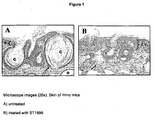
- Figure 1 shows the effects topical treatment with ST1898 (Formulation 1) on the skin of rhino mice.
- This treatment had a very marked effect on the reduction in the number, dimensions and horny content of the utriculi/pseudocomedones, as well as on the morphology of the sebaceous glands, which became more atrophic (arrows in figure).
- the hyperplasia of the epidermis (B) compared with the untreated mice was also particularly clear (A).
- the skin of the treated rhino mice manifested a defect in the catagenic phase of the hair follicle, which involved the complete loss of the hair by the sixth week of life and the development of the so-called utriculi/pseudocomedones (C in Fig. 1 ), which represented models of open comedones histologically similar to the "retentional" acne lesions.
- the skin of rhino mice was also characterised by atrophy of the sebaceous glands (arrows in Fig. 1 ) and by the presence of cysts in the deep portion of the dermis (asterisk in Fig. 1 only partly visible as the images only show the most supeficial portion of the skin).
- lecithin soya seed extract (Epikuron 200 TM )
- isopropyl palmitate ascorbic acid
- ammonium molybdate iodine crystals
- tetramethylammonium phosphate decolourising carbon and sodium dehydrogen phosphate.
- chloroform methylene chloride, methanol, ethanol, dimethylsulphoxide (DMSO) and an aqueous solution of ammonia (30%).
- DMSO dimethylsulphoxide
- the reference lipid POPC (1-palmitoyl-2-oleoyl- sn -glycero-3-phosphatidyl choline) was acquired from Avanti Polar Lipids (Canada) and used without further purification.
- the gel was formed when the water was completely dispersed in the organic phase, a phenomenon generally dependent on the concentration of lecithin, on the magnetic agitation and of the nature of the solvent used. Under the conditions used in this study, the gelification of the lecithin/IPP solution took place at intervals of time which ranged from a few seconds to a few minutes.
- V H 2 ⁇ O mL m EP ⁇ 200 g 760 ⁇ 18 ⁇ w 0
- V H 2 O represents the volume of water to be added (in ml)
- m EP200 is the quantity of Epikuron 200 lecithin (in g)
- w 0 is the desired molar ratio of water and lecithin (see eq. 1).
- UV-Vis spectrophotometry was used to characterise the retinoid ST1898 quantitatively both dissolved in the solvent DMSO and incorporated in the lecithin/IPP gel phase, using a diode array spectrophotometer (Agilent HP8452A), with a resolution of 2 nm, using 1 cm quartz cuvettes. Transferring the organogel containing the retinoid ST1898 to the cuvette required raising the temperature (approx. 60°C), given the high viscosity of the material, followed by cooling to carry out the analysis.
- HPLC analysis of retinoid ST1898 both dissolved in DMSO and incorporated in the gel phase was carried out with HPLC HP1050 apparatus (Agilent), provided with a UV-Vis diode array detector and HP ChemStation software.
- the procedure for the quantitative analysis of the drug involves isocratic elution (methanol/water, in the volume ratio 80/20, with 0.2% of TFA) on a Reverse Phase Nucleosyl C18 column, 3 ⁇ m (particle dimensions), 125 x 4 mm; flow 1.5 ml/min; injected volume equal to 5 ⁇ l (under these conditions a stationary pressure of approx. 140 bar was recorded).
- Detection was by spectrophotometry, using absorbance (330 nm). Typical conditions are the injection of 5 ⁇ l of solutions of ST1898 in DMSO. The retention time observed was equal to approx. 8 minutes.
- the rhino mouse ( hr rh hr rh ) is an allele of the hairless mouse and is an experimental animal model for non-inflammatory acne.
- a fault in the catagen phase results in a premature and irreversible hair loss at the age of 4 weeks.
- the follicle fails to reconstruct itself. Instead, the lower part of the original follicular unit develops into horn-producing cysts which become permanently situated in the deep dermis and enlarge as the animal ages. Meanwhile, the original pilary canals (upper part of the original follicular unit) transform into ampulliform cavities or utriculi.
- utriculi are filled with horny cells and sebum and progressively enlarge due to the production and accumulation of horny material. Histologically, they resemble typical retentional acneic lesions or comedones. However, they are not visible to the naked eye and can not be squeezed out between the fingers. As in human acne, the sebaceous glands progressively shrink as the utriculi form and enlarge. Finally, the skin of the rhino mouse appears sagging and redundant, due to a paucity of elastic fibers. Therefore, the skin of adult rhino mice is characterized by the utricoli that are derived from the infundibular zone of the original follicular units. These are histologically similar to retentional acne lesions, i. e. microcomedones. Rhino mice have, therefore, been used over the last 30 years in in vivo protocols aimed at testing the comedolytic activity of new drugs, topically and to a lesser extent istically administered, for the treatment of acne.
- the most widely used technique in the screening of topical comedolytic agents for evaluation and measurement of their comedolytic activity is quantitative histological image analysis of rhino mouse skin sections from a skin biopsy obtained at the end of a three week treatment period.
- Several microscopic measurements allow to calculate the following parameters: the total number of epidermal utriculi (comedones) per centimetre of stratum corneum length, the comedo profile which gives a measure of the morphological aspect of the comedo (i. e. ampulliform versus narrow), and the epidermal thickness.
- male rhino mice (RHJ/LeJ), (batch No. 2004256 born on 28/07/2004) and female rhino mice (batch No. 2004257, 8 born on 11/08/2004 and 7 born on 21/07/2004), 5-6 weeks of age with a body weight of 18-22 g at the beginning of the experiment supplied by Charles River Italy S.p.A., housed in makrolon cages (26.7 x 20.7 x 14 cm, in size); one rat to each cage, with a plastic cover with a filter and with a grill on a litter of sterile sawdust.
- the animals were housed in 12 hour light/dark cycles (7.00-19.00: light).
- the parameters of the animal room were set as follows: temperature 22 ⁇ 2 °C, relative humidity equal to 55 ⁇ 15%, air filters changed every 15-20 hours.
- the animal housing employee transferred the mice from the boxes to the cages at random. Each cage was then labelled with a card identifying the type of treatment (substance used, dose, route of administration and identification number of the animal).
- the animals were treated by the topical application to the back for 45 sec. of the compounds examined dosed using a 50 ⁇ l volume micropipette, once a day for 5 consecutive days per week, for a period of 3 weeks (at the Sigma-Tau laboratories).
- the animals were accurately observed, paying particular attention both to the behaviour and to the local and general signs, every day, before and after treatment, checking and recording any deaths. In addition all the animals were weighed before each treatment with the compounds under examination and with the vehicle.
- Biopsies were taken using 6 mm punches of the area treated, fixed in 10% buffered formalin and included in paraffin (fixing and passing through 70% ethanol at the Sigma-Tau laboratories, inclusion in paraffin at the BMC Laboratory, IDI). 3 sections were obtained from each biopsy, 3 ⁇ m thick and 150 ⁇ m apart and stained with hematoxylin-eosin stain.
- the in vivo model used in this research project is the rhino mouse ( hr rh hr rh ), which is allelic to the mouse without hair ( hr hr hr hr ) and represents an experimental animal model for non-inflammatory acne.
- This model has been used for over twenty years to evaluate the therapeutic efficacy, in particular comedolytic efficacy, of anti-acne compounds applied topically and also administered systemically.
- the rhino mice manifested various skin changes, including a defect in the catagenic phase of the hair follicle which involved the complete loss of the hair by the sixth week of life and the development of the so-called utriculi/pseudocomedones (C in Fig.
- ST1898 (Formulation 1) applied topically, had pharmacologically useful characteristics for treating acne, with a comedolytic and anti-inflammatory effect and leading to a reduction in the number of comedones. ST1898 therefore acted as a modulator of the cell differentiation processes of keratinisation and inflammation which in acne pathology are greatly changed ( Fig. 1 ).
- r The parameter directly correlated to the comedolytic effect of a drug following topical treatment of acne is r (Tab. 1) ( Mezick, et al, 1984 J. Am. Acad. Dermatol. 11, 902-4 ;; Bouclier, et al., 1991 Skin Pharmacol. 4, 65-73 ): if r is equal to or greater than 1, the compound under examination has a comedolytic effect demonstrated by the reduction in the number of typical acne lesions.
- mice (Charles River Italy S.p.A. for the Jackson Laboratory) were housed inside cages of makrolon ( 26.7 x 20.7 x 14 cm ) (1 mouse/cage) with grating cover of steel and bedstead of sawdust of pulverized and sterilized dust-free bedding cobs. Animals were housed under a light-dark cycle, keeping temperature and humidity constant. Parameters of the animal rooms were assessed as follows: 22 ⁇ 2 °C temperature, 55 ⁇ 15% relative humidity, about 15-20 filtered air changes/hour and 12 hour circadian cycle of artificial light (7 a.m., 7 p.m.). The environmental conditions were monitored; the data were retained in Animal Housing Archives.
- Drinking water was supplied ad libitum. Each mouse was offered daily a complete pellet diet (GLP 4RF21, Mucedola) throughout the study. The analytical certificates of animal food and water were retained at Sigma-Tau premises.
- mice (Jackson Laboratory), 15 male and 15 female (6-8 weeks of age) were subdivided in 6 mice/group.
- Two groups were treated with ST1898 (Formulation 2) (0.1% and 0.05% in the vehicle), a group with adapalene (Differin ® gel), used as reference compound (0.1 %), a group with the vehicle (the same of the formulation of Differin ® gel: carbomer 980, propylene glycol, poloxamer, disodium edentate, methyl hydroxybenzoate, phenoxyethanol, sodium hydroxide and purified water).
- Differin ® gel the same of the formulation of Differin ® gel: carbomer 980, propylene glycol, poloxamer, disodium edentate, methyl hydroxybenzoate, phenoxyethanol, sodium hydroxide and purified water.
- mice were sacrificed by cervical dislocation. Two skin punch biopsies (6 mm) were taken immediately after death from all sacrificed animals. The biopsies were formalin-fixed (10% buffered formalin solution) and paraffin-embedded.
- Quantitative histological image analysis was evaluated as the total number of epidermal utriculi (comedones) per centimetre of stratum corneum length, the comedo profile, and the epidermal thickness. From one biopsy, three 3- ⁇ m thick skin sections were obtained at 150 ⁇ m intervals and were stained with hematoxylin-eosin. The second biopsy was kept stored for records.
- a topical application on the dorsal skin was performed of 50 ⁇ l applied with a gloved finger. The treatment was done once daily for 5 consecutive days/week (excluding Saturdays and Sundays) for 3 consecutive weeks.
- mice During the treatment, the body weight of mice was recorded to control the healthy status of mice. No signficative variation in body weight was found (table 2).
- the epidermal thickness was significantly increased in ST1898 0.1%-, ST1898 0.05%- and adapalene-treated mice with respect to both groups of control mice (p value ⁇ 0.0005). Untreated and vehicle-treated mice showed comparable values. The thickness of the epidermis was higher in ST1898 0.05%-treated mice as compared to mice treated with 0.1 % ST1898 (p value ⁇ 0.05) or adapalene (p value ⁇ 0.005). Adapalene-treated mice showed a significantly thicker epidermis when compared with mice treated with 0.1% ST1898 (p value ⁇ 0.05).
- ST1898 exerted a similar effect to that elicited by the reference compound, adapalene, on both comedo number and profile, when administered at the same concentration (0.1%).
- ST1898 was dose-related, being 0.05% ST1898 less effective than 0.1% ST1898 in reducing the number of comedones and in inducing epidermal hyperplasia.
- the vehicle used for ST1898 was the same of Differin gel (carbomer 980, propylene glycol, poloxamer, disodium edentate, methyl hydroxybenzoate, phenoxyethanol, sodium hydroxide and purified water). *One mouse was excluded from the study before starting the treatment for the low body weight.
Landscapes
- Health & Medical Sciences (AREA)
- Life Sciences & Earth Sciences (AREA)
- Animal Behavior & Ethology (AREA)
- General Health & Medical Sciences (AREA)
- Public Health (AREA)
- Veterinary Medicine (AREA)
- Chemical & Material Sciences (AREA)
- Epidemiology (AREA)
- Pharmacology & Pharmacy (AREA)
- Medicinal Chemistry (AREA)
- Dermatology (AREA)
- Engineering & Computer Science (AREA)
- Chemical Kinetics & Catalysis (AREA)
- General Chemical & Material Sciences (AREA)
- Emergency Medicine (AREA)
- Birds (AREA)
- Organic Chemistry (AREA)
- Bioinformatics & Cheminformatics (AREA)
- Nuclear Medicine, Radiotherapy & Molecular Imaging (AREA)
- Biophysics (AREA)
- Molecular Biology (AREA)
- Oil, Petroleum & Natural Gas (AREA)
- Acyclic And Carbocyclic Compounds In Medicinal Compositions (AREA)
- Cosmetics (AREA)
- Medicinal Preparation (AREA)
Applications Claiming Priority (2)
| Application Number | Priority Date | Filing Date | Title |
|---|---|---|---|
| IT000248A ITRM20050248A1 (it) | 2005-05-20 | 2005-05-20 | Uso acido adamantil metossidifenil propenoico per il trattamento di patologie cutanee. |
| PCT/EP2006/062088 WO2006122883A1 (en) | 2005-05-20 | 2006-05-05 | Use of adamantyl methoxydi phenyl propenoic acid for the treatment of acne |
Publications (2)
| Publication Number | Publication Date |
|---|---|
| EP1890671A1 EP1890671A1 (en) | 2008-02-27 |
| EP1890671B1 true EP1890671B1 (en) | 2014-03-05 |
Family
ID=36646157
Family Applications (1)
| Application Number | Title | Priority Date | Filing Date |
|---|---|---|---|
| EP06755041.8A Active EP1890671B1 (en) | 2005-05-20 | 2006-05-05 | Use of adamantyl-methoxydiphenyl-propenoic acid for the topical treatment of acne |
Country Status (13)
| Country | Link |
|---|---|
| US (1) | US7635719B2 (enExample) |
| EP (1) | EP1890671B1 (enExample) |
| JP (1) | JP5072833B2 (enExample) |
| KR (1) | KR101307910B1 (enExample) |
| CN (1) | CN101180028B (enExample) |
| AR (1) | AR054361A1 (enExample) |
| AU (1) | AU2006248981B2 (enExample) |
| BR (1) | BRPI0611289A2 (enExample) |
| CA (1) | CA2606567A1 (enExample) |
| IT (1) | ITRM20050248A1 (enExample) |
| MX (1) | MX2007014222A (enExample) |
| TW (1) | TWI365753B (enExample) |
| WO (1) | WO2006122883A1 (enExample) |
Families Citing this family (4)
| Publication number | Priority date | Publication date | Assignee | Title |
|---|---|---|---|---|
| JP5109383B2 (ja) * | 2007-01-31 | 2012-12-26 | 大正製薬株式会社 | アダパレン含有外用剤組成物 |
| JP2009137874A (ja) * | 2007-12-05 | 2009-06-25 | Authele:Kk | ビタミンC(Ascorbicacid)を含有するレシチンゲルおよびその製造方法 |
| TW201031402A (en) * | 2008-12-24 | 2010-09-01 | Sigma Tau Ind Farmaceuti | New retinoid derivatives endowed with cytotoxic and/or antiangiogenic properties |
| EP3301085A1 (en) * | 2016-09-29 | 2018-04-04 | Biogem S.Ca.R.L. | Retinoid derivatives with antitumor activity |
Family Cites Families (5)
| Publication number | Priority date | Publication date | Assignee | Title |
|---|---|---|---|---|
| US6071923A (en) * | 1994-09-16 | 2000-06-06 | Bar-Ilan University | Retinoyloxy aryl-substituted alkylene butyrates useful for the treatment of cancer and other proliferative diseases |
| FR2752734B1 (fr) * | 1996-09-02 | 1998-11-06 | Cird Galderma | Utilisation de retinoides pour la preparation d'un medicament destine a traiter les affections liees a une surexpression de vegf |
| US5994330A (en) * | 1998-11-09 | 1999-11-30 | El Khoury; Georges F. | Topical application of muscarinic agents such as neostigmine for treatment of acne and other inflammatory conditions |
| ITRM20010464A1 (it) | 2001-07-31 | 2003-01-31 | Sigma Tau Ind Farmaceuti | Derivati retinoidi ad attivita' antiangiogenica, antitumorale e pro-apoptotica. |
| MXPA04008684A (es) * | 2002-03-12 | 2004-12-06 | Galderma Res & Dev | Uso de adapaleno para tratamiento de trastornos dermatologicos. |
-
2005
- 2005-05-20 IT IT000248A patent/ITRM20050248A1/it unknown
-
2006
- 2006-05-03 TW TW095115754A patent/TWI365753B/zh not_active IP Right Cessation
- 2006-05-05 EP EP06755041.8A patent/EP1890671B1/en active Active
- 2006-05-05 CN CN2006800175175A patent/CN101180028B/zh not_active Expired - Fee Related
- 2006-05-05 MX MX2007014222A patent/MX2007014222A/es active IP Right Grant
- 2006-05-05 KR KR1020077027137A patent/KR101307910B1/ko not_active Expired - Fee Related
- 2006-05-05 JP JP2008511670A patent/JP5072833B2/ja not_active Expired - Fee Related
- 2006-05-05 WO PCT/EP2006/062088 patent/WO2006122883A1/en not_active Ceased
- 2006-05-05 AU AU2006248981A patent/AU2006248981B2/en not_active Ceased
- 2006-05-05 CA CA002606567A patent/CA2606567A1/en not_active Abandoned
- 2006-05-05 US US11/911,749 patent/US7635719B2/en not_active Expired - Fee Related
- 2006-05-05 BR BRPI0611289-7A patent/BRPI0611289A2/pt not_active IP Right Cessation
- 2006-05-17 AR ARP060101983A patent/AR054361A1/es not_active Application Discontinuation
Also Published As
| Publication number | Publication date |
|---|---|
| EP1890671A1 (en) | 2008-02-27 |
| KR101307910B1 (ko) | 2013-09-16 |
| TWI365753B (en) | 2012-06-11 |
| WO2006122883A1 (en) | 2006-11-23 |
| CN101180028A (zh) | 2008-05-14 |
| ITRM20050248A1 (it) | 2006-11-21 |
| TW200716192A (en) | 2007-05-01 |
| AU2006248981A1 (en) | 2006-11-23 |
| MX2007014222A (es) | 2008-02-07 |
| WO2006122883A9 (en) | 2012-10-04 |
| BRPI0611289A2 (pt) | 2010-08-31 |
| CA2606567A1 (en) | 2006-11-23 |
| US20080153916A1 (en) | 2008-06-26 |
| AU2006248981B2 (en) | 2011-06-02 |
| KR20080016573A (ko) | 2008-02-21 |
| US7635719B2 (en) | 2009-12-22 |
| JP2008540603A (ja) | 2008-11-20 |
| CN101180028B (zh) | 2010-12-08 |
| JP5072833B2 (ja) | 2012-11-14 |
| HK1117737A1 (en) | 2009-01-23 |
| AR054361A1 (es) | 2007-06-20 |
Similar Documents
| Publication | Publication Date | Title |
|---|---|---|
| Vasam et al. | Acne vulgaris: A review of the pathophysiology, treatment, and recent nanotechnology based advances | |
| KR20180036580A (ko) | 수가용화(水加溶化)된 우르소데옥시콜산을 함유하는 염증성 피부질환 또는 중증 소양증 예방 또는 치료용 조성물 | |
| HK59493A (en) | Dermatological, pharmaceutical or cosmetic composition consisting of hydrated lipid lamellar phases or liposomes and containing retinoids or analogues such as carotenoids | |
| KR102632946B1 (ko) | 노화 방지 및 피부 톤 미백 조성물 및 이를 위한 방법 | |
| Yang et al. | Seeking new acne treatment from natural products, devices and synthetic drug discovery | |
| HK1223297A1 (en) | Topical retinoid solutions | |
| EP1890671B1 (en) | Use of adamantyl-methoxydiphenyl-propenoic acid for the topical treatment of acne | |
| Runnsjö et al. | A novel microparticle based formulation for topical delivery of FOL-005, a small peptide | |
| RU2450836C1 (ru) | Комбинированная мазевая композиция для уменьшения интенсивности локальной гиперпигментации кожи | |
| Guleria et al. | Decoding acne vulgaris: Insights into pathogenesis, treatment modalities, diagnosis and recent advancements | |
| JP2024516652A (ja) | 過酸化ベンゾイルおよびアゼライン酸を含む外用剤およびその使用 | |
| WO2021076722A1 (en) | Compositions and methods of treating acne and photoaging | |
| HK1117737B (en) | Use of adamantyl methoxydi phenyl propenoic acid for the treatment of acne | |
| US10022348B2 (en) | Topical solution of isotretinoin | |
| Naudé | Formulation, in vitro release and transdermal diffusion of Vitamin A and Zinc for the treatment of acne | |
| Berardesca | Retinoids | |
| WO2021189077A1 (en) | Methods for treating acne | |
| White et al. | Pharmacology of salicylic acid (SA) in acne vulgaris Otto Mills, PhD, Robert Wood Johnson Medical School, New Brunswick, NJ, United States; Donald Adler, DO, private practice, Doylestown, PA, United States; Robert Verdicchio, PhD, Verdi Enterprise, Succasunna, NJ The role of SA is acne treatment is dependent upon several pharmacological actions | |
| Cunliffe | Vitamin a in Dermatology | |
| Sharma | Topical approach expresses high level of potential in Acne |
Legal Events
| Date | Code | Title | Description |
|---|---|---|---|
| PUAI | Public reference made under article 153(3) epc to a published international application that has entered the european phase |
Free format text: ORIGINAL CODE: 0009012 |
|
| 17P | Request for examination filed |
Effective date: 20071115 |
|
| AK | Designated contracting states |
Kind code of ref document: A1 Designated state(s): AT BE BG CH CY CZ DE DK EE ES FI FR GB GR HU IE IS IT LI LT LU LV MC NL PL PT RO SE SI SK TR |
|
| AX | Request for extension of the european patent |
Extension state: AL BA HR MK YU |
|
| 17Q | First examination report despatched |
Effective date: 20120911 |
|
| GRAP | Despatch of communication of intention to grant a patent |
Free format text: ORIGINAL CODE: EPIDOSNIGR1 |
|
| RIC1 | Information provided on ipc code assigned before grant |
Ipc: A61K 8/36 20060101AFI20130829BHEP Ipc: A61K 9/08 20060101ALI20130829BHEP Ipc: A61Q 19/00 20060101ALI20130829BHEP Ipc: A61P 17/10 20060101ALI20130829BHEP Ipc: A61K 31/192 20060101ALI20130829BHEP |
|
| INTG | Intention to grant announced |
Effective date: 20131002 |
|
| GRAS | Grant fee paid |
Free format text: ORIGINAL CODE: EPIDOSNIGR3 |
|
| GRAA | (expected) grant |
Free format text: ORIGINAL CODE: 0009210 |
|
| AK | Designated contracting states |
Kind code of ref document: B1 Designated state(s): AT BE BG CH CY CZ DE DK EE ES FI FR GB GR HU IE IS IT LI LT LU LV MC NL PL PT RO SE SI SK TR |
|
| AX | Request for extension of the european patent |
Extension state: AL BA HR MK YU |
|
| REG | Reference to a national code |
Ref country code: GB Ref legal event code: FG4D |
|
| REG | Reference to a national code |
Ref country code: CH Ref legal event code: EP |
|
| REG | Reference to a national code |
Ref country code: AT Ref legal event code: REF Ref document number: 654357 Country of ref document: AT Kind code of ref document: T Effective date: 20140315 |
|
| REG | Reference to a national code |
Ref country code: IE Ref legal event code: FG4D |
|
| REG | Reference to a national code |
Ref country code: DE Ref legal event code: R096 Ref document number: 602006040501 Country of ref document: DE Effective date: 20140417 |
|
| REG | Reference to a national code |
Ref country code: AT Ref legal event code: MK05 Ref document number: 654357 Country of ref document: AT Kind code of ref document: T Effective date: 20140305 |
|
| REG | Reference to a national code |
Ref country code: NL Ref legal event code: VDEP Effective date: 20140305 |
|
| PG25 | Lapsed in a contracting state [announced via postgrant information from national office to epo] |
Ref country code: LT Free format text: LAPSE BECAUSE OF FAILURE TO SUBMIT A TRANSLATION OF THE DESCRIPTION OR TO PAY THE FEE WITHIN THE PRESCRIBED TIME-LIMIT Effective date: 20140305 |
|
| REG | Reference to a national code |
Ref country code: LT Ref legal event code: MG4D |
|
| PG25 | Lapsed in a contracting state [announced via postgrant information from national office to epo] |
Ref country code: FI Free format text: LAPSE BECAUSE OF FAILURE TO SUBMIT A TRANSLATION OF THE DESCRIPTION OR TO PAY THE FEE WITHIN THE PRESCRIBED TIME-LIMIT Effective date: 20140305 Ref country code: SE Free format text: LAPSE BECAUSE OF FAILURE TO SUBMIT A TRANSLATION OF THE DESCRIPTION OR TO PAY THE FEE WITHIN THE PRESCRIBED TIME-LIMIT Effective date: 20140305 Ref country code: CY Free format text: LAPSE BECAUSE OF FAILURE TO SUBMIT A TRANSLATION OF THE DESCRIPTION OR TO PAY THE FEE WITHIN THE PRESCRIBED TIME-LIMIT Effective date: 20140305 Ref country code: AT Free format text: LAPSE BECAUSE OF FAILURE TO SUBMIT A TRANSLATION OF THE DESCRIPTION OR TO PAY THE FEE WITHIN THE PRESCRIBED TIME-LIMIT Effective date: 20140305 |
|
| PG25 | Lapsed in a contracting state [announced via postgrant information from national office to epo] |
Ref country code: LV Free format text: LAPSE BECAUSE OF FAILURE TO SUBMIT A TRANSLATION OF THE DESCRIPTION OR TO PAY THE FEE WITHIN THE PRESCRIBED TIME-LIMIT Effective date: 20140305 |
|
| PG25 | Lapsed in a contracting state [announced via postgrant information from national office to epo] |
Ref country code: BG Free format text: LAPSE BECAUSE OF FAILURE TO SUBMIT A TRANSLATION OF THE DESCRIPTION OR TO PAY THE FEE WITHIN THE PRESCRIBED TIME-LIMIT Effective date: 20140605 Ref country code: RO Free format text: LAPSE BECAUSE OF FAILURE TO SUBMIT A TRANSLATION OF THE DESCRIPTION OR TO PAY THE FEE WITHIN THE PRESCRIBED TIME-LIMIT Effective date: 20140305 Ref country code: EE Free format text: LAPSE BECAUSE OF FAILURE TO SUBMIT A TRANSLATION OF THE DESCRIPTION OR TO PAY THE FEE WITHIN THE PRESCRIBED TIME-LIMIT Effective date: 20140305 Ref country code: IS Free format text: LAPSE BECAUSE OF FAILURE TO SUBMIT A TRANSLATION OF THE DESCRIPTION OR TO PAY THE FEE WITHIN THE PRESCRIBED TIME-LIMIT Effective date: 20140705 Ref country code: CZ Free format text: LAPSE BECAUSE OF FAILURE TO SUBMIT A TRANSLATION OF THE DESCRIPTION OR TO PAY THE FEE WITHIN THE PRESCRIBED TIME-LIMIT Effective date: 20140305 Ref country code: BE Free format text: LAPSE BECAUSE OF FAILURE TO SUBMIT A TRANSLATION OF THE DESCRIPTION OR TO PAY THE FEE WITHIN THE PRESCRIBED TIME-LIMIT Effective date: 20140305 Ref country code: NL Free format text: LAPSE BECAUSE OF FAILURE TO SUBMIT A TRANSLATION OF THE DESCRIPTION OR TO PAY THE FEE WITHIN THE PRESCRIBED TIME-LIMIT Effective date: 20140305 |
|
| PG25 | Lapsed in a contracting state [announced via postgrant information from national office to epo] |
Ref country code: SK Free format text: LAPSE BECAUSE OF FAILURE TO SUBMIT A TRANSLATION OF THE DESCRIPTION OR TO PAY THE FEE WITHIN THE PRESCRIBED TIME-LIMIT Effective date: 20140305 Ref country code: ES Free format text: LAPSE BECAUSE OF FAILURE TO SUBMIT A TRANSLATION OF THE DESCRIPTION OR TO PAY THE FEE WITHIN THE PRESCRIBED TIME-LIMIT Effective date: 20140305 Ref country code: PL Free format text: LAPSE BECAUSE OF FAILURE TO SUBMIT A TRANSLATION OF THE DESCRIPTION OR TO PAY THE FEE WITHIN THE PRESCRIBED TIME-LIMIT Effective date: 20140305 |
|
| REG | Reference to a national code |
Ref country code: DE Ref legal event code: R119 Ref document number: 602006040501 Country of ref document: DE |
|
| PG25 | Lapsed in a contracting state [announced via postgrant information from national office to epo] |
Ref country code: PT Free format text: LAPSE BECAUSE OF FAILURE TO SUBMIT A TRANSLATION OF THE DESCRIPTION OR TO PAY THE FEE WITHIN THE PRESCRIBED TIME-LIMIT Effective date: 20140707 Ref country code: LU Free format text: LAPSE BECAUSE OF FAILURE TO SUBMIT A TRANSLATION OF THE DESCRIPTION OR TO PAY THE FEE WITHIN THE PRESCRIBED TIME-LIMIT Effective date: 20140505 |
|
| REG | Reference to a national code |
Ref country code: CH Ref legal event code: PL |
|
| PLBE | No opposition filed within time limit |
Free format text: ORIGINAL CODE: 0009261 |
|
| STAA | Information on the status of an ep patent application or granted ep patent |
Free format text: STATUS: NO OPPOSITION FILED WITHIN TIME LIMIT |
|
| PG25 | Lapsed in a contracting state [announced via postgrant information from national office to epo] |
Ref country code: DK Free format text: LAPSE BECAUSE OF FAILURE TO SUBMIT A TRANSLATION OF THE DESCRIPTION OR TO PAY THE FEE WITHIN THE PRESCRIBED TIME-LIMIT Effective date: 20140305 Ref country code: LI Free format text: LAPSE BECAUSE OF NON-PAYMENT OF DUE FEES Effective date: 20140531 Ref country code: MC Free format text: LAPSE BECAUSE OF FAILURE TO SUBMIT A TRANSLATION OF THE DESCRIPTION OR TO PAY THE FEE WITHIN THE PRESCRIBED TIME-LIMIT Effective date: 20140305 Ref country code: CH Free format text: LAPSE BECAUSE OF NON-PAYMENT OF DUE FEES Effective date: 20140531 |
|
| 26N | No opposition filed |
Effective date: 20141208 |
|
| GBPC | Gb: european patent ceased through non-payment of renewal fee |
Effective date: 20140605 |
|
| REG | Reference to a national code |
Ref country code: IE Ref legal event code: MM4A |
|
| REG | Reference to a national code |
Ref country code: FR Ref legal event code: ST Effective date: 20150130 |
|
| REG | Reference to a national code |
Ref country code: DE Ref legal event code: R119 Ref document number: 602006040501 Country of ref document: DE Effective date: 20141202 |
|
| PG25 | Lapsed in a contracting state [announced via postgrant information from national office to epo] |
Ref country code: IT Free format text: LAPSE BECAUSE OF FAILURE TO SUBMIT A TRANSLATION OF THE DESCRIPTION OR TO PAY THE FEE WITHIN THE PRESCRIBED TIME-LIMIT Effective date: 20140305 |
|
| PG25 | Lapsed in a contracting state [announced via postgrant information from national office to epo] |
Ref country code: IE Free format text: LAPSE BECAUSE OF NON-PAYMENT OF DUE FEES Effective date: 20140505 Ref country code: DE Free format text: LAPSE BECAUSE OF NON-PAYMENT OF DUE FEES Effective date: 20141202 |
|
| PG25 | Lapsed in a contracting state [announced via postgrant information from national office to epo] |
Ref country code: GB Free format text: LAPSE BECAUSE OF NON-PAYMENT OF DUE FEES Effective date: 20140605 Ref country code: FR Free format text: LAPSE BECAUSE OF NON-PAYMENT OF DUE FEES Effective date: 20140602 Ref country code: SI Free format text: LAPSE BECAUSE OF FAILURE TO SUBMIT A TRANSLATION OF THE DESCRIPTION OR TO PAY THE FEE WITHIN THE PRESCRIBED TIME-LIMIT Effective date: 20140305 |
|
| PG25 | Lapsed in a contracting state [announced via postgrant information from national office to epo] |
Ref country code: GR Free format text: LAPSE BECAUSE OF FAILURE TO SUBMIT A TRANSLATION OF THE DESCRIPTION OR TO PAY THE FEE WITHIN THE PRESCRIBED TIME-LIMIT Effective date: 20140606 |
|
| PG25 | Lapsed in a contracting state [announced via postgrant information from national office to epo] |
Ref country code: TR Free format text: LAPSE BECAUSE OF FAILURE TO SUBMIT A TRANSLATION OF THE DESCRIPTION OR TO PAY THE FEE WITHIN THE PRESCRIBED TIME-LIMIT Effective date: 20140305 Ref country code: HU Free format text: LAPSE BECAUSE OF FAILURE TO SUBMIT A TRANSLATION OF THE DESCRIPTION OR TO PAY THE FEE WITHIN THE PRESCRIBED TIME-LIMIT; INVALID AB INITIO Effective date: 20060505 |