EP1882278B1 - Procede de preparation d'une anode pour batterie a ion-lithium. - Google Patents
Procede de preparation d'une anode pour batterie a ion-lithium. Download PDFInfo
- Publication number
- EP1882278B1 EP1882278B1 EP06755488A EP06755488A EP1882278B1 EP 1882278 B1 EP1882278 B1 EP 1882278B1 EP 06755488 A EP06755488 A EP 06755488A EP 06755488 A EP06755488 A EP 06755488A EP 1882278 B1 EP1882278 B1 EP 1882278B1
- Authority
- EP
- European Patent Office
- Prior art keywords
- foam
- anode
- metal
- lithium
- current collector
- Prior art date
- Legal status (The legal status is an assumption and is not a legal conclusion. Google has not performed a legal analysis and makes no representation as to the accuracy of the status listed.)
- Not-in-force
Links
- 229910001416 lithium ion Inorganic materials 0.000 title claims abstract description 32
- HBBGRARXTFLTSG-UHFFFAOYSA-N Lithium ion Chemical compound [Li+] HBBGRARXTFLTSG-UHFFFAOYSA-N 0.000 title claims abstract description 18
- 238000004519 manufacturing process Methods 0.000 title claims abstract description 4
- 239000006260 foam Substances 0.000 claims abstract description 53
- 239000011149 active material Substances 0.000 claims abstract description 29
- OAICVXFJPJFONN-UHFFFAOYSA-N Phosphorus Chemical compound [P] OAICVXFJPJFONN-UHFFFAOYSA-N 0.000 claims abstract description 25
- 229910052698 phosphorus Inorganic materials 0.000 claims abstract description 25
- 239000011574 phosphorus Substances 0.000 claims abstract description 25
- 238000000034 method Methods 0.000 claims abstract description 23
- 229910052751 metal Inorganic materials 0.000 claims abstract description 22
- 239000002184 metal Substances 0.000 claims abstract description 22
- 229910052723 transition metal Inorganic materials 0.000 claims abstract description 14
- 150000003624 transition metals Chemical class 0.000 claims abstract description 14
- PXHVJJICTQNCMI-UHFFFAOYSA-N Nickel Chemical group [Ni] PXHVJJICTQNCMI-UHFFFAOYSA-N 0.000 claims description 45
- 238000006243 chemical reaction Methods 0.000 claims description 22
- 229910052759 nickel Inorganic materials 0.000 claims description 21
- WHXSMMKQMYFTQS-UHFFFAOYSA-N Lithium Chemical compound [Li] WHXSMMKQMYFTQS-UHFFFAOYSA-N 0.000 claims description 14
- 229910052744 lithium Inorganic materials 0.000 claims description 13
- 239000010949 copper Substances 0.000 claims description 12
- 239000000463 material Substances 0.000 claims description 12
- XEEYBQQBJWHFJM-UHFFFAOYSA-N Iron Chemical group [Fe] XEEYBQQBJWHFJM-UHFFFAOYSA-N 0.000 claims description 11
- 239000006262 metallic foam Substances 0.000 claims description 11
- RYGMFSIKBFXOCR-UHFFFAOYSA-N Copper Chemical group [Cu] RYGMFSIKBFXOCR-UHFFFAOYSA-N 0.000 claims description 10
- 229910052802 copper Inorganic materials 0.000 claims description 10
- 239000000203 mixture Substances 0.000 claims description 8
- 239000003792 electrolyte Substances 0.000 claims description 6
- 239000002904 solvent Substances 0.000 claims description 6
- 229910052742 iron Inorganic materials 0.000 claims description 5
- 229910052720 vanadium Inorganic materials 0.000 claims description 5
- RTAQQCXQSZGOHL-UHFFFAOYSA-N Titanium Chemical group [Ti] RTAQQCXQSZGOHL-UHFFFAOYSA-N 0.000 claims description 4
- 229910003002 lithium salt Inorganic materials 0.000 claims description 4
- 159000000002 lithium salts Chemical class 0.000 claims description 4
- 229910052719 titanium Inorganic materials 0.000 claims description 4
- 239000010936 titanium Substances 0.000 claims description 4
- LEONUFNNVUYDNQ-UHFFFAOYSA-N vanadium atom Chemical group [V] LEONUFNNVUYDNQ-UHFFFAOYSA-N 0.000 claims description 4
- 239000011261 inert gas Substances 0.000 claims description 2
- 238000003780 insertion Methods 0.000 description 10
- 230000037431 insertion Effects 0.000 description 10
- 239000011148 porous material Substances 0.000 description 9
- OKTJSMMVPCPJKN-UHFFFAOYSA-N Carbon Chemical compound [C] OKTJSMMVPCPJKN-UHFFFAOYSA-N 0.000 description 7
- KMTRUDSVKNLOMY-UHFFFAOYSA-N Ethylene carbonate Chemical compound O=C1OCCO1 KMTRUDSVKNLOMY-UHFFFAOYSA-N 0.000 description 6
- 229910052799 carbon Inorganic materials 0.000 description 6
- 150000001875 compounds Chemical class 0.000 description 6
- 238000000133 mechanosynthesis reaction Methods 0.000 description 6
- VYPSYNLAJGMNEJ-UHFFFAOYSA-N Silicium dioxide Chemical compound O=[Si]=O VYPSYNLAJGMNEJ-UHFFFAOYSA-N 0.000 description 4
- 230000001351 cycling effect Effects 0.000 description 4
- IEJIGPNLZYLLBP-UHFFFAOYSA-N dimethyl carbonate Chemical compound COC(=O)OC IEJIGPNLZYLLBP-UHFFFAOYSA-N 0.000 description 4
- 238000005259 measurement Methods 0.000 description 4
- WEVYAHXRMPXWCK-UHFFFAOYSA-N Acetonitrile Chemical compound CC#N WEVYAHXRMPXWCK-UHFFFAOYSA-N 0.000 description 3
- RTZKZFJDLAIYFH-UHFFFAOYSA-N Diethyl ether Chemical compound CCOCC RTZKZFJDLAIYFH-UHFFFAOYSA-N 0.000 description 3
- ZMXDDKWLCZADIW-UHFFFAOYSA-N N,N-Dimethylformamide Chemical compound CN(C)C=O ZMXDDKWLCZADIW-UHFFFAOYSA-N 0.000 description 3
- JFDZBHWFFUWGJE-UHFFFAOYSA-N benzonitrile Chemical compound N#CC1=CC=CC=C1 JFDZBHWFFUWGJE-UHFFFAOYSA-N 0.000 description 3
- 239000000919 ceramic Substances 0.000 description 3
- 238000012512 characterization method Methods 0.000 description 3
- 230000002441 reversible effect Effects 0.000 description 3
- 150000003839 salts Chemical class 0.000 description 3
- XKRFYHLGVUSROY-UHFFFAOYSA-N Argon Chemical compound [Ar] XKRFYHLGVUSROY-UHFFFAOYSA-N 0.000 description 2
- XTHFKEDIFFGKHM-UHFFFAOYSA-N Dimethoxyethane Chemical compound COCCOC XTHFKEDIFFGKHM-UHFFFAOYSA-N 0.000 description 2
- WYURNTSHIVDZCO-UHFFFAOYSA-N Tetrahydrofuran Chemical compound C1CCOC1 WYURNTSHIVDZCO-UHFFFAOYSA-N 0.000 description 2
- 229910052770 Uranium Inorganic materials 0.000 description 2
- 239000003708 ampul Substances 0.000 description 2
- 230000008021 deposition Effects 0.000 description 2
- 238000005470 impregnation Methods 0.000 description 2
- 150000008040 ionic compounds Chemical class 0.000 description 2
- 239000007788 liquid Substances 0.000 description 2
- FBMUYWXYWIZLNE-UHFFFAOYSA-N nickel phosphide Chemical compound [Ni]=P#[Ni] FBMUYWXYWIZLNE-UHFFFAOYSA-N 0.000 description 2
- LQNUZADURLCDLV-UHFFFAOYSA-N nitrobenzene Chemical compound [O-][N+](=O)C1=CC=CC=C1 LQNUZADURLCDLV-UHFFFAOYSA-N 0.000 description 2
- 239000000843 powder Substances 0.000 description 2
- 238000002360 preparation method Methods 0.000 description 2
- 239000000377 silicon dioxide Substances 0.000 description 2
- HXJUTPCZVOIRIF-UHFFFAOYSA-N sulfolane Chemical class O=S1(=O)CCCC1 HXJUTPCZVOIRIF-UHFFFAOYSA-N 0.000 description 2
- HHVIBTZHLRERCL-UHFFFAOYSA-N sulfonyldimethane Chemical compound CS(C)(=O)=O HHVIBTZHLRERCL-UHFFFAOYSA-N 0.000 description 2
- 238000004627 transmission electron microscopy Methods 0.000 description 2
- RYHBNJHYFVUHQT-UHFFFAOYSA-N 1,4-Dioxane Chemical compound C1COCCO1 RYHBNJHYFVUHQT-UHFFFAOYSA-N 0.000 description 1
- JWUJQDFVADABEY-UHFFFAOYSA-N 2-methyltetrahydrofuran Chemical compound CC1CCCO1 JWUJQDFVADABEY-UHFFFAOYSA-N 0.000 description 1
- YEJRWHAVMIAJKC-UHFFFAOYSA-N 4-Butyrolactone Chemical class O=C1CCCO1 YEJRWHAVMIAJKC-UHFFFAOYSA-N 0.000 description 1
- 229910017008 AsF 6 Inorganic materials 0.000 description 1
- 229910020366 ClO 4 Inorganic materials 0.000 description 1
- OIFBSDVPJOWBCH-UHFFFAOYSA-N Diethyl carbonate Chemical compound CCOC(=O)OCC OIFBSDVPJOWBCH-UHFFFAOYSA-N 0.000 description 1
- 239000005569 Iron sulphate Substances 0.000 description 1
- 229910012851 LiCoO 2 Inorganic materials 0.000 description 1
- 229910010707 LiFePO 4 Inorganic materials 0.000 description 1
- 229910013290 LiNiO 2 Inorganic materials 0.000 description 1
- 229910013870 LiPF 6 Inorganic materials 0.000 description 1
- PWHULOQIROXLJO-UHFFFAOYSA-N Manganese Chemical compound [Mn] PWHULOQIROXLJO-UHFFFAOYSA-N 0.000 description 1
- SUAKHGWARZSWIH-UHFFFAOYSA-N N,N‐diethylformamide Chemical compound CCN(CC)C=O SUAKHGWARZSWIH-UHFFFAOYSA-N 0.000 description 1
- SECXISVLQFMRJM-UHFFFAOYSA-N N-Methylpyrrolidone Chemical compound CN1CCCC1=O SECXISVLQFMRJM-UHFFFAOYSA-N 0.000 description 1
- 229910003307 Ni-Cd Inorganic materials 0.000 description 1
- XBDQKXXYIPTUBI-UHFFFAOYSA-M Propionate Chemical compound CCC([O-])=O XBDQKXXYIPTUBI-UHFFFAOYSA-M 0.000 description 1
- QSNQXZYQEIKDPU-UHFFFAOYSA-N [Li].[Fe] Chemical compound [Li].[Fe] QSNQXZYQEIKDPU-UHFFFAOYSA-N 0.000 description 1
- XHCLAFWTIXFWPH-UHFFFAOYSA-N [O-2].[O-2].[O-2].[O-2].[O-2].[V+5].[V+5] Chemical class [O-2].[O-2].[O-2].[O-2].[O-2].[V+5].[V+5] XHCLAFWTIXFWPH-UHFFFAOYSA-N 0.000 description 1
- 239000000654 additive Substances 0.000 description 1
- 125000005910 alkyl carbonate group Chemical group 0.000 description 1
- 229910052782 aluminium Inorganic materials 0.000 description 1
- 150000001408 amides Chemical class 0.000 description 1
- TZIHFWKZFHZASV-UHFFFAOYSA-N anhydrous methyl formate Natural products COC=O TZIHFWKZFHZASV-UHFFFAOYSA-N 0.000 description 1
- 150000001450 anions Chemical class 0.000 description 1
- 239000006183 anode active material Substances 0.000 description 1
- 229910052786 argon Inorganic materials 0.000 description 1
- 239000011230 binding agent Substances 0.000 description 1
- 230000015572 biosynthetic process Effects 0.000 description 1
- 229930188620 butyrolactone Natural products 0.000 description 1
- 125000004432 carbon atom Chemical group C* 0.000 description 1
- 229910052804 chromium Inorganic materials 0.000 description 1
- 239000002131 composite material Substances 0.000 description 1
- 150000004292 cyclic ethers Chemical class 0.000 description 1
- 238000010586 diagram Methods 0.000 description 1
- 238000002848 electrochemical method Methods 0.000 description 1
- 239000007772 electrode material Substances 0.000 description 1
- 238000005516 engineering process Methods 0.000 description 1
- 150000002148 esters Chemical class 0.000 description 1
- 150000002170 ethers Chemical class 0.000 description 1
- 238000000605 extraction Methods 0.000 description 1
- WBJINCZRORDGAQ-UHFFFAOYSA-N formic acid ethyl ester Natural products CCOC=O WBJINCZRORDGAQ-UHFFFAOYSA-N 0.000 description 1
- 239000003365 glass fiber Substances 0.000 description 1
- 239000010439 graphite Substances 0.000 description 1
- 229910002804 graphite Inorganic materials 0.000 description 1
- 229930195733 hydrocarbon Natural products 0.000 description 1
- 150000002430 hydrocarbons Chemical class 0.000 description 1
- BAUYGSIQEAFULO-UHFFFAOYSA-L iron(2+) sulfate (anhydrous) Chemical compound [Fe+2].[O-]S([O-])(=O)=O BAUYGSIQEAFULO-UHFFFAOYSA-L 0.000 description 1
- 230000002427 irreversible effect Effects 0.000 description 1
- 238000012423 maintenance Methods 0.000 description 1
- 229910052748 manganese Inorganic materials 0.000 description 1
- 239000011572 manganese Substances 0.000 description 1
- WPBNNNQJVZRUHP-UHFFFAOYSA-L manganese(2+);methyl n-[[2-(methoxycarbonylcarbamothioylamino)phenyl]carbamothioyl]carbamate;n-[2-(sulfidocarbothioylamino)ethyl]carbamodithioate Chemical compound [Mn+2].[S-]C(=S)NCCNC([S-])=S.COC(=O)NC(=S)NC1=CC=CC=C1NC(=S)NC(=O)OC WPBNNNQJVZRUHP-UHFFFAOYSA-L 0.000 description 1
- 125000002496 methyl group Chemical group [H]C([H])([H])* 0.000 description 1
- KKQAVHGECIBFRQ-UHFFFAOYSA-N methyl propyl carbonate Chemical compound CCCOC(=O)OC KKQAVHGECIBFRQ-UHFFFAOYSA-N 0.000 description 1
- 238000001000 micrograph Methods 0.000 description 1
- 150000002825 nitriles Chemical class 0.000 description 1
- 150000002828 nitro derivatives Chemical class 0.000 description 1
- LYGJENNIWJXYER-UHFFFAOYSA-N nitromethane Chemical compound C[N+]([O-])=O LYGJENNIWJXYER-UHFFFAOYSA-N 0.000 description 1
- 231100000252 nontoxic Toxicity 0.000 description 1
- 230000003000 nontoxic effect Effects 0.000 description 1
- 239000010450 olivine Substances 0.000 description 1
- 229910052609 olivine Inorganic materials 0.000 description 1
- 238000005457 optimization Methods 0.000 description 1
- 230000003647 oxidation Effects 0.000 description 1
- 238000007254 oxidation reaction Methods 0.000 description 1
- 239000002245 particle Substances 0.000 description 1
- 125000005010 perfluoroalkyl group Chemical group 0.000 description 1
- RUOJZAUFBMNUDX-UHFFFAOYSA-N propylene carbonate Chemical compound CC1COC(=O)O1 RUOJZAUFBMNUDX-UHFFFAOYSA-N 0.000 description 1
- 230000035484 reaction time Effects 0.000 description 1
- 239000007787 solid Substances 0.000 description 1
- 229910052566 spinel group Inorganic materials 0.000 description 1
- 239000007858 starting material Substances 0.000 description 1
- 239000000126 substance Substances 0.000 description 1
- 150000003457 sulfones Chemical class 0.000 description 1
- 238000003786 synthesis reaction Methods 0.000 description 1
- YLQBMQCUIZJEEH-UHFFFAOYSA-N tetrahydrofuran Natural products C=1C=COC=1 YLQBMQCUIZJEEH-UHFFFAOYSA-N 0.000 description 1
- TWQULNDIKKJZPH-UHFFFAOYSA-K trilithium;phosphate Chemical class [Li+].[Li+].[Li+].[O-]P([O-])([O-])=O TWQULNDIKKJZPH-UHFFFAOYSA-K 0.000 description 1
- 229910001935 vanadium oxide Inorganic materials 0.000 description 1
- XLYOFNOQVPJJNP-UHFFFAOYSA-N water Substances O XLYOFNOQVPJJNP-UHFFFAOYSA-N 0.000 description 1
Images






Classifications
-
- H—ELECTRICITY
- H01—ELECTRIC ELEMENTS
- H01M—PROCESSES OR MEANS, e.g. BATTERIES, FOR THE DIRECT CONVERSION OF CHEMICAL ENERGY INTO ELECTRICAL ENERGY
- H01M10/00—Secondary cells; Manufacture thereof
- H01M10/05—Accumulators with non-aqueous electrolyte
- H01M10/052—Li-accumulators
- H01M10/0525—Rocking-chair batteries, i.e. batteries with lithium insertion or intercalation in both electrodes; Lithium-ion batteries
-
- H—ELECTRICITY
- H01—ELECTRIC ELEMENTS
- H01M—PROCESSES OR MEANS, e.g. BATTERIES, FOR THE DIRECT CONVERSION OF CHEMICAL ENERGY INTO ELECTRICAL ENERGY
- H01M4/00—Electrodes
- H01M4/02—Electrodes composed of, or comprising, active material
- H01M4/13—Electrodes for accumulators with non-aqueous electrolyte, e.g. for lithium-accumulators; Processes of manufacture thereof
- H01M4/136—Electrodes based on inorganic compounds other than oxides or hydroxides, e.g. sulfides, selenides, tellurides, halogenides or LiCoFy
-
- H—ELECTRICITY
- H01—ELECTRIC ELEMENTS
- H01M—PROCESSES OR MEANS, e.g. BATTERIES, FOR THE DIRECT CONVERSION OF CHEMICAL ENERGY INTO ELECTRICAL ENERGY
- H01M4/00—Electrodes
- H01M4/02—Electrodes composed of, or comprising, active material
- H01M4/36—Selection of substances as active materials, active masses, active liquids
- H01M4/58—Selection of substances as active materials, active masses, active liquids of inorganic compounds other than oxides or hydroxides, e.g. sulfides, selenides, tellurides, halogenides or LiCoFy; of polyanionic structures, e.g. phosphates, silicates or borates
- H01M4/5805—Phosphides
-
- H—ELECTRICITY
- H01—ELECTRIC ELEMENTS
- H01M—PROCESSES OR MEANS, e.g. BATTERIES, FOR THE DIRECT CONVERSION OF CHEMICAL ENERGY INTO ELECTRICAL ENERGY
- H01M4/00—Electrodes
- H01M4/02—Electrodes composed of, or comprising, active material
- H01M4/36—Selection of substances as active materials, active masses, active liquids
- H01M4/58—Selection of substances as active materials, active masses, active liquids of inorganic compounds other than oxides or hydroxides, e.g. sulfides, selenides, tellurides, halogenides or LiCoFy; of polyanionic structures, e.g. phosphates, silicates or borates
- H01M4/581—Chalcogenides or intercalation compounds thereof
-
- H—ELECTRICITY
- H01—ELECTRIC ELEMENTS
- H01M—PROCESSES OR MEANS, e.g. BATTERIES, FOR THE DIRECT CONVERSION OF CHEMICAL ENERGY INTO ELECTRICAL ENERGY
- H01M4/00—Electrodes
- H01M4/02—Electrodes composed of, or comprising, active material
- H01M4/64—Carriers or collectors
- H01M4/66—Selection of materials
- H01M4/661—Metal or alloys, e.g. alloy coatings
-
- H—ELECTRICITY
- H01—ELECTRIC ELEMENTS
- H01M—PROCESSES OR MEANS, e.g. BATTERIES, FOR THE DIRECT CONVERSION OF CHEMICAL ENERGY INTO ELECTRICAL ENERGY
- H01M4/00—Electrodes
- H01M4/02—Electrodes composed of, or comprising, active material
- H01M4/13—Electrodes for accumulators with non-aqueous electrolyte, e.g. for lithium-accumulators; Processes of manufacture thereof
- H01M4/139—Processes of manufacture
- H01M4/1397—Processes of manufacture of electrodes based on inorganic compounds other than oxides or hydroxides, e.g. sulfides, selenides, tellurides, halogenides or LiCoFy
-
- H—ELECTRICITY
- H01—ELECTRIC ELEMENTS
- H01M—PROCESSES OR MEANS, e.g. BATTERIES, FOR THE DIRECT CONVERSION OF CHEMICAL ENERGY INTO ELECTRICAL ENERGY
- H01M4/00—Electrodes
- H01M4/02—Electrodes composed of, or comprising, active material
- H01M4/64—Carriers or collectors
- H01M4/70—Carriers or collectors characterised by shape or form
- H01M4/80—Porous plates, e.g. sintered carriers
- H01M4/808—Foamed, spongy materials
-
- Y—GENERAL TAGGING OF NEW TECHNOLOGICAL DEVELOPMENTS; GENERAL TAGGING OF CROSS-SECTIONAL TECHNOLOGIES SPANNING OVER SEVERAL SECTIONS OF THE IPC; TECHNICAL SUBJECTS COVERED BY FORMER USPC CROSS-REFERENCE ART COLLECTIONS [XRACs] AND DIGESTS
- Y02—TECHNOLOGIES OR APPLICATIONS FOR MITIGATION OR ADAPTATION AGAINST CLIMATE CHANGE
- Y02E—REDUCTION OF GREENHOUSE GAS [GHG] EMISSIONS, RELATED TO ENERGY GENERATION, TRANSMISSION OR DISTRIBUTION
- Y02E60/00—Enabling technologies; Technologies with a potential or indirect contribution to GHG emissions mitigation
- Y02E60/10—Energy storage using batteries
-
- Y—GENERAL TAGGING OF NEW TECHNOLOGICAL DEVELOPMENTS; GENERAL TAGGING OF CROSS-SECTIONAL TECHNOLOGIES SPANNING OVER SEVERAL SECTIONS OF THE IPC; TECHNICAL SUBJECTS COVERED BY FORMER USPC CROSS-REFERENCE ART COLLECTIONS [XRACs] AND DIGESTS
- Y10—TECHNICAL SUBJECTS COVERED BY FORMER USPC
- Y10T—TECHNICAL SUBJECTS COVERED BY FORMER US CLASSIFICATION
- Y10T29/00—Metal working
- Y10T29/49—Method of mechanical manufacture
- Y10T29/49002—Electrical device making
- Y10T29/49108—Electric battery cell making
- Y10T29/49115—Electric battery cell making including coating or impregnating
Definitions
- the invention relates to a method for preparing an anode for lithium-ion battery, and an anode for said battery, and a lithium-ion battery comprising such anode.
- Lithium ion batteries operate by reversibly inserting lithium ions between a negative electrode (or anode), and a positive electrode (or cathode).
- the lithium-ion technology requires the use of an active material that can be reduced to very low potentials vis-à-vis lithium. It is known that carbon meets this criterion.
- transition metal phosphides As active material for anode.
- the intrinsic properties of these materials make them particularly interesting for the massive insertion of lithium. Indeed, the degree of oxidation of phosphorus can vary from +5 in its most oxidized form to -3 in its most reduced form. Phosphorus forms phosphorus-phosphorus bonds and metal-phosphorus bonds with a covalent nature with most transition metals, these bonds being easily deformable depending on the supply or removal of electrons via lithium insertion / extraction.
- WO 03/058732 describes the use of binary transition metal phosphides such as FeP 2 , CoP 3 and MnP 4 as anode active materials.
- the active material is first prepared by the ceramic route. This active material is associated with a binder and carbon particles to form a paste. This paste is then applied to the current collector a non-porous metal sheet.
- the anode obtained by such a method has a limited cycling performance and low kinetics, which makes its use unrealistic in a lithium-ion battery.
- this material can rapidly lose its cycling capacity in the absence of carbon additives, or if the layer deposited on the current collector is too thick.
- the deposition on the current collector of a phosphide and carbon-based composite material can be made difficult because of adhesion problems.
- Electrodes used in aqueous Ni-Cd or Ni-MeH batteries are also known, said electrodes being formed of nickel foam.
- the foams are simply impregnated with Ni (OH) 2 active material, and, consequently, the Ni / Ni (OH) 2 interface between the foam and the active material is purely physical. The quality of such an interface is not sufficient for a lithium-ion battery anode.
- the invention proposes a method for preparing an anode for a lithium-ion battery which consists in preparing the active material directly on the current collector, so as to obtain a chemical interface between the current collector and the active material.
- the invention proposes a method for preparing an anode for a lithium-ion battery, said anode being constituted by a current collector formed of a transition metal M in the form of a foam and by a active material consisting of a binary phosphide of said metal M, said active material corresponding to the formula MP x in which 1 ⁇ x ⁇ 4.
- the process consists in subjecting the metal foam M to the action of phosphorus vapors at a temperature of between 300 ° C and 600 ° C, the phosphorus being present in a proportion which differs at most 10% of the stoichiometric proportion relative to the metal M.
- the foam may be in the form of a sheet with open porosity.
- the fact of using a foam has the advantage of allowing a rapid reaction between the metal M and the phosphorus, and to lead to a uniform deposition of the metal phosphide layer M.
- These advantages result from the fact that the foam has, thanks to its porous structure, a large contact surface that can react with phosphorus.
- the pores of the foam are open and have a diameter of about 100 to 200 microns. The phosphorus vapor can thus spread everywhere inside the metal foam.
- the structure of the foam when covered with metal phosphide M, makes it possible to increase the specific surface area of active material available for the reaction with lithium.
- the reaction of phosphorus with the metal foam M makes it possible to grow phosphide of the metal M on the surface of the pores of the foam.
- a metal foam M is thus obtained, the pores of which are covered, over their entire surface, with a layer of phosphide of the metal M.
- the thickness of the phosphide layer depends on the reaction conditions of temperature and duration. By choosing a sufficiently long reaction time, it is possible to obtain a foam whose pores are totally impregnated with phosphide. This possibility of controlling the thickness of the layer, added to the quality of the active material / current collector interface, further improves the performance of the anode obtained.
- the phosphorus is present in such proportions that the active material formed corresponds to the formula MP 2 .
- the reaction between the metal foam M and the phosphorus is preferably carried out for a period of between 6 and 120 hours.
- This reaction can take place under an inert gas, such as argon. It can also advantageously take place under vacuum, which makes it possible to overcome the overpressures of phosphorus vapor.
- the transition metal M may be nickel, copper, vanadium, titanium or iron.
- an anode according to the invention may be prepared in the following manner: a foam 1 of metal M is placed in an ampoule 2, such as a silica tube, sealed under a vacuum of 10 -2 Torr, by means of a support 3, for example silica.
- the foam 1 is subjected to the action of phosphorus vapors 4.
- red phosphorus is introduced into the ampoule in stoichiometric proportions relative to the metal used, or in proportions deviating by more or less 10% by compared to stoichiometry.
- the duration of the reaction typically between 6 and 120 hours, determines the amount of metal phosphide that forms, as illustrated in Example 3 below.
- the subject of the invention is an anode for a lithium-ion battery, comprising a current collector and an active material.
- This anode is characterized in that the current collector is constituted by a transition metal foam M, and the active material is a binary phosphide of the foam-impregnating metal M, which corresponds to the formula MP x in which 1 ⁇ x ⁇ 4.
- the active material corresponds to the formula MP 2 .
- the current collector is a nickel foam.
- the current collector is a copper foam.
- the current collector may also be a vanadium foam, or a titanium foam, or an iron foam.
- the subject of the invention is a lithium-ion battery comprising an anode as defined above, a cathode comprising a lithiated material as active material, and an electrolyte constituted by a lithium salt and a solvent or a mixture of solvents.
- the solvent of the electrolyte is preferably chosen from aprotic liquids such as, for example, linear ethers and cyclic ethers, esters, nitriles, nitro derivatives, amides, sulfones, sulfolanes, alkylsulfamides and hydrocarbons. partially halogenated.
- aprotic liquids such as, for example, linear ethers and cyclic ethers, esters, nitriles, nitro derivatives, amides, sulfones, sulfolanes, alkylsulfamides and hydrocarbons. partially halogenated.
- Particularly preferred solvents are diethyl ether, dimethoxyethane, glyme, tetrahydrofuran, dioxane, dimethyltetrahydrofuran, methyl or ethyl formate, propylene carbonate or ethylene carbonate (EC), alkyl carbonates ( in particular dimethyl carbonate (DMC), diethyl carbonate and methylpropyl carbonate), butyrolactones, acetonitrile, benzonitrile, nitromethane, nitrobenzene, dimethylformamide, diethylformamide, N-methylpyrrolidone, dimethylsulfone, tetramethylene sulfone and tetraalkylsulfonamides having 5 to 10 carbon atoms.
- a mixture of two or more of these liquids may be used, including an EC / DMC mixture.
- the lithium salt of the electrolyte may be an ionic compound Li + Y - , in which Y - represents a delocalised electronic charge anion, for example Br - , ClO 4 - , PF 6 - , AsF 6 - , R F SO 3 - , (R F SO 2 ) 2 N - , (R F SO 2 ) 3 C - , C 6 H (6-x) (CO (CF 3 SO 2 ) 2 C - ) x or C 6 H (6- x) (SO 2 (CF 3 SO 2 ) 2 C - ) x, where R F represents a perfluoroalkyl or perfluoroaryl group, with 1 ⁇ x ⁇ 4.
- Y - represents a delocalised electronic charge anion, for example Br - , ClO 4 - , PF 6 - , AsF 6 - , R F SO 3 - , (R F SO 2 ) 2 N - , (R F SO 2
- the method of the invention makes it possible to obtain an anode having a substantially improved cycling performance compared to that of the anodes of the prior art. This result comes from the fact that there is a solution of continuity between the active material and the current collector, resulting in an optimization of the active material / current collector interface and consequently a better electronic conductivity. It is therefore no longer necessary to mix carbon (electrochemically inactive material) with the active material to improve the electronic conductivity.
- the preparation of the battery is simplified because the synthesis of the active material and the preparation of the anode are carried out in a single step.
- the anode formed and the starting compounds are non-toxic and are stable to air and water, satisfying satisfactorily the constraints imposed by the industry.
- Examples 1 to 4 illustrate the characterization of electrodes consisting of NiP 2 on nickel foam, with reference to Figures 2 to 5
- Example 5 illustrates the characterization of an electrode consisting of CuP 2 on copper foam, with reference to figures 6 and 7
- Example 6 illustrates the characterization of an electrode consisting of NiP 3 on nickel foam, with reference to figures 8a and 8b .
- the impregnation of the nickel foam with nickel phosphide was carried out in the device described above from a nickel foam (marketed by RECEMAT under the reference RCM-Ni-4852.016) whose thickness is about 1 mm, whose pores have a diameter of about 100 to 200 microns and a volume of about 10 -4 to 10 -3 mm 3 .
- the pores represent about 95% of the total volume of the foam, which induces a very large specific surface and a good rigidity and hardness of the foam.
- the density of the nickel foam is about 0.4 to 0.5 g / cm 3 .
- the reaction was carried out at a temperature of 600 ° C. for 120 hours, using a quantity of phosphorus corresponding to the stoichiometry of the NiP 2 compound.
- Example 1 The procedure of Example 1 was repeated to form a NiP 2 nickel diphosphide material on a nickel foam. The reaction was carried out at 350 ° C for 12 hours.
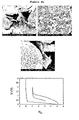
- the Figures 3a to 3d present transmission electron microscopy images made on the obtained material, the images corresponding to magnifications of x500, x2000, x6000 and x12000 respectively.
- the figure 3a allows to see the shape of the pores of nickel foam covered with NiP 2 , the average diameter of these pores being 200 microns.
- the figure 3b highlights the thickness of the NiP 2 layer, between 5 and 10 microns.
- the Figures 3c and 3d show that the structure of the NiP 2 layer is very flaky, which contributes to increase the available surface of reaction with lithium.
- the thickness of the sheets is of the order of a few tens of nanometers.
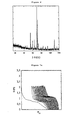
- FIGS. 4a to 4d each represent several transmission electron microscopy micrographs made on a material consisting of NiP 2 on nickel foam, obtained according to the procedure of Example 2. The reaction was carried out at 350 ° C., for respective periods of time. 2, 6, 12 and 120 hours. Each figure also represents the corresponding galvanostatic curve. Each of these curves represents the potential U (in Volts) as a function of the number of inserted Li + ions (N Li ).
- the clichés of Figures 4b and 4c show that after 6 hours of reaction, a layer of NiP 2 of thickness equal to 3 microns appears, and that after 12 hours of reaction, the layer reaches a thickness of 10 microns.
- the corresponding galvanostatic curves show a reversible insertion of 5.1 Li + ions after 6 hours of reaction, and 5.3 Li + ions after 12 hours of reaction.
- the clichés of the figure 4d show that after 120 hours, the reaction is complete because the nickel foam has disappeared, almost all the nickel has been transformed into NiP 2 .
- the surface of NiP 2 is amorphized (thickness of 20 to 50 microns), and the galvanostatic curve shows a reversible insertion of 2 lithium atoms.
- FIGs 5a to 5d compare performance between an electrode according to the invention consisting of NiP 2 on nickel foam ( figures 5a and 5c ), and a NiP 2 phase in powder form prepared by mechanosynthesis ( figures 5b and 5d ).
- the electrode according to the invention was obtained according to the procedure of Example 2, the reaction between the foam and the phosphorus having been carried out at a temperature of 350 ° C. for 12 hours.
- the mechanosynthesis technique is described in the publication of M. Morcrette et al., Electrochem. Solid State Lett., 6, 4 (2003) ).
- the curves 5a and 5b represent the potential U, in Volts, as a function of the number of inserted Li + ions (N Li ), and the curves 5c and 5d represent the capacitance C and the number of inserted Li + ions (N Li ) depending on the number of cycles (N C ).
- the insertion rate is 1 Li + ion in 10 hours.
- the curves obtained for the electrode according to the invention show that 5.2 Li + ions are inserted in discharge vis-à-vis the lithium, and 4.5 Li + ions are extracted during the first charge.
- the capacity resulting from this first discharge is 1150 mA.hg -1 , and 1000 mA.hg -1 load, a capacity of 5600 and 4900 mA.h.cm -3 respectively. After 7 cycles, the capacity is always 900 mA.hg -1 . After 6 cycles, the capacity is only 444 mA.hg -1 for the sample prepared by mechanosynthesis.
- the capacity measured for the phase NiP 2 prepared by mechanosynthesis is only 15% of that of the first discharge, and 20% of that of the second, while the The electrode according to the invention maintains 72% of the capacity of the first discharge and more than 85% of that of the second.
- the impregnation of a copper foam with copper phosphide was carried out in the device described above from a copper foam (marketed by the EFOAM company) whose thickness is about 1.5 mm, and whose width is about 150 mm.
- the pores represent about 90% of the total volume of the foam.
- the foam has a strength of 1000 N / m.
- the reaction was carried out at a temperature of 350 ° C. for 15 hours, using a quantity of phosphorus corresponding to the stoichiometry of the compound CuP 2 .
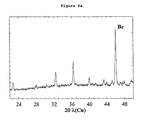
- the X-ray diffractogram obtained for the material constituted by the impregnated foam is represented on the figure 6 (Cr wavelength).
- Example 1 The procedure of Example 1 was repeated, but using a quantity of phosphorus corresponding to the stoichiometry of the nickel triphosphide compound NiP 3 .
- the figure 8b shows the electrochemical behavior of Ni-foam impregnated with nickel triphosphide.
- the potential V (Vs Li + / Li) is given on the ordinate, and the number x of Li + ions inserted in the compound Li x NiP 3 is given as abscissa.
- the insertion rate is 1 Li + ion in 10 hours. It appears that 6 Li + ions are inserted in discharge to 0 V with respect to lithium, and that 5.4 Li + ions are extracted up to 2 V during the first charge.
- the resulting reversible capacitance is therefore 960 mA.hg -1 , which is three times the capacity of a graphite electrode.
Landscapes
- Chemical & Material Sciences (AREA)
- Chemical Kinetics & Catalysis (AREA)
- Electrochemistry (AREA)
- General Chemical & Material Sciences (AREA)
- Engineering & Computer Science (AREA)
- Materials Engineering (AREA)
- Inorganic Chemistry (AREA)
- Manufacturing & Machinery (AREA)
- Battery Electrode And Active Subsutance (AREA)
- Secondary Cells (AREA)
- Cell Electrode Carriers And Collectors (AREA)
- Inorganic Compounds Of Heavy Metals (AREA)
Description
- L'invention concerne un procédé de préparation d'une anode pour batterie à ion-lithium, ainsi qu'une anode pour ladite batterie, et une batterie à ion-lithium comprenant une telle anode.
- Les batteries à ion-lithium fonctionnent par insertion réversible d'ions lithium entre une électrode négative (ou anode), et une électrode positive (ou cathode). A l'anode, la technologie à ion-lithium nécessite l'emploi d'un matériau actif pouvant se réduire à des potentiels très faibles vis-à-vis du lithium. Il est connu que le carbone répond à ce critère.
- Toutefois, de tels systèmes présentent des capacités massique et volumique limitées. Il s'est donc avéré nécessaire de trouver des alternatives à l'utilisation du carbone.
- A cet effet, il a été proposé d'utiliser les phosphures de métaux de transition en tant que matériau actif pour anode. Les propriétés intrinsèques de ces matériaux les rendent particulièrement intéressants pour l'insertion massive du lithium. En effet, le degré d'oxydation du phosphore peut varier de +5 sous sa forme la plus oxydée jusqu'à -3 sous sa forme la plus réduite. Le phosphore forme des liaisons phosphore-phosphore et des liaisons métal-phosphore à caractère covalent avec la plupart des métaux de transition, ces liaisons étant facilement déformables selon l'apport ou le retrait d'électrons via l'insertion / extraction de lithium.
- Par exemple,
WO 03/058732 - On connaît également des électrodes utilisées dans les batteries aqueuses de type Ni-Cd ou Ni-MeH, lesdites électrodes étant formées de mousse de nickel. Dans ces électrodes, les mousses sont simplement imprégnées de matière active Ni(OH)2, et, en conséquence, l'interface Ni/ Ni(OH)2 entre la mousse et le matériau actif est purement physique. La qualité d'une telle interface n'est pas suffisante pour une anode de batterie à ion-lithium.
- Pour pallier ces inconvénients, l'invention propose un procédé de préparation d'une anode pour batterie à ion-lithium qui consiste à préparer le matériau actif directement sur le collecteur de courant, de sorte à obtenir une interface chimique entre le collecteur de courant et le matériau actif.
- Ainsi, selon un premier aspect, l'invention propose un procédé de préparation d'une anode pour batterie à ion-lithium, ladite anode étant constituée par un collecteur de courant formé d'un métal de transition M sous forme de mousse et par un matériau actif constitué par un phosphure binaire dudit métal M, ledit matériau actif répondant à la formule MPx dans laquelle 1 ≤ x ≤ 4. Le procédé consiste à soumettre la mousse de métal M à l'action de vapeurs de phosphore à une température comprise entre 300°C et 600°C, le phosphore étant présent en une proportion qui diffère au plus de 10% de la proportion stoechiométrique par rapport au métal M.
- La mousse peut se présenter sous forme d'un feuillet à porosité ouverte. Le fait d'utiliser une mousse présente l'avantage de permettre une réaction rapide entre le métal M et le phosphore, et de conduire à un dépôt uniforme de la couche de phosphure de métal M. Ces avantages résultent du fait que la mousse présente, grâce à sa structure poreuse, une surface de contact importante susceptible de réagir avec le phosphore. Les pores de la mousse sont ouverts et ont un diamètre d'environ 100 à 200 microns. La vapeur de phosphore peut ainsi se propager partout à l'intérieur de la mousse métallique. En outre, la structure de la mousse, lorsqu'elle est recouverte de phosphure de métal M, permet d'augmenter la surface spécifique de matériau actif disponible pour la réaction avec le lithium.
- La réaction du phosphore avec la mousse de métal M permet de faire croître du phosphure du métal M sur la surface des pores de la mousse. On obtient ainsi une mousse de métal M dont les pores sont recouverts, sur toute leur surface, d'une couche de phosphure du métal M. L'épaisseur de la couche de phosphure dépend des conditions réactionnelles de température et de durée. En choisissant une durée de réaction suffisamment longue, on peut obtenir une mousse dont les pores sont totalement imprégnés de phosphure. Cette possibilité de contrôler l'épaisseur de la couche, ajoutée à la qualité de l'interface matériau actif / collecteur de courant, améliore encore les performances de l'anode obtenue.
- Selon une réalisation, le phosphore est présent dans des proportions telles que le matériau actif formé réponde à la formule MP2.
- La réaction entre la mousse de métal M et le phosphore est de préférence mise en oeuvre pendant une durée comprise entre 6 et 120 heures.
- Cette réaction peut avoir lieu sous gaz inerte, tel que l'argon. Elle peut également avoir lieu avantageusement sous vide, ce qui permet de s'affranchir des surpressions de vapeur de phosphore.
- Le métal de transition M peut être le nickel, le cuivre, le vanadium, le titane ou le fer.
- Comme représenté schématiquement sur la
figure 1 , une anode selon l'invention peut être préparée de la façon suivante : une mousse 1 de métal M est placée dans une ampoule 2, telle qu'un tube de silice, scellée sous un vide de 10-2 torr, au moyen d'un support 3, par exemple en silice. La mousse 1 est soumise à l'action de vapeurs de phosphore 4. Pour cela, du phosphore rouge est introduit dans l'ampoule en proportions stoechiométriques par rapport au métal utilisé, ou dans des proportions s'écartant de plus ou moins 10% par rapport à la stoechiométrie. Puis on chauffe à une température comprise entre 300°C et 600°C, de sorte à sublimer le phosphore. La durée de la réaction, typiquement comprise entre 6 et 120 heures, conditionne la quantité de phosphure de métal qui se forme, comme cela est illustré dans l'exemple 3 ci-après. - Selon un deuxième aspect, l'invention a pour objet une anode pour batterie à ion-lithium, comprenant un collecteur de courant et un matériau actif.
- Cette anode est caractérisée en ce que le collecteur de courant est constitué par une mousse de métal de transition M, et le matériau actif est un phosphure binaire du métal M imprégnant la mousse, qui répond à la formule MPx dans laquelle 1 ≤ x ≤ 4.
- Selon un mode de réalisation, le matériau actif répond à la formule MP2.
- Selon une réalisation particulière, le collecteur de courant est une mousse de nickel.
- Selon une autre réalisation, le collecteur de courant est une mousse de cuivre.
- Le collecteur de courant peut également être une mousse de vanadium, ou une mousse de titane, ou une mousse de fer.
- Selon un troisième aspect, l'invention a pour objet une batterie à ion-lithium comprenant une anode telle que définie précédemment, une cathode comprenant un matériau lithié comme matériau actif, et un électrolyte constitué d'un sel de lithium et d'un solvant ou d'un mélange de solvants.
- Le matériau actif de la cathode est choisi par exemple parmi LiFePO4, LiNiO2, LiCoO2, Li2MnO4, les oxydes de vanadium VOx (2 ≤ x ≤ 2,5), LiV3O8, LiyNi1-xCoxO2, (0 ≤ x ≤ 1 ; 0 ≤ y ≤ 1), les spinelles de manganèse LiyMn1-xMxO2 (M = Cr, Al, V, Ni, 0 ≤ x ≤ 0,5 ; 0 ≤ y ≤ 2), les polydisulfures organiques, FeS, FeS2, le sulfate de fer Fe2(SO4)3, les phosphates et phosphosilicates de fer et de lithium de structure olivine, ou leurs produits de substitution du fer par le manganèse, utilisés seuls ou en mélanges.
- Le solvant de l'électrolyte est choisi de préférence parmi les liquides aprotiques tels que par exemple les éthers linéaires et les éthers cycliques, les esters, les nitriles, les dérivés nitrés, les amides, les sulfones, les sulfolanes, les alkylsulfamides et les hydrocarbures partiellement halogénés. Les solvants particulièrement préférés sont le diéthyléther, le diméthoxyéthane, le glyme, le tétrahydrofurane, le dioxane, le diméthyltétrahydrofurane, le formiate de méthyle ou d'éthyle, le carbonate de propylène ou d'éthylène (EC), les carbonates d'alkyles (notamment le carbonate de diméthyle (DMC), le carbonate de diéthyle et le carbonate de méthylpropyle), les butyrolactones, l'acétonitrile, le benzonitrile, le nitrométhane, le nitrobenzène, la diméthylformamide, la diéthylformamide, la N-méthylpyrrolidone, la diméthylsulfone, la tétraméthylène sulfone et les tétraalkylsulfonamides ayant de 5 à 10 atomes de carbone. Un mélange de deux ou plusieurs de ces liquides peut être utilisé, notamment un mélange EC/DMC.
- Le sel de lithium de l'électrolyte peut être un composé ionique Li+Y-, dans lequel Y- représente un anion à charge électronique délocalisée, par exemple Br-, ClO4 -, PF6 -, AsF6 -, RFSO3 -, (RFSO2)2N-, (RFSO2)3C-, C6H(6-x)(CO(CF3SO2)2C-)x ou C6H(6-x)(SO2(CF3SO2)2C-)x, RF représentant un groupement perfluoroalkyle ou perfluoroaryle, avec 1≤x≤4. Les composés ioniques préférés sont les sels de lithium, et plus particulièrement (CF3SO2)2N-Li+, CF3SO3 -Li+, les composés C6HC(6-x) -[CO(CF3SO2)2C-Li+]x dans lesquels x est compris entre 1 et 4, de préférence avec x = 1 ou 2, les composés C6H(6-x)-[SO2(CF3SO2)2C-Li+]x dans lesquels x est compris entre 1 et 4, de préférence avec x = 1 ou 2. Des mélanges de ces sels entre eux ou avec d'autres sels peuvent être utilisés. A titre d'exemple de mélanges de sels on peut citer : (CF3SO2)2N-Li+ et CF3SO3 -Li+ ou (CF3SO2)2N-Li+ et C6H4 -[CO(CF3SO2)2C-Li+]2 dans des proportions variées, mais comprenant de préférence de 20 à 40% en poids de (CF3SO2)2N-Li+.
- Le procédé de l'invention permet d'obtenir une anode présentant une tenue en cyclage nettement améliorée par rapport à celle des anodes de l'art antérieur. Ce résultat vient du fait qu'il existe une solution de continuité entre le matériau actif et le collecteur de courant, ce qui entraîne une optimisation de l'interface matériau actif / collecteur de courant et par conséquent une meilleure conductivité électronique. Il n'est donc plus nécessaire de mélanger du carbone (matériau électrochimiquement inactif) au matériau actif pour en améliorer la conductivité électronique.
- En outre, la préparation de la batterie est simplifiée du fait que la synthèse du matériau actif et la préparation de l'anode sont réalisées en une seule étape.
- Par ailleurs, l'anode formée ainsi que les composés de départ sont non toxiques et sont stables à l'air et à l'eau, ce qui répond de façon satisfaisante aux contraintes imposées par l'industrie.
- La présente invention est illustrée par les exemples de réalisation concrets décrits ci-après, auxquels elle n'est cependant pas limitée.
- Tous les échantillons ont été préparés dans un dispositif et selon le procédé décrits ci-dessus. Les mesures électrochimiques présentées ci-dessous ont été réalisées dans une cellule classique de type swadgelock. Ces mesures ont été réalisées en laboratoire, dans une cellule en configuration Li-métal, l'électrode de référence étant une électrode de lithium, l'électrode de travail étant une électrode constituée par la mousse de métal M imprégnée par le phosphure du métal M. Dans ce cas, l'élément en mousse de métal fonctionne en tant que cathode, et l'électrode de lithium de référence en tant qu'anode. Les deux électrodes sont séparées par un séparateur constitué par plusieurs couches de fibre de verre imbibées d'électrolyte. L'électrolyte est constitué par LiPF6 dans un mélange de carbonate d'éthylène (EC) et de carbonate de diméthyle (DMC) dans un rapport massique EC/DMC de 1/1. Toutes les mesures galvanostatiques ont été réalisées en 1 Li / 10 heures, c'est-à-dire que le courant que l'on impose à la batterie correspond à l'insertion d'un ion Li+ dans la maille de phosphure de métal en 10 heures.
- Les exemples 1 à 4 illustrent la caractérisation d'électrodes constituées de NiP2 sur mousse de nickel, en référence aux
figures 2 à 5 , l'exemple 5 illustre la caractérisation d'une électrode constituée de CuP2 sur mousse de cuivre, en référence auxfigures 6 et7 , et l'exemple 6 illustre la caractérisation d'une électrode constituée de NiP3 sur mousse de nickel, en référence auxfigures 8a et8b . - L'imprégnation de la mousse de nickel par du phosphure de nickel a été effectuée dans le dispositif décrit ci-dessus à partir d'une mousse de nickel (commercialisée par la société RECEMAT sous la référence RCM-Ni-4852.016) dont l'épaisseur est d'environ 1 mm, dont les pores ont un diamètre d'environ 100 à 200 µm et un volume d'environ 10-4 à 10-3 mm3. Les pores représentent environ 95% du volume total de la mousse, ce qui induit une très grande surface spécifique et une bonne rigidité et dureté de la mousse. La densité de la mousse de nickel est d'environ 0,4 à 0,5 g/cm3.
- La réaction a été mise en oeuvre à une température de 600°C pendant 120 heures, en utilisant une quantité de phosphore correspondant à la stoechiométrie du composé NiP2.
- Le diffractogramme des rayons X obtenu pour le matériau constitué par la mousse imprégnée est représenté sur la
figure 2 . Il permet de constater que le phosphure de nickel formé sur la mousse est un diphosphure NiP2 de structure monoclinique, présentant les paramètres suivants : a = 6,366 Å, b = 5,615 Å, c = 6,072 Å, β= 126,2, C2/c. - On a reproduit le mode opératoire de l'exemple 1 pour former un matériau constitué du diphosphure de nickel NiP2 sur une mousse de nickel. La réaction a été mise en oeuvre à 350°C pendant 12 heures. Les
figures 3a à 3d présentent des clichés de microscopie électronique à transmission réalisés sur le matériau obtenu, les clichés correspondant à des grossissements respectifs de x500, x2000, x6000 et x12000. - La
figure 3a permet de voir la forme des pores de la mousse de nickel recouverte de NiP2, le diamètre moyen de ces pores étant de 200 microns. - La
figure 3b met en évidence l'épaisseur de la couche de NiP2, comprise entre 5 et 10 microns. - Les
figures 3c et 3d font apparaître que la structure de la couche de NiP2 est très feuilletée, ce qui contribue à augmenter la surface disponible de réaction avec le lithium. L'épaisseur des feuillets est de l'ordre de quelque dizaines de nanomètres. - Les
figures 4a à 4d représentent chacune plusieurs clichés de microscopie électronique à transmission réalisés sur un matériau constitué de NiP2 sur mousse de nickel, obtenu selon le mode opératoire de l'exemple 2. La réaction a été mise en oeuvre à 350°C, pendant des durées respectives de 2, 6, 12 et 120 heures. Chaque figure représente également la courbe galvanostatique correspondante. Chacune de ces courbes représente le potentiel U (en Volts) en fonction du nombre d'ions Li+ insérés (NLi). - D'après les clichés de la
figure 4a , il apparaît que, au bout de 2 heures de mise en contact entre la mousse de nickel et le phosphore, la réaction de phosphuration n'a pas démarré, car la phase NiP2 n'apparaît pas. La courbe galvanostatique correspondante montre que l'insertion de lithium est faible et irréversible, différente de celle attendue pour NiP2. - Les clichés des
figures 4b et4c montrent qu'après 6 heures de réaction, une couche de NiP2 d'épaisseur égale à 3 microns apparaît, et que, après 12 heures de réaction, la couche atteint une épaisseur de 10 microns. Les courbes galvanostatiques correspondantes montrent une insertion réversible de 5,1 ions Li+ après 6 heures de réaction, et de 5,3 ions Li+ après 12 heures de réaction. - Les clichés de la
figure 4d montrent qu'après 120 heures, la réaction est totale car la mousse de nickel a disparu, la quasi totalité du nickel s'étant transformée en NiP2. La surface de NiP2 est amorphisée (épaisseur de 20 à 50 microns), et la courbe galvanostatique montre une insertion réversible de 2 atomes de lithium. - D'après ces résultats, il apparaît que les protocoles de 6 heures et 12 heures à 350°C permettent d'obtenir les performances maximales d'insertion de lithium et de maintien de la capacité en fonction des cycles.
- Les
figures 5a à 5d permettent de comparer des performances entre une électrode selon l'invention constituée de NiP2 sur mousse de nickel (figures 5a et5c ), et une phase NiP2 sous forme de poudre préparée par mécanosynthèse (figures 5b et5d ). L'électrode selon l'invention a été obtenue selon le mode opératoire de l'exemple 2, la réaction entre la mousse et le phosphore ayant été mise en oeuvre à une température de 350°C pendant 12 heures. La technique de mécanosynthèse est décrite dans la publication de M. Morcrette et al., Electrochem. Solid State Lett., 6, 4 (2003). - Les courbes 5a et 5b représentent le potentiel U, en Volts, en fonction du nombre d'ions Li+ insérés (NLi), et les courbes 5c et 5d représentent la capacité C et le nombre d'ions Li+ insérés (NLi)en fonction du nombre de cycles (NC). Le taux d'insertion est de 1 ion Li+ en 10 heures.
- Les courbes obtenues pour l'électrode selon l'invention montrent que 5,2 ions Li+ sont insérés en décharge vis-à-vis du lithium, et 4,5 ions Li+ sont extraits lors de la première charge. La capacité résultant de cette première décharge est de 1150 mA.h.g-1, et de 1000 mA.h.g-1 en charge, soit une capacité volumique de 5600 et 4900 mA.h.cm-3 respectivement. Après 7 cycles, la capacité est toujours de 900 mA.h.g-1. Après 6 cycles, la capacité n'est plus que de 444 mA.h.g-1 pour l'échantillon préparé par mécanosynthèse.
- Ainsi, il apparaît que, après 7 cycles, la capacité mesurée pour la phase NiP2 préparée par mécanosynthèse n'est plus que de 15% de celle de la première décharge, et de 20% de celle de la seconde, alors que l'électrode selon l'invention maintient 72% de la capacité de la première décharge et plus de 85% de celle de la seconde.
- La tenue en cyclage est donc nettement améliorée pour l'électrode selon l'invention, par rapport au matériau préparé par mécanosynthèse. Ces résultats sont d'autant plus significatifs que les matériaux d'électrode préparés par mécanosynthèse sont eux-mêmes reconnus comme montrant des performances électrochimiques supérieures à celles des matériaux obtenus par la voie céramique classique.
- L'imprégnation d'une mousse de cuivre par du phosphure de cuivre a été effectuée dans le dispositif décrit ci-dessus à partir d'une mousse de cuivre (commercialisée par la société EFOAM) dont l'épaisseur est d'environ 1,5 mm, et dont la largeur est d'environ 150 mm. Les pores représentent environ 90% du volume total de la mousse. La mousse présente une résistance de 1000 N/m.
- La réaction a été mise en oeuvre à une température de 350°C pendant 15 heures, en utilisant une quantité de phosphore correspondant à la stoechiométrie du composé CuP2.
- Le diffractogramme des rayons X obtenu pour le matériau constitué par la mousse imprégnée est représenté sur la
figure 6 (longueur d'onde Cr). Le diagramme permet de mettre en évidence la phase cristallisée Cu3P (a = 6,951(1) Å, c = 7,143(1) Å, dans le groupe d'espace P63cm), la phase CuP2 étant amorphe aux rayons X. - La mesure galvanostatique correspondant à cet échantillon apparaît sur la
figure 7a , qui représente le potentiel U, en Volts, en fonction du nombre d'ions Li+ insérés (NLi). Les résultats obtenus sont représentatifs de l'insertion de lithium dans une phase formée du diphosphure de cuivre CuP2. La comparaison de ces résultats avec une mesure galvanostatique réalisée sur une poudre Cu3P préparée par voie céramique à 600°C (Figure 7b ) fait apparaître la bonne cyclabilité de la batterie préparée à partir de la mousse de cuivre. - On a reproduit le mode opératoire de l'exemple 1, mais en utilisant une quantité de phosphore correspondant à la stoechiométrie du composé triphosphure de nickel NiP3.
- Le diffractogramme des rayons X est représenté sur la
figure 8a . Il montre que le produit formé est un triphosphure NiP3 qui a une structure cubique (Im-3) avec un paramètre de maille a = 7,819 Å. - La
figure 8b montre le comportement électrochimique de la mousse de Ni imprégnée par le triphosphure de nickel. Le potentiel V (Vs Li+/Li) est donné en ordonnée, et le nombre x d'ions Li+ insérés dans le composé LixNiP3 est donné en abscisse. Le taux d'insertion est de 1 ion Li+ en 10 heures. Il apparaît que 6 ions Li+ sont insérés en décharge jusqu'à 0 V vis à vis du lithium, et que 5,4 ions Li+ sont extraits jusqu'à 2 V lors de la première charge. La capacité réversible qui en résulte est par conséquent de 960 mA.h.g-1, ce qui représente le triple de la capacité d'une électrode de graphite.
Claims (18)
- Procédé de préparation d'une anode pour batterie à ion-lithium, ladite anode étant constituée par un collecteur de courant formé d'un métal de transition M sous forme de mousse et par un matériau actif constitué par un phosphure dudit métal M, ledit matériau actif répondant à la formule MPx dans laquelle 1 ≤ x ≤ 4, caractérisé en ce qu'il consiste à soumettre la mousse de métal M à l'action de vapeurs de phosphore à une température comprise entre 300°C et 600°C, le phosphore étant présent en une proportion qu diffère au plus de 10% de la proportion stoechiométrique par rapport au métal M.
- Procédé selon la revendication 1, caractérisé en ce que le matériau actif répond à la formule MP2.
- Procédé selon la revendication 1 ou 2, caractérisé en ce que la réaction entre la mousse de métal et le phosphore est mise en oeuvre pendant une durée comprise entre 6 et 120 heures.
- Procédé selon l'une quelconque des revendications 1 à 3, caractérisé en ce que la réaction entre la mousse de métal et le phosphore a lieu sous vide.
- Procédé selon l'une quelconque des revendications 1 à 3, caractérisé en ce que la réaction entre la mousse de métal et le phosphore a lieu sous gaz inerte.
- Procédé selon l'une quelconque des revendications précédentes, caractérisé en ce que le métal de transition M est le nickel.
- Procédé selon l'une quelconque des revendications 1 à 5, caractérisé en ce que le métal de transition M est le cuivre.
- Procédé selon l'une quelconque des revendications 1 à 5, caractérisé en ce que le métal de transition M est le vanadium.
- Procédé selon l'une quelconque des revendications 1 à 5 caractérisé en ce que le métal de transition M est le titane.
- Procédé selon l'une quelconque des revendications 1 à 5, caractérisé en ce que le métal de transition M est le fer.
- Anode pour batterie à ion-lithium, comprenant un collecteur de courant et un matériau actif, caractérisée en ce que le collecteur de courant est constitué par une mousse de métal de transition M, et en ce que cette mousse est imprégnée par un phosphure binaire du métal M répondant à la formule MPx dans laquelle 1 ≤ x ≤ 4.
- Anode selon la revendication 11, caractérisée en ce que le phosphure du métal M répond à la formule MP2.
- Anode selon la revendication 11 ou 12, caractérisée en ce que le collecteur de courant est une mousse de nickel.
- Anode selon la revendication 11 ou 12, caractérisée en ce que le collecteur de courant est une mousse de cuivre.
- Anode selon la revendication 11 ou 12, caractérisée en ce que le collecteur de courant est une mousse de vanadium.
- Anode selon la revendication 11 ou 12, caractérisée en ce que le collecteur de courant est une mousse de titane.
- Anode selon la revendication 11 ou 12, caractérisée en ce que le collecteur de courant est une mousse de fer.
- Batterie à ion-lithium comprenant une anode selon l'une quelconque des revendications 11 à 17, une cathode comprenant un matériau lithié comme matériau actif, et un électrolyte constitué d'un sel de lithium et d'un solvant ou d'un mélange de solvants.
Applications Claiming Priority (2)
| Application Number | Priority Date | Filing Date | Title |
|---|---|---|---|
| FR0504961A FR2886060B1 (fr) | 2005-05-18 | 2005-05-18 | Procede de preparation d'une anode pour batterie a ion-lithium. |
| PCT/FR2006/001100 WO2006123050A1 (fr) | 2005-05-18 | 2006-05-16 | Procede de preparation d'une anode pour batterie a ion-lithium. |
Publications (2)
| Publication Number | Publication Date |
|---|---|
| EP1882278A1 EP1882278A1 (fr) | 2008-01-30 |
| EP1882278B1 true EP1882278B1 (fr) | 2009-12-23 |
Family
ID=35457600
Family Applications (1)
| Application Number | Title | Priority Date | Filing Date |
|---|---|---|---|
| EP06755488A Not-in-force EP1882278B1 (fr) | 2005-05-18 | 2006-05-16 | Procede de preparation d'une anode pour batterie a ion-lithium. |
Country Status (8)
| Country | Link |
|---|---|
| US (1) | US8114542B2 (fr) |
| EP (1) | EP1882278B1 (fr) |
| JP (1) | JP5014331B2 (fr) |
| CN (1) | CN101223661B (fr) |
| AT (1) | ATE453219T1 (fr) |
| DE (1) | DE602006011302D1 (fr) |
| FR (1) | FR2886060B1 (fr) |
| WO (1) | WO2006123050A1 (fr) |
Families Citing this family (16)
| Publication number | Priority date | Publication date | Assignee | Title |
|---|---|---|---|---|
| FR2886060B1 (fr) | 2005-05-18 | 2007-07-27 | Centre Nat Rech Scient | Procede de preparation d'une anode pour batterie a ion-lithium. |
| CN101533900B (zh) * | 2009-03-18 | 2012-05-16 | 清华大学 | 一种用于电化学可逆储锂的磷复合材料及其制备方法 |
| CN103947021B (zh) * | 2011-08-02 | 2018-02-09 | 普列托电池公司 | 一种具有互穿电极的锂离子电池 |
| CN103296261B (zh) * | 2012-02-24 | 2015-08-26 | 清华大学 | 锂离子电池负极材料的制备方法 |
| US10022709B2 (en) * | 2013-08-06 | 2018-07-17 | Massachusetts Institute Of Technology | Process for the production of non-sintered transition metal carbide and nitride nanoparticles |
| CN103887494B (zh) * | 2014-03-11 | 2015-11-11 | 三峡大学 | 一种磷化亚铜/铜复合材料的制备方法及在锂离子电池中的应用 |
| DE102014108704B4 (de) * | 2014-06-20 | 2020-09-03 | Thyssenkrupp Ag | Metallionen-Akkumulator |
| EP3075885A1 (fr) * | 2015-03-31 | 2016-10-05 | International Iberian Nanotechnology Laboratory | Procédé de fabrication d'un matériau poreux pour électrode |
| CN104868098B (zh) * | 2015-05-15 | 2018-03-27 | 三峡大学 | 一种碳复合Cu3P‑Cu锂离子电池负极及其制备方法 |
| US10211452B2 (en) * | 2015-12-17 | 2019-02-19 | GM Global Technology Operations LLC | Lithium ion battery components |
| CN105576239A (zh) * | 2016-01-22 | 2016-05-11 | 三峡大学 | 一种无粘结剂Cu3P/C-Cu负极材料的制备工艺及应用 |
| CN108588713B (zh) * | 2018-05-23 | 2020-07-07 | 南京航空航天大学 | 一种二维磷化钼薄膜的制备方法 |
| CN111816881B (zh) * | 2019-08-28 | 2021-11-26 | 中南大学 | 一种类红毛丹壳状3d亲锂复合集流体、锂金属负极及其制备和应用 |
| CN113488656A (zh) * | 2020-08-31 | 2021-10-08 | 中南大学 | 一种3d亲锂复合多孔金属合金集流体及其制备方法和应用 |
| CN113299492B (zh) * | 2021-06-07 | 2022-05-27 | 北京工业大学 | 一种mof衍生多孔金属磷化物纳米片阵列及应用 |
| CN121134724B (zh) * | 2025-11-18 | 2026-02-10 | 福安国隆纳米材料有限公司 | 磷酸铁锂的制备方法、磷酸铁锂及锂离子电池 |
Family Cites Families (17)
| Publication number | Priority date | Publication date | Assignee | Title |
|---|---|---|---|---|
| US4092464A (en) * | 1976-07-19 | 1978-05-30 | P. R. Mallory & Co. Inc. | Flexible cells and batteries formed therefrom |
| ZA785392B (en) * | 1978-09-22 | 1980-05-28 | South African Inventions | Cathode for an electrochemical cell,and an electrochemical cell |
| DE3117393A1 (de) * | 1981-05-02 | 1982-11-11 | Degesch Gmbh, 6000 Frankfurt | Verfahren zur herstellung der phosphide von aluminium oder magnesium |
| US4508608A (en) * | 1983-04-21 | 1985-04-02 | Combustion Engineering, Inc. | Method for making chalcogenide cathodes |
| JPS6364903A (ja) * | 1986-09-03 | 1988-03-23 | Nippon Chem Ind Co Ltd:The | 高純度金属リン化物およびその製造方法 |
| US5338625A (en) * | 1992-07-29 | 1994-08-16 | Martin Marietta Energy Systems, Inc. | Thin film battery and method for making same |
| JPH07122261A (ja) * | 1993-10-26 | 1995-05-12 | Matsushita Electric Ind Co Ltd | 電気化学素子 |
| JP3358777B2 (ja) * | 1995-10-03 | 2002-12-24 | 日本電信電話株式会社 | 二次電池用負極 |
| JP3438538B2 (ja) * | 1997-07-23 | 2003-08-18 | 松下電器産業株式会社 | アルカリ蓄電池とその電極の製造法 |
| JP3561736B2 (ja) * | 1998-04-17 | 2004-09-02 | 静岡県 | SiC粒子分散強化型複合材料の製造方法およびその方法により製造された物 |
| JP2001110425A (ja) * | 1999-10-06 | 2001-04-20 | Toyo Kohan Co Ltd | 二次電池用集電体、その集電体を使用した二次電池及びそれらの製造方法 |
| AU2002218926A1 (en) * | 2002-01-08 | 2003-07-24 | Linda F. Nazar | New electrode materials for a rechargeable electrochemical cell |
| DE10201936A1 (de) * | 2002-01-19 | 2003-07-31 | Fortu Bat Batterien Gmbh | Wiederaufladbare elektrochemische Batteriezelle |
| US7608178B2 (en) * | 2003-11-10 | 2009-10-27 | Polyplus Battery Company | Active metal electrolyzer |
| JP2005190982A (ja) * | 2003-12-04 | 2005-07-14 | Nichia Chem Ind Ltd | 活物質、活物質の製造方法、非水電解質二次電池およびリチウム一次電池 |
| CN100385718C (zh) * | 2004-06-10 | 2008-04-30 | 上海交通大学 | 锂离子电池用锂金属磷化物负极材料及制备方法 |
| FR2886060B1 (fr) | 2005-05-18 | 2007-07-27 | Centre Nat Rech Scient | Procede de preparation d'une anode pour batterie a ion-lithium. |
-
2005
- 2005-05-18 FR FR0504961A patent/FR2886060B1/fr not_active Expired - Fee Related
-
2006
- 2006-05-16 CN CN2006800263829A patent/CN101223661B/zh not_active Expired - Fee Related
- 2006-05-16 EP EP06755488A patent/EP1882278B1/fr not_active Not-in-force
- 2006-05-16 AT AT06755488T patent/ATE453219T1/de not_active IP Right Cessation
- 2006-05-16 JP JP2008511750A patent/JP5014331B2/ja not_active Expired - Fee Related
- 2006-05-16 WO PCT/FR2006/001100 patent/WO2006123050A1/fr not_active Ceased
- 2006-05-16 US US11/920,625 patent/US8114542B2/en not_active Expired - Fee Related
- 2006-05-16 DE DE602006011302T patent/DE602006011302D1/de active Active
Also Published As
| Publication number | Publication date |
|---|---|
| JP2008541391A (ja) | 2008-11-20 |
| CN101223661A (zh) | 2008-07-16 |
| FR2886060A1 (fr) | 2006-11-24 |
| FR2886060B1 (fr) | 2007-07-27 |
| WO2006123050A1 (fr) | 2006-11-23 |
| US8114542B2 (en) | 2012-02-14 |
| CN101223661B (zh) | 2010-04-14 |
| US20090286156A1 (en) | 2009-11-19 |
| EP1882278A1 (fr) | 2008-01-30 |
| ATE453219T1 (de) | 2010-01-15 |
| DE602006011302D1 (de) | 2010-02-04 |
| JP5014331B2 (ja) | 2012-08-29 |
Similar Documents
| Publication | Publication Date | Title |
|---|---|---|
| EP1882278B1 (fr) | Procede de preparation d'une anode pour batterie a ion-lithium. | |
| EP2751859B1 (fr) | Accumulateur electrochimique de type lithium-soufre (li-s) et son procede de realisation | |
| EP2478580B1 (fr) | Matériau constitue de particules composites d'oxyde, procédé pour sa préparation, et son utilisation comme matière active d' électrode | |
| FR2961634A1 (fr) | Procede pour l'elaboration d'une batterie au lithium ou au sodium | |
| WO2007023235A1 (fr) | Materiau d'electrode positive haute tension de structure spinelle a base de nickel et de manganese pour accumulateurs au lithium | |
| EP3365933B1 (fr) | Procede de fabrication d'un accumulateur du type lithium-ion | |
| EP3365937B1 (fr) | Procédé de fabrication d'un accumulateur du type sodium-ion | |
| EP2396841B1 (fr) | Procédé de préparation d'un mélange d'une poudre d'un composé actif d'électrode et d'une poudre d'un composé conducteur électronique, mélange ainsi obtenu, électrode, cellule et accumulateur | |
| EP2757068B1 (fr) | Procédé de synthèse d'un composé LiM1-x-y-zNyQzFexPO4 et son utilisation comme matériau d'électrode pour accumulateur au lithium | |
| EP4271668A1 (fr) | Liquide ionique à base de bis(fluorosulfonyl)imidure | |
| EP3457472B1 (fr) | Procede de fabrication d'une electrode pour accumulateur lithium-soufre utilisant du li2s comme materiau actif | |
| CA2658741C (fr) | Nouveaux materiaux d`electrode presentant une conductivite de surface elevee | |
| EP3776697B1 (fr) | Élément électrochimique de type lithium/soufre | |
| EP3108524B1 (fr) | Electrode positive pour accumulateur electrochimique lithium-soufre presentant une structuration specifique | |
| WO2013008189A2 (fr) | Phosphate de manganese lithie et materiau composite le comprenant | |
| WO2019008249A1 (fr) | Procede de fabrication d'un accumulateur du type lithium-ion | |
| EP3293148A1 (fr) | Procédé de fabrication d'un matériau silicaté de structure olivine | |
| EP3327832B1 (fr) | Procede de fabrication d'une electrode positive pour accumulateur electrochimique lithium-soufre | |
| EP3457471B1 (fr) | Procede de fabrication d'une electrode pour accumulateur lithium-soufre a surface active importante | |
| FR2730988A1 (fr) | Oxyde amorphe suroxygene et son utilisation comme matiere active d'electrode | |
| EP3472882B1 (fr) | Procede de fabrication d'une structure faisant office d'electrode positive et de collecteur de courant pour accumulateur electrochimique lithium-soufre | |
| EP3327831B1 (fr) | Procede de fabrication d'une electrode positive poreuse pour accumulateur electrochimique lithium-soufre | |
| EP4333124A1 (fr) | Nouvelles électrodes organiques et leur utilisation dans des systèmes électrochimiques |
Legal Events
| Date | Code | Title | Description |
|---|---|---|---|
| PUAI | Public reference made under article 153(3) epc to a published international application that has entered the european phase |
Free format text: ORIGINAL CODE: 0009012 |
|
| 17P | Request for examination filed |
Effective date: 20071108 |
|
| AK | Designated contracting states |
Kind code of ref document: A1 Designated state(s): AT BE BG CH CY CZ DE DK EE ES FI FR GB GR HU IE IS IT LI LT LU LV MC NL PL PT RO SE SI SK TR |
|
| DAX | Request for extension of the european patent (deleted) | ||
| GRAP | Despatch of communication of intention to grant a patent |
Free format text: ORIGINAL CODE: EPIDOSNIGR1 |
|
| GRAS | Grant fee paid |
Free format text: ORIGINAL CODE: EPIDOSNIGR3 |
|
| GRAA | (expected) grant |
Free format text: ORIGINAL CODE: 0009210 |
|
| AK | Designated contracting states |
Kind code of ref document: B1 Designated state(s): AT BE BG CH CY CZ DE DK EE ES FI FR GB GR HU IE IS IT LI LT LU LV MC NL PL PT RO SE SI SK TR |
|
| REG | Reference to a national code |
Ref country code: GB Ref legal event code: FG4D Free format text: NOT ENGLISH |
|
| REG | Reference to a national code |
Ref country code: CH Ref legal event code: EP |
|
| REG | Reference to a national code |
Ref country code: IE Ref legal event code: FG4D |
|
| REF | Corresponds to: |
Ref document number: 602006011302 Country of ref document: DE Date of ref document: 20100204 Kind code of ref document: P |
|
| REG | Reference to a national code |
Ref country code: NL Ref legal event code: VDEP Effective date: 20091223 |
|
| PG25 | Lapsed in a contracting state [announced via postgrant information from national office to epo] |
Ref country code: SE Free format text: LAPSE BECAUSE OF FAILURE TO SUBMIT A TRANSLATION OF THE DESCRIPTION OR TO PAY THE FEE WITHIN THE PRESCRIBED TIME-LIMIT Effective date: 20091223 Ref country code: FI Free format text: LAPSE BECAUSE OF FAILURE TO SUBMIT A TRANSLATION OF THE DESCRIPTION OR TO PAY THE FEE WITHIN THE PRESCRIBED TIME-LIMIT Effective date: 20091223 Ref country code: LT Free format text: LAPSE BECAUSE OF FAILURE TO SUBMIT A TRANSLATION OF THE DESCRIPTION OR TO PAY THE FEE WITHIN THE PRESCRIBED TIME-LIMIT Effective date: 20091223 |
|
| LTIE | Lt: invalidation of european patent or patent extension |
Effective date: 20091223 |
|
| PG25 | Lapsed in a contracting state [announced via postgrant information from national office to epo] |
Ref country code: SI Free format text: LAPSE BECAUSE OF FAILURE TO SUBMIT A TRANSLATION OF THE DESCRIPTION OR TO PAY THE FEE WITHIN THE PRESCRIBED TIME-LIMIT Effective date: 20091223 Ref country code: PL Free format text: LAPSE BECAUSE OF FAILURE TO SUBMIT A TRANSLATION OF THE DESCRIPTION OR TO PAY THE FEE WITHIN THE PRESCRIBED TIME-LIMIT Effective date: 20091223 Ref country code: LV Free format text: LAPSE BECAUSE OF FAILURE TO SUBMIT A TRANSLATION OF THE DESCRIPTION OR TO PAY THE FEE WITHIN THE PRESCRIBED TIME-LIMIT Effective date: 20091223 |
|
| PG25 | Lapsed in a contracting state [announced via postgrant information from national office to epo] |
Ref country code: AT Free format text: LAPSE BECAUSE OF FAILURE TO SUBMIT A TRANSLATION OF THE DESCRIPTION OR TO PAY THE FEE WITHIN THE PRESCRIBED TIME-LIMIT Effective date: 20091223 |
|
| REG | Reference to a national code |
Ref country code: IE Ref legal event code: FD4D |
|
| PG25 | Lapsed in a contracting state [announced via postgrant information from national office to epo] |
Ref country code: RO Free format text: LAPSE BECAUSE OF FAILURE TO SUBMIT A TRANSLATION OF THE DESCRIPTION OR TO PAY THE FEE WITHIN THE PRESCRIBED TIME-LIMIT Effective date: 20091223 Ref country code: PT Free format text: LAPSE BECAUSE OF FAILURE TO SUBMIT A TRANSLATION OF THE DESCRIPTION OR TO PAY THE FEE WITHIN THE PRESCRIBED TIME-LIMIT Effective date: 20100423 Ref country code: BG Free format text: LAPSE BECAUSE OF FAILURE TO SUBMIT A TRANSLATION OF THE DESCRIPTION OR TO PAY THE FEE WITHIN THE PRESCRIBED TIME-LIMIT Effective date: 20100323 Ref country code: ES Free format text: LAPSE BECAUSE OF FAILURE TO SUBMIT A TRANSLATION OF THE DESCRIPTION OR TO PAY THE FEE WITHIN THE PRESCRIBED TIME-LIMIT Effective date: 20100403 Ref country code: NL Free format text: LAPSE BECAUSE OF FAILURE TO SUBMIT A TRANSLATION OF THE DESCRIPTION OR TO PAY THE FEE WITHIN THE PRESCRIBED TIME-LIMIT Effective date: 20091223 Ref country code: EE Free format text: LAPSE BECAUSE OF FAILURE TO SUBMIT A TRANSLATION OF THE DESCRIPTION OR TO PAY THE FEE WITHIN THE PRESCRIBED TIME-LIMIT Effective date: 20091223 Ref country code: IS Free format text: LAPSE BECAUSE OF FAILURE TO SUBMIT A TRANSLATION OF THE DESCRIPTION OR TO PAY THE FEE WITHIN THE PRESCRIBED TIME-LIMIT Effective date: 20100423 |
|
| PG25 | Lapsed in a contracting state [announced via postgrant information from national office to epo] |
Ref country code: SK Free format text: LAPSE BECAUSE OF FAILURE TO SUBMIT A TRANSLATION OF THE DESCRIPTION OR TO PAY THE FEE WITHIN THE PRESCRIBED TIME-LIMIT Effective date: 20091223 Ref country code: CZ Free format text: LAPSE BECAUSE OF FAILURE TO SUBMIT A TRANSLATION OF THE DESCRIPTION OR TO PAY THE FEE WITHIN THE PRESCRIBED TIME-LIMIT Effective date: 20091223 |
|
| PG25 | Lapsed in a contracting state [announced via postgrant information from national office to epo] |
Ref country code: GR Free format text: LAPSE BECAUSE OF FAILURE TO SUBMIT A TRANSLATION OF THE DESCRIPTION OR TO PAY THE FEE WITHIN THE PRESCRIBED TIME-LIMIT Effective date: 20100324 Ref country code: IE Free format text: LAPSE BECAUSE OF FAILURE TO SUBMIT A TRANSLATION OF THE DESCRIPTION OR TO PAY THE FEE WITHIN THE PRESCRIBED TIME-LIMIT Effective date: 20091223 Ref country code: CY Free format text: LAPSE BECAUSE OF FAILURE TO SUBMIT A TRANSLATION OF THE DESCRIPTION OR TO PAY THE FEE WITHIN THE PRESCRIBED TIME-LIMIT Effective date: 20091223 |
|
| PLBE | No opposition filed within time limit |
Free format text: ORIGINAL CODE: 0009261 |
|
| STAA | Information on the status of an ep patent application or granted ep patent |
Free format text: STATUS: NO OPPOSITION FILED WITHIN TIME LIMIT |
|
| 26N | No opposition filed |
Effective date: 20100924 |
|
| PG25 | Lapsed in a contracting state [announced via postgrant information from national office to epo] |
Ref country code: MC Free format text: LAPSE BECAUSE OF NON-PAYMENT OF DUE FEES Effective date: 20100531 |
|
| REG | Reference to a national code |
Ref country code: CH Ref legal event code: PL |
|
| PG25 | Lapsed in a contracting state [announced via postgrant information from national office to epo] |
Ref country code: DK Free format text: LAPSE BECAUSE OF FAILURE TO SUBMIT A TRANSLATION OF THE DESCRIPTION OR TO PAY THE FEE WITHIN THE PRESCRIBED TIME-LIMIT Effective date: 20091223 |
|
| PG25 | Lapsed in a contracting state [announced via postgrant information from national office to epo] |
Ref country code: LI Free format text: LAPSE BECAUSE OF NON-PAYMENT OF DUE FEES Effective date: 20100531 Ref country code: CH Free format text: LAPSE BECAUSE OF NON-PAYMENT OF DUE FEES Effective date: 20100531 |
|
| PG25 | Lapsed in a contracting state [announced via postgrant information from national office to epo] |
Ref country code: IT Free format text: LAPSE BECAUSE OF FAILURE TO SUBMIT A TRANSLATION OF THE DESCRIPTION OR TO PAY THE FEE WITHIN THE PRESCRIBED TIME-LIMIT Effective date: 20091223 |
|
| PG25 | Lapsed in a contracting state [announced via postgrant information from national office to epo] |
Ref country code: LU Free format text: LAPSE BECAUSE OF NON-PAYMENT OF DUE FEES Effective date: 20100516 Ref country code: HU Free format text: LAPSE BECAUSE OF FAILURE TO SUBMIT A TRANSLATION OF THE DESCRIPTION OR TO PAY THE FEE WITHIN THE PRESCRIBED TIME-LIMIT Effective date: 20100624 |
|
| PG25 | Lapsed in a contracting state [announced via postgrant information from national office to epo] |
Ref country code: TR Free format text: LAPSE BECAUSE OF FAILURE TO SUBMIT A TRANSLATION OF THE DESCRIPTION OR TO PAY THE FEE WITHIN THE PRESCRIBED TIME-LIMIT Effective date: 20091223 |
|
| REG | Reference to a national code |
Ref country code: FR Ref legal event code: PLFP Year of fee payment: 11 |
|
| PGFP | Annual fee paid to national office [announced via postgrant information from national office to epo] |
Ref country code: GB Payment date: 20160426 Year of fee payment: 11 Ref country code: DE Payment date: 20160421 Year of fee payment: 11 |
|
| PGFP | Annual fee paid to national office [announced via postgrant information from national office to epo] |
Ref country code: BE Payment date: 20160425 Year of fee payment: 11 Ref country code: FR Payment date: 20160422 Year of fee payment: 11 |
|
| REG | Reference to a national code |
Ref country code: DE Ref legal event code: R119 Ref document number: 602006011302 Country of ref document: DE |
|
| GBPC | Gb: european patent ceased through non-payment of renewal fee |
Effective date: 20170516 |
|
| REG | Reference to a national code |
Ref country code: FR Ref legal event code: ST Effective date: 20180131 |
|
| REG | Reference to a national code |
Ref country code: BE Ref legal event code: MM Effective date: 20170531 |
|
| PG25 | Lapsed in a contracting state [announced via postgrant information from national office to epo] |
Ref country code: DE Free format text: LAPSE BECAUSE OF NON-PAYMENT OF DUE FEES Effective date: 20171201 Ref country code: GB Free format text: LAPSE BECAUSE OF NON-PAYMENT OF DUE FEES Effective date: 20170516 |
|
| PG25 | Lapsed in a contracting state [announced via postgrant information from national office to epo] |
Ref country code: FR Free format text: LAPSE BECAUSE OF NON-PAYMENT OF DUE FEES Effective date: 20170531 |
|
| PG25 | Lapsed in a contracting state [announced via postgrant information from national office to epo] |
Ref country code: BE Free format text: LAPSE BECAUSE OF NON-PAYMENT OF DUE FEES Effective date: 20170531 |