EP1877596B1 - Metering material to promote rapid vaporization - Google Patents
Metering material to promote rapid vaporization Download PDFInfo
- Publication number
- EP1877596B1 EP1877596B1 EP06752197.1A EP06752197A EP1877596B1 EP 1877596 B1 EP1877596 B1 EP 1877596B1 EP 06752197 A EP06752197 A EP 06752197A EP 1877596 B1 EP1877596 B1 EP 1877596B1
- Authority
- EP
- European Patent Office
- Prior art keywords
- vaporization
- powdered
- orifice
- piston
- positive displacement
- Prior art date
- Legal status (The legal status is an assumption and is not a legal conclusion. Google has not performed a legal analysis and makes no representation as to the accuracy of the status listed.)
- Expired - Lifetime
Links
Images


Classifications
-
- C—CHEMISTRY; METALLURGY
- C23—COATING METALLIC MATERIAL; COATING MATERIAL WITH METALLIC MATERIAL; CHEMICAL SURFACE TREATMENT; DIFFUSION TREATMENT OF METALLIC MATERIAL; COATING BY VACUUM EVAPORATION, BY SPUTTERING, BY ION IMPLANTATION OR BY CHEMICAL VAPOUR DEPOSITION, IN GENERAL; INHIBITING CORROSION OF METALLIC MATERIAL OR INCRUSTATION IN GENERAL
- C23C—COATING METALLIC MATERIAL; COATING MATERIAL WITH METALLIC MATERIAL; SURFACE TREATMENT OF METALLIC MATERIAL BY DIFFUSION INTO THE SURFACE, BY CHEMICAL CONVERSION OR SUBSTITUTION; COATING BY VACUUM EVAPORATION, BY SPUTTERING, BY ION IMPLANTATION OR BY CHEMICAL VAPOUR DEPOSITION, IN GENERAL
- C23C14/00—Coating by vacuum evaporation, by sputtering or by ion implantation of the coating forming material
- C23C14/22—Coating by vacuum evaporation, by sputtering or by ion implantation of the coating forming material characterised by the process of coating
- C23C14/24—Vacuum evaporation
-
- C—CHEMISTRY; METALLURGY
- C23—COATING METALLIC MATERIAL; COATING MATERIAL WITH METALLIC MATERIAL; CHEMICAL SURFACE TREATMENT; DIFFUSION TREATMENT OF METALLIC MATERIAL; COATING BY VACUUM EVAPORATION, BY SPUTTERING, BY ION IMPLANTATION OR BY CHEMICAL VAPOUR DEPOSITION, IN GENERAL; INHIBITING CORROSION OF METALLIC MATERIAL OR INCRUSTATION IN GENERAL
- C23C—COATING METALLIC MATERIAL; COATING MATERIAL WITH METALLIC MATERIAL; SURFACE TREATMENT OF METALLIC MATERIAL BY DIFFUSION INTO THE SURFACE, BY CHEMICAL CONVERSION OR SUBSTITUTION; COATING BY VACUUM EVAPORATION, BY SPUTTERING, BY ION IMPLANTATION OR BY CHEMICAL VAPOUR DEPOSITION, IN GENERAL
- C23C14/00—Coating by vacuum evaporation, by sputtering or by ion implantation of the coating forming material
- C23C14/06—Coating by vacuum evaporation, by sputtering or by ion implantation of the coating forming material characterised by the coating material
- C23C14/12—Organic material
-
- C—CHEMISTRY; METALLURGY
- C23—COATING METALLIC MATERIAL; COATING MATERIAL WITH METALLIC MATERIAL; CHEMICAL SURFACE TREATMENT; DIFFUSION TREATMENT OF METALLIC MATERIAL; COATING BY VACUUM EVAPORATION, BY SPUTTERING, BY ION IMPLANTATION OR BY CHEMICAL VAPOUR DEPOSITION, IN GENERAL; INHIBITING CORROSION OF METALLIC MATERIAL OR INCRUSTATION IN GENERAL
- C23C—COATING METALLIC MATERIAL; COATING MATERIAL WITH METALLIC MATERIAL; SURFACE TREATMENT OF METALLIC MATERIAL BY DIFFUSION INTO THE SURFACE, BY CHEMICAL CONVERSION OR SUBSTITUTION; COATING BY VACUUM EVAPORATION, BY SPUTTERING, BY ION IMPLANTATION OR BY CHEMICAL VAPOUR DEPOSITION, IN GENERAL
- C23C14/00—Coating by vacuum evaporation, by sputtering or by ion implantation of the coating forming material
- C23C14/22—Coating by vacuum evaporation, by sputtering or by ion implantation of the coating forming material characterised by the process of coating
- C23C14/24—Vacuum evaporation
- C23C14/246—Replenishment of source material
-
- H—ELECTRICITY
- H10—SEMICONDUCTOR DEVICES; ELECTRIC SOLID-STATE DEVICES NOT OTHERWISE PROVIDED FOR
- H10K—ORGANIC ELECTRIC SOLID-STATE DEVICES
- H10K71/00—Manufacture or treatment specially adapted for the organic devices covered by this subclass
- H10K71/10—Deposition of organic active material
- H10K71/16—Deposition of organic active material using physical vapour deposition [PVD], e.g. vacuum deposition or sputtering
-
- H—ELECTRICITY
- H10—SEMICONDUCTOR DEVICES; ELECTRIC SOLID-STATE DEVICES NOT OTHERWISE PROVIDED FOR
- H10K—ORGANIC ELECTRIC SOLID-STATE DEVICES
- H10K71/00—Manufacture or treatment specially adapted for the organic devices covered by this subclass
- H10K71/10—Deposition of organic active material
- H10K71/16—Deposition of organic active material using physical vapour deposition [PVD], e.g. vacuum deposition or sputtering
- H10K71/164—Deposition of organic active material using physical vapour deposition [PVD], e.g. vacuum deposition or sputtering using vacuum deposition
Definitions
- the present invention relates to the field of physical vapor deposition where material is heated to a temperature causing rapid vaporization, and create a vapor plume that condenses to form a thin film on a surface of a substrate.
- An organic light emitting diode (OLED) device includes a substrate, an anode, a hole-transporting layer made of an organic compound, an organic luminescent layer with suitable dopants, an organic electron-transporting layer, and a cathode.
- OLED devices are attractive because of their low driving voltage, high luminance, wide-angle viewing and capability for full-color flat emission displays. Tang et al. described this multilayer OLED device in their U.S. Patent Nos. 4,769,292 and 4,885,211 .
- a consequence of using single component sources is that many sources are required in order to produce films containing a host and multiple dopants. These sources are arrayed one next to the other with the outer sources angled toward the center to approximate a co-deposition condition.
- the number of linear sources used to co-deposit different materials has been limited to three. This restriction has imposed a substantial limitation on the architecture of OLED devices, increases the necessary size and cost of the vacuum deposition chamber and decreases the reliability of the system.
- the use of separate sources creates a gradient effect in the deposited film where the material in the source closest to the advancing substrate is over represented in the initial film immediately adjacent the substrate while the material in the last source is over represented in the final film surface.
- This gradient co-deposition is unavoidable in prior art sources where a single material is vaporized from each of multiple sources.
- the gradient in the deposited film is especially evident when the contribution of either of the end sources is more than a few percent of the central source, such as when a co-host is used.
- a further limitation of prior art sources is that the geometry of the interior of the vapor manifold changes as the organic material charge is consumed. This change requires that the heater temperature change to maintain a constant vaporization rate and it is observed that the overall plume shape of the vapor exiting the orifices can change as a function of the organic material thickness and distribution in the source, particularly when the conductance to vapor flow in the source with a full charge of material is low enough to sustain pressure gradients from non-uniform vaporization within the source, hi this case, as the material charge is consumed, the conductance increases and the pressure distribution and hence overall plume shape improve.
- Document GB 1 122 577 A concerns a device for vaporizing materials in granulated or powdered form.
- the device comprises a container for holding powder or granulate that is connected via a feed pipe with a crucible. By moving a dosing device provided under the container, the powder or granulate can be pushed via the feed pipe into the crucible. Within the crucible, the powder or granulate is molten by means of electron beams.
- an apparatus for vaporization of powdered or granular material comprising:
- the present device achieves substantially higher vaporization rates than in prior art devices with substantially reduced material degradation. Further still, no heater temperature change is required as the source material is consumed.
- a container 5 is provided and holds a powdered or granular material.
- This material may be a single component or in alternative embodiments it may contain multiple components.
- the material can be powdered or granular.
- the container 5 can be provided with a structure for agitating or fluidizing the material (not visible in figure). There are many well known ways for providing this functionality; the use of a horizontal auger is particularly common. Alternatively, the container 5 maybe vibrated by actuators attached to the walls of the container 5.
- a vaporization zone 10 is provided in a manner that is thermally isolated from the container 5 which contains the powdered or granular material.
- thermally isolating the vaporization zone 10 from the container 5 uses distance to achieve thermal isolation.
- other ways may be utilized such as thermal barriers constructed of thermally insulating materials or active cooling of the container 5.
- a screw mechanism 15 (see FIG. 2 ) transports fluidized material from the container 5 to a positive displacement mechanism 20.
- the positive displacement mechanism 20 receives a controllable amount of material from the container 5 via the screw and repeatably delivers that controlled or metered amount of material to the vaporization zone 10.
- the vaporization zone 10 contains a heated plate 25 for flash evaporating the material received from the positive displacement mechanism 20. In this embodiment, the heated plate 25 provides the energy for flash vaporizing the received material.
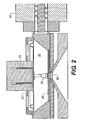
- FIG. 2 a detailed view of the positive displacement mechanism 20 is shown in cross-section.
- the screw mechanism 15 feeds fluidized material from the container 5 (see FIG. 1 ) into a chamber 30 defined by the housing of the positive displacement mechanism 20.
- a piezo-actuated vibratory diaphragm 45 maintains the material in the chamber 30 in an agitated or fluidized state.
- a member shown as a piston 40 is actuable by an electrical coil 35.
- the piston 40 is located above and coaxially with an orifice 50. Actuation of the coil 35 causes the piston 40 to move up and down in response to current flow in different directions in the coil 35. Current in the coil 35 sets up a magnetic field that exerts forces on the piston 40.
- the vibration of the diaphragm 45 will cause a quantity of material to occupy the volume vacated by the piston 40.
- a change in current flow to the coil 35 will drive the piston 40 downward, which in turn will drive the material in the space now occupied by the piston 40 out of the orifice.
- the mass of ejected material is controlled by the diameter of the piston 40, the length of the stroke, and the density of the material and the time of actuating the coil 35.
- a very uniform, tightly controlled mass of material per unit time is delivered from the chamber 30 to the vaporization zone 10. This degree of control is important to the manufacture of thin-film layers using evaporative sources.
- the delivery rate of material can vary over a wide range.
- the mass per unit time can be constant or varied over time depending on the desired nature of the deposited film.
- FIG. 3 is a cross-section of an alternative embodiment of the invention.
- This embodiment is circularly symmetric.
- the screw mechanism 15 feeds material from the container 5 against a spreader 55.
- the spreader 55 is conically shaped and expands the diameter of delivered material from the screw mechanism 15 driving the material through the material channel 60.
- a piezo-actuated vibratory diaphragm 65 is attached to the spreader 55.
- the diaphragm 65 displaces material in the material channel 60, forcing the material to flow around the diaphragm 65.
- the material that has flowed around the diaphragm 65 is directed to the heated plate 25 (see FIG. 1 ) for flash vaporization of the material.
Landscapes
- Chemical & Material Sciences (AREA)
- Chemical Kinetics & Catalysis (AREA)
- Engineering & Computer Science (AREA)
- Materials Engineering (AREA)
- Mechanical Engineering (AREA)
- Metallurgy (AREA)
- Organic Chemistry (AREA)
- Physical Vapour Deposition (AREA)
- Electroluminescent Light Sources (AREA)
Applications Claiming Priority (2)
| Application Number | Priority Date | Filing Date | Title |
|---|---|---|---|
| US11/120,330 US7213347B2 (en) | 2005-05-03 | 2005-05-03 | Metering material to promote rapid vaporization |
| PCT/US2006/017095 WO2006119403A2 (en) | 2005-05-03 | 2006-05-03 | Metering material to promote rapid vaporization |
Publications (2)
| Publication Number | Publication Date |
|---|---|
| EP1877596A2 EP1877596A2 (en) | 2008-01-16 |
| EP1877596B1 true EP1877596B1 (en) | 2014-12-03 |
Family
ID=37075866
Family Applications (1)
| Application Number | Title | Priority Date | Filing Date |
|---|---|---|---|
| EP06752197.1A Expired - Lifetime EP1877596B1 (en) | 2005-05-03 | 2006-05-03 | Metering material to promote rapid vaporization |
Country Status (4)
| Country | Link |
|---|---|
| US (1) | US7213347B2 (https=) |
| EP (1) | EP1877596B1 (https=) |
| JP (1) | JP5032466B2 (https=) |
| WO (1) | WO2006119403A2 (https=) |
Families Citing this family (7)
| Publication number | Priority date | Publication date | Assignee | Title |
|---|---|---|---|---|
| US7625602B2 (en) | 2005-05-03 | 2009-12-01 | Eastman Kodak Company | Controllably feeding powdered or granular material |
| US7877895B2 (en) | 2006-06-26 | 2011-02-01 | Tokyo Electron Limited | Substrate processing apparatus |
| JP4974832B2 (ja) * | 2007-09-10 | 2012-07-11 | 株式会社アルバック | 蒸着源、蒸着装置 |
| JP4996452B2 (ja) * | 2007-12-28 | 2012-08-08 | 株式会社アルバック | 成膜源、成膜装置 |
| JP4974877B2 (ja) * | 2007-12-28 | 2012-07-11 | 株式会社アルバック | 成膜源、成膜装置 |
| WO2010098308A1 (ja) * | 2009-02-24 | 2010-09-02 | 株式会社アルバック | 有機化合物蒸気発生装置及び有機薄膜製造装置 |
| CN106967951B (zh) * | 2017-03-28 | 2019-06-04 | 信利半导体有限公司 | 一种成膜装置、成膜方法及成膜源 |
Family Cites Families (19)
| Publication number | Priority date | Publication date | Assignee | Title |
|---|---|---|---|---|
| US2447789A (en) * | 1945-03-23 | 1948-08-24 | Polaroid Corp | Evaporating crucible for coating apparatus |
| GB1122577A (en) | 1965-11-16 | 1968-08-07 | Hermsdorf Keramik Veb | Method of and devices for the vaporisation of materials |
| US4249674A (en) * | 1979-08-10 | 1981-02-10 | Antenore Ronald L | Dry product dispenser |
| US4885211A (en) * | 1987-02-11 | 1989-12-05 | Eastman Kodak Company | Electroluminescent device with improved cathode |
| US4769292A (en) * | 1987-03-02 | 1988-09-06 | Eastman Kodak Company | Electroluminescent device with modified thin film luminescent zone |
| FR2660670B1 (fr) * | 1990-04-06 | 1992-10-30 | Clausse Georges | Dispositif pour effectuer en continu l'evaporation sous vide d'un melange de metaux pulverulents. |
| JPH07258828A (ja) * | 1994-03-24 | 1995-10-09 | Matsushita Electric Works Ltd | 膜形成方法 |
| JPH08212547A (ja) * | 1995-02-02 | 1996-08-20 | Kao Corp | 磁気記録媒体の製造装置 |
| JP3586551B2 (ja) * | 1998-01-27 | 2004-11-10 | 松下電器産業株式会社 | 光記録媒体の製造方法及び製造装置 |
| US5945163A (en) | 1998-02-19 | 1999-08-31 | First Solar, Llc | Apparatus and method for depositing a material on a substrate |
| US6037241A (en) * | 1998-02-19 | 2000-03-14 | First Solar, Llc | Apparatus and method for depositing a semiconductor material |
| DE19852326A1 (de) * | 1998-11-12 | 1999-11-18 | Siemens Ag | Verfahren zum Herstellen eines mit einem dotierten Leuchtstoff beschichteten Substrats sowie Vorrichtung zum Bedampfen eines Substrats mit einem Beschichtungsstoff |
| US20030051728A1 (en) * | 2001-06-05 | 2003-03-20 | Lloyd Peter M. | Method and device for delivering a physiologically active compound |
| US7090830B2 (en) * | 2001-05-24 | 2006-08-15 | Alexza Pharmaceuticals, Inc. | Drug condensation aerosols and kits |
| GB0229003D0 (en) * | 2002-12-12 | 2003-01-15 | Int Coatings Ltd | Powder coating process |
| US7501152B2 (en) * | 2004-09-21 | 2009-03-10 | Eastman Kodak Company | Delivering particulate material to a vaporization zone |
| US7398605B2 (en) | 2005-02-04 | 2008-07-15 | Eastman Kodak Company | Method of feeding particulate material to a heated vaporization surface |
| US7165340B2 (en) * | 2005-02-04 | 2007-01-23 | Eastman Kodak Company | Feeding organic material to a heated surface |
| US7625601B2 (en) * | 2005-02-04 | 2009-12-01 | Eastman Kodak Company | Controllably feeding organic material in making OLEDs |
-
2005
- 2005-05-03 US US11/120,330 patent/US7213347B2/en not_active Expired - Lifetime
-
2006
- 2006-05-03 EP EP06752197.1A patent/EP1877596B1/en not_active Expired - Lifetime
- 2006-05-03 JP JP2008510191A patent/JP5032466B2/ja not_active Expired - Lifetime
- 2006-05-03 WO PCT/US2006/017095 patent/WO2006119403A2/en not_active Ceased
Also Published As
| Publication number | Publication date |
|---|---|
| US20060251810A1 (en) | 2006-11-09 |
| WO2006119403A2 (en) | 2006-11-09 |
| JP2008540831A (ja) | 2008-11-20 |
| EP1877596A2 (en) | 2008-01-16 |
| WO2006119403A3 (en) | 2006-12-28 |
| JP5032466B2 (ja) | 2012-09-26 |
| US7213347B2 (en) | 2007-05-08 |
Similar Documents
| Publication | Publication Date | Title |
|---|---|---|
| US7625601B2 (en) | Controllably feeding organic material in making OLEDs | |
| CN101094932B (zh) | 颗粒物质到蒸发源的输送 | |
| JP5485888B2 (ja) | 熱に敏感な材料の気化 | |
| US7165340B2 (en) | Feeding organic material to a heated surface | |
| EP1877596B1 (en) | Metering material to promote rapid vaporization | |
| EP1893785B1 (en) | Method for feeding powdered or granular material | |
| US7398605B2 (en) | Method of feeding particulate material to a heated vaporization surface | |
| EP2278043B1 (en) | Controlling the application of vaporized organic material | |
| US20060099344A1 (en) | Controlling the vaporization of organic material | |
| EP2398932B1 (en) | Simplified powder feeding and vaporization apparatus |
Legal Events
| Date | Code | Title | Description |
|---|---|---|---|
| PUAI | Public reference made under article 153(3) epc to a published international application that has entered the european phase |
Free format text: ORIGINAL CODE: 0009012 |
|
| 17P | Request for examination filed |
Effective date: 20071025 |
|
| AK | Designated contracting states |
Kind code of ref document: A2 Designated state(s): DE GB NL |
|
| RBV | Designated contracting states (corrected) |
Designated state(s): DE GB NL |
|
| DAX | Request for extension of the european patent (deleted) | ||
| 17Q | First examination report despatched |
Effective date: 20100310 |
|
| RAP1 | Party data changed (applicant data changed or rights of an application transferred) |
Owner name: GLOBAL OLED TECHNOLOGY LLC |
|
| RAP1 | Party data changed (applicant data changed or rights of an application transferred) |
Owner name: GLOBAL OLED TECHNOLOGY LLC |
|
| GRAP | Despatch of communication of intention to grant a patent |
Free format text: ORIGINAL CODE: EPIDOSNIGR1 |
|
| INTG | Intention to grant announced |
Effective date: 20140708 |
|
| GRAS | Grant fee paid |
Free format text: ORIGINAL CODE: EPIDOSNIGR3 |
|
| GRAA | (expected) grant |
Free format text: ORIGINAL CODE: 0009210 |
|
| AK | Designated contracting states |
Kind code of ref document: B1 Designated state(s): DE GB NL |
|
| REG | Reference to a national code |
Ref country code: GB Ref legal event code: FG4D |
|
| REG | Reference to a national code |
Ref country code: NL Ref legal event code: T3 |
|
| REG | Reference to a national code |
Ref country code: DE Ref legal event code: R096 Ref document number: 602006043879 Country of ref document: DE Effective date: 20150122 |
|
| REG | Reference to a national code |
Ref country code: DE Ref legal event code: R097 Ref document number: 602006043879 Country of ref document: DE |
|
| PLBE | No opposition filed within time limit |
Free format text: ORIGINAL CODE: 0009261 |
|
| STAA | Information on the status of an ep patent application or granted ep patent |
Free format text: STATUS: NO OPPOSITION FILED WITHIN TIME LIMIT |
|
| 26N | No opposition filed |
Effective date: 20150904 |
|
| PGFP | Annual fee paid to national office [announced via postgrant information from national office to epo] |
Ref country code: NL Payment date: 20250521 Year of fee payment: 20 |
|
| PGFP | Annual fee paid to national office [announced via postgrant information from national office to epo] |
Ref country code: DE Payment date: 20250521 Year of fee payment: 20 |
|
| PGFP | Annual fee paid to national office [announced via postgrant information from national office to epo] |
Ref country code: GB Payment date: 20250530 Year of fee payment: 20 |