EP1871848B1 - Verfahren zum aufbringen von gelösten oder dispergierten substanzen - Google Patents
Verfahren zum aufbringen von gelösten oder dispergierten substanzen Download PDFInfo
- Publication number
- EP1871848B1 EP1871848B1 EP06743277A EP06743277A EP1871848B1 EP 1871848 B1 EP1871848 B1 EP 1871848B1 EP 06743277 A EP06743277 A EP 06743277A EP 06743277 A EP06743277 A EP 06743277A EP 1871848 B1 EP1871848 B1 EP 1871848B1
- Authority
- EP
- European Patent Office
- Prior art keywords
- substance
- dissolved
- pigment
- dispersed
- und
- Prior art date
- Legal status (The legal status is an assumption and is not a legal conclusion. Google has not performed a legal analysis and makes no representation as to the accuracy of the status listed.)
- Expired - Lifetime
Links
Classifications
-
- C—CHEMISTRY; METALLURGY
- C09—DYES; PAINTS; POLISHES; NATURAL RESINS; ADHESIVES; COMPOSITIONS NOT OTHERWISE PROVIDED FOR; APPLICATIONS OF MATERIALS NOT OTHERWISE PROVIDED FOR
- C09D—COATING COMPOSITIONS, e.g. PAINTS, VARNISHES OR LACQUERS; FILLING PASTES; CHEMICAL PAINT OR INK REMOVERS; INKS; CORRECTING FLUIDS; WOODSTAINS; PASTES OR SOLIDS FOR COLOURING OR PRINTING; USE OF MATERIALS THEREFOR
- C09D11/00—Inks
- C09D11/30—Inkjet printing inks
Definitions
- the present invention relates to a method for applying dissolved or dispersed substances (A) from a formulation in polar medium to substrates (B) using at least one auxiliary substance (C), by a formulation in polar medium, the dissolved or dispersed substance (A) and at least one auxiliary substance (C), on substrate (B) applies, wherein the pK a value of auxiliary substance (C) is higher than that of substrate (B) and of dissolved or dispersed substance (A), wherein dissolved or dispersed substance (A) is selected from water-soluble dyes, self-dispersing colorants, combinations of disperse dye with dispersant and combinations of pigment with dispersant and wherein auxiliary substance (C) is selected from three-dimensional amphoteric core-shell polymers which are partially crosslinked chemically modified cationic-core polymer obtainable by (co) polymerization of one or more nitrogen-containing (co) monomers, and before application to substrate (B) is uncharged or negatively charged shell.
- beat JP 2004/155686 and EP 0 997 506 A to print two aqueous formulations, one containing a colorant and the other containing a pH-sensitive polymer.
- this solution is technically complex, it requires special printers in many cases.
- the two formulations already react with one another on the printhead and lead to precipitations there, whereby the printer is damaged.
- JP-A 2000-17209 proposes to use, for example, a combination of two inks, one of which contains at least one cationic or amphoteric polymer based on polyethyleneimine and the other an anionic polymer, for example polyacrylic acid.
- This solution is also technically complex, it requires special printers in many cases. In addition, there is no guarantee that no unwanted bleeding will take place between the two printing steps of the first and second inks. Furthermore, it turns out that in many cases the Both inks on the printhead already react with each other and there lead to precipitation, whereby the printer is damaged.
- EP 0 736 582 proposes to add as dispersants in ink-jet inks an amphoteric polymer obtained by free-radical copolymerization of carboxyl or sulfonic acid containing monomers such as acrylic acid, itaconic acid, methacrylic acid, maleic acid, fumaric acid and styrenesulfonic acid with cationic monomers such as 2-vinylpyrrolidone, 4-vinylpyrrolidone , Allylamine, diallylamine and N-methylaminoethyl methacrylate.
- the use of such amphoteric polymers in ink-jet inks leads in many cases to an undesirably high increase in viscosity.
- auxiliary substance (C) the method defined above for applying dissolved or dispersed substances (A) from a formulation in polar medium to substrates (B) using at least one auxiliary substance (C) was found by applying a formulation in polar medium, preferably an aqueous formulation containing dissolved or dispersed substance (A) and at least one auxiliary substance (C), on substrate (B), wherein the pK a value of auxiliary substance (C) is higher than that of substrate (B) and of dissolved or dispersed substance (A) and wherein auxiliary substance (C) is selected from three-dimensional amphoteric core-shell polymers.
- a formulation in polar medium in the context of the present invention, is a substantially liquid formulation at room temperature which may contain dispersed solids and which comprises at least one polar medium, for example alcohols, such as methanol, ethanol or isopropanol, and in particular water.
- polar medium for example alcohols, such as methanol, ethanol or isopropanol, and in particular water.
- Preferred formulations in polar medium are aqueous formulations and contain at least 50% by weight of water.
- substrate (B) is not contacted with a solution of anionic polymer, such as, either immediately before or immediately after applying formulation in polar medium and preferably aqueous formulation containing dissolved or dispersed substance (A) and at least one auxiliary substance (C) Poly (meth) acrylic acid or copolymers of styrene and (meth) acrylic acid.
- anionic polymer such as, either immediately before or immediately after applying formulation in polar medium and preferably aqueous formulation containing dissolved or dispersed substance (A) and at least one auxiliary substance (C) Poly (meth) acrylic acid or copolymers of styrene and (meth) acrylic acid.
- anionic polymer such as, either immediately before or immediately after applying formulation in polar medium and preferably aqueous formulation containing dissolved or dispersed substance (A) and at least one auxiliary substance (C) Poly (meth) acrylic acid or copolymers of styrene and (meth) acrylic acid.
- substrates (B) rigid and preferably flexible substrates are suitable, wherein flexible substrates are essentially those substrates which can be bent without breaking or irreversibly changing.
- Paper, cardboard, cardboard preferably paper with a pK a value in the range of 4 to 6, very particularly preferably transfer paper with a pK a value of 4.5 to 5.5.
- Examples of flexible substrates are in particular leather, textile substrates, paper, cardboard, cardboard, preferably paper having a pK a value in the range of 4 to 6, very particularly preferably transfer paper having a pK a value of 4.5 to 5.5 ,
- a formulation in polar medium preferably an aqueous formulation containing at least one dissolved or dispersed substance (A) and at least one auxiliary substance (C)
- substrate (B) in which connection adheres to the contact dissolved or dispersed substance (A) to substrate (B).
- Application within the meaning of the present invention can be irreversible or reversible, with possible separation of dissolved or dispersed substance (A) and substrate (B) necessitating changed external conditions, for example mechanical violence, drastic change of the pH or drastic temperature change.
- a formulation it is further understood below that only one formulation in polar medium, preferably an aqueous formulation, is applied at one location of substrate (B). At another location of substrate (B) one can apply the same or a different formulation in polar medium, preferably an aqueous formulation.
- locations may be in the range of one or more square meters, but they may also be in the range of 1 mm 2 to 10 mm 2 or punctiform, that is to say be in the range of one or a few ⁇ m 2 .
- dissolved or dispersed substance (A) per m 2 of substrate (B) in the range from 0.01 to 200 g of dissolved or dispersed substance (A) per m 2 of substrate (B), preferably 0.03 to 150 g, particularly preferably 0.05 to 120 g , very particularly preferably 0.1 to 50 g per m 2 of substrate (B).
- the application is carried out by applying a formulation in polar medium and preferably an aqueous formulation comprising at least one dissolved or dispersed substance (A) and at least one auxiliary substance (C) to substrate (B).
- a formulation in polar medium and preferably an aqueous formulation comprising at least one dissolved or dispersed substance (A) and at least one auxiliary substance (C) to substrate (B).
- sprays, rolls, brushes, with a pipette such as an Eppendorf micropipette and preferably applied by printing, particularly preferably by the ink-jet method.
- a formulation in polar medium and preferably an aqueous formulation containing at least one dissolved or dispersed substance (A) and at least one auxiliary substance (C), are printed on substrate in a printing step by the ink-jet method (B).
- the polar and preferably aqueous formulation containing at least one dissolved or dispersed substance (A) and at least one auxiliary substance (C) is a treatment liquid, preferably an ink and more preferably an ink -Jet ink.
- Dissolved or dispersed substance (A) is preferably those substances or mixtures which are solid at room temperature.
- dissolved or dispersed substance (A) comprises at least one anionic substance.
- dissolved or dispersed substance (A) comprises at least one organic anion whose molecular weight is greater than that of the cation required for electrostatic neutralization.
- Cations required for electrostatic neutralization are preferably selected from alkali metals such as, for example, sodium and potassium or from ammonium, which may be NH 4 + in the context of the present invention or one to four times the same or different with, for example, C 1 -C 4 -alkyl, such as methyl, ethyl , n-propyl, n-butyl and iso-propyl and / or C 2 -C 4 - ⁇ -hydroxyalkyl, in particular 2-hydroxyethyl may be mono- to 4-times substituted.
- the molecular weight of organic anion of dissolved or dispersed substance (A) is in the range of 5 to 10,000 times as high as that of the cation required for electrostatic neutralization, preferably in the range of 100 to 10,000 times higher.
- dissolved or dispersed substance (A) comprises a substance having at least one SO 3 - or OSO 3 - group per molecule, for example an organic and preferably aromatic sulfonic acid or disulfonic acid or its corresponding alkali metal or ammonium salt or a sulfated organic compound.
- dissolved or dispersed substance (A) comprises a substance having COOH groups or its corresponding alkali metal or ammonium salt.
- dissolved or dispersed substance (A) is a colorant or a combination of colorant and dispersant.
- examples include: water-soluble dyes, self-dispersing colorants such as with one or more sulfonic acid groups or sulfonic acid amide groups per particle modified pigments, combinations of disperse dye with dispersant and combinations of pigment with dispersant.
- Suitable soluble dyes are those of the formula where M 3 can be identical or different and selected from alkali metals such as lithium and in particular sodium or potassium and furthermore from ammonium, unsubstituted or substituted, for example C 1 -C 4 -alkyl or ⁇ -hydroxy-C 2 -C 4 -alkyl, in particular 2-hydroxyethyl.
- pigments are organic and inorganic pigments, vat dyes in the context of the present invention being listed under pigments.
- vat dyes other than those already mentioned above:
- Interference pigments such as metal effect pigments based on coated metal flakes, pearlescent pigments based on metal oxide coated mica flakes, and liquid crystal pigments.
- Preferred pigments are monoazo case (especially laked BONS pigments, Naphthol AS pigments), disazo pigments (especially diaryl, Bisacetessigklacetanilidpigmente, disazo pyrazolone pigments), quinacridone pigments, quinophthalone pigments, perinone pigments, phthalocyanine pigments, Triaryicarboniumpigmente (alkali blue pigments, laked rhodamines, dye salts with complex anions), To name isoindoline pigments and carbon blacks.
- Particular preferred pigments are: C.I. Pigment Yellow 138, C.I. Pigment Red 122, C.I. Pigment Violet 19, C.I. Pigment Blue 15: 3 and 15: 4, C.I. Pigment Black 7, C.I. Pigment Orange 5, 38 and 43 and C.I. Pigment Green 7.
- disperse dye or pigment when dispersed substance (A) is a combination of dispersant and dispersion dye or pigment, disperse dye or pigment itself are not anionic and no COOH groups or SO 3 - or - OSO 3 - - Groups and which is dispersed with a dispersant which is anionic, preferably COOH groups or SO 3 - - or OSO 3 - groups.
- dispersants with SO 3 - groups are lignosulfonates, Napthalinmono- and -disulfonklaren, naphthalenesulfonic acid-formaldehyde condensation products and in particular with alkali metal salts of fatty acids mixed naphthalenesulfonic acid-formaldehyde condensation products and from US 5,186,846 known dispersants.
- acidic catalyst
- the weight ratio of dispersant to disperse dye or pigment can be in the range from 1:10 to 10: 1, preferably from 1: 5 to 5: 1, particularly preferably from 1: 2 to 2: 1.
- one uses not only a dispersant, but a mixture of at least two dispersants, of which at least one COOH groups or SO 3 - - or OSO 3 - groups and at least one no COOH groups or SO comprises groups - 3 - or - OSO.
- a dispersant a mixture of at least two dispersants, of which at least one COOH groups or SO 3 - - or OSO 3 - groups and at least one no COOH groups or SO comprises groups - 3 - or - OSO.
- particularly suitable dispersants which have no COOH groups or SO 3 - or OSO 3 - groups are non-sulfated analogs of compounds of general formula Ia and Ib, in which the O-SO 3 M group a hydroxyl group is replaced.
- auxiliary substance (C) whose pK a value is higher than that of substrate (B) and of dissolved or dispersed substance (A) and which is selected from three-dimensional , ie preferably non-linear amphoteric core-shell polymers.
- the pK a value of auxiliary substance (C) may be from 1 to 15 units, preferably from 1 to 6 units higher than the pK a value of substrate (B) and from 1 to 15 units, preferably from 1 to 6 units higher than the pK a value of dissolved or dispersed substance (A).
- auxiliary substance (C) used in the process according to the invention has at least two pK a values. If auxiliary substance (C) has at least two pK a values, preferably two pK a values, particularly preferably all pK a values of auxiliary substance (C) are 1 to 15 units, preferably 1 to 6 units higher than pK a - Value of substrate (B).
- pK a values of auxiliary substance (C), substrate (B) and of dissolved or dispersed substance (A) can be determined by methods known per se, for example titrimetrically by determination of the half-neutralization potentials.
- auxiliary substance (C) is understood to mean partially crosslinked amphoteric core-shell polymers, whereby partially crosslinked means that at least one amphoteric core-shell polymer having 0.1 to 10 wt. -% of at least one at least bifunctional crosslinker or at least one nitrogen-containing polymer has reacted with 0.1 to 10 wt .-% of at least one at least bifunctional crosslinker.
- Suitable at least bifunctional crosslinkers are, for example, trifunctional and preferably bifunctional compounds which may be low molecular weight or preferably high molecular weight, low molecular weight crosslinkers having molecular weights in the range from 80 to 500 g / mol and high molecular weight crosslinkers having a molecular weight above 500 g / mol.
- auxiliary substance (C) that auxiliary substance (C) is present on substrate (C) before the time of application of formulation in polar medium and preferably aqueous formulation containing excipient (C) and dissolved or dispersed substance (A).
- the charge distribution in adjuvant substance (C) preferably changes during the application of formulation in polar medium and preferably aqueous formulation containing auxiliary substance (C) and dissolved or dispersed substance (A), and in particular during the contacting.
- the charge distribution in adjuvant substance (C) changes such that the relative proportion of cationic charge increases or the relative proportion of anionic charge decreases.
- Core-shell polymers in one embodiment of the present invention are those polymers which are spatially inhomogeneous in composition.
- core-shell polymers have a charged, preferably cationically charged, core which may be formed, for example, by (co) polymerization of one or more nitrogen-containing (co) monomers and which constitutes one of the districts described in the preceding paragraph, and a shell , which may also be referred to as a shell and which is uncharged or preferably negatively charged before application to substrate (B).
- the shell may be non-polymeric in nature. These are understood to mean those shells or sheaths which are applied to the core by polymer-analogous reaction, namely by reaction with one or more low molecular weight reagents, for example having a molecular weight in the range from 30 to 500 g / mol.
- the shell is polymeric in nature.
- these are, for example, those shells or shells understood, which are applied by polymer-analogous reaction to the core, namely implementation with one or more high molecular weight reagents, for example having a molecular weight above 500 g / mol, and in another embodiment such shells, which are applied by grafting to the core.
- the weight ratio of core to shell in one embodiment of the present invention is in the range of 1: 0.1 to 1:10, preferably 1: 0.2 to 1: 2.
- the three-dimensional core-shell amphoteric polymer is a partially crosslinked chemically modified polymer that has been chemically modified, for example, by one or more polymer-analogous reactions, one of which is, for example, a Michael addition or a polymerization reaction Carboxymethylation, for example in the form of a nucleophilic substitution may be.
- Nitrogen-containing polymers (C1) are selected, for example, from polyalkylenepolyamines, polyamidoamines, ethyleneimine-grafted polyamidoamines and polyetheramines.
- polyalkylene polyamines used as (C1) are preferably polymers which contain at least six nitrogen atoms and at least five C 2 -C 10 -alkylene units, preferably C 2 -C 3 -alkylene units per molecule, for example pentaethylenehexamine, and in particular polyethyleneimines.
- Polyethyleneimines may have, for example, an average molecular weight (M w ) of at least 300 g / mol, preferably the average molecular weight of polyethyleneimines in the range of 800 to 2,000,000 g / mol, more preferably 20,000 to 1,000,000 g / mol, most preferably up to 750,000 g / mol, determined by light scattering.
- Polyalkylenepolyamines used as (C1) may be partially amidated, obtainable for example by reaction of polyalkylenepolyamines described above with C 1 -C 30 -carboxylic acids or C 1 -C 30 -carboxylic acid derivatives, for example C 1 -C 30 -carboxylic esters, in particular C 1 -C 30 -Carboxylic acid-C 1 -C 10 alkyl esters, C 1 -C 30 carboxylic anhydrides or C 1 -C 30 -Carbonklahalogeniden such as C 1 -C 28 carboxylic acid chlorides prepared.
- Polyalkylenepolyamines used as component (C1) can preferably be amidated for subsequent reactions to 1 to 30, particularly preferably up to 20, mol%, based on amidable N atoms in (C1). It is also possible that the amidation is carried out by reacting polyalkylenepolyamine with C 1 -C 28 alkyl diketene. Preferably, amidated polyalkylenepolyamines have free NH groups so that they can be reacted with (C2) and optionally (C3).
- Suitable C 1 -C 30 carboxylic acids for the amidation of polyalkylenepolyamines described above are, for example, formic acid, acetic acid, propionic acid, benzoic acid, lauric acid, palmitic acid, stearic acid, oleic acid, linoleic acid and behenic acid, particularly suitable C 1 -C 30 carboxylic acid derivatives, the anhydrides and Chlorides of the aforementioned C 1 -C 30 carboxylic acids.
- Particularly suitable C 1 -C 30 -carboxylic acid C 1 -C 10 -alkyl esters are the methyl and ethyl esters of the abovementioned C 1 -C 30 -carboxylic acids.
- Polyalkyleneamines can also be used in partially quaternized (alkylated) form as (C1).
- Suitable quaternizing agents are, for example, alkyl halides, in particular C 1 -C 10 -alkyl chloride such as methyl chloride, methyl bromide, methyl iodide, ethyl chloride, ethyl bromide, n-butyl chloride, tert-butyl chloride, n-hexyl chloride, furthermore epichlorohydrin, dimethyl sulfate, diethyl sulfate and benzyl chloride , If quaternized (alkylated) polyalkylenepolyamines are used as (C1), the degree of quaternization (alkylation) is preferably 1 to 30, particularly preferably up to 20 mol%, based on quaternizable (alkylatable) N atoms in (C1).
- Polyalkyleneamines, and in particular polyethyleneimines, can furthermore be used as (C1) in alkoxylated form in which C 2 -C 22 -epoxides are partially alkoxylated.
- suitable C 2 -C 22 epoxides are ethylene oxide, propylene oxide, n-hexylene oxide, styrene oxide, prepared, for example, in the presence of bases as catalyst.
- the degree of alkoxylation is preferably 1 to 30, particularly preferably up to 20 mol%, based on alkoxylatable N atoms in (C1).
- polyamidoamines are suitable as (C1).
- Suitable polyamidoamines are obtainable, for example, by reacting C 4 -C 10 -dicarboxylic acids with polyalkylenepolyamines, which preferably contain 3 to 10 basic nitrogen atoms in the molecule.
- suitable dicarboxylic acids are succinic acid, maleic acid, adipic acid, glutaric acid, suberic acid, sebacic acid or terephthalic acid. It is also possible to use mixtures of the abovementioned dicarboxylic acids, for example mixtures of adipic acid and glutaric acid or mixtures of maleic acid and adipic acid.
- Adipic acid is preferably used for the preparation as (C1) suitable polyamidoamines.
- Suitable polyalkylenepolyamines which are condensed with the above-mentioned dicarboxylic acids are, for example, diethylenetriamine, triethylenetetramine, dipropylenetriamine, tripropylenetetramine, dihexamethylenetriamine, aminopropylethylenediamine and bisaminopropylethylenediamine.
- the aforementioned polyalkylenepolyamines can also be used in the form of mixtures in the preparation of polyamidoamine suitable as (C1).
- the preparation of (C1) suitable polyamidoamine is preferably carried out in bulk, but may also be carried out optionally in inert solvents.
- the condensation of dicarboxylic acid with polyalkylenepolyamine takes place at higher temperatures, for example in the range from 120 to 220.degree.
- the water formed during the reaction is distilled off from the reaction mixture.
- the condensation may optionally be carried out in the presence of lactones or lactams of carboxylic acids having 4 to 8 carbon atoms.
- lactones or lactams of carboxylic acids having 4 to 8 carbon atoms In general, from 0.8 to 1.4 mol of a polyalkylenepolyamine are used per mole of dicarboxylic acid.
- polyamidoamines have primary and secondary NH groups and are soluble in water.
- polyamidoamines (C1) grafted with ethyleneimine which can be prepared by allowing ethyleneimine to act on polyamidoamine described above in the presence of Bronsted acids or Lewis acids, for example sulfuric acid, phosphoric acid or boron trifluoride etherate.
- ethyleneimine is grafted onto the relevant polyamidoamine.
- per basic nitrogen atom in the polyamidoamine one can graft 1 to 10 ethyleneimine units, i. H. to 100 parts by weight of polyamidoamine is used about 10 to 500 parts by weight of ethyleneimine.
- polyetheramines can be used, for example DE-A 29 16 356 are known.
- Polyether amines can be obtained by condensation of di- and polyamines with chlorohydrin ethers at elevated temperatures such as 50 to 150 ° C.
- Polyamines used as starting material for the preparation of polyetheramines may contain up to 10 nitrogen atoms per molecule.
- Chlorohydrin ethers used as starting material for the preparation of polyetheramines are prepared, for example, by reacting epihalohydrin, preferably epichlorohydrin with at least one at least dihydric alcohol, for example with dihydric alcohols having 2 to 5 carbon atoms, alkoxylation products of dihydric alcohols having 2 to 5 carbon atoms with up to 60 Alkyleneoxy units per molecule, glycerol or polyglycerol containing up to 15 glycerol units per mole, erythritol or pentaerythritol.
- epihalohydrin preferably epichlorohydrin
- at least dihydric alcohol for example with dihydric alcohols having 2 to 5 carbon atoms, alkoxylation products of dihydric alcohols having 2 to 5 carbon atoms with up to 60 Alkyleneoxy units per molecule, glycerol or polyglycerol containing up to 15 glycerol units per mole, erythritol or pen
- At least dihydric alcohols Per mole of one of the above-mentioned at least dihydric alcohols is preferably used at least 2 to 8 moles of epichlorohydrin. Subsequently, di- or polyamine is reacted with chlorohydrin usually at temperatures of 1 to 200 ° C.
- suitable polyether polyamines can also be prepared by condensing diethanolamine or triethanolamine according to known methods, see for example US 4,404,362 . US 4,459,220 and US 2,407,895 ,
- (C1) polyalkylenepolyamines which are optionally amidated to a maximum of 20 mol%, based on amidable N atoms.
- Particular preference is given to using (C1) polyalkylenepolyamines, in particular polyethyleneimines, which very particularly preferably have an average molecular weight M w of 800 to 2,000,000 g / mol, particularly preferably 20,000 to 1,000,000 g / mol, very particularly preferably 20,000 to 750,000 g / mol, for example determined by light scattering methods.
- auxiliary substance (C) At least one nitrogen-containing polymer (C1) is reacted with at least one carboxyalkylating reagent (C2).
- Carboxyalkylating reagents (C2) are selected from ⁇ , ⁇ -unsaturated carboxylic compounds whose carboxyl groups may be free or blocked, ⁇ -halo-carboxylic compounds whose carboxyl groups may be free or blocked, Glycidylcarboxyl compounds whose carboxyl groups may be free or blocked, cyanohydrins and mixtures of at least one aldehyde and at least one alkali metal cyanide.
- suitable ⁇ , ⁇ -unsaturated carboxylic compounds whose carboxyl groups may be free or blocked mention may be made, for example, of monoethylenically unsaturated ⁇ , ⁇ -unsaturated carboxylic compounds, preferably 3 to 20 carbon atoms in the alkenyl radical.
- ⁇ , ⁇ -unsaturated carboxylic compounds whose carboxyl groups may be free or capped are selected from ⁇ , ⁇ -unsaturated carboxylic acids, their salts, esters, amides or nitriles.
- Suitable ⁇ , ⁇ -unsaturated carboxylic acids as (C2) are acrylic acid, methacrylic acid, 3,3-dimethylacrylic acid, ethylacrylic acid, maleic acid, fumaric acid, itaconic acid, cinnamic acid, methylenemalonic acid and citraconic acid. Also repeatedly ethylenically unsaturated carboxylic acids such as sorbic acid are suitable.
- (C2) is selected from acrylic acid, methacrylic acid and maleic acid.
- salts of the abovementioned ⁇ , ⁇ -unsaturated carboxylic acids are suitable as (C2).
- Suitable salts are, for example, the alkali metal, alkaline earth metal and ammonium salts of the abovementioned ⁇ , ⁇ -unsaturated carboxylic acids.
- Preferred are the sodium, potassium and ammonium salts.
- Ammonium salts can be derived from both ammonia and from amines or amine derivatives such as ethanolamine, diethanolamine and triethanolamine.
- Suitable alkaline earth metal salts are generally magnesium and calcium salts of the abovementioned ⁇ , ⁇ -unsaturated carboxylic acids.
- Suitable (C2) esters of the abovementioned ⁇ , ⁇ -unsaturated carboxylic acids are derived from preferably monohydric C 1 -C 20 -alcohols or divalent C 2 -C 6 -alkanediols.
- esters (C2) are (meth) acrylate, ethyl (meth) acrylate, n-propyl (meth) acrylate, isopropyl (meth) acrylate, n-butyl (meth) acrylate, isobutyl (meth) acrylate, 2 Ethylhexyl (meth) acrylate, palmithyl (meth) acrylate, lauryl (meth) acrylate, dimethyl maleate, diethyl maleate, mono- and diisopropyl maleate, 2-hydroxy-n-propyl (meth) acrylate, 3-hydroxypropyl (meth) acrylate, 4 Hydroxybutyl (meth) acrylate and 6-hydroxyhexyl (meth) acrylate.
- Suitable (C2) nitriles of the aforementioned ⁇ , ⁇ -unsaturated carboxylic acids are preferably acrylonitrile and methacrylonitrile.
- suitable amides of the aforementioned ⁇ , ⁇ -unsaturated carboxylic acids are, for example, acrylamide and methacrylamide mentioned.
- Carboxalkyl istsreagenzien (C2) ⁇ -halo-carboxyl compounds are suitable, the carboxyl groups may be free or blocked.
- Suitable ⁇ -halo-carboxylic compounds are preferably ⁇ -halocarboxylic acids such as, for example, ⁇ -chlorocarboxylic acids.
- Suitable ⁇ -chlorocarboxylic acids are, for example, chloroacetic acid, 2-chloropropionic acid, 3-chloropropionic acid, 2-chlorobutyric acid, 3-chlorobutyric acid, 4-chlorobutyric acid, dichloroacetic acid and 2,2-dichloropropionic acid.
- ⁇ -Halogencarboxyl-16en whose carboxyl groups may be free or capped, chloroacetic acid-C 1 -C 10 -alkyl, 2-chloropropionic acid-C 1 -C 10 -alkyl, 2-chloro-butyric acid C 1 -C 10 -alkyl, Dichloressigklare- C 1 -C 10 alkyl esters, 2,2-dichloropropionic acid and chloroacetonitrile.
- Preferred compounds of the formula V are glycidylic acid and its sodium, potassium, ammonium, magnesium or calcium salts, glycidylamide and glycidyl esters, in particular C 1 -C 10 -glycidylic acid esters, such as methyl glycidylate, ethyl glycidylate, n-propyl glycidylate, glycidylic acid n-butyl ester, isobutyl glycidylate, 2-ethylhexyl glycidylate, 2-hydroxypropyl glycidylate and 4-hydroxybutyl glycidylate.
- Particularly preferred are glycidylic acid, its sodium, potassium or ammonium salts and glycidyl amide.
- Carboxalkyl istsreagenzien (C2) are cyanohydrins, for example Mandel Textrenitril and hydroxyacetonitrile.
- carboxyalkylating reagents are mixtures of at least one aldehyde and at least one alkali metal cyanide.
- Suitable aldehydes are, for example, C 1 -C 10 -alkanals, preferably acetaldehyde and particularly preferably formaldehyde, furthermore aromatic aldehydes, for example benzaldehyde.
- Suitable alkali metal cyanides are, for example, potassium cyanide and sodium cyanide.
- the carboxyalkylation of nitrogen-containing polymer (C1) with at least one carboxyalkylating reagent (C2) can be carried out, for example, by processes known per se, for example as in WO 97/40087 described.
- the carboxyalkylation of nitrogen-containing polymer (C1) with at least one carboxyalkylating reagent (C2) is carried out in a preferred embodiment so that simultaneously to an aqueous solution of nitrogen-containing polymer (C1) within 0.5 to 10 hours aldehyde and Alkalimetallcyanid feeding, with a slight excess of alkali metal cyanide in the reaction mixture is preferred.
- alkali metal cyanide for example 2 to 10 mol%, based on NH groups in nitrogen-containing polymer (C1), and then nitrogen-containing polymer (C1), aldehyde and alkali metal cyanide a molar ratio of about 1: 1 separately or as a mixture.
- One mole of aldehyde and one mole of alkali metal cyanide react theoretically per mole of NH groups in nitrogen-containing polymer (C1). Since a lower degree of carboxyalkylation is desired, a molar deficit of from 0.2 to 0.95 mol of aldehyde, preferably up to 0.85 mol of aldehyde and 0, based on one mole of NH groups in nitrogen-containing polymer (C1), From 2 to 0.95 mole of alkali metal cyanide, preferably to 0.85 mole of.
- the carboxyalkylation can be carried out continuously or batchwise or semicontinuously.
- (C2) a monoethylenically unsaturated carboxylic acid, particularly preferably acrylic acid, methacrylic acid or maleic acid, very particularly preferably acrylic acid.
- carboxyalkylating reagent (C2) having a capped carboxyl group, for example a nitrile group, or carboxyalkylating reagent (C2) having carboxyl groups in the form of, for example, ester or amide groups is used, hydrolysis is carried out following the reaction of nitrogen-containing polymer (C1) Carboxalkyl mecanicz (C2) and optionally at least bifunctional crosslinker (C3).
- At least bifunctional crosslinkers are suitable which have as functional groups at least one halohydrin, glycidyl, aziridine or isocyanate unit or at least one halogen atom per molecule.
- the functional groups in (C3) may be the same or different.
- Suitable (C3) at least bifunctional crosslinkers are, for example, epihalohydrins, preferably epichlorohydrin, and also ⁇ , ⁇ -bis (chlorohydrin) polyalkylene glycol ethers and the ⁇ , ⁇ -bis (epoxides) of polyalkylene glycol ethers obtainable therefrom by treatment with bases.
- ⁇ , ⁇ -bis (chlorohydrin) polyalkylene glycol ethers are prepared, for example, by reacting polyalkylene glycols in a molar ratio of 1 to at least 2 to 5 with epichlorohydrin.
- Suitable polyalkylene glycols are, for example, polyethylene glycol, polypropylene glycol and polybutylene glycols and block copolymers of C 2 -C 4 -alkylene oxides.
- the average molecular weight M w of polyalkylene glycol suitable for the preparation of (C3) may be in the range from 100 to 6,000 g / mol, preferably 300 to 2,000 g / mol.
- ⁇ , ⁇ -bis (chlorohydrin) polyalkylene glycol ethers and processes for their preparation are described, for example, in US Pat US 4,144,123 described.
- the corresponding ⁇ , ⁇ -bis (epoxides) of polyalkylene glycol ethers can be prepared from ⁇ , ⁇ -bis (chlorohydrin) polyalkylene glycol ethers, which are likewise suitable as bifunctional crosslinkers (C3).
- Suitable .alpha.,. Omega.-dichloropolyalkylene glycols can be prepared, for example, by reacting bis-tetrahydric alcohols, preferably alkoxylated dihydric to tetrahydric alcohols, either with thionyl chloride with elimination of HCl and subsequent catalytic decomposition of the corresponding bischlorosulfonates with elimination of sulfur dioxide, or with phosgene with elimination of HCl converted into the corresponding Bischcorkohlenklaer and then obtained by catalytic decomposition with carbon dioxide cleavage ⁇ , ⁇ -Dichlorpolyalkylenglykole.
- Alkoxylated dihydric to tetrahydric alcohols are preferably ethoxylated and / or propoxylated glycol, glycerol or pentaerythritol which has been reacted with from 1 to 100, in particular from 4 to 40, mol of ethylene oxide or propylene oxide per mole of glycol.
- At least bifunctional crosslinkers (C3) are ⁇ , ⁇ or vicinal dichloroalkanes, for example 1,2-dichloroethane, 1-bromo-2-chloroethane, 1,2-dichloropropane, 1,3-dichloropropane, 1,4-dichlorobutane and 1,6-dichlorohexane.
- Further suitable at least bifunctional crosslinkers (C3) are reaction products of at least trihydric alcohols with epichlorohydrin to give reaction products which have at least two chlorohydrin units.
- At least bifunctional crosslinkers (C3) which optionally contain blocked isocyanate groups, for example trimethylhexamethylene diisocyanate blocked with 2,2,3,6-tetramethylpiperidinone-4.
- Such at least bifunctional crosslinkers (C3) are as such, for example DE-A 40 28 285 known.
- at least bifunctional crosslinkers (C3) containing aziridine units are suitable, for example those based on polyethers or substituted hydrocarbons, for example 1,6-bis-N-aziridinohexane.
- Particularly preferred at least bifunctional crosslinkers (C3) are epihalohydrins, preferably epichlorohydrin, ⁇ , ⁇ -bis (chlorohydrin) polyalkylene glycol ethers, ⁇ , ⁇ -bis (epoxides) of polyalkylene glycol ethers and / or bisglycidyl ethers of polyalkylene glycols.
- an at least bifunctional crosslinker (C3) is used to prepare auxiliary substance (C).
- auxiliary substance (C) for the preparation of auxiliary substance (C), mixtures of two or more at least bifunctional crosslinkers (C3) are used.
- (C1) has been selected from polyalkyleneamines and in particular polyethyleneimines
- (C3) in which at least bifunctional crosslinker (C3) in the preparation of auxiliary substance (C).
- Auxiliary substance (C) can be prepared by processes known per se. For example, (C1) can first be reacted with (C2) and then (C3) added. Also, one can implement the (C3) and (C2) simultaneously with (C1). It is preferred to first react (C1) with (C3) and then add (C2).
- reaction of (C1) with (C2) and optionally (C3) is carried out at temperatures in the range from 30 to 150 ° C, preferably 55 ° C to 100 ° C.
- reaction of (C1) with (C2) and optionally (C3) is carried out at pressures in the range from 0.1 to 10 bar, particularly preferably at atmospheric pressure or from 1 to 5 bar.
- the reaction of (C1) with (C2) and optionally (C3) is carried out in an aqueous medium in which one or more organic solvents may be present.
- the use of organic solvents is preferably dispensed with and carried out in water.
- the reaction of (C1) with (C2) is carried out in the presence of at least one radical scavenger, for example hydroquinone, hydroquinone monomethyl ether, phenothiazine, hindered amines (HALS) such as 2,2,6,6-tetramethylpiperidine, or substituted phenols such as 2,6-di-tert-butylphenol.
- at least one radical scavenger for example hydroquinone, hydroquinone monomethyl ether, phenothiazine, hindered amines (HALS) such as 2,2,6,6-tetramethylpiperidine, or substituted phenols such as 2,6-di-tert-butylphenol.
- HALS hindered amines
- reaction of (C1) with (C2) is carried out in the presence of strong base, for example sodium hydroxide or potassium hydroxide.
- strong base for example sodium hydroxide or potassium hydroxide.
- the molar ratio between the components (C1) and (C2) is preferably selected such that the molar ratio of the hydrogen atoms on the nitrogen in (C1) to the component (C2) ranges from 1 to 0.2 to 1 to 0.95 , preferably 1 to 0.3 to 1 to 0.9, more preferably 1 to 0.4 to 1 to 0.85.
- auxiliary substance (C) used according to the invention is an crosslinked polymer, i. h., 0.1 to 10 mol%, preferably up to 5 mol%, more preferably up to 2 mol% of the NH bonds contained in nitrogen-containing polymer (C1) are at least one at least bifunctional crosslinker (C3 ) implemented.
- auxiliary substance (C) has a molecular weight M w in the range of 1,000 to 2,000,000 g / mol, preferably in the range of 20,000 to 1,000,000 g / mol.
- Auxiliary substance (C) is usually obtained as an aqueous solution or dispersion from which auxiliary substance (C) can be isolated and purified by processes known per se. In many cases, however, one can use the resulting aqueous solution of auxiliary substance (C) for the preparation of inventive aqueous formulation and dispense with purification steps.
- the process according to the invention is carried out as an ink-jet process by the transfer printing process by containing an ink-jet ink containing at least one disperse dye as dispersed substance (A) and at least one auxiliary substance (C) , applied to a transfer paper as a substrate (B), wherein the pK a value of auxiliary substance (C) is higher than that of the transfer paper as substrate (B) and of disperse dye optionally in combination with at least one dispersant as dispersed substance (A) and wherein auxiliary substance (C) is selected from three-dimensional amphoteric core-shell polymers, and then transferred at temperatures in the range of 150 to 250 ° C preferably by sublimation to a second substrate which can dissolve disperse dyes molecularly such as polyamide, polyacrylonitrile, viscose, acetate and preferably polyester, especially synthetic fibers such as polyamide, viscose, acetate and / or polyester.
- disperse dyes molecularly such as polyamide, poly
- the temperatures in the range of 150 to 250 ° C are achieved by using a heat press or a calender.
- Another object of the present invention are formulations, preferably containing aqueous formulations at least one dissolved or dispersed substance (A) and at least one auxiliary substance (C), the pK a value of auxiliary substance (C) being higher than that of dissolved or dispersed substance (A), wherein dissolved or dispersed substance (A) is selected from water-soluble dyes, self-dispersing coloring agents, combinations of disperse dye with dispersing agent and combinations of pigment with dispersing agent and wherein auxiliary substance (C) is selected from three-dimensional amphoteric core-shell polymers which are partially crosslinked chemically modified cationic core polymer obtainable by (co) polymerizing one or more nitrogen-containing (co) monomers and uncharged or negatively charged shell.
- Dissolved or dispersed substance (A) and auxiliary substance (C) and methods for their preparation are described above.
- the three-dimensional amphoteric core-shell polymer selected as auxiliary substance (C) is a partially crosslinked chemically modified cationic-core polymer.
- dissolved or dispersed substance (A) is a disperse dye.
- dissolved or dispersed substance (A) when dissolved or dispersed substance (A) is a substance having SO 3 - or - OSO 3 - groups.
- aqueous formulations according to the invention preferably comprise aqueous formulations 0.01 to 40 wt .-%, preferably 0.05 to 30 wt .-% and particularly preferably 0.1 to 20 wt .-% of dissolved or dispersed substance (A) and 0.001 to 20 wt .-%, preferably 0.01 to 10 wt .-% and particularly preferably 0.1 to 1 wt .-% auxiliary substance (C), each based on the total inventive formulation.
- a special aspect of the present invention are inks for the ink-jet process, comprising at least one preferably aqueous formulation according to the invention.
- Inventive inks for the inkjet process comprise at least one dissolved or preferably dispersed substance (A) and at least one auxiliary substance (C), the pK a value of auxiliary substance (C) being higher than that of dissolved or dispersed substance (A). and wherein auxiliary substance (C) is selected from three-dimensional amphoteric core-shell polymers.
- ink sets comprising a plurality of inks of the invention for the ink-jet process.
- Inventive ink sets do not include an additional liquid containing an anionic polymer such as poly (meth) acrylic acid or styrene- (meth) acrylic acid copolymer.
- aqueous formulations according to the invention and in particular inks according to the invention for the ink-jet process may contain at least one additional additive (D).
- inks for the ink-jet process are also referred to as ink-jet inks or in short as inks.
- ink-jet inks according to the invention are prepared by diluting water-containing, preferably aqueous, formulation according to the invention and optionally mixing it with one or more additives (D).
- the solids content of ink-jet inks according to the invention is adjusted to be in the range from 3 to 40%, preferably to 35%, particularly preferably 5 to 30%.
- inks according to the invention for the ink-jet process may contain one or more organic solvents.
- Low molecular weight polytetrahydrofuran (poly-THF) is a preferred additive (D), it may be used as the sole or preferably in admixture with one or more low volatility water-soluble or water-miscible organic solvents.
- Preferably used low molecular weight polytetrahydrofuran usually has an average molecular weight M w of 150 to 500 g / mol, preferably from 200 to 300 g / mol and particularly preferably about 250 g / mol (corresponding to a molecular weight distribution).
- Polytetrahydrofuran can be prepared in a known manner via cationic polymerization of tetrahydrofuran. This produces linear polytetramethylene glycols.
- organic solvents which are generally difficult to evaporate (ie generally have a boiling point> 100 ° C. at normal pressure) and thus have a water-retaining effect are used soluble or miscible with water.
- Suitable solvents are polyhydric alcohols, preferably unbranched and branched polyhydric alcohols having 2 to 8, in particular 3 to 6, carbon atoms, such as ethylene glycol, 1,2- and 1,3-propylene glycol, glycerol, erythritol, 1,1,1-trimethylolpropane , Pentaerythritol, pentites such as arabitol, adonite and xylitol, and hexitols such as sorbitol, mannitol and dulcitol.
- polyhydric alcohols preferably unbranched and branched polyhydric alcohols having 2 to 8, in particular 3 to 6, carbon atoms, such as ethylene glycol, 1,2- and 1,3-propylene glycol, glycerol, erythritol, 1,1,1-trimethylolpropane , Pentaerythritol, pentites such as arabitol, adonite and x
- polyethylene and polypropylene glycols which are to be understood as including the lower polymers (di-, tri- and tetramers), and their mono- (especially C 1 -C 6 -, especially C 1 -C 4 -) alkyl ethers .
- Examples are di-, tri- and tetraethylene glycol, diethylene glycol monomethyl, -ethyl, -n-, -iso-propyl-propyl and -n-butyl ether, triethylene glycol monomethyl, -ethyl, -n-propyl, -iso propyl and n-butyl ethers, di-, tri- and tetra-1,2- and 1,3-propylene glycol and di-, tri- and tetra-1,2- and 1,3-propylene glycol monomethyl-, ethyl, n-propyl, iso-propyl and n-butyl ether.
- pyrrolidone and N-alkylpyrrolidones whose alkyl chain preferably contains 1 to 4, especially 1 to 2, carbon atoms.
- suitable alkylpyrrolidones are N-methylpyrrolidone, N-ethylpyrrolidone and N- (2-hydroxyethyl) pyrrolidone.
- solvents examples include 1,2- and 1,3-propylene glycol, glycerol, sorbitol, diethylene glycol, polyethylene glycol (M w 150 to 500 g / mol), diethylene glycol monobutyl ether, triethylene glycol monobutyl ether, pyrrolidone, N-methylpyrrolidone and N- (2 hydroxyethyl) pyrrolidone.
- Polytetrahydrofuran may also be mixed with one or more (e.g., two, three or four) of the solvents listed above.
- inks for the ink-jet process according to the invention may be 0.1 to 80% by weight, preferably 2 to 60% by weight, more preferably 5 to 50% by weight and most preferably 10 to 40 wt .-% non-aqueous solvent.
- Non-aqueous solvents as additives (D), in particular also the abovementioned particularly preferred solvent combinations, can advantageously be supplemented by urea (as a rule from 0.5 to 5% by weight, based on the weight of the formulation), which has the water-retaining effect of the solvent mixture reinforced.
- urea as a rule from 0.5 to 5% by weight, based on the weight of the formulation
- Inventive inks for the ink-jet process may contain further additives (D), as are customary in particular for aqueous ink-jet inks and in the printing and coating industry.
- D further additives
- preservatives such as, for example, 1,2-benzisothiazolin-3-one (commercially available as Proxel brands from Avecia Lim.) And its alkali metal salts, glutaric dialdehyde and / or tetramethylolacetylenediurea, Protectole®, antioxidants, degasifiers / defoamers such as acetylenediols and ethoxylated acetylenediols which usually contain 20 to 40 moles of ethylene oxide per mole of acetylenediol and at the same time also have a dispersing effect, viscosity regulators, leveling agents, wetting agents (for example wetting surfactants based on ethoxylated or propoxylated fatty
- these agents are part of ink-jet inks of the invention, their total amount is usually 2 wt .-%, in particular 1 wt .-%, based on the weight of the colorant preparations according to the invention and in particular of the inks according to the invention for the ink-jet process.
- R 5 or R 7 are methyl.
- R 5 and R 7 are methyl, and R 4 and R 6 are isobutyl.
- Other preferred additives (D) are optionally alkoxylated silicon compounds, in particular of the formula VII a to VII d [(CH 3 ) 3 Si-O] 2 -Si (CH 3 ) - (CH 2 ) 3 -O (CH 2 CH 2 O) d -H VII a H (OCH 2 CH 2 ) d -O- (CH 2 ) 3 -Si (CH 3 ) [OSi (CH 3 ) 3 ] [OSi (CH 3 ) 2 -OSi (CH 3 ) 3 ] VII b H (PO) d - (OCH 2 CH 2 ) d -O- (CH 2 ) 3 -Si (CH 3 ) [OSi (CH 3 ) 2 -OSi (CH 3 ) 3 ] 2 VII c H (PO) d - (OCH 2 CH 2 ) d -O- (CH 2 ) 3 -Si (CH 3 ) [OSi (CH 3 ) 3 ] [OS
- inks for the ink-jet process according to the invention have a dynamic viscosity in the range from 2 to 80 mPa.s, preferably from 3 to 40 mPa.s, more preferably to 30 mPa.s, measured at 23 ° C according to DIN 53018.
- the surface tension of inks according to the invention for the ink-jet process is 24 to 70 mN / m, in particular 25 to 60 mN / m, measured at 25 ° C. according to DIN 53993.
- the pH of inks according to the invention for the ink-jet process is from 5 to 10, preferably from 7 to 9.
- Ink jet inks according to the invention show overall advantageous application properties, above all good write-on behavior and good continuous writing behavior (kogation), and, in particular when using the particularly preferred solvent combination, good drying behavior, and result in high quality printed images, ie. high brilliance and color depth and high friction, light, water and wet rub fastness.
- At least two, preferably at least three, different ink-jet inks according to the invention can be combined to give ink sets, wherein different ink-jet inks according to the invention each contain different colorants, each of a different color, for example yellow, magenta , cyan and black.
- a further subject of the present invention is a process for the preparation of preferably aqueous formulations according to the invention, also referred to below as preparation process according to the invention.
- the preparation process according to the invention is carried out by dissolving or dispersing at least one substance (A) in polar and preferably aqueous medium and mixing with at least one auxiliary substance (C).
- Polar medium can be, for example, alcohol, preferably methanol or ethanol or isopropanol.
- Aqueous medium for the purposes of the present invention may be either pure water or preferably an aqueous solution of additives (D), as is customary, for example, in coating processes or printing processes, in particular in printing processes by the ink-jet process.
- additives (D) for the ink-jet process are listed above.
- the preparation process according to the invention is carried out by dispersing at least one substance (A) mixed in a polar and preferably aqueous medium with at least one auxiliary substance (C), for example in a ball mill.
- Printed substrates according to the invention are distinguished by very good rubfastnesses, such as, for example, dry rub fastness and wet scrub fastness, and furthermore by extremely sharp lines of applied dissolved or dispersed substance (A).
- Another aspect of the present invention is the use of printed substrates according to the invention as a transfer medium in the transfer printing process.
- Another aspect of the present invention is a process for coloring polyester or polyester-containing materials by the transfer printing method using printed substrates of the present invention as a transfer medium, wherein substrate (B) is preferably a transfer paper having a pK a of 4 to 6.
- a further aspect of the present invention are substrates of polyamide, polyacrylonitrile, viscose, acetate and preferably polyester or polyester-containing material, colored using printed substrates according to the invention or by a method according to the invention.
- Inventive colored substrates of polyamide, polyacrylonitrile, viscose, acetate and preferably polyester or polyester-containing material are characterized by very good rub fastness such as Dry scrub fastness and wet scrubbing fastness and furthermore by very sharp lines of applied dissolved or dispersed substance (A).
- patterns can be transferred particularly well and brilliantly to substrates of polyamide, polyacrylonitrile, viscose, acetate and preferably polyester or polyester-containing material.
- Solids content The percentages in the context of the present invention always refer to wt .-%, unless expressly stated otherwise.
- the Fikentscher K value is a measure of the molecular weight of, for example, auxiliary substances (C) and was determined according to H. Fikentscher, Cellulose Chemistry, 13, 38-64, and 71-74 (1932 ) as 1% by weight solution in water at 23 ° C.
- auxiliary substance C-2 The pK a value of auxiliary substance C-2 was 6.5.
- reaction mixture was heated to 80 ° C and treated dropwise at 80 ° C within 3 hours with 259.4 g of acrylic acid (C2.1). After completion of the addition, the reaction mixture was stirred at 95 ° C for an additional hour and then cooled to room temperature. A viscous, yellow-orange solution of auxiliary substance C-3 with a solids content of 44.1% (2 h, vacuum / 120 ° C.) and a Fikentscher K value (1% in water) of 23.1 was obtained.
- auxiliary substance C-3 The pK a value of auxiliary substance C-3 was 6.4.
- the inks T1 to T4 according to the invention were printed with a Mimaki JV4 ink-jet printer on substrates B1 to B7 into line patterns, to strips of one ink T1 to T4 next to strips of one ink T1 to T3 or mixtures of two or three Three inks T1 to T3, and measure the bleeding of the respective inks at the boundaries of the strips in mm.
- the following results were obtained depending on the substrates listed below.
- Paper B3 was paper: Coldenhove Jetcol Highspeed, pK a value: 5.0 Table 2.3 Printing of inks T1 to T4 according to the invention on substrate B3 T1 (cyan) T2 (magenta) T3 (yellow) T4 (black) T1 / T2 / T3 0.12 0.09 0.05 0.08 T1 / T2 0.07 0.09 0.09 0.06 T1 / T3 0.07 0.1 0.08 0.09 T2 / T3 0.05 0.06 0.07 0.06 T1 - 0.03 0.05 0.06 0.06 T2 - - 0.08 0.04 T3 - - - 0.03
- the inks T5 to T8 according to the invention were printed with an ink jet printer Mimaki JV4 on substrates B1 to B7 into line patterns, to strips of one ink T5 to T8 next to strips of one ink T5 to T7 or mixtures of two or three inks T5 to T7, and measure the bleeding of the respective inks at the boundaries of the strips in mm.
- the following results were obtained depending on the substrates listed below.
- Table 3.1 Printing of inks T5 to T8 according to the invention on substrate B1 T5 (cyan) T6 (magenta) T7 (yellow) T8 (black) T5 / T6 / T7 0.15 0.12 0.09 0.09 T5 / T6 0.09 0.1 0.11 0.09 T5 / T7 0.11 0.09 0.1 0.12 T6 / T7 0.08 0.09 0.09 0.08 T5 - 0.06 0.08 0.09 T6 - - 0.07 0.05 T7 - - - 0.06 T5 (cyan) T6 (magenta) T7 (yellow) T8 (black T5 / T6 / T7 0.16 0.13 0.12 0.1 T5 / T6 0.08 0.11 0.1 0.09 T5 / T7 0.06 0.12 0.09 0.08 T6 / T7 0.1 0.08 0.09 0.06 T5 - 0.07 0.08 0.07 T6 - - 0.08 0.05 T7 - - - 0.07 T5 (cyan)
- the substrates printed with the inks according to the invention also had very good rubfastnesses.
Landscapes
- Chemical & Material Sciences (AREA)
- Life Sciences & Earth Sciences (AREA)
- Engineering & Computer Science (AREA)
- Materials Engineering (AREA)
- Wood Science & Technology (AREA)
- Organic Chemistry (AREA)
- Inks, Pencil-Leads, Or Crayons (AREA)
- Application Of Or Painting With Fluid Materials (AREA)
- Ink Jet (AREA)
- Ink Jet Recording Methods And Recording Media Thereof (AREA)
- Manufacturing Of Micro-Capsules (AREA)
Description
- Die vorliegende Erfindung betrifft ein Verfahren zum Aufbringen von gelösten oder dispergierten Substanzen (A) aus einer Formulierung in polarem Medium auf Substraten (B) unter Verwendung von mindestens einer Hilfssubstanz (C), indem man eine Formulierung in polarem Medium, die gelöste oder dispergierte Substanz (A) und mindestens eine Hilfssubstanz (C) enthält, auf Substrat (B) aufbringt,
wobei der pKa-Wert von Hilfssubstanz (C) höher ist als vom Substrat (B) und von gelöster oder dispergierter Substanz (A),
wobei man gelöste oder dispergierte Substanz (A) wählt aus wasserlöslichen Farbstoffen, selbstdispergierenden Farbmitteln, Kombinationen aus Dispersionsfarbstoff mit Dispergiermittel und Kombinationen aus Pigment mit Dispergiermittel
und wobei Hilfssubstanz (C) gewählt wird aus dreidimensionalen amphoteren Kern-Schale-Polymeren, bei denen es sich um partiell vernetztes chemisch modifiziertes Polymer mit kationischem Kern, der erhältlich ist durch (Co)polymerisation von einem oder mehreren Stickstoffhaltigen (Co)monomeren, und vor dem Aufbringen auf Substrat (B) ungeladener oder negativ geladener Hülle handelt. - In vielen Fällen ist man bestrebt, gelöste oder dispergierte Substanzen lokal und zeitlich gezielt auf Substrate aufzubringen. Beispiele sind das Drucken mit gelösten oder dispergierten Farbmitteln, insbesondere das Drucken nach dem Ink-Jet-Verfahren beispielsweise mit Farbstoffen, Dispersionsfarbstoffen oder Pigmenten, wo man in vielen Fällen an gestochen scharfen Bildern oder Schriftzügen interessiert ist.
- Dabei ist es nicht nur erforderlich, entsprechende gelöste oder dispergierte Substanz gezielt aufzubringen, sondern auch ein unerwünschtes Verlaufen oder Vermischen oder Migrieren zu verhindern.
- Bisherige Lösungsvorschläge sind in vielen Fällen nicht befriedigend.
- So schlagen beispielsweise
JP 2004/155686 EP 0 997 506 A vor, zwei wässrige Formulierungen zu verdrucken, von denen eine ein Farbmittel und die andere ein pH-Wert-empfindliches Polymer enthält. Diese Lösung ist jedoch technisch aufwändig, sie erfordert in vielen Fällen spezielle Drucker. Es ist außerdem nicht gewährleistet, dass zwischen den beiden Druckschritten von erster und zweiter wässrigen Formulierung kein unerwünschtes Verlaufen stattfindet. Weiterhin zeigt sich, dass in vielen Fällen die beiden Formulierungen bereits auf dem Druckkopf miteinander reagieren und dort zu Ausfällungen führen, wodurch der Drucker geschädigt wird. -
JP-A 2000-17209 -
EP 0 736 582 schlägt vor, als Dispergiermittel in Ink-Jet-Tinten ein amphoteres Polymer zuzusetzen, das durch radikalische Copolymerisation von Carboxylgruppenhaltigen oder Sulfonsäuregruppenhaltigen Monomeren wie beispielsweise Acrylsäure, Itaconsäure, Methacrylsäure, Maleinsäure, Fumarsäure und Styrolsulfonsäure mit kationischen Monomeren wie beispielsweise 2-Vinylpyrrolidon, 4-Vinylpyrrolidon, Allylamin, Diallylamin und N-Methylaminoethylmethacrylat erhältlich ist. Der Einsatz von derartigen amphoteren Polymeren führt in ink-Jet-Tinten in vielen Fällen zu einem unerwünscht starken Anstieg der Viskosität. -
US 5,648,405 schlägt vor, als Dispergiermittel in Ink-Jet-Tinten Polyampholyten einzusetzen, die durch radikalische Copolymerisation von ethylenisch ungesättigten Carbonsäuren und basischen Monomeren wie beispielsweise N,N-Dimethylaminoethyl(meth)-acrylat erhältlich sind. - Es bestand also die Aufgabe, ein Verfahren zum Aufbringen von gelösten oder dispergierten Stoffen bereit zu stellen, das die aus dem Stand der Technik bekannten Nachteile vermeidet. Es bestand weiterhin die Aufgabe, wässrige Formulierungen bereit zu stellen, mit denen sich ein Verfahren ausüben lässt, das die aus dem Stand der Technik bekannten Nachteile vermeidet. Schließlich bestand die Aufgabe, Substrate bereit zu stellen, auf denen gelöste oder dispergierte Substanzen präzise aufgebracht sind.
- Demgemäß wurde das eingangs definierte Verfahren zum Aufbringen von gelösten oder dispergierten Substanzen (A) aus einer Formulierung in polarem Medium auf Substraten (B) unter Verwendung von mindestens einer Hilfssubstanz (C) gefunden, indem man
eine Formulierung in polarem Medium, vorzugsweise eine wässrige Formulierung aufbringt, die gelöste oder dispergierte Substanz (A) und mindestens eine Hilfssubstanz (C) enthält, auf Substrat (B) aufbringt,
wobei der pKa-Wert von Hilfssubstanz (C) höher ist als vom Substrat (B) und von gelöster oder dispergierter Substanz (A)
und wobei Hilfssubstanz (C) gewählt wird aus dreidimensionalen amphoteren Kem-Schale-Polymeren. - Unter einer Formulierung in polarem Medium ist im Zusammenhang mit der vorliegenden Erfindung eine bei Zimmertemperatur im wesentlichen flüssige Formulierung zu verstehen, die dispergierte Feststoffe enthalten kann und die mindestens ein polares Medium umfasst, beispielsweise Alkohole wie Methanol, Ethanol oder Isopropanol und insbesondere Wasser. Bevorzugt sind Formulierungen in polarem Medium wässrige Formulierungen und enthalten mindestens 50 Gew.-% Wasser.
- Insbesondere kontaktiert man Substrat (B) weder unmittelbar vor noch unmittelbar nach dem Aufbringen von Formulierung in polarem Medium und vorzugsweise wässriger Formulierung, die gelöste oder dispergierte Substanz (A) und mindestens eine Hilfssubstanz (C) enthält, mit einer Lösung von anionischem Polymer wie beispielsweise Poly(meth)acrylsäure oder Copolymere von Styrol und (Meth)acrylsäure. Dabei ist unter unmittelbar vor bzw. unmittelbar nach dem Aufbringen ein Zeitrahmen von einer halben Stunde vor bis eine halbe Stunde nach dem Aufbringen von Formulierung in polarem Medium und vorzugsweise von wässriger Formulierung, die gelöste oder dispergierte Substanz (A) und mindestens eine Hilfssubstanz (C) enthält, zu betrachten.
- Als Substrate (B) sind starre und vorzugsweise flexible Substrate geeignet, wobei unter flexiblen Substraten im Wesentlichen solche Substrate zu verstehen sind, die man biegen kann, ohne dass sie brechen oder sich irreversibel verändern.
- Beispiele für Substrate (B) sind:
- cellulosehaltige Materialien wie Papier, Pappe, Karton, Holz und Holzwerkstoffe, die auch lackiert oder anderweitig beschichtet sein können,
- metallische Materialien wie Folien, Bleche oder Werkstücke aus Aluminium, Eisen, Kupfer, Silber, Gold, Zink oder Legierungen dieser Metalle, die lackiert oder anderweitig beschichtet sein können,
- silikatische Materialien wie Glas, Porzellan und Keramik, die beschichtet sein können,
- polymere Materialien wie Polystyrol, Polyamide, Polyester, Polyethylen, Polypropylen, Melaminharze, Polyacrylate, Polyacrylnitril, Polyurethane, Polycarbonate, Polyvinylchlorid, Polyvinylalkohole, Polyvinylacetate, Polyvinylpyrrolidone und entsprechende Copolymere und Blockcopolymere, biologisch abbaubare Polymere und natürliche Polymere wie Gelatine,
- Leder, sowohl Naturleder als auch Kunstleder, als Glatt-, Nappa- oder Velourleder,
- Lebensmittel und Kosmetika, und insbesondere
- textile Substrate wie Fasern, Garne, Zwirne, Maschenware, Webware, Non-wovens und konfektionierte Ware aus Polyester, modifiziertem Polyester, Polyestermischgewebe, cellulosehaltige Materialien wie Baumwolle, Baumwollmischgewebe, Jute, Flachs, Hanf und Ramie, Viskose, Wolle, Seide, Polyamid, Polyamidmischgewebe, Polyacrylnitril, Triacetat, Acetat, Polycarbonat, Polypropylen, Polyvinylchlorid, Mischgewebe wie beispielsweise Polyester/Polyurethan-Mischgewebe (z. B. Lycra®), Polyethylen-Polypropylen-Mischgewebe, Polyestermikrofasern und Glasfasergewebe, und insbesondere
- Papier, Pappe, Kartonagen, bevorzugt Papier mit einem pKa-Wert im Bereich von 4 bis 6, ganz besonders bevorzugt Transferpapier mit einem pKa-Wert von 4,5 bis 5,5.
- Beispiele für flexible Substrate sind insbesondere Leder, textile Substrate, Papier, Pappe, Kartonagen, bevorzugt Papier mit einem pKa-Wert im Bereich von 4 bis 6, ganz besonders bevorzugt Transferpapier mit einem pKa-Wert von 4,5 bis 5,5.
- Unter Aufbringen wird im Folgenden verstanden, dass man eine Formulierung in polarem Medium, bevorzugt eine wässrige Formulierung, die mindestens eine gelöste oder dispergierte Substanz (A) und mindestens eine Hilfssubstanz (C) enthält, gezielt mit Substrat (B) kontaktiert, wobei im Anschluss an das Kontaktieren gelöste bzw. dispergierte Substanz (A) an Substrat (B) haftet. Aufbringen im Sinne der vorliegenden Erfindung kann irreversibel oder reversibel sein, wobei ein mögliches Trennen von gelöster oder dispergierter Substanz (A) und Substrat (B) geänderte äußere Bedingungen erfordert, beispielsweise mechanische Gewalt, drastische Änderung des pH-Werts oder drastische Temperaturänderung.
- Unter Aufbringen einer Formulierung wird im Folgenden ferner verstanden, dass man an einer Stelle von Substrat (B) nur eine Formulierung in polarem Medium, bevorzugt eine wässrige Formulierung, aufbringt. An einer anderen Stelle von Substrat (B) kann man die gleiche oder eine andere Formulierung in polarem Medium, bevorzugt eine wässrige Formulierung, aufbringen. Derartige Stellen können im Bereich von einem oder mehreren Quadratmetern groß sein, sie können jedoch auch im Bereich von 1 mm2 bis 10 mm2 oder punktförmig sein, das heißt im Bereich von einem oder wenigen µm2 groß sein.
- In einer Ausführungsform der vorliegenden Erfindung bringt man im Bereich von 0,01 bis 200 g gelöste bzw. dispergierte Substanz (A) pro m2 Substrat (B) auf, bevorzugt 0,03 bis 150 g, besonders bevorzugt 0,05 bis 120 g, ganz besonders bevorzugt 0,1 bis 50 g pro m2 Substrat (B).
- In einer Ausführungsform der vorliegenden Erfindung führt man das Aufbringen so aus, dass man eine Formulierung in polarem Medium und vorzugsweise eine wässrige Formulierung, die mindestens eine gelöste oder dispergierte Substanz (A) und mindestens eine Hilfssubstanz (C) enthält, auf Substrat (B) sprüht, walzt, pinselt, mit einer Pipette wie beispielsweise einer Eppendorf-Mikropipette aufbringt und bevorzugt verdruckt, besonders bevorzugt nach dem Ink-Jet-Verfahren.
- In einer Ausführungsform der vorliegenden Erfindung verdruckt man eine Formulierung in polarem Medium und vorzugsweise eine wässrige Formulierung, die mindestens eine gelöste oder dispergierte Substanz (A) und mindestens eine Hilfssubstanz (C) enthält, in einem Druckschritt nach dem Ink-Jet-Verfahren auf Substrat (B).
- In einer Ausführungsform der vorliegenden Erfindung handelt es sich bei der polaren und vorzugsweise wässrigen Formulierung, die mindestens eine gelöste oder dispergierte Substanz (A) und mindestens eine Hilfssubstanz (C) enthält, um eine Behandlungsflüssigkeit, bevorzugt um eine Tinte und besonders bevorzugt um eine Ink-Jet-Tinte.
- Bei gelöster oder dispergierter Substanz (A) handelt es sich vorzugsweise um solche Stoffe oder Stoffgemische, die als solche bei Zimmertemperatur fest sind.
- In einer Ausführungsform der vorliegenden Erfindung umfasst gelöste oder dispergierte Substanz (A) mindestens eine anionische Substanz. Darunter ist zu verstehen, dass gelöste oder dispergierte Substanz (A) mindestens ein organisches Anion umfasst, dessen Molekulargewicht größer ist als die des zur elektrostatischen Neutralisierung erforderlichen Kations. Vorzugsweise sind zur elektrostatischen Neutralisierung erforderliche Kationen gewählt aus Alkalimetallen wie beispielsweise Natrium und Kalium oder aus Ammonium, das im Rahmen der vorliegenden Erfindung NH4 + sein kann oder ein bis vierfach gleich oder verschieden mit beispielsweise C1-C4-Alkyl wie Methyl, Ethyl, n-Propyl, n-Butyl und iso-Propyl und/oder C2-C4-ω-Hydroxyalkyl, insbesondere 2-Hydroxyethyl ein- bis 4-fach substituiert sein kann. Vorzugsweise ist das Molekulargewicht von organischem Anion aus gelöster oder dispergierter Substanz (A) im Bereich von 5 bis 10.000 mal so hoch wie das des zur elektrostatischen Neutralisierung erforderlichen Kations, bevorzugt im Bereich von 100 bis 10.000 mal so hoch.
- In einer Ausführungsform der vorliegenden Erfindung umfasst gelöste oder dispergierte Substanz (A) eine Substanz mit mindestens einer SO3 -- oder OSO3 - -Gruppe pro Molekül, beispielsweise eine organische und vorzugsweise aromatische Sulfonsäure oder Disulfonsäure bzw. ihr korrespondierendes Alkalimetall- oder Ammoniumsalz oder eine sulfatierte organische Verbindung.
- In einer anderen Ausführungsform der vorliegenden Erfindung umfasst gelöste oder dispergierte Substanz (A) eine Substanz mit COOH-Gruppen bzw. ihr korrespondierendes Alkalimetall- oder Ammoniumsalz.
- In einer Ausführungsform der vorliegenden Erfindung handelt es sich bei gelöster oder dispergierter Substanz (A) um ein Farbmittel oder eine Kombination aus Farbmittel und Dispergiermittel. Beispielhaft sind zu nennen: wasserlösliche Farbstoffe, selbstdispergierende Farbmittel wie beispielsweise mit einer oder mehreren Sulfonsäuregruppen oder Sulfonsäureamidgruppen pro Partikel modifizierte Pigmente, Kombinationen aus Dispersionsfarbstoff mit Dispergiermittel und Kombinationen aus Pigment mit Dispergiermittel.
- Beispiele für lösliche Farbstoffe sind
- C.I. Basic Yellow 2, 37, 78, 94, 96, 97, 98, 102 und 111;
- C.I. Basic Orange 2, 60, 62 und 63;
- C.I. Basic Red 1, 14, 49, 108 und 111;
- C.I. Basic Violet 1, 3, 4, 10, 11, 49 und 50;
- C.I. Basic Blue 26, 152, 157, 158 und 161;
- C.I. Basic Green 1 und 4;
- C.I. Basic Brown 1;
- C.I. Acid Orange 7 und 8;
- C.I. Acid Blue 9;
- C.I. Direct Yellow 4, 5, 11, 15, 127, 131 und 147;
- C.I. Direct Red 239 und 254;
- C.I. Direct Blue 161, 199, 279 und 281;
- C.I. Reactive Red 120.
- Weitere geeignete lösliche Farbstoffe sind solche der Formel

- Beispiele für Pigmente sind organische und anorganische Pigmente, wobei Küpenfarbstoffe im Rahmen der vorliegenden Erfindung mit unter Pigmenten aufgeführt sind.
-
- Monoazopigmente
- wie beispielsweise C.I. Pigment Brown 25; C.I. Pigment Orange 5, 13, 36 und 67; C.I. Pigment Red 1, 2, 3, 5, 8, 9, 12, 17, 22, 23, 31, 48:1, 48:2, 48:3, 48:4, 49, 49:1, 52:1, 52:2, 53, 53:1, 53:3, 57:1, 63, 112, 146, 170, 184, 210, 245 und 251; C.I. Pigment Yellow 1, 3, 73, 74, 65, 97, 151 und 183;
- Disazopigmente
- wie beispielsweise C.I. Pigment Orange 16, 34 und 44; C.I. Pigment Red 144, 166, 214 und 242; C.I. Pigment Yellow 12, 13, 14, 16, 17, 81, 83, 106, 113, 126, 127, 155, 174, 176 und 188,
- Anthanthronpigmente
- wie beispielsweise C.I. Pigment Red 168 (C.I. Vat Orange 3);
- Anthrachinonpigmente
- wie beispielsweise C.I. Pigment Yellow 147 und 177, C.I. Pigment Violet 31,
- Anthrapyrimidinpigmente
- wie beispielsweise C.I. Pigment Yellow 108 (C.I. Vat Yellow 20);
- Chinacridonpigmente
- wie beispielsweise C.I. Pigment Red 122, 202 und 206, C.I. Pigment Violet 19;
- Chinophthalonpigmente
- wie beispielsweise C.I. Pigment Yellow 138,
- Dioxazinpigmente
- wie beispielsweise C.I. Pigment Violet 23 und 37,
- Flavanthronpigmente
- wie beispielsweise C.I. Pigment Yellow 24 (C.I. Vat Yellow 1),
- Indanthronpigmente
- wie beispielsweise C.I. Pigment Blue 60 (C.I. Vat Blue 4) und 64 (C.I. Vat Blue 6),
- lsoindolinpigmente
- wie beispielsweise C.I. Pigment Orange 69, C.I. Pigment Red 260, C.I. Pigment Yellow 139 und 185,
- Isoindolinonpigmente
- wie beispielsweise C.I. Pigment Orange 61, C.I. Pigment Red 257 und 260, C.I. Pigment Yellow 109, 110, 173 und 185,
- Isoviolanthronpigmente
- wie beispielsweise C.I. Pigment Violet 31 (C.I. Vat Violet 1),
- Metallkomplexpigmente
- wie beispielsweise C.I. Pigment Yellow 117, 150 und 153, C.I. Pigment Green 8,
- Perinonpigmente
- wie beispielsweise C.I. Pigment Orange 43 (C.I. Vat Orange 7), C.I. Pigment Red 194 (C.I. Vat Red 15),
- Perylenpigmente
- wie beispielsweise C.I. Pigment Black 31 und 32, C.I. Pigment Red 123, 149, 178, 179 (C.I. Vat Red 23), 190 (C.I. Vat Red 29) und 224, C.I. Pigment Violet 29,
- Phthalocyaninpigmente
- wie beispielsweise C.I. Pigment Blue 15, 15:1, 15:2, 15:3, 15:4, 15:6 und 16, C.I. Pigment Green 7 und 36,
- Pyranthronpigmente
- wie beispielsweise C.I. Pigment Orange 51, C.I. Pigment Red 216 (C.I. Vat Orange 4),
- Thioindigopigmente
- wie beispielsweise C.I. Pigment Red 88 und 181 (C.I. Vat Red 1), C.I. Pigment Violet 38 (C.I. Vat Violet 3),
- Triarylcarboniumpigmente
- wie beispielsweise C.I. Pigment Blue 1, 61 und 62, C.I. Pigment Green 1, C.I. Pigment Red 81, 81:1 und 169, C.I. Pigment Violet 1, 2, 3 und 27, C.I. Pigment Black 1 (Anilinschwarz),
-
- C.I. Vat Yellow
- 2, 3, 4, 5, 9, 10, 12, 22, 26, 33, 37, 46, 48, 49 und 50;
- C.I. Vat Orange
- 1, 2, 5, 9, 11, 13, 15, 19, 26, 29, 30 und 31;
- C.I. Vat Red
- 2, 10, 12, 13, 14, 16, 19, 21, 31, 32, 37, 41, 51, 52 und 61;
- C.I. Vat Violet
- 2, 9, 13, 14, 15, 17 und 21;
- C.I. Vat Blue 1 (C.I. Pigment Blue 66),
- 3, 5, 10, 12, 13, 14, 16, 17, 18, 19, 20, 22, 25, 26, 29, 30, 31, 35, 41, 42, 43, 64, 65, 66, 72 und 74;
- C.I. Vat Green
- 1, 2, 3, 5, 7, 8, 9, 13, 14, 17, 26, 29, 30, 31, 32, 33, 40, 42, 43, 44 und 49;
- C.I. Vat Brown
- 1, 3, 4, 5, 6, 9, 11, 17, 25, 32, 33, 35, 38, 39, 41, 42, 44, 45, 49, 50, 55, 57, 68, 72, 73, 80, 81, 82, 83 und 84;
- C.I. Vat Black
- 1, 2, 7, 8, 9, 13, 14, 16, 19, 20, 22, 25, 27, 28, 29, 30, 31, 32, 34, 36, 56, 57, 58, 63, 64 und 65;
- Interferenzpigmente wie beispielsweise Metalleffektpigmente auf der Basis beschichteter Metallplättchen, Perlglanzpigmente auf der Basis metalloxidbeschichteter Glimmerplättchen, und Flüssigkristallpigmente.
- Als bevorzugte Pigmente sind dabei Monoazopigmente (insbesondere verlackte BONS-Pigmente, Naphthol AS-Pigmente), Disazopigmente (insbesondere Diarylgelbpigmente, Bisacetessigsäureacetanilidpigmente, Disazopyrazolonpigmente), Chinacridonpigmente, Chinophthalonpigmente, Perinonpigmente, Phthalocyaninpigmente, Triaryicarboniumpigmente (Alkaliblaupigmente, verlackte Rhodamine, Farbstoffsalze mit komplexen Anionen), Isoindolinpigmente und Ruße zu nennen.
- Beispiele für besonders bevorzugte Pigmente sind im einzelnen: C.I. Pigment Yellow 138, C.I. Pigment Red 122, C.I. Pigment Violet 19, C.I. Pigment Blue 15:3 und 15:4, C.I. Pigment Black 7, C.I. Pigment Orange 5, 38 und 43 und C.I. Pigment Green 7.
- Beispiele für Dispersionsfarbstoffe sind in Wasser schwerlösliche Farbmittel, die in mindestens einem organischen Medium wie beispielsweise organischem Polymer gut löslich sind, insbesondere sogenannten Solvent- und Dispersionsfarbstoffe wie beispielsweise
- C.I. Disperse Yellow
- 1, 2, 3, 4, 5, 6, 7, 8, 9, 10, 11, 11:1, 12, 13, 14, 15, 16, 17, 18, 19, 20, 21, 22, 23, 24, 25, 26, 27, 28, 29, 30, 31, 32, 33, 34, 35, 36, 37, 38, 39, 40, 41, 42, 43, 44, 45, 46, 47, 48, 49, 50, 51, 52, 53, 54, 55, 56, 57, 58, 59, 60, 61, 62, 63, 64, 65, 66, 67, 68, 69, 70, 71, 72, 73, 74, 75, 76, 77, 78, 79, 80, 81, 82, 83, 84, 85, 86, 87, 88, 89, 90, 91, 92, 93, 94, 95, 96, 97, 98, 99, 100, 101, 102, 103, 104, 105, 106, 107, 108, 109, 110, 111, 112, 113, 114, 115, 116, 117, 118, 119, 120, 121, 179, 180, 181, 182, 183, 184, 184:1, 198, 200, 201, 202, 203, 204, 205, 206, 207, 208, 209, 210, 211, 212, 213, 214, 215, 216, 217, 218, 219, 220, 221, 222, 223, 224, 225, 226, 227 und 228;
- C.I. Disperse Orange
- 1, 2, 3, 3:3, 4, 5, 6, 7, 8, 9, 10, 11, 12, 13, 14, 15, 16, 17, 18, 19, 20, 21, 22, 23, 24, 25, 25:1, 26, 27, 28, 29, 30, 31, 32, 33, 34, 35, 36, 37, 38, 39, 40, 41, 41:1, 42, 43, 44, 45, 46, 47, 48, 49, 50, 51, 52, 53, 54, 55, 56, 57, 58, 59, 60, 61, 62, 63, 64, 65, 66, 67, 68, 69, 70, 71, 72, 73, 74, 75, 76, 77, 78, 79, 80, 81, 82, 83, 84, 85, 86, 87, 88, 89, 90, 91, 126, 127, 128, 129, 130, 131, 136, 137, 138, 139, 140, 141, 142, 143, 145, 146, 147 und 148;
- C.I. Disperse Red
- 1, 2, 3, 4, 5, 5:1, 6, 7, 8, 9, 10, 11, 12, 13, 14, 15, 16, 17, 18, 19, 20, 21, 22, 23, 24, 25, 26, 27, 28, 29, 30, 30:1, 31, 32, 33, 34, 35, 36, 38, 39, 40, 41, 43, 43:1, 46, 48, 50, 51, 52, 53, 54, 55, 55:1, 56, 58, 59, 60, 61, 63, 65, 66, 69, 70, 72, 73, 74, 75, 76, 77, 79, 80, 81, 82, 84, 85, 86, 86:1, 87, 88, 89, 90, 91, 92, 93, 94, 96, 97, 98, 100, 102, 103, 104, 105, 106, 107, 108, 109, 110, 111, 112, 113, 115, 116, 117, 118, 120, 121, 122, 123, 125, 126, 127, 128, 129, 130, 131, 132, 133, 134, 135, 136, 137, 138, 139, 140, 141, 142, 143, 144, 145, 146, 147, 148, 149, 150, 151, 151:1, 152, 153, 154, 155, 156, 157, 158, 159, 160, 161, 162, 163, 164, 165, 166, 167, 167:1, 168, 169, 170, 171, 172, 173, 174, 175, 176, 177, 178, 179, 180, 181, 182, 183, 184, 185, 186, 187, 188, 189, 190, 190:1, 191, 191:1, 192, 193, 194, 195, 211, 223, 224, 273, 274, 275, 276, 277, 278, 279, 280, 281, 302:1, 305, 306, 307, 308, 309, 310, 311, 312, 313, 314, 315, 316, 317, 318, 319, 320, 321, 322, 323, 324, 325, 326, 327, 328, 329, 330, 331, 332, 333, 334, 335, 336, 338, 339, 340, 341, 342, 343, 344, 346, 347, 348, 349, 352, 356 und 367;
- C.I. Disperse Violet
- 1, 2, 3, 4, 4:1, 5, 6, 7, 8, 9, 10, 11, 12, 13, 14, 15, 16, 17, 18, 19, 20, 21, 22, 23, 24, 25, 26, 27, 28, 29, 31, 33, 34, 35, 36, 37, 38, 39, 40, 41, 42, 43, 44, 45, 46, 47, 48, 49, 50, 51, 52, 53, 54, 55, 56, 57, 58, 59, 60, 70, 81, 86, 87, 88, 89, 91, 92, 93, 94, 96 und 97;
- C.I. Disperse Blue
- 1, 1:1, 2, 3, 3:1, 4, 5, 6, 7, 7:1, 8, 9, 10, 11, 12, 13, 13:1, 14, 15, 16, 17, 18, 19, 20, 21, 22, 23, 23:1, 24, 25, 26, 27, 28, 29, 30, 31, 32, 33, 34, 35, 36, 38, 39, 40, 42, 43, 44, 45, 47, 48, 49, 51, 52, 53, 54, 55, 56, 58, 60, 60:1, 61, 62, 63, 64, 64:1, 65, 66, 68, 70, 72, 73, 75, 76, 77, 79, 80, 81, 81:1, 82, 83, 84, 85, 86, 87, 88, 89, 90, 91, 92, 93, 94, 95, 96, 97, 98, 99, 100, 101, 102, 103, 104, 105, 106, 107, 108, 109, 111, 112, 113, 114, 115, 116, 117, 118, 119, 121, 122, 123, 124, 125, 126, 127, 128, 130, 131, 132, 133, 134, 136, 137, 138, 139, 140, 141, 142, 143, 144, 145, 146, 147, 148, 149, 150, 151, 152, 153, 154, 155, 156, 158, 159, 160, 161, 162, 163, 164, 165, 165:2, 166, 167, 168, 169, 170, 171, 172, 173, 174, 175, 195, 281, 282, 283, 283:1, 284, 285, 286, 287, 288, 289, 290, 291, 292, 293, 294, 316, 317, 318, 319, 320, 321, 322, 323, 324, 325, 326, 327, 328, 329, 330, 331, 332, 333, 334, 335, 336, 337, 338, 339, 340, 341, 342, 343, 344, 345, 346, 347, 349, 351 und 359;
- C.I. Disperse Green
- 1, 2, 5, 6 und 9;
- C.I. Disperse Brown
- 1, 2, 3, 4, 4:1, 5, 7, 8, 9, 10, 11, 18, 19, 20 und 21;
- C.I. Disperse Black
- 1, 3, 4, 5, 6, 7, 8, 9, 10, 11, 12, 13, 14, 15, 20, 22, 24, 25, 26, 27, 28, 29, 29:1, 30, 31, 32, 33, 34 und 36;
- C.I. Solvent Yellow
- 2, 3, 7, 12, 13, 14, 16, 18, 19, 21, 25, 25:1, 27, 28, 29, 30, 33, 34, 36, 42, 43, 44, 47, 56, 62, 72, 73, 77, 79, 81, 82, 83, 83:1, 88, 89, 90, 93, 94, 96, 98, 104, 107, 114, 116, 117, 124, 130, 131, 133, 135, 141, 143, 144, 145, 146, 157, 160:1, 161, 162, 163, 167, 169, 172, 173, 176, 179, 180, 181, 182, 183, 184, 185, 186, 187, 189, 190 und 191;
- C.I. Solvent Orange
- 1, 2, 3, 4, 5, 7, 11, 14, 20, 23, 25, 31A, 40:1, 41, 45, 54, 56, 58, 60, 62, 63, 70, 75, 77, 80, 81, 86, 99, 102, 103, 105, 106, 107, 108, 109, 110, 111, 112 und 113;
- C.I. Solvent Yellow
- 2, 3, 7, 12, 13, 14, 16, 18, 19, 21, 25, 25:1, 27, 28, 29, 30, 33, 34, 36, 42, 43, 44, 47, 56, 62, 72, 73, 77, 79, 81, 82, 83, 83:1, 88, 89, 90, 93, 94, 96, 98, 104, 107, 114, 116, 117, 124, 130, 131, 133, 135, 141, 143, 144, 145, 146, 157, 160:1, 161, 162, 163, 167, 169, 172, 173, 176, 179, 180, 181, 182, 183, 184, 185, 186, 187, 189, 190 und 191;
- C.I. Solvent Orange
- 1, 2, 3, 4, 5, 7, 11, 14, 20, 23, 25, 31A, 40:1, 41, 45, 54, 56, 58, 60, 62, 63, 70, 75, 77, 80, 81, 86, 99, 102, 103, 105, 106, 107, 108, 109, '110, 111, 112 und 113;
- C.I. Solvent Red
- 1, 2, 3, 4, 8, 16, 17, 18, 19, 23, 24, 25, 26, 27, 30, 33, 35, 41, 42, 45, 48, 49, 52, 68, 69, 72, 73, 83:1, 84:1, 89, 90, 90:1, 91, 92, 106, 109, 111, 118, 119, 122, 124, 125, 127, 130, 132, 135, 141, 143, 145, 146, 149, 150, 151, 155, 160, 161, 164, 164:1, 165, 166, 168, 169, 172, 175, 179, 180, 181, 182, 195, 196, 197, 198, 207, 208, 210, 212, 214, 215, 218, 222, 223, 225, 227, 229, 230, 233, 234, 235, 236, 238, 239, 240, 241, 242, 243, 244, 245, 247 und 248;
- C.I. Solvent Violet
- 2, 8, 9, 11, 13, 14, 21, 21:1, 26, 31, 36, 37, 38, 45, 46, 47, 48, 49, 50, 51, 55, 56, 57, 58, 59, 60 und 61;
- C.I. Solvent Blue
- 2, 3, 4, 5, 7, 18, 25, 26, 35, 36, 37, 38, 43, 44, 45, 48, 51, 58, 59, 59:1, 63, 64, 67, 68, 69, 70, 78, 79, 83, 94, 97, 98, 99, 100, 101, 102, 104, 105, 111, 112, 122, 124, 128, 129, 132, 136, 137, 138, 139 und 143;
- C.I. Solvent Green
- 1, 3, 4, 5, 7, 28, 29, 32, 33, 34 und 35;
- C.I. Solvent Brown
- 1, 3, 4, 5, 12, 20, 22, 28, 38, 41, 42, 43, 44, 52, 53, 59, 60, 61, 62 und 63;
- C.I. Solvent Black
- 3, 5, 5:2, 7, 13, 22, 22:1, 26, 27, 28, 29, 34, 35, 43, 45, 46, 48, 49 und 50.
- In einer Ausführungsform der vorliegenden Erfindung handelt es sich bei dispergierter Substanz (A) um eine Kombination von Dispergiermittel und Dispersionsfarbstoff oder Pigment, wobei Dispersionsfarbstoff bzw. Pigment selber nicht anionisch sind und auch keine COOH-Gruppen oder SO3 - - oder OSO3 --Gruppen aufweisen und der bzw. das mit einem Dispergiermittel dispergiert ist, welches anionisch ist, bevorzugt COOH-Gruppen oder SO3 - - oder OSO3 --Gruppen aufweist.
- Beispiele für besonders geeignete Dispergiermittel mit SO3 --Gruppen sind Ligninsulfonate, Napthalinmono- und -disulfonsäuren, Naphthalinsulfonsäure-Formaldehyd-Kondensationsprodukte und insbesondere mit Alkalimetallsalzen von Fettsäuren gemischte Naphthalinsulfönsäure-Formaldehyd-Kondensationsprodukte sowie aus
US 5,186,846 bekannte Dispergiermittel. - Beispiele für besonders geeignete Dispergiermittel mit OSO3 - -Gruppen sind sulfatierte und alkoxylierte, insbesondere ethoxylierte und gegebenenfalls alkylierte oder arylierte Phenole, besonders bevorzugt Verbindungen der allgemeinen Formeln I a und Ib


- R1
- gewählt aus Wasserstoff, Phenyl, CH(CH3)-C6H5 und
- C1-C10-Alkyl,
- verzweigt oder unverzweigt, wie Methyl, Ethyl, n-Propyl, iso-Propyl, n-Butyl, iso-Butyl, sec.-Butyl, tert.-Butyl, n-Pentyl, iso-Pentyl, sec.-Pentyl, neo-Pentyl, 1,2-Dimethylpropyl, iso-Amyl, n-Hexyl, iso-Hexyl, sec.-Hexyl, n-Heptyl, n-Octyl, 2-Ethylhexyl, n-Nonyl, n-Decyl, besonders bevorzugt C1-C4-Alkyl wie Methyl, Ethyl, n-Propyl, n-Butyl und insbesondere iso-Propyl,
- R2
- gleich oder verschieden und gewählt aus Wasserstoff, Phenyl und
C1-C10-Alkyl, verzweigt oder unverzweigt, wie Methyl, Ethyl, n-Propyl, iso-Propyl, n-Butyl, iso-Butyl, sec.-Butyl, tert.-Butyl, n-Pentyl, iso-Pentyl, sec.-Pentyl, neo-Pentyl, 1,2-Dimethylpropyl, iso-Amyl, n-Hexyl, iso-Hexyl, sec.-Hexyl, n-Heptyl, n-Octyl, 2-Ethylhexyl, n-Nonyl, n-Decyl, besonders bevorzugt C1-C4-Alkyl wie Methyl, Ethyl, n-Propyl, n-Butyl und insbesondere Methyl oder Ethyl, - AO
- steht für Alkylenoxid, bevorzugt C3-C5-Alkylenoxid, beispielsweise Butylenoxid, Pentylenoxid und insbesondere Propylenoxid C3H6O,
- EO
- steht für Ethylenoxid CH2-CH2-O,
- a
- gleich oder verschieden und gewählt aus Zahlen im Bereich von 0 bis 150, bevorzugt bis 20, wobei a als Mittelwert (Zahlenmittel) auch eine nicht-ganze Zahl sein kann,
- b
- gleich oder verschieden und gewählt aus Zahlen im Bereich von 15 bis 250, bevorzugt 20 bis 200 und besonders bevorzugt bis 35, wobei b als Mittelwert (Zahlenmittel) auch eine nicht-ganze Zahl sein kann,
wobei b ≥ a, - M1
- gleich oder verschieden und gewählt aus Ammonium und Alkalimetallen, beispielsweise Lithium, Caesium, Rubidium und bevorzugt Natrium und Kalium.
- Die Herstellung von Verbindungen der allgemeinen Formel Ia und Ib ist an sich bekannt und gelingt beispielsweise durch Umsetzung von Phenolen der allgemeinen Formel II a


- Das Gewichtsverhältnis Dispergiermittel zu Dispersionsfarbstoff bzw. Pigment kann dabei im Bereich von 1 : 10 bis 10: 1 liegen, bevorzugt 1 : 5 bis 5 : 1, besonders bevorzugt 1 : 2 bis 2 : 1.
- In einer Ausführungsform der vorliegenden Erfindung setzt man nicht nur ein Dispergiermittel ein, sondern eine Mischung aus mindestens zwei Dispergiermitteln, von denen mindestens eines COOH-Gruppen oder SO3 -- oder OSO3 --Gruppen aufweist und mindestens eines keine COOH-Gruppen oder SO3 -- oder OSO3 --Gruppen aufweist. Beispiele für besonders gut geeignete Dispergiermittel, die keine COOH-Gruppen oder SO3 -- oder OSO3 - -Gruppen aufweisen, sind nicht-sulfatierte Analoga von Verbindungen der allgemeinen Formel Ia und Ib, in denen die O-SO3M-Gruppe durch eine Hydroxylgruppe ersetzt ist.
- Im erfindungsgemäßen Verfahren eingesetzte Formulierung in polarem Medium und vorzugsweise wässrige Formulierung enthält weiterhin mindestens eine Hilfssubstanz (C), deren pKa-Wert höher ist als der von Substrat (B) und von gelöster oder dispergierter Substanz (A) und die ausgewählt ist aus dreidimensionalen, also vorzugsweise nicht-linearen amphoteren Kem-Schale-Polymeren. Beispielsweise kann der pKa-Wert von Hilfssubstanz (C) um 1 bis 15 Einheiten, bevorzugt 1 bis 6 Einheiten höher sein als der pKa-Wert von Substrat (B) und 1 bis 15 Einheiten, bevorzugt 1 bis 6 Einheiten höher sein als der pKa-Wert von gelöster oder dispergierter Substanz (A).
- In einer Ausführungsform der vorliegenden Erfindung weist im erfindungsgemäßen Verfahren eingesetzte Hilfssubstanz (C) mindestens zwei pKa-Werte auf. Wenn Hilfssubstanz (C) mindestens zwei pKa-Werte aufweist, so sind vorzugsweise zwei pKa-Werte, besonders bevorzugt sämtliche pKa-Werte von Hilfssubstanz (C) 1 bis 15 Einheiten, bevorzugt 1 bis 6 Einheiten höher als der pKa-Wert von Substrat (B).
- pKa-Werte von Hilfssubstanz (C), Substrat (B) und von gelöster oder dispergierter Substanz (A) lassen sich nach an sich bekannten Methoden bestimmen, beispielsweise titrimetrisch durch Bestimmung der Halbneutralisationspotenziale.
- Vorzugsweise wird unter dreidimensional im Zusammenhang mit Hilfssubstanz (C) verstanden, dass es sich um partiell vernetzte amphotere Kern-Schale-Polymere handelt, wobei partiell vernetzt bedeutet, dass man mindestens ein amphoteres Kern-Schale-Polymer mit 0,1 bis 10 Gew.-% mindestens eines mindestens bifunktionellen Vernetzers oder mindestens ein Stickstoff-haltiges Polymer mit 0,1 bis 10 Gew.-% mindestens eines mindestens bifunktionellen Vernetzers umgesetzt hat. Geeignete mindestens bifunktionelle Vernetzer sind beispielsweise tri- und bevorzugt bifunktionelle Verbindungen, die niedermolekular oder vorzugsweise hochmolekular sein können, wobei niedermolekulare Vemetzer Molekulargewichte im Bereich von 80 bis 500 g/mol haben und hochmolekulare Vemetzer ein Molekulargewicht über 500 g/mol aufweisen.
- Unter amphoter wird im Zusammenhang mit Hilfssubstanz (C) verstanden, dass Hilfssubstanz (C) vor dem Zeitpunkt des Aufbringens von Formulierung in polarem Medium und vorzugsweise wässriger Formulierung, die Hilfssubstanz (C) und gelöste oder dispergierte Substanz (A) enthält, auf Substrat (B) mindestens einen geladenen, bevorzugt kationisch geladenen Bezirk aufweist und weiterhin mindestens einen ungeladenen oder vorzugsweise anionischen Bezirk. Die Ladungsverteilung in Hilfssubstanz (C) ändert sich vorzugsweise während des Aufbringens von Formulierung in polarem Medium und vorzugsweise wässriger Formulierung, die Hilfssubstanz (C) und gelöste oder dispergierte Substanz (A) enthält, und insbesondere während des Kontaktierens. Vorzugsweise ändert sich während des Aufbringens die Ladungsverteilung in Hilfssubstanz (C) dergestalt, dass der relative Anteil an kationischer Ladung zunimmt oder der relative Anteil an anionischer Ladung abnimmt.
- Kern-Schale-Polymere sind in einer Ausführungsform der vorliegenden Erfindung solche Polymere, die räumlich inhomogen zusammengesetzt sind. Bevorzugt weisen Kern-Schale-Polymere einen geladenen, bevorzugt kationisch geladenen Kern auf, den man beispielsweise durch (Co)polymerisation von einem oder mehreren Stickstoffhaltigen (Co)monomeren darstellen kann, und der einen der im vorstehenden Absatz beschriebenen Bezirke ausmacht, und eine Schale, die man auch als Hülle bezeichnen kann und die vor dem Aufbringen auf Substrat (B) ungeladen oder vorzugsweise negativ geladen ist.
- In einer Ausführungsform der vorliegenden Erfindung kann die Schale bzw. Hülle nichtpolymerer Natur sein. Darunter werden solche Schalen bzw. Hüllen verstanden, die man durch polymeranaloge Umsetzung auf den Kern aufbringt, und zwar durch Umsetzung mit einem oder mehreren niedermofekularen Reagenzien beispielsweise mit einem Molekulargewicht im Bereich von 30 bis 500 g/mol.
- In einer anderen Ausführungsform der vorliegenden Erfindung ist die Schale polymerer Natur. Darunter werden beispielsweise solche Schalen bzw. Hüllen verstanden, die man durch polymeranaloge Umsetzung auf den Kern aufbringt, und zwar Umsetzung mit einem oder mehreren hochmolekularen Reagenzien beispielsweise mit einem Molekulargewicht über 500 g/mol, und in einer anderen Ausführungsform solche Schalen bzw. Hüllen, die man durch Pfropfpolymerisation auf den Kern aufbringt.
- Das Gewichtsverhältnis von Kern zu Schale liegt in einer Ausführungsform der vorliegenden Erfindung im Bereich von 1: 0,1 bis 1:10, bevorzugt 1: 0,2 bis 1:2. In einer Ausführungsform der vorliegenden Erfindung handelt es sich bei dreidimensionalem amphoterem Kem-Schale-Polymer um ein partiell vernetztes chemisch modifiziertes Polymer, das man beispielsweise durch eine oder mehrere Polymer-analoge Reaktionen chemisch modifiziert hat, von denen eine beispielsweise eine Michael-Addition oder eine Carboxymethylierung, beispielsweise in Form einer nucleophilen Substitution, sein kann.
- In einer Ausführungsform der vorliegenden Erfindung ist Hilfssubstanz (C) erhältlich durch Umsetzung von
- (C1) mindestens einem Stickstoff-haltigen Polymer, gewählt aus Polyalkylenpolyaminen, Polyamidoaminen, mit Ethylenimin gepfropften Polyamidoaminen, Polyetheraminen, mit
- (C2) mindestens einem Carboxyalkylierungsreagenz, gewählt aus α,β-ungesättigten Carboxylverbindungen, deren Carboxylgruppen frei oder verkappt sein können, α-Halogencarboxylverbindungen, deren Carboxylgruppen frei oder verkappt sein können, Glycidylcarboxylverbindungen, deren Carboxylgruppen frei oder verkappt sein können,
Cyanhydrinen, und Gemischen von mindestens einem Aldehyd und mindestens einem Alkalimetallcyanid, - (C3) und gegebenenfalls mindestens einem mindestens bifunktionellen Vernetzer, dessen funktionelle Gruppen gewählt werden aus Halogenhydrin-, Glycidyl-, Aziridin- oder Isocyanat-Einheiten oder Halogenatomen.
- Stickstoff-haltige Polymere (C1) sind beispielsweise gewählt aus Polyalkylenpolyaminen, Polyamidoaminen, mit Ethylenimin gepfropften Polyamidoaminen und Polyetheraminen.
- Unter als (C1) eingesetzten Polyalkylenpolyaminen sollen im Rahmen der vorliegenden Anmeldung vorzugsweise solche Polymere verstanden werden, die mindestens sechs Stickstoffatome und mindestens fünf C2-C10-Alkyleneinheiten, bevorzugt C2-C3-Alkyleneinheiten pro Molekül enthalten, zum Beispiel Pentaethylenhexamin, und insbesondere Polyethylenimine. Polyethylenimine können beispielsweise ein mittleres Molekulargewicht (Mw) von mindestens 300 g/mol haben, bevorzugt liegt das mittlere Molekulargewicht von Polyethyleniminen im Bereich von 800 bis 2.000.000 g/mol, besonders bevorzugt 20.000 bis 1.000.000 g/mol, ganz besonders bevorzugt bis 750.000 g/mol, ermittelt durch Lichtstreuung.
- Als (C1) eingesetzte Polyalkylenpolyamine können partiell amidiert sein, erhältlich beispielsweise durch Reaktion von vorstehend beschriebenen Polyalkylenpolyaminen mit C1-C30-Carbonsäuren oder C1-C30-Carbonsäurederivaten wie beispielsweise C1-C30-Carbonsäureestem, insbesondere C1-C30-Carbonsäure-C1-C10-alkylestem, C1-C30-Carbonsäureanhydriden oder C1-C30-Carbonsäurehalogeniden wie beispielsweise C1-C28-Carbonsäurechloriden hergestellt. Als Komponente (C1) eingesetzte Polyalkylenpolyamine können für nachfolgende Umsetzungen vorzugsweise zu 1 bis 30, besonderes bevorzugt bis zu 20 mol-% amidiert werden, bezogen auf amidierbare N-Atome in (C1). Es ist ebenfalls möglich, dass die Amidierung durch Umsetzung von Polyalkylenpolyamin mit C1-C28-Alkyldiketen vorgenommen wird. Vorzugsweise weisen amidierte Polyalkylenpolyamine freie NH-Gruppen auf, damit sie mit (C2) und gegebenenfalls (C3) umgesetzt werden können. Geeignete C1-C30-Carbonsäuren für die Amidierung von vorstehend beschriebenen Polyalkylenpolyamine sind zum Beispiel Ameisensäure, Essigsäure, Propionsäure, Benzoesäure, Laurinsäure, Palmitinsäure, Stearinsäure, Ölsäure, Linolsäure und Behensäure, besonders geeignete C1-C30-Carbonäurederivate die Anhydride und Chloride der vorstehend genannten C1-C30-Carbonäuren. Besonders geeignete C1-C30-Carbonsäure-C1-C10-alkylester sind die Methyl- und Ethylester der vorstehend genannten C1-C30-Carbonsäuren.
- Polyalkylenamine können auch in teilweise quaternierter (alkylierter) Form als (C1) eingesetzt werden. Geeignete Quaternierungsmittel (Alkylierungsmittel) sind zum Beispiel Alkylhalogenide, insbesondere C1-C10-Alkylchlorid wie Methylchlorid, Methylbromid, Methyliodid, Ethylchlorid, Ethylbromid, n-Butylchlorid, tert.-Butylchlorid, n-Hexylhlorid, weiterhin Epichlorhydrin, Dimethylsulfat, Diethylsulfat und Benzylchlorid. Falls quaternierte (alkylierte) Polyalkylenpolyamine als (C1) eingesetzt werden, beträgt der Grad der Quaternierung (Alkylierung) bevorzugt 1 bis 30, besonders bevorzugt bis zu 20 mol-%, bezogen auf quaternierbare (alkylierbare) N-Atome in (C1).
- Polyalkylenamine und insbesondere Polyethylenimine können des Weiteren in partiell mit C2-C22-Epoxiden alkoxylierter Form als (C1) eingesetzt werden. Beispiele für geeignete C2-C22-Epoxide sind Ethylenoxid, Propylenoxid, n-Hexylenoxid, Styroloxid, hergestellt beispielsweise in Gegenwart von Basen als Katalysator. Falls teilweise mit C2-C22-Epoxiden alkoxylierte Polyalkylenpolyamine als (C1) eingesetzt werden, beträgt der Grad der Alkoxylierung bevorzugt 1 bis 30, besonders bevorzugt bis zu 20 mol-%, bezogen auf alkoxylierbare N-Atome in (C1).
- Weiterhin sind Polyamidoamine als (C1) geeignet. Geeignete Polyamidoamine sind zum Beispiel durch Umsetzung von C4-C10-Dicarbonsäuren mit Polyalkylenpolyaminen erhältlich, die vorzugsweise 3 bis 10 basische Stickstoffatome im Molekül enthalten. Geeignete Dicarbonsäuren sind beispielsweise Bernsteinsäure, Maleinsäure, Adipinsäure, Glutarsäure, Korksäure, Sebacinsäure oder Terephthalsäure. Man kann auch Mischungen von vorstehend genannten Dicarbonsäuren einsetzen, zum Beispiel Mischungen von Adipinsäure und Glutarsäure oder Mischungen von Maleinsäure und Adipinsäure. Bevorzugt setzt man Adipinsäure zur Herstellung als (C1) geeigneten Polyamidoaminen ein. Geeignete Polyalkylenpolyamine, die mit vorstehend genannten Dicarbonsäuren kondensiert werden, sind zum Beispiel Diethylentriamin, Trietyhlentetramin, Dipropylentriamin, Tripropylentetramin, Dihexamethylentriamin, Aminopropylethylendiamin und bis-Aminopropyl-ethylen-diamin. Vorstehend genannte Polyalkylenpolyamine können auch in Form von Mischungen bei der Herstellung von als (C1) geeignetem Polyamidoamin eingesetzt werden. Die Herstellung von als (C1) geeignetem Polyamidoamin erfolgt vorzugsweise in Substanz, kann jedoch auch gegebenenfalls in inerten Lösungsmitteln vorgenommen werden. Die Kondensation von Dicarbonsäure mit Polyalkylenpolyamin erfolgt bei höheren Temperaturen, zum Beispiel im Bereich von 120 bis 220 °C. Das während der Reaktion gebildete Wasser wird aus dem Reaktionsgemisch abdestilliert. Die Kondensation kann gegebenenfalls in Gegenwart von Lactonen oder Lactamen von Carbonsäuren mit 4 bis 8 Kohlenstoffatomen vorgenommen werden. Pro mol Dicarbonsäure verwendet man im Allgemeinen 0,8 bis 1,4 mol eines Polyalkylenpolyamins. So erhältliche Polyamidoamine weisen primäre und sekundäre NH-Gruppen auf und sind in Wasser löslich.
- Des Weiteren können als (C1) mit Ethylenimin gepfropfte Polyamidoamine eingesetzt werden, die dadurch herstellbar sind, dass man Ethylenimin in Gegenwart von Brönstedt-Säuren oder Lewis-Säuren, zum Beispiel Schwefelsäure, Phosphorsäure oder Bortrifluoridetherat, auf oben beschriebenes Polyamidoamin einwirken lässt. Dadurch wird Ethylenimin auf das betreffende Polyamidoamin aufgepfropft. Zum Beispiel kann man pro basischem Stickstoffatom im Polyamidoamin 1 bis 10 Ethylenimineinheiten aufpfropfen, d. h. auf 100 Gewichtsteile Polyamidoamin setzt man etwa 10 bis 500 Gewichtsteile Ethylenimin ein.
- Weiterhin können als (C1) Polyetheramine eingesetzt werden, die beispielsweise aus
DE-A 29 16 356 bekannt sind. Polyetheramine kann mann durch Kondensation von Di- und Polyaminen mit Chlorhydrinethern bei erhöhten Temperaturen wie beispielsweise 50 bis 150°C erhalten. - Als Ausgangsmaterial zur Herstellung von Polyetheraminen eingesetzte Polyamine können bis zu 10 Stickstoffatome pro Molekül enthalten.
- Als Ausgangsmaterial zur Herstellung von Polyetheraminen eingesetzte Chlorhydrinether stellt man zum Beispiel her durch Umsetzung von Epihalogenhydrin, bevorzugt Epichlorhydrin mit mindestens einem mindestens zweiwertigen Alkohol, beispielsweise mit zweiwertigen Alkoholen mit 2 bis 5 Kohlenstoffatomen, Alkoxylierungsprodukten von zweiwertigen Alkoholen mit 2 bis 5 Kohlenstoffatomen mit bis zu 60 Alkylenoxieinheiten pro Molekül, Glycerin oder Polyglycerin, das bis zu 15 Glycerineinheiten pro Mol enthält, Erythrit oder Penthaerythrit.
- Pro Mol eines der vorstehend genannten mindestens zweiwertigen Alkohole setzt man bevorzugt mindestens 2 bis 8 Mol Epichlorhydrin ein. Anschließend setzt man Di- oder Polyamin mit Chlorhydrinether üblicherweise bei Temperaturen von 1 bis 200°C um. Als (C1) geeignete Polyetherpolyamine kann man auch durch Kondensieren von Diethanolamin oder Triethanolamin nach an sich bekannten Verfahren herstellen, siehe beispielsweise
US 4,404,362 ,US 4,459,220 undUS 2,407,895 . - Bevorzugt setzt man als (C1) Polyalkylenpolyamine ein, die gegebenenfalls bis maximal 20 mol-% amidiert sind, bezogen auf amidierbare N-Atome. Besonders bevorzugt setzt man als (C1) Polyalkylenpolyamine, insbesondere Polyethylenimine ein, die ganz besonders bevorzugt eine mittlere Molekulargewicht Mw von 800 bis 2.000.000 g/mol, besonders bevorzugt 20.000 bis 1.000.000 g/mol, ganz besonders bevorzugt 20.000 bis 750.000 g/mol aufweisen, beispielsweise bestimmt durch Lichtstreumethoden.
- Zur Herstellung von Hilfssubstanz (C) setzt man mindestens ein Stickstoff-haltiges Polymer (C1) mit mindestens einem Carboxyalkylierungsreagenz (C2) um. Carboxyalkylierungsreagenzien (C2) sind gewählt aus
α,β-ungesättigten Carboxylverbindungen, deren Carboxylgruppen frei oder verkappt sein können,
α-Halogencarboxylverbindungen, deren Carboxylgruppen frei oder verkappt sein können,
Glycidylcarboxylverbindungen, deren Carboxylgruppen frei oder verkappt sein können,
Cyanhydrinen
und Gemischen von mindestens einem Aldehyd und mindestens einem Alkalimetallcyanid. - Als (C2) geeignete α,β-ungesättigten Carboxylverbindungen, deren Carboxylgruppen frei oder verkappt sein können, sind beispielsweise monoethylenisch ungesättigte α,β-ungesättigte Carboxylverbindungen zu nennen, die bevorzugt 3 bis 20 Kohlenstoffatome im Alkenylrest aufweisen. α,β-Ungesättigte Carboxylverbindungen, deren Carboxylgruppen frei oder verkappt sein können, werden gewählt aus α,β-ungesättigten Carbonsäuren, deren Salzen, Estern, Amiden oder Nitrilen.
- Als (C2) geeignete α,β-ungesättigte Carbonsäuren sind beispielsweise Acrylsäure, Methacrylsäure, 3,3-Dimethylacrylsäure, Ethylacrylsäure, Maleinsäure, Fumarsäure, Ithaconsäure, Zimtsäure, Methylenmalonsäure und Citraconsäure. Auch mehrfach ethylenisch ungesättigte Carbonsäuren wie beispielsweise Sorbinsäure sind geeignet. Bevorzugt wird (C2) ausgewählt aus Acrylsäure, Methacrylsäure und Maleinsäure.
- Weiterhin sind Salze der vorstehend genannten α,β-ungesättigten Carbonsäuren als (C2) geeignet. Geeignete Salze sind beispielsweise die Alkalimetall-, Erdalkalimetall- und Ammoniumsalze der vorstehend genannten α,β-ungesättigten Carbonsäuren. Bevorzugt sind die Natrium-, Kalium- und Ammoniumsalze. Ammoniumsalze können sich sowohl von Ammoniak als auch von Aminen oder Aminderivaten wie Ethanolamin, Diethanolamin und Triethanolamin ableiten. Als Erdalkalimetallsalze kommen im Allgemeinen Magnesium und Calciumsalze der vorstehend genannten α,β-ungesättigten Carbonsäuren in Betracht.
- Als (C2) geeignete Ester der vorstehend genannten α,β-ungesättigten Carbonsäuren leiten sich von vorzugsweise von einwertigen C1-C20-Alkoholen oder zweiwertigen C2-C6-Alkandiolen ab. Als (C2) geeignete Ester sind beispielhaft zu nennen: (Meth)acrylsäuremethylester, (Meth)acryisäureethylester, (Meth)acrylsäure-n-Propylester, (Meth)acrylsäureisopropylester, (Meth)acrylsäure-n-butylester, (Meth)acrylsäureisobutylester, 2-Ethylhexyl(meth)acrylat, Palmithyl(meth)acrylat, Lauryl(meth)acrylat, Dimethylmaleinat, Diethylmaleinat, Mon- und Diisopropylmaleinat, 2-Hydroxy-n-propyl-(meth)acrylat, 3-Hydroxypropyl(meth)acrylat, 4-Hydroxybutyl(meth)acrylat und 6-Hydroxyhexyl(meth)acrylat.
- Als (C2) geeignete Nitrile von vorstehend genannten α,β-ungesättigten Carbonsäuren sind bevorzugt Acrylnitril und Methacrylnitril zu nennen.
- Als (C2) geeignete Amide von vorstehend genannten α,β-ungesättigten Carbonsäuren sind zum Beispiel Acrylamid und Methacrylamid zu nennen.
- Weiterhin sind als Carboxalkylierungsreagenzien (C2) α-Halogencarboxylverbindungen geeignet, deren Carboxylgruppen frei oder verkappt sein können. Geeignete α-Halogencarboxylverbindungen sind bevorzugt α-Halogencarbonsäuren wie beispielsweise α-Chlorcarbonsäuren. Geeignete α-Chlorcarbonsäuren sind zum Beispiel Chloressigsäure, 2-Chlorpropionsäure, 3-Chlorpropionsäure, 2-Chlorbuttersäure, 3-Chlorbuttersäure, 4-Chlorbuttersäure, Dichloressigsäure und 2,2-Dichlorpropionsäure. Weitere geeignete α-Halogencarboxylverbindungen, deren Carboxylgruppen frei oder verkappt sein können, sind Chloressigsäure-C1-C10-alkylester, 2-Chlorpropionsäure-C1-C10-alkylester, 2-Chlorbuttersäure-C1-C10-alkylester, Dichloressigsäure-C1-C10-alkylester, 2,2-Dichlorpropionsäure und Chloracetonitril.
- Weiterhin sind als Carboxalkylierungsreagenzien (C2) Glycidylcarboxylverbindungen geeignet, die vorzugsweise Formel III aufweisen:

- X1
- NH2, OH, OM2, OR3
- M2
- gewählt aus einem Äquivalent Ammonium oder Alkalimetallion, insbesondere Na+ oder K+, und einem halben Äquivalent Mg2+ und Ca2+,
- R3
- C1-C10-Alkyl, verzweigt oder unverzweigt, oder C2-C4-Hydroxyalkyl, insbesondere C2-C4-ω-Hydroxyalkyl.
- Bevorzugte Verbindungen der Formel V sind Glycidylsäure und ihre Natrium-, Kalium-, Ammonium-, Magnesium- oder Calciumsalze, Glycidylsäureamid und Glycidylsäureester, insbesondere Glycidylsäure-C1-C10-alkylester wie Glycidylsäuremethylester, Glycidylsäureethylester, Glycidylsäure-n-propylester, Glycidylsäure-n-butylester, Glycidylsäureisobutylester, Glycidylsäure-2-ethylhexylester, Glycidylsäure-2-hydroxypropylester und Glycidylsäure-4-hydroxybutylester. Besonders bevorzugt sind Glycidylsäure, ihre Natrium-, Kalium- oder Ammoniumsalze und Glycidylsäureamid.
- Weiterhin als Carboxalkylierungsreagenzien (C2) geeignet sind Cyanhydrine, beispielsweise Mandelsäurenitril und Hydroxyacetonitril.
- Weiterhin als Carboxalkylierungsreagenzien (C2) geeignet sind Gemische von mindestens einem Aldehyd und mindestens einem Alkalimetallcyanid.
- Geeignete Aldehyde sind beispielsweise C1-C10-Alkanale, bevorzugt Acetaldehyd und besonders bevorzugt Formaldehyd, weiterhin aromatische Aldehyde wie beispielsweise Benzaldehyd.
- Geeignete Alkalimetallcyanide sind beispielsweise Kaliumcyanid und Natriumcyanid.
- Die Carboxalkylierung von Stickstoff-haltigem Polymer (C1) mit mindestens einem Carboxalkylierungsreagenz (C2) kann man beispielsweise nach an sich bekannten Verfahren durchführen, zum Beispiel wie in
WO 97/40087 - Pro mol NH-Gruppen in Stickstoff-haltiaem Polymer (C1) reagiert theoretisch ein Mol Aldehyd und ein Mol Alkalimetallcyanid. Da ein niedrigerer Carboxalkylierungsgrad angestrebt wird, setzt man, bezogen auf ein Mol NH-Gruppen in Stickstoff-haltigem Polymer (C1), einen molaren Unterschuss von 0,2 bis 0,95 Mol Aldehyd, bevorzugt bis 0,85 Mol Aldehyd und 0,2 bis 0,95 Mol Alkalimetallcyanid, bevorzugt bis 0,85 Mol ein. Die Carboxalkylierung kann man kontinuierlich oder diskontinuierlich oder semikontinuierlich durchführen.
- Ganz besonders bevorzugt setzt man als (C2) eine monoethylenisch ungesättigte Carbonsäure ein, besonders bevorzugt Acrylsäure, Methacrylsäure oder Maleinsäure, ganz besonders bevorzugt Acrylsäure.
- Hat man Carboxalkylierungsreagenz (C2) mit einer verkappten Carboxylgruppe, beispielsweise mit einer Nitrilgruppe, eingesetzt oder Carboxalkylierungsreagenz (C2) mit Carboxylgruppen in Form von beispielsweise Ester- oder Amidgruppen, so hydrolysiert man im Anschluss an die Umsetzung von Stickstoff-haltigem Polymer (C1) mit Carboxalkylierungsreagenz (C2) und gegebenenfalls mindestens bifunktionellem Vemetzer (C3).
- Als (C3) sind mindestens bifunktionelle Vemetzer geeignet, die als funktionelle Gruppen mindestens eine Halogenhydrin-, Glycidyl-, Aziridin- oder Isocyanat-Einheit oder mindestens ein Halogenatom pro Molekül aufweisen. Dabei können die funktionellen Gruppen in (C3) jeweils gleich oder verschieden sein.
- Als (C3) geeignete mindestens bifunktionelle Vemetzer sind zum Beispiel Epihalogenhydrine, bevorzugt Epichlorhydrin, sowie α,ω-bis-(Chlorhydrin)polyalkylenglykolether und die daraus durch Behandlung mit Basen erhältlichen α,ω-bis(Epoxide) von Polyalkylenglykolethem. α,ω-bis-(Chlorhydrin)polyalkylenglykolether stellt man zum Beispiel her, indem man Polyalkylenglykole im Molverhältnis 1 zu mindestens 2 bis 5 mit Epichlorhydrin umsetzt. Geeignete Polyalkylenglykole sind zum Beispiel Polyethylenglykol, Polypropylenglykol und Polybutylenglykole sowie Blockcopolymerisate von C2-C4-Alkylenoxiden. Die mittlere Molekulargewicht Mw von zur Herstellung von (C3) geeignetem Polyalkylenglykol kann im Bereich von 100 bis 6.000 g/mol, bevorzugt 300 bis 2.000 g/mol liegen. α,ω-bis-(Chlorhydrin)polyalkylenglykolether und Verfahren zu deren Herstellung werden zum Beispiel in
US 4,144,123 beschrieben. Durch Behandlung mit Basen lassen sich aus α,ω-bis-(Chlorhydrin)polyalkylenglykolethem die entsprechenden α,ω-bis(Epoxide) von Polyalkylenglykolethem herstellen, die ebenfalls als bifunktionelle Vernetzer (C3) geeignet sind. - Des Weiteren sind als mindestens bifunktionelle Vemetzer (C3) α,ω-Dichlorpolyalkylenglykole geeignet, wie sie zum Beispiel in
EP-A 0 025 515 beschrieben sind. Geeignete α,ω-Dichlorpolyalkylenglykole kann man beispielsweise herstellen, indem man zweibis vierwertige Alkohole, bevorzugt alkoxylierte zwei- bis vierwertige Alkohole entweder mit Thionylchlorid unter HCl-Abspaltung und nachfolgender beispielsweise katalytischer Zersetzung der entsprechenden Bischlorsulfonate unter Schwefeldioxidabspaltung umsetzt, oder mit Phosgen unter HCl-Abspaltung in die entsprechenden Bischlorkohlensäureester überführt und daraus anschließend durch katalytische Zersetzung unter Kohlendioxidabspaltung α,ω-Dichlorpolyalkylenglykole erhält. Bei alkoxylierten zwei bis vierwertigen Alkoholen handelt es sich dabei bevorzugt um ethoxyliertes und/oder propoxyliertes Glykol, Glycerin oder Pentaerythrit, die man mit 1 bis 100, insbesondere 4 bis 40 mol Ethylenoxid bzw. Propylenoxid pro Mol Glykol umgesetzt hat. - Weitere geeignete mindestens bifunktionelle Vemetzer (C3) sind α,ω- oder vicinale Dichloralkane, zum Beispiel 1,2-Dichlorethan, 1-Brom-2-chlorethan, 1,2-Dichlorpropan, 1,3-Dichlorpropan, 1,4-Dichlorbutan und 1,6-Dichlorhexan. Weitere geeignete mindestens bifunktionelle Vemetzer (C3) sind Umsetzungsprodukte von mindestens dreiwertigen Alkoholen mit Epichlorhydrin zu Reaktionsprodukten, die mindestens zwei Chlorhydrin-Einheiten aufweisen. Beispielsweise verwendet man als mehrwertige Alkohole Glycerin, ein oder mehrfach ethoxylierte und/oder propoxylierte Glycerine, Polyglycerine mit 2 bis 15 Glycerin-Einheiten pro Molekül sowie gegebenenfalls ethoxylierte und/oder propoxylierte Polyglycerine, die als solche beispielsweise aus
DE-A 29 16 356 bekannt sind. - Weiterhin sind mindestens bifunktionelle Vernetzer (C3) geeignet, die gegebenenfalls blockierte Isocyanatgruppen enthalten, zum Beispiel Trimethylhexamethylendiisocyanat blockiert mit 2,2,3,6-Tetramethylpiperidinon-4. Derartige mindestens bifunktionelle Vernetzer (C3) sind als solche zum Beispiel aus
DE-A 40 28 285 bekannt. Des Weiteren sind Aziridin-Einheiten enthaltende mindestens bifunktionelle Vernetzer (C3) geeignet, beispielsweise solche auf Basis von Polyethern oder substituierten Kohlenwasserstoffen, zum Beispiel 1,6-bis-N-Aziridinohexan. - Besonders bevorzugte mindestens bifunktionelle Vemetzer (C3) sind Epihalohydrine, bevorzugt Epichlorhydrin, α,ω-bis-(Chlorhydrin)Polyalkylenglykolether, α,ω-bis(Epoxide) von Polyalkylenglykolether und/oder Bisglycidylether von Polyalkylenglykolen.
- In einer Ausführungsform der vorliegenden Erfindung setzt man zur Herstellung von Hilfssubstanz (C) einen mindestens bifunktionellen Vemetzer (C3) ein.
- In einer anderen Ausführungsform der vorliegenden Erfindung setzt man zur Herstellung von Hilfssubstanz (C) Mischungen von zwei oder mehr mindestens bifunktionellen Vernetzern (C3) ein.
- In einer anderen Ausführungsform der vorliegenden Erfindung, in der man (C1) aus Polyalkylenaminen und insbesondere Polyethyleniminen gewählt hat, kann man bei der Herstellung von Hilfssubstanz (C) mit mindestens bifunktionellem Vemetzer (C3) verzichten.
- Hilfssubstanz (C) kann man nach an sich bekannten Verfahren herstellen. Beispielsweise kann man (C1) zunächst mit (C2) zur Reaktion bringen und danach (C3) zusetzen. Auch kann man die (C3) und (C2) gleichzeitig mit (C1) umsetzen. Bevorzugt ist es, (C1) zunächst mit (C3) zur Reaktion bringen und danach (C2) zusetzen.
- In einer Ausführungsform der vorliegenden Erfindung führt man die Umsetzung von (C1) mit (C2) und gegebenenfalls (C3) bei Temperaturen im Bereich von 30 bis 150°C, bevorzugt 55°C bis 100°C durch.
- In einer Ausführungsform der vorliegenden Erfindung führt man die Umsetzung von (C1) mit (C2) und gegebenenfalls (C3) bei Drücken im Bereich von 0,1 bis 10 bar, besonders bevorzugt bei Normaldruck oder 1 bis 5 bar durch.
- In einer Ausführungsform der vorliegenden Erfindung führt man die Umsetzung von (C1) mit (C2) und gegebenenfalls (C3) in wässrigem Milieu durch, in dem ein oder mehrere organische Lösungsmittel enthalten sein können. Bevorzugt verzichtet man jedoch bei der Umsetzung von (C1) mit (C2) und gegebenenfalls (C3) auf den Einsatz von organischen Lösungsmitteln und führt sie in Wasser durch.
- In einer Ausführungsform der vorliegenden Erfindung führt man die Umsetzung von (C1) mit (C2) in Gegenwart von mindestens einem Radikalfänger durch, beispielsweise Hydrochinon, Hydrochinonmonomethylether, Phenothiazin, gehinderten Aminen (HALS) wie beispielsweise 2,2,6,6-Tetramethylpiperidin, oder substituierten Phenolen wie beispielsweise 2,6-Di-tert-butylphenol.
- In einer Ausführungsform der vorliegenden Erfindung führt man die Umsetzung von (C1) mit (C2) in Gegenwart von starker Base durch, beispielsweise Natriumhydroxid oder Kaliumhydroxid.
- Das molare Verhältnis zwischen den Komponenten (C1) und (C2) wird bevorzugt so gewählt, dass das molare Verhältnis der Wasserstoffatome am Stickstoff in (C1) zu der Komponente (C2) im Bereich von 1 zu 0,2 bis 1 zu 0,95, bevorzugt 1 zu 0,3 bis 1 zu 0,9, besonders bevorzugt 1 zu 0,4 bis 1 zu 0,85 liegt.
- In einer Ausführungsform der vorliegenden Erfindung handelt es sich bei erfindungsgemäß eingesetzter Hilfssubstanz (C) um anvernetzte Polymere, d. h., 0,1 bis zu 10 mol-%, bevorzugt bis zu 5 mol-%, besonders bevorzugt bis zu 2 mol% der in Stickstoff-haltigem Polymer (C1) enthaltenen N-H-Bindungen sind mit mindestens einem mindestens bifunktionellen Vernetzer (C3) umgesetzt.
- In einer Ausführungsform der vorliegenden Erfindung hat Hilfssubstanz (C) ein Molekulargewicht Mw im Bereich von 1.000 bis 2.000.000 g/mol, bevorzugt im Bereich von 20.000 bis 1.000.000 g/mol.
- Hilfssubstanz (C) fällt üblicherweise als wässrige Lösung oder Dispersion an, aus der man Hilfssubstanz (C) nach an sich bekannten Verfahren isolieren und aufreinigen kann. In vielen Fällen kann man jedoch die anfallende wässrige Lösung von Hilfssubstanz (C) zur Herstellung von erfindungsgemäßer wässriger Formulierung einsetzen und auf Reinigungsschritte verzichten.
- In einer speziellen Ausführungsform der vorliegenden Erfindung führt man das erfindungsgemäße Verfahren als Ink-Jet-Verfahren nach dem Transferdruckverfahren durch, indem man eine Ink-Jet-Tinte, die mindestens einen Dispersionsfarbstoff als dispergierte Substanz (A) und mindestens eine Hilfssubstanz (C) enthält, auf ein Transferpapier als Substrat (B) aufbringt,
wobei der pKa-Wert von Hilfssubstanz (C) höher ist als vom Transferpapier als Substrat (B) und von Dispersionsfarbstoff gegebenenfalls in Kombination mit mindestens einem Dispergiermittel als dispergierter Substanz (A)
und wobei Hilfssubstanz (C) gewählt wird aus dreidimensionalen amphoteren Kern-Schale-Polymeren,
und transferiert anschließend bei Temperaturen im Bereich von 150 bis 250°C vorzugsweise durch Sublimation auf ein zweites Substrat, das Dispersionsfarbstoffe molekular lösen kann wie beispielsweise Polyamid, Polyacrylnitril, Viskose, Acetat und vorzugsweise Polyester, insbesondere synthetische Fasern beispielsweise aus Polyamid, Viskose, Acetat und/oder Polyester. - In einer Ausführungsform der vorliegenden Erfindung erreicht man die Temperaturen im Bereich von 150 bis 250°C durch Verwendung einer Transferpresse oder eines Kalanders.
- Ein weiterer Gegenstand der vorliegenden Erfindung sind Formulierungen, vorzugsweise wässrige Formulierungen, enthaltend
mindestens eine gelöste oder dispergierte Substanz (A) und
mindestens eine Hilfssubstanz (C), wobei der pKa-Wert von Hilfssubstanz (C) höher ist als von gelöster oder dispergierter Substanz (A),
wobei man gelöste oder dispergierte Substanz (A) wählt aus wasserlöslichen Farbstoffen, selbstdispergierenden Farbmitteln, Kombinationen aus Dispersionsfarbstoff mit Dispergiermittel und Kombinationen aus Pigment mit Dispergiermittel und wobei Hilfssubstanz (C) gewählt wird aus dreidimensionalen amphoteren Kern-Schale-Polymeren, bei denen es sich um partiell vernetztes chemisch modifiziertes Polymer mit kationischem Kern, der erhältlich ist durch (Co)polymerisation von einem oder mehreren Stickstoffhaltigen (Co)monomeren, und ungeladener oder negativ geladener Hülle handelt. - Gelöste oder dispergierte Substanz (A) und Hilfssubstanz (C) sowie Verfahren zu ihrer Herstellung sind vorstehend beschrieben.
- In einer Ausführungsform der vorliegenden Erfindung handelt es sich bei als Hilfssubstanz (C) gewählten dreidimensionalen amphoteren Kern-Schale-Polymeren um partiell vernetztes chemisch modifiziertes Polymer mit kationischem Kern.
- In einer Ausführungsform der vorliegenden Erfindung handelt es sich bei gelöster oder dispergierter Substanz (A) um einen Dispersionsfarbstoff.
- In einer Ausführungsform der vorliegenden Erfindung handelt es sich bei gelöster oder dispergierter Substanz (A) um eine Substanz mit SO3 -- oder OSO3 - -Gruppen.
- In einer bevorzugten Ausführungsform der vorliegenden Erfindung ist Hilfssubstanz (C) erhältlich durch Umsetzung von
- (C1) mindestens einem Stickstoff-haltigen Polymer, gewählt aus Polyalkylenpolyaminen, Polyamidoaminen, mit Ethylenimin gepfropften Polyamidoaminen, Polyetheraminen,
- (C2) mindestens einem Carboxyalkylierungsreagenz, gewählt aus α,β-ungesättigten Carboxylverbindungen, deren Carboxylgruppen frei oder verkappt sein können, α-Halogencarboxylverbindungen, deren Carboxylgruppen frei oder verkappt sein können, Glycidylcarboxylverbindungen, deren Carboxylgruppen frei oder verkappt sein können,
Cyanhydrinen, und Gemischen von mindestens einem Aldehyd und mindestens einem Alkalimetallcyanid, - (C3) gegebenenfalls mindestens einem mindestens bifunktionellen Vernetzer, dessen funktionelle Gruppen gewählt werden aus Halogenhydrin-, Glycidyl-, Aziridin- oder Isocyanat-Einheiten oder Halogenatomen.
- In einer Ausführungsform der vorliegenden Erfindung enthalten erfindungsgemäße vorzugweise wässrige Formulierungen
0,01 bis 40 Gew.-%, bevorzugt 0,05 bis 30 Gew.-% und besonders bevorzugt 0,1 bis 20 Gew.-% gelöste bzw. dispergierte Substanz (A) und
0,001 bis 20 Gew.-%, bevorzugt 0,01 bis 10 Gew.-% und besonders bevorzugt 0,1 bis 1 Gew.-% Hilfssubstanz (C), jeweils bezogen auf gesamte erfindungsgemäße Formulierung.
Ein spezieller Aspekt der vorliegenden Erfindung sind Tinten für das Ink-Jet-Verfahren, enthaltend mindestens eine erfindungsgemäße vorzugsweise wässrige Formulierung. - Erfindungsgemäße Tinten für das Ink-Jet-Verfahren enthalten mindestens eine gelöste oder bevorzugt dispergierte Substanz (A) und mindestens eine Hilfssubstanz (C), wobei der pKa-Wert von Hilfssubstanz (C) höher ist als von gelöster oder dispergierter Substanz (A)
und wobei Hilfssubstanz (C) gewählt wird aus dreidimensionalen amphoteren Kern-Schale-Polymeren. - Ein weiterer Aspekt der vorliegenden Erfindung sind Tintensätze, umfassend mehrere erfindungsgemäße Tinten für das Ink-Jet-Verfahren. Erfindungsgemäße Tintensätze umfassen keine zusätzliche Flüssigkeit, die ein anionisches Polymer wie beispielsweise Poly(meth)acrylsäure oder Styrol-(meth)acrylsäure-Copolymer enthält.
- In einer Ausführungsform der vorliegenden Erfindung können erfindungsgemäße vorzugsweise wässrige Formulierungen und insbesondere erfindungsgemäße Tinten für das Ink-Jet-Verfahren noch mindestens einen Zuschlagstoff (D) enthalten.
- Im Rahmen der vorliegenden Erfindung werden Tinten für das Ink-Jet-Verfahren auch als Ink-Jet-Tinten oder kurz als Tinten bezeichnet.
- In einer Ausführungsform der vorliegenden Erfindung stellt man erfindungsgemäße Ink-Jet-Tinten so her, dass man erfindungsgemäße vorzugsweise wässrige Formulierung mit Wasser verdünnt und gegebenenfalls mit einem oder mehreren Zuschlagstoffen (D) vermischt.
- In einer Ausführungsform der vorliegenden Erfindung stellt man den Feststoffgehalt von erfindungsgemäßen Ink-Jet-Tinten so ein, dass er im Bereich von 3 bis 40 %, bevorzugt bis 35 %, besonders bevorzugt 5 bis 30 % liegt.
- Als Zuschlagstoff (D) können erfindungsgemäße Tinten für das Ink-Jet-Verfahren ein oder mehrere organische Lösungsmittel enthalten. Niedermolekulares Polytetrahydrofuran (Poly-THF) ist ein bevorzugter Zuschlagstoff (D), es kann als einziges oder vorzugsweise im Gemisch mit einem oder mehreren schwer verdampfbaren, in Wasser löslichen oder mit Wasser mischbaren organischen Lösungsmitteln eingesetzt werden.
- Bevorzugt verwendetes niedermolekulares Polytetrahydrofuran hat üblicherweise ein mittleres Molekulargewicht Mw von 150 bis 500 g/mol, bevorzugt von 200 bis 300 g/mol und besonders bevorzugt von etwa 250 g/mol (entsprechend einer Molekulargewichtsverteilung).
- Polytetrahydrofuran kann auf bekannte Weise über kationische Polymerisation von Tetrahydrofuran hergestellt werden. Dabei entstehen lineare Polytetramethylenglykole.
- Wenn Polytetrahydrofuran im Gemisch mit weiteren organischen Lösungsmitteln als Zuschlagstoff (D) verwendet wird, werden hierfür im Allgemeinen schwer verdampfbare (d.h. in der Regel bei Normaldruck einen Siedepunkt > 100°C aufweisende) und damit eine wasserrückhaltende Wirkung besitzende organische Lösungsmittel eingesetzt, die in Wasser löslich oder mit Wasser mischbar sind.
- Als Lösungsmittel eignen sich mehrwertige Alkohole, bevorzugt unverzweigte und verzweigte mehrwertige Alkohole mit 2 bis 8, insbesondere 3 bis 6, Kohlenstoffatomen, wie Ethylenglykol, 1,2- und 1,3-Propylenglykol, Glycerin, Erythrit, 1,1,1-Trimethylolpropan, Pentaerythrit, Pentite wie Arabit, Adonit und Xylit und Hexite wie Sorbit, Mannit und Dulcit.
- Weitere geeignete Lösungsmittel sind Polyethylen- und Polypropylenglykole, worunter auch die niederen Polymere (Di-, Tri- und Tetramere) verstanden werden sollen, und deren Mono- (vor allem C1-C6-, insbesondere C1-C4-)alkylether. Bevorzugt sind Polyethylen- und Polypropylenglykole mit mittleren Molekulargewichten Mn von 100 bis 6000 g/mol, insbesondere bis 1500 g/mol, vor allem von 150 bis 500 g/mol. Als Beispiele seien Di-, Tri- und Tetraethylenglykol, Diethylenglykolmonomethyl-, -ethyl-, -n-, -iso-propyl -propyl- und -n-butylether, Triethylenglykolmonomethyl-, -ethyl-, -n-propyl-, -iso-propyl - und -n-butylether, Di-, Tri- und Tetra-1,2- und -1,3-propylenglykol und Di-, Tri- und Tetra-1,2- und -1,3-propylenglykolmonomethyl-, -ethyl-, -n-propyl-, -iso-propyl- und -n-butylether genannt.
- Weiterhin als Zuschlagstoff (D) geeignet sind Pyrrolidon und N-Alkylpyrrolidone, deren Alkylkette vorzugsweise 1 bis 4, vor allem 1 bis 2, Kohlenstoffatome enthält. Beispiele für geeignete Alkylpyrrolidone sind N-Methylpyrrolidon, N-Ethylpyrrolidon und N-(2-Hydroxyethyl)pyrrolidon.
- Beispiele für besonders bevorzugte Lösungsmittel sind 1,2- und 1,3-Propylenglykol, Glycerin, Sorbit, Diethylenglykol, Polyethylenglykol (Mw 150 bis 500 g/mol), Diethylenglykolmonobutylether, Triethylenglykolmonobutylether, Pyrrolidon, N-Methylpyrrolidon und N-(2-Hydroxyethyl)pyrrolidon.
- Polytetrahydrofuran kann auch mit einem oder mehreren (z.B. zwei, drei oder vier) der oben aufgeführten Lösungsmitteln gemischt werden.
- In einer Ausführungsform der vorliegenden Erfindung können erfindungsgemäße Tinten für das Ink-Jet-Verfahren 0,1 bis 80 Gew.-%, bevorzugt 2 bis 60 Gew.-%, besonders bevorzugt 5 bis 50 Gew.-% und ganz besonders bevorzugt 10 bis 40 Gew.-% nicht-wässrige Lösungsmittel enthalten.
- Nicht-wässrige Lösungsmittel als Zuschlagstoffe (D), insbesondere auch die genannten besonders bevorzugten Lösungsmittelkombinationen, können vorteilhaft durch Harnstoff (in der Regel 0,5 bis 5 Gew.-%, bezogen auf das Gewicht der Formulierung) ergänzt werden, der die wasserrückhaltende Wirkung des Lösungsmittelgemisches noch verstärkt.
- Erfindungsgemäße Tinten für das Ink-Jet-Verfahren können weitere Zuschlagstoffe (D), wie sie insbesondere für wässrige Ink-Jet-Tinten und in der Druck- und Lackindustrie üblich sind, enthalten. Genannt seien z.B. Konservierungsmittel wie beispielsweise 1,2-Benzisothiazolin-3-on (kommerziell erhältlich als Proxel-Marken der Fa. Avecia Lim.) und dessen Alkalimetallsalze, Glutardialdehyd und/oder Tetramethylolacetylendiharnstoff, Protectole®, Antioxidantien, Entgaser/Entschäumer wie beispielsweise Acetylendiole und ethoxylierte Acetylendiole, die üblicherweise 20 bis 40 mol Ethylenoxid pro mol Acetylendiol enthalten und gleichzeitig auch dispergierend wirken können, Mittel zur Regulierung der Viskosität, Verlaufshilfsmittel, Netzmittel (z.B. benetzend wirkende Tenside auf der Basis von ethoxylierten oder propoxylierten Fett- oder Oxoalkoholen, Propylenoxid/Ethylenoxid-Blockcopolymeren, Ethoxylaten von Ölsäure oder Alkylphenolen, Alkylphenolethersulfaten, Alkylpolyglycosiden, Alkylphosphonaten, AIkylphenylphosphonaten, Alkylphosphaten, Alkylphenylphosphaten oder bevorzugt Polyethersiloxan-Copolymeren, insbesondere alkoxylierten 2-(3-Hydroxypropyl)heptamethyltrisiloxanen, die in der Regel einen Block aus 7 bis 20, vorzugsweise 7 bis 12, Ethylenoxideinheiten und einen Block aus 2 bis 20, vorzugsweise 2 bis 10 Propylenoxideinheiten aufweisen und in Mengen von 0,05 bis 1 Gew.-% in den Farbmittelzubereitungen enthalten sein können), Antiabsetzmittel, Glanzverbesserer, Gleitmittel, Haftverbesserer, Hautverhinderungsmittel, Mattierungsmittel, Emulgatoren, Stabilisatoren, Hydrophobiermittel, Lichtschutzadditive, Griffverbesserer, Antistatikmittel, Basen wie beispielsweise Triethanolamin oder Säuren, speziell Carbonsäuren wie beispielsweise Milchsäure oder Zitronensäure zur Regulierung des pH-Wertes. Wenn diese Mittel Bestandteil erfindungsgemäßer Tinten für das Ink-Jet-Verfahren sind, beträgt ihre Gesamtmenge in der Regel 2 Gew.-%, insbesondere 1 Gew.-%, bezogen auf das Gewicht der erfindungsgemäßen Farbmittelzubereitungen und insbesondere der erfindungsgemäßen Tinten für das Ink-Jet-Verfahren.
- Weitere geeignete Zuschlagstoffe (D) sind gegebenenfalls alkoxylierte Acetylendiole, beispielsweise der allgemeinen Formel VI
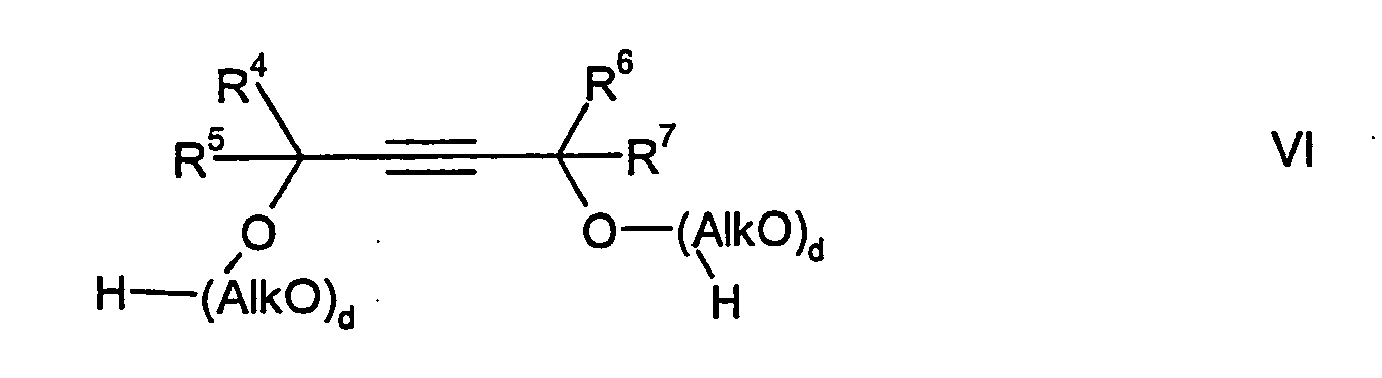
- AlkO
- steht für gleiche oder verschiedene Alkylenoxideinheiten, beispielsweise Propylenoxideinheiten, Butylenoxideinheiten und insbesondere Ethylenoxideinheiten,
- R4, R5, R6, R7
- sind jeweils gleich oder verschieden und gewählt aus C1-C10-Alkyl, unverzweigt oder verzweigt, wie Methyl, Ethyl, n-Propyl, iso-Propyl, n-Butyl, iso-Butyl, sec.-Butyl, tert.-Butyl, n-Pentyl, iso-Pentyl, sec.-Pentyl, neo-Pentyl, 1,2-Dimethylpropyl, iso-Amyl, n-Hexyl, iso-Hexyl, sec.-Hexyl, n-Heptyl, n-Octyl, 2-Ethylhexyl, n-Nonyl, n-Decyl, besonders bevorzugt C1-C4-Alkyl wie Methyl, Ethyl, n-Propyl, iso-Propyl, n-Butyl, iso-Butyl, sec.-Butyl und tert.-Butyl; und Wasserstoff;
- d
- ist gleich oder verschieden und gewählt aus ganzen Zahlen im Bereich von 0 bis 50, bevorzugt 0 oder 1 bis 30 und besonders bevorzugt 3 bis 20.
- In einer bevorzugten Ausführungsform der vorliegenden Erfindung sind R5 oder R7 gleich Methyl.
- In einer bevorzugten Ausführungsform der vorliegenden Erfindung sind R5 und R7 gleich Methyl, und R4 und R6 gleich Isobutyl.
- Andere bevorzugte Zuschlagstoffe (D) sind gegebenenfalls alkoxylierte Siliziumverbindungen insbesondere der Formel VII a bis VII d
[(CH3)3Si-O]2-Si(CH3)-(CH2)3-O(CH2CH2O)d-H VII a
H(OCH2CH2)d-O-(CH2)3-Si(CH3)[OSi(CH3)3][OSi(CH3)2-OSi(CH3)3] VII b
H(PO)d-(OCH2CH2)d-O-(CH2)3-Si(CH3)[OSi(CH3)2-OSi(CH3)3]2 VII c
H(PO)d-(OCH2CH2)d-O-(CH2)3-Si(CH3)[OSi(CH3)3][OSi(CH3)2]u-OSi(CH3)3 VII d
in der die Variable d jeweils gleich oder verschieden und wie vorstehend definiert ist und u eine ganze Zahl im Bereich von 1 bis 10 bedeutet. - In einer Ausführungsform der vorliegenden Erfindung haben erfindungsgemäße Tinten für das Ink-Jet-Verfahren eine dynamische Viskosität im Bereich von 2 bis 80 mPa·s, bevorzugt 3 bis 40 mPa·s, besonders bevorzugt bis 30 mPa·s, gemessen bei 23°C nach DIN 53018.
- In einer Ausführungsform der vorliegenden Erfindung beträgt die Oberflächenspannung erfindungsgemäßer Tinten für das Ink-Jet-Verfahren 24 bis 70 mN/m, insbesondere 25 bis 60 mN/m, gemessen bei 25°C nach DIN 53993.
- In einer Ausführungsform der vorliegenden Erfindung liegt der pH-Wert erfindungsgemäßer Tinten für das Ink-Jet-Verfahren bei 5 bis 10, vorzugsweise bei 7 bis 9.
- Erfindungsgemäße Tinten für das Ink-Jet-Verfahren zeigen insgesamt vorteilhafte Anwendungseigenschaften, vor allem gutes Anschreibverhalten und gutes Dauerschreibverhalten (Kogation) sowie, insbesondere bei Verwendung der besonders bevorzugten Lösungsmittelkombination, gutes Trocknungsverhalten, und ergeben Druckbilder hoher Qualität, d.h. hoher Brillanz und Farbtiefe sowie hoher Reib-, Licht-, Wasser- und Nassreibechtheit.
- Gemäß einer weiteren Ausführungsform der vorliegenden Erfindung kann man mindestens zwei, bevorzugt mindestens drei verschiedene erfindungsgemäße Tinten für das Ink-Jet-Verfahren zu Tintensätzen kombinieren, wobei verschiedene erfindungsgemäße Ink-Jet-Tinten jeweils unterschiedliche Farbmittel mit jeweils unterschiedlicher Farbe enthalten, beispielsweise gelb, magenta, cyan und schwarz.
- Ein weiterer Gegenstand der vorliegenden Erfindung ist ein Verfahren zur Herstellung von erfindungsgemäßen vorzugsweise wässrigen Formulierungen, im Folgenden auch erfindungsgemäßes Herstellverfahren genannt.
- In einer Ausführungsform führt man das erfindungsgemäße Herstellverfahren so durch, dass man mindestens eine Substanz (A) in polarem und vorzugsweise wässrigem Medium löst bzw. dispergiert und mit mindestens einer Hilfssubstanz (C) vermischt.
- Polares Medium kann beispielsweise Alkohol sein, bevorzugt Methanol oder Ethanol oder Isopropanol.
- Wässriges Medium im Sinne der vorliegenden Erfindung kann entweder reines Wasser sein oder bevorzugt eine wässrige Lösung von Zuschlagstoffen (D), wie sie beispielsweise in Beschichtungsverfahren oder Druckverfahren, insbesondere in Druckverfahren nach dem Ink-Jet-Verfahren üblich ist. Bevorzugte Zuschlagstoffe (D) für das Ink-Jet-Verfahren sind vorstehend aufgeführt.
- Natürlich kann man auch Mischungen von Wasser und Methanol oder Wasser und Ethanol oder Wasser und Isopropanol als polares Medium einsetzen.
- In einer speziellen Ausführungsform der vorliegenden Erfindung führt man das erfindungsgemäße Herstellverfahren so durch, dass man mindestens eine Substanz (A) in polarem und vorzugsweise wässrigem Medium mit mindestens einer Hilfssubstanz (C) vermischt dispergiert, beispielsweise in einer Kugelmühle.
- Ein weiterer Aspekt der vorliegenden Erfindung sind Substrate, bedruckt nach dem erfindungsgemäßen Verfahren. Erfindungsgemäße bedruckte Substrate zeichnen sich durch sehr gute Reibechtheiten wie beispielsweise Trockenreibechtheit und Nassreibechtheit aus und weiterhin durch ausgesprochen scharfe Linien von aufgebrachter gelöster bzw. dispergierter Substanz (A).
- Ein weiterer Aspekt der vorliegenden Erfindung ist die Verwendung von erfindungsgemäßen bedruckten Substraten als Übertragungsmedium im Transferdruckverfahren.
- Ein weiterer Aspekt der vorliegenden Erfindung ist ein Verfahren zum Kolorieren von Polyester oder polyesterhaltige Materialien nach dem Transferdruckverfahren unter Verwendung von erfindungsgemäßen bedruckten Substraten als Übertragungsmedium, wobei Substrat (B) vorzugsweise ein Transferpapier mit einem pKa-Wert von 4 bis 6 ist.
- Ein weiterer Aspekt der vorliegenden Erfindung sind Substrate aus Polyamid, Polyacrylnitril, Viskose, Acetat und vorzugsweise Polyester oder polyesterhaltigem Material, koloriert unter Verwendung von erfindungsgemäßen bedruckten Substraten oder nach einem erfindungsgemäßen Verfahren. Erfindungsgemäße kolorierte Substrate aus Polyamid, Polyacrylnitril, Viskose, Acetat und vorzugsweise Polyester oder polyesterhaltigem Material zeichnen sich durch sehr gute Reibechtheiten wie beispielsweise Trockenreibechtheit und Nassreibechtheit aus und weiterhin durch ausgesprochen scharfe Linien von aufgebrachter gelöster bzw. dispergierter Substanz (A). Insbesondere lassen sich Muster besonders gut und brillant auf Substrate aus Polyamid, Polyacrylnitril, Viskose, Acetat und vorzugsweise Polyester oder polyesterhaltiges Material übertragen.
- Die Erfindung wird durch Arbeitsbeispiele erläutert.
- Feststoffgehalt: Die Angaben in % beziehen sich im Rahmen der vorliegenden Erfindung stets auf Gew.-%, wenn nicht ausdrücklich anders angegeben.
- Der K-Wert nach Fikentscher stellt ein Maß für das Molekulargewicht von beispielsweise Hilfssubstanzen (C) dar und wurde gemäß H. Fikentscher, Cellulose-Chemie, 13, 38 bis 64 und 71 bis 74 (1932) als 1 Gew.-% Lösung in Wasser bei 23°C bestimmt.
- In einem Vierhalskolben mit Metallrührer und Rückflusskühler wurden unter Stickstoffatmosphäre 196 g Polyethylenimin (C1.1, wasserfrei, Mw 25.000 g/mol) vorgelegt und mit 588 g destilliertem Wasser auf 25 Gew.-% verdünnt. Es wurde unter Rühren auf 70°C aufgeheizt, und bei 70°C wurden 40 ml einer 22 Gew.-% wässrigen Lösung von C3.1 innerhalb von 5 Minuten zugegeben. C3.1 war ein Umsetzungsprodukt eines Polyethylenglykols mit Mw 1500 g/mol mit 2 Äquivalenten Epichlorhydrin. Nach beendeter Zugabe von C3.1 wurde die Reaktionsmischung für 5 Stunden bei 70°C gerührt. Anschließend wurde auf 80°C aufgeheizt und bei 80°C innerhalb von 3 Stunden 263,2 g Acrylsäure (C2.1) zugetropft. Nach beendeter Zugabe wurde die so erhältliche Reaktionsmischung bei 80°C für 1 weitere Stunde weitergerührt und danach auf Zimmertemperatur abgekühlt. Man erhielt eine viskose, gelb-orange Lösung von Hilfssubstanz C-1 mit einem Feststoffgehalt von 42% (2h, Vakuum/120°C) und einem K-Wert nach Fikentscher (1% in Wasser) von 17.
- Der pKa-Wert von Hilfssubstanz C-1 betrug 6,3.
- In einem Vierhalskolben mit Metallrührer und Rückflusskühler wurden unter Stickstoffatmosphäre 350 g einer 56 Gew.-% wässrigen Lösung von Polyethylenimin (C1.1, Mw 25.000 g/mol) vorgelegt und mit 456 g destilliertem Wasser auf 24% verdünnt. Es wurde unter Rühren auf 80°C aufgeheizt und bei 80°C innerhalb von 3 Stunden 259,4 g Acrylsäure (C2.1) zugetropft. Nach beendeter Zugabe wurde die Lösung bei 80°C für weitere 6 Stunden weitergerührt. Man erhielt eine viskose, gelb-orange Lösung von Hilfssubstanz C-2 mit einem Feststoffgehalt von 43,2% (2h, Vakuum/120°C) und einem K-Wert nach Fikentscher (1% in Wasser) von 14,9.
- Der pKa-Wert von Hilfssubstanz C-2 betrug 6,5.
- In einem Vierhalskolben mit Metallrührer und Rückflusskühler wurden unter Stickstoffatmosphäre 350 g einer 56 Gew.-% wässrigen Lösung von Polyethylenimin (C1.1, Mw 25.000 g/mol) vorgelegt und mit 456 g destilliertem Wasser verdünnt. Es wurde unter Rühren auf 70°C aufgeheizt, und bei 70°C wurden 18 ml einer 50 Gew.-% wässrigen Lösung von C3.3 innerhalb von 5 Minuten zugegeben. C3.3 war ein Umsetzungsprodukt eines Polyethylenglykols mit mittlerer Molekulargewicht Mw 660 g/mol mit 2 Äquivalenten Epichlorhydrin. Nach beendeter Zugabe wurde die Reaktionsmischung für 5 Stunden bei 70°C gerührt. Anschließend wurde die Reaktionsmischung auf 80°C aufgeheizt und bei 80°C innerhalb von 3 Stunden tropfenweise mit 259,4 g Acrylsäure (C2.1) versetzt. Nach beendeter Zugabe wurde die Reaktionsmischung bei 95°C für eine weitere Stunde gerührt und danach auf Zimmertemperatur abgekühlt. Man erhielt eine viskose, gelb-orange Lösung von Hilfssubstanz C-3 mit einem Feststoffgehalt von 44,1 % (2h, Vakuum/120°C) und einem K-Wert nach Fikentscher (1% in Wasser) von 23,1.
- Der pKa-Wert von Hilfssubstanz C-3 betrug 6,4.
- In einem Becherglas wurden Ingredienzien gemäß Tabelle 1 vermischt. Alle Mengenangaben in g, wenn nicht anders angegeben. Man erhielt die erfindungsgemäßen Tinten T1 bis T8.
Tabelle 1: Zusammensetzung von erfindungsgemäßen Tinten T1 bis T4 T1 (cyan) T2 (magenta) T3 (gelb) T4 (schwarz) Disperse Blue 359 4,5 Disperse Red 60 4,2 0,5 Disperse Yellow 54 3,5 0,5 Disperse Blue 72 2,8 Dispergiermittel 1 6 5,6 4,67 5,07 C-1 0,35 0,3 0,25 0,4 Diethylenglykol 12,8 13,2 11,7 12,6 Triethanolamin 0,2 0,2 0,2 0,2 Zuschlagstoff D1 4,5 4,2 3,5 3,8 Zuschlagstoff D2 5,2 6,4 7,3 4,6 Zuschlagstoff D3 0,3 0,28 0,23 0,25 Zuschlagstoff D4 0,12 0,2 0,15 0,23 Vollentsalztes Wasser 66,03 65,42 68,5 69,05 - Es bedeuten:
- Dispergiermittel 1: Verbindung I b.1, pka-Wert 2,2.

- Zuschlagstoff D1: Polyethylenglykol mit Mw 1000 g/mol
- Zuschlagstoff D2: Polyethylenglykol mit Mw 4000 g/mol
- Zuschlagstoff D3: 20 Gew.-% Lösung von 1,2-Benziso-thiazolin-3-on in Propylenglykol (Biozid)
- Zuschlagstoff D4: H(OCH2CH2)7O-(CH2)3-Si(CH3)[OSi(CH3)3]2
- Dispergiermittel 2:
- Naphthalinsulfonsäure/Formaldehyd-Kondensat mit Mw 20.000 g/mol, pka-Wert 2,1.
- Zuschlagstoff D5:
- Polyethylenglykol mit Mw 4000 g/mol
- Zuschlagstoff D6:
- H(OC3H6)3-(OCH2CH2)10-O-(CH2)3-Si(CH3)[OSi(CH3)3][OSi(CH3)2]3-OSi(CH3)3
- Die erfindungsgemäßen Tinten T1 bis T4 wurden mit einem Ink-Jet-Drucker Mimaki JV4 auf Substrate B1 bis B7 zu Linienmustem verdruckt, und zwar zu Streifen aus jeweils einer Tinte T1 bis T4 neben Streifen aus jeweils einer Tinte T1 bis T3 oder Mischungen aus zwei oder drei Tinten T1 bis T3, und das Ausbluten der jeweiligen Tinten an den Grenzen der Streifen in mm vermessen. Dabei wurden in Abhängigkeit der unten aufgeführten Substrate folgende Resultate erhalten.
- Als Substrat B1 diente Papier: Coldenhove Jetcol HTR 2000, pKa-Wert: 4,9
Tabelle 2.1 Verdrucken von erfindungsgemäßen Tinten T1 bis T4 auf Substrat B1 T1 (cyan) T2 (magenta) T3 (gelb) T4 (schwarz) T1/T2/T3 0,12 0,11 0,08 0,07 T1/T2 0,06 0,08 0,09 0,07 T1/T3 0,08 0,09 0,07 0,09 T2/T3 0,06 0,07 0,06 0,05 T1 - 0,04 0,06 0,05 T2 - - 0,07 0,03 T3 - - - 0,04 - Als Substrat B2 diente Papier: Coldenhove Jetcol HTR 4000, pKa-Wert: 4,8
Tabelle 2.2 Verdrucken von erfindungsgemäßen Tinten T1 bis T4 auf Substrat B2 T1 (cyan) T2 (magenta) T3 (gelb) T4 (schwarz) T1/T2/T3 0,14 0,1 0,09 0,08 T1/T2 0,05 0,1 0,08 0,06 T1/T3 0,06 0,09 0,07 0,07 T2/T3 0,08 0,09 0,08 0,04 T1 - 0,05 0,07 0,05 T2 - - 0,08 0,03 T3 - - - 0,05 - Als Substrat B3 diente Papier: Coldenhove Jetcol Highspeed, pKa-Wert: 5,0
Tabelle 2.3 Verdrucken von erfindungsgemäßen Tinten T1 bis T4 auf Substrat B3 T1 (cyan) T2 (magenta) T3 (gelb) T4 (schwarz) T1/T2/T3 0,12 0,09 0,05 0,08 T1/T2 0,07 0,09 0,09 0,06 T1/T3 0,07 0,1 0,08 0,09 T2/T3 0,05 0,06 0,07 0,06 T1 - 0,03 0,05 0,06 T2 - - 0,08 0,04 T3 - - - 0,03 - Als Substrat B4 diente Papier: Cham Tenero Transjet 831, pKa-Wert: 5,5
Tabelle 2.4 Verdrucken von erfindungsgemäßen Tinten T1 bis T4 auf Substrat B4 T1 (cyan) T2 (magenta) T3 (gelb) T4 (schwarz) T1/T2/T3 0,14 0,12 0,07 0,07 T1/T2 0,08 0,09 0,1 0,06 T1/T3 0,08 0,09 0,06 0,08 T2/T3 0,05 0,08 0,07 0,07 T1 - 0,06 0,07 0,07 T2 - - 0,06 0,07 T3 - - - 0,06 - Als Substrat B5 diente Papier: EPSON Photo Quality Paper, pKa-Wert: 7,7
Tabelle 2.5 Verdrucken von erfindungsgemäßen Tinten T1 bis T4 auf Substrat B5 T1 (cyan) T2 (magenta) T3 (gelb) T4 (schwarz) T1/T2/T3 1,7 1,9 1,6 2,1 T1/T2 0,7 0,5 0,6 0,5 T1/T3 0,9 1,0 0,8 0,95 T2/T3 0,8 0,4 0,5 1,05 T1 - 0,06 0,2 0,05 T2 - - 0,06 0,07 - Die erfindungsgemäßen Tinten T5 bis T8 wurden mit einem Ink-Jet-Drucker Mimaki JV4 auf Substrate B1 bis B7 zu Linienmustern verdruckt, und zwar zu Streifen aus jeweils einer Tinte T5 bis T8 neben Streifen aus jeweils einer Tinte T5 bis T7 oder Mischungen aus zwei oder drei Tinten T5 bis T7, und das Ausbluten der jeweiligen Tinten an den Grenzen der Streifen in mm vermessen. Dabei wurden in Abhängigkeit der unten aufgeführten Substrate folgende Resultate erhalten.
Tabelle 3.1 Verdrucken von erfindungsgemäßen Tinten T5 bis T8 auf Substrat B1 T5 (cyan) T6 (magenta) T7 (gelb) T8 (schwarz) T5/T6/T7 0,15 0,12 0,09 0,09 T5/T6 0,09 0,1 0,11 0,09 T5/T7 0,11 0,09 0,1 0,12 T6/T7 0,08 0,09 0,09 0,08 T5 - 0,06 0,08 0,09 T6 - - 0,07 0,05 T7 - - - 0,06 Tabelle 3.2 Verdrucken von erfindungsgemäßen Tinten T5 bis T8 auf Substrat B2 T5 (cyan) T6 (magenta) T7 (gelb) T8 (schwarz T5/T6/T7 0,16 0,13 0,12 0,1 T5/T6 0,08 0,11 0,1 0,09 T5/T7 0,06 0,12 0,09 0,08 T6/T7 0,1 0,08 0,09 0,06 T5 - 0,07 0,08 0,07 T6 - - 0,08 0,05 T7 - - - 0,07 Tabelle 3.3 Verdrucken von erfindungsgemäßen Tinten T5 bis T8 auf Substrat B3 T5 (cyan) T6 (magenta) T7 (gelb) T8 (schwarz) T5/T6/T7 0,13 0,1 0,08 0,09 T5/T6 0,08 0,09 0,08 0,09 T5/T7 0,06 0,11 0,09 0,11 T6/T7 0,07 0,08 0,08 0,09 T5 - 0,07 0,06 0,05 T6 - - 0,07 0,07 T7 - - - 0,06 Tabelle 3.4 Verdrucken von erfindungsgemäßen Tinten T5 bis T8 auf Substrat B4 T5 (cyan) T6 (magenta) T7 (gelb) T8 (schwarz) T5/T6/T7 0,15 0,13 0,09 0,1 T5/T6 0,08 0,08 0,11 0,08 T5/T7 0,07 0,1 0,07 0,09 T6/T7 0,06 0,09 0,08 0,07 T5 - 0,08 0,08 0,08 T6 - - 0,07 0,08 T7 - - - 0,07 Tabelle 3.5 Verdrucken von erfindungsgemäßen Tinten T5 bis T8 auf Substrat B5 (Vergleichsversuch) T5 (cyan) T6 (magenta) T7 (gelb) T8 (schwarz) T5/T6/T7 1,6 1,8 1,4 1,95 T5/T6 0,55 0,8 0,7 0,5 T5/T7 1,0 1,0 0,7 0,9 T6/T7 0,6 0,55 0,6 0,95 T5 - 0,1 0,05 0,2 T6 0,08 - 0,1 0,1 - Die mit den erfindungsgemäßen Tinten bedruckten Substraten wiesen außerdem sehr gute Reibechtheiten auf.
C.I. Pigment Brown 22.
Weißpigmente wie beispielsweise Titandioxid (C.I. Pigment White 6), Zinkweiß, Farbenzinkoxid; Zinksulfid, Lithopone; Bleiweiß, Bariumsulfat,
Schwarzpigmente wie beispielsweise Eisenoxidschwarz (C.I. Pigment Black 11), Eisen-Mangan-Schwarz, Spinellschwarz (C.I. Pigment Black 27); Ruß (C.I. Pigment Black 7),
Buntpigmente wie beispielsweise Chromoxid, Chromoxidhydratgrün, Chromgrün (C.I. Pigment Green 48), Cobaltgrün (C.I. Pigment Green 50), Ultramaringrün, Kobaltblau (C.I. Pigment Blue 28 und 36); Ultramarinblau; Eisenblau (C.I. Pigment Blue 27); Manganblau; Ultramarinviolett, Kobalt- und Manganviolett, Eisenoxidrot (C.I. Pigment Red 101), Cadmiumsulfoselenid (C.I. Pigment Red 108); Molybdatrot (C.I. Pigment Red 104), Ultramarinrot,
Eisenoxidbraun, Mischbraun, Spinell- und Korundphasen (C.I. Pigment Brown 24, 29 und 31), Chromorange,
Eisenoxidgelb (C.I. Pigment Yellow 42), Nickeltitangelb (C.I. Pigment Yellow 53, C.I. Pigment Yellow 157 und 164), Chromtitangelb, Cadmiumsulfid und Cadmiumzinksulfid (C.I. Pigment Yellow 37 und 35), Chromgelb (C.I. Pigment Yellow 34), Zinkgelb, Erdalkalichromate; Neapelgelb, Bismutvanadat (C.I. Pigment Yellow 184),
| T5 (cyan) | T6 (magenta) | T7 (gelb) | T8 (schwarz) | |
| Disperse Blue 359 | 4,5 | |||
| Disperse Red 60 | 4,2 | 0,5 | ||
| Disperse Yellow 54 | 3,5 | 0,5 | ||
| Disperse Blue 72 | 2,8 | |||
| Dispergiermittel 2 | 6 | 5,6 | 4,67 | 5,07 |
| C-2 | 0,52 | 0,48 | 0,41 | 0,32 |
| Glycerin | 11,4 | 12,3 | 10,2 | 11,3 |
| Triethanolamin | 0,25 | 0,25 | 0,25 | 0,25 |
| Zuschlagstoff D1 | 4,5 | 4,2 | 3,5 | 3,8 |
| Zuschlagstoff D5 | 6,5 | 7,7 | 8,5 | 5,9 |
| Zuschlagstoff D3 | 0,3 | 0,28 | 0,23 | 0,25 |
| Zuschlagstoff D6 | 0,1 | 0,15 | 0,1 | 0,15 |
| Vollentsalztes Wasser | 65,93 | 64,84 | 68,64 | 69,16 |
Claims (19)
- Verfahren zum Aufbringen von gelösten oder dispergierten Substanzen (A) aus einer Formulierung in polarem Medium auf Substraten (B) unter Verwendung von mindestens einer Hilfssubstanz (C), indem man
eine Formulierung in polarem Medium, die gelöste oder dispergierte Substanz (A) und mindestens eine Hilfssubstanz (C) enthält, auf Substrat (B) aufbringt,
wobei der pKa-Wert von Hilfssubstanz (C) höher ist als vom Substrat (B) und von gelöster oder dispergierter Substanz (A),
wobei man gelöste oder dispergierte Substanz (A) wählt aus wasserlöslichen Farbstoffen, selbstdispergierenden Farbmitteln, Kombinationen aus Dispersionsfarbstoff mit Dispergiermittel und Kombinationen aus Pigment mit Dispergiermittel und wobei Hilfssubstanz (C) gewählt wird aus dreidimensionalen amphoteren Kern-Schale-Polymeren, bei denen es sich um partiell vernetztes chemisch modifiziertes Polymer mit kationischem Kern, der erhältlich ist durch (Co)polymerisation von einem oder mehreren Stickstoffhaltigen (Co)monomeren, und vor dem Aufbringen auf Substrat (B) ungeladener oder negativ geladener Hülle handelt. - Verfahren nach Anspruch 1, dadurch gekennzeichnet, dass man Substrat (B) weder unmittelbar vor noch unmittelbar nach dem Aufbringen von Formulierung in polarem Medium, die gelöste oder dispergierte Substanz (A) und mindestens eine Hilfssubstanz (C) enthält, mit einer Lösung von anionischem Polymer kontaktiert.
- Verfahren nach Anspruch 1 oder 2, dadurch gekennzeichnet, dass es sich bei Substraten (B) um flexible Substrate handelt.
- Verfahren nach einem der Ansprüche 1 bis 3, dadurch gekennzeichnet, dass gelöste oder dispergierte Substanz (A) mindestens eine anionische Substanz umfasst.
- Verfahren nach einem der Ansprüche 1 bis 4, dadurch gekennzeichnet, dass gelöste oder dispergierte Substanz (A) eine Substanz mit mindestens einer SO3 -- oder OSO3 - -Gruppe pro Molekül umfasst.
- Verfahren nach einem der Ansprüche 1 bis 5, dadurch gekennzeichnet, dass man es als Ink-Jet-Verfahren ausführt.
- Verfahren nach einem der Ansprüche 1 bis 6, dadurch gekennzeichnet, dass man als Substrat (B) Papier wählt.
- Verfahren nach einem der Ansprüche 1 bis 7, dadurch gekennzeichnet, dass Hilfssubstanz (C) erhältlich ist durch Umsetzung von(C1) mindestens einem Stickstoff-haltigen Polymer, gewählt aus Polyalkylenpolyaminen, Polyamidoaminen, mit Ethylenimin gepfropften Polyamidoaminen, Polyetheraminen, mit(C2) mindestens einem Carboxyalkylierungsreagenz, gewählt aus α,β-ungesättigten Carboxylverbindungen, deren Carboxylgruppen frei oder verkappt sein können, α-Halogencarboxylverbindungen, deren Carboxylgruppen frei oder verkappt sein können, Glycidylcarboxylverbindungen, deren Carboxylgruppen frei oder verkappt sein können, Cyanhydrinen, und Gemischen von mindestens einem Aldehyd und mindestens einem Alkalimetallcyanid,(C3) und gegebenenfalls mindestens einem mindestens bifunktionellen Vernetzer, dessen funktionelle Gruppen gewählt werden aus Halogenhydrin-, Glycidyl-, Aziridin- oder Isocyanat-Einheiten oder Halogenatomen.
- Formulierung, enthaltend mindestens eine gelöste oder dispergierte Substanz (A) und mindestens eine Hilfssubstanz (C) in polarem Medium, wobei der pKa-Wert von Hilfssubstanz (C) höher ist als von gelöster oder dispergierter Substanz (A), wobei man gelöste oder dispergierte Substanz (A) wählt aus wasserlöslichen Farbstoffen, selbstdispergierenden Farbmitteln, Kombinationen aus Dispersionsfarbstoff mit Dispergiermittel und Kombinationen aus Pigment mit Dispergiermittel und wobei Hilfssubstanz (C) gewählt wird aus dreidimensionalen amphoteren Kern-Schale-Polymeren, bei denen es sich um partiell vernetztes chemisch modifiziertes Polymer mit kationischem Kern, erhältlich durch (Co)polymerisation von einem oder mehreren Stickstoffhaltigen (Co)monomeren, und vor dem Aufbringen auf Substrat (B) ungeladener oder negativ geladener Hülle handelt.
- Formulierung nach Anspruch 9, dadurch gekennzeichnet, dass es sich bei gelöster oder dispergierter Substanz (A) um einen Dispersionsfarbstoff handelt.
- Formulierung nach Anspruch 9 oder 10, dadurch gekennzeichnet, dass es sich bei gelöster oder dispergierter Substanz (A) um eine Substanz mit SO3 -- oder OSO3 --Gruppen handelt.
- Formulierung nach einem der Ansprüche 9 bis 11, dadurch gekennzeichnet, dass Hilfssubstanz (C) erhältlich ist durch Umsetzung von(C1) mindestens einem Stickstoff-haltigen Polymer, gewählt aus Polyalkylenpolyaminen, Polyamidoaminen, mit Ethylenimin gepfropften Polyamidoaminen, Polyetheraminen, mit(C2) mindestens einem Carboxyalkylierungsreagenz, gewählt aus α,β-ungesättigten Carboxylverbindungen, deren Carboxylgruppen frei oder verkappt sein können, α-Halogencarboxylverbindungen, deren Carboxylgruppen frei oder verkappt sein können, Glycidylcarboxylverbindungen, deren Carboxylgruppen frei oder verkappt sein können, Cyanhydrinen, und Gemischen von mindestens einem Aldehyd und mindestens einem Alkalimetallcyanid, und(C3) gegebenenfalls mindestens einem mindestens bifunktionellen Vernetzer, dessen funktionelle Gruppen gewählt werden aus Halogenhydrin-, Glycidyl-, Aziridin- oder Isocyanat-Einheiten oder Halogenatomen.
- Tinten für das Ink-Jet-Verfahren, enthaltend mindestens eine wässrige Formulierung nach einem der Ansprüche 9 bis 12.
- Tintensatz für das Ink-Jet-Verfahren, umfassend mindestens zwei Tinten nach Anspruch 13.
- Verfahren zur Herstellung von wässrigen Formulierungen nach einem der Ansprüche 9 bis 12, dadurch gekennzeichnet, dass man mindestens eine Substanz (A) in wässrigem Medium löst bzw. dispergiert und mit mindestens einer Hilfssubstanz (C) vermischt.
- Verfahren zum Bedrucken von Substraten (B) nach mindestens einem der Ansprüche 1 bis 8 unter Verwendung von mindestens einer wässrigen Formulierung nach einem der Ansprüche 9 bis 12.
- Substrate, behandelt nach einem Verfahren nach einem der Ansprüche 1 bis 8.
- Verwendung von bedruckten Substraten nach Anspruch 17 als Übertragungsmedium im Transferdruckverfahren.
- Verfahren zum Kolorieren von Polyester oder polyesterhaltige Materialien nach dem Transferdruckverfahren unter Verwendung von bedruckten Substraten nach Anspruch 17 als Übertragungsmedium.
Applications Claiming Priority (2)
| Application Number | Priority Date | Filing Date | Title |
|---|---|---|---|
| DE102005017052A DE102005017052A1 (de) | 2005-04-12 | 2005-04-12 | Verfahren zum Aufbringen von gelösten oder dispergierten Substanzen |
| PCT/EP2006/061505 WO2006108832A1 (de) | 2005-04-12 | 2006-04-11 | Verfahren zum aufbringen von gelösten oder dispergierten substanzen |
Publications (2)
| Publication Number | Publication Date |
|---|---|
| EP1871848A1 EP1871848A1 (de) | 2008-01-02 |
| EP1871848B1 true EP1871848B1 (de) | 2009-09-16 |
Family
ID=36655120
Family Applications (1)
| Application Number | Title | Priority Date | Filing Date |
|---|---|---|---|
| EP06743277A Expired - Lifetime EP1871848B1 (de) | 2005-04-12 | 2006-04-11 | Verfahren zum aufbringen von gelösten oder dispergierten substanzen |
Country Status (8)
| Country | Link |
|---|---|
| US (1) | US20080193648A1 (de) |
| EP (1) | EP1871848B1 (de) |
| JP (1) | JP2008535988A (de) |
| CN (1) | CN101160362B (de) |
| AT (1) | ATE443111T1 (de) |
| CA (1) | CA2603906A1 (de) |
| DE (2) | DE102005017052A1 (de) |
| WO (1) | WO2006108832A1 (de) |
Families Citing this family (9)
| Publication number | Priority date | Publication date | Assignee | Title |
|---|---|---|---|---|
| EP2197941B1 (de) * | 2007-10-09 | 2011-05-25 | Basf Se | Verwendung hochfunktioneller, hochverzweigter polyetheraminpolyole zur beschichtung von oberflächen |
| DK2342296T3 (da) * | 2008-10-02 | 2013-11-25 | Basf Se | Fremgangsmåde til trykning på substrater |
| JP5736749B2 (ja) * | 2010-11-29 | 2015-06-17 | 株式会社リコー | インクジェット記録方法 |
| JP5736748B2 (ja) * | 2010-11-29 | 2015-06-17 | 株式会社リコー | インクジェット記録方法 |
| JP6094280B2 (ja) * | 2013-03-14 | 2017-03-15 | セイコーエプソン株式会社 | インクジェット捺染用ブラックインク、および捺染方法 |
| JP6429075B2 (ja) * | 2015-01-21 | 2018-11-28 | セイコーエプソン株式会社 | 昇華転写用インクセット、並びに、染色物及びその製造方法 |
| JP2017036358A (ja) * | 2015-08-06 | 2017-02-16 | セイコーエプソン株式会社 | オレンジインク組成物、インクセット、染色物の製造方法、及び染色物 |
| JP7234658B2 (ja) * | 2019-01-30 | 2023-03-08 | セイコーエプソン株式会社 | 水性インクジェット用組成物 |
| JP7375306B2 (ja) * | 2019-02-27 | 2023-11-08 | セイコーエプソン株式会社 | 捺染用インクジェットインク組成物及び捺染方法 |
Family Cites Families (18)
| Publication number | Priority date | Publication date | Assignee | Title |
|---|---|---|---|---|
| US5116409A (en) * | 1991-04-17 | 1992-05-26 | Hewlett-Packard Company | Bleed alleviation in ink-jet inks |
| US5648405A (en) * | 1992-12-30 | 1997-07-15 | E. I. Du Pont De Nemours And Company | Aqueous ink jet inks |
| DE4306608A1 (de) * | 1993-03-03 | 1994-11-24 | Basf Ag | Wäßrige Pigmentanschlämmungen, Verfahren zu ihrer Herstellung und ihre Verwendung bei der Herstellung von füllstoffhaltigem Papier |
| JP4014056B2 (ja) * | 1995-04-07 | 2007-11-28 | キヤノン株式会社 | インクジェット用のインク、これを用いたインクジェット記録方法及びインクジェット記録装置 |
| US6174354B1 (en) * | 1995-04-07 | 2001-01-16 | Canon Kabushiki Kaisha | Ink, ink-jet recording process and apparatus using the same |
| TW455597B (en) * | 1996-04-12 | 2001-09-21 | Sumitomo Chemical Co | Water soluble resins and paper coating composition containing same |
| JP3484878B2 (ja) * | 1996-05-27 | 2004-01-06 | 富士ゼロックス株式会社 | インクジェット記録用インクユニット及びインクジェット記録方法 |
| US5998543A (en) * | 1996-05-28 | 1999-12-07 | Eastman Chemical Company | Stable amino-containing polymer latex blends |
| US6057384A (en) * | 1997-10-31 | 2000-05-02 | Hewlett-Packard Company | Latex polymer blends for improving the permanence of ink-jet inks |
| EP1027393B1 (de) * | 1997-10-31 | 2004-04-21 | Hewlett-Packard Company, A Delaware Corporation | Drucktintenzusammensetzungen mit hoher schmierenfestigkeit |
| JPH11199808A (ja) * | 1998-01-16 | 1999-07-27 | Seiko Epson Corp | 水性インク組成物とこれを用いた記録方法、並びに、これらを用いて記録された記録物 |
| WO2001008895A1 (en) * | 1999-07-30 | 2001-02-08 | Seiko Epson Corporation | Recording method comprising printing recording medium with two liquid components |
| US20020052439A1 (en) * | 2000-08-08 | 2002-05-02 | 3M Innovative Properties Company | Ink receptive compositions and articles for image transfer |
| JP2004017569A (ja) * | 2002-06-19 | 2004-01-22 | Fuji Xerox Co Ltd | インクジェット記録方法 |
| JP4492046B2 (ja) * | 2002-11-28 | 2010-06-30 | セイコーエプソン株式会社 | インクセット、記録方法、及び記録物 |
| US7513944B2 (en) * | 2002-11-28 | 2009-04-07 | Seiko Epson Corporation | Black ink composition, ink set, recording method and recorded matter |
| US6858301B2 (en) * | 2003-01-02 | 2005-02-22 | Hewlett-Packard Development Company, L.P. | Specific core-shell polymer additive for ink-jet inks to improve durability |
| JP2009056615A (ja) * | 2007-08-30 | 2009-03-19 | Ricoh Co Ltd | インクジェット記録方法 |
-
2005
- 2005-04-12 DE DE102005017052A patent/DE102005017052A1/de not_active Withdrawn
-
2006
- 2006-04-11 US US11/911,355 patent/US20080193648A1/en not_active Abandoned
- 2006-04-11 CN CN2006800120399A patent/CN101160362B/zh not_active Expired - Fee Related
- 2006-04-11 CA CA002603906A patent/CA2603906A1/en not_active Abandoned
- 2006-04-11 EP EP06743277A patent/EP1871848B1/de not_active Expired - Lifetime
- 2006-04-11 AT AT06743277T patent/ATE443111T1/de active
- 2006-04-11 WO PCT/EP2006/061505 patent/WO2006108832A1/de not_active Ceased
- 2006-04-11 JP JP2008505883A patent/JP2008535988A/ja not_active Ceased
- 2006-04-11 DE DE502006004867T patent/DE502006004867D1/de not_active Expired - Lifetime
Also Published As
| Publication number | Publication date |
|---|---|
| DE102005017052A1 (de) | 2006-10-19 |
| CN101160362A (zh) | 2008-04-09 |
| DE502006004867D1 (de) | 2009-10-29 |
| WO2006108832A1 (de) | 2006-10-19 |
| CN101160362B (zh) | 2011-07-13 |
| ATE443111T1 (de) | 2009-10-15 |
| EP1871848A1 (de) | 2008-01-02 |
| CA2603906A1 (en) | 2006-10-19 |
| US20080193648A1 (en) | 2008-08-14 |
| JP2008535988A (ja) | 2008-09-04 |
Similar Documents
| Publication | Publication Date | Title |
|---|---|---|
| EP1203055B1 (de) | Farbmittelzubereitungen | |
| DE69612950T2 (de) | Wässrige Tintenzusammensetzung, die Amide als Mittel gegen das Einrollen von Papier enthält | |
| EP0672733B1 (de) | Wasserbeständige Farbstoffe für Tintenstrahl-Aufzeichnungsflüssigkeiten | |
| EP1440100A1 (de) | Vernetzbare polyurethan-blockcopolymere und ihre verwendung in dispergierbindemittelsystemen | |
| DE602004009958T2 (de) | Tintenstrahldrucktinte, tintenkombination und druckverfahren | |
| AU732884B2 (en) | Waterfast infrared scannable inks for ink jet printing | |
| EP1624033B1 (de) | Aufzeichnungsflüssigkeiten, enthaltend Polyurethane mit hyperverzweigten Strukturen | |
| DE102004009940A1 (de) | Aufzeichnungsflüssigkeiten | |
| EP1871848A1 (de) | Verfahren zum aufbringen von gelösten oder dispergierten substanzen | |
| US20030101900A1 (en) | Pigment ink formulation | |
| WO2005017047A1 (de) | Farbmittelzubereitungen | |
| DE60317542T2 (de) | WäSSRIGE TINTENZUSAMMENSETZUNG, DAMIT DURCHGEFüHRTES TINTENSTRAHLDRUCKVERFAHREN SOWIE AUFZEICHNUNG | |
| JP2011074321A (ja) | インクジェット記録用インク組成物 | |
| DE69916553T2 (de) | Alkoxysilane-Bindemittel als Zusatzstoff für Tintenstrahltinten | |
| JP5532810B2 (ja) | インクジェット記録用インク組成物 | |
| EP1442085B1 (de) | Farbmittelzubereitungen | |
| DE102004009942A1 (de) | Aufzeichnungsflüssigkeiten | |
| JP4324173B2 (ja) | ウレタンポリマー含有ラテックス粒子 | |
| EP1412440A1 (de) | Farbmittelzubereitungen | |
| JP7215185B2 (ja) | 被覆着色剤およびその製造方法 | |
| JP2009504824A (ja) | 顔料製剤の製造方法 |
Legal Events
| Date | Code | Title | Description |
|---|---|---|---|
| PUAI | Public reference made under article 153(3) epc to a published international application that has entered the european phase |
Free format text: ORIGINAL CODE: 0009012 |
|
| 17P | Request for examination filed |
Effective date: 20071112 |
|
| AK | Designated contracting states |
Kind code of ref document: A1 Designated state(s): AT BE BG CH CY CZ DE DK EE ES FI FR GB GR HU IE IS IT LI LT LU LV MC NL PL PT RO SE SI SK TR |
|
| RAP1 | Party data changed (applicant data changed or rights of an application transferred) |
Owner name: BASF SE |
|
| DAX | Request for extension of the european patent (deleted) | ||
| 17Q | First examination report despatched |
Effective date: 20080805 |
|
| GRAP | Despatch of communication of intention to grant a patent |
Free format text: ORIGINAL CODE: EPIDOSNIGR1 |
|
| GRAS | Grant fee paid |
Free format text: ORIGINAL CODE: EPIDOSNIGR3 |
|
| GRAA | (expected) grant |
Free format text: ORIGINAL CODE: 0009210 |
|
| AK | Designated contracting states |
Kind code of ref document: B1 Designated state(s): AT BE BG CH CY CZ DE DK EE ES FI FR GB GR HU IE IS IT LI LT LU LV MC NL PL PT RO SE SI SK TR |
|
| REG | Reference to a national code |
Ref country code: GB Ref legal event code: FG4D Free format text: NOT ENGLISH |
|
| REG | Reference to a national code |
Ref country code: CH Ref legal event code: EP |
|
| REG | Reference to a national code |
Ref country code: IE Ref legal event code: FG4D |
|
| REF | Corresponds to: |
Ref document number: 502006004867 Country of ref document: DE Date of ref document: 20091029 Kind code of ref document: P |
|
| PG25 | Lapsed in a contracting state [announced via postgrant information from national office to epo] |
Ref country code: SE Free format text: LAPSE BECAUSE OF FAILURE TO SUBMIT A TRANSLATION OF THE DESCRIPTION OR TO PAY THE FEE WITHIN THE PRESCRIBED TIME-LIMIT Effective date: 20090916 Ref country code: LT Free format text: LAPSE BECAUSE OF FAILURE TO SUBMIT A TRANSLATION OF THE DESCRIPTION OR TO PAY THE FEE WITHIN THE PRESCRIBED TIME-LIMIT Effective date: 20090916 Ref country code: FI Free format text: LAPSE BECAUSE OF FAILURE TO SUBMIT A TRANSLATION OF THE DESCRIPTION OR TO PAY THE FEE WITHIN THE PRESCRIBED TIME-LIMIT Effective date: 20090916 |
|
| LTIE | Lt: invalidation of european patent or patent extension |
Effective date: 20090916 |
|
| PG25 | Lapsed in a contracting state [announced via postgrant information from national office to epo] |
Ref country code: NL Free format text: LAPSE BECAUSE OF FAILURE TO SUBMIT A TRANSLATION OF THE DESCRIPTION OR TO PAY THE FEE WITHIN THE PRESCRIBED TIME-LIMIT Effective date: 20090916 Ref country code: PL Free format text: LAPSE BECAUSE OF FAILURE TO SUBMIT A TRANSLATION OF THE DESCRIPTION OR TO PAY THE FEE WITHIN THE PRESCRIBED TIME-LIMIT Effective date: 20090916 Ref country code: LV Free format text: LAPSE BECAUSE OF FAILURE TO SUBMIT A TRANSLATION OF THE DESCRIPTION OR TO PAY THE FEE WITHIN THE PRESCRIBED TIME-LIMIT Effective date: 20090916 Ref country code: SI Free format text: LAPSE BECAUSE OF FAILURE TO SUBMIT A TRANSLATION OF THE DESCRIPTION OR TO PAY THE FEE WITHIN THE PRESCRIBED TIME-LIMIT Effective date: 20090916 |
|
| NLV1 | Nl: lapsed or annulled due to failure to fulfill the requirements of art. 29p and 29m of the patents act | ||
| PG25 | Lapsed in a contracting state [announced via postgrant information from national office to epo] |
Ref country code: CY Free format text: LAPSE BECAUSE OF FAILURE TO SUBMIT A TRANSLATION OF THE DESCRIPTION OR TO PAY THE FEE WITHIN THE PRESCRIBED TIME-LIMIT Effective date: 20090916 |
|
| REG | Reference to a national code |
Ref country code: IE Ref legal event code: FD4D |
|
| PG25 | Lapsed in a contracting state [announced via postgrant information from national office to epo] |
Ref country code: ES Free format text: LAPSE BECAUSE OF FAILURE TO SUBMIT A TRANSLATION OF THE DESCRIPTION OR TO PAY THE FEE WITHIN THE PRESCRIBED TIME-LIMIT Effective date: 20091227 Ref country code: CZ Free format text: LAPSE BECAUSE OF FAILURE TO SUBMIT A TRANSLATION OF THE DESCRIPTION OR TO PAY THE FEE WITHIN THE PRESCRIBED TIME-LIMIT Effective date: 20090916 Ref country code: RO Free format text: LAPSE BECAUSE OF FAILURE TO SUBMIT A TRANSLATION OF THE DESCRIPTION OR TO PAY THE FEE WITHIN THE PRESCRIBED TIME-LIMIT Effective date: 20090916 Ref country code: IS Free format text: LAPSE BECAUSE OF FAILURE TO SUBMIT A TRANSLATION OF THE DESCRIPTION OR TO PAY THE FEE WITHIN THE PRESCRIBED TIME-LIMIT Effective date: 20100116 Ref country code: EE Free format text: LAPSE BECAUSE OF FAILURE TO SUBMIT A TRANSLATION OF THE DESCRIPTION OR TO PAY THE FEE WITHIN THE PRESCRIBED TIME-LIMIT Effective date: 20090916 Ref country code: IE Free format text: LAPSE BECAUSE OF FAILURE TO SUBMIT A TRANSLATION OF THE DESCRIPTION OR TO PAY THE FEE WITHIN THE PRESCRIBED TIME-LIMIT Effective date: 20090916 Ref country code: PT Free format text: LAPSE BECAUSE OF FAILURE TO SUBMIT A TRANSLATION OF THE DESCRIPTION OR TO PAY THE FEE WITHIN THE PRESCRIBED TIME-LIMIT Effective date: 20100118 |
|
| PG25 | Lapsed in a contracting state [announced via postgrant information from national office to epo] |
Ref country code: SK Free format text: LAPSE BECAUSE OF FAILURE TO SUBMIT A TRANSLATION OF THE DESCRIPTION OR TO PAY THE FEE WITHIN THE PRESCRIBED TIME-LIMIT Effective date: 20090916 |
|
| PLBE | No opposition filed within time limit |
Free format text: ORIGINAL CODE: 0009261 |
|
| STAA | Information on the status of an ep patent application or granted ep patent |
Free format text: STATUS: NO OPPOSITION FILED WITHIN TIME LIMIT |
|
| PG25 | Lapsed in a contracting state [announced via postgrant information from national office to epo] |
Ref country code: DK Free format text: LAPSE BECAUSE OF FAILURE TO SUBMIT A TRANSLATION OF THE DESCRIPTION OR TO PAY THE FEE WITHIN THE PRESCRIBED TIME-LIMIT Effective date: 20090916 |
|
| 26N | No opposition filed |
Effective date: 20100617 |
|
| PG25 | Lapsed in a contracting state [announced via postgrant information from national office to epo] |
Ref country code: GR Free format text: LAPSE BECAUSE OF FAILURE TO SUBMIT A TRANSLATION OF THE DESCRIPTION OR TO PAY THE FEE WITHIN THE PRESCRIBED TIME-LIMIT Effective date: 20091217 |
|
| BERE | Be: lapsed |
Owner name: BASF SE Effective date: 20100430 |
|
| PG25 | Lapsed in a contracting state [announced via postgrant information from national office to epo] |
Ref country code: MC Free format text: LAPSE BECAUSE OF NON-PAYMENT OF DUE FEES Effective date: 20100430 |
|
| REG | Reference to a national code |
Ref country code: CH Ref legal event code: PL |
|
| PG25 | Lapsed in a contracting state [announced via postgrant information from national office to epo] |
Ref country code: LI Free format text: LAPSE BECAUSE OF NON-PAYMENT OF DUE FEES Effective date: 20100430 Ref country code: CH Free format text: LAPSE BECAUSE OF NON-PAYMENT OF DUE FEES Effective date: 20100430 |
|
| PG25 | Lapsed in a contracting state [announced via postgrant information from national office to epo] |
Ref country code: BE Free format text: LAPSE BECAUSE OF NON-PAYMENT OF DUE FEES Effective date: 20100430 |
|
| PGFP | Annual fee paid to national office [announced via postgrant information from national office to epo] |
Ref country code: FR Payment date: 20120611 Year of fee payment: 7 Ref country code: GB Payment date: 20120430 Year of fee payment: 7 |
|
| PG25 | Lapsed in a contracting state [announced via postgrant information from national office to epo] |
Ref country code: HU Free format text: LAPSE BECAUSE OF FAILURE TO SUBMIT A TRANSLATION OF THE DESCRIPTION OR TO PAY THE FEE WITHIN THE PRESCRIBED TIME-LIMIT Effective date: 20100317 Ref country code: LU Free format text: LAPSE BECAUSE OF NON-PAYMENT OF DUE FEES Effective date: 20100411 Ref country code: BG Free format text: LAPSE BECAUSE OF FAILURE TO SUBMIT A TRANSLATION OF THE DESCRIPTION OR TO PAY THE FEE WITHIN THE PRESCRIBED TIME-LIMIT Effective date: 20090916 |
|
| PGFP | Annual fee paid to national office [announced via postgrant information from national office to epo] |
Ref country code: IT Payment date: 20120420 Year of fee payment: 7 |
|
| PG25 | Lapsed in a contracting state [announced via postgrant information from national office to epo] |
Ref country code: TR Free format text: LAPSE BECAUSE OF FAILURE TO SUBMIT A TRANSLATION OF THE DESCRIPTION OR TO PAY THE FEE WITHIN THE PRESCRIBED TIME-LIMIT Effective date: 20090916 |
|
| REG | Reference to a national code |
Ref country code: AT Ref legal event code: MM01 Ref document number: 443111 Country of ref document: AT Kind code of ref document: T Effective date: 20110411 |
|
| PGFP | Annual fee paid to national office [announced via postgrant information from national office to epo] |
Ref country code: DE Payment date: 20120702 Year of fee payment: 7 |
|
| PG25 | Lapsed in a contracting state [announced via postgrant information from national office to epo] |
Ref country code: AT Free format text: LAPSE BECAUSE OF NON-PAYMENT OF DUE FEES Effective date: 20110411 |
|
| GBPC | Gb: european patent ceased through non-payment of renewal fee |
Effective date: 20130411 |
|
| PG25 | Lapsed in a contracting state [announced via postgrant information from national office to epo] |
Ref country code: DE Free format text: LAPSE BECAUSE OF NON-PAYMENT OF DUE FEES Effective date: 20131101 Ref country code: GB Free format text: LAPSE BECAUSE OF NON-PAYMENT OF DUE FEES Effective date: 20130411 |
|
| REG | Reference to a national code |
Ref country code: FR Ref legal event code: ST Effective date: 20131231 |
|
| REG | Reference to a national code |
Ref country code: DE Ref legal event code: R119 Ref document number: 502006004867 Country of ref document: DE Effective date: 20131101 |
|
| PG25 | Lapsed in a contracting state [announced via postgrant information from national office to epo] |
Ref country code: FR Free format text: LAPSE BECAUSE OF NON-PAYMENT OF DUE FEES Effective date: 20130430 Ref country code: IT Free format text: LAPSE BECAUSE OF NON-PAYMENT OF DUE FEES Effective date: 20130411 |