EP1856256B1 - Free reactant use in nucleic acid-templated synthesis - Google Patents
Free reactant use in nucleic acid-templated synthesis Download PDFInfo
- Publication number
- EP1856256B1 EP1856256B1 EP06733839A EP06733839A EP1856256B1 EP 1856256 B1 EP1856256 B1 EP 1856256B1 EP 06733839 A EP06733839 A EP 06733839A EP 06733839 A EP06733839 A EP 06733839A EP 1856256 B1 EP1856256 B1 EP 1856256B1
- Authority
- EP
- European Patent Office
- Prior art keywords
- reactive
- reaction
- oligonucleotide
- sequence
- reaction intermediate
- Prior art date
- Legal status (The legal status is an assumption and is not a legal conclusion. Google has not performed a legal analysis and makes no representation as to the accuracy of the status listed.)
- Expired - Lifetime
Links
Images




Classifications
-
- C—CHEMISTRY; METALLURGY
- C07—ORGANIC CHEMISTRY
- C07H—SUGARS; DERIVATIVES THEREOF; NUCLEOSIDES; NUCLEOTIDES; NUCLEIC ACIDS
- C07H21/00—Compounds containing two or more mononucleotide units having separate phosphate or polyphosphate groups linked by saccharide radicals of nucleoside groups, e.g. nucleic acids
-
- C—CHEMISTRY; METALLURGY
- C12—BIOCHEMISTRY; BEER; SPIRITS; WINE; VINEGAR; MICROBIOLOGY; ENZYMOLOGY; MUTATION OR GENETIC ENGINEERING
- C12N—MICROORGANISMS OR ENZYMES; COMPOSITIONS THEREOF; PROPAGATING, PRESERVING, OR MAINTAINING MICROORGANISMS; MUTATION OR GENETIC ENGINEERING; CULTURE MEDIA
- C12N15/00—Mutation or genetic engineering; DNA or RNA concerning genetic engineering, vectors, e.g. plasmids, or their isolation, preparation or purification; Use of hosts therefor
- C12N15/09—Recombinant DNA-technology
- C12N15/10—Processes for the isolation, preparation or purification of DNA or RNA
- C12N15/1034—Isolating an individual clone by screening libraries
- C12N15/1068—Template (nucleic acid) mediated chemical library synthesis, e.g. chemical and enzymatical DNA-templated organic molecule synthesis, libraries prepared by non ribosomal polypeptide synthesis [NRPS], DNA/RNA-polymerase mediated polypeptide synthesis
Definitions
- the invention relates generally to methods for performing nucleic acid-templated synthesis. More particularly, the invention relates to methods for performing nucleic acid-templated synthesis to produce reaction intermediates, which can then be chemically transformed into reaction products using free reactants that react with the reaction intermediates to produce the reaction products.
- Nucleic acid-templated organic synthesis enables modes of controlling reactivity that are not possible in a conventional synthesis format and allows synthetic molecules to be manipulated using translation, selection, and amplification methods previously available only to biological macromolecules ( Gartner et al. (2001) J. AM. CHEM. Soc. 123: 6961-3 ; Gartner et al. (2002) ANGEW. CHEM., INT. ED. ENGL. 123: 61796-1800 ; Gartner et al. (2002) J. AM. CHEM. SOC. 124: 10304-6 ; Calderone et al. (2002) ANGEW. CHEM., INT. ED. ENGL.
- WO 2004/013070 is entitled “Multi-Step Synthesis of Templated Molecules”. It describes a method for the manufacture of a library of complexes.
- the complexes comprise templated molecules attached to the template which directed the synthesis thereof.
- the templated molecules are produced in a step-by-step fashion which provides for a high local concentration of reactive groups involved in the formation of connections between the individual components of the template molecule.
- WO 2004/016767 is entitled “Evolving New Molecular Function”. It explains that nature evolves biological molecules such as proteins through iterated rounds of diversification, selection, and amplification.
- WO 2002/103008 is entitled "templated molecules and methods for using such molecules”. It is said to relate to templated molecules and complexes comprising such molecules linked to the template that has directed the template-directed synthesis of the templated molecule.
- the invention allows the generation of libraries which can be screened for e.g. therapeutic activity.
- DTS DNA templated organic synthesis
- nucleic acid-templated synthesis in particular, DNA-templated organic synthesis, or DTS
- DTS DNA-templated organic synthesis
- the structures that can be accessed through nucleic acid-templated synthesis have been limited predominantly to products of coupling reactions between two nucleic acid-linked reactants. In some cases, however, reactants are difficult or impossible to tether to an oligonucleotide.
- the present invention provides methods for expanding the scope of nucleic acid-templated organic syntheses by addressing the need for reagents to be tethered to oligonucleotides.
- reagents for example, DNA
- these transformations allow such reagents to nevertheless contribute to small molecule syntheses while preserving the correspondence between nucleic acid sequence and the structure of the product.
- this approach allows bond formation to take place under conditions that do not necessarily support nucleic acid hybridization.
- the invention provides a method of synthesizing a reaction product as set forth in claim 1.
- the invention provides a method of synthesizing a reaction product via nucleic acid-templated synthesis as set forth in claim 6.
- first reactive units and optionally second reactive units
- multiple different reaction intermediates may be created. Accordingly, it may be advantageous for the free reactant to be selectively reactive with just one specific type of reaction intermediate in the mixture. Alternatively, it may be advantageous for the free reactant to be selectively reactive with a group or sub-group of reaction intermediates, where the reaction intermediates have a functional group with a particular chemical functionality. For example, the free reactant may be selectively reactive with reactive intermediates containing a free amine as compared to other reactive intermediates lacking a free amine.
- the codon and/or anticodon sequences it is possible to determine which second reactive unit reacted with the first reactive unit to produce the reactive intermediate and/or the reaction product.
- the first oligonucleotide provides a sequence identifier for the first reactive unit attached to the first oligonucleotide, it is possible to determine what first reaction unit reacted with the second reactive unit to produce the reaction intermediate and/or the reaction product.
- the reactants present in a reaction mixture containing reaction intermediates and information concerning when certain free reactants are added to the mixture containing reaction intermediates, it can be possible to determine what free reactant reacted with a reaction intermediate to create a specific reaction product. This information can be used to identify the reaction product and the reaction pathway by which it was made.
- codon and anti-codon as used herein, refer to complementary oligonucleotide sequences in a template and in a transfer unit, respectively, that permit the transfer unit to anneal to the template during nucleic acid-templated synthesis.
- free reactant refers to a chemical reagent or chemical moiety that is not linked to an oligonucleotide that can participate in nucleic acid-templated synthesis.
- first and second reactive units and the transfer units are attached to oligonucleotides that can participate in nucleic acid-templated synthesis.
- oligonucleotide or “nucleic acid” as used herein refer to a polymer of nucleotides.
- the polymer may include, without limitation, natural nucleosides (i.e. , adenosine, thymidine, guanosine, cytidine, uridine, deoxyadenosine, deoxythymidine, deoxyguanosine, and deoxycytidine), nucleoside analogs (e.g.
- methylated bases e.g. , methylated bases
- intercalated bases modified sugars (e.g. , 2'-fluororibose, ribose, 2'-deoxyribose, arabinose, and hexose), or modified phosphate groups (e.g. , phosphorothioates and 5' -N-phosphoramidite linkages).
- modified sugars e.g. , 2'-fluororibose, ribose, 2'-deoxyribose, arabinose, and hexose
- modified phosphate groups e.g. , phosphorothioates and 5' -N-phosphoramidite linkages.
- Nucleic acids and oligonucleotides may also include other polymers of bases having a modified backbone, such as a locked nucleic acid (LNA), a peptide nucleic acid (PNA), a threose nucleic acid (TNA) and any other polymers capable of serving as a template for an amplification reaction using an amplification technique, for example, a polymerase chain reaction, a ligase chain reaction, or non-enzymatic template-directed replication.
- LNA locked nucleic acid
- PNA peptide nucleic acid
- TAA threose nucleic acid
- any other polymers capable of serving as a template for an amplification reaction using an amplification technique for example, a polymerase chain reaction, a ligase chain reaction, or non-enzymatic template-directed replication.
- reactive unit refers to a chemical reagent or chemical moiety (including, for example, but not limited to, a building block, monomer, monomer unit, small molecule scaffold, or other reactant useful in nucleic acid-templated chemical synthesis) that can participate in a chemical reaction with another chemical reagent or chemical moiety to produce a reaction intermediate and/or a reaction product.
- reaction intermediate refers to a chemical reagent or a chemical moiety that can be chemically transformed into a different reagent or chemical moiety with a free reactant.
- small molecule refers to an organic compound either synthesized in the laboratory or found in nature having a molecular weight less than 10,000 grams per mole, optionally less than 5,000 grams per mole, and optionally less than 2,000 grams per mole.
- small molecule scaffold refers to a chemical compound having at least one site or chemical moiety suitable for functionalization.
- the small molecule scaffold or molecular scaffold may have two, three, four, five or more sites or chemical moieties suitable for functionalization. These functionalization sites may be protected or masked as would be appreciated by one of skill in this art. The sites may also be found on an underlying ring structure or backbone.
- the small molecule scaffolds are not nucleic acids, nucleotides, or nucleotide analogs.
- transfer unit refers to a molecule comprising an oligonucleotide having an anti-codon sequence attached to a reactive unit including, for example, but not limited to, a building block, monomer, monomer unit, small molecule scaffold, or other reactant useful in nucleic acid-templated chemical synthesis.
- template refers to a molecule comprising an oligonucleotide having at least one codon sequence suitable for a nucleic acid-templated chemical synthesis.
- the template optionally may comprise (i) a plurality of codon sequences, (ii) an amplification means, for example, a PCR primer binding site or a sequence complementary thereto, (iii) a reactive unit associated therewith, (iv) a combination of (i) and (ii), (v) a combination of (i) and (iii), (vi) a combination of (ii) and (iii), or a combination of (i), (ii) and (iii).
- compositions are described as having, including, or comprising specific components, or where methods are described as having, including, or comprising specific process steps, it is contemplated that compositions also consist essentially of, or consist of, the recited components, and that the methods of the present invention also consist essentially of, or consist of, the recited method steps. Further, it should be understood that the order of steps or order for performing certain actions are immaterial so long as the invention remains operable. Moreover, unless specified to the contrary, two or more steps or actions may be conducted simultaneously.
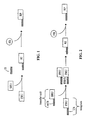
- FIG. 1 is a schematic illustration of one aspect of the present invention in which a first reactive unit (FRU) and a second reactive unit (SRU) react to form a reaction intermediate (RI).
- the reaction intermediate (RI) is attached to an identifying sequence (IS).
- the RI-IS complex is combined with a free reactant (FR), which is selectively reactive with the RI to yield a reaction product (RP) linked to the IS.
- FR free reactant
- FIG. 2 is a schematic illustration of an aspect of the present invention, in which prior to the formation of the reaction intermediate (RI) the first reactive unit (FRU) and the second reactive unit (SRU) are linked to a codon sequence (CS) and a complementary anti-codon sequence (ACS), respectively.
- the CS and the ACS anneal to one another to permit the FRU and SRU to react with one another to produce the RI.
- the CS remains linked to the RI.
- the CS remains attached to the reaction product (RP) when the RI has been reacted with the free reactant (FR).
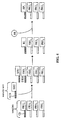
- FIG. 3 is a schematic illustration of an embodiment of the scheme shown in FIG. 1 , in which, in a mixture of a population of first reactive units (FRU 1 -FRU 4 ), at least one of the first reactive units (FRU 1 ) reacts with a second reactive unit (SRU 1 ) to form a reaction intermediate (RI 1 ) which coexists with the population of first reactive units (FRU 2 -FRU 4 ).
- the reaction intermediate (RI 1 ) is linked to an identifying sequence (IS).
- reaction intermediate (RI 1 ) linked to the IS and coexisting with the population of first reactive units (FRU 2 -FRU 4 ) then is permitted to react with a free reactant (FR), which is selectively reactive with RI 1 , to yield a reaction product (RP 1 ) linked to the IS.
- FR free reactant
- FIG. 4 is a schematic illustration of an embodiment of the scheme shown in FIG. 2 , in which prior to the formation of the reaction intermediate (RI 1 ) the first reactive units (FRU 1 -FRU 4 ) and the second reactive unit (SRU) are linked to codon sequences (CS) and a complementary anti-codon sequence (ACS), respectively.
- the CS remains linked to RI 1 .
- the CS remains attached to the reaction product (RP 1 ) when RI 1 has been reacted with the free reactant (FR) to produce RP 1 .
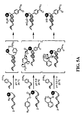
- FIG. 5A depicts DNA-templated transformation of azides into primary amines (top scheme), carboxylic acids (middle scheme), and thiols (bottom scheme).
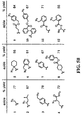
- FIG. 5B depicts exemplary DNA-templated reactions using substrate azides 1-12, in which the listed yields represent lower limits.
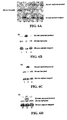
- FIG. 6A is a representation of a denaturing polyacrylamide gel electrophoresis (PAGE) gel following DNA-templated azide-to-amine transformation of azide 3 from FIG. 5B .
- Lane 1 contains azide-linked 30-mer template.
- Lane 2 contains azide-linked 30-mer template + carboxylic acid-linked 20-mer capture reagent + 30 mM EDC + 15 mM sulfo-NHS (showing no product formation).
- Lane 3 contains azide-linked 30-mer template + phosphine-linked 10-mer reagent (10-mer not visible).
- Lane 4 contains azide-linked 30-mer template + phosphine-linked 10-mer reagent + carboxylic acid-linked 20-mer capture reagent + 30 mM EDC + 15 mM sulfo-NHS, the 50-mer secondary product arising from azide-to-amine transformation following by DNA-templated amine acylation is visible.
- Lane 5 contains azide-linked 30-mer template + phosphine-linked 10-mer reagent containing a mismatched sequence + carboxylic acid-linked 20-mer capture reagent + 30 mM EDC + 15 mM sulfo-NHS.
- Lane 6 contains azide-linked 30-mer template + 5 mM TCEP-HCl + carboxylic acid-linked 20-mer capture reagent + 30 mM EDC + 15 mM sulfo-NHS (positive control in which the azide is reduced in situ by TCEP). It appears that incomplete denaturing of the duplex between the 30-mer template and 20-mer capture reagent at the onset of electrophoresis results in band blurring (lanes 2 and 4-6).
- FIG. 6B is a representation of a denaturing PAGE gel following DNA-templated azide-to-amine transformation of azide 7 from FIG. 5B .
- Lane 1 contains azide-linked 30-mer template + aldehyde-linked 20-mer capture reagent + 3 mM NaBH 3 CN.
- Lane 2 contains azide-linked 30-mer template + phosphine-linked 10-mer reagent + aldehyde-linked 20-mer capture reagent + 3 mM NaBH 3 CN.
- Lane 3 contains azide-linked 30-mer template + phosphine-linked 10-mer reagent containing a mismatched sequence + aldehyde-linked 20-mer capture reagent + 3 mM NaBH 3 CN.
- lanes 1 and 3 Slight 50-mer captured product formation is observed in lanes 1 and 3, which arises from slow spontaneous reduction of the phenyl azide during the preparation of a substrate-linked template and during the DNA-templated reactions.
- the background reactivity observed in lanes 1 and 3 was subtracted to determine the reported yield for lane 2.
- FIG. 6C is a representation of a denaturing PAGE gel following DNA-templated azide-to-carboxylic acid transformation of azide 8 from FIG. 5B .
- Lane 1 contains azide-linked 30-mer template + amine-linked 20-mer capture reagent + 30 mM EDC + 15 mM sulfo-NHS.
- Lane 2 contains azide-linked 30-mer template + phosphine-linked 10-mer reagent + amine-linked 20-mer capture reagent + 30 mM EDC + 15 mM sulfo-NHS.
- Lane 3 contains azide-linked 30-mer template + phosphine-linked 10-mer reagent containing a mismatched sequence + amine-linked 20-mer capture reagent + 30 mM EDC + 15 mM sulfo-NHS.
- FIG. 6D is a representation of a denaturing PAGE gel following DNA-templated azide-to-thiol transformation of azide 11 from FIG. 5B using a 10% polyacrylamide gel.
- Lane 1 contains azide-linked 30-mer template + alkyl bromide-linked 20-mer capture reagent.
- Lane 2 contains azide-linked 30-mer template + phosphine-linked 10-mer reagent + alkyl bromide-linked 20-mer capture reagent.
- Lane 3 contains azide-linked 30-mer template + phosphine-linked 10-mer reagent containing a mismatched sequence + alkyl bromide-linked 20-mer capture reagent.
- FIG. 7 is a representative MALDI-TOF spectrum from a DNA-templated functional group transformation (in this case, the amine product arising from azide 1 ).
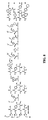
- FIG. 8 depicts a reaction of a single solution containing four azides with four non-DNA-linked small-molecule electrophiles to generate four sequence-programmed sulfonamide, carbamate, urea, and thiourea products.
- Template 13 is attached to an oligonucleotide having codon sequence a.
- the triphenylphosphine containing transfer unit 17 is attached to an oligonucleotide having anti-codon sequence a'.
- templates 14, 15, and 16 contain codon sequences b, c, and d, respectively, which anneal to transfer units 18, 19, and 20 via anti-codon sequences b', c', and d', respectively.
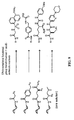
- FIG. 9 is a schematic illustration showing the starting reagents used and reaction products created in FIG. 8 .
- FIG. 10A through FIG. 10D are drawings of HPLC traces (monitored at 260 nm) following HPLC analysis of reactions of amine-linked templates with small-molecule reagents.
- SM indicates unreacted starting material amine-linked template peaks.
- PRD indicates derivatized products. Unless otherwise noted, peaks other than those labeled as SM or PRD do not correspond to DNA-linked species as judged by UV absorption at 230 nm and by MALDI-TOF analysis.
- FIG. 10A shows the results of the reaction of amine-linked template 13 with dansyl chloride 21 (reagents 13 and 21 are shown in FIG. 8 ).
- FIG.10B shows the results of the reaction of amine-linked template 14 with ethyl chloroformate 22 (reagents 14 and 22 are shown in FIG. 8 ).
- FIG. 10C shows the results of the reaction of amine-linked template 15 with 4-methoxy phenyl isocyanate 23 (reagents 15 and 23 are shown in FIG. 8 ).
- FIG. 10D shows the results of the reaction of amine-linked template 16 with 6-morpholino pyridinyl 3-methoxyl phenyl isocyanate 24 (reagents 16 and 24 are shown in FIG. 8 ).
- FIG. 11A shows a MALDI-TOF spectrum of the four azide starting materials in one solution (reagents 13-16 in FIG. 8 ).
- FIG.11B shows a MALDI-TOF spectrum of the four sequence-specific transformation products (products 25-28 in FIG. 8 ) of the azide starting materials 13-16.
- the present invention is useful in the synthesis of libraries of molecules, for example, small molecules.
- the functional group transformations described herein are particularly useful in expanding the scope of nucleic acid-templated organic syntheses by addressing the need for reagents to be tethered to oligonucleotides. When the linkage of reagents to an oligonucleotide is not possible or convenient, these transformations allow such reagents to nevertheless contribute to small molecule syntheses while preserving the correspondence between oligonucleotide sequence and resulting product structure.
- the invention provides a method of synthesizing a reaction product as set out in claim 1.
- a first reactive unit FRU
- SRU second, different reactive unit
- RI reaction intermediate
- the RI is covalently attached, to an identifying sequence (IS).
- IS is be an oligonucleotide (for example, DNA, or derivatives thereof, RNA, or derivatives thereof).
- FR free reactant
- RP reaction product
- the RP is still linked to the IS, which can be used to identify RP and the synthetic history of RP.
- the IS for example, a nucleic acid sequence defining a specific codon sequence or anti-codon sequence
- the IS remains linked to the RI after the reaction so as to provide an IS linked to the RI.
- the IS remains linked to the RP so that it is possible to identify the RP and its synthetic history.
- the SRU may also be linked to a sequence complementary to the IS.
- the IS hybridizes to the sequence complementary to the IS so as to bring the FRU and SRU into reactive proximity.
- the IS for example, a nucleic acid sequence defining a specific codon sequence or anti-codon sequence
- the RI can then be chemically transformed via the FR into RP.
- the IS remains linked to the RP.
- the IS can be linked enzymatically, for example, by a polymerase or ligase, to the RI after formation of the RI.
- the FR is at least five times more reactive with the RI than with at least one of, and optionally all of, the reactive units or other reactive intermediates in the starting mixture. Furthermore, depending on the reactants and reaction conditions, in other embodiments the FR is at least ten times, at least fifty times, at least one hundred times, at least two hundred fifty times, at least five hundred times, or at least one thousand times more reactive with the RI than with at least one of, and optionally all of, the reactive units or other reactive intermediates in the starting mixture. In addition, depending upon the reactants and reaction conditions, the RP is synthesized with a yield greater than or equal to 50%, greater than or equal to 75%, greater than or equal to 85%, or greater than or equal to 98%.
- the reactivity of the FR to the RI relative to the starting materials FRU and SRU can be determined experimentally.
- the amount of product produced by combining FR and RI under standard reaction conditions can be determined.
- the amount of product produced by combining in equimolar amounts FR with either FRU or SRU under the same reaction conditions can be determined.
- the yields of products can be determined by standard techniques in the chemical arts. Based on the relative amounts of product produced in each reaction it is possible to determine whether the FR is more reactive, and, if so, how much more reactive, than the FRU or the SRU. Similar approaches can be used to determine whether the free reactant is more reactive with one reaction intermediate than with other, different reactive intermediates.
- the invention provides a method of synthesizing a reaction product via nucleic acid-templated synthesis as set out in claim 6.
- a first reactive unit FRU
- a first oligonucleotide comprising a codon sequence (CS).
- the combination of the first reactive unit and the oligonucleotide can be referred to as a template.
- the codon sequence may identify the FRU, for example, like an IS.
- the CS may further comprise a separate identifier sequence (IS) that identifies the FRU.
- the CS can identify the second reactive unit (SRU) that reacts with the FRU to create the reaction intermediate (RI) and the IS can identify the FRU.
- the SRU is attached, for example, covalently attached to a second oligonucleotide that contains an anti-codon sequence (ACS) complementary to the CS.
- ACS anti-codon sequence
- the combination of the second reactive unit with the anti-codon sequence can be referred to as a transfer unit.
- the CS and the ACS anneal to one another to bring the FRU and SRU into reactive proximity.
- the FRU and SRU then react with one another, for example, by proximity catalysis, to produce RI that is still linked to CS.
- the RI is chemically transformed by FR into a reaction product (RP) that is still linked to the CS.
- the oligonucleotide attached to RP contains the CS, then it is possible to determine what SRU was involved in the synthesis of the RI and/or the RP. Similarly; if the oligonucleotide attached to RP contains the IS, then it is possible to determine what FRU was involved in the synthesis of the RI and/or RP. Accordingly, this information can be used to determine the identity and synthetic history of RI and/or RP.
- the FRU can be a small molecule scaffold that can be used during nucleic acid-templated synthesis to produce a small molecule.
- the small molecule scaffold can be used as a core on which to assemble the substituents of the small molecule.
- the FR is at least five times more reactive with the RI than with at least one of, and optionally all of, the reactive units or other reactive intermediates in the starting mixture. Furthermore, depending on the reactants and reaction conditions, in other embodiments the FR is at least ten times, at least fifty times, at least one hundred times, at least two hundred fifty times, at least five hundred times, or at least one thousand times more reactive with the RI than with at least one of, and optionally all of, the reactive units or other reactive intermediates in the starting mixture. In addition, depending upon the reactants and reaction conditions, the RP is synthesized with a yield greater than or equal to 50%, greater than or equal to 75%, greater than or equal to 85%, or greater than or equal to 98%.
- the invention provides a method of synthesizing a reaction product as set out in claim 7.
- This approach is shown schematically in FIG. 3 and is similar to the approach shown schematically in FIG. 1 except that the first reaction unit is present as a mixture of first reactive units.
- a starting mixture containing four first reactive units denoted FRU 1 , FRU 2 , FRU 3 , and FRU 4 are combined with a second reactive unit denoted as SRU 1 .
- FRU 1 and SRU 1 react with one another to produce a reaction intermediate denoted as RI 1 .
- An identifier sequence (IS) can be attached to the RI 1 which identifies RI 1 .
- a free reactant (FR) is combined to the mixture under conditions for the RI to be chemically transformed into a reaction product denoted RP 1 .
- the RP 1 is still linked to the IS which can be used to identify RP and the synthetic history of RP.
- RP 1 can be exposed to other rounds of functional group transformations, especially where the FRU is a small molecule scaffold, to produce further modified products.
- the invention provides a method of synthesizing a reaction product via nucleic acid-templated synthesis as set out in claim 13.
- the initial reaction contains a plurality of templates, where each template contains a first reactive unit (denoted as FRU 1 , FRU 2 , FRU 3 and FRU 4 ) attached, preferably, covalently attached, to its own respective oligonucleotide containing its own codon unique sequence (CS).
- the oligonucleotide preferably also contains an identifier sequence (IS) that identifies what first reactive unit is attached to what codon sequence of the template.
- a transfer unit containing a second reactive unit (SRU) attached, preferably, covalently attached, to an oligonucleotide containing an anti-codon sequence complementary to the codon sequence is combined with the templates.
- the ACS of the transfer unit anneals to the CS of the template to bring the FRU 1 and SRU into reactive proximity, whereupon the FRU 1 and SRU react with one another to produce reaction intermediate (RI 1 ) that still remains attached to the oligonucleotide containing the CS.
- reaction intermediate RI 1
- RP reaction product
- the first reactive units can be small molecule scaffolds useful in the design and synthesis of a small molecule library.
- the method can also include the additional steps of: providing a third different reactive unit linked to a third oligonucleotide comprising an anti-codon sequence complementary to the codon sequence of at least one different first reactive unit, wherein the anti-codon sequence is indicative of the third reactive unit; annealing the codon sequence of a different one of the first oligonucleotides with the anti-codon sequence of the third oligonucleotide to induce a reaction between the first and third reactive units to form a second reaction intermediate attached at least to a first, different oligonucleotide; and combining the second reaction intermediate with a free reactant selectively reactive with the second reaction intermediate, thereby synthesizing a second reaction product attached to the identifying sequence, wherein the free reactant is more reactive with the second reaction intermediate than with at least one of, and optionally all of, the reactive units or other reactive intermediates in the mixture.
- reaction products can be exposed to other rounds of functional group transformations, for example, where FRU 1 is a small molecule scaffold, to produce further modified products.
- the method of the invention can be used to expand the range of chemistries that can be used during nucleic acid-templated chemical syntheses.
- General considerations concerning the selection and use of templates, transfer units, reaction conditions, reaction chemistries, selection procedures are know in the art. A general discussion of these considerations follows.
- the nucleic acid template can direct a wide variety of chemical reactions without obvious structural requirements by sequence-specifically recruiting reactants linked to complementary oligonucleotides.
- the template hybridizes or anneals to one or more transfer units to direct the synthesis of a reaction intermediate that can subsequently be converted by a free reactant into a reaction product.
- the reaction product then is selected or screened based on certain criteria, such as the ability to bind to a preselected target molecule.
- the associated template can then be sequenced to decode the synthetic history of the reaction intermediate and/or the reaction product.
- the length of the template may vary greatly depending upon the type of the nucleic acid-templated synthesis contemplated.
- the template may be from 10 to 10,000 nucleotides in length, from 20 to 1,000 nucleotides in length, from 20 to 400 nucleotides in length, from 40 to 1,000 nucleotides in length, or from 40 to 400 nucleotides in length.
- the length of the template will of course depend on, for example, the length of the codons, the complexity of the library, the complexity and/or size of a reaction product, the use of spacer sequences, etc.
- the template may incorporate a hairpin loop on one end terminating in a reactive unit that can interact with one or more reactive units associated with transfer units.
- a DNA template can comprise a hairpin loop terminating in a 5'-amino group, which may or may not be protected.
- the amino group may act as an initiation point for formation of an unnatural polymer or small molecule.
- the sequence of the template may be designed in a number of ways. For example, the length of the codon must be determined and the codon sequences must be set. If a codon length of two is used, then using the four naturally occurring bases only 16 possible combinations are available to be used in encoding the library. If the length of the codon is increased to three (the number Nature uses in encoding proteins), the number of possible combinations increases to 64. If the length of the codon is increased to four, the number of possible combinations increases to 256. Other factors to be considered in determining the length of the codon are mismatching, frame-shifting, complexity of library, etc. As the length of the codon is increased up to a certain point the number of mismatches is decreased; however, excessively long codons likely will hybridize despite mismatched base pairs.
- the codons may range from 2 to 50 nucleotides, from 2 to 40 nucleotides, from 2 to 30 nucleotides, from 2 to 20 nucleotides, from 2 to 15 nucleotides, from 2 to 10 nucleotides, from 3 to 50 nucleotides, from 3 to 40 nucleotides, from 3 to 30 nucleotides, from 3 to 20 nucleotides, from 3 to 15 nucleotides, from 3 to 10 nucleotides, from 4 to 50 nucleotides, from 4 to 40 nucleotides, from 4 to 30 nucleotides, from 4 to 20 nucleotides, from 4 to 15 nucleotides, from 4 to 10 nucleotides, from 5 to 50 nucleotides, from 5 to 40 nucleotides, from 5 to 30 nucleotides, from 5 to 20 nucleotides, from 5 to 15 nucleotides, from 5 to 10 nucleotides, from 2 to 40 nucleot
- a set of codons used in the template preferably maximizes the number of mismatches between any two codons within a codon set to ensure that only the proper anti-codons of the transfer units anneal to the codon sites of the template. Furthermore, it is important that the template has mismatches between all the members of one codon set and all the codons of a different codon set to ensure that the anti-codons do not inadvertently bind to the wrong codon set.
- the choice of exemplary codon sets and methods of creating functional codon sets are described, for example, in U.S. Patent Publication No. US 2004/0180412 . Using this and other approaches, different sets of codons can be generated so that no codons are repeated.
- spacer sequences may also be placed between the codons to prevent frame shifting.
- the bases of the template that encode a polymer subunit (the "genetic code” for the polymer) may be chosen so as to minimize the possibility of out-of-frame annealing.
- the templates may be synthesized using methodologies well known in the art. These methods include both in vivo and in vitro methods including PCR, plasmid preparation, endonuclease digestion, solid phase synthesis (for example, using an automated synthesizer), in vitro transcription, strand separation, etc.
- the template when desired may be attached (for example, covalently or non covalently attached) with a reactive unit of interest using standard coupling chemistries known in the art.
- oligonucleotides are synthesized using standard 3' to 5' chemistries.
- the constant 3' end is synthesized.
- This is then split into n different vessels, where n is the number of different codons to appear at that position in the template.
- n is the number of different codons to appear at that position in the template.
- one of the n different codons is synthesized on the (growing) 5' end of the constant 3' end.
- each vessel contains, from 5' to 3', a different codon attached to a constant 3' end.
- the n vessels then are pooled, so that a single vessel contains n different codons attached to the constant 3' end.
- any constant bases adjacent the 5' end of the codon are now synthesized.
- the pool then is split into m different vessels, where m is the number of different codons to appear at the next (more 5') position of the template.
- a different codon is synthesized (at the 5' end of the growing oligonucleotide) in each of the m vessels.
- the resulting oligonucleotides are pooled in a single vessel. Splitting, synthesizing, and pooling are repeated as required to synthesize all codons and constant regions in the oligonucleotides.
- a transfer unit comprises an oligonucleotide containing an anti-codon sequence and a reactive unit.
- the anti-codons are designed to be complementary to the codons present in the template. Accordingly, the sequences used in the template and the codon lengths should be considered when designing the anti-codons. Any molecule complementary to a codon used in the template may be used, including natural or non-natural nucleotides.
- the codons include one or more bases found in nature (i.e. , thymidine, uracil, guanidine, cytosine, and adenine).
- the anti-codon can include one or more nucleotides normally found in Nature with a base, a sugar, and an optional phosphate group.
- the anti-codon is associated with a particular type of reactive unit to form a transfer unit.
- the reactive unit may represent a distinct entity or may be part of the functionality of the anti-codon unit.
- the anti-codon generally is associated with a reactive unit or reactant used to modify a small molecule scaffold.
- the reactant is linked to the anti-codon via a linker long enough to allow the reactant to come into reactive proximity with the small molecule scaffold.
- the linker preferably has a length and composition to permit intramolecular reactions but yet minimize intermolecular reactions.
- the reactants include a variety of reagents as demonstrated by the wide range of reactions that can be utilized in nucleic acid-templated synthesis and can be any chemical group, catalyst (e.g. , organometallic compounds), or reactive moiety (e.g. , electrophiles, nucleophiles) known in the chemical arts.
- catalyst e.g. , organometallic compounds
- reactive moiety e.g. , electrophiles, nucleophiles
- each anti-codon sequence is associated with one monomer type.
- the anti-codon sequence ATTAG may be associated with a carbamate residue with an isobutyl side chain
- the anti-codon sequence CATAG may be associated with a carbamate residue with a phenyl side chain.
- mutating the sequence of the template, different monomer units may be introduced, thereby allowing the synthesis of related polymers, which can subsequently be selected and evolved.
- several anti-codons may code for one monomer unit as is the case in Nature.
- the anti-codon can be associated with the reactant through a linker moiety.
- the linkage can be cleavable by light, oxidation, hydrolysis, exposure to acid, exposure to base, reduction, etc.
- Fruchtel et al. (1996) ANGEW. CHEM. INT. ED. ENGL. 35: 17 describes a variety of linkages useful in the practice of the invention.
- the linker facilitates contact of the reactant with the small molecule scaffold and in certain embodiments, depending on the desired reaction, positions DNA as a leaving group ("autocleavable” strategy), or may link reactive groups to the template via the "scarless” linker strategy (which yields product without leaving behind an additional atom or atoms having chemical functionality), or a "useful scar” strategy (in which a portion of the linker is left behind to be functionalized in subsequent steps following linker cleavage).
- “autocleavable” strategy positions DNA as a leaving group
- scarless linker strategy which yields product without leaving behind an additional atom or atoms having chemical functionality
- a “useful scar” strategy in which a portion of the linker is left behind to be functionalized in subsequent steps following linker cleavage.
- transfer units can be used at submillimolar concentrations (e.g. less than 100 ⁇ M, less than 10 ⁇ M, less than 1 ⁇ M, less than 100 nM, or less than 10 nM).
- a variety of compounds and/or libraries can be prepared using the methods described herein.
- compounds that are not, or do not resemble, nucleic acids or analogs thereof are synthesized according to the method of the invention.
- compounds that are not, or do not resemble, proteins, peptides, or analogs thereof are synthesized according to the method of the invention.
- small molecules such as small molecules using the methods described herein.
- These small molecules may be like natural products, non-polymeric, and/or non-oligomeric.
- the substantial interest in small molecules is due in part to their use as the active ingredient in many pharmaceutical preparations although they may also be used, for example, as catalysts, materials, or additives.
- an evolvable template can be used.
- the template can include a small molecule scaffold upon which the small molecule is to be built, or a small molecule scaffold may be added to the template.
- the small molecule scaffold can be any chemical compound with two or more sites for functionalization.
- the small molecule scaffold can include a ring system (e.g. , the ABCD steroid ring system found in cholesterol) with functionalizable groups coupled to the atoms making up the rings.
- the small molecule may be the underlying structure of a pharmaceutical agent such as morphine, epothilone or a cephalosporin antibiotic.
- the sites or groups to be functionalized on the small molecule scaffold may be protected using methods and protecting groups known in the art.
- the protecting groups used in a small molecule scaffold may be orthogonal to one another so that protecting groups can be removed one at a time.
- the transfer units comprise an anti-codon associated with a reactant or a building block for use in modifying, adding to, or taking away from the small molecule scaffold.
- the reactants or building blocks may be, for example, electrophiles (e.g. , acetyl, amides, acid chlorides, esters, nitriles, imines), nucleophiles ( e.g. , amines, hydroxyl groups, thiols), catalysts (e.g. , organometallic catalysts), or side chains.
- the transfer units are allowed to contact the template under hydridizing conditions.
- the attached reactant or building block is allowed to react with a site on the small molecule scaffold to produce one or more reaction intermediates.
- the reaction intermediates can then be reacted with a free reactant to produce a reaction product.
- reaction conditions, linker, reactant, and site to be functionalized are chosen to avoid intermolecular reactions and accelerate intramolecular reactions. Sequential or simultaneous contacting of the template with transfer units can be employed depending on the particular compound to be synthesized.
- the newly synthesized small molecule remains associated with the template that encoded its synthesis.
- Decoding the sequence of the template permits the deconvolution of the synthetic history and thereby the structure of the small molecule.
- the template can also be amplified in order to create more of the desired small molecule and/or the template can be evolved (mutagenized) to create related small molecules.
- the small molecule can also be cleaved from the template for purification or screening.
- polymers specifically unnatural polymers, can be prepared using the techniques described herein.
- exemplary unnatural polymers include, but are not limited to, peptide nucleic acid (PNA) polymers, polycarbamates, polyureas, polyesters, polyacrylate, polyalkylene ( e.g. , polyethylene, polypropylene), polycarbonates, polypeptides with unnatural stereochemistry, polypeptides with unnatural amino acids, and combination thereof.
- PNA peptide nucleic acid
- polymers comprise at least 10, 25, 75, 100, 125, 150 monomer units or more.
- the polymers synthesized using the methodologies described herein may be used, for example, as catalysts, pharmaceuticals, metal chelators, or catalysts.
- the monomer units attached to the anti-codons may be any monomers or oligomers capable of being joined together to form a polymer.
- the monomer units may be, for example, carbamates, D-amino acids, unnatural amino acids, PNAs, ureas, hydroxy acids, esters, carbonates, acrylates, or ethers.
- nucleic acid-templated reactions for example, nucleic acid-templated reactions to produce reaction intermediates, can occur in aqueous or non-aqueous ( i.e., organic) solutions, or a mixture of one or more aqueous and non-aqueous solutions.
- aqueous solutions reactions can be performed at pH ranges from about 2 to about 12, or preferably from about 2 to about 10, or more preferably from about 4 to about 10.
- the reactions used in DNA-templated chemistry preferably should not require very basic conditions (e.g. , pH > 12, pH > 10) or very acidic conditions (e.g.
- the aqueous solution can contain one or more inorganic salts, including, but not limited to, NaCl, Na 2 SO 4 , KCl, Mg +2 , Mn +2 , etc., at various concentrations.
- Organic solvents suitable for nucleic acid-templated reactions include, but are not limited to, methylene chloride, chloroform, dimethylformamide, and organic alcohols, including methanol and ethanol.
- quatemized ammonium salts such as, for example, long chain tetraalkylammonium salts, can be added ( Jost et al. (1989) NUCLEIC ACIDS RES. 17: 2143 ; Mel'nikov et al. (1999) LANGMUIR 15: 1923-1928 ).
- Nucleic acid-templated reactions may require a catalyst, such as, for example, homogeneous, heterogeneous, phase transfer, and asymmetric catalysis. In other embodiments, a catalyst is not required.
- a catalyst is not required.
- additional, accessory reagents not linked to a nucleic acid are preferred in some embodiments.
- Useful accessory reagents can include, for example, oxidizing agents (e.g. , NaIO 4 ); reducing agents (e.g. , NaCNBH 3 ); activating reagents ( e.g. , EDC, NHS, and sulfo-NHS); transition metals such as nickel ( e.g., Ni(NO 3 ) 2 ), rhodium ( e.g.
- RhCl 3 RhCl 3
- ruthenium e.g. RuCl 3
- copper e.g. Cu(NO 3 ) 2
- cobalt e.g. CoCl 2
- iron e.g. Fe(NO 3 ) 3
- osmium e.g. OsO 4
- titanium e.g. TiCl 4 or titanium tetraisopropoxide
- palladium e.g. NaPdCl 4
- Ln transition metal ligands (e.g. , phosphines, amines, and halides); Lewis acids; and Lewis bases.
- Reaction conditions preferably are optimized to suit the nature of the reactive units and oligonucleotides used. It is understood that the choice of reagents, for example, free reactants, and the reaction conditions used to create the reaction intermediates and to convert the reaction intermediates into final products will depend upon the particular compounds and libraries to be produced. It is contemplated, however, that the choice of reagents and reaction conditions is within the level of skill in the art.
- the invention is particularly useful in performing certain functional group transformations, which include, without limitation, azide-to-amine transformations, azide-to-thiol transformations, azide-to-carboxylic acid transformations, hydroxyl-to-amine transformations, hydroxyl-to-thiol transformations, acetal-to-aldehyde transformations, ketal-to-ketone transformations, carbonate-to-hydroxyl group transformations, carbamate-to-amine transformations, thiocarbonate-to-thiol transformations, nitro group-to-amine transformations, sulfonamide-to-amine transformations, alkene-to-epoxide transformations, ⁇ , ⁇ -unsaturated ketone-to-epoxide transformations, epoxide-to-1,2-diol transformations, epoxide-to-1,2-hydroxy amine transformations, epoxide-to-1,2-hydroxy sulfide transformation
- Selection and/or screening for reaction products with desired activities may be performed using methodologies known and used in the art.
- affinity selections may be performed according to the principles used in library-based selection methods such as phage display, polysome display, and mRNA-fusion protein displayed peptides.
- Selection for catalytic activity may be performed by affinity selections on transition-state analog affinity columns ( Baca et al. (1997) PROC. NATL. ACAD. SCI. USA 94(19): 10063-8 ) or by function-based selection schemes ( Pedersen et al. (1998) PROC. NATL. ACAD. SCI. USA 95(18): 10523-8 ).
- the templates and reaction products can be selected (or screened) for binding to a target molecule.
- selection or partitioning means any process whereby a library member bound to a target molecule is separated from library members not bound to target molecules. Selection can be accomplished by various methods known in the art.
- the templates of the present invention contain a built-in function for direct selection and amplification. In most applications, binding to a target molecule preferably is selective, such that the template and the resulting reaction product bind preferentially with a specific target molecule, perhaps preventing or inducing a specific biological effect. Ultimately, a binding molecule identified using the present invention may be useful as a therapeutic and/or diagnostic agent.
- the selected templates optionally can be amplified and sequenced.
- the selected reaction products if present in sufficient quantity, can be separated from the templates, purified ( e.g. , by HPLC, column chromatography, or other chromatographic method), and further characterized.
- the selection strategy can be carried out to allow selection against almost any target. Importantly, the selection strategy does not require any detailed structural information about the target molecule or about the molecules in the libraries. The entire process is driven by the binding affinity involved in the specific recognition and binding of the molecules in the library to a given target.
- nucleic acid-templated syntheses broadly permit identifying binding molecules for any known target molecule.
- novel unknown targets can be discovered by isolating binding molecules against unknown antigens (epitopes) and using these binding molecules for identification and validation.
- binding molecules from a library can be performed in any format to identify optimal binding molecules. Binding selections typically involve immobilizing the desired target molecule, adding a library of potential binders, and removing non-binders by washing. When the molecules showing low affinity for an immobilized target are washed away, the molecules with a stronger affinity generally remain attached to the target.
- the enriched population remaining bound to the target after stringent washing is preferably eluted with, for example, acid, chaotropic salts, heat, competitive elution with a known ligand or by proteolytic release of the target and/or of template molecules.
- the eluted templates are suitable for PCR, leading to many orders of amplification, whereby essentially each selected template becomes available at a greatly increased copy number for cloning, sequencing, and/or further enrichment or diversification.
- the target molecule (peptide, protein, DNA or other antigen) can be immobilized on a solid support, for example, a container wall, a wall of a microtiter plate well.
- the library preferably is dissolved in aqueous binding buffer in one pot and equilibrated in the presence of immobilized target molecule. Non-binders are washed away with buffer. Those molecules that may be binding to the target molecule through their attached DNA templates rather than through their synthetic moieties can be eliminated by washing the bound library with unfunctionalized templates lacking PCR primer binding sites. Remaining bound library members then can be eluted, for example, by denaturation.
- the target molecule can be immobilized on beads, particularly if there is doubt that the target molecule will adsorb sufficiently to a container wall, as may be the case for an unfolded target eluted from an SDS-PAGE gel.
- the derivatized beads can then be used to separate high-affinity library members from nonbinders by simply sedimenting the beads in a benchtop centrifuge.
- the beads can be used to make an affinity column. In such cases, the library is passed through the column one or more times to permit binding. The column then is washed to remove nonbinding library members.
- Magnetic beads are essentially a variant on the above; the target is attached to magnetic beads which are then used in the selection.
- Library members that bind a target molecule can be released by denaturation, acid, or chaotropic salts.
- elution conditions can be more specific to reduce background or to select for a desired specificity. Elution can be accomplished using proteolysis to cleave a linker between the target molecule and the immobilizing surface or between the reaction product and the template. Also, elution can be accomplished by competition with a known competitive ligand for the target molecule. Alternatively, a PCR reaction can be performed directly in the presence of the washed target molecules at the end of the selection procedure. Thus, the binding molecules need not be elutable from the target to be selectable since only the template is needed for further amplification or cloning, not the reaction product itself. Indeed, some target molecules bind the most avid ligands so tightly that elution would be difficult.
- the templates which are, or formerly were, attached to the selected reaction product preferably are amplified using any suitable technique to facilitate sequencing or other subsequent manipulation of the templates.
- Natural oligonucleotides can be amplified by any state of the art method. These methods include, for example, polymerase chain reaction (PCR); nucleic acid sequence-based amplification (see, for example, Compton (1991) NATURE 350: 91-92 ), amplified anti-sense RNA (see, for example, van Gelder et al. (1988) PROC. NATL. ACAD. SCI. USA 85: 77652-77656 ); self-sustained sequence replication systems ( Gnatelli et al. (1990) PROC. NATL.
- PCR polymerase chain reaction
- nucleic acid sequence-based amplification see, for example, Compton (1991) NATURE 350: 91-92
- amplified anti-sense RNA see, for example, van Gelder et al. (1988) PROC.
- any means allowing faithful, efficient amplification of selected nucleic acid sequences can be employed in the method of the present invention. It is preferable, although not necessary, that the proportionate representations of the sequences after amplification reflect the relative proportions of sequences in the mixture before amplification.
- non-natural nucleotides the choices of efficient amplification procedures are fewer.
- non-natural nucleotides can be incorporated by certain enzymes including polymerases it will be possible to perform manual polymerase chain reaction by adding the polymerase during each extension cycle.
- sequences of the template that encoded a product of interest can be determined. Sequencing, for example, can be performed by a standard dideoxy chain termination method, or by chemical sequencing, for example, using the Maxam-Gilbert sequencing procedure. Alternatively, the sequence of the template (or, if a long template is used, the variable portion(s) thereof) can be determined by hybridization experiments. For example, a single-stranded template molecule associated with a detectable moiety such as a fluorescent moiety is exposed to a chip bearing a large number of clonal populations of single-stranded nucleic acids or nucleic acid analogs of known sequence, each clonal population being present at a particular addressable location on the chip.
- the template sequences are permitted to anneal to the chip sequences.
- the position of the detectable moieties on the chip then is determined. Based upon the location of the detectable moiety and the immobilized sequence at that location, the sequence of the template can be determined. It is contemplated that large numbers of such oligonucleotides can be immobilized in an array on a chip or other solid support.
- Libraries can be evolved by introducing mutations at the DNA level, for example, using error-prone PCR ( Cadwell et al. (1992) PCR METHODS APPL. 2: 28 ) or by subjecting the DNA to in vitro homologous recombination ( Stemmer (1994) PROC. NATL. ACAD. SCI. USA 91: 10747 ; Stemmer (1994) NATURE 370: 389 ) or by cassette mutagenesis. Template evolution and evolutionary synthesis are described, for example, in U.S. Patent Application, Publication No. US 2004/0180412 .
- Examples 1 and 2 describe three sequence-programmed functional group transformations, namely-azide to-amine, azide-to-thiol, and azide-to-carboxylic acid transformations where the end products of the transformations have been characterized by gel electrophoresis (Example 1) or by mass spectrometry (Example 2).
- Example 3 shows that it is possible to transform amine-linked templates into a sulfonamide, a carbamate, a urea or a thiourea using small molecule reagents, for example, sulfonyl chloride, chloroformate, isocyanate, and isothiocyanate reactants not linked to DNA.
- Example 4 shows that it is possible to sequence-specifically transform, in a single-solution, a mixture of organic azides into amine intermediates and then sequence-specifically transform the amine intermediates into sulfonamide, carbamate, urea, and thiourea products using free reactants (e.g., sulfonyl chloride, chloroformate, isocyanate, and isothiocyanate) not linked to DNA.
- free reactants e.g., sulfonyl chloride, chloroformate, isocyanate, and isothiocyanate
- This example describes sequence-programmed functional group transformations where an azide can be specifically converted into an amine, a thiol, or a carboxylic acid.
- the individual reaction schemes and the resulting reaction yields are shown in FIGS. 5A and 5B .
- Azido substrates for the synthesis of compounds 1-12 shown in FIG. 5B were prepared from the corresponding carboxylic acid precursors as follows:
- Azido Acetic Acid (Used to produce template 1 in FIG. 5B ). This reagent was produced as described in Lundquist et al. (2001) ORG LETT. 3: 781 . The product was found to have the following characteristics: 1 H NMR (300 MHz, CDCl 3 ) 6 3.96 (2H, s).
- 1-Azidocyclohexyl Carboxylic Acid (Used to prepare template 5 in FIG. 5B ) and Azidoisoglutamic Acid (Used to prepare template 4 in FIG. 5B ) were synthesized according to the method described for the synthesis of azido acids by diazo transfer in Lundquist et al. (2001) supra.
- 1-azidocyclohexyl carboxylic acid was found to have the following characteristics: 1 H NMR (300 MHz, CDCl 3 ) ⁇ 1.86 (4H, m) 1.63 (4H, m) 1.36 (2H, m); CIMS calculated for C 7 H 7 N 3 O 2 (M+NH 4 + ): 1187.1195; observed: 1187.1188.
- 4-Azidobenzyl-Succinic Acid Monoester (Used to prepare template 9 in FIG. 5B ). 4-Azidobenzyl alcohol (100 mg, 0.67 mmol), succinic anhydride (134 mg, 1.37 mmol), and N,N-dimethylaminopyridine (3.7 mg, 30 ⁇ mol) were dissolved in DMF (1 mL) and stirred 12 h at 25 °C. The reaction mixture was concentrated and purified by flash chromatography (30% EtOAc/hexanes). The desired ester was obtained as yellow solid (75.9 mg, 45%).
- 4-Azidobenzyl-Diphenicacid Monoester (Used to prepare template 10 in FIG. 5B ). 4-Azidobenzyl alcohol (112 mg, 0.5 mmol) and diphenic acid anhydride (74.5 mg, 0.5 mmol) were dissolved in pyridine (1 mL) and stirred 12 h at 25 °C. The reaction mixture was diluted in EtOAc, washed with phosphate buffer (pH 6.0, 2x), then washed with brine. The organic layer was dried over Na 2 SO 4 and concentrated in vacuo. The crude product was purified by flash chromatography (25% EtOAc/hexanes). The desired ester was obtained as yellow solid (193 mg, 99%.).
- N -hydroxylsuccinimidyl 2-azidomethyl benzoate ester (16.4 mg, 47 ⁇ mol) and thioacetic acid (3.2 ⁇ L) in DMF (250 ⁇ L) were allowed to react at 25 °C for 24 h.
- the reaction mixture was diluted in EtOAc and washed with NaHCO 3 (2x), then washed with brine.
- the organic layer was dried with Na 2 SO 4 and concentrated in vacuo.
- the crude mixture was purified by flash chromatography (30% EtOAc/hexanes) to provide the thioester (9.8 mg, 83%).
- 2-Azidomethylbenzoyl Thio Propionic Acid Thioester (Used to prepare template 12 in FIG. 5B ).
- 2-azidomethylbenzoyl N -hydroxy succinimidyl (NHS) ester was prepared by mixing equal volumes of 1-azido methyl benzoic acid (used to produce template 6 in FIG. 5B ) (900 mM in DMF), EDC (900 mM in DMF) and NHS (900 mM in DMF) at 25 °C for 1 h.
- the thiol group was attached to the DNA oligonucleotide in a parallel preparation, and was incorporated into the template upon template formation (see below, preparation for 5' 2-azidomethylbenzoyl thio propionic acid thioester-linked DNA).
- oligonucleotides were synthesized on a Perseptive Biosystems Expedite 8090 DNA synthesizer using standard phosphoramidite protocols and purified using preparative scale reverse-phase HPLC. Reagents for automated solid-phase oligonucleotide synthesis were purchased from Glen Research.
- 5' amino-modifier 5 (Glen Research) was used to prepare 5' amino-modified oligonucleotides
- 3' amino-modifier C7 CPG (Glen Research) was used to prepare 3' amino-modified oligonucleotides
- biotin TEG CPG (Glen Research) was used to prepare 3' biotin-labeled oligonucleotides.
- Functionalized DNA oligonucleotides were purified by analytical scale reverse-phase HPLC.
- oligonucleotides in solution were determined based on their absorbance at 260 nm measured on a Hewlett-Packard 8453 UV-visible spectrophotometer (Agilent Technologies). Oligonucleotides stained with ethidium bromide were visualized and quantitated by UV transillumination and densitometry using an Eagle Eye II densitometer (Stratagene).
- N- hydroxy succinimidyl (NHS) ester of the desired azido acid was prepared by mixing equal volumes of the respective azido acid (900 mM in DMF), EDC (900 mM in DMF) and NHS (900 mM in DMF) at 25°C for 1 h.
- the crude NHS ester was added in two portions (50 ⁇ L each) to a solution containing 5' amino-modified DNA oligonucleotide (50 ⁇ L, typically 300 ⁇ M) in 100 mM sodium phosphate buffer (pH 7.2, 350 ⁇ L).
- the 30-mer template used in these preparations was ⁇ 5'NH 2 (C 2 H 4 O) 2 -PO 3 H-GGT ACG AAT TGC ACT CGG GAA ATC CAC CTT (SEQ ID NO: 1).
- the coupling reaction was performed at 25 °C for 1 h.
- the resulting reaction mixture was directly loaded onto a NAP-5 size exclusion column (Amersham Biosciences) to remove organic solvent, salts, and excess small molecules, and the azide-linked DNA oligonucleotides were further purified by analytical scale reverse-phase HPLC (8-30% MeCN/0.1 M TEAA gradient).
- the desired oligonucleotide products were characterized by MALDI-TOF mass spectrometry.
- the reaction mixture was directly loaded onto a NAP-5 size exclusion column (Amersham Biosciences) and purified by analytical scale reverse-phase HPLC (8-30% MeCN/0.1 M TEAA gradient).
- the disulfide-linked oligonucleotide product was characterized by MALDI-TOF mass spectrometry.
- the 2-thiopropionic acid-linked oligonucleotide was prepared by treating the disulfide-linked oligonuleotide above (typically 10 ⁇ M) in 100 mM CAPS buffer (pH 8) with 20 mM DTT at 25°C for 0.5 h. Excess DTT was removed by passing the reaction mixture through a gel filtration column.
- 2-azidomethylbenzoyl N -hydroxy succinimidyl (NHS) ester was prepared as described (see above, preparation for 2-Azidomethylbenzoyl Thio Propionic Acid Thioester).
- the crude NHS ester (100 ⁇ L) was added to a solution of 5' thiol-linked oligonucleotide (100 ⁇ L) in 100 mM sodium phosphate buffer (pH 7.2, 300 ⁇ L).
- the coupling reaction was performed at 25°C for 1 h.
- the reaction mixture was directly loaded onto a NAP-5 size exclusion column and purified by analytical scale reverse-phase HPLC (8-30% MeCN/0.1 M TEAA gradient).
- the desired oligonucleotide product was characterized by MALDI-TOF mass spectrometry.
- 3' Triphenylphosphine-Linked DNA Attachment of the triphenylphosphine group was performed on 3' amino-modified oligonucleotides linked to CPG resin.
- a 10-mer reagent fully complementary to the template had the structure 5' AAT TCG TAC C-OPO 3 H-CH 2 CH(CH 2 OH)(CH 2 ) 4 NHCOC 6 H 4 PPh 2 (SEQ ID NO: 2).
- a 10-mer reagent containing a three-base mismatch relative to the template had the following structure - 5' AAT ACA TCC C-OPO 3 H-CH 2 CH(CH 2 OH)(CH 2 ) 4 NHCOC 6 H 4 PPh 2 (SEQ ID NO: 3). The latter was used as a control in these experiments.
- the Fmoc group on 3' FMOC-NH-oligonucleotides was removed by three cycles of: ( i ) treatment with 20% piperidine in DMF for 10 min; ( ii ) washing with DMF; and ( iii ) washing with MeCN.
- the resin was dried under a stream of nitrogen gas.
- a solution of 4-diphenylphosphino benzoic acid (30.6 mg, 100 ⁇ mol), EDC (19.1 mg, 100 ⁇ mol), N,N- diisopropylethylamine (36.8 ⁇ L, 211 ⁇ mol) in DMF (0.6 mL) was added to the resin and the mixture was incubated at 37 °C for 2 h.
- the resin was washed with DMF (2x) and with MeCN (2x), then dried under nitrogen.
- the derivatized oligonucleotide was cleaved from the CPG resin by incubation in 1:1 ammonium hydroxide:methyl amine (AMA) with tris(2-carboxyethyl)phosphine hydrochloride (TCEP-HCl, 1 mg) at 55 °C for 45 min.
- the cleavage solution was filtered and purified by analytical scale reverse-phase HPLC (8-30% MeCN/0.1 M TEAA gradient).
- the desired oligonucleotide products were characterized by MALDI-TOF mass spectrometry.
- reaction products were captured using 20-mer secondary reagents (capture reagents) that annealed to the template.
- the 20-mer secondary reagent contained the sequence 5' TCC CGA GTG CAA TTC GTA CC-OPO 3 H-CH 2 CH(CH 2 OH)(CH 2 ) 4 NH 2 (SEQ ID NO: 4). This oligonucleotide was used as a starting material for the following capture reagents.
- the NHS ester of bromoacetic acid was prepared by mixing equal volumes of 900 mM bromoacetic acid in DMF, 900 mM EDC in DMF, and 900 mM NHS in DMF at 25 °C for 1 h.
- the crude NHS ester 100 ⁇ L was added to a solution of 5' amino-modified DNA oligonucleotide (50 ⁇ L, typically 300 ⁇ M) in 100 mM sodium phosphate buffer (pH 7.2, 350 ⁇ L). The coupling reaction was allowed to proceed at 25 C for 1 h.
- the reaction mixture was directly loaded onto a NAP-5 size exclusion column to remove organic solvent, salts, and excess small molecules and was further purified by analytical scale reverse-phase HPLC (8-30% MeCN/0.1 M TEAA gradient).
- the desired oligonucleotide products were characterized by MALDI-TOF mass spectrometry.
- 3' Succinic Acid Monoester-Linked DNA (This reagent was used to capture the products of the templates 1-6 ).
- Succinic anhydride (22 mg, 0.1 mmol) was activated with NHS (10 mg, 0.1 mmol) in DMF (200 ⁇ L) at 25 °C for 15 min.
- 100 ⁇ L of the mixture was added to the 3' amino modified template (50 ⁇ L, typically 300 ⁇ M) in 100 mM HEPES buffer (pH 8.5; 850 ⁇ L) and was incubated at 37 °C for 16 h.
- the reaction mixture was desalted by NAP-5 size exclusion column and further purified by analytical scale HPLC (8-30% MeCN/0.1 M TEAA gradient).
- the desired oligonucleotide products were characterized by MALDI-TOF mass spectrometry.
- DNA-templated azide-to-amine functional group transformations were performed by mixing a 30-mer 5' azide-linked template (12 pmol) and 10-mer 3' triphenylphosphine-linked reagent (24 pmol) in a total volume of 200 ⁇ L of 100 mM CAPS buffer (pH 10) containing 500 mM NaCl at 25 °C for 16 h.
- the azide-to-amine transformations could not be monitored directly by denaturing polyacrylamide gel electrophoresis (PAGE) because the starting materials and products had similar molecular weights.
- PAGE denaturing polyacrylamide gel electrophoresis
- the putative amine products were captured with 20-mer-linked carboxylic acids in the presence of a carbodiimide, or with 20-mer-linked aldehydes in the presence of NaBH 3 CN.
- These secondary reagents or capture reagents displaced the 10-mer linked phosphine oxide and efficiently coupled with primary amines, but not with azides.
- the resulting amide or secondary amine products gained the molecular weight of the 20-mer and could easily be distinguished from starting azides by PAGE.
- the resulting pellets were dissolved in denaturing gel-loading buffer and were subjected to denaturing PAGE analysis. Unless specified, denaturing PAGE analysis was performed using 15% polyacrylamide gel (TBE-urea).
- Reaction yields were quantitated by ethidium bromide staining of the gels, UV visualization and CCD-based densitometry of product and template bands. Yield calculations assumed that templates and products in denaturing gels stained with equal intensity per base. In cases where products were partially double-stranded during quantitation, changes in staining intensity may result in higher apparent yields.
- FIG. 6A shows denaturing PAGE analysis of a DNA-templated azide-to-amine transformation for azide 3 in FIG. 5B .
- FIG. 6B shows denaturing PAGE analysis of a DNA-templated azide-to-amine transformation for azide 7 in FIG. 5B .
- DNA-templated azide-to-carboxylic acid transformations were performed like the azide-to-amine transformations, except that the buffer contained 0.1 M MES pH 6.0 and 1 M NaCl.
- 20-mer 3' amine-linked reagent was added to the reaction mixture with EDC (30 mM) and sulfo-NHS (15 mM) in MES buffer (pH 6.5).
- Typical results from denaturing PAGE are shown in FIG. 6C (represented is the case using reagent 8 from FIG. 5B ).
- DNA-templated azide-to-thiol transformations were performed as above, except that the buffer contained either 0.1 M MES pH 6.0 (for substrate 11) or MOPS pH 7.5 (for substrate 12) and 1 M NaCl.
- 20-mer 3' alkyl bromide-linked reagent was added to the reaction mixture and incubated at 37 °C for 6 h. Typical results from denaturing PAGE are shown in FIG. 6D (represented is the case using reagent 11 from FIG. 5B ).
- Example 2 is similar to Example 1 except the reaction products were characterized by mass spectrometry rather than PAGE. To facilitate this a smaller template and different capture system were used under the same or similar conditions.
- oligonucleotides used in this Example were prepared in a manner similar to Example 1 with the following changes.
- the template oligonucleotides were prepared as described in Example 1 except that rather than using a 30-mer template, the following 10-mer template was used: 5'-NH 2 (C 2 H 4 O) 2 -PO 3 H-GGT ACG AAT T-OPO 3 H-CH(CH 2 OH)CH 2 (OC 2 H 4 ) 4 CH 2 NHCO-biotin (SEQ ID NO: 5).
- triphenylphosphine-linked reagent was prepared as described in Example 1.
- MALDI-TOF mass spectrometry was performed on an Applied Biosystems Voyager-DE Pro Biospectrometry Workstation and processed with Voyager Data Explorer software.
- HPA hydroxypicolinic acid
- ammonium citrate 50 mg/mL in H 2 O
- the resulting iminophosphoranes were identified by MALDI-TOF mass spectrometry and found to be unexpectedly stable to hydrolysis especially under acidic conditions, presumably due to formation of a stable HCl salt ( Shalev, et al. (1996) J. ORG. CHEM. 61: 1689-1701 ).
- DNA templates 13-16, FIG. 8 were prepared, each containing a different azide at the 5' terminus, one of four unique six-base codons, and a biotin group at the 3' terminus to facilitate template manipulation and purification.
- the azide-linked templates then were chemically converted into amine-linked templates by exposure to TCEP-HCl.
- the resulting amines then were reacted with free reagents to determine whether the conversion of the amine intermediate into a final product was possible.
- dansyl chloride (21), ethyl chloroformate (22), 4-methoxy phenyl isocyanate (23) and 6-morpholino pyridinyl 3-isothiocyanate (24) were all chosen as amine-reactive agents as they cannot easily be attached to DNA due to their structure or their reactivity with water.
- Simplified reaction schemes showing the starting reagents and theoretical end products are shown in FIG. 9 .
- Coding sequences for the templates were designed by computational screening to ( i ) ensure that at least 6 non-complementary base pairs existed between any two different codons,
- templates 13-16 contained 5' NH 2 (C 2 H 4 O) 2 -PO 3 H-TT-(codon)-GTA n -OPO 3 H-CH(CH 2 OH)CH 2 (OC 2 H 4 ) 4 CH 2 NHCO-biotin.
- the azide-containing templates 13-16 were prepared as described in Example 1 (see templates 1, 3, 4, and 2, respectively).
- templates 13-16 were chemically transformed into amine groups by exposure to TCEP-HCl. Briefly, amine-linked templates then were prepared by treating the azide-linked templates (templates 13-16) with 5 mM TCEP-HCl in 100 mM MOPS buffer (pH 7.5) at 25 °C for 3 h. The resulting templates were purified by HPLC. Thereafter, the resulting templates (amine intermediates) were reacted with soluble reagents to determine whether functional group transformations were possible.
- the amine-linked template 13 (400 pmol) in 100 ⁇ L of 100 mM aqueous NaHCO 3 (pH 9.0) was mixed with 20 mM dansyl chloride 21 in 100 ⁇ L DMF and agitated at 37 °C for 1 h.
- the reaction mixture was diluted in 200 ⁇ L 0.1 M TEAA and passed through a NAP-5 size exclusion column.
- the eluant in 1 mL 0.1 M TEAA was analyzed by analytical scale reverse phase HPLC (8-30 % MeCN/ 0.1 M TEAA gradient).
- Product yield was calculated based on the integrated peak areas (based on UV absorbance at 260 nm) of the starting material, the product, and any side products.
- a representative chromatogram is shown in FIG. 10A .
- Amine-linked template 14 400 pmol in 100 ⁇ L of 200 mM aqueous NaHCO 3 (pH 9.0) was mixed with 40 mM ethyl chloroformate 22 in 100 ⁇ L DMF and agitated at 37 °C for 1 h. The reaction was quenched by addition of glycogen in NaOAc buffer (pH 5.0) followed by ethanol precipitation. The pellet was dissolved in 0.1 M TEAA and analyzed by analytical scale reverse phase HPLC (8-30 % MeCN/ 0.1 M TEAA gradient). A representative chromatogram is shown in FIG. 10B .
- Amine-linked template 15 400 pmol in 100 ⁇ L of 500 mM aqueous triethylamine (pH 10) was mixed with 20 mM 4-methoxyphenylisocyanate 23 in 100 ⁇ L DMF and agitated at 37 °C for 1 h. The reaction mixture was quenched and analyzed as described above. A representative chromatogram is shown in FIG. 10C .
- Amine-linked template 16 400 pmol in 100 ⁇ L of 500 mM aqueous triethylamine (pH 10) was mixed with 20 mM and was allowed to react with 20 mM 6-morpholino isothiocyanate 24 in 100 ⁇ L DMF and agitated at 37°C for 1 h. The reaction mixture was quenched and analyzed as described above. A representative chromatogram is shown in FIG. 10D .
- This Example demonstrates that it is possible to perform a sequence specific transformation of template bound reactants to generate reaction intermediates, which can then be reacted with free reactants to produce reaction products.
- a single-solution mixture of azide linked templates were sequence-specifically transformed into amine intermediates.
- the amine intermediates were then sequence-specifically modified into sulfonamide, carbamate, urea, and thiourea products using sulfonyl chloride, chloroformate, isocyanate, and isothiocyanate reactants not linked to DNA.
- the templates 13-16 were prepared as described in Example 3.
- triphenylphosphine-linked oligonucleotides were prepared as described in Example 1.
- Oligonucleotide 17 ( FIG. 9 ) had the structure 5' CGT TGC ACA A- OPO 3 H-CH 2 CH(CH 2 OH)(CH 2 ) 4 NHCOC 6 H 4 PPh 2 (SEQ ID NO: 10).
- Oligonucleotide 18 ( FIG. 9 ) had the structure 5' CGA CTA GGA A- OPO 3 H-CH 2 CH(CH 2 OH)(CH 2 ) 4 NHCOC 6 H 4 PPh 2 (SEQ ID NO: 11).
- Oligonucleotide 19 ( FIG. 9 ) had the structure 5' CGT TGC ACA A- OPO 3 H-CH 2 CH(CH 2 OH)(CH 2 ) 4 NHCOC 6 H 4 PPh 2 (SEQ ID NO: 10).
- Oligonucleotide 18 ( FIG. 9 ) had the structure 5' CGA CTA GGA A- OPO 3 H-CH 2 CH(CH 2 OH)(CH 2 ) 4 NHCOC 6 H 4
- Oligonucleotide 20 ( FIG. 9 ) had the structure 5' CGG GCT TAA A- OPO 3 H-CH 2 CH(CH 2 OH)(CH 2 ) 4 NHCOC 6 H 4 PPh 2 (SEQ ID NO: 12). Oligonucleotide 20 ( FIG. 9 ) had the structure 5' CGC AAG CTA A- OPO 3 H-CH 2 CH(CH 2 OH)(CH 2 ) 4 NHCOC 6 H 4 PPh 2 (SEQ ID NO: 13).
- a mixture of templates 13-16 was combined with sequence specific reactant 17 and then free reactant 21.
- the resulting solution was similarly combined with sequence specific reactant 18 followed by free reactant 22; sequence specific reactant 19 followed by free reactant 23; and sequence specific reactant 20 followed by free reactant 24.
- 3' triphenylphosphine-linked oligonucleotide 17 (8 equiv.) was added to a single solution mixture of the four 5' azide-linked templates (templates 13-16, 100 nM for each template) in 100 mM CAPS buffer (pH 10) and 500 mM NaCl to effect azide-to-amine transformation. The mixture was incubated at 25 °C for 0.5 h then 37 °C for 12 h. The oligonucleotides were precipitated by the addition of glycogen in NaOAc buffer (pH 5.0) and ethanol.
- the pellet was dissolved in 100 ⁇ L of 100 mM NaHCO 3 and was allowed to react with dansyl chloride 21 in 100 ⁇ L of DMF (20 mM) at 37 °C for 1 h.
- the reaction mixture was desalted by ethanol precipitation. If the DNA-templated azide-to-amine transformation proceeded sequence-specifically, only the amine arising from template 13 should react with sequence specific reactant 21 to generate sulfonamide 25, while templates 14-16 should remain unaltered (see, FIG. 8 ). Excess sulfonyl chloride was removed upon ethanol precipitation, and any unreacted amines were removed using N-hydroxysuccinimidyl (NHS) ester-linked resin.
- NHS N-hydroxysuccinimidyl
- the DNA-templated azide-to-amine transformation described above then was repeated using phosphine-linked oligonucleotide 18.
- the pellet was dissolved in 100 ⁇ L of 200 mM NaHCO 3 and was allowed to react with ethyl chloroformate 22 in 100 ⁇ L of DMF (40 mM) at 37 °C for 1 h.
- the reaction mixture was desalted by ethanol precipitation and dried.
- the DNA-templated azide-to-amine transformation described above then was repeated using phosphine-linked oligonucleotide 19.
- the pellet was dissolved in 100 ⁇ L of 500 mM aqueous triethylamine solution and was allowed to react with 4-methoxyphenylisocyanate 23 in 100 ⁇ L of DMF (20 mM) at 37 °C for 1 h.
- the reaction mixture was desalted by ethanol precipitation and dried.
- the DNA-templated azide-to-amine transformation described above then was repeated using phosphine-linked oligonucleotide 20.
- the pellet was dissolved in 100 ⁇ L of 500 mM aqueous triethylamine solution and was allowed to react with 6-morpholino-3-pyridinylisothiocyanate 24 in 100 ⁇ L of DMF (20 mM) at 37 °C for 1 h.
- the reaction mixture was desalted by ethanol precipitation and dried.
- the pellet was dissolved in 100 mM MES buffer (pH 6), first treated with TCEP-HCl (5 mM) at 25 °C for 2 h then with NHS activated resin (Amersham Biosciences; 5 ⁇ L resin solution for 100 pmol template) for another 2 h. The resin was removed by filtration and washed three times with 0.1 M TEAA.
- the final mixture of products was purified by capturing template-linked biotin groups with streptavidin linked to magnetic particles.
- the captured oligonucleotides were eluted from the particles following the manufacturer's protocol.
- the DNA in the eluant was precipitated with NaOAc (pH 5.0), glycogen, and ethanol. DNA recovery was determined spectrometrically by monitoring UV absorbance for the starting material pool and the final product pool at 260 nm.
- the concentration for a mixture containing equal amounts of products 25-28 (see, FIG. 8 ) with a UV absorbance of 1.0 at 260 nm was estimated to be 5.5 ⁇ M.
- Samples for MALDI-TOF analysis were prepared as described in Example 2.
- FIG. 11A and FIG. 11B show representative spectra of starting materials (templates 13, 14, 15 and 16) and products (products 25, 26, 27, 28), respectively.
- MALDI-TOF mass spectrometry revealed that the final product mixture contained predominantly the four sequence-programmed products (sulfonamide 25, carbamate 26, urea 27, and thiourea 28). None of the 12 possible undesired cross-products were observed.
- UV spectrometry analysis indicated that the final product mixture was generated in 51% overall yield for the four consecutive DNA-templated reduction and small-molecule coupling sequences.
- the DNA-templated functional group transformation described in this Example expands the synthetic capabilities of nucleic acid-templated synthesis by addressing the need for reagents to be tethered to oligonucleotides.
- these transformations allow such reagents to nevertheless contribute to small molecule syntheses while preserving the correspondence between an oligonucleotide sequence and a product structure.
Landscapes
- Chemical & Material Sciences (AREA)
- Life Sciences & Earth Sciences (AREA)
- Health & Medical Sciences (AREA)
- Organic Chemistry (AREA)
- Engineering & Computer Science (AREA)
- Genetics & Genomics (AREA)
- Biotechnology (AREA)
- Biochemistry (AREA)
- Molecular Biology (AREA)
- General Engineering & Computer Science (AREA)
- General Health & Medical Sciences (AREA)
- Biomedical Technology (AREA)
- Zoology (AREA)
- Wood Science & Technology (AREA)
- Bioinformatics & Cheminformatics (AREA)
- Microbiology (AREA)
- Plant Pathology (AREA)
- Physics & Mathematics (AREA)
- Crystallography & Structural Chemistry (AREA)
- Biophysics (AREA)
- Bioinformatics & Computational Biology (AREA)
- Measuring Or Testing Involving Enzymes Or Micro-Organisms (AREA)
- Organic Low-Molecular-Weight Compounds And Preparation Thereof (AREA)
Applications Claiming Priority (2)
| Application Number | Priority Date | Filing Date | Title |
|---|---|---|---|
| US64658405P | 2005-01-21 | 2005-01-21 | |
| PCT/US2006/002420 WO2006079061A2 (en) | 2005-01-21 | 2006-01-20 | Free reactant use in nucleic acid-templated synthesis |
Publications (2)
| Publication Number | Publication Date |
|---|---|
| EP1856256A2 EP1856256A2 (en) | 2007-11-21 |
| EP1856256B1 true EP1856256B1 (en) | 2009-07-15 |
Family
ID=36604194
Family Applications (1)
| Application Number | Title | Priority Date | Filing Date |
|---|---|---|---|
| EP06733839A Expired - Lifetime EP1856256B1 (en) | 2005-01-21 | 2006-01-20 | Free reactant use in nucleic acid-templated synthesis |
Country Status (7)
| Country | Link |
|---|---|
| EP (1) | EP1856256B1 (enExample) |
| JP (1) | JP4969459B2 (enExample) |
| CN (1) | CN101107357B (enExample) |
| AU (1) | AU2006206219B2 (enExample) |
| CA (1) | CA2595590C (enExample) |
| DE (1) | DE602006007819D1 (enExample) |
| WO (1) | WO2006079061A2 (enExample) |
Families Citing this family (16)
| Publication number | Priority date | Publication date | Assignee | Title |
|---|---|---|---|---|
| US7727713B2 (en) | 2001-06-20 | 2010-06-01 | Nuevolution A/S | Templated molecules and methods for using such molecules |
| US10731151B2 (en) | 2002-03-15 | 2020-08-04 | Nuevolution A/S | Method for synthesising templated molecules |
| AU2003247266A1 (en) | 2002-08-01 | 2004-02-23 | Nuevolution A/S | Multi-step synthesis of templated molecules |
| CN102838654B (zh) | 2002-10-30 | 2016-05-18 | 纽韦卢森公司 | 合成双功能复合物的方法 |
| DE60330406D1 (de) | 2002-12-19 | 2010-01-14 | Nuevolution As | Durch quasizufallsstrukturen und funktionen geführte synthesemethode |
| US20070026397A1 (en) | 2003-02-21 | 2007-02-01 | Nuevolution A/S | Method for producing second-generation library |
| US8017323B2 (en) | 2003-03-26 | 2011-09-13 | President And Fellows Of Harvard College | Free reactant use in nucleic acid-templated synthesis |
| ATE447626T1 (de) | 2003-09-18 | 2009-11-15 | Nuevolution As | Methode zur gewinnung struktureller informationen kodierter moleküle und zur selektion von verbindungen |
| LT3018206T (lt) | 2005-12-01 | 2021-12-10 | Nuevolution A/S | Fermentiniai kodavimo būdai, skirti didelių bibliotekų efektyviai sintezei |
| SG173627A1 (en) | 2009-02-13 | 2011-09-29 | Chem Inc X | Methods of creating and screening dna-encoded libraries |
| SI2558577T1 (sl) | 2010-04-16 | 2019-05-31 | Nuevolution A/S | Bifunkcionalni kompleksi in metode za pripravo in uporabo takšnih kompleksov |
| DK2748357T3 (en) * | 2011-09-07 | 2018-07-16 | X Chem Inc | Methods for labeling DNA-encoded libraries |
| KR102146721B1 (ko) | 2012-07-13 | 2020-08-21 | 엑스-켐, 인크. | 폴리머라제에 의해 판독가능하지 않은 코딩 올리고뉴클레오티드 연결을 갖는 dna-코딩된 라이브러리 |
| EP3472376A4 (en) | 2016-06-16 | 2019-12-18 | Richard Edward Watts | OLIGONUCLEOTIDE CONTROLLED AND RECORDED COMBINATORY SYNTHESIS OF CODED PROBE MOLECULES |
| EP3619340A4 (en) * | 2017-05-02 | 2021-01-20 | Haystack Sciences Corporation | OLIGONUCLEOTID-DRIVEN COMBINATORY SYNTHESIS VERIFICATION MOLECULES AND ASSOCIATED MANUFACTURING AND USE PROCESSES |
| EP4594480A2 (en) * | 2022-09-26 | 2025-08-06 | Ansa Biotechnologies, Inc. | Cleavable linkers for the tethering of polymerases to nucleotides |
Family Cites Families (5)
| Publication number | Priority date | Publication date | Assignee | Title |
|---|---|---|---|---|
| US5573905A (en) * | 1992-03-30 | 1996-11-12 | The Scripps Research Institute | Encoded combinatorial chemical libraries |
| US7479472B1 (en) * | 1998-10-19 | 2009-01-20 | The Board Of Trustees Of The Leland Stanford Junior University | DNA-templated combinatorial library chemistry |
| CN1539014A (zh) * | 2001-06-20 | 2004-10-20 | ŦΤ¬ɭ��˾ | 模控分子和使用这种分子的方法 |
| AU2003247266A1 (en) * | 2002-08-01 | 2004-02-23 | Nuevolution A/S | Multi-step synthesis of templated molecules |
| WO2004016767A2 (en) * | 2002-08-19 | 2004-02-26 | The President And Fellows Of Harvard College | Evolving new molecular function |
-
2006
- 2006-01-20 WO PCT/US2006/002420 patent/WO2006079061A2/en not_active Ceased
- 2006-01-20 EP EP06733839A patent/EP1856256B1/en not_active Expired - Lifetime
- 2006-01-20 JP JP2007552363A patent/JP4969459B2/ja not_active Expired - Lifetime
- 2006-01-20 AU AU2006206219A patent/AU2006206219B2/en not_active Ceased
- 2006-01-20 CA CA2595590A patent/CA2595590C/en not_active Expired - Fee Related
- 2006-01-20 CN CN200680002864.0A patent/CN101107357B/zh not_active Expired - Fee Related
- 2006-01-20 DE DE602006007819T patent/DE602006007819D1/de not_active Expired - Lifetime
Also Published As
| Publication number | Publication date |
|---|---|
| CA2595590A1 (en) | 2006-07-27 |
| WO2006079061A3 (en) | 2006-09-28 |
| AU2006206219A1 (en) | 2006-07-27 |
| WO2006079061A2 (en) | 2006-07-27 |
| DE602006007819D1 (de) | 2009-08-27 |
| AU2006206219B2 (en) | 2012-07-26 |
| JP2008528000A (ja) | 2008-07-31 |
| CN101107357A (zh) | 2008-01-16 |
| CN101107357B (zh) | 2013-01-02 |
| EP1856256A2 (en) | 2007-11-21 |
| JP4969459B2 (ja) | 2012-07-04 |
| CA2595590C (en) | 2015-04-21 |
Similar Documents
| Publication | Publication Date | Title |
|---|---|---|
| US8017323B2 (en) | Free reactant use in nucleic acid-templated synthesis | |
| EP1540013B1 (en) | Evolving new molecular function | |
| EP1608748B1 (en) | Ligational encoding of small molecules | |
| AU2006206219B2 (en) | Free reactant use in nucleic acid-templated synthesis | |
| EP1910538B1 (en) | Methods for synthesis of encoded libraries | |
| HK1120546B (en) | Methods for synthesis of encoded libraries | |
| HK1158695A (en) | Methods for synthesis of encoded libraries | |
| HK1150454B (en) | Method for identifying compounds which bind to biological target molecule | |
| HK1155432A (en) | Methods for synthesis of encoded libraries |
Legal Events
| Date | Code | Title | Description |
|---|---|---|---|
| PUAI | Public reference made under article 153(3) epc to a published international application that has entered the european phase |
Free format text: ORIGINAL CODE: 0009012 |
|
| 17P | Request for examination filed |
Effective date: 20070712 |
|
| AK | Designated contracting states |
Kind code of ref document: A2 Designated state(s): AT BE BG CH CY CZ DE DK EE ES FI FR GB GR HU IE IS IT LI LT LU LV MC NL PL PT RO SE SI SK TR |
|
| DAX | Request for extension of the european patent (deleted) | ||
| 17Q | First examination report despatched |
Effective date: 20071119 |
|
| RIN1 | Information on inventor provided before grant (corrected) |
Inventor name: SAKURAI, KAORI Inventor name: LIU, DAVID |
|
| GRAP | Despatch of communication of intention to grant a patent |
Free format text: ORIGINAL CODE: EPIDOSNIGR1 |
|
| GRAS | Grant fee paid |
Free format text: ORIGINAL CODE: EPIDOSNIGR3 |
|
| GRAA | (expected) grant |
Free format text: ORIGINAL CODE: 0009210 |
|
| AK | Designated contracting states |
Kind code of ref document: B1 Designated state(s): AT BE BG CH CY CZ DE DK EE ES FI FR GB GR HU IE IS IT LI LT LU LV MC NL PL PT RO SE SI SK TR |
|
| REG | Reference to a national code |
Ref country code: CH Ref legal event code: EP Ref country code: GB Ref legal event code: FG4D |
|
| REG | Reference to a national code |
Ref country code: IE Ref legal event code: FG4D |
|
| REF | Corresponds to: |
Ref document number: 602006007819 Country of ref document: DE Date of ref document: 20090827 Kind code of ref document: P |
|
| NLV1 | Nl: lapsed or annulled due to failure to fulfill the requirements of art. 29p and 29m of the patents act | ||
| PG25 | Lapsed in a contracting state [announced via postgrant information from national office to epo] |
Ref country code: FI Free format text: LAPSE BECAUSE OF FAILURE TO SUBMIT A TRANSLATION OF THE DESCRIPTION OR TO PAY THE FEE WITHIN THE PRESCRIBED TIME-LIMIT Effective date: 20090715 Ref country code: LT Free format text: LAPSE BECAUSE OF FAILURE TO SUBMIT A TRANSLATION OF THE DESCRIPTION OR TO PAY THE FEE WITHIN THE PRESCRIBED TIME-LIMIT Effective date: 20090715 Ref country code: AT Free format text: LAPSE BECAUSE OF FAILURE TO SUBMIT A TRANSLATION OF THE DESCRIPTION OR TO PAY THE FEE WITHIN THE PRESCRIBED TIME-LIMIT Effective date: 20090715 Ref country code: IS Free format text: LAPSE BECAUSE OF FAILURE TO SUBMIT A TRANSLATION OF THE DESCRIPTION OR TO PAY THE FEE WITHIN THE PRESCRIBED TIME-LIMIT Effective date: 20091115 Ref country code: SE Free format text: LAPSE BECAUSE OF FAILURE TO SUBMIT A TRANSLATION OF THE DESCRIPTION OR TO PAY THE FEE WITHIN THE PRESCRIBED TIME-LIMIT Effective date: 20090715 Ref country code: ES Free format text: LAPSE BECAUSE OF FAILURE TO SUBMIT A TRANSLATION OF THE DESCRIPTION OR TO PAY THE FEE WITHIN THE PRESCRIBED TIME-LIMIT Effective date: 20091026 |
|
| PG25 | Lapsed in a contracting state [announced via postgrant information from national office to epo] |
Ref country code: NL Free format text: LAPSE BECAUSE OF FAILURE TO SUBMIT A TRANSLATION OF THE DESCRIPTION OR TO PAY THE FEE WITHIN THE PRESCRIBED TIME-LIMIT Effective date: 20090715 Ref country code: SI Free format text: LAPSE BECAUSE OF FAILURE TO SUBMIT A TRANSLATION OF THE DESCRIPTION OR TO PAY THE FEE WITHIN THE PRESCRIBED TIME-LIMIT Effective date: 20090715 Ref country code: PL Free format text: LAPSE BECAUSE OF FAILURE TO SUBMIT A TRANSLATION OF THE DESCRIPTION OR TO PAY THE FEE WITHIN THE PRESCRIBED TIME-LIMIT Effective date: 20090715 Ref country code: LV Free format text: LAPSE BECAUSE OF FAILURE TO SUBMIT A TRANSLATION OF THE DESCRIPTION OR TO PAY THE FEE WITHIN THE PRESCRIBED TIME-LIMIT Effective date: 20090715 |
|
| PG25 | Lapsed in a contracting state [announced via postgrant information from national office to epo] |
Ref country code: PT Free format text: LAPSE BECAUSE OF FAILURE TO SUBMIT A TRANSLATION OF THE DESCRIPTION OR TO PAY THE FEE WITHIN THE PRESCRIBED TIME-LIMIT Effective date: 20091115 Ref country code: BG Free format text: LAPSE BECAUSE OF FAILURE TO SUBMIT A TRANSLATION OF THE DESCRIPTION OR TO PAY THE FEE WITHIN THE PRESCRIBED TIME-LIMIT Effective date: 20091015 |
|
| PG25 | Lapsed in a contracting state [announced via postgrant information from national office to epo] |
Ref country code: EE Free format text: LAPSE BECAUSE OF FAILURE TO SUBMIT A TRANSLATION OF THE DESCRIPTION OR TO PAY THE FEE WITHIN THE PRESCRIBED TIME-LIMIT Effective date: 20090715 Ref country code: CZ Free format text: LAPSE BECAUSE OF FAILURE TO SUBMIT A TRANSLATION OF THE DESCRIPTION OR TO PAY THE FEE WITHIN THE PRESCRIBED TIME-LIMIT Effective date: 20090715 Ref country code: DK Free format text: LAPSE BECAUSE OF FAILURE TO SUBMIT A TRANSLATION OF THE DESCRIPTION OR TO PAY THE FEE WITHIN THE PRESCRIBED TIME-LIMIT Effective date: 20090715 Ref country code: RO Free format text: LAPSE BECAUSE OF FAILURE TO SUBMIT A TRANSLATION OF THE DESCRIPTION OR TO PAY THE FEE WITHIN THE PRESCRIBED TIME-LIMIT Effective date: 20090715 |
|
| PLBE | No opposition filed within time limit |
Free format text: ORIGINAL CODE: 0009261 |
|
| STAA | Information on the status of an ep patent application or granted ep patent |
Free format text: STATUS: NO OPPOSITION FILED WITHIN TIME LIMIT |
|
| PG25 | Lapsed in a contracting state [announced via postgrant information from national office to epo] |
Ref country code: BE Free format text: LAPSE BECAUSE OF FAILURE TO SUBMIT A TRANSLATION OF THE DESCRIPTION OR TO PAY THE FEE WITHIN THE PRESCRIBED TIME-LIMIT Effective date: 20090715 Ref country code: SK Free format text: LAPSE BECAUSE OF FAILURE TO SUBMIT A TRANSLATION OF THE DESCRIPTION OR TO PAY THE FEE WITHIN THE PRESCRIBED TIME-LIMIT Effective date: 20090715 |
|
| 26N | No opposition filed |
Effective date: 20100416 |
|
| PG25 | Lapsed in a contracting state [announced via postgrant information from national office to epo] |
Ref country code: MC Free format text: LAPSE BECAUSE OF NON-PAYMENT OF DUE FEES Effective date: 20100131 |
|
| REG | Reference to a national code |
Ref country code: CH Ref legal event code: PL |
|
| PG25 | Lapsed in a contracting state [announced via postgrant information from national office to epo] |
Ref country code: LI Free format text: LAPSE BECAUSE OF NON-PAYMENT OF DUE FEES Effective date: 20100131 Ref country code: GR Free format text: LAPSE BECAUSE OF FAILURE TO SUBMIT A TRANSLATION OF THE DESCRIPTION OR TO PAY THE FEE WITHIN THE PRESCRIBED TIME-LIMIT Effective date: 20091016 Ref country code: CH Free format text: LAPSE BECAUSE OF NON-PAYMENT OF DUE FEES Effective date: 20100131 |
|
| PG25 | Lapsed in a contracting state [announced via postgrant information from national office to epo] |
Ref country code: IE Free format text: LAPSE BECAUSE OF NON-PAYMENT OF DUE FEES Effective date: 20100120 |
|
| PG25 | Lapsed in a contracting state [announced via postgrant information from national office to epo] |
Ref country code: IT Free format text: LAPSE BECAUSE OF FAILURE TO SUBMIT A TRANSLATION OF THE DESCRIPTION OR TO PAY THE FEE WITHIN THE PRESCRIBED TIME-LIMIT Effective date: 20090715 |
|
| PG25 | Lapsed in a contracting state [announced via postgrant information from national office to epo] |
Ref country code: CY Free format text: LAPSE BECAUSE OF FAILURE TO SUBMIT A TRANSLATION OF THE DESCRIPTION OR TO PAY THE FEE WITHIN THE PRESCRIBED TIME-LIMIT Effective date: 20090715 |
|
| PG25 | Lapsed in a contracting state [announced via postgrant information from national office to epo] |
Ref country code: HU Free format text: LAPSE BECAUSE OF FAILURE TO SUBMIT A TRANSLATION OF THE DESCRIPTION OR TO PAY THE FEE WITHIN THE PRESCRIBED TIME-LIMIT Effective date: 20100116 Ref country code: LU Free format text: LAPSE BECAUSE OF NON-PAYMENT OF DUE FEES Effective date: 20100120 |
|
| PG25 | Lapsed in a contracting state [announced via postgrant information from national office to epo] |
Ref country code: TR Free format text: LAPSE BECAUSE OF FAILURE TO SUBMIT A TRANSLATION OF THE DESCRIPTION OR TO PAY THE FEE WITHIN THE PRESCRIBED TIME-LIMIT Effective date: 20090715 |
|
| REG | Reference to a national code |
Ref country code: FR Ref legal event code: PLFP Year of fee payment: 11 |
|
| REG | Reference to a national code |
Ref country code: FR Ref legal event code: PLFP Year of fee payment: 12 |
|
| REG | Reference to a national code |
Ref country code: FR Ref legal event code: PLFP Year of fee payment: 13 |
|
| PGFP | Annual fee paid to national office [announced via postgrant information from national office to epo] |
Ref country code: DE Payment date: 20180129 Year of fee payment: 13 Ref country code: GB Payment date: 20180129 Year of fee payment: 13 |
|
| PGFP | Annual fee paid to national office [announced via postgrant information from national office to epo] |
Ref country code: FR Payment date: 20180125 Year of fee payment: 13 |
|
| REG | Reference to a national code |
Ref country code: DE Ref legal event code: R119 Ref document number: 602006007819 Country of ref document: DE |
|
| GBPC | Gb: european patent ceased through non-payment of renewal fee |
Effective date: 20190120 |
|
| PG25 | Lapsed in a contracting state [announced via postgrant information from national office to epo] |
Ref country code: FR Free format text: LAPSE BECAUSE OF NON-PAYMENT OF DUE FEES Effective date: 20190131 Ref country code: DE Free format text: LAPSE BECAUSE OF NON-PAYMENT OF DUE FEES Effective date: 20190801 |
|
| PG25 | Lapsed in a contracting state [announced via postgrant information from national office to epo] |
Ref country code: GB Free format text: LAPSE BECAUSE OF NON-PAYMENT OF DUE FEES Effective date: 20190120 |