EP1856027B1 - Method for purifying quaternary onium salts - Google Patents
Method for purifying quaternary onium salts Download PDFInfo
- Publication number
- EP1856027B1 EP1856027B1 EP06737014.8A EP06737014A EP1856027B1 EP 1856027 B1 EP1856027 B1 EP 1856027B1 EP 06737014 A EP06737014 A EP 06737014A EP 1856027 B1 EP1856027 B1 EP 1856027B1
- Authority
- EP
- European Patent Office
- Prior art keywords
- quaternary onium
- onium salt
- spiro
- group
- concentration
- Prior art date
- Legal status (The legal status is an assumption and is not a legal conclusion. Google has not performed a legal analysis and makes no representation as to the accuracy of the status listed.)
- Expired - Lifetime
Links
Images


Classifications
-
- C—CHEMISTRY; METALLURGY
- C07—ORGANIC CHEMISTRY
- C07C—ACYCLIC OR CARBOCYCLIC COMPOUNDS
- C07C209/00—Preparation of compounds containing amino groups bound to a carbon skeleton
- C07C209/82—Purification; Separation; Stabilisation; Use of additives
- C07C209/84—Purification
-
- C—CHEMISTRY; METALLURGY
- C07—ORGANIC CHEMISTRY
- C07F—ACYCLIC, CARBOCYCLIC OR HETEROCYCLIC COMPOUNDS CONTAINING ELEMENTS OTHER THAN CARBON, HYDROGEN, HALOGEN, OXYGEN, NITROGEN, SULFUR, SELENIUM OR TELLURIUM
- C07F9/00—Compounds containing elements of Groups 5 or 15 of the Periodic Table
- C07F9/02—Phosphorus compounds
-
- C—CHEMISTRY; METALLURGY
- C07—ORGANIC CHEMISTRY
- C07C—ACYCLIC OR CARBOCYCLIC COMPOUNDS
- C07C209/00—Preparation of compounds containing amino groups bound to a carbon skeleton
- C07C209/82—Purification; Separation; Stabilisation; Use of additives
- C07C209/86—Separation
-
- C—CHEMISTRY; METALLURGY
- C07—ORGANIC CHEMISTRY
- C07C—ACYCLIC OR CARBOCYCLIC COMPOUNDS
- C07C211/00—Compounds containing amino groups bound to a carbon skeleton
- C07C211/62—Quaternary ammonium compounds
-
- C—CHEMISTRY; METALLURGY
- C07—ORGANIC CHEMISTRY
- C07C—ACYCLIC OR CARBOCYCLIC COMPOUNDS
- C07C211/00—Compounds containing amino groups bound to a carbon skeleton
- C07C211/62—Quaternary ammonium compounds
- C07C211/63—Quaternary ammonium compounds having quaternised nitrogen atoms bound to acyclic carbon atoms
-
- C—CHEMISTRY; METALLURGY
- C07—ORGANIC CHEMISTRY
- C07F—ACYCLIC, CARBOCYCLIC OR HETEROCYCLIC COMPOUNDS CONTAINING ELEMENTS OTHER THAN CARBON, HYDROGEN, HALOGEN, OXYGEN, NITROGEN, SULFUR, SELENIUM OR TELLURIUM
- C07F9/00—Compounds containing elements of Groups 5 or 15 of the Periodic Table
- C07F9/02—Phosphorus compounds
- C07F9/025—Purification; Separation; Stabilisation; Desodorisation of organo-phosphorus compounds
-
- C—CHEMISTRY; METALLURGY
- C07—ORGANIC CHEMISTRY
- C07F—ACYCLIC, CARBOCYCLIC OR HETEROCYCLIC COMPOUNDS CONTAINING ELEMENTS OTHER THAN CARBON, HYDROGEN, HALOGEN, OXYGEN, NITROGEN, SULFUR, SELENIUM OR TELLURIUM
- C07F9/00—Compounds containing elements of Groups 5 or 15 of the Periodic Table
- C07F9/02—Phosphorus compounds
- C07F9/28—Phosphorus compounds with one or more P—C bonds
- C07F9/54—Quaternary phosphonium compounds
-
- C—CHEMISTRY; METALLURGY
- C07—ORGANIC CHEMISTRY
- C07F—ACYCLIC, CARBOCYCLIC OR HETEROCYCLIC COMPOUNDS CONTAINING ELEMENTS OTHER THAN CARBON, HYDROGEN, HALOGEN, OXYGEN, NITROGEN, SULFUR, SELENIUM OR TELLURIUM
- C07F9/00—Compounds containing elements of Groups 5 or 15 of the Periodic Table
- C07F9/02—Phosphorus compounds
- C07F9/28—Phosphorus compounds with one or more P—C bonds
- C07F9/54—Quaternary phosphonium compounds
- C07F9/5407—Acyclic saturated phosphonium compounds
-
- C—CHEMISTRY; METALLURGY
- C07—ORGANIC CHEMISTRY
- C07F—ACYCLIC, CARBOCYCLIC OR HETEROCYCLIC COMPOUNDS CONTAINING ELEMENTS OTHER THAN CARBON, HYDROGEN, HALOGEN, OXYGEN, NITROGEN, SULFUR, SELENIUM OR TELLURIUM
- C07F9/00—Compounds containing elements of Groups 5 or 15 of the Periodic Table
- C07F9/02—Phosphorus compounds
- C07F9/547—Heterocyclic compounds, e.g. containing phosphorus as a ring hetero atom
- C07F9/6564—Heterocyclic compounds, e.g. containing phosphorus as a ring hetero atom having phosphorus atoms, with or without nitrogen, oxygen, sulfur, selenium or tellurium atoms, as ring hetero atoms
- C07F9/6568—Heterocyclic compounds, e.g. containing phosphorus as a ring hetero atom having phosphorus atoms, with or without nitrogen, oxygen, sulfur, selenium or tellurium atoms, as ring hetero atoms having phosphorus atoms as the only ring hetero atoms
- C07F9/65688—Heterocyclic compounds, e.g. containing phosphorus as a ring hetero atom having phosphorus atoms, with or without nitrogen, oxygen, sulfur, selenium or tellurium atoms, as ring hetero atoms having phosphorus atoms as the only ring hetero atoms the ring phosphorus atom being part of a phosphonium compound
Definitions
- the present invention relates to methods for purifying quaternary onium salts. More specifically, the present invention relates to methods for purifying quaternary onium salts containing ionic impurities, e.g. halides, as well as acidic impurities.
- ionic impurities e.g. halides
- Quaternary onium salts are highly soluble and readily dissociate in many non-aqueous as well as aqueous solvents. This property enables many solvents, which conventionally are not considered as having the ability to support electrical conductivity, to be used as an effective electrolyte medium.
- Quaternary onium cations, and in particular tetraalkylammonium cations, are relatively electrochemically stable. That is, these cations are relatively stable against electrochemical reduction processes.
- a similarly stable anion i.e. stable against electrochemical oxidation processes
- the resulting electrolyte can be used in a wide variety of electrochemical applications such as carbon-based electrode supercapacitors. See e.g. U.S. 5,086,374 .
- US 6,207,039 discloses a process for the preparation of a quaternary onium salt, specifically an onium oxide, which is produced using an electrochemical process. The process proceeds via electrolysis of water, which acts as the solvent for an onium salt and which generates the hydroxide ion. The process disclosed in US 6,207,039 is exclusively carried out in an electrochemical cell.
- the electrochemical stability of a substance is represented by its so called electrochemical window , possessing Volts (V) as a unit and determined by cyclic voltammetry (CV).
- V Volts
- CV cyclic voltammetry
- the general trend of cation stability is: pyridinium ⁇ pyrazolium ⁇ imidazolium ⁇ sulfonium ⁇ ammonium
- anion stability is:
- free acid has been identified as a critical parameter, e.g. low ppm-levels of tetrafluoroboronic acid in onium tetrafluoroborate electrolytes.
- the free acid equilibrates with gaseous compounds causing problems, e.g., reduced lifetimes, in the devices that use such products.
- quaternary onium salts are commercially prepared by reacting alkylamines with alkylfluorides, alkylchlorides, alkylbromides, or alkyliodides to form alkylammonium halides. These alkylammonium halides are then converted into quaternary onium salts essentially free of fluoride, chloride, bromide, or iodide via methods known in the art, such as the one described in WO 2004/039761 .
- chloride, fluoride, bromide, and iodide anions as well as residual acid are not electrochemically stable and even residual amounts of these substances in a quaternary onium salt reduces the overall electrochemical stability of the related electrolyte. This reduction in stability, in turn, leads to a shortened lifespan of many products that utilize such electrolytes. In addition, a residual amount of fluoride anions remaining in a quaternary onium salt would also cause corrosion, thus further reducing product lifespan.
- the present invention provides a method of purifying quaternary onium salts comprising the step of contacting a composition comprising an onium salt and a first concentration of ionic impurities with an ion exchange resin.
- the resin is provided in an ionic exchange column or in a fixed or fluid ion exchange bed.
- a composition is produced, which comprises a quaternary onium salt and a second concentration of ionic impurities, which is less than the first concentration of ionic impurities.
- the quaternary onium salt is provided to the method of present invention as a liquid onium salt or in the form of a solution of an onium salt in a solvent, and has a formula selected from those defined in claim 1 presented herewith.
- the ionic impurity is selected from the group consisting of fluoride ion, chloride ion, bromide ion, iodide ion, free acid, and combinations of these.
- the present invention also provides a method of isolating a quaternary onium salt, which comprises the steps of purifying a quaternary onium salt according to the above method of claim 1, and removing solvent if present, to isolate the purified salt.
- ionic impurities such as halide and free acid can be removed from non-aqueous quaternary onium salt solutions by contacting the salt solutions with an ion exchange material that a) has been charged with anions, preferably anions that are more electrochemically stable than the halide impurities and/or b) works as a scavenger.
- Preferred embodiments of the present methods are generally less costly and more versatile compared to many conventional crystallization methods for separating halides from quaternary onium salts and their anhydrous solutions.
- certain preferred embodiments of the present invention comprise (i) providing a non-aqueous solution of one or more quaternary onium salts having at least one ionic impurity, e.g. halide and/or free acid at a first concentration; (ii) providing an ion exchange material charged with anions, preferably electrochemically stable anions and/or in the free form; and (iii) contacting the salt solution with the ion exchange material to produce a non-aqueous quaternary onium salt solution having a second ionic impurity concentration, wherein the second ionic impurity concentration is lower than the first ionic impurity concentration.
- ionic impurity e.g. halide and/or free acid at a first concentration
- liquid onium salts or onium salt solutions preferably non-aqueous, quaternary onium salt solutions.
- ionic impurities such as halide and free acid impurities
- one preferred step of the present invention is providing a non-aqueous quaternary onium salt solution having a first concentration of ionic impurities, like halides and/or free acid.
- quaternary onium salt it is meant a salt having a cation that can be represented as (R a R b R c R d )A + , wherein A is P or N and R a , R b , R c , and R d are, independently of each other, a C 1 -C 12 alkyl, a member of a C 2 -C 20 unsaturated heterocyclic, or a single, double, or non-localized pi bond, provided that a combination of bonds result in a tetravalent N or P.
- salt includes both the crystalline structure of the compound as well as the compound when it is dissolved in a solvent.
- salt solution means solution having at least one salt that is at least partially dissolved in a solvent.
- liquid onium salt means a salt that can be at least partly dissociated without the use of a solvent.
- some quaternary onium salts described herein have such low melting points that they are liquid at room temperature and also partly dissociated and therefore conductive without any other material (such as a solvent) being present.
- Such liquid salts are also referred to in the art as "Ionic Liquids”.
- onium salt is not limited to a compositions of a singular onium salt, but can include a plurality of different onium salts.
- halide it is meant an ion of fluoride, chloride, bromide, iodide, or some combination thereof.
- free acid it is meant a proton, usually present as dissociated proton with a counter ion or in the form of a non-dissociated acid molecule.
- quaternary onium salts according to the present invention are selected based upon their electrical conductivity, solubility, and electrochemical stability.
- Quaternary onium salts that may be practiced with the present invention are quaternary onium salts according to Formula I, II, III, or IV: and wherein
- Compounds of the structure in Formula I are quaternary onium salts that, when dissolved in a solvent, preferably form a cation having a central nitrogen or phosphorous atom joined by four organic groups and a negatively charged, electrochemically stable anion.
- the organic groups attached to the central atom are independently C 1 - C 12 alkyls, or C 1 - C 12 fluoroalkyls.
- alkyl groups that constitute the quaternary alkyl ammonium cation are: a methyl group, ethyl group, n-propyl group, isopropyl group, n-butyl group, isobutyl group, sec-butyl group, tert-butyl group, n-pentyl group, isopentyl group, neopentyl group, n-hexyl group, isohexyl group, n-decyl group, n-dodecyl group, n-octadecyl group, cyclopentyl group, cyclohexyl group, and, those in which one, or two or more, hydrogen atoms comprising this unsubstituted alkyl group are substituted with a substituent such as fluorine, e.g trifluromethyl or 2,2,2 trifluoroethyl groups; an aryl group, for example, phenyl
- cations are tetramethylammonium, tetraethylammonium, tetrapropylammonium, tetra butylammonium, tetra-n-propylammonium, tetra-n-butylammonium, tetra-n-pentylammonium, tetra-n-hexyl ammonium, ethyl trimethylammonium, 2,2,2 trifluoroethyl trimethylammonium, 2,2,2 trifluoroethyl triethylammonium, ethyl tri(trifluromethyl) ammonium, methyl tri(trifluromethyl) ammonium, benzyltrimethylammonium, benzyltriethylammonium, trimethyl(2-methoxyethyl)ammonium, trimethyl[2-(2-methoxyethoxy)ethyl]ammonium, methyldiethyl-
- propyl includes n-propyl, i-propyl, butyl includes n-butyl, i-butyl, s-butyl, t-butyl.
- Particularly preferred cations include methyltriethylammonium, spiro-1,1'-bipyrrolidinium, spiro-1,1'-bipiperidinium, spiro-1,1'-pyrrolidinium piperidinium, spiro-1,1'-pyrrolidinium morpholinium, benzyltrimethylammonium, benzyltriethylammonium, trimethyl(2-methoxyethyl)ammonium, trimethyl[2-(2-methoxyethoxy)ethyl]ammonium etc.
- the negatively charged anion Z is selected from the group consisting of BF 4 - , CF 3 SO 3 - and N(SO 2 CF 3 ) 2 - .
- Compounds of the structure in Formula II are quaternary onium salts that, when dissolved in a solvent, form a negatively charged anion and an optionally substituted 6-member unsaturated heterocyclic cation, preferably having one nitrogen and five carbon ring members, such as pyridinium, 2-methylpyridinium, 3-methylpyridinium, 4-methylpyridinium, 2,6-dimethylpyridinium, quinolinium, isoquinolinium, acridinium or phenanthridinium;, or two nitrogen and four carbon ring members, such as pyridazinium, pyrimidium, pyrazinium or phenazinium; one nitrogen and one oxygen ring member, such as morpholinium, 2-methyl morpholinium or 3-methyl morpholinium.
- one nitrogen and five carbon ring members such as pyridinium, 2-methylpyridinium, 3-methylpyridinium, 4-methylpyridinium, 2,6-dimethylpyridinium, quinolinium, is
- the functional groups attached to the ring atoms are independently fluorine, hydrogen or C 1 - C 12 alkyls, preferably independently methyl, ethyl, propyl or butyl.
- the cation is pyridinium and the anion is tetrafluoroborate.
- Compounds of the structure in Formula III are quaternary onium salts that, when dissolved in a solvent, preferably form a negatively charged anion and an optionally substituted 5-member unsaturated heterocyclic cation, preferably having either one or two nitrogen ring members, such as pyrrolium, imidazolium, pyrazolium, indolium, isoindolium, quinazolinium or indozolium; three nitrogen ring members, such as triazolium, one nitrogen and one sulfur ring member, such as thiazolium, or one nitrogen and one oxygen ring member, such as oxazolium.
- nitrogen ring members such as pyrrolium, imidazolium, pyrazolium, indolium, isoindolium, quinazolinium or indozolium
- three nitrogen ring members such as triazolium, one nitrogen and one sulfur ring member, such as thiazolium, or one nitrogen and one oxygen ring member, such as oxa
- the functional groups attached to the ring atoms are independently independently fluorine, hydrogen or C 1 - C 12 alkyls, preferably independently methyl, ethyl, propyl or butyl.
- the cation is diethylimidazolium, ethylmethylimidazolium, or butylmethylimidazolium and the anion is tetrafluoroborate, CF 3 SO 3 - or N(SO 2 CF 3 ) 2 -
- Compounds of the structure in Formula IV are quaternary onium salts that, when dissolved in a solvent, preferably form a negatively charged anion and an optionally substituted 5-member saturated heterocyclic cation, preferably having either one or two nitrogen ring members, such as pyrrolidinium, pyrazolidinium, imidazolidinium, indolinium, isoindolinium, , three nitrogen ring members, such as triazolium, one nitrogen and one sulfur ring member, such as thiazolium, or one nitrogen and one oxygen ring member, such as oxazolium.
- nitrogen ring members such as pyrrolidinium, pyrazolidinium, imidazolidinium, indolinium, isoindolinium
- three nitrogen ring members such as triazolium, one nitrogen and one sulfur ring member, such as thiazolium, or one nitrogen and one oxygen ring member, such as oxazolium.
- the functional groups attached to the ring atoms are independently fluorine, hydrogen or C 1 - C 12 alkyls, preferably independently methyl, ethyl, propyl, butyl or cyclic alkyls preferably independently pyrrolidinium, piperidinium or morpholinium thereby forming a spiro compound.
- the cation is diethylpyrrolidinium, ethylmethylpyrrolidinium, propylmethylpyrrolidinium, butylmethylpyrrolidinium, spiro-1,1'-bipyrrolidinium, spiro-1,1'-bipiperidinium, spiro-1-pyrrolidinium 1'-piperidinium or spiro-1-pyrrolidinium 1'-morpholinium and the anion is tetrafluoroborate.
- the salt solutions form an electrically conductive electrolyte.
- the concentration of the onium salts in the non-aqueous solution is at least 0.5 mol/L, more preferably at least 1.0 mol/L.
- Certain preferred salt solutions of the present invention comprise one of the above-described quaternary onium salts dissolved in at least one non-aqueous solvent. Certain other preferred salt solutions comprise a combination of at least two quaternary onium salts dissolved in at least one non-aqueous solvent.
- Particularly preferred combinations of salts include the combinations of imidazolium tetrafluoroborate and pyrazolium tetrafluoroborate; methyltriethylammonium tetrafluoroborate and ethylmethylimidazolium tetrafluoroborate; methyltriethylammonium tetrafluoroborate and ethylmethylimidazolium tetrafluoroborate; ethylmethylimidazolium tetrafluoroborate and ethylmethylpyrazolium tetrafluoroborate; and methyltriethylammonium tetrafluoroborate, ethylmethylimidazolium tetrafluoroborate and ethylmethylpyrazolium tetrafluoroborate.
- the organic solvent in the non-aqueous solution is preferably at least one solvent selected from the group consisting of: an organic, cyclic carbonate, such as ethylene carbonate, propylene carbonate, butylene carbonate; an organic, linear carbonate such as dimethyl carbonate, ethyl methyl carbonate, diethyl carbonate; gamma-butylrolactone; sulfolane; nitrile, such as acetonitrile, propionitrile; dinitrile, such as glutaronitrile; and combinations of these.
- an organic, cyclic carbonate such as ethylene carbonate, propylene carbonate, butylene carbonate
- an organic, linear carbonate such as dimethyl carbonate, ethyl methyl carbonate, diethyl carbonate
- gamma-butylrolactone gamma-butylrolactone
- sulfolane such as acetonitrile, propionitrile
- dinitrile such as glutaronit
- the concentration of halide in low purity quaternary onium salts could be above 20 weight percent.
- low purity solutions having a halide content of not greater than 5000 parts per million (ppm) are preferred, at least in part, because they allow for the present invention to occur in a compact system of columns. In certain embodiments, it is even more preferred that the low purity solutions have a halide content of from 20 to 2000 ppm.
- Quaternary onium salt solutions having a halide concentration of not greater than 20 parts per million are generally considered pure, as that term is used herein, and are generally acceptable for products providing long life spans in accordance with preferred embodiments of the present invention.
- the concentration of free acids in low purity quaternary onium salt liquids could be above 10 weight percent.
- the corresponding low purity liquids which have a free acid content of not greater than 5000 parts per million are preferred, at least in part, because they allow for the present invention to occur in a compact system of columns.
- Even more preferred are low purity solutions having a free acid content of from 20 to 2000 parts per million.
- Quaternary onium salt solutions having a free acid concentration of not greater than 30 parts per million are generally considered pure, as that term is used herein, and are generally targeted to achieve long lifetime and non-corrosiveness in accordance with the present invention.
- Another preferred step of the present invention is providing an ion exchange material charged with electrochemically stable anions.
- ion exchange materials are those which can exchange an ion (i.e. an atom or molecule that has lost or gained an electron and thus acquired an electrical charge) that is attached to the exchange material for a similarly charged ion from a solution.
- Ion exchange materials generally have greater selectivity for ions with increasing valence or charge. Among ions with the same charge, higher affinities are generally seen for ions with a higher atomic number. These affinity relationships are reversed in concentrated solutions, allowing for regeneration of the exchange material.
- Ion exchange materials suitable for the present invention include, but are not limited to, materials that have immobile exchange sites and materials that have mobile exchange sites.
- suitable materials having immobile ion exchange sites include, but are not limited to, resins such as those forming a solid 3-dimensional polymer network that is essentially insoluble in the reaction media. Resins are used due to the ease at which the desired product can be separated from the exchange material.
- Resins are typically synthetically produced solid organic particles in the form of beads that have a distinct number of immobile ion sites which set the maximum quantity of exchanges per unit of resin.
- Preferred resins according to the present invention are weakly basic anion and Type-1 strong base anion resins based upon a styrene-divinylbenzene (DVB) copolymer and having either a gel or macroporous physical structure.
- Gel resins are generally homogeneous crosslinked polymers having exchange sites evenly distributed throughout the bead. Macroporous resins have sponge-like structure of relatively larger pores than gel resins and therefore permit access to interior exchange sites.
- macroporous resins have better physical stability as compared to gels, gel resins typically have better operating efficiencies and cost less. Thus, a determination of the most appropriate resin will depend upon the particular application involved and one skilled in the art could readily make such a determination without undue experimentation in view of the teachings contained herein.
- Ion exchange resins are preferably generally spherical in shape and, preferably, of substantially similar or uniform dimensions to accommodate the swelling and contraction of the resin bead during exhaustion and regeneration.
- Average bead diameter is preferably from 2000 to 250 ⁇ m, and more preferably from 900 to 250 ⁇ m.
- Styrene-DVB resins according to the present invention can be manufactured by processes known in the art. These resins are also commercial available as, for example, Dow Chemical's DOWEX 21K Cl, DOWEX 21K XLT, DOWEX M43 and Marathon WBA; Rohm & Haas' Amberjet 4200; Amberjet 4600 Cl; Amberlite IRA-67, Amberlite IRA-96, Amberlite IRA-743, Amberlite IRA-900 Cl, Amberlyst A21, Duolite A7; and Lanxess' Lewatit Monoplus M500, MP-62 and MP-64.
- the resin is preferably charged before use with anions.
- This charging process imparts negatively charged ions to the resin which are then available for exchange with similarly charged ions in the salt solution to be purified. Therefore, the solution utilized in this process preferably supplies anions to the resin that are more electrochemically stable than the halide ion impurities which are sought to be removed from the salt solution.
- the resin is charged with acid solution, wherein the acid anions attach to the resin.
- the resin is in case of a weakly basic resin type not charged before use or in the case of chloride containing strong base resin types conditioned with e.g. caustic soda, water and an appropriate solvent. Therefore, the resin utilized in this process preferably removes free acid from the solution via an adsorption.
- the ion exchange resins are provided in an ion exchange column or in a fixed or fluid ion exchange bed.
- these resins are provided in one or, more preferably, multiple ion exchange columns that can be arranged in parallel or, more preferably, in series.
- Other embodiments of the present invention include resins that are provided in fixed or fluid ion exchange beds.
- the present invention also comprises in preferred embodiments, the step of contacting the salt solution with the ion exchange material to produce a quaternary onium salts solution having a second concentration of halide which is less than the first concentration of halide.
- the ion exchange material has a greater selectivity for more electrochemically stable ions, such as tetrafluoroborate, than the halide ions which are to be removed.
- electrochemically stable ions such as tetrafluoroborate
- the exchange material tends to favor ions having a higher atomic number or a larger size. Referring to Figure 5, ion chromatography of anions in an aqueous solution shows that weakly adsorbed anions are eluated earlier than strongly adsorbed anions.
- the graph illustrates that fluoride is first eluated, followed by chloride, nitrate, monohydrogenphosphate, sulfate, tetrafluoroborate, and iodide. Therefore, chloride will not be adsorbed in the presence of an excess of tetrafluoroborate and, thus, chloride can generally not be eliminated from an aqueous solution containing tetrafluoroborate. Likewise, fluoride can generally not be adsorbed in the presence of an excess of tetrafluoroborate due to the in-situ formation of hydrolyzing tetrafluoroborate anions.
- anion exchange materials have a greater affinity for halide ions if the exchange is carried out in a non-aqueous solution. This unexpected property allows reversal of the exchange direction so that the exchange materials remove halide anions from the salt solutions, even when the halide anions are present in very low concentrations.
- the halide concentration of the purified salt solution is less than 10 percent of the concentration of the crude salt solution (i.e. the first concentration).
- the second concentration of halide in the salt solution is less than 100 parts per million by weight, more preferably less than 5 parts per million by weight, and even more preferably less than 1 parts per million by weight.
- steps (a) through (c) of the present invention may be repeated one or more times to iteratively reduce the halide concentration in the salt solution. Preferably, these steps are repeated once, and more preferably, these steps are repeated two or more times.
- the halide exchange efficiency for salt solutions comprising a non-aqueous solvent in accordance with the present invention is generally higher if the salt solution has a residual water content of not greater than 1000 parts per million by weight. Therefore, in certain preferred embodiments, the salt solution in the exchange process has a residual water content of not greater than 5 weight percent, more preferably not greater than 1000 ppm.
- residual water refers to the water content in the polymer network of the ion exchange resin.
- at least a portion of the residual water may be optionally removed by a drying process before or during the step of reducing halide ion concentration.
- drying processes known in the art are amenable to the present invention, including molecular sieves drying or azeotropic distillation.
- the purified salt solution can be further diluted or concentrated by ordinary methods or used as it is e.g. to fill electrochemical cells or to work as reaction media in chemical synthesis reactions or the purified salt can be isolated by removing the solvent from the solution.
- the reduction of ionic impurities can be run as a batch process, usually as a multistep, or as a continuous process, usually with column equipment known by people skilled in the art. Further the reduction steps can be carried out separately or in series, e.g. lead-lag or merry-go-round set-up.
- the procedure requires at least one type of resin being appropriately conditioned.
- 100g of charged styrene macroporous anion exchange resin (sold under the trade designation DOWEX M-43) is provided.
- This resin is brought into intimate contact with 300 ml fluoroboric acid (concentration: 10%) by adding the resin to the solution and mixing for one hour. The liquid was then separated from the resin.
- a new 300g batch of fluoroboric acid (concentration: 10%) is provided, added, and mixed as before to the resin from the first separation step.
- the liquid from the second mixing step is then separated from the resin.
- the resin is washed with 250 ml of water four times. The pH of the last washing water was 6.
- the resin was dried for several days under vacuum and temperature up to 40° C.
- a 1 molar solution of tetraethylammonium tetrafluoroborate (TEA-BF 4 ) in acetonitrile containing impurities (as described in WO 2004/039761 ) and a water content of 292 parts per million is stirred for 1 hour with 5.6 g of the charged anion exchange resin prepared as described above.
- the TEA-BF 4 solution is then removed from the solid anion exchange resin and a sample of the solution is taken and dried to the desired water content below 20 ppm.
- the final moisture content of the solution is determined by a Karl-Fisher titration method and the halide content is determined by ion chromatography.
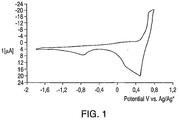
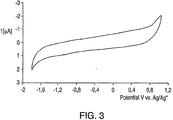
- the sample is subjected to cyclic voltammetry (CV) to determine its "voltage window".
- CV cyclic voltammetry
- the sample is placed in a cell having a working electrode, a counter electrode, and a test electrode, which is immediately adjacent but not touching the working electrode.
- the electrodes in the cell are connected to an apparatus applying cyclic voltage, called a potentiostat, which is configured to adjust the current between the working and counter electrodes to maintain a "desired voltage" between the working electrode and the reference electrode.
- the voltage between the reference electrode and the working electrode can be varied as a function of time in a programmed manner.
- the voltage window is determined by progressively increasing the desired voltage (in both the positive and negative directions) until there is a precipitous increase in the current required to drive the working and counter electrodes to maintain the desired voltage.
- the sharp rise in current at the end voltages generally indicates the breakdown voltage of the electrolyte solution, meaning that the salt or the solvent is undergoing an irreversible, destructive reduction reaction at the negative end voltage or an oxidation reaction at the positive end voltage.
- This ion exchange procedure is iteratively repeated a second and a third time with the solution. Samples are taken each time, dried and characterized in the same way.
- the reference material was prepared from the same raw material in an identical way except that it is not treated with any anion exchange resin before drying.
- the resin concurrently reduces the concentration of F, Cl, and Br.
- the methods of the present invention are not limited to reducing only these ions, but in fact can reduce all halide ions as well as sulfate.
- 100g of charged styrene macroporous anion exchange resin (sold under the trade designation Amberjet 4600 Cl) is provided.
- This resin is brought into intimate contact with 300 ml caustic soda (concentration: 5%) by adding the resin to the solution and mixing for one hour. The liquid was then separated from the resin.
- a new 300 ml batch of caustic soda (concentration: 5%) is provided, added, and mixed as before to the resin from the first separation step.
- the liquid from the second mixing step is then separated from the resin.
- the resin is washed with 250 ml of water four times.
- the resin was washed with 300 ml of an organic solvent, e.g. acetonitrile and dried for several days under vacuum and temperature up to 40° C.
- 100g of charged styrene gel anion exchange resin (sold under the trade designation Duolite A7) is provided. This resin is washed with 250 ml of water four times. The resin was washed with 300 ml of an organic solvent, e.g. acetonitrile and dried for several days under vacuum and temperature up to 40° C.
- a 1 molar solution of tetraethylammonium tetrafluoroborate (TEA-BF 4 ) in acetonitrile containing impurities (as described in WO 2004/039761 , which is incorporated herein by reference) and a water content of 292 parts per million is stirred for 1 hour with 5.6 g of the weakly basic anion exchange resin prepared as described above.
- the TEA-BF 4 solution is then removed from the resin and a sample of the solution is taken and dried to the desired water content below 20 ppm.
- Example 3 The process for Example 3 is repeated (three treatments), except that the TEA-BF 4 solution for the anion exchange process contains different concentrations of water during the exchange process.
- the examples demonstrate that the ion exchange reactivity at a water content of 20 parts per million is lower than the ion exchange reactivity at a water content of 500 ppm.
- the examples demonstrate that the ion exchange process is not limited to a specific ion exchange resin.
- Example TEA-BF 4 Molarity CV 34 0.5 No Peak 35 1.0 No Peak 36 1.5 No Peak
- Example Salt CV 40 methyltriethylammonium tetrafluoroborate No Peak 41 tetraethylammonium hydrogen maleate No Peak 42 pyridinium tetrafluoroborate No Peak 43 50% methyltriethylammonium tetrafluoroborate / 50% tetraethylammonium tetrafluoroborate No Peak 44 Ethylmethylimidazolium tetrafluoroborate No Peak 45 Butylmethylimidazolium tetrafluoroborate No Peak 46 50% methyltriethylammonium tetrafluoroborate / 50% ethylmethylimidazolium tetrafluoroborate No Peak 47 50% ethylmethylimidazolium tetrafluoroborate / 50% ethylmethylpyrazolium te
Landscapes
- Chemical & Material Sciences (AREA)
- Organic Chemistry (AREA)
- Health & Medical Sciences (AREA)
- Life Sciences & Earth Sciences (AREA)
- Biochemistry (AREA)
- General Health & Medical Sciences (AREA)
- Molecular Biology (AREA)
- Electric Double-Layer Capacitors Or The Like (AREA)
- Pyridine Compounds (AREA)
- Organic Low-Molecular-Weight Compounds And Preparation Thereof (AREA)
- Pyrrole Compounds (AREA)
Applications Claiming Priority (2)
| Application Number | Priority Date | Filing Date | Title |
|---|---|---|---|
| US65854505P | 2005-03-04 | 2005-03-04 | |
| PCT/US2006/007784 WO2006096578A1 (en) | 2005-03-04 | 2006-03-03 | Method for purifying quaternary onium salts |
Publications (2)
| Publication Number | Publication Date |
|---|---|
| EP1856027A1 EP1856027A1 (en) | 2007-11-21 |
| EP1856027B1 true EP1856027B1 (en) | 2016-04-20 |
Family
ID=36646213
Family Applications (1)
| Application Number | Title | Priority Date | Filing Date |
|---|---|---|---|
| EP06737014.8A Expired - Lifetime EP1856027B1 (en) | 2005-03-04 | 2006-03-03 | Method for purifying quaternary onium salts |
Country Status (6)
| Country | Link |
|---|---|
| US (1) | US7601871B2 (enExample) |
| EP (1) | EP1856027B1 (enExample) |
| JP (2) | JP5106127B2 (enExample) |
| KR (1) | KR20070114381A (enExample) |
| CN (1) | CN101163661B (enExample) |
| WO (1) | WO2006096578A1 (enExample) |
Families Citing this family (16)
| Publication number | Priority date | Publication date | Assignee | Title |
|---|---|---|---|---|
| JP5106127B2 (ja) * | 2005-03-04 | 2012-12-26 | ハネウェル・インターナショナル・インコーポレーテッド | 第四オニウム塩を精製するための方法 |
| JP5121248B2 (ja) * | 2007-02-23 | 2013-01-16 | 日本カーリット株式会社 | スピロ型第四級アンモニウム化合物の製造方法及び該スピロ型第四級アンモニウム化合物並びにその用途 |
| US8000084B2 (en) * | 2007-07-25 | 2011-08-16 | Honeywell International, Inc. | High voltage electrolytes |
| JP2012528087A (ja) * | 2009-05-28 | 2012-11-12 | メルク パテント ゲゼルシャフト ミット ベシュレンクテル ハフツング | 抗フケ剤 |
| CN101993380B (zh) * | 2009-08-11 | 2013-05-01 | 兆联实业股份有限公司 | 氢氧化四甲基铵的回收设备及其方法 |
| US8576543B2 (en) | 2010-12-14 | 2013-11-05 | Avx Corporation | Solid electrolytic capacitor containing a poly(3,4-ethylenedioxythiophene) quaternary onium salt |
| US8493713B2 (en) | 2010-12-14 | 2013-07-23 | Avx Corporation | Conductive coating for use in electrolytic capacitors |
| US8451588B2 (en) | 2011-03-11 | 2013-05-28 | Avx Corporation | Solid electrolytic capacitor containing a conductive coating formed from a colloidal dispersion |
| US9748605B2 (en) | 2011-08-24 | 2017-08-29 | Basf Se | Sulfur-containing additives for electrochemical or optoelectronic devices |
| US8636916B2 (en) | 2011-08-30 | 2014-01-28 | Corning Incorporated | Electrolyte synthesis for ultracapacitors |
| US8971019B2 (en) | 2012-03-16 | 2015-03-03 | Avx Corporation | Wet capacitor cathode containing an alkyl-substituted poly(3,4-ethylenedioxythiophene) |
| CN106565499B (zh) * | 2016-09-30 | 2018-10-23 | 多氟多化工股份有限公司 | 一种利用微通道反应器合成四乙基四氟硼酸铵的方法 |
| CN106674232A (zh) * | 2017-01-04 | 2017-05-17 | 湖南省正源储能材料与器件研究所 | 一种用离子交换净化法制备高纯螺环季铵盐的方法 |
| KR101830636B1 (ko) | 2017-01-04 | 2018-02-21 | 삼화페인트공업주식회사 | 스피로 4차 암모늄 염의 제조 방법 |
| JP7850019B2 (ja) * | 2021-08-31 | 2026-04-22 | 富士フイルム株式会社 | 感活性光線性又は感放射線性樹脂組成物の製造方法、パターン形成方法、及び電子デバイスの製造方法 |
| CN115477926B (zh) * | 2022-09-15 | 2024-06-25 | 江苏科技大学 | 一种相变材料及其制备方法 |
Family Cites Families (14)
| Publication number | Priority date | Publication date | Assignee | Title |
|---|---|---|---|---|
| JPH01246386A (ja) * | 1987-11-25 | 1989-10-02 | Asahi Glass Co Ltd | オニウム塩の製造方法 |
| FR2639888B1 (fr) * | 1988-12-07 | 1993-08-13 | Valeo Vision | Projecteur de vehicule automobile, comportant un reflecteur a surface complexe a zones intermediaires modifiees |
| US5086374A (en) | 1989-05-24 | 1992-02-04 | Specialised Conductives Pty. Limited | Aprotic electrolyte capacitors and methods of making the same |
| JPH03167160A (ja) * | 1989-11-22 | 1991-07-19 | Sumitomo Chem Co Ltd | 水酸化第四級アンモニウム水溶液の精製方法 |
| US5965054A (en) | 1997-08-12 | 1999-10-12 | Covalent Associates, Inc. | Nonaqueous electrolyte for electrical storage devices |
| US5968338A (en) * | 1998-01-20 | 1999-10-19 | Sachem, Inc. | Process for recovering onium hydroxides from solutions containing onium compounds |
| US6207039B1 (en) * | 1998-04-07 | 2001-03-27 | Sachem, Inc. | Process for recovering onium hydroxides or onium salts from solutions containing onium compounds using electrochemical ion exchange |
| JP3324502B2 (ja) * | 1998-05-14 | 2002-09-17 | 日本メクトロン株式会社 | アクリルエラストマー組成物 |
| JP2002053532A (ja) * | 2000-08-07 | 2002-02-19 | Tonen Chem Corp | 四級アンモニウム塩の精製方法 |
| CN1177804C (zh) * | 2001-12-28 | 2004-12-01 | 中国石油化工股份有限公司 | 一种由季铵盐制备季铵碱的方法 |
| US6787021B2 (en) * | 2002-01-03 | 2004-09-07 | Sachem, Inc. | Purification of onium hydroxides by electrodialysis |
| JP4194296B2 (ja) * | 2002-05-14 | 2008-12-10 | ステラケミファ株式会社 | 四級アルキルアンモニウム塩の精製方法及び四級アルキルアンモニウム塩の製造方法 |
| DE10250808B3 (de) | 2002-10-31 | 2004-04-08 | Honeywell Specialty Chemicals Seelze Gmbh | Tetraalkylammoniumtetrafluoroborat-haltige Elektrolytzusammensetzung, Verfahren zur Herstellung dieser Tetraalkylammoniumtetrafluoroborathaltiger Elektrolytzusammensetzungen sowie deren Verwendung |
| JP5106127B2 (ja) * | 2005-03-04 | 2012-12-26 | ハネウェル・インターナショナル・インコーポレーテッド | 第四オニウム塩を精製するための方法 |
-
2006
- 2006-03-03 JP JP2007558303A patent/JP5106127B2/ja not_active Expired - Fee Related
- 2006-03-03 EP EP06737014.8A patent/EP1856027B1/en not_active Expired - Lifetime
- 2006-03-03 US US11/368,168 patent/US7601871B2/en not_active Expired - Fee Related
- 2006-03-03 KR KR1020077022683A patent/KR20070114381A/ko not_active Ceased
- 2006-03-03 WO PCT/US2006/007784 patent/WO2006096578A1/en not_active Ceased
- 2006-03-03 CN CN200680013697.XA patent/CN101163661B/zh not_active Expired - Fee Related
-
2012
- 2012-07-12 JP JP2012156737A patent/JP5501411B2/ja not_active Expired - Fee Related
Non-Patent Citations (3)
| Title |
|---|
| IAN M. DOWNIE ET AL: "Cylisation reactions of 2-substituted biphenyl-2'-yldiazonium salts leading to O-alkyldibenzofuranium and S-alkyl-dibenzothiophenium salts: modified meerwein reagents", TETRAHEDRON, vol. 48, no. 19, 1 January 1992 (1992-01-01), pages 4005 - 4016, XP055135230, ISSN: 0040-4020, DOI: 10.1016/S0040-4020(01)88480-5 * |
| MANFRED BOCHMANN ET AL: "Synthesis of some Cationic 16-and 18-Electron Nickel Alkyl Phosphine Complexes containing Bidentate Ligands: Ligand-dependent Square-planar, Trigonal-bipyramidal, and Square-pyramidal Co-ordination Geometries, their Reactions with CO and Alkynes, and the Crystal Structure of [ Ni (CH,Si Me,) ( PMe,)", J. CHEM. SOC. DALTON TRANS, 1 January 1990 (1990-01-01), XP055135228, Retrieved from the Internet <URL:http://pubs.rsc.org/en/content/articlepdf/1990/dt/dt9900001213> [retrieved on 20140819] * |
| WHEELER CHARLES M.: "Reaction of Dimethyl Ether-Boron Trifluoride with Quaternary Alkyl Ammonium Halides", JOURNAL OF AMERICAN CHEMICAL SOCIETY, vol. 77, 5 April 1955 (1955-04-05), pages 2024 - 2025, XP055135322 * |
Also Published As
| Publication number | Publication date |
|---|---|
| JP2012232993A (ja) | 2012-11-29 |
| CN101163661B (zh) | 2015-08-19 |
| EP1856027A1 (en) | 2007-11-21 |
| US20060247472A1 (en) | 2006-11-02 |
| WO2006096578A1 (en) | 2006-09-14 |
| CN101163661A (zh) | 2008-04-16 |
| KR20070114381A (ko) | 2007-12-03 |
| JP2008536809A (ja) | 2008-09-11 |
| JP5106127B2 (ja) | 2012-12-26 |
| US7601871B2 (en) | 2009-10-13 |
| JP5501411B2 (ja) | 2014-05-21 |
Similar Documents
| Publication | Publication Date | Title |
|---|---|---|
| JP5501411B2 (ja) | 第四オニウム塩を精製するための方法 | |
| US9243013B2 (en) | Ionic compound, method for producing the same, and ion-conductive material comprising the same | |
| JP4499594B2 (ja) | 超高純度イオン性液体 | |
| US8029689B2 (en) | Method for producing high-purity quaternary ammonium salt | |
| US20070049750A1 (en) | Method for synthesizing spiro quartenary ammonium systems | |
| JP2005529232A (ja) | イオン性液体を製造するための電気化学的プロセス | |
| RU2059023C1 (ru) | Способ очистки растворов гидроксидов четвертичного аммония | |
| KR100966215B1 (ko) | 전기투석에 의한 오늄 하이드록사이드의 정제 | |
| KR20010082325A (ko) | 전기 투석법으로 오늄 수산화물을 제조 또는 정제하는 방법 | |
| AU2008223312B2 (en) | Ultra-high purity zinc bromides and quaternary ammonium bromides for use in zinc-bromine batteries | |
| JP2004221557A (ja) | 電解液 | |
| JP4322073B2 (ja) | イオン性液体の精製方法 | |
| JP4674022B2 (ja) | 廃液から有機水酸化物を回収するためのプロセス | |
| EP3984615B1 (en) | Amine separation method using liquid chromatography | |
| KR101830636B1 (ko) | 스피로 4차 암모늄 염의 제조 방법 | |
| CN114940690A (zh) | 一种四丙基氢氧化鏻及其制备方法和应用 | |
| CN1524853A (zh) | 室温离子液体的绿色合成方法 | |
| CN1978708A (zh) | 降低离子液体中卤素含量的方法 | |
| McGregor et al. | Interfacial Cation Arrangement Governs Electrocatalytic Kinetics in CO2 Reduction | |
| CN117209467B (zh) | 一种氟代碳酸乙烯酯的制备方法 | |
| KR20140013802A (ko) | 이온성 액체 emi-bf₄의 정제방법 | |
| EP1820794B1 (en) | Method of obtaining cyclic amino acids | |
| Hlavatý et al. | Use of Nafion membranes in laboratory organic electrosynthesis | |
| JPH0277591A (ja) | 第4級ホスホニウムヒドロオキシドの製造法 |
Legal Events
| Date | Code | Title | Description |
|---|---|---|---|
| PUAI | Public reference made under article 153(3) epc to a published international application that has entered the european phase |
Free format text: ORIGINAL CODE: 0009012 |
|
| 17P | Request for examination filed |
Effective date: 20070830 |
|
| AK | Designated contracting states |
Kind code of ref document: A1 Designated state(s): AT BE BG CH CY CZ DE DK EE ES FI FR GB GR HU IE IS IT LI LT LU LV MC NL PL PT RO SE SI SK TR |
|
| 17Q | First examination report despatched |
Effective date: 20080226 |
|
| RIN1 | Information on inventor provided before grant (corrected) |
Inventor name: SIGGEL, ALFRED Inventor name: NERENZ, FRANK Inventor name: THEISSEN, MICHAEL Inventor name: DEMEL, SONJA Inventor name: KANSCHIK-CONRADSEN, ANDREAS |
|
| DAX | Request for extension of the european patent (deleted) | ||
| REG | Reference to a national code |
Ref country code: DE Ref legal event code: R079 Ref document number: 602006048784 Country of ref document: DE Free format text: PREVIOUS MAIN CLASS: C07C0209860000 Ipc: C07F0009540000 |
|
| GRAP | Despatch of communication of intention to grant a patent |
Free format text: ORIGINAL CODE: EPIDOSNIGR1 |
|
| RAP1 | Party data changed (applicant data changed or rights of an application transferred) |
Owner name: HONEYWELL INTERNATIONAL INC. |
|
| RIC1 | Information provided on ipc code assigned before grant |
Ipc: C07C 209/84 20060101ALI20151112BHEP Ipc: C07C 211/63 20060101ALI20151112BHEP Ipc: C07F 9/02 20060101ALI20151112BHEP Ipc: C07F 9/54 20060101AFI20151112BHEP Ipc: C07F 9/6568 20060101ALI20151112BHEP |
|
| INTG | Intention to grant announced |
Effective date: 20151203 |
|
| GRAS | Grant fee paid |
Free format text: ORIGINAL CODE: EPIDOSNIGR3 |
|
| GRAA | (expected) grant |
Free format text: ORIGINAL CODE: 0009210 |
|
| AK | Designated contracting states |
Kind code of ref document: B1 Designated state(s): AT BE BG CH CY CZ DE DK EE ES FI FR GB GR HU IE IS IT LI LT LU LV MC NL PL PT RO SE SI SK TR |
|
| REG | Reference to a national code |
Ref country code: GB Ref legal event code: FG4D |
|
| REG | Reference to a national code |
Ref country code: CH Ref legal event code: EP |
|
| REG | Reference to a national code |
Ref country code: AT Ref legal event code: REF Ref document number: 792351 Country of ref document: AT Kind code of ref document: T Effective date: 20160515 |
|
| REG | Reference to a national code |
Ref country code: IE Ref legal event code: FG4D |
|
| REG | Reference to a national code |
Ref country code: DE Ref legal event code: R096 Ref document number: 602006048784 Country of ref document: DE |
|
| REG | Reference to a national code |
Ref country code: LT Ref legal event code: MG4D |
|
| REG | Reference to a national code |
Ref country code: AT Ref legal event code: MK05 Ref document number: 792351 Country of ref document: AT Kind code of ref document: T Effective date: 20160420 |
|
| REG | Reference to a national code |
Ref country code: NL Ref legal event code: MP Effective date: 20160420 |
|
| PG25 | Lapsed in a contracting state [announced via postgrant information from national office to epo] |
Ref country code: PL Free format text: LAPSE BECAUSE OF FAILURE TO SUBMIT A TRANSLATION OF THE DESCRIPTION OR TO PAY THE FEE WITHIN THE PRESCRIBED TIME-LIMIT Effective date: 20160420 Ref country code: LT Free format text: LAPSE BECAUSE OF FAILURE TO SUBMIT A TRANSLATION OF THE DESCRIPTION OR TO PAY THE FEE WITHIN THE PRESCRIBED TIME-LIMIT Effective date: 20160420 Ref country code: NL Free format text: LAPSE BECAUSE OF FAILURE TO SUBMIT A TRANSLATION OF THE DESCRIPTION OR TO PAY THE FEE WITHIN THE PRESCRIBED TIME-LIMIT Effective date: 20160420 Ref country code: FI Free format text: LAPSE BECAUSE OF FAILURE TO SUBMIT A TRANSLATION OF THE DESCRIPTION OR TO PAY THE FEE WITHIN THE PRESCRIBED TIME-LIMIT Effective date: 20160420 |
|
| PG25 | Lapsed in a contracting state [announced via postgrant information from national office to epo] |
Ref country code: SE Free format text: LAPSE BECAUSE OF FAILURE TO SUBMIT A TRANSLATION OF THE DESCRIPTION OR TO PAY THE FEE WITHIN THE PRESCRIBED TIME-LIMIT Effective date: 20160420 Ref country code: ES Free format text: LAPSE BECAUSE OF FAILURE TO SUBMIT A TRANSLATION OF THE DESCRIPTION OR TO PAY THE FEE WITHIN THE PRESCRIBED TIME-LIMIT Effective date: 20160420 Ref country code: GR Free format text: LAPSE BECAUSE OF FAILURE TO SUBMIT A TRANSLATION OF THE DESCRIPTION OR TO PAY THE FEE WITHIN THE PRESCRIBED TIME-LIMIT Effective date: 20160721 Ref country code: LV Free format text: LAPSE BECAUSE OF FAILURE TO SUBMIT A TRANSLATION OF THE DESCRIPTION OR TO PAY THE FEE WITHIN THE PRESCRIBED TIME-LIMIT Effective date: 20160420 Ref country code: PT Free format text: LAPSE BECAUSE OF FAILURE TO SUBMIT A TRANSLATION OF THE DESCRIPTION OR TO PAY THE FEE WITHIN THE PRESCRIBED TIME-LIMIT Effective date: 20160822 Ref country code: AT Free format text: LAPSE BECAUSE OF FAILURE TO SUBMIT A TRANSLATION OF THE DESCRIPTION OR TO PAY THE FEE WITHIN THE PRESCRIBED TIME-LIMIT Effective date: 20160420 |
|
| PG25 | Lapsed in a contracting state [announced via postgrant information from national office to epo] |
Ref country code: BE Free format text: LAPSE BECAUSE OF FAILURE TO SUBMIT A TRANSLATION OF THE DESCRIPTION OR TO PAY THE FEE WITHIN THE PRESCRIBED TIME-LIMIT Effective date: 20160420 Ref country code: IT Free format text: LAPSE BECAUSE OF FAILURE TO SUBMIT A TRANSLATION OF THE DESCRIPTION OR TO PAY THE FEE WITHIN THE PRESCRIBED TIME-LIMIT Effective date: 20160420 |
|
| REG | Reference to a national code |
Ref country code: DE Ref legal event code: R097 Ref document number: 602006048784 Country of ref document: DE |
|
| PG25 | Lapsed in a contracting state [announced via postgrant information from national office to epo] |
Ref country code: DK Free format text: LAPSE BECAUSE OF FAILURE TO SUBMIT A TRANSLATION OF THE DESCRIPTION OR TO PAY THE FEE WITHIN THE PRESCRIBED TIME-LIMIT Effective date: 20160420 Ref country code: EE Free format text: LAPSE BECAUSE OF FAILURE TO SUBMIT A TRANSLATION OF THE DESCRIPTION OR TO PAY THE FEE WITHIN THE PRESCRIBED TIME-LIMIT Effective date: 20160420 Ref country code: RO Free format text: LAPSE BECAUSE OF FAILURE TO SUBMIT A TRANSLATION OF THE DESCRIPTION OR TO PAY THE FEE WITHIN THE PRESCRIBED TIME-LIMIT Effective date: 20160420 Ref country code: SK Free format text: LAPSE BECAUSE OF FAILURE TO SUBMIT A TRANSLATION OF THE DESCRIPTION OR TO PAY THE FEE WITHIN THE PRESCRIBED TIME-LIMIT Effective date: 20160420 Ref country code: CZ Free format text: LAPSE BECAUSE OF FAILURE TO SUBMIT A TRANSLATION OF THE DESCRIPTION OR TO PAY THE FEE WITHIN THE PRESCRIBED TIME-LIMIT Effective date: 20160420 |
|
| PLBE | No opposition filed within time limit |
Free format text: ORIGINAL CODE: 0009261 |
|
| STAA | Information on the status of an ep patent application or granted ep patent |
Free format text: STATUS: NO OPPOSITION FILED WITHIN TIME LIMIT |
|
| 26N | No opposition filed |
Effective date: 20170123 |
|
| PG25 | Lapsed in a contracting state [announced via postgrant information from national office to epo] |
Ref country code: SI Free format text: LAPSE BECAUSE OF FAILURE TO SUBMIT A TRANSLATION OF THE DESCRIPTION OR TO PAY THE FEE WITHIN THE PRESCRIBED TIME-LIMIT Effective date: 20160420 |
|
| REG | Reference to a national code |
Ref country code: CH Ref legal event code: PL |
|
| PG25 | Lapsed in a contracting state [announced via postgrant information from national office to epo] |
Ref country code: MC Free format text: LAPSE BECAUSE OF FAILURE TO SUBMIT A TRANSLATION OF THE DESCRIPTION OR TO PAY THE FEE WITHIN THE PRESCRIBED TIME-LIMIT Effective date: 20160420 |
|
| REG | Reference to a national code |
Ref country code: IE Ref legal event code: MM4A |
|
| REG | Reference to a national code |
Ref country code: FR Ref legal event code: ST Effective date: 20171130 |
|
| PG25 | Lapsed in a contracting state [announced via postgrant information from national office to epo] |
Ref country code: FR Free format text: LAPSE BECAUSE OF NON-PAYMENT OF DUE FEES Effective date: 20170331 Ref country code: LU Free format text: LAPSE BECAUSE OF NON-PAYMENT OF DUE FEES Effective date: 20170303 |
|
| PG25 | Lapsed in a contracting state [announced via postgrant information from national office to epo] |
Ref country code: CH Free format text: LAPSE BECAUSE OF NON-PAYMENT OF DUE FEES Effective date: 20170331 Ref country code: IE Free format text: LAPSE BECAUSE OF NON-PAYMENT OF DUE FEES Effective date: 20170303 Ref country code: LI Free format text: LAPSE BECAUSE OF NON-PAYMENT OF DUE FEES Effective date: 20170331 |
|
| PG25 | Lapsed in a contracting state [announced via postgrant information from national office to epo] |
Ref country code: HU Free format text: LAPSE BECAUSE OF FAILURE TO SUBMIT A TRANSLATION OF THE DESCRIPTION OR TO PAY THE FEE WITHIN THE PRESCRIBED TIME-LIMIT; INVALID AB INITIO Effective date: 20060303 |
|
| PG25 | Lapsed in a contracting state [announced via postgrant information from national office to epo] |
Ref country code: BG Free format text: LAPSE BECAUSE OF FAILURE TO SUBMIT A TRANSLATION OF THE DESCRIPTION OR TO PAY THE FEE WITHIN THE PRESCRIBED TIME-LIMIT Effective date: 20160420 |
|
| PG25 | Lapsed in a contracting state [announced via postgrant information from national office to epo] |
Ref country code: CY Free format text: LAPSE BECAUSE OF NON-PAYMENT OF DUE FEES Effective date: 20160420 |
|
| PG25 | Lapsed in a contracting state [announced via postgrant information from national office to epo] |
Ref country code: TR Free format text: LAPSE BECAUSE OF FAILURE TO SUBMIT A TRANSLATION OF THE DESCRIPTION OR TO PAY THE FEE WITHIN THE PRESCRIBED TIME-LIMIT Effective date: 20160420 |
|
| PGFP | Annual fee paid to national office [announced via postgrant information from national office to epo] |
Ref country code: GB Payment date: 20200327 Year of fee payment: 15 |
|
| PG25 | Lapsed in a contracting state [announced via postgrant information from national office to epo] |
Ref country code: IS Free format text: LAPSE BECAUSE OF FAILURE TO SUBMIT A TRANSLATION OF THE DESCRIPTION OR TO PAY THE FEE WITHIN THE PRESCRIBED TIME-LIMIT Effective date: 20160820 |
|
| PGFP | Annual fee paid to national office [announced via postgrant information from national office to epo] |
Ref country code: DE Payment date: 20200330 Year of fee payment: 15 |
|
| REG | Reference to a national code |
Ref country code: DE Ref legal event code: R119 Ref document number: 602006048784 Country of ref document: DE |
|
| GBPC | Gb: european patent ceased through non-payment of renewal fee |
Effective date: 20210303 |
|
| PG25 | Lapsed in a contracting state [announced via postgrant information from national office to epo] |
Ref country code: GB Free format text: LAPSE BECAUSE OF NON-PAYMENT OF DUE FEES Effective date: 20210303 Ref country code: DE Free format text: LAPSE BECAUSE OF NON-PAYMENT OF DUE FEES Effective date: 20211001 |