EP1853382B1 - Producing supported cobalt catalysts for the fischer-tropsch synthesis - Google Patents
Producing supported cobalt catalysts for the fischer-tropsch synthesis Download PDFInfo
- Publication number
- EP1853382B1 EP1853382B1 EP05825199.2A EP05825199A EP1853382B1 EP 1853382 B1 EP1853382 B1 EP 1853382B1 EP 05825199 A EP05825199 A EP 05825199A EP 1853382 B1 EP1853382 B1 EP 1853382B1
- Authority
- EP
- European Patent Office
- Prior art keywords
- hydrogen
- catalyst
- fischer
- activation stage
- reduced
- Prior art date
- Legal status (The legal status is an assumption and is not a legal conclusion. Google has not performed a legal analysis and makes no representation as to the accuracy of the status listed.)
- Expired - Lifetime
Links
Images
Classifications
-
- B—PERFORMING OPERATIONS; TRANSPORTING
- B01—PHYSICAL OR CHEMICAL PROCESSES OR APPARATUS IN GENERAL
- B01J—CHEMICAL OR PHYSICAL PROCESSES, e.g. CATALYSIS OR COLLOID CHEMISTRY; THEIR RELEVANT APPARATUS
- B01J23/00—Catalysts comprising metals or metal oxides or hydroxides, not provided for in group B01J21/00
- B01J23/70—Catalysts comprising metals or metal oxides or hydroxides, not provided for in group B01J21/00 of the iron group metals or copper
- B01J23/74—Iron group metals
- B01J23/75—Cobalt
-
- C—CHEMISTRY; METALLURGY
- C10—PETROLEUM, GAS OR COKE INDUSTRIES; TECHNICAL GASES CONTAINING CARBON MONOXIDE; FUELS; LUBRICANTS; PEAT
- C10G—CRACKING HYDROCARBON OILS; PRODUCTION OF LIQUID HYDROCARBON MIXTURES, e.g. BY DESTRUCTIVE HYDROGENATION, OLIGOMERISATION, POLYMERISATION; RECOVERY OF HYDROCARBON OILS FROM OIL-SHALE, OIL-SAND, OR GASES; REFINING MIXTURES MAINLY CONSISTING OF HYDROCARBONS; REFORMING OF NAPHTHA; MINERAL WAXES
- C10G2/00—Production of liquid hydrocarbon mixtures of undefined composition from oxides of carbon
- C10G2/30—Production of liquid hydrocarbon mixtures of undefined composition from oxides of carbon from carbon monoxide with hydrogen
- C10G2/32—Production of liquid hydrocarbon mixtures of undefined composition from oxides of carbon from carbon monoxide with hydrogen with the use of catalysts
- C10G2/33—Production of liquid hydrocarbon mixtures of undefined composition from oxides of carbon from carbon monoxide with hydrogen with the use of catalysts characterised by the catalyst used
- C10G2/331—Production of liquid hydrocarbon mixtures of undefined composition from oxides of carbon from carbon monoxide with hydrogen with the use of catalysts characterised by the catalyst used containing group VIII-metals
- C10G2/332—Production of liquid hydrocarbon mixtures of undefined composition from oxides of carbon from carbon monoxide with hydrogen with the use of catalysts characterised by the catalyst used containing group VIII-metals of the iron-group
-
- B—PERFORMING OPERATIONS; TRANSPORTING
- B01—PHYSICAL OR CHEMICAL PROCESSES OR APPARATUS IN GENERAL
- B01J—CHEMICAL OR PHYSICAL PROCESSES, e.g. CATALYSIS OR COLLOID CHEMISTRY; THEIR RELEVANT APPARATUS
- B01J37/00—Processes, in general, for preparing catalysts; Processes, in general, for activation of catalysts
- B01J37/16—Reducing
- B01J37/18—Reducing with gases containing free hydrogen
-
- C—CHEMISTRY; METALLURGY
- C07—ORGANIC CHEMISTRY
- C07C—ACYCLIC OR CARBOCYCLIC COMPOUNDS
- C07C1/00—Preparation of hydrocarbons from one or more compounds, none of them being a hydrocarbon
- C07C1/02—Preparation of hydrocarbons from one or more compounds, none of them being a hydrocarbon from oxides of a carbon
- C07C1/04—Preparation of hydrocarbons from one or more compounds, none of them being a hydrocarbon from oxides of a carbon from carbon monoxide with hydrogen
-
- C—CHEMISTRY; METALLURGY
- C10—PETROLEUM, GAS OR COKE INDUSTRIES; TECHNICAL GASES CONTAINING CARBON MONOXIDE; FUELS; LUBRICANTS; PEAT
- C10G—CRACKING HYDROCARBON OILS; PRODUCTION OF LIQUID HYDROCARBON MIXTURES, e.g. BY DESTRUCTIVE HYDROGENATION, OLIGOMERISATION, POLYMERISATION; RECOVERY OF HYDROCARBON OILS FROM OIL-SHALE, OIL-SAND, OR GASES; REFINING MIXTURES MAINLY CONSISTING OF HYDROCARBONS; REFORMING OF NAPHTHA; MINERAL WAXES
- C10G2/00—Production of liquid hydrocarbon mixtures of undefined composition from oxides of carbon
-
- C—CHEMISTRY; METALLURGY
- C10—PETROLEUM, GAS OR COKE INDUSTRIES; TECHNICAL GASES CONTAINING CARBON MONOXIDE; FUELS; LUBRICANTS; PEAT
- C10G—CRACKING HYDROCARBON OILS; PRODUCTION OF LIQUID HYDROCARBON MIXTURES, e.g. BY DESTRUCTIVE HYDROGENATION, OLIGOMERISATION, POLYMERISATION; RECOVERY OF HYDROCARBON OILS FROM OIL-SHALE, OIL-SAND, OR GASES; REFINING MIXTURES MAINLY CONSISTING OF HYDROCARBONS; REFORMING OF NAPHTHA; MINERAL WAXES
- C10G2300/00—Aspects relating to hydrocarbon processing covered by groups C10G1/00 - C10G99/00
- C10G2300/70—Catalyst aspects
- C10G2300/703—Activation
Definitions
- This invention relates to a process for producing a supported Fischer-Tropsch catalyst.
- a supported Fischer-Tropsch catalyst precursor by impregnating a particulate catalyst support with cobalt nitrate (Co(NO 3 ) 2 .6H 2 O), and calcining the impregnated support.
- a precursor is hereinafter also referred to as a "pre-reduction cobalt nitrate-based supported Fischer-Tropsch synthesis catalyst precursor".
- Such a precursor can then, in an activation process or step, be reduced by means of hydrogen, to obtain an active Fischer-Tropsch catalyst which contains cobalt crystallites as active component of the catalyst. Any residual nitrogen present in the precursor can be converted to ammonia (NH 3 ) during the activation process.
- EP 0533227 discloses a process for the activation of a Fischer-Tropsch catalyst by using hydrogen, in which the hydrogen concentration and space velocity are increased step-wise or continuously during the activation and in which the hydrogen is recompressed and recycled.
- WO 92/06784 discloses a process for activating cobalt catalysts for hydrocarbon synthesis using hydrogen whilst maintaining the water partial pressure below 5 atmospheres.
- US 2002/0052289 discloses a Fischer-Tropsch catalyst which is prepared by impregnation of a Si-MCM-41 support with cobalt acetate and a ruthenium compound and which is then activated by hydrogen.
- the Applicant has found that, particularly when the active Fischer-Tropsch catalyst is produced on a commercial scale, higher than desired levels of Co are present in a wax supernatant of an active Fischer-Tropsch catalyst coated with wax i.e. the wax top layer of a solidified mixture of an active Fischer-Tropsch catalyst and a wax, in which the catalyst has settled down and the top layer is mainly wax.
- This higher than desired levels of Co in the wax supernatant may lead to submicron cobalt contamination of the Fischer-Tropsch synthesis wax product produced during the initial stages of a start-up of a commercial Gas-to-Liquids plant or directly after any on-line addition of fresh catalyst.
- the Fischer-Tropsch synthesis wax product is defined as the hydrocarbon product that is a liquid at the applied Fischer-Tropsch synthesis conditions and that is withdrawn as such from the reactor. Low or no cobalt concentrations in the wax supernatant of an active Fischer-Tropsch catalyst coated with wax is therefore desirable.
- the Applicant has found that, particularly when the active Fischer-Tropsch catalyst is produced on a commercial scale, the cobalt concentration in the wax supernatant can at times be higher than desirable.
- a process for producing a supported Fischer-Tropsch catalyst which process includes treating, in an activation stage, a particulate pre-reduction cobalt nitrate-based supported Fischer-Tropsch synthesis catalyst precursor containing reducible cobalt oxides, with hydrogen as a reducing gas in order to reduce the cobalt oxides over a period of time to Co, with ammonia and water being formed, the reduction including a time period when predominantly CoO is reduced to Co; withdrawing unreacted hydrogen, which thus includes water, from the activation stage, treating the unreacted hydrogen to lower its dewpoint and returning at least a portion of the withdrawn unreacted hydrogen to the activation stage as recycle hydrogen; and maintaining an ammonia concentration in the activation stage, at least during the time when predominantly CoO is reduced to Co, of less than 250 volume parts per million ("vppm").
- the ammonia concentration in the activation stage can be measured, per definition, in an outlet hydrogen gas stream directly after the hydrogen gas stream exits the activation reactor prior to any gas treatment steps.
- the ammonia concentration in the activation stage is maintained, at least during the time when predominantly CoO is reduced to Co, at less than 70 vppm, more preferably at less than 45 vppm.
- the particulate pre-reduction cobalt nitrate-based supported Fischer-Tropsch synthesis catalyst precursor is heated at a controlled rate and the reduction is thus effected at elevated temperatures.
- variations in the dewpoint of the unreacted hydrogen withdrawn from the activation stage, and variations in the hydrogen consumption occur, with both typically showing two peaks as the temperature is increased, if the product of calcination is assumed to be Co 3 O 4 .
- the reduction of CoO to Co is typified by the peak occurring at the highest temperature, and thus either dewpoint data or hydrogen consumption data, or both, can in practice be used to determine when predominantly CoO is being reduced to Co. Broadly, this occurs at temperatures between about 250 °C and about 425 °C, typically between about 275 °C and about 400 °C.
- Maintaining the ammonia concentration in the activation stage, at least during the time when predominantly CoO is reduced to Co, at less than 250 vppm, preferably at less than 70 vppm, more preferably at less than 45 vppm, may include removing NH 3 from the unreacted hydrogen.
- the NH 3 may be removed by contacting the unreacted hydrogen with an NH 3 adsorbent. Suitable adsorbents are well-known to those skilled in the art and are easily identified from literature.
- Treating the unreacted hydrogen to lower its dewpoint includes removing water from the unreacted hydrogen, thus to maintain the water partial pressure at a low level thereby to promote catalyst activity.
- Removing water from the unreacted hydrogen may include cooling the unreacted hydrogen to condense at least some of the water and removing the aqueous condensate.
- Removing water from the unreacted hydrogen may also include contacting the unreacted hydrogen with a water adsorbent or dessicant. Suitable water adsorbents are well-known to those skilled in the art and are easily identified from literature.
- Some of the NH 3 may also be adsorbed by the water adsorbent. It will thus be appreciated that water and some of the NH 3 present in the unreacted hydrogen may thus simultaneously be removed from the unreacted hydrogen in a common process step or unit operation.
- the process typically includes feeding makeup hydrogen to the activation stage, together with the recycle hydrogen.
- the supported Fischer-Tropsch catalyst i.e. the reduced and activated cobalt catalyst may be loaded into molten wax under an inert atmosphere to prevent the reduced catalyst coming into contact with oxygen from the atmosphere that may oxidize the reduced cobalt to cobalt oxide.
- the loading of the reduced and activated catalyst into the wax to form a slurry mixture should, obviously, be done at a temperature above the melting temperature of the wax.
- the slurry mixture of activated cobalt catalyst and wax is then cooled down to room temperature during which the catalyst settles and the mixture solidifies.
- the process may include, after having activated the particulate pre-reduction cobalt nitrate-based supported Fischer-Tropsch synthesis catalyst precursor to produce a freshly activated Fischer-Tropsch catalyst, cooling down the freshly activated Fischer-Tropsch catalyst in pure hydrogen to a temperature T c , and thereafter further cooling the activated Fischer-Tropsch catalyst down to room temperature in substantially pure nitrogen.
- the temperature T c must be low enough to ensure that nitrogen behaves as an inert during the last leg of this cooling phase.
- This switch temperature T c is easily determined by those skilled in the art of producing supported Fischer-Tropsch catalyst, e.g. by using a method as taught by PCT Patent Application No. WO 03/035257 .
- the particulate pre-reduction cobalt nitrate-based supported Fischer-Tropsch synthesis catalyst precursor may be any suitable cobalt nitrate-based catalyst precursor requiring activation or reduction to obtain an active Fischer-Tropsch catalyst.
- the pre-reduction cobalt nitrate-based supported Fischer-Tropsch synthesis catalyst precursor is obtained by forming a slurry of a particulate catalyst support, cobalt nitrate as an active component precursor, and water; subjecting the catalyst support to impregnation with the cobalt nitrate; drying the impregnated catalyst support; and calcining the impregnated support, to obtain the catalyst precursor.
- the catalyst precursor thus obtained must, however, then still be activated or reduced prior to using it for catalyzing a Fischer-Tropsch reaction, and this reduction or activation is effected in accordance with the present invention.
- the resultant catalyst is thus an activated cobalt Fischer-Tropsch synthesis catalyst.
- any commercially available pre-shaped porous oxide catalyst support such as Al 2 O 3 , silica (SiO 2 ), titania (TiO 2 ), magnesia (MgO), SiO 2 -Al 2 O 3 and zinc oxide (ZnO), may be used.
- the support preferably has an average pore diameter between 8 and 50 nanometers, more preferably between 10 and 15 nanometers.
- the support pore volume may be between 0.1 and 1.0ml/g, preferably between 0.3 and 0.9ml/g.
- the average particle size is preferably between 1 and 500 micrometers, more preferably between 10 and 250 micrometers, still more preferably between 45 and 200 micrometers.
- the support may be a protected modified catalyst support, containing, for example, silicon as modifying component, as described in EP Application No. 99906328.2 (European Publication No. 1058580 ).
- the cobalt loading can be between 5gCo/100g support and 100gCo/100g support, preferably between 20gCo/100g support and 70gCo/100g support.
- the impregnation of the catalyst support may, in principle, be effected by any known method or procedure such as incipient wetness impregnation or slurry phase impregnation.
- the impregnation may, in particular, be effected in the manner described in US 6455462 or in US 5733839 .
- the support impregnation may thus involve a 2-step slurry phase impregnation process, which is dependent on a desired cobalt loading requirement and the pore volume of the catalyst support.
- a water soluble precursor salt of platinum (Pt), palladium (Pd), ruthenium (Ru) or mixtures thereof may be added, as a dopant capable of enhancing the reducibility of the active component.
- the mass proportion of this dopant, when used, to cobalt may be between 0,01:100 and 0,3:100.
- Calcination of the impregnated and dried material may be done using any method, known to those skilled in the art, for example in a fluidized bed, or a rotary kiln, calciner at 200-350°C. It may, in particular, be effected as described in PCT Patent Application WO 01/39882 .
- Also described is a process for synthesis of a Fischer-Trospch wax product the process comprising producing a supported Fischer-Tropsch catalyst in accordance with the process of the first aspect of the invention; and contacting a synthesis gas comprising hydrogen (H 2 ) and carbon monoxide (CO) at an elevated temperature between 180 °C and 250 °C and an elevated pressure between 10 bar and 40 bar with said catalyst to obtain hydrocarbons by means of a slurry phase Fischer-Tropsch reaction of the hydrogen with the carbon monoxide.
- a synthesis gas comprising hydrogen (H 2 ) and carbon monoxide (CO)
- This example describes a typical preparation of a batch of pre-reduced catalyst precursor suitable for use in the process of the invention to produce a supported Fischer-Tropsch catalyst.
- the alumina support used in this example was modified with Si by means of slurry phase impregnation and vacuum drying, as described in EP 1058580 .
- the pre-reduced catalyst precursor was prepared by means of slurry phase impregnation followed by vacuum drying, as described in US 6,455,462 .
- the impregnated and dried precursor was subsequently treated by means of a fluidized bed calcination procedure, as described in WO 01/39882 .
- the impregnated, dried and calcined precursor was subsequently activated by means of a reduction procedure as described in WO 03/035257 .
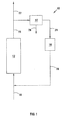
- reference numeral 10 generally indicates a process in accordance with the invention for producing on a commercial scale a supported active Fischer-Tropsch catalyst.
- the process 10 includes an activation stage defined by a reduction reactor 12, and further includes a condenser 14 and an adsorber 16.
- the adsorber 16 includes both an NH 3 adsorbent and a water adsorbent.
- a hydrogen make-up line 18 leads into the reduction reactor 12 and a wet or unreacted hydrogen line 20 leads from the reactor 12 to the condenser 14, with a flare line 22 branching off from the line 20.
- a hydrogen line 24 connects the condenser 14 to the adsorber 16. From the adsorber 16, a hydrogen recycle line 26 returns to the hydrogen make-up line 18.
- a condensate removal line 28 is provided for the condenser 14.
- a particulate pre-reduction cobalt nitrate-based supported Fischer-Tropsch synthesis catalyst precursor such as the catalyst precursor produced in accordance with the Example, is loaded into the reduction reactor 12.
- a reducing gas comprising at least 90 vol% hydrogen and up to about 10 vol% inerts is fed by means of the hydrogen make-up line 18 into the reduction reactor 12 to contact the catalyst precursor.
- the reduction reactor 12 is then heated according to a preselected heating programme, which may include several hold times, to a final temperature not exceeding 600 °C, preferably a final temperature not exceeding 500 °C, and most preferably a final temperature not exceeding 450 °C, a hold time at the final temperature, followed by cooling to an unloading temperature not exceeding 180 °C and typically about 140 °C temperature.
- a preselected heating programme which may include several hold times, to a final temperature not exceeding 600 °C, preferably a final temperature not exceeding 500 °C, and most preferably a final temperature not exceeding 450 °C, a hold time at the final temperature, followed by cooling to an unloading temperature not exceeding 180 °C and typically about 140 °C temperature.
- Unreacted reducing gas which thus includes unreacted hydrogen, any gaseous products formed during the reduction of the catalyst precursor and any gaseous substances removed from the catalyst precursor, is withdrawn from the reduction reactor 12 by means of the wet hydrogen line 20 and fed to the condenser 14.
- This gas includes moisture and NH 3 .
- a small portion of the gas is purged by means of the flare line 22.
- the gas is cooled to condense moisture with the aqueous condensate formed being removed by means of the condensate removal line 28.
- the gas is then fed by means of the hydrogen line 24 to the adsorber 16 where the water adsorbent is used to polish the gas in order further to remove moisture and the NH 3 adsorbent is used to remove NH 3 .
- the gas now substantially free of moisture and NH 3 , is returned as recycle hydrogen to the reduction reactor 12 by means of the hydrogen recycle line 26.
- Make-up hydrogen is added by means of the hydrogen make-up line 18 to compensate for hydrogen consumed in the reduction reactor 12 and hydrogen purged via the flare line 22.
- reducible cobalt oxides are thus reduced to cobalt over a period of time to produce an active Fischer-Tropsch catalyst which contains cobalt crystallites as active component of the catalyst.
- This time interval can be identified by studying dewpoint data for the gas withdrawn from the reduction reactor 12, or hydrogen consumption data for the reduction reactor 12, or both.
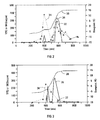
- Figure 2 shows graphs of reactor temperature, NH 3 concentration in the reduction gas entering the reactor 12, NH 3 concentration in the gas withdrawn from the reactor 12, and the dewpoint of the gas withdrawn from the reactor 12, as a function of time, for a process identical to the process 10 but in which the NH 3 adsorbent in the adsorber 16 is absent.
- the temperature is indicated by graph 30
- the NH 3 concentration in the reducing gas feed is indicated by graph 32
- the NH 3 concentration in the gas withdrawn from the reactor 12 is indicated by graph 34
- the dewpoint of the gas withdrawn from the reactor 12 is indicated by graph 36.
- the dewpoint graph shows two distinct peaks. The second peak, occurring after about 600 minutes identifies the time interval during which predominantly CoO is reduced to Co.
- Figure 3 shows graphs for the same parameters as shown in Figure 2 , but for the process 10 in which both the water adsorbent and the NH 3 adsorbent in the adsorber 16 are present.
- the same reference numerals are used in Figure 3 to indicate the graphs for the same parameters as are used in Figure 2 .
- the NH 3 concentration in the gas withdrawn from the reactor 12 during this time interval is less than about 150 vppm and declining, reaching a value of about 70 vppm at the second dewpoint maximum. It is to be noted that, although different batches of catalyst precursor was used in the processes which produced Figures 2 and 3 , the catalyst precursor batches were very similar and the operating conditions were identical, apart from the presence of the NH 3 adsorbent in the adsorber 16.
- the active Fischer-Tropsch catalyst obtained from the process producing the graphs of Figure 2 and the active Fischer-Tropsch catalyst obtained from the process producing the graphs of Figure 3 were each suspended in molten wax at about 140 °C and cooled down to room temperature. During the cooling down process the active Fischer-Tropsch catalyst settled and the mixture of settled catalyst and wax solidified. The process of settling and solidification ensures a catalyst layer at the bottom of the solidified mixture and a wax layer (i.e. wax supernatant) on top of the settled catalyst. After solidification the wax supernatant was analysed to determine the cobalt concentration therein.
- the cobalt concentration in the wax supernatant of the conventionally produced Fischer-Tropsch catalyst was 346 mass ppm, whereas the cobalt concentration in the supernatant of the catalyst produced in accordance with the process of the invention was only 6 mass ppm.
- the active Fischer-Tropsch catalyst produced by the process of the invention shows a cobalt concentration in the wax supernatant of the reduced, wax-coated and settled Fischer-Tropsch catalyst which is surprisingly superior (i.e. lower) than the cobalt concentration in the wax supernatant of the reduced, wax-coated and settled Fischer-Tropsch catalyst produced conventionally.
- the Applicant believes that this is due to the low NH 3 concentration in the reduction reactor during the time interval when predominantly CoO is reduced to Co.
- an active Fischer-Tropsch catalyst which contains cobalt crystallites as active component of the catalyst can be produced which surprisingly will result in a slurry phase Fischer-Tropsch synthesis process that will produce a high quality wax product (i.e. less than 50 mass ppm cobalt contamination) immediately after process start up with a fresh catalyst inventory, or immediately after any on-line addition of fresh catalyst.
Landscapes
- Chemical & Material Sciences (AREA)
- Organic Chemistry (AREA)
- Engineering & Computer Science (AREA)
- Chemical Kinetics & Catalysis (AREA)
- Oil, Petroleum & Natural Gas (AREA)
- Materials Engineering (AREA)
- General Chemical & Material Sciences (AREA)
- Catalysts (AREA)
- Organic Low-Molecular-Weight Compounds And Preparation Thereof (AREA)
Applications Claiming Priority (2)
| Application Number | Priority Date | Filing Date | Title |
|---|---|---|---|
| US64293705P | 2005-01-11 | 2005-01-11 | |
| PCT/IB2005/054375 WO2006075216A1 (en) | 2005-01-11 | 2005-12-22 | Producing supported cobalt catalysts for the fisher-tropsch synthesis |
Publications (2)
| Publication Number | Publication Date |
|---|---|
| EP1853382A1 EP1853382A1 (en) | 2007-11-14 |
| EP1853382B1 true EP1853382B1 (en) | 2014-11-19 |
Family
ID=36096396
Family Applications (1)
| Application Number | Title | Priority Date | Filing Date |
|---|---|---|---|
| EP05825199.2A Expired - Lifetime EP1853382B1 (en) | 2005-01-11 | 2005-12-22 | Producing supported cobalt catalysts for the fischer-tropsch synthesis |
Country Status (9)
| Country | Link |
|---|---|
| EP (1) | EP1853382B1 (enExample) |
| JP (1) | JP4914840B2 (enExample) |
| CN (1) | CN100537025C (enExample) |
| AU (1) | AU2005324772B2 (enExample) |
| BR (1) | BRPI0512669B1 (enExample) |
| NL (1) | NL1030792C2 (enExample) |
| NO (1) | NO338523B1 (enExample) |
| WO (1) | WO2006075216A1 (enExample) |
| ZA (1) | ZA200609775B (enExample) |
Families Citing this family (11)
| Publication number | Priority date | Publication date | Assignee | Title |
|---|---|---|---|---|
| UA98644C2 (ru) | 2007-05-11 | 2012-06-11 | Сасол Текнолоджи (Проприетари) Лимитед | Процесс регенерации отработанного катализатора на основе кобальта для синтеза фишера-тропша |
| WO2010140077A2 (en) * | 2009-06-03 | 2010-12-09 | Sasol Technology (Proprietary) Limited | Catalysts |
| JP5795483B2 (ja) * | 2011-03-31 | 2015-10-14 | 独立行政法人石油天然ガス・金属鉱物資源機構 | 活性化されたフィッシャー・トロプシュ合成反応用触媒および炭化水素の製造方法 |
| WO2013041997A1 (en) * | 2011-09-21 | 2013-03-28 | Sasol Technology (Proprietary) Limited | Process for preparing a cobalt - containing fischer tropsch catalyst |
| EP3229957B1 (en) * | 2014-12-12 | 2021-04-07 | Bp P.L.C. | Fischer-tropsch process using reduced cobalt catalyst |
| WO2016091695A1 (en) | 2014-12-12 | 2016-06-16 | Bp P.L.C. | Process for producing a reductively activated fischer-tropsch synthesis catalyst, and process for producing hydrocarbons using the same |
| WO2016091694A1 (en) | 2014-12-12 | 2016-06-16 | Bp P.L.C. | Process for producing a supported, partially reductively activated fischer-tropsch synthesis catalyst, and process for producing hydrocarbons using the same |
| WO2016091692A1 (en) | 2014-12-12 | 2016-06-16 | Bp P.L.C. | Process for producing a supported reductively activated fischer-tropsch synthesis catalyst, and process for producing hydrocarbons using the same |
| FR3039432B1 (fr) * | 2015-07-31 | 2017-08-04 | Ifp Energies Now | Procede de preparation d'un catalyseur destine a etre mis en œuvre dans une reaction fischer-tropsch. |
| GB201702248D0 (en) | 2017-02-10 | 2017-03-29 | Bp Plc | Start-up procedure for a fischer-tropsch process |
| CN112354541A (zh) * | 2019-07-24 | 2021-02-12 | 天津大学 | 一种负载在泡沫镍基底上的Co/CoO异质结电催化剂及其制备方法和应用 |
Family Cites Families (11)
| Publication number | Priority date | Publication date | Assignee | Title |
|---|---|---|---|---|
| SG44913A1 (en) | 1990-10-15 | 1997-12-19 | Exxon Research Engineering Co | Method for preparing cobalt-containing hydrocarbon synthesis catalyst |
| GB9117899D0 (en) | 1991-08-20 | 1991-10-09 | Shell Int Research | Process for the activation of a catalyst |
| DZ2013A1 (fr) | 1995-04-07 | 2002-10-23 | Sastech Ltd | Catalyseurs. |
| DZ2724A1 (fr) | 1998-02-20 | 2003-09-01 | Sasol Tech Pty Ltd | Procédé pour la production d'hydrocarbures à partir d'un gaz de synthèse et leurs catalyseurs. |
| US6319872B1 (en) | 1998-08-20 | 2001-11-20 | Conoco Inc | Fischer-Tropsch processes using catalysts on mesoporous supports |
| RU2223821C2 (ru) | 1998-10-05 | 2004-02-20 | Сэсол Текнолоджи (Проприетери) Лимитед | Способ приготовления предшественника катализатора фишера-тропша |
| EP1237652A1 (en) | 1999-12-01 | 2002-09-11 | Sasol Technology (Proprietary) Limited | Cobalt catalysts |
| US6337353B1 (en) * | 2000-01-04 | 2002-01-08 | Exxonmobil Research And Engineering Company | Activation of hydrocarbon synthesis catalysts with hydrogen and ammonia |
| KR20040030805A (ko) * | 2001-07-13 | 2004-04-09 | 엑손모빌 리서치 앤드 엔지니어링 컴퍼니 | 고순도 피셔-트롭시 왁스의 직접 제조 |
| AR037036A1 (es) * | 2001-10-25 | 2004-10-20 | Sasol Tech Pty Ltd | Un proceso para obtener un catalizador fischer-tropsch soportado |
| US7419928B2 (en) * | 2003-04-11 | 2008-09-02 | Exxonmobil Research And Engineering Company | Fischer-Tropsch catalyst production |
-
2005
- 2005-12-22 CN CN 200580037544 patent/CN100537025C/zh not_active Expired - Lifetime
- 2005-12-22 WO PCT/IB2005/054375 patent/WO2006075216A1/en not_active Ceased
- 2005-12-22 AU AU2005324772A patent/AU2005324772B2/en not_active Ceased
- 2005-12-22 EP EP05825199.2A patent/EP1853382B1/en not_active Expired - Lifetime
- 2005-12-22 JP JP2007549969A patent/JP4914840B2/ja not_active Expired - Lifetime
- 2005-12-22 BR BRPI0512669A patent/BRPI0512669B1/pt not_active IP Right Cessation
- 2005-12-27 NL NL1030792A patent/NL1030792C2/nl not_active IP Right Cessation
-
2006
- 2006-11-23 ZA ZA200609775A patent/ZA200609775B/en unknown
- 2006-12-29 NO NO20066071A patent/NO338523B1/no not_active IP Right Cessation
Also Published As
| Publication number | Publication date |
|---|---|
| WO2006075216A1 (en) | 2006-07-20 |
| JP2008526486A (ja) | 2008-07-24 |
| NL1030792A1 (nl) | 2006-07-12 |
| JP4914840B2 (ja) | 2012-04-11 |
| AU2005324772B2 (en) | 2011-02-17 |
| NL1030792C2 (nl) | 2006-11-01 |
| BRPI0512669B1 (pt) | 2015-11-24 |
| EP1853382A1 (en) | 2007-11-14 |
| NO338523B1 (no) | 2016-08-29 |
| NO20066071L (no) | 2007-08-06 |
| ZA200609775B (en) | 2008-07-30 |
| BRPI0512669A (pt) | 2008-04-01 |
| CN101052466A (zh) | 2007-10-10 |
| AU2005324772A1 (en) | 2006-07-20 |
| CN100537025C (zh) | 2009-09-09 |
Similar Documents
| Publication | Publication Date | Title |
|---|---|---|
| RU2301110C2 (ru) | Способ активации катализаторов на основе кобальта | |
| JP5284349B2 (ja) | 触媒 | |
| EP2606104B1 (en) | Fischer-tropsch catalyst regeneration | |
| RU2252072C2 (ru) | Кобальтовые катализаторы | |
| US8067333B2 (en) | Catalysts | |
| EP0533227B2 (en) | Process for the activation of a Fischer-Tropsch catalyst and the activated catalyst | |
| AU2002363102A1 (en) | Process for activating cobalt catalysts | |
| KR20010041156A (ko) | 합성 가스로부터 탄화수소를 제조하는 방법 및 이의 촉매 | |
| AU2001262578A1 (en) | Cobalt catalysts | |
| EP1289654A2 (en) | Cobalt catalysts | |
| US7524787B2 (en) | Producing supported cobalt catalysts for the Fisher-Tropsch synthesis | |
| AU2005324772B2 (en) | Producing supported cobalt catalysts for the Fisher-Tropsch synthesis | |
| JP5065255B2 (ja) | 触媒の製造方法 | |
| CA2076324C (en) | Process for the activation of a catalyst | |
| RU2592271C2 (ru) | Катализаторы |
Legal Events
| Date | Code | Title | Description |
|---|---|---|---|
| PUAI | Public reference made under article 153(3) epc to a published international application that has entered the european phase |
Free format text: ORIGINAL CODE: 0009012 |
|
| 17P | Request for examination filed |
Effective date: 20070326 |
|
| AK | Designated contracting states |
Kind code of ref document: A1 Designated state(s): AT BE BG CH CY CZ DE DK EE ES FI FR GB GR HU IE IS IT LI LT LU LV MC NL PL PT RO SE SI SK TR |
|
| DAX | Request for extension of the european patent (deleted) | ||
| RAP1 | Party data changed (applicant data changed or rights of an application transferred) |
Owner name: SASOL TECHNOLOGY (PROPRIETARY) LIMITED Owner name: ENGELHARD DE MEERN B.V. |
|
| 17Q | First examination report despatched |
Effective date: 20100401 |
|
| RAP1 | Party data changed (applicant data changed or rights of an application transferred) |
Owner name: SASOL TECHNOLOGY (PROPRIETARY) LIMITED Owner name: BASF NEDERLAND B.V. |
|
| GRAP | Despatch of communication of intention to grant a patent |
Free format text: ORIGINAL CODE: EPIDOSNIGR1 |
|
| INTG | Intention to grant announced |
Effective date: 20140602 |
|
| GRAS | Grant fee paid |
Free format text: ORIGINAL CODE: EPIDOSNIGR3 |
|
| GRAA | (expected) grant |
Free format text: ORIGINAL CODE: 0009210 |
|
| AK | Designated contracting states |
Kind code of ref document: B1 Designated state(s): AT BE BG CH CY CZ DE DK EE ES FI FR GB GR HU IE IS IT LI LT LU LV MC NL PL PT RO SE SI SK TR |
|
| REG | Reference to a national code |
Ref country code: GB Ref legal event code: FG4D |
|
| REG | Reference to a national code |
Ref country code: CH Ref legal event code: EP |
|
| REG | Reference to a national code |
Ref country code: AT Ref legal event code: REF Ref document number: 696666 Country of ref document: AT Kind code of ref document: T Effective date: 20141215 |
|
| REG | Reference to a national code |
Ref country code: IE Ref legal event code: FG4D |
|
| REG | Reference to a national code |
Ref country code: DE Ref legal event code: R096 Ref document number: 602005045244 Country of ref document: DE Effective date: 20141231 |
|
| REG | Reference to a national code |
Ref country code: NL Ref legal event code: VDEP Effective date: 20141119 |
|
| REG | Reference to a national code |
Ref country code: AT Ref legal event code: MK05 Ref document number: 696666 Country of ref document: AT Kind code of ref document: T Effective date: 20141119 |
|
| REG | Reference to a national code |
Ref country code: LT Ref legal event code: MG4D |
|
| PG25 | Lapsed in a contracting state [announced via postgrant information from national office to epo] |
Ref country code: LT Free format text: LAPSE BECAUSE OF FAILURE TO SUBMIT A TRANSLATION OF THE DESCRIPTION OR TO PAY THE FEE WITHIN THE PRESCRIBED TIME-LIMIT Effective date: 20141119 Ref country code: PT Free format text: LAPSE BECAUSE OF FAILURE TO SUBMIT A TRANSLATION OF THE DESCRIPTION OR TO PAY THE FEE WITHIN THE PRESCRIBED TIME-LIMIT Effective date: 20150319 Ref country code: IS Free format text: LAPSE BECAUSE OF FAILURE TO SUBMIT A TRANSLATION OF THE DESCRIPTION OR TO PAY THE FEE WITHIN THE PRESCRIBED TIME-LIMIT Effective date: 20150319 Ref country code: ES Free format text: LAPSE BECAUSE OF FAILURE TO SUBMIT A TRANSLATION OF THE DESCRIPTION OR TO PAY THE FEE WITHIN THE PRESCRIBED TIME-LIMIT Effective date: 20141119 Ref country code: FI Free format text: LAPSE BECAUSE OF FAILURE TO SUBMIT A TRANSLATION OF THE DESCRIPTION OR TO PAY THE FEE WITHIN THE PRESCRIBED TIME-LIMIT Effective date: 20141119 Ref country code: NL Free format text: LAPSE BECAUSE OF FAILURE TO SUBMIT A TRANSLATION OF THE DESCRIPTION OR TO PAY THE FEE WITHIN THE PRESCRIBED TIME-LIMIT Effective date: 20141119 |
|
| PG25 | Lapsed in a contracting state [announced via postgrant information from national office to epo] |
Ref country code: SE Free format text: LAPSE BECAUSE OF FAILURE TO SUBMIT A TRANSLATION OF THE DESCRIPTION OR TO PAY THE FEE WITHIN THE PRESCRIBED TIME-LIMIT Effective date: 20141119 Ref country code: PL Free format text: LAPSE BECAUSE OF FAILURE TO SUBMIT A TRANSLATION OF THE DESCRIPTION OR TO PAY THE FEE WITHIN THE PRESCRIBED TIME-LIMIT Effective date: 20141119 Ref country code: LV Free format text: LAPSE BECAUSE OF FAILURE TO SUBMIT A TRANSLATION OF THE DESCRIPTION OR TO PAY THE FEE WITHIN THE PRESCRIBED TIME-LIMIT Effective date: 20141119 Ref country code: GR Free format text: LAPSE BECAUSE OF FAILURE TO SUBMIT A TRANSLATION OF THE DESCRIPTION OR TO PAY THE FEE WITHIN THE PRESCRIBED TIME-LIMIT Effective date: 20150220 Ref country code: AT Free format text: LAPSE BECAUSE OF FAILURE TO SUBMIT A TRANSLATION OF THE DESCRIPTION OR TO PAY THE FEE WITHIN THE PRESCRIBED TIME-LIMIT Effective date: 20141119 Ref country code: CY Free format text: LAPSE BECAUSE OF FAILURE TO SUBMIT A TRANSLATION OF THE DESCRIPTION OR TO PAY THE FEE WITHIN THE PRESCRIBED TIME-LIMIT Effective date: 20141119 |
|
| PG25 | Lapsed in a contracting state [announced via postgrant information from national office to epo] |
Ref country code: BE Free format text: LAPSE BECAUSE OF NON-PAYMENT OF DUE FEES Effective date: 20141231 |
|
| PG25 | Lapsed in a contracting state [announced via postgrant information from national office to epo] |
Ref country code: CZ Free format text: LAPSE BECAUSE OF FAILURE TO SUBMIT A TRANSLATION OF THE DESCRIPTION OR TO PAY THE FEE WITHIN THE PRESCRIBED TIME-LIMIT Effective date: 20141119 Ref country code: EE Free format text: LAPSE BECAUSE OF FAILURE TO SUBMIT A TRANSLATION OF THE DESCRIPTION OR TO PAY THE FEE WITHIN THE PRESCRIBED TIME-LIMIT Effective date: 20141119 Ref country code: DK Free format text: LAPSE BECAUSE OF FAILURE TO SUBMIT A TRANSLATION OF THE DESCRIPTION OR TO PAY THE FEE WITHIN THE PRESCRIBED TIME-LIMIT Effective date: 20141119 Ref country code: RO Free format text: LAPSE BECAUSE OF FAILURE TO SUBMIT A TRANSLATION OF THE DESCRIPTION OR TO PAY THE FEE WITHIN THE PRESCRIBED TIME-LIMIT Effective date: 20141119 Ref country code: SK Free format text: LAPSE BECAUSE OF FAILURE TO SUBMIT A TRANSLATION OF THE DESCRIPTION OR TO PAY THE FEE WITHIN THE PRESCRIBED TIME-LIMIT Effective date: 20141119 |
|
| REG | Reference to a national code |
Ref country code: CH Ref legal event code: PL |
|
| REG | Reference to a national code |
Ref country code: DE Ref legal event code: R097 Ref document number: 602005045244 Country of ref document: DE |
|
| PG25 | Lapsed in a contracting state [announced via postgrant information from national office to epo] |
Ref country code: MC Free format text: LAPSE BECAUSE OF FAILURE TO SUBMIT A TRANSLATION OF THE DESCRIPTION OR TO PAY THE FEE WITHIN THE PRESCRIBED TIME-LIMIT Effective date: 20141119 |
|
| REG | Reference to a national code |
Ref country code: IE Ref legal event code: MM4A |
|
| PLBE | No opposition filed within time limit |
Free format text: ORIGINAL CODE: 0009261 |
|
| STAA | Information on the status of an ep patent application or granted ep patent |
Free format text: STATUS: NO OPPOSITION FILED WITHIN TIME LIMIT |
|
| 26N | No opposition filed |
Effective date: 20150820 |
|
| PG25 | Lapsed in a contracting state [announced via postgrant information from national office to epo] |
Ref country code: CH Free format text: LAPSE BECAUSE OF NON-PAYMENT OF DUE FEES Effective date: 20141231 Ref country code: IE Free format text: LAPSE BECAUSE OF NON-PAYMENT OF DUE FEES Effective date: 20141222 Ref country code: LI Free format text: LAPSE BECAUSE OF NON-PAYMENT OF DUE FEES Effective date: 20141231 |
|
| REG | Reference to a national code |
Ref country code: FR Ref legal event code: PLFP Year of fee payment: 11 |
|
| PG25 | Lapsed in a contracting state [announced via postgrant information from national office to epo] |
Ref country code: IT Free format text: LAPSE BECAUSE OF FAILURE TO SUBMIT A TRANSLATION OF THE DESCRIPTION OR TO PAY THE FEE WITHIN THE PRESCRIBED TIME-LIMIT Effective date: 20141119 |
|
| PG25 | Lapsed in a contracting state [announced via postgrant information from national office to epo] |
Ref country code: SI Free format text: LAPSE BECAUSE OF FAILURE TO SUBMIT A TRANSLATION OF THE DESCRIPTION OR TO PAY THE FEE WITHIN THE PRESCRIBED TIME-LIMIT Effective date: 20141119 |
|
| PG25 | Lapsed in a contracting state [announced via postgrant information from national office to epo] |
Ref country code: BG Free format text: LAPSE BECAUSE OF FAILURE TO SUBMIT A TRANSLATION OF THE DESCRIPTION OR TO PAY THE FEE WITHIN THE PRESCRIBED TIME-LIMIT Effective date: 20141119 |
|
| PG25 | Lapsed in a contracting state [announced via postgrant information from national office to epo] |
Ref country code: TR Free format text: LAPSE BECAUSE OF FAILURE TO SUBMIT A TRANSLATION OF THE DESCRIPTION OR TO PAY THE FEE WITHIN THE PRESCRIBED TIME-LIMIT Effective date: 20141119 Ref country code: HU Free format text: LAPSE BECAUSE OF FAILURE TO SUBMIT A TRANSLATION OF THE DESCRIPTION OR TO PAY THE FEE WITHIN THE PRESCRIBED TIME-LIMIT; INVALID AB INITIO Effective date: 20051222 Ref country code: LU Free format text: LAPSE BECAUSE OF NON-PAYMENT OF DUE FEES Effective date: 20141222 |
|
| REG | Reference to a national code |
Ref country code: FR Ref legal event code: PLFP Year of fee payment: 12 |
|
| REG | Reference to a national code |
Ref country code: FR Ref legal event code: PLFP Year of fee payment: 13 |
|
| P01 | Opt-out of the competence of the unified patent court (upc) registered |
Effective date: 20230502 |
|
| PGFP | Annual fee paid to national office [announced via postgrant information from national office to epo] |
Ref country code: GB Payment date: 20241001 Year of fee payment: 20 |
|
| PGFP | Annual fee paid to national office [announced via postgrant information from national office to epo] |
Ref country code: FR Payment date: 20241219 Year of fee payment: 20 |
|
| PGFP | Annual fee paid to national office [announced via postgrant information from national office to epo] |
Ref country code: DE Payment date: 20241219 Year of fee payment: 20 |
|
| REG | Reference to a national code |
Ref country code: DE Ref legal event code: R071 Ref document number: 602005045244 Country of ref document: DE |
|
| REG | Reference to a national code |
Ref country code: GB Ref legal event code: PE20 Expiry date: 20251221 |