EP1833112B1 - Elektroden-Membran-Einheit und Brennstoffzelle - Google Patents
Elektroden-Membran-Einheit und Brennstoffzelle Download PDFInfo
- Publication number
- EP1833112B1 EP1833112B1 EP07103566A EP07103566A EP1833112B1 EP 1833112 B1 EP1833112 B1 EP 1833112B1 EP 07103566 A EP07103566 A EP 07103566A EP 07103566 A EP07103566 A EP 07103566A EP 1833112 B1 EP1833112 B1 EP 1833112B1
- Authority
- EP
- European Patent Office
- Prior art keywords
- membrane
- electrode
- intermediate layer
- unit according
- membrane unit
- Prior art date
- Legal status (The legal status is an assumption and is not a legal conclusion. Google has not performed a legal analysis and makes no representation as to the accuracy of the status listed.)
- Not-in-force
Links
Images
Classifications
-
- H—ELECTRICITY
- H01—ELECTRIC ELEMENTS
- H01M—PROCESSES OR MEANS, e.g. BATTERIES, FOR THE DIRECT CONVERSION OF CHEMICAL ENERGY INTO ELECTRICAL ENERGY
- H01M8/00—Fuel cells; Manufacture thereof
- H01M8/04—Auxiliary arrangements, e.g. for control of pressure or for circulation of fluids
- H01M8/04082—Arrangements for control of reactant parameters, e.g. pressure or concentration
- H01M8/04089—Arrangements for control of reactant parameters, e.g. pressure or concentration of gaseous reactants
- H01M8/04119—Arrangements for control of reactant parameters, e.g. pressure or concentration of gaseous reactants with simultaneous supply or evacuation of electrolyte; Humidifying or dehumidifying
- H01M8/04126—Humidifying
- H01M8/04149—Humidifying by diffusion, e.g. making use of membranes
-
- H—ELECTRICITY
- H01—ELECTRIC ELEMENTS
- H01M—PROCESSES OR MEANS, e.g. BATTERIES, FOR THE DIRECT CONVERSION OF CHEMICAL ENERGY INTO ELECTRICAL ENERGY
- H01M8/00—Fuel cells; Manufacture thereof
- H01M8/04—Auxiliary arrangements, e.g. for control of pressure or for circulation of fluids
- H01M8/04082—Arrangements for control of reactant parameters, e.g. pressure or concentration
- H01M8/04089—Arrangements for control of reactant parameters, e.g. pressure or concentration of gaseous reactants
- H01M8/04119—Arrangements for control of reactant parameters, e.g. pressure or concentration of gaseous reactants with simultaneous supply or evacuation of electrolyte; Humidifying or dehumidifying
- H01M8/04126—Humidifying
-
- H—ELECTRICITY
- H01—ELECTRIC ELEMENTS
- H01M—PROCESSES OR MEANS, e.g. BATTERIES, FOR THE DIRECT CONVERSION OF CHEMICAL ENERGY INTO ELECTRICAL ENERGY
- H01M8/00—Fuel cells; Manufacture thereof
- H01M8/04—Auxiliary arrangements, e.g. for control of pressure or for circulation of fluids
- H01M8/04082—Arrangements for control of reactant parameters, e.g. pressure or concentration
- H01M8/04197—Preventing means for fuel crossover
-
- H—ELECTRICITY
- H01—ELECTRIC ELEMENTS
- H01M—PROCESSES OR MEANS, e.g. BATTERIES, FOR THE DIRECT CONVERSION OF CHEMICAL ENERGY INTO ELECTRICAL ENERGY
- H01M2300/00—Electrolytes
- H01M2300/0017—Non-aqueous electrolytes
- H01M2300/0065—Solid electrolytes
- H01M2300/0082—Organic polymers
-
- H—ELECTRICITY
- H01—ELECTRIC ELEMENTS
- H01M—PROCESSES OR MEANS, e.g. BATTERIES, FOR THE DIRECT CONVERSION OF CHEMICAL ENERGY INTO ELECTRICAL ENERGY
- H01M8/00—Fuel cells; Manufacture thereof
- H01M8/04—Auxiliary arrangements, e.g. for control of pressure or for circulation of fluids
- H01M8/04291—Arrangements for managing water in solid electrolyte fuel cell systems
-
- H—ELECTRICITY
- H01—ELECTRIC ELEMENTS
- H01M—PROCESSES OR MEANS, e.g. BATTERIES, FOR THE DIRECT CONVERSION OF CHEMICAL ENERGY INTO ELECTRICAL ENERGY
- H01M8/00—Fuel cells; Manufacture thereof
- H01M8/10—Fuel cells with solid electrolytes
- H01M8/1007—Fuel cells with solid electrolytes with both reactants being gaseous or vaporised
-
- H—ELECTRICITY
- H01—ELECTRIC ELEMENTS
- H01M—PROCESSES OR MEANS, e.g. BATTERIES, FOR THE DIRECT CONVERSION OF CHEMICAL ENERGY INTO ELECTRICAL ENERGY
- H01M8/00—Fuel cells; Manufacture thereof
- H01M8/10—Fuel cells with solid electrolytes
- H01M8/1016—Fuel cells with solid electrolytes characterised by the electrolyte material
- H01M8/1018—Polymeric electrolyte materials
-
- Y—GENERAL TAGGING OF NEW TECHNOLOGICAL DEVELOPMENTS; GENERAL TAGGING OF CROSS-SECTIONAL TECHNOLOGIES SPANNING OVER SEVERAL SECTIONS OF THE IPC; TECHNICAL SUBJECTS COVERED BY FORMER USPC CROSS-REFERENCE ART COLLECTIONS [XRACs] AND DIGESTS
- Y02—TECHNOLOGIES OR APPLICATIONS FOR MITIGATION OR ADAPTATION AGAINST CLIMATE CHANGE
- Y02E—REDUCTION OF GREENHOUSE GAS [GHG] EMISSIONS, RELATED TO ENERGY GENERATION, TRANSMISSION OR DISTRIBUTION
- Y02E60/00—Enabling technologies; Technologies with a potential or indirect contribution to GHG emissions mitigation
- Y02E60/30—Hydrogen technology
- Y02E60/50—Fuel cells
Definitions
- the invention relates to an electrode-membrane unit for a fuel cell, which is operated with gaseous fuel, comprising a cathode, an anode and a proton-conducting membrane device which is arranged between the anode and the cathode, wherein the membrane device has at least one catalytic intermediate layer, on which water can be generated by a catalytic reaction of oxidizer and fuel.
- the invention further relates to a fuel cell.
- PEC Proton exchange fuel cells
- a membrane electrode assembly for a fuel cell which comprises a polymer membrane having an anode on one side and a cathode on the other side, the anode and cathode having catalyst layers for carrying out the fuel cell process with recombination of the reaction gases.
- a catalyst layer located within the membrane and undergoing recombination serves to recover water from recombination of the reaction gases to humidify the membrane.
- a membrane-electrode assembly that includes an anode, a cathode, and a membrane between the anode and the cathode.
- a catalytic layer is provided between the cathode and the membrane. This catalytic layer serves to reduce oxygen and decompose hydrogen peroxide and free radicals to produce water.
- the invention has for its object to provide an electrode-membrane unit of the type mentioned, which is easy to manufacture and safe to operate.
- the membrane device can be produced in a simple manner. For example, a first membrane layer is produced, on which the catalytic intermediate layer is applied. It is then arranged a further membrane layer on the catalytic intermediate layer.
- a humidifying device is integrated into the membrane device.
- fuel and oxidizer can catalytically react to water, so that the membrane device is moistened from the inside out.
- An external humidification module consumes additional energy, space and costs.
- the solution according to the invention makes it possible to ensure adequate humidification of the membrane device, even at temperatures above 100 ° C., without the operating pressure of the reaction gases having to be increased, for example.
- protons can be used for recombination.
- additional control options or adjustment options can be improved by an electrical connection between the catalytic intermediate layer and the cathode, the proton conduction.
- the production of water can be increased, since additional protons are used for water formation.
- the catalytic intermediate layer also prevents oxidizer from getting from the cathode side to the anode side and allowing fuel to pass from the anode side to the cathode side.
- An abreaction takes place at the catalytic intermediate layer.
- the transition from external reaction gas to the other electrode leads to a mixed potential formation and thus to a lowering of the quiescent potential, which in turn reduces the efficiency of the fuel cell.
- the at least one catalytic intermediate layer is connected to the anode via a resistance device. This results in additional control options, since the current flow between the anode and the catalytic intermediate layer is adjustable and thus the proton conduction is adjustable.
- the membrane device is constructed in multiple layers with a first membrane layer which adjoins the cathode, a second membrane layer which adjoins the anode, and the at least one catalytic layer Liner.
- a membrane device can be produced in a simple manner.
- a single catalytic intermediate layer is arranged between the first membrane layer and the second membrane layer and adjoins it in each case.
- Such a membrane device can be produced in a simple manner.
- the first membrane layer has a smaller thickness than the second membrane layer. This makes it possible to ensure that oxygen reaches the catalytic intermediate layer.
- the at least one catalytic intermediate layer extends across the entire cross-sectional area of the membrane device transversely to the connection direction between the cathode and the anode. This requires protons to pass through the catalytic interlayer. Furthermore, it can be guaranteed that the fuel and oxidizer, which reaches the catalytic intermediate layer, reacts to water.
- the at least one catalytic intermediate layer is produced by spraying. This makes it possible to produce a thin layer in a simple manner.
- the membrane device is designed to be permeable to the oxidizer for at least one catalytic intermediate layer.
- the oxidant transport to the catalytic intermediate layer can be ensured (apart from the oxidant diffusion that is present anyway).
- the membrane device may be provided with a plurality of openings to ensure the Oxidatortransport to the catalytic intermediate layer.
- the membrane device is formed perforated.
- a first membrane layer which is arranged between the cathode and the at least one catalytic intermediate layer, is permeable to oxidizer.
- the resistance device is designed to be adjustable with respect to its resistance value in order to adjust the current flow accordingly.
- the resistance device is designed to be temperature-sensitive with regard to its resistance value. This allows the current flow to vary depending on the temperature. This in turn allows an automatic control of humidification can be achieved.
- the resistance decreases with increasing temperature in order to improve the proton conduction when the temperature increases. In turn, this results in increased water formation in the membrane device.
- the thickness of the at least one catalytic intermediate layer is of the order of magnitude of micrometers.
- a typical thickness is about 3 microns.
- the catalytic intermediate layer is proton-conducting.
- the normal fuel cell reactions would not be significantly affected by the formation of water on the catalytic interlayer.
- the fuel is (gaseous) hydrogen.
- the at least one catalytic intermediate layer is made of a catalyst material such as platinum or platinum-ruthenium.
- a catalytic conversion of oxidizer and fuel for water formation can be effectively achieved.
- the electrode-membrane unit according to the invention can be used in an advantageous manner in a fuel cell.
- the fuel cell is in particular a PEFC fuel cell.
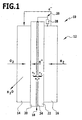
- An exemplary embodiment of a fuel cell 10 comprises an electrode-membrane unit 12.
- the electrode-membrane unit 12 has a cathode 14, an anode 16 and a proton-conducting membrane device 18, which is arranged between the anode 14 and the cathode 16.
- the fuel cell 10 is in particular a PEFC (Proton Exchange Membrane Fuel Cell) type.
- the cathode 14 is supplied to oxidizer in the form of pure oxygen or atmospheric oxygen.
- the anode 16 is supplied gaseous fuel and in particular hydrogen.
- the membrane device serves as an electrolyte, as a carrier for the cathode 14 and the anode 16 and as a separator for the gaseous reactants.
- the partial reaction is running H 2 ⁇ 2 H + + 2 e - from.
- the cathode the partial reaction runs 2 ⁇ H + + 1 2 ⁇ O 2 + 2 ⁇ e - ⁇ H 2 ⁇ O from.
- the membrane device 18 comprises a first membrane layer 20, which borders on the cathode 14.
- the cathode 14 is arranged on the first membrane layer 20.
- the membrane device 18 comprises a second membrane layer 22, which adjoins the anode 16.
- the anode 16 is arranged on the second membrane layer 22.
- the first membrane layer 20 and the second membrane layer 22 are formed proton-conducting; for example, they are based on a perfluorinated, sulfonated polymer.
- One possible material for the first membrane layer 20 and the second membrane layer 22 is, for example, Nafion.
- a catalytic intermediate layer 24 is arranged between the first membrane layer 20 and the second membrane layer 22.
- This is made of a catalyst material such as platinum or platinum-ruthenium.
- the catalyst material may also be carbon supported.
- the catalytic intermediate layer 24 is produced in particular by spraying onto the first membrane layer 20 or the second membrane layer 22.
- the catalytic interlayer preferably has a substantially uniform thickness (based on the connection direction between the cathode 14 and the anode 16). As a result, the first membrane layer 20 and the second membrane layer 22 are aligned substantially parallel to one another.
- a typical thickness of the catalytic intermediate layer 24 is approximately 1 ⁇ m to 5 ⁇ m.
- the catalytic intermediate layer 24 preferably extends over the entire cross-sectional area of the first membrane layer 20 and the second membrane layer 22, wherein the cross-sectional area is transverse to the connecting direction between the cathode 14 and the anode 16. This means that the reaction gas entering the membrane device can not bypass the catalytic intermediate layer 24.
- membranes of a fuel cell 10 of the PEFC type are only proton conductive when moistened. Often, the water produced during the catalytic reaction is not sufficient for moistening a membrane, in particular at temperatures above 100 ° C. From the prior art it is known that reaction gases (oxidizer and / or gaseous fuel) are additionally moistened.
- the catalytic intermediate layer 24 forms an integrated humidifying device of the electrode-membrane unit 12.
- her catalytic hydrogen and oxygen can be converted to water, whereby the first membrane layer 20 and the second membrane layer 22 are moistened from the inside out.
- the catalytic intermediate layer 24 is proton-conducting and electrically separated from the electrodes via the first membrane layer 20 and the second membrane layer 22.
- the actual fuel cell reaction to which the reaction equations have been given above, is not hindered.
- the catalytic intermediate layer 24 is further ensured that reaction gases which diffuse through the first membrane layer 20 (oxidizer) or through the Diffuse second membrane layer 22 (fuel) can abreagieren and thus can not get to the other electrode (fuel to the cathode 14, oxidizer to the anode 16).
- a mixed potential formation and a concomitant lowering of the rest potential is prevented.
- the catalytic intermediate layer 24 can be produced in a simple manner by producing the first membrane layer 20 and the second membrane layer 22 separately and then producing the catalytic intermediate layer 24 on one of the membrane layers 20 or 22, for example by spraying and then the other membrane layer 22 or 20 is positioned on the catalytic liner 24.
- the first membrane layer 20 is permeable to the oxidizer (in addition to the existing diffusion permeability) to facilitate oxidant transport to the catalytic spacer 24. Such an increased permeability can take place, for example, via corresponding perforation of the first membrane layer 20.
- the thickness of the first membrane layer 20 (based on the spacing direction between the cathode 14 and the anode 16) is smaller than the thickness of the second membrane layer 22. This improves the oxidant access to the catalytic intermediate layer 24.
- the catalytic intermediate layer 24 is electrically connected to the cathode 14 or the anode 16. It may be, for example, a short-circuit connection. It can also be used by protons for recombination. When connected to the cathode 14, the proton conduction may be improved.
- the catalytic intermediate layer 24 is connected to the anode 16 via a connecting device 26. This can increase water production.
- connection device 26 may comprise an adjustable resistance device 28.
- the resistance value of the resistance device 28 By adjusting the resistance value of the resistance device 28, the electric current flowing between the anode 16 and the catalytic interlayer 24 can be adjusted. This in turn allows the water formation on the catalytic intermediate layer 24 to be adjusted to a certain extent. As a result, an adaptation to the external conditions is possible; For example, a temperature adjustment is possible. Thus, at higher temperatures, the formation of water can be increased.
- the resistance device 28 it is fundamentally possible for the resistance device 28 to be designed to be temperature-sensitive in such a way that the resistance value decreases when the temperature increases, so that a larger current flows between the anode 16 and the catalytic intermediate layer 24 when the temperature increases. As a result, water formation is increased when the temperature increases.
- a control and in particular automatic control of the humidification of the membrane device 18 can be performed.
Landscapes
- Life Sciences & Earth Sciences (AREA)
- Engineering & Computer Science (AREA)
- Manufacturing & Machinery (AREA)
- Sustainable Development (AREA)
- Sustainable Energy (AREA)
- Chemical & Material Sciences (AREA)
- Chemical Kinetics & Catalysis (AREA)
- Electrochemistry (AREA)
- General Chemical & Material Sciences (AREA)
- Inert Electrodes (AREA)
- Fuel Cell (AREA)
Description
- Die Erfindung betrifft eine Elektroden-Membran-Einheit für eine Brennstoffzelle, welche mit gasförmigem Brennstoff betrieben ist, umfassend eine Kathode, eine Anode und eine protonenleitende Membraneinrichtung, welche zwischen der Anode und der Kathode angeordnet ist, wobei die Membraneinrichtung mindestens eine katalytische Zwischenlage aufweist, an welcher Wasser durch eine katalytische Reaktion von Oxidator und Brennstoff erzeugbar ist.
- Die Erfindung betrifft ferner eine Brennstoffzelle.
- Brennstoffzellen vom Typ PEFC (Protone Exchange Fuel Cells) weisen eine Membran auf, welche üblicherweise aus einer protonenleitenden Folie hergestellt ist. Die Membran leitet nur in befeuchtetem Zustand Protonen.
- Aus der
DE 199 17 812 C2 ist eine Membranelektrodeneinheit für eine Brennstoffzelle bekannt, welche eine Polymermembran mit einer Anode auf der einen Seite und einer Kathode auf der anderen Seite umfasst, wobei Anode und Kathode Katalysatorschichten zwecks Durchführung des Brennstoffzellenprozesses mit Rekombination der Reaktionsgase aufweisen. Eine innerhalb der Membran lokalisierte Katalysatorschicht, an der die Rekombination stattfindet, dient zur Gewinnung von Wasser aus der Rekombination der Reaktionsgase zwecks Befeuchtung der Membran. - In dem Artikel "Self-Humidifying Electrolyte Membranes for Fuel Cells" von H. Uchida et al. in Journal of The Electrochemical Society, 150 (1) A57-A62 (2003) sind Polymerelektrolytmembrane (PEM) beschrieben, die selbstbefeuchtend sind.
- Aus der
US 2005/0196661 A1 ist eine Membran-Elektroden-Einheit bekannt, welche eine Anode, eine Kathode und eine Membran zwischen der Anode und der Kathode aufweist. Eine katalytische Schicht ist zwischen der Kathode und der Membran vorgesehen. Diese katalytische Schicht dient dazu, Sauerstoff zu reduzieren und Wasserstoffperoxid und freie Radikale zu zerlegen, um Wasser zu produzieren. - Der Erfindung liegt die Aufgabe zugrunde, eine Elektroden-Membran-Einheit der eingangs genannten Art bereitzustellen, welche einfach herstellbar und sicher betreibbar ist.
- Diese Aufgabe wird bei der eingangs genannten Elektroden-Membran-Einheit erfindungsgemäß dadurch gelöst, dass die mindestens eine katalytische Zwischenlage mit der Anode über eine Widerstandseinrichtung elektrisch verbunden ist.
- Durch die katalytische Zwischenlage lässt sich die Membraneinrichtung auf einfache Weise herstellen. Beispielsweise wird eine erste Membranlage hergestellt, auf welcher die katalytische Zwischenlage aufgebracht wird. Es wird dann eine weitere Membranlage auf der katalytischen Zwischenlage angeordnet.
- Bei der erfindungsgemäßen Lösung ist in die Membraneinrichtung eine Befeuchtungseinrichtung integriert. An der katalytischen Zwischenlage können Brennstoff und Oxidator katalytisch zu Wasser reagieren, so dass die Membraneinrichtung von innen heraus befeuchtet wird. Dadurch ist eine externe Befeuchtung von Reaktionsgasen nicht mehr notwendig. Ein externes Befeuchtungsmodul verbraucht zusätzlich Energie, Bauraum und Kosten.
- Durch die erfindungsgemäße Lösung ist es möglich, auch bei Temperaturen oberhalb von 100°C eine ausreichende Befeuchtung der Membraneinrichtung sicherzustellen, ohne dass beispielsweise der Betriebsdruck der Reaktionsgase erhöht werden muss.
- Wenn die mindestens eine katalytische Zwischenlage mit der Kathode oder der Anode elektrisch verbunden ist, lassen sich Protonen zur Rekombination nutzen. Es ergeben sich zusätzliche Steuerungsmöglichkeiten bzw. Einstellmöglichkeiten. Beispielsweise lässt sich durch eine elektrische Verbindung zwischen der katalytischen Zwischenlage und der Kathode die Protonenleitung verbessern. Bei der Kontaktierung der katalytischen Zwischenlage mit der Anode lässt sich die Wasserproduktion erhöhen, da zusätzlich Protonen zur Wasserbildung genutzt werden.
- Durch die katalytische Zwischenlage wird auch verhindert, dass Oxidator von der Kathodenseite zur Anodenseite gelangen kann und Brennstoff von der Anodenseite zur Kathodenseite gelangen kann. An der katalytischen Zwischenlage erfolgt eine Abreaktion. Der Übergang von Fremdreaktionsgas zur anderen Elektrode führt zu einer Mischpotentialbildung und damit zu einer Absenkung des Ruhepotentials, was wiederum den Wirkungsgrad der Brennstoffzelle verringert. Durch die erfindungsgemäße Lösung wird dies verhindert oder zumindest stark verringert.
- Die mindestens eine katalytische Zwischenlage ist mit der Anode über eine Widerstandseinrichtung verbunden. Dadurch ergeben sich zusätzliche Steuerungsmöglichkeiten, da der Stromfluss zwischen der Anode und der katalytischen Zwischenlage einstellbar ist und damit die Protonenleitung einstellbar ist.
- Insbesondere ist die Membraneinrichtung mehrlagig aufgebaut mit einer ersten Membranlage, welche an die Kathode grenzt, einer zweiten Membranlage, welche an die Anode grenzt, und der mindestens einen katalytischen Zwischenlage. Eine solche Membraneinrichtung lässt sich auf einfache Weise herstellen.
- Insbesondere ist eine einzige katalytische Zwischenlage zwischen der ersten Membranlage und der zweiten Membranlage angeordnet und grenzt dabei jeweils an diese. Eine solche Membraneinrichtung lässt sich auf einfache Weise herstellen.
- Es kann vorgesehen sein, dass die erste Membranlage eine kleinere Dicke aufweist als die zweite Membranlage. Dadurch lässt sich sicherstellen, dass Sauerstoff zu der katalytischen Zwischenlage gelangt.
- Insbesondere erstreckt sich die mindestens eine katalytische Zwischenlage über die ganze Querschnittsfläche der Membraneinrichtung quer zur Verbindungsrichtung zwischen der Kathode und der Anode. Dadurch müssen Protonen die katalytische Zwischenlage durchlaufen. Weiterhin lässt sich so garantieren, dass Brennstoff und Oxidator, welcher zu der katalytischen Zwischenlage gelangt, sich zu Wasser abreagiert.
- Günstig ist es, wenn die mindestens eine katalytische Zwischenlage durch Aufsprühen hergestellt ist. Dadurch lässt sich eine dünne Schicht auf einfache Weise herstellen.
- Günstig ist es, wenn die Membraneinrichtung durchlässig für Oxidator zur mindestens einen katalytischen Zwischenlage ausgebildet ist. Dadurch lässt sich der Oxidatortransport zu der katalytischen Zwischenlage (abgesehen von der sowieso vorhandenen Oxidatordiffusion) gewährleisten.
- Insbesondere kann die Membraneinrichtung mit einer Mehrzahl von Öffnungen versehen sein, um den Oxidatortransport zu der katalytischen Zwischenlage zu gewährleisten. Beispielsweise ist die Membraneinrichtung perforiert ausgebildet.
- Günstig ist es dabei, wenn eine erste Membranlage, welche zwischen der Kathode und der mindestens einen katalytischen Zwischenlage angeordnet ist, durchlässig für Oxidator ausgebildet ist.
- Es ist dann günstig, wenn die Widerstandseinrichtung bezüglich ihres Widerstandswerts einstellbar ausgebildet ist, um den Stromfluss entsprechend einzustellen.
- Beispielsweise ist es vorgesehen, dass die Widerstandseinrichtung bezüglich ihres Widerstandswerts temperatursensitiv ausgebildet ist. Dadurch kann der Stromfluss je nach Temperatur variieren. Dadurch wiederum lässt sich eine automatische Regelung der Befeuchtung erreichen. Insbesondere ist es vorgesehen, dass der Widerstand mit Temperaturerhöhung abnimmt, um so bei Temperaturerhöhung die Protonenleitung zu verbessern. Dadurch wiederum erhält man eine erhöhte Wasserbildung in der Membraneinrichtung.
- Günstig ist es, wenn die Dicke der mindestens einen katalytischen Zwischenlage in der Größenordnung Mikrometer liegt. Eine typische Dicke liegt bei ca. 3 µm. Dadurch werden die elektrolytischen Eigenschaften der Membraneinrichtung nicht negativ beeinflusst, wobei sich auf effektive Weise eine interne Befeuchtungseinrichtung ausbilden lässt.
- Insbesondere ist die katalytische Zwischenlage protonenleitend. Dadurch würden die normalen Brennstoffzellenreaktionen durch die Wasserbildung an der katalytischen Zwischenlage nicht wesentlich beeinflusst.
- Insbesondere ist der Brennstoff (gasförmiger) Wasserstoff.
- Vorteilhafterweise ist die mindestens eine katalytische Zwischenlage aus einem Katalysatormaterial wie Platin oder Platin-Ruthenium hergestellt. Dadurch lässt sich auf effektive Weise eine katalytische Umsetzung von Oxidator und Brennstoff zur Wasserbildung erreichen.
- Die erfindungsgemäße Elektroden-Membran-Einheit lässt sich auf vorteilhafte Weise in einer Brennstoffzelle verwenden.
- Die Brennstoffzelle ist insbesondere eine PEFC-Brennstoffzelle.
- Die nachfolgende Beschreibung bevorzugter Ausführungsformen dient im Zusammenhang mit der Zeichnung der näheren Erläuterung der Erfindung.
- Die einzige
- Figur 1
- zeigt schematisch ein Ausführungsbeispiel einer erfindungsgemäßen Brennstoffzelle/Elektroden-Membran-Einheit.
- Ein Ausführungsbeispiel einer erfindungsgemäßen Brennstoffzelle 10 umfasst eine Elektroden-Membran-Einheit 12. Die Elektroden-Membran-Einheit 12 weist eine Kathode 14, eine Anode 16 und eine protonenleitende Membraneinrichtung 18, welche zwischen der Anode 14 und der Kathode 16 angeordnet ist, auf.
- Bei der Brennstoffzelle 10 handelt es sich insbesondere um eine solche vom Typ PEFC (Protone Exchange Membrane Fuel Cell). Der Kathode 14 wird Oxidator in der Form von reinem Sauerstoff oder Luftsauerstoff zugeführt. Der Anode 16 wird gasförmiger Brennstoff und insbesondere Wasserstoff zugeführt. Die Membraneinrichtung dient als Elektrolyt, als Träger für die Kathode 14 und die Anode 16 und als Separator für die gasförmigen Reaktanden. An der Anode läuft die Teilreaktion
H 2 → 2H+ + 2e-
ab. An der Kathode läuft die Teilreaktion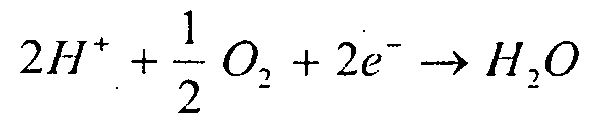
ab. - Die Membraneinrichtung 18 umfasst eine erste Membranlage 20, welche an die Kathode 14 grenzt. Insbesondere ist die Kathode 14 an der ersten Membranlage 20 angeordnet. Ferner umfasst die Membraneinrichtung 18 eine zweite Membranlage 22, welche an die Anode 16 grenzt. Insbesondere ist die Anode 16 an der zweiten Membranlage 22 angeordnet.
- Die erste Membranlage 20 und die zweite Membranlage 22 sind protonenleitend ausgebildet; sie sind beispielsweise auf der Basis eines perfluorierten, sulfonierten Polymers hergestellt. Ein mögliches Material für die erste Membranlage 20 und die zweite Membranlage 22 ist beispielsweise Nafion.
- Zwischen der ersten Membranlage 20 und der zweiten Membranlage 22 ist eine katalytische Zwischenlage 24 angeordnet. Diese ist aus einem Katalysatormaterial wie Platin oder Platin-Ruthenium hergestellt. Das Katalysatormaterial kann auch kohlenstoffgeträgert sein. Die katalytische Zwischenlage 24 ist insbesondere durch Aufsprühen auf die erste Membranlage 20 oder die zweite Membranlage 22 hergestellt. Die katalytische Zwischenlage weist vorzugsweise eine im wesentlichen gleichmäßige Dicke (bezogen auf die Verbindungsrichtung zwischen der Kathode 14 und der Anode 16) auf. Dadurch sind die erste Membranlage 20 und die zweite Membranlage 22 im wesentlichen parallel zueinander ausgerichtet.
- Eine typische Dicke der katalytischen Zwischenlage 24 liegt bei ca. 1 µm bis 5 µm.
- Die katalytische Zwischenlage 24 erstreckt sich vorzugsweise über die gesamte Querschnittsfläche der ersten Membranlage 20 und der zweiten Membranlage 22, wobei die Querschnittsfläche quer zu der Verbindungsrichtung zwischen der Kathode 14 und der Anode 16 liegt. Dies bedeutet, dass in die Membraneinrichtung eindringendes Reaktionsgas die katalytische Zwischenlage 24 nicht umgehen kann.
- Üblicherweise sind Membrane einer Brennstoffzelle 10 vom Typ PEFC nur dann protonenleitend, wenn sie befeuchtet sind. Oftmals reicht das bei der katalytischen Reaktion entstehende Wasser zur Befeuchtung einer Membran nicht aus, insbesondere bei Temperaturen oberhalb von 100°C. Aus dem Stand der Technik ist es bekannt, dass Reaktionsgase (Oxidator und/oder gasförmiger Brennstoff) zusätzlich befeuchtet werden.
- Bei der erfindungsgemäßen Lösung bildet die katalytische Zwischenlage 24 eine integrierte Befeuchtungseinrichtung der Elektroden-Membran-Einheit 12. An ihr lassen sich katalytisch Wasserstoff und Sauerstoff zu Wasser umsetzen, wodurch die erste Membranlage 20 und die zweite Membranlage 22 von innen heraus befeuchtet werden.
- Die katalytische Zwischenlage 24 ist protonenleitend und über die erste Membranlage 20 und die zweite Membranlage 22 von den Elektroden elektrisch getrennt. Dadurch wird die eigentliche Brennstoffzellenreaktion, zu der oben die Reaktionsgleichungen angegeben wurden, nicht behindert. Durch die katalytische Zwischenlage 24 wird weiterhin dafür gesorgt, dass Reaktionsgase, welche durch die erste Membranlage 20 diffundieren (Oxidator) bzw. durch die zweite Membranlage 22 diffundieren (Brennstoff) abreagieren können und damit nicht zur anderen Elektrode (Brennstoff zur Kathode 14, Oxidator zur Anode 16) gelangen können. Dadurch wird eine Mischpotentialbildung und eine damit einhergehende Absenkung des Ruhepotentials verhindert. Durch eine Mischpotentialbildung wird grundsätzlich der Wirkungsgrad einer Brennstoffzelle verschlechtert.
- Die katalytische Zwischenlage 24 lässt sich auf einfache Weise herstellen, indem die erste Membranlage 20 und die zweite Membranlage 22 getrennt hergestellt werden und die katalytische Zwischenlage 24 dann auf einer der Membranlagen 20 oder 22 beispielsweise durch Aufsprühen hergestellt wird und anschließend die andere Membranlage 22 oder 20 auf der katalytischen Zwischenlage 24 positioniert wird.
- Es kann vorgesehen sein, dass die erste Membranlage 20 durchlässig für den Oxidator ausgebildet ist (zusätzlich zu der vorhandenen Diffusionsdurchlässigkeit), um den Oxidatortransport zu der katalytischen Zwischenlage 24 zu ermöglichen. Eine solche erhöhte Durchlässigkeit kann beispielsweise über entsprechende Perforation der ersten Membranlage 20 erfolgen.
- Es kann ferner vorgesehen sein, dass die Dicke der ersten Membranlage 20 (bezogen auf die Abstandsrichtung zwischen der Kathode 14 und der Anode 16) kleiner ist als die Dicke der zweiten Membranlage 22. Dadurch wird der Oxidatorzugang zu der katalytischen Zwischenlage 24 verbessert.
- Die katalytische Zwischenlage 24 ist mit der Kathode 14 oder der Anode 16 elektrisch verbunden. Es kann sich dabei beispielsweise um eine Kurzschlussverbindung handeln. Es lassen sich dadurch auch Protonen zur Rekombination nutzen. Bei der Verbindung mit der Kathode 14 lässt sich die Protonenleitung unter Umständen verbessern.
- Vorteilhaft ist es, wenn die katalytische Zwischenlage 24 mit der Anode 16 über eine Verbindungseinrichtung 26 verbunden ist. Dadurch lässt sich die Wasserproduktion erhöhen.
- Die Verbindungseinrichtung 26 kann eine Widerstandseinrichtung 28 mit einstellbarem Widerstand umfassen. Über die Einstellung des Widerstandswerts der Widerstandseinrichtung 28 lässt sich der elektrische Strom, welcher zwischen der Anode 16 und der katalytischen Zwischenlage 24 fließt, einstellen. Dadurch wiederum lässt sich in gewissem Maße die Wasserbildung an der katalytischen Zwischenlage 24 einstellen. Dadurch ist eine Anpassung an die externen Verhältnisse möglich; beispielsweise ist eine Temperaturanpassung möglich. So kann bei höheren Temperaturen die Wasserbildung erhöht werden.
- Beispielsweise ist es grundsätzlich möglich, dass die Widerstandseinrichtung 28 temperatursensitiv ausgebildet ist und zwar derart, dass bei Temperaturerhöhung der Widerstandswert sinkt, so dass bei Temperaturerhöhung ein größerer Strom zwischen der Anode 16 und der katalytischen Zwischenlage 24 fließt. Dadurch wird bei Temperaturerhöhung die Wasserbildung erhöht. Bei entsprechender Ausbildung der Widerstandseinrichtung 28 lässt sich eine Regelung und insbesondere automatische Regelung der Befeuchtung der Membraneinrichtung 18 durchführen.
Claims (18)
- Elektroden-Membran-Einheit für eine Brennstoffzelle (10), welche mit gasförmigem Brennstoff betrieben ist, umfassend eine Kathode (14), eine Anode (16) und eine protonenleitende Membraneinrichtung (18), welche zwischen der Anode (16) und der Kathode (14) angeordnet ist, wobei die Membraneinrichtung (18) mindestens eine katalytische Zwischenlage (24) aufweist, an welcher Wasser durch eine katalytische Reaktion von Oxidator und Brennstoff erzeugbar ist,
dadurch gekennzeichnet , dass die mindestens eine katalytische Zwischenlage (24) mit der Anode (16) über eine Widerstandseinrichtung (28) elektrisch verbunden ist. - Elektroden-Membran-Einheit nach Anspruch 1, dadurch gekennzeichnet, dass die Membraneinrichtung (18) mehrlagig aufgebaut ist mit einer ersten Membranlage (20), welche an die Kathode (14) grenzt, einer zweiten Membranlage (22), welche an die Anode (16) grenzt, und der mindestens einen katalytischen Zwischenlage (24).
- Elektroden-Membran-Einheit nach Anspruch 2, dadurch gekennzeichnet, dass eine einzige katalytische Zwischenlage (24) zwischen der ersten Membranlage (20) und der zweiten Membranlage (22) angeordnet ist und jeweils an diese grenzt.
- Elektroden-Membran-Einheit nach Anspruch 3, dadurch gekennzeichnet, dass die erste Membranlage (20) eine kleinere Dicke aufweist als die zweite Membranlage (22).
- Elektroden-Membran-Einheit nach einem der vorangehenden Ansprüche, dadurch gekennzeichnet, dass die mindestens eine katalytische Zwischenlage (24) sich über die ganze Querschnittsfläche der Membraneinrichtung (18) quer zur Verbindungsrichtung zwischen der Kathode (14) und der Anode (16) erstreckt.
- Elektroden-Membran-Einheit nach einem der vorangehenden Ansprüche, dadurch gekennzeichnet, dass die mindestens eine katalytische Zwischenlage (24) durch Aufsprühen hergestellt ist.
- Elektroden-Membran-Einheit nach einem der vorangehenden Ansprüche, dadurch gekennzeichnet, dass die Membraneinrichtung (18) durchlässig für Oxidator zur mindestens einen katalytischen Zwischenlage (24) ausgebildet ist.
- Elektroden-Membran-Einheit nach Anspruch 7, dadurch gekennzeichnet, dass die Membraneinrichtung (18) perforiert ausgebildet ist.
- Elektroden-Membran-Einheit nach Anspruch 7 oder 8, dadurch gekennzeichnet, dass eine erste Membranlage (20), welche zwischen der Kathode (14) und der mindestens einen katalytischen Zwischenlage (24) angeordnet ist, durchlässig für Oxidator ausgebildet ist.
- Elektroden-Membran-Einheit nach einem der vorangehenden Ansprüche, dadurch gekennzeichnet, dass die Widerstandseinrichtung (28) bezüglich ihres Widerstandswerts einstellbar ausgebildet ist.
- Elektroden-Membran-Einheit nach einem der vorangehenden Ansprüche, dadurch gekennzeichnet, dass die Widerstandseinrichtung (28) bezüglich ihres Widerstandswerts temperatursensitiv ausgebildet ist.
- Elektroden-Membran-Einheit nach einem der vorangehenden Ansprüche, dadurch gekennzeichnet, dass die Dicke der mindestens einen katalytischen Zwischenlage (24) in der Größenordnung Mikrometer liegt.
- Elektroden-Membran-Einheit nach einem der vorangehenden Ansprüche, dadurch gekennzeichnet, dass die katalytische Zwischenlage (24) protonenleitend ist.
- Elektroden-Membran-Einheit nach einem der vorangehenden Ansprüche, dadurch gekennzeichnet, dass der Brennstoff Wasserstoff ist.
- Elektroden-Membran-Einheit nach einem der vorangehenden Ansprüche, dadurch gekennzeichnet, dass die mindestens eine katalytische Zwischenlage (24) aus einem Katalysatormaterial hergestellt ist.
- Verwendung einer Elektroden-Membran-Einheit gemäß einem der vorangehenden Ansprüche in einer Brennstoffzelle.
- Brennstoffzelle, welche eine Elektroden-Membran-Einheit gemäß einem der Ansprüche 1 bis 15 umfasst.
- Brennstoffzelle nach Anspruch 17, welche eine PEFC-Brennstoffzelle ist.
Applications Claiming Priority (1)
| Application Number | Priority Date | Filing Date | Title |
|---|---|---|---|
| DE102006012908A DE102006012908A1 (de) | 2006-03-10 | 2006-03-10 | Elektroden-Membran-Einheit und Brennstoffzelle |
Publications (3)
| Publication Number | Publication Date |
|---|---|
| EP1833112A2 EP1833112A2 (de) | 2007-09-12 |
| EP1833112A3 EP1833112A3 (de) | 2008-05-14 |
| EP1833112B1 true EP1833112B1 (de) | 2010-12-22 |
Family
ID=38134727
Family Applications (1)
| Application Number | Title | Priority Date | Filing Date |
|---|---|---|---|
| EP07103566A Not-in-force EP1833112B1 (de) | 2006-03-10 | 2007-03-06 | Elektroden-Membran-Einheit und Brennstoffzelle |
Country Status (4)
| Country | Link |
|---|---|
| EP (1) | EP1833112B1 (de) |
| AT (1) | ATE492919T1 (de) |
| DE (2) | DE102006012908A1 (de) |
| DK (1) | DK1833112T3 (de) |
Cited By (1)
| Publication number | Priority date | Publication date | Assignee | Title |
|---|---|---|---|---|
| EP3922757A1 (de) * | 2016-12-22 | 2021-12-15 | Johnson Matthey Fuel Cells Limited | Katalysatorbeschichtete membran mit laminatstruktur |
Families Citing this family (2)
| Publication number | Priority date | Publication date | Assignee | Title |
|---|---|---|---|---|
| DE102006041961B4 (de) * | 2006-08-30 | 2010-01-28 | Deutsches Zentrum für Luft- und Raumfahrt e.V. | Elektroden-Membran-Einheit, ihre Verwendung und Brennstoffzelle |
| US7858915B2 (en) | 2008-03-31 | 2010-12-28 | Eastman Kodak Company | Active pixel sensor having two wafers |
Family Cites Families (4)
| Publication number | Priority date | Publication date | Assignee | Title |
|---|---|---|---|---|
| US5672439A (en) * | 1995-12-18 | 1997-09-30 | Ballard Power Systems, Inc. | Method and apparatus for reducing reactant crossover in an electrochemical fuel cell |
| DE19917812C2 (de) * | 1999-04-20 | 2002-11-21 | Siemens Ag | Membranelektrodeneinheit für eine selbstbefeuchtende Brennstoffzelle, Verfahren zu ihrer Herstellung und Brennstoffzellenbatterie mit einer solchen Membranelektrodeneinheit |
| US7507494B2 (en) * | 2004-03-04 | 2009-03-24 | Utc Power Corporation | Extended catalyzed layer for minimizing cross-over oxygen and consuming peroxide |
| JP2005332693A (ja) * | 2004-05-20 | 2005-12-02 | Aisin Seiki Co Ltd | 燃料電池 |
-
2006
- 2006-03-10 DE DE102006012908A patent/DE102006012908A1/de not_active Ceased
-
2007
- 2007-03-06 EP EP07103566A patent/EP1833112B1/de not_active Not-in-force
- 2007-03-06 DE DE502007005998T patent/DE502007005998D1/de active Active
- 2007-03-06 AT AT07103566T patent/ATE492919T1/de active
- 2007-03-06 DK DK07103566.1T patent/DK1833112T3/da active
Cited By (1)
| Publication number | Priority date | Publication date | Assignee | Title |
|---|---|---|---|---|
| EP3922757A1 (de) * | 2016-12-22 | 2021-12-15 | Johnson Matthey Fuel Cells Limited | Katalysatorbeschichtete membran mit laminatstruktur |
Also Published As
| Publication number | Publication date |
|---|---|
| ATE492919T1 (de) | 2011-01-15 |
| DK1833112T3 (da) | 2011-04-11 |
| DE502007005998D1 (de) | 2011-02-03 |
| EP1833112A2 (de) | 2007-09-12 |
| EP1833112A3 (de) | 2008-05-14 |
| DE102006012908A1 (de) | 2007-09-13 |
Similar Documents
| Publication | Publication Date | Title |
|---|---|---|
| DE102008046403B4 (de) | Sauerstoffentwicklungsreaktionskatalysatoren enthaltende Elektroden | |
| DE112008001766B4 (de) | Elektrolytmembran und Brennstoffzelle unter Verwendung derselben | |
| WO1998021777A1 (de) | Elektroden-elektrolyt-einheit für eine brennstoffzelle | |
| DE102008038202B4 (de) | PEM-Brennstoffzelle mit verbessertem Wassermanagement und Verfahren zu ihrer Herstellung | |
| DE112013004009T5 (de) | Verfahren zur Herstellung eines katalytischen Materials | |
| EP1759434B1 (de) | Membran-elektroden-modul (mea) für eine brennstoffzelle | |
| DE102011014154B4 (de) | Strömungsfeldplatte für Brennstoffzellenanwendungen | |
| EP3834243B1 (de) | Schichtaufbau für eine brennstoffzelle und verfahren zur herstellung eines solchen schichtaufbaus | |
| DE102016220653A1 (de) | Korrosionsbeständiger katalysator | |
| DE102014118309A1 (de) | Schichtauslegung, um eine Korrosion von Brennstoffzellenelektroden aus einem nicht idealen Betrieb zu mindern | |
| EP1833112A2 (de) | Elektroden-Membran-Einheit und Brennstoffzelle | |
| DE112005002022B4 (de) | Membran-Elektroden-Einheit und Brennstoffzelle | |
| DE112005001340B4 (de) | Zellenmodul und Brennstoffzelle | |
| EP2618417B1 (de) | Direkt-Methanol-Brennstoffzelle und Verfahren zum Betreiben derselben | |
| DE112007002008B4 (de) | Brennstoffzelle | |
| DE102021204371A1 (de) | Reversible shunts zum schutz vor überladung in polymerelektrolytmembran-brennstoffzellen | |
| DE102006041961B4 (de) | Elektroden-Membran-Einheit, ihre Verwendung und Brennstoffzelle | |
| DE112006002510B4 (de) | Brennstoffzelle | |
| EP1833113B1 (de) | Elektroden-Membran Einheit und Brennstoffzelle | |
| DE112012001206T5 (de) | Brennstoffzellen-System | |
| DE10260501A1 (de) | Gasdiffusionselektrode mit einer Schicht zur Steuerung der Querdiffusion von Wasser | |
| DE102012011441A1 (de) | Membran-Elektroden-Einheit für eine Brennstoffzelle | |
| DE102018204816A1 (de) | Brennstoffzellenaufbau | |
| EP2913877B1 (de) | Direkt-Alkohol-Brennstoffzelle und Direkt-Alkohol-Brennstoffzellenstapel mit effektiver CO2-Entfernung sowie Verfahren zum Betreiben einer solchen Direkt-Alkohol-Brennstoffzelle | |
| DE202005008749U1 (de) | Membran-Elektroden-Modul (MEA) für eine Brennstoffzelle |
Legal Events
| Date | Code | Title | Description |
|---|---|---|---|
| PUAI | Public reference made under article 153(3) epc to a published international application that has entered the european phase |
Free format text: ORIGINAL CODE: 0009012 |
|
| AK | Designated contracting states |
Kind code of ref document: A2 Designated state(s): AT BE BG CH CY CZ DE DK EE ES FI FR GB GR HU IE IS IT LI LT LU LV MC MT NL PL PT RO SE SI SK TR |
|
| AX | Request for extension of the european patent |
Extension state: AL BA HR MK YU |
|
| PUAL | Search report despatched |
Free format text: ORIGINAL CODE: 0009013 |
|
| AK | Designated contracting states |
Kind code of ref document: A3 Designated state(s): AT BE BG CH CY CZ DE DK EE ES FI FR GB GR HU IE IS IT LI LT LU LV MC MT NL PL PT RO SE SI SK TR |
|
| AX | Request for extension of the european patent |
Extension state: AL BA HR MK RS |
|
| RIC1 | Information provided on ipc code assigned before grant |
Ipc: H01M 8/04 20060101AFI20080404BHEP |
|
| 17P | Request for examination filed |
Effective date: 20081108 |
|
| AKX | Designation fees paid |
Designated state(s): AT BE BG CH CY CZ DE DK EE ES FI FR GB GR HU IE IS IT LI LT LU LV MC MT NL PL PT RO SE SI SK TR |
|
| 17Q | First examination report despatched |
Effective date: 20090108 |
|
| GRAP | Despatch of communication of intention to grant a patent |
Free format text: ORIGINAL CODE: EPIDOSNIGR1 |
|
| GRAS | Grant fee paid |
Free format text: ORIGINAL CODE: EPIDOSNIGR3 |
|
| GRAA | (expected) grant |
Free format text: ORIGINAL CODE: 0009210 |
|
| AK | Designated contracting states |
Kind code of ref document: B1 Designated state(s): AT BE BG CH CY CZ DE DK EE ES FI FR GB GR HU IE IS IT LI LT LU LV MC MT NL PL PT RO SE SI SK TR |
|
| REG | Reference to a national code |
Ref country code: GB Ref legal event code: FG4D Free format text: NOT ENGLISH |
|
| REG | Reference to a national code |
Ref country code: CH Ref legal event code: EP |
|
| REG | Reference to a national code |
Ref country code: IE Ref legal event code: FG4D |
|
| REF | Corresponds to: |
Ref document number: 502007005998 Country of ref document: DE Date of ref document: 20110203 Kind code of ref document: P |
|
| REG | Reference to a national code |
Ref country code: DE Ref legal event code: R096 Ref document number: 502007005998 Country of ref document: DE Effective date: 20110203 |
|
| REG | Reference to a national code |
Ref country code: DK Ref legal event code: T3 |
|
| REG | Reference to a national code |
Ref country code: NL Ref legal event code: VDEP Effective date: 20101222 |
|
| PG25 | Lapsed in a contracting state [announced via postgrant information from national office to epo] |
Ref country code: LT Free format text: LAPSE BECAUSE OF FAILURE TO SUBMIT A TRANSLATION OF THE DESCRIPTION OR TO PAY THE FEE WITHIN THE PRESCRIBED TIME-LIMIT Effective date: 20101222 |
|
| LTIE | Lt: invalidation of european patent or patent extension |
Effective date: 20101222 |
|
| PG25 | Lapsed in a contracting state [announced via postgrant information from national office to epo] |
Ref country code: BG Free format text: LAPSE BECAUSE OF FAILURE TO SUBMIT A TRANSLATION OF THE DESCRIPTION OR TO PAY THE FEE WITHIN THE PRESCRIBED TIME-LIMIT Effective date: 20110322 Ref country code: FI Free format text: LAPSE BECAUSE OF FAILURE TO SUBMIT A TRANSLATION OF THE DESCRIPTION OR TO PAY THE FEE WITHIN THE PRESCRIBED TIME-LIMIT Effective date: 20101222 Ref country code: SE Free format text: LAPSE BECAUSE OF FAILURE TO SUBMIT A TRANSLATION OF THE DESCRIPTION OR TO PAY THE FEE WITHIN THE PRESCRIBED TIME-LIMIT Effective date: 20101222 Ref country code: LV Free format text: LAPSE BECAUSE OF FAILURE TO SUBMIT A TRANSLATION OF THE DESCRIPTION OR TO PAY THE FEE WITHIN THE PRESCRIBED TIME-LIMIT Effective date: 20101222 Ref country code: CY Free format text: LAPSE BECAUSE OF FAILURE TO SUBMIT A TRANSLATION OF THE DESCRIPTION OR TO PAY THE FEE WITHIN THE PRESCRIBED TIME-LIMIT Effective date: 20101222 Ref country code: SI Free format text: LAPSE BECAUSE OF FAILURE TO SUBMIT A TRANSLATION OF THE DESCRIPTION OR TO PAY THE FEE WITHIN THE PRESCRIBED TIME-LIMIT Effective date: 20101222 |
|
| REG | Reference to a national code |
Ref country code: IE Ref legal event code: FD4D |
|
| PG25 | Lapsed in a contracting state [announced via postgrant information from national office to epo] |
Ref country code: GR Free format text: LAPSE BECAUSE OF FAILURE TO SUBMIT A TRANSLATION OF THE DESCRIPTION OR TO PAY THE FEE WITHIN THE PRESCRIBED TIME-LIMIT Effective date: 20110323 Ref country code: ES Free format text: LAPSE BECAUSE OF FAILURE TO SUBMIT A TRANSLATION OF THE DESCRIPTION OR TO PAY THE FEE WITHIN THE PRESCRIBED TIME-LIMIT Effective date: 20110402 Ref country code: PT Free format text: LAPSE BECAUSE OF FAILURE TO SUBMIT A TRANSLATION OF THE DESCRIPTION OR TO PAY THE FEE WITHIN THE PRESCRIBED TIME-LIMIT Effective date: 20110422 Ref country code: CZ Free format text: LAPSE BECAUSE OF FAILURE TO SUBMIT A TRANSLATION OF THE DESCRIPTION OR TO PAY THE FEE WITHIN THE PRESCRIBED TIME-LIMIT Effective date: 20101222 Ref country code: EE Free format text: LAPSE BECAUSE OF FAILURE TO SUBMIT A TRANSLATION OF THE DESCRIPTION OR TO PAY THE FEE WITHIN THE PRESCRIBED TIME-LIMIT Effective date: 20101222 Ref country code: IS Free format text: LAPSE BECAUSE OF FAILURE TO SUBMIT A TRANSLATION OF THE DESCRIPTION OR TO PAY THE FEE WITHIN THE PRESCRIBED TIME-LIMIT Effective date: 20110422 |
|
| PG25 | Lapsed in a contracting state [announced via postgrant information from national office to epo] |
Ref country code: SK Free format text: LAPSE BECAUSE OF FAILURE TO SUBMIT A TRANSLATION OF THE DESCRIPTION OR TO PAY THE FEE WITHIN THE PRESCRIBED TIME-LIMIT Effective date: 20101222 Ref country code: RO Free format text: LAPSE BECAUSE OF FAILURE TO SUBMIT A TRANSLATION OF THE DESCRIPTION OR TO PAY THE FEE WITHIN THE PRESCRIBED TIME-LIMIT Effective date: 20101222 Ref country code: PL Free format text: LAPSE BECAUSE OF FAILURE TO SUBMIT A TRANSLATION OF THE DESCRIPTION OR TO PAY THE FEE WITHIN THE PRESCRIBED TIME-LIMIT Effective date: 20101222 Ref country code: NL Free format text: LAPSE BECAUSE OF FAILURE TO SUBMIT A TRANSLATION OF THE DESCRIPTION OR TO PAY THE FEE WITHIN THE PRESCRIBED TIME-LIMIT Effective date: 20101222 |
|
| BERE | Be: lapsed |
Owner name: DEUTSCHES ZENTRUM FUR LUFT- UND RAUMFAHRT E.V. Effective date: 20110331 |
|
| PLBE | No opposition filed within time limit |
Free format text: ORIGINAL CODE: 0009261 |
|
| STAA | Information on the status of an ep patent application or granted ep patent |
Free format text: STATUS: NO OPPOSITION FILED WITHIN TIME LIMIT |
|
| PG25 | Lapsed in a contracting state [announced via postgrant information from national office to epo] |
Ref country code: IE Free format text: LAPSE BECAUSE OF FAILURE TO SUBMIT A TRANSLATION OF THE DESCRIPTION OR TO PAY THE FEE WITHIN THE PRESCRIBED TIME-LIMIT Effective date: 20101222 Ref country code: MC Free format text: LAPSE BECAUSE OF NON-PAYMENT OF DUE FEES Effective date: 20110331 |
|
| REG | Reference to a national code |
Ref country code: CH Ref legal event code: PL |
|
| 26N | No opposition filed |
Effective date: 20110923 |
|
| PG25 | Lapsed in a contracting state [announced via postgrant information from national office to epo] |
Ref country code: MT Free format text: LAPSE BECAUSE OF FAILURE TO SUBMIT A TRANSLATION OF THE DESCRIPTION OR TO PAY THE FEE WITHIN THE PRESCRIBED TIME-LIMIT Effective date: 20101222 Ref country code: IT Free format text: LAPSE BECAUSE OF FAILURE TO SUBMIT A TRANSLATION OF THE DESCRIPTION OR TO PAY THE FEE WITHIN THE PRESCRIBED TIME-LIMIT Effective date: 20101222 Ref country code: BE Free format text: LAPSE BECAUSE OF NON-PAYMENT OF DUE FEES Effective date: 20110331 |
|
| REG | Reference to a national code |
Ref country code: DE Ref legal event code: R097 Ref document number: 502007005998 Country of ref document: DE Effective date: 20110923 |
|
| PG25 | Lapsed in a contracting state [announced via postgrant information from national office to epo] |
Ref country code: CH Free format text: LAPSE BECAUSE OF NON-PAYMENT OF DUE FEES Effective date: 20110331 Ref country code: LI Free format text: LAPSE BECAUSE OF NON-PAYMENT OF DUE FEES Effective date: 20110331 |
|
| REG | Reference to a national code |
Ref country code: AT Ref legal event code: MM01 Ref document number: 492919 Country of ref document: AT Kind code of ref document: T Effective date: 20120306 |
|
| PG25 | Lapsed in a contracting state [announced via postgrant information from national office to epo] |
Ref country code: LU Free format text: LAPSE BECAUSE OF NON-PAYMENT OF DUE FEES Effective date: 20110306 |
|
| PG25 | Lapsed in a contracting state [announced via postgrant information from national office to epo] |
Ref country code: AT Free format text: LAPSE BECAUSE OF NON-PAYMENT OF DUE FEES Effective date: 20120306 |
|
| PG25 | Lapsed in a contracting state [announced via postgrant information from national office to epo] |
Ref country code: TR Free format text: LAPSE BECAUSE OF FAILURE TO SUBMIT A TRANSLATION OF THE DESCRIPTION OR TO PAY THE FEE WITHIN THE PRESCRIBED TIME-LIMIT Effective date: 20101222 |
|
| PG25 | Lapsed in a contracting state [announced via postgrant information from national office to epo] |
Ref country code: HU Free format text: LAPSE BECAUSE OF FAILURE TO SUBMIT A TRANSLATION OF THE DESCRIPTION OR TO PAY THE FEE WITHIN THE PRESCRIBED TIME-LIMIT Effective date: 20101222 |
|
| REG | Reference to a national code |
Ref country code: FR Ref legal event code: PLFP Year of fee payment: 9 |
|
| REG | Reference to a national code |
Ref country code: DE Ref legal event code: R082 Ref document number: 502007005998 Country of ref document: DE Representative=s name: HOEGER, STELLRECHT & PARTNER PATENTANWAELTE MB, DE |
|
| REG | Reference to a national code |
Ref country code: FR Ref legal event code: PLFP Year of fee payment: 10 |
|
| REG | Reference to a national code |
Ref country code: FR Ref legal event code: PLFP Year of fee payment: 11 |
|
| REG | Reference to a national code |
Ref country code: FR Ref legal event code: PLFP Year of fee payment: 12 |
|
| PGFP | Annual fee paid to national office [announced via postgrant information from national office to epo] |
Ref country code: GB Payment date: 20190227 Year of fee payment: 13 Ref country code: DE Payment date: 20190215 Year of fee payment: 13 |
|
| PGFP | Annual fee paid to national office [announced via postgrant information from national office to epo] |
Ref country code: FR Payment date: 20190220 Year of fee payment: 13 Ref country code: DE Payment date: 20190215 Year of fee payment: 13 Ref country code: DK Payment date: 20190227 Year of fee payment: 13 |
|
| REG | Reference to a national code |
Ref country code: DE Ref legal event code: R082 Ref document number: 502007005998 Country of ref document: DE Representative=s name: HOEGER, STELLRECHT & PARTNER PATENTANWAELTE MB, DE |
|
| REG | Reference to a national code |
Ref country code: DE Ref legal event code: R119 Ref document number: 502007005998 Country of ref document: DE |
|
| REG | Reference to a national code |
Ref country code: DK Ref legal event code: EBP Effective date: 20200331 |
|
| PG25 | Lapsed in a contracting state [announced via postgrant information from national office to epo] |
Ref country code: FR Free format text: LAPSE BECAUSE OF NON-PAYMENT OF DUE FEES Effective date: 20200331 Ref country code: DE Free format text: LAPSE BECAUSE OF NON-PAYMENT OF DUE FEES Effective date: 20201001 |
|
| GBPC | Gb: european patent ceased through non-payment of renewal fee |
Effective date: 20200306 |
|
| PG25 | Lapsed in a contracting state [announced via postgrant information from national office to epo] |
Ref country code: DK Free format text: LAPSE BECAUSE OF NON-PAYMENT OF DUE FEES Effective date: 20200331 Ref country code: GB Free format text: LAPSE BECAUSE OF NON-PAYMENT OF DUE FEES Effective date: 20200306 |