EP1831248B1 - Impfstoff gegen pasteurella multocida - Google Patents
Impfstoff gegen pasteurella multocida Download PDFInfo
- Publication number
- EP1831248B1 EP1831248B1 EP05857856A EP05857856A EP1831248B1 EP 1831248 B1 EP1831248 B1 EP 1831248B1 EP 05857856 A EP05857856 A EP 05857856A EP 05857856 A EP05857856 A EP 05857856A EP 1831248 B1 EP1831248 B1 EP 1831248B1
- Authority
- EP
- European Patent Office
- Prior art keywords
- live attenuated
- virus
- orf
- vaccine
- pasteurella multocida
- Prior art date
- Legal status (The legal status is an assumption and is not a legal conclusion. Google has not performed a legal analysis and makes no representation as to the accuracy of the status listed.)
- Expired - Lifetime
Links
Images
Classifications
-
- C—CHEMISTRY; METALLURGY
- C12—BIOCHEMISTRY; BEER; SPIRITS; WINE; VINEGAR; MICROBIOLOGY; ENZYMOLOGY; MUTATION OR GENETIC ENGINEERING
- C12N—MICROORGANISMS OR ENZYMES; COMPOSITIONS THEREOF; PROPAGATING, PRESERVING, OR MAINTAINING MICROORGANISMS; MUTATION OR GENETIC ENGINEERING; CULTURE MEDIA
- C12N1/00—Microorganisms; Compositions thereof; Processes of propagating, maintaining or preserving microorganisms or compositions thereof; Processes of preparing or isolating a composition containing a microorganism; Culture media therefor
- C12N1/20—Bacteria; Culture media therefor
-
- A—HUMAN NECESSITIES
- A61—MEDICAL OR VETERINARY SCIENCE; HYGIENE
- A61K—PREPARATIONS FOR MEDICAL, DENTAL OR TOILETRY PURPOSES
- A61K35/00—Medicinal preparations containing materials or reaction products thereof with undetermined constitution
- A61K35/66—Microorganisms or materials therefrom
- A61K35/74—Bacteria
-
- A—HUMAN NECESSITIES
- A61—MEDICAL OR VETERINARY SCIENCE; HYGIENE
- A61K—PREPARATIONS FOR MEDICAL, DENTAL OR TOILETRY PURPOSES
- A61K39/00—Medicinal preparations containing antigens or antibodies
- A61K39/02—Bacterial antigens
- A61K39/102—Pasteurellales, e.g. Actinobacillus, Pasteurella; Haemophilus
-
- A—HUMAN NECESSITIES
- A61—MEDICAL OR VETERINARY SCIENCE; HYGIENE
- A61P—SPECIFIC THERAPEUTIC ACTIVITY OF CHEMICAL COMPOUNDS OR MEDICINAL PREPARATIONS
- A61P31/00—Antiinfectives, i.e. antibiotics, antiseptics, chemotherapeutics
- A61P31/12—Antivirals
-
- C—CHEMISTRY; METALLURGY
- C12—BIOCHEMISTRY; BEER; SPIRITS; WINE; VINEGAR; MICROBIOLOGY; ENZYMOLOGY; MUTATION OR GENETIC ENGINEERING
- C12Q—MEASURING OR TESTING PROCESSES INVOLVING ENZYMES, NUCLEIC ACIDS OR MICROORGANISMS; COMPOSITIONS OR TEST PAPERS THEREFOR; PROCESSES OF PREPARING SUCH COMPOSITIONS; CONDITION-RESPONSIVE CONTROL IN MICROBIOLOGICAL OR ENZYMOLOGICAL PROCESSES
- C12Q1/00—Measuring or testing processes involving enzymes, nucleic acids or microorganisms; Compositions therefor; Processes of preparing such compositions
- C12Q1/68—Measuring or testing processes involving enzymes, nucleic acids or microorganisms; Compositions therefor; Processes of preparing such compositions involving nucleic acids
- C12Q1/6876—Nucleic acid products used in the analysis of nucleic acids, e.g. primers or probes
- C12Q1/6888—Nucleic acid products used in the analysis of nucleic acids, e.g. primers or probes for detection or identification of organisms
- C12Q1/689—Nucleic acid products used in the analysis of nucleic acids, e.g. primers or probes for detection or identification of organisms for bacteria
Definitions
- the present invention relates to live attenuated bacteria of the species Pasteurella multocida , to live attenuated vaccines comprising such live attenuated bacteria, to the use of such bacteria for the manufacture of such va ccines, to methods for the preparation of such vaccines and to diagnostic tests for the detection of such bacteria.
- Pasteurella multocida has been known as the causative agent of diseases in several animal species for over a ce ntury now.
- Pasteurella multocida is known i.a. to cause fowl cholera in poultry, haemorrhagic septicaemia in cattle and atrophic rhinitis in pigs. Additionally its importance as a human pathogen has become more and more clear over the last 60 years.
- Pasteurella multocida There is only one species of Pasteurella multocida. No subspecies exist. Nevertheless, a subdivision can be made on the basis of differences in capsular antigens and LPS antigen. Five Pasteurella multocida groups, A-E, have been defined based on capsular antigens and 16 somatic serotypes have been defined based on LPS antigen. The pathogenicity or virulence is not influenced by the capsular antigen group or the LPS serotype of the strains. The capsular antigen group merely determines the host animal of any specific strain.
- Strains causing fowl cholera belong mainly to capsular antigen group A.
- Two kinds of disease are known: acute and chronic fowl cholera. Symptoms of acute fowl cholera are depression, ruffled feathers, fever, anorexia, mucosal discharge and incr eased respiratory ra te. Lesions such as petechial and ecchymotic haemorrhages, general passive hyperemia and increased peritoneal and pericardial fluids are frequently seen.
- Symptoms of disease in chronically infected birds are usually associated with localized infections. Swellings of the wattles, sinuses, periorbital subcutaneous tissues, legs or wing joints often occur. Exudative conjunctivitis and pharyngitis are also often seen. Lesions in chronically infected birds are generally characterized by fibri nosuppurative exudates, focal necrosis and connective tissue proliferation.
- Haemorrhagic septicaemia is an acute disease characterized by a rapid course, edematous swelling in the head-throat-brisket region, swollen and haemorrhagic lymph nodes and the presence of numerous sub serous petechial haemorrhages.
- Pasteurella multocida causes atrophic rhinitis and pneumonia. These syndromes are caused mainly by strains of capsular type A and D. Also cases of acute septicaemia have been described, which were caused by capsular type B. Clinical signs associated with atrophic rhinitis are sneezing, nasal discharge, shortening and twisting of the snout, pneumonia and growth retardation. Pneumonia is mainly seen as a secondary infection, increasing the severity of primary lesions. Clinical signs include a dry non -productive cough, which be comes productive, and in severe cases a rise in body temperature.
- Pasteurella multocida In principle, when it comes to vaccination against Pasteurella multocida , there are two approaches to protect against Pasteurella multocida infection: vaccination with killed vaccines (bacterins) and vaccination with live attenuated vaccines. Bacterins are economically attractive, because they are inexpensive to produce. They must however be injected, they often cause severe tissue reactions, a high challenge pressure can still cause disease outbreaks in bacterin -vaccinated animals and worst of all; they only give protection against the homologous serotype.
- bacterins killed vaccines
- live attenuated vaccines live attenuated vaccines.
- Bacterins are economically attractive, because they are inexpensive to produce. They must however be injected, they often cause severe tissue reactions, a high challenge pressure can still cause disease outbreaks in bacterin -vaccinated animals and worst of all; they only give protection against the homologous serotype.
- Pasteurella multocida a novel, hitherto unknown gene of Pasteurella multocida, further referred to as the Orf-15 gene can be dele ted without impairing the immune reactivity of the strain, while at the same time dramatically decreasing the virulence of the bacterium.
- the presence of the gene in wild type Pasteurella multocida is not restricted to a specific capsular antigen group or somatic serotype.
- the gene is present in Pasteurella multocida strains regardless the capsular antigen group or somatic serotype: it is found in all 16 somatic serotypes and all five capsular antigen groups.
- the gene is a universal attenuation target in Pasteurella multocida, now for the first time allowing the preparation of sa fe vaccines for Pasteurella multocida -related disease.
- the approach is therefore equally suitable for the preparation of e.g. vaccines protecting humans against Pasteurella multocida infection or the effects thereof, vaccines protecting poultry against fowl cholera, vaccines protecting pigs against atrophic rhinitis and vaccines protecting cattle and water buffaloes against haemorrhagic septicaemia.
- a first embodiment of the invention therefore relates to a live attenuated Pasteurella multocida bacterium that is not capable of expressing a functional Orf-15 protein.
- the sequence of the novel open reading frame Orf-15 gene is presented in SEQ ID NO: 1, and the Orf-15 protein it encodes is depicted in SEQ ID NO: 2.
- a functional Orf-15 protein is understood to be a Orf-15 protein capable of causing full virulence as in wild type Pasteurella multocida.
- a Pasteurella multocida strain that is defective in at least this capability is considered to be not capable of expressing a functional Orf-15 protein.
- Any mutation, such as an insertion replacement or deletion mutation, in the Orf-15 gene that leads to a decrease of virulence when compared to the wild type Pasteurella multocida strain is considered to fall within the scope of the present invention.
- a decrease in virulence of a strain for the purpose of this invention is defined in two ways.
- One definition of a decrease in virulence relates to the level of protection against lethal infection: it is known that infection of turkeys with a Pasteurella multocida wild type strain under controlled conditions gives a mortality of above 50% (see i.a. Example section).
- a Pasteurella multocida strain with decreased virulence due to a mutation in the Orf-15 gene accord ing to the invention is a strain that under the same conditions gives a level of mortality below 10%.
- a decrease in virulence relates to the level and the seriousness of lesions after vaccination, when compared to sub-lethal infection with a wild type Pasteurella multocida strain.
- a Pasteurella multocida strain has a decreased level of virulence if it causes a level of lesions that is below 3 0 % of the level of lesion s caused by infection with a wild type Pasteurella multocida strain.
- Pasteurella multocida strain is considered to fall within the scope of the present invention if it has e.g a mutation in the Orf-15 gene or an agent interfering with the expressio n of the protein encoded by the Orf-15 gene (see below) that leads to a decrease in virulence according to at least one of the two definitions of decrease in virulence provided above.
- Such a mutation can be an insertion, a deletion, a substitution or a co mbination thereof, provided that the mutation leads to the failure to express a functional Orf-15 .
- a silent mutation such as a mutation of codon CTC to CTT does not affect the Orf -15 protein and therefore does not lead to a fa ilure to express a functional Orf-15 protein. Therefore, for the purpose of the present invention such a mutation is not considered).
- a mutation will be an insertion, a replacement or a deletion of one or more nucleotides.
- insertion or deletion of a number of nucleotides that is not dividable by three lead s to a frame-shift, which in turn leads to a nons ense code.
- a truncated Orf-15 protein will be synthesized that has a decreased functionality or even no functionality at all.
- transposon mutagenesis would be a good alternative.
- Making mutants by transposon mutagenesis is also a technique well -known in the art. This is a kind of mutation accomplished at a localized site in the chromosome. Stable, avirulent, immunogenic, transposon-mediated mutants of P. multocida can be thus be produced.
- Transposon -mediated mutants are those that have the transposon inserted into the bac terial genome.
- transposon is a DNA element that can insert into DNA molecules by transposition, a non - homologous recombination process that does not require extensive DNA sequence homology.
- Transposons usually include genes encoding transposition enzym es called transposases, which cut the DNA at the end of the transposons and insert the transposons into the target DNA.
- transposons usually contain marker genes encoding antibiotic resistance, which can be used for selection of the mutants wit h transposon insertions.
- Known transposons include Tn3, Tn5, TnphoA, Tn7, Tn9, Tn10 and functional fragments thereof ( Mobile DNA, eds. D. E. Berg and M. M. Howe, ASM Press, 1989 ).
- Tn10 transposon are very well known in the art and des cribed i.a. by Lee ( Lee, M.D., Henk, A.D., Veterinary Microbiology, 50, 1996,143 -1480 ).
- a transposon insertion mutant can be produced by standard methods known to those skilled in the art ( Mobile DNA, eds. D. E. Berg and M. M. Howe, ASM Press, 1989 ).
- Orf-15 transposon mutations would be easier and less time consuming, due to the fact that a PCR using primers located at the 3' -terminal and 5' -terminal side of the Orf-15 gene would directly show if the transposon -insertion is located in the Orf-15 gene or elsewhere.
- Such a mutation may again be an insertion, a deletion, a replacement of one nucleotide by another one or a combination thereof, with the only proviso that the mutated gene no longer encodes functional Orf-15.
- Such a mutation can e.g. be made by deletion of a numb er of base pairs. Even very small deletions such as single base pair deletions leading to frame shift can sufficiently render Orf-15 non-functional. More preferably, a longer stretch is removed, e.g. 10, 50 or more base pairs. Even more preferably, the who le Orf-15 gene is deleted.
- Orf-15 -negative mutants through site-directed mutagenesis are well-known standard techniques. They relate e.g. to cloning of the Orf-15 gene, modifying the gene sequence by site -directed mutagenesis, restriction enzyme digestion followed by re - ligation or PCR-approaches and to subsequent replacement of the wild type Orf-15 gene with the mutant gene (allelic exchange or allelic replacement). Standard recombinant DNA techniques such as cloning of the Orf-15 gene in a plasmid, digestion of the gene with a restriction enzyme, followed by endonuclease treatment, re -ligation and homologous recombination in the host strain, are all known in the art and described i.a.
- Orf -15-specific dsRNA, Orf-15-specific short interfering RNA or Orf-15-specific anti-sense RNA in the bacterium would interfere with the Orf-15 mRNA, and therefore block the translation of Orf-15 mRNA into wild-type amounts of Orf-15 protein.
- the RNAs upon which this mechanism is based or the mechanism as such, is commonly known as RNAi. Therefore, the presence of e.g. Orf-15-specific siRNA, dsRNA or Orf-15-specific anti-sense RNA would have the same effect as a mutation in the Orf-15 gene: such a bacterium would not be capable to express a functional Orf-15 protein.
- RNAi e.g. dsRNA or siRNA
- Reviews on this topic have been written by Hannon, G.J. in Nature 418: 244 -251 (2002 ) and by Deni, A.M. and Hannon, G.J. in TRENDS in Biochemical Sciences 28: 196-201 (2003 ).
- Other papers, describing the use of siRNA in gene silencing are by Bertrand, J.R. et al., in B.B.R.C.
- a preferred form of this embodiment relates to a live attenuated bacterium that is not capable to express a functional Orf-15 protein due to a mutation in the Orf-15 gene.
- a deletion or insertion, especially an out -of-frame mutation will have a drastic effect on the functionality of the Orf-15 protein.
- the mutation comprises an insertion and/or a deletion.
- the whole Orf -15 gene or at least its coding sequence is deleted.
- the Orf-15 gene comprises a coding sequence as well as a promoter regi on and a ribosome binding site.
- the promoter site comprises at least the region comprising nucleotide 22 -71 of SEQ ID NO: 1, whereas the ribosome binding site spans nucleotides 92 -96. Therefore it goes without saying that any mutation rendering the promote r or ribosome binding site ineffective, and thus resulting in decreased expression or non -expression of Orf-15 is also considered to fall within the scope of the present invention.
- live attenuated bacteria as a recombinant carrier for heterologous gen es, encoding antigens selected from other pathogenic micro-organisms or viruses.
- Administration of such a recombinant carrier has the advantage that immunity is induced against two or more diseases at the same time.
- the live attenuated bacteria according to the present invention provide very suitable carriers for heterologous genes, due to their attenuated behavior.
- an even more preferred form of this embodiment rel ates to a live attenuated bacterium according to the invention that carries a heterologous gene encoding one or more antigens selected from the group of microorganisms and viruses pathogenic to humans and/or animals.
- Orf-15 gene as an insertion site for a heterologous gene has the additional advantage that at the same ti me the Orf-15 gene is inactivated and the newly introduced heterologous gene can be expressed (in concert with the homologous bacterial genes). Therefore, a still even more preferred form of this embodiment relates to a live attenuated Pasteurella multocida bacterium according to the invention that has as a characteristic that the heterologous gene is inserted in the gene encoding Orf-15.
- the heterologous gene may carry a homologous promoter or any other promoter that is recognized by Pasteurella multocida RNA polymerase.
- the native Orf-15 promoter can also be used. This could be most easily arranged by deleting the ORF -15 coding sequence and replacing it by the heterologous gene of choice.
- the heterologous gene encodes one or more antigens selected from the group of porcine pathogens, co nsisting of Porcine Reproductive Respiratory Syndrome (PRRS) virus, Pseudorabies virus, Porcine Influenza virus, Porcine Parvovirus, Transmissible Gastroenteritis virus, rotavirus, Porcine Circovirus 1 or 2, Escherichia coli, Erysipelothrix rhusi opathiae, Bordetella bronchiseptica , Haemophilus parasuis, Mycoplasma hyopneumoniae and Streptococcus suis.
- PRRS Porcine Reproductive Respiratory Syndrome
- the heterologous gene encodes one or more antigens selected from the group of cattle pathogens, co nsisting of Bovine Herpesvirus, bovine Viral Diarrhoea virus, Parainfluenza type 3 virus, Bovine Paramyxovirus, Foot and Mouth Disease virus, Pasteurella haemolytica , Staphylococcus aureus, Escherichia coli, Staphylococcus uberis, Bovine Respiratory Syncytial Virus, Theileria parva, Theileria annulata , Babesia bovis, Babesia bigemina , Babesia major, Trypanosoma species , Anaplasma marginale, Anaplasma marginale, Anaplasma marginale or Neospora caninum.
- Bovine Herpesvirus bovine Viral Diarrhoea virus, Parainfluenza type 3 virus, Bovine Paramyxovirus, Foot and Mouth Disease virus, Pasteurella haemolytica ,
- the heterologous gene encodes one or more antigens selected from the gr oup of poultry pathogens, co nsisting of Fowlpox virus, Infectious Bronchitis virus, Infectious Bursal Disease (Gumboro), Marek's Disease Virus, Chicken Anaemia agent, Avian Reovirus, Mycoplasma gallisepticum , Turkey Rhinotracheitis virus, Haemophilus parag allinarum (Coryza), Chicken Poxvirus, Avian Encephalomyelitisvirus, Duck Plague virus, Newcastle Disease virus, Egg Drop syndrome virus, Infectious Laryngotracheitis virus, Herpes Virus of Turkeys, Eimeria species, Ornithobacterium rhinotracheale, Mycoplasma synoviae, Clostridium perfringens , Salmonella species and E. coli.
- Another attractive possibility is to insert, preferably in the Orf-15 gene a gene encoding a protein involved in triggering the immune system, such as a cytokine, an interleukin or an interferon, or another gene involved in immune -regulation.
- a protein involved in triggering the immune system such as a cytokine, an interleukin or an interferon, or another gene involved in immune -regulation.
- the bacteria according to the invention are very suitable as a basis for live attenuated vaccines.
- another embodiment of the present invention relates to a live attenuated vaccine for the protection of animals or humans against Pasteurella multocida infection or the pathogenic effects thereof, that comprise s a live attenuated bacterium according to the invention and a pharmaceutically acceptable carrier.
- Such vaccines comprise an immunogenically effective amount of a live attenuated bacterium according to the invention.
- Immunogenically effective means that the amount of live attenuated bacteria administered at vaccination is sufficient to induce in the host an effective immune response against virulent forms of the bacterium.
- a vaccine according to the present invention als o contains a pharmaceutically acceptable carrier.
- a carrier may be as simple as water, but it may e.g. also comprise culture fluid in which the bacteria were cultured.
- Another suitable carrier is e.g. a solution of physiological salt concentration.
- the useful dosage to be administered will vary depending on the age, weight and animal vaccinated, the mode of administration and the type of pathogen against which vaccination is sought.
- the Examples below give an example of suitable dosages.
- the skilled a rtisan is able to extrapolate these figures to other animal species.
- the vaccine may compri se any dose ofbacteria sufficient to evoke an effective immune response. Doses below 10 2 live attenuated bacteria may not always be successful to sufficiently stimulate the immune system and doses above 10 10 live attenuated bacteria are not very attractive from an economical point of view.
- Doses ranging between 10 3 and 10 9 bacteria are usually very suitable doses.
- one or more compounds having adjuvant a ctivity may be added to the vaccine.
- a live attenuated Pasteurella multocida bacterium according to the invention does not necessarily need such an adjuvant for efficacy, but especially for combination vaccines comprising a live attenuated Pasteurella multocida bacterium according to the invention and antigenic material from another pathogenic virus or microorganism (see below) it could be worthwhile to add an adjuvant.
- Adjuvants are non-specific stimulators of the immune system. They enhance the immune response of the host to the vaccine. Examples of adjuvants known in the art are Freund's Complete and Incomplete adjuvant, vitamin E, non -ionic block polymers, muramyl dipeptides, ISCOMs (immune stimulating complexes, cf. for instance European Patent EP 1099 42 ), Saponins, mineral oil, vegetable oil, and Carbopol.
- Adjuvants specially suitable for mucosal application are e.g. the E. coli heat-labile toxin (LT) or Cholera toxin (CT).
- LT heat-labile toxin
- CT Cholera toxin
- adjuvants are for example aluminum hydroxide, aluminum phosphate or aluminum oxide, oil-emulsions (e.g. ofBayol F (R) or Marcol 52 (R) ), saponins or vitamin -E solubilisate.
- oil-emulsions e.g. ofBayol F (R) or Marcol 52 (R)
- saponins e.g. ofBayol F (R) or Marcol 52 (R)
- saponins e.g. ofBayol F (R) or Marcol 52 (R)
- the live attenuated vaccine according to the present invention comprise s an adjuvant.
- compositions e.g. sorbitol, mannitol, starch, sucrose, glucose, dextran
- proteins such as albumin or casein
- protein containing agents such as bovine serum or skimmed milk
- buffers e.g. phosphate buffer
- the vaccine is very suitable for freeze - drying. Freeze-drying has the advantage that the freeze -dried material does not require specialized storage conditions such as storage below -20 or even -80 degrees Celsius. Therefore, in a more preferred form of this embodiment, the live attenuated vaccine is in a freeze-dried form.
- a vaccine comprising a bacterium according to the invention as described above, it is beneficial to include antigens derived from another micro -organism or a virus pathogenic to humans or animals or an antibody against such an antigen.
- an even more preferred form of this embodiment relates to a live attenuated vaccine according to the invention, that is characterized in that it additionally comprises one ore more antigens selected from the group of viruses and microorganisms pathogenic to humans and/or animals.
- antigens are selected from the group of porcine, bovine or poultry pathogens described above.
- Another embodiment of the invention relates to live attenuated bacterium according to the invention for use in a vaccine.
- Still another embodiment of the invention relates to the use of a live attenuated bacterium according to the invention for the manufacture of a vaccine for the protection of humans or animals against infection with a Pasteurella multocida bacterium or the pathogenic effects of infection.
- the vaccine according to the present invention can be given inter alia intranasally, intradermally, subcutaneously, orally, by aerosol or intramuscularly.
- oral (drinking water), spraying and eye-drop administration are especially suitable, if only for the ease of such routes of administration.
- a vaccine according to the invention especially when used for poultry, would preferably be given orally through drinking water or by spraying.
- Still another embodiment of the invention relates to methods for the preparation of a vaccine according to the invention.
- Such methods comprise the admixing of a live attenuated bacterium according to the invention and a pharmaceutically acceptable carrier.
- Pasteurella multocida infections in animals.
- Such diagnostic tests should be both quick and selective, in the sense that they must provide early detection and they must be specific for Pasteurella multocida and not give false positive reactions with other bacteria, regardless of whether those other bacteria belong to other Pasteurella species or non- Pasteurella species.
- Orf-15 gene sequence is unique for Pasteurella multocida , and is not present in other Pasteurellaceae.
- a diagnostic test for the detection of Pasteurella multocida is e.g. based upon the reaction of DNA or RNA isolated from the animal to be tested, with specific probes or it is e.g. a (RT-)PCR test based upon the Orf-15 gene sequence or based upon nu cleic acid sequences that are complementary to th at sequence. If nucleic acid molecules specific for the Pasteurella multocida associated proteins according to the invention are present in the animal, these will e.g. specifically bind to specific PCR -primers and will subsequently become amplified in (RT-)PCR-reaction. The PCR -reaction product can then easily be detected in DNA gel electrophoresis. (RT-)PCR reactions are well -known in the art (see reference below). The nucleic acid molecules can most easily be isolated from affected tissue of body fluids of the animal to be tested.
- a nasal swab of material from affected lung tissue pro vides suitable material for (RT - )PCR testing.
- Trachea swabs or material from affected liver, lung or heart tissue would be the preferred source in chickens.
- buffalo, sheep and cattle the organs of choice would be the nose and affected lung tissue.
- Standard PCR-textbooks give methods for determining the length of the primers for selective PCR-reactions with nucleic ac id molecules specific for the Orf-15 gene according to the invention.
- Primers with a nucleotide sequence of at least 12 nucleotides are frequently used, but primers of more than 15, more preferably 18 nucleotides are somewhat more selective.
- Especially primers with a length of at least 20, preferably at least 30 nucleotides are very generally applicable.
- PCR-techniques are extensively described in ( Dieffenbach & Dreksler; PCR primers, a laboratory manual. ISBN 0 -87969-447-5 (1995 )).
- Nucleic acid molecules of the Orf-15 gene or parts of those nucleic acid molecules having a length of at least 12, preferably 15, more preferably 18, even more preferably 20, 22, 25, 30, 35 or 40 nucleotides in that order of preference or nucleic acid molecules complementary therewith are therefore also part of the invention.
- Such nucleic acid molecules can e.g. be used as primers in (RT-)PCR-reactions in order to enhance the amount of nucleic acid that encodes the proteins according to the invention. This allows the quick amplifi cation of specific nucleotide sequences for use as a diagnostic tool for e.g. the detection of Pasteurella multocida in tissue as indicated above.
- a Pasteurella multocida strain was cultured in Luria-Bertani (LB) broth at 37° C overnight. 0.2 ml of the culture was spread onto LB agar plates containing nalidixic acid 10 mg/ml and incubated at 37° C for 48 hours. A couple of resistant colonies were picked and streaked onto nalidixic acid containing LB agar plates again. After another 48 hours incubation, one resistant colony was picked and inoculated into 10 ml LB broth containing 20 mg/ml of nalidixic acid and cultured overnight. The culture was mixed with 5 ml of glycerol, aliquoted into 1.8 ml tubes (1 ml per tube) and stored at -70° C. The nalidixic resistant strain was designated P-1059NR.
- P-1059NR was cultured in LB broth containing 20 mg/ml of nalidixic acid and 10 mg/ml of thymine at 37° C overnight. 0.2 ml of the culture was spread onto a LB plate containing 20 mg/ml of nalidixic acid, 10 mg/ml of trimethoprim and 50 mg/ml of thymine, and incubated at 37° C for 24-48 hours. Ten colonies were transferred to the same kind of plate and the LB plate containing only 20 mg/ml of nalidixic acid and 10 mg/ml of trimethoprim. The colonies that grew on the first plate but not the second plate were thyA- mutants.
- One of the thyA- mutants was inoculated into 10 ml of LB broth containing 20 mg/ml of nalidixic acid, and 150 mg/ml of thymine, and incubated at 37° C overnight.
- the culture was mixed with 5 ml of glycerol, aliquoted 1 ml per tube and stored at -70° C.
- the stored thyA- mutant was designated P9818.
- the E. coli thyA gene was amplified by polymer ase chain reaction (PCR) from genomic DNA of E. coli K-12 with primers of 5'-AAGCTTGGCTGTCTCAGGTTTGTTCC -3' and 5'-TAGCTTGGCCAGTTTCTATTTCTTCG -3'. The PCR fragment was trimmed with T4 DNA polymerase plus dGTP.
- pLOF/Ptt Berlino, M., de Lorenzo, V. Timmis, K. N., J. Bacteriology, 172, 1990, 6557 -6567
- the trimmed PCR fragment (one end) was ligated to partially filled Xba I end of the digested plasmid. Another end of the PCR fragment and Sfi end of the digested plasmid were blunted with T4 DNA polymerase and dNTP. This treated plasmid with the ligated PCR fragment was self -ligated and transformed into E. coli SM 10. One transformant containing the right siz ed plasmid was purified, cultured aliquoted and stored at -70° C. The plasmid in this transformant was designated pYL 1.3
- P9818 was cultured in LB broth + 200 mg/ml of thymine at 37° C with vigorous shaking for about 48 hours.
- E. coli SM10 containing pYL1.3 was cultured inLB broth overnight.
- 0.1 ml of P9818 and E. coli SM 10 culture was mixed, spread onto LB + (IPTG 100 mg/ml + 10 mM MgSO4 + thymine 200 mg/ml) and incubated at 37° C overnight.
- the bacterial lawn was washed from the plates and collected.
- 0.1 ml of the collected suspension was spread onto LB plates + nalidixic acid 20 mg/ml and incubated at 37° C for 48 hours.
- transconjugants were picked up and restreaked onto LB plates + na lidixic acid 20 mg/ml for purification. These transconjugants were cultured in LB broth + nalidixic acid 20 mg/ml and stored at -70° C. These transconjugants were restreaked simultaneously onto LB plates + nalidixic acid 20 mg/ml and LB plates + nalidixic acid 20 mg/ml + ampicillin 25 mg/ml to select transposon mutants.
- transconjugants (about 120) which grew only on LB plates + nalidixic acid 20 mg/ml were recultured in LB broth + nalidixic acid 20 mg/ml, aliquoted and stored at -70° C.
- Tn mutants were randomly picked and cultured in LB broth + nalidixic acid 20 mg/ml. Genomic DNAs of the mutants were extracted using a QIAmp kit (QIAGEN Inc., Valencia, CA, USA). The DNAs were digested with Hind III. P-1059 genomic DNA digested with Hind III, pGP704 (dorfo, M., de Lorenzo, V. Timmis, K.N., J. Bacteriology, 172, 1990, 6557-6567 ) and pYL1.3 were also included as controls.
- a Southern blot was performed by standard methods ( Sambrook, et al., eds., Molecular Cloning, 2 nd Edition, Cold Springs Harbor Laboratory Press, Plainview, NY,1989 ).
- a DIG DNA labeling and Detection Kit (Roche Molecular Biochemicals, Indianapolis, IN, USA) was used for the probe labeling and Southern blot.
- the pGP704 and PCR amplified E. coli thyA gene were labeled with digoxigenin, and the digested genomic DNAs were probed according to the manufacturer's instructions. The results showed most of the mutants were transposition mutants with one Tn insertion and a few of the mutants were plasmid integ ration mutants.
- transposon mutants thus obtained were checked for their attenuated behavior in standard animal tests.
- transposon mutants that behaved attenuated, the insertion site of the transposon was identified and the disrupted gene was sequenced.
- Pasteurella multocida strain P15 (shortly strain P15). This mutant has the transposon inserted in Orf -15. It is this strain that has been used for vaccination experiments in the next Example.
- the vaccination was done together with vaccination against Newcastle disease. This was done because vaccination with a Pasteurella multocida vaccine and a Newcastle disease vaccine would in the veterinary practice preferably be done at the same day, even at the same moment.
- the advantage of the experimental approach described here is therefore that it additionally gives an impression about the behaviour of the vac cine under field conditions.
- the Pasteurella multocida strain P15 cultures use for priming comprised 1.5x10 8 CFU/ml and the cultures used for the booster comprised 1.6x10 9 CFU/ml.
- the Pasteurella multocida strain P15 culture used for priming comprised 1.2x10 8 CFU/ml and the culture used for the booster comprised 1.3x10 9 CFU/ml.
- ND vaccine cultures contain ed 7.3 EID 50 (Egg Infectious Doses) per dose per bird.
- Table 1 Treatment scheme no. of birds vaccination at day 14 and 28 no. of birds chall. with virulent P.m. at day 42 25 P15 aerosol + ND vaccine 15 25 P15 drinking-water + ND vaccine 16 25 ND vaccine 15
- Challenge was done by intra -muscular injection (1.0 ml, breast) of a fresh diluted culture of a wild-type Pasteurella multocida strain of serotype 1 containing 1.5x10 5 CFU/ml.
- the challenge culture was prepared in TPB as a fresh 5 hours cultures.
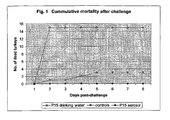
- the post-vaccination observations are summarized in Table 2.
- the post-mortems after vaccination showed that the aerosol route induced slightly more abnormalities (mild airsac lesions that could be due to the vaccine strains) compared to the drinking water group.
- Pasteurella multocida Orf-15 mutants according to the invention are very suitable strain s for use as a live attenuated strain in vaccines .
- the mortality observed after vaccination was with the highest dose possible (>10 9 CFU/ml).
- the vaccine dose can be strongly reduced until a level that no mortality or signs are observed.
- the challenge dose 1000x LD 50 ) can be strongly reduced.
- Pasteurella multocida Orf-15 mutants provide a very good basis for efficacious and safe live attenuated Pasteurella multocida vaccines.
- This figure shows a comparison of the cumulative mortality of vaccinated animals (vaccination through drinking water and aerosol vaccination) versus control animals after challenge.
Landscapes
- Chemical & Material Sciences (AREA)
- Life Sciences & Earth Sciences (AREA)
- Health & Medical Sciences (AREA)
- Organic Chemistry (AREA)
- Analytical Chemistry (AREA)
- Proteomics, Peptides & Aminoacids (AREA)
- Engineering & Computer Science (AREA)
- Wood Science & Technology (AREA)
- Zoology (AREA)
- General Health & Medical Sciences (AREA)
- Microbiology (AREA)
- Genetics & Genomics (AREA)
- Bioinformatics & Cheminformatics (AREA)
- Biotechnology (AREA)
- Biochemistry (AREA)
- Immunology (AREA)
- General Engineering & Computer Science (AREA)
- Molecular Biology (AREA)
- Medicinal Chemistry (AREA)
- Public Health (AREA)
- Physics & Mathematics (AREA)
- Biophysics (AREA)
- Pharmacology & Pharmacy (AREA)
- Veterinary Medicine (AREA)
- Animal Behavior & Ethology (AREA)
- Mycology (AREA)
- Epidemiology (AREA)
- Virology (AREA)
- Nuclear Medicine, Radiotherapy & Molecular Imaging (AREA)
- Oncology (AREA)
- Chemical Kinetics & Catalysis (AREA)
- General Chemical & Material Sciences (AREA)
- Communicable Diseases (AREA)
- Tropical Medicine & Parasitology (AREA)
- Biomedical Technology (AREA)
- Medicines Containing Antibodies Or Antigens For Use As Internal Diagnostic Agents (AREA)
- Micro-Organisms Or Cultivation Processes Thereof (AREA)
- Measuring Or Testing Involving Enzymes Or Micro-Organisms (AREA)
- Medicines That Contain Protein Lipid Enzymes And Other Medicines (AREA)
- Polysaccharides And Polysaccharide Derivatives (AREA)
Claims (15)
- Lebendes abgeschwächtes Pasteurella multocida-Bakterium, wobei das Bakterium nicht in der Lage ist, ein funktionsfähiges Orf-15-Protein zu exprimieren.
- Lebendes abgeschwächtes Bakterium nach Anspruch 1, dadurch gekennzeichnet, dass das Bakterium aufgrund einer Mutation im Orf-15-Gen nicht in der Lage ist, ein funktionsfähiges Orf-15-Protein zu exprimieren.
- Lebendes abgeschwächtes Bakterium nach Anspruch 2, dadurch gekennzeichnet, dass die Mutation eine Insertion und/oder eine Deletion umfasst.
- Lebendes abgeschwächtes Bakterium nach Anspruch 1-3, dadurch gekennzeichnet, dass das Bakterium ein für ein oder mehrere aus der Gruppe der für Menschen und/oder Tiere pathogenen Viren und Mikroorganismen ausgewählte Antigene codierendes heterologes Gen trägt.
- Lebendes abgeschwächtes Bakterium nach Anspruch 4, dadurch gekennzeichnet, dass das heterologe Gen in dem für Orf-15 codierenden Gen insertiert ist.
- Lebendes abgeschwächtes Bakterium nach Anspruch 4 oder 5, dadurch gekennzeichnet, dass das eine oder die mehreren Antigene ausgewählt sind aus der Gruppe PRRS(Porcine Reproductive Respiratory Syndrome)-Virus, Pseudorabiesvirus, Schweinegrippevirus, Schweineparvovirus, Übertragbare-Gastroenteritis-Virus, Rotavirus, Schweinecircovirus 1 oder 2, Escherichia coli, Erysipelothrix rhusiopathiae, Bordetella bronchiseptica, Haemophilus parasuis, Mycoplasma hyopneumoniae und Streptococcus suis.
- Lebendes abgeschwächtes Bakterium nach Anspruch 4 oder 5, dadurch gekennzeichnet, dass das eine oder die mehreren Antigene ausgewählt sind aus der Gruppe Rinderherpesvirus, Virus der viralen Diarrhö bei Rindern, Parainfluenza-Typ-3-Virus, Rinderparamyxovirus, Maul-und-Klauenseuche-Virus, Pasteurella haemolytica, Staphylococcus aureus, Staphylococcus uberis, Escherichia coli, Rinder-RSV(Respiratory Syncytial Virus), Theileria parva, Theileria annulata, Babesia bovis, Babesia bigemina, Babesia major, Trypanosoma species, Anaplasma marginale, Anaplasma centrale oder Neospora caninum.
- Lebendes abgeschwächtes Bakterium nach Anspruch 4 oder 5, dadurch gekennzeichnet, dass das eine oder die mehreren Antigene ausgewählt sind aus der Gruppe Fowlpox-Virus, Infektiöse-Bronchitis-Virus, Infektiöse Bursitis, Mareksche-Krankheit-Virus, Hühneranämie-Agens, Vogelreovirus, Mycoplasma gallisepticum, Truthahn-Rhinotracheitis-Virus, Haemophilus paragallinarum, Hühner-Poxvirus, Vogel-Enzephalomyelitis-Virus, Entenpestvirus, Newcastle-Disease-Virus, Egg-Drop-Syndrome-Virus, Infektiöse-Laryngotracheitis-Virus, Truthahn-Herpesvirus, Eimeria-Spezies, Ornithobacterium rhinotracheale, Mycoplasma synoviae, Clostridium perfringens, Salmonella-Spezies und E. coli.
- Lebender abgeschwächter Impfstoff zum Schutz von Tieren oder Menschen gegen eine Infektion mit Pasteurella multocida oder die pathogenen Effekte davon, dadurch gekennzeichnet, dass der Impfstoff ein lebendes abgeschwächtes Bakterium nach Anspruch 1-8 und einen pharmazeutisch unbedenklichen Trägerstoff aufweist.
- Lebender abgeschwächter Impfstoff nach Anspruch 9, dadurch gekennzeichnet, dass er ein Adjuvans umfasst.
- Lebender abgeschwächter Impfstoff nach Anspruch 9 oder 10, dadurch gekennzeichnet, dass er in gefriergetrockneter Form vorliegt.
- Lebender abgeschwächter Impfstoff nach Anspruch 9-11, dadurch gekennzeichnet, dass er zusätzlich ein oder mehrere aus der Gruppe der für Menschen und/oder Tiere pathogenen Viren und Mikroorganismen ausgewählte Antigene umfasst.
- Lebendes abgeschwächtes Bakterium nach Anspruch 1-8 zur Verwendung in einem Impfstoff.
- Verwendung eines lebenden abgeschwächten Bakteriums nach Anspruch 1-8 zur Herstellung eines Impfstoffs zum Schutz von Menschen oder Tieren gegen eine Infektion mit einem Pasteurella multocida-Bakterium oder die pathogenen Effekte der Infektion.
- Verfahren zur Herstellung eines Impfstoffs nach Anspruch 9-12, dadurch gekennzeichnet, dass das Verfahren das Mischen eines lebenden abgeschwächten Bakteriums mit der in Anspruch 1-8 angegebenen Bedeutung und eines pharmazeutisch unbedenklichen Trägerstoffs umfasst.
Applications Claiming Priority (2)
| Application Number | Priority Date | Filing Date | Title |
|---|---|---|---|
| US63944704P | 2004-12-22 | 2004-12-22 | |
| PCT/EP2005/056995 WO2006122586A1 (en) | 2004-12-22 | 2005-12-21 | Pasteurella multocida vaccine |
Publications (2)
| Publication Number | Publication Date |
|---|---|
| EP1831248A1 EP1831248A1 (de) | 2007-09-12 |
| EP1831248B1 true EP1831248B1 (de) | 2010-12-15 |
Family
ID=36677027
Family Applications (1)
| Application Number | Title | Priority Date | Filing Date |
|---|---|---|---|
| EP05857856A Expired - Lifetime EP1831248B1 (de) | 2004-12-22 | 2005-12-21 | Impfstoff gegen pasteurella multocida |
Country Status (14)
| Country | Link |
|---|---|
| US (1) | US8309101B2 (de) |
| EP (1) | EP1831248B1 (de) |
| JP (1) | JP4981684B2 (de) |
| KR (1) | KR20070092290A (de) |
| CN (1) | CN101087803B (de) |
| AT (1) | ATE491720T1 (de) |
| AU (1) | AU2005331860B2 (de) |
| BR (1) | BRPI0519381A2 (de) |
| CA (1) | CA2591624A1 (de) |
| DE (1) | DE602005025404D1 (de) |
| MX (1) | MX2007007570A (de) |
| RU (1) | RU2415926C2 (de) |
| WO (1) | WO2006122586A1 (de) |
| ZA (1) | ZA200705087B (de) |
Cited By (1)
| Publication number | Priority date | Publication date | Assignee | Title |
|---|---|---|---|---|
| WO2015066292A1 (en) | 2013-11-01 | 2015-05-07 | Merial Limited | Attenuated pasteurella multocidavaccines & methods of making & use thereof |
Families Citing this family (10)
| Publication number | Priority date | Publication date | Assignee | Title |
|---|---|---|---|---|
| WO2008118902A1 (en) * | 2007-03-26 | 2008-10-02 | Wyeth | Vaccination against multiple serotypes of pasteurella multocida |
| CN101948791A (zh) * | 2010-09-21 | 2011-01-19 | 华东理工大学 | 一种溶藻弧菌野生毒株的无标记基因缺失减毒突变株、相关制剂及应用 |
| RU2455024C1 (ru) * | 2010-12-30 | 2012-07-10 | Федеральное государственное бюджетное учреждение "Научно-исследовательский институт эпидемиологии и микробиологии имени почетного академика Н.Ф. Гамалеи Министерства здравоохранения и социального развития РФ" | Аттенуированные бактерии bordetella pertussis, вакцина против возбудителя коклюша |
| RU2460791C1 (ru) * | 2011-07-28 | 2012-09-10 | Федеральное бюджетное учреждение науки Государственный научный центр прикладной микробиологии и биотехнологии (ФБУН ГНЦ ПМБ) | Способ аттенуации вакцинного туляремийного штамма |
| US20140147475A1 (en) * | 2012-11-29 | 2014-05-29 | Antonius Arnoldus Christiaan Jacobs | Vaccine to protect a ruminant against pneumonia caused by pasteurella multocida |
| US9642905B2 (en) | 2013-03-18 | 2017-05-09 | Intervet Inc. | Vaccine to protect a ruminant against pneumonia caused by mannheimia haemolytica |
| CN104560854B (zh) * | 2015-01-07 | 2018-03-02 | 四川农业大学 | 缺失phoP的禽多杀性巴氏杆菌减毒菌株及其构建方法和应用 |
| CN106114241A (zh) * | 2016-06-28 | 2016-11-16 | 无锡新大力电机有限公司 | 一种含有冷却水套的太阳能电动汽车 |
| CN109847060A (zh) * | 2019-04-19 | 2019-06-07 | 黑龙江八一农垦大学 | 牛多杀性巴氏杆菌病、溶血性曼氏杆菌病二联灭活疫苗及其制备方法 |
| CN110205395A (zh) * | 2019-06-17 | 2019-09-06 | 武汉科前生物股份有限公司 | 副猪嗜血杆菌的血清分型方法、引物组合以及pcr体系 |
Family Cites Families (6)
| Publication number | Priority date | Publication date | Assignee | Title |
|---|---|---|---|---|
| CA2148829A1 (en) * | 1992-11-06 | 1994-05-26 | Keum Hwa Choi | Avirulent live vaccine and method for immunizing animals against p. multocida pasteurellosis |
| US6248329B1 (en) * | 1998-06-01 | 2001-06-19 | Ramaswamy Chandrashekar | Parasitic helminth cuticlin nucleic acid molecules and uses thereof |
| US7449178B2 (en) | 2002-04-05 | 2008-11-11 | Merial Limited | Attenuated gram negative bacteria |
| ATE420105T1 (de) * | 2002-04-05 | 2009-01-15 | Merial Sas | Attenuirte gram-negative bakterien |
| JP2004242608A (ja) * | 2003-02-17 | 2004-09-02 | Nitsuseiken Kk | 無毒変異型パスツレラ・ムルトシダ毒素とその遺伝子および製法 |
| UA65107A (en) * | 2003-05-30 | 2004-03-15 | Vasyl Petrovych Ryzhenko | Pasteurella multocida "z-40/155" strain for production of vaccine against pasteurellosis of livestock |
-
2005
- 2005-12-21 AU AU2005331860A patent/AU2005331860B2/en not_active Ceased
- 2005-12-21 CA CA002591624A patent/CA2591624A1/en not_active Abandoned
- 2005-12-21 WO PCT/EP2005/056995 patent/WO2006122586A1/en not_active Ceased
- 2005-12-21 RU RU2007128047/10A patent/RU2415926C2/ru not_active IP Right Cessation
- 2005-12-21 BR BRPI0519381-8A patent/BRPI0519381A2/pt not_active Application Discontinuation
- 2005-12-21 US US11/722,476 patent/US8309101B2/en not_active Expired - Fee Related
- 2005-12-21 AT AT05857856T patent/ATE491720T1/de not_active IP Right Cessation
- 2005-12-21 EP EP05857856A patent/EP1831248B1/de not_active Expired - Lifetime
- 2005-12-21 KR KR1020077016568A patent/KR20070092290A/ko not_active Ceased
- 2005-12-21 DE DE602005025404T patent/DE602005025404D1/de not_active Expired - Lifetime
- 2005-12-21 MX MX2007007570A patent/MX2007007570A/es active IP Right Grant
- 2005-12-21 CN CN2005800444942A patent/CN101087803B/zh not_active Expired - Fee Related
- 2005-12-21 JP JP2007547497A patent/JP4981684B2/ja not_active Expired - Fee Related
-
2007
- 2007-06-13 ZA ZA200705087A patent/ZA200705087B/xx unknown
Cited By (1)
| Publication number | Priority date | Publication date | Assignee | Title |
|---|---|---|---|---|
| WO2015066292A1 (en) | 2013-11-01 | 2015-05-07 | Merial Limited | Attenuated pasteurella multocidavaccines & methods of making & use thereof |
Also Published As
| Publication number | Publication date |
|---|---|
| EP1831248A1 (de) | 2007-09-12 |
| MX2007007570A (es) | 2007-07-24 |
| KR20070092290A (ko) | 2007-09-12 |
| CA2591624A1 (en) | 2006-11-23 |
| US8309101B2 (en) | 2012-11-13 |
| JP2008523840A (ja) | 2008-07-10 |
| BRPI0519381A2 (pt) | 2009-01-20 |
| RU2007128047A (ru) | 2009-01-27 |
| US20100062017A1 (en) | 2010-03-11 |
| CN101087803A (zh) | 2007-12-12 |
| ZA200705087B (en) | 2008-08-27 |
| CN101087803B (zh) | 2012-01-18 |
| DE602005025404D1 (de) | 2011-01-27 |
| RU2415926C2 (ru) | 2011-04-10 |
| JP4981684B2 (ja) | 2012-07-25 |
| AU2005331860B2 (en) | 2011-08-11 |
| AU2005331860A1 (en) | 2006-11-23 |
| WO2006122586A1 (en) | 2006-11-23 |
| ATE491720T1 (de) | 2011-01-15 |
Similar Documents
| Publication | Publication Date | Title |
|---|---|---|
| Nicholas et al. | Contagious caprine pleuropneumonia: new aspects of an old disease | |
| Davies et al. | Diversity of avian Pasteurella multocida strains based on capsular PCR typing and variation of the OmpA and OmpH outer membrane proteins | |
| AU2010215065B2 (en) | Live attenuated vaccines | |
| HK1198289A1 (en) | Mycoplasma hyopneumoniae avirulent - adjuvanted live vaccine | |
| EP1831248B1 (de) | Impfstoff gegen pasteurella multocida | |
| JP5451619B2 (ja) | 弱毒マイコプラズマガリセプティクム(Mycoplasmagallisepticum)株 | |
| EP2684959A1 (de) | Vektoren zur Transformation von Mycoplasma hyopneumoniae, transformierte Stämme von Mycoplasma hyopneumoniae, sowie deren Verwendung | |
| Christensen et al. | The genus Pasteurella | |
| EP2389433B1 (de) | Mycoplasma gallisepticum-formulierung | |
| Woo et al. | Fowl cholera outbreak in domestic poultry and epidemiological properties of Pasteurella multocida isolate | |
| KR100448225B1 (ko) | 악티노바실러스 플루로뉴모니아의 rtx 톡신 apx에 대한 면역 | |
| Ozbey et al. | Random amplified polymorphic DNA (RAPD) analysis of Pasteurella multocida and Manheimia haemolytica strains isolated from cattle, sheep and goats | |
| KR20130086154A (ko) | 약독화된 미코플라스마와 관련된 방법 | |
| WO2014174257A2 (en) | Methods | |
| AU2018200954B2 (en) | Live Vaccine Strains | |
| Oliveira | Haemophilus parasuis: diagnosis, epidemiology and control | |
| Mathengtheng | Molecular characterization of Mycoplasma gallisepticum strains from South African poultry | |
| Jabbari et al. | Molecular identification and capsular typing of Pasteurella multocida isolates from sheep pneumonia in Iran | |
| JPH11171A (ja) | 豚丹毒菌の莢膜形成遺伝子群の塩基配列、それを利用した豚丹毒菌の弱毒株の作出方法および豚丹毒菌の鑑別方法 | |
| Shonima | Molecular fingerprinting of Riemerella anatipestifer isolates from ducks of Kerala | |
| STHITMATEE et al. | Distribution of Adhesive Protein Gene and the Protein Antigen among Avian Pasteurella multocida Isolates in Japan | |
| HK1161289B (en) | Mycoplasma gallisepticum formulation | |
| Calsamiglia-Costa | Development and application of molecular diagnostic techniques for Mycoplasma hyopneumoniae and Haemophilus parasuis | |
| HK1145292A (en) | Mycoplasma hyopneumoniae avirulent-adjuvanted live vaccine |
Legal Events
| Date | Code | Title | Description |
|---|---|---|---|
| PUAI | Public reference made under article 153(3) epc to a published international application that has entered the european phase |
Free format text: ORIGINAL CODE: 0009012 |
|
| 17P | Request for examination filed |
Effective date: 20070723 |
|
| AK | Designated contracting states |
Kind code of ref document: A1 Designated state(s): AT BE BG CH CY CZ DE DK EE ES FI FR GB GR HU IE IS IT LI LT LU LV MC NL PL PT RO SE SI SK TR |
|
| DAX | Request for extension of the european patent (deleted) | ||
| 17Q | First examination report despatched |
Effective date: 20080606 |
|
| GRAP | Despatch of communication of intention to grant a patent |
Free format text: ORIGINAL CODE: EPIDOSNIGR1 |
|
| GRAS | Grant fee paid |
Free format text: ORIGINAL CODE: EPIDOSNIGR3 |
|
| GRAA | (expected) grant |
Free format text: ORIGINAL CODE: 0009210 |
|
| AK | Designated contracting states |
Kind code of ref document: B1 Designated state(s): AT BE BG CH CY CZ DE DK EE ES FI FR GB GR HU IE IS IT LI LT LU LV MC NL PL PT RO SE SI SK TR |
|
| REG | Reference to a national code |
Ref country code: GB Ref legal event code: FG4D Ref country code: CH Ref legal event code: EP |
|
| REG | Reference to a national code |
Ref country code: IE Ref legal event code: FG4D |
|
| REF | Corresponds to: |
Ref document number: 602005025404 Country of ref document: DE Date of ref document: 20110127 Kind code of ref document: P |
|
| REG | Reference to a national code |
Ref country code: NL Ref legal event code: T3 |
|
| PG25 | Lapsed in a contracting state [announced via postgrant information from national office to epo] |
Ref country code: LT Free format text: LAPSE BECAUSE OF FAILURE TO SUBMIT A TRANSLATION OF THE DESCRIPTION OR TO PAY THE FEE WITHIN THE PRESCRIBED TIME-LIMIT Effective date: 20101215 |
|
| LTIE | Lt: invalidation of european patent or patent extension |
Effective date: 20101215 |
|
| PG25 | Lapsed in a contracting state [announced via postgrant information from national office to epo] |
Ref country code: LV Free format text: LAPSE BECAUSE OF FAILURE TO SUBMIT A TRANSLATION OF THE DESCRIPTION OR TO PAY THE FEE WITHIN THE PRESCRIBED TIME-LIMIT Effective date: 20101215 Ref country code: FI Free format text: LAPSE BECAUSE OF FAILURE TO SUBMIT A TRANSLATION OF THE DESCRIPTION OR TO PAY THE FEE WITHIN THE PRESCRIBED TIME-LIMIT Effective date: 20101215 Ref country code: AT Free format text: LAPSE BECAUSE OF FAILURE TO SUBMIT A TRANSLATION OF THE DESCRIPTION OR TO PAY THE FEE WITHIN THE PRESCRIBED TIME-LIMIT Effective date: 20101215 Ref country code: CY Free format text: LAPSE BECAUSE OF FAILURE TO SUBMIT A TRANSLATION OF THE DESCRIPTION OR TO PAY THE FEE WITHIN THE PRESCRIBED TIME-LIMIT Effective date: 20101215 Ref country code: BG Free format text: LAPSE BECAUSE OF FAILURE TO SUBMIT A TRANSLATION OF THE DESCRIPTION OR TO PAY THE FEE WITHIN THE PRESCRIBED TIME-LIMIT Effective date: 20110315 Ref country code: SI Free format text: LAPSE BECAUSE OF FAILURE TO SUBMIT A TRANSLATION OF THE DESCRIPTION OR TO PAY THE FEE WITHIN THE PRESCRIBED TIME-LIMIT Effective date: 20101215 Ref country code: SE Free format text: LAPSE BECAUSE OF FAILURE TO SUBMIT A TRANSLATION OF THE DESCRIPTION OR TO PAY THE FEE WITHIN THE PRESCRIBED TIME-LIMIT Effective date: 20101215 |
|
| PG25 | Lapsed in a contracting state [announced via postgrant information from national office to epo] |
Ref country code: PT Free format text: LAPSE BECAUSE OF FAILURE TO SUBMIT A TRANSLATION OF THE DESCRIPTION OR TO PAY THE FEE WITHIN THE PRESCRIBED TIME-LIMIT Effective date: 20110415 Ref country code: MC Free format text: LAPSE BECAUSE OF NON-PAYMENT OF DUE FEES Effective date: 20101231 Ref country code: IS Free format text: LAPSE BECAUSE OF FAILURE TO SUBMIT A TRANSLATION OF THE DESCRIPTION OR TO PAY THE FEE WITHIN THE PRESCRIBED TIME-LIMIT Effective date: 20110415 Ref country code: ES Free format text: LAPSE BECAUSE OF FAILURE TO SUBMIT A TRANSLATION OF THE DESCRIPTION OR TO PAY THE FEE WITHIN THE PRESCRIBED TIME-LIMIT Effective date: 20110326 Ref country code: EE Free format text: LAPSE BECAUSE OF FAILURE TO SUBMIT A TRANSLATION OF THE DESCRIPTION OR TO PAY THE FEE WITHIN THE PRESCRIBED TIME-LIMIT Effective date: 20101215 Ref country code: CZ Free format text: LAPSE BECAUSE OF FAILURE TO SUBMIT A TRANSLATION OF THE DESCRIPTION OR TO PAY THE FEE WITHIN THE PRESCRIBED TIME-LIMIT Effective date: 20101215 Ref country code: GR Free format text: LAPSE BECAUSE OF FAILURE TO SUBMIT A TRANSLATION OF THE DESCRIPTION OR TO PAY THE FEE WITHIN THE PRESCRIBED TIME-LIMIT Effective date: 20110316 Ref country code: BE Free format text: LAPSE BECAUSE OF FAILURE TO SUBMIT A TRANSLATION OF THE DESCRIPTION OR TO PAY THE FEE WITHIN THE PRESCRIBED TIME-LIMIT Effective date: 20101215 |
|
| REG | Reference to a national code |
Ref country code: CH Ref legal event code: PL |
|
| PG25 | Lapsed in a contracting state [announced via postgrant information from national office to epo] |
Ref country code: RO Free format text: LAPSE BECAUSE OF FAILURE TO SUBMIT A TRANSLATION OF THE DESCRIPTION OR TO PAY THE FEE WITHIN THE PRESCRIBED TIME-LIMIT Effective date: 20101215 Ref country code: PL Free format text: LAPSE BECAUSE OF FAILURE TO SUBMIT A TRANSLATION OF THE DESCRIPTION OR TO PAY THE FEE WITHIN THE PRESCRIBED TIME-LIMIT Effective date: 20101215 Ref country code: SK Free format text: LAPSE BECAUSE OF FAILURE TO SUBMIT A TRANSLATION OF THE DESCRIPTION OR TO PAY THE FEE WITHIN THE PRESCRIBED TIME-LIMIT Effective date: 20101215 |
|
| PLBE | No opposition filed within time limit |
Free format text: ORIGINAL CODE: 0009261 |
|
| STAA | Information on the status of an ep patent application or granted ep patent |
Free format text: STATUS: NO OPPOSITION FILED WITHIN TIME LIMIT |
|
| PG25 | Lapsed in a contracting state [announced via postgrant information from national office to epo] |
Ref country code: DK Free format text: LAPSE BECAUSE OF FAILURE TO SUBMIT A TRANSLATION OF THE DESCRIPTION OR TO PAY THE FEE WITHIN THE PRESCRIBED TIME-LIMIT Effective date: 20101215 Ref country code: IE Free format text: LAPSE BECAUSE OF NON-PAYMENT OF DUE FEES Effective date: 20101221 Ref country code: CH Free format text: LAPSE BECAUSE OF NON-PAYMENT OF DUE FEES Effective date: 20101231 Ref country code: LI Free format text: LAPSE BECAUSE OF NON-PAYMENT OF DUE FEES Effective date: 20101231 |
|
| 26N | No opposition filed |
Effective date: 20110916 |
|
| PG25 | Lapsed in a contracting state [announced via postgrant information from national office to epo] |
Ref country code: IT Free format text: LAPSE BECAUSE OF FAILURE TO SUBMIT A TRANSLATION OF THE DESCRIPTION OR TO PAY THE FEE WITHIN THE PRESCRIBED TIME-LIMIT Effective date: 20101215 |
|
| REG | Reference to a national code |
Ref country code: DE Ref legal event code: R097 Ref document number: 602005025404 Country of ref document: DE Effective date: 20110916 |
|
| PG25 | Lapsed in a contracting state [announced via postgrant information from national office to epo] |
Ref country code: HU Free format text: LAPSE BECAUSE OF FAILURE TO SUBMIT A TRANSLATION OF THE DESCRIPTION OR TO PAY THE FEE WITHIN THE PRESCRIBED TIME-LIMIT Effective date: 20110616 Ref country code: LU Free format text: LAPSE BECAUSE OF NON-PAYMENT OF DUE FEES Effective date: 20101221 |
|
| PG25 | Lapsed in a contracting state [announced via postgrant information from national office to epo] |
Ref country code: TR Free format text: LAPSE BECAUSE OF FAILURE TO SUBMIT A TRANSLATION OF THE DESCRIPTION OR TO PAY THE FEE WITHIN THE PRESCRIBED TIME-LIMIT Effective date: 20101215 |
|
| REG | Reference to a national code |
Ref country code: FR Ref legal event code: PLFP Year of fee payment: 11 |
|
| REG | Reference to a national code |
Ref country code: FR Ref legal event code: PLFP Year of fee payment: 12 |
|
| REG | Reference to a national code |
Ref country code: FR Ref legal event code: PLFP Year of fee payment: 13 |
|
| PGFP | Annual fee paid to national office [announced via postgrant information from national office to epo] |
Ref country code: DE Payment date: 20191114 Year of fee payment: 15 Ref country code: NL Payment date: 20191127 Year of fee payment: 15 |
|
| PGFP | Annual fee paid to national office [announced via postgrant information from national office to epo] |
Ref country code: FR Payment date: 20191122 Year of fee payment: 15 |
|
| PGFP | Annual fee paid to national office [announced via postgrant information from national office to epo] |
Ref country code: GB Payment date: 20191126 Year of fee payment: 15 |
|
| REG | Reference to a national code |
Ref country code: DE Ref legal event code: R119 Ref document number: 602005025404 Country of ref document: DE |
|
| REG | Reference to a national code |
Ref country code: NL Ref legal event code: MM Effective date: 20210101 |
|
| GBPC | Gb: european patent ceased through non-payment of renewal fee |
Effective date: 20201221 |
|
| PG25 | Lapsed in a contracting state [announced via postgrant information from national office to epo] |
Ref country code: NL Free format text: LAPSE BECAUSE OF NON-PAYMENT OF DUE FEES Effective date: 20210101 |
|
| PG25 | Lapsed in a contracting state [announced via postgrant information from national office to epo] |
Ref country code: FR Free format text: LAPSE BECAUSE OF NON-PAYMENT OF DUE FEES Effective date: 20201231 |
|
| PG25 | Lapsed in a contracting state [announced via postgrant information from national office to epo] |
Ref country code: GB Free format text: LAPSE BECAUSE OF NON-PAYMENT OF DUE FEES Effective date: 20201221 Ref country code: DE Free format text: LAPSE BECAUSE OF NON-PAYMENT OF DUE FEES Effective date: 20210701 |