EP1824844B1 - Pyrazindicarbonsäureamide und ihre verwendung - Google Patents
Pyrazindicarbonsäureamide und ihre verwendung Download PDFInfo
- Publication number
- EP1824844B1 EP1824844B1 EP05815232A EP05815232A EP1824844B1 EP 1824844 B1 EP1824844 B1 EP 1824844B1 EP 05815232 A EP05815232 A EP 05815232A EP 05815232 A EP05815232 A EP 05815232A EP 1824844 B1 EP1824844 B1 EP 1824844B1
- Authority
- EP
- European Patent Office
- Prior art keywords
- formula
- compound
- amino
- mmol
- salts
- Prior art date
- Legal status (The legal status is an assumption and is not a legal conclusion. Google has not performed a legal analysis and makes no representation as to the accuracy of the status listed.)
- Expired - Lifetime
Links
- 0 *C(CCCN1*)C1=O Chemical compound *C(CCCN1*)C1=O 0.000 description 5
- DPLGLEJKHBMCHG-UHFFFAOYSA-N NN(CCCN1N)C1=O Chemical compound NN(CCCN1N)C1=O DPLGLEJKHBMCHG-UHFFFAOYSA-N 0.000 description 2
- UVLKCOMHVBJJLG-UHFFFAOYSA-N CC(C)(C)[Si](C)(C)OCCNc(cc1)ccc1[N+]([O-])=O Chemical compound CC(C)(C)[Si](C)(C)OCCNc(cc1)ccc1[N+]([O-])=O UVLKCOMHVBJJLG-UHFFFAOYSA-N 0.000 description 1
- MBHNKUNCRAEYOE-UHFFFAOYSA-N CC(CCN1N)C1=O Chemical compound CC(CCN1N)C1=O MBHNKUNCRAEYOE-UHFFFAOYSA-N 0.000 description 1
- ZVENZXKHZRFJNI-UHFFFAOYSA-N CN(CCCN1c(cc2)ccc2NC(c2nccnc2C(Nc(cc2)ccc2F)=O)=O)C1=O Chemical compound CN(CCCN1c(cc2)ccc2NC(c2nccnc2C(Nc(cc2)ccc2F)=O)=O)C1=O ZVENZXKHZRFJNI-UHFFFAOYSA-N 0.000 description 1
- YPGKOCFEGLMPTD-UHFFFAOYSA-N Cc(cc1)ccc1NC(c1c(C(Nc(cc2)ccc2N(CCC2)C2=O)=O)nccn1)=O Chemical compound Cc(cc1)ccc1NC(c1c(C(Nc(cc2)ccc2N(CCC2)C2=O)=O)nccn1)=O YPGKOCFEGLMPTD-UHFFFAOYSA-N 0.000 description 1
- BNNCGVWYEDSNIE-UHFFFAOYSA-N NN(CCCC1O)C1=O Chemical compound NN(CCCC1O)C1=O BNNCGVWYEDSNIE-UHFFFAOYSA-N 0.000 description 1
- IOMOVAPYJQVJDK-UHFFFAOYSA-N Nc(cc1)ccc1N(CCC1)C1=O Chemical compound Nc(cc1)ccc1N(CCC1)C1=O IOMOVAPYJQVJDK-UHFFFAOYSA-N 0.000 description 1
- CZHZTHARBYJWDN-UHFFFAOYSA-N O=C(c1c(C(Nc(cc2)ncc2Cl)=O)nccn1)Nc(cc1)ccc1N(CCCN1CCN2CCCC2)C1=O Chemical compound O=C(c1c(C(Nc(cc2)ncc2Cl)=O)nccn1)Nc(cc1)ccc1N(CCCN1CCN2CCCC2)C1=O CZHZTHARBYJWDN-UHFFFAOYSA-N 0.000 description 1
- OLSDBVIGPHADCP-UHFFFAOYSA-N O=C(c1nccnc1C(Nc(cc1)ccc1Cl)=O)Nc(cc1)ccc1N(CCOC1)C1=O Chemical compound O=C(c1nccnc1C(Nc(cc1)ccc1Cl)=O)Nc(cc1)ccc1N(CCOC1)C1=O OLSDBVIGPHADCP-UHFFFAOYSA-N 0.000 description 1
- SJGPDTGUTYVANL-UHFFFAOYSA-N OCCN(CCCN1c(cc2)ccc2NC(c2c(C(Nc(nc3)ccc3Cl)=O)nccn2)=O)C1=O Chemical compound OCCN(CCCN1c(cc2)ccc2NC(c2c(C(Nc(nc3)ccc3Cl)=O)nccn2)=O)C1=O SJGPDTGUTYVANL-UHFFFAOYSA-N 0.000 description 1
Classifications
-
- C—CHEMISTRY; METALLURGY
- C07—ORGANIC CHEMISTRY
- C07D—HETEROCYCLIC COMPOUNDS
- C07D491/00—Heterocyclic compounds containing in the condensed ring system both one or more rings having oxygen atoms as the only ring hetero atoms and one or more rings having nitrogen atoms as the only ring hetero atoms, not provided for by groups C07D451/00 - C07D459/00, C07D463/00, C07D477/00 or C07D489/00
- C07D491/02—Heterocyclic compounds containing in the condensed ring system both one or more rings having oxygen atoms as the only ring hetero atoms and one or more rings having nitrogen atoms as the only ring hetero atoms, not provided for by groups C07D451/00 - C07D459/00, C07D463/00, C07D477/00 or C07D489/00 in which the condensed system contains two hetero rings
- C07D491/04—Ortho-condensed systems
-
- A—HUMAN NECESSITIES
- A61—MEDICAL OR VETERINARY SCIENCE; HYGIENE
- A61P—SPECIFIC THERAPEUTIC ACTIVITY OF CHEMICAL COMPOUNDS OR MEDICINAL PREPARATIONS
- A61P13/00—Drugs for disorders of the urinary system
- A61P13/12—Drugs for disorders of the urinary system of the kidneys
-
- A—HUMAN NECESSITIES
- A61—MEDICAL OR VETERINARY SCIENCE; HYGIENE
- A61P—SPECIFIC THERAPEUTIC ACTIVITY OF CHEMICAL COMPOUNDS OR MEDICINAL PREPARATIONS
- A61P17/00—Drugs for dermatological disorders
-
- A—HUMAN NECESSITIES
- A61—MEDICAL OR VETERINARY SCIENCE; HYGIENE
- A61P—SPECIFIC THERAPEUTIC ACTIVITY OF CHEMICAL COMPOUNDS OR MEDICINAL PREPARATIONS
- A61P25/00—Drugs for disorders of the nervous system
- A61P25/28—Drugs for disorders of the nervous system for treating neurodegenerative disorders of the central nervous system, e.g. nootropic agents, cognition enhancers, drugs for treating Alzheimer's disease or other forms of dementia
-
- A—HUMAN NECESSITIES
- A61—MEDICAL OR VETERINARY SCIENCE; HYGIENE
- A61P—SPECIFIC THERAPEUTIC ACTIVITY OF CHEMICAL COMPOUNDS OR MEDICINAL PREPARATIONS
- A61P27/00—Drugs for disorders of the senses
- A61P27/02—Ophthalmic agents
-
- A—HUMAN NECESSITIES
- A61—MEDICAL OR VETERINARY SCIENCE; HYGIENE
- A61P—SPECIFIC THERAPEUTIC ACTIVITY OF CHEMICAL COMPOUNDS OR MEDICINAL PREPARATIONS
- A61P29/00—Non-central analgesic, antipyretic or antiinflammatory agents, e.g. antirheumatic agents; Non-steroidal antiinflammatory drugs [NSAID]
-
- A—HUMAN NECESSITIES
- A61—MEDICAL OR VETERINARY SCIENCE; HYGIENE
- A61P—SPECIFIC THERAPEUTIC ACTIVITY OF CHEMICAL COMPOUNDS OR MEDICINAL PREPARATIONS
- A61P3/00—Drugs for disorders of the metabolism
- A61P3/08—Drugs for disorders of the metabolism for glucose homeostasis
- A61P3/10—Drugs for disorders of the metabolism for glucose homeostasis for hyperglycaemia, e.g. antidiabetics
-
- A—HUMAN NECESSITIES
- A61—MEDICAL OR VETERINARY SCIENCE; HYGIENE
- A61P—SPECIFIC THERAPEUTIC ACTIVITY OF CHEMICAL COMPOUNDS OR MEDICINAL PREPARATIONS
- A61P35/00—Antineoplastic agents
-
- A—HUMAN NECESSITIES
- A61—MEDICAL OR VETERINARY SCIENCE; HYGIENE
- A61P—SPECIFIC THERAPEUTIC ACTIVITY OF CHEMICAL COMPOUNDS OR MEDICINAL PREPARATIONS
- A61P7/00—Drugs for disorders of the blood or the extracellular fluid
- A61P7/02—Antithrombotic agents; Anticoagulants; Platelet aggregation inhibitors
-
- A—HUMAN NECESSITIES
- A61—MEDICAL OR VETERINARY SCIENCE; HYGIENE
- A61P—SPECIFIC THERAPEUTIC ACTIVITY OF CHEMICAL COMPOUNDS OR MEDICINAL PREPARATIONS
- A61P7/00—Drugs for disorders of the blood or the extracellular fluid
- A61P7/06—Antianaemics
-
- A—HUMAN NECESSITIES
- A61—MEDICAL OR VETERINARY SCIENCE; HYGIENE
- A61P—SPECIFIC THERAPEUTIC ACTIVITY OF CHEMICAL COMPOUNDS OR MEDICINAL PREPARATIONS
- A61P9/00—Drugs for disorders of the cardiovascular system
- A61P9/06—Antiarrhythmics
-
- A—HUMAN NECESSITIES
- A61—MEDICAL OR VETERINARY SCIENCE; HYGIENE
- A61P—SPECIFIC THERAPEUTIC ACTIVITY OF CHEMICAL COMPOUNDS OR MEDICINAL PREPARATIONS
- A61P9/00—Drugs for disorders of the cardiovascular system
- A61P9/08—Vasodilators for multiple indications
-
- A—HUMAN NECESSITIES
- A61—MEDICAL OR VETERINARY SCIENCE; HYGIENE
- A61P—SPECIFIC THERAPEUTIC ACTIVITY OF CHEMICAL COMPOUNDS OR MEDICINAL PREPARATIONS
- A61P9/00—Drugs for disorders of the cardiovascular system
- A61P9/10—Drugs for disorders of the cardiovascular system for treating ischaemic or atherosclerotic diseases, e.g. antianginal drugs, coronary vasodilators, drugs for myocardial infarction, retinopathy, cerebrovascula insufficiency, renal arteriosclerosis
-
- C—CHEMISTRY; METALLURGY
- C07—ORGANIC CHEMISTRY
- C07D—HETEROCYCLIC COMPOUNDS
- C07D401/00—Heterocyclic compounds containing two or more hetero rings, having nitrogen atoms as the only ring hetero atoms, at least one ring being a six-membered ring with only one nitrogen atom
- C07D401/02—Heterocyclic compounds containing two or more hetero rings, having nitrogen atoms as the only ring hetero atoms, at least one ring being a six-membered ring with only one nitrogen atom containing two hetero rings
- C07D401/12—Heterocyclic compounds containing two or more hetero rings, having nitrogen atoms as the only ring hetero atoms, at least one ring being a six-membered ring with only one nitrogen atom containing two hetero rings linked by a chain containing hetero atoms as chain links
-
- C—CHEMISTRY; METALLURGY
- C07—ORGANIC CHEMISTRY
- C07D—HETEROCYCLIC COMPOUNDS
- C07D401/00—Heterocyclic compounds containing two or more hetero rings, having nitrogen atoms as the only ring hetero atoms, at least one ring being a six-membered ring with only one nitrogen atom
- C07D401/14—Heterocyclic compounds containing two or more hetero rings, having nitrogen atoms as the only ring hetero atoms, at least one ring being a six-membered ring with only one nitrogen atom containing three or more hetero rings
-
- C—CHEMISTRY; METALLURGY
- C07—ORGANIC CHEMISTRY
- C07D—HETEROCYCLIC COMPOUNDS
- C07D403/00—Heterocyclic compounds containing two or more hetero rings, having nitrogen atoms as the only ring hetero atoms, not provided for by group C07D401/00
- C07D403/02—Heterocyclic compounds containing two or more hetero rings, having nitrogen atoms as the only ring hetero atoms, not provided for by group C07D401/00 containing two hetero rings
- C07D403/12—Heterocyclic compounds containing two or more hetero rings, having nitrogen atoms as the only ring hetero atoms, not provided for by group C07D401/00 containing two hetero rings linked by a chain containing hetero atoms as chain links
-
- C—CHEMISTRY; METALLURGY
- C07—ORGANIC CHEMISTRY
- C07D—HETEROCYCLIC COMPOUNDS
- C07D413/00—Heterocyclic compounds containing two or more hetero rings, at least one ring having nitrogen and oxygen atoms as the only ring hetero atoms
- C07D413/02—Heterocyclic compounds containing two or more hetero rings, at least one ring having nitrogen and oxygen atoms as the only ring hetero atoms containing two hetero rings
- C07D413/12—Heterocyclic compounds containing two or more hetero rings, at least one ring having nitrogen and oxygen atoms as the only ring hetero atoms containing two hetero rings linked by a chain containing hetero atoms as chain links
-
- C—CHEMISTRY; METALLURGY
- C07—ORGANIC CHEMISTRY
- C07D—HETEROCYCLIC COMPOUNDS
- C07D413/00—Heterocyclic compounds containing two or more hetero rings, at least one ring having nitrogen and oxygen atoms as the only ring hetero atoms
- C07D413/14—Heterocyclic compounds containing two or more hetero rings, at least one ring having nitrogen and oxygen atoms as the only ring hetero atoms containing three or more hetero rings
Definitions
- the present application relates to novel pyrazine dicarboxylic acid amides, processes for their preparation, their use for the prevention of blood coagulation in vitro and their use for the preparation of medicaments for the treatment and / or prophylaxis of diseases, in particular thromboembolic diseases.
- Blood clotting is a protective mechanism of the organism, with the help of which defects in the vessel wall can be "sealed" quickly and reliably. Thus, a blood loss can be avoided or minimized.
- Hemostasis following vascular injury is essentially through the coagulation system, which triggers an enzymatic cascade of complex plasma protein reactions.
- At the end of the cascade is the conversion of the soluble fibrinogen into the insoluble fibrin, resulting in a blood clot.
- blood clotting distinguishes between the intrinsic and extrinsic systems, which result in a final common pathway.
- factor Xa which is formed by the proenzyme factor X, plays a key role, since it combines both coagulation pathways.
- the activated serine protease Xa cleaves prothrombin to thrombin.
- the resulting thrombin in turn splits fibrinogen to fibrin.
- Subsequent cross-linking of the fibrin monomers leads to the formation of blood clots and thus to haemostasis.
- thrombin is a potent trigger of platelet aggregation, which also makes a significant contribution to hemostasis.
- Hemostasis is subject to a complex regulatory mechanism.
- An uncontrolled activation of the coagulation system or a defective inhibition of the activation processes can cause the formation of local thromboses or embolisms in vessels (arteries, veins, lymphatics) or cardiac cavities. This can lead to serious thromboembolic diseases.
- hypercoagulability - systemically - in a consumption coagulopathy can lead to disseminated intravascular coagulation.
- Thromboembolic complications also occur in microangiopathic hemolytic anemias, extracorporeal blood circuits such as hemodialysis, and heart valve prostheses.
- Thromboembolic disorders are the leading cause of morbidity and mortality in most industrialized countries [ Heart Disease: A Textbook of Cardiovascular Medicine, Eugene Braunwald, 5th Ed., 1997, WB Saunders Company, Philadelphia ].
- heparin is used, which is administered parenterally or subcutaneously. Due to more favorable pharmacokinetic properties, although increasingly low molecular weight heparin is nowadays increasingly preferred; However, this also the known disadvantages described below can not be avoided, which consist in the therapy with heparin. Thus, heparin is orally ineffective and has only a comparatively low half-life. Since heparin simultaneously inhibits several factors of the blood coagulation cascade, there is an unselective effect.
- a second class of anticoagulants are the vitamin K antagonists. These include, for example, 1,3-indandiones, but especially compounds such as warfarin, phenprocoumon, dicumarol and other coumarin derivatives, which are unsuitable for the synthesis of various products of certain vitamin K-dependent coagulation factors in the liver. Due to the mechanism of action, the effect is only very slow (latency until the onset 36 to 48 hours). Although the compounds can be administered orally, due to the high risk of bleeding and the narrow therapeutic index, a complex individual adjustment and observation of the patient is necessary [ J. Hirsh, J.
- factor Xa is one of the most important targets for anticoagulant drugs [ J. Hauptmann, J. S. S. S. S. S. S. S. S. S. S. S. S. S. S. S. S. S. S. S. S. S. S. S. S. S. S. S. S. S. S. S. S. S. S. S. S. S. S. S. S. S. S. S. S., Thrombosis Research 1999, 93, 203 ; SAV Raghavan, M. Dikshit, "Recent Advances in the Status and Targets of Antithrombotic Agents" Drugs Fut. 2002, 27, 669 to 683 ; HA Wieland, V. Laux, D. Kozian, M.
- non-peptidic, low molecular weight factor Xa inhibitors for example, in WO 03/026652 .
- WO 02/079145 WO 01/019788 and WO 01/064642 described.
- the object of the present invention is to provide novel substances for controlling diseases, in particular thromboembolic diseases.
- Compounds according to the invention are the compounds of the formula (I) and their salts, solvates and solvates of the salts comprising the compounds of the formulas below and their salts, solvates and solvates of the salts and of the formula (I) encompassed by formula (I), hereinafter referred to as exemplary compounds and their salts, solvates and solvates of the salts, as far as the compounds of formula (I), the compounds mentioned below are not already salts, solvates and solvates of the salts .
- the compounds of the invention may exist in stereoisomeric forms (enantiomers, diastereomers).
- the invention therefore includes the enantiomers or diastereomers and their respective mixtures. From such mixtures of enantiomers and / or diastereomers, the stereoisomerically uniform components can be isolated in a known manner.
- the present invention encompasses all tautomeric forms.
- Salts used in the context of the present invention are physiologically acceptable salts of the compounds according to the invention. Also included are salts which are themselves unsuitable for pharmaceutical applications but can be used, for example, for the isolation or purification of the compounds of the invention.
- Physiologically acceptable salts of the compounds according to the invention include acid addition salts of mineral acids, carboxylic acids and sulfonic acids, for example salts of hydrochloric acid, hydrobromic acid, sulfuric acid, phosphoric acid, methanesulfonic acid, ethanesulfonic acid, toluenesulfonic acid, benzenesulfonic acid, naphthalenedisulfonic acid, acetic acid, trifluoroacetic acid, Propionic acid, lactic acid, tartaric acid, malic acid, citric acid, fumaric acid, maleic acid and benzoic acid.
- Physiologically acceptable salts of the compounds according to the invention also include salts of customary bases, such as, by way of example and by way of preference, alkali metal salts (for example sodium and potassium salts), alkaline earth salts (for example calcium and magnesium salts) and ammonium salts derived from ammonia or organic amines having from 1 to 16 carbon atoms, for example and preferably, ethylamine, diethylamine, triethylamine, ethyldiisopropylamine, monoethanolamine, diethanolamine, triethanolamine, dicyclohexylamine, dimethylaminoethanol, procaine, dibenzylamine, N-methylmorpholine, arginine, lysine, ethylenediamine and N-methylpiperidine.
- customary bases such as, by way of example and by way of preference, alkali metal salts (for example sodium and potassium salts), alkaline earth salts (for example calcium and magnesium salts) and ammonium salt
- Solvates in the context of the invention are those forms of the compounds according to the invention which form a complex in the solid or liquid state by coordination with solvent molecules. Hydrates are a special form of solvates that coordinate with water. As solvates, hydrates are preferred in the context of the present invention.
- prodrugs of the compounds of the invention includes compounds which may themselves be biologically active or inactive, but which are converted during their residence time in the body into compounds of the invention (for example metabolically or hydrolytically).
- a straight-chain or branched alkoxy radical having 1 to 4 or 1 to 3 carbon atoms is particularly preferred.
- a straight-chain or branched alkoxy radical having 1 to 3 carbon atoms examples which may be mentioned by way of example include: methoxy, ethoxy, n-propoxy, isopropoxy, n-butoxy and tert-butoxy.
- Mono (C 1 -C 6 ) -alkylamino and mono- (C 1 -C 4 -alkylamino in the context of the invention represent an amino group having a straight-chain or branched alkyl substituent which has 1 to 6 or 1 to 4 carbon atoms
- Di (C 1 -C 6 ) -alkylamino and di (C 1 -C 4 ) -alkylamino are in the context of the invention an amino group having two identical or different straight-chain or branched alkyl substituents, each of which is 1 to 6 or Have 1 to 4 carbon atoms. Preference is given to straight-chain or branched dialkylamino radicals each having 1 to 4 carbon atoms.
- N N- dimethylamino
- N N- diethylamino
- N- ethyl- N- methylamino N- methyl- N- n-propylamino
- N- isopropyl- N- n-propylamino N- tert.
- (C 3 -C 7 ) -Cycloalkylamino in the context of the invention represents an amino group having a cycloalkyl substituent having 3 to 7 carbon atoms. Preference is given to a cycloalkylamino radical having 3 to 6 carbon atoms. Examples which may be mentioned by way of example include cyclopropylamino, cyclobutylamino, cyclopentylamino, cyclohexylamino and cycloheptylamino.
- (C 1 -C 6 ) -Alkanoylamino in the context of the invention represents an amino group having a straight-chain or branched alkanoyl substituent which has 1 to 6 carbon atoms and the carbonyl group is linked. Preference is given to an alkanoylamino radical having 1 to 4 carbon atoms.
- an alkanoylamino radical having 1 to 4 carbon atoms.
- (C 1 -C 6 ) -alkoxycarbonylamino is an amino group having a straight-chain or branched chain.
- Alkoxycarbonyl substituent which has 1 to 6 carbon atoms in the alkoxy radical and is linked via the carbonyl group.
- Preferred is an alkoxycarbonylamino radical having 1 to 4 carbon atoms in the alkoxy group.
- methoxycarbonylamino, ethoxycarbonylamino, n-propoxycarbonylamino and tert-butoxycarbonylamino are examples of: methoxycarbonylamino, ethoxycarbonylamino, n-propoxycarbonylamino and tert-butoxycarbonylamino.
- a 4- to 7-membered heterocycle in the context of the invention is a saturated heterocycle having 4 to 7 ring atoms, which contains a ring nitrogen, is linked via this and may contain a further heteroatom from the series N or O.
- Preferred is a 5- or 6-membered saturated, N-linked heterocycle which may contain another heteroatom from the series N or O.
- Examples include: pyrrolidinyl, oxazolidinyl, imidazolidinyl, piperidinyl, piperazinyl, morpholinyl, azepinyl and 1,4-diazepinyl. Particularly preferred are pyrrolidinyl, piperidinyl, piperazinyl and morpholinyl.
- radicals are substituted in the compounds according to the invention, the radicals can, unless otherwise specified, be monosubstituted or polysubstituted. In the context of the present invention, the meaning is independent of each other for all radicals which occur repeatedly. Substitution with one, two or three identical or different substituents is preferred. Very particular preference is given to the substitution with a substituent.
- the compounds according to the invention can also be prepared by further conversions of functional groups of individual substituents, in particular the substituents listed under R 3 and R 4 , starting from the compounds of the formula (I) obtained by the above process.
- transformations are carried out by conventional methods and include, for example, reactions such as alkylation, amination, acylation, esterification, ester cleavage, amide formation, oxidation or reduction, and the introduction and removal of protecting groups.
- Inert solvents for process steps (II) + (III) ⁇ (IV) and (IV) + (V) ⁇ (I) are, for example, halogenated hydrocarbons, such as dichloromethane, trichloromethane, carbon tetrachloride, 1,2-dichloroethane, trichlorethylene or chlorobenzene, or solvents such as dimethylsulfoxide, dimethylformamide, N, N'-dimethylpropyleneurea (DMPU), N- methylpyrrolidone (NMP) or acetonitrile. It is also possible to use mixtures of the solvents mentioned. Preferred is dimethylformamide.
- Suitable bases for process step (II) + (III) ⁇ (IV) and, if appropriate, also for process step (V) + (III) ⁇ (VI) are the customary organic amine bases. These include in particular triethylamine, N- methylmorpholine, N- methylpiperidine, N, N -diisopropylethylamine, pyridine, 1,5-diazabicyclo [4.3.0] non-5-ene (DBN), 1,4-diazabicyclo [2.2.2] octane (DABCO ®) or 1,8-diazabicyclo [5.4.0] undec-7-ene (DBU). Preferred is triethylamine.
- Suitable dehydrating agents in process step (II) + (III) ⁇ (IV) are, for example, organic carboxylic acid chlorides such as acetyl chloride or pivaloyl chloride, organic sulfonyl chlorides such as methanesulfonyl chloride, chloroformates such as methyl chloroformate or isobutyl chloroformate, or inorganic acid chlorides or anhydrides such as phosphorus oxychloride, phosphorus pentachloride, phosphorus trichloride, phosphorus pentoxide or thionyl chloride.
- pivaloyl chloride is used.
- Suitable acids for process step (IV) + (V) ⁇ (I) are, for example, organic carboxylic acids or sulfonic acids such as acetic acid, trifluoroacetic acid, methanesulfonic acid or trifluoromethanesulfonic acid, or inorganic acids such as hydrogen chloride, hydrogen bromide, sulfuric acid or phosphoric acid.
- organic carboxylic acids or sulfonic acids such as acetic acid, trifluoroacetic acid, methanesulfonic acid or trifluoromethanesulfonic acid
- inorganic acids such as hydrogen chloride, hydrogen bromide, sulfuric acid or phosphoric acid.
- trifluoroacetic acid is used.
- Inert solvents for process step (V) + (III) ⁇ (VI) are, for example, halogenated hydrocarbons, such as dichloromethane, trichloromethane, tetrachloromethane, trichloroethane, tetrachloroethane, 1,2-dichloroethane or trichlorethylene, ethers, such as diethyl ether, dioxane, tetrahydrofuran, glycol dimethyl ether or diethylene glycol dimethyl ether.
- halogenated hydrocarbons such as dichloromethane, trichloromethane, tetrachloromethane, trichloroethane, tetrachloroethane, 1,2-dichloroethane or trichlorethylene
- ethers such as diethyl ether, dioxane, tetrahydrofuran, glycol dimethyl ether or diethylene glycol dimethyl ether.
- Hydrocarbons such as benzene, xylene, toluene, hexane, cyclohexane or petroleum fractions, or other solvents such as ethyl acetate, acetone, dimethylformamide, dimethyl sulfoxide, N, N'-dimethylpropyleneurea (DMPU), N- methylpyrrolidone (NMP) or acetonitrile. It is likewise possible to use mixtures of the solvents mentioned. Preference is given to tetrahydrofuran or dimethylformamide.
- the process steps (II) + (III) ⁇ (IV) and (V) + (III) ⁇ (VI) are generally in a temperature range from -20 ° C to + 60 ° C, preferably from 0 ° C to +40 ° C, performed.
- the reactions may be carried out at normal, elevated or reduced pressure (e.g., from 0.5 to 5 bar). Generally, one works at normal pressure.
- the process step (IV) + (V) ⁇ (I) is generally carried out in a temperature range of + 20 ° C to + 100 ° C, preferably from + 50 ° C to + 80 ° C.
- the reaction may be carried out at normal, elevated or reduced pressure (e.g., from 0.5 to 5 bar). Generally, one works at normal pressure.
- Inert solvents for process step (VI) + (II) ⁇ (I) are, for example, ethers, such as diethyl ether, dioxane, tetrahydrofuran, glycol dimethyl ether or diethylene glycol dimethyl ether, hydrocarbons, such as benzene, toluene, xylene, hexane, cyclohexane or petroleum fractions, halogenated hydrocarbons, such as dichloromethane, trichloromethane, Tetrachloromethane, 1,2-dichloroethane, trichlorethylene or chlorobenzene, or other solvents such as ethyl acetate, pyridine, dimethylsulfoxide, dimethylformamide, N, N'-dimethylpropyleneurea (DMPU), N- methylpyrrolidone (NMP), acetonitrile or acetone. It is also possible mixtures of the above To use solvents. Preference is given
- Suitable condensing agents for amide formation in process step (VI) + (II) ⁇ (I) are, for example, carbodiimides such as N, N'-diethyl, N, N'-dipropyl, N, N'-diisopropyl, N, N '-dicyclohexylcarbodiimide (DCC), N - (3-dimethylaminoisopropyl) - N' -ethylcarbodiimid hydrochloride (EDC), or phosgene derivatives such as N, N 'carbonyldiimidazole, or 1,2-oxazolium compounds such as 2-ethyl-5- phenyl-1,2-oxazolium-3-sulfate or 2- tert -butyl-5-methylisoxazolium perchlorate, or acylamino compounds such as 2-ethoxy-1-ethoxycarbonyl-1,2-dihydroquinoline, or isobut
- the process step (VI) + (II) ⁇ (I) is generally carried out in a temperature range from -20 ° C to + 60 ° C, preferably from 0 ° C to + 40 ° C.
- the reaction may be carried out at normal, elevated or reduced pressure (e.g., from 0.5 to 5 bar). Generally, one works at normal pressure.
- t Bu tert -butyl
- Et ethyl
- TBTU O - (benzotriazol-1-yl) -N , N, N, N'-tetramethyl-uronium tetrafluoroborate
- TFA trifluoroacetic acid
- the compounds of the invention show an unpredictable, valuable pharmacological spectrum of action, in particular a high potency and a favorable half-life.
- the compounds according to the invention are selective inhibitors of the blood coagulation factor Xa, which act in particular as anticoagulants.
- Another object of the present invention is the use of the compounds of the invention for the treatment and / or prophylaxis of diseases, preferably thromboembolic disorders and / or thromboembolic complications.
- thromboembolic disorders include, in particular, diseases such as myocardial infarction with ST segment elevation (STEMI) and without ST segment elevation (non-STEMI), stable angina pectoris, unstable angina pectoris, reocclusions and restenoses Coronary interventions such as angioplasty or aortocoronary bypass, peripheral arterial occlusive diseases, pulmonary embolism, deep venous thrombosis and renal vein thrombosis, transient ischemic attacks and thrombotic and thromboembolic stroke.
- diseases such as myocardial infarction with ST segment elevation (STEMI) and without ST segment elevation (non-STEMI)
- stable angina pectoris such as myocardial infarction with ST segment elevation (STEMI) and without ST segment elevation (non-STEMI)
- unstable angina pectoris unstable angina pectoris
- reocclusions and restenoses
- Coronary interventions such as angioplasty or aortocoronary bypass, peripheral
- the substances are therefore also useful for the prevention and treatment of cardiogenic thromboembolism, such as brain ischemia, stroke and systemic thromboembolism and ischaemia, in patients with acute, intermittent or persistent cardiac arrhythmias, such as atrial fibrillation, and those undergoing cardioversion, in patients with valvular heart disease or with artificial heart valves.
- cardiogenic thromboembolism such as brain ischemia, stroke and systemic thromboembolism and ischaemia
- acute, intermittent or persistent cardiac arrhythmias such as atrial fibrillation, and those undergoing cardioversion
- DIC disseminated intravascular coagulation
- Thromboembolic complications also occur in microangiopathic hemolytic anemias, extracorporeal blood circuits such as hemodialysis, and heart valve prostheses.
- the compounds according to the invention are also suitable for the prophylaxis and / or treatment of atherosclerotic vascular diseases and inflammatory diseases such as rheumatic diseases of the musculoskeletal system, moreover also for the prophylaxis and / or treatment of Alzheimer's disease.
- the compounds of the invention for the inhibition of tumor growth and metastasis, in microangiopathies, age-related macular degeneration, diabetic retinopathy, diabetic nephropathy and other microvascular diseases and for the prevention and Treatment of thromboembolic complications, such as venous thromboembolism, in tumor patients, especially those undergoing major surgery or chemo- or radiotherapy.
- the compounds of the invention can also be used ex vivo to prevent coagulation, eg for the preservation of blood and plasma products, for cleaning / pretreatment of catheters and other medical aids and devices, for coating artificial surfaces of in vivo or ex vivo used medical Aids and equipment or biological samples containing factor Xa.
- Another object of the present disclosure is the use of the compounds of the invention for the treatment and / or prophylaxis of diseases, in particular the aforementioned diseases.
- Another object of the present invention is the use of the compounds of the invention for the manufacture of a medicament for the treatment and / or prophylaxis of diseases, in particular the aforementioned diseases.
- Another object of the present disclosure is a method for the treatment and / or prophylaxis of diseases, in particular the aforementioned diseases, using an anticoagulatory effective amount of the compound of the invention.
- Another object of the present invention is a method for preventing blood coagulation in vitro, especially in blood or biological samples containing factor Xa, which is characterized in that an anticoagulatory effective amount of the compound of the invention is added.
- compositions containing at least one compound of the invention usually together with one or more inert, non-toxic, pharmaceutically suitable excipients, and their use for the purposes mentioned above.
- the compounds according to the invention can act systemically and / or locally.
- they may be applied in a suitable manner, e.g. oral, parenteral, pulmonary, nasal, sublingual, lingual, buccal, rectal, dermal, transdermal, conjunctival, otic or as an implant or stent.
- the compounds according to the invention can be administered in suitable administration forms.
- the compounds of the invention rapidly and / or modified donating application forms containing the compounds of the invention in crystalline and / or amorphized and / or dissolved form, such as tablets (uncoated or coated Tablets, for example with enteric or delayed-dissolving or insoluble coatings, which control the release of the compound of the invention), tablets or films / wafers, films / lyophilisates, capsules (for example hard or soft gelatine capsules), dragees, granules, rapidly disintegrating in the oral cavity Pellets, powders, emulsions, suspensions, aerosols or solutions.
- Parenteral administration can be accomplished by bypassing a resorption step (e.g., intravenous, intraarterial, intracardiac, intraspinal, or intralumbar) or by resorting to absorption (e.g., intramuscular, subcutaneous, intracutaneous, percutaneous, or intraperitoneal).
- a resorption step e.g., intravenous, intraarterial, intracardiac, intraspinal, or intralumbar
- absorption e.g., intramuscular, subcutaneous, intracutaneous, percutaneous, or intraperitoneal.
- parenteral administration are suitable as application forms u.a. Injection and infusion preparations in the form of solutions, suspensions, emulsions, lyophilisates or sterile powders.
- Inhalation medicines including powder inhalers, nebulizers
- nasal drops solutions or sprays
- lingual, sublingual or buccal tablets films / wafers or capsules
- suppositories ear or eye preparations
- vaginal capsules aqueous suspensions (lotions, shake mixtures) lipophilic suspensions
- ointments creams, transdermal therapeutic systems (eg patches), milk, pastes, foams, powdered powders, implants or stents.
- the compounds according to the invention can be converted into the stated administration forms. This can be done in a conventional manner by mixing with inert, non-toxic, pharmaceutically suitable excipients.
- excipients for example microcrystalline cellulose, lactose, mannitol
- solvents eg liquid polyethylene glycols
- emulsifiers and dispersing or wetting agents for example sodium dodecylsulfate, polyoxysorbitanoleate
- binders for example polyvinylpyrrolidone
- synthetic and natural polymers for example albumin
- stabilizers eg antioxidants such as ascorbic acid
- dyes eg, inorganic pigments such as iron oxides
- flavor and / or odor remedies include, among others.
- Excipients for example microcrystalline cellulose, lactose, mannitol
- solvents eg liquid polyethylene glycols
- emulsifiers and dispersing or wetting agents for example sodium dodecylsul
- the dosage is about 0.01 to 100 mg / kg, preferably about 0.01 to 20 mg / kg and most preferably 0.1 to 10 mg / kg of body weight.
- Device type MS Micromass ZQ
- Device type HPLC Waters Alliance 2795; Column: Phenomenex Synergi 2 ⁇ Hydro-RP Mercury 20 mm x 4 mm; Eluent A: 11 water + 0.5 ml 50% formic acid, eluent B: 1 liter acetonitrile + 0.5 ml 50% formic acid; Gradient: 0.0 min 90% A ⁇ 2.5 min 30% A ⁇ 3.0 min 5% A ⁇ 4.5 min 5% A; Flow: 0.0 min 1 ml / min, 2.5 min / 3.0 min / 4.5 min 2 ml / min; Oven: 50 ° C; UV detection: 210 nm.
- Device type MS Micromass ZQ
- Device type HPLC HP 1100 Series
- UV DAD Column: Phenomenex Synergi 2 ⁇ Hydro-RP Mercury 20 mm x 4 mm
- Eluent A 1 l of water + 0.5 ml of 50% formic acid
- eluent B 1 l of acetonitrile + 0.5 ml of 50% formic acid
- Flow 0.0 min 1 ml / min, 2.5 min / 3.0 min / 4.5 min 2 ml / min
- Oven 50 ° C
- UV detection 210 nm.
- Device type MS Micromass ZQ
- Device type HPLC Waters Alliance 2795; Column: Merck Chromolith SpeedROD RP-18e 50 mm x 4.6 mm; Eluent A: 11 water + 0.5 ml 50% formic acid, eluent B: 1 liter acetonitrile + 0.5 ml 50% formic acid; Gradient: 0.0 min 10% B ⁇ 3.0 min 95% B ⁇ 4.0 min 95% B; Oven: 35 ° C; Flow: 0.0 min 1.0 ml / min ⁇ 3.0 min 3.0 ml / min ⁇ 4.0 min 3.0 ml / min; UV detection: 210 nm.
- Example 4A The preparation is analogous to the synthesis of Example 4A from 5.39 g (22.8 mmol) of 4-iodo-2-fluoroaniline and 4.00 g (28.5 mmol, 1.25 eq.) Of 3- (hydroxymethyl) pyridine-2 (1 H ) -one [representation see S. McN. Sieburth et al., Chem. Commun. 1996, 19, 2249-2250 ].
- Example 15A The preparation is analogous to the synthesis of Example 15A from 1.06 g (6 mmol) of 1- (4-amino-phenyl) pyrrolidin-2-one (Example 1A) and 0.9 g (6 mmol) of pyrazine dicarboxylic anhydride.
- Example 15A The preparation is analogous to the synthesis of Example 15A from 1.32 g (7.45 mmol) of 1- (4-aminophenyl) imidazolidin-2-one (Example 3A) and 1.12 g (7.45 mmol) of pyrazinedicarboxylic anhydride.
- Example 15A The preparation is analogous to the synthesis of Example 15A from 1.15 g (6 mmol) of 4- (4-aminophenyl) morpholin-3-one (Example 6A) and 0.9 g (6 mmol) of pyrazinedicarboxylic anhydride.
- Example 15A The preparation is analogous to the synthesis of Example 15A from 1.23 g (6 mmol) of 1- (4-aminophenyl) -3-methyltetrahydropyrimidin-2 (1 H ) -one (Example 9A) and 0.9 g (6 mmol) of pyrazinedicarboxylic anhydride.
- 0.1 mmol of phenyliminofuro [3,4-b] pyrazine-5 (7H) -one are dissolved in 0.15 ml of absolute DMF under argon. Then 7.7 .mu.l (11.4 mg, 0.1 mmol) of trifluoroacetic acid and 0.1 or 0.2 mmol of aniline derivative are added and the reaction mixture is stirred overnight at 70.degree. The reaction mixture is diluted after cooling with 0.1 ml of DMF and a little water and filtered.
- the product-containing fractions are concentrated in vacuo.
- reaction solution is washed with water, with saturated aqueous sodium bicarbonate solution and again with water.
- the solvent is removed in vacuo and the residue treated with ethyl acetate.
- the precipitated solid is filtered off and washed with pentane.
- the filtrate is concentrated in vacuo and the residue purified by column chromatography.
- the enantiomers are separated by chromatography on a chiral phase [column: KBD 5326, 640 x 40 mm, based on the selector poly ( N- methacryloyl-L-leucine-dicyclopropylmethylamide); Injection volume: 10 ml; Eluent A: iso -hexane, eluent B: ethyl acetate; Gradient: 0 min 70% B ⁇ 40 min 100% B ⁇ 45 min 70% B; Flow rate: 50 ml / min; Column temperature: 24 ° C; Wavelength: 280 nm].
- reaction mixture is cooled in an ice bath, treated portionwise with 19 mg (0.51 mmol, 2.5 eq.) Of sodium borohydride and then stirred overnight at RT.
- the residue is treated with saturated aqueous sodium chloride solution and dichloromethane and, after phase separation, the aqueous phase is extracted with dichloromethane.
- the combined organic phases are dried over magnesium sulfate, filtered and concentrated in vacuo.
- the crude product is purified by preparative HPLC (Kromasil 100 C18 5 ⁇ m, eluent: water / acetonitrile / 1% trifluoroacetic acid 48:40:12).
- the compounds according to the invention act in particular as selective inhibitors of the blood coagulation factor Xa and do not inhibit or only at significantly higher concentrations other serine proteases such as plasmin or trypsin.
- “Selective” refers to those coagulation factor Xa inhibitors in which the IC 50 values for factor Xa inhibition are at least 100-fold smaller than the IC 50 values for the inhibition of other serine proteases, in particular plasmin and trypsin , reference being made to the test methods of selectivity for the test methods of examples Ba1) and Ba2) described below.
- FXa human factor Xa
- the enzymatic activity of human factor Xa is measured by the reaction of a FXa-specific chromogenic substrate.
- the factor Xa cleaves from the chromogenic substrate p-nitroaniline.
- the determinations are carried out in microtiter plates as follows:
- the control is pure DMSO.
- the chromogenic substrate 150 .mu.mol / l Pefachrome ® FXa from Pentapharm
- the absorbance at 405 nm is determined.
- the extinctions of the test mixtures with test substance are compared with the control batches without
- test substances are tested for their inhibition of other human serine proteases, such as trypsin and plasmin.
- trypsin 500 mU / ml
- plasmin 3.2 nmol / l
- Chromozym Trypsin ® and Chromozym Plasmin ®; Roche Diagnostics company) is started, the enzymatic reaction and the extinction is determined after 20 minutes at 405 nm. All determinations are carried out at 37 ° C. The extinctions of the test mixtures with test substance are compared with the control samples without test substance and from this the IC 50 values are calculated.
- the anticoagulant effect of the test substances is determined in vitro in human and rabbit plasma.
- blood is taken off using a 0.11 molar sodium citrate solution as a template in a sodium citrate / blood mixing ratio of 1: 9.
- the blood is mixed well immediately after collection and centrifuged for 10 minutes at about 2500 g.
- the supernatant is pipetted off.
- the prothrombin time (PT, synonyms: thromboplastin time, quick test) in the presence of varying concentrations of test substance or the corresponding solvent using a commercial test kit (Hemoliance ® RecombiPlastin, from Instrumentation Laboratory). certainly.
- the test compounds are incubated for 3 minutes at 37 ° C with the plasma. Subsequently, coagulation is triggered by the addition of thromboplastin and the time of coagulation is determined.
- the concentration of test substance is determined which causes a doubling of the prothrombin time.
- Fasted rabbits (strain: ESD: NZW) are anesthetized by intramuscular administration of a Rompun / Ketavet solution (5 mg / kg or 40 mg / kg).
- the thrombus formation is in an arteriovenous shunt based on the by CN Berry et al. [Semin. Thromb. Hemost. 1996, 22, 233-241 ] method.
- the left jugular vein and the right carotid artery are dissected free.
- An extracorporeal shunt is placed between the two vessels by means of a 10 cm long venous catheter.
- This catheter is centered in another 4 cm long polyethylene tube (PE 160, Becton Dickenson) which incorporates a roughened and looped nylon thread to create a thrombogenic surface.
- PE 160 polyethylene tube
- Becton Dickenson a polyethylene tube
- the extracorporeal circuit is maintained for 15 minutes. Then the shunt is removed and the nylon thread with the thrombus weighed immediately. The net weight of the nylon thread was determined before the start of the test.
- the test substances are administered either intravenously via an ear vein or orally by gavage prior to application of the extracorporeal circuit.
- the compounds according to the invention can be converted into pharmaceutical preparations as follows:
- the mixture of compound of the invention, lactose and starch is granulated with a 5% solution (m / m) of the PVP in water.
- the granules are mixed after drying with the magnesium stearate for 5 minutes.
- This mixture is compressed with a conventional tablet press (for the tablet format see above).
- a pressing force of 15 kN is used as a guideline for the compression.
- a single dose of 100 mg of the compound of the invention corresponds to 10 ml of oral suspension.
- the rhodigel is suspended in ethanol, the compound according to the invention is added to the suspension. While stirring, the addition of water. Until the completion of the swelling of Rhodigels is stirred for about 6 h.
- the compound of the invention is suspended in the mixture of polyethylene glycol and polysorbate with stirring. The stirring is continued until complete dissolution of the compound according to the invention.
- the compound of the invention is dissolved at a concentration below saturation solubility in a physiologically acceptable solvent (e.g., isotonic saline, 5% glucose solution, and / or 30% PEG 400 solution).
- a physiologically acceptable solvent e.g., isotonic saline, 5% glucose solution, and / or 30% PEG 400 solution.
- the solution is sterile filtered and filled into sterile and pyrogen-free injection containers.
Landscapes
- Chemical & Material Sciences (AREA)
- Organic Chemistry (AREA)
- Health & Medical Sciences (AREA)
- Veterinary Medicine (AREA)
- Life Sciences & Earth Sciences (AREA)
- Pharmacology & Pharmacy (AREA)
- Chemical Kinetics & Catalysis (AREA)
- General Chemical & Material Sciences (AREA)
- Medicinal Chemistry (AREA)
- Nuclear Medicine, Radiotherapy & Molecular Imaging (AREA)
- Bioinformatics & Cheminformatics (AREA)
- Engineering & Computer Science (AREA)
- Public Health (AREA)
- Animal Behavior & Ethology (AREA)
- General Health & Medical Sciences (AREA)
- Diabetes (AREA)
- Heart & Thoracic Surgery (AREA)
- Cardiology (AREA)
- Hematology (AREA)
- Neurology (AREA)
- Urology & Nephrology (AREA)
- Biomedical Technology (AREA)
- Neurosurgery (AREA)
- Vascular Medicine (AREA)
- Hospice & Palliative Care (AREA)
- Psychiatry (AREA)
- Pain & Pain Management (AREA)
- Rheumatology (AREA)
- Emergency Medicine (AREA)
- Endocrinology (AREA)
- Obesity (AREA)
- Ophthalmology & Optometry (AREA)
- Dermatology (AREA)
- Pharmaceuticals Containing Other Organic And Inorganic Compounds (AREA)
- Plural Heterocyclic Compounds (AREA)
Abstract
Description
- Die vorliegende Anmeldung betrifft neue Pyrazindicarbonsäureamide, Verfahren zu ihrer Herstellung, ihre Verwendung zur Verhinderung der Blutkoagulation in vitro sowie ihre Verwendung zur Herstellung von Arzneimitteln zur Behandlung und/oder Prophylaxe von Krankheiten, insbesondere von thromboembolischen Erkrankungen.
- Die Blutgerinnung ist ein Schutzmechanismus des Organismus, mit dessen Hilfe Defekte in der Gefäßwand rasch und zuverlässig "abgedichtet" werden können. So kann ein Blutverlust vermieden bzw. minimiert werden. Die Blutstillung nach Gefäßverletzung erfolgt im wesentlichen durch das Gerinnungssystem, bei dem eine enzymatische Kaskade komplexer Reaktionen von Plasmaproteinen ausgelöst wird. Hierbei sind zahlreiche Blutgerinnungsfaktoren beteiligt, von denen jeder, sobald aktiviert, die jeweils nächste inaktive Vorstufe in ihre aktive Form überführt. Am Ende der Kaskade steht die Umwandlung des löslichen Fibrinogens in das unlösliche Fibrin, so dass es zu einem Blutgerinnsel kommt. Traditionell unterscheidet man bei der Blutgerinnung zwischen dem intrinsischen und dem extrinsischen System, die in einem abschließenden gemeinsamen Reaktionsweg münden. Hierbei kommt dem Faktor Xa, der aus dem Proenzym Faktor X gebildet wird, eine Schlüsselrolle zu, da er beide Gerinnungswege verbindet. Die aktivierte Serinprotease Xa spaltet Prothrombin zu Thrombin. Das entstandene Thrombin wiederum spaltet seinerseits Fibrinogen zu Fibrin. Durch anschließende Quervernetzung der Fibrin-Monomere kommt es zur Bildung von Blutgerinnseln und damit zur Blutstillung. Darüber hinaus ist Thrombin ein potenter Auslöser der Thrombozytenaggregation, die ebenfalls einen erheblichen Beitrag bei der Hämostase leistet.
- Die Hämostase unterliegt einem komplexen Regulationsmechanismus. Eine unkontrollierte Aktivierung des Gerinnungssystems oder eine defekte Hemmung der Aktivierungsprozesse kann die Bildung von lokalen Thrombosen oder Embolien in Gefäßen (Arterien, Venen, Lymphgefäßen) oder Herzhöhlen bewirken. Dies kann zu schwerwiegenden thromboembolischen Erkrankungen führen. Darüber hinaus kann eine Hyperkoagulabilität - systemisch - bei einer Verbrauchskoagulopathie zur disseminierten intravasalen Gerinnung führen. Thromboembolische Komplikationen treten ferner auf bei mikroangiopathischen hämolytischen Anämien, extrakorporalen Blutkreisläufen, wie Hämodialyse, sowie Herzklappenprothesen.
- Thromboembolische Erkrankungen sind die häufigste Ursache von Morbidität und Mortalität in den meisten industrialisierten Ländern [Heart Disease: A Textbook of Cardiovascular Medicine, Eugene Braunwald, 5. Auflage, 1997, W.B. Saunders Company, Philadelphia].
- Die aus dem Stand der Technik bekannten Antikoagulantien, d.h. Stoffe zur Hemmung oder Verhinderung der Blutgerinnung, weisen verschiedene, oftmals gravierende Nachteile auf. Eine effiziente Behandlungsmethode bzw. Prophylaxe von thromboembolischen Erkrankungen erweist sich in der Praxis deshalb als sehr schwierig und unbefriedigend.
- Für die Therapie und Prophylaxe von thromboembolischen Erkrankungen findet zum einen Heparin Verwendung, das parenteral oder subkutan appliziert wird. Aufgrund günstigerer pharmakokinetischer Eigenschaften wird zwar heutzutage zunehmend niedermolekulares Heparin bevorzugt; allerdings können auch hierdurch die im folgenden geschilderten bekannten Nachteile nicht vermieden werden, die bei der Therapierung mit Heparin bestehen. So ist Heparin oral unwirksam und besitzt nur eine vergleichsweise geringe Halbwertszeit. Da Heparin gleichzeitig mehrere Faktoren der Blutgerinnungskaskade hemmt, kommt es zu einer unselektiven Wirkung. Darüber hinaus besteht ein hohes Blutungsrisiko, insbesondere können Hirnblutungen und Blutungen im Gastrointestinaltrakt auftreten, und es kann zu Thrombopenie, Alopecia medicomentosa oder Osteoporose kommen [Pschyrembel, Klinisches Wörterbuch, 257. Auflage, 1994, Walter de Gruyter Verlag, Seite 610, Stichwort "Heparin"; Römpp Lexikon Chemie, Version 1.5, 1998, Georg Thieme Verlag Stuttgart, Stichwort "Heparin"].
- Eine zweite Klasse von Antikoagulantien stellen die Vitamin K-Antagonisten dar. Hierzu gehören beispielsweise 1,3-Indandione, vor allem aber Verbindungen wie Warfarin, Phenprocoumon, Dicumarol und andere Cumarin-Derivate, die unselektiv die Synthese verschiedener Produkte bestimmter Vitamin K-abhängiger Gerinnungsfaktoren in der Leber hemmen. Durch den Wirkmechanismus bedingt, setzt die Wirkung aber nur sehr langsam ein (Latenzzeit bis zum Wirkeintritt 36 bis 48 Stunden). Die Verbindungen können zwar oral appliziert werden, aufgrund des hohen Blutungsrisikos und des engen therapeutischen Indexes ist aber eine aufwendige individuelle Einstellung und Beobachtung des Patienten notwendig [J. Hirsh, J. Dalen, D.R. Anderson et al., "Oral anticoagulants: Mechanism of action, clinical effectiveness, and optimal therapeutic range" Chest 2001, 119, 8S-21S; J. Ansell, J. Hirsh, J. Dalen et al., "Managing oral anticoagulant therapy" Chest 2001, 119, 22S-38S; P.S. Wells, A.M. Holbrook, N.R. Crowther et al., "Interactions of warfarin with drugs and food" Ann. Intern. Med. 1994, 121, 676-683].
- In jüngster Zeit ist ein neuer Therapieansatz für die Behandlung und Prophylaxe von thromboembolischen Erkrankungen beschrieben worden. Ziel dieses neuen Therapieansatzes ist die Inhibierung von Faktor Xa. Entsprechend der zentralen Rolle, die Faktor Xa in der Blutgerinnungskaskade spielt, stellt Faktor Xa eines der wichtigsten Targets für antikoagulatorische Wirkstoffe dar [J. Hauptmann, J. Stürzebecher, Thrombosis Research 1999, 93, 203; S.A.V. Raghavan, M. Dikshit, "Recent advances in the status and targets of antithrombotic agents" Drugs Fut. 2002, 27, 669-683; H.A. Wieland, V. Laux, D. Kozian, M. Lorenz, "Approaches in anticoagulation: Rationales for target positioning" Curr. Opin. Investig. Drugs 2003, 4, 264-271; U.J. Ries, W. Wienen, "Serine proteases as targets for antithrombotic therapy" Drugs Fut. 2003, 28, 355-370; L.-A. Linkins, J.I. Weitz, "New anticoagulant therapy" Annu. Rev. Med. 2005, 56, 63-77 (online-Publikation August 2004)].
- Dabei ist gezeigt worden, dass verschiedene, sowohl peptidische wie nicht-peptidische Verbindungen in Tiermodellen als Faktor Xa-Inhibitoren wirksam sind. Eine große Anzahl von direkten Faktor Xa-Inhibitoren ist bislang bekannt [J.M. Walenga, W.P. Jeske, D. Hoppensteadt, J. Fareed, "Factor Xa Inhibitors: Today and beyond" Curr. Opin. Investig. Drugs 2003, 4, 272-281; J. Ruef, H.A. Katus, "New antithrombotic drugs on the horizon" Expert Opin. Investig. Drugs 2003, 12, 781-797; M.L. Quan, J.M. Smallheer, "The race to an orally active Factor Xa inhibitor: Recent advances" Curr. Opin. Drug Discovery & Development 2004, 7, 460-469]. Weiterhin sind nicht-peptidische, niedermolekulare Faktor Xa-Inhibitoren beispielsweise auch in
WO 03/026652 WO 02/079145 WO 01/019788 WO 01/064642 - Die Aufgabe der vorliegenden Erfindung liegt in der Bereitstellung neuer Substanzen zur Bekämpfung von Erkrankungen, insbesondere von thromboembolischen Erkrankungen.
- Gegenstand der vorliegenden Erfindung sind Verbindungen der allgemeinen Formel (I)

- A
- für eine Gruppe der Formel


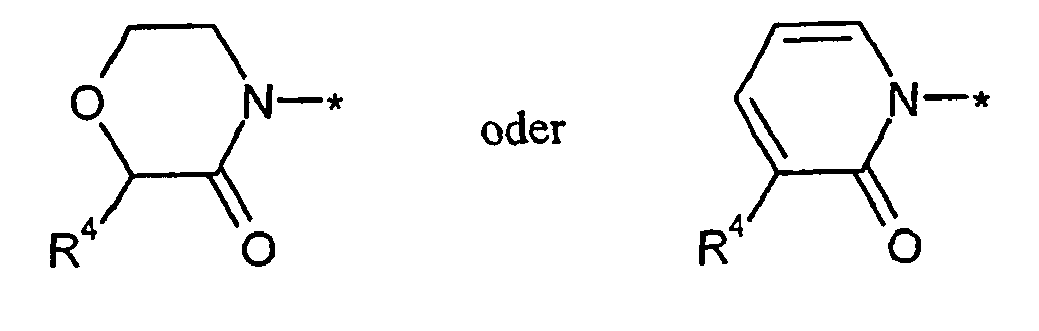
- R4
- Wasserstoff, (C1-C6)-Alkyl, Hydroxy, (C1-C6)-Alkoxy, Amino, Mono- oder Di-(C1-C6)-alkylamino, (C3-C7)-Cycloalkylamino, (C1-C6)-Alkanoylamino oder (C1-C6)-Alkoxycarbonylamino bedeutet, wobei
(C1-C6)-Alkyl, (C1-C6)-Alkoxy, Mono- und Di-(C1-C6)-alkylamino ihrerseits jeweils durch Hydroxy, (C1-C4)-Alkoxy, Amino, Mono- oder Di-(C1-C4)-alkylamino, (C3-C7)-Cycloakylamino oder einen 4- bis 7-gliedrigen gesättigten, über ein N-Atom gebundenen Heterocyclus, der ein Ringglied aus der Reihe N-R5 oder O enthalten kann, worin - R5
- Wasserstoff oder (C1-C4)-Alkyl bedeutet,
- Z
- für Phenyl, Pyridyl, Pyrimidinyl, Pyrazinyl oder Thienyl steht, die jeweils ein- oder zweifach, gleich oder verschieden, durch Substituenten ausgewählt aus der Gruppe von Fluor, Chlor, Cyano, (C1-C4)-Alkyl, welches seinerseits durch Amino substituiert sein kann, Ethinyl und Amino substituiert sein können,
- R1 und R2
- gleich oder verschieden sind und unabhängig voneinander für Wasserstoff, Fluor, Chlor, Cyano, (C1-C3)-Alkyl, Cyclopropyl, Trifluormethyl, Hydroxy, (C1-C3)-Alkoxy, Trifluormethoxy oder Amino stehen, wobei (C1-C3)-Alkyl und (C1-C3)-Alkoxy ihrerseits durch Hydroxy oder Amino substituiert sein können,
und - R3
- für Wasserstoff oder (C1-C6)-Alkyl, welches durch Hydroxy, (C1-C4)-Alkoxy, Amino oder Mono- oder Di-(C1-C4)-alkylamino substituiert sein kann, steht,
- Erfindungsgemäße Verbindungen sind die Verbindungen der Formel (I) und deren Salze, Solvate und Solvate der Salze, die von Formel (I) umfassten Verbindungen der nachfolgend genannten Formeln und deren Salze, Solvate und Solvate der Salze sowie die von Formel (I) umfassten, nachfolgend als Ausführungsbeispiele genannten Verbindungen und deren Salze, Solvate und Solvate der Salze, soweit es sich bei den von Formel (I) umfassten, nachfolgend genannten Verbindungen nicht bereits um Salze, Solvate und Solvate der Salze handelt.
- Die erfindungsgemäßen Verbindungen können in Abhängigkeit von ihrer Struktur in stereoisomeren Formen (Enantiomere, Diastereomere) existieren. Die Erfindung umfasst deshalb die Enantiomeren oder Diastereomeren und ihre jeweiligen Mischungen. Aus solchen Mischungen von Enantiomeren und/oder Diastereomeren lassen sich die stereoisomer einheitlichen Bestandteile in bekannter Weise isolieren.
- Sofern die erfindungsgemäßen Verbindungen in tautomeren Formen vorkommen können, umfasst die vorliegende Erfindung sämtliche tautomere Formen.
- Als Salze sind im Rahmen der vorliegenden Erfindung physiologisch unbedenkliche Salze der erfindungsgemäßen Verbindungen bevorzugt. Umfasst sind auch Salze, die für pharmazeutische Anwendungen selbst nicht geeignet sind, jedoch beispielsweise für die Isolierung oder Reinigung der erfindungsgemäßen Verbindungen verwendet werden können.
- Physiologisch unbedenkliche Salze der erfindungsgemäßen Verbindungen umfassen Säureadditionssalze von Mineralsäuren, Carbonsäuren und Sulfonsäuren, z.B. Salze der Chlorwasserstoffsäure, Bromwasserstoffsäure, Schwefelsäure, Phosphorsäure, Methansulfonsäure, Ethansulfonsäure, Toluolsulfonsäure, Benzolsulfonsäure, Naphthalindisulfonsäure, Essigsäure, Trifluoressigsäure, Propionsäure, Milchsäure, Weinsäure, Äpfelsäure, Zitronensäure, Fumarsäure, Maleinsäure und Benzoesäure.
- Physiologisch unbedenkliche Salze der erfindungsgemäßen Verbindungen umfassen auch Salze üblicher Basen, wie beispielhaft und vorzugsweise Alkalimetallsalze (z.B. Natrium- und Kaliumsalze), Erdalkalisalze (z.B. Calcium- und Magnesiumsalze) und Ammoniumsalze, abgeleitet von Ammoniak oder organischen Aminen mit 1 bis 16 C-Atomen, wie beispielhaft und vorzugsweise Ethylamin, Diethylamin, Triethylamin, Ethyldiisopropylamin, Monoethanolamin, Diethanolamin, Triethanolamin, Dicyclohexylamin, Dimethylaminoethanol, Prokain, Dibenzylamin, N-Methylmorpholin, Arginin, Lysin, Ethylendiamin und N-Methylpiperidin.
- Als Solvate werden im Rahmen der Erfindung solche Formen der erfindungsgemäßen Verbindungen bezeichnet, welche in festem oder flüssigem Zustand durch Koordination mit Lösungsmittelmolekülen einen Komplex bilden. Hydrate sind eine spezielle Form der Solvate, bei denen die Koordination mit Wasser erfolgt. Als Solvate sind im Rahmen der vorliegenden Erfindung Hydrate bevorzugt.
- Außerdem umfasst die vorliegende Offenbarung auch Prodrugs der erfindungsgemäßen Verbindungen. Der Begriff "Prodrugs" umfasst Verbindungen, welche selbst biologisch aktiv oder inaktiv sein können, jedoch während ihrer Verweilzeit im Körper zu erfindungsgemäßen Verbindungen umgesetzt werden (beispielsweise metabolisch oder hydrolytisch).
- Im Rahmen der vorliegenden Erfindung haben die Substituenten, soweit nicht anders spezifiziert, die folgende Bedeutung:
- (C 1 -C 6 )-Alkyl, (C 1 -C 4 )-Alkyl und (C 1 -C 3 )-Alkyl stehen im Rahmen der Erfindung für einen geradkettigen oder verzweigten Alkylrest mit 1 bis 6, 1 bis 4 bzw. 1 bis 3 Kohlenstoffatomen. Bevorzugt ist ein geradkettiger oder verzweigter Alkylrest mit 1 bis 4 bzw. 1 bis 3 Kohlenstoffatomen. Besonders bevorzugt ist ein geradkettiger oder verzweigter Alkylrest mit 1 bis 3 Kohlenstoffatomen. Beispielhaft und vorzugsweise seien genannt: Methyl, Ethyl, n-Propyl, Isopropyl, n-Butyl, isoButyl, sec.-Butyl, tert.-Butyl, 1-Ethylpropyl, n-Pentyl und n-Hexyl.
- (C 3 -C 7 )-Cycloalkyl steht im Rahmen der Erfindung für eine monocyclische Cycloalkylgruppe mit 3 bis 7 Kohlenstoffatomen. Bevorzugt ist ein Cycloalkylrest mit 3 bis 6 Kohlenstoffatomen. Beispielhaft und vorzugsweise seien genannt: Cyclopropyl, Cyclobutyl, Cyclopentyl, Cyclohexyl und Cycloheptyl.
- (C 1 -C 6 )-Alkoxy, (C 1- C 4 )-Alkoxy und (C 1 -C 3 )-Alkoxy stehen im Rahmen der Erfindung für einen geradkettigen oder verzweigten Alkoxyrest mit 1 bis 6, 1 bis 4 bzw. 1 bis 3 Kohlenstoffatomen.
- Bevorzugt ist ein geradkettiger oder verzweigter Alkoxyrest mit 1 bis 4 bzw. 1 bis 3 Kohlenstoffatomen. Besonders bevorzugt ist ein geradkettiger oder verzweigter Alkoxyrest mit 1 bis 3 Kohlenstoffatomen. Beispielhaft und vorzugsweise seien genannt: Methoxy, Ethoxy, n-Propoxy, Isopropoxy, n-Butoxy und tert.-Butoxy.
- C 1 -C 2 )-Alkanoyl [(C1-C6)-Acyl] steht im Rahmen der Erfindung für einen geradkettigen oder verzweigten Alkylrest mit 1 bis 6 Kohlenstoffatomen, der in der 1-Position ein doppelt gebundenes Sauerstoffatom trägt und über die 1-Position verknüpft ist. Bevorzugt ist ein geradkettiger oder verzweigter Alkanoylrest mit 1 bis 4 Kohlenstoffatomen. Beispielhaft und vorzugsweise seien genannt: Formyl, Acetyl, Propionyl, n-Butyryl, iso-Butyryl und Pivaloyl:
- (C 1 -C 6 )-Alkoxycarbonyl steht im Rahmen der Erfindung für einen geradkettigen oder verzweigten Alkoxyrest mit 1 bis 6 Kohlenstoffatomen, der über eine Carbonylgruppe verknüpft ist. Bevorzugt ist ein geradkettiger oder verzweigter Alkoxycarbonylrest mit 1 bis 4 Kohlenstoffatomen in der Alkoxy-Gruppe. Beispielhaft und vorzugsweise seien genannt: Methoxycarbonyl, Ethoxycarbonyl, n-Propoxycarbonyl, Isopropoxycarbonyl und tert.-Butoxycarbonyl.
- Mono-(C 1 -C 6 )-Alkylamino und Mono-(C 1 -C 4 -Alkylamino stehen im Rahmen der Erfindung für eine Amino-Gruppe mit einem geradkettigen oder verzweigten Alkylsubstituenten, der 1 bis 6 bzw. 1 bis 4 Kohlenstoffatome aufweist. Bevorzugt ist ein geradkettiger oder verzweigter Monoalkylamino-Rest mit 1 bis 4 Kohlenstoffatomen. Beispielhaft und vorzugsweise seien genannt: Methylamino, Ethylamino, n-Propylamino, Isopropylamino und tert.-Butylamino.
- Di-(C 1 -C 6 )-Alkylamino und Di-(C 1 -C 4 )-Alkylamino stehen im Rahmen der Erfindung für eine Amino-Gruppe mit zwei gleichen oder verschiedenen geradkettigen oder verzweigten Alkylsubstituenten, die jeweils 1 bis 6 bzw. 1 bis 4 Kohlenstoffatome aufweisen. Bevorzugt sind geradkettige oder verzweigte Dialkylamino-Reste mit jeweils 1 bis 4 Kohlenstoffatomen. Beispielhaft und vorzugsweise seien genannt: N,N-Dimethylamino, N,N-Diethylamino, N-Ethyl-N-methylamino, N-Methyl-N-n-propylamino, N-Isopropyl-N-n-propylamino, N-tert.-Butyl-N-methylamino, N-Ethyl-N-n-pentylamino und N-n-Hexyl-N-methylamino.
- (C 3 -C 7 )-Cycloalkylamino steht im Rahmen der Erfindung für eine Amino-Gruppe mit einem Cycloalkyl-Substituenten, der 3 bis 7 Kohlenstoffatome aufweist. Bevorzugt ist ein Cycloalkylamino-Rest mit 3 bis 6 Kohlenstoffatomen. Beispielhaft und vorzugsweise seien genannt: Cyclopropylamino, Cyclobutylamino, Cyclopentylamino, Cyclohexylamino und Cycloheptylamino.
- (C 1 -C 6 )-Alkanoylamino steht im Rahmen der Erfindung für eine Amino-Gruppe mit einem geradkettigen oder verzweigten Alkanoyl-Substituenten, der 1 bis 6 Kohlenstoffatome aufweist und über die Carbonylgruppe verknüpft ist. Bevorzugt ist ein Alkanoylamino-Rest mit 1 bis 4 Kohlenstoffatomen. Beispielhaft und vorzugsweise seien genannt: Formamido, Acetamido, Propionamido, n-Butyramido und Pivaloylamido.
- (C 1 -C 6 )-Alkoxycarbonylamino steht im Rahmen der Erfindung für eine Amino-Gruppe mit einem geradkettigen oder verzweigten. Alkoxycarbonyl-Substituenten, der im Alkoxyrest 1 bis 6 Kohlenstoffatome aufweist und über die Carbonylgruppe verknüpft ist. Bevorzugt ist ein Alkoxycarbonylamino-Rest mit 1 bis 4 Kohlenstoffatomen in der Alkoxy-Gruppe. Beispielhaft und vorzugsweise seien genannt: Methoxycarbonylamino, Ethoxycarbonylamino, n-Propoxycarbonylamino und tert.-Butoxycarbonylamino.
- Ein 4- bis 7-gliedriger Heterocyclus steht im Rahmen der Erfindung für einen gesättigten Heterocyclus mit 4 bis 7 Ringatomen, der ein Ring-Stickstoffatom enthält, über dieses verknüpft ist und ein weiteres Heteroatom aus der Reihe N oder O enthalten kann. Bevorzugt ist ein 5- oder 6-gliedriger gesättigter, N-verknüpfter Heterocyclus, der ein weiteres Heteroatom aus der Reihe N oder O enthalten kann. Beispielhaft seien genannt: Pyrrolidinyl, Oxazolidinyl, Imidazolidinyl, Piperidinyl, Piperazinyl, Morpholinyl, Azepinyl und 1,4-Diazepinyl. Besonders bevorzugt sind Pyrrolidinyl, Piperidinyl, Piperazinyl und Morpholinyl.
- Wenn Reste in den erfindungsgemäßen Verbindungen substituiert sind, können die Reste, soweit nicht anders spezifiziert, ein- oder mehrfach substituiert sein. Im Rahmen der vorliegenden Erfindung gilt, dass für alle Reste, die mehrfach auftreten, deren Bedeutung unabhängig voneinander ist. Eine Substitution mit ein, zwei oder drei gleichen oder verschiedenen Substituenten ist bevorzugt. Ganz besonders bevorzugt ist die Substitution mit einem Substituenten.
- Bevorzugt sind Verbindungen der Formel (I), in welcher
- A
- für eine Gruppe der Formel


R4A Wasserstoff, Hydroxy, Methoxy oder Amino,
R4B Methyl oder Ethyl, welche jeweils durch Hydroxy, Amino, Pyrrolidino oder Cyclopropylamino substituiert sein können, oder Amino,
R4C Wasserstoff, Methyl oder Ethyl, wobei Methyl oder Ethyl jeweils durch Hydroxy, Amino, Pyrrolidino oder Cyclopropylamino substituiert sein können,
und
* die Verknüpfungsstelle mit dem Phenylring bedeuten, - Z
- für eine Gruppe der Formel

R6 Fluor, Chlor, Methyl, Cyano oder Ethinyl
und
# die Verknüpfungsstelle mit dem Stickstoffatom bedeutet, - R1
- für Wasserstoff,
- R2
- für Wasserstoff, Fluor oder Methyl,
und - R3
- für Wasserstoff stehen,
- Besonders bevorzugt sind Verbindungen der Formel (I), in welcher
- A
- für eine heterocyclische Gruppe der Formel


- Z
- für eine Gruppe der Formel

- R1
- für Wasserstoff,
- R2
- für Wasserstoff, Fluor oder Methyl,
und - R3
- für Wasserstoff stehen,
- Die in den jeweiligen Kombinationen bzw. bevorzugten Kombinationen von Resten im einzelnen angegebenen Reste-Definitionen werden unabhängig von den jeweiligen angegebenen Kombinationen der Reste beliebig auch durch Reste-Definitionen anderer Kombinationen ersetzt.
- Ganz besonders bevorzugt sind Kombinationen von zwei oder mehreren der oben genannten Vorzugsbereiche.
- Weiterer Gegenstand der Erfindung ist ein Verfahren zur Herstellung der erfindungsgemäßen Verbindungen, dadurch gekennzeichnet, dass man entweder
- [A] Verbindungen der Formel (II)

zunächst in einem inerten Lösungsmittel in Gegenwart einer Base, wie beispielsweise Triethylamin, und eines wasserentziehenden Mittels, wie beispielsweise Pivaloylchlorid, mit einer Verbindung der Formel (III)
zu Verbindungen der Formel (IV)
umsetzt und diese dann in einem inerten Lösungsmittel in Gegenwart einer Säure mit einer Verbindung der Formel (V)
H2N—Z (V),
in welcher Z die oben angegebene Bedeutung hat,
in Verbindungen der Formel (I) überführt
oder - [B] Verbindungen der Formel (V) zunächst in einem inerten Lösungsmittel gegebenenfalls in Gegenwart einer Base mit einer Verbindung der Formel (III) zu Verbindungen der Formel (VI)

umsetzt und diese dann in einem inerten Lösungsmittel nach Aktivierung der Carbonsäure-Funktion mit einer Verbindung der Formel (II) in Verbindungen der Formel (I) überführt, - Die erfindungsgemäßen Verbindungen können gegebenenfalls auch durch weitere Umwandlungen von funktionellen Gruppen einzelner Substituenten, insbesondere den unter R3 und R4 aufgeführten Substituenten, ausgehend von den nach obigem Verfahren erhaltenen Verbindungen der Formel (I) hergestellt werden. Diese Umwandlungen werden nach üblichen Methoden durchgeführt und umfassen beispielsweise Reaktionen wie Alkylierung, Aminierung, Acylierung, Veresterung, Esterspaltung, Amid-Bildung, Oxidation oder Reduktion sowie die Einführung und Entfernung von Schutzgruppen.
- Inerte Lösungsmittel für die Verfahrensschritte (II) + (III) → (IV) und (IV) + (V) → (I) sind beispielsweise Halogenkohlenwasserstoffe wie Dichlormethan, Trichlormethan, Tetrachlormethan, 1,2-Dichlorethan, Trichlorethylen oder Chlorbenzol, oder Lösungsmittel wie Dimethylsulfoxid, Dimethylformamid, N,N'-Dimethylpropylenharnstoff (DMPU), N-Methylpyrrolidon (NMP) oder Acetonitril. Ebenso ist es möglich, Gemische der genannten Lösungsmittel zu verwenden. Bevorzugt ist Dimethylformamid.
- Als Base für den Verfahrensschritt (II) + (III) → (IV) und gegebenenfalls auch für den Verfahrensschritt (V) + (III) → (VI) eignen sich die üblichen organischen Amin-Basen. Hierzu gehören insbesondere Triethylamin, N-Methylmorpholin, N-Methylpiperidin, N,N-Diisopropylethylamin, Pyridin, 1,5-Diazabicyclo[4.3.0]non-5-en (DBN), 1,4-Diazabicyclo[2.2.2]octan (DABCO®) oder 1,8-Diazabicyclo[5.4.0]undec-7-en (DBU). Bevorzugt ist Triethylamin.
- Als wasserentziehendes Mittel im Verfahrensschritt (II) + (III) → (IV) eignen sich beispielsweise organische Carbonsäurechloride wie Acetylchlorid oder Pivaloylchlorid, organische Sulfonsäurechloride wie Methansulfonsäurechlorid, Chlorameisensäureester wie Methylchlorformiat oder Isobutylchlorformiat, oder anorganische Säurechloride oder Anhydride wie Phosphoroxychlorid, Phosphorpentachlorid, Phosphortrichlorid, Phosphorpentoxid oder Thionylchlorid. Bevorzugt wird Pivaloylchlorid verwendet.
- Als Säure für den Verfahrensschritt (IV) + (V) → (I) eignen sich beispielsweise organische Carbonsäuren oder Sulfonsäuren wie Essigsäure, Trifluoressigsäure, Methansulfonsäure oder Trifluormethansulfonsäure, oder anorganische Säuren wie Chlorwasserstoff, Bromwasserstoff, Schwefelsäure oder Phosphorsäure. Bevorzugt wird Trifluoressigsäure verwendet.
- Inerte Lösungsmittel für den Verfahrensschritt (V) + (III) → (VI) sind beispielsweise Halogenkohlenwasserstoffe wie Dichlormethan, Trichlormethan, Tetrachlormethan, Trichlorethan, Tetrachlorethan, 1,2-Dichlorethan oder Trichlorethylen, Ether wie Diethylether, Dioxan, Tetrahydrofuran, Glykoldimethylether oder Diethylenglykoldimethylether, Kohlenwasserstoffe wie Benzol, Xylol, Toluol, Hexan, Cyclohexan oder Erdölfraktionen, oder andere Lösungsmittel wie Ethylacetat, Aceton, Dimethylformamid, Dimethylsulfoxid, N,N'-Dimethylpropylenharnstoff (DMPU), N-Methylpyrrolidon (NMP) oder Acetonitril. Ebenso ist es möglich, Gemische der genannten Lösungsmittel einzusetzen. Bevorzugt ist Tetrahydrofuran oder Dimethylformamid.
- Die Verfahrensschritte (II) + (III) → (IV) und (V) + (III) → (VI) werden im Allgemeinen in einem Temperaturbereich von -20°C bis +60°C, bevorzugt von 0°C bis +40°C, durchgeführt. Die Umsetzungen können bei normalem, erhöhtem oder bei erniedrigtem Druck durchgeführt werden (z.B. von 0.5 bis 5 bar). Im Allgemeinen arbeitet man bei Normaldruck.
- Der Verfahrensschritt (IV) + (V) → (I) wird im Allgemeinen in einem Temperaturbereich von +20°C bis +100°C, bevorzugt von +50°C bis +80°C, durchgeführt. Die Umsetzung kann bei normalem, erhöhtem oder bei erniedrigtem Druck durchgeführt werden (z.B. von 0.5 bis 5 bar). Im Allgemeinen arbeitet man bei Normaldruck.
- Inerte Lösungsmittel für den Verfahrensschritt (VI) + (II) → (I) sind beispielsweise Ether wie Diethylether, Dioxan, Tetrahydrofuran, Glykoldimethylether oder Diethylenglykoldimethylether, Kohlenwasserstoffe wie Benzol, Toluol, Xylol, Hexan, Cyclohexan oder Erdölfraktionen, Halogenkohlenwasserstoffe wie Dichlormethan, Trichlormethan, Tetrachlormethan, 1,2-Dichlorethan, Trichlorethylen oder Chlorbenzol, oder andere Lösungsmittel wie Ethylacetat, Pyridin, Dimethylsulfoxid, Dimethylformamid, N,N'-Dimethylpropylenharnstoff (DMPU), N-Methylpyrrolidon (NMP), Acetonitril oder Aceton. Ebenso ist es möglich, Gemische der genannten Lösungsmittel zu verwenden. Bevorzugt sind Dichlormethan, Tetrahydrofuran, Dimethylformamid oder Gemische dieser Lösungsmittel.
- Als Kondensationsmittel für die Amidbildung im Verfahrensschritt (VI) + (II) → (I) eignen sich beispielsweise Carbodiimide wie N,N'-Diethyl-, N,N'-Dipropyl-, N,N'-Diisopropyl-, N,N'-Dicyclohexylcarbodiimid (DCC), N-(3-Dimethylaminoisopropyl)-N'-ethylcarbodiimid-Hydrochlorid (EDC), oder Phosgen-Derivate wie N,N'-Carbonyldiimidazol, oder 1,2-Oxazoliumverbindungen wie 2-Ethyl-5-phenyl-1,2-oxazolium-3-sulfat oder 2-tert.-Butyl-5-methyl-isoxazolium-perchlorat, oder Acylaminoverbindungen wie 2-Ethoxy-1-ethoxycarbonyl-1,2-dihydrochinolin, oder Isobutylchlorformiat, Propanphosphonsäureanhydrid (PPA), Cyanophosphonsäurediethylester, Bis-(2-oxo-3-oxazolidinyl)-phosphorylchlorid, Benzotriazol-1-yloxy-tris(dimethylamino)phosphonium-hexafluorophosphat, Benzotriazol-1-yloxy-tris(pyrrolidino)phosphonium-hexafluorophosphat (PyBOP), O-(Benzotriazol-1-yl)-N,N,N',N'-tetramethyluronium-tetrafluoroborat (TBTU), O-(Benzotriazol-1-yl)-N,N,N',N'-tetramethyluronium-hexafluorophosphat (HBTU), 2-(2-Oxo-1-(2H)-pyridyl)-1,1,3,3-tetramethyluronium-tetrafluoroborat (TPTU), O-(7-Azabenzotriazol-1-yl)-N,N,N',N'-tetramethyl-uronium-hexafluorophosphat (HATU) oder O-(1H-6-Chlorbenzotriazol-1-yl)-1,1,3,3-tetramethyl-uronium-tetrafluoroborat (TCTU), gegebenenfalls in Kombination mit weiteren Hilfsstoffen wie 1-Hydroxybenzotriazol (HOBt) oder N-Hydroxysuccinimid (HOSu), sowie als Basen Alkalicarbonate, z.B. Natrium- oder Kaliumcarbonat oder -hydrogencarbonat, oder organische Basen wie Trialkylamine, z.B. Triethylamin, N-Methylmorpholin, N-Methylpiperidin oder N,N-Diisopropylethylamin. Bevorzugt werden TBTU, HATU oder PPA, jeweils in Kombination mit N,N-Diisopropylethylamin, verwendet.
- Der Verfahrensschritt (VI) + (II) → (I) wird im Allgemeinen in einem Temperaturbereich von -20°C bis +60°C, bevorzugt von 0°C bis +40°C, durchgeführt. Die Umsetzung kann bei normalem, erhöhtem oder bei erniedrigtem Druck durchgeführt werden (z.B. von 0.5 bis 5 bar). Im Allgemeinen arbeitet man bei Normaldruck.
- Die Verbindungen der Formeln (II), (III) und (V) sind kommerziell erhältlich, literaturbekannt oder können in Analogie zu literaturbekannten Verfahren hergestellt werden.
- Die Herstellung der erfindungsgemäßen Verbindungen kann durch das folgende Syntheseschema veranschaulicht werden:

- [Abkürzungen: tBu = tert.-Butyl; Et = Ethyl; TBTU = O-(Benzotriazol-1-yl)-N,N,N,N'-tetramethyl-uronium-tetrafluoroborat; TFA = Trifluoressigsäure].
- Die erfindungsgemäßen Verbindungen zeigen ein nicht vorhersehbares, wertvolles pharmakologisches Wirkspektrum, insbesondere eine hohe Wirkstärke sowie eine günstige Halbwertszeit.
- Sie eignen sich daher zur Verwendung als Arzneimittel zur Behandlung und/oder Prophylaxe von Krankheiten bei Menschen und Tieren.
- Bei den erfindungsgemäßen Verbindungen handelt es sich um selektive Inhibitoren des Blutgerinnungsfaktors Xa, die insbesondere als Antikoagulantien wirken.
- Weiterer Gegenstand der vorliegenden Erfindung ist der Einsatz der erfindungsgemäßen Verbindungen zur Behandlung und/oder Prophylaxe von Erkrankungen, vorzugsweise von thromboembolischen Erkrankungen und/oder thromboembolischen Komplikationen.
- Zu den "thromboembolischen Erkrankungen" im Sinne der vorliegenden Erfindung zählen insbesondere Erkrankungen wie Herzinfarkt mit ST-Segment-Erhöhung (STEMI) und ohne ST-Segment-Erhöhung (non-STEMI), stabile Angina Pectoris, instabile Angina Pectoris, Reokklusionen und Restenosen nach Koronarinterventionen wie Angioplastie oder aortokoronarem Bypass, periphere arterielle Verschlusskrankheiten, Lungenembolien, tiefe venöse Thrombosen und Nierenvenenthrombosen, transitorische ischämische Attacken sowie thrombotischer und thromboembolischer Hirnschlag.
- Die Substanzen eignen sich daher auch zur Prävention und Behandlung von kardiogenen Thromboembolien, wie beispielsweise Hirn-Ischämien, Schlaganfall und systemischen Thromboembolien und Ischämien, bei Patienten mit akuten, intermittierenden oder persistierenden Herzarrhythmien, wie beispielsweise Vorhofflimmern, und solchen, die sich einer Kardioversion unterziehen, ferner bei Patienten mit Herzklappen-Erkrankungen oder mit künstlichen Herzklappen. Darüber hinaus sind die erfindungsgemäßen Verbindungen zur Behandlung der disseminierten intravasalen Gerinnung (DIC) geeignet.
- Thromboembolische Komplikationen treten ferner auf bei mikroangiopathischen hämolytischen Anämien, extrakorporalen Blutkreisläufen, wie Hämodialyse, sowie Herzklappenprothesen.
- Außerdem kommen die erfindungsgemäßen Verbindungen auch für die Prophylaxe und/oder Behandlung von atherosklerotischen Gefäßerkrankungen und entzündlichen Erkrankungen wie rheumatische Erkrankungen des Bewegungsapparats in Betracht, darüber hinaus ebenso für die Prophylaxe und/oder Behandlung der Alzheimer'schen Erkrankung. Außerdem können die erfindungsgemäßen Verbindungen zur Inhibition des Tumorwachstums und der Metastasenbildung, bei Mikroangiopathien, altersbedingter Makula-Degeneration, diabetischer Retinopathie, diabetischer Nephropathie und anderen mikrovaskulären Erkrankungen sowie zur Prävention und Behandlung thromboembolischer Komplikationen, wie beispielsweise venöser Thromboembolien, bei Tumorpatienten, insbesondere solchen, die sich größeren chirurgischen Eingriffen oder einer Chemo- oder Radiotherapie unterziehen, eingesetzt werden.
- Die erfindungsgemäßen Verbindungen können darüber hinaus auch zur Verhinderung von Koagulation ex vivo eingesetzt werden, z.B. zur Konservierung von Blut- und Plasmaprodukten, zur Reinigung/Vorbehandlung von Kathetern und anderen medizinischen Hilfsmitteln und Geräten, zur Beschichtung künstlicher Oberflächen von in vivo oder ex vivo eingesetzten medizinischen Hilfsmitteln und Geräten oder bei biologischen Proben, die Faktor Xa enthalten.
- Weiterer Gegenstand der vorliegenden Offenbarung ist die Verwendung der erfindungsgemäßen Verbindungen zur Behandlung und/oder Prophylaxe von Erkrankungen, insbesondere der zuvor genannten Erkrankungen.
- Weiterer Gegenstand der vorliegenden Erfindung ist die Verwendung der erfindungsgemäßen Verbindungen zur Herstellung eines Arzneimittels zur Behandlung und/oder Prophylaxe von Erkrankungen, insbesondere der zuvor genannten Erkrankungen.
- Weiterer Gegenstand der vorliegenden Offenbarung ist ein Verfahren zur Behandlung und/oder Prophylaxe von Erkrankungen, insbesondere der zuvor genannten Erkrankungen, unter Verwendung einer antikoagulatorisch wirksamen Menge der erfindungsgemäßen Verbindung.
- Weiterer Gegenstand der vorliegenden Erfindung ist ein Verfahren zur Verhinderung der Blutkoagulation in vitro, insbesondere bei Blutkonserven oder biologischen Proben, die Faktor Xa enthalten, das dadurch gekennzeichnet ist, dass eine antikoagulatorisch wirksame Menge der erfindungsgemäßen Verbindung zugegeben wird.
- Weiterer Gegenstand der vorliegenden Erfindung sind Arzneimittel, enthaltend eine erfindungsgemäße Verbindung und einen oder mehrere weitere Wirkstoffe, insbesondere zur Behandlung und/oder Prophylaxe der zuvor genannten Erkrankungen. Als geeignete Kombinationswirkstoffe seien beispielhaft und vorzugsweise genannt:
- Lipidsenker, insbesondere HMG-CoA-(3-Hydroxy-3-methylglutaryl-Coenzym A)-Reduktase-Inhibitoren;
- Koronartherapeutika/Vasodilatatoren, insbesondere ACE-(Angiotensin-Converting-Enzyme)-Inhibitoren; AII-(Angiotensin II)-Rezeptor-Antagonisten; β-Adrenozeptor-Antagonisten; alpha-1-Adrenozeptor-Antagonisten; Diuretika; Calciumkanal-Blocker; Substanzen, die eine Erhöhung von cyclischem Guanosinmonophosphat (cGMP) bewirken, wie beispielsweise Stimulatoren der löslichen Guanylatcyclase;
- Plasminogen-Aktivatoren (Thrombolytika/Fibrinolytika) und die Thrombolyse/Fibrinolyse steigernde Verbindungen wie Inhibitoren des Plasminogen-Aktivator-Inhibitors (PAI-Inhibitoren) oder Inhibitoren des Thrombin-aktivierten Fibrinolyse-Inhibitors (TAFI-Inhibitoren);
- antikoagulatorisch wirksame Substanzen (Antikoagulantien);
- plättchenaggregationshemmende Substanzen (Plättchenaggregationshemmer, Thrombozytenaggregationshemmer);
- Fibrinogen-Rezeptor-Antagonisten (Glycoprotein-IIb/IIIa-Antagonisten);
- sowie Antiarrhythmika.
- Weiterer Gegenstand der vorliegenden Erfindung sind Arzneimittel, die mindestens eine erfindungsgemäße Verbindung, üblicherweise zusammen mit einem oder mehreren inerten, nicht-toxischen, pharmazeutisch geeigneten Hilfsstoffen enthalten, sowie deren Verwendung zu den zuvor genannten Zwecken.
- Die erfindungsgemäßen Verbindungen können systemisch und/oder lokal wirken. Zu diesem Zweck können sie auf geeignete Weise appliziert werden, wie z.B. oral, parenteral, pulmonal, nasal, sublingual, lingual, buccal, rectal, dermal, transdermal, conjunctival, otisch oder als Implantat bzw. Stent.
- Für diese Applikationswege können die erfindungsgemäßen Verbindungen in geeigneten Applikationsformen verabreicht werden.
- Für die orale Applikation eignen sich nach dem Stand der Technik funktionierende, die erfindungsgemäßen Verbindungen schnell und/oder modifiziert abgebende Applikationsformen, die die erfindungsgemäßen Verbindungen in kristalliner und/oder amorphisierter und/oder gelöster Form enthalten, wie z.B. Tabletten (nicht-überzogene oder überzogene Tabletten, beispielsweise mit magensaftresistenten oder sich verzögert auflösenden oder unlöslichen Überzügen, die die Freisetzung der erfindungsgemäßen Verbindung kontrollieren), in der Mundhöhle schnell zerfallende Tabletten oder Filme/Oblaten, Filme/Lyophylisate, Kapseln (beispielsweise Hart- oder Weichgelatinekapseln), Dragees, Granulate, Pellets, Pulver, Emulsionen, Suspensionen, Aerosole oder Lösungen.
- Die parenterale Applikation kann unter Umgehung eines Resorptionsschrittes geschehen (z.B. intravenös, intraarteriell, intrakardial, intraspinal oder intralumbal) oder unter Einschaltung einer Resorption (z.B. intramuskulär, subcutan, intracutan, percutan oder intraperitoneal). Für die parenterale Applikation eignen sich als Applikationsformen u.a. Injektions- und Infusionszubereitungen in Form von Lösungen, Suspensionen, Emulsionen, Lyophilisaten oder sterilen Pulvern.
- Für die sonstigen Applikationswege eignen sich z.B. Inhalationsarzneiformen (u.a. Pulverinhalatoren, Nebulizer), Nasentropfen, -lösungen oder -sprays, lingual, sublingual oder buccal zu applizierende Tabletten, Filme/Oblaten oder Kapseln, Suppositorien, Ohren- oder -Augen-präparationen, Vaginalkapseln, wäßrige Suspensionen (Lotionen, Schüttelmixturen), lipophile Suspensionen, Salben, Cremes, transdermale therapeutische Systeme (z.B. Pflaster), Milch, Pasten, Schäume, Streupuder, Implantate oder Stents.
- Bevorzugt sind die orale oder parenterale Applikation, insbesondere die orale Applikation.
- Die erfindungsgemäßen Verbindungen können in die angeführten Applikationsformen überführt werden. Dies kann in an sich bekannter Weise durch Mischen mit inerten, nichttoxischen, pharmazeutisch geeigneten Hilfsstoffen geschehen. Zu diesen Hilfsstoffen zählen u.a. Trägerstoffe (beispielsweise mikrokristalline Cellulose, Lactose, Mannitol), Lösungsmittel (z.B. flüssige Polyethylenglycole), Emulgatoren und Dispergier- oder Netzmittel (beispielsweise Natriumdodecylsulfat, Polyoxysorbitanoleat), Bindemittel (beispielsweise Polyvinylpyrrolidon), synthetische und natürliche Polymere (beispielsweise Albumin), Stabilisatoren (z.B. Antioxidantien wie beispielsweise Ascorbinsäure), Farbstoffe (z.B. anorganische Pigmente wie beispielsweise Eisenoxide) und Geschmacks- und/oder Geruchskorrigentien.
- Im Allgemeinen hat es sich als vorteilhaft erwiesen, bei parenteraler Applikation Mengen von etwa 0.001 bis 1 mg/kg, vorzugsweise etwa 0.01 bis 0.5 mg/kg Körpergewicht zur Erzielung wirksamer Ergebnisse zu verabreichen. Bei oraler Applikation beträgt die Dosierung etwa 0.01 bis 100 mg/kg, vorzugsweise etwa 0.01 bis 20 mg/kg und ganz besonders bevorzugt 0.1 bis 10 mg/kg Körpergewicht.
- Trotzdem kann es gegebenenfalls erforderlich sein, von den genannten Mengen abzuweichen, und zwar in Abhängigkeit von Körpergewicht, Applikationsweg, individuellem Verhalten gegenüber dem Wirkstoff, Art der Zubereitung und Zeitpunkt bzw. Intervall, zu welchem die Applikation erfolgt. So kann es in einigen Fällen ausreichend sein, mit weniger als der vorgenannten Mindestmenge auszukommen, während in anderen Fällen die genannte obere Grenze überschritten werden muss. Im Falle der Applikation größerer Mengen kann es empfehlenswert sein, diese in mehreren Einzelgaben über den Tag zu verteilen.
- Die nachfolgenden Ausführungsbeispiele erläutern die Erfindung. Die Erfindung ist nicht auf die Beispiele beschränkt.
- Die Prozentangaben in den folgenden Tests und Beispielen sind, sofern nicht anders angegeben, Gewichtsprozente; Teile sind Gewichtsteile. Lösungsmittelverhältnisse, Verdünnungsverhältnisse und Konzentrationsangaben von flüssig/flüssig-Lösungen beziehen sich jeweils auf das Volumen.
-
- DCI
- direkte chemische Ionisation (bei MS)
- DMF
- N,N-Dimethylformamid
- DMSO
- Dimethylsulfoxid
- d. Th.
- der Theorie (bei Ausbeute)
- ee
- Enantiomerenüberschuss
- eq.
- Äquivalent(e)
- ESI
- Elektrospray-Ionisation (bei MS)
- h
- Stunde(n)
- HPLC
- Hochdruck-, Hochleistungsflüssigchromatographie
- LC-MS
- Flüssigchromatographie-gekoppelte Massenspektroskopie
- min
- Minute(n)
- MS
- Massenspektroskopie
- NMR
- Kernresonanzspektroskopie
- RP
- reverse phase (bei HPLC)
- RT
- Raumtemperatur
- Rt
- Retentionszeit (bei HPLC)
- THF
- Tetrahydrofuran
- Gerätetyp MS: Micromass ZQ; Gerätetyp HPLC: Waters Alliance 2795; Säule: Phenomenex Synergi 2µ Hydro-RP Mercury 20 mm x 4 mm; Eluent A: 11 Wasser + 0.5 ml 50%-ige Ameisensäure, Eluent B: 1 1 Acetonitril + 0.5 ml 50%-ige Ameisensäure; Gradient: 0.0 min 90% A → 2.5 min 30% A → 3.0 min 5% A → 4.5 min 5% A; Fluss: 0.0 min 1 ml/min, 2.5 min/3.0 min/4.5 min 2 ml/min; Ofen: 50°C; UV-Detektion: 210 nm.
- Gerätetyp MS: Micromass ZQ; Gerätetyp HPLC: HP 1100 Series; UV DAD; Säule: Phenomenex Synergi 2µ Hydro-RP Mercury 20 mm x 4 mm; Eluent A: 1 1 Wasser + 0.5 ml 50%-ige Ameisensäure, Eluent B: 1 1 Acetonitril + 0.5 ml 50%-ige Ameisensäure; Gradient: 0.0 min 90% A → 2.5 min 30% A → 3.0 min 5% A → 4.5 min 5% A; Fluss: 0.0 min 1 ml/min, 2.5 min/3.0 min/4.5 min 2 ml/min; Ofen: 50°C; UV-Detektion: 210 nm.
- Instrument: Micromass Quattro LCZ mit HPLC Agilent Serie 1100; Säule: Phenomenex Synergi 2µ Hydro-RP Mercury 20 mm x 4 mm; Eluent A: 1 1 Wasser + 0.5 ml 50%-ige Ameisensäure, Eluent B: 1 l Acetonitril + 0.5 ml 50%-ige Ameisensäure; Gradient: 0.0 min 90% A → 2.5 min 30% A → 3.0 min 5% A → 4.5 min 5% A; Fluss: 0.0 min 1 ml/min, 2.5 min/3.0 min/4.5 min 2 ml/min; Ofen: 50°C; UV-Detektion: 208-400 nm.
- Instrument: Micromass Platform LCZ mit HPLC Agilent Serie 1100; Säule: Phenomenex Synergi 2µ Hydro-RP Mercury 20 mm x 4 mm; Eluent A: 1 l Wasser + 0.5 ml 50%-ige Ameisensäure, Eluent B: 1 l Acetonitril + 0.5 ml 50%-ige Ameisensäure; Gradient: 0.0 min 90% A → 2.5 min 30% A → 3.0 min 5% A → 4.5 min 5% A; Fluss: 0.0 min 1 ml/min, 2.5 min/3.0 min/4.5 min 2 ml/min; Ofen: 50°C; UV-Detektion: 210 nm.
- Instrument: Micromass Platform LCZ mit HPLC Agilent Serie 1100; Säule: Thermo HyPURITY Aquastar 3µ 50 mm x 2.1 mm; Eluent A: 1 1 Wasser + 0.5 ml 50%-ige Ameisensäure, Eluent B: 1 1 Acetonitril + 0.5 ml 50%-ige Ameisensäure; Gradient: 0.0 min 100% A → 0.2 min 100% A → 2.9 min 30% A → 3.1 min 10% A → 5.5 min 10% A; Ofen: 50°C; Fluss: 0.8 ml/min; UV-Detektion: 210 nm.
- Gerätetyp MS: Micromass ZQ; Gerätetyp HPLC: Waters Alliance 2795; Säule: Merck Chromolith SpeedROD RP-18e 50 mm x 4.6 mm; Eluent A: 11 Wasser + 0.5 ml 50%-ige Ameisensäure, Eluent B: 1 l Acetonitril + 0.5 ml 50%-ige Ameisensäure; Gradient: 0.0 min 10% B → 3.0 min 95% B → 4.0 min 95% B; Ofen: 35°C; Fluss: 0.0 min 1.0 ml/min → 3.0 min 3.0 ml/min → 4.0 min 3.0 ml/min; UV-Detektion: 210 nm.
- Instrument: HP 1100 mit DAD-Detektion; Säule: Kromasil 100 RP-18, 60 mm x 2.1 mm, 3.5 µm; Eluent A: 5 ml HClO4 (70%-ig) / 1 Wasser, Eluent B: Acetonitril; Gradient: 0 min 2% B → 0.5 min 2% B → 4.5 min 90% B → 9 min 0% B → 9.2 min 2% B → 10 min 2% B; Fluss: 0.75 ml/min; Säulentemperatur: 30°C; UV-Detektion: 210 nm.
- Instrument: HP 1100 mit DAD-Detektion; Säule: Kromasil 100 RP-18, 60 mm x 2.1 mm, 3.5 µm; Eluent A: 5 ml HClO4 (70%-ig) / l Wasser, Eluent B: Acetonitril; Gradient: 0 min 2% B → 0.5 min 2% B → 4.5 min 90% B → 15 min 90% B → 15.2 min 2% B → 16 min 2% B; Fluss: 0.75 ml/min; Säulentemperatur: 30°C; UV-Detektion: 210 nm.
- Instrument: HP 1100 mit DAD-Detektion; Säule: Kromasil 100 RP-18, 60 mm x 2.1 mm, 3.5 µm; Eluent A: 5 ml HClO4 (70%-ig) / 1 Wasser, Eluent B: Acetonitril; Gradient: 0 min 2% B → 0.5 min 2% B → 4.5 min 90% B → 6.5 min 90% B → 6.7 min 2% B → 7.5 min 2% B; Fluss: 0.75 ml/min; Säulentemperatur: 30°C; UV-Detektion: 210 nm.
-

- Die Darstellung erfolgt durch Reduktion von 1-(4-Nitrophenyl)-2-pyrrolidinon, siehe Reppe et al., Justus Liebigs Ann. Chem. 1955, 596, 209.
-

- Die Darstellung erfolgt auf literaturbekanntem Weg, siehe M. Artico et al., Farmaco Ed. Sci. 1969, 24, 179-190.
-
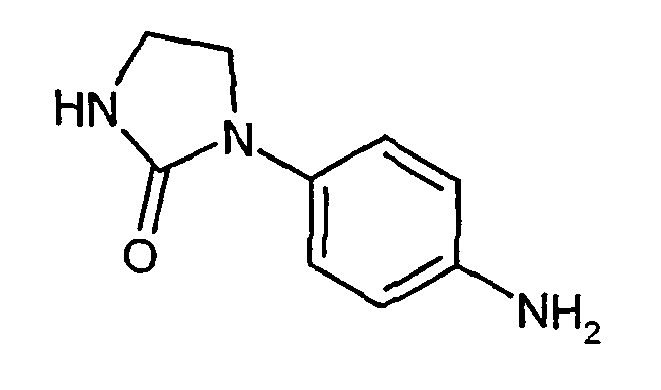
- 2.0 g (9.6 mmol) 1-(4-Nitrophenyl)imidazolidin-2-on [dargestellt durch Mitsunobu-Reaktion von 1-(2-Hydroxyethyl)-3-(4-nitrophenyl)harnstoff, siehe T.H. Kim, G.J. Lee, M.-H. Cha, Synth. Commun. 1999, 29, 2753-2758] werden in 20 ml DMF/THF (1:1) gelöst, mit 200 mg Palladium auf Aktivkohle (5%-ig) versetzt und in einer Wasserstoffatmosphäre bei RT und Normaldruck hydriert. Nach 12 h wird das Reaktionsgemisch mit Tonsil über Celite abgesaugt, mit THF gewaschen, das Filtrat eingeengt und der Rückstand im Hochvakuum getrocknet.
Ausbeute: 1.7 g (93% d. Th.)
LC-MS (Methode 7): Rt = 0.31 min;
MS (ESIpos): m/z = 178 [M+H]+. -

- Die Darstellung erfolgt analog einer literaturbekannten Methode [A. Klapers et al., J. Am. Chem. Soc. 2002, 124, 7421-7428] aus 2-Fluor-4-iodanilin und 3-Hydroxypiperidin-2-on [Darstellung siehe I.S. Hutchinson et al., Tetrahedron 2002, 58, 3137-3143]:
- Eine Suspension aus 6.45 g (27.2 mmol) 2-Fluor-4-iodanilin, 3.92 g (34.0 mmol, 1.25 eq.) 3-Hydroxypiperidin-2-on, 1.04 g (5.5 mmol, 0.2 eq.) Kupfer(I)iodid, 11.56 g (54.5 mmol, 2 eq.) Kaliumphosphat und 1.2 ml (10.9 mmol, 0.4 eq.) N,N-Dimethylethylendiamin in 157 ml Dioxan wird unter Argon über Nacht unter Rückfluss gerührt. Es werden weitere 1.04 g (5.5 mmol, 0.2 eq.) Kupfer(I)iodid und 0.9 ml (8.2 mmol, 0.3 eq.) N,N-Dimethylethylendiamin nachgegeben, und das Reaktionsgemisch wird weitere 8h lang unter Rückfluss gerührt. Die Suspension wird über eine Kieselgur-Schicht filtriert und der Rückstand mit einer Mischung aus Dichlormethan und Methanol (1:1) gewaschen. Die vereinigten Filtrate werden im Vakuum eingeengt. Das Rohprodukt wird mittels Flash-Chromatographie gereinigt (Kieselgel 60, Eluent: Dichlormethan/Methanol 100:1 → 40:1).
Ausbeute: 2.57 g (41 % d. Th.)
HPLC (Methode 9): Rt = 1.52 min;
MS (DCI, NH3): m/z = 242 [M+NH4]+;
1H-NMR (300 MHz, DMSO-d6): δ = 6.94 (d, 1H), 6.81-6.65 (m, 2H), 5.12 (br. s, 2H), 3.99 (dt, 1H), 3.63-3.39 (m, 2H), 2.12-2.00 (m, 1H), 2.00-1.62 (m, 4H). -

- Die Darstellung erfolgt analog einer literaturbekannten Methode [A. Klapers et al., J. Am. Chem. Soc. 2002, 124, 7421-7428] aus 7.48 g (34.2 mmol) 4-Iodanilin und 9.00 g (42.0 mmol, 1.23 eq.) tert.-Butyl (2-oxopiperidin-3-yl)carbamat [Darstellung siehe K.-L. Yu et al., J. Med. Chem. 1988, 31, 1430-1436]; siehe auch Beispiel 4A.
Ausbeute: 6.4 g (60% d. Th.)
HPLC (Methode 9): Rt = 3.50 min;
MS (ESIpos): m/z= 306 [M+H]+;
1H-NMR (300 MHz, DMSO-d6): δ = 6.85 (d, 1H), 6.52 (d, 2H), 5.00 (s, 2H), 4.10-3.94 (m, 1H), 3.52-3.42 (m, 2H), 2.08-1.95 (m, 1H), 1.95-1.69 (m, 3H). -

- Die Darstellung erfolgt durch Substitution von 4-Fluornitrobenzol mit Morpholin-3-on [J.-M. Lehn, F. Montavon, Helv. Chim. Acta 1976, 59, 1566-1583] und anschließende Reduktion des 4-(4-Nitrophenyl)morpholin-3-ons (siehe
WO O1/47919 -

- Die Darstellung erfolgt analog einer literaturbekannten Methode [A. Klapers et al., J. Am. Chem. Soc. 2002, 124, 7421-7428] aus 5.0 g (21.1 mmol) 2-Fluor-4-iodanilin und 2.6 g (26 mmol, 1.23 eq.) Morpholin-3-on; siehe auch Beispiel 4A.
Ausbeute: 4.2 g (94% d. Th.)
HPLC (Methode 2): Rt = 0.85 min;
MS (ESIpos): m/z = 211 [M+H]+;
1H-NMR (300 MHz, DMSO-d6): δ = 7.06 (dd, 1H), 6.87 (dd, 1H), 6.73 (dd, 1H), 5.18 (br. s, 2H), 4.14 (s, 2H), 3.92 (t, 2H), 3.62 (t, 2H). -

-

- Zu einer Lösung von 13.7 g (81.9 mmol, 1.4 eq.) Lithium-1,1,1,3,3,3-hexamethyldisilazan-2-id in 400 ml THF werden bei -70°C unter Argon 13.0 g (58.5 mmol) 4-(4-Nitrophenyl)morpholin-3-on [J.-M. Lehn, F. Montavon, Helv. Chim. Acta 1976, 59, 1566-1583] gegeben. Das Reaktionsgemisch wird 10 min gerührt und dann mit 5.4 ml (58.5 mmol, 1.0 eq.) 3-Iod-1-propen, das zuvor über wenig Aluminiumoxid mit THF filtriert worden ist, versetzt. Das Reaktionsgemisch wird langsam auf RT kommen gelassen, auf ca. 100 ml Volumen eingeengt und mit einer Mischung aus Dichlormethan und Wasser versetzt. Nach Phasentrennung wird die wässrige Phase mit Dichlormethan extrahiert, die organischen Phasen über Magnesiumsulfat getrocknet, filtriert und im Vakuum eingeengt. Das Rohprodukt wird mittels Flash-Chromatographie gereinigt (Kieselgel 60, Eluent: Cyclohexan → Cyclohexan/Ethylacetat 1:1).
Ausbeute: 4.1 g (27% d. Th.)
LC-MS (Methode 1): Rt = 1.78 min;
MS (ESIpos): m/z = 263 [M+H]+. -

- Eine Lösung von 1.33 g (5.07 mmol) 2-Allyl-4-(4-nitrophenyl)morpholin-3-on in 60 ml Tetrahydrofuran/Wasser (1:1) wird bei RT mit 0.62 ml (0.10 mmol, 0.02 eq.) einer 4%-igen wässrigen Osmiumtetroxid-Lösung und 3.25 g (15.2 mmol, 3 eq.) Natriumperiodat versetzt. Das Reaktionsgemisch wird 1.3 h bei RT gerührt und mit einer Mischung aus Wasser und Dichlormethan verdünnt. Nach Phasentrennung wird die wässrige Phase mit Dichlormethan extrahiert, und die vereinigten organischen Phasen werden über Magnesiumsulfat getrocknet, filtriert und im Vakuum eingeengt. Der Rückstand wird in 40 ml Tetrahydrofuran/Wasser (1:1) aufgenommen, die Reaktionslösung bei RT mit 96 mg (2.5 mmol, 0.5 eq.) Natriumborhydrid versetzt und 5 min bei RT gerührt. Nach Zugabe einer Mischung aus Wasser und Dichlormethan und Phasentrennung wird die wässrige Phase mit Dichlormethan extrahiert, und die vereinigten organischen Phasen werden über Natriumsulfat getrocknet, filtriert und im Vakuum eingeengt. Das Rohprodukt wird mittels Flash-Chromatographie gereinigt (Kieselgel 60, Eluent: Dichlormethan → Dichlormethan/Methanol 10:1).
Ausbeute: 1.1 g (80% d. Th.)
LC-MS (Methode 2): Rt = 1.49 min;
MS (ESIpos): m/z = 267 [M+H]+. -

- Eine Lösung aus 1.10 g (4.13 mmol) 2-(2-Hydroxyethyl)-4-(4-nitrophenyl)morpholin-3-on in 7 ml DMF wird bei RT mit 563 mg (8.26 mmol, 2 eq.) Imidazol und 934 mg (6.20 mmol, 1.5 eq.) tert.-Butyldimethylsilylchlorid versetzt und über Nacht bei 90°C gerührt. Das Reaktionsgemisch wird in gesättigte wässrige Natriumhydrogencarbonat-Lösung gegeben. Nach Zugabe von Diethylether und Phasentrennung wird die wässrige Phase mit Diethylether extrahiert, und die vereinigten organischen Phasen werden mit gesättigter wässriger Natriumchlorid-Lösung gewaschen, über Magnesiumsulfat getrocknet, filtriert und im Vakuum eingeengt. Das Rohprodukt wird ohne weitere Reinigung in der nächsten Stufe eingesetzt.
Ausbeute: 1.67 g (97% Reinheit)
LC-MS (Methode 1): Rt = 2.87 min;
MS (ESIpos): m/z = 381 [M+H]+. -

- Eine Lösung aus 1.2 g (3.15 mmol) 2-(2-{[tert.-Butyl(dimethyl)silyl)oxy}ethyl)-4-(4-nitrophenyl)-morpholin-3-on in 15 ml Ethanol und 10 ml Wasser wird bei RT mit 5.0 ml einer 5%-igen wässrigen Eisentrichlorid-Lösung und 652 mg (11.7 mmol, 3.7 eq.) Eisenpulver versetzt und 2.5 h unter Rückfluss gerührt. Die Reaktionslösung wird heiß über Celite filtriert und im Vakuum eingeengt. Nach Zugabe von Wasser und Dichlormethan wird die Reaktionslösung mit einem Tropfen Ammoniak-Lösung alkalisch gestellt und nochmals über Celite filtriert. Nach Phasentrennung wird die wässrige Phase mit Dichlormethan extrahiert, und die vereinigten organischen Phasen werden über Magnesiumsulfat getrocknet, filtriert und im Vakuum eingeengt.
Ausbeute: 899 mg (95% Reinheit, 77% d. Th.)
LC-MS (Methode 1): Rt = 2.23 min;
MS (ESIpos): m/z = 351 [M+H]+;
1H-NMR (300 MHz, CDCl3): δ = 7.00 (d, 2H), 6.61 (d, 2H), 4.30 (dd, 1H), 4.08-3.98 (m, 1H), 3.87 (dd, 1H), 3.82-3.70 (m, 3H), 3.50-3.39 (m, 1H), 2.36-2.21 (m, 1H), 1.95-1.81 (m, 1H), 0.84 (s, 9H), 0.01 (s, 6H). -
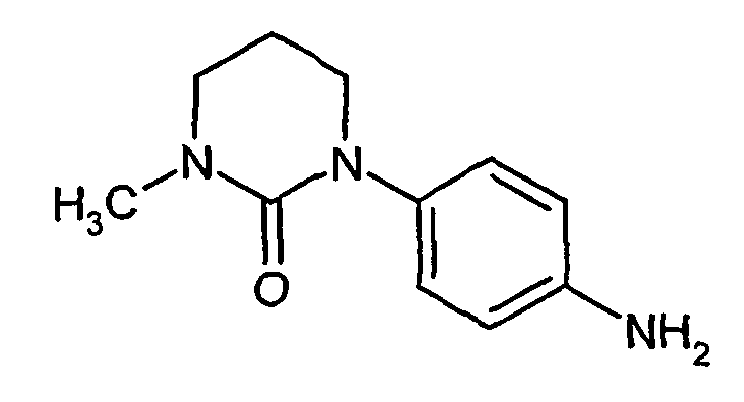
-

- Eine Lösung aus 10.0 g (87.6 mmol) 1-Methyltetrahydropyrimidin-2(1H)-on [Darstellung siehe
DE 1 121 617 ; Chem. Abstr. 1962, 56, 11601g] in 300 ml DMF wird unter Argon bei RT mit 14.8 g (131.4 mmol, 1.5 eq.) Kalium-tert.-butylat versetzt und 45 min bei RT gerührt. Anschließend wird das Reaktionsgemisch portionsweise mit 14.8 g (105.1 mmol, 1.2 eq.) 1-Fluor-4-nitrobenzol versetzt, über Nacht bei RT gerührt und dann im Vakuum eingeengt. Der Rückstand wird in einer Mischung aus gesättigter wässriger Natriumhydrogencarbonat-Lösung und Ethylacetat aufgenommen. Nach Phasentrennung wird die wässrige Phase mit Ethylacetat extrahiert. Die vereinigten organischen Phasen werden mit gesättigter wässriger Natriumchlorid-Lösung gewaschen, über Natriumsulfat getrocknet, filtriert und im Vakuum eingeengt. Der Rückstand wird in Toluol verrührt, abfiltriert und im Vakuum getrocknet.
Ausbeute: 9.4 g (46% d. Th.)
LC-MS (Methode 2): Rt = 1.68 min;
MS (ESIpos): m/z = 236 [M+H]+;
1H-NMR (300 MHz, DMSO-d6): δ = 8.14 (d, 2H), 7.55 (d, 2H), 3.77 (t, 2H), 3.38 (t, 2H), 2.90 (s, 3H), 2.05 (t, 2H). -

- Eine Lösung aus 10.0 g (42.5 mmol) 1-Methyl-3-(4-nitrophenyl)tetrahydropyrimidin-2(1H)-on in 400 ml THF wird unter Argon mit 2.0 g Palladium auf Aktivkohle (5%-ig) versetzt und in einer Wasserstoffatmosphäre bei RT und Normaldruck über Nacht hydriert. Das Reaktionsgemisch wird mit Tonsil über Celite abgesaugt, mit Methanol gewaschen und das Filtrat im Vakuum eingeengt und getrocknet.
Ausbeute: 8.6 g (99% d. Th.)
LC-MS (Methode 5): Rt = 2.00 min;
MS (ESIpos): m/z = 206 [M+H]+;
1H-NMR (300 MHz, DMSO-d6): δ = 6.82 (d, 2H), 6.48 (d, 2H), 4.88 (br. s, 2H), 3.49 (t, 2H), 3.28 (t, 2H), 2.80 (s, 3H), 1.98 (quintett, 2H). -
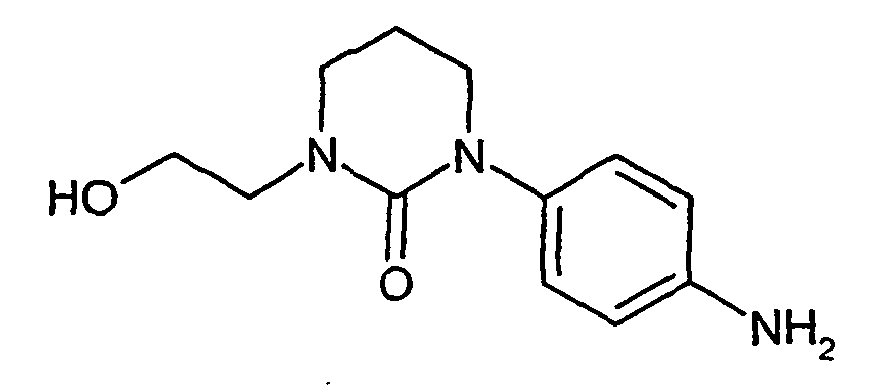
-

- Die Darstellung erfolgt analog einer literaturbekannten Methode [A. Klapers et al., J. Am. Chem. Soc. 2002, 124, 7421-7428] aus 5.00 g (20.1 mmol) 1-Iod-4-nitrobenzol und 3.56 g (24.7 mmol, 1.23 eq.) 1-(2-Hydroxyethyl)tetrahydropyrimidin-2(1H)-on [Darstellung siehe
DE 1 121 617 ; Chem. Abstr. 1962, 56, 11601g]; siehe auch Beispiel 4A.
Ausbeute: 2.93 g (51 % d. Th.)
LC-MS (Methode 2): Rt = 1.49 min;
MS (ESIpos): m/z = 266 [M+H]+. -

- Eine Lösung aus 200 mg (0.75 mmol) 1-(2-Hydroxyethyl)-3-(4-nitrophenyl)tetrahydropyrimidin-2(1H)-on in 10 ml Methanol wird unter Argon mit 35 mg Palladium auf Aktivkohle (10%-ig) versetzt und in einer Wasserstoffatmosphäre bei RT und Normaldruck für 2 h hydriert. Der Katalysator wird über eine Kieselgel-Schicht abgetrennt und das Filtrat im Vakuum eingeengt. Der Rückstand wird in Diethylether verrührt, abfiltriert und im Vakuum getrocknet.
Ausbeute: 156 mg (88% d. Th.)
HPLC (Methode 9): Rt = 2.47 min;
MS (ESIpos): m/z = 236 [M+H]+;
1H-NMR (300 MHz, DMSO-d6): δ = 6.84 (d, 2H), 6.48 (d, 2H), 4.92 (s, 1H), 3.54-3.43 (m, 4H), 3.39 (t, 2H), 3.29 (t, 2H), 1.95 (q, 2H). -

- Die Darstellung erfolgt analog der Synthese von Beispiel 4A aus 5.39 g (22.8 mmol) 4-Iod-2-fluoranilin und 4.00 g (28.5 mmol, 1.25 eq.) 3-(Hydroxymethyl)pyridin-2(1H)-on [Darstellung siehe S. McN. Sieburth et al., Chem. Commun. 1996, 19, 2249-2250].
Ausbeute: 3.46 g (65% d. Th.)
HPLC (Methode 9): Rt = 2.44 min;
MS (ESIpos): m/z = 235 [M+H]+;
1H-NMR (300 MHz, DMSO-d6): δ = 7.48 (m, 2H), 7.10 (dd, 1H), 6.89 (dd, 1H), 6.80 (t, 1H), 6.30 (t, 1H), 5.39 (s, 2H), 5.11 (t, 1H), 4.31 (d, 2H). -

- 68.0 g (0.53 mol) 2-Amino-5-chlorpyridin werden in 1100 ml THF gelöst und portionsweise mit 95.3 g (0.63 mol) 2,3-Pyrazindicarbonsäureanhydrid versetzt. Die Suspension wird eine Stunde bei Raumtemperatur gerührt. Anschließend wird der Niederschlag abfiltriert. Das Filtrat wird eingeengt und der Rückstand mit dem Niederschlag vereinigt. Es wird in Diethylether verrührt, erneut filtriert und im Vakuum getrocknet.
Ausbeute: 154 g (99% d. Th.)
HPLC (Methode 9): Rt = 3.50 min;
MS (ESIpos): m/z = 279 [M+H]+;
1H-NMR (300 MHz, DMSO-d6): δ = 13.89 (br. s, 1H), 11.07 (s, 1H), 8.90 (dd, 2H), 8.44 (s, 1H), 8.20 (d, 1H), 8.01 (dd, 1H). -

- 500 mg (4.27 mmol) 4-Ethinylanilin und 641 mg (4.27 mmol) 2,3-Pyrazindicarbonsäureanhydrid werden analog der für Beispiel 12A beschriebenen Methode umgesetzt.
Ausbeute: 1.08 g (96% Reinheit, 91% d. Th.)
HPLC (Methode 3): Rt = 1.49 min;
MS (ESIpos): m/z = 224 [M+H-CO2]+. -

- 100 mg (0.78 mmol) 4-Chloranilin und 118 mg (0.78 mmol) 2,3-Pyrazindicarbonsäureanhydrid werden analog der für Beispiel 12A beschriebenen Methode umgesetzt.
Ausbeute: 115 mg (53% d. Th.)
HPLC (Methode 1): Rt = 1.28 min;
MS (ESIpos): m/z = 234 [M+H-CO2]+;
1H-NMR (300 MHz, DMSO-d6): δ = 13.80 (br. s, 1H), 10.92 (s, 1H), 8.90 (dd, 2H), 7.82 (d, 2H), 7.44 (d, 2H). -

- 1.07 g (6 mmol) 3-(4-Aminophenyl)-1,3-oxazolidin-2-on (Beispiel 2A) werden unter Argon in 15 ml absolutem DMF gelöst. Dann werden 0.9 g (6 mmol) Pyrazindicarbonsäureanhydrid zugegeben und die Reaktionslösung 1 h gerührt. Nach Zugabe von 0.75 ml (0.55 g, 5.4 mmol) Triethylamin und 0.81 ml (0.8 g, 6.6 mmol) Pivaloylchlorid wird die Reaktionsmischung 0.5 h bei RT gerührt und danach mit Wasser verdünnt. Die Kristalle werden abgesaugt, mit Methanol und tert.-Butylmethylether gewaschen und im Vakuum getrocknet.
Ausbeute: 1.4 g (75% d. Th.)
LC-MS (Methode 3): Rt = 1.51 min;
MS (ESIpos): m/z = 311 [M+H]+;
1H-NMR (300 MHz, DMSO-d6): δ = 9.05 (s, 2H), 7.75 (d, 2H), 7.5 (d, 2H), 4.5 (tr, 2H), 4.15 (tr, 2H). -

- Die Darstellung erfolgt analog der Synthese von Beispiel 15A aus 1.06 g (6 mmol) 1 -(4-Amino- phenyl)pyrrolidin-2-on (Beispiel 1A) und 0.9 g (6 mmol) Pyrazindicarbonsäureanhydrid.
Ausbeute: 0.98 g (53% d. Th.)
LC-MS (Methode 3): Rt = 1.59 min;
MS (ESIpos): m/z = 309 [M+H]+;
1H-NMR (300 MHz, DMSO-d6): δ = 9.05 (s, 2H), 7.85 (d, 2H), 7.45 (d, 2H), 3.9 (tr, 2H), 2.55 (tr, 2H), 2.1 (quintett, 2H). -

- Die Darstellung erfolgt analog der Synthese von Beispiel 15A aus 1.32 g (7.45 mmol) 1-(4-Aminophenyl)imidazolidin-2-on (Beispiel 3A) und 1.12 g (7.45 mmol) Pyrazindicarbonsäureanhydrid.
Ausbeute: 1.08 g (47% d. Th.)
LC-MS (Methode 1): Rt = 1.18 min;
MS (ESIpos): m/z = 310 [M+H]+;
1H-NMR (300 MHz, DMSO-d6): δ = 9.05 (s, 2H), 7.75 (d, 2H), 7.4 (d, 2H), 7.05 (s, 1H), 3.9 (tr, 2H), 3.45 (tr, 2H). -

- Die Darstellung erfolgt analog der Synthese von Beispiel 15A aus 1.15 g (6 mmol) 4-(4-Aminophenyl)morpholin-3-on (Beispiel 6A) und 0.9 g (6 mmol) Pyrazindicarbonsäureanhydrid.
Ausbeute: 1.3 g (69% d. Th.)
LC-MS (Methode 2): Rt = 1.30 min;
MS (ESIpos): m/z = 325 [M+H]+;
1H-NMR (300 MHz, DMSO-d6): δ = 9.1 (s, 2H), 7.6 (d, 2H), 7.5 (d, 2H), 4.25 (s, 2H), 4.05 (tr, 2H), 3.8 (dd, 2H). -

- Die Darstellung erfolgt analog der Synthese von Beispiel 15A aus 1.23 g (6 mmol) 1-(4-Aminophenyl)-3-methyltetrahydropyrimidin-2(1H)-on (Beispiel 9A) und 0.9 g (6 mmol) Pyrazindicarbonsäureanhydrid.
Ausbeute: 1.3 g (64% d. Th.)
LC-MS (Methode 3): Rt = 1.56 min;
MS (ESIpos): m/z= 338 [M+H]+;
1H-NMR (300 MHz, DMSO-d6): δ = 9.05 (s, 2H), 7.45 (d, 2H), 7.35 (d, 2H), 3.75 (tr, 2H), 3.4 (tr, 2H), 2.9 (s, 3H), 2.1 (quintett, 2H). -

-

- Eine Lösung aus 101 g (716 mmol) 4-Fluornitrophenol in 500 ml Ethanol wird mit 130 ml (2.15 mol, 3 eq.) 2-Aminoethanol und 274 ml (1,57 mol, 2.2 eq.) N,N-Diisopropylethylamin versetzt. Das Reaktionsgemisch wird bei 50°C über Nacht gerührt, anschließend mit weiteren 86 ml (1.43 mol, 2.0 eq.) 2-Aminoethanol und 249 ml (1.43 mol, 2.0 eq.) N,N-Diisopropylethylamin versetzt und weitere 12 h bei 50°C gerührt. Die Reaktionslösung wird im Vakuum eingeengt und der Rückstand mit 600 ml Wasser verrührt. Der entstandene Niederschlag wird abfiltriert, mehrmals mit Wasser gewaschen und getrocknet.
Ausbeute: 127 g (97% d. Th.)
LC-MS (Methode 5): Rt = 2.32 min;
MS (ESIpos): m/z =183 [M+H]+;
1H-NMR (300 MHz, DMSO-d6): δ = 7.99 (d, 2H), 7.30 (t, 1H), 6.68 (d, 2H), 4.82 (t, 1H), 3.63-3.52 (m, 2H), 3.30-3.19 (m, 2H). -

- Eine Lösung aus 30.8 g (169 mmol) 2-[(4-Nitrophenyl)amino]ethanol in 300 ml DMF wird bei RT mit 30.6 g (203 mmol, 1.2 eq.) tert.-Butyldimethylchlorsilan und 17.3 g (254 mmol, 1.5 eq.) Imidazol versetzt und bei RT 2.5 h lang gerührt. Das Reaktionsgemisch wird im Vakuum eingeengt und der Rückstand in 200 ml Dichlormethan und 100 ml Wasser gelöst. Nach Phasentrennung wird die wässrige Phase dreimal mit jeweils 80 ml Dichlormethan extrahiert. Die vereinigten organischen Phasen werden mit 100 ml gesättigter wässriger Natriumchlorid-Lösung gewaschen, über Natriumsulfat getrocknet, filtriert und im Vakuum eingeengt.
Ausbeute: 49.7 g (quant.)
LC-MS (Methode 3): Rt = 3.09 min;
MS (ESIpos): m/z = 297 [M+H]+;
1H-NMR (300 MHz, DMSO-d6): δ = 7.98 (d, 2H), 7.29 (t, 1H), 6.68 (d, 2H), 3.77-3.66 (m, 2H), 3.35-3.24 (m, 2H), 0.81 (s, 9H), 0.0 (s, 6H). -

- Eine Lösung aus 59.5 g (201 mmol) N-(2-{[tert.-Butyl(dimethyl)silyl]oxy}ethyl)-4-nitroanilin in 500 ml Ethanol wird unter Argon mit 4 g Palladium auf Aktivkohle (10%-ig) versetzt und in einer Wasserstoffatmosphäre bei RT und Normaldruck hydriert. Der Katalysator wird über eine Filterschicht abgetrennt, mit Ethanol gewaschen und das Filtrat im Vakuum eingeengt.
Ausbeute: 53 g (quant.)
LC-MS (Methode 2): Rt = 1.83 min;
MS (ESIpos): m/z = 267 [M+H]+;
1H-NMR (300 MHz, DMSO-d6): δ = 6.42-6.30 (m, 4H), 4.48 (t, 1H), 4.21 (br. s, 2H), 3.68-3.58 (m, 2H), 3.04-2.93 (m, 2H), 0.82 (s, 9H), 0.0 (s, 6H). -

- 1.0 g (8.5 mmol) 4-Aminobenzonitril und 1.3 g (8.5 mmol) 2,3-Pyrazindicarbonsäureanhydrid werden analog der für Beispiel 12A beschriebenen Methode umgesetzt.
Ausbeute: 2.1g (92% d. Th.)
HPLC (Methode 3): Rt = 1.06 min;
MS (ESIpos): m/z = 225 [M+H-CO2]+;
1H-NMR (300 MHz, DMSO): δ = 13.92 (br. s, 1H), .11.22 (s, 1H), 8.92 (dd, 2H), 7.99 (d, 2H), 7.87 (d, 2H). -

-

- 70.2 g (446.8 mmol) 5-Fluor-2-nitrophenol werden mit 130 ml DMF und 92.6 g (670.2 mmol, 1.5 eq.) Kaliumcarbonat versetzt. Dazu wird eine Lösung von 11.1 g (67.0 mmol, 0.15 eq.) Kaliumiodid und 113.5 g (446.8 mmol, 1.0 eq.) N-(2-Bromethyl)phthalimid in 200 ml DMF gegeben. Die Suspension wird 16 Stunden bei 80°C gerührt. Nach Abkühlen auf Raumtemperatur werden 1300 ml Wasser zugegeben. Es wird eine Stunde bei Raumtemperatur nachgerührt und anschließend der Feststoff abfiltriert. Der Rückstand wird je dreimal mit 200 ml Wasser und 200 ml Diethylether gewaschen. Der Feststoff wird bei 85°C im Hochvakuum getrocknet.
Ausbeute: 89.1 g (90% Reinheit, 54% d. Th.)
LC-MS (Methode 1): Rt = 2.09 min;
MS (ESIpos): m/z = 331 [M+H]+;
1H-NMR (400 MHz, DMSO-d6): δ = 7.97-7.93 (m, 1H), 7.91-7.82 (m, 4H), 7.38 (dd, 1H), 6.97 (dd, 1H), 4.45 (t, 2H), 4.00 (t, 2H). -

- Eine Lösung von 1.81 g (17.91 mmol) Morpholin-3-on [E. Pfeil, U. Harder, Angew. Chem. 1967, 79, 188] in 100 ml DMF wird mit 3.02 g (26.87 mmol, 1.5 eq.) Kalium-tert.-butylat und 7.10 g (21.50 mmol, 1.2 eq.) 2-[2-(5-Fluor-2-nitrophenoxy)ethyl]-1H-isoindol-1,3(2H)-dion versetzt. Es wird 18 Stunden bei Raumtemperatur und dann 4 Stunden bei 80°C gerührt. Nach Abkühlen werden 400 ml Wasser sowie 200 ml Dichlormethan zugegeben. Die organische Phase wird abgetrennt und die wässrige Phase erneut zweimal mit je 100 ml Dichlormethan extrahiert. Die vereinigten organischen Phasen werden im Vakuum eingeengt. Der Rückstand wird säulenchromatographisch an Kieselgel (Laufmittel: Dichlormethan/Methanol 98:2) und anschließend mittels präparativer RP-HPLC gereinigt.
Ausbeute: 940 mg (13% d. Th.)
LC-MS (Methode 1): Rt = 1.73 min;
MS (ESIpos): m/z = 412 [M+H]+;
1H-NMR (400 MHz, DMSO-d6): δ = 7.91-7.84 (m, 5H), 7.47 (d, 1H), 7.20 (dd, 1H), 4.41 (t, 2H), 4.24 (s, 2H), 4.02-3.97 (m, 4H), 3.81 (t, 2H). -

- Eine mit Argon überschichtete Suspension von 935 mg (2.27 mmol) 2-{2-[2-Nitro-5-(3-oxomorpholin-4-yl)phenoxy]ethyl}-1H-isoindol-1,3(2H)-dion in 100 ml eines Ethanol/Methanol/Dichlormethan-Gemisches (1:1:1) wird mit 121 mg (0.11 mmol, 0.05 eq.) Palladium auf Kohle (10%-ig) versetzt. Es wird 16 Stunden bei Raumtemperatur und Normaldruck hydriert. Nach Filtration über Kieselgur wird die Lösung im Vakuum eingeengt und der Rückstand säulenchromatographisch an Kieselgel (Laufinittel: Essigsäureethylester/Methanol 98:2) aufgereinigt. Das erhaltene Produkt wird in Diethylether verrührt und im Hochvakuum getrocknet.
Ausbeute: 547 mg (78% Reinheit, 49% d. Th.)
LC-MS (Methode 1): Rt = 1.37 min;
MS (ESIpos): m/z= 3 82 [M+H]+. - 0.1 mmol Phenyliminofuro[3,4-b]pyrazin-5(7H)-on werden unter Argon in 0.15 ml absolutem DMF gelöst. Dann werden 7.7 µl (11.4 mg, 0.1 mmol) Trifluoressigsäure und 0.1 oder 0.2 mmol Anilin-Derivat hinzugegeben und die Reaktionsmischung über Nacht bei 70°C gerührt. Die Reaktionsmischung wird nach Abkühlen mit 0.1 ml DMF und wenig Wasser verdünnt und filtriert. Das Filtrat wird durch präparative HPLC gereinigt (Säule: Machery Nagel VP50/21 Nucleosil 100-5 C18 Nautilus, 5 µm, 21 x 50 mm; Injektionsvolumen: 500 µl; Eluent A = Wasser + 0.1% Ameisensäure, Eluent B = Acetonitril; Gradient: 0 min 10% B → 2 min 10% B → 6 min 90% B → 7 min 90% B → 7.1 min 10% B → 8 min 10% B; Flussrate: 25 ml/min; Wellenlänge: 220 nm). Die produkthaltigen Fraktionen werden im Vakuum eingeengt.
- 3-{[Arylamino]carbonyl}pyrazin-2-carbonsäure und N,N-Diisopropylethylamin (1.05 eq.) werden in Dichlormethan vorgelegt und 15 min bei RT gerührt. Anschließend wird eine Lösung des Anilin-Derivats (1.0 eq.) in Dichlormethan zugetropft. Man gibt O-(Benzotriazol-1-yl)-N,N,N',N'-tetramethyluroniumtetrafluoroborat (1.05 eq.) hinzu und rührt bei Raumtemperatur über Nacht. Anschließend wird die Reaktionslösung mit Wasser, mit gesättigter wässriger Natriumhydrogencarbonat-Lösung und erneut mit Wasser gewaschen. Das Lösungsmittel wird im Vakuum entfernt und der Rückstand mit Essigsäureethylester versetzt. Der ausgefallene Feststoff wird abfiltriert und mit Pentan gewaschen. Das Filtrat wird im Vakuum eingeengt und der Rückstand säulenchromatographisch gereinigt.
- Eine Lösung des Anilin-Derivats (1.0 eq.) in Dichlormethan wird mit N,N-Diisopropylethylamin (10.0 eq.) versetzt. Anschließend werden 3-{[Arylamino]carbonyl}pyrazin-2-carbonsäure (1.1 eq.) und n-Propanphosphonsäureanhydrid (n-PPA) (2.0 eq.) hinzugegeben. Die Reaktionssuspension wird über Nacht bei RT gerührt. Das Lösungsmittel wird im Vakuum entfernt. Der Rückstand wird in DMSO aufgenommen und mittels RP-HPLC gereinigt (Eluent: Wasser/Acetonitril 90:10 → 2:98).
- Nach der Allgemeinen Methode 1 werden die folgenden Verbindungen ausgehend von Beispiel 16A dargestellt:
-

LC-MS (Methode 1): Rt = 1.84 min;
MS (ESIpos): m/z = 436 [M+H]+. -

LC-MS (Methode 2): Rt = 1.96 min;
MS (ESIpos): m/z = 437 [M+H]+. -

LC-MS (Methode 2): Rt =1.76 min;
MS (ESIpos): m/z = 437 [M+H]+. -

LC-MS (Methode 4): Rt = 2.07 min;
MS (ESIpos): m/z = 420 [M+H]+. -

LC-MS (Methode 2): Rt = 1.98 min;
MS (ESIpos): m/z = 416 [M+H]+. -

- Nach der Allgemeinen Methode 1 wird die Titelverbindung ausgehend von Beispiel 15A dargestellt.
Ausbeute: 5 mg (11% d. Th.)
LC-MS (Methode 1): Rt = 1.82 min;
MS (ESIpos): m/z = 438 [M+H]+. -

-

- Nach der Allgemeinen Methode 2 werden 104.5 g (0.38 mol) der Verbindung aus Beispiel 12A und 100.0 g (0.38 mol) der Verbindung aus Beispiel 20A umgesetzt.
Ausbeute: 101.3 g (51% d. Th.)
LC-MS (Methode 3): Rt = 2.96 min;
MS (ESIpos): m/z = 527 [M+H]+;
1H-NMR (400 MHz, DMSO-d6): δ = 11.07 (s, 1H), 10.37 (s, 1H), 8.85 (s, 2H), 8.38 (s, 1H), 8.21 (d, 1H), 7.95 (d, 1H), 7.45 (d, 2H), 6.53 (d, 2H), 5.40 (t, NH), 3.67 (t, 2H), 3.10 (dt, 2H), 0.83 (s, 9H), 0.00 (s, 6H). -

- 10.0 g (19.0 mmol) N-{4-[(2-([tert.-Butyl(dimethyl)silyl]oxy}ethyl)amino]phenyl}-N'-(5-chlorpyridin-2-yl)pyrazin-2,3-dicarboxamid werden in 50 ml THF gelöst und bei 0°C mit 37.9 ml (9.9 g, 37.9 mmol) Tetra-n-butylammoniumfluorid versetzt. Man lässt die Reaktionslösung auf Raumtemperatur aufwärmen und rührt 1 h bei dieser Temperatur. Das Lösungsmittel wird im Vakuum entfernt und der Rückstand mit Dichlormethan und Wasser versetzt. Die organische Phase wird abgetrennt, über Natriumsulfat getrocknet, filtriert und im Vakuum eingeengt. Der erhaltene Feststoff wird in Diethylether verrührt, abfiltriert und im Vakuum getrocknet.
Ausbeute: 4.9 g (63% d. Th.)
LC-MS (Methode 2): Rt = 1.54 min;
MS (ESIpos): m/z = 413 [M+H]+. -

- 500 mg (1.2 mmol) N-(5-Chlorpyridin-2-yl)-N'-{4-[(2-hydroxyethyl)amino]phenyl}pyrazin-2,3-dicarboxamid in 20 ml THF werden mit 295 mg (1.8 mmol) 1,1'-Carbonyldiimidazol versetzt. Anschließend werden 74 mg (0.6 mmol) N,N-4-Dimethylaminopyridin hinzugefügt und das Reaktionsgemisch 16 h bei 80°C gerührt. Das Lösungsmittel wird im Vakuum entfernt und der Rückstand mittels präparativer HPLC gereinigt.
Ausbeute: 100 mg (19% d. Th.)
HPLC (Methode 7): Rt = 3.89 min;
MS (ESIpos): m/z = 439 [M+H]+;
1H-NMR (400 MHz, DMSO-d6): δ = 11.12 (s, 1H), 10.80 (s, 1H), 8.96 (s, 2H), 8.42 (s, 1H), 8.24 (d, 1H), 7.99 (d, 1H), 7.81 (d, 2H), 7.53 (dd, 2H), 4.43 (t, 2H), 4.05 (t, 2H). -

- Nach der Allgemeinen Methode 1 wird die Titelverbindung ausgehend von Beispiel 17A dargestellt.
Ausbeute: 34.9 mg (40% d. Th.)
LC-MS (Methode 3): Rt= 1.92 min;
MS (ESIpos): m/z = 437 [M+M]+. -

- Nach der Allgemeinen Methode 2 werden 2.57 g (11.46 mol) der Verbindung aus Beispiel 4A und 3.19 g (11.46 mol) der Verbindung aus Beispiel 12A umgesetzt.
Ausbeute: 3.23 g (58% d. Th.)
LC-MS (Methode 2): Rt = 1.94 min;
MS (ESIpos): m/z = 485 [M+H]+;
1H-NMR (400 MHz, DMSO-d6): δ = 11.06 (s, 1H), 10.54 (s, 1H), 8.96 (s, 2H), 8.41 (s, 1H), 8.23 (d, 1H), 7.99 (dd, 1H), 7.86 (t, 1H), 7.41 (dd, 1H), 7.18 (d, 1H), 5.30 (d, 1H), 4.12-4.02 (m, 1H), 3.74-3.64 (m, 1H), 3.61-3.50 (m, 1H), 2.17-2.04 (m, 1H), 2.02-1.81 (m, 2H), 1.81-1.69 (m, 1H). - Die Enantiomeren werden durch Chromatographie an chiraler Phase getrennt [Säule: KBD 5326, 640 x 40 mm, basierend auf dem Selektor Poly(N-methacryloyl-L-leucin-dicyclopropylmethylamid); Injektionsvolumen: 10 ml; Eluent A: iso-Hexan, Eluent B: Ethylacetat; Gradient: 0 min 70% B → 40 min 100% B → 45 min 70% B; Flussrate: 50 ml/min; Säulentemperatur: 24°C; Wellenlänge: 280 nm].
- >99% ee, Rt = 3.58 min [Säule: ent-KBD 5326, 250 x 4.6 mm; Eluent: Ethylacetat; Flussrate: 1.0 ml/min; Säulentemperatur: 24°C; Wellenlänge: 270 nm].
- 98% ee, Rt = 4.38 min [Säule: KBD 5326, 250 x 4.6 mm; Eluent: Ethylacetat; Flussrate: 1.0 ml/min; Säulentemperatur: 24°C; Wellenlänge: 270 nm].
-

-

- Nach der Allgemeinen Methode 3 werden 560 mg (1.83 mmol) der Verbindung aus Beispiel 5A und 560 mg (2.02 mmol) der Verbindung aus Beispiel 14A umgesetzt.
Ausbeute: 0.12 g (12% d. Th.)
LC-MS (Methode 1): Rt = 2.13 min;
MS (ESIpos): m/z = 565 [M+H]+;
1H-NMR (400 MHz, DMSO-d6): δ= 10.88 (s, 1H), 10.78 (s, 1H), 8.95 (s, 2H), 7.79 (d, 2H), 7.74 (d, 2H), 7.42 (d, 2H), 7.25 (d, 2H), 6.99 (d, 1H), 4.16-4.03 (m, 1H), 3.69-3.52 (m, 2H), 2.09-1.76 (m, 4H), 1.39 (s, 9H). -

- Eine Lösung von 100 mg (0.18 mmol) tert.-Butyl-[1-(4-{[(3-{[(4-chlorphenyl)amino]carbonyl}-pyrazin-2-yl)carbonyl]amino}phenyl)-2-oxopiperidin-3-yl]carbamat in 5 ml Dioxan wird bei RT mit 2 ml einer 4 N Lösung von Chlorwasserstoff in Dioxan versetzt. Die Reaktionssuspension wird über Nacht bei RT gerührt. Das Lösungsmittel wird im Vakuum entfernt und der Rückstand in Diethylether verrührt, abgesaugt und im Hochvakuum getrocknet.
Ausbeute: 76 mg (92% d. Th.)
LC-MS (Methode 1): Rt = 1.21 min;
MS (ESIpos): m/z = 465 [M+H]+;
1H-NMR (400 MHz, DMSO-d6): δ = 10.92 (s, 1H), 10.85 (s, 1H), 8.97 (s, 2H), 8.42-8.28 (m, 3H), 7.8 (t, 4H), 7.41 (d, 2H), 7.3 (d, 2H), 4.13-4.0 (m, 1H), 3.78-3.53 (m, 2H), 2.21-2.3 (m, 1H), 1.98-2.31 (m, 1H), 1.98-1.84 (m, 1H). - Nach der Allgemeinen Methode 1 wird die folgende Verbindung ausgehend von Beispiel 18A dargestellt:
-

LC-MS (Methode 1): Rt = 1.71min;
MS (ESIpos): m/z = 452 [M+H]+;
1H-NMR (200 MHz, DMSO-d6): δ = 10.9 (s, 1H), 10.83 (s, 1H), 8.97 (s, 2H), 7.9-7.7 (m, 4H), 7.5-7.3 (m, 4H), 4.21 (s, 2H), 3.98 (t, 2H), 3.61 (t, 2H). -

- Nach der Allgemeinen Methode 2 werden 10.0 g (34.1 mmol) der Verbindung aus Beispiel 12A und 6.6 g (34.1 mmol) der Verbindung aus Beispiel 6A umgesetzt.
Ausbeute: 12.3 g (79% d. Th.)
LC-MS (Methode 4): Rt = 1.84 min;
MS (ESIpos): m/z = 453 [M+H]+;
1H-NMR (300 MHz, DMSO-d6): δ = 11.06 (s, 1H), 10.82 (s, 1H), 8.93 (s, 2H), 8.41 (s, 1H), 8.23 (d, 1H), 8.02-7.92 (dd, 1H), 7.8 (d, 2H), 7.36 (d, 2H), 4.19 (s, 2H), 3.97 (t, 2H), 3.71 (t, 2H). -

- Nach der Allgemeinen Methode 3 werden 500 mg (1.79 mmol) der Verbindung aus Beispiel 7A und 415 mg (1.97 mmol) der Verbindung aus Beispiel 12A umgesetzt.
Ausbeute: 96 mg (11% d. Th.)
LC-MS (Methode 2): Rt = 1.90 min;
MS (ESIpos): m/z = 471 [M+H]+;
1H-NMR (400 MHz, DMSO-d6): δ = 11.05 (s, 1H), 10.57 (s, 1H), 8.98 (s, 2H), 8.42 (s, 1H), 8.25 (d, 1H), 7.98 (d, 1H), 7.87 (t, 1H), 7.48 (d, 1H), 7.29 (d, 1H), 4.22 (s, 2H), 3.98 (t, 2H), 3.77 (t, 2H). -

LC-MS (Methode 3): Rt = 1.6 min;
MS (ESIpos): m/z = 453 [M+H]+. -

LC-MS (Methode 3): Rt = 1.92 min;
MS (ESIpos): m/z = 452 [M+H]+. -

LC-MS (Methode 3): Rt = 2.13 min;
MS (ESIpos): m/z = 486 [M+H]+. -

LC-MS (Methode 4): Rt = 1.95 min;
MS (ESIpos)- m/z = 436 [M+H]+. -

LC-MS (Methode 3): Rt = 1.82 min;
MS (ESIpos): m/z = 432 [M+H]+. -

LC-MS (Methode 2): Rt = 1.65 min;
MS (ESIpos): m/z = 418 [M+H]+. -

- Nach der Allgemeinen Methode 2 werden 72 mg (0.37 mmol) der Verbindung aus Beispiel 6A und 100 mg (0.37 mmol) der Verbindung aus Beispiel 13A umgesetzt.
Ausbeute: 19 mg (11% d. Th.)
LC-MS (Methode 1): Rt = 1.61 min;
MS (ESIpos): m/z = 442 [M+H]+;
1H-NMR (300 MHz, DMSO-d6): δ = 10.92 (s, 1H), 10.84 (s, 1H), 8.96 (s, 2H), 7.78 (dd, 4H), 7.48 (d, 2H), 7.38 (d, 2H), 4.20 (s, 2H), 4.13 (s, 1H), 3.97 (dd, 2H), 3.72 (dd, 2H). -

-

- Eine Lösung von 150 mg (0.43 mmol) 4-(4-Aminophenyl)-2-(2-{[tert.-butyl(dimethyl)silyl]oxy}-ethyl)morpholin-3-on (Beispiel 8A) in 1.5 ml DMF wird bei RT unter Argon mit 64 mg (0.43 mmol, 1.0 eq.) 2,3-Pyrazindicarbonsäureanhydrid versetzt und 0.5 h gerührt. Anschließend werden 50 µl (0.39 mmol, 0.9 eq.) Triethylamin und 60 µl (0.47 mmol, 1.1 eq.) 2,2-Dimethylpropanoylchlorid zugegeben. Das Reaktionsgemisch wird 1 h bei RT gerührt, dann mit 55 mg (0.43 mmol, 1.0 eq.) 4-Chloranilin versetzt und weitere 4 h bei RT gerührt. Nach Zugabe von Wasser und gesättigter wässriger Natriumhydrogencarbonat-Lösung und Phasentrennung wird die wässrige Phase mit Ethylacetat extrahiert. Die vereinigten organischen Phasen werden über Natriumsulfat getrocknet, filtriert und im Vakuum eingeengt. Das Rohprodukt wird mittels präparativer HPLC gereinigt.
Ausbeute: 66 mg (70% Reinheit, 70% d. Th.)
LC-MS (Methode 1): Rt = 2.80 min;
MS (ESIpos): m/z = 611 [M+H]+. -

- Eine Lösung von 66 mg (70%-ig, 0.08 mmol) N-{4-[2-(2-{[tert.-Butyl(dimethyl)silyl]oxy}ethyl)-3-oxomorpholin-4-yl]phenyl}-N'-(4-chlorphenyl)pyrazin-2,3-dicarboxamid in 1 ml THF wird bei RT mit 160 µl (0.16 mmol, 2.0 eq.) Tetra-n-butylammoniumfluorid versetzt und über Nacht bei RT gerührt. Das Reaktionsgemisch wird mit Wasser und Dichlormethan verdünnt, und nach Phasentrennung wird die wässrige Phase mit Dichlormethan extrahiert. Die vereinigten organischen Phasen werden über Magnesiumsulfat getrocknet, filtriert und im Vakuum eingeengt.
Ausbeute: 25 mg (97% Reinheit, 64% d. Th.)
LC-MS (Methode 1): Rt = 1.63 min;
MS (ESIpos): m/z = 496 [M+H]+;
1H-NMR (400 MHz, CDCl3): δ = 9.05 (d, 2H), 8.7 (s, 2H), 7.73 (d, 2H), 7.68 (d, 2H), 7.3 (dd, 4H), 4.42 (t, 1H), 4.12-4.2 (m, 1H), 3.98 (d, 2H), 3.89-3.8 (m, 2H), 3.62-3.52 (m, 1H), 2.4 (t, 1H), 2.32-2.08 (m, 2H). - Nach der Allgemeinen Methode 1 werden die folgenden Verbindungen ausgehend von Beispiel 19A dargestellt:
-

LC-MS (Methode 1): Rt = 1.85 min;
MS (ESIpos): m/z = 465 [M+H]+;
1H-NMR (400 MHz, DMSO-d6): δ = 10.85 (s, 1H), 10.69 (s, 1H), 8.94 (s, 2H), 7.8 (d, 2H), 7.66 (d, 2H), 7.42 (d, 2H), 7.21 (d, 2H), 3.62 (t, 2H), 3.39-3.34 (m, 2H), 2.85 (s, 3H), 1.98-2.09 (m, 2H). -

LC-MS (Methode 3): Rt = 1.93 min;
MS (ESIpos): m/z = 466 [M+H]+. -

LC-MS (Methode 3): Rt = 1.74 min;
MS (ESIpos): m/z = 466 [M+H]+. -

LC-MS (Methode 4): Rt = 2.07 min;
MS (ESIpos): m/z = 448 [M+H]+. -

LC-MS (Methode 3): Rt = 1.94 min;
MS (ESIpos): m/z = 445 [M+H]+. -

- Eine Lösung aus 169 mg (0.61 mmol, 1.1 eq.) der Verbindung aus Beispiel 12A in 2 ml Dichlormethan und 2 ml DMF wird bei 0°C mit 231 mg (0.61 mmol, 1.1 eq.) O-(7-Azabenzotriazol-1-yl)-N,N,N',N'-tetramethyluronium-hexafluorophosphat (HATU), 130 mg (0.55 mmol) der Verbindung aus Beispiel 10A und 340 µl (1.93 mmol, 3.5 eq.) N,N-Diisopropylethylamin versetzt. Das Reaktionsgemisch wird 30 min bei 0°C gerührt, anschließend auf RT kommen gelassen und über Nacht gerührt. Das Reaktionsgemisch wird im Vakuum eingeengt und der Rückstand mittels RP-HPLC gereinigt.
Ausbeute: 17 mg (6% d. Th.)
LC (Methode 3): Rt = 1.74 min;
MS (ESIpos): m/z = 496 [M+H]+;
1H-NMR (400 MHz, DMSO-d6)- δ = 11.11 (s, 1H), 10.75 (s, 1H), 8.92 (s, 2H), 8.42 (s, 1H), 8.25 (d, 1H), 7.99 (dd, 1H), 7.40 (d, 2H), 7.22 (d, 2H), 4.68 (t, 1H), 3.61 (t, 2H), 3.52 (m, 2H), 3.43 (t, 2H), 2.01 (quintett, 2H). -

- Eine Suspension von 140 mg (0.28 mmol) der Verbindung aus Beispiel 27 in 10 ml THF und 5 ml DMF wird bei -78°C mit 60 µl (0.34 mmol, 1.2 eq.) Trifluormethansulfonsäureanhydrid und 0.10 ml (0.85 mmol, 3 eq.) 2,6-Dimethylpyridin versetzt. Das Reaktionsgemisch wird 2 h bei -78°C gerührt, anschließend langsam bis -5°C kommen gelassen und dann mit 0.24 ml (2.82 mmol, 10 eq.) Pyrrolidin versetzt. Die Reaktionslösung wird langsam auf RT erwärmt und über Nacht bei RT gerührt. Das Reaktionsgemisch wird im Vakuum eingeengt und der Rückstand mittels RP-HPLC gereinigt.
Ausbeute: 25 mg (15% d. Th.)
LC (Methode 3): Rt = 1.54 min;
MS (ESIpos): m/z = 549 [M+H]+;
1H-NMR (300 MHz, DMSO-d6): δ = 11.20-11.03 (br. s, 1H), 10.77 (s, 1H), 8.92 (s, 2H), 8.40 (s, 1H), 8.25 (d, 1H), 8.00 (dd, 1H), 7.70 (d, 2H), 7.23 (d, 2H), 3.65-3.58 (m, 2H), 3.14-3.05 (m, 4H), 2.77-2.60 (m, 6H), 2.07-1.96 (m, 2H), 1.87-1.79 (m, 4H), 1.77-1.68 (m, 4H). -

- Nach der Allgemeinen Methode 2 werden 2.00 g (8.54 mmol) der Verbindung aus Beispiel 11A und 2.38 g (8.54 mmol) der Verbindung aus Beispiel 12A umgesetzt.
Ausbeute: 2.55 g (60% d. Th.)
LC-MS (Methode 1): Rt = 1.58 min;
MS (ESIpos): m/z = 495 [M+M]+;
1H-NMR (300 MHz, DMSO-d6): δ = 11.08 (s, 1H), 10.69 (s, 1H), 8.98 (s, 2H), 8.43 (s, 1H), 8.25 (d, 1H), 8.08-7.94 (m, 2H), 7.59 (dd, 1H), 7.51 (dd, 2H), 7.29 (dd, 1H), 6.39 (t, 1H), 5.18 (t, 1H), 4.34 (d, 2H). -

-

- Eine Suspension von 2.27 g (4.58 mmol) der Verbindung aus Beispiel 29 in 60 ml Dichlormethan wird unter Argon bei RT mit 2.14 g (5.04 mmol, 1.1 eq.) Dess-Martin-Periodinan versetzt. Das Reaktionsgemisch wird 1 h bei RT gerührt, wobei nach wenigen Minuten aus der Suspension eine Lösung wird und anschließend ein Niederschlag gebildet wird. Der Niederschlag wird abfiltriert, getrocknet und ohne weitere Reinigung in der nächsten Stufe umgesetzt.
Ausbeute: 2.21 g -

- Eine Suspension von 100 mg (0.20 mmol) N'(5-Chlorpyridin-2-yl)-N'-[2-fluor-4-(3-formyl-2-oxo-pyridin-1(2H)-yl)phenyl]pyrazin-2,3-dicarboxamid in 5 ml Methanol wird unter Argon bei RT mit 70 µl (1.01 mmol, 5 eq.) Cyclopropylamin versetzt und 3 h bei RT gerührt. Anschließend wird das Reaktionsgemisch im Eisbad gekühlt, portionsweise mit 19 mg (0.51 mmol, 2.5 eq.) Natriumborhydrid versetzt und dann über Nacht bei RT gerührt. Der Rückstand wird mit gesättigter wässriger Natriumchlorid-Lösung und Dichlormethan versetzt, und nach Phasentrennung wird die wässrige Phase mit Dichlormethan extrahiert. Die vereinigten organischen Phasen werden über Magnesiumsulfat getrocknet, filtriert und im Vakuum eingeengt. Das Rohprodukt wird mittels präparativer HPLC gereinigt (Kromasil 100 C18 5 µm, Eluent: Wasser/Acetonitril/1%-ige Trifluoressigsäure 48:40:12).
Ausbeute: 4.8 mg (4% d. Th.)
LC-MS (Methode 1): Rt = 1.26 min;
MS (ESIpos): m/z = 534 [M+H]+;
1H-NMR (300 MHz, DMSO-d6): δ = 11.08 (s, 1H), 10.70 (s, 1H), 8.98 (d, 2H), 8.75 (br. s, 2H), 8.41 (s, 1H), 8.22 (d, 1H), 8.08 (t, 1H), 7.99 (dd, 1H), 7.86 (dd, 1H), 7.78 (dd, 1H), 7.55 (dd, 1H), 7.32 (dd, 1H), 6.49 (t, 1H), 4.10 (s, 2H), 2.78-2.69 (m, 1H), 0.84-0.75 (m, 4H). -

- Nach der Allgemeinen Methode 2 werden 143 mg (0.75 mmol) der Verbindung aus Beispiel 6A und 200 mg (0.75 mmol) der Verbindung aus Beispiel 21A umgesetzt.
Ausbeute: 24 mg (7% d. Th.)
LC-MS (Methode 3): Rt = 1.63 min;
MS (ESIpos): m/z = 443 [M+H]+;
1H-NMR (400 MHz, DMSO-d6): δ = 11.18 (s, 1H), 10.87 (s, 1H), 8.98 (s, 2H), 7.96 (d, 2H), 7.83 (d, 2H), 7.79 (d, 2H), 7.38 (d, 2H), 4.20 (s, 2H), 3.98 (t, 2H), 3.72 (t, 2H). -

-

- Nach der Allgemeinen Methode 2 werden 146 mg (0.52 mmol) der Verbindung aus Beispiel 12A und 200 mg (0.52 mmol, 1.0 eq.) der Verbindung aus Beispiel 22A umgesetzt. Es wird 16 Stunden bei Raumtemperatur gerührt und dann erneut 563 mg (2.02 mmol, 3.9 eq.) der Verbindung aus Beispiel 12A zugegeben. Nach weiteren 16 Stunden Rühren werden 20 ml Wasser zugesetzt und die organische Phase abgetrennt. Diese wird mit 20 ml einer gesättigten wässrigen Natriumhydrogencarbonat-Lösung sowie mit 20 ml Wasser gewaschen. Die organische Phase wird im Vakuum eingeengt und der Rückstand mittels präparativer RP-HPLC gereinigt.
Ausbeute: 127 mg (38% d. Th.)
LC-MS (Methode 3): Rt = 2.18 min;
MS (ESIpos): m/z = 642 [M+H]+;
1H-NMR (400 MHz, DMSO-d6): δ = 11.10 (s, 1H), 10.03 (s, 1H), 8.93-8.91 (m, 1H), 8.79-8.77 (m, 1H), 8.38-8.36 (m, 1H), 8.23 (d, 1H), 8.20 (d, 1H), 7.96 (d, 1H), 7.82-7.75 (m, 4H), 7.24-7.22 (m, 1H), 6.95 (d, 1H), 4.37 (t, 2H), 4.16 (s, 2H), 4.02 (t, 2H), 3.94 (t, 2H), 3.68 (t, 2H). -

- Eine Suspension von 113 mg (0.18 mmol) N-(5-Chlorpyridin-2-yl)-N'-[2-[2-(1,3-dioxo-1,3-dihydro-2H-isoindol-2-yl)ethoxy]-4-(3-oxomorpholin-4-yl)phenyl]pyrazin-2,3-dicarboxamid und 0.205 ml (82.0 mg, 2.64 mmol, 15 eq.) einer 40%-igen wässrigen Methylamin-Lösung in 5 ml Methanol wird 15 Minuten bei 40°C gerührt. Anschließend wird für 25 Minuten bei 60°C gerührt, dann auf Raumtemperatur abgekühlt, eingeengt und der Rückstand mittels präparativer RP-HPLC (Eluent: Wasser/Acetonitril/1%-ige Trifluoressigsäure 56:30:14) gereinigt.
Ausbeute: 61 mg (52% d. Th.)
LC-MS (Methode 3): Rt = 1.33 min;
MS (ESIpos): m/z = 512 [M+H-CF3COOH]+;
1H-NMR (400 MHz, DMSO-d6): δ = 11.16 (s, 1H), 10.26 (s, 1H), 8.99-8.97 (m, 1H), 8.95-8.93 (m, 1H), 8.44 (s, 1H), 8.23 (d, 1H), 8.07 (d, 1H), 8.01 (br. s, 3H), 8.01-7.98 (m, 1H), 7.24 (s, 1H), 7.03 (d, 1H), 4.29 (t, 2H), 4.21 (s, 2H), 3.99 (t, 2H), 3.74 (t, 2H), 3.29-3.27 (m, 2H). - Die erfindungsgemäßen Verbindungen wirken insbesondere als selektive Inhibitoren des Blutgerinnungsfaktors Xa und hemmen nicht oder erst bei deutlich höheren Konzentrationen auch andere Serinproteasen wie Plasmin oder Trypsin.
- Als "selektiv" werden solche Inhibitoren des Blutgerinnungsfaktors Xa bezeichnet, bei denen die IC50-Werte für die Faktor Xa-Inhibierung gegenüber den IC50-Werten für die Inhibierung anderer Serinproteasen, insbesondere Plasmin und Trypsin, um mindestens das 100-fache kleiner sind, wobei bezüglich der Testmethoden für die Selektivität Bezug genommen wird auf die im folgenden beschriebenen Testmethoden der Beispiele B.a.1) und B.a.2).
- Die vorteilhaften pharmakologischen Eigenschaften der erfindungsgemäßen Verbindungen können durch folgende Methoden festgestellt werden:
- Die enzymatische Aktivität von humanem Faktor Xa (FXa) wird über die Umsetzung eines für den FXa-spezifischen chromogenen Substrats gemessen. Dabei spaltet der Faktor Xa aus dem chromogenen Substrat p-Nitroanilin ab. Die Bestimmungen werden wie folgt in Mikrotiterplatten durchgeführt:
- Die Prüfsubstanzen werden in unterschiedlichen Konzentrationen in DMSO gelöst und für 10 Minuten mit humanem FXa (0.5 nmol/l gelöst in 50 mmol/l Tris-Puffer [C,C,C-Tris(hydroxymethyl)aminomethan], 150 mmol/l NaCl, 0.1% BSA [bovine serum albumine], pH = 8.3) bei 25°C inkubiert. Als Kontrolle dient reines DMSO. Anschließend wird das chromogene Substrat (150 µmol/l Pefachrome® FXa der Firma Pentapharm) hinzugefügt. Nach 20 Minuten Inkubationsdauer bei 25°C wird die Extinktion bei 405 nm bestimmt. Die Extinktionen der Testansätze mit Prüfsubstanz werden mit den Kontrollansätzen ohne Prüfsubstanz verglichen und daraus die IC50-Werte berechnet.
- Repräsentative Wirkdaten aus diesem Test sind in der folgenden Tabelle 1 aufgeführt:
Tabelle 1 Beispiel Nr. IC50 [nM] 9 4.4 11 0.49 12 0.16 17 16 18 7.5 20 6.3 30 0.44 32 0.3 - Zum Nachweis der selektiven FXa-Inhibition werden die Prüfsubstanzen auf ihre Hemmung anderer humaner Serinproteasen wie Trypsin und Plasmin hin untersucht. Zur Bestimmung der enzymatischen Aktivität von Trypsin (500 mU/ml) und Plasmin (3.2 nmol/l) werden diese Enzyme in Tris-Puffer (100 mmol/l, 20 mmol/l CaCl2, pH = 8.0) gelöst und für 10 Minuten mit Prüfsubstanz oder Lösungsmittel inkubiert. Anschließend wird durch Zugabe der entsprechenden spezifischen chromogenen Substrate (Chromozym Trypsin® und Chromozym Plasmin®; Fa. Roche Diagnostics) die enzymatische Reaktion gestartet und die Extinktion nach 20 Minuten bei 405 nm bestimmt. Alle Bestimmungen werden bei 37°C durchgeführt. Die Extinktionen der Testansätze mit Prüfsubstanz werden mit den Kontrollproben ohne Prüfsubstanz verglichen und daraus die IC50-Werte berechnet.
- Die antikoagulatorische Wirkung der Prüfsubstanzen wird in vitro in Human- und Kaninchenplasma bestimmt. Dazu wird Blut unter Verwendung einer 0.11 molaren Natriumcitrat-Lösung als Vorlage in einem Mischungsverhältnis Natriumcitrat/Blut 1:9 abgenommen. Das Blut wird unmittelbar nach der Abnahme gut gemischt und 10 Minuten bei ca. 2500 g zentrifugiert. Der Überstand wird abpipettiert. Die Prothrombinzeit (PT, Synonyme: Thromboplastinzeit, Quick-Test) wird in Gegenwart variierender Konzentrationen an Prüfsubstanz oder dem entsprechenden Lösungsmittel mit einem handelsüblichen Testkit (Hemoliance® RecombiPlastin, Fa. Instrumentation Laboratory) bestimmt. Die Testverbindungen werden 3 Minuten bei 37°C mit dem Plasma inkubiert. Anschließend wird durch Zugabe von Thromboplastin die Gerinnung ausgelöst und der Zeitpunkt des Gerinnungseintritts bestimmt. Es wird die Konzentration an Prüfsubstanz ermittelt, die eine Verdoppelung der Prothrombinzeit bewirkt.
- Nüchterne Kaninchen (Stamm: Esd: NZW) werden durch intramuskuläre Gabe einer Rompun/Ketavet-Lösung narkotisiert (5 mg/kg bzw. 40 mg/kg). Die Thrombusbildung wird in einem arteriovenösen Shunt in Anlehnung an die von C.N. Berry et al. [Semin. Thromb. Hemost. 1996, 22, 233-241] beschriebene Methode ausgelöst. Dazu werden die linke Vena jugularis und die rechte Arteria carotis freipräpariert. Ein extracorporaler Shunt wird mittels eines 10 cm langen Venenkatheders zwischen den beiden Gefäßen gelegt. Dieser Katheder ist in der Mitte in einen weiteren, 4 cm langen Polyethylenschlauch (PE 160, Becton Dickenson), der zur Erzeugung einer thrombogenen Oberfläche einen aufgerauhten und zu einer Schlinge gelegten Nylonfaden enthält, eingebunden. Der extrakorporale Kreislauf wird 15 Minuten lang aufrechterhalten. Dann wird der Shunt entfernt und der Nylonfaden mit dem Thrombus sofort gewogen. Das Leergewicht des Nylonfadens ist vor Versuchsbeginn ermittelt worden. Die Prüfsubstanzen werden vor Anlegung des extrakorporalen Kreislaufs entweder intravenös über eine Ohrvene oder oral mittels Schlundsonde verabreicht.
- Die erfindungsgemäßen Verbindungen können folgendermaßen in pharmazeutische Zubereitungen überführt werden:
- 100 mg der erfindungsgemäßen Verbindung, 50 mg Lactose (Monohydrat), 50 mg Maisstärke (nativ), 10 mg Polyvinylpyrrolidon (PVP 25) (Fa. BASF, Ludwigshafen, Deutschland) und 2 mg Magnesiumstearat.
- Tablettengewicht 212 mg. Durchmesser 8 mm, Wölbungsradius 12 mm.
- Die Mischung aus erfindungsgemäßer Verbindung, Lactose und Stärke wird mit einer 5%-igen Lösung (m/m) des PVPs in Wasser granuliert. Das Granulat wird nach dem Trocknen mit dem Magnesiumstearat 5 Minuten gemischt. Diese Mischung wird mit einer üblichen Tablettenpresse verpresst (Format der Tablette siehe oben). Als Richtwert für die Verpressung wird eine Presskraft von 15 kN verwendet.
- 1000 mg der erfindungsgemäßen Verbindung, 1000 mg Ethanol (96%), 400 mg Rhodigel® (Xanthan gum der Firma FMC, Pennsylvania, USA) und 99 g Wasser.
- Einer Einzeldosis von 100 mg der erfindungsgemäßen Verbindung entsprechen 10 ml orale Suspension.
- Das Rhodigel wird in Ethanol suspendiert, die erfindungsgemäße Verbindung wird der Suspension zugefügt. Unter Rühren erfolgt die Zugabe des Wassers. Bis zum Abschluß der Quellung des Rhodigels wird ca. 6 h gerührt.
- 500 mg der erfindungsgemäßen Verbindung, 2.5 g Polysorbat und 97 g Polyethylenglycol 400. Einer Einzeldosis von 100 mg der erfindungsgemäßen Verbindung entsprechen 20 g orale Lösung.
- Die erfindungsgemäße Verbindung wird in der Mischung aus Polyethylenglycol und Polysorbat unter Rühren suspendiert. Der Rührvorgang wird bis zur vollständigen Auflösung der erfindungsgemäßen Verbindung fortgesetzt.
- Die erfindungsgemäße Verbindung wird in einer Konzentration unterhalb der Sättigungslöslichkeit in einem physiologisch verträglichen Lösungsmittel (z.B. isotonische Kochsalzlösung, Glucoselösung 5% und/oder PEG 400-Lösung 30%) gelöst. Die Lösung wird steril filtriert und in sterile und pyrogenfreie Injektionsbehältnisse abgefüllt.
und * die Verknüpfungsstelle mit dem Phenylring bedeutet,
Claims (11)
- Verbindung der Formel (I)
 A für eine Gruppe der Formel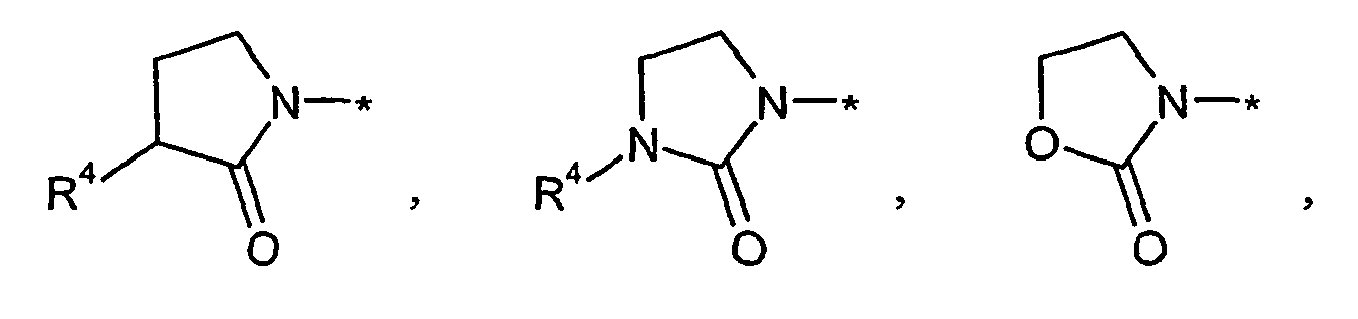

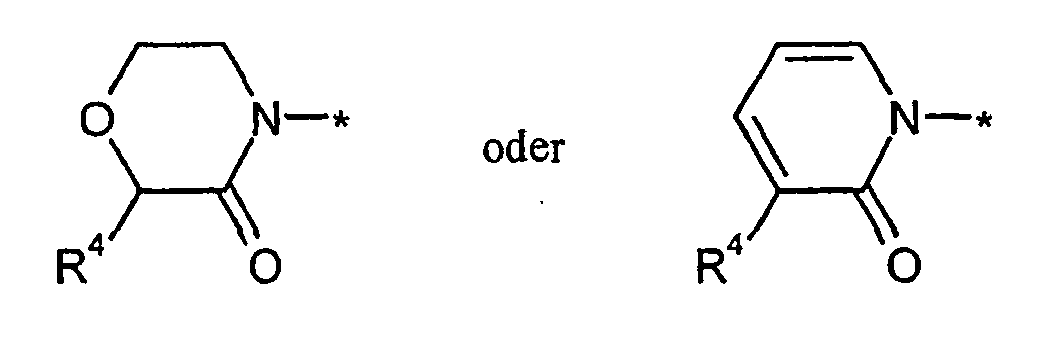 R4 Wasserstoff, (C1-C6)-Alkyl, Hydroxy, (C1-C6)-Alkoxy, Amino, Mono- oder Di-(C1-C6)-alkylamino, (C3-C7)-Cycloalkylamino, (C1-C6)-Alkanoylamino oder (C1-C6)-Alkoxycarbonylamino bedeutet, wobei
(C1-C6)-Alkyl, (C1-C6)-Alkoxy, Mono- und Di-(C1-C6)-alkylamino ihrerseits jeweils durch Hydroxy, (C1-C4)-Alkoxy, Amino, Mono- oder Di-(C1-C4)-alkylamino, (C3-C7)-Cycloalkylamino oder einen 4- bis 7-gliedrigen gesättigten, über ein N-Atom gebundenen Heterocyclus, der ein Ringglied aus der Reihe N-R5 oder O enthalten kann, worinR5 Wasserstoff oder (C1-C4)-Alkyl bedeutet,substituiert sein können,
und * die Verknüpfungsstelle mit dem Phenylring bedeutet,Z für Phenyl, Pyridyl, Pyrimidinyl, Pyrazinyl oder Thienyl steht, die jeweils ein- oder zweifach, gleich oder verschieden, durch Substituenten ausgewählt aus der Gruppe von Fluor, Chlor, Cyano, (C1-C4)-Alkyl, welches seinerseits durch Amino substituiert sein kann, Ethinyl und Amino substituiert sein können,R1 und R2 gleich oder verschieden sind und unabhängig voneinander für Wasserstoff, Fluor, Chlor, Cyano, (C1-C3)-Alkyl, Cyclopropyl, Trifluormethyl, Hydroxy, (C1-C3)-Alkoxy, Trifluormethoxy oder Amino stehen, wobei
(C1-C3)-Alkyl und (C1-C3)-Alkoxy ihrerseits durch Hydroxy oder Amino substituiert sein können,
undR3 für Wasserstoff oder (C1-C6)-Alkyl, welches durch Hydroxy, (C1-C4)-Alkoxy, Amino oder Mono- oder Di-(C1-C4)-alkylamino substituiert sein kann, steht,sowie ihre Salze, Solvate und Solvate der Salze. - Verbindung der Formel (I) nach Anspruch 1, in welcherA für eine Gruppe der Formel

 R4A Wasserstoff, Hydroxy, Methoxy oder Amino,R4B Methyl oder Ethyl, welche jeweils durch Hydroxy, Amino, Pyrrolidino oder Cyclopropylamino substituiert sein können, oder Amino,R4C Wasserstoff, Methyl oder Ethyl, wobei Methyl oder Ethyl jeweils durch Hydroxy, Amino, Pyrrolidino oder Cyclopropylamino substituiert sein können,
und* die Verknüpfungsstelle mit dem Phenylring bedeuten,Z für eine Gruppe der Formel
 R6 Fluor, Chlor, Methyl, Cyano oder Ethinyl
und# die Verknüpfungsstelle mit dem Stickstoffatom bedeutet,R1 für Wasserstoff,R2 für Wasserstoff, Fluor oder Methyl,
undR3 für Wasserstoff stehen,sowie ihre Salze, Solvate und Solvate der Salze. - Verbindung der Formel (I) nach Anspruch 1 oder 2, in welcherA für eine heterocyclische Gruppe der Formel

 Z für eine Gruppe der Formel
 R1 für Wasserstoff,R2 für Wasserstoff, Fluor oder Methyl,
undR3 für Wasserstoff stehen,sowie ihre Salze, Solvate und Solvate der Salze. - Verfahren zur Herstellung von Verbindungen der Formel (I), wie in Anspruch 1 definiert, dadurch gekennzeichnet, dass man entweder[A] Verbindungen der Formel (II)


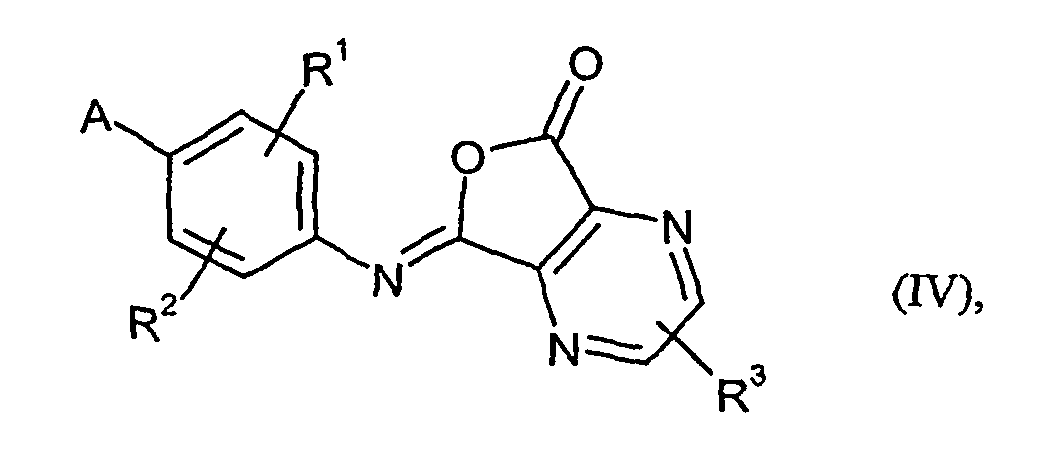
H2N—Z (V),
in welcher Z die in Anspruch 1 angegebene Bedeutung hat,
in Verbindungen der Formel (I) überführt
oder[B] Verbindungen der Formel (V) zunächst mit einer Verbindung der Formel (III) zu Verbindungen der Formel (VI)und die Verbindungen der Formel (I) gegebenenfalls mit den entsprechenden (i) Lösungsmitteln und/oder (ii) Basen oder Säuren zu ihren Solvaten, Salzen und/oder Solvaten der Salze umsetzt.
umsetzt und diese dann mit einer Verbindung der Formel (II) in Verbindungen der Formel (I) überführt, - Verbindung der Formel (I) sowie ihre physiologisch unbedenklichen Salze, Hydrate und Hydrate der physiologisch unbedenklichen Salze; wie in Anspruch 1 definiert, zur Behandlung und/oder Prophylaxe von Krankheiten.
- Verwendung einer Verbindung der Formel (I) oder eines ihrer physiologisch unbedenklichen Salze, Hydrate oder Hydrate der physiologisch unbedenklichen Salze, wie in Anspruch 1 definiert, zur Herstellung eines Arzneimittels zur Behandlung und/oder Prophylaxe von thromboembolischen Erkrankungen.
- Verwendung einer Verbindung der Formel (I) oder eines ihrer physiologisch unbedenklichen Salze, Hydrate oder Hydrate der physiologisch unbedenklichen Salze, wie in Anspruch 1 definiert, zur Verhinderung der Blutkoagulation in vitro.
- Arzneimittel enthaltend eine Verbindung der Formel (I) oder eines ihrer physiologisch unbedenklichen Salze, Hydrate oder Hydrate der physiologisch unbedenklichen Salze, wie in Anspruch 1 definiert, in Kombination mit einem inerten, nicht-toxischen, pharmazeutisch geeigneten Hilfsstoff.
- Arzneimittel enthaltend eine Verbindung der Formel (I) oder eines ihrer physiologisch unbedenklichen Salze, Hydrate oder Hydrate der physiologisch unbedenklichen Salze, wie in Anspruch 1 definiert, in Kombination mit einem weiteren Wirkstoff.
- Arzneimittel nach Anspruch 8 oder 9 zur Behandlung und/oder Prophylaxe von thromboembolischen Erkrankungen.
- Verfahren zur Verhinderung der Blutkoagulation in vitro, dadurch gekennzeichnet, dass eine antikoagulatorisch wirksame Menge einer Verbindung der Formel (I) oder eines ihrer physiologisch unbedenklichen Salze, Hydrate oder Hydrate der physiologisch unbedenklichen Salze, wie in Anspruch 1 definiert, zugegeben wird.
Applications Claiming Priority (2)
| Application Number | Priority Date | Filing Date | Title |
|---|---|---|---|
| DE102004059219A DE102004059219A1 (de) | 2004-12-09 | 2004-12-09 | Pyrazindicarbonsäureamide und ihre Verwendung |
| PCT/EP2005/012681 WO2006061116A1 (de) | 2004-12-09 | 2005-11-28 | Pyrazindicarbonsäureamide und ihre verwendung |
Publications (2)
| Publication Number | Publication Date |
|---|---|
| EP1824844A1 EP1824844A1 (de) | 2007-08-29 |
| EP1824844B1 true EP1824844B1 (de) | 2008-11-05 |
Family
ID=36088503
Family Applications (1)
| Application Number | Title | Priority Date | Filing Date |
|---|---|---|---|
| EP05815232A Expired - Lifetime EP1824844B1 (de) | 2004-12-09 | 2005-11-28 | Pyrazindicarbonsäureamide und ihre verwendung |
Country Status (11)
| Country | Link |
|---|---|
| US (1) | US20060287315A1 (de) |
| EP (1) | EP1824844B1 (de) |
| JP (1) | JP2008522992A (de) |
| AR (1) | AR052148A1 (de) |
| AT (1) | ATE413396T1 (de) |
| CA (1) | CA2594102A1 (de) |
| DE (2) | DE102004059219A1 (de) |
| DO (1) | DOP2005000250A (de) |
| ES (1) | ES2315932T3 (de) |
| TW (1) | TW200635920A (de) |
| WO (1) | WO2006061116A1 (de) |
Families Citing this family (5)
| Publication number | Priority date | Publication date | Assignee | Title |
|---|---|---|---|---|
| IN2012DN00602A (de) * | 2009-06-25 | 2015-06-12 | Inst Univ De Ciencia I Technologia S A | |
| ES2354550B1 (es) * | 2009-06-26 | 2011-11-15 | Institut Univ. De Ciència I Tecnologia, S.A. | Biblioteca de n-(1-fenil-2-oxo-3-piperidil)sulfonamidas para el descubrimiento de fármacos. |
| ES2354551B1 (es) * | 2009-07-01 | 2011-11-15 | Institut Univ. De Ciencia I Tecnologia S.A. | Bibliotecas de n-(1-fenil-2-oxo-3-piperidil)sulfonamidas para la identificación de actividad biológica y farmacológica. |
| CN103804222A (zh) * | 2014-02-25 | 2014-05-21 | 湖北迅达药业股份有限公司 | 一种4-(4-氨基苯基)-3-吗啉酮的合成方法及其中间体 |
| EP3078378B1 (de) | 2015-04-08 | 2020-06-24 | Vaiomer | Verwendung von faktor-xa-inhibitoren zur regulierung von glykämie |
Family Cites Families (4)
| Publication number | Priority date | Publication date | Assignee | Title |
|---|---|---|---|---|
| AU2001273040A1 (en) * | 2000-06-27 | 2002-01-08 | Du Pont Pharmaceuticals Company | Factor xa inhibitors |
| ATE368643T1 (de) * | 2001-03-30 | 2007-08-15 | Millennium Pharm Inc | Faktor xa benzamidin inhibitoren |
| EP1427415B1 (de) * | 2001-09-21 | 2009-08-12 | Brystol-Myers Squibb Company | Lactamhaltige verbindungen und ihre derivate als faktor-xa-hemmer |
| DE102004058062A1 (de) * | 2004-12-02 | 2006-06-08 | Bayer Healthcare Ag | Cyclische Iminocarbamate und ihre Verwendung |
-
2004
- 2004-12-09 DE DE102004059219A patent/DE102004059219A1/de not_active Withdrawn
-
2005
- 2005-11-28 ES ES05815232T patent/ES2315932T3/es not_active Expired - Lifetime
- 2005-11-28 JP JP2007544770A patent/JP2008522992A/ja active Pending
- 2005-11-28 CA CA002594102A patent/CA2594102A1/en not_active Abandoned
- 2005-11-28 DE DE502005005917T patent/DE502005005917D1/de not_active Expired - Fee Related
- 2005-11-28 WO PCT/EP2005/012681 patent/WO2006061116A1/de not_active Ceased
- 2005-11-28 AT AT05815232T patent/ATE413396T1/de not_active IP Right Cessation
- 2005-11-28 EP EP05815232A patent/EP1824844B1/de not_active Expired - Lifetime
- 2005-12-07 AR ARP050105118A patent/AR052148A1/es not_active Application Discontinuation
- 2005-12-08 DO DO2005000250A patent/DOP2005000250A/es unknown
- 2005-12-08 TW TW094143286A patent/TW200635920A/zh unknown
- 2005-12-08 US US11/299,342 patent/US20060287315A1/en not_active Abandoned
Also Published As
| Publication number | Publication date |
|---|---|
| CA2594102A1 (en) | 2006-06-15 |
| JP2008522992A (ja) | 2008-07-03 |
| ES2315932T3 (es) | 2009-04-01 |
| DE502005005917D1 (de) | 2008-12-18 |
| TW200635920A (en) | 2006-10-16 |
| DOP2005000250A (es) | 2006-06-15 |
| US20060287315A1 (en) | 2006-12-21 |
| WO2006061116A1 (de) | 2006-06-15 |
| DE102004059219A1 (de) | 2006-06-14 |
| ATE413396T1 (de) | 2008-11-15 |
| AR052148A1 (es) | 2007-03-07 |
| EP1824844A1 (de) | 2007-08-29 |
Similar Documents
| Publication | Publication Date | Title |
|---|---|---|
| EP1928867B1 (de) | 2-aminoethoxyessigsäure-derivate und ihre verwendung zur behandlung thromboembolischer erkrankungen | |
| EP1626969A1 (de) | Heterocyclische verbindungen | |
| EP1608645B1 (de) | Pyrazolidin-1,2-dicarbonsäure-1-((phenyl)-amid)-2-((phenyl)-amid) derivate als koagulationsfaktor xa inhibitoren zur behandlung von thrombosen | |
| EP2029546B1 (de) | Aryl-substituierte heterozyklen und ihre verwendung | |
| EP2084154B1 (de) | Aminoacyl-prodrug derivate und arzneimittel zur behandlung von thromboembolischen erkrankungen | |
| EP2173744A1 (de) | Substituierte (oxazolidinon-5-yl-methyl) -2-thiophen-carboxamide und ihre verwendung im gebiet der blutgerinnung | |
| DE102004058062A1 (de) | Cyclische Iminocarbamate und ihre Verwendung | |
| DE102004059219A1 (de) | Pyrazindicarbonsäureamide und ihre Verwendung | |
| EP2029586B1 (de) | Isoindolin-1-on-, isoindolin-3-on- und isoindolin-1,3-dion-derivate und ihre verwendung | |
| DE102005042583A1 (de) | Iminooxazolidin-Derivate und ihre Verwendung | |
| EP1945634B1 (de) | Phenylen-bis-oxazolidin-derivate und ihre verwendung als antikoagulantien | |
| DE102006025318A1 (de) | Dihydro-pyrrolopyridin-, Dihydro-pyrrolopyridazin- und Dihydro-pyrrolopyrimidin-Derivate und ihre Verwendung | |
| DE102006025315A1 (de) | Tetrahydro-pyrrolopyridin-, Tetrahydro-pyrazolopyridin-, Tetrahydro-imidazopyridin- und Tetrahydro-triazolopyridin-Derivate und ihre Verwendung | |
| EP2029582A1 (de) | Isoindolin-1-on-, isoindolin-3-on- und isoindolin-1,3-dion-derivate und ihre verwendung | |
| EP1874764B1 (de) | Imino-oxazolidine und ihre verwendung als antikoagulantien | |
| EP2032567A1 (de) | Substituierte heterozyklen und ihre verwendung |
Legal Events
| Date | Code | Title | Description |
|---|---|---|---|
| PUAI | Public reference made under article 153(3) epc to a published international application that has entered the european phase |
Free format text: ORIGINAL CODE: 0009012 |
|
| 17P | Request for examination filed |
Effective date: 20070709 |
|
| AK | Designated contracting states |
Kind code of ref document: A1 Designated state(s): AT BE BG CH CY CZ DE DK EE ES FI FR GB GR HU IE IS IT LI LT LU LV MC NL PL PT RO SE SI SK TR |
|
| 17Q | First examination report despatched |
Effective date: 20071017 |
|
| RIN1 | Information on inventor provided before grant (corrected) |
Inventor name: ARNDT, SABINE Inventor name: JESKE, MARIO Inventor name: LOBELL, MARIO Inventor name: SCHLEMMER, KARL-HEINZ Inventor name: TUCH, AROUNARITH Inventor name: ROSENTRETER, ULRICH Inventor name: FISCHER, KARIN Inventor name: BURKHARDT, NILS Inventor name: AKBABA, METIN Inventor name: ROEHRIG, SUSANNE Inventor name: POHLMANN, JENS Inventor name: ALLERHEILIGEN, SWEN Inventor name: GERDES, CHRISTOPH Inventor name: BOYER, STEPHEN Inventor name: NELL, PETER Inventor name: PERZBORN, ELISABETH |
|
| RIN1 | Information on inventor provided before grant (corrected) |
Inventor name: JESKE, MARIO Inventor name: ROSENTRETER, ULRICH Inventor name: NELL, PETER Inventor name: ROEHRIG, SUSANNE Inventor name: SCHLEMMER, KARL-HEINZ Inventor name: PERZBORN, ELISABETH Inventor name: BOYER, STEPHEN Inventor name: POHLMANN, JENS Inventor name: TUCH, AROUNARITH Inventor name: GERDES, CHRISTOPH Inventor name: ARNDT, SABINE Inventor name: BURKHARDT, NILS Inventor name: FISCHER, KARIN Inventor name: AKBABA, METIN Inventor name: LOBELL, MARIO Inventor name: ALLERHEILIGEN, SWEN |
|
| DAX | Request for extension of the european patent (deleted) | ||
| GRAP | Despatch of communication of intention to grant a patent |
Free format text: ORIGINAL CODE: EPIDOSNIGR1 |
|
| GRAS | Grant fee paid |
Free format text: ORIGINAL CODE: EPIDOSNIGR3 |
|
| GRAA | (expected) grant |
Free format text: ORIGINAL CODE: 0009210 |
|
| AK | Designated contracting states |
Kind code of ref document: B1 Designated state(s): AT BE BG CH CY CZ DE DK EE ES FI FR GB GR HU IE IS IT LI LT LU LV MC NL PL PT RO SE SI SK TR |
|
| REG | Reference to a national code |
Ref country code: GB Ref legal event code: FG4D Free format text: NOT ENGLISH |
|
| REG | Reference to a national code |
Ref country code: CH Ref legal event code: EP |
|
| REG | Reference to a national code |
Ref country code: IE Ref legal event code: FG4D Free format text: LANGUAGE OF EP DOCUMENT: GERMAN |
|
| REF | Corresponds to: |
Ref document number: 502005005917 Country of ref document: DE Date of ref document: 20081218 Kind code of ref document: P |
|
| PGFP | Annual fee paid to national office [announced via postgrant information from national office to epo] |
Ref country code: DE Payment date: 20081030 Year of fee payment: 4 |
|
| PGFP | Annual fee paid to national office [announced via postgrant information from national office to epo] |
Ref country code: ES Payment date: 20081216 Year of fee payment: 4 |
|
| NLV1 | Nl: lapsed or annulled due to failure to fulfill the requirements of art. 29p and 29m of the patents act | ||
| REG | Reference to a national code |
Ref country code: ES Ref legal event code: FG2A Ref document number: 2315932 Country of ref document: ES Kind code of ref document: T3 |
|
| LTIE | Lt: invalidation of european patent or patent extension |
Effective date: 20081105 |
|
| PG25 | Lapsed in a contracting state [announced via postgrant information from national office to epo] |
Ref country code: LT Free format text: LAPSE BECAUSE OF FAILURE TO SUBMIT A TRANSLATION OF THE DESCRIPTION OR TO PAY THE FEE WITHIN THE PRESCRIBED TIME-LIMIT Effective date: 20081105 |
|
| PGFP | Annual fee paid to national office [announced via postgrant information from national office to epo] |
Ref country code: FR Payment date: 20081112 Year of fee payment: 4 |
|
| PG25 | Lapsed in a contracting state [announced via postgrant information from national office to epo] |
Ref country code: SI Free format text: LAPSE BECAUSE OF FAILURE TO SUBMIT A TRANSLATION OF THE DESCRIPTION OR TO PAY THE FEE WITHIN THE PRESCRIBED TIME-LIMIT Effective date: 20081105 Ref country code: NL Free format text: LAPSE BECAUSE OF FAILURE TO SUBMIT A TRANSLATION OF THE DESCRIPTION OR TO PAY THE FEE WITHIN THE PRESCRIBED TIME-LIMIT Effective date: 20081105 Ref country code: FI Free format text: LAPSE BECAUSE OF FAILURE TO SUBMIT A TRANSLATION OF THE DESCRIPTION OR TO PAY THE FEE WITHIN THE PRESCRIBED TIME-LIMIT Effective date: 20081105 Ref country code: IS Free format text: LAPSE BECAUSE OF FAILURE TO SUBMIT A TRANSLATION OF THE DESCRIPTION OR TO PAY THE FEE WITHIN THE PRESCRIBED TIME-LIMIT Effective date: 20090305 Ref country code: PL Free format text: LAPSE BECAUSE OF FAILURE TO SUBMIT A TRANSLATION OF THE DESCRIPTION OR TO PAY THE FEE WITHIN THE PRESCRIBED TIME-LIMIT Effective date: 20081105 Ref country code: LV Free format text: LAPSE BECAUSE OF FAILURE TO SUBMIT A TRANSLATION OF THE DESCRIPTION OR TO PAY THE FEE WITHIN THE PRESCRIBED TIME-LIMIT Effective date: 20081105 |
|
| BERE | Be: lapsed |
Owner name: BAYER HEALTHCARE A.G. Effective date: 20081130 |
|
| PG25 | Lapsed in a contracting state [announced via postgrant information from national office to epo] |
Ref country code: MC Free format text: LAPSE BECAUSE OF NON-PAYMENT OF DUE FEES Effective date: 20081130 |
|
| REG | Reference to a national code |
Ref country code: IE Ref legal event code: FD4D |
|
| PG25 | Lapsed in a contracting state [announced via postgrant information from national office to epo] |
Ref country code: IE Free format text: LAPSE BECAUSE OF FAILURE TO SUBMIT A TRANSLATION OF THE DESCRIPTION OR TO PAY THE FEE WITHIN THE PRESCRIBED TIME-LIMIT Effective date: 20081105 Ref country code: RO Free format text: LAPSE BECAUSE OF FAILURE TO SUBMIT A TRANSLATION OF THE DESCRIPTION OR TO PAY THE FEE WITHIN THE PRESCRIBED TIME-LIMIT Effective date: 20081105 Ref country code: BG Free format text: LAPSE BECAUSE OF FAILURE TO SUBMIT A TRANSLATION OF THE DESCRIPTION OR TO PAY THE FEE WITHIN THE PRESCRIBED TIME-LIMIT Effective date: 20090205 Ref country code: EE Free format text: LAPSE BECAUSE OF FAILURE TO SUBMIT A TRANSLATION OF THE DESCRIPTION OR TO PAY THE FEE WITHIN THE PRESCRIBED TIME-LIMIT Effective date: 20081105 Ref country code: DK Free format text: LAPSE BECAUSE OF FAILURE TO SUBMIT A TRANSLATION OF THE DESCRIPTION OR TO PAY THE FEE WITHIN THE PRESCRIBED TIME-LIMIT Effective date: 20081105 |
|
| PG25 | Lapsed in a contracting state [announced via postgrant information from national office to epo] |
Ref country code: CZ Free format text: LAPSE BECAUSE OF FAILURE TO SUBMIT A TRANSLATION OF THE DESCRIPTION OR TO PAY THE FEE WITHIN THE PRESCRIBED TIME-LIMIT Effective date: 20081105 Ref country code: SE Free format text: LAPSE BECAUSE OF FAILURE TO SUBMIT A TRANSLATION OF THE DESCRIPTION OR TO PAY THE FEE WITHIN THE PRESCRIBED TIME-LIMIT Effective date: 20090205 Ref country code: PT Free format text: LAPSE BECAUSE OF FAILURE TO SUBMIT A TRANSLATION OF THE DESCRIPTION OR TO PAY THE FEE WITHIN THE PRESCRIBED TIME-LIMIT Effective date: 20090406 |
|
| PLBE | No opposition filed within time limit |
Free format text: ORIGINAL CODE: 0009261 |
|
| STAA | Information on the status of an ep patent application or granted ep patent |
Free format text: STATUS: NO OPPOSITION FILED WITHIN TIME LIMIT |
|
| PG25 | Lapsed in a contracting state [announced via postgrant information from national office to epo] |
Ref country code: SK Free format text: LAPSE BECAUSE OF FAILURE TO SUBMIT A TRANSLATION OF THE DESCRIPTION OR TO PAY THE FEE WITHIN THE PRESCRIBED TIME-LIMIT Effective date: 20081105 Ref country code: BE Free format text: LAPSE BECAUSE OF NON-PAYMENT OF DUE FEES Effective date: 20081130 |
|
| 26N | No opposition filed |
Effective date: 20090806 |
|
| PGFP | Annual fee paid to national office [announced via postgrant information from national office to epo] |
Ref country code: IT Payment date: 20081130 Year of fee payment: 4 |
|
| REG | Reference to a national code |
Ref country code: FR Ref legal event code: TP |
|
| PG25 | Lapsed in a contracting state [announced via postgrant information from national office to epo] |
Ref country code: AT Free format text: LAPSE BECAUSE OF NON-PAYMENT OF DUE FEES Effective date: 20081128 |
|
| REG | Reference to a national code |
Ref country code: CH Ref legal event code: PL |
|
| GBPC | Gb: european patent ceased through non-payment of renewal fee |
Effective date: 20091128 |
|
| PG25 | Lapsed in a contracting state [announced via postgrant information from national office to epo] |
Ref country code: CY Free format text: LAPSE BECAUSE OF FAILURE TO SUBMIT A TRANSLATION OF THE DESCRIPTION OR TO PAY THE FEE WITHIN THE PRESCRIBED TIME-LIMIT Effective date: 20081105 Ref country code: HU Free format text: LAPSE BECAUSE OF FAILURE TO SUBMIT A TRANSLATION OF THE DESCRIPTION OR TO PAY THE FEE WITHIN THE PRESCRIBED TIME-LIMIT Effective date: 20090506 Ref country code: LU Free format text: LAPSE BECAUSE OF NON-PAYMENT OF DUE FEES Effective date: 20081128 |
|
| REG | Reference to a national code |
Ref country code: FR Ref legal event code: ST Effective date: 20100730 |
|
| PG25 | Lapsed in a contracting state [announced via postgrant information from national office to epo] |
Ref country code: TR Free format text: LAPSE BECAUSE OF FAILURE TO SUBMIT A TRANSLATION OF THE DESCRIPTION OR TO PAY THE FEE WITHIN THE PRESCRIBED TIME-LIMIT Effective date: 20081105 |
|
| PG25 | Lapsed in a contracting state [announced via postgrant information from national office to epo] |
Ref country code: LI Free format text: LAPSE BECAUSE OF NON-PAYMENT OF DUE FEES Effective date: 20091130 Ref country code: GR Free format text: LAPSE BECAUSE OF FAILURE TO SUBMIT A TRANSLATION OF THE DESCRIPTION OR TO PAY THE FEE WITHIN THE PRESCRIBED TIME-LIMIT Effective date: 20090206 Ref country code: FR Free format text: LAPSE BECAUSE OF NON-PAYMENT OF DUE FEES Effective date: 20091130 Ref country code: CH Free format text: LAPSE BECAUSE OF NON-PAYMENT OF DUE FEES Effective date: 20091130 |
|
| PG25 | Lapsed in a contracting state [announced via postgrant information from national office to epo] |
Ref country code: DE Free format text: LAPSE BECAUSE OF NON-PAYMENT OF DUE FEES Effective date: 20100601 |
|
| PG25 | Lapsed in a contracting state [announced via postgrant information from national office to epo] |
Ref country code: GB Free format text: LAPSE BECAUSE OF NON-PAYMENT OF DUE FEES Effective date: 20091128 |
|
| REG | Reference to a national code |
Ref country code: ES Ref legal event code: FD2A Effective date: 20110303 |
|
| PG25 | Lapsed in a contracting state [announced via postgrant information from national office to epo] |
Ref country code: IT Free format text: LAPSE BECAUSE OF NON-PAYMENT OF DUE FEES Effective date: 20091128 |
|
| PG25 | Lapsed in a contracting state [announced via postgrant information from national office to epo] |
Ref country code: ES Free format text: LAPSE BECAUSE OF NON-PAYMENT OF DUE FEES Effective date: 20110302 |
|
| PG25 | Lapsed in a contracting state [announced via postgrant information from national office to epo] |
Ref country code: ES Free format text: LAPSE BECAUSE OF NON-PAYMENT OF DUE FEES Effective date: 20091129 |