EP1824589B1 - Dispersant for reducing viscosity of particulate solids - Google Patents
Dispersant for reducing viscosity of particulate solids Download PDFInfo
- Publication number
- EP1824589B1 EP1824589B1 EP05843336A EP05843336A EP1824589B1 EP 1824589 B1 EP1824589 B1 EP 1824589B1 EP 05843336 A EP05843336 A EP 05843336A EP 05843336 A EP05843336 A EP 05843336A EP 1824589 B1 EP1824589 B1 EP 1824589B1
- Authority
- EP
- European Patent Office
- Prior art keywords
- dispersant
- dispersion
- group
- acid
- moiety
- Prior art date
- Legal status (The legal status is an assumption and is not a legal conclusion. Google has not performed a legal analysis and makes no representation as to the accuracy of the status listed.)
- Expired - Lifetime
Links
- 0 CCN(C)C(C)(**)C(F)(F)F Chemical compound CCN(C)C(C)(**)C(F)(F)F 0.000 description 4
- DGOWMWZXSXVWDS-UHFFFAOYSA-N CC(C1)C1(C)C(N)=O Chemical compound CC(C1)C1(C)C(N)=O DGOWMWZXSXVWDS-UHFFFAOYSA-N 0.000 description 1
- JJHWISKRNWVFDJ-UHFFFAOYSA-N NCC(C(C=O)O)N Chemical compound NCC(C(C=O)O)N JJHWISKRNWVFDJ-UHFFFAOYSA-N 0.000 description 1
Images


Classifications
-
- C—CHEMISTRY; METALLURGY
- C09—DYES; PAINTS; POLISHES; NATURAL RESINS; ADHESIVES; COMPOSITIONS NOT OTHERWISE PROVIDED FOR; APPLICATIONS OF MATERIALS NOT OTHERWISE PROVIDED FOR
- C09D—COATING COMPOSITIONS, e.g. PAINTS, VARNISHES OR LACQUERS; FILLING PASTES; CHEMICAL PAINT OR INK REMOVERS; INKS; CORRECTING FLUIDS; WOODSTAINS; PASTES OR SOLIDS FOR COLOURING OR PRINTING; USE OF MATERIALS THEREFOR
- C09D5/00—Coating compositions, e.g. paints, varnishes or lacquers, characterised by their physical nature or the effects produced; Filling pastes
- C09D5/02—Emulsion paints including aerosols
-
- C—CHEMISTRY; METALLURGY
- C09—DYES; PAINTS; POLISHES; NATURAL RESINS; ADHESIVES; COMPOSITIONS NOT OTHERWISE PROVIDED FOR; APPLICATIONS OF MATERIALS NOT OTHERWISE PROVIDED FOR
- C09C—TREATMENT OF INORGANIC MATERIALS, OTHER THAN FIBROUS FILLERS, TO ENHANCE THEIR PIGMENTING OR FILLING PROPERTIES ; PREPARATION OF CARBON BLACK ; PREPARATION OF INORGANIC MATERIALS WHICH ARE NO SINGLE CHEMICAL COMPOUNDS AND WHICH ARE MAINLY USED AS PIGMENTS OR FILLERS
- C09C1/00—Treatment of specific inorganic materials other than fibrous fillers; Preparation of carbon black
- C09C1/04—Compounds of zinc
- C09C1/043—Zinc oxide
-
- C—CHEMISTRY; METALLURGY
- C09—DYES; PAINTS; POLISHES; NATURAL RESINS; ADHESIVES; COMPOSITIONS NOT OTHERWISE PROVIDED FOR; APPLICATIONS OF MATERIALS NOT OTHERWISE PROVIDED FOR
- C09C—TREATMENT OF INORGANIC MATERIALS, OTHER THAN FIBROUS FILLERS, TO ENHANCE THEIR PIGMENTING OR FILLING PROPERTIES ; PREPARATION OF CARBON BLACK ; PREPARATION OF INORGANIC MATERIALS WHICH ARE NO SINGLE CHEMICAL COMPOUNDS AND WHICH ARE MAINLY USED AS PIGMENTS OR FILLERS
- C09C1/00—Treatment of specific inorganic materials other than fibrous fillers; Preparation of carbon black
- C09C1/34—Compounds of chromium
- C09C1/346—Chromium oxides
-
- C—CHEMISTRY; METALLURGY
- C09—DYES; PAINTS; POLISHES; NATURAL RESINS; ADHESIVES; COMPOSITIONS NOT OTHERWISE PROVIDED FOR; APPLICATIONS OF MATERIALS NOT OTHERWISE PROVIDED FOR
- C09C—TREATMENT OF INORGANIC MATERIALS, OTHER THAN FIBROUS FILLERS, TO ENHANCE THEIR PIGMENTING OR FILLING PROPERTIES ; PREPARATION OF CARBON BLACK ; PREPARATION OF INORGANIC MATERIALS WHICH ARE NO SINGLE CHEMICAL COMPOUNDS AND WHICH ARE MAINLY USED AS PIGMENTS OR FILLERS
- C09C1/00—Treatment of specific inorganic materials other than fibrous fillers; Preparation of carbon black
- C09C1/40—Compounds of aluminium
- C09C1/407—Aluminium oxides or hydroxides
-
- C—CHEMISTRY; METALLURGY
- C09—DYES; PAINTS; POLISHES; NATURAL RESINS; ADHESIVES; COMPOSITIONS NOT OTHERWISE PROVIDED FOR; APPLICATIONS OF MATERIALS NOT OTHERWISE PROVIDED FOR
- C09C—TREATMENT OF INORGANIC MATERIALS, OTHER THAN FIBROUS FILLERS, TO ENHANCE THEIR PIGMENTING OR FILLING PROPERTIES ; PREPARATION OF CARBON BLACK ; PREPARATION OF INORGANIC MATERIALS WHICH ARE NO SINGLE CHEMICAL COMPOUNDS AND WHICH ARE MAINLY USED AS PIGMENTS OR FILLERS
- C09C3/00—Treatment in general of inorganic materials, other than fibrous fillers, to enhance their pigmenting or filling properties
- C09C3/08—Treatment with low-molecular-weight non-polymer organic compounds
-
- C—CHEMISTRY; METALLURGY
- C09—DYES; PAINTS; POLISHES; NATURAL RESINS; ADHESIVES; COMPOSITIONS NOT OTHERWISE PROVIDED FOR; APPLICATIONS OF MATERIALS NOT OTHERWISE PROVIDED FOR
- C09D—COATING COMPOSITIONS, e.g. PAINTS, VARNISHES OR LACQUERS; FILLING PASTES; CHEMICAL PAINT OR INK REMOVERS; INKS; CORRECTING FLUIDS; WOODSTAINS; PASTES OR SOLIDS FOR COLOURING OR PRINTING; USE OF MATERIALS THEREFOR
- C09D11/00—Inks
- C09D11/30—Inkjet printing inks
- C09D11/32—Inkjet printing inks characterised by colouring agents
- C09D11/324—Inkjet printing inks characterised by colouring agents containing carbon black
- C09D11/326—Inkjet printing inks characterised by colouring agents containing carbon black characterised by the pigment dispersant
-
- C—CHEMISTRY; METALLURGY
- C09—DYES; PAINTS; POLISHES; NATURAL RESINS; ADHESIVES; COMPOSITIONS NOT OTHERWISE PROVIDED FOR; APPLICATIONS OF MATERIALS NOT OTHERWISE PROVIDED FOR
- C09D—COATING COMPOSITIONS, e.g. PAINTS, VARNISHES OR LACQUERS; FILLING PASTES; CHEMICAL PAINT OR INK REMOVERS; INKS; CORRECTING FLUIDS; WOODSTAINS; PASTES OR SOLIDS FOR COLOURING OR PRINTING; USE OF MATERIALS THEREFOR
- C09D17/00—Pigment pastes, e.g. for mixing in paints
- C09D17/004—Pigment pastes, e.g. for mixing in paints containing an inorganic pigment
-
- C—CHEMISTRY; METALLURGY
- C09—DYES; PAINTS; POLISHES; NATURAL RESINS; ADHESIVES; COMPOSITIONS NOT OTHERWISE PROVIDED FOR; APPLICATIONS OF MATERIALS NOT OTHERWISE PROVIDED FOR
- C09D—COATING COMPOSITIONS, e.g. PAINTS, VARNISHES OR LACQUERS; FILLING PASTES; CHEMICAL PAINT OR INK REMOVERS; INKS; CORRECTING FLUIDS; WOODSTAINS; PASTES OR SOLIDS FOR COLOURING OR PRINTING; USE OF MATERIALS THEREFOR
- C09D5/00—Coating compositions, e.g. paints, varnishes or lacquers, characterised by their physical nature or the effects produced; Filling pastes
- C09D5/02—Emulsion paints including aerosols
- C09D5/024—Emulsion paints including aerosols characterised by the additives
- C09D5/027—Dispersing agents
-
- C—CHEMISTRY; METALLURGY
- C09—DYES; PAINTS; POLISHES; NATURAL RESINS; ADHESIVES; COMPOSITIONS NOT OTHERWISE PROVIDED FOR; APPLICATIONS OF MATERIALS NOT OTHERWISE PROVIDED FOR
- C09K—MATERIALS FOR MISCELLANEOUS APPLICATIONS, NOT PROVIDED FOR ELSEWHERE
- C09K23/00—Use of substances as emulsifying, wetting, dispersing, or foam-producing agents
-
- C—CHEMISTRY; METALLURGY
- C09—DYES; PAINTS; POLISHES; NATURAL RESINS; ADHESIVES; COMPOSITIONS NOT OTHERWISE PROVIDED FOR; APPLICATIONS OF MATERIALS NOT OTHERWISE PROVIDED FOR
- C09K—MATERIALS FOR MISCELLANEOUS APPLICATIONS, NOT PROVIDED FOR ELSEWHERE
- C09K23/00—Use of substances as emulsifying, wetting, dispersing, or foam-producing agents
- C09K23/16—Amines or polyamines
-
- C—CHEMISTRY; METALLURGY
- C09—DYES; PAINTS; POLISHES; NATURAL RESINS; ADHESIVES; COMPOSITIONS NOT OTHERWISE PROVIDED FOR; APPLICATIONS OF MATERIALS NOT OTHERWISE PROVIDED FOR
- C09K—MATERIALS FOR MISCELLANEOUS APPLICATIONS, NOT PROVIDED FOR ELSEWHERE
- C09K23/00—Use of substances as emulsifying, wetting, dispersing, or foam-producing agents
- C09K23/22—Amides or hydrazides
-
- C—CHEMISTRY; METALLURGY
- C01—INORGANIC CHEMISTRY
- C01P—INDEXING SCHEME RELATING TO STRUCTURAL AND PHYSICAL ASPECTS OF SOLID INORGANIC COMPOUNDS
- C01P2006/00—Physical properties of inorganic compounds
- C01P2006/22—Rheological behaviour as dispersion, e.g. viscosity, sedimentation stability
Definitions
- the invention relates to a dispersant for an aqueous solid dispersion or composition therefrom, and in particular a dispersion of positively charged or chargeable solid particulates, which can reduce the viscosity and/or the tendency to form a gel or a yield stress material, especially following periods of high shear stress.
- the solid particulate dispersion may be used, for example, as a component of a coating material, an inkjet recording paper or film, a chemical-mechanical polishing/abrasive material, a ceramic, a cement, a paint, a catalyst system, a refractory material, a surface-frictionising formulation or a filler or any product that incorporates nanoparticulate materials.
- aqueous solid dispersions often require to be processed at a high concentration of solids for one or more of the following reasons: to improve the costs/efficiency of transportation, to increase laydown or to reduce the drying load, as the removal of water is wasteful and expensive.
- the formulations also need to be stable over a wide range of shear, which extends from low to high shear rates.
- shear which extends from low to high shear rates.
- the high viscosity of the dispersions at low shear affects their dispersability and flowability, making the systems difficult to stir, pump, transport, coat or pour. Moreover their tendency to form a gel or a yield stress material in regions of low flow is often more of a problem, as gelation is often irreversible and consequently totally unacceptable for manufacturing processes that rely on systems to flow.
- DE 19703582 describes the use of carboxylic acid and salts for reducing the viscosity of aqueous pigment dispersions of zinc oxide and titanium dioxide pastes.
- WO 9715382 discloses that metal oxides can be dispersed in an aqueous medium using a hydrolyzed polymer containing maleic anhydride for use in coatings and cosmetics and BE 903772 and United States Patent No. 4,687,789 describe an acrylic acid/itaconic acid/methacrylic acid copolymer for stabilization of a zinc oxide or titanium dioxide dispersion for providing rheological stability.
- EP-A-0 697 998 teaches the combination of zinc oxide with a polyacrylic acid dispersant to provide a colloidal-sized zinc oxide material.
- WO 2003/037984 describes a water-soluble polyelectrolyte/polyacid copolymer for use as an inorganic pigment dispersant for dispersing zinc oxide and zinc oxide/titanium dioxide slurries.
- EP-A-1 207 143 discloses methods for dispersing and binding ceramic materials in aqueous media using water-soluble polymers having pendant derivatized amide, ester or ether functionalities.
- United States Patent No. 4, 548, 733 discloses a method of reducing the viscosities of aqueous slurries of particulate materials, such as titanium dioxide, silicon dioxide, iron oxides, cobalt-modified iron oxides, aluminum oxide, antimony oxide, chromium dioxide, zinc oxide, zinc sulfide, basic carbonate white lead, basic sulfate white lead, barium sulfate, calcium carbonate, magnesium silicates, aluminum silicates, mica and clays, by using anionic siliconates of silylorganocarboxylates, sulfonates and phosphonates.
- particulate materials such as titanium dioxide, silicon dioxide, iron oxides, cobalt-modified iron oxides, aluminum oxide, antimony oxide, chromium dioxide, zinc oxide, zinc sulfide, basic carbonate white lead, basic sulfate white lead, barium sulfate, calcium carbonate, magnesium silicates, aluminum silicates, mica and clays.
- WO 2004/000916 describes a process to prepare a stable dispersion of nanoparticles in aqueous media using a copolymer/cyclic phosphate dispersant, and the use of an acrylamide polymer for flocculating the boehmite form of alumina is disclosed in United States Patent No. 3,117,944 .
- Patent publication No. WO2006/067453 discloses the particular use of a dispersant to reduce the viscosity and/or tendency to gel of, specifically, the boehmite form of alumina which has an unusual rheological character which is dependent on its shear stress history.
- citric acid, gallic acid and 2-phosphonobutane-1,2,4,-tricarboxylic acid as dispersants for alumina for producing zero cement high-alumina castables for refractory purposes is described in A.R. Studart et al., Journal of the European Ceramic Society, 23 (2003) 997-1004 'Selection of Dispersants for High-Alumina Zero-Cement Refractory Castables' . P.C. Hidber et al., in J. Am. Ceram. Soc., 79[7] (1996) 1857-67 'Citric Acid - A Dispersant for Aqueous Alumina Suspensions' discusses the science of the high affinity of citric acid for an ⁇ -alumina surface.
- a dispersant additive for an aqueous dispersion of positively charged or chargeable solid particulates that can provide a low viscosity-increment with increasing concentration of solids and/or a reduced tendency to form a gel or a yield stress material following periods of high shear stress, thereby facilitating handling and processing of a resulting composition.
- acid and other systems can be used to reduce the viscosity of dispersions of positively charged or chargeable solid particulates as described in the prior art above, their ability to accomplish this tends to be fairly limited, particularly when shear stresses are reduced following the higher shear stresses of mixing.
- prior art materials are not that effective in preventing such systems from forming yield stress materials when the systems are relaxed from the high shear stresses of mixing, and especially when the systems show a tendency to gel.
- the rheological problems defined above limit the concentration of solids that can be loaded into a dispersion formulation if the resulting composition is to remain manageable and processable.
- the present invention thus provides an aqueous dispersion comprising positively charged or chargeable solid particulates and a dispersant which comprises a compound consisting of two moieties linked together comprising an anchoring moiety and a polymeric hydrophilic moiety, the anchoring moiety containing at least one acid and/or hydroxy group and having an overall acidity or neutrality and the polymeric moiety being derived from a monomer unit comprising an unsubstituted or substituted acrylamide or methacrylamide and having a lower affinity for the particulate surface than the anchoring moiety, wherein the compound has the formula (I): wherein A is carbon or nitrogen, R is hydrogen or an unsubstituted or substituted alkyl, aryl or heterocyclic group and m is 1 when A is carbon and m is 0 when A is nitrogen; B is an acid group or an ester or amide thereof, or a hydroxy group; each E is independently hydrogen, an unsubstituted or substituted amino group or an acid group or an ester
- a coating composition containing an aqueous dispersion as hereinbefore defined, wherein the solid particulates are selected from metal oxides, metal hydroxides, metal carbonates, nitrides, ceramics, metals and latexes, at a pH below their isoelectric point.
- a method of reducing the viscosity and/or tendency to form a gel or a yield stress material of a dispersion of positively charged or chargeable solid particulates which comprises the addition thereto of one or more dispersants, as hereinbefore defined, in association with an aqueous dispersing medium, and optionally a binder.
- a dispersion for the reduction of viscosity and/or tendency to form a gel or a yield stress material of a dispersion of positively charged or chargeable solid particulates, and in particular for the preparation of an inkjet recording element to provide stability over a wide range of shear stress whilst retaining satisfactory gloss and porosity
- the dispersion comprising one or more dispersants, as hereinbefore defined, in association with an aqueous dispersing medium, and optionally a binder.
- an inkjet recording element comprising a support having thereon at least one image-receiving layer, said inkjet recording element containing a coating composition as hereinbefore defined.
- This invention provides an efficient dispersant for an aqueous dispersion of positively charged or chargeable solid particulates that greatly reduces the viscosity and/or yield stress problems associated therewith when the dispersion is subjected to gradual relaxation of shear stress following the high shear stresses encountered during mixing.
- the dispersant thus facilitates the manipulation of the resulting composition, such as stirring, pumping, transporting, coating or pouring, even at high concentrations of solids, due to improved dispersability and flowability.
- the dispersant also can enable the use of higher concentrations of solid particulates and the control of the yield stress, as some yield stress is often beneficial in helping prevent or reduce sedimentation.
- 'yield stress' is defined as a critical shear stress value below which a plastic or viscoplastic material behaves like a solid (i.e. will not flow).
- 'yield stress material' is defined as a material that exhibits a 'yield stress'. In many cases this will be a gel but the term is not to be construed as limited thereto, as it may, for example, be a another solid form, such as a paste or 'cake'.
- the objective of this invention therefore was to provide a water-soluble dispersant which reduce these problems and so increases the utility of the corresponding dispersions in manufacturing processes, relative to the use of other dispersant materials described in the prior art.
- the invention accomplishes this by providing a dispersant that, when added to the dispersion, reduces the intrinsic viscosity of the dispersion and/or reduces the tendency of the dispersion to form a gel or a yield stress material, relative to the system in the absence of dispersant or the system in the presence of other common dispersants.
- the invention provides a method of increasing the concentration of solids in the aqueous dispersion without increasing the viscosity or tendency to form a gel or a yield stress material, relative to either a dispersion without the dispersant or with a prior art dispersant. Furthermore the invention provides a method of controlling the yield stress of the gel in the aqueous dispersion by controlling the amount of added dispersant and added solids, such that the solids loading is higher than that obtainable using prior art dispersants. The present invention thus facilitates the fluid processing and general fluid management of such dispersions in manufacturing processes, due to the improved dispersability and flowability engendered within the system.
- Fig.1 illustrates the rise in viscosity that occurs in a dispersion of fine zinc oxide powder in the absence of dispersant when the shear stress is relaxed from high shear stress, and the subsequent steep, almost vertical, rise in viscosity that is associated with the gelling point (log-log scaling), i.e. when the system becomes a gelling yield stress material.
- the shear stress was increased steadily in an incremental manner from a low or intermediate shear stress to a high shear stress over a period of 20-30 minutes to ensure thorough mixing and, after reaching the high shear stress point, the shear stress was decreased incrementally in a steady, controlled manner.
- a parameter was selected to represent the approximate value of shear stress associated with this steep rise in viscosity, which could distinguish the relative efficacy of different dispersants.
- the primary aim for the dispersants for use in the invention therefore was to eliminate or reduce the yield stress value of the dispersion at low shear stress more effectively than known dispersant materials. Elimination of the yield stress condition means that the viscosity does not rise steeply with decreasing shear stress and that the viscosity never reaches the climes of 1000Pa.s. Instead it tends to level out with deceasing shear stress, suggesting the system has a limiting value of low shear viscosity, i.e. is the typical behaviour for a fluid dispersion.
- solid particulate systems that are or can be positively charged for use in the invention are: metal oxides, metal hydroxides, metal carbonates, nitrides, ceramics and metals and positively charged or chargeable latexes, all at a pH below their isoelectric point (IEP).
- IEP isoelectric point
- the present invention is particularly suited to inorganic solid particulates with an IEP above the pH of water saturated with carbon dioxide, i.e. pH >5.8, but is not limited to this condition, since the pH of a system can be lowered below its IEP by the addition of a suitable acid, provided the system and any associated product or process can tolerate the presence of the acid.
- IEPs can also be manipulated to advantage by the use of different ion types in solution via specific adsorption.
- metal oxides that possess an IEP pH >5.8 are, for example, Al 2 O 3 , CeO 2 , Co 3 O 4 , Cr 2 O 3 , CuO, Eu 2 O 3 , Fe 2 O 3 , HgO, MgO, NiO, PuO 2 , TiO 2 , UO 2 , ZnO and ZrO 2 .
- Metal hydroxides that possess an IEP pH >5.8 are exemplified by: Al(OH) 3 , Cu(OH) 2 , Fe(OH) 3 , Mn(OH) 2 , Mg(OH) 2 and Ni(OH) 2 .
- An example of a carbonate that possesses an IEP pH >5.8 is CaCO 3
- an example of a nitride that possesses an IEP pH >5.8 is Si 3 N 4
- Metals that possess an IEP pH >5.8 are, for example: Ni, Al, Cu, Zn, Co and Cr and examples of ceramics that possess an IEP > pH 5.8 are: Y-TZP, 12Ce-TZP and Y-TZP/12Ce-TZP ( Journal of Materials Science, 2002, 37, 1661-1665 ).
- the dispersant for use in the invention comprises a compound consisting of two moieties linked together comprising having an anchoring moiety and a polymeric hydrophilic moiety, the anchoring moiety containing at least one acid and/or hydroxy group and having an overall acidity or neutrality and the polymeric moiety being derived from a monomer unit comprising an unsubstituted or substituted acrylamide or methacrylamide and having a lower affinity for the particulate surface than the anchoring moiety.
- the acid group is preferably selected from a carboxylic acid, sulfonic acid or phosphoric acid, preferably a sulfonic acid or more preferably a carboxylic acid group.
- the polymeric hydrophilic moiety is preferably polyacrylamide, poly-N,N-di-methylacrylamide, poly-2-acrylamido-2-hydroxymethyl-1,3-propaudiul, polymethacrylamide, poly-N-methylacrylamide or poly-N-methylmethacrylamide or a mixture thereof. More preferably the polymeric moiety is polyacrylamide or poly-N,N-dimethylacrylamide.
- the polymeric moiety may contain hydrophobic monomers, provided that it remains hydrophilic in character overall and provided that it contains less than 25% hydrophobic groups and preferably less than 12% hydrophobic groups:
- the dispersant for use in the invention has the formula (I):- wherein A is carbon or nitrogen, R' is hydrogen or an unsubstituted or substituted alkyl, aryl or heterocyclic group and m is 1 when A is carbon and m is 0 when A is nitrogen; B is an acid group or an ester or amide thereof, or a hydroxy group; each E is independently hydrogen, an unsubstituted or substituted amino group or an acid group or an ester or amide thereof and n is 0 or an integer from 1 to 10; D is a hydrogen atom, an unsubstituted or substituted amino group, an acid group or an ester or amide thereof, an unsubstituted or substituted alkyl group or an alkyl group substituted with one or more acid groups or an ester or amide thereof; G is a carbonyl group or an unsubstituted or substituted alkylene, aminoalkylene or oxyalkylene group and p is 0 or 1; L is a
- A is carbon and R is hydrogen or a methyl group.
- E or D is an acid group, or in the case of D or G substituted with one or more acid groups, the acid is preferably selected from a carboxylic acid, sulfonic acid or phosphoric acid, preferably a sulfonic acid or more preferably a carboxylic acid group.
- D is preferably hydrogen or a carboxylic acid group and preferably p is 0.
- n is generally 0 or 1 but when it is an integer from 2 to 10, each E may be the same or different and is preferably hydrogen or a carboxylic acid group.
- B may be a hydroxy group but is preferably a sulfonic or more preferably a carboxylic acid group.
- the alkylene group in G may contain an acid group, preferably a carboxylic, sulfonic acid or phosphoric acid group.
- the more preferred anchoring moieties contain at least two acid groups, preferably carboxylic acid groups, attached either in a [1,1], [1,2] or [1,3] relationship.
- L may also be a chain of up to about 20 atoms that may contain, for example, one or more unsubstituted or substituted alkylene, ester, thioester, amide, thioamide, ketone, thioketone, ether or thioether groups or L may be, for example, a polyalkylenethio group [-(CH 2 ) q -S] group, where q is an integer from 1 to 20 and especially 9, a group -CH 2 COCH 2 S or a group -CONH-(CH 2 ) r S, where r is from 1 to 5.
- z may alternatively be 0 so that there is no linking group present.
- the number of monomer units (x) is preferably 10-100, more preferably 10 to 50. In particular in the case of an acrylamide, the number of units from 25 to 35 has been found to be particularly useful. Within the most preferred range it appears that the reduction in viscosity is particularly effective with increasing polymer length.
- the polymer is polyacrylamide, poly-N,N-di-methylacrylamide, poly-2-acrylamido-2-hydroxymethyl-1,3-propandiol, polymethacrylamide, poly-N-methylacrylamide or poly-N-methylmethacrylamide or a mixture thereof. More preferably the polymer is polyacrylamide or poly-N,N-dimethylacrylamide.
- M may have either of the structures shown below, with the point of attachment to F being on the right hand side: wherein R, R 1 and R 2 are independently hydrogen or an unsubstituted or substituted lower alkyl group having 1 to 3 carbon atoms or R 1 may be the group C(CH 2 OH) 3 .
- R, R 1 and R 2 are each hydrogen, then M is an unsubstituted acrylamide group and this is preferred.
- R and R 1 are each independently a methyl, ethyl, n-propyl, i- propyl or t-butyl group (or R 1 a C(CH 2 OH) 3 group)
- R 2 will normally be either hydrogen or a methyl group.
- anchor moiety and polymer moiety chemistries is essential for the materials of the invention to function as highly effective dispersants.
- the component parts are unable to function as suitable dispersants within the definition and scope of the invention.
- a polyacrylamide polymer is actually suitable for flocculating alumina, which is the opposite of the function of the materials of this invention.
- the chemical structures of the anchoring moieties defined in the invention can be important to the function of the materials of the invention as highly effective dispersants.
- the anchor moiety contains one or a small number of hydroxy or acidic groups or a combination of the two, and preferably one, or especially two, carboxylic acid groups.
- amino groups may also be present in the anchoring moiety in combination with an acid group, so long as there is not an excess of amino groups in the anchoring moiety.
- the chemical structure of the hydrophilic polymer moiety described in this invention can also be important for the materials of invention to function as highly effective dispersants in aqueous media.
- the polymeric moiety may contain hydrophobic monomers provided that it remains hydrophilic in character overall.
- the affinity of the hydrophilic polymer for the surface of the solid particulates needs to be less than that of the anchoring moiety, otherwise the polymer is likely to adsorb to the surface of the solid particulates, with the subsequent potential for bridging between the particles which is likely to lead to particle aggregation.
- Dispersant Average Structure M n /g.mol -1 (to nearest integer) (M w /M n ) I-1a 1210 (1.11) I-1b 2520 I-2a 1300 (2.48) I-3a 1400 (Not known) I-3b 2778 (Not known) I-4a 1950 (1.84) I-5a 2990 (2.05) I-6a 3820 (4.53) I-7a 579 (2.09) I-8a 1920 (1.97)
- the solid particulates relating to this invention range in particle size from 1nm to 100 micrometer, preferably from 5nm to 10 micrometer, more preferably from 10nm to 3 micrometer and most preferably from 50nm to 1 micrometer.
- the composition comprises positively charged or chargeable solid particulates and an aqueous dispersing medium together with one or more dispersants of the invention and optionally a water-soluble binder and/or a pH modifier.
- a dispersing medium generally used to refer more specifically to the solid particulates, aqueous dispersing medium and dispersant
- the term 'composition' is generally used to refer to the dispersion together with any added components which may be required, for example, for rendering the dispersion suitable for practical use.
- the composition is prepared using a mechanical mixing device such as, for example, a stirrer, homogeniser, milling device or high-pressure disperser.
- a water-soluble binder may be any binder known to the skilled person to be suitable for the purpose.
- it may be a polymer, for example, starch and its modified products, polyvinyl alcohol and its modified products (e.g. acetyl acetylated polyvinyl alcohol), a polyvinyl acetate, hydroxycellulose, hydroxymethyl cellulose, carboxymethyl cellulose, polyvinyl pyrrolidone, polyvinylacetal including its derivatives and protein-derived polymers, such as gelatin and its derivatives.
- polyvinyl alcohols having a degree of hydrolysis of 86-89% such as GohsenolTM GH-17, GohsenolTM GH-20 and GohsenolTM GH-23, obtainable from Nippon Gohsei, Japan. It may also be a latex polymer such as, for example, a styrene acrylic latex or styrene butadiene latex.
- the amount of binder will vary from application to application, but it is generally present in an amount of from 0 to 40% w/w with respect to the solid particles, more preferably from 0 to 20% w/w, most preferably from 0 to 10% w/w.
- a pH modifier could be any suitable organic or inorganic acid (mono or polyacid), but preferably a strong acid such as hydrochloric acid or nitric acid, which may also enhance the efficacy of the reduction in viscosity following high shear stress conditions.
- the composition may include other additives such as, for example, fillers or plasticisers, colorants (pigments or dyes), frost inhibitors, hardeners, accelerators, antioxidants, bactericides, antistatic agents, UV absorbers, UV light stabilizers and materials that limit the adverse effects of atmospheric gases or contaminants.
- additives such as, for example, fillers or plasticisers, colorants (pigments or dyes), frost inhibitors, hardeners, accelerators, antioxidants, bactericides, antistatic agents, UV absorbers, UV light stabilizers and materials that limit the adverse effects of atmospheric gases or contaminants.
- additives such as, for example, fillers or plasticisers, colorants (pigments or dyes), frost inhibitors, hardeners, accelerators, antioxidants, bactericides, antistatic agents, UV absorbers, UV light stabilizers and materials that limit the adverse effects of atmospheric gases or contaminants.
- the solid particulate content in the dispersions of the invention normally ranges from a volume fraction of solids of about 0.02 to about 0.8, preferably about 0.1 to about 0.6, more preferably about 0.2 to about 0.5.
- the wt% content will vary with density of the dispersed solids, but in general the level is chosen such that the dispersion can be dispersed well with the dispersants of the invention and that the final dispersion is processable and manageable due to its improved dispersability and flowability.
- the dispersant content in the dispersion is typically used in the range 1:1000 to 60:1000 w/w particulate solid, preferably 2:1000 to 50:1000 w/w particulate solid, more preferably 3:1000 to 45:1000 w/w particulate solid and most preferably 7:1000 to 16:1000 w/w particulate solid.
- the dispersants act at the particle surface, it is also well accepted by those practitioners that higher concentrations of dispersant will be required as particle sizes are reduced further and further due to the resulting increase in surface area.
- a particular advantage of the dispersions of the invention is their use as components of coating materials in view of their improved dispersability and flowability after subj ection to high shear.
- Coating compositions using dispersants of the invention may be applied to one or both of a substrate surface through pre-metered or post-metered coating methods. These methods may include dip-coating, wound-wire rod coating, grooved rod coating, smooth rod coating, air knife coating, bent or bevelled blade coating, gravure coating, forward roll coating, reverse roll coating, multiple roll coating, slide coating, bead coating, extrusion coating and curtain coating. Known coating and drying methods are described in further detail in Research Disclosure No. 308119, published Dec. 1989, pages 1007 to 1008. The coating composition can be coated either from water, water-based mixtures or organic solvents but water is preferred.
- the choice of coating process would be determined from the economics of the operation and, in turn, would determine the formulation specifications such as coating solids, coating viscosity and coating speed.
- the coating fluids are generally dried by simple evaporation, which may be accelerated by know techniques such as convection heating. Further treatment, such as calendaring, may be used to apply a surface texture.
- the substrate may be, for example, textiles, wood, metal or plastic, depending upon the proposed application.
- the substrate or support for use in the invention is paper, resin-coated paper or a transparent support. It may have a thickness of from about 10 to about 500 ⁇ m, preferably from about 50 to about 300 ⁇ m.
- Antioxidants, antistatic agents, plasticizers and other known additives may be incorporated into the support, if desired.
- the support may be any of those usually used for inkjet receivers, such as resin-coated paper, paper, polyesters, or microporous materials such as polyethylene polymer- containing material sold by PPG Industries, Inc., Pittsburgh, Pennsylvania under the trade name of TESLIN TM, TYVEKTM synthetic paper (DuPont Corp.), and OPPalyteTM films (Mobil Chemical Co.) and other composite films listed in U.S. Patent No. 5,244,861 .
- Opaque supports include plain paper, coated paper, synthetic paper, photographic paper support, melt-extrusion-coated paper and laminated paper, such as biaxially oriented support laminates. Biaxially oriented support laminates are described in U.S.
- biaxially oriented supports include a paper base and a biaxially oriented polyolefin sheet, typically polypropylene, laminated to one or both sides of the paper base.
- Transparent supports include glass, cellulose derivatives, e.g., a cellulose ester, cellulose triacetate, cellulose diacetate, cellulose acetate propionate, cellulose acetate butyrate; polyesters, such as poly(ethylene terephthalate), poly(ethylene naphthalate), poly(1,4-cyclohexanedimethylene terephthalate), poly(butylene terephthalate), and copolymers thereof; polyimides; polyamides; polycarbonates; polystyrene; polyolefins, such as polyethylene or polypropylene; polysulfones; polyacrylates; polyetherimides; and mixtures thereof.
- the papers listed above include a broad range of papers from high end papers, such as photographic paper, to low end papers, such as newsprint.
- the dispersants may be prepared by methods analogously to the examples herein and in accordance with Makromoleculare Chemie, (1992), 193(9), pages 2505-2517 .
- Dispersant Structure M n /g.mol -1 Name C1 2000 Polyacrylic acid (Aldrich) C2 192.1 Citric acid C3 150.2 Mercaptosuccinic Acid (Aldrich) C4 1500 Polyacrylamide (N10)
- Control 1 Zinc oxide dispersion in water with no dispersant
- the Control 1 dispersion gave the characteristics of a fluid at high shear stress, but behaved as a yield stress material when the shear stress was reduced below the yield stress, in that it became a gel.
- the yield stress behaviour is associated with the sudden, almost vertical, steep climb in viscosity that occurred with decreasing shear stress, which is directly due to the formation of a gel.
- the "yield stress value", as hereinbefore defined, of the Control 1 system was found to be approx. 45Pa, which is a relatively high value, indicating a strong tendency to gel.
- the final composition on a w/w basis was 30% ZnO and 70% of a dilute aqueous solution of the dispersant concerned.
- aqueous dispersion of ZnO was made up as in Example 1 with the exception that an aqueous solution of comparison dispersant C1 was used in place of the water.
- the dispersant was tested over the following final concentration range (w/w): 0.10%, 0.30%, 0.51 % and 1.0%, representing a concentration range of dispersant to ZnO from 3:1000 to 33:1000.
- the rheology of each of these systems was measured as described in Example 1 and the results are shown in Fig. 2 , where the curves A, B, C, D and E represent the results for 0%, 0.10%, 0.30%, 0.51% and 1.0% dispersant concentration respectively.
- Fig. 2 shows that C1 reduced the yield stress value at all concentrations tested relative to the Control 1 system (curve A).
- Curve A the concentration of dispersant
- aqueous dispersion of ZnO was made up as in Example 1 with the exception that an aqueous solution of comparative dispersant C2 (citric acid - Fisher Scientific analytical reagent grade, Code: C/6200/53, 99.96%) was used in place of the water.
- the dispersant was tested over the final concentration range (w/w) 0.30% and 1.0%, representing a concentration range of dispersant to ZnO from 10:1000 to 33:1000 and the rheology of the systems was measured.
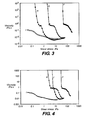
- the most effective result for reducing the "yield stress value" of the Control 1 was obtained with 0.3% concentration (Table 1), but C2 was unable to prevent the basic Control 1 system from gelling, as shown in Fig. 3 .
- the objective of this example was to determine the impact that the chemical structure of a preferred anchor moiety of the invention had on the system when used in isolation chemically (from its polymer moiety).
- aqueous dispersion of ZnO was made up as in Example 1 with the exception that an aqueous solution of comparison dispersant C3 (mercaptosuccinic acid, 97%) was used in place of the water.
- C3 represents a preferred anchor moiety of a dispersant of the invention.
- C3 was tested over the following final concentration range (w/w): 0.10%, 0.29% and 0.5%, representing a concentration range of dispersant to ZnO from 3:1000 to 17:1000. All three concentrations reduced the "yield stress value" of the Control 1 system by 0.7 to 0.9 of an order of magnitude, with the optimum concentration being 0.5% (Table 1).
- C3, which represents a preferred anchor moiety of a dispersant of the invention possessed a limited capability for reducing the "yield stress value" of the Control 1 system, but was unable to prevent the Control 1 composition from gelling, as shown in Fig. 4 .
- a preferred anchor moiety of the invention is not particularly effective as a dispersant, when used in chemical isolation, i.e. not bonded chemically to a suitable polymer moiety as defined for a dispersant of the invention.
- the objective of this example was to determine what impact the chemistry of a preferred polymer moiety of the invention had on the system when used in isolation (from its anchor moiety) from a chemical perspective.
- C4 represents a preferred polymer moiety of a dispersant of the invention.
- C4 was tested over the following final concentration range (w/w): 0.10%, 0.31%, 0.50% and 1.0%, representing a concentration range of dispersant to ZnO from 3:1000 to 33:1000.
- the "yield stress values” reduced with increasing concentration of C4 but, even at its most effective concentration C4 of 1.0%, it only lowered the yield stress of the Control 1 composition by just over an order of magnitude and hence was not as effective or efficient as C1 in this respect.
- C4 which represents a preferred polymer moiety of a dispersant of the invention, possesses a limited capability for reducing the "yield stress value" of the Control 1 system but is unable to prevent the Control 1 composition from gelling, as shown in Fig. 4 .
- a preferred polymer moiety of the invention is not particularly effective as a dispersant, when used in chemical isolation, i.e. not bonded chemically to a suitable anchor moiety as defined for a dispersant of the invention.
- Control 2 ⁇ -Aluminium oxide dispersion in water with no dispersant
- the Control 2 system is defined as an aqueous dispersion of oxide, ⁇ -Al 2 O 3 (Alpha Aesar, Stock No. 042573, 99.95% min., 0.35-0.49 micrometer APS powder) comprising 50wt% ⁇ -Al 2 O 3 and 50% millipore-purified water (w/w).
- the viscosity of the Control 2 dispersion system was recorded as a function of the decreasing shear stress from a high shear stress condition (approx. 200Pa). Although fluid at 200Pa, the viscosity started rising immediately with reducing shear. Before the shear stress had been decreased a full order of magnitude in value, the system showed the characteristic steep vertical rise in viscosity associated with a yield stress material.
- the "yield stress value” was measured to be approximately 39Pa, similar to the Control 1 system based on 30% zinc oxide in water. Hence the Control 2 system shows a strong tendency to gel.
- Control 2 ⁇ -Aluminium oxide + comparison dispersant C2
- aqueous dispersion of ⁇ -Al 2 O 3 was made up as in Example 6 with the exception that an aqueous solution of comparison dispersant C2 was used in place of the water. Therefore the final composition on a w/w basis was 50% ⁇ -Al 2 O 3 and 50% C2.
- the dispersant was tested over the following final concentration range (w/w): 0.30% and 1.0%, representing a concentration range of dispersant to ⁇ -Al 2 O 3 from 10:1000 to 33:1000. In each case the viscosity of the dispersion systems was recorded as a function of decreasing shear stress from a high shear stress (approx. 200Pa).
- Control 3 Chromium (III) oxide dispersion in water with no dispersant
- the Control 3 system is defined as an aqueous dispersion of Cr 2 O 3 (Aldrich, Cat. No. 20,216-9, 98+%, 1 micrometer powder), comprising 35wt% Cr 2 O 3 and 65% millipore-purified water (w/w).
- the viscosity of the Control 3 dispersion system was recorded as a function of the decreasing shear stress from a high shear stress (approx. 70Pa.) Although fluid at 70Pa, the viscosity started rising immediately with reducing shear. However, in just over an order of magnitude reduction in shear stress from high shear (shear stress ⁇ 6Pa), the system showed the characteristic steep vertical rise in viscosity associated with a yield stress material.
- yield stress value was found to be approx. 4.5Pa, which is an order of magnitude lower than the Control 1 system (30% zinc oxide in water alone). Although this value is lower than that of Controls 1 and 2, the presence of the yield stress condition still indicates a definite tendency to gel.
- Control 3 Chromium (III) oxide + comparison dispersant C2
- aqueous dispersion of Cr 2 O 3 was made up as in Example 8 with the exception that an aqueous solution of comparison dispersant C2 was used in place of water. Therefore the final composition on a w/w basis was 35% Cr 2 O 3 and 65% aqueous C2.
- the dispersant was tested over the following final concentration range (w/w): 0.1%, 0.2%, 0.30%, 0.5% and 1.0%, representing a concentration range of dispersant to Cr 2 O 3 from 3:1000 to 29:1000.
- the viscosity of each of the dispersion systems was recorded as a function of the decreasing shear stress from a high shear stress of approx. 70Pa.
- Control 1 (30% ZnO + No dispersant) 45 2 Control 1 + C1 0.2 (0.3%) 3 Control 1 + C2 1.9 (0.3%) 4 Control 1 + C3 5.4 (0.5%) 5 Control 1 + C4 2.9 (1.0%) 6 Control 2 (50% ⁇ -Al 2 O 3 no dispersant) 39 7 Control 2 + C2 32 (1.0%) 8 Control 3 (35% Cr 2 O 3 no dispersant) 4.5 9 Control 3 + C2 1.2 (0.2%)
- Examples 1, 6 and 8 demonstrate that aqueous dispersions of fine, particulate, metal oxides (ZnO, ⁇ -Al 2 O 3 , and Cr 2 O 3 ) can result in yield stress systems (i.e. they can, for example, form gels) when the solids content of their dispersions are high, in these particular cases, 30-50% by weight.
- yield stress systems i.e. they can, for example, form gels
- the rheology of such an aqueous particulate dispersion limits the maximum concentration of solids that is manageable in the resulting composition.
- Table 1 contains two Examples relating to the individual anchor and polymer moieties of one of the preferred dispersants of the invention.
- the anchor and polymer moieties were tested in isolation from a chemical perspective: the anchor moiety being represented by C3 (mercaptosuccinic acid) and the polymer moiety being represented by C4 (a polyacrylamide comprising an average of ⁇ 20 monomer units).
- C3 and C4 were generally not as effective as the prior art dispersants C1 and C2, i.e. the two major component parts of a structure of one of the preferred dispersants of the invention are not effective as dispersants when used in isolation from one another, from a chemical viewpoint.
- Control 1 Zinc oxide + Dispersant of the Invention I-1a
- aqueous dispersion of ZnO was made up as in Example 1, with the exception that an aqueous solution of I-1a was used in place of the water.
- the final composition on a w/w basis was 30% ZnO and 70% aqueous dispersant.
- the dispersant was tested over the following final concentration range (w/w): 0.10%, 0.30% and 0.50%, representing a concentration range of dispersant to ZnO from 3:1000 to 17:1000.
- the viscosity of the dispersion systems was recorded as a function of decreasing shear stress from a high shear stress of 20-300Pa.
- the high shear stress achieved may be as low as 20 Pa., whereas in the absence of a dispersant shear stresses as high as 300 Pa may be achieved).
- I-1a is capable of preventing the ZnO dispersion system (Control 1) from gelling, providing it is used within its optimum range of concentration.
- the optimum range of concentration is in the region of 0.5%, i.e. around 17:1000 dispersant to ZnO.
- I-1a showed a distinct advantage over comparison dispersants C1 and C2, which were unable to fluidize the Control 1 system at their optimum level and resulted in yield stress systems (i.e. gelling systems).
- Fig. 3 illustrates the scale of the difference in rheological performance between (I-1a) and C1 and C2 in the Control 1 system.
- Fig. 3 demonstrates how a dispersant of the invention can reduce the viscosity of dispersion systems and prevent them from gelling, relative to prior art dispersants.
- Fig. 4 demonstrates the efficacy of the combination of chemistries used in the dispersants of the invention compared to that of its two representative individual moieties.
- the representative individual moieties represented by curves J and K, have some impact in reducing the "yield stress value" of the Control 1 dispersion system, but nowhere near as great as the impact of dispersant I-1a (curve I), which in principle is the two moieties linked chemically together.
- This combination of chemistries in the dispersant of the invention reduces the low shear viscosity of the Control 1 dispersion system by several orders of magnitude, turning the formulation into a non-gelling fluid system. This produces the advantage of making the formulation more manageable and/or permitting further loading of solids into the system.
- Control 2 ⁇ -Aluminium oxide+ Dispersant of the Invention I-1a
- aqueous dispersion of ⁇ -Al 2 O 3 was made up as in Example 6 with the exception that an aqueous solution of I-1a was used in place of the water.
- the final composition on a w/w basis was 50% ⁇ -Al 2 O 3 and 50% aqueous dispersant (I-1a).
- the dispersant was tested over the following final concentration range (w/w): 0.10%, 0.30%, 0.49 and 0.98%, representing a concentration range of dispersant to ⁇ -Al 2 O 3 from 2:1000 to 20:1000.
- the viscosity of the dispersion systems was recorded as a function of decreasing shear stress from a high shear stress of 20-300Pa.
- Control 3 Chromium (III) oxide + Dispersant of the Invention I-1b
- aqueous dispersion of Cr 2 O 3 was made up using the same method and materials as those utilized in preparing the Control 3 in Example 8, with the exception that an aqueous solution of I-1b, was used in place of the water.
- the final composition on a w/w basis was 35% Cr 2 O 3 and 65% dilute aqueous dispersant.
- the dispersant was tested over the following final concentration range (w/w): 0.11%, 0.30% and 0.49%, representing a concentration range of dispersant to Cr 2 O 3 from 3: to 14:1000. In each case the viscosity of the dispersion systems was recorded as a function of decreasing shear stress from a high shear stress (20-80Pa).
- Control 1 Zinc oxide+ Dispersant of the Invention I-2a
- aqueous dispersion of ZnO was made up as in Example 1 with the exception that an aqueous solution of I-2a, was used in place of the water.
- the final composition on a w/w basis was 30% ZnO and 70% aqueous dispersant.
- the dispersant was tested over the following final concentration range (w/w): 0.09%, 0.30% and 0.49%, representing a concentration range of dispersant to ZnO from 3:1000 to 16:1000.
- the viscosity of the dispersion systems was recorded as a function of decreasing shear stress from a high shear stress (30-300Pa).
- Control 1 Additional Zinc oxide + Dispersant of the Invention I-2a
- the aim of this example was to take one of the dispersion samples from Example 13 that possessed more than the optimum level of I-2a and then attempt to increase the amount of ZnO solid in the system until its rheology was similar to that of the original Control 1 dispersion.
- the objective here was to demonstrate that systems containing a near optimum amount of a dispersant of the invention could be loaded with more dispersion than the original control system that contained no dispersant, without any penalty.
- Control 3 Chromium (III) oxide + Dispersant of the Invention I-2a
- aqueous dispersion of Cr 2 O 3 was made up using the same method and materials as those utilised in preparing the Control 3 in Example 8, with the exception that an aqueous solution of I-2a was used in place of the water.
- the final composition on a w/w basis was 35% Cr 2 O 3 and 65% aqueous dispersant.
- the dispersant was tested over the following final concentration range (w/w): 0.09%, 0.30% and 0.50%, representing a concentration range of dispersant to Cr 2 O 3 from 3:1000 to 14:1000. In each case the viscosity of the dispersion systems was recorded as a function of decreasing shear stress from a high shear stress (20-300Pa).
- the most effective result was obtained at 0.30% concentration of the dispersant, where the low shear viscosity at 0.04Pa shear stress was 110Pa.s.
- the invention dispersant reduced the low shear viscosity of the Control 3 dispersion system below 1000Pa.s and hence is characterized as a fluid system, with a low shear viscosity at 0.04Pa shear stress, and not as a yield stress system.
- I-2a shows a similar effectiveness to I-1b in the Control 3 system and hence is also much more effective than C2 in the Control 3 system, which at its optimum concentration of 0.2% resulted in a yield stress system with "yield stress value" of 1.2Pa (see Example 9 - Table 1).
- Yield stress value 1.2Pa
- the dispersants of the invention work with solid particulates and in particular inorganic oxides that are below their isoelectric point, i.e. where they are cationically charged, which in practical terms for aqueous systems in the absence of acid, means solid particulates with an isoelectric point above pH 5.8, i.e. the pH of water saturated with carbon dioxide.
- ZnO, ⁇ -Al 2 O 3 and Cr 2 O 3 are three such examples that can be used with advantage.
- the dispersants of the invention reduced the dispersion to a fluid system with a definable low shear viscosity
- the control dispersion, or the control dispersion with a comparison dispersant tended to result in a yield stress system (gelling system).
- Example 14 demonstrates that a dispersant of the invention lowers the viscosity of a dispersion system so effectively that more solids can be added to the system, without making the viscosity or yield stress any higher than the original dispersion system in the absence of dispersant. It is thus established that dispersants of the invention permit increased loading of solids in such dispersions.
- Example 10 in Table 2 shows that when anchor and polymer moieties of a structure of one of the preferred dispersants of the invention, namely mercaptosuccinic acid and polyacrylamide were chemically linked together in an anchor-polymer conformation as defined in the invention, in this case as I-1a, the resulting compound reduced the viscosity of the dispersion by a totally unexpected magnitude. This is graphically depicted in Fig. 4 . These data show the importance in the invention of the combination of anchor and stabilizing polymer moieties.
- each of the above compositions was coated several times, each in the following manner.
- Each formulation was coated onto 7mil gelatin-subbed EstarTM ( ⁇ 100 ⁇ m thick) using an RK Print Motorised K Control Blade Coater (manufactured by R K Print Coat Instruments Ltd). Coatings were made using a coating speed of 1.6 cm.s -1 (speed setting 3) and a blade height of 1 50 ⁇ m (set with a feeler gauge before each coating).
- the temperature of the coating block was controlled by re-circulating water maintained at 40° ⁇ 0.1C, giving a block surface temperature of 39.0° ⁇ 0.5C.
- the coating quality was improved by fan-assisted drying using a standard, static, desktop fan set 50 cm away from the coating block at the same height as the block.
- FIGs. 5a and 5b This difference is illustrated photographically in Figs. 5a and 5b using two representative coatings from the above study, one without a dispersant and the other with dispersant of the invention I-3b. These photographs were obtained by illuminating the coatings from the side in a darkroom using a horizontally mounted Beck microscope lamp positioned about 1 metre away. The coatings were tipped about 12° from the horizontal towards the lamp to help the illumination of surface imperfections.
- the coating quality can be improved when a dispersant of the invention is used to disperse the alumina media, as in Fig. 5b , compared to the case when no dispersant is present, as in Fig. 5a .
- the dispersing capability of a dispersant of the invention is demonstrated, indicating that a dispersant of the invention produces a much finer dispersion of alumina than water alone.
Landscapes
- Chemical & Material Sciences (AREA)
- Organic Chemistry (AREA)
- Engineering & Computer Science (AREA)
- Materials Engineering (AREA)
- Wood Science & Technology (AREA)
- Life Sciences & Earth Sciences (AREA)
- Dispersion Chemistry (AREA)
- Inorganic Chemistry (AREA)
- Emulsifying, Dispersing, Foam-Producing Or Wetting Agents (AREA)
- Ink Jet Recording Methods And Recording Media Thereof (AREA)
- Paints Or Removers (AREA)
- Inks, Pencil-Leads, Or Crayons (AREA)
- Addition Polymer Or Copolymer, Post-Treatments, Or Chemical Modifications (AREA)
Applications Claiming Priority (2)
| Application Number | Priority Date | Filing Date | Title |
|---|---|---|---|
| GBGB0428262.0A GB0428262D0 (en) | 2004-12-23 | 2004-12-23 | Dispersant for reducing viscosity of particulate solids |
| PCT/GB2005/005000 WO2006067457A1 (en) | 2004-12-23 | 2005-12-22 | Dispersant for reducing viscosity of particulate solids |
Publications (2)
| Publication Number | Publication Date |
|---|---|
| EP1824589A1 EP1824589A1 (en) | 2007-08-29 |
| EP1824589B1 true EP1824589B1 (en) | 2011-04-06 |
Family
ID=34113189
Family Applications (1)
| Application Number | Title | Priority Date | Filing Date |
|---|---|---|---|
| EP05843336A Expired - Lifetime EP1824589B1 (en) | 2004-12-23 | 2005-12-22 | Dispersant for reducing viscosity of particulate solids |
Country Status (6)
| Country | Link |
|---|---|
| US (1) | US8153716B2 (enExample) |
| EP (1) | EP1824589B1 (enExample) |
| JP (1) | JP2008525178A (enExample) |
| DE (1) | DE602005027387D1 (enExample) |
| GB (1) | GB0428262D0 (enExample) |
| WO (1) | WO2006067457A1 (enExample) |
Families Citing this family (7)
| Publication number | Priority date | Publication date | Assignee | Title |
|---|---|---|---|---|
| JP4525583B2 (ja) * | 2005-12-15 | 2010-08-18 | 東レ・ファインケミカル株式会社 | 酸化亜鉛分散ペーストの製造方法 |
| GB0526231D0 (en) * | 2005-12-22 | 2006-02-01 | Eastman Kodak Co | Dispersant for reducing viscosity of solids |
| GB0712482D0 (en) * | 2007-06-27 | 2007-08-08 | Eastman Kodak Co | Thermally-responsive dispersants for media formulations |
| JP5125464B2 (ja) * | 2007-12-10 | 2013-01-23 | セイコーエプソン株式会社 | 導体パターン形成用インク、導体パターンおよび配線基板 |
| DE102010001891A1 (de) | 2010-02-12 | 2011-08-18 | Leibniz-Institut für Polymerforschung Dresden e.V., 01069 | Dispergiermittel zur Stabilisierung von Dispersionen |
| GB201613970D0 (en) * | 2016-08-15 | 2016-09-28 | Xeros Ltd | Method for applying a treatment agent to a substrate |
| CN115785324A (zh) * | 2023-02-09 | 2023-03-14 | 广东壮丽彩印股份有限公司 | 一种纳米碳酸钙用分散剂的制备方法 |
Family Cites Families (24)
| Publication number | Priority date | Publication date | Assignee | Title |
|---|---|---|---|---|
| NL194077A (enExample) * | 1954-01-18 | |||
| US3117944A (en) | 1960-07-28 | 1964-01-14 | Du Pont | Coagula of colloidal fibrous boehmite and acrylamide polymers and processes for making same |
| US3935023A (en) * | 1973-07-30 | 1976-01-27 | Philadelphia Quartz Company | Alumina dispersions |
| US4548733A (en) * | 1984-10-05 | 1985-10-22 | Dow Corning Corporation | Anionic siliconates of silylorganocarboxylates, sulfonates and phosphonates to reduce viscosities of particulate slurries |
| US5231131A (en) * | 1991-12-24 | 1993-07-27 | E. I. Du Pont De Nemours And Company | Aqueous graft copolymer pigment dispersants |
| US5244861A (en) | 1992-01-17 | 1993-09-14 | Eastman Kodak Company | Receiving element for use in thermal dye transfer |
| US5928127A (en) | 1995-04-03 | 1999-07-27 | Asahi Glass Company Ltd. | Alumina sol and recording sheet |
| AU7438196A (en) * | 1995-10-27 | 1997-05-15 | E.I. Du Pont De Nemours And Company | Dispersants for inorganic materials in aqueous systems |
| GB9626941D0 (en) * | 1996-12-27 | 1997-02-12 | Ecc Int Ltd | Dispersed aqueous suspensions |
| DE19703582A1 (de) | 1997-01-31 | 1998-08-06 | Borchers Gmbh | Verwendung von Oligocarbonsäuresalzen als Netz- und Dispergierhilfsmittel für wäßrige Pigmentzubereitungen |
| US5888681A (en) | 1997-05-23 | 1999-03-30 | Eastman Kodak Company | Photographic element with microvoided sheet of opalescent appearance |
| US5853965A (en) | 1997-05-23 | 1998-12-29 | Eastman Kodak Company | Photographic element with bonding layer on oriented sheet |
| US5874205A (en) | 1997-05-23 | 1999-02-23 | Eastman Kodak Company | Photographic element with indicia on oriented polymer back sheet |
| US5888683A (en) | 1997-05-23 | 1999-03-30 | Eastman Kodak Company | Roughness elimination by control of strength of polymer sheet in relation to base paper |
| US5866282A (en) | 1997-05-23 | 1999-02-02 | Eastman Kodak Company | Composite photographic material with laminated biaxially oriented polyolefin sheets |
| US5888643A (en) | 1997-05-23 | 1999-03-30 | Eastman Kodak Company | Controlling bending stiffness in photographic paper |
| US5888714A (en) | 1997-12-24 | 1999-03-30 | Eastman Kodak Company | Adhesives such as metallocene catalyzed ethylene plastomers for bonding biaxially oriented polyolefin sheets to paper |
| JP3470879B2 (ja) * | 1999-01-22 | 2003-11-25 | タイホー工業株式会社 | インクジェット用被記録材用塗工剤及びインクジェット用被記録材 |
| DE10022371A1 (de) * | 1999-05-20 | 2000-11-23 | Bayer Ag | Pfropfcopolymere enthaltende Feststoffpräparationen |
| AUPQ654700A0 (en) * | 2000-03-28 | 2000-04-20 | Alcoa Of Australia Limited | Agglomeration of alumina and binder therefor |
| US6660793B1 (en) * | 2000-06-15 | 2003-12-09 | E. I. Du Pont De Nemours And Company | Aqueous coating compositions having improved transparency |
| FR2810261B1 (fr) * | 2000-06-15 | 2002-08-30 | Coatex Sa | Utilisation de copolymeres faiblement anioniques comme agent dispersant et/ou d'aide au broyage de suspension aqueuse de matieres minerales, suspensions aqueuses obtenues et leurs utilisations |
| US20030144399A1 (en) * | 2001-10-31 | 2003-07-31 | Matta Bruce L. | Polymeric stabilizer for pigment dispersions |
| AU2003272186A1 (en) * | 2002-02-04 | 2004-01-06 | Nanophase Technologies Corporation | Stable dispersions of nanoparticles in aqueous media |
-
2004
- 2004-12-23 GB GBGB0428262.0A patent/GB0428262D0/en not_active Ceased
-
2005
- 2005-12-22 US US11/722,674 patent/US8153716B2/en not_active Expired - Fee Related
- 2005-12-22 DE DE602005027387T patent/DE602005027387D1/de not_active Expired - Lifetime
- 2005-12-22 JP JP2007547648A patent/JP2008525178A/ja active Pending
- 2005-12-22 WO PCT/GB2005/005000 patent/WO2006067457A1/en not_active Ceased
- 2005-12-22 EP EP05843336A patent/EP1824589B1/en not_active Expired - Lifetime
Also Published As
| Publication number | Publication date |
|---|---|
| DE602005027387D1 (de) | 2011-05-19 |
| JP2008525178A (ja) | 2008-07-17 |
| US8153716B2 (en) | 2012-04-10 |
| WO2006067457A1 (en) | 2006-06-29 |
| GB0428262D0 (en) | 2005-01-26 |
| US20080145546A1 (en) | 2008-06-19 |
| EP1824589A1 (en) | 2007-08-29 |
Similar Documents
| Publication | Publication Date | Title |
|---|---|---|
| JP4704564B2 (ja) | シリカ分散体、コーティング組成物、及び記録媒体 | |
| KR20100098426A (ko) | 내부식성 물질 | |
| GB2297758A (en) | Gloss emulsion paints | |
| JP2006508882A (ja) | 分散液、塗工液および吸収性媒体 | |
| JP2003342515A (ja) | 分散液、塗料および記録媒体 | |
| US8153716B2 (en) | Dispersant for reducing viscosity of particulate solids | |
| US8063132B2 (en) | Coating composition comprising boehmite particles and one or more dispersants and a method of coating a substrate using said coating composition | |
| TWI488928B (zh) | 水性導電組成物 | |
| Tan et al. | Rheological properties of nanometer tetragonal polycrystal zirconia slurries for aqueous gel tape casting process | |
| US8202926B2 (en) | Coating composition containing a dispersant | |
| US6476083B1 (en) | Alumina dispersant, alumina dispersion liquid, agent for treating inkjet-printing materials, and inkjet-printing materials | |
| US8318853B2 (en) | Thermally-responsive dispersants for media formulations | |
| Song et al. | Rheological properties of nanosized barium titanate prepared by HGRP for aqueous tape casting | |
| US6617362B1 (en) | Method of making cationic pigment slurries | |
| EP1817117A2 (en) | High solids content boehmite alumina dispersions and coated substrates made therefrom | |
| US7144475B2 (en) | Method of making a coated paper | |
| JP2005313490A (ja) | 微粒子分散液、および該分散液を用いた被記録媒体 | |
| CA2385878C (en) | Recording medium with glossy coating containing alumina | |
| Tan et al. | Influence of polyelectrolyte dispersant on slip preparation of nano-sized tetragonal polycrystals zirconia for aqueous-gel-tape-casting process | |
| JP2008190071A (ja) | 紙塗工用組成物 | |
| JP6100134B2 (ja) | キャストコート紙およびその製造方法 | |
| JP2006281474A (ja) | インクジェット記録媒体の製造方法 | |
| CN102336083B (zh) | 记录介质 | |
| JPH02129066A (ja) | セラミックス摺動部材およびその製造方法 |
Legal Events
| Date | Code | Title | Description |
|---|---|---|---|
| PUAI | Public reference made under article 153(3) epc to a published international application that has entered the european phase |
Free format text: ORIGINAL CODE: 0009012 |
|
| 17P | Request for examination filed |
Effective date: 20070702 |
|
| AK | Designated contracting states |
Kind code of ref document: A1 Designated state(s): DE FR GB |
|
| RBV | Designated contracting states (corrected) |
Designated state(s): DE FR GB |
|
| DAX | Request for extension of the european patent (deleted) | ||
| 17Q | First examination report despatched |
Effective date: 20080722 |
|
| GRAP | Despatch of communication of intention to grant a patent |
Free format text: ORIGINAL CODE: EPIDOSNIGR1 |
|
| GRAS | Grant fee paid |
Free format text: ORIGINAL CODE: EPIDOSNIGR3 |
|
| GRAA | (expected) grant |
Free format text: ORIGINAL CODE: 0009210 |
|
| AK | Designated contracting states |
Kind code of ref document: B1 Designated state(s): DE FR GB |
|
| REG | Reference to a national code |
Ref country code: GB Ref legal event code: FG4D |
|
| REF | Corresponds to: |
Ref document number: 602005027387 Country of ref document: DE Date of ref document: 20110519 Kind code of ref document: P |
|
| REG | Reference to a national code |
Ref country code: DE Ref legal event code: R096 Ref document number: 602005027387 Country of ref document: DE Effective date: 20110519 |
|
| PLBE | No opposition filed within time limit |
Free format text: ORIGINAL CODE: 0009261 |
|
| STAA | Information on the status of an ep patent application or granted ep patent |
Free format text: STATUS: NO OPPOSITION FILED WITHIN TIME LIMIT |
|
| 26N | No opposition filed |
Effective date: 20120110 |
|
| REG | Reference to a national code |
Ref country code: DE Ref legal event code: R097 Ref document number: 602005027387 Country of ref document: DE Effective date: 20120110 |
|
| PGFP | Annual fee paid to national office [announced via postgrant information from national office to epo] |
Ref country code: GB Payment date: 20121128 Year of fee payment: 8 |
|
| PGFP | Annual fee paid to national office [announced via postgrant information from national office to epo] |
Ref country code: FR Payment date: 20121219 Year of fee payment: 8 |
|
| PGFP | Annual fee paid to national office [announced via postgrant information from national office to epo] |
Ref country code: DE Payment date: 20121221 Year of fee payment: 8 |
|
| REG | Reference to a national code |
Ref country code: DE Ref legal event code: R119 Ref document number: 602005027387 Country of ref document: DE |
|
| GBPC | Gb: european patent ceased through non-payment of renewal fee |
Effective date: 20131222 |
|
| REG | Reference to a national code |
Ref country code: DE Ref legal event code: R119 Ref document number: 602005027387 Country of ref document: DE Effective date: 20140701 |
|
| REG | Reference to a national code |
Ref country code: FR Ref legal event code: ST Effective date: 20140829 |
|
| PG25 | Lapsed in a contracting state [announced via postgrant information from national office to epo] |
Ref country code: DE Free format text: LAPSE BECAUSE OF NON-PAYMENT OF DUE FEES Effective date: 20140701 |
|
| PG25 | Lapsed in a contracting state [announced via postgrant information from national office to epo] |
Ref country code: GB Free format text: LAPSE BECAUSE OF NON-PAYMENT OF DUE FEES Effective date: 20131222 Ref country code: FR Free format text: LAPSE BECAUSE OF NON-PAYMENT OF DUE FEES Effective date: 20131231 |