EP1813787A2 - Verfahren sowie Vorrichtung zur Abgasuntersuchung bei Dieselmotoren - Google Patents
Verfahren sowie Vorrichtung zur Abgasuntersuchung bei Dieselmotoren Download PDFInfo
- Publication number
- EP1813787A2 EP1813787A2 EP06127029A EP06127029A EP1813787A2 EP 1813787 A2 EP1813787 A2 EP 1813787A2 EP 06127029 A EP06127029 A EP 06127029A EP 06127029 A EP06127029 A EP 06127029A EP 1813787 A2 EP1813787 A2 EP 1813787A2
- Authority
- EP
- European Patent Office
- Prior art keywords
- exhaust gas
- temperature sensor
- sensor
- turbidity
- exhaust
- Prior art date
- Legal status (The legal status is an assumption and is not a legal conclusion. Google has not performed a legal analysis and makes no representation as to the accuracy of the status listed.)
- Granted
Links
Images

Classifications
-
- F—MECHANICAL ENGINEERING; LIGHTING; HEATING; WEAPONS; BLASTING
- F01—MACHINES OR ENGINES IN GENERAL; ENGINE PLANTS IN GENERAL; STEAM ENGINES
- F01N—GAS-FLOW SILENCERS OR EXHAUST APPARATUS FOR MACHINES OR ENGINES IN GENERAL; GAS-FLOW SILENCERS OR EXHAUST APPARATUS FOR INTERNAL-COMBUSTION ENGINES
- F01N11/00—Monitoring or diagnostic devices for exhaust-gas treatment apparatus
-
- F—MECHANICAL ENGINEERING; LIGHTING; HEATING; WEAPONS; BLASTING
- F01—MACHINES OR ENGINES IN GENERAL; ENGINE PLANTS IN GENERAL; STEAM ENGINES
- F01N—GAS-FLOW SILENCERS OR EXHAUST APPARATUS FOR MACHINES OR ENGINES IN GENERAL; GAS-FLOW SILENCERS OR EXHAUST APPARATUS FOR INTERNAL-COMBUSTION ENGINES
- F01N11/00—Monitoring or diagnostic devices for exhaust-gas treatment apparatus
- F01N11/002—Monitoring or diagnostic devices for exhaust-gas treatment apparatus the diagnostic devices measuring or estimating temperature or pressure in, or downstream of the exhaust apparatus
-
- F—MECHANICAL ENGINEERING; LIGHTING; HEATING; WEAPONS; BLASTING
- F02—COMBUSTION ENGINES; HOT-GAS OR COMBUSTION-PRODUCT ENGINE PLANTS
- F02D—CONTROLLING COMBUSTION ENGINES
- F02D41/00—Electrical control of supply of combustible mixture or its constituents
- F02D41/02—Circuit arrangements for generating control signals
- F02D41/14—Introducing closed-loop corrections
- F02D41/1438—Introducing closed-loop corrections using means for determining characteristics of the combustion gases; Sensors therefor
- F02D41/1444—Introducing closed-loop corrections using means for determining characteristics of the combustion gases; Sensors therefor characterised by the characteristics of the combustion gases
- F02D41/1446—Introducing closed-loop corrections using means for determining characteristics of the combustion gases; Sensors therefor characterised by the characteristics of the combustion gases the characteristics being exhaust temperatures
-
- F—MECHANICAL ENGINEERING; LIGHTING; HEATING; WEAPONS; BLASTING
- F01—MACHINES OR ENGINES IN GENERAL; ENGINE PLANTS IN GENERAL; STEAM ENGINES
- F01N—GAS-FLOW SILENCERS OR EXHAUST APPARATUS FOR MACHINES OR ENGINES IN GENERAL; GAS-FLOW SILENCERS OR EXHAUST APPARATUS FOR INTERNAL-COMBUSTION ENGINES
- F01N2550/00—Monitoring or diagnosing the deterioration of exhaust systems
- F01N2550/03—Monitoring or diagnosing the deterioration of exhaust systems of sorbing activity of adsorbents or absorbents
-
- F—MECHANICAL ENGINEERING; LIGHTING; HEATING; WEAPONS; BLASTING
- F01—MACHINES OR ENGINES IN GENERAL; ENGINE PLANTS IN GENERAL; STEAM ENGINES
- F01N—GAS-FLOW SILENCERS OR EXHAUST APPARATUS FOR MACHINES OR ENGINES IN GENERAL; GAS-FLOW SILENCERS OR EXHAUST APPARATUS FOR INTERNAL-COMBUSTION ENGINES
- F01N2560/00—Exhaust systems with means for detecting or measuring exhaust gas components or characteristics
- F01N2560/02—Exhaust systems with means for detecting or measuring exhaust gas components or characteristics the means being an exhaust gas sensor
-
- G—PHYSICS
- G01—MEASURING; TESTING
- G01N—INVESTIGATING OR ANALYSING MATERIALS BY DETERMINING THEIR CHEMICAL OR PHYSICAL PROPERTIES
- G01N21/00—Investigating or analysing materials by the use of optical means, i.e. using sub-millimetre waves, infrared, visible or ultraviolet light
- G01N21/17—Systems in which incident light is modified in accordance with the properties of the material investigated
- G01N21/47—Scattering, i.e. diffuse reflection
- G01N21/49—Scattering, i.e. diffuse reflection within a body or fluid
- G01N21/53—Scattering, i.e. diffuse reflection within a body or fluid within a flowing fluid, e.g. smoke
- G01N21/534—Scattering, i.e. diffuse reflection within a body or fluid within a flowing fluid, e.g. smoke by measuring transmission alone, i.e. determining opacity
-
- Y—GENERAL TAGGING OF NEW TECHNOLOGICAL DEVELOPMENTS; GENERAL TAGGING OF CROSS-SECTIONAL TECHNOLOGIES SPANNING OVER SEVERAL SECTIONS OF THE IPC; TECHNICAL SUBJECTS COVERED BY FORMER USPC CROSS-REFERENCE ART COLLECTIONS [XRACs] AND DIGESTS
- Y02—TECHNOLOGIES OR APPLICATIONS FOR MITIGATION OR ADAPTATION AGAINST CLIMATE CHANGE
- Y02T—CLIMATE CHANGE MITIGATION TECHNOLOGIES RELATED TO TRANSPORTATION
- Y02T10/00—Road transport of goods or passengers
- Y02T10/10—Internal combustion engine [ICE] based vehicles
- Y02T10/40—Engine management systems
Definitions
- the invention relates to a method for exhaust gas testing in diesel engines, comprising determining the turbidity or absorption, wherein rapid load changes must be performed, and a device for exhaust gas analysis in diesel engines, comprising a turbidity measuring apparatus and an evaluation unit.
- the turbidity N or the absorption k is checked during the exhaust gas test.
- rapid load changes of the engine are to be passed through, which are achieved by rapid speed accelerations.
- the turbidity N reaches its maximum value at these load increases, which is used to determine the measurement result.
- the monitoring of the load change is performed in most cases via the speed.
- a speed sensor is usually mounted in the engine compartment, which is very time-consuming and difficult in many cases.
- the speed is increasingly used as a management and monitoring measure for the emission analysis.
- the turbidity is observed during run-up and, in addition to the evaluation of the turbidity peak value, also used for procedure control.
- This method has the disadvantage that in vehicles with particle filter, which hardly produce turbidity, no safe speed increase can be determined, since no real turbidity peak occurs even in speed up.
- the exhaust pressure is monitored, for which a pressure sensor is integrated into the meter.
- the exhaust pressure is supplied to the pressure sensor via the sampling, which is already connected to the exhaust.
- the review of the exhaust pressure has the disadvantage that the soot particles and the chemical composition of the exhaust gas (NOx, HC, ...) and the chem. Compounds therefrom (for example: nitric acid) can damage or destroy the sensor permanently.
- the condensate contained in the exhaust gas (often mixed with oil, soot, rust particles, etc.) can have a negative effect on the pressure sensor.
- pressure sensors have a complex structure, which is reflected in a correspondingly high price.
- the object of the present invention was an apparatus for emission analysis, which ensures a simple determination of speed changes or load changes of the engine with a simple, reliable and economical design and without major interference in the engine to be tested.
- the method according to the invention is characterized in that the relative change in the exhaust gas flow rate is monitored to determine the rapid load changes.
- This flow change can be determined easily and without expensive intervention on the engine itself in the field of exhaust gas sampling and represents by determining the coupled with a speed change gas shock is a simple and safe monitoring size.
- the exhaust gas passed through a heated temperature sensor and its temperature change is used as a measure of the relative change in the flow. Since the relative temperature change is sufficient for the determination of the gas impact, the cooling or heating of the temperature sensor taking place for the duration of the gas shock can be used as an indicator for this gas impact and thus also the speed change.
- the actual test run is initiated after setting a sensor temperature, so that a reference value is given at a certain speed of the motor, against which the cooling or heating of the temperature sensor is determined.
- this reference mark is determined at idle speed.
- the solution of the problem is also solved by a device for exhaust gas analysis, which is characterized according to the invention by a device for determining relative flow changes of the exhaust gas.
- This device does not require any changes to the engine to be checked and yet provides a way to safely determine changes in the engine speed.
- the device for determining relative flow changes comprises a heated exhaust gas temperature sensor.
- a heated resistor in the form of a heat wire or a hot-film plate is present, and a complex control electronics keeps the temperature of this flowed around by the measuring medium hot wire or hot-film platelet constant. From the energy required to stabilize the temperature supplied by the flowing air mass can be determined.
- Arrangements with two temperature sensors are also known for flow measurement, one of the sensors determining the temperature of the flow-free medium.
- the exhaust gas temperature sensor is heated to a selectable operating temperature.
- the circuit is very simple with only one temperature sensor.
- the exhaust gas temperature sensor is used in a low-resistance measuring bridge.
- the sensor is automatically heated by the current in the measuring bridge. From the measuring bridge diagonal voltage, the sensor temperature can be determined, with increases in speed and thus also increased exhaust gas flow lead to cooling or heating of the sensor and thus an indication of a load change.
- the exhaust gas temperature sensor is provided with a protective sheath, preferably made of glass, so that the measurement is not impaired by the accumulation and accumulation of soot, dirt and the like on the sensor.
- the exhaust gas temperature sensor is a PT-100 sensor. This type of sensor has proven itself many times, is very small, and has a low heat capacity and therefore very good dynamic properties.
- a program is stored in the evaluation unit which records the course of the exhaust turbidity determined via the turbidity measuring apparatus as well as the signals of the device for determining the relative change in the exhaust gas flow, preferably the values of the exhaust gas flow. Temperature sensor, processed and determined from a load change.
- FIG. 2 shows an exemplary embodiment of a measuring circuit according to the invention
- FIG. 3 is a diagram with the time profiles of relevant variables and associated signals or measured values.
- At least a partial flow of the exhaust gas 1 to be analyzed is passed through a turbidity measuring apparatus 2.
- This turbidity measuring apparatus 2 is connected to an evaluation unit 3, in which preferably a program is stored, which is processed via the turbidity measuring device 2 determined course of the exhaust turbidity.
- a device for determining relative changes in the flow of the exhaust gas 1 is additionally present, which in the illustrated embodiment, a heated exhaust gas temperature sensor 4, preferably in front of the measuring cell Turbidity measuring apparatus 2 connected includes.
- This exhaust gas temperature sensor 4 is also connected to the evaluation unit 3, in which preferably programmatically, the signals of the device for determining relative changes in the exhaust gas flow, preferably the values of the exhaust gas temperature sensor 4, processed and from the load changes are determined.
- the evaluation unit 3 can also be integrated into the turbidity measuring apparatus 2.
- the exhaust gas temperature sensor 4 is preferably used in a low-resistance measuring bridge, which is shown by way of example in FIG. 2.
- the three arrows symbolize the exhaust stream 1, which at the temperature sensor 4, preferably a proven and cheap PT 100 sensor, passed.
- This is advantageously surrounded by a protective glass tube so that soot particles, oil, condensate u. The like have no effect on the sensor 4 and thus not on the measurement result.
- At 5 is the feed of the measuring bridge, wherein due to the low-impedance design of the measuring bridge, the required heating current flows through the temperature sensor 4.
- the bridge diagonal voltage can be tapped, which depends on the temperature and the variable resistance of the temperature sensor 4. This type of measurement also has the advantage that no circuitry overhead is required.
- FIG. 3 graphically illustrates the above-described relationships in a graph showing the time course of the rotational speed, the exhaust gas flow, and the turbidity in the curves 7, 8, and 9.
- the curve 10 for the temperature at the exhaust gas temperature sensor 4 is located.
- the section 7a of the speed curve 7 represents the output speed, usually the idling speed, at which a specific operating temperature, represented by the curve section 10a, adjusts itself to the temperature sensor 4 as a function of the voltage fed into the measuring bridge, for example of FIG.
- a load change takes place, for example, by increasing the rotational speed, so that the curve section 7b is reached.
- the exhaust gas flow change follows the speed change with a slight time delay, which is expressed in the curve 8. With a further slight time delay, a cloud point occurs, as can be seen in curve 9.
- the temperature sensor 4 Due to the gas impact and the thus increased exhaust gas flow, the temperature sensor 4 is cooled, possibly also heated, which is expressed in the curve sections 10b and 10c. This cooling 10b or heating 10c is then in the Evaluation unit 3 registered and processed as an indication of the occurrence of the gas shock and thus a load change. After returning to the output speed 7a and the temperature goes back to the initial value, ie the operating temperature 10a back.
Landscapes
- Engineering & Computer Science (AREA)
- Chemical & Material Sciences (AREA)
- Combustion & Propulsion (AREA)
- Mechanical Engineering (AREA)
- General Engineering & Computer Science (AREA)
- Chemical Kinetics & Catalysis (AREA)
- Testing Of Engines (AREA)
- Combined Controls Of Internal Combustion Engines (AREA)
- Investigating Or Analysing Materials By Optical Means (AREA)
Abstract
Description
- Die Erfindung betrifft ein Verfahren zur Abgasuntersuchung bei Dieselmotoren, umfassend die Bestimmung der Trübung bzw. der Absorption, wobei schnelle Lastwechsel durchlaufen werden müssen, sowie eine Vorrichtung zur Abgasuntersuchung bei Dieselmotoren, umfassend eine Trübungsmessapparatur und eine Auswerteeinheit.
- Bei Dieselmotoren wird bei der Abgasuntersuchung die Trübung N bzw. die Absorption k überprüft. Dabei sollen in jedem Fall schnelle Lastwechsel des Motors durchlaufen werden, welche durch rasche Drehzahlbeschleunigungen erreicht werden. Die Trübung N erreicht bei diesen Lastanstiegen ihren Maximalwert, welcher zur Ermittlung des Messergebnisses herangezogen wird. Die Überwachung des Lastwechsels wird in den meisten Fällen über die Drehzahl durchgeführt. Dazu wird meist ein Drehzahlsensor im Motorraum angebracht, was in vielen Fällen sehr zeitintensiv und schwierig ist.
- Daher wird die Drehzahl immer seltener als Führungs- und Überwachungsmessgröße für die Abgasuntersuchung herangezogen. Stattdessen wird die Trübung während des Hochlaufes beobachtet und neben der Auswertung des Trübungsspitzenwertes auch zur Prozedursteuerung verwendet. Dieses Verfahren hat den Nachteil, dass bei Fahrzeugen mit Partikelfilter, welche kaum Trübung produzieren, kein sicherer Drehzahlanstieg ermittelt werden kann, da auch im Drehzahlhochlauf kein wirklicher Trübungsspitzenwert auftritt.
- Daher ist die Drehzahlerhöhung über andere Messgrößen festzustellen, wobei dafür keine zusätzlichen Sensoren am Fahrzeug appliziert werden sollten. In vielen Fällen wird der Abgasdruck überwacht, wofür ein Drucksensor ins Messgerät integriert wird. Der Abgasdruck wird über die Probennahme, die ohnehin am Auspuff angeschlossen wird, dem Drucksensor zugeführt. Die Überprüfung des Abgasdrucks hat den Nachteil, dass die Russpartikel und die chemische Zusammensetzung des Abgases (NOx, HC, ...) sowie die chem. Verbindungen daraus (z.B.: Salpetersäure) den Sensor nachhaltig schädigen oder zerstören können. Weiters kann sich das im Abgas enthaltene Kondensat (oft mit Öl, Ruß, Rostteilchen,... versetzt) negativ auf den Drucksensor auswirken. Zudem besitzen Drucksensoren einen komplexen Aufbau, was sich in einem entsprechend hohen Preis niederschlägt.
- Die Drehzahländerungen über die Messung der Abgastemperatur festzustellen hat den Nachteil, dass aufgrund von teilweise sehr komplexen und langen Auspuffanlagen, in denen thermische Ausgleichsprozesse stattfinden, am Auspuffendrohr meist keine Temperaturänderung festgestellt werden kann.
- Die Aufgabe der vorliegenden Erfindung war eine Vorrichtung zur Abgasuntersuchung, die bei einfachem, funktionssicherem und wirtschaftlichem Aufbau und ohne große Eingriffe in den zu überprüfenden Motor die eindeutige Ermittlung von Drehzahländerungen bzw. Lastwechsel des Motors gewährleistet.
- Zur Lösung dieser Aufgabe ist das Verfahren erfindungsgemäß dadurch gekennzeichnet, dass zur Ermittlung der schnellen Lastwechsel die relative Veränderung des Abgasdurchflusses überwacht wird. Diese Durchflussänderung kann einfach und ohne aufwendige Eingriffe am Motor selbst im Bereich der Abgasprobennahme ermittelt werden und stellt durch Ermittlung des mit einer Drehzahländerung gekoppelten Gasstoßes eine einfache und sichere Überwachungsgröße dar.
- Dazu kann, gemäß einem bevorzugten Ausführungsbeispiel der Erfindung, vorgesehen sein, dass das Abgas über einen beheizten Temperatursensor geleitet und dessen Temperaturänderung als Maß für die relative Veränderung des Durchflusses herangezogen wird. Da für die Ermittlung des Gasstoßes die relative Temperaturänderung ausreichend ist, kann die für die Dauer des Gasstoßes erfolgende Abkühlung bzw. Erwärmung des Temperatursensors als Indikator für diesen Gasstoß und damit auch die Drehzahländerung herangezogen werden.
- Vorteilhafterweise wird der eigentliche Prüflauf nach Einstellen einer Sensortemperatur eingeleitet, so dass ein Referenzwert bei einer bestimmten Drehzahl des Motors gegeben ist, gegenüber welcher die Abkühlung bzw. Erwärmung des Temperatursensors ermittelt wird. Vorzugsweise wird diese Referenzmarke bei Leerlaufdrehzahl ermittelt.
- Die Lösung der gestellten Aufgabe wird aber auch durch eine Vorrichtung zur Abgasuntersuchung gelöst, die erfindungsgemäß gekennzeichnet ist durch eine Vorrichtung zur Ermittlung von relativen Durchflussänderungen des Abgases. Diese Vorrichtung bedarf keinerlei Änderungen am zu überprüfenden Motor und bietet dennoch eine Möglichkeit, sicher Drehzahländerungen des Motors feststellen zu können.
- Gemäß einer vorteilhaften Ausführungsform der erfindungsgemäßen Vorrichtung umfasst die Vorrichtung zur Ermittlung von relativen Durchflussänderungen einen beheizten Abgas-Temperatursensor. Für die Durchflussmessung sind sehr aufwendige und komplizierte Anordnungen bekannt, bei welchen eine beheizter Widerstand in Form eines Hitzedrahts oder eines Heißfilmplättchens vorhanden ist, und eine komplexe Regelelektronik die Temperatur dieses vom Messmediums umströmten Hitzedrahtes oder Heißfilmplättchens konstant hält. Aus der zur Stabilisierung der Temperatur notwendigen zugeführten Energie kann die vorbeiströmende Luftmasse ermittelt werden. Auch Anordnungen mit zwei Temperatursensoren sind zur Durchflussmessung bekannt, wobei einer der Sensoren die Temperatur des strömungsfreien Mediums ermittelt. Bei der erfindungsgemäßen Lösung hingegen wird der Abgas-Temperatursensor auf eine wählbare Betriebstemperatur aufgeheizt. Die Schaltung ist mit nur einem Temperatursensor sehr einfach aufgebaut.
- Gemäß einem weiteren Merkmal der Erfindung ist dabei der Abgas-Temperatursensor in einer niederohmigen Messbrücke eingesetzt. Damit wird der Sensor durch den Strom in der Messbrücke automatisch beheizt. Aus der Messbrückendiagonalspannung kann die Sensortemperatur ermittelt werden, wobei Drehzahlerhöhungen und damit auch erhöhter Abgasstrom zur Abkühlung bzw. Erwärmung des Sensors und damit einem Anzeichen für einen Lastwechsel führen.
- Vorteilhafterweise ist der Abgas-Temperatursensor mit einer Schutzhülle, vorzugsweise aus Glas, versehen, so dass die Messung nicht durch Ab- und Anlagerung von Russ, Schmutz und dgl. am Sensor beeinträchtigt wird.
- Gemäß einer vorteilhaften Ausführungsform der Erfindung ist vorgesehen, dass der Abgas-Temperatursensor ein PT-100 Sensor ist. Diese Art von Sensor ist vielfach bewährt, sehr klein, und besitzt eine geringe Wärmekapazität und damit sehr gute dynamische Eigenschaften.
- Gemäß einem weiteren Merkmal der Erfindung ist weiters vorgesehen, dass in der Auswerteeinheit ein Programm abgelegt ist, das den über die Trübungsmessapparatur ermittelten Verlauf der Abgas-Trübung als auch die Signale der Vorrichtung zur Ermittlung der relativen Veränderung des Abgasdurchflusses, vorzugsweise die Werte des Abgas-Temperatursensors, verarbeitet und daraus einen Lastwechsel ermittelt.
- In der nachfolgenden Beschreibung soll die Erfindung anhand eines auch in den beigefügten Zeichnungen dargestellten Ausführungsbeispieles näher erläutert werden.
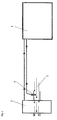
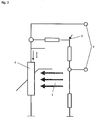
- Dabei zeigt die Fig. 1 in schematischer Darstellung das Grundprinzip des erfindungsgemäßen Verfahrens, Fig. 2 zeigt ein Ausführungsbeispiel für eine erfindungsgemäße Messschaltung, und Fig. 3 ist ein Diagramm mit den zeitlichen Verläufen relevanter Größen und zugehöriger Signale bzw. Messwerte.
- In einer erfindungsgemäßen Vorrichtung zur Abgasuntersuchung bei Dieselmotoren, wie auch in Fig. 1 beispielhaft und schematisch dargestellt, wird zumindest ein Teilstrom des zu analysierenden Abgases 1 durch eine Trübungsmessapparatur 2 geleitet. Diese Trübungsmessapparatur 2 ist mit einer Auswerteeinheit 3 verbunden, in welcher vorzugsweise ein Programm abgelegt ist, das den über die Trübungsmessapparatur 2 ermittelten Verlauf der Abgas-Trübung verarbeitet wird.
- Um nun schnelle Lastwechsel sicher und durch eine einfache als auch leicht einsetzbare Anordnung zu erkennen, ist erfindungsgemäß zusätzlich eine Vorrichtung zur Ermittlung von relativen Veränderungen des Durchflusses des Abgases 1 vorhanden, welche im dargestellten Ausführungsbeispiel einen beheizten Abgas-Temperatursensor 4, vorzugsweise vor der Messzelle der Trübungsmessapparatur 2 geschaltet, umfasst. Auch dieser Abgas-Temperatursensor 4 ist mit der Auswerteeinheit 3 verbunden, in welcher vorzugsweise programmgesteuert die Signale der Vorrichtung zur Ermittlung von relativen Veränderungen des Abgasdurchflusses, vorzugsweise also die Werte des Abgas-Temperatursensors 4, verarbeitet und daraus die Lastwechsel ermittelt werden. Die Auswerteeinheit 3 kann auch in die Trübungsmessapparatur 2 integriert werden.
- Vorzugsweise ist der Abgas-Temperatursensor 4 in einer niederohmigen Messbrücke eingesetzt, was beispielhaft in Fig. 2 dargestellt ist. Die drei Pfeile symbolisieren den Abgasstrom 1, welcher am Temperatursensor 4, vorzugsweise einem bewährten und billigen PT 100-Sensor, vorbeigeführt wird. Dieser ist vorteilhafterweise von einem schützenden Glasrohr umgeben, sodass Russpartikel, Öl, Kondensat u. dergleichen keinen Einfluss auf den Sensor 4 und damit auch nicht auf das Messergebnis haben. Bei 5 befindet sich die Einspeisung der Messbrücke, wobei aufgrund der niederohmigen Auslegung der Messbrücke der erforderliche Heizstrom durch den Temperatursensor 4 fließt. Bei 6 kann die Brückendiagonalspannung abgegriffen werden, welche von der Temperatur und dem damit veränderlichen Widerstand am Temperatursensor 4 abhängt. Diese Art der Messung besitzt überdies den Vorteil, dass kein schaltungstechnischer Mehraufwand erforderlich ist.
- Bereits im Motorleerlauf strömt Abgas 1 am vorgeheizten Sensor 4 vorbei. Dies bewirkt eine geringfügige Abkühlung oder auch Erwärmung des Sensors 4 auf eine bestimmte Betriebstemperatur. Bei einem Drehzahlhochlauf im Zuge eines Lastwechsels strömt mehr Abgas 1 am Sensor 4 vorbei, sodass eine merkliche Abkühlung oder auch Erwärmung des Sensors 4 für die Dauer des Gasstoßes auftritt. Nach Rückkehr des Motors auf Leerlaufdrehzahl erhöht oder senkt sich die Sensortemperatur wieder.
- Die Fig. 3 stellt die oben beschriebenen Verhältnisse graphisch in einem Diagramm dar, welches den zeitlichen Verlauf der Drehzahl, des Abgasstroms, und der Trübung in den Kurven 7, 8 und 9 zeigt. Darüber ist die Kurve 10 für die Temperatur am Abgas-Temperatursensor 4 eingezeichnet.
- Der Abschnitt 7a der Drehzahlkurve 7 repräsentiert die Ausgangsdrehzahl, meist die Leerlaufdrehzahl, bei welcher sich in Abhängigkeit von der in die Messbrücke beispielsweise der Fig. 2 eingespeisten Spannung eine bestimmte Betriebstemperatur, repräsentiert durch den Kurvenabschnitt 10a, am Temperatursensor 4 einstellt. Ein Lastwechsel erfolgt beispielsweise durch Erhöhen der Drehzahl, sodass der Kurvenabschnitt 7b erreicht wird. Die Abgasdurchflussänderung folgt der Drehzahländerung mit geringer zeitlicher Verzögerung, was in der Kurve 8 zum Ausdruck kommt. Mit nochmals geringer zeitlicher Verzögerung tritt dann eine Trübungsspitze auf, wie in Kurve 9 erkennbar ist.
- Durch den Gasstoß und den damit erhöhten Abgasdurchfluss wird der Temperatursensor 4 abgekühlt, eventuell auch erwärmt, was in den Kurvenabschnitten 10b bzw. 10c zum Ausdruck kommt. Diese Abkühlung 10b bzw. Erwärmung 10c wird dann in der Auswerteeinheit 3 als Anzeichen für das Auftreten des Gasstoßes und damit eines Lastwechsels registriert und verarbeitet. Nach Zurückfahren auf die Ausgangsdrehzahl 7a geht auch die Temperatur wieder auf den Ausgangswert, also die Betriebstemperatur 10a zurück.
Claims (9)
- Verfahren zur Abgasuntersuchung bei Dieselmotoren, umfassend die Bestimmung der Trübung bzw. der Absorption, wobei schnelle Lastwechsel durchlaufen werden müssen, dadurch gekennzeichnet, dass zur Ermittlung der schnellen Lastwechsel die relative Veränderung des Abgasdurchflusses überwacht wird.
- Verfahren nach Anspruch 1, dadurch gekennzeichnet, daß das Abgas über einen beheizten Temperatursensor geleitet und dessen Temperaturänderung als Maß für die relative Veränderung des Abgasdurchflusses herangezogen wird.
- Verfahren nach Anspruch 2, dadurch gekennzeichnet, daß der eigentliche Prüflauf nach Einstellen einer Sensortemperatur eingeleitet wird.
- Vorrichtung zur Abgasuntersuchung bei Dieselmotoren, umfassend eine Trübungsmessapparatur (2) und eine Auswerteeinheit (3), gekennzeichnet durch eine Vorrichtung zur Ermittlung von relativen Veränderungen des Abgasdurchflusses.
- Vorrichtung nach Anspruch 4, dadurch gekennzeichnet, daß die Vorrichtung zur Ermittlung von relativen Veränderungen des Abgasdurchflusses einen beheizten Abgas-Temperatursensor (4) umfasst.
- Vorrichtung nach Anspruch 5, dadurch gekennzeichnet, daß der Abgas-Temperatursensor (4) in einer niederohmigen Messbrücke eingesetzt ist.
- Vorrichtung nach Anspruch 5 oder 6, dadurch gekennzeichnet, daß der Abgas-Temperatursensor (4) mit einer Schutzhülle, vorzugsweise aus Glas, versehen ist.
- Vorrichtung nach einem der Ansprüche 5 bis 7, dadurch gekennzeichnet, daß der Abgas-Temperatursensor (4) ein PT-100 Sensor ist.
- Vorrichtung nach einem der Ansprüche 4 bis 8, dadurch gekennzeichnet, daß in der Auswerteeinheit (3) ein Programm abgelegt ist, das den über die Trübungsmessapparatur (2) ermittelten Verlauf der Abgas-Trübung als auch die Signale der Vorrichtung zur Ermittlung von relativen Veränderungen des Abgasdurchflusses, vorzugsweise die Werte des Abgas-Temperatursensors (4), verarbeitet und daraus einen Lastwechsel ermittelt.
Applications Claiming Priority (1)
| Application Number | Priority Date | Filing Date | Title |
|---|---|---|---|
| AT0089905U AT8308U3 (de) | 2005-12-29 | 2005-12-29 | Verfahren sowie vorrichtung zur abgasuntersuchung bei dieselmotoren |
Publications (3)
| Publication Number | Publication Date |
|---|---|
| EP1813787A2 true EP1813787A2 (de) | 2007-08-01 |
| EP1813787A3 EP1813787A3 (de) | 2009-03-04 |
| EP1813787B1 EP1813787B1 (de) | 2019-04-03 |
Family
ID=36037285
Family Applications (1)
| Application Number | Title | Priority Date | Filing Date |
|---|---|---|---|
| EP06127029.4A Not-in-force EP1813787B1 (de) | 2005-12-29 | 2006-12-22 | Verfahren sowie Vorrichtung zur Abgasuntersuchung bei Dieselmotoren |
Country Status (4)
| Country | Link |
|---|---|
| EP (1) | EP1813787B1 (de) |
| JP (1) | JP2007183262A (de) |
| CN (1) | CN100588936C (de) |
| AT (1) | AT8308U3 (de) |
Families Citing this family (2)
| Publication number | Priority date | Publication date | Assignee | Title |
|---|---|---|---|---|
| US20120150495A1 (en) * | 2010-12-08 | 2012-06-14 | GM Global Technology Operations LLC | Three-dimensional catalytic converter modeling |
| CN111351954A (zh) * | 2020-05-06 | 2020-06-30 | 吉林大学 | 一种发动机转速汽油车不分光红外检测装置及方法 |
Citations (6)
| Publication number | Priority date | Publication date | Assignee | Title |
|---|---|---|---|---|
| GB2148487A (en) | 1983-10-13 | 1985-05-30 | Perkins Engines Group | Apparatus for measuring smoke density |
| WO1999035480A1 (en) | 1998-01-05 | 1999-07-15 | U.S. Environmental Protection Agency | Real-time on-road vehicle exhaust gas modular flowmeter and emissions reporting system |
| JP2000161043A (ja) | 1998-11-25 | 2000-06-13 | Nippon Soken Inc | 内燃機関から排出される粒子状物質量の測定装置 |
| JP2002214082A (ja) | 2001-01-24 | 2002-07-31 | Tsukasa Sokken Co Ltd | 排気ガス流量とガス組成の高速連続測定によるマスエミッシヨンまたは燃料消費量計測における同時性を確保する同時性補正装置 |
| WO2002070116A1 (en) | 2001-03-02 | 2002-09-12 | Parsons Advanced Technologies Inc. | Assembly and method for mixing gases |
| JP2004518869A (ja) | 2001-03-14 | 2004-06-24 | ローベルト ボツシユ ゲゼルシヤフト ミツト ベシユレンクテル ハフツング | 信号を監視する方法及び装置 |
Family Cites Families (16)
| Publication number | Priority date | Publication date | Assignee | Title |
|---|---|---|---|---|
| GB558299A (en) * | 1942-06-26 | 1943-12-30 | Standard Telephones Cables Ltd | Improvements in or relating to electrical temperature indicators |
| JPS6161450A (ja) * | 1984-09-03 | 1986-03-29 | Oki Electric Ind Co Ltd | 半導体素子の製造方法 |
| JPS6343544A (ja) * | 1986-08-06 | 1988-02-24 | Shibaura Eng Works Co Ltd | 電動機 |
| JPS6357810A (ja) * | 1986-08-29 | 1988-03-12 | Hino Motors Ltd | デイ−ゼルエンジンの窒素酸化物除去方法 |
| JP2865771B2 (ja) * | 1990-02-20 | 1999-03-08 | トキコ株式会社 | 自動液管理装置 |
| JPH0443939A (ja) * | 1990-06-11 | 1992-02-13 | Nippon Jidosha Kenkyusho | ディーゼルエンジン排ガスの分析方法 |
| JPH04270946A (ja) * | 1991-02-27 | 1992-09-28 | Nippon Jidosha Kenkyusho | ディーゼルエンジン排ガス分析方法 |
| JP2530988B2 (ja) * | 1993-05-28 | 1996-09-04 | 株式会社日立製作所 | 熱式流量計 |
| JP3617261B2 (ja) * | 1997-07-16 | 2005-02-02 | いすゞ自動車株式会社 | 連続パティキュレート測定装置 |
| JP2001124674A (ja) * | 1999-10-25 | 2001-05-11 | Horiba Ltd | 車載型エンジン排ガス分析計 |
| US6415602B1 (en) * | 2000-10-16 | 2002-07-09 | Engelhard Corporation | Control system for mobile NOx SCR applications |
| JP4031986B2 (ja) * | 2000-11-22 | 2008-01-09 | アーファウエル リスト ゲゼルシャフト ミット ベシュレンクテル ハフツング | 状態調節された燃焼ガスを内燃機関に供給するための方法、該方法を実施するための装置、内燃機関の排ガス中の有害物質量を測定するための方法、および該方法を実施するための装置 |
| AUPR347901A0 (en) * | 2001-03-02 | 2001-03-29 | Parsons Australia Pty Ltd | Particulate and gaseous emission testing method of apparatus |
| DE10118327A1 (de) * | 2001-04-12 | 2002-10-17 | Emitec Emissionstechnologie | Abgassystem |
| JP2004091625A (ja) * | 2002-08-30 | 2004-03-25 | Eng Kk | ボイラ用乳化植物油燃料 |
| JP2004117261A (ja) * | 2002-09-27 | 2004-04-15 | Horiba Ltd | 車載型排ガス分析装置 |
-
2005
- 2005-12-29 AT AT0089905U patent/AT8308U3/de not_active IP Right Cessation
-
2006
- 2006-12-21 JP JP2006344215A patent/JP2007183262A/ja active Pending
- 2006-12-22 EP EP06127029.4A patent/EP1813787B1/de not_active Not-in-force
- 2006-12-28 CN CN200610156748A patent/CN100588936C/zh not_active Expired - Fee Related
Patent Citations (7)
| Publication number | Priority date | Publication date | Assignee | Title |
|---|---|---|---|---|
| GB2148487A (en) | 1983-10-13 | 1985-05-30 | Perkins Engines Group | Apparatus for measuring smoke density |
| WO1999035480A1 (en) | 1998-01-05 | 1999-07-15 | U.S. Environmental Protection Agency | Real-time on-road vehicle exhaust gas modular flowmeter and emissions reporting system |
| US6148656A (en) | 1998-01-05 | 2000-11-21 | The United States Of America As Represented By The Adminstrator Of The Environmental Protection Agency. | Real-time on-road vehicle exhaust gas modular flowmeter and emissions reporting system |
| JP2000161043A (ja) | 1998-11-25 | 2000-06-13 | Nippon Soken Inc | 内燃機関から排出される粒子状物質量の測定装置 |
| JP2002214082A (ja) | 2001-01-24 | 2002-07-31 | Tsukasa Sokken Co Ltd | 排気ガス流量とガス組成の高速連続測定によるマスエミッシヨンまたは燃料消費量計測における同時性を確保する同時性補正装置 |
| WO2002070116A1 (en) | 2001-03-02 | 2002-09-12 | Parsons Advanced Technologies Inc. | Assembly and method for mixing gases |
| JP2004518869A (ja) | 2001-03-14 | 2004-06-24 | ローベルト ボツシユ ゲゼルシヤフト ミツト ベシユレンクテル ハフツング | 信号を監視する方法及び装置 |
Also Published As
| Publication number | Publication date |
|---|---|
| CN100588936C (zh) | 2010-02-10 |
| JP2007183262A (ja) | 2007-07-19 |
| AT8308U3 (de) | 2007-01-15 |
| EP1813787A3 (de) | 2009-03-04 |
| AT8308U2 (de) | 2006-05-15 |
| EP1813787B1 (de) | 2019-04-03 |
| CN101113941A (zh) | 2008-01-30 |
Similar Documents
| Publication | Publication Date | Title |
|---|---|---|
| DE102007014761B4 (de) | Verfahren zum Betreiben eines sammelnden Partikelsensors und Vorrichtung zur Durchführung des Verfahrens | |
| EP2442098B1 (de) | Verfahren und vorrichtung zur bestimmung der russkonzentration im motoröl von brennkraftmaschinen | |
| DE102010006708B4 (de) | Diagnoseverfahren eines Rußsensors | |
| DE102014209810B4 (de) | Verfahren und Vorrichtung zur Erkennung einer Ruß- und Aschebeladung eines Partikelfilters | |
| DE102013008426A1 (de) | Verfahren zur Ermittlung einer Rußbeladung eines Partikelfilters, Steuereinheit sowie Kraftfahrzeug | |
| DE102009028319A1 (de) | Verfahren und Vorrichtung zum Betrieb eines Partikelsensors | |
| DE102007059523A1 (de) | Verfahren und Vorrichtung zur Diagnose eines Partikelfilters | |
| DE10218218A1 (de) | Vorrichtung und Verfahren zur Feststellung einer Fehlfunktion eines Filters | |
| DE102005040790A1 (de) | Verfahren zum Betreiben eines Sensors zum Erfassen von Partikeln in einem Gasstrom und Vorrichtung zur Durchführung des Verfahrens | |
| DE102010027975A1 (de) | Verfahren und Vorrichtung zur Eigendiagnose einer Abgassonde | |
| DE102013202980A1 (de) | Verfahren und Vorrichtung zur Regeneration eines Partikelsensors | |
| EP1921430B1 (de) | Verfahren zur bestimmung der an einem resistiven partikelsensor herrschenden temperatur | |
| DE102006029990A1 (de) | Verfahren zur Diagnose eines Partikelfilters und Vorrichtung zur Durchführung des Verfahrens | |
| DE102007009873B4 (de) | Verfahren zur Erkennung des Auftretens von Querempfindlichkeiten eines Abgassensors | |
| DE19964193A1 (de) | Luftmassenmesser zum Bestimmen des Umgebungsdruckes bei einer Brennkraftmaschine | |
| DE102009001064A1 (de) | Verfahren zum Ermitteln eines Maßes für einen Wassertropfeneintrag in den Abgaskanal einer Brennkraftmaschine und Vorrichtung zur Durchführung des Verfahrens | |
| AT518446B1 (de) | Verfahren zur Überprüfung der NOx-Emissionen eines Fahrzeugs | |
| EP1559894A1 (de) | Verfahren zur Beurteilung der Güte eines einer Brennkraftmaschine eines Fahrzeuges, insbesondere eines Kraftfahrzeuges, nachgeschalteten Abgaskatalysator | |
| EP1813787A2 (de) | Verfahren sowie Vorrichtung zur Abgasuntersuchung bei Dieselmotoren | |
| EP2982841B1 (de) | Verfahren zur zustandsüberwachung eines partikelfilters, abgasanlage und messvorrichtung | |
| DE10102491A1 (de) | Vorrichtung im Abgassystem eines Verbrennungsmotors zur Prüfung der Belastung des Abgasstroms mit Rußpartikeln | |
| DE102008002464A1 (de) | Verfahren zur Kompensation der Anströmabhängigkeit des Messsignals eines Gassensors | |
| DE102006046837B4 (de) | Verfahren zum Betreiben eines Sensors zur Detektion von Teilchen in einem Gasstrom | |
| DE102011002434A1 (de) | Verfahren und Vorrichtung zur Bewertung der Filterwirkung eines Partikelfilters | |
| DE102007045080A1 (de) | Verfahren und Vorrichtung zum Bestimmen einer dynamischen Eigenschaft eines Abgassensors |
Legal Events
| Date | Code | Title | Description |
|---|---|---|---|
| PUAI | Public reference made under article 153(3) epc to a published international application that has entered the european phase |
Free format text: ORIGINAL CODE: 0009012 |
|
| AK | Designated contracting states |
Kind code of ref document: A2 Designated state(s): AT BE BG CH CY CZ DE DK EE ES FI FR GB GR HU IE IS IT LI LT LU LV MC NL PL PT RO SE SI SK TR |
|
| AX | Request for extension of the european patent |
Extension state: AL BA HR MK YU |
|
| PUAL | Search report despatched |
Free format text: ORIGINAL CODE: 0009013 |
|
| AK | Designated contracting states |
Kind code of ref document: A3 Designated state(s): AT BE BG CH CY CZ DE DK EE ES FI FR GB GR HU IE IS IT LI LT LU LV MC NL PL PT RO SE SI SK TR |
|
| AX | Request for extension of the european patent |
Extension state: AL BA HR MK RS |
|
| 17Q | First examination report despatched |
Effective date: 20090930 |
|
| 17P | Request for examination filed |
Effective date: 20090903 |
|
| AKX | Designation fees paid |
Designated state(s): AT BE BG CH CY CZ DE DK EE ES FI FR GB GR HU IE IS IT LI LT LU LV MC NL PL PT RO SE SI SK TR |
|
| RAP1 | Party data changed (applicant data changed or rights of an application transferred) |
Owner name: AVL DITEST GMBH |
|
| STAA | Information on the status of an ep patent application or granted ep patent |
Free format text: STATUS: EXAMINATION IS IN PROGRESS |
|
| GRAP | Despatch of communication of intention to grant a patent |
Free format text: ORIGINAL CODE: EPIDOSNIGR1 |
|
| STAA | Information on the status of an ep patent application or granted ep patent |
Free format text: STATUS: GRANT OF PATENT IS INTENDED |
|
| RIC1 | Information provided on ipc code assigned before grant |
Ipc: F01N 11/00 20060101AFI20181018BHEP Ipc: G01N 21/53 20060101ALI20181018BHEP Ipc: F02D 41/14 20060101ALI20181018BHEP |
|
| INTG | Intention to grant announced |
Effective date: 20181120 |
|
| GRAS | Grant fee paid |
Free format text: ORIGINAL CODE: EPIDOSNIGR3 |
|
| GRAA | (expected) grant |
Free format text: ORIGINAL CODE: 0009210 |
|
| STAA | Information on the status of an ep patent application or granted ep patent |
Free format text: STATUS: THE PATENT HAS BEEN GRANTED |
|
| AK | Designated contracting states |
Kind code of ref document: B1 Designated state(s): AT BE BG CH CY CZ DE DK EE ES FI FR GB GR HU IE IS IT LI LT LU LV MC NL PL PT RO SE SI SK TR |
|
| REG | Reference to a national code |
Ref country code: GB Ref legal event code: FG4D Free format text: NOT ENGLISH |
|
| REG | Reference to a national code |
Ref country code: CH Ref legal event code: EP Ref country code: AT Ref legal event code: REF Ref document number: 1116022 Country of ref document: AT Kind code of ref document: T Effective date: 20190415 |
|
| REG | Reference to a national code |
Ref country code: DE Ref legal event code: R096 Ref document number: 502006016215 Country of ref document: DE |
|
| REG | Reference to a national code |
Ref country code: IE Ref legal event code: FG4D Free format text: LANGUAGE OF EP DOCUMENT: GERMAN |
|
| REG | Reference to a national code |
Ref country code: SK Ref legal event code: T3 Ref document number: E 30842 Country of ref document: SK |
|
| REG | Reference to a national code |
Ref country code: NL Ref legal event code: MP Effective date: 20190403 |
|
| REG | Reference to a national code |
Ref country code: LT Ref legal event code: MG4D |
|
| PG25 | Lapsed in a contracting state [announced via postgrant information from national office to epo] |
Ref country code: NL Free format text: LAPSE BECAUSE OF FAILURE TO SUBMIT A TRANSLATION OF THE DESCRIPTION OR TO PAY THE FEE WITHIN THE PRESCRIBED TIME-LIMIT Effective date: 20190403 |
|
| PG25 | Lapsed in a contracting state [announced via postgrant information from national office to epo] |
Ref country code: PT Free format text: LAPSE BECAUSE OF FAILURE TO SUBMIT A TRANSLATION OF THE DESCRIPTION OR TO PAY THE FEE WITHIN THE PRESCRIBED TIME-LIMIT Effective date: 20190803 Ref country code: ES Free format text: LAPSE BECAUSE OF FAILURE TO SUBMIT A TRANSLATION OF THE DESCRIPTION OR TO PAY THE FEE WITHIN THE PRESCRIBED TIME-LIMIT Effective date: 20190403 Ref country code: CZ Free format text: LAPSE BECAUSE OF FAILURE TO SUBMIT A TRANSLATION OF THE DESCRIPTION OR TO PAY THE FEE WITHIN THE PRESCRIBED TIME-LIMIT Effective date: 20190403 Ref country code: LT Free format text: LAPSE BECAUSE OF FAILURE TO SUBMIT A TRANSLATION OF THE DESCRIPTION OR TO PAY THE FEE WITHIN THE PRESCRIBED TIME-LIMIT Effective date: 20190403 Ref country code: SE Free format text: LAPSE BECAUSE OF FAILURE TO SUBMIT A TRANSLATION OF THE DESCRIPTION OR TO PAY THE FEE WITHIN THE PRESCRIBED TIME-LIMIT Effective date: 20190403 |
|
| PG25 | Lapsed in a contracting state [announced via postgrant information from national office to epo] |
Ref country code: LV Free format text: LAPSE BECAUSE OF FAILURE TO SUBMIT A TRANSLATION OF THE DESCRIPTION OR TO PAY THE FEE WITHIN THE PRESCRIBED TIME-LIMIT Effective date: 20190403 Ref country code: GR Free format text: LAPSE BECAUSE OF FAILURE TO SUBMIT A TRANSLATION OF THE DESCRIPTION OR TO PAY THE FEE WITHIN THE PRESCRIBED TIME-LIMIT Effective date: 20190704 Ref country code: PL Free format text: LAPSE BECAUSE OF FAILURE TO SUBMIT A TRANSLATION OF THE DESCRIPTION OR TO PAY THE FEE WITHIN THE PRESCRIBED TIME-LIMIT Effective date: 20190403 Ref country code: BG Free format text: LAPSE BECAUSE OF FAILURE TO SUBMIT A TRANSLATION OF THE DESCRIPTION OR TO PAY THE FEE WITHIN THE PRESCRIBED TIME-LIMIT Effective date: 20190703 |
|
| PG25 | Lapsed in a contracting state [announced via postgrant information from national office to epo] |
Ref country code: IS Free format text: LAPSE BECAUSE OF FAILURE TO SUBMIT A TRANSLATION OF THE DESCRIPTION OR TO PAY THE FEE WITHIN THE PRESCRIBED TIME-LIMIT Effective date: 20190803 |
|
| REG | Reference to a national code |
Ref country code: DE Ref legal event code: R097 Ref document number: 502006016215 Country of ref document: DE |
|
| PG25 | Lapsed in a contracting state [announced via postgrant information from national office to epo] |
Ref country code: RO Free format text: LAPSE BECAUSE OF FAILURE TO SUBMIT A TRANSLATION OF THE DESCRIPTION OR TO PAY THE FEE WITHIN THE PRESCRIBED TIME-LIMIT Effective date: 20190403 Ref country code: EE Free format text: LAPSE BECAUSE OF FAILURE TO SUBMIT A TRANSLATION OF THE DESCRIPTION OR TO PAY THE FEE WITHIN THE PRESCRIBED TIME-LIMIT Effective date: 20190403 Ref country code: DK Free format text: LAPSE BECAUSE OF FAILURE TO SUBMIT A TRANSLATION OF THE DESCRIPTION OR TO PAY THE FEE WITHIN THE PRESCRIBED TIME-LIMIT Effective date: 20190403 |
|
| PLBE | No opposition filed within time limit |
Free format text: ORIGINAL CODE: 0009261 |
|
| STAA | Information on the status of an ep patent application or granted ep patent |
Free format text: STATUS: NO OPPOSITION FILED WITHIN TIME LIMIT |
|
| PG25 | Lapsed in a contracting state [announced via postgrant information from national office to epo] |
Ref country code: IT Free format text: LAPSE BECAUSE OF FAILURE TO SUBMIT A TRANSLATION OF THE DESCRIPTION OR TO PAY THE FEE WITHIN THE PRESCRIBED TIME-LIMIT Effective date: 20190403 |
|
| 26N | No opposition filed |
Effective date: 20200106 |
|
| PG25 | Lapsed in a contracting state [announced via postgrant information from national office to epo] |
Ref country code: TR Free format text: LAPSE BECAUSE OF FAILURE TO SUBMIT A TRANSLATION OF THE DESCRIPTION OR TO PAY THE FEE WITHIN THE PRESCRIBED TIME-LIMIT Effective date: 20190403 |
|
| PG25 | Lapsed in a contracting state [announced via postgrant information from national office to epo] |
Ref country code: SI Free format text: LAPSE BECAUSE OF FAILURE TO SUBMIT A TRANSLATION OF THE DESCRIPTION OR TO PAY THE FEE WITHIN THE PRESCRIBED TIME-LIMIT Effective date: 20190403 |
|
| REG | Reference to a national code |
Ref country code: DE Ref legal event code: R119 Ref document number: 502006016215 Country of ref document: DE |
|
| REG | Reference to a national code |
Ref country code: CH Ref legal event code: PL |
|
| REG | Reference to a national code |
Ref country code: BE Ref legal event code: MM Effective date: 20191231 |
|
| PG25 | Lapsed in a contracting state [announced via postgrant information from national office to epo] |
Ref country code: MC Free format text: LAPSE BECAUSE OF FAILURE TO SUBMIT A TRANSLATION OF THE DESCRIPTION OR TO PAY THE FEE WITHIN THE PRESCRIBED TIME-LIMIT Effective date: 20190403 |
|
| PG25 | Lapsed in a contracting state [announced via postgrant information from national office to epo] |
Ref country code: DE Free format text: LAPSE BECAUSE OF NON-PAYMENT OF DUE FEES Effective date: 20200701 Ref country code: LU Free format text: LAPSE BECAUSE OF NON-PAYMENT OF DUE FEES Effective date: 20191222 Ref country code: FR Free format text: LAPSE BECAUSE OF NON-PAYMENT OF DUE FEES Effective date: 20191231 Ref country code: IE Free format text: LAPSE BECAUSE OF NON-PAYMENT OF DUE FEES Effective date: 20191222 |
|
| PG25 | Lapsed in a contracting state [announced via postgrant information from national office to epo] |
Ref country code: CH Free format text: LAPSE BECAUSE OF NON-PAYMENT OF DUE FEES Effective date: 20191231 Ref country code: LI Free format text: LAPSE BECAUSE OF NON-PAYMENT OF DUE FEES Effective date: 20191231 Ref country code: BE Free format text: LAPSE BECAUSE OF NON-PAYMENT OF DUE FEES Effective date: 20191231 |
|
| REG | Reference to a national code |
Ref country code: AT Ref legal event code: MM01 Ref document number: 1116022 Country of ref document: AT Kind code of ref document: T Effective date: 20191222 |
|
| PG25 | Lapsed in a contracting state [announced via postgrant information from national office to epo] |
Ref country code: AT Free format text: LAPSE BECAUSE OF NON-PAYMENT OF DUE FEES Effective date: 20191222 Ref country code: CY Free format text: LAPSE BECAUSE OF FAILURE TO SUBMIT A TRANSLATION OF THE DESCRIPTION OR TO PAY THE FEE WITHIN THE PRESCRIBED TIME-LIMIT Effective date: 20190403 |
|
| PG25 | Lapsed in a contracting state [announced via postgrant information from national office to epo] |
Ref country code: HU Free format text: LAPSE BECAUSE OF FAILURE TO SUBMIT A TRANSLATION OF THE DESCRIPTION OR TO PAY THE FEE WITHIN THE PRESCRIBED TIME-LIMIT; INVALID AB INITIO Effective date: 20061222 |
|
| P01 | Opt-out of the competence of the unified patent court (upc) registered |
Effective date: 20230615 |
|
| PGFP | Annual fee paid to national office [announced via postgrant information from national office to epo] |
Ref country code: SK Payment date: 20231219 Year of fee payment: 18 |
|
| PGFP | Annual fee paid to national office [announced via postgrant information from national office to epo] |
Ref country code: GB Payment date: 20231211 Year of fee payment: 18 |
|
| PGFP | Annual fee paid to national office [announced via postgrant information from national office to epo] |
Ref country code: FI Payment date: 20231227 Year of fee payment: 18 |
|
| PG25 | Lapsed in a contracting state [announced via postgrant information from national office to epo] |
Ref country code: FI Free format text: LAPSE BECAUSE OF NON-PAYMENT OF DUE FEES Effective date: 20241222 |
|
| REG | Reference to a national code |
Ref country code: SK Ref legal event code: MM4A Ref document number: E 30842 Country of ref document: SK Effective date: 20241222 |
|
| GBPC | Gb: european patent ceased through non-payment of renewal fee |
Effective date: 20241222 |
|
| PG25 | Lapsed in a contracting state [announced via postgrant information from national office to epo] |
Ref country code: GB Free format text: LAPSE BECAUSE OF NON-PAYMENT OF DUE FEES Effective date: 20241222 |
|
| PG25 | Lapsed in a contracting state [announced via postgrant information from national office to epo] |
Ref country code: SK Free format text: LAPSE BECAUSE OF NON-PAYMENT OF DUE FEES Effective date: 20241222 |