EP1809480B1 - Droplet deposition apparatus - Google Patents
Droplet deposition apparatus Download PDFInfo
- Publication number
- EP1809480B1 EP1809480B1 EP05761560.1A EP05761560A EP1809480B1 EP 1809480 B1 EP1809480 B1 EP 1809480B1 EP 05761560 A EP05761560 A EP 05761560A EP 1809480 B1 EP1809480 B1 EP 1809480B1
- Authority
- EP
- European Patent Office
- Prior art keywords
- actuator
- wall
- actuation
- fluid pump
- displacements
- Prior art date
- Legal status (The legal status is an assumption and is not a legal conclusion. Google has not performed a legal analysis and makes no representation as to the accuracy of the status listed.)
- Expired - Lifetime
Links
Images



Classifications
-
- B—PERFORMING OPERATIONS; TRANSPORTING
- B41—PRINTING; LINING MACHINES; TYPEWRITERS; STAMPS
- B41J—TYPEWRITERS; SELECTIVE PRINTING MECHANISMS, i.e. MECHANISMS PRINTING OTHERWISE THAN FROM A FORME; CORRECTION OF TYPOGRAPHICAL ERRORS
- B41J2/00—Typewriters or selective printing mechanisms characterised by the printing or marking process for which they are designed
- B41J2/005—Typewriters or selective printing mechanisms characterised by the printing or marking process for which they are designed characterised by bringing liquid or particles selectively into contact with a printing material
- B41J2/01—Ink jet
- B41J2/015—Ink jet characterised by the jet generation process
- B41J2/04—Ink jet characterised by the jet generation process generating single droplets or particles on demand
- B41J2/045—Ink jet characterised by the jet generation process generating single droplets or particles on demand by pressure, e.g. electromechanical transducers
-
- B—PERFORMING OPERATIONS; TRANSPORTING
- B41—PRINTING; LINING MACHINES; TYPEWRITERS; STAMPS
- B41J—TYPEWRITERS; SELECTIVE PRINTING MECHANISMS, i.e. MECHANISMS PRINTING OTHERWISE THAN FROM A FORME; CORRECTION OF TYPOGRAPHICAL ERRORS
- B41J2/00—Typewriters or selective printing mechanisms characterised by the printing or marking process for which they are designed
- B41J2/005—Typewriters or selective printing mechanisms characterised by the printing or marking process for which they are designed characterised by bringing liquid or particles selectively into contact with a printing material
- B41J2/01—Ink jet
- B41J2/135—Nozzles
- B41J2/16—Production of nozzles
- B41J2/1621—Manufacturing processes
- B41J2/164—Manufacturing processes thin film formation
-
- B—PERFORMING OPERATIONS; TRANSPORTING
- B41—PRINTING; LINING MACHINES; TYPEWRITERS; STAMPS
- B41J—TYPEWRITERS; SELECTIVE PRINTING MECHANISMS, i.e. MECHANISMS PRINTING OTHERWISE THAN FROM A FORME; CORRECTION OF TYPOGRAPHICAL ERRORS
- B41J2/00—Typewriters or selective printing mechanisms characterised by the printing or marking process for which they are designed
- B41J2/005—Typewriters or selective printing mechanisms characterised by the printing or marking process for which they are designed characterised by bringing liquid or particles selectively into contact with a printing material
- B41J2/01—Ink jet
-
- B—PERFORMING OPERATIONS; TRANSPORTING
- B41—PRINTING; LINING MACHINES; TYPEWRITERS; STAMPS
- B41J—TYPEWRITERS; SELECTIVE PRINTING MECHANISMS, i.e. MECHANISMS PRINTING OTHERWISE THAN FROM A FORME; CORRECTION OF TYPOGRAPHICAL ERRORS
- B41J2/00—Typewriters or selective printing mechanisms characterised by the printing or marking process for which they are designed
- B41J2/005—Typewriters or selective printing mechanisms characterised by the printing or marking process for which they are designed characterised by bringing liquid or particles selectively into contact with a printing material
- B41J2/01—Ink jet
- B41J2/135—Nozzles
- B41J2/14—Structure thereof only for on-demand ink jet heads
- B41J2/14201—Structure of print heads with piezoelectric elements
- B41J2/14209—Structure of print heads with piezoelectric elements of finger type, chamber walls consisting integrally of piezoelectric material
-
- B—PERFORMING OPERATIONS; TRANSPORTING
- B41—PRINTING; LINING MACHINES; TYPEWRITERS; STAMPS
- B41J—TYPEWRITERS; SELECTIVE PRINTING MECHANISMS, i.e. MECHANISMS PRINTING OTHERWISE THAN FROM A FORME; CORRECTION OF TYPOGRAPHICAL ERRORS
- B41J2/00—Typewriters or selective printing mechanisms characterised by the printing or marking process for which they are designed
- B41J2/005—Typewriters or selective printing mechanisms characterised by the printing or marking process for which they are designed characterised by bringing liquid or particles selectively into contact with a printing material
- B41J2/01—Ink jet
- B41J2/135—Nozzles
- B41J2/16—Production of nozzles
- B41J2/1607—Production of print heads with piezoelectric elements
- B41J2/1609—Production of print heads with piezoelectric elements of finger type, chamber walls consisting integrally of piezoelectric material
Definitions
- the present invention relates to actuators and in particular actuators for droplet deposition apparatus.
- Droplet deposition apparatus or inkjet print heads are capable of placing small droplets of fluid onto a substrate.
- the apparatus which will be called an inkjet print head from now on - even though fluids other than ink may be ejected-force the fluid from nozzles which communicate with an ejection chamber.
- Actuators corresponding with the ejection chamber apply the force that ejects the fluid.
- These actuators take a number of different forms but tend to fall within one of two categories. The first of which is mechanical, where an electrical pulse causes the actuator to deform, and includes such technology as electrostatic, thermal bend or piezoelectric for example.
- the second category is thermal or bubble actuators, where heat is applied to bring the fluid to its nucleation point. The resultant bubble pressurises the ink in the chamber and forces some of it through the nozzle.
- Piezoelectricity is a property of certain classes of crystalline materials including natural crystals of Quartz, Rochelle Salt and Tourmaline plus manufactured ceramics such as Barium Titanate and Lead Zirconate Titanates (PZT). Certain plastics such as PVDF can also express piezoelectric characteristics.
- the crystalline structure When mechanical pressure is applied to one of these materials, the crystalline structure produces a voltage proportional to the pressure. Conversely, when an electric field is applied, the structure changes shape producing dimensional changes in the material.
- the piezoelectric effect for a given item depends on the type of piezoelectric material and the mechanical and electrical axes of operation. For certain types of piezoelectric material - notably PZT - these axes are set during "poling", the process that induces piezoelectric properties in the ceramic and the orientation of the poling field determines their orientation.
- a voltage lower than the poling voltage changes the dimensions of the ceramic for as long as the voltage is applied.
- a voltage with the same polarity as the poling voltage causes additional expansion along the poling axis and contraction perpendicular to the poling axis.
- a voltage with the opposite polarity has the opposite effect: contraction along the poling axis, and expansion perpendicular to the poling axis.
- the piezoelectric element returns to its poled dimensions when the voltage is removed from the electrodes.
- the piezoelectric element moves in thickness shear or face shear.
- one type of expansion is accompanied by another type of contraction which compensate each other resulting in no change of volume.
- the expansion of length of a plate may be compensated by an equal contraction of width or thickness.
- the compensating effects are not of equal magnitude and net volume change does occur. In all cases, the deformations are very small when amplification by mechanical resonance is not involved.
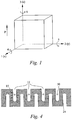
- Figure 1 describes the standard directions of piezoelectric material.
- the three orthogonal axis are termed 1,2 and 3.
- the polar, or 3 axis is always taken parallel to the direction of polarization within the ceramic.
- the indexes 4, 5 and 6 represent a shear movement around the 1, 2 and 3 axis respectively.
- the direction of polarization is established during the poling process by a strong electrical field applied between two electrodes.
- double subscripts e.g. dij
- the first subscript gives the direction of the excitation, the second describes the direction of the system response. For example, d33 applies when the electric field is along the polarization axis (direction 3) and the strain (deflection) is along the same axis.
- d31 applies if the electric field is in the same direction as before, but the strain is in the 1 axis (orthogonal to the polarization axis) It has been proposed in the prior art to manufacture droplet deposition apparatus, or fluid pumps from piezoelectric material.
- One structure, described for example in US 4,842,493 provides a pump channel formed by first and second piezoelectric parts arranged parallel to one another. The parts are polarised such that the polarisation direction lies parallel to a field generated by the electrodes. Upon application of the field the piezoelectric parts expand both in d 31 and d 33 modes and thereby affect the pressure of the ejection chamber.
- d 33 applies when the electric field is along the polarization axis (direction 3) and the strain (deflection) is along the same axis.
- d 31 applies if the electric field is in the same direction as before, but the strain is in the 1 axis (orthogonal to the polarization axis)
- a shared wall device operating in shear or d 15 mode is described in US 4,887,100 .
- Two adjacent pressure chambers are separated by a single displaceable wall which can deflect towards or away from each of the chambers.
- the pressure in this chamber is increased whilst the pressure in the other chamber is reduced.
- the pressure in this chamber is increased with a corresponding reduction in the pressure in the first chamber.
- the pressure changes are primarily due to volume changes caused by the moving wall.
- a shared wall allows for an increase in the chamber density and a reduction in the size of the print head for a given number of ejection chambers.
- each wall acts on two chambers simultaneously it is not possible to fire droplets from each ejection chamber at the same time and hence this reduces the rate at which droplets can be ejected.
- Patent document US 6,223,405 B1 discloses a piezoeletric construction for fluid ejection wherein the polarization direction is parallel to the array direction of chanbers
- a fluid pump for droplet deposition comprising an array of pressure chambers arranged side by side in an array direction, a displaceable wall dividing adjacent pressure chambers and comprising piezoelectric material polarised in a direction parallel to said array direction and electrode means for applying an electric field thereto; and wherein the displaceable wall is disposed so as to be able under an electric field applied between said electrode means to displace a volume in one of said adjacent chambers that is different to a volume displaced in the other adjacent chamber.
- the volume displaced in the pressure chambers also displaces a corresponding volume of fluid.
- the fluid is preferably in liquid form but may also be a gas.
- the volume displaced in the second adjacent chamber is substantially zero. that is to say that the displacement has no significant effect on the operation of the adjacent chamber.
- the displaceable wall is preferably arranged to have a neutral axis offset from the geometric centre of the displaceable wall. When such an arrangement undergoes a strain parallel to the (offset) neutral axis, a bending moment is induced resulting in a bending strain.
- the displaceable wall may have a stiffness which is greater on one side of the wall than on the opposite side of the wall. It is preferred that different faces of the wall have different stiffnesses effected by coatings applied to each side of the wall, however the structure of the wall could be adapted in alternative ways to offset the neutral axis, for example by providing weakening notches along one side.
- the coatings may have a functional feature other than simply stiffening portions of the wall such as, for example, a passivation function or an electrically conducting function.
- Two or more different coating materials may be provided on either or both sides of the wall in a layered arrangement.
- the same coating material, or materials may be provided on both sides of the wall in different thickness, the thickness on the or each side being selected to provide the relative difference in stiffness.
- the electrode means are preferably provided by electrodes located on opposing faces of the wall such that a field generated between them lies parallel to the array direction.
- the electrodes are of different thickness to provide the relative difference in stiffness.
- the electrodes may be formed by electroless plating.
- a seed layer can be deposited on one side of each wall using a directional technique eg. vacuum plating.
- the seed layer is then plated up with a suitable electroless process, resulting on a plated layer on one side of the wall but not on the other.
- a seed layer is then deposited on the other side of each wall, and the electroless plating process continued. Although both sides of the wall will now be plated, the initial layer on one side only will result in differential thicknesses being maintained.
- the electrodes could be formed by providing a seed layer to both sides of each wall, using a wet chemical process for example. Patterning is then performed to connect together the first sides of each wall in a first set, and separately to connect together the second sides of each wall in a second set. The walls are then differentially electroplated, the first set being plated for a longer period of time than the second set, or vice versa.
- each pressure chamber may be of equal dimensions and comprise a nozzle through which fluid is ejected.
- some of the pressure chambers may be designated ejection chambers from which droplets are ejected through a nozzle whilst the remaining chambers are designated dummy chambers from which no fluid is ejected.
- the dummy chambers may comprise liquid or air.
- Both the dummy chambers and pressure chambers may be elongate channels with a direction of elongation being orthogonal to the array direction.
- a cover may be provided which extends over the top of the channels thereby closing the top.
- the cover contains the nozzles through which droplets are ejected.
- the nozzles are formed in a nozzle plate which is attached to the front face of the pressure channels.
- the dummy channels may or may not have a cover closing their top surface.
- the cover may be stiff or preferably have a degree of flexibility to allow flexure of the displaceable walls.
- a flexible hinge may be provided by, for example a flexible glue layer may adhesively join the tops of the displaceable walls with the cover.
- Moulding or sawing or a combination of the two may form the fluid pump.
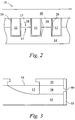
- an ink jet printhead 10 comprises a multiplicity of parallel ink channels 12 forming an array in which the channels are mutually spaced in an array direction perpendicular to the length of the channels.
- the channels are formed at a density of two or more channels per mm. in a laminated sheet 14 of piezo-electric material, suitably PZT, poled in the direction of arrows 15, 15' and are defined each by side walls 16 and a bottom surface, the thickness of the PZT being greater than the channel depth.
- the channels 12 are open topped and in the printhead are closed by a top sheet 20 of insulating material which is thermally matched to the sheet 14 and is disposed parallel to the bottom surfaces of the channels and bonded to the tops 22 of the walls 16.
- the channels 12 on their side wall and bottom surfaces are lined with a metallised electrode layer 24. It will be apparent therefore that when a potential difference of similar magnitude but opposite sign is applied to the electrodes on opposite faces of each of two adjacent walls 16, the walls will be subject to electric fields normal to the poling direction 15. The walls are in consequence deflected in shear mode, and are displaced to the positions indicated by the broken lines 28.
- the channels 12 comprise a forward part of uniform depth which is closed at its forward end by a nozzle plate 38 having formed therein a nozzle 40 from which droplets of ink in the channel are expelled by activation of the facing actuator walls 16 of the channel.
- the channel 12 also has a part of lesser depth extending from the tops of the walls 16.
- the metallised plating 24 which is on opposed surfaces of the walls 16 occupies the depth of the channel side walls but does not extend the length of the channel to minimise the capacitive load of the print head.
- a suitable electrode metal used is an alloy of nickel and chromium, i.e. nichrome or electroplated or electroless plated nickel.
- the electrodes are deposited by first using a plating angle to allow electrode deposition on the full depth of the side walls.
- a mask is used to prevent deposition on the walls in the manifold region.
- the step is repeated to allow electrodes to be formed on both sides of each wall.
- a third step is carried out with deposition perpendicular to the to the base of the channels, such that deposition occurs on the bottom of each channel and the channel run out in the manifold region.
- a droplet is ejected from each channel by applying a suitable waveform to the electrodes 24 on either side of the wall 16.
- a particularly preferred waveform is known as a draw-release-reinforce waveform.
- the volume of a selected channel is initially increased by drawing both walls bounding the chamber outwards and the walls are held in this position for a period of time. After the period of time has elapsed the walls are moved inwards to reduce the volume of the selected channel thereby ejecting a drop through the nozzle.
- each wall acts on neighbouring channels it is not possible to eject a droplet from both of the neighbouring channels simultaneously. Care must also be taken that droplets are not ejected from unselected channels.
- Air gaps may be narrower than ejection channels but it can be seen that this will reduce the channel density by up to 50%.
- FIG. 4 Another form of an actuator is described with reference to Figure 4 .
- a multiplicity of parallel channels are formed which are separated from one another by parallel walls of a piezoelectric ceramic.
- the direction of polarisation is, however, orthogonal to the direction of poling described with reference to Figure 2 .
- the walls are polarised in the array direction and electrodes provided on either side of the wall apply a field across the wall in a direction parallel to the polarisation direction.
- Channels 12 are formed into one side of the PZT, and have nozzles 50 associated.
- Electrodes 24 are provided on the inside walls of the channels.
- the driving electrodes 24 are also used to apply the field which polarises the PZT as shown by arrows 15 in Figure 3 .
- the electrodes on either side of the wall and base are of the same thickness.
- the wall 16 will thicken in d33 and contract in height in d31 as depicted by the dotted lines.
- the net displacement for a given channel in these directions is given the nomenclature ⁇ 31wall and ⁇ 33wall .
- the piezoelectric material is polarised by applying a polarising field between the driving electrodes.
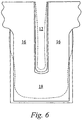
- the electrodes are of a different thickness depending on whether they are inside or outside the ejection chamber 12. This provides different stiffness to opposite sides of the wall that, it has been discovered by the applicant, improves ejection efficiency.
- the stiffness of the base 18, however, can inhibit the bending movement of the wall and a design modification can be made to further improve the ejection efficiency.
- the poling direction within the base may be reversed, or the thickness of the base may be reduced.
- the volumes displaced by the expansion or contraction of the piezoelectric material and the volumes displaced by the bending movement can work together to either increase or decrease the total net volume displacement within a chamber.
- the structure should be sufficiently compliant at the top or the bottom (or both) of the wall to allow the necessary wall rotation there.
- the top plate 1114 may be made of a sufficiently compliant material.
- a mechanical hinge could be employed where the wall meets the top or bottom plates.
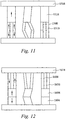
- FIG. 9 to 12 Alternative wall structures which allow simultaneous actuation of neighbouring channels are shown in Figures 9 to 12 .
- Each of these figures depicts three walls defining two channels.
- the poling pattern for the walls is illustrated by arrows in the left hand wall, however different poling configurations may be possible to achieve the same actuated configuration, depending on the electrode placement and drive signal applied. Actuation in all cases is by the application of an electric field across the wall or wall portions (left to right or right to left as viewed).
- the central wall is shown in its actuated configuration, the wall deformation causing a net displacement in the left hand channel and substantially no net displacement in the right hand channel.
- Nozzles are not shown in these figures, but could be located in the roofs of the channels or at the ends of the channels.
- the lower portion of the channel wall 1202 acts in the so called direct mode, the applied electric field and poling being in the same direction causing expansion of that portion of the wall.
- the two upper portions of the wall 1204 and 1206, are poled in opposite direction perpendicular to the applied field, and act in shear producing a chevron like shape when actuated. It can be seen that when actuated, portion 1202 expands causing a reduction in volume of both channels 1220 and 1230.
- the chevron configuration of upper portions 1204 and 1206 however cause a reduction in volume of channel 1220, and in increase in volume of channel 1230.
- the displacements in channel 1230 can be made to cancel each other, thereby causing substantially no net change in volume in channel 1230, while the displacements in channel 1220 reinforce to cause droplet ejection from that channel.
- actuation is effected by the application of a single field across the whole height of the wall.
- the direct mode wall portion 1202 it will be necessary for the direct mode wall portion 1202 to have increased activity, to balance the activity of portions 1204 and 1206. This can be achieved by using a greater electric field across this portion, higher activity piezoelectric material, a greater wall height for this portion, or any combination of these.
- direct mode operation could be applied to the base or roof of the channels. It can be seen though that the contraction in height of the wall portion acting in direct mode will tend to cause deflection of the base portion 1240 causing some displacement in both neighbouring channels.
- upper wall portions 1304 and 1306 act in the same way as described above in relation to Figure 9 .
- the lower portion of the wall is formed of two pairs of chevron-like actuating portions 1308 and 1310, separated by a gap 1312.
- the gap may be filled with ink or air.
- actuated lower portions 1308 and 1310 deflect in opposite senses, causing a volume reduction in both neighbouring channels 1320 and 1330.
- this structure can be arranged such that actuation of channel 1320 causes substantially no net volume change in channel 1330.
- This structure is more complex than that of Figure 9 , and this may result in an increased nozzle pitch resulting in lower resolution.
- Shear mode actuation typically has a longer life cycle than direct mode actuation however, and there is therefore advantage in an embodiment which uses only shear mode actuation.
- electrodes are typically formed on both the inside and outside faces of each wall, and the direction of polling in the walls will depend on how the electrodes are connected and the drive signals applied.
- Such arrangements may include an electrode layer having a break at a point part way up the height of the wall.
- the upper portion 1516 is formed of a single portion of PZT poled in the same direction. On application of an electric field across the upper portion, it deforms in shear mode, as if like one half of a chevron arrangement. This acts as a cantilever, laterally displacing the centre of the wall, and causing a similar lateral displacement of the lower portion of the wall.
- Lower portions 1508 and 1510 displace in outwardly expanding chevrons as described previously, but additionally have a shear or skew superposed on them.
- the member at the top of the channels 1518 should be relatively stiff and offer resistance to the bending moment induced by portion 1516 acting as a cantilever.
- FIG. 12 employs wall portions 1604 and 1606, poled in opposite direction perpendicular to the applied field, deforming into a chevron on actuation. These portions are substantially the same as those described in Figures 12 and 13, but here they are use for the bottom, rather than the top portion of the wall.
- the top of the wall takes a double wall form, having two wall portions 1608 and 1610 separated by a cavity. Portions 1608 and 1610 each have a single direction of poling perpendicular to the applied field, but poled in opposite senses (achievable by poling using the electrodes for example). When activated, these portions each act as cantilevers, skewing outwards in opposite directions. It will be understood that in order to allow this deformation, member 1618 which may be a cover or nozzle plate in certain embodiments is required to exhibit a degree of compliance.
- Figures 8 to 12 all employ two different modes of actuation, one causing displacements of the same sign in the two neighbouring channels (ie reducing the volume in both channels or increasing the volume in both channels) and one causing displacement of opposite sign in the two neighbouring channels (ie reducing the volume of one and increasing the volume of the other).
- the two different modes of actuation are superposed on the same wall portion, ie a single actuation surface undergoing two different modes of deflection.
- the two modes of actuation can be considered to derive from different wall portions having different actuation modes.
- upper and lower portions of the wall have different structures associated with different actuation modes, however there is some superposition of actuation modes in the lower portion as described above.
- PZT tiles and a substrate support are laminated together.
- Channels 1108, 1112 etc are sawn and a seed plating applied.
- the plating is patterned and the electrodes formed by electroplating.
- a passivation coating is applied over the electrodes and then the piezoelectric material is poled.
- Each wall may be polarised to a different level which allows for uniformity variations in the activity of the actuators to be evened out as higher activity walls may be polarised to a lesser extent.
- the benefit of poling late in the process is that high temperature processes may be used.
- a particularly preferred form of passivation is a Faraday Cage.
- a faraday cage is produced, for example, when an electrically conducting layer is deposited over a non conducting layer when the non-conducting layer is deposited over electrodes.
- each layer is conformal and cover the entire actuator.
- a nozzle is attached to the outer electrically conducting layer using an appropriate attach mechanism e.g. epoxy, thermocompressive, eutectic, anodic etc.
- the nozzle plate attach may be reworked by a process where the outer electrically conducting layer is etched whilst the inner insulating layer is left.
- the insulating layer may be parylene and the outer conducting layer copper.
- An etchant of either ferric chloride or Ammonium sulphate may be used to etch copper rapidly without effect on the parylene.
- the nozzle plate Upon completion of the etch the nozzle plate is released and free to be reworked or replaced. A new outer electrically conducting layer is then deposited onto the insulating layer and subsequently a replacement nozzle plate is then attached.
- an actuator of the present invention for a loudspeaker or the like.
- One particular benefit of using an actuator of the present invention for a loudspeaker is that as there is no significant net displacement of the actuator on the opposite side substantially no sound will be reflected in reverse.
Landscapes
- Engineering & Computer Science (AREA)
- Manufacturing & Machinery (AREA)
- Particle Formation And Scattering Control In Inkjet Printers (AREA)
- Reciprocating Pumps (AREA)
- Coating Apparatus (AREA)
- Fluid-Pressure Circuits (AREA)
Applications Claiming Priority (2)
| Application Number | Priority Date | Filing Date | Title |
|---|---|---|---|
| GBGB0415529.7A GB0415529D0 (en) | 2004-07-10 | 2004-07-10 | Droplet deposition apparatus |
| PCT/GB2005/002746 WO2006005952A2 (en) | 2004-07-10 | 2005-07-11 | Droplet deposition apparatus |
Publications (2)
| Publication Number | Publication Date |
|---|---|
| EP1809480A2 EP1809480A2 (en) | 2007-07-25 |
| EP1809480B1 true EP1809480B1 (en) | 2016-06-29 |
Family
ID=32865808
Family Applications (1)
| Application Number | Title | Priority Date | Filing Date |
|---|---|---|---|
| EP05761560.1A Expired - Lifetime EP1809480B1 (en) | 2004-07-10 | 2005-07-11 | Droplet deposition apparatus |
Country Status (12)
| Country | Link |
|---|---|
| US (1) | US7780273B2 (enExample) |
| EP (1) | EP1809480B1 (enExample) |
| JP (1) | JP4801061B2 (enExample) |
| KR (1) | KR20070032811A (enExample) |
| CN (1) | CN101107128A (enExample) |
| AU (1) | AU2005261498A1 (enExample) |
| BR (1) | BRPI0513219A (enExample) |
| CA (1) | CA2573041A1 (enExample) |
| GB (1) | GB0415529D0 (enExample) |
| IL (1) | IL180533A0 (enExample) |
| RU (1) | RU2007105101A (enExample) |
| WO (1) | WO2006005952A2 (enExample) |
Families Citing this family (7)
| Publication number | Priority date | Publication date | Assignee | Title |
|---|---|---|---|---|
| JP2012148428A (ja) * | 2011-01-17 | 2012-08-09 | Toshiba Tec Corp | インクジェットヘッドの製造方法 |
| JP2012192629A (ja) * | 2011-03-16 | 2012-10-11 | Toshiba Tec Corp | インクジェットヘッドおよびインクジェットヘッドの製造方法 |
| FR2990055B1 (fr) * | 2012-04-30 | 2014-12-26 | Total Sa | Matrice de depot d'au moins un fluide conducteur sur un substrat, ainsi que dispositif comprenant cette matrice et procede de depot |
| JP6069967B2 (ja) * | 2012-08-31 | 2017-02-01 | セイコーエプソン株式会社 | 液体吐出装置 |
| GB2546097B (en) | 2016-01-08 | 2020-12-30 | Xaar Technology Ltd | Droplet deposition head |
| US10821724B2 (en) * | 2016-02-24 | 2020-11-03 | Konica Minolta, Inc. | Inkjet recording device and inkjet head driving method |
| GB2564634B (en) * | 2017-05-12 | 2021-08-25 | Xaar Technology Ltd | A piezoelectric solid solution ceramic material |
Family Cites Families (15)
| Publication number | Priority date | Publication date | Assignee | Title |
|---|---|---|---|---|
| EP0268204B1 (de) * | 1986-11-14 | 1991-09-18 | Qenico AB | Piezoelektrische Pumpe |
| US4879568A (en) * | 1987-01-10 | 1989-11-07 | Am International, Inc. | Droplet deposition apparatus |
| JP2756159B2 (ja) * | 1989-11-09 | 1998-05-25 | 松下電器産業株式会社 | インク記録装置 |
| US5227813A (en) | 1991-08-16 | 1993-07-13 | Compaq Computer Corporation | Sidewall actuator for a high density ink jet printhead |
| JP3047661B2 (ja) * | 1993-02-16 | 2000-05-29 | ブラザー工業株式会社 | 液滴噴射装置 |
| JP2854508B2 (ja) * | 1993-08-27 | 1999-02-03 | 株式会社テック | インクジェットプリンタヘッド及びその駆動方法 |
| US5480095A (en) | 1993-09-14 | 1996-01-02 | Minnesota Mining And Manufacturing Company | Actuator and container for dispensing fluids |
| JP3183010B2 (ja) * | 1993-12-24 | 2001-07-03 | ブラザー工業株式会社 | インク噴射装置 |
| JP3135800B2 (ja) * | 1994-10-20 | 2001-02-19 | 株式会社沖データ | インクジェットヘッド及びその製造方法 |
| US5901425A (en) * | 1996-08-27 | 1999-05-11 | Topaz Technologies Inc. | Inkjet print head apparatus |
| JP3257960B2 (ja) * | 1996-12-17 | 2002-02-18 | 富士通株式会社 | インクジェットヘッド |
| US6020905A (en) * | 1997-01-24 | 2000-02-01 | Lexmark International, Inc. | Ink jet printhead for drop size modulation |
| ES2206290T3 (es) * | 1999-08-14 | 2004-05-16 | Xaar Technology Limited | Aparato de deposicion de gotitas. |
| JP2002096476A (ja) * | 2000-09-20 | 2002-04-02 | Sharp Corp | 圧電素子ユニットおよびその製造方法ならびに圧電素子ユニットを用いたインクジェットヘッド |
| JP2004142310A (ja) | 2002-10-25 | 2004-05-20 | Sharp Corp | インクジェット記録ヘッド |
-
2004
- 2004-07-10 GB GBGB0415529.7A patent/GB0415529D0/en not_active Ceased
-
2005
- 2005-07-11 EP EP05761560.1A patent/EP1809480B1/en not_active Expired - Lifetime
- 2005-07-11 BR BRPI0513219-3A patent/BRPI0513219A/pt not_active IP Right Cessation
- 2005-07-11 CA CA002573041A patent/CA2573041A1/en not_active Abandoned
- 2005-07-11 AU AU2005261498A patent/AU2005261498A1/en not_active Abandoned
- 2005-07-11 RU RU2007105101/12A patent/RU2007105101A/ru not_active Application Discontinuation
- 2005-07-11 KR KR1020077003210A patent/KR20070032811A/ko not_active Withdrawn
- 2005-07-11 US US11/631,909 patent/US7780273B2/en not_active Expired - Fee Related
- 2005-07-11 WO PCT/GB2005/002746 patent/WO2006005952A2/en not_active Ceased
- 2005-07-11 JP JP2007519890A patent/JP4801061B2/ja not_active Expired - Fee Related
- 2005-07-11 CN CNA2005800232722A patent/CN101107128A/zh active Pending
-
2007
- 2007-01-03 IL IL180533A patent/IL180533A0/en unknown
Also Published As
| Publication number | Publication date |
|---|---|
| JP2008505781A (ja) | 2008-02-28 |
| CA2573041A1 (en) | 2006-01-19 |
| AU2005261498A1 (en) | 2006-01-19 |
| US20080117260A1 (en) | 2008-05-22 |
| WO2006005952A2 (en) | 2006-01-19 |
| US7780273B2 (en) | 2010-08-24 |
| JP4801061B2 (ja) | 2011-10-26 |
| BRPI0513219A (pt) | 2008-04-29 |
| WO2006005952A3 (en) | 2007-07-12 |
| IL180533A0 (en) | 2007-06-03 |
| EP1809480A2 (en) | 2007-07-25 |
| RU2007105101A (ru) | 2008-08-20 |
| GB0415529D0 (en) | 2004-08-11 |
| CN101107128A (zh) | 2008-01-16 |
| KR20070032811A (ko) | 2007-03-22 |
Similar Documents
| Publication | Publication Date | Title |
|---|---|---|
| US4879568A (en) | Droplet deposition apparatus | |
| JP2666087B2 (ja) | 高密度多重溝配列の電気パルス式液滴堆積装置 | |
| EP2343187B1 (en) | Droplet deposition apparatus | |
| CN104589795B (zh) | 喷墨头及其控制方法 | |
| JPH05301342A (ja) | インクジェットプリンタ用ヘッド | |
| GB2546097A (en) | Droplet deposition head | |
| EP1809480B1 (en) | Droplet deposition apparatus | |
| US5886717A (en) | Printing head for an ink jet printer with titanium plate comb | |
| JP3484841B2 (ja) | インクジェット式記録ヘッド | |
| KR20080034147A (ko) | 액적 디포지션 장치 | |
| CN1325263C (zh) | 压电喷墨头的驱动方法 | |
| JP4494880B2 (ja) | 圧電インクジェットヘッドの駆動方法 | |
| EP0928688A1 (en) | Ink jet recording head and method of manufacturing the same | |
| JP4269608B2 (ja) | インクジェットヘッドおよびそれを備えたインクジェット式記録装置 | |
| JPH04341855A (ja) | インクジェットヘッド | |
| JP3842656B2 (ja) | インクジェット記録ヘッド | |
| JP2008079500A (ja) | 圧電アクチュエータ及び流体移送装置 | |
| CA1292909C (en) | Droplet deposition apparatus | |
| JP3555242B2 (ja) | インク噴射装置 | |
| JP5930701B2 (ja) | 液体吐出ヘッド | |
| JP2002046269A (ja) | インクジェットヘッド | |
| JPWO1995010416A1 (ja) | インクジェットヘッドとその製造方法及びその駆動方法 | |
| HK1009416A (en) | Inkjet print head apparatus | |
| JP2000246890A (ja) | インクジェットヘッド及びその製造方法 |
Legal Events
| Date | Code | Title | Description |
|---|---|---|---|
| PUAI | Public reference made under article 153(3) epc to a published international application that has entered the european phase |
Free format text: ORIGINAL CODE: 0009012 |
|
| 17P | Request for examination filed |
Effective date: 20070209 |
|
| AK | Designated contracting states |
Kind code of ref document: A2 Designated state(s): AT BE BG CH CY CZ DE DK EE ES FI FR GB GR HU IE IS IT LI LT LU LV MC NL PL PT RO SE SI SK TR |
|
| AX | Request for extension of the european patent |
Extension state: AL BA HR MK YU |
|
| R17D | Deferred search report published (corrected) |
Effective date: 20070712 |
|
| RIC1 | Information provided on ipc code assigned before grant |
Ipc: B41J 2/14 20060101AFI20070728BHEP |
|
| DAX | Request for extension of the european patent (deleted) | ||
| 17Q | First examination report despatched |
Effective date: 20130408 |
|
| REG | Reference to a national code |
Ref country code: DE Ref legal event code: R079 Ref document number: 602005049638 Country of ref document: DE Free format text: PREVIOUS MAIN CLASS: B41J0001000000 Ipc: B41J0002140000 |
|
| RIC1 | Information provided on ipc code assigned before grant |
Ipc: B41J 2/14 20060101AFI20151215BHEP Ipc: B41J 2/16 20060101ALI20151215BHEP |
|
| GRAP | Despatch of communication of intention to grant a patent |
Free format text: ORIGINAL CODE: EPIDOSNIGR1 |
|
| INTG | Intention to grant announced |
Effective date: 20160122 |
|
| GRAS | Grant fee paid |
Free format text: ORIGINAL CODE: EPIDOSNIGR3 |
|
| GRAA | (expected) grant |
Free format text: ORIGINAL CODE: 0009210 |
|
| AK | Designated contracting states |
Kind code of ref document: B1 Designated state(s): AT BE BG CH CY CZ DE DK EE ES FI FR GB GR HU IE IS IT LI LT LU LV MC NL PL PT RO SE SI SK TR |
|
| REG | Reference to a national code |
Ref country code: GB Ref legal event code: FG4D |
|
| REG | Reference to a national code |
Ref country code: CH Ref legal event code: EP |
|
| REG | Reference to a national code |
Ref country code: AT Ref legal event code: REF Ref document number: 808766 Country of ref document: AT Kind code of ref document: T Effective date: 20160715 |
|
| REG | Reference to a national code |
Ref country code: IE Ref legal event code: FG4D |
|
| REG | Reference to a national code |
Ref country code: DE Ref legal event code: R096 Ref document number: 602005049638 Country of ref document: DE |
|
| REG | Reference to a national code |
Ref country code: NL Ref legal event code: FP |
|
| REG | Reference to a national code |
Ref country code: LT Ref legal event code: MG4D |
|
| PG25 | Lapsed in a contracting state [announced via postgrant information from national office to epo] |
Ref country code: FI Free format text: LAPSE BECAUSE OF FAILURE TO SUBMIT A TRANSLATION OF THE DESCRIPTION OR TO PAY THE FEE WITHIN THE PRESCRIBED TIME-LIMIT Effective date: 20160629 Ref country code: LT Free format text: LAPSE BECAUSE OF FAILURE TO SUBMIT A TRANSLATION OF THE DESCRIPTION OR TO PAY THE FEE WITHIN THE PRESCRIBED TIME-LIMIT Effective date: 20160629 |
|
| PG25 | Lapsed in a contracting state [announced via postgrant information from national office to epo] |
Ref country code: LV Free format text: LAPSE BECAUSE OF FAILURE TO SUBMIT A TRANSLATION OF THE DESCRIPTION OR TO PAY THE FEE WITHIN THE PRESCRIBED TIME-LIMIT Effective date: 20160629 Ref country code: GR Free format text: LAPSE BECAUSE OF FAILURE TO SUBMIT A TRANSLATION OF THE DESCRIPTION OR TO PAY THE FEE WITHIN THE PRESCRIBED TIME-LIMIT Effective date: 20160930 Ref country code: SE Free format text: LAPSE BECAUSE OF FAILURE TO SUBMIT A TRANSLATION OF THE DESCRIPTION OR TO PAY THE FEE WITHIN THE PRESCRIBED TIME-LIMIT Effective date: 20160629 |
|
| REG | Reference to a national code |
Ref country code: AT Ref legal event code: MK05 Ref document number: 808766 Country of ref document: AT Kind code of ref document: T Effective date: 20160629 |
|
| PG25 | Lapsed in a contracting state [announced via postgrant information from national office to epo] |
Ref country code: BE Free format text: LAPSE BECAUSE OF NON-PAYMENT OF DUE FEES Effective date: 20160731 |
|
| PG25 | Lapsed in a contracting state [announced via postgrant information from national office to epo] |
Ref country code: IT Free format text: LAPSE BECAUSE OF FAILURE TO SUBMIT A TRANSLATION OF THE DESCRIPTION OR TO PAY THE FEE WITHIN THE PRESCRIBED TIME-LIMIT Effective date: 20160629 Ref country code: SK Free format text: LAPSE BECAUSE OF FAILURE TO SUBMIT A TRANSLATION OF THE DESCRIPTION OR TO PAY THE FEE WITHIN THE PRESCRIBED TIME-LIMIT Effective date: 20160629 Ref country code: IS Free format text: LAPSE BECAUSE OF FAILURE TO SUBMIT A TRANSLATION OF THE DESCRIPTION OR TO PAY THE FEE WITHIN THE PRESCRIBED TIME-LIMIT Effective date: 20161029 Ref country code: EE Free format text: LAPSE BECAUSE OF FAILURE TO SUBMIT A TRANSLATION OF THE DESCRIPTION OR TO PAY THE FEE WITHIN THE PRESCRIBED TIME-LIMIT Effective date: 20160629 Ref country code: CZ Free format text: LAPSE BECAUSE OF FAILURE TO SUBMIT A TRANSLATION OF THE DESCRIPTION OR TO PAY THE FEE WITHIN THE PRESCRIBED TIME-LIMIT Effective date: 20160629 Ref country code: RO Free format text: LAPSE BECAUSE OF FAILURE TO SUBMIT A TRANSLATION OF THE DESCRIPTION OR TO PAY THE FEE WITHIN THE PRESCRIBED TIME-LIMIT Effective date: 20160629 |
|
| PG25 | Lapsed in a contracting state [announced via postgrant information from national office to epo] |
Ref country code: AT Free format text: LAPSE BECAUSE OF FAILURE TO SUBMIT A TRANSLATION OF THE DESCRIPTION OR TO PAY THE FEE WITHIN THE PRESCRIBED TIME-LIMIT Effective date: 20160629 Ref country code: BE Free format text: LAPSE BECAUSE OF FAILURE TO SUBMIT A TRANSLATION OF THE DESCRIPTION OR TO PAY THE FEE WITHIN THE PRESCRIBED TIME-LIMIT Effective date: 20160629 Ref country code: PL Free format text: LAPSE BECAUSE OF FAILURE TO SUBMIT A TRANSLATION OF THE DESCRIPTION OR TO PAY THE FEE WITHIN THE PRESCRIBED TIME-LIMIT Effective date: 20160629 Ref country code: ES Free format text: LAPSE BECAUSE OF FAILURE TO SUBMIT A TRANSLATION OF THE DESCRIPTION OR TO PAY THE FEE WITHIN THE PRESCRIBED TIME-LIMIT Effective date: 20160629 |
|
| REG | Reference to a national code |
Ref country code: CH Ref legal event code: PL |
|
| REG | Reference to a national code |
Ref country code: DE Ref legal event code: R097 Ref document number: 602005049638 Country of ref document: DE |
|
| PG25 | Lapsed in a contracting state [announced via postgrant information from national office to epo] |
Ref country code: LI Free format text: LAPSE BECAUSE OF NON-PAYMENT OF DUE FEES Effective date: 20160731 Ref country code: CH Free format text: LAPSE BECAUSE OF NON-PAYMENT OF DUE FEES Effective date: 20160731 |
|
| REG | Reference to a national code |
Ref country code: IE Ref legal event code: MM4A |
|
| PLBE | No opposition filed within time limit |
Free format text: ORIGINAL CODE: 0009261 |
|
| STAA | Information on the status of an ep patent application or granted ep patent |
Free format text: STATUS: NO OPPOSITION FILED WITHIN TIME LIMIT |
|
| PG25 | Lapsed in a contracting state [announced via postgrant information from national office to epo] |
Ref country code: DK Free format text: LAPSE BECAUSE OF FAILURE TO SUBMIT A TRANSLATION OF THE DESCRIPTION OR TO PAY THE FEE WITHIN THE PRESCRIBED TIME-LIMIT Effective date: 20160629 |
|
| REG | Reference to a national code |
Ref country code: FR Ref legal event code: ST Effective date: 20170428 |
|
| 26N | No opposition filed |
Effective date: 20170330 |
|
| PG25 | Lapsed in a contracting state [announced via postgrant information from national office to epo] |
Ref country code: IE Free format text: LAPSE BECAUSE OF NON-PAYMENT OF DUE FEES Effective date: 20160711 Ref country code: FR Free format text: LAPSE BECAUSE OF NON-PAYMENT OF DUE FEES Effective date: 20160829 |
|
| PG25 | Lapsed in a contracting state [announced via postgrant information from national office to epo] |
Ref country code: SI Free format text: LAPSE BECAUSE OF FAILURE TO SUBMIT A TRANSLATION OF THE DESCRIPTION OR TO PAY THE FEE WITHIN THE PRESCRIBED TIME-LIMIT Effective date: 20160629 Ref country code: LU Free format text: LAPSE BECAUSE OF NON-PAYMENT OF DUE FEES Effective date: 20160711 Ref country code: BG Free format text: LAPSE BECAUSE OF FAILURE TO SUBMIT A TRANSLATION OF THE DESCRIPTION OR TO PAY THE FEE WITHIN THE PRESCRIBED TIME-LIMIT Effective date: 20160929 |
|
| PG25 | Lapsed in a contracting state [announced via postgrant information from national office to epo] |
Ref country code: CY Free format text: LAPSE BECAUSE OF FAILURE TO SUBMIT A TRANSLATION OF THE DESCRIPTION OR TO PAY THE FEE WITHIN THE PRESCRIBED TIME-LIMIT Effective date: 20160629 Ref country code: HU Free format text: LAPSE BECAUSE OF FAILURE TO SUBMIT A TRANSLATION OF THE DESCRIPTION OR TO PAY THE FEE WITHIN THE PRESCRIBED TIME-LIMIT; INVALID AB INITIO Effective date: 20050711 |
|
| PG25 | Lapsed in a contracting state [announced via postgrant information from national office to epo] |
Ref country code: PT Free format text: LAPSE BECAUSE OF FAILURE TO SUBMIT A TRANSLATION OF THE DESCRIPTION OR TO PAY THE FEE WITHIN THE PRESCRIBED TIME-LIMIT Effective date: 20160629 Ref country code: MC Free format text: LAPSE BECAUSE OF FAILURE TO SUBMIT A TRANSLATION OF THE DESCRIPTION OR TO PAY THE FEE WITHIN THE PRESCRIBED TIME-LIMIT Effective date: 20160629 Ref country code: TR Free format text: LAPSE BECAUSE OF FAILURE TO SUBMIT A TRANSLATION OF THE DESCRIPTION OR TO PAY THE FEE WITHIN THE PRESCRIBED TIME-LIMIT Effective date: 20160629 |
|
| PGFP | Annual fee paid to national office [announced via postgrant information from national office to epo] |
Ref country code: NL Payment date: 20180712 Year of fee payment: 14 Ref country code: DE Payment date: 20180626 Year of fee payment: 14 |
|
| PGFP | Annual fee paid to national office [announced via postgrant information from national office to epo] |
Ref country code: GB Payment date: 20180711 Year of fee payment: 14 |
|
| REG | Reference to a national code |
Ref country code: DE Ref legal event code: R119 Ref document number: 602005049638 Country of ref document: DE |
|
| GBPC | Gb: european patent ceased through non-payment of renewal fee |
Effective date: 20190711 |
|
| PG25 | Lapsed in a contracting state [announced via postgrant information from national office to epo] |
Ref country code: GB Free format text: LAPSE BECAUSE OF NON-PAYMENT OF DUE FEES Effective date: 20190711 Ref country code: NL Free format text: LAPSE BECAUSE OF NON-PAYMENT OF DUE FEES Effective date: 20190801 Ref country code: DE Free format text: LAPSE BECAUSE OF NON-PAYMENT OF DUE FEES Effective date: 20200201 |
|
| REG | Reference to a national code |
Ref country code: NL Ref legal event code: MM Effective date: 20190801 |
|
| P01 | Opt-out of the competence of the unified patent court (upc) registered |
Effective date: 20230514 |