EP1808424B1 - Verfahren zur Herstellung eines mit einer Edelmetallschicht überzogenen Gegenstands aus Keramik oder Porzellan sowie mit einer solchen Schicht überzogener Keramik- oder Porzellangegenstand - Google Patents
Verfahren zur Herstellung eines mit einer Edelmetallschicht überzogenen Gegenstands aus Keramik oder Porzellan sowie mit einer solchen Schicht überzogener Keramik- oder Porzellangegenstand Download PDFInfo
- Publication number
- EP1808424B1 EP1808424B1 EP06023875A EP06023875A EP1808424B1 EP 1808424 B1 EP1808424 B1 EP 1808424B1 EP 06023875 A EP06023875 A EP 06023875A EP 06023875 A EP06023875 A EP 06023875A EP 1808424 B1 EP1808424 B1 EP 1808424B1
- Authority
- EP
- European Patent Office
- Prior art keywords
- layer
- glaze
- noble metal
- ceramic
- metal layer
- Prior art date
- Legal status (The legal status is an assumption and is not a legal conclusion. Google has not performed a legal analysis and makes no representation as to the accuracy of the status listed.)
- Active
Links
- 239000000919 ceramic Substances 0.000 title claims abstract description 25
- 229910052573 porcelain Inorganic materials 0.000 title claims abstract description 21
- 238000000034 method Methods 0.000 title claims abstract description 16
- 238000004519 manufacturing process Methods 0.000 title claims abstract description 10
- 229910000510 noble metal Inorganic materials 0.000 title claims description 53
- 239000000725 suspension Substances 0.000 claims abstract description 13
- BASFCYQUMIYNBI-UHFFFAOYSA-N platinum Chemical compound [Pt] BASFCYQUMIYNBI-UHFFFAOYSA-N 0.000 claims description 16
- 229910052500 inorganic mineral Inorganic materials 0.000 claims description 11
- 239000011707 mineral Substances 0.000 claims description 11
- 239000003086 colorant Substances 0.000 claims description 10
- PCHJSUWPFVWCPO-UHFFFAOYSA-N gold Chemical compound [Au] PCHJSUWPFVWCPO-UHFFFAOYSA-N 0.000 claims description 10
- 229910052737 gold Inorganic materials 0.000 claims description 10
- 239000010931 gold Substances 0.000 claims description 10
- 229910052697 platinum Inorganic materials 0.000 claims description 8
- 230000003746 surface roughness Effects 0.000 claims description 8
- 230000015572 biosynthetic process Effects 0.000 claims description 2
- 239000000049 pigment Substances 0.000 claims 8
- 239000010970 precious metal Substances 0.000 abstract description 10
- 238000010304 firing Methods 0.000 abstract description 6
- 229910052751 metal Inorganic materials 0.000 abstract description 5
- 239000002184 metal Substances 0.000 abstract description 5
- 239000000975 dye Substances 0.000 description 12
- 239000000243 solution Substances 0.000 description 9
- 238000002360 preparation method Methods 0.000 description 7
- 239000005338 frosted glass Substances 0.000 description 6
- 239000000203 mixture Substances 0.000 description 5
- 239000013078 crystal Substances 0.000 description 4
- 239000011248 coating agent Substances 0.000 description 3
- 238000000576 coating method Methods 0.000 description 3
- 238000004040 coloring Methods 0.000 description 3
- 229910018619 Si-Fe Inorganic materials 0.000 description 2
- 229910008289 Si—Fe Inorganic materials 0.000 description 2
- QCWXUUIWCKQGHC-UHFFFAOYSA-N Zirconium Chemical compound [Zr] QCWXUUIWCKQGHC-UHFFFAOYSA-N 0.000 description 2
- 229910007727 Zr V Inorganic materials 0.000 description 2
- AYJRCSIUFZENHW-UHFFFAOYSA-L barium carbonate Chemical compound [Ba+2].[O-]C([O-])=O AYJRCSIUFZENHW-UHFFFAOYSA-L 0.000 description 2
- 229910052804 chromium Inorganic materials 0.000 description 2
- 238000001816 cooling Methods 0.000 description 2
- 230000004907 flux Effects 0.000 description 2
- 239000011521 glass Substances 0.000 description 2
- 229910052742 iron Inorganic materials 0.000 description 2
- 229910052748 manganese Inorganic materials 0.000 description 2
- 239000000025 natural resin Substances 0.000 description 2
- 229910052759 nickel Inorganic materials 0.000 description 2
- 239000003960 organic solvent Substances 0.000 description 2
- 229910052726 zirconium Inorganic materials 0.000 description 2
- GNFTZDOKVXKIBK-UHFFFAOYSA-N 3-(2-methoxyethoxy)benzohydrazide Chemical compound COCCOC1=CC=CC(C(=O)NN)=C1 GNFTZDOKVXKIBK-UHFFFAOYSA-N 0.000 description 1
- 239000005995 Aluminium silicate Substances 0.000 description 1
- FGUUSXIOTUKUDN-IBGZPJMESA-N C1(=CC=CC=C1)N1C2=C(NC([C@H](C1)NC=1OC(=NN=1)C1=CC=CC=C1)=O)C=CC=C2 Chemical compound C1(=CC=CC=C1)N1C2=C(NC([C@H](C1)NC=1OC(=NN=1)C1=CC=CC=C1)=O)C=CC=C2 FGUUSXIOTUKUDN-IBGZPJMESA-N 0.000 description 1
- BPQQTUXANYXVAA-UHFFFAOYSA-N Orthosilicate Chemical compound [O-][Si]([O-])([O-])[O-] BPQQTUXANYXVAA-UHFFFAOYSA-N 0.000 description 1
- 238000007792 addition Methods 0.000 description 1
- WNROFYMDJYEPJX-UHFFFAOYSA-K aluminium hydroxide Chemical compound [OH-].[OH-].[OH-].[Al+3] WNROFYMDJYEPJX-UHFFFAOYSA-K 0.000 description 1
- 235000012211 aluminium silicate Nutrition 0.000 description 1
- 239000004927 clay Substances 0.000 description 1
- 238000005034 decoration Methods 0.000 description 1
- 239000010459 dolomite Substances 0.000 description 1
- 229910000514 dolomite Inorganic materials 0.000 description 1
- 230000003628 erosive effect Effects 0.000 description 1
- 230000001788 irregular Effects 0.000 description 1
- NLYAJNPCOHFWQQ-UHFFFAOYSA-N kaolin Chemical compound O.O.O=[Al]O[Si](=O)O[Si](=O)O[Al]=O NLYAJNPCOHFWQQ-UHFFFAOYSA-N 0.000 description 1
- 239000007788 liquid Substances 0.000 description 1
- 239000000463 material Substances 0.000 description 1
- 239000011159 matrix material Substances 0.000 description 1
- 239000010434 nepheline Substances 0.000 description 1
- 229910052664 nepheline Inorganic materials 0.000 description 1
- 239000002245 particle Substances 0.000 description 1
- 239000002244 precipitate Substances 0.000 description 1
- 239000010453 quartz Substances 0.000 description 1
- 230000000717 retained effect Effects 0.000 description 1
- 230000003678 scratch resistant effect Effects 0.000 description 1
- 230000035945 sensitivity Effects 0.000 description 1
- VYPSYNLAJGMNEJ-UHFFFAOYSA-N silicon dioxide Inorganic materials O=[Si]=O VYPSYNLAJGMNEJ-UHFFFAOYSA-N 0.000 description 1
- 238000007569 slipcasting Methods 0.000 description 1
- 239000002904 solvent Substances 0.000 description 1
- 238000005507 spraying Methods 0.000 description 1
- 239000010435 syenite Substances 0.000 description 1
- 239000000057 synthetic resin Substances 0.000 description 1
Images

Classifications
-
- C—CHEMISTRY; METALLURGY
- C04—CEMENTS; CONCRETE; ARTIFICIAL STONE; CERAMICS; REFRACTORIES
- C04B—LIME, MAGNESIA; SLAG; CEMENTS; COMPOSITIONS THEREOF, e.g. MORTARS, CONCRETE OR LIKE BUILDING MATERIALS; ARTIFICIAL STONE; CERAMICS; REFRACTORIES; TREATMENT OF NATURAL STONE
- C04B41/00—After-treatment of mortars, concrete, artificial stone or ceramics; Treatment of natural stone
- C04B41/45—Coating or impregnating, e.g. injection in masonry, partial coating of green or fired ceramics, organic coating compositions for adhering together two concrete elements
- C04B41/52—Multiple coating or impregnating multiple coating or impregnating with the same composition or with compositions only differing in the concentration of the constituents, is classified as single coating or impregnation
-
- C—CHEMISTRY; METALLURGY
- C04—CEMENTS; CONCRETE; ARTIFICIAL STONE; CERAMICS; REFRACTORIES
- C04B—LIME, MAGNESIA; SLAG; CEMENTS; COMPOSITIONS THEREOF, e.g. MORTARS, CONCRETE OR LIKE BUILDING MATERIALS; ARTIFICIAL STONE; CERAMICS; REFRACTORIES; TREATMENT OF NATURAL STONE
- C04B41/00—After-treatment of mortars, concrete, artificial stone or ceramics; Treatment of natural stone
- C04B41/009—After-treatment of mortars, concrete, artificial stone or ceramics; Treatment of natural stone characterised by the material treated
-
- C—CHEMISTRY; METALLURGY
- C04—CEMENTS; CONCRETE; ARTIFICIAL STONE; CERAMICS; REFRACTORIES
- C04B—LIME, MAGNESIA; SLAG; CEMENTS; COMPOSITIONS THEREOF, e.g. MORTARS, CONCRETE OR LIKE BUILDING MATERIALS; ARTIFICIAL STONE; CERAMICS; REFRACTORIES; TREATMENT OF NATURAL STONE
- C04B41/00—After-treatment of mortars, concrete, artificial stone or ceramics; Treatment of natural stone
- C04B41/80—After-treatment of mortars, concrete, artificial stone or ceramics; Treatment of natural stone of only ceramics
- C04B41/81—Coating or impregnation
- C04B41/89—Coating or impregnation for obtaining at least two superposed coatings having different compositions
- C04B41/90—Coating or impregnation for obtaining at least two superposed coatings having different compositions at least one coating being a metal
-
- C—CHEMISTRY; METALLURGY
- C04—CEMENTS; CONCRETE; ARTIFICIAL STONE; CERAMICS; REFRACTORIES
- C04B—LIME, MAGNESIA; SLAG; CEMENTS; COMPOSITIONS THEREOF, e.g. MORTARS, CONCRETE OR LIKE BUILDING MATERIALS; ARTIFICIAL STONE; CERAMICS; REFRACTORIES; TREATMENT OF NATURAL STONE
- C04B2111/00—Mortars, concrete or artificial stone or mixtures to prepare them, characterised by specific function, property or use
- C04B2111/80—Optical properties, e.g. transparency or reflexibility
Definitions
- the invention relates to a method for producing a coated with a noble metal layer of ceramic or porcelain article.
- a very thin layer of noble metal is sometimes applied to the glaze of the article applied in a previously performed process step to give the article a particular appearance or design.
- the article is first provided with a glaze glaze layer, which is formed by applying a glaze suspension and then baking the same.
- the noble metal layer is then brought onto this glaze glaze layer using suitable noble metal-containing solutions which are subsequently baked.
- the appearance or the design of the ceramic or porcelain article can be made advantageous, disadvantageous but is the high scratch sensitivity of the noble metal coating.
- the noble metal layer is very thin, the thickness is in the range of about 0.1 microns.
- An impact with a harder or sharper object very often leads to the formation of a scratch in known noble metal layers, that is, the noble metal layer is damaged and worn away, so that the underlying gloss glaze, which is characterized by an extreme surface flatness, is visible.
- the z. B. serve decorative purposes, and therefore are not commonly used commodities are coated with a layer of precious metal, since there the risk of damaging the precious metal layer is relatively low.
- a ceramic decal is known that can be applied to a ceramic body and has a bright precious metal preparation that can be baked.
- JP 6-056558 A a ceramic article is known, on the surface of which a glass flux layer with incorporated zirconium particles is formed, by which a so-called "build-up color" is formed.
- the glass flux layer is covered with a noble metal layer.
- DD 157 327 B1 a colored matt glaze especially for wall and floor tiles known.
- the glaze has inter alia increased resistance to surface wear.
- an additional decoration can be applied on the glazed surface such as a tile.
- the invention is therefore based on the problem to provide a method which allows the production of a coated with a noble metal layer ceramic or porcelain items with significantly higher scratch resistance.
- a frosted glaze layer is applied to the unfired ceramic or porcelain article.
- a matt glaze layer is characterized by a certain, very fine surface roughness.
- an aqueous matt glaze suspension in a layer thickness of about 0.5-1 mm, preferably by spraying, is first applied to the unfired object.
- the frosted glass suspension contains - unlike a gloss glaze suspension - hard-to-melt components, which do not melt or partially melt during the subsequent fire or precipitate on cooling as crystals. These grains or crystals protrude from the frosted glaze surface or are covered with a glassy layer.
- the glassy layer takes on the contours of the grains or crystals, resulting in the very fine surface roughness.
- on the porcelain article remains a silicate layer consisting of a glassy matrix in which mineral grains or crystals are embedded.
- the typical average roughness R z (DIN) is often in the range of approximately 20-40 ⁇ m.
- a noble metal-containing solution is applied, preferably also sprayed, and then subjected to the subject of a second fire.
- the components of the solution evaporate, leaving a very thin metallic layer of 0.05-1.5, preferably of about 0.1 ⁇ m, thickness on the slightly rough surface of the frosted glaze layer.
- the fine roughness of the glaze is retained because the metal layer is very thin compared to the surface roughness. Nevertheless, the result is a harmonious, smooth surface view for the observer, since the roughness of the frosted glaze and this following the noble metal layer is minimal and very fine.
- inventive method therefore allows the production of a ceramic or porcelain article with a much scratch-resistant noble metal coating to.
- an article may be any commodity such as a harness, a decorative item such as figures or vases or sanitary items such as sinks, toilet bowls, etc.
- a particularly advantageous development of the method according to the invention provides that at least one dye is added to the frosted glass suspension to form a colored frosted glaze layer.
- the frosted glaze is dyed, preferably using a dye or a dye mixture whose color is as close as possible to that of the noble metal layer, so that consequently the frosted glaze layer color is similar to the noble metal layer color.
- a mineral dye containing Zr-V color body and / or Zr-Si-Pr color body is expediently used as the dye when producing a gold layer.
- a mineral dye containing a Co, Fe, Mn, Ni or Cr color body and a Zr-Si-Fe color body is used.
- the invention further relates to a ceramic or porcelain article, prepared according to the inventive method, with a baked rough frosted glaze layer with a mean surface roughness R z between 20 and 50 microns, on a baked precious metal layer with a layer thickness between 0.05 and 1.5 microns is applied.
- the matt glaze layer is preferably colored in order to reduce the color contrast to the applied noble metal layer or to compensate as far as possible or completely.
- a local erosion of the noble metal layer in the area of the glaze bumps or peaks, which makes the frosted glaze layer visible, is due to the low Color contrast between noble metal layer and frosted glaze layer not at all.
- the matt glaze layer is colored by means of a mineral dye containing Zr-V color bodies and / or Zr-Si-Pr color bodies. If the noble metal layer is a platinum layer, the frosted glaze layer is dyed according to the invention by means of a mineral dye containing a Co, Fe, Mn, Ni or Cr color body and a Zr-Si-Fe color body.
- Fig. 1 shows a flow chart of the central steps of the method according to the invention.
- a fired ceramic or porcelain article is first produced in a manner known per se. This is, for example, a sanitary object such as a sink or the like, which is usually produced in slip casting.
- a frosted glass suspension is applied in step b, mainly sprayed on.
- the liquid frosted glass suspension has, for example, the following composition: component % by weight quartz 24.3 fire clay 8.3 kaolin 4.5 Nepheline syenite 7.6 dolomite 23.1 barium carbonate 2.7 Frit A 4.4 Frit B 6.8 aluminum hydroxide 8.2 zirconium 10.1
- the frosted glaze may also have any other composition, as long as it is ensured that forms a frosted glaze with a certain surface roughness.
- This matte glaze suspension may optionally have dye additions to form a colored matte glaze layer.
- the added mineral dye expediently depends on the type of noble metal layer applied. The aim is to color the matt glaze layer so that the smallest possible color contrast between the colored frosted glaze layer and the subsequently applied noble metal layer results.
- step c the article coated in this way with frosted glass suspension in a thickness of 0.5-1.5, in particular of approx. 0.8 mm, is then fired at a firing temperature between 1100 ° C. and 1300 ° C.
- step d the fired ceramic or porcelain article is cooled. It now has a matt glaze layer with a fine surface roughness which has an average roughness R z (DIN) ⁇ 50 ⁇ m, in particular ⁇ 40 ⁇ m, on the one hand To be rough enough for high scratch resistance, and on the other hand to be fine enough for an optically homogeneous, smooth noble metal layer.
- R z (DIN) average roughness
- a noble metal-containing solution which serves to form the noble metal layer, applied, preferably also sprayed on here to allow the most homogeneous order possible.
- noble metal-containing solution or precious metal preparation for example, the under the trade name "shiny gold GG 95 / 3-12%" of W.C. Heraeus GmbH, Ceramic Colors Division, Heraeusstr. 12-14, DE-63450 Hanau, available preparation.
- This preparation contains gold sulforesinate, other metal resinates as well as synthetic and natural resins dissolved in organic solvents. With this precious metal-containing solution, a gold layer can be produced.
- the ceramic or porcelain article is fired a second time in step f.
- the firing temperature is in the range between 700-1100 ° C., in particular in the range of 800-900 ° C.
- the solvents evaporate, ultimately forming a homogeneous noble metal layer over the surface-gray frosted glaze layer, wherein the noble metal layer is also slightly rough, essentially following the contour of the frosted glaze layer.
- step g the cooling of the finished article takes place.
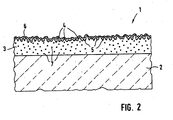
- Fig. 2 shows in the form of a schematic representation of a section of a ceramic or porcelain article 1 according to the invention, for. B. a sanitary object.
- This consists of the actual ceramic or porcelain body 2, on the surface of a frosted glaze layer 3 is applied.
- This has obvious a rough, textured surface profile with a variety of irregular elevations 4 and corresponding recesses 5.
- the representation is merely exemplary in nature and neither scale nor shape.
- the noble metal layer 6 is applied, which is significantly thinner than the frosted glaze layer 3. While the average thickness of the frosted glaze layer is in the range of about 0.8 mm, the average layer thickness of the noble metal layer 6 is less than 1 micron, it is preferably in the range of about 0.5 microns or less.
- the noble metal layer 6 is slightly rough, so has a textured rough surface. It covers both the bumps 4 and the recesses 5, wherein the recesses 5 are filled with a little more precious metal material, so that there is a certain flattening of the rougher glaze structure. If it is now scarred with a hard object against the noble metal layer 6, it will be removed only in the region of the peaks or elevations 4 of the structured surface, all adjoining areas remaining substantially uninjured. The overall appearance thus has despite local, but only microscopic punctiform damage to the noble metal layer on a still homogeneous layer.
- the frosted glaze layer is expediently colored in the exemplary embodiment shown. It contains mineral color bodies 7, which are introduced into the frosted glaze layer 3 in a correspondingly high density and dye them accordingly.
- the particular colorant used or the colorant mixture depends on whether the noble metal layer 6 is a gold or a platinum or another layer.
- the intensity of the coloring of the frosted glaze layer 3 as well as the colorant (s) used should always be selected so that the color glaze layer is so strongly colored that there is only a slight color contrast between it and the noble metal layer. Thus, if the noble metal layer 6 were badly damaged so that the frosted glaze layer is exposed, this would not appear visually or only insignificantly after the color difference between the undamaged noble metal layer and the exposed frosted glaze layer due to their coloring is minimal.
Landscapes
- Chemical & Material Sciences (AREA)
- Engineering & Computer Science (AREA)
- Ceramic Engineering (AREA)
- Materials Engineering (AREA)
- Structural Engineering (AREA)
- Organic Chemistry (AREA)
- Laminated Bodies (AREA)
- Surface Treatment Of Glass (AREA)
- Glass Compositions (AREA)
- Insulating Bodies (AREA)
- Other Surface Treatments For Metallic Materials (AREA)
- Adornments (AREA)
- Ceramic Capacitors (AREA)
- Aftertreatments Of Artificial And Natural Stones (AREA)
Description
- Die Erfindung betrifft ein Verfahren zur Herstellung eines mit einer Edelmetallschicht überzogenen Gegenstands aus Keramik oder Porzellan.
- Bei Keramik- oder Porzellangegenständen, seien es Gebrauchs- oder Haushaltsgegenstände wie Geschirrteile, seien es Sanitärartikel, wird mitunter auf die in einem vorher durchgeführten Verfahrensschritt aufgebrachte Glasur des Gegenstandes eine sehr dünne Edelmetallschicht gebracht, um dem Gegenstand ein besonderes Äußeres bzw. Design zu verleihen. Der Gegenstand wird dabei zunächst mit einer Glanzglasurschicht versehen, die durch Aufbringen einer Glasursuspension und anschließendes Einbrennen derselben gebildet wird. Auf diese Glanzglasurschicht wird anschließend die Edelmetallschicht unter Verwendung geeigneter edelmetallhaltiger Lösungen, die anschließend eingebrannt werden, gebracht.
- Zwar kann das Äußere bzw. das Design des Keramik- oder Porzellangegenstandes hierdurch vorteilhaft gestaltet werden, nachteilig aber ist die hohe Kratzempfindlichkeit der Edelmetallbeschichtung. Üblicherweise ist die Edelmetallschicht sehr dünn, die Dicke liegt im Bereich von ca. 0,1 µm. Ein Anstoßen mit einem härteren oder schärferen Gegenstand führt bei bekannten Edelmetallschichten sehr häufig zur Bildung eines Kratzers, das heißt, die Edelmetallschicht wird beschädigt und abgetragen, so dass die darunter liegende Glanzglasur, die sich durch eine extreme Oberflächenebenheit auszeichnet, sichtbar ist. Infolgedessen können zumeist nur Gegenstände, die z. B. dekorativen Zwecken dienen, mithin also keine häufig benutzten Gebrauchsgegenstände sind, mit einer Edelmetallschicht beschichtet werden, da dort die Gefahr, die Edelmetallschicht zu beschädigen, relativ gering ist.
- Aus
DE 31 22 546 C2 ist ein keramisches Abziehbild bekannt, das auf einen Keramikkörper aufgebracht werden kann und eine Glanzedelmetallpräparation aufweist, die eingebrannt werden kann. - Aus
JP 6-056558 A - Ferner ist aus
DD 157 327 B1 - Der Erfindung liegt damit das Problem zugrunde, ein Verfahren anzugeben, das die Herstellung eines mit einer Edelmetallschicht überzogenen Keramik- oder Porzellangegenstandes mit deutlich höherer Kratzfestigkeit ermöglicht.
- Zur Lösung dieses Problems ist erfindungsgemäß ein Verfahren vorgesehen, bei dem
- auf den ungebrannten Gegenstand zunächst eine Mattglasursuspension in einer Schichtdicke von 0,5 bis 1,5 mm aufgebracht
- und zur Bildung einer rauen Mattglasurschicht mit einer mittleren Rautiefe Rz zwischen 20 und 50 µm eingebrannt wird,
- auf welche anschließend eine edelmetallhaltige Lösung derart aufgebracht wird, dass die Edelmetallschicht nach dem Einbrennen eine Schichtdicke zwischen 0,05 und 1,5 µm ausbildet.
- Anders als im Stand der Technik wird auf den ungebrannten Keramik- oder Porzellangegenstand keine Glanzglasur, sondern eine Mattglasurschicht aufgebracht. Eine solche Mattglasurschicht zeichnet sich durch eine bestimmte, sehr feine Oberflächenrauigkeit aus. Zur Herstellung wird zunächst auf den ungebrannten Gegenstand eine wässrige Mattglasursuspension in einer Schichtdicke von ca. 0,5 - 1 mm, vorzugsweise durch Spritzen, aufgetragen. Die Mattglasursuspension enthält - anders als eine Glanzglasursuspension - schwer schmelzbare Bestandteile, die während des nachfolgenden Brandes nicht oder nur teilweise aufschmelzen bzw. sich beim Erkalten als Kristalle ausscheiden. Diese Körner oder Kristalle stehen aus der Mattglasuroberfläche hervor oder sind mit einer glasigen Schicht überzogen. Die glasige Schicht nimmt die Konturen der Körner bzw. Kristalle an, wodurch sich die sehr feine Oberflächenrauigkeit ergibt. Auf dem Porzellangegenstand verbleibt also eine silikatische Schicht, bestehend aus einer glasartigen Matrix, in die mineralische Körner oder Kristalle eingebettet sind. Die typische gemittelte Rautiefe Rz (DIN) liegt häufig im Bereich von ca. 20 - 40 µm.
- In einem zweiten Arbeitsgang wird sodann eine edelmetallhaltige Lösung aufgebracht, vorzugsweise ebenfalls aufgespritzt, und anschließend der Gegenstand einem zweiten Brand unterzogen. Die Lösungsbestandteile dampfen ab, es verbleibt auf der leicht rauen Oberfläche der Mattglasurschicht eine sehr dünne metallische Schicht von 0,05 - 1,5, bevorzugt von ca. 0,1 µm Dicke. Die feine Rauigkeit der Glasur bleibt erhalten, da die Metallschicht im Vergleich zur Oberflächenrauigkeit sehr dünn ist. Gleichwohl ergibt sich eine für den Betrachter harmonische, glatte Oberflächenansicht, da die Rauigkeit der Mattglasur und dieser folgend der Edelmetallschicht minimal und sehr fein ist.
- Diese trotz Beschichtung gegebene leichte Rauigkeit ist der Grund für die hohe Kratzfestigkeit einer der in der erfindungsgemäßen Weise hergestellten Edelmetallschicht. Selbst wenn versehentlich an den beschichteten Gegenstand mit einem anderen Gegenstand geschlagen wird, wird die Edelmetallschicht lediglich im Bereich der Glasurspitzen abgetragen. In allen daran anschließenden Bereichen, also den Flanken der Erhebungen und der Täler, bleibt die Edelmetallschicht jedoch unangetastet. Es erfolgt infolgedessen kein großflächiger Schichtabtrag wie bei einer darunter liegenden Glanzglasurschicht, vielmehr lediglich ein extrem kleiner, punktueller Abtrag, der optisch nicht ins Auge fällt, nachdem der größte Flächenbereich der Edelmetallschicht von dem verletzenden Gegenstand überhaupt nicht berührt wird.
- Insgesamt lässt das erfindungsgemäße Verfahren demzufolge die Herstellung eines Keramik- oder Porzellangegenstandes mit einer wesentlich kratzfesteren Edelmetallbeschichtung zu. Bei einem solchen Gegenstand kann es sich um einen beliebigen Gebrauchsgegenstand wie ein Geschirr, einen Dekorationsgegenstand wie Figuren oder Vasen oder um Sanitärteile wie Waschbecken, Toilettenschüsseln etc. handeln.
- Eine besonders vorteilhafte Weiterbildung des erfindungsgemäßen Verfahrens sieht vor, dass der Mattglasursuspension wenigstens ein Farbstoff zur Bildung einer eingefärbten Mattglasurschicht beigefügt wird. Gemäß dieser Erfindungsausgestaltung wird zur Verringerung des Farbkontrasts zwischen Mattglasurschicht und Edelmetallschicht die Mattglasur eingefärbt, wobei bevorzugt ein Farbstoff oder ein Farbstoffgemisch verwendet wird, dessen Farbe möglichst der der Edelmetallschicht nahe kommt, so dass mithin die Mattglasurschichtfarbe der Edelmetallschichtfarbe ähnlich ist.
- Als Edelmetallschicht-Farbglasur-Kombinationen wird zweckmäßigerweise bei Herstellung einer Goldschicht als Farbstoff ein mineralischer Farbstoff enthaltend Zr-V-Farbkörper und/oder Zr-Si-Pr-Farbkörper verwendet. Zur Herstellung einer Platinschicht wird ein mineralischer Farbstoff enthaltend einen Co-, Fe-, Mn-, Ni- oder Cr-Farbkörper und einen Zr-Si-Fe-Farbkörper verwendet. Diese Aufzählung verwendbarer Farbkörper für die Herstellung einer Farbglasurschicht bei Herstellung einer Gold- oder Platinschicht ist nicht abschließend, vielmehr sind grundsätzlich auch andere Farbstoffe verwendbar, solange sie eine Glasurschichteinfärbung ermöglichen.
- Neben dem erfindungsgemäßen Verfahren betrifft die Erfindung ferner einen Keramik- oder Porzellangegenstand, hergestellt gemäß dem erfindungsgemäßen Verfahren, mit einer eingebrannten rauen Mattglasurschicht mit einer mittleren Rautiefe Rz zwischen 20 und 50 µm, auf der eine eingebrannte Edelmetallschicht mit einer Schichtdicke zwischen 0,05 und 1,5 µm aufgebracht ist. Die Mattglasurschicht ist bevorzugt eingefärbt, um den farblichen Kontrast zur aufgebrachten Edelmetallschicht zu verringern oder weitestgehend bzw. vollständig auszugleichen. Ein lokaler Abtrag der Edelmetallschicht im Bereich der Glasurerhebungen oder -spitzen, der die Mattglasurschicht sichtbar macht, fällt infolge des geringen Farbkontrasts zwischen Edelmetallschicht und Mattglasurschicht überhaupt nicht auf.
- Sofern die Edelmetallschicht eine Goldschicht ist, ist erfindungsgemäß die Mattglasurschicht mittels eines mineralischen Farbstoffs enthaltend Zr-V-Farbkörper und/oder Zr-Si-Pr-Farbkörper eingefärbt. Handelt es sich bei der Edelmetallschicht um eine Platinschicht, ist die Mattglasurschicht erfindungsgemäß mittels eines mineralischen Farbstoffs enthaltend einen Co-, Fe-, Mn-, Ni- oder Cr-Farbkörper und einen Zr-Si-Fe-Farbkörper eingefärbt.
- Weitere Vorteile, Merkmale und Einzelheiten der Erfindung ergeben sich aus dem im folgenden beschriebenen Ausführungsbeispiel sowie anhand der Zeichnungen. Dabei zeigen:
- Fig. 1
- ein Flussdiagramm, das die wesentlichen Schritte des erfindungs- gemäßen Verfahrens darstellt, und
- Fig. 2
- eine Teilansicht eines Keramik- oder Porzellangegenstandes im Schnitt.
-
Fig. 1 zeigt ein Flussdiagramm der zentralen Schritte des erfindungsgemäßen Verfahrens. Im Schritt a wird zunächst in an sich bekannter Weise ein gebrannter Keramik- oder Porzellangegenstand hergestellt. Bei diesem handelt es sich beispielsweise um einen Sanitärgegenstand wie ein Waschbecken oder dergleichen, das üblicherweise im Schlickerguss hergestellt wird. Auf den ungebrannten Grünling wird im Schritt b eine Mattglasursuspension aufgetragen, vornehmlich aufgespritzt. Die flüssige Mattglasursuspension weist beispielsweise folgende Zusammensetzung auf:Bestandteil Gewichts-% Quarz 24,3 Schamotte 8,3 Kaolin 4,5 Nephelin-Syenit 7,6 Dolomit 23,1 Bariumcarbonat 2,7 Fritte A 4,4 Fritte B 6,8 Aluminiumhydroxid 8,2 Zirkonsilikat 10,1 - Diese Zusammensetzung ist lediglich beispielhaft, selbstverständlich kann die Mattglasur auch eine beliebig andere Zusammensetzung aufweisen, so lange sichergestellt ist, dass sich eine Mattglasur mit einer gewissen Oberflächenrauigkeit ausbildet.
- Diese Mattglasursuspension kann gegebenenfalls Farbstoffzuschläge aufweisen, um eine eingefärbte Mattglasurschicht zu bilden. Der zugeschlagene mineralische Farbstoff richtet sich zweckmäßigerweise nach der Art der aufgebrachten Edelmetallschicht. Ziel ist es, die Mattglasurschicht so einzufärben, dass sich ein möglichst geringer Farbkontrast zwischen der eingefärbten Mattglasurschicht und der nachfolgend aufgebrachten Edelmetallschicht ergibt.
- Im Schritt c wird nun der auf diese Weise mit Mattglasursuspension in einer Stärke von 0,5 - 1,5, vornehmlich von ca. 0,8 mm belegte Gegenstand bei einer Brenntemperatur zwischen 1100° C - 1300° C gebrannt. Im Schritt d wird der gebrannte Keramik- oder Porzellangegenstand abgekühlt. Er weist nun eine Mattglasurschicht mit einer feinen Oberflächenrauigkeit auf, die eine gemittelte Rautiefe Rz (DIN) ≤ 50 µm, insbesondere ≤ 40 µm, aufweist, um einerseits rau genug für eine hohe Kratzfestigkeit zu sein, und um andererseits fein genug für eine optisch homogene, glatte Edelmetallschicht zu sein.
- Im nächsten Schritt e wird nun auf die Mattglasurschicht eine edelmetallhaltige Lösung, die der Ausbildung der Edelmetallschicht dient, aufgebracht, bevorzugt auch hier aufgespritzt, um einen möglichst homogenen Auftrag zu ermöglichen.
- Als edelmetallhaltige Lösung bzw. Edelmetallpräparat kann beispielsweise die unter dem Handelsnamen "Glanzgold GG 95/3-12%" der W.C. Heraeus GmbH, Ceramic Colours Division, Heraeusstr. 12-14, DE-63450 Hanau, erhältliche Zubereitung verwendet werden. Diese Zubereitung enthält Goldsulforesinat, weitere Metallresinate sowie Kunst- und Naturharze gelöst in organischen Lösungsmitteln. Mit dieser edelmetallhaltigen Lösung kann eine Goldschicht hergestellt werden.
- Zur Bildung einer Platinschicht kann die unter dem Handelsnamen "Glanzplatin GP 3309/1" der Firma W.C. Heraeus GmbH erhältliche Zubereitung verwendet werden. Diese Zubereitung enthält neben Goldsulforesinat auch Platinsulforesinat, weitere Metallresinate und Kunststoff- und Naturharze gelöst in organischen Lösungsmitteln.
- Nach dem Auftragen der jeweiligen edelmetallhaltigen Lösung wird im Schritt f der Keramik- oder Porzellangegenstand ein zweites Mal gebrannt. Die Brenntemperatur liegt im Bereich zwischen 700 - 1100° C, insbesondere im Bereich von 800 - 900° C. Beim Brennen dampfen die Lösungsmittel ab, es bildet sich letztlich eine homogene Edelmetallschicht über der oberflächenrauen Mattglasurschicht aus, wobei die Edelmetallschicht ebenfalls leicht rau ist, im Wesentlichen der Kontur der Mattglasurschicht folgend. Schließlich erfolgt im Schritt g die Abkühlung des fertigen Gegenstands.
-
Fig. 2 zeigt in Form einer Prinzipdarstellung einen Ausschnitt aus einem erfindungsgemäßen Keramik- oder Porzellangegenstand 1, z. B. einem Sanitärgegenstand. Dieser besteht aus dem eigentlichen Keramik- oder Porzellankörper 2, auf den oberflächlich eine Mattglasurschicht 3 aufgebracht ist. Diese besitzt ersichtlich ein raues, strukturiertes Oberflächenprofil mit einer Vielzahl unregelmäßiger Erhebungen 4 und entsprechenden Vertiefungen 5. Die Darstellung ist lediglich exemplarischer Natur und weder maßstabs- noch formgerecht. - Auf der Mattglasurschicht 3 ist die Edelmetallschicht 6 aufgebracht, die deutlich dünner ist als die Mattglasurschicht 3. Während die durchschnittliche Dicke der Mattglasurschicht im Bereich von ca. 0,8 mm liegt, beträgt die durchschnittliche Schichtdicke der Edelmetallschicht 6 weniger als 1 µm, sie liegt bevorzugt im Bereich von ca. 0,5 µm oder weniger.
- Ersichtlich ist auch die Edelmetallschicht 6 leicht rau, weist also eine strukturierte raue Oberfläche auf. Sie bedeckt sowohl die Erhebungen 4 als auch die Vertiefungen 5, wobei die Vertiefungen 5 mit etwas mehr Edelmetallmaterial ausgefüllt sind, so dass sich eine gewisse Verflachung der raueren Glasurstruktur ergibt. Wird nun mit einem harten Gegenstand gegen die Edelmetallschicht 6 geschrammt, so wird diese lediglich im Bereich der Spitzen bzw. Erhebungen 4 der strukturierten Oberfläche abgetragen, alle daran anschließenden Bereiche bleiben im Wesentlichen unverletzt. Das Gesamterscheinungsbild weist damit trotz lokaler, jedoch lediglich mikroskopischer punktueller Beschädigung der Edelmetallschicht eine immer noch homogene Schicht auf.
- Sollte dennoch einmal die Edelmetallschicht größerflächig beschädigt werden, so dass sie bis auf die Mattglasurschicht abgetragen ist, mithin also diese lokal sichtbar ist, ist zweckmäßigerweise beim gezeigten Ausführungsbeispiel die Mattglasurschicht eingefärbt. Sie enthält mineralische Farbkörper 7, die in entsprechend hoher Dichte in die Mattglasurschicht 3 eingebracht sind und diese entsprechend färben. Der jeweils verwendete Farbkörper oder die Farbkörpermischung richtet sich danach, ob es sich bei der Edelmetallschicht 6 um eine Gold- oder eine Platin- oder eine andere Schicht handelt. Die Intensität der Färbung der Mattglasurschicht 3 wie auch der oder die verwendeten Farbkörper sollte stets so gewählt werden, dass die Farbglasurschicht so stark eingefärbt ist, dass sich nur ein geringer Farbkontrast zwischen ihr und der Edelmetallschicht ergibt. Würde also die Edelmetallschicht 6 stark verletzt werden, so dass die Mattglasurschicht freiliegt, so würde diese optisch nicht oder nur unwesentlich in Erscheinung treten, nachdem der Farbunterschied zwischen der unverletzten Edelmetallschicht und der freiliegenden Mattglasurschicht infolge deren Einfärbung minimal ist.
Claims (7)
- Verfahren zur Herstellung eines mit einer Edelmetallschicht überzogenen Gegenstands aus Keramik oder Porzellan, bei dem- auf den ungebrannten Gegenstand zunächst eine Mattglasursuspension in einer Schichtdicke von 0,5 bis 1,5 mm aufgebracht- und zur Bildung einer rauen Mattglasurschicht mit einer mittleren Rautiefe Rz zwischen 20 und 50 µm eingebrannt wird,- auf welche anschließend eine edelmetallhaltige Lösung derart aufgebracht wird, dass die Edelmetallschicht nach dem Einbrennen eine Schichtdicke zwischen 0,05 und 1,5 µm ausbildet.
- Verfahren nach Anspruch 1, dadurch gekennzeichnet, dass der Mattglasursuspension wenigstens ein Farbstoff zur Bildung einer eingefärbten Mattglasurschicht beigefügt wird.
- Verfahren nach Anspruch 2, dadurch gekennzeichnet, dass bei Herstellung einer Goldschicht als Farbstoff ein mineralischer Farbstoff enthaltend Zr-V-Farbkörper und/oder Zr-Si-Pr-Farbkörper und zur Herstellung eine Platinschicht ein mineralischer Farbstoff enthaltend einen Co-, Fe-, Mn-, Ni- oder Cr-Farbkörper und einen Zr-Si-Fe-Farbkörper verwendet wird.
- Keramik- oder Porzellangegenstand, hergestellt nach dem Verfahren nach einem der Ansprüche 1 bis 3, mit einer eingebrannten rauen Mattglasurschicht (3) mit einer mittleren Rautiefe Rz zwischen 20 und 50 µm, auf der eine eingebrannte Edelmetallschicht (6) mit einer Schichtdicke zwischen 0,05 und 1,5 µm aufgebracht ist.
- Keramik- oder Porzellangegenstand nach Anspruch 4, dadurch gekennzeichnet, dass die Mattglasurschicht (3) eingefärbt ist.
- Keramik- oder Porzellangegenstand nach Anspruch 5, dadurch gekennzeichnet, dass die Edelmetallschicht (6) eine Goldschicht und die Mattglasurschicht (3) mittels eines mineralischen Farbstoffs (7) enthaltend Zr-V-Farbkörper und/oder Zr-Si-Pr-Farbkörper eingefärbt ist.
- Keramik- oder Porzellangegenstand nach Anspruch 5, dadurch gekennzeichnet, dass die Edelmetallschicht (6) eine Platinschicht und die Mattglasurschicht (3) mittels eines mineralischen Farbstoffs (7) enthaltend einen Co-, Fe-, Mn-, Ni- oder Cr-Farbkörper und einen Zr-Si-Fe-Farbkörper eingefärbt ist.
Applications Claiming Priority (1)
| Application Number | Priority Date | Filing Date | Title |
|---|---|---|---|
| DE102006002373A DE102006002373B4 (de) | 2006-01-17 | 2006-01-17 | Verfahren zur Herstellung eines mit einer Edelmetallschicht überzogenen Gegenstands aus Keramik oder Porzellan sowie mit einer solchen Schicht überzogener Keramik- oder Porzellangegenstand |
Publications (3)
| Publication Number | Publication Date |
|---|---|
| EP1808424A2 EP1808424A2 (de) | 2007-07-18 |
| EP1808424A3 EP1808424A3 (de) | 2008-06-25 |
| EP1808424B1 true EP1808424B1 (de) | 2010-09-01 |
Family
ID=37919747
Family Applications (1)
| Application Number | Title | Priority Date | Filing Date |
|---|---|---|---|
| EP06023875A Active EP1808424B1 (de) | 2006-01-17 | 2006-11-17 | Verfahren zur Herstellung eines mit einer Edelmetallschicht überzogenen Gegenstands aus Keramik oder Porzellan sowie mit einer solchen Schicht überzogener Keramik- oder Porzellangegenstand |
Country Status (4)
| Country | Link |
|---|---|
| EP (1) | EP1808424B1 (de) |
| AT (1) | ATE479643T1 (de) |
| DE (2) | DE102006002373B4 (de) |
| ES (1) | ES2350943T3 (de) |
Families Citing this family (1)
| Publication number | Priority date | Publication date | Assignee | Title |
|---|---|---|---|---|
| WO2018090044A1 (en) * | 2016-11-14 | 2018-05-17 | Medtronic Advanced Energy Llc | Colored vitreous enamel composition for electrosurgical tool |
Family Cites Families (4)
| Publication number | Priority date | Publication date | Assignee | Title |
|---|---|---|---|---|
| DE63450C (de) | CH. F. JACOBS in Chicago, 187, East Chicago Avenue, Illinois, V. St. A | Gummireifen für Fahrräder | ||
| DD157327B1 (de) * | 1981-03-18 | 1986-07-16 | Fliesenwerke Kurt Buerger Boiz | Keramische glasuren mit halbglaenzender bis matter oberflaeche |
| DE3122546A1 (de) * | 1981-06-06 | 1982-12-23 | W.C. Heraeus Gmbh, 6450 Hanau | "keramisches abziehbild fuer die herstellung von matten edelmetall-dekorationen" |
| JP2616352B2 (ja) * | 1992-08-10 | 1997-06-04 | 鳴海製陶株式会社 | 盛絵具 |
-
2006
- 2006-01-17 DE DE102006002373A patent/DE102006002373B4/de not_active Expired - Fee Related
- 2006-11-17 ES ES06023875T patent/ES2350943T3/es active Active
- 2006-11-17 AT AT06023875T patent/ATE479643T1/de active
- 2006-11-17 EP EP06023875A patent/EP1808424B1/de active Active
- 2006-11-17 DE DE502006007767T patent/DE502006007767D1/de active Active
Also Published As
| Publication number | Publication date |
|---|---|
| DE102006002373B4 (de) | 2009-06-18 |
| ATE479643T1 (de) | 2010-09-15 |
| DE502006007767D1 (de) | 2010-10-14 |
| ES2350943T3 (es) | 2011-01-28 |
| EP1808424A2 (de) | 2007-07-18 |
| EP1808424A3 (de) | 2008-06-25 |
| DE102006002373A1 (de) | 2007-07-26 |
Similar Documents
| Publication | Publication Date | Title |
|---|---|---|
| EP1514852B1 (de) | Transparente Schutzschicht für einen Körper | |
| DE102013103573B4 (de) | Chemisch vorspannbares Glaselement mit hoher Kratztoleranz, und Verfahren zur Herstellung des Glaselementes | |
| EP3053902B1 (de) | Keramischer gegenstand und verfahren zur herstellung eines solchen | |
| EP1043294B2 (de) | Glanzedelmetallpräparat | |
| EP3312147B1 (de) | Verfahren zur herstellung einer dekorblende | |
| DE102018122020B3 (de) | Glas- oder Glaskeramikartikel, Verfahren zur Herstellung eines Glas- oder Glaskeramikartikels und dessen Verwendung | |
| DE102016015231A1 (de) | Verfahren zur Herstellung eines Glassubstrats und Glassubstrat | |
| AT503237B1 (de) | Wandverkleidung aus glas | |
| DE102010013524A1 (de) | Keramikfliese und Verfahren zu deren Herstellung | |
| DE4002021A1 (de) | Spiegel und verfahren zu seiner herstellung | |
| WO1999058786A1 (de) | Fliese | |
| EP0601346A1 (de) | Auf Glas- oder Glaskeramiksubstrate aufgebrachte Dekorschichten aus keramischen Farben | |
| DE102005041375A1 (de) | Verfahren zur Erzeugung dekorativer Oberflächenstrukturen | |
| EP3372569A1 (de) | Emaille-zusammensetzung und verfahren zur herstellung emaillierter glaskeramikartikel sowie deren verwendung | |
| DE102006002373B4 (de) | Verfahren zur Herstellung eines mit einer Edelmetallschicht überzogenen Gegenstands aus Keramik oder Porzellan sowie mit einer solchen Schicht überzogener Keramik- oder Porzellangegenstand | |
| DE4318178C2 (de) | Verfahren zum chemischen Entfernen von, mit der Oberfläche eines Substrates aus Glas, Glaskeramik oder Keramik verbundenen Beschichtungen, so hergestelltes Substrat und Verfahren zur Herstellung eines neuen Dekors auf diesem Substrat | |
| DE69312550T2 (de) | Verfahren zur gemusterten chromatischen Dekoration von Flachglas und dadurch hergestellte Gegenstände | |
| DE102024120239B3 (de) | Glas- oder Glaskeramikprodukt, Verfahren zu dessen Herstellung und Tinte | |
| DE69111743T2 (de) | Verfahren zur Herstellung von gemustertem Flachglas. | |
| DE1086407B (de) | Verfahren zum Herstellen von gemustertem Hohlglas | |
| DE202025103180U1 (de) | Glaskeramiksubstrat mit matter Beschichtung und Druckspannungszone | |
| DE102020122315B4 (de) | Emailprodukt sowie Verfahren zur Herstellung eines Emailproduktes | |
| AT18348U2 (de) | Farbiges Dekoratives Element | |
| CH715124A2 (de) | Verfahren zur Herstellung eines Keramikstücks aus Zirkonoxid. | |
| DE865645C (de) | Verfahren zum Mattieren von Oberflaechen fester Gegenstaende |
Legal Events
| Date | Code | Title | Description |
|---|---|---|---|
| PUAI | Public reference made under article 153(3) epc to a published international application that has entered the european phase |
Free format text: ORIGINAL CODE: 0009012 |
|
| AK | Designated contracting states |
Kind code of ref document: A2 Designated state(s): AT BE BG CH CY CZ DE DK EE ES FI FR GB GR HU IE IS IT LI LT LU LV MC NL PL PT RO SE SI SK TR |
|
| AX | Request for extension of the european patent |
Extension state: AL BA HR MK YU |
|
| PUAL | Search report despatched |
Free format text: ORIGINAL CODE: 0009013 |
|
| AK | Designated contracting states |
Kind code of ref document: A3 Designated state(s): AT BE BG CH CY CZ DE DK EE ES FI FR GB GR HU IE IS IT LI LT LU LV MC NL PL PT RO SE SI SK TR |
|
| AX | Request for extension of the european patent |
Extension state: AL BA HR MK RS |
|
| 17P | Request for examination filed |
Effective date: 20080716 |
|
| 17Q | First examination report despatched |
Effective date: 20080820 |
|
| AKX | Designation fees paid |
Designated state(s): AT BE BG CH CY CZ DE DK EE ES FI FR GB GR HU IE IS IT LI LT LU LV MC NL PL PT RO SE SI SK TR |
|
| AXX | Extension fees paid |
Extension state: HR Payment date: 20080716 Extension state: RS Payment date: 20080716 Extension state: BA Payment date: 20080716 Extension state: MK Payment date: 20080716 Extension state: AL Payment date: 20080716 |
|
| GRAP | Despatch of communication of intention to grant a patent |
Free format text: ORIGINAL CODE: EPIDOSNIGR1 |
|
| GRAS | Grant fee paid |
Free format text: ORIGINAL CODE: EPIDOSNIGR3 |
|
| GRAA | (expected) grant |
Free format text: ORIGINAL CODE: 0009210 |
|
| AK | Designated contracting states |
Kind code of ref document: B1 Designated state(s): AT BE BG CH CY CZ DE DK EE ES FI FR GB GR HU IE IS IT LI LT LU LV MC NL PL PT RO SE SI SK TR |
|
| AX | Request for extension of the european patent |
Extension state: AL BA HR MK RS |
|
| REG | Reference to a national code |
Ref country code: GB Ref legal event code: FG4D Free format text: NOT ENGLISH |
|
| REG | Reference to a national code |
Ref country code: CH Ref legal event code: EP |
|
| REG | Reference to a national code |
Ref country code: NL Ref legal event code: T3 Ref country code: IE Ref legal event code: FG4D Free format text: LANGUAGE OF EP DOCUMENT: GERMAN |
|
| REG | Reference to a national code |
Ref country code: CH Ref legal event code: NV Representative=s name: ISLER & PEDRAZZINI AG |
|
| REF | Corresponds to: |
Ref document number: 502006007767 Country of ref document: DE Date of ref document: 20101014 Kind code of ref document: P |
|
| REG | Reference to a national code |
Ref country code: ES Ref legal event code: FG2A Effective date: 20110118 |
|
| PG25 | Lapsed in a contracting state [announced via postgrant information from national office to epo] |
Ref country code: FI Free format text: LAPSE BECAUSE OF FAILURE TO SUBMIT A TRANSLATION OF THE DESCRIPTION OR TO PAY THE FEE WITHIN THE PRESCRIBED TIME-LIMIT Effective date: 20100901 Ref country code: LT Free format text: LAPSE BECAUSE OF FAILURE TO SUBMIT A TRANSLATION OF THE DESCRIPTION OR TO PAY THE FEE WITHIN THE PRESCRIBED TIME-LIMIT Effective date: 20100901 |
|
| LTIE | Lt: invalidation of european patent or patent extension |
Effective date: 20100901 |
|
| PG25 | Lapsed in a contracting state [announced via postgrant information from national office to epo] |
Ref country code: PL Free format text: LAPSE BECAUSE OF FAILURE TO SUBMIT A TRANSLATION OF THE DESCRIPTION OR TO PAY THE FEE WITHIN THE PRESCRIBED TIME-LIMIT Effective date: 20100901 Ref country code: SI Free format text: LAPSE BECAUSE OF FAILURE TO SUBMIT A TRANSLATION OF THE DESCRIPTION OR TO PAY THE FEE WITHIN THE PRESCRIBED TIME-LIMIT Effective date: 20100901 Ref country code: CY Free format text: LAPSE BECAUSE OF FAILURE TO SUBMIT A TRANSLATION OF THE DESCRIPTION OR TO PAY THE FEE WITHIN THE PRESCRIBED TIME-LIMIT Effective date: 20100901 |
|
| REG | Reference to a national code |
Ref country code: IE Ref legal event code: FD4D |
|
| PG25 | Lapsed in a contracting state [announced via postgrant information from national office to epo] |
Ref country code: SE Free format text: LAPSE BECAUSE OF FAILURE TO SUBMIT A TRANSLATION OF THE DESCRIPTION OR TO PAY THE FEE WITHIN THE PRESCRIBED TIME-LIMIT Effective date: 20100901 Ref country code: LV Free format text: LAPSE BECAUSE OF FAILURE TO SUBMIT A TRANSLATION OF THE DESCRIPTION OR TO PAY THE FEE WITHIN THE PRESCRIBED TIME-LIMIT Effective date: 20100901 |
|
| PG25 | Lapsed in a contracting state [announced via postgrant information from national office to epo] |
Ref country code: IE Free format text: LAPSE BECAUSE OF FAILURE TO SUBMIT A TRANSLATION OF THE DESCRIPTION OR TO PAY THE FEE WITHIN THE PRESCRIBED TIME-LIMIT Effective date: 20100901 |
|
| PG25 | Lapsed in a contracting state [announced via postgrant information from national office to epo] |
Ref country code: SK Free format text: LAPSE BECAUSE OF FAILURE TO SUBMIT A TRANSLATION OF THE DESCRIPTION OR TO PAY THE FEE WITHIN THE PRESCRIBED TIME-LIMIT Effective date: 20100901 Ref country code: PT Free format text: LAPSE BECAUSE OF FAILURE TO SUBMIT A TRANSLATION OF THE DESCRIPTION OR TO PAY THE FEE WITHIN THE PRESCRIBED TIME-LIMIT Effective date: 20110103 Ref country code: EE Free format text: LAPSE BECAUSE OF FAILURE TO SUBMIT A TRANSLATION OF THE DESCRIPTION OR TO PAY THE FEE WITHIN THE PRESCRIBED TIME-LIMIT Effective date: 20100901 Ref country code: RO Free format text: LAPSE BECAUSE OF FAILURE TO SUBMIT A TRANSLATION OF THE DESCRIPTION OR TO PAY THE FEE WITHIN THE PRESCRIBED TIME-LIMIT Effective date: 20100901 Ref country code: IS Free format text: LAPSE BECAUSE OF FAILURE TO SUBMIT A TRANSLATION OF THE DESCRIPTION OR TO PAY THE FEE WITHIN THE PRESCRIBED TIME-LIMIT Effective date: 20110101 Ref country code: CZ Free format text: LAPSE BECAUSE OF FAILURE TO SUBMIT A TRANSLATION OF THE DESCRIPTION OR TO PAY THE FEE WITHIN THE PRESCRIBED TIME-LIMIT Effective date: 20100901 |
|
| PG25 | Lapsed in a contracting state [announced via postgrant information from national office to epo] |
Ref country code: MC Free format text: LAPSE BECAUSE OF NON-PAYMENT OF DUE FEES Effective date: 20101130 |
|
| PLBE | No opposition filed within time limit |
Free format text: ORIGINAL CODE: 0009261 |
|
| STAA | Information on the status of an ep patent application or granted ep patent |
Free format text: STATUS: NO OPPOSITION FILED WITHIN TIME LIMIT |
|
| 26N | No opposition filed |
Effective date: 20110606 |
|
| PG25 | Lapsed in a contracting state [announced via postgrant information from national office to epo] |
Ref country code: DK Free format text: LAPSE BECAUSE OF FAILURE TO SUBMIT A TRANSLATION OF THE DESCRIPTION OR TO PAY THE FEE WITHIN THE PRESCRIBED TIME-LIMIT Effective date: 20100901 |
|
| REG | Reference to a national code |
Ref country code: DE Ref legal event code: R097 Ref document number: 502006007767 Country of ref document: DE Effective date: 20110606 |
|
| PG25 | Lapsed in a contracting state [announced via postgrant information from national office to epo] |
Ref country code: HU Free format text: LAPSE BECAUSE OF FAILURE TO SUBMIT A TRANSLATION OF THE DESCRIPTION OR TO PAY THE FEE WITHIN THE PRESCRIBED TIME-LIMIT Effective date: 20110302 Ref country code: BG Free format text: LAPSE BECAUSE OF FAILURE TO SUBMIT A TRANSLATION OF THE DESCRIPTION OR TO PAY THE FEE WITHIN THE PRESCRIBED TIME-LIMIT Effective date: 20100901 Ref country code: LU Free format text: LAPSE BECAUSE OF NON-PAYMENT OF DUE FEES Effective date: 20101117 |
|
| PG25 | Lapsed in a contracting state [announced via postgrant information from national office to epo] |
Ref country code: TR Free format text: LAPSE BECAUSE OF FAILURE TO SUBMIT A TRANSLATION OF THE DESCRIPTION OR TO PAY THE FEE WITHIN THE PRESCRIBED TIME-LIMIT Effective date: 20100901 |
|
| PG25 | Lapsed in a contracting state [announced via postgrant information from national office to epo] |
Ref country code: BG Free format text: LAPSE BECAUSE OF FAILURE TO SUBMIT A TRANSLATION OF THE DESCRIPTION OR TO PAY THE FEE WITHIN THE PRESCRIBED TIME-LIMIT Effective date: 20101201 |
|
| PG25 | Lapsed in a contracting state [announced via postgrant information from national office to epo] |
Ref country code: GR Free format text: LAPSE BECAUSE OF FAILURE TO SUBMIT A TRANSLATION OF THE DESCRIPTION OR TO PAY THE FEE WITHIN THE PRESCRIBED TIME-LIMIT Effective date: 20100901 |
|
| REG | Reference to a national code |
Ref country code: FR Ref legal event code: PLFP Year of fee payment: 10 |
|
| PGFP | Annual fee paid to national office [announced via postgrant information from national office to epo] |
Ref country code: DE Payment date: 20151124 Year of fee payment: 10 Ref country code: IT Payment date: 20151124 Year of fee payment: 10 Ref country code: GB Payment date: 20151123 Year of fee payment: 10 Ref country code: CH Payment date: 20151123 Year of fee payment: 10 |
|
| PGFP | Annual fee paid to national office [announced via postgrant information from national office to epo] |
Ref country code: FR Payment date: 20151124 Year of fee payment: 10 Ref country code: ES Payment date: 20151124 Year of fee payment: 10 Ref country code: AT Payment date: 20151120 Year of fee payment: 10 Ref country code: BE Payment date: 20151124 Year of fee payment: 10 Ref country code: NL Payment date: 20151124 Year of fee payment: 10 |
|
| PG25 | Lapsed in a contracting state [announced via postgrant information from national office to epo] |
Ref country code: BE Free format text: LAPSE BECAUSE OF NON-PAYMENT OF DUE FEES Effective date: 20161130 |
|
| REG | Reference to a national code |
Ref country code: DE Ref legal event code: R119 Ref document number: 502006007767 Country of ref document: DE |
|
| REG | Reference to a national code |
Ref country code: CH Ref legal event code: PL |
|
| REG | Reference to a national code |
Ref country code: NL Ref legal event code: MM Effective date: 20161201 |
|
| REG | Reference to a national code |
Ref country code: AT Ref legal event code: MM01 Ref document number: 479643 Country of ref document: AT Kind code of ref document: T Effective date: 20161117 |
|
| GBPC | Gb: european patent ceased through non-payment of renewal fee |
Effective date: 20161117 |
|
| PG25 | Lapsed in a contracting state [announced via postgrant information from national office to epo] |
Ref country code: LI Free format text: LAPSE BECAUSE OF NON-PAYMENT OF DUE FEES Effective date: 20161130 Ref country code: CH Free format text: LAPSE BECAUSE OF NON-PAYMENT OF DUE FEES Effective date: 20161130 |
|
| REG | Reference to a national code |
Ref country code: FR Ref legal event code: ST Effective date: 20170731 |
|
| PG25 | Lapsed in a contracting state [announced via postgrant information from national office to epo] |
Ref country code: AT Free format text: LAPSE BECAUSE OF NON-PAYMENT OF DUE FEES Effective date: 20161117 |
|
| PG25 | Lapsed in a contracting state [announced via postgrant information from national office to epo] |
Ref country code: NL Free format text: LAPSE BECAUSE OF NON-PAYMENT OF DUE FEES Effective date: 20161201 |
|
| PG25 | Lapsed in a contracting state [announced via postgrant information from national office to epo] |
Ref country code: FR Free format text: LAPSE BECAUSE OF NON-PAYMENT OF DUE FEES Effective date: 20161130 Ref country code: IT Free format text: LAPSE BECAUSE OF NON-PAYMENT OF DUE FEES Effective date: 20161117 |
|
| PG25 | Lapsed in a contracting state [announced via postgrant information from national office to epo] |
Ref country code: DE Free format text: LAPSE BECAUSE OF NON-PAYMENT OF DUE FEES Effective date: 20170601 Ref country code: GB Free format text: LAPSE BECAUSE OF NON-PAYMENT OF DUE FEES Effective date: 20161117 |
|
| REG | Reference to a national code |
Ref country code: BE Ref legal event code: MM Effective date: 20161130 |
|
| PG25 | Lapsed in a contracting state [announced via postgrant information from national office to epo] |
Ref country code: ES Free format text: LAPSE BECAUSE OF NON-PAYMENT OF DUE FEES Effective date: 20161118 |
|
| REG | Reference to a national code |
Ref country code: ES Ref legal event code: FD2A Effective date: 20181123 |