EP1807671B1 - Verfahren und vorrichtung zur gewinnung eines metalls aus einer das metall enthaltenden schlacke - Google Patents
Verfahren und vorrichtung zur gewinnung eines metalls aus einer das metall enthaltenden schlacke Download PDFInfo
- Publication number
- EP1807671B1 EP1807671B1 EP20060754232 EP06754232A EP1807671B1 EP 1807671 B1 EP1807671 B1 EP 1807671B1 EP 20060754232 EP20060754232 EP 20060754232 EP 06754232 A EP06754232 A EP 06754232A EP 1807671 B1 EP1807671 B1 EP 1807671B1
- Authority
- EP
- European Patent Office
- Prior art keywords
- furnace
- slag
- metal
- copper
- designed
- Prior art date
- Legal status (The legal status is an assumption and is not a legal conclusion. Google has not performed a legal analysis and makes no representation as to the accuracy of the status listed.)
- Not-in-force
Links
- 239000002893 slag Substances 0.000 title claims abstract description 135
- 229910052751 metal Inorganic materials 0.000 title claims abstract description 49
- 239000002184 metal Substances 0.000 title claims abstract description 49
- 238000000034 method Methods 0.000 title claims abstract description 30
- 239000010949 copper Substances 0.000 claims abstract description 71
- RYGMFSIKBFXOCR-UHFFFAOYSA-N Copper Chemical compound [Cu] RYGMFSIKBFXOCR-UHFFFAOYSA-N 0.000 claims abstract description 67
- 229910052802 copper Inorganic materials 0.000 claims abstract description 64
- 239000000155 melt Substances 0.000 claims abstract description 23
- 230000009467 reduction Effects 0.000 claims description 43
- OKTJSMMVPCPJKN-UHFFFAOYSA-N Carbon Chemical compound [C] OKTJSMMVPCPJKN-UHFFFAOYSA-N 0.000 claims description 23
- 239000000571 coke Substances 0.000 claims description 20
- 230000005291 magnetic effect Effects 0.000 claims description 19
- 229910002804 graphite Inorganic materials 0.000 claims description 17
- 239000010439 graphite Substances 0.000 claims description 17
- PXHVJJICTQNCMI-UHFFFAOYSA-N Nickel Chemical compound [Ni] PXHVJJICTQNCMI-UHFFFAOYSA-N 0.000 claims description 10
- BASFCYQUMIYNBI-UHFFFAOYSA-N platinum Chemical compound [Pt] BASFCYQUMIYNBI-UHFFFAOYSA-N 0.000 claims description 8
- 238000000926 separation method Methods 0.000 claims description 7
- 238000013019 agitation Methods 0.000 claims description 6
- 229910052799 carbon Inorganic materials 0.000 claims description 6
- 238000000605 extraction Methods 0.000 claims description 5
- 239000011133 lead Substances 0.000 claims description 5
- 239000000463 material Substances 0.000 claims description 4
- 229910052759 nickel Inorganic materials 0.000 claims description 4
- 229910052697 platinum Inorganic materials 0.000 claims description 3
- 238000010438 heat treatment Methods 0.000 claims description 2
- JBQYATWDVHIOAR-UHFFFAOYSA-N tellanylidenegermanium Chemical compound [Te]=[Ge] JBQYATWDVHIOAR-UHFFFAOYSA-N 0.000 claims description 2
- 238000010891 electric arc Methods 0.000 abstract description 14
- 230000008569 process Effects 0.000 abstract description 7
- 239000004575 stone Substances 0.000 description 18
- XEEYBQQBJWHFJM-UHFFFAOYSA-N Iron Chemical compound [Fe] XEEYBQQBJWHFJM-UHFFFAOYSA-N 0.000 description 15
- SZVJSHCCFOBDDC-UHFFFAOYSA-N iron(II,III) oxide Inorganic materials O=[Fe]O[Fe]O[Fe]=O SZVJSHCCFOBDDC-UHFFFAOYSA-N 0.000 description 14
- 239000007788 liquid Substances 0.000 description 13
- 238000003756 stirring Methods 0.000 description 12
- 238000004140 cleaning Methods 0.000 description 11
- 238000002844 melting Methods 0.000 description 11
- 230000008018 melting Effects 0.000 description 11
- 239000012141 concentrate Substances 0.000 description 7
- 238000011084 recovery Methods 0.000 description 7
- 238000004581 coalescence Methods 0.000 description 6
- 229910052742 iron Inorganic materials 0.000 description 6
- 238000006243 chemical reaction Methods 0.000 description 5
- 239000003638 chemical reducing agent Substances 0.000 description 5
- 238000000151 deposition Methods 0.000 description 5
- 230000005012 migration Effects 0.000 description 5
- 238000013508 migration Methods 0.000 description 5
- 239000000203 mixture Substances 0.000 description 5
- 238000004062 sedimentation Methods 0.000 description 5
- 238000003723 Smelting Methods 0.000 description 4
- 230000015572 biosynthetic process Effects 0.000 description 4
- 230000008021 deposition Effects 0.000 description 4
- 230000005684 electric field Effects 0.000 description 4
- 238000005868 electrolysis reaction Methods 0.000 description 4
- 238000005265 energy consumption Methods 0.000 description 4
- 150000002739 metals Chemical class 0.000 description 4
- 238000012546 transfer Methods 0.000 description 4
- QVGXLLKOCUKJST-UHFFFAOYSA-N atomic oxygen Chemical compound [O] QVGXLLKOCUKJST-UHFFFAOYSA-N 0.000 description 3
- 239000003575 carbonaceous material Substances 0.000 description 3
- 238000004891 communication Methods 0.000 description 3
- 238000002347 injection Methods 0.000 description 3
- 239000007924 injection Substances 0.000 description 3
- 230000003993 interaction Effects 0.000 description 3
- UQSXHKLRYXJYBZ-UHFFFAOYSA-N iron oxide Inorganic materials [Fe]=O UQSXHKLRYXJYBZ-UHFFFAOYSA-N 0.000 description 3
- VNWKTOKETHGBQD-UHFFFAOYSA-N methane Chemical compound C VNWKTOKETHGBQD-UHFFFAOYSA-N 0.000 description 3
- 229910052760 oxygen Inorganic materials 0.000 description 3
- 239000001301 oxygen Substances 0.000 description 3
- 230000000737 periodic effect Effects 0.000 description 3
- UGFAIRIUMAVXCW-UHFFFAOYSA-N Carbon monoxide Chemical compound [O+]#[C-] UGFAIRIUMAVXCW-UHFFFAOYSA-N 0.000 description 2
- QPLDLSVMHZLSFG-UHFFFAOYSA-N Copper oxide Chemical compound [Cu]=O QPLDLSVMHZLSFG-UHFFFAOYSA-N 0.000 description 2
- 239000005751 Copper oxide Substances 0.000 description 2
- 229910002091 carbon monoxide Inorganic materials 0.000 description 2
- 229910000431 copper oxide Inorganic materials 0.000 description 2
- 230000000694 effects Effects 0.000 description 2
- 239000007789 gas Substances 0.000 description 2
- 230000006872 improvement Effects 0.000 description 2
- 230000006698 induction Effects 0.000 description 2
- 238000004519 manufacturing process Methods 0.000 description 2
- 230000003647 oxidation Effects 0.000 description 2
- 238000007254 oxidation reaction Methods 0.000 description 2
- 238000012545 processing Methods 0.000 description 2
- 239000011435 rock Substances 0.000 description 2
- 239000000243 solution Substances 0.000 description 2
- 239000000126 substance Substances 0.000 description 2
- 241001424392 Lucia limbaria Species 0.000 description 1
- 229910004298 SiO 2 Inorganic materials 0.000 description 1
- 229910004283 SiO 4 Inorganic materials 0.000 description 1
- HCHKCACWOHOZIP-UHFFFAOYSA-N Zinc Chemical compound [Zn] HCHKCACWOHOZIP-UHFFFAOYSA-N 0.000 description 1
- 230000009286 beneficial effect Effects 0.000 description 1
- 230000008859 change Effects 0.000 description 1
- 239000003795 chemical substances by application Substances 0.000 description 1
- 238000010924 continuous production Methods 0.000 description 1
- IYRDVAUFQZOLSB-UHFFFAOYSA-N copper iron Chemical compound [Fe].[Cu] IYRDVAUFQZOLSB-UHFFFAOYSA-N 0.000 description 1
- YOCUPQPZWBBYIX-UHFFFAOYSA-N copper nickel Chemical compound [Ni].[Cu] YOCUPQPZWBBYIX-UHFFFAOYSA-N 0.000 description 1
- 229910000365 copper sulfate Inorganic materials 0.000 description 1
- ARUVKPQLZAKDPS-UHFFFAOYSA-L copper(II) sulfate Chemical compound [Cu+2].[O-][S+2]([O-])([O-])[O-] ARUVKPQLZAKDPS-UHFFFAOYSA-L 0.000 description 1
- 238000005520 cutting process Methods 0.000 description 1
- 230000007423 decrease Effects 0.000 description 1
- 230000002349 favourable effect Effects 0.000 description 1
- 238000005188 flotation Methods 0.000 description 1
- 230000005484 gravity Effects 0.000 description 1
- 238000000227 grinding Methods 0.000 description 1
- 229910001338 liquidmetal Inorganic materials 0.000 description 1
- 238000010309 melting process Methods 0.000 description 1
- 239000012768 molten material Substances 0.000 description 1
- 230000001590 oxidative effect Effects 0.000 description 1
- 238000006213 oxygenation reaction Methods 0.000 description 1
- 239000002245 particle Substances 0.000 description 1
- 238000005191 phase separation Methods 0.000 description 1
- 230000001737 promoting effect Effects 0.000 description 1
- 238000000746 purification Methods 0.000 description 1
- 238000010791 quenching Methods 0.000 description 1
- 230000000171 quenching effect Effects 0.000 description 1
- 238000007670 refining Methods 0.000 description 1
- 239000003340 retarding agent Substances 0.000 description 1
- 239000007787 solid Substances 0.000 description 1
- 238000007711 solidification Methods 0.000 description 1
- 230000008023 solidification Effects 0.000 description 1
- 230000007704 transition Effects 0.000 description 1
- 239000011701 zinc Substances 0.000 description 1
- 229910052725 zinc Inorganic materials 0.000 description 1
Images


Classifications
-
- C—CHEMISTRY; METALLURGY
- C22—METALLURGY; FERROUS OR NON-FERROUS ALLOYS; TREATMENT OF ALLOYS OR NON-FERROUS METALS
- C22B—PRODUCTION AND REFINING OF METALS; PRETREATMENT OF RAW MATERIALS
- C22B15/00—Obtaining copper
-
- F—MECHANICAL ENGINEERING; LIGHTING; HEATING; WEAPONS; BLASTING
- F27—FURNACES; KILNS; OVENS; RETORTS
- F27B—FURNACES, KILNS, OVENS OR RETORTS IN GENERAL; OPEN SINTERING OR LIKE APPARATUS
- F27B3/00—Hearth-type furnaces, e.g. of reverberatory type; Electric arc furnaces ; Tank furnaces
- F27B3/04—Hearth-type furnaces, e.g. of reverberatory type; Electric arc furnaces ; Tank furnaces of multiple-hearth type; of multiple-chamber type; Combinations of hearth-type furnaces
-
- C—CHEMISTRY; METALLURGY
- C22—METALLURGY; FERROUS OR NON-FERROUS ALLOYS; TREATMENT OF ALLOYS OR NON-FERROUS METALS
- C22B—PRODUCTION AND REFINING OF METALS; PRETREATMENT OF RAW MATERIALS
- C22B15/00—Obtaining copper
- C22B15/0026—Pyrometallurgy
- C22B15/0054—Slag, slime, speiss, or dross treating
-
- C—CHEMISTRY; METALLURGY
- C22—METALLURGY; FERROUS OR NON-FERROUS ALLOYS; TREATMENT OF ALLOYS OR NON-FERROUS METALS
- C22B—PRODUCTION AND REFINING OF METALS; PRETREATMENT OF RAW MATERIALS
- C22B7/00—Working up raw materials other than ores, e.g. scrap, to produce non-ferrous metals and compounds thereof; Methods of a general interest or applied to the winning of more than two metals
-
- C—CHEMISTRY; METALLURGY
- C22—METALLURGY; FERROUS OR NON-FERROUS ALLOYS; TREATMENT OF ALLOYS OR NON-FERROUS METALS
- C22B—PRODUCTION AND REFINING OF METALS; PRETREATMENT OF RAW MATERIALS
- C22B7/00—Working up raw materials other than ores, e.g. scrap, to produce non-ferrous metals and compounds thereof; Methods of a general interest or applied to the winning of more than two metals
- C22B7/04—Working-up slag
-
- F—MECHANICAL ENGINEERING; LIGHTING; HEATING; WEAPONS; BLASTING
- F27—FURNACES; KILNS; OVENS; RETORTS
- F27B—FURNACES, KILNS, OVENS OR RETORTS IN GENERAL; OPEN SINTERING OR LIKE APPARATUS
- F27B3/00—Hearth-type furnaces, e.g. of reverberatory type; Electric arc furnaces ; Tank furnaces
- F27B3/08—Hearth-type furnaces, e.g. of reverberatory type; Electric arc furnaces ; Tank furnaces heated electrically, with or without any other source of heat
- F27B3/085—Arc furnaces
-
- F—MECHANICAL ENGINEERING; LIGHTING; HEATING; WEAPONS; BLASTING
- F27—FURNACES; KILNS; OVENS; RETORTS
- F27D—DETAILS OR ACCESSORIES OF FURNACES, KILNS, OVENS OR RETORTS, IN SO FAR AS THEY ARE OF KINDS OCCURRING IN MORE THAN ONE KIND OF FURNACE
- F27D99/00—Subject matter not provided for in other groups of this subclass
- F27D99/0001—Heating elements or systems
- F27D99/0006—Electric heating elements or system
- F27D2099/0021—Arc heating
- F27D2099/0023—DC arc heating
-
- Y—GENERAL TAGGING OF NEW TECHNOLOGICAL DEVELOPMENTS; GENERAL TAGGING OF CROSS-SECTIONAL TECHNOLOGIES SPANNING OVER SEVERAL SECTIONS OF THE IPC; TECHNICAL SUBJECTS COVERED BY FORMER USPC CROSS-REFERENCE ART COLLECTIONS [XRACs] AND DIGESTS
- Y02—TECHNOLOGIES OR APPLICATIONS FOR MITIGATION OR ADAPTATION AGAINST CLIMATE CHANGE
- Y02P—CLIMATE CHANGE MITIGATION TECHNOLOGIES IN THE PRODUCTION OR PROCESSING OF GOODS
- Y02P10/00—Technologies related to metal processing
- Y02P10/20—Recycling
-
- Y—GENERAL TAGGING OF NEW TECHNOLOGICAL DEVELOPMENTS; GENERAL TAGGING OF CROSS-SECTIONAL TECHNOLOGIES SPANNING OVER SEVERAL SECTIONS OF THE IPC; TECHNICAL SUBJECTS COVERED BY FORMER USPC CROSS-REFERENCE ART COLLECTIONS [XRACs] AND DIGESTS
- Y02—TECHNOLOGIES OR APPLICATIONS FOR MITIGATION OR ADAPTATION AGAINST CLIMATE CHANGE
- Y02P—CLIMATE CHANGE MITIGATION TECHNOLOGIES IN THE PRODUCTION OR PROCESSING OF GOODS
- Y02P10/00—Technologies related to metal processing
- Y02P10/25—Process efficiency
Definitions
- the invention relates to a method for recovering a metal from a slag containing the metal, wherein the liquefied metal-containing slag is heated in at least one electric arc furnace. Furthermore, the invention relates to an apparatus for recovering a metal from a slag containing the metal.
- the melting of copper concentrates produces molten copper and slag.
- the slag contains copper both in dissolved form and in the form of mechanically passed stone inclusions.
- Slag cleaning requires the reduction of magnetite to release the suspended inclusions and allow them to settle and allow for copper oxide coreduction.
- the most commonly used copper slag cleaning in AC arc furnaces requires a relatively large furnace because of the required reduction and sedimentation time, which is 3 to 8 hours. It causes a relatively high specific energy consumption due to the strong specific influence of the heat losses.
- the slag cleaning in an electric arc furnace is carried out as a batchwise or semi-continuous process.
- the flexibility of the arc furnace in the temperature control allows proper slag preheating.
- the formation of dispersed metallic copper inclusions as a product of the reduction of coppery oxide along with a portion of small copper stalagmite confines phase separation and sufficient copper recovery.
- a process for the recovery of metals from metal-containing slags, in particular iron-copper slags in a furnace is known from US 4,110,107 known.
- the molten slag is introduced into an electric arc furnace in which melting takes place.
- a carbon injection unit is used to introduce carbon into the bottom area of the melt pool.
- a slagging agent such as CaO is also introduced into the bath. After reduction, the metal is removed from the oven.
- WO 01/49890 A1 discloses a method for producing blister copper directly from copper sulfate concentrate, in which the copper is obtained from finely ground and cooled copper in a reaction vessel under oxygen enrichment. The oxygenation takes place with supply of oxygen-enriched air, wherein the oxygen content is at least 50%.
- Blister copper also called bladder copper, is unrefined, blistered copper. Copper in the molten state has a higher solubility for gases than the solid metal. During solidification, the gases separate out as small bubbles (blister) in the copper.
- the US 4,060,409 shows a pyrometallurgical system, with which material can be kept in a molten state.
- the system has a vessel for receiving the material, wherein a number of cells of the same size are formed in the vessel interior. Furthermore, a plurality of mechanical stirrers are provided to stir the molten material.
- the US 6,436,169 discloses a method of operating a copper smelting furnace wherein an iron-containing substance having greater than 80% by weight of iron having a density between 3.0 and 8.0 is added; The diameter of the particles is between 0.3 and 15 millimeters. The iron-containing substance is added to iron-containing copper slag. Then, a reduction of Fe 3 O 4 to FeO is performed.
- a device for continuous copper smelting is from the EP 0 487 032 B1 known. It has a melting furnace for melting and oxidizing copper concentrate to produce a mixture of stone and slag. Furthermore, a separation furnace for separating the stone from the slag is provided. In a converter furnace, the rock separated from the slag is oxidized to produce blister copper. Melt-retarding agents connect the melting furnace, the separation furnace and the converter furnace. For refining the copper produced in the converter furnace, anode furnaces are provided.
- a connection between the converter furnace and the anode furnaces is provided with crude copper runner.
- a melting furnace, a separation furnace and a converter furnace are provided, which are interconnected via flow connection means. Further, anode furnaces are provided which are in flow communication with the converter furnace.
- the copper concentrate is fed into the smelting furnace where melting and oxidation of the concentrate to produce a mixture of rough and slag occurs.
- the mixture of raw stone and slag is fed to the separation furnace, in which a separation of the raw stone from the slag takes place.
- the blister copper then flows into one of the anode furnaces where the copper is made.
- the previously known methods for recovering a metal from a slag containing the metal are still in need of improvement in terms of their efficiency.
- the invention is therefore based on the object to provide an improved process for the recovery of particular copper from slags.
- the solution of this problem by the invention is characterized in that the metal-containing slag in a first as AC electric furnace heated furnace and the melt is spent from the first furnace in a second formed as a DC electric furnace furnace.
- the metal to be recovered is copper, which is located in a copper-containing slag.
- the invention thus relates to recovery of copper from the melting and conversion of copper slags by two-stage slag reduction and sedimentation in the AC arc furnace and DC reduction gutter furnace, preferably - as will be seen below - with electromagnetic stirring to make.
- the proposed method can also be used to recover metals such as lead, zinc, platinum or nickel from their respective slags.
- the first furnace formed as an alternating current electric furnace preference is given to pre-reducing the slag and depositing metal stone, in particular molten copper, in which case a deep slag reduction and removal of inclusions takes place in the second furnace constructed as a direct current electric furnace.
- the second formed as a DC electric furnace furnace is advantageously carried out an electrolytic deposition of the metal to be recovered.
- a substantial improvement of the extraction process can still be achieved if it is further provided that in the second formed as a DC electric furnace furnace during the extraction of the metal takes place, an electromagnetic stirring of the melt.
- at least one electromagnet can act on the melt located in the second furnace.
- at least one permanent magnet can be provided for this purpose.
- the at least one magnet should particularly preferably generate a magnetic field between 50 and 1000 gauss, wherein the magnetic field senses at least a portion of the cross-section of the melt and the region of the electrodes in the second furnace.
- a reducing agent in particular coke, is preferably added during the heating.
- Carbonaceous material particularly coke
- a layer of metal stone, in particular of copper stone can be maintained with a substantially constant thickness, wherein the layer, acting as a cathode, can be in contact with an electrical connection.
- the device which is designed in particular for carrying out the method according to the invention, is characterized by a first designed as AC electric furnace furnace and a second formed as a DC electric furnace furnace, wherein between the first furnace and the second furnace a connecting means for melt, in particular a Flow channel, is present.
- the first furnace may have two electrodes immersed in the melt in the first furnace and connected to an AC source.
- the second furnace may comprise two plate-like electrodes which are arranged horizontally extending in the upper region and in the lower region of the melt located in the second furnace and connected to a DC power source.
- the electrode located in the upper region can be designed as a coke bed, which is in communication with an electrical contact, in particular with a graphite electrode.
- the lower region located electrode may be formed as a layer of metal stone, in particular of copper stone, which is in communication with an electrical contact, in particular with a graphite electrode.
- the second furnace is preferably designed as a channel furnace.
- the device preferably has magnets, in particular electromagnets, in the side regions of the second furnace, whose magnetic field lines are at least partially perpendicular to the current flow direction in at least some of the current-carrying elements.
- magnets in particular electromagnets
- the device preferably has magnets, in particular electromagnets, in the side regions of the second furnace, whose magnetic field lines are at least partially perpendicular to the current flow direction in at least some of the current-carrying elements.
- the invention thus proposes a two-stage slag reduction and the removal of the copper in two electric arc furnaces.
- the first furnace the three-phase arc furnace, serves to pre-reduce the slag and deposit copper matte, followed by deep slag reduction and entrapment removal in a DC reduction channel furnace with electromagnetic stirring.
- electromagnetic stirring which improves mass transfer to the reduction surface and coalescence of the inclusions, along with slag electrolysis and electrokinetic phenomena, enables effective slag cleaning and high recovery of copper.
- Fig. 1 shows a first furnace 1 in the form of an alternating current furnace, to which a second furnace 2 in the form of a direct current furnace connects.
- the melt of copper slag prepared in the furnace 1 is conducted into the second furnace 2 via a connecting means 8 in the form of a melt channel.
- two electrodes 9 and 10 in the form of graphite electrodes are immersed, which are connected to an AC power source 11.
- the second furnace 2 has a slag inlet 16 for the slag 15 and a slag outlet 17.
- the second furnace 2 there are two electrodes 4 and 5, which are plate-like. Both electrodes 4, 5 are coupled via electrical connections in the form of a graphite contact electrode 6 and 7 to a DC power source 12.
- the upper horizontal electrode 6 is connected to the positive pole of the DC power source 12 and serves as an anode.
- the lower electrode 5, also horizontally arranged is connected to the minus pole of the DC power source 12 and thus serves as a cathode.
- the copper is recovered via an electrolytic process.
- the second furnace 2 is designed as a channel furnace.
- Side electrical coils 13 and 14 are arranged around metal cores, which thus form electromagnets 3. With these magnets, an electromagnetic stirring effect is generated, which stirs the melt in the second furnace 2, see below
- liquid slag is substantially processed in the AC arc furnace 1 (AC furnace).
- the copper content in the molten slag is between 2 and 10% and the magnetite content between 10 and 20% depending on the melting process and the produced stone bag.
- the first step of the slag treatment in the AC electric arc furnace 1 focuses on the magnetite reduction to a value of 7 to 8% and a copper content of 0.8 to 1.2%, which requires a unit energy consumption of 50 to 70 kWh / t, as appropriate original slag composition.
- the above-mentioned degree of slag reduction allows the reduction time to be shortened by about 50%, which corresponds to a twofold increase in the furnace treatment capacities.
- the slag is tapped continuously or at regular intervals to the second DC reduction channel furnace 2 (DC furnace).
- the coke bed 4 on the slag surface, with which the graphite electrode 6 makes contact with the DC power source 12, has the function of the anode and the liquid stone 5 in contact with the graphite block 7 is a cathode in the DC reduction runner 2.
- two permanent magnet blocks are arranged in the window of the furnace vessel, namely at half the height of the slag layer.
- the interaction of a non-uniform, horizontal magnetic field with a non-uniform vertical constant electric field induces the gradient of the Lorentz force acting on the slag.
- the slag speed is 1 to 2 orders of magnitude greater than the natural convection speeds. It causes the slag in the area of the magnet to rotate intensely, which improves the magnetite transition to the coke surface and accelerates the reduction.
- the reactions in the reduction of the magnetite and coreduction of the copper-type oxide are controlled by mass transfer, the agitation of the slag substantially increases the reduction rate.
- agitation of the slag prevents the formation of stagnant liquid and homogenizes the slag.
- Stirring the slag in the first stage of the inclusion removal process is beneficial, thus increasing the likelihood of its collision and coalescence.
- the slag movement increases the likelihood of collision of stone inclusions and metallic copper, thus improving their coalescence and settling.
- the second part of the channel furnace 2 experiences no intensive slag movement and allows a quiet sedimentation of the inclusions.
- the cathodic disassembly of magnetite and the deposition of copper increase the overall rate of magnetite reduction and removal of copper.
- the deposition of CO as anodic product forms further centers of magnetite reduction.
- the rate of migration of the metal or stone inclusions decreases with the drop radius.
- the migration rate is much higher for smaller inclusions than gravity settling.
- Slag processing in crossed electric and magnetic fields uses a number of phenomena that make the slag purification process very intense and effective. Electromagnetic agitation of the slag increases mass transfer, accelerating slag reduction and promoting coalescence of the inclusions. Simultaneous slag electrolysis acts as an additional reducing agent in cathodic reduction of magnetite and copper oxide and anodic formation of carbon monoxide. Electrocapillary migration of the inclusions favors their coalescence and leads to the removal of inclusions from the slag.
- Slag from the melting of concentrate in a flash smelting unit contains 4% Cu and 15% Fe 3 O 4 .
- the slag is tapped every 3 hours and passed through a gutter to the 9.5 MVA three-phase electric arc furnace 1.
- the slag production amount is 30 t / h, this corresponds to a processing of 90 t in each cycle.
- the coke consumption amounts to approx. 8 kg / t and the energy consumption to approx. 70 kWh / t, corresponding to an average power consumption of 6.3 MW.
- the slag begins on the arc furnace for a period of 2 hours.
- the slag with a Cu content of 1.1% and 7% Fe 3 O 4 is transported through the channel 8 into the DC arc furnace 2 with a chamber which is 4 m long and 1 m wide.
- the reduction channel furnace for semi-continuous slag cleaning is in Fig. 2 shown.
- the slag flows continuously through the reduction channel furnace 2 for 2 hours.
- the average residence time is about 30 minutes.
- the unit power consumption is approximately 35 kWh / t and the required power consumption is 1 MW.
- the current is of the order of 10 kA.
- the estimated coke consumption is about 2 kg / t.
- the finished slag contains 0.5% Cu and 4% magnetite.
- the total energy consumption amounts to 105 kWh / t and the coke consumption to 10 kg / t.
- the inventive method thus operates according to the embodiment, as a two-stage copper slag cleaning in electric arc furnaces.
- the graphite or carbon electrodes are introduced into the molten slag and a power supply accomplished via them.
- Coke or other reducing agent is added to the slag surface.
- the control of the slag temperature in the slag cleaning furnace is done by controlling the power consumption.
- a truncation of the recovered metals takes place in the form of copper and metallic copper.
- a periodic or continuous parting of the slag can take place.
- a direct current is applied between the coke layer acting as the anode on the slag surface and the liquid rock functioning as a cathode.
- the superimposed, localized magnetic field generated by electromagnets or permanent magnets is used to move the slag in motion.
- Coke is charged onto the slag surface to keep the layer thickness of the coke layer constant and to maintain favorable electrical contact conditions with the graphite or carbon electrodes.
- a continuous or a periodic parting of the cleaned final slag take place.
- the cutting off of the copper or of the copper is carried out together with metallic copper.
- a matte (copper) layer is maintained on the furnace bottom as a liquid cathode with the catode in contact with a graphite block.
- the copper slag may be the slag obtained by melting copper concentrates into copper stone or directly into blister copper, and the slag obtained by converting copper slug.
- the first electric arc furnace 1 a conventional AC three-phase electric arc furnace or a DC electric arc furnace can be used.
- the induction of a magnetic field generated by permanent magnets or electromagnets is preferably in the range of 50 to 1000 Gauss, the permanent magnetic field covering part of the cross-section of the liquid slag in the region of the electrode or electrodes in contact with the coke bed.
- the electrodes used are preferably graphite or carbon electrodes.
- the location of the electrodes causes the current lines to cross the magnetic field lines.
- the optimal positioning of the electrodes causes the streamlines to be perpendicular to the magnetic field lines.
- the layer of liquid metal or metal stone under the slag is in contact with a graphite or other electrode having the function of the cathode; the carbon or coke layer on the slag surface is in contact with a graphite or other electrode having the function of the anode.
- the strength of the direct current is preferably in the range between 500 and 50,000 A, depending on the size of the slag cleaning aggregate, the amount of slag and the temperature.
- Two-stage slag reduction and removal of the copper in two electric arc furnaces enables the first three-phase arc furnace to be used to pre-reduce the slag and deposit copperstone, followed by deep slag reduction and the removal of inclusions in a DC reduction gutter furnace with electromagnetic stirring.
- electromagnetic stirring which improves mass transfer to the reduction surface and coalescence of the inclusions, along with slag electrolysis and electrokinetic phenomena, enables effective slag cleaning and high recovery of copper.
Landscapes
- Engineering & Computer Science (AREA)
- Chemical & Material Sciences (AREA)
- Mechanical Engineering (AREA)
- Organic Chemistry (AREA)
- Materials Engineering (AREA)
- Metallurgy (AREA)
- Manufacturing & Machinery (AREA)
- General Engineering & Computer Science (AREA)
- Life Sciences & Earth Sciences (AREA)
- Environmental & Geological Engineering (AREA)
- General Life Sciences & Earth Sciences (AREA)
- Geology (AREA)
- Manufacture And Refinement Of Metals (AREA)
- Curing Cements, Concrete, And Artificial Stone (AREA)
- Processing Of Solid Wastes (AREA)
Description
- Die Erfindung betrifft ein Verfahren zur Gewinnung eines Metalls aus einer das Metall enthaltenden Schlacke, bei dem die verflüssigte metallhaltige Schlacke in mindestens einem Lichtbogenofen erhitzt wird. Des weiteren betrifft die Erfindung eine Vorrichtung zur Gewinnung eines Metalls aus einer das Metall enthaltenden Schlacke.
- Beim Erschmelzen von Kupferkonzentraten werden Kupferstein und Schlacke erzeugt. Die Schlacke enthält Kupfer sowohl in gelöster Form als auch in Form von mechanisch übergegangenen Steineinschlüssen. Es gibt zwei wesentliche Verfahren zur Reinigung der Schlacke: Die Schlackeflotation nach dem Abschrecken, Zerkleinern und Mahlen und die pyrometallurgische Reduktion der flüssigen Schlacke.
- Pyrometallurgische Schlackereinigung wird zumeist in drei Varianten vorgenommen, nämlich:
- 1) in einem AC-Lichtbogenofen durch Reduktion mit Koks und Elektroden, Schlackevorwärmung und Sedimentation,
- 2) in horizontalen zylindrischen Drehöfen durch Eindüsung eines Reduktionsmittels, z. B. in einem Teniente-Schlackereinigungsofen,
- 3) in vertikalen Konverter mit Eindüsung eines Reduktionsmittels. z. B. TBRC oder Isasmelt.
- Die Schlackereinigung erfordert die Reduktion von Magnetit, um die suspendierten Einschlüsse freizusetzen und ihr Absetzen zu ermöglichen und die Koreduktion von kupferartigem Oxid zuzulassen.
- Die am häufigsten eingesetzte Kupferschlackereinigung in AC-Lichtbogenöfen erfordern einen verhältnismäßig großen Ofen wegen der erforderlichen Reduktions- und Sedimentationszeit, welche 3 bis 8 Stunden beträgt. Sie verursacht einen relativ hohen spezifischen Energieverbrauch aufgrund des starken spezifischen Einflusses der Wärmeverluste. Die Schlackereinigung in einem Lichtbogenofen wird als schubweiser oder halbkontinuierlicher Prozess durchgeführt. Die Flexibilität des Lichtbogenofens bei der Temperaturregelung erlaubt eine richtige Schlackevorwärmung. Die Bildung von dispergierten metallischen Kupfereinschlüssen als Produkt der Reduktion von kupferartigem Oxid zusammen mit einem Teil kleiner Kupfersteineinschlüsse begrenzen jedoch die Phasentrennung und ausreichende Kupferrückgewinnung.
- Ein Verfahren zur Rückgewinnung von Metallen aus metallhaltigen Schlacken, insbesondere von Eisen-Kupfer-Schlacken in einem Schmelzofen ist aus der
US 4,110,107 bekannt. Die geschmolzene Schlacke wird in einen Lichtbogenofen eingebracht, in dem ein Aufschmelzen erfolgt. Eine Kohlenstoff Einspritzeinheit wird eingesetzt, um Kohlenstoff in den Bodenbereich des Schmelzebades einzubringen. Ein Verschlackungsmittel wie beispielsweise CaO wird ebenfalls in das Bad eingebracht. Nach der Reduktion wird das Metall aus dem Ofen entnommen. - Ein ähnliches Verfahren zum Rückgewinnen insbesondere von Nickel und einer Nickel-Kupfer-Mischung aus einer Schlackenschmelze ist aus der
US 4,036,636 bekannt. Dort wird Magnetit in der Schlacke mit kohlenstoffhaltigen Materialien reduziert. Dabei erfolgt ein Mischen der Schlacke mit einem mechanischen Rührer, während die Reduktion der Schlacke stattfindet. - Aus der
WO 01/49890 A1 - Die
US 4,060,409 zeigt ein pyrometallurgisches System, mit dem Material in geschmolzenem Zustand gehalten werden kann. Das System weist ein Gefäß zur Aufnahme des Materials auf, wobei im Gefäßinneren eine Anzahl von Zellen gleicher Größe ausgebildet sind. Weiterhin ist eine Vielzahl mechanischer Rührer vorgesehen, um das geschmolzene Material rühren zu können. - Die
US 6,436,169 offenbart ein Verfahren zum Betreiben eines Kupfer-Schmelzofens, wobei eine eisenhaltige Substanz mit mehr als 80 Gewichtsprozent Eisen zugegeben wird, die eine Dichte zwischen 3,0 und 8,0 aufweist; der Durchmesser der Partikel liegt dabei zwischen 0,3 und 15 Millimetern. Die eisenhaltige Substanz wird eisenhaltiger Kupferschlacke zugegeben. Dann wird eine Reduktion von Fe3O4 zu FeO durchgeführt. - Eine Vorrichtung zur kontinuierlichen Kupferverhüttung ist aus der
EP 0 487 032 B1 bekannt. Sie weist einen Schmelzofen zum Schmelzen und Oxidieren von Kupferkonzentrat auf, um ein Gemisch aus Stein und Schlacke zu erzeugen. Weiterhin ist ein Trennofen zum Trennen des Steins von der Schlacke vorgesehen. In einem Konverterofen wird zur Erzeugung von Rohkupfer der von der Schlacke abgetrennte Stein oxidiert. Schmelzeabstichrinnmittel verbinden den Schmelzofen, den Trennofen und den Konverterofen. Zum Raffinieren des in dem Konverterofen erzeugten Kupfers sind Anodenöfen vorgesehen. - Eine Verbindung zwischen dem Konverterofen und den Anodenöfen wird mit Rohkupferrinnmittel geschaffen.
- Aus der
EP 0 487 031 B1 geht ein Verfahren zum kontinuierlichen Schmelzen von Kupfer hervor. Auch hier ist ein Schmelzofen, ein Trennofen und ein Konverterofen vorgesehen, die über Fließverbindungsmittel miteinander verbunden sind. Ferner sind Anodenöfen vorgesehen, die mit dem Konverterofen in Fließverbindung stehen. Das Kupferkonzentrat wird in den Schmelzofen eingespeist, wo ein Schmelzen und Oxidieren des Konzentrates zur Herstellung einer Mischung aus Rohstein und Schlacke erfolgt. Anschließend wird die Mischung aus Rohstein und Schlacke dem Trennofen zugeführt, in dem ein Trennen des Rohsteins von der Schlacke erfolgt. Dann wir der von der Schlacke getrennte Rohstein in den Konverterofen verbracht, wo er zur Herstellung von Rohkupfer oxidiert wird. Das Rohkupfer fließt dann in einen der Anodenöfen, wo das Kupfer hergestellt wird. - Weitere Lösungen teilweise ähnlicher Art sind aus der
US 5,765,489 , aus derDE 27 07 578 A1 und aus derUS 5,479,433 bekannt. - Die vorbekannten Verfahren zur Gewinnung eines Metalls aus einer das Metall enthaltenden Schlacke sind bezüglich ihrer Effizienz noch verbesserungsbedürftig. Der Erfindung liegt daher die Aufgabe zugrunde, ein verbessertes Verfahren zur Rückgewinnung insbesondere von Kupfer aus Schlacken bereitzustellen.
- Die Lösung dieser Aufgabe durch die Erfindung ist dadurch gekennzeichnet, dass die metallhaltige Schlacke in einem ersten als Wechselstrom-Elektroofen ausgebildeten Ofen erhitzt und die Schmelze von dem ersten Ofen in einen zweiten als Gleichstrom-Elektroofen ausgebildeten Ofen verbracht wird.
- Mit Vorteil ist vorgesehen, dass das zu gewinnende Metall Kupfer ist, das sich in einer kupferhaltigen Schlacke befindet.
- Danach bezieht sich die Erfindung also darauf, eine Rückgewinnung von Kupfer aus dem Erschmelzen und der Umwandlung von Kupferschlacken durch eine zweistufige Schlackereduktion und Sedimentation im AC-Lichtbogenofen und DC-Reduktions-Rinnenofen, vorzugsweise - wie weiter unten zu sehen sein wird - mit elektromagnetischem Rühren, vorzunehmen.
- Das vorgeschlagene Verfahren kann auch eingesetzt werden, um Metalle wie Blei, Zink, Platin oder Nickel aus ihren jeweiligen Schlacken zurückzugewinnen.
- In dem ersten als Wechselstrom-Elektroofen ausgebildeten Ofen erfolgt bevorzugt eine Vorabreduktion der Schlacke und ein Abscheiden von Metallstein, insbesondere von Kupferstein, wobei in dem zweiten als Gleichstrom-Elektroofen ausgebildeten Ofen dann eine tiefgehende Schlackenreduktion und ein Entfernen von Einschlüssen erfolgt.
- In dem zweiten als Gleichstrom-Elektroofen ausgebildeten Ofen erfolgt mit Vorteil eine elektrolytische Abscheidung des zu gewinnenden Metalls.
- Eine wesentliche Verbesserung des Gewinnungsprozesses lässt sich noch erreichen, wenn weiterhin vorgesehen wird, dass in dem zweiten als Gleichstrom-Elektroofen ausgebildeten Ofen während der Gewinnung des Metalls ein elektromagnetisches Rühren der Schmelze erfolgt. Zur Erzeugung des elektromagnetischen Rührens kann mindestens ein Elektromagnet auf die sich im zweiten Ofen befindliche Schmelze wirken. Alternativ kann auch mindestens ein Dauermagnet hierfür vorgesehen werden. Der mindestens eine Magnet sollte besonders bevorzugt ein Magnetfeld zwischen 50 und 1.000 Gauss erzeugen, wobei das Magnetfeld zumindest einen Teil des Querschnittes der Schmelze und des Bereichs der Elektroden in dem zweiten Ofen erfasst.
- In den ersten Ofen wird bevorzugt während des Erhitzens ein Reduktionsmittel, insbesondere Koks, zugegeben.
- Auf die Schmelzeoberfläche in dem zweiten Ofen kann kohlenstoffhaltiges Material, insbesondere Koks, so aufgegeben werden, dass sich eine Schicht des kohlenstoffhaltiges Materials mit im wesentlichen konstanter Dicke ausbildet, wobei die Schicht, als Anode wirkend, mit einer elektrischen Verbindung in Kontakt steht.
- Im Bodenbereich unter der Schmelze kann in dem zweiten Ofen eine Schicht aus Metallstein, insbesondere aus Kupferstein, mit im wesentlichen konstanter Dicke aufrechterhalten werden, wobei die Schicht, als Kathode wirkend, mit einer elektrischen Verbindung in Kontakt stehen kann.
- Die Vorrichtung, die insbesondere zur Durchführung des erfindungsgemäßen Verfahrens ausgebildet ist, ist gekennzeichnet durch einen ersten als Wechselstrom-Elektroofen ausgebildeten Ofen und einen zweiten als Gleichstrom-Elektroofen ausgebildeten Ofen, wobei zwischen dem ersten Ofen und dem zweiten Ofen ein Verbindungsmittel für Schmelze, insbesondere eine Fließrinne, vorhanden ist.
- Der erste Ofen kann zwei Elektroden aufweisen, die in die sich im ersten Ofen befindliche Schmelze eintauchen und an eine Wechselstromquelle angeschlossen sind. Der zweite Ofen kann zwei plattenartig ausgebildete Elektroden aufweisen, die sich horizontal erstreckend im oberen Bereich und im unteren Bereich der sich im zweiten Ofen befindlichen Schmelze angeordnet und an eine Gleichstromquelle angeschlossen sind. Die sich im oberen Bereich befindliche Elektrode kann als Koksbett ausgebildet sein, das mit einem elektrischen Kontakt, insbesondere mit einer Graphit-Elektrode, in Verbindung steht. Die sich im unteren Bereich befindliche Elektrode kann als Schicht aus Metallstein, insbesondere aus Kupferstein, ausgebildet sein, die mit einem elektrischen Kontakt, insbesondere mit einer Graphit-Elektrode, in Verbindung steht. Der zweite Ofen ist bevorzugt als Rinnenofen ausgebildet. Die Vorrichtung hat schließlich bevorzugt Magnete, insbesondere Elektromagnete, in den Seitenbereichen des zweiten Ofens, deren magnetische Feldlinien zur Stromflussrichtung in zumindest einigen der stromführenden Elemente zumindest teilweise rechtwinkelig stehen. Damit kann eine Lorentzkraft erzeugt werden, die den elektromagnetischen Rühreffekt erzeugt.
- Die Erfindung schlägt also eine zweistufige Schlackereduktion und die Entfernung des Kupfers in zwei Lichtbogenöfen vor. Der erste Ofen, der Drehstrom-Lichtbogenofen, dient der Vorabreduktion der Schlacke und der Abscheidung von Kupferstein, gefolgt von einer tiefgehenden Schlackereduktion und Entfernung von Einschlüssen in einem DC-Reduktions-Rinnenofen mit elektromagnetischem Rühren. Der Einsatz von elektromagnetischem Rühren, welches den Stoffübergang auf die Reduktionsfläche und die Koaleszenz der Einschlüsse verbessert, gemeinsam mit Schlackeelektrolyse und elektrokinetischen Phänomenen ermöglichen eine wirksame Schlackereinigung und hohe Rückgewinnung von Kupfer.
- In den Zeichnungen ist ein Ausführungsbeispiel der Erfindung dargestellt.
Es zeigen: - Fig. 1
- eine schematische Darstellung eines Drehstrom-Lichtbogenofens und eines nachgeschalteten DC-Reduktions-Rinnenofens und
- Fig.2a und Fig. 2b
- die geschnittene Vorderansicht und die geschnittene Seitenansicht des DC-Reduktions-Rinnenofens zur tiefgehenden Schlackereduktion und Entfernung von Einschlüssen unter Verwendung eines Koksbetts und flüssigem Kupferstein als Elektroden.
- In
Fig. 1 ist ein erster Ofen 1 in Form eines Wechselstromofens zu sehen, an den sich ein zweiter Ofen 2 in Form eines Gleichstromofens anschließt. Die im Ofen 1 vorbereitete Schmelze aus Kupferschlacke wird über ein Verbindungsmittel 8 in Form einer Schmelzerinne in den zweiten Ofen 2 geleitet. - In den ersten Ofen 1 und namentlich in die sich in diesem Ofen befindliche Schlackenschmelze tauchen zwei Elektroden 9 und 10 in Form von Graphit-Elektroden ein, die an eine Wechselstromquelle 11 angeschlossen sind.
- Der zweite Ofen 2 hat einen Schlackeneintritt 16 für die Schlacke 15 sowie einen Schlackenaustritt 17. Im zweiten Ofen 2 befinden sich zwei Elektroden 4 und 5, die plattenartig ausgebildet sind. Beide Elektroden 4, 5 sind über elektrische Verbindungen in Form einer Graphit-Kontaktelektrode 6 bzw. 7 an eine Gleichstromquelle 12 gekoppelt. Die obere horizontal liegende Elektrode 6 ist an den Plus-Pol der Gleichstromquelle 12 angeschlossen und dient als Anode. Entsprechend ist die untere ebenfalls horizontal angeordnete Elektrode 5 an den Minus-Pol der Gleichstromquelle 12 angeschlossen und dient damit als Kathode. Über einen elektrolytischen Prozess wird das Kupfer gewonnen.
- Wie
Fig. 2 entnommen werden kann, ist der zweite Ofen 2 als Rinnenofen ausgebildet. Seitlich sind elektrische Spulen 13 und 14 um Metallkerne angeordnet, die damit Elektromagnete 3 bilden. Mit diesen Magneten wird ein elektromagnetischer Rühreffekt erzeugt, die die Schmelze im zweiten Ofen 2 rührt, s. u. - Gemäß dem erfindungsgemäßen Prozess wird flüssige Schlacke im Wesentlichen in dem AC-Lichtbogenofen 1 (Wechselstromofen) verarbeitet. Magnetit und kupferartiges Oxid in der Schlacke reagieren mit dem Kohlenstoff der Graphitelektroden 9, 10 und dem zugegebenen Koks gemäß der Gleichungen:
Fe3O4 + CO = 3 FeO + CO2
Cu2O + CO = 2 Cu + CO2
CO2 + C = 2 CO
- Die Reduktion von kupferartigem Oxid wird durch die Magnetitkoreduktion eingeschränkt. Die Bedingungen der Koreduktion werden durch das Gleichgewicht dieser Reaktion bestimmt:
(Cu2O)Schacke + 3 (FeO)Schlacke ⇔ 2 (CU)Metall + (Fe3O4)Schlacke
- Der Kupfergehalt in der Schmelzenschlacke liegt zwischen 2 und 10 % und der Magnetitgehalt zwischen 10 und 20 % je nach Schmelzverfahren und der erzeugten Steingüte.
- Der erste Schritt der Schlackebehandlung im AC-Lichtbogenofen 1 konzentriert sich auf die Magnetitreduktion auf einen Wert von 7 bis 8 % und einen Kupfergehalt von 0,8 bis 1,2 %, was einen Einheitsenergieverbrauch von 50 bis 70 kWh/t erfordert, je nach ursprünglicher Schlackezusammensetzung. Der oben genannte Grad der Schlackereduktion erlaubt die Reduktionszeit um ca. 50 % zu kürzen, was einer zweifachen Erhöhung der Ofenbehandlungskapazitäten entspricht. Die Schlacke wird kontinuierlich oder in regelmäßigen Abständen zum zweiten DC-Reduktions-Rinnenofen 2 (Gleichstromofen) abgestochen.
- Das Koksbett 4 auf der Schlackeoberfläche, mit dem die Graphitelektrode 6 den Kontakt zur Gleichstromquelle 12 herstellt, hat die Funktion der Anode und der flüssige Stein 5 in Kontakt mit dem Graphitblock 7 ist eine Kathode im DC-Reduktions-Rinnenofen 2.
- Einlassseitig im Ofen sind zwei Permanentmagnetblöcke im Fenster des Ofengefäßes angeordnet und zwar auf halber Höhe der Schlackeschicht. Das Zusammenwirken eines nicht gleichförmigen, horizontalen magnetischen Felds mit einem nicht gleichförmigen vertikalen konstanten elektrischen Feld induziert den Gradienten der auf die Schlacke wirkenden Lorentzkraft.
- Die Lorentz-Kraft, die in jedem elementaren Volumen leitfähiger Flüssigkeit, wie z. B. flüssiger Schlacke, in gekreuzten konstanten elektrischen und permanenten magnetischen Feldern wirkt, verändert offensichtlich die relative Dichte der Flüssigkeit:

- γA -
- scheinbare relative Dichte in N m-3,
- γ -
- relative Dichte in N m-3,
- j -
- Stromdichte in einer Flüssigkeit in A m-2,
- B -
- magnetische Induktion in T.
- Mit oben genannter Kraft bei einer Stromdichte von 200 bis 2000 A/m2 und einer magnetischen Feldstärke von 0,005 bis 0.1 Tesla ist die Schlackegeschwindigkeit 1 bis 2 Größenordnungen größer im Vergleich zu den natürlichen Konvektionsgeschwindigkeiten. Sie versetzt die Schlacke im Bereich des Magnets in intensive Rotation, wodurch der Magnetitübergang auf die Koksoberfläche verbessert und die Reduktion beschleunigt wird. Bei der hohen Temperatur der Schlackereduktion (1200 bis 1300 °C) werden die Reaktionen bei der Reduktion des Magnetits und Koreduktion des kupferartigen Oxids durch Stoffübergang gesteuert, das Rühren der Schlacke erhöht die Reduktionsgeschwindigkeit wesentlich.
- Darüber hinaus verhindert das Rühren der Schlacke die Bildung von stagnierender Flüssigkeit und homogenisiert die Schlacke. Das Rühren der Schlacke in der ersten Stufe des Verfahrens für die Entfernung von Einschlüssen ist günstig, womit die Wahrscheinlichkeit ihrer Kollision und ihrer Koaleszenz erhöht wird.
- Die Schlackebewegung erhöht die Wahrscheinlichkeit der Kollision von Stein-einschlüssen und metallischem Kupfer, womit deren Koaleszenz und Absetzen verbessert wird. Der zweite Teil des Rinnenofens 2 erfährt keine intensive Schlackebewegung und erlaubt eine ruhige Sedimentation der Einschlüsse.
- Aufgrund der lonenstruktur der flüssigen Schlacke regt der Gleichstrom die Schlackeelektrolyse an. Kathodische Reduktion und anodische Oxidation resultieren in der Magnetitreduktion, Kupferabscheidung und Bildung von Kohlenmonoxid auf den Elektroden entsprechend den Reaktionen:
Kathode: Fe3+ + e = Fe2+ Cu+ + e = Cuo Anode: SiO4 4- + 2 C = SiO2 + 2 [CO] + 4 e O2- + C = [CO] + 2 e - Die kathodische Zerlegung von Magnetit und die Abscheidung von Kupfer erhöhen die gesamte Geschwindigkeit der Magnetitreduktion und Entfernung von Kupfer. Die Abscheidung von CO als anodisches Produkt bildet weitere Zentren der Magnetitreduktion.
- Die zusätzliche auf metallische Einschlusse wirkende Kraft als Ergebnis der scheinbaren Änderung der relativen Dichte der Schlacke und die Interaktion des Stroms im Metall und des Magnetfelds sind gleich:

- FEBF -
- Auftriebskraft in N,
- j -
- Stromdichte in A/m2 ,
- B -
- Induktivität magnetisches Feld in T,
- r -
- Radius des Einschlusses in m.
- Die Interaktion des elektrischen Felds mit der elektrischen Oberflächenladung auf der Einschlussoberfläche lässt den Metalltropfen entlang der elektrischen Feldlinien wandern; die Wanderungsgeschwindigkeit, bekannt als Phänomen der Elektrokapillaritätsbewegung, wird durch die Formel von Levich beschrieben:
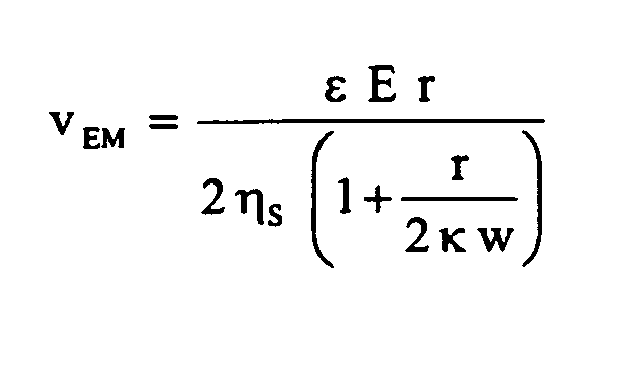
- VEM -
- Wanderungsgeschwindigkeit in m s-1,
- ε -
- Oberflächenladung in coul m-2,
- E -
- Stärke des elektrischen Felds in V m-1,
- ηS -
- Schlackeviskosität in Pa s,
- κ -
- Spezifische Leitfähigkeit der Schlacke in Ω-1 m-1,
- w -
- Widerstand der Metall/Schlackegrenzfläche in Ω m2.
- Basierend auf der elektrischen Ladungsdichte nimmt die Wanderungsgeschwindigkeit des Metalls oder der Steineinschlüsse gemäß der oben aufgeführten Formel mit dem Tropfenradius ab. Die Wanderungsgeschwindigkeit ist bei kleineren Einschlüssen wesentlich höher als das Absetzen durch Schwerkraft.
- Die Schlackeverarbeitung in gekreuzten elektrischen und magnetischen Feldern nutzt eine Reihe von Phänomenen, durch die der Schlackereinigungsprozess sehr intensiv und effektiv wird. Elektromagnetisches Rühren der Schlacke erhöht den Stoffübergang, wodurch die Schlackereduktion beschleunigt und die Koaleszenz der Einschlüsse gefördert wird. Gleichzeitige Schlackeelektrolyse wirkt bei kathodischer Reduktion von Magnetit und Kupferoxid und anodischer Bildung von Kohlenmonoxid als zusätzliches Reduktionsmittel. Elektrokapillare Wanderung der Einschlüsse begünstigt deren Koaleszenz und führt zur Entfernung von Einschlüssen aus der Schlacke.
- Schlacke aus dem Erschmelzen von Konzentrat in einem Flash-Schmelzaggregat enthält 4% Cu und 15% Fe3O4. Die Schlacke wird alle 3 Stunden abgestochen und durch eine Rinne an den 9,5 MVA-Drehstrom-Lichtbogenofen 1 übergeben. Die Schlackeproduktionsmenge beträgt 30 t/h, dies entspricht einer Verarbeitung von 90 t in jedem Zyklus. Der Koksverbrauch beläuft sich auf ca.8 kg/t und der Energieverbrauch auf ungefähr 70 kWh/t, entsprechend einer durchschnittlichen Leistungsaufnahme von 6,3 MW. Nach einer Stunde beginnt der Schlackeabstich auf dem Lichtbogenofen über einen Zeitraum von 2 Stunden. Die Schlacke mit einem Cu-Gehalt von 1,1 % und 7 % Fe3O4 wird durch die Rinne 8 in den DC-Lichtbogenofen 2 mit einer Kammer transportiert, welche 4 m lang und 1 m breit ist. Der Reduktions-Rinnenofen zur halbkontinuierlichen Schlackereinigung ist in
Fig. 2 dargestellt. Die Schlacke fließt 2 Stunden kontinuierlich durch den Reduktions-Rinnenofen 2. Bei einem Schlackespiegel von 1 m beträgt die durchschnittliche Verweilzeit ungefähr 30 Minuten. Bei Ofenwärmeverlusten von 1 GJ/h beträgt der Einheitsstromverbrauch ungefähr 35 kWh/t und die erforderliche Leistungsaufnahme 1 MW. Bei einer geschätzten Spannung von 100 V liegt die Stromstärke in der Größenordnung von 10 kA. Der geschätzte Koksverbrauch ist ca. 2 kg/t. Die Fertigschlacke enthält 0,5% Cu und 4% Magnetit. Der gesamte Energieverbrauch beläuft sich auf 105 kWh/t und der Koksverbrauch auf 10 kg/t. - Das erfindungsgemäße Verfahren arbeitet gemäß dem Ausführungsbeispiel also als zweistufige Kupferschlackenreinigung in Lichtbogenöfen.
- Es kann ein periodisches oder ein kontinuierliches Chargieren der Schlacke in den ersten Lichtbogenofen 1 erfolgen. In diesen Ofen 1 werden die Graphit- bzw. Kohlenstoffelektroden in die geschmolzene Schlacke eingeführt und über sie eine Stromzufuhr bewerkstelligt. Auf die Schlackenoberfläche wird Koks oder ein anderes Reduktionsmittel zugegeben. Die Regelung der Schlackentemperatur im Schlackenreinigungsofen erfolgt durch Regelung der Leistungsaufnahme. Schließlich erfolgt ein Abstechen der gewonnenen Metalle in Form von Kupferstein und metallischem Kupfer.
- Auch im DC-Rinnenofen 2 kann ein periodisches oder kontinuierliches Abstechen der Schlacke erfolgen. Ein Gleichstrom wird zwischen der als Anode fungierenden Koksschicht an der Schlackenoberfläche und der als Kathode fungierenden flüssigen Stein angelegt. Das überlagerte, örtlich begrenzte Magnetfeld, das durch Elektromagnete oder Dauermagnete erzeugt wird, wird benutzt, um die Schlacke in Bewegung zu versetzen. Auf die Schlackenoberfläche wird Koks chargiert, um die Schichtdicke der Koksschicht konstant zu halten und um günstige elektrische Kontaktbedingungen mit den Graphit- oder Kohlenstoffelektroden aufrecht zu erhalten. Auch hier kann ein kontinuierliches oder ein periodisches Abstechen der gereinigten Fertigschlacke erfolgen. Gleichermaßen kann periodisch das Abstechen des Kupfersteins oder des Kupfersteins zusammen mit metallischem Kupfer erfolgen. Weiterhin wird eine Kupferstein-(Kupfer-)Schicht auf dem Ofenboden als flüssige Kathode aufrechterhalten, wobei die Katzode in Kontakt mit einem Graphitblock steht.
- Die Kupferschlacke kann diejenige Schlacke darstellen, die durch das Erschmelzen von Kupferkonzentraten zu Kupferstein oder unmittelbar zu Blisterkupfer gewonnen wird, sowie diejenige Schlacke, die durch das Umwandeln von Kupferstein gewonnen wird.
- Als erster Lichtbogenofen 1 kann ein klassischer AC-Drehstrom-Lichtbogenofen oder ein DC-Lichtbogenofen eingesetzt werden.
- Die Induktion eines durch Permanentmagneten oder Elektromagneten erzeugten Magnetfelds liegt bevorzugt im Bereich von 50 bis 1.000 Gauss, wobei das permanente magnetische Feld einen Teil des Querschnitts der Flüssigschlacke im Bereich der Elektrode oder Elektroden in Kontakt mit dem Koksbett abdecken.
- Als Elektroden werden bevorzugt Graphit- oder Kohlenstoffelektroden eingesetzt. Der Ort der Elektroden lässt die Stromlinien die magnetischen Feldlinien kreuzen. Die optimale Positionierung der Elektroden führt dazu, dass die Stromlinien senkrecht zu den magnetischen Feldlinien verlaufen.
- Wie erläutert, ist die Schicht des flüssigen Metalls bzw. der Metallstein unter der Schlacke in Kontakt mit einer Graphit- oder anderen Elektrode, die die Funktion der Kathode hat; der Kohlenstoff bzw. die Koksschicht an der Schlackeoberfläche ist in Kontakt mit einer Graphit- oder anderen Elektrode, die die Funktion der Anode hat.
- Die Stärke des Gleichstroms liegt bevorzugt im Bereich zwischen 500 und 50.000 A, abhängig von der Größe des Schlackereinigungsaggregats, der Schlackemenge und der Temperatur.
- Wengleich das vorgeschlagene Verfahren bevorzugt für die Gewinnung von Kupfer vorgesehen ist, kann es auch für andere Metalle wie für Blei (Pb), Zink (Zn), Platin (Pt) oder Nickel (Ni) angewendet werden.
- Durch die zweistufige Schlackereduktion und die Entfernung des Kupfers in zwei Lichtbogenöfen wird erreicht, dass der erste Drehstrom-Lichtbogenöfen zur Vorabreduktion der Schlacke und Abscheidung von Kupferstein eingesetzt werden kann, gefolgt von einer tiefgehenden Schlackereduktion und der Entfernung von Einschlüssen in einem DC-Reduktions-Rinnenofen mit elektromagnetischem Rühren. Der Einsatz von elektromagnetischem Rühren, welches den Stoffübergang auf die Reduktionsfläche und die Koaleszenz der Einschlüsse verbessert, gemeinsam mit Schlackeelektrolyse und elektrokinetischen Phänomenen ermöglichen eine wirksame Schlackereinigung und eine hohe Rückgewinnung von Kupfer.
-
- 1
- erster Ofen (Wechselstromofen)
- 2
- zweiter Ofen (Gleichstromofen)
- 3
- Elektromagnet
- 4
- Elektrode (Anode)
- 5
- Elektrode (Kathode)
- 6
- elektrische Verbindung (Graphitelektrode)
- 7
- elektrische Verbindung (Graphitelektrode)
- 8
- Verbindungsmittel
- 9
- Elektrode
- 10
- Elektrode
- 11
- Wechselstromquelle
- 12
- Gleichstromquelle
- 13
- elektrische Spule
- 14
- elektrische Spule
- 15
- Schlacke
- 16
- Schlackeneintritt
- 17
- Schlackenaustritt
Claims (19)
- Verfahren zur Gewinnung eines Metalls aus einer das Metall enthaltenden Schlacke, bei dem die verflüssigte metallhaltige Schlacke in mindestens einem Lichtbogenofen (1, 2) erhitzt wird,
dadurch gekennzeichnet,
dass die metallhaltige Schlacke in einem ersten als Wechselstrom-Elektroofen ausgebildeten Ofen (1) erhitzt und die Schmelze von dem ersten Ofen (1) in einen zweiten als Gleichstrom-Elektroofen ausgebildeten Ofen (2) verbracht wird. - Verfahren nach Anspruch 1,
dadurch gekennzeichnet,
dass das zu gewinnende Metall Kupfer (Cu) ist, das sich in einer kupferhaltigen Schlacke befindet. - Verfahren nach Anspruch 1,
dadurch gekennzeichnet,
dass das zu gewinnende Metall Blei (Pb), Zink (Zn), Platin (Pt) oder Nickel (Ni) ist, das sich in einer Schlacke befindet. - Verfahren nach einem der Ansprüche 1 bis 3,
dadurch gekennzeichnet,
dass in dem ersten als Wechselstrom-Elektroofen ausgebildeten Ofen (1) eine Vorabreduktion der Schlacke und ein Abscheiden von Metallstein, insbesondere von Kupferstein, erfolgt und dass in dem zweiten als Gleichstrom-Elektroofen ausgebildeten Ofen (2) eine tiefgehende Schlackenreduktion und ein Entfernen von Einschlüssen erfolgt. - Verfahren nach einem der Ansprüche 1 bis 4,
dadurch gekennzeichnet,
dass in dem zweiten als Gleichstrom-Elektroofen ausgebildeten Ofen (2) eine elektrolytische Abscheidung des zu gewinnenden Metalls erfolgt. - Verfahren nach einem der Ansprüche 1 bis 5,
dadurch gekennzeichnet,
dass in dem zweiten als Gleichstrom-Elektroofen ausgebildeten Ofen (2) während der Gewinnung des Metalls ein elektromagnetisches Rühren der Schmelze erfolgt. - Verfahren nach Anspruch 6,
dadurch gekennzeichnet,
dass zur Erzeugung des elektromagnetischen Rührens mindestens ein Elektromagnet (3) auf die sich im zweiten Ofen (2) befindliche Schmelze wirkt. - Verfahren nach Anspruch 6,
dadurch gekennzeichnet,
dass zur Erzeugung des elektromagnetischen Rührens mindestens ein Dauermagnet auf die sich im zweiten Ofen (2) befindliche Schmelze wirkt. - Verfahren nach Anspruch 7 oder 8,
dadurch gekennzeichnet,
dass der mindestens eine Magnet ein Magnetfeld zwischen 50 und 1.000 Gauss erzeugt und dass das Magnetfeld zumindest einen Teil des Querschnittes der Schmelze und des Bereichs der Elektroden (4, 5) in dem zweiten Ofen (2) erfasst. - Verfahren nach einem der Ansprüche 1 bis 9,
dadurch gekennzeichnet,
dass in den ersten Ofen (1) während des Erhitzens ein Reduktionsmittel, insbesondere Koks, zugegeben wird. - Verfahren nach einem der Ansprüche 1 bis 10,
dadurch gekennzeichnet,
dass auf die Schmelzeoberfläche in dem zweiten Ofen (2) kohlenstoffhaltiges Material, insbesondere Koks, so aufgegeben wird, dass sich eine Schicht des kohlenstoffhaltiges Materials mit im wesentlichen konstanter Dicke ausbildet, wobei die Schicht, als Anode (4) wirkend, mit einer elektrischen Verbindung (6) in Kontakt steht. - Verfahren nach einem der Ansprüche 1 bis 11,
dadurch gekennzeichnet,
dass im Bodenbereich unter der Schmelze in dem zweiten Ofen (2) eine Schicht aus Metallstein, insbesondere aus Kupferstein, mit im wesentlichen konstanter Dicke aufrechterhalten wird, wobei die Schicht, als Kathode (5) wirkend, mit einer elektrischen Verbindung (7) in Kontakt steht. - Vorrichtung zur Gewinnung eines Metalls aus einer das Metall enthaltenden Schlacke, insbesondere zur Durchführung des Verfahrens nach einem der Ansprüche 1 bis 12,
gekennzeichnet durch
einen ersten als Wechselstrom-Elektroofen ausgebildeten Ofen (1) und
einen zweiten als Gleichstrom-Elektroofen ausgebildeten Ofen (2), wobei zwischen dem ersten Ofen (1) und dem zweiten Ofen (2) ein Verbindungsmittel (8) für Schmelze vorhanden ist. - Vorrichtung nach Anspruch 13,
dadurch gekennzeichnet,
dass der erste Ofen (1) zwei Elektroden (9, 10) aufweist, die in die sich im ersten Ofen (1) befindliche Schmelze eintauchen und an eine Wechselstromquelle (11) angeschlossen sind. - Vorrichtung nach Anspruch 13 oder 14,
dadurch gekennzeichnet,
dass der zweite Ofen (2) zwei plattenartig ausgebildete Elektroden (4, 5) aufweist, die sich horizontal erstreckend im oberen Bereich und im unteren Bereich der sich im zweiten Ofen (2) befindlichen Schmelze angeordnet und an eine Gleichstromquelle (12) angeschlossen sind. - Vorrichtung nach Anspruch 15,
dadurch gekennzeichnet,
dass die sich im oberen Bereich befindliche Elektrode (4) als Koksbett ausgebildet ist, das mit einem elektrischen Kontakt (6), insbesondere mit einer Graphit-Elektrode, in Verbindung steht. - Vorrichtung nach Anspruch 15 oder 16,
dadurch gekennzeichnet,
dass die sich im unteren Bereich befindliche Elektrode (5) als Schicht aus Metallstein, insbesondere aus Kupferstein, ausgebildet ist, die mit einem elektrischen Kontakt (7), insbesondere mit einer Graphit-Elektrode, in Verbindung steht. - Vorrichtung nach einem der Ansprüche 13 bis 17,
dadurch gekennzeichnet,
dass der zweite Ofen (2) als Rinnenofen ausgebildet ist. - Vorrichtung nach einem der Ansprüche 13 bis 18,
dadurch gekennzeichnet,
dass Magnete, insbesondere Elektromagnete (3), in den Seitenbereichen des zweiten Ofens (2) angeordnet sind, deren magnetische Feldlinien zur Stromflussrichtung in zumindest einigen der stromführenden Elemente (4, 5) zumindest teilweise rechtwinkelig stehen.
Priority Applications (1)
| Application Number | Priority Date | Filing Date | Title |
|---|---|---|---|
| PL06754232T PL1807671T3 (pl) | 2005-06-08 | 2006-06-08 | Sposób i urządzenie do pozyskiwania metalu z zawierającego metal żużlu |
Applications Claiming Priority (3)
| Application Number | Priority Date | Filing Date | Title |
|---|---|---|---|
| DE102005026589 | 2005-06-08 | ||
| DE200610022779 DE102006022779A1 (de) | 2005-06-08 | 2006-05-16 | Verfahren und Vorrichtung zur Gewinnung eines Metalls aus einer das Metall enthaltenden Schlacke |
| PCT/EP2006/005497 WO2006131372A1 (de) | 2005-06-08 | 2006-06-08 | Verfahren und vorrichtung zur gewinnung eines metalls aus einer das metall enthaltenden schlacke |
Publications (2)
| Publication Number | Publication Date |
|---|---|
| EP1807671A1 EP1807671A1 (de) | 2007-07-18 |
| EP1807671B1 true EP1807671B1 (de) | 2008-02-27 |
Family
ID=36686090
Family Applications (1)
| Application Number | Title | Priority Date | Filing Date |
|---|---|---|---|
| EP20060754232 Not-in-force EP1807671B1 (de) | 2005-06-08 | 2006-06-08 | Verfahren und vorrichtung zur gewinnung eines metalls aus einer das metall enthaltenden schlacke |
Country Status (15)
| Country | Link |
|---|---|
| US (1) | US9733016B2 (de) |
| EP (1) | EP1807671B1 (de) |
| JP (1) | JP5094411B2 (de) |
| KR (1) | KR101139304B1 (de) |
| AT (1) | ATE387616T1 (de) |
| AU (1) | AU2006256916B2 (de) |
| BR (1) | BRPI0614020B1 (de) |
| CA (1) | CA2598571C (de) |
| DE (2) | DE102006022779A1 (de) |
| ES (1) | ES2301153T3 (de) |
| MX (1) | MX2007015380A (de) |
| NO (1) | NO339493B1 (de) |
| PL (1) | PL1807671T3 (de) |
| RU (1) | RU2368673C2 (de) |
| WO (1) | WO2006131372A1 (de) |
Cited By (3)
| Publication number | Priority date | Publication date | Assignee | Title |
|---|---|---|---|---|
| DE102008058605A1 (de) | 2007-12-18 | 2009-07-02 | Sms Demag Ag | Vorrichtung zur Gewinnung von Metallen oder Metallverbindungen, aus einem das Metall oder die Metallverbindung enthaltenden Material |
| DE102014019133A1 (de) | 2014-08-26 | 2016-03-17 | Sms Group Gmbh | Verfahren zur Rückgewinnung von Metallen aus der Schlacke |
| DE102016207798A1 (de) * | 2015-11-19 | 2017-05-24 | Sms Group Gmbh | Absetzofen und Verfahren zu seinem Betrieb |
Families Citing this family (12)
| Publication number | Priority date | Publication date | Assignee | Title |
|---|---|---|---|---|
| EP2053137A1 (de) * | 2007-10-19 | 2009-04-29 | Paul Wurth S.A. | Verwertung von Reststoffen, die Kupfer und andere wertvolle Metalle enthalten |
| ES2377698B1 (es) | 2009-02-27 | 2013-02-14 | Corrugados Azpeitia S.L. | Procedimiento secuencial para la gestión ecológica y limpia de la escoria blanca de acerías en estado pulverulento y equipo para la realización de dicho procedimiento. |
| PL2564173T3 (pl) * | 2010-04-30 | 2019-10-31 | Agellis Group Ab | Wykonywanie pomiarów w naczyniach metalurgicznych |
| CN102242231B (zh) * | 2010-09-27 | 2013-04-24 | 山东焦化集团有限公司 | 利用熔融炉渣生产平板型无机非金属材料的方法 |
| DE102011090072A1 (de) | 2011-12-29 | 2013-07-04 | Sms Siemag Ag | Verfahren zur Gewinnung eines Metalls aus einer das Metall enthaltenden Schlacke sowie Vorrichtung zur Gewinnung des Metalls |
| SE536291C2 (sv) * | 2012-03-08 | 2013-08-06 | Valeas Recycling Ab | Järnreduktionsprocess och anordning därför |
| FI126583B (fi) * | 2014-03-31 | 2017-02-28 | Outotec Finland Oy | Menetelmä ja kantoaine pelkistimen kuten koksin kuljettamiseksi metallurgiseen uuniin ja kantoaineen tuotantomenetelmä |
| DE102014010442A1 (de) * | 2014-07-11 | 2016-01-14 | Aurubis Ag | Verfahren und Vorrichtung zur Aufbereitung von Eisensilikatgestein |
| BR112017004592A2 (pt) * | 2014-09-09 | 2018-11-06 | The Arizona Board Of Regents On Behalf Of The University Of Arizona | sistema, equipamento e processo para lixiviar metal e armazenar energia térmica durante a extração do metal |
| CN104928484B (zh) * | 2015-05-21 | 2016-06-15 | 东营方圆有色金属有限公司 | 一种铜冶炼渣处理装置及其方法 |
| CN106051776A (zh) * | 2016-07-13 | 2016-10-26 | 北京保利洁科技发展有限公司 | 一种焚烧处理固体废弃物的方法 |
| CN107663589A (zh) * | 2017-10-10 | 2018-02-06 | 东北大学 | 一种由含镍与铁的混合熔渣回收有价组分的方法 |
Family Cites Families (18)
| Publication number | Priority date | Publication date | Assignee | Title |
|---|---|---|---|---|
| SU574478A1 (ru) * | 1971-10-18 | 1977-09-30 | Предприятие П/Я Г-4911 | Установка дл комплексной переработки полиметаллического сырь |
| US4036636A (en) | 1975-12-22 | 1977-07-19 | Kennecott Copper Corporation | Pyrometallurgical process for smelting nickel and nickel-copper concentrates including slag treatment |
| US4060409A (en) | 1976-02-23 | 1977-11-29 | Kennecott Copper Corporation | Mechanically stirred furnace for pyrometallurgical operations and processes |
| FI63441C (fi) * | 1976-02-23 | 1983-06-10 | Outokumpu Oy | Foerfarande foer framstaellning av raokoppar fraon kopparmalm eller -koncentrat innehaollande skadliga eller ekonomiskt sinifikanta maengder andra icke-jaernmetaller |
| US4110107A (en) | 1977-06-16 | 1978-08-29 | The United States Of America As Represented By The Secretary Of The Interior | Process for reducing molten furnace slags by carbon injection |
| JPS60208489A (ja) * | 1984-04-03 | 1985-10-21 | Nippon Mining Co Ltd | 銅スラグからの有価金属の回収法 |
| MY110307A (en) | 1990-11-20 | 1998-04-30 | Mitsubishi Materials Corp | Apparatus for continuous copper smelting |
| DE69124665T2 (de) | 1990-11-20 | 1997-06-19 | Mitsubishi Materials Corp | Verfahren zum kontinuierlichen Schmelzen von Kupfer |
| JPH06174382A (ja) * | 1992-12-07 | 1994-06-24 | Nkk Corp | 直流アーク炉 |
| CH688325A5 (de) * | 1994-11-25 | 1997-07-31 | Holderbank Financ Glarus | Verfahren zur Aufbereitung von festen Rueckstaenden aus Muellverbrennungsanlagen und Vorrichtung zur Drchfuehrung des Verfahrens. |
| WO1997000333A1 (en) * | 1995-06-15 | 1997-01-03 | Mintek | The processing of zinc bearing materials in a dc arc furnace |
| WO1997018415A1 (de) | 1995-11-10 | 1997-05-22 | Mgc-Plasma Ag | Anlage und verfahren zum thermischen zersetzen, schmelzen, verglasen und zur wertstoffrückgewinnung aus abfall- und reststoffen unterschiedlichster art |
| RU2121518C1 (ru) * | 1997-05-21 | 1998-11-10 | Открытое акционерное общество "Институт Гинцветмет" | Способ переработки оксидного сырья, содержащего цветные металлы |
| CA2362294C (en) * | 1999-02-26 | 2009-12-29 | Mintek | Treatment of metal sulphide concentrates by roasting and arc furnace smelt reduction |
| JP2000337776A (ja) * | 1999-05-25 | 2000-12-08 | Nkk Corp | 溶解炉等における二次燃焼率及び着熱効率の向上方法 |
| PL194875B1 (pl) | 2000-01-04 | 2007-07-31 | Outokumpu Oy | Sposób wytwarzania miedzi konwertorowej w reaktorze zawiesinowym |
| JP3529317B2 (ja) | 2000-03-03 | 2004-05-24 | 日鉱金属株式会社 | 銅製錬炉の操業方法 |
| US7350559B2 (en) * | 2002-12-16 | 2008-04-01 | Energetics Technologies, Llc | Systems and methods of electromagnetic influence on electroconducting continuum |
-
2006
- 2006-05-16 DE DE200610022779 patent/DE102006022779A1/de not_active Withdrawn
- 2006-06-08 AT AT06754232T patent/ATE387616T1/de active
- 2006-06-08 ES ES06754232T patent/ES2301153T3/es active Active
- 2006-06-08 AU AU2006256916A patent/AU2006256916B2/en not_active Ceased
- 2006-06-08 WO PCT/EP2006/005497 patent/WO2006131372A1/de not_active Ceased
- 2006-06-08 US US11/921,885 patent/US9733016B2/en not_active Expired - Fee Related
- 2006-06-08 EP EP20060754232 patent/EP1807671B1/de not_active Not-in-force
- 2006-06-08 RU RU2007129748A patent/RU2368673C2/ru not_active IP Right Cessation
- 2006-06-08 KR KR20077014427A patent/KR101139304B1/ko not_active Expired - Fee Related
- 2006-06-08 JP JP2007549880A patent/JP5094411B2/ja not_active Expired - Fee Related
- 2006-06-08 DE DE200650000401 patent/DE502006000401D1/de active Active
- 2006-06-08 PL PL06754232T patent/PL1807671T3/pl unknown
- 2006-06-08 MX MX2007015380A patent/MX2007015380A/es active IP Right Grant
- 2006-06-08 BR BRPI0614020-3A patent/BRPI0614020B1/pt not_active IP Right Cessation
- 2006-06-08 CA CA 2598571 patent/CA2598571C/en not_active Expired - Fee Related
-
2007
- 2007-06-25 NO NO20073255A patent/NO339493B1/no not_active IP Right Cessation
Cited By (3)
| Publication number | Priority date | Publication date | Assignee | Title |
|---|---|---|---|---|
| DE102008058605A1 (de) | 2007-12-18 | 2009-07-02 | Sms Demag Ag | Vorrichtung zur Gewinnung von Metallen oder Metallverbindungen, aus einem das Metall oder die Metallverbindung enthaltenden Material |
| DE102014019133A1 (de) | 2014-08-26 | 2016-03-17 | Sms Group Gmbh | Verfahren zur Rückgewinnung von Metallen aus der Schlacke |
| DE102016207798A1 (de) * | 2015-11-19 | 2017-05-24 | Sms Group Gmbh | Absetzofen und Verfahren zu seinem Betrieb |
Also Published As
| Publication number | Publication date |
|---|---|
| ES2301153T3 (es) | 2008-06-16 |
| CA2598571C (en) | 2012-08-28 |
| AU2006256916A1 (en) | 2006-12-14 |
| NO20073255L (no) | 2007-08-07 |
| JP5094411B2 (ja) | 2012-12-12 |
| JP2008527168A (ja) | 2008-07-24 |
| DE102006022779A1 (de) | 2006-12-21 |
| MX2007015380A (es) | 2008-02-11 |
| EP1807671A1 (de) | 2007-07-18 |
| KR20080015383A (ko) | 2008-02-19 |
| RU2007129748A (ru) | 2009-02-10 |
| RU2368673C2 (ru) | 2009-09-27 |
| KR101139304B1 (ko) | 2012-04-26 |
| AU2006256916B2 (en) | 2009-02-19 |
| US9733016B2 (en) | 2017-08-15 |
| ATE387616T1 (de) | 2008-03-15 |
| DE502006000401D1 (de) | 2008-04-10 |
| BRPI0614020B1 (pt) | 2015-07-21 |
| NO339493B1 (no) | 2016-12-19 |
| WO2006131372A1 (de) | 2006-12-14 |
| CA2598571A1 (en) | 2006-12-14 |
| US20090211398A1 (en) | 2009-08-27 |
| BRPI0614020A2 (pt) | 2011-03-01 |
| PL1807671T3 (pl) | 2008-07-31 |
Similar Documents
| Publication | Publication Date | Title |
|---|---|---|
| EP1937859B1 (de) | Verfahren zur kontinuierlichen oder diskontinuierlichen gewinnung eines metalls oder mehrerer metalle aus einer das metall oder eine verbindung des metalls enthaltende schlacke | |
| EP1807671B1 (de) | Verfahren und vorrichtung zur gewinnung eines metalls aus einer das metall enthaltenden schlacke | |
| DD211363A5 (de) | Verfahren zur verarbeitung edelmetallhaltiger eisentragender schlacken | |
| US11981979B2 (en) | Device and method for preparing low-impurity regenerated brass alloy through step-by-step insertion of electrode | |
| DE3877419T2 (de) | Wiedergewinnung von nichteisenmetallen. | |
| EP2798294B1 (de) | Verfahren zur gewinnung eines metalls aus einer das metall enthaltenden schlacke sowie vorrichtung zur gewinnung des metalls | |
| DE10016075C1 (de) | Verfahren zum Schmelzentfernen von Verunreinigungselementen aus Eisen | |
| CN101238343B (zh) | 从含有金属的炉渣中提取金属的方法和装置 | |
| DE2105038C3 (de) | Verfahren und Vorrichtung zur direkten elektrolytischen Abscheidung von Metallen | |
| DE3816697C1 (en) | Process for recovering rare metals | |
| DE2638082C2 (de) | Verfahren zur Verarbeitung von zinnhaltigen Materialien mit einem Eisengehalt von mehr als 3 Gew % | |
| EP2937431A1 (de) | Verfahren und Vorrichtung zum Herstellen einer Metallschmelze | |
| DE1266327B (de) | Verfahren zur Herstellung von hochwertigem Stahl aus Eisensanden | |
| DE2548029C3 (de) | Verfahren zur Rückgewinnung von Kupfer aus dieses enthaltende Schlacken | |
| EP0948656A1 (de) | Verfahren zum abreichern von hochschmelzenden materialien unter verwendung eines schmelzgefässes und eines elektro-reduktionsgefässes | |
| DE2113639A1 (de) | Metallurgisches Verfahren fuer Induktions-Tiegeloefen | |
| DE2548029B2 (de) | Verfahren zur rueckgewinnung von kupfer aus dieses enthaltende schlacken |
Legal Events
| Date | Code | Title | Description |
|---|---|---|---|
| PUAI | Public reference made under article 153(3) epc to a published international application that has entered the european phase |
Free format text: ORIGINAL CODE: 0009012 |
|
| 17P | Request for examination filed |
Effective date: 20070525 |
|
| AK | Designated contracting states |
Kind code of ref document: A1 Designated state(s): AT BE BG CH CY CZ DE DK EE ES FI FR GB GR HU IE IS IT LI LT LU LV MC NL PL PT RO SE SI SK TR |
|
| GRAP | Despatch of communication of intention to grant a patent |
Free format text: ORIGINAL CODE: EPIDOSNIGR1 |
|
| GRAS | Grant fee paid |
Free format text: ORIGINAL CODE: EPIDOSNIGR3 |
|
| GRAA | (expected) grant |
Free format text: ORIGINAL CODE: 0009210 |
|
| AK | Designated contracting states |
Kind code of ref document: B1 Designated state(s): AT BE BG CH CY CZ DE DK EE ES FI FR GB GR HU IE IS IT LI LT LU LV MC NL PL PT RO SE SI SK TR |
|
| REG | Reference to a national code |
Ref country code: GB Ref legal event code: FG4D Free format text: NOT ENGLISH |
|
| REG | Reference to a national code |
Ref country code: RO Ref legal event code: EPE |
|
| REG | Reference to a national code |
Ref country code: CH Ref legal event code: EP |
|
| REG | Reference to a national code |
Ref country code: IE Ref legal event code: FG4D Free format text: LANGUAGE OF EP DOCUMENT: GERMAN |
|
| REF | Corresponds to: |
Ref document number: 502006000401 Country of ref document: DE Date of ref document: 20080410 Kind code of ref document: P |
|
| REG | Reference to a national code |
Ref country code: SE Ref legal event code: TRGR |
|
| REG | Reference to a national code |
Ref country code: ES Ref legal event code: FG2A Ref document number: 2301153 Country of ref document: ES Kind code of ref document: T3 |
|
| PG25 | Lapsed in a contracting state [announced via postgrant information from national office to epo] |
Ref country code: IS Free format text: LAPSE BECAUSE OF FAILURE TO SUBMIT A TRANSLATION OF THE DESCRIPTION OR TO PAY THE FEE WITHIN THE PRESCRIBED TIME-LIMIT Effective date: 20080627 |
|
| REG | Reference to a national code |
Ref country code: PL Ref legal event code: T3 |
|
| NLV1 | Nl: lapsed or annulled due to failure to fulfill the requirements of art. 29p and 29m of the patents act | ||
| ET | Fr: translation filed | ||
| PG25 | Lapsed in a contracting state [announced via postgrant information from national office to epo] |
Ref country code: LV Free format text: LAPSE BECAUSE OF FAILURE TO SUBMIT A TRANSLATION OF THE DESCRIPTION OR TO PAY THE FEE WITHIN THE PRESCRIBED TIME-LIMIT Effective date: 20080227 Ref country code: SI Free format text: LAPSE BECAUSE OF FAILURE TO SUBMIT A TRANSLATION OF THE DESCRIPTION OR TO PAY THE FEE WITHIN THE PRESCRIBED TIME-LIMIT Effective date: 20080227 |
|
| REG | Reference to a national code |
Ref country code: IE Ref legal event code: FD4D |
|
| PG25 | Lapsed in a contracting state [announced via postgrant information from national office to epo] |
Ref country code: NL Free format text: LAPSE BECAUSE OF FAILURE TO SUBMIT A TRANSLATION OF THE DESCRIPTION OR TO PAY THE FEE WITHIN THE PRESCRIBED TIME-LIMIT Effective date: 20080227 Ref country code: IE Free format text: LAPSE BECAUSE OF FAILURE TO SUBMIT A TRANSLATION OF THE DESCRIPTION OR TO PAY THE FEE WITHIN THE PRESCRIBED TIME-LIMIT Effective date: 20080227 Ref country code: CZ Free format text: LAPSE BECAUSE OF FAILURE TO SUBMIT A TRANSLATION OF THE DESCRIPTION OR TO PAY THE FEE WITHIN THE PRESCRIBED TIME-LIMIT Effective date: 20080227 Ref country code: SK Free format text: LAPSE BECAUSE OF FAILURE TO SUBMIT A TRANSLATION OF THE DESCRIPTION OR TO PAY THE FEE WITHIN THE PRESCRIBED TIME-LIMIT Effective date: 20080227 Ref country code: DK Free format text: LAPSE BECAUSE OF FAILURE TO SUBMIT A TRANSLATION OF THE DESCRIPTION OR TO PAY THE FEE WITHIN THE PRESCRIBED TIME-LIMIT Effective date: 20080227 Ref country code: PT Free format text: LAPSE BECAUSE OF FAILURE TO SUBMIT A TRANSLATION OF THE DESCRIPTION OR TO PAY THE FEE WITHIN THE PRESCRIBED TIME-LIMIT Effective date: 20080721 |
|
| PLBE | No opposition filed within time limit |
Free format text: ORIGINAL CODE: 0009261 |
|
| STAA | Information on the status of an ep patent application or granted ep patent |
Free format text: STATUS: NO OPPOSITION FILED WITHIN TIME LIMIT |
|
| PG25 | Lapsed in a contracting state [announced via postgrant information from national office to epo] |
Ref country code: MC Free format text: LAPSE BECAUSE OF NON-PAYMENT OF DUE FEES Effective date: 20080630 Ref country code: LT Free format text: LAPSE BECAUSE OF FAILURE TO SUBMIT A TRANSLATION OF THE DESCRIPTION OR TO PAY THE FEE WITHIN THE PRESCRIBED TIME-LIMIT Effective date: 20080227 |
|
| 26N | No opposition filed |
Effective date: 20081128 |
|
| PG25 | Lapsed in a contracting state [announced via postgrant information from national office to epo] |
Ref country code: EE Free format text: LAPSE BECAUSE OF FAILURE TO SUBMIT A TRANSLATION OF THE DESCRIPTION OR TO PAY THE FEE WITHIN THE PRESCRIBED TIME-LIMIT Effective date: 20080227 Ref country code: BG Free format text: LAPSE BECAUSE OF FAILURE TO SUBMIT A TRANSLATION OF THE DESCRIPTION OR TO PAY THE FEE WITHIN THE PRESCRIBED TIME-LIMIT Effective date: 20080527 |
|
| PG25 | Lapsed in a contracting state [announced via postgrant information from national office to epo] |
Ref country code: CY Free format text: LAPSE BECAUSE OF FAILURE TO SUBMIT A TRANSLATION OF THE DESCRIPTION OR TO PAY THE FEE WITHIN THE PRESCRIBED TIME-LIMIT Effective date: 20080227 |
|
| PG25 | Lapsed in a contracting state [announced via postgrant information from national office to epo] |
Ref country code: LU Free format text: LAPSE BECAUSE OF NON-PAYMENT OF DUE FEES Effective date: 20080608 Ref country code: HU Free format text: LAPSE BECAUSE OF FAILURE TO SUBMIT A TRANSLATION OF THE DESCRIPTION OR TO PAY THE FEE WITHIN THE PRESCRIBED TIME-LIMIT Effective date: 20080828 |
|
| PG25 | Lapsed in a contracting state [announced via postgrant information from national office to epo] |
Ref country code: TR Free format text: LAPSE BECAUSE OF FAILURE TO SUBMIT A TRANSLATION OF THE DESCRIPTION OR TO PAY THE FEE WITHIN THE PRESCRIBED TIME-LIMIT Effective date: 20080227 |
|
| PG25 | Lapsed in a contracting state [announced via postgrant information from national office to epo] |
Ref country code: GR Free format text: LAPSE BECAUSE OF FAILURE TO SUBMIT A TRANSLATION OF THE DESCRIPTION OR TO PAY THE FEE WITHIN THE PRESCRIBED TIME-LIMIT Effective date: 20080528 |
|
| REG | Reference to a national code |
Ref country code: CH Ref legal event code: PL |
|
| GBPC | Gb: european patent ceased through non-payment of renewal fee |
Effective date: 20100608 |
|
| PG25 | Lapsed in a contracting state [announced via postgrant information from national office to epo] |
Ref country code: CH Free format text: LAPSE BECAUSE OF NON-PAYMENT OF DUE FEES Effective date: 20080630 Ref country code: LI Free format text: LAPSE BECAUSE OF NON-PAYMENT OF DUE FEES Effective date: 20080630 |
|
| PG25 | Lapsed in a contracting state [announced via postgrant information from national office to epo] |
Ref country code: CH Free format text: LAPSE BECAUSE OF NON-PAYMENT OF DUE FEES Effective date: 20100630 Ref country code: LI Free format text: LAPSE BECAUSE OF NON-PAYMENT OF DUE FEES Effective date: 20100630 |
|
| PG25 | Lapsed in a contracting state [announced via postgrant information from national office to epo] |
Ref country code: GB Free format text: LAPSE BECAUSE OF NON-PAYMENT OF DUE FEES Effective date: 20100608 |
|
| REG | Reference to a national code |
Ref country code: DE Ref legal event code: R082 Ref document number: 502006000401 Country of ref document: DE Representative=s name: HEMMERICH & KOLLEGEN, DE Ref country code: DE Ref legal event code: R081 Ref document number: 502006000401 Country of ref document: DE Owner name: SMS GROUP GMBH, DE Free format text: FORMER OWNER: SMS SIEMAG AKTIENGESELLSCHAFT, 40237 DUESSELDORF, DE |
|
| REG | Reference to a national code |
Ref country code: FR Ref legal event code: PLFP Year of fee payment: 11 |
|
| REG | Reference to a national code |
Ref country code: FR Ref legal event code: PLFP Year of fee payment: 12 |
|
| REG | Reference to a national code |
Ref country code: FR Ref legal event code: PLFP Year of fee payment: 13 |
|
| PGFP | Annual fee paid to national office [announced via postgrant information from national office to epo] |
Ref country code: RO Payment date: 20180529 Year of fee payment: 13 Ref country code: AT Payment date: 20180621 Year of fee payment: 13 Ref country code: BE Payment date: 20180620 Year of fee payment: 13 Ref country code: PL Payment date: 20180522 Year of fee payment: 13 Ref country code: FR Payment date: 20180620 Year of fee payment: 13 |
|
| PGFP | Annual fee paid to national office [announced via postgrant information from national office to epo] |
Ref country code: SE Payment date: 20180620 Year of fee payment: 13 |
|
| PGFP | Annual fee paid to national office [announced via postgrant information from national office to epo] |
Ref country code: ES Payment date: 20180724 Year of fee payment: 13 Ref country code: IT Payment date: 20180627 Year of fee payment: 13 |
|
| PGFP | Annual fee paid to national office [announced via postgrant information from national office to epo] |
Ref country code: FI Payment date: 20190620 Year of fee payment: 14 Ref country code: DE Payment date: 20190619 Year of fee payment: 14 |
|
| REG | Reference to a national code |
Ref country code: SE Ref legal event code: EUG |
|
| PG25 | Lapsed in a contracting state [announced via postgrant information from national office to epo] |
Ref country code: RO Free format text: LAPSE BECAUSE OF NON-PAYMENT OF DUE FEES Effective date: 20190608 Ref country code: SE Free format text: LAPSE BECAUSE OF NON-PAYMENT OF DUE FEES Effective date: 20190609 |
|
| REG | Reference to a national code |
Ref country code: AT Ref legal event code: MM01 Ref document number: 387616 Country of ref document: AT Kind code of ref document: T Effective date: 20190608 |
|
| REG | Reference to a national code |
Ref country code: BE Ref legal event code: MM Effective date: 20190630 |
|
| PG25 | Lapsed in a contracting state [announced via postgrant information from national office to epo] |
Ref country code: IT Free format text: LAPSE BECAUSE OF NON-PAYMENT OF DUE FEES Effective date: 20190608 Ref country code: AT Free format text: LAPSE BECAUSE OF NON-PAYMENT OF DUE FEES Effective date: 20190608 |
|
| PG25 | Lapsed in a contracting state [announced via postgrant information from national office to epo] |
Ref country code: BE Free format text: LAPSE BECAUSE OF NON-PAYMENT OF DUE FEES Effective date: 20190630 |
|
| PG25 | Lapsed in a contracting state [announced via postgrant information from national office to epo] |
Ref country code: FR Free format text: LAPSE BECAUSE OF NON-PAYMENT OF DUE FEES Effective date: 20190630 |
|
| REG | Reference to a national code |
Ref country code: ES Ref legal event code: FD2A Effective date: 20201027 |
|
| REG | Reference to a national code |
Ref country code: DE Ref legal event code: R119 Ref document number: 502006000401 Country of ref document: DE |
|
| REG | Reference to a national code |
Ref country code: FI Ref legal event code: MAE |
|
| PG25 | Lapsed in a contracting state [announced via postgrant information from national office to epo] |
Ref country code: FI Free format text: LAPSE BECAUSE OF NON-PAYMENT OF DUE FEES Effective date: 20200608 Ref country code: ES Free format text: LAPSE BECAUSE OF NON-PAYMENT OF DUE FEES Effective date: 20190609 |
|
| PG25 | Lapsed in a contracting state [announced via postgrant information from national office to epo] |
Ref country code: DE Free format text: LAPSE BECAUSE OF NON-PAYMENT OF DUE FEES Effective date: 20210101 |
|
| PG25 | Lapsed in a contracting state [announced via postgrant information from national office to epo] |
Ref country code: PL Free format text: LAPSE BECAUSE OF NON-PAYMENT OF DUE FEES Effective date: 20190608 |