EP1806128A1 - Haarpflegemittel - Google Patents
Haarpflegemittel Download PDFInfo
- Publication number
- EP1806128A1 EP1806128A1 EP06025998A EP06025998A EP1806128A1 EP 1806128 A1 EP1806128 A1 EP 1806128A1 EP 06025998 A EP06025998 A EP 06025998A EP 06025998 A EP06025998 A EP 06025998A EP 1806128 A1 EP1806128 A1 EP 1806128A1
- Authority
- EP
- European Patent Office
- Prior art keywords
- group
- oder
- bis
- und
- radical
- Prior art date
- Legal status (The legal status is an assumption and is not a legal conclusion. Google has not performed a legal analysis and makes no representation as to the accuracy of the status listed.)
- Granted
Links
- 210000004209 hair Anatomy 0.000 title claims description 49
- -1 polysiloxane Polymers 0.000 claims abstract description 193
- 229920001296 polysiloxane Polymers 0.000 claims abstract description 129
- 229920000642 polymer Polymers 0.000 claims abstract description 39
- 125000000217 alkyl group Chemical group 0.000 claims abstract description 26
- 230000003750 conditioning effect Effects 0.000 claims abstract description 24
- 239000000835 fiber Substances 0.000 claims abstract description 20
- 125000002091 cationic group Chemical group 0.000 claims abstract description 16
- 150000001875 compounds Chemical class 0.000 claims description 122
- 239000000203 mixture Substances 0.000 claims description 75
- 239000004215 Carbon black (E152) Substances 0.000 claims description 67
- 239000003795 chemical substances by application Substances 0.000 claims description 67
- 125000004122 cyclic group Chemical group 0.000 claims description 67
- 125000004432 carbon atom Chemical group C* 0.000 claims description 46
- LFQSCWFLJHTTHZ-UHFFFAOYSA-N Ethanol Chemical compound CCO LFQSCWFLJHTTHZ-UHFFFAOYSA-N 0.000 claims description 44
- IAYPIBMASNFSPL-UHFFFAOYSA-N Ethylene oxide Chemical compound C1CO1 IAYPIBMASNFSPL-UHFFFAOYSA-N 0.000 claims description 34
- 239000000975 dye Substances 0.000 claims description 32
- 239000007800 oxidant agent Substances 0.000 claims description 30
- 150000002191 fatty alcohols Chemical class 0.000 claims description 29
- 229930195733 hydrocarbon Natural products 0.000 claims description 28
- 235000014113 dietary fatty acids Nutrition 0.000 claims description 27
- 229930195729 fatty acid Natural products 0.000 claims description 27
- 239000000194 fatty acid Substances 0.000 claims description 27
- 150000004665 fatty acids Chemical class 0.000 claims description 26
- 125000001453 quaternary ammonium group Chemical group 0.000 claims description 25
- 125000003118 aryl group Chemical group 0.000 claims description 24
- MHAJPDPJQMAIIY-UHFFFAOYSA-N Hydrogen peroxide Chemical compound OO MHAJPDPJQMAIIY-UHFFFAOYSA-N 0.000 claims description 23
- 239000000126 substance Substances 0.000 claims description 22
- QGZKDVFQNNGYKY-UHFFFAOYSA-O ammonium group Chemical group [NH4+] QGZKDVFQNNGYKY-UHFFFAOYSA-O 0.000 claims description 21
- 229920001577 copolymer Polymers 0.000 claims description 20
- 230000003647 oxidation Effects 0.000 claims description 20
- 238000007254 oxidation reaction Methods 0.000 claims description 20
- 239000002243 precursor Substances 0.000 claims description 20
- 238000000034 method Methods 0.000 claims description 19
- 229920000233 poly(alkylene oxides) Polymers 0.000 claims description 19
- 125000002496 methyl group Chemical group [H]C([H])([H])* 0.000 claims description 18
- 239000000982 direct dye Substances 0.000 claims description 16
- NIXOWILDQLNWCW-UHFFFAOYSA-N 2-Propenoic acid Natural products OC(=O)C=C NIXOWILDQLNWCW-UHFFFAOYSA-N 0.000 claims description 15
- SMZOUWXMTYCWNB-UHFFFAOYSA-N 2-(2-methoxy-5-methylphenyl)ethanamine Chemical compound COC1=CC=C(C)C=C1CCN SMZOUWXMTYCWNB-UHFFFAOYSA-N 0.000 claims description 14
- CERQOIWHTDAKMF-UHFFFAOYSA-N Methacrylic acid Chemical compound CC(=C)C(O)=O CERQOIWHTDAKMF-UHFFFAOYSA-N 0.000 claims description 13
- 229920006317 cationic polymer Polymers 0.000 claims description 13
- 125000004430 oxygen atom Chemical group O* 0.000 claims description 13
- 150000003626 triacylglycerols Chemical class 0.000 claims description 12
- 125000001997 phenyl group Chemical group [H]C1=C([H])C([H])=C(*)C([H])=C1[H] 0.000 claims description 11
- 239000002280 amphoteric surfactant Substances 0.000 claims description 10
- 125000003709 fluoroalkyl group Chemical group 0.000 claims description 10
- 150000007524 organic acids Chemical class 0.000 claims description 10
- 229920005862 polyol Polymers 0.000 claims description 10
- 150000003077 polyols Chemical class 0.000 claims description 10
- 229920006395 saturated elastomer Polymers 0.000 claims description 10
- 125000000129 anionic group Chemical group 0.000 claims description 9
- 239000010466 nut oil Substances 0.000 claims description 9
- 108010076876 Keratins Proteins 0.000 claims description 8
- 102000011782 Keratins Human genes 0.000 claims description 8
- 239000003921 oil Substances 0.000 claims description 8
- 235000019198 oils Nutrition 0.000 claims description 8
- 229910052717 sulfur Inorganic materials 0.000 claims description 8
- QVGXLLKOCUKJST-UHFFFAOYSA-N atomic oxygen Chemical group [O] QVGXLLKOCUKJST-UHFFFAOYSA-N 0.000 claims description 7
- 239000006071 cream Substances 0.000 claims description 7
- 229910052700 potassium Inorganic materials 0.000 claims description 7
- 239000000419 plant extract Substances 0.000 claims description 6
- 239000000344 soap Substances 0.000 claims description 6
- VILAVOFMIJHSJA-UHFFFAOYSA-N dicarbon monoxide Chemical group [C]=C=O VILAVOFMIJHSJA-UHFFFAOYSA-N 0.000 claims description 5
- 125000004185 ester group Chemical group 0.000 claims description 5
- 239000007788 liquid Substances 0.000 claims description 5
- 241000208473 Macadamia ternifolia Species 0.000 claims description 4
- 125000002252 acyl group Chemical group 0.000 claims description 4
- 235000021122 unsaturated fatty acids Nutrition 0.000 claims description 4
- 150000004670 unsaturated fatty acids Chemical class 0.000 claims description 4
- 235000019488 nut oil Nutrition 0.000 claims description 2
- 229920001281 polyalkylene Polymers 0.000 claims description 2
- 239000004094 surface-active agent Substances 0.000 abstract description 9
- 150000003254 radicals Chemical class 0.000 description 86
- 239000000499 gel Substances 0.000 description 43
- PEDCQBHIVMGVHV-UHFFFAOYSA-N Glycerine Chemical compound OCC(O)CO PEDCQBHIVMGVHV-UHFFFAOYSA-N 0.000 description 32
- 150000003839 salts Chemical class 0.000 description 29
- 235000019441 ethanol Nutrition 0.000 description 28
- UFHFLCQGNIYNRP-UHFFFAOYSA-N Hydrogen Chemical compound [H][H] UFHFLCQGNIYNRP-UHFFFAOYSA-N 0.000 description 26
- 239000000047 product Substances 0.000 description 26
- 238000004043 dyeing Methods 0.000 description 22
- 239000001257 hydrogen Substances 0.000 description 21
- 229910052739 hydrogen Inorganic materials 0.000 description 21
- 238000002360 preparation method Methods 0.000 description 21
- 239000003086 colorant Substances 0.000 description 20
- XLYOFNOQVPJJNP-UHFFFAOYSA-N water Substances O XLYOFNOQVPJJNP-UHFFFAOYSA-N 0.000 description 18
- OSCJHTSDLYVCQC-UHFFFAOYSA-N 2-ethylhexyl 4-[[4-[4-(tert-butylcarbamoyl)anilino]-6-[4-(2-ethylhexoxycarbonyl)anilino]-1,3,5-triazin-2-yl]amino]benzoate Chemical compound C1=CC(C(=O)OCC(CC)CCCC)=CC=C1NC1=NC(NC=2C=CC(=CC=2)C(=O)NC(C)(C)C)=NC(NC=2C=CC(=CC=2)C(=O)OCC(CC)CCCC)=N1 OSCJHTSDLYVCQC-UHFFFAOYSA-N 0.000 description 17
- 239000000178 monomer Substances 0.000 description 17
- GHMLBKRAJCXXBS-UHFFFAOYSA-N resorcinol Chemical compound OC1=CC=CC(O)=C1 GHMLBKRAJCXXBS-UHFFFAOYSA-N 0.000 description 17
- CWLKGDAVCFYWJK-UHFFFAOYSA-N 3-aminophenol Chemical class NC1=CC=CC(O)=C1 CWLKGDAVCFYWJK-UHFFFAOYSA-N 0.000 description 15
- 125000005843 halogen group Chemical group 0.000 description 15
- 230000001590 oxidative effect Effects 0.000 description 15
- 239000000284 extract Substances 0.000 description 13
- 235000011187 glycerol Nutrition 0.000 description 13
- 230000008569 process Effects 0.000 description 13
- 125000002887 hydroxy group Chemical group [H]O* 0.000 description 12
- 125000003277 amino group Chemical group 0.000 description 11
- 150000002431 hydrogen Chemical class 0.000 description 11
- 229910052757 nitrogen Inorganic materials 0.000 description 11
- KJCVRFUGPWSIIH-UHFFFAOYSA-N 1-naphthol Chemical compound C1=CC=C2C(O)=CC=CC2=C1 KJCVRFUGPWSIIH-UHFFFAOYSA-N 0.000 description 10
- UHOVQNZJYSORNB-UHFFFAOYSA-N Benzene Chemical compound C1=CC=CC=C1 UHOVQNZJYSORNB-UHFFFAOYSA-N 0.000 description 10
- GOOHAUXETOMSMM-UHFFFAOYSA-N Propylene oxide Chemical group CC1CO1 GOOHAUXETOMSMM-UHFFFAOYSA-N 0.000 description 10
- 239000004480 active ingredient Substances 0.000 description 10
- 238000006243 chemical reaction Methods 0.000 description 10
- 239000000118 hair dye Substances 0.000 description 10
- 125000004435 hydrogen atom Chemical group [H]* 0.000 description 10
- OIPPWFOQEKKFEE-UHFFFAOYSA-N orcinol Chemical compound CC1=CC(O)=CC(O)=C1 OIPPWFOQEKKFEE-UHFFFAOYSA-N 0.000 description 10
- PLIKAWJENQZMHA-UHFFFAOYSA-N 4-aminophenol Chemical compound NC1=CC=C(O)C=C1 PLIKAWJENQZMHA-UHFFFAOYSA-N 0.000 description 9
- DNIAPMSPPWPWGF-UHFFFAOYSA-N Propylene glycol Chemical compound CC(O)CO DNIAPMSPPWPWGF-UHFFFAOYSA-N 0.000 description 9
- 150000001298 alcohols Chemical class 0.000 description 9
- 125000003178 carboxy group Chemical group [H]OC(*)=O 0.000 description 9
- 229960001755 resorcinol Drugs 0.000 description 9
- 125000004178 (C1-C4) alkyl group Chemical group 0.000 description 8
- WQZGKKKJIJFFOK-GASJEMHNSA-N Glucose Natural products OC[C@H]1OC(O)[C@H](O)[C@@H](O)[C@@H]1O WQZGKKKJIJFFOK-GASJEMHNSA-N 0.000 description 8
- WQZGKKKJIJFFOK-VFUOTHLCSA-N beta-D-glucose Chemical compound OC[C@H]1O[C@@H](O)[C@H](O)[C@@H](O)[C@@H]1O WQZGKKKJIJFFOK-VFUOTHLCSA-N 0.000 description 8
- RTZKZFJDLAIYFH-UHFFFAOYSA-N ether Substances CCOCC RTZKZFJDLAIYFH-UHFFFAOYSA-N 0.000 description 8
- LQJBNNIYVWPHFW-UHFFFAOYSA-N 20:1omega9c fatty acid Natural products CCCCCCCCCCC=CCCCCCCCC(O)=O LQJBNNIYVWPHFW-UHFFFAOYSA-N 0.000 description 7
- 229940018563 3-aminophenol Drugs 0.000 description 7
- DBFYESDCPWWCHN-UHFFFAOYSA-N 5-amino-2-methylphenol Chemical compound CC1=CC=C(N)C=C1O DBFYESDCPWWCHN-UHFFFAOYSA-N 0.000 description 7
- 235000018330 Macadamia integrifolia Nutrition 0.000 description 7
- 240000000912 Macadamia tetraphylla Species 0.000 description 7
- 235000003800 Macadamia tetraphylla Nutrition 0.000 description 7
- 125000001424 substituent group Chemical group 0.000 description 7
- 238000011282 treatment Methods 0.000 description 7
- CDAWCLOXVUBKRW-UHFFFAOYSA-N 2-aminophenol Chemical compound NC1=CC=CC=C1O CDAWCLOXVUBKRW-UHFFFAOYSA-N 0.000 description 6
- GHVHDYYKJYXFGU-UHFFFAOYSA-N Beta-Orcinol Chemical compound CC1=CC(O)=C(C)C(O)=C1 GHVHDYYKJYXFGU-UHFFFAOYSA-N 0.000 description 6
- VEXZGXHMUGYJMC-UHFFFAOYSA-M Chloride anion Chemical compound [Cl-] VEXZGXHMUGYJMC-UHFFFAOYSA-M 0.000 description 6
- KFZMGEQAYNKOFK-UHFFFAOYSA-N Isopropanol Chemical compound CC(C)O KFZMGEQAYNKOFK-UHFFFAOYSA-N 0.000 description 6
- OKKJLVBELUTLKV-UHFFFAOYSA-N Methanol Chemical compound OC OKKJLVBELUTLKV-UHFFFAOYSA-N 0.000 description 6
- ZQPPMHVWECSIRJ-UHFFFAOYSA-N Oleic acid Natural products CCCCCCCCC=CCCCCCCCC(O)=O ZQPPMHVWECSIRJ-UHFFFAOYSA-N 0.000 description 6
- 235000001466 Ribes nigrum Nutrition 0.000 description 6
- 241001312569 Ribes nigrum Species 0.000 description 6
- QAOWNCQODCNURD-UHFFFAOYSA-N Sulfuric acid Chemical compound OS(O)(=O)=O QAOWNCQODCNURD-UHFFFAOYSA-N 0.000 description 6
- 150000001735 carboxylic acids Chemical class 0.000 description 6
- 238000004040 coloring Methods 0.000 description 6
- 230000003766 combability Effects 0.000 description 6
- 150000005690 diesters Chemical class 0.000 description 6
- ZQPPMHVWECSIRJ-MDZDMXLPSA-N elaidic acid Chemical compound CCCCCCCC\C=C\CCCCCCCC(O)=O ZQPPMHVWECSIRJ-MDZDMXLPSA-N 0.000 description 6
- 125000001495 ethyl group Chemical group [H]C([H])([H])C([H])([H])* 0.000 description 6
- 229910052731 fluorine Inorganic materials 0.000 description 6
- QXJSBBXBKPUZAA-UHFFFAOYSA-N isooleic acid Natural products CCCCCCCC=CCCCCCCCCC(O)=O QXJSBBXBKPUZAA-UHFFFAOYSA-N 0.000 description 6
- 238000005259 measurement Methods 0.000 description 6
- 150000007522 mineralic acids Chemical class 0.000 description 6
- 239000002736 nonionic surfactant Substances 0.000 description 6
- 229910052760 oxygen Inorganic materials 0.000 description 6
- 239000001301 oxygen Substances 0.000 description 6
- SECPZKHBENQXJG-FPLPWBNLSA-N palmitoleic acid Chemical compound CCCCCC\C=C/CCCCCCCC(O)=O SECPZKHBENQXJG-FPLPWBNLSA-N 0.000 description 6
- 235000018102 proteins Nutrition 0.000 description 6
- 102000004169 proteins and genes Human genes 0.000 description 6
- 108090000623 proteins and genes Proteins 0.000 description 6
- WRIDQFICGBMAFQ-UHFFFAOYSA-N (E)-8-Octadecenoic acid Natural products CCCCCCCCCC=CCCCCCCC(O)=O WRIDQFICGBMAFQ-UHFFFAOYSA-N 0.000 description 5
- BMTSZVZQNMNPCT-UHFFFAOYSA-N 2-aminopyridin-3-ol Chemical compound NC1=NC=CC=C1O BMTSZVZQNMNPCT-UHFFFAOYSA-N 0.000 description 5
- ZTMADXFOCUXMJE-UHFFFAOYSA-N 2-methylbenzene-1,3-diol Chemical compound CC1=C(O)C=CC=C1O ZTMADXFOCUXMJE-UHFFFAOYSA-N 0.000 description 5
- XYRDGCCCBJITBH-UHFFFAOYSA-N 3-amino-2-chloro-6-methylphenol Chemical compound CC1=CC=C(N)C(Cl)=C1O XYRDGCCCBJITBH-UHFFFAOYSA-N 0.000 description 5
- JQVAPEJNIZULEK-UHFFFAOYSA-N 4-chlorobenzene-1,3-diol Chemical compound OC1=CC=C(Cl)C(O)=C1 JQVAPEJNIZULEK-UHFFFAOYSA-N 0.000 description 5
- QGNGOGOOPUYKMC-UHFFFAOYSA-N 4-hydroxy-6-methylaniline Chemical compound CC1=CC(O)=CC=C1N QGNGOGOOPUYKMC-UHFFFAOYSA-N 0.000 description 5
- QSBYPNXLFMSGKH-UHFFFAOYSA-N 9-Heptadecensaeure Natural products CCCCCCCC=CCCCCCCCC(O)=O QSBYPNXLFMSGKH-UHFFFAOYSA-N 0.000 description 5
- CPELXLSAUQHCOX-UHFFFAOYSA-M Bromide Chemical compound [Br-] CPELXLSAUQHCOX-UHFFFAOYSA-M 0.000 description 5
- HEDRZPFGACZZDS-UHFFFAOYSA-N Chloroform Chemical compound ClC(Cl)Cl HEDRZPFGACZZDS-UHFFFAOYSA-N 0.000 description 5
- 239000005642 Oleic acid Substances 0.000 description 5
- 239000004721 Polyphenylene oxide Substances 0.000 description 5
- 240000006365 Vitis vinifera Species 0.000 description 5
- 235000014787 Vitis vinifera Nutrition 0.000 description 5
- 239000002253 acid Substances 0.000 description 5
- 125000002947 alkylene group Chemical group 0.000 description 5
- 239000003945 anionic surfactant Substances 0.000 description 5
- 239000004359 castor oil Substances 0.000 description 5
- 235000019438 castor oil Nutrition 0.000 description 5
- MTHSVFCYNBDYFN-UHFFFAOYSA-N diethylene glycol Chemical compound OCCOCCO MTHSVFCYNBDYFN-UHFFFAOYSA-N 0.000 description 5
- 150000002148 esters Chemical class 0.000 description 5
- ZEMPKEQAKRGZGQ-XOQCFJPHSA-N glycerol triricinoleate Natural products CCCCCC[C@@H](O)CC=CCCCCCCCC(=O)OC[C@@H](COC(=O)CCCCCCCC=CC[C@@H](O)CCCCCC)OC(=O)CCCCCCCC=CC[C@H](O)CCCCCC ZEMPKEQAKRGZGQ-XOQCFJPHSA-N 0.000 description 5
- ZUVBIBLYOCVYJU-UHFFFAOYSA-N naphthalene-1,7-diol Chemical compound C1=CC=C(O)C2=CC(O)=CC=C21 ZUVBIBLYOCVYJU-UHFFFAOYSA-N 0.000 description 5
- QJGQUHMNIGDVPM-UHFFFAOYSA-N nitrogen group Chemical group [N] QJGQUHMNIGDVPM-UHFFFAOYSA-N 0.000 description 5
- 238000004806 packaging method and process Methods 0.000 description 5
- 229920000570 polyether Polymers 0.000 description 5
- WQGWDDDVZFFDIG-UHFFFAOYSA-N pyrogallol Chemical compound OC1=CC=CC(O)=C1O WQGWDDDVZFFDIG-UHFFFAOYSA-N 0.000 description 5
- WZCQRUWWHSTZEM-UHFFFAOYSA-N 1,3-phenylenediamine Chemical compound NC1=CC=CC(N)=C1 WZCQRUWWHSTZEM-UHFFFAOYSA-N 0.000 description 4
- ULQISTXYYBZJSJ-UHFFFAOYSA-N 12-hydroxyoctadecanoic acid Chemical compound CCCCCCC(O)CCCCCCCCCCC(O)=O ULQISTXYYBZJSJ-UHFFFAOYSA-N 0.000 description 4
- XDOFQFKRPWOURC-UHFFFAOYSA-N 16-methylheptadecanoic acid Chemical compound CC(C)CCCCCCCCCCCCCCC(O)=O XDOFQFKRPWOURC-UHFFFAOYSA-N 0.000 description 4
- SWZVJOLLQTWFCW-UHFFFAOYSA-N 2-chlorobenzene-1,3-diol Chemical compound OC1=CC=CC(O)=C1Cl SWZVJOLLQTWFCW-UHFFFAOYSA-N 0.000 description 4
- OBCSAIDCZQSFQH-UHFFFAOYSA-N 2-methyl-1,4-phenylenediamine Chemical compound CC1=CC(N)=CC=C1N OBCSAIDCZQSFQH-UHFFFAOYSA-N 0.000 description 4
- YCRGIOIOENCYMG-UHFFFAOYSA-N 3-(cyclopentylamino)phenol Chemical compound OC1=CC=CC(NC2CCCC2)=C1 YCRGIOIOENCYMG-UHFFFAOYSA-N 0.000 description 4
- SYRZWFBWUASJJI-UHFFFAOYSA-N 3-amino-2,4-dichlorophenol Chemical compound NC1=C(Cl)C=CC(O)=C1Cl SYRZWFBWUASJJI-UHFFFAOYSA-N 0.000 description 4
- WDQMXRWYXILWPT-UHFFFAOYSA-N 5-amino-4-chloro-2-methylphenol Chemical compound CC1=CC(Cl)=C(N)C=C1O WDQMXRWYXILWPT-UHFFFAOYSA-N 0.000 description 4
- 101710179734 6,7-dimethyl-8-ribityllumazine synthase 2 Proteins 0.000 description 4
- QGZKDVFQNNGYKY-UHFFFAOYSA-N Ammonia Chemical compound N QGZKDVFQNNGYKY-UHFFFAOYSA-N 0.000 description 4
- CIWBSHSKHKDKBQ-JLAZNSOCSA-N Ascorbic acid Chemical compound OC[C@H](O)[C@H]1OC(=O)C(O)=C1O CIWBSHSKHKDKBQ-JLAZNSOCSA-N 0.000 description 4
- JIGUQPWFLRLWPJ-UHFFFAOYSA-N Ethyl acrylate Chemical compound CCOC(=O)C=C JIGUQPWFLRLWPJ-UHFFFAOYSA-N 0.000 description 4
- 101710186609 Lipoyl synthase 2 Proteins 0.000 description 4
- 101710122908 Lipoyl synthase 2, chloroplastic Proteins 0.000 description 4
- 101710101072 Lipoyl synthase 2, mitochondrial Proteins 0.000 description 4
- 240000000513 Santalum album Species 0.000 description 4
- 235000008632 Santalum album Nutrition 0.000 description 4
- 230000002378 acidificating effect Effects 0.000 description 4
- 150000003973 alkyl amines Chemical class 0.000 description 4
- 150000001412 amines Chemical class 0.000 description 4
- 150000001450 anions Chemical class 0.000 description 4
- 230000008859 change Effects 0.000 description 4
- 239000000460 chlorine Substances 0.000 description 4
- 229910052801 chlorine Inorganic materials 0.000 description 4
- KRKNYBCHXYNGOX-UHFFFAOYSA-N citric acid Natural products OC(=O)CC(O)(C(O)=O)CC(O)=O KRKNYBCHXYNGOX-UHFFFAOYSA-N 0.000 description 4
- 239000003581 cosmetic carrier Substances 0.000 description 4
- 239000006185 dispersion Substances 0.000 description 4
- LQZZUXJYWNFBMV-UHFFFAOYSA-N dodecan-1-ol Chemical compound CCCCCCCCCCCCO LQZZUXJYWNFBMV-UHFFFAOYSA-N 0.000 description 4
- POULHZVOKOAJMA-UHFFFAOYSA-N dodecanoic acid Chemical compound CCCCCCCCCCCC(O)=O POULHZVOKOAJMA-UHFFFAOYSA-N 0.000 description 4
- 239000000839 emulsion Substances 0.000 description 4
- 125000001153 fluoro group Chemical group F* 0.000 description 4
- 238000009472 formulation Methods 0.000 description 4
- 125000000623 heterocyclic group Chemical group 0.000 description 4
- IPCSVZSSVZVIGE-UHFFFAOYSA-N hexadecanoic acid Chemical compound CCCCCCCCCCCCCCCC(O)=O IPCSVZSSVZVIGE-UHFFFAOYSA-N 0.000 description 4
- 229920001519 homopolymer Polymers 0.000 description 4
- 235000010181 horse chestnut Nutrition 0.000 description 4
- GGNQRNBDZQJCCN-UHFFFAOYSA-N hydroxyhydroquinone Natural products OC1=CC=C(O)C(O)=C1 GGNQRNBDZQJCCN-UHFFFAOYSA-N 0.000 description 4
- 238000004519 manufacturing process Methods 0.000 description 4
- 125000004433 nitrogen atom Chemical group N* 0.000 description 4
- 150000004989 p-phenylenediamines Chemical class 0.000 description 4
- CNVZJPUDSLNTQU-SEYXRHQNSA-N petroselinic acid Chemical compound CCCCCCCCCCC\C=C/CCCCC(O)=O CNVZJPUDSLNTQU-SEYXRHQNSA-N 0.000 description 4
- 229920000223 polyglycerol Polymers 0.000 description 4
- 125000002924 primary amino group Chemical group [H]N([H])* 0.000 description 4
- LDIJKUBTLZTFRG-UHFFFAOYSA-N pyrazolo[1,5-a]pyrimidine Chemical compound N1=CC=CN2N=CC=C21 LDIJKUBTLZTFRG-UHFFFAOYSA-N 0.000 description 4
- 238000005956 quaternization reaction Methods 0.000 description 4
- 239000002453 shampoo Substances 0.000 description 4
- 239000007858 starting material Substances 0.000 description 4
- 150000003467 sulfuric acid derivatives Chemical class 0.000 description 4
- JNYAEWCLZODPBN-JGWLITMVSA-N (2r,3r,4s)-2-[(1r)-1,2-dihydroxyethyl]oxolane-3,4-diol Chemical compound OC[C@@H](O)[C@H]1OC[C@H](O)[C@H]1O JNYAEWCLZODPBN-JGWLITMVSA-N 0.000 description 3
- CBCKQZAAMUWICA-UHFFFAOYSA-N 1,4-phenylenediamine Chemical compound NC1=CC=C(N)C=C1 CBCKQZAAMUWICA-UHFFFAOYSA-N 0.000 description 3
- XAWPKHNOFIWWNZ-UHFFFAOYSA-N 1h-indol-6-ol Chemical compound OC1=CC=C2C=CNC2=C1 XAWPKHNOFIWWNZ-UHFFFAOYSA-N 0.000 description 3
- HZAXFHJVJLSVMW-UHFFFAOYSA-N 2-Aminoethan-1-ol Chemical compound NCCO HZAXFHJVJLSVMW-UHFFFAOYSA-N 0.000 description 3
- 125000000954 2-hydroxyethyl group Chemical group [H]C([*])([H])C([H])([H])O[H] 0.000 description 3
- ASHGTJPOSUFTGB-UHFFFAOYSA-N 3-methoxyphenol Chemical compound COC1=CC=CC(O)=C1 ASHGTJPOSUFTGB-UHFFFAOYSA-N 0.000 description 3
- PZKNKZNLQYKXFV-UHFFFAOYSA-N 4-amino-2-(aminomethyl)phenol Chemical compound NCC1=CC(N)=CC=C1O PZKNKZNLQYKXFV-UHFFFAOYSA-N 0.000 description 3
- SGNZYJXNUURYCH-UHFFFAOYSA-N 5,6-dihydroxyindole Chemical compound C1=C(O)C(O)=CC2=C1NC=C2 SGNZYJXNUURYCH-UHFFFAOYSA-N 0.000 description 3
- KIEGFAYDOKCBOK-UHFFFAOYSA-N 6-hydroxy-4,5-dimethyl-1h-pyridin-2-one Chemical compound CC1=CC(=O)NC(O)=C1C KIEGFAYDOKCBOK-UHFFFAOYSA-N 0.000 description 3
- WEPOCTWSRWLQLL-UHFFFAOYSA-N 6-methoxypyridine-2,3-diamine Chemical compound COC1=CC=C(N)C(N)=N1 WEPOCTWSRWLQLL-UHFFFAOYSA-N 0.000 description 3
- TWLMSPNQBKSXOP-UHFFFAOYSA-N 6358-09-4 Chemical compound NC1=CC([N+]([O-])=O)=CC(Cl)=C1O TWLMSPNQBKSXOP-UHFFFAOYSA-N 0.000 description 3
- 240000006914 Aspalathus linearis Species 0.000 description 3
- 244000223760 Cinnamomum zeylanicum Species 0.000 description 3
- 102000008186 Collagen Human genes 0.000 description 3
- 108010035532 Collagen Proteins 0.000 description 3
- RFSUNEUAIZKAJO-VRPWFDPXSA-N D-Fructose Natural products OC[C@H]1OC(O)(CO)[C@@H](O)[C@@H]1O RFSUNEUAIZKAJO-VRPWFDPXSA-N 0.000 description 3
- 102000004190 Enzymes Human genes 0.000 description 3
- 108090000790 Enzymes Proteins 0.000 description 3
- LYCAIKOWRPUZTN-UHFFFAOYSA-N Ethylene glycol Chemical compound OCCO LYCAIKOWRPUZTN-UHFFFAOYSA-N 0.000 description 3
- RFSUNEUAIZKAJO-ARQDHWQXSA-N Fructose Chemical compound OC[C@H]1O[C@](O)(CO)[C@@H](O)[C@@H]1O RFSUNEUAIZKAJO-ARQDHWQXSA-N 0.000 description 3
- 244000208060 Lawsonia inermis Species 0.000 description 3
- 229910019142 PO4 Inorganic materials 0.000 description 3
- 235000021319 Palmitoleic acid Nutrition 0.000 description 3
- 241000282372 Panthera onca Species 0.000 description 3
- 235000008331 Pinus X rigitaeda Nutrition 0.000 description 3
- 241000018646 Pinus brutia Species 0.000 description 3
- 235000011613 Pinus brutia Nutrition 0.000 description 3
- 241000219793 Trifolium Species 0.000 description 3
- 235000015724 Trifolium pratense Nutrition 0.000 description 3
- 235000009754 Vitis X bourquina Nutrition 0.000 description 3
- 235000012333 Vitis X labruscana Nutrition 0.000 description 3
- 239000012190 activator Substances 0.000 description 3
- 239000013543 active substance Substances 0.000 description 3
- 150000001338 aliphatic hydrocarbons Chemical class 0.000 description 3
- WQZGKKKJIJFFOK-PHYPRBDBSA-N alpha-D-galactose Chemical compound OC[C@H]1O[C@H](O)[C@H](O)[C@@H](O)[C@H]1O WQZGKKKJIJFFOK-PHYPRBDBSA-N 0.000 description 3
- 235000001014 amino acid Nutrition 0.000 description 3
- 229920006318 anionic polymer Polymers 0.000 description 3
- SRBFZHDQGSBBOR-UHFFFAOYSA-N beta-D-Pyranose-Lyxose Natural products OC1COC(O)C(O)C1O SRBFZHDQGSBBOR-UHFFFAOYSA-N 0.000 description 3
- 230000015572 biosynthetic process Effects 0.000 description 3
- 150000007942 carboxylates Chemical class 0.000 description 3
- 239000001913 cellulose Substances 0.000 description 3
- 229920002678 cellulose Polymers 0.000 description 3
- SECPZKHBENQXJG-UHFFFAOYSA-N cis-palmitoleic acid Natural products CCCCCCC=CCCCCCCCC(O)=O SECPZKHBENQXJG-UHFFFAOYSA-N 0.000 description 3
- 229920001436 collagen Polymers 0.000 description 3
- 239000002537 cosmetic Substances 0.000 description 3
- GHVNFZFCNZKVNT-UHFFFAOYSA-N decanoic acid Chemical compound CCCCCCCCCC(O)=O GHVNFZFCNZKVNT-UHFFFAOYSA-N 0.000 description 3
- 229940079857 disodium cocoamphodipropionate Drugs 0.000 description 3
- KJDVLQDNIBGVMR-UHFFFAOYSA-L disodium;3-[2-aminoethyl-[2-(2-carboxylatoethoxy)ethyl]amino]propanoate Chemical compound [Na+].[Na+].[O-]C(=O)CCN(CCN)CCOCCC([O-])=O KJDVLQDNIBGVMR-UHFFFAOYSA-L 0.000 description 3
- UKMSUNONTOPOIO-UHFFFAOYSA-N docosanoic acid Chemical compound CCCCCCCCCCCCCCCCCCCCCC(O)=O UKMSUNONTOPOIO-UHFFFAOYSA-N 0.000 description 3
- 230000000694 effects Effects 0.000 description 3
- 229940088598 enzyme Drugs 0.000 description 3
- 229930182830 galactose Natural products 0.000 description 3
- 229930182470 glycoside Natural products 0.000 description 3
- 150000004820 halides Chemical class 0.000 description 3
- 235000012907 honey Nutrition 0.000 description 3
- RAXXELZNTBOGNW-UHFFFAOYSA-N imidazole Natural products C1=CNC=N1 RAXXELZNTBOGNW-UHFFFAOYSA-N 0.000 description 3
- 150000002475 indoles Chemical class 0.000 description 3
- 150000002476 indolines Chemical class 0.000 description 3
- 125000001449 isopropyl group Chemical group [H]C([H])([H])C([H])(*)C([H])([H])[H] 0.000 description 3
- VGSVNUGKHOVSPK-UHFFFAOYSA-N leukoaminochrome Chemical class C1=C(O)C(O)=CC2=C1NCC2 VGSVNUGKHOVSPK-UHFFFAOYSA-N 0.000 description 3
- 239000006210 lotion Substances 0.000 description 3
- 229910021645 metal ion Inorganic materials 0.000 description 3
- 238000002156 mixing Methods 0.000 description 3
- OENHRRVNRZBNNS-UHFFFAOYSA-N naphthalene-1,8-diol Chemical compound C1=CC(O)=C2C(O)=CC=CC2=C1 OENHRRVNRZBNNS-UHFFFAOYSA-N 0.000 description 3
- 230000003472 neutralizing effect Effects 0.000 description 3
- 150000002482 oligosaccharides Chemical class 0.000 description 3
- 235000021317 phosphate Nutrition 0.000 description 3
- 239000001294 propane Substances 0.000 description 3
- 125000001436 propyl group Chemical group [H]C([*])([H])C([H])([H])C([H])([H])[H] 0.000 description 3
- 150000003222 pyridines Chemical class 0.000 description 3
- PZRKPUQWIFJRKZ-UHFFFAOYSA-N pyrimidine-2,4,5,6-tetramine Chemical compound NC1=NC(N)=C(N)C(N)=N1 PZRKPUQWIFJRKZ-UHFFFAOYSA-N 0.000 description 3
- 235000013526 red clover Nutrition 0.000 description 3
- 230000002829 reductive effect Effects 0.000 description 3
- 239000007787 solid Substances 0.000 description 3
- 238000003860 storage Methods 0.000 description 3
- OUYCCCASQSFEME-UHFFFAOYSA-N tyrosine Chemical compound OC(=O)C(N)CC1=CC=C(O)C=C1 OUYCCCASQSFEME-UHFFFAOYSA-N 0.000 description 3
- 239000002888 zwitterionic surfactant Substances 0.000 description 3
- WQZGKKKJIJFFOK-SVZMEOIVSA-N (+)-Galactose Chemical compound OC[C@H]1OC(O)[C@H](O)[C@@H](O)[C@H]1O WQZGKKKJIJFFOK-SVZMEOIVSA-N 0.000 description 2
- 125000002733 (C1-C6) fluoroalkyl group Chemical group 0.000 description 2
- 0 *c1ccc(*)c(*)c1 Chemical compound *c1ccc(*)c(*)c1 0.000 description 2
- GEYOCULIXLDCMW-UHFFFAOYSA-N 1,2-phenylenediamine Chemical compound NC1=CC=CC=C1N GEYOCULIXLDCMW-UHFFFAOYSA-N 0.000 description 2
- XGNXYCFREOZBOL-UHFFFAOYSA-N 1,3-benzodioxol-5-amine Chemical compound NC1=CC=C2OCOC2=C1 XGNXYCFREOZBOL-UHFFFAOYSA-N 0.000 description 2
- VIXBPSTZNCRCJE-UHFFFAOYSA-N 1,3-bis[4-amino-n-(2-hydroxyethyl)anilino]propan-2-ol Chemical compound C1=CC(N)=CC=C1N(CCO)CC(O)CN(CCO)C1=CC=C(N)C=C1 VIXBPSTZNCRCJE-UHFFFAOYSA-N 0.000 description 2
- 150000005207 1,3-dihydroxybenzenes Chemical class 0.000 description 2
- BOKGTLAJQHTOKE-UHFFFAOYSA-N 1,5-dihydroxynaphthalene Chemical compound C1=CC=C2C(O)=CC=CC2=C1O BOKGTLAJQHTOKE-UHFFFAOYSA-N 0.000 description 2
- QFFLWFJPXWCDFQ-UHFFFAOYSA-N 1-butyl-2,3-dihydroindole-5,6-diol Chemical compound OC1=C(O)C=C2N(CCCC)CCC2=C1 QFFLWFJPXWCDFQ-UHFFFAOYSA-N 0.000 description 2
- ODEFWHTWLAESJT-UHFFFAOYSA-N 1-butylindole-5,6-diol Chemical compound OC1=C(O)C=C2N(CCCC)C=CC2=C1 ODEFWHTWLAESJT-UHFFFAOYSA-N 0.000 description 2
- YWVXDPWCLPPBSF-UHFFFAOYSA-N 1-ethyl-2,3-dihydroindole-5,6-diol Chemical compound OC1=C(O)C=C2N(CC)CCC2=C1 YWVXDPWCLPPBSF-UHFFFAOYSA-N 0.000 description 2
- IWQLRGUKRBIQOV-UHFFFAOYSA-N 1-ethylindole-5,6-diol Chemical compound OC1=C(O)C=C2N(CC)C=CC2=C1 IWQLRGUKRBIQOV-UHFFFAOYSA-N 0.000 description 2
- OREUKLHWMRALGC-UHFFFAOYSA-N 1-methyl-2,3-dihydroindole-5,6-diol Chemical compound OC1=C(O)C=C2N(C)CCC2=C1 OREUKLHWMRALGC-UHFFFAOYSA-N 0.000 description 2
- SVCXUHURTDIETO-UHFFFAOYSA-N 1-propyl-2,3-dihydroindole-5,6-diol Chemical compound OC1=C(O)C=C2N(CCC)CCC2=C1 SVCXUHURTDIETO-UHFFFAOYSA-N 0.000 description 2
- KGZSAZJZJMJKRX-UHFFFAOYSA-N 1-propylindole-5,6-diol Chemical compound OC1=C(O)C=C2N(CCC)C=CC2=C1 KGZSAZJZJMJKRX-UHFFFAOYSA-N 0.000 description 2
- OXEDXHIBHVMDST-UHFFFAOYSA-N 12Z-octadecenoic acid Natural products CCCCCC=CCCCCCCCCCCC(O)=O OXEDXHIBHVMDST-UHFFFAOYSA-N 0.000 description 2
- WNWHHMBRJJOGFJ-UHFFFAOYSA-N 16-methylheptadecan-1-ol Chemical compound CC(C)CCCCCCCCCCCCCCCO WNWHHMBRJJOGFJ-UHFFFAOYSA-N 0.000 description 2
- ORVPXPKEZLTMNW-UHFFFAOYSA-N 1h-indol-7-ol Chemical compound OC1=CC=CC2=C1NC=C2 ORVPXPKEZLTMNW-UHFFFAOYSA-N 0.000 description 2
- OVSKIKFHRZPJSS-UHFFFAOYSA-N 2,4-D Chemical compound OC(=O)COC1=CC=C(Cl)C=C1Cl OVSKIKFHRZPJSS-UHFFFAOYSA-N 0.000 description 2
- SWELIMKTDYHAOY-UHFFFAOYSA-N 2,4-diamino-6-hydroxypyrimidine Chemical compound NC1=CC(=O)N=C(N)N1 SWELIMKTDYHAOY-UHFFFAOYSA-N 0.000 description 2
- 229940113489 2,4-diaminophenoxyethanol Drugs 0.000 description 2
- SYEYEGBZVSWYPK-UHFFFAOYSA-N 2,5,6-triamino-4-hydroxypyrimidine Chemical compound NC1=NC(N)=C(N)C(O)=N1 SYEYEGBZVSWYPK-UHFFFAOYSA-N 0.000 description 2
- MRQOOXQWSNRMAM-UHFFFAOYSA-N 2,5-dimethylpyrazolo[1,5-a]pyrimidine-3,7-diamine Chemical compound NC1=CC(C)=NC2=C(N)C(C)=NN21 MRQOOXQWSNRMAM-UHFFFAOYSA-N 0.000 description 2
- BXBOXUNPNIJELB-UHFFFAOYSA-N 2,6-dimethoxypyridine-3,5-diamine Chemical compound COC1=NC(OC)=C(N)C=C1N BXBOXUNPNIJELB-UHFFFAOYSA-N 0.000 description 2
- LGZOJZFHAJJLCF-UHFFFAOYSA-N 2,7-dimethylpyrazolo[1,5-a]pyrimidine-3,5-diamine Chemical compound CC1=CC(N)=NC2=C(N)C(C)=NN21 LGZOJZFHAJJLCF-UHFFFAOYSA-N 0.000 description 2
- KULOFVMDAJSPOK-UHFFFAOYSA-N 2-(2,5-diaminophenoxy)ethanol Chemical compound NC1=CC=C(N)C(OCCO)=C1 KULOFVMDAJSPOK-UHFFFAOYSA-N 0.000 description 2
- KWSVXCAQFTWTEF-UHFFFAOYSA-N 2-(2,5-diaminophenyl)ethanol Chemical compound NC1=CC=C(N)C(CCO)=C1 KWSVXCAQFTWTEF-UHFFFAOYSA-N 0.000 description 2
- AZLWQVJVINEILY-UHFFFAOYSA-N 2-(2-dodecoxyethoxy)ethanol Chemical compound CCCCCCCCCCCCOCCOCCO AZLWQVJVINEILY-UHFFFAOYSA-N 0.000 description 2
- PVLQNEPQDXRGDX-UHFFFAOYSA-N 2-(2-hydroxyethyl)naphthalen-1-ol Chemical compound C1=CC=CC2=C(O)C(CCO)=CC=C21 PVLQNEPQDXRGDX-UHFFFAOYSA-N 0.000 description 2
- GHKOYBVXCWBGCT-UHFFFAOYSA-N 2-(4-amino-1,3-benzodioxol-5-yl)ethanol Chemical compound C1=C(CCO)C(N)=C2OCOC2=C1 GHKOYBVXCWBGCT-UHFFFAOYSA-N 0.000 description 2
- RYVFEFXJFWSQHB-UHFFFAOYSA-N 2-(hydroxymethyl)naphthalen-1-ol Chemical compound C1=CC=CC2=C(O)C(CO)=CC=C21 RYVFEFXJFWSQHB-UHFFFAOYSA-N 0.000 description 2
- GHCFWKFREBNSPC-UHFFFAOYSA-N 2-Amino-4-methylpyrimidine Chemical compound CC1=CC=NC(N)=N1 GHCFWKFREBNSPC-UHFFFAOYSA-N 0.000 description 2
- ATBJHESGXAEWOU-UHFFFAOYSA-N 2-[(3-aminopyrazolo[1,5-a]pyrimidin-7-yl)-(2-hydroxyethyl)amino]ethanol Chemical compound OCCN(CCO)C1=CC=NC2=C(N)C=NN21 ATBJHESGXAEWOU-UHFFFAOYSA-N 0.000 description 2
- RHIPXPBQVGXJNL-UHFFFAOYSA-N 2-[(3-aminopyrazolo[1,5-a]pyrimidin-7-yl)amino]ethanol Chemical compound OCCNC1=CC=NC2=C(N)C=NN21 RHIPXPBQVGXJNL-UHFFFAOYSA-N 0.000 description 2
- ZQLZWNDBBQUIEY-UHFFFAOYSA-N 2-[(7-aminopyrazolo[1,5-a]pyrimidin-3-yl)-(2-hydroxyethyl)amino]ethanol Chemical compound NC1=CC=NC2=C(N(CCO)CCO)C=NN12 ZQLZWNDBBQUIEY-UHFFFAOYSA-N 0.000 description 2
- HARBPHQCTIDSBX-UHFFFAOYSA-N 2-[(7-aminopyrazolo[1,5-a]pyrimidin-3-yl)amino]ethanol Chemical compound NC1=CC=NC2=C(NCCO)C=NN12 HARBPHQCTIDSBX-UHFFFAOYSA-N 0.000 description 2
- DMUXRIHPNREBPF-UHFFFAOYSA-N 2-[2-[2-[2-(2,5-diaminophenoxy)ethoxy]ethoxy]ethoxy]benzene-1,4-diamine Chemical compound NC1=CC=C(N)C(OCCOCCOCCOC=2C(=CC=C(N)C=2)N)=C1 DMUXRIHPNREBPF-UHFFFAOYSA-N 0.000 description 2
- ISCYHXYLVTWDJT-UHFFFAOYSA-N 2-[4-amino-n-(2-hydroxyethyl)anilino]ethanol Chemical compound NC1=CC=C(N(CCO)CCO)C=C1 ISCYHXYLVTWDJT-UHFFFAOYSA-N 0.000 description 2
- BMRXXBXPVJOAMM-UHFFFAOYSA-N 2-amino-5-chloropyridin-3-ol Chemical compound NC1=NC=C(Cl)C=C1O BMRXXBXPVJOAMM-UHFFFAOYSA-N 0.000 description 2
- SRJCJJKWVSSELL-UHFFFAOYSA-N 2-methylnaphthalen-1-ol Chemical compound C1=CC=CC2=C(O)C(C)=CC=C21 SRJCJJKWVSSELL-UHFFFAOYSA-N 0.000 description 2
- HEMGYNNCNNODNX-UHFFFAOYSA-N 3,4-diaminobenzoic acid Chemical compound NC1=CC=C(C(O)=O)C=C1N HEMGYNNCNNODNX-UHFFFAOYSA-N 0.000 description 2
- UVUGDGRIYQQKIT-UHFFFAOYSA-N 3,4-dihydro-2h-1,4-benzoxazin-6-amine Chemical compound O1CCNC2=CC(N)=CC=C21 UVUGDGRIYQQKIT-UHFFFAOYSA-N 0.000 description 2
- HWWIVWKTKZAORO-UHFFFAOYSA-N 3,4-dihydro-2h-1,4-benzoxazin-6-ol Chemical compound O1CCNC2=CC(O)=CC=C21 HWWIVWKTKZAORO-UHFFFAOYSA-N 0.000 description 2
- WAVOOWVINKGEHS-UHFFFAOYSA-N 3-(diethylamino)phenol Chemical compound CCN(CC)C1=CC=CC(O)=C1 WAVOOWVINKGEHS-UHFFFAOYSA-N 0.000 description 2
- CTGSQPRDMHCIMM-UHFFFAOYSA-N 3-(ethylamino)-4-methylphenol Chemical compound CCNC1=CC(O)=CC=C1C CTGSQPRDMHCIMM-UHFFFAOYSA-N 0.000 description 2
- RMTFNDVZYPHUEF-XZBKPIIZSA-N 3-O-methyl-D-glucose Chemical compound O=C[C@H](O)[C@@H](OC)[C@H](O)[C@H](O)CO RMTFNDVZYPHUEF-XZBKPIIZSA-N 0.000 description 2
- XSBKXUJEVYHSNO-UHFFFAOYSA-N 3-amino-2,6-dimethylphenol Chemical compound CC1=CC=C(N)C(C)=C1O XSBKXUJEVYHSNO-UHFFFAOYSA-N 0.000 description 2
- BGMAIXRJQFTHIH-UHFFFAOYSA-N 3-amino-4H-pyrazolo[1,5-a]pyrimidin-5-one Chemical compound C1=CC(O)=NC2=C(N)C=NN21 BGMAIXRJQFTHIH-UHFFFAOYSA-N 0.000 description 2
- CAPZHZNRBKNRGW-UHFFFAOYSA-N 3-amino-5-(2-hydroxyethyl)-2-methylphenol Chemical compound CC1=C(N)C=C(CCO)C=C1O CAPZHZNRBKNRGW-UHFFFAOYSA-N 0.000 description 2
- AXNUJYHFQHQZBE-UHFFFAOYSA-N 3-methylbenzene-1,2-diamine Chemical compound CC1=CC=CC(N)=C1N AXNUJYHFQHQZBE-UHFFFAOYSA-N 0.000 description 2
- ZQBHGSSAKLGUBH-UHFFFAOYSA-N 4,5,6-triamino-1h-pyrimidin-2-one Chemical compound NC1=NC(=O)NC(N)=C1N ZQBHGSSAKLGUBH-UHFFFAOYSA-N 0.000 description 2
- FZQCIWKUHYZRGY-UHFFFAOYSA-N 4-(2-methoxyethoxy)-5-methylbenzene-1,3-diamine Chemical compound COCCOC1=C(C)C=C(N)C=C1N FZQCIWKUHYZRGY-UHFFFAOYSA-N 0.000 description 2
- AXDJCCTWPBKUKL-UHFFFAOYSA-N 4-[(4-aminophenyl)-(4-imino-3-methylcyclohexa-2,5-dien-1-ylidene)methyl]aniline;hydron;chloride Chemical compound Cl.C1=CC(=N)C(C)=CC1=C(C=1C=CC(N)=CC=1)C1=CC=C(N)C=C1 AXDJCCTWPBKUKL-UHFFFAOYSA-N 0.000 description 2
- MWKPYVXITDAZLL-UHFFFAOYSA-N 4-[3-(2,4-diaminophenoxy)propoxy]benzene-1,3-diamine Chemical compound NC1=CC(N)=CC=C1OCCCOC1=CC=C(N)C=C1N MWKPYVXITDAZLL-UHFFFAOYSA-N 0.000 description 2
- YVHADNHJPSBNRQ-UHFFFAOYSA-N 4-[4-(4-aminophenyl)-1,4-diazepan-1-yl]aniline Chemical compound C1=CC(N)=CC=C1N1CCN(C=2C=CC(N)=CC=2)CCC1 YVHADNHJPSBNRQ-UHFFFAOYSA-N 0.000 description 2
- KRQUHMFZMVSALZ-UHFFFAOYSA-N 4-amino-2-(diethylaminomethyl)phenol Chemical compound CCN(CC)CC1=CC(N)=CC=C1O KRQUHMFZMVSALZ-UHFFFAOYSA-N 0.000 description 2
- HLIGKHFHQXRAOX-UHFFFAOYSA-N 4-amino-2-[(5-amino-2-hydroxyphenyl)methyl]phenol Chemical compound NC1=CC=C(O)C(CC=2C(=CC=C(N)C=2)O)=C1 HLIGKHFHQXRAOX-UHFFFAOYSA-N 0.000 description 2
- BPSGVKFIQZZFNH-UHFFFAOYSA-N 4-hydroxy-2-methyl-1h-pyrimidin-6-one Chemical compound CC1=NC(O)=CC(=O)N1 BPSGVKFIQZZFNH-UHFFFAOYSA-N 0.000 description 2
- NLMQHXUGJIAKTH-UHFFFAOYSA-N 4-hydroxyindole Chemical compound OC1=CC=CC2=C1C=CN2 NLMQHXUGJIAKTH-UHFFFAOYSA-N 0.000 description 2
- BBTNLADSUVOPPN-UHFFFAOYSA-N 5,6-diaminouracil Chemical compound NC=1NC(=O)NC(=O)C=1N BBTNLADSUVOPPN-UHFFFAOYSA-N 0.000 description 2
- DMBUAGDHNUPLRA-UHFFFAOYSA-N 5,6-dimethylpyrazolo[1,5-a]pyrimidine-3,7-diamine Chemical compound NC1=C(C)C(C)=NC2=C(N)C=NN21 DMBUAGDHNUPLRA-UHFFFAOYSA-N 0.000 description 2
- DDQAFFLMUSVRSQ-UHFFFAOYSA-N 5-(methylamino)benzene-1,3-diol Chemical compound CNC1=CC(O)=CC(O)=C1 DDQAFFLMUSVRSQ-UHFFFAOYSA-N 0.000 description 2
- SPNBXQUPIHKTMI-UHFFFAOYSA-N 5-amino-2-(1-hydroxyethoxy)phenol Chemical compound CC(O)OC1=CC=C(N)C=C1O SPNBXQUPIHKTMI-UHFFFAOYSA-N 0.000 description 2
- MUHQJMUYRYHUIW-UHFFFAOYSA-N 5-amino-4-methoxy-2-methylphenol Chemical compound COC1=CC(C)=C(O)C=C1N MUHQJMUYRYHUIW-UHFFFAOYSA-N 0.000 description 2
- LNDZXOWGUAIUBG-UHFFFAOYSA-N 6-aminouracil Chemical compound NC1=CC(=O)NC(=O)N1 LNDZXOWGUAIUBG-UHFFFAOYSA-N 0.000 description 2
- JJHVYGVVMBYCMQ-UHFFFAOYSA-N 6-hydroxy-4-methyl-1h-pyridin-2-one Chemical compound CC=1C=C(O)NC(=O)C=1 JJHVYGVVMBYCMQ-UHFFFAOYSA-N 0.000 description 2
- ATCBPVDYYNJHSG-UHFFFAOYSA-N 6-methoxy-2-n-methylpyridine-2,3-diamine Chemical compound CNC1=NC(OC)=CC=C1N ATCBPVDYYNJHSG-UHFFFAOYSA-N 0.000 description 2
- NNGSFBDCUNKGIM-UHFFFAOYSA-N 6-methyl-1,2,3,4-tetrahydroquinoxaline Chemical compound N1CCNC2=CC(C)=CC=C21 NNGSFBDCUNKGIM-UHFFFAOYSA-N 0.000 description 2
- XGRCGWLFRPCJOC-UHFFFAOYSA-N 7-n,7-n,2,5-tetramethylpyrazolo[1,5-a]pyrimidine-3,7-diamine Chemical compound CN(C)C1=CC(C)=NC2=C(N)C(C)=NN12 XGRCGWLFRPCJOC-UHFFFAOYSA-N 0.000 description 2
- QTBSBXVTEAMEQO-UHFFFAOYSA-M Acetate Chemical compound CC([O-])=O QTBSBXVTEAMEQO-UHFFFAOYSA-M 0.000 description 2
- 241000157282 Aesculus Species 0.000 description 2
- 241000157280 Aesculus hippocastanum Species 0.000 description 2
- DPUOLQHDNGRHBS-UHFFFAOYSA-N Brassidinsaeure Natural products CCCCCCCCC=CCCCCCCCCCCCC(O)=O DPUOLQHDNGRHBS-UHFFFAOYSA-N 0.000 description 2
- 125000002853 C1-C4 hydroxyalkyl group Chemical group 0.000 description 2
- 235000004310 Cinnamomum zeylanicum Nutrition 0.000 description 2
- FBPFZTCFMRRESA-FSIIMWSLSA-N D-Glucitol Natural products OC[C@H](O)[C@H](O)[C@@H](O)[C@H](O)CO FBPFZTCFMRRESA-FSIIMWSLSA-N 0.000 description 2
- KZQYIMCESJLPQH-UHFFFAOYSA-N Demethylated antipyrine Chemical compound N1C(C)=CC(=O)N1C1=CC=CC=C1 KZQYIMCESJLPQH-UHFFFAOYSA-N 0.000 description 2
- URXZXNYJPAJJOQ-UHFFFAOYSA-N Erucic acid Natural products CCCCCCC=CCCCCCCCCCCCC(O)=O URXZXNYJPAJJOQ-UHFFFAOYSA-N 0.000 description 2
- DBVJJBKOTRCVKF-UHFFFAOYSA-N Etidronic acid Chemical compound OP(=O)(O)C(O)(C)P(O)(O)=O DBVJJBKOTRCVKF-UHFFFAOYSA-N 0.000 description 2
- 108010015776 Glucose oxidase Proteins 0.000 description 2
- 239000004366 Glucose oxidase Substances 0.000 description 2
- 241000208680 Hamamelis mollis Species 0.000 description 2
- OAKJQQAXSVQMHS-UHFFFAOYSA-N Hydrazine Chemical compound NN OAKJQQAXSVQMHS-UHFFFAOYSA-N 0.000 description 2
- DGAQECJNVWCQMB-PUAWFVPOSA-M Ilexoside XXIX Chemical compound C[C@@H]1CC[C@@]2(CC[C@@]3(C(=CC[C@H]4[C@]3(CC[C@@H]5[C@@]4(CC[C@@H](C5(C)C)OS(=O)(=O)[O-])C)C)[C@@H]2[C@]1(C)O)C)C(=O)O[C@H]6[C@@H]([C@H]([C@@H]([C@H](O6)CO)O)O)O.[Na+] DGAQECJNVWCQMB-PUAWFVPOSA-M 0.000 description 2
- SIKJAQJRHWYJAI-UHFFFAOYSA-N Indole Chemical compound C1=CC=C2NC=CC2=C1 SIKJAQJRHWYJAI-UHFFFAOYSA-N 0.000 description 2
- ODKSFYDXXFIFQN-BYPYZUCNSA-N L-arginine Chemical compound OC(=O)[C@@H](N)CCCN=C(N)N ODKSFYDXXFIFQN-BYPYZUCNSA-N 0.000 description 2
- 229930064664 L-arginine Natural products 0.000 description 2
- 235000014852 L-arginine Nutrition 0.000 description 2
- 239000005639 Lauric acid Substances 0.000 description 2
- OYHQOLUKZRVURQ-HZJYTTRNSA-N Linoleic acid Chemical compound CCCCC\C=C/C\C=C/CCCCCCCC(O)=O OYHQOLUKZRVURQ-HZJYTTRNSA-N 0.000 description 2
- 241001465754 Metazoa Species 0.000 description 2
- VXOSJAYSAUDUOR-UHFFFAOYSA-N N-methyl-5,6-dihydroxyindole Chemical compound OC1=C(O)C=C2N(C)C=CC2=C1 VXOSJAYSAUDUOR-UHFFFAOYSA-N 0.000 description 2
- PKACFTKQQUDJDA-UHFFFAOYSA-N OC1=CC=NC2=C(N)C=NN21 Chemical compound OC1=CC=NC2=C(N)C=NN21 PKACFTKQQUDJDA-UHFFFAOYSA-N 0.000 description 2
- 108090000854 Oxidoreductases Proteins 0.000 description 2
- 102000004316 Oxidoreductases Human genes 0.000 description 2
- CNVZJPUDSLNTQU-UHFFFAOYSA-N Petroselaidic acid Natural products CCCCCCCCCCCC=CCCCCC(O)=O CNVZJPUDSLNTQU-UHFFFAOYSA-N 0.000 description 2
- XBDQKXXYIPTUBI-UHFFFAOYSA-M Propionate Chemical compound CCC([O-])=O XBDQKXXYIPTUBI-UHFFFAOYSA-M 0.000 description 2
- 241000750718 Pterocarpus santalinus Species 0.000 description 2
- WTKZEGDFNFYCGP-UHFFFAOYSA-N Pyrazole Chemical compound C=1C=NNC=1 WTKZEGDFNFYCGP-UHFFFAOYSA-N 0.000 description 2
- JUJWROOIHBZHMG-UHFFFAOYSA-N Pyridine Chemical compound C1=CC=NC=C1 JUJWROOIHBZHMG-UHFFFAOYSA-N 0.000 description 2
- LCTONWCANYUPML-UHFFFAOYSA-N Pyruvic acid Chemical compound CC(=O)C(O)=O LCTONWCANYUPML-UHFFFAOYSA-N 0.000 description 2
- 235000000533 Rosa gallica Nutrition 0.000 description 2
- 244000181025 Rosa gallica Species 0.000 description 2
- 235000004789 Rosa xanthina Nutrition 0.000 description 2
- 241000109329 Rosa xanthina Species 0.000 description 2
- LUSZGTFNYDARNI-UHFFFAOYSA-N Sesamol Chemical compound OC1=CC=C2OCOC2=C1 LUSZGTFNYDARNI-UHFFFAOYSA-N 0.000 description 2
- 235000021355 Stearic acid Nutrition 0.000 description 2
- 229930182558 Sterol Natural products 0.000 description 2
- 240000007313 Tilia cordata Species 0.000 description 2
- GSEJCLTVZPLZKY-UHFFFAOYSA-N Triethanolamine Chemical compound OCCN(CCO)CCO GSEJCLTVZPLZKY-UHFFFAOYSA-N 0.000 description 2
- 240000002913 Trifolium pratense Species 0.000 description 2
- 235000021307 Triticum Nutrition 0.000 description 2
- 244000098338 Triticum aestivum Species 0.000 description 2
- 108010092464 Urate Oxidase Proteins 0.000 description 2
- XSQUKJJJFZCRTK-UHFFFAOYSA-N Urea Chemical compound NC(N)=O XSQUKJJJFZCRTK-UHFFFAOYSA-N 0.000 description 2
- RFQSMLBZXQOMKK-UHFFFAOYSA-N [3-[(4,8-diamino-6-bromo-1,5-dioxonaphthalen-2-yl)amino]phenyl]-trimethylazanium;chloride Chemical compound [Cl-].C[N+](C)(C)C1=CC=CC(NC=2C(C3=C(N)C=C(Br)C(=O)C3=C(N)C=2)=O)=C1 RFQSMLBZXQOMKK-UHFFFAOYSA-N 0.000 description 2
- HSWXSHNPRUMJKI-UHFFFAOYSA-N [8-[(2-methoxyphenyl)hydrazinylidene]-7-oxonaphthalen-2-yl]-trimethylazanium;chloride Chemical compound [Cl-].COC1=CC=CC=C1N\N=C/1C2=CC([N+](C)(C)C)=CC=C2C=CC\1=O HSWXSHNPRUMJKI-UHFFFAOYSA-N 0.000 description 2
- CMPPYVDBIJWGCB-UHFFFAOYSA-N [8-[(4-amino-3-nitrophenyl)hydrazinylidene]-7-oxonaphthalen-2-yl]-trimethylazanium;chloride Chemical compound [Cl-].C12=CC([N+](C)(C)C)=CC=C2C=CC(=O)\C1=N\NC1=CC=C(N)C([N+]([O-])=O)=C1 CMPPYVDBIJWGCB-UHFFFAOYSA-N 0.000 description 2
- UXEAWNJALIUYRH-UHFFFAOYSA-N [8-[(4-aminophenyl)hydrazinylidene]-7-oxonaphthalen-2-yl]-trimethylazanium;chloride Chemical compound [Cl-].C12=CC([N+](C)(C)C)=CC=C2C=CC(=O)\C1=N/NC1=CC=C(N)C=C1 UXEAWNJALIUYRH-UHFFFAOYSA-N 0.000 description 2
- 238000010521 absorption reaction Methods 0.000 description 2
- 150000007513 acids Chemical class 0.000 description 2
- 230000002411 adverse Effects 0.000 description 2
- 238000004220 aggregation Methods 0.000 description 2
- 230000002776 aggregation Effects 0.000 description 2
- 150000001299 aldehydes Chemical class 0.000 description 2
- PYMYPHUHKUWMLA-LMVFSUKVSA-N aldehydo-D-ribose Chemical compound OC[C@@H](O)[C@@H](O)[C@@H](O)C=O PYMYPHUHKUWMLA-LMVFSUKVSA-N 0.000 description 2
- 235000010443 alginic acid Nutrition 0.000 description 2
- 229920000615 alginic acid Polymers 0.000 description 2
- 125000001931 aliphatic group Chemical group 0.000 description 2
- 150000008044 alkali metal hydroxides Chemical class 0.000 description 2
- 125000003282 alkyl amino group Chemical group 0.000 description 2
- DTOSIQBPPRVQHS-PDBXOOCHSA-N alpha-linolenic acid Chemical compound CC\C=C/C\C=C/C\C=C/CCCCCCCC(O)=O DTOSIQBPPRVQHS-PDBXOOCHSA-N 0.000 description 2
- 235000020661 alpha-linolenic acid Nutrition 0.000 description 2
- 150000001413 amino acids Chemical class 0.000 description 2
- 229910021529 ammonia Inorganic materials 0.000 description 2
- 229940051880 analgesics and antipyretics pyrazolones Drugs 0.000 description 2
- 239000007864 aqueous solution Substances 0.000 description 2
- YZXBAPSDXZZRGB-DOFZRALJSA-N arachidonic acid Chemical compound CCCCC\C=C/C\C=C/C\C=C/C\C=C/CCCC(O)=O YZXBAPSDXZZRGB-DOFZRALJSA-N 0.000 description 2
- 150000005840 aryl radicals Chemical class 0.000 description 2
- 235000010323 ascorbic acid Nutrition 0.000 description 2
- 229960005070 ascorbic acid Drugs 0.000 description 2
- 239000011668 ascorbic acid Substances 0.000 description 2
- 125000004429 atom Chemical group 0.000 description 2
- 239000002585 base Substances 0.000 description 2
- 230000008901 benefit Effects 0.000 description 2
- ISAOCJYIOMOJEB-UHFFFAOYSA-N benzoin Chemical compound C=1C=CC=CC=1C(O)C(=O)C1=CC=CC=C1 ISAOCJYIOMOJEB-UHFFFAOYSA-N 0.000 description 2
- 230000008033 biological extinction Effects 0.000 description 2
- 238000004061 bleaching Methods 0.000 description 2
- 229920001400 block copolymer Polymers 0.000 description 2
- GDTBXPJZTBHREO-UHFFFAOYSA-N bromine Chemical compound BrBr GDTBXPJZTBHREO-UHFFFAOYSA-N 0.000 description 2
- 239000000337 buffer salt Substances 0.000 description 2
- 229910052799 carbon Inorganic materials 0.000 description 2
- 238000004177 carbon cycle Methods 0.000 description 2
- 235000010418 carrageenan Nutrition 0.000 description 2
- 239000000679 carrageenan Substances 0.000 description 2
- 229920001525 carrageenan Polymers 0.000 description 2
- 229940113118 carrageenan Drugs 0.000 description 2
- 239000000969 carrier Substances 0.000 description 2
- 150000001768 cations Chemical class 0.000 description 2
- 125000001309 chloro group Chemical group Cl* 0.000 description 2
- 238000004140 cleaning Methods 0.000 description 2
- 239000003240 coconut oil Substances 0.000 description 2
- 235000019864 coconut oil Nutrition 0.000 description 2
- 239000013065 commercial product Substances 0.000 description 2
- 239000007859 condensation product Substances 0.000 description 2
- 238000007796 conventional method Methods 0.000 description 2
- 125000002704 decyl group Chemical group [H]C([H])([H])C([H])([H])C([H])([H])C([H])([H])C([H])([H])C([H])([H])C([H])([H])C([H])([H])C([H])([H])C([H])([H])* 0.000 description 2
- 238000009826 distribution Methods 0.000 description 2
- NOPFSRXAKWQILS-UHFFFAOYSA-N docosan-1-ol Chemical compound CCCCCCCCCCCCCCCCCCCCCCO NOPFSRXAKWQILS-UHFFFAOYSA-N 0.000 description 2
- QELUYTUMUWHWMC-UHFFFAOYSA-N edaravone Chemical compound O=C1CC(C)=NN1C1=CC=CC=C1 QELUYTUMUWHWMC-UHFFFAOYSA-N 0.000 description 2
- 235000013399 edible fruits Nutrition 0.000 description 2
- DPUOLQHDNGRHBS-KTKRTIGZSA-N erucic acid Chemical compound CCCCCCCC\C=C/CCCCCCCCCCCC(O)=O DPUOLQHDNGRHBS-KTKRTIGZSA-N 0.000 description 2
- 238000006266 etherification reaction Methods 0.000 description 2
- 150000002170 ethers Chemical class 0.000 description 2
- 239000003925 fat Substances 0.000 description 2
- 235000019197 fats Nutrition 0.000 description 2
- 230000009969 flowable effect Effects 0.000 description 2
- LQJBNNIYVWPHFW-QXMHVHEDSA-N gadoleic acid Chemical compound CCCCCCCCCC\C=C/CCCCCCCC(O)=O LQJBNNIYVWPHFW-QXMHVHEDSA-N 0.000 description 2
- 229920000159 gelatin Polymers 0.000 description 2
- 235000019322 gelatine Nutrition 0.000 description 2
- 229940116332 glucose oxidase Drugs 0.000 description 2
- 235000019420 glucose oxidase Nutrition 0.000 description 2
- 229930182478 glucoside Natural products 0.000 description 2
- 125000003187 heptyl group Chemical group [H]C([*])([H])C([H])([H])C([H])([H])C([H])([H])C([H])([H])C([H])([H])C([H])([H])[H] 0.000 description 2
- BXWNKGSJHAJOGX-UHFFFAOYSA-N hexadecan-1-ol Chemical compound CCCCCCCCCCCCCCCCO BXWNKGSJHAJOGX-UHFFFAOYSA-N 0.000 description 2
- 125000004051 hexyl group Chemical group [H]C([H])([H])C([H])([H])C([H])([H])C([H])([H])C([H])([H])C([H])([H])* 0.000 description 2
- 125000004356 hydroxy functional group Chemical group O* 0.000 description 2
- 125000002768 hydroxyalkyl group Chemical group 0.000 description 2
- SIOLDWZBFABPJU-UHFFFAOYSA-N isotridecanoic acid Chemical compound CC(C)CCCCCCCCCC(O)=O SIOLDWZBFABPJU-UHFFFAOYSA-N 0.000 description 2
- JVTAAEKCZFNVCJ-UHFFFAOYSA-N lactic acid Chemical compound CC(O)C(O)=O JVTAAEKCZFNVCJ-UHFFFAOYSA-N 0.000 description 2
- 229940100491 laureth-2 Drugs 0.000 description 2
- CSFWPUWCSPOLJW-UHFFFAOYSA-N lawsone Chemical compound C1=CC=C2C(=O)C(O)=CC(=O)C2=C1 CSFWPUWCSPOLJW-UHFFFAOYSA-N 0.000 description 2
- 230000000670 limiting effect Effects 0.000 description 2
- 235000020778 linoleic acid Nutrition 0.000 description 2
- OYHQOLUKZRVURQ-IXWMQOLASA-N linoleic acid Natural products CCCCC\C=C/C\C=C\CCCCCCCC(O)=O OYHQOLUKZRVURQ-IXWMQOLASA-N 0.000 description 2
- 229960004488 linolenic acid Drugs 0.000 description 2
- KQQKGWQCNNTQJW-UHFFFAOYSA-N linolenic acid Natural products CC=CCCC=CCC=CCCCCCCCC(O)=O KQQKGWQCNNTQJW-UHFFFAOYSA-N 0.000 description 2
- 229940018564 m-phenylenediamine Drugs 0.000 description 2
- 150000004988 m-phenylenediamines Chemical class 0.000 description 2
- 239000011777 magnesium Substances 0.000 description 2
- 239000002609 medium Substances 0.000 description 2
- 239000004530 micro-emulsion Substances 0.000 description 2
- HYDJHCUXQSESEO-UHFFFAOYSA-N n-(2-chloro-3-hydroxy-4-methylphenyl)-2,2,2-trifluoroacetamide Chemical compound CC1=CC=C(NC(=O)C(F)(F)F)C(Cl)=C1O HYDJHCUXQSESEO-UHFFFAOYSA-N 0.000 description 2
- 125000004108 n-butyl group Chemical group [H]C([H])([H])C([H])([H])C([H])([H])C([H])([H])* 0.000 description 2
- FZZQNEVOYIYFPF-UHFFFAOYSA-N naphthalene-1,6-diol Chemical compound OC1=CC=CC2=CC(O)=CC=C21 FZZQNEVOYIYFPF-UHFFFAOYSA-N 0.000 description 2
- JRNGUTKWMSBIBF-UHFFFAOYSA-N naphthalene-2,3-diol Chemical compound C1=CC=C2C=C(O)C(O)=CC2=C1 JRNGUTKWMSBIBF-UHFFFAOYSA-N 0.000 description 2
- DFQICHCWIIJABH-UHFFFAOYSA-N naphthalene-2,7-diol Chemical compound C1=CC(O)=CC2=CC(O)=CC=C21 DFQICHCWIIJABH-UHFFFAOYSA-N 0.000 description 2
- 150000004780 naphthols Chemical class 0.000 description 2
- 125000001624 naphthyl group Chemical group 0.000 description 2
- 125000001971 neopentyl group Chemical group [H]C([*])([H])C(C([H])([H])[H])(C([H])([H])[H])C([H])([H])[H] 0.000 description 2
- 230000007935 neutral effect Effects 0.000 description 2
- 238000006386 neutralization reaction Methods 0.000 description 2
- IPSIPYMEZZPCPY-UHFFFAOYSA-N new fuchsin Chemical compound [Cl-].C1=CC(=[NH2+])C(C)=CC1=C(C=1C=C(C)C(N)=CC=1)C1=CC=C(N)C(C)=C1 IPSIPYMEZZPCPY-UHFFFAOYSA-N 0.000 description 2
- 125000001400 nonyl group Chemical group [H]C([*])([H])C([H])([H])C([H])([H])C([H])([H])C([H])([H])C([H])([H])C([H])([H])C([H])([H])C([H])([H])[H] 0.000 description 2
- 235000014571 nuts Nutrition 0.000 description 2
- GLDOVTGHNKAZLK-UHFFFAOYSA-N octadecan-1-ol Chemical compound CCCCCCCCCCCCCCCCCCO GLDOVTGHNKAZLK-UHFFFAOYSA-N 0.000 description 2
- QIQXTHQIDYTFRH-UHFFFAOYSA-N octadecanoic acid Chemical compound CCCCCCCCCCCCCCCCCC(O)=O QIQXTHQIDYTFRH-UHFFFAOYSA-N 0.000 description 2
- OQCDKBAXFALNLD-UHFFFAOYSA-N octadecanoic acid Natural products CCCCCCCC(C)CCCCCCCCC(O)=O OQCDKBAXFALNLD-UHFFFAOYSA-N 0.000 description 2
- WWZKQHOCKIZLMA-UHFFFAOYSA-N octanoic acid Chemical compound CCCCCCCC(O)=O WWZKQHOCKIZLMA-UHFFFAOYSA-N 0.000 description 2
- ZQPPMHVWECSIRJ-KTKRTIGZSA-N oleic acid Chemical compound CCCCCCCC\C=C/CCCCCCCC(O)=O ZQPPMHVWECSIRJ-KTKRTIGZSA-N 0.000 description 2
- 238000006384 oligomerization reaction Methods 0.000 description 2
- 229920001542 oligosaccharide Polymers 0.000 description 2
- 239000003960 organic solvent Substances 0.000 description 2
- WXZMFSXDPGVJKK-UHFFFAOYSA-N pentaerythritol Chemical compound OCC(CO)(CO)CO WXZMFSXDPGVJKK-UHFFFAOYSA-N 0.000 description 2
- 125000001147 pentyl group Chemical group C(CCCC)* 0.000 description 2
- PNJWIWWMYCMZRO-UHFFFAOYSA-N pent‐4‐en‐2‐one Natural products CC(=O)CC=C PNJWIWWMYCMZRO-UHFFFAOYSA-N 0.000 description 2
- 125000005004 perfluoroethyl group Chemical group FC(F)(F)C(F)(F)* 0.000 description 2
- 239000002304 perfume Substances 0.000 description 2
- JRKICGRDRMAZLK-UHFFFAOYSA-L persulfate group Chemical group S(=O)(=O)([O-])OOS(=O)(=O)[O-] JRKICGRDRMAZLK-UHFFFAOYSA-L 0.000 description 2
- 150000003013 phosphoric acid derivatives Chemical class 0.000 description 2
- 229920000151 polyglycol Polymers 0.000 description 2
- 239000010695 polyglycol Substances 0.000 description 2
- 239000000256 polyoxyethylene sorbitan monolaurate Substances 0.000 description 2
- 229920001184 polypeptide Polymers 0.000 description 2
- 239000002244 precipitate Substances 0.000 description 2
- 102000004196 processed proteins & peptides Human genes 0.000 description 2
- 108090000765 processed proteins & peptides Proteins 0.000 description 2
- YPFDHNVEDLHUCE-UHFFFAOYSA-N propane-1,3-diol Chemical compound OCCCO YPFDHNVEDLHUCE-UHFFFAOYSA-N 0.000 description 2
- 230000005588 protonation Effects 0.000 description 2
- 108010001816 pyranose oxidase Proteins 0.000 description 2
- JEXVQSWXXUJEMA-UHFFFAOYSA-N pyrazol-3-one Chemical class O=C1C=CN=N1 JEXVQSWXXUJEMA-UHFFFAOYSA-N 0.000 description 2
- 150000003217 pyrazoles Chemical class 0.000 description 2
- FFNJDUZBKSGSIV-UHFFFAOYSA-N pyrazolo[1,5-a]pyrimidine-3,5-diamine Chemical compound C1=CC(N)=NC2=C(N)C=NN21 FFNJDUZBKSGSIV-UHFFFAOYSA-N 0.000 description 2
- PNFZIEOWPDFJBH-UHFFFAOYSA-N pyrazolo[1,5-a]pyrimidine-3,7-diamine Chemical compound NC1=CC=NC2=C(N)C=NN21 PNFZIEOWPDFJBH-UHFFFAOYSA-N 0.000 description 2
- VHNQIURBCCNWDN-UHFFFAOYSA-N pyridine-2,6-diamine Chemical compound NC1=CC=CC(N)=N1 VHNQIURBCCNWDN-UHFFFAOYSA-N 0.000 description 2
- WLFXSECCHULRRO-UHFFFAOYSA-N pyridine-2,6-diol Chemical compound OC1=CC=CC(O)=N1 WLFXSECCHULRRO-UHFFFAOYSA-N 0.000 description 2
- 229940083082 pyrimidine derivative acting on arteriolar smooth muscle Drugs 0.000 description 2
- MISVBCMQSJUHMH-UHFFFAOYSA-N pyrimidine-4,6-diamine Chemical compound NC1=CC(N)=NC=N1 MISVBCMQSJUHMH-UHFFFAOYSA-N 0.000 description 2
- 150000003230 pyrimidines Chemical class 0.000 description 2
- 229940079877 pyrogallol Drugs 0.000 description 2
- 150000003856 quaternary ammonium compounds Chemical class 0.000 description 2
- 239000002994 raw material Substances 0.000 description 2
- 235000002020 sage Nutrition 0.000 description 2
- 235000003441 saturated fatty acids Nutrition 0.000 description 2
- 150000004671 saturated fatty acids Chemical class 0.000 description 2
- 229910052708 sodium Inorganic materials 0.000 description 2
- 239000011734 sodium Substances 0.000 description 2
- 239000000243 solution Substances 0.000 description 2
- 239000000600 sorbitol Substances 0.000 description 2
- 239000008117 stearic acid Substances 0.000 description 2
- 235000003702 sterols Nutrition 0.000 description 2
- 239000000758 substrate Substances 0.000 description 2
- 150000003871 sulfonates Chemical class 0.000 description 2
- 239000003760 tallow Substances 0.000 description 2
- 239000008399 tap water Substances 0.000 description 2
- 235000020679 tap water Nutrition 0.000 description 2
- HLZKNKRTKFSKGZ-UHFFFAOYSA-N tetradecan-1-ol Chemical compound CCCCCCCCCCCCCCO HLZKNKRTKFSKGZ-UHFFFAOYSA-N 0.000 description 2
- 230000008719 thickening Effects 0.000 description 2
- 230000002110 toxicologic effect Effects 0.000 description 2
- 231100000027 toxicology Toxicity 0.000 description 2
- AQWHMKSIVLSRNY-UHFFFAOYSA-N trans-Octadec-5-ensaeure Natural products CCCCCCCCCCCCC=CCCCC(O)=O AQWHMKSIVLSRNY-UHFFFAOYSA-N 0.000 description 2
- OEIXGLMQZVLOQX-UHFFFAOYSA-N trimethyl-[3-(prop-2-enoylamino)propyl]azanium;chloride Chemical compound [Cl-].C[N+](C)(C)CCCNC(=O)C=C OEIXGLMQZVLOQX-UHFFFAOYSA-N 0.000 description 2
- DWKARHJHPSUOBW-UHFFFAOYSA-N trimethyl-[3-[(2e)-2-(3-methyl-5-oxo-1-phenylpyrazol-4-ylidene)hydrazinyl]phenyl]azanium;chloride Chemical compound [Cl-].CC1=NN(C=2C=CC=CC=2)C(O)=C1N=NC1=CC=CC([N+](C)(C)C)=C1 DWKARHJHPSUOBW-UHFFFAOYSA-N 0.000 description 2
- 125000002948 undecyl group Chemical group [H]C([*])([H])C([H])([H])C([H])([H])C([H])([H])C([H])([H])C([H])([H])C([H])([H])C([H])([H])C([H])([H])C([H])([H])C([H])([H])[H] 0.000 description 2
- LLWJPGAKXJBKKA-UHFFFAOYSA-N victoria blue B Chemical compound [Cl-].C1=CC(N(C)C)=CC=C1C(C=1C=CC(=CC=1)N(C)C)=C(C=C1)C2=CC=CC=C2C1=[NH+]C1=CC=CC=C1 LLWJPGAKXJBKKA-UHFFFAOYSA-N 0.000 description 2
- ROVRRJSRRSGUOL-UHFFFAOYSA-N victoria blue bo Chemical compound [Cl-].C12=CC=CC=C2C(NCC)=CC=C1C(C=1C=CC(=CC=1)N(CC)CC)=C1C=CC(=[N+](CC)CC)C=C1 ROVRRJSRRSGUOL-UHFFFAOYSA-N 0.000 description 2
- 239000007762 w/o emulsion Substances 0.000 description 2
- 238000005406 washing Methods 0.000 description 2
- 239000002023 wood Substances 0.000 description 2
- UHVMMEOXYDMDKI-JKYCWFKZSA-L zinc;1-(5-cyanopyridin-2-yl)-3-[(1s,2s)-2-(6-fluoro-2-hydroxy-3-propanoylphenyl)cyclopropyl]urea;diacetate Chemical compound [Zn+2].CC([O-])=O.CC([O-])=O.CCC(=O)C1=CC=C(F)C([C@H]2[C@H](C2)NC(=O)NC=2N=CC(=CC=2)C#N)=C1O UHVMMEOXYDMDKI-JKYCWFKZSA-L 0.000 description 2
- HDTRYLNUVZCQOY-UHFFFAOYSA-N α-D-glucopyranosyl-α-D-glucopyranoside Natural products OC1C(O)C(O)C(CO)OC1OC1C(O)C(O)C(O)C(CO)O1 HDTRYLNUVZCQOY-UHFFFAOYSA-N 0.000 description 1
- PFTAWBLQPZVEMU-DZGCQCFKSA-N (+)-catechin Chemical compound C1([C@H]2OC3=CC(O)=CC(O)=C3C[C@@H]2O)=CC=C(O)C(O)=C1 PFTAWBLQPZVEMU-DZGCQCFKSA-N 0.000 description 1
- CFOQKXQWGLAKSK-KTKRTIGZSA-N (13Z)-docosen-1-ol Chemical compound CCCCCCCC\C=C/CCCCCCCCCCCCO CFOQKXQWGLAKSK-KTKRTIGZSA-N 0.000 description 1
- NKNCGBHPGCHYCQ-UHFFFAOYSA-N (2,5-diaminophenyl)methanol Chemical compound NC1=CC=C(N)C(CO)=C1 NKNCGBHPGCHYCQ-UHFFFAOYSA-N 0.000 description 1
- GHGPIPTUDQZJJS-UHFFFAOYSA-N (2-chlorophenyl)hydrazine Chemical compound NNC1=CC=CC=C1Cl GHGPIPTUDQZJJS-UHFFFAOYSA-N 0.000 description 1
- OBETXYAYXDNJHR-SSDOTTSWSA-M (2r)-2-ethylhexanoate Chemical compound CCCC[C@@H](CC)C([O-])=O OBETXYAYXDNJHR-SSDOTTSWSA-M 0.000 description 1
- BZANQLIRVMZFOS-ZKZCYXTQSA-N (3r,4s,5s,6r)-2-butoxy-6-(hydroxymethyl)oxane-3,4,5-triol Chemical compound CCCCOC1O[C@H](CO)[C@@H](O)[C@H](O)[C@H]1O BZANQLIRVMZFOS-ZKZCYXTQSA-N 0.000 description 1
- HOVAGTYPODGVJG-UVSYOFPXSA-N (3s,5r)-2-(hydroxymethyl)-6-methoxyoxane-3,4,5-triol Chemical compound COC1OC(CO)[C@@H](O)C(O)[C@H]1O HOVAGTYPODGVJG-UVSYOFPXSA-N 0.000 description 1
- RQKQKYICHBSFNX-UHFFFAOYSA-N (4,5-diamino-1-ethylpyrazol-3-yl)methanol Chemical compound CCN1N=C(CO)C(N)=C1N RQKQKYICHBSFNX-UHFFFAOYSA-N 0.000 description 1
- LHGUPKWTLOUVPW-UHFFFAOYSA-N (4,5-diamino-1-methylpyrazol-3-yl)methanol Chemical compound CN1N=C(CO)C(N)=C1N LHGUPKWTLOUVPW-UHFFFAOYSA-N 0.000 description 1
- DPTWQNJCRFZYPL-UHFFFAOYSA-N (4,5-diamino-1-propan-2-ylpyrazol-3-yl)methanol Chemical compound CC(C)N1N=C(CO)C(N)=C1N DPTWQNJCRFZYPL-UHFFFAOYSA-N 0.000 description 1
- WEFHSZAZNMEWKJ-KEDVMYETSA-N (6Z,8E)-undeca-6,8,10-trien-2-one (6E,8E)-undeca-6,8,10-trien-2-one (6Z,8E)-undeca-6,8,10-trien-3-one (6E,8E)-undeca-6,8,10-trien-3-one (6Z,8E)-undeca-6,8,10-trien-4-one (6E,8E)-undeca-6,8,10-trien-4-one Chemical compound CCCC(=O)C\C=C\C=C\C=C.CCCC(=O)C\C=C/C=C/C=C.CCC(=O)CC\C=C\C=C\C=C.CCC(=O)CC\C=C/C=C/C=C.CC(=O)CCC\C=C\C=C\C=C.CC(=O)CCC\C=C/C=C/C=C WEFHSZAZNMEWKJ-KEDVMYETSA-N 0.000 description 1
- ALSTYHKOOCGGFT-KTKRTIGZSA-N (9Z)-octadecen-1-ol Chemical compound CCCCCCCC\C=C/CCCCCCCCO ALSTYHKOOCGGFT-KTKRTIGZSA-N 0.000 description 1
- CUXYLFPMQMFGPL-UHFFFAOYSA-N (9Z,11E,13E)-9,11,13-Octadecatrienoic acid Natural products CCCCC=CC=CC=CCCCCCCCC(O)=O CUXYLFPMQMFGPL-UHFFFAOYSA-N 0.000 description 1
- CUXYLFPMQMFGPL-WPOADVJFSA-N (9Z,11E,13E)-octadeca-9,11,13-trienoic acid Chemical compound CCCC\C=C\C=C\C=C/CCCCCCCC(O)=O CUXYLFPMQMFGPL-WPOADVJFSA-N 0.000 description 1
- OYHQOLUKZRVURQ-NTGFUMLPSA-N (9Z,12Z)-9,10,12,13-tetratritiooctadeca-9,12-dienoic acid Chemical compound C(CCCCCCC\C(=C(/C\C(=C(/CCCCC)\[3H])\[3H])\[3H])\[3H])(=O)O OYHQOLUKZRVURQ-NTGFUMLPSA-N 0.000 description 1
- IKYKEVDKGZYRMQ-PDBXOOCHSA-N (9Z,12Z,15Z)-octadecatrien-1-ol Chemical compound CC\C=C/C\C=C/C\C=C/CCCCCCCCO IKYKEVDKGZYRMQ-PDBXOOCHSA-N 0.000 description 1
- DJYWKXYRGAMLRE-QXMHVHEDSA-N (z)-icos-9-en-1-ol Chemical compound CCCCCCCCCC\C=C/CCCCCCCCO DJYWKXYRGAMLRE-QXMHVHEDSA-N 0.000 description 1
- TVPWKOCQOFBNML-SEYXRHQNSA-N (z)-octadec-6-en-1-ol Chemical compound CCCCCCCCCCC\C=C/CCCCCO TVPWKOCQOFBNML-SEYXRHQNSA-N 0.000 description 1
- BNQJVRXJLZUDMV-UHFFFAOYSA-N 1,1-diamino-1-(4-aminophenyl)propan-2-ol Chemical compound CC(O)C(N)(N)C1=CC=C(N)C=C1 BNQJVRXJLZUDMV-UHFFFAOYSA-N 0.000 description 1
- FTNJQNQLEGKTGD-UHFFFAOYSA-N 1,3-benzodioxole Chemical class C1=CC=C2OCOC2=C1 FTNJQNQLEGKTGD-UHFFFAOYSA-N 0.000 description 1
- MHANKXPPKNGTID-UHFFFAOYSA-N 1,3-bis(2,5-diaminophenoxy)propan-2-ol Chemical compound NC1=CC=C(N)C(OCC(O)COC=2C(=CC=C(N)C=2)N)=C1 MHANKXPPKNGTID-UHFFFAOYSA-N 0.000 description 1
- FBMQNRKSAWNXBT-UHFFFAOYSA-N 1,4-diaminoanthracene-9,10-dione Chemical compound O=C1C2=CC=CC=C2C(=O)C2=C1C(N)=CC=C2N FBMQNRKSAWNXBT-UHFFFAOYSA-N 0.000 description 1
- FRASJONUBLZVQX-UHFFFAOYSA-N 1,4-dioxonaphthalene Natural products C1=CC=C2C(=O)C=CC(=O)C2=C1 FRASJONUBLZVQX-UHFFFAOYSA-N 0.000 description 1
- NLXFWUZKOOWWFD-UHFFFAOYSA-N 1-(2-hydroxyethylamino)-4-(methylamino)anthracene-9,10-dione Chemical compound O=C1C2=CC=CC=C2C(=O)C2=C1C(NCCO)=CC=C2NC NLXFWUZKOOWWFD-UHFFFAOYSA-N 0.000 description 1
- XYAQUYKPDDPZHG-UHFFFAOYSA-N 1-(4-aminoanilino)propan-2-ol Chemical compound CC(O)CNC1=CC=C(N)C=C1 XYAQUYKPDDPZHG-UHFFFAOYSA-N 0.000 description 1
- ICVRBKCRXNVOJC-UHFFFAOYSA-N 1-amino-4-(methylamino)anthracene-9,10-dione Chemical compound O=C1C2=CC=CC=C2C(=O)C2=C1C(N)=CC=C2NC ICVRBKCRXNVOJC-UHFFFAOYSA-N 0.000 description 1
- FKKAGFLIPSSCHT-UHFFFAOYSA-N 1-dodecoxydodecane;sulfuric acid Chemical compound OS(O)(=O)=O.CCCCCCCCCCCCOCCCCCCCCCCCC FKKAGFLIPSSCHT-UHFFFAOYSA-N 0.000 description 1
- OSSNTDFYBPYIEC-UHFFFAOYSA-N 1-ethenylimidazole Chemical compound C=CN1C=CN=C1 OSSNTDFYBPYIEC-UHFFFAOYSA-N 0.000 description 1
- YMRBWWVXSSYSGH-UHFFFAOYSA-N 1-methylpyrazole-3,4,5-triamine Chemical compound CN1N=C(N)C(N)=C1N YMRBWWVXSSYSGH-UHFFFAOYSA-N 0.000 description 1
- KQGOJGSMIRVVJL-UHFFFAOYSA-N 1-n-methyl-4-n-[4-[4-(methylamino)anilino]butyl]benzene-1,4-diamine Chemical compound C1=CC(NC)=CC=C1NCCCCNC1=CC=C(NC)C=C1 KQGOJGSMIRVVJL-UHFFFAOYSA-N 0.000 description 1
- OWEGMIWEEQEYGQ-UHFFFAOYSA-N 100676-05-9 Natural products OC1C(O)C(O)C(CO)OC1OCC1C(O)C(O)C(O)C(OC2C(OC(O)C(O)C2O)CO)O1 OWEGMIWEEQEYGQ-UHFFFAOYSA-N 0.000 description 1
- XUJLWPFSUCHPQL-UHFFFAOYSA-N 11-methyldodecan-1-ol Chemical compound CC(C)CCCCCCCCCCO XUJLWPFSUCHPQL-UHFFFAOYSA-N 0.000 description 1
- 229940114069 12-hydroxystearate Drugs 0.000 description 1
- 229940114072 12-hydroxystearic acid Drugs 0.000 description 1
- CFOQKXQWGLAKSK-UHFFFAOYSA-N 13-docosen-1-ol Natural products CCCCCCCCC=CCCCCCCCCCCCCO CFOQKXQWGLAKSK-UHFFFAOYSA-N 0.000 description 1
- MIMYTSWNVBMNRH-UHFFFAOYSA-N 1h-indol-6-amine Chemical compound NC1=CC=C2C=CNC2=C1 MIMYTSWNVBMNRH-UHFFFAOYSA-N 0.000 description 1
- AXINVSXSGNSVLV-UHFFFAOYSA-N 1h-pyrazol-4-amine Chemical class NC=1C=NNC=1 AXINVSXSGNSVLV-UHFFFAOYSA-N 0.000 description 1
- JVVRJMXHNUAPHW-UHFFFAOYSA-N 1h-pyrazol-5-amine Chemical compound NC=1C=CNN=1 JVVRJMXHNUAPHW-UHFFFAOYSA-N 0.000 description 1
- WXFKWEVAPSWLOI-UHFFFAOYSA-N 1h-pyrazole-3,4,5-triamine Chemical compound NC1=NNC(N)=C1N WXFKWEVAPSWLOI-UHFFFAOYSA-N 0.000 description 1
- LHGQFZQWSOXLEW-UHFFFAOYSA-N 1h-pyrazole-4,5-diamine Chemical compound NC=1C=NNC=1N LHGQFZQWSOXLEW-UHFFFAOYSA-N 0.000 description 1
- KEUDMLLLHGLIGH-UHFFFAOYSA-N 1h-pyrazole;pyrimidine Chemical class C=1C=NNC=1.C1=CN=CN=C1 KEUDMLLLHGLIGH-UHFFFAOYSA-N 0.000 description 1
- BXXWFOGWXLJPPA-UHFFFAOYSA-N 2,3-dibromobutane Chemical compound CC(Br)C(C)Br BXXWFOGWXLJPPA-UHFFFAOYSA-N 0.000 description 1
- OBTGBAVJKZORLW-UHFFFAOYSA-N 2,3-dihydro-1,4-benzodioxine-5,8-diamine Chemical compound O1CCOC2=C1C(N)=CC=C2N OBTGBAVJKZORLW-UHFFFAOYSA-N 0.000 description 1
- MXXKDNVTCQXXHU-UHFFFAOYSA-N 2,3-dihydro-1h-indol-4-amine Chemical compound NC1=CC=CC2=C1CCN2 MXXKDNVTCQXXHU-UHFFFAOYSA-N 0.000 description 1
- UMXPKGQJQAQXLU-UHFFFAOYSA-N 2,3-dihydro-1h-indol-6-amine Chemical compound NC1=CC=C2CCNC2=C1 UMXPKGQJQAQXLU-UHFFFAOYSA-N 0.000 description 1
- JWLQULBRUJIEHY-UHFFFAOYSA-N 2,3-dihydro-1h-indol-6-ol Chemical compound OC1=CC=C2CCNC2=C1 JWLQULBRUJIEHY-UHFFFAOYSA-N 0.000 description 1
- GZVVXXLYQIFVCA-UHFFFAOYSA-N 2,3-dimethylbenzene-1,4-diamine Chemical compound CC1=C(C)C(N)=CC=C1N GZVVXXLYQIFVCA-UHFFFAOYSA-N 0.000 description 1
- KZTWOUOZKZQDMN-UHFFFAOYSA-N 2,5-diaminotoluene sulfate Chemical compound OS(O)(=O)=O.CC1=CC(N)=CC=C1N KZTWOUOZKZQDMN-UHFFFAOYSA-N 0.000 description 1
- BWAPJIHJXDYDPW-UHFFFAOYSA-N 2,5-dimethyl-p-phenylenediamine Chemical compound CC1=CC(N)=C(C)C=C1N BWAPJIHJXDYDPW-UHFFFAOYSA-N 0.000 description 1
- BRMHZFZMBVIHMO-UHFFFAOYSA-N 2,5-dimethylpyrazole-3,4-diamine Chemical compound CC1=NN(C)C(N)=C1N BRMHZFZMBVIHMO-UHFFFAOYSA-N 0.000 description 1
- KEEQZNSCYCPKOJ-UHFFFAOYSA-N 2,6-diethylbenzene-1,4-diamine Chemical compound CCC1=CC(N)=CC(CC)=C1N KEEQZNSCYCPKOJ-UHFFFAOYSA-N 0.000 description 1
- MJAVQHPPPBDYAN-UHFFFAOYSA-N 2,6-dimethylbenzene-1,4-diamine Chemical compound CC1=CC(N)=CC(C)=C1N MJAVQHPPPBDYAN-UHFFFAOYSA-N 0.000 description 1
- VFFKUMJVZWLOQM-UHFFFAOYSA-N 2,6-dimethylpyrazolo[1,5-a]pyrimidine-3,7-diamine Chemical compound NC1=C(C)C=NC2=C(N)C(C)=NN21 VFFKUMJVZWLOQM-UHFFFAOYSA-N 0.000 description 1
- ZEXQZDBPFALETL-UHFFFAOYSA-N 2-(2,4-diamino-6-chloro-3-nitrophenyl)ethanol Chemical compound NC1=CC(Cl)=C(CCO)C(N)=C1[N+]([O-])=O ZEXQZDBPFALETL-UHFFFAOYSA-N 0.000 description 1
- STNOBKHYSBEHCH-UHFFFAOYSA-N 2-(2-amino-4-nitrophenyl)ethylurea Chemical compound NC(=O)NCCC1=CC=C([N+]([O-])=O)C=C1N STNOBKHYSBEHCH-UHFFFAOYSA-N 0.000 description 1
- ILDXSRFKXABMHH-UHFFFAOYSA-N 2-(2-aminophenyl)ethanol Chemical compound NC1=CC=CC=C1CCO ILDXSRFKXABMHH-UHFFFAOYSA-N 0.000 description 1
- ILCOCZBHMDEIAI-UHFFFAOYSA-N 2-(2-octadecoxyethoxy)ethanol Chemical compound CCCCCCCCCCCCCCCCCCOCCOCCO ILCOCZBHMDEIAI-UHFFFAOYSA-N 0.000 description 1
- JILWUYWXYQTKLL-UHFFFAOYSA-N 2-(3-amino-4-methyl-2-nitrophenyl)ethanol Chemical compound CC1=CC=C(CCO)C([N+]([O-])=O)=C1N JILWUYWXYQTKLL-UHFFFAOYSA-N 0.000 description 1
- QBOQGVXXIUOJRM-UHFFFAOYSA-N 2-(4,5-diamino-3-methylpyrazol-1-yl)ethanol Chemical compound CC1=NN(CCO)C(N)=C1N QBOQGVXXIUOJRM-UHFFFAOYSA-N 0.000 description 1
- KDBUTNSQYYLYOY-UHFFFAOYSA-N 2-(4,5-diaminopyrazol-1-yl)ethanol Chemical compound NC=1C=NN(CCO)C=1N KDBUTNSQYYLYOY-UHFFFAOYSA-N 0.000 description 1
- LGZSBRSLVPLNTM-UHFFFAOYSA-N 2-(4-amino-2-methyl-5-nitroanilino)ethanol Chemical compound CC1=CC(N)=C([N+]([O-])=O)C=C1NCCO LGZSBRSLVPLNTM-UHFFFAOYSA-N 0.000 description 1
- YESOPQNVGIQNEV-UHFFFAOYSA-N 2-(4-amino-2-nitroanilino)benzoic acid Chemical compound [O-][N+](=O)C1=CC(N)=CC=C1NC1=CC=CC=C1C(O)=O YESOPQNVGIQNEV-UHFFFAOYSA-N 0.000 description 1
- LGGKGPQFSCBUOR-UHFFFAOYSA-N 2-(4-chloro-2-nitroanilino)ethanol Chemical compound OCCNC1=CC=C(Cl)C=C1[N+]([O-])=O LGGKGPQFSCBUOR-UHFFFAOYSA-N 0.000 description 1
- GEDBTTQRNHWAQC-UHFFFAOYSA-N 2-(4-methoxyphenyl)pyridine-3,4-diamine Chemical compound C1=CC(OC)=CC=C1C1=NC=CC(N)=C1N GEDBTTQRNHWAQC-UHFFFAOYSA-N 0.000 description 1
- GVNVAWHJIKLAGL-UHFFFAOYSA-N 2-(cyclohexen-1-yl)cyclohexan-1-one Chemical compound O=C1CCCCC1C1=CCCCC1 GVNVAWHJIKLAGL-UHFFFAOYSA-N 0.000 description 1
- BEWCNXNIQCLWHP-UHFFFAOYSA-N 2-(tert-butylamino)ethyl 2-methylprop-2-enoate Chemical compound CC(=C)C(=O)OCCNC(C)(C)C BEWCNXNIQCLWHP-UHFFFAOYSA-N 0.000 description 1
- VLZVIIYRNMWPSN-UHFFFAOYSA-N 2-Amino-4-nitrophenol Chemical compound NC1=CC([N+]([O-])=O)=CC=C1O VLZVIIYRNMWPSN-UHFFFAOYSA-N 0.000 description 1
- DEZOGYCXWGTILF-UHFFFAOYSA-N 2-[(4-chlorophenyl)methyl]pyrazole-3,4-diamine Chemical compound NC1=C(N)C=NN1CC1=CC=C(Cl)C=C1 DEZOGYCXWGTILF-UHFFFAOYSA-N 0.000 description 1
- FKMHSNTVILORFA-UHFFFAOYSA-N 2-[2-(2-dodecoxyethoxy)ethoxy]ethanol Chemical compound CCCCCCCCCCCCOCCOCCOCCO FKMHSNTVILORFA-UHFFFAOYSA-N 0.000 description 1
- FHHDPRNJLKDPEV-UHFFFAOYSA-N 2-[2-amino-4-(2-hydroxyethyl)-3-nitrophenyl]ethanol Chemical compound NC1=C(CCO)C=CC(CCO)=C1[N+]([O-])=O FHHDPRNJLKDPEV-UHFFFAOYSA-N 0.000 description 1
- FCDKGTXZKZEBPA-UHFFFAOYSA-N 2-[4-(2-hydroxyethylamino)anilino]ethanol Chemical compound OCCNC1=CC=C(NCCO)C=C1 FCDKGTXZKZEBPA-UHFFFAOYSA-N 0.000 description 1
- NZKTVPCPQIEVQT-UHFFFAOYSA-N 2-[4-[(4-aminophenyl)diazenyl]-n-(2-hydroxyethyl)anilino]ethanol Chemical compound C1=CC(N)=CC=C1N=NC1=CC=C(N(CCO)CCO)C=C1 NZKTVPCPQIEVQT-UHFFFAOYSA-N 0.000 description 1
- FLCAOAGLACNSPB-UHFFFAOYSA-N 2-[4-amino-n-[2-[4-amino-n-(2-hydroxyethyl)anilino]ethyl]anilino]ethanol Chemical compound C1=CC(N)=CC=C1N(CCO)CCN(CCO)C1=CC=C(N)C=C1 FLCAOAGLACNSPB-UHFFFAOYSA-N 0.000 description 1
- BCQDCROHHKDXAT-UHFFFAOYSA-N 2-[4-amino-n-[4-[4-amino-n-(2-hydroxyethyl)anilino]butyl]anilino]ethanol Chemical compound C1=CC(N)=CC=C1N(CCO)CCCCN(CCO)C1=CC=C(N)C=C1 BCQDCROHHKDXAT-UHFFFAOYSA-N 0.000 description 1
- TXBCBTDQIULDIA-UHFFFAOYSA-N 2-[[3-hydroxy-2,2-bis(hydroxymethyl)propoxy]methyl]-2-(hydroxymethyl)propane-1,3-diol Chemical compound OCC(CO)(CO)COCC(CO)(CO)CO TXBCBTDQIULDIA-UHFFFAOYSA-N 0.000 description 1
- MPGFDYDCTBHZQG-UHFFFAOYSA-N 2-amino-4-(2-hydroxyethyl)-3-nitrophenol Chemical compound NC1=C(O)C=CC(CCO)=C1[N+]([O-])=O MPGFDYDCTBHZQG-UHFFFAOYSA-N 0.000 description 1
- SWFNPENEBHAHEB-UHFFFAOYSA-N 2-amino-4-chlorophenol Chemical compound NC1=CC(Cl)=CC=C1O SWFNPENEBHAHEB-UHFFFAOYSA-N 0.000 description 1
- KWXIPEYKZKIAKR-UHFFFAOYSA-N 2-amino-4-hydroxy-6-methylpyrimidine Chemical compound CC1=CC(O)=NC(N)=N1 KWXIPEYKZKIAKR-UHFFFAOYSA-N 0.000 description 1
- HCPJEHJGFKWRFM-UHFFFAOYSA-N 2-amino-5-methylphenol Chemical compound CC1=CC=C(N)C(O)=C1 HCPJEHJGFKWRFM-UHFFFAOYSA-N 0.000 description 1
- ZMXYNJXDULEQCK-UHFFFAOYSA-N 2-amino-p-cresol Chemical compound CC1=CC=C(O)C(N)=C1 ZMXYNJXDULEQCK-UHFFFAOYSA-N 0.000 description 1
- AJZRIOLJTXDFDY-UHFFFAOYSA-N 2-benzyl-5-methylpyrazole-3,4-diamine Chemical compound NC1=C(N)C(C)=NN1CC1=CC=CC=C1 AJZRIOLJTXDFDY-UHFFFAOYSA-N 0.000 description 1
- MGLZGLAFFOMWPB-UHFFFAOYSA-N 2-chloro-1,4-phenylenediamine Chemical compound NC1=CC=C(N)C(Cl)=C1 MGLZGLAFFOMWPB-UHFFFAOYSA-N 0.000 description 1
- CDFNUSAXZDSXKF-UHFFFAOYSA-N 2-chloro-6-(ethylamino)-4-nitrophenol Chemical compound CCNC1=CC([N+]([O-])=O)=CC(Cl)=C1O CDFNUSAXZDSXKF-UHFFFAOYSA-N 0.000 description 1
- ASJSAQIRZKANQN-CRCLSJGQSA-N 2-deoxy-D-ribose Chemical compound OC[C@@H](O)[C@@H](O)CC=O ASJSAQIRZKANQN-CRCLSJGQSA-N 0.000 description 1
- MEKRUGGNBTYVRV-UHFFFAOYSA-N 2-ethyl-5-methylpyrazole-3,4-diamine Chemical compound CCN1N=C(C)C(N)=C1N MEKRUGGNBTYVRV-UHFFFAOYSA-N 0.000 description 1
- YIWUKEYIRIRTPP-UHFFFAOYSA-N 2-ethylhexan-1-ol Chemical compound CCCCC(CC)CO YIWUKEYIRIRTPP-UHFFFAOYSA-N 0.000 description 1
- FXFTWEVIIHVHDS-UHFFFAOYSA-N 2-fluorobenzene-1,4-diamine Chemical compound NC1=CC=C(N)C(F)=C1 FXFTWEVIIHVHDS-UHFFFAOYSA-N 0.000 description 1
- MXCDRFGKHNFKIP-UHFFFAOYSA-N 2-hydroxy-5-[(4-sulfophenyl)diazenyl]benzoic acid Chemical compound C1=C(O)C(C(=O)O)=CC(N=NC=2C=CC(=CC=2)S(O)(=O)=O)=C1 MXCDRFGKHNFKIP-UHFFFAOYSA-N 0.000 description 1
- LYEBIHUMFJCIMG-UHFFFAOYSA-N 2-methyl-5-phenylpyrazole-3,4-diamine Chemical compound NC1=C(N)N(C)N=C1C1=CC=CC=C1 LYEBIHUMFJCIMG-UHFFFAOYSA-N 0.000 description 1
- XOAXOKSJNVLLHZ-UHFFFAOYSA-N 2-methylpyrazole-3,4-diamine Chemical compound CN1N=CC(N)=C1N XOAXOKSJNVLLHZ-UHFFFAOYSA-N 0.000 description 1
- GFKHZYMALAAJBX-UHFFFAOYSA-N 2-n,2-n-dimethylpyrimidine-2,4,5,6-tetramine Chemical compound CN(C)C1=NC(N)=C(N)C(N)=N1 GFKHZYMALAAJBX-UHFFFAOYSA-N 0.000 description 1
- HVHNMNGARPCGGD-UHFFFAOYSA-N 2-nitro-p-phenylenediamine Chemical compound NC1=CC=C(N)C([N+]([O-])=O)=C1 HVHNMNGARPCGGD-UHFFFAOYSA-N 0.000 description 1
- KUIYXYIWGVFQPD-UHFFFAOYSA-N 2-octyldodecanoic acid Chemical compound CCCCCCCCCCC(C(O)=O)CCCCCCCC KUIYXYIWGVFQPD-UHFFFAOYSA-N 0.000 description 1
- WNYJRJRHKRZXEO-UHFFFAOYSA-N 2-propan-2-ylbenzene-1,4-diamine Chemical compound CC(C)C1=CC(N)=CC=C1N WNYJRJRHKRZXEO-UHFFFAOYSA-N 0.000 description 1
- CTGVWWNOCSCKKI-UHFFFAOYSA-N 2-tert-butyl-5-methylpyrazole-3,4-diamine Chemical compound CC1=NN(C(C)(C)C)C(N)=C1N CTGVWWNOCSCKKI-UHFFFAOYSA-N 0.000 description 1
- XDHQHBSDKYPJRG-UHFFFAOYSA-N 3-[2-nitro-4-(trifluoromethyl)anilino]propane-1,2-diol Chemical compound OCC(O)CNC1=CC=C(C(F)(F)F)C=C1[N+]([O-])=O XDHQHBSDKYPJRG-UHFFFAOYSA-N 0.000 description 1
- SIYKOUNMJAUPEV-UHFFFAOYSA-N 3-amino-2-(2-hydroxyethyl)-4,6-dinitrophenol Chemical compound NC1=C(CCO)C(O)=C([N+]([O-])=O)C=C1[N+]([O-])=O SIYKOUNMJAUPEV-UHFFFAOYSA-N 0.000 description 1
- QOXOZONBQWIKDA-UHFFFAOYSA-N 3-hydroxypropyl Chemical group [CH2]CCO QOXOZONBQWIKDA-UHFFFAOYSA-N 0.000 description 1
- VTXBLQLZQLHDIL-UHFFFAOYSA-N 4-(3-hydroxypropylamino)-3-nitrophenol Chemical compound OCCCNC1=CC=C(O)C=C1[N+]([O-])=O VTXBLQLZQLHDIL-UHFFFAOYSA-N 0.000 description 1
- UNBOSJFEZZJZLR-UHFFFAOYSA-N 4-(4-nitrophenylazo)aniline Chemical compound C1=CC(N)=CC=C1N=NC1=CC=C([N+]([O-])=O)C=C1 UNBOSJFEZZJZLR-UHFFFAOYSA-N 0.000 description 1
- BGNGWHSBYQYVRX-UHFFFAOYSA-N 4-(dimethylamino)benzaldehyde Chemical compound CN(C)C1=CC=C(C=O)C=C1 BGNGWHSBYQYVRX-UHFFFAOYSA-N 0.000 description 1
- XPLTXYDVYDWSSO-UHFFFAOYSA-N 4-(ethylamino)-3-nitrobenzoic acid Chemical compound CCNC1=CC=C(C(O)=O)C=C1[N+]([O-])=O XPLTXYDVYDWSSO-UHFFFAOYSA-N 0.000 description 1
- LUNUNJFSHKSXGQ-UHFFFAOYSA-N 4-Aminoindole Chemical compound NC1=CC=CC2=C1C=CN2 LUNUNJFSHKSXGQ-UHFFFAOYSA-N 0.000 description 1
- NZDXSXLYLMHYJA-UHFFFAOYSA-M 4-[(1,3-dimethylimidazol-1-ium-2-yl)diazenyl]-n,n-dimethylaniline;chloride Chemical compound [Cl-].C1=CC(N(C)C)=CC=C1N=NC1=[N+](C)C=CN1C NZDXSXLYLMHYJA-UHFFFAOYSA-M 0.000 description 1
- KEVCVWPVGPWWOI-UHFFFAOYSA-N 4-[(1,3-dimethylimidazol-1-ium-2-yl)diazenyl]aniline;chloride Chemical compound [Cl-].CN1C=C[N+](C)=C1N=NC1=CC=C(N)C=C1 KEVCVWPVGPWWOI-UHFFFAOYSA-N 0.000 description 1
- LINZUAHGDQMPTJ-UHFFFAOYSA-N 4-amino-2-(1-amino-3-hydroxypropyl)phenol Chemical compound OCCC(N)C1=CC(N)=CC=C1O LINZUAHGDQMPTJ-UHFFFAOYSA-N 0.000 description 1
- DSVRZWSDAPTPDQ-UHFFFAOYSA-N 4-amino-2-(2-hydroxyethoxy)phenol Chemical compound NC1=CC=C(O)C(OCCO)=C1 DSVRZWSDAPTPDQ-UHFFFAOYSA-N 0.000 description 1
- WSEFOZIMAJPJHW-UHFFFAOYSA-N 4-amino-2-(hydroxymethyl)phenol Chemical compound NC1=CC=C(O)C(CO)=C1 WSEFOZIMAJPJHW-UHFFFAOYSA-N 0.000 description 1
- UGQGQNKOSVSKEG-UHFFFAOYSA-N 4-amino-2-(hydroxymethylamino)phenol Chemical compound NC1=CC=C(O)C(NCO)=C1 UGQGQNKOSVSKEG-UHFFFAOYSA-N 0.000 description 1
- RGKJLNMYCNSVKZ-UHFFFAOYSA-N 4-amino-2-(methoxymethyl)phenol Chemical compound COCC1=CC(N)=CC=C1O RGKJLNMYCNSVKZ-UHFFFAOYSA-N 0.000 description 1
- GMNKPLHGHUSMSQ-UHFFFAOYSA-N 4-amino-2-[[4-[(5-amino-2-hydroxyphenyl)methyl]piperazin-1-yl]methyl]phenol Chemical compound NC1=CC=C(O)C(CN2CCN(CC=3C(=CC=C(N)C=3)O)CC2)=C1 GMNKPLHGHUSMSQ-UHFFFAOYSA-N 0.000 description 1
- ZYZQSCWSPFLAFM-UHFFFAOYSA-N 4-amino-2-chlorophenol Chemical compound NC1=CC=C(O)C(Cl)=C1 ZYZQSCWSPFLAFM-UHFFFAOYSA-N 0.000 description 1
- MXJQJURZHQZLNN-UHFFFAOYSA-N 4-amino-2-fluorophenol Chemical compound NC1=CC=C(O)C(F)=C1 MXJQJURZHQZLNN-UHFFFAOYSA-N 0.000 description 1
- HDGMAACKJSBLMW-UHFFFAOYSA-N 4-amino-2-methylphenol Chemical compound CC1=CC(N)=CC=C1O HDGMAACKJSBLMW-UHFFFAOYSA-N 0.000 description 1
- DHKIYDNMIXSKQP-UHFFFAOYSA-N 4-amino-3-(hydroxymethyl)phenol Chemical compound NC1=CC=C(O)C=C1CO DHKIYDNMIXSKQP-UHFFFAOYSA-N 0.000 description 1
- MNPLTKHJEAFOCA-UHFFFAOYSA-N 4-amino-3-fluorophenol Chemical compound NC1=CC=C(O)C=C1F MNPLTKHJEAFOCA-UHFFFAOYSA-N 0.000 description 1
- IQXUIDYRTHQTET-UHFFFAOYSA-N 4-amino-3-nitrophenol Chemical compound NC1=CC=C(O)C=C1[N+]([O-])=O IQXUIDYRTHQTET-UHFFFAOYSA-N 0.000 description 1
- KGEXISHTCZHGFT-UHFFFAOYSA-N 4-azaniumyl-2,6-dichlorophenolate Chemical compound NC1=CC(Cl)=C(O)C(Cl)=C1 KGEXISHTCZHGFT-UHFFFAOYSA-N 0.000 description 1
- DBCAQXHNJOFNGC-UHFFFAOYSA-N 4-bromo-1,1,1-trifluorobutane Chemical compound FC(F)(F)CCCBr DBCAQXHNJOFNGC-UHFFFAOYSA-N 0.000 description 1
- ZFIQGRISGKSVAG-UHFFFAOYSA-N 4-methylaminophenol Chemical compound CNC1=CC=C(O)C=C1 ZFIQGRISGKSVAG-UHFFFAOYSA-N 0.000 description 1
- VGNTUDBFWCGMGV-UHFFFAOYSA-N 4-n,1-dimethylpyrazole-3,4,5-triamine Chemical compound CNC=1C(N)=NN(C)C=1N VGNTUDBFWCGMGV-UHFFFAOYSA-N 0.000 description 1
- POKISONDDBRXBK-UHFFFAOYSA-N 4-n,4-n,2-trimethylbenzene-1,4-diamine Chemical compound CN(C)C1=CC=C(N)C(C)=C1 POKISONDDBRXBK-UHFFFAOYSA-N 0.000 description 1
- XBTWVJKPQPQTDW-UHFFFAOYSA-N 4-n,4-n-diethyl-2-methylbenzene-1,4-diamine Chemical compound CCN(CC)C1=CC=C(N)C(C)=C1 XBTWVJKPQPQTDW-UHFFFAOYSA-N 0.000 description 1
- QNGVNLMMEQUVQK-UHFFFAOYSA-N 4-n,4-n-diethylbenzene-1,4-diamine Chemical compound CCN(CC)C1=CC=C(N)C=C1 QNGVNLMMEQUVQK-UHFFFAOYSA-N 0.000 description 1
- UOWYGPTYSRURDP-UHFFFAOYSA-N 4-n,4-n-dipropylbenzene-1,4-diamine Chemical compound CCCN(CCC)C1=CC=C(N)C=C1 UOWYGPTYSRURDP-UHFFFAOYSA-N 0.000 description 1
- XCJRRZLPXALCIP-UHFFFAOYSA-N 4-n-(2-methoxyethyl)benzene-1,4-diamine Chemical compound COCCNC1=CC=C(N)C=C1 XCJRRZLPXALCIP-UHFFFAOYSA-N 0.000 description 1
- QZHXKQKKEBXYRG-UHFFFAOYSA-N 4-n-(4-aminophenyl)benzene-1,4-diamine Chemical compound C1=CC(N)=CC=C1NC1=CC=C(N)C=C1 QZHXKQKKEBXYRG-UHFFFAOYSA-N 0.000 description 1
- OAQDBKQAJRFJIY-UHFFFAOYSA-N 4-n-[2-(4-amino-n-ethyl-3-methylanilino)ethyl]-4-n-ethyl-2-methylbenzene-1,4-diamine Chemical compound C=1C=C(N)C(C)=CC=1N(CC)CCN(CC)C1=CC=C(N)C(C)=C1 OAQDBKQAJRFJIY-UHFFFAOYSA-N 0.000 description 1
- OOPWJBCZQDTTNE-UHFFFAOYSA-N 4-n-[4-(4-aminoanilino)butyl]benzene-1,4-diamine Chemical compound C1=CC(N)=CC=C1NCCCCNC1=CC=C(N)C=C1 OOPWJBCZQDTTNE-UHFFFAOYSA-N 0.000 description 1
- JDWYRSDDJVCWPB-UHFFFAOYSA-N 5,6-dihydroxy-2,3-dihydro-1h-indole-2-carboxylic acid Chemical compound OC1=C(O)C=C2NC(C(=O)O)CC2=C1 JDWYRSDDJVCWPB-UHFFFAOYSA-N 0.000 description 1
- YFTGOBNOJKXZJC-UHFFFAOYSA-N 5,6-dihydroxyindole-2-carboxylic acid Chemical compound OC1=C(O)C=C2NC(C(=O)O)=CC2=C1 YFTGOBNOJKXZJC-UHFFFAOYSA-N 0.000 description 1
- RGJZYQQJISIEFA-UHFFFAOYSA-N 5-(2-aminoethyl)-1,3-dimethyl-3h-pyrazole-2,4-diamine Chemical compound CC1N(N)N(C)C(CCN)=C1N RGJZYQQJISIEFA-UHFFFAOYSA-N 0.000 description 1
- CMYXTZPTHYRATM-UHFFFAOYSA-N 5-hydrazinyl-1,3-dimethylpyrazol-4-amine Chemical compound CC1=NN(C)C(NN)=C1N CMYXTZPTHYRATM-UHFFFAOYSA-N 0.000 description 1
- JSVCLRZBHIRDNZ-UHFFFAOYSA-N 5-methyl-2-phenylpyrazole-3,4-diamine Chemical compound NC1=C(N)C(C)=NN1C1=CC=CC=C1 JSVCLRZBHIRDNZ-UHFFFAOYSA-N 0.000 description 1
- CGTQMHXEGLHVFE-UHFFFAOYSA-N 5-methyl-2-propan-2-ylpyrazole-3,4-diamine Chemical compound CC(C)N1N=C(C)C(N)=C1N CGTQMHXEGLHVFE-UHFFFAOYSA-N 0.000 description 1
- NYEINRQDXMWWDE-UHFFFAOYSA-N 5-tert-butyl-2-methylpyrazole-3,4-diamine Chemical compound CN1N=C(C(C)(C)C)C(N)=C1N NYEINRQDXMWWDE-UHFFFAOYSA-N 0.000 description 1
- GWEJPUMJAQFCBN-UHFFFAOYSA-N 6-hydroxy-1h-pyrimidine-2,4-dione Chemical compound OC1=CC(=O)NC(=O)N1 GWEJPUMJAQFCBN-UHFFFAOYSA-N 0.000 description 1
- ATNZJTUJPNJYQS-UHFFFAOYSA-N 6-methoxy-2-(2-methoxyethyl)pyridine-3,4-diamine Chemical compound COCCC1=NC(OC)=CC(N)=C1N ATNZJTUJPNJYQS-UHFFFAOYSA-N 0.000 description 1
- ZVDCYZVYRXZJQF-UHFFFAOYSA-N 6-nitro-1,2,3,4-tetrahydroquinoxaline Chemical compound N1CCNC2=CC([N+](=O)[O-])=CC=C21 ZVDCYZVYRXZJQF-UHFFFAOYSA-N 0.000 description 1
- FHVDTGUDJYJELY-UHFFFAOYSA-N 6-{[2-carboxy-4,5-dihydroxy-6-(phosphanyloxy)oxan-3-yl]oxy}-4,5-dihydroxy-3-phosphanyloxane-2-carboxylic acid Chemical compound O1C(C(O)=O)C(P)C(O)C(O)C1OC1C(C(O)=O)OC(OP)C(O)C1O FHVDTGUDJYJELY-UHFFFAOYSA-N 0.000 description 1
- 235000007173 Abies balsamea Nutrition 0.000 description 1
- 244000235603 Acacia catechu Species 0.000 description 1
- CQPFMGBJSMSXLP-ZAGWXBKKSA-M Acid orange 7 Chemical compound OC1=C(C2=CC=CC=C2C=C1)/N=N/C1=CC=C(C=C1)S(=O)(=O)[O-].[Na+] CQPFMGBJSMSXLP-ZAGWXBKKSA-M 0.000 description 1
- 229920002126 Acrylic acid copolymer Polymers 0.000 description 1
- 229920000178 Acrylic resin Polymers 0.000 description 1
- 239000004925 Acrylic resin Substances 0.000 description 1
- 108010025188 Alcohol oxidase Proteins 0.000 description 1
- GUBGYTABKSRVRQ-XLOQQCSPSA-N Alpha-Lactose Chemical compound O[C@@H]1[C@@H](O)[C@@H](O)[C@@H](CO)O[C@H]1O[C@@H]1[C@@H](CO)O[C@H](O)[C@H](O)[C@H]1O GUBGYTABKSRVRQ-XLOQQCSPSA-N 0.000 description 1
- AOMZHDJXSYHPKS-DROYEMJCSA-L Amido Black 10B Chemical compound [Na+].[Na+].[O-]S(=O)(=O)C1=CC2=CC(S([O-])(=O)=O)=C(\N=N\C=3C=CC=CC=3)C(O)=C2C(N)=C1\N=N\C1=CC=C(N(=O)=O)C=C1 AOMZHDJXSYHPKS-DROYEMJCSA-L 0.000 description 1
- 244000144725 Amygdalus communis Species 0.000 description 1
- 235000011437 Amygdalus communis Nutrition 0.000 description 1
- 244000061520 Angelica archangelica Species 0.000 description 1
- 240000007087 Apium graveolens Species 0.000 description 1
- 235000015849 Apium graveolens Dulce Group Nutrition 0.000 description 1
- 235000010591 Appio Nutrition 0.000 description 1
- 235000006226 Areca catechu Nutrition 0.000 description 1
- 239000004475 Arginine Substances 0.000 description 1
- 235000003092 Artemisia dracunculus Nutrition 0.000 description 1
- 240000001851 Artemisia dracunculus Species 0.000 description 1
- 235000003884 Aspalathus contaminatus Nutrition 0.000 description 1
- 235000012984 Aspalathus linearis Nutrition 0.000 description 1
- 235000021357 Behenic acid Nutrition 0.000 description 1
- 235000012284 Bertholletia excelsa Nutrition 0.000 description 1
- 244000205479 Bertholletia excelsa Species 0.000 description 1
- 235000018185 Betula X alpestris Nutrition 0.000 description 1
- 235000018212 Betula X uliginosa Nutrition 0.000 description 1
- 241000717739 Boswellia sacra Species 0.000 description 1
- 125000000882 C2-C6 alkenyl group Chemical group 0.000 description 1
- RJGDNDKAUBBEOA-UHFFFAOYSA-O C[NH2+]C=CN(C)C(NNc(cc1)ccc1N(C)C)=C Chemical compound C[NH2+]C=CN(C)C(NNc(cc1)ccc1N(C)C)=C RJGDNDKAUBBEOA-UHFFFAOYSA-O 0.000 description 1
- 240000007436 Cananga odorata Species 0.000 description 1
- 240000005209 Canarium indicum Species 0.000 description 1
- 239000005632 Capric acid (CAS 334-48-5) Substances 0.000 description 1
- 239000005635 Caprylic acid (CAS 124-07-2) Substances 0.000 description 1
- 235000005747 Carum carvi Nutrition 0.000 description 1
- 240000000467 Carum carvi Species 0.000 description 1
- 241000218645 Cedrus Species 0.000 description 1
- 229920013683 Celanese Polymers 0.000 description 1
- 240000003538 Chamaemelum nobile Species 0.000 description 1
- 235000007866 Chamaemelum nobile Nutrition 0.000 description 1
- 229920002101 Chitin Polymers 0.000 description 1
- 229920001661 Chitosan Polymers 0.000 description 1
- KZBUYRJDOAKODT-UHFFFAOYSA-N Chlorine Chemical compound ClCl KZBUYRJDOAKODT-UHFFFAOYSA-N 0.000 description 1
- 108010000659 Choline oxidase Proteins 0.000 description 1
- 101150065749 Churc1 gene Proteins 0.000 description 1
- 235000008733 Citrus aurantifolia Nutrition 0.000 description 1
- 235000005979 Citrus limon Nutrition 0.000 description 1
- 244000131522 Citrus pyriformis Species 0.000 description 1
- 235000013162 Cocos nucifera Nutrition 0.000 description 1
- 244000060011 Cocos nucifera Species 0.000 description 1
- 235000006965 Commiphora myrrha Nutrition 0.000 description 1
- 235000008317 Condalia obovata Nutrition 0.000 description 1
- 244000147935 Condalia obovata Species 0.000 description 1
- 235000002787 Coriandrum sativum Nutrition 0.000 description 1
- 244000018436 Coriandrum sativum Species 0.000 description 1
- 240000004784 Cymbopogon citratus Species 0.000 description 1
- 235000017897 Cymbopogon citratus Nutrition 0.000 description 1
- GUBGYTABKSRVRQ-CUHNMECISA-N D-Cellobiose Chemical compound O[C@@H]1[C@@H](O)[C@H](O)[C@@H](CO)O[C@H]1O[C@@H]1[C@@H](CO)OC(O)[C@H](O)[C@H]1O GUBGYTABKSRVRQ-CUHNMECISA-N 0.000 description 1
- WQZGKKKJIJFFOK-QTVWNMPRSA-N D-mannopyranose Chemical compound OC[C@H]1OC(O)[C@@H](O)[C@@H](O)[C@@H]1O WQZGKKKJIJFFOK-QTVWNMPRSA-N 0.000 description 1
- SRBFZHDQGSBBOR-SOOFDHNKSA-N D-ribopyranose Chemical compound O[C@@H]1COC(O)[C@H](O)[C@@H]1O SRBFZHDQGSBBOR-SOOFDHNKSA-N 0.000 description 1
- SRBFZHDQGSBBOR-IOVATXLUSA-N D-xylopyranose Chemical compound O[C@@H]1COC(O)[C@H](O)[C@H]1O SRBFZHDQGSBBOR-IOVATXLUSA-N 0.000 description 1
- 240000002943 Elettaria cardamomum Species 0.000 description 1
- 241000196324 Embryophyta Species 0.000 description 1
- 239000004386 Erythritol Substances 0.000 description 1
- UNXHWFMMPAWVPI-UHFFFAOYSA-N Erythritol Natural products OCC(O)C(O)CO UNXHWFMMPAWVPI-UHFFFAOYSA-N 0.000 description 1
- 241000116713 Ferula gummosa Species 0.000 description 1
- KRHYYFGTRYWZRS-UHFFFAOYSA-M Fluoride anion Chemical compound [F-] KRHYYFGTRYWZRS-UHFFFAOYSA-M 0.000 description 1
- YCKRFDGAMUMZLT-UHFFFAOYSA-N Fluorine atom Chemical group [F] YCKRFDGAMUMZLT-UHFFFAOYSA-N 0.000 description 1
- BDAGIHXWWSANSR-UHFFFAOYSA-M Formate Chemical compound [O-]C=O BDAGIHXWWSANSR-UHFFFAOYSA-M 0.000 description 1
- 239000004863 Frankincense Substances 0.000 description 1
- 108010010803 Gelatin Proteins 0.000 description 1
- 239000001828 Gelatine Substances 0.000 description 1
- 241000208152 Geranium Species 0.000 description 1
- 235000010469 Glycine max Nutrition 0.000 description 1
- 244000068988 Glycine max Species 0.000 description 1
- 229920002907 Guar gum Polymers 0.000 description 1
- 235000001287 Guettarda speciosa Nutrition 0.000 description 1
- MIWUTEVJIISHCP-UHFFFAOYSA-N HC Blue No. 2 Chemical compound OCCNC1=CC=C(N(CCO)CCO)C=C1[N+]([O-])=O MIWUTEVJIISHCP-UHFFFAOYSA-N 0.000 description 1
- GZGZVOLBULPDFD-UHFFFAOYSA-N HC Red No. 3 Chemical compound NC1=CC=C(NCCO)C([N+]([O-])=O)=C1 GZGZVOLBULPDFD-UHFFFAOYSA-N 0.000 description 1
- PNENOUKIPPERMY-UHFFFAOYSA-N HC Yellow No. 4 Chemical compound OCCNC1=CC=C([N+]([O-])=O)C=C1OCCO PNENOUKIPPERMY-UHFFFAOYSA-N 0.000 description 1
- 241000208690 Hamamelis Species 0.000 description 1
- 241000208681 Hamamelis virginiana Species 0.000 description 1
- 235000019487 Hazelnut oil Nutrition 0.000 description 1
- 239000004354 Hydroxyethyl cellulose Substances 0.000 description 1
- 229920000663 Hydroxyethyl cellulose Polymers 0.000 description 1
- 244000018716 Impatiens biflora Species 0.000 description 1
- AYRXSINWFIIFAE-SCLMCMATSA-N Isomaltose Natural products OC[C@H]1O[C@H](OC[C@@H](O)[C@@H](O)[C@H](O)[C@@H](O)C=O)[C@@H](O)[C@@H](O)[C@@H]1O AYRXSINWFIIFAE-SCLMCMATSA-N 0.000 description 1
- 235000010254 Jasminum officinale Nutrition 0.000 description 1
- 240000005385 Jasminum sambac Species 0.000 description 1
- 241000721662 Juniperus Species 0.000 description 1
- AHLPHDHHMVZTML-BYPYZUCNSA-N L-Ornithine Chemical compound NCCC[C@H](N)C(O)=O AHLPHDHHMVZTML-BYPYZUCNSA-N 0.000 description 1
- ODKSFYDXXFIFQN-BYPYZUCNSA-P L-argininium(2+) Chemical compound NC(=[NH2+])NCCC[C@H]([NH3+])C(O)=O ODKSFYDXXFIFQN-BYPYZUCNSA-P 0.000 description 1
- KDXKERNSBIXSRK-YFKPBYRVSA-N L-lysine Chemical compound NCCCC[C@H](N)C(O)=O KDXKERNSBIXSRK-YFKPBYRVSA-N 0.000 description 1
- OUYCCCASQSFEME-QMMMGPOBSA-N L-tyrosine Chemical compound OC(=O)[C@@H](N)CC1=CC=C(O)C=C1 OUYCCCASQSFEME-QMMMGPOBSA-N 0.000 description 1
- 108010029541 Laccase Proteins 0.000 description 1
- 108010073450 Lactate 2-monooxygenase Proteins 0.000 description 1
- GUBGYTABKSRVRQ-QKKXKWKRSA-N Lactose Natural products OC[C@H]1O[C@@H](O[C@H]2[C@H](O)[C@@H](O)C(O)O[C@@H]2CO)[C@H](O)[C@@H](O)[C@H]1O GUBGYTABKSRVRQ-QKKXKWKRSA-N 0.000 description 1
- 239000004166 Lanolin Substances 0.000 description 1
- 229920002884 Laureth 4 Polymers 0.000 description 1
- 244000165082 Lavanda vera Species 0.000 description 1
- 235000010663 Lavandula angustifolia Nutrition 0.000 description 1
- 240000007472 Leucaena leucocephala Species 0.000 description 1
- 235000010643 Leucaena leucocephala Nutrition 0.000 description 1
- 241000234435 Lilium Species 0.000 description 1
- KDXKERNSBIXSRK-UHFFFAOYSA-N Lysine Natural products NCCCCC(N)C(O)=O KDXKERNSBIXSRK-UHFFFAOYSA-N 0.000 description 1
- 239000004472 Lysine Substances 0.000 description 1
- 240000007575 Macadamia integrifolia Species 0.000 description 1
- FYYHWMGAXLPEAU-UHFFFAOYSA-N Magnesium Chemical compound [Mg] FYYHWMGAXLPEAU-UHFFFAOYSA-N 0.000 description 1
- GUBGYTABKSRVRQ-PICCSMPSSA-N Maltose Natural products O[C@@H]1[C@@H](O)[C@H](O)[C@@H](CO)O[C@@H]1O[C@@H]1[C@@H](CO)OC(O)[C@H](O)[C@H]1O GUBGYTABKSRVRQ-PICCSMPSSA-N 0.000 description 1
- 235000007232 Matricaria chamomilla Nutrition 0.000 description 1
- 229920000877 Melamine resin Polymers 0.000 description 1
- 241001529735 Melissa Species 0.000 description 1
- 244000179970 Monarda didyma Species 0.000 description 1
- 235000010672 Monarda didyma Nutrition 0.000 description 1
- 235000009421 Myristica fragrans Nutrition 0.000 description 1
- 240000009023 Myrrhis odorata Species 0.000 description 1
- 235000007265 Myrrhis odorata Nutrition 0.000 description 1
- BZORFPDSXLZWJF-UHFFFAOYSA-N N,N-dimethyl-1,4-phenylenediamine Chemical compound CN(C)C1=CC=C(N)C=C1 BZORFPDSXLZWJF-UHFFFAOYSA-N 0.000 description 1
- WHNWPMSKXPGLAX-UHFFFAOYSA-N N-Vinyl-2-pyrrolidone Chemical compound C=CN1CCCC1=O WHNWPMSKXPGLAX-UHFFFAOYSA-N 0.000 description 1
- SFEJLGXFERZHIP-UHFFFAOYSA-N NC1N(N(C(=C1CCO)N)C)N Chemical compound NC1N(N(C(=C1CCO)N)C)N SFEJLGXFERZHIP-UHFFFAOYSA-N 0.000 description 1
- 238000010934 O-alkylation reaction Methods 0.000 description 1
- AYRXSINWFIIFAE-UHFFFAOYSA-N O6-alpha-D-Galactopyranosyl-D-galactose Natural products OCC1OC(OCC(O)C(O)C(O)C(O)C=O)C(O)C(O)C1O AYRXSINWFIIFAE-UHFFFAOYSA-N 0.000 description 1
- DGHRBBAMXYDSHU-UHFFFAOYSA-N OC1=NC=NC(=C1)C.NC1=NC=CC=N1 Chemical compound OC1=NC=NC(=C1)C.NC1=NC=CC=N1 DGHRBBAMXYDSHU-UHFFFAOYSA-N 0.000 description 1
- 241000123069 Ocyurus chrysurus Species 0.000 description 1
- AHLPHDHHMVZTML-UHFFFAOYSA-N Orn-delta-NH2 Natural products NCCCC(N)C(O)=O AHLPHDHHMVZTML-UHFFFAOYSA-N 0.000 description 1
- UTJLXEIPEHZYQJ-UHFFFAOYSA-N Ornithine Natural products OC(=O)C(C)CCCN UTJLXEIPEHZYQJ-UHFFFAOYSA-N 0.000 description 1
- 235000021314 Palmitic acid Nutrition 0.000 description 1
- 240000004371 Panax ginseng Species 0.000 description 1
- 235000005035 Panax pseudoginseng ssp. pseudoginseng Nutrition 0.000 description 1
- 235000003140 Panax quinquefolius Nutrition 0.000 description 1
- 235000019483 Peanut oil Nutrition 0.000 description 1
- 235000019495 Pecan oil Nutrition 0.000 description 1
- 108700020962 Peroxidase Proteins 0.000 description 1
- 102000003992 Peroxidases Human genes 0.000 description 1
- 241000218657 Picea Species 0.000 description 1
- 235000012550 Pimpinella anisum Nutrition 0.000 description 1
- 240000004760 Pimpinella anisum Species 0.000 description 1
- 235000010582 Pisum sativum Nutrition 0.000 description 1
- 240000004713 Pisum sativum Species 0.000 description 1
- 241000209504 Poaceae Species 0.000 description 1
- 235000011751 Pogostemon cablin Nutrition 0.000 description 1
- 240000002505 Pogostemon cablin Species 0.000 description 1
- 229920002873 Polyethylenimine Polymers 0.000 description 1
- 102100038239 Protein Churchill Human genes 0.000 description 1
- 235000009984 Pterocarpus indicus Nutrition 0.000 description 1
- 244000086363 Pterocarpus indicus Species 0.000 description 1
- CZPWVGJYEJSRLH-UHFFFAOYSA-N Pyrimidine Chemical compound C1=CN=CN=C1 CZPWVGJYEJSRLH-UHFFFAOYSA-N 0.000 description 1
- 108010042687 Pyruvate Oxidase Proteins 0.000 description 1
- 241000219100 Rhamnaceae Species 0.000 description 1
- 244000178231 Rosmarinus officinalis Species 0.000 description 1
- 244000272264 Saussurea lappa Species 0.000 description 1
- 235000006784 Saussurea lappa Nutrition 0.000 description 1
- XUIMIQQOPSSXEZ-UHFFFAOYSA-N Silicon Chemical group [Si] XUIMIQQOPSSXEZ-UHFFFAOYSA-N 0.000 description 1
- 229920002472 Starch Polymers 0.000 description 1
- 244000028419 Styrax benzoin Species 0.000 description 1
- 235000000126 Styrax benzoin Nutrition 0.000 description 1
- CZMRCDWAGMRECN-UGDNZRGBSA-N Sucrose Chemical compound O[C@H]1[C@H](O)[C@@H](CO)O[C@@]1(CO)O[C@@H]1[C@H](O)[C@@H](O)[C@H](O)[C@@H](CO)O1 CZMRCDWAGMRECN-UGDNZRGBSA-N 0.000 description 1
- 229930006000 Sucrose Natural products 0.000 description 1
- QAOWNCQODCNURD-UHFFFAOYSA-L Sulfate Chemical compound [O-]S([O-])(=O)=O QAOWNCQODCNURD-UHFFFAOYSA-L 0.000 description 1
- NINIDFKCEFEMDL-UHFFFAOYSA-N Sulfur Chemical group [S] NINIDFKCEFEMDL-UHFFFAOYSA-N 0.000 description 1
- 235000008411 Sumatra benzointree Nutrition 0.000 description 1
- 244000269722 Thea sinensis Species 0.000 description 1
- 235000006468 Thea sinensis Nutrition 0.000 description 1
- 235000007303 Thymus vulgaris Nutrition 0.000 description 1
- 240000002657 Thymus vulgaris Species 0.000 description 1
- 235000011941 Tilia x europaea Nutrition 0.000 description 1
- HDTRYLNUVZCQOY-WSWWMNSNSA-N Trehalose Natural products O[C@@H]1[C@@H](O)[C@@H](O)[C@@H](CO)O[C@@H]1O[C@@H]1[C@H](O)[C@@H](O)[C@@H](O)[C@@H](CO)O1 HDTRYLNUVZCQOY-WSWWMNSNSA-N 0.000 description 1
- 206010044625 Trichorrhexis Diseases 0.000 description 1
- ZJCCRDAZUWHFQH-UHFFFAOYSA-N Trimethylolpropane Chemical compound CCC(CO)(CO)CO ZJCCRDAZUWHFQH-UHFFFAOYSA-N 0.000 description 1
- 102000003425 Tyrosinase Human genes 0.000 description 1
- 108060008724 Tyrosinase Proteins 0.000 description 1
- LEHOTFFKMJEONL-UHFFFAOYSA-N Uric Acid Chemical compound N1C(=O)NC(=O)C2=C1NC(=O)N2 LEHOTFFKMJEONL-UHFFFAOYSA-N 0.000 description 1
- TVWHNULVHGKJHS-UHFFFAOYSA-N Uric acid Natural products N1C(=O)NC(=O)C2NC(=O)NC21 TVWHNULVHGKJHS-UHFFFAOYSA-N 0.000 description 1
- 235000019498 Walnut oil Nutrition 0.000 description 1
- 239000004164 Wax ester Substances 0.000 description 1
- NJSSICCENMLTKO-HRCBOCMUSA-N [(1r,2s,4r,5r)-3-hydroxy-4-(4-methylphenyl)sulfonyloxy-6,8-dioxabicyclo[3.2.1]octan-2-yl] 4-methylbenzenesulfonate Chemical compound C1=CC(C)=CC=C1S(=O)(=O)O[C@H]1C(O)[C@@H](OS(=O)(=O)C=2C=CC(C)=CC=2)[C@@H]2OC[C@H]1O2 NJSSICCENMLTKO-HRCBOCMUSA-N 0.000 description 1
- 150000001242 acetic acid derivatives Chemical class 0.000 description 1
- 229940019789 acid black 52 Drugs 0.000 description 1
- 229940099540 acid violet 43 Drugs 0.000 description 1
- 150000003926 acrylamides Chemical class 0.000 description 1
- 238000007259 addition reaction Methods 0.000 description 1
- 239000002671 adjuvant Substances 0.000 description 1
- 238000005882 aldol condensation reaction Methods 0.000 description 1
- 229940072056 alginate Drugs 0.000 description 1
- 239000003513 alkali Substances 0.000 description 1
- 229910052783 alkali metal Inorganic materials 0.000 description 1
- 229910000288 alkali metal carbonate Inorganic materials 0.000 description 1
- 150000008041 alkali metal carbonates Chemical class 0.000 description 1
- 150000001340 alkali metals Chemical class 0.000 description 1
- 125000002521 alkyl halide group Chemical group 0.000 description 1
- 150000001350 alkyl halides Chemical class 0.000 description 1
- 230000029936 alkylation Effects 0.000 description 1
- 238000005804 alkylation reaction Methods 0.000 description 1
- CUXYLFPMQMFGPL-SUTYWZMXSA-N all-trans-octadeca-9,11,13-trienoic acid Chemical compound CCCC\C=C\C=C\C=C\CCCCCCCC(O)=O CUXYLFPMQMFGPL-SUTYWZMXSA-N 0.000 description 1
- 235000020224 almond Nutrition 0.000 description 1
- HDTRYLNUVZCQOY-LIZSDCNHSA-N alpha,alpha-trehalose Chemical compound O[C@@H]1[C@@H](O)[C@H](O)[C@@H](CO)O[C@@H]1O[C@@H]1[C@H](O)[C@@H](O)[C@H](O)[C@@H](CO)O1 HDTRYLNUVZCQOY-LIZSDCNHSA-N 0.000 description 1
- OBETXYAYXDNJHR-UHFFFAOYSA-N alpha-ethylcaproic acid Natural products CCCCC(CC)C(O)=O OBETXYAYXDNJHR-UHFFFAOYSA-N 0.000 description 1
- OYTKINVCDFNREN-UHFFFAOYSA-N amifampridine Chemical compound NC1=CC=NC=C1N OYTKINVCDFNREN-UHFFFAOYSA-N 0.000 description 1
- 229960004012 amifampridine Drugs 0.000 description 1
- ROOXNKNUYICQNP-UHFFFAOYSA-N ammonium persulfate Chemical class [NH4+].[NH4+].[O-]S(=O)(=O)OOS([O-])(=O)=O ROOXNKNUYICQNP-UHFFFAOYSA-N 0.000 description 1
- 235000019395 ammonium persulphate Nutrition 0.000 description 1
- 150000003863 ammonium salts Chemical class 0.000 description 1
- 150000004056 anthraquinones Chemical class 0.000 description 1
- 229940054051 antipsychotic indole derivative Drugs 0.000 description 1
- 239000012736 aqueous medium Substances 0.000 description 1
- PYMYPHUHKUWMLA-UHFFFAOYSA-N arabinose Natural products OCC(O)C(O)C(O)C=O PYMYPHUHKUWMLA-UHFFFAOYSA-N 0.000 description 1
- 229940114079 arachidonic acid Drugs 0.000 description 1
- 235000021342 arachidonic acid Nutrition 0.000 description 1
- ODKSFYDXXFIFQN-UHFFFAOYSA-N arginine Natural products OC(=O)C(N)CCCNC(N)=N ODKSFYDXXFIFQN-UHFFFAOYSA-N 0.000 description 1
- 235000009697 arginine Nutrition 0.000 description 1
- 150000001491 aromatic compounds Chemical class 0.000 description 1
- 229940083439 aspalathus linearis leaf extract Drugs 0.000 description 1
- 239000000987 azo dye Substances 0.000 description 1
- HNYOPLTXPVRDBG-UHFFFAOYSA-N barbituric acid Chemical compound O=C1CC(=O)NC(=O)N1 HNYOPLTXPVRDBG-UHFFFAOYSA-N 0.000 description 1
- 235000013871 bee wax Nutrition 0.000 description 1
- 239000012166 beeswax Substances 0.000 description 1
- 229940116226 behenic acid Drugs 0.000 description 1
- 229960002130 benzoin Drugs 0.000 description 1
- 125000001797 benzyl group Chemical group [H]C1=C([H])C([H])=C(C([H])=C1[H])C([H])([H])* 0.000 description 1
- WHGYBXFWUBPSRW-FOUAGVGXSA-N beta-cyclodextrin Chemical compound OC[C@H]([C@H]([C@@H]([C@H]1O)O)O[C@H]2O[C@@H]([C@@H](O[C@H]3O[C@H](CO)[C@H]([C@@H]([C@H]3O)O)O[C@H]3O[C@H](CO)[C@H]([C@@H]([C@H]3O)O)O[C@H]3O[C@H](CO)[C@H]([C@@H]([C@H]3O)O)O[C@H]3O[C@H](CO)[C@H]([C@@H]([C@H]3O)O)O3)[C@H](O)[C@H]2O)CO)O[C@@H]1O[C@H]1[C@H](O)[C@@H](O)[C@@H]3O[C@@H]1CO WHGYBXFWUBPSRW-FOUAGVGXSA-N 0.000 description 1
- GUBGYTABKSRVRQ-QUYVBRFLSA-N beta-maltose Chemical compound OC[C@H]1O[C@H](O[C@H]2[C@H](O)[C@@H](O)[C@H](O)O[C@@H]2CO)[C@H](O)[C@@H](O)[C@@H]1O GUBGYTABKSRVRQ-QUYVBRFLSA-N 0.000 description 1
- 230000001588 bifunctional effect Effects 0.000 description 1
- 235000020279 black tea Nutrition 0.000 description 1
- 229910021538 borax Inorganic materials 0.000 description 1
- 229910052794 bromium Inorganic materials 0.000 description 1
- 125000001246 bromo group Chemical group Br* 0.000 description 1
- 125000000484 butyl group Chemical group [H]C([*])([H])C([H])([H])C([H])([H])C([H])([H])[H] 0.000 description 1
- 150000004657 carbamic acid derivatives Chemical class 0.000 description 1
- 239000004202 carbamide Substances 0.000 description 1
- 150000001720 carbohydrates Chemical class 0.000 description 1
- 150000001721 carbon Chemical group 0.000 description 1
- BVKZGUZCCUSVTD-UHFFFAOYSA-N carbonic acid Chemical class OC(O)=O BVKZGUZCCUSVTD-UHFFFAOYSA-N 0.000 description 1
- 150000004649 carbonic acid derivatives Chemical class 0.000 description 1
- 150000001733 carboxylic acid esters Chemical class 0.000 description 1
- 125000002843 carboxylic acid group Chemical group 0.000 description 1
- 235000005300 cardamomo Nutrition 0.000 description 1
- 239000003054 catalyst Substances 0.000 description 1
- 239000003093 cationic surfactant Substances 0.000 description 1
- 229940073638 ceteareth-15 Drugs 0.000 description 1
- 229940112261 ceteareth-2 Drugs 0.000 description 1
- 229960000541 cetyl alcohol Drugs 0.000 description 1
- OGEBRHQLRGFBNV-RZDIXWSQSA-N chembl2036808 Chemical class C12=NC(NCCCC)=NC=C2C(C=2C=CC(F)=CC=2)=NN1C[C@H]1CC[C@H](N)CC1 OGEBRHQLRGFBNV-RZDIXWSQSA-N 0.000 description 1
- 239000003638 chemical reducing agent Substances 0.000 description 1
- QBWCMBCROVPCKQ-UHFFFAOYSA-N chlorous acid Chemical class OCl=O QBWCMBCROVPCKQ-UHFFFAOYSA-N 0.000 description 1
- OEYIOHPDSNJKLS-UHFFFAOYSA-N choline Chemical compound C[N+](C)(C)CCO OEYIOHPDSNJKLS-UHFFFAOYSA-N 0.000 description 1
- 229960001231 choline Drugs 0.000 description 1
- 235000017803 cinnamon Nutrition 0.000 description 1
- 229940096386 coconut alcohol Drugs 0.000 description 1
- 238000005097 cold rolling Methods 0.000 description 1
- 210000001520 comb Anatomy 0.000 description 1
- 239000008139 complexing agent Substances 0.000 description 1
- 238000009833 condensation Methods 0.000 description 1
- 230000005494 condensation Effects 0.000 description 1
- 230000008878 coupling Effects 0.000 description 1
- 238000010168 coupling process Methods 0.000 description 1
- 238000005859 coupling reaction Methods 0.000 description 1
- MWKFXSUHUHTGQN-UHFFFAOYSA-N decan-1-ol Chemical compound CCCCCCCCCCO MWKFXSUHUHTGQN-UHFFFAOYSA-N 0.000 description 1
- 238000006356 dehydrogenation reaction Methods 0.000 description 1
- 150000001983 dialkylethers Chemical class 0.000 description 1
- RXKJFZQQPQGTFL-UHFFFAOYSA-N dihydroxyacetone Chemical compound OCC(=O)CO RXKJFZQQPQGTFL-UHFFFAOYSA-N 0.000 description 1
- 238000006471 dimerization reaction Methods 0.000 description 1
- YIOJGTBNHQAVBO-UHFFFAOYSA-N dimethyl-bis(prop-2-enyl)azanium Chemical compound C=CC[N+](C)(C)CC=C YIOJGTBNHQAVBO-UHFFFAOYSA-N 0.000 description 1
- GQOKIYDTHHZSCJ-UHFFFAOYSA-M dimethyl-bis(prop-2-enyl)azanium;chloride Chemical compound [Cl-].C=CC[N+](C)(C)CC=C GQOKIYDTHHZSCJ-UHFFFAOYSA-M 0.000 description 1
- SZXQTJUDPRGNJN-UHFFFAOYSA-N dipropylene glycol Chemical compound OCCCOCCCO SZXQTJUDPRGNJN-UHFFFAOYSA-N 0.000 description 1
- LQJVOKWHGUAUHK-UHFFFAOYSA-L disodium 5-amino-4-hydroxy-3-phenyldiazenylnaphthalene-2,7-disulfonate Chemical compound [Na+].[Na+].OC1=C2C(N)=CC(S([O-])(=O)=O)=CC2=CC(S([O-])(=O)=O)=C1N=NC1=CC=CC=C1 LQJVOKWHGUAUHK-UHFFFAOYSA-L 0.000 description 1
- 229960000735 docosanol Drugs 0.000 description 1
- POULHZVOKOAJMA-UHFFFAOYSA-M dodecanoate Chemical compound CCCCCCCCCCCC([O-])=O POULHZVOKOAJMA-UHFFFAOYSA-M 0.000 description 1
- 230000009982 effect on human Effects 0.000 description 1
- 239000003792 electrolyte Substances 0.000 description 1
- 239000004862 elemi Substances 0.000 description 1
- 230000008030 elimination Effects 0.000 description 1
- 238000003379 elimination reaction Methods 0.000 description 1
- 239000003995 emulsifying agent Substances 0.000 description 1
- 230000001804 emulsifying effect Effects 0.000 description 1
- 238000003912 environmental pollution Methods 0.000 description 1
- UNXHWFMMPAWVPI-ZXZARUISSA-N erythritol Chemical compound OC[C@H](O)[C@H](O)CO UNXHWFMMPAWVPI-ZXZARUISSA-N 0.000 description 1
- 235000019414 erythritol Nutrition 0.000 description 1
- 229940009714 erythritol Drugs 0.000 description 1
- 230000032050 esterification Effects 0.000 description 1
- 238000005886 esterification reaction Methods 0.000 description 1
- 125000001301 ethoxy group Chemical group [H]C([H])([H])C([H])([H])O* 0.000 description 1
- 238000007046 ethoxylation reaction Methods 0.000 description 1
- STVZJERGLQHEKB-UHFFFAOYSA-N ethylene glycol dimethacrylate Substances CC(=C)C(=O)OCCOC(=O)C(C)=C STVZJERGLQHEKB-UHFFFAOYSA-N 0.000 description 1
- SFNALCNOMXIBKG-UHFFFAOYSA-N ethylene glycol monododecyl ether Chemical compound CCCCCCCCCCCCOCCO SFNALCNOMXIBKG-UHFFFAOYSA-N 0.000 description 1
- 238000000605 extraction Methods 0.000 description 1
- 210000003746 feather Anatomy 0.000 description 1
- 239000012458 free base Substances 0.000 description 1
- 239000004864 galbanum Substances 0.000 description 1
- 239000008273 gelatin Substances 0.000 description 1
- 235000011852 gelatine desserts Nutrition 0.000 description 1
- DLRVVLDZNNYCBX-CQUJWQHSSA-N gentiobiose Chemical compound O[C@@H]1[C@@H](O)[C@H](O)[C@@H](CO)O[C@H]1OC[C@@H]1[C@@H](O)[C@H](O)[C@@H](O)C(O)O1 DLRVVLDZNNYCBX-CQUJWQHSSA-N 0.000 description 1
- 235000008434 ginseng Nutrition 0.000 description 1
- 239000008103 glucose Substances 0.000 description 1
- 150000004676 glycans Chemical class 0.000 description 1
- 229960005150 glycerol Drugs 0.000 description 1
- 108010090622 glycerol oxidase Proteins 0.000 description 1
- 150000002338 glycosides Chemical class 0.000 description 1
- 235000002532 grape seed extract Nutrition 0.000 description 1
- 235000012701 green S Nutrition 0.000 description 1
- WDPIZEKLJKBSOZ-UHFFFAOYSA-M green s Chemical compound [Na+].C1=CC(N(C)C)=CC=C1C(C=1C2=CC=C(C=C2C=C(C=1O)S([O-])(=O)=O)S([O-])(=O)=O)=C1C=CC(=[N+](C)C)C=C1 WDPIZEKLJKBSOZ-UHFFFAOYSA-M 0.000 description 1
- 239000000665 guar gum Substances 0.000 description 1
- 235000010417 guar gum Nutrition 0.000 description 1
- 229960002154 guar gum Drugs 0.000 description 1
- 235000019382 gum benzoic Nutrition 0.000 description 1
- 230000037308 hair color Effects 0.000 description 1
- 230000003760 hair shine Effects 0.000 description 1
- 230000003699 hair surface Effects 0.000 description 1
- 239000010468 hazelnut oil Substances 0.000 description 1
- 235000008216 herbs Nutrition 0.000 description 1
- 125000005842 heteroatom Chemical group 0.000 description 1
- 125000004836 hexamethylene group Chemical group [H]C([H])([*:2])C([H])([H])C([H])([H])C([H])([H])C([H])([H])C([H])([H])[*:1] 0.000 description 1
- JMOLZNNXZPAGBH-UHFFFAOYSA-N hexyldecanoic acid Chemical compound CCCCCCCCC(C(O)=O)CCCCCC JMOLZNNXZPAGBH-UHFFFAOYSA-N 0.000 description 1
- 229950004531 hexyldecanoic acid Drugs 0.000 description 1
- HNDVDQJCIGZPNO-UHFFFAOYSA-N histidine Natural products OC(=O)C(N)CC1=CN=CN1 HNDVDQJCIGZPNO-UHFFFAOYSA-N 0.000 description 1
- 238000005984 hydrogenation reaction Methods 0.000 description 1
- QAOWNCQODCNURD-UHFFFAOYSA-M hydrogensulfate Chemical compound OS([O-])(=O)=O QAOWNCQODCNURD-UHFFFAOYSA-M 0.000 description 1
- 235000019447 hydroxyethyl cellulose Nutrition 0.000 description 1
- 125000004029 hydroxymethyl group Chemical group [H]OC([H])([H])* 0.000 description 1
- VKOBVWXKNCXXDE-UHFFFAOYSA-N icosanoic acid Chemical compound CCCCCCCCCCCCCCCCCCCC(O)=O VKOBVWXKNCXXDE-UHFFFAOYSA-N 0.000 description 1
- MTNDZQHUAFNZQY-UHFFFAOYSA-N imidazoline Chemical compound C1CN=CN1 MTNDZQHUAFNZQY-UHFFFAOYSA-N 0.000 description 1
- 238000011065 in-situ storage Methods 0.000 description 1
- 238000010348 incorporation Methods 0.000 description 1
- PZOUSPYUWWUPPK-UHFFFAOYSA-N indole Natural products CC1=CC=CC2=C1C=CN2 PZOUSPYUWWUPPK-UHFFFAOYSA-N 0.000 description 1
- RKJUIXBNRJVNHR-UHFFFAOYSA-N indolenine Natural products C1=CC=C2CC=NC2=C1 RKJUIXBNRJVNHR-UHFFFAOYSA-N 0.000 description 1
- 150000004694 iodide salts Chemical class 0.000 description 1
- 229910052740 iodine Inorganic materials 0.000 description 1
- 239000011630 iodine Substances 0.000 description 1
- PNDPGZBMCMUPRI-UHFFFAOYSA-N iodine Chemical compound II PNDPGZBMCMUPRI-UHFFFAOYSA-N 0.000 description 1
- 125000003010 ionic group Chemical group 0.000 description 1
- DLRVVLDZNNYCBX-RTPHMHGBSA-N isomaltose Chemical compound O[C@@H]1[C@@H](O)[C@H](O)[C@@H](CO)O[C@@H]1OC[C@@H]1[C@@H](O)[C@H](O)[C@@H](O)C(O)O1 DLRVVLDZNNYCBX-RTPHMHGBSA-N 0.000 description 1
- 150000002576 ketones Chemical class 0.000 description 1
- 235000014655 lactic acid Nutrition 0.000 description 1
- 239000004310 lactic acid Substances 0.000 description 1
- 150000003903 lactic acid esters Chemical class 0.000 description 1
- 239000008101 lactose Substances 0.000 description 1
- 235000019388 lanolin Nutrition 0.000 description 1
- 229940057905 laureth-3 Drugs 0.000 description 1
- 229940061515 laureth-4 Drugs 0.000 description 1
- PYIDGJJWBIBVIA-UYTYNIKBSA-N lauryl glucoside Chemical compound CCCCCCCCCCCCO[C@@H]1O[C@H](CO)[C@@H](O)[C@H](O)[C@H]1O PYIDGJJWBIBVIA-UYTYNIKBSA-N 0.000 description 1
- 229940048848 lauryl glucoside Drugs 0.000 description 1
- 239000001102 lavandula vera Substances 0.000 description 1
- 235000018219 lavender Nutrition 0.000 description 1
- 239000004571 lime Substances 0.000 description 1
- SXQCTESRRZBPHJ-UHFFFAOYSA-M lissamine rhodamine Chemical compound [Na+].C=12C=CC(=[N+](CC)CC)C=C2OC2=CC(N(CC)CC)=CC=C2C=1C1=CC=C(S([O-])(=O)=O)C=C1S([O-])(=O)=O SXQCTESRRZBPHJ-UHFFFAOYSA-M 0.000 description 1
- 239000001115 mace Substances 0.000 description 1
- 229910052749 magnesium Inorganic materials 0.000 description 1
- 230000014759 maintenance of location Effects 0.000 description 1
- 239000000463 material Substances 0.000 description 1
- JDSHMPZPIAZGSV-UHFFFAOYSA-N melamine Chemical compound NC1=NC(N)=NC(N)=N1 JDSHMPZPIAZGSV-UHFFFAOYSA-N 0.000 description 1
- 238000002844 melting Methods 0.000 description 1
- 230000008018 melting Effects 0.000 description 1
- 229910052751 metal Inorganic materials 0.000 description 1
- 239000002184 metal Substances 0.000 description 1
- NYGZLYXAPMMJTE-UHFFFAOYSA-M metanil yellow Chemical compound [Na+].[O-]S(=O)(=O)C1=CC=CC(N=NC=2C=CC(NC=3C=CC=CC=3)=CC=2)=C1 NYGZLYXAPMMJTE-UHFFFAOYSA-M 0.000 description 1
- 125000005395 methacrylic acid group Chemical group 0.000 description 1
- 125000000956 methoxy group Chemical group [H]C([H])([H])O* 0.000 description 1
- HOVAGTYPODGVJG-UHFFFAOYSA-N methyl beta-galactoside Natural products COC1OC(CO)C(O)C(O)C1O HOVAGTYPODGVJG-UHFFFAOYSA-N 0.000 description 1
- 150000004702 methyl esters Chemical class 0.000 description 1
- 230000004048 modification Effects 0.000 description 1
- 238000012986 modification Methods 0.000 description 1
- 150000002780 morpholines Chemical class 0.000 description 1
- 125000002757 morpholinyl group Chemical group 0.000 description 1
- 229940043348 myristyl alcohol Drugs 0.000 description 1
- YRDNVESFWXDNSI-UHFFFAOYSA-N n-(2,4,4-trimethylpentan-2-yl)prop-2-enamide Chemical compound CC(C)(C)CC(C)(C)NC(=O)C=C YRDNVESFWXDNSI-UHFFFAOYSA-N 0.000 description 1
- FYTRVVJHEWUARG-UHFFFAOYSA-N n-(2-aminophenyl)nitramide Chemical class NC1=CC=CC=C1N[N+]([O-])=O FYTRVVJHEWUARG-UHFFFAOYSA-N 0.000 description 1
- DZQXQAXLDXJEAG-UHFFFAOYSA-N n-(2-hydroxyphenyl)nitramide Chemical class OC1=CC=CC=C1N[N+]([O-])=O DZQXQAXLDXJEAG-UHFFFAOYSA-N 0.000 description 1
- WQEPLUUGTLDZJY-UHFFFAOYSA-N n-Pentadecanoic acid Natural products CCCCCCCCCCCCCCC(O)=O WQEPLUUGTLDZJY-UHFFFAOYSA-N 0.000 description 1
- MLKPMOZMNCKWGN-UHFFFAOYSA-N n-[2-(2,5-diaminophenoxy)ethyl]acetamide Chemical compound CC(=O)NCCOC1=CC(N)=CC=C1N MLKPMOZMNCKWGN-UHFFFAOYSA-N 0.000 description 1
- GOQYKNQRPGWPLP-UHFFFAOYSA-N n-heptadecyl alcohol Natural products CCCCCCCCCCCCCCCCCO GOQYKNQRPGWPLP-UHFFFAOYSA-N 0.000 description 1
- LLLILZLFKGJCCV-UHFFFAOYSA-M n-methyl-n-[(1-methylpyridin-1-ium-4-yl)methylideneamino]aniline;methyl sulfate Chemical compound COS([O-])(=O)=O.C=1C=CC=CC=1N(C)\N=C\C1=CC=[N+](C)C=C1 LLLILZLFKGJCCV-UHFFFAOYSA-M 0.000 description 1
- 150000002790 naphthalenes Chemical class 0.000 description 1
- CTIQLGJVGNGFEW-UHFFFAOYSA-L naphthol yellow S Chemical compound [Na+].[Na+].C1=C(S([O-])(=O)=O)C=C2C([O-])=C([N+]([O-])=O)C=C([N+]([O-])=O)C2=C1 CTIQLGJVGNGFEW-UHFFFAOYSA-L 0.000 description 1
- 150000002823 nitrates Chemical class 0.000 description 1
- 230000000474 nursing effect Effects 0.000 description 1
- 239000007764 o/w emulsion Substances 0.000 description 1
- QIQXTHQIDYTFRH-UHFFFAOYSA-M octadecanoate Chemical compound CCCCCCCCCCCCCCCCCC([O-])=O QIQXTHQIDYTFRH-UHFFFAOYSA-M 0.000 description 1
- WWZKQHOCKIZLMA-UHFFFAOYSA-M octanoate Chemical compound CCCCCCCC([O-])=O WWZKQHOCKIZLMA-UHFFFAOYSA-M 0.000 description 1
- 229960002446 octanoic acid Drugs 0.000 description 1
- 229940049964 oleate Drugs 0.000 description 1
- ALSTYHKOOCGGFT-MDZDMXLPSA-N oleyl alcohol Chemical compound CCCCCCCC\C=C\CCCCCCCCO ALSTYHKOOCGGFT-MDZDMXLPSA-N 0.000 description 1
- 229940055577 oleyl alcohol Drugs 0.000 description 1
- XMLQWXUVTXCDDL-UHFFFAOYSA-N oleyl alcohol Natural products CCCCCCC=CCCCCCCCCCCO XMLQWXUVTXCDDL-UHFFFAOYSA-N 0.000 description 1
- 125000000962 organic group Chemical group 0.000 description 1
- 229960003104 ornithine Drugs 0.000 description 1
- 238000005691 oxidative coupling reaction Methods 0.000 description 1
- ATGUVEKSASEFFO-UHFFFAOYSA-N p-aminodiphenylamine Chemical compound C1=CC(N)=CC=C1NC1=CC=CC=C1 ATGUVEKSASEFFO-UHFFFAOYSA-N 0.000 description 1
- 230000036961 partial effect Effects 0.000 description 1
- 239000000312 peanut oil Substances 0.000 description 1
- 239000010470 pecan oil Substances 0.000 description 1
- 238000005191 phase separation Methods 0.000 description 1
- QXYMVUZOGFVPGH-UHFFFAOYSA-N picramic acid Chemical compound NC1=CC([N+]([O-])=O)=CC([N+]([O-])=O)=C1O QXYMVUZOGFVPGH-UHFFFAOYSA-N 0.000 description 1
- 239000000049 pigment Substances 0.000 description 1
- 125000003386 piperidinyl group Chemical group 0.000 description 1
- 229920000058 polyacrylate Polymers 0.000 description 1
- 229920001515 polyalkylene glycol Polymers 0.000 description 1
- 239000003996 polyglycerol polyricinoleate Substances 0.000 description 1
- 235000010958 polyglycerol polyricinoleate Nutrition 0.000 description 1
- 238000006116 polymerization reaction Methods 0.000 description 1
- 229920001282 polysaccharide Polymers 0.000 description 1
- 239000005017 polysaccharide Substances 0.000 description 1
- 150000003138 primary alcohols Chemical class 0.000 description 1
- 150000003142 primary aromatic amines Chemical class 0.000 description 1
- 230000002035 prolonged effect Effects 0.000 description 1
- BDERNNFJNOPAEC-UHFFFAOYSA-N propan-1-ol Chemical compound CCCO BDERNNFJNOPAEC-UHFFFAOYSA-N 0.000 description 1
- 230000001681 protective effect Effects 0.000 description 1
- 239000003531 protein hydrolysate Substances 0.000 description 1
- UMJSCPRVCHMLSP-UHFFFAOYSA-N pyridine Natural products COC1=CC=CN=C1 UMJSCPRVCHMLSP-UHFFFAOYSA-N 0.000 description 1
- ZZYXNRREDYWPLN-UHFFFAOYSA-N pyridine-2,3-diamine Chemical class NC1=CC=CN=C1N ZZYXNRREDYWPLN-UHFFFAOYSA-N 0.000 description 1
- MIROPXUFDXCYLG-UHFFFAOYSA-N pyridine-2,5-diamine Chemical compound NC1=CC=C(N)N=C1 MIROPXUFDXCYLG-UHFFFAOYSA-N 0.000 description 1
- CSNFMBGHUOSBFU-UHFFFAOYSA-N pyrimidine-2,4,5-triamine Chemical compound NC1=NC=C(N)C(N)=N1 CSNFMBGHUOSBFU-UHFFFAOYSA-N 0.000 description 1
- 229940107700 pyruvic acid Drugs 0.000 description 1
- 150000003242 quaternary ammonium salts Chemical class 0.000 description 1
- 150000004053 quinones Chemical class 0.000 description 1
- 125000001567 quinoxalinyl group Chemical class N1=C(C=NC2=CC=CC=C12)* 0.000 description 1
- 229920005604 random copolymer Polymers 0.000 description 1
- 230000001105 regulatory effect Effects 0.000 description 1
- 239000011347 resin Substances 0.000 description 1
- 229920005989 resin Polymers 0.000 description 1
- WBHHMMIMDMUBKC-XLNAKTSKSA-N ricinelaidic acid Chemical compound CCCCCC[C@@H](O)C\C=C\CCCCCCCC(O)=O WBHHMMIMDMUBKC-XLNAKTSKSA-N 0.000 description 1
- FEUQNCSVHBHROZ-UHFFFAOYSA-N ricinoleic acid Natural products CCCCCCC(O[Si](C)(C)C)CC=CCCCCCCCC(=O)OC FEUQNCSVHBHROZ-UHFFFAOYSA-N 0.000 description 1
- 229960003656 ricinoleic acid Drugs 0.000 description 1
- 238000007363 ring formation reaction Methods 0.000 description 1
- 210000004761 scalp Anatomy 0.000 description 1
- 229910052710 silicon Inorganic materials 0.000 description 1
- 229920005573 silicon-containing polymer Polymers 0.000 description 1
- FQENQNTWSFEDLI-UHFFFAOYSA-J sodium diphosphate Chemical compound [Na+].[Na+].[Na+].[Na+].[O-]P([O-])(=O)OP([O-])([O-])=O FQENQNTWSFEDLI-UHFFFAOYSA-J 0.000 description 1
- 229940057950 sodium laureth sulfate Drugs 0.000 description 1
- 229940048086 sodium pyrophosphate Drugs 0.000 description 1
- 159000000000 sodium salts Chemical class 0.000 description 1
- 235000010339 sodium tetraborate Nutrition 0.000 description 1
- GTKIEPUIFBBXJQ-UHFFFAOYSA-M sodium;2-[(4-hydroxy-9,10-dioxoanthracen-1-yl)amino]-5-methylbenzenesulfonate Chemical compound [Na+].[O-]S(=O)(=O)C1=CC(C)=CC=C1NC1=CC=C(O)C2=C1C(=O)C1=CC=CC=C1C2=O GTKIEPUIFBBXJQ-UHFFFAOYSA-M 0.000 description 1
- SXHLENDCVBIJFO-UHFFFAOYSA-M sodium;2-[2-(2-dodecoxyethoxy)ethoxy]ethyl sulfate Chemical compound [Na+].CCCCCCCCCCCCOCCOCCOCCOS([O-])(=O)=O SXHLENDCVBIJFO-UHFFFAOYSA-M 0.000 description 1
- FTUYQIPAPWPHNC-UHFFFAOYSA-M sodium;4-[[4-[benzyl(ethyl)amino]phenyl]-[4-[benzyl(ethyl)azaniumylidene]cyclohexa-2,5-dien-1-ylidene]methyl]benzene-1,3-disulfonate Chemical compound [Na+].C=1C=C(C(=C2C=CC(C=C2)=[N+](CC)CC=2C=CC=CC=2)C=2C(=CC(=CC=2)S([O-])(=O)=O)S([O-])(=O)=O)C=CC=1N(CC)CC1=CC=CC=C1 FTUYQIPAPWPHNC-UHFFFAOYSA-M 0.000 description 1
- 239000002904 solvent Substances 0.000 description 1
- 238000001228 spectrum Methods 0.000 description 1
- 238000010186 staining Methods 0.000 description 1
- 239000008107 starch Substances 0.000 description 1
- 235000019698 starch Nutrition 0.000 description 1
- 238000001256 steam distillation Methods 0.000 description 1
- 229940098760 steareth-2 Drugs 0.000 description 1
- 150000003432 sterols Chemical class 0.000 description 1
- 238000003756 stirring Methods 0.000 description 1
- 239000005720 sucrose Substances 0.000 description 1
- 150000005846 sugar alcohols Chemical class 0.000 description 1
- 125000000542 sulfonic acid group Chemical group 0.000 description 1
- 239000011593 sulfur Chemical group 0.000 description 1
- 210000004243 sweat Anatomy 0.000 description 1
- 238000003786 synthesis reaction Methods 0.000 description 1
- 150000003899 tartaric acid esters Chemical class 0.000 description 1
- UJMBCXLDXJUMFB-GLCFPVLVSA-K tartrazine Chemical compound [Na+].[Na+].[Na+].[O-]C(=O)C1=NN(C=2C=CC(=CC=2)S([O-])(=O)=O)C(=O)C1\N=N\C1=CC=C(S([O-])(=O)=O)C=C1 UJMBCXLDXJUMFB-GLCFPVLVSA-K 0.000 description 1
- 235000012756 tartrazine Nutrition 0.000 description 1
- 239000004149 tartrazine Substances 0.000 description 1
- 125000001302 tertiary amino group Chemical group 0.000 description 1
- TUNFSRHWOTWDNC-UHFFFAOYSA-N tetradecanoic acid Chemical compound CCCCCCCCCCCCCC(O)=O TUNFSRHWOTWDNC-UHFFFAOYSA-N 0.000 description 1
- TUNFSRHWOTWDNC-HKGQFRNVSA-N tetradecanoic acid Chemical compound CCCCCCCCCCCCC[14C](O)=O TUNFSRHWOTWDNC-HKGQFRNVSA-N 0.000 description 1
- 235000019818 tetrasodium diphosphate Nutrition 0.000 description 1
- 239000001577 tetrasodium phosphonato phosphate Substances 0.000 description 1
- OULAJFUGPPVRBK-UHFFFAOYSA-N tetratriacontan-1-ol Chemical compound CCCCCCCCCCCCCCCCCCCCCCCCCCCCCCCCCCO OULAJFUGPPVRBK-UHFFFAOYSA-N 0.000 description 1
- 239000001585 thymus vulgaris Substances 0.000 description 1
- 125000005208 trialkylammonium group Chemical group 0.000 description 1
- 125000000725 trifluoropropyl group Chemical group [H]C([H])(*)C([H])([H])C(F)(F)F 0.000 description 1
- AAAQKTZKLRYKHR-UHFFFAOYSA-N triphenylmethane Chemical compound C1=CC=CC=C1C(C=1C=CC=CC=1)C1=CC=CC=C1 AAAQKTZKLRYKHR-UHFFFAOYSA-N 0.000 description 1
- BSVBQGMMJUBVOD-UHFFFAOYSA-N trisodium borate Chemical compound [Na+].[Na+].[Na+].[O-]B([O-])[O-] BSVBQGMMJUBVOD-UHFFFAOYSA-N 0.000 description 1
- UJMBCXLDXJUMFB-UHFFFAOYSA-K trisodium;5-oxo-1-(4-sulfonatophenyl)-4-[(4-sulfonatophenyl)diazenyl]-4h-pyrazole-3-carboxylate Chemical compound [Na+].[Na+].[Na+].[O-]C(=O)C1=NN(C=2C=CC(=CC=2)S([O-])(=O)=O)C(=O)C1N=NC1=CC=C(S([O-])(=O)=O)C=C1 UJMBCXLDXJUMFB-UHFFFAOYSA-K 0.000 description 1
- 229940116269 uric acid Drugs 0.000 description 1
- 235000013311 vegetables Nutrition 0.000 description 1
- 235000008979 vitamin B4 Nutrition 0.000 description 1
- 239000011579 vitamin B4 Substances 0.000 description 1
- 239000008170 walnut oil Substances 0.000 description 1
- 229920003169 water-soluble polymer Polymers 0.000 description 1
- 235000019386 wax ester Nutrition 0.000 description 1
- 229940118846 witch hazel Drugs 0.000 description 1
- 210000002268 wool Anatomy 0.000 description 1
- 239000004711 α-olefin Substances 0.000 description 1
Classifications
-
- A—HUMAN NECESSITIES
- A61—MEDICAL OR VETERINARY SCIENCE; HYGIENE
- A61Q—SPECIFIC USE OF COSMETICS OR SIMILAR TOILETRY PREPARATIONS
- A61Q5/00—Preparations for care of the hair
- A61Q5/12—Preparations containing hair conditioners
-
- A—HUMAN NECESSITIES
- A61—MEDICAL OR VETERINARY SCIENCE; HYGIENE
- A61K—PREPARATIONS FOR MEDICAL, DENTAL OR TOILETRY PURPOSES
- A61K8/00—Cosmetics or similar toiletry preparations
- A61K8/18—Cosmetics or similar toiletry preparations characterised by the composition
- A61K8/30—Cosmetics or similar toiletry preparations characterised by the composition containing organic compounds
- A61K8/40—Cosmetics or similar toiletry preparations characterised by the composition containing organic compounds containing nitrogen
- A61K8/44—Aminocarboxylic acids or derivatives thereof, e.g. aminocarboxylic acids containing sulfur; Salts; Esters or N-acylated derivatives thereof
-
- A—HUMAN NECESSITIES
- A61—MEDICAL OR VETERINARY SCIENCE; HYGIENE
- A61K—PREPARATIONS FOR MEDICAL, DENTAL OR TOILETRY PURPOSES
- A61K8/00—Cosmetics or similar toiletry preparations
- A61K8/18—Cosmetics or similar toiletry preparations characterised by the composition
- A61K8/72—Cosmetics or similar toiletry preparations characterised by the composition containing organic macromolecular compounds
- A61K8/81—Cosmetics or similar toiletry preparations characterised by the composition containing organic macromolecular compounds obtained by reactions involving only carbon-to-carbon unsaturated bonds
- A61K8/8141—Compositions of homopolymers or copolymers of compounds having one or more unsaturated aliphatic radicals, each having only one carbon-to-carbon double bond, and at least one being terminated by only one carboxyl radical, or of salts, anhydrides, esters, amides, imides or nitriles thereof; Compositions of derivatives of such polymers
- A61K8/8147—Homopolymers or copolymers of acids; Metal or ammonium salts thereof, e.g. crotonic acid, (meth)acrylic acid; Compositions of derivatives of such polymers
-
- A—HUMAN NECESSITIES
- A61—MEDICAL OR VETERINARY SCIENCE; HYGIENE
- A61K—PREPARATIONS FOR MEDICAL, DENTAL OR TOILETRY PURPOSES
- A61K8/00—Cosmetics or similar toiletry preparations
- A61K8/18—Cosmetics or similar toiletry preparations characterised by the composition
- A61K8/72—Cosmetics or similar toiletry preparations characterised by the composition containing organic macromolecular compounds
- A61K8/84—Cosmetics or similar toiletry preparations characterised by the composition containing organic macromolecular compounds obtained by reactions otherwise than those involving only carbon-carbon unsaturated bonds
- A61K8/86—Polyethers
-
- A—HUMAN NECESSITIES
- A61—MEDICAL OR VETERINARY SCIENCE; HYGIENE
- A61K—PREPARATIONS FOR MEDICAL, DENTAL OR TOILETRY PURPOSES
- A61K8/00—Cosmetics or similar toiletry preparations
- A61K8/18—Cosmetics or similar toiletry preparations characterised by the composition
- A61K8/72—Cosmetics or similar toiletry preparations characterised by the composition containing organic macromolecular compounds
- A61K8/84—Cosmetics or similar toiletry preparations characterised by the composition containing organic macromolecular compounds obtained by reactions otherwise than those involving only carbon-carbon unsaturated bonds
- A61K8/89—Polysiloxanes
- A61K8/896—Polysiloxanes containing atoms other than silicon, carbon, oxygen and hydrogen, e.g. dimethicone copolyol phosphate
- A61K8/898—Polysiloxanes containing atoms other than silicon, carbon, oxygen and hydrogen, e.g. dimethicone copolyol phosphate containing nitrogen, e.g. amodimethicone, trimethyl silyl amodimethicone or dimethicone propyl PG-betaine
-
- A—HUMAN NECESSITIES
- A61—MEDICAL OR VETERINARY SCIENCE; HYGIENE
- A61K—PREPARATIONS FOR MEDICAL, DENTAL OR TOILETRY PURPOSES
- A61K2800/00—Properties of cosmetic compositions or active ingredients thereof or formulation aids used therein and process related aspects
- A61K2800/40—Chemical, physico-chemical or functional or structural properties of particular ingredients
- A61K2800/54—Polymers characterized by specific structures/properties
- A61K2800/542—Polymers characterized by specific structures/properties characterized by the charge
- A61K2800/5426—Polymers characterized by specific structures/properties characterized by the charge cationic
-
- A—HUMAN NECESSITIES
- A61—MEDICAL OR VETERINARY SCIENCE; HYGIENE
- A61K—PREPARATIONS FOR MEDICAL, DENTAL OR TOILETRY PURPOSES
- A61K2800/00—Properties of cosmetic compositions or active ingredients thereof or formulation aids used therein and process related aspects
- A61K2800/40—Chemical, physico-chemical or functional or structural properties of particular ingredients
- A61K2800/54—Polymers characterized by specific structures/properties
- A61K2800/542—Polymers characterized by specific structures/properties characterized by the charge
- A61K2800/5428—Polymers characterized by specific structures/properties characterized by the charge amphoteric or zwitterionic
Definitions
- the present invention relates to means for conditioning keratin-containing fibers containing a special care agent combination of at least one specific amphoteric surfactant, at least one amphoteric and / or cationic polymer and at least one polyammonium-polysiloxane compound. Further, a hair treatment method with this agent is described.
- the hair is treated with special care substances, for example quaternary ammonium salts or special polymers, usually in the form of a rinse.
- special care substances for example quaternary ammonium salts or special polymers, usually in the form of a rinse.
- this treatment improves the combability, the hold and the fullness of the hair and reduces the split rate.
- These preparations contain, in addition to the usual components, for example for cleaning or coloring of the hair, in addition care substances that were previously reserved for the hair aftertreatment agents.
- the consumer thus saves an application step; At the same time, packaging costs are reduced because one product is less needed.
- Nursing substances can be incorporated into a wide variety of cosmetic carriers.
- the cosmetic carriers used are lotions, shampoos or O / W or W / O emulsions.
- the form of a clear gel is a special, attractive cosmetic carrier for care substances.
- conditioning agents are to be formulated in the form of a clear gel, it is the task of the skilled person to select the conditioner conditioning agents so that the care material can be permanently incorporated into the gelatinous cosmetic carrier.
- the resulting gel should always remain stable and clear, i. e.g. during prolonged storage, especially at temperatures from -20 ° C to 60 ° C, no phase separation or turbidity should occur.
- the care benefit must not be affected if the previous considerations are taken into account.
- the conditioning agents should also be excellently suitable for the formulation of combination preparations, in particular combination preparations based on oxidative colorants.
- oxidation dyes play a preferred role because of their intense colors and good fastness properties.
- colorants contain oxidation dye precursors, so-called developer components and coupler components.
- the developer components when present as aromatics, carry at least one optionally substituted amino group and at least one amino or hydroxy group ortho or para thereto, which may optionally also be substituted.
- developer components are, for example, p-phenylenediamine, p-toluenediamine, 2,4,5,6-tetraaminopyrimidine, p-aminophenol, N, N-bis (2-hydroxyethyl) -p-phenylenediamine, 2- (2,5-) Diaminophenyl) ethanol, 2- (2,5-diaminophenoxy) ethanol, 1-phenyl-3-carboxyamido-4-amino-pyrazolone-5, 4-amino-3-methylphenol, 2-aminomethyl-4-aminophenol, 2 -Hydroxy-4,5,6-triaminopyrimidine, 2,4-dihydroxy-5,6-diaminopyrimidine, 2,5,6-triamino-4-hydroxypyrimidine and 1,3-N, N'-bis (2-hydroxyethyl) -N, N'-bis (4-aminophenyl) -diamino-propan-2
- coupler components m-phenylenediamine derivatives, naphthols, resorcinol and resorcinol derivatives, pyridines, pyrazolones and m-aminophenols are generally used.
- Suitable coupler substances are in particular 1-naphthol, 1,5-, 2,7- and 1,7-dihydroxynaphthalene, 5-amino-2-methylphenol, m-aminophenol, resorcinol, resorcinol monomethyl ether, 2-amino-3-hydroxypyridine, m Phenylenediamine, 1-phenyl-3-methyl-pyrazolone-5, 2,4-dichloro-3-aminophenol, 1,3-bis (2,4-diaminophenoxy) -propane, 2-chlororesorcinol, 4-chlororesorcinol, 2 -Chloro-6-methyl-3-aminophenol, 2-methylresorcinol, 5-methylresorcinol and 2-methyl-4
- the developer components form under the influence of oxidizing agents or of atmospheric oxygen with one another or with coupling with one or more coupler components, the actual dyes.
- an oxidizing agent such as hydrogen peroxide is added to the oxidation dye precursors immediately before use.
- the oxidizing agents in this case are packaged in a separately packaged oxidizing agent preparation, usually in the form of a lotion, emulsion or dispersion, as a second component in the kit.
- the oxidizing agent preparation usually has an acidic pH.
- the application mixture of the first and second components usually has a basic pH.
- the conditioners must therefore provide an appropriate care performance even at basic pH. Desirably, the conditioners provide an excellent care result even in the presence of oxidants, such as hydrogen peroxide, and / or high electrolyte concentrations.
- the oxidation dye precursors should also have a good AufziehFab on the fiber, in particular in human hair no significant differences between strained and freshly regrowed hair should exist (leveling ability).
- the colorations obtained should be resistant to light, heat, sweat, friction and the influence of chemical reducing agents, e.g. Perm liquids.
- the means - if used as a hair dye - the scalp should not stain too much, and above all, they should be harmless from a toxicological and dermatological point of view.
- the coloring achieved by bleaching should be easily removed from the hair, if it does not meet the individual wishes of each person and should be reversed.
- conditioner As usual in dyeing processes with conventional oxidative hair dyes, after the dyeing process, a so-called conditioner is used as part of a post-treatment. These conditioning agents have an acidic to neutral pH and are often included in commercially available oxidative colorant kits. These conditioning agents are used for softening and in some cases should improve the color retention.
- Oxidative hair dyes have been known for some time, which, in addition to the hair coloring, have a simultaneously avivating effect.
- the hair care (Avivage) is achieved in these 2-in-1 colorants usually by addition of known care substances to the oxidative hair dye.
- the care substances either the oxidizing agent-containing component, packaged separately or added to the coloring cream, depending on whether the affected care substance can be incorporated storage stable in an oxidizing agent or not.
- a problem of the 2-in-1 colorants is that the care agents contained therein may affect the color absorption of the hair. This may be the case in particular with polymeric care substances. In addition, the added care substances may possibly adversely affect the properties of the dyeings.
- the publication US-A-4 507 280 relates to hair conditioning agents containing in addition to 0.1 to 10% of a cationic polymer, 0.2 to 20% of an amphoteric surfactant in a defined ratio to each other.
- the conditioning agents do not contain the active ingredient combination according to the invention.
- two component colorants which contain in a first component an alkaline aqueous solution of developer and coupler components in combination with a cationic polymer, an anionic and / or amphoteric surfactant and at least 70% water.
- a second adjusted to an acidic pH component, at least one oxidizing agent and a dispersed anionic polymer are included.
- a gel with a pH of greater than pH 7 is formed.
- the anionic polymer dissolves, but the cationic polymer forms an insoluble precipitate.
- the agents described in this document do not contain the active ingredient combination according to the invention.
- the object of the present invention is to provide new conditioning agents for keratin-containing fibers which are stable in storage and additionally have improved hair conditioning properties, in particular in one or more of the conditions described above.
- the conditioning agents should preferably be carried out as nourishing oxidation colorants and, in this case, additionally provide dyeings having good fastness properties, in particular with regard to washing, rubbing, lightfastness, cold-rolling and perspiration fastness in a broad color spectrum and unproblematic in dermatological terms be.
- the agent according to the invention produces an excellent finish, in particular improved wet combability.
- the conditioners are in gel form, a clear and storage-stable gel is obtained.
- keratin-containing fibers are understood to mean furs, wool, feathers and, in particular, human hair.
- conditioning agents according to the invention are primarily suitable for the conditioning of keratin-containing fibers, in principle there is nothing to prevent their use in other fields as well.
- a water-containing agent according to the invention preferably contains water in an amount of 50 to 99% by weight, particularly preferably 60 to 85% by weight, in each case based on the weight of the composition.
- the polysiloxane compounds according to the invention are characterized in that they have the above-defined components a1) to a4).
- the polysiloxane compounds are formed by binding of said structural units or radicals a1) to a3) to each other.
- Component a4) serves to neutralize the positive charges resulting from component a2).
- the polysiloxane compounds of the invention may be oligomers or polymeric compounds. Oligomeric compounds also include the case described below wherein the polysiloxane compound has only one repeating unit.
- Polysiloxane compounds of the invention are naturally formed by alternating linkage of divalent radicals.
- the terminal atom groups result from the terminal atom groups of the starting materials used. This is known per se to the person skilled in the art.
- the polymeric polysiloxane compounds according to the invention are linear polyammonium-polysiloxane compounds which are composed of the structural components a1) to a3).
- the linear polymeric polysiloxane compounds according to the invention in particular their formed from the repeat units linear polymeric backbone, by alternating juxtaposition of polyalkylene oxide structural units a1), organic radicals containing at least one, preferably quaternary ammonium group a2) and polysiloxane structural units a3) are constructed. That is, the optionally present in the structural components beyond free valences (as may occur in trivalent radicals as component a2) or trivalent radicals K) are preferably not used to build polymeric side chains or polymeric branches.
- the main chain of the linear polymeric polysiloxane compounds according to the invention can be built up from the organic radicals containing at least one ammonium group a2) and the polysiloxane structural units a3), and the polyalkylene oxide structural units a1) bind as side chains to the trivalent organic ammonium group radical.
- the polysiloxane compounds according to the invention preferably consist essentially of the components a1) to a4), the polymeric polysiloxane compounds according to the invention naturally having the terminal groups resulting from the reaction of the monomeric starting materials. However, it is also possible to use monofunctional chain terminators.
- the polyalkylene oxide structural units a1) may furthermore be a monovalent, ie terminal polyalkylene oxide structural unit of the formula: - AER 2 in which A and E have the abovementioned meaning, and R 2 is H, straight-chain, cyclic or branched C 1 - C 20 hydrocarbon radical which may be interrupted by -O- or -C (O) - and substituted by -OH and may be acetylenic, olefinic or aromatic.
- the component a2) from which the polysiloxane compounds according to the invention are composed is at least one divalent or trivalent organic radical which contains at least one ammonium group.
- the bond of the radical to the other components of the polysiloxane compounds of the invention is preferably carried out via the nitrogen atom of one or more ammonium groups in the organic radical.
- divalent or trivalent means that the organic ammonium radical to form bonds in particular to the other components of the polysiloxane compounds according to the invention has two or three free valences.
- the ammonium radical is expediently represented by an NH 4 + group in which at least two hydrogen atoms are substituted by organic groups.
- quaternary ammonium group is by general definition (see, for example, Römpp Chemie Lexikon) a group in which all four hydrogen atoms of an NH 4 + group are replaced by organic radicals.
- the component a2) of the polysiloxane compounds according to the invention is at least one polysiloxane structural unit of the general formula: -KSK-,
- R 1 is preferably C 1 -C 18 alkyl, C 1 -C 18 fluoroalkyl and aryl. Furthermore, R1 is preferably C 1 -C 18 -alkyl, C 1 -C 6 -fluoroalkyl and aryl. Furthermore, R 1 is preferably C 1 -C 6 alkyl, C 1 - C 6 fluoroalkyl, preferably C 1 -C 4 fluoroalkyl, and phenyl. More preferably, R 1 is methyl, ethyl, trifluoropropyl and phenyl.
- C 1 -C 22 -alkyl in the context of the present invention means that the aliphatic hydrocarbon groups have 1 to 22 carbon atoms, which may be straight-chain or branched. Examples include methyl, ethyl, propyl, n-butyl, pentyl, hexyl, heptyl, nonyl, decyl, undecyl, iso-propyl, neopentyl, and 1,2,3 trimethylhexyl listed.
- C 1 -C 22 fluoroalkyl in the context of the present invention means aliphatic hydrocarbon compounds having 1 to 22 carbon atoms which may be straight-chain or branched and are substituted by at least one fluorine atom. Examples include monofluoromethyl, monofluoroethyl, 1,1,1-trifluoroethyl, perfluoroethyl, 1,1,1-trifluoropropyl, 1,2,2-trifluorobutyl listed.
- aryl in the context of the present invention means unsubstituted or mono- or polysubstituted by OH, F, Cl, CF 3 C 1 -C 6 -alkyl, C 1 -C 6 -alkoxy, C 3 -C 7 -cycloalkyl C 2 C 6 alkenyl or phenyl substituted phenyl.
- the term may optionally also mean naphthyl.
- K represents a bivalent or trivalent straight-chain, cyclic or branched C 2 -C 40 -hydrocarbon radical which is represented by -O-, -NH-, -N-, C (O) -, - C (S) -, -N + (R 3 ) -, -NR 1 -, and -N + (R 1 ) (R 3 ) - may be interrupted and substituted with -OH.
- Interrupted means that in the case of bivalent radicals a - CH 2 grouping in the case of the trivalent radicals a -CH- grouping of the hydrocarbon radical are replaced by said groups. This also applies to the rest of the description, if this name is used.
- the group K binds via a carbon atom to the silicon atom of the group S.
- the group K can, as seen above, also preferably have quaternary ammonium groups, so that ammonium groups result in addition to the ammonium groups in said component a2) in the polysiloxane compounds according to the invention.
- the polysiloxane compounds according to the invention can, for example in the radical K, have amino groups.
- the reaction of the polysiloxane compounds according to the invention with acids leads to their protonation.
- Such protonated amino group-containing polysiloxane compounds are included in the scope of the present invention.
- the bonding of component a3), the polysiloxane structural unit -K-S-K-, to the other structural components via the radical K preferably does not take place via a nitrogen atom of the radical K.
- R 1 is as defined above or optionally represents a bond to a divalent radical R 3 , so that a cycle results.
- R 3 represents a monovalent or divalent straight-chain, cyclic or branched C 1 -C 20 -hydrocarbon radical which may be interrupted by -O-, -NH-, -C (O) -, -C (S) - and substituted by -OH may be, or -AER 2 , wherein A, E and R 2 are as defined above.
- the radicals K can be identical or different from one another, and in the case where K represents a trivalent radical, the saturation of the third valence takes place via a bond to the abovementioned organic radical which contains at least one ammonium group.
- the polysiloxane compounds according to the invention furthermore contain component a4), at least one organic or inorganic anionic acid radical for neutralizing the charges resulting from the (n) ammonium group (s).
- Organic or inorganic acid radicals are radicals that formally result from the elimination of one or more protons from organic or inorganic acids and include, for example, halides such as fluoride, chloride, bromide, sulfates, nitrates, phosphates, carboxylates such as formate, acetate, propionate etc., sulfonates, sulfates, polyether carboxylates and polyether sulfates etc. Chloride is preferred.
- the organic or inorganic anionic acid radicals as component a4) of the polysiloxane compounds according to the invention may be identical or different from one another.
- halide ions preferably result from the reaction of the amines with alkyl halides, while, for example, carboxylates result from the carboxylic acids which can be added in the reaction of bisepoxides with amines.
- K is a divalent or trivalent straight-chain, cyclic or branched C 2 -C 40 -hydrocarbon radical which is represented by -O-, -NH-, -N-, -NR 1 -, -C (O ) -, -C (S) - and may be substituted by -OH, wherein R 1 is as defined above, and wherein the radicals K may be the same or different from each other.
- the abovementioned organic radical which contains at least one, preferably quaternary ammonium, group is preferably a radical of the general formula: -N 1 -FN 1 -, wherein N 'is a quaternary ammonium group of the general formula - (R 4 ) N + (R 5 ) -, in which R 4 represents a monovalent or divalent straight-chain, cyclic or branched C 1 -C 20 -hydrocarbon radical which is represented by -O-, -NH-, -C (O) -, -C (S) - may be interrupted and substituted with -OH, and R 5 is a monovalent straight-chain, cyclic or branched C 1 -C 20 hydrocarbon radical represented by -O -, -NH-, -C (O) -, -C (S) - may be interrupted and substituted with -OH, or a single bond to a divalent radical R 4 or a tetravalent radical F,
- F is a divalent or tetravalent straight-chain, cyclic or branched C 2 -C 30 -hydrocarbon radical which is represented by -O-, -NH-, -N-, - C (O) -, -C (S) -, a siloxane chain S , wherein for S the above-mentioned references apply, can be interrupted and substituted with -OH.
- the aforementioned organic radical containing at least one, preferably quaternary ammonium, group may further preferably a radical of the general formula - (R 6 ) N + (R 7 ) - be, wherein R 6 is a monovalent or divalent straight-chain, cyclic or branched C 1 -C 30 -hydrocarbon radical interrupted by -O-, -NH-, -C (O) -, -C (S) - and substituted by -OH or R 6 represents a single bond to a trivalent radical K.
- R 7 is a monovalent straight-chain, cyclic or branched C 1 -C 20 -hydrocarbon radical which may be interrupted by -O-, -NH- -C (O) -, -C (S) - and substituted by -OH, or -AER 2 , wherein -AER 2 has the abovementioned meaning, or a single bond to a divalent radical R 6 or to a trivalent radical K.
- the radicals R 6 and R 7 may be the same or different from each other.
- F can form a branched or ring system with the limiting N 1 , so that F then participates with two bonds at each quaternization of both limiting N 1 .
- the possibility of a divalent substructure for R 4 means that in these cases it is a cyclic-structure-forming structure in which R 5 in this case is a single bond to R 4 .
- Examples are morpholinyl and piperidinyl structures. More preferred embodiments of this so-called first embodiment of the invention and processes for the preparation of said polysiloxane compounds of the formula (I) or (I ') are described below.
- R 4 is preferably -CH 3 , -CH 2 CH 3 , - (CH 2 ) 2 CH 3 , - (CH 2 ) 3 CH 3 , - (CH 2 ) 5 CH 3 , -CH 2 CH 2 OH, - CH 2 CH 2 NHCO-R 14 or -CH 2 CH 2 CH 2 NHCO-R 14 , wherein wherein R 14 is a straight-chain, cyclic or branched C 1 -C 18 hydrocarbon radical, interrupted by -O-, -NH-, -C (O) -, -C (S) - and substituted with -OH, is ,
- R 4 and R 5 can also together form a cyclic structure of the formulas form.
- R 1 in the so-called first embodiment of the polysiloxane compounds can be referred to the above statements.
- R 4 is preferably a monovalent or divalent straight-chain, cyclic or branched C 1 -C 16 , more preferably C 3 -C 16 , hydrocarbon radical which is represented by -O-, -NH-, -C ( O) -, -C (S) - may be interrupted and substituted with -OH, more preferably a C 3 - C 16 -hydrocarbon radical represented by -O-, -NH-, -NR 1 -, -C (O) - , -C (S) - may be interrupted and substituted with -OH, wherein R 1 has the abovementioned meaning.
- R 14 is preferably unsubstituted C 5 -C 17 -hydrocarbon radicals derived from the corresponding fatty acids or hydroxylated C 3 -C 17 radicals which can be attributed to hydroxylated carboxylic acids, preferably saccharide carboxylic acids ,
- the polyammonium-polysiloxane compounds according to the invention are preferred in which R 14 can furthermore be hydroxylated radicals from the group consisting of represents.
- m is 2 to 100, preferably 2 to 50.
- n is 0 to 1000, preferably 0 to 100, more preferably 0 to 80 and particularly preferably 10 to 80.
- q is 1 to 200, preferably 1 to 50, more preferably 2 to 20 and particularly preferably 2 to 10.
- r is 0 to 200, preferably 0 to 100, more preferably 0 to 50, and even more preferably 0 to 20.
- K can be branched and then participates with two bonds in the quaternization of N 2 .
- divalent substructure for R 8 means that in these cases it is a cyclic-structure-forming structure, where R 9 is then a single bond to R 2 .
- R 8 is preferably -CH 3 , -CH 2 CH 3 , - (CH 2 ) 2 CH 3 , - (CH 2 ) 3 CH 3 , - (CH 2 ) 5 CH 3 , -CH 2 CH 2 OH -CH 2 CH 2 NHCO-R 17 or -CH 2 CH 2 CH 2 NHCO-R 17 .
- R 17 is a straight-chain, cyclic or branched C 1 -C 18 -hydrocarbon radical which may be interrupted by -O-, -NH-, -C (O) -, -C (S) - and substituted with -OH , is.
- R 8 and R 9 may also together form a cyclic structure of the formulas form.
- R 1 in the so-called second embodiment of the polysiloxane compounds may be as described above. to get expelled.
- K is preferably a divalent or trivalent straight-chain, cyclic or branched C 3 -C 16 -hydrocarbon radical which is represented by -O-, -NH-, -NR 1 -, -N-, -C ( O) -, -C (S) - may be interrupted and substituted with -OH, wherein R 1 is as defined above.
- R 8 is preferably a monovalent or divalent straight-chain, cyclic or branched C 1 -C 16 -hydrocarbon radical which is interrupted by -O-, -NH-, -C (O), -C (S) - and substituted by -OH can.
- R 16 is preferably a straight-chain, cyclic or branched C 1 -C 18 -hydrocarbon radical which may be interrupted by -O- or -C (O) - and substituted by -OH and may be acetylenic or olefinic.
- R 17 preferably represents unsubstituted C 5 -C 17 -hydrocarbon radicals which are derived from the corresponding fatty acids or hydroxylated C 3 -C 17 radicals which can be attributed to hydroxylated carboxylic acids, preferably to saccharidecarboxylic acids.
- n is preferably 0 to 200, more preferably 0 to 80, particularly preferably 10 to 80.
- q is preferably 1 to 50, more preferably 2 to 20, and particularly preferably 2 to 10.
- r is preferably 0 to 100, and more preferably 0 to 50.
- r is preferably 0 to 20, and more preferably 0 to 10.
- a particular embodiment of the polyammonium-polysiloxane compounds (which is referred to below as the so-called third embodiment of the polysiloxanes) is represented by the polysiloxane compounds of the general formula (III): - [KSKN 3 ] m - (III) where S, K and m are as defined above, N 3 is an organic radical containing at least one quaternary ammonium group of the general formula - (R 10 ) -N + (R 11 ) - in which R 10 is a monovalent straight-chain, cyclic or branched C 1 -C 30 -hydrocarbon radical which is interrupted by -O-, -NH-, -C (O) -, -C (S) - and substituted by -OH may or is a single bond to K, R 11 is -AER 2 , wherein -AER 2 has the abovementioned meaning.
- R 10 and R 19 are independently of one another preferably -CH 3 , -CH 2 CH 3 , - (CH 2 ) 2 CH 3 , - (CH 2 ) 3 CH 3 , - (CH 2 ) 5 CH 3 , -CH 2 CH 2 OH, -CH 2 CH 2 NHCOR 21 or -CH 2 CH 2 CH 2 NHCOR 21 , wherein R 21 is a straight, cyclic or branched C 1 -C 18 hydrocarbon radical represented by -O-, -NH-, -C (O) -, -C (S) - may be interrupted and substituted with -OH.
- a bivalent substructure for R 10 is a cyclic system-forming structure wherein R 10 then has a single bond to K, preferably a tertiary amino structure or quaternary structure N 5 over R 19 .
- R 1 in the so-called third embodiment of the polysiloxanes can be referred to the above statements.
- R 10 is a monovalent or divalent straight chain, cyclic or branched C 1 -C 25 hydrocarbon radical which is interrupted by -O-, -NH-, -C (O) -, -C (S) - and substituted by -OH can be.
- R 19 is a monovalent or divalent straight-chain, cyclic or branched C 1 -C 25 hydrocarbon radical which is interrupted by -O-, -NH-, -C (O) -, -C (S) - and substituted by -OH can be.
- K is furthermore preferably a divalent or trivalent straight-chain, cyclic or branched C 3 -C 30 -hydrocarbon radical which is represented by -O-, -NH-, -NR 1 -, -N-, -C (O) -, -C (S) - may be interrupted and substituted with -OH, more preferably K is -CH 2 CH 2 CH 2 OCH 2 CHOHCH 2 -, wherein R 20 is as defined above.
- R 21 is an unsubstituted C 5 -C 17 hydrocarbon radical derived from the corresponding fatty acids or having hydroxylated C 3 -C 17 radicals derived from the group of hydroxylated carboxylic acids, preferably saccharide carboxylic acids.
- R 21 is:
- m is preferably 2 to 100, and more preferably 2 to 50
- n is 0 to 100, preferably 0 to 80, and particularly preferably 10 to 80
- q is 1 to 50, preferably 2 to 50 more preferably 2 to 20, and more preferably q is 2 to 10
- r is 0 to 100, preferably 0 to 50, particularly preferably 0 to 20, and still more preferably r is 0 to 10.
- a particular embodiment of the polysiloxanes (which is referred to below as the so-called fourth embodiment of the polysiloxanes to be used according to the invention) is represented by the polysiloxane compounds of the general formula (IV): - [N 4 -KSKN 4 -AE-A '] m or - [N 4 -KSKN 4 -A'-EA] m - (IV) wherein m, K, S, -AE-A 'and -A'-EA- are as defined above, and N 4 is an organic radical containing at least one quaternary ammonium group of the general formula - (R 12 ) N + (R 13 ) - wherein R 12 is a monovalent or divalent straight chain, cyclic or branched C 1 -C 20 hydrocarbon radical which may be interrupted by -O-, -NH-, -C (O) -, -C (S) - and substituted by -OH, R 13 may have the
- K may be branched and then be involved in two bonds to the quaternization of N 4 .
- R 12 The possibility of a divalent substructure for R 12 means that in these cases it is a cyclic-structure-forming structure, where R 13 is then a single bond to R 12 .
- R 12 is preferably -CH 3 , -CH 2 CH 3 , - (CH 2 ) 2 CH 3 , - (CH 2 ) 3 CH 3 , - (CH 2 ) 5 CH 3 , -CH 2 CH 2 OH, -CH 2 CH 2 NHCOR 22 or -CH 2 CH 2 CH 2 NHCOR 22 , wherein R 22 is a straight-chain, cyclic or branched C 1 -C 18 hydrocarbon radical which may be interrupted by -O-, -NH-, -C (O) -, -C (S) - and substituted by -OH, is.
- R 12 and R 13 may also together form a cyclic structure of the formulas form.
- R 12 is a monovalent or divalent straight chain, cyclic or branched C 1 -C 16 hydrocarbyl radical interrupted by -O-, -NH-, -C (O) -, -C (S) - and substituted with -OH can be.
- K is preferably a divalent or trivalent straight-chain, cyclic or branched C 3 -C 16 hydrocarbon radical which is represented by -O-, -NH-, -NR 1 -, -N-, -C (O ) -, -C (S) - may be interrupted and substituted with -OH, more preferably K is -CH 2 CH 2 CH 2 -, -CH 2 CH 2 CH 2 OCH 2 CHOHCH 2 - or
- R 22 is an unsubstituted C 5 -C 17 hydrocarbon radical derived from the corresponding fatty acids or having hydroxylated C 3 -C 17 radicals which may be attributed to hydroxylated carboxylic acids, preferably saccharide carboxylic acids.
- R 22 More preferred is R 22 : m is preferably 2 to 100, and particularly preferably 2 to 50. n is 0 to 100, preferably 0 to 80, and particularly preferably 10 to 80. q is 1 to 50, preferably 2 to 50, and particularly preferably 2 to 20, more preferably q is 2 to 10. r is 0 to 100, preferably 0 to 50, and more preferably 0 to 20, more preferably r is 0 to 10.
- C 1 -C 22 -alkyl or C 1 -C 30 -hydrocarbon radical as used above means in the context of the present invention aliphatic hydrocarbon compounds having 1 to 22 carbon atoms or 1 to 30 carbon atoms which may be straight-chain or branched can. Examples which may be mentioned are methyl, ethyl, propyl, n-butyl, pentyl, hexyl, heptyl, nonyl, decyl, undecyl, isopropyl, neopentyl, and 1,2,3-trimethylhexyl.
- C 1 -C 22 fluoroalkyl in the context of the present invention means aliphatic hydrocarbon compounds having 1 to 22 carbon atoms which may be straight-chain or branched and are substituted by at least one fluorine atom. Examples include monofluoromethyl, monofluoroethyl, 1,1,1-trifluoroethyl, perfluoroethyl, 1,1,1-trifluoropropyl, 1,2,2 trifluorobutyl listed.
- aryl as used above means in the context of the present invention unsubstituted or mono- or polysubstituted by OH, F, Cl, CF 3 C 1 -C 6 -alkyl, C 1 -C 6 -alkoxy, C 3 - C 7 - cycloalkyl, C 2 -C 6 alkenyl or phenyl substituted phenyl.
- the term may optionally also mean naphthyl.
- N 4 is - (R 12 ) N + (R 13 ) - where R 12 is a C 1 to C 4 alkyl group and R 13 is a Single bond to K.
- K is a radical
- A is a group -CH 2 CH 2 C (O) O-
- a ' is a group -CH 2 CH 2 C (O) -
- the molar ratio of the group -KSK- and the group -AE-A'- or -A'-EA- in the polysiloxane compound of the general formula (V) is between 100: 1 and 1: 100.
- This molar ratio can, as in the published patent WO 02/10257
- the ratio of the ( ⁇ , ⁇ -halocarboxylic acid polyalkylene oxide ester compounds and the polysiloxane bis-epoxide compounds used according to the invention are controlled by the choice of the molar ratio of the starting compounds
- K is a divalent hydrocarbon radical having at least 4 carbon atoms which has a hydroxyl group and which may be interrupted by an oxygen atom.
- F1 is a divalent straight-chain, cyclic or branched C 2 -C 30 -hydrocarbon radical which is represented by -O-, -NH-, -N-, -C (O) -, - C (S) - or may be interrupted by a group -E-, wherein E is as defined above, and wherein the carbon atoms resulting from the radical E are not counted among the 2 to 30 carbon atoms of the C 2 -C 30 hydrocarbon radical become.
- F 2 is a branched, preferably straight chain C 1 -C 6 alkanediyl group, of which a 1,6-hexanediyl (or hexamethylene) group is preferred.
- the so-called fifth embodiment of the polysiloxane compounds -N 5 -F 1 -N 5 - a group of formula: -N (R 27 R 28 ) + -F 3 -N (R 27 R 28 ) + - wherein R 27 and R 28 are each hydrogen, C 1 -C 6 alkyl or hydroxy (C 1 -C 6 ) alkyl, preferably hydrogen, methyl or -CH 2 CH 2 OH, and F 3 is a divalent straight chain, cyclic or branched hydrocarbon radical interrupted by a group -E-, where E is as defined above.
- F 3 is particularly preferably a group of the formula -DED- wherein E is as defined above and D is each a single bond or a straight or branched C 1 -C 6 alkanediyl group, provided that D is not a single bond when it binds to a terminal E group oxygen atom.
- the group -DED- is replaced by a group of the formula -D- (OCH 2 CH 2 ) v (OCH 2 CH (CH 3 )) w -OD- wherein D is a straight or branched C 1 -C 6 alkanediyl group and r and q are as defined above.
- the ethylene oxide and propylene oxide units can be arranged arbitrarily, for example as a random copolymer unit or as a block copolymer unit.
- v is preferably 1 to 100, more preferably 1 to 70, still more preferably 1 to 40.
- w is preferably 0 to 100, more preferably 0 to 70, even more preferably 0 to 40.
- the group -N 5 -F 1 -N 5 by a group of the formula: -N + R 25 R 26 -F 2 -N + R 25 R 26 - and a group of the formula: -N + R 27 R 28 -F 3 -N + R 27 R 28 - wherein the substituents each have the above meanings.
- the molar ratio of the group -N + R 25 R 26 -F 2 -N + R 25 R 26 - to the group -N + R 27 R 28 -F 3 -N + R 27 R 28 - Suitably 70:30 to 95: 5, preferably 80:20 to 90:10.
- the polysiloxane compounds of the general formula (V) may be cyclic or linear.
- the terminal groups result either from the bifunctional monomers described below for the preparation or their functionalized derivatives or from monoamines which are added as chain terminators during the polymerization.
- the terminal groups resulting from the use of the monoamine chain-stopper are preferably present as ammonium groups, either by quaternization or protonation.
- K is one of the groups of the formula:
- the organic or inorganic acid radical for neutralizing the charges resulting from the (n) ammonium group (s) is suitably selected from inorganic radicals such as chloride, bromide, hydrogensulfate, sulfate, or organic radicals such as acetate , Propionate, octanoate, decanoate, dodecanoate, tetradecanoate, hexadecanoate, octadecanoate and oleate, wherein as mentioned above, chloride and bromide preferably result from the reaction of the alkyl halide groups with amine groups.
- inorganic radicals such as chloride, bromide, hydrogensulfate, sulfate, or organic radicals such as acetate , Propionate, octanoate, decanoate, dodecanoate, tetradecanoate, hexadecanoate, octadecanoate and oleate, wherein as mentioned
- polysiloxanes of the fifth embodiment are present in protonated form as amine salts or as amines.
- polysiloxanes of the fifth embodiment of the invention are conveniently prepared by one of the methods disclosed in Laid-Open Publication WO 02/10257 are described.
- polyammonium-polysiloxane compounds described above can be obtained for example under the tradename Baysilone ® from GE Bayer Silicones.
- Baysilone TP 3911, SME 253 and SFE 839 are preferred.
- Very particular preference is given to the use of Baysilone TP 3911.
- the polyammonium-polysiloxane compounds, as described in Example 8 of WO 02/10257 are described.
- those compounds which are themselves particularly preferred should also be particularly preferred from that in Example 8 of the WO 02/10257 compound distinguished only by a variation of the length of the silicone chain and / or a variation of the length of the polyether chain.
- the amphoteric surfactants of the formula (I) are the second component of the combination according to the invention.
- the radical R according to formula (I) is a linear (C 12 to C 18 ) alkyl group.
- Particularly preferred compounds of formula (I) under the INCI name Disodium Cocoamphodipropionate with the trade names Miranol ® C2M SF conc. (Rhodia), Amphoterge K-2 ® (Lonza) and Monateric CEM-38 ® (Unichema) marketed.
- the group R-CO- according to formula (I) is derived from fatty acids of coconut oil.
- the compounds of the formula (I) are preferably present in the composition according to the invention in an amount of 0.05 to 20% by weight, more preferably of 0.1 to 15% by weight, based in each case on the weight of the composition.
- the second component of the active ingredient combination is an amphoteric and / or a cationic polymer.
- the quaternary ammonium polymers mentioned in the list are preferably used according to the invention as amphoteric polymers.
- amphopolymer suitable is the acrylic resin commercially available as Amphomer ® is a copolymer of tert-butylaminoethyl methacrylate, N- (1,1,3,3-tetramethylbutyl) -acrylamide and two or more monomers from the group of acrylic acid, Represents methacrylic acid and its simple esters.
- amphoteric polymers are those in the British Patent Application 2,104,091 , of the European Patent Application 47,714 , the European Offenlegungsschrift 217 274 , of the European Patent Publication 283,817 and the German Offenlegungsschrift 28 17 369 mentioned compounds.
- acrylic acid is used for the amphoteric polymers preferred according to the invention.
- amphoteric polymers are copolymers of at least one monomer (M1) or (M2) with the monomer (M3), in particular copolymers of the monomers (M2) and (M3).
- amphoteric polymers are copolymers of diallyl dimethyl ammonium chloride and acrylic acid. These copolymers are sold under the INCI name Polyquaternium-22, inter alia with the trade name Merquat® 280 (Nalco).
- amphoteric polymers can be used both directly and in salt form, which is obtained by neutralization of the polymers, for example with an alkali metal hydroxide, according to the invention.
- an alkali metal hydroxide for example with an alkali metal hydroxide
- Suitable cationic polymers include, for example, cationic cellulose derivatives such as a quaternized hydroxyethylcellulose available under the name Polymer JR 400® from Amerchol, cationic starch, homopolymers of diallylammonium salts, copolymers of diallylammonium salts and acrylamides, quaternized vinylpyrrolidone / vinylimidazole polymers , such as Luviquat® (BASF), condensation products of polyglycols and amines, quaternized collagen polypeptides, such as lauryldimonium hydroxypropyl hydrolyzed collagen (Lamequat®L / Grünau), quaternized wheat polypeptides, polyethylenimine, cationic silicone polymers, such as amidomethicones, polyaminopolyamides, as described, for example of the FR-A 2252840 and their crosslinked water-soluble polymers, cationic chitin derivatives, such as
- a preferred cationic polymer is the homopolymer of the monomer of formula (III).
- amphoteric or cationic polymers are preferably contained in the agent according to the invention in an amount of 0.05 to 20 wt .-%, particularly preferably from 0.1 to 15 wt .-% in each case based on the weight of the ready-to-use agent.
- the agents may furthermore contain at least one (C 8 to C 22 ) triacylglyceride.
- the (C 8 to C 22 ) acyl groups of the triacylglycerides are preferably derived according to the invention from linear or branched, saturated or unsaturated fatty acids.
- Typical examples of such fatty acids are caprylic acid, 2-ethylhexanoic acid, capric acid, lauric acid, isotridecanoic acid, myristic acid, palmitic acid, palmitoleic acid, stearic acid, isostearic acid, oleic acid, elaidic acid, petroselinic acid, linoleic acid, linolenic acid, elaeostearic acid, arachic acid, arachidonic acid, gadoleic acid, behenic acid and erucic acid, and the like mixtures.
- the (C 8 to C 22) -Triacylglyceride particularly preferably contain at least one (C 8 to C 22) acyl group which is derived from an unsaturated fatty acid, in particular of the palmitoleic acid, oleic acid, petroselinic acid, eleostearic acid, gadoleic acid, erucic acid, linolenic acid and / or linoleic acid.
- Compositions according to the invention containing palmitoleic acid-containing triacylglycerides are particularly preferred.
- the (C 8 to C 22 ) triacylglycerides may be of synthetic or natural origin. It is preferable in the invention to use as the triacylglyceride source a natural oil, preferably oils of nuts such as pecan oil, Brazil nut oil, kuku nut oil, walnut oil, hazelnut oil, peanut oil or macadamia nut oil. Macadamia nut oil is a particularly preferred natural oil. Suitable macadamia nut oils are, for example, oils which are preferably obtained from the seed kernel of the nuts of Macadamia tetraphylla, Macadamia integrifolia and Macadamia ternifolia .
- the oil of Macadamia ternifolia is preferably used as triacylglyceride source for providing the compositions of the invention.
- the triacylglyceride mixture of this macadamia nut oil has, for example, a fatty acid composition of: ⁇ 1% by weight lauric acid ⁇ 1% by weight myristic 8 to 10% by weight palmitic 16 to 24% by weight palmitoleic 2 to 4% by weight stearic acid 53 to 67% by weight oleic acid 1.5 to 4% by weight linoleic acid ⁇ 1% by weight linolenic 1.5 to 3% by weight arachidic ⁇ 1% by weight behenic ⁇ 1% by weight erucic on.
- Corresponding macadamia nut oils are sold, for example, under the INCI name Macadamia ternifolia by JH Müller.
- the (C 8 to C 22 ) triacylglycerides according to the invention are preferably present in an amount of from 0.05 to 10% by weight, particularly preferably from 0.1 to 5% by weight, based in each case on the weight of the composition.
- the quantitative ratio of the (C 8 to C 22 ) triacylglycerides to the compound of the formula (I) to the amphoteric or cationic polymers is preferably 1 to 1 to 1 to 1 to 300 to 300, particularly preferably 1 to 1 to 1 to 1 to 100 to 50, most preferably from 1 to 2.5 to 4 to 1 to 5 to 5.
- a very particularly preferred embodiment of the active ingredient combination according to the invention is the combination of a polyammonium-polysiloxane compound, a compound of the formula (I) and a homopolymer of the monomer of the formula (III).
- composition according to the invention can be used as a lotion or cream, i. present as the corresponding W / O emulsion or O / W emulsion and as a gel.
- the agent according to the invention in the embodiment is present as a colorant as a cream or (especially clear) gel.
- C 8/18 alkyl mono- and oligoglycosides their preparation and their use are known in the art. They are prepared in particular by reacting glucose or oligosaccharides with primary alcohols having 8 to 18 carbon atoms.
- glycoside radical both monoglycosides in which a cyclic sugar residue is glycosidically linked to the fatty alcohol and oligomeric glycosides having a degree of oligomerization of preferably approximately 8 are suitable.
- the degree of oligomerization is a statistical mean, which is based on a homolog distribution typical for such technical products.
- Gels in the sense of this embodiment of the invention are those which fall under item 1 and item 3 of the above list.
- gel within the meaning of the present invention, inter alia, transparent gels such as those in the US Pat. No. 3,101,300 and US 3,101,301 to be described. These transparent gels are referred to as microemulsion gels.
- a general definition for microemulsion gels is in " Happi: Household Pers. Prod. Ind. 30 (1993), No. 2, p. 58-64 ", to which express and complete reference is made.
- a gel is considered to be clear if at a layer thickness of 1 cm the extinction at a wavelength in which the gel-like composition has no absorption bands (typically at a wavelength of 800 nm) is at most 0.05 extinction units.
- the gel should preferably be flowable and characterized by a high intrinsic viscosity, i.e., these compositions appear relatively highly viscous under the influence of low shear forces, such as intrinsic weight, but can be applied using higher shear forces, e.g. stir very easily when stirred.
- Laureth-2 commercial product Dehydol ® LS 2 Deo N Fa. Cognis
- laureth-3 a product Dehydol ® LS 3 of the Fa. Cognis
- Laureth-4 commercial product Dehydol ® LS 4, the Fa. Cognis
- Ceteareth-2 Liowenol ® C 279 of the Fa. Lowenstein
- steareth-2 Eumulgin ® S 2 from. Cognis
- steareth-4 (Arlypon ® SA 4, the Fa. Cognis) known.
- the saturated or unsaturated, linear or branched alcohols having 8 to 36 C atoms to be used according to the invention are preferably fatty alcohols and / or Guerbet alcohols.
- fatty alcohols are to be understood as meaning primary aliphatic alcohols of the formula (V) R 10 OH (V) in which R 10 is an aliphatic, linear or branched hydrocarbon radical having 8 to 22 carbon atoms which is saturated or may contain up to 3 double bonds.
- Typical examples are 2-ethylhexyl alcohol, capric alcohol, lauryl alcohol, isotridecyl alcohol, myristyl alcohol, cetyl alcohol, palmoleyl alcohol, stearyl alcohol, isostearyl alcohol, oleyl alcohol, elaidyl alcohol, petroselinyl alcohol, linolyl alcohol, linolenyl alcohol, elaeostearyl alcohol, arachyl alcohol, gadoleyl alcohol, behenyl alcohol, erucyl alcohol and brassidyl alcohol, and technical mixtures thereof eg incurred in the high-pressure hydrogenation of technical methyl esters based on fats and oils or aldehydes from the Roelen oxo synthesis and as a monomer fraction in the dimerization of unsaturated fatty alcohols.
- Guerbet alcohols are to be understood as alcohols which are prepared by alkaline condensation of alcohols to higher molecular weight, branched iso alcohols. This implementation was first published by Guerbet in 1899. Machemer presented in 1952 essential steps of the Reaction ( Angewandte Chemie 64 (1952) 213-20 ): In addition to the dehydrogenation to the ketone, in which hydrogen is split off, and the aldol condensation is the crotonization, in which water is split off, an important step in the reaction process. The prior art is a reaction at atmospheric pressure and a reaction temperature of 240 to 260 ° C. The branched alcohols thus obtained are referred to as Guerbet alcohols. In the meantime, a large number of other processes are known from the prior art according to which Guerbet alcohols can be obtained.
- the fatty acids suitable for soap formation are preferably liquid or low melting C 16 -C 22 unsaturated linear fatty acids such as palmitoleic, oleic, elaidic, myristic, petroselic, petroselaidic, gadoleic, erucic, brassidic and mixtures of these fatty acids with each other and optionally with minor proportions of saturated linear fatty acids with 12 to 22 carbon atoms.
- Other fatty acids which are likewise suitable are branched fatty acids having 16 to 22 C atoms, for example 2-hexyldecanoic acid, isostearic acid and 2-octyldodecanoic acid.
- alkali metal hydroxides and alkali metal carbonates For the conversion of fatty acids into water-soluble soaps are alkali metal hydroxides and alkali metal carbonates, ammonia, mono-, di- and trialkanolamines having 2 to 4 carbon atoms in the alkanol group and alkaline amino acids such as arginine, ornithine, lysine and / or histidine.
- the conditioning agent according to the invention additionally, again preferably together with the three aforementioned components a) to c), 0.5 to 10 wt .-% of an adduct of 15 to 100 units of ethylene oxide, in particular from 15 to 50 moles of ethylene oxide each per molecule of a linear fatty alcohol having 8 to 22 carbon atoms, in a hydrous composition.
- adduct of 15 to 100 units of ethylene oxide in particular from 15 to 50 moles of ethylene oxide each per molecule of a linear fatty alcohol having 8 to 22 carbon atoms, in a hydrous composition.
- ceteareth-15 or ceteareth-50 which are marketed as Eumulgin ® CS 15 and CS Eumulgin ® 50 by Cognis Germany GmbH.
- Suitable adducts of 1 to 4 or 15 to 100 mol of ethylene oxide with a linear fatty alcohol having 12 to 22 carbon atoms are all adducts obtainable by the known industrial ethoxylation processes. Preference is given to the addition products which contain only a small amount of free fatty alcohol and have a narrow homolog distribution (so-called “narrow range ethoxylates”), as used, for example, in accordance with the method described in US Pat DE 38 43 713 A1 are accessible methods described.
- non-clear, ie turbid or milky, gels may also be preferred according to the invention.
- the agents according to the invention are water-containing compositions.
- aqueous-alcoholic are to be understood as meaning water-containing compositions containing not more than 70% by weight of a low molecular weight monoalcohol and / or of a polyol.
- low-molecular weight monoalcohols are to be understood as meaning water-miscible alcohols having 1 to 5 C atoms. These monoalcohols carry only one hydroxy group.
- the low molecular weight monoalcohols are ethanol, propanol and / or isopropanol.
- polyols carry at least two hydroxyl groups, preferably two to four hydroxy groups.
- polyols especially those having 2 to 6 C atoms are preferred. It is suitable e.g. Ethylene glycol, 1,2-propylene glycol, 1,3-propylene glycol, glycerin, erythritol, trimethylolpropane, diethylene glycol and dipropylene glycol. 1,2-propylene glycol is particularly preferred.
- the agents according to the invention preferably comprise at least one low molecular weight monoalcohol and at least one polyol.
- Suitable water-soluble synthetic surfactants are preferably anionic, amphoteric, zwitterionic and nonionic surfactants having good water solubility and good lime soap dispersibility.
- Such surfactants typically have a lipophilic linear alkyl or acyl group of 12 to 18 carbon atoms and a highly dissociated ionic group or nonionic water-solubilizing polyether group.
- Suitable examples are sulfuric acid semi-salts of linear fatty alcohols having 12 to 18 carbon atoms or of fatty alcohol polyglycol ethers having 12 to 16 carbon atoms in the alkyl group and 1 to 10 glycol ether groups.
- suitable anionic surfactants are, for example, linear alkanesulfonates and ⁇ -olefin sulfonates having 12 to 18 C atoms.
- Suitable nonionic surfactants are, for example, the adducts of 7 to 30 moles of ethylene oxide with linear fatty alcohols having 12 to 18 carbon atoms, with fatty acids having 12 to 18 carbon atoms and with fatty acid monoglycerides and with fatty acid sorbitan monoesters.
- suitable nonionic surfactants are the fatty alkylamine oxides and in particular the fatty alkyl glycosides, preferably fatty alkyl glucosides.
- the fatty alkyl group may have 12 to 18 carbon atoms in the said products.
- amphoteric surfactants such as N-fatty alkyl-dimethyl-glycine or N-fatty alkylaminopropionic acid and / or zwitterionic surfactants, for example N-Fettalkyldimethylammoniumglycinat or N-Fettacylaminopropyldimethylglycinat.
- amphoteric surfactants may, in addition to the compounds of the formula (I), be present in the agents according to the invention and be different from the compounds of the formula (I).
- Farther Cationic surfactants such as quaternary ammonium compounds (QACs), in particular quaternized trialkylammonium compounds with alkyl radicals having a chain length of from C 8 to C 22 , are preferred.
- thickening of the agents according to the invention, in particular of the gels is achieved by the addition of further, limited water-soluble, non-ionic surfactants.
- the agents of the invention may contain addition products of from 1 to 4 moles of ethylene oxide onto a fatty alkylamine.
- addition products of 1 to 4 moles of ethylene oxide to a linear fatty alkylamine having 12 to 22 carbon atoms are all accessible by known technical methods adducts, which are also commercially available. Particularly suitable is the adduct of 2 moles of ethylene oxide to a C 12 -C 18 cocoalkylamine.
- Particularly preferred compounds of formula (VI) are e.g. Dicetylstearyl ether, dicetylstearyldioxyethyl ether and N, N-bis (2-cetyl / stearyl-oxyethyl) aminoethanol.
- these anionic polymers are not covered by the definition of the amphoteric polymers according to the invention.
- the anionic acrylic acid and / or methacrylic acid polymers or copolymers are in the inventive compositions preferably in an amount of 0.1 to 10 wt .-%, particularly preferably from 1 to 5 wt .-%, each based on the weight of By means of, included.
- compositions additionally proteins and / or protein derivatives of plant or animal origin such as pea, soybean, wheat and almond protein hydrolyzate or acacia protein and collagen or Keratinhydrolysat included.
- the agents according to the invention contain the proteins and / or protein derivatives of vegetable or animal origin preferably in an amount of 0.05 to 10 wt .-%, in particular 0.1 to 3 wt .-%, each based on the weight of the total composition.
- Suitable plant extracts are obtained by extraction with organic solvents (such as, for example, ethanol, isopropanol, diethyl ether, benzene, benzene, chloroform) or by steam distillation.
- organic solvents such as, for example, ethanol, isopropanol, diethyl ether, benzene, benzene, chloroform
- preferred plant extracts are extracts of flowers (linden flowers, camomiles, lily, lavender, roses, jasmine, neroli, ylang-ylang), stems and leaves (cassis, horse chestnut, rooibos, birch, melissa, clover, grape leaves, geranium, patchouli, petitgrain ), Fruits (aniseed, cassis, coriander, caraway, juniper), fruit peel (bergamot, lemon, oranges), roots (mace, angelica, celery, cardamom, costus, iris, calmus
- the plant extracts are particularly preferably selected from at least one extract from the group Hamamelis (Hamamelis virginiana L.), grape leaves (Vitis vinifera L.), roses (Rosa gallica L.), sandalwood (Pterocarpus santalinus), rooibos (Aspalathus linearis), horse chestnut (Aesculus Hippocastanum L.), clover (especially red clover, Trifolium pratense), cinnamon (Cinnamomum zeylanicum nees) and cassis (especially from Cassis leaves, Ribes nigrum L.).
- Such extracts are preferably used are marketed under the names Herbasol ® by the company Cosmetochem or Extrapone ® by the company Symrise.
- the plant extracts are contained in the agent according to the invention preferably in an amount of 0.05 to 5 wt .-%, in particular 0.1 to 2 wt .-%, each based on the weight of the total composition.
- the agent according to the invention may additionally contain at least one saccharide as mono-, di-, oligo- and / or polysaccharide.
- Preferred here are mono-, di- and / or oligosaccharides, in particular D-glucose, D-galactose, D-mannose, D-fructose, L-arabinose, D-xylose, D-ribose and the like.
- Particularly preferred is a combination of D-glucose and D-fructose.
- D-glucose and D-fructose can each be added to the composition according to the invention in its isolated form or, for example, as honey or honey extract.
- developer components are usually primary aromatic amines with another, located in the para or ortho position, free or substituted hydroxy or amino group, diaminopyridine derivatives, heterocyclic hydrazones, 4-aminopyrazole derivatives and 2,4,5,6-tetraaminopyrimidine and its derivatives used ,
- C 1 - to C 4 -alkyl radicals mentioned as substituents in the compounds according to the invention are the groups methyl, ethyl, propyl, isopropyl and butyl. Ethyl and methyl are preferred alkyl radicals.
- C 1 -C 4 -alkoxy radicals preferred according to the invention are, for example, a methoxy or an ethoxy group.
- a C 1 - to C 4 -hydroxyalkyl group a hydroxymethyl, a 2-hydroxyethyl, a 3-hydroxypropyl or a 4-hydroxybutyl group may be mentioned.
- a 2-hydroxyethyl group is particularly preferred.
- a particularly preferred C 2 to C 4 polyhydroxyalkyl group is the 1,2-dihydroxyethyl group.
- halogen atoms are according to the invention F, Cl or Br atoms, Cl atoms are very particularly preferred.
- the other terms used are derived according to the invention from the definitions given here.
- nitrogen-containing groups of the formula (E1) are, in particular, the amino groups, C 1 - to C 4 -monoalkylamino groups, C 1 - to C 4 -dialkylamino groups, C 1 - to C 4 -trialkylammonium groups, C 1 - to C 4 -monohydroxyalkylamino groups, Imidazolinium and ammonium.
- Particularly preferred p-phenylenediamines of the formula (E1) are selected from p-phenylenediamine, p-toluenediamine, 2-chloro-p-phenylenediamine, 2,3-dimethyl-p-phenylenediamine, 2,6-dimethyl-p-phenylenediamine, 2,6-diethyl-p-phenylenediamine, 2,5-dimethyl-p-phenylenediamine, N, N-dimethyl-p-phenylenediamine, N, N-diethyl-p-phenylenediamine, N, N-dipropyl-p-phenylenediamine, 4-amino-3-methyl- (N, N-diethyl) -aniline, N, N-bis ( ⁇ -hydroxyethyl) -p-phenylenediamine, 4-N, N- Bis ( ⁇ -hydroxyethyl) amino-2-methylaniline, 4-N, N-bis ( ⁇ -
- Very particular preferred p-phenylenediamine derivatives of the formula (E1) according to the invention are p-phenylenediamine, p-toluenediamine, 2- ( ⁇ -hydroxyethyl) -p-phenylenediamine, 2- ( ⁇ , ⁇ -dihydroxyethyl) -p-phenylenediamine and N, N bis ( ⁇ -hydroxyethyl) -p-phenylenediamine.
- developer component compounds which contain at least two aromatic nuclei which are substituted by amino and / or hydroxyl groups.
- Preferred binuclear developer components of the formula (E2) are in particular: N, N'-bis ( ⁇ -hydroxyethyl) -N, N'-bis (4'-aminophenyl) -1,3-diamino-propan-2-ol, N, N'-bis ( ⁇ -hydroxyethyl) -N, N'-bis (4'-aminophenyl) ethylenediamine, N, N'-bis (4-aminophenyl) tetramethylenediamine, N, N'-bis - ( ⁇ -hydroxyethyl) -N, N'-bis (4-aminophenyl) tetramethylenediamine, N, N'-bis (4-methylaminophenyl) tetramethylenediamine, N, N'-diethyl-N, N ' bis (4'-amino-3'-methylphenyl) ethylenediamine, bis (2-hydroxy-5-aminophenyl) methane, N
- Very particularly preferred binuclear developer components of the formula (E2) are N, N'-bis ( ⁇ -hydroxyethyl) -N, N'-bis (4-aminophenyl) -1,3-diamino-propan-2-ol, bis (2-hydroxy-5-aminophenyl) -methane, 1,3-bis (2,5-diaminophenoxy) -propan-2-ol, N, N'-bis (4-aminophenyl) -1,4- diazacycloheptane and 1,10-bis- (2,5-diaminophenyl) -1,4,7,10-tetraoxadecane or one of its physiologically acceptable salts.
- Preferred p-aminophenols of the formula (E3) are, in particular, p-aminophenol, N-methyl-p-aminophenol, 4-amino-3-methylphenol, 4-amino-3-fluorophenol, 2-hydroxymethylamino-4-aminophenol, 4 -Amino-3-hydroxymethylphenol, 4-amino-2- ( ⁇ -hydroxyethoxy) -phenol, 4-amino-2-methylphenol, 4-amino-2-hydroxymethylphenol, 4-amino-2-methoxymethyl-phenol, 4-amino 2-aminomethylphenol, 4-amino-2- ( ⁇ -hydroxyethyl-aminomethyl) -phenol, 4-amino-2- ( ⁇ , ⁇ -dihydroxyethyl) -phenol, 4-amino-2-fluorophenol, 4-amino-2 -chlorophenol, 4-amino-2,6-dichlorophenol, 4-amino-2- (diethyl-aminomethyl) -phenol and their physiological
- Very particularly preferred compounds of the formula (E3) are p-aminophenol, 4-amino-3-methylphenol, 4-amino-2-aminomethylphenol, 4-amino-2- ( ⁇ , ⁇ -dihydroxyethyl) -phenol and 4-amino 2- (diethylaminomethyl) -phenol.
- the developer component may be selected from o-aminophenol and its derivatives such as 2-amino-4-methylphenol, 2-amino-5-methylphenol or 2-amino-4-chlorophenol.
- the developer component may be selected from heterocyclic developer components such as the pyridine, pyrimidine, pyrazole, pyrazole pyrimidine derivatives and their physiologically acceptable salts.
- Preferred pyridine derivatives are in particular the compounds described in the patents GB 1 026 978 and GB 1 153 196 such as 2,5-diamino-pyridine, 2- (4-methoxyphenyl) amino-3-amino-pyridine, 2,3-diamino-6-methoxy-pyridine, 2- ( ⁇ -methoxyethyl) -amino 3-amino-6-methoxypyridine and 3,4-diamino-pyridine.
- Preferred pyrimidine derivatives are, in particular, the compounds which are known in the German Patent DE 2 359 399 , of the Japanese Laid-Open Patent Publication JP 02019576 A2 or in the Publication WO 96/15765 such as 2,4,5,6-tetraaminopyrimidine, 4-hydroxy-2,5,6-triaminopyrimidine, 2-hydroxy-4,5,6-triaminopyrimidine, 2-dimethylamino-4,5,6-triaminopyrimidine, 2,4-dihydroxy-5,6-diaminopyrimidine and 2,5,6-triaminopyrimidine.
- Preferred pyrazole derivatives are in particular the compounds described in the patents DE 3 843 892 . DE 4 133 957 and patent applications WO 94/08969 . WO 94/08970 .
- EP-740 931 and DE 195 43 988 such as 4,5-diamino-1-methylpyrazole, 4,5-diamino-1- ( ⁇ -hydroxyethyl) pyrazole, 3,4-diaminopyrazole, 4,5-diamino-1- (4'-chlorobenzyl) pyrazole, 4,5-diamino-1,3-dimethylpyrazole, 4,5-diamino-3-methyl-1-phenylpyrazole, 4,5-diamino-1-methyl-3-phenylpyrazole, 4-amino-1,3 dimethyl-5-hydrazinopyrazole, 1-benzyl-4,5-diamino-3-methylpyrazole, 4,5-diamino-3-
- pyrazolo [1,5-a] pyrimidines of the above formula (E4) can be prepared as described in the literature by cyclization starting from an aminopyrazole or from hydrazine.
- indoles and indolines which have at least one hydroxy or amino group, preferably as a substituent on the six-membered ring.
- these groups may carry further substituents, e.g. Example in the form of etherification or esterification of the hydroxy group or alkylation of the amino group.
- the colorants contain at least one indole and / or indoline derivative.
- Particularly preferred derivatives of indoline are 5,6-dihydroxyindoline, N-methyl-5,6-dihydroxyindoline, N-ethyl-5,6-dihydroxyindoline, N-propyl-5,6-dihydroxyindoline, N-butyl-5,6 dihydroxyindoline, 5,6-dihydroxyindoline-2-carboxylic acid and 6-hydroxyindoline, 6-aminoindoline and 4-aminoindoline.
- N-methyl-5,6-dihydroxyindoline N-ethyl-5,6-dihydroxyindoline, N-propyl-5,6-dihydroxyindoline, N-butyl-5,6-dihydroxyindoline and especially 5, 6-Dihydroxyindolin.
- Particularly preferred derivatives of indole are 5,6-dihydroxyindole, N-methyl-5,6-dihydroxyindole, N-ethyl-5,6-dihydroxyindole, N-propyl-5,6-dihydroxyindole, N-butyl-5,6- dihydroxyindole, 5,6-dihydroxyindole-2-carboxylic acid, 6-hydroxyindole, 6-aminoindole and 4-aminoindole.
- N-methyl-5,6-dihydroxyindole N-ethyl-5,6-dihydroxyindole, N-propyl-5,6-dihydroxyindole, N-butyl-5,6-dihydroxyindole, and especially the 5,6 -Dihydroxyindol.
- the colorants according to the invention contain at least one coupler component.
- coupler components m-phenylenediamine derivatives, naphthols, resorcinol and resorcinol derivatives, pyrazolones and m-aminophenol derivatives are generally used.
- Suitable coupler substances are in particular 1-naphthol, 1,5-, 2,7- and 1,7-dihydroxynaphthalene, 5-amino-2-methylphenol, m-aminophenol, resorcinol, resorcinol monomethyl ether, m-phenylenediamine, 1-phenyl-3 -methyl-pyrazolone-5, 2,4-dichloro-3-aminophenol, 1,3-bis (2 ', 4'-diaminophenoxy) -propane, 2-chloro-resorcinol, 4-chloro-resorcinol, 2-chloro 6-methyl-3-aminophenol, 2-amino-3-hydroxypyridine, 2-methylresorcinol, 5-methylresorcinol and
- coupler components according to the invention are 1-naphthol, 1,5-, 2,7- and 1,7-dihydroxynaphthalene, 3-aminophenol, 5-amino-2-methylphenol, 2-amino-3-hydroxypyridine, resorcinol, 4-chlororesorcinol , 2-chloro-6-methyl-3-aminophenol, 2-methylresorcinol, 5-methylresorcinol, 2,5-dimethylresorcinol and 2,6-dihydroxy-3,4-dimethylpyridine.
- Preferred substantive dyes which are used in the compositions according to the invention are nitrophenylenediamines, nitroaminophenols, azo dyes, anthraquinones or indophenols.
- Preferred substantive dyes are those having the international designations or trade names HC Yellow 2, HC Yellow 4, HC Yellow 5, HC Yellow 6, HC Yellow 12, Acid Yellow 1, Acid Yellow 10, Acid Yellow 23, Acid Yellow 36, HC Orange Disperse Orange 3, Acid Orange 7, HC Red 1, HC Red 3, HC Red 10, HC Red 11, HC Red 13, Acid Red 33, Acid Red 52, HC Red BN, Pigment Red 57: 1, HC Blue 2, HC Blue 12, Disperse Blue 3, Acid Blue 7, Acid Green 50, HC Violet 1, Disperse Violet 1, Disperse Violet 4, Acid Violet 43, Disperse Black 9, Acid Black 1, and Acid Black 52 known compounds as well as 1,4-diamino-2-nitrobenzene, 2-amino-4-nitrophenol, 1,4-bis ( ⁇ -hydroxyethyl) amino-2-nitrobenzene
- Preferred cationic substantive dyes of group (c) are in particular the following compounds:
- the compounds of the formulas (DZ1), (DZ3) and (DZ5) which are also known by the names Basic Yellow 87, Basic Orange 31 and Basic Red 51, are very particularly preferred cationic substantive dyes of group (c).
- the cationic direct dyes which are sold under the trademark Arianor ®, according to the invention are also very particularly preferred cationic direct dyes.
- compositions according to the invention according to this embodiment preferably contain the substantive dyes in an amount of from 0.01 to 20% by weight, based on the total agent.
- preparations of the invention may also naturally occurring dyes such as henna red, henna neutral, henna black, chamomile, sandalwood, black tea, buckthorn bark, sage, bluewood, madder root, Catechu, Sedre and alkano root are included.
- oxidation dye precursors or the direct dyes it is not necessary for the oxidation dye precursors or the direct dyes to be in each case homogeneous compounds. Rather, in the compositions according to the invention, due to the production process for the individual dyes, minor amounts of other components may be included, as far as they do not adversely affect the dyeing result or for other reasons, e.g. toxicological, must be excluded.
- the agent according to the invention contains oxidation dye precursors
- the actual oxidative dyeing of the fibers can in principle be carried out with atmospheric oxygen.
- a chemical oxidizing agent is used, especially if, in addition to the dyeing with the oxidation dye precursors and / or substantive dyes, a lightening effect on human hair is desired.
- Suitable oxidizing agents are persulfates, chlorites and, in particular, hydrogen peroxide or its addition products of urea, melamine and sodium borate.
- the ready-to-use agent contains, in particular, a mixture of persulfates and hydrogen peroxide as oxidizing agent.
- the agent according to the invention is to be provided as a combined preparation in the form of an oxidative hair dyeing and conditioning agent, it preferably consists of two components, namely a preparation containing the dye precursors or substantive dyes (which will be referred to hereinafter as the dye carrier) and an oxidizing agent composition.
- the agent according to the invention can also be applied to the hair together with an oxidation activator which activates the oxidation of the dye precursors by the oxidizing agent.
- the oxidizing agent is atmospheric oxygen or additional chemical oxidizing agents.
- the oxidation activators are preferably selected from the group consisting of carbonates, hydrogencarbonates, carbamates, carboxylic acid esters or their salts, aldehydes, in particular aliphatic aldehydes, 1,3-dihydroxyacetone, imidazole and its derivatives, alkali metal and ammonium peroxydisulfates, metal ions, iodides, Quinones and enzymes.
- the oxidation activators are preferably present in amounts of from 0.01 to 5% by weight, based on the weight of the total composition, of the agents according to the invention.
- Suitable metal ions are, for example, Zn 2+ , Cu 2+ , Fe 2+ , Fe 3+ , Mn 2+ , Mn 4+ , Li + , Mg 2+ , Ca 2+ and Al 3+ . Particularly suitable are Zn 2+ , Cu 2+ and Mn 2+ .
- the metal ions can in principle be used in the form of any physiologically acceptable salt or in the form of a complex compound.
- Preferred salts are the acetates, sulfates, halides, lactates and tartrates.
- the (in particular gelatinous and clear) dye carrier is flowable and preferably has a viscosity of at most 100 mPa.s (20 ° C.), preferably of at most 20 mPa.s (20 ° C.).
- the ready-to-use (in particular gelatinous and clear) dyeing composition preferably has a viscosity of at least 3 Pa.s (20 ° C.), preferably 8 to 20 Pa.s (20 ° C.) (viscosity measurements each with the rotary viscometer Brookfield, type RTV, spindle 4, 4 rpm).
- vacuumable gels having viscosities on the order of a conventional emulsion may be preferred.
- the viscosities of the gels of this embodiment are preferably in a range from 10,000 to 100,000 mPas, more preferably in a range from 15,000 to 50,000 mPas, most preferably in a range from 20,000 to 35,000 mPas (viscosity measurements in each case using the Brookfield rotational viscometer , Type RTV, spindle 4, 4 rpm at 20 ° C).
- Such gels are obtained, in particular, when the content of low molecular weight monoalcohols and / or polyols is significantly reduced or completely dispensed with these components.
- a content of low molecular weight monoalcohols and / or polyols of less than 50% by weight, preferably less than 30% by weight, very preferably less than 10% by weight, is preferred according to the invention.
- an aqueous composition containing is excellent 3 to 12% by weight hydrogen peroxide 0.1 to 5% by weight a water-soluble, synthetic surfactant and 1 to 5% by weight a dispersed acrylic acid and / or methacrylic acid polymer or copolymer.
- anionic surfactants e.g. Sulfuric acid semi-salts of linear fatty alcohols having 12 to 18 carbon atoms or of Fettalkoholpolyglycolethern having 12 to 16 carbon atoms in the alkyl group and 1 to 10 glycol ether groups in the form of their alkali, magnesium, ammonium or alkanolammonium used.
- the oxidizer composition also preferably contains complexing agents and buffer salts to adjust the pH from 2 to 5.
- this weakly acidic medium remain the acrylic acid and / or methacrylic acid polymer dispersions thin and stable.
- the pH of the mixture increases and the carboxyl groups of the polymer or copolymer are converted to the salt form.
- the polymers begin to dissolve in the aqueous medium and increase the viscosity of the solution.
- dispersions of corresponding polymers are those which contain the abovementioned preferred acrylic acid and / or methacrylic polymers or copolymers.
- the agents according to the invention may additionally contain all known and commonly used active ingredients and adjuvants in these fields.
- a third object of the present invention is a process for the treatment of keratin-containing fibers, in which an agent according to the invention is applied to the fibers and rinsed off again after a contact time.
- the exposure time is preferably 1 to 20 minutes.
- kits which contains at least one separately prepared, inventive agent of the first subject of the invention.
- the kit may contain at least one separately formulated oxidizer composition, especially if an (oxidative) colorant is to be provided.
- the kit may additionally contain optional instructions for use, application aids or protective gloves.
- a packaging unit is formed when separately prepared compositions are brought together by a common outer packaging, such as a folding box or a banderole.
- a common outer packaging such as a folding box or a banderole.
- it is also a packaging unit, if a common or sequential use of separately formulated compositions by instruction in the instructions for use or in advertising is proposed.
- the dye carriers according to Table 1 were each mixed with the oxidizing agent preparation according to Table 2 in a weight ratio of 4 to 5 to obtain an application-ready, clear, gelatinous colorant.
- Table 2 Oxidizing agent composition dipicolinic 0.62 sodium pyrophosphate 0.03 Turpinal® ® SL 1.50 Texapon.RTM ® NSO 2.00 Aculyn ® 33 A 12,00 Hydrogen peroxide (50% aqueous solution) 12,00 water ad 100
- the hair strands were washed as part of a pretreatment with Texapon® NSO solution, dried and stored for 24 hours. As a reference measurement, the combing work of each strand of hair was determined before the application of the colorants (see point 1.2).
- the agent E1 according to the invention causes a conditioning, so that the combability undergoes only a change of about 20%.
- the fibers After application of the agent V1 without the active ingredient combination according to the invention, the fibers have a markedly poorer wet combability (46% change). The hair experiences a much worse conditioning by V1 than by E1.
- the following cloudy gelled dye carrier was prepared by a conventional method (unless stated otherwise, amounts are given in% by weight): Table 4: raw material Recipe 1 Dehydol ® LS 2 deo N 4.9 Eumulgin ® CS50 5.0 Lorol, techn.
- This gel formulation was mixed with the 4: 5 ratio of oxidizer described in Table 2 and applied to the hair tresses (Alkinco 6634, natural dark European hair) at a liquor ratio of 2 grams of application mixture per gram of hair. After an exposure time of 30 minutes at 37 ° C, the strands were rinsed for 2 minutes with 30 ° C warm, running tap water and dried with a hair dryer.
- Aculyn ® 33 A Acrylic polymer (about 28% solids in water, INCI name: acrylates copolymer) Amphoterge K-2 ® about 39-41% active ingredient content; INCI name: Disodium Cocoamphodipropionate (Lonza) Dehydol ® LS 2 deo N C 12-14 fatty alcohol with approx. 2 EO units (INCI name: Laureth-2) (Cognis) Edenor ® PK 1805 Oleic acid (INCI name: Oleic Acid) (Cognis) Silicone according to the invention Silicone according to Example 8 of WO 02/10257 slightly modified in the length of the silicone and the Polyetherketter. Eumulgin ® CS 50 Cetylstearyl alcohol with approx.
Landscapes
- Health & Medical Sciences (AREA)
- Life Sciences & Earth Sciences (AREA)
- Animal Behavior & Ethology (AREA)
- General Health & Medical Sciences (AREA)
- Public Health (AREA)
- Veterinary Medicine (AREA)
- Birds (AREA)
- Epidemiology (AREA)
- Dermatology (AREA)
- Cosmetics (AREA)
- Treatments For Attaching Organic Compounds To Fibrous Goods (AREA)
Abstract
Description
- Die vorliegende Erfindung betrifft Mittel zur Konditionierung keratinhaltiger Fasern, die eine spezielle Pflegemittelkombination aus mindestens einem speziellen amphoteren Tensid, mindestens einem amphoteren und/oder kationischen Polymer und mindestens einer Polyammonium-Polysiloxan-Verbindung enthalten. Ferner wird Verfahren zur Haarbehandlung mit diesem Mittel beschrieben.
- Nicht zuletzt durch die starke Beanspruchung der Haare, beispielsweise durch Umweltbelastungen, das Färben oder Dauerwellen als auch durch die Reinigung der Haare mit Shampoos, nimmt die Bedeutung von Pflegeprodukten mit möglichst langanhaltender Wirkung zu. Derartige Pflegemittel beeinflussen die natürliche Struktur und die Eigenschaften der Haare. So können anschließend an solche Behandlungen beispielsweise die Nass- und Trockenkämmbarkeit des Haares, der Halt und die Fülle des Haares optimiert sein oder die Haare vor erhöhtem Spliss geschützt sein.
- Es ist daher seit langem üblich, die Haare einer speziellen Behandlung zu unterziehen. Dabei werden, üblicherweise in Form einer Spülung, die Haare mit speziellen Pflegestoffen, beispielsweise quaternären Ammoniumsalzen oder speziellen Polymeren, behandelt. Durch diese Behandlung werden je nach Formulierung die Kämmbarkeit, der Halt und die Fülle der Haare verbessert und die Splissrate verringert.
- Weiterhin wurden in jüngster Zeit so genannte Kombinationspräparate entwickelt, um den Aufwand der üblichen mehrstufigen Verfahren, insbesondere bei der direkten Anwendung durch Verbraucher, zu verringern.
- Diese Präparate enthalten neben den üblichen Komponenten, beispielsweise zur Reinigung oder Färbung der Haare, zusätzlich Pflegestoffe, die früher den Haarnachbehandlungsmitteln vorbehalten waren. Der Konsument spart somit einen Anwendungsschritt; gleichzeitig wird der Verpackungsaufwand verringert, da ein Produkt weniger gebraucht wird.
- Die zur Verfügung stehenden Pflegestoffe sowohl für separate Nachbehandlungsmittel als auch für Kombinationspräparate wirken im Allgemeinen bevorzugt an der Haaroberfläche. So sind Pflegestoffe bekannt, welche dem Haar Glanz, Halt, Fülle, bessere Nass- oder Trockenkämmbarkeiten verleihen oder dem Spliss vorbeugen. Genauso bedeutend wie das äußere Erscheinungsbild der Haare ist jedoch der innere strukturelle Zusammenhalt der Haarfasern, der insbesondere bei oxidativen und reduktiven Prozessen wie Färbung und Dauerwellen stark beeinflusst werden kann.
- Es besteht daher weiterhin ein Bedarf nach Pflegestoffen bzw. Pflegestoffkombinationen für kosmetische Mittel mit guten pflegenden Eigenschaften und guter biologischer Abbaubarkeit.
- Pflegestoffe können in die verschiedensten kosmetischen Träger eingearbeitet werden. Als kosmetische Träger dienen dabei Lotionen, Shampoos oder O/W- bzw. W/O-Emulsionen. Insbesondere die Form eines klaren Gels stellt einen speziellen, reizvollen kosmetischen Träger für Pflegestoffe dar.
- Wenn Konditioniermittel in Form eines klaren Gels formuliert werden sollen, stellt sich für den Fachmann die Aufgabe, die Pflegestoffe des Konditioniermittels so auszuwählen, dass sich der Pflegestoff dauerhaft in den gelförmigen kosmetischen Träger einarbeiten lässt. Das resultierende Gel sollte stets stabil und klar bleiben, d.h. z.B. bei längerer Lagerung, insbesondere bei Temperaturen von -20°C bis 60°C, sollte keine Phasentrennung oder Trübung auftreten. Die Pflegeleistung darf bei Berücksichtigung der vorherigen Gesichtspunkte nicht beeinträchtigt werden.
- Die Konditioniermittel sollen sich ebenso hervorragend zur Formulierung von Kombinationspräparaten, insbesondere Kombinationspräparate auf Basis oxidativer Färbemittel, eignen.
- Für das Färben von Keratinfasern, insbesondere von menschlichen Haaren, spielen die so genannten Oxidationsfärbemittel wegen ihrer intensiven Farben und guten Echtheitseigenschaften eine bevorzugte Rolle. Solche Färbemittel enthalten Oxidationsfarbstoffvorprodukte, so genannte Entwicklerkomponenten und Kupplerkomponenten.
- Die Entwicklerkomponenten tragen, wenn sie als Aromaten vorliegen, mindestens eine gegebenenfalls substituierte Aminogruppe und mindestens eine dazu in ortho- oder para-Position befindliche Amino- oder Hydroxygruppe, welche gegebenenfalls ebenso substituiert sein kann.
- Spezielle Vertreter der Entwicklerkomponenten sind beispielsweise p-Phenylendiamin, p-Toluylendiamin, 2,4,5,6-Tetraaminopyrimidin, p-Aminophenol, N,N-Bis(2-hydroxyethyl)-p-phenylendiamin, 2-(2,5-Diaminophenyl)-ethanol, 2-(2,5-Diaminophenoxy)-ethanol, 1-Phenyl-3-carboxyamido-4-amino-pyrazolon-5, 4-Amino-3-methylphenol, 2-Aminomethyl-4-aminophenol, 2-Hydroxy-4,5,6-triaminopyrimidin, 2,4-Dihydroxy-5,6-diaminopyrimidin, 2,5,6-Triamino-4-hydroxypyrimidin und 1,3-N,N'-Bis(2-hydroxyethyl)-N,N'-bis(4-aminophenyl)-diamino-propan-2-ol.
- Als Kupplerkomponenten werden in der Regel m-Phenylendiaminderivate, Naphthole, Resorcin und Resorcinderivate, Pyridine, Pyrazolone und m-Aminophenole verwendet. Als Kupplersubstanzen eignen sich insbesondere 1-Naphthol, 1,5-, 2,7- und 1,7-Dihydroxynaphthalin, 5-Amino-2-methylphenol, m-Aminophenol, Resorcin, Resorcinmonomethylether, 2-Amino-3-hydroxypyridin, m-Phenylendiamin, 1-Phenyl-3-methyl-pyrazolon-5, 2,4-Dichlor-3-aminophenol, 1,3-Bis-(2,4-diaminophenoxy)-propan, 2-Chlorresorcin, 4-Chlorresorcin, 2-Chlor-6-methyl-3-aminophenol, 2-Methylresorcin, 5-Methylresorcin und 2-Methyl-4-chlor-5-aminophenol. Die Kupplerkomponenten tragen, wenn sie als aromatische Verbindungen vorliegen, keine zueinander ortho- oder para-ständigen Amino- bzw. Hydroxygruppen, welche gegebenenfalls substituiert sein können.
- Die Entwicklerkomponenten bilden unter dem Einfluss von Oxidationsmitteln oder von Luftsauerstoff untereinander oder unter Kupplung mit einer oder mehreren Kupplerkomponenten die eigentlichen Farbstoffe aus. Meist wird ein Oxidationsmittel wie Wasserstoffperoxid direkt vor der Anwendung den Oxidationsfarbstoffvorprodukten zugemischt.
- Die oxidativen Färbemittel werden daher oft als Verkaufseinheit (Kit) mit mindestens zwei getrennt konfektionierten Komponenten angeboten:
- Die Oxidationsfarbstoffvorprodukte sind als erste Komponente in einer meist auf einen basischen pH-Wert eingestellten Färbecreme oder einem Färbegel enthalten. Färbegele sind nicht nur ästhetischer und daher ansprechender für den Verbraucher. Zusätzlich bieten Gele aufgrund ihrer Strukturviskosität einen Vorteil bei der Anwendung am Haar. Besonders wichtig ist daher, dass nach dem Auftragen auf die Fasern die Strukturviskosität des erfindungsgemäßen Konditioniermittels erhalten bleibt und letzteres sich zwar leicht auf dem Haar verteilen lässt, nicht aber vom Haar abläuft.
- Die Oxidationsmittel sind in diesem Falle in einer gesondert verpackten Oxidationsmittelzubereitung, meist im Form einer Lotion, Emulsion oder Dispersion konfektioniert, als zweite Komponente in dem Kit enthalten. Die Oxidationsmittelzubereitung besitzt üblicherweise einen sauren pH-Wert.
- Die Anwendungsmischung aus der ersten und zweiten Komponente besitzt üblicherweise einen basischen pH-Wert. Die Pflegestoffe müssen folglich auch bei basischem pH-Wert eine angemessene Pflegeleistung erbringen. Erstrebenswerterweise liefern die Pflegestoffe auch in Gegenwart von Oxidationsmitteln, wie z.B. Wasserstoffperoxid, und/oder hohen Elektrolytkonzentrationen ein hervorragendes Pflegeergebnis.
- Gute oxidative Färbemittel bilden bei der oxidativen Kupplung der Vorprodukte die gewünschten Farbnuancen in ausreichender Intensität und Echtheit aus. Die Oxidationsfarbstoffvorprodukte sollen ferner ein gutes Aufziehvermögen auf die Faser besitzen, wobei insbesondere bei menschlichen Haaren keine merklichen Unterschiede zwischen strapaziertem und frisch nachgewachsenem Haar bestehen sollen (Egalisiervermögen). Die erzielten Färbungen sollen beständig sein gegen Licht, Wärme, Schweiß, Reibung und den Einfluss chemischer Reduktionsmittel, z.B. Dauerwellenflüssigkeiten. Schließlich sollen die Mittel - falls als Haarfärbemittel zur Anwendung kommend - die Kopfhaut nicht zu sehr anfärben, und vor allem sollen sie in toxikologischer und dermatologischer Hinsicht unbedenklich sein. Weiterhin soll die erzielte Färbung durch Blondierung leicht wieder aus dem Haar entfernt werden können, falls sie doch nicht den individuellen Wünschen der einzelnen Person entspricht und rückgängig gemacht werden soll.
- Zusätzlich zu hervorragenden färberischen Eigenschaften stellt der Verbraucher an die modernen oxidativen Färbemittel den Anspruch der Haarpflege.
- Wie in Färbeverfahren mit herkömmlichen oxidativen Haarfärbemitteln üblich, wird nach dem Färbevorgang ein so genanntes Konditioniermittel im Rahmen einer Nachbehandlung angewendet. Diese Konditioniermittel weisen einen sauren bis neutralen pH-Wert auf und sind oft in kommerziell angebotenen oxidativen Färbemittel-Kits enthalten. Diese Konditioniermittel dienen der Avivage und sollen in manchen Fällen den Farberhalt verbessern.
- Seit geraumer Zeit sind oxidative Haarfärbemittel bekannt, welche neben der Haarfärbung gleichzeitig avivierend wirken. Die Haarpflege (Avivage) wird bei diesen 2-in-1-Färbemitteln meist durch Zusatz von bekannten Pflegestoffen zum oxidativen Haarfärbemittel erreicht. Im handelsüblichen Haarfärbe-Kit werden die Pflegestoffe entweder der oxidationsmittelhaltigen Komponente, separat konfektioniert bzw. der Färbecreme zugesetzt, je nach dem, ob der betroffene Pflegestoff lagerstabil in eine Oxidationsmittelzubereitung eingearbeitet werden kann oder nicht.
- Meist erfolgt auch bei Anwendung der 2-in-1-Färbemittel nach der oxidativen Färbung eine Nachbehandlung mit einem sauer eingestellten Konditioniermittel.
- Ein Problem der 2-in-1-Färbemittel ist es, dass die darin enthaltenen Pflegestoffe die Farbaufnahme des Haars beeinträchtigen können. Dies kann insbesondere bei polymeren Pflegestoffen der Fall sein. Darüber hinaus können möglicherweise die zugesetzten Pflegestoffe die Eigenschaften der Färbungen negativ beeinflussen.
- Die Druckschrift
US-A-4 507 280 betrifft Haarkonditioniermittel, welche neben 0.1 bis 10 % eines kationischen Polymers, 0.2 bis 20 % eines amphoteren Tensids in einem definierten Mengenverhältnis zueinander enthalten. Die Konditioniermittel enthalten nicht die erfindungsgemäße Wirkstoffkombination. - Aus der Druckschrift
EP-B1-640 335 - Die Verwendung von Polyammonium-Polysiloxan-Verbindungen wird beispielsweise in der
WO 2004/069137 sowie derWO 02/10257 - Aufgabe der vorliegenden Erfindung ist es, neue Konditioniermittel für keratinhaltige Fasern bereitzustellen, die lagerstabil sind und zusätzlich verbesserte haarkonditionierende Eigenschaften, insbesondere bei einer oder mehrerer der eingangs beschriebenen Bedingungen, besitzen. Die Konditioniermittel sollen bevorzugt als pflegend wirkende Oxidationsfärbemittel ausgeführt werden und müssen in diesem Falle zusätzlich Färbungen mit guten Echtheitseigenschaften, insbesondere in Bezug auf die Wasch-, Reib-, Licht-, Kaltwell- und Schweißechtheit, in einem breiten Farbspektrum liefern und in dermatologischer Hinsicht unproblematisch sein.
- Ein erster Gegenstand der Erfindung sind wasserhaltige Mittel zur Konditionierung keratinhaltiger Fasern, insbesondere menschlicher Haare, enthaltend eine Kombination aus
- mindestens einem amphoteren Tensid gemäß Formel (I) und/oder dessen physiologisch verträglichem Salz,

- mindestens einem amphoteren und/oder kationischen Polymer
und - mindestens einer Polyammonium-Polysiloxan-Verbindung.
- Das erfindungsgemäße Mittel bewirkt eine hervorragende Avivage, insbesondere eine verbesserte Nasskämmbarkeit. Wenn die Konditioniermittel als Gel vorliegen, wird ein klares und lagerstabiles Gel erhalten.
- Unter keratinhaltigen Fasern sind erfindungsgemäß Pelze, Wolle, Federn und insbesondere menschliche Haare zu verstehen. Obwohl sich die erfindungsgemäßen Konditioniermittel in erster Linie zur Konditionierung von keratinhaltigen Fasern eignen, steht prinzipiell einer Verwendung auch auf anderen Gebieten nichts entgegen.
- Ein erfindungsgemäßes wasserhaltiges Mittel enthält bevorzugt Wasser in einer Menge von 50 bis 99 Gew.-%, besonders bevorzugt von 60 bis 85 Gew.-%, jeweils bezogen auf das Gewicht des Mittels.
- Die erfindungsgemäßen Mittel enthalten mindestens eine Polyammonium-Polysiloxan Verbindung, die wie im Folgenden beschrieben, aufgebaut ist. Die Polyammonium-Polysiloxan Verbindungen enthalten:
- a1) mindestens eine Polyalkylenoxid-Struktureinheit der allgemeinen Formeln:
- A-E-, -E-A-, -A-E-A'- und/oder -A'-E-A- , worin:
- A steht für eine der Gruppen: -CH2C(O)O-, -CH2CH2C(O)O-, -CH2CH2CH2C(O)O-, -OC(O)CH2-, -OC(O)CH2CH2- und/oder -OC(O)CH2CH2CH2-,
- A' bedeutet: -CH2C(O)-, -CH2CH2C(O)-, -CH2CH2CH2C(O)-, -C(O)CH2-, -C(O)CH2CH2- und/oder -C(O)CH2CH2CH2- und
- E steht für eine Polyalkylenoxidgruppe der allgemeinen Formeln:
- -[CH2CH2O]q-[CH2CH(CH3)O]r- und/oder -[OCH(CH3)CH2]r,-[OCH2CH2]q-, mit q = 1 bis 200 und r = 0 bis 200, wobei das endständige Sauerstoffatom der Gruppe A an die endständige -CH2-Gruppe der Gruppe E, und das endständige Carbonylkohlenstoffatom der Gruppe A' an das endständige Sauerstoffatom Gruppe E jeweils unter Ausbildung von Estergruppen binden, und/oder mindestens eine endständige Polyalkylenoxid-Struktureinheit der Formel -A-E-R2, worin A und E die oben genannte Bedeutung aufweisen, und R2 steht für H, geradkettiger, cyclischer oder verzweigter C1 - C20 - Kohlenwasserstoffrest, der durch -O-, oder - C(O)unterbrochen und mit -OH substituiert und acetylenisch, olefinisch oder aromatisch sein kann,
- A-E-, -E-A-, -A-E-A'- und/oder -A'-E-A- , worin:
- a2) mindestens einen zweiwertigen oder dreiwertigen organischen Rest, der mindestens eine Ammoniumgruppe enthält,
- a3) mindestens eine Polysiloxan- Struktureinheit der allgemeinen Formel:
-K-S-K-,
worin S steht für -Si(R1)2-O[-Si(R1)2-O]n-Si(R1)2- und
worin R1 steht für C1-C22-Alkyl, C1-C22-Fluoralkyl oder Aryl, n steht für 0 bis 1000, und wenn mehrere Gruppen S in der Polysiloxanverbindung vorliegen, diese gleich oder verschieden sein können,
worin K ein zweiwertiger oder dreiwertiger geradkettiger, cyclischer oder verzweigter C2-C40-Kohlenwasserstoffrest, der durch -O-, -N -, -NR1-, -C(O)-, -C(S)-, -N+(R3)- und -N+(R1)(R3)- unterbrochen und mit -OH substituiert sein kann,
worin R1 wie oben definiert ist, oder gegebenenfalls eine Bindung zu einem zweiwertigen Rest R3 darstellt, und
worin R3 einen einwertigen oder zweiwertigen geradkettigen, cyclischen oder verzweigten C1-C20-Kohienwasserstoffrest, der durch -O-, - NH-, -C(O)-, -C(S)- unterbrochen und mit -OH substituiert sein kann, oder -A-E-R2 darstellt, worin A, E und R2 wie oben definiert ist,
wobei die Reste K gleich oder verschieden voneinander sein können, und im Falle, dass K einen dreiwertigen Rest darstellt, die Absättigung der dritten Valenz über eine Bindung an den vorstehend genannten organischen Rest, der mindestens eine Ammoniumgruppe enthält, erfolgt, - a4) einen organischen oder anorganischen Säurerest zur Neutralisation der aus der(n) Ammoniumgruppe(n) resultierenden Ladungen.
- Die erfindungsgemäßen Polysiloxanverbindungen sind dadurch gekennzeichnet, dass sie die vorstehend definierten Komponenten a1) bis a4) aufweisen. Die Polysiloxanverbindungen werden dabei durch Bindung der genannten Struktureinheiten bzw. Reste a1) bis a3) aneinander gebildet. Die Komponente a4) dient der Neutralisation der aus der Komponente a2) resultierenden positiven Ladungen.
- Die erfindungsgemäßen Polysiloxanverbindungen können Oligomere oder polymere Verbindungen sein. Oligomere Verbindungen schließen dabei auch den unten beschriebenen Fall ein, worin die Polysiloxanverbindung lediglich eine Wiederholungseinheit aufweist.
- Polymere erfindungsgemäße Polysiloxanverbindungen entstehen dabei naturgemäß durch alternierende Verknüpfung von zweiwertigen Resten.
- Im Falle der polymeren erfindungsgemäßen Polysiloxanverbindungen resultieren die endständigen Atomgruppierungen aus den endständigen Atomgruppierungen der eingesetzten Ausgangsmaterialien. Dies ist dem Fachmann an sich bekannt.
- In einer bevorzugten Ausführungsform sind die polymeren erfindungsgemäßen Polysiloxanverbindungen lineare Polyammonium-Polysiloxanverbindungen, die sich aus den Struktur-Komponenten a1) bis a3) zusammensetzen. So können die linearen polymeren erfindungsgemäßen Polysiloxanverbindungen, insbesondere deren aus den Wiederholungseinheiten gebildete lineare polymere Hauptkette, durch alternierende Aneinanderreihung von Polyalkylenoxid-Struktureinheiten a1), organischen Resten, die mindestens eine, vorzugsweise quartäre Ammoniumgruppe enthalten a2) und Polysiloxan- Struktureinheiten a3) aufgebaut werden. Das heißt, die darüber hinaus gegebenenfalls in den Strukturkomponenten vorhandenen freien Valenzen (wie sie bei dreiwertigen Resten als Komponente a2) oder bei dreiwertigen Resten K auftreten können) dienen bevorzugt nicht dem Aufbau polymerer Seitenketten bzw. polymerer Verzweigungen.
- In einer weiteren Ausführungsform kann die Hauptkette der linearen polymeren erfindungsgemäßen Polysiloxanverbindungen von den organischen Resten, die mindestens eine Ammoniumgruppe enthalten a2) und den Polysiloxan - Struktureinheiten a3) aufgebaut werden, und die Polyalkylenoxid- Struktureinheiten a1) binden als Seitenketten an den dreiwertigen organischen Ammoniumgruppenrest.
- So können beispielsweise folgende Aufbauten resultieren:
- (Polyalkylenoxidstruktureinheit-Polysiloxanstruktureinheit- Polyalkylenoxidstruktureinheit - bevorzugt quartärer Ammnoniumgruppenrest)x- -(Polysiloxanstruktureinheit - bevorzugt quartärer Ammoniumgruppenrest)x-Polyalkylenoxidstruktureinheit)x-
- (Polysiloxanstruktureinheit- bevorzugt quartärer Ammoniumgruppenrest)x-Polyalkylenoxidstruktureinheit
- Je nach molarem Verhältnis der monomeren Ausgangsverbindungen können erfindungsgemäße Polysiloxanverbindungen resultieren, die lediglich eine Wiederholungseinheit aufweisen. Dies ist dem Fachmann an sich bekannt. Dieser Fall führt beispielsweise zu erfindungsgemäßen Polysiloxanverbindungen des Aufbaus:
- (endständige Polyalkylenoxidstruktureinheit-quartärer Ammoniumgruppenrest-Polysiloxanstruktureinheit-quartärer Ammoniumgruppenrest- endständige Polyalkylenoxidstruktureinheit).
- Die erfindungsgemäße Polysiloxanverbindungen bestehen bevorzugt im wesentlichen aus den Komponenten a1) bis a4), wobei die polymeren erfindungsgemäßen Polysiloxanverbindungen naturgemäß die aus der Umsetzung der monomeren Ausgangsmaterialien resultierenden terminalen Gruppen aufweisen. Es können aber auch monofunktionelle Kettenabbruchsmittel eingesetzt werden.
- Bei den Polyalkylenoxid-Struktureinheiten a) kann es sich um zweiwertige Reste der allgemeinen Formeln:
- -A-E-, -E-A-, -A-E-A'- und/oder -A'-E-A- handeln.
- Der Rest A bedeutet dabei:
- -CH2C(O)O-, -CH2CH2C(O)O-, -CH2CH2CH2C(O)O-, -OC(O)CH2-, -OC(O)CH2CH2- und/oder -OC(O)CH2CH2CH2-
- Der Rest A' bedeutet dabei:
- -CH2C(O)-, -CH2CH2C(O)-, - CH2CH2CH2C(O)-, -C(O)CH2-, -C(O)CH2CH2- und/oder -C(O)CH2CH2CH2-.
- Die Polyalkylenoxidgruppe E der allgemeinen Formeln:
-[CH2CH2O]q-[CH2CH(CH3)O]r- und/oder -[OCH(CH3)CH2]r-[OCH2CH2]q mit q = 1 oder 2 bis 200 und r = 0 bis 200, schließen dabei alle möglichen Ethylenoxid/Propylenoxid-Gruppierungen ein. So kann es sich um statistische Ethylenoxid/Propylenoxid-Copolymergruppen oder Ethylenoxid/Propylenoxid-Block Copolymergruppen mit beliebiger Anordnung von einem oder mehreren Ethylenoxid-, oder Propylenoxid-Blöcken handeln. - Die Anbindung der Reste A bzw. A' an die Gruppe E erfolgt dabei so, dass das endständige Sauerstoffatom der Gruppe A an die endständige -CH2- Gruppe der Gruppe E, und das endständige Carbonyl-Kohlenstoffatom der Gruppe A' an das endständige Sauerstoffatom der Gruppe E jeweils unter Ausbildung von Estergruppen binden.
- Bei den Polyalkylenoxid-Struktureinheiten a1) kann es sich weiterhin um einwertige, d.h. endständige Polyalkylenoxid-Struktureinheit der Formel - A-E-R2 handeln, worin A und E die oben genannte Bedeutung aufweisen, und R2 für H, geradkettiger, cyclischer oder verzweigter C1-C20-Kohlenwasserstoffrest steht, der durch -O-, oder -C(O)- unterbrochen und mit -OH substituiert und acetylenisch, olefinisch oder aromatisch sein kann.
- Die Komponente a2) aus der sich die erfindungsgemäßen Polysiloxanverbindungen zusammensetzen, ist mindestens ein zweiwertiger oder dreiwertiger organischer Rest, der mindestens eine Ammoniumgruppe enthält. Die Bindung des Restes an die übrigen Komponenten der erfindungsgemäßen Polysiloxanverbindungen erfolgt bevorzugt über das Stickstoffatom einer oder mehrerer Ammoniumgruppen in dem organischen Rest. Der Begriff "zweiwertig" bzw. "dreiwertig" bedeutet, dass der organische Ammonium-Rest zur Ausbildung von Bindungen insbesondere zu den übrigen Komponenten der erfindungsgemäßen Polysiloxanverbindungen zwei oder drei freie Valenzen aufweist. Der Ammoniumrest wird zweckmäßig durch eine NH4 +-Gruppe dargestellt, in der mindestens zwei Wasserstoffatome durch organische Gruppen substituiert sind. Vorzugsweise handelt es sich um eine sekundäre oder quartäre, besonders bevorzugt um eine quartäre Ammoniumgruppe. Eine quartäre Ammoniumgruppe ist nach allgemeiner Definition (s. z.B. Römpp-Chemie-Lexikon) eine Gruppe bei der alle vier Wasserstoffatome einer NH4 +-Gruppe durch organische Reste ersetzt sind.
- Die Komponente a2) der erfindungsgemäßen Polysiloxanverbindungen ist mindestens eine Polysiloxan-Struktureinheit der allgemeinen Formel:
-K-S-K-,
S ist darin eine Polysiloxangruppe der allgemeinen Formel -Si(R1)2-O[-Si(R1)2-O]n-Si(R1)2-,
worin R1 bedeutet C1-C22-Alkyl, C1-C22-Fluoralkyl oder Aryl, vorzugsweise Phenyl, n = 0 bis 1000, und wenn mehrere Gruppen S in der Polysiloxanverbindung vorliegen, diese gleich oder verschieden sein können. - R1 ist bevorzugt C1-C18-Alkyl, C1-C18-Fluoralkyl und Aryl. Weiterhin ist R1 bevorzugt C1-C18-Alkyl, C1-C6-Fluoralkyl und Aryl. Weiterhin ist R1 bevorzugt C1-C6-Alkyl, C1 - C6-Fluoralkyl, bevorzugter C1-C4-Fluoralkyl, und Phenyl. Noch bevorzugter ist R1 Methyl, Ethyl, Trifluorpropyl und Phenyl.
- Der Begriff "C1-C22-Alkyl" bedeutet im Rahmen der vorliegenden Erfindung, dass die aliphatische Kohlenstoffwasserstoffgruppen 1 bis 22 Kohlenstoffatome besitzen, die geradkettig oder verzweigt sein können. Beispielhaft seien Methyl, Ethyl, Propyl, n-Butyl, Pentyl, Hexyl, Heptyl, Nonyl, Decyl, Undecyl, iso-Propyl, Neopentyl, und 1,2,3 Trimethylhexyl aufgeführt.
- Der Begriff "C1-C22-Fluoralkyl" bedeutet im Rahmen der vorliegenden Erfindung aliphatische Kohlenstoffwasserstoffverbindungen mit 1 bis 22 Kohlenstoffatomen die geradkettig oder verzweigt sein können und mit mindestens einem Fluoratom substituiert sind. Beispielhaft seien Monofluormethyl, Monofluorethyl, 1,1,1-Trifluorethyl, Perflourethyl, 1,1,1-Trifluorpropyl, 1,2,2-Triflourbutyl aufgeführt.
- Der Begriff "Aryl" bedeutet im Rahmen der vorliegenden Erfindung unsubstituierte oder ein oder mehrfach mit OH, F, Cl, CF3 C1-C6-Alkyl, C1-C6-Alkoxy, C3-C7- Cycloalkyl C2-C6-Alkenyl oder Phenyl substituiertes Phenyl. Der Ausdruck kann gegebenenfalls auch Naphthyl bedeuten.
- K stellt einen zweiwertigen oder dreiwertigen geradkettigen, cyclischen oder verzweigten C2-C40-Kohlenwasserstoffrest dar, der durch -O-, - NH-, -N-, C(O)-,-C(S)-, -N+(R3)-, -NR1-, und -N+(R1)(R3)- unterbrochen und mit -OH substituiert sein kann.
- "Unterbrochen" bedeutet dabei, dass im Falle der zweiwertigen Reste eine - CH2-Gruppierung im Falle der dreiwertigen Reste eine -CH- Gruppierung des Kohlenwasserstoffrestes durch die genannten Gruppen ersetzt sind. Dies gilt auch für den übrigen Teil der Beschreibung, wenn diese Bezeichnung verwendet wird.
- Die Gruppe K bindet über ein Kohlenstoffatom an das Siliziumatom der Gruppe S.
- Die Gruppe K kann, wie oben zu sehen, ebenfalls bevorzugt quartäre Ammoniumgruppen aufweisen, so dass Ammoniumgruppen zusätzlich zu den Ammoniumgruppen in der genannten Komponente a2) in den erfindungsgemäßen Polysiloxanverbindungen resultieren.
- Die erfindungsgemäßen Polysiloxanverbindungen können, wie zum Beispiel in dem Rest K, Aminogruppen aufweisen. Die Umsetzung der erfindungsgemäßen Polysiloxanverbindungen mit Säuren führt zu deren Protonierung. Solche protonierte Aminogruppen aufweisende Polysiloxanverbindungen sind im Umfang der vorliegenden Erfindung enthalten.
- Die Bindung der Komponente a3), der Polysiloxan-Struktureinheit -K-S-K-, zu den übrigen Aufbaukomponenten über den Rest K erfolgt bevorzugt nicht über ein Stickstoffatom des Restes K.
- R1 ist wie oben definiert oder stellt gegebenenfalls eine Bindung zu einem zweiwertigen Rest R3 dar, so dass ein Cyclus resultiert.
- R3 stellt einen einwertigen oder zweiwertigen geradkettigen, cyclischen oder verzweigten C1-C20-Kohlenwasserstoffrest, der durch -O-, -NH-, -C(O)-, -C(S)- unterbrochen und mit -OH substituiert sein kann, oder -A-E-R2 dar, worin A, E und R2 wie oben definiert ist.
- Die Reste K können gleich oder verschieden voneinander sein, und im Falle, dass K einen dreiwertigen Rest darstellt, erfolgt die Absättigung der dritten Valenz über eine Bindung an den - vorstehend genannten organischen Rest, der mindestens eine Ammoniumgruppe enthält.
- Die erfindungsgemäßen Polysiloxanverbindungen enthalten weiterhin die Komponente a4), mindestens einen organischen oder anorganischen anionischen Säurerest zur Neutralisation der aus der(n) Ammoniumgruppe(n) resultierenden Ladungen. Organische oder anorganische Säurereste sind Reste, die formal aus der Abspaltung von eines oder mehrerer Protonen aus organischen oder anorganischen Säuren resultieren und schließen beispielsweise ein Halogenide, wie Fluorid, Chlorid, Bromid, Sulfate, Nitrate, Phosphate, Carboxylate, wie Formiat, Acetat, Propionat etc., Sulfonate, Sulfate, Polyethercarboxylate und Polyethersulfate etc. Bevorzugt ist Chlorid. Die organischen oder anorganischen anionischen Säurereste als Komponente a4) der erfindungsgemäßen Polysiloxanverbindungen können gleich oder verschieden voneinander sein. So resultieren aus der Umsetzung der Amine mit Alkylhalogeniden bevorzugt Halogenidionen, während zum Beispiel Carboxylate aus den Carbonsäuren, die bei der Umsetzung von Bisepoxiden mit Aminen zugesetzt werden können, resultieren.
- In einer bevorzugten Ausführungsform der erfindungsgemäßen Polysiloxanverbindungen stellt K einen zweiwertigen oder dreiwertigen geradkettigen, cyclischen oder verzweigten C2-C40-Kohlenwasserstoffrest dar, der durch -O-, -NH-, -N-, -NR1-, -C(O)-, -C(S)- unterbrochen und mit -OH substituiert sein kann, worin R1 wie oben definiert ist, -und wobei die Reste K gleich oder verschieden voneinander sein können.
- Der zuvor genannte organische Rest, der mindestens eine, bevorzugt quartäre Ammoniumgruppe enthält, ist bevorzugt ein Rest der allgemeinen Formel:
-N1-F-N1-,
worin N' eine quartäre Ammoniumgruppe der allgemeinen Formel -(R4)N+(R5)- ist, worin R4 einen einwertigen oder zweiwertigen geradkettigen, cyclischen oder verzweigten C1-C20-Kohlenwasserstoffrest darstellt, der durch -O-, -NH-, -C(O)-, -C(S)- unterbrochen und mit -OH substituiert sein kann, und R5 ist ein einwertiger geradkettiger, cyclischer oder verzweigter C1-C20-Kohlenwasserstoffrest darstellt, der durch -O-, -NH-, -C(O)-, -C(S)- unterbrochen und mit -OH substituiert sein kann, oder eine Einfachbindung zu einem zweiwertigen Rest R4 oder einem vierwertigen Rest F, und die Reste R4 und R5 innerhalb der Gruppe -N1-F-N1- sowie in der Polysiloxanverbindung gleich oder verschieden voneinander sein können, - F ist ein zweiwertiger oder vierwertiger geradkettiger, cyclischer oder verzweigter C2 -C30-Kohlenwasserstoffrest, der durch -O-, -NH-, -N-, - C(O)-, -C(S)-, eine Siloxankette S, wobei für S die oben genannten Bezüge gelten, unterbrochen und mit -OH substituiert sein kann.
- Bezüglich weiterer Einzelheiten der Definitionen der quartären Ammoniumgruppe der Formel -N1-F-N1- (bevorzugte Ausführungsformen etc.) sei auf die Erläuterungen der ersten Ausführungsform der vorliegenden Erfindung zur Komponente a, den Polyammonium-Polysiloxan Verbindungen, in der diese Gruppe realisiert ist, verwiesen, und die auch in diesem allgemeineren Kontext Gültigkeit besitzen.
- Der zuvor genannte organische Rest, der mindestens eine, bevorzugt quartäre Ammoniumgruppe enthält, kann weiterhin bevorzugt ein Rest der allgemeinen Formel
-(R6)N+(R7)- sein,
worin R6 ein einwertiger oder zweiwertiger geradkettiger, cyclischer oder verzweigter C1-C30-Kohlenwasserstoffrest ist, der durch -O-, -NH-, -C(O)-, -C(S)- unterbrochen und mit -OH substituiert sein kann, oder R6 stellt eine Einfachbindung zu einem dreiwertigen Rest K dar. - R7 ist ein einwertiger geradkettiger, cyclischer oder verzweigter C1-C20-Kohlenwasserstoffrest, der durch -O-, -NH- -C(O)-, -C(S)- unterbrochen und mit -OH substituiert sein kann, oder -A-E-R2, worin -A-E-R2 die oben genannte Bedeutung aufweist, oder eine Einfachbindung zu einem zweiwertigen Rest R6 oder zu einem dreiwertigen Rest K.
Die Reste R6 und R7 können gleich oder verschieden voneinander sein. - Bezüglich weiterer Einzelheiten der Definitionen der quartären Ammoniumgruppe der Formel -(R6)N+(R7)- (bevorzugte Ausführungsformen) sei auf die Erläuterungen der zweiten, dritten und vierten Ausführungsform zu den erfindungsgemäß bevorzugten Polyammonium-Polysiloxan Verbindungen verwiesen, in der diese Gruppe realisiert ist, und die auch in diesem allgemeineren Kontext Gültigkeit besitzen.
- Der zuvor genannte organische Rest, der mindestens eine Ammoniumgruppe enthält, kann weiterhin bevorzugt ein Rest der allgemeinen Formel:
- -N5-F1-N5- sein,
worin N5 eine Ammoniumgruppe der allgemeinen Formel - -(R23)N+(R24)- ist, worin
R23 Wasserstoff, ein einwertiger oder zweiwertiger geradkettiger, cyclischer oder verzweigter C1-C20- Kohlenwasserstoffrest darstellt, der durch -O-, -NH-, -C(O)-, -C(S)- unterbrochen und mit -OH substituiert sein kann,
R24 Wasserstoff, ein einwertiger geradkettiger, cyclischer oder verzweigter C1- C20-Kohlenwasserstoffrest darstellt, der durch -O-, -NH-, -C(O)-, -C(S) unterbrochen und mit -OH substituiert sein kann, oder eine Einfachbindung zu einem zweiwertigen Rest R23 darstellt, und die Reste R23 Und R24 innerhalb der Gruppe -N5-F1-N5-sowie in der Polysiloxanverbindung gleich oder verschieden voneinander sein können,
F1 bedeutet ein zweiwertiger geradkettiger, cyclischer oder verzweigter -N Kohlenwasserstoffrest darstellt, der durch -O-, -NH-, -C(O)-, -N-, -C(S)- oder durch eine Gruppe -E- unterbrochen sein kann,
und worin eine Mehrzahl der Gruppen N5 und F1 jeweils gleich oder verschieden voneinander sein können. - Bezüglich weiterer Einzelheiten der Definitionen der Ammoniumgruppe der Formel -N5-F1-N5- (bevorzugte Ausführungsformen) sei auf die Erläuterungen der fünften Ausführungsform zur Komponente a, den Polyammonium-Polysiloxan Verbindungen der vorliegenden Erfindung verwiesen, in der diese Gruppe beispielhaft realisiert ist, und die auch in diesem allgemeineren Kontext Gültigkeit besitzen.
- Im Folgenden werden die erfindungsgemäß bevorzugten Polyammonium-Polysiloxan-Verbindungen anhand von fünf bevorzugten Ausführungsformen dieser Verbindungen näher beschrieben.
- Eine besondere Ausführungsform der Polyammonium-Polysiloxan Verbindungen (die im folgenden als erste Ausführungsform bezeichnet wird), worin der zuvor genannte organische Rest, der mindestens eine, bevorzugt quartäre Ammoniumgruppe enthält, als Komponente a2) der erfindungsgemäßen Polysiloxanverbindungen einen Rest der allgemeinen Formel:
-N1-F-N1-
darstellt, wird durch die Polysiloxan-Verbindungen der folgenden allgemeinen Formel (I) dargestellt:
-[B-N1-F-N1]m- (I)
worin m = 2 bis 500,
B bedeutet -A-E-K-S-K-E-A- und zusätzlich gegebenenfalls -A-E-A'- bzw. -A'-E-A- ist,
worin S, K, -A-E-, - E-A-, -A-E-A'- bzw. -A'-E-A- und -N1-F-N1- wie oben definiert sind, und der Anteil der Gruppe -A-E-A'- bzw. -A'-E-A- in der Gruppe B so gewählt sein kann, dass die Masse von -A-E-A'- bzw. -A'-E-A- von 0 bis 90 %, bevorzugt 0% oder 0,1 bis 50% der Masse des Polysiloxananteils S im Polymer beträgt. - Die erste Ausführungsform der Polyammonium-Polysiloxan Verbindungen betrifft bevorzugt lineare alkylenoxidmodifizierte polyquaternäre Polysiloxane der allgemeinen Formel (I'),
-[B-N1-F-N1],- (I')
worin - m
- 2 bis 500,
- B
- -A-E-K-S-K-E-A-,
- S
- -Si(R1)2-O[Si(R1)2-O]n-Si(R1)2-
- R1
- C1-C22-Alkyl, C1-C22-Fluoralkyl oder Aryl,
- n
- 0 bis 1000,
- K
- ein zweiwertiger geradkettiger, cyclischer oder verzweigter C2-C20-Kohlenwasserstoffrest, der durch -O-, -NH-, -NR1-, -C(O)-, -C(S) unterbrochen und mit -OH substituiert sein kann,
- E
- eine Polyalkylenoxideinheit der Struktur
-[CH2CH2O]q-[CH2CH(CH3)O]r - mit,
q 1 bis 200,
r 0 bis 200 und
A -CH2C(O)O-, -CH2CH2C(O)O- oder - CH2CH2CH2C(O)O-,
N1 eine quarternäre Ammoniumstruktur -(R4)N+(R5)-
R4 ein einwertiger oder zweiwertiger geradkettiger, cyclischer oder verzweigter C1-C20-Kohlenwasserstoffrest darstellt, der durch O-, -NH, -C(O)-, -C(S)- unterbrochen und mit -OH substituiert sein kann,
R5 R4 oder eine Einfachbindung zu R4 oder F darstellt,
F ein zweiwertiger oder vierwertiger geradkettiger, cyclischer oder verzweigter C2-C30- Kohlenwasserstoffrest darstellt, der durch -O-, -NH-, -N-, -C(O)-, -C(S)- , eine Siloxankette S, wobei für S die oben genannten Bezüge gelten, unterbrochen und mit -OH substituiert sein kann. - Die Möglichkeit einer vierwertigen Substruktur für F bedeutet, dass F ein verzweigtes oder Ringsystem mit den begrenzenden N1 bilden kann, so dass F dann mit jeweils zwei Bindungen an der Quartärnierung von beiden begrenzenden N1 beteiligt ist.
- Zur näheren Illustration sei auf die Offenlegungsschrift
WO 02/10257 - In einer weiteren Ausführungsform der Polyammonium-Polysiloxan Verbindungen bedeutet die Möglichkeit einer zweiwertigen Substruktur für R4, dass es sich in diesen Fällen um eine cyclische Systeme bildende Struktur handelt, worin R5 in diesem Fall eine Einfachbindung zu R4 ist. Beispiele sind Morpholinyl- und Piperidinylstrukturen.
Bevorzugtere Ausführungsformen dieser so genannten ersten Ausführungsform der Erfindung sowie Verfahren zur Herstellung der genannten Polysiloxanverbindungen der Formel (I) bzw. (I') werden nachfolgend beschrieben. - R4 ist bevorzugt -CH3, -CH2CH3, -(CH2)2CH3, -(CH2)3CH3, -(CH2)5CH3, -CH2CH2OH, - CH2CH2NHCO-R14 oder -CH2CH2CH2NHCO-R14, worin
worin R14 einen geradkettigen, cyclischen oder verzweigten C1-C18-Kohlenwasserstoffrest, der durch -O-, -NH-, -C(O)-, -C(S)- unterbrochen und mit -OH substituiert sein kann, ist. - R4 und R5 können wie vorstehend erwähnt auch gemeinsam eine cyclische Struktur der Formeln

- Zu den bevorzugten Bedeutungen von R1 in der so genannten ersten Ausführungsform der Polysiloxanverbindungen kann zu den vorstehenden Ausführungen verwiesen werden.
- In der so genannten ersten Ausführungsform der Polysiloxanverbindungen ist R4 bevorzugt ein einwertiger oder zweiwertiger geradkettiger, cyclischer oder verzweigter C1-C16-, bevorzugter C3-C16- Kohlenwasserstoffrest, der durch -O-, -NH-, -C(O)-, -C(S)- unterbrochen und mit -OH substituiert sein kann, bevorzugter ein C3- C16-Kohlenwasserstoffrest, der durch -O-, -NH-, -NR1-, -C(O)-, -C(S)- unterbrochen und mit -OH substituiert sein kann, worin R1 die obengenannte Bedeutung besitzt.
- In der so genannten ersten Ausführungsform der Polysiloxanverbindungen ist F bevorzugt ein zweiwertiger oder vierwertiger geradkettiger, cyclischer oder verzweigter C2-C20-Kohlenwasserstoffrest, der durch -O-, -NH-, -N-, - C(O)-, -C(S), eine Siloxankette S, wobei für S die oben genannten Bezüge gelten, unterbrochen und mit -OH substituiert sein kann.
- In der so genannten ersten Ausführungsform der Polysiloxanverbindungen ist K bevorzugt -CH2CH2CH2-, -(CH2)4-, -(CH2)6-, -CH2CH2CH2OCH2CH(OH)CH2-, und -CH=CHCH2-.
- In der so genannten ersten Ausführungsform der Polysiloxanverbindungen stellt R14 bevorzugt unsubstituierte C5-C17-Kohlenwasserstoffreste dar, die sich von den entsprechenden Fettsäuren ableiten oder aber hydroxylierte C3-C17-Reste, die auf hydroxylierte Carbonsäuren, bevorzugt Saccharidcarbonsäuren zurückgeführt werden können.
- In der so genannten ersten Ausführungsform sind die erfindungsgemäßen Polyammonium-Polysiloxanverbindungen bevorzugt, bei denen R14 weiterhin stehen kann für hydroxylierte Reste aus der Gruppe bestehend aus

- In der so genannten ersten Ausführungsform der Polysiloxanverbindungen ist m 2 bis 100, bevorzugt 2 bis 50.
- In der so genannten ersten Ausführungsform der Polysiloxanverbindungen ist n 0 bis 1000, bevorzugt 0 bis 100, bevorzugter 0 bis 80 und besonders bevorzugt 10 bis 80.
- In der so genannten ersten Ausführungsform der Erfindung ist q 1 bis 200, bevorzugt 1 bis 50, bevorzugter 2 bis 20 und besonders bevorzugt 2 bis 10.
- In der so genannten ersten Ausführungsform der Erfindung ist r 0 bis 200, bevorzugt 0 bis 100, bevorzugter 0 bis 50 und noch bevorzugter 0 bis 20.
- Zur Herstellung der erfindungsgemäßen Polysiloxan-Polyammonium Verbindungen sowohl dieser ersten Ausführungsform als auch aller weiteren bevorzugten Ausführungsformen der erfindungsgemäßen Polysiloxan- Polyammonium Verbindungen sei an dieser Stelle ganz explizit auf die Ausführungsbeispiele der Offenlegungsschrift
WO 02/10257 - Eine besondere Ausführungsform der Erfindung (die im Folgenden als so genannte zweite Ausführungsform der Polysiloxanverbindungen bezeichnet wird) wird durch die Polysiloxan Verbindungen der allgemeinen Formel (II) dargestellt,
R2-E-A-N2 -K-S-K-N2-A-E-R2 (II)
worin
S, K, -A-E-, -E-A- und R2 die oben genannten Bedeutungen aufweisen, und
N2 ein organischer Rest, der mindestens eine quartäre Ammoniumgruppe enthält, der allgemeinen Formel -(R8)N+(R9)- ist, worin - R8
- ein einwertiger oder zweiwertiger geradkettiger, cyclischer oder verzweigter C1-C20-Kohlenwasserstoffrest, der durch -O-, -NH-, -C(O)-, -C(S)- unterbrochen und mit -OH substituiert sein kann,
- R9
- ein einwertiger geradkettiger, cyclischer oder verzweigter C1-C20-Kohlenwasserstoffrest, der durch -O-, -NH-, -C(O)-, -C(S)- unterbrochen und mit -OH substituiert sein kann, oder eine Einfachbindung zu einem zweiwertigen Rest R8 oder zu einem dreiwertigen Rest K darstellt, und die Reste R8 und R9 innerhalb der Polysiloxanverbindung der allgemeinen Formel (II) gleich oder verschieden voneinander sein können.
- Bevorzugt handelt es sich bei den Polysiloxanverbindungen der zweiten Ausführungsform um (α,ω-Alkylenoxid- und polyquarternär modifizierte Polysiloxane der allgemeinen Formel (II'),
R16- E-A-N2-K-S-K-N2-A-E-R16 (II')
Worin die Bezeichnungen stehen für, - S
- -Si(R1)2-O[-Si(R1)2-O]nSi(R1)-
- mit R1
- C1-C22-Alkyl, C1-C22-Fluoralkyl oder Aryl,
- n bedeutet
- 0 bis 1000,
- K
- ein zweiwertiger oder dreiwertiger geradkettiger, cyclischer oder verzweigter C2-C20-Kohlenwasserstoffrest, der durch -O-, -N-, -NH-, -NR1-, -C(O)-, -C(S)-unterbrochen und mit -OH substituiert sein kann,
- N2
- eine quartäre Ammoniumstruktur -(R8)N+(R9)-
R8 ein einwertiger oder zweiwertiger geradkettiger, cyclischer oder verzweigter C1-C20-Kohlenwasserstoffrest, der durch -O-, -NH-, C(O)-, -C(S)- unterbrochen und mit -OH substituiert sein kann,
R9 R8 oder eine Einfachbindung zu K oder R8, - A
- -CH2C(O)O-, -CH2CH2C(O)O- oder -CH2CH2CH2C(O)O-
- E
- eine Polyalkylenoxideinheit der Struktur -[CH2CH2O]q-[CH2CH(CH3)O]r-
q 1 bis 200
r 0 bis 200 und - R16
- H, geradkettiger, cyclischer oder verzweigter C1-C20-Kohlenwasserstoffrest, der durch -O-, oder -C(O)- unterbrochen und -OH substituiert und acetylenisch, olefinisch oder aromatisch sein kann.
- Die Möglichkeit einer dreiwertigen Substruktur für K bedeutet hier, dass K verzweigt sein kann und dann mit zwei Bindungen an der Quartärnierung von N2 beteiligt ist. Die Möglichkeit einer zweiwertigen Substruktur für R8 bedeutet, dass es sich in diesen Fällen um eine cyclische Systeme bildende Struktur handelt, wobei R9 dann eine Einfachbindung zu R2 ist.
- R8 ist bevorzugt -CH3, -CH2CH3, -(CH2)2CH3, -(CH2)3CH3, -(CH2)5CH3, -CH2CH2OH -CH2CH2NHCO-R17 oder -CH2CH2CH2NHCO-R17.
worin R17 einen geradkettigen, cyclischen oder verzweigten C1-C18-Kohlenwasser-stoffrest, der durch -O-, -NH-, -C(O)-, -C(S)- unterbrochen und mit -OH substituiert sein kann, ist.
R8 und R9 können wie vorstehend erwähnt auch gemeinsam eine cyclische Struktur der Formeln
- Zu den bevorzugten Bedeutungen von R1 in der so genannten zweiten Ausführungsform der Polysiloxanverbindungen kann zu den vorstehenden Ausführungen. verwiesen werden.
- In der so genannten zweiten Ausführungsform der Polysiloxanverbindungen ist K bevorzugt ein zweiwertiger oder dreiwertiger geradkettiger, cyclischer oder verzweigter C3-C16-Kohlenwasserstoffrest, der durch -O-, -NH-, -NR1-, -N-, -C(O)-, -C(S)- unterbrochen und mit -OH substituiert sein kann, worin R1 wie vorstehend definiert ist.
- Bevorzugt für K sind zum Beispiel Reste der folgenden Strukturen:
- -CH2CH2CH2- -CH2CH2CH2OCH2CHOHCH2- oder

- R8 ist bevorzugt ein einwertiger oder zweiwertiger geradkettiger, cyclischer oder verzweigter C1-C16-Kohlenwasserstoffrest, der durch -O-, -NH-, -C(O), -C(S)- unterbrochen und mit -OH substituiert sein kann.
- R16 ist bevorzugt ein geradkettiger, cyclischer oder verzweigter C1- C18-Kohlen-wasserstoffrest, der durch -O- oder -C(O)- unterbrochen und mit - OH substituiert und acetylenisch oder olefinisch sein kann.
- Weiterhin ist R16 bevorzugt C5-C17-Alkyl, -CH2CH=CH2, -CH2CH(OH)CH2OCH2CH=CH2, -CH2CCH, -C(O)CH3, -C(O)CH2CH3.
- R17 stellt bevorzugt unsubstituierte C5-C17-Kohlenwasserstoffreste, die sich von den entsprechenden Fettsäuren ableiten oder aber hydroxylierte C3-C17-Reste, die auf hydroxylierte Carbonsäuren, bevorzugt auf Saccharidcarbonsäuren zurückgeführt werden können, dar.
- R17 wird besonders bevorzugt aus der Gruppe aus

- In der so genannten zweiten Ausführungsform der Polysiloxanverbindungen ist n bevorzugt 0 bis 200, bevorzugter 0 bis 80, besonders bevorzugt 10 bis 80.
- In der so genannten zweiten Ausführungsform der Polysiloxanverbindungen ist q bevorzugt 1 bis 50, bevorzugter 2 bis 20 und besonders bevorzugt 2 bis 10.
- In der so genannten zweiten Ausführungsform der Polysiloxanverbindungen ist r bevorzugt 0 bis 100 und bevorzugter 0 bis 50.
- In der so genannten zweiten Ausführungsform der Erfindung ist r bevorzugt 0 bis 20 und bevorzugter 0 bis 10.
- Zur Herstellung der erfindungsgemäßen Polysiloxan-Verbindungen der so genannten zweiten Ausführungsform sei auf die Ausführungen zur ersten bevorzugten Ausführungsform verwiesen.
- Eine besondere Ausführungsform der Polyammonium-Polysiloxan Verbindungen (die im Folgenden als so genannte dritte Ausführungsform der Polysiloxane bezeichnet wird) wird durch die Polysiloxan Verbindungen der allgemeinen Formel (III) dargestellt:
-[K-S-K-N3]m- (III)
in der S, K und m wie oben definiert sind,
N3 ein organischer Rest, der mindestens eine quartäre Ammoniumgruppe enthält, der allgemeinen Formel
-(R10)-N+(R11)-
ist, worin R10 ein einwertiger geradkettiger, cyclischer oder verzweigter C1- C30-Kohlenwasserstoffrest, der durch -O-, -NH-, -C(O)-, -C(S)- unterbrochen und mit -OH substituiert sein kann oder eine Einfachbindung zu K darstellt,
R11 steht für -A-E-R2, worin -A-E-R2 die oben genannte Bedeutung aufweist. - Bevorzugt handelt es sich bei den Polysiloxanverbindungen der dritten Ausführungsform um Alkylenoxidmodifizierte polyparternäre Polysiloxane der allgemeinen Formel (III'),
-[K-S-K-N3]m- (III'),
in der m 2 bis 500 ist,
S bedeutet -Si(R1)2-O[-Si(R1)2-O]n-Si(R1)2-
mit R1 C1-C22-Alkyl, C1-C22-Fluoralkyl oder Aryl,
n = 0 bis 1000,
N3 eine quartäre Ammoniumstruktur
-(R10)N+(R11)-
worin R10 ein einwertiger oder zweiwertiger geradkettiger, cyclischer oder verzweigter C1-C30-Kohlenwasserstoffrest, der durch -O-, -NH-, -C(O)-, -C(S)-unterbrochen und mit -OH substituiert sein kann oder eine Einfachbindung zu K darstellt,
R3 -A-E - ist, mit
A für -CH2C(O)O-, -CH2CH2C(O)O- oder - CH2CH2CH2C(O)O- und
E für eine Polyalkylenoxideinheit der Struktur
-[CH2CH2O]q-[CH2CH(CH3)O]r-R18
q von 1 bis 200,
r von 0 bis 200,
R18 für H, geradkettiger, cyclischer oder verzweigter C1-C20-Kohlenwasserstoffrest, der durch -O-, oder -C(O)- unterbrochen -und mit -OH substituiert und acetylenisch, olefinisch oder aromatisch sein kann, sowie
K ist ein zweiwertiger oder dreiwertiger geradkettiger, cyclischer oder verzweigter C2-C40-Kohlenwasserstoffrest, der durch -O-, -NH-, - NR1-, -N-, -C(O)-, -C(S)- unterbrochen und mit -OH substituiert sein kann oder eine quartäre Ammonium-struktur N5 enthält, mit
N5 in der Bedeutung von -(R19)N+(R20)-
R19 ein einwertiger oder zweiwertiger geradkettiger, cyclischer oder verzweigter C1-C20-Kohlenwasserstoffrest, der durch -O-, -NH-, -C(O)-, -C(S)- unterbrochen und mit -OH substituiert sein kann oder eine Einfachbindung zu R10 darstellt, und R20 -A-E- ist, das wie oben definiert ist. - Zur Herstellung der bevorzugten Ausführungsformen der so genannten dritten Ausführungsform der Polysiloxanverbindungen sei wie bereits zuvor explizit auf die Ausführungsbeispiele der Offenlegungsschrift
WO 02/10257 - R10 und R19 sind unabhängig voneinander bevorzugt -CH3, -CH2CH3, -(CH2)2CH3, -(CH2)3CH3, -(CH2)5CH3, -CH2CH2OH, -CH2CH2NHCOR21 oder -CH2CH2CH2NHCOR21, worin R21 einen geradkettigen, cyclischen oder verzweigten C1-C18-Kohlenwasserstoffrest, der durch -O-, -NH-, -C(O)-, -C(S)- unterbrochen und mit -OH substituiert sein kann, ist.
- In einer Ausführungsform der so genannten dritten Ausführungsform der Polysiloxanverbindungen handelt es sich bei einer zweiwertigen Substruktur für R10 um eine ein cyclisches System bildende Struktur, wobei R10 dann eine Einfachbindung zu K besitzt, bevorzugt zu einer tertiären Aminostruktur oder aber zur quartären Struktur N5 über R19.
- Zu den bevorzugten Bedeutungen von R1 in der so genannten dritten Ausführungsform der Polysiloxane kann zu den obigen Ausführungen verwiesen werden.
- Bevorzugt ist R10 ein einwertiger oder zweiwertiger geradkettiger, cyclischer oder verzweigter C1-C25-Kohlenwasserstoffrest, der durch -O-, -NH-, -C(O)-, -C(S)- unterbrochen und mit -OH substituiert sein kann.
- Bevorzugt ist R19 ein einwertiger oder zweiwertiger geradkettiger, cyclischer oder verzweigter C1-C25-Kohlenwasserstoffrest, der durch -O-, -NH-, -C(O)-, -C(S)- unterbrochen und mit -OH substituiert sein kann.
- In der so genannten dritten Ausführungsform der Polysiloxanverbindungen ist K weiterhin bevorzugt ein zweiwertiger oder dreiwertiger geradkettiger, cyclischer oder verzweigter C3-C30-Kohlenwasserstoffrest, der durch -O-, -NH-, -NR1-, -N-, -C(O)-, -C(S)- unterbrochen und mit -OH substituiert sein kann, noch bevorzugter ist K
-CH2CH2CH2OCH2CHOHCH2-,


- In der so genannten dritten Ausführungsform der Polysiloxane ist R2 bzw. R18 bevorzugt ein geradkettiger, cyclischer oder verzweigter C1-C18Kohlenwasser-stoffrest, der durch -O- oder -C(O)- unterbrochen und -OH substituiert und acetylenisch oder olefinisch sein kann. Bevorzugter ist R2 bzw. R18 C1-C6-Alkyl, -CH2CH=CH2, -CH2CH(OH)CH2OCH2CH=CH2, -CH2CCH, -C(O)CH3 oder -C(O)CH2CH3.
- Bevorzugt ist R21 ein unsubstituierter C5-C17-Kohlenwasserstoffrest, der sich von den entsprechenden Fettsäuren ableitet oder aber hydroxylierte C3-C17-Reste aufweist, und aus der Gruppe von hydroxylierten Carbonsäuren, bevorzugt Saccharidcarbonsäuren stammt.
- So ist R21 beispielsweise:

- In der so genannten dritten Ausführungsform der Polysiloxane ist m bevorzugt 2 bis 100, und besonders bevorzugt 2 bis 50, n ist 0 bis 100, bevorzugt 0 bis 80, und besonders bevorzugt 10 bis 80, q ist 1 bis 50, bevorzugt 2 bis 50 besonders bevorzugt 2 bis 20, und noch bevorzugter ist q 2 bis 10, r ist 0 bis 100, bevorzugt 0 bis 50, besonders bevorzugt 0 bis 20, und noch bevorzugter ist r 0 bis 10.
- Zur Herstellung der erfindungsgemäßen in der Wirkstoffkombination zu verwendenden Polysiloxan-Verbindungen der so genannten dritten Ausführungsform wird zweckmäßig wiederum auf die Ausführungsbeispiele der Offenlegungsschrift
WO 02/10257 - Eine besondere Ausführungsform der Polysiloxane (die im Folgenden als so genannte vierte Ausführungsform der erfindungsgemäß zu verwendenden Polysiloxane bezeichnet wird) wird durch die Polysiloxanverbindungen der allgemeinen Formel (IV) dargestellt:
-[N4-K-S-K-N4-A-E-A']m bzw. -[N4-K-S-K-N4-A'-E-A]m- (IV)
worin m, K, S, -A-E-A'- und -A'-E-A- wie oben definiert sind, und
N4 ein organischer Rest, der mindestens eine quartäre Ammoniumgruppe enthält, der allgemeinen Formel -(R12)N+(R13)- ist, worin R12 ein einwertiger oder zweiwertiger geradkettiger, cyclischer oder verzweigter C1-C20-Kohlenwasserstoffrest ist, der durch -O-, -NH-, -C(O)-, -C(S)- unterbrochen und mit -OH substituiert sein kann,
R13 die Bedeutungen von R12 aufweisen kann, oder eine Einfachbindung zu K oder R12 darstellt, und die Reste R12 und R13 gleich oder verschieden voneinander sein können. - Bevorzugt handelt es sich bei den Polysiloxanverbindungen der vierten Ausführungsform um Alkylenoxidmodifizierte polyquarternäre Polysiloxane der allgemeinen Formel (IV'),
-[N4-K-S-K-N4-A-E-A]m- (IV')
worin m = 2 bis 500, - S
- -Si(R1)2-O[-Si(R1)2-O]-Si(R1)2-, worin
R1 steht für C1-C22-Alkyl, C1-C22-Fluoralkyl oder Aryl,
n 0 bis 1000, - K
- einen zweiwertigen. oder dreiwertigen geradkettigen, cyclischen oder verzweigten C2-C20-Kohlenwasserstoffrest darstellt, der durch -O-, -NH-, -NR1, -N-, -C(O)-, -C(S)- unterbrochen und mit -OH substituiert sein kann,
- N4
- eine quartäre Ammoniumstruktur -(R12)N+(R13)- ist, worin R12 ein einwertiger oder zweiwertiger geradkettiger, cyclischer oder verzweigter C1-C20-Kohlenwasserstoffrest, der durch -O-, -NH-, -C(O)-, -C(S)- unterbrochen und mit -OH substituiert sein kann, R13 steht für R12 oder eine Einfachbindung zu K oder R12,
- A
- ist -CH2C(O)O-, -CH2CH2C(O)O- oder -CH2CH2CH2C(O)O-
- E
- ist eine Polyalkylenoxideinheit der Struktur -[CH2CH2O]q-[CH2CH(CH3)O]r-
mit q = 1 bis 200 und
r = 0 bis 200. - Zu den Herstellungsverfahren sei auf das bisher ausgeführte verwiesen.
- Bevorzugtere Ausführungsformen dieser so genannten vierten Ausführungsform Polysiloxane der Formel (IV) bzw. (IV') werden nachfolgend beschrieben.
- Die Möglichkeit einer dreiwertigen Substruktur für K bedeutet, dass K verzweigt sein kann und dann mit zwei Bindungen an der Quartärnierung von N4 beteiligt sein kann.
- Die Möglichkeit einer zweiwertigen Substruktur für R12 bedeutet, dass es sich in diesen Fällen um eine cyclische Systeme bildende Struktur handelt, wobei R13 dann eine Einfachbindung zu R12 ist.
- R12 ist bevorzugt -CH3, -CH2CH3, -(CH2)2CH3, -(CH2)3CH3, -(CH2)5CH3, -CH2CH2OH, -CH2CH2NHCOR22 oder-CH2CH2CH2NHCOR22,
worin R22 einen geradkettigen, cyclischen oder verzweigten C1-C18Kohlenwasser-stoffrest, der durch -O-, -NH-, -C(O)-, -C(S)- unterbrochen und mit -OH substituiert sein kann, ist. - R12 und R13 können wie vorstehend erwähnt auch gemeinsam eine cyclische Struktur der Formeln
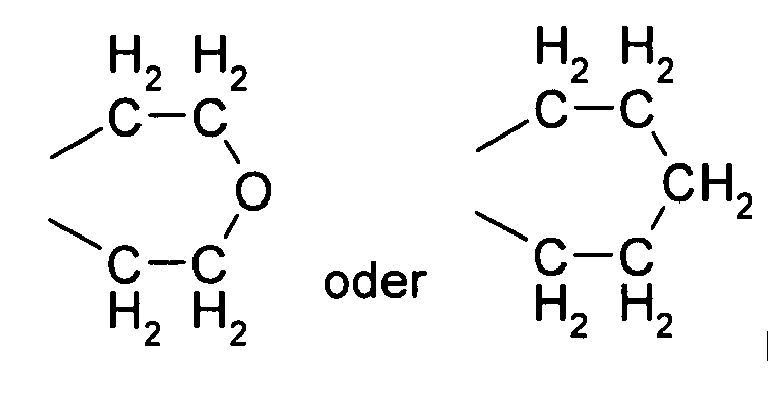
- Zu den bevorzugten Bedeutungen von R1 in der so genannten vierten Ausführungsform der Polysiloxane kann auf die vorstehenden Ausführungen verwiesen werden.
- Bevorzugt ist R12 ein einwertiger oder zweiwertiger geradkettiger, cyclischer oder verzweigter C1-C16-Kohlenwasserstoffrest, der durch -O-, -NH-, -C(O)-, -C(S)- unterbrochen und mit -OH substituiert sein kann.
- In der so genannten vierten Ausführungsform, ist K bevorzugt ein zweiwertiger oder dreiwertiger geradkettiger, cyclischer oder verzweigter C3-C16- Kohlenwasserstoffrest, der durch -O-, -NH-, -NR1-, -N-, -C(O)-, -C(S)- unterbrochen und mit -OH substituiert sein kann, besonders bevorzugt ist K -CH2CH2CH2-, -CH2CH2CH2OCH2CHOHCH2- oder

- Bevorzugt ist R22 ein unsubstituierter C5-C17-Kohlenwasserstoffrest, der sich von den entsprechenden Fettsäuren ableitet oder aber hydroxylierte C3-C17-Reste aufweist, die auf hydroxylierte Carbonsäuren, bevorzugt Saccharidcarbonsäuren zurückgeführt worden können.
- Bevorzugter ist R22:

- Der Begriff "C1-C22-Alkyl oder C1-C30-Kohlenwasserstoffrest", wie er vorstehend verwendet wird, bedeutet im Rahmen der vorliegenden Erfindung aliphatische Kohlenstoffwasserstoffverbindungen mit 1 bis 22 Kohlenstoffatomen bzw. 1 bis 30 Kohlenstoffatomen die geradkettig oder verzweigt sein können. Beispielhaft seien Methyl, Ethyl, Propyl, n-Butyl, Pentyl, Hexyl, Heptyl, Nonyl, Decyl, Undecyl, iso Propyl, Neopentyl, und 1,2,3 Trimethylhexyl aufgeführt.
- Der Begriff "C1-C22-Fluoralkyl" bedeutet, wie er vorstehend verwendet wird, im Rahmen der vorliegenden Erfindung aliphatische Kohlenstoffwasserstoffverbindungen mit 1 bis 22 Kohlenstoffatomen die geradkettig oder verzweigt sein können und mit mindestens einem Fluoratom substituiert sind. Beispielhaft seien Monofluormethyl, Monofluorethyl, 1,1,1-Trifluorethyl, Perflourethyl, 1,1,1-Trifluorpropyl, 1,2,2 Triflourbutyl aufgeführt.
- Der Begriff "Aryl ", wie er vorstehend verwendet wird, bedeutet im Rahmen der vorliegenden Erfindung unsubstituierte oder ein oder mehrfach mit OH, F, Cl, CF3 C1-C6-Alkyl, C1-C6-Alkoxy, C3-C7- Cycloalkyl, C2-C6-Alkenyl oder Phenyl substituiertes Phenyl. Der Ausdruck kann gegebenenfalls auch Naphthyl bedeuten.
- Im Rahmen dieser vierten Ausführungsform hat es sich als besonders bevorzugt erwiesen, wenn N4 steht für -(R12)N+(R13)- wobei R12 steht für eine C1- bis C4-Alkylgruppe und R13 steht für eine Einfachbindung zu K.
- Weiterhin hat es sich als besonders bevorzugt erwiesen, wenn K steht für einen Rest

- Ebenso kann es erfindungsgemäß bevorzugt sein, wenn S steht für eine Gruppe -Si(R1)2-O[-Si(R1)2-O]n-Si(R1)2-,
worin R1 bedeutet C1-C22-Alkyl, C1-C22-Fluoralkyl oder Aryl, vorzugsweise Phenyl, n = 0 bis 1000, und wenn mehrere Gruppen S in der Polysiloxanverbindung vorliegen, diese gleich oder verschieden sein können. Weiterhin hat es sich erfindungsgemäß als bevorzugt erwiesen, wenn R1 jeweils für eine Methylgruppe steht. - Ausserdem kann es erfindungsgemäß bevorzugt sein, wenn A steht für eine Gruppe -CH2CH2C(O)O- , A' steht für eine Gruppe -CH2CH2C(O)-, und E steht für eine Polyalkylengruppe der allgemeinen Formel -[CH2CH2O]q- mit q = 1 bis 200 wobei das endständige Sauerstoffatom der Gruppe A an die endständige -CH2-Gruppe der Gruppe E, und das endständige Carbonylkohlenstoffatom der Gruppe A' an das endständige Sauerstoffatom Gruppe E jeweils unter Ausbildung von Estergruppen binden.
- Eine besondere Ausführungsform der erfindungsgemäßen Polysiloxane (die im Folgenden als so genannte fünfte Ausführungsform der Polysiloxane bezeichnet wird) wird durch die Polysiloxane der allgemeinen Formel (V) dargestellt:
[-N5-F1-N5-Y-]m
worin
Y eine Gruppe der Formel -K-S-K- und -A-E-A'- bzw. -A'-E-A- ist,
worin m, K, S, -A-E-A'- und -A'-E-A- wie oben definiert sind, die Gruppen K, S, -A-E-A'- und -A'-E-A- innerhalb der Polysiloxane der allgemeinen Formel (V) gleich oder verschieden voneinander sein können, und das molare Verhältnis der Gruppe -K-S-K- und der Gruppe -A-E-A'- bzw. -A'-E-A- in der Polysiloxanverbindung der allgemeinen Formel (V) von 100: 1 bis 1: 100 ist, - N5
- eine Ammoniumgruppe der allgemeinen Formel -(R23)N+(R24)- ist,worin
R23 Wasserstoff, ein einwertiger oder zweiwertiger geradkettiger, cyclischer oder verzweigter C1-C20-Kohlenwasserstoffrest darstellt, der durch -O-, -NH-, -C(O)-, -C(S)- unterbrochen und mit -OH substituiert sein kann,
R24 Wasserstoff, ein einwertiger geradkettiger, cyclischer oder verzweigter C1-C20-Kohlenwasserstoffrest darstellt, der durch -O-, -NH-, - C(O)-, C(S)- unterbrochen und mit -OH substituiert sein kann, oder eine Einfachbindung zu einem zweiwertigen Rest R23 darstellt, und die Reste R23 und R24 innerhalb der Gruppe -N5-F1-N5- sowie in der Polysiloxanverbindung gleich oder verschieden voneinander sein können,
F1 ein zweiwertiger geradkettiger, cyclischer oder verzweigter Kohlenwasserstoffrest darstellt, der durch -O-, -NH-, -N-, -C(O)- oder -C(S)- oder durch eine Gruppe -E- unterbrochen sein kann, worin E wie oben definiert ist, und worin eine Mehrzahl von N5 und F1 jeweils gleich oder verschieden voneinander sein können. - Das molare Verhältnis der Gruppe -K-S-K- und der Gruppe -A-E-A'- bzw. -A'-E-A- in der Polysiloxanverbindung der allgemeinen Formel (V) liegt zwischen 100: 1 und 1: 100. Dieses molare Verhältnis kann wie in der Offenlegungsschrift
WO 02/10257 - In einer bevorzugten Ausführungsform der so genannten fünften Ausführungsform der Polysiloxane ist F1 ein zweiwertiger geradkettiger, cyclischer oder verzweigter C2-C30-Kohlenwasserstoffrest, der durch -O-, -NH-, -N-, -C(O)-, -C(S)- oder durch eine Gruppe -E- unterbrochen sein kann, worin E wie oben definiert ist, und worin die Kohlenstoffatome, die aus dem Rest E resultieren, nicht zu den 2 bis 30 Kohlenstoffatomen des C2-C30 Kohlenwasserstoffrest gezählt werden.
- In einer weiteren bevorzugten Ausführungsform der so genannten fünften Ausführungsform der Erfindung ist
-N5 -F1-N5-
eine Gruppe der Formel:
-N(R25R26)+-F2-N(R25R26)+-
worin - R25
- ein einwertiger oder zweiwertiger geradkettiger, cyclischer oder verzweigter C1-C20-Kohlenwasserstoffrest, der durch -O-, -NH-, -C(O)-, -C(S)- unterbrochen und mit -OH substituiert sein kann, besonders bevorzugt Methyl ist,
- R26
- ein einwertiger geradkettiger, cyclischer oder verzweigter C1-C20-Kohlenwasserstoffrest, der durch -O-, -NH-, -C(O)-, -C(S) unterbrochen und mit -OH substituiert sein kann, besonders bevorzugt Methyl ist, oder eine Einfachbindung zu einem zweiwertigen Rest R25 darstellt, und die Reste R25 und R26 innerhalb der Gruppe -N5-F2-N5- sowie in der Polysiloxanverbindung gleich oder verschieden voneinander sein können, und
- F2
- ein zweiwertiger geradkettiger, cyclischer oder verzweigter Kohlenwasserstoffrest ist, der durch -O-, -NH-, -N-, -C(O)-, -C(S)- unterbrochen sein kann.
- In einer noch bevorzugteren Ausführungsform ist F2 eine verzweigte, bevorzugt geradkettige C1-C6-Alkandiyl-Gruppe, worunter eine 1,6-Hexandiyl- (bzw. Hexamethylen-) Gruppe bevorzugt ist.
- In einer weiteren bevorzugten Ausführungsform. der so genannten fünften Ausführungsform der Polysiloxanverbindungen ist
-N5-F1-N5-
eine Gruppe der Formel:
-N(R27R28)+-F3-N(R27R28)+-
worin
R27 und R28 jeweils Wasserstoff, C1-C6-Alkyl oder Hydroxy(C1-C6)alkyl, bevorzugt Wasserstoff, Methyl oder -CH2CH2OH sind, und
F3
ein zweiwertiger geradkettiger, cyclischer oder verzweigter Kohlenwasserstoffrest ist, der durch eine Gruppe -E- unterbrochen ist, worin E wie oben definiert ist. - F3 ist besonders bevorzugt eine Gruppe der Formel
-D-E-D-
worin E wie oben definiert ist und D jeweils eine Einfachbindung oder eine geradkettige oder verzweigte C1-C6-Alkandiylgruppe ist, mit der Maßgabe, das D keine Einfachbindung ist, wenn es an ein endständiges Sauerstoffatom der Gruppe E bindet. - Bevorzugt wird die Gruppe -D-E-D- durch eine Gruppe der Formel
-D-(OCH2CH2)v(OCH2CH(CH3))w-O-D-
dargestellt, worin D eine geradkettige oder verzweigte C1 -C6-Alkandiylgruppe ist und r und q wie oben definiert sind. In der Gruppe -D-(OCH2CH2)q(OCH2CH(CH3))r-O-D- können die Ethylenoxid- und Propylenoxideinheiten beliebig angeordnet sein, z.B. als statistische Copolymereinheit oder als Blockcopolymereinheit. - v ist bevorzugt 1 bis 100, bevorzugter 1 bis 70, noch bevorzugter 1 bis 40.
- w ist bevorzugt 0 bis 100, bevorzugter 0 bis 70, noch bevorzugter 0 bis 40.
- In einer weiteren bevorzugten Ausführungsform der so genannten fünften Ausführungsform der Erfindung wird die Gruppe
-N5-F1-N5
durch eine Gruppe der Formel:
-N+R25R26-F2-N+R25R26-
und eine Gruppe der Formel:
-N+R27R28-F3-N+R27R28-
dargestellt, worin die Substituenten jeweils die vorstehenden Bedeutungen aufweisen. - Dies bedeutet, das die Polysiloxanverbindungen der allgemeinen Formel (V) aus zwei verschiedenen Typen der Gruppe -N5-F1-N5- aufgebaut sind.
- In dieser Ausführungsform beträgt das molare Verhältnis der Gruppe
-N+R25R26-F2-N+R25R26-
zur Gruppe
-N+R27R28-F3-N+R27R28-
zweckmäßig 70 : 30 bis 95 : 5, bevorzugt 80 : 20 bis 90 : 10. - Die Polysiloxanverbindungen der allgemeinen Formel (V) können cylisch oder linear sein. Im Falle der linearen Verbindungen resultieren die endständigen Gruppen entweder aus den für die Herstellung verwendeten unten beschriebenen bifunktionellen Monomeren oder deren funktionalisierten Derivaten oder aus Monoaminen, die während der Polymerisation als Kettenabbruchmittel zugesetzt werden. Die aus der Verwendung der Monoamin-Kettenabbruchmittel resultierenden terminalen Gruppen liegen bevorzugt als Ammoniumgruppen, entweder durch Quartärnierung oder Protonierung vor.
- In einer weiteren bevorzugten Ausführungsform der so genannten fünften Ausführungsform der Polysiloxane steht K für eine der Gruppen der Formel:


- In der so genannten fünften Ausführungsform der Polysiloxane liegt q bevorzugt im Bereich von 1 bis 50, insbesondere 2 bis 50, speziell 2 bis 20 und ganz speziell 2 bis 10, und r liegt im Bereich von 0 bis 100, insbesondere 0 bis 50, speziell 0 bis 20 und ganz speziell 0 bis 10.
- In der so genannten fünften Ausführungsform der Erfindung wird der organische oder anorganische Säurerest zur Neutralisation der aus der(n) Ammoniumgruppe(n) resultierenden Ladungen zweckmäßig ausgewählt aus anorganischen Resten, wie Chlorid, Bromid, Hydrogensulfat, Sulfat, bzw. organischen Resten, wie Acetat, Propionat, Octanoat, Decanoat, Dodecanoat, Tetradecanoat, Hexadecanoat, Octadecanoat und Oleat, wobei wie eingangs erwähnt Chlorid und Bromid bevorzugt aus der Umsetzung der Alkylhalogenidgruppen mit Amingruppen resultieren.
- Weiterhin liegen die Polysiloxane der fünften Ausführungsform in protonierter Form als Aminsalze oder als Amine vor.
- Die Polysiloxane der fünften Ausführungsform der Erfindung werden zweckmäßig hergestellt durch eines der Verfahren, welche in der Offenlegungsschrift
WO 02/10257 - Die vorstehend beschriebenen Polyammonium-Polysiloxan Verbindungen können beispielsweise unter der Handelsbezeichnung Baysilone® von GE Bayer Silicones bezogen werden. Die Produkte mit den Bezeichnungen Baysilone TP 3911, SME 253 und SFE 839 sind dabei bevorzugt. Ganz besonders bevorzugt ist die Verwendung von Baysilone TP 3911. Weiterhin bevorzugt sind die Polyammonium-Polysiloxan Verbindungen, wie sie in Beispiel 8 der
WO 02/10257 WO 02/10257 - Die vorstehend beschriebenen Polyammonium-Polysiloxan Verbindungen werden erfindungsgemäß vorzugsweise in einer Menge von 0,01 bis 15 Gew.% , vorzugsweise 0,05 bis 10, besonders bevorzugt 0,1 bis 5,0 Gew.%, ganz besonders bevorzugt von 0,1 bis 2,5 Gew.% jeweils in Bezug auf die Gesamtzusammensetzung verwendet.
- Die amphoteren Tenside der Formel (I) sind die zweite Komponente der erfindungsgemäßen Kombination. In einer bevorzugten Ausführungsform steht der Rest R gemäß Formel (I) für eine lineare (C12 bis C18)-Alkylgruppe. Besonders bevorzugte Verbindungen der Formel (I) werden unter der INCI-Bezeichnung Disodium Cocoamphodipropionate mit den Handelsnamen Miranol® C2M SF conc. (Rhodia), Amphoterge® K-2 (Lonza) und Monateric® CEM-38 (Unichema) vermarktet. Dabei leitet sich die Gruppe R-CO- gemäß Formel (I) von Fettsäuren des Kokosnußöls ab.
- Die Verbindungen der Formel (I) sind in dem erfindungsgemäßen Mittel bevorzugt in einer Menge von 0,05 bis 20 Gew.-%, besonders bevorzugt von 0,1 bis 15 Gew.-%, jeweils bezogen auf das Gewicht des Mittels, enthalten.
- Die zweite Komponente der Wirkstoffkombination ist ein amphoteres und/oder ein kationisches Polymer.
- Unter dem Begriff amphotere Polymere werden solche Polymere verstanden,
- die im Molekül sowohl freie Aminogruppen als auch freie -COOH- oder SO3H-Gruppen enthalten und zur Ausbildung innerer Salze befähigt sind,
- zwitterionische Polymere, die im Molekül quartäre Ammoniumgruppen und -COO--Gruppen oder -SO3 --Gruppen enthalten, sowie
- Polymere, die -COOH-Gruppen oder SO3H-Gruppen und quartäre Ammoniumgruppen enthalten.
- Die in der Aufzählung genannten Polymere mit quartären Ammoniumgruppen werden erfindungsgemäß bevorzugt als amphotere Polymere eingesetzt.
- Ein Beispiel für ein erfindungsgemäß einsetzbares Amphopolymer ist das unter der Bezeichnung Amphomer® erhältliche Acrylharz, das ein Copolymeres aus tert.-Butylaminoethylmethacrylat, N-(1,1,3,3-Tetramethylbutyl)acrylamid sowie zwei oder mehr Monomeren aus der Gruppe Acrylsäure, Methacrylsäure und deren einfachen Estern darstellt.
- Weitere erfindungsgemäß einsetzbare amphotere Polymere sind die in der
britischen Offenlegungsschrift 2 104 091 europäischen Offenlegungsschrift 47 714 217 274 europäischen Offenlegungsschrift 283 817 deutschen Offenlegungsschrift 28 17 369 genannten Verbindungen. - Erfindungsgemäß bevorzugte amphotere und/oder kationische Polymere sind solche Polymerisate, in denen sich eine kationische Gruppe ableitet von mindestens einem der folgenden Monomere:
- (M1) Monomeren mit quartären Ammoniumgruppen der allgemeinen Formel (II),
R1-CH=CR2-CO-Z-(CnH2n)-N(+)R3R4R5 A(-) (II)
in der R1 und R2 unabhängig voneinander stehen für Wasserstoff oder eine Methylgruppe und R3, R4 und R5 unabhängig voneinander für Alkylgruppen mit 1 bis 4 Kohlenstoff-Atomen, Z eine NH-Gruppe oder ein Sauerstoffatom, n eine ganze Zahl von 2 bis 5 und A(-) das Anion einer organischen oder anorganischen Säure ist, - (M2) Monomeren mit quartären Ammoniumgruppen der allgemeinen Formel (III),

Wenn sich eine kationische Gruppe der amphoteren bzw. kationischen Polymerisate vom Monomer des Typs (M1) ableitet, stehen in Formel (II) die Reste R3, R4 und R5 bevorzugt für Methylgruppen, Z ist bevorzugt eine NH-Gruppe und A(-) bedeutet bevorzugt ein Halogenid-, Methoxysulfat- oder Ethoxysulfat-Ion. Besonders bevorzugt ist es in diesem Falle Acrylamidopropyl-trimethyl-ammoniumchlorid als Monomer (M1) zu verwenden.
In Formel (III) steht A- bevorzugt für ein Halogenidion, insbesondere für Chlorid oder Bromid.
Bevorzugte erfindungsgemäße amphotere Polymere sind Polymere, deren anionische Gruppe sich von mindestens einem Monomeren der Formel (IV) ableitet - (M3) monomeren Carbonsäuren der allgemeinen Formel (IV) bzw. deren Salze mit einer organischen oder anorganischen Säure,
R8-CH=CR8-COOH (IV)
in denen R8 und R9 unabhängig voneinander Wasserstoff oder Methylgruppen sind. - Als Monomeres (M3) wird für die erfindungsgemäß bevorzugten amphoteren Polymerisate Acrylsäure verwendet.
- Besonders bevorzugte amphotere Polymere sind Copolymere, aus mindestens einem Monomer (M1) bzw. (M2) mit dem Momomer (M3), insbesondere Copolymere aus den Monomeren (M2) und (M3). Erfindungsgemäß ganz besonders bevorzugt verwendete amphotere Polymere sind Copolymerisate aus Diallyl-dimethylammoniumchlorid und Acrylsäure. Diese Copolymerisate werden unter der INCI-Bezeichnung Polyquaternium-22 unter anderem mit dem Handelsnamen Merquat® 280 (Nalco) vertrieben.
- Die amphoteren Polymere können sowohl direkt als auch in Salzform, die durch Neutralisation der Polymerisate, beispielsweise mit einem Alkalihydroxid, erhalten wird, erfindungsgemäß eingesetzt werden. Bezüglich der Einzelheiten der Herstellung dieser Polymerisate wird ausdrücklich auf den Inhalt der
deutschen Offenlegungsschrift 39 29 973 Bezug genommen. - Geeignete kationische Polymere sind beispielsweise kationische Cellulosederivate, wie z.B. eine quaternierte Hydroxyethylcellulose, die unter der Bezeichnung Polymer JR 400® von Amerchol erhältlich ist, kationische Stärke, Homopolymere von Diallylammoniumsalzen, Copolymere von Diallylammoniumsalzen und Acrylamiden, quaternierte Vinyl-pyrrolidon/Vinyl-imidazol-Polymere, wie z.B. Luviquat® (BASF), Kondensationsprodukte von Polyglycolen und Aminen, quaternierte Kollagenpolypeptide, wie beispielsweise Lauryldimonium hydroxypropyl hydrolyzed collagen (Lamequat®L/Grünau), quaternierte Weizenpolypeptide, Polyethylenimin, kationische Siliconpolymere, wie z.B. Amidomethicone, Polyaminopolyamide, wie z.B. beschrieben in der
FR-A 2252840 - Ein bevorzugtes kationisches Polymer ist das Homopolymer aus dem Monomer mit der Formel (III). Diallyldimethylammonium-Homopolymere werden mit der INCI-Bezeichnung Polyquaternium-6 beispielsweise unter dem Handelsnamen Merquat® 100 (Nalco) vermarktet.
- Die amphoteren bzw. kationischen Polymere sind in dem erfindungsgemäßen Mittel bevorzugt in einer Menge von 0,05 bis 20 Gew.-%, besonders bevorzugt von 0,1 bis 15 Gew.-% jeweils bezogen auf das Gewicht des anwendungsbereiten Mittels enthalten.
- In einer bevorzugten Ausführungsform der vorliegenden Erfindung können die Mittel neben den erfindungswesentlichen Komponenten weiterhin mindestens ein (C8 bis C22)-Triacylglycerid enthalten.
- Die (C8 bis C22)-Acylgruppen der Triacylglyceride leiten sich erfindungsgemäß bevorzugt von linearen oder verzweigten, gesättigten oder ungesättigten Fettsäuren ab. Typische Beispiele solcher Fettsäuren sind Caprylsäure, 2-Ethylhexansäure, Caprinsäure, Laurinsäure, Isotridecansäure, Myristinsäure, Palmitinsäure, Palmitoleinsäure, Stearinsäure, Isostearinsäure, Ölsäure, Elaidinsäure, Petroselinsäure, Linolsäure, Linolensäure, Elaeostearinsäure, Arachinsäure, Arachidonsäure, Gadoleinsäure, Behensäure und Erucasäure sowie deren Mischungen. Die (C8 bis C22)-Triacylglyceride enthalten besonders bevorzugt mindestens eine (C8 bis C22)-Acylgruppe, die sich von einer ungesättigten Fettsäure ableitet, insbesondere von der Palmitoleinsäure, Ölsäure, Petroselinsäure, Elaeostearinsäure, Gadoleinsäure, Erucasäure, Linolensäure und/oder Linolsäure. Erfindungsgemäße Mittel, welche Palmitoleinsäure-haltige Triacylglyceride enthalten, sind besonders bevorzugt.
- Die (C8 bis C22)-Triacylglyceride können synthetischer oder natürlicher Herkunft sein. Es ist erfindungsgemäß bevorzugt, als Triacylglyceridquelle ein natürliches Öl, bevorzugt Öle aus Nüssen wie z.B. Pekannußöl, Paranussöl, Kukuinußöl, Walnußöl, Haselnußöl, Erdnußöl oder Macadamianußöl, zu verwenden. Macadamianußöl ist ein besonders bevorzugtes natürliches Öl. Geeignete Macadamianußöle sind beispielsweise Öle, die bevorzugt aus dem Samenkern der Nüsse der Macadamia tetraphylla, Macadamia integrifolia sowie Macadamia ternifolia gewonnen werden. Dabei wird wiederum das Öl der Macadamia ternifolia bevorzugt als Triacylglyceridquelle zur Bereitstellung der erfindungsgemäßen Mittel verwendet. Das Triacylglycerid-Gemisch dieses Macadamianußöls weist beispielsweise eine Fettsäurezusammensetzung von:
< 1 Gew.-% Laurinsäure < 1 Gew.-% Myristinsäure 8 bis 10 Gew.-% Palmitinsäure 16 bis 24 Gew.-% Palmitoleinsäure 2 bis 4 Gew.-% Stearinsäure 53 bis 67 Gew.-% Ölsäure 1,5 bis 4 Gew.-% Linolsäure < 1 Gew.-% Linolensäure 1,5 bis 3 Gew.-% Arachinsäure < 1 Gew.-% Behensäure < 1 Gew.-% Erucasäure - Die erfindungsgemäßen (C8 bis C22)-Triacylglyceride sind bevorzugt in einer Menge von 0,05 bis 10 Gew.-%, besonders bevorzugt von 0,1 bis 5 Gew.-%, jeweils bezogen auf das Gewicht des Mittels enthalten.
- Das Mengenverhältnis der (C8 bis C22)-Triacylglyceride zur Verbindung mit der Formel (I) zu den amphoteren bzw. kationischen Polymeren beträgt bevorzugt 1 zu 1 zu 1 bis 1 zu 300 zu 300, besonders bevorzugt 1 zu 1 zu 1 bis 1 zu 100 zu 50, ganz besonders bevorzugt von 1 zu 2,5 zu 4 bis 1 zu 5 zu 5.
- Eine ganz besonders bevorzugte Ausführungsform der erfindungsgemäßen Wirkstoffkombination ist die Kombination einer Polyammonium-Polysiloxan-Verbindung, einer Verbindung gemäß Formel (I) und einem Homopolymer aus dem Monomer mit der Formel (III).
- Das erfindungsgemäße Mittel kann als Lotion oder Creme, d.h. als entsprechende W/O-Emulsion bzw. O/W-Emulsion sowie als Gel vorliegen. Bevorzugt liegt das erfindungsgemäße Mittel in der Ausführungsform als Färbemittel als Creme oder (insbesondere klares) Gel vor.
- Der Begriff "Creme" betrifft im Sinne der Erfindung W/O-Emulsionen bzw. O/W-Emulsionen von Fetten und/oder Fettalkoholen und Wasser. Dabei können in der Wasserphase auch organische Lösemittel wie niedermolekulare Monoalkohole und/oder Polyole (Definition siehe unten) enthalten sein. Solche Cremes werden durch das Emulgieren von beispielsweise festen und/oder flüssigen Paraffinen, Wollwachs, Bienenwachs, synthetischen Wachsestern, Fettalkoholen, Sterolen oder Sterolestern erhalten. Bevorzugte Vertreter dieser Stoffe werden weiter unten definiert. Als Emulgatoren dienen bevorzugt nichtionogene Tenside aus mindestens einer der folgenden Gruppen:
- (1) Anlagerungsprodukte von 2 bis 30 Mol Ethylenoxid und/ oder 0 bis 5 Mol Propylenoxid an lineare Fettalkohole mit 8 bis 22 C-Atomen, an Fettsäuren mit 12 bis 22 C-Atomen und an Alkylphenole mit 8 bis 15 C-Atomen in der Alkylgruppe;
- (2) C12/18Fettsäuremono- und -diester von Anlagerungsprodukten von 1 bis 30 Mol Ethylenoxid an Glycerin;
- (3) Glycerinmono- und -diester und Sorbitanmono- und -diester von gesättigten und ungesättigten Fettsäuren mit 6 bis 22 Kohlenstoffatomen und deren Ethylenoxidanlagerungsprodukte;
- (4) Alkylmono- und -oligoglycoside mit 8 bis 22 Kohlenstoffatomen im Alkylrest und deren ethoxylierte Analoga;
- (5) Anlagerungsprodukte von 15 bis 60 Mol Ethylenoxid an Ricinusöl und/oder gehärtetes Ricinusöl;
- (6) Polyol- und insbesondere Polyglycerinester, wie z.B. Polyglycerinpolyricinoleat, Polyglycerinpoly-12-hydroxystearat oder Polyglycerindimerat. Ebenfalls geeignet sind Gemische von Verbindungen aus mehreren dieser Substanzklassen;
- (7) Anlagerungsprodukte von 2 bis 15 Mol Ethylenoxid an Ricinusöl und/oder gehärtetes Ricinusöl;
- (8) Partialester auf Basis linearer, verzweigter, ungesättigter bzw. gesättigter C6/22-Fettsäuren, Ricinolsäure sowie 12-Hydroxystearinsäure und Glycerin, Polyglycerin, Pentaerythrit, Dipenta-erythrit, Zuckeralkohole (z.B. Sorbit), Alkylglucoside (z.B. Methylglucosid, Butylglucosid, Lauryl-glucosid) sowie Polyglucoside (z.B. Cellulose);
- (9) Trialkylphosphate sowie Mono-, Di- und/oder Tri-PEG-alkylphosphate;
- (10) Polysiloxan-Polyalkyl-Polyether-Copolymere bzw. entsprechende Derivate;
- (11) Mischester aus Pentaerythrit, Fettsäuren, Citronensäure und Fettalkohol gemäß
DE-PS 1165574 und/oder Mischester von Fettsäuren mit 6 bis 22 Kohlenstoffatomen, Methylglucose und Polyolen, vorzugsweise Glycerin sowie - (12) Polyalkylenglycole.
- C8/18-Alkylmono- und -oligoglycoside, ihre Herstellung und ihre Verwendung sind aus dem Stand der Technik bekannt. Ihre Herstellung erfolgt insbesondere durch Umsetzung von Glucose oder Oligosacchariden mit primären Alkoholen mit 8 bis 18 C-Atomen. Bezüglich des Glycosidrestes gilt, daß sowohl Monoglycoside, bei denen ein cyclischer Zuckerrest glycosidisch an den Fettalkohol gebunden ist, als auch oligomere Glycoside mit einem Oligomerisationsgrad bis vorzugsweise etwa 8 geeignet sind. Der Oligomerisierungsgrad ist dabei ein statistischer Mittelwert, dem eine für solche technischen Produkte übliche Homologenverteilung zugrunde liegt.
- Der Begriff "Gel" wird in "Faraday discussions of the chemical society, No. 57, 1974 (Gels and Gelling Processes), P.J. Flory, Seite 7-18", näher charakterisiert. Demnach werden Gele in 4 Untergruppen eingeteilt:
- 1. Gele mit lamellaren Ordnungsstrukturen einschließlich Gel-Mesophasen, z.B. Tensidgele, insbesondere Seifengele.
- 2. Gele, die aus polymeren, dreidimensionalen, kovalent gebundenen Netzwerken, die ohne Zerstörung der Kovalenzbindungen in Lösungsmitteln unlöslich sind, aufgebaut sind.
- 3. Gele aus polymeren Netzwerken mit lokalen Ordnungsstrukturen, die durch physikalische Kräfte zusammengehalten werden, z.B. Gelatine, Homo- und Copolymere von Acryl- und Methacrylsäure, Alginate, Carrageenan.
- 4. Gele gebildet aus feinverteilten Bestandteilen, z.B. Niederschlägen, die i.a. eine große geometrische Anisotropie aufweisen, z.B. V2O5-Gele oder Gele, die sich durch Aggregation von Proteinen bilden.
- Gele im Sinne dieser Ausführungsform der Erfindung sind solche, die unter Punkt 1. und Punkt 3. der obigen Auflistung fallen. Als "Gel" im Sinne der vorliegenden Erfindung sind unter anderem Transparentgele wie sie z.B. in den
US-Patentschriften US 3 101 300 undUS 3 101 301 beschrieben werden, zu verstehen. Diese Transparentgele werden als Mikroemulsionsgele bezeichnet. Eine allgemeingültige Definition für Mikroemulsionsgele ist in "Happi: Household Pers. Prod. Ind. 30 (1993), Nr. 2, p. 58-64" angegeben, auf die ausdrücklich und vollumfänglich Bezug genommen wird. - Ein Gel ist als klar zu bewerten, wenn bei einer Schichtdicke von 1 cm die Extinktion bei einer Wellenlänge, in dem die gelförmige Zusammensetzung keine Absorptionsbanden aufweist (typischerweise bei einer Wellenlänge von 800 nm) höchstens 0.05 Extinktionseinheiten beträgt.
- Das Gel sollte vorzugsweise fließfähig sein, und durch eine hohe Strukturviskosität gekennzeichnet sein, d.h., diese Zubereitungen erscheinen unter dem Einfluss geringer Scherkräfte, etwa des Eigengewichts, relativ hochviskos, lassen sich aber bei Anwendung höherer Scherkräfte, z.B. beim Verrühren sehr leicht bewegen.
- Es ist erfindungsgemäß bevorzugt, als klare, wässrige Gelgrundlage eine Zusammensetzung, enthaltend
- a) 0,5 bis 10 Gew.-% eines Anlagerungsproduktes von 1 bis 5 Mol Ethylenoxid an einen linearen Fettalkohol mit 8 bis 22 C-Atomen,
- b) 0,1 bis 15 Gew.-% eines gesättigten oder ungesättigten, linearen oder verzweigten Alkohols mit 8 bis 36 C-Atomen und
- c) 0,1 bis 15 Gew.-% einer flüssigen Fettsäure mit 16 bis 22 C-Atomen in Form einer wasserlöslichen Seife
- Erfindungsgemäß verwendbare Anlagerungsprodukte von 1 bis 5 Mol Ethylenoxid an einen linearen Fettalkohol mit 8 bis 22 C-Atomen werden beispielsweise mit der INCl-Bezeichnung Laureth-2 (Handelsprodukt Dehydol® LS 2 Deo N der Fa. Cognis), Laureth-3 (Handelsprodukt Dehydol® LS 3 der Fa. Cognis), Laureth-4 (Handelsprodukt Dehydol® LS 4 der Fa. Cognis), Ceteareth-2 (Lowenol® C 279 der Fa. Lowenstein), Steareth-2 (Eumulgin® S 2 der Fa. Cognis) bzw. Steareth-4 (Arlypon® SA 4 der Fa. Cognis) bekannt.
- Bei den erfindungsgemäß einzusetzenden gesättigten oder ungesättigten, linearen oder verzweigten Alkoholen mit 8 bis 36 C-Atomen handelt es sich vorzugsweise um Fettalkohole und/oder Guerbetalkohole.
- Unter Fettalkoholen sind im Sinne der Erfindung primäre aliphatische Alkohole der Formel (V) zu verstehen,
R10OH (V)
in der R10 für einen aliphatischen, linearen oder verzweigten Kohlenwasserstoffrest mit 8 bis 22 Kohlenstoffatomen, der gesättigt ist oder bis zu 3 Doppelbindungen enthalten kann, steht. - Typische Beispiele sind 2-Ethylhexylalkohol, Caprinalkohol, Laurylalkohol, Isotridecylalkohol, Myristylalkohol, Cetylalkohol, Palmoleylalkohol, Stearylalkohol, Isostearylalkohol, Oleylalkohol, Elaidylalkohol, Petroselinylalkohol, Linolylalkohol, Linolenylalkohol, Elaeostearylalkohol, Arachylalkohol, Gadoleylalkohol, Behenylalkohol, Erucylalkohol und Brassidylalkohol sowie deren technische Mischungen, die z.B. bei der Hochdruckhydrierung von technischen Methylestern auf Basis von Fetten und Ölen oder Aldehyden aus der Roelen'schen Oxosynthese sowie als Monomerfraktion bei der Dimerisierung von ungesättigten Fettalkoholen anfallen.
- Bevorzugt sind technische Fettalkoholmischungen mit 12 bis 18 Kohlenstoffatomen wie beispielsweise Kokos-, Palm-, Palmkern- oder Talgfettalkohol, insbesondere Kokos- und/ oder Talgfettalkohol.
- Unter Guerbetalkoholen sind Alkohole zu verstehen, die durch alkalische Kondensation von Alkoholen zu höhermolekularen, verzweigten Iso-Alkoholen hergestellt werden. Diese Umsetzung wurde erstmals von Guerbet 1899 veröffentlicht. Machemer stellte 1952 wesentliche Schritte der Reaktion dar (Angewandte Chemie 64 (1952) 213 - 20): Neben der Dehydrierung zum Keton, bei der Wasserstoff abgespalten wird, und der Aldolkondensation ist die Crotonisierung, bei der Wasser abgespalten wird, ein wichtiger Schritt im Reaktionsablauf. Stand der Technik ist eine Reaktionsführung bei Normaldruck und einer Reaktionstemperatur von 240 bis 260 °C. Die so erhaltenen verzweigten Alkohole werden als Guerbetalkohole bezeichnet. Aus dem Stand der Technik sind inzwischen eine Vielzahl weiterer Verfahren bekannt, gemäß derer man Guerbetalkohole erhalten kann.
- Die zur Seifenbildung geeigneten Fettsäuren sind bevorzugt flüssige oder niedrigschmelzende ungesättigte lineare C16-C22-Fettsäuren wie Palmitoleinsäure, Ölsäure, Elaidinsäure, Myristinsäure, Petroselinsäure, Petroselaidinsäure, Gadoleinsäure, Erucasäure, Brassidinsäure sowie Gemische dieser Fettsäuren untereinander und gegebenenfalls mit geringeren Anteilen gesättigter linearer Fettsäuren mit 12 bis 22 C-Atomen. Andere ebenfalls geeignete Fettsäuren sind verzweigte Fettsäuren mit 16 bis 22 C-Atomen, z.B. die 2-Hexyldecansäure, Isostearinsäure und die 2-Octyldodecansäure.
- Zur Überführung der Fettsäuren in wasserlösliche Seifen eignen sich Alkalihydroxide und Alkalicarbonate, Ammoniak, Mono-, Di- und Trialkanolamine mit 2 bis 4 C-Atomen in der Alkanolgruppe sowie alkalische Aminosäuren wie beispielsweise Arginin, Ornithin, Lysin und/ oder Histidin.
- Es ist erfindungsgemäß bevorzugt, wenn das erfindungsgemäße Konditioniermittel zusätzlich, wiederum bevorzugt zusammen mit den drei vorgenannten Komponenten a) bis c), 0,5 bis 10 Gew.-% eines Anlagerungsproduktes von 15 bis 100 Einheiten Ethylenoxid, insbesondere von 15 bis 50 Mol Ethylenoxid jeweils pro Molekül eines linearen Fettalkohols mit 8 bis 22 C-Atomen, in einer wasserhaltigen Zusammensetzung enthält. Es handelt sich dabei ganz besonders bevorzugt um Ceteareth-15 oder Ceteareth-50, welche als Eumulgin® CS 15 bzw. Eumulgin® CS 50 von der Firma Cognis Deutschland GmbH vermarktet werden.
- Als Anlagerungsprodukte von 1 bis 4 bzw. 15 bis 100 Mol Ethylenoxid an einen linearen Fettalkohol mit 12 bis 22 C-Atomen eignen sich alle nach den bekannten technischen Oxethylierungsverfahren erhältlichen Addukte. Bevorzugt sind die Anlagerungsprodukte, die nur wenig freien Fettalkohol enthalten und eine eingeengte Homologenverteilung aufweisen (sogenannte "narrow range ethoxylates"), wie sie z.B. nach dem in
DE 38 43 713 A1 beschriebenen Verfahren zugänglich sind. - Neben den Transparentgelen können erfindungsgemäß aber auch nicht klare, d.h. trübe beziehungsweise milchige, Gele bevorzugt sein.
- Die erfindungsgemäßen Mittel sind wasserhaltige Zusammensetzungen. Darunter fallen auch wässrig-alkoholische Systeme. Unter wässrig-alkoholisch sind im Sinne der vorliegenden Erfindung wasserhaltige Zusammensetzungen mit einem Gehalt von höchstens 70 Gew.-% eines niedermolekularen Monoalkohols und/oder eines Polyols zu verstehen.
- Unter niedermolekularen Monoalkoholen sind im Sinne der vorliegenden Erfindung mit Wasser mischbare Alkohole mit 1 bis 5 C-Atomen zu verstehen. Diese Monoalkohole tragen nur eine Hydroxygruppe. Vorzugsweise handelt es sich bei den niedermolekularen Monoalkoholen um Ethanol, Propanol und/ oder Isopropanol.
- Polyole tragen im Sinne der Erfindung mindestens zwei Hydroxygruppen, bevorzugt zwei bis vier Hydroxygruppen. Als Polyole sind insbesondere solche mit 2 bis 6 C-Atomen bevorzugt. Es eignen sich z.B. Ethylenglycol, 1,2-Propylenglycol, 1,3-Propylenglycol, Glycerin, Erythrit, Trimethylolpropan, Diethylenglycol und Dipropylenglycol. 1,2-Propylenglycol ist besonders bevorzugt.
- Bevorzugt enthalten die erfindungsgemäßen Mittel mindestens einen niedermolekularen Monoalkohol und mindestens ein Polyol.
- Als wasserlösliche synthetische Tenside eignen sich bevorzugt anionische, amphotere, zwitterionische und nichtionische Tenside mit guter Wasserlöslichkeit und mit gutem Kalkseifendispergiervermögen. Solche Tenside weisen in der Regel eine lipophile lineare Alkyl- oder Acylgruppe mit 12 bis 18 C-Atomen und eine stark dissoziierte ionische Gruppe oder eine nichtionische wasserlöslichmachende Polyethergruppe auf. Geeignet sind z.B. Schwefelsäurehalbestersalze von linearen Fettalkoholen mit 12 bis 18 C-Atomen oder von Fettalkoholpolyglycolethern mit 12 bis 16 C-Atomen in der Alkylgruppe und 1 bis 10 Glycolethergruppen. Weitere geeignete Aniontenside sind z.B. lineare Alkansulfonate und α-Olefinsulfonate mit 12 bis 18 C-Atomen. Geeignete nichtionogene Tenside sind z.B. die Anlagerungsprodukte von 7 bis 30 Mol Ethylenoxid an lineare Fettalkohole mit 12 bis 18 C-Atomen, an Fettsäuren mit 12 bis 18 C-Atomen sowie an Fettsäuremonoglyceride und an Fettsäuresorbitanmonoester. Bevorzugt geeignete nichtionogene Tenside sind die Fettalkylaminoxide und insbesondere die Fettalkylglykoside, vorzugsweise Fettalkylglucoside. Die Fettalkylgruppe kann in den genannten Produkten 12 bis 18 C-Atome aufweisen. Besonders bevorzugt im Sinne der vorliegenden Erfindung sind auch amphotere Tenside, wie beispielsweise N-Fettalkyl-dimethyl-glycin oder N-Fettalkylaminopropionsäure und/ oder zwitterionische Tenside, z.B. N-Fettalkyldimethylammoniumglycinat oder N-Fettacylaminopropyldimethylglycinat. Diese amphoteren Tenside können zusätzlich zu den Verbindungen gemäß Formel (I) in den erfindungsgemäßen Mitteln enthalten sein und sind von den Verbindungen der Formel (I) verschieden. Weiterhin bevorzugt werden Kationtenside wie quartäre Ammoniumverbindungen (QAV) insbesondere quaternierte Trialkylammoniumverbindungen mit Alkylresten einer Kettenlänge von C8 bis C22.
- Es hat sich gezeigt, dass durch den Zusatz weiterer, begrenzt wasserltislicher, nichtionogener Tenside eine Verdickung der erfindungsgemäßen Mittel, insbesondere der Gele, erreicht wird.
- Zusätzlich können die erfindungsgemäßen Mittel Anlagerungsprodukte von 1 bis 4 Mol Ethylenoxid an ein Fettalkylamin enthalten. Als Anlagerungsprodukte von 1 bis 4 Mol Ethylenoxid an ein lineares Fettalkylamin mit 12 bis 22 C-Atomen eignen sich alle nach bekannten technischen Verfahren zugänglichen Addukte, die auch im Handel erhältlich sind. Besonders geeignet ist das Anlagerungsprodukt von 2 Mol Ethylenoxid an ein C12-C18-Kokosalkylamin.
- Geeignete Verbindungen der Formel (VI)
R11-(OC2H4)x-A-(C2H4O)y-R12 (VI)
in welcher A ein Sauerstoffatom ist, sind Dialkylether mit 12 bis 18 C-Atomen in den Alkylgruppen R11 und R12. Solche Produkte sind literaturbekannt. Noch besser geeignet sind die Produkte der Formel (VI), in welchen x oder y oder beide = 1 sind. Solche Dialkyloxethylether lassen sich durch literaturbekannte Veretherungsverfahren aus Fettalkoholen und Fettalkyloxyethanolen herstellen. Die Produkte der Formel (VI), in welchen A eine Gruppe
DE 35 04 242 beschriebenen Verfahren zur Herstellung von Etheraminen gewinnen. - Besonders bevorzugte Verbindungen der Formel (VI) sind z.B. Dicetylstearylether, Dicetylstearyldioxyethylether und N,N-Bis-(2-cetyl-/stearyl-oxyethyl)-aminoethanol.
- Während mit Anlagerungsprodukten von 1 bis 5 Mol Ethylenoxid an einen linearen Fettalkohol die erforderliche Verdickung meist allein durch diese Komponente erreicht wird, kann es bei Einsatz der Anlagerungsprodukte von 1 bis 4 Mol Ethylenoxid an ein lineares Fettalkylamin vorteilhaft sein, diese in Kombination mit 1 bis 10 Gew.-% einer Verbindung der Formel (VI) zu verwenden.
- Desweiteren enthält das erfindungsgemäße Mittel bevorzugt zusätzlich mindestens ein anionisches Acrylsäure- und/oder Methacrylsäure-Polymerisat oder -Copolymerisat. Bevorzugte Polymerisate dieser Art sind:
- Polymerisate z.B. aus wenigstens 10 Gew.-% Acrylsäure-Niedrigalkylester, 25 bis 70 Gew.-% Methacrylsäure und ggf. bis zu 40 Gew.-% eines weiteren Comonomeren, wie sie z.B. in
GB 870 994 - Mischpolymerisate (aus
DE 11 64 095 ) aus 50 bis 75 Gew.-% Ethylacrylat, 25 bis 35 Gew.-% Acrylsäure und 0 bis 25 Gew.-% anderer Comonomeren bekannt. Geeignete Dispersionen dieser Art sind im Handel erhältlich, z.B. unter der Handelsbezeichnung Latekoll® D (BASF). - die in
DE 34 45 549 beschriebenen Copolymerisate aus 50 bis 60 Gew.-% Ethylacrylat, 30 bis 40 Gew.-% Methacrylsäure und 5 bis 15 Gew.-% Acrylsäure, vernetzt mit Ethylenglycoldimethacrylat. - Diese anionischen Polymerisate fallen erfindungsgemäß nicht unter die Definition der erfindungsgemäßen amphoteren Polymere.
- Die anionischen Acrylsäure- und/oder Methacrylsäure-Polymerisate oder -Copolymerisate sind in den erfindungsgemäßen Mitteln bevorzugt in einer Menge von 0,1 bis 10 Gew.-%, besonders bevorzugt von 1 bis 5 Gew.-%, jeweils bezogen auf das Gewicht des Mittels, enthalten.
- Insbesondere bevorzugt sind in den erfindungsgemäßen Mitteln zusätzlich Proteine und/ oder Proteinderivate pflanzlicher oder tierischer Herkunft wie beispielsweise Erbsen-, Soja-, Weizen- und Mandelproteinhydrolysat oder Akazienprotein sowie Collagen- oder Keratinhydrolysat enthalten. Die erfindungsgemäßen Mittel enthalten die Proteine und/oder Proteinderivate pflanzlicher oder tierischer Herkunft bevorzugt in einer Menge von 0,05 bis 10 Gew.-%, insbesondere 0,1 bis 3 Gew.-%, jeweils bezogen auf das Gewicht des gesamten Mittels.
- Weiterhin ist es bevorzugt, in die erfindungsgemäßen Mittel zusätzlich mindestens ein Pflanzenextrakt einzuarbeiten.
- Geeignete Pflanzenextrakte werden durch Extraktion mit organischen Lösemitteln (wie beispielsweise Ethanol, Isopropanol, Diethylether, Benzin, Benzol, Chloroform) oder durch Wasserdampfdestillation gewonnen. Bevorzugte Pflanzenextrakte sind beispielsweise Extrakte von Blüten (Lindenblüten, Kamillen, Lilie, Lavendel, Rosen, Jasmin, Neroli, Ylang-Ylang), Stengeln und Blättern (Cassis, Rosskastanie, Rooibos, Birke, Melisse, Klee, Weinblättern, Geranium, Patchouli, Petitgrain), Früchten (Anis, Cassis, Koriander, Kümmel, Wacholder), Fruchtschalen (Bergamotte, Zitrone, Orangen), Wurzeln (Macis, Angelica, Sellerie, Kardamon, Costus, Iris, Calmus, Ginseng), Hölzern (Pinien-, Sandel-, Guajak-, Zedern-, Rosenholz), Kräutern und Gräsern (Estragon, Lemongras, Salbei, Thymian, Rosmarin), Nadeln und Zweigen (Fichte, Tanne, Kiefer, Latschen, Sandelholz), Harzen und Balsamen (Galbanum, Elemi, Benzoe, Myrrhe, Olibanum, Opoponax).
- Besonders bevorzugt werden die Pflanzenextrakte ausgewählt aus mindestens einem Extrakt aus der Gruppe Hamamelis (Hamamelis virginiana L.), Weinblättern (Vitis vinifera L.), Rosen (Rosa gallica L.), Sandelholz (Pterocarpus Santalinus), Rooibos (Aspalathus linearis), Rosskastanie (Aesculus Hippocastanum L.), Klee (insbesondere Rotklee, Trifolium pratense), Zimt (Cinnamomum zeylanicum nees) und Cassis (insbesondere aus Cassis Blättern, Ribes nigrum L.).
- Solche bevorzugt verwendeten Extrakte werden unter den Bezeichnungen Herbasol® von der Firma Cosmetochem oder Extrapon® von der Firma Symrise vermarktet.
- Die Pflanzenextrakte sind in dem erfindungsgemäßen Mittel bevorzugt in einer Menge von 0,05 bis 5 Gew.-%, insbesondere 0,1 bis 2 Gew.-%, jeweils bezogen auf das Gewicht des gesamten Mittels, enthalten.
- Weiterhin kann das erfindungsgemäße Mittel zusätzlich mindestens ein Saccharid als Mono-, Di-, Oligo- und/oder Polysaccharid enthalten. Bevorzugt sind hierbei Mono-, Di- und/oder Oligosaccharide, wie insbesondere D-Glucose, D-Galactose, D-Mannose, D-Fructose, L-Arabinose, D-Xylose, D-Ribose u. 2-Desoxy-D-ribose, Saccharose, Maltose, Lactose, Galactose, Trehalose, Cellobiose, Gentiobiose und Isomaltose.
Besonders bevorzugt ist eine Kombination aus D-Glucose und D-Fructose. D-Glucose und D-Fructose können dem erfindungsgemäßen Mittel jeweils in ihrer isolierten Form oder z.B. als Honig bzw. Honigextrakt zugesetzt werden. - Das erfindungsgemäße Mittel kann insbesondere als 2-in-1-Färbemittel konfektioniert sein. In dieser Ausführungsform der Erfindung enthält es zusätzlich
- als Oxidationsfarbstoffvorprodukt mindestens eine Entwicklerkomponente und gegebenenfalls mindestens eine Kupplerkomponente und/oder
- mindestens einen direktziehenden Farbstoff.
- Als Entwicklerkomponenten werden üblicherweise primäre aromatische Amine mit einer weiteren, in para- oder ortho-Position befindlichen, freien oder substituierten Hydroxy- oder Aminogruppe, Diaminopyridinderivate, heterozyklische Hydrazone, 4-Aminopyrazolderivate sowie 2,4,5,6-Tetraaminopyrimidin und dessen Derivate eingesetzt.
- Es kann erfindungsgemäß bevorzugt sein, als Entwicklerkomponente ein p-Phenylendiaminderivat oder eines seiner physiologisch verträglichen Salze einzusetzen. Besonders bevorzugt sind p-Phenylendiaminderivate der Formel (E1)

- G1 steht für ein Wasserstoffatom, einen C1- bis C4-Alkylrest, einen C1- bis C4-Monohydroxyalkylrest, einen C2- bis C4-Polyhydroxyalkylrest, einen (C1- bis C4)-Alkoxy-(C1- bis C4)-alkylrest, einen 4'-Aminophenylrest oder einen C1- bis C4-Alkylrest, der mit einer stickstoffhaltigen Gruppe, einem Phenyl- oder einem 4'-Aminophenylrest substituiert ist;
- G2 steht für ein Wasserstoffatom, einen C1- bis C4-Alkylrest, einen C1- bis C4-Monohydroxyalkylrest, einen C2- bis C4-Polyhydroxyalkylrest, einen (C1- bis C4)-Alkoxy-(C1- bis C4)-alkylrest oder einen C1- bis C4-Alkylrest, der mit einer stickstoffhaltigen Gruppe substituiert ist;
- G3 steht für ein Wasserstoffatom, ein Halogenatom, wie ein Chlor-, Brom-, lod- oder Fluoratom, einen C1- bis C4-Alkylrest, einen C1- bis C4-Monohydroxyalkylrest, einen C2- bis C4-Polyhydroxyalkylrest, einen C1- bis C4-Hydroxyalkoxyrest, einen C1- bis C4-Acetylaminoalkoxyrest, einen C1- bis C4- Mesylaminoalkoxyrest oder einen C1- bis C4-Carbamoylaminoalkoxyrest;
- G4 steht für ein Wasserstoffatom, ein Halogenatom oder einen C1- bis C4-Alkylrest oder
- wenn G3 und G4 in ortho-Stellung zueinander stehen, können sie gemeinsam eine verbrückende α,ω-Alkylendioxogruppe, wie beispielsweise eine Ethylendioxygruppe bilden.
- Beispiele für die als Substituenten in den erfindungsgemäßen Verbindungen genannten C1- bis C4-Alkylreste sind die Gruppen Methyl, Ethyl, Propyl, Isopropyl und Butyl. Ethyl und Methyl sind bevorzugte Alkylreste. Erfindungsgemäß bevorzugte C1- bis C4-Alkoxyreste sind beispielsweise eine Methoxy- oder eine Ethoxygruppe. Weiterhin können als bevorzugte Beispiele für eine C1- bis C4-Hydroxyalkylgruppe eine Hydroxymethyl-, eine 2-Hydroxyethyl-, eine 3-Hydroxypropyl- oder eine 4-Hydroxybutylgruppe genannt werden. Eine 2-Hydroxyethylgruppe ist besonders bevorzugt. Eine besonders bevorzugte C2- bis C4-Polyhydroxyalkylgruppe ist die 1,2-Dihydroxyethylgruppe. Beispiele für Halogenatome sind erfindungsgemäß F-, Cl- oder Br-Atome, Cl-Atome sind ganz besonders bevorzugt. Die weiteren verwendeten Begriffe leiten sich erfindungsgemäß von den hier gegebenen Definitionen ab. Beispiele für stickstoffhaltige Gruppen der Formel (E1) sind insbesondere die Aminogruppen, C1- bis C4-Monoalkylaminogruppen, C1- bis C4-Dialkylaminogruppen, C1- bis C4-Trialkylammoniumgruppen, C1- bis C4-Monohydroxyalkylaminogruppen, Imidazolinium und Ammonium.
- Besonders bevorzugte p-Phenylendiamine der Formel (E1) sind ausgewählt aus p-Phenylendiamin, p-Toluylendiamin, 2-Chlor-p-phenylendiamin, 2,3-Dimethyl-p-phenylendiamin, 2,6-Dimethyl-p-phenylendiamin, 2,6-Diethyl-p-phenylendiamin, 2,5-Dimethyl-p-phenylendiamin, N,N-Dimethyl-p-phenylendiamin, N,N-Diethyl-p-phenylendiamin, N,N-Dipropyl-p-phenylendiamin, 4-Amino-3-methyl-(N,N-diethyl)-anilin, N,N-Bis-(β-hydroxyethyl)-p-phenylendiamin, 4-N,N-Bis-(β-hydroxyethyl)-amino-2-methylanilin, 4-N,N-Bis-(β-hydroxyethyl)-amino-2-chloranilin, 2-(β-Hydroxyethyl)-p-phenylendiamin, 2-(a,β-Dihydroxyethyl)-p-phenylendiamin, 2-Fluor-p-phenylendiamin, 2-Isopropyl-p-phenylendiamin, N-(β-Hydroxypropyl)-p-phenylendiamin, 2-Hydroxymethyl-p-phenylendiamin, N,N-Dimethyl-3-methyl-p-phenylendiamin, N,N-(Ethyl,β-hydroxyethyl)-p-phenylendiamin, N-(β,γ-Dihydroxypropyl)-p-phenylendiamin, N-(4'-Aminophenyl)-p-phenylendiamin, N-Phenyl-p-phenylendiamin, 2-(β-Hydroxyethyloxy)-p-phenylendiamin, 2-(β-Acetylaminoethyloxy)-p-phenylendiamin, N-(β-Methoxyethyl)-p-phenylendiamin, N-(4-Amino-3-methylphenyl)-N-[3-(1H-imidazol-1-yl)propyl]amin und 5,8-Diaminobenzo-1,4-dioxan sowie ihren physiologisch verträglichen Salzen.
- Erfindungsgemäß ganz besonders bevorzugte p-Phenylendiaminderivate der Formel (E1) sind p-Phenylendiamin, p-Toluylendiamin, 2-(β-Hydroxyethyl)-p-phenylendiamin, 2-(α,β-Dihydroxyethyl)-p-phenylendiamin und N,N-Bis-(β-hydroxyethyl)-p-phenylendiamin.
- Es kann erfindungsgemäß weiterhin bevorzugt sein, als Entwicklerkomponente Verbindungen einzusetzen, die mindestens zwei aromatische Kerne enthalten, die mit Amino- und/oder Hydroxylgruppen substituiert sind.
- Unter den zweikernigen Entwicklerkomponenten, die in den Färbezusammensetzungen gemäß der Erfindung verwendet werden können, kann man insbesondere die Verbindungen nennen, die der folgenden Formel (E2) entsprechen, sowie ihre physiologisch verträglichen Salze:

- Z1 und Z2 stehen unabhängig voneinander für einen Hydroxyl- oder NH2-Rest, der gegebenenfalls durch einen C1- bis C4-Alkylrest, durch einen C1- bis C4-Hydroxyalkylrest und/oder durch eine Verbrückung Y substituiert ist oder der gegebenenfalls Teil eines verbrückenden Ringsystems ist,
- die Verbrückung Y steht für eine Alkylengruppe mit 1 bis 14 Kohlenstoffatomen, wie beispielsweise eine lineare oder verzweigte Alkylenkette oder einen Alkylenring, die von einer oder mehreren stickstoffhaltigen Gruppen und/oder einem oder mehreren Heteroatomen wie Sauerstoff-, Schwefel- oder Stickstoffatomen unterbrochen oder beendet sein kann und eventuell durch einen oder mehrere Hydroxyl- oder C1- bis C8-Alkoxyreste substituiert sein kann, oder eine direkte Bindung,
- G5 und G6 stehen unabhängig voneinander für ein Wasserstoff- oder Halogenatom, einen C1- bis C4-Alkylrest, einen C1- bis C4-Monohydroxyalkylrest, einen C2- bis C4- Polyhydroxyalkylrest, einen C1- bis C4-Aminoalkylrest oder eine direkte Verbindung zur Verbrückung Y,
- G7, G8, G9, G10, G11 und G12 stehen unabhängig voneinander für ein Wasserstoffatom, eine direkte Bindung zur Verbrückung Y oder einen C1- bis C4-Alkylrest,
- Die in Formel (E2) verwendeten Substituenten sind erfindungsgemäß analog zu den obigen Ausführungen definiert.
- Bevorzugte zweikernige Entwicklerkomponenten der Formel (E2) sind insbesondere: N,N'-Bis-(β-hydroxyethyl)-N,N'-bis-(4'-aminophenyl)-1,3-diamino-propan-2-ol, N,N'-Bis-(β-hydroxyethyl)-N,N'-bis-(4'-aminophenyl)-ethylendiamin, N,N'-Bis-(4-aminophenyl)-tetramethylendiamin, N,N'-Bis-(β-hydroxyethyl)-N,N'-bis-(4-aminophenyl)-tetramethylendiamin, N,N'-Bis-(4-methyl-aminophenyl)-tetramethylendiamin, N,N'-Diethyl-N,N'-bis-(4'-amino-3'-methylphenyl)-ethylendiamin, Bis-(2-hydroxy-5-aminophenyl)-methan, N,N'-Bis-(4'-aminophenyl)-1,4-diazacycloheptan, N,N'-Bis-(2-hydroxy-5-aminobenzyl)-piperazin, N-(4'-Aminophenyl)-p-phenylendiamin und 1,10-Bis-(2',5'-diaminophenyl)-1,4,7,10-tetraoxadecan und ihre physiologisch verträglichen Salze.
- Ganz besonders bevorzugte zweikernige Entwicklerkomponenten der Formel (E2) sind N,N'-Bis-(β-hydroxyethyl)-N,N'-bis-(4-aminophenyl)-1,3-diamino-propan-2-ol, Bis-(2-hydroxy-5-aminophenyl)-methan, 1,3-Bis-(2,5-diaminophenoxy)-propan-2-ol, N,N'-Bis-(4-aminophenyl)-1,4-diazacycloheptan und 1,10-Bis-(2,5-diaminophenyl)-1,4,7,10-tetraoxadecan oder eines ihrer physiologisch verträglichen Salze.
- Weiterhin kann es erfindungsgemäß bevorzugt sein, als Entwicklerkomponente ein p-Aminophenolderivat oder eines seiner physiologisch verträglichen Salze einzusetzen. Besonders bevorzugt sind p-Aminophenolderivate der Formel (E3)

- G13 steht für ein Wasserstoffatom, ein Halogenatom, einen C1- bis C4-Alkylrest, einen C1- bis C4-Monohydroxyalkylrest, einen C2- bis C4-Polyhydroxyalkylrest, einen (C1- bis C4)-Alkoxy-(C1- bis C4)-alkylrest, einen C1- bis C4-Aminoalkylrest, einen Hydroxy-(C1- bis C4)-alkylaminorest, einen C1-bis C4-Hydroxyalkoxyrest, einen C1- bis C4-Hydroxyalkyl-(C1-bis C4)-aminoalkylrest oder einen (Di-C1- bis C4-Alkylamino)-(C1- bis C4)-alkylrest, und
- G14 steht für ein Wasserstoff- oder Halogenatom, einen C1- bis C4-Alkylrest, einen C1- bis C4-Monohydroxyalkylrest, einen C2- bis C4-Polyhydroxyalkylrest, einen (C1- bis C4)-Alkoxy-(C1- bis C4)-alkylrest, einen C1- bis C4-Aminoalkylrest oder einen C1- bis C4-Cyanoalkylrest,
- G15 steht für Wasserstoff, einen C1- bis C4-Alkylrest, einen C1- bis C4-Monohydroxyalkylrest, einen C2- bis C4-Polyhydroxyalkylrest, einen Phenylrest oder einen Benzylrest, und
- G16 steht für Wasserstoff oder ein Halogenatom.
- Die in Formel (E3) verwendeten Substituenten sind erfindungsgemäß analog zu den obigen Ausführungen definiert.
- Bevorzugte p-Aminophenole der Formel (E3) sind insbesondere p-Aminophenol, N-Methyl-p-aminophenol, 4-Amino-3-methyl-phenol, 4-Amino-3-fluorphenol, 2-Hydroxymethylamino-4-aminophenol, 4-Amino-3-hydroxymethylphenol, 4-Amino-2-(β-hydroxyethoxy)-phenol, 4-Amino-2-methylphenol, 4-Amino-2-hydroxymethylphenol, 4-Amino-2-methoxymethyl-phenol, 4-Amino-2-aminomethylphenol, 4-Amino-2-(β-hydroxyethyl-aminomethyl)-phenol, 4-Amino-2-(α,β-dihydroxyethyl)-phenol, 4-Amino-2-fluorphenol, 4-Amino-2-chlorphenol, 4-Amino-2,6-dichlorphenol, 4-Amino-2-(diethyl-aminomethyl)-phenol sowie ihre physiologisch verträglichen Salze.
- Ganz besonders bevorzugte Verbindungen der Formel (E3) sind p-Aminophenol, 4-Amino-3-methylphenol, 4-Amino-2-aminomethylphenol, 4-Amino-2-(α,β-dihydroxyethyl)-phenol und 4-Amino-2-(diethyl-aminomethyl)-phenol.
- Ferner kann die Entwicklerkomponente ausgewählt sein aus o-Aminophenol und seinen Derivaten, wie beispielsweise 2-Amino-4-methylphenol, 2-Amino-5-methylphenol oder 2-Amino-4-chlorphenol.
- Weiterhin kann die Entwicklerkomponente ausgewählt sein aus heterocyclischen Entwicklerkomponenten, wie beispielsweise den Pyridin-, Pyrimidin-, Pyrazol-, Pyrazol-PyrimidinDerivaten und ihren physiologisch verträglichen Salzen.
- Bevorzugte Pyridin-Derivate sind insbesondere die Verbindungen, die in den Patenten
GB 1 026 978 GB 1 153 196 - Bevorzugte Pyrimidin-Derivate sind insbesondere die Verbindungen, die im
deutschen Patent DE 2 359 399 , derjapanischen Offenlegungsschrift JP 02019576 A2 Offenlegungsschrift WO 96/15765 - Bevorzugte Pyrazol-Derivate sind insbesondere die Verbindungen, die in den Patenten
DE 3 843 892 ,DE 4 133 957 und PatentanmeldungenWO 94/08969 WO 94/08970 EP-740 931 DE 195 43 988 beschrieben werden, wie 4,5-Diamino-1-methylpyrazol, 4,5-Diamino-1-(β-hydroxyethyl)-pyrazol, 3,4-Diaminopyrazol, 4,5-Diamino-1-(4'-chlorbenzyl)-pyrazol, 4,5-Diamino-1,3-dimethylpyrazol, 4,5-Diamino-3-methyl-1-phenylpyrazol, 4,5-Diamino-1-methyl-3-phenylpyrazol, 4-Amino-1,3-dimethyl-5-hydrazinopyrazol, 1-Benzyl-4,5-diamino-3-methylpyrazol, 4,5-Diamino-3-tert.-butyl-1-methylpyrazol, 4,5-Diamino-1-tert.-butyl-3-methylpyrazol, 4,5-Diamino-1-(β-hydroxyethyl)-3-methylpyrazol, 4,5-Diamino-1-ethyl-3-methylpyrazol, 4,5-Diamino-1-ethyl-3-(4'-methoxyphenyl)-pyrazol, 4,5-Diamino-1-ethyl-3-hydroxymethylpyrazol, 4,5-Diamino-3-hydroxymethyl-1-methylpyrazol, 4,5-Diamino-3-hydroxymethyl-1-isopropylpyrazol, 4,5-Diamino-3-methyl-1-isopropylpyrazol, 4-Amino-5-(β-aminoethyl)-amino-1,3-dimethylpyrazol, 3,4,5-Triaminopyrazol, 1-Methyl-3,4,5-triaminopyrazol, 3,5-Diamino-1-methyl-4-methylaminopyrazol und 3,5-Diamino-4-(β-hydroxyethyl)-amino-1-methylpyrazol. - Bevorzugte Pyrazolopyrimidin-Derivate sind insbesondere die Derivate des Pyrazolo[1,5-a]pyrimidin der folgenden Formel (E4) und dessen tautomeren Formen, sofern ein tautomeres Gleichgewicht besteht:

- G17, G18, G19 und G20 unabhängig voneinander stehen für ein Wasserstoffatom, einen C1- bis C4-Alkylrest, einen Aryl-Rest, einen C1- bis C4-Hydroxyalkylrest, einen C2- bis C4-Polyhydroxyalkylrest einen (C1- bis C4)-Alkoxy-(C1- bis C4)-alkylrest, einen C1- bis C4-Aminoalkylrest, der gegebenenfalls durch ein Acetyl-Ureid- oder einen Sulfonyl-Rest geschützt sein kann, einen (C1- bis C4)-Alkylamino-(C1- bis C4)-alkylrest, einen Di-[(C1- bis C4)-alkyl]-(C1- bis C4)-aminoalkylrest, wobei die Dialkyl-Reste gegebenenfalls einen Kohlenstoffzyklus oder einen Heterozyklus mit 5 oder 6 Kettengliedern bilden, einen C1- bis C4-Hydroxyalkyl- oder einen Di-(C1-bis C4)-[Hydroxyalkyl]-(C1- bis C4)-aminoalkylrest,
- die X-Reste stehen unabhängig voneinander für ein Wasserstoffatom, einen C1- bis C4-Alkylrest, einen Aryl-Rest, einen C1- bis C4-Hydroxyalkylrest, einen C2- bis C4-Polyhydroxyalkylrest, einen C1- bis C4-Aminoalkylrest, einen (C1- bis C4)-Alkylamino-(C1- bis C4)-alkylrest, einen Di-[(C1- bis C4)alkyl]- (C1- bis C4)-aminoalkylrest, wobei die Dialkyl-Reste gegebenenfalls einen Kohlenstoffzyklus oder einen Heterozyklus mit 5 oder 6 Kettengliedern bilden, einen C1- bis C4-Hydroxyalkyl- oder einen Di-(C1- bis C4-hydroxyalkyl)-aminoalkylrest, einen Aminorest, einen C1- bis C4-Alkyl- oder Di-(C1- bis C4-hydroxyalkyl)-aminorest, ein Halogenatom, eine Carboxylsäuregruppe oder eine Sulfonsäuregruppe,
- i hat den Wert 0, 1, 2 oder 3,
- p hat den Wert 0 oder 1,
- q hat den Wert 0 oder 1 und
- n hat den Wert 0 oder 1,
mit der Maßgabe, dass - die Summe aus p + q ungleich 0 ist,
- wenn p + q gleich 2 ist, n den Wert 0 hat, und die Gruppen NG17G18 und NG19G20 belegen die Positionen (2,3); (5,6); (6,7); (3,5) oder (3,7);
- wenn p + q gleich 1 ist, n den Wert 1 hat, und die Gruppen NG17G18 (oder NG19G20) und die Gruppe OH belegen die Positionen (2,3); (5,6); (6,7); (3,5) oder (3,7);
- Die in Formel (E4) verwendeten Substituenten sind erfindungsgemäß analog zu den obigen Ausführungen definiert.
- Wenn das Pyrazolo[1,5-a]-pyrimidin der obenstehenden Formel (E4) eine Hydroxygruppe an einer der Positionen 2, 5 oder 7 des Ringsystems enthält, besteht ein tautomeres Gleichgewicht, das zum Beispiel im folgenden Schema dargestellt wird:

- Unter den Pyrazolo[1,5-a]-pyrimidinen der obenstehenden Formel (E4) kann man insbesondere nennen:
- Pyrazolo[1,5-a]pyrimidin-3,7-diamin;
- 2,5-Dimethyl-pyrazolo[1,5-a]pyrimidin-3,7-diamin;
- Pyrazolo[1,5-a]pyrimidin-3,5-diamin;
- 2,7-Dimethyl-pyrazolo[1,5-a]pyrimidin-3,5-diamin;
- 3-Aminopyrazolo[1,5-a]pyrimidin-7-ol;
- 3-Aminopyrazolo[1,5-a]pyrimidin-5-ol;
- 2-(3-Aminopyrazolo[1,5-a]pyrimidin-7-ylamino)-ethanol;
- 2-(7-Aminopyrazolo[1,5-a]pyrimidin-3-ylamino)-ethanol;
- 2-[(3-Aminopyrazolo[1,5-a]pyrimidin-7-yl)-(2-hydroxy-ethyl)-amino]-ethanol;
- 2-[(7-Aminopyrazolo[1,5-a]pyrimidin-3-yl)-(2-hydroxy-ethyl)-amino]-ethanol;
- 5,6-Dimethylpyrazolo[1,5-a]pyrimidin-3,7-diamin;
- 2,6-Dimethylpyrazolo[1,5-a]pyrimidin-3,7-diamin;
- 3-Amino-7-dimethylamino-2,5-dimethylpyrazolo[1,5-a]pyrimidin;
sowie ihre physiologisch verträglichen Salze und ihre tautomeren Formen, wenn ein tautomers Gleichgewicht vorhanden ist. - Die Pyrazolo[1,5-a]pyrimidine der obenstehenden Formel (E4) können wie in der Literatur beschrieben durch Zyklisierung ausgehend von einem Aminopyrazol oder von Hydrazin hergestellt werden.
- Als Vorstufen naturanaloger Farbstoffe werden bevorzugt als Oxidationsfarbstoffvorprodukt vom Entwicklertyp solche Indole und Indoline eingesetzt, die mindestens eine Hydroxy- oder Aminogruppe, bevorzugt als Substituent am Sechsring, aufweisen. Diese Gruppen können weitere Substituenten tragen, z. B. in Form einer Veretherung oder Veresterung der Hydroxygruppe oder eine Alkylierung der Aminogruppe. In einer zweiten bevorzugten Ausführungsform enthalten die Färbemittel mindestens ein Indol- und/oder Indolinderivat.
- Besonders gut als Vorstufen naturanaloger Haarfarbstoffe geeignet sind Derivate des 5,6-Dihydroxyindolins der Formel (Vlla),

- R1 steht für Wasserstoff, eine C1-C4-Alkylgruppe oder eine C1-C4-Hydroxy-alkylgruppe,
- R2 steht für Wasserstoff oder eine -COOH-Gruppe, wobei die -COOH-Gruppe auch als Salz mit einem physiologisch verträglichen Kation vorliegen kann,
- R3 steht für Wasserstoff oder eine C1-C4-Alkylgruppe,
- R4 steht für Wasserstoff, eine C1-C4-Alkylgruppe oder eine Gruppe -CO-R6, in der R6 steht für eine C1-C4-Alkylgruppe, und
- R5 steht für eine der unter R4 genannten Gruppen,
sowie physiologisch verträgliche Salze dieser Verbindungen mit einer organischen oder anorganischen Säure. - Besonders bevorzugte Derivate des Indolins sind das 5,6-Dihydroxyindolin, N-Methyl-5,6-dihydroxyindolin, N-Ethyl-5,6-dihydroxyindolin, N-Propyl-5,6-dihydroxyindolin, N-Butyl-5,6-dihydroxyindolin, 5,6-Dihydroxyindolin-2-carbonsäure sowie das 6-Hydroxyindolin, das 6-Aminoindolin und das 4-Aminoindolin.
- Besonders hervorzuheben sind innerhalb dieser Gruppe N-Methyl-5,6-dihydroxyindolin, N-Ethyl-5,6-dihydroxyindolin, N-Propyl-5,6-dihydroxyindolin, N-Butyl-5,6-dihydroxyindolin und insbesondere das 5,6-Dihydroxyindolin.
- Als Vorstufen naturanaloger Haarfarbstoffe hervorragend geeignet sind weiterhin Derivate des 5,6-Dihydroxyindols der Formel (Vllb),

- R1 steht für Wasserstoff, eine C1-C4-Alkylgruppe oder eine C1-C4-Hydroxyalkylgruppe,
- R2 steht für Wasserstoff oder eine -COOH-Gruppe, wobei die -COOH-Gruppe auch als Salz mit einem physiologisch verträglichen Kation vorliegen kann,
- R3 steht für Wasserstoff oder eine C1-C4-Alkylgruppe,
- R4 steht für Wasserstoff, eine C1-C4-Alkylgruppe oder eine Gruppe -CO-R6, in der R6 steht für eine C1-C4-Alkylgruppe, und
- R5 steht für eine der unter R4 genannten Gruppen,
- sowie physiologisch verträgliche Salze dieser Verbindungen mit einer organischen oder anorganischen Säure.
- Besonders bevorzugte Derivate des Indols sind 5,6-Dihydroxyindol, N-Methyl-5,6-dihydroxyindol, N-Ethyl-5,6-dihydroxyindol, N-Propyl-5,6-dihydroxyindol, N-Butyl-5,6-dihydroxyindol, 5,6-Dihydroxyindol-2-carbonsäure, 6-Hydroxyindol, 6-Aminoindol und 4-Aminoindol.
- Innerhalb dieser Gruppe hervorzuheben sind N-Methyl-5,6-dihydroxyindol, N-Ethyl-5,6-dihydroxyindol, N-Propyl-5,6-dihydroxyindol, N-Butyl-5,6-dihydroxyindol sowie insbesondere das 5,6-Dihydroxyindol.
- In einer weiteren bevorzugten Ausführungsform enthalten die erfindungsgemäßen Färbemittel mindestens eine Kupplerkomponente.
- Als Kupplerkomponenten werden in der Regel m-Phenylendiaminderivate, Naphthole, Resorcin und Resorcinderivate, Pyrazolone und m-Aminophenolderivate verwendet. Als Kupplersubstanzen eignen sich insbesondere 1-Naphthol, 1,5-, 2,7- und 1,7-Dihydroxynaphthalin, 5-Amino-2-methylphenol, m-Aminophenol, Resorcin, Resorcinmonomethylether, m-Phenylendiamin, 1-Phenyl-3-methyl-pyrazolon-5, 2,4-Dichlor-3-aminophenol, 1,3-Bis-(2',4'-diaminophenoxy)-propan, 2-Chlor-resorcin, 4-Chlor-resorcin, 2-Chlor-6-methyl-3-aminophenol, 2-Amino-3-hydroxypyridin, 2-Methylresorcin, 5-Methylresorcin und 2-Methyl-4-chlor-5-aminophenol.
- Erfindungsgemäß bevorzugte Kupplerkomponenten sind
- m-Aminophenol und dessen Derivate wie beispielsweise 5-Amino-2-methylphenol, N-Cyclopentyl-3-aminophenol, 3-Amino-2-chlor-6-methylphenol, 2-Hydroxy-4-aminophenoxyethanol, 2,6-Dimethyl-3-aminophenol, 3-Trifluoroacetylamino-2-chlor-6-methylphenol, 5-Amino-4-chlor-2-methylphenol, 5-Amino-4-methoxy-2-methylphenol, 5-(2'-Hydroxyethyl)-amino-2-methylphenol, 3-(Diethylamino)-phenol, N-Cyclopentyl-3-aminophenol, 1,3-Dihydroxy-5-(methylamino)-benzol, 3-Ethylamino-4-methylphenol und 2,4-Dichlor-3-aminophenol,
- o-Aminophenol und dessen Derivate,
- m-Diaminobenzol und dessen Derivate wie beispielsweise 2,4-Diaminophenoxy-ethanol, 1,3-Bis-(2',4'-diaminophenoxy)-propan, 1-Methoxy-2-amino-4-(2'-hydroxyethylamino)benzol, 1,3-Bis-(2',4'-diaminophenyl)-propan, 2,6-Bis-(2'-hydroxyethylamino)-1-methylbenzol, 2-({3-[(2-Hydroxyethyl)amino]-4-methoxy-5-methylphenyl}amino)ethanol, 2-({3-[(2-Hydroxyethyl)amino]-2-methoxy-5-methylphenyl}amino)ethanol, 2-({3-[(2-Hydroxyethyl)amino]-4,5-dimethylphenyl}-amino)ethanol, 2-[3-Morpholin-4-ylphenyl)amino]ethanol, 3-Amino-4-(2-methoxyethoxy)-5-methylphenylamin und 1-Amino-3-bis-(2'-hydroxyethyl)-aminobenzol,
- o-Diaminobenzol und dessen Derivate wie beispielsweise 3,4-Diaminobenzoesäure und 2,3-Diamino-1-methylbenzol,
- Di- beziehungsweise Trihydroxybenzolderivate wie beispielsweise Resorcin, Resorcinmonomethylether, 2-Methylresorcin, 5-Methylresorcin, 2,5-Dimethylresorcin, 2-Chlorresorcin, 4-Chlorresorcin, Pyrogallol und 1,2,4-Trihydroxybenzol,
- Pyridinderivate wie beispielsweise 2,6-Dihydroxypyridin, 2-Amino-3-hydroxypyridin, 2-Amino-5-chlor-3-hydroxypyridin, 3-Amino-2-methylamino-6-methoxypyridin, 2,6-Dihydroxy-3,4-dimethylpyridin, 2,6-Dihydroxy-4-methylpyridin, 2,6-Diaminopyridin, 2,3-Diamino-6-methoxypyridin und 3,5-Diamino-2,6-dimethoxypyridin,
- Naphthalinderivate wie beispielsweise 1-Naphthol, 2-Methyl-1-naphthol, 2-Hydroxymethyl-1-naphthol, 2-Hydroxyethyl-1-naphthol, 1,5-Dihydroxynaphthalin, 1,6-Dihydroxynaphthalin, 1,7-Dihydroxynaphthalin, 1,8-Dihydroxynaphthalin, 2,7-Dihydroxynaphthalin und 2,3-Dihydroxynaphthalin,
- Morpholinderivate wie beispielsweise 6-Hydroxybenzomorpholin und 6-Amino-benzomorpholin,
- Chinoxalinderivate wie beispielsweise 6-Methyl-1,2,3,4-tetrahydrochinoxalin,
- Pyrazolderivate wie beispielsweise 1-Phenyl-3-methylpyrazol-5-on,
- Indolderivate wie beispielsweise 4-Hydroxyindol, 6-Hydroxyindol und 7-Hydroxyindol,
- Pyrimidinderivate, wie beispielsweise 4,6-Diaminopyrimidin, 4-Amino-2,6-dihydroxypyrimidin, 2,4-Diamino-6-hydroxypyrimidin, 2,4,6-Trihydroxypyrimidin, 2-Amino-4-methylpyrimidin, 2-Amino-4-hydroxy-6-methylpyrimidin und 4,6-Dihydroxy-2-methylpyrimidin, oder
- Methylendioxybenzolderivate wie beispielsweise 1-Hydroxy-3,4-methylendioxybenzol, 1-Amino-3,4-methylendioxybenzol und 1-(2'-Hydroxyethyl)-amino-3,4-methylendioxybenzol
- Erfindungsgemäß besonders bevorzugte Kupplerkomponenten sind 1-Naphthol, 1,5-, 2,7- und 1,7-Dihydroxynaphthalin, 3-Aminophenol, 5-Amino-2-methylphenol, 2-Amino-3-hydroxypyridin, Resorcin, 4-Chlorresorcin, 2-Chlor-6-methyl-3-aminophenol, 2-Methylresorcin, 5-Methylresorcin, 2,5-Dimethylresorcin und 2,6-Dihydroxy-3,4-dimethylpyridin.
- Bevorzugte direktziehende Farbstoffe, die in den erfindungsgemäßen Mitteln Verwendung finden, sind Nitrophenylendiamine, Nitroaminophenole, Azofarbstoffe, Anthrachinone oder Indophenole. Bevorzugte direktziehende Farbstoffe sind die unter den internationalen Bezeichnungen bzw. Handelsnamen HC Yellow 2, HC Yellow 4, HC Yellow 5, HC Yellow 6, HC Yellow 12, Acid Yellow 1, Acid Yellow 10, Acid Yellow 23, Acid Yellow 36, HC Orange 1, Disperse Orange 3, Acid Orange 7, HC Red 1, HC Red 3, HC Red 10, HC Red 11, HC Red 13, Acid Red 33, Acid Red 52, HC Red BN, Pigment Red 57:1, HC Blue 2, HC Blue 12, Disperse Blue 3, Acid Blue 7, Acid Green 50, HC Violet 1, Disperse Violet 1, Disperse Violet 4, Acid Violet 43, Disperse Black 9, Acid Black 1, und Acid Black 52 bekannten Verbindungen sowie 1,4-Diamino-2-nitrobenzol, 2-Amino-4-nitrophenol, 1,4-Bis-(β-hydroxyethyl)amino-2-nitrobenzol, 3-Nitro-4-(β-hydroxyethyl)aminophenol, 2-(2'-Hydroxyethyl)amino-4,6-dinitrophenol, 1-(2'-Hydroxyethyl)amino-4-methyl-2-nitrobenzol, 1-Amino-4-(2'-hydroxyethyl)amino-5-chlor-2-nitrobenzol, 4-Amino-3-nitrophenol, 1-(2'-Ureidoethyl)amino-4-nitrobenzol, 4-Amino-2-nitrodiphenylamin-2'-carbonsäure, 6-Nitro-1,2,3,4-tetrahydrochinoxalin, 2-Hydroxy-1,4-naphthochinon, Pikraminsäure und deren Salze, 2-Amino-6-chloro-4-nitrophenol, 4-Ethylamino-3-nitrobenzoesäure und 2-Chloro-6-ethylamino-1-hydroxy-4-nitrobenzol.
- Ferner können die erfindungsgemäßen Mittel einen kationischen direktziehenden Farbstoff enthalten. Besonders bevorzugt sind dabei
- (a) kationische Triphenylmethanfarbstoffe, wie beispielsweise Basic Blue 7, Basic Blue 26, Basic Violet 2 und Basic Violet 14,
- (b) aromatischen Systeme, die mit einer quaternären Stickstoffgruppe substituiert sind, wie beispielsweise Basic Yellow 57, Basic Red 76, Basic Blue 99, Basic Brown 16 und Basic Brown 17, sowie
- (c) direktziehende Farbstoffe, die einen Heterozyklus enthalten, der mindestens ein quaternäres Stickstoffatom aufweist, wie sie beispielsweise in der
EP-A2-998 908 - Bevorzugte kationische direktziehende Farbstoffe der Gruppe (c) sind insbesondere die folgenden Verbindungen:


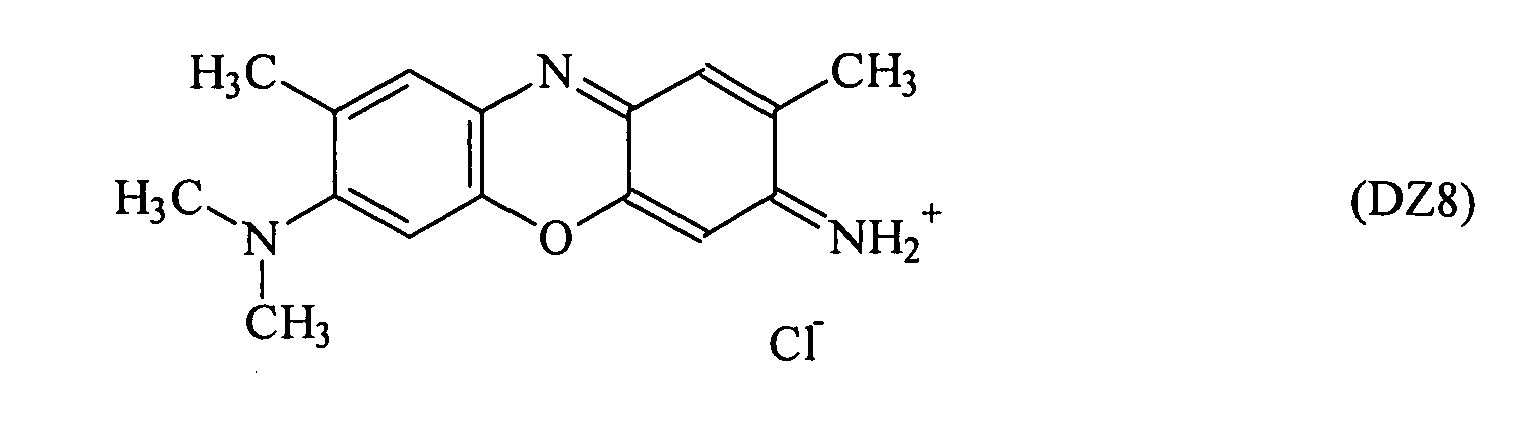

- Die Verbindungen der Formeln (DZ1), (DZ3) und (DZ5), die auch unter den Bezeichnungen Basic Yellow 87, Basic Orange 31 und Basic Red 51 bekannt sind, sind ganz besonders bevorzugte kationische direktziehende Farbstoffe der Gruppe (c).
- Die kationischen direktziehenden Farbstoffe, die unter dem Warenzeichen Arianor® vertrieben werden, sind erfindungsgemäß ebenfalls ganz besonders bevorzugte kationische direktziehende Farbstoffe.
- Die erfindungsgemäßen Zusammensetzungen gemäß dieser Ausführungsform enthalten die direktziehenden Farbstoffe bevorzugt in einer Menge von 0,01 bis 20 Gew.-%, bezogen auf das gesamte Mittel.
- Weiterhin können die erfindungsgemäßen Zubereitungen auch in der Natur vorkommende Farbstoffe wie sie beispielsweise in Henna rot, Henna neutral, Henna schwarz, Kamillenblüte, Sandelholz, schwarzem Tee, Faulbaumrinde, Salbei, Blauholz, Krappwurzel, Catechu, Sedre und Alkannawurzel enthalten sind, enthalten.
- Es ist nicht erforderlich, dass die Oxidationsfarbstoffvorprodukte oder die direktziehenden Farbstoffe jeweils einheitliche Verbindungen darstellen. Vielmehr können in den erfindungsgemäßen Zusammensetzungen, bedingt durch die Herstellungsverfahren für die einzelnen Farbstoffe, in untergeordneten Mengen noch weitere Komponenten enthalten sein, soweit diese nicht das Färbeergebnis nachteilig beeinflussen oder aus anderen Gründen, z.B. toxikologischen, ausgeschlossen werden müssen.
- Bezüglich weiterer fakultativer Komponenten sowie die eingesetzten Mengen dieser Komponenten wird ausdrücklich auf die dem Fachmann bekannten einschlägigen Handbücher, z. B. Kh. Schrader, Grundlagen und Rezepturen der Kosmetika, 2. Auflage, Hüthig Buch Verlag, Heidelberg, 1989, verwiesen.
- Wenn das erfindungsgemäße Mittel Oxidationsfarbstoffvorprodukte enthält, kann die eigentliche oxidative Färbung der Fasern grundsätzlich mit Luftsauerstoff erfolgen. Bevorzugt wird jedoch ein chemisches Oxidationsmittel eingesetzt, besonders dann, wenn neben der Färbung mit den Oxidationsfarbstoffvorprodukten und/oder direktziehenden Farbstoffen ein Aufhelleffekt an menschlichem Haar gewünscht ist. Als Oxidationsmittel kommen Persulfate, Chlorite und insbesondere Wasserstoffperoxid oder dessen Anlagerungsprodukte an Harnstoff, Melamin sowie an Natriumborat in Frage.
- Soll das erfindungsgemäße Mittel als Kombinationspräparat in Form eines Bleich- und Konditioniermittels bereitgestellt werden, enthält das anwendungsbereite Mittel insbesondere eine Mischung aus Persulfaten und Wasserstoffperoxid als Oxidationsmittel.
Soll das erfindungsgemäße Mittel als Kombinationspräparat in Form eines oxidativen Haarfärbe- und Konditioniermittels bereitgestellt werden, besteht es bevorzugt aus zwei Komponenten, nämlich einer Zubereitung, enthaltend die Farbstoffvorprodukte bzw. die direktziehenden Farbstoffe (die im weiteren als Farbstoffträger bezeichnet wird) und einer Oxidationsmittelzusammensetzung. - Ein zweiter Gegenstand der Erfindung ist daher ein Mittel, welches unmittelbar vor der Anwendung aus zwei Komponenten gemischt wird, wobei die erste Komponente als Farbstoffträger ein Mittel des ersten Erfindungsgegenstandes, enthaltend zusätzlich
- mindestens eine Entwicklerkomponente und gegebenenfalls mindestens eine Kupplerkomponente und/oder
- mindestens einen direktziehenden Farbstoff
- Optional kann das erfindungsgemäße Mittel auch zusammen mit einem Oxidationsaktivator auf das Haar aufgebracht werden, der die Oxidation der Farbstoffvorprodukte durch das Oxidationsmittel, aktiviert. Als Oxidationsmittel dient, wie zuvor erwähnt, Luftsauerstoff oder zusätzliche chemische Oxidationsmittel. Die Oxidationsaktivatoren werden bevorzugt ausgewählt aus der Gruppe, die gebildet wird aus Carbonaten, Hydrogencarbonaten, Carbamaten, Carbonsäureestern oder deren Salze, Aldehyden, insbesondere aliphatischen Aldehyden, 1,3-Dihydroxyaceton, Imidazol und seinen Derivaten, Alkali- und Ammoniumperoxidisulfaten, Metallionen, Iodiden, Chinonen und Enzymen.
- Die Oxidationsaktivatoren sind bevorzugt in Mengen von 0.01 bis 5 Gew.%, bezogen auf das Gewicht des gesamten Mittels, in den erfindungsgemäßen Mitteln enthalten.
- Geeignete Metallionen sind beispielsweise Zn2+, Cu2+, Fe2+, Fe3+, Mn2+, Mn4+, Li+, Mg2+, Ca2+ und Al3+. Besonders geeignet sind dabei Zn2+, Cu2+ und Mn2+. Die Metallionen können prinzipiell in der Form eines beliebigen, physiologisch verträglichen Salzes oder in Form einer Komplexverbindung eingesetzt werden. Bevorzugte Salze sind die Acetate, Sulfate, Halogenide, Lactate und Tartrate. Durch Verwendung dieser Metallsalze kann sowohl die Ausbildung der Färbung beschleunigt als auch die Farbnuance gezielt beeinflusst werden.
- Geeignete Enzyme sind z.B. Peroxidasen, die die Wirkung geringer Mengen an Wasserstoffperoxid deutlich verstärken können. Weiterhin sind solche Enzyme erfindungsgemäß geeignet, die mit Hilfe von Luftsauerstoff die Oxidationsfarbstoffvorprodukte direkt oxidieren, wie beispielsweise die Laccasen, oder in situ geringe Mengen Wasserstoffperoxid erzeugen und auf diese Weise die Oxidation der Farbstoffvorprodukte biokatalytisch aktivieren. Besonders geeignete Katalysatoren für die Oxidation der Farbstoffvorläufer sind die sogenannten 2-Elektronen-Oxidoreduktasen in Kombination mit den dafür spezifischen Substraten, z.B.
- Pyranose-Oxidase und z.B. D-Glucose oder Galactose,
- Glucose-Oxidase und D-Glucose,
- Glycerin-Oxidase und Glycerin,
- Pyruvat-Oxidase und Benztraubensäure oder deren Salze,
- Alkohol-Oxidase und Alkohol (MeOH, EtOH),
- Lactat-Oxidase und Milchsäure und deren Salze,
- Tyrosinase-Oxidase und Tyrosin,
- Uricase und Harnsäure oder deren Salze,
- Cholinoxidase und Cholin,
- Aminosäure-Oxidase und Aminosäuren.
- Das eigentliche (oxidative) Haarfärbemittel wird zweckmäßigerweise unmittelbar vor der Anwendung durch Mischung der Oxidationsmittelzusammensetzung mit dem Farbstoffträger, bevorzugt im Gewichtsverhältnisbereich von 1 zu 4 bis 4 zu 1, insbesondere von 1 zu 2 bis 2 zu 1, hergestellt. Das dabei entstehende gebrauchsfertige Haarfärbepräparat sollte bevorzugt einen pH-Wert im Bereich von 6 bis 12, insbesondere von pH 7 bis 11, aufweisen. Besonders bevorzugt ist die Anwendung der Haarfärbemittel in einem schwach alkalischen Milieu.
- Es wird angestrebt, dass der (insbesondere gelförmige und klare) Farbstoffträger fließfähig ist und bevorzugt eine Viskosität von höchstens 100 mPa·s (20 °C), bevorzugt von höchstens 20 mPa·s (20 °C) besitzt. Wird diese Zusammensetzung mit einer Oxidationsmittelzusammensetzung vermischt, weist der anwendungsfertige (insbesondere gelförmige und klare) Färbeansatz bevorzugt eine Viskosität von wenigstens 3 Pa˙s (20 °C), bevorzugt von 8 bis 20 Pa·s (20 °C), auf (Viskositätsmessungen jeweils mit dem Rotationsviskosimeter Brookfield, Typ RTV, Spindel 4, 4 rpm).
- In einer weiteren Ausführungsform der vorliegenden Erfindung können tubenfähige Gele bevorzugt sein, die Viskositäten in der Größenordnung einer herkömmlichen Emulsion aufweisen. Die Viskositäten der Gele dieser Ausführungsform liegen bevorzugt in einem Bereich von 10 000 bis 100 000mPas, besonders bevorzugt in einem Bereich von 15 000 bis 50 000 mPas, ganz besonders bevorzugt in einem Bereich von 20 000 bis 35 000mPas (Viskositätsmessungen jeweils mit dem Rotationsviskosimeter Brookfield, Typ RTV, Spindel 4, 4 rpm bei 20°C). Derartige Gele werden insbesondere dann erhalten, wenn der Gehalt an niedermolekularen Monoalkoholen und/oder Polyolen deutlich abgesenkt wird beziehungsweise ganz auf diese Komponenten verzichtet wird. Im Rahmen dieser Ausführungsform ist ein Gehalt an niedermolekularen Monoalkoholen und/oder Polyolen von weniger als 50Gew.-%, vorzugsweise weniger als 30Gew.-%, ganz vorzugsweise weniger als 10 Gew.-%, erfindungsgemäß bevorzugt. Im Rahmen dieser Ausführungform kann es ganz besonders bevorzugt sein, trübe Gele der genannten Viskosität einzusetzen.
- Als erfindungsgemäß bevorzugte Oxidationsmittelzusammensetzung für die Ausführungsform als Färbemittel eignet sich hervorragend eine wässrige Zusammensetzung, enthaltend
3 bis 12 Gew.-% Wasserstoffperoxid 0,1 bis 5 Gew.-% eines wasserlöslichen, synthetischen Tensids und 1 bis 5 Gew.-% eines dispergierten Acrylsäure- und/oder Methacrylsäure-Polymerisats oder -Copolymerisats. - Sie kann aber auch ohne Wasserstoffperoxid oder im einfachsten Fall allein aus Wasser bestehen, so dass die Oxidation von Oxidationsfarbstoffvorprodukten durch den Luftsauerstoff herbeigeführt wird.
- Als wasserlösliche synthetische Tenside können in der Oxidationsmittelzusammensetzung die zuvor für das erfindungsgemäße Mittel genannten optionalen Tenside aus anionischen, amphoteren, zwitterionischen und nichtionischen Tensiden oder Gemischen davon verwendet werden. Bevorzugt werden anionische Tenside, z.B. Schwefelsäurehalbestersalze von linearen Fettalkoholen mit 12 bis 18 C-Atomen oder von Fettalkoholpolyglycolethern mit 12 bis 16 C-Atomen in der Alkylgruppe und 1 bis 10 Glycolethergruppen in Form ihrer Alkali-, Magnesium-, Ammonium- oder Alkanolammoniumsalze eingesetzt.
- Die Oxidationsmittelzusammensetzung enthält außerdem bevorzugt Komplexbildner und Puffersalze zur Einstellung eines pH-Wertes von 2 bis 5. In diesem schwach sauren Medium bleiben die Acrylsäure- und/oder Methacrylsäure-Polymerisat-Dispersionen dünnflüssig und stabil. Beim Vermischen mit des alkalischen Farbstoffträgers, der Ammoniak und Puffersalze zur Einstellung eines pH-Wertes von 8 bis 10 enthält, steigt der pH-Wert der Mischung an und die Carboxylgruppen des Polymerisats oder Copolymerisats werden in die Salzform überführt. Dabei beginnen die Polymerisate sich im wässrigen Medium zu lösen und die Viskosität der Lösung anzuheben.
- Besonders günstig für den Viskositätsaufbau nach dem Vermischen ist der Gehalt an dispergierten Acrylsäure- und/oder Methacrylsäure-Polymerisat oder -Copolymerisat in der Oxidationsmittelzusammensetzung. Bevorzugte Dispersionen von entsprechenden Polymerisaten sind solche, welche die zuvor genannten bevorzugten Acrylsäure- und/oder Methycrylsäre-Polymerisate oder -Copolymerisate enthalten.
- Die erfindungsgemäßen Mittel können zusätzlich alle auf diesen Gebieten bekannten und üblicherweise verwendeten Wirk- und Hilfsstoffe enthalten.
- Ein dritter Gegenstand der vorliegenden Erfindung ist ein Verfahren zur Behandlung keratinhaltiger Fasern, bei dem ein erfindungsgemäßes Mittel auf die Fasern aufgetragen wird und nach einer Einwirkzeit wieder abgespült wird. Die Einwirkungszeit beträgt bevorzugt 1 bis 20 Minuten.
- Eine bevorzugte Ausführungsform des erfindungsgemäßen Verfahrens ist ein Verfahren zur Färbung und Konditionierung keratinischer Fasern, bei dem das erfindungsgemäße Mittel des ersten Gegenstandes, enthaltend zusätzlich
- mindestens eine Entwicklerkomponente und gegebenenfalls mindestens eine Kupplerkomponente und/oder
- mindestens einen direktziehenden Farbstoff
- Die Anwendungstemperaturen dieser Ausführungsform können in einem Bereich zwischen 15 und 40 °C liegen. Nach einer Einwirkungszeit von in der Regel 5 bis 45 Minuten wird das Haarfärbemittel durch Ausspülen von dem zu färbenden Haar entfernt. Das Nachwaschen mit einem Shampoo entfällt, wenn ein stark tensidhaltiger Träger, z.B. ein Färbeshampoo, verwendet wurde.
- Ein weiterer Gegenstand ist eine Verpackungseinheit (Kit), welche mindestens ein getrennt konfektioniertes, erfindungsgemäßes Mittel des ersten Erfindungsgegenstandes enthält. Zusätzlich kann das Kit mindestens eine getrennt konfektionierte Oxidationsmittelzusammensetzung enthalten, insbesondere dann, wenn ein (oxidatives) Färbemittel bereitgestellt werden soll. Darüber hinaus kann das Kit zusätzlich optional eine Gebrauchsanweisung, Applikationshilfen oder Schutzhandschuhe enthalten.
- Eine Verpackungseinheit bildet sich erfindungsgemäß, wenn getrennt konfektionierte Zusammensetzungen durch eine gemeinsame Umverpackung, wie z.B. eine Faltschachtel oder eine Banderole, zusammengeführt werden. Im Sinne der Erfindung gilt es ebenso als Verpackungseinheit, wenn eine gemeinsame oder sequenzielle Benutzung getrennt konfektionierter Zusammensetzungen durch Anweisung in der Gebrauchsanleitung beziehungsweise in der Werbung vorgeschlagen wird.
- Es wurden folgende klare, gelförmige Farbstoffträger nach einem herkömmlichen Verfahren hergestellt (sofern keine anders lautenden Angaben gemacht werden, verstehen sich die Mengenangaben in Gew.-%):
Tabelle 1: Rohstoff V1 E1 Dehydol® LS 2 deo N 4,90 4,90 Eumulgin CS 50 5,00 5,00 Lorol techn.® 8,00 8,00 Edenor® PK1805 6,75 6,75 Isopropanol 14,50 14,50 1,2-Propylenglykol 6,75 6,75 Texapon® NSO 4,50 4,50 Monoethanolamin 5,00 5,00 L-Arginin 1,00 1,00 Natriumsulfit 0,10 0,10 Ascorbinsäure 0,40 0,40 Turpinal® SL 0,20 0,20 Parfüm 0,60 0,60 Merquat® 280 1,50 1,50 Miranol® C2M SF 1,00 1,00 Macadamianußöl 0,40 0,40 Herbasol Komplex SC 0,30 0,30 Erfindungsgemäßes Silikon -- 2,00 p-Toluylendiamin, freie Base 25% 1,93 1,93 3-Methyl-4-aminophenol 0,50 0,50 Resorcin 0,57 0,57 m-Aminophenol 0,05 0,05 5-Amino-2-methylphenol 0,15 0,15 6-Chlor-4-nitro-2-aminophenol 0,07 0,07 Wasser ad 100 ad 100 - Unmittelbar vor der Anwendung am Haar wurden die Farbstoffträger gemäß Tabelle 1 jeweils mit der Oxidationsmittelzubereitung gemäß Tabelle 2 im Gewichtsverhältnis von 4 zu 5 unter Erhalt eines anwendungsbereiten, klaren, gelförmigen Färbemittels vermischt.
Tabelle 2: Oxidationsmittelzusammensetzung Dipicolinsäure 0,62 Natriumpyrophosphat 0,03 Turpinal® SL 1,50 Texapon® NSO 2,00 Aculyn® 33 A 12,00 Wasserstoffperoxid (50 %ige wässrige Lösung) 12,00 Wasser ad 100 - Die Ausfärbung erfolgte stets auf Haarsträhnen (Alkinco 6634, natural dark european hair).
- Die Haarsträhnen wurden im Rahmen einer Vorbehandlung mit Texapon® NSO Lösung gewaschen, getrocknet und 24 Stunden gelagert. Als Referenzmessung wurde vor der Anwendung der Färbemittel die Kämmarbeit jeder Haarsträhne bestimmt (Siehe Punkt 1.2).
- Pro Farbstoffträger E1, E2, V1 sowie V2 wurden jeweils 20 Haarsträhnen angefeuchtet und mit dem Handtuch getrocknet, so dass eine Restfeuchtigkeit im Haar verblieb. Danach wurde je Strähne ein anwendungsbereites klares, gelförmiges Färbemittel in einem Flottenverhältnis von 2 g Anwendungsmischung pro g Haar aufgetragen und über einen Zeitraum von 30 Minuten bei 37°C einwirken gelassen. Anschließend wurden die Strähnen 2 Minuten mit 30°C warmen, fließendem Leitungswasser gespült.
- Abschließend wurde erneut die Kämmarbeit jeder Haarsträhne bestimmt (siehe Punkt 1.2).
- Vor der Arbeitsmessung wurden die Einzelsträhnen ca. 1 Minute in einer Vorkämmapparatur nass gekämmt. Unmittelbar im Anschluss daran wurde von jeder einzelnen Strähne die Arbeit ermittelt, die für 10 Kämmungen aufgewendet werden musste. Die Messergebnisse der 20 Strähnen wurden gemittelt (arithmetisches Mittel = Ø).
- Die so erhaltenen gemittelten Messwerte für die Kämmarbeit vor (Referenz) und nach der Färbung wurden verglichen und die Änderung (Erhöhung) der Kämmarbeit auf die Referenzmessung bezogen:

- Die Ergebnisse sind der Tabelle 3 zu entnehmen.
Tabelle 3: Rezeptur Ø Kämmarbeit Referenz (vor der Färbung) [mJ] Ø Kämmarbeit (nach der Färbung) [mJ] Änderung der Kämmarbeit [%] E1 61 72 -21 V1 51 74 -46 - Das erfindungsgemäße Mittel E1 bewirkt eine Konditionierung, so dass die Kämmbarkeit lediglich eine Änderung um ca. 20% erfährt.
Nach Anwendung des Mittels V1 ohne die erfindungsgemäße Wirkstoffkombination weisen die Fasern eine deutlich verschlechterte Nasskämmbarkeit (46% Änderung) auf.
Das Haar erfährt durch V1 eine deutlich schlechtere Konditionierung als durch E1. - Es wurde der folgende trübe gelförmige Farbstoffträger nach einem herkömmlichen Verfahren hergestellt (sofern keine anders lautenden Angaben gemacht werden, verstehen sich die Mengenangaben in Gew.-%):
Tabelle 4: Rohstoff Rezeptur 1 Dehydol® LS 2 deo N 4,9 Eumulgin® CS50 5,0 Lorol, techn. 8,0 Edenor® PK 1805 6,8 Texapon® NSO 4,5 Merquat® 280 2,0 Amphoterge® K-2 1,0 Erfindungsgemäßes Silikon 2,0 Monoethanolamin 5,0 L-Arginin 1,0 Natriumsulfit 0,2 Ascorbinsäure 0,2 Turpinal® SL 0,2 Parfum 0,6 p-Toluylendiamin-sulfat 0,85 4-Amino-3-methylphenol 0,50 Resorcin 0,57 m-Aminophenol 0,05 5-Amino-2-methylphenol 0,15 2-Amino-6-chlor-4-nitrophenol 0,07 Wasser ad 100 - Diese Gelformulierung wurde mit der in Tabelle 2 beschriebenen Oxidationsmittelzubreitung im Verhältnis 4 : 5 vermischt und in einem Flottenverhältnis von 2 g Anwendungsmischung pro g Haar auf die Haarsträhnen (Alkinco 6634, natural dark european hair) aufgetragen. Nach einer Einwirkungszeit von 30 Minuten bei 37°C wurden die Strähnen 2 Minuten mit 30°C warmen, fließendem Leitungswasser gespült und mit einem Fön getrocknet.
-
Aculyn® 33 A Acrylpolymer (ca. 28% Festkörper in Wasser; INCI-Bezeichnung: Acrylates Copolymer) Amphoterge® K-2 ca. 39-41% Aktivsubstanzgehalt; INCI-Bezeichnung: Disodium Cocoamphodipropionate (Lonza) Dehydol® LS 2 deo N C12-14-Fettalkohol mit ca. 2-EO-Einheiten (INCI-Bezeichnung: Laureth-2)(Cognis) Edenor® PK 1805 Ölsäure (INCI-Bezeichnung: Oleic Acid) (Cognis) Erfindungsgemäßes Silikon Silikon gemäß Beispiel 8 der WO 02/10257 geringfügig modifiziert in der Länge der Silikon- und der Polyetherketter. Eumulgin® CS 50 Cetylstearylalkohol mit ca. 50 EO-Einheiten (INCI-Bezeichnung: Ceteareth-50) (Cognis) Herbasol Komplex SC ca. 3,5-6,5% Trockensubstanzgehalt; INCI-Bezeichnung: Propylene Glycol, Aqua (Water), Sorbitol, Mel (Honey Extract), Hamamelis Virginiana (Witch Hazel) Extract, Aesculus Hippocastanum (Horse Chestnut) Seed Extract, Cinnamomum Zeylanicum Bark Extract, Vitis Vinifera (Grape) Leaf Extract, Trifolium Pratense (Clover) Flower Extract, Ribes Nigrum (Black Currant) Leaf Extract, Aspalathus Linearis Leaf Extract, Rosa Gallica Flower Extract, Pterocarpus Santalinus Wood Extract (Cosmetochem) Lorol® techn. C12-18-Fettalkohol (INCI-Bezeichnung: Coconut alcohol) (Cognis) Mergital® CS 50A Fettalkohol mit ca. 50 EO-Einheiten (INCI-Bezeichnung: Ceteareth-50) (Cognis) Merquat® 280 Dimethyldiallylammoniumchlorid Acrylsäure Copolymer (ca. 35 Aktivsubstanz in Wasser; INCI-Bezeichnung: Polyquaternium-22) (Ondeo-Nalco) Miranol® C2M SF ca. 38-40% Festkörper; INCI-Bezeichnung: Disodium Cocoamphodipropionate (Rhodia) Texapon® NSO Laurylethersulfat, Natriumsalz (ca. 27,5% Aktivsubstanz; INCI-Bezeichnung: Sodium Laureth Sulfate) (Cognis) Turpinal® SL 1-Hydroxyethan-1,1-diphosphonsäure (ca. 58 - 61% Aktivsubstanzgehalt; INCI-Bezeichnung: Etidronic Acid, Aqua (Water)) (Solutia)
Claims (24)
- Mittel zur Konditionierung keratinischer Fasern, insbesondere menschlicher Haare, enthaltend in einem kosmetisch akzeptablen Träger- mindestens ein amphoteres Tensid der Formel (I)
 - mindestens ein kationisches und/oder amphoteres Polymer und- mindestens eine Polyammonium-Polysiloxan-Verbindung.
 - Mittel nach Anspruch 1, dadurch gekennzeichnet, dass das Polyammonium-Polysiloxana1) mindestens eine Polyalkylenoxid-Struktureinheit der allgemeinen Formeln: -A-E-, -E-A-, -A-E-A'- und/oder -A'-E-A- , worin:A steht für eine der Gruppen: -CH2C(O)O-, -CH2CH2C(O)O-, -CH2CH2CH2C(O)O-, -OC(O)CH2-, -OC(O)CH2CH2- und/oder -OC(O)CH2CH2CH2-,A' bedeutet: -CH2C(O)-, -CH2CH2C(O)-, -CH2CH2CH2C(O)-, -C(O)CH2-, -C(O)CH2CH2- und/oder -C(O)CH2CH2CH2- undE steht für eine Polyalkylenoxidgruppe der allgemeinen Formeln:
-[CH2CH2O]q-[CH2CH(CH3)O]r- und/oder -[OCH(CH3)CH2)r,-[OCH2CH2]q-, mit q = 1 bis 200 und r = 0 bis 200, wobei das endständige Sauerstoffatom der Gruppe A an die endständige -CH2-Gruppe der Gruppe E, und das endständige Carbonylkohlenstoffatom der Gruppe A' an das endständige Sauerstoffatom Gruppe E jeweils unter Ausbildung von Estergruppen binden, und/oder mindestens eine endständige Polyalkylenoxid-Struktureinheit der Formel -A-E-R2, worin A und E die oben genannte Bedeutung aufweisen, und R2 steht für H, geradkettiger, cyclischer oder verzweigter C1 - C20 - Kohlenwasserstoffrest, der durch -O-, oder -C(O)unterbrochen und mit -OH substituiert und acetylenisch, olefinisch oder aromatisch sein kann,a2) mindestens einen zweiwertigen oder dreiwertigen organischen Rest, der mindestens eine Ammoniumgruppe enthält,a3) mindestens eine Polysiloxan-Struktureinheit der allgemeinen Formel:
-K-S-K-,
worin S steht für -Si(R1)2-O[-Si(R1)2-O]n-Si(R1)2- und
worin R1 steht für C1-C22-Alkyl, C1-C22-Fluoralkyl oder Aryl, n steht für 0 bis 1000, und wenn mehrere Gruppen S in der Polysiloxanverbindung vorliegen, diese gleich oder verschieden sein können,
worin K ein zweiwertiger oder dreiwertiger geradkettiger, cyclischer oder verzweigter C2-C40-Kohlenwasserstoffrest, der durch -O-, -N -, -NR1-, -C(O)-, -C(S)-, -N+(R3)- und -N+(R1)(R3)- unterbrochen und mit -OH substituiert sein kann,
worin R1 wie oben definiert ist, oder gegebenenfalls eine Bindung zu einem zweiwertigen Rest R3 darstellt, und
worin R3 einen einwertigen oder zweiwertigen geradkettigen, cyclischen oder verzweigten C1-C20-Kohlenwasserstoffrest, der durch -O-, - NH-, -C(O)-, -C(S)-unterbrochen und mit -OH substituiert sein kann, oder -A-E-R2 darstellt, worin A, E und R2 wie oben definiert ist,
wobei die Reste K gleich oder verschieden voneinander sein können, und im Falle, dass K einen dreiwertigen Rest darstellt, die Absättigung der dritten Valenz über eine Bindung an den vorstehend genannten organischen Rest, der mindestens eine Ammoniumgruppe enthält, erfolgt, unda4) mindestens einen organischen oder anorganischen Säurerest zur Neutralisation der aus der(n) Ammoniumgruppe(n) resultierenden Ladungenenthält. - Mittel nach Anspruch 2, dadurch gekennzeichnet, dass das Polyammonium-Polysiloxan eine Verbindung der Formel
-[N4-K-S-K-N4-A-E-A']m- bzw. -[N4-K-S-K-N4-A'-E-A]m- (IV)
ist, wobei K, S, A, E und A' die oben gegebenen Bedeutungen haben und
N4 ein organischer Rest, der mindestens eine quartäre Ammoniumgruppe enthält, der allgemeinen Formel
-(N+R12R13)-
ist, worin R12 ein einwertiger oder zweiwertiger geradkettiger, cyclischer oder verzweigter C1-C20-Kohlenwasserstoffrest ist, der durch -O-, -NH-, -C(O)-, -C(S)- unterbrochen und mit -OH substituiert sein kann,
R13 die Bedeutungen von R12 aufweisen kann, oder eine Einfachbindung zu K oder R12 darstellt, und die Reste R12 und R13 gleich oder verschieden voneinander sein können. - Mittel nach Anspruch 3, dadurch gekennzeichnet, dass R12 steht für eine C1- bis C4-Alkylgruppe und R13 steht für eine Einfachbindung zu K.
- Mittel nach einem der Ansprüche 2 bis 4, dadurch gekennzeichnet, dass K steht für einen Rest

- Mittel nach einem der Ansprüche 2 bis 5, dadurch gekennzeichnet, dass S steht für eine Gruppe
-Si(R1)2-O[-Si(R1)2-O]n-Si(R1)2-,
worin R1 bedeutet C1-C22-Alkyl, C1-C22-Fluoralkyl oder Aryl, vorzugsweise Phenyl, n = 0 bis 1000, und wenn mehrere Gruppen S in der Polysiloxanverbindung vorliegen, diese gleich oder verschieden sein können. - Mittel nach Anspruch 6, dadurch gekennzeichnet, dass R1 jeweils für eine Methylgruppe steht.
- Mittel nach einem der Ansprüche 2 bis 7, dadurch gekennzeichnet, dass A steht für eine Gruppe -CH2CH2C(O)O- , A' steht für eine Gruppe -CH2CH2C(O)-, und E steht für eine Polyalkylengruppe der allgemeinen Formel -[CH2CH2O]q- mit q = 1 bis 200 wobei das endständige Sauerstoffatom der Gruppe A an die endständige -CH2-Gruppe der Gruppe E, und das endständige Carbonylkohlenstoffatom der Gruppe A' an das endständige Sauerstoffatom Gruppe E jeweils unter Ausbildung von Estergruppen binden.
- Mittel nach einem der Ansprüche 1 bis 8 dadurch gekennzeichnet, dass die Verbindungen der Formel (I) in einer Menge von 0,1 bis 15 Gew.-%, bezogen auf das Gewicht des Mittels, enthalten sind.
- Mittel nach einem der Ansprüche 1 bis 9, dadurch gekennzeichnet, dass die amphoteren und/oder kationischen Polymere in einer Menge von 0,1 bis 15 Gew.-% bezogen auf das Gewicht des gesamten Mittels, enthalten sind.
- Mittel nach einem der Ansprüche 1 bis 10, dadurch gekennzeichnet, dass es weiterhin mindestens ein (C8 bis C22)-Triacylglycerid enthält.
- Mittel nach Anspruch 11, dadurch gekennzeichnet, dass sich mindestens eine (C8 bis C22)-Acylgruppe der (C8 bis C22)-Triacylglyceride von mindestens einer ungesättigten Fettsäure ableitet.
- Mittel nach einem der Ansprüche 11 oder 12, dadurch gekennzeichnet, dass als (C8 bis C22)-Triacylglyceridquelle ein natürliches Öl, insbesondere ein Nussöl, enthalten ist.
- Mittel nach einem der Ansprüche 11 bis 13, dadurch gekennzeichnet, dass als (C8 bis C22)-Triacylglyceridquelle Macadamianußöl, insbesondere ein Öl aus Macadamia ternifolia, enthalten ist.
- Mittel nach einem der Ansprüche 11 bis 14, dadurch gekennzeichnet, dass die (C8 bis C22)-Triacylglyceride in einer Menge von 0,05 bis 10 Gew.-%, jeweils bezogen auf das Gewicht des Mittels, enthalten sind.
- Mittel nach einem der Ansprüche 1 bis 15, dadurch gekennzeichnet, dass es in Form einer Creme oder eines Gels vorliegt.
- Mittel nach einem der Ansprüche 1 bis 16, dadurch gekennzeichnet, dass es zusätzlich eine Kombination aus- 0,5 bis 10 Gew.-% eines Anlagerungsproduktes von 1 bis 5 Mol Ethylenoxid an einen linearen Fettalkohol mit 8 bis 22 C-Atomen,- 0,1 bis 15 Gew.-% eines gesättigten oder ungesättigten, linearen oder verzweigten Alkohols mit 8 bis 36 C-Atomen und- 0,1 bis 15 Gew.-% einer flüssigen Fettsäure mit 16 bis 22 C-Atomen in Form einer wasserlöslichen Seifeenthält.
- Mittel nach einem der Ansprüche 1 bis 17, dadurch gekennzeichnet, dass es zusätzlich 0,5 bis 10 Gew.-% eines Anlagerungsproduktes von 15 bis 100 Einheiten Ethylenoxid pro Molekül eines linearen Fettalkohols mit 8 bis 22 C-Atomen, enthält.
- Mittel nach einem der Ansprüche 1 bis 18, dadurch gekennzeichnet, dass es zusätzlich 3 bis 70 Gew.-% mindestens eines niedermolekularen Monoalkohols und/oder mindestens eines Polyols enthält.
- Mittel nach einem der Ansprüche 1 bis 19, dadurch gekennzeichnet, dass es zusätzlich mindestens ein anionisches Acrylsäure- und/oder Methacrylsäure-Polymerisat oder -Copolymerisat enthält.
- Mittel nach einem der Ansprüche 1 bis 20, dadurch gekennzeichnet, dass es zusätzlich mindestens ein Pflanzenextrakt enthält.
- Mittel nach einem der Ansprüche 1 bis 17, dadurch gekennzeichnet, dass es zusätzlich- als Oxidationsfarbstoffvorprodukt mindestens eine Entwicklerkomponente und gegebenenfalls mindestens eine Kupplerkomponente
und/oder- mindestens einen direktziehenden Farbstoff enthält. - Mittel, welches unmittelbar vor der Anwendung aus zwei Komponenten gemischt wird, dadurch gekennzeichnet, dass die erste Komponente ein Mittel gemäß Anspruch 22 bedeutet und die zweite Komponente eine Oxidationsmittelzusammensetzung, enthaltend mindestens ein chemisches Oxidationsmittel, insbesondere Wasserstoffperoxid, ist.
- Verfahren zur Behandlung keratinhaltiger Fasern, bei dem ein Mittel nach einem der Ansprüche 1 bis 23 auf die Fasern aufgetragen wird und nach einer Einwirkzeit wieder abgespült wird.
Applications Claiming Priority (1)
| Application Number | Priority Date | Filing Date | Title |
|---|---|---|---|
| DE102005062651A DE102005062651A1 (de) | 2005-12-23 | 2005-12-23 | Haarpflegemittel |
Publications (2)
| Publication Number | Publication Date |
|---|---|
| EP1806128A1 true EP1806128A1 (de) | 2007-07-11 |
| EP1806128B1 EP1806128B1 (de) | 2009-09-02 |
Family
ID=37946227
Family Applications (1)
| Application Number | Title | Priority Date | Filing Date |
|---|---|---|---|
| EP06025998A Not-in-force EP1806128B1 (de) | 2005-12-23 | 2006-12-15 | Haarpflegemittel |
Country Status (3)
| Country | Link |
|---|---|
| EP (1) | EP1806128B1 (de) |
| AT (1) | ATE441400T1 (de) |
| DE (2) | DE102005062651A1 (de) |
Cited By (1)
| Publication number | Priority date | Publication date | Assignee | Title |
|---|---|---|---|---|
| WO2008025679A1 (de) * | 2006-09-01 | 2008-03-06 | Henkel Ag & Co. Kgaa | Kosmetische wirkstoffzusammensetzung mit sandelholzextrakt |
Citations (27)
| Publication number | Priority date | Publication date | Assignee | Title |
|---|---|---|---|---|
| US3101301A (en) | 1962-05-11 | 1963-08-20 | Bristol Myers Co | Transparent water and mineral oil gels as hair conditioners |
| DE1164095B (de) | 1961-11-17 | 1964-02-27 | Basf Ag | Verfahren zur Herstellung von waessrigen Dispersionen carboxylgruppenhaltiger Mischpolymerisate |
| GB1026978A (en) | 1962-03-30 | 1966-04-20 | Schwarzkopf Verwaltung G M B H | Method of dyeing hair |
| GB1153196A (en) | 1965-07-07 | 1969-05-29 | Schwarzkopf Verwaltung G M B H | Method of Dyeing Hair |
| DE2024051A1 (de) | 1970-05-16 | 1971-12-09 | Henkel & Cie GmbH, 4000 Dusseldorf Holthausen | Kosmetische Zubereitungen, insbesondere kosmetische Reinigungsmittel, mit einem Ge halt an Ruckfettungsmitteln |
| DE2359399A1 (de) | 1973-11-29 | 1975-06-12 | Henkel & Cie Gmbh | Haarfaerbemittel |
| FR2252840A1 (de) | 1973-11-30 | 1975-06-27 | Oreal | |
| DE2817369A1 (de) | 1977-04-21 | 1978-10-26 | Oreal | Neue copolymerisate, verfahren zu deren herstellung und diese enthaltende kosmetische mittel |
| GB2104091A (en) | 1981-07-17 | 1983-03-02 | Kao Corp | Detergent composition |
| DE3504242A1 (de) | 1985-02-08 | 1986-08-14 | Henkel KGaA, 4000 Düsseldorf | Verfahren zur herstellung von tertiaeren etheraminen |
| EP0217274A2 (de) | 1985-09-30 | 1987-04-08 | Kao Corporation | Haarkosmetikum |
| DE3843892A1 (de) | 1988-12-24 | 1990-06-28 | Wella Ag | Oxidationshaarfaerbemittel mit einem gehalt an diaminopyrazolderivaten und neue diaminopyrazolderivate |
| DE4133957A1 (de) | 1991-10-14 | 1993-04-15 | Wella Ag | Haarfaerbemittel mit einem gehalt an aminopyrazolderivaten sowie neue pyrazolderivate |
| WO1994008969A1 (de) | 1992-10-16 | 1994-04-28 | Wella Aktiengesellschaft | Verfahren zur herstellung von 4,5-diaminopyrazol-derivaten deren verwendung zum färben von haaren sowie neue pyrazol-derivate |
| WO1994008970A1 (de) | 1992-10-16 | 1994-04-28 | Wella Aktiengesellschaft | Oxidationshaarfärbemittel mit einem gehalt an 4,5-diaminopyrazolderivaten sowie neue 4,5-diaminopyrazolderivate und verfahren zu ihrer herstellung |
| US5376146A (en) * | 1993-08-26 | 1994-12-27 | Bristol-Myers Squibb Company | Two-part aqueous composition for coloring hair, which forms a gel on mixing of the two parts |
| WO1996015765A1 (de) | 1994-11-17 | 1996-05-30 | Henkel Kommanditgesellschaft Auf Aktien | Oxidationsfärbemittel |
| EP0740931A1 (de) | 1995-05-05 | 1996-11-06 | L'oreal | Zusammensetzungen für die Färbung von keratinischen Fibern, die Diaminopyrazole enthalten, Verfahren zum Färben, Diaminopyrazole und Verfahren zu ihrer Herstellung |
| DE19543988A1 (de) | 1995-11-25 | 1997-05-28 | Wella Ag | Oxidationshaarfärbemittel mit einem Gehalt an 3,4,5-Triaminopyrazolderivaten sowie neue 3,4,5-Triaminopyrazolderivate |
| EP0819422A1 (de) * | 1996-07-15 | 1998-01-21 | Kao Corporation | Präparat zum Farben menschlicher Haaren |
| JPH10114628A (ja) * | 1996-10-08 | 1998-05-06 | Kao Corp | 毛髪処理剤組成物 |
| EP0640335B1 (de) | 1993-08-26 | 2000-02-02 | Bristol-Myers Squibb Company | Haarfärbemittel |
| EP0998908A2 (de) | 1998-11-04 | 2000-05-10 | L'oreal | Färbende Zusammensetzung enthaltend einen kationschen direkt-und einen Oxidationsfarbstoff auf der Basis von Pyrazolo-(1,5)-Pyramidin und Färbeverfahren |
| WO2002010257A1 (de) | 2000-07-27 | 2002-02-07 | Ge Bayer Silicones Gmbh & Co. Kg | Polyammonium-polysiloxan-verbindungen, verfahren zu ihrer herstellung und ihre verwendung |
| WO2004069137A2 (de) | 2003-02-07 | 2004-08-19 | Ge Bayer Silicones Gmbh & Co. Kg | Verwendung von polyamino- und/oder polyammonium-polysiloxancopolymeren |
| DE10304923A1 (de) * | 2003-02-07 | 2004-08-26 | Ge Bayer Silicones Gmbh & Co. Kg | Herstellung und Verwendung Polyamino- und/oder Polyammonium-Polysiloxancopolymere enthaltender Formulierungen |
| WO2007000223A1 (de) * | 2005-06-25 | 2007-01-04 | Henkel Kommanditgesellschaft Auf Aktien | Kosmetische mittel enthaltend eine polyammonium-polysiloxan verbindung und weitere wirkstoffe |
-
2005
- 2005-12-23 DE DE102005062651A patent/DE102005062651A1/de not_active Withdrawn
-
2006
- 2006-12-15 EP EP06025998A patent/EP1806128B1/de not_active Not-in-force
- 2006-12-15 DE DE502006004727T patent/DE502006004727D1/de active Active
- 2006-12-15 AT AT06025998T patent/ATE441400T1/de active
Patent Citations (27)
| Publication number | Priority date | Publication date | Assignee | Title |
|---|---|---|---|---|
| DE1164095B (de) | 1961-11-17 | 1964-02-27 | Basf Ag | Verfahren zur Herstellung von waessrigen Dispersionen carboxylgruppenhaltiger Mischpolymerisate |
| GB1026978A (en) | 1962-03-30 | 1966-04-20 | Schwarzkopf Verwaltung G M B H | Method of dyeing hair |
| US3101301A (en) | 1962-05-11 | 1963-08-20 | Bristol Myers Co | Transparent water and mineral oil gels as hair conditioners |
| GB1153196A (en) | 1965-07-07 | 1969-05-29 | Schwarzkopf Verwaltung G M B H | Method of Dyeing Hair |
| DE2024051A1 (de) | 1970-05-16 | 1971-12-09 | Henkel & Cie GmbH, 4000 Dusseldorf Holthausen | Kosmetische Zubereitungen, insbesondere kosmetische Reinigungsmittel, mit einem Ge halt an Ruckfettungsmitteln |
| DE2359399A1 (de) | 1973-11-29 | 1975-06-12 | Henkel & Cie Gmbh | Haarfaerbemittel |
| FR2252840A1 (de) | 1973-11-30 | 1975-06-27 | Oreal | |
| DE2817369A1 (de) | 1977-04-21 | 1978-10-26 | Oreal | Neue copolymerisate, verfahren zu deren herstellung und diese enthaltende kosmetische mittel |
| GB2104091A (en) | 1981-07-17 | 1983-03-02 | Kao Corp | Detergent composition |
| DE3504242A1 (de) | 1985-02-08 | 1986-08-14 | Henkel KGaA, 4000 Düsseldorf | Verfahren zur herstellung von tertiaeren etheraminen |
| EP0217274A2 (de) | 1985-09-30 | 1987-04-08 | Kao Corporation | Haarkosmetikum |
| DE3843892A1 (de) | 1988-12-24 | 1990-06-28 | Wella Ag | Oxidationshaarfaerbemittel mit einem gehalt an diaminopyrazolderivaten und neue diaminopyrazolderivate |
| DE4133957A1 (de) | 1991-10-14 | 1993-04-15 | Wella Ag | Haarfaerbemittel mit einem gehalt an aminopyrazolderivaten sowie neue pyrazolderivate |
| WO1994008970A1 (de) | 1992-10-16 | 1994-04-28 | Wella Aktiengesellschaft | Oxidationshaarfärbemittel mit einem gehalt an 4,5-diaminopyrazolderivaten sowie neue 4,5-diaminopyrazolderivate und verfahren zu ihrer herstellung |
| WO1994008969A1 (de) | 1992-10-16 | 1994-04-28 | Wella Aktiengesellschaft | Verfahren zur herstellung von 4,5-diaminopyrazol-derivaten deren verwendung zum färben von haaren sowie neue pyrazol-derivate |
| EP0640335B1 (de) | 1993-08-26 | 2000-02-02 | Bristol-Myers Squibb Company | Haarfärbemittel |
| US5376146A (en) * | 1993-08-26 | 1994-12-27 | Bristol-Myers Squibb Company | Two-part aqueous composition for coloring hair, which forms a gel on mixing of the two parts |
| WO1996015765A1 (de) | 1994-11-17 | 1996-05-30 | Henkel Kommanditgesellschaft Auf Aktien | Oxidationsfärbemittel |
| EP0740931A1 (de) | 1995-05-05 | 1996-11-06 | L'oreal | Zusammensetzungen für die Färbung von keratinischen Fibern, die Diaminopyrazole enthalten, Verfahren zum Färben, Diaminopyrazole und Verfahren zu ihrer Herstellung |
| DE19543988A1 (de) | 1995-11-25 | 1997-05-28 | Wella Ag | Oxidationshaarfärbemittel mit einem Gehalt an 3,4,5-Triaminopyrazolderivaten sowie neue 3,4,5-Triaminopyrazolderivate |
| EP0819422A1 (de) * | 1996-07-15 | 1998-01-21 | Kao Corporation | Präparat zum Farben menschlicher Haaren |
| JPH10114628A (ja) * | 1996-10-08 | 1998-05-06 | Kao Corp | 毛髪処理剤組成物 |
| EP0998908A2 (de) | 1998-11-04 | 2000-05-10 | L'oreal | Färbende Zusammensetzung enthaltend einen kationschen direkt-und einen Oxidationsfarbstoff auf der Basis von Pyrazolo-(1,5)-Pyramidin und Färbeverfahren |
| WO2002010257A1 (de) | 2000-07-27 | 2002-02-07 | Ge Bayer Silicones Gmbh & Co. Kg | Polyammonium-polysiloxan-verbindungen, verfahren zu ihrer herstellung und ihre verwendung |
| WO2004069137A2 (de) | 2003-02-07 | 2004-08-19 | Ge Bayer Silicones Gmbh & Co. Kg | Verwendung von polyamino- und/oder polyammonium-polysiloxancopolymeren |
| DE10304923A1 (de) * | 2003-02-07 | 2004-08-26 | Ge Bayer Silicones Gmbh & Co. Kg | Herstellung und Verwendung Polyamino- und/oder Polyammonium-Polysiloxancopolymere enthaltender Formulierungen |
| WO2007000223A1 (de) * | 2005-06-25 | 2007-01-04 | Henkel Kommanditgesellschaft Auf Aktien | Kosmetische mittel enthaltend eine polyammonium-polysiloxan verbindung und weitere wirkstoffe |
Non-Patent Citations (6)
| Title |
|---|
| ANGEWANDTE CHEMIE, vol. 64, 1952, pages 213 - 20 |
| HAPPI: HOUSEHOLD PERS. PROD. IND., vol. 30, no. 2, 1993, pages 58 - 64 |
| KH. SCHRADER: "Grundlagen und Rezepturen der Kosmetika", 1989, HÜTHIG BUCH VERLAG |
| NRC NORDMANN ET AL: "Starke Haarfarben dank Baysilone TP 3911", INTERNET CITATION, 17 February 2005 (2005-02-17), XP002394906, Retrieved from the Internet <URL:http://web.archive.org/web/20050217172802/www.nrc.de/da-presse-0081.html> [retrieved on 20060816] * |
| P.J. FLORY, FARADAY DISCUSSIONS OF THE CHEMICAL SOCIETY, no. 57, 1974, pages 7 - 18 |
| P.J. FLORY, GELS AND GELLING PROCESSES, pages 7 - 18 |
Cited By (1)
| Publication number | Priority date | Publication date | Assignee | Title |
|---|---|---|---|---|
| WO2008025679A1 (de) * | 2006-09-01 | 2008-03-06 | Henkel Ag & Co. Kgaa | Kosmetische wirkstoffzusammensetzung mit sandelholzextrakt |
Also Published As
| Publication number | Publication date |
|---|---|
| ATE441400T1 (de) | 2009-09-15 |
| DE102005062651A1 (de) | 2007-06-28 |
| DE502006004727D1 (de) | 2009-10-15 |
| EP1806128B1 (de) | 2009-09-02 |
Similar Documents
| Publication | Publication Date | Title |
|---|---|---|
| EP1335696B1 (de) | Enzymatisches färbemittel | |
| EP1531853B2 (de) | Synergistische kombination von seidenproteinen | |
| EP2192958B1 (de) | Oxidative haarbehandlung mit verringerter haarschädigung | |
| EP1893168B1 (de) | Haarpflegemittel | |
| EP1321132A2 (de) | Stabile Färbeemulsionen | |
| EP1888021B1 (de) | Haarfärbemittel mit aloe-bestandteilen | |
| EP2054021B1 (de) | Haarfärbemittel mit reiskeimöl und proteinhydrolysat | |
| WO2005058260A1 (de) | Pflegendes oxidationsfärbemittel in tube | |
| EP1778363B1 (de) | Stabile gel-formulierungen mit erhöhtem elektrolytgehalt | |
| EP1789140B1 (de) | Farbverändernde mittel mit moringa extrakt | |
| WO2008012182A2 (de) | Haarfärbemittel mit shea butter | |
| EP1815839B2 (de) | Haarfärbeverfahren | |
| EP1986590B1 (de) | Rheopexe gele als trägermedium | |
| EP1806128B1 (de) | Haarpflegemittel | |
| EP1843735B1 (de) | Haarpflegemittel | |
| DE102005043187A1 (de) | Polymere mit kleiner Molmasse | |
| EP1825884B1 (de) | Aufhell- und/oder Färbemittel mit reduziertem Irritationspotential | |
| EP1813260B1 (de) | Aufhell- und/oder Färbemittel mit reduziertem Irritationspotential | |
| DE102005007695A1 (de) | Verfahren zur Herstellung verdickter kosmetischer Zusammensetzungen | |
| DE102004046027A1 (de) | Neue direktziehende Farbstoffe | |
| DE102005015895A1 (de) | Verdickung von Kosmetika mit hohem Elektrolytgehalt | |
| DE202004014826U1 (de) | Mittel zur Tönung keratinischer Fasern, insbesondere menschlicher Haare |
Legal Events
| Date | Code | Title | Description |
|---|---|---|---|
| PUAI | Public reference made under article 153(3) epc to a published international application that has entered the european phase |
Free format text: ORIGINAL CODE: 0009012 |
|
| 17P | Request for examination filed |
Effective date: 20061215 |
|
| AK | Designated contracting states |
Kind code of ref document: A1 Designated state(s): AT BE BG CH CY CZ DE DK EE ES FI FR GB GR HU IE IS IT LI LT LU LV MC NL PL PT RO SE SI SK TR |
|
| AX | Request for extension of the european patent |
Extension state: AL BA HR MK YU |
|
| 17Q | First examination report despatched |
Effective date: 20070823 |
|
| AKX | Designation fees paid |
Designated state(s): AT BE BG CH CY CZ DE DK EE ES FI FR GB GR HU IE IS IT LI LT LU LV MC NL PL PT RO SE SI SK TR |
|
| RAP1 | Party data changed (applicant data changed or rights of an application transferred) |
Owner name: HENKEL AG & CO. KGAA |
|
| GRAP | Despatch of communication of intention to grant a patent |
Free format text: ORIGINAL CODE: EPIDOSNIGR1 |
|
| GRAS | Grant fee paid |
Free format text: ORIGINAL CODE: EPIDOSNIGR3 |
|
| GRAA | (expected) grant |
Free format text: ORIGINAL CODE: 0009210 |
|
| AK | Designated contracting states |
Kind code of ref document: B1 Designated state(s): AT BE BG CH CY CZ DE DK EE ES FI FR GB GR HU IE IS IT LI LT LU LV MC NL PL PT RO SE SI SK TR |
|
| REG | Reference to a national code |
Ref country code: CH Ref legal event code: EP |
|
| REG | Reference to a national code |
Ref country code: IE Ref legal event code: FG4D Free format text: LANGUAGE OF EP DOCUMENT: GERMAN |
|
| REF | Corresponds to: |
Ref document number: 502006004727 Country of ref document: DE Date of ref document: 20091015 Kind code of ref document: P |
|
| PG25 | Lapsed in a contracting state [announced via postgrant information from national office to epo] |
Ref country code: FI Free format text: LAPSE BECAUSE OF FAILURE TO SUBMIT A TRANSLATION OF THE DESCRIPTION OR TO PAY THE FEE WITHIN THE PRESCRIBED TIME-LIMIT Effective date: 20090902 Ref country code: LT Free format text: LAPSE BECAUSE OF FAILURE TO SUBMIT A TRANSLATION OF THE DESCRIPTION OR TO PAY THE FEE WITHIN THE PRESCRIBED TIME-LIMIT Effective date: 20090902 Ref country code: SE Free format text: LAPSE BECAUSE OF FAILURE TO SUBMIT A TRANSLATION OF THE DESCRIPTION OR TO PAY THE FEE WITHIN THE PRESCRIBED TIME-LIMIT Effective date: 20090902 |
|
| NLV1 | Nl: lapsed or annulled due to failure to fulfill the requirements of art. 29p and 29m of the patents act | ||
| LTIE | Lt: invalidation of european patent or patent extension |
Effective date: 20090902 |
|
| PG25 | Lapsed in a contracting state [announced via postgrant information from national office to epo] |
Ref country code: LV Free format text: LAPSE BECAUSE OF FAILURE TO SUBMIT A TRANSLATION OF THE DESCRIPTION OR TO PAY THE FEE WITHIN THE PRESCRIBED TIME-LIMIT Effective date: 20090902 Ref country code: SI Free format text: LAPSE BECAUSE OF FAILURE TO SUBMIT A TRANSLATION OF THE DESCRIPTION OR TO PAY THE FEE WITHIN THE PRESCRIBED TIME-LIMIT Effective date: 20090902 Ref country code: PL Free format text: LAPSE BECAUSE OF FAILURE TO SUBMIT A TRANSLATION OF THE DESCRIPTION OR TO PAY THE FEE WITHIN THE PRESCRIBED TIME-LIMIT Effective date: 20090902 Ref country code: NL Free format text: LAPSE BECAUSE OF FAILURE TO SUBMIT A TRANSLATION OF THE DESCRIPTION OR TO PAY THE FEE WITHIN THE PRESCRIBED TIME-LIMIT Effective date: 20090902 |
|
| PG25 | Lapsed in a contracting state [announced via postgrant information from national office to epo] |
Ref country code: CY Free format text: LAPSE BECAUSE OF FAILURE TO SUBMIT A TRANSLATION OF THE DESCRIPTION OR TO PAY THE FEE WITHIN THE PRESCRIBED TIME-LIMIT Effective date: 20090902 |
|
| REG | Reference to a national code |
Ref country code: IE Ref legal event code: FD4D |
|
| PG25 | Lapsed in a contracting state [announced via postgrant information from national office to epo] |
Ref country code: EE Free format text: LAPSE BECAUSE OF FAILURE TO SUBMIT A TRANSLATION OF THE DESCRIPTION OR TO PAY THE FEE WITHIN THE PRESCRIBED TIME-LIMIT Effective date: 20090902 Ref country code: RO Free format text: LAPSE BECAUSE OF FAILURE TO SUBMIT A TRANSLATION OF THE DESCRIPTION OR TO PAY THE FEE WITHIN THE PRESCRIBED TIME-LIMIT Effective date: 20090902 Ref country code: CZ Free format text: LAPSE BECAUSE OF FAILURE TO SUBMIT A TRANSLATION OF THE DESCRIPTION OR TO PAY THE FEE WITHIN THE PRESCRIBED TIME-LIMIT Effective date: 20090902 Ref country code: ES Free format text: LAPSE BECAUSE OF FAILURE TO SUBMIT A TRANSLATION OF THE DESCRIPTION OR TO PAY THE FEE WITHIN THE PRESCRIBED TIME-LIMIT Effective date: 20091213 Ref country code: IE Free format text: LAPSE BECAUSE OF FAILURE TO SUBMIT A TRANSLATION OF THE DESCRIPTION OR TO PAY THE FEE WITHIN THE PRESCRIBED TIME-LIMIT Effective date: 20090902 Ref country code: PT Free format text: LAPSE BECAUSE OF FAILURE TO SUBMIT A TRANSLATION OF THE DESCRIPTION OR TO PAY THE FEE WITHIN THE PRESCRIBED TIME-LIMIT Effective date: 20100104 Ref country code: IS Free format text: LAPSE BECAUSE OF FAILURE TO SUBMIT A TRANSLATION OF THE DESCRIPTION OR TO PAY THE FEE WITHIN THE PRESCRIBED TIME-LIMIT Effective date: 20100102 |
|
| PG25 | Lapsed in a contracting state [announced via postgrant information from national office to epo] |
Ref country code: SK Free format text: LAPSE BECAUSE OF FAILURE TO SUBMIT A TRANSLATION OF THE DESCRIPTION OR TO PAY THE FEE WITHIN THE PRESCRIBED TIME-LIMIT Effective date: 20090902 |
|
| BERE | Be: lapsed |
Owner name: HENKEL A.G. & CO. KGAA Effective date: 20091231 |
|
| PLBE | No opposition filed within time limit |
Free format text: ORIGINAL CODE: 0009261 |
|
| STAA | Information on the status of an ep patent application or granted ep patent |
Free format text: STATUS: NO OPPOSITION FILED WITHIN TIME LIMIT |
|
| PG25 | Lapsed in a contracting state [announced via postgrant information from national office to epo] |
Ref country code: MC Free format text: LAPSE BECAUSE OF NON-PAYMENT OF DUE FEES Effective date: 20100701 Ref country code: DK Free format text: LAPSE BECAUSE OF FAILURE TO SUBMIT A TRANSLATION OF THE DESCRIPTION OR TO PAY THE FEE WITHIN THE PRESCRIBED TIME-LIMIT Effective date: 20090902 |
|
| 26N | No opposition filed |
Effective date: 20100603 |
|
| PG25 | Lapsed in a contracting state [announced via postgrant information from national office to epo] |
Ref country code: GR Free format text: LAPSE BECAUSE OF FAILURE TO SUBMIT A TRANSLATION OF THE DESCRIPTION OR TO PAY THE FEE WITHIN THE PRESCRIBED TIME-LIMIT Effective date: 20091203 Ref country code: BE Free format text: LAPSE BECAUSE OF NON-PAYMENT OF DUE FEES Effective date: 20091231 |
|
| PG25 | Lapsed in a contracting state [announced via postgrant information from national office to epo] |
Ref country code: IT Free format text: LAPSE BECAUSE OF FAILURE TO SUBMIT A TRANSLATION OF THE DESCRIPTION OR TO PAY THE FEE WITHIN THE PRESCRIBED TIME-LIMIT Effective date: 20090902 Ref country code: BG Free format text: LAPSE BECAUSE OF FAILURE TO SUBMIT A TRANSLATION OF THE DESCRIPTION OR TO PAY THE FEE WITHIN THE PRESCRIBED TIME-LIMIT Effective date: 20091231 |
|
| PG25 | Lapsed in a contracting state [announced via postgrant information from national office to epo] |
Ref country code: LU Free format text: LAPSE BECAUSE OF NON-PAYMENT OF DUE FEES Effective date: 20091215 |
|
| PG25 | Lapsed in a contracting state [announced via postgrant information from national office to epo] |
Ref country code: HU Free format text: LAPSE BECAUSE OF FAILURE TO SUBMIT A TRANSLATION OF THE DESCRIPTION OR TO PAY THE FEE WITHIN THE PRESCRIBED TIME-LIMIT Effective date: 20100303 |
|
| PG25 | Lapsed in a contracting state [announced via postgrant information from national office to epo] |
Ref country code: TR Free format text: LAPSE BECAUSE OF FAILURE TO SUBMIT A TRANSLATION OF THE DESCRIPTION OR TO PAY THE FEE WITHIN THE PRESCRIBED TIME-LIMIT Effective date: 20090902 |
|
| PGFP | Annual fee paid to national office [announced via postgrant information from national office to epo] |
Ref country code: CH Payment date: 20121213 Year of fee payment: 7 |
|
| PGFP | Annual fee paid to national office [announced via postgrant information from national office to epo] |
Ref country code: AT Payment date: 20121127 Year of fee payment: 7 |
|
| REG | Reference to a national code |
Ref country code: DE Ref legal event code: R084 Ref document number: 502006004727 Country of ref document: DE Effective date: 20130807 |
|
| REG | Reference to a national code |
Ref country code: CH Ref legal event code: PL |
|
| REG | Reference to a national code |
Ref country code: AT Ref legal event code: MM01 Ref document number: 441400 Country of ref document: AT Kind code of ref document: T Effective date: 20131215 |
|
| PG25 | Lapsed in a contracting state [announced via postgrant information from national office to epo] |
Ref country code: CH Free format text: LAPSE BECAUSE OF NON-PAYMENT OF DUE FEES Effective date: 20131231 Ref country code: LI Free format text: LAPSE BECAUSE OF NON-PAYMENT OF DUE FEES Effective date: 20131231 |
|
| PG25 | Lapsed in a contracting state [announced via postgrant information from national office to epo] |
Ref country code: AT Free format text: LAPSE BECAUSE OF NON-PAYMENT OF DUE FEES Effective date: 20131215 |
|
| REG | Reference to a national code |
Ref country code: FR Ref legal event code: PLFP Year of fee payment: 10 |
|
| REG | Reference to a national code |
Ref country code: FR Ref legal event code: PLFP Year of fee payment: 11 |
|
| REG | Reference to a national code |
Ref country code: FR Ref legal event code: PLFP Year of fee payment: 12 |
|
| PGFP | Annual fee paid to national office [announced via postgrant information from national office to epo] |
Ref country code: FR Payment date: 20201223 Year of fee payment: 15 Ref country code: GB Payment date: 20201223 Year of fee payment: 15 Ref country code: DE Payment date: 20201211 Year of fee payment: 15 |
|
| REG | Reference to a national code |
Ref country code: DE Ref legal event code: R119 Ref document number: 502006004727 Country of ref document: DE |
|
| GBPC | Gb: european patent ceased through non-payment of renewal fee |
Effective date: 20211215 |
|
| PG25 | Lapsed in a contracting state [announced via postgrant information from national office to epo] |
Ref country code: GB Free format text: LAPSE BECAUSE OF NON-PAYMENT OF DUE FEES Effective date: 20211215 Ref country code: DE Free format text: LAPSE BECAUSE OF NON-PAYMENT OF DUE FEES Effective date: 20220701 |
|
| PG25 | Lapsed in a contracting state [announced via postgrant information from national office to epo] |
Ref country code: FR Free format text: LAPSE BECAUSE OF NON-PAYMENT OF DUE FEES Effective date: 20211231 |