EP1787828B1 - Notlaufsystem, das selbstaufblasbare Zellen enthält. - Google Patents
Notlaufsystem, das selbstaufblasbare Zellen enthält. Download PDFInfo
- Publication number
- EP1787828B1 EP1787828B1 EP06123778A EP06123778A EP1787828B1 EP 1787828 B1 EP1787828 B1 EP 1787828B1 EP 06123778 A EP06123778 A EP 06123778A EP 06123778 A EP06123778 A EP 06123778A EP 1787828 B1 EP1787828 B1 EP 1787828B1
- Authority
- EP
- European Patent Office
- Prior art keywords
- cellular elements
- chemical composition
- tyre
- assembly
- rim
- Prior art date
- Legal status (The legal status is an assumption and is not a legal conclusion. Google has not performed a legal analysis and makes no representation as to the accuracy of the status listed.)
- Not-in-force
Links
- 239000000203 mixture Substances 0.000 claims abstract description 34
- 239000000126 substance Substances 0.000 claims abstract description 31
- KRKNYBCHXYNGOX-UHFFFAOYSA-N citric acid Chemical compound OC(=O)CC(O)(C(O)=O)CC(O)=O KRKNYBCHXYNGOX-UHFFFAOYSA-N 0.000 claims abstract description 9
- UIIMBOGNXHQVGW-UHFFFAOYSA-M Sodium bicarbonate Chemical compound [Na+].OC([O-])=O UIIMBOGNXHQVGW-UHFFFAOYSA-M 0.000 claims abstract description 5
- ATRRKUHOCOJYRX-UHFFFAOYSA-N Ammonium bicarbonate Chemical compound [NH4+].OC([O-])=O ATRRKUHOCOJYRX-UHFFFAOYSA-N 0.000 claims abstract description 3
- 239000001099 ammonium carbonate Substances 0.000 claims abstract description 3
- 230000001413 cellular effect Effects 0.000 claims description 84
- 238000006243 chemical reaction Methods 0.000 claims description 18
- 230000000694 effects Effects 0.000 claims description 11
- 239000012528 membrane Substances 0.000 claims description 9
- 239000000463 material Substances 0.000 claims description 8
- CSCPPACGZOOCGX-UHFFFAOYSA-N Acetone Chemical compound CC(C)=O CSCPPACGZOOCGX-UHFFFAOYSA-N 0.000 claims description 6
- YMWUJEATGCHHMB-UHFFFAOYSA-N Dichloromethane Chemical compound ClCCl YMWUJEATGCHHMB-UHFFFAOYSA-N 0.000 claims description 6
- XEKOWRVHYACXOJ-UHFFFAOYSA-N Ethyl acetate Chemical compound CCOC(C)=O XEKOWRVHYACXOJ-UHFFFAOYSA-N 0.000 claims description 6
- VLKZOEOYAKHREP-UHFFFAOYSA-N n-Hexane Chemical compound CCCCCC VLKZOEOYAKHREP-UHFFFAOYSA-N 0.000 claims description 6
- 230000015572 biosynthetic process Effects 0.000 claims description 5
- 239000013013 elastic material Substances 0.000 claims description 5
- 230000002427 irreversible effect Effects 0.000 claims description 3
- 229910000013 Ammonium bicarbonate Inorganic materials 0.000 claims description 2
- 235000012538 ammonium bicarbonate Nutrition 0.000 claims description 2
- 239000007788 liquid Substances 0.000 claims description 2
- 229910000030 sodium bicarbonate Inorganic materials 0.000 claims description 2
- 235000017557 sodium bicarbonate Nutrition 0.000 claims description 2
- 239000007787 solid Substances 0.000 claims description 2
- 239000004743 Polypropylene Substances 0.000 abstract description 6
- 229920001155 polypropylene Polymers 0.000 abstract description 6
- -1 polypropylene Polymers 0.000 abstract description 5
- 229920000219 Ethylene vinyl alcohol Polymers 0.000 abstract description 3
- UFRKOOWSQGXVKV-UHFFFAOYSA-N ethene;ethenol Chemical compound C=C.OC=C UFRKOOWSQGXVKV-UHFFFAOYSA-N 0.000 abstract description 3
- 239000004715 ethylene vinyl alcohol Substances 0.000 abstract description 3
- 235000012501 ammonium carbonate Nutrition 0.000 abstract 1
- 239000007789 gas Substances 0.000 description 12
- 150000001875 compounds Chemical class 0.000 description 7
- CURLTUGMZLYLDI-UHFFFAOYSA-N Carbon dioxide Chemical compound O=C=O CURLTUGMZLYLDI-UHFFFAOYSA-N 0.000 description 4
- 230000000712 assembly Effects 0.000 description 3
- 238000000429 assembly Methods 0.000 description 3
- 238000004519 manufacturing process Methods 0.000 description 3
- 239000004952 Polyamide Substances 0.000 description 2
- 239000001569 carbon dioxide Substances 0.000 description 2
- 229910002092 carbon dioxide Inorganic materials 0.000 description 2
- 238000010438 heat treatment Methods 0.000 description 2
- 238000000034 method Methods 0.000 description 2
- 229920002647 polyamide Polymers 0.000 description 2
- 238000005096 rolling process Methods 0.000 description 2
- 238000003466 welding Methods 0.000 description 2
- 238000004026 adhesive bonding Methods 0.000 description 1
- 239000011324 bead Substances 0.000 description 1
- 238000005452 bending Methods 0.000 description 1
- 239000000470 constituent Substances 0.000 description 1
- 238000000354 decomposition reaction Methods 0.000 description 1
- 230000007613 environmental effect Effects 0.000 description 1
- 230000017525 heat dissipation Effects 0.000 description 1
- 230000000977 initiatory effect Effects 0.000 description 1
- 238000012423 maintenance Methods 0.000 description 1
- 238000005192 partition Methods 0.000 description 1
- 230000035515 penetration Effects 0.000 description 1
- 239000004033 plastic Substances 0.000 description 1
- 229920003023 plastic Polymers 0.000 description 1
- 229920002635 polyurethane Polymers 0.000 description 1
- 239000004814 polyurethane Substances 0.000 description 1
- 229920000915 polyvinyl chloride Polymers 0.000 description 1
- 239000004800 polyvinyl chloride Substances 0.000 description 1
- LVTJOONKWUXEFR-FZRMHRINSA-N protoneodioscin Natural products O(C[C@@H](CC[C@]1(O)[C@H](C)[C@@H]2[C@]3(C)[C@H]([C@H]4[C@@H]([C@]5(C)C(=CC4)C[C@@H](O[C@@H]4[C@H](O[C@H]6[C@@H](O)[C@@H](O)[C@@H](O)[C@H](C)O6)[C@@H](O)[C@H](O[C@H]6[C@@H](O)[C@@H](O)[C@@H](O)[C@H](C)O6)[C@H](CO)O4)CC5)CC3)C[C@@H]2O1)C)[C@H]1[C@H](O)[C@H](O)[C@H](O)[C@@H](CO)O1 LVTJOONKWUXEFR-FZRMHRINSA-N 0.000 description 1
- 230000002441 reversible effect Effects 0.000 description 1
- 238000007789 sealing Methods 0.000 description 1
- 230000009466 transformation Effects 0.000 description 1
Images


Classifications
-
- B—PERFORMING OPERATIONS; TRANSPORTING
- B60—VEHICLES IN GENERAL
- B60C—VEHICLE TYRES; TYRE INFLATION; TYRE CHANGING; CONNECTING VALVES TO INFLATABLE ELASTIC BODIES IN GENERAL; DEVICES OR ARRANGEMENTS RELATED TO TYRES
- B60C17/00—Tyres characterised by means enabling restricted operation in damaged or deflated condition; Accessories therefor
- B60C17/01—Tyres characterised by means enabling restricted operation in damaged or deflated condition; Accessories therefor utilising additional inflatable supports which become load-supporting in emergency
- B60C17/02—Tyres characterised by means enabling restricted operation in damaged or deflated condition; Accessories therefor utilising additional inflatable supports which become load-supporting in emergency inflated or expanded in emergency only
-
- Y—GENERAL TAGGING OF NEW TECHNOLOGICAL DEVELOPMENTS; GENERAL TAGGING OF CROSS-SECTIONAL TECHNOLOGIES SPANNING OVER SEVERAL SECTIONS OF THE IPC; TECHNICAL SUBJECTS COVERED BY FORMER USPC CROSS-REFERENCE ART COLLECTIONS [XRACs] AND DIGESTS
- Y10—TECHNICAL SUBJECTS COVERED BY FORMER USPC
- Y10T—TECHNICAL SUBJECTS COVERED BY FORMER US CLASSIFICATION
- Y10T428/00—Stock material or miscellaneous articles
- Y10T428/13—Hollow or container type article [e.g., tube, vase, etc.]
- Y10T428/1352—Polymer or resin containing [i.e., natural or synthetic]
Definitions
- the invention relates to certain types of flatbed assemblies for equipping motor vehicles. These sets include a rim with a valve and a tire, mounted on the rim. According to the state of the art concerning the realization of this type of assembly, the internal space between the inner wall of the tire and the rim is occupied by a means for temporarily supporting the load when the pressure inside the interior volume accidentally falls.
- these means may be constituted by a plurality of closed cells, with flexible and sealed walls, elastic or non-elastic, and containing a given amount of gas possibly under pressure.
- These closed cell elements forming as many sealed compartments, may be independent of each other, or be connected by their sides or their ends so as to form bands or sets of a given length comprising several closed cell elements.
- the cells When the tire is pressurized, the cells are compressed and the pressure of the gases they contain equilibrates with the inflation pressure in such a way that the volume of the cells occupies only a fraction of the internal volume of the tire. .
- the cells redeploy and help balance the load, by increasing the deflection of the tire. Only the cells to the right of the perforation of the tread may possibly be deteriorated, and the load is then distributed on adjacent cells.
- the objective of the present invention is to propose a solution that makes it possible to eliminate these disadvantages.
- each cell element is filled with a given amount of a chemical composition, solid or liquid at room temperature, and passing to the gaseous state by phase change or by shifting a chemical equilibrium to a temperature above room temperature and generally between 40 ° C and 80 ° C.
- the cellular elements occupy a reduced volume and it is easy to introduce a given number of said cells into the interior of the tire before completing the tire mounting operation on the rim.
- the temperature inside the envelope will rise due to the dissipation of calories related to the movements of the tire. This increase in temperature, beyond a certain threshold, will initiate the chemical reaction producing a gaseous compound which will occupy the volume of the cellular element.
- the choice of the temperature at which the chemical composition passes to the gaseous state, and consequently the determination of the nature and dosage of its components, depends on the conditions making it possible to initiate this reaction. Too low a temperature would lead to initiate the reaction during the industrial phases of implementation, too high a temperature would require significant heat inputs, difficult to achieve under normal conditions of driving a vehicle. In practice a temperature of 20 ° C higher than the ambient temperature makes it possible to meet most conditions of use.
- the chemical reaction can be reversible or irreversible. In practice it will be observed that when the compound goes into the gaseous state, this causes an increase in pressure inside the tire enclosure. It is therefore necessary to adjust the pressure by removing the amount of air necessary so as to obtain an equilibrium pressure equal to the operating pressure of the tire.
- the amount of chemical compound required to be introduced depends on the chemical composition itself and the number of moles of gas desired in each cell element.
- the amount of compound is adjusted so that the volume of all the cellular elements, as a result of the chemical reaction or the phase change of the composition, and to the pressure and the temperature of use of the tire, equal to a fraction of the total internal volume delimited by the rim and the inner surface of the tire.
- the fraction of volume occupied is of the order of 40% to 70% of the total volume of the tire interior and is more favorably between 50% to 60% of said total volume.
- a number of cellular elements determined in such a way that the volume formed by the sum of the maximum volume of each of the cellular elements is greater than the internal volume delimited by the rim and the internal surface of the tire, is introduced into the internal space of the tire.
- the gas contained in said cellular elements will then relax.
- the entire interior space of the tire is thus occupied by the cellular elements which thus contribute to supporting the load carried by said tire.
- the equivalent use pressure is substantially equal to half the normal pressure of use.
- it is also chosen to produce the walls of the cellular elements with a substantially inelastic material.
- a number of cellular elements is introduced into the internal space of the tire, such that the volume formed by the sum of the maximum volume of each of the cellular elements corresponds to the desired fraction of the internal volume delimited by the rim and the inner surface. of the tire.
- This arrangement requires the cellular elements to be filled with a quantity of chemical composition that delivers, after the chemical reaction or the phase change of the compound, a quantity of gas such that the pressure inside the cellular elements is greater than the normal pressure. of use of the tire.
- the cellular elements then deploy at their maximum volume within the interior space formed by the rim and the pneumatic, and occupy the fraction of the volume of said space.
- the fraction of volume occupied is of the order of 50% to 60% of the total volume of the tire interior and will be determined according to the rate of subsidence that the tire is likely to undergo in the event of running flat.
- the system is less sensitive to pressure variations related to the reaction equilibrium of the chemical composition as long as the volume occupied by the cellular elements is substantially constant.
- the tread collapses on the cellular elements which, without substantially changing the volume to the point of completely filling the interior space of the tire, then provide sufficient support to support the load of the vehicle.
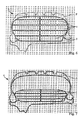
- Cellular elements 1, as illustrated on the figure 1 are formed from two sheets 11 and 12 constituting the walls of said cellular elements.
- the sheets 11 and 12 are made from a flexible material of small thickness, airtight and substantially inelastic and preferably heat sealable.
- Sheets formed from a stack of Polypropylene / EVOH / Polypropylene or Polypropylene / Polyamide / EVOH / Polyamide / Polypropylene layers have given good results. They also have the property of being heat-sealable, which facilitates the production of cells on an industrial scale. Welding is localized and releases a negligible amount of heat and insufficient to substantially change the chemical balance of the component disposed within the cell element.
- the sheets are welded together by longitudinal welds Si and by transverse welds S t .
- the longitudinal and transverse directions being marked respectively by the arrows L and T.
- a determined amount of the chemical composition C is deposited in each cell before proceeding to their complete closure.
- An assembly of cellular elements juxtaposed with each other is then obtained. Due to the low heat dissipation of the weld, there is no risk of initiating the chemical reaction or the phase change of the chemical composition during this operation.
- the size of the cells which is directly determined by the spacing of the welds, is chosen so that their unit volume is much smaller than the volume of the interior space of the tire P. This volume can vary from a few cm 3 to a few tens of cm 3 . Typically, good results have been obtained with cells of a volume of about 75 cm 3 , which has led to spacing longitudinal welds S 1 of 8 cm and transverse welds S t of 4 cm. These values are given for information only, and it goes without saying that it is also possible to choose smaller or larger dimensions depending on the size of the tire in which it is desired to dispose these cellular elements.
- the cell elements could be detached from each other so as to obtain unit cell elements.
- assemblies of cellular elements by producing strips of a given width in the transverse direction and of great length in the longitudinal direction. These very thin strips can be handled easily and are flexible enough to be wound on reels easy to store and distribute.
- the strips are cut into sections of a length determined according to the circumference of the rim J and the tire P in which it is sought to introduce said section.
- This section is wound on the inside of the tire on one or more turns, taking care, however, that the length wound at each turn corresponds to the circumference of the strip when the cellular elements are deployed under the effect of the formation of the gas. and the possible loss of accidental pressure in the tire P, and can take the maximum volume that they are intended to occupy.
- the layer of cell elements arranged radially outwardly is intended to be placed on a circumference substantially equal to the circumference of the inner portion of the tire P located under the tread, while the layer in contact with the rim J will remain substantially in the same position.
- An alternative to the method of implementation described above is to take in the continuous strip a portion of a length corresponding to the maximum circumference of the layer of cells located on the radially closest portion of the tread when cellular elements occupy their maximum volume.
- the accordion section is folded along the longitudinal seams Si so as to obtain a section of the width of one or more cellular elements and comprising several layers arranged one above the other, as illustrated in FIG. figure 2 .
- this section is wound inside the tire, generally on one turn. It is also possible to abut, by thermo welding, the two ends of said section so as to make a ring of the desired circumference, which is available on the rim J before mounting the tire P.
- the assembly E consisting of the tire P, the rim J and comprising the cellular elements arranged in the interior space between the rim J and the tire P, can then be inflated to the operating pressure via the inflation valve V.
- the chemical composition C contained in the cells will turn into gas under the effect of the heat input, and cause the extension of the cellular elements until the pressure in the air the cells are in equilibrium with the inflation pressure or until the cellular elements occupy their maximum volume.
- the figure 4 shows the state of a set E once the interior space has been brought to the normal operating pressure, and in which the pressure inside the cells equilibrates with the inflation pressure. This necessitates adjusting the inflation pressure after having realized the increase in volume of the cellular elements so that the cells occupy only a fraction of the internal space of the tire P.
- a membrane M By arranging a membrane M on the radially outer layer of the cellular element assembly, as illustrated in FIG. figure 5 the cell elements are maintained.
- the elasticity of this membrane can be adjusted to also combat the effects of centrifugal force when the assembly E is rotated while allowing the cellular elements to expand to their maximum volume in case of accidental loss of pressure of the set E as illustrated in the figure 6 .
- the figure 7 illustrates the arrangement of cellular elements according to another preferred embodiment of the invention.
- the pressure inside the cell elements is greater than the inflation pressure, and the cells occupy their maximum volume once the chemical reaction or the phase change of the compound C is complete.
- This increase in volume has the effect of tensioning the walls of the cellular elements, and to provide sufficient radial and circumferential rigidity to the assembly so that it is not necessary, also because of the low weight of the walls opposite their tensile strength, to have a membrane M to fight against the effects of centrifugal force.
Landscapes
- Engineering & Computer Science (AREA)
- Mechanical Engineering (AREA)
- Tires In General (AREA)
- Laminated Bodies (AREA)
- Micro-Organisms Or Cultivation Processes Thereof (AREA)
- Check Valves (AREA)
- Medical Preparation Storing Or Oral Administration Devices (AREA)
- Medicines Containing Material From Animals Or Micro-Organisms (AREA)
Claims (22)
- Geschlossene Zellelemente (1), die zur Verwendung im Inneren einer Anordnung (E) bestimmt sind, die aus einem Rad gebildet ist, das eine Felge (J), die mit einem Auffüllventil (V) ausgestattet ist, umfasst, auf dem ein Reifen (P) montiert ist, wobei die Zellelemente (1) Wände aufweisen, die aus weichen Folien gebildet sind, welche von geringer Dicke sind und gasdicht sind (11, 12),
dadurch gekennzeichnet, dass sie eine vorgegebene Menge an einer chemischen Zusammensetzung (C) umgeben, die bei Raumtemperatur fest oder flüssig ist und in den gasförmigen Zustand übergeht, wenn sie auf eine Temperatur gebracht werden, die über der Raumtemperatur liegt. - Zellelemente nach Anspruch 1, wobei die chemische Zusammensetzung (C) bei einer Temperatur, die mindestens 20 °C über der Raumtemperatur liegt, in den gasförmigen Zustand übergeht.
- Zellelemente nach Anspruch 1, wobei die chemische Zusammensetzung (C) bei einer Temperatur zwischen 40 °C und 80 °C in den gasförmigen Zustand übergeht.
- Zellelemente nach einem der Ansprüche 1 bis 3, wobei die chemische Zusammensetzung (C) durch Phasenänderung in den gasförmigen Zustand übergeht.
- Zellelemente nach einem der Ansprüche 1 bis 3, wobei die chemische Zusammensetzung (C) durch Verschiebung eines chemischen Gleichgewichts in den gasförmigen Zustand übergeht.
- Zellelemente nach Anspruch 5, wobei der Übergang der chemischen Zusammensetzung (C) in den gasförmigen Zustand im Wesentlichen irreversibel ist.
- Zellelemente nach einem der Ansprüche 1 bis 6, wobei die chemische Zusammensetzung (C) eine Mischung aus Natron und Zitronensäure umfasst.
- Zellelemente nach einem der Ansprüche 1 bis 6, wobei die chemische Zusammensetzung (C) Ammoniumbicarbonat umfasst.
- Zellelemente nach einem der Ansprüche 1 bis 6, wobei die chemische Zusammensetzung (C) ein Produkt oder mehrere Produkte umfasst, das/die aus der Gruppe bestehend aus Azeton, Hexan, Ethylazetat oder Methylchlorid ausgewählt ist/sind.
- Zellelemente nach einem der Ansprüche 1 bis 9, wobei die Wände (11, 12) der Zellelemente (1) aus einem heißsiegelbaren Material gebildet sind.
- Zellelemente nach Anspruch 10, die aus mindestens zwei Folien (11, 12) gebildet sind, welche örtlich durch lineare, in der Längsrichtung (S1) und in der Querrichtung (St) angeordnete Schweißnähte zusammengefügt sind und eine Anordnung von dichten Fächern (1) abgrenzen, um so ein nachgiebiges Band mit geringer Dicke zu bilden.
- Geschlossene Zellelemente nach einem der Ansprüche 1 bis 11, wobei die Wände (11, 12) der Zellelemente (1) aus einem im Wesentlichen nicht elastischen Material gebildet sind.
- Geschlossene Zellelemente nach einem der Ansprüche 1 bis 11, wobei die Wände (11, 12) der Zellelemente (1) aus einem elastischen Material gebildet sind.
- Anordnung (E), die aus einer Felge (J), welche mit einem Auffüllventil (V) ausgestattet ist, gebildet ist, auf der ein Reifen (P) montiert ist,
dadurch gekennzeichnet, dass sie geschlossene Zellelemente (1) nach Anspruch 12 enthält, die im Innenraum angeordnet sind, der durch die Felge (J) und den Reifen (P) gebildet wird. - Anordnung (E) nach Anspruch 14, wobei das Volumen, das aus der Summe des Höchstvolumens von jedem der Zellelemente (1) gebildet ist, größer als das Innenvolumen ist, das durch die Felge (J) und die Innenfläche des Reifens (P) abgegrenzt ist.
- Anordnung (E) nach Anspruch 15, wobei die Menge der chemischen Verbindung (C) derart bestimmt wird, dass nach der chemischen Reaktion oder der Phasenänderung der chemischen Zusammensetzung (C), die zur Bildung einer vorgegebenen Anzahl an Gasmolen führt, das Gesamtvolumen, das vom Gas eingenommen wird, welches in der Gesamtheit der Zellelemente (1) enthalten ist, bei Arbeitsdruck und Arbeitstemperatur des Reifens (P) einem Bruchteil des gesamten Innenvolumens, das durch die Felge (J) und die Innenfläche des Reifens (P) abgegrenzt ist, entspricht.
- Anordnung (E) nach Anspruch 14, wobei das Volumen, das aus der Summe des Höchstvolumens von jedem der Zellelemente (1) gebildet ist, einem Bruchteil des Innenvolumens, das durch die Felge (J) und die Innenfläche des Reifens (P) abgegrenzt ist, entspricht.
- Anordnung (E) nach Anspruch 17, wobei die Menge der chemischen Verbindung (C) derart bestimmt wird, dass nach der chemischen Reaktion oder der Phasenänderung der chemischen Zusammensetzung (C), die zur Bildung einer vorgegebenen Anzahl an Gasmolen führt, der Druck des Gases, das in der Gesamtheit der Zellelemente enthalten ist, größer als der Arbeitsdruck des Reifens (P) ist.
- Anordnung (E), die aus einem Felgenrad (J), welches mit einem Auffüllventil (V) ausgestattet ist, gebildet ist, auf dem ein Reifen (P) montiert ist,
dadurch gekennzeichnet, dass sie geschlossene Zellelemente (1) nach Anspruch 13 enthält, die im Innenraum angeordnet sind, der durch die Felge (J) und den Reifen (P) gebildet wird. - Anordnung (E) nach Anspruch 19, wobei die Menge der chemischen Verbindung (C) derart bestimmt wird, dass nach der chemischen Reaktion oder der Phasenänderung der chemischen Zusammensetzung (C), die zur Bildung einer vorgegebenen Anzahl an Gasmolen führt, das Gesamtvolumen des Gases, das in der Gesamtheit der Zellelemente (1) enthalten ist, bei Arbeitsdruck und Arbeitstemperatur des Reifens (P) einem Bruchteil des gesamten Innenvolumens, das durch die Felge (J) und die Innenfläche des Reifens (P) abgegrenzt ist, entspricht.
- Anordnung (E) nach einem der Ansprüche 14 bis 20, wobei die Zellelemente (1) von einer elastischen Membran (M) gehalten werden, die auf diese Elemente eine Radialkraft ausübt, welche auf die Felge (J) gerichtet ist und ausreicht, um den Einwirkungen der Zentrifugalkraft entgegenzuwirken, wenn die Anordnung (E) in Drehung versetzt wird, und die sich unter der Einwirkung der Ausdehnung der Zellelemente entfaltet.
- Anordnung (E) nach einem der Ansprüche 14 bis 21, wobei die Zellelemente (1) aus einem einheitlichen Volumen sind, das weit unter dem Innenvolumen liegt, welches durch die Felge (J) und die Innenfläche des Reifens (P) abgegrenzt ist.
Applications Claiming Priority (1)
| Application Number | Priority Date | Filing Date | Title |
|---|---|---|---|
| FR0511928A FR2893536A1 (fr) | 2005-11-22 | 2005-11-22 | Systeme de roulage a plat comprenant des cellules autogonflantes |
Publications (2)
| Publication Number | Publication Date |
|---|---|
| EP1787828A1 EP1787828A1 (de) | 2007-05-23 |
| EP1787828B1 true EP1787828B1 (de) | 2009-02-18 |
Family
ID=36583838
Family Applications (1)
| Application Number | Title | Priority Date | Filing Date |
|---|---|---|---|
| EP06123778A Not-in-force EP1787828B1 (de) | 2005-11-22 | 2006-11-09 | Notlaufsystem, das selbstaufblasbare Zellen enthält. |
Country Status (8)
| Country | Link |
|---|---|
| US (1) | US20070113945A1 (de) |
| EP (1) | EP1787828B1 (de) |
| JP (1) | JP5189284B2 (de) |
| CN (1) | CN1970321B (de) |
| AT (1) | ATE423023T1 (de) |
| BR (1) | BRPI0604827A (de) |
| DE (1) | DE602006005204D1 (de) |
| FR (1) | FR2893536A1 (de) |
Families Citing this family (10)
| Publication number | Priority date | Publication date | Assignee | Title |
|---|---|---|---|---|
| DE602007009655D1 (de) * | 2006-03-20 | 2010-11-18 | Liang Fan | Explosionssicheres reserverad in einem reifen |
| ES2334301B1 (es) * | 2007-11-30 | 2011-05-16 | Sebastian Molina Espinosa | Rueda auto-reparable. |
| ITRM20080055A1 (it) * | 2008-01-31 | 2009-08-01 | Cynthia Bisogni | Pneumatico con camera d'aria interna d'emergenza |
| CN102815171A (zh) * | 2011-06-10 | 2012-12-12 | 周颖 | 一种自充气式防爆轮胎 |
| US10717328B2 (en) * | 2014-02-21 | 2020-07-21 | Hutchinson S.A. | System including pressurized load cells |
| CN104648050A (zh) * | 2015-01-06 | 2015-05-27 | 韦顺凯 | 一种防止汽车轮胎爆胎的方法 |
| FR3066197B1 (fr) | 2017-05-11 | 2020-05-15 | Arkema France | Composition a base de peba et son utilisation pour la fabrication d'un objet transparent resistant a la fatigue |
| WO2020252758A1 (zh) * | 2019-06-21 | 2020-12-24 | 龙台工业股份有限公司 | 复合轮圈制程 |
| CN112277536B (zh) * | 2019-12-05 | 2023-09-01 | 怀化沃普环保科技有限公司 | 一种受限式组合防爆装置 |
| CN114734756A (zh) * | 2022-04-29 | 2022-07-12 | 季华实验室 | 换热轮胎及车辆 |
Family Cites Families (10)
| Publication number | Priority date | Publication date | Assignee | Title |
|---|---|---|---|---|
| US852130A (en) * | 1906-04-20 | 1907-04-30 | Frank A Magowan | Process of making rubber articles. |
| DE1953824A1 (de) * | 1969-10-25 | 1971-05-06 | Continental Gummi Werke Ag | Sicherheitseinlage fuer Luftbereifungen |
| JPS5141721B2 (de) * | 1971-10-16 | 1976-11-11 | ||
| IT1079133B (it) * | 1976-06-28 | 1985-05-08 | Pirelli | Struttura elasticamente deformabile per pneumatici di sicurezza |
| GB2329160B (en) * | 1997-09-13 | 2001-11-28 | Sumitomo Rubber Ind | Accommodating pressure loss in tyre and wheel assemblies |
| US6132694A (en) * | 1997-12-16 | 2000-10-17 | The United States Of America As Represented By The Administrator Of The National Aeronautics And Space Administration | Catalyst for oxidation of volatile organic compounds |
| US6510875B2 (en) * | 1999-07-14 | 2003-01-28 | Pennzoil | Inflating device and method of use |
| JP2002087028A (ja) * | 2000-09-19 | 2002-03-26 | Bridgestone Corp | 空気入り安全タイヤ |
| US20030019553A1 (en) * | 2001-07-27 | 2003-01-30 | Yun Song Moon | Run-flat system for pneumatic tires utilizing air-filled elastic balls |
| JP4508535B2 (ja) * | 2002-06-18 | 2010-07-21 | 株式会社ブリヂストン | 安全タイヤおよび安全タイヤ用中子 |
-
2005
- 2005-11-22 FR FR0511928A patent/FR2893536A1/fr active Pending
-
2006
- 2006-11-09 EP EP06123778A patent/EP1787828B1/de not_active Not-in-force
- 2006-11-09 DE DE602006005204T patent/DE602006005204D1/de active Active
- 2006-11-09 AT AT06123778T patent/ATE423023T1/de not_active IP Right Cessation
- 2006-11-22 US US11/603,644 patent/US20070113945A1/en not_active Abandoned
- 2006-11-22 BR BRPI0604827-7A patent/BRPI0604827A/pt not_active IP Right Cessation
- 2006-11-22 CN CN2006101486686A patent/CN1970321B/zh not_active Expired - Fee Related
- 2006-11-22 JP JP2006343543A patent/JP5189284B2/ja not_active Expired - Fee Related
Also Published As
| Publication number | Publication date |
|---|---|
| ATE423023T1 (de) | 2009-03-15 |
| FR2893536A1 (fr) | 2007-05-25 |
| EP1787828A1 (de) | 2007-05-23 |
| BRPI0604827A (pt) | 2007-09-04 |
| DE602006005204D1 (de) | 2009-04-02 |
| US20070113945A1 (en) | 2007-05-24 |
| JP5189284B2 (ja) | 2013-04-24 |
| CN1970321B (zh) | 2010-12-08 |
| JP2007145324A (ja) | 2007-06-14 |
| CN1970321A (zh) | 2007-05-30 |
Similar Documents
| Publication | Publication Date | Title |
|---|---|---|
| EP1787828B1 (de) | Notlaufsystem, das selbstaufblasbare Zellen enthält. | |
| EP0184262B1 (de) | Steuerbarer aerostatischer Ballon | |
| CA1218021A (fr) | Reacteur et installation d'epuration par adsorption | |
| CA1111646A (fr) | Mottes de culture | |
| FR2780945A1 (fr) | Ballon surpressurise et procede de fabrication d'un tel ballon | |
| EP1727501A1 (de) | Mit beutel versehener intragastrischer ballon mit einem verschlusselement, das auf verbesserte weise an den beuteln angeordnet ist | |
| EP0746507A1 (de) | Dichtes behältnis, verfahren zu seiner herstellung, verfahren zu seiner befüllung mit einer flüssigkeit | |
| WO2007093717A2 (fr) | Ballon intra-gastrique a memoire de forme | |
| FR2862525A1 (fr) | Ballon intra-gastrique presentant un ecran barriere aux gaz, procede de fabrication correspondant et utilisation de polymeres a effet barriere aux gaz pour fabriquer un tel ballon | |
| WO2008065280A2 (fr) | Perfectionnement d'un procede de fabrication de tubes souples lamines | |
| WO2010125304A1 (fr) | Dispositif de conditionnement et de distribution du type flacon-poche | |
| CA2720457C (fr) | Procede de fabrication de tubes par soudage | |
| EP1720495B1 (de) | Magenballon mit verbessertem formmittel und erhöhter mechanischer festigketi | |
| FR2555552A1 (fr) | Feuille composite comportant un ensemble de poches perforees, et leur utilisation dans un procede pour regler la vitesse de degagement d'un gaz pour conservation d'aliments | |
| FR2468502A1 (fr) | Ballon capable de flotter indefiniment dans l'air | |
| LU82938A1 (fr) | Element a membrane pour osmose inverse enroule en spirale | |
| EP0234156A1 (de) | Rohrförmiges Gefüge, welches ein gefaltetes Flachband enthält | |
| EP2513289B1 (de) | Kartonfreie verpackung von festen hefeprodukten | |
| EP2002738B1 (de) | Aufbereitungsverfahren von geformten Blättern in einem Material, das Tabak enthält, und so durchgeführtes Aufbereitungsverfahren | |
| FR2927616A1 (fr) | Systeme de conditionnement pour fromage tartinable et procede de fabrication de ce systeme | |
| EP1657180A1 (de) | Verbesserungen an mehrschichtige Papiersäcke mit einem luftdichten Film oder ähnliches der zwischen zwei Papierschichten angeordnet ist | |
| EP2351643B1 (de) | Verfahren zur Herstellung eines flexiblen Behälters zum medizinischen Einsatz | |
| FR2778645A1 (fr) | Produit d'emballage en feuille comportant des graines de mais eclatees et procede d'obtention | |
| CH287062A (fr) | Paroi auto-obturatrice, notamment pour bandages pneumatiques, et procédé de fabrication de cette paroi. | |
| WO2026002933A1 (fr) | Ensemble gonflable formant couverture pour etendue d'eau |
Legal Events
| Date | Code | Title | Description |
|---|---|---|---|
| PUAI | Public reference made under article 153(3) epc to a published international application that has entered the european phase |
Free format text: ORIGINAL CODE: 0009012 |
|
| AK | Designated contracting states |
Kind code of ref document: A1 Designated state(s): AT BE BG CH CY CZ DE DK EE ES FI FR GB GR HU IE IS IT LI LT LU LV MC NL PL PT RO SE SI SK TR |
|
| AX | Request for extension of the european patent |
Extension state: AL BA HR MK YU |
|
| 17P | Request for examination filed |
Effective date: 20071123 |
|
| AKX | Designation fees paid |
Designated state(s): AT BE BG CH CY CZ DE DK EE ES FI FR GB GR HU IE IS IT LI LT LU LV MC NL PL PT RO SE SI SK TR |
|
| GRAP | Despatch of communication of intention to grant a patent |
Free format text: ORIGINAL CODE: EPIDOSNIGR1 |
|
| GRAS | Grant fee paid |
Free format text: ORIGINAL CODE: EPIDOSNIGR3 |
|
| GRAA | (expected) grant |
Free format text: ORIGINAL CODE: 0009210 |
|
| AK | Designated contracting states |
Kind code of ref document: B1 Designated state(s): AT BE BG CH CY CZ DE DK EE ES FI FR GB GR HU IE IS IT LI LT LU LV MC NL PL PT RO SE SI SK TR |
|
| REG | Reference to a national code |
Ref country code: GB Ref legal event code: FG4D Free format text: NOT ENGLISH |
|
| REG | Reference to a national code |
Ref country code: CH Ref legal event code: EP |
|
| REG | Reference to a national code |
Ref country code: IE Ref legal event code: FG4D Free format text: LANGUAGE OF EP DOCUMENT: FRENCH |
|
| REF | Corresponds to: |
Ref document number: 602006005204 Country of ref document: DE Date of ref document: 20090402 Kind code of ref document: P |
|
| PG25 | Lapsed in a contracting state [announced via postgrant information from national office to epo] |
Ref country code: SI Free format text: LAPSE BECAUSE OF FAILURE TO SUBMIT A TRANSLATION OF THE DESCRIPTION OR TO PAY THE FEE WITHIN THE PRESCRIBED TIME-LIMIT Effective date: 20090218 Ref country code: NL Free format text: LAPSE BECAUSE OF FAILURE TO SUBMIT A TRANSLATION OF THE DESCRIPTION OR TO PAY THE FEE WITHIN THE PRESCRIBED TIME-LIMIT Effective date: 20090218 Ref country code: LT Free format text: LAPSE BECAUSE OF FAILURE TO SUBMIT A TRANSLATION OF THE DESCRIPTION OR TO PAY THE FEE WITHIN THE PRESCRIBED TIME-LIMIT Effective date: 20090218 Ref country code: FI Free format text: LAPSE BECAUSE OF FAILURE TO SUBMIT A TRANSLATION OF THE DESCRIPTION OR TO PAY THE FEE WITHIN THE PRESCRIBED TIME-LIMIT Effective date: 20090218 Ref country code: ES Free format text: LAPSE BECAUSE OF FAILURE TO SUBMIT A TRANSLATION OF THE DESCRIPTION OR TO PAY THE FEE WITHIN THE PRESCRIBED TIME-LIMIT Effective date: 20090529 |
|
| NLV1 | Nl: lapsed or annulled due to failure to fulfill the requirements of art. 29p and 29m of the patents act | ||
| PG25 | Lapsed in a contracting state [announced via postgrant information from national office to epo] |
Ref country code: IS Free format text: LAPSE BECAUSE OF FAILURE TO SUBMIT A TRANSLATION OF THE DESCRIPTION OR TO PAY THE FEE WITHIN THE PRESCRIBED TIME-LIMIT Effective date: 20090618 Ref country code: AT Free format text: LAPSE BECAUSE OF FAILURE TO SUBMIT A TRANSLATION OF THE DESCRIPTION OR TO PAY THE FEE WITHIN THE PRESCRIBED TIME-LIMIT Effective date: 20090218 Ref country code: SE Free format text: LAPSE BECAUSE OF FAILURE TO SUBMIT A TRANSLATION OF THE DESCRIPTION OR TO PAY THE FEE WITHIN THE PRESCRIBED TIME-LIMIT Effective date: 20090518 Ref country code: LV Free format text: LAPSE BECAUSE OF FAILURE TO SUBMIT A TRANSLATION OF THE DESCRIPTION OR TO PAY THE FEE WITHIN THE PRESCRIBED TIME-LIMIT Effective date: 20090218 Ref country code: PL Free format text: LAPSE BECAUSE OF FAILURE TO SUBMIT A TRANSLATION OF THE DESCRIPTION OR TO PAY THE FEE WITHIN THE PRESCRIBED TIME-LIMIT Effective date: 20090218 |
|
| REG | Reference to a national code |
Ref country code: IE Ref legal event code: FD4D |
|
| PG25 | Lapsed in a contracting state [announced via postgrant information from national office to epo] |
Ref country code: DK Free format text: LAPSE BECAUSE OF FAILURE TO SUBMIT A TRANSLATION OF THE DESCRIPTION OR TO PAY THE FEE WITHIN THE PRESCRIBED TIME-LIMIT Effective date: 20090218 Ref country code: EE Free format text: LAPSE BECAUSE OF FAILURE TO SUBMIT A TRANSLATION OF THE DESCRIPTION OR TO PAY THE FEE WITHIN THE PRESCRIBED TIME-LIMIT Effective date: 20090218 Ref country code: CZ Free format text: LAPSE BECAUSE OF FAILURE TO SUBMIT A TRANSLATION OF THE DESCRIPTION OR TO PAY THE FEE WITHIN THE PRESCRIBED TIME-LIMIT Effective date: 20090218 Ref country code: PT Free format text: LAPSE BECAUSE OF FAILURE TO SUBMIT A TRANSLATION OF THE DESCRIPTION OR TO PAY THE FEE WITHIN THE PRESCRIBED TIME-LIMIT Effective date: 20090727 Ref country code: IE Free format text: LAPSE BECAUSE OF FAILURE TO SUBMIT A TRANSLATION OF THE DESCRIPTION OR TO PAY THE FEE WITHIN THE PRESCRIBED TIME-LIMIT Effective date: 20090218 |
|
| PG25 | Lapsed in a contracting state [announced via postgrant information from national office to epo] |
Ref country code: RO Free format text: LAPSE BECAUSE OF FAILURE TO SUBMIT A TRANSLATION OF THE DESCRIPTION OR TO PAY THE FEE WITHIN THE PRESCRIBED TIME-LIMIT Effective date: 20090218 Ref country code: SK Free format text: LAPSE BECAUSE OF FAILURE TO SUBMIT A TRANSLATION OF THE DESCRIPTION OR TO PAY THE FEE WITHIN THE PRESCRIBED TIME-LIMIT Effective date: 20090218 |
|
| PLBE | No opposition filed within time limit |
Free format text: ORIGINAL CODE: 0009261 |
|
| STAA | Information on the status of an ep patent application or granted ep patent |
Free format text: STATUS: NO OPPOSITION FILED WITHIN TIME LIMIT |
|
| 26N | No opposition filed |
Effective date: 20091119 |
|
| PG25 | Lapsed in a contracting state [announced via postgrant information from national office to epo] |
Ref country code: BG Free format text: LAPSE BECAUSE OF FAILURE TO SUBMIT A TRANSLATION OF THE DESCRIPTION OR TO PAY THE FEE WITHIN THE PRESCRIBED TIME-LIMIT Effective date: 20090518 |
|
| BERE | Be: lapsed |
Owner name: MICHELIN RECHERCHE ET TECHNIQUE S.A. Effective date: 20091130 Owner name: SOC. DE TECHNOLOGIE MICHELIN Effective date: 20091130 |
|
| PG25 | Lapsed in a contracting state [announced via postgrant information from national office to epo] |
Ref country code: MC Free format text: LAPSE BECAUSE OF NON-PAYMENT OF DUE FEES Effective date: 20091130 |
|
| PG25 | Lapsed in a contracting state [announced via postgrant information from national office to epo] |
Ref country code: GR Free format text: LAPSE BECAUSE OF FAILURE TO SUBMIT A TRANSLATION OF THE DESCRIPTION OR TO PAY THE FEE WITHIN THE PRESCRIBED TIME-LIMIT Effective date: 20090519 Ref country code: BE Free format text: LAPSE BECAUSE OF NON-PAYMENT OF DUE FEES Effective date: 20091130 |
|
| PG25 | Lapsed in a contracting state [announced via postgrant information from national office to epo] |
Ref country code: LU Free format text: LAPSE BECAUSE OF NON-PAYMENT OF DUE FEES Effective date: 20091109 |
|
| PG25 | Lapsed in a contracting state [announced via postgrant information from national office to epo] |
Ref country code: HU Free format text: LAPSE BECAUSE OF FAILURE TO SUBMIT A TRANSLATION OF THE DESCRIPTION OR TO PAY THE FEE WITHIN THE PRESCRIBED TIME-LIMIT Effective date: 20090819 |
|
| REG | Reference to a national code |
Ref country code: CH Ref legal event code: PL |
|
| GBPC | Gb: european patent ceased through non-payment of renewal fee |
Effective date: 20101109 |
|
| PG25 | Lapsed in a contracting state [announced via postgrant information from national office to epo] |
Ref country code: CH Free format text: LAPSE BECAUSE OF NON-PAYMENT OF DUE FEES Effective date: 20101130 Ref country code: LI Free format text: LAPSE BECAUSE OF NON-PAYMENT OF DUE FEES Effective date: 20101130 |
|
| PG25 | Lapsed in a contracting state [announced via postgrant information from national office to epo] |
Ref country code: TR Free format text: LAPSE BECAUSE OF FAILURE TO SUBMIT A TRANSLATION OF THE DESCRIPTION OR TO PAY THE FEE WITHIN THE PRESCRIBED TIME-LIMIT Effective date: 20090218 |
|
| PG25 | Lapsed in a contracting state [announced via postgrant information from national office to epo] |
Ref country code: CY Free format text: LAPSE BECAUSE OF FAILURE TO SUBMIT A TRANSLATION OF THE DESCRIPTION OR TO PAY THE FEE WITHIN THE PRESCRIBED TIME-LIMIT Effective date: 20090218 |
|
| PG25 | Lapsed in a contracting state [announced via postgrant information from national office to epo] |
Ref country code: GB Free format text: LAPSE BECAUSE OF NON-PAYMENT OF DUE FEES Effective date: 20101109 |
|
| PGFP | Annual fee paid to national office [announced via postgrant information from national office to epo] |
Ref country code: DE Payment date: 20121121 Year of fee payment: 7 Ref country code: FR Payment date: 20121130 Year of fee payment: 7 |
|
| PGFP | Annual fee paid to national office [announced via postgrant information from national office to epo] |
Ref country code: IT Payment date: 20121121 Year of fee payment: 7 |
|
| REG | Reference to a national code |
Ref country code: FR Ref legal event code: ST Effective date: 20140731 |
|
| PG25 | Lapsed in a contracting state [announced via postgrant information from national office to epo] |
Ref country code: DE Free format text: LAPSE BECAUSE OF NON-PAYMENT OF DUE FEES Effective date: 20140603 Ref country code: IT Free format text: LAPSE BECAUSE OF NON-PAYMENT OF DUE FEES Effective date: 20131109 |
|
| REG | Reference to a national code |
Ref country code: DE Ref legal event code: R119 Ref document number: 602006005204 Country of ref document: DE Effective date: 20140603 |
|
| PG25 | Lapsed in a contracting state [announced via postgrant information from national office to epo] |
Ref country code: FR Free format text: LAPSE BECAUSE OF NON-PAYMENT OF DUE FEES Effective date: 20131202 |