EP1783852A2 - Separatordispersion für Li-Polymer-Batterien - Google Patents
Separatordispersion für Li-Polymer-Batterien Download PDFInfo
- Publication number
- EP1783852A2 EP1783852A2 EP07103829A EP07103829A EP1783852A2 EP 1783852 A2 EP1783852 A2 EP 1783852A2 EP 07103829 A EP07103829 A EP 07103829A EP 07103829 A EP07103829 A EP 07103829A EP 1783852 A2 EP1783852 A2 EP 1783852A2
- Authority
- EP
- European Patent Office
- Prior art keywords
- separator
- dispersion
- anode
- cathode
- lithium
- Prior art date
- Legal status (The legal status is an assumption and is not a legal conclusion. Google has not performed a legal analysis and makes no representation as to the accuracy of the status listed.)
- Granted
Links
- 239000006185 dispersion Substances 0.000 title claims abstract description 42
- 229920000642 polymer Polymers 0.000 claims abstract description 34
- 150000003839 salts Chemical class 0.000 claims description 21
- 239000000010 aprotic solvent Substances 0.000 claims description 8
- 239000002245 particle Substances 0.000 claims description 6
- 229910044991 metal oxide Inorganic materials 0.000 claims description 4
- 150000004706 metal oxides Chemical class 0.000 claims description 4
- 229910018072 Al 2 O 3 Inorganic materials 0.000 claims description 2
- 239000013385 inorganic framework Substances 0.000 claims 1
- 239000000126 substance Substances 0.000 claims 1
- 238000004519 manufacturing process Methods 0.000 abstract description 13
- WHXSMMKQMYFTQS-UHFFFAOYSA-N Lithium Chemical compound [Li] WHXSMMKQMYFTQS-UHFFFAOYSA-N 0.000 abstract description 11
- 229910052744 lithium Inorganic materials 0.000 abstract description 11
- 239000011248 coating agent Substances 0.000 abstract description 3
- 238000000576 coating method Methods 0.000 abstract description 3
- 238000010030 laminating Methods 0.000 abstract description 2
- KMTRUDSVKNLOMY-UHFFFAOYSA-N Ethylene carbonate Chemical compound O=C1OCCO1 KMTRUDSVKNLOMY-UHFFFAOYSA-N 0.000 description 12
- BQCIDUSAKPWEOX-UHFFFAOYSA-N 1,1-Difluoroethene Chemical compound FC(F)=C BQCIDUSAKPWEOX-UHFFFAOYSA-N 0.000 description 11
- 229920006370 Kynar Polymers 0.000 description 11
- CPLXHLVBOLITMK-UHFFFAOYSA-N Magnesium oxide Chemical compound [Mg]=O CPLXHLVBOLITMK-UHFFFAOYSA-N 0.000 description 10
- RUOJZAUFBMNUDX-UHFFFAOYSA-N propylene carbonate Chemical compound CC1COC(=O)O1 RUOJZAUFBMNUDX-UHFFFAOYSA-N 0.000 description 10
- -1 polypropylene Polymers 0.000 description 9
- 229910013870 LiPF 6 Inorganic materials 0.000 description 8
- 239000010406 cathode material Substances 0.000 description 8
- 238000000034 method Methods 0.000 description 8
- 239000002904 solvent Substances 0.000 description 8
- 239000000463 material Substances 0.000 description 7
- 239000002033 PVDF binder Substances 0.000 description 6
- 239000000654 additive Substances 0.000 description 6
- 239000002131 composite material Substances 0.000 description 6
- IEJIGPNLZYLLBP-UHFFFAOYSA-N dimethyl carbonate Chemical compound COC(=O)OC IEJIGPNLZYLLBP-UHFFFAOYSA-N 0.000 description 6
- 229920002981 polyvinylidene fluoride Polymers 0.000 description 6
- 238000002360 preparation method Methods 0.000 description 6
- 239000010405 anode material Substances 0.000 description 5
- 239000011888 foil Substances 0.000 description 5
- ODINCKMPIJJUCX-UHFFFAOYSA-N Calcium oxide Chemical compound [Ca]=O ODINCKMPIJJUCX-UHFFFAOYSA-N 0.000 description 4
- XTHFKEDIFFGKHM-UHFFFAOYSA-N Dimethoxyethane Chemical compound COCCOC XTHFKEDIFFGKHM-UHFFFAOYSA-N 0.000 description 4
- 239000004743 Polypropylene Substances 0.000 description 4
- 229920002313 fluoropolymer Polymers 0.000 description 4
- 239000004811 fluoropolymer Substances 0.000 description 4
- 239000012528 membrane Substances 0.000 description 4
- 238000003756 stirring Methods 0.000 description 4
- 239000012300 argon atmosphere Substances 0.000 description 3
- 239000010949 copper Substances 0.000 description 3
- 239000003792 electrolyte Substances 0.000 description 3
- 239000010445 mica Substances 0.000 description 3
- 229910052618 mica group Inorganic materials 0.000 description 3
- 235000011837 pasties Nutrition 0.000 description 3
- 150000004760 silicates Chemical class 0.000 description 3
- 239000007858 starting material Substances 0.000 description 3
- BTBUEUYNUDRHOZ-UHFFFAOYSA-N Borate Chemical compound [O-]B([O-])[O-] BTBUEUYNUDRHOZ-UHFFFAOYSA-N 0.000 description 2
- RYGMFSIKBFXOCR-UHFFFAOYSA-N Copper Chemical compound [Cu] RYGMFSIKBFXOCR-UHFFFAOYSA-N 0.000 description 2
- OIFBSDVPJOWBCH-UHFFFAOYSA-N Diethyl carbonate Chemical compound CCOC(=O)OCC OIFBSDVPJOWBCH-UHFFFAOYSA-N 0.000 description 2
- LYCAIKOWRPUZTN-UHFFFAOYSA-N Ethylene glycol Chemical compound OCCO LYCAIKOWRPUZTN-UHFFFAOYSA-N 0.000 description 2
- 229920001774 Perfluoroether Polymers 0.000 description 2
- 125000005910 alkyl carbonate group Chemical group 0.000 description 2
- 125000000217 alkyl group Chemical group 0.000 description 2
- 229910052782 aluminium Inorganic materials 0.000 description 2
- XAGFODPZIPBFFR-UHFFFAOYSA-N aluminium Chemical compound [Al] XAGFODPZIPBFFR-UHFFFAOYSA-N 0.000 description 2
- 239000003795 chemical substances by application Substances 0.000 description 2
- 238000005562 fading Methods 0.000 description 2
- 229920001973 fluoroelastomer Polymers 0.000 description 2
- 239000011245 gel electrolyte Substances 0.000 description 2
- KWGKDLIKAYFUFQ-UHFFFAOYSA-M lithium chloride Chemical compound [Li+].[Cl-] KWGKDLIKAYFUFQ-UHFFFAOYSA-M 0.000 description 2
- 239000002931 mesocarbon microbead Substances 0.000 description 2
- 229910052751 metal Inorganic materials 0.000 description 2
- 239000002184 metal Substances 0.000 description 2
- 229910001092 metal group alloy Inorganic materials 0.000 description 2
- 150000002739 metals Chemical class 0.000 description 2
- 239000000203 mixture Substances 0.000 description 2
- 229920000570 polyether Polymers 0.000 description 2
- 229920005596 polymer binder Polymers 0.000 description 2
- 239000002491 polymer binding agent Substances 0.000 description 2
- 229920001155 polypropylene Polymers 0.000 description 2
- 229920000036 polyvinylpyrrolidone Polymers 0.000 description 2
- 235000013855 polyvinylpyrrolidone Nutrition 0.000 description 2
- 230000008961 swelling Effects 0.000 description 2
- 229920001897 terpolymer Polymers 0.000 description 2
- 229910052902 vermiculite Inorganic materials 0.000 description 2
- 239000010455 vermiculite Substances 0.000 description 2
- 235000019354 vermiculite Nutrition 0.000 description 2
- 239000010457 zeolite Substances 0.000 description 2
- LQIAZOCLNBBZQK-UHFFFAOYSA-N 1-(1,2-Diphosphanylethyl)pyrrolidin-2-one Chemical compound PCC(P)N1CCCC1=O LQIAZOCLNBBZQK-UHFFFAOYSA-N 0.000 description 1
- VGGSQFUCUMXWEO-UHFFFAOYSA-N Ethene Chemical compound C=C VGGSQFUCUMXWEO-UHFFFAOYSA-N 0.000 description 1
- 239000005977 Ethylene Substances 0.000 description 1
- 101000713585 Homo sapiens Tubulin beta-4A chain Proteins 0.000 description 1
- 229910013684 LiClO 4 Inorganic materials 0.000 description 1
- HBBGRARXTFLTSG-UHFFFAOYSA-N Lithium ion Chemical compound [Li+] HBBGRARXTFLTSG-UHFFFAOYSA-N 0.000 description 1
- 229910019142 PO4 Inorganic materials 0.000 description 1
- 239000004721 Polyphenylene oxide Substances 0.000 description 1
- DNIAPMSPPWPWGF-UHFFFAOYSA-N Propylene glycol Chemical class CC(O)CO DNIAPMSPPWPWGF-UHFFFAOYSA-N 0.000 description 1
- 229910004298 SiO 2 Inorganic materials 0.000 description 1
- 229920002472 Starch Polymers 0.000 description 1
- 229910010413 TiO 2 Inorganic materials 0.000 description 1
- RTAQQCXQSZGOHL-UHFFFAOYSA-N Titanium Chemical compound [Ti] RTAQQCXQSZGOHL-UHFFFAOYSA-N 0.000 description 1
- 102100036788 Tubulin beta-4A chain Human genes 0.000 description 1
- 229910021536 Zeolite Inorganic materials 0.000 description 1
- 230000000996 additive effect Effects 0.000 description 1
- WYTGDNHDOZPMIW-RCBQFDQVSA-N alstonine Natural products C1=CC2=C3C=CC=CC3=NC2=C2N1C[C@H]1[C@H](C)OC=C(C(=O)OC)[C@H]1C2 WYTGDNHDOZPMIW-RCBQFDQVSA-N 0.000 description 1
- CNLWCVNCHLKFHK-UHFFFAOYSA-N aluminum;lithium;dioxido(oxo)silane Chemical compound [Li+].[Al+3].[O-][Si]([O-])=O.[O-][Si]([O-])=O CNLWCVNCHLKFHK-UHFFFAOYSA-N 0.000 description 1
- 229910021383 artificial graphite Inorganic materials 0.000 description 1
- 239000012298 atmosphere Substances 0.000 description 1
- 239000000440 bentonite Substances 0.000 description 1
- 229910000278 bentonite Inorganic materials 0.000 description 1
- SVPXDRXYRYOSEX-UHFFFAOYSA-N bentoquatam Chemical compound O.O=[Si]=O.O=[Al]O[Al]=O SVPXDRXYRYOSEX-UHFFFAOYSA-N 0.000 description 1
- 150000001642 boronic acid derivatives Chemical class 0.000 description 1
- 239000006229 carbon black Substances 0.000 description 1
- 230000015556 catabolic process Effects 0.000 description 1
- 230000000052 comparative effect Effects 0.000 description 1
- 150000001875 compounds Chemical class 0.000 description 1
- 239000004020 conductor Substances 0.000 description 1
- 229920001577 copolymer Polymers 0.000 description 1
- 229910052802 copper Inorganic materials 0.000 description 1
- 239000011889 copper foil Substances 0.000 description 1
- 229910052607 cyclosilicate Inorganic materials 0.000 description 1
- GUJOJGAPFQRJSV-UHFFFAOYSA-N dialuminum;dioxosilane;oxygen(2-);hydrate Chemical compound O.[O-2].[O-2].[O-2].[Al+3].[Al+3].O=[Si]=O.O=[Si]=O.O=[Si]=O.O=[Si]=O GUJOJGAPFQRJSV-UHFFFAOYSA-N 0.000 description 1
- 150000005686 dimethyl carbonates Chemical class 0.000 description 1
- 125000000118 dimethyl group Chemical group [H]C([H])([H])* 0.000 description 1
- HNPSIPDUKPIQMN-UHFFFAOYSA-N dioxosilane;oxo(oxoalumanyloxy)alumane Chemical compound O=[Si]=O.O=[Al]O[Al]=O HNPSIPDUKPIQMN-UHFFFAOYSA-N 0.000 description 1
- 238000007599 discharging Methods 0.000 description 1
- 229920001971 elastomer Polymers 0.000 description 1
- 239000007772 electrode material Substances 0.000 description 1
- RTZKZFJDLAIYFH-UHFFFAOYSA-N ether Substances CCOCC RTZKZFJDLAIYFH-UHFFFAOYSA-N 0.000 description 1
- 230000007717 exclusion Effects 0.000 description 1
- 238000002474 experimental method Methods 0.000 description 1
- 238000001125 extrusion Methods 0.000 description 1
- 229910052839 forsterite Inorganic materials 0.000 description 1
- 239000007789 gas Substances 0.000 description 1
- 150000002334 glycols Chemical class 0.000 description 1
- HCDGVLDPFQMKDK-UHFFFAOYSA-N hexafluoropropylene Chemical group FC(F)=C(F)C(F)(F)F HCDGVLDPFQMKDK-UHFFFAOYSA-N 0.000 description 1
- 125000002887 hydroxy group Chemical group [H]O* 0.000 description 1
- WGCNASOHLSPBMP-UHFFFAOYSA-N hydroxyacetaldehyde Natural products OCC=O WGCNASOHLSPBMP-UHFFFAOYSA-N 0.000 description 1
- 239000011261 inert gas Substances 0.000 description 1
- 150000002484 inorganic compounds Chemical class 0.000 description 1
- 229910010272 inorganic material Inorganic materials 0.000 description 1
- 239000011147 inorganic material Substances 0.000 description 1
- 230000037427 ion transport Effects 0.000 description 1
- NLYAJNPCOHFWQQ-UHFFFAOYSA-N kaolin Chemical compound O.O.O=[Al]O[Si](=O)O[Si](=O)O[Al]=O NLYAJNPCOHFWQQ-UHFFFAOYSA-N 0.000 description 1
- 229910052622 kaolinite Inorganic materials 0.000 description 1
- 229910001416 lithium ion Inorganic materials 0.000 description 1
- MCVFFRWZNYZUIJ-UHFFFAOYSA-M lithium;trifluoromethanesulfonate Chemical compound [Li+].[O-]S(=O)(=O)C(F)(F)F MCVFFRWZNYZUIJ-UHFFFAOYSA-M 0.000 description 1
- HCWCAKKEBCNQJP-UHFFFAOYSA-N magnesium orthosilicate Chemical compound [Mg+2].[Mg+2].[O-][Si]([O-])([O-])[O-] HCWCAKKEBCNQJP-UHFFFAOYSA-N 0.000 description 1
- VNWKTOKETHGBQD-UHFFFAOYSA-N methane Chemical compound C VNWKTOKETHGBQD-UHFFFAOYSA-N 0.000 description 1
- 229910052901 montmorillonite Inorganic materials 0.000 description 1
- 150000002894 organic compounds Chemical class 0.000 description 1
- 230000035699 permeability Effects 0.000 description 1
- 235000021317 phosphate Nutrition 0.000 description 1
- 150000003013 phosphoric acid derivatives Chemical class 0.000 description 1
- 229910052615 phyllosilicate Inorganic materials 0.000 description 1
- 229920002006 poly(N-vinylimidazole) polymer Polymers 0.000 description 1
- 229920002857 polybutadiene Polymers 0.000 description 1
- 229920001195 polyisoprene Polymers 0.000 description 1
- 229920001470 polyketone Polymers 0.000 description 1
- 229920000123 polythiophene Polymers 0.000 description 1
- 229920002451 polyvinyl alcohol Polymers 0.000 description 1
- 235000019422 polyvinyl alcohol Nutrition 0.000 description 1
- 229920001289 polyvinyl ether Polymers 0.000 description 1
- 229920002717 polyvinylpyridine Polymers 0.000 description 1
- 239000001267 polyvinylpyrrolidone Substances 0.000 description 1
- 239000011148 porous material Substances 0.000 description 1
- 235000013772 propylene glycol Nutrition 0.000 description 1
- 229910052903 pyrophyllite Inorganic materials 0.000 description 1
- 230000027756 respiratory electron transport chain Effects 0.000 description 1
- 239000005060 rubber Substances 0.000 description 1
- 238000002791 soaking Methods 0.000 description 1
- 239000007787 solid Substances 0.000 description 1
- 229910052642 spodumene Inorganic materials 0.000 description 1
- 235000019698 starch Nutrition 0.000 description 1
- 239000008107 starch Substances 0.000 description 1
- 235000000346 sugar Nutrition 0.000 description 1
- 239000000454 talc Substances 0.000 description 1
- 229910052623 talc Inorganic materials 0.000 description 1
- 150000008648 triflates Chemical class 0.000 description 1
- 238000003466 welding Methods 0.000 description 1
- 238000009736 wetting Methods 0.000 description 1
- 238000004804 winding Methods 0.000 description 1
- 239000010456 wollastonite Substances 0.000 description 1
- 229910052882 wollastonite Inorganic materials 0.000 description 1
Images
Classifications
-
- H—ELECTRICITY
- H01—ELECTRIC ELEMENTS
- H01M—PROCESSES OR MEANS, e.g. BATTERIES, FOR THE DIRECT CONVERSION OF CHEMICAL ENERGY INTO ELECTRICAL ENERGY
- H01M4/00—Electrodes
- H01M4/02—Electrodes composed of, or comprising, active material
- H01M4/13—Electrodes for accumulators with non-aqueous electrolyte, e.g. for lithium-accumulators; Processes of manufacture thereof
-
- H—ELECTRICITY
- H01—ELECTRIC ELEMENTS
- H01M—PROCESSES OR MEANS, e.g. BATTERIES, FOR THE DIRECT CONVERSION OF CHEMICAL ENERGY INTO ELECTRICAL ENERGY
- H01M10/00—Secondary cells; Manufacture thereof
- H01M10/04—Construction or manufacture in general
- H01M10/0436—Small-sized flat cells or batteries for portable equipment
-
- H—ELECTRICITY
- H01—ELECTRIC ELEMENTS
- H01M—PROCESSES OR MEANS, e.g. BATTERIES, FOR THE DIRECT CONVERSION OF CHEMICAL ENERGY INTO ELECTRICAL ENERGY
- H01M10/00—Secondary cells; Manufacture thereof
- H01M10/05—Accumulators with non-aqueous electrolyte
- H01M10/052—Li-accumulators
-
- H—ELECTRICITY
- H01—ELECTRIC ELEMENTS
- H01M—PROCESSES OR MEANS, e.g. BATTERIES, FOR THE DIRECT CONVERSION OF CHEMICAL ENERGY INTO ELECTRICAL ENERGY
- H01M10/00—Secondary cells; Manufacture thereof
- H01M10/05—Accumulators with non-aqueous electrolyte
- H01M10/056—Accumulators with non-aqueous electrolyte characterised by the materials used as electrolytes, e.g. mixed inorganic/organic electrolytes
- H01M10/0564—Accumulators with non-aqueous electrolyte characterised by the materials used as electrolytes, e.g. mixed inorganic/organic electrolytes the electrolyte being constituted of organic materials only
- H01M10/0565—Polymeric materials, e.g. gel-type or solid-type
-
- H—ELECTRICITY
- H01—ELECTRIC ELEMENTS
- H01M—PROCESSES OR MEANS, e.g. BATTERIES, FOR THE DIRECT CONVERSION OF CHEMICAL ENERGY INTO ELECTRICAL ENERGY
- H01M10/00—Secondary cells; Manufacture thereof
- H01M10/05—Accumulators with non-aqueous electrolyte
- H01M10/058—Construction or manufacture
-
- H—ELECTRICITY
- H01—ELECTRIC ELEMENTS
- H01M—PROCESSES OR MEANS, e.g. BATTERIES, FOR THE DIRECT CONVERSION OF CHEMICAL ENERGY INTO ELECTRICAL ENERGY
- H01M10/00—Secondary cells; Manufacture thereof
- H01M10/05—Accumulators with non-aqueous electrolyte
- H01M10/052—Li-accumulators
- H01M10/0525—Rocking-chair batteries, i.e. batteries with lithium insertion or intercalation in both electrodes; Lithium-ion batteries
-
- H—ELECTRICITY
- H01—ELECTRIC ELEMENTS
- H01M—PROCESSES OR MEANS, e.g. BATTERIES, FOR THE DIRECT CONVERSION OF CHEMICAL ENERGY INTO ELECTRICAL ENERGY
- H01M10/00—Secondary cells; Manufacture thereof
- H01M10/05—Accumulators with non-aqueous electrolyte
- H01M10/056—Accumulators with non-aqueous electrolyte characterised by the materials used as electrolytes, e.g. mixed inorganic/organic electrolytes
- H01M10/0564—Accumulators with non-aqueous electrolyte characterised by the materials used as electrolytes, e.g. mixed inorganic/organic electrolytes the electrolyte being constituted of organic materials only
- H01M10/0566—Liquid materials
- H01M10/0568—Liquid materials characterised by the solutes
-
- H—ELECTRICITY
- H01—ELECTRIC ELEMENTS
- H01M—PROCESSES OR MEANS, e.g. BATTERIES, FOR THE DIRECT CONVERSION OF CHEMICAL ENERGY INTO ELECTRICAL ENERGY
- H01M50/00—Constructional details or processes of manufacture of the non-active parts of electrochemical cells other than fuel cells, e.g. hybrid cells
- H01M50/40—Separators; Membranes; Diaphragms; Spacing elements inside cells
- H01M50/409—Separators, membranes or diaphragms characterised by the material
- H01M50/411—Organic material
- H01M50/414—Synthetic resins, e.g. thermoplastics or thermosetting resins
- H01M50/426—Fluorocarbon polymers
-
- H—ELECTRICITY
- H01—ELECTRIC ELEMENTS
- H01M—PROCESSES OR MEANS, e.g. BATTERIES, FOR THE DIRECT CONVERSION OF CHEMICAL ENERGY INTO ELECTRICAL ENERGY
- H01M50/00—Constructional details or processes of manufacture of the non-active parts of electrochemical cells other than fuel cells, e.g. hybrid cells
- H01M50/40—Separators; Membranes; Diaphragms; Spacing elements inside cells
- H01M50/46—Separators, membranes or diaphragms characterised by their combination with electrodes
-
- H—ELECTRICITY
- H01—ELECTRIC ELEMENTS
- H01M—PROCESSES OR MEANS, e.g. BATTERIES, FOR THE DIRECT CONVERSION OF CHEMICAL ENERGY INTO ELECTRICAL ENERGY
- H01M50/00—Constructional details or processes of manufacture of the non-active parts of electrochemical cells other than fuel cells, e.g. hybrid cells
- H01M50/40—Separators; Membranes; Diaphragms; Spacing elements inside cells
- H01M50/489—Separators, membranes, diaphragms or spacing elements inside the cells, characterised by their physical properties, e.g. swelling degree, hydrophilicity or shut down properties
-
- Y—GENERAL TAGGING OF NEW TECHNOLOGICAL DEVELOPMENTS; GENERAL TAGGING OF CROSS-SECTIONAL TECHNOLOGIES SPANNING OVER SEVERAL SECTIONS OF THE IPC; TECHNICAL SUBJECTS COVERED BY FORMER USPC CROSS-REFERENCE ART COLLECTIONS [XRACs] AND DIGESTS
- Y02—TECHNOLOGIES OR APPLICATIONS FOR MITIGATION OR ADAPTATION AGAINST CLIMATE CHANGE
- Y02E—REDUCTION OF GREENHOUSE GAS [GHG] EMISSIONS, RELATED TO ENERGY GENERATION, TRANSMISSION OR DISTRIBUTION
- Y02E60/00—Enabling technologies; Technologies with a potential or indirect contribution to GHG emissions mitigation
- Y02E60/10—Energy storage using batteries
-
- Y—GENERAL TAGGING OF NEW TECHNOLOGICAL DEVELOPMENTS; GENERAL TAGGING OF CROSS-SECTIONAL TECHNOLOGIES SPANNING OVER SEVERAL SECTIONS OF THE IPC; TECHNICAL SUBJECTS COVERED BY FORMER USPC CROSS-REFERENCE ART COLLECTIONS [XRACs] AND DIGESTS
- Y02—TECHNOLOGIES OR APPLICATIONS FOR MITIGATION OR ADAPTATION AGAINST CLIMATE CHANGE
- Y02P—CLIMATE CHANGE MITIGATION TECHNOLOGIES IN THE PRODUCTION OR PROCESSING OF GOODS
- Y02P70/00—Climate change mitigation technologies in the production process for final industrial or consumer products
- Y02P70/50—Manufacturing or production processes characterised by the final manufactured product
Definitions
- the invention relates to a Li-polymer battery with a new Separatorsystem and a method for their preparation.
- the separator serves to separate the anode and cathode and should also prevent meltdown or battery system breakdown.
- Conventional separator systems of lithium-polymer batteries are described, for example, in the book " Lithium Ion Batteries, edited by M. Wakihara and O. Yamamoto, page 195 (1998), VCH Verlag Weinheim "Further information regarding conventional separator systems, in particular for lithium-polymer batteries, is available in Handbook of Battery Materials, edited by IO Besenhard, pages 559 to 563 (1998), Verlag VCH, Weinheim “described.
- membranes e.g. based on polypropylene, polyether or combinations thereof. Examples of these are Celgard®, Setala®, HiPORE®, Exepol®.
- gel electrolyte separators are known (e.g., from Bellcore). These may be constructed according to the above-mentioned Handbook of Battery Materials based on polyvinyldenfluoride: hexafluoropropylene (PVDF: HFP). These gel electrolyte separators are available in thicknesses of about 50 microns. In addition, they have about 60 wt .-% of polymer.
- the separators used in batteries have no ion transport resistance. In practice, however, some resistance must be tolerated.
- separators Another essential characteristic of separators is the soaking or wetting of the separator with electrolyte, i. with conductive salt in the respective optimum aprotic solvent. Further problems with the conventional separator systems exist when introducing the separator between anode and cathode.
- the invention is based on a completely new process concept, which is intended to improve the abovementioned problems of conventional separator systems in lithium polymer batteries by means of a new material combination.
- a first alternative is a production method for a Li-polymer battery with an anode and a cathode, and with a separator provided for separating anode and cathode, characterized in that a dispersion is applied as a dispersion layer to the anode mass or the cathode mass, and then the anode and the cathode are laminated to one another via the dispersion layer.
- a second alternative is a production method for a Li-polymer battery with an anode and a cathode, as well as with a separator for separating anode and cathode separator, characterized in that a dispersion is applied as a respective dispersion layer on the anode material and the cathode material and then laminating the anode and cathode together over the dispersion layers.
- the lithium-polymer battery according to the invention has at least one anode and cathode, as well as a separator which has a separator layer with a dispersion for separating anode and cathode.
- Li-polymer battery according to the invention will be explained in more detail with reference to a first embodiment.
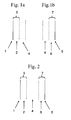
- FIG. 1a shows an anode 3 with arrester 1 and anode material 2.
- the cathode 7 may be provided with a trap 5 and a cathode mass 6 with a separator layer 4, as shown in FIG. 1b.
- the separator layer 4 having a dispersion is disposed between the anode 3 and the cathode 7 in the lithium-polymer battery shown in FIG.
- a separator layer 4 arranged between anode 3 and cathode 7 in each case adjacent to the electrode mass 2, 2 is sufficient to form a laminated composite system with a multilayer structure.
- the anode 3 or the cathode 7 comprises an arrester 1.5 and an electrode mass 2.6.
- the arrester 1 of the anode 3 is preferably made of a copper foil or a copper mesh, but other metals and metal alloys suitable for anode materials can also be used.
- the arrester 5 of the cathode 7 is made preferably made of aluminum and may be formed as a film or mesh. Again, the use is not limited to aluminum, but all metals and metal alloys commonly used for cathode materials can also be used.
- the arresters 1.5 are preferably primed in order to further improve the electron conduction.
- the layer thickness of the anode material 2 is preferably 20-60 ⁇ m and the layer thickness of the cathode material 6 is preferably 20-80 ⁇ m.
- Suitable dispersions for the separator used in the Li-polymer battery of the present invention include conductive salts, solvents and builders. In addition, they may preferably contain conductive salt additives. Conducting salts may be selected from the group consisting of LiPF 6 , LiClO 4 , Li triflates and their derivatives, and Li organoborates. However, conventionally used lithium conductive salts, as described, for example, in "Handbook of Battery Materials, pages 462 and 463" can be used.
- Preferred swelling agents for the aprotic solvents are, for example, terpolymers of fluoroelastomers, which are also known under the trademark Dyneon® are or fluoroelastomer copolymers.
- Dyneon® fluoroelastomer copolymers.
- Leitsalzadditive also polybutadienes, polyisoprenes and / or other rubbers and polyhydroxyl derivatives, such as starch, sugar and polyvinyl alcohols, which are largely capped with alkyl or methacryloyl and their non-etherified or esterified OH groups substituted with lithium as LiO units present, be used according to the invention.
- esterified or etherified polyhydroxyl derivatives can be selected according to the invention.
- solvents for the lithium polymer battery according to the invention indifferent components, preferably aprotic solvents such as alkyl carbonates, and perfluoroalkyl ethers, and alkylated glycols, in particular ethylene and / or propylene glycols can be used.
- alkyl carbonates are e.g. Propylene, ethylene, dimethyl carbonates and the like.
- mixtures of these solvents can be used.
- inorganic or organic compounds are used.
- inorganic materials are: metal oxides such as MgO, CaO, Al 2 O 3 , SiO 2 and TiO 2 , silicates such as island silicates, eg forsterite, ring silicates, eg benitoite, chain and ribbon silicates such as wollastonite and spodumene, sheet silicates such as serpentine, kaolinite, Talc, pyrophyllite, mica, montmorillonite, bentonite and vermiculite, and zeolites or the like, borates such as Li-metaborate, phosphates such as Ca 2 P 2 O 7 , titanates such as Ca titanate, zirconates, tungstates, molybdates, and CaSnO 3 and the like , Also suitable as builders are open-cell polycondensates, adducts or other polymers, as long as they can maintain an open-pore structure.
- Preferably used builders have a particle diameter of 0.5-20 microns.
- the builders may also consist of particles comprising individual particles.
- the total particle diameter of the builders is preferably in the range of 10 to 20 microns.
- the dispersion preferably consists of one or more conductive salts in an amount of 5-60 wt .-% optionally one or more Leitsalzadditiven in an amount of 0.1 to 20 wt .-%, one or more solvents in an amount of 20-50 Wt .-% and one or more builders in an amount of 20-60 wt .-%, each based on the total dispersion.
- all feedstocks such as conductive salts, solvents, builders and optionally conductive salt additives
- a dissolver at about 50-2500 rpm until a single-phase pasty dispersion is present in order to produce a dispersion used for a separator
- the starting materials can either all be stirred together at the same time or it is preferably possible to initially charge the conductive salt and then to add one or more solvents with stirring, in order subsequently to admix also builders or conductive salt additives with stirring.
- stirring is carried out in a dissolver at approximately 50-2500 rpm, preferably at 500-2000 rpm and in particular at 1000-2000 rpm.
- the dispersion can be stirred further, for example, even at a lower stirring speed, such as 1000 rpm, until a single-phase pasty dispersion is present.
- This single-phase pasty dispersion prepared according to the invention can be applied to the anode mass 2 and / or cathode mass 6 by means of a standard paste-making device in order to produce a lithium-polymer battery.
- the coating of the electrodes 3, 7 or electrode masses 2 preferably carried out continuously via extruders or coating systems.
- the dispersion is preferably applied by means of slot dies and / or pasting machines parallel to the extrusion of the electrode materials 2, 6 as separator layer 4.
- the separator layer is preferably 10-50 ⁇ m and more preferably 20-35 ⁇ m.
- a laminate composite of anode 3 and cathode 7 is produced with at least two separator layers 4 as a separating layer, so that the layer thickness of the entire separator layer 4 is equal to 15-70 ⁇ m and preferably 20-50 ⁇ m.
- the production process according to the invention for lithium-polymer batteries is preferably carried out in the absence of moisture.
- an inert gas atmosphere such as, for example, under an argon atmosphere
- the preparation of the individual electrode mass layers 2, 6 or separator layers 4 can be carried out.
- Example 2 The process was carried out analogously to Example 1, but the conductive salt used was lithium oxalato borate. Further, all feeds were degassed at 50 ° C and 10 -2 torr for 60 minutes, and the entire process was conducted under an argon atmosphere.
- the mixed feeds were as follows: 1. 20 parts by weight Lioxalato borate Second 10 parts by weight Ethylene carbonate EC Third 10 parts by weight Propylene carbonate PC 4th 20 parts by weight Mono glycol bis-tetra-fluoroethyl 5th 25 parts by weight MgO 6th 5 parts by weight Polyvinylpyrrolidone (Luviskol K90®)
- Example 3 the preparation of separate dispersions was carried out analogously to Example 1 and the starting materials used, such as conductive salt, solvent, builder and Leitsalzadditiv are shown in Table 2. In addition, the respective weight percentages are indicated. Table 2 Example no. Conducting salt / part by weight LM / weight T. Scaffold / Wt. Conducting salt additive / part.-T.
- Example 3 LiPF 6/20 EC / 20, DEC / 20 MgO / 30 Kynar / 10
- Example 4 LiPF 6/25 EC / 20, DMC / 20 MgO / 25 mica / 10 Kynar / 10
- Example 5 LiOB / 20 DME / 20, DMC / 20 MgO / 20 chrystotil / 10 Dyneon / 10
- Example 6 Li-triflate / 30 DMC / 10, DEC / 10 Al 2 O / 25 CaO 3/10 Kynar / 15
- Example 7 LiCl 4/25 EC / 25, PC / 25 MgO / 10 Kynar / 15
- Example 8 LiOB / 10 LiPF 6/20 EC / 20, PC / 20 MgO / 10 Li metaborate / 10 Kynar / 10
- Example 9 LiPF 6/20 EC / 20, DEC / 20 Vermiculite / 20 MgO / 10 Kynar / 10
- Example 1 the components were mixed and the dispersion contained in each case applied to the anode masses 2 and cathode materials 6 in a layer of about 20 microns thickness. All work was carried out under argon atmosphere with exclusion of moisture.
- Example 1 The single-phase dispersion prepared in Example 1 was applied to the cathode material 6 with conductor foil 5 prepared under point 11a in a layer about 20 ⁇ m thick.
- An arrester foil 1 (Cu, thickness: 18 ⁇ m, width 150 mm) was subjected to an anode mass 2 in a thickness of 35 ⁇ m by means of a Collin extruder at 120-130 ° C.
- MCMB 25 / 28® 1 75 parts by weight LiOB 10 parts by weight
- Polymer binder Kynar 2801® 2 8 parts by weight
- anode 3 was then combined with the obtained under the points a and b cathode 7 with applied separator 4 to a composite system arrester foil Al / cathode material / separator / anode material / collector foil Cu.
- the composite system described above was wound on a winding machine ( ⁇ 7.5 cm).
- the Ableiterfolien 1.5 were contacted by laser welding, and provided with Ableitinn at each pole of the battery. Thereafter, the entire system was wrapped in a shrink wrap.
- the wound cell produced according to Example 11 d) was formed and charged in a 3-step process with a current of 0.15 mA / m 2 galvanostatically at 1.5 V, 2.8 V, 4.2 V and then potentiostatic at 4.2 V.
- a charging program and devices of the company Digatron Aachen was used.
- the discharge was also carried out with a current of 0.15 mA / m 2 up to a discharge voltage of 2.8 V.
- the measured discharge capacity was 35 Ah and fading of ⁇ 2.5% was observed after 150 cycles (at temperatures up to 60 ° C).
- the separator mass was a polypropylene membrane (Cellgard®).
- Cellgard® polypropylene membrane
- the separator membrane was soaked in a 0.5 M Li-oxalatoborate solution in dimethyl / diethyl carbonate (1: 1 by volume).
- the resulting discharge capacities were comparable to the results with the batteries with dispersions in the separator.
- the fading at room temperature was about 2 - 2.5%, but at 60 ° C already 3.5 - 4%, and was thus compared to the Li-polymer batteries according to the invention with dispersions in the separator significantly worse.
Landscapes
- Chemical & Material Sciences (AREA)
- General Chemical & Material Sciences (AREA)
- Engineering & Computer Science (AREA)
- Chemical Kinetics & Catalysis (AREA)
- Electrochemistry (AREA)
- Manufacturing & Machinery (AREA)
- Materials Engineering (AREA)
- Physics & Mathematics (AREA)
- Condensed Matter Physics & Semiconductors (AREA)
- Dispersion Chemistry (AREA)
- General Physics & Mathematics (AREA)
- Inorganic Chemistry (AREA)
- Secondary Cells (AREA)
- Cell Separators (AREA)
- Processes Of Treating Macromolecular Substances (AREA)
Abstract
Description
- Die Erfindung betrifft eine Li-Polymer-Batterie mit einem neuen Separatorsystem und ein Verfahren für ihre Herstellung.
- Im Allgemeinen dient der Separator zur Trennung von Anode und Kathode und sollte auch ein Durchbrennen ("meltdown") bzw. ein Versagen ("breakdown") des Batteriesystems verhindern. Herkömmliche Separatorsysteme von Lithium-Polymer-Batterien sind z.B. in dem Buch "Lithium Ion Batteries, herausgegeben von M. Wakihara und O. Yamamoto, Seite 195 (1998), Verlag VCH, Weinheim" beschrieben. Weitere Informationen bezüglich herkömmlicher Separatorsysteme, insbesondere für Lithium-Polymer-Batterien, sind im "Handbook of Battery Materials, herausgegeben von I. O. Besenhard, Seiten 559 bis 563 (1998), Verlag VCH, Weinheim" beschrieben.
- Herkömmlicherweise werden Membranen, z.B. auf der Basis von Polypropylen, Polyether oder Kombinationen davon, verwendet. Beispiele davon sind Celgard®, Setala®, HiPORE®, Exepol®. Außerdem sind Gelelektrolyt-Separatoren bekannt (z.B. von Bellcore). Diese können gemäß dem vorstehend genannten Handbook of Battery Materials auf Basis von Polyvinyldenflurid: Hexafluorpropylen (PVDF:HFP) aufgebaut sein. Diese Gelelektrolyt-Separatoren liegen in Stärken von ca. 50 µm vor. Außerdem weisen sie ca. 60 Gew.-% Polymer auf.
- Idealerweise haben die in Batterien eingesetzten Separatoren keinen Ionentransportwiderstand. In der Praxis jedoch muss einiger Widerstand toleriert werden.
- Typische Eigenschaften der vorstehend genannten mikroporösen Membranen, die als herkömmliche Separatoren eingesetzt werden, sind in der nachstehenden Tabelle 1 aufgeführt (aus Handbook of Battery Materials, Seite 558, 10.6).
Tabelle 1 Celgard 2400® Celgard 2300® Struktur 1 Schicht: PP 3 Schichten: PP/PE/PP Stärke [µm] 25 25 Porosität (%) 38 38 Luftdurchlässigkeit 35 25 Durchschlagfestigkeit 380 480 - Ein weiteres wesentliches Charakteristikum von Separatoren ist das Tränken bzw. Benetzen des Separators mit Elektrolyt, d.h. mit Leitsalz im jeweiligen optimalen aprotischem Lösungsmittel. Weitere Probleme mit den herkömmlichen Separatorsystemen gibt es beim Einbringen des Separators zwischen Anode und Kathode.
- Deshalb liegt der Erfindung ein vollkommen neues Verfahrenskonzept zugrunde, das durch eine neue Materialkombination die vorstehend genannten Probleme der herkömmlichen Separatorsysteme in Lithium-Polymer-Batterien verbessern soll.
- Daher ist es die Aufgabe der Erfindung, eine Lithium-Polymer-Batterie mit einem verbesserten Separatorsystem sowie ein Herstellungsverfahren für eine Lithium-Polymer-Batterie bereitzustellen.
- Diese Aufgabe kann beispielsweise durch eine Lithium-Polymer-Batterie mit einer Anode und einer Kathode sowie mit einem zur Trennung von Anode und Kathode vorgesehenen Separator gelöst werden, wobei der Separator eine Dispersion aufweist. Ferner werden erfindungsgemäß zwei alternative Herstellungsverfahren für eine solche Lithium-Polymer-Batterie erläutert: Eine erste Alternative ist ein Herstellungsverfahren für eine Li-Polymer-Batterie mit einer Anode und einer Kathode, sowie mit einem zur Trennung von Anode und Kathode vorgesehenen Separator, dadurch gekennzeichnet, dass eine Dispersion als Dispersionsschicht auf die Anodenmasse bzw. die Kathodenmasse aufgebracht wird und anschließend die Anode und die Kathode über die Dispersionsschicht miteinander laminiert werden. Eine zweite Alternative ist ein Herstellungsverfahren für eine Li-Polymer-Batterie mit einer Anode und einer Kathode, sowie mit einem zur Trennung von Anode und Kathode vorgesehenen Separator, dadurch gekennzeichnet, dass eine Dispersion als jeweils eine Dispersionsschicht auf die Anodenmasse und die Kathodenmasse aufgebracht wird und anschließend die Anode und die Kathode über die Dispersionsschichten miteinander laminiert werden.
- Die erfindungsgemäße Lithium-Polymer-Batterie hat wenigstens eine Anode und Kathode, sowie einen Separator, der zur Trennung von Anode und Kathode eine Separatorschicht mit einer Dispersion aufweist.
- Bevorzugte Ausführungsformen der Lithium-Polymer-Batterie und des Herstellungsverfahrens für die Lithium-Polymer-Batterie gemäß der Erfindung sind in den Unteransprüchen definiert.
- Im Folgenden werden die erfindungsgemäße Lithium-Polymer-Batterie und deren bevorzugte Ausführungsformen, sowie das erfindungsgemäße Herstellungsverfahren für die Lithium-Polymer-Batterie und bevorzugte Ausführungsformen dafür an Hand von Figuren näher erläutert.
-
- Fig. 1a eine Anode einer erfindungsgemäßen Lithium-Polymer-Batterie;
- Fig. 1b eine Kathode einer erfindungsgemäßen Lithium-Polymer-Batterie; und
- Fig. 2 eine erfindungsgemäße Lithium-Polymer-Batterie mit einer Separatorschicht zwischen Anode und Kathode.
- Anschließend wird die erfindungsgemäße Li-Polymer-Batterie anhand einer ersten Ausführungsform näher erläutert.
- Die Fig. 1a zeigt eine Anode 3 mit Ableiter 1 und Anodenmasse 2. Auf der Anodemasse 2 ist der Separator in Form einer Separatorschicht 4 ausgebildet. Analog kann die Kathode 7 mit einem Ableiter 5 und einer Kathodenmasse 6 mit einer Separatorschicht 4 versehen sein, wie in Fig. 1b gezeigt ist. Die Separatorschicht 4, die eine Dispersion aufweist, ist in der in Fig. 2 gezeigten Lithium-Polymer-Batterie zwischen der Anode 3 und Kathode 7 angeordnet. Im Allgemeinen genügt eine Separatorschicht 4, die zwischen Anode 3 und Kathode 7 jeweils an die Elektrodenmasse 2,6 angrenzend angeordnet ist, so dass ein laminiertes Verbundsystem mit mehrschichtigem Aufbau entsteht.
- Im Allgemeinen umfasst die Anode 3 bzw. die Kathode 7 einen Ableiter 1,5 und eine Elektrodenmasse 2,6. Der Ableiter 1 der Anode 3 besteht bevorzugt aus einer Kupfer-Folie oder einem Kupfer-Netz, jedoch können auch weitere für Anodenmaterialien geeignete Metalle und Metalllegierungen eingesetzt werden. Der Ableiter 5 der Kathode 7 besteht bevorzugt aus Aluminium und kann als Folie oder Netz ausgebildet sein. Auch hier ist die Verwendung nicht auf Aluminium beschränkt, sondern alle für Kathodenmaterialien üblicher Weise eingesetzten Metalle und Metalllegierungen können ebenso eingesetzt werden. Des Weiteren sind die Ableiter 1,5 bevorzugt geprimert, um die Elektronenleitung weiter zu verbessern.
- Die Schichtdicke der Anodenmasse 2 beträgt bevorzugt 20-60 µm und die Schichtdicke der Kathodenmasse 6 bevorzugt 20-80 µm.
- In der erfindungsgemäßen Li-Polymer-Batterie geeigneter Weise eingesetzte Dispersionen für den Separator umfassen Leitsalze, Lösungsmittel und Gerüstsubstanzen. Zusätzlich können sie bevorzugt Leitsalzadditive enthalten. Leitsalze können aus der aus LiPF6, LiClO4, Li-Triflaten und deren Derivaten, sowie Li-Organoboraten bestehenden Gruppe ausgewählt sein. Jedoch können auch Herkömmlicherweise eingesetzte Lithium-Leitsalze, wie sie z.B. im "Handbook of Battery Materials, Seiten 462 und 463" beschrieben sind, verwendet werden.
- Leitsalzadditive sind Hilfsstoffe, die beispielsweise als Elektronen-Donor/Acceptor-Komponenten in den Elektronentransfer eingreifen. Bevorzugt eingesetzt werden Polyvinylpyrrolidone, Polyketone, Polyether, wahlweise mit verkappten Endgruppen wie z.B. Alkyl- (z.B. -CH3) und/oder Methacryloylresten (CH2=C(CH3)CO-), Polyvinylether, Polyvinylpyridine, Polyvinylimidazole, Polythiophene, insbesondere deren Homo- und Copolykondensate, und Copolymere aus diesen Verbindungen. Ferner können diese Leitsalzadditive auch Quellmittel für die aprotischen Lösungsmittel darstellen. Bevorzugt eingesetzte Quellmittel für die aprotischen Lösungsmittel sind z.B. Terpolymere von Fluorelastomeren, die auch unter der Marke Dyneon® bekannt sind, oder Fluorelastomercopolymere. Weiterhin können als Leitsalzadditive auch Polybutadiene, Polyisoprene und/oder andere Kautschuke sowie Polyhydroxyl-Derivate, wie Stärke, Zucker und Polyvinylalkohole, die weitgehend mit Alkyl-oder Methacryloylgruppen verkappt sind und deren nicht veretherte oder veresterte OH-Gruppen mit Lithium substituiert als LiO-Einheiten vorliegen, erfindungsgemäß eingesetzt werden. Auch veresterte oder veretherte Polyhydroxyl-Derivate können erfindungsgemäß ausgewählt werden.
- Als Lösungsmittel für die erfindungsgemäße Lithium-Polymer-Batterie können indifferente Komponenten, vorzugsweise aprotische Lösungsmittel wie Alkylcarbonate, und Perfluoralkylether, sowie alkylierte Glykole, insbesondere Ethylen- und/oder Propylenglykole, eingesetzt werden. Beispiele solcher Alkylcarbonate sind z.B. Propylen-, Ethylen-, Dimethylcarbonate und dergleichen. Außerdem können auch Mischungen dieser Lösungsmittel eingesetzt werden.
- Als Gerüstsubstanzen werden vorzugsweise anorganische oder organische Verbindungen eingesetzt. Beispiele von anorganischen Materialien sind: Metalloxide wie MgO, CaO, Al2O3, SiO2 und TiO2, Silikate wie Inselsilikate, z.B. Forsterit, Ringsilikate, z.B. Benitoit, Ketten- und Bandsilikate wie Wollastonit und Spodumen, Schichtsilikate wie Serpentin, Kaolinit, Talk, Pyrophyllit, Glimmer, Montmorillonit, Bentonit und Vermiculit, und Zeolithe oder ähnliches, Borate wie etwa Li-Metaborat, Phosphate wie Ca2P2O7, Titanate wie Ca-Titanat, Zirkonate, Wolframate, Molybdate, und CaSnO3 und dergleichen. Weiterhin eignen sich als Gerüstsubstanzen auch offenporige Polykondensate, Addukte oder andere Polymere, solange sie eine offenporige Struktur aufrechterhalten können.
- Bevorzugt eingesetzte Gerüstsubstanzen haben einen Teilchendurchmesser von 0,5-20 µm. Die Gerüstsubstanzen können jedoch auch aus Partikeln bestehen, die Einzelteilchen umfassen. In diesem Falle liegt der Gesamtpartikeldurchmesser der Gerüstsubstanzen bevorzugt im Bereich von 10 bis 20 µm.
- Die Dispersion besteht bevorzugt aus einem oder mehreren Leitsalzen in einer Menge von 5-60 Gew.-% optional einem oder mehreren Leitsalzadditiven in einer Menge von 0,1 bis 20 Gew.-%, einem oder mehreren Lösungsmitteln in einer Menge von 20-50 Gew.-% und einer oder mehreren Gerüstsubstanzen in einer Menge von 20-60 Gew.-%, jeweils bezogen auf die gesamte Dispersion.
- Die vom Separator umfasste Dispersion dient einerseits als Leitsalz- und Elektrolyt-Quelle und verleiht dem System zusätzlich mechanische Stabilität durch die in der Dispersion enthaltenen Gerüstsubstanzen. Weiterhin können in der erfindungsgemäß eingesetzten Dispersion, insbesondere einer Leitsalz-Dispersion, Leitfähigkeitsverluste zwischen Anode und Kathode verringert bzw. vermieden werden. Gerade durch die hohe mechanische Stabilität der Dispersion wird ein Durchbrennen bzw. Kurzschluss im Separator verhindert.
- In einer zweiten Ausführungsform besteht abweichend von der ersten Ausführungsform die Separatorschicht 4 aus wenigstens zwei unterschiedlichen Separatorschichten, die zwischen der Anode 3 und der Kathode 7 angeordnet sind. Durch zwei oder mehrere Separatorschichten 4 mit unterschiedlichen Zusammensetzungen, die jeweils an die Anodenmasse 2 als auch die Kathodenmasse 6 anliegen, kann die Haftung der Separatorschicht 4 an die jeweilige Elektrodenmasse 2,6 gewährleistet werden, auch wenn die Elektrodenmassen 2,6 aus unterschiedlichen Materialien aufgebaut sind.
- Alle übrigen Merkmale, wie erfindungsgemäß eingesetzte Materialien oder Anwendungsbereiche können wie in der ersten Ausführungsform beschrieben ausgewählt und variiert werden.
- In einer ersten Ausführungsform des Herstellungsverfahrens werden zur Herstellung einer für einen Separator eingesetzten Dispersion sämtliche Einsatzstoffe, wie etwa Leitsalze, Lösungsmittel, Gerüstsubstanzen und optional Leitsalzadditive, in einem Dissolver bei Umdrehungen von etwa 50-2500 U/min vermischt, bis eine einphasige pastöse Dispersion vorliegt. Die Einsatzstoffe können entweder alle gleichzeitig zusammengerührt werden oder es kann bevorzugt das Leitsalz vorgelegt und anschließend ein oder mehrere Lösungsmittel unter Rühren zugegeben werden, um anschließend auch noch Gerüstsubstanzen bzw. Leitsalzadditive unter Rühren zuzumischen. Hierin erfolgt das Rühren in einem Dissolver bei annähernd 50-2500 U/min, bevorzugt bei 500-2000 U/min und insbesondere bei 1000-2000 U/min. Nach der Zugabe aller Einsatzstoffe kann die Dispersion beispielsweise auch bei geringerer Rührgeschwindigkeit wie etwa 1000 U/min solange weiter gerührt werden, bis eine einphasige pastöse Dispersion vorliegt. Diese erfindungsgemäß hergestellte, einphasige pastöse Dispersion kann mittels einer Standardpastiereinrichtung auf die Anodenmasse 2 und/oder Kathodenmasse 6 aufgetragen werden, um eine Lithium-Polymer-Batterie herzustellen. Hierbei kann die Beschichtung der Elektroden 3,7 bzw. Elektrodenmassen 2,6 bevorzugt kontinuierlich über Extruder oder Beschichtungsanlagen erfolgen. In diesem Verfahren wird die Dispersion bevorzugt mittels Breitschlitzdüsen und/oder Pastiermaschinen parallel zur Extrusion der Elektrodenmassen 2,6 als Separatorschicht 4 aufgetragen. Die Separatorschicht beträgt bevorzugt 10-50 µm und weiter bevorzugt 20-35 µm.
- Während in einer Ausführungsform des Herstellungsverfahrens das Verfahren so durchgeführt wird, dass nur die Anodenmasse 2 bzw. die Kathodenmasse 6 mit der Dispersion beaufschlagt wird, kann alternativ in einer weiteren Ausführungsform die Dispersion jedoch auch auf die Anodenmasse 2 und die Kathodenmasse 7 aufgetragen werden. So wird ein Laminatverbund aus Anode 3 und Kathode 7 mit wenigstens zwei Separatorschichten 4 als Trennschicht hergestellt, so dass die Schichtstärke der gesamten Separatorschicht 4 gleich 15-70 µm und vorzugsweise 20-50 µm beträgt.
- Somit wird durch das erfindungsgemäße Herstellungsverfahren ein einfaches und kostengünstiges Verfahren zur Herstellung von Lithium-Polymer-Batterien geschaffen.
- Vorzugsweise erfolgt das erfindungsgemäße Herstellungsverfahren für Lithium-Polymer-Batterien unter Ausschluss von Feuchtigkeit. Hierzu kann unter Inertgasatmosphäre, wie zum Beispiel unter Argonatmosphäre die Herstellung der einzelnen Elektrodenmassenschichten 2,6 bzw. Separatorschichten 4 durchgeführt werden.
- Anschließend werden zur weiteren Veranschaulichung der erfindungsgemäßen Lithium-Polymer-Batterien sowie der erfindungsgemäßen Herstellungsverfahren für die Herstellung der Lithium-Polymer-Batterien, umfassend ein Verbundsystem aus Anode/Separatorschicht(en)/Kathode anhand von Beispielen näher erläutert.
- Herstellen einer Dispersion mit LiPF6 als Leitsalz. 25 Gewichtsteile LiPF6 als Leitsalz wurden mit 20 Gewichtsteilen Ethylencarbonat (EC) und 10 Gewichtsteile Propylencarbonat (PC) als Lösungsmittel vermischt und in einem Disperser 60 min bei 1000 U/min gerührt. Dann wird die erhaltene Dispersion mit 25 Gewichtsteile MgO und 15 Gewichtsteile Glimmer als Gerüstsubstanzen sowie mit 6 Gewichtsteile eines Fluorpolymeren auf Basis von PVDF/HFP (Kynar 2801®) versetzt und bei Raumtemperatur weitere 60 Minuten bei 1000 U/min gerührt, so dass eine einphasige Dispersion 4 entstand. Diese Dispersion wurde zur Ausbildung einer Separatorschicht mittels einer Pastiermaschine sowohl auf die Anodenmassen 2 als auch auf die Kathodenmasse 6 wie in den Figuren 1A und 1B gezeigt in einer jeweils 20µm starken Schicht aufgetragen.
- Das Verfahren wurde analog zum Beispiel 1 durchgeführt, jedoch war das verwendete Leitsalz Lithiumoxalatoborat. Weiterhin wurden sämtliche Einsatzstoffe bei 50°C und 10-2 Torr 60 Minuten lang entgast und das gesamte Verfahren wurde unter einer Argon-Atmosphäre durchgeführt. Die vermischten Einsatzstoffe waren wie folgt:
1. 20 Gewichtsteile Lioxalato-borat 2. 10 Gewichtsteile Ethylencarbonat EC 3. 10 Gewichtsteile Propylencarbonat PC 4. 20 Gewichtsteile Monoglykol-bis-tetra-fluorethylether 5. 25 Gewichtsteile MgO 6. 5 Gewichtsteile Polyvinylpyrrolidon (Luviskol K90®) - In den Beispielen 3 bis 10 erfolgte die Herstellung von Separat-Dispersionen analog zu Beispiel 1 und die eingesetzten Einsatzstoffe wie Leitsalz, Lösungsmittel, Gerüstsubstanz und Leitsalzadditiv sind in der Tabelle 2 angegeben. Außerdem sind die jeweiligen Gewichtsprozente mit angegeben.
Tabelle 2 Beispiel Nr. Leitsalz/ Gew.-T. L.M./Gew.-T. Gerüstsubstanz/ Gew.-T. Leitsalzadditiv/ Gew.-T. Beispiel 3 LiPF6/20 EC/20, DEC/20 MgO/30 Kynar/10 Beispiel 4 LiPF6/25 EC/20, DMC/20 MgO/25 Glimmer/10 Kynar/10 Beispiel 5 LiOB/20 DME/20, DMC/20 MgO/20 Chrystotil/10 Dyneon/10 Beispiel 6 Li-Triflat/ 30 DMC/10, DEC/10 Al2O/25 CaO3/10 Kynar/15 Beispiel 7 LiCl4/25 EC/25, PC/25 MgO/10 Kynar/15 Beispiel 8 LiOB/10 LiPF6/20 EC/20, PC/20 MgO/10 Li-Metaborat/10 Kynar/10 Beispiel 9 LiPF6/20 EC/20, DEC/20 Vermiculit/20 MgO/10 Kynar/10 Beispiel 10 LiPF6/25 EC/20, DMC/20 Fluorether/10 Zeolith/10 CaO/10 Dyneon/5 EC = Ethylencarbonat
PC = Propylencarbonat
DEC = Diethylcarbonat
DMC = Dimethylcarbonat
DME = Ethylenglykoldimethylether
Fluorether = Monoglykol-bis-tetra-fluoralkylether
LiOB = Li-oxalatoborat
Kynar = Fluorpolamer auf Basis von PVDF/HFP (Kynar 2801®)
Dyneon = Terpolymer PVDF/HFP/Perfluoralkoxyether (Dyneon 210®) - Gemäß Beispiel 1 wurden die Komponenten vermischt und die jeweils enthaltene Dispersion auf die Anodenmassen 2 bzw. Kathodenmassen 6 in einer Schicht von jeweils ca. 20 µm Stärke aufgetragen. Hierbei wurden alle Arbeiten unter Argonatmosphäre unter Ausschluss von Feuchtigkeit ausgeführt.
- Herstellen einer erfindungsgemäßen Lithium-Polymer-Batterie
- Auf eine Al-Folie (Stärke: 18 µm, Breite 150 mm) mit einer Primerschicht (3 µm Stärke) aus einem Fluorterpolymer (Dyneon THV 220 D) mit 30 Gew.-% leitfähigem Ruß (Ensaco®-Ruß) (Gew.-% sind bezogen auf den Feststoffanteil des Fluorterpolymeren) wurde mittels eines Extruders eine Folie aus Kathodenmasse in einer Schichtstärke von 30 µm aufgetragen:
LiCooxid SS 5 75 Gewichtsteile LiOB 5 Gewichtsteile Polymerbinder Kynar 2801®1 10 Gewichtsteile Aprotisches Lösungsmittel PC 10 Gewichtsteile 1 Fluorpolymer auf Basis von PVDF/HFP - Auf die unter Punkt 11a hergestellte Kathodenmasse 6 mit Ableiterfolie 5 wurde die im Beispiel 1 hergestellte einphasige Dispersion in einer ca. 20 µm starken Schicht aufgetragen.
- Eine Ableiterfolie 1 (Cu, Stärke: 18 µm, Breite 150 mm) wurde mittels eines Collin-Extruders bei 120 - 130°C mit einer Anodenmasse 2 in einer Stärke von 35 µm beaufschlagt:
MCMB 25/28®1 75 Gewichtsteile LiOB 10 Gewichtsteile Polymerbinder Kynar 2801®2 8 Gewichtsteile Aprotisches Lösungsmittel PC 7 Gewichtsteile 1 Mesocarbonmicrobeads (Osaka Gas Chemicals Co., Ltd.; synthetischer Graphit)
2 Fluorpolymer auf Basis von PVDF/HFP - Die somit erhaltene Anode 3 wurde dann mit der unter den Punkten a und b erhaltenen Kathode 7 mit aufgetragener Separatorschicht 4 zu einem Verbundsystem Ableiterfolie Al/Kathodenmasse/Separator/Anodenmasse/Ableiterfolie Cu kombiniert.
- Das oben beschriebene Verbundsystem wurde auf einer Wickelmaschine (Ø 7,5 cm) gewickelt. Die Ableiterfolien 1,5 wurden durch Laser-Schweißen kontaktiert, sowie mit Ableiterscheiben an jedem Pol der Batterie versehen. Danach wurde das gesamte System in einer Schrumpffolie eingehaust.
- Die entsprechend Beispiel 11 d) hergestellte Wickelzelle wurde formiert und geladen und zwar in einem 3-Stufenprozess mit einem Strom von 0,15 mA/m2 galvanostatisch bei 1,5 V, 2,8 V, 4,2 V und dann potentiostatisch bei 4,2 V. Hierfür wurde ein Ladeprogramm und Geräte der Firma Digatron Aachen eingesetzt. Die Entladung erfolgte ebenfalls mit einem Strom von 0,15 mA/m2 bis zu einer Entladespannung von 2,8 V.
- Die gemessene Entladekapazität betrug 35 Ah und es wurde nach 150 Zyklen ein Fading von < 2,5 % festgestellt (bei Temperaturen bis zu 60°C).
- Es wurde statt der erfindungsgemäßen Lithium-Polymer-Batterie eine Batterie eingesetzt, in der die Separatormasse eine Polypropylenmembran (Cellgard®) war. Die Separatormembran war mit einer 0,5 M Li-Oxalatoboratlösung in Dimethyl-/Diethylcarbonat (1:1 Volumenanteil) getränkt. Die erhaltenen Entladekapazitäten waren vergleichbar zu den Ergebnissen mit den Batterien mit Dispersionen im Separator. Das Fading bei Raumtemperatur betrug ca. 2 - 2,5 %, jedoch bei 60°C schon 3,5 - 4 %, und war somit gegenüber den erfindungsgemäßen Li-Polymer-Batterien mit Dispersionen im Separator deutlich schlechter.
Claims (6)
- Separator für Lithium-Polymer-Batterien, aufgebaut aus einer Dispersion aus Leitsalz, aprotisches Lösungsmittel und anorganischer Gerüstsubstanz,
dadurch gekennzeichnet, dass
die anorganische Gerüstsubstanz wenigstens ein Metalloxid umfasst. - Separator nach Anspruch 1, wobei die Dispersion ein oder mehrere Leitsalze in einer Menge von 5 bis 60 Gew.-%, ein oder mehrere aprotische Lösungsmittel in einer Menge von 20 bis 50 Gew.-% und ein oder mehrere Gerüstsubstanzen in einer Menge von 20 bis 60 Gew.-%, bezogen auf die gesamte Dispersion, enthält.
- Separator nach Anspruch 2, dadurch gekennzeichnet, dass die Dispersion ein Leitsalzadditiv in einer Menge von 0,1 bis 20 Gew.-% enthält.
- Separator nach einem der vorhergehenden Ansprüche, wobei das Metalloxid ausgewählt ist aus MgO, CaO oder Al2O3.
- Separator nach Anspruch 4, wobei das Metalloxid MgO ist.
- Separator nach einem der vorhergehenden Ansprüche, dadurch gekennzeichnet, dass die anorganische Gerüstsubstanz einen Teilchendurchmesser von 0,5 bis 20 µm und einen Gesamtpartikel-Durchmesser zwischen 10 und 20 um aufweist.
Applications Claiming Priority (2)
| Application Number | Priority Date | Filing Date | Title |
|---|---|---|---|
| DE10308945.4A DE10308945B4 (de) | 2003-02-28 | 2003-02-28 | Li-Polymer-Batterien mit Separator-Dispersion und Verfahren für ihre Herstellung |
| EP04714781A EP1649537B1 (de) | 2003-02-28 | 2004-02-26 | Li-polymer-batterien mit separator-dispersion und verfahren für ihre herstellung |
Related Parent Applications (2)
| Application Number | Title | Priority Date | Filing Date |
|---|---|---|---|
| EP04714781.4 Division | 2004-02-26 | ||
| EP04714781A Division EP1649537B1 (de) | 2003-02-28 | 2004-02-26 | Li-polymer-batterien mit separator-dispersion und verfahren für ihre herstellung |
Publications (3)
| Publication Number | Publication Date |
|---|---|
| EP1783852A2 true EP1783852A2 (de) | 2007-05-09 |
| EP1783852A3 EP1783852A3 (de) | 2008-09-17 |
| EP1783852B1 EP1783852B1 (de) | 2010-10-06 |
Family
ID=32891810
Family Applications (2)
| Application Number | Title | Priority Date | Filing Date |
|---|---|---|---|
| EP04714781A Expired - Lifetime EP1649537B1 (de) | 2003-02-28 | 2004-02-26 | Li-polymer-batterien mit separator-dispersion und verfahren für ihre herstellung |
| EP07103829A Expired - Lifetime EP1783852B1 (de) | 2003-02-28 | 2004-02-26 | Separatordispersion für Li-Polymer-Batterien |
Family Applications Before (1)
| Application Number | Title | Priority Date | Filing Date |
|---|---|---|---|
| EP04714781A Expired - Lifetime EP1649537B1 (de) | 2003-02-28 | 2004-02-26 | Li-polymer-batterien mit separator-dispersion und verfahren für ihre herstellung |
Country Status (4)
| Country | Link |
|---|---|
| EP (2) | EP1649537B1 (de) |
| DE (1) | DE10308945B4 (de) |
| ES (2) | ES2350472T3 (de) |
| WO (1) | WO2004077588A2 (de) |
Cited By (15)
| Publication number | Priority date | Publication date | Assignee | Title |
|---|---|---|---|---|
| WO2010121696A1 (de) | 2009-04-24 | 2010-10-28 | Li-Tec Battery Gmbh | Elektrochemische zelle mit lithiumtitanat |
| DE102009021230A1 (de) | 2009-05-14 | 2010-12-16 | Li-Tec Battery Gmbh | Elektrochemische Zelle mit Separator |
| DE102009049326A1 (de) | 2009-10-14 | 2011-04-21 | Li-Tec Battery Gmbh | Kathodische Elektrode und elektrochemische Zelle hierzu |
| DE102010011413A1 (de) | 2010-03-15 | 2011-09-15 | Li-Tec Battery Gmbh | Kathodische Elektrode und elektrochemische Zelle für dynamische Einsätze |
| DE102010011414A1 (de) | 2010-03-15 | 2011-09-15 | Li-Tec Battery Gmbh | Lithiumionenzelle mit intrinsischem Schutz gegen thermisches Durchgehen |
| WO2012079704A1 (de) | 2010-12-15 | 2012-06-21 | Li-Tec Battery Gmbh | Elektrochemische zelle |
| DE102011100607A1 (de) | 2011-05-05 | 2012-11-08 | Li-Tec Battery Gmbh | Elektrochemische Zelle |
| DE102011102628A1 (de) | 2011-05-27 | 2012-11-29 | Li-Tec Battery Gmbh | Elektrochemische Zelle |
| WO2013017216A1 (de) | 2011-08-01 | 2013-02-07 | Li-Tec Battery Gmbh | Elektrochemische zelle |
| DE102011109134A1 (de) | 2011-08-01 | 2013-02-07 | Li-Tec Battery Gmbh | Elektrochemische Zelle |
| DE102012006200A1 (de) | 2012-03-27 | 2013-10-02 | Li-Tec Battery Gmbh | Elektrochemische Zelle |
| DE102012022969A1 (de) | 2012-11-23 | 2014-05-28 | Li-Tec Battery Gmbh | Elektrochemische Zelle |
| DE102013018235A1 (de) | 2013-10-29 | 2015-04-30 | Li-Tec Battery Gmbh | Elektrochemische Zelle |
| DE102014001025A1 (de) | 2014-01-27 | 2015-07-30 | Li-Tec Battery Gmbh | Elektrochemische Zelle |
| DE102014211998A1 (de) | 2014-06-23 | 2015-12-24 | Evonik Litarion Gmbh | Hydrophober Separator sowie Verfahren zur Herstellung des Separators |
Families Citing this family (5)
| Publication number | Priority date | Publication date | Assignee | Title |
|---|---|---|---|---|
| DE102005039696A1 (de) | 2005-08-23 | 2007-03-01 | Dilo Trading Ag | Separator für Lithium-Polymer-Batterien und Verfahren zur Herstellung derselben |
| DE202005021884U1 (de) * | 2005-09-06 | 2010-11-18 | Dilo Trading Ag | Spezial Lithium-Polymer-Batterien |
| KR20120002519A (ko) * | 2008-10-29 | 2012-01-05 | 세람테크 게엠베하 | 리튬 이온 축전지들 또는 배터리들 내의 애노드 및 캐소드를 분리하기 위한 분리 층 |
| DE102010016749B4 (de) | 2010-05-03 | 2024-02-22 | Dr. Ing. H.C. F. Porsche Aktiengesellschaft | Airbaggehäuse eines Airbagsystems und Airbagsystem |
| DE102010021148B4 (de) | 2010-05-21 | 2024-10-24 | Dr. Ing. H.C. F. Porsche Aktiengesellschaft | Beutelzellenbatterieanordnung und entsprechendes Herstellungsverfahren und Verwendung |
Citations (5)
| Publication number | Priority date | Publication date | Assignee | Title |
|---|---|---|---|---|
| WO1999044247A1 (en) | 1998-02-25 | 1999-09-02 | Axiva Gmbh | Method for producing membrane of gel composite electrolyte |
| EP0942485A1 (de) | 1998-03-11 | 1999-09-15 | Ngk Insulators, Ltd. | Lithium Sekundärbatterie |
| US6218051B1 (en) | 1998-11-09 | 2001-04-17 | Ngk Spark Plug Co., Ltd. | Separator material for secondary lithium batteries |
| DE10112613A1 (de) | 2001-03-14 | 2002-10-02 | Dilo Trading Ag Zug | Polymerelektrolyte für Lithium-Polymer-Batterien |
| DE10134057A1 (de) | 2001-07-13 | 2003-02-06 | Dilo Trading Ag Zug | Lithium Polymer Batterie und Verfahren zur Herstellung |
Family Cites Families (5)
| Publication number | Priority date | Publication date | Assignee | Title |
|---|---|---|---|---|
| JPH1055718A (ja) * | 1996-08-07 | 1998-02-24 | Polytec Design:Kk | ペースト状電解質 |
| DE19925683A1 (de) * | 1999-06-04 | 2000-12-14 | Nbt Gmbh | Negative Elektrode für Hochenergie-Lithium-Ionen-Zellen und ein Verfahren zu ihrer Herstellung |
| JP4412840B2 (ja) * | 2000-10-11 | 2010-02-10 | パナソニック株式会社 | リチウムポリマー電池およびその製造法 |
| DE10118639B4 (de) * | 2001-04-12 | 2007-06-14 | Dilo Trading Ag | Verfahren zur kontinuierlichen Herstellung von Trilaminaten für Polymer-Lithium Batterien |
| DE10122811B4 (de) * | 2001-05-10 | 2007-08-09 | Dilo Trading Ag | Elektrode für eine Lithium-Polymer-Wickelzellen-Batterie, Lithium-Polymer-Batterie und Verfahren zur Herstellung der Lithium-Polymer-Batterie |
-
2003
- 2003-02-28 DE DE10308945.4A patent/DE10308945B4/de not_active Expired - Fee Related
-
2004
- 2004-02-26 WO PCT/EP2004/001933 patent/WO2004077588A2/de not_active Ceased
- 2004-02-26 ES ES07103829T patent/ES2350472T3/es not_active Expired - Lifetime
- 2004-02-26 EP EP04714781A patent/EP1649537B1/de not_active Expired - Lifetime
- 2004-02-26 ES ES04714781T patent/ES2310717T3/es not_active Expired - Lifetime
- 2004-02-26 EP EP07103829A patent/EP1783852B1/de not_active Expired - Lifetime
Patent Citations (5)
| Publication number | Priority date | Publication date | Assignee | Title |
|---|---|---|---|---|
| WO1999044247A1 (en) | 1998-02-25 | 1999-09-02 | Axiva Gmbh | Method for producing membrane of gel composite electrolyte |
| EP0942485A1 (de) | 1998-03-11 | 1999-09-15 | Ngk Insulators, Ltd. | Lithium Sekundärbatterie |
| US6218051B1 (en) | 1998-11-09 | 2001-04-17 | Ngk Spark Plug Co., Ltd. | Separator material for secondary lithium batteries |
| DE10112613A1 (de) | 2001-03-14 | 2002-10-02 | Dilo Trading Ag Zug | Polymerelektrolyte für Lithium-Polymer-Batterien |
| DE10134057A1 (de) | 2001-07-13 | 2003-02-06 | Dilo Trading Ag Zug | Lithium Polymer Batterie und Verfahren zur Herstellung |
Non-Patent Citations (2)
| Title |
|---|
| I. O. BESENHARD: "Handbook of Battery Materials", 1998, VERLAG VCH, pages: 559 - 563 |
| M. WAKIHARA; O. YAMAMOTO: "Lithium Ion Batteries", 1998, VERLAG VCH, pages: 195 |
Cited By (22)
| Publication number | Priority date | Publication date | Assignee | Title |
|---|---|---|---|---|
| WO2010121696A1 (de) | 2009-04-24 | 2010-10-28 | Li-Tec Battery Gmbh | Elektrochemische zelle mit lithiumtitanat |
| DE102009018804A1 (de) | 2009-04-24 | 2010-10-28 | Li-Tec Battery Gmbh | Elektrochemische Zelle mit Lithiumtitanat |
| DE102009021230A1 (de) | 2009-05-14 | 2010-12-16 | Li-Tec Battery Gmbh | Elektrochemische Zelle mit Separator |
| DE102009049326A1 (de) | 2009-10-14 | 2011-04-21 | Li-Tec Battery Gmbh | Kathodische Elektrode und elektrochemische Zelle hierzu |
| WO2011045028A1 (de) | 2009-10-14 | 2011-04-21 | Li-Tec Battery Gmbh | Kathodische elektrode und elektrochemische zelle hierzu |
| DE102010011413A1 (de) | 2010-03-15 | 2011-09-15 | Li-Tec Battery Gmbh | Kathodische Elektrode und elektrochemische Zelle für dynamische Einsätze |
| DE102010011414A1 (de) | 2010-03-15 | 2011-09-15 | Li-Tec Battery Gmbh | Lithiumionenzelle mit intrinsischem Schutz gegen thermisches Durchgehen |
| WO2011113520A1 (de) | 2010-03-15 | 2011-09-22 | Li-Tec Battery Gmbh | Lithiumionenzelle mit intrinsischem schutz gegen thermisches durchgehen |
| WO2011113515A1 (de) | 2010-03-15 | 2011-09-22 | Li-Tec Battery Gmbh | Kathodische elektrode und elektrochemische zelle für dynamische einsätze |
| WO2012079704A1 (de) | 2010-12-15 | 2012-06-21 | Li-Tec Battery Gmbh | Elektrochemische zelle |
| DE102010054610A1 (de) | 2010-12-15 | 2012-06-21 | Li-Tec Battery Gmbh | Elektrochemische Zelle |
| DE102011100607A1 (de) | 2011-05-05 | 2012-11-08 | Li-Tec Battery Gmbh | Elektrochemische Zelle |
| DE102011102628A1 (de) | 2011-05-27 | 2012-11-29 | Li-Tec Battery Gmbh | Elektrochemische Zelle |
| WO2012163485A1 (de) | 2011-05-27 | 2012-12-06 | Li-Tec Battery Gmbh | Elektrochemische zelle |
| WO2013017216A1 (de) | 2011-08-01 | 2013-02-07 | Li-Tec Battery Gmbh | Elektrochemische zelle |
| DE102011109134A1 (de) | 2011-08-01 | 2013-02-07 | Li-Tec Battery Gmbh | Elektrochemische Zelle |
| DE102012006200A1 (de) | 2012-03-27 | 2013-10-02 | Li-Tec Battery Gmbh | Elektrochemische Zelle |
| WO2013143680A1 (de) | 2012-03-27 | 2013-10-03 | Li-Tec Battery Gmbh | Elektrochemische zelle |
| DE102012022969A1 (de) | 2012-11-23 | 2014-05-28 | Li-Tec Battery Gmbh | Elektrochemische Zelle |
| DE102013018235A1 (de) | 2013-10-29 | 2015-04-30 | Li-Tec Battery Gmbh | Elektrochemische Zelle |
| DE102014001025A1 (de) | 2014-01-27 | 2015-07-30 | Li-Tec Battery Gmbh | Elektrochemische Zelle |
| DE102014211998A1 (de) | 2014-06-23 | 2015-12-24 | Evonik Litarion Gmbh | Hydrophober Separator sowie Verfahren zur Herstellung des Separators |
Also Published As
| Publication number | Publication date |
|---|---|
| EP1783852B1 (de) | 2010-10-06 |
| DE10308945A1 (de) | 2004-09-23 |
| WO2004077588A2 (de) | 2004-09-10 |
| WO2004077588A3 (de) | 2005-10-20 |
| EP1649537A2 (de) | 2006-04-26 |
| EP1783852A3 (de) | 2008-09-17 |
| EP1649537B1 (de) | 2008-05-14 |
| ES2350472T3 (es) | 2011-01-24 |
| ES2310717T3 (es) | 2009-01-16 |
| DE10308945B4 (de) | 2014-02-13 |
Similar Documents
| Publication | Publication Date | Title |
|---|---|---|
| EP1649537B1 (de) | Li-polymer-batterien mit separator-dispersion und verfahren für ihre herstellung | |
| DE69904932T2 (de) | Anordnung von elektrochemischen bi-zellen mit isolierelementen zur erhöhung der sicherheit | |
| DE112013001587T5 (de) | Poröser Metallkörper mit dreidimensionalem Netzwerk für Kollektoren, Elektrode und nicht-wässrige Elektrolyt- Sekundärbatterie | |
| DE102012204613A1 (de) | Negative Flüssigmetallelektrode für Lithiumionenbatterien | |
| DE102010018731A1 (de) | Lithium-Schwefel-Batterie | |
| DE112012000882T5 (de) | Elektrochemisches Element | |
| DE102022107902A1 (de) | Wiederaufladbare elektrochemische lithiumionen-zellen mit isolierten laschen und verfahren zu deren herstellung | |
| EP2697844A1 (de) | Lithium-ionen-batterie mit hoher spannung | |
| DE10231319B4 (de) | Verfahren zur Herstellung von Speichern für elektrische Energie auf Basis von wiederaufladbaren Lithium-Polymer-Zellen | |
| DE69900713T2 (de) | Separatormaterial für Lithium-Akkumulatoren | |
| DE102016216267A1 (de) | Chemische Lithiierung von Elektrodenaktivmaterial | |
| EP2514019B1 (de) | Lithium-ionen-batterie | |
| DE10159230A1 (de) | Verfahren zur Herstellung von galvanischen Elementen mit einem flüssigen organischen Elektrolyten | |
| DE10251241B4 (de) | Verfahren zur Herstellung von Lithium-Polymer-Batterien | |
| DE102009021230A1 (de) | Elektrochemische Zelle mit Separator | |
| DE102008041319B4 (de) | Verfahren zum Herstellen von Lithium-Ionen-Zellen und Lithium-Ionen-Zelle | |
| DE10143889B4 (de) | Verfahren zum Herstellen von Separatoren als Zwischenschicht zwischen der Anode und Kathode und Verwendung dieser Separatoren zum Herstellen von Batteriesystemen | |
| DE10362276B4 (de) | Separator für Lithium-Polymer-Batterien | |
| DE102008008483B4 (de) | Festpolymerelektrolyt-Werkstoff, Festpolymerelektrolyt-Folie und Verfahren für ihre Herstellung sowie elektrochemische Batterievorrichtung mit einer solchen Folie | |
| DE10251194B4 (de) | Verfahren zur Herstellung eines Lithium-Polymer-Batterievorläufers und Verwendung des Verfahrens | |
| DE10125619A1 (de) | Verfahren zur Herstellung eines Separator/Elektrodenverbundes für galvanische Elemente | |
| DE10251238B4 (de) | Verfahren zur Herstellung eines Lithium-Polymer-Batterievorläufers, Verwendung des Verfahrens und Lithum-Polymer-Batterievorläufer | |
| DE102023102563A1 (de) | Separator für eine Lithiumionenbatterie umfassend einen Hybridelektrolyten und Lithiumionenbatterie | |
| DE102023102564A1 (de) | Elektrode für eine Lithiumionenbatterie umfassend einen Hybridelektrolyten und Lithiumionenbatterie | |
| DE102020132661A1 (de) | Kathodenaktivmaterial und Lithiumionen-Batterie mit dem Kathodenaktivmaterial |
Legal Events
| Date | Code | Title | Description |
|---|---|---|---|
| PUAI | Public reference made under article 153(3) epc to a published international application that has entered the european phase |
Free format text: ORIGINAL CODE: 0009012 |
|
| 17P | Request for examination filed |
Effective date: 20070309 |
|
| AC | Divisional application: reference to earlier application |
Ref document number: 1649537 Country of ref document: EP Kind code of ref document: P |
|
| AK | Designated contracting states |
Kind code of ref document: A2 Designated state(s): CZ ES FR GB |
|
| PUAL | Search report despatched |
Free format text: ORIGINAL CODE: 0009013 |
|
| AK | Designated contracting states |
Kind code of ref document: A3 Designated state(s): CZ ES FR GB |
|
| AKX | Designation fees paid |
Designated state(s): CZ ES FR GB |
|
| 17Q | First examination report despatched |
Effective date: 20090806 |
|
| GRAP | Despatch of communication of intention to grant a patent |
Free format text: ORIGINAL CODE: EPIDOSNIGR1 |
|
| RIC1 | Information provided on ipc code assigned before grant |
Ipc: H01M 10/052 20100101AFI20100203BHEP |
|
| GRAS | Grant fee paid |
Free format text: ORIGINAL CODE: EPIDOSNIGR3 |
|
| GRAA | (expected) grant |
Free format text: ORIGINAL CODE: 0009210 |
|
| AC | Divisional application: reference to earlier application |
Ref document number: 1649537 Country of ref document: EP Kind code of ref document: P |
|
| AK | Designated contracting states |
Kind code of ref document: B1 Designated state(s): CZ ES FR GB |
|
| REG | Reference to a national code |
Ref country code: GB Ref legal event code: FG4D Free format text: NOT ENGLISH |
|
| REG | Reference to a national code |
Ref country code: ES Ref legal event code: FG2A Effective date: 20110112 |
|
| PLBE | No opposition filed within time limit |
Free format text: ORIGINAL CODE: 0009261 |
|
| STAA | Information on the status of an ep patent application or granted ep patent |
Free format text: STATUS: NO OPPOSITION FILED WITHIN TIME LIMIT |
|
| 26N | No opposition filed |
Effective date: 20110707 |
|
| REG | Reference to a national code |
Ref country code: FR Ref legal event code: PLFP Year of fee payment: 12 |
|
| PGFP | Annual fee paid to national office [announced via postgrant information from national office to epo] |
Ref country code: CZ Payment date: 20150223 Year of fee payment: 12 |
|
| PGFP | Annual fee paid to national office [announced via postgrant information from national office to epo] |
Ref country code: FR Payment date: 20150302 Year of fee payment: 12 Ref country code: GB Payment date: 20150223 Year of fee payment: 12 |
|
| PGFP | Annual fee paid to national office [announced via postgrant information from national office to epo] |
Ref country code: ES Payment date: 20150831 Year of fee payment: 12 |
|
| GBPC | Gb: european patent ceased through non-payment of renewal fee |
Effective date: 20160226 |
|
| REG | Reference to a national code |
Ref country code: FR Ref legal event code: ST Effective date: 20161028 |
|
| PG25 | Lapsed in a contracting state [announced via postgrant information from national office to epo] |
Ref country code: CZ Free format text: LAPSE BECAUSE OF NON-PAYMENT OF DUE FEES Effective date: 20160226 |
|
| PG25 | Lapsed in a contracting state [announced via postgrant information from national office to epo] |
Ref country code: GB Free format text: LAPSE BECAUSE OF NON-PAYMENT OF DUE FEES Effective date: 20160226 Ref country code: FR Free format text: LAPSE BECAUSE OF NON-PAYMENT OF DUE FEES Effective date: 20160229 |
|
| PG25 | Lapsed in a contracting state [announced via postgrant information from national office to epo] |
Ref country code: ES Free format text: LAPSE BECAUSE OF NON-PAYMENT OF DUE FEES Effective date: 20160227 |