EP1753774B1 - 2"-nitrobenzyl-modified ribonucleotides - Google Patents
2"-nitrobenzyl-modified ribonucleotides Download PDFInfo
- Publication number
- EP1753774B1 EP1753774B1 EP05769767A EP05769767A EP1753774B1 EP 1753774 B1 EP1753774 B1 EP 1753774B1 EP 05769767 A EP05769767 A EP 05769767A EP 05769767 A EP05769767 A EP 05769767A EP 1753774 B1 EP1753774 B1 EP 1753774B1
- Authority
- EP
- European Patent Office
- Prior art keywords
- ribonucleoside
- ribose
- reversible
- ribonucleotide
- rna polymerase
- Prior art date
- Legal status (The legal status is an assumption and is not a legal conclusion. Google has not performed a legal analysis and makes no representation as to the accuracy of the status listed.)
- Expired - Lifetime
Links
Images


Classifications
-
- C—CHEMISTRY; METALLURGY
- C07—ORGANIC CHEMISTRY
- C07H—SUGARS; DERIVATIVES THEREOF; NUCLEOSIDES; NUCLEOTIDES; NUCLEIC ACIDS
- C07H19/00—Compounds containing a hetero ring sharing one ring hetero atom with a saccharide radical; Nucleosides; Mononucleotides; Anhydro-derivatives thereof
- C07H19/02—Compounds containing a hetero ring sharing one ring hetero atom with a saccharide radical; Nucleosides; Mononucleotides; Anhydro-derivatives thereof sharing nitrogen
- C07H19/04—Heterocyclic radicals containing only nitrogen atoms as ring hetero atom
- C07H19/06—Pyrimidine radicals
- C07H19/10—Pyrimidine radicals with the saccharide radical esterified by phosphoric or polyphosphoric acids
-
- C—CHEMISTRY; METALLURGY
- C07—ORGANIC CHEMISTRY
- C07H—SUGARS; DERIVATIVES THEREOF; NUCLEOSIDES; NUCLEOTIDES; NUCLEIC ACIDS
- C07H19/00—Compounds containing a hetero ring sharing one ring hetero atom with a saccharide radical; Nucleosides; Mononucleotides; Anhydro-derivatives thereof
- C07H19/02—Compounds containing a hetero ring sharing one ring hetero atom with a saccharide radical; Nucleosides; Mononucleotides; Anhydro-derivatives thereof sharing nitrogen
- C07H19/04—Heterocyclic radicals containing only nitrogen atoms as ring hetero atom
-
- C—CHEMISTRY; METALLURGY
- C07—ORGANIC CHEMISTRY
- C07H—SUGARS; DERIVATIVES THEREOF; NUCLEOSIDES; NUCLEOTIDES; NUCLEIC ACIDS
- C07H19/00—Compounds containing a hetero ring sharing one ring hetero atom with a saccharide radical; Nucleosides; Mononucleotides; Anhydro-derivatives thereof
- C07H19/02—Compounds containing a hetero ring sharing one ring hetero atom with a saccharide radical; Nucleosides; Mononucleotides; Anhydro-derivatives thereof sharing nitrogen
- C07H19/04—Heterocyclic radicals containing only nitrogen atoms as ring hetero atom
- C07H19/16—Purine radicals
- C07H19/20—Purine radicals with the saccharide radical esterified by phosphoric or polyphosphoric acids
Definitions
- RNA and DNA polymerases utilize ribonucleotides and deoxyribonucleotides respectively, for the polymerisation of nucleic acids, and discriminate between these nucleotides with high fidelity.
- Extensive efforts have been made to permit the incorporation of modified nucleotides by polymerases, including base modifications, sugar modifications, and backbone modifications.
- the use of such modified nucleotides as substrates for both RNA- and DNA-polymerases is desirable for a variety of reasons.
- these include the incorporation of fluorescent labels for product detection (Raap), ribose-modified nucleotides for the generation of polynucleotides less susceptible to nuclease action (Sioud) or the use of terminating dideoxyribose nucleotides for DNA sequencing (Sanger).
- polymerases have been improved in their utilisation of 2'3'-dideoxynucleotide terminators by engineering an amino acid substitution in the active site rendering the polymerase more similar to T7 DNA polymerase, demonstrated to tolerate such nucleotides well (Tabor).
- RNA polymerases Furthermore investigation into the biochemical and structural source of differing substrate specificity between bacterial and phage DNA and RNA polymerases has lead to the identification of residues which if substituted enable RNA polymerases to use deoxyribonucleotides, and others that allow DNA polymerases to use ribonucleotides.
- a peptide loop referred to as the 'steric gate' appears to prevent DNA polymerases from accepting groups bulkier than the lone hydrogen atom present at the 2' position in deoxyribonucleotides. This loop is essentially missing in phage-encoded RNA polymerases.
- RNA polymerases may be somewhat more tolerant to the presence of other groups attached to the 2' position of the sugar ring providing the groups are relatively small. Consistent with this Padilla and Sousa have shown that T7 RNA polymerase is capable of utilising nucleotides modified at the 2' position with O-methyl groups, or with azido (N3) groups (Padilla), provided that one or two additional enabling amino acid substitutions are also introduced.
- the invention is based on the discovery of novel reversibly terminated ribonucleotides and methods for using these novel nucleotides for sequencing nucleic acids.
- One aspect of the invention is directed to a ribonucleoside having a formula SM-BASE wherein SM is a ribose, BASE is a pyrimidine or purine, and wherein said ribose wherein the reversible chain terminating moiety is a 2 - nitrobenzyl group comprises a reversible chain terminating moiety at a 2' position in said ribose.
- SM is a ribose
- BASE is a pyrimidine or purine
- said ribose wherein the reversible chain terminating moiety is a 2 - nitrobenzyl group comprises a reversible chain terminating moiety at a 2' position in said ribose.
- the BASE may be, for example, adenine, guanine, cytosine or uracil.
- the ribonucleoside may be a ribonucleoside 5'-phosphate, a ribonucleoside 5'-diphosphate or a ribonucleoside 5'-triphosphate - with a structure of PM-SM-BASE wherein PM is a phosphate moiety (e.g., monophosphate, diphosphate, or triphosphates).
- PM is a phosphate moiety (e.g., monophosphate, diphosphate, or triphosphates).
- nucleotides of the invention can serve as a chain termination nucleotide. That is, the incorporation of the nucleotide into an elongating nucleic acid chain prevents the subsequent incorporation of any additional nucleotide to the same chain by a polymerase.
- ribonucleotides examples include adenosine 5'-monophosphate (adenylate or AMP), adenosine 5'-diphosphate (ADP), adenosine 5'-triphosphate (ATP), guanosine 5'-monophosphate (guanylate or GMP), guanosine 5'-diphosphate (GDP), guanosine 5'-triphosphate (GTP), uridine 5'-monophosphate (uridylate or UMP), uridine 5'-diphosphate (UDP), uridine 5'-triphosphate (UTP), cytidine 5'-monophosphate (cytidylate (CMP), cytidine 5'-diphosphate (CDP), and cytidine 5'-triphosphate (CTP).
- adenosine 5'-monophosphate adenylate or AMP
- ADP adenosine 5'-d
- the 2-Nitrobenzyl group may be connected to a ribonucleoside or ribonucleotide of the invention by a reversible linkage.
- the reversible linkage may be a bond that is cleavable by electromagnetic radiation, chemical treatment or combination of these treatments.
- the treatment may be a exposure to electromagnetic radiation such as light (UV light).
- the ribonucleosides and ribonucleotides of the invention may comprise a detectable label.
- the detectable label may be a detectable moiety such as green fluorescent protein, blue fluorescent protein, red fluorescent protein, beta-galactosidase, chloramphenicol acetyltransferase, beta-glucoronidase, luciferases, b-lactamase, digoxygenin, fluorescent dye molecule, fluorescein, cy3, cy5, alkaline phosphatase, horse radish peroxidase or a combination of these moieties.
- the detectable label is removable.
- the detectable label may be removable by photobleaching.
- the detectable label may be connected to the ribonucleotide by a reversible linkage.
- the reversible linkage may be a bond that is cleavable by electromagnetic radiation, chemical treatment, or a combination of these treatments.
- the ribonucleoside may be a ribonucleoside 5' monophosphate, ribonucleoside 5' diphosphate, or a ribonucleoside 5' triphosphates.
- the method comprises a first step of providing a ribonucleoside having a formula SM-BASE wherein SM is a ribose, BASE is a pyrimidine or purine.
- a reversible chain terminating moiety is attached to a 2' position of the ribose, wherein the reversible chain termination moiety is a 2-Nitrobenzyl group
- a primer which may be DNA or RNA
- a target nucleic acid and elongated with an RNA polymerase and one first species of ribonucleotide (e.g., ATP, GTP, CTP or UTP) having the formula PM-SM-BASE wherein PM is a phosphate moiety, SM is a ribose, BASE is a pyrimidine or purine, wherein said ribose comprises a chain terminating moiety, which is a 2-Nitrobenzyl group, connected by a reversible linkage at a 2' position of said ribose.
- ribonucleotide e.g., ATP, GTP, CTP or UTP
- the primer/target nucleic acid complex may be formed by hybridizing two nucleic acids strands or by synthesis by RNA polymerase.
- RNA polymerase For example, T3 RNA polymerase, T7 RNA polymerase, and SP6 RNA polymerase can synthesize RNA primers de novo at a proper RNA promoter sites (i.e., at the proper DNA sequences).
- a primer:target nucleic acid complex may be made by contacting a T7 polymerase with a DNA molecule which contains the a T7 promoter sequence along with NTPs.
- RNA polymerases referred to in this disclosure may be any RNA polymerase and include, at least, a phage-encoded RNA polymerase such as T3 RNA polymerase, T7 RNA polymerase or SP6 RNA polymerase.
- a phage-encoded RNA polymerase such as T3 RNA polymerase, T7 RNA polymerase or SP6 RNA polymerase.
- the polymerases of this disclosure may include a deletion or substitution in the steric gate region or in the nucleotide binding and catalytic pocket region. With these deletions and substitutions, a DNA polymerase may be used for the methods of the invention.
- Another aspect of the invention is directed to a method of sequencing a target nucleic acid comprising the steps of (1) elongating a primer which is complexed with a target nucleic acid with a RNA polymerase and ribonucleotides ATP, GTP, UTP, and CTP to form an incorporated nucleotide, wherein said ribonucleotides have the formula PM-SM-BASE wherein PM is a phosphate moiety, SM is a ribose, BASE is a pyrimidine or purine, wherein said ribose comprises a chain terminating moiety which is a 2-Nitrobenzyl group, connected by a reversible linkage at a 2' position of said ribose and wherein each of said ribonucleotide is reversibly labeled with a detectable label; and (2) detecting said incorporated nucleotide by detecting said detectable label to determine a sequence of said target nucleic acid
- T7 RNA polymerase can incorporate ribonucleotides into a growing chain in at least two different synthetic modes.
- the polymerase recognises a bona fide promoter sequence it initiates the synthesis of short runs of RNA in a distributive mode, but in a template-dependent manner.
- the polymerase may slip back and forth releasing short RNA fragments, but eventually locks onto the template in a new stable mode known as the elongation mode.
- T7 RNA polymerase has been reported to add a nucleotide to the transcript when it reaches the very end of a template in a non-template directed manner.
- T7 RNAP normally works in the context of a promoter element encoded in the template as described, a model system has been devised by Temiakov et al. (Temiakov), in which the RNA polymerase extends the RNA chain of a RNA-DNA hybrid. In this experimental situation the RNA oligomer acts as a primer. Together with the template and polymerase it forms a structure that has been described as mimicking the elongation mode of transcription, however some of the properties of the polymerase enzyme may be slightly different under these conditions.
- the catalytic process also involves substantial motion of the protein and substrate during which the nucleotide is 'ratcheted' up until it is positioned deeper within a protein channel.
- the substrate nucleotide must move past a number of side chains, and notably the 3'-hydroxyl seems to move closely past a variety of residues during transit, and to sit snugly and tightly against the electron-density wall in the post-catalytic position.
- the 2'-modified nucleotide is not free of inhibitory characteristics, but combining the known biochemical evidence, crystal structures, and our own data paves a way to a line of investigation in which a biochemical or genetic screen of mutants is undertaken to find T7 RNAP variants capable of incorporation of 2'-(2-Nitrobenzyl) ribonucleotides also in the processive mode of template dependant transcription.
- a similar approach may be taken with DNA polymerases, providing that some effort is first made to generally permit the access of ribose ands its possible derivatives by removing the steric gate (this involves mutating the structurally equivalent region to glycine 542 in T7 RNA polymerase, for example E710A in the E.coli klenow fragment. Astatke et al.).
- a polymerase with a steric gate deletion may include a deletion of an amino acid sequence comprising any one or more of the residues listed above.
- a polymerase with amino acid substitutions in nucleotide binding and catalytic pocket may comprise a an amino acid substitution in any one or more of the residues listed above.
- the nucleotides of the invention may be used for sequencing methods which involves single nucleic acid templates, such as those described in pending PCT application WO 00/53805 .
- the nucleotides of the invention may be used for sequencing methods which involves multiple nucleic acid templates, such as, for example, pyrophosphate based sequencing method.
- the nucleotides of the invention may be substituted in any reaction where a terminating nucleotide is employed.
- the nucleotides of the invention may be substitute for ddNTPs in sequencing by the Sanger method.
- Example 4 Use of an RNA oligomer of an RNA-DNA hybrid acts as primer in the scaffold assay
- Temiakov et al. have shown that a short RNA oligomer can serve as a primer for T7 RNA polymerase catalyzed transcription when hybridised to single-stranded DNA acting as a template.
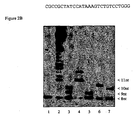
- the polymerase can then be 'walked' along the coding template by the stepwise addition of cognate nucleotides. We confirmed these results, but observe that under the conditions used here additional nucleotides are incorporated in a non template dependent manner.
- RNA oligomer and a single-stranded DNA template can form a nucleic acid scaffold that interacts with T7 RNAP in a transcriptional complex.
- a cognate nucleotide here rATP
- the RNA primer is extended by one or two bases ( figure 2B , lane 3).
- a scaffold will be extended by 3 or more bases (1B lane 4) when offered the next two nucleotides encoded by the DNA (here rATP and rGTP).
- the sole incoming nucleotide is non-cognate (here rCTP)
- the extension is limited to one base only (1B lane 5).
- the incorporation of one or more nucleotides in addition to the encoded base is evidently not a template dependant event. This effect is pronounced of the so-called N+1 effect (Milligan).
- RNA/DNA scaffold and T7 RNA polymerase offer a simple system for testing the potential of nucleotide analogs to be incorporated into a growing RNA chain.
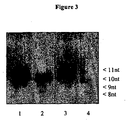
- Example 5 2'-(2 Nitrobenzyl)-ATP is incorporated into an RNA chain by T7 RNA polymerase
- the main product could be the result of the incorporation of a single 2'-(2-Nitrobenzyl)-ATP, of two 2'-(2-Nitrobenzyl)-ATP (the second of which would be non-template dependant, i.e. N+1 type), or of one 2'-(2-Nitrobenzyl)-ATP added to a canonically incorporated rATP. Further evidence for the identity of the main product of transcription in the presence of high concentrations of 2'-(2-Nitrobenzyl)-ATP comes from a deprotection experiment.
- the 2-Nitrobenzyl moiety is a photolabile group used in many application for its ability to absorb light energy and cleave the covalent bond between itself and a 'protected' molecule (Givens).
- cleavage of this bond generates a free 2'-OH group on the ribose ring.
- the product of this photo-deprotection should consequently run at the same position as an RNA oligomer extended by the incorporation of unmodified rATP.
- Example 7 2'-(2-Nitrobenzyl)-ATP acts as reversible terminator of transcription
- a potential application for the incorporation of NB-modified nucleotides by a polymerase is their use as reversible terminators in a novel sequencing technology ( WO 00/53805 ).
- 2'-(2-Nitrobenzyl)-ATP acts as a bona fide terminator of transcription. Elongation of the transcript can resume upon removal of the protecting 2-Nitrobenzyl group by UV irradiation.
- This quality of the 2'-(2-Nitrobenzyl)-ATP also rules out the possibility mentioned above that the main product of transcription in presence of high concentrations of 2'-(2-Nitrobenzyl)-ATP could be an RNA primer extended by two rather than one modified nucleotide.
Landscapes
- Chemical & Material Sciences (AREA)
- Organic Chemistry (AREA)
- Health & Medical Sciences (AREA)
- Life Sciences & Earth Sciences (AREA)
- Engineering & Computer Science (AREA)
- Biochemistry (AREA)
- Biotechnology (AREA)
- General Health & Medical Sciences (AREA)
- Genetics & Genomics (AREA)
- Molecular Biology (AREA)
- Measuring Or Testing Involving Enzymes Or Micro-Organisms (AREA)
- Saccharide Compounds (AREA)
Applications Claiming Priority (2)
| Application Number | Priority Date | Filing Date | Title |
|---|---|---|---|
| US57690704P | 2004-06-02 | 2004-06-02 | |
| PCT/IB2005/002488 WO2005118608A2 (en) | 2004-06-02 | 2005-06-02 | 2’-nitrobenzyl-modified ribonucleotides |
Publications (2)
| Publication Number | Publication Date |
|---|---|
| EP1753774A2 EP1753774A2 (en) | 2007-02-21 |
| EP1753774B1 true EP1753774B1 (en) | 2008-09-10 |
Family
ID=35463420
Family Applications (1)
| Application Number | Title | Priority Date | Filing Date |
|---|---|---|---|
| EP05769767A Expired - Lifetime EP1753774B1 (en) | 2004-06-02 | 2005-06-02 | 2"-nitrobenzyl-modified ribonucleotides |
Country Status (8)
| Country | Link |
|---|---|
| US (4) | US7759061B2 (enExample) |
| EP (1) | EP1753774B1 (enExample) |
| JP (3) | JP2008501679A (enExample) |
| AT (1) | ATE407939T1 (enExample) |
| AU (1) | AU2005250239A1 (enExample) |
| CA (1) | CA2569491A1 (enExample) |
| DE (1) | DE602005009693D1 (enExample) |
| WO (1) | WO2005118608A2 (enExample) |
Families Citing this family (15)
| Publication number | Priority date | Publication date | Assignee | Title |
|---|---|---|---|---|
| US7572581B2 (en) | 2003-06-30 | 2009-08-11 | Roche Molecular Systems, Inc. | 2′-terminator nucleotide-related methods and systems |
| US7947817B2 (en) | 2003-06-30 | 2011-05-24 | Roche Molecular Systems, Inc. | Synthesis and compositions of 2'-terminator nucleotides |
| WO2005118608A2 (en) | 2004-06-02 | 2005-12-15 | Asm Scientific, Inc. | 2’-nitrobenzyl-modified ribonucleotides |
| US7928207B2 (en) * | 2004-06-28 | 2011-04-19 | Roche Molecular Systems, Inc | Synthesis and compositions of nucleic acids comprising 2′-terminator nucleotides |
| US7745125B2 (en) * | 2004-06-28 | 2010-06-29 | Roche Molecular Systems, Inc. | 2′-terminator related pyrophosphorolysis activated polymerization |
| CN101346472B (zh) * | 2005-12-21 | 2013-04-24 | 霍夫曼—拉罗奇有限公司 | 用可逆2’-修饰的核苷酸进行的序列测定和基因分型 |
| EP2071927A2 (en) | 2006-09-28 | 2009-06-24 | Illumina, Inc. | Compositions and methods for nucleotide sequencing |
| US8486717B2 (en) | 2011-01-18 | 2013-07-16 | Symbolics, Llc | Lateral flow assays using two dimensional features |
| US9874556B2 (en) | 2012-07-18 | 2018-01-23 | Symbolics, Llc | Lateral flow assays using two dimensional features |
| US9146248B2 (en) | 2013-03-14 | 2015-09-29 | Intelligent Bio-Systems, Inc. | Apparatus and methods for purging flow cells in nucleic acid sequencing instruments |
| US9591268B2 (en) | 2013-03-15 | 2017-03-07 | Qiagen Waltham, Inc. | Flow cell alignment methods and systems |
| CN105765384B (zh) | 2013-09-13 | 2018-02-09 | Symbolics有限责任公司 | 运用二维试验和对照信号读出模式的侧向层析检测 |
| CN105722977A (zh) | 2013-10-30 | 2016-06-29 | 绿色生活生物技术有限责任公司 | 用于柑橘绿化枯萎病的发病定量系统和治疗方法 |
| JP2024518331A (ja) | 2021-04-29 | 2024-05-01 | アボット・ラボラトリーズ | 生体試料のハイスループット核酸検査 |
| US12668836B2 (en) | 2021-05-21 | 2026-06-30 | Tetracore, Inc. | Detection of recombinase polymerase amplification (RPA) amplicons via FEN1 cleavage |
Family Cites Families (14)
| Publication number | Priority date | Publication date | Assignee | Title |
|---|---|---|---|---|
| JPS58109498A (ja) * | 1981-08-24 | 1983-06-29 | Agency Of Ind Science & Technol | オリゴリボヌクレオチド |
| JPS5836396A (ja) * | 1981-08-24 | 1983-03-03 | Agency Of Ind Science & Technol | オリゴリボヌクレオチドの製造法 |
| US5223414A (en) | 1990-05-07 | 1993-06-29 | Sri International | Process for nucleic acid hybridization and amplification |
| CA2122203C (en) * | 1993-05-11 | 2001-12-18 | Melinda S. Fraiser | Decontamination of nucleic acid amplification reactions |
| US20010018514A1 (en) * | 1998-07-31 | 2001-08-30 | Mcgall Glenn H. | Nucleic acid labeling compounds |
| WO1998033939A1 (en) * | 1997-01-31 | 1998-08-06 | Hitachi, Ltd. | Method for determining nucleic acid base sequence and apparatus therefor |
| AU3174600A (en) * | 1999-03-10 | 2000-09-28 | Asm Scientific, Inc. | A method for direct nucleic acid sequencing |
| JP2001288197A (ja) * | 2000-04-10 | 2001-10-16 | Fuji Photo Film Co Ltd | 蛍光ヌクレオチド |
| EP3034627B1 (en) * | 2000-10-06 | 2019-01-30 | The Trustees of Columbia University in the City of New York | Massive parallel method for decoding dna and rna |
| CN1348096A (zh) * | 2000-10-10 | 2002-05-08 | 栾国彦 | 一种均相特异性检测核酸的探针及应用方法 |
| AU1312502A (en) * | 2000-10-11 | 2002-04-22 | Pe Corp Ny | Fluorescent nucleobase conjugates having anionic linkers |
| DK1499738T3 (da) | 2002-02-21 | 2008-11-17 | Asm Scient Inc | Recombinase-polymerease-amplifikation |
| WO2005118853A2 (en) | 2004-06-01 | 2005-12-15 | Asm Scientific, Inc. | Recombinase polymerase amplification |
| WO2005118608A2 (en) * | 2004-06-02 | 2005-12-15 | Asm Scientific, Inc. | 2’-nitrobenzyl-modified ribonucleotides |
-
2005
- 2005-06-02 WO PCT/IB2005/002488 patent/WO2005118608A2/en not_active Ceased
- 2005-06-02 JP JP2007514217A patent/JP2008501679A/ja not_active Withdrawn
- 2005-06-02 CA CA002569491A patent/CA2569491A1/en not_active Abandoned
- 2005-06-02 DE DE602005009693T patent/DE602005009693D1/de not_active Expired - Fee Related
- 2005-06-02 US US11/628,343 patent/US7759061B2/en not_active Expired - Lifetime
- 2005-06-02 EP EP05769767A patent/EP1753774B1/en not_active Expired - Lifetime
- 2005-06-02 AT AT05769767T patent/ATE407939T1/de not_active IP Right Cessation
- 2005-06-02 AU AU2005250239A patent/AU2005250239A1/en not_active Abandoned
-
2010
- 2010-06-21 US US12/803,261 patent/US8022194B2/en not_active Expired - Lifetime
-
2011
- 2011-08-10 US US13/206,926 patent/US8299226B2/en not_active Expired - Lifetime
-
2012
- 2012-01-25 JP JP2012013260A patent/JP2012095665A/ja active Pending
- 2012-05-25 JP JP2012119854A patent/JP2012157369A/ja active Pending
- 2012-10-23 US US13/658,023 patent/US20130045475A1/en not_active Abandoned
Also Published As
| Publication number | Publication date |
|---|---|
| US20080261208A1 (en) | 2008-10-23 |
| ATE407939T1 (de) | 2008-09-15 |
| CA2569491A1 (en) | 2005-12-15 |
| US20130045475A1 (en) | 2013-02-21 |
| WO2005118608A3 (en) | 2006-04-27 |
| US8299226B2 (en) | 2012-10-30 |
| AU2005250239A1 (en) | 2005-12-15 |
| WO2005118608A2 (en) | 2005-12-15 |
| EP1753774A2 (en) | 2007-02-21 |
| US7759061B2 (en) | 2010-07-20 |
| US8022194B2 (en) | 2011-09-20 |
| US20120040345A1 (en) | 2012-02-16 |
| JP2012157369A (ja) | 2012-08-23 |
| US20110053154A1 (en) | 2011-03-03 |
| JP2012095665A (ja) | 2012-05-24 |
| DE602005009693D1 (de) | 2008-10-23 |
| JP2008501679A (ja) | 2008-01-24 |
Similar Documents
| Publication | Publication Date | Title |
|---|---|---|
| US8299226B2 (en) | 2-nitrobenzyl-modified ribonucleotides | |
| AU2018256647C1 (en) | A method for the site-specific enzymatic labelling of nucleic acids in vitro by incorporation of unnatural nucleotides | |
| KR102298737B1 (ko) | 뉴클레오티드 유사체 | |
| EP3091026B1 (en) | Disulfide-linked reversible terminators | |
| US8153779B2 (en) | Nucleotide with an alpha-phosphate mimetic | |
| US8057997B2 (en) | Nucleic acid binding compounds containing pyrazolo[3,4-D]pyrimidine analogues of purin-2,6-diamine and their uses | |
| US20090018324A1 (en) | Labeled nucleotide analogs and uses therefor | |
| WO2018148723A1 (en) | Polymerase enzyme from pyrococcus abyssi | |
| WO2008042067A2 (en) | Compositions and methods for nucleotide sequencing | |
| WO2018148727A1 (en) | Polymerase enzyme from 9°n | |
| US20240093164A1 (en) | Polymerase enzyme from 9°n | |
| US7534569B2 (en) | Method of generating long nucleic acid molecules of defined sequence | |
| WO2018148724A1 (en) | Polymerase enzyme from pyrococcus furiosus | |
| ES2224640T3 (es) | Utilizacion de nucleotidos modificados en 5' en biologia molecular y en medicina. | |
| EP3580350B1 (en) | Polymerase enzyme from pyrococcus furiosus | |
| EP3580352A1 (en) | Polymerase enzyme from pyrococcus abyssi | |
| Stolze et al. | Synthesis of 3′‐Sugar‐and Base‐Modified Nucleotides and Their Application as Potent Chain Terminators in DNA Sequencing | |
| WO2021205155A2 (en) | C5-modified thymidines | |
| WO2021205156A2 (en) | 5-position modified pyrimidines | |
| Vaghefi | Chemical synthesis of oligonucleotide triphosphates | |
| HK40074774A (en) | Enzymatic synthesis of oligonucleotides | |
| JPWO2019150564A1 (ja) | スルホンアミド骨格をもつオリゴヌクレオチドを鋳型として用いたdna複製法 |
Legal Events
| Date | Code | Title | Description |
|---|---|---|---|
| PUAI | Public reference made under article 153(3) epc to a published international application that has entered the european phase |
Free format text: ORIGINAL CODE: 0009012 |
|
| 17P | Request for examination filed |
Effective date: 20061221 |
|
| AK | Designated contracting states |
Kind code of ref document: A2 Designated state(s): AT BE BG CH CY CZ DE DK EE ES FI FR GB GR HU IE IS IT LI LT LU MC NL PL PT RO SE SI SK TR |
|
| 17Q | First examination report despatched |
Effective date: 20070221 |
|
| RIN1 | Information on inventor provided before grant (corrected) |
Inventor name: STEMPLE, DEREK L.,ASM SCIENTIFIC, INC. Inventor name: ARMES, NIALL, A. Inventor name: PIEPENBURG, OLAF,ASM SCIENTIFIC, INC. |
|
| DAX | Request for extension of the european patent (deleted) | ||
| GRAP | Despatch of communication of intention to grant a patent |
Free format text: ORIGINAL CODE: EPIDOSNIGR1 |
|
| GRAS | Grant fee paid |
Free format text: ORIGINAL CODE: EPIDOSNIGR3 |
|
| RAP1 | Party data changed (applicant data changed or rights of an application transferred) |
Owner name: ASM SCIENTIFIC, INC. |
|
| GRAA | (expected) grant |
Free format text: ORIGINAL CODE: 0009210 |
|
| AK | Designated contracting states |
Kind code of ref document: B1 Designated state(s): AT BE BG CH CY CZ DE DK EE ES FI FR GB GR HU IE IS IT LI LT LU MC NL PL PT RO SE SI SK TR |
|
| REG | Reference to a national code |
Ref country code: GB Ref legal event code: FG4D |
|
| REG | Reference to a national code |
Ref country code: CH Ref legal event code: EP |
|
| REG | Reference to a national code |
Ref country code: IE Ref legal event code: FG4D |
|
| REF | Corresponds to: |
Ref document number: 602005009693 Country of ref document: DE Date of ref document: 20081023 Kind code of ref document: P |
|
| PG25 | Lapsed in a contracting state [announced via postgrant information from national office to epo] |
Ref country code: LT Free format text: LAPSE BECAUSE OF FAILURE TO SUBMIT A TRANSLATION OF THE DESCRIPTION OR TO PAY THE FEE WITHIN THE PRESCRIBED TIME-LIMIT Effective date: 20080910 |
|
| PG25 | Lapsed in a contracting state [announced via postgrant information from national office to epo] |
Ref country code: FI Free format text: LAPSE BECAUSE OF FAILURE TO SUBMIT A TRANSLATION OF THE DESCRIPTION OR TO PAY THE FEE WITHIN THE PRESCRIBED TIME-LIMIT Effective date: 20080910 Ref country code: AT Free format text: LAPSE BECAUSE OF FAILURE TO SUBMIT A TRANSLATION OF THE DESCRIPTION OR TO PAY THE FEE WITHIN THE PRESCRIBED TIME-LIMIT Effective date: 20080910 Ref country code: SI Free format text: LAPSE BECAUSE OF FAILURE TO SUBMIT A TRANSLATION OF THE DESCRIPTION OR TO PAY THE FEE WITHIN THE PRESCRIBED TIME-LIMIT Effective date: 20080910 |
|
| NLV1 | Nl: lapsed or annulled due to failure to fulfill the requirements of art. 29p and 29m of the patents act | ||
| PG25 | Lapsed in a contracting state [announced via postgrant information from national office to epo] |
Ref country code: BE Free format text: LAPSE BECAUSE OF FAILURE TO SUBMIT A TRANSLATION OF THE DESCRIPTION OR TO PAY THE FEE WITHIN THE PRESCRIBED TIME-LIMIT Effective date: 20080910 |
|
| PG25 | Lapsed in a contracting state [announced via postgrant information from national office to epo] |
Ref country code: BG Free format text: LAPSE BECAUSE OF FAILURE TO SUBMIT A TRANSLATION OF THE DESCRIPTION OR TO PAY THE FEE WITHIN THE PRESCRIBED TIME-LIMIT Effective date: 20081210 Ref country code: ES Free format text: LAPSE BECAUSE OF FAILURE TO SUBMIT A TRANSLATION OF THE DESCRIPTION OR TO PAY THE FEE WITHIN THE PRESCRIBED TIME-LIMIT Effective date: 20081221 |
|
| PG25 | Lapsed in a contracting state [announced via postgrant information from national office to epo] |
Ref country code: RO Free format text: LAPSE BECAUSE OF FAILURE TO SUBMIT A TRANSLATION OF THE DESCRIPTION OR TO PAY THE FEE WITHIN THE PRESCRIBED TIME-LIMIT Effective date: 20080910 Ref country code: SK Free format text: LAPSE BECAUSE OF FAILURE TO SUBMIT A TRANSLATION OF THE DESCRIPTION OR TO PAY THE FEE WITHIN THE PRESCRIBED TIME-LIMIT Effective date: 20080910 Ref country code: CZ Free format text: LAPSE BECAUSE OF FAILURE TO SUBMIT A TRANSLATION OF THE DESCRIPTION OR TO PAY THE FEE WITHIN THE PRESCRIBED TIME-LIMIT Effective date: 20080910 Ref country code: PT Free format text: LAPSE BECAUSE OF FAILURE TO SUBMIT A TRANSLATION OF THE DESCRIPTION OR TO PAY THE FEE WITHIN THE PRESCRIBED TIME-LIMIT Effective date: 20090210 Ref country code: IS Free format text: LAPSE BECAUSE OF FAILURE TO SUBMIT A TRANSLATION OF THE DESCRIPTION OR TO PAY THE FEE WITHIN THE PRESCRIBED TIME-LIMIT Effective date: 20090110 Ref country code: NL Free format text: LAPSE BECAUSE OF FAILURE TO SUBMIT A TRANSLATION OF THE DESCRIPTION OR TO PAY THE FEE WITHIN THE PRESCRIBED TIME-LIMIT Effective date: 20080910 |
|
| PLBE | No opposition filed within time limit |
Free format text: ORIGINAL CODE: 0009261 |
|
| STAA | Information on the status of an ep patent application or granted ep patent |
Free format text: STATUS: NO OPPOSITION FILED WITHIN TIME LIMIT |
|
| PG25 | Lapsed in a contracting state [announced via postgrant information from national office to epo] |
Ref country code: DK Free format text: LAPSE BECAUSE OF FAILURE TO SUBMIT A TRANSLATION OF THE DESCRIPTION OR TO PAY THE FEE WITHIN THE PRESCRIBED TIME-LIMIT Effective date: 20080910 Ref country code: EE Free format text: LAPSE BECAUSE OF FAILURE TO SUBMIT A TRANSLATION OF THE DESCRIPTION OR TO PAY THE FEE WITHIN THE PRESCRIBED TIME-LIMIT Effective date: 20080910 |
|
| 26N | No opposition filed |
Effective date: 20090611 |
|
| PG25 | Lapsed in a contracting state [announced via postgrant information from national office to epo] |
Ref country code: IT Free format text: LAPSE BECAUSE OF FAILURE TO SUBMIT A TRANSLATION OF THE DESCRIPTION OR TO PAY THE FEE WITHIN THE PRESCRIBED TIME-LIMIT Effective date: 20080910 |
|
| PG25 | Lapsed in a contracting state [announced via postgrant information from national office to epo] |
Ref country code: SE Free format text: LAPSE BECAUSE OF FAILURE TO SUBMIT A TRANSLATION OF THE DESCRIPTION OR TO PAY THE FEE WITHIN THE PRESCRIBED TIME-LIMIT Effective date: 20081210 Ref country code: MC Free format text: LAPSE BECAUSE OF NON-PAYMENT OF DUE FEES Effective date: 20090630 |
|
| REG | Reference to a national code |
Ref country code: CH Ref legal event code: PL |
|
| GBPC | Gb: european patent ceased through non-payment of renewal fee |
Effective date: 20090602 |
|
| REG | Reference to a national code |
Ref country code: FR Ref legal event code: ST Effective date: 20100226 |
|
| REG | Reference to a national code |
Ref country code: IE Ref legal event code: MM4A |
|
| PG25 | Lapsed in a contracting state [announced via postgrant information from national office to epo] |
Ref country code: LI Free format text: LAPSE BECAUSE OF NON-PAYMENT OF DUE FEES Effective date: 20090630 Ref country code: FR Free format text: LAPSE BECAUSE OF NON-PAYMENT OF DUE FEES Effective date: 20090630 Ref country code: CH Free format text: LAPSE BECAUSE OF NON-PAYMENT OF DUE FEES Effective date: 20090630 Ref country code: IE Free format text: LAPSE BECAUSE OF NON-PAYMENT OF DUE FEES Effective date: 20090602 |
|
| PG25 | Lapsed in a contracting state [announced via postgrant information from national office to epo] |
Ref country code: GB Free format text: LAPSE BECAUSE OF NON-PAYMENT OF DUE FEES Effective date: 20090602 Ref country code: PL Free format text: LAPSE BECAUSE OF FAILURE TO SUBMIT A TRANSLATION OF THE DESCRIPTION OR TO PAY THE FEE WITHIN THE PRESCRIBED TIME-LIMIT Effective date: 20080910 |
|
| PG25 | Lapsed in a contracting state [announced via postgrant information from national office to epo] |
Ref country code: DE Free format text: LAPSE BECAUSE OF NON-PAYMENT OF DUE FEES Effective date: 20100101 |
|
| PG25 | Lapsed in a contracting state [announced via postgrant information from national office to epo] |
Ref country code: GR Free format text: LAPSE BECAUSE OF FAILURE TO SUBMIT A TRANSLATION OF THE DESCRIPTION OR TO PAY THE FEE WITHIN THE PRESCRIBED TIME-LIMIT Effective date: 20081211 |
|
| PG25 | Lapsed in a contracting state [announced via postgrant information from national office to epo] |
Ref country code: LU Free format text: LAPSE BECAUSE OF NON-PAYMENT OF DUE FEES Effective date: 20090602 |
|
| PG25 | Lapsed in a contracting state [announced via postgrant information from national office to epo] |
Ref country code: HU Free format text: LAPSE BECAUSE OF FAILURE TO SUBMIT A TRANSLATION OF THE DESCRIPTION OR TO PAY THE FEE WITHIN THE PRESCRIBED TIME-LIMIT Effective date: 20090311 |
|
| PG25 | Lapsed in a contracting state [announced via postgrant information from national office to epo] |
Ref country code: TR Free format text: LAPSE BECAUSE OF FAILURE TO SUBMIT A TRANSLATION OF THE DESCRIPTION OR TO PAY THE FEE WITHIN THE PRESCRIBED TIME-LIMIT Effective date: 20080910 |
|
| PG25 | Lapsed in a contracting state [announced via postgrant information from national office to epo] |
Ref country code: CY Free format text: LAPSE BECAUSE OF FAILURE TO SUBMIT A TRANSLATION OF THE DESCRIPTION OR TO PAY THE FEE WITHIN THE PRESCRIBED TIME-LIMIT Effective date: 20080910 |