EP1748643B1 - Vorrichtungen und Verfahren zur Regelung von stroboskopischer Beleuchtung - Google Patents
Vorrichtungen und Verfahren zur Regelung von stroboskopischer Beleuchtung Download PDFInfo
- Publication number
- EP1748643B1 EP1748643B1 EP06114229A EP06114229A EP1748643B1 EP 1748643 B1 EP1748643 B1 EP 1748643B1 EP 06114229 A EP06114229 A EP 06114229A EP 06114229 A EP06114229 A EP 06114229A EP 1748643 B1 EP1748643 B1 EP 1748643B1
- Authority
- EP
- European Patent Office
- Prior art keywords
- light
- control
- respective light
- strobe illumination
- machine vision
- Prior art date
- Legal status (The legal status is an assumption and is not a legal conclusion. Google has not performed a legal analysis and makes no representation as to the accuracy of the status listed.)
- Expired - Lifetime
Links
Images





Classifications
-
- G—PHYSICS
- G01—MEASURING; TESTING
- G01N—INVESTIGATING OR ANALYSING MATERIALS BY DETERMINING THEIR CHEMICAL OR PHYSICAL PROPERTIES
- G01N21/00—Investigating or analysing materials by the use of optical means, i.e. using sub-millimetre waves, infrared, visible or ultraviolet light
- G01N21/84—Systems specially adapted for particular applications
- G01N21/88—Investigating the presence of flaws or contamination
- G01N21/8806—Specially adapted optical and illumination features
-
- H—ELECTRICITY
- H04—ELECTRIC COMMUNICATION TECHNIQUE
- H04N—PICTORIAL COMMUNICATION, e.g. TELEVISION
- H04N23/00—Cameras or camera modules comprising electronic image sensors; Control thereof
- H04N23/70—Circuitry for compensating brightness variation in the scene
- H04N23/74—Circuitry for compensating brightness variation in the scene by influencing the scene brightness using illuminating means
-
- G—PHYSICS
- G01—MEASURING; TESTING
- G01N—INVESTIGATING OR ANALYSING MATERIALS BY DETERMINING THEIR CHEMICAL OR PHYSICAL PROPERTIES
- G01N21/00—Investigating or analysing materials by the use of optical means, i.e. using sub-millimetre waves, infrared, visible or ultraviolet light
- G01N21/84—Systems specially adapted for particular applications
- G01N21/88—Investigating the presence of flaws or contamination
- G01N21/8806—Specially adapted optical and illumination features
- G01N2021/8838—Stroboscopic illumination; synchronised illumination
Definitions
- This invention relates to systems and methods that select light source channels and control light intensity and direction for precision machine vision inspection using a transient light source.
- Such systems may include a computer, a camera and/or optical system and a precision stage that may be movable in multiple directions to allow the camera to scan the features of a workpiece that is being inspected.
- One exemplary prior art system of a type that may be characterized as a general-purpose "off-line" precision vision system, is the commercially available Quick Vision TM series of vision inspection machines and QVPak ® software available from Mitutoyo America Corporation (MAC), located in Aurora, Illinois.
- Such general-purpose "off-line" precision vision systems often include a programmable illumination system and a lens turret with lenses of various magnifications, for example, to increase versatility of the image systems and provide the ability to rapidly change configuration and imaging parameters for the vision systems to perform a wide variety of inspection tasks.
- a programmable illumination system and a lens turret with lenses of various magnifications, for example, to increase versatility of the image systems and provide the ability to rapidly change configuration and imaging parameters for the vision systems to perform a wide variety of inspection tasks.
- General purpose precision machine vision inspection systems such as the Quick Vision TM system, are also generally programmable and operable to provide automated video inspection. Such systems may include features and tools that simplify the programming and operation of such systems, such that operation and programming may be performed reliably by "non-expert" operators.
- U.S. Patent No. 6,542,180 teaches a vision system that uses automated video inspection. The system performs operations to adjust the lighting used to illuminate a workpiece feature based on a plurality of selected regions of a feature image.
- Imaging systems are widely used to inspect workpieces being transported through a manufacturing process.
- Equipment such as machine vision inspection systems often capture images of the workpieces using a camera, for example, and process captured images to verify various workpiece dimensions by identifying edges of relevant features in the images.
- edge artifacts or edge-shifting may be created by lighting-specific shadows cast due to sub-optimal direction of the illumination of the workpiece. Over- or under-exposure may reduce the ability to accurately detect an edge, and decrease measurement repeatability.
- workpieces may be kept in motion, even during image capture. This places an additional burden on illumination systems to minimize blurring caused by the motion. Such factors frequently limit the accuracy with which the edge of a feature may be located within an image and/or the velocity that may be tolerated during image capture. Thus, improvements in workpiece illumination control technology would be very desirable.
- Exemplary systems may include an illumination source, an image acquisition device and a control system.
- the illumination source may emit light of one or more visible or invisible wavelengths of radiation that are suitable for imaging the workpiece, as a transient flash or pulse to the workpiece.
- the transient flash or pulse may occur in response to a lamp trigger.
- the illumination source may emit the light at an illumination intensity that rises from a begin threshold to a peak and afterwards diminishes to an end threshold during a flash duration.
- the image acquisition device may capture the light associated with the workpiece for an exposure duration started in response to an exposure trigger.
- the control system may control the illumination source and the image acquisition device to provide a desired overlap between the exposure duration and the flash duration.
- the beginning of the exposure duration may precede the lamp trigger by a lamp lag period.
- the lamp trigger may be set to synchronize or adjust a timing relationship between an end of the exposure duration and the illumination intensity profile of the flash.
- exposure triggers may correspond to predetermined positions of the workpiece relative to a coordinate space used by the machine vision inspection system.
- such a system may further include a spatial light modulator (SLM) that forms an array to control and/or distribute the light from one or more illumination sources.
- the array may include elements that selectively either block, partially transmit, or transmit the light toward respective lighting channels, such as respective optical fiber bundles. Each respective lighting channel may direct the light along a path to project commanded illumination from a respective position and/or angle of incidence relative to the workpiece.
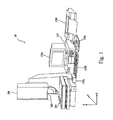
- FIG. 1 shows a diagram of an exemplary general purpose machine vision inspection system
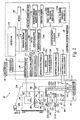
- FIG. 2 shows a block diagram in greater detail of a control system, a vision components system and a light source system of the exemplary machine vision inspection system;
- FIG. 3 shows a block diagram in greater detail of the light source system and a lighting control interface
- FIG. 4 shows an exemplary graphical user interface of a control for a spatial light modulator
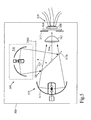
- FIG. 5 shows a schematic layout diagram of exemplary lighting system including a spatial light modulator
- FIG. 6 shows a bar-chart of exemplary relative grayscale intensities obtained when imaging various materials at different magnifications
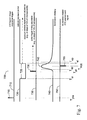
- FIG. 7 shows a timing diagram of exemplary camera and flash triggers associated with strobe illumination and exposure control
- FIG. 8 shows a block diagram of an exemplary controller signals associated with a light generator and a vision measuring machine
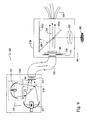
- FIG. 9 shows a schematic layout diagram of exemplary light channels, including a structured light channel and a spatial light modulator
- FIG. 10 shows a plot illustrating exemplary generic relationships between a power setting and corresponding strobe duration times
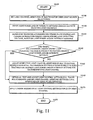
- FIG. 11 is a flowchart illustrating an exemplary method of using a strobe light source and a spatial light modulator to provide illumination levels for one or more light sources.
- the following detailed description refers to multi-channel strobe illumination for magnified image acquisition.
- the strobe illumination source may refer to a Xenon flashlamp, for example.
- the principles described herein may be equally applied to any known or later-developed transient illumination sources, beyond the examples specifically discussed herein.
- Exemplary systems and methods for machine vision inspection may be used in conjunction with systems and methods disclosed in EP-A-1533996 and/or EP-A-1621914 and/or U.S. Patent Application No. 10/435,625 filed on May 7, 2003 directed to improved machine vision inspection throughput.
- Fig. 1 is a block diagram of an exemplary embodiment of a general purpose programmable machine vision inspection system 10 usable according to this invention.
- the machine vision inspection system 10 may include a vision measuring machine 200 that may be operably arranged to exchange data and control signals with a control system portion 120.
- the control system portion 120 may be further operably arranged to exchange data and control signals with at least one of a monitor 136a, a printer 136b, a joystick 138a, a keyboard 138b, and a mouse 138c.
- the vision measuring machine 200 may include a moveable workpiece stage 210 and an optical imaging system 205, which may include a zoom lens or a number of interchangeable lenses.
- the zoom lens or interchangeable lenses may generally provide various magnifications for images produced by the optical imaging system 205.
- the joystick 138a may be used to control the movement of the movable workpiece stage 210 in both X- and Y-axes horizontal directions, which may be generally parallel to the focal planes and perpendicular to the Z-axis movement direction of the optical imaging system 34. Frequently, Z-axis movement may be controlled by a rotary deflection component of a handle or knob of the joystick 138a.
- the joystick 138a may be provided in a form other than that shown, such as any visual representation or widget on the monitor 136a that may be intended to function as a "virtual motion control device" of the machine vision inspection system 10 and is controllable through any computer input device, such as the mouse 138c or other analogous devices.
- FIG. 2 shows a detailed block diagram of a machine vision inspection system 10', which is an exemplary embodiment of the machine vision inspection system 10, that includes the control system portion 120, the vision measuring machine 200 and, in addition, includes a controllable light generation system 300.
- the control system portion 120 may be arranged to exchange data and control signals with both the vision measuring machine 200 and the light generation system 300.
- the control system portion 120 may include a controller 125 that may be in communication with, or connected to, an input/output interface 130, a memory 140, a workpiece program generator and executor 170, a computer-aided design (CAD) file feature extractor 180 and a power supply portion 190.
- the control system portion 120 may also be arranged to exchange data and control signals with display devices 136 and input devices 138, for example, through the input/output interface 130.
- the input/output interface 130 may comprise an imaging control interface 131, a motion control interface 132, a lighting control interface 133, and a lens control interface 134.
- the motion control interface 132 may include a position portion 132a and a speed and acceleration portion 132b.
- the lighting control interface 133 may include lighting channel exposure and control portion 135.
- the various elements of the control system portion 120 may generally encompass hard-wired circuits, software circuits, subroutines, objects, operations, application programming interfaces, managers, applications, or any other known or later-developed hardware or software structure.
- the display devices 136 may include, for example, the monitor 136a and the printer 136b ( FIG. 1 ).
- the input devices 138 may include, for example, the joystick 138a, the keyboard 138b and the mouse 138c ( FIG. 1 ).
- the various elements of the control system portion 120 may be operably connected to each other and to external devices by any suitable known or later-developed power and/or signal busses, wireless communication signals, and/or application programming interfaces, or the like. Such interconnections are generally indicated by various interconnection lines 195, throughout the control system portion 124, in an arrangement of interconnections that is exemplary only, and not limiting.
- the light generation system 300 may include one or more light generator 310 and a spatial light modulator (SLM) 350 to control the distribution of light from the light generator 310, to a plurality of light channels, as described further below.
- the light generator 310 and the SLM 350 may be arranged to exchange data and control signals with the light channel exposure and control portion 135, for example, by respective power and signal lines 311, 351.
- At least one of the lamps (not shown) of the light generator 310 may be used in a strobe illumination mode of operation to provide a combination of a very fast light generator response time (in the ⁇ s or ns range) and suitable optical power levels.
- the light generator 310 may include a high intensity Xenon (Xe) flashlamp. However, in general, any light generator that emits a wavelength within a sensing range of the camera 260 may be used.
- Xe Xenon
- the vision measuring machine 200 may include an optical assembly 205, light sources, including stage light source 220, coaxial light source 230, and programmable ring light (PRL) source 240.
- the workpiece stage 210 may include a central transparent portion 212 through which light from the stage light source 220 passes.
- the stage 210 may be controllably movable along X- and Y-axes that lie in a plane substantially parallel to the surface of the stage 210 where a workpiece or target 20 may be positioned.
- the stage light source 220 may receive light through a light cable 221 from a respective channel of the SLM 350 to transmit light 222 through the transparent portion 212.
- the components that provide the light 222 may be regarded as a first light channel of the machine vision inspection system 10'.
- the coaxial light source 230 may receive light through a light cable 231 from a respective channel of the SLM 350 to transmit light 232 to a beamsplitter that provides a coaxial mirror 233 that directs the transmitted light 232 through the objective lens 250.
- the components that provide the light 232 may be regarded as a second light channel of the machine vision inspection system 10'.
- the programmable ring light (PRL) source 240 may form an annular ring above and around the workpiece 20 to transmit light 242 to the workpiece 20 at controllable angles.
- An exemplary configuration for the PRL source 240 may include four ring-light sources 240a through 240d, arranged in respective quadrants around the ring-light.
- the four sources 240a through 240d may receive light through respective light cables 241a through 241d from respective channels of the SLM 350.
- the various light cables may comprise optical fiber bundles, or the like.
- the PRL source 240 may be formed as a combination of individually controllable sources.
- the components that provide respective portions of the light 242 may be regarded as four additional light channels of the machine vision inspection system 10'.
- the workpiece 20 may be disposed on the stage 210 at a known or learned position. By detecting macroscopic positions of the stage 210 and/or the workpiece 20, the control system portion 120 may accurately determine where to capture workpiece images to perform inspection of various workpiece features.
- the memory 140 may comprise an image file memory portion 141, a workpiece program memory portion 142, and a video tool portion 143.
- the video tool portion 143 may comprise a region of interest generator 143x, and various respective video tools 143a through 143m, which may include respective GUI interfaces, image processing operations, and the like, which assist a user in performing and/or programming various inspection operations.
- the region of interest generator 143x provides operations that may assist the user in defining desired regions of interest to be analyzed or operated upon be the various video tools 143a-143m, as described in the '180 patent, for example.
- the memory 140 may store data and/or "tools" usable to operate the machine vision inspection system 10 to capture or acquire an image of the workpiece 20 with desired image characteristics.
- the memory 140 may further store data and/or video tools usable to operate the machine vision inspection system 10 to perform various inspection and measurement operations on the acquired images, either manually or automatically, and to output the results, for example, through the input/output interface 130 through data and/or control busses and/or the controller 125.
- the memory 140 may also contain data defining a GUI operable through the input/output interface 130 by way of data and/or control busses and/or the controller 125.
- the optical assembly 205 may include, for example, a camera or image acquisition device 260, an interchangeable objective lens 250, a turret lens assembly 280, and the coaxial light source 230.
- the objective lens 250 and the camera 260 may be aligned along a camera axis.
- the optical assembly 205 may be controllably movable along the Z-axis that is generally orthogonal to the X- and Y-axes, for example, by using a controllable motor 294.
- Each of the X-, Y- and Z-axes of the machine vision inspection system 10 may be instrumented with respective X-, Y- and Z-axis position encoders (not shown) that provide spatial position information to the control system portion 120, for example, over suitable signal and/or control lines (not shown).
- the camera 260 may include a charge-couple diode (CCD) array, or a CMOS array, or any other suitable detector array, to provide an image based on the light received from the workpiece 20.
- the turret lens assembly 280 may include two or more respective lenses 286, 288 that may be rotated around a rotation axis 284 to be respectively positioned in the optical path between the camera 260 and the objective lens 250 to provide a respective image magnification in combination with the objection lens 250.
- the control system portion 120 may rotate the turret lens assembly 280 to provide a desired image magnification.
- the input/output interface 130 may exchange data and control signals with the camera 260, the turret lens assembly 280 and the motor 294, for example, by power and signal lines or busses 262, 281, 296.
- Respective signal and/or control lines (not shown) of the respective X-, Y- and Z-axes position encoders (not shown) may also be in communication with the input/output interface 130.
- the signal line 262 may carry various signals from the controller 125 that set an image acquisition pixel range for the camera 260, initiate an image acquisition camera operation sequence, and/or similar operations.
- the optical assembly 205 of the machine vision inspection system 10 may include, in addition to the previously discussed components, other lenses, and/or other optical elements, such as apertures, beam-splitters and other analogous devices, such as may be needed for providing desirable machine vision inspection system features.
- the workpiece 20 to be imaged and inspected using the machine vision inspection system 10 may be placed on the stage 210.
- One or more of the light sources 220, 230, 240 may emit the respective light 222, 232, 242, that may illuminate the workpiece 20.
- Light may be reflected from or transmitted through the workpiece 20 as workpiece light 255, which may pass through the interchangeable objective lens 250 and one of the lenses 286, 288 of the turret lens assembly 280 to be received by the camera 260.
- the image of the workpiece 20, captured by the camera 260 may be output, for example, through the signal line 262 to the control system portion 120.
- a distance between the stage 210 and the optical assembly 205 may be adjusted to change the focus of the image of the workpiece 20 captured by the camera 260.
- the optical assembly 205 may be movable in the vertical (Z-axis) direction perpendicular to the stage 32, for example, using the controllable motor 294 that may drive an actuator, a connecting cable, or other analogous devices, to move the optical assembly 205 along the Z-axis.
- the term Z-axis refers to the axis for focusing the image obtained by the optical assembly 205.
- the controllable motor 294 when used, may be in communication with the control system portion 120, for example, through the signal line 296.
- the control system portion 120 may be usable to determine image acquisition settings or parameters and/or acquire an image of the workpiece 20 with desired image characteristics in a region of interest that includes a workpiece feature to be inspected by workpiece program instructions.
- workpiece imaging instructions may be encoded by the workpiece part programming generator and executor 170 and transmitted to other components through data and/or control busses and/or application programming interfaces 195.
- the display devices 136 and input devices 138 may be used to view, create and/or modify part programs, to view the images captured by the camera 260, and/or to view and/or modify various GUI features for monitoring and/or controlling the machine vision inspection system 10'.
- the physical movements may be controlled by the motion control interface 132.
- the motion control interface 132 may receive position information from the X-, Y- and Z-axis position encoders and may transmit position altering control signals via data and/or control busses and/or application programming interfaces 195.
- such instructions may cause the machine vision inspection system 10' to manipulate the stage 210 and/or the camera 260 such that a particular portion of the workpiece 20 may be within the field of view of the camera 260 and may provide a desired magnification, a desired focus state and an appropriate illumination. This process may be repeated for each of multiple images in a set of images that are to be captured for inspecting the workpiece 20.
- FIG. 3 shows an exemplary block diagram of details of the lighting control interface 133 including the light channel and exposure control portion 135, and the light generation system 300.
- the light channel and exposure control portion 135 may include a timing and synchronization portion 135a, an SLM control portion 135b and a light generator control portion 135c.
- the SLM control portion 135b may be connected to the SLM 350, for example, through a signal line or buss 351.
- the light generator control portion 135c may be connected to the light generator 310, for example, through a power and/or signal line or buss 311.
- the light generator 310 may emit light 314 to illuminate an illumination area 315 on the SLM 350.
- the SLM 350 may generally transmit, partially transmit, or block light.
- the SLM 350 may include a plurality of respective controllable apertures within the illumination area 315.
- the respective apertures may generally provide illumination control for the respective light channels of the machine vision inspection system by transmitting, partially transmitting, or blocking the light 314 to each of the respective light channels.
- the apertures include a stage light channel aperture 321, a coaxial light channel aperture 331, and PRL light channel apertures 341a, 341b, 341c, 341d.
- the respective apertures 321, 331, 341a-341d may individually control the amount of light 314 transmitted to the respective light cables 221, 231, 241a-241d ( FIG. 2 ) to be output through the respective light sources 220, 230, 240a-240d.
- the SLM 350 may include an arrangement of shutters that provide the respective apertures.
- the shutters may be of any now-known or later-developed type that can provide controllable light transmitting and light blocking functions in a desired pattern.
- the SLM may be used to selectively transmit, attenuate and/or block light from the light generator 310.
- SLM may be a micro-display graphics array from CRL-Opto in Dunfermline, Scotland, United Kingdom, which includes an LCD pixel array that may generally be controlled by conventional video signals, if desired, and may be used to display an electronically generated 8-bit gray-scale pattern that may transmit, partially-transmit, or block the light 314 through any given pixel of the pattern, depending on its gray-scale value.
- the various respective apertures may be implemented as features of the pattern, and the pattern may be controlled at conventional video rates.
- a custom LCD including a custom pattern of desired apertures may be used in various embodiments.
- the SLM 350 allows one light generator 310 to provide independently controllable lighting to a plurality of light channels, while also allowing the light from a plurality of light channels to be perfectly synchronized, for example as one light generator 310 is strobed during an image acquisition.
- the use of one light generator 310 also allows reduced cost and reduced size, relative to the use of an individual light generator for each light channel, for example.
- the SLM 350 may include an arrangement of any now-known or later-developed type of controllable reflective shutters that can provide controllable light deflection in a desired pattern.
- the light generator 310 may be arranged such that the light 314 will not reach the various light channels unless the controllable reflective shutters or pixels "transmit" the light by reflecting and/or deflecting light at a specific angle toward the various light channels.
- the reflective SLM may be nominally oriented along a plane at 45 degrees relative to the light 314, and the reflective array elements may be aligned along that plane to transmit the light 314 toward the various respective light channels by reflecting and/or deflecting it at a right angle to reach the various respective light channels.
- the reflective array elements or pixels may be disabled from reflecting the light 314 at right angles, either by altering their individual angles, of by blocking their individual reflective light paths, for example using individually controllable LCD blocking elements.
- controllable reflective shutter arrays include liquid crystal on silicon (LCOS) micro-display products, for example, from CRL Opto, Dunfermline, Scotland, and digital light projector (DLP) micro-mirror products, for example, from Texas Instruments DLP Products, Plano, Texas.
- LCOS liquid crystal on silicon
- DLP digital light projector
- the various respective apertures may be implemented as features of a reflective pattern, and the pattern may be controlled at conventional video rates.
- a light channel aperture implemented using a micro-mirror device may alternatively attenuate the light transmitted to a particular light channel by effective reducing the its aperture size, as needed.
- the aperture diameter may be reduced by altering the configuration of the pixels that form the aperture.
- a light generator 310 may include one or more high intensity light emitting diodes (LEDs), such as one of the LEDs in the Luxeon TM product line, available from Lumileds Lighting, LLC, of San Jose, California, which may be used for both continuous wave (CW) and strobe illumination as described in U.S. Patent Application No. 10/719,210 .
- a CW light source may include a high intensity discharge (HID) metal halide lamp and/or a quartz halogen lamp.
- the strobe light generator may include a high intensity Xenon (Xe) flashlamp, such as model CX-1500 Xe flashlamp of the CX-Strobe TM series from PerkinElmer ® Optoelectronics of Frémont, California.
- Xe Xenon
- the CX-1500 Xe flashlamp may illuminate across an electromagnetic spectrum for wavelengths between 250 nm and more than 1100 nm.
- the filter may pass the visible wavelength range between 390 nm (violet) and 750 nm (red) to the light channels.
- other wavelengths ranges may be desired.
- the CX-1500 Xe flashlamp may cycle at a repeat rate of between 16 Hz and 35 Hz, with a pulse duration of between 8 ⁇ s and 10 ⁇ s.
- the CX-1500 Xe flashlamp may produce a radiometric output of 256 mJ and a photometric light output of 205 lumen-sec at 600 V DC that may be directed into a 0.9" (23 mm) diameter fiber optic guide.
- a general purpose machine vision systems may image a wide variety of workpieces, some of which may have surfaces with low reflectivity. Furthermore, magnified images may be desired. Furthermore, fast exposures, enabling imaging of moving workpieces may be desired. All of these factors tend to reduce the amount of light accumulated during an image exposure, as discussed further below. Thus, a very high intensity flashlamp may be advantageous for providing a very versatile machine vision inspection system.
- the timing and synchronization portion 135a may provide operations that send and receive control signals that synchronize the SLM 350, the light generator 310, the camera 260 and positioning of the machine vision inspection system 10',
- the SLM control portion 135b may provide control for the various light channels by controlling the on-off timing, contrast, and aperture pattern, if applicable, of the SLM 350.
- the light generator control portion 135c may provide control for the power levels, the trigger signals, and on-off timing (if applicable) of the one or more lamps or LED's, or the like, of the light generator 310.
- the light generator control portion 135c may also provide for light path control for auxiliary light sources (if applicable), as outlined further below.
- FIG. 4 shows an exemplary SLM setup and control GUI 400 including an SLM image field 410 and a control window 420.
- the SLM image field 410 shows one exemplary aperture pattern including a stage light channel aperture representation 431, a coaxial light channel aperture representation 421, and PRL light channel aperture representations 441a, 441b, 441c, 441d.
- the respective aperture representations may correspond to the apertures 321, 331, 341a-341d of the SLM 350, for example.
- the control window 420 includes a stage light channel aperture control 531, a coaxial light channel aperture control 521, and PRL light channel aperture controls 541a, 541b, 541c, 541d, which control the similarly numbered aperture representations, and a set of corresponding control signals that may be implemented to control the SLM 350.
- the SLM 350 is an LCD pixel array
- the pixel array may be controlled such that the gray-scale values that control the pixel array correspond to the gray-scale values of the pixels shown in the SLM image field 410.
- the double cross-hatched background represents a light-blocking region of the SLM 350.
- the stage light channel aperture representation 431 shows a similar double cross-hatching to represent a significantly light-blocking setting of the corresponding control 531.
- the coaxial light channel aperture representation 421 shows an unfilled area to represent a significantly light-transmitting setting of the corresponding control 521.
- the PRL light channel aperture representations 441 a, 441 b, 441 c, 441 d show single cross-hatching to represent a partially light-transmitting setting of the corresponding controls 541a, 541b, 541c, 541d.
- the layout of the aperture representations 421, 431, and 441 a-441 d in the SLM image field 410 may correspond directly to a physical layout of the apertures 321, 331, and 341a-341d of the SLM 350, and to a physical layout of the input ends of the light cables 221, 231, and 241a-241d ( FIG. 2 ), which may be held in a fixture proximate to the SLM 350, such that they are properly aligned to receive transmitted light from the corresponding apertures.
- the particular layout shown in FIG. 4 is exemplary and is not limiting. Other configurations are possible and contemplated. It will be appreciated that the various aspects of aperture control described above with reference to FIG.
- SLM 4 may also generally be provided under manual, semi-automatic, or automatic control as functions of the SLM control 135b. Accordingly, these and other manual, semi-automatic, or automatic control measures over the apertures 321, 331, and 341 a-341d of the SLM 350 may be implemented to support various learn mode and/or run mode operations of the machine vision inspection system 10'.
- the control window 420 may include panels with the "slider" controls outlined above, along with corresponding numerical settings, along with other slider controls, numerical displays and radio buttons to adjust and display selected parameters which may control the light intensities of the various lighting channels and their representations in the SLM image field 410.
- the PRL panel may include a "gang" PRL radio button 425 that indicates whether the PRL sources 240a through 240d are ganged together, i.e., adjusted to the same setting, rather than separately controlled.
- the slider control scales may denote the range (from none to full) of the intensity to be transmitted by the corresponding aperture.
- the slider control pointer and the numerical display may indicate the selected value to which the respective light source intensity may have been set.
- the numerical display may denote a digital quantity across a binary integer grayscale range of 2 8 from full illumination at 255 to no illumination at 0.
- the stage control panel 531 shows, for example, a low-level value of 71
- the coaxial control panel 521 shows, for example, a high-level value of 234, while all the PRL control panels 541a-d show, for example, a mid-level value of 130.
- the PRL radio button 425 shows, for example, that the PRL sources are ganged together in this example.
- a background radio button 426 may indicate a selection of the display background, being either white or black, shown in the example as being black (double cross-hatched.)
- the respective slider controls of "Shift" scales 427V and 427H may be used to adjust the position of the aperture pattern shown in the SLM image field 410 over a limited range along the vertical (V) and horizontal (H) directions, respectively.
- the actual location of the aperture pattern of the SLM 350 may be controlled in a corresponding manner.
- the alignment of the actual aperture pattern of the SLM 350 relative to the physical layout of the input ends of the light cables 221, 231, and 241a-241d FIG.
- the SLM control 135b may be stored in the SLM control 135b, for use during ongoing operations of the machine vision inspection system 10'.
- FIG. 5 shows an exemplary schematic layout diagram of the light generation system 300, including light generator(s) 310 and a spatial light modulator 350.
- a collimator lens 312 may receive light 314 from one of a CW lamp 316, such as an HID lamp, or a Xe strobe 317. Both may have substantially elliptical mirrors.
- a hinged mirror 313 may pivot to enable either the HID lamp 316 or the strobe 317 to transmit light through the collimator lens 312. In a first position 316b, the light from HID lamp 316 is blocked by the mirror 313, and the Xe strobe 317 may shine directly into the collimator lens 312. In a second position 317b, the light from Xe strobe 317 is blocked by the mirror 313, and the light from HID lamp 316 may be reflected into the collimator lens 312.
- a light 314 may pass through the collimator lens 312, and be directed as collimated, or approximately collimated, light toward the SLM 350.
- the light 314 may pass through an aperture 317, which may define the illumination area 315 ( FIG. 3 ), and may then pass through a filter 318 to block wavelengths that may contribute deleterious effects, such as undesirable heating, or image blur, or the like.
- wavelengths in the ultraviolet portion of the electromagnetic spectrum may focus differently than a dominant imaging wavelength and degrade images.
- the light may then pass, for example, through the previously discussed respective apertures of the SLM 350 and into the respective optical cables of the optical cable arrangement 319 that are aligned with the respective apertures, to be transmitted to the respective positions of the illumination sources 220, 230, and 240, for example.
- the input ends of the optical cables of the optical cable arrangement 319 may be inserted into an alignment and mounting plate (not shown) that has a plurality of holes that receive the ends of the optical cables and hold them in an alignment that matches the aperture pattern of the SLM 350.
- the mounting plate may be mounted proximate to, or flush to, the SLM 350, and may also act as an optical baffle or barrier between the outputs of the various apertures and the optical cable ends, to reduce stray light "cross talk" between the light channels.
- An alternative configuration is shown in FIG. 9 , described below.
- FIG. 6 shows an exemplary bar chart 600 for the relative average grayscale intensity observed using a typical camera and constant illumination, for sundry workpiece surfaces at specific magnifications.
- Several materials, each at 1 ⁇ , 2 ⁇ and 6 ⁇ magnification are listed along the abscissa 610, including floppy disk, brown connector, textured metal, green printed circuit board (PCB), integrated circuit (IC) lead, white connector, metal mirror and glass mirror.
- the 8-bit relative average grayscale intensity along the ordinate 620 ranges from 0 through 255, where zero is no intensity and 255 represents camera saturation or overexposure.
- the illumination intensity may be required to be adjustable over a range of many orders of magnitude.
- imaging the workpiece 20 disposed on the stage 210 may be performed while the stage 210 remains in motion.
- a strobe light flash of high intensity and short duration may be required to sufficiently illuminate the workpiece 20 in a short enough exposure time to avoid image blur during workpiece motion.
- an extremely bright strobe lamp such as a Xe lamp, may be advantageous.
- the strobe flash “profile” may temporally change in light intensity beginning with a gradual initial rise, followed by a rapid increase, a leveling off, a rapid reduction and a more gradual decay. Providing a reliable and consistent illumination exposure over a wide dynamic range using such a flash profile would be desirable.
- FIG. 7 shows an exemplary timeline chart 700 for trigger control of a strobe pulse and a camera integration period used for imaging.
- the exposure level for an image may be determined by the transient light level integrated by the camera over the exposure duration.
- the exposure duration may generally be limited by the strobe duration, or, when CW illumination or "long" illumination pulses are used, by the camera integration period.
- the ability to vary the flash duration may be limited, and the flash duration may be inherently less that a typical minimum camera integration period. Therefore, methods to reduce the effective exposure illumination provided by a strobe flash, by orders of magnitude, with consistent control, may be desirable.
- the chart 700 includes, for example, five timelines.
- the first timeline 710 represents an image acquisition trigger signal 715 beginning at a position trigger time T pta based on positional X-, Y- and Z-axis coordinates of the stage 210 ( FIG. 2 ), which may correspond to a workpiece feature being positioned in the field of view of the camera 260.
- the second timeline 720 represents a camera integration duration 725, that may have a programmable duration (T ei -T si ) as short as tens of microseconds, and as long as several milliseconds.
- the controlled duration may be controlled based on a high-speed clock, such that it is relatively consistent.
- the camera integration duration 725 may start at integration begin time T si and end at integration end time T ei .
- the integration begin time T si may occur a discrete latency period (T si -T pta ) after the position trigger time T pta has been used to initiate a camera integration period.
- the latency period may be relatively consistent.
- the third timeline 730 represents the flash initiation signal 735 beginning at a pulse trigger time T pt to initiate the strobe flash.
- the pulse trigger time T pt may be based by the same high-speed clock that is used to determine the camera integration duration 725. Therefore, a pulse trigger delay period (T pt -T si ) may be programmable, based on the high-speed clock, and relatively consistent.
- the beginning of the pulse trigger time T pt may initiate the strobe pulse flash intensity profile indicated by the fourth timeline 740.
- the flash intensity may exhibit a transient profile, described further below, that rises to a peak 745 before diminishing.
- the fifth timeline 750 represents an exposure-related coordinate position latch signal 755 beginning at latch time T txyz that may coincide with an effective or nominal exposure time.
- the X-, Y- and Z- coordinates for the stage 210 or the workpiece 20 at the latch time T txyz may be associated with the acquired image and may be stored in memory 140. Descriptions of the timeline events, listed in order of occurrence during an image acquisition cycle, are summarized in Table 1 below. Table 1 Event No.
- the strobe pulse flash intensity profile begins at the pulse trigger T pt with an initial gradual rise until effective start of the flash at time T sp . After a rapid rise to a peak value 745, the flash may then diminish rapidly, to an effective end point of the flash at a time T ep , and then continue to decay, providing little additional illumination energy, as shown in FIG. 7 .
- a latency period between the pulse trigger time T pt and the effective pulse start time T sp may be relatively consistent.
- the intensity profile and the illumination energy provided at a particular operating voltage for a particular lamp may be relatively consistent.
- the ability to vary the flash duration (or profile) may be limited, and the flash duration may be inherently less than a typical minimum camera integration period. Therefore, to reduce the effective exposure illumination provided by a strobe flash, by orders of magnitude, with consistent control, it may be desirable that the camera exposure end at a predictable and consistent time before the effective end time T ep of the flash.
- the pulse trigger delay period (T pt -T si ) may be programmable, based on the high-speed clock, and relatively consistent.
- the programmable camera integration duration (T ei -T si ) may be programmable, based on the same high-speed clock, and relatively consistent.
- the latency period between the pulse trigger time T pt and the effective pulse start time T sp may be relatively consistent. Therefore, for a given flash time period (T ep -T sp ) and associated profile, the effective exposure illumination may be controlled by selecting and/or programming the programmable camera integration duration (T ei -T si ), and the pulse trigger delay period (T pt -T si ), such that camera integration end time T ei ends at a predictable time during the flash profile, and truncates and determines the effective image exposure illumination.
- the start of the effective image exposure illumination may begin with the flash, a short time following the start of the camera integration period, and may end with the end of the camera integration period, during the strobe flash profile.
- all of the above latency times may calibrated or determined for particular machines, lamps, voltage levels, etc., by design and/or experiment, and the results calibrated or stored such that a combination of timing, operating voltages, and the like, that provide a desired or calibrated illumination level may be readily determined.
- FIG. 8 shows an exemplary schematic block diagram including exemplary controller signals associated with portions of the control system portion 120, the vision measuring machine 200 and the light generation system 300, shown in FIGS. 2 and 3 .
- the control system portion 120 includes the imaging control interface 131 that may comprise a frame-grabber, the motion control interface 132, and the SLM control portion 135b ( FIG. 3 ).
- the motion control interface 132 may comprise a motion controller.
- the light generation system 300 may include the light generator 310, the SLM 350 and an SLM interface portion 135b'.
- the timing and synchronization portion 135a may be located with, or packaged in, the light generation system 300, which may facilitate retrofit applications of the light generation system 300.
- the light generation system 300 may operate in conjunction with the SLM control portion 135b, the timing and synchronization portion 135a ( FIG. 3 ) and a video splitter 810.
- the timing and synchronization portion 135a and the SLM control portion 135b may be components of the light channel exposure and control portion 135 ( FIG. 2 ).
- the vision measuring machine 200 ( FIG. 2 ) includes the camera 260 and light sources 220, 230, 240 to illuminate the workpiece 20.
- the coaxial mirror 233 directs the light from the coaxial light source 230 toward the workpiece 20.
- the camera 260 may receive signals from the imaging control interface 131, and may transmit image data via the imaging control interface 131 via a video input 820. The camera 260 may also receive and transmit signals between a serial communicator 830.
- a digital monitor 840 and/or an analog monitor 850 may display information related to the SLM 350 (for example, as one means to implement the SLM setup and control GUI 400, described with reference to FIG. 4 ).
- the SLM control portion 135b may supply SLM video signals to the video splitter 810 and the digital monitor 840.
- the video splitter 810 may supply video signals to the timing and synchronization portion 135a, and the SLM interface portion 135b', as well as with the analog monitor 850.
- the video signal supplied to the SLM interface portion 135b' may be a conventional video signal, and the SLM interface portion 135b' may receive and decode the video signal into digital control signals suitable for operating an SLM 350 that may comprise an LCD pixel array, to produce a desired aperture configuration and operating state.
- SLM interface decoders are commercially available from many vendors of LCD pixel array displays, such as the vendor of the LCD array previously described.
- the timing and synchronization portion 135a may receive a position trigger output signal (for example, see 715, FIG. 7 ) from the motion control interface 132 (conventional motion controllers may be programmed to provide such position triggers) and relay a related signal to the imaging control interface 131 ("OptoTRIG" in FIG. 8 ) to maintain the timing relationships described with reference to FIG. 7 .
- the imaging control interface 131 may supply an exposure trigger signal to the camera 260 to initiate the start of a camera integration period (for example, see 725, FIG. 7 ) and supply a pulse trigger (for example, see 735, FIG. 7 ) to the light generator 310, which may provide light to the SLM 350 for distribution to the light sources 220, 230, 240.
- the pulse trigger signal may be delayed relative to the exposure trigger signal by a programmable amount, based on a high speed clock included in the imaging control interface 131.
- This programmable delay in conjunction with the programmed integration period of the camera 260 (and, possibly, various consistent timing latencies) may be used to control the effective image exposure illumination, as previously described with reference to FIG. 7 .
- the high speed clock and the programmable integration period and pulse trigger signal delay may be implemented in various commercially available frame grabbers.
- the timing and synchronization portion 135a may supply a position latch trigger signal (for example, see 755, FIG. 7 ) to the motion control interface 132, in order to latch the X-, Y- and Z- coordinates for the stage 210 or the workpiece 20 at a time that corresponds to the effective image exposure time.
- the timing and synchronization portion 135a may implement a latching time that best corresponds to the effective image exposure time based on the known pulse trigger signal time and the known camera integration period, which allows the timing of the effective image exposure period (for example, see T ei -T sp , FIG. 7 ) to be known.
- the position latch timing may be set at the middle of the period (T ei -T sp ).
- the position latch time may be set at the intensity-weighted average time of the period (T ei -T sp ), based on the known flash intensity profile, which may be determined experimentally, for example.
- the pulse trigger signal time that is used to determine the effective image exposure time may be determined internally to the timing and synchronization portion 135a, based on a delay related to the signal supplied to the imaging control interface 131 ("OptoTRIG" in FIG. 8 ), or, optionally, the pulse trigger signal time that is used may be determined based on sending the pulse trigger signal in parallel to the synchronization portion 135a, when it is sent to light generator 310.
- the serial communicator 830 may represent an interface control tool.
- the control system portion 120 may include a personal computer backplane with the SLM control portion 135b provided by a Matrox dual video interface (DVI) daughter board and the imaging control interface 131 including a Corona II frame-grabber, both available from Matrox Electronic Systems Ltd, St-Régis Dorval (Québec), Canada.
- the vision measuring machine 200 may use Quick Vision TM controls for controlling the various light sources.
- the SLM interface portion 135b' and the SLM 350 may be provided by a micro-display graphics array and associated electronics from CRL-Opto in Dunfermline, Scotland, United Kingdom.
- the motion control interface 132 may include a motion controller, for example one of the DMC-XXXX series of motion control cards commercially available from Galil Motion Control, Rocklin, California, or a motion control card such as that supplied as part of the previously described Quick Vision TM systems.
- a motion controller for example one of the DMC-XXXX series of motion control cards commercially available from Galil Motion Control, Rocklin, California, or a motion control card such as that supplied as part of the previously described Quick Vision TM systems.
- FIG. 9 shows a schematic layout diagram of an alternate configuration of the light generation system 300', including a light source channel that provides a structured light source 945.
- the light generation system 300' is generally similar to the light generation system 300 described with reference FIG. 5 , therefore, only significant differences will be described.
- the light 314 is provided, as previously described with reference to FIG. 5 .
- the light 314 may be channeled, for example, through a fiber bundle light conduit 910 to then pass, as collimated light 314', through the aperture 317, the filter 318 and the SLM 350, which are located in a second portion of the light generation system 300'.
- the second portion of the light generation system 300' may include a hinged mirror 920, similar to the hinged mirror 313. In a first position 921 a, the light 314' may shine directly into the previously described optical cable arrangement 319, to provide all of the previously described illumination functions.
- the SLM 350 may be a controllable element that may include, or be configurable or programmable to form, a structured light pattern, in addition to the exemplary aperture patterns described above.
- the structured light pattern may include a regular pattern of light (light transmitting) and dark (light blocking) stripes at a desired pitch, and may be formed using the previously described LCD pixel array.
- the collimated light 314' that passes through the SLM 350 will may provide a field of parallel stripes of light.
- the hinged mirror may deflect the parallel stripes of light to pass through focusing and/or magnifying, and/or collimating lenses 930 before being emitted to provide a structured light source 945 that may be used to illuminate the workpiece 20 ( FIG. 2 ).
- the structured light source 945 may be mounted at a fixed and/or known position to emit the parallel light stripes toward the workpiece 20 along an axis that is arranged at a known angle relative to the optical axis of the machine vision inspection system 10'.
- an image of the structured light pattern on the surface of the workpiece 20 may be used in conjunction with known structured light triangulation techniques to determine relative dimensions of the profile of the workpiece 20 along the Z-axis direction.
- known structured light triangulation techniques to determine relative dimensions of the profile of the workpiece 20 along the Z-axis direction.
- the SLM 350 may be implemented such that the various respective channel apertures may be partially transmitting, for example, when the previously described LCD pixel array is used, the SLM 350 may advantageously be used to increase the dynamic range of the effective image exposure illumination. That is, in addition to the dynamic range control provided by the previously described measures of controlling the camera integration period and the strobe flash timing, gray-level control of an LCD pixel array, or a custom LCD element, or the like, may be used in parallel with any of the foregoing techniques, to provide additional illumination dynamic range.
- Table 2 shows various factors which may be used in various combinations to provide a desired illumination level, including the use of a partially-transmitting type of SLM.
- Row 1 shows that an LCD pixel array may provide a variable illumination attenuation that may be controlled with an 8-bit gray-level command. However, in practice, the actual level of variation observed in the transmitted light is limited to approximately 150:1.
- Row 2 shows that an LCD pixel array may provide a variable "brightness" attenuation that affects all pixels at once, and may provide an actual level of variation observed in the transmitted light that is approximately 1.2:1.
- Row 3 shows that a Xe strobe lamp may provide a variable "brightness" depending on its operating voltage level, and may provide an actual level of variation observed in the provided and transmitted light that is approximately 17:1.
- Row 4 shows that a Xe strobe lamp generally provides an effective exposure time that is shorter than a typical minimum camera integration period, therefore, for strobe exposures, the overall duration of the camera exposure period is not used to affect the exposure. However, as previously indicated, the pulse duration may be set so as to stop the image exposure to effectively truncate part of the flash profile.
- Row 5 shows that the pulse trigger delay (for example, see [T pt -T si ], FIG.
- Table 2 Item Adjustment Setting Adjustment steps Units Actual effect on exposure Control Level 1 Pixel brightness (SLM) 0-255 (8 bit) DN 150:1 Individual light channels (Individual Pixels of SLM) 2 Display brightness (SLM) 0x00 - 0x80 DN 1.2:1 All Light Channels together (Entire SLM at once) 3 Xe brightness (flash lamp) 150 - 600 Volts Volt 17:1 All Light Channels together 4 CCD exposure (Tei-Tsi) 0.1 - 250 10's of ⁇ s (but stable and repeatable) time None All Light Channels together (Entire camera at once) Note: No effect for strobe exposures. Strobe pulse timing controls effective exposure time.
- Pulse trigger delay (Tpt - Tsi) 0-250 40 ns time steps time 250:1* All Light Channels together 6 Pulse rise time delay (Tpt - Tsp) f(V FL ) None. Fixed or calibrated time None Pulse delay vs. lamp voltage is characterized. Used to compensate Tpt, if needed. 7 Xe pulse 10-30 None. Fixed or calibrated ⁇ s None
- FIG. 10 is a plot 1000 illustrating exemplary generic relationships between a light setting (power setting) during a continuous illumination that may be satisfactory during a reference or standard exposure time, and corresponding respective strobe duration times for a number of respective strobe light power levels represented by lines 1010, 1020, 1030.
- particular strobe duration times may be implemented by controlling the various timing relationships outlined above with reference to FIGS. 7 and 8 .
- the abscissa in FIG. 10 may correspond to the light setting (power setting) during continuous illumination that produces a satisfactory "stationary" workpiece image that may be acquired throughout a reference or standard exposure time, such as the frame rate of conventional cameras.
- This method of illumination and exposure may be conventional, and may be well-suited for operation of a vision machine during manual operations and training mode operations that involve a machine operator.
- the ordinate in FIG. 10 may correspond to a strobe duration time necessary for a given strobe light power to achieve an image intensity equivalent to the light setting (power setting) during continuous illumination, that is, to achieve the same total exposure illumination energy for that light source.
- a particular total exposure illumination energy may be defined as corresponding to a particular continuous illumination level, when using the reference or standard exposure time. This energy may be divided by a particular strobe light average power level that may directly determine the corresponding required strobe duration time to a first approximation.
- Each of the exemplary strobe light power curves 1410, 1020, 1030 may reflect a respective strobe lamp power setting consistent for each point along the respective curves. Thus, operation according to any point along the higher power curve 1030 may allow a shorter strobe duration time than operation according to corresponding (vertically aligned) points along either of the lower power curves 1020, 1010.
- higher strobe light power curves may correspond to higher strobe lamp operating voltages and/or controlling the pixels of an LCD pixel array used for the SLM 350 to be fully transmitting.
- Lower strobe light power curves may correspond to lower strobe lamp operating voltages and/or controlling the pixels of an LCD pixel array used for the SLM 350 to be only partially transmitting.
- Each strobe light source may inherently have a maximum allowable power level and, in the absence of other camera response considerations, and other analogous devices, this factor may determine the fastest allowed strobe duration.
- the higher power curve 1030 generally represents such a maximum power level. For a maximum or selected power level and a desired operating point, for example, as indicated by the line 1040, the corresponding strobe duration period may then be determined.
- the strobe duration period may provide the required matching total exposure illumination energy.
- the lines 1050, 1060 generally represent alternative settings for providing a desired illumination level by using respective strobe duration times corresponding to respective strobe light power levels. Also, for a desired strobe duration time defined along the ordinate, the corresponding required strobe light power may be determined at the intersection of the abscissa and ordinate values in the plot 1000.
- An operator may input control parameters such as workpiece positions, light source intensity mixtures, etc. to inspect one or more workpieces manually, semiautomatically, or automatically.
- parameters such as workpiece image acquisition positions, stage velocity, magnification, light intensities, etc.
- Table 3 Parameter Name Parameter Value 1 Workpiece Position(s) X-, Y-, Z-coordinates 2 Stage Velocity V 3 Ring light: % of available power or duty cycle 100% 4 Coaxial light % of available power or duty cycle 75% 5 Stage Light % of available power or duty cycle 50% 6 Magnification 1 ⁇ 7 Edge Position Tolerance or Allowable Blur ⁇ 1.5 micron or ⁇ 0.25 pixels 8 etc. etc.
- the control parameters may be determined by an operator who places a sample workpiece 20 ( FIG. 2 ) onto the stage 210 ( FIG. 2 ) and determines the best position, magnification, lighting, etc., with which to perform the image capture to obtain optimal results.
- An operator may image a sample workpiece 20 with various parameter combinations and observe the image captured by the camera 260 ( FIG. 2 ) and assess whether the edges are properly determined. After obtaining an operable set of parameters, the operator may enter those parameter values as programmed control parameters.
- the control system portion 120 may process the control parameters established by the operator that may be obtained during the static imaging conditions of a training mode and convert them to appropriate control commands for dynamic image capture during the continuous motion conditions of an automatic inspection mode. For example, successive image acquisition locations and the associated total illumination energy to be provided by each light source may be established by the operator during a training mode and the measurement path, velocities, SLM settings corresponding to the various light sources, effective strobe duration period corresponding to the various light sources, etc, may then be optimized by appropriate processing and/or analysis in the control system portion 120 ( FIG. 2 ), in order to yield the highest throughput, or best accuracy, etc., during automatic inspection program execution. After the dynamic image capture control commands for the automatic inspection program have been generated, the control commands (and the control parameters) may be stored in the memory 140 for later retrieval and use.
- the control system portion 120 downloads image acquisition position parameters, the associated light control command information, and any other appropriate information to the lighting control interface 133 and/or the light channel exposure and control portion 135 and/or the light generation system 300 and may control the other system components to execute an inspection process.
- the motion controller 132 may receive stage velocity information and command the stage 210 to move the workpiece 20 after receiving position information from the light generation system 300, which may receive control commands from control system portion 120 and processes the control commands into specific data to control an image capture operation.
- the captured images may be processed by the video tool portion 143.
- the image capture cycles may be repeated until completion of a total number of inspection images for each workpiece 20 ( FIG. 1 ), and the control system portion 120 issues a next position signal corresponding to a next (if any) workpiece 20.
- FIG. 11 is a flowchart illustrating an exemplary method 1100 of using an a strobe light source and a spatial light modulator to provide desired illumination levels for one or more light sources in a machine vision inspection system.
- the operations shown in Fig. 11 may be executed, for example, during learn mode operations of the machine vision inspection system 10', in order to determine various light control parameters that may to be used to provide strobe illumination during run mode operations.
- the method may begin in step S 1105 and proceed to step S1110, wherein the light channel apertures of a controllable SLM may be set to correspond to one of more light sources selected by a user to illuminate a workpiece feature to be inspected.
- the SLM may be controlled to set the corresponding light channel apertures to an "OFF" condition.
- the selected light channel apertures may be tentatively set to an "ON” condition.
- the method may then proceed to step S 1120, wherein machine vision inspection system inputs the light power or intensity settings that are associated with the various selected light sources.
- the light power or intensity settings may be determined manually by a user, based on observation of real time images while the user adjusts the light sources during the learn mode operations, or automatically, based on methods taught in U.S. Patent No. 6,627,863 , which is incorporated herein by reference in its entirety.
- a light power setting of zero may indicate an "OFF" setting for a light source, and steps S1110 and S1120 may be merged or indistinguishable.
- the machine vision inspection system may analyze the light power or intensity settings input in step S1120 and determine timing relationships between the strobe flash profile and the camera integration period, and/or a strobe lamp operating voltage, based on the light power or intensity settings, such that the strobe illumination that is integrated during the camera integration period provides an illumination level that is sufficient for all of the respective selected light source channels, in comparison to their respective light power or intensity settings.
- the control parameters corresponding to the determined timing and/or voltage level may be stored in memory and/or implemented in the appropriate circuits or routines.
- the corresponding strobe illumination level may exceed the respective light power or intensity settings for some or all of the light source channels, if a controllable SLM is available to attenuate the light transmission to the various light source channels.
- step S1140 it may be determined whether the timing and/or voltage level determined in step S 1130 is sufficient to provide the desired light power and/or intensity setting for each selected light source. If so, then operation may jump to step S 1160. Otherwise, operation proceeds to step S1150.
- step S1150 the respective light channel apertures are adjusted in the SLM to provide respective partial light transmission settings and/or respective aperture sizes that provide a level of light transmission attenuation that provides the desired light power and/or intensity level for each respective light channel. It should be appreciated that a light channel aperture size can be reduced in the SLM, instead of, or in addition to adjusting the pixel gray-levels or the like, in order to attenuate the light transmission through a light source channel aperture.
- the SLM may be adjusted independently for each light source channel aperture, such that one strobe flash can be differently attenuated for each respective light source channel, to provide a desired combination of illumination levels for multiple light sources during a single flash.
- the light control settings determined in steps S1130-S1150 may be tested by acquiring and evaluating a workpiece image using the settings. For example, the user may observe the resulting image on a display of the machine vision inspection system during learn mode, and accept or reject the image. If the image is rejected, the light control settings may be refined and retested until an acceptable image results. However, if the image illumination is not critical for a particular image, and/or if the various light control settings are adequately accurate and/or calibrated such that reliable illumination levels are obtained without confirmation of the determined settings, then the step S1160 may be omitted.
- step S1170 the final light control settings determined in steps S1130-S1160 may be applied to acquire a workpiece image suitable for learn mode inspection operations and/or recorded, for example, in a part program that may be used later for automatic high-speed inspection. The process may then end in step S1175.
- control system portions may be integrated within a stand-alone system or may be executed separately and be coupled to any number of devices, workstation computers, server computers or data storage devices via any communications medium (e.g., network, modem, direct connection, wireless transmission).
- communications medium e.g., network, modem, direct connection, wireless transmission.
- the control system processes may be implemented by any quantity of devices or processing systems (e.g., IBM-compatible, Apple, Palm Pilot, Blackberry).
- the computer system may include any commercially available or customized operating system (e.g., Windows, Macintosh, Unix, Linux, OS/2, DOS) to execute any commercially available or custom designed software (e.g., Quick Vision TM ) and any type of input devices (e.g., keyboard, mouse, microphone, I/O port, wireless receiver).
- any desired computer language e.g., C, C++, Java, Fortran, Lisp, SQL
- such software may be available or distributed via any suitable medium (e.g., stored on magnetic or optical devices such as CD-ROM and diskette), downloaded from the internet or other network (via packets and/or carrier signals), downloaded from a bulletin board (via carrier signals), or other conventional distribution mechanisms.
- suitable medium e.g., stored on magnetic or optical devices such as CD-ROM and diskette
- downloaded from the internet or other network via packets and/or carrier signals
- downloaded from a bulletin board via carrier signals
Landscapes
- Engineering & Computer Science (AREA)
- Multimedia (AREA)
- Signal Processing (AREA)
- Physics & Mathematics (AREA)
- Health & Medical Sciences (AREA)
- Life Sciences & Earth Sciences (AREA)
- Chemical & Material Sciences (AREA)
- Analytical Chemistry (AREA)
- Biochemistry (AREA)
- General Health & Medical Sciences (AREA)
- General Physics & Mathematics (AREA)
- Immunology (AREA)
- Pathology (AREA)
- Investigating Materials By The Use Of Optical Means Adapted For Particular Applications (AREA)
- Length Measuring Devices By Optical Means (AREA)
- Stroboscope Apparatuses (AREA)
Claims (20)
- Ein System zur Steuerung von stroboskopischer Bildbelichtungsbeleuchtung, die von einer Vielzahl von jeweiligen Lichtkanälen in einem maschinellen Bildsystem bereitgestellt wird, das aufweist:eine Kamera; undeine stroboskopische Beleuchtungsquelle, die Strahlung emittiert, die durch die Kamera zur Bildgebung benutzbar ist;gekennzeichnet indem es ferner aufweist:einen steuerbaren räumlichen Lichtmodulator, der eine Vielzahl von steuerbaren jeweiligen Lichtkanalblenden bereitstellt, die positioniert sind, um die emittierte Strahlung aufzunehmen;einen Steuersystemteil, das den räumlichen Lichtmodulator steuert; undeine Vielzahl von jeweiligen Lichtleitungen, die der Vielzahl von jeweiligen Lichtkanälen entsprechen, wobei die jeweiligen Lichtleitungen positioniert sind, um Strahlung, die von jeweiligen Lichtkanalblenden transmittiert wurde, aufzunehmen,wobei der räumliche Lichtmodulator gesteuert ist, zu bestimmen, welche aus der Vielzahl von steuerbaren jeweiligen Lichtkanalblenden die emittierte Strahlung zu ihrer entsprechenden jeweiligen Lichtleitung transmittiert.
- Das System gemäß Anspruch 1, das zumindest einen jeweiligen strukturierten Lichtkanal aufweist, wobei der steuerbare räumliche Lichtmodulator gesteuert wird, um ein strukturiertes Lichtmuster bereitzustellen, das positioniert ist, um die emittierte Strahlung aufzunehmen und die emittierte Strahlung in der Form eines entsprechenden strukturierten Lichts zu dem zumindest einen strukturierten Lichtkanal zu transmittieren.
- Das System gemäß Anspruch 1 oder 2, wobei der räumliche Lichtmodulator ferner gesteuert ist, um jeweilige Dämpfungen zu bestimmen, die von den jeweiligen Lichtkanalblenden bereitgestellt werden, bevor die emittierte Strahlung zu der jeweiligen Lichtleitung transmittiert wird, wodurch die stroboskopische Bildbelichtungsbeleuchtung weiter gesteuert wird.
- Das System gemäß Anspruch 3, wobei die jeweiligen Dämpfungen von zumindest einer Graugehaltssteuerung der jeweiligen Lichtkanalblenden und Größensteuerung der jeweiligen Lichtkanalblenden bestimmt werden.
- Das System gemäß Anspruch 3 oder Anspruch 4, wobei das Steuersystemteil ferner zumindest ein Zeitverhältnis zwischen einer Bildintegrationsperiode der Kamera und einer Taktung eines Pulsprofils der Strahlung steuert, die von der stroboskopischen Beleuchtungsquelle zum weiteren Steuern der stroboskopischen Bildbelichtungsbeleuchtung emittiert wird.
- Das System gemäß Anspruch 5, wobei das Zeitverhältnis die Bildintegrationsperiode veranlasst, während des Pulsprofils der Strahlung, die von der stroboskopischen Beleuchtungsquelle emittiert wird, zu beenden, so dass ein verbleibender Teil des Pulsprofils nicht die Bildbelichtung beeinträchtigt.
- Das System gemäß irgendeinem der Ansprüche 3 bis 6, wobei das Steuersystemteil eine Arbeitsspannung der stroboskopischen Beleuchtungsquelle steuert, um die stroboskopische Bildbelichtungsbeleuchtung weiter zu steuern.
- Das System gemäß irgendeinem der vorherigen Ansprüche, wobei der räumliche Lichtmodulator ein LCD Bildpunktfeld aufweist.
- Das System gemäß irgendeinem der vorherigen Ansprüche, wobei die Beleuchtungsquelle eine Xenonblitzlampe aufweist.
- Das System gemäß irgendeinem der vorherigen Ansprüche, wobei ein Ort zumindest einiger der Vielzahl von den steuerbaren jeweiligen Lichtkanalblenden unter Verwendung von Computerprogrammparametern eingestellt ist, so dass zumindest einige von der Vielzahl von steuerbaren jeweiligen Lichtkanalblenden in einem gewünschten Ausmaß mit entsprechenden jeweiligen Lichtleitungen ausgerichtet sind.
- Ein Verfahren zur Steuerung von stroboskopischer Bildbelichtungsbeleuchtung, die von einer Vielzahl von jeweiligen Lichtkanälen in einem maschinellen Bildsystem bereitgestellt wird, das aufweist:Emittieren von Strahlung von einer stroboskopischen Beleuchtungsquelle, wobei die Strahlung zur Bildgebung durch eine Kamera des maschinellen Bildsystems benutzbar ist;gekennzeichnet durch
Betreiben eines Steuersystemteils des maschinellen Bildinspektionssystems zur Steuerung eines räumlichen Lichtmodulators, der eine Vielzahl von steuerbaren jeweiligen Lichtkanalblenden bereitstellt, die positioniert sind, die emittierte Strahlung aufzunehmen,
wobei
das maschinelle Bildsystem eine Vielzahl von jeweiligen Lichtleitungen aufweist, die der Vielzahl von jeweiligen Lichtkanälen entsprechen;
wobei die jeweiligen Lichtleitungen positioniert sind, um Strahlung, die von jeweiligen Lichtkanalblenden transmittiert wurde, aufzunehmen; und
der Schritt des Betriebs des Steuersystemteils des maschinellen Bildinspektionssystems zur Steuerung des räumlichen Lichtmodulators aufweist, zu bestimmen, welche der Vielzahl von steuerbaren jeweiligen Lichtkanalblenden die emittierte Strahlung zu ihrer entsprechenden jeweiligen Lichtleitung transmittiert. - Das Verfahren gemäß Anspruch 11, wobei das maschinelle Bildsystem zumindest einen jeweiligen strukturierten Lichtkanal aufweist, und das Verfahren ferner den Betrieb des Steuersystemteils des maschinellen Bildinspektionssystems aufweist, um den räumlichen Lichtmodulator zu steuern, um ein strukturiertes Lichtmuster bereitzustellen, das positioniert ist, um die emittierte Strahlung aufzunehmen und die emittierte Strahlung in der Form eines entsprechend strukturierten Lichts zu dem zumindest einen strukturierten Lichtkanal zu transmittieren.
- Das Verfahren gemäß Anspruch 11 oder Anspruch 12, wobei der Schritt des Betriebes des Steuersystemteils des maschinellen Bildinspektionssystems, um den räumlichen Lichtmodulator zu steuern, ferner aufweist, den räumlichen Lichtmodulator zu steuern, um jeweilige Dämpfungen zu bestimmen, die von den jeweiligen Lichtkanalblenden bereitgestellt werden, bevor die emittierte Strahlung zu der jeweiligen Lichtleitung transmittiert wird, wodurch die stroboskopische Bildbelichtungsbeleuchtung weiter gesteuert wird.
- Das Verfahren gemäß Anspruch 13, wobei die jeweiligen Dämpfungen bestimmt werden durch Steuern eines Graugehalts der jeweiligen Lichtkanalblenden und/oder einer Größe der jeweiligen Lichtkanalblenden.
- Das Verfahren gemäß Anspruch 13 oder 14, das ferner den Betrieb des Steuersystemteils des maschinellen Bildinspektionssystems aufweist, um zumindest ein Zeitverhältnis zwischen einer Bildintegrationsperiode der Kamera und einer Taktung eines Pulsprofils der Strahlung zu steuern, die von der stroboskopischen Beleuchtungsquelle zum weiteren Steuern der stroboskopischen Bildbelichtungsbeleuchtung emittiert wird.
- Das Verfahren gemäß Anspruch 15, wobei das Zeitverhältnis gesteuert ist, um die Bildintegrationsperiode zu veranlassen während des Pulsprofils der Strahlung, die von der stroboskopischen Beleuchtungsquelle emittiert wird, zu beenden, so dass ein verbleibender Teil des Pulsprofils nicht die Bildbelichtung beeinträchtigt.
- Das Verfahren gemäß irgendeinem der Ansprüche 13 bis 16, das ferner den Betrieb des Steuersystemteils des maschinellen Bildinspektionssystems aufweist, um eine Arbeitsspannung der stroboskopischen Beleuchtungsquelle zu steuern, um die stroboskopische Bildbelichtungsbeleuchtung weiter zu steuern.
- Das Verfahren gemäß irgendeinem der Ansprüche 11 bis 17, wobei der räumliche Lichtmodulator ein LCD Bildpunktfeld aufweist.
- Das Verfahren gemäß irgendeinem der Ansprüche 11 bis 18, wobei die Beleuchtungsquelle eine Xenonblitzlampe aufweist.
- Das Verfahren gemäß irgendeinem der Ansprüche 11 bis 19, das ferner den Betrieb des Steuersystemteils des maschinellen Bildinspektionssystems aufweist, um einen Ort zumindest einiger der Vielzahl der steuerbaren jeweiligen Lichtkanalblenden unter Verwendung von Computerprogrammparametern anzupassen, so dass zumindest einige der Vielzahl von steuerbaren jeweiligen Lichtkanalblenden in einem gewünschten Ausmaß mit entsprechenden jeweiligen Lichtleitungen ausgerichtet sind.
Applications Claiming Priority (1)
| Application Number | Priority Date | Filing Date | Title |
|---|---|---|---|
| US11/191,969 US8045002B2 (en) | 2005-07-29 | 2005-07-29 | Systems and methods for controlling strobe illumination |
Publications (3)
| Publication Number | Publication Date |
|---|---|
| EP1748643A2 EP1748643A2 (de) | 2007-01-31 |
| EP1748643A3 EP1748643A3 (de) | 2008-03-05 |
| EP1748643B1 true EP1748643B1 (de) | 2009-09-30 |
Family
ID=37239877
Family Applications (1)
| Application Number | Title | Priority Date | Filing Date |
|---|---|---|---|
| EP06114229A Expired - Lifetime EP1748643B1 (de) | 2005-07-29 | 2006-05-19 | Vorrichtungen und Verfahren zur Regelung von stroboskopischer Beleuchtung |
Country Status (5)
| Country | Link |
|---|---|
| US (1) | US8045002B2 (de) |
| EP (1) | EP1748643B1 (de) |
| JP (1) | JP5000942B2 (de) |
| CN (1) | CN1905633B (de) |
| DE (1) | DE602006009444D1 (de) |
Cited By (1)
| Publication number | Priority date | Publication date | Assignee | Title |
|---|---|---|---|---|
| US9234852B2 (en) | 2005-07-29 | 2016-01-12 | Mitutoyo Corporation | Systems and methods for controlling strobe illumination |
Families Citing this family (45)
| Publication number | Priority date | Publication date | Assignee | Title |
|---|---|---|---|---|
| US8220957B2 (en) * | 2007-02-12 | 2012-07-17 | Abl Ip Holding Llc | Retrofit light assembly |
| US8018525B2 (en) * | 2007-12-21 | 2011-09-13 | Nokia Corporation | Camera flash module and method for controlling same |
| US20090244908A1 (en) * | 2008-04-01 | 2009-10-01 | Stephen Haight Lydecker | Louver for Light Assembly |
| USD640825S1 (en) | 2008-04-24 | 2011-06-28 | Abl Ip Holding Llc | Louver |
| USD612534S1 (en) | 2008-04-24 | 2010-03-23 | Abl Ip Holding Llc | Bracket |
| WO2010043721A1 (en) | 2008-10-17 | 2010-04-22 | Oryzon Genomics, S.A. | Oxidase inhibitors and their use |
| CN101750848B (zh) * | 2008-12-11 | 2011-03-30 | 鸿富锦精密工业(深圳)有限公司 | 摄像装置及其补光方法 |
| US8993808B2 (en) | 2009-01-21 | 2015-03-31 | Oryzon Genomics, S.A. | Phenylcyclopropylamine derivatives and their medical use |
| WO2011053631A1 (en) | 2009-10-28 | 2011-05-05 | Alentic Microscience Inc. | Microscopy imaging |
| US20140152801A1 (en) * | 2009-10-28 | 2014-06-05 | Alentic Microscience Inc. | Detecting and Using Light Representative of a Sample |
| US9075225B2 (en) | 2009-10-28 | 2015-07-07 | Alentic Microscience Inc. | Microscopy imaging |
| CA2762637C (en) * | 2009-11-04 | 2012-08-28 | Technologies Numetrix Inc. | Device and method for obtaining three-dimensional object surface data |
| US8280172B1 (en) * | 2011-03-22 | 2012-10-02 | Mitutoyo Corporation | Edge location measurement correction for coaxial light images |
| CN103163709A (zh) * | 2011-12-09 | 2013-06-19 | 苏州工业园区高登威科技有限公司 | 相机组件 |
| CN102645162A (zh) * | 2012-04-01 | 2012-08-22 | 苏州怡信光电科技有限公司 | 一种用于成批量检测的影像测量仪 |
| CN102769757A (zh) * | 2012-05-25 | 2012-11-07 | 南京大学 | 基于主动光源的图像采集方法及系统 |
| WO2014006435A1 (en) * | 2012-07-03 | 2014-01-09 | Sony Mobile Communications Ab | Controlling direction of light associated with a flash device |
| US20140078278A1 (en) * | 2012-09-19 | 2014-03-20 | Omnivision Technologies, Inc. | Systems and Methods for Controlling Lighting Strength of a Camera System by Time-Matched Intermittent Illumination |
| TWI573462B (zh) * | 2012-10-05 | 2017-03-01 | 豪威科技股份有限公司 | 藉由時間匹配之間歇性照明來控制攝像系統之光強度之系統與方法 |
| US10502666B2 (en) | 2013-02-06 | 2019-12-10 | Alentic Microscience Inc. | Sample processing improvements for quantitative microscopy |
| US9518920B2 (en) | 2013-06-26 | 2016-12-13 | Alentic Microscience Inc. | Sample processing improvements for microscopy |
| US9350921B2 (en) | 2013-06-06 | 2016-05-24 | Mitutoyo Corporation | Structured illumination projection with enhanced exposure control |
| CN103278449A (zh) * | 2013-06-19 | 2013-09-04 | 中国科学院电子学研究所 | 多通道光学检测装置 |
| CN103475887A (zh) * | 2013-07-12 | 2013-12-25 | 黑龙江科技大学 | 一种摄像机视觉系统中图像同步方法及装置 |
| EP2887645A1 (de) * | 2013-12-19 | 2015-06-24 | Thomson Licensing | Verfahren und Vorrichtung zur Erfassung einer Gruppe von mit einem Blitzlicht beleuchteten Bildern |
| US9606525B2 (en) * | 2013-12-23 | 2017-03-28 | Mitutoyo Corporation | Remote accessory for generating customized and synchronized reference notes for a programmable metrology system |
| TWI520100B (zh) * | 2014-03-17 | 2016-02-01 | 緯創資通股份有限公司 | 自由空間定位方法及系統 |
| JP6470506B2 (ja) * | 2014-06-09 | 2019-02-13 | 株式会社キーエンス | 検査装置 |
| US10085092B2 (en) * | 2015-03-02 | 2018-09-25 | Profoto Ab | Flash head and extension cable with identification electronics and a flash generator |
| DE102015105656B4 (de) * | 2015-04-14 | 2025-02-13 | Chromasens Gmbh | Steuermodul für eine Kamera, Kamera, Produktionssystem und Verfahren zum Erfassen von Bildern mittels einer solchen Kamera |
| US10140540B2 (en) * | 2015-06-03 | 2018-11-27 | Perceptics, Llc | Vehicle imaging system |
| KR20180077781A (ko) * | 2016-12-29 | 2018-07-09 | 에이치피프린팅코리아 주식회사 | 화상독취장치 및 화상독취방법 |
| US10609265B2 (en) * | 2017-01-26 | 2020-03-31 | Qualcomm Incorporated | Methods and apparatus for synchronizing camera flash and sensor blanking |
| ES2626487B1 (es) * | 2017-03-31 | 2018-07-04 | Universidad De Jaén | Sistema de inspección de defectos en lentes de proyectores de vehículos |
| US10701277B2 (en) * | 2017-05-31 | 2020-06-30 | Fotonation Limited | Automatic exposure module for an image acquisition system |
| WO2020036603A1 (en) * | 2018-08-17 | 2020-02-20 | Hewlett-Packard Development Company, L.P. | Exposure control of captured images |
| CN109005365B (zh) * | 2018-08-22 | 2020-12-08 | 浙江大华技术股份有限公司 | 一种控制补光灯开启的方法及装置 |
| CN109375358B (zh) * | 2018-11-28 | 2020-07-24 | 南京理工大学 | 一种基于最优照明模式设计下的差分相衬定量相位显微成像方法 |
| TWI703509B (zh) * | 2018-12-13 | 2020-09-01 | 致茂電子股份有限公司 | 光學檢測裝置以及校正方法 |
| IT201900005536A1 (it) * | 2019-04-10 | 2020-10-10 | Doss Visual Solution S R L | Metodo di acquisizione immagini per una macchina di ispezione ottica |
| CN111586289A (zh) * | 2020-03-31 | 2020-08-25 | 广东利元亨智能装备股份有限公司 | 一种高速飞拍控制方法及系统 |
| CN111510638A (zh) * | 2020-05-30 | 2020-08-07 | 广东利元亨智能装备股份有限公司 | 飞拍控制模块、板卡、电路及飞拍装置 |
| CN111510639A (zh) * | 2020-05-30 | 2020-08-07 | 广东利元亨智能装备股份有限公司 | 飞拍控制模块、飞拍控制板、飞拍控制电路及飞拍设备 |
| CN113899312B (zh) * | 2021-09-30 | 2022-06-21 | 苏州天准科技股份有限公司 | 一种影像测量设备及影像测量方法 |
| CN114383817B (zh) * | 2021-12-24 | 2023-07-14 | 北京控制工程研究所 | 一种高精度同步扫描光学系统装调精度评估方法 |
Family Cites Families (24)
| Publication number | Priority date | Publication date | Assignee | Title |
|---|---|---|---|---|
| DE4003983C1 (en) | 1990-02-09 | 1991-08-29 | Abos Automation, Bildverarbeitung, Optische Systeme Gmbh, 8057 Eching, De | Automated monitoring of space=shape data for mfg. semiconductors - compares image signals for defined illumination angle range with master signals, to determine defects |
| DE69330010T2 (de) | 1992-05-29 | 2001-09-13 | Eastman Kodak Co., Rochester | Vorrichtung und Verfahren zur Beschichtungsdichteanalyse mittels Bildverarbeitung |
| US5548418A (en) * | 1994-01-14 | 1996-08-20 | Dcs Corporation | Holographic structured light generator |
| US6690474B1 (en) * | 1996-02-12 | 2004-02-10 | Massachusetts Institute Of Technology | Apparatus and methods for surface contour measurement |
| US6038067A (en) * | 1996-05-23 | 2000-03-14 | The Regents Of The University Of California | Scanning computed confocal imager |
| US6324298B1 (en) * | 1998-07-15 | 2001-11-27 | August Technology Corp. | Automated wafer defect inspection system and a process of performing such inspection |
| JP3585214B2 (ja) * | 1999-10-28 | 2004-11-04 | 株式会社ロゼフテクノロジー | 帯状シート検査装置 |
| US20010030744A1 (en) | 1999-12-27 | 2001-10-18 | Og Technologies, Inc. | Method of simultaneously applying multiple illumination schemes for simultaneous image acquisition in an imaging system |
| US6239554B1 (en) * | 1999-12-30 | 2001-05-29 | Mitutoyo Corporation | Open-loop light intensity calibration systems and methods |
| US6542180B1 (en) * | 2000-01-07 | 2003-04-01 | Mitutoyo Corporation | Systems and methods for adjusting lighting of a part based on a plurality of selected regions of an image of the part |
| JP4477782B2 (ja) * | 2000-01-18 | 2010-06-09 | 株式会社ミツトヨ | 被測定物のイメージにおける複数選択領域該当箇所の照明調整装置及び方法 |
| US6545758B1 (en) * | 2000-08-17 | 2003-04-08 | Perry Sandstrom | Microarray detector and synthesizer |
| JP2002075815A (ja) | 2000-08-23 | 2002-03-15 | Sony Corp | パターン検査装置及びこれを用いた露光装置制御システム |
| US6687428B2 (en) * | 2000-09-21 | 2004-02-03 | Tera Op (Usa) Inc. | Optical switch |
| US6430328B1 (en) * | 2000-10-13 | 2002-08-06 | William H. Culver | Optical switch |
| JP2002168800A (ja) | 2000-12-05 | 2002-06-14 | Ckd Corp | 外観検査装置 |
| JP2003004441A (ja) | 2001-06-18 | 2003-01-08 | Hitachi Ltd | 距離計測方法および距離計測機能を有する画像入力装置 |
| AU2003265611A1 (en) * | 2002-08-24 | 2004-03-11 | William Daniel Meisburger | Continuous direct-write optical lithography |
| AU2003208566A1 (en) * | 2003-01-08 | 2004-08-10 | Explay Ltd. | An image projecting device and method |
| DE10304267B9 (de) * | 2003-02-03 | 2005-12-15 | Carl Zeiss | Augenchirurgie-Mikroskopiesystem |
| WO2004091362A2 (en) | 2003-04-08 | 2004-10-28 | Medibell Medical Vision Technologies, Ltd. | Transcleral opthalmic illumination method and system |
| JP3941948B2 (ja) * | 2003-05-23 | 2007-07-11 | 株式会社カイジョー | ボンディング装置 |
| JP2005081497A (ja) * | 2003-09-09 | 2005-03-31 | Ryoichi Goto | 観測装置 |
| US7030351B2 (en) | 2003-11-24 | 2006-04-18 | Mitutoyo Corporation | Systems and methods for rapidly automatically focusing a machine vision inspection system |
-
2005
- 2005-07-29 US US11/191,969 patent/US8045002B2/en active Active
-
2006
- 2006-05-19 DE DE602006009444T patent/DE602006009444D1/de not_active Expired - Lifetime
- 2006-05-19 EP EP06114229A patent/EP1748643B1/de not_active Expired - Lifetime
- 2006-07-26 CN CN2006101086433A patent/CN1905633B/zh not_active Expired - Fee Related
- 2006-07-27 JP JP2006204690A patent/JP5000942B2/ja not_active Expired - Fee Related
Cited By (1)
| Publication number | Priority date | Publication date | Assignee | Title |
|---|---|---|---|---|
| US9234852B2 (en) | 2005-07-29 | 2016-01-12 | Mitutoyo Corporation | Systems and methods for controlling strobe illumination |
Also Published As
| Publication number | Publication date |
|---|---|
| US20070025709A1 (en) | 2007-02-01 |
| CN1905633A (zh) | 2007-01-31 |
| JP2007040993A (ja) | 2007-02-15 |
| CN1905633B (zh) | 2010-06-16 |
| DE602006009444D1 (de) | 2009-11-12 |
| EP1748643A2 (de) | 2007-01-31 |
| JP5000942B2 (ja) | 2012-08-15 |
| EP1748643A3 (de) | 2008-03-05 |
| US8045002B2 (en) | 2011-10-25 |
Similar Documents
| Publication | Publication Date | Title |
|---|---|---|
| US8045002B2 (en) | Systems and methods for controlling strobe illumination | |
| US9234852B2 (en) | Systems and methods for controlling strobe illumination | |
| JP7323443B2 (ja) | 平面状傾斜パターン表面を有する較正物体を用いて可変焦点距離レンズシステムを較正するためのシステム及び方法 | |
| EP3462236B1 (de) | Linsensystem mit variabler brennweite mit überwachung der optischen leistung | |
| EP3145171B1 (de) | Korrektur der chromatischen aberration in einem bildgebungssystem mit objektiv mit variabler brennweite | |
| EP3503525B1 (de) | Linsensystem mit variabler brennweite mit einem fokuszustandreferenzsybsystem und zugehörige methode | |
| EP3503524B1 (de) | Linsensystem mit variabler brennweite mit einem fokuszustandreferenzsybsystem und zugehörige methode | |
| JP6717692B2 (ja) | 倍率調整可能光学システムにおける可変焦点距離レンズの適応的な動作周波数の調整方法 | |
| EP3708369B1 (de) | Stereolithografievorrichtung mit einer detektionseinheit zur optischen anpassung und bildmodifikation | |
| JP4676834B2 (ja) | ワーク画像取得方法、ワーク画像取得装置 | |
| US10142621B2 (en) | Mass production MTF testing machine | |
| US20100309307A1 (en) | Automatic stent inspection system | |
| US10812701B2 (en) | High-speed tag lens assisted 3D metrology and extended depth-of-field imaging | |
| CN120265965A (zh) | 用于测定试样的至少一个影像的成像质量的装置和方法 | |
| EP3502646B1 (de) | Lichtquellenvorrichtung und verfahren zur ansteuerung der lichtquellenvorrichtung | |
| US9176070B2 (en) | Inspection assembly | |
| TWI410606B (zh) | 用於高解析度處理具有欲成像微觀形體之大體平坦工件之裝置,用於蒐集具有微觀形體之工件影像之方法,及用於檢驗微觀物件之系統 | |
| US20260065459A1 (en) | Image freezing for pcb and semiconductor inspection | |
| KR102310449B1 (ko) | 개선된 구조의 다면 비전 검사 시스템 및 검사 방법 | |
| TW202613534A (zh) | 用於印刷電路板(pcb)及半導體檢測之影像凍結 | |
| WO2008150050A1 (en) | High speed optical monitoring system using a rotatable mirror | |
| KR101324027B1 (ko) | 레이저 가공 장치 |
Legal Events
| Date | Code | Title | Description |
|---|---|---|---|
| PUAI | Public reference made under article 153(3) epc to a published international application that has entered the european phase |
Free format text: ORIGINAL CODE: 0009012 |
|
| AK | Designated contracting states |
Kind code of ref document: A2 Designated state(s): AT BE BG CH CY CZ DE DK EE ES FI FR GB GR HU IE IS IT LI LT LU LV MC NL PL PT RO SE SI SK TR |
|
| AX | Request for extension of the european patent |
Extension state: AL BA HR MK YU |
|
| PUAL | Search report despatched |
Free format text: ORIGINAL CODE: 0009013 |
|
| AK | Designated contracting states |
Kind code of ref document: A3 Designated state(s): AT BE BG CH CY CZ DE DK EE ES FI FR GB GR HU IE IS IT LI LT LU LV MC NL PL PT RO SE SI SK TR |
|
| AX | Request for extension of the european patent |
Extension state: AL BA HR MK YU |
|
| RIC1 | Information provided on ipc code assigned before grant |
Ipc: H04N 5/235 20060101ALI20080131BHEP Ipc: G01N 21/88 20060101AFI20080131BHEP |
|
| 17P | Request for examination filed |
Effective date: 20080813 |
|
| AKX | Designation fees paid |
Designated state(s): DE FR GB |
|
| GRAP | Despatch of communication of intention to grant a patent |
Free format text: ORIGINAL CODE: EPIDOSNIGR1 |
|
| GRAS | Grant fee paid |
Free format text: ORIGINAL CODE: EPIDOSNIGR3 |
|
| GRAA | (expected) grant |
Free format text: ORIGINAL CODE: 0009210 |
|
| AK | Designated contracting states |
Kind code of ref document: B1 Designated state(s): DE FR GB |
|
| REG | Reference to a national code |
Ref country code: GB Ref legal event code: FG4D |
|
| REF | Corresponds to: |
Ref document number: 602006009444 Country of ref document: DE Date of ref document: 20091112 Kind code of ref document: P |
|
| PLBE | No opposition filed within time limit |
Free format text: ORIGINAL CODE: 0009261 |
|
| STAA | Information on the status of an ep patent application or granted ep patent |
Free format text: STATUS: NO OPPOSITION FILED WITHIN TIME LIMIT |
|
| 26N | No opposition filed |
Effective date: 20100701 |
|
| REG | Reference to a national code |
Ref country code: FR Ref legal event code: ST Effective date: 20110131 |
|
| PG25 | Lapsed in a contracting state [announced via postgrant information from national office to epo] |
Ref country code: FR Free format text: LAPSE BECAUSE OF NON-PAYMENT OF DUE FEES Effective date: 20100531 |
|
| REG | Reference to a national code |
Ref country code: DE Ref legal event code: R082 Ref document number: 602006009444 Country of ref document: DE Representative=s name: KEIL & SCHAAFHAUSEN PATENTANWAELTE PARTGMBB, DE Ref country code: DE Ref legal event code: R082 Ref document number: 602006009444 Country of ref document: DE Representative=s name: KEIL & SCHAAFHAUSEN PATENT- UND RECHTSANWAELTE, DE |
|
| REG | Reference to a national code |
Ref country code: DE Ref legal event code: R079 Ref document number: 602006009444 Country of ref document: DE Free format text: PREVIOUS MAIN CLASS: H04N0005235000 Ipc: H04N0023700000 |
|
| PGFP | Annual fee paid to national office [announced via postgrant information from national office to epo] |
Ref country code: DE Payment date: 20230519 Year of fee payment: 18 |
|
| PGFP | Annual fee paid to national office [announced via postgrant information from national office to epo] |
Ref country code: GB Payment date: 20230523 Year of fee payment: 18 |
|
| REG | Reference to a national code |
Ref country code: DE Ref legal event code: R119 Ref document number: 602006009444 Country of ref document: DE |
|
| GBPC | Gb: european patent ceased through non-payment of renewal fee |
Effective date: 20240519 |
|
| PG25 | Lapsed in a contracting state [announced via postgrant information from national office to epo] |
Ref country code: DE Free format text: LAPSE BECAUSE OF NON-PAYMENT OF DUE FEES Effective date: 20241203 |
|
| PG25 | Lapsed in a contracting state [announced via postgrant information from national office to epo] |
Ref country code: GB Free format text: LAPSE BECAUSE OF NON-PAYMENT OF DUE FEES Effective date: 20240519 |