EP1737705B1 - Audio devices for vehicles - Google Patents
Audio devices for vehicles Download PDFInfo
- Publication number
- EP1737705B1 EP1737705B1 EP05734297A EP05734297A EP1737705B1 EP 1737705 B1 EP1737705 B1 EP 1737705B1 EP 05734297 A EP05734297 A EP 05734297A EP 05734297 A EP05734297 A EP 05734297A EP 1737705 B1 EP1737705 B1 EP 1737705B1
- Authority
- EP
- European Patent Office
- Prior art keywords
- threaded member
- vibrator
- audio device
- threads
- threaded
- Prior art date
- Legal status (The legal status is an assumption and is not a legal conclusion. Google has not performed a legal analysis and makes no representation as to the accuracy of the status listed.)
- Ceased
Links
Images


Classifications
-
- B—PERFORMING OPERATIONS; TRANSPORTING
- B60—VEHICLES IN GENERAL
- B60R—VEHICLES, VEHICLE FITTINGS, OR VEHICLE PARTS, NOT OTHERWISE PROVIDED FOR
- B60R11/00—Arrangements for holding or mounting articles, not otherwise provided for
- B60R11/02—Arrangements for holding or mounting articles, not otherwise provided for for radio sets, television sets, telephones, or the like; Arrangement of controls thereof
- B60R11/0217—Arrangements for holding or mounting articles, not otherwise provided for for radio sets, television sets, telephones, or the like; Arrangement of controls thereof for loud-speakers
- B60R11/0223—Arrangements for holding or mounting articles, not otherwise provided for for radio sets, television sets, telephones, or the like; Arrangement of controls thereof for loud-speakers of flat type
-
- H—ELECTRICITY
- H04—ELECTRIC COMMUNICATION TECHNIQUE
- H04R—LOUDSPEAKERS, MICROPHONES, GRAMOPHONE PICK-UPS OR LIKE ACOUSTIC ELECTROMECHANICAL TRANSDUCERS; ELECTRIC HEARING AIDS; PUBLIC ADDRESS SYSTEMS
- H04R1/00—Details of transducers, loudspeakers or microphones
- H04R1/02—Casings; Cabinets ; Supports therefor; Mountings therein
- H04R1/025—Arrangements for fixing loudspeaker transducers, e.g. in a box, furniture
-
- H—ELECTRICITY
- H04—ELECTRIC COMMUNICATION TECHNIQUE
- H04R—LOUDSPEAKERS, MICROPHONES, GRAMOPHONE PICK-UPS OR LIKE ACOUSTIC ELECTROMECHANICAL TRANSDUCERS; ELECTRIC HEARING AIDS; PUBLIC ADDRESS SYSTEMS
- H04R2499/00—Aspects covered by H04R or H04S not otherwise provided for in their subgroups
- H04R2499/10—General applications
- H04R2499/13—Acoustic transducers and sound field adaptation in vehicles
Definitions
- the present invention relates to audio devices for vehicles and in particular to audio devices including vibrators that are mounted to interior trim panels of vehicles, which interior trim panels at least partially define the vehicle cabins, so that sound is produced due to vibrations applied to the interior trim panels by the vibrators.
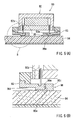
- the drive motor 90 generally includes a motor base 96 and a vibrator 92 coupled to the motor base 96.
- the motor base 96 is secured to a headliner 94 defining a surface of a vehicle cabin.
- a steel cap and a magnet configure the vibrator 92.
- the motor base 96 includes a tubular portion 96t and a flange 96f.
- the tubular portion 96t has an outer peripheral surface with external threads 96m.
- the flange 96f extends outward from the base end of the motor base 96.
- the motor base 96 is secured to the headliner 94 via the flange 96f.
- the vibrator 92 further includes a ring-shaped guide member 93 disposed at a lower end of the vibrator 92.
- the guide member 93 has an inner peripheral surface with internal threads 93w.
- the vibrator 92 may therefore be mounted to the head liner 94 by engaging the internal threads 93w of the guide member 93 with the external threads 96m of the motor base 96 and thereafter tightening the internal threads 93w until the guide member 93 contacts the flange 96f of the motor base 96.
- audio devices are taught that are adapted to be mounted to an interior trim panel defining a surface of a vehicle cabin.
- the audio devices are adapted to vibrate the interior trim panel in order to produce audio sounds.
- the audio devices include a vibrator, a first threaded member, a ring-shaped resilient member, and a second threaded member.
- the first threaded member includes a tubular portion, an external thread formed on an outer surface of the tubular portion, and a flange formed on one end of the tubular portion.
- the ring-shaped resilient member is fitted around the tubular portion of the first threaded member and axially opposes the flange of the first threaded member.
- the second threaded member includes a ring-shaped portion axially opposing the resilient member from a side surface not opposing the flange of the first threaded member.
- the second threaded member also includes internal threads formed on an inner surface of the ring-shaped portion and engageable with the external thread of the first threaded member.
- the vibrator is mounted to one of the first and second threaded members.
- the other of the first and second threaded members is mounted to the interior trim panel.
- the resilient member is clamped and resiliently deformed between the flange of the first threaded member and the ring-shaped portion of the second threaded member through engagement between the external threads of the first threaded member and the internal threads of the second threaded member.
- the resilient member is clamped and resiliently deformed between the flange of the first threaded member and the ring-shaped portion of the second threaded member. Therefore, due to the restoring force of the resilient member, the external threads of the first threaded portion and the internal threads of the second threaded portion may be forced axially in opposing directions. Consequently, the external threads and the internal threads may closely contact with each other within the engaging region. For at least this reason, any potential clearance or axial displacement may be reliably prevented or inhibited between the first threaded member and the second threaded member within the engaging region of the external threads and the internal threads.
- any potential loosening of the engagement between the external threads of the first threaded member and the internal threads of the second threaded member may be eliminated or inhibited even if the vibrations of the vehicle body have been continuously transmitted to the vibrator or the interior trim panel, or even if a difference between the axial length of the external threads and the axial length of the internal threads is caused due to a difference in the linear coefficients of thermal expansion of the materials used in the audio device.
- the audio device may effectively produce the desired sounds via the vibrations of the vibrator.
- the first threaded member is made of resin and is fixedly mounted to the interior trim panel.
- the second threaded member is also made of resin and fixedly supports the vibrator in a direction perpendicular to the axis.
- the second threaded member movably supports the vibrator in an axial direction.
- the overall audio device may have a relatively light-weight construction. Therefore, the loading with respect to the weight applied to a voice coil of the vibrator may be reduced. As a result, any problematic reductions of the sound pressure produced by the audio device may be avoided or minimized.
- the resilient member has a modulus of elasticity in the range of about 0.05 MPa to 5 MPa. Setting of the modulus to be equal to or more than 0.05 MPa may prevent the vibrations of the vibrator from being absorbed by the resilient member so that a sufficient sound pressure may be obtained. In addition, the setting of the modulus to be equal to or less than 5 MPa may effectively absorb any potential difference between the axial length of the external threads and the axial length of the internal threads caused by a difference in the linear coefficients of thermal expansion.
- the audio device further includes a stopper device disposed between the flange of the first threaded member and the ring-shaped portion of the second threaded member.
- the stopper device serves to limit the resilient deformation (i.e., compression) of the resilient member to a predetermined amount.
- the operator can recognize that the resilient member has been compressed by a predetermined amount when there is a perceptible increase in the reaction force opposing the tightening torque (in addition to the expected increase in the reaction force resulting primarily from the compression of the resilient member). Consequently, the assembly operation of the audio device can be easily performed.
- the vibrator includes an outer yoke forming a magnetic circuit of the vibrator.
- the outer yoke is connected to the second threaded member via a plurality of dampers made of other resilient members, for example, leaf springs.
- the dampers may be disposed along the circumference of the first threaded member and may be connected between the circumference of the first threaded member and the circumference of the outer yoke or the vibrator.
- audio devices are taught that are adapted to be mounted to an interior trim panel defining a portion of the vehicle cabin. Audio devices are taught that vibrate the interior trim panel in order to produce audio sounds.
- the audio device includes a vibrator, a first threaded member, a second threaded member, and a biasing device.
- the first threaded member may support the vibrator.
- the second threaded member is engageable with the first threaded member and may be mounted to the interior trim panel.
- the biasing device is interposed between the first threaded member and the second threaded member in order to apply an axial force between the first threaded member and the second threaded member.
- the axial force functions so as to press the first threaded member against the second threaded member in an axial direction when the first threaded member is threadably engaged with the second threaded member.
- the biasing device may be a resilient member such as a rubber.
- the first threaded member includes first threads and a first surface extending substantially perpendicular to the axis.
- the second threaded member is disposed coaxially with the first threaded member and includes second threads engageable with the first threads and a second surface extending substantially perpendicular to the axis and axially opposing the first surface.
- the resilient member may be clamped and compressed between the first surface and the second surface.
- a flange formed on the first threaded member may define the first surface.
- a ring-shaped portion formed on the second threaded member may define the second surface.
- the resilient member may have a ring-shaped configuration and may be disposed coaxially with the first threaded member and the second threaded member.
- One of the first and second threads may be external threads.
- the other of the first and second threads may be internal threads.
- the first threaded member may be made of resin and may be integrally molded with the first threads and the first surface.
- the second threaded member may also be made of resin and may be integrally molded with the second threads and the second surface.
- a representative vehicle audio device 10 generally includes an interior trim panel 12 defining a portion of a vehicle cabin (not shown), a bracket 20 fixedly mounted to the interior trim panel 12, and a vibrator 30 (i.e., resonator) coupled to the bracket 20.
- a vibrator 30 i.e., resonator
- the interior trim panel 12 may include a base layer 12m, a fibrous layer 12f overlaid on the back surface of the base layer 12m, and a surface layer 12k overlaid on the front surface of the base layer 12m.
- the bracket may be bonded to the fibrous layer 12f of the interior trim panel 12 via adhesive 14.
- the bracket 20 may be made of resin and includes a tubular portion 22 and a disk-shaped flange 24. External threads 22m are formed on the outer peripheral surface of the tubular portion 22.
- the flange 24 is joined to the base end (i.e., the lower end as viewed in FIG. 2) of the tubular portion 22.
- the back surface of the flange 24, on the side surface opposite of the tubular portion 22 is bonded to the fibrous layer 12f of the interior trim panel 12 via adhesive 14.
- the vibrator 30 includes a ring-shaped holder 32 that is made of resin. Internal threads 32w are formed on an inner circumferential surface of the holder 32 so that the external thread portion 22m of the bracket 20 can engage the internal threads 32w.
- a ring-shaped flat surface 32f is defined at the terminal end (i.e., the lower end as viewed in FIGS. 2 and 3) of the holder 32 and extends about the internal threads 32w (i.e., beyond the radius defined by the internal threads 32w).
- the ring-shaped flat surface 32f of the holder 32 directly opposes the flange 24 of the bracket 20.
- the outer diameter of the ring-shaped flat surface 32f is set to be equal to or substantially equal to the outer diameter of the flange 24 of the bracket 20.
- a voice coil bobbin 34 is fixed to a base end (i.e., the upper end as viewed in FIG. 2) of the holder 32 and is positioned coaxially with the internal threads 32w.
- a voice coil 35 is wound around the voice coil bobbin 34.
- an outer yoke 39 which constitutes a magnetic circuit, is mounted to the outer circumferential edge of the base end of the holder 32 via dampers 36, made of spring plate material for example.
- Each damper 36 has a substantially arc-shaped band-type of configuration in plan view and is adapted to mount the outer yoke 39 to the holder 32.
- the mounting is such that the outer yoke 39 is permitted to shift or move relative to the holder 32 in an axial direction.
- One circumferential end of each damper 36 is secured to the outer circumferential edge of the base end of the holder 32, for example, by means of a screw 36b.
- the other circumferential end of each damper 36 is fixed to the outer circumferential edge of the outer yoke 38 by a suitable means, such as welding.
- the dampers 36 are held to extend substantially parallel to the ring-shaped flat surface 32f of the holder 32.
- four dampers 36 are provided and are arranged at regular intervals along the circumferential direction of the holder 32.
- the invention is not limited to four dampers 36, one, two, three, and five or more dampers 36 may be provided.
- the outer yoke 39 has a cup-shaped configuration and includes a cylindrical tubular portion 39e and a disk-shaped top portion 39t.
- the cylindrical tubular portion 39e is held so as to be coaxial with the voice coil 35.
- the outer yoke 39 covers the voice coil 35 but does not contact the voice coil 35.
- a circumferential end of each damper 36 is secured to the end surface of the cylindrical tubular portion 39e.
- a disk-shaped magnet 37 is secured to the central portion of the inner wall of the disk-like top plate 39t of the outer yoke 39 and is positioned coaxially with the outer yoke 39.
- An inner yoke 38 having a disk-shaped configuration similar to the magnet 37, is secured to an end surface of the magnet 37 (i.e., the lower end surface as viewed in FIG. 2) and is positioned coaxially with the magnet 37.
- the outer diameter of the magnet 37 and the outer diameter of the inner yoke 38 are set to be substantially equal to each other.
- the magnet 37 and the inner yoke 38 are positioned within the outer yoke 39 so as to not contact the voice coil bobbin 34.
- the voice coil bobbin 34 and the voice coil 35 are positioned between the cylindrical tubular portion 39e of the outer yoke 39, and an assembly of the magnet 37. and the inner yoke 38, with respect to the diametrical direction.
- the voice coil bobbin 34 and the voice coil 35 are positioned so as to not contact these elements.
- a ring-shaped resilient member 25 is interleaved between the holder 32 of the vibrator 30 and the flange 24 of the bracket 20.
- the resilient member 25 is positioned about the tubular portion 22 of the bracket 20.
- the outer diameter of the resilient member 25 is set to be substantially equal to the outer diameter of the flange 24 of the bracket 20.
- the inner diameter of the resilient member 25 is set to be substantially equal to the outer diameter of the tubular portion 22 (i.e., the outer diameter of the external threads).
- the resilient member 25 has a predetermined substantially uniform thickness.
- the ring-shaped resilient member 25 is fitted onto the tubular portion 22 of the bracket 20.
- the bracket 20 may have been previously secured to the interior trim panel 12.
- the internal threads 32w of the holder 32 of the vibrator 30 are then threadably engaged with the external threads 22m of the tubular portion 22 of the bracket 20.
- the holder 32 is rotated relative to the tubular portion 22 until the resilient member 25 is compressed.
- the resilient member 25 is resiliently deformed by a predetermined amount after clamping the resilient member 25 between the ring-shaped flat surface 32f and the flange 24 of the bracket 20.
- the mounting operation of the vibrator 30 to the interior trim panel 12 may be completed when the internal threads 32w of the holder 32 have been threadably engaged with the external threads 22m of the bracket 20 substantially along the entire length of the external threads 22m in an axial direction.
- the vibrator 30 may vibrate when an electric current signal is inputted to the voice coil 35.
- the vibration may then be transmitted from the vibrator 30 to the interior trim panel 12 via the holder 32 of the vibrator 30 and the bracket 20. Consequently, sound may be produced.
- the resilient member 25 is clamped between the holder 32 of the vibrator 30 and the flange 24 of the bracket 20 so as to be resiliently deformed or compressed. Therefore, the internal threads 32w of the holder 32 may be axially pressed against the external threads 22m of the bracket 20 in opposing directions (e.g., as indicated by arrows in FIG. 3) due to the restoring force of the resilient member 25. In other words, the internal threads 32w may closely contact with the external threads 22m within the engaging region. As a result, the vibrations of the vibrator 30 may be reliably transmitted to the interior trim panel 12 via the internal threads 32w of the holder 32 and the external threads 22m of the bracket 20.
- the internal threads 32w of the holder 32 may contact within the engaging region with the external threads 22m of the bracket 20 while they are pressed axially against each other, the internal threads 32w and the external threads 22m may not allow any significant displacement relative to an axial direction within the threaded engaging region. Therefore, the engagement between the internal threads 32w and the external threads 22m may not be loosened even if potential external vibrations or impacts have been continuously applied via the vehicle body to the vibrator 30 or the interior trim panel 12. The engagement may also not be loosened even if the length of the external threads 22m becomes different than the length of the internal threads 32w due to differences in their linear coefficients of thermal expansion.
- the resilient member 25 may serve to prevent potential damage to the internal threads 32w and the external threads 22m.
- the resilient member 25 may prevent potential damage that may otherwise be caused if the internal threads 32w and the external threads 22m have been excessively tightened or over tightened.
- the modulus of elasticity of the resilient member 25 may be chosen from a value included in the range of about 0.05 MPa to 5 MPa. If the modulus is smaller than 0.05 MPa, the resilient member 25 may prevent the obtaining of a sufficient sound pressure due to of absorption of vibrations by the resilient member 25. On the contrary, if the modulus is greater than 5 MPa, the resilient member 25 may not effectively absorb a difference in the axial lengths between the external threads 22m and the internal threads 32w due to different linear coefficients of thermal expansion.
- the resilient member 25 may be made of rubber. Using a rubber resilient member 25 increases the frictional coefficient between the contact surfaces of the resilient member 25 and the holder 32 and the frictional coefficient between the contact surfaces of the resilient member 25 and the bracket 20. The increases in the frictional coefficients may help to prevent the loosening of the engagement between the external threads 22m and the internal threads 32w. More preferably, the resilient member 25 may be made of a silicon rubber material having a small permanent compression stress or may be made of silicon rubber foam providing a relatively small modulus of elasticity, such as approximately 0.8 MPa.
- the holder 32 of the vibrator 30 and the bracket 20 are made of resin. Therefore, the overall audio device may have a relatively lightweight construction. In addition, the weight load applied to the voice coil 35 may be reduced and consequently prevent a potential reduction of the sound pressure generated by the audio device.
- a projection 32z (i.e., a stopper device) may be formed on the outer circumferential edge of the ring-shaped flat surface 32f of the holder 32 of the vibrator 30.
- the operator can recognize, without needing to exactly control the tightening torque, that the resilient member 25 has been compressed by a predetermined amount.
- the operator is able to recognize this point when the reaction force (i.e., opposing the tightening force) has been significantly increased above the expected increase in the reaction force due primarily to the compression of the resilient member 25 during the tightening operation.
- this characteristic of the projection 32z or other configurations of spacers or stoppers may facilitate the assembly operation of the vibrator 30.
- the projection 32z in the form of a cylindrical ring projection is formed on the holder 32 of the vibrator 30
- the projection 32z or other configurations of stoppers or spacers may be formed on the flange 24 of the bracket 20 as an alternative arrangement.
- the projection 32z may be formed on the flange 24 in addition to the projection 32z formed on the holder 32 of the vibrator 30 or as an alternative to the projection 32z formed on the holder 32 of the vibrator 30.
Landscapes
- Engineering & Computer Science (AREA)
- Mechanical Engineering (AREA)
- Fittings On The Vehicle Exterior For Carrying Loads, And Devices For Holding Or Mounting Articles (AREA)
- Details Of Audible-Bandwidth Transducers (AREA)
Applications Claiming Priority (2)
| Application Number | Priority Date | Filing Date | Title |
|---|---|---|---|
| JP2004122864A JP2005311500A (ja) | 2004-04-19 | 2004-04-19 | 車両用音響装置 |
| PCT/JP2005/007583 WO2005102780A1 (en) | 2004-04-19 | 2005-04-14 | Audio devices for vehicles |
Publications (2)
| Publication Number | Publication Date |
|---|---|
| EP1737705A1 EP1737705A1 (en) | 2007-01-03 |
| EP1737705B1 true EP1737705B1 (en) | 2007-09-12 |
Family
ID=34965351
Family Applications (1)
| Application Number | Title | Priority Date | Filing Date |
|---|---|---|---|
| EP05734297A Ceased EP1737705B1 (en) | 2004-04-19 | 2005-04-14 | Audio devices for vehicles |
Country Status (8)
| Country | Link |
|---|---|
| US (1) | US8090138B2 (https=) |
| EP (1) | EP1737705B1 (https=) |
| JP (1) | JP2005311500A (https=) |
| CN (1) | CN100439156C (https=) |
| AU (1) | AU2005235055B2 (https=) |
| CA (1) | CA2555443C (https=) |
| DE (1) | DE602005002469T2 (https=) |
| WO (1) | WO2005102780A1 (https=) |
Cited By (1)
| Publication number | Priority date | Publication date | Assignee | Title |
|---|---|---|---|---|
| WO2022129057A1 (fr) * | 2020-12-17 | 2022-06-23 | Treves Products, Services & Innovation | Système de montage d'un transducteur sur un panneau de garnissage intérieur de véhicule automobile |
Families Citing this family (18)
| Publication number | Priority date | Publication date | Assignee | Title |
|---|---|---|---|---|
| US7817810B2 (en) | 2005-08-03 | 2010-10-19 | The Boeing Company | Flat panel loudspeaker system |
| JP4755928B2 (ja) * | 2006-03-15 | 2011-08-24 | 富士通テン株式会社 | 音声発生装置 |
| JP2007283809A (ja) * | 2006-04-13 | 2007-11-01 | Anden | 車両周辺に対して警報を発する警報音発生装置 |
| US8291322B2 (en) | 2009-09-30 | 2012-10-16 | United Video Properties, Inc. | Systems and methods for navigating a three-dimensional media guidance application |
| DE202014003034U1 (de) * | 2014-04-02 | 2015-04-07 | Harman Becker Automotive Systems Gmbh | Lautsprecher |
| JP6088479B2 (ja) * | 2014-12-01 | 2017-03-01 | 小島プレス工業株式会社 | 車載マイク装置 |
| KR102370183B1 (ko) * | 2017-07-12 | 2022-03-03 | 엘지디스플레이 주식회사 | 표시장치 |
| US10911849B2 (en) * | 2017-09-20 | 2021-02-02 | Mitek Corp., Inc. | Direct fire small ceiling speaker system |
| CN108146356B (zh) * | 2017-12-25 | 2020-12-08 | 苏州佳亿达电器有限公司 | 一种车载电器的可升降安装支架 |
| GB201816795D0 (en) * | 2018-10-16 | 2018-11-28 | Agco Int Gmbh | Senor assembly for vehicle |
| JP7330623B2 (ja) * | 2019-08-09 | 2023-08-22 | アルパイン株式会社 | 音響用の加振装置及び車載音響装置 |
| JP2021035008A (ja) * | 2019-08-29 | 2021-03-01 | 日本電産サンキョー株式会社 | アクチュエータ、およびパネルスピーカー |
| KR102789076B1 (ko) * | 2020-04-08 | 2025-04-03 | 한국전자통신연구원 | 디지털 트윈을 이용한 스마트 축사 시스템 및 방법 |
| KR102723668B1 (ko) * | 2020-04-09 | 2024-10-30 | 현대자동차주식회사 | 진동스피커 |
| KR20220089739A (ko) * | 2020-12-21 | 2022-06-29 | 현대자동차주식회사 | 전기자동차의 가상 효과 구현 장치 |
| JPWO2023195528A1 (https=) * | 2022-04-06 | 2023-10-12 | ||
| CN120092461A (zh) * | 2022-10-19 | 2025-06-03 | Agc株式会社 | 玻璃振动板以及带振子的玻璃振动板 |
| KR20240145195A (ko) * | 2023-03-27 | 2024-10-07 | 엘지디스플레이 주식회사 | 음향 장치 및 이를 포함하는 운송 장치 |
Family Cites Families (28)
| Publication number | Priority date | Publication date | Assignee | Title |
|---|---|---|---|---|
| US3356796A (en) * | 1964-08-11 | 1967-12-05 | Gen Motors Corp | Field case assembly for loudspeaker |
| US3430007A (en) * | 1966-03-16 | 1969-02-25 | Rolen Diversified Investors In | Dynamic transducer with wall mounted diaphragm |
| US4234766A (en) * | 1979-02-05 | 1980-11-18 | Cacho Gibson C | Speaker assembly |
| US4281224A (en) * | 1980-04-21 | 1981-07-28 | Sparkomatic Corporation | Grille covered speaker assembly construction for compact automobiles and the like |
| CH645227A5 (fr) * | 1981-12-22 | 1984-09-14 | Multiphonie Sa | Transducteur electro-acoustique. |
| US4546850A (en) * | 1984-03-12 | 1985-10-15 | Chrysler Corporation | Speaker and grille installation clip mounting |
| EP0363425A4 (en) * | 1987-06-19 | 1991-07-31 | Harman International Industries, Incorporated | Loudspeaker mounting |
| US5273243A (en) * | 1988-04-08 | 1993-12-28 | General Motors Corporation | Radio speaker mounting apparatus and method |
| US4951270A (en) | 1989-06-20 | 1990-08-21 | Andrews Jay E | Audio transducer apparatus |
| US5731551A (en) * | 1993-04-05 | 1998-03-24 | Ford Motor Company | Mounting assembly and method for mounting a loudspeaker in a vehicle |
| US5473700A (en) * | 1993-11-24 | 1995-12-05 | Fenner, Jr.; Thomas C. | High gain acoustic transducer |
| US5699438A (en) * | 1995-08-24 | 1997-12-16 | Prince Corporation | Speaker mounting system |
| KR19990037726A (ko) * | 1995-09-02 | 1999-05-25 | 헨리 에이지마 | 판넬형 음향 방사소자들로 구성된 라우드스피커 |
| US6519349B1 (en) * | 1995-09-02 | 2003-02-11 | New Transducers Limited | Loudspeaker |
| JP3413741B2 (ja) * | 1995-10-18 | 2003-06-09 | 株式会社ケンウッド | 車載用スピーカの装着構造 |
| JP3124246B2 (ja) | 1997-05-20 | 2001-01-15 | 株式会社ベンカン | 薄肉ステンレス鋼管と管継手の接続機構 |
| IL134749A0 (en) * | 1997-09-03 | 2001-04-30 | New Transducers Ltd | Trim panel comprising an integral acoustic system |
| US5939682A (en) * | 1998-05-27 | 1999-08-17 | Ut Automotive Dearborn, Inc. | Molded in speaker grid |
| JP2000197185A (ja) * | 1998-12-28 | 2000-07-14 | Foster Electric Co Ltd | バイザ―用スピ―カ |
| US6258438B1 (en) * | 1999-06-17 | 2001-07-10 | Daimlerchrysler Corporation | Vehicle shelf trim panel with insert molded speaker grille |
| US7050593B1 (en) * | 1999-08-25 | 2006-05-23 | Lear Corporation | Vehicular audio system and electromagnetic transducer assembly for use therein |
| DE19951659C2 (de) * | 1999-10-26 | 2002-07-25 | Arvinmeritor Gmbh | Fahrzeugdach, insbesondere Kraftfahrzeugdach |
| JP2001263551A (ja) | 2000-03-15 | 2001-09-26 | On Industries Ltd | バルブの接続部構造 |
| GB0027278D0 (en) | 2000-11-08 | 2000-12-27 | New Transducers Ltd | Loudspeaker driver |
| JP2002166199A (ja) | 2000-11-30 | 2002-06-11 | Abb Kk | 回転霧化頭型塗装装置 |
| US7031490B2 (en) * | 2002-03-26 | 2006-04-18 | T C Sounds Inc. | Speaker driver with detachable motor and basket |
| US7218745B2 (en) * | 2002-12-23 | 2007-05-15 | Lear Corporation | Headliner transducer covers |
| US6968069B1 (en) * | 2004-01-06 | 2005-11-22 | Stillwater Designs & Audio, Inc. | Low-profile tweeter with lateral air chamber |
-
2004
- 2004-04-19 JP JP2004122864A patent/JP2005311500A/ja active Pending
-
2005
- 2005-04-14 AU AU2005235055A patent/AU2005235055B2/en not_active Ceased
- 2005-04-14 EP EP05734297A patent/EP1737705B1/en not_active Ceased
- 2005-04-14 US US11/547,315 patent/US8090138B2/en not_active Expired - Fee Related
- 2005-04-14 WO PCT/JP2005/007583 patent/WO2005102780A1/en not_active Ceased
- 2005-04-14 CA CA002555443A patent/CA2555443C/en not_active Expired - Fee Related
- 2005-04-14 DE DE602005002469T patent/DE602005002469T2/de not_active Expired - Lifetime
- 2005-04-14 CN CNB2005800115004A patent/CN100439156C/zh not_active Expired - Fee Related
Cited By (1)
| Publication number | Priority date | Publication date | Assignee | Title |
|---|---|---|---|---|
| WO2022129057A1 (fr) * | 2020-12-17 | 2022-06-23 | Treves Products, Services & Innovation | Système de montage d'un transducteur sur un panneau de garnissage intérieur de véhicule automobile |
Also Published As
| Publication number | Publication date |
|---|---|
| WO2005102780A1 (en) | 2005-11-03 |
| EP1737705A1 (en) | 2007-01-03 |
| CN100439156C (zh) | 2008-12-03 |
| US8090138B2 (en) | 2012-01-03 |
| CA2555443A1 (en) | 2005-11-03 |
| AU2005235055B2 (en) | 2009-01-29 |
| JP2005311500A (ja) | 2005-11-04 |
| DE602005002469T2 (de) | 2008-06-12 |
| CA2555443C (en) | 2009-09-01 |
| DE602005002469D1 (de) | 2007-10-25 |
| CN1942343A (zh) | 2007-04-04 |
| US20080285769A1 (en) | 2008-11-20 |
| AU2005235055A1 (en) | 2005-11-03 |
Similar Documents
| Publication | Publication Date | Title |
|---|---|---|
| EP1737705B1 (en) | Audio devices for vehicles | |
| US20220272437A1 (en) | In-vehicle speaker system | |
| US7325648B2 (en) | Frame for speaker device and speaker device | |
| US8776944B2 (en) | On-vehicle acoustic device and method of assembling the same | |
| JP2000120769A (ja) | サスペンション装置 | |
| US6621912B2 (en) | Speaker | |
| JP2020096355A (ja) | 懸架システムを備えた音響パネルアセンブリ | |
| JP7635555B2 (ja) | スピーカー装置、及び車両用ドア | |
| JP4624494B2 (ja) | 筒状ダイナミックダンパ及びその製造方法 | |
| US7539318B2 (en) | Speaker unit, method for fabricating the same, and speaker apparatus | |
| US7394913B2 (en) | Speakers | |
| US7324658B2 (en) | Speaker | |
| JP2011117512A (ja) | 防振装置 | |
| US7587060B2 (en) | Speaker device | |
| JP2008211548A (ja) | ヘッドホンおよびその製造方法 | |
| CN223744895U (zh) | 一种振动抑制扬声器 | |
| JP4157060B2 (ja) | 筒状ダイナミックダンパ | |
| CN223744896U (zh) | 一种振动抑制扬声器的振动缓冲件 | |
| JP5946320B2 (ja) | スピーカ用クッション装置およびこれを使用した車載用音響装置 | |
| JP4503224B2 (ja) | スピーカユニット及びスピーカユニットの取付構造 | |
| JP2603679Y2 (ja) | スピーカ | |
| JP2010081329A (ja) | 磁歪スピーカとこれを搭載した家電製品、電子機器、移動体ならびに建築物 | |
| WO2024166597A1 (ja) | ダイナミックダンパ | |
| JP2024155363A (ja) | スピーカーおよび車両用ドア | |
| JP2005061566A (ja) | 防振マウント |
Legal Events
| Date | Code | Title | Description |
|---|---|---|---|
| PUAI | Public reference made under article 153(3) epc to a published international application that has entered the european phase |
Free format text: ORIGINAL CODE: 0009012 |
|
| 17P | Request for examination filed |
Effective date: 20060814 |
|
| AK | Designated contracting states |
Kind code of ref document: A1 Designated state(s): DE FR GB |
|
| GRAP | Despatch of communication of intention to grant a patent |
Free format text: ORIGINAL CODE: EPIDOSNIGR1 |
|
| DAX | Request for extension of the european patent (deleted) | ||
| RBV | Designated contracting states (corrected) |
Designated state(s): DE FR GB |
|
| GRAS | Grant fee paid |
Free format text: ORIGINAL CODE: EPIDOSNIGR3 |
|
| GRAA | (expected) grant |
Free format text: ORIGINAL CODE: 0009210 |
|
| AK | Designated contracting states |
Kind code of ref document: B1 Designated state(s): DE FR GB |
|
| REG | Reference to a national code |
Ref country code: GB Ref legal event code: FG4D |
|
| REF | Corresponds to: |
Ref document number: 602005002469 Country of ref document: DE Date of ref document: 20071025 Kind code of ref document: P |
|
| ET | Fr: translation filed | ||
| PLBE | No opposition filed within time limit |
Free format text: ORIGINAL CODE: 0009261 |
|
| STAA | Information on the status of an ep patent application or granted ep patent |
Free format text: STATUS: NO OPPOSITION FILED WITHIN TIME LIMIT |
|
| 26N | No opposition filed |
Effective date: 20080613 |
|
| REG | Reference to a national code |
Ref country code: FR Ref legal event code: PLFP Year of fee payment: 12 |
|
| REG | Reference to a national code |
Ref country code: FR Ref legal event code: PLFP Year of fee payment: 13 |
|
| REG | Reference to a national code |
Ref country code: FR Ref legal event code: PLFP Year of fee payment: 14 |
|
| PGFP | Annual fee paid to national office [announced via postgrant information from national office to epo] |
Ref country code: FR Payment date: 20200312 Year of fee payment: 16 |
|
| PGFP | Annual fee paid to national office [announced via postgrant information from national office to epo] |
Ref country code: DE Payment date: 20200331 Year of fee payment: 16 |
|
| PGFP | Annual fee paid to national office [announced via postgrant information from national office to epo] |
Ref country code: GB Payment date: 20200401 Year of fee payment: 16 |
|
| REG | Reference to a national code |
Ref country code: DE Ref legal event code: R119 Ref document number: 602005002469 Country of ref document: DE |
|
| GBPC | Gb: european patent ceased through non-payment of renewal fee |
Effective date: 20210414 |
|
| PG25 | Lapsed in a contracting state [announced via postgrant information from national office to epo] |
Ref country code: DE Free format text: LAPSE BECAUSE OF NON-PAYMENT OF DUE FEES Effective date: 20211103 Ref country code: FR Free format text: LAPSE BECAUSE OF NON-PAYMENT OF DUE FEES Effective date: 20210430 Ref country code: GB Free format text: LAPSE BECAUSE OF NON-PAYMENT OF DUE FEES Effective date: 20210414 |