EP1736799B1 - Verfahren zur Optimierung von Ultraschallübertragung/-empfang, entsprechendes Programm und diagnostisches Ultraschallgerät - Google Patents
Verfahren zur Optimierung von Ultraschallübertragung/-empfang, entsprechendes Programm und diagnostisches Ultraschallgerät Download PDFInfo
- Publication number
- EP1736799B1 EP1736799B1 EP06012290A EP06012290A EP1736799B1 EP 1736799 B1 EP1736799 B1 EP 1736799B1 EP 06012290 A EP06012290 A EP 06012290A EP 06012290 A EP06012290 A EP 06012290A EP 1736799 B1 EP1736799 B1 EP 1736799B1
- Authority
- EP
- European Patent Office
- Prior art keywords
- ultrasonic
- delay time
- weighting coefficient
- ultrasonic transducer
- transducers
- Prior art date
- Legal status (The legal status is an assumption and is not a legal conclusion. Google has not performed a legal analysis and makes no representation as to the accuracy of the status listed.)
- Active
Links
Images

Classifications
-
- G—PHYSICS
- G01—MEASURING; TESTING
- G01S—RADIO DIRECTION-FINDING; RADIO NAVIGATION; DETERMINING DISTANCE OR VELOCITY BY USE OF RADIO WAVES; LOCATING OR PRESENCE-DETECTING BY USE OF THE REFLECTION OR RERADIATION OF RADIO WAVES; ANALOGOUS ARRANGEMENTS USING OTHER WAVES
- G01S15/00—Systems using the reflection or reradiation of acoustic waves, e.g. sonar systems
- G01S15/88—Sonar systems specially adapted for specific applications
- G01S15/89—Sonar systems specially adapted for specific applications for mapping or imaging
- G01S15/8906—Short-range imaging systems; Acoustic microscope systems using pulse-echo techniques
- G01S15/8909—Short-range imaging systems; Acoustic microscope systems using pulse-echo techniques using a static transducer configuration
- G01S15/8915—Short-range imaging systems; Acoustic microscope systems using pulse-echo techniques using a static transducer configuration using a transducer array
- G01S15/8925—Short-range imaging systems; Acoustic microscope systems using pulse-echo techniques using a static transducer configuration using a transducer array the array being a two-dimensional transducer configuration, i.e. matrix or orthogonal linear arrays
-
- G—PHYSICS
- G10—MUSICAL INSTRUMENTS; ACOUSTICS
- G10K—SOUND-PRODUCING DEVICES; METHODS OR DEVICES FOR PROTECTING AGAINST, OR FOR DAMPING, NOISE OR OTHER ACOUSTIC WAVES IN GENERAL; ACOUSTICS NOT OTHERWISE PROVIDED FOR
- G10K11/00—Methods or devices for transmitting, conducting or directing sound in general; Methods or devices for protecting against, or for damping, noise or other acoustic waves in general
- G10K11/18—Methods or devices for transmitting, conducting or directing sound
- G10K11/26—Sound-focusing or directing, e.g. scanning
- G10K11/34—Sound-focusing or directing, e.g. scanning using electrical steering of transducer arrays, e.g. beam steering
- G10K11/341—Circuits therefor
- G10K11/346—Circuits therefor using phase variation
-
- G—PHYSICS
- G01—MEASURING; TESTING
- G01S—RADIO DIRECTION-FINDING; RADIO NAVIGATION; DETERMINING DISTANCE OR VELOCITY BY USE OF RADIO WAVES; LOCATING OR PRESENCE-DETECTING BY USE OF THE REFLECTION OR RERADIATION OF RADIO WAVES; ANALOGOUS ARRANGEMENTS USING OTHER WAVES
- G01S7/00—Details of systems according to groups G01S13/00, G01S15/00, G01S17/00
- G01S7/52—Details of systems according to groups G01S13/00, G01S15/00, G01S17/00 of systems according to group G01S15/00
- G01S7/52017—Details of systems according to groups G01S13/00, G01S15/00, G01S17/00 of systems according to group G01S15/00 particularly adapted to short-range imaging
- G01S7/52046—Techniques for image enhancement involving transmitter or receiver
- G01S7/52047—Techniques for image enhancement involving transmitter or receiver for elimination of side lobes or of grating lobes; for increasing resolving power
-
- G—PHYSICS
- G01—MEASURING; TESTING
- G01S—RADIO DIRECTION-FINDING; RADIO NAVIGATION; DETERMINING DISTANCE OR VELOCITY BY USE OF RADIO WAVES; LOCATING OR PRESENCE-DETECTING BY USE OF THE REFLECTION OR RERADIATION OF RADIO WAVES; ANALOGOUS ARRANGEMENTS USING OTHER WAVES
- G01S7/00—Details of systems according to groups G01S13/00, G01S15/00, G01S17/00
- G01S7/52—Details of systems according to groups G01S13/00, G01S15/00, G01S17/00 of systems according to group G01S15/00
- G01S7/52017—Details of systems according to groups G01S13/00, G01S15/00, G01S17/00 of systems according to group G01S15/00 particularly adapted to short-range imaging
- G01S7/5205—Means for monitoring or calibrating
Definitions
- the present invention relates to the optimization of beam deflection in ultrasonic transmission/reception using a two-dimensional ultrasonic probe having, for example, ultrasonic transducers arranged in a two-dimensional matrix, a delay time for beam convergence, a weighting coefficient used in echo signal addition processing, and the like.
- An ultrasonic diagnostic apparatus is a medical image device which noninvasively obtains a tomogram of a soft tissue in a living body from the body surface by an ultrasonic pulse reflection method.
- This ultrasonic diagnostic apparatus has advantages of being smaller in size, more inexpensive, and safer because of no exposure to X-rays and the like than other medical image devices, and of being capable of blood flow imaging, and hence is widely used in a cardiac department, abdominal department, urological department, obsterics and gynecology, and the like.
- a real-time three-dimensional display function (three-dimensional real-time display function) has been put into practice.
- Techniques for this function include a technique (mechanical 4D scanning method) of using a mechanical 3D scanner which scans a three-dimensional area of a subject by mechanically scanning an electronic scanning type one-dimensional array transducer in a direction perpendicular to a scanning surface and a technique (to be referred to as a real-time 3D scanning method hereinafter) of realizing scanning on a three-dimensional area of a subject by electronic scanning operation using a two-dimensional ultrasonic probe having a two-dimensional array of transducers (see, for example, Jpn. Pat. Appln. KOKAI Publication Nos. 6-169921 and 9-313487 ).
- the real-time 3D scanning method has been rapidly popularized together with the introduction of a two-dimensional ultrasonic probe.
- a plurality of ultrasonic transducer blocks BL are bonded to each other through adhesive layers in this manner because it is difficult to cut one ceramic piezoelectric material block into, for example, 1782 elements by using any one of the current dicing techniques.
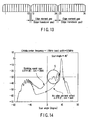
- FIG. 13 is an enlarged view of the inside of the circle shown in FIG. 12 , which shows an edge of each ultrasonic transducer block on the ultrasonic wave application side.
- the respective ultrasonic transducer blocks are bonded to each other through adhesive layers (not shown).
- the ultrasonic transducer at one or two ends of each ultrasonic transducer block (in FIG. 13 , the 12th, 13th, 24th, and 25th ultrasonic transducers to be referred to as "edge ultrasonic transducers" hereinafter) are bonded to the adhesive layers.
- each edge ultrasonic transducer is subjected to the influence of bonding (e.g., changes in shape and the like), and has vibration characteristics (i.e., acoustic characteristics) different from those of the other type (which is not used for bonding) of ultrasonic transducers.
- bonding e.g., changes in shape and the like
- vibration characteristics i.e., acoustic characteristics
- the conventional system gives no consideration of the characteristic difference between edge ultrasonic transducers and the other type of ultrasonic transducers due to this bonding.
- edge transducer gaps due to the presence of the adhesive layers between edges of the ultrasonic transducer blocks.
- edge transducer gaps due to the presence of the adhesive layers between edges of the ultrasonic transducer blocks.
- DE 103 36 101 A1 discloses an ultrasound transmit pulser with receive interconnection and method of use.
- US 2001/015592 A1 discloses a medical diagnostic ultrasound transducer comprising a plurality of piezomaterial bodies that are merged together to form a larger piezomaterial body.
- US 5 920 523 A discloses two-dimensional acoustic array comprising a plurality of transducer segments.
- the present invention has been made in consideration of the above situation, and has as its object to provide an ultrasonic transmission/reception condition optimization method, and an ultrasonic diagnostic apparatus which can realize suitable acoustic characteristics as compared with the prior art by executing ultrasonic transmission/reception in consideration of edge transducer gaps and the characteristics of edge transducers.
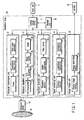
- FIG. 1 is a block diagram showing the arrangement of an ultrasonic diagnostic apparatus 1 according to this embodiment.
- the ultrasonic diagnostic apparatus 1 comprises an ultrasonic probe 10, storage unit 30, input unit 7, monitor 25, and apparatus body 50.
- the ultrasonic probe 10 includes a plurality of ultrasonic transducers which generate ultrasonic waves at a predetermined timing on the basis of a driving signal from an ultrasonic transmission unit 2 and convert reflected waves from a subject into electrical signals, matching layers provided for the ultrasonic transducers, backing members which prevent ultrasonic waves from propagating backward from the ultrasonic transducers, and the like.
- the transmitted ultrasonic waves are sequentially reflected by a discontinuity surface of acoustic impedance of internal body tissue, and are received as an echo signal by the ultrasonic probe 10.
- the amplitude of this echo signal depends on an acoustic impedance difference on the discontinuity surface by which the echo signal is reflected.
- the echo produced when an ultrasonic pulse is reflected by the surface of a moving blood flow, cardiac wall, or the like is subjected to a frequency shift depending on the speed component of the moving body in the ultrasonic transmission direction due to a Doppler effect.
- the ultrasonic probe 10 is formed as follows.
- ultrasonic transducer blocks BL each having a plurality of ultrasonic transducers (e.g., 12 elements x 48 elements) are formed by cutting a plurality of (e.g., three) blocks made of a ceramic piezoelectric material. These blocks are then bonded to each other in the array direction of ultrasonic transducers through adhesive layers.
- the storage unit 30 stores images obtained by past imaging operation, images captured by this apparatus through a network and detachable storage media, a dedicated program for the execution of a predetermined imaging sequence, and the like.
- the storage unit 30 also stores, for each probe, the spatial position of each ultrasonic transducer from a reference position set in consideration of an edge transducer gap and information (e.g., a predetermined formula or a correspondence table, which information will be referred to as "delay time/weighting coefficient acquisition information" hereinafter) for the acquisition of a delay time and weighting coefficient for each ultrasonic transducer on the basis of the spatial position of each ultrasonic transducer.
- the storage unit 30 stores, for each probe, a delay time and weighting coefficient for each ultrasonic transducer acquired on the basis of the spatial position of each ultrasonic transducer which is set in consideration of each edge transducer gap, as needed.
- the input unit 7 includes various kinds of switches and buttons, a trackball, a mouse, a keyboard, and the like which are connected to the apparatus body 50 of the ultrasonic diagnostic apparatus 1 to input various kinds of instructions and conditions, an instruction to set a region of interest (ROI), various kinds of image quality condition setting instructions, and the like from the operator to the apparatus body. For example, when the operator operates a predetermined button of the input unit 7, delay time/weighting coefficient optimization processing (to be described later) or displaying of the result obtained by the processing in a predetermined form is executed.
- the monitor 25 displays morphological information in the living body or blood flow information as an image on the basis of a video signal received from the apparatus body 50.
- the image or the like displayed on the monitor 25 is stored in a storage unit in the apparatus body 50 in response to predetermined operation with the input unit 7 or the like.
- the apparatus body 50 comprises the ultrasonic transmission unit 2 which performs transmission control on ultrasonic waves transmitted from the ultrasonic probe 10, an ultrasonic reception unit 3 which performs preprocessing for an echo signal received by the ultrasonic probe 10, a harmonic detection unit 4 which detects a harmonic component from the echo signal having undergone the preprocessing, a signal processing unit 5 which generates image data upon performing predetermined signal processing for the detected harmonic component, an image display unit 8 which generates and displays an ultrasonic image on the basis of the image data, and a control circuit (CPU) 6.
- the ultrasonic transmission unit 2 which performs transmission control on ultrasonic waves transmitted from the ultrasonic probe 10
- an ultrasonic reception unit 3 which performs preprocessing for an echo signal received by the ultrasonic probe 10
- a harmonic detection unit 4 which detects a harmonic component from the echo signal having undergone the preprocessing
- a signal processing unit 5 which generates image data upon performing predetermined signal processing for the detected harmonic component
- an image display unit 8 which generates and displays an ultra
- the ultrasonic transmission unit 2 comprises a rate pulse generator 11, transmission delay circuit 12, and pulser 13.
- the rate pulse generator 11 generates a rate pulse which determines the cycle period (rate period) of ultrasonic pulses to be emitted into the subject, and supplies the rate pulse to the transmission delay circuit 12.
- the transmission delay circuit 12 comprises independent delay circuits of M channels equal in number to the ultrasonic transducers used for transmission.
- the transmission delay circuit 12 gives the received rate pulse a focusing delay time for focusing ultrasonic pulses to a predetermined depth and a deflection delay time for transmitting the ultrasonic pulses in a predetermined direction, and supplies the resultant rate pulse to the pulser 13.
- the pulser 13 includes independent driving circuits of the M channels equal in number to the delay circuits of the transmission delay circuit 12.
- the ultrasonic transducers mounted on the ultrasonic probe 10 are driven to emit ultrasonic pulses into the subject by applying driving signals generated by the respective driving circuits to the respective ultrasonic transducers.
- the transmission delay circuit 12 of the ultrasonic transmission unit 2 combines the focusing delay time and deflection delay time which are optimized by delay time/weighting coefficient optimization processing (to be described later) to give a delay time to the rate pulse.
- the ultrasonic reception unit 3 comprises a preamplifier 14, A/D converter 15, beam former 16, and adder 28.
- the preamplifier 14 is designed to amplify small signals converted into electrical echo signals by the ultrasonic transducers to ensure a sufficient S/N ratio.
- the fundamental components and harmonic components of the echo signals amplified to a predetermined magnitude by the preamplifier 14 are converted into digital signals by the A/D converter 15, and the digital signals are sent to the beam former 16.
- the beam former 16 gives each echo signal converted into a digital signal a focusing delay time for focusing each reflected ultrasonic wave from a predetermined depth and a deflection delay time for scanning the subject while sequentially changing the reception directivity of each reflected ultrasonic wave.
- the adder 28 performs phased addition of the outputs from the beam former 16 (addition of the echo signals obtained from a predetermined direction upon phasing).
- the beam former 16 of the ultrasonic reception unit 3 performs beam forming by using at least one of the focusing delay time and the deflection delay time which are optimized by delay time/weighting coefficient optimization processing (to be described later).
- the adder 28 of the ultrasonic reception unit 3 performs addition processing in accordance with a control signal from the control circuit 6 in delay time/weighting coefficient optimization processing (to be described later).
- the harmonic detection unit 4 performs processing associated with the phase-in version method, and comprises a waveform memory 17, adder-subtracter 18, and filter circuit 19.
- the waveform memory 17 temporarily stores echo signals obtained by the first transmission/reception in a predetermined direction.
- the filter circuit 19 is a filter which reduces fundamental components which cannot be erased by the phase-in version method due to the movement of an organ and the movement of the body.
- the signal processing unit 5 comprises an envelope detector 20, logarithmic transformer 21, and persistence transformer 22.
- the envelope detector 20 performs envelope detection computation for an input digital signal to detect its envelope.
- the logarithmic transformer 21 comprises a lookup table which logarithmically transforms an input value and outputs the resultant data.
- the logarithmic transformer 21 logarithmically transforms the amplitude of an echo signal to relatively enhance a weak signal.
- the persistence transformer temporarily stores scanning lines corresponding to several frames, and performs processing of averaging luminance changes.
- the image display unit 8 comprises a display image memory 23 and a conversion circuit 24.
- the display image memory 23 combines image data supplied from the signal processing unit 5 and accessory data such as characters and numerals associated with the image data, and temporarily stores the resultant data.
- the display image memory 23 temporarily stores image data obtained by combining a normal mode image and a puncture mode image in a predetermined form.
- the stored image data and accessory data are subjected to D/A conversion and TV format conversion in the conversion circuit 24, and the resultant image is displayed on the monitor 25.
- the control circuit 6 reads out transmission/reception conditions and a dedicated program stored in the storage unit 30 on the basis of instructions of mode selection, transmission start/end, and the like input from the input unit 7, and statically or dynamically controls each unit and the overall system in accordance with them.
- the control circuit 6 reads out a dedicated program for implementing the delay time/weighting coefficient optimization function (to be described later) from the storage unit 30, loads the program in a predetermined memory, and executes control on each unit in accordance with the program.
- a dedicated program for implementing the delay time/weighting coefficient optimization function to be described later
- the delay time/weighting coefficient optimization function of the ultrasonic diagnostic apparatus 1 will be described next. This function is used to accurately grasp the spatial position of each ultrasonic transducer for each probe and execute ultrasonic transmission/reception by using the delay time/weighting coefficient calculated on the basis of the spatial position of each ultrasonic transducer, thereby realizing a suitable acoustic field in consideration of the influence of each edge transducer gap and the acoustic characteristics of each edge transducer.
- the delay time optimized by this function is a delay pattern for beam forming (to be executed at the time of transmission or reception).
- the weighting coefficient optimized by this function indicates the weighting coefficient of an aperture function used in echo signal addition processing.
- this optimization function can be implemented by installing software programs for executing processing associated with this function in an existing ultrasonic diagnostic apparatus or a computer such as a workstation and loading the programs in a memory as well as being implemented by a hardware arrangement.
- the programs which can cause the computer to execute the corresponding techniques can be distributed by being stored in recording media such as magnetic disks (floppy (registered trademark) disks, hard disks, and the like), optical disks (CD-ROMs, DVDs, and the like), and semiconductor memories.
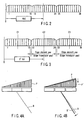
- FIG. 2 is a view for explaining a conventional delay time/weighting coefficient calculation technique.
- an ultrasonic transducer array is assumed to have an ideal structure without any edge transducer gap due to the connection layers which connect the ultrasonic transducer blocks to each other, a coordinate axis is set with, for example, a reference position O being an origin, and a spatial position x(n) ( n is a transducer number) of each element is defined on the basis of the width of each element, an array pitch, and the like.
- a delay time and a weighting coefficient are determined by predetermined formulas T(x(n)) and W(x(n)) defined with reference to the above ideal structure.
- This delay time/weighting coefficient optimization function serves to accurately grasp the spatial position of each ultrasonic transducer for each probe and execute ultrasonic transmission/reception by using the delay time and weighting coefficient for each transducer calculated on the basis of the spatial position of each transducer.
- FIG. 3 is a view for explaining a delay time/weighting coefficient calculation technique according to this function.
- a coordinate axis with the reference position O being an origin is set, and a spatial position x'(n) of each element is defined in consideration of the edge transducer gaps.
- a delay time and a weighting coefficient are determined by predetermined formulas T(x'(n)) and W(x'(n)) defined in consideration of the edge transducer gaps.
- the reference positions (central positions C1, C2, and C3 in the example shown in FIG. 3 ) of ultrasonic blocks BL1, BL2, and BL3 are measured.
- the spatial position x'(n) of each ultrasonic transducer is determined in accordance with the distance from each central position.
- the central positions C1, C2, and C3 of the respective ultrasonic blocks are measured in consideration of the thicknesses of connection layers D1 and D2, the spatial position x'(n) of each ultrasonic transducer can be accurately grasped.
- a delay time and a weighting coefficient are accurately defined on the basis of the spatial position of each ultrasonic transducer. Take a transmission/reception delay time for example, if a conventional delay pattern P with no consideration given to edge transducer gaps and a beam B based on this pattern are those shown in FIG. 4A , this function can correct them into a deflection delay pattern P' and a beam B' based on this pattern as shown in FIG. 4B . This makes it possible to eliminate errors due to the edge transducer gaps and realize a suitable acoustic field which improves the deflection angle accuracy and includes little sidelobes.
- a delay time and a weighting coefficient are defined by predetermined formulas T(x(n)), W(x(n)), T(x',(n)), and W(x'(n)).
- the present invention is not limited to this, and the technical idea of the present invention can be applied to any arrangement as long as each ultrasonic transducer is identified on the basis of an accurate spatial position in consideration of edge transducer gaps, and a delay time and a weighting coefficient are defined for each identified element. Therefore, a delay time and a weighting coefficient for each element may be obtained by using a table which associates the spatial position of each transducer, obtained in consideration of edge transducer gaps, with a delay time and a weighting coefficient.
- each ultrasonic block BLn (n is a natural number) is not limited to a central position Cn of each block. That is, the reference position may be any position as long as the position of each element of each ultrasonic block can be determined in consideration of the thickness of a connection layer Dn.
- This embodiment has exemplified the case wherein the ultrasonic blocks BLn are one-dimensionally (in the array direction) connected through the connection layers Dn.
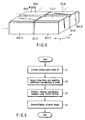
- the present invention is not limited to this, and the technique of this embodiment can also be applied to a case wherein ultrasonic blocks BL(n, m) ( n and m are both natural numbers) are two-dimensional connected to each other through connection layers Dn and Dm, as shown in, for example, FIG. 5 .
- central positions C(1, 1),..., C(n, m) of ultrasonic blocks BL(1, 1), ..., BL(n, m) are measured.
- a spatial position x'(n, m) of each ultrasonic transducer is determined in accordance with the distance from each central position.
- the spatial position x'(n, m) of each ultrasonic transducer can be accurately grasped.
- Calculation of delay times and weighting coefficients with consideration given to the above edge transducer gaps is executed according to a predetermined formula, rule, or the like on the basis of the spatial positions of the respective ultrasonic transducers.
- the position of each ultrasonic transducer which is used in this case can be measured by, for example, one of the methods according to the first to third embodiments to be described below.
- an array shape is measured by using a microscope or the like, and offset values and variations of ultrasonic transducer block intervals are obtained and calculated as statistics for each production lot of ultrasonic transducer blocks.
- Predetermined correction is then performed by using software for the system on the basis of the obtained offset values, and the unified spatial position of each ultrasonic transducer is obtained for each production lot. According to this technique, the spatial position of each ultrasonic transducer can be acquired relatively easily in consideration of the influences of edge transducer gaps.
- An array shape (ultrasonic transducer block interval or the like) is measured for each ultrasonic probe before a manufactured lens is bonded.
- the measured value is input to a predetermined correction table incorporated in advance in an ultrasonic diagnostic apparatus 1, and correction is performed for each probe by using each piece of probe information.
- This technique can acquire the spatial position of each ultrasonic transducer in consideration of edge transducer gaps more accurately than the technique according to the first embodiment and more easily than the technique according to the third embodiment.
- Each manufactured probe is placed in a water bath, and an acoustic field is measured. Parameters are operated and optimized until deflection angles and sidelobes fall within specified values, and the optimal values are input to a predetermined correction table incorporated in the apparatus in advance, thereby performing correction for each probe. For example, a sidelobe originating from an adhesive layer between ultrasonic transducer blocks has a shape with a certain tendency. The influence of an edge transducer gap can be corrected by inputting optimal values so as to reduce such a tendency. This technique can acquire the spatial position of each ultrasonic transducer more accurately than the techniques according to the first and second embodiments.
- an ultrasonic probe 10 having an arrangement in which ultrasonic blocks BLn are bonded to each other through adhesive layers Dn, a problem arises in terms of the acoustic characteristics of edge transducers bonded to the adhesive layers.
- a weighting coefficient for attenuating an echo signal from each edge transducer is set, and addition processing is performed by using it to reduce a sidelobe due to the acoustic characteristics of each edge transducer (apodization).
- apodization may be executed for a signal at the time of transmission as well as a signal at the time of reception. That is, a transmission voltage is set with a weight that reduces transmission ultrasonic waves and is applied to each edge transducer. This makes it possible to transmit a beam with a reduced sidelobe originating from the acoustic characteristics of each edge transducer.
- FIG. 6 is a flowchart showing the flow of each processing executed in ultrasonic transmission/reception based on the delay time/weighting coefficient optimization function.
- a control circuit 6 recognizes the ID of the connected ultrasonic probe 10 (step S1), and acquires a delay time and weighting coefficient for each ultrasonic transducer of the ultrasonic probe (i.e., T(x'(n)) and W(x'(n)) set in consideration of each edge transducer gap) from a storage unit 30 (step S2).
- a weighting coefficient is determined for each edge transducer to reduce a sidelobe originating from its acoustic characteristics.
- this delay time and weighting coefficient are calculated in advance by using the spatial position information and delay time/weighting coefficient acquisition information of each ultrasonic transducer of the ultrasonic probe which are stored in the storage unit 30.
- the present invention is not limited to this. For example, every time an ultrasonic probe is connected to the apparatus body 50, a delay time and a weighting coefficient may be calculated by using the spatial position information and delay time/weighting coefficient information of each ultrasonic transducer of the ultrasonic probe which are stored in the storage unit 30.
- Ultrasonic transmission/reception is performed on the basis of the acquired delay time/weighting coefficient information (step S3).
- An ultrasonic image is then generated on the basis of acquired echo signals, and is displayed in a predetermined form (step S4).
- the position of each ultrasonic transducer is accurately specified in consideration of each edge transducer gap, and a delay time/weighting coefficient for each transducer is determined in ultrasonic transmission/reception on the basis of the specified position. For example, a reference position of each ultrasonic block is measured, and a spatial position x'(n) of each ultrasonic transducer is determined in accordance with the distance from each reference position. Since a delay time and a weighting coefficient are determined in accordance with the position of each ultrasonic transducer, accurate delay times and weighting coefficients can be determined in consideration of the thickness of each adhesive layer as compared with the prior art in which delay times and weighting coefficients are determined without any consideration to edge transducer gaps.
- a weighting coefficient matching the characteristics of each transducer can be set by specifying each edge transducer on the basis of accurate spatial positions and selecting a weighting coefficient corresponding to a deterioration in the sensitivity of each edge transducer. This makes it possible to realize a suitable acoustic field which realizes high deflection angle accuracy and can reduce sidelobes and the like as compared with the prior art.
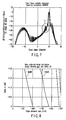
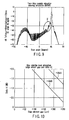
- FIG. 7 is a graph showing the spectrum distribution of echo signals obtained by ultrasonic transmission/reception using delay times and weighting coefficients according to the prior art (i.e., those determined by a technique without any consideration to edge transducer gaps).
- FIG. 8 is a graph showing the distribution of sidelobes which appear in ultrasonic transmission/reception using delay times and weighting coefficient according to the prior art.
- FIG. 9 is a graph showing the spectrum distribution of echo signals obtained by ultrasonic transmission/reception using delay times and weighting coefficients determined by this delay time/weighting coefficient optimization function.
- FIG. 10 is a graph showing the distribution of sidelobes which appear in ultrasonic transmission/reception using delay times and weighting coefficient determined by the delay time/weighting coefficient optimization function.
- FIGS. 7 and 9 A comparison between FIGS. 7 and 9 reveals that the size of a sidelobe S' is smaller than that of a sidelobe S.
- FIGS. 8 and 10 a comparison between FIGS. 8 and 10 reveals that in ultrasonic transmission/reception executed in this apparatus, the occurrence of sidelobes is more suppressed, and the resolution improves.
- This technique has the effect of solving the problem that the main lobe is located inside more than actually due to the shadows of the edge transducer gaps, in addition to the sidelobe reducing effect.
- edge transducers bonded to the adhesive layers are reduced by executing apodization associated with the edge transducers at least at the time of transmission or reception.
- apodization associated with the edge transducers at least at the time of transmission or reception.
- a program which implements this delay time/weighting coefficient optimization function and the spatial position of each ultrasonic transducer obtained in consideration of each edge transducer gap are installed in an existing apparatus, and the apparatus is activated to implement the delay time/weighting coefficient optimization function. Therefore, this function can be implemented at a relatively low cost and with ease.
- the present invention is not limited to the above embodiment, and can be embodied in the execution stage by modifying constituent elements within the spirit and scope of the invention. For example, the following are specific modifications.
Landscapes
- Physics & Mathematics (AREA)
- Engineering & Computer Science (AREA)
- Acoustics & Sound (AREA)
- Radar, Positioning & Navigation (AREA)
- Remote Sensing (AREA)
- Computer Networks & Wireless Communication (AREA)
- General Physics & Mathematics (AREA)
- Multimedia (AREA)
- Ultra Sonic Daignosis Equipment (AREA)
Claims (16)
- Ultraschalldiagnosevorrichtung, enthaltend:eine Ultraschallsonde (10), die eine Mehrzahl von Ultraschalltransducerblöcken (BL) enthält, die in einer vorbestimmten Richtung angeordnet sind, und mindestens eine Klebeschicht (D), die benachbarte Ultraschalltransducerblöcke (BL) in der vorbestimmten Richtung miteinander verbindet, wobei jeder Ultraschalltransducerblock (BL) eine Mehrzahl von Ultraschalltransducern enthält, die in der vorbestimmten Richtung angeordnet und angepasst sind zum Erzeugen von Ultraschallwellen basierend auf gelieferten Treibersignalen, und von Echosignalen basierend auf den empfangenen Ultraschallwellen;eine Sende-/Empfangseinheit (2,3), die angepasst ist zum Senden/Empfangen von Ultraschallwellen; undeine Steuereinheit (6), die angepasst ist zum Bestimmen von mindestens einem von einer Verzögerungszeit und eines Gewichtungskoeffizienten für jeden der Mehrzahl von Ultraschalltransducem gemäß einer gemessenen Referenzposition (C1, C2, C3) des entsprechenden Ultraschalltransducerblocks (BL), wobei die Referenzposition (C1, C2, C3) beeinflusst wird durch eine Breite der mindestens einen Klebeschicht (D) in der vorbestimmten Richtung, und zum Steuern der Sende/Empfangs-Einheit (2,3) basierend auf der bestimmten mindestens einen von der Verzögerungszeit und dem Gewichtungskoeffizienten.
- Vorrichtung nach Anspruch 1, bei der die Steuereinheit (6) angepasst ist zum Bestimmen von mindestens einem von einer Verzögerungszeit für jeden der Ultraschalltransducer bei einem Ultrschallsenden, einer Verzögerungszeit für jeden der Ultraschalltransducer bei einem Ultraschallempfangen, und einem Gewichtungskoeffizienten für jeden der Ultraschalltransducer, der verwenden wird zusätzlich zu der Verarbeitung einer empfangenen Ultraschallwelle gemäß einer Position von jedem der Ultraschalltransducerblöcke.
- Vorrichtung nach Anspruch 1 oder 2, bei der die Steuereinheit (6) angepasst ist zum Bestimmen der Verzögerungszeit und des Gewichtungskoeffizienten durch eine vorbestimmte Berechnung unter Verwendung einer Position von jedem der Ultraschalltransducer.
- Vorrichtung nach einem der Ansprüche 1 bis 3, bei der die Steuereinheit (6) angepasst ist zum Bestimmen der Verzögerungszeit und des Gewichtungskoeffizienten, indem eine Tabelle verwendet wird, die eine Position von jedem der Ultraschalltransducer jeder Verzögerungszeit und jedem Gewichtungskoeffizienten zuordnet.
- Vorrichtung nach einem der Ansprüche 1 bis 4, bei der die Ulltraschallsonde (10) eine zweidimensionale Anordnungssonde enthält, die Ultraschalltransducer enthält, die in der Form einer Matrix angeordnet sind, oder eine 1,5-dimensionale Anordnungssonde.
- Vorrichtung nach einem der Ansprüche 1 bis 5, bei der die Mehrzahl der Ultraschalltransducerblöcke in einer Anordnungsform angeordnet sind entlang einer vorbestimmten Richtung, und
die Mehrzahl der Klebeschichten, die Ultraschalltransducer, die in der vorbestimmten Richtung benachbart zueinander sind, verbindet. - Vorrichtung nach einem der Ansprüche 1 bis 6, bei der
die Mehrzahl der Ultraschalltransducerblöcke in der Form einer Matrix entlang einer ersten Richtung und einer zweiten Richtung angeordnet sind, und
die Mehrzahl der Klebeschichten die Ultraschalltransducer, die entlang der ersten Richtung benachbart zueinander sind, verbindet, und die Ultraschalltransducer, die entlang der zweiten Richtung benachbart zueinander sind, verbindet. - Vorrichtung nach einem der Ansprüche 1 bis 7, bei der die Steuereinheit (6) angepasst ist zum Bestimmen von Gewichtungskoeffizienten einer Aperturfunktion entsprechend der Ultraschalltransducer in einer Echosignaladditionsverarbeitung derart, dass ein Beitrag der Ultraschalltransducer, die mit der mindestens einen Klebeschicht verbunden sind, zu einer gesendeten Ultraschallwelle und einer empfangenen Ultraschallwelle kleiner ist als ein Beitrag eines Ultraschalltransducers, der nicht mit der mindestens einen Klebeschicht verbunden ist, zu einer gesendeten Ultraschallwelle und einer empfangenen Ultraschallwelle.
- Ultraschallsende-/-empfangsbedingungs-Optimierungsverfahren, das eine Ultraschallsonde (10) verwendet, die eine Mehrzahl von Ultraschalltransducerblöcken (BL) enthält, die in einer vorbestimmten Richtung angeordnet sind, und mindestens eine Klebeschicht (D), die benachbarte Ultraschalltransducerblöcke (BL) in der vorbestimmten Richtung miteinander verbindet, wobei jeder Ultraschalltransducerblock (BL) eine Mehrzahl von Ultraschalltransducem enthält, die in der vorbestimmten Richtung angeordnet und angepasst sind zum Erzeugen von Ultraschallwellen basierend auf gelieferten Treibersignalen, und von Echosignalen basierend auf den empfangenen Ultraschallwellen, wobei das Verfahren die Schritte enthält:Messen von Referenzpositionen (C1, C2, C3) von der Mehrzahl von Ultraschalltransducerblöcken (BL);Bestimmen von mindestens einem von einer Verzögerungszeit und eines Gewichtungskoeffizienten für jeden von der Mehrzahl von Ultraschalltransducern gemäß der Referenzposition (C1, C2, C3) des entsprechenden Ultraschalltransducerblocks (BL), wobei die Referenzposition (C1, C2, C3) beeinflusst ist durch eine Breite der mindestens einen Klebeschicht (D) in der vorbestimmten Richtung; undDurchführen eines Ultraschallsendens basierend auf dem bestimmten mindestens einen von der Verzögerungszeit und dem Gewichtungskoeffizienten.
- Verfahren nach Anspruch 9, bei dem das mindestens eine von einer Verzögerungszeit und einem Gewichtungskoeffizient mindestens eines von einer Verzögerungszeit für jeden Ultraschalltransducer beim Ultraschallsenden, einer Verzögerungszeit für jeden Ultraschalltransducer beim Ultraschallempfangen, und einem Gewichtungskoeffizienten für jeden Ultraschalltransducer enthält, der in der Additionsverarbeitung der empfangenen Ultraschallwellen verwendet wird.
- Verfahren nach Anspruch 9 oder 10, bei dem beim Bestimmen des mindestens einen von einer Verzögerungszeit und eines Gewichtungskoeffizienten, die Verzögerungszeit oder der Gewichtungskoeffizient bestimmt wird durch eine vorbestimmte Berechnung, die eine Position von jedem der Mehrzahl von Ultraschalltransducem verwendet.
- Verfahren nach Anspruch 9 oder 10, bei dem beim Bestimmen des mindestens einen von einer Verzögerungszeit und eines Gewichtungskoeffizienten die Verzögerungszeit oder der Gewichtungskoeffizient bestimmt wird, indem eine Tabelle verwendet wird, die eine Position jedes Ultraschalltransducers jeder Verzögerungszeit und jedem Gewichtungskoeffizienten zuordnet.
- Verfahren nach einem der Ansprüche 9 bis 12, bei dem die Ultraschallsonde eine zweidimensionale Anordnungssonde enthält, die Ultraschalltransducer enthält, die in der Form einer Matrix angeordnet sind, oder eine 1,5-dimensionale Anordnungssonde.
- Verfahren nach einem der Ansprüche 9 bis 13, bei dem die Mehrzahl der Ultraschalltransducerblöcke in einer Anordnungsform entlang einer vorbestimmten Richtung angeordnet sind, und
die Mehrzahl der Klebeschichten Ultraschalltransducer, die in der vorbestimmten Richtung benachbart zueinander sind, verbindet. - Verfahren nach einem der Ansprüche 9 bis 14, bei dem
die Mehrzahl der Ultraschalltransducerblöcke in der Form einer Matrix entlang einer ersten Richtung und einer zweiten Richtung angeordnet sind, und
die Mehrzahl der Klebeschichten die Ultraschalltransducer, die entlang der ersten Richtung benachbart zueinander sind, verbindet, und die Ultraschalltransducer, die entlang der zweiten Richtung zueinander benachbart sind, verbindet. - Verfahren nach einem der Ansprüche 9 bis 15, bei dem die Gewichtungskoeffizienten einer Aperturfunktion bestimmt werden entsprechend den Ultraschalltransducem bei der Echosignaladditionsverarbeitung derart, dass ein Beitrag der Ultraschalltransducer, die mit der mindestens einen Klebeschicht verbunden sind, zu einer gesendeten Ultraschallwelle und einer empfangenen Ultraschallwelle kleiner ist als ein Beitrag des Ultraschalltransducers, der nicht mit der mindestens einen Klebeschicht verbunden ist, zu einer gesendeten Ultraschallwelle und einer empfangenen Ultraschallwelle.
Applications Claiming Priority (1)
| Application Number | Priority Date | Filing Date | Title |
|---|---|---|---|
| JP2005176488 | 2005-06-16 |
Publications (3)
| Publication Number | Publication Date |
|---|---|
| EP1736799A1 EP1736799A1 (de) | 2006-12-27 |
| EP1736799B1 true EP1736799B1 (de) | 2012-12-26 |
| EP1736799B8 EP1736799B8 (de) | 2013-05-29 |
Family
ID=36992818
Family Applications (1)
| Application Number | Title | Priority Date | Filing Date |
|---|---|---|---|
| EP06012290.0A Active EP1736799B8 (de) | 2005-06-16 | 2006-06-14 | Verfahren zur Optimierung von Ultraschallübertragung/-empfang, entsprechendes Programm und diagnostisches Ultraschallgerät |
Country Status (3)
| Country | Link |
|---|---|
| US (1) | US9606227B2 (de) |
| EP (1) | EP1736799B8 (de) |
| JP (1) | JP5498551B2 (de) |
Families Citing this family (5)
| Publication number | Priority date | Publication date | Assignee | Title |
|---|---|---|---|---|
| KR100686289B1 (ko) * | 2004-04-01 | 2007-02-23 | 주식회사 메디슨 | 대상체 영상의 윤곽내 볼륨 데이터를 이용하는 3차원초음파 영상 형성 장치 및 방법 |
| JP5433429B2 (ja) * | 2010-01-12 | 2014-03-05 | 株式会社東芝 | 超音波プローブ |
| KR101792590B1 (ko) * | 2011-04-26 | 2017-11-01 | 삼성전자주식회사 | 빔포밍 방법, 이를 수행하는 장치 및 의료영상시스템 |
| US9987809B2 (en) * | 2014-12-31 | 2018-06-05 | General Electric Company | System and method for manufacturing an ultrasound probe lens |
| JP6459744B2 (ja) * | 2015-04-17 | 2019-01-30 | 株式会社ソシオネクスト | 超音波検査装置及び超音波検査装置の制御方法 |
Family Cites Families (24)
| Publication number | Priority date | Publication date | Assignee | Title |
|---|---|---|---|---|
| FR2570837B1 (fr) * | 1984-09-25 | 1987-11-20 | Cgr Ultrasonic | Sonde a ultrasons pour balayage sectoriel electronique et echographe incorporant une telle sonde |
| US4841492A (en) * | 1987-08-05 | 1989-06-20 | North American Philips Corporation | Apodization of ultrasound transmission |
| US4893284A (en) * | 1988-05-27 | 1990-01-09 | General Electric Company | Calibration of phased array ultrasound probe |
| NL8801776A (nl) * | 1988-07-13 | 1990-02-01 | Optische Ind De Oude Delft Nv | Ultrasone transducent omvattende tenminste een rij ultrasone elementen. |
| JPH0531109A (ja) | 1990-11-07 | 1993-02-09 | Toshiba Corp | 超音波イメージング装置 |
| JPH0595951A (ja) * | 1991-03-08 | 1993-04-20 | Fujitsu Ltd | 超音波影像装置 |
| JPH05111U (ja) * | 1991-06-24 | 1993-01-08 | 横河メデイカルシステム株式会社 | 超音波診断装置 |
| US5379769A (en) * | 1992-11-30 | 1995-01-10 | Hitachi Medical Corporation | Ultrasonic diagnostic apparatus for displaying an image in a three-dimensional image and in a real time image and a display method thereof |
| JP3335687B2 (ja) | 1992-12-02 | 2002-10-21 | 株式会社日立メディコ | 超音波診断装置 |
| CA2139151A1 (en) * | 1994-01-14 | 1995-07-15 | Amin M. Hanafy | Two-dimensional acoustic array and method for the manufacture thereof |
| JPH09313487A (ja) * | 1996-05-29 | 1997-12-09 | Ge Yokogawa Medical Syst Ltd | 超音波3次元像撮像方法および装置 |
| US5676149A (en) * | 1996-09-24 | 1997-10-14 | Siemens Medical Systems Inc. | Method of compensating for inoperative elements in an ultrasound transducer |
| US5957850A (en) * | 1997-09-29 | 1999-09-28 | Acuson Corporation | Multi-array pencil-sized ultrasound transducer and method of imaging and manufacture |
| US5986972A (en) * | 1998-03-31 | 1999-11-16 | The United States Of America As Represented By The Secretary Of The Navy | Beam pattern shaping for transmitter array |
| US6135960A (en) * | 1998-08-31 | 2000-10-24 | Holmberg; Linda Jean | High-resolution, three-dimensional whole body ultrasound imaging system |
| JP3943731B2 (ja) | 1998-10-19 | 2007-07-11 | 株式会社東芝 | 超音波トランスデューサ用圧電板及びその製造方法 |
| US6489706B2 (en) * | 1998-11-13 | 2002-12-03 | Acuson Corporation | Medical diagnostic ultrasound transducer and method of manufacture |
| US6120449A (en) * | 1998-11-25 | 2000-09-19 | General Electric Company | Method and apparatus for compensating for inoperative elements in ultrasonic transducer array |
| FR2786651B1 (fr) * | 1998-11-27 | 2002-10-25 | Commissariat Energie Atomique | Transducteur ultrasonore de contact, a elements multiples |
| KR20000038847A (ko) * | 1998-12-09 | 2000-07-05 | 이민화 | 초음파영상화시스템에서의 집속방법 |
| US6891311B2 (en) * | 2002-06-27 | 2005-05-10 | Siemens Medical Solutions Usa, Inc | Ultrasound transmit pulser with receive interconnection and method of use |
| JP4342859B2 (ja) * | 2002-09-30 | 2009-10-14 | 富士フイルム株式会社 | 超音波用探触子及びそれを用いた超音波送受信装置 |
| JP2005074146A (ja) | 2003-09-03 | 2005-03-24 | Hiroshi Kanai | 超音波測定方法、超音波発生機構 |
| JP5132089B2 (ja) | 2005-06-16 | 2013-01-30 | 株式会社東芝 | 超音波診断装置、超音波送受信条件適正化プログラム及び超音波送受信条件適正化方法 |
-
2006
- 2006-06-14 EP EP06012290.0A patent/EP1736799B8/de active Active
- 2006-06-15 US US11/424,375 patent/US9606227B2/en active Active
-
2012
- 2012-09-18 JP JP2012204910A patent/JP5498551B2/ja not_active Expired - Fee Related
Also Published As
| Publication number | Publication date |
|---|---|
| JP2013013759A (ja) | 2013-01-24 |
| EP1736799B8 (de) | 2013-05-29 |
| JP5498551B2 (ja) | 2014-05-21 |
| US20070016048A1 (en) | 2007-01-18 |
| EP1736799A1 (de) | 2006-12-27 |
| US9606227B2 (en) | 2017-03-28 |
Similar Documents
| Publication | Publication Date | Title |
|---|---|---|
| US6464638B1 (en) | Ultrasound imaging system and method for spatial compounding | |
| US8926512B2 (en) | Ultrasonic imaging apparatus and ultrasonic velocity optimization method | |
| US11439368B2 (en) | Acoustic wave processing device, signal processing method for acoustic wave processing device, and program | |
| US8197412B2 (en) | Ultrasonic diagnostic apparatus | |
| US10918355B2 (en) | Ultrasound diagnostic device and ultrasound diagnostic method | |
| EP0545714A1 (de) | Abweichungskorrektur unter Verwendung von aus einem Strahlbündel gewonnenen Daten bei einem phasengesteuerten Ultraschallabtaster | |
| CN110023782A (zh) | 用于对超声图像杂波滤波的方法和系统 | |
| US20080242992A1 (en) | Ultrasound Imaging System and Method for Flow Imaging Using Real-Time Spatial Compounding | |
| US20080168839A1 (en) | Ultrasonic diagnostic apparatus | |
| CN102970935B (zh) | 超声波诊断装置以及超声波诊断装置控制方法 | |
| JP5498551B2 (ja) | 超音波診断装置及び超音波送受信条件最適化プログラム | |
| US20100081936A1 (en) | Ultrasonic diagnosis apparatus and ultrasonic transmission/reception method | |
| US10980515B2 (en) | Acoustic wave processing apparatus, signal processing method, and program for acoustic wave processing apparatus | |
| US11747456B2 (en) | Location device and system for locating an ultrasound acoustic sensor | |
| US8905933B2 (en) | Ultrasonic diagnostic apparatus | |
| US8398548B2 (en) | Ultrasound diagnostic apparatus and ultrasound diagnostic method | |
| JP5132089B2 (ja) | 超音波診断装置、超音波送受信条件適正化プログラム及び超音波送受信条件適正化方法 | |
| JP3180958B2 (ja) | 超音波診断装置 | |
| WO2018162305A1 (en) | Location device and system for locating an acoustic sensor | |
| US20240081779A1 (en) | Ultrasound diagnostic apparatus and control method for ultrasound diagnostic apparatus | |
| JP2004201864A (ja) | 超音波撮像装置及び超音波撮像方法 | |
| Le Croissette | Signal Processing In Ultrasound | |
| JPH02213330A (ja) | 超音波診断装置 |
Legal Events
| Date | Code | Title | Description |
|---|---|---|---|
| PUAI | Public reference made under article 153(3) epc to a published international application that has entered the european phase |
Free format text: ORIGINAL CODE: 0009012 |
|
| 17P | Request for examination filed |
Effective date: 20060614 |
|
| AK | Designated contracting states |
Kind code of ref document: A1 Designated state(s): AT BE BG CH CY CZ DE DK EE ES FI FR GB GR HU IE IS IT LI LT LU LV MC NL PL PT RO SE SI SK TR |
|
| AX | Request for extension of the european patent |
Extension state: AL BA HR MK YU |
|
| 17Q | First examination report despatched |
Effective date: 20070201 |
|
| AKX | Designation fees paid |
Designated state(s): DE |
|
| GRAP | Despatch of communication of intention to grant a patent |
Free format text: ORIGINAL CODE: EPIDOSNIGR1 |
|
| GRAS | Grant fee paid |
Free format text: ORIGINAL CODE: EPIDOSNIGR3 |
|
| GRAA | (expected) grant |
Free format text: ORIGINAL CODE: 0009210 |
|
| AK | Designated contracting states |
Kind code of ref document: B1 Designated state(s): DE |
|
| REG | Reference to a national code |
Ref country code: DE Ref legal event code: R096 Ref document number: 602006033786 Country of ref document: DE Effective date: 20130307 |
|
| RAP2 | Party data changed (patent owner data changed or rights of a patent transferred) |
Owner name: TOSHIBA MEDICAL SYSTEMS CORPORATION Owner name: KABUSHIKI KAISHA TOSHIBA |
|
| REG | Reference to a national code |
Ref country code: DE Ref legal event code: R082 Ref document number: 602006033786 Country of ref document: DE Representative=s name: KRAMER - BARSKE - SCHMIDTCHEN, DE Ref country code: DE Ref legal event code: R082 Ref document number: 602006033786 Country of ref document: DE Representative=s name: KRAMER BARSKE SCHMIDTCHEN PATENTANWAELTE PARTG, DE |
|
| PLBE | No opposition filed within time limit |
Free format text: ORIGINAL CODE: 0009261 |
|
| STAA | Information on the status of an ep patent application or granted ep patent |
Free format text: STATUS: NO OPPOSITION FILED WITHIN TIME LIMIT |
|
| 26N | No opposition filed |
Effective date: 20130927 |
|
| REG | Reference to a national code |
Ref country code: DE Ref legal event code: R097 Ref document number: 602006033786 Country of ref document: DE Effective date: 20130927 |
|
| PGFP | Annual fee paid to national office [announced via postgrant information from national office to epo] |
Ref country code: DE Payment date: 20250402 Year of fee payment: 20 |