EP1724293B1 - Fluoreszierender chiraler sensor vom typ molekularer draht - Google Patents
Fluoreszierender chiraler sensor vom typ molekularer draht Download PDFInfo
- Publication number
- EP1724293B1 EP1724293B1 EP04799877A EP04799877A EP1724293B1 EP 1724293 B1 EP1724293 B1 EP 1724293B1 EP 04799877 A EP04799877 A EP 04799877A EP 04799877 A EP04799877 A EP 04799877A EP 1724293 B1 EP1724293 B1 EP 1724293B1
- Authority
- EP
- European Patent Office
- Prior art keywords
- carbon atoms
- substituent
- group
- poly
- alkyl group
- Prior art date
- Legal status (The legal status is an assumption and is not a legal conclusion. Google has not performed a legal analysis and makes no representation as to the accuracy of the status listed.)
- Expired - Lifetime
Links
- 0 C[Si](C)(C)C#Cc(c(Oc(cc1COC[C@](C2C=CC=CC2)OCCOCCO[C@](CO2)c3ccccc3)cc2c1O)c1)ccc1C#C* Chemical compound C[Si](C)(C)C#Cc(c(Oc(cc1COC[C@](C2C=CC=CC2)OCCOCCO[C@](CO2)c3ccccc3)cc2c1O)c1)ccc1C#C* 0.000 description 1
- BTURDHJZPARDJA-VSJLXWSYSA-N N#Cc(cc1)cc(/C=[O]/c(cc2COC[C@H](c3ccccc3)OCCOCCO[C@H](CO3)c4ccccc4)cc3c2O)c1C#N Chemical compound N#Cc(cc1)cc(/C=[O]/c(cc2COC[C@H](c3ccccc3)OCCOCCO[C@H](CO3)c4ccccc4)cc3c2O)c1C#N BTURDHJZPARDJA-VSJLXWSYSA-N 0.000 description 1
Images

Classifications
-
- C—CHEMISTRY; METALLURGY
- C08—ORGANIC MACROMOLECULAR COMPOUNDS; THEIR PREPARATION OR CHEMICAL WORKING-UP; COMPOSITIONS BASED THEREON
- C08G—MACROMOLECULAR COMPOUNDS OBTAINED OTHERWISE THAN BY REACTIONS ONLY INVOLVING UNSATURATED CARBON-TO-CARBON BONDS
- C08G61/00—Macromolecular compounds obtained by reactions forming a carbon-to-carbon link in the main chain of the macromolecule
- C08G61/02—Macromolecular compounds containing only carbon atoms in the main chain of the macromolecule, e.g. polyxylylenes
-
- C—CHEMISTRY; METALLURGY
- C08—ORGANIC MACROMOLECULAR COMPOUNDS; THEIR PREPARATION OR CHEMICAL WORKING-UP; COMPOSITIONS BASED THEREON
- C08G—MACROMOLECULAR COMPOUNDS OBTAINED OTHERWISE THAN BY REACTIONS ONLY INVOLVING UNSATURATED CARBON-TO-CARBON BONDS
- C08G61/00—Macromolecular compounds obtained by reactions forming a carbon-to-carbon link in the main chain of the macromolecule
- C08G61/02—Macromolecular compounds containing only carbon atoms in the main chain of the macromolecule, e.g. polyxylylenes
- C08G61/10—Macromolecular compounds containing only carbon atoms in the main chain of the macromolecule, e.g. polyxylylenes only aromatic carbon atoms, e.g. polyphenylenes
-
- C—CHEMISTRY; METALLURGY
- C08—ORGANIC MACROMOLECULAR COMPOUNDS; THEIR PREPARATION OR CHEMICAL WORKING-UP; COMPOSITIONS BASED THEREON
- C08G—MACROMOLECULAR COMPOUNDS OBTAINED OTHERWISE THAN BY REACTIONS ONLY INVOLVING UNSATURATED CARBON-TO-CARBON BONDS
- C08G2261/00—Macromolecular compounds obtained by reactions forming a carbon-to-carbon link in the main chain of the macromolecule
- C08G2261/30—Monomer units or repeat units incorporating structural elements in the main chain
- C08G2261/31—Monomer units or repeat units incorporating structural elements in the main chain incorporating aromatic structural elements in the main chain
- C08G2261/312—Non-condensed aromatic systems, e.g. benzene
-
- G—PHYSICS
- G01—MEASURING; TESTING
- G01N—INVESTIGATING OR ANALYSING MATERIALS BY DETERMINING THEIR CHEMICAL OR PHYSICAL PROPERTIES
- G01N21/00—Investigating or analysing materials by the use of optical means, i.e. using sub-millimetre waves, infrared, visible or ultraviolet light
- G01N21/62—Systems in which the material investigated is excited whereby it emits light or causes a change in wavelength of the incident light
- G01N21/63—Systems in which the material investigated is excited whereby it emits light or causes a change in wavelength of the incident light optically excited
- G01N21/64—Fluorescence; Phosphorescence
- G01N21/6428—Measuring fluorescence of fluorescent products of reactions or of fluorochrome labelled reactive substances, e.g. measuring quenching effects, using measuring "optrodes"
- G01N2021/6432—Quenching
-
- G—PHYSICS
- G01—MEASURING; TESTING
- G01N—INVESTIGATING OR ANALYSING MATERIALS BY DETERMINING THEIR CHEMICAL OR PHYSICAL PROPERTIES
- G01N21/00—Investigating or analysing materials by the use of optical means, i.e. using sub-millimetre waves, infrared, visible or ultraviolet light
- G01N21/75—Systems in which material is subjected to a chemical reaction, the progress or the result of the reaction being investigated
- G01N21/77—Systems in which material is subjected to a chemical reaction, the progress or the result of the reaction being investigated by observing the effect on a chemical indicator
- G01N2021/7769—Measurement method of reaction-produced change in sensor
- G01N2021/7786—Fluorescence
-
- Y—GENERAL TAGGING OF NEW TECHNOLOGICAL DEVELOPMENTS; GENERAL TAGGING OF CROSS-SECTIONAL TECHNOLOGIES SPANNING OVER SEVERAL SECTIONS OF THE IPC; TECHNICAL SUBJECTS COVERED BY FORMER USPC CROSS-REFERENCE ART COLLECTIONS [XRACs] AND DIGESTS
- Y10—TECHNICAL SUBJECTS COVERED BY FORMER USPC
- Y10T—TECHNICAL SUBJECTS COVERED BY FORMER US CLASSIFICATION
- Y10T436/00—Chemistry: analytical and immunological testing
- Y10T436/17—Nitrogen containing
-
- Y—GENERAL TAGGING OF NEW TECHNOLOGICAL DEVELOPMENTS; GENERAL TAGGING OF CROSS-SECTIONAL TECHNOLOGIES SPANNING OVER SEVERAL SECTIONS OF THE IPC; TECHNICAL SUBJECTS COVERED BY FORMER USPC CROSS-REFERENCE ART COLLECTIONS [XRACs] AND DIGESTS
- Y10—TECHNICAL SUBJECTS COVERED BY FORMER USPC
- Y10T—TECHNICAL SUBJECTS COVERED BY FORMER US CLASSIFICATION
- Y10T436/00—Chemistry: analytical and immunological testing
- Y10T436/17—Nitrogen containing
- Y10T436/170769—N-Nitroso containing [e.g., nitrosamine, etc.]
Definitions
- the present invention relates to a chiral sensor constituted by an optically active compound. More specifically, the present invention relates to a molecular-wire type fluorescent chiral sensor into which an optically active portion that is capable of recognizing a chiral compound is introduced.
- optically active amines such as ethanolamine derivatives and catecholamine derivatives have physiological activities on the central nerve, they are important compounds as intermediates for various pharmaceuticals.
- natural amino acids and physiologically active substances are all chiral compounds.
- optically active pseudo-18-crown-6 having a variety of metacyclophane structures have high asymmetry recognition ability toward primary amines (see Japanese Laid-Open Patent Publication No. 2004-75624 ).
- a selector that is represented by the following formula and in which pseudo-18-crown-6 is bound to a silica gel is applied to column chromatography and shows excellent separation ability toward a variety of primary amines.
- the pseudo-18-crown-6 that is represented by the following formula and into which a 2,4-dinitrophenylazo group, which is a chromophore, is introduced changes its absorption spectrum significantly by forming a complex with an amine.
- this pseudo-18-crown-6 can be used as a chiral indicator.
- this pseudo-18-crown-6 is still not sufficient as a chiral sensor in view of the detection sensitivity.
- Chemical sensors such as chiral sensors are devices having a receptor site that recognizes a specific ion or molecule as a target and is bound thereto, and these devices read a change in the electronic state resulting from the binding to the target as an optical response (e.g., a change in absorption or fluorescence spectrum) or an electrical response (e.g., a change in electrical conductivity or oxidation-reduction potential).
- the sensitivity of the chemical sensors depends on the degree of binding ability between the target and the receptor site (complex stability constant) and the efficiency of converting the changes in the electronic state of a sensor molecule into signals. This will be described on the basis of the following scheme:
- receptor sites can be immobilized to a carrier, and furthermore electrons and holes or the excitation energy can move freely within an effective conjugated chain.
- the electronic state of the effective conjugated chain is changed, which results in a change in the electrical conductivity or the oxidation-reduction potential of the polymer (see (B) of the scheme).
- the excitation energy that moves in the conjugated chain is deactivated by the target booud to one receptor site, which results in a quenching of the fluorescence due to the polymer.
- the inventors of the present invention found that when a compound having high asymmetry recognition ability toward the above-mentioned primary amines was incorporated into a molecular wire as the receptor site, the obtained compound could actually function as a chiral amine sensor having high sensitivity, and thus achieved the present invention.
- the present invention provides a fluorescent molecular wire including a fluorescent polymer main chain to which an optically active substituent is linked so as to be a conjugatable form, the optically active substituent being represented by the following formula (I): where R 1 represents a hydrogen atom or an alkyl group having 1 to 10 carbon atoms; R 2 , R 3 , R 4 , R 5 , R 6 , R 7 , R 8 , and R 9 represent independently a hydrogen atom, a linear alkyl group having 1 to 30 carbon atoms that may have a substituent, a branched alkyl group having 2 to 30 carbon atoms that may have a substituent, a cyclic alkyl group having 3 to 30 carbon atoms that may have a substituent, an aryl group having 6 to 30 carbon atoms that may have a substituent, or an aralkyl group having 7 to 30 carbon atoms that may have a substituent, and R 3 and R 7 may be bonded respectively to R 4 and R 8
- the polymer main chain is a polyarylene structure, a poly(arylene ethynylene) structure, or a poly(arylene vinylene) structure, preferably, a polyphenylene structure, a polythiophene structure, a poly(phenylene thiophenylene) structure, a poly(phenylene ethynylene) structure, a poly(thiophenylene ethynylene) structure, or a poly(phenylene vinylene) structure.
- the optically active substituent is coupled to the polymer main chain via mono- or poly-arylene, mono- or poly-alkylene, mono- or poly-vinylene, or a combination thereof.
- the optically active substituent is represented by the following formula (II): where R 1 represents a hydrogen atom or an alkyl group having 1 to 10 carbon atoms; and R 2 , R 3 , R 4 , R 5 , R 6 , R 7 , R 8 , and R 9 represent independently a hydrogen atom, a linear alkyl group having 1 to 30 carbon atoms that may have a substituent, a branched alkyl group having 2 to 30 carbon atoms that may have a substituent, a cyclic alkyl group having 3 to 30 carbon atoms that may have a substituent, an aryl group having 6 to 30 carbon atoms that may have a substituent, or an aralkyl group having 7 to 30 carbon atoms that may have a substituent, and R 3 and R 7 may be bonded respectively to R 4 and R 8 to form an alkylene group having 2 to 60 carbon atoms that may have a substituent.
- R 3 and R 7 may be bonded respectively to R 4
- the fluorescent molecular wire is represented by the following formula (III): where R 12 and R 13 represent independently a hydrogen atom, an alkyl group having 1 to 20 carbon atoms, an alkoxy group having 1 to 20 carbon atoms, a di- or mono-alkylamide group having 1 to 20 carbon atoms, or an alkyl ester group having 1 to 20 carbon atoms; and n is an integer of 5 or more.
- the present invention also provides a chiral sensor including any one of the fluorescent molecular wires described above.
- the fluorescent molecular wire of the present invention has not only a higher detection sensitivity but also an improved asymmetry recognition ability when compared to monomeric compounds having the same structure as a substituent having high asymmetry recognition ability. Therefore, it can function as a primary amine chiral sensor having an even higher sensitivity and selectivity.
- the fluorescent molecular wire of the present invention is constituted by a fluorescent polymer main chain to which an optically active substituent having asymmetry recognition ability toward primary amines is linked so as to be a conjugatable form.
- fluorescent molecular wire refers to a fluorescent polymer having a fluorescent polymer main chain in which the excitation energy can move freely within an effective conjugated chain.
- the fluorescent polymer main chain has a structure in which conjugated systems are linked together so that the excitation energy can move within the polymer main chain.
- Examples of such a fluorescent polymer main chain include a polyarylene structure, a poly(arylene ethynylene) structure, and a poly(arylene vinylene) structure, preferably, a polyphenylene structure, a polythiophene structure, a poly(phenylene thiophenylene) structure, a poly(phenylene ethynylene) structure, a poly(thiophenylene ethynylene) structure, or a poly(phenylene vinylene) structure.
- the polymer main chain is preferably a poly(phenylene ethynylene) structure or a poly(phenylene thiophenylene) structure, and more preferably a poly(phenylene ethynylene) structure.
- the fluorescent polymer main chain may contain a substituent other than the optically active substituent in order to avoid steric hindrance due to the optically active substituents and improve the solubility.
- a substituent other than the optically active substituent in order to avoid steric hindrance due to the optically active substituents and improve the solubility.
- a case in which the optically active substituent is linked to a benzene ring of poly(phenylene ethynylene) will be described as an example.
- the benzene ring to which the optically active substituent is linked or a benzene ring adjacent to that benzene ring may contain, for example, an alkyl group, an alkoxy group, a di- or mono-alkylamide group, or an alkyl ester group.
- a linear or branched alkyl group having 1 to 20 carbon atoms, an alkoxy group having 1 to 20 carbon atoms, a linear or branched di- or mono-alkylamide group having 1 to 20 carbon atoms, or a linear or branched alkyl ester group having 1 to 20 carbon atoms is preferable, and such a substituent may be incorporated in a benzene ring, for example.
- the optically active substituent having asymmetry recognition ability toward primary amines is represented by the following formula (I): where R 1 represents a hydrogen atom or an alkyl group having 1 to 10 carbon atoms; R 2 , R 3 , R 4 , R 5 , R 6 , R 7 , R 8 , and R 9 represent independently a hydrogen atom, a linear alkyl group having 1 to 30 carbon atoms that may have a substituent, a branched alkyl group having 2 to 30 carbon atoms that may have a substituent, a cyclic alkyl group having 3 to 30 carbon atoms that may have a substituent, an aryl group having 6 to 30 carbon atoms that may have a substituent, or an aralkyl group having 7 to 30 carbon atoms that may have a substituent, and R 3 and R 7 may be bonded respectively to R 4 and R 8 to form an alkylene group having 2 to 60 carbon atoms that may have a substituent; and R 3 and R 7
- R 1 represents a hydrogen atom or an alkyl group having 1 to 10 carbon atoms.
- R 1 is a hydrogen atom and a methyl group.
- R 2 , R 3 , R 4 , R 5 , R 6 , R 7 , R 8 , and R 9 represent independently a hydrogen atom, a linear alkyl group having 1 to 30 carbon atoms that may have a substituent, a branched alkyl group having 2 to 30 carbon atoms that may have a substituent, a cyclic alkyl group having 3 to 30 carbon atoms that may have a substituent, an aryl group having 6 to 30 carbon atoms that may have a substituent, or an aralkyl group having 7 to 30 carbon atoms that may have a substituent, and R 3 and R 7 may be bonded respectively to R 4 and R 8 to form an alkylene group having 2 to 60 carbon atoms that may have a substituent.
- examples of the substituent include a hydroxyl group, an alkoxy group having 1 to 10 carbon atoms, a thiol group, an amino group, a nitro group, and a halogen atom (e.g., a fluorine atom, a chlorine atom, a bromine atom, and an iodine atom).
- a halogen atom e.g., a fluorine atom, a chlorine atom, a bromine atom, and an iodine atom.
- R 2 , R 3 , R 4 , R 6 , R 7 , and R 8 are hydrogen atoms.
- R 5 and R 9 examples include an aryl group having 6 to 30 carbon atoms, such as a phenyl group and a 1-naphthyl group, a cyclic alkyl group having 3 to 30 carbon atoms that may have a substituent, such as a 1-adamanthyl group.
- An aryl group having 6 to 12 carbon atoms or a cyclic alkyl group having 3 to 10 carbon atoms is preferable.
- R 5 and R 9 include a phenyl group, a 1-naphthyl group, a 1-adamanthyl group, a 1-(3,5-dimethyl)phenyl group, and a 1-bi-2-naphthyl group, among which a phenyl group is preferable.
- R 10 and R 11 represent independently a hydrogen atom or an alkyl group having 1 to 15 carbon atoms that may have a heteroatom, and R 10 and R 11 may be bonded to form an alkylene group having 2 to 30 carbon atoms that may have a substituent or may have a heteroatom.
- examples of the heteroatom include an oxygen atom, a sulfur atom, and a nitrogen atom.
- Preferred R 10 and R 11 include a group formed by combining R 10 and R 11 and represented by the formula: - [(CH 2 ) p -O-(CH 2 ) q ] r - where p, q, and r represent independently an integer of 1 to 15.
- a pseudo-18-crown-6 type in which p and q are each 2 and r is 1 is more preferable.
- the optically active substituent is represented by the following formula (II): where R 1 , R 2 , R 3 , R 4 , R 5 , R 6 , R 7 , R 8 , and R 9 are defined as above.
- optically active substituent is introduced directly into the polymer main chain of the fluorescent molecular wire as described above, or coupled thereto via a spacer.
- spacer any group can be used as long as the optically active substituent is conjugated with the fluorescent polymer main chain and the excitation energy can move freely, and mono- or poly-arylene, mono- or poly-alkylene, mono- or poly-vinylene, or a combination thereof is preferable, and an ethynylene group is more preferable.
- Preferred examples of such a fluorescent molecular wire include a compound represented by formula (III): where R 12 and R 13 represent independently a hydrogen atom, an alkyl group having 1 to 20 carbon atoms, an alkoxy group having 1 to 20 carbon atoms, a di- or mono-alkylamide group having 1 to 20 carbon atoms, or an alkyl ester group having 1 to 20 carbon atoms; and n is an integer of 5 or more.
- the basic framework of the optically active substituent of the compound represented by this formula (III) is a phenolic pseudo-18-crown-6 type having two asymmetric carbon atoms.
- This optically active substituent is introduced into the polymer main chain of the fluorescent molecular wire at a para position to the phenolic hydroxy group via an ethynylene group.
- a high electron negativity of the sp carbon facilitates acid dissociation of the phenolic hydroxy group, and therefore amines can be captured effectively.
- R 12 and R 13 which are substituents other than the optically active substituent in the polymer main chain, are more preferably decyloxy groups, in which case the solubility of the polymer may be increased.
- the optically active substituent (hereinafter sometimes referred to as the "receptor site") forms a complex selectively with either the R-form or the S-form of amines and amino acids and derivatives thereof.
- the amines and the amino acids and derivatives thereof there is no particular limitation regarding the amines and the amino acids and derivatives thereof.
- which of the R-form or the S-form of the amines and the amino acids and derivatives thereof can form a complex more effectively may depend on the stereostructure of the receptor site.
- the formation of complex between the optically active substituent (receptor site) and a primary amine causes a charge transfer from the receptor site to the polymer main chain, which results in a quenching of the fluorescence.
- the mechanism of this quenching is the same as that of a conventional monomeric pseudo-18-crown-6 (see Japanese Laid-Open Patent Publication No. 2004-75624 ).
- the fluorescent molecular wire of the present invention also has an improved asymmetry recognition ability toward primary amines when compared to the monomer type.
- the method for producing the fluorescent molecular wire of the present invention can be obtained by polymerizing fluorescent monomer units into which a receptor site was introduced.
- a fluorescent molecular wire represented by the formula (III) in which R 12 and R 13 are decyloxy groups can be obtained from (S)-mandelic acid ((S)-3) through a synthetic pathway described in the following scheme: More specifically, the fluorescent molecular wire of the present invention can be produced by a method described in examples below. These examples are among embodiments of the present invention, and the present invention is not limited only to the examples below.
- the fluorescent molecular wire in which the optically active substituent represented by the formula (I) is linked to the fluorescent polymer main chain so as to be a conjugatable form can be obtained.
- the chiral sensor of the present invention is constituted by the above-described fluorescent molecular wire.
- the above-described fluorescent molecular wire may be used without being subjected to any treatment or in a form in which it is dissolved in a solvent.
- the above-described fluorescent molecular wire is mixed into a thermoplastic resin such as polyethylene, polypropylene, or polystyrene and the mixture is formed into a film such as a porous film or a product having desired shape and size, such as a bead, a pellet, or a plate.
- the chiral sensor of the present invention can be used in a variety of forms for a wide range of purposes.
- the chiral sensor of the present invention is capable of recognizing asymmetry of primary amines with high sensitivity and high selectivity and thus is very useful for practical applications.
- amines, amino acids, and amino alcohols include a large amount of physiologically active substances, it can be preferably used for separation, sensing, sensing for detection of a narcotic drug or identification of the place of production, and the like.
- the crown ether (S,S)-6 160 mg, 285 ⁇ mol
- tetrahydrofuran 1.5 mL
- methanol 2.0 mL
- potassium carbonate 89 mg, 650 ⁇ mol
- dichloromethane (108 mL) and methanol (43 mL) were placed into a 300 mL recovery flask that was equipped with a calcium chloride tube and a magnetic stirrer and that was shielded from light. Then, 2-bromoaniline (1.50 g, 8.55 mmol), BTMAICl 2 (3.28 g, 9.42 mmol) (BTMA: benzyltrimethylammonium), and calcium carbonate were added thereto, and the mixture was stirred for 10 hours. The progress of the reaction was monitored by TLC. After the reaction mixture was filtrated and concentrated, an aqueous solution of saturated sodium thiosulfate was added thereto, and the mixture was extracted with ether.
- the compound 8 500 mg, 1.68 mmol
- 5% hydrochloric acid 3.4 mL, 171 mg, 4.69 mmol
- the reaction mixture was cooled to 0°C in an ice bath, and an aqueous solution (1.3 mL) of sodium nitrite (150 mg, 2.17 mmol) was added dropwise thereto.
- the compound 10 (8.15 g, 18.7 mmol), methyl iodide (50.0 mL, 110 g, 799 mmol), and iodine (4.85 g, 19.1 mmol) were placed into a pressure-resistant glass tube, and the tube was degassed by argon bubbling, sealed tightly and heated at 100°C for 12 hours. After opening the tube, the reaction mixture was extracted with ether, and the organic layer was washed with an aqueous solution of saturated sodium thiosulfate and then with saturated brine.
- a 5 mL side-arm recovery flask was equipped with a septum, an Allihn condenser, and a magnetic stirrer and flame-dried with heat gun under a nitrogen atmosphere. Then, copper (I) iodide (5.4 mg, 28 ⁇ mol) and PdCl 2 (PPh 3 ) 2 (6.3 mg, 9.0 ⁇ mol) were placed into the flask and the atmosphere was replaced with argon.
- a 100 mL three-neck flask was equipped with a septum, a Dimroth condenser, a ball stopper, and a magnetic stirrer and flame-dried under a nitrogen atmosphere. Then, copper (I) iodide (35.3 mg, 180 ⁇ mol) and PdCl 2 (PhCN) 2 (62.4 mg, 164 ⁇ mol) were placed into the flask and the atmosphere was replaced with argon. A solution of the compound 12 (759 mg, 1.75 mmol) in triethylamine (10.0 mL), which was previously degassed by argon bubbling, was added thereto, and further triethylamine (5.0 mL) was poured into the flask with washing.
- the compound (S,S)-16 (980 mg, 763 ⁇ mol), tetrahydrofuran (50 mL), and 1.0 M tetrabutylammonium fluoride (tetrahydrofuran solution) (1.5 mL, 1.50 mmol) were placed into a 20 mL recovery flask equipped with a calcium chloride tube and a magnetic stirrer, and the mixture was stirred at room temperature for 10 minutes. The progress of the reaction was monitored by TLC. After adding water, the reaction mixture was extracted with ether, and the organic layer was washed with saturated brine.
- a 50 mL three-neck flask was equipped with a septum, a ball stopper, a Dimroth condenser, and a magnetic stirrer and flame-dried with heat gun under a nitrogen atmosphere. Then, copper (I) iodide (11.6 mg, 59.1 ⁇ mol) and tetrakis(triphenylphosphine) palladium (0) (Pd(PPh 3 ) 4 : 53.0 mg, 45.9 ⁇ mol) were placed into the flask and the atmosphere was replaced with argon.
- a 30 mL side-arm recovery flask was equipped with a septum, a Dimroth condenser, and a magnetic stirrer. Then, a compound 18 (1.50 g, 2.34 mmol) was placed into the flask, and the atmosphere was replaced with argon. Tetrahydrofuran (16 mL) was added thereto, and the mixture was cooled to -76°C in a carbon dioxide-ethanol bath. Then, 1.6 M n-butyllithium (hexane solution) (1.8 mL, 2.88 mmol) was added thereto dropwise for 10 minutes, and the mixture was stirred with cooling for 2 hours and 30 minutes. The reaction was monitored by HPLC.
- the compound (S,S)-13 (539 mg, 641 ⁇ mol), tetrahydrofuran (22 mL), and 1.0 M tetrabutylammonium fluoride (tetrahydrofuran solution) (2.8 mL, 2.80 mmol) were placed into a 50 mL recovery flask equipped with a calcium chloride tube and a magnetic stirrer, and the mixture was stirred for 45 minutes. The reaction was monitored by TLC. After adding 1 N hydrochloric acid, the reaction mixture was extracted with ether, and the organic layer was washed with saturated brine.
- a 30 mL side-arm recovery flask was equipped with a septum, a Dimroth condenser, and a magnetic stirrer and flame-dried under a nitrogen atmosphere. Then, copper (I) iodide (17.5 mg, 91.4 ⁇ mol) and Pd(PPh 3 ) 4 (60.2 mg, 52.1 ⁇ mol) were placed into the flask and the atomosphere was replaced with argon. Triethylamine (1 mL) previously degassed by argon bubbling was added thereto.
- Example 18 Evaluation of complex forming ability and fluorescence quenching ability
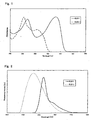
- the ultraviolet and visible absorption spectra of the fluorescent molecular wire (S,S)-1 and the comparative compound (S,S)-2 were measured in methylene chloride ( Fig. 1 ).
- the peak at 319 nm is due to absorption of the phenolic moiety and the peak at 431 nm is due to absorption of the poly(phenylene ethynylene) main chain.
- absorption of the phenolic moiety and absorption of the bis(phenylethynyl)benzene moiety are exhibited at 305 nm and 357 nm, respectively.
- the fluorescence spectra of (S,S)-1 and (S,S)-2 were measured in methylene chloride ( Fig. 2 ).
- the fluorescence maximum wavelength was 463 nm for (S,S)-1 and 432 nm for (S,S)-2.
- the degree of quenching of the fluorescent molecular wire (S,S)-1 was significantly higher than that of the monomer model (S,S)-2.
- the obtained plots were approximated by straight lines according to the Stern-Volmer equation.
- quenching of the monomer model (S,S)-2 is static quenching resulting from a decrease due to the formation of complex in the concentration of (S,S)-2 that does not form a complex, and signals of the quenching are read out corresponding to the formation of complex in one to one.
- the values of the quenching constants of the fluorescent molecular wire (S,S)-1 are about 5 to 10 times greater than those of (S,S)-2. This improvement in the sensitivity is due to an effect of amplifying the signal conversion efficiency by the molecular wire method.
- K SV(R) /K SV(S) which represents the asymmetry recognition ability, was 10 for (S,S)-1 and 3.6 for (S,S)-2.
- K SV(R) /K SV(S) it is also found that (S,S)-1 has superior asymmetry recognition ability to (S,S)-2. The reason for this is uncertain, but it seems that dynamic quenching due to the formation of complex between an excited molecule and an amine or asymmetric induction of the polymer main chain in (S,S)-1 is involved.
- the chiral sensor of the present invention has high asymmetry recognition ability toward primary amines and high sensitivity, and thus can be used for optical resolution and analysis of pharmaceuticals, agrochemicals, and the like.
- amines, amino acids, and amino alcohols it is useful in separation, sensing, sensing for detection of a narcotic drug or identification of the place of production, and the like in connection with their physiological activities.
- it also can be useful in the field of materials such as liquid crystal.
Landscapes
- Chemical & Material Sciences (AREA)
- Health & Medical Sciences (AREA)
- Chemical Kinetics & Catalysis (AREA)
- Medicinal Chemistry (AREA)
- Polymers & Plastics (AREA)
- Organic Chemistry (AREA)
- Investigating, Analyzing Materials By Fluorescence Or Luminescence (AREA)
- Investigating Or Analyzing Non-Biological Materials By The Use Of Chemical Means (AREA)
- Investigating Or Analysing Materials By The Use Of Chemical Reactions (AREA)
- Polyoxymethylene Polymers And Polymers With Carbon-To-Carbon Bonds (AREA)
- Addition Polymer Or Copolymer, Post-Treatments, Or Chemical Modifications (AREA)
- Heterocyclic Carbon Compounds Containing A Hetero Ring Having Oxygen Or Sulfur (AREA)
Claims (7)
- Ein fluoreszierender molekularer Draht, der eine fluoreszierende Polymerhauptkette mit einem konjugierten System umfasst, mit dem ein optisch aktiver Substituent verbunden ist und so eine konjugierbare Form bildet, wobei der optisch aktive Substituent von der folgenden Formel (I) dargestellt wird:

- Der fluoreszierende molekulare Draht aus Anspruch 1, wobei die Polymerhauptkette mit einem verbundenen konjugierten System eine Polyarylen-Struktur, eine Poly(arylen-ethinylen)-Struktur oder eine Poly(arylen-vinylen)-Struktur ist.
- Der fluoreszierende molekulare Draht aus Anspruch 1, wobei die Polymerhauptkette mit einem verbundenen konjugierten System eine Polyphenylen-Struktur, eine Polythiophenylen-Struktur, eine Poly(Phenylen-Thiophenylen)-Struktur, eine Poly(Phenylen-Ethinylen)-Struktur, eine Poly(Thiophenylen-Ethiny!en)-Stuktur oder eine Poly(rhenCn-vinyien)-Struktur ist.
- Der fluoreszierende molekulare Draht aus einem der Ansprüche 1 bis 3, wobei der optisch aktive Substituent an die Polymerhauptkette mit einem verbundenen konjugierten System über ein Mono- oder Polyarylen, Mono- oder Polyalkylen, Mono- oder Polyvinylen oder eine Kombination davon gekoppelt ist.
- Der fluoreszierende molekulare Draht aus einem der Ansprüche 1 bis 4, wobei der optisch aktive Substituent durch die folgende Formel (II) dargestellt wird:

- Der fluoreszierende molekulare Draht aus Anspruch 5, der durch die folgende Formel (III) dargestellt wird:

- Ein chiraler Sensor, der einen fluoreszierenden molekularen Draht aus einem der Ansprüche 1 bis 6 umfasst.
Applications Claiming Priority (2)
| Application Number | Priority Date | Filing Date | Title |
|---|---|---|---|
| JP2004067226A JP3950117B2 (ja) | 2004-03-10 | 2004-03-10 | 分子ワイヤー型蛍光性キラルセンサー |
| PCT/JP2004/017675 WO2005087835A1 (ja) | 2004-03-10 | 2004-11-22 | 分子ワイヤー型蛍光性キラルセンサー |
Publications (3)
| Publication Number | Publication Date |
|---|---|
| EP1724293A1 EP1724293A1 (de) | 2006-11-22 |
| EP1724293A4 EP1724293A4 (de) | 2009-01-14 |
| EP1724293B1 true EP1724293B1 (de) | 2010-05-12 |
Family
ID=34975544
Family Applications (1)
| Application Number | Title | Priority Date | Filing Date |
|---|---|---|---|
| EP04799877A Expired - Lifetime EP1724293B1 (de) | 2004-03-10 | 2004-11-22 | Fluoreszierender chiraler sensor vom typ molekularer draht |
Country Status (5)
| Country | Link |
|---|---|
| US (1) | US7781223B2 (de) |
| EP (1) | EP1724293B1 (de) |
| JP (1) | JP3950117B2 (de) |
| DE (1) | DE602004027167D1 (de) |
| WO (1) | WO2005087835A1 (de) |
Families Citing this family (6)
| Publication number | Priority date | Publication date | Assignee | Title |
|---|---|---|---|---|
| US8951473B2 (en) | 2008-03-04 | 2015-02-10 | Massachusetts Institute Of Technology | Devices and methods for determination of species including chemical warfare agents |
| US8735313B2 (en) * | 2008-12-12 | 2014-05-27 | Massachusetts Institute Of Technology | High charge density structures, including carbon-based nanostructures and applications thereof |
| US8456073B2 (en) | 2009-05-29 | 2013-06-04 | Massachusetts Institute Of Technology | Field emission devices including nanotubes or other nanoscale articles |
| US20110171629A1 (en) * | 2009-11-04 | 2011-07-14 | Massachusetts Institute Of Technology | Nanostructured devices including analyte detectors, and related methods |
| US8476510B2 (en) | 2010-11-03 | 2013-07-02 | Massachusetts Institute Of Technology | Compositions comprising and methods for forming functionalized carbon-based nanostructures |
| WO2019090323A1 (en) | 2017-11-06 | 2019-05-09 | Massachusetts Institute Of Technology | High functionalization density graphene |
Family Cites Families (6)
| Publication number | Priority date | Publication date | Assignee | Title |
|---|---|---|---|---|
| JPS61207414A (ja) * | 1985-03-11 | 1986-09-13 | Ajinomoto Co Inc | クラウンエ−テル重合体 |
| US5405975A (en) * | 1993-03-29 | 1995-04-11 | Molecular Probes, Inc. | Fluorescent ion-selective diaryldiaza crown ether conjugates |
| JPH0797450A (ja) * | 1993-09-29 | 1995-04-11 | Mitsubishi Cable Ind Ltd | クラウン系ポリマーの製造方法および固体電解質 |
| JPH10120914A (ja) * | 1996-10-18 | 1998-05-12 | Mitsubishi Chem Corp | イオン導電性固体高分子電解質及びその製造方法 |
| JP3926662B2 (ja) * | 2002-04-03 | 2007-06-06 | 独立行政法人科学技術振興機構 | ポリアリールアセチレン誘導体及びこれを用いたキラルセンサー |
| JP4545370B2 (ja) | 2002-08-20 | 2010-09-15 | 独立行政法人科学技術振興機構 | キラルセンサー |
-
2004
- 2004-03-10 JP JP2004067226A patent/JP3950117B2/ja not_active Expired - Fee Related
- 2004-11-22 DE DE602004027167T patent/DE602004027167D1/de not_active Expired - Lifetime
- 2004-11-22 WO PCT/JP2004/017675 patent/WO2005087835A1/ja not_active Ceased
- 2004-11-22 US US10/591,920 patent/US7781223B2/en not_active Expired - Fee Related
- 2004-11-22 EP EP04799877A patent/EP1724293B1/de not_active Expired - Lifetime
Also Published As
| Publication number | Publication date |
|---|---|
| EP1724293A4 (de) | 2009-01-14 |
| US7781223B2 (en) | 2010-08-24 |
| JP3950117B2 (ja) | 2007-07-25 |
| WO2005087835A1 (ja) | 2005-09-22 |
| JP2005255778A (ja) | 2005-09-22 |
| US20070179272A1 (en) | 2007-08-02 |
| EP1724293A1 (de) | 2006-11-22 |
| DE602004027167D1 (de) | 2010-06-24 |
Similar Documents
| Publication | Publication Date | Title |
|---|---|---|
| CN105482812B (zh) | 一种多金属离子同时选择测定的荧光探针试剂及制备和应用 | |
| Liu et al. | A BODIPY derivative for colorimetric and fluorometric sensing of fluoride ion and its logic gates behavior | |
| Kim et al. | BODIPY appended cone-calix [4] arene: selective fluorescence changes upon Ca2+ binding | |
| Jiang et al. | Dimethoxy triarylamine-derived terpyridine–zinc complex: A fluorescence light-up sensor for citrate detection based on aggregation-induced emission | |
| Ghorpade et al. | Highly sensitive colorimetric and fluorometric anion sensors based on mono and di-calix [4] pyrrole substituted diketopyrrolopyrroles | |
| CN102435588B (zh) | 碘离子传感材料及在碘离子荧光和生色检测方面的应用 | |
| Feng et al. | Imine organic cages derived from tetraphenylethylene dialdehydes exhibiting aggregation-induced emission and explosives detection | |
| Liang | A silicon-cored tetraphenyl benzene derivative with aggregation-induced emission enhancement as a fluorescent probe for nitroaromatic compounds detection | |
| Meng et al. | A fluorescence sensor based on chiral polymer for highly enantioselective recognition of phenylalaninol | |
| CN108772027A (zh) | 一种超分子有机凝胶及其金属凝胶的制备和应用 | |
| US7781223B2 (en) | Molecular-wire type fluorescent chiral sensor | |
| Yao et al. | Tetraphenylethene-based polymeric fluorescent probes for 2, 4, 6-trinitrophenol detection and specific lysosome labelling | |
| Feng et al. | Naphthalene-based fluorophores: Synthesis characterization, and photophysical properties | |
| Han et al. | Synthesis of π-conjugated, pyridine ring functionalized bis-terpyridines with efficient green, blue, and purple emission | |
| CN105884650B (zh) | 一种作为近红外荧光探针的含腈基的薁‑苯乙烯衍生物及其制备方法和应用 | |
| Grigoras et al. | Synthesis and optoelectronic characterization of some triphenylamine-based compounds containing strong acceptor substituents | |
| CN115745965B (zh) | 一种荧光分子及其制备方法与应用 | |
| CN117049980A (zh) | 一种aie席夫碱凝胶及其制备方法、应用 | |
| JP2014152243A (ja) | ケイ光イオンセンサー色素 | |
| Şenkuytu et al. | Structural and chemosensor properties of FDA and FDP derivatives of fluorenylidene bridged cyclotetraphosphazenes | |
| CN114605851A (zh) | 一种用于溶酶体标记的荧光染料及其合成方法和应用 | |
| US7358403B2 (en) | Chiral sensor | |
| JP5437615B2 (ja) | ケイ光ソルバトクロミック色素 | |
| Du et al. | Two Novel Salen Based Chemosensors for Selective Recognition of Zinc (II) Ion | |
| Sakamoto et al. | Complexation and fluorescence behavior of a copolymer bearing azacrown ether and anthracene moieties |
Legal Events
| Date | Code | Title | Description |
|---|---|---|---|
| PUAI | Public reference made under article 153(3) epc to a published international application that has entered the european phase |
Free format text: ORIGINAL CODE: 0009012 |
|
| 17P | Request for examination filed |
Effective date: 20060302 |
|
| AK | Designated contracting states |
Kind code of ref document: A1 Designated state(s): DE FR GB |
|
| DAX | Request for extension of the european patent (deleted) | ||
| RBV | Designated contracting states (corrected) |
Designated state(s): DE FR GB |
|
| A4 | Supplementary search report drawn up and despatched |
Effective date: 20081211 |
|
| RIC1 | Information provided on ipc code assigned before grant |
Ipc: C08G 61/00 20060101AFI20050926BHEP Ipc: C08G 61/02 20060101ALI20081205BHEP Ipc: G01N 31/22 20060101ALI20081205BHEP Ipc: C09K 11/06 20060101ALI20081205BHEP |
|
| 17Q | First examination report despatched |
Effective date: 20090302 |
|
| GRAP | Despatch of communication of intention to grant a patent |
Free format text: ORIGINAL CODE: EPIDOSNIGR1 |
|
| GRAS | Grant fee paid |
Free format text: ORIGINAL CODE: EPIDOSNIGR3 |
|
| GRAA | (expected) grant |
Free format text: ORIGINAL CODE: 0009210 |
|
| AK | Designated contracting states |
Kind code of ref document: B1 Designated state(s): DE FR GB |
|
| REG | Reference to a national code |
Ref country code: GB Ref legal event code: FG4D |
|
| REF | Corresponds to: |
Ref document number: 602004027167 Country of ref document: DE Date of ref document: 20100624 Kind code of ref document: P |
|
| PLBE | No opposition filed within time limit |
Free format text: ORIGINAL CODE: 0009261 |
|
| STAA | Information on the status of an ep patent application or granted ep patent |
Free format text: STATUS: NO OPPOSITION FILED WITHIN TIME LIMIT |
|
| 26N | No opposition filed |
Effective date: 20110215 |
|
| REG | Reference to a national code |
Ref country code: DE Ref legal event code: R097 Ref document number: 602004027167 Country of ref document: DE Effective date: 20110214 |
|
| PGFP | Annual fee paid to national office [announced via postgrant information from national office to epo] |
Ref country code: DE Payment date: 20121121 Year of fee payment: 9 Ref country code: FR Payment date: 20121130 Year of fee payment: 9 |
|
| PGFP | Annual fee paid to national office [announced via postgrant information from national office to epo] |
Ref country code: GB Payment date: 20121120 Year of fee payment: 9 |
|
| GBPC | Gb: european patent ceased through non-payment of renewal fee |
Effective date: 20131122 |
|
| REG | Reference to a national code |
Ref country code: FR Ref legal event code: ST Effective date: 20140731 |
|
| REG | Reference to a national code |
Ref country code: DE Ref legal event code: R119 Ref document number: 602004027167 Country of ref document: DE Effective date: 20140603 |
|
| PG25 | Lapsed in a contracting state [announced via postgrant information from national office to epo] |
Ref country code: DE Free format text: LAPSE BECAUSE OF NON-PAYMENT OF DUE FEES Effective date: 20140603 |
|
| PG25 | Lapsed in a contracting state [announced via postgrant information from national office to epo] |
Ref country code: GB Free format text: LAPSE BECAUSE OF NON-PAYMENT OF DUE FEES Effective date: 20131122 Ref country code: FR Free format text: LAPSE BECAUSE OF NON-PAYMENT OF DUE FEES Effective date: 20131202 |