EP1704864A2 - Verfahren zur Herstellung einer injizierbaren Arzneimittelzubereitung - Google Patents
Verfahren zur Herstellung einer injizierbaren Arzneimittelzubereitung Download PDFInfo
- Publication number
- EP1704864A2 EP1704864A2 EP06012171A EP06012171A EP1704864A2 EP 1704864 A2 EP1704864 A2 EP 1704864A2 EP 06012171 A EP06012171 A EP 06012171A EP 06012171 A EP06012171 A EP 06012171A EP 1704864 A2 EP1704864 A2 EP 1704864A2
- Authority
- EP
- European Patent Office
- Prior art keywords
- spacer
- active substance
- protein
- group
- bond
- Prior art date
- Legal status (The legal status is an assumption and is not a legal conclusion. Google has not performed a legal analysis and makes no representation as to the accuracy of the status listed.)
- Granted
Links
- 238000000034 method Methods 0.000 title claims description 34
- 239000000825 pharmaceutical preparation Substances 0.000 title claims description 9
- 230000008569 process Effects 0.000 title claims description 8
- 230000027455 binding Effects 0.000 claims abstract description 55
- 238000009739 binding Methods 0.000 claims abstract description 55
- 102000004169 proteins and genes Human genes 0.000 claims abstract description 55
- 108090000623 proteins and genes Proteins 0.000 claims abstract description 55
- 125000006850 spacer group Chemical group 0.000 claims abstract description 54
- 239000007788 liquid Substances 0.000 claims abstract description 15
- 239000000824 cytostatic agent Substances 0.000 claims abstract description 14
- 239000013543 active substance Substances 0.000 claims description 66
- 239000004480 active ingredient Substances 0.000 claims description 33
- 239000000032 diagnostic agent Substances 0.000 claims description 16
- 229940039227 diagnostic agent Drugs 0.000 claims description 16
- 208000037265 diseases, disorders, signs and symptoms Diseases 0.000 claims description 12
- -1 nitrogenous iodine derivatives Chemical class 0.000 claims description 12
- 201000010099 disease Diseases 0.000 claims description 11
- 108090000695 Cytokines Proteins 0.000 claims description 10
- 102000004127 Cytokines Human genes 0.000 claims description 10
- 150000001875 compounds Chemical class 0.000 claims description 10
- 239000002872 contrast media Substances 0.000 claims description 9
- 230000001419 dependent effect Effects 0.000 claims description 9
- 239000000126 substance Substances 0.000 claims description 9
- 230000001085 cytostatic effect Effects 0.000 claims description 8
- 230000003301 hydrolyzing effect Effects 0.000 claims description 8
- 238000002360 preparation method Methods 0.000 claims description 8
- 230000002255 enzymatic effect Effects 0.000 claims description 7
- NMHMNPHRMNGLLB-UHFFFAOYSA-N phloretic acid Chemical group OC(=O)CCC1=CC=C(O)C=C1 NMHMNPHRMNGLLB-UHFFFAOYSA-N 0.000 claims description 6
- 125000003118 aryl group Chemical group 0.000 claims description 5
- 238000001514 detection method Methods 0.000 claims description 5
- 125000002228 disulfide group Chemical group 0.000 claims description 5
- 239000007850 fluorescent dye Substances 0.000 claims description 5
- OKTJSMMVPCPJKN-UHFFFAOYSA-N Carbon Chemical group [C] OKTJSMMVPCPJKN-UHFFFAOYSA-N 0.000 claims description 4
- 238000009007 Diagnostic Kit Methods 0.000 claims description 4
- 125000002534 ethynyl group Chemical group [H]C#C* 0.000 claims description 4
- 239000003446 ligand Substances 0.000 claims description 4
- 125000005439 maleimidyl group Chemical group C1(C=CC(N1*)=O)=O 0.000 claims description 4
- 244000005700 microbiome Species 0.000 claims description 4
- 208000030090 Acute Disease Diseases 0.000 claims description 3
- 208000023275 Autoimmune disease Diseases 0.000 claims description 3
- 230000001154 acute effect Effects 0.000 claims description 3
- 125000001931 aliphatic group Chemical group 0.000 claims description 3
- 229940045799 anthracyclines and related substance Drugs 0.000 claims description 3
- 239000003242 anti bacterial agent Substances 0.000 claims description 3
- 230000003356 anti-rheumatic effect Effects 0.000 claims description 3
- 239000003435 antirheumatic agent Substances 0.000 claims description 3
- 125000004069 aziridinyl group Chemical group 0.000 claims description 3
- 125000004432 carbon atom Chemical group C* 0.000 claims description 3
- 208000037976 chronic inflammation Diseases 0.000 claims description 3
- 208000037893 chronic inflammatory disorder Diseases 0.000 claims description 3
- 238000009826 distribution Methods 0.000 claims description 3
- 239000003937 drug carrier Substances 0.000 claims description 3
- 229960003444 immunosuppressant agent Drugs 0.000 claims description 3
- 239000003018 immunosuppressive agent Substances 0.000 claims description 3
- ZBKFYXZXZJPWNQ-UHFFFAOYSA-N isothiocyanate group Chemical group [N-]=C=S ZBKFYXZXZJPWNQ-UHFFFAOYSA-N 0.000 claims description 3
- 125000004430 oxygen atom Chemical group O* 0.000 claims description 3
- VEEGZPWAAPPXRB-BJMVGYQFSA-N (3e)-3-(1h-imidazol-5-ylmethylidene)-1h-indol-2-one Chemical compound O=C1NC2=CC=CC=C2\C1=C/C1=CN=CN1 VEEGZPWAAPPXRB-BJMVGYQFSA-N 0.000 claims description 2
- 241000894006 Bacteria Species 0.000 claims description 2
- 241000233866 Fungi Species 0.000 claims description 2
- 229940124158 Protease/peptidase inhibitor Drugs 0.000 claims description 2
- 229940123237 Taxane Drugs 0.000 claims description 2
- 229940122803 Vinca alkaloid Drugs 0.000 claims description 2
- 229940100198 alkylating agent Drugs 0.000 claims description 2
- 239000002168 alkylating agent Substances 0.000 claims description 2
- 230000000202 analgesic effect Effects 0.000 claims description 2
- 239000004037 angiogenesis inhibitor Substances 0.000 claims description 2
- 229940121369 angiogenesis inhibitor Drugs 0.000 claims description 2
- 239000002260 anti-inflammatory agent Substances 0.000 claims description 2
- 230000001857 anti-mycotic effect Effects 0.000 claims description 2
- 230000001741 anti-phlogistic effect Effects 0.000 claims description 2
- 230000000840 anti-viral effect Effects 0.000 claims description 2
- 239000002543 antimycotic Substances 0.000 claims description 2
- 230000003115 biocidal effect Effects 0.000 claims description 2
- 229930195731 calicheamicin Natural products 0.000 claims description 2
- 239000003085 diluting agent Substances 0.000 claims description 2
- 230000001861 immunosuppressant effect Effects 0.000 claims description 2
- 239000003112 inhibitor Substances 0.000 claims description 2
- 239000000137 peptide hydrolase inhibitor Substances 0.000 claims description 2
- 239000000546 pharmaceutical excipient Substances 0.000 claims description 2
- 230000019491 signal transduction Effects 0.000 claims description 2
- 230000003612 virological effect Effects 0.000 claims description 2
- KDCGOANMDULRCW-UHFFFAOYSA-N 7H-purine Chemical compound N1=CNC2=NC=NC2=C1 KDCGOANMDULRCW-UHFFFAOYSA-N 0.000 claims 2
- 241000700605 Viruses Species 0.000 claims 1
- 229940045696 antineoplastic drug podophyllotoxin derivative Drugs 0.000 claims 1
- 239000012530 fluid Substances 0.000 claims 1
- 239000004052 folic acid antagonist Substances 0.000 claims 1
- HRGDZIGMBDGFTC-UHFFFAOYSA-N platinum(2+) Chemical class [Pt+2] HRGDZIGMBDGFTC-UHFFFAOYSA-N 0.000 claims 1
- YJGVMLPVUAXIQN-XVVDYKMHSA-N podophyllotoxin Chemical class COC1=C(OC)C(OC)=CC([C@@H]2C3=CC=4OCOC=4C=C3[C@H](O)[C@@H]3[C@@H]2C(OC3)=O)=C1 YJGVMLPVUAXIQN-XVVDYKMHSA-N 0.000 claims 1
- 239000003600 podophyllotoxin derivative Substances 0.000 claims 1
- 239000000649 purine antagonist Substances 0.000 claims 1
- 239000003790 pyrimidine antagonist Substances 0.000 claims 1
- 239000003814 drug Substances 0.000 abstract description 29
- 229940079593 drug Drugs 0.000 abstract description 29
- 238000004519 manufacturing process Methods 0.000 abstract description 5
- 238000001727 in vivo Methods 0.000 abstract description 4
- 239000008194 pharmaceutical composition Substances 0.000 abstract description 2
- 239000003118 drug derivative Substances 0.000 abstract 2
- 235000018102 proteins Nutrition 0.000 description 44
- 108090000765 processed proteins & peptides Proteins 0.000 description 23
- AOJJSUZBOXZQNB-TZSSRYMLSA-N Doxorubicin Chemical compound O([C@H]1C[C@@](O)(CC=2C(O)=C3C(=O)C=4C=CC=C(C=4C(=O)C3=C(O)C=21)OC)C(=O)CO)[C@H]1C[C@H](N)[C@H](O)[C@H](C)O1 AOJJSUZBOXZQNB-TZSSRYMLSA-N 0.000 description 21
- 102000004190 Enzymes Human genes 0.000 description 15
- 108090000790 Enzymes Proteins 0.000 description 15
- 108010088751 Albumins Proteins 0.000 description 13
- 102000009027 Albumins Human genes 0.000 description 13
- FAPWRFPIFSIZLT-UHFFFAOYSA-M Sodium chloride Chemical compound [Na+].[Cl-] FAPWRFPIFSIZLT-UHFFFAOYSA-M 0.000 description 13
- 229960004679 doxorubicin Drugs 0.000 description 12
- 102000004506 Blood Proteins Human genes 0.000 description 11
- 108010017384 Blood Proteins Proteins 0.000 description 11
- 210000002381 plasma Anatomy 0.000 description 11
- 210000001519 tissue Anatomy 0.000 description 9
- QOSSAOTZNIDXMA-UHFFFAOYSA-N Dicylcohexylcarbodiimide Chemical compound C1CCCCC1N=C=NC1CCCCC1 QOSSAOTZNIDXMA-UHFFFAOYSA-N 0.000 description 8
- 125000002915 carbonyl group Chemical group [*:2]C([*:1])=O 0.000 description 8
- 125000001997 phenyl group Chemical group [H]C1=C([H])C([H])=C(*)C([H])=C1[H] 0.000 description 8
- 239000000243 solution Substances 0.000 description 8
- 108010000684 Matrix Metalloproteinases Proteins 0.000 description 7
- 102000002274 Matrix Metalloproteinases Human genes 0.000 description 7
- 239000000562 conjugate Substances 0.000 description 7
- 238000011534 incubation Methods 0.000 description 7
- DHMQDGOQFOQNFH-UHFFFAOYSA-N Glycine Chemical compound NCC(O)=O DHMQDGOQFOQNFH-UHFFFAOYSA-N 0.000 description 6
- OKKJLVBELUTLKV-UHFFFAOYSA-N Methanol Chemical compound OC OKKJLVBELUTLKV-UHFFFAOYSA-N 0.000 description 6
- SJRJJKPEHAURKC-UHFFFAOYSA-N N-Methylmorpholine Chemical compound CN1CCOCC1 SJRJJKPEHAURKC-UHFFFAOYSA-N 0.000 description 6
- 239000002253 acid Substances 0.000 description 6
- 230000009471 action Effects 0.000 description 6
- 238000006243 chemical reaction Methods 0.000 description 6
- 239000003795 chemical substances by application Substances 0.000 description 6
- KRKNYBCHXYNGOX-UHFFFAOYSA-N citric acid Chemical compound OC(=O)CC(O)(C(O)=O)CC(O)=O KRKNYBCHXYNGOX-UHFFFAOYSA-N 0.000 description 6
- 238000003776 cleavage reaction Methods 0.000 description 6
- 229910052757 nitrogen Inorganic materials 0.000 description 6
- 230000007017 scission Effects 0.000 description 6
- 239000011780 sodium chloride Substances 0.000 description 6
- PEEHTFAAVSWFBL-UHFFFAOYSA-N Maleimide Chemical compound O=C1NC(=O)C=C1 PEEHTFAAVSWFBL-UHFFFAOYSA-N 0.000 description 5
- 102000007562 Serum Albumin Human genes 0.000 description 5
- 108010071390 Serum Albumin Proteins 0.000 description 5
- 239000008363 phosphate buffer Substances 0.000 description 5
- 239000001488 sodium phosphate Substances 0.000 description 5
- 229910000162 sodium phosphate Inorganic materials 0.000 description 5
- RYFMWSXOAZQYPI-UHFFFAOYSA-K trisodium phosphate Chemical compound [Na+].[Na+].[Na+].[O-]P([O-])([O-])=O RYFMWSXOAZQYPI-UHFFFAOYSA-K 0.000 description 5
- NQTADLQHYWFPDB-UHFFFAOYSA-N N-Hydroxysuccinimide Chemical compound ON1C(=O)CCC1=O NQTADLQHYWFPDB-UHFFFAOYSA-N 0.000 description 4
- DNIAPMSPPWPWGF-UHFFFAOYSA-N Propylene glycol Chemical compound CC(O)CO DNIAPMSPPWPWGF-UHFFFAOYSA-N 0.000 description 4
- 208000006265 Renal cell carcinoma Diseases 0.000 description 4
- 125000000217 alkyl group Chemical group 0.000 description 4
- 235000001014 amino acid Nutrition 0.000 description 4
- 229940024606 amino acid Drugs 0.000 description 4
- 150000001413 amino acids Chemical class 0.000 description 4
- 210000001124 body fluid Anatomy 0.000 description 4
- 239000010839 body fluid Substances 0.000 description 4
- 239000000872 buffer Substances 0.000 description 4
- 238000007796 conventional method Methods 0.000 description 4
- 150000007857 hydrazones Chemical class 0.000 description 4
- 150000002466 imines Chemical class 0.000 description 4
- 235000018977 lysine Nutrition 0.000 description 4
- GBCAVSYHPPARHX-UHFFFAOYSA-M n'-cyclohexyl-n-[2-(4-methylmorpholin-4-ium-4-yl)ethyl]methanediimine;4-methylbenzenesulfonate Chemical compound CC1=CC=C(S([O-])(=O)=O)C=C1.C1CCCCC1N=C=NCC[N+]1(C)CCOCC1 GBCAVSYHPPARHX-UHFFFAOYSA-M 0.000 description 4
- 239000008063 pharmaceutical solvent Substances 0.000 description 4
- 150000003839 salts Chemical class 0.000 description 4
- 239000002904 solvent Substances 0.000 description 4
- QTBSBXVTEAMEQO-UHFFFAOYSA-N Acetic acid Natural products CC(O)=O QTBSBXVTEAMEQO-UHFFFAOYSA-N 0.000 description 3
- 102000004225 Cathepsin B Human genes 0.000 description 3
- 108090000712 Cathepsin B Proteins 0.000 description 3
- LFQSCWFLJHTTHZ-UHFFFAOYSA-N Ethanol Chemical compound CCO LFQSCWFLJHTTHZ-UHFFFAOYSA-N 0.000 description 3
- XEKOWRVHYACXOJ-UHFFFAOYSA-N Ethyl acetate Chemical compound CCOC(C)=O XEKOWRVHYACXOJ-UHFFFAOYSA-N 0.000 description 3
- PEDCQBHIVMGVHV-UHFFFAOYSA-N Glycerine Chemical compound OCC(O)CO PEDCQBHIVMGVHV-UHFFFAOYSA-N 0.000 description 3
- 101000990902 Homo sapiens Matrix metalloproteinase-9 Proteins 0.000 description 3
- 102100030412 Matrix metalloproteinase-9 Human genes 0.000 description 3
- 206010028980 Neoplasm Diseases 0.000 description 3
- 102000035195 Peptidases Human genes 0.000 description 3
- 108091005804 Peptidases Proteins 0.000 description 3
- ZMANZCXQSJIPKH-UHFFFAOYSA-N Triethylamine Chemical compound CCN(CC)CC ZMANZCXQSJIPKH-UHFFFAOYSA-N 0.000 description 3
- 150000007513 acids Chemical class 0.000 description 3
- 150000001732 carboxylic acid derivatives Chemical class 0.000 description 3
- 210000004027 cell Anatomy 0.000 description 3
- 230000008878 coupling Effects 0.000 description 3
- 238000010168 coupling process Methods 0.000 description 3
- 238000005859 coupling reaction Methods 0.000 description 3
- MTHSVFCYNBDYFN-UHFFFAOYSA-N diethylene glycol Chemical compound OCCOCCO MTHSVFCYNBDYFN-UHFFFAOYSA-N 0.000 description 3
- 230000032050 esterification Effects 0.000 description 3
- 238000005886 esterification reaction Methods 0.000 description 3
- 238000002270 exclusion chromatography Methods 0.000 description 3
- 238000002474 experimental method Methods 0.000 description 3
- 229960002449 glycine Drugs 0.000 description 3
- 210000003734 kidney Anatomy 0.000 description 3
- 229920000136 polysorbate Polymers 0.000 description 3
- 239000000758 substrate Substances 0.000 description 3
- MTCFGRXMJLQNBG-REOHCLBHSA-N (2S)-2-Amino-3-hydroxypropansäure Chemical compound OC[C@H](N)C(O)=O MTCFGRXMJLQNBG-REOHCLBHSA-N 0.000 description 2
- GUBGYTABKSRVRQ-XLOQQCSPSA-N Alpha-Lactose Chemical compound O[C@@H]1[C@@H](O)[C@@H](O)[C@@H](CO)O[C@H]1O[C@@H]1[C@@H](CO)O[C@H](O)[C@H](O)[C@H]1O GUBGYTABKSRVRQ-XLOQQCSPSA-N 0.000 description 2
- LSNNMFCWUKXFEE-UHFFFAOYSA-M Bisulfite Chemical compound OS([O-])=O LSNNMFCWUKXFEE-UHFFFAOYSA-M 0.000 description 2
- 102000004175 Cathepsin H Human genes 0.000 description 2
- 108090000619 Cathepsin H Proteins 0.000 description 2
- 102000004172 Cathepsin L Human genes 0.000 description 2
- 108090000624 Cathepsin L Proteins 0.000 description 2
- WQZGKKKJIJFFOK-QTVWNMPRSA-N D-mannopyranose Chemical compound OC[C@H]1OC(O)[C@@H](O)[C@@H](O)[C@@H]1O WQZGKKKJIJFFOK-QTVWNMPRSA-N 0.000 description 2
- WQZGKKKJIJFFOK-GASJEMHNSA-N Glucose Natural products OC[C@H]1OC(O)[C@H](O)[C@@H](O)[C@@H]1O WQZGKKKJIJFFOK-GASJEMHNSA-N 0.000 description 2
- KFZMGEQAYNKOFK-UHFFFAOYSA-N Isopropanol Chemical compound CC(C)O KFZMGEQAYNKOFK-UHFFFAOYSA-N 0.000 description 2
- 208000008839 Kidney Neoplasms Diseases 0.000 description 2
- KDXKERNSBIXSRK-YFKPBYRVSA-N L-lysine Chemical compound NCCCC[C@H](N)C(O)=O KDXKERNSBIXSRK-YFKPBYRVSA-N 0.000 description 2
- FBOZXECLQNJBKD-ZDUSSCGKSA-N L-methotrexate Chemical compound C=1N=C2N=C(N)N=C(N)C2=NC=1CN(C)C1=CC=C(C(=O)N[C@@H](CCC(O)=O)C(O)=O)C=C1 FBOZXECLQNJBKD-ZDUSSCGKSA-N 0.000 description 2
- AYFVYJQAPQTCCC-GBXIJSLDSA-N L-threonine Chemical compound C[C@@H](O)[C@H](N)C(O)=O AYFVYJQAPQTCCC-GBXIJSLDSA-N 0.000 description 2
- GUBGYTABKSRVRQ-QKKXKWKRSA-N Lactose Natural products OC[C@H]1O[C@@H](O[C@H]2[C@H](O)[C@@H](O)C(O)O[C@@H]2CO)[C@H](O)[C@@H](O)[C@H]1O GUBGYTABKSRVRQ-QKKXKWKRSA-N 0.000 description 2
- KDXKERNSBIXSRK-UHFFFAOYSA-N Lysine Natural products NCCCCC(N)C(O)=O KDXKERNSBIXSRK-UHFFFAOYSA-N 0.000 description 2
- 239000004472 Lysine Substances 0.000 description 2
- 102000000424 Matrix Metalloproteinase 2 Human genes 0.000 description 2
- 108010016165 Matrix Metalloproteinase 2 Proteins 0.000 description 2
- 206010027476 Metastases Diseases 0.000 description 2
- 241000699670 Mus sp. Species 0.000 description 2
- 108010038807 Oligopeptides Proteins 0.000 description 2
- 102000015636 Oligopeptides Human genes 0.000 description 2
- JGSARLDLIJGVTE-MBNYWOFBSA-N Penicillin G Chemical compound N([C@H]1[C@H]2SC([C@@H](N2C1=O)C(O)=O)(C)C)C(=O)CC1=CC=CC=C1 JGSARLDLIJGVTE-MBNYWOFBSA-N 0.000 description 2
- 239000004365 Protease Substances 0.000 description 2
- MTCFGRXMJLQNBG-UHFFFAOYSA-N Serine Natural products OCC(N)C(O)=O MTCFGRXMJLQNBG-UHFFFAOYSA-N 0.000 description 2
- 239000004098 Tetracycline Substances 0.000 description 2
- AYFVYJQAPQTCCC-UHFFFAOYSA-N Threonine Natural products CC(O)C(N)C(O)=O AYFVYJQAPQTCCC-UHFFFAOYSA-N 0.000 description 2
- 239000004473 Threonine Substances 0.000 description 2
- GSEJCLTVZPLZKY-UHFFFAOYSA-N Triethanolamine Chemical compound OCCN(CCO)CCO GSEJCLTVZPLZKY-UHFFFAOYSA-N 0.000 description 2
- DHKHKXVYLBGOIT-UHFFFAOYSA-N acetaldehyde Diethyl Acetal Natural products CCOC(C)OCC DHKHKXVYLBGOIT-UHFFFAOYSA-N 0.000 description 2
- 150000001241 acetals Chemical class 0.000 description 2
- 125000004103 aminoalkyl group Chemical group 0.000 description 2
- 150000001450 anions Chemical class 0.000 description 2
- 230000000259 anti-tumor effect Effects 0.000 description 2
- 239000003443 antiviral agent Substances 0.000 description 2
- 229940121357 antivirals Drugs 0.000 description 2
- WQZGKKKJIJFFOK-VFUOTHLCSA-N beta-D-glucose Chemical compound OC[C@H]1O[C@@H](O)[C@H](O)[C@@H](O)[C@@H]1O WQZGKKKJIJFFOK-VFUOTHLCSA-N 0.000 description 2
- 230000015572 biosynthetic process Effects 0.000 description 2
- VSJKWCGYPAHWDS-FQEVSTJZSA-N camptothecin Chemical compound C1=CC=C2C=C(CN3C4=CC5=C(C3=O)COC(=O)[C@]5(O)CC)C4=NC2=C1 VSJKWCGYPAHWDS-FQEVSTJZSA-N 0.000 description 2
- 201000011510 cancer Diseases 0.000 description 2
- WIIZWVCIJKGZOK-RKDXNWHRSA-N chloramphenicol Chemical compound ClC(Cl)C(=O)N[C@H](CO)[C@H](O)C1=CC=C([N+]([O-])=O)C=C1 WIIZWVCIJKGZOK-RKDXNWHRSA-N 0.000 description 2
- MYSWGUAQZAJSOK-UHFFFAOYSA-N ciprofloxacin Chemical compound C12=CC(N3CCNCC3)=C(F)C=C2C(=O)C(C(=O)O)=CN1C1CC1 MYSWGUAQZAJSOK-UHFFFAOYSA-N 0.000 description 2
- 239000012050 conventional carrier Substances 0.000 description 2
- 238000001212 derivatisation Methods 0.000 description 2
- 238000004090 dissolution Methods 0.000 description 2
- 230000000694 effects Effects 0.000 description 2
- GNBHRKFJIUUOQI-UHFFFAOYSA-N fluorescein Chemical compound O1C(=O)C2=CC=CC=C2C21C1=CC=C(O)C=C1OC1=CC(O)=CC=C21 GNBHRKFJIUUOQI-UHFFFAOYSA-N 0.000 description 2
- 239000008103 glucose Substances 0.000 description 2
- 235000013905 glycine and its sodium salt Nutrition 0.000 description 2
- 229910052739 hydrogen Inorganic materials 0.000 description 2
- 125000002887 hydroxy group Chemical group [H]O* 0.000 description 2
- CGIGDMFJXJATDK-UHFFFAOYSA-N indomethacin Chemical compound CC1=C(CC(O)=O)C2=CC(OC)=CC=C2N1C(=O)C1=CC=C(Cl)C=C1 CGIGDMFJXJATDK-UHFFFAOYSA-N 0.000 description 2
- 239000008101 lactose Substances 0.000 description 2
- 150000002669 lysines Chemical class 0.000 description 2
- 229920002521 macromolecule Polymers 0.000 description 2
- 230000003211 malignant effect Effects 0.000 description 2
- 230000009401 metastasis Effects 0.000 description 2
- 229960000485 methotrexate Drugs 0.000 description 2
- 239000000203 mixture Substances 0.000 description 2
- 238000007911 parenteral administration Methods 0.000 description 2
- 229940068965 polysorbates Drugs 0.000 description 2
- 229940002612 prodrug Drugs 0.000 description 2
- 239000000651 prodrug Substances 0.000 description 2
- 238000000746 purification Methods 0.000 description 2
- 230000003252 repetitive effect Effects 0.000 description 2
- 238000000926 separation method Methods 0.000 description 2
- 238000010532 solid phase synthesis reaction Methods 0.000 description 2
- 238000003786 synthesis reaction Methods 0.000 description 2
- 235000019364 tetracycline Nutrition 0.000 description 2
- 150000003522 tetracyclines Chemical class 0.000 description 2
- 125000002221 trityl group Chemical group [H]C1=C([H])C([H])=C([H])C([H])=C1C([*])(C1=C(C(=C(C(=C1[H])[H])[H])[H])[H])C1=C([H])C([H])=C([H])C([H])=C1[H] 0.000 description 2
- KQRHTCDQWJLLME-XUXIUFHCSA-N (2s)-2-[[(2s)-2-[[(2s)-2-[[(2s)-2-aminopropanoyl]amino]-4-methylpentanoyl]amino]propanoyl]amino]-4-methylpentanoic acid Chemical compound CC(C)C[C@@H](C(O)=O)NC(=O)[C@H](C)NC(=O)[C@H](CC(C)C)NC(=O)[C@H](C)N KQRHTCDQWJLLME-XUXIUFHCSA-N 0.000 description 1
- SGKRLCUYIXIAHR-AKNGSSGZSA-N (4s,4ar,5s,5ar,6r,12ar)-4-(dimethylamino)-1,5,10,11,12a-pentahydroxy-6-methyl-3,12-dioxo-4a,5,5a,6-tetrahydro-4h-tetracene-2-carboxamide Chemical compound C1=CC=C2[C@H](C)[C@@H]([C@H](O)[C@@H]3[C@](C(O)=C(C(N)=O)C(=O)[C@H]3N(C)C)(O)C3=O)C3=C(O)C2=C1O SGKRLCUYIXIAHR-AKNGSSGZSA-N 0.000 description 1
- FFTVPQUHLQBXQZ-KVUCHLLUSA-N (4s,4as,5ar,12ar)-4,7-bis(dimethylamino)-1,10,11,12a-tetrahydroxy-3,12-dioxo-4a,5,5a,6-tetrahydro-4h-tetracene-2-carboxamide Chemical compound C1C2=C(N(C)C)C=CC(O)=C2C(O)=C2[C@@H]1C[C@H]1[C@H](N(C)C)C(=O)C(C(N)=O)=C(O)[C@@]1(O)C2=O FFTVPQUHLQBXQZ-KVUCHLLUSA-N 0.000 description 1
- GUXHBMASAHGULD-SEYHBJAFSA-N (4s,4as,5as,6s,12ar)-7-chloro-4-(dimethylamino)-1,6,10,11,12a-pentahydroxy-3,12-dioxo-4a,5,5a,6-tetrahydro-4h-tetracene-2-carboxamide Chemical compound C1([C@H]2O)=C(Cl)C=CC(O)=C1C(O)=C1[C@@H]2C[C@H]2[C@H](N(C)C)C(=O)C(C(N)=O)=C(O)[C@@]2(O)C1=O GUXHBMASAHGULD-SEYHBJAFSA-N 0.000 description 1
- FFGSXKJJVBXWCY-UHFFFAOYSA-N 1,4-bis[2-(2-hydroxyethylamino)ethylamino]anthracene-9,10-dione Chemical compound O=C1C2=CC=CC=C2C(=O)C2=C1C(NCCNCCO)=CC=C2NCCNCCO FFGSXKJJVBXWCY-UHFFFAOYSA-N 0.000 description 1
- ASOKPJOREAFHNY-UHFFFAOYSA-N 1-Hydroxybenzotriazole Chemical compound C1=CC=C2N(O)N=NC2=C1 ASOKPJOREAFHNY-UHFFFAOYSA-N 0.000 description 1
- WEZDRVHTDXTVLT-GJZGRUSLSA-N 2-[[(2s)-2-[[(2s)-2-[(2-aminoacetyl)amino]-3-phenylpropanoyl]amino]-4-methylpentanoyl]amino]acetic acid Chemical compound OC(=O)CNC(=O)[C@H](CC(C)C)NC(=O)[C@@H](NC(=O)CN)CC1=CC=CC=C1 WEZDRVHTDXTVLT-GJZGRUSLSA-N 0.000 description 1
- CDAWCLOXVUBKRW-UHFFFAOYSA-N 2-aminophenol Chemical class NC1=CC=CC=C1O CDAWCLOXVUBKRW-UHFFFAOYSA-N 0.000 description 1
- ZJSQZQMVXKZAGW-UHFFFAOYSA-N 2H-benzotriazol-4-ol hydrate Chemical compound O.OC1=CC=CC2=C1N=NN2 ZJSQZQMVXKZAGW-UHFFFAOYSA-N 0.000 description 1
- NDMPLJNOPCLANR-UHFFFAOYSA-N 3,4-dihydroxy-15-(4-hydroxy-18-methoxycarbonyl-5,18-seco-ibogamin-18-yl)-16-methoxy-1-methyl-6,7-didehydro-aspidospermidine-3-carboxylic acid methyl ester Natural products C1C(CC)(O)CC(CC2(C(=O)OC)C=3C(=CC4=C(C56C(C(C(O)C7(CC)C=CCN(C67)CC5)(O)C(=O)OC)N4C)C=3)OC)CN1CCC1=C2NC2=CC=CC=C12 NDMPLJNOPCLANR-UHFFFAOYSA-N 0.000 description 1
- AOJJSUZBOXZQNB-VTZDEGQISA-N 4'-epidoxorubicin Chemical compound O([C@H]1C[C@@](O)(CC=2C(O)=C3C(=O)C=4C=CC=C(C=4C(=O)C3=C(O)C=21)OC)C(=O)CO)[C@H]1C[C@H](N)[C@@H](O)[C@H](C)O1 AOJJSUZBOXZQNB-VTZDEGQISA-N 0.000 description 1
- WREGKURFCTUGRC-UHFFFAOYSA-N 4-Amino-1-[5-(hydroxymethyl)oxolan-2-yl]pyrimidin-2-one Chemical compound O=C1N=C(N)C=CN1C1OC(CO)CC1 WREGKURFCTUGRC-UHFFFAOYSA-N 0.000 description 1
- FYWVFGAAKATOHN-UHFFFAOYSA-N 6-(2,5-dioxopyrrol-1-yl)hexanehydrazide Chemical class NNC(=O)CCCCCN1C(=O)C=CC1=O FYWVFGAAKATOHN-UHFFFAOYSA-N 0.000 description 1
- WYWHKKSPHMUBEB-UHFFFAOYSA-N 6-Mercaptoguanine Natural products N1C(N)=NC(=S)C2=C1N=CN2 WYWHKKSPHMUBEB-UHFFFAOYSA-N 0.000 description 1
- NGHVIOIJCVXTGV-ALEPSDHESA-N 6-aminopenicillanic acid Chemical compound [O-]C(=O)[C@H]1C(C)(C)S[C@@H]2[C@H]([NH3+])C(=O)N21 NGHVIOIJCVXTGV-ALEPSDHESA-N 0.000 description 1
- NGHVIOIJCVXTGV-UHFFFAOYSA-N 6beta-amino-penicillanic acid Natural products OC(=O)C1C(C)(C)SC2C(N)C(=O)N21 NGHVIOIJCVXTGV-UHFFFAOYSA-N 0.000 description 1
- STQGQHZAVUOBTE-UHFFFAOYSA-N 7-Cyan-hept-2t-en-4,6-diinsaeure Natural products C1=2C(O)=C3C(=O)C=4C(OC)=CC=CC=4C(=O)C3=C(O)C=2CC(O)(C(C)=O)CC1OC1CC(N)C(O)C(C)O1 STQGQHZAVUOBTE-UHFFFAOYSA-N 0.000 description 1
- FUXVKZWTXQUGMW-FQEVSTJZSA-N 9-Aminocamptothecin Chemical compound C1=CC(N)=C2C=C(CN3C4=CC5=C(C3=O)COC(=O)[C@]5(O)CC)C4=NC2=C1 FUXVKZWTXQUGMW-FQEVSTJZSA-N 0.000 description 1
- GSDSWSVVBLHKDQ-UHFFFAOYSA-N 9-fluoro-3-methyl-10-(4-methylpiperazin-1-yl)-7-oxo-2,3-dihydro-7H-[1,4]oxazino[2,3,4-ij]quinoline-6-carboxylic acid Chemical compound FC1=CC(C(C(C(O)=O)=C2)=O)=C3N2C(C)COC3=C1N1CCN(C)CC1 GSDSWSVVBLHKDQ-UHFFFAOYSA-N 0.000 description 1
- RZVAJINKPMORJF-UHFFFAOYSA-N Acetaminophen Chemical compound CC(=O)NC1=CC=C(O)C=C1 RZVAJINKPMORJF-UHFFFAOYSA-N 0.000 description 1
- QTBSBXVTEAMEQO-UHFFFAOYSA-M Acetate Chemical compound CC([O-])=O QTBSBXVTEAMEQO-UHFFFAOYSA-M 0.000 description 1
- APKFDSVGJQXUKY-KKGHZKTASA-N Amphotericin-B Natural products O[C@H]1[C@@H](N)[C@H](O)[C@@H](C)O[C@H]1O[C@H]1C=CC=CC=CC=CC=CC=CC=C[C@H](C)[C@@H](O)[C@@H](C)[C@H](C)OC(=O)C[C@H](O)C[C@H](O)CC[C@@H](O)[C@H](O)C[C@H](O)C[C@](O)(C[C@H](O)[C@H]2C(O)=O)O[C@H]2C1 APKFDSVGJQXUKY-KKGHZKTASA-N 0.000 description 1
- WZPBZJONDBGPKJ-UHFFFAOYSA-N Antibiotic SQ 26917 Natural products O=C1N(S(O)(=O)=O)C(C)C1NC(=O)C(=NOC(C)(C)C(O)=O)C1=CSC(N)=N1 WZPBZJONDBGPKJ-UHFFFAOYSA-N 0.000 description 1
- 108010039627 Aprotinin Proteins 0.000 description 1
- BSYNRYMUTXBXSQ-UHFFFAOYSA-N Aspirin Chemical compound CC(=O)OC1=CC=CC=C1C(O)=O BSYNRYMUTXBXSQ-UHFFFAOYSA-N 0.000 description 1
- KLWPJMFMVPTNCC-UHFFFAOYSA-N Camptothecin Natural products CCC1(O)C(=O)OCC2=C1C=C3C4Nc5ccccc5C=C4CN3C2=O KLWPJMFMVPTNCC-UHFFFAOYSA-N 0.000 description 1
- 102000005600 Cathepsins Human genes 0.000 description 1
- 108010084457 Cathepsins Proteins 0.000 description 1
- QYQDKDWGWDOFFU-IUODEOHRSA-N Cefotiam Chemical compound CN(C)CCN1N=NN=C1SCC1=C(C(O)=O)N2C(=O)[C@@H](NC(=O)CC=3N=C(N)SC=3)[C@H]2SC1 QYQDKDWGWDOFFU-IUODEOHRSA-N 0.000 description 1
- GNWUOVJNSFPWDD-XMZRARIVSA-M Cefoxitin sodium Chemical compound [Na+].N([C@]1(OC)C(N2C(=C(COC(N)=O)CS[C@@H]21)C([O-])=O)=O)C(=O)CC1=CC=CS1 GNWUOVJNSFPWDD-XMZRARIVSA-M 0.000 description 1
- 229930186147 Cephalosporin Natural products 0.000 description 1
- 239000004099 Chlortetracycline Substances 0.000 description 1
- 102000008186 Collagen Human genes 0.000 description 1
- 108010035532 Collagen Proteins 0.000 description 1
- 229930105110 Cyclosporin A Natural products 0.000 description 1
- PMATZTZNYRCHOR-CGLBZJNRSA-N Cyclosporin A Chemical compound CC[C@@H]1NC(=O)[C@H]([C@H](O)[C@H](C)C\C=C\C)N(C)C(=O)[C@H](C(C)C)N(C)C(=O)[C@H](CC(C)C)N(C)C(=O)[C@H](CC(C)C)N(C)C(=O)[C@@H](C)NC(=O)[C@H](C)NC(=O)[C@H](CC(C)C)N(C)C(=O)[C@H](C(C)C)NC(=O)[C@H](CC(C)C)N(C)C(=O)CN(C)C1=O PMATZTZNYRCHOR-CGLBZJNRSA-N 0.000 description 1
- 108010036949 Cyclosporine Proteins 0.000 description 1
- 102000005927 Cysteine Proteases Human genes 0.000 description 1
- 108010005843 Cysteine Proteases Proteins 0.000 description 1
- FMTDIUIBLCQGJB-UHFFFAOYSA-N Demethylchlortetracyclin Natural products C1C2C(O)C3=C(Cl)C=CC(O)=C3C(=O)C2=C(O)C2(O)C1C(N(C)C)C(O)=C(C(N)=O)C2=O FMTDIUIBLCQGJB-UHFFFAOYSA-N 0.000 description 1
- BXZVVICBKDXVGW-NKWVEPMBSA-N Didanosine Chemical compound O1[C@H](CO)CC[C@@H]1N1C(NC=NC2=O)=C2N=C1 BXZVVICBKDXVGW-NKWVEPMBSA-N 0.000 description 1
- 108010016626 Dipeptides Proteins 0.000 description 1
- 229940123907 Disease modifying antirheumatic drug Drugs 0.000 description 1
- JWCSIUVGFCSJCK-CAVRMKNVSA-N Disodium Moxalactam Chemical compound N([C@]1(OC)C(N2C(=C(CSC=3N(N=NN=3)C)CO[C@@H]21)C(O)=O)=O)C(=O)C(C(O)=O)C1=CC=C(O)C=C1 JWCSIUVGFCSJCK-CAVRMKNVSA-N 0.000 description 1
- HTIJFSOGRVMCQR-UHFFFAOYSA-N Epirubicin Natural products COc1cccc2C(=O)c3c(O)c4CC(O)(CC(OC5CC(N)C(=O)C(C)O5)c4c(O)c3C(=O)c12)C(=O)CO HTIJFSOGRVMCQR-UHFFFAOYSA-N 0.000 description 1
- UIOFUWFRIANQPC-JKIFEVAISA-N Floxacillin Chemical compound N([C@@H]1C(N2[C@H](C(C)(C)S[C@@H]21)C(O)=O)=O)C(=O)C1=C(C)ON=C1C1=C(F)C=CC=C1Cl UIOFUWFRIANQPC-JKIFEVAISA-N 0.000 description 1
- GHASVSINZRGABV-UHFFFAOYSA-N Fluorouracil Chemical compound FC1=CNC(=O)NC1=O GHASVSINZRGABV-UHFFFAOYSA-N 0.000 description 1
- 102000002464 Galactosidases Human genes 0.000 description 1
- 108010093031 Galactosidases Proteins 0.000 description 1
- 101000766307 Gallus gallus Ovotransferrin Proteins 0.000 description 1
- 102000053187 Glucuronidase Human genes 0.000 description 1
- 108010060309 Glucuronidase Proteins 0.000 description 1
- 102000005720 Glutathione transferase Human genes 0.000 description 1
- 108010070675 Glutathione transferase Proteins 0.000 description 1
- 108010009504 Gly-Phe-Leu-Gly Proteins 0.000 description 1
- 239000004471 Glycine Substances 0.000 description 1
- 101000990915 Homo sapiens Stromelysin-1 Proteins 0.000 description 1
- 102000008100 Human Serum Albumin Human genes 0.000 description 1
- 108091006905 Human Serum Albumin Proteins 0.000 description 1
- XQFRJNBWHJMXHO-RRKCRQDMSA-N IDUR Chemical compound C1[C@H](O)[C@@H](CO)O[C@H]1N1C(=O)NC(=O)C(I)=C1 XQFRJNBWHJMXHO-RRKCRQDMSA-N 0.000 description 1
- HEFNNWSXXWATRW-UHFFFAOYSA-N Ibuprofen Chemical compound CC(C)CC1=CC=C(C(C)C(O)=O)C=C1 HEFNNWSXXWATRW-UHFFFAOYSA-N 0.000 description 1
- XDXDZDZNSLXDNA-TZNDIEGXSA-N Idarubicin Chemical compound C1[C@H](N)[C@H](O)[C@H](C)O[C@H]1O[C@@H]1C2=C(O)C(C(=O)C3=CC=CC=C3C3=O)=C3C(O)=C2C[C@@](O)(C(C)=O)C1 XDXDZDZNSLXDNA-TZNDIEGXSA-N 0.000 description 1
- XDXDZDZNSLXDNA-UHFFFAOYSA-N Idarubicin Natural products C1C(N)C(O)C(C)OC1OC1C2=C(O)C(C(=O)C3=CC=CC=C3C3=O)=C3C(O)=C2CC(O)(C(C)=O)C1 XDXDZDZNSLXDNA-UHFFFAOYSA-N 0.000 description 1
- 206010061218 Inflammation Diseases 0.000 description 1
- 102100040018 Interferon alpha-2 Human genes 0.000 description 1
- 108010005716 Interferon beta-1a Proteins 0.000 description 1
- 108010005714 Interferon beta-1b Proteins 0.000 description 1
- 101710104976 Interferon gamma-related Proteins 0.000 description 1
- 108010079944 Interferon-alpha2b Proteins 0.000 description 1
- 108010050904 Interferons Proteins 0.000 description 1
- 102000014150 Interferons Human genes 0.000 description 1
- 102000000588 Interleukin-2 Human genes 0.000 description 1
- 108010002350 Interleukin-2 Proteins 0.000 description 1
- AGPKZVBTJJNPAG-WHFBIAKZSA-N L-isoleucine Chemical compound CC[C@H](C)[C@H](N)C(O)=O AGPKZVBTJJNPAG-WHFBIAKZSA-N 0.000 description 1
- 108010016160 Matrix Metalloproteinase 3 Proteins 0.000 description 1
- 102000000422 Matrix Metalloproteinase 3 Human genes 0.000 description 1
- 206010027458 Metastases to lung Diseases 0.000 description 1
- 241001465754 Metazoa Species 0.000 description 1
- ZDZOTLJHXYCWBA-VCVYQWHSSA-N N-debenzoyl-N-(tert-butoxycarbonyl)-10-deacetyltaxol Chemical compound O([C@H]1[C@H]2[C@@](C([C@H](O)C3=C(C)[C@@H](OC(=O)[C@H](O)[C@@H](NC(=O)OC(C)(C)C)C=4C=CC=CC=4)C[C@]1(O)C3(C)C)=O)(C)[C@@H](O)C[C@H]1OC[C@]12OC(=O)C)C(=O)C1=CC=CC=C1 ZDZOTLJHXYCWBA-VCVYQWHSSA-N 0.000 description 1
- CMWTZPSULFXXJA-UHFFFAOYSA-N Naproxen Natural products C1=C(C(C)C(O)=O)C=CC2=CC(OC)=CC=C21 CMWTZPSULFXXJA-UHFFFAOYSA-N 0.000 description 1
- 239000004100 Oxytetracycline Substances 0.000 description 1
- 229910019142 PO4 Inorganic materials 0.000 description 1
- 229930012538 Paclitaxel Natural products 0.000 description 1
- 208000037273 Pathologic Processes Diseases 0.000 description 1
- 229930182555 Penicillin Natural products 0.000 description 1
- 229930195708 Penicillin V Natural products 0.000 description 1
- 102000001938 Plasminogen Activators Human genes 0.000 description 1
- 108010001014 Plasminogen Activators Proteins 0.000 description 1
- 229920003171 Poly (ethylene oxide) Polymers 0.000 description 1
- DUFKCOQISQKSAV-UHFFFAOYSA-N Polypropylene glycol (m w 1,200-3,000) Chemical group CC(O)COC(C)CO DUFKCOQISQKSAV-UHFFFAOYSA-N 0.000 description 1
- 206010038389 Renal cancer Diseases 0.000 description 1
- IWUCXVSUMQZMFG-AFCXAGJDSA-N Ribavirin Chemical compound N1=C(C(=O)N)N=CN1[C@H]1[C@H](O)[C@H](O)[C@@H](CO)O1 IWUCXVSUMQZMFG-AFCXAGJDSA-N 0.000 description 1
- 102000012479 Serine Proteases Human genes 0.000 description 1
- 108010022999 Serine Proteases Proteins 0.000 description 1
- VYPSYNLAJGMNEJ-UHFFFAOYSA-N Silicium dioxide Chemical compound O=[Si]=O VYPSYNLAJGMNEJ-UHFFFAOYSA-N 0.000 description 1
- VMHLLURERBWHNL-UHFFFAOYSA-M Sodium acetate Chemical compound [Na+].CC([O-])=O VMHLLURERBWHNL-UHFFFAOYSA-M 0.000 description 1
- 102100030416 Stromelysin-1 Human genes 0.000 description 1
- 239000012505 Superdex™ Substances 0.000 description 1
- QJJXYPPXXYFBGM-LFZNUXCKSA-N Tacrolimus Chemical compound C1C[C@@H](O)[C@H](OC)C[C@@H]1\C=C(/C)[C@@H]1[C@H](C)[C@@H](O)CC(=O)[C@H](CC=C)/C=C(C)/C[C@H](C)C[C@H](OC)[C@H]([C@H](C[C@H]2C)OC)O[C@@]2(O)C(=O)C(=O)N2CCCC[C@H]2C(=O)O1 QJJXYPPXXYFBGM-LFZNUXCKSA-N 0.000 description 1
- 102000004338 Transferrin Human genes 0.000 description 1
- 108090000901 Transferrin Proteins 0.000 description 1
- 102000004142 Trypsin Human genes 0.000 description 1
- 108090000631 Trypsin Proteins 0.000 description 1
- JXLYSJRDGCGARV-WWYNWVTFSA-N Vinblastine Natural products O=C(O[C@H]1[C@](O)(C(=O)OC)[C@@H]2N(C)c3c(cc(c(OC)c3)[C@]3(C(=O)OC)c4[nH]c5c(c4CCN4C[C@](O)(CC)C[C@H](C3)C4)cccc5)[C@@]32[C@H]2[C@@]1(CC)C=CCN2CC3)C JXLYSJRDGCGARV-WWYNWVTFSA-N 0.000 description 1
- 238000009825 accumulation Methods 0.000 description 1
- 239000008351 acetate buffer Substances 0.000 description 1
- 229960001138 acetylsalicylic acid Drugs 0.000 description 1
- 229960004150 aciclovir Drugs 0.000 description 1
- MKUXAQIIEYXACX-UHFFFAOYSA-N aciclovir Chemical compound N1C(N)=NC(=O)C2=C1N(COCCO)C=N2 MKUXAQIIEYXACX-UHFFFAOYSA-N 0.000 description 1
- 108010054982 alanyl-leucyl-alanyl-leucine Proteins 0.000 description 1
- DKNWSYNQZKUICI-UHFFFAOYSA-N amantadine Chemical compound C1C(C2)CC3CC2CC1(N)C3 DKNWSYNQZKUICI-UHFFFAOYSA-N 0.000 description 1
- 229960003805 amantadine Drugs 0.000 description 1
- 229940024554 amdinocillin Drugs 0.000 description 1
- 229950011363 ametantrone Drugs 0.000 description 1
- 238000010640 amide synthesis reaction Methods 0.000 description 1
- 125000003277 amino group Chemical group 0.000 description 1
- 229960003022 amoxicillin Drugs 0.000 description 1
- LSQZJLSUYDQPKJ-NJBDSQKTSA-N amoxicillin Chemical compound C1([C@@H](N)C(=O)N[C@H]2[C@H]3SC([C@@H](N3C2=O)C(O)=O)(C)C)=CC=C(O)C=C1 LSQZJLSUYDQPKJ-NJBDSQKTSA-N 0.000 description 1
- APKFDSVGJQXUKY-INPOYWNPSA-N amphotericin B Chemical compound O[C@H]1[C@@H](N)[C@H](O)[C@@H](C)O[C@H]1O[C@H]1/C=C/C=C/C=C/C=C/C=C/C=C/C=C/[C@H](C)[C@@H](O)[C@@H](C)[C@H](C)OC(=O)C[C@H](O)C[C@H](O)CC[C@@H](O)[C@H](O)C[C@H](O)C[C@](O)(C[C@H](O)[C@H]2C(O)=O)O[C@H]2C1 APKFDSVGJQXUKY-INPOYWNPSA-N 0.000 description 1
- 229960003942 amphotericin b Drugs 0.000 description 1
- 229960000723 ampicillin Drugs 0.000 description 1
- AVKUERGKIZMTKX-NJBDSQKTSA-N ampicillin Chemical compound C1([C@@H](N)C(=O)N[C@H]2[C@H]3SC([C@@H](N3C2=O)C(O)=O)(C)C)=CC=CC=C1 AVKUERGKIZMTKX-NJBDSQKTSA-N 0.000 description 1
- 229940035676 analgesics Drugs 0.000 description 1
- 238000010171 animal model Methods 0.000 description 1
- 238000005349 anion exchange Methods 0.000 description 1
- 239000000730 antalgic agent Substances 0.000 description 1
- 230000000340 anti-metabolite Effects 0.000 description 1
- 229940088710 antibiotic agent Drugs 0.000 description 1
- 229940121375 antifungal agent Drugs 0.000 description 1
- 229940100197 antimetabolite Drugs 0.000 description 1
- 239000002256 antimetabolite Substances 0.000 description 1
- 229960004405 aprotinin Drugs 0.000 description 1
- JTWOMNBEOCYFNV-NFFDBFGFSA-N azlocillin Chemical compound N([C@@H](C(=O)N[C@H]1[C@H]2SC([C@@H](N2C1=O)C(O)=O)(C)C)C=1C=CC=CC=1)C(=O)N1CCNC1=O JTWOMNBEOCYFNV-NFFDBFGFSA-N 0.000 description 1
- 229960003623 azlocillin Drugs 0.000 description 1
- WZPBZJONDBGPKJ-VEHQQRBSSA-N aztreonam Chemical compound O=C1N(S([O-])(=O)=O)[C@@H](C)[C@@H]1NC(=O)C(=N/OC(C)(C)C(O)=O)\C1=CSC([NH3+])=N1 WZPBZJONDBGPKJ-VEHQQRBSSA-N 0.000 description 1
- 229960003644 aztreonam Drugs 0.000 description 1
- 229960002707 bendamustine Drugs 0.000 description 1
- YTKUWDBFDASYHO-UHFFFAOYSA-N bendamustine Chemical compound ClCCN(CCCl)C1=CC=C2N(C)C(CCCC(O)=O)=NC2=C1 YTKUWDBFDASYHO-UHFFFAOYSA-N 0.000 description 1
- 230000037396 body weight Effects 0.000 description 1
- 229940127093 camptothecin Drugs 0.000 description 1
- FPPNZSSZRUTDAP-UWFZAAFLSA-N carbenicillin Chemical compound N([C@H]1[C@H]2SC([C@@H](N2C1=O)C(O)=O)(C)C)C(=O)C(C(O)=O)C1=CC=CC=C1 FPPNZSSZRUTDAP-UWFZAAFLSA-N 0.000 description 1
- 229960003669 carbenicillin Drugs 0.000 description 1
- 229910052799 carbon Inorganic materials 0.000 description 1
- QYIYFLOTGYLRGG-GPCCPHFNSA-N cefaclor Chemical compound C1([C@H](C(=O)N[C@@H]2C(N3C(=C(Cl)CS[C@@H]32)C(O)=O)=O)N)=CC=CC=C1 QYIYFLOTGYLRGG-GPCCPHFNSA-N 0.000 description 1
- 229960005361 cefaclor Drugs 0.000 description 1
- 229960004841 cefadroxil Drugs 0.000 description 1
- NBFNMSULHIODTC-CYJZLJNKSA-N cefadroxil monohydrate Chemical compound O.C1([C@@H](N)C(=O)N[C@H]2[C@@H]3N(C2=O)C(=C(CS3)C)C(O)=O)=CC=C(O)C=C1 NBFNMSULHIODTC-CYJZLJNKSA-N 0.000 description 1
- OLVCFLKTBJRLHI-AXAPSJFSSA-N cefamandole Chemical compound CN1N=NN=C1SCC1=C(C(O)=O)N2C(=O)[C@@H](NC(=O)[C@H](O)C=3C=CC=CC=3)[C@H]2SC1 OLVCFLKTBJRLHI-AXAPSJFSSA-N 0.000 description 1
- 229960003012 cefamandole Drugs 0.000 description 1
- VTLCNEGVSVJLDN-MLGOLLRUSA-N cefazedone Chemical compound S1C(C)=NN=C1SCC1=C(C(O)=O)N2C(=O)[C@@H](NC(=O)CN3C=C(Cl)C(=O)C(Cl)=C3)[C@H]2SC1 VTLCNEGVSVJLDN-MLGOLLRUSA-N 0.000 description 1
- 229960005312 cefazedone Drugs 0.000 description 1
- 229960001139 cefazolin Drugs 0.000 description 1
- MLYYVTUWGNIJIB-BXKDBHETSA-N cefazolin Chemical compound S1C(C)=NN=C1SCC1=C(C(O)=O)N2C(=O)[C@@H](NC(=O)CN3N=NN=C3)[C@H]2SC1 MLYYVTUWGNIJIB-BXKDBHETSA-N 0.000 description 1
- 229960002129 cefixime Drugs 0.000 description 1
- OKBVVJOGVLARMR-QSWIMTSFSA-N cefixime Chemical compound S1C(N)=NC(C(=N\OCC(O)=O)\C(=O)N[C@@H]2C(N3C(=C(C=C)CS[C@@H]32)C(O)=O)=O)=C1 OKBVVJOGVLARMR-QSWIMTSFSA-N 0.000 description 1
- SNBUBQHDYVFSQF-HIFRSBDPSA-N cefmetazole Chemical compound S([C@@H]1[C@@](C(N1C=1C(O)=O)=O)(NC(=O)CSCC#N)OC)CC=1CSC1=NN=NN1C SNBUBQHDYVFSQF-HIFRSBDPSA-N 0.000 description 1
- 229960003585 cefmetazole Drugs 0.000 description 1
- 229960004682 cefoperazone Drugs 0.000 description 1
- GCFBRXLSHGKWDP-XCGNWRKASA-N cefoperazone Chemical compound O=C1C(=O)N(CC)CCN1C(=O)N[C@H](C=1C=CC(O)=CC=1)C(=O)N[C@@H]1C(=O)N2C(C(O)=O)=C(CSC=3N(N=NN=3)C)CS[C@@H]21 GCFBRXLSHGKWDP-XCGNWRKASA-N 0.000 description 1
- 229960004261 cefotaxime Drugs 0.000 description 1
- AZZMGZXNTDTSME-JUZDKLSSSA-M cefotaxime sodium Chemical compound [Na+].N([C@@H]1C(N2C(=C(COC(C)=O)CS[C@@H]21)C([O-])=O)=O)C(=O)\C(=N/OC)C1=CSC(N)=N1 AZZMGZXNTDTSME-JUZDKLSSSA-M 0.000 description 1
- SRZNHPXWXCNNDU-RHBCBLIFSA-N cefotetan Chemical compound N([C@]1(OC)C(N2C(=C(CSC=3N(N=NN=3)C)CS[C@@H]21)C(O)=O)=O)C(=O)C1SC(=C(C(N)=O)C(O)=O)S1 SRZNHPXWXCNNDU-RHBCBLIFSA-N 0.000 description 1
- 229960005495 cefotetan Drugs 0.000 description 1
- 229960001242 cefotiam Drugs 0.000 description 1
- 229960002682 cefoxitin Drugs 0.000 description 1
- 229960005090 cefpodoxime Drugs 0.000 description 1
- WYUSVOMTXWRGEK-HBWVYFAYSA-N cefpodoxime Chemical compound N([C@H]1[C@@H]2N(C1=O)C(=C(CS2)COC)C(O)=O)C(=O)C(=N/OC)\C1=CSC(N)=N1 WYUSVOMTXWRGEK-HBWVYFAYSA-N 0.000 description 1
- 229960002588 cefradine Drugs 0.000 description 1
- 229960003202 cefsulodin Drugs 0.000 description 1
- SYLKGLMBLAAGSC-QLVMHMETSA-N cefsulodin Chemical compound C1=CC(C(=O)N)=CC=[N+]1CC1=C(C([O-])=O)N2C(=O)[C@@H](NC(=O)[C@@H](C=3C=CC=CC=3)S(O)(=O)=O)[C@H]2SC1 SYLKGLMBLAAGSC-QLVMHMETSA-N 0.000 description 1
- 229960000484 ceftazidime Drugs 0.000 description 1
- ORFOPKXBNMVMKC-DWVKKRMSSA-N ceftazidime Chemical compound S([C@@H]1[C@@H](C(N1C=1C([O-])=O)=O)NC(=O)\C(=N/OC(C)(C)C(O)=O)C=2N=C(N)SC=2)CC=1C[N+]1=CC=CC=C1 ORFOPKXBNMVMKC-DWVKKRMSSA-N 0.000 description 1
- 229960001991 ceftizoxime Drugs 0.000 description 1
- NNULBSISHYWZJU-LLKWHZGFSA-N ceftizoxime Chemical compound N([C@@H]1C(N2C(=CCS[C@@H]21)C(O)=O)=O)C(=O)\C(=N/OC)C1=CSC(N)=N1 NNULBSISHYWZJU-LLKWHZGFSA-N 0.000 description 1
- 229960004755 ceftriaxone Drugs 0.000 description 1
- VAAUVRVFOQPIGI-SPQHTLEESA-N ceftriaxone Chemical compound S([C@@H]1[C@@H](C(N1C=1C(O)=O)=O)NC(=O)\C(=N/OC)C=2N=C(N)SC=2)CC=1CSC1=NC(=O)C(=O)NN1C VAAUVRVFOQPIGI-SPQHTLEESA-N 0.000 description 1
- 229960001668 cefuroxime Drugs 0.000 description 1
- JFPVXVDWJQMJEE-IZRZKJBUSA-N cefuroxime Chemical compound N([C@@H]1C(N2C(=C(COC(N)=O)CS[C@@H]21)C(O)=O)=O)C(=O)\C(=N/OC)C1=CC=CO1 JFPVXVDWJQMJEE-IZRZKJBUSA-N 0.000 description 1
- 229940106164 cephalexin Drugs 0.000 description 1
- ZAIPMKNFIOOWCQ-UEKVPHQBSA-N cephalexin Chemical compound C1([C@@H](N)C(=O)N[C@H]2[C@@H]3N(C2=O)C(=C(CS3)C)C(O)=O)=CC=CC=C1 ZAIPMKNFIOOWCQ-UEKVPHQBSA-N 0.000 description 1
- 229940124587 cephalosporin Drugs 0.000 description 1
- 150000001780 cephalosporins Chemical class 0.000 description 1
- RDLPVSKMFDYCOR-UEKVPHQBSA-N cephradine Chemical compound C1([C@@H](N)C(=O)N[C@H]2[C@@H]3N(C2=O)C(=C(CS3)C)C(O)=O)=CCC=CC1 RDLPVSKMFDYCOR-UEKVPHQBSA-N 0.000 description 1
- 230000008859 change Effects 0.000 description 1
- BWWVAEOLVKTZFQ-ISVUSNJMSA-N chembl530 Chemical compound N(/[C@H]1[C@H]2SC([C@@H](N2C1=O)C(O)=O)(C)C)=C\N1CCCCCC1 BWWVAEOLVKTZFQ-ISVUSNJMSA-N 0.000 description 1
- 125000003636 chemical group Chemical group 0.000 description 1
- 229960004630 chlorambucil Drugs 0.000 description 1
- JCKYGMPEJWAADB-UHFFFAOYSA-N chlorambucil Chemical compound OC(=O)CCCC1=CC=C(N(CCCl)CCCl)C=C1 JCKYGMPEJWAADB-UHFFFAOYSA-N 0.000 description 1
- 229960005091 chloramphenicol Drugs 0.000 description 1
- CYDMQBQPVICBEU-UHFFFAOYSA-N chlorotetracycline Natural products C1=CC(Cl)=C2C(O)(C)C3CC4C(N(C)C)C(O)=C(C(N)=O)C(=O)C4(O)C(O)=C3C(=O)C2=C1O CYDMQBQPVICBEU-UHFFFAOYSA-N 0.000 description 1
- 229960004475 chlortetracycline Drugs 0.000 description 1
- CYDMQBQPVICBEU-XRNKAMNCSA-N chlortetracycline Chemical compound C1=CC(Cl)=C2[C@](O)(C)[C@H]3C[C@H]4[C@H](N(C)C)C(O)=C(C(N)=O)C(=O)[C@@]4(O)C(O)=C3C(=O)C2=C1O CYDMQBQPVICBEU-XRNKAMNCSA-N 0.000 description 1
- 235000019365 chlortetracycline Nutrition 0.000 description 1
- 229960001265 ciclosporin Drugs 0.000 description 1
- 229960003405 ciprofloxacin Drugs 0.000 description 1
- 239000007979 citrate buffer Substances 0.000 description 1
- 229960003326 cloxacillin Drugs 0.000 description 1
- LQOLIRLGBULYKD-JKIFEVAISA-N cloxacillin Chemical compound N([C@@H]1C(N2[C@H](C(C)(C)S[C@@H]21)C(O)=O)=O)C(=O)C1=C(C)ON=C1C1=CC=CC=C1Cl LQOLIRLGBULYKD-JKIFEVAISA-N 0.000 description 1
- 229920001436 collagen Polymers 0.000 description 1
- 238000010276 construction Methods 0.000 description 1
- 235000018417 cysteine Nutrition 0.000 description 1
- 150000001945 cysteines Chemical class 0.000 description 1
- 231100000050 cytotoxic potential Toxicity 0.000 description 1
- 229960000975 daunorubicin Drugs 0.000 description 1
- STQGQHZAVUOBTE-VGBVRHCVSA-N daunorubicin Chemical compound O([C@H]1C[C@@](O)(CC=2C(O)=C3C(=O)C=4C=CC=C(C=4C(=O)C3=C(O)C=21)OC)C(C)=O)[C@H]1C[C@H](N)[C@H](O)[C@H](C)O1 STQGQHZAVUOBTE-VGBVRHCVSA-N 0.000 description 1
- 229960002398 demeclocycline Drugs 0.000 description 1
- 229960001259 diclofenac Drugs 0.000 description 1
- DCOPUUMXTXDBNB-UHFFFAOYSA-N diclofenac Chemical compound OC(=O)CC1=CC=CC=C1NC1=C(Cl)C=CC=C1Cl DCOPUUMXTXDBNB-UHFFFAOYSA-N 0.000 description 1
- 229960002656 didanosine Drugs 0.000 description 1
- 238000009792 diffusion process Methods 0.000 description 1
- IJKVHSBPTUYDLN-UHFFFAOYSA-N dihydroxy(oxo)silane Chemical compound O[Si](O)=O IJKVHSBPTUYDLN-UHFFFAOYSA-N 0.000 description 1
- VSJKWCGYPAHWDS-UHFFFAOYSA-N dl-camptothecin Natural products C1=CC=C2C=C(CN3C4=CC5=C(C3=O)COC(=O)C5(O)CC)C4=NC2=C1 VSJKWCGYPAHWDS-UHFFFAOYSA-N 0.000 description 1
- 229960003668 docetaxel Drugs 0.000 description 1
- ZWAOHEXOSAUJHY-ZIYNGMLESA-N doxifluridine Chemical compound O[C@@H]1[C@H](O)[C@@H](C)O[C@H]1N1C(=O)NC(=O)C(F)=C1 ZWAOHEXOSAUJHY-ZIYNGMLESA-N 0.000 description 1
- 229960003722 doxycycline Drugs 0.000 description 1
- 238000007336 electrophilic substitution reaction Methods 0.000 description 1
- 229960002549 enoxacin Drugs 0.000 description 1
- IDYZIJYBMGIQMJ-UHFFFAOYSA-N enoxacin Chemical compound N1=C2N(CC)C=C(C(O)=O)C(=O)C2=CC(F)=C1N1CCNCC1 IDYZIJYBMGIQMJ-UHFFFAOYSA-N 0.000 description 1
- 229960001904 epirubicin Drugs 0.000 description 1
- 150000002148 esters Chemical class 0.000 description 1
- VFRSADQPWYCXDG-LEUCUCNGSA-N ethyl (2s,5s)-5-methylpyrrolidine-2-carboxylate;2,2,2-trifluoroacetic acid Chemical compound OC(=O)C(F)(F)F.CCOC(=O)[C@@H]1CC[C@H](C)N1 VFRSADQPWYCXDG-LEUCUCNGSA-N 0.000 description 1
- VJJPUSNTGOMMGY-MRVIYFEKSA-N etoposide Chemical compound COC1=C(O)C(OC)=CC([C@@H]2C3=CC=4OCOC=4C=C3[C@@H](O[C@H]3[C@@H]([C@@H](O)[C@@H]4O[C@H](C)OC[C@H]4O3)O)[C@@H]3[C@@H]2C(OC3)=O)=C1 VJJPUSNTGOMMGY-MRVIYFEKSA-N 0.000 description 1
- 229960005420 etoposide Drugs 0.000 description 1
- 229960004273 floxacillin Drugs 0.000 description 1
- 229960002949 fluorouracil Drugs 0.000 description 1
- 238000009472 formulation Methods 0.000 description 1
- 238000004108 freeze drying Methods 0.000 description 1
- 229960002963 ganciclovir Drugs 0.000 description 1
- 239000002271 gyrase inhibitor Substances 0.000 description 1
- 125000005842 heteroatom Chemical group 0.000 description 1
- 238000004128 high performance liquid chromatography Methods 0.000 description 1
- 230000007062 hydrolysis Effects 0.000 description 1
- 238000006460 hydrolysis reaction Methods 0.000 description 1
- 229960001680 ibuprofen Drugs 0.000 description 1
- 229960000908 idarubicin Drugs 0.000 description 1
- 229960004716 idoxuridine Drugs 0.000 description 1
- 230000001506 immunosuppresive effect Effects 0.000 description 1
- 229960000905 indomethacin Drugs 0.000 description 1
- 230000002757 inflammatory effect Effects 0.000 description 1
- 230000004054 inflammatory process Effects 0.000 description 1
- ZPNFWUPYTFPOJU-LPYSRVMUSA-N iniprol Chemical compound C([C@H]1C(=O)NCC(=O)NCC(=O)N[C@H]2CSSC[C@H]3C(=O)N[C@@H](CCCCN)C(=O)N[C@@H](C)C(=O)N[C@@H](CCCNC(N)=N)C(=O)N[C@H](C(N[C@H](C(=O)N[C@@H](CCCNC(N)=N)C(=O)N[C@@H](CC=4C=CC(O)=CC=4)C(=O)N[C@@H](CC=4C=CC=CC=4)C(=O)N[C@@H](CC=4C=CC(O)=CC=4)C(=O)N[C@@H](CC(N)=O)C(=O)N[C@@H](C)C(=O)N[C@@H](CCCCN)C(=O)N[C@@H](C)C(=O)NCC(=O)N[C@@H](CC(C)C)C(=O)N[C@@H](CSSC[C@H](NC(=O)[C@H](CC(O)=O)NC(=O)[C@H](CCC(O)=O)NC(=O)[C@H](C)NC(=O)[C@H](CO)NC(=O)[C@H](CCCCN)NC(=O)[C@H](CC=4C=CC=CC=4)NC(=O)[C@H](CC(N)=O)NC(=O)[C@H](CC(N)=O)NC(=O)[C@H](CCCNC(N)=N)NC(=O)[C@H](CCCCN)NC(=O)[C@H](C)NC(=O)[C@H](CCCNC(N)=N)NC2=O)C(=O)N[C@@H](CCSC)C(=O)N[C@@H](CCCNC(N)=N)C(=O)N[C@@H]([C@@H](C)O)C(=O)N[C@@H](CSSC[C@H](NC(=O)[C@H](CC=2C=CC=CC=2)NC(=O)[C@H](CC(O)=O)NC(=O)[C@H]2N(CCC2)C(=O)[C@@H](N)CCCNC(N)=N)C(=O)N[C@@H](CC(C)C)C(=O)N[C@@H](CCC(O)=O)C(=O)N2[C@@H](CCC2)C(=O)N2[C@@H](CCC2)C(=O)N[C@@H](CC=2C=CC(O)=CC=2)C(=O)N[C@@H]([C@@H](C)O)C(=O)NCC(=O)N2[C@@H](CCC2)C(=O)N3)C(=O)NCC(=O)NCC(=O)N[C@@H](C)C(O)=O)C(=O)N[C@@H](CCC(N)=O)C(=O)N[C@H](C(=O)N[C@@H](CC=2C=CC=CC=2)C(=O)N[C@H](C(=O)N1)C(C)C)[C@@H](C)O)[C@@H](C)CC)=O)[C@@H](C)CC)C1=CC=C(O)C=C1 ZPNFWUPYTFPOJU-LPYSRVMUSA-N 0.000 description 1
- 238000002347 injection Methods 0.000 description 1
- 239000007924 injection Substances 0.000 description 1
- 229940079322 interferon Drugs 0.000 description 1
- 229960004461 interferon beta-1a Drugs 0.000 description 1
- 229960003161 interferon beta-1b Drugs 0.000 description 1
- 229940028862 interferon gamma-1b Drugs 0.000 description 1
- 108010042414 interferon gamma-1b Proteins 0.000 description 1
- 238000001990 intravenous administration Methods 0.000 description 1
- 238000002642 intravenous therapy Methods 0.000 description 1
- UWKQSNNFCGGAFS-XIFFEERXSA-N irinotecan Chemical compound C1=C2C(CC)=C3CN(C(C4=C([C@@](C(=O)OC4)(O)CC)C=4)=O)C=4C3=NC2=CC=C1OC(=O)N(CC1)CCC1N1CCCCC1 UWKQSNNFCGGAFS-XIFFEERXSA-N 0.000 description 1
- 229960004768 irinotecan Drugs 0.000 description 1
- AGPKZVBTJJNPAG-UHFFFAOYSA-N isoleucine Natural products CCC(C)C(N)C(O)=O AGPKZVBTJJNPAG-UHFFFAOYSA-N 0.000 description 1
- 229960000310 isoleucine Drugs 0.000 description 1
- 229960003350 isoniazid Drugs 0.000 description 1
- QRXWMOHMRWLFEY-UHFFFAOYSA-N isoniazide Chemical compound NNC(=O)C1=CC=NC=C1 QRXWMOHMRWLFEY-UHFFFAOYSA-N 0.000 description 1
- 238000002372 labelling Methods 0.000 description 1
- 229960000433 latamoxef Drugs 0.000 description 1
- 210000004072 lung Anatomy 0.000 description 1
- 239000011159 matrix material Substances 0.000 description 1
- 229960001924 melphalan Drugs 0.000 description 1
- SGDBTWWWUNNDEQ-LBPRGKRZSA-N melphalan Chemical compound OC(=O)[C@@H](N)CC1=CC=C(N(CCCl)CCCl)C=C1 SGDBTWWWUNNDEQ-LBPRGKRZSA-N 0.000 description 1
- YPBATNHYBCGSSN-VWPFQQQWSA-N mezlocillin Chemical compound N([C@@H](C(=O)N[C@H]1[C@H]2SC([C@@H](N2C1=O)C(O)=O)(C)C)C=1C=CC=CC=1)C(=O)N1CCN(S(C)(=O)=O)C1=O YPBATNHYBCGSSN-VWPFQQQWSA-N 0.000 description 1
- 229960000198 mezlocillin Drugs 0.000 description 1
- 229960004023 minocycline Drugs 0.000 description 1
- 229960001156 mitoxantrone Drugs 0.000 description 1
- KKZJGLLVHKMTCM-UHFFFAOYSA-N mitoxantrone Chemical compound O=C1C2=C(O)C=CC(O)=C2C(=O)C2=C1C(NCCNCCO)=CC=C2NCCNCCO KKZJGLLVHKMTCM-UHFFFAOYSA-N 0.000 description 1
- 229960002009 naproxen Drugs 0.000 description 1
- CMWTZPSULFXXJA-VIFPVBQESA-N naproxen Chemical compound C1=C([C@H](C)C(O)=O)C=CC2=CC(OC)=CC=C21 CMWTZPSULFXXJA-VIFPVBQESA-N 0.000 description 1
- 229960001180 norfloxacin Drugs 0.000 description 1
- OGJPXUAPXNRGGI-UHFFFAOYSA-N norfloxacin Chemical compound C1=C2N(CC)C=C(C(O)=O)C(=O)C2=CC(F)=C1N1CCNCC1 OGJPXUAPXNRGGI-UHFFFAOYSA-N 0.000 description 1
- 239000002777 nucleoside Substances 0.000 description 1
- 150000003833 nucleoside derivatives Chemical class 0.000 description 1
- 229960001699 ofloxacin Drugs 0.000 description 1
- 238000005580 one pot reaction Methods 0.000 description 1
- UWYHMGVUTGAWSP-JKIFEVAISA-N oxacillin Chemical compound N([C@@H]1C(N2[C@H](C(C)(C)S[C@@H]21)C(O)=O)=O)C(=O)C1=C(C)ON=C1C1=CC=CC=C1 UWYHMGVUTGAWSP-JKIFEVAISA-N 0.000 description 1
- 229960001019 oxacillin Drugs 0.000 description 1
- 229910052760 oxygen Inorganic materials 0.000 description 1
- 229960000625 oxytetracycline Drugs 0.000 description 1
- IWVCMVBTMGNXQD-PXOLEDIWSA-N oxytetracycline Chemical compound C1=CC=C2[C@](O)(C)[C@H]3[C@H](O)[C@H]4[C@H](N(C)C)C(O)=C(C(N)=O)C(=O)[C@@]4(O)C(O)=C3C(=O)C2=C1O IWVCMVBTMGNXQD-PXOLEDIWSA-N 0.000 description 1
- 235000019366 oxytetracycline Nutrition 0.000 description 1
- LSQZJLSUYDQPKJ-UHFFFAOYSA-N p-Hydroxyampicillin Natural products O=C1N2C(C(O)=O)C(C)(C)SC2C1NC(=O)C(N)C1=CC=C(O)C=C1 LSQZJLSUYDQPKJ-UHFFFAOYSA-N 0.000 description 1
- 229960001592 paclitaxel Drugs 0.000 description 1
- 229960005489 paracetamol Drugs 0.000 description 1
- 230000001717 pathogenic effect Effects 0.000 description 1
- 230000009054 pathological process Effects 0.000 description 1
- 235000019371 penicillin G benzathine Nutrition 0.000 description 1
- 229940056360 penicillin g Drugs 0.000 description 1
- 229940056367 penicillin v Drugs 0.000 description 1
- 150000002960 penicillins Chemical class 0.000 description 1
- 108010091867 peptide P Proteins 0.000 description 1
- 238000005897 peptide coupling reaction Methods 0.000 description 1
- 230000035699 permeability Effects 0.000 description 1
- 239000002831 pharmacologic agent Substances 0.000 description 1
- 230000000144 pharmacologic effect Effects 0.000 description 1
- BPLBGHOLXOTWMN-MBNYWOFBSA-N phenoxymethylpenicillin Chemical compound N([C@H]1[C@H]2SC([C@@H](N2C1=O)C(O)=O)(C)C)C(=O)COC1=CC=CC=C1 BPLBGHOLXOTWMN-MBNYWOFBSA-N 0.000 description 1
- NBIIXXVUZAFLBC-UHFFFAOYSA-K phosphate Chemical compound [O-]P([O-])([O-])=O NBIIXXVUZAFLBC-UHFFFAOYSA-K 0.000 description 1
- 229910052698 phosphorus Inorganic materials 0.000 description 1
- 229960002292 piperacillin Drugs 0.000 description 1
- WCMIIGXFCMNQDS-IDYPWDAWSA-M piperacillin sodium Chemical compound [Na+].O=C1C(=O)N(CC)CCN1C(=O)N[C@H](C=1C=CC=CC=1)C(=O)N[C@@H]1C(=O)N2[C@@H](C([O-])=O)C(C)(C)S[C@@H]21 WCMIIGXFCMNQDS-IDYPWDAWSA-M 0.000 description 1
- 229960003342 pivampicillin Drugs 0.000 description 1
- ZEMIJUDPLILVNQ-ZXFNITATSA-N pivampicillin Chemical compound C1([C@@H](N)C(=O)N[C@H]2[C@@H]3N(C2=O)[C@H](C(S3)(C)C)C(=O)OCOC(=O)C(C)(C)C)=CC=CC=C1 ZEMIJUDPLILVNQ-ZXFNITATSA-N 0.000 description 1
- 229940127126 plasminogen activator Drugs 0.000 description 1
- 239000008389 polyethoxylated castor oil Substances 0.000 description 1
- 229920001223 polyethylene glycol Polymers 0.000 description 1
- 239000001267 polyvinylpyrrolidone Substances 0.000 description 1
- 229920000036 polyvinylpyrrolidone Polymers 0.000 description 1
- 235000013855 polyvinylpyrrolidone Nutrition 0.000 description 1
- 125000002924 primary amino group Chemical group [H]N([H])* 0.000 description 1
- 102000004196 processed proteins & peptides Human genes 0.000 description 1
- 235000019833 protease Nutrition 0.000 description 1
- 239000001990 protein-drug conjugate Substances 0.000 description 1
- IUVKMZGDUIUOCP-BTNSXGMBSA-N quinbolone Chemical group O([C@H]1CC[C@H]2[C@H]3[C@@H]([C@]4(C=CC(=O)C=C4CC3)C)CC[C@@]21C)C1=CCCC1 IUVKMZGDUIUOCP-BTNSXGMBSA-N 0.000 description 1
- 201000010174 renal carcinoma Diseases 0.000 description 1
- 206010039073 rheumatoid arthritis Diseases 0.000 description 1
- 229960000329 ribavirin Drugs 0.000 description 1
- HZCAHMRRMINHDJ-DBRKOABJSA-N ribavirin Natural products O[C@@H]1[C@H](O)[C@@H](CO)O[C@H]1N1N=CN=C1 HZCAHMRRMINHDJ-DBRKOABJSA-N 0.000 description 1
- 229960005009 rolitetracycline Drugs 0.000 description 1
- HMEYVGGHISAPJR-IAHYZSEUSA-N rolitetracycline Chemical compound O=C([C@@]1(O)C(O)=C2[C@@H]([C@](C3=CC=CC(O)=C3C2=O)(C)O)C[C@H]1[C@@H](C=1O)N(C)C)C=1C(=O)NCN1CCCC1 HMEYVGGHISAPJR-IAHYZSEUSA-N 0.000 description 1
- 229940058287 salicylic acid derivative anticestodals Drugs 0.000 description 1
- 150000003872 salicylic acid derivatives Chemical class 0.000 description 1
- 229920006395 saturated elastomer Polymers 0.000 description 1
- 239000000741 silica gel Substances 0.000 description 1
- 229910002027 silica gel Inorganic materials 0.000 description 1
- 150000003384 small molecules Chemical class 0.000 description 1
- 239000001632 sodium acetate Substances 0.000 description 1
- 235000017281 sodium acetate Nutrition 0.000 description 1
- JJICLMJFIKGAAU-UHFFFAOYSA-M sodium;2-amino-9-(1,3-dihydroxypropan-2-yloxymethyl)purin-6-olate Chemical compound [Na+].NC1=NC([O-])=C2N=CN(COC(CO)CO)C2=N1 JJICLMJFIKGAAU-UHFFFAOYSA-M 0.000 description 1
- 239000007787 solid Substances 0.000 description 1
- 239000007790 solid phase Substances 0.000 description 1
- 238000003860 storage Methods 0.000 description 1
- WVAKABMNNSMCDK-UHFFFAOYSA-N sulfacarbamide Chemical compound NC(=O)NS(=O)(=O)C1=CC=C(N)C=C1 WVAKABMNNSMCDK-UHFFFAOYSA-N 0.000 description 1
- 229950010053 sulfacarbamide Drugs 0.000 description 1
- GPTONYMQFTZPKC-UHFFFAOYSA-N sulfamethoxydiazine Chemical compound N1=CC(OC)=CN=C1NS(=O)(=O)C1=CC=C(N)C=C1 GPTONYMQFTZPKC-UHFFFAOYSA-N 0.000 description 1
- 229960002229 sulfametoxydiazine Drugs 0.000 description 1
- 229940124530 sulfonamide Drugs 0.000 description 1
- 150000003456 sulfonamides Chemical class 0.000 description 1
- 229910052717 sulfur Inorganic materials 0.000 description 1
- 238000007910 systemic administration Methods 0.000 description 1
- 230000001839 systemic circulation Effects 0.000 description 1
- RCINICONZNJXQF-MZXODVADSA-N taxol Chemical compound O([C@@H]1[C@@]2(C[C@@H](C(C)=C(C2(C)C)[C@H](C([C@]2(C)[C@@H](O)C[C@H]3OC[C@]3([C@H]21)OC(C)=O)=O)OC(=O)C)OC(=O)[C@H](O)[C@@H](NC(=O)C=1C=CC=CC=1)C=1C=CC=CC=1)O)C(=O)C1=CC=CC=C1 RCINICONZNJXQF-MZXODVADSA-N 0.000 description 1
- NRUKOCRGYNPUPR-QBPJDGROSA-N teniposide Chemical compound COC1=C(O)C(OC)=CC([C@@H]2C3=CC=4OCOC=4C=C3[C@@H](O[C@H]3[C@@H]([C@@H](O)[C@@H]4O[C@@H](OC[C@H]4O3)C=3SC=CC=3)O)[C@@H]3[C@@H]2C(OC3)=O)=C1 NRUKOCRGYNPUPR-QBPJDGROSA-N 0.000 description 1
- 229960001278 teniposide Drugs 0.000 description 1
- IWVCMVBTMGNXQD-UHFFFAOYSA-N terramycin dehydrate Natural products C1=CC=C2C(O)(C)C3C(O)C4C(N(C)C)C(O)=C(C(N)=O)C(=O)C4(O)C(O)=C3C(=O)C2=C1O IWVCMVBTMGNXQD-UHFFFAOYSA-N 0.000 description 1
- 229960002180 tetracycline Drugs 0.000 description 1
- 229930101283 tetracycline Natural products 0.000 description 1
- 229940040944 tetracyclines Drugs 0.000 description 1
- 230000001225 therapeutic effect Effects 0.000 description 1
- 238000002560 therapeutic procedure Methods 0.000 description 1
- 229960003053 thiamphenicol Drugs 0.000 description 1
- OTVAEFIXJLOWRX-NXEZZACHSA-N thiamphenicol Chemical compound CS(=O)(=O)C1=CC=C([C@@H](O)[C@@H](CO)NC(=O)C(Cl)Cl)C=C1 OTVAEFIXJLOWRX-NXEZZACHSA-N 0.000 description 1
- MNRILEROXIRVNJ-UHFFFAOYSA-N tioguanine Chemical compound N1C(N)=NC(=S)C2=NC=N[C]21 MNRILEROXIRVNJ-UHFFFAOYSA-N 0.000 description 1
- 229960003087 tioguanine Drugs 0.000 description 1
- 230000008354 tissue degradation Effects 0.000 description 1
- 229960000303 topotecan Drugs 0.000 description 1
- UCFGDBYHRUNTLO-QHCPKHFHSA-N topotecan Chemical compound C1=C(O)C(CN(C)C)=C2C=C(CN3C4=CC5=C(C3=O)COC(=O)[C@]5(O)CC)C4=NC2=C1 UCFGDBYHRUNTLO-QHCPKHFHSA-N 0.000 description 1
- 231100000331 toxic Toxicity 0.000 description 1
- 230000002588 toxic effect Effects 0.000 description 1
- 239000012581 transferrin Substances 0.000 description 1
- ZIBGPFATKBEMQZ-UHFFFAOYSA-N triethylene glycol Chemical compound OCCOCCOCCO ZIBGPFATKBEMQZ-UHFFFAOYSA-N 0.000 description 1
- 239000012588 trypsin Substances 0.000 description 1
- 201000008827 tuberculosis Diseases 0.000 description 1
- 229960003048 vinblastine Drugs 0.000 description 1
- JXLYSJRDGCGARV-XQKSVPLYSA-N vincaleukoblastine Chemical compound C([C@@H](C[C@]1(C(=O)OC)C=2C(=CC3=C([C@]45[C@H]([C@@]([C@H](OC(C)=O)[C@]6(CC)C=CCN([C@H]56)CC4)(O)C(=O)OC)N3C)C=2)OC)C[C@@](C2)(O)CC)N2CCC2=C1NC1=CC=CC=C21 JXLYSJRDGCGARV-XQKSVPLYSA-N 0.000 description 1
- 229960004528 vincristine Drugs 0.000 description 1
- OGWKCGZFUXNPDA-XQKSVPLYSA-N vincristine Chemical compound C([N@]1C[C@@H](C[C@]2(C(=O)OC)C=3C(=CC4=C([C@]56[C@H]([C@@]([C@H](OC(C)=O)[C@]7(CC)C=CCN([C@H]67)CC5)(O)C(=O)OC)N4C=O)C=3)OC)C[C@@](C1)(O)CC)CC1=C2NC2=CC=CC=C12 OGWKCGZFUXNPDA-XQKSVPLYSA-N 0.000 description 1
- OGWKCGZFUXNPDA-UHFFFAOYSA-N vincristine Natural products C1C(CC)(O)CC(CC2(C(=O)OC)C=3C(=CC4=C(C56C(C(C(OC(C)=O)C7(CC)C=CCN(C67)CC5)(O)C(=O)OC)N4C=O)C=3)OC)CN1CCC1=C2NC2=CC=CC=C12 OGWKCGZFUXNPDA-UHFFFAOYSA-N 0.000 description 1
- 229960004355 vindesine Drugs 0.000 description 1
- UGGWPQSBPIFKDZ-KOTLKJBCSA-N vindesine Chemical compound C([C@@H](C[C@]1(C(=O)OC)C=2C(=CC3=C([C@]45[C@H]([C@@]([C@H](O)[C@]6(CC)C=CCN([C@H]56)CC4)(O)C(N)=O)N3C)C=2)OC)C[C@@](C2)(O)CC)N2CCC2=C1N=C1[C]2C=CC=C1 UGGWPQSBPIFKDZ-KOTLKJBCSA-N 0.000 description 1
- 229960002066 vinorelbine Drugs 0.000 description 1
- GBABOYUKABKIAF-GHYRFKGUSA-N vinorelbine Chemical compound C1N(CC=2C3=CC=CC=C3NC=22)CC(CC)=C[C@H]1C[C@]2(C(=O)OC)C1=CC([C@]23[C@H]([C@]([C@H](OC(C)=O)[C@]4(CC)C=CCN([C@H]34)CC2)(O)C(=O)OC)N2C)=C2C=C1OC GBABOYUKABKIAF-GHYRFKGUSA-N 0.000 description 1
- XLYOFNOQVPJJNP-UHFFFAOYSA-N water Substances O XLYOFNOQVPJJNP-UHFFFAOYSA-N 0.000 description 1
- 229960002555 zidovudine Drugs 0.000 description 1
- HBOMLICNUCNMMY-XLPZGREQSA-N zidovudine Chemical compound O=C1NC(=O)C(C)=CN1[C@@H]1O[C@H](CO)[C@@H](N=[N+]=[N-])C1 HBOMLICNUCNMMY-XLPZGREQSA-N 0.000 description 1
- 150000003952 β-lactams Chemical class 0.000 description 1
Classifications
-
- A—HUMAN NECESSITIES
- A61—MEDICAL OR VETERINARY SCIENCE; HYGIENE
- A61K—PREPARATIONS FOR MEDICAL, DENTAL OR TOILETRY PURPOSES
- A61K31/00—Medicinal preparations containing organic active ingredients
- A61K31/70—Carbohydrates; Sugars; Derivatives thereof
- A61K31/7028—Compounds having saccharide radicals attached to non-saccharide compounds by glycosidic linkages
- A61K31/7034—Compounds having saccharide radicals attached to non-saccharide compounds by glycosidic linkages attached to a carbocyclic compound, e.g. phloridzin
- A61K31/704—Compounds having saccharide radicals attached to non-saccharide compounds by glycosidic linkages attached to a carbocyclic compound, e.g. phloridzin attached to a condensed carbocyclic ring system, e.g. sennosides, thiocolchicosides, escin, daunorubicin
-
- A—HUMAN NECESSITIES
- A61—MEDICAL OR VETERINARY SCIENCE; HYGIENE
- A61K—PREPARATIONS FOR MEDICAL, DENTAL OR TOILETRY PURPOSES
- A61K47/00—Medicinal preparations characterised by the non-active ingredients used, e.g. carriers or inert additives; Targeting or modifying agents chemically bound to the active ingredient
- A61K47/50—Medicinal preparations characterised by the non-active ingredients used, e.g. carriers or inert additives; Targeting or modifying agents chemically bound to the active ingredient the non-active ingredient being chemically bound to the active ingredient, e.g. polymer-drug conjugates
- A61K47/51—Medicinal preparations characterised by the non-active ingredients used, e.g. carriers or inert additives; Targeting or modifying agents chemically bound to the active ingredient the non-active ingredient being chemically bound to the active ingredient, e.g. polymer-drug conjugates the non-active ingredient being a modifying agent
- A61K47/54—Medicinal preparations characterised by the non-active ingredients used, e.g. carriers or inert additives; Targeting or modifying agents chemically bound to the active ingredient the non-active ingredient being chemically bound to the active ingredient, e.g. polymer-drug conjugates the non-active ingredient being a modifying agent the modifying agent being an organic compound
- A61K47/545—Heterocyclic compounds
-
- A—HUMAN NECESSITIES
- A61—MEDICAL OR VETERINARY SCIENCE; HYGIENE
- A61K—PREPARATIONS FOR MEDICAL, DENTAL OR TOILETRY PURPOSES
- A61K47/00—Medicinal preparations characterised by the non-active ingredients used, e.g. carriers or inert additives; Targeting or modifying agents chemically bound to the active ingredient
- A61K47/50—Medicinal preparations characterised by the non-active ingredients used, e.g. carriers or inert additives; Targeting or modifying agents chemically bound to the active ingredient the non-active ingredient being chemically bound to the active ingredient, e.g. polymer-drug conjugates
- A61K47/51—Medicinal preparations characterised by the non-active ingredients used, e.g. carriers or inert additives; Targeting or modifying agents chemically bound to the active ingredient the non-active ingredient being chemically bound to the active ingredient, e.g. polymer-drug conjugates the non-active ingredient being a modifying agent
- A61K47/62—Medicinal preparations characterised by the non-active ingredients used, e.g. carriers or inert additives; Targeting or modifying agents chemically bound to the active ingredient the non-active ingredient being chemically bound to the active ingredient, e.g. polymer-drug conjugates the non-active ingredient being a modifying agent the modifying agent being a protein, peptide or polyamino acid
- A61K47/64—Drug-peptide, drug-protein or drug-polyamino acid conjugates, i.e. the modifying agent being a peptide, protein or polyamino acid which is covalently bonded or complexed to a therapeutically active agent
- A61K47/643—Albumins, e.g. HSA, BSA, ovalbumin or a Keyhole Limpet Hemocyanin [KHL]
-
- A—HUMAN NECESSITIES
- A61—MEDICAL OR VETERINARY SCIENCE; HYGIENE
- A61K—PREPARATIONS FOR MEDICAL, DENTAL OR TOILETRY PURPOSES
- A61K47/00—Medicinal preparations characterised by the non-active ingredients used, e.g. carriers or inert additives; Targeting or modifying agents chemically bound to the active ingredient
- A61K47/50—Medicinal preparations characterised by the non-active ingredients used, e.g. carriers or inert additives; Targeting or modifying agents chemically bound to the active ingredient the non-active ingredient being chemically bound to the active ingredient, e.g. polymer-drug conjugates
- A61K47/51—Medicinal preparations characterised by the non-active ingredients used, e.g. carriers or inert additives; Targeting or modifying agents chemically bound to the active ingredient the non-active ingredient being chemically bound to the active ingredient, e.g. polymer-drug conjugates the non-active ingredient being a modifying agent
- A61K47/62—Medicinal preparations characterised by the non-active ingredients used, e.g. carriers or inert additives; Targeting or modifying agents chemically bound to the active ingredient the non-active ingredient being chemically bound to the active ingredient, e.g. polymer-drug conjugates the non-active ingredient being a modifying agent the modifying agent being a protein, peptide or polyamino acid
- A61K47/65—Peptidic linkers, binders or spacers, e.g. peptidic enzyme-labile linkers
-
- A—HUMAN NECESSITIES
- A61—MEDICAL OR VETERINARY SCIENCE; HYGIENE
- A61K—PREPARATIONS FOR MEDICAL, DENTAL OR TOILETRY PURPOSES
- A61K9/00—Medicinal preparations characterised by special physical form
- A61K9/0012—Galenical forms characterised by the site of application
- A61K9/0019—Injectable compositions; Intramuscular, intravenous, arterial, subcutaneous administration; Compositions to be administered through the skin in an invasive manner
-
- A—HUMAN NECESSITIES
- A61—MEDICAL OR VETERINARY SCIENCE; HYGIENE
- A61P—SPECIFIC THERAPEUTIC ACTIVITY OF CHEMICAL COMPOUNDS OR MEDICINAL PREPARATIONS
- A61P29/00—Non-central analgesic, antipyretic or antiinflammatory agents, e.g. antirheumatic agents; Non-steroidal antiinflammatory drugs [NSAID]
-
- A—HUMAN NECESSITIES
- A61—MEDICAL OR VETERINARY SCIENCE; HYGIENE
- A61P—SPECIFIC THERAPEUTIC ACTIVITY OF CHEMICAL COMPOUNDS OR MEDICINAL PREPARATIONS
- A61P31/00—Antiinfectives, i.e. antibiotics, antiseptics, chemotherapeutics
- A61P31/04—Antibacterial agents
-
- A—HUMAN NECESSITIES
- A61—MEDICAL OR VETERINARY SCIENCE; HYGIENE
- A61P—SPECIFIC THERAPEUTIC ACTIVITY OF CHEMICAL COMPOUNDS OR MEDICINAL PREPARATIONS
- A61P31/00—Antiinfectives, i.e. antibiotics, antiseptics, chemotherapeutics
- A61P31/10—Antimycotics
-
- A—HUMAN NECESSITIES
- A61—MEDICAL OR VETERINARY SCIENCE; HYGIENE
- A61P—SPECIFIC THERAPEUTIC ACTIVITY OF CHEMICAL COMPOUNDS OR MEDICINAL PREPARATIONS
- A61P31/00—Antiinfectives, i.e. antibiotics, antiseptics, chemotherapeutics
- A61P31/12—Antivirals
-
- A—HUMAN NECESSITIES
- A61—MEDICAL OR VETERINARY SCIENCE; HYGIENE
- A61P—SPECIFIC THERAPEUTIC ACTIVITY OF CHEMICAL COMPOUNDS OR MEDICINAL PREPARATIONS
- A61P35/00—Antineoplastic agents
-
- A—HUMAN NECESSITIES
- A61—MEDICAL OR VETERINARY SCIENCE; HYGIENE
- A61P—SPECIFIC THERAPEUTIC ACTIVITY OF CHEMICAL COMPOUNDS OR MEDICINAL PREPARATIONS
- A61P37/00—Drugs for immunological or allergic disorders
-
- A—HUMAN NECESSITIES
- A61—MEDICAL OR VETERINARY SCIENCE; HYGIENE
- A61P—SPECIFIC THERAPEUTIC ACTIVITY OF CHEMICAL COMPOUNDS OR MEDICINAL PREPARATIONS
- A61P37/00—Drugs for immunological or allergic disorders
- A61P37/02—Immunomodulators
-
- A—HUMAN NECESSITIES
- A61—MEDICAL OR VETERINARY SCIENCE; HYGIENE
- A61P—SPECIFIC THERAPEUTIC ACTIVITY OF CHEMICAL COMPOUNDS OR MEDICINAL PREPARATIONS
- A61P37/00—Drugs for immunological or allergic disorders
- A61P37/02—Immunomodulators
- A61P37/06—Immunosuppressants, e.g. drugs for graft rejection
-
- A—HUMAN NECESSITIES
- A61—MEDICAL OR VETERINARY SCIENCE; HYGIENE
- A61P—SPECIFIC THERAPEUTIC ACTIVITY OF CHEMICAL COMPOUNDS OR MEDICINAL PREPARATIONS
- A61P43/00—Drugs for specific purposes, not provided for in groups A61P1/00-A61P41/00
Definitions
- the invention relates to a process for the preparation of injectable pharmaceutical compositions containing a therapeutically and / or diagnostically active substance consisting of an active ingredient, a spacer molecule and at least one protein binding molecule and after contacting the body via the protein binding molecule covalently to body fluid or tissue components binds, so that a transport form of the active ingredient is present, which is pH-dependent, hydrolytic or enzymatic cleavable in the body with release of the active ingredient.
- a therapeutically and / or diagnostically active substance consisting of an active ingredient, a spacer molecule and at least one protein binding molecule and after contacting the body via the protein binding molecule covalently to body fluid or tissue components binds, so that a transport form of the active ingredient is present, which is pH-dependent, hydrolytic or enzymatic cleavable in the body with release of the active ingredient.
- the majority of the drugs currently used are low molecular weight compounds and have a high plasma and total clearance after systemic administration. Furthermore, they penetrate into the tissue structures of the body due to diffusion processes and generally have a uniform biodistribution. Both properties mean that only small amounts of the drug reach the site of action and the drug causes side effects due to its distribution on the healthy tissue of the body. These disadvantages are particularly pronounced in those drugs which have a high cytotoxic potential, such as cytostatics, immunosuppressants or antivirals.
- the invention has for its object to overcome these disadvantages.
- This object is achieved by a process for the preparation of an injectable pharmaceutical preparation containing a therapeutically and / or diagnostically active substance which is dissolved in an injectable carrier liquid, which is characterized in that as a therapeutically and / or diagnostically active substance, a compound consisting of a Active ingredient and at least one protein-binding molecule residue, which are connected by a spacer, is used, wherein the spacer or the bond between the active ingredient and the spacer are pH-dependent, hydrolytic or enzymatic cleavable in the body. In the cleavage, the active ingredient or a derivative of the active ingredient is released.
- an active ingredient derivative substances comprising the active ingredient but which may additionally contain portions of the spacer or groups through which the active ingredient has been bound to the protein binding molecule.
- the effectiveness of the drug should be determined by its release as Derivative not be affected.
- the active ingredient or its derivative unfolds its activity only after release.
- the invention is based on the surprising finding that it is not necessary, as previously assumed, to combine an active ingredient with a specific carrier under defined conditions and to administer the product, but that it is possible to use therapeutically and / or diagnostically active substances consisting of a pharmacological agent, and at least one protein-binding moiety linked together by a spacer, to be used directly as injectable drugs, since these, after contacting the body via the protein-binding molecule, covalently bind to body fluid or tissue components, primarily serum proteins , bind, that in vivo a transport form of the drug is formed, which reaches the target cells or the target tissue of the drug.
- the binding in the spacer molecule or between the active substance and the spacer molecule is cleavable in the body in a pH-dependent, hydrolytic or enzymatic manner in the therapeutically and / or diagnostically active substance, the active ingredient is nevertheless released in a targeted manner at the desired target site.
- injectable pharmaceutical preparations of therapeutically and / or diagnostically active substances change and, because of their protein-binding properties, decisively improve the pharmacokinetic profile of the active ingredients.
- therapeutically and / or diagnostically active substances enter body fluids, they covalently bind to body fluid or tissue components, preferably serum proteins, more preferably serum albumin so as to be present as macromolecular prodrugs which transport the drug to and / or into the target site release a metered form.
- the therapeutically and / or diagnostically active substance obtained according to the invention consists of an active substance W, a spacer molecule SM and at least one protein-binding molecule PM with the following general structure:
- the substance obtained according to the invention may have labeling groups or labeled elements or molecules, the substance then being particularly suitable for diagnostic purposes.
- Preferred markers are one or more radionuclides, ligands comprising one or more radionuclides, one or more positron emitters, one or more NMR contrast agents, one or more fluorescent compound (s) and / or one or more near infrared contrast agents.
- a diagnostic agent in the context of this invention is, for example, an active ingredient as described above or one or more fluorescent compound (s) or / and one or more contrast agents in the near IR region.
- the active substance is a cytostatic, a cytokine, an immunosuppressant, an antiviral, an antirheumatic, an analgesic, an antiphlogistic, an antibiotic, an antimycotic, a signal transduction inhibitor, an angiogenesis inhibitor or a protease inhibitor.
- Preferred cytostatics for the preparation of injectable therapeutically and / or diagnostically active substances according to the present invention are the anthracyclines doxorubicin, daunorubicin, epirubicin, idarubicin, mitoxantrone and ametantrone and related derivatives, the alkylating agents chlorambucil, bendamustine, melphalan and oxazaphoshorins and related derivatives, the antimetabolites methotrexate, 5-fluorouracil, 5'-deoxy-5-fluorouridine and thioguanine, and related derivatives, the taxanes paclitaxel and docetaxel and related derivatives, the camptothecine topotecan, irinotecan, 9-aminocamptothecin and camptothecin, and related derivatives, the podophylloxine derivatives etoposide, teniposide and mitopodocide and related derivatives, the vinca alkaloids vinblastine,
- cytokines for the production of therapeutically and / or diagnostically active substances of the present invention are interleukin 2, interferon ⁇ -2a, interferon ⁇ -2b, interferon ⁇ -1a, interferon ⁇ -1b, interferon ⁇ -1b and related derivatives.
- the cytokines used are i.d.R. genetically engineered drugs.
- Preferred immunosuppresives for the method of the present invention are cyclosporin A and related derivatives, as well as tacrolimus (FK 506) and related derivatives.
- Particularly suitable antirheumatics for the method of the present invention are methotrexate and related derivatives.
- Preferred analgesics for the method of the present invention are salicylic acid derivatives such as acetylsalicylic acid and related derivatives, pharmaceutical derivatives having an acetic or propionic acid group such as diclofenac and indomethacin or ibuprofen and naproxen, respectively, and aminophenol derivatives such as paracetamol.
- Preferred antifungals for methods of the present invention are amphotericin B and related derivatives.
- Preferred antivirals for the method of the present invention are nucleoside analogs such as aciclovir, ganciclovir, idoxuridine, ribavirin, vidaribine, zidovudine, didanosine and 2 ', 3'-dideoxycytidine (ddC) and related derivatives, and amantadine.
- nucleoside analogs such as aciclovir, ganciclovir, idoxuridine, ribavirin, vidaribine, zidovudine, didanosine and 2 ', 3'-dideoxycytidine (ddC) and related derivatives, and amantadine.
- Preferred antibiotics for the method of the present invention are sulfonamides, such as sulanilamide, sulfacarbamide and sulfametoxydiazine and related derivatives, penicillins such as 6-aminopenicillanic acid, penicillin G and penicillin V and related derivatives, isoxazoylpenicillins (eg, oxacillin, cloxacillin, flucloxacillin) and related derivatives, ⁇ -substituted benzylpenicillins (eg, ampicillin, carbenicillin, pivampicillin, amoxicillin) and related ones Derivatives, acylaminopenicillins (eg mezlocillin, azlocillin, piperacillin, apalicillin) and related derivatives, amidineopenicillins such as mecillinam, atypical beta-lactams such as imipenam and aztreonam, cephalosporins such as cefalexin, cefradine, ce
- the spacer molecule SM is an organic molecule consisting of an aliphatic carbon chain and / or an aliphatic carbon ring and / or at least one aromatic.
- the aliphatic carbon chain / ring preferably consists of 1-12 carbon atoms, which may be partially replaced by oxygen atoms, and may optionally be substituted, in particular by one or more water-soluble groups, such as sulfonic acid, aminoalkyl or hydroxy groups.
- the aromatic is preferably a benzene ring which may optionally be substituted, such as with the above-mentioned water-soluble groups.
- the aliphatic carbon chain may contain oxygen atoms for better water solubility and may be conveniently derived from an oligoethylene oxide or -propylene oxide chain, eg a diethylene glycol, triethylene glycol or dipropylene glycol chain.
- the protein binding molecule PM is preferably a maleimide group, a haloacetamide group, a haloacetate group, a pyridyldithio group, an N-hydroxysuccinimide ester or a 1-isothiocyanate group. It may also be a disulfide group, a vinylcarbonyl group, an aziridine group or an acetylene group. The disulfide group is preferably activated, typically by a thionitrobenzoic acid (e.g., 5'-thio-2-nitrobenzoic acid) being the interchangeable group. The groups may optionally be substituted.
- the maleimide, pyridyldithio or N-hydroxysuccinimide ester group may be optionally substituted with alkyl or with the above-mentioned water-soluble groups.
- PM has protein binding properties, i. it covalently binds to certain amino acids on the protein surface in a physiological environment.
- the maleimide, the haloacetamide, the haloacetate, the pyridyldithio group, the disulfide group, the vinylcarbonyl group, the aziridine group or the acetylene group reacts preferably with HS groups of cysteines, the N-hydroxysuccinimide ester and isothiocyanate groups react preferentially with the amino group of lysines on the protein surface.
- the therapeutically and / or diagnostically active substance provided by the method of the present invention as an injectable pharmaceutical preparation enters the bloodstream after parenteral administration and can bind to proteins via PM.
- proteins in particular serum albumin.
- serum proteins in particular serum albumin.
- the therapeutically and / or diagnostically active substance via the maleimide, haloacetamide, haloacetate, pyridyldithio group, the disulfide group, the vinylcarbonyl group, the Aziridinruppe or the acetylene group in particular with the free cysteine-34 the albumin reacts and is covalently bound in this way.
- Pharmacologically active substances having an N-hydroxysuccinimide ester or isothiocyanate group preferably bind to the ⁇ -amino group of lysines on the protein surface of albumin or other serum proteins.
- Serum proteins such as albumin or transferrin, have a markedly long half-life in the systemic circulation (up to 19 days). Peters, T. Jr. (1985): Serum albumin. Adv. Protein. Chem. 37, 161-245 ). Due to an increased permeability of vessel walls of the malignant, infected or inflamed tissue for macromolecules, serum albumin preferably enters this target tissue ( Maeda, H .; Matsumura, Y. Crit. Rev. Ther. Drug Carrier Sys.
- an albumin-coupled active ingredient can more selectively reach the site of action.
- covalent coupling of the drug to serum proteins in the bloodstream prevents the drug from diffusing into healthy tissue structures of the body or eliminating it via the kidney or damaging it as much as the unbound drug. This alters and improves the pharmacokinetic profile of the drug because its action is enhanced by accumulation at the site of action while reducing the toxic effects on healthy systems of the body.
- the therapeutically and / or diagnostically active substances used according to the present invention contain a defined chemical bond in the spacer molecule or between SM and W.
- This bond is pH-dependent, preferably acid-labile, cleavable or hydrolytically cleavable, or it contains at least one bond which is enzymatically cleaved in the body, preferably a peptide bond.
- Bindings that are cleaved by hydrolysis to release the drug are, for example, ester bonds or metal complex bonds such as those found in platinum-dicarboxylate complexes, thereby releasing a diamminediaquo-platinum (II) complex.
- the acid-labile cleavable bonds are acetal, ketal, imine, hydrazone, carboxylhydrazone or sulfonylhydrazone bonds or cis-aconityl bonds or trityl group-containing bonds, where the trityl group may be substituted or unsubstituted.
- preferred therapeutically / diagnostically relevant acid-labile bonds are, for example, in Kratz et al. (1990) Crit. Rev. Ther.
- the peptide sequence in the realized peptide bonds usually consists of about 2-30 amino acids.
- the peptide sequence is preferably tailored to the substrate specificity of certain enzymes, hereinafter referred to as target enzymes, in the body, so that the peptide sequence or a part of this sequence is recognized by an enzyme in the body and the peptide is cleaved.
- the enzymatically cleavable bond consists of a bond that is not a peptide bond.
- Examples are carbamate bonds which release by disease-specific enzymes, such as glutathione-S-transferases, glucuronidases, galactosidases, the active ingredient or an active ingredient derivative. It is also readily possible for an enzymatically cleavable bond to be constructed from a peptide sequence and one of the abovementioned non-peptide bond bonds.
- the target enzymes may be either endogenous enzymes or enzymes that are present in or formed by microorganisms.
- the target enzymes are usually proteases, serine proteases, plasminogen activators and peptidases, for example matrix metalloproteinases (MMP) or cysteine proteases, which are more highly formed or activated in diseases such as rheumatoid arthritis or cancer resulting in excessive tissue degradation, inflammation and metastasis.
- MMP matrix metalloproteinases
- Target enzymes are in particular MMP 2, MMP3 and MMP 9, which are involved as proteases in the mentioned pathological processes ( Vassalli, J., Pepper, MS (1994), Nature 370, 14-15 . Brown, PD (1995), Advan Enzyme Regul. 35, 291-301 ).
- cathepsins which are target enzymes for therapeutically and / or diagnostically active substances of the present invention are cathepsins, in particular cathepsin B, H and L, which are known as Key enzymes have been identified in inflammatory and malignant diseases.
- the abovementioned types of binding ensure that the active substance or a correspondingly active derivative is released at the site of action extracellularly and / or intracellularly after the conjugate has been taken up by the cell and can develop its therapeutic and / or diagnostic action.
- the cleavage can also take place in such a way that not the active substance as such is cleaved off, but a derivative of the active substance.
- a derivative thus contains the active ingredient as well as groups bound thereto derived from the spacer molecule, depending on where the desired cleavage has occurred.
- the therapeutically and / or diagnostically active substance used in the method of the present invention may be prepared according to one of the general descriptions below:
- Agents having a HOOC group are derivatized as follows:
- the esterification is carried out by conventional methods which are familiar to the expert.
- reaction to the imine derivatives is carried out by conventional methods which are familiar to the expert.
- Active agents of the present invention having an HO group are derivatized as follows:
- the esterification is carried out by conventional methods which are familiar to the expert.
- R is usually from 1 to 12 carbon atoms, which may optionally be substituted, for example by water-soluble groups, such as sulfonic acid, aminoalkyl or hydroxy groups.
- the aromatic is typically a benzene ring, which may optionally be substituted, such as with the above-mentioned water-soluble groups.
- the carbonyl moiety may be further introduced by other chemical reactions, such as by electrophilic substitution on the HO or NH 2 group of the drug with a suitable carbonyl moiety.
- the spacers which consist of the protein binding molecule PM and the spacer molecule SM, can be prepared, for example, according to methods which are described, inter alia, in US Pat DE 196 36 889 A1 .
- U. Beyer et al. Chemical Monthly, 128, 91, 1997 . RS Greenfield et al, Cancer Res., 50, 6600, 1990 . T. Kaneko et al., Bioconjugate Chem., 2, 133, 1991 . Bioconjugate Techniques, GT Hermanson, Academic Press, 1996 or in U.S. Patent 4,251,445 described are produced.
- Therapeutically and / or diagnostically active substances for the present invention containing a peptide bond can be prepared by reacting a peptide consisting of 2 to about 30 amino acids with a protein binding compound such that a protein binding molecule directly or via a spacer molecule SM is introduced at the N-terminal end of the peptide.
- a protein-binding spacer molecule bearing protein for example a Maleinimidocarbon Acid bound by peptide coupling to the N-terminal end of the peptide and the protein-binding peptide in the connection is split off from the solid phase.
- the peptide derivatives thus obtained may be reacted with an active ingredient having an H 2 N or HO group in the presence of a condensing agent such as N, N'-dicyclohexylcarbodiimide (DCC) or N-cyclohexyl-N '- (2- morpholinoethyl) carbodiimide metho-p-toluenesulfonate (CMC), (benzotriazol-1-yloxy) -trispyrrolidinophosphoniumhexafluorophosphat (pyBOP) or O-benzotriazole-N, N, N ', N'-tetramethyluroniumhexafluorophosphat and optionally with the addition of N-hydroxysuccinimide or a water-soluble N-hydroxysuccinimide, such as N-hydroxysuccinimide-3-sulfonic acid sodium salt or 1-hydroxybenzotriazole and / or in the presence of a base, such as N-
- octapeptides (P 4 -P ' 4 ) have been identified for MMP 2 and MMP 9, which simulate the cleavage sequence of the collagen chain, and are particularly efficiently cleaved by MMP 2 and 9: peptide P 4 P 3 P 2 P 1 P ' 1 P ' 2 P ' 3 P ' 4 Gly-Pro-Leu-Gly-Ile-Ala-Gly-Gln Gly-Pro-Gln-Gly-Ile-Trp-Gly-Gln ( Netzel-Arnett et al., Biochemistry 32, 1993, 6427-6432 ).
- the peptides are exclusively at the P 1 - cleaved P '1 binding enzymatically.
- oligopeptide breakpoint occurs at least once in an oligopeptide.
- the oligopeptides listed above are representative examples of the production of therapeutically and / or diagnostically active substances.
- Therapeutically and / or diagnostically active substances for the present invention containing a cytokine can be prepared by reacting the cytokine with a spacer molecule containing a protein-binding group which has a carboxylic acid or an activated carboxylic acid:
- the spacer molecule has an N-hydroxysuccinimide ester group (N-hydroxysuccinimide or N-hydroxysuccinimide-3-sulfonic acid sodium salt), it is reacted directly with the cytokine.
- the reaction of the cytokine with a spacer molecule containing a protein-binding group and having a carboxylic acid occurs in the presence of a condensing agent such as, for example.
- DCC N, N'-dicyclohexylcarbodiimide
- CMC 2-morpholinoethyl carbodiimide metho-p-toluenesulfonate
- the purification of the thus derivatized cytokines is expediently carried out with the aid of exclusion chromatography.
- the reactions described above are familiar to the person skilled in the art ( Bioconjugate Techniques, GT Hermanson, Academic Press, 1996 ).
- an injectable pharmaceutical preparation containing the therapeutically and / or diagnostically active substance is prepared in a suitable carrier liquid.
- the therapeutically and / or diagnostically active substance is preferably present as lyophilisate, it being possible to add conventional carriers and / or pharmaceutical auxiliaries, such as polysorbates, glucose, lactose, mannose, citric acid, tromethamol, triethanolamine or aminoacetic acid, before or after lyophilization.
- the injectable drug preparation must be prepared so that the protein binding molecule is not deactivated, cleaved or hydrolyzed by dissolution in the injectable carrier liquid.
- the acid-labile bond in the therapeutically and / or diagnostically active substance which is an ester, acetal, ketal, imine, hydrazone, Carboxylhydrazon- or Sulfonylhydrazoneitati is not hydrolyzed.
- the protein-binding molecules used in the present invention are base-sensitive, so that the pH of the carrier liquid should not exceed a pH of 8.0.
- the pH is in the range of pH 4.0-7.0, more preferably between pH 6.0 and pH 7.0.
- the carrier liquid must of course be physiologically compatible.
- Preferred carrier liquids are approximately isotonic salt buffers, e.g. Phosphate, acetate or citrate buffer such as 0.004 M sodium phosphate, 0.15 M NaCl - pH 6.0-7.0 or 0.01 M sodium acetate, 0.14 M NaCl - pH 5.0-6.5).
- the carrier liquid used may also be an isotonic sodium chloride solution.
- the salt buffers may contain conventional carriers and / or auxiliaries, such as polysorbates, glucose, lactose, mannose, citric acid, tromethamol, triethanolamine or aminoacetic acid.
- the solubility of the therapeutically and / or diagnostically active substance in the injectable carrier liquid can be determined by pharmaceutical Solvents such as ethanol, isopropanol, 1,2-propylene glycol, glycerol, macrogols, polyethylene glycols or polyethylene oxides or by solubilizers, such as Tween, Cremophor or polyvinylpyrrolidone, can be improved.
- pharmaceutical Solvents such as ethanol, isopropanol, 1,2-propylene glycol, glycerol, macrogols, polyethylene glycols or polyethylene oxides
- solubilizers such as Tween, Cremophor or polyvinylpyrrolidone
- the carrier liquid should be selected so that the dissolution process of the therapeutically and / or diagnostically effective substance in the carrier liquid is completed after a few minutes, so that an injectable pharmaceutical preparation is provided at the bedside.
- a carrier molecule such as one of those mentioned above, can additionally be brought into contact with the active substance, the active substance being able to bind to this carrier molecule.
- the present invention thus comprises the step of bringing together the carrier molecule and the protein-binding therapeutically and / or diagnostically active substance ex vivo and subsequent parenteral administration.
- the selectivity of the therapeutically and / or diagnostically active substance for a carrier molecule, for example for albumin can be improved.
- the carrier molecules are preferably selected from the mentioned, in particular serum proteins.
- the therapeutically and / or diagnostically active substance which has been prepared by the process according to the invention is thus suitable for the treatment of cancer diseases, viral diseases, autoimmune diseases, acute or chronic inflammatory diseases and / or diseases caused by bacteria, fungi or other microorganisms ,
- Another object of the present invention is a therapeutically and / or diagnostically active substance containing at least one active ingredient, which is characterized in that it comprises at least one protein-binding molecule residue which is connected to the active ingredient by a spacer, wherein the spacer or the Binding between spacer and active ingredient pH-dependent, hydrolytic or enzymatic cleavable in the body to release the active ingredient, wherein the active ingredient is not a cytostatic.
- Yet another object of the present invention is a diagnostically active substance containing at least one diagnostic agent, which is characterized in that it has at least one protein-binding molecule residue which is connected to the diagnostic agent by a spacer, wherein the spacer or the bond between spacer and Diagnostic pH-dependent, hydrolytic or enzymatic fissile in the body with release of the diagnostic agent.
- the diagnostic agent preferably comprises one or more readonuclides, ligands comprising one or more radionuclides, one or more positron emitters, one or more NMR contrast agents, one or more fluorescent compound (s), and / or one or more near IR contrast agents -Area.
- a further embodiment of the present invention relates to a diagnostic kit comprising a protein-binding diagnostic substance according to the invention, optionally together with the Carrier molecule and pharmaceutically acceptable excipients, carriers and / or diluents, in particular selected from the above.
- the diagnostic kit according to the invention can preferably be used to detect the diseases as defined above or to detect carrier molecules and / or their distribution in the organism.
- Yet another subject of the present invention is a process for preparing an injectable pharmaceutical preparation comprising a diagnostically active substance which is dissolved in an injectable carrier liquid, which is characterized in that a compound comprising a diagnostic agent and at least one protein-binding molecule residue as the diagnostically active substance is used.
- a diagnostic agent may be any of the above compounds, for example, one or more radionuclides, ligands comprising one or more radionuclides, one or more positron emitters, one or more NMR contrast agents, one or more fluorescent compound (s), and / or one or more contrast agents in the near IR range.
- the diagnostic agent and the at least one protein-binding moiety may also be linked by a spacer.
- the spacer or the bond which connects the two components is not cleavable.
- non-organically cleavable bonds which may be present when bound to the diagnostically active substance are amide bonds, saturated or unsaturated carbon-carbon bonds or bonds between carbon and a heteroatom, -CX-, where X is preferably O, N, S or P is.
- a preferred bond is an amide bond.
- the release of the therapeutically active substance is preferred since, as a rule, the low-molecular active substance must interact with its molecular target in order to develop its pharmacological activity.
- a release of the protein-bound diagnostic agent is not absolutely necessary, but may be present. Therefore, according to the invention in addition, a diagnostically active substance may be bound via a non-body-cleavable bond to the spacer molecule or directly to the protein-binding group without the presence of a spacer molecule SM.
- the pharmacologically active substance (abbreviated DOXO-HYD) shown below consists of the cytostatic doxorubicin, of a maleimide group as protein-binding molecule PM and of a phenylacetylhydrazone spacer as spacer molecule SM.
- the bond between doxorubicin and the spacer molecule SM is an acid-labile carboxylhydrazone bond:
- DOXO-HYD 10.51 mg DOXO-HYD are dissolved in 2.0 ml 1,2-propylene glycol by shaking and then this solution is diluted with 8.0 ml phosphate buffer (0.004 M sodium phosphate, 0.15 M NaCl - pH 6.5) and homogenized ( Concentration of DOXO-HYD in the carrier liquid ⁇ 1300 ⁇ M).
- 8.0 ml phosphate buffer 0.004 M sodium phosphate, 0.15 M NaCl - pH 6.5
- Concentration of DOXO-HYD in the carrier liquid ⁇ 1300 ⁇ M Concentration of DOXO-HYD in the carrier liquid ⁇ 1300 ⁇ M.
- the thus-prepared injectable drug preparation of DOXO-HYD was directly administered intravenously to experimental animals (see below).
- DOXO-HYD After DOXO-HYD enters the bloodstream, it binds to serum proteins, preferably serum albumin, such that DOXO-HYD and others. is present as an acid-labile albumin-doxorubicin conjugate.
- the plasma sample was separated on a POROS® - 20 anion exchange column (detection of the proteins at 254 nm, detection of the anthracycline by fluorescence).
- mice Balb / c mice, female; Tumor: RENCA, renal cell carcinoma (renal cell carcinoma) Therapy: Day (d) 10, 13, 17 and 20 intravenous (iv), end of experiment d24 Number of mice substance dose Average body weight loss (%) d 1-24 10 control 10 doxorubicin 4 x 10 mmol / kg -15 10 DOXO-HYD 4 x 20 mmol / kg -15
- DOXO-HYD shows very good antitumoral efficacy and significantly reduces kidney tumor volume and lung metastasis compared to the control group and the doxorubicin-treated group.
- DOXO-EMHC 6-maleimidocaproic acid hydrazone derivative of doxorubicin
- the doxorubicin-maleimide peptide derivative (2) was prepared according to the following reaction equation:
- the peptide sequence Gln-Gly-Ala-Ile-Gly-Leu-Pro-Gly is recognized by the matrix metalloprotease MMP9 and cleaved between isoleucine and glycine. This was demonstrated by the following experiment: 200 of a 100 ⁇ M ⁇ l solution of the albumin conjugate of 2 having the following structure (abbreviated to HSA-2): that by the in the German Patent Application A19926475.9 of 10 June 1999 was prepared, was incubated with trypsin / aprotinin activated MMP9 (2 mU from Calbiochem, Germany) for 30 minutes at 37 ° C.
Landscapes
- Health & Medical Sciences (AREA)
- Life Sciences & Earth Sciences (AREA)
- Veterinary Medicine (AREA)
- Chemical & Material Sciences (AREA)
- Public Health (AREA)
- Medicinal Chemistry (AREA)
- General Health & Medical Sciences (AREA)
- Animal Behavior & Ethology (AREA)
- Pharmacology & Pharmacy (AREA)
- Engineering & Computer Science (AREA)
- Bioinformatics & Cheminformatics (AREA)
- Epidemiology (AREA)
- General Chemical & Material Sciences (AREA)
- Nuclear Medicine, Radiotherapy & Molecular Imaging (AREA)
- Chemical Kinetics & Catalysis (AREA)
- Organic Chemistry (AREA)
- Proteomics, Peptides & Aminoacids (AREA)
- Immunology (AREA)
- Molecular Biology (AREA)
- Communicable Diseases (AREA)
- Oncology (AREA)
- Dermatology (AREA)
- Pain & Pain Management (AREA)
- Rheumatology (AREA)
- Virology (AREA)
- Transplantation (AREA)
- Medicinal Preparation (AREA)
- Pharmaceuticals Containing Other Organic And Inorganic Compounds (AREA)
- Medicines That Contain Protein Lipid Enzymes And Other Medicines (AREA)
- Medicines Containing Antibodies Or Antigens For Use As Internal Diagnostic Agents (AREA)
- Preparation Of Compounds By Using Micro-Organisms (AREA)
Abstract
Description
- Die Erfindung betrifft ein Verfahren zur Herstellung injizierbarer Arzneimittelzubereitungen, enthaltend eine therapeutisch und/oder diagnostisch wirksame Substanz, die aus einem Wirkstoff, einem Spacermolekül und wenigstens einem proteinbindenden Molekül besteht und nach dem Zusammenbringen mit dem Körper über das proteinbindende Molekül kovalent an Körperflüssigkeits- oder Gewebebestandteile bindet, so daß eine Transportform des Wirkstoffs vorliegt, der pH-abhängig, hydrolytisch oder enzymatisch im Körper unter Freisetzung des Wirkstoffs spaltbar ist.
- Der Großteil der zur Zeit eingesetzten Pharmaka sind niedermolekulare Verbindungen und weisen nach systemischer Applikation eine hohe Plasmasowie Gesamtclearance auf. Des weiteren dringen sie aufgrund von Diffusionsvorgängen in die Gewebestrukturen des Körpers ein und weisen in der Regel eine gleichmäßige Bioverteilung auf. Beide Eigenschaften führen dazu, daß nur geringe Mengen des Pharmakons den Wirkort erreichen und das Pharmakon aufgrund seiner Verteilung auf das gesunde Gewebe des Körpers Nebenwirkungen hervorruft. Diese Nachteile sind besonders bei solchen Pharmaka ausgeprägt, die ein hohes zytotoxisches Potential besitzen, wie etwa Zytostatika, lmmunsuppressiva oder Virostatika.
- Um die Selektivität von niedermolekularen Pharmaka zu verbessern, werden mehrere Strategien verfolgt, beispielsweise die chemische Derivatisierung von Leitstrukturen, die Formulierung als Prodrugs oder die Kopplung der Pharmaka an Trägermoleküle. Die vorliegende Erfindung geht von solchen Konzepten aus, bei denen Pharmaka an körpereigene Makromoleküle chemisch gebunden wurden. Bekannt sind Konjugate, bei denen im allgemeinen Zytostatika an Serumproteine, vorwiegend an bestimmte Trägermoleküle wie Humanserumalbumin und Humanserumtransferrin, gebunden werden und dann verabreicht werden. Diese bekannten Proteinkonjugate werden dadurch hergestellt, daß man ex vivo entweder in einem "Eintopfverfahren" das Zytostatikum an das Serumprotein koppelt (
DE 41 22 210 A1 ) und das resultierende Albumin-Zytostatikum-Konjugat gewinnt oder daß man zunächst das Zytostatikum mit einem geeigneten Spacermolekül derivatisiert, das resultierende Produkt isoliert und in einem zweiten Schritt das so derivatisierte Zytostatikum über eine Maleinimidgruppe an das Protein koppelt (DE 196 36 889 A1 undPCT/DE 97/02000 ) und das resultierende Albumin-Zytostatikum-Konjugat isoliert. Beide Verfahren haben den Nachteil, daß Plasmaproteine verwendet werden, die pathogene Erreger enthalten können. Weitere Nachteile der beschriebenen Protein-Wirkstoff-Konjugate sind ihre unbefriedigende Stabilität und Lagerbeständigkeit und der technische Aufwand ihrer Herstellung. - Der Erfindung liegt die Aufgabe zugrunde, diese Nachteile zu überwinden. Gelöst wird diese Aufgabe durch ein Verfahren zur Herstellung einer injizierbaren Arzneimittelzubereitung, enthaltend eine therapeutisch und/oder diagnostisch wirksame Substanz, die in einer injizierbaren Trägerflüssigkeit gelöst wird, welches dadurch gekennzeichnet ist, daß als therapeutisch und/oder diagnostisch wirksame Substanz eine Verbindung bestehend aus einem Wirkstoff und wenigstens einem proteinbindenden Molekülrest, die durch einen Spacer verbunden sind, verwendet wird, worin der Spacer oder die Bindung zwischen dem Wirkstoff und dem Spacer pH-abhängig, hydrolytisch oder enzymatisch im Körper spaltbar sind. Bei der Spaltung wird der Wirkstoff oder ein Derivat des Wirkstoffes freigesetzt. Unter einem Wirkstoffderivat werden Substanzen verstanden, die den Wirkstoff umfassen, jedoch zusätzlich Teile des Spacers oder der Gruppen, über die der Wirkstoff mit dem proteinbindenden Molekül gebunden war, enthalten können. Die Wirksamkeit des Wirkstoffs sollte durch seine Freisetzung als Derivat nicht beeinträchtigt werden. Vorzugsweise entfaltet der Wirkstoff bzw. dessen Derivat seine Wirksamkeit erst nach der Freisetzung.
- Die Erfindung beruht auf der überraschenden Feststellung, daß es nicht, wie bisher angenommen wurde, nötig ist, einen Wirkstoff mit einem bestimmten Träger unter definierten Bedingungen zu verbinden und das Produkt zu verabreichen, sondern daß es möglich ist, therapeutisch und/oder diagnostisch wirksame Substanzen, bestehend aus einem pharmakologischen Wirkstoff, und wenigstens einem proteinbindenden Molekülteil, die durch einen Spacer miteinander verbunden sind, direkt als injizierbare Arzneimittel einzusetzen, da diese nach dem Zusammenbringen mit dem Körper über das proteinbindende Molekül kovalent derart an Körperflüssigkeits- oder Gewebebestandteile, vorwiegend an Serumproteine, binden, daß in vivo eine Transportform des Wirkstoffs gebildet wird, welche die Zielzellen bzw. das Zielgewebe des Wirkstoffs erreicht. Da erfindungsgemäß bei der therapeutisch und/oder diagnostisch wirksamen Substanz die Bindung im Spacermolekül oder zwischen dem Wirkstoff und dem Spacermolekül pH-abhängig, hydrolytisch oder enzymatisch im Körper spaltbar ist, wird der Wirkstoff trotzdem gezielt am gewünschten Zielort freigesetzt.
- Erfindungsgemäß erhaltene injizierbare Arzneimittelzubereitungen von therapeutisch und/oder diagnostisch wirksame Substanzen verändern und verbessern aufgrund ihrer proteinbindenden Eigenschaften das pharmakokinetische Profil der Wirkstoffe entscheidend. Wenn diese therapeutisch und/oder diagnostisch wirksame Substanzen in Körperflüssigkeiten gelangen, binden sie kovalent an Körperflüssigkeits- oder Gewebebestandteile, vorzugsweise an Serumproteine, mehr bevorzugt an Serumalbumin, um so als makromolekulare Prodrugs vorzuliegen, die den Wirkstoff zu dem Zielort transportieren und/oder ihn in einer dosierten Form freisetzen.
- Die erfindungsgemäß erhaltene therapeutisch und/oder diagnostisch wirksame Substanz besteht aus einem Wirkstoff W, einem Spacermolekül SM und wenigstens einem proteinbindenden Molekül PM mit folgender allgemeiner Struktur:

- Zusätzlich kann die erfindungsgemäß erhaltene Substanz Markierungsgruppen bzw. markierte Elemente oder Moleküle aufweisen, wobei sich die Substanz dann insbesondere für diagnostische Zwecke eignet. Bevorzugte Marker sind ein oder mehrere Radionuklide, ein oder mehrere Radionuklide umfassende Liganden, eine oder mehrere Positronenstrahler, ein oder mehrere NMR-Kontrastmittel, ein oder mehrere fluoreszierende Verbindung(en) oder/und ein oder mehrere Kontrastmittel im nahen IR-Bereich.
- Ein Diagnostikum im Sinne dieser Erfindung ist beispielsweise ein wie oben beschrieben markierter Wirkstoff oder ein oder mehrere fluoreszierende Verbindung(en) oder/und ein oder mehrere Kontrastmittel im nahen IR-Bereich.
- Der Wirkstoff ist ein Zytostatikum, ein Zytokin, ein Immunsuppressivum, ein Virostatikum, ein Antirheumatikum, ein Analgetikum, ein Antiphlogistikum, ein Antibiotikum, ein Antimykotikum, ein Signaltransduktionsinhibitor, ein Angiogeneseinhibitor oder ein Proteaseinhibitor.
- Bevorzugte Zytostatika für die Herstellung von injizierbaren therapeutisch und/oder diagnostisch wirksamen Substanzen gemäß der vorliegenden Erfindung sind die Anthrazykline Doxorubicin, Daunorubicin, Epirubicin, Idarubicin, Mitoxantron und Ametantron sowie verwandte Derivate, die Alkylantien Chlorambucil, Bendamustin, Melphalan und Oxazaphoshorine sowie verwandte Derivate, die Antimetabolite Methotrexat, 5-Fluorouracil, 5 '-Desoxy-5-fluorouridin und Thioguanin sowie verwandte Derivate, die Taxane Paclitaxel und Docetaxel sowie verwandte Derivate, die Camptothecine Topotecan, Irinotecan, 9-Aminocamptothecin und Camptothecin sowie verwandte Derivate, die Podophyllotoxinderivate Etoposid, Teniposid und Mitopodozid sowie verwandte Derivate, die Vinca-Alkaloide Vinblastin, Vincristin, Vindesin und Vinorelbin sowie verwandte Derivate, die Calicheamicine, die Maytansinoide und eine Verbindung der allgemeinen Formel I bis XII:


- Bevorzugte Zytokine für die Herstellung von therapeutisch und/oder diagnostisch wirksamen Substanzen der vorliegenden Erfindung sind Interleukin 2, Interferon α-2a, Interferon α-2b, Interferon β-1a, Interferon β-1b, Interferon γ-1b und verwandte Derivate. Die verwendeten Zytokine sind i.d.R. gentechnisch hergestellte Arzneimittel.
- Bevorzugte Immunsuppresiva für das Verfahren der vorliegenden Erfindung sind Cyclosporin A und verwandte Derivate, sowie Tacrolimus (FK 506) und verwandte Derivate.
- Besonders geeignete Antirheumatika für das Verfahren der vorliegenden Erfindung sind Methotrexat und verwandte Derivate.
- Bevorzugte Analgetika für das Verfahren der vorliegenden Erfindung sind Salicylsäurederivate, wie etwa Acetylsalicylsäure und verwandte Derivate, Pharmaka-Derivate, die eine Essig- oder Propionsäuregruppe aufweisen, wie etwa Diclofenac bzw. Indometacin oder Ibuprofen bzw. Naproxen, und Aminophenolderivate, wie etwa Paracetamol.
- Bevorzugte Antimykotika für Verfahren der vorliegenden Erfindung sind Amphotericin B und verwandte Derivate.
- Bevorzugte Virostatika für das Verfahren der vorliegenden Erfindung sind Nukleosidanaloga, wie etwa Aciclovir, Ganciclovir, Idoxuridin, Ribavirin, Vidaribin, Zidovudin, Didanosin und 2',3'-Didesoxycytidin (ddC) und verwandte Derivate, und Amantadin.
- Bevorzugte Antibiotika für das Verfahren der vorliegenden Erfindung sind Sulfonamide, wie etwa Sulanilamid, Sulfacarbamid und Sulfametoxydiazin und verwandte Derivate, Penicilline, wie etwa 6-Aminopenicillansäure, Penicillin G sowie Penicillin V und verwandte Derivate, Isoxazoylpenicilline (z.B. Oxacillin, Cloxacillin, Flucloxacillin) und verwandte Derivate, α-substituierte Benzylpenicilline (z.B. Ampicillin, Carbenicillin, Pivampicillin, Amoxicillin) und verwandte Derivate, Acylaminopenicilline (z.B. Mezlocillin, Azlocillin, Piperacillin, Apalicillin) und verwandte Derivate, Amidinopenicilline, wie etwa Mecillinam, atypische β-Lactame, wie etwa Imipenam und Aztreonam, Cephalosporine, wie etwa Cefalexin, Cefradin, Cefaclor, Cefadroxil, Cefixim, Cefpodoxim, Cefazolin, Cefazedon, Cefuroxim, Cefamandol, Cefotiam, Cefoxitin, Cefotetan, Cefmetazol, Latamoxef, Cefotaxim, Ceftriaxon, Ceftizoxim, Cefmonoxim, Ceftazidim, Cefsulodin und Cefoperazon und verwandte Derivate, Tetracycline, wie Tetracyclin, Chlortetracyclin, Oxytetracyclin, Demeclocyclin, Rolitetracyclin, Doxycyclin und Minocyclin und verwandte Derivate, Chloramphenicole, wie etwa Chloramphenicol und Thiamphenicol und verwandte Derivate, Gyrasehemmstoffe, wie etwa Nalixidinsäure, Pipemidsäure, Norfloxacin, Ofloxacin, Ciprofloxacin und Enoxacin und verwandte Derivate, und Tuberkulosemittel, wie etwa Isoniazid und verwandte Derivate.
- Das Spacermolekül SM ist ein organisches Molekül bestehend aus einer aliphatischen Kohlenstoffkette und/oder einem aliphatischen Kohlenstoffring und/oder mindestens einem Aromaten. Die/der aliphatische Kohlenstoffkette/-ring besteht vorzugsweise aus 1-12 Kohlenstoffatomen, die teilweise durch Sauerstoffatome ersetzt sein können, und kann gegebenenfalls substituiert sein, insbesondere durch eine oder mehrere wasserlösliche Gruppen, wie Sulfonsäure-, Aminoalkyl- oder Hydroxygruppen. Der Aromat ist vorzugsweise ein Benzolring, der gegebenenfalls substituiert sein kann, wie etwa mit den obengenannten wasserlöslichen Gruppen. Die aliphatische Kohlenstoffkette kann zur besseren Wasserlöslichkeit Sauerstoffatome enthalten und sich dazu zweckmäßig von einer Oligoethylenoxid- oder -propylenoxidkette ableiten, z.B. eine Diethylenglycol-, Triethylenglycol-oder Dipropylenglycolkette sein.
- Das proteinbindende Molekül PM ist vorzugsweise eine Maleinimidgruppe, eine Halogenacetamidgruppe, eine Halogenacetatgruppe, eine Pyridyldithio-Gruppe, eine N-Hydroxysuccinimidester-odereine 1sothiocyanat-Gruppe. Es kann auch eine Disulfidgruppe, eine Vinylcarbonylgruppe, eine Aziridingruppe oder eine Acetylengruppe sein. Die Disulfidgruppe ist bevorzugt aktiviert, in der Regel dadurch, daß eine Thionitrobenzoesäure (z.B. 5'-Thio-2-Nitrobenzoesäure) die austauschbare Gruppe darstellt. Die Gruppen können gegebenenfalls substituiert sein. Die Maleinimid-, Pyridyldithio- bzw. N-Hydroxysuccinimidester-Gruppe kann gegebenenfalls mit Alkyl oder mit den obengenannten wasserlöslichen Gruppen substituiert sein. PM besitzt proteinbindende Eigenschaften, d.h. es bindet im physiologischen Milieu kovalent an bestimmte Aminosäuren auf der Proteinoberfläche. Dabei reagiert die Maleinimid-, die Halogenacetamid-, die Halogenacetat, die Pyridyldithio-Gruppe, die Disulfidgruppe, die Vinylcarbonylgruppe, die Aziridingruppe bzw. die Acetylengruppe vorzugsweise mit HS-Gruppen von Cysteinen, die N-Hydroxysuccinimidester- und Isothiocyanatgruppe reagiert vorzugsweise mit der Aminogruppe von Lysinen auf der Proteinoberfläche.
- Die durch das Verfahren der vorliegenden Erfindung als injizierbare Arzneimittelzubereitung bereitgestellte therapeutisch und/oder diagnostisch wirksame Substanz gelangt nach parenteraler Applikation in die Blutbahn und kann über PM an Proteine binden. Bevorzugt erfolgt die Bindung an Serumproteine, insbesondere Serumalbumin. Es wurde gefunden, daß im physiologischen Milieu die therapeutisch und/oder diagnostisch wirksame Substanz über die Maleinimid-, Halogenacetamid-, Halogenacetat-, Pyridyldithio-Gruppe, die Disulfidgruppe, die Vinylcarbonylgruppe, die Aziridingruppe bzw. die Acetylengruppe insbesondere mit dem freien Cystein-34 des Albumins reagiert und auf diesem Weg kovalent gebunden wird. Pharmakologisch aktive Substanzen mit einer N-Hydroxysuccinimidester- bzw. Isothiocyanat-Gruppe binden bevorzugt an die ∈-Aminogruppe von Lysinen auf der Proteinoberfläche von Albumin oder anderen Serumproteinen. Serumproteine, wie Albumin oder Transferrin, weisen eine ausgesprochen lange Halbwertszeit im systemischen Kreislauf auf (bis zu 19 Tagen - Peters, T. Jr. (1985): Serum albumin. Adv. Protein. Chem. 37, 161-245). Aufgrund einer erhöhten Permeabilität von Gefäßwänden des malignen, infizierten bzw. entzündeten Gewebes für Makromoleküle gelangt Serumalbumin bevorzugt in dieses Zielgewebe (Maeda, H.; Matsumura, Y. Crit. Rev. Ther. Drug Carrier Sys. (1989), 6, 193-210). Dadurch kann ein an Albumin gekoppelter Wirkstoff gezielter den Wirkort erreichen. Des weiteren verhindert die kovalente Kopplung des Wirkstoffs an Serumproteine in der Blutbahn, daß der Wirkstoff in gesunde Gewebestrukturen des Körpers diffundiert oder über die Niere eliminiert wird bzw. diese in dem Maße schädigt wie der nicht gebundene Wirkstoff. Dadurch wird das pharmakokinetische Profil des Wirkstoffs verändert und verbessert, da seine Wirkung durch eine Anreicherung am Wirkort erhöht wird und gleichzeitig die toxischen Wirkungen auf gesunde Systeme des Körpers verringert werden.
- Die gemäß der vorliegenden Erfindung verwendeten therapeutisch und/oder diagnostisch wirksamen Substanzen enthalten im Spacermolekül oder zwischen SM und W eine definierte chemische Bindung. Diese Bindung ist pH-abhängig, vorzugsweise säurelabil, spaltbar bzw. hydrolytisch spaltbar, oder sie enthält mindestens eine Bindung, die im Körper enzymatisch gespalten wird, vorzugsweise eine Peptidbindung.
- Bindungen, die durch Hydrolyse unter Freisetzung des Wirkstoffs gespalten werden, sind beispielsweise Esterbindungen oder Metallkomplexbindungen, wie sie bei Platin-Dicarboxylat-Komplexen vorliegen, wobei ein Diammindiaquo-Platin(II)-Komplex freigesetzt wird. Die säurelabilen spaltbaren Bindungen sind Acetal-, Ketal-, Imin-, Hydrazon, Carboxylhydrazon- oder Sulfonylhydrazonbindungen oder cis-Aconitylbindungen oder eine Tritylgruppe enthaltende Bindungen, wobei die Tritylgruppe substituiert oder nicht substituiert sein kann. Bevorzugte therapeutisch/diagnostisch relevante säurelabile Bindungen sind beispielsweise in Kratz et al. (1990) Crit. Rev. Ther. Drug. Car.Sys. 16 (3), 245-288 beschrieben. Die Peptidsequenz in den realisierten Peptidbindungen besteht in der Regel aus etwa 2-30 Aminosäuren. Die Peptidsequenz ist dabei vorzugsweise auf die Substratspezifität bestimmter Enzyme, nachstehend als Targetenzyme bezeichnet, im Körper zugeschnitten, so daß die Peptidsequenz oder ein Teil diese Sequenz von einem Enzym im Körper erkannt wird und das Peptid gespalten wird. Gemäß einer weiteren Ausführungsform der vorliegenden Erfindung besteht die enzymatisch spaltbare Bindung aus einer Bindung, die keine Peptidbindung ist. Beispiele sind Carbamatbindungen, die durch krankheitsspezifische Enzyme, z.B. Glutathion-S-Transferasen, Glucuronidasen, Galactosidasen, den Wirkstoff oder ein Wirkstoffderivat freisetzen. Es ist auch ohne weiteres möglich, daß eine enzymatisch spaltbare Bindung aus einer Peptidsequenz und einer der obengenannten Bindungen, die keine Peptidbindung ist, aufgebaut ist. Die Targetenzyme können sowohl körpereigene Enzyme sein oder Enzyme, die in Mikroorganismen vorkommen bzw. von diesen gebildet werden.
- Die Targetenzyme sind in der Regel Proteasen, Serinproteasen, Plasminogenaktivatoren und Peptidasen, beispielsweise Matrix-Metalloproteasen (MMP) oder Cysteinproteasen, die bei Erkrankungen wie rheumatoider Arthritis oder Krebs verstärkt gebildet oder aktiviert sind, was zum exzessiven Gewebeabbau, zu Entzündungen und zur Metastasierung führt. Targetenzyme sind insbesondere MMP 2, MMP3 und MMP 9, die als Proteasen bei den genannten pathologischen Prozessen beteiligt sind (Vassalli, J., Pepper, M.S. (1994), Nature 370, 14-15, Brown, P.D. (1995), Advan Enzyme Regul. 35, 291-301).
- Weitere Proteasen, die Targetenzyme für therapeutisch und/oder diagnostisch wirksame Substanzen der vorliegenden Erfindung darstellen, sind Cathepsine, insbesondere Cathepsin B, H und L, die als Schlüsselenzyme bei entzündlichen und malignen Erkrankungen identifiziert worden sind.
- Die oben genannten Bindungstypen gewährleisten, daß der Wirkstoff oder ein entsprechend aktives Derivat am Wirkort extrazellulär und/oder intrazellulär nach Aufnahme des Konjugats durch die Zelle freigesetzt wird und seine therapeutische und/oder diagnostische Wirkung entfalten kann.
- Die Spaltung kann auch dergestalt ablaufen, dass nicht der Wirkstoff als solcher abgespalten wird, sondern ein Derivat des Wirkstoffs. Ein solches Derivat enthält somit den Wirkstoff sowie daran gebundene Gruppen, die aus dem Spacermolekül stammen, je nachdem, an welcher Stelle die gewünschte Spaltung erfolgt ist.
- Die im Verfahren der vorliegenden Erfindung verwendete therapeutisch und/oder diagnostisch wirksame Substanz kann gemäß einer der untenstehenden allgemeinen Beschreibungen hergestellt werden:
- Wirkstoffe, die eine HOOC-Gruppe besitzen, werden folgendermaßen derivatisiert:

- Die Veresterung erfolgt dabei durch übliche Verfahren, die dem Fachmann geläufig sind.
- Es ist weiterhin möglich, die HOOC-Gruppe in eine Hydrazidgruppe zu überführen, z.B. durch Umsetzen mit tert.-Alkylcarbazaten und anschließende Spaltung mit Säuren (beschrieben in
DE 196 36 889 ), und das eine Hydrazidgruppe aufweisende Pharmakon mit einem eine Carbonylkomponente enthaltenen Spacer, bestehend aus PM und SM, umzusetzen, wie u.a. inDE 196 36 889 A1 bzw.PCT/DE 97/02000 beschrieben ist:
- Wirkstoffe der vorliegenden Erfindung, die eine H2N-Gruppe besitzen, werden folgendermaßen derivatisiert:

- Die Reaktion zu den Iminderivaten erfolgt dabei durch übliche Verfahren, die dem Fachmann geläufig sind.
- Wirkstoffe der vorliegenden Erfindung, die eine HO-Gruppe besitzen, werden folgendermaßen derivatisiert:

- Die Veresterung erfolgt dabei durch übliche Verfahren, die dem Fachmann geläufig sind.
- Wirkstoffe der vorliegenden Erfindung, die eine Carbonylkomponente besitzen, werden folgendermaßen derivatisiert:


- Die Umsetzung zu den Carboxyhydrazon-, Sutfonythydrazon-, Hydrazon-bzw. Iminderivaten erfolgt dabei gemäß Verfahren, die u.a. in
DE 196 36 889 A1 bzw.PCT/DE 97/02000 beschrieben sind, oder durch übliche Verfahren, die dem Fachmann geläufig sind. - Es ist weiterhin möglich, eine HO-Gruppe oder eine NH2-Gruppe eines Wirkstoffs in eine Carbonylkomponente zu überführen, z.B. durch Veresterung bzw. Amidbildung mit einer Carbonsäure-tragenden Carbonylkomponente gemäß folgender allgemeiner Formel:


- Die Carbonylkomponente kann des Weiteren durch andere chemische Reaktionen eingeführt werden, so z.B. durch eine elektrophile Substitution an der HO- oder NH2-Gruppe des Wirkstoffs mit einer geeigneten Carbonylkomponente.
- Die so derivatisierten Wirkstoffe, die nun eine Carbonylkomponente besitzen, werden analog zu den oben beschriebenen Verfahren mit den proteinbindenden Spacermolekülen, die eine Amino-, Hydrazid- oder Hydrazingruppe besitzen, zu den entsprechenden Carboxylhydrazon-, Sulfonylhydrazon-, Hydrazon-bzw. Iminderivaten umgesetzt. Diesäurelabile Spaltung dieser Bindungen führt demnach zu einer Freisetzung des derivatisierten Wirkstoffs, der eine Carbonylkomponente besitzt.
- Die Spacer, die aus dem proteinbindenden Molekül PM und dem Spacermolekül SM bestehen, können z.B. gemäß Verfahren, die u.a. in
DE 196 36 889 A1 , U. Beyer et al. Chemical Monthly, 128, 91, 1997 , R.S. Greenfield et al, Cancer Res., 50, 6600, 1990, T. Kaneko et al., Bioconjugate Chem., 2, 133, 1991, Bioconjugate Techniques, G.T. Hermanson, Academic Press, 1996 oder inUS-Patent 4,251,445 beschrieben sind, hergestellt werden. - Therapeutisch und/oder diagnostisch wirksame Substanzen für die vorliegende Erfindung, die eine Peptidbindung enthalten, können dadurch hergestellt werden, daß ein Peptid, das aus 2 bis etwa 30 Aminosäuren besteht, mit einer proteinbindenden Verbindung umgesetzt wird, so daß ein proteinbindendes Molekül direkt oder über ein Spacermolekül SM am N-terminalen Ende des Peptids eingeführt wird. Die Synthese von solchen proteinbindenden Peptidderivaten erfolgt vorzugsweise durch eine dem Fachmann geläufige Festphasensynthese, wobei im letzten Schritt des Peptidaufbaus ein Carbonsäure tragendes proteinbindendes Spacermolekül, z.B. eine Maleinimidocarbonsäure, durch Peptidkopplung an das N-terminale ende des Peptids gebunden und das proteinbindende Peptid im Anschluss von der Festphase abgespalten wird. Die so erhaltenen Peptidderivate können mit einem Wirkstoff, der eine H2N- oder HO-Gruppe besitzt, in der Gegenwart eines Kondensationsmittels, wie zum Beispiel N,N'-Dicyclohexylcarbodiimid (DCC) oder N-Cyclohexyl-N'-(2-morpholinoethyl)-carbodiimid Metho-p-toluolsulfonat (CMC), (Benzotriazol-1-yloxy)-trispyrrolidinophosphoniumhexafluorophosphat (pyBOP) oder O-Benzotriazol-N,N,N',N'-tetramethyluroniumhexafluorophosphat und gegebenenfalls unter Zusatz von N-Hydroxysuccinimid oder eines wasserlöslichen N-Hydroxysuccinimids, wie etwa N-Hydroxysuccinimid-3-sulfonsäure Natriumsalz oder 1-Hydroxybenzotriazol und/oder in Gegenwart einer Base, wie z.B. N-Methylmorpholin oder Triethylamin, zu den entsprechenden proteinbindenden Wirkstoff-Peptidderivaten umgesetzt werden:




- Es ist weiterhin möglich, über die HOOC-Gruppe der Wirkstoffe eine H2N-oder HO-Gruppe einzuführen, beispielsweise durch Derivatisierung mit den Aminosäuren (AS) Lysin, Serin oder Threonin über deren α-Aminogruppe oder über die α-Aminogruppe mit einer Diaminoverbindung der allgemeinen Formel H2N―(CH2)n―NH2 oder mit einem Alkoholamin der allgemeinen Formel H2N―(CH2)n―OH mit n = 1-12, und diese Derivate im Anschluß mit den oben genannten Peptidderivaten zu den entsprechenden proteinbindenden Wirkstoff-Peptidderivaten umzusetzen:
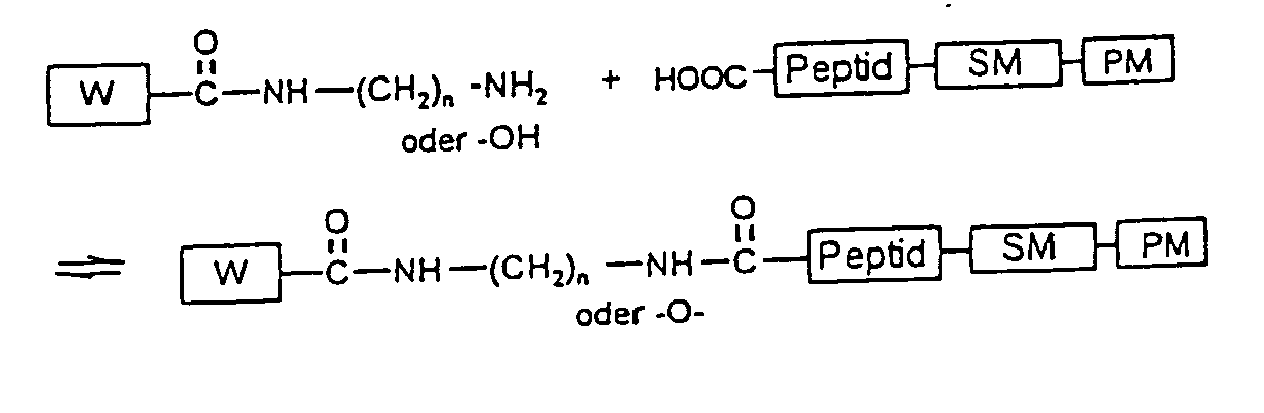


- Die Substratspezifität von Targetenzymen, wie etwa von MMP 2, MMP3, MMP 9, Cathepsin B, H und L, ist bekannt (Netzel-Arnett et al. (1993), Biochemistry 32, 6427-6432, Shuja, S., Sheahan, K., Murname, M.J. (1991), Int.J. Cancer 49, 341-346, Lah, T.T., Kos, J. (1998), Biol. Chem. 379, 125-130).
- Beispielsweise sind Octapeptide (P4 - P'4) für MMP 2 und MMP 9 identifiziert worden, welche die Spaltsequenz der Kollagenkette simulieren, und besonders effizient von MMP 2 und 9 gespalten werden:
Peptid P4 P3 P2 P1 P'1 P'2 P'3 P'4
Gly-Pro-Gln-Gly-Ile-Trp-Gly-Gln
(Netzel-Arnett et al., Biochemistry 32, 1993, 6427-6432). - Die Peptide werden ausschließlich an der P1 - P'1-Bindung enzymatisch gespalten.
- Desweiteren sind bei Cathepsin B substratspezifische Dipeptide bekannt mit der Sequenz -Arg-Arg-, -Phe-Lys-, Gly-Phe-Leu-Gly, Gly-Phe-Ala-Leu oder Ala-Leu-Ala-Leu (Werle, B., Ebert, E., Klein, W., Spiess, E. (1995), Biol. Chem. Hoppe-Seyler 376, 157-164; Ulricht, B., Spiess, E., Schwartz-Albiez, R., Ebert, W. (1995), Biol. Chem. Hoppe-Seyler 376, 404-414).
- Die Peptidsequenz, welche die für das Targetenzym relevante Peptidsollbruchstelle enthält, kann auch so aufgebaut sein, daß die Peptidsollbruchstelle mehrfach wiederholt wird, wie beispielsweise durch:
- -Gly-Pro-Leu-Gly-lie-Ala-Gly-Gln-Gly-Pro-Leu-Gly-Ile-Ala-Gly-Gln
oder - -Phe-Lys-Phe-Lys-Phe-Lys-Phe-Lys-Phe-Lys-Phe-Lys-
oder es kann eine repetitive Peptidsequenz integriert werden, die den Abstand zwischen dem proteinbindenden Molekül und der relevanten Peptidsollbruchstelle vergrößert, wie beispielsweise durch: - -Gly-Gly-Gly-Gly-Gly-Gly-Gly-Gly-Gly-Gly-Gly-Gly-Phe-Lys-Phe-Lys-
- Entscheidend für die therapeutisch und/oder diagnostisch wirksamen Substanzen zur Verwendung in der vorliegenden Erfindung ist die Tatsache, daß die für das jeweilige Targetenzym relevante Peptidsollbruchstelle mindestens einmal in einem Oligopeptid vorkommt. Die oben aufgeführten Oligopeptide sind repräsentative Beispiele für die Herstellung von therapeutisch und/oder diagnostisch wirksame Substanzen.
- Therapeutisch und/oder diagnostisch wirksame Substanzen für die vorliegende Erfindung, die ein Zytokin enthalten, können dadurch hergestellt werden, daß das Zytokin mit einem eine proteinbindende Gruppe enthaltenen Spacermolekül, das eine Carbonsäure oder eine aktivierte Carbonsäure aufweist, umgesetzt wird:


- Weist das Spacermolekül eine N-Hydroxysuccinimidester-Gruppe (N-Hydroxysuccinimid oder N-Hydroxysuccinimid-3-sulfonsäure Natriumsalz) auf, wird es direkt mit dem Zytokin umgesetzt. Die Umsetzung des Zytokins mit einem eine proteinbindenden Gruppe enthaltenen Spacermolekül, das eine Carbonsäure aufweist, erfolgt in der Gegenwart eines Kondensationsmittels, wie zum Beispiel. N,N'-Dicyclohexylcarbodiimid (DCC) oder N-Cyclohexyl-N'-(2-morpholinoethyl)-carbodiimid Metho-p-toluolsulfonat (CMC), und gegebenenfalls unter Zusatz von N-Hydroxysuccinimid oder N-Hydroxysuccinimid-3-sulfonsäure Natriumsalz, zu den entsprechenden proteinbindenden Zytokinderivaten. Die Aufreinigung der so derivatisierten Zytokine erfolgt zweckmäßig mit Hilfe der Ausschlußchromatographie. Die oben beschriebenen Umsetzungen sind dem Fachmann geläufig (Bioconjugate Techniques, G.T. Hermanson, Academic Press, 1996).
- Im Anschluß an die Synthese der therapeutisch und/oder diagnostisch wirksamen Substanz wird eine injizierbare Arzneimittelzubereitung, enthaltend die therapeutisch und/oder diagnostisch wirksame Substanz, in einer geeigneten Trägerflüssigkeit hergestellt. Die therapeutisch und/oder diagnostisch wirksame Substanz liegt bevorzugt als Lyophilisat vor, wobei vor oder nach dem Lyophilisieren übliche Träger und/oder pharmazeutische Hilfsstoffe, wie etwa Polysorbate, Glucose, Lactose, Mannose, Citronensäure, Tromethamol, Triethanolamin oder Aminoessigsäure beigefügt sein können. Die injizierbare Arzneimittelzubereitung muß so hergestellt werden, daß das proteinbindende Molekül durch das Lösen in der injizierbaren Trägerflüssigkeit nicht deaktiviert, abgespalten oder hydrolysiert wird. Weiterhin muß gewährleistet werden, daß die säurelabile Bindung in der therapeutisch und/oder diagnostisch wirksamen Substanz, die eine Ester-, Acetal-, Ketal-, Imin-, Hydrazon, Carboxylhydrazon- oder Sulfonylhydrazonbindung ist, nicht hydrolysiert wird. Die im Rahmen der vorliegenden Erfindung verwendeten proteinbindenden Moleküle sind basenempfindlich, so daß der pH-Wert der Trägerflüssigkeit einen pH-Wert von 8,0 nicht überschreiten soll. Bevorzugt liegt der pH-Wert im Bereich von pH 4,0-7,0, mehr bevorzugt zwischen pH 6,0 und pH 7,0. Außerdem muß die Trägerflüssigkeit natürlich physiologisch verträglich sein.
- Bevorzugte Trägerflüssigkeiten sind annähernd isotonische Salzpuffer, z.B. Phosphat-, Acetat- oder Citratpuffer, wie etwa, 0.004 M Natriumphosphat, 0.15 M NaCl - pH 6,0-7,0 oder 0.01 M Natriumacetat, 0.14 M NaCl - pH 5,0-6,5). Die verwendete Trägerflüssigkeit kann auch eine isotonische Natriumchloridlösung sein. Die Salzpuffer können übliche Träger und/oder Hilfsstoffe, wie etwa Polysorbate, Glucose, Lactose, Mannose, Citronensäure, Tromethamol, Triethanolamin oder Aminoessigsäure enthalten.
- Die Löslichkeit der therapeutisch und/oder diagnostisch wirksamen Substanz in der injizierbaren Trägerflüssigkeit kann durch pharmazeutische Lösungsmittel, wie etwa Ethanol, Isopropanol, 1,2-Propylenglykol, Glycerol, Macrogole, Polyethylenglykole bzw. Polyethylenoxide oder durch Lösungsvermittler, z.B. Tween, Cremophor oder Polyvinylpyrrolidon, verbessert werden. Zu diesem Zweck wird die therapeutisch und/oder diagnostisch wirksame Substanz entweder in dem pharmazeutischen Lösungsmittel bzw. Lösungsvermittler gelöst und anschließend mit einem Salzpuffer verdünnt oder eine Trägerflüssigkeit, enthaltend den Salzpuffer und mindestens ein pharmazeutisches Lösungsmittel bzw. Lösungsvermittler, wird zum Lösen der therapeutisch und/oder diagnostisch wirksamen Substanz direkt verwendet. Die Konzentration der pharmazeutischen Lösungsmittel bzw. Lösungsvermittler überschreiten dabei nicht die Mengen, die vom Arzneimittelgesetz (AMG) vorgeschrieben sind.
- Vorzugsweise sollte die Trägerflüssigkeit so ausgewählt werden, daß der Lösevorgang der therapeutisch und/oder diagnostisch wirksamen Substanz in der Trägerflüssigkeit nach wenigen Minuten abgeschlossen ist, so daß eine injizierbare Arzneimittelzubereitung am Krankenbett zur Verfügung gestellt wird.
- Es kann auch zusätzlich ein Trägermolekül, wie etwa eines der eingangs genannten, mit der wirksamen Substanz in Kontakt gebracht werden, wobei die wirksame Substanz in der Lage ist, an dieses Trägermolekül zu binden. Gemäß einer weiteren Ausführungsform umfaßt die vorliegende Erfindung somit den Schritt des Zusammenbringens des Trägermoleküls und der proteinbindenden therapeutisch und/oder diagnostisch wirksamen Substanz ex vivo und anschließender parenteraler Applikation. Auf diesem Weg kannfalls erwünscht bzw. notwendig - die Selektivität der therapeutisch und/oder diagnostisch wirksamen Substanz für ein Trägermolekül, beispielsweise für Albumin, verbessert werden. Die Trägermoleküle sind bevorzugt ausgewählt aus den genannten, insbesondere Serumproteinen.
- Die therapeutisch und/oder diagnostisch wirksame Substanz, die nach dem erfindungsgemäßen Verfahren hergestellt wurde, eignet sich somit zur Behandlung von Krebskrankheiten, Viruskrankheiten, Autoimmunerkrankungen, akuten oder chronisch-entzündlichen Erkrankungen und/oder Erkrankungen, die durch Bakterien, Pilze oder andere Mikroorganismen verursacht werden.
- Ein weiterer Gegenstand der vorliegenden Erfindung ist eine therapeutisch und/oder diagnostisch wirksame Substanz mit Gehalt an wenigstens einem Wirkstoff, die dadurch gekennzeichnet ist, daß sie wenigstens einen proteinbindenen Molekülrest aufweist, welcher mit dem Wirkstoff durch einen Spacer verbunden ist, wobei der Spacer oder die Bindung zwischen Spacer und Wirkstoff pH-abhängig, hydrolytisch oder enzymatisch im Körper spaltbar ist unter Freisetzung des Wirkstoffs, wobei der Wirkstoff kein Zytostatikum ist.
- Noch ein weiterer Gegenstand der vorliegenden Erfindung ist eine diagnostisch wirksame Substanz mit Gehalt an wenigstens einem Diagnostikum, die dadurch gekennzeichnet ist, daß sie wenigstens einen proteinbindenden Molekülrest, welcher mit dem Diagnostikum durch einen Spacer verbunden ist, wobei der Spacer oder die Bindung zwischen Spacer und Diagnostikum pH-abhängig, hydrolytisch oder enzymatisch im Körper spaltbar ist unter Freisetzung des Diagnostikums. Wie oben erwähnt, umfaßt das Diagnostikum bevorzugt ein oder mehrere Readionuklide, ein oder mehrere Radionuklide umfassende Liganden, ein oder mehrere Positronenstrahler, ein oder mehrere NMR-Kontrastmittel, ein oder mehrere fluoreszierende Verbindung(en) oder/und ein oder mehrere Kontrastmittel im nahen IR-Bereich.
- Eine weitere Ausführungsform der vorliegenden Erfindung betrifft einen diagnostischen Kit, enthaltend eine erfindungsgemäße proteinbindende diagnostisch wirksame Substanz, gegebenenfalls zusammen mit dem Trägermolekül und pharmazeutisch annehmbaren Hilfsstoffen, Trägerstoffen und/oder Verdünnungsmitteln, insbesondere ausgewählt aus den oben genannten. Der erfindungsgemäße diagnostische Kit kann bevorzugt zum Nachweis der wie oben definierten Erkrankungen oder zum Nachweis von Trägermolekülen und/oder deren Verteilung im Organismus verwendet werden.
- Noch ein weiterer Gegenstand der vorliegenden Erfindung ist ein Verfahren zur Herstellung einer injizierbaren Arzneimittelzubereitung, enthaltend eine diagnostisch wirksame Substanz, die in einer injizierbaren Trägerflüssigkeit gelöst wird, welches dadurch gekennzeichnet ist, dass als diagnostisch wirksame Substanz eine Verbindung umfassend ein Diagnostikum und wenigstens einen proteinbindenden Molekülrest verwendet wird. Ein Diagnostikum kann eine der oben genannten Verbindungen sein, beispielsweise ein oder mehrere Radionuklide, ein oder mehrere Radionuklide umfassende Liganden, ein oder mehrer Positronenstrahler, ein oder mehrere NMR-Kontrastmittel, ein oder mehrere fluoreszierende Verbindung(en) oder/und ein oder mehrere Kontrastmittel im nahen IR-Bereich. Das Diagnostikum und der wenigstens eine proteinbindende Molekülrest können auch durch einen Spacer verbunden sein. Hierbei ist es bevorzugt, dass der Spacer oder die Bindung, welche die beiden Komponenten verbindet, nicht spaltbar ist. Beispiele für nicht im Körper spaltbare Bindungen, die bei der Bindung zur diagnostisch wirksamen Substanz vorliegen können, sind Amidbindungen, gesättigte bzw. ungesättigte Kohlenstoff-Kohlenstoff-Bindungen oder Bindungen zwischen Kohlenstoff und einem Heteroatom, -C-X-, wobei X vorzugsweise O, N, S oder P ist. Eine bevorzugte Bindung ist eine Amidbindung. Die Freisetzung der therapeutisch wirksamen Substanz ist bevorzugt, da in der Regel der niedermolekulare Wirkstoff mit seinem molekularen Target wechselwirken muß, um seine pharmakologische Wirksamkeit zu entfalten. Bei diagnostisch wirksamen Substanzen hingegen ist eine Freisetzung des Protein gebundenen Diagnostikums nicht unbedingt erforderlich, kann aber vorhanden sein. Erfindungsgemäß kann deshalb die diagnostisch wirksame Substanz zusätzlich über eine nicht im Körper spaltbare Bindung an das Spacermolekül oder direkt an die proteinbindende Gruppe ohne Vorhandensein eines Spacermoleküls SM gebunden sein.
- Die folgenden Beispiele erläutern die Erfindung näher.
- Die im folgenden abgebildete pharmakologisch aktive Substanz (abgekürzt DOXO-HYD) besteht aus dem Zytostatikum Doxorubicin, aus einer Maleinimidgruppe als proteinbindendes Molekül PM und aus einem Phenylacetylhydrazonspacer als Spacermolekül SM. Die Bindung zwischen Doxorubicin und dem Spacermolekül SM ist eine säurelabile Carboxylhydrazonbindung:
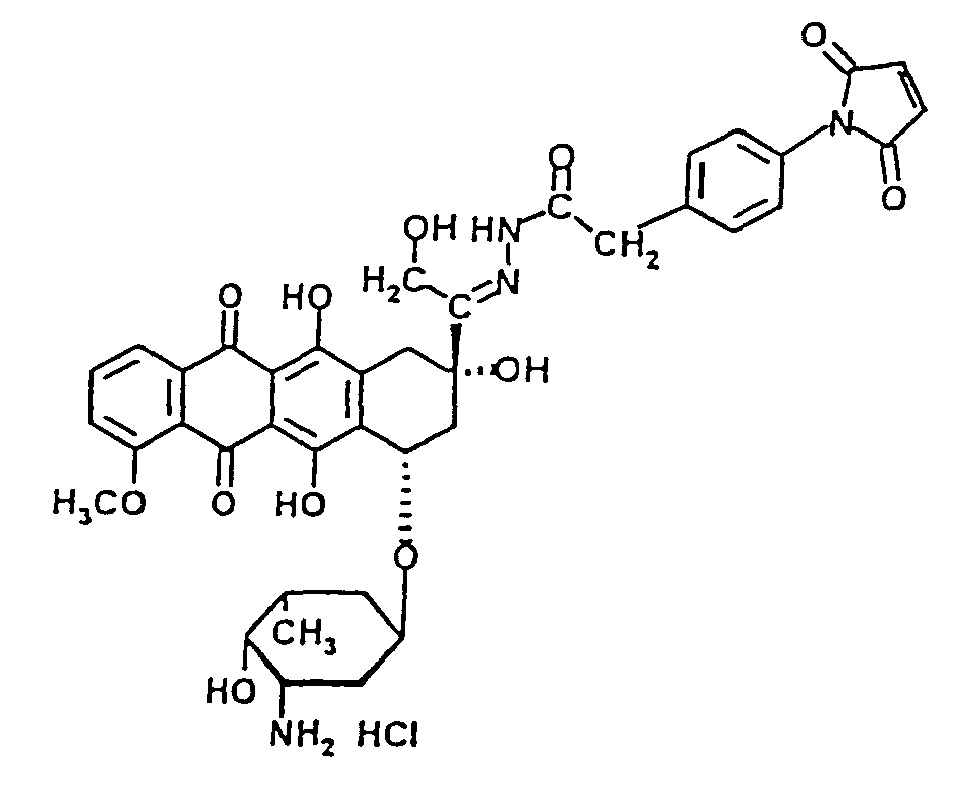
- 10,51 mg DOXO-HYD werden in 2,0 ml 1,2-Propylenglykol durch Schütteln gelöst und anschließend wird diese Lösung mit 8,0 ml Phosphatpuffer (0.004 M Natriumphosphat, 0.15 M NaCl - pH 6,5) verdünnt und homogenisiert (Konzentration von DOXO-HYD in der Trägerflüssigkeit ≈ 1300 µM). Die so hergestellte injizierbare Arzneimittelzubereitung von DOXO-HYD wurde Versuchstieren unmittelbar intravenös verabreicht (siehe unten).
- Nachdem DOXO-HYD in die Blutbahn gelangt, findet eine Bindung an Serumproteine statt, vorzugsweise an Serumalbumin, so daß DOXO-HYD u.a. als säurelabiles Albumin-Doxorubicin-Konjugat vorliegt.
- Inkubationsstudien von Humanblutplasma mit DOXO-HYD bei 37 °C zeigen, daß nach einer 5-minütigen Inkubation der Großteil von DOX-HYD kovalent an Albumin gebunden ist. (A) - im Gegensatz zu freiem Doxorubicin (B). Dieser Sachverhalt ist in den untenstehenden Chromatogrammen dargestellt. (A und B):


- Hierbei wurde nach erfolgter Inkubation die Plasmaprobe über eine POROS®-20-Anionenaustauschersäule getrennt (Detektion der Proteine bei 254 nm, Detektion des Anthrazyklins durch Fluoreszenz).
- Die unten aufgeführten biologischen Daten verdeutlichen die in vivo Wirksamkeit von DOXO-HYD im Vergleich zu freiem Doxorubicin: Im sogenannten RENCA (renal cell carcinoma)-Modell wurde Doxorubicin und DOXO-HYD hinsichtlich der antitumoralen Wirksamkeit bei annähernd äquitoxischer Dosis miteinander verglichen (intravenöse Therapie 10 Tage nach Injektion von etwa 1 Million Nierenkarzinomzellen in der linken Niere).
- Tiere: Balb/c-Mäuse, weiblich; Tumor: RENCA, renal cell carcinoma (Nierenzellkarzinom)
Therapie: Tag(d) 10, 13, 17 und 20 intravenöse (i.v.), Ende des Versuchs d24Anzahl der Mäuse Substanz Dosis Durchschnittliche Körpergewichtsabnahme (%) d 1-24 10 Kontrolle 10 Doxorubicin 4 x 10 mmol/kg -15 10 DOXO-HYD 4 x 20 mmol/kg -15 - Die Ergebnisse dieses Versuches sind untenstehend abgebildet. DOXO-HYD zeigt eine sehr gute antitumorale Wirksamkeit und erzielt eine deutliche Reduktion des Nierentumorvolumens und der Anzahl von Lungenmetastasen im Vergleich zur Kontrollgruppe und der Doxorubicin behandelten Gruppe.
-

- 1,6 mg des 6-Maleinimidocapronsäurehydrazon-Derivats von Doxorubicin (abgekürzt DOXO-EMHC) mit untenstehender Strukturformel


- Das Doxorubicin-Maleinimid-Peptid-Derivat (2) wurde gemäß folgender Reaktionsgleichung hergestellt:
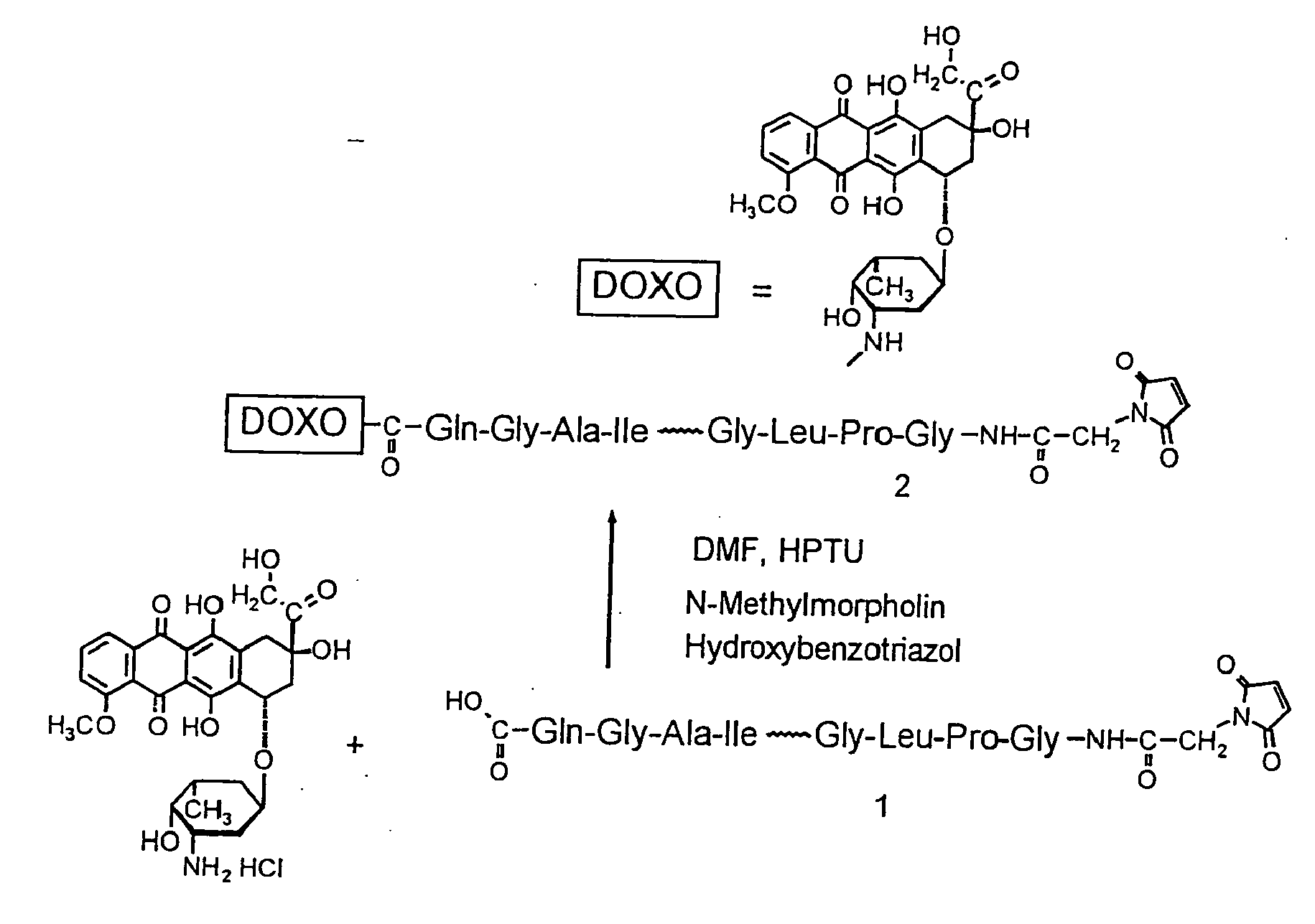
- Dabei wird das mit Maleinimidoglycin derivatisierte Octapeptid Gln-Gly-Ala-Ile-Gly-Leu-Pro-Gly 1 (Mr 848, hergestellt durch Festphasensynthese durch Bachem AG, Schweiz) mit Doxorubicin laut folgender Vorschrift umgesetzt:
- Zu einer leicht trüben Lösung von 17,1 mg Doxorubicin in 3 ml DMF werden 25 mg 1 (als Trifluoracetatsalz) gelöst in 500 µl DMF, 33,5 mg O-Benzotriazol-N,N,N',N'-tetramethyluroniumhexafluorphosphat (HPTU) gelöst in 200 µl DMF, 11,9 mg Hydroxybenzotriazolhydrat gelöst in 100 µl DMF und 16,2 µl N-Methylmorpholin zugegeben, und der Ansatz anschließend 18 h lang bei RT im Dunklen gerührt. DMF wurde am Hochvakuum entfernt und der Feststoff in 20 ml Methanol aufgenommen, filtriert und im Vakuum auf 1 ml eingeengt. Nach Aufreinigung über Kieselgel (Essigester/Methanol 2/1) wurden 5 mg 2 erhalten.
- 1,4 mg 2 (Mr 1374) werden in 1,0 ml Phosphatpuffer (0,15 M NaCl, 0,004 M Natriumphosphat, pH 6,5) bei Raumtemperatur gelöst (1000 µm Lösung). Werden 300 µl dieser Lösung mit 1,0 ml Humanplasma 60 Sekunden lang bei 37 °C inkubiert, und die Probe anschließend über einen schwachen Anionenaustauscher (von POROS® ) getrennt, zeigt sich, daß der überwiegende Teil von 2 an Albumin gebunden ist (s. untenstehendes Chromatogramm):

- Die Peptidsequenz Gln-Gly-Ala-Ile-Gly-Leu-Pro-Gly wird von der Matrixmetalloprotease MMP9 erkannt und zwischen Isoleucin und Glycin gespalten. Dies wurde durch folgenden Versuch gezeigt: 200 µl einer 100 µM Lösung des Albuminkonjugats von 2 mit folgender Struktur (abgekürzt HSA-2):
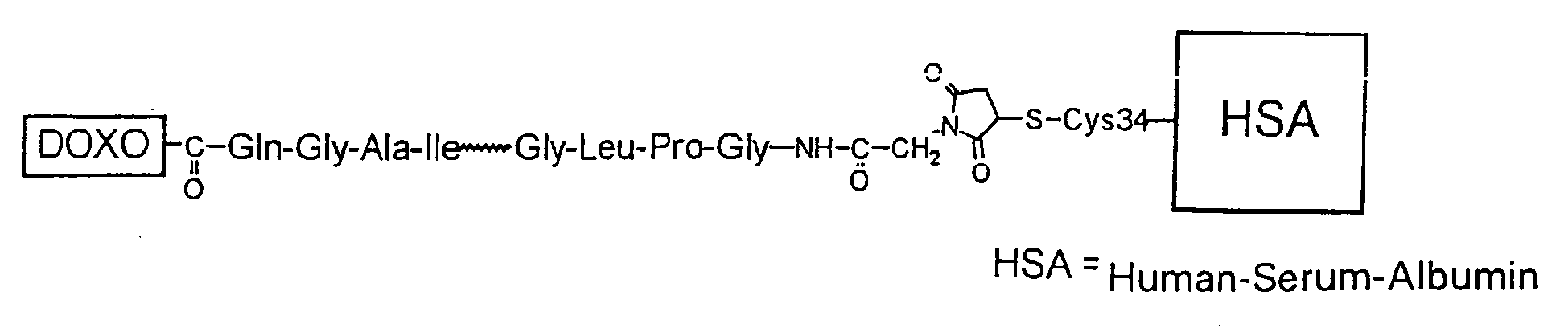
deutschen Patentanmeldung A19926475.9 vom 10. Juni 1999 beschriebene Verfahren hergestellt wurde, wurde mit Trypsin/Aprotinin aktivierter MMP9 (2 mU von Calbiochem, Deutschland) 30 Minuten lang bei 37 °C inkubiert. Die Freisetzung von DOXO-Gln-Gly-Ala-Ile nach dieser Zeit ist in den untenstehenden Chromatogrammen abgebildet. Gezeigt ist das Chromatogramm von HSA-2 bei t = 0 (Trennung durch HPLC Ausschlußchromatographie mit einer Biosil 250 SEC Säule von der Firma Biorad, Detektion bei λ = 495 nm) und nach einer Inkubationszeit mit aktivierter MMP9 von 30 Minuten.
-

- Nach einer 5-minütigen Inkubation von 250 µl einer 100 µM Fluoresceinmaleinimid-Lösung (Phosphatpuffer - 0,15 M NaCl, 0,004 M Natriumphosphat, pH 5,0) mit 1,0 ml Humanplasma und anschließenden Trennung der Probe mittels der Ausschlußchromatographie (Superdex® 200, Pharamcia), zeigt sich, daß der überwiegende Teil des Fluoresceinmaleinimids an Albumin gebunden ist (s. untenstehendes Chromatogramm):
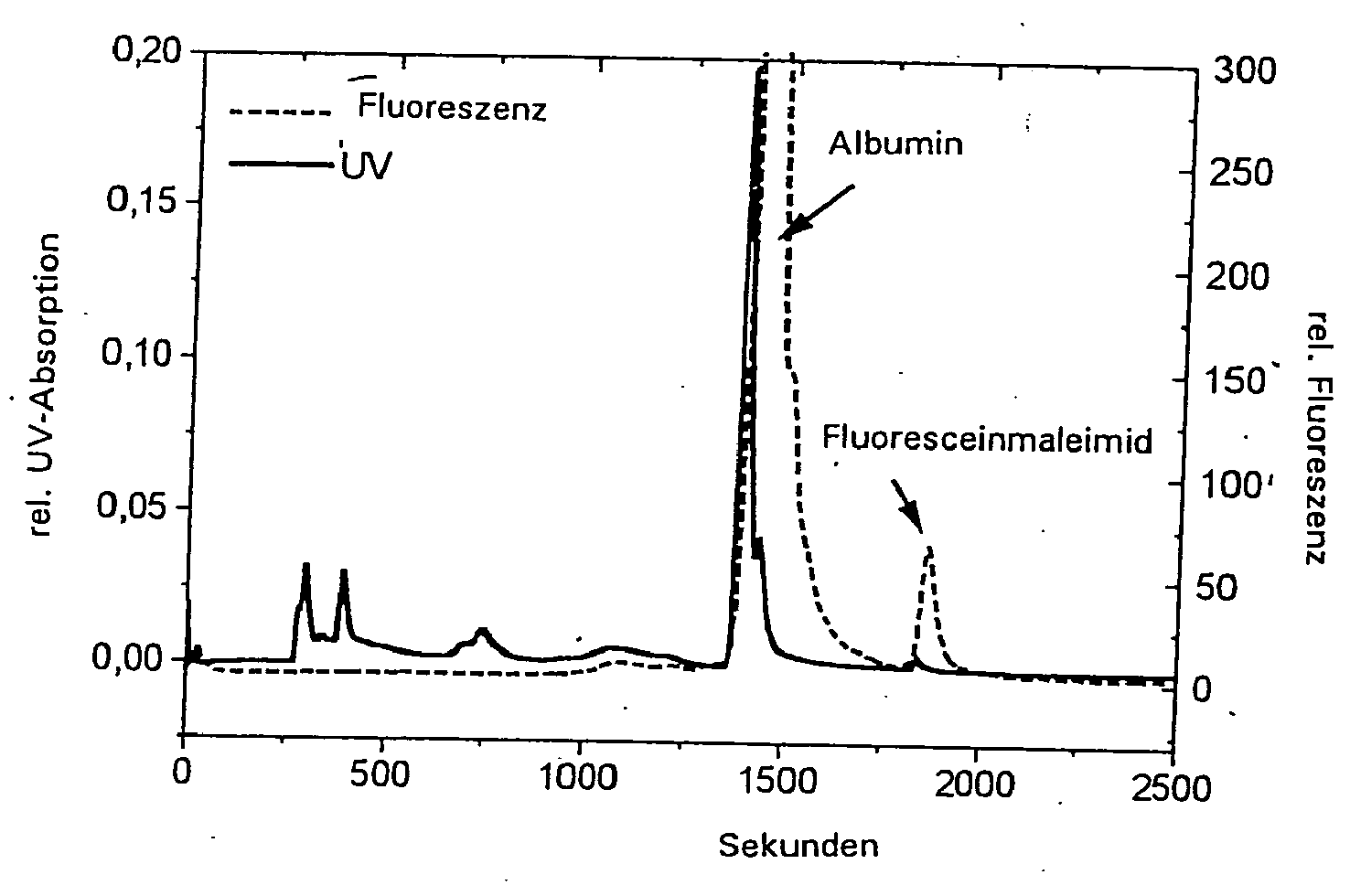
Claims (19)
- Verfahren zur Herstellung einer injizierbaren Arzneimittelzubereitung, enthaltend einetherapeutisch und/oder diagnostisch wirksame Substanz, die in einer injizierbaren Trägerflüssigkeit gelöst wird, dadurch gekennzeichnet, daß als therapeutisch und/oder diagnostisch wirksame Substanz eine Verbindung bestehend aus einem Wirkstoff und wenigstens einem proteinbindenden Molekülrest, die durch einen Spacer verbunden sind, verwendet wird, worin der Spacer oder die Bindung zwischen dem Wirkstoff und dem Spacer pH-abhängig, hydrolytisch oder enzymatisch im Körper spaltbar ist.
- Verfahren nach Anspruch 1, dadurch gekennzeichnet, daß der Spacer oder die Bindung zwischen dem Wirkstoff und dem Spacer unter Freisetzung des Wirkstoffs oder eines Derivats des Wirkstoffs im Körper spaltbar ist.
- Verfahren nach Anspruch 1 oder 2, dadurch gekennzeichnet, daß der Wirkstoff ein Zytostatikum, ein Zytokin, ein Immunsuppressivum, ein Virostatikum, ein Antirheumatikum, ein Analgetikum, ein Antiphlogistikum, ein Antibiotikum, ein Antimykotikum, ein Signaltransduktionsinhibitor, ein Angiogeneseinhibitor oder ein Proteaseinhibitor ist.
- Verfahren nach Anspruch 1, 2 oder 3, dadurch gekennzeichnet, daß der Wirkstoff aus der Gruppe der Anthrazykline, der Stickstofflostderivate, der Alkylantien, der Purin- oder Pyrimidinantagonisten, der Folsäureantagonisten, der Taxane, der Camptothecine, der Podophyllotoxinderivate, der Vinca-Alkaloide, der Calicheamicine, der Maytansinoide oder der ciskonfigurierten Platin(II)-Komplexe ausgewählt ist.
- Verfahren nach einem der vorhergehenden Ansprüche, dadurch gekennzeichnet, daß die diagnostisch wirksame Substanz ein oder mehrere Radionuklide, ein oder mehrere Radionuklide umfassende Liganden, ein oder mehrere Positronenstrahler, ein oder mehrere NMR-Kontrastmittel, eine oder mehrere fluoreszierende Verbindung(en) oder/und ein oder mehrere Kontrastmittel im nahen IR-Bereich aufweist.
- Verfahren nach einem der vorhergehenden Ansprüche, dadurch gekennzeichnet, daß das proteinbindende Molekül eine Maleinimidgruppe, eine Halogenacetamidgruppe, eine Halogenacetatgruppe, eine Pyridyldithio-Gruppe, eine N-Hydroxysuccinimidestergruppe, eine Isothiocyanat-Gruppe, eine Disulfidgruppe, eine Vinylcarbonylgruppe, eine Aziridingruppe oder eine Acetylengruppe ist, die gegebenenfalls substituiert sein kann.
- Verfahren nach einem der vorhergehenden Ansprüche, dadurch gekennzeichnet, daß der Spacer ein organischer Molekülrest ist, welcher eine aliphatische Kohlenstoffkette und/oder einen aliphatischen Kohlenstoffring mit 1-12 Kohlenstoffatomen, die teilweise durch Sauerstoffatome ersetzt sein können, und/oder mindestens einem Aromaten enthält, welche gegebenenfalls substituiert sein können.
- Verfahren nach einem der vorhergehenden Ansprüche, dadurch gekennzeichnet, daß die Bindung zwischen dem Wirkstoff und dem Spacer bzw. der proteinbindenden Molekülrest mindestens eine Peptidbindung enthält.
- Verfahren nach einem der vorhergehenden Ansprüche, dadurch gekennzeichnet, daß zusätzlich ein Trägermolekül verwendet wird.
- Verfahren nach Anspruch 9, dadurch gekennzeichnet, daß das Zusammenbringen des Trägermoleküls mit der therapeutisch und/oder diagnostisch wirksamen Substanz ex vivo erfolgt.
- Therapeutisch und/oder diagnostisch wirksame Substanz mit Gehalt an wenigstens einem Wirkstoff, dadurch gekennzeichnet, daß sie wenigstens einen proteinbindenden Molekülrest aufweist, welcher mit dem Wirkstoff durch einen Spacer verbunden ist, wobei der Spacer oder die Bindung zwischen Spacer und Wirkstoff pH-abhängig, hydrolytisch oder enzymatisch im Körper spaltbar ist, wobei der Wirkstoff kein Zytostatikum ist.
- Diagnostisch wirksame Substanz mit Gehalt an wenigstens einem Diagnostikum, dadurch gekennzeichnet, daß sie wenigstens einen proteinbindenden Molekülrest, welcher mit dem Diagnostikum durch einen Spacer verbunden ist, wobei der Spacer oder die Bindung zwischen Spacer und Diagnostikum pH-abhängig, hydrolytisch oder enzymatisch im Körper spaltbar ist.
- Verwendung der therapeutisch und/oder diagnostisch wirksamen Substanz gemäß einem der Ansprüche 1 bis 10 zur Behandlung von Krebskrankheiten, Viruskrankheiten, Autoimmunerkrankungen, akute oder chronisch-entzündliche Erkrankungen und Erkrankungen, die durch Bakterien, Pilze oder andere Mikroorganismen verursacht sind.
- Diagnostischer Kit, enthaltend die proteinbindende diagnostisch wirksame Substanz nach einem der Ansprüche 5 bis 12, gegebenenfalls ein Trägermolekül, sowie pharmazeutisch annehmbare Hilfsstoffe, Trägerstoffe und/oder Verdünnungsmittel.
- Verwendung der diagnostisch wirksamen Substanz nach einem der Ansprüche 5 bis 10 und 12 oder des diagnostischen Kits nach Anspruch 14 zum Nachweis von Krebskrankheiten, Autoimmunkrankheiten, akuten oder chronisch-entzündlichen Erkrankungen und Erkrankungen, die durch Viren und/oder Mikroorganismen verursacht werden und/oder zum Nachweis des Trägermoleküls und dessen Verteilung im Organismus.
- Verfahren zur Herstellung einer injizierbaren Arzneimittelzubereitung, enthaltend eine diagnostisch wirksame Substanz, die in einer injizierbaren Trägerflüssigkeit gelöst wird, dadurch gekennzeichnet, dass als diagnostisch wirksame Substanz eine Verbindung umfassend ein Diagnostikum und wenigstens einen Protein-bindenden Molekülrest verwendet wird.
- Verfahren nach Anspruch 16, dadurch gekennzeichnet, dass das Diagnostikum und der Protein-bindende Molekülrest durch einen Spacer verbunden sind.
- Verfahren nach Anspruch 16 oder 17, dadurch gekennzeichnet, dass die Bindung zwischen dem Diagnostikum und dem Protein-bindenden Molekülrest oder der Spacer nicht spaltbar sind.
- Verfahren nach Anspruch 18, dadurch gekennzeichnet, dass das Diagnostikum und der Protein-bindende Molekülrest durch eine Amidbindung miteinander verbunden sind.
Priority Applications (4)
| Application Number | Priority Date | Filing Date | Title |
|---|---|---|---|
| DK10183870.4T DK2347770T4 (da) | 1999-06-09 | 2000-06-07 | Fremgangsmåde til fremstilling af en injicerbar farmaceutisk tilberedning |
| EP10183870.4A EP2347770B2 (de) | 1999-06-09 | 2000-06-07 | Verfahren zur Herstellung einer injizierbaren Arzneimittelzubereitung |
| SI200031070T SI1704864T1 (sl) | 1999-06-09 | 2000-06-07 | Injekcijski pripravek zdravila, ki sestoji iz citostatika in maleinimidne skupine, vezane z vmestnikom |
| CY20121100751T CY1113370T1 (el) | 1999-06-09 | 2012-08-22 | Ενεσιμο φαρμακευτικο σκευασμα αποτελουμενο απο ενα κυτταροστατικο και μια μηλεϊνιμιδο ομαδα συνδεομενη δια ενος παρεμβαλλομενου μοριου |
Applications Claiming Priority (2)
| Application Number | Priority Date | Filing Date | Title |
|---|---|---|---|
| DE19926154A DE19926154A1 (de) | 1999-06-09 | 1999-06-09 | Verfahren zur Herstellung einer injizierbaren Arzneimittelzubereitung |
| EP00945721A EP1183050B1 (de) | 1999-06-09 | 2000-06-07 | Verfahren zur herstellung einer injizierbaren arzneimittelzubereitung |
Related Parent Applications (2)
| Application Number | Title | Priority Date | Filing Date |
|---|---|---|---|
| EP00945721A Division EP1183050B1 (de) | 1999-06-09 | 2000-06-07 | Verfahren zur herstellung einer injizierbaren arzneimittelzubereitung |
| EP00945721.9 Division | 2000-06-07 |
Related Child Applications (3)
| Application Number | Title | Priority Date | Filing Date |
|---|---|---|---|
| EP10183870.4A Division EP2347770B2 (de) | 1999-06-09 | 2000-06-07 | Verfahren zur Herstellung einer injizierbaren Arzneimittelzubereitung |
| EP10183870.4A Division-Into EP2347770B2 (de) | 1999-06-09 | 2000-06-07 | Verfahren zur Herstellung einer injizierbaren Arzneimittelzubereitung |
| EP10183870.4 Division-Into | 2010-09-30 |
Publications (4)
| Publication Number | Publication Date |
|---|---|
| EP1704864A2 true EP1704864A2 (de) | 2006-09-27 |
| EP1704864A3 EP1704864A3 (de) | 2007-01-10 |
| EP1704864B1 EP1704864B1 (de) | 2012-05-23 |
| EP1704864B9 EP1704864B9 (de) | 2012-09-19 |
Family
ID=7910588
Family Applications (3)
| Application Number | Title | Priority Date | Filing Date |
|---|---|---|---|
| EP06012171A Expired - Lifetime EP1704864B9 (de) | 1999-06-09 | 2000-06-07 | Injizierbare Arzneimittelzubereitung bestehend aus einem Zytostatikum und einer durch einen Spacer gebundenen Maleinimidgruppe. |
| EP10183870.4A Expired - Lifetime EP2347770B2 (de) | 1999-06-09 | 2000-06-07 | Verfahren zur Herstellung einer injizierbaren Arzneimittelzubereitung |
| EP00945721A Expired - Lifetime EP1183050B1 (de) | 1999-06-09 | 2000-06-07 | Verfahren zur herstellung einer injizierbaren arzneimittelzubereitung |
Family Applications After (2)
| Application Number | Title | Priority Date | Filing Date |
|---|---|---|---|
| EP10183870.4A Expired - Lifetime EP2347770B2 (de) | 1999-06-09 | 2000-06-07 | Verfahren zur Herstellung einer injizierbaren Arzneimittelzubereitung |
| EP00945721A Expired - Lifetime EP1183050B1 (de) | 1999-06-09 | 2000-06-07 | Verfahren zur herstellung einer injizierbaren arzneimittelzubereitung |
Country Status (13)
| Country | Link |
|---|---|
| US (5) | US7387771B1 (de) |
| EP (3) | EP1704864B9 (de) |
| JP (5) | JP5517384B2 (de) |
| AT (1) | ATE339225T1 (de) |
| AU (1) | AU779697B2 (de) |
| CA (1) | CA2374964C (de) |
| CY (2) | CY1105701T1 (de) |
| DE (2) | DE19926154A1 (de) |
| DK (3) | DK1183050T3 (de) |
| ES (3) | ES2623017T5 (de) |
| PT (3) | PT1183050E (de) |
| SI (1) | SI1704864T1 (de) |
| WO (1) | WO2000076551A2 (de) |
Cited By (3)
| Publication number | Priority date | Publication date | Assignee | Title |
|---|---|---|---|---|
| WO2008087017A3 (de) * | 2007-01-18 | 2009-01-22 | Bayer Schering Pharma Ag | Neue kaskaden-polymer-komplexe, verfahren zu ihrer herstellung und diese enthaltende pharmazeutische mittel |
| WO2008098789A3 (en) * | 2007-02-16 | 2009-05-28 | Ktb Tumorforschungs Gmbh | Dual acting prodrugs |
| CN102781417A (zh) * | 2010-02-12 | 2012-11-14 | 赢创高施米特有限公司 | 包含聚甘油偏酯的化妆品组合物 |
Families Citing this family (67)
| Publication number | Priority date | Publication date | Assignee | Title |
|---|---|---|---|---|
| US6887470B1 (en) | 1999-09-10 | 2005-05-03 | Conjuchem, Inc. | Protection of endogenous therapeutic peptides from peptidase activity through conjugation to blood components |
| US6849714B1 (en) | 1999-05-17 | 2005-02-01 | Conjuchem, Inc. | Protection of endogenous therapeutic peptides from peptidase activity through conjugation to blood components |
| US6514500B1 (en) | 1999-10-15 | 2003-02-04 | Conjuchem, Inc. | Long lasting synthetic glucagon like peptide {GLP-!} |
| US7144854B1 (en) | 1999-09-10 | 2006-12-05 | Conjuchem, Inc. | Long lasting anti-angiogenic peptides |
| CN1191273C (zh) | 1999-05-17 | 2005-03-02 | 康久化学公司 | 长效促胰岛肽 |
| US7582301B1 (en) | 1999-05-17 | 2009-09-01 | Conjuchem Biotechnologies, Inc. | Long-lasting antiviral fusion inhibitor peptide conjugates comprising albumin and human immunodeficiency virus (HIV) peptides |
| US7601691B2 (en) | 1999-05-17 | 2009-10-13 | Conjuchem Biotechnologies Inc. | Anti-obesity agents |
| DE19926154A1 (de) * | 1999-06-09 | 2000-12-14 | Ktb Tumorforschungs Gmbh | Verfahren zur Herstellung einer injizierbaren Arzneimittelzubereitung |
| DE19926475A1 (de) * | 1999-06-10 | 2000-12-14 | Ktb Tumorforschungs Gmbh | Träger-Pharmaka-Konjugate |
| US6706892B1 (en) | 1999-09-07 | 2004-03-16 | Conjuchem, Inc. | Pulmonary delivery for bioconjugation |
| JP2003508501A (ja) * | 1999-09-07 | 2003-03-04 | コンジュケム,インコーポレーテッド | 生物学的結合のための肺送達 |
| EP1889639A3 (de) * | 1999-09-07 | 2008-04-09 | ConjuChem Biotechnologies Inc. | Verfahren und Zusammensetzungen zur Herstellung antineoplastischer Wirkstoffe von hoher Haltbarkeit |
| US7090851B1 (en) | 1999-09-10 | 2006-08-15 | Conjuchem Inc. | Long lasting fusion peptide inhibitors of viral infection |
| US6961567B1 (en) * | 2000-12-07 | 2005-11-01 | Palm, Inc. | Generic activation and registration framework for wireless devices |
| US7555571B1 (en) * | 2001-01-05 | 2009-06-30 | Palm, Inc. | Activation of mobile computing device on a cellular network |
| WO2002062844A2 (en) | 2001-02-02 | 2002-08-15 | Conjuchem Inc. | Long lasting growth hormone releasing factor derivatives |
| CA2436399A1 (en) | 2001-02-16 | 2002-08-29 | Conjuchem Inc. | Long lasting glucagon-like peptide 2 (glp-2) for the treatment of gastrointestinal diseases and disorders |
| US8812398B2 (en) * | 2001-05-08 | 2014-08-19 | Qualcomm Incorporated | Key for a wireless-enabled device |
| DE60229677D1 (de) | 2001-05-31 | 2008-12-11 | Conjuchem Biotechnologies Inc | Langwirkende Fusionspeptidinhibitoren gegen HIV-Infektion |
| US7585491B2 (en) | 2002-12-13 | 2009-09-08 | Immunomedics, Inc. | Immunoconjugates with an intracellularly-cleavable linkage |
| US7591994B2 (en) | 2002-12-13 | 2009-09-22 | Immunomedics, Inc. | Camptothecin-binding moiety conjugates |
| US8877901B2 (en) | 2002-12-13 | 2014-11-04 | Immunomedics, Inc. | Camptothecin-binding moiety conjugates |
| US8435529B2 (en) | 2002-06-14 | 2013-05-07 | Immunomedics, Inc. | Combining radioimmunotherapy and antibody-drug conjugates for improved cancer therapy |
| US9770517B2 (en) | 2002-03-01 | 2017-09-26 | Immunomedics, Inc. | Anti-Trop-2 antibody-drug conjugates and uses thereof |
| DE10310082A1 (de) | 2003-03-07 | 2004-09-16 | Ktb Tumorforschungsgesellschaft Mbh | Protein-bindende Doxorubicin-Peptid-Derivate |
| GB0321613D0 (en) * | 2003-09-15 | 2003-10-15 | Drug Discovery Lab As | Compounds |
| DK1745078T3 (da) * | 2004-04-23 | 2009-10-26 | Conjuchem Biotechnologies Inc | Fremgangsmåde til oprensning af albuminkonjugater |
| DE102005002991A1 (de) * | 2005-01-21 | 2006-07-27 | Rösner Research GmbH & Co.KG | Verfahren zur Herstellung von Albumin-Konjugaten mit Gyrasehemmern |
| US9707302B2 (en) | 2013-07-23 | 2017-07-18 | Immunomedics, Inc. | Combining anti-HLA-DR or anti-Trop-2 antibodies with microtubule inhibitors, PARP inhibitors, bruton kinase inhibitors or phosphoinositide 3-kinase inhibitors significantly improves therapeutic outcome in cancer |
| US10058621B2 (en) | 2015-06-25 | 2018-08-28 | Immunomedics, Inc. | Combination therapy with anti-HLA-DR antibodies and kinase inhibitors in hematopoietic cancers |
| US8039432B2 (en) * | 2005-11-09 | 2011-10-18 | Conjuchem, Llc | Method of treatment of diabetes and/or obesity with reduced nausea side effect |
| DE102006024528A1 (de) * | 2006-05-23 | 2007-11-29 | Albupharm Heidelberg Gmbh & Co. Kg | Neue, an der Tumorphysiologie orientierte Formulierung eines Zytostatikums, insbesondere von cis-Platin |
| PL3939617T3 (pl) | 2009-02-13 | 2025-03-17 | Immunomedics, Inc. | Związki pośrednie do wytwarzania koniugatów z wiązaniem rozszczepialnym wewnątrzkomórkowo |
| EP2289558A1 (de) * | 2009-08-25 | 2011-03-02 | KTB Tumorforschungsgesellschaft mbH | Bisphosphonat-Prodrugs |
| EP2382993A1 (de) | 2010-04-19 | 2011-11-02 | KTB Tumorforschungsgesellschaft mbH | Kombination von Arzneimitteln mit proteinbindenden Prodrugs |
| US9382329B2 (en) | 2012-08-14 | 2016-07-05 | Ibc Pharmaceuticals, Inc. | Disease therapy by inducing immune response to Trop-2 expressing cells |
| BR112015013444B1 (pt) | 2012-12-13 | 2022-11-01 | Immunomedics, Inc | Uso de um imunoconjugado |
| US10137196B2 (en) | 2012-12-13 | 2018-11-27 | Immunomedics, Inc. | Dosages of immunoconjugates of antibodies and SN-38 for improved efficacy and decreased toxicity |
| US10744129B2 (en) | 2012-12-13 | 2020-08-18 | Immunomedics, Inc. | Therapy of small-cell lung cancer (SCLC) with a topoisomerase-I inhibiting antibody-drug conjugate (ADC) targeting Trop-2 |
| US9931417B2 (en) | 2012-12-13 | 2018-04-03 | Immunomedics, Inc. | Antibody-SN-38 immunoconjugates with a CL2A linker |
| US9492566B2 (en) | 2012-12-13 | 2016-11-15 | Immunomedics, Inc. | Antibody-drug conjugates and uses thereof |
| US10206918B2 (en) | 2012-12-13 | 2019-02-19 | Immunomedics, Inc. | Efficacy of anti-HLA-DR antiboddy drug conjugate IMMU-140 (hL243-CL2A-SN-38) in HLA-DR positive cancers |
| US10413539B2 (en) | 2012-12-13 | 2019-09-17 | Immunomedics, Inc. | Therapy for metastatic urothelial cancer with the antibody-drug conjugate, sacituzumab govitecan (IMMU-132) |
| EP3915369A1 (de) | 2012-12-13 | 2021-12-01 | CytRx Corporation | Anthracyclinformulierungen |
| US12310958B2 (en) | 2012-12-13 | 2025-05-27 | Immunomedics, Inc. | Antibody-drug conjugates and uses thereof |
| US9107960B2 (en) | 2012-12-13 | 2015-08-18 | Immunimedics, Inc. | Antibody-SN-38 immunoconjugates with a CL2A linker |
| US20240148873A1 (en) | 2012-12-13 | 2024-05-09 | Immunomedics, Inc. | Dosages of immunoconjugates of antibodies and sn-38 for improved efficacy and decreased toxicity |
| TWI716339B (zh) | 2012-12-21 | 2021-01-21 | 荷蘭商台醫(有限合夥)公司 | 親水性自消耗連接子及彼等之共軛物 |
| CN113842392A (zh) * | 2013-06-05 | 2021-12-28 | 西特克斯公司 | 用于治疗癌症的细胞毒素剂 |
| US11253606B2 (en) | 2013-07-23 | 2022-02-22 | Immunomedics, Inc. | Combining anti-HLA-DR or anti-Trop-2 antibodies with microtubule inhibitors, PARP inhibitors, Bruton kinase inhibitors or phosphoinositide 3-kinase inhibitors significantly improves therapeutic outcome in cancer |
| AU2015276821A1 (en) | 2014-06-20 | 2017-01-12 | Abgenomics International Inc. | Anti-folate receptor aplha (FRA) antibody-drug conjugates and methods of using thereof |
| KR101759261B1 (ko) | 2014-11-20 | 2017-07-19 | 파로스젠 주식회사 | 유도형질로 활성화되는 다기능성 항암제 전구체, 이의 제조방법 및 이의 용도 |
| EP3286224A4 (de) | 2015-04-22 | 2018-11-14 | Immunomedics, Inc. | Isolierung, detektion, diagnose und/oder charakterisierung von zirkulierenden trop-2-positiven krebszellen |
| PT3310800T (pt) * | 2015-06-19 | 2022-03-21 | Centurion Biopharma Corp | Sistemas de administração para a libertação controlada de fármacos |
| US10195175B2 (en) | 2015-06-25 | 2019-02-05 | Immunomedics, Inc. | Synergistic effect of anti-Trop-2 antibody-drug conjugate in combination therapy for triple-negative breast cancer when used with microtubule inhibitors or PARP inhibitors |
| HUE056897T2 (hu) | 2015-12-09 | 2022-03-28 | Univ Wien Med | Monomaleimid-funkcionalizált platinavegyületek rákterápiához |
| ES2880731T3 (es) | 2016-01-08 | 2021-11-25 | Altrubio Inc | Anticuerpos anti-PSGL-1 tetravalentes y usos de los mismos |
| WO2017139623A1 (en) | 2016-02-10 | 2017-08-17 | Immunomedics, Inc. | Combination of abcg2 inhibitors with sacituzumab govitecan (immu-132) overcomes resistance to sn-38 in trop-2 expressing cancers |
| WO2017147240A1 (en) | 2016-02-23 | 2017-08-31 | Tarveda Therapeutics, Inc. | Hsp90 targeted conjugates and particles and formulations thereof |
| AU2017257254B2 (en) | 2016-04-27 | 2022-02-24 | Immunomedics, Inc. | Efficacy of anti-Trop-2-SN-38 antibody drug conjugates for therapy of tumors relapsed/refractory to checkpoint inhibitors |
| RU2758234C2 (ru) | 2017-03-27 | 2021-10-26 | Иммьюномедикс, Инк. | ЛЕЧЕНИЕ ТРИЖДЫ НЕГАТИВНОГО РАКА МОЛОЧНОЙ ЖЕЛЕЗЫ, ХАРАКТЕРИЗУЮЩЕГОСЯ ЭКСПРЕССИЕЙ Trop-2, С ПОМОЩЬЮ САЦИТУЗУМАБА ГОВИТЕКАНА И ИНГИБИТОРА Rad51 |
| CN110352201A (zh) | 2017-04-03 | 2019-10-18 | 免疫医疗公司 | 用于癌症疗法的抗体药物缀合物的皮下施用 |
| EP3668538A4 (de) | 2017-08-15 | 2021-06-16 | NantCell, Inc. | Hank-cetuximab-kombinationen und verfahren |
| JP2021014409A (ja) * | 2017-11-21 | 2021-02-12 | 京都薬品工業株式会社 | タンパク質結合性薬物 |
| IL305268A (en) | 2017-11-30 | 2023-10-01 | Centurion Biopharma Corp | Maytansinoid-based drug delivery systems |
| US11377473B2 (en) | 2017-11-30 | 2022-07-05 | Centurion Biopharma Corporation | Albumin-binding prodrugs of auristatin E derivatives |
| US12194111B2 (en) | 2018-10-16 | 2025-01-14 | Nant Holdings Ip, Llc | Alpha emitter compositions and methods |
Citations (2)
| Publication number | Priority date | Publication date | Assignee | Title |
|---|---|---|---|---|
| DE4122210A1 (de) | 1991-07-04 | 1993-01-14 | Deutsches Krebsforsch | Konjugate aus tumoraktiver verbindung und protein sowie verfahren zu deren herstellung und ihre verwendung |
| DE19636889A1 (de) | 1996-09-11 | 1998-03-12 | Felix Dr Kratz | Antineoplastisch wirkende Transferrin- und Albuminkonjugate zytostatischer Verbindungen aus der Gruppe der Anthrazykline, Alkylantien, Antimetabolite und Cisplatin-Analoga und diese enthaltende Arzneimittel |
Family Cites Families (18)
| Publication number | Priority date | Publication date | Assignee | Title |
|---|---|---|---|---|
| US4251445A (en) | 1978-03-24 | 1981-02-17 | Weltman Joel K | N-succinimidyl haloacetyl aminobenzoates as coupling agents |
| DE3060377D1 (en) | 1979-08-29 | 1982-07-01 | Nihon Mediphysics Co Ltd | 2-oxopropionaldehyde bis(thiosemicarbazone)derivatives and their production and use |
| US4894226A (en) * | 1986-11-14 | 1990-01-16 | Cetus Corporation | Solubilization of proteins for pharmaceutical compositions using polyproline conjugation |
| US5612034A (en) * | 1990-10-03 | 1997-03-18 | Redcell, Inc. | Super-globuling for in vivo extended lifetimes |
| US5827819A (en) * | 1990-11-01 | 1998-10-27 | Oregon Health Sciences University | Covalent polar lipid conjugates with neurologically active compounds for targeting |
| EP0493745A1 (de) | 1990-12-21 | 1992-07-08 | Dojindo Laboratories | Fluoreszierende Verbindung, Komplex, Reagenz und spezifische Bindungtest |
| US5622929A (en) | 1992-01-23 | 1997-04-22 | Bristol-Myers Squibb Company | Thioether conjugates |
| CZ74797A3 (en) * | 1994-09-13 | 1997-08-13 | Theratech | Composition for specific intracellular introduction of a chemical agent and method of such introduction |
| IT1282625B1 (it) * | 1996-02-14 | 1998-03-31 | Zambon Spa | Composizione farmaceutica atta ad inibire la formazione di metastasi tumorali |
| US5840733A (en) * | 1996-07-01 | 1998-11-24 | Redcell, Canada, Inc. | Methods and compositions for producing novel conjugates of thrombin inhibitors and endogenous carriers resulting in anti-thrombins with extended lifetimes |
| US5879897A (en) | 1996-09-23 | 1999-03-09 | Wake Forest University | Methods and compositions for the diagnosis of extraesophageal gastric reflux |
| EP0966304B1 (de) * | 1997-02-20 | 2005-05-25 | David S. Dime | Ortsspezifische arzneimittel verabreichung |
| AU9063398A (en) | 1997-09-12 | 1999-04-05 | Exiqon A/S | Oligonucleotide analogues |
| CA2291066A1 (en) * | 1998-03-23 | 1999-09-30 | Conjuchem, Inc. | Local delivery of long lasting therapeutic agents |
| DE19923168A1 (de) * | 1999-05-20 | 2000-11-23 | Roche Diagnostics Gmbh | Neue Fluoreszenzfarbstoffe und ihre Verwendung als Fluoreszenzmarker |
| DE19926154A1 (de) | 1999-06-09 | 2000-12-14 | Ktb Tumorforschungs Gmbh | Verfahren zur Herstellung einer injizierbaren Arzneimittelzubereitung |
| DE19926475A1 (de) | 1999-06-10 | 2000-12-14 | Ktb Tumorforschungs Gmbh | Träger-Pharmaka-Konjugate |
| US20060233701A1 (en) | 2005-03-30 | 2006-10-19 | Thomas Parias | Method and apparatus to improve the industrial production of hydrogen-carbon monoxide |
-
1999
- 1999-06-09 DE DE19926154A patent/DE19926154A1/de not_active Ceased
-
2000
- 2000-06-07 DE DE50013468T patent/DE50013468D1/de not_active Expired - Lifetime
- 2000-06-07 PT PT00945721T patent/PT1183050E/pt unknown
- 2000-06-07 WO PCT/EP2000/005272 patent/WO2000076551A2/de not_active Ceased
- 2000-06-07 DK DK00945721T patent/DK1183050T3/da active
- 2000-06-07 ES ES10183870T patent/ES2623017T5/es not_active Expired - Lifetime
- 2000-06-07 EP EP06012171A patent/EP1704864B9/de not_active Expired - Lifetime
- 2000-06-07 EP EP10183870.4A patent/EP2347770B2/de not_active Expired - Lifetime
- 2000-06-07 US US09/980,266 patent/US7387771B1/en not_active Expired - Lifetime
- 2000-06-07 JP JP2001502882A patent/JP5517384B2/ja not_active Expired - Lifetime
- 2000-06-07 EP EP00945721A patent/EP1183050B1/de not_active Expired - Lifetime
- 2000-06-07 SI SI200031070T patent/SI1704864T1/sl unknown
- 2000-06-07 CA CA2374964A patent/CA2374964C/en not_active Expired - Lifetime
- 2000-06-07 DK DK10183870.4T patent/DK2347770T4/da active
- 2000-06-07 PT PT06012171T patent/PT1704864E/pt unknown
- 2000-06-07 AT AT00945721T patent/ATE339225T1/de active
- 2000-06-07 DK DK06012171.2T patent/DK1704864T3/da active
- 2000-06-07 AU AU59709/00A patent/AU779697B2/en not_active Expired
- 2000-06-07 PT PT101838704T patent/PT2347770T/pt unknown
- 2000-06-07 ES ES00945721T patent/ES2269160T3/es not_active Expired - Lifetime
- 2000-06-07 ES ES06012171T patent/ES2385230T3/es not_active Expired - Lifetime
-
2006
- 2006-03-24 US US11/388,733 patent/US20060233707A1/en not_active Abandoned
- 2006-10-12 CY CY20061101464T patent/CY1105701T1/el unknown
-
2009
- 2009-10-22 US US12/604,093 patent/US8153581B2/en not_active Expired - Fee Related
-
2011
- 2011-04-28 JP JP2011102053A patent/JP5871483B2/ja not_active Expired - Lifetime
-
2012
- 2012-03-07 US US13/414,316 patent/US8846602B2/en not_active Expired - Fee Related
- 2012-08-22 CY CY20121100751T patent/CY1113370T1/el unknown
-
2013
- 2013-12-26 JP JP2013268998A patent/JP2014055192A/ja not_active Withdrawn
-
2014
- 2014-08-26 US US14/469,232 patent/US20150196573A1/en not_active Abandoned
-
2015
- 2015-12-24 JP JP2015252087A patent/JP6290166B2/ja not_active Expired - Lifetime
-
2017
- 2017-11-07 JP JP2017214959A patent/JP6573947B2/ja not_active Expired - Lifetime
Patent Citations (2)
| Publication number | Priority date | Publication date | Assignee | Title |
|---|---|---|---|---|
| DE4122210A1 (de) | 1991-07-04 | 1993-01-14 | Deutsches Krebsforsch | Konjugate aus tumoraktiver verbindung und protein sowie verfahren zu deren herstellung und ihre verwendung |
| DE19636889A1 (de) | 1996-09-11 | 1998-03-12 | Felix Dr Kratz | Antineoplastisch wirkende Transferrin- und Albuminkonjugate zytostatischer Verbindungen aus der Gruppe der Anthrazykline, Alkylantien, Antimetabolite und Cisplatin-Analoga und diese enthaltende Arzneimittel |
Cited By (4)
| Publication number | Priority date | Publication date | Assignee | Title |
|---|---|---|---|---|
| WO2008087017A3 (de) * | 2007-01-18 | 2009-01-22 | Bayer Schering Pharma Ag | Neue kaskaden-polymer-komplexe, verfahren zu ihrer herstellung und diese enthaltende pharmazeutische mittel |
| WO2008098789A3 (en) * | 2007-02-16 | 2009-05-28 | Ktb Tumorforschungs Gmbh | Dual acting prodrugs |
| US8664181B2 (en) | 2007-02-16 | 2014-03-04 | Ktb Tumorforschungsgesellschaft Mbh | Dual acting prodrugs |
| CN102781417A (zh) * | 2010-02-12 | 2012-11-14 | 赢创高施米特有限公司 | 包含聚甘油偏酯的化妆品组合物 |
Also Published As
Similar Documents
| Publication | Publication Date | Title |
|---|---|---|
| EP1183050B1 (de) | Verfahren zur herstellung einer injizierbaren arzneimittelzubereitung | |
| EP1198254B1 (de) | Träger-pharmaka-konjugate | |
| DE10012120A1 (de) | Therapeutische und diagnostische Ligandensysteme mit Transportmolekülbindenden Eigenschaften und diese enthaltende Arzneimittel | |
| EP1601686B1 (de) | Protein-bindende doxorubicin-peptid-derivate | |
| DE102005009084A1 (de) | Proteinbindende Anthrazyklin-Peptid-Derivate und diese enthaltende Arzneimittel | |
| EP2046813B1 (de) | Proteinbindende methotrexat-derivate und diese enthaltende arzneimittel | |
| HK1160382A (en) | Process for producing an injectable pharmaceutical preparation |
Legal Events
| Date | Code | Title | Description |
|---|---|---|---|
| PUAI | Public reference made under article 153(3) epc to a published international application that has entered the european phase |
Free format text: ORIGINAL CODE: 0009012 |
|
| 17P | Request for examination filed |
Effective date: 20060613 |
|
| AC | Divisional application: reference to earlier application |
Ref document number: 1183050 Country of ref document: EP Kind code of ref document: P |
|
| AK | Designated contracting states |
Kind code of ref document: A2 Designated state(s): AT BE CH CY DE DK ES FI FR GB GR IE IT LI LU MC NL PT SE |
|
| AX | Request for extension of the european patent |
Extension state: AL LT LV MK RO SI |
|
| RIC1 | Information provided on ipc code assigned before grant |
Ipc: A61P 35/00 20060101ALI20060911BHEP Ipc: A61K 49/00 20060101ALI20060911BHEP Ipc: A61K 51/00 20060101ALI20060911BHEP Ipc: A61K 47/48 20060101AFI20060911BHEP |
|
| PUAL | Search report despatched |
Free format text: ORIGINAL CODE: 0009013 |
|
| AK | Designated contracting states |
Kind code of ref document: A3 Designated state(s): AT BE CH CY DE DK ES FI FR GB GR IE IT LI LU MC NL PT SE |
|
| AX | Request for extension of the european patent |
Extension state: AL LT LV MK RO SI |
|
| 17Q | First examination report despatched |
Effective date: 20070511 |
|
| RIN1 | Information on inventor provided before grant (corrected) |
Inventor name: KRATZ, FELIX |
|
| AKX | Designation fees paid |
Designated state(s): AT BE CH CY DE DK ES FI FR GB GR IE IT LI LU MC NL PT SE |
|
| AXX | Extension fees paid |
Extension state: LT Payment date: 20060613 Extension state: RO Payment date: 20060613 Extension state: MK Payment date: 20060613 Extension state: LV Payment date: 20060613 Extension state: AL Payment date: 20060613 Extension state: SI Payment date: 20060613 |
|
| GRAP | Despatch of communication of intention to grant a patent |
Free format text: ORIGINAL CODE: EPIDOSNIGR1 |
|
| RTI1 | Title (correction) |
Free format text: INJECTABLE PHARMACEUTICAL PREPARATION CONSISTING OF A CYTOSTATIC AGENT AND A MALEINIMIDE LINKED BY A SPACER. |
|
| GRAS | Grant fee paid |
Free format text: ORIGINAL CODE: EPIDOSNIGR3 |
|
| GRAA | (expected) grant |
Free format text: ORIGINAL CODE: 0009210 |
|
| AC | Divisional application: reference to earlier application |
Ref document number: 1183050 Country of ref document: EP Kind code of ref document: P |
|
| AK | Designated contracting states |
Kind code of ref document: B1 Designated state(s): AT BE CH CY DE DK ES FI FR GB GR IE IT LI LU MC NL PT SE |
|
| AX | Request for extension of the european patent |
Extension state: AL LT LV MK RO SI |
|
| REG | Reference to a national code |
Ref country code: GB Ref legal event code: FG4D Free format text: NOT ENGLISH |
|
| REG | Reference to a national code |
Ref country code: CH Ref legal event code: EP |
|
| REG | Reference to a national code |
Ref country code: CH Ref legal event code: NV Representative=s name: BOHEST AG Ref country code: AT Ref legal event code: REF Ref document number: 558744 Country of ref document: AT Kind code of ref document: T Effective date: 20120615 |
|
| REG | Reference to a national code |
Ref country code: IE Ref legal event code: FG4D Free format text: LANGUAGE OF EP DOCUMENT: GERMAN |
|
| REG | Reference to a national code |
Ref country code: PT Ref legal event code: SC4A Free format text: AVAILABILITY OF NATIONAL TRANSLATION Effective date: 20120625 Ref country code: PT Ref legal event code: SC4A Ref document number: 1704864 Country of ref document: PT Date of ref document: 20120702 Kind code of ref document: T Free format text: AVAILABILITY OF NATIONAL TRANSLATION Effective date: 20120625 |
|
| REG | Reference to a national code |
Ref country code: ES Ref legal event code: FG2A Ref document number: 2385230 Country of ref document: ES Kind code of ref document: T3 Effective date: 20120719 |
|
| REG | Reference to a national code |
Ref country code: DE Ref legal event code: R096 Ref document number: 50016230 Country of ref document: DE Effective date: 20120726 |
|
| REG | Reference to a national code |
Ref country code: NL Ref legal event code: T3 |
|
| REG | Reference to a national code |
Ref country code: DK Ref legal event code: T3 |
|
| REG | Reference to a national code |
Ref country code: SE Ref legal event code: TRGR |
|
| REG | Reference to a national code |
Ref country code: GR Ref legal event code: EP Ref document number: 20120401808 Country of ref document: GR Effective date: 20120920 |
|
| PLBE | No opposition filed within time limit |
Free format text: ORIGINAL CODE: 0009261 |
|
| STAA | Information on the status of an ep patent application or granted ep patent |
Free format text: STATUS: NO OPPOSITION FILED WITHIN TIME LIMIT |
|
| 26N | No opposition filed |
Effective date: 20130226 |
|
| REG | Reference to a national code |
Ref country code: DE Ref legal event code: R097 Ref document number: 50016230 Country of ref document: DE Effective date: 20130226 |
|
| REG | Reference to a national code |
Ref country code: CH Ref legal event code: PCAR Free format text: NEW ADDRESS: HOLBEINSTRASSE 36-38, 4051 BASEL (CH) |
|
| REG | Reference to a national code |
Ref country code: FR Ref legal event code: PLFP Year of fee payment: 16 |
|
| REG | Reference to a national code |
Ref country code: FR Ref legal event code: PLFP Year of fee payment: 17 |
|
| REG | Reference to a national code |
Ref country code: DE Ref legal event code: R079 Ref document number: 50016230 Country of ref document: DE Free format text: PREVIOUS MAIN CLASS: A61K0047480000 Ipc: A61K0047500000 |
|
| REG | Reference to a national code |
Ref country code: FR Ref legal event code: PLFP Year of fee payment: 18 |
|
| PGFP | Annual fee paid to national office [announced via postgrant information from national office to epo] |
Ref country code: SK Payment date: 20170830 Year of fee payment: 12 Ref country code: GR Payment date: 20170926 Year of fee payment: 18 |
|
| PGFP | Annual fee paid to national office [announced via postgrant information from national office to epo] |
Ref country code: PT Payment date: 20170905 Year of fee payment: 18 Ref country code: AT Payment date: 20170911 Year of fee payment: 18 |
|
| PGFP | Annual fee paid to national office [announced via postgrant information from national office to epo] |
Ref country code: CY Payment date: 20170926 Year of fee payment: 18 |
|
| REG | Reference to a national code |
Ref country code: FR Ref legal event code: PLFP Year of fee payment: 19 |
|
| REG | Reference to a national code |
Ref country code: LT Ref legal event code: MM9D Effective date: 20180607 |
|
| PG25 | Lapsed in a contracting state [announced via postgrant information from national office to epo] |
Ref country code: FI Free format text: LAPSE BECAUSE OF NON-PAYMENT OF DUE FEES Effective date: 20180607 Ref country code: PT Free format text: LAPSE BECAUSE OF NON-PAYMENT OF DUE FEES Effective date: 20181207 Ref country code: CY Free format text: LAPSE BECAUSE OF NON-PAYMENT OF DUE FEES Effective date: 20180607 |
|
| REG | Reference to a national code |
Ref country code: AT Ref legal event code: MM01 Ref document number: 558744 Country of ref document: AT Kind code of ref document: T Effective date: 20180607 |
|
| REG | Reference to a national code |
Ref country code: BE Ref legal event code: MM Effective date: 20180630 |
|
| PG25 | Lapsed in a contracting state [announced via postgrant information from national office to epo] |
Ref country code: MC Free format text: LAPSE BECAUSE OF NON-PAYMENT OF DUE FEES Effective date: 20180702 Ref country code: LU Free format text: LAPSE BECAUSE OF NON-PAYMENT OF DUE FEES Effective date: 20180607 |
|
| REG | Reference to a national code |
Ref country code: SI Ref legal event code: KO00 Effective date: 20190215 |
|
| PG25 | Lapsed in a contracting state [announced via postgrant information from national office to epo] |
Ref country code: AT Free format text: LAPSE BECAUSE OF NON-PAYMENT OF DUE FEES Effective date: 20180607 |
|
| PG25 | Lapsed in a contracting state [announced via postgrant information from national office to epo] |
Ref country code: GR Free format text: LAPSE BECAUSE OF NON-PAYMENT OF DUE FEES Effective date: 20190107 Ref country code: BE Free format text: LAPSE BECAUSE OF NON-PAYMENT OF DUE FEES Effective date: 20180630 |
|
| PGFP | Annual fee paid to national office [announced via postgrant information from national office to epo] |
Ref country code: NL Payment date: 20190612 Year of fee payment: 20 Ref country code: DE Payment date: 20190528 Year of fee payment: 20 Ref country code: IT Payment date: 20190620 Year of fee payment: 20 Ref country code: DK Payment date: 20190613 Year of fee payment: 20 Ref country code: IE Payment date: 20190610 Year of fee payment: 20 |
|
| PGFP | Annual fee paid to national office [announced via postgrant information from national office to epo] |
Ref country code: FR Payment date: 20190620 Year of fee payment: 20 Ref country code: SE Payment date: 20190611 Year of fee payment: 20 |
|
| PGFP | Annual fee paid to national office [announced via postgrant information from national office to epo] |
Ref country code: CH Payment date: 20190614 Year of fee payment: 20 |
|
| PGFP | Annual fee paid to national office [announced via postgrant information from national office to epo] |
Ref country code: GB Payment date: 20190605 Year of fee payment: 20 Ref country code: ES Payment date: 20190701 Year of fee payment: 20 |
|
| REG | Reference to a national code |
Ref country code: DE Ref legal event code: R071 Ref document number: 50016230 Country of ref document: DE |
|
| REG | Reference to a national code |
Ref country code: DK Ref legal event code: EUP Expiry date: 20200607 |
|
| REG | Reference to a national code |
Ref country code: NL Ref legal event code: MK Effective date: 20200606 |
|
| REG | Reference to a national code |
Ref country code: CH Ref legal event code: PL |
|
| REG | Reference to a national code |
Ref country code: GB Ref legal event code: PE20 Expiry date: 20200606 |
|
| REG | Reference to a national code |
Ref country code: IE Ref legal event code: MK9A |
|
| REG | Reference to a national code |
Ref country code: SE Ref legal event code: EUG |
|
| PG25 | Lapsed in a contracting state [announced via postgrant information from national office to epo] |
Ref country code: GB Free format text: LAPSE BECAUSE OF EXPIRATION OF PROTECTION Effective date: 20200606 |
|
| REG | Reference to a national code |
Ref country code: ES Ref legal event code: FD2A Effective date: 20200925 |
|
| PG25 | Lapsed in a contracting state [announced via postgrant information from national office to epo] |
Ref country code: IE Free format text: LAPSE BECAUSE OF EXPIRATION OF PROTECTION Effective date: 20200607 Ref country code: ES Free format text: LAPSE BECAUSE OF EXPIRATION OF PROTECTION Effective date: 20200608 |