EP1703019B1 - Phosphorsäure stabilisierte Kreppklebemittel - Google Patents
Phosphorsäure stabilisierte Kreppklebemittel Download PDFInfo
- Publication number
- EP1703019B1 EP1703019B1 EP06004638.0A EP06004638A EP1703019B1 EP 1703019 B1 EP1703019 B1 EP 1703019B1 EP 06004638 A EP06004638 A EP 06004638A EP 1703019 B1 EP1703019 B1 EP 1703019B1
- Authority
- EP
- European Patent Office
- Prior art keywords
- adhesive
- epihalohydrin
- creping
- aminoamide
- poly
- Prior art date
- Legal status (The legal status is an assumption and is not a legal conclusion. Google has not performed a legal analysis and makes no representation as to the accuracy of the status listed.)
- Expired - Lifetime
Links
Images


Classifications
-
- D—TEXTILES; PAPER
- D21—PAPER-MAKING; PRODUCTION OF CELLULOSE
- D21H—PULP COMPOSITIONS; PREPARATION THEREOF NOT COVERED BY SUBCLASSES D21C OR D21D; IMPREGNATING OR COATING OF PAPER; TREATMENT OF FINISHED PAPER NOT COVERED BY CLASS B31 OR SUBCLASS D21G; PAPER NOT OTHERWISE PROVIDED FOR
- D21H21/00—Non-fibrous material added to the pulp, characterised by its function, form or properties; Paper-impregnating or coating material, characterised by its function, form or properties
- D21H21/14—Non-fibrous material added to the pulp, characterised by its function, form or properties; Paper-impregnating or coating material, characterised by its function, form or properties characterised by function or properties in or on the paper
- D21H21/146—Crêping adhesives
-
- D—TEXTILES; PAPER
- D21—PAPER-MAKING; PRODUCTION OF CELLULOSE
- D21H—PULP COMPOSITIONS; PREPARATION THEREOF NOT COVERED BY SUBCLASSES D21C OR D21D; IMPREGNATING OR COATING OF PAPER; TREATMENT OF FINISHED PAPER NOT COVERED BY CLASS B31 OR SUBCLASS D21G; PAPER NOT OTHERWISE PROVIDED FOR
- D21H17/00—Non-fibrous material added to the pulp, characterised by its constitution; Paper-impregnating material characterised by its constitution
- D21H17/03—Non-macromolecular organic compounds
- D21H17/05—Non-macromolecular organic compounds containing elements other than carbon and hydrogen only
- D21H17/10—Phosphorus-containing compounds
-
- D—TEXTILES; PAPER
- D21—PAPER-MAKING; PRODUCTION OF CELLULOSE
- D21H—PULP COMPOSITIONS; PREPARATION THEREOF NOT COVERED BY SUBCLASSES D21C OR D21D; IMPREGNATING OR COATING OF PAPER; TREATMENT OF FINISHED PAPER NOT COVERED BY CLASS B31 OR SUBCLASS D21G; PAPER NOT OTHERWISE PROVIDED FOR
- D21H17/00—Non-fibrous material added to the pulp, characterised by its constitution; Paper-impregnating material characterised by its constitution
- D21H17/20—Macromolecular organic compounds
- D21H17/33—Synthetic macromolecular compounds
- D21H17/46—Synthetic macromolecular compounds obtained otherwise than by reactions only involving carbon-to-carbon unsaturated bonds
- D21H17/52—Epoxy resins
-
- D—TEXTILES; PAPER
- D21—PAPER-MAKING; PRODUCTION OF CELLULOSE
- D21H—PULP COMPOSITIONS; PREPARATION THEREOF NOT COVERED BY SUBCLASSES D21C OR D21D; IMPREGNATING OR COATING OF PAPER; TREATMENT OF FINISHED PAPER NOT COVERED BY CLASS B31 OR SUBCLASS D21G; PAPER NOT OTHERWISE PROVIDED FOR
- D21H17/00—Non-fibrous material added to the pulp, characterised by its constitution; Paper-impregnating material characterised by its constitution
- D21H17/20—Macromolecular organic compounds
- D21H17/33—Synthetic macromolecular compounds
- D21H17/46—Synthetic macromolecular compounds obtained otherwise than by reactions only involving carbon-to-carbon unsaturated bonds
- D21H17/54—Synthetic macromolecular compounds obtained otherwise than by reactions only involving carbon-to-carbon unsaturated bonds obtained by reactions forming in the main chain of the macromolecule a linkage containing nitrogen
- D21H17/55—Polyamides; Polyaminoamides; Polyester-amides
-
- D—TEXTILES; PAPER
- D21—PAPER-MAKING; PRODUCTION OF CELLULOSE
- D21H—PULP COMPOSITIONS; PREPARATION THEREOF NOT COVERED BY SUBCLASSES D21C OR D21D; IMPREGNATING OR COATING OF PAPER; TREATMENT OF FINISHED PAPER NOT COVERED BY CLASS B31 OR SUBCLASS D21G; PAPER NOT OTHERWISE PROVIDED FOR
- D21H25/00—After-treatment of paper not provided for in groups D21H17/00 - D21H23/00
- D21H25/005—Mechanical treatment
Definitions
- the invention is in the field of polyamide-epihalohydrin creping adhesives.
- creping In the manufacture of tissue and towel products, a common step is creping the product to provide desired aesthetic and performance properties to the product. Creping is commonly used in both the conventional wet press and through air drying processes. Many of the aesthetic properties of tissue and towel products rely more upon the perceptions of the consumer than on properties that can be measured quantitatively. Such things as softness, and perceived bulk are not easily quantified, but have significant impacts on consumer acceptance. However both softness and bulk are dramatically improved by the creping process. Creping is generally accomplished by mechanically foreshortening or compacting paper in the machine direction with a flexible blade, a so-called doctor blade, against a Yankee dryer in an on-machine operation. This blade is also sometimes referred to as a creping blade or simply a creper.
- creping By breaking a significant number of interfiber bonds and slowing down the speeds between the Yankee and the reel, creping increases the basis weight (mass per unit area) of the paper and effects significant changes in many physical properties, particularly when measured in the machine direction. Creping thus enhances bulk and stretch, and increases the perceived softness of the resulting product.
- a Yankee dryer is a large diameter, generally 8-20 foot drum which is designed to be pressurized with steam to provide a hot surface for completing the drying of papermaking webs at the end of the papermaking process.
- the paper web which is first formed on a foraminiferous forming carrier, such as a Fourdrinier wire, where it is freed of the copious water needed to disperse the fibrous slurry, then is usually transferred to a felt or fabric either for dewatering in a press section where de-watering is continued by mechanically compacting the paper or by some other water removal method such as through-drying with hot air, before finally being transferred in the semi-dry condition to the surface of the Yankee for the drying to be completed.
- an adhesive is applied directly to the Yankee dryer.
- crepe quality Obtaining and maintaining adhesion of tissue and towel products to Yankee dryers is an important factor in determining crepe quality.
- Re-wetability, doctorability, and the level of adhesion are important properties of a creping adhesive.
- the ability of the adhesive to be rewet on the surface of the dryer helps to prevent buildup on the drum and on the creping blade. Inadequate adhesion results in poor creping, sheet floating, and poor sheet handling whereas excessive adhesion may result in crepe blade picking, sheet plugging behind the crepe blade, and sheet breaks due to excessive tension.
- creping adhesives alone or in combination with release agents and/or modifiers have been applied to the surface of the dryer in order to provide the appropriate adhesion to produce the desired crepe.
- the adhesive coating also serves the purpose of protecting the Yankee dryer and creping blade surfaces from excessive wear.
- the coating agents provide improved runnability of the tissue machine. As creping blades wear, they must be replaced with new ones. This replacement process represents a significant source of tissue machine downtime, or lost production.
- creping adhesives have been used to adhere fibrous webs to dryer surfaces such as Yankee dryers.
- Some examples of prior art creping adhesives rely upon combinations of self-crosslinkable soft polymers with a non-film forming hard polymer emulsion ( U.S. Pat. No. 4,886,579 ).
- Some others involve thermoset resins ( U.S. Pat. Nos. 4,528,316 and 4,501,640 ).
- the ability to control the mechanical properties of the polymers, as well as the adhesion and release of the fibrous web from the Yankee dryer, is limited when using these types of creping adhesives.
- a variety of proposals have been made in an attempt to improve the properties of certain adhesives. For example, U.S. Pat. No.
- 5,370,773 describes the use of a phosphate surfactant with an adhesive compositon that includes a non-self-crosslinkable polymer or oligomer having functional groups that can be ionic crosslinked using a high valence metallic crosslinking agent.
- U.S. Pat. No. 6,280,571 describes the use of an acid selected from hypophosphorous acid, phosphorous acid, hypodiphosphoric acid, diphosphorous acid, hypophosphoric acid, pyrophosphorous acid, or their salts, to stabilize a polymer selected from polyamidoamine-epichlorohydrin resin, polyamine-epichlorohydrin resin, reaction products of epichlorohydrin with highly branched polyamidoamines and polyvinyl alcohol.
- Poly(aminoamide)-epihalohydrin type creping adhesives also referred to as PAE resins
- PAE resins Poly(aminoamide)-epihalohydrin type creping adhesives
- Resins of this type have been used for many years in paper making and are described in U.S. Pat. Nos. 2,926,116 and 3,058,873 . They are generally prepared by reacting an epihalohydrin and a polyamide containing secondary or tertiary amine groups, followed by stabilizing the reaction products by acidification with sulfuric or hydrochloric acid. They have very useful properties when freshly applied in runnability and initial re-wetability and doctorability.
- the paper sheet is preferably dried to very low moisture levels (e.g., less than 3%), thus economic considerations often require an adhesive that will perform at very high sheet temperatures. But the foregoing problems with the poly(aminoamide)-epihalohydrin type creping adhesives can be particularly severe at higher temperatures.
- PAE resins Another difficulty with PAE resins is the adverse effect of sizing agents such as alkyl ketene dimer (AKD), alkylene ketene dimers and alkylene succinic anhydride (ASA) on the creping process.
- sizing agents such as alkyl ketene dimer (AKD), alkylene ketene dimers and alkylene succinic anhydride (ASA)
- ASA alkylene succinic anhydride
- the present invention provides an improved method for manufacturing tissue using an improved poly(aminoamide)-epihalohydrin creping adhesive that is re-wetable, and that reduces buildup, or facilitates its removal, with attendant significant decrease in downtime and maintenance.
- the creping adhesive of the present invention provides a particularly impressive improvement.
- tissue substrates such as might be used in napkin basestock
- sizing agents such as AKD
- they can become particularly difficult to crepe.
- the creping adhesives of the present invention provide dramatically improved creping performance when used with AKD treated base sheets, such as are disclosed in U.S. Application Serial No. 10/995457 filed 11/22/04 entitled "Multi-Ply Paper Product With Moisture Strike Through Resistance And Method Of Making The Same.”
- the adhesive is prepared in the usual manner of preparing poly(aminoamide)-epihalohydrin creping adhesives with a change in one step, a change that appears to be simple, yet which, very surprisingly, results in essentially substantial alleviation of the problems of adhesive buildup. This is accomplished at the end of the polymerization reaction, at the quenching step, by replacing the usual sulfuric acid or hydrochloric acid with phosphoric acid.
- a poly(aminoamide)-epihalohydrin creping adhesive is prepared by first reacting a dibasic carboxylic acid, or its ester, half-ester, or anhydride derivative, with a polyalkylene polyamine, preferably in aqueous solution, under conditions suitable to produce a water soluble polyamide.
- the water-soluble polyamide is then reacted with an epihalohydrin until substantially fully cross-linked, and stabilized by acidification with phosphoric acid at the end of the polymerization reaction to form the water-soluble cationic polyamide-epihalohydrin resin of this invention.
- the epihalohydrin used in preparing the phosphoric acid stabilized poly(aminoamide)-epihalohydrin resin is preferably epichlorohydrin, to prepare a phosphoric acid stabilized poly(aminoamide)-epichlorohydrin resin.
- the manufacturing method includes applying a creping adhesive to the surface of a Yankee dryer, while using a felt or carrier fabric to apply a preformed nascent fibrous paper web to the creping adhesive on the surface of the dryer, thereafter removing the paper web from the Yankee dryer by use of a creping blade and winding the dried paper onto a roll.
- the method may optionally also include applying water or a modifier, e.g., by spraying, to the exposed edges of the Yankee drum directed principally against the drum surfaces not contacted by the felt or carrier fabric, to control buildup.
- the present invention is directed to a method for manufacturing tissue, towel, or napkin paper from a continuous paper web fed onto the outer surface of a paper drying drum, comprising:
- poly(aminoamide)-epihalohydrin creping adhesive is a poly(aminoamide)-epichlorohydrin adhesive.
- the poly(aminoamide)-epihalohydrin creping adhesive is prepared by first reacting a dibasic carboxylic acid, or its ester, half-ester, or anhydride derivative, with a polyalkylene polyamine under conditions suitable to produce a water soluble polyamide, the water-soluble polyamide is then reacted with an epihalohydrin, and stabilized by acidification with phosphoric acid to a pH of 3.5 - 7.0 at the end of the polymerization reaction.
- the poly(aminoamide)-epihalohydrin polymer is preferably stabilized with ortho-phosphoric acid.
- the dicarboxylic acids, or its ester, half-ester, or anhydride thereof is preferably one of a saturated aliphatic dibasic carboxylic acids, ester, half-ester, or anhydride derivative, containing from about 3 to about 10 carbon atoms.
- the dicarboxylic acid is adipic acid.
- the epihalohydrin used in preparing the poly(aminoamide)-epihalohydrin polymer is preferably epichlorohydrin.
- the phosphoric acid stabilized poly(aminoamide)-epihalohydrin creping adhesive is preferably substantially fully cross-linked.
- the water-soluble polyamide is preferably reacted with epihalohydrin until the poly(aminoamide)-epihalohydrin is substantially fully cross-linked.
- the dryer is preferably a Yankee dryer and the creping adhesive composition applied to the outer surface of the Yankee dryer drum.
- the paper web is preferably applied to the outer, adhesive coated surface of the drum by a carrier fabric which does not extend to one or more edges of the drum surface whereby one or both edges of the drum surface are exposed, and including the step of applying water to the said one or more exposed edges of the adhesive coated drum.
- the invention is further directed to a method for manufacturing tissue, towel, or napkin paper from a continuous paper web fed onto the outer surface of a Yankee dryer drum, comprising:
- the invention is further directed to a phosphoric acid stabilized poly(aminoamide)-epihalohydrin creping adhesive.
- the poly(aminoamide)-epihalohydrin creping adhesive is preferably poly(aminoamide)-epichlorohydrin adhesive.
- the poly(aminoamide)-epihalohydrin creping adhesive is preferably prepared by first reacting a dibasic carboxylic acid, or its ester, half-ester, or anhydride derivative, with a polyalkylene polyamine under conditions suitable to produce a water soluble polyamide, the water-soluble polyamide is then reacted with an epihalohydrin, and stabilized by acidification with phosphoric acid to a pH of 3.5 - 7.0 at the end of the polymerization reaction.
- the poly(aminoamide)-epihalohydrin polymer is preferably stabilized with ortho-phosphoric acid.
- the dicarboxylic acid, or its ester, half-ester, or anhydride derivative is preferably one of a saturated aliphatic dibasic carboxylic acids, ester, half-ester, or anhydride derivative, containing from about 3 to about 10 carbon atoms.
- the dicarboxylic acid is preferably adipic acid.
- the epihalohydrin used in preparing the poly(aminoamide)-epihalohydrin polymer is preferably epichlorohydrin.
- the phosphoric acid stabilized poly(aminoamide)-epihalohydrin creping adhesive is preferably substantially fully cross-linked.
- the water-soluble polyamide is preferably reacted with epihalohydrin until the poly(aminoamide)-epihalohydrin is substantially fully cross-linked.
- the invention is further directed to a substantially fully cross-linked phosphoric acid stabilized poly(aminoamide)-epichlorohydrin creping adhesive prepared by first reacting adipic acid with a polyalkylene polyamine under conditions suitable to produce a water soluble polyamide, the water-soluble polyamide is then reacted with epichlorohydrin until the polymer is substantially fully cross-linked, and stabilized by acidification with ortho-phosphoric acid at the end of the polymerization reaction.
- the invention is furthermore directed to a method of preparing a phosphoric acid stabilized poly(aminoamide)-epihalohydrin creping adhesive, comprising:
- the poly(aminoamide)-epihalohydrin polymer is preferably stabilized with ortho-phosphoric acid.
- the dicarboxylic acid, or its ester, half-ester, or anhydride derivative is preferably one of a saturated aliphatic dibasic carboxylic acids, ester, half-ester, or anhydride derivative, containing from about 3 to about 10 carbon atoms.
- the dicarboxylic acid is preferably adipic acid.
- the epihalohydrin used in preparing the poly(aminoamide)-epihalohydrin polymer preferably is epichlorohydrin.
- the invention is further directed to a method of preparing a substantially fully linked phosphoric acid stabilized poly(aminoamide)-epihalohydrin creping adhesive, comprising:
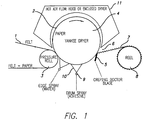
- FIG. 1 illustrates steps in formation of a tissue paper web suitable for use as a facial tissue.
- the method illustrated is a schematic example only and is not meant to indicate or infer any limitations on the method, but is only meant to illustrate the method in broad terms, representing one of a number of possible configurations used in processing tissue or towel products.
- the manufacturing method includes applying a creping adhesive to the surface of a Yankee dryer, using a felt or carrier fabric to apply a preformed fibrous nascent web to the creping adhesive on the surface of the dryer, drying the nascent web to form a paper web on the surface of the Yankee and, thereafter, removing the paper web from the Yankee dryer by use of a creping blade and winding the dried paper onto a roll.
- the method optionally also includes applying water or modifier, e.g., by spraying, to exposed edges of the Yankee drum, i.e., drum surfaces not contacted by the felt or carrier fabric.
- transfer and impression felt carrier fabric designated at 1 carries the nascent, dewatered paper web 2 around turning pressure roll 3 to the nip between the pressure roll 3 and Yankee dryer drum 4.
- the fabric, web and dryer move in the directions indicated by the arrows.
- the entry of the web to the dryer is well around the drum 4 from a creping doctor blade 5 which, as schematically indicated at 6, crepes the traveling web from the dryer.
- Creped web 7 exiting from the dryer is wound into a soft creped tissue reel 8.
- spray boom 9 sprays adhesive 10 directly onto the outer surface of the internally heated Yankee drum 4. Additionally, hot air flow is applied to the adhered paper web by a hood 11.
- Suitable apparatus for use with the present invention are disclosed in U.S. Pat. Nos. 4,304,625 and 4,064,213 .
- the apparatus can be configured so that the felt or carrier fabric 1 is of a dimension sufficient to entirely cover the surface of the drum 4 contacted by the doctor blade 5. If it not so dimensioned, which is typically the case, then in accordance with a preferred embodiment of the invention, possible in substantial part by the superior re-wetability of the adhesive obtained by the use of a phosphoric acid quenching step, water or modifier is applied to the exposed edge(s).
- An edge spray 12 can be used to apply a water spray 13 to the exposed side edge or edges of the drum, i.e., on the drive side and/or operator side of the adhesive coated Yankee drum, as the case may be.
- the present invention is useful for the preparation of fibrous webs which are creped to increase the thickness of the web and to provide texture to the web.
- the invention is particularly useful in the preparation of final products such as facial tissue, napkins, bath tissue, and paper towels.
- the fibrous web can be formed from various types of wood pulp based fibers which are used to make the above products such as hardwood kraft fibers, softwood kraft fibers, hardwood sulfite fibers, softwood sulfite fibers, high yield fibers such as chemi-thermo-mechanical pulps, thermomechanical pulps, or refiner mechanical pulps. Furnishes used may also contain or be totally comprised of recycled fibers (i.e., secondary fibers).
- the fibrous web prior to application to the Yankee dryer, usually has a water content of 40 to 80 wt. %, more preferably 50 to 70 wt. %.
- the fibrous web usually has a water content of less than 7 wt. %, preferably less than 5 wt. %.
- the creping operation itself can be conducted under conventional conditions except that the creping adhesive of the present invention is substituted for a conventional creping adhesive.
- an improved poly(aminoamide)-epihalohydrin creping adhesive that is re-wetable and facilitates water spray removal of buildup so as to lengthen the life of the creping blades, with attendant significant decrease in downtime and maintenance.
- the adhesive is prepared in the usual manner of preparing poly(aminoamide)-epihalohydrin creping adhesives with a change in one step, a change that appears to be simple, yet which, very surprisingly, results in substantial alleviation of the problems of adhesive buildup; and, in many cases, makes it possible for the creping package to provide an increased level of adhesion producing a softer more flexible creped sheet as reflected by a decreased tensile modulus.
- This change is accomplished at the end of the polymerization reaction, at the quenching step, by replacing the usual sulfuric acid or hydrochloric acid with phosphoric acid.
- a poly(aminoamide)-epihalohydrin creping adhesive is prepared by first reacting a dibasic carboxylic acid, or its ester, half-ester, or anhydride derivative, with a polyalkylene polyamine, preferably in aqueous solution, under conditions suitable to produce a water soluble polyamide.
- the water-soluble polyamide is then reacted with an epihalohydrin, and stabilized by acidification with phosphoric acid at the end of the polymerization reaction, preferably with 85% ortho-phosphoric acid, 0.1 - 2.0 molar equivalent based on polymer content to a pH of 3.5 - 7.0, most preferably to 7.0.
- Acidification quenches the epihalohydrin cross-linking reaction, in which molecular weight is built, to prevent gelation.
- the acid salts of the remaining amine groups in the polymer backbone are less reactive toward the azetidinium rings than were the free amines at the higher pH before quenching.
- the extent of cross-linking can be controlled with reaction conditions.
- epihalohydrin is added in aliquots to base polymer and reacted at high temperature at each stage until there is viscosity "burn-out", with no more advancement.
- the polymer is then acidified, ensuring that the difunctional epihalohydrin has reacted completely with prepolymer.
- the correct viscosity end point is determined by carefully controlling the amount of epihalohydrin added.
- a small excess of epihalohydrin is added (compared to fully cross-linked, either in aliquots or at once) and reacted to a pre-determined viscosity end point before the reaction burns out.
- the viscosity advancement is halted at the determined end point by addition of acid. This ensures that the epihalohydrin is not completely cross-linked and that some residual pendant chlorohydrin remains.
- C-13 NMR can detect pendant chlorohydrin present in partially cross-linked resins.
- the viscosity of the partially cross-linked material can be made to advance with heat, and can change during storage while fully cross-linked materials are far more stable over time.
- the polyalkylene polyamine preferably has the repeating units -NH(C n H n HN) x -CORCO- where n and x are each 2 or more and R is the divalent hydrocarbon radical of the dibasic carboxylic acid or its derivative containing from about 3-10 carbon atoms.
- the polyamide secondary amine groups are preferably derived from a polyalkylene polyamine for example polyethylene polyamides, polypropylene polyamines or polybutylene polyamines, with diethylenetriamine being preferred.
- Poly(aminoamide)-epihalohydrin resins undergo at least two types of reactions that contribute to wet strength.
- One reaction involves the reaction of an azetidinium group in one molecule with an unreacted secondary amine group in another molecule to produce a cross-link between the two molecules.
- the second reaction at least two azetidinium groups on a single resin molecule react with carboxyl groups on two different fibers to produce an interfiber cross-link.
- promoters such as carboxymethyl cellulose to enhance the performance of these materials in paper products.
- the dicarboxylic acid is one of the saturated aliphatic dibasic carboxylic acids containing from about 3 to about 10 carbon atoms.
- Examples are malonic, succinic, glutaric, adipic, pimelic, suberic, azelaic, and sebacic dicarboxylic acids, and mixtures thereof.
- Examples of ester, half-ester, or anhydride derivatives of adipoc acid are dimethyl adipate, diethyl adipate, adipic acid monomethyl ester, adipic acid monoethyl ester, and adipic acid anhydride.
- Corresponding esters, half esters, and anhydrides of each of the listed dibasic acids are further examples.
- Blends of two or more of derivatives of dibasic carboxylic acids may also be used, as well as blends of one or more derivatives of dibasic carboxylic acids with dibasic acids.
- Dicarboxylic acids containing from 4 to 8 carbon atoms, and their derivatives, are preferred, with adipic acid (hexanedioic acid) being most preferred.
- adipic acid hexanedioic acid
- the mole ratio of polyalkylene to dibasic carboxylic acid, or equivalent amount of its derivative is from about 0.8 to 1 to about 1.5 to 1.
- the mole ratio of epihalohydrin to secondary amine groups in the polyamide is preferably from about 0.01 to 1 to about 2 to 1.
- the epihalohydrin used in preparing the poly(aminoamide)-epihalohydrin resin is preferably epichlorohydrin, to prepare a phosphoric acid stabilized poly(aminoamide)-epichlorohydrin resin.
- the poly(aminoamide)-epihalohydrin resin is stabilized by acidification to a pH of 3.5-7.0, preferably to 7.0, at the end of the polymerization reaction.
- the poly(aminoamide)-epihalohydrin resin in place of the usual acidification with sulfuric acid, or in some cases with hydrochloric acid, is stabilized with phoshoric acid.
- it is stabilized with 85% ortho-phosphoric acid, 0.1 - 2.0 molar equivalent based on polymer content phosphoric acid, to a pH of 3.5 - 7.0, most preferably to 7.0.
- the reactor condenser was configured for reflux.
- 990.2242 grams of liquid DETA (diethylenetriamine) were loaded to the reactor at 25 °C and atmospheric pressure.
- the reaction was exothermal, raising the temperature from 40 °C to about 147 °C during the course of adipic acid additions.
- the reactor condenser was switched from reflux to distillation and heat was applied to raise the reaction temperature to a maximum of 165°C. Water began to distill from the reaction mixture at about 160 °C, and heat was supplied to slowly ramp-up the reaction temperature to a maximum temperature of 165 °C.
- the condenser was then switched back to reflux, and fresh water was gradually loaded to the molten prepolymer at 158 °C and atmospheric pressure. The addition of water brought the prepolymer to about 66% concentration and reduced the reaction temperature to about 100 °C. The prepolymer was then diluted to 45% non-volatiles, and the viscosity was 290 cP by Brookfield.
- Example 2 Physical properties of the formulations of Example 2 (denoted 378G55) and Example 3 (denoted 315D54), are shown in Table 1.
- the materials were analyzed for molecular weight based on poly(vinyl pyridine) standards. To determine weight % solids, weighed portions of each sample were dried for 4 hours at 105°C in a weighed aluminum pan. The dried samples were cooled and weighed again to determine water loss.
- For C-13 NMR analysis 2.8 ml of the adhesive was combined with 0.4 ml of D2O and TSP in an NMR tube. Quantitative C-13 and P-31 NMR spectra were taken at 25°C on a Varian UNITY® 300 MHz NMR using standard suppressed nuclear Overhauser conditions.
- Example 2 The formulations of Examples 2 and 3 were used in runs preparing tissue on a Yankee drum with apparatus in which the carrier fabric did not extend to the entire drive and operator sides, leaving drive and operator edges exposed.
- the top blade was run with the sulfuric acid stabilized adhesive of Example 3, while the bottom was run with the phosphoric acid stabilized adhesive of Example 2.
- Each blade was run for 4 reels, about 80 minutes.
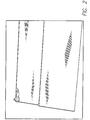
- the phosphoric acid stabilized adhesive did not build a hard coating on the edges of the rear blade surface when a water spray at 20 psi was applied on the edges of the Yankee surface.
- the sulfuric acid stabilized adhesive built hard coating on both edges of the rear blade surface.
- edge coating build-up reduced with 315D54 when the sheet temperature is reduced to 121°C (250°F).
- This improved wet-ability provided a considerable improvement in adhesion resulting in a softer sheet as reflected by a significant reduction in base sheet GM Modulus when the adhesive was switched from 315D54 (i.e., GM Modulus of 59 g/%) to 378G55 (i.e., GMM of 49.6 g/%) at the sheet temperature close to 127°C (260°F).
- the base sheet produced with 315D54 had a GM Modulus (i.e., 47.6 g/%) similar to that of the based sheet produced with 378G55 at 125°C (257°F) sheet temperature. It is evident that 378G55 performs well at higher sheet temperature while 315D54 can only perform as well at lower sheet temperature.
- creping adhesives of the present invention (Unicrepe PAE) a series of creping trials were performed using four different commercially available conventional creping adhesives based on PAE or PVOH at an add on rate of 2 kg of creping adhesive per 1000 kg (4 lbs. per ton) of paper passed over Yankee. Creping was attempted with two base sheets: a conventional wet strength base sheet for napkin stock which was substantially free of any release/barrier material, and a barrier napkin base sheets comprising alkenyl ketene dimer in the amounts indicated. All of the creping adhesives were satisfactory with a conventional base sheet.
- creping adhesive of the present invention was suitable for use with base sheets containing 1.63 kg of alkenyl ketene dimer per 1000 kg (3.25 lbs per ton) of tissue.
- the conventional creping adhesives resulted in poor creping and unstable sheets. It is believed that this result can be attributed to the very low creping force observed with each of conventional adhesives. Throughout these examples, a 5° blade bevel was used.
Landscapes
- Paper (AREA)
- Adhesives Or Adhesive Processes (AREA)
Claims (13)
- Verfahren zum Herstellen von Tissue, Papierhandtuch oder Papierserviette aus einer Endlospapierbahn auf der Außenfläche einer Papiertrocknungstrommel, umfassend:Auftragen einer Kreppklebstoffzusammensetzung auf die Außenfläche der Papiertrocknungstrommel, bevor die Bahn mit der Trommeloberfläche in Kontakt gelangt, wobei der Klebstoff einen phosphorsäurestabilisierten Poly(aminoamid)-Epihalohydrin-Kreppklebstoff enthält;Kontaktieren der Kreppklebstoff-tragenden Trommeloberfläche mit einer Endlospapierbahn;Trocknen der Endlospapierbahn; undKreppen des trockenen Endlospapiers mit einer Krepprakel zur Bildung eines gekreppten Tissues, Papierhandtuchs oder einer gekreppten Papierserviette.
- Verfahren zum Zubereiten eines phosphorsäurestabilisierten Poly(aminoamid)-Epihalohydrin-Kreppklebstoffs, umfassend:zuerst Umsetzen einer dibasischen Carbonsäure oder ihres Esters, Halbesters oder Anhydridderivats mit einem Polyalkylenpolyamin, um ein wasserlösliches Polyamid zu erhalten;Umsetzen des wasserlöslichen Polyamids mit einem Epihalohydrin; undStabilisieren des erhaltenen Produkts am Ende der Polymerisationsreaktion durch Ansäuerung mit Phosphorsäure auf einen pH-Wert von 3,5 bis 7,0.
- Verfahren nach einem der Ansprüche 1 oder 2, wobei der Poly(aminoamid)-Epihalohydrin-Kreppklebstoff ein Poly(aminoamid)-Epichlorhydrin-Kreppklebstoff ist.
- Verfahren nach einem der Ansprüche 1 oder 3, wobei der Poly(aminoamid)-Epihalohydrin-Kreppklebstoff zubereitet wird, indem zuerst dibasische Carbonsäure oder ihr Ester, Halbester oder Anhydridderivat, enthaltend etwa 3 bis etwa 10 Kohlenstoffatome, mit einem Polyalkylenpolyamin umgesetzt wird, um ein wasserlösliches Polyamid zu erhalten, das wasserlösliche Polyamid dann mit einem Epihalohydrin umgesetzt wird und durch Ansäuerung mit Phosphorsäure auf einen pH-Wert von 3,5 bis 7,0 am Ende der Polymerisationsreaktion stabilisiert wird.
- Verfahren nach Anspruch 4, wobei die Dicarbonsäure Adipinsäure ist.
- Verfahren nach Anspruch 4, wobei das in der Zubereitung des Poly(aminoamid)-Epihalohydrinpolymers verwendete Epihalohydrin Epichlorhydrin ist.
- Verfahren nach Anspruch 4, wobei der phosphorsäurestabilisierte Poly(aminoamid)-Epihalohydrin-Kreppklebstoff im Wesentlichen vollständig vernetzt ist.
- Verfahren nach Anspruch 1, wobei der Trockner ein Yankee-Trockner ist und die Kreppklebstoffzusammensetzung auf die Außenfläche der Yankee-Trocknertrommel aufgetragen wird, die Papierbahn auf die mit Klebstoff beschichtete Außenfläche der Trommel durch einen Trägerstoff aufgetragen wird, der sich nicht zu einem Rand oder mehreren Rändern der Trommeloberfläche erstreckt, wodurch ein Rand oder mehrere Ränder der Trommeloberfläche freiliegen, und enthaltend den Schritt des Auftragens von Wasser auf den einen freiliegenden Rand oder die mehreren freiliegenden Ränder der mit Klebstoff beschichteten Trommel.
- Phosphorsäurestabilisierter Poly(aminoamid)-Epihalohydrin-Kreppklebstoff.
- Klebstoff nach Anspruch 9, wobei der Poly(aminoamid)-Epihalohydrin-Kreppklebstoff ein Poly(aminoamid)-Epichlorhydrin-Kreppklebstoff ist.
- Klebstoff nach Anspruch 9, wobei der Poly(aminoamid)-Epihalohydrin-Kreppklebstoff zubereitet wird, indem zuerst dibasische Carbonsäure oder ihr Ester, Halbester oder Anhydridderivat, mit einem Polyalkylenpolyamin umgesetzt wird, um ein wasserlösliches Polyamid zu erhalten, das wasserlösliche Polyamid dann mit einem Epihalohydrin umgesetzt wird und durch Ansäuerung mit Phosphorsäure auf einen pH-Wert von 3,5 bis 7,0 am Ende der Polymerisationsreaktion stabilisiert wird.
- Klebstoff nach Anspruch 11, wobei die Dicarbonsäure eines von gesättigten, aliphatischen, dibasischen Carbonsäuren, einem Ester, Halbester oder Anhydridderivat ist, enthaltend etwa 3 bis etwa 10 Kohlenstoffatome.
- Klebstoff nach Anspruch 11, wobei das wasserlösliche Polyamid mit Epihalohydrin umgesetzt wird, bis das Poly(aminoamid)-Epihalohydrin im Wesentlichen vollständig vernetzt ist.
Priority Applications (1)
| Application Number | Priority Date | Filing Date | Title |
|---|---|---|---|
| PL06004638T PL1703019T3 (pl) | 2005-03-15 | 2006-03-07 | Stabilizowany kwasem fosforowym klej krepujący |
Applications Claiming Priority (1)
| Application Number | Priority Date | Filing Date | Title |
|---|---|---|---|
| US11/081,387 US7718035B2 (en) | 2005-03-15 | 2005-03-15 | Phosphoric acid quenched creping adhesive |
Publications (2)
| Publication Number | Publication Date |
|---|---|
| EP1703019A1 EP1703019A1 (de) | 2006-09-20 |
| EP1703019B1 true EP1703019B1 (de) | 2018-04-25 |
Family
ID=36602775
Family Applications (1)
| Application Number | Title | Priority Date | Filing Date |
|---|---|---|---|
| EP06004638.0A Expired - Lifetime EP1703019B1 (de) | 2005-03-15 | 2006-03-07 | Phosphorsäure stabilisierte Kreppklebemittel |
Country Status (7)
| Country | Link |
|---|---|
| US (2) | US7718035B2 (de) |
| EP (1) | EP1703019B1 (de) |
| CA (1) | CA2539532C (de) |
| ES (1) | ES2670841T3 (de) |
| HU (1) | HUE038975T2 (de) |
| PL (1) | PL1703019T3 (de) |
| TR (1) | TR201806902T4 (de) |
Families Citing this family (17)
| Publication number | Priority date | Publication date | Assignee | Title |
|---|---|---|---|---|
| US7959761B2 (en) * | 2002-04-12 | 2011-06-14 | Georgia-Pacific Consumer Products Lp | Creping adhesive modifier and process for producing paper products |
| US7718035B2 (en) * | 2005-03-15 | 2010-05-18 | Georgia-Pacific Consumer Products Lp | Phosphoric acid quenched creping adhesive |
| CA2735867C (en) | 2008-09-16 | 2017-12-05 | Dixie Consumer Products Llc | Food wrap basesheet with regenerated cellulose microfiber |
| DE102008047966A1 (de) * | 2008-09-18 | 2010-03-25 | Tesa Se | Repulpierbare Klebmassen |
| US8444812B2 (en) * | 2008-11-18 | 2013-05-21 | Nalco Company | Creping adhesives with improved film properties |
| US9382664B2 (en) | 2011-01-05 | 2016-07-05 | Georgia-Pacific Consumer Products Lp | Creping adhesive compositions and methods of using those compositions |
| US9670617B2 (en) * | 2011-02-15 | 2017-06-06 | Georgia-Pacific Consumer Products Lp | System and methods involving fabricating sheet products |
| CA2842988A1 (en) | 2011-08-01 | 2013-02-07 | Buckman Laboratories International, Inc. | Creping methods using ph-modified creping adhesive compositions |
| WO2014099838A1 (en) | 2012-12-19 | 2014-06-26 | Georgia-Pacific Chemicals Llc | Blends of polymers as wet strengthening agents for paper |
| US9611590B2 (en) * | 2013-11-07 | 2017-04-04 | Georgia-Pacific Chemicals Llc | Creping adhesives and methods for making and using same |
| US9976259B2 (en) | 2013-12-10 | 2018-05-22 | Buckman Laboratories International, Inc. | Adhesive formulation and creping methods using same |
| BR112017011840B1 (pt) * | 2014-12-12 | 2022-02-08 | Solenis Technologies, L.P. | Método para produzir um papel crepado |
| EP3768891A1 (de) | 2018-03-22 | 2021-01-27 | Buckman Laboratories International, Inc. | Modifizierte kreppklebstoffformulierung und kreppverfahren unter verwendung derselben |
| WO2021092363A1 (en) | 2019-11-07 | 2021-05-14 | Ecolab Usa Inc. | Creping adhesives and processes for making and using same |
| KR102286262B1 (ko) * | 2021-02-04 | 2021-08-10 | 모리스앤코 주식회사 | 반려견 대변 처리용 위생용지의 제조방법 및 그 위생용지 |
| CN116003783B (zh) * | 2022-12-21 | 2023-08-15 | 中国林业科学研究院林产化学工业研究所 | 一种腰果酚基粘缸剂及其制备方法 |
| WO2024227979A1 (en) * | 2023-05-03 | 2024-11-07 | Kemira Oyj | An intermediate composition |
Family Cites Families (39)
| Publication number | Priority date | Publication date | Assignee | Title |
|---|---|---|---|---|
| NL110447C (de) | 1957-09-05 | |||
| US2926154A (en) * | 1957-09-05 | 1960-02-23 | Hercules Powder Co Ltd | Cationic thermosetting polyamide-epichlorohydrin resins and process of making same |
| US3058873A (en) | 1958-09-10 | 1962-10-16 | Hercules Powder Co Ltd | Manufacture of paper having improved wet strength |
| US4056510A (en) | 1975-01-23 | 1977-11-01 | The Dow Chemical Company | Amine-modified polyethers |
| US4064213A (en) | 1976-02-09 | 1977-12-20 | Scott Paper Company | Creping process using two-position adhesive application |
| US4304625A (en) | 1979-11-13 | 1981-12-08 | Kimberly-Clark Corporation | Creping adhesives for through-dried tissue |
| US4501640A (en) | 1983-10-18 | 1985-02-26 | Kimberly-Clark Corporation | Creping adhesives containing polyvinyl alcohol and cationic polyamide resins |
| US4528316A (en) | 1983-10-18 | 1985-07-09 | Kimberly-Clark Corporation | Creping adhesives containing polyvinyl alcohol and cationic polyamide resins |
| US4684439A (en) | 1986-10-08 | 1987-08-04 | Kimberly-Clark Corporation | Creping adhesives containing polyvinyl alcohol and thermoplastic polyamide resins derived from poly(oxyethylene) diamine |
| US4886579A (en) | 1988-04-29 | 1989-12-12 | Scott Paper Company | Adhesive material for creping of fibrous webs |
| US5246544A (en) | 1990-10-02 | 1993-09-21 | James River Corporation Of Virginia | Crosslinkable creping adhesives |
| US5256727A (en) | 1992-04-30 | 1993-10-26 | Georgia-Pacific Resins, Inc. | Resins with reduced epichlorohydrin hydrolyzates |
| US5382323A (en) | 1993-01-08 | 1995-01-17 | Nalco Chemical Company | Cross-linked poly(aminoamides) as yankee dryer adhesives |
| US5370773A (en) | 1993-11-09 | 1994-12-06 | James River Corporation Of Virginia | Creping adhesives |
| US5374334A (en) | 1993-12-06 | 1994-12-20 | Nalco Chemical Company | Class of polymeric adhesives for yankee dryer applications |
| US5567798A (en) * | 1994-09-12 | 1996-10-22 | Georgia-Pacific Resins, Inc. | Repulpable wet strength resins for paper and paperboard |
| US5833806A (en) | 1995-04-25 | 1998-11-10 | Hercules Incorporated | Method for creping fibrous webs |
| US5786429A (en) | 1996-04-18 | 1998-07-28 | Hercules Incorporated | Highly branched polyamidoamines and their preparation |
| DE19654390A1 (de) | 1996-12-27 | 1998-07-02 | Basf Ag | Verfahren zur Herstellung von Papier |
| US6133405A (en) | 1997-07-10 | 2000-10-17 | Hercules Incorporated | Polyalkanolamide tackifying resins for creping adhesives |
| US5942085A (en) | 1997-12-22 | 1999-08-24 | The Procter & Gamble Company | Process for producing creped paper products |
| US6429267B1 (en) | 1997-12-31 | 2002-08-06 | Hercules Incorporated | Process to reduce the AOX level of wet strength resins by treatment with base |
| US6315865B1 (en) | 1998-02-27 | 2001-11-13 | Hercules Incorporated | Silyl-linked polyamidoamine and their preparation |
| US6187138B1 (en) | 1998-03-17 | 2001-02-13 | The Procter & Gamble Company | Method for creping paper |
| US6280571B1 (en) * | 1998-08-17 | 2001-08-28 | Hercules Incorporated | Stabilizer for creping adhesives |
| US6235155B1 (en) | 1999-01-25 | 2001-05-22 | Kimberly-Clark Worldwide, Inc. | Modified condensation polymers having azetidinium groups and containing polysiloxane moieties |
| US6277242B1 (en) | 2000-02-28 | 2001-08-21 | Calgon Corporation | Creping adhesive containing an admixture of PAE resins |
| US6352613B1 (en) | 2000-03-14 | 2002-03-05 | Hercules Incorporated | Resin compositions having high solids contents |
| US6336995B1 (en) | 2000-07-26 | 2002-01-08 | Vulcan Materials, Inc. | Cross linked polyamide-ephalohydrin creping additives |
| US20030070783A1 (en) | 2000-12-09 | 2003-04-17 | Riehle Richard James | Reduced byproduct high solids polyamine-epihalohydrin compositions |
| US20040118540A1 (en) * | 2002-12-20 | 2004-06-24 | Kimberly-Clark Worlwide, Inc. | Bicomponent strengtheninig system for paper |
| US7081512B2 (en) | 2003-05-21 | 2006-07-25 | Hercules Incorporated | Treatment of resins to lower levels of CPD-producing species and improve gelation stability |
| DE102004025861A1 (de) * | 2004-05-24 | 2005-12-22 | Basf Ag | Verfahren zur Herstellung von gekrepptem Papier |
| US7799169B2 (en) | 2004-09-01 | 2010-09-21 | Georgia-Pacific Consumer Products Lp | Multi-ply paper product with moisture strike through resistance and method of making the same |
| DE102004052957A1 (de) * | 2004-10-29 | 2006-05-04 | Basf Ag | Verfahren zur Herstellung von gekrepptem Papier |
| US7718035B2 (en) * | 2005-03-15 | 2010-05-18 | Georgia-Pacific Consumer Products Lp | Phosphoric acid quenched creping adhesive |
| US8066847B2 (en) * | 2005-12-29 | 2011-11-29 | Nalco Corporation | Creping adhesives comprising blends of polyaminoamide epihalolhydrin resins and polyamides |
| US8753478B2 (en) * | 2005-12-29 | 2014-06-17 | Nalco Company | Creping adhesives comprising blends of high and low molecular weight resins |
| PL2121806T3 (pl) * | 2007-01-19 | 2015-08-31 | Solenis Tech Cayman Lp | Sposób wytwarzania środków adhezyjnych do krepowania wytworzonych z poliamidoamin zakończonych grupą aminową |
-
2005
- 2005-03-15 US US11/081,387 patent/US7718035B2/en active Active
-
2006
- 2006-03-07 ES ES06004638.0T patent/ES2670841T3/es not_active Expired - Lifetime
- 2006-03-07 PL PL06004638T patent/PL1703019T3/pl unknown
- 2006-03-07 EP EP06004638.0A patent/EP1703019B1/de not_active Expired - Lifetime
- 2006-03-07 HU HUE06004638A patent/HUE038975T2/hu unknown
- 2006-03-07 TR TR2018/06902T patent/TR201806902T4/tr unknown
- 2006-03-14 CA CA2539532A patent/CA2539532C/en not_active Expired - Lifetime
-
2010
- 2010-03-30 US US12/749,586 patent/US20100184902A1/en not_active Abandoned
Non-Patent Citations (1)
| Title |
|---|
| None * |
Also Published As
| Publication number | Publication date |
|---|---|
| US20060207736A1 (en) | 2006-09-21 |
| ES2670841T3 (es) | 2018-06-01 |
| CA2539532A1 (en) | 2006-09-15 |
| TR201806902T4 (tr) | 2018-06-21 |
| US20100184902A1 (en) | 2010-07-22 |
| CA2539532C (en) | 2013-05-07 |
| HUE038975T2 (hu) | 2018-12-28 |
| PL1703019T3 (pl) | 2018-08-31 |
| US7718035B2 (en) | 2010-05-18 |
| EP1703019A1 (de) | 2006-09-20 |
Similar Documents
| Publication | Publication Date | Title |
|---|---|---|
| US20100184902A1 (en) | Phosphoric Acid Quenched Creping Adhesive | |
| RU2419547C2 (ru) | Способ регулирования избыточного накопления адгезива на сушильном барабане | |
| US5567798A (en) | Repulpable wet strength resins for paper and paperboard | |
| EP1908879B1 (de) | Verbesserte Krepphilfsmittel Modifizierer und Verfahren zur Herstellung von Papierprodukten | |
| US6663942B1 (en) | Crosslinkable creping adhesive formulations applied to a dryer surface or to a cellulosic fiber | |
| EP3246464B1 (de) | Papier und verfahren zur papierherstellung | |
| CA1250691A (en) | Epoxidized polyalkyleneamine-amide wet strength resins | |
| EP2794990B1 (de) | Zusammensetzungen und verfahren zur herstellung von papierprodukten | |
| US6277242B1 (en) | Creping adhesive containing an admixture of PAE resins | |
| KR101600102B1 (ko) | 고분자량 및 저분자량 수지 혼합물을 포함하는 크레이핑 접착제 | |
| US8771578B2 (en) | Acidified polyamidoamine adhesives, method of manufacture, and use for creping and ply bond applications | |
| JP2003515016A (ja) | クレーピング接着剤 | |
| EP2929087B1 (de) | In papier verwendete zusammensetzungen und verfahren zur papierherstellung | |
| EP3066261B1 (de) | Krepphaftstoffe und verfahren zur herstellung und verwendung davon | |
| US6689250B1 (en) | Crosslinkable creping adhesive formulations | |
| EP1330574B1 (de) | Vernetzte polyamide-epihalohydrin kreppklebemittel | |
| US20040211534A1 (en) | Creping additives for paper webs | |
| US6562194B1 (en) | Method of creping paper webs |
Legal Events
| Date | Code | Title | Description |
|---|---|---|---|
| PUAI | Public reference made under article 153(3) epc to a published international application that has entered the european phase |
Free format text: ORIGINAL CODE: 0009012 |
|
| AK | Designated contracting states |
Kind code of ref document: A1 Designated state(s): AT BE BG CH CY CZ DE DK EE ES FI FR GB GR HU IE IS IT LI LT LU LV MC NL PL PT RO SE SI SK TR |
|
| AX | Request for extension of the european patent |
Extension state: AL BA HR MK YU |
|
| 17P | Request for examination filed |
Effective date: 20070314 |
|
| RAP1 | Party data changed (applicant data changed or rights of an application transferred) |
Owner name: GEORGIA-PACIFIC CONSUMER PRODUCTS LP Owner name: GEORGIA-PACIFIC RESINS, INC. |
|
| 17Q | First examination report despatched |
Effective date: 20070417 |
|
| AKX | Designation fees paid |
Designated state(s): AT BE BG CH CY CZ DE DK EE ES FI FR GB GR HU IE IS IT LI LT LU LV MC NL PL PT RO SE SI SK TR |
|
| STAA | Information on the status of an ep patent application or granted ep patent |
Free format text: STATUS: EXAMINATION IS IN PROGRESS |
|
| GRAP | Despatch of communication of intention to grant a patent |
Free format text: ORIGINAL CODE: EPIDOSNIGR1 |
|
| STAA | Information on the status of an ep patent application or granted ep patent |
Free format text: STATUS: GRANT OF PATENT IS INTENDED |
|
| INTG | Intention to grant announced |
Effective date: 20171025 |
|
| RIN1 | Information on inventor provided before grant (corrected) |
Inventor name: CLUNGEON, NANCY S. Inventor name: RINGOLD, CLAY E. Inventor name: JOHNSON, DEXTER C. Inventor name: BOETTCHER, JEFFERY J. Inventor name: CHOU, HUNG LIANG |
|
| GRAS | Grant fee paid |
Free format text: ORIGINAL CODE: EPIDOSNIGR3 |
|
| RAP1 | Party data changed (applicant data changed or rights of an application transferred) |
Owner name: GEORGIA-PACIFIC CHEMICALS LLC Owner name: GPCP IP HOLDINGS LLC |
|
| GRAA | (expected) grant |
Free format text: ORIGINAL CODE: 0009210 |
|
| STAA | Information on the status of an ep patent application or granted ep patent |
Free format text: STATUS: THE PATENT HAS BEEN GRANTED |
|
| AK | Designated contracting states |
Kind code of ref document: B1 Designated state(s): AT BE BG CH CY CZ DE DK EE ES FI FR GB GR HU IE IS IT LI LT LU LV MC NL PL PT RO SE SI SK TR |
|
| REG | Reference to a national code |
Ref country code: GB Ref legal event code: FG4D |
|
| REG | Reference to a national code |
Ref country code: CH Ref legal event code: EP |
|
| REG | Reference to a national code |
Ref country code: AT Ref legal event code: REF Ref document number: 993056 Country of ref document: AT Kind code of ref document: T Effective date: 20180515 |
|
| REG | Reference to a national code |
Ref country code: IE Ref legal event code: FG4D |
|
| REG | Reference to a national code |
Ref country code: DE Ref legal event code: R096 Ref document number: 602006055212 Country of ref document: DE |
|
| REG | Reference to a national code |
Ref country code: ES Ref legal event code: FG2A Ref document number: 2670841 Country of ref document: ES Kind code of ref document: T3 Effective date: 20180601 |
|
| REG | Reference to a national code |
Ref country code: SE Ref legal event code: TRGR |
|
| REG | Reference to a national code |
Ref country code: NL Ref legal event code: FP |
|
| REG | Reference to a national code |
Ref country code: LT Ref legal event code: MG4D |
|
| PG25 | Lapsed in a contracting state [announced via postgrant information from national office to epo] |
Ref country code: LT Free format text: LAPSE BECAUSE OF FAILURE TO SUBMIT A TRANSLATION OF THE DESCRIPTION OR TO PAY THE FEE WITHIN THE PRESCRIBED TIME-LIMIT Effective date: 20180425 Ref country code: BG Free format text: LAPSE BECAUSE OF FAILURE TO SUBMIT A TRANSLATION OF THE DESCRIPTION OR TO PAY THE FEE WITHIN THE PRESCRIBED TIME-LIMIT Effective date: 20180725 |
|
| PG25 | Lapsed in a contracting state [announced via postgrant information from national office to epo] |
Ref country code: GR Free format text: LAPSE BECAUSE OF FAILURE TO SUBMIT A TRANSLATION OF THE DESCRIPTION OR TO PAY THE FEE WITHIN THE PRESCRIBED TIME-LIMIT Effective date: 20180726 Ref country code: LV Free format text: LAPSE BECAUSE OF FAILURE TO SUBMIT A TRANSLATION OF THE DESCRIPTION OR TO PAY THE FEE WITHIN THE PRESCRIBED TIME-LIMIT Effective date: 20180425 |
|
| REG | Reference to a national code |
Ref country code: HU Ref legal event code: AG4A Ref document number: E038975 Country of ref document: HU |
|
| PG25 | Lapsed in a contracting state [announced via postgrant information from national office to epo] |
Ref country code: PT Free format text: LAPSE BECAUSE OF FAILURE TO SUBMIT A TRANSLATION OF THE DESCRIPTION OR TO PAY THE FEE WITHIN THE PRESCRIBED TIME-LIMIT Effective date: 20180827 |
|
| REG | Reference to a national code |
Ref country code: DE Ref legal event code: R097 Ref document number: 602006055212 Country of ref document: DE |
|
| PG25 | Lapsed in a contracting state [announced via postgrant information from national office to epo] |
Ref country code: RO Free format text: LAPSE BECAUSE OF FAILURE TO SUBMIT A TRANSLATION OF THE DESCRIPTION OR TO PAY THE FEE WITHIN THE PRESCRIBED TIME-LIMIT Effective date: 20180425 Ref country code: SK Free format text: LAPSE BECAUSE OF FAILURE TO SUBMIT A TRANSLATION OF THE DESCRIPTION OR TO PAY THE FEE WITHIN THE PRESCRIBED TIME-LIMIT Effective date: 20180425 Ref country code: DK Free format text: LAPSE BECAUSE OF FAILURE TO SUBMIT A TRANSLATION OF THE DESCRIPTION OR TO PAY THE FEE WITHIN THE PRESCRIBED TIME-LIMIT Effective date: 20180425 Ref country code: EE Free format text: LAPSE BECAUSE OF FAILURE TO SUBMIT A TRANSLATION OF THE DESCRIPTION OR TO PAY THE FEE WITHIN THE PRESCRIBED TIME-LIMIT Effective date: 20180425 |
|
| PLBE | No opposition filed within time limit |
Free format text: ORIGINAL CODE: 0009261 |
|
| STAA | Information on the status of an ep patent application or granted ep patent |
Free format text: STATUS: NO OPPOSITION FILED WITHIN TIME LIMIT |
|
| 26N | No opposition filed |
Effective date: 20190128 |
|
| PG25 | Lapsed in a contracting state [announced via postgrant information from national office to epo] |
Ref country code: SI Free format text: LAPSE BECAUSE OF FAILURE TO SUBMIT A TRANSLATION OF THE DESCRIPTION OR TO PAY THE FEE WITHIN THE PRESCRIBED TIME-LIMIT Effective date: 20180425 |
|
| PG25 | Lapsed in a contracting state [announced via postgrant information from national office to epo] |
Ref country code: MC Free format text: LAPSE BECAUSE OF FAILURE TO SUBMIT A TRANSLATION OF THE DESCRIPTION OR TO PAY THE FEE WITHIN THE PRESCRIBED TIME-LIMIT Effective date: 20180425 |
|
| REG | Reference to a national code |
Ref country code: CH Ref legal event code: PL |
|
| PG25 | Lapsed in a contracting state [announced via postgrant information from national office to epo] |
Ref country code: LU Free format text: LAPSE BECAUSE OF NON-PAYMENT OF DUE FEES Effective date: 20190307 |
|
| REG | Reference to a national code |
Ref country code: BE Ref legal event code: MM Effective date: 20190331 |
|
| PG25 | Lapsed in a contracting state [announced via postgrant information from national office to epo] |
Ref country code: CH Free format text: LAPSE BECAUSE OF NON-PAYMENT OF DUE FEES Effective date: 20190331 Ref country code: IE Free format text: LAPSE BECAUSE OF NON-PAYMENT OF DUE FEES Effective date: 20190307 Ref country code: LI Free format text: LAPSE BECAUSE OF NON-PAYMENT OF DUE FEES Effective date: 20190331 |
|
| PG25 | Lapsed in a contracting state [announced via postgrant information from national office to epo] |
Ref country code: BE Free format text: LAPSE BECAUSE OF NON-PAYMENT OF DUE FEES Effective date: 20190331 |
|
| REG | Reference to a national code |
Ref country code: AT Ref legal event code: UEP Ref document number: 993056 Country of ref document: AT Kind code of ref document: T Effective date: 20180425 |
|
| PG25 | Lapsed in a contracting state [announced via postgrant information from national office to epo] |
Ref country code: CY Free format text: LAPSE BECAUSE OF FAILURE TO SUBMIT A TRANSLATION OF THE DESCRIPTION OR TO PAY THE FEE WITHIN THE PRESCRIBED TIME-LIMIT Effective date: 20180425 |
|
| PG25 | Lapsed in a contracting state [announced via postgrant information from national office to epo] |
Ref country code: IS Free format text: LAPSE BECAUSE OF FAILURE TO SUBMIT A TRANSLATION OF THE DESCRIPTION OR TO PAY THE FEE WITHIN THE PRESCRIBED TIME-LIMIT Effective date: 20180825 |
|
| REG | Reference to a national code |
Ref country code: GB Ref legal event code: 732E Free format text: REGISTERED BETWEEN 20230112 AND 20230118 |
|
| P01 | Opt-out of the competence of the unified patent court (upc) registered |
Effective date: 20230528 |
|
| P02 | Opt-out of the competence of the unified patent court (upc) changed |
Effective date: 20230831 |
|
| PGFP | Annual fee paid to national office [announced via postgrant information from national office to epo] |
Ref country code: NL Payment date: 20240326 Year of fee payment: 19 |
|
| PGFP | Annual fee paid to national office [announced via postgrant information from national office to epo] |
Ref country code: AT Payment date: 20240221 Year of fee payment: 19 |
|
| PGFP | Annual fee paid to national office [announced via postgrant information from national office to epo] |
Ref country code: HU Payment date: 20240222 Year of fee payment: 19 Ref country code: FI Payment date: 20240325 Year of fee payment: 19 Ref country code: DE Payment date: 20240327 Year of fee payment: 19 Ref country code: CZ Payment date: 20240223 Year of fee payment: 19 Ref country code: GB Payment date: 20240327 Year of fee payment: 19 |
|
| PGFP | Annual fee paid to national office [announced via postgrant information from national office to epo] |
Ref country code: TR Payment date: 20240226 Year of fee payment: 19 Ref country code: SE Payment date: 20240327 Year of fee payment: 19 Ref country code: PL Payment date: 20240220 Year of fee payment: 19 Ref country code: IT Payment date: 20240321 Year of fee payment: 19 Ref country code: FR Payment date: 20240325 Year of fee payment: 19 |
|
| PGFP | Annual fee paid to national office [announced via postgrant information from national office to epo] |
Ref country code: ES Payment date: 20240401 Year of fee payment: 19 |
|
| REG | Reference to a national code |
Ref country code: DE Ref legal event code: R119 Ref document number: 602006055212 Country of ref document: DE |
|
| PG25 | Lapsed in a contracting state [announced via postgrant information from national office to epo] |
Ref country code: FI Free format text: LAPSE BECAUSE OF NON-PAYMENT OF DUE FEES Effective date: 20250307 |
|
| PG25 | Lapsed in a contracting state [announced via postgrant information from national office to epo] |
Ref country code: CZ Free format text: LAPSE BECAUSE OF NON-PAYMENT OF DUE FEES Effective date: 20250307 |
|
| REG | Reference to a national code |
Ref country code: SE Ref legal event code: EUG |
|
| REG | Reference to a national code |
Ref country code: NL Ref legal event code: MM Effective date: 20250401 |
|
| PG25 | Lapsed in a contracting state [announced via postgrant information from national office to epo] |
Ref country code: HU Free format text: LAPSE BECAUSE OF NON-PAYMENT OF DUE FEES Effective date: 20250308 |
|
| REG | Reference to a national code |
Ref country code: AT Ref legal event code: MM01 Ref document number: 993056 Country of ref document: AT Kind code of ref document: T Effective date: 20250307 |
|
| GBPC | Gb: european patent ceased through non-payment of renewal fee |
Effective date: 20250307 |
|
| PG25 | Lapsed in a contracting state [announced via postgrant information from national office to epo] |
Ref country code: NL Free format text: LAPSE BECAUSE OF NON-PAYMENT OF DUE FEES Effective date: 20250401 |
|
| PG25 | Lapsed in a contracting state [announced via postgrant information from national office to epo] |
Ref country code: DE Free format text: LAPSE BECAUSE OF NON-PAYMENT OF DUE FEES Effective date: 20251001 |
|
| PG25 | Lapsed in a contracting state [announced via postgrant information from national office to epo] |
Ref country code: GB Free format text: LAPSE BECAUSE OF NON-PAYMENT OF DUE FEES Effective date: 20250307 |
|
| PG25 | Lapsed in a contracting state [announced via postgrant information from national office to epo] |
Ref country code: AT Free format text: LAPSE BECAUSE OF NON-PAYMENT OF DUE FEES Effective date: 20250307 |
|
| PG25 | Lapsed in a contracting state [announced via postgrant information from national office to epo] |
Ref country code: FR Free format text: LAPSE BECAUSE OF NON-PAYMENT OF DUE FEES Effective date: 20250331 Ref country code: IT Free format text: LAPSE BECAUSE OF NON-PAYMENT OF DUE FEES Effective date: 20250307 |
|
| PG25 | Lapsed in a contracting state [announced via postgrant information from national office to epo] |
Ref country code: SE Free format text: LAPSE BECAUSE OF NON-PAYMENT OF DUE FEES Effective date: 20250308 |
|
| REG | Reference to a national code |
Ref country code: ES Ref legal event code: FD2A Effective date: 20260427 |