EP1689760B1 - Verfahren zur asymmetrischen synthese - Google Patents
Verfahren zur asymmetrischen synthese Download PDFInfo
- Publication number
- EP1689760B1 EP1689760B1 EP04803259A EP04803259A EP1689760B1 EP 1689760 B1 EP1689760 B1 EP 1689760B1 EP 04803259 A EP04803259 A EP 04803259A EP 04803259 A EP04803259 A EP 04803259A EP 1689760 B1 EP1689760 B1 EP 1689760B1
- Authority
- EP
- European Patent Office
- Prior art keywords
- aryl
- alkyl
- cycloalkyl
- group
- hetaryl
- Prior art date
- Legal status (The legal status is an assumption and is not a legal conclusion. Google has not performed a legal analysis and makes no representation as to the accuracy of the status listed.)
- Expired - Lifetime
Links
- 238000000034 method Methods 0.000 title claims abstract description 79
- 238000011914 asymmetric synthesis Methods 0.000 title abstract description 11
- 239000003446 ligand Substances 0.000 claims abstract description 127
- 239000003054 catalyst Substances 0.000 claims abstract description 83
- 230000008569 process Effects 0.000 claims abstract description 57
- 125000003118 aryl group Chemical group 0.000 claims description 121
- 150000001875 compounds Chemical class 0.000 claims description 111
- 125000000217 alkyl group Chemical group 0.000 claims description 106
- 125000000753 cycloalkyl group Chemical group 0.000 claims description 95
- 150000003254 radicals Chemical class 0.000 claims description 87
- -1 organyl radical Chemical class 0.000 claims description 83
- 229910052739 hydrogen Inorganic materials 0.000 claims description 81
- 125000001072 heteroaryl group Chemical group 0.000 claims description 78
- 239000001257 hydrogen Substances 0.000 claims description 77
- 125000004429 atom Chemical group 0.000 claims description 75
- 125000000592 heterocycloalkyl group Chemical group 0.000 claims description 55
- 229910052698 phosphorus Inorganic materials 0.000 claims description 53
- 238000007037 hydroformylation reaction Methods 0.000 claims description 45
- 125000002252 acyl group Chemical group 0.000 claims description 41
- 125000001424 substituent group Chemical group 0.000 claims description 37
- 125000000524 functional group Chemical group 0.000 claims description 33
- 229910052799 carbon Inorganic materials 0.000 claims description 32
- 229910052736 halogen Inorganic materials 0.000 claims description 32
- 150000002367 halogens Chemical class 0.000 claims description 32
- 125000003545 alkoxy group Chemical group 0.000 claims description 30
- 125000004122 cyclic group Chemical group 0.000 claims description 28
- 125000004435 hydrogen atom Chemical class [H]* 0.000 claims description 26
- 150000001336 alkenes Chemical class 0.000 claims description 24
- 125000005842 heteroatom Chemical group 0.000 claims description 23
- 125000004093 cyano group Chemical group *C#N 0.000 claims description 22
- 150000001299 aldehydes Chemical class 0.000 claims description 21
- 229910052785 arsenic Inorganic materials 0.000 claims description 20
- 125000000449 nitro group Chemical group [O-][N+](*)=O 0.000 claims description 19
- 229910052757 nitrogen Inorganic materials 0.000 claims description 19
- 229910052723 transition metal Inorganic materials 0.000 claims description 19
- 150000003624 transition metals Chemical class 0.000 claims description 19
- 150000007942 carboxylates Chemical class 0.000 claims description 18
- 125000002496 methyl group Chemical group [H]C([H])([H])* 0.000 claims description 18
- 125000001495 ethyl group Chemical group [H]C([H])([H])C([H])([H])* 0.000 claims description 17
- BDHFUVZGWQCTTF-UHFFFAOYSA-M sulfonate Chemical compound [O-]S(=O)=O BDHFUVZGWQCTTF-UHFFFAOYSA-M 0.000 claims description 16
- 229910052787 antimony Inorganic materials 0.000 claims description 14
- 125000000623 heterocyclic group Chemical group 0.000 claims description 13
- 238000005810 carbonylation reaction Methods 0.000 claims description 12
- 238000005984 hydrogenation reaction Methods 0.000 claims description 12
- 125000004437 phosphorous atom Chemical group 0.000 claims description 12
- 238000011925 1,2-addition Methods 0.000 claims description 11
- 150000001450 anions Chemical class 0.000 claims description 11
- 230000006315 carbonylation Effects 0.000 claims description 11
- 229910052760 oxygen Inorganic materials 0.000 claims description 11
- 229910052717 sulfur Inorganic materials 0.000 claims description 11
- 125000004104 aryloxy group Chemical group 0.000 claims description 10
- 150000001768 cations Chemical class 0.000 claims description 10
- 125000000000 cycloalkoxy group Chemical group 0.000 claims description 10
- 238000005669 hydrocyanation reaction Methods 0.000 claims description 10
- 238000006459 hydrosilylation reaction Methods 0.000 claims description 9
- 150000002466 imines Chemical class 0.000 claims description 8
- 239000000758 substrate Substances 0.000 claims description 8
- 150000003573 thiols Chemical class 0.000 claims description 8
- JGLMVXWAHNTPRF-CMDGGOBGSA-N CCN1N=C(C)C=C1C(=O)NC1=NC2=CC(=CC(OC)=C2N1C\C=C\CN1C(NC(=O)C2=CC(C)=NN2CC)=NC2=CC(=CC(OCCCN3CCOCC3)=C12)C(N)=O)C(N)=O Chemical compound CCN1N=C(C)C=C1C(=O)NC1=NC2=CC(=CC(OC)=C2N1C\C=C\CN1C(NC(=O)C2=CC(C)=NN2CC)=NC2=CC(=CC(OCCCN3CCOCC3)=C12)C(N)=O)C(N)=O JGLMVXWAHNTPRF-CMDGGOBGSA-N 0.000 claims description 7
- 238000006136 alcoholysis reaction Methods 0.000 claims description 7
- 238000005882 aldol condensation reaction Methods 0.000 claims description 7
- 238000006197 hydroboration reaction Methods 0.000 claims description 7
- 238000006317 isomerization reaction Methods 0.000 claims description 7
- 238000003419 tautomerization reaction Methods 0.000 claims description 7
- 238000006579 Tsuji-Trost allylation reaction Methods 0.000 claims description 6
- 238000007098 aminolysis reaction Methods 0.000 claims description 6
- 238000005888 cyclopropanation reaction Methods 0.000 claims description 6
- 125000002887 hydroxy group Chemical group [H]O* 0.000 claims description 6
- 238000004519 manufacturing process Methods 0.000 claims description 6
- 238000005649 metathesis reaction Methods 0.000 claims description 6
- 238000007115 1,4-cycloaddition reaction Methods 0.000 claims description 5
- 230000000295 complement effect Effects 0.000 claims description 5
- 125000002950 monocyclic group Chemical group 0.000 claims description 5
- 125000004178 (C1-C4) alkyl group Chemical group 0.000 claims description 4
- 150000001733 carboxylic acid esters Chemical class 0.000 claims description 4
- 125000000468 ketone group Chemical group 0.000 claims description 4
- 125000002924 primary amino group Chemical group [H]N([H])* 0.000 claims description 4
- 125000003107 substituted aryl group Chemical group 0.000 claims description 4
- 125000005346 substituted cycloalkyl group Chemical group 0.000 claims description 4
- 125000000229 (C1-C4)alkoxy group Chemical group 0.000 claims description 3
- 125000000879 imine group Chemical group 0.000 claims description 3
- 230000003993 interaction Effects 0.000 claims description 3
- HZVOZRGWRWCICA-UHFFFAOYSA-N methanediyl Chemical group [CH2] HZVOZRGWRWCICA-UHFFFAOYSA-N 0.000 claims description 3
- 125000004430 oxygen atom Chemical group O* 0.000 claims description 3
- JOYRKODLDBILNP-UHFFFAOYSA-N Ethyl urethane Chemical compound CCOC(N)=O JOYRKODLDBILNP-UHFFFAOYSA-N 0.000 claims description 2
- WSFSSNUMVMOOMR-UHFFFAOYSA-N Formaldehyde Chemical compound O=C WSFSSNUMVMOOMR-UHFFFAOYSA-N 0.000 claims description 2
- 229930194542 Keto Natural products 0.000 claims description 2
- XSQUKJJJFZCRTK-UHFFFAOYSA-N Urea Chemical compound NC(N)=O XSQUKJJJFZCRTK-UHFFFAOYSA-N 0.000 claims description 2
- 150000001409 amidines Chemical class 0.000 claims description 2
- 239000004202 carbamide Substances 0.000 claims description 2
- SKOLWUPSYHWYAM-UHFFFAOYSA-N carbonodithioic O,S-acid Chemical compound SC(S)=O SKOLWUPSYHWYAM-UHFFFAOYSA-N 0.000 claims description 2
- 125000004433 nitrogen atom Chemical group N* 0.000 claims description 2
- 125000000467 secondary amino group Chemical group [H]N([*:1])[*:2] 0.000 claims description 2
- 150000003462 sulfoxides Chemical class 0.000 claims description 2
- 125000005555 sulfoximide group Chemical group 0.000 claims description 2
- 125000001302 tertiary amino group Chemical group 0.000 claims description 2
- 150000003857 carboxamides Chemical class 0.000 claims 1
- 125000004185 ester group Chemical group 0.000 claims 1
- 229940124530 sulfonamide Drugs 0.000 claims 1
- 150000003456 sulfonamides Chemical class 0.000 claims 1
- 229910052751 metal Inorganic materials 0.000 abstract description 16
- 239000002184 metal Substances 0.000 abstract description 16
- 238000006471 dimerization reaction Methods 0.000 abstract description 3
- 230000007704 transition Effects 0.000 abstract description 2
- 238000006243 chemical reaction Methods 0.000 description 43
- 150000002431 hydrogen Chemical class 0.000 description 34
- UFHFLCQGNIYNRP-UHFFFAOYSA-N Hydrogen Chemical compound [H][H] UFHFLCQGNIYNRP-UHFFFAOYSA-N 0.000 description 33
- VOXZDWNPVJITMN-ZBRFXRBCSA-N 17β-estradiol Chemical compound OC1=CC=C2[C@H]3CC[C@](C)([C@H](CC4)O)[C@@H]4[C@@H]3CCC2=C1 VOXZDWNPVJITMN-ZBRFXRBCSA-N 0.000 description 18
- KDLHZDBZIXYQEI-UHFFFAOYSA-N palladium Substances [Pd] KDLHZDBZIXYQEI-UHFFFAOYSA-N 0.000 description 18
- 125000001997 phenyl group Chemical group [H]C1=C([H])C([H])=C(*)C([H])=C1[H] 0.000 description 17
- 238000002360 preparation method Methods 0.000 description 16
- 230000015572 biosynthetic process Effects 0.000 description 14
- 239000000203 mixture Substances 0.000 description 14
- PXHVJJICTQNCMI-UHFFFAOYSA-N nickel Substances [Ni] PXHVJJICTQNCMI-UHFFFAOYSA-N 0.000 description 14
- BASFCYQUMIYNBI-UHFFFAOYSA-N platinum Substances [Pt] BASFCYQUMIYNBI-UHFFFAOYSA-N 0.000 description 14
- 239000010948 rhodium Substances 0.000 description 14
- 239000002904 solvent Substances 0.000 description 14
- 229910052703 rhodium Inorganic materials 0.000 description 13
- UHOVQNZJYSORNB-UHFFFAOYSA-N Benzene Chemical compound C1=CC=CC=C1 UHOVQNZJYSORNB-UHFFFAOYSA-N 0.000 description 12
- 125000001624 naphthyl group Chemical group 0.000 description 12
- 125000000999 tert-butyl group Chemical group [H]C([H])([H])C(*)(C([H])([H])[H])C([H])([H])[H] 0.000 description 12
- LFQSCWFLJHTTHZ-UHFFFAOYSA-N Ethanol Chemical compound CCO LFQSCWFLJHTTHZ-UHFFFAOYSA-N 0.000 description 11
- 125000004453 alkoxycarbonyl group Chemical group 0.000 description 11
- 229910052763 palladium Inorganic materials 0.000 description 11
- 238000003786 synthesis reaction Methods 0.000 description 11
- 125000002023 trifluoromethyl group Chemical group FC(F)(F)* 0.000 description 11
- 238000005481 NMR spectroscopy Methods 0.000 description 10
- 150000001298 alcohols Chemical class 0.000 description 10
- 125000004356 hydroxy functional group Chemical group O* 0.000 description 10
- 125000001449 isopropyl group Chemical group [H]C([H])([H])C([H])(*)C([H])([H])[H] 0.000 description 10
- MHOVAHRLVXNVSD-UHFFFAOYSA-N rhodium atom Chemical compound [Rh] MHOVAHRLVXNVSD-UHFFFAOYSA-N 0.000 description 10
- UGFAIRIUMAVXCW-UHFFFAOYSA-N Carbon monoxide Chemical compound [O+]#[C-] UGFAIRIUMAVXCW-UHFFFAOYSA-N 0.000 description 9
- OKKJLVBELUTLKV-UHFFFAOYSA-N Methanol Chemical compound OC OKKJLVBELUTLKV-UHFFFAOYSA-N 0.000 description 9
- YXFVVABEGXRONW-UHFFFAOYSA-N Toluene Chemical compound CC1=CC=CC=C1 YXFVVABEGXRONW-UHFFFAOYSA-N 0.000 description 9
- 229910002091 carbon monoxide Inorganic materials 0.000 description 9
- 239000000539 dimer Substances 0.000 description 9
- 150000002576 ketones Chemical class 0.000 description 9
- 229910052707 ruthenium Inorganic materials 0.000 description 9
- JRZJOMJEPLMPRA-UHFFFAOYSA-N 1-nonene Chemical compound CCCCCCCC=C JRZJOMJEPLMPRA-UHFFFAOYSA-N 0.000 description 8
- WYURNTSHIVDZCO-UHFFFAOYSA-N Tetrahydrofuran Chemical compound C1CCOC1 WYURNTSHIVDZCO-UHFFFAOYSA-N 0.000 description 8
- 125000004432 carbon atom Chemical group C* 0.000 description 8
- 229910052759 nickel Inorganic materials 0.000 description 7
- 229910052697 platinum Inorganic materials 0.000 description 7
- 239000000047 product Substances 0.000 description 7
- XEKOWRVHYACXOJ-UHFFFAOYSA-N Ethyl acetate Chemical compound CCOC(C)=O XEKOWRVHYACXOJ-UHFFFAOYSA-N 0.000 description 6
- IMNFDUFMRHMDMM-UHFFFAOYSA-N N-Heptane Chemical compound CCCCCCC IMNFDUFMRHMDMM-UHFFFAOYSA-N 0.000 description 6
- OAICVXFJPJFONN-UHFFFAOYSA-N Phosphorus Chemical compound [P] OAICVXFJPJFONN-UHFFFAOYSA-N 0.000 description 6
- KJTLSVCANCCWHF-UHFFFAOYSA-N Ruthenium Chemical compound [Ru] KJTLSVCANCCWHF-UHFFFAOYSA-N 0.000 description 6
- 239000003795 chemical substances by application Substances 0.000 description 6
- 230000000694 effects Effects 0.000 description 6
- 150000002148 esters Chemical class 0.000 description 6
- 229910052741 iridium Inorganic materials 0.000 description 6
- VLKZOEOYAKHREP-UHFFFAOYSA-N n-Hexane Chemical compound CCCCCC VLKZOEOYAKHREP-UHFFFAOYSA-N 0.000 description 6
- DGQUMYDUFBBKPK-UHFFFAOYSA-N 2-ethenyl-6-methoxynaphthalene Chemical compound C1=C(C=C)C=CC2=CC(OC)=CC=C21 DGQUMYDUFBBKPK-UHFFFAOYSA-N 0.000 description 5
- 239000002253 acid Substances 0.000 description 5
- 230000003213 activating effect Effects 0.000 description 5
- 150000001408 amides Chemical class 0.000 description 5
- 150000001412 amines Chemical class 0.000 description 5
- 150000001721 carbon Chemical group 0.000 description 5
- 239000000460 chlorine Substances 0.000 description 5
- 229930195733 hydrocarbon Natural products 0.000 description 5
- 150000002430 hydrocarbons Chemical class 0.000 description 5
- 238000011065 in-situ storage Methods 0.000 description 5
- XEEYBQQBJWHFJM-UHFFFAOYSA-N iron Substances [Fe] XEEYBQQBJWHFJM-UHFFFAOYSA-N 0.000 description 5
- 125000000956 methoxy group Chemical group [H]C([H])([H])O* 0.000 description 5
- 150000002825 nitriles Chemical class 0.000 description 5
- GJVFBWCTGUSGDD-UHFFFAOYSA-L pentamethonium bromide Chemical compound [Br-].[Br-].C[N+](C)(C)CCCCC[N+](C)(C)C GJVFBWCTGUSGDD-UHFFFAOYSA-L 0.000 description 5
- 239000011574 phosphorus Substances 0.000 description 5
- ZGEGCLOFRBLKSE-UHFFFAOYSA-N 1-Heptene Chemical compound CCCCCC=C ZGEGCLOFRBLKSE-UHFFFAOYSA-N 0.000 description 4
- DCTOHCCUXLBQMS-UHFFFAOYSA-N 1-undecene Chemical compound CCCCCCCCCC=C DCTOHCCUXLBQMS-UHFFFAOYSA-N 0.000 description 4
- 238000005160 1H NMR spectroscopy Methods 0.000 description 4
- HBAQYPYDRFILMT-UHFFFAOYSA-N 8-[3-(1-cyclopropylpyrazol-4-yl)-1H-pyrazolo[4,3-d]pyrimidin-5-yl]-3-methyl-3,8-diazabicyclo[3.2.1]octan-2-one Chemical class C1(CC1)N1N=CC(=C1)C1=NNC2=C1N=C(N=C2)N1C2C(N(CC1CC2)C)=O HBAQYPYDRFILMT-UHFFFAOYSA-N 0.000 description 4
- QGZKDVFQNNGYKY-UHFFFAOYSA-N Ammonia Chemical compound N QGZKDVFQNNGYKY-UHFFFAOYSA-N 0.000 description 4
- KAKZBPTYRLMSJV-UHFFFAOYSA-N Butadiene Chemical compound C=CC=C KAKZBPTYRLMSJV-UHFFFAOYSA-N 0.000 description 4
- HEDRZPFGACZZDS-UHFFFAOYSA-N Chloroform Chemical compound ClC(Cl)Cl HEDRZPFGACZZDS-UHFFFAOYSA-N 0.000 description 4
- KFZMGEQAYNKOFK-UHFFFAOYSA-N Isopropanol Chemical compound CC(C)O KFZMGEQAYNKOFK-UHFFFAOYSA-N 0.000 description 4
- LRHPLDYGYMQRHN-UHFFFAOYSA-N N-Butanol Chemical compound CCCCO LRHPLDYGYMQRHN-UHFFFAOYSA-N 0.000 description 4
- MZRVEZGGRBJDDB-UHFFFAOYSA-N N-Butyllithium Chemical compound [Li]CCCC MZRVEZGGRBJDDB-UHFFFAOYSA-N 0.000 description 4
- XYFCBTPGUUZFHI-UHFFFAOYSA-N Phosphine Chemical compound P XYFCBTPGUUZFHI-UHFFFAOYSA-N 0.000 description 4
- PPBRXRYQALVLMV-UHFFFAOYSA-N Styrene Chemical compound C=CC1=CC=CC=C1 PPBRXRYQALVLMV-UHFFFAOYSA-N 0.000 description 4
- HEDRZPFGACZZDS-MICDWDOJSA-N Trichloro(2H)methane Chemical compound [2H]C(Cl)(Cl)Cl HEDRZPFGACZZDS-MICDWDOJSA-N 0.000 description 4
- UORVGPXVDQYIDP-UHFFFAOYSA-N borane Chemical compound B UORVGPXVDQYIDP-UHFFFAOYSA-N 0.000 description 4
- 125000003178 carboxy group Chemical group [H]OC(*)=O 0.000 description 4
- 150000001732 carboxylic acid derivatives Chemical class 0.000 description 4
- 150000001735 carboxylic acids Chemical class 0.000 description 4
- 229910052762 osmium Inorganic materials 0.000 description 4
- 150000003003 phosphines Chemical class 0.000 description 4
- BDERNNFJNOPAEC-UHFFFAOYSA-N propan-1-ol Chemical compound CCCO BDERNNFJNOPAEC-UHFFFAOYSA-N 0.000 description 4
- 150000003839 salts Chemical class 0.000 description 4
- 150000003335 secondary amines Chemical class 0.000 description 4
- 239000000126 substance Substances 0.000 description 4
- 238000006467 substitution reaction Methods 0.000 description 4
- YLQBMQCUIZJEEH-UHFFFAOYSA-N tetrahydrofuran Natural products C=1C=COC=1 YLQBMQCUIZJEEH-UHFFFAOYSA-N 0.000 description 4
- JKJCKJFOSSLMJF-UHFFFAOYSA-N (5-ethenylthiophen-2-yl)-phenylmethanone Chemical compound S1C(C=C)=CC=C1C(=O)C1=CC=CC=C1 JKJCKJFOSSLMJF-UHFFFAOYSA-N 0.000 description 3
- 239000004912 1,5-cyclooctadiene Substances 0.000 description 3
- GJYSYQQXHBPJRD-UHFFFAOYSA-N 1-(2-methylpropyl)-4-prop-1-enylbenzene Chemical compound CC=CC1=CC=C(CC(C)C)C=C1 GJYSYQQXHBPJRD-UHFFFAOYSA-N 0.000 description 3
- AFFLGGQVNFXPEV-UHFFFAOYSA-N 1-decene Chemical compound CCCCCCCCC=C AFFLGGQVNFXPEV-UHFFFAOYSA-N 0.000 description 3
- CRSBERNSMYQZNG-UHFFFAOYSA-N 1-dodecene Chemical compound CCCCCCCCCCC=C CRSBERNSMYQZNG-UHFFFAOYSA-N 0.000 description 3
- QDCUAHOXDLTZCU-UHFFFAOYSA-N 1-ethenyl-3-phenoxybenzene Chemical compound C=CC1=CC=CC(OC=2C=CC=CC=2)=C1 QDCUAHOXDLTZCU-UHFFFAOYSA-N 0.000 description 3
- VTMSSJKVUVVWNJ-UHFFFAOYSA-N 1-ethenyl-4-(2-methylpropyl)benzene Chemical compound CC(C)CC1=CC=C(C=C)C=C1 VTMSSJKVUVVWNJ-UHFFFAOYSA-N 0.000 description 3
- KWKAKUADMBZCLK-UHFFFAOYSA-N 1-octene Chemical compound CCCCCCC=C KWKAKUADMBZCLK-UHFFFAOYSA-N 0.000 description 3
- ZWEHNKRNPOVVGH-UHFFFAOYSA-N 2-Butanone Chemical compound CCC(C)=O ZWEHNKRNPOVVGH-UHFFFAOYSA-N 0.000 description 3
- NTYHSGAJVIGSEY-UHFFFAOYSA-N 4-ethenyl-2-fluoro-1-phenylbenzene Chemical group FC1=CC(C=C)=CC=C1C1=CC=CC=C1 NTYHSGAJVIGSEY-UHFFFAOYSA-N 0.000 description 3
- CFEYBLWMNFZOPB-UHFFFAOYSA-N Allylacetonitrile Natural products C=CCCC#N CFEYBLWMNFZOPB-UHFFFAOYSA-N 0.000 description 3
- QGZKDVFQNNGYKY-UHFFFAOYSA-O Ammonium Chemical compound [NH4+] QGZKDVFQNNGYKY-UHFFFAOYSA-O 0.000 description 3
- 0 CC(N1)=C(*)C(*)=C(*)C1=O Chemical compound CC(N1)=C(*)C(*)=C(*)C1=O 0.000 description 3
- OKTJSMMVPCPJKN-UHFFFAOYSA-N Carbon Chemical compound [C] OKTJSMMVPCPJKN-UHFFFAOYSA-N 0.000 description 3
- YMWUJEATGCHHMB-UHFFFAOYSA-N Dichloromethane Chemical compound ClCCl YMWUJEATGCHHMB-UHFFFAOYSA-N 0.000 description 3
- RTZKZFJDLAIYFH-UHFFFAOYSA-N Diethyl ether Chemical compound CCOCC RTZKZFJDLAIYFH-UHFFFAOYSA-N 0.000 description 3
- 239000002841 Lewis acid Substances 0.000 description 3
- ZMXDDKWLCZADIW-UHFFFAOYSA-N N,N-Dimethylformamide Chemical compound CN(C)C=O ZMXDDKWLCZADIW-UHFFFAOYSA-N 0.000 description 3
- JCXJVPUVTGWSNB-UHFFFAOYSA-N Nitrogen dioxide Chemical class O=[N]=O JCXJVPUVTGWSNB-UHFFFAOYSA-N 0.000 description 3
- VYPSYNLAJGMNEJ-UHFFFAOYSA-N Silicium dioxide Chemical compound O=[Si]=O VYPSYNLAJGMNEJ-UHFFFAOYSA-N 0.000 description 3
- HEMHJVSKTPXQMS-UHFFFAOYSA-M Sodium hydroxide Chemical compound [OH-].[Na+] HEMHJVSKTPXQMS-UHFFFAOYSA-M 0.000 description 3
- 238000010719 annulation reaction Methods 0.000 description 3
- CREMABGTGYGIQB-UHFFFAOYSA-N carbon carbon Chemical compound C.C CREMABGTGYGIQB-UHFFFAOYSA-N 0.000 description 3
- 239000011203 carbon fibre reinforced carbon Substances 0.000 description 3
- 125000002915 carbonyl group Chemical group [*:2]C([*:1])=O 0.000 description 3
- 229910017052 cobalt Inorganic materials 0.000 description 3
- 239000010941 cobalt Substances 0.000 description 3
- GUTLYIVDDKVIGB-UHFFFAOYSA-N cobalt atom Chemical compound [Co] GUTLYIVDDKVIGB-UHFFFAOYSA-N 0.000 description 3
- 238000001212 derivatisation Methods 0.000 description 3
- 150000002170 ethers Chemical class 0.000 description 3
- 239000007789 gas Substances 0.000 description 3
- 238000005913 hydroamination reaction Methods 0.000 description 3
- GKOZUEZYRPOHIO-UHFFFAOYSA-N iridium atom Chemical compound [Ir] GKOZUEZYRPOHIO-UHFFFAOYSA-N 0.000 description 3
- 229910052742 iron Inorganic materials 0.000 description 3
- 150000007517 lewis acids Chemical class 0.000 description 3
- 238000000302 molecular modelling Methods 0.000 description 3
- 229960002009 naproxen Drugs 0.000 description 3
- 230000003647 oxidation Effects 0.000 description 3
- 238000007254 oxidation reaction Methods 0.000 description 3
- 230000000737 periodic effect Effects 0.000 description 3
- XRBCRPZXSCBRTK-UHFFFAOYSA-N phosphonous acid Chemical class OPO XRBCRPZXSCBRTK-UHFFFAOYSA-N 0.000 description 3
- 229920000233 poly(alkylene oxides) Polymers 0.000 description 3
- 238000009901 transfer hydrogenation reaction Methods 0.000 description 3
- RIOQSEWOXXDEQQ-UHFFFAOYSA-N triphenylphosphine Chemical compound C1=CC=CC=C1P(C=1C=CC=CC=1)C1=CC=CC=C1 RIOQSEWOXXDEQQ-UHFFFAOYSA-N 0.000 description 3
- XLYOFNOQVPJJNP-UHFFFAOYSA-N water Substances O XLYOFNOQVPJJNP-UHFFFAOYSA-N 0.000 description 3
- VNPFTLIIEKEYIW-UHFFFAOYSA-N (3-ethenylphenyl)-phenylmethanone Chemical compound C=CC1=CC=CC(C(=O)C=2C=CC=CC=2)=C1 VNPFTLIIEKEYIW-UHFFFAOYSA-N 0.000 description 2
- GGQQNYXPYWCUHG-RMTFUQJTSA-N (3e,6e)-deca-3,6-diene Chemical compound CCC\C=C\C\C=C\CC GGQQNYXPYWCUHG-RMTFUQJTSA-N 0.000 description 2
- QFGVXAGYMGCGNE-UHFFFAOYSA-N (4-ethenylphenyl)-thiophen-2-ylmethanone Chemical compound C1=CC(C=C)=CC=C1C(=O)C1=CC=CS1 QFGVXAGYMGCGNE-UHFFFAOYSA-N 0.000 description 2
- VYXHVRARDIDEHS-UHFFFAOYSA-N 1,5-cyclooctadiene Chemical compound C1CC=CCCC=C1 VYXHVRARDIDEHS-UHFFFAOYSA-N 0.000 description 2
- XWJBRBSPAODJER-UHFFFAOYSA-N 1,7-octadiene Chemical compound C=CCCCCC=C XWJBRBSPAODJER-UHFFFAOYSA-N 0.000 description 2
- VXNZUUAINFGPBY-UHFFFAOYSA-N 1-Butene Chemical compound CCC=C VXNZUUAINFGPBY-UHFFFAOYSA-N 0.000 description 2
- LIKMAJRDDDTEIG-UHFFFAOYSA-N 1-hexene Chemical compound CCCCC=C LIKMAJRDDDTEIG-UHFFFAOYSA-N 0.000 description 2
- 238000001644 13C nuclear magnetic resonance spectroscopy Methods 0.000 description 2
- XRMDCWJNPDVAFI-UHFFFAOYSA-N 2,2,6,6-tetramethyl-1-oxopiperidin-1-ium-4-ol Chemical compound CC1(C)CC(O)CC(C)(C)[N+]1=O XRMDCWJNPDVAFI-UHFFFAOYSA-N 0.000 description 2
- GKVVFBRUOAPKMI-UHFFFAOYSA-N 2-(4-ethenylphenyl)-3h-isoindol-1-one Chemical compound C1=CC(C=C)=CC=C1N1C(=O)C2=CC=CC=C2C1 GKVVFBRUOAPKMI-UHFFFAOYSA-N 0.000 description 2
- RYPKRALMXUUNKS-UHFFFAOYSA-N 2-Hexene Natural products CCCC=CC RYPKRALMXUUNKS-UHFFFAOYSA-N 0.000 description 2
- BKOOMYPCSUNDGP-UHFFFAOYSA-N 2-methylbut-2-ene Chemical compound CC=C(C)C BKOOMYPCSUNDGP-UHFFFAOYSA-N 0.000 description 2
- JMMZCWZIJXAGKW-UHFFFAOYSA-N 2-methylpent-2-ene Chemical compound CCC=C(C)C JMMZCWZIJXAGKW-UHFFFAOYSA-N 0.000 description 2
- WHGXZPQWZJUGEP-UHFFFAOYSA-N 2-prop-1-enylphenol Chemical compound CC=CC1=CC=CC=C1O WHGXZPQWZJUGEP-UHFFFAOYSA-N 0.000 description 2
- YEEGQDGJIXWFIQ-UHFFFAOYSA-N 3,4-dihydro-2h-1,4-oxazine Chemical class C1COC=CN1 YEEGQDGJIXWFIQ-UHFFFAOYSA-N 0.000 description 2
- CSCPPACGZOOCGX-UHFFFAOYSA-N Acetone Chemical compound CC(C)=O CSCPPACGZOOCGX-UHFFFAOYSA-N 0.000 description 2
- IJGRMHOSHXDMSA-UHFFFAOYSA-N Atomic nitrogen Chemical compound N#N IJGRMHOSHXDMSA-UHFFFAOYSA-N 0.000 description 2
- LSNNMFCWUKXFEE-UHFFFAOYSA-M Bisulfite Chemical compound OS([O-])=O LSNNMFCWUKXFEE-UHFFFAOYSA-M 0.000 description 2
- WKBOTKDWSSQWDR-UHFFFAOYSA-N Bromine atom Chemical compound [Br] WKBOTKDWSSQWDR-UHFFFAOYSA-N 0.000 description 2
- 239000007848 Bronsted acid Substances 0.000 description 2
- ZAMOUSCENKQFHK-UHFFFAOYSA-N Chlorine atom Chemical compound [Cl] ZAMOUSCENKQFHK-UHFFFAOYSA-N 0.000 description 2
- 238000003775 Density Functional Theory Methods 0.000 description 2
- 238000005698 Diels-Alder reaction Methods 0.000 description 2
- PXGOKWXKJXAPGV-UHFFFAOYSA-N Fluorine Chemical compound FF PXGOKWXKJXAPGV-UHFFFAOYSA-N 0.000 description 2
- VZCYOOQTPOCHFL-OWOJBTEDSA-N Fumaric acid Chemical compound OC(=O)\C=C\C(O)=O VZCYOOQTPOCHFL-OWOJBTEDSA-N 0.000 description 2
- 239000002879 Lewis base Substances 0.000 description 2
- CSNNHWWHGAXBCP-UHFFFAOYSA-L Magnesium sulfate Chemical compound [Mg+2].[O-][S+2]([O-])([O-])[O-] CSNNHWWHGAXBCP-UHFFFAOYSA-L 0.000 description 2
- BAPJBEWLBFYGME-UHFFFAOYSA-N Methyl acrylate Chemical compound COC(=O)C=C BAPJBEWLBFYGME-UHFFFAOYSA-N 0.000 description 2
- UFWIBTONFRDIAS-UHFFFAOYSA-N Naphthalene Chemical compound C1=CC=CC2=CC=CC=C21 UFWIBTONFRDIAS-UHFFFAOYSA-N 0.000 description 2
- NBBJYMSMWIIQGU-UHFFFAOYSA-N Propionic aldehyde Chemical compound CCC=O NBBJYMSMWIIQGU-UHFFFAOYSA-N 0.000 description 2
- DKGAVHZHDRPRBM-UHFFFAOYSA-N Tert-Butanol Chemical compound CC(C)(C)O DKGAVHZHDRPRBM-UHFFFAOYSA-N 0.000 description 2
- 238000006887 Ullmann reaction Methods 0.000 description 2
- BZHJMEDXRYGGRV-UHFFFAOYSA-N Vinyl chloride Chemical compound ClC=C BZHJMEDXRYGGRV-UHFFFAOYSA-N 0.000 description 2
- QROGIFZRVHSFLM-QHHAFSJGSA-N [(e)-prop-1-enyl]benzene Chemical compound C\C=C\C1=CC=CC=C1 QROGIFZRVHSFLM-QHHAFSJGSA-N 0.000 description 2
- 230000010933 acylation Effects 0.000 description 2
- 238000005917 acylation reaction Methods 0.000 description 2
- 125000004423 acyloxy group Chemical group 0.000 description 2
- 238000007259 addition reaction Methods 0.000 description 2
- 229910052783 alkali metal Inorganic materials 0.000 description 2
- XXROGKLTLUQVRX-UHFFFAOYSA-N allyl alcohol Chemical compound OCC=C XXROGKLTLUQVRX-UHFFFAOYSA-N 0.000 description 2
- 229910021529 ammonia Inorganic materials 0.000 description 2
- 238000004458 analytical method Methods 0.000 description 2
- 229910000085 borane Inorganic materials 0.000 description 2
- GDTBXPJZTBHREO-UHFFFAOYSA-N bromine Substances BrBr GDTBXPJZTBHREO-UHFFFAOYSA-N 0.000 description 2
- 229910052794 bromium Inorganic materials 0.000 description 2
- IAQRGUVFOMOMEM-UHFFFAOYSA-N but-2-ene Chemical compound CC=CC IAQRGUVFOMOMEM-UHFFFAOYSA-N 0.000 description 2
- BTANRVKWQNVYAZ-UHFFFAOYSA-N butan-2-ol Chemical compound CCC(C)O BTANRVKWQNVYAZ-UHFFFAOYSA-N 0.000 description 2
- 239000012018 catalyst precursor Substances 0.000 description 2
- 238000006555 catalytic reaction Methods 0.000 description 2
- 229910052801 chlorine Inorganic materials 0.000 description 2
- 239000012043 crude product Substances 0.000 description 2
- 239000013078 crystal Substances 0.000 description 2
- HGCIXCUEYOPUTN-UHFFFAOYSA-N cyclohexene Chemical compound C1CCC=CC1 HGCIXCUEYOPUTN-UHFFFAOYSA-N 0.000 description 2
- 125000000113 cyclohexyl group Chemical group [H]C1([H])C([H])([H])C([H])([H])C([H])(*)C([H])([H])C1([H])[H] 0.000 description 2
- LPIQUOYDBNQMRZ-UHFFFAOYSA-N cyclopentene Chemical compound C1CC=CC1 LPIQUOYDBNQMRZ-UHFFFAOYSA-N 0.000 description 2
- HEFNNWSXXWATRW-JTQLQIEISA-N dexibuprofen Chemical compound CC(C)CC1=CC=C([C@H](C)C(O)=O)C=C1 HEFNNWSXXWATRW-JTQLQIEISA-N 0.000 description 2
- 150000001993 dienes Chemical class 0.000 description 2
- 229940069096 dodecene Drugs 0.000 description 2
- 239000003814 drug Substances 0.000 description 2
- 150000002085 enols Chemical group 0.000 description 2
- NHOGGUYTANYCGQ-UHFFFAOYSA-N ethenoxybenzene Chemical class C=COC1=CC=CC=C1 NHOGGUYTANYCGQ-UHFFFAOYSA-N 0.000 description 2
- FJKIXWOMBXYWOQ-UHFFFAOYSA-N ethenoxyethane Chemical compound CCOC=C FJKIXWOMBXYWOQ-UHFFFAOYSA-N 0.000 description 2
- 239000011737 fluorine Substances 0.000 description 2
- 229910052731 fluorine Inorganic materials 0.000 description 2
- 150000004820 halides Chemical class 0.000 description 2
- LELOWRISYMNNSU-UHFFFAOYSA-N hydrogen cyanide Chemical compound N#C LELOWRISYMNNSU-UHFFFAOYSA-N 0.000 description 2
- 229960004187 indoprofen Drugs 0.000 description 2
- 239000012442 inert solvent Substances 0.000 description 2
- 150000002500 ions Chemical class 0.000 description 2
- VCJMYUPGQJHHFU-UHFFFAOYSA-N iron(3+);trinitrate Chemical compound [Fe+3].[O-][N+]([O-])=O.[O-][N+]([O-])=O.[O-][N+]([O-])=O VCJMYUPGQJHHFU-UHFFFAOYSA-N 0.000 description 2
- ZXEKIIBDNHEJCQ-UHFFFAOYSA-N isobutanol Chemical compound CC(C)CO ZXEKIIBDNHEJCQ-UHFFFAOYSA-N 0.000 description 2
- 229960000991 ketoprofen Drugs 0.000 description 2
- 150000007527 lewis bases Chemical class 0.000 description 2
- 239000007788 liquid Substances 0.000 description 2
- PDPSZWKARHWFBD-UHFFFAOYSA-N n-[6-[bis(diethylamino)phosphanyl]pyridin-2-yl]-2,2-dimethylpropanamide Chemical compound CCN(CC)P(N(CC)CC)C1=CC=CC(NC(=O)C(C)(C)C)=N1 PDPSZWKARHWFBD-UHFFFAOYSA-N 0.000 description 2
- 125000004108 n-butyl group Chemical group [H]C([H])([H])C([H])([H])C([H])([H])C([H])([H])* 0.000 description 2
- VJHGSLHHMIELQD-UHFFFAOYSA-N nona-1,8-diene Chemical compound C=CCCCCCC=C VJHGSLHHMIELQD-UHFFFAOYSA-N 0.000 description 2
- 230000000269 nucleophilic effect Effects 0.000 description 2
- CCCMONHAUSKTEQ-UHFFFAOYSA-N octadec-1-ene Chemical compound CCCCCCCCCCCCCCCCC=C CCCMONHAUSKTEQ-UHFFFAOYSA-N 0.000 description 2
- HFPZCAJZSCWRBC-UHFFFAOYSA-N p-cymene Chemical compound CC(C)C1=CC=C(C)C=C1 HFPZCAJZSCWRBC-UHFFFAOYSA-N 0.000 description 2
- YWAKXRMUMFPDSH-UHFFFAOYSA-N pentene Chemical compound CCCC=C YWAKXRMUMFPDSH-UHFFFAOYSA-N 0.000 description 2
- QMMOXUPEWRXHJS-UHFFFAOYSA-N pentene-2 Natural products CCC=CC QMMOXUPEWRXHJS-UHFFFAOYSA-N 0.000 description 2
- 239000012071 phase Substances 0.000 description 2
- 125000005538 phosphinite group Chemical group 0.000 description 2
- 150000004857 phospholes Chemical class 0.000 description 2
- 150000008300 phosphoramidites Chemical class 0.000 description 2
- 229910000073 phosphorus hydride Inorganic materials 0.000 description 2
- 125000001436 propyl group Chemical group [H]C([*])([H])C([H])([H])C([H])([H])[H] 0.000 description 2
- 239000011541 reaction mixture Substances 0.000 description 2
- 230000009467 reduction Effects 0.000 description 2
- 238000006722 reduction reaction Methods 0.000 description 2
- YNWSXIWHOSSPCO-UHFFFAOYSA-N rhodium(2+) Chemical compound [Rh+2] YNWSXIWHOSSPCO-UHFFFAOYSA-N 0.000 description 2
- PZSJYEAHAINDJI-UHFFFAOYSA-N rhodium(3+) Chemical class [Rh+3] PZSJYEAHAINDJI-UHFFFAOYSA-N 0.000 description 2
- 150000003303 ruthenium Chemical class 0.000 description 2
- 229920006395 saturated elastomer Polymers 0.000 description 2
- 125000002914 sec-butyl group Chemical group [H]C([H])([H])C([H])([H])C([H])(*)C([H])([H])[H] 0.000 description 2
- 150000004756 silanes Chemical class 0.000 description 2
- 239000000741 silica gel Substances 0.000 description 2
- 229910002027 silica gel Inorganic materials 0.000 description 2
- 239000007787 solid Substances 0.000 description 2
- 125000002130 sulfonic acid ester group Chemical group 0.000 description 2
- 229960004492 suprofen Drugs 0.000 description 2
- GKUQKQQLAZLMFX-UHFFFAOYSA-N tert-butyl 2,3-dihydro-1,4-oxazine-4-carboxylate Chemical compound CC(C)(C)OC(=O)N1CCOC=C1 GKUQKQQLAZLMFX-UHFFFAOYSA-N 0.000 description 2
- 125000005497 tetraalkylphosphonium group Chemical group 0.000 description 2
- VZCYOOQTPOCHFL-UHFFFAOYSA-N trans-butenedioic acid Natural products OC(=O)C=CC(O)=O VZCYOOQTPOCHFL-UHFFFAOYSA-N 0.000 description 2
- 150000003623 transition metal compounds Chemical class 0.000 description 2
- JRTIUDXYIUKIIE-KZUMESAESA-N (1z,5z)-cycloocta-1,5-diene;nickel Chemical compound [Ni].C\1C\C=C/CC\C=C/1.C\1C\C=C/CC\C=C/1 JRTIUDXYIUKIIE-KZUMESAESA-N 0.000 description 1
- LYXHWHHENVLYCN-QMDOQEJBSA-N (1z,5z)-cycloocta-1,5-diene;rhodium;tetrafluoroborate Chemical compound [Rh].F[B-](F)(F)F.C\1C\C=C/CC\C=C/1.C\1C\C=C/CC\C=C/1 LYXHWHHENVLYCN-QMDOQEJBSA-N 0.000 description 1
- ZOLLIQAKMYWTBR-MOLCZBCNSA-N (1z,5z,9z)-cyclododeca-1,5,9-triene Chemical compound C\1C\C=C/CC\C=C/CC\C=C/1 ZOLLIQAKMYWTBR-MOLCZBCNSA-N 0.000 description 1
- UULSXYSSHHRCQK-ZDUSSCGKSA-N (2s)-2-[4-(2-methylpropyl)phenyl]butanoic acid Chemical compound CC[C@H](C(O)=O)C1=CC=C(CC(C)C)C=C1 UULSXYSSHHRCQK-ZDUSSCGKSA-N 0.000 description 1
- DAFHKNAQFPVRKR-UHFFFAOYSA-N (3-hydroxy-2,2,4-trimethylpentyl) 2-methylpropanoate Chemical compound CC(C)C(O)C(C)(C)COC(=O)C(C)C DAFHKNAQFPVRKR-UHFFFAOYSA-N 0.000 description 1
- 125000006833 (C1-C5) alkylene group Chemical group 0.000 description 1
- YCTDZYMMFQCTEO-FNORWQNLSA-N (E)-3-octene Chemical compound CCCC\C=C\CC YCTDZYMMFQCTEO-FNORWQNLSA-N 0.000 description 1
- SYTBZMRGLBWNTM-JTQLQIEISA-N (S)-flurbiprofen Chemical compound FC1=CC([C@@H](C(O)=O)C)=CC=C1C1=CC=CC=C1 SYTBZMRGLBWNTM-JTQLQIEISA-N 0.000 description 1
- UVKXJAUUKPDDNW-NSCUHMNNSA-N (e)-pent-3-enenitrile Chemical compound C\C=C\CC#N UVKXJAUUKPDDNW-NSCUHMNNSA-N 0.000 description 1
- IYWJIYWFPADQAN-LNTINUHCSA-N (z)-4-hydroxypent-3-en-2-one;ruthenium Chemical compound [Ru].C\C(O)=C\C(C)=O.C\C(O)=C\C(C)=O.C\C(O)=C\C(C)=O IYWJIYWFPADQAN-LNTINUHCSA-N 0.000 description 1
- POILWHVDKZOXJZ-ARJAWSKDSA-M (z)-4-oxopent-2-en-2-olate Chemical compound C\C([O-])=C\C(C)=O POILWHVDKZOXJZ-ARJAWSKDSA-M 0.000 description 1
- VOSLXTGMYNYCPW-UHFFFAOYSA-N 1,10-Undecadiene Chemical compound C=CCCCCCCCC=C VOSLXTGMYNYCPW-UHFFFAOYSA-N 0.000 description 1
- BPHFKBMQSYYNGQ-UHFFFAOYSA-N 1,12-Tridecadiene Chemical compound C=CCCCCCCCCCC=C BPHFKBMQSYYNGQ-UHFFFAOYSA-N 0.000 description 1
- 125000005919 1,2,2-trimethylpropyl group Chemical group 0.000 description 1
- 125000001399 1,2,3-triazolyl group Chemical group N1N=NC(=C1)* 0.000 description 1
- WSLDOOZREJYCGB-UHFFFAOYSA-N 1,2-Dichloroethane Chemical compound ClCCCl WSLDOOZREJYCGB-UHFFFAOYSA-N 0.000 description 1
- 125000005918 1,2-dimethylbutyl group Chemical group 0.000 description 1
- RYHBNJHYFVUHQT-UHFFFAOYSA-N 1,4-Dioxane Chemical compound C1COCCO1 RYHBNJHYFVUHQT-UHFFFAOYSA-N 0.000 description 1
- PRBHEGAFLDMLAL-UHFFFAOYSA-N 1,5-Hexadiene Natural products CC=CCC=C PRBHEGAFLDMLAL-UHFFFAOYSA-N 0.000 description 1
- MTNKRTXSIXNCAP-UHFFFAOYSA-N 1-(4-butoxyphenyl)-n-[4-[2-[4-[(4-butoxyphenyl)methylideneamino]phenyl]ethyl]phenyl]methanimine Chemical compound C1=CC(OCCCC)=CC=C1C=NC(C=C1)=CC=C1CCC1=CC=C(N=CC=2C=CC(OCCCC)=CC=2)C=C1 MTNKRTXSIXNCAP-UHFFFAOYSA-N 0.000 description 1
- IQQRAVYLUAZUGX-UHFFFAOYSA-N 1-butyl-3-methylimidazolium Chemical class CCCCN1C=C[N+](C)=C1 IQQRAVYLUAZUGX-UHFFFAOYSA-N 0.000 description 1
- REACWASHYHDPSQ-UHFFFAOYSA-N 1-butylpyridin-1-ium Chemical class CCCC[N+]1=CC=CC=C1 REACWASHYHDPSQ-UHFFFAOYSA-N 0.000 description 1
- OVGRCEFMXPHEBL-UHFFFAOYSA-N 1-ethenoxypropane Chemical compound CCCOC=C OVGRCEFMXPHEBL-UHFFFAOYSA-N 0.000 description 1
- SDRZFSPCVYEJTP-UHFFFAOYSA-N 1-ethenylcyclohexene Chemical compound C=CC1=CCCCC1 SDRZFSPCVYEJTP-UHFFFAOYSA-N 0.000 description 1
- 125000006218 1-ethylbutyl group Chemical group [H]C([H])([H])C([H])([H])C([H])([H])C([H])(*)C([H])([H])C([H])([H])[H] 0.000 description 1
- ARNKHYQYAZLEEP-UHFFFAOYSA-N 1-naphthalen-1-yloxynaphthalene Chemical group C1=CC=C2C(OC=3C4=CC=CC=C4C=CC=3)=CC=CC2=C1 ARNKHYQYAZLEEP-UHFFFAOYSA-N 0.000 description 1
- HECLRDQVFMWTQS-RGOKHQFPSA-N 1755-01-7 Chemical compound C1[C@H]2[C@@H]3CC=C[C@@H]3[C@@H]1C=C2 HECLRDQVFMWTQS-RGOKHQFPSA-N 0.000 description 1
- GEAFJLPHGRQHTK-UHFFFAOYSA-N 2,2-dimethyl-n-[6-[naphthalen-1-yl(phenyl)phosphanyl]pyridin-2-yl]propanamide Chemical compound CC(C)(C)C(=O)NC1=CC=CC(P(C=2C=CC=CC=2)C=2C3=CC=CC=C3C=CC=2)=N1 GEAFJLPHGRQHTK-UHFFFAOYSA-N 0.000 description 1
- YQTCQNIPQMJNTI-UHFFFAOYSA-N 2,2-dimethylpropan-1-one Chemical compound CC(C)(C)[C]=O YQTCQNIPQMJNTI-UHFFFAOYSA-N 0.000 description 1
- LSIXBBPOJBJQHN-UHFFFAOYSA-N 2,3-Dimethylbicyclo[2.2.1]hept-2-ene Chemical compound C1CC2C(C)=C(C)C1C2 LSIXBBPOJBJQHN-UHFFFAOYSA-N 0.000 description 1
- SMZOUWXMTYCWNB-UHFFFAOYSA-N 2-(2-methoxy-5-methylphenyl)ethanamine Chemical compound COC1=CC=C(C)C=C1CCN SMZOUWXMTYCWNB-UHFFFAOYSA-N 0.000 description 1
- JAHNSTQSQJOJLO-UHFFFAOYSA-N 2-(3-fluorophenyl)-1h-imidazole Chemical compound FC1=CC=CC(C=2NC=CN=2)=C1 JAHNSTQSQJOJLO-UHFFFAOYSA-N 0.000 description 1
- OTTZHAVKAVGASB-HYXAFXHYSA-N 2-Heptene Chemical compound CCCC\C=C/C OTTZHAVKAVGASB-HYXAFXHYSA-N 0.000 description 1
- NIXOWILDQLNWCW-UHFFFAOYSA-N 2-Propenoic acid Natural products OC(=O)C=C NIXOWILDQLNWCW-UHFFFAOYSA-N 0.000 description 1
- 125000006176 2-ethylbutyl group Chemical group [H]C([H])([H])C([H])([H])C([H])(C([H])([H])*)C([H])([H])C([H])([H])[H] 0.000 description 1
- OTTZHAVKAVGASB-UHFFFAOYSA-N 2-heptene Natural products CCCCC=CC OTTZHAVKAVGASB-UHFFFAOYSA-N 0.000 description 1
- 125000004493 2-methylbut-1-yl group Chemical group CC(C*)CC 0.000 description 1
- 125000005916 2-methylpentyl group Chemical group 0.000 description 1
- ILPBINAXDRFYPL-UHFFFAOYSA-N 2-octene Chemical compound CCCCCC=CC ILPBINAXDRFYPL-UHFFFAOYSA-N 0.000 description 1
- ZQDPJFUHLCOCRG-UHFFFAOYSA-N 3-hexene Chemical compound CCC=CCC ZQDPJFUHLCOCRG-UHFFFAOYSA-N 0.000 description 1
- 125000003542 3-methylbutan-2-yl group Chemical group [H]C([H])([H])C([H])(*)C([H])(C([H])([H])[H])C([H])([H])[H] 0.000 description 1
- BEQGRRJLJLVQAQ-UHFFFAOYSA-N 3-methylpent-2-ene Chemical compound CCC(C)=CC BEQGRRJLJLVQAQ-UHFFFAOYSA-N 0.000 description 1
- 125000005917 3-methylpentyl group Chemical group 0.000 description 1
- UQRONKZLYKUEMO-UHFFFAOYSA-N 4-methyl-1-(2,4,6-trimethylphenyl)pent-4-en-2-one Chemical group CC(=C)CC(=O)Cc1c(C)cc(C)cc1C UQRONKZLYKUEMO-UHFFFAOYSA-N 0.000 description 1
- NLHHRLWOUZZQLW-UHFFFAOYSA-N Acrylonitrile Chemical compound C=CC#N NLHHRLWOUZZQLW-UHFFFAOYSA-N 0.000 description 1
- OSDWBNJEKMUWAV-UHFFFAOYSA-N Allyl chloride Chemical compound ClCC=C OSDWBNJEKMUWAV-UHFFFAOYSA-N 0.000 description 1
- CPELXLSAUQHCOX-UHFFFAOYSA-M Bromide Chemical compound [Br-] CPELXLSAUQHCOX-UHFFFAOYSA-M 0.000 description 1
- CTJFNLCIDZVRGS-UHFFFAOYSA-I C(C)(=O)[O-].[Rh+2].[Rh+3].C(C)(=O)[O-].C(C)(=O)[O-].C(C)(=O)[O-].C(C)(=O)[O-] Chemical compound C(C)(=O)[O-].[Rh+2].[Rh+3].C(C)(=O)[O-].C(C)(=O)[O-].C(C)(=O)[O-].C(C)(=O)[O-] CTJFNLCIDZVRGS-UHFFFAOYSA-I 0.000 description 1
- VEXZGXHMUGYJMC-UHFFFAOYSA-M Chloride anion Chemical compound [Cl-] VEXZGXHMUGYJMC-UHFFFAOYSA-M 0.000 description 1
- NOTFZGFABLVTIG-UHFFFAOYSA-N Cyclohexylethyl acetate Chemical compound CC(=O)OCCC1CCCCC1 NOTFZGFABLVTIG-UHFFFAOYSA-N 0.000 description 1
- SNRUBQQJIBEYMU-UHFFFAOYSA-N Dodecane Natural products CCCCCCCCCCCC SNRUBQQJIBEYMU-UHFFFAOYSA-N 0.000 description 1
- 206010013710 Drug interaction Diseases 0.000 description 1
- 230000005526 G1 to G0 transition Effects 0.000 description 1
- 238000000023 Kugelrohr distillation Methods 0.000 description 1
- 238000006683 Mannich reaction Methods 0.000 description 1
- CERQOIWHTDAKMF-UHFFFAOYSA-N Methacrylic acid Chemical compound CC(=C)C(O)=O CERQOIWHTDAKMF-UHFFFAOYSA-N 0.000 description 1
- SHCSFZHSNSGTOP-UHFFFAOYSA-N Methyl 4-pentenoate Chemical compound COC(=O)CCC=C SHCSFZHSNSGTOP-UHFFFAOYSA-N 0.000 description 1
- VVQNEPGJFQJSBK-UHFFFAOYSA-N Methyl methacrylate Chemical compound COC(=O)C(C)=C VVQNEPGJFQJSBK-UHFFFAOYSA-N 0.000 description 1
- BZLVMXJERCGZMT-UHFFFAOYSA-N Methyl tert-butyl ether Chemical compound COC(C)(C)C BZLVMXJERCGZMT-UHFFFAOYSA-N 0.000 description 1
- CCCAMSOAGWELBQ-UHFFFAOYSA-N N-[6-(12,14-dioxa-13-phosphapentacyclo[13.8.0.02,11.03,8.018,23]tricosa-1(15),2(11),3,5,7,9,16,18,20,22-decaen-13-yl)pyridin-2-yl]-2,2-dimethylpropanamide Chemical compound CC(C)(C)C(=O)NC1=CC=CC(P2OC3=C(C4=CC=CC=C4C=C3)C3=C4C=CC=CC4=CC=C3O2)=N1 CCCAMSOAGWELBQ-UHFFFAOYSA-N 0.000 description 1
- 238000007126 N-alkylation reaction Methods 0.000 description 1
- 239000004435 Oxo alcohol Substances 0.000 description 1
- ABLZXFCXXLZCGV-UHFFFAOYSA-N Phosphorous acid Chemical compound OP(O)=O ABLZXFCXXLZCGV-UHFFFAOYSA-N 0.000 description 1
- OFOBLEOULBTSOW-UHFFFAOYSA-N Propanedioic acid Natural products OC(=O)CC(O)=O OFOBLEOULBTSOW-UHFFFAOYSA-N 0.000 description 1
- 229910021604 Rhodium(III) chloride Inorganic materials 0.000 description 1
- 229910006069 SO3H Inorganic materials 0.000 description 1
- BLRPTPMANUNPDV-UHFFFAOYSA-N Silane Chemical compound [SiH4] BLRPTPMANUNPDV-UHFFFAOYSA-N 0.000 description 1
- 229910000831 Steel Inorganic materials 0.000 description 1
- NINIDFKCEFEMDL-UHFFFAOYSA-N Sulfur Chemical compound [S] NINIDFKCEFEMDL-UHFFFAOYSA-N 0.000 description 1
- QYKIQEUNHZKYBP-UHFFFAOYSA-N Vinyl ether Chemical class C=COC=C QYKIQEUNHZKYBP-UHFFFAOYSA-N 0.000 description 1
- HRJABHWZEQHPFS-UHFFFAOYSA-N [1-[2-(12,14-dioxa-13-phosphapentacyclo[13.8.0.02,11.03,8.018,23]tricosa-1(15),2(11),3,5,7,9,16,18,20,22-decaen-13-yloxy)naphthalen-1-yl]naphthalen-2-yl]-diphenylphosphane Chemical compound O1C=2C=CC3=CC=CC=C3C=2C(C2=CC=CC=C2C=C2)=C2OP1OC1=CC=C2C=CC=CC2=C1C(C1=CC=CC=C1C=C1)=C1P(C=1C=CC=CC=1)C1=CC=CC=C1 HRJABHWZEQHPFS-UHFFFAOYSA-N 0.000 description 1
- DHSFXWHSHXLCDP-UHFFFAOYSA-N [3-(methylamino)-1-phenylpropyl] acetate Chemical compound CNCCC(OC(C)=O)C1=CC=CC=C1 DHSFXWHSHXLCDP-UHFFFAOYSA-N 0.000 description 1
- IUHFWCGCSVTMPG-UHFFFAOYSA-N [C].[C] Chemical class [C].[C] IUHFWCGCSVTMPG-UHFFFAOYSA-N 0.000 description 1
- HDTOJNWTFZFLPZ-UHFFFAOYSA-J [K+].[Rh+3].[O-]S([O-])(=O)=O.[O-]S([O-])(=O)=O Chemical compound [K+].[Rh+3].[O-]S([O-])(=O)=O.[O-]S([O-])(=O)=O HDTOJNWTFZFLPZ-UHFFFAOYSA-J 0.000 description 1
- ROZSPJBPUVWBHW-UHFFFAOYSA-N [Ru]=O Chemical class [Ru]=O ROZSPJBPUVWBHW-UHFFFAOYSA-N 0.000 description 1
- DEQUSKUFNQLMEC-UHFFFAOYSA-N [dimethoxy(methyl)silyl]oxy-[dimethylsilyloxy(dimethyl)silyl]oxy-dimethylsilane Chemical compound CO[Si](C)(OC)O[Si](C)(C)O[Si](C)(C)O[SiH](C)C DEQUSKUFNQLMEC-UHFFFAOYSA-N 0.000 description 1
- 150000001242 acetic acid derivatives Chemical class 0.000 description 1
- 125000002777 acetyl group Chemical group [H]C([H])([H])C(*)=O 0.000 description 1
- 150000007513 acids Chemical class 0.000 description 1
- 125000000641 acridinyl group Chemical group C1(=CC=CC2=NC3=CC=CC=C3C=C12)* 0.000 description 1
- 230000004913 activation Effects 0.000 description 1
- 150000001266 acyl halides Chemical class 0.000 description 1
- 230000002776 aggregation Effects 0.000 description 1
- 238000004220 aggregation Methods 0.000 description 1
- 150000001335 aliphatic alkanes Chemical class 0.000 description 1
- 150000007933 aliphatic carboxylic acids Chemical class 0.000 description 1
- 150000001340 alkali metals Chemical class 0.000 description 1
- 229940045714 alkyl sulfonate alkylating agent Drugs 0.000 description 1
- 150000008052 alkyl sulfonates Chemical class 0.000 description 1
- 229940100198 alkylating agent Drugs 0.000 description 1
- 239000002168 alkylating agent Substances 0.000 description 1
- 125000002947 alkylene group Chemical group 0.000 description 1
- 125000000746 allylic group Chemical group 0.000 description 1
- XYLMUPLGERFSHI-UHFFFAOYSA-N alpha-Methylstyrene Chemical compound CC(=C)C1=CC=CC=C1 XYLMUPLGERFSHI-UHFFFAOYSA-N 0.000 description 1
- 125000003368 amide group Chemical group 0.000 description 1
- 238000005576 amination reaction Methods 0.000 description 1
- 150000003927 aminopyridines Chemical class 0.000 description 1
- 150000008064 anhydrides Chemical class 0.000 description 1
- 125000002178 anthracenyl group Chemical group C1(=CC=CC2=CC3=CC=CC=C3C=C12)* 0.000 description 1
- 239000008346 aqueous phase Substances 0.000 description 1
- 125000003435 aroyl group Chemical group 0.000 description 1
- 125000003710 aryl alkyl group Chemical group 0.000 description 1
- 150000005840 aryl radicals Chemical class 0.000 description 1
- 238000007294 asymmetric addition reaction Methods 0.000 description 1
- 238000009876 asymmetric hydrogenation reaction Methods 0.000 description 1
- 239000012298 atmosphere Substances 0.000 description 1
- QVGXLLKOCUKJST-UHFFFAOYSA-N atomic oxygen Chemical compound [O] QVGXLLKOCUKJST-UHFFFAOYSA-N 0.000 description 1
- 239000002585 base Substances 0.000 description 1
- 125000003354 benzotriazolyl group Chemical group N1N=NC2=C1C=CC=C2* 0.000 description 1
- 125000003236 benzoyl group Chemical group [H]C1=C([H])C([H])=C(C([H])=C1[H])C(*)=O 0.000 description 1
- 125000001797 benzyl group Chemical group [H]C1=C([H])C([H])=C(C([H])=C1[H])C([H])([H])* 0.000 description 1
- 229960000074 biopharmaceutical Drugs 0.000 description 1
- 229960003119 butetamate Drugs 0.000 description 1
- ZTQSAGDEMFDKMZ-UHFFFAOYSA-N butyric aldehyde Natural products CCCC=O ZTQSAGDEMFDKMZ-UHFFFAOYSA-N 0.000 description 1
- 125000004063 butyryl group Chemical group O=C([*])C([H])([H])C([H])([H])C([H])([H])[H] 0.000 description 1
- 239000006227 byproduct Substances 0.000 description 1
- 238000004364 calculation method Methods 0.000 description 1
- 125000000609 carbazolyl group Chemical group C1(=CC=CC=2C3=CC=CC=C3NC12)* 0.000 description 1
- 125000001589 carboacyl group Chemical group 0.000 description 1
- 125000002837 carbocyclic group Chemical group 0.000 description 1
- ZVENKBGRIGHMRG-UHFFFAOYSA-M carbon monoxide chloro(hydrido)ruthenium triphenylphosphane Chemical compound [C-]#[O+].[H][Ru]Cl.c1ccc(cc1)P(c1ccccc1)c1ccccc1.c1ccc(cc1)P(c1ccccc1)c1ccccc1.c1ccc(cc1)P(c1ccccc1)c1ccccc1 ZVENKBGRIGHMRG-UHFFFAOYSA-M 0.000 description 1
- FMJNZRCLIZWWJP-UHFFFAOYSA-N carbon monoxide;ruthenium;triphenylphosphane Chemical compound [Ru].[O+]#[C-].[O+]#[C-].[O+]#[C-].C1=CC=CC=C1P(C=1C=CC=CC=1)C1=CC=CC=C1.C1=CC=CC=C1P(C=1C=CC=CC=1)C1=CC=CC=C1 FMJNZRCLIZWWJP-UHFFFAOYSA-N 0.000 description 1
- 230000003197 catalytic effect Effects 0.000 description 1
- 239000007795 chemical reaction product Substances 0.000 description 1
- 238000005356 chiral GC Methods 0.000 description 1
- 238000004296 chiral HPLC Methods 0.000 description 1
- 150000008280 chlorinated hydrocarbons Chemical class 0.000 description 1
- 150000001805 chlorine compounds Chemical class 0.000 description 1
- QABCGOSYZHCPGN-UHFFFAOYSA-N chloro(dimethyl)silicon Chemical compound C[Si](C)Cl QABCGOSYZHCPGN-UHFFFAOYSA-N 0.000 description 1
- WMIGNRZXZWCOKI-UHFFFAOYSA-N chloro-naphthalen-1-yl-phenylphosphane Chemical compound C=1C=CC2=CC=CC=C2C=1P(Cl)C1=CC=CC=C1 WMIGNRZXZWCOKI-UHFFFAOYSA-N 0.000 description 1
- 238000004440 column chromatography Methods 0.000 description 1
- 229920001577 copolymer Polymers 0.000 description 1
- 239000002537 cosmetic Substances 0.000 description 1
- LDHQCZJRKDOVOX-NSCUHMNNSA-N crotonic acid Chemical compound C\C=C\C(O)=O LDHQCZJRKDOVOX-NSCUHMNNSA-N 0.000 description 1
- 238000002425 crystallisation Methods 0.000 description 1
- 230000008025 crystallization Effects 0.000 description 1
- 150000001923 cyclic compounds Chemical class 0.000 description 1
- 150000003997 cyclic ketones Chemical class 0.000 description 1
- 150000001925 cycloalkenes Chemical class 0.000 description 1
- ZXIJMRYMVAMXQP-UHFFFAOYSA-N cycloheptene Chemical compound C1CCC=CCC1 ZXIJMRYMVAMXQP-UHFFFAOYSA-N 0.000 description 1
- 125000000582 cycloheptyl group Chemical group [H]C1([H])C([H])([H])C([H])([H])C([H])([H])C([H])(*)C([H])([H])C1([H])[H] 0.000 description 1
- 150000001935 cyclohexenes Chemical class 0.000 description 1
- URYYVOIYTNXXBN-UPHRSURJSA-N cyclooctene Chemical compound C1CCC\C=C/CC1 URYYVOIYTNXXBN-UPHRSURJSA-N 0.000 description 1
- 239000004913 cyclooctene Substances 0.000 description 1
- 125000001511 cyclopentyl group Chemical group [H]C1([H])C([H])([H])C([H])([H])C([H])(*)C1([H])[H] 0.000 description 1
- 150000001942 cyclopropanes Chemical class 0.000 description 1
- NLDGJRWPPOSWLC-UHFFFAOYSA-N deca-1,9-diene Chemical compound C=CCCCCCCC=C NLDGJRWPPOSWLC-UHFFFAOYSA-N 0.000 description 1
- 125000002704 decyl group Chemical group [H]C([H])([H])C([H])([H])C([H])([H])C([H])([H])C([H])([H])C([H])([H])C([H])([H])C([H])([H])C([H])([H])C([H])([H])* 0.000 description 1
- 230000001419 dependent effect Effects 0.000 description 1
- 150000008049 diazo compounds Chemical class 0.000 description 1
- 150000001991 dicarboxylic acids Chemical class 0.000 description 1
- KTQYJQFGNYHXMB-UHFFFAOYSA-N dichloro(methyl)silicon Chemical compound C[Si](Cl)Cl KTQYJQFGNYHXMB-UHFFFAOYSA-N 0.000 description 1
- FWPHTMLJYGTNJA-UHFFFAOYSA-N dichlorosilyloxy(trimethyl)silane Chemical compound C[Si](C)(C)O[SiH](Cl)Cl FWPHTMLJYGTNJA-UHFFFAOYSA-N 0.000 description 1
- PKTOVQRKCNPVKY-UHFFFAOYSA-N dimethoxy(methyl)silicon Chemical compound CO[Si](C)OC PKTOVQRKCNPVKY-UHFFFAOYSA-N 0.000 description 1
- CIQDYIQMZXESRD-UHFFFAOYSA-N dimethoxy(phenyl)silane Chemical compound CO[SiH](OC)C1=CC=CC=C1 CIQDYIQMZXESRD-UHFFFAOYSA-N 0.000 description 1
- XNMQEEKYCVKGBD-UHFFFAOYSA-N dimethylacetylene Natural products CC#CC XNMQEEKYCVKGBD-UHFFFAOYSA-N 0.000 description 1
- 125000000532 dioxanyl group Chemical group 0.000 description 1
- GPAYUJZHTULNBE-UHFFFAOYSA-N diphenylphosphine Chemical compound C=1C=CC=CC=1PC1=CC=CC=C1 GPAYUJZHTULNBE-UHFFFAOYSA-N 0.000 description 1
- KPUWHANPEXNPJT-UHFFFAOYSA-N disiloxane Chemical class [SiH3]O[SiH3] KPUWHANPEXNPJT-UHFFFAOYSA-N 0.000 description 1
- 238000004821 distillation Methods 0.000 description 1
- IYPLTVKTLDQUGG-UHFFFAOYSA-N dodeca-1,11-diene Chemical compound C=CCCCCCCCCC=C IYPLTVKTLDQUGG-UHFFFAOYSA-N 0.000 description 1
- 229940079593 drug Drugs 0.000 description 1
- QYDYPVFESGNLHU-UHFFFAOYSA-N elaidic acid methyl ester Natural products CCCCCCCCC=CCCCCCCCC(=O)OC QYDYPVFESGNLHU-UHFFFAOYSA-N 0.000 description 1
- 238000005516 engineering process Methods 0.000 description 1
- 230000032050 esterification Effects 0.000 description 1
- 238000005886 esterification reaction Methods 0.000 description 1
- 238000001704 evaporation Methods 0.000 description 1
- 230000008020 evaporation Effects 0.000 description 1
- 239000011552 falling film Substances 0.000 description 1
- 229960001419 fenoprofen Drugs 0.000 description 1
- 125000003983 fluorenyl group Chemical group C1(=CC=CC=2C3=CC=CC=C3CC12)* 0.000 description 1
- VMDTXBZDEOAFQF-UHFFFAOYSA-N formaldehyde;ruthenium Chemical compound [Ru].O=C VMDTXBZDEOAFQF-UHFFFAOYSA-N 0.000 description 1
- 125000002485 formyl group Chemical group [H]C(*)=O 0.000 description 1
- 239000012634 fragment Substances 0.000 description 1
- 239000001530 fumaric acid Substances 0.000 description 1
- 125000002541 furyl group Chemical group 0.000 description 1
- 239000011521 glass Substances 0.000 description 1
- WZHKDGJSXCTSCK-UHFFFAOYSA-N hept-3-ene Chemical compound CCCC=CCC WZHKDGJSXCTSCK-UHFFFAOYSA-N 0.000 description 1
- GEAWFZNTIFJMHR-UHFFFAOYSA-N hepta-1,6-diene Chemical compound C=CCCCC=C GEAWFZNTIFJMHR-UHFFFAOYSA-N 0.000 description 1
- 125000000268 heptanoyl group Chemical group O=C([*])C([H])([H])C([H])([H])C([H])([H])C([H])([H])C([H])([H])C([H])([H])[H] 0.000 description 1
- 150000002390 heteroarenes Chemical class 0.000 description 1
- UOGFCIYBLKSQHL-UHFFFAOYSA-N hex-5-en-3-ol Chemical compound CCC(O)CC=C UOGFCIYBLKSQHL-UHFFFAOYSA-N 0.000 description 1
- PYGSKMBEVAICCR-UHFFFAOYSA-N hexa-1,5-diene Chemical compound C=CCCC=C PYGSKMBEVAICCR-UHFFFAOYSA-N 0.000 description 1
- 125000003104 hexanoyl group Chemical group O=C([*])C([H])([H])C([H])([H])C([H])([H])C([H])([H])C([H])([H])[H] 0.000 description 1
- 150000004678 hydrides Chemical class 0.000 description 1
- 125000005113 hydroxyalkoxy group Chemical group 0.000 description 1
- 125000002632 imidazolidinyl group Chemical group 0.000 description 1
- 125000002883 imidazolyl group Chemical group 0.000 description 1
- 125000003453 indazolyl group Chemical group N1N=C(C2=C1C=CC=C2)* 0.000 description 1
- 125000001041 indolyl group Chemical group 0.000 description 1
- 230000006698 induction Effects 0.000 description 1
- 239000013067 intermediate product Substances 0.000 description 1
- PNDPGZBMCMUPRI-UHFFFAOYSA-N iodine Chemical compound II PNDPGZBMCMUPRI-UHFFFAOYSA-N 0.000 description 1
- 239000002608 ionic liquid Substances 0.000 description 1
- VNVQLDDPGAWSSB-UHFFFAOYSA-H iridium(3+);trisulfate Chemical compound [Ir+3].[Ir+3].[O-]S([O-])(=O)=O.[O-]S([O-])(=O)=O.[O-]S([O-])(=O)=O VNVQLDDPGAWSSB-UHFFFAOYSA-H 0.000 description 1
- 150000002506 iron compounds Chemical class 0.000 description 1
- PVFSDGKDKFSOTB-UHFFFAOYSA-K iron(3+);triacetate Chemical compound [Fe+3].CC([O-])=O.CC([O-])=O.CC([O-])=O PVFSDGKDKFSOTB-UHFFFAOYSA-K 0.000 description 1
- 125000004491 isohexyl group Chemical group C(CCC(C)C)* 0.000 description 1
- 238000002955 isolation Methods 0.000 description 1
- 125000001972 isopentyl group Chemical group [H]C([H])([H])C([H])(C([H])([H])[H])C([H])([H])C([H])([H])* 0.000 description 1
- 125000004628 isothiazolidinyl group Chemical group S1N(CCC1)* 0.000 description 1
- 125000003965 isoxazolidinyl group Chemical group 0.000 description 1
- OZWKMVRBQXNZKK-UHFFFAOYSA-N ketorolac Chemical compound OC(=O)C1CCN2C1=CC=C2C(=O)C1=CC=CC=C1 OZWKMVRBQXNZKK-UHFFFAOYSA-N 0.000 description 1
- 229960004752 ketorolac Drugs 0.000 description 1
- 229910001416 lithium ion Inorganic materials 0.000 description 1
- 230000007774 longterm Effects 0.000 description 1
- 238000004139 low temperature NMR Methods 0.000 description 1
- 229910052943 magnesium sulfate Inorganic materials 0.000 description 1
- 235000019341 magnesium sulphate Nutrition 0.000 description 1
- VZCYOOQTPOCHFL-UPHRSURJSA-N maleic acid Chemical compound OC(=O)\C=C/C(O)=O VZCYOOQTPOCHFL-UPHRSURJSA-N 0.000 description 1
- 239000011976 maleic acid Substances 0.000 description 1
- 150000002739 metals Chemical class 0.000 description 1
- 125000005394 methallyl group Chemical group 0.000 description 1
- VUZPPFZMUPKLLV-UHFFFAOYSA-N methane;hydrate Chemical compound C.O VUZPPFZMUPKLLV-UHFFFAOYSA-N 0.000 description 1
- 125000001160 methoxycarbonyl group Chemical group [H]C([H])([H])OC(*)=O 0.000 description 1
- KJALUUCEMMPKAC-ONEGZZNKSA-N methyl (e)-pent-3-enoate Chemical compound COC(=O)C\C=C\C KJALUUCEMMPKAC-ONEGZZNKSA-N 0.000 description 1
- QYDYPVFESGNLHU-KHPPLWFESA-N methyl oleate Chemical compound CCCCCCCC\C=C/CCCCCCCC(=O)OC QYDYPVFESGNLHU-KHPPLWFESA-N 0.000 description 1
- 229940073769 methyl oleate Drugs 0.000 description 1
- XJRBAMWJDBPFIM-UHFFFAOYSA-N methyl vinyl ether Chemical compound COC=C XJRBAMWJDBPFIM-UHFFFAOYSA-N 0.000 description 1
- 239000005048 methyldichlorosilane Substances 0.000 description 1
- LVHBHZANLOWSRM-UHFFFAOYSA-N methylenebutanedioic acid Natural products OC(=O)CC(=C)C(O)=O LVHBHZANLOWSRM-UHFFFAOYSA-N 0.000 description 1
- TVMXDCGIABBOFY-UHFFFAOYSA-N n-Octanol Natural products CCCCCCCC TVMXDCGIABBOFY-UHFFFAOYSA-N 0.000 description 1
- JVEHJSIFWIIFHM-UHFFFAOYSA-N n-[chloro(diethylamino)phosphanyl]-n-ethylethanamine Chemical compound CCN(CC)P(Cl)N(CC)CC JVEHJSIFWIIFHM-UHFFFAOYSA-N 0.000 description 1
- 125000003136 n-heptyl group Chemical group [H]C([H])([H])C([H])([H])C([H])([H])C([H])([H])C([H])([H])C([H])([H])C([H])([H])* 0.000 description 1
- 125000001280 n-hexyl group Chemical group C(CCCCC)* 0.000 description 1
- 125000000740 n-pentyl group Chemical group [H]C([H])([H])C([H])([H])C([H])([H])C([H])([H])C([H])([H])* 0.000 description 1
- 125000004123 n-propyl group Chemical group [H]C([H])([H])C([H])([H])C([H])([H])* 0.000 description 1
- 150000002790 naphthalenes Chemical class 0.000 description 1
- 125000001038 naphthoyl group Chemical group C1(=CC=CC2=CC=CC=C12)C(=O)* 0.000 description 1
- 229950006890 naproxol Drugs 0.000 description 1
- 125000001971 neopentyl group Chemical group [H]C([*])([H])C(C([H])([H])[H])(C([H])([H])[H])C([H])([H])[H] 0.000 description 1
- 238000006386 neutralization reaction Methods 0.000 description 1
- 150000002816 nickel compounds Chemical class 0.000 description 1
- LGQLOGILCSXPEA-UHFFFAOYSA-L nickel sulfate Chemical compound [Ni+2].[O-]S([O-])(=O)=O LGQLOGILCSXPEA-UHFFFAOYSA-L 0.000 description 1
- 229910000363 nickel(II) sulfate Inorganic materials 0.000 description 1
- DBJLJFTWODWSOF-UHFFFAOYSA-L nickel(ii) fluoride Chemical compound F[Ni]F DBJLJFTWODWSOF-UHFFFAOYSA-L 0.000 description 1
- LJDZFAPLPVPTBD-UHFFFAOYSA-N nitroformic acid Chemical compound OC(=O)[N+]([O-])=O LJDZFAPLPVPTBD-UHFFFAOYSA-N 0.000 description 1
- 125000001400 nonyl group Chemical group [H]C([*])([H])C([H])([H])C([H])([H])C([H])([H])C([H])([H])C([H])([H])C([H])([H])C([H])([H])C([H])([H])[H] 0.000 description 1
- UZGCMRVEDHLBGY-UHFFFAOYSA-N oct-1-en-4-ol Chemical compound CCCCC(O)CC=C UZGCMRVEDHLBGY-UHFFFAOYSA-N 0.000 description 1
- IRUCBBFNLDIMIK-UHFFFAOYSA-N oct-4-ene Chemical compound CCCC=CCCC IRUCBBFNLDIMIK-UHFFFAOYSA-N 0.000 description 1
- 150000004010 onium ions Chemical class 0.000 description 1
- 230000003287 optical effect Effects 0.000 description 1
- 239000012074 organic phase Substances 0.000 description 1
- 125000001181 organosilyl group Chemical group [SiH3]* 0.000 description 1
- 125000001190 organyl group Chemical group 0.000 description 1
- SYQBFIAQOQZEGI-UHFFFAOYSA-N osmium atom Chemical compound [Os] SYQBFIAQOQZEGI-UHFFFAOYSA-N 0.000 description 1
- 125000000160 oxazolidinyl group Chemical group 0.000 description 1
- 239000001301 oxygen Substances 0.000 description 1
- QYZLKGVUSQXAMU-UHFFFAOYSA-N penta-1,4-diene Chemical compound C=CCC=C QYZLKGVUSQXAMU-UHFFFAOYSA-N 0.000 description 1
- 125000000538 pentafluorophenyl group Chemical group FC1=C(F)C(F)=C(*)C(F)=C1F 0.000 description 1
- RGSFGYAAUTVSQA-UHFFFAOYSA-N pentamethylene Natural products C1CCCC1 RGSFGYAAUTVSQA-UHFFFAOYSA-N 0.000 description 1
- 125000003538 pentan-3-yl group Chemical group [H]C([H])([H])C([H])([H])C([H])(*)C([H])([H])C([H])([H])[H] 0.000 description 1
- 125000005010 perfluoroalkyl group Chemical group 0.000 description 1
- 150000002978 peroxides Chemical class 0.000 description 1
- 239000000575 pesticide Substances 0.000 description 1
- 125000001792 phenanthrenyl group Chemical group C1(=CC=CC=2C3=CC=CC=C3C=CC12)* 0.000 description 1
- NONJJLVGHLVQQM-JHXYUMNGSA-N phenethicillin Chemical compound N([C@@H]1C(N2[C@H](C(C)(C)S[C@@H]21)C(O)=O)=O)C(=O)C(C)OC1=CC=CC=C1 NONJJLVGHLVQQM-JHXYUMNGSA-N 0.000 description 1
- 229960004894 pheneticillin Drugs 0.000 description 1
- 150000002989 phenols Chemical class 0.000 description 1
- AQSJGOWTSHOLKH-UHFFFAOYSA-N phosphite(3-) Chemical class [O-]P([O-])[O-] AQSJGOWTSHOLKH-UHFFFAOYSA-N 0.000 description 1
- UEZVMMHDMIWARA-UHFFFAOYSA-M phosphonate Chemical compound [O-]P(=O)=O UEZVMMHDMIWARA-UHFFFAOYSA-M 0.000 description 1
- XYFCBTPGUUZFHI-UHFFFAOYSA-O phosphonium Chemical compound [PH4+] XYFCBTPGUUZFHI-UHFFFAOYSA-O 0.000 description 1
- 125000004193 piperazinyl group Chemical group 0.000 description 1
- 125000003386 piperidinyl group Chemical group 0.000 description 1
- 150000003057 platinum Chemical class 0.000 description 1
- CLSUSRZJUQMOHH-UHFFFAOYSA-L platinum dichloride Chemical compound Cl[Pt]Cl CLSUSRZJUQMOHH-UHFFFAOYSA-L 0.000 description 1
- 125000003367 polycyclic group Chemical group 0.000 description 1
- 150000004291 polyenes Chemical class 0.000 description 1
- 229920000642 polymer Polymers 0.000 description 1
- 238000002953 preparative HPLC Methods 0.000 description 1
- 150000003138 primary alcohols Chemical class 0.000 description 1
- 125000001325 propanoyl group Chemical group O=C([*])C([H])([H])C([H])([H])[H] 0.000 description 1
- 125000004368 propenyl group Chemical group C(=CC)* 0.000 description 1
- 230000001681 protective effect Effects 0.000 description 1
- 239000003586 protic polar solvent Substances 0.000 description 1
- 125000000561 purinyl group Chemical group N1=C(N=C2N=CNC2=C1)* 0.000 description 1
- 125000003373 pyrazinyl group Chemical group 0.000 description 1
- 125000003072 pyrazolidinyl group Chemical group 0.000 description 1
- 125000003226 pyrazolyl group Chemical group 0.000 description 1
- 125000002098 pyridazinyl group Chemical group 0.000 description 1
- UBQKCCHYAOITMY-UHFFFAOYSA-N pyridin-2-ol Chemical group OC1=CC=CC=N1 UBQKCCHYAOITMY-UHFFFAOYSA-N 0.000 description 1
- 125000004076 pyridyl group Chemical group 0.000 description 1
- 125000000714 pyrimidinyl group Chemical group 0.000 description 1
- 125000000719 pyrrolidinyl group Chemical group 0.000 description 1
- 125000000168 pyrrolyl group Chemical group 0.000 description 1
- 125000002943 quinolinyl group Chemical group N1=C(C=CC2=CC=CC=C12)* 0.000 description 1
- 239000012429 reaction media Substances 0.000 description 1
- 238000006268 reductive amination reaction Methods 0.000 description 1
- 230000002829 reductive effect Effects 0.000 description 1
- 238000010992 reflux Methods 0.000 description 1
- 229920005989 resin Polymers 0.000 description 1
- 239000011347 resin Substances 0.000 description 1
- 150000003283 rhodium Chemical class 0.000 description 1
- 150000003284 rhodium compounds Chemical class 0.000 description 1
- VXNYVYJABGOSBX-UHFFFAOYSA-N rhodium(3+);trinitrate Chemical compound [Rh+3].[O-][N+]([O-])=O.[O-][N+]([O-])=O.[O-][N+]([O-])=O VXNYVYJABGOSBX-UHFFFAOYSA-N 0.000 description 1
- YWFDDXXMOPZFFM-UHFFFAOYSA-H rhodium(3+);trisulfate Chemical compound [Rh+3].[Rh+3].[O-]S([O-])(=O)=O.[O-]S([O-])(=O)=O.[O-]S([O-])(=O)=O YWFDDXXMOPZFFM-UHFFFAOYSA-H 0.000 description 1
- SONJTKJMTWTJCT-UHFFFAOYSA-K rhodium(iii) chloride Chemical compound [Cl-].[Cl-].[Cl-].[Rh+3] SONJTKJMTWTJCT-UHFFFAOYSA-K 0.000 description 1
- 125000006413 ring segment Chemical group 0.000 description 1
- 229910001927 ruthenium tetroxide Inorganic materials 0.000 description 1
- LHPHHNRKGMRCMY-UHFFFAOYSA-N ruthenium(6+) Chemical compound [Ru+6] LHPHHNRKGMRCMY-UHFFFAOYSA-N 0.000 description 1
- YBCAZPLXEGKKFM-UHFFFAOYSA-K ruthenium(iii) chloride Chemical compound [Cl-].[Cl-].[Cl-].[Ru+3] YBCAZPLXEGKKFM-UHFFFAOYSA-K 0.000 description 1
- 238000010517 secondary reaction Methods 0.000 description 1
- 238000000926 separation method Methods 0.000 description 1
- 229910000077 silane Inorganic materials 0.000 description 1
- 238000006884 silylation reaction Methods 0.000 description 1
- RPACBEVZENYWOL-XFULWGLBSA-M sodium;(2r)-2-[6-(4-chlorophenoxy)hexyl]oxirane-2-carboxylate Chemical compound [Na+].C=1C=C(Cl)C=CC=1OCCCCCC[C@]1(C(=O)[O-])CO1 RPACBEVZENYWOL-XFULWGLBSA-M 0.000 description 1
- SNOOUWRIMMFWNE-UHFFFAOYSA-M sodium;6-[(3,4,5-trimethoxybenzoyl)amino]hexanoate Chemical compound [Na+].COC1=CC(C(=O)NCCCCCC([O-])=O)=CC(OC)=C1OC SNOOUWRIMMFWNE-UHFFFAOYSA-M 0.000 description 1
- 239000007790 solid phase Substances 0.000 description 1
- 238000000638 solvent extraction Methods 0.000 description 1
- 238000001179 sorption measurement Methods 0.000 description 1
- 238000004611 spectroscopical analysis Methods 0.000 description 1
- 230000006641 stabilisation Effects 0.000 description 1
- 238000011105 stabilization Methods 0.000 description 1
- 239000007858 starting material Substances 0.000 description 1
- 239000010959 steel Substances 0.000 description 1
- 125000000547 substituted alkyl group Chemical group 0.000 description 1
- 125000000020 sulfo group Chemical group O=S(=O)([*])O[H] 0.000 description 1
- 125000001273 sulfonato group Chemical group [O-]S(*)(=O)=O 0.000 description 1
- 125000000542 sulfonic acid group Chemical group 0.000 description 1
- 239000011593 sulfur Substances 0.000 description 1
- 239000000725 suspension Substances 0.000 description 1
- 125000001973 tert-pentyl group Chemical group [H]C([H])([H])C([H])([H])C(*)(C([H])([H])[H])C([H])([H])[H] 0.000 description 1
- 150000003512 tertiary amines Chemical class 0.000 description 1
- 125000005207 tetraalkylammonium group Chemical group 0.000 description 1
- 150000005621 tetraalkylammonium salts Chemical class 0.000 description 1
- DZLFLBLQUQXARW-UHFFFAOYSA-N tetrabutylammonium Chemical class CCCC[N+](CCCC)(CCCC)CCCC DZLFLBLQUQXARW-UHFFFAOYSA-N 0.000 description 1
- 125000001935 tetracenyl group Chemical group C1(=CC=CC2=CC3=CC4=CC=CC=C4C=C3C=C12)* 0.000 description 1
- XMRSTLBCBDIKFI-UHFFFAOYSA-N tetradeca-1,13-diene Chemical compound C=CCCCCCCCCCCC=C XMRSTLBCBDIKFI-UHFFFAOYSA-N 0.000 description 1
- DAUOXRUBCACRRL-UHFFFAOYSA-N tetradecylphosphane Chemical class CCCCCCCCCCCCCCP DAUOXRUBCACRRL-UHFFFAOYSA-N 0.000 description 1
- 125000003718 tetrahydrofuranyl group Chemical group 0.000 description 1
- 125000001412 tetrahydropyranyl group Chemical group 0.000 description 1
- 125000003507 tetrahydrothiofenyl group Chemical group 0.000 description 1
- 125000001984 thiazolidinyl group Chemical group 0.000 description 1
- 125000001544 thienyl group Chemical group 0.000 description 1
- 125000003944 tolyl group Chemical group 0.000 description 1
- 125000005490 tosylate group Chemical group 0.000 description 1
- LDHQCZJRKDOVOX-UHFFFAOYSA-N trans-crotonic acid Natural products CC=CC(O)=O LDHQCZJRKDOVOX-UHFFFAOYSA-N 0.000 description 1
- ZDHXKXAHOVTTAH-UHFFFAOYSA-N trichlorosilane Chemical compound Cl[SiH](Cl)Cl ZDHXKXAHOVTTAH-UHFFFAOYSA-N 0.000 description 1
- 239000005052 trichlorosilane Substances 0.000 description 1
- QQQSFSZALRVCSZ-UHFFFAOYSA-N triethoxysilane Chemical compound CCO[SiH](OCC)OCC QQQSFSZALRVCSZ-UHFFFAOYSA-N 0.000 description 1
- YUYCVXFAYWRXLS-UHFFFAOYSA-N trimethoxysilane Chemical compound CO[SiH](OC)OC YUYCVXFAYWRXLS-UHFFFAOYSA-N 0.000 description 1
- 229910052721 tungsten Inorganic materials 0.000 description 1
- 125000003774 valeryl group Chemical group O=C([*])C([H])([H])C([H])([H])C([H])([H])C([H])([H])[H] 0.000 description 1
- 239000008096 xylene Substances 0.000 description 1
- 150000003738 xylenes Chemical class 0.000 description 1
- 125000005023 xylyl group Chemical group 0.000 description 1
- 239000004711 α-olefin Substances 0.000 description 1
Images

Classifications
-
- B—PERFORMING OPERATIONS; TRANSPORTING
- B01—PHYSICAL OR CHEMICAL PROCESSES OR APPARATUS IN GENERAL
- B01J—CHEMICAL OR PHYSICAL PROCESSES, e.g. CATALYSIS OR COLLOID CHEMISTRY; THEIR RELEVANT APPARATUS
- B01J31/00—Catalysts comprising hydrides, coordination complexes or organic compounds
- B01J31/16—Catalysts comprising hydrides, coordination complexes or organic compounds containing coordination complexes
- B01J31/18—Catalysts comprising hydrides, coordination complexes or organic compounds containing coordination complexes containing nitrogen, phosphorus, arsenic or antimony as complexing atoms, e.g. in pyridine ligands, or in resonance therewith, e.g. in isocyanide ligands C=N-R or as complexed central atoms
-
- C—CHEMISTRY; METALLURGY
- C07—ORGANIC CHEMISTRY
- C07F—ACYCLIC, CARBOCYCLIC OR HETEROCYCLIC COMPOUNDS CONTAINING ELEMENTS OTHER THAN CARBON, HYDROGEN, HALOGEN, OXYGEN, NITROGEN, SULFUR, SELENIUM OR TELLURIUM
- C07F9/00—Compounds containing elements of Groups 5 or 15 of the Periodic Table
- C07F9/02—Phosphorus compounds
- C07F9/547—Heterocyclic compounds, e.g. containing phosphorus as a ring hetero atom
- C07F9/553—Heterocyclic compounds, e.g. containing phosphorus as a ring hetero atom having one nitrogen atom as the only ring hetero atom
- C07F9/576—Six-membered rings
- C07F9/58—Pyridine rings
-
- B—PERFORMING OPERATIONS; TRANSPORTING
- B01—PHYSICAL OR CHEMICAL PROCESSES OR APPARATUS IN GENERAL
- B01J—CHEMICAL OR PHYSICAL PROCESSES, e.g. CATALYSIS OR COLLOID CHEMISTRY; THEIR RELEVANT APPARATUS
- B01J31/00—Catalysts comprising hydrides, coordination complexes or organic compounds
- B01J31/16—Catalysts comprising hydrides, coordination complexes or organic compounds containing coordination complexes
- B01J31/18—Catalysts comprising hydrides, coordination complexes or organic compounds containing coordination complexes containing nitrogen, phosphorus, arsenic or antimony as complexing atoms, e.g. in pyridine ligands, or in resonance therewith, e.g. in isocyanide ligands C=N-R or as complexed central atoms
- B01J31/1805—Catalysts comprising hydrides, coordination complexes or organic compounds containing coordination complexes containing nitrogen, phosphorus, arsenic or antimony as complexing atoms, e.g. in pyridine ligands, or in resonance therewith, e.g. in isocyanide ligands C=N-R or as complexed central atoms the ligands containing nitrogen
- B01J31/181—Cyclic ligands, including e.g. non-condensed polycyclic ligands, comprising at least one complexing nitrogen atom as ring member, e.g. pyridine
- B01J31/1815—Cyclic ligands, including e.g. non-condensed polycyclic ligands, comprising at least one complexing nitrogen atom as ring member, e.g. pyridine with more than one complexing nitrogen atom, e.g. bipyridyl, 2-aminopyridine
- B01J31/182—Cyclic ligands, including e.g. non-condensed polycyclic ligands, comprising at least one complexing nitrogen atom as ring member, e.g. pyridine with more than one complexing nitrogen atom, e.g. bipyridyl, 2-aminopyridine comprising aliphatic or saturated rings
-
- B—PERFORMING OPERATIONS; TRANSPORTING
- B01—PHYSICAL OR CHEMICAL PROCESSES OR APPARATUS IN GENERAL
- B01J—CHEMICAL OR PHYSICAL PROCESSES, e.g. CATALYSIS OR COLLOID CHEMISTRY; THEIR RELEVANT APPARATUS
- B01J31/00—Catalysts comprising hydrides, coordination complexes or organic compounds
- B01J31/16—Catalysts comprising hydrides, coordination complexes or organic compounds containing coordination complexes
- B01J31/18—Catalysts comprising hydrides, coordination complexes or organic compounds containing coordination complexes containing nitrogen, phosphorus, arsenic or antimony as complexing atoms, e.g. in pyridine ligands, or in resonance therewith, e.g. in isocyanide ligands C=N-R or as complexed central atoms
- B01J31/1845—Catalysts comprising hydrides, coordination complexes or organic compounds containing coordination complexes containing nitrogen, phosphorus, arsenic or antimony as complexing atoms, e.g. in pyridine ligands, or in resonance therewith, e.g. in isocyanide ligands C=N-R or as complexed central atoms the ligands containing phosphorus
- B01J31/1865—Phosphonites (RP(OR)2), their isomeric phosphinates (R2(RO)P=O) and RO-substitution derivatives thereof
-
- B—PERFORMING OPERATIONS; TRANSPORTING
- B01—PHYSICAL OR CHEMICAL PROCESSES OR APPARATUS IN GENERAL
- B01J—CHEMICAL OR PHYSICAL PROCESSES, e.g. CATALYSIS OR COLLOID CHEMISTRY; THEIR RELEVANT APPARATUS
- B01J31/00—Catalysts comprising hydrides, coordination complexes or organic compounds
- B01J31/16—Catalysts comprising hydrides, coordination complexes or organic compounds containing coordination complexes
- B01J31/18—Catalysts comprising hydrides, coordination complexes or organic compounds containing coordination complexes containing nitrogen, phosphorus, arsenic or antimony as complexing atoms, e.g. in pyridine ligands, or in resonance therewith, e.g. in isocyanide ligands C=N-R or as complexed central atoms
- B01J31/189—Catalysts comprising hydrides, coordination complexes or organic compounds containing coordination complexes containing nitrogen, phosphorus, arsenic or antimony as complexing atoms, e.g. in pyridine ligands, or in resonance therewith, e.g. in isocyanide ligands C=N-R or as complexed central atoms containing both nitrogen and phosphorus as complexing atoms, including e.g. phosphino moieties, in one at least bidentate or bridging ligand
-
- B—PERFORMING OPERATIONS; TRANSPORTING
- B01—PHYSICAL OR CHEMICAL PROCESSES OR APPARATUS IN GENERAL
- B01J—CHEMICAL OR PHYSICAL PROCESSES, e.g. CATALYSIS OR COLLOID CHEMISTRY; THEIR RELEVANT APPARATUS
- B01J31/00—Catalysts comprising hydrides, coordination complexes or organic compounds
- B01J31/16—Catalysts comprising hydrides, coordination complexes or organic compounds containing coordination complexes
- B01J31/22—Organic complexes
- B01J31/2265—Carbenes or carbynes, i.e.(image)
- B01J31/2269—Heterocyclic carbenes
- B01J31/2273—Heterocyclic carbenes with only nitrogen as heteroatomic ring members, e.g. 1,3-diarylimidazoline-2-ylidenes
-
- B—PERFORMING OPERATIONS; TRANSPORTING
- B01—PHYSICAL OR CHEMICAL PROCESSES OR APPARATUS IN GENERAL
- B01J—CHEMICAL OR PHYSICAL PROCESSES, e.g. CATALYSIS OR COLLOID CHEMISTRY; THEIR RELEVANT APPARATUS
- B01J31/00—Catalysts comprising hydrides, coordination complexes or organic compounds
- B01J31/16—Catalysts comprising hydrides, coordination complexes or organic compounds containing coordination complexes
- B01J31/24—Phosphines, i.e. phosphorus bonded to only carbon atoms, or to both carbon and hydrogen atoms, including e.g. sp2-hybridised phosphorus compounds such as phosphabenzene, phosphole or anionic phospholide ligands
- B01J31/2404—Cyclic ligands, including e.g. non-condensed polycyclic ligands, the phosphine-P atom being a ring member or a substituent on the ring
- B01J31/2409—Cyclic ligands, including e.g. non-condensed polycyclic ligands, the phosphine-P atom being a ring member or a substituent on the ring with more than one complexing phosphine-P atom
-
- B—PERFORMING OPERATIONS; TRANSPORTING
- B01—PHYSICAL OR CHEMICAL PROCESSES OR APPARATUS IN GENERAL
- B01J—CHEMICAL OR PHYSICAL PROCESSES, e.g. CATALYSIS OR COLLOID CHEMISTRY; THEIR RELEVANT APPARATUS
- B01J31/00—Catalysts comprising hydrides, coordination complexes or organic compounds
- B01J31/16—Catalysts comprising hydrides, coordination complexes or organic compounds containing coordination complexes
- B01J31/24—Phosphines, i.e. phosphorus bonded to only carbon atoms, or to both carbon and hydrogen atoms, including e.g. sp2-hybridised phosphorus compounds such as phosphabenzene, phosphole or anionic phospholide ligands
- B01J31/2404—Cyclic ligands, including e.g. non-condensed polycyclic ligands, the phosphine-P atom being a ring member or a substituent on the ring
- B01J31/2442—Cyclic ligands, including e.g. non-condensed polycyclic ligands, the phosphine-P atom being a ring member or a substituent on the ring comprising condensed ring systems
- B01J31/2447—Cyclic ligands, including e.g. non-condensed polycyclic ligands, the phosphine-P atom being a ring member or a substituent on the ring comprising condensed ring systems and phosphine-P atoms as substituents on a ring of the condensed system or on a further attached ring
- B01J31/2452—Cyclic ligands, including e.g. non-condensed polycyclic ligands, the phosphine-P atom being a ring member or a substituent on the ring comprising condensed ring systems and phosphine-P atoms as substituents on a ring of the condensed system or on a further attached ring with more than one complexing phosphine-P atom
-
- B—PERFORMING OPERATIONS; TRANSPORTING
- B01—PHYSICAL OR CHEMICAL PROCESSES OR APPARATUS IN GENERAL
- B01J—CHEMICAL OR PHYSICAL PROCESSES, e.g. CATALYSIS OR COLLOID CHEMISTRY; THEIR RELEVANT APPARATUS
- B01J31/00—Catalysts comprising hydrides, coordination complexes or organic compounds
- B01J31/16—Catalysts comprising hydrides, coordination complexes or organic compounds containing coordination complexes
- B01J31/24—Phosphines, i.e. phosphorus bonded to only carbon atoms, or to both carbon and hydrogen atoms, including e.g. sp2-hybridised phosphorus compounds such as phosphabenzene, phosphole or anionic phospholide ligands
- B01J31/2495—Ligands comprising a phosphine-P atom and one or more further complexing phosphorus atoms covered by groups B01J31/1845 - B01J31/1885, e.g. phosphine/phosphinate or phospholyl/phosphonate ligands
-
- C—CHEMISTRY; METALLURGY
- C07—ORGANIC CHEMISTRY
- C07B—GENERAL METHODS OF ORGANIC CHEMISTRY; APPARATUS THEREFOR
- C07B53/00—Asymmetric syntheses
-
- C—CHEMISTRY; METALLURGY
- C07—ORGANIC CHEMISTRY
- C07F—ACYCLIC, CARBOCYCLIC OR HETEROCYCLIC COMPOUNDS CONTAINING ELEMENTS OTHER THAN CARBON, HYDROGEN, HALOGEN, OXYGEN, NITROGEN, SULFUR, SELENIUM OR TELLURIUM
- C07F9/00—Compounds containing elements of Groups 5 or 15 of the Periodic Table
- C07F9/02—Phosphorus compounds
- C07F9/547—Heterocyclic compounds, e.g. containing phosphorus as a ring hetero atom
- C07F9/6564—Heterocyclic compounds, e.g. containing phosphorus as a ring hetero atom having phosphorus atoms, with or without nitrogen, oxygen, sulfur, selenium or tellurium atoms, as ring hetero atoms
- C07F9/6571—Heterocyclic compounds, e.g. containing phosphorus as a ring hetero atom having phosphorus atoms, with or without nitrogen, oxygen, sulfur, selenium or tellurium atoms, as ring hetero atoms having phosphorus and oxygen atoms as the only ring hetero atoms
- C07F9/657163—Heterocyclic compounds, e.g. containing phosphorus as a ring hetero atom having phosphorus atoms, with or without nitrogen, oxygen, sulfur, selenium or tellurium atoms, as ring hetero atoms having phosphorus and oxygen atoms as the only ring hetero atoms the ring phosphorus atom being bound to at least one carbon atom
- C07F9/65719—Heterocyclic compounds, e.g. containing phosphorus as a ring hetero atom having phosphorus atoms, with or without nitrogen, oxygen, sulfur, selenium or tellurium atoms, as ring hetero atoms having phosphorus and oxygen atoms as the only ring hetero atoms the ring phosphorus atom being bound to at least one carbon atom the ring phosphorus atom and, at least, one ring oxygen atom being part of a (thio)phosphonous acid derivative
-
- B—PERFORMING OPERATIONS; TRANSPORTING
- B01—PHYSICAL OR CHEMICAL PROCESSES OR APPARATUS IN GENERAL
- B01J—CHEMICAL OR PHYSICAL PROCESSES, e.g. CATALYSIS OR COLLOID CHEMISTRY; THEIR RELEVANT APPARATUS
- B01J2231/00—Catalytic reactions performed with catalysts classified in B01J31/00
- B01J2231/30—Addition reactions at carbon centres, i.e. to either C-C or C-X multiple bonds
- B01J2231/32—Addition reactions to C=C or C-C triple bonds
-
- B—PERFORMING OPERATIONS; TRANSPORTING
- B01—PHYSICAL OR CHEMICAL PROCESSES OR APPARATUS IN GENERAL
- B01J—CHEMICAL OR PHYSICAL PROCESSES, e.g. CATALYSIS OR COLLOID CHEMISTRY; THEIR RELEVANT APPARATUS
- B01J2231/00—Catalytic reactions performed with catalysts classified in B01J31/00
- B01J2231/30—Addition reactions at carbon centres, i.e. to either C-C or C-X multiple bonds
- B01J2231/32—Addition reactions to C=C or C-C triple bonds
- B01J2231/321—Hydroformylation, metalformylation, carbonylation or hydroaminomethylation
-
- B—PERFORMING OPERATIONS; TRANSPORTING
- B01—PHYSICAL OR CHEMICAL PROCESSES OR APPARATUS IN GENERAL
- B01J—CHEMICAL OR PHYSICAL PROCESSES, e.g. CATALYSIS OR COLLOID CHEMISTRY; THEIR RELEVANT APPARATUS
- B01J2231/00—Catalytic reactions performed with catalysts classified in B01J31/00
- B01J2231/30—Addition reactions at carbon centres, i.e. to either C-C or C-X multiple bonds
- B01J2231/32—Addition reactions to C=C or C-C triple bonds
- B01J2231/323—Hydrometalation, e.g. bor-, alumin-, silyl-, zirconation or analoguous reactions like carbometalation, hydrocarbation
-
- B—PERFORMING OPERATIONS; TRANSPORTING
- B01—PHYSICAL OR CHEMICAL PROCESSES OR APPARATUS IN GENERAL
- B01J—CHEMICAL OR PHYSICAL PROCESSES, e.g. CATALYSIS OR COLLOID CHEMISTRY; THEIR RELEVANT APPARATUS
- B01J2231/00—Catalytic reactions performed with catalysts classified in B01J31/00
- B01J2231/30—Addition reactions at carbon centres, i.e. to either C-C or C-X multiple bonds
- B01J2231/32—Addition reactions to C=C or C-C triple bonds
- B01J2231/324—Cyclisations via conversion of C-C multiple to single or less multiple bonds, e.g. cycloadditions
- B01J2231/325—Cyclopropanations
-
- B—PERFORMING OPERATIONS; TRANSPORTING
- B01—PHYSICAL OR CHEMICAL PROCESSES OR APPARATUS IN GENERAL
- B01J—CHEMICAL OR PHYSICAL PROCESSES, e.g. CATALYSIS OR COLLOID CHEMISTRY; THEIR RELEVANT APPARATUS
- B01J2231/00—Catalytic reactions performed with catalysts classified in B01J31/00
- B01J2231/30—Addition reactions at carbon centres, i.e. to either C-C or C-X multiple bonds
- B01J2231/32—Addition reactions to C=C or C-C triple bonds
- B01J2231/324—Cyclisations via conversion of C-C multiple to single or less multiple bonds, e.g. cycloadditions
- B01J2231/326—Diels-Alder or other [4+2] cycloadditions, e.g. hetero-analogues
-
- B—PERFORMING OPERATIONS; TRANSPORTING
- B01—PHYSICAL OR CHEMICAL PROCESSES OR APPARATUS IN GENERAL
- B01J—CHEMICAL OR PHYSICAL PROCESSES, e.g. CATALYSIS OR COLLOID CHEMISTRY; THEIR RELEVANT APPARATUS
- B01J2231/00—Catalytic reactions performed with catalysts classified in B01J31/00
- B01J2231/30—Addition reactions at carbon centres, i.e. to either C-C or C-X multiple bonds
- B01J2231/34—Other additions, e.g. Monsanto-type carbonylations, addition to 1,2-C=X or 1,2-C-X triplebonds, additions to 1,4-C=C-C=X or 1,4-C=-C-X triple bonds with X, e.g. O, S, NH/N
- B01J2231/341—1,2-additions, e.g. aldol or Knoevenagel condensations
-
- B—PERFORMING OPERATIONS; TRANSPORTING
- B01—PHYSICAL OR CHEMICAL PROCESSES OR APPARATUS IN GENERAL
- B01J—CHEMICAL OR PHYSICAL PROCESSES, e.g. CATALYSIS OR COLLOID CHEMISTRY; THEIR RELEVANT APPARATUS
- B01J2231/00—Catalytic reactions performed with catalysts classified in B01J31/00
- B01J2231/30—Addition reactions at carbon centres, i.e. to either C-C or C-X multiple bonds
- B01J2231/34—Other additions, e.g. Monsanto-type carbonylations, addition to 1,2-C=X or 1,2-C-X triplebonds, additions to 1,4-C=C-C=X or 1,4-C=-C-X triple bonds with X, e.g. O, S, NH/N
- B01J2231/341—1,2-additions, e.g. aldol or Knoevenagel condensations
- B01J2231/342—Aldol type reactions, i.e. nucleophilic addition of C-H acidic compounds, their R3Si- or metal complex analogues, to aldehydes or ketones
-
- B—PERFORMING OPERATIONS; TRANSPORTING
- B01—PHYSICAL OR CHEMICAL PROCESSES OR APPARATUS IN GENERAL
- B01J—CHEMICAL OR PHYSICAL PROCESSES, e.g. CATALYSIS OR COLLOID CHEMISTRY; THEIR RELEVANT APPARATUS
- B01J2231/00—Catalytic reactions performed with catalysts classified in B01J31/00
- B01J2231/40—Substitution reactions at carbon centres, e.g. C-C or C-X, i.e. carbon-hetero atom, cross-coupling, C-H activation or ring-opening reactions
- B01J2231/44—Allylic alkylation, amination, alkoxylation or analogues
-
- B—PERFORMING OPERATIONS; TRANSPORTING
- B01—PHYSICAL OR CHEMICAL PROCESSES OR APPARATUS IN GENERAL
- B01J—CHEMICAL OR PHYSICAL PROCESSES, e.g. CATALYSIS OR COLLOID CHEMISTRY; THEIR RELEVANT APPARATUS
- B01J2231/00—Catalytic reactions performed with catalysts classified in B01J31/00
- B01J2231/50—Redistribution or isomerisation reactions of C-C, C=C or C-C triple bonds
- B01J2231/52—Isomerisation reactions
-
- B—PERFORMING OPERATIONS; TRANSPORTING
- B01—PHYSICAL OR CHEMICAL PROCESSES OR APPARATUS IN GENERAL
- B01J—CHEMICAL OR PHYSICAL PROCESSES, e.g. CATALYSIS OR COLLOID CHEMISTRY; THEIR RELEVANT APPARATUS
- B01J2231/00—Catalytic reactions performed with catalysts classified in B01J31/00
- B01J2231/50—Redistribution or isomerisation reactions of C-C, C=C or C-C triple bonds
- B01J2231/54—Metathesis reactions, e.g. olefin metathesis
- B01J2231/543—Metathesis reactions, e.g. olefin metathesis alkene metathesis
-
- B—PERFORMING OPERATIONS; TRANSPORTING
- B01—PHYSICAL OR CHEMICAL PROCESSES OR APPARATUS IN GENERAL
- B01J—CHEMICAL OR PHYSICAL PROCESSES, e.g. CATALYSIS OR COLLOID CHEMISTRY; THEIR RELEVANT APPARATUS
- B01J2231/00—Catalytic reactions performed with catalysts classified in B01J31/00
- B01J2231/60—Reduction reactions, e.g. hydrogenation
- B01J2231/64—Reductions in general of organic substrates, e.g. hydride reductions or hydrogenations
- B01J2231/641—Hydrogenation of organic substrates, i.e. H2 or H-transfer hydrogenations, e.g. Fischer-Tropsch processes
- B01J2231/645—Hydrogenation of organic substrates, i.e. H2 or H-transfer hydrogenations, e.g. Fischer-Tropsch processes of C=C or C-C triple bonds
-
- B—PERFORMING OPERATIONS; TRANSPORTING
- B01—PHYSICAL OR CHEMICAL PROCESSES OR APPARATUS IN GENERAL
- B01J—CHEMICAL OR PHYSICAL PROCESSES, e.g. CATALYSIS OR COLLOID CHEMISTRY; THEIR RELEVANT APPARATUS
- B01J2531/00—Additional information regarding catalytic systems classified in B01J31/00
- B01J2531/02—Compositional aspects of complexes used, e.g. polynuclearity
- B01J2531/0261—Complexes comprising ligands with non-tetrahedral chirality
- B01J2531/0266—Axially chiral or atropisomeric ligands, e.g. bulky biaryls such as donor-substituted binaphthalenes, e.g. "BINAP" or "BINOL"
-
- B—PERFORMING OPERATIONS; TRANSPORTING
- B01—PHYSICAL OR CHEMICAL PROCESSES OR APPARATUS IN GENERAL
- B01J—CHEMICAL OR PHYSICAL PROCESSES, e.g. CATALYSIS OR COLLOID CHEMISTRY; THEIR RELEVANT APPARATUS
- B01J2531/00—Additional information regarding catalytic systems classified in B01J31/00
- B01J2531/02—Compositional aspects of complexes used, e.g. polynuclearity
- B01J2531/0286—Complexes comprising ligands or other components characterized by their function
- B01J2531/0291—Ligands adapted to form modular catalysts, e.g. self-associating building blocks as exemplified in the patent document EP-A-1 479 439
-
- B—PERFORMING OPERATIONS; TRANSPORTING
- B01—PHYSICAL OR CHEMICAL PROCESSES OR APPARATUS IN GENERAL
- B01J—CHEMICAL OR PHYSICAL PROCESSES, e.g. CATALYSIS OR COLLOID CHEMISTRY; THEIR RELEVANT APPARATUS
- B01J2531/00—Additional information regarding catalytic systems classified in B01J31/00
- B01J2531/80—Complexes comprising metals of Group VIII as the central metal
- B01J2531/82—Metals of the platinum group
- B01J2531/821—Ruthenium
-
- B—PERFORMING OPERATIONS; TRANSPORTING
- B01—PHYSICAL OR CHEMICAL PROCESSES OR APPARATUS IN GENERAL
- B01J—CHEMICAL OR PHYSICAL PROCESSES, e.g. CATALYSIS OR COLLOID CHEMISTRY; THEIR RELEVANT APPARATUS
- B01J2531/00—Additional information regarding catalytic systems classified in B01J31/00
- B01J2531/80—Complexes comprising metals of Group VIII as the central metal
- B01J2531/82—Metals of the platinum group
- B01J2531/822—Rhodium
-
- B—PERFORMING OPERATIONS; TRANSPORTING
- B01—PHYSICAL OR CHEMICAL PROCESSES OR APPARATUS IN GENERAL
- B01J—CHEMICAL OR PHYSICAL PROCESSES, e.g. CATALYSIS OR COLLOID CHEMISTRY; THEIR RELEVANT APPARATUS
- B01J2531/00—Additional information regarding catalytic systems classified in B01J31/00
- B01J2531/80—Complexes comprising metals of Group VIII as the central metal
- B01J2531/82—Metals of the platinum group
- B01J2531/824—Palladium
-
- B—PERFORMING OPERATIONS; TRANSPORTING
- B01—PHYSICAL OR CHEMICAL PROCESSES OR APPARATUS IN GENERAL
- B01J—CHEMICAL OR PHYSICAL PROCESSES, e.g. CATALYSIS OR COLLOID CHEMISTRY; THEIR RELEVANT APPARATUS
- B01J2531/00—Additional information regarding catalytic systems classified in B01J31/00
- B01J2531/80—Complexes comprising metals of Group VIII as the central metal
- B01J2531/82—Metals of the platinum group
- B01J2531/827—Iridium
-
- B—PERFORMING OPERATIONS; TRANSPORTING
- B01—PHYSICAL OR CHEMICAL PROCESSES OR APPARATUS IN GENERAL
- B01J—CHEMICAL OR PHYSICAL PROCESSES, e.g. CATALYSIS OR COLLOID CHEMISTRY; THEIR RELEVANT APPARATUS
- B01J2531/00—Additional information regarding catalytic systems classified in B01J31/00
- B01J2531/80—Complexes comprising metals of Group VIII as the central metal
- B01J2531/82—Metals of the platinum group
- B01J2531/828—Platinum
-
- B—PERFORMING OPERATIONS; TRANSPORTING
- B01—PHYSICAL OR CHEMICAL PROCESSES OR APPARATUS IN GENERAL
- B01J—CHEMICAL OR PHYSICAL PROCESSES, e.g. CATALYSIS OR COLLOID CHEMISTRY; THEIR RELEVANT APPARATUS
- B01J2531/00—Additional information regarding catalytic systems classified in B01J31/00
- B01J2531/80—Complexes comprising metals of Group VIII as the central metal
- B01J2531/84—Metals of the iron group
- B01J2531/842—Iron
-
- B—PERFORMING OPERATIONS; TRANSPORTING
- B01—PHYSICAL OR CHEMICAL PROCESSES OR APPARATUS IN GENERAL
- B01J—CHEMICAL OR PHYSICAL PROCESSES, e.g. CATALYSIS OR COLLOID CHEMISTRY; THEIR RELEVANT APPARATUS
- B01J2531/00—Additional information regarding catalytic systems classified in B01J31/00
- B01J2531/80—Complexes comprising metals of Group VIII as the central metal
- B01J2531/84—Metals of the iron group
- B01J2531/847—Nickel
Definitions
- the present invention relates to a process for the asymmetric synthesis in the presence of a chiral catalyst, comprising at least one complex of a metal of VIII.
- a chiral catalyst comprising at least one complex of a metal of VIII.
- Asymmetric synthesis is the term for reactions in which a chiral moiety is generated from a prochiral one in such a way that the stereoisomeric products (enantiomers or diastereomers) are formed in unequal amounts.
- the asymmetric synthesis has gained immense importance, especially in the pharmaceutical industry, since often only a certain optically active isomer is therapeutically active.
- Hydroformylation or oxo synthesis is an important industrial process and is used to prepare aldehydes from olefins, carbon monoxide and hydrogen. These aldehydes may optionally be hydrogenated in the same operation with hydrogen to the corresponding oxo alcohols.
- Asymmetric hydroformylation is an important method for the synthesis of chiral aldehydes and is of interest as access to chiral building blocks for the preparation of flavorings, cosmetics, pesticides, and pharmaceuticals.
- the hydroformylation reaction itself is highly exothermic and generally proceeds under elevated pressure and at elevated temperatures in the presence of catalysts.
- the catalysts used are Co, Rh, Ir, Ru, Pd or Pt compounds or complexes which are used for the activity and / or selectivity can be modified with N, P, As or Sb-containing ligands.
- the hydroformylation reaction of olefins having more than two C atoms it may be due to the possible CO addition to each of the two carbon atoms of a double bond to form mixtures of isomeric aldehydes.
- the use of olefins having at least four carbon atoms by a double bond isomerization may lead to the formation of mixtures of isomeric olefins and optionally also isomeric aldehydes.
- the following conditions must be met: 1. high catalyst activity, 2. high selectivity to the desired aldehyde, and 3. high stereoselectivity in favor of the desired isomer.
- phosphorus-containing ligands for the stabilization and / or activation of the catalyst metal in the rhodium-low-pressure hydroformylation.
- Suitable phosphorus ligands are z.
- phosphines, phosphinites, phosphonites, phosphites, phosphoramidites, phospholes and phosphabenzenes are z.
- the currently most widespread ligands are triarylphosphines, such as. As triphenylphosphine and sulfonated triphenylphosphine, since they have sufficient stability under the reaction conditions.
- chelating ligands also has an advantageous effect on the achieved n-selectivity in the hydroformylation (see Moulijn, van Leeuwen and van Santen, Catalysis, Vol. 79, p.199 - 248, Eisevier 1993 ).
- a disadvantage of the use of chelating ligands, however, is that they often require complex syntheses to prepare them and / or they are obtained only in poor yields.
- the ligands used are phosphines which contain at least one hetaryl radical, eg. B. carry an optionally substituted pyridyl radical.
- phosphines which have at least one group capable of forming noncovalent bonds as ligands is not described.
- the WO 80/01690 describes a rhodium catalyst which comprises at least one phosphine ligand in which two aryl groups are bonded to the P atom and a heteroatom-containing radical via an alkylene bridge.
- This heteroatom-containing radical may be a multiplicity of different radicals, inter alia also radicals containing carboxylic acid amide groups being mentioned.
- this document does not teach the use of ligands having a functional group capable of forming intermolecular noncovalent bonds.
- the sole embodiment relates to carboxylic acid amide group-containing ligands (N-2-pyrolidinonylethyl) diphenylphosphine, which is not capable of forming intermolecular noncovalent bonds between the amide groups.
- the US 4,687,874 has one of the WO 80/01690 comparable disclosure content.
- the EP-A-0 614 870 describes a process for the preparation of optically active aldehydes by hydroformylation of prochiral 1-olefins in the presence of a rhodium complex as a hydroformylation catalyst comprising an unsymmetrical phosphorus atom-containing ligand with a 1,1'-binaphthylene backbone.
- the preparation of the asymmetric phosphorus-containing ligands is associated with high synthesis effort.
- EP-A-0 684 249 and DE-A-198 53 748 describe unsymmetrical phosphorus-containing ligands of comparable structure.
- the WO 93/03839 ( EP-B-0 600 020 ) describes an optically active metal-ligand complex catalyst comprising an optically active pnicogen compound as a ligand and processes for asymmetric synthesis in the presence of such a catalyst.
- the present invention has for its object to provide a method for producing chiral compounds with high stereoselectivity available.
- the desired isomer should also be obtained in high yield.
- a special task It is the object of the invention to provide a process which is suitable for the hydrogenation of carbon-carbon and carbon-heteroatom multiple bonds with high stereoselectivity.
- Another specific object of the present invention is to provide a hydroformylation process which is suitable for the hydroformylation of olefins with high stereoselectivity.
- catalysts should be used in the process whose ligands can be prepared easily and in good yields.
- the present invention therefore provides a process for producing chiral compounds by reacting a prochiral compound containing at least one ethylenically unsaturated double bond with a substrate in the presence of a chiral catalyst comprising at least one transition metal complex with ligands each having a pnicogen atom-containing or pseudopnicogen atom-containing group and have at least one functional group capable of forming intermolecular, noncovalent bonds, wherein the complex has dimerized ligands via intermolecular noncovalent bonds.
- the present invention relates to ligands as defined in claims 26 and 27, each having a pnicogen atom-containing or pseudopnicogen-atom-containing group and at least one functional group capable of forming intermolecular, noncovalent bonds, and chiral catalysts as defined in claim 28.
- pnicogen atom denotes an atom of the main group V of the Periodic Table of the Elements.
- pseudopnicogen atom refers to an atom which is equivalent to a pnicogen atom.
- a preferred pseudopnicogen atom is the carbene carbon atom.
- a "pseudopnicogen atom-containing group” is a group which is equivalent to a pnicogen-containing group.
- Preferred pseudopnicogen atom-containing groups are N-heterocyclic carbenes, as they are of WA Herrmann in Angew. Chem. 2002, 114, p. 1342-1363 to be discribed. The disclosure of this document is incorporated herein by reference.
- Chiral compounds in the context of the present invention are compounds having at least one chiral center (i.e., at least one asymmetric atom, in particular at least one asymmetric C atom or P atom), with chirality axis, chirality plane, or helix.
- chiral catalyst is widely understood in the context of the present invention. It comprises both catalysts which have at least one chiral ligand and catalysts with intrinsically achiral ligands which, due to the arrangement of the ligands as a result of noncovalent interactions and / or the arrangement of the ligands in complexed form, are center-chirality, axial chirality, planar chirality or helicity exhibit.
- prochiral compound a compound having at least one prochiral center.
- Asymmetric synthesis refers to a reaction in which, from a compound having at least one prochiral center, a compound having at least one chiral center, a chiral axis, a plane of chirality, or a helical coil is generated, whereby the stereoisomeric products are formed in unequal amounts.
- Steps are compounds of the same constitution but of different atomic order in three-dimensional space.
- Enantiomers are stereoisomers that behave as image to mirror image to each other.
- R and S are the descriptors of the CIP reaction.
- the enantiomerically pure compound (ee 100%) is also called “homochiral compound”.
- the process of the invention results in products that are enriched in a particular stereoisomer.
- the achieved "enantiomeric excess” (ee) is generally at least 20%, preferably at least 50%, in particular at least 80%.
- Diastereomers are stereoisomers that are not enantiomeric to one another.
- chiral catalysts containing at least one complex with monopnicogen ligands or monopseudopnicogen ligands capable of forming dimers through intermolecular, noncovalent bonds, in which the Distance between the two Pnicogen atoms / pseudo-pnicogen atoms in a range common to chelating ligands, when used in asymmetric synthesis, can achieve as high a stereoselectivity as is otherwise achieved only with chelating ligands.
- the regioselectivities typical of chelating ligands can generally also be achieved with these catalysts. So z. B. achieve such high n-selectivity when used in the hydroformylation, as otherwise achieved only with chelating ligands.
- Ligands capable of forming dimers via intermolecular noncovalent bonds are also referred to herein as pseudochelate ligands.
- ligands are used which have a functional group which is capable of forming intermolecular, noncovalent bonds. These bonds are preferably hydrogen bonds or ionic bonds, in particular hydrogen bonds. In a preferred embodiment, the functional groups may be tautomeric-capable groups. The functional groups capable of forming intermolecular noncovalent bonds enable the ligands to associate; H. for the formation of aggregates in the form of dimers.
- Complementary compounds are ligand / ligand pairs that have complementary functional groups. Such pairs are for association, i. H. capable of forming aggregates.
- the functional groups capable of forming intermolecular noncovalent bonds are selected from hydroxyl, primary, secondary and tertiary amino, thiol, keto, thioketone, imine, carboxylic acid ester, carboxylic acid amide, amidine, urethane, urea , Sulfoxide, sulfoximine, sulfonic acid amide and sulfonic acid ester groups.
- These functional groups are preferably so-called self-complementary functional groups, ie the non-covalent bonds are formed between two identical functional groups of the ligands used.
- Functional groups capable of tautomerism may be present in the dimers in the form of the same or different isomers (tautomers), respectively.
- tautomers isomers
- both mono (pseudo) pnicogen ligands may be present in the keto form, both in the enol form or one in the keto form, and one in the enol form.
- the ligand / ligand pairs can also be formed by two different ligands.
- the distance between the transition metal-coordinating atoms of the pnicogen-atom-containing or pseudopnicogen-atom-containing groups of the dimerized ligands is preferably at most 5 ⁇ . It is preferably in a range of 2.5 to 4.5 ⁇ , more preferably 3.5 to 4.2 ⁇ .
- Suitable methods for determining whether the ligands employed are capable of forming dimers include crystal structure analysis, nuclear magnetic resonance spectroscopy, and molecular modeling techniques. It is usually sufficient to determine the ligands in non-complexed form. This is especially true for molecular modeling methods. It has also been found that both solid-state crystal structure analysis and solution-type nuclear magnetic resonance spectroscopy, as well as calculation of the gas phase structure, generally provide reliable predictions about the behavior of the ligands employed under the reaction conditions of the catalyzed reaction. So z. For example, ligands which are capable of forming dimers by the stated methods of determination usually have properties which are otherwise customary only for chelating ligands even under the conditions of the reactions in which they are used.
- Pseudochelatligand are preferably suitable those in which in the calculated dimer structure of the distance of the coordinating atoms, for. B. the P atoms, less than 5 ⁇ .
- alkyl includes straight-chain and branched alkyl groups. These are preferably straight-chain or branched C 1 -C 20 -alkyl, preferably C 1 -C 12 -alkyl, particularly preferably C 1 -C 8 -alkyl and very particularly preferably C 1 -C 4 -alkyl groups.
- alkyl groups are in particular methyl, ethyl, propyl, isopropyl, n-butyl, 2-butyl, sec-butyl, tert-butyl, n-pentyl, 2-pentyl, 2-methylbutyl, 3-methylbutyl, 1,2 Dimethyl propyl, 1,1-dimethylpropyl, 2,2-dimethylpropyl, 1-ethylpropyl, n-hexyl, 2-hexyl, 2-methylpentyl, 3-methylpentyl, 4-methylpentyl, 1,2-dimethylbutyl, 1,3-dimethylbutyl , 2,3-dimethylbutyl, 1,1-dimethylbutyl, 2,2-dimethylbutyl, 3,3-dimethylbutyl, 1,1,2-trimethyl (propyl, 1,2,2-trimethylpropyl, 1-ethylbutyl, 2-ethylbutyl , 1-ethyl-2-
- alkyl also includes substituted alkyl groups which generally have 1, 2, 3, 4 or 5, preferably 1, 2 or 3 and more preferably 1 substituent. These are preferably selected from alkoxy, cycloalkyl, aryl, hetaryl, hydroxyl, halogen, NE 1 E 2 , NE 1 E 2 E 3+ , carboxylate and sulfonate.
- a preferred perfluoroalkyl group is trifluoromethyl.
- alkylene in the context of the present invention stands for straight-chain or branched alkanediyl groups having 1 to 5 carbon atoms.
- cycloalkyl in the context of the present invention comprises unsubstituted as well as substituted cycloalkyl groups, preferably C 5 -C 7 -cycloalkyl groups, such as cyclopentyl, cyclohexyl or cycloheptyl. In the case of a substitution, these may in general carry 1, 2, 3, 4 or 5, preferably 1, 2 or 3 and particularly preferably 1 substituent. Preferably, these substituents are selected from alkyl, alkoxy, NE 1 E 2 , NE 1 E 2 E 3+ , and halogen.
- heterocycloalkyl in the context of the present invention comprises saturated, cycloaliphatic groups having generally 4 to 7, preferably 5 or 6, ring atoms in which 1 or 2 of the ring carbon atoms are replaced by heteroatoms selected from the elements oxygen, nitrogen and sulfur and which may optionally be substituted, wherein in the case of a substitution, these heterocycloaliphatic groups may carry 1, 2 or 3, preferably 1 or 2, more preferably 1 substituent.
- substituents are preferably selected from alkyl, alkoxy, aryl, COOR o , COO - M + , hydroxyl, halogen and NE 1 E 2 , particularly preferred are alkyl radicals.
- heterocycloaliphatic groups examples include pyrrolidinyl, piperidinyl, 2,2,6,6-tetramethylpiperidinyl, imidazolidinyl, pyrazolidinyl, oxazolidinyl, morpholidinyl, thiazolidinyl, isothiazolidinyl, isoxazolidinyl, piperazinyl, tetrahydrothiophenyl, tetrahydrofuranyl, tetrahydropyranyl, dioxanyl.
- aryl for the purposes of the present invention comprises unsubstituted as well as substituted aryl groups, and is preferably phenyl, tolyl, xylyl, mesityl, Naphthyl, fluorenyl, anthracenyl, phenanthrenyl or naphthacenyl, particularly preferably phenyl or naphthyl, these aryl groups in the case of a substitution generally 1, 2, 3, 4 or 5, preferably 1, 2 or 3 and particularly preferably 1 substituent selected from the groups alkyl, alkoxy, carboxylate, trifluoromethyl, sulfonate, NE 1 E 2 , alkylene-NE 1 E 2 , nitro, cyano or halogen, can carry.
- a preferred perfluoroaryl group is pentafluorophenyl.
- heterocycloaromatic groups preferably the groups furyl, thiophenyl, pyridyl, quinolinyl, acridinyl, pyridazinyl, pyrimidinyl, pyrazinyl, pyrrolyl, imidazolyl, pyrazolyl, indolyl, purinyl, indazolyl, benzotriazolyl , 1,2,3-triazolyl, 1,3,4-triazolyl and carbazolyl.
- these heterocycloaromatic groups may in general carry 1, 2 or 3 substituents selected from among alkyl, alkoxy, hydroxyl, carboxylate, sulfonate, NE 1 E 2 , alkylene-NE 1 E 2 or halogen.
- Carboxylate and sulfonate in the context of this invention preferably represent a derivative of a carboxylic acid function or a sulfonic acid function, in particular a metal carboxylate or sulfonate, a carboxylic acid ester or sulfonic acid ester function or a carboxylic acid or sulfonic acid amide function.
- these include z.
- esters with C 1 -C 4 alkanols such as methanol, ethanol, n-propanol, isopropanol, n-butanol, sec-butanol and tert-butanol.
- acyl in the context of the present invention represents alkanoyl or aroyl groups having generally 2 to 11, preferably 2 to 8, carbon atoms, for example the formyl, acetyl, propanoyl, butanoyl, pentanoyl, hexanoyl, Heptanoyl, 2-ethylhexanoyl, 2-propylheptanoyl, benzoyl or naphthoyl group.
- the radicals E 1 to E 12 are independently selected from hydrogen, alkyl, cycloalkyl and aryl.
- the groups NE 1 E 2 , NE 4 E 5 , NE 7 E 8 and NE 10 E 11 are preferably N, N-dimethylamino, N, N-diethylamino, N, N-dipropylamino, N, N-diisopropylamino, N, N-di-n-butylamino, N, N-di-t.-butylamino, N, N-dicyclohexylamino or N, N-diphenylamino.
- Halogen is fluorine, chlorine, bromine and iodine, preferably fluorine, chlorine and bromine.
- M + stands for a cation equivalent, ie for a monovalent cation or the fraction of a polyvalent cation corresponding to a positive single charge.
- the cation M + is only used as a counter ion for the neutralization of negatively charged substituent groups such as the COO - or sulphonate group and may be selected as desired, in principle, become.
- alkali metal in particular Na + , K + -, Li + ions or onium ions, such as ammonium, mono-, di-, tri-, tetraalkylammonium, phosphonium, tetraalkylphosphonium or tetraarylphosphonium ions are used.
- anion equivalent X - which serves merely as a counterion of positively charged substituent groups, such as the ammonium groups, and can be chosen arbitrarily from monovalent anions and the portions of a polyvalent anion corresponding to a negative single charge, wherein in general halide ions X - are preferred, in particular Chloride and bromide.
- the values for x and y are an integer from 1 to 240, preferably an integer from 2 to 120.
- polycyclic compound in the context of the present invention broadly includes compounds containing at least two rings, regardless of how these rings are linked. These may be carbocyclic and / or heterocyclic rings. The rings may be linked via single or double bonds (“polynuclear compounds”), linked by annulation (“fused ring systems”) or bridged (“bridged ring systems", “cage compounds”). Preferred polycyclic compounds are fused ring systems.
- Condensed ring systems may be fused (fused) aromatic, hydroaromatic and cyclic compounds.
- Condensed ring systems consist of two, three or more than three rings. Depending on the type of linkage, a distinction is made in condensed ring systems between an ortho-annulation, d. H. each ring has one edge or two atoms in common with each adjacent ring, and a peri-annulation in which one carbon atom belongs to more than two rings.
- Preferred among the fused ring systems are orthocondensed ring systems.
- the Pn atoms in the formula I are independently selected from N, P, As, Sb and carbene carbon atoms.
- the radicals R A, R comprises B, R C, R E and R F, are not intended for a forming intermolecular, noncovalent bonds or functional group capable of such a group , unsubstituted or mono- or polysubstituted alkyl or aryl radicals.
- the radical R A is preferably a functional group capable of forming intermolecular, noncovalent bonds or comprises such a group.
- the radical R G is a functional group capable of forming intermolecular, noncovalent bonds or comprises such a group.
- the radical R H is preferably alkyl, in particular methyl, ethyl, isopropyl or tert-butyl, aryl, in particular phenyl, or arylalkyl, in particular benzyl.
- the radicals R 1 and R L are preferably hydrogen.
- the group G 2 is preferably O or NR K.
- R 1 and R 2 are not bridged with one another. Then R 1 and R 2 are preferably independently selected from alkyl, cycloalkyl, aryl and hetaryl, as defined above.
- At least one of the radicals R 1 and R 2 and more preferably R 1 and R 2 are both aryl.
- one of R 1 and R 2 is phenyl and the other is naphthyl or R 1 and R 2 are both phenyl or R 1 and R 2 are both naphthyl.
- Preferred naphthyl radicals are 1-naphthyl radicals.
- the radical D is preferably a C 2 -C 6 -alkylene bridge which is fused once or twice with aryl and / or which may have a substituent selected from alkyl, optionally substituted cycloalkyl and optionally substituted aryl and / or which may be interrupted by an optionally substituted heteroatom.
- the fused aryls of the radicals D are preferably benzene or naphthalene.
- Anellated benzene rings are preferably unsubstituted or have 1, 2 or 3, in particular 1 or 2, substituents which are preferably selected from alkyl, alkoxy, halogen, sulfonate, NE 4 E 5 , alkylene-NE 4 E 5 , trifluoromethyl, nitro, carboxylate , Alkoxycarbonyl, acyl and cyano.
- Anellated naphthalenes are preferably unsubstituted or have in the non-fused ring and / or in the fused ring in each case 1, 2 or 3, in particular 1 or 2 of the substituents previously mentioned in the fused benzene rings.
- alkyl is preferably C 1 - to C 4 -alkyl and in particular methyl, isopropyl and tert-butyl.
- Alkoxy is preferably C 1 - to C 4 -alkoxy and especially methoxy.
- Alkoxycarbonyl is preferably C 1 - to C 4 -alkoxycarbonyl.
- C 2 to C 6 alkylene bridge of the radical D is interrupted by 1, 2 or 3, optionally substituted heteroatoms, these are preferably selected from O, S or NR h , where R h is alkyl, cycloalkyl or aryl.
- the C 2 to C 6 alkylene bridge of the radical D When the C 2 to C 6 alkylene bridge of the radical D is substituted, it preferably has 1, 2, 3 or 4, in particular 2 or 4, substituents selected from alkyl, alkoxy, hydroxy, cycloalkyl, heterocycloalkyl, aryl and hetaryl, where the cycloalkyl, heterocycloalkyl, -, aryl and hetaryl substituents can each carry 1, 2 or 3 of the substituents mentioned above as suitable for these radicals.
- the radical D is a C 3 - to C 6 -alkylene bridge, which is fused and / or substituted as described above and / or interrupted by optionally substituted heteroatoms.
- the radical D is a C 3 - to C 6 -alkylene bridge, which is fused once or twice with phenyl and / or naphthyl, it being possible for the phenyl or naphthyl groups to carry 1, 2 or 3 of the abovementioned substituents.
- R I , R II , R III , R IV , R V , R VI , R VII , R VIII , R IX , R X , R XI and R XII are each independently hydrogen, alkyl, cycloalkyl, aryl, alkoxy, halogen, Sulfonate, NE 4 E 5 , alkylene-NE 4 E 5 , trifluoromethyl, nitro, alkoxycarbonyl or cyano.
- Y preferably represents a group of the formula II.1 in which R IV and R V independently of one another are C 1 -C 4 -alkyl or C 1 -C 4 -alkoxy.
- R IV and R V are selected from methyl, ethyl, isopropyl, tert -butyl and methoxy.
- R 1 , R II , R III , R VI , R VII and R VIII are preferably hydrogen.
- Y preferably represents a group of the formula II.1 in which R I and R VIII independently of one another are C 1 -C 4 -alkyl or C 1 -C 4 -alkoxy. Particularly preferably, R I and R VIII are tert-butyl. Particularly preferred in these compounds R II , R III , R IV , R V , R VI , R VII are hydrogen. Furthermore, R III and R VI in these compounds are preferably each independently C 1 -C 4 -alkyl or C 1 -C 4 -alkoxy. With particular preference R III and R VI are independently selected from methyl, ethyl, isopropyl, tert-butyl and methoxy.
- Y is preferably a group of the formula II.1, in which R II and R VII are hydrogen.
- R II and R VII are hydrogen.
- -C 4 alkyl or C 1 are each independently C 1 -C 4 alkoxy in these compounds, R I, R III, R IV, R V, R VI and R VIII.
- R I , R III , R IV , R V , R VI and R VIII are independently selected from methyl, ethyl, isopropyl, tert-butyl and methoxy.
- Y is furthermore preferably a group of the formula II.3 in which R 1 to R XII are hydrogen.
- Y is furthermore preferably a group of the formula II.3, in which R I and R XII independently of one another are C 1 -C 4 -alkyl or C 1 -C 4 -alkoxy.
- R I and R XII are independently selected from methyl, ethyl, isopropyl, tert-butyl, Methoxy and alkoxycarbonyl, preferably methoxycarbonyl.
- Particularly preferred in these compounds are the radicals R II to R XI is hydrogen.
- Preferred chiral groups of general formula I.3 include, for. (2R, 3S, 4R, 5S) -2,5-dimethyl-3,4-dihydroxyphospholano and (2S, 3R, 4S, 5R) -2,5-dimethyl-3,4-dihydroxyphospholano groups, and (R) -1,1'-Binaphthylene-2,2'-diyldioxyphosphino, (S) -1,1'-Binaphthylene-2,2'-diyldioxyphosphino, (S) -1,1'-biphenylene-2,2 ' -diyldioxyphosphino and (S) -1,1'-biphenylene-2,2'-diyldioxyphosphino groups, which may be unsubstituted or substituted as previously described.
- At least one of the ligands used according to the invention has a functional group capable of tautomerism and of forming intermolecular noncovalent bonds.
- This is preferably selected from groups of the formula and the tautomers thereof, wherein Y is O, S or NR 4 , wherein R 4 is hydrogen, alkyl, cycloalkyl, heterocycloalkyl, aryl or hetaryl.
- Pn is preferably N, P, As or Sb, particularly preferably P, As or Sb and in particular P.
- the divalent bridging group X in the compounds of the formulas Ia and I.b preferably has 1 to 4, particularly preferably 1 to 3, bridge atoms between the flanking bonds.
- X is a C 1 -C 5 -alkylene bridge, which may have one or two double bonds. Furthermore, preferably two or more than two of the bridge atoms of the bridge X together with the structural element of the formula Ia or Ib to which they are attached may stand for a monocyclic or polycyclic compound.
- the ligands used according to the invention preferably have at least one structural element of the general formulas Ia or Ib in which the group X and the radical R 3 together with the group -NH-C (YY) - to which they are attached are used for a to 8-membered, preferably 6-membered ring.
- Such ring systems in which one of the tautomers can form an aromatic ring system are particularly stable.
- the rings mentioned may be unsubstituted or have one, two, three, four or five of the abovementioned substituents. These are preferably selected from C 1 -C 4 -alkyl, more preferably methyl, ethyl, isopropyl or tert-butyl, C 1 -C 4 -alkoxy, especially methoxy, ethoxy, isopropyloxy or tert-butyloxy, and aryl, preferably phenyl.
- said rings have at least one double bond, wherein the radicals bound to this double bond stands for a fused ring system having 1, 2 or 3 further rings. These are preferably benzene or naphthalene rings.
- Anellated benzene rings are preferably unsubstituted or have 1, 2 or 3 substituents selected from alkyl, hydroxy, alkoxy, carboxylate, sulfonate, halogen, NE 1 E 2 , trifluoromethyl, nitro, alkoxycarbonyl, acyl and cyano.
- Anellated naphthalene rings are preferably unsubstituted or have in the non-fused and / or in the fused ring each 1, 2 or 3 of the substituents previously mentioned in the fused benzene rings.
- Suitable pnicogen- or pseudopnicogen-atom-containing groups of the compounds (I.A) to (I.C) are the abovementioned groups I.1, I.2 and I.3. Suitable and preferred embodiments of these groups are referred to.
- two vicinal radicals selected from the radicals R 5 to R 9 which do not stand for a pnicogen- or pseudopnicogen-atom-containing group represent a fused ring system, they are preferably the radicals R 7 and R 8 .
- the fused rings are benzene or naphthalene rings.
- Anellated benzene rings are preferably unsubstituted or have 1, 2 or 3 substituents, which are preferably selected from alkyl, hydroxy, alkoxy, carboxylate, sulfonate, halogen, NE 1 E 2 , trifluoromethyl, nitro, alkoxycarbonyl, acyl and cyano.
- Anellated naphthalene rings are preferably unsubstituted or have in the non-fused and / or in the fused ring each 1, 2 or 3 of the substituents previously mentioned in the fused benzene rings.
- R a is acyl
- these acyl radicals are preferably selected from radicals of the formula -C (OO) -R k where R k is hydrogen, alkyl, cycloalkyl, aryl or hetaryl.
- R k is preferably C 1 -C 4 -alkyl, in particular methyl, ethyl, n-propyl, isopropyl, n-butyl and tert-butyl.
- a preferred acyl radical R a is the pivaloyl radical.
- the compounds of Formulas IA through IC are useful as ligands in asymmetric synthesis catalysts.
- the invention therefore also provides processes for preparing chiral compounds by reacting a prochiral compound containing at least one ethylenically unsaturated double bond with a substrate in the presence of a chiral catalyst comprising at least one transition metal complex with ligands selected from compounds of the general formulas IA to IC, as defined above.
- the radicals R 1 and R 2 are preferably, independently of one another, C 1 -C 8 -alkyl, such as methyl, ethyl, isopropyl and tert-butyl, C 5 -C 8 -cycloalkyl, such as cyclohexyl, or aryl, such as phenyl.
- the radicals R 1 and R 2 are both aryl.
- one of R 1 and R 2 is phenyl and the other is naphthyl or R 1 and R 2 are both phenyl or R 1 and R 2 are both naphthyl.
- Preferred naphthyl radicals are 1-naphthyl radicals.
- the pnicogen-containing group is a chiral pnicogen-containing group as described above. Reference is made to the comments on groups II.1 and II.3.
- the radicals R 6 , R 7 , R 8 and R 9 are independently selected from hydrogen, C 1 -C 4 alkyl, C 1 -C 4 alkoxy, aryl, heteroaryl, carboxylate , Sulfonate, NE 1 E 2 , halogen, trifluoromethyl, nitro, alkoxycarbonyl, acyl and cyano.
- R 6 , R 7 , R 8 and R 9 are preferably hydrogen, aryl or heteroaryl.
- the radicals R 7 and R 8 are preferably a fused-on ring system.
- the radical R b is preferably hydrogen, C 1 -C 8 -alkyl, C 5 -C 8 -cycloalkyl or C 6 -C 10 -aryl or hetaryl.
- a preferred ligand of the formula Ii is and the tautomers thereof.
- Preferred ligands of the formula I.ii are and the tautomers thereof.
- the ligand / ligand pairs used according to the invention and used according to the invention may be pairs of identical or different ligands.
- Another object of the invention is a chiral catalyst, as described above. Full reference is made to the foregoing for suitable and preferred ligands.
- novel chiral catalysts used according to the invention preferably have two or more than two of the compounds described above as ligands. At least two of the ligands are preferably present in dimerized form (as ligand / ligand pairs). The ligand / ligand pairs may be the same or different ligands.
- ligands preferably selected from halides, amines, carboxylates, acetylacetonate, aryl or alkyl sulfonates, hydride, CO, olefins, dienes, cycloolefins; Nitriles, N-containing heterocycles, aromatics and heteroaromatics, ethers, PF 3 , phospholes, phosphabenzenes and mono-, bi- and polydentate phosphine, phosphinite, phosphonite, phosphoramidite and phosphite ligands.
- the transition metal is preferably a metal of I, VI, VII or VIII of the Periodic Table of the Elements. Particularly preferably, the transition metal is selected from the metals of VIII. Subgroup (ie Fe, Co, Ni, Ru, Rh, Pd, Os, Ir, Pt). In particular, the transition metal is iridium, nickel, ruthenium, rhodium, palladium or platinum.
- the present invention relates generally to processes for preparing chiral compounds by reacting a prochiral compound containing at least one ethylenically unsaturated double bond with a substrate in the presence of a chiral catalyst as described above. It is only necessary that at least one of the ligands used or the catalytically active species is chiral as a whole. In general, certain transition metal complexes are formed as catalytically active species under the reaction conditions of the individual processes for producing chiral compounds.
- catalytically active species of the general formula H x M y (CO) z L q are formed under hydroformylation conditions from the particular catalysts or catalyst precursors used, where M is a transition metal, L is a pnicogen atom-containing compound and q, x, y, z integers, depending on the valence and type of metal as well as the binding of the ligand L.
- z and q are independently of one another at least a value of 1, such. B. 1, 2 or 3.
- the sum of z and q is preferably from 1 to 5.
- the complexes may, if desired, additionally have at least one of the further ligands described above. There is reason to believe that each catalytically active species also has dimerized ligands (pseudochelates).
- the catalytically active species is preferably present as a homogeneous single-phase solution in a suitable solvent.
- This solution may additionally contain free ligands.
- the process according to the invention for the preparation of chiral compounds is preferably a hydrogenation, hydroformylation, hydrocyanation, carbonylation, hydroacylation (intramolecular and intermolecular), hydroamidation, hydroesterification, hydrosilylation, hydroboration, aminolysis (hydroamination), alcoholysis (hydroxyalkoxy addition) , Isomerization, transfer hydrogenation, metathesis, cyclopropanation, aldol condensation, allylic alkylation or a [4 + 2] cycloaddition (Diels-Alder reaction).
- the process according to the invention for producing chiral compounds is particularly preferably a 1,2-addition, in particular a hydrogenation or a 1-hydro-2-carboo addition.
- 1-Hydro-2-carbo-addition refers to an addition reaction in which after the reaction of one atom of the double bond hydrogen and the other is bound to a carbon atom-containing group. Double bond isomerizations during addition are allowed.
- 1-hydro-2-carbo-addition in unsymmetrical substrates is also not intended to refer to a preferred addition of the carbon fragment to the C2 atom are, since the selectivity with respect to the orientation of the addition is usually dependent on the agent to be added and the catalyst used.
- “1-hydro-2-carbo-" is in this sense synonymous with "1-carbo-2-hydro-”.
- reaction conditions of the processes according to the invention for the preparation of chiral compounds, except for the chiral catalyst used, generally correspond to those of the corresponding asymmetric processes.
- Suitable reactors and reaction conditions can thus be taken from the relevant literature for the respective process and adapted routinely by the person skilled in the art.
- Suitable reaction temperatures are generally in the range of -100 to 500 ° C, preferably in the range of -80 to 250 ° C.
- Suitable reaction pressures are generally in a range from 0.0001 to 600 bar, preferably from 0.5 to 300 bar.
- the processes may generally be continuous, semi-continuous or batch-wise. Suitable reactors for the continuous reaction are known in the art and z. In Ullmanns Enzyklopadie der ischen Chemie, Vol.
- suitable solvents are z.
- aromatics such as toluene and xylenes, hydrocarbons or mixtures of hydrocarbons.
- halogenated, in particular chlorinated hydrocarbons such as dichloromethane, chloroform or 1,2-dichloroethane.
- Further solvents are esters of aliphatic carboxylic acids with alkanols, for example ethyl acetate or Texanol®, ethers, such as tert-butyl methyl ether, dioxane-1,4 and tetrahydrofuran, and dimethylformamide.
- ligands are sufficiently hydrophilized, it is also possible to use alcohols, such as methanol, ethanol, n-propanol, isopropanol, n-butanol, isobutanol, ketones, such as acetone and methyl ethyl ketone, etc. Further, as a solvent and so-called “ionic liquids" can be used.
- liquid salts for example N, N'-dialkylimidazolium salts such as N-butyl-N'-methylimidazolium salts, tetraalkylammonium salts such as tetra-n-butylammonium salts, N-alkylpyridinium salts such as n-butylpyridinium salts, tetraalkylphosphonium salts such as trishexyl ( tetradecyl) phosphonium salts, e.g. As the tetrafluoroborates, acetates, tetrachloroaluminates, hexafluorophosphates, chlorides and tosylates. As a solvent, it is also possible to use an educt, product or by-product of the particular reaction.
- N, N'-dialkylimidazolium salts such as N-butyl-N'-methylimidazolium salts
- Suitable prochiral ethylenically unsaturated compounds for the process according to the invention are in principle all prochiral compounds which contain one or more ethylenically unsaturated carbon-carbon or carbon-heteroatom double bonds.
- prochiral olefins hydroformylation, intermolecular hydroacylation, hydrocyanation, hydrosilylation, Carbonylation, hydroamidation, hydroesterification, aminolysis, alcoholysis, cyclopropanation, hydroboration, Diels-Alder reaction, metathesis
- unsubstituted and substituted aldehydes introductionamolecular hydroacylation, aldol condensation, allylic alkylation
- ketones hydroogenation, hydrosilylation, aldol condensation, transfer hydrogenation, allylic alkylation
- imines hydroogenation, hydrosilylation, transfer hydrogenation, Mannich reaction.
- Suitable prochiral ethylenically unsaturated olefins are generally compounds of the formula wherein R ⁇ and R ⁇ and / or E ⁇ and R ⁇ are radicals of different definitions. It goes without saying that for the production of chiral compounds according to the invention, the substrates reacted with the prochiral ethylenically unsaturated compound and possibly also the stereoselectivity with respect to the addition of a particular substituent to a particular carbon atom of the CC double bond are chosen to be at least equal a chiral carbon atom results.
- R ⁇ , R ⁇ , R ⁇ and R ⁇ are preferably selected, independently of one another, from hydrogen, alkyl, cycloalkyl, heterocycloalkyl, aryl, hetaryl, alkoxy, cycloalkoxy, heterocycloalkoxy, aryloxy, hetaryloxy, hydroxy, thiol, polyalkylene oxide, polyalkyleneimine, COOH, carboxylate, SO 3 H, sulfonate, NE 7 e 8, NE 7 e 8 e 9 + X -, halogen, nitro, acyl, acyloxy or cyano, in which e 7, e 8 and e 9 are identical or different Radicals which are selected from hydrogen, alkyl, cycloalkyl or aryl and X - is an anion equivalent, wherein the alkyl radicals 1, 2, 3, 4, 5 or more substituents selected from cycloalkyl, heterocycloalkyl, ary
- Suitable prochiral olefins are olefins having at least 4 carbon atoms and terminal or internal double bonds which are straight-chain, branched or cyclic in structure.
- Suitable ⁇ -olefins are, for. 1-butene, 1-pentene, 1-hexene, 1-heptene, 1-octene, 1-nonene, 1-decene, 1-undecene, 1-dodecene, 1-octadecene, etc.
- Suitable linear (straight-chain) internal olefins are preferably C 4 -C 20 -olefins, such as 2-butene, 2-pentene, 2-hexene, 3-hexene, 2-heptene, 3-heptene, 2-octene, 3-octene, 4-octene etc.
- Suitable branched, internal olefins are preferably C 4 -C 20 -olefins, such as 2-methyl-2-butene, 2-methyl-2-pentene, 3-methyl-2-pentene, branched, internal mixtures of heptene, branched, internal Octene mixtures, branched, internal nonene mixtures, branched, internal decene mixtures, branched, internal undecene mixtures, branched, internal dodecene mixtures, etc.
- Suitable olefins to be hydroformylated are furthermore C 5 -C 8 -cycloalkenes, such as cyclopentene, cyclohexene, cycloheptene, cyclooctene and their derivatives, such as. B. their C 1 -C 20 alkyl derivatives having 1 to 5 alkyl substituents.
- Suitable olefins to be hydroformylated are furthermore vinylaromatics, such as styrene, ⁇ -methylstyrene, 4-isobutylstyrene, etc., 2-vinyl-6-methoxynaphthalene, (3-ethenylphenyl) phenyl ketone, (4-ethenylphenyl) -2-thienyl ketone, 4-ethenyl -2-fluorobiphenyl, 4- (1,3-dihydro-1-oxo-2H-isoindol-2-yl) styrene, 2-ethenyl-5-benzoylthiophene, (3-ethenylphenyl) phenyl ether, propenylbenzene, 2-propenylphenol, isobutyl 4-propenylbenzene, phenyl vinyl ethers and cyclic enamides, e.g.
- 2,3-dihydro-1,4-oxazines such as 2,3-dihydro-4-tert-butoxycarbonyl-1,4-oxazine.
- Suitable olefins to be hydroformylated are further ⁇ , ⁇ -ethylenically unsaturated mono- and / or or dicarboxylic acids, their esters, monoesters and amides, such as acrylic acid, methacrylic acid, maleic acid, fumaric acid, crotonic acid, itaconic acid, 3-pentenoic acid methyl ester, 4-pentenoic acid methyl ester, methyl oleate, methyl acrylate, methyl methacrylate, unsaturated nitriles, such as 3-pentenenitrile, 4-pentenenitrile, acrylonitrile , Vinyl ethers such as vinyl methyl ether, vinyl ethyl ether, vinyl propyl ether, etc., vinyl chloride, allyl chloride, C 3
- Suitable substrates are also di- or polyenes with isolated or conjugated double bonds. These include z. 1,3-butadiene, 1,4-pentadiene, 1,5-hexadiene, 1,6-heptadiene, 1,7-octadiene, 1,8-nonadiene, 1,9-decadiene, 1,10-undecadiene, 1,11-dodecadiene, 1,12-tridecadiene, 1,13-tetradecadiene, vinylcyclohexene, dicyclopentadiene, 1,5,9-cyclooctatriene and butadiene homo- and copolymers.
- prochiral ethylenically unsaturated compounds are, for. P-isobutylstyrene, 2-vinyl-6-methoxynaphthalene, (3-ethenylphenyl) phenyl ketone, (4-ethenylphenyl) -2-thienyl ketone, 4-ethenyl-2-fluorobiphenyl, 4- (1,3-dihydro-1 -oxo-2H-isoindol-2-yl) styrene, 2-ethenyl-5-benzoylthiophene, (3-ethenylphenyl) phenyl ether, propenylbenzene, 2-propenylphenol, isobutyl-4-propenylbenzene, phenylvinyl ethers and cyclic enamides, e.g.
- 2,3-dihydro-1,4-oxazines such as
- the aforementioned olefins can be used individually or in the form of mixtures.
- the inventive and inventively used chiral catalysts are prepared in situ in the reactor used for the reaction. If desired, however, the catalysts according to the invention can also be prepared separately and isolated by customary processes.
- the catalysts of the invention can be z.
- Suitable activating agents are, for. B. Bronsted acids, Lewis acids, such as. B. BF 3 , AlCl 3 , ZnCl 2 , and Lewis bases.
- catalyst precursors Very suitable as catalyst precursors are transition metals, transition metal compounds and transition metal complexes.
- Suitable rhodium compounds or complexes are, for. Rhodium (II) and rhodium (III) salts, such as rhodium (III) chloride, rhodium (III) nitrate, rhodium (III) sulfate, potassium rhodium sulfate, rhodium (II) or rhodium ( III) carboxylate, rhodium (II) - and rhodium (III) acetate, rhodium (III) oxide, salts of rhodium (III) acid, trisammonium hexachlororhodat (III), etc.
- rhodium complexes, such as Rh 4 are (CO) 12 , rhodiumbiscarbonylacetylacetonate, acetylacetonatobisethylenrhodium (I), etc.
- ruthenium salts or compounds are, for example, ruthenium (III) chloride, ruthenium (IV), ruthenium (VI) or ruthenium (VIII) oxide, alkali metal salts of ruthenium oxygen acids such as K 2 RuO 4 or KRuO 4 or complex compounds, such as.
- RuHCl (CO) (PPh 3 ) 3 ruthenium (III) chloride, ruthenium (IV), ruthenium (VI) or ruthenium (VIII) oxide
- alkali metal salts of ruthenium oxygen acids such as K 2 RuO 4 or KRuO 4 or complex compounds, such as.
- the metal carbonyls of ruthenium such as dodecacarbonyltriruthenium or octadecacarbonylhexaruthenium, or mixed forms in which CO has been partly replaced by ligands of the formula PR 3 can, such as Ru (CO) 3 (PPh 3) 2, are used in the inventive method.
- Suitable iron compounds are for. As iron (III) acetate and iron (III) nitrate and the carbonyl complexes of iron.
- Suitable nickel compounds are nickel fluoride and nickel sulfate.
- a suitable for the preparation of a nickel catalyst nickel complex is z. Bis (1,5-cyclooctadiene) nickel (0).
- the metal concentration in the reaction medium is in a range of about 1 to 10,000 ppm.
- the molar ratio of monopnicogen ligand to transition metal is generally in the range of about 0.5: 1 to 1000: 1, preferably 1: 1 to 500: 1.
- catalysts described above can be suitably, for. B. by attachment via suitable as anchor groups functional groups, adsorption, grafting, etc. to a suitable carrier, eg. Example of glass, silica gel, resins, polymers, etc., be immobilized. They are then also suitable for use as solid phase catalysts.
- the process according to the invention is a hydrogenation (1,2-H, H-addition).
- a prochiral compound containing at least one ethylenically unsaturated double bond with hydrogen in the presence of a chiral catalyst as described above, one obtains corresponding chiral compounds having a single bond.
- prochiral olefins chiral carbon-containing compounds, prochiral ketones to chiral alcohols, and prochiral imines to chiral amines are obtained.
- the process according to the invention is a reaction with carbon monoxide and hydrogen, which is referred to below as hydroformylation.
- the hydroformylation can be carried out in the presence of one of the abovementioned solvents.
- the molar ratio of mono (pseudo) pnicogen ligand to VIII-group metal generally ranges from about 1: 1 to 1000: 1, preferably 2: 1 to 500: 1.
- hydroformylation catalyst is prepared in situ, reacting at least one ligand according to the invention, a compound or complex of a transition metal and optionally an activating agent in an inert solvent under the hydroformylation conditions.
- the transition metal is preferably a metal of subgroup VIII of the Periodic Table of the Elements, more preferably cobalt, ruthenium, iridium, rhodium and palladium. In particular, rhodium is used.
- composition of the synthesis gas of carbon monoxide and hydrogen used in the process according to the invention can be varied within wide ranges.
- the molar ratio of carbon monoxide and hydrogen is usually about 5:95 to 70:30, preferably about 40:60 to 60:40. Particularly preferred is a molar ratio of carbon monoxide and hydrogen in the range of about 1: 1 is used.
- the temperature in the hydroformylation reaction is generally in a range of about 20 to 180 ° C, preferably about 50 to 150 ° C.
- the pressure is in a range of about 1 to 700 bar, preferably 1 to 600 bar, in particular 1 to 300 bar.
- the reaction pressure can be varied depending on the activity of the hydroformylation catalyst of the invention used.
- the catalysts based on phosphorus-containing compounds according to the invention allow a reaction in a range of low pressures, such as in the range of 1 to 100 bar.
- hydroformylation catalysts used according to the invention and the hydroformylation catalysts according to the invention can be separated off from the effluent of the hydroformylation reaction by customary methods known to those skilled in the art and can generally be used again for the hydroformylation.
- the asymmetric hydroformylation by the process according to the invention is characterized by a high stereoselectivity.
- the catalysts according to the invention and the catalysts used according to the invention also generally have a high regioselectivity.
- the catalysts generally have a high stability under the hydroformylation conditions, so that with you usually longer catalyst life can be achieved than with known from the prior art catalysts based on conventional chelating ligands.
- the catalysts according to the invention and used according to the invention also show a high activity, so that the corresponding aldehydes, or alcohols, are generally obtained in good yields.
- the catalysts used for the hydrocyanation include complexes of a metal of VIII. Subgroup, in particular cobalt, nickel, ruthenium, rhodium, palladium, platinum, preferably nickel, palladium and platinum and most preferably nickel.
- the preparation of the metal complexes can be carried out as described above. The same applies to the in situ preparation of the hydrocyanation catalysts according to the invention. Methods for hydrocyanation are in J. March, Advanced Organic Chemistry, 4th ed., Pp. 811-812 described, which is hereby incorporated by reference.
- the 1-hydro-2-carboo addition is a reaction with carbon monoxide and at least one compound having a nucleophilic group, hereinafter referred to as carbonylation.
- the carbonylation catalysts also include complexes of a metal of subgroup VIII, preferably nickel, cobalt, iron, ruthenium, rhodium and palladium, in particular palladium.
- a metal of subgroup VIII preferably nickel, cobalt, iron, ruthenium, rhodium and palladium, in particular palladium.
- the preparation of the metal complexes can be carried out as described above. The same applies to the in situ preparation of the carbonylation catalysts according to the invention.
- the compounds are having a nucleophilic group selected from water, alcohols, thiols, carboxylic acid esters, primary and secondary amines.
- a preferred carbonylation reaction is the conversion of olefins with carbon monoxide and water to carboxylic acids (hydrocarboxylation).
- the carbonylation can be carried out in the presence of activating agents.
- Suitable activating agents are, for. B. Bronsted acids, Lewis acids, such as. B. BF 3 , AlCl 3 , ZnCl 2 , and Lewis bases.
- hydroacylation Another important 1,2-addition is hydroacylation.
- asymmetric intramolecular hydroacylation for example, reaction of an unsaturated aldehyde leads to optically active cyclic ketones.
- chiral ketones are obtained by reacting a prochiral olefin with an acyl halide in the presence of a chiral catalyst as described above. Suitable methods of hydroacylation are in J. March, Advanced Organic Chemistry, 4th ed., P. 811 described, which is hereby incorporated by reference.
- hydroboration Another important 1,2-addition is hydroboration.
- a prochiral compound containing at least one ethylenically unsaturated double bond with borane or a borane source in the presence of a chiral catalyst as described above, chiral trialkylboranes are obtained which are converted into primary alcohols (eg with NaOH / H 2 O 2 ) or can be oxidized to carboxylic acids.
- Suitable hydroboration processes are in J. March, Advanced Organic Chemistry, 4th ed., Pp. 783-789 described, which is hereby incorporated by reference.
- hydrosilylation Another important 1,2-addition is hydrosilylation.
- a prochiral compound containing at least one ethylenically unsaturated double bond with a silane in the presence of a chiral catalyst as described above, chiral silyl functionalized compounds are obtained.
- Prochiral olefins result in chiral silyl-functionalized alkanes.
- Prochiral ketones result in chiral silyl ethers or alcohols.
- the transition metal is preferably selected from Pt, Pd, Rh, Ru and Ir. It may be advantageous to use combinations or mixtures of one of the aforementioned catalysts with other catalysts.
- Suitable additional catalysts include platinum in finely divided form (“platinum black”), platinum chloride and platinum complexes such as hexachloroplatinic acid or divinyldisiloxane-platinum complexes, e.g. B. Tetramethyldivinyldisiloxan-platinum complexes.
- Suitable rhodium catalysts are, for example, (RhCl (P (C 6 H 5 ) 3 ) 3 ) and RhCl 3 .
- RuCl 3 and IrCl 3 - Suitable catalysts are also Lewis acids such as AlCl 3 or TiCl 4 and peroxides.
- Suitable silanes are, for. Halogenated silanes such as trichlorosilane, methyldichlorosilane, dimethylchlorosilane and trimethylsiloxydichlorosilane; Alkoxysilanes, such as trimethoxysilane, triethoxysilane, methyldimethoxysilane, phenyldimethoxysilane, 1,3,3,5,5,7,7-heptamethyl-1,1-dimethoxytetrasiloxane and acyloxysilanes.
- Halogenated silanes such as trichlorosilane, methyldichlorosilane, dimethylchlorosilane and trimethylsiloxydichlorosilane
- Alkoxysilanes such as trimethoxysilane, triethoxysilane, methyldimethoxysilane, phenyldimethoxysilane, 1,3,3,5,5,7,7-hept
- the reaction temperature in the silylation is preferably in a range of 0 to 140 ° C, more preferably 40 to 120 ° C.
- the reaction is usually carried out under atmospheric pressure, but can also at elevated pressures, such as. B. in the range of about 1.5 to 20 bar, or reduced pressures such. B. 200 to 600 mbar done.
- the reaction can be carried out without solvent or in the presence of a suitable solvent.
- Preferred solvents are, for example, toluene, tetrahydrofuran and chloroform.
- Another important 1,2-addition is aminolysis (hydroamination).
- a prochiral compound containing at least one ethylenically unsaturated double bond with ammonia, a primary or a secondary amine in the presence of a chiral catalyst as described above, one obtains chiral primary, secondary or tertiary amines.
- Suitable methods for hydroamination are in J. March, Advanced Organic Chemistry, 4th ed., P. 768-770 described, which is hereby incorporated by reference.
- alcoholysis hydro-alkoxy-addition
- a prochiral compound containing at least one ethylenically unsaturated double bond with alcohols in the presence of a chiral catalyst as described above, one obtains chiral ethers.
- Suitable methods for alcoholysis are in J. March, Advanced Organic Chemistry, 4th ed., Pp. 763-764 described, which is hereby incorporated by reference.
- Another important reaction is isomerization.
- a prochiral compound containing at least one ethylenically unsaturated double bond in the presence of a chiral catalyst, as described above, to chiral compounds.
- allylic alkylation Another important reaction is allylic alkylation.
- a prochiral ketone or aldehyde with an allylic alkylating agent in the presence of a chiral catalyst as described above, one obtains chiral hydrocarbons.
- Another object of the invention is the use of catalysts comprising at least one complex of a metal of VIII.
- optically active compounds which can be prepared by the process according to the invention are substituted and unsubstituted alcohols or phenols, amines, amides, esters, carboxylic acids or anhydrides, ketones, olefins, aldehydes, nitriles and hydrocarbons.
- Optically active aldehydes prepared by the asymmetric hydroformylation process of the present invention include, for example, S-2- (p-isobutylphenyl) propionaldehyde, S-2- (6-methoxynaphthyl) propionaldehyde, S-2- (3-benzoylphenyl) propionaldehyde, S-2- (p-isobutylphenyl) propionaldehyde.
- optically active compounds are in Kirk-Othmer, Encyclopaedia of Chemical Technology, Third Edition, 1984 , and The Merck Index, An Encyclopedia of Chemicals, Drugs and Biologicals, Eleventh Edition, 1989 , which is hereby incorporated by reference.
- the inventive method allows the production of optically active products with high enantioselectivity and, if necessary, regioselectivity, eg. B. in the hydroformylation. Enantiomeric excesses (ee) of at least 50%, preferably at least 75% and in particular at least 90% can be achieved.
- optically active compounds obtained by the process according to the invention may be subjected to one or more secondary reactions.
- Such methods are known to the person skilled in the art. These include, for example, the esterification of alcohols, the oxidation of alcohols to aldehydes, N-alkylation of amides, addition of aldehydes to amides, nitrile reduction, acylation of ketones with esters, acylation of amines, etc.
- asymmetric Hydroformylation obtained optically active aldehydes an oxidation to carboxylic acids, reduction to alcohols, aldol condensation to ⁇ , ⁇ -unsaturated compounds, reductive amination to amines, amination to imines, etc., be subjected.
- a preferred derivatization comprises the oxidation of an aldehyde prepared by the asymmetric hydroformylation process according to the invention to the corresponding optically active carboxylic acid.
- a variety of pharmaceutically important compounds such as S-ibuprofen, S-naproxen, S-ketoprofen, S-suprofen, S-fluorobiprofen, S-indoprofen, S-tiaprofenoic acid, etc. can be prepared.
- olefin aldehyde product p-isobutylstyrene S-2- (p-isobutylphenyl) propionaldehyde S-ibuprofen 2-vinyl-6-methoxynaphthalene S-2- (6-methoxynaphthyl) propionaldehyde S-naproxen 3-ethenylphenyl phenyl S-2- (3-benzoylphenyl) propionaldehyde S-ketoprofen 4-ethenylphenyl 2-thienyl ketone- S-2- (p-Thienoylphenyl) propionaldehyde S-suprofen 4-ethenyl-2-fluorobiphenyl S-2- (3-Fluoro-4-phenyl) phenylpropionaldehyde S-
- reaction solution is warmed to room temperature for 12 h.
- the reaction was quenched by addition of saturated NaHCO 3 solution (30 ml), the aqueous phase separated and extracted with ethyl acetate (3 ⁇ 20 ml).
- the combined organic phases were dried over MgSO 4 and the solvent removed on a rotary evaporator.
- the crude product was purified by column chromatography using silica gel as the stationary phase and a cyclohexane-ethyl acetate mixture (10: 1).
Landscapes
- Chemical & Material Sciences (AREA)
- Organic Chemistry (AREA)
- Materials Engineering (AREA)
- Inorganic Chemistry (AREA)
- Engineering & Computer Science (AREA)
- Chemical Kinetics & Catalysis (AREA)
- Biochemistry (AREA)
- General Health & Medical Sciences (AREA)
- Molecular Biology (AREA)
- Life Sciences & Earth Sciences (AREA)
- Health & Medical Sciences (AREA)
- Organic Low-Molecular-Weight Compounds And Preparation Thereof (AREA)
- Catalysts (AREA)
- Low-Molecular Organic Synthesis Reactions Using Catalysts (AREA)
Description
- Die vorliegende Erfindung betrifft ein Verfahren zur asymmetrischen Synthese in Gegenwart eines chiralen Katalysators, umfassend wenigstens einen Komplex eines Metalls der VIII. Nebengruppe mit zur Dimerisierung über nichtkovalente Bindungen befähigten Liganden, solche Liganden und Katalysatoren sowie deren Verwendung.
- Asymmetrische Synthese ist die Bezeichnung für Reaktionen, bei denen aus einer prochiralen eine chirale Gruppierung so erzeugt wird, dass die stereoisomeren Produkte (Enantiomere oder Diastereomere) in ungleichen Mengen entstehen. Die asymmetrische Synthese hat vor allem im Bereich der pharmazeutischen Industrie immense Bedeutung gewonnen, da häufig nur ein bestimmtes optisch aktives Isomer therapeutisch aktiv ist. Es besteht somit ein ständiger Bedarf an neuen asymmetrischen Syntheseverfahren und speziell Katalysatoren mit einer großen asymmetrischen Induktion für bestimmte Stereozentren, d.h. die Synthese soll zu dem gewünschten Isomeren in hoher optischer Reinheit und in hoher chemischer Ausbeute führen.
- Eine wichtige Klasse von Reaktionen ist die Addition an Kohlenstoff-Kohlenstoff- und an Kohlenstoff-Heteroatom-Mehrfachbindungen. Dabei wird die Addition an die beiden benachbarten Atome einer C=X-Doppelbindung (X = C, Heteroatom) auch als 1,2-Addition bezeichnet. Zusätzlich können Additionsreaktionen nach der Art der angelagerten Gruppen charakterisiert werden, wobei mit Hydro-Addition die Anlagerung eines Wasserstoffatoms und mit Carbo-Addition die Anlagerung eines kohlenstoffhaltigen Fragments bezeichnet wird. So bezeichnet eine 1-Hydro-2-Carbo-Addition eine Anlagerung von Wasserstoff und einer kohlenstoffatomhaltigen Gruppe. Wichtige Vertreter dieser Reaktion sind z. B. die Hydroformylierung, Hydrocyanierung und die Carbonylierung. Eine weitere sehr bedeutsame Addition an Kohlenstoff-Kohlenstoff- und an Kohlenstoff-Heteroatom-Mehrfachbindungen ist die Hydrierung. Es besteht ein Bedarf an Katalysatoren für asymmetrische Additionsreaktionen an prochirale ethylenisch ungesättigte Verbindungen mit guter katalytischer Aktivität und hoher Stereoselektivität.
- Die Hydroformylierung oder Oxo-Synthese ist ein wichtiges großtechnisches Verfahren und dient der Herstellung von Aldehyden aus Olefinen, Kohlenmonoxid und Wasserstoff. Diese Aldehyde können gegebenenfalls im gleichen Arbeitsgang mit Wasserstoff zu den entsprechenden Oxo-Alkoholen hydriert werden. Die asymmetrische Hydroformylierung ist eine wichtige Methode zur Synthese chiraler Aldehyde und ist als Zugang zu chiralen Bausteinen für die Herstellung von Aromastoffen, Kosmetika, Pflanzenschutzmitteln und Pharmazeutika von Interesse. Die Hydroformylierungsreaktion selbst ist stark exotherm und läuft im Allgemeinen unter erhöhtem Druck und bei erhöhten Temperaturen in Gegenwart von Katalysatoren ab. Als Katalysatoren werden Co-, Rh-, Ir-, Ru-, Pd- oder Pt-Verbindungen bzw. -komplexe eingesetzt, die zur Aktivitäts- und/oder Selektivitätsbeeinflussung mit N-, P-, As- oder Sb-haltigen Liganden modifiziert sein können. Bei der Hydroformylierungsreaktion von Olefinen mit mehr als zwei C-Atomen kann es auf Grund der möglichen CO-Anlagerung an jedes der beiden C-Atome einer Doppelbindung zur Bildung von Gemischen isomerer Aldehyde kommen. Zusätzlich kann es beim Einsatz von Olefinen mit mindestens vier Kohlenstoffatomen durch eine Doppelbindungsisomerisierung zur Bildung von Gemischen isomerer Olefine und gegebenenfalls auch isomerer Aldehyde kommen. Für eine effiziente asymmetrische Hydroformylierung müssen daher folgende Bedingungen erfüllt sein: 1. hohe Aktivität des Katalysators, 2. hohe Selektivität bezüglich des gewünschten Aldehyds und 3. hohe Stereoselektivität zugunsten des gewünschten Isomers.
- Es ist bekannt, bei der Rhodium-Niederdruck-Hydroformylierung phosphorhaltige Liganden zur Stabilisierung und/oder Aktivierung des Katalysatormetalls einzusetzen. Geeignete phosphorhaltige Liganden sind z. B. Phosphine, Phosphinite, Phosphonite, Phosphite, Phosphoramidite, Phosphole und Phosphabenzole. Die derzeit am weitesten verbreiteten Liganden sind Triarylphosphine, wie z. B. Triphenylphosphin und sulfoniertes Triphenylphosphin, da diese unter den Reaktionsbedingungen eine hinreichende Stabilität besitzen.
- Es ist bekannt, dass der Einsatz von Chelatliganden, die zwei zur Koordination befähigte Gruppen aufweisen, sich vorteilhaft auf die erzielte Stereoselektivität in asymmetrischen Hydroformylierungsreaktionen auswirkt. So beschreiben beispielsweise M. M. H. Lambers-Verstappen und J. de Vries in Adv. Synth. Catal. 2003, 345, Nr. 4, S. 478-482 die Rhodium katalysierte Hydroformylierung von ungesättigten Nitrilen, wobei nur mit asymmetrischen BINAPHOS-Liganden eine befriedigende asymmetrische Hydroformylierung möglich war. Es ist weiterhin bekannt, dass der Einsatz von Chelatliganden sich auch vorteilhaft auf die erzielte n-Selektivität bei der Hydroformylierung auswirkt (siehe Moulijn, van Leeuwen und van Santen, Catalysis, Bd. 79, S.199 - 248, EIsevier 1993). Nachteilig am Einsatz von Chelatliganden ist jedoch, dass zu deren Bereitstellung vielfach aufwendige Synthesen erforderlich sind und/oder sie nur in schlechten Ausbeuten erhalten werden.
- M. Akazome et al. beschreiben in J. Org. Chem. 2000, 65, S. 6917-6921 die Synthese, Festkörperstruktur und das Aggregationsverhalten von Phosphinen, die einen 2-Pyridonring tragen. G.R. Newkome und D.C. Hager beschreiben in J. Org. Chem. 1978, 43, S. 947-949 ein Verfahren zur Herstellung von Pyridyldiphenylphosphinen. Ein Einsatz als Liganden in Übergangsmetallkatalysatoren ist in diesen Dokumenten nicht beschrieben. In der
US 4,786,443 und derUS 4,940,787 sind Verfahren zur Carbonylierung von acetylenisch ungesättigten Verbindungen in Gegenwart eines Palladium-Katalysators beschrieben. Als Liganden werden Phosphine eingesetzt, die wenigstens einen Hetarylrest, z. B. einen gegebenenfalls substituierten Pyridylrest, tragen. Der Einsatz von Phosphinen, die wenigstens eine zur Ausbildung nichtkovalenter Bindungen befähigte Gruppe aufweisen, als Liganden wird nicht beschrieben. - Die
WO 80/01690 US 4,687,874 hat einen derWO 80/01690 - Die unveröffentlichte deutsche Patentanmeldung
P 10313319.4 (=EP 1 486 481 A2 ) beschreibt ein Hydroformylierungsverfahren, das sich zur Hydroformylierung von 1-Olefinen mit hoher n-Selektivität eignet. Darin kommen Hydroformylierungskatalysatoren auf Basis von Monophosphorliganden zum Einsatz die zur Ausbildung intermolekularer nlchtkovalenter Bindungen befähigt sind. Derartige Liganden können prinzipiell über intermolekulare nichtkovalente Bindungen dimerisieren und somit Pseudochelatkomplexe ausbilden. - B. Breit und W. Seiche beschreiben in J. Am. Chem. Soc. 2003, 125, 6608 - 6609 die Dimerisierung monodentater Liganden über Wasserstoffbrückenbindungen unter Ausbildung bidentater Donorliganden und deren Einsatz in Hydroformylierungskatalysatoren mit hoher Regioselektivität.
- Keines der zuvor genannten Dokumente beschäftigt sich mit chiralen Liganden bzw. Katalysatoren für einen Einsatz in asymmetrischen Synthesen.
- Die
EP-A-0 614 870 beschreibt ein Verfahren zur Herstellung optisch aktiver Aldehyde durch Hydroformylierung prochiraler 1-Olefine in Gegenwart eines Rhodiumkomplexes als Hydroformylierungskatalysator, der einen unsymmetrischen phosphoratomhaltlgen Liganden mit 1,1'-Binaphthylen-Rückgrat aufweist. Die Herstellung der unsymmetrischen phosphoratomhaltigen Liganden ist mit hohem Syntheseaufwand verbunden. DieEP-A-0 614 901 ,EP-A-0 614 902 ,EP-A-0 614 903 ,EP-A- 0 684 249 undDE-A-198 53 748 beschreiben unsymmetrische phosphoratomhaltige Liganden mit vergleichbarer Struktur. - Die
WO 93/03839 EP-B-0 600 020 ) beschreibt einen optisch aktiven Metall-Ligand-Komplex-Katalysator umfassend eine optisch aktive Pnicogenverbindung als Ligand sowie Verfahren zur asymmetrischen Synthese in Gegenwart eines solchen Katalysators. - Der vorliegenden Erfindung liegt die Aufgabe zugrunde, ein Verfahren zur Herstellung chiraler Verbindungen mit hoher Stereoselektivität zur Verfügung zu stellen. Zudem soll das gewünschte Isomer auch in hoher Ausbeute erhalten werden. Eine spezielle Aufgabe der Erfindung ist es ein Verfahren zur Verfügung zu stellen, das sich zur Hydrierung von Kohlenstoff-Kohlenstoff- und Kohlenstoff-Heteroatom-Mehrfachbindungen mit hoher Stereoselektivität eignet. Eine weitere spezielle Aufgabe der vorliegenden Erfindung ist es, ein Hydroformylierungsverfahren zur Verfügung zu stellen, das sich zur Hydroformylierung von Olefinen mit hoher Stereoselektivität eignet. Vorzugsweise sollen in den Verfahren Katalysatoren zum Einsatz kommen, deren Liganden leicht und in guten Ausbeuten herstellbar sind.
- Überraschenderweise wurde nun gefunden, dass diese Aufgabe durch die Bereitstellung chiraler Katalysatoren auf Basis von Monopnicogenliganden bzw. Monopseudopnicogenliganden gelöst wird, die zur Ausbildung intermolekularer nichtkovalenter Bindungen befähigt sind. Derartige Liganden können prinzipiell über intermolekulare nichtkovalente Bindungen dimerisieren und somit Pseudochelatkomplexe ausbilden.
- Gegenstand der vorliegenden Erfindung ist daher ein Verfahren zur Herstellung chiraler Verbindungen durch Umsetzung einer prochiralen Verbindung, die wenigstens eine ethylenisch ungesättigte Doppelbindung enthält, mit einem Substrat in Gegenwart eines chiralen Katalysators, umfassend wenigstens einen Übergangsmetallkomplex mit Liganden, die jeweils eine pnicogenatomhaltige oder pseudopnicogenatomhaltige Gruppe und wenigstens eine zur Ausbildung intermolekularer, nichtkovalenter Bindungen befähigte funktionelle Gruppe aufweisen, wobei der Komplex über intermolekulare nichtkovalente Bindungen dimerisierte Liganden aufweist.
- Außerdem betrifft die vorliegende Erfindung Liganden, wie in Anspruch 26 und 27 definiert, die jeweils eine pnicogenatomhaltige oder pseudopnicogenatomhaltige Gruppe und wenigstens eine zur Ausbildung intermolekularer, nichtkovalenter Bindungen befähigte funktionelle Gruppe aufweisen, sowie chirale Katalysatoren, wie in Anspruch 28 definiert.
- Der Begriff "Pnicogenatom" bezeichnet ein Atom der V. Hauptgruppe des Periodensystems der Elemente. Bevorzugte Pnicogenatome sind N, P, As und Sb, besonders bevorzugt sind N und P. Falls es sich bei dem Pnicogenatom um ein Stickstoffatom handelt, so liegt dieses vorzugsweise als Imin (=N-) vor, d. h. es weist eine Doppelbindung zu einem benachbarten Atom auf. Speziell wird als Pnicogenatom ein P-Atom eingesetzt.
- Der Begriff "Pseudopnicogenatom" bezeichnet ein Atom, das mit einem Pnicogenatom gleichwirkend ist. Ein bevorzugtes Pseudopnicogenatom ist das CarbenKohlenstoffatom. Entsprechend ist eine "pseudopnicogenatomhaltige Gruppe" eine Gruppe, die mit einer pnicogenatomhaltigen Gruppe gleichwirkend ist. Bevorzugt pseudopnicogenatomhaltige Gruppen sind N-heterocyclische Carbene, wie sie von W. A. Herrmann in Angew. Chem. 2002, 114, S. 1342 - 1363 beschrieben werden. Auf die Offenbarung dieses Dokuments wird in vollem Umfang Bezug genommen.
- "Chirale Verbindungen" sind im Rahmen der vorliegenden Erfindung Verbindungen mit wenigstens einem Chiralitätszentrum (d. h. wenigstens einem asymmetrischen Atom, insbesondere wenigstens einem asymmetrischen C-Atom oder P-Atom), mit Chiralitätsachse, Chiralitätsebene oder Schraubenwindung.
- Der Begriff "chiraler Katalysator" wird im Rahmen der vorliegenden Erfindung weit verstanden. Er umfasst sowohl Katalysatoren, die wenigstens einen chiralen Liganden aufweisen, als auch Katalysatoren mit an sich achiralen Liganden, die aufgrund der Anordnung der Liganden infolge nichtkovalenter Wechselwirkungen und/oder der Anordnung der Liganden in komplex gebundener Form Zentrumschiralität, axiale Chiralität, planare Chiralität oder Helicität aufweisen.
- "Achirale Verbindungen" sind Verbindungen, die nicht chiral sind.
- Unter einer "prochiralen Verbindung" wird eine Verbindung mit wenigstens einem prochiralen Zentrum verstanden. "Asymmetrische Synthese" bezeichnet eine Reaktion, bei der aus einer Verbindung mit wenigstens einem prochiralen Zentrum eine Verbindung mit wenigstens einem Chiralitätszentrum, einer Chiralitätsachse, Chiralitätsebene oder Schraubenwindung erzeugt wird, wobei die stereoisomeren Produkte in ungleichen Mengen entstehen.
- "Stereoisomere" sind Verbindungen gleicher Konstitution aber unterschiedlicher Atomanordnung im dreidimensionalen Raum.
- "Enantiomere" sind Stereoisomere, die sich zueinander wie Bild zu Spiegelbild verhalten. Der bei einer asymmetrischen Synthese erzielte "Enantiomeren-Überschuss" (enantiomeric excess, ee) ergibt sich dabei nach folgender Formel: ee[%] = (R-S)/(R+S) x 100. R und S sind die Deskriptoren des CIP-Systems für die beiden Enantiomeren und geben die absolute Konfiguration am asymmetrischen Atom wieder. Die enantiomerenreine Verbindung (ee = 100 %) wird auch als "homochirale Verbindung" bezeichnet.
- Das erfindungsgemäße Verfahren führt zu Produkten, die bezüglich eines bestimmten Stereoisomers angereichert sind. Der erzielte "Enantiomeren-Überschuss" (ee) beträgt in der Regel wenigstens 20 %, bevorzugt wenigstens 50 %, insbesondere wenigstens 80%.
- "Diastereomere" sind Stereoisomere, die nicht enantiomer zueinander sind.
- Es wurde überraschenderweise gefunden, dass chirale Katalysatoren, die wenigstens einen Komplex mit Monopnicogenliganden oder Monopseudopnicogenliganden (Liganden, die nur eine pnicogenatomhaltige Gruppe oder pseudopnicogenatomhaltige Gruppe pro Molekül aufweisen) enthalten, welche befähigt sind, über intermolekulare, nichtkovalente Bindungen Dimere zu bilden, bei denen der Abstand zwischen den beiden Pnicogenatomen/Pseudopnicogenatomen in einem Bereich liegt, wie er für Chelatliganden üblich ist, bei einem Einsatz in der asymmetrischen Synthese eine so hohe Stereoselektivität erzielen, wie sie ansonsten nur mit Chelatliganden erzielt wird. Zudem können mit diesen Katalysatoren im allgemeinen auch die für Chelatliganden typischen Regioselektivitäten erzielt werden. So werden z. B. bei einem Einsatz in der Hydroformylierung so hohe n-Selektivität erzielen, wie sie ansonsten nur mit Chelatliganden erzielt wird.
- Liganden mit der Befähigung, über intermolekulare, nichtkovalente Bindungen Dimere zu bilden, werden im Rahmen dieser Erfindung auch als Pseudochelatliganden bezeichnet.
- Erfindungsgemäß werden Liganden eingesetzt, die eine funktionelle Gruppe aufweisen, die zur Ausbildung intermolekularer, nichtkovalenter Bindungen befähigt ist. Vorzugsweise handelt es sich bei diesen Bindungen um Wasserstoffbrückenbindungen oder ionische Bindungen, insbesondere um Wasserstoffbrückenbindungen. Bei den funktionellen Gruppen kann es sich in einer bevorzugten Ausführung um zur Tautomerie befähigte Gruppen handeln. Die zur Ausbildung intermolekularer nichtkovalenter Bindungen befähigten funktionellen Gruppen befähigen die Liganden zur Assoziation, d. h. zur Ausbildung von Aggregaten in Form von Dimeren.
- Ein Paar von funktionellen Gruppen zweier Liganden, die zur Ausbildung intermolekularer nichtkovalenter Bindungen befähigt sind, wird im Rahmen der vorliegenden Erfindung als "komplementäre funktionelle Gruppen" bezeichnet. "Komplementäre Verbindungen" sind Ligand/Ligand-Paare, die zueinander komplementäre funktionelle Gruppen aufweisen. Solche Paare sind zur Assoziation, d. h. zur Ausbildung von Aggregaten befähigt.
- Vorzugsweise sind die zur Ausbildung intermolekularer nichtkovalenter Bindungen befähigten funktionellen Gruppen ausgewählt unter Hydroxyl-, primären, sekundären und tertiären Amino-, Thiol-, Keto-, Thioketon-, Imin-, Carbonsäureester-, Carbonsäureamid-, Amidin-, Urethan-, Harnstoff-, Sulfoxid-, Sulfoximin-, Sulfonsäureamid- und Sulfonsäureestergruppen.
- Vorzugsweise handelt es sich bei diesen funktionellen Gruppen um so genannte selbstkomplementäre funktionelle Gruppen, d. h. die Ausbildung der nichtkovalenten Bindungen erfolgt zwischen zwei gleichen funktionellen Gruppen der eingesetzten Liganden. Funktionelle Gruppen, die zur Tautomerie befähigt sind, können in den Dimeren jeweils in Form der gleichen oder als unterschiedliche Isomere (Tautomere) vorliegen. So können beispielsweise bei einer Keto-Enol-Tautomerie beide Mono(pseudo)-pnicogenliganden in der Ketoform, beide in der Enolform oder einer in der Ketoform und einer in der Enolform vorliegen. Selbstverständlich können die Ligand/Ligand-Paare auch von zwei verschiedenen Liganden gebildet werden.
- Der Abstand zwischen den an das Übergangsmetall koordinierenden Atomen der pnicogenatomhaltigen oder pseudopnicogenatomhaltigen Gruppen der dimerisierten Liganden beträgt vorzugsweise höchstens 5 Å. Er liegt vorzugsweise in einem Bereich von 2,5 bis 4,5 Å, besonders bevorzugt von 3,5 bis 4,2 Å.
- Geeignete Verfahren zur Bestimmung, ob die eingesetzten Liganden befähigt sind, Dimere zu bilden, umfassen die Kristallstrukturanalyse, die Kernresonanzspektroskopie sowie Molecular-Modelling-Verfahren. Dabei ist es in der Regel ausreichend zur Bestimmung, die Liganden in nichtkomplexgebundener Form heranzuziehen. Dies gilt speziell für Molecular-Modelling-Verfahren. Es wurde zudem gefunden, dass sowohl durch Kristallstrukturanalyse, die am Festkörper erfolgt, als auch durch Kernresonanzspektroskopie in Lösung, als auch durch Berechnung der Struktur für die Gasphase im Allgemeinen zuverlässige Voraussagen über das Verhalten der eingesetzten Liganden unter den Reaktionsbedingungen der katalysierten Reaktion erzielt werden. So weisen z. B. Liganden, die nach den genannten Bestimmungsverfahren befähigt sind, Dimere zu bilden, in der Regel auch unter den Bedingungen der Reaktionen, in denen sie eingesetzt werden, Eigenschaften auf, wie sie ansonsten nur für Chelatliganden üblich sind. Dazu zählt insbesondere die Erzielung einer hohen Stereoselektivität bei der Hydrierung und Hydroformylierung von prochiralen Olefinen. Des Weiteren wurde gefunden, das diese hohe Stereoselektivität nicht mehr erzielt wird, wenn bei der Reaktion die Ausbildung intermolekularer nichtkovalenter Bindungen zwischen den Liganden durch Zugabe von Säuren oder protischen Lösungsmitteln, wie z. B. Methanol, gestört wird.
- In einer geeigneten Vorgehensweise zur Bestimmung, ob ein Ligand für das erfindungsgemäße Verfahren geeignet ist, werden zunächst mit Hilfe eines graphischen Molecular-Modelling-Programms alle möglichen H-Brücken-gebundenen Dimere des Liganden und seiner Tautomeren erzeugt. Diese Dimerstrukturen werden dann mit quantenchemischen Methoden optimiert. Vorzugsweise wird hierfür die Dichtefunktionaltheorie (DFT) eingesetzt, beispielsweise unter Verwendung des Funktionals B-P86 (A. D. Becke, Phys. Rev. A 1988, 38, 3098; J. P. Perdew, Phys. Rev. B 1986, 33, 8822; ibid 1986, 34, 7406(E)) und der Basis SV(P) (A. Schäfer, H. Horn, R. Ahlrichs, J. Chem. Phys. 1992, 97, 2571) in dem Programmpaket Turbomole (R. Ahlrichs, M. Bär, M. Häser, H. Horn, C. Kölmel, Chem. Phys. Lett. 1989, 162,165; M. v. Amim, R. Ahlrichs; J. Comput. Chem. 1998, 19, 1746) (erhältlich von der Universität Karlsruhe). Ein kommerziell erhältliches geeignetes Molecular-Modelling-Paket ist Gaussian 98 (M. J. Frisch, J. A. Pople et al., Gaussian 98, Revision A.5, Gaussian Inc., Pittsburgh (PA) 1998).
- Als Pseudochelatligand sind vorzugsweise solche geeignet, bei denen in der berechneten Dimerstruktur der Abstand der koordinierenden Atome, z. B. der P-Atome, weniger als 5 Å beträgt.
- Für den Zweck der Erläuterung der vorliegenden Erfindung umfasst der Ausdruck "Alkyl" geradkettige und verzweigte Alkylgruppen. Vorzugsweise handelt es sich dabei um geradkettige oder verzweigte C1-C20-Alkyl, bevorzugterweise C1-C12-Alkyl-, besonders bevorzugt C1-C8-Alkyl- und ganz besonders bevorzugt C1-C4-Alkylgruppen. Beispiele für Alkylgruppen sind insbesondere Methyl, Ethyl, Propyl, Isopropyl, n-Butyl, 2-Butyl, sec.-Butyl, tert.-Butyl, n-Pentyl, 2-Pentyl, 2-Methylbutyl, 3-Methylbutyl, 1,2-Dimethylpropyl, 1,1-Dimethylpropyl, 2,2-Dimethylpropyl, 1-Ethylpropyl, n-Hexyl, 2-Hexyl, 2-Methylpentyl, 3-Methylpentyl, 4-Methylpentyl, 1,2-Dimethylbutyl, 1,3-Dimethylbutyl, 2,3-Dimethylbutyl, 1,1-Dimethylbutyl, 2,2-Dimethylbutyl, 3,3-Dimethylbutyl, 1,1,2-Trimethy(propyl, 1,2,2-Trimethylpropyl, 1-Ethylbutyl, 2-Ethylbutyl, 1-Ethyl-2-methylpropyl, n-Heptyl, 2-Heptyl, 3-Heptyl, 2-Ethylpentyl, 1-Propylbutyl, n-Octyl, 2-Ethylhexyl, 2-Propylheptyl, Nonyl, Decyl.
- Der Ausdruck "Alkyl" umfasst auch substituierte Alkylgruppen, welche im Allgemeinen 1, 2, 3, 4 oder 5, bevorzugt 1, 2 oder 3 und besonders bevorzugt 1 Substituenten aufweisen. Diese sind vorzugsweise ausgewählt unter Alkoxy, Cycloalkyl, Aryl, Hetaryl, Hydroxyl, Halogen, NE1E2, NE1E2E3+, Carboxylat und Sulfonat. Eine bevorzugte Perfluoralkylgruppe ist Trifluormethyl.
- Der Ausdruck "Alkylen" im Sinne der vorliegenden Erfindung steht für geradkettige oder verzweigte Alkandiyl-Gruppen mit 1 bis 5 Kohlenstoffatomen.
- Der Ausdruck "Cycloalkyl" umfasst im Sinne der vorliegenden Erfindung unsubstituierte als auch substituierte Cycloalkylgruppen, vorzugsweise C5-C7-Cycloalkylgruppen, wie Cyclopentyl, Cyclohexyl oder Cycloheptyl. Diese können im Falle einer Substitution, im Allgemeinen 1, 2, 3, 4 oder 5, bevorzugt 1, 2 oder 3 und besonders bevorzugt 1 Substituenten tragen. Vorzugsweise sind diese Substituenten ausgewählt unter Alkyl, Alkoxy, NE1E2, NE1E2E3+, und Halogen.
- Der Ausdruck "Heterocycloalkyl" im Sinne der vorliegenden Erfindung umfasst gesättigte, cycloaliphatische Gruppen mit im Allgemeinen 4 bis 7, vorzugsweise 5 oder 6 Ringatomen, in denen 1 oder 2 der Ringkohlenstoffatome durch Heteroatome, ausgewählt aus den Elementen Sauerstoff, Stickstoff und Schwefel, ersetzt sind und die gegebenenfalls substituiert sein können, wobei im Falle einer Substitution, diese heterocycloaliphatischen Gruppen 1, 2 oder 3, vorzugsweise 1 oder 2, besonders bevorzugt 1 Substituenten tragen können. Diese Substituenten sind vorzugsweise ausgewählt unter Alkyl, Alkoxy, Aryl, COORo, COO-M+, Hydroxyl, Halogen und NE1E2, besonders bevorzugt sind Alkylreste. Beispielhaft für solche heterocycloaliphatischen Gruppen seien Pyrrolidinyl, Piperidinyl, 2,2,6,6-Tetramethyl-piperidinyl, Imidazolidinyl, Pyrazolidinyl, Oxazolidinyl, Morpholidinyl, Thiazolidinyl, Isothiazolidinyl, Isoxazolidinyl, Piperazinyl, Tetrahydrothiophenyl, Tetrahydrofuranyl, Tetrahydropyranyl, Dioxanyl genannt.
- Der Ausdruck "Aryl" umfasst im Sinne der vorliegenden Erfindung unsubstituierte als auch substituierte Arylgruppen, und steht vorzugsweise für Phenyl, Tolyl, Xylyl, Mesityl, Naphthyl, Fluorenyl, Anthracenyl, Phenanthrenyl oder Naphthacenyl, besonders bevorzugt für Phenyl oder Naphthyl, wobei diese Arylgruppen im Falle einer Substitution im Allgemeinen 1, 2, 3, 4 oder 5, vorzugsweise 1, 2 oder 3 und besonders bevorzugt 1 Substituenten, ausgewählt aus den Gruppen Alkyl, Alkoxy, Carboxylat, Trifluormethyl, Sulfonat, NE1E2, Alkylen-NE1E2, Nitro, Cyano oder Halogen, tragen können. Eine bevorzugte Perfluorarylgruppe ist Pentafluorphenyl.
- Der Ausdruck "Hetaryl" umfasst im Sinne der vorliegenden Erfindung unsubstituierte oder substituierte, heterocycloaromatische Gruppen, vorzugsweise die Gruppen Furyl, Thiophenyl, Pyridyl, Chinolinyl, Acridinyl, Pyridazinyl, Pyrimidinyl, Pyrazinyl, Pyrrolyl, Imidazolyl, Pyrazolyl, Indolyl, Purinyl, Indazolyl, Benzotriazolyl, 1,2,3-Triazolyl, 1,3,4-Triazolyl und Carbazolyl. Diese heterocycloaromatischen Gruppen können im Falle einer Substitution im Allgemeinen 1, 2 oder 3 Substituenten, ausgewählt aus den Gruppen Alkyl, Alkoxy, Hydroxyl, Carboxylat, Sulfonat, NE1E2, Alkylen-NE1E2 oder Halogen, tragen.
- Carboxylat und Sulfonat stehen im Rahmen dieser Erfindung vorzugsweise für ein Derivat einer Carbonsäurefunktion bzw. einer Sulfonsäurefunktion, insbesondere für ein Metallcarboxylat oder -sulfonat, eine Carbonsäureester- oder Sulfonsäureesterfunktion oder eine Carbonsäure- oder Sulfonsäureamidfunktion. Dazu zählen z. B. die Ester mit C1-C4-Alkanolen, wie Methanol, Ethanol, n-Propanol, Isopropanol, n-Butanol, sec.-Butanol und tert.-Butanol.
- Die obigen Erläuterungen zu den Ausdrücken "Alkyl", "Cycloalkyl", "Aryl", "Heterocycloalkyl" und "Hetaryl" gelten entsprechend für die Ausdrücke "Alkoxy", "Cycloalkoxy", "Aryloxy", "Heterocycloalkoxy" und "Hetaryloxy".
- Der Ausdruck "Acyl" steht im Sinne der vorliegenden Erfindung für Alkanoyl- oder Aroylgruppen mit im Allgemeinen 2 bis 11, vorzugsweise 2 bis 8 Kohlenstoffatomen, beispielsweise für die Formyl-, Acetyl-, Propanoyl-, Butanoyl-, Pentanoyl-, Hexanoyl-, Heptanoyl-, 2-Ethylhexanoyl-, 2-Propylheptanoyl-, Benzoyl- oder Naphthoyl-Gruppe.
- Die Reste E1 bis E12 sind unabhängig voneinander ausgewählt unter Wasserstoff, Alkyl, Cycloalkyl und Aryl. Die Gruppen NE1E2, NE4E5, NE7E8 und NE10E11 stehen vorzugsweise für N,N-Dimethylamino, N,N-Diethylamino, N,N-Dipropylamino, N,N-Diisopropylamino, N,N-Di-n-butylamino, N,N-Di-t.-butylamino, N,N-Dicyclohexylamino oder N,N-Diphenylamino.
- Halogen steht für Fluor, Chlor, Brom und lod, bevorzugt für Fluor, Chlor und Brom.
- M+ steht für ein Kationäquivalent, d. h. für ein einwertiges Kation oder den einer positiven Einfachladung entsprechenden Anteil eines mehrwertigen Kations. Das Kation M+ dient lediglich als Gegenion zur Neutralisation negativ geladener Substituentengruppen, wie der COO- oder der Sulfonat-Gruppe und kann im Prinzip beliebig gewählt werden. Vorzugsweise werden deshalb Alkalimetall-, insbesondere Na+, K+-, Li+-Ionen oder Onium-lonen, wie Ammonium-, Mono-, Di-, Tri-, Tetraalkylammonium-, Phosphonium-, Tetraalkylphosphonium- oder Tetraarylphosphonium-lonen verwendet.
- Entsprechendes gilt für das Anionäquivalent X-, das lediglich als Gegenion positiv geladener Substituentengruppen, wie den Ammoniumgruppen, dient und beliebig gewählt werden kann unter einwertigen Anionen und den einer negativen Einfachladung entsprechenden Anteilen eines mehrwertigen Anions, wobei im Allgemeinen Halogenidlonen X- bevorzugt sind, insbesondere Chlorid und Bromid.
- Die Werte für x und y stehen für eine ganze Zahl von 1 bis 240, vorzugsweise für eine ganze Zahl von 2 bis 120.
- Der Begriff "polycyclische Verbindung" umfasst im Rahmen der vorliegenden Erfindung im weitesten Sinne Verbindungen, die wenigstens zwei Ringe enthalten, unabhängig davon, wie diese Ringe verknüpft sind. Hierbei kann es sich um carbocyclische und/oder heterocyclische Ringe handeln. Die Ringe können über Einfach- oder Doppelbindungen verknüpft ("mehrkernige Verbindungen"), durch Anellierung verbunden ("kondensierte Ringsysteme") oder überbrückt ("überbrückte Ringsysteme", "Käfigverbindungen") sein. Bevorzugte polycyclische Verbindungen sind kondensierte Ringsysteme.
- Kondensierte Ringsysteme können durch Anellierung verknüpfte (ankondensierte) aromatische, hydroaromatische und cyclische Verbindungen sein. Kondensierte Ringsysteme bestehen aus zwei, drei oder mehr als drei Ringen. Je nach der Verknüpfungsart unterscheidet man bei kondensierten Ringsystemen zwischen einer ortho-Anellierung, d. h. jeder Ring hat mit jedem Nachbarring jeweils eine Kante, bzw. zwei Atome gemeinsam, und einer peri-Anellierung, bei der ein Kohlenstoffatom mehr als zwei Ringen angehört. Bevorzugt unter den kondensierten Ringsystemen sind orthokondensierte Ringsysteme.
- Die erfindungsgemäß eingesetzten Ligand/Ligand-Paare lassen sich schematisch durch die folgende allgemeine Formel I darstellen:

- Pn
- für unabhängig voneinander ausgewählte Pnicogenatome oder koordinierende Atome pseudopnicogenatomhaltiger Gruppen stehen,
- A und B
- für Reste mit zueinander komplementären funktionellen Gruppen stehen, zwi- schen denen eine nichtkovalente Wechselwirkung besteht,
- R1
- für einen einfach oder doppelt gebundenen Organylrest steht,
- R2
- für einen einfach gebundenen Organylrest steht,
- a
- in Abhängigkeit von der Valenz des Pnicogenatoms oder koordinierenden Atoms der pseudopnicogenatomhaltigen Gruppen und der Bindigkeit des Rests R2 für 0 oder 1 steht,
- Bevorzugt sind die Pn-Atome in der Formel I unabhängig voneinander ausgewählt unter N, P, As, Sb und Carben-Kohlenstoffatomen.
- In einer ersten Ausführung handelt es sich bei der pnicogen- oder pseudopnicogenatomhaltigen Gruppe um eine Carbengruppe der Formel R1-C-A bzw. R1-C-B. Bevorzugt ist das Carbenkohlenstoffatom dann Teil eines Ringsystems der allgemeinen Formel I.1

- G1
- für NRB oder CRCRD steht, worin RB, RC und RD unabhängig voneinander für Wasserstoff, Alkyl, Cycloalkyl, Heterocycloalkyl, Aryl oder Hetaryl stehen, wobei RC oder RD auch für ein Bindungsäquivalent einer Doppelbindung stehen kann,
- Q1
- für eine zweiwertige verbrückende Gruppe mit 1 bis 5 Atomen zwischen den flankierenden Bindungen steht,
- RA
- für Wasserstoff, Alkyl, Cycloalkyl, Heterocycloalkyl, Aryl oder Hetaryl steht,
- Bevorzugt sind die Verbindungen der Formel I.1 ausgewählt unter den N-heterocyclischen Carbenen der Formeln I.1a bis I.1d

- RA, RB, RC, RE und RF
- unabhängig voneinander für Wasserstoff, Alkyl, Cycloalkyl, Hete- rocycloalkyl, Aryl oder Hetaryl stehen, wobei einer dieser Reste für eine zur Aus- bildung intermolekularer, nichtkovalenter Bindungen befähigte funktionelle Grup- pe steht oder eine solche Gruppe umfasst.
- Bevorzugt stehen in den Verbindungen der Formeln I.1a bis I.1d die Reste RA, RB, RC, RE und RF, die nicht für eine zur Ausbildung intermolekularer, nichtkovalenter Bindungen befähigte funktionelle Gruppe stehen oder eine solche Gruppe umfassen, für unsubstituierte oder ein- oder mehrfach substituierte Alkyl- oder Arylreste.
- Bevorzugt steht in den Verbindungen der Formeln I.1a bis I.1d der Rest RA für eine zur Ausbildung intermolekularer, nichtkovalenter Bindungen befähigte funktionelle Gruppe oder umfasst eine solche Gruppe.
- In einer zweiten Ausführung handelt es sich bei der pnicogen- oder pseudopnicogenatomhaltigen Gruppe um eine Imingruppe der Formel R1=N-A bzw. R1=N-B. Bevorzugt ist die Imingruppe dann Teil eines Ringsystems der allgemeinen Formel I.2

- Q2
- für eine zweiwertige verbrückende Gruppe mit 1 bis 5 Atomen zwischen den flankierenden Bindungen steht, und
- RG, RH und R1
- unabhängig voneinander für Wasserstoff, Alkyl, Cycloalkyl, Heterocyclo- alkyl, Aryl oder Hetaryl stehen,
- Bevorzugt steht in der Formel I.2 die Gruppe Q2 für eine C1-C5-Alkylengruppe, die ein Heteroatom oder eine heteroatomhaltige Gruppe, vorzugsweise ausgewählt unter O, S oder NRK (RK = Wasserstoff, Alkyl, Cycloalkyl, Aryl), aufweisen kann.
- Bevorzugt sind die Verbindungen der Formel I.2 ausgewählt unter cyclischen Iminen der Formeln I.2a oder I.2b

- G2
- für O oder NRK steht, worin RK für Wasserstoff, Alkyl, Cycloalkyl, Heterocycloal- kyl, Aryl oder Hetaryl steht,
- RG, RH, RI und RL
- unabhängig voneinander für Wasserstoff, Alkyl, Cycloalkyl, Hetero- cycloalkyl, Aryl oder Hetaryl stehen,
- Bevorzugt steht in den Verbindungen der Formeln I.2a oder I.2b der Rest RG für eine zur Ausbildung intermolekularer, nichtkovalenter Bindungen befähigte funktionelle Gruppe oder umfasst eine solche Gruppe.
- Bevorzugt steht in den Verbindungen der Formeln I.2a oder I.2b der Rest RH für Alkyl, insbesondere Methyl, Ethyl, Isopropyl oder tert.-Butyl, Aryl, insbesondere Phenyl, oder Arylalkyl, insbesondere Benzyl.
- Bevorzugt stehen in den Verbindungen der Formeln I.2a oder I.2b die Reste RI und RL für Wasserstoff.
- Bevorzugt steht in den Verbindungen der Formeln I.2a oder I.2b die Gruppe G2 für O oder NRK.
- In einer dritten Ausführung ist die pnicogen- oder pseudopnicogenatomhaltige Gruppe ausgewählt unter Gruppen der allgemeinen Formel I.3

- Pn
- für N, P, As oder Sb, vorzugsweise P steht,
- R1 und R2
- unabhängig voneinander für Alkyl, Alkoxy, Cycloalkyl, Cycloalkoxy, Hetero- cycloalkyl, Heterocycloalkoxy, Aryl, Aryloxy, Hetaryl oder Hetaryloxy stehen oder
- R1 und R2
- zusammen mit dem Phosphoratom, an das sie gebunden sind, für einen 4- bis 8-gliedrigen Heterocyclus stehen, der gegebenenfalls zusätzlich ein-, zwei- oder dreifach mit Cycloalkyl, Heterocycloalkyl, Aryl oder Hetaryl anelliert ist, wo- bei der Heterocyclus und, falls vorhanden, die anellierten Gruppen unabhängig voneinander je einen, zwei, drei oder vier Substituenten tragen können, die aus- SRe, gewählt sind unter Alkyl, Cycloalkyl, Heterocycloalkyl, Aryl, Hetaryl, COORc, COO-M+, SO3Rc, SO3 -M+, PO3(Rc)(Rd), (FO3)2-(M+)2, NE4E5, (NE4E5E6)+X-, ORe, (CHRfCH2O)yRe, (CH2O)yRe, (CH2CH2NE4)yRe, Halogen, Nitro, Acyl oder Cyano stehen,
- Rc und Rd
- jeweils gleiche oder verschiedene Reste, ausgewählt unter Wasser- stoff, Alkyl, Cycloalkyl, Aryl oder Hetaryl bedeuten,
- R8, E4, E5, E6
- jeweils gleiche oder verschiedene Reste, ausgewählt unter Was- serstoff, Alkyl, Cycloalkyl, Aryl oder Hetaryl bedeuten,
- Rf
- für Wasserstoff, Methyl oder Ethyl steht,
- M+
- für ein Kationäquivalent steht,
- X-
- für ein Anionäquivalent steht und
- y
- für eine ganze Zahl von 1 bis 240 steht.
- Nach einer ersten bevorzugten Ausführungsform sind in den Gruppen der allgemeinen Formel I.3 die Reste R1 und R2 nicht miteinander verbrückt. Dann sind R1 und R2 vorzugsweise unabhängig voneinander ausgewählt unter Alkyl, Cycloalkyl, Aryl und Hetaryl, wie eingangs definiert.
- Bevorzugt steht wenigstens einer der Reste R1 und R2 und besonders bevorzugt stehen R1 und R2 beide für Aryl. Dann steht beispielsweise einer der Reste R1 und R2 für Phenyl und der andere für Naphthyl oder R1 und R2 stehen beide für Phenyl oder R1 und R2 stehen beide für Naphthyl. Bevorzugte Naphthylreste sind 1-Naphthylreste.
- Nach einer weiteren bevorzugten Ausführungsform sind in den Gruppen der allgemeinen Formel I.3 die Reste R1 und R2 miteinander verbrückt. Dann steht die pnicogenatomhaltige Gruppe vorzugsweise für eine Gruppe der Formel
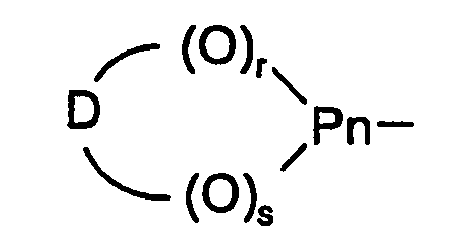
- Pn für P, As oder Sb,
- bevorzugt P, steht,
- r und s
- unabhängig voneinander für 0 oder 1 stehen, und
- D
- zusammen mit dem Phosphoratom und dem/den Sauerstoffatom(en), an die es gebunden ist, für einen 4- bis 8-gliedrigen Heterocyclus steht, der gegebenenfalls ein-, zwei- oder dreifach mit Cycloalkyl, Heterocycloalkyl, Aryl und/oder Hetaryl anelliert ist, wobei die anellierten Gruppen unabhängig voneinander je einen, zwei, drei oder vier Substituenten, ausgewählt unter Alkyl, Alkoxy, Halogen, Sul- fonat, NE4E5, Alkylen-NE4E5, Nitro, Cyano und Carboxylat, tragen können und/oder D einen, zwei, drei oder vier Substituenten, die ausgewählt sind unter Alkyl, Hydroxy, Alkoxy, gegebenenfalls substituiertem Cycloalkyl und gegebenen- falls substituiertem Aryl, aufweisen kann und/oder D durch 1, 2 oder 3 gegebe- nenfalls substituierte Heteroatome unterbrochen sein kann.
- Der Rest D steht vorzugsweise für eine C2- bis C6-Alkylenbrücke, die 1- oder 2-fach mit Aryl anelliert ist und/oder die einen Substituenten, der ausgewählt ist unter Alkyl, gegebenenfalls substituiertem Cycloalkyl und gegebenenfalls substituiertem Aryl, aufweisen kann und/oder die durch ein gegebenenfalls substituiertes Heteroatom unterbrochen sein kann.
- Bei den anellierten Arylen der Reste D handelt es sich bevorzugt um Benzol oder Naphthalin. Anellierte Benzolringe sind vorzugsweise unsubstituiert oder weisen 1, 2 oder 3, insbesondere 1 oder 2 Substituenten auf, die vorzugsweise ausgewählt sind unter Alkyl, Alkoxy, Halogen, Sulfonat, NE4E5, Alkylen-NE4E5, Trifluormethyl, Nitro, Carboxylat, Alkoxycarbonyl, Acyl und Cyano. Anellierte Naphthaline sind vorzugsweise unsubstituiert oder weisen im nicht anellierten Ring und/oder im anellierten Ring jeweils 1, 2 oder 3, insbesondere 1 oder 2 der zuvor bei den anellierten Benzolringen genannten Substituenten auf. Bei den Substituenten der anellierten Aryle steht Alkyl vorzugsweise für C1- bis C4-Alkyl und insbesondere für Methyl, Isopropyl und tert.-Butyl. Alkoxy steht dabei vorzugsweise für C1- bis C4-Alkoxy und insbesondere für Methoxy. Alkoxycarbonyl steht vorzugsweise für C1- bis C4-Alkoxycarbonyl.
- Wenn die C2- bis C6-Alkylenbrücke des Restes D durch 1, 2 oder 3, gegebenenfalls substituierte Heteroatome unterbrochen ist, so sind diese vorzugsweise ausgewählt unter O, S oder NRh, wobei Rh für Alkyl, Cycloalkyl oder Aryl steht.
- Wenn die C2- bis C6-Alkylenbrücke des Restes D substituiert ist, so weist sie vorzugsweise 1, 2, 3 oder 4, insbesondere 2 oder 4 Substituenten auf, die ausgewählt sind unter Alkyl, Alkoxy, Hydroxy, Cycloalkyl, Heterocycloalkyl, Aryl und Hetaryl, wobei die Cycloalkyl-, Heterocycloalkyl,-, Aryl- und Hetarylsubstituenten jeweils 1, 2 oder 3 der eingangs für diese Reste als geeignet genannten Substituenten tragen können.
- Vorzugsweise steht der Rest D für eine C3- bis C6-Alkylenbrücke, die wie zuvor beschrieben anelliert und/oder substituiert und/oder durch gegebenenfalls substituierte Heteroatome unterbrochen ist. Insbesondere steht der Rest D für eine C3- bis C6-Alkylenbrücke, die ein- oder zweifach mit Phenyl und/oder Naphthyl anelliert ist, wobei die Phenyl- oder Naphthylgruppen 1, 2 oder 3 der zuvor genannten Substituenten tragen können.
- Vorzugsweise steht der Rest D zusammen mit dem Phosphoratom und dem/den Sauerstoffatom(en), an die er gebunden ist, für einen 4- bis 8-gliedrigen Heterocyclus, wobei D für einen Rest steht, der ausgewählt ist unter den Resten der Formeln II.1 bis II.4,


- T
- für O, S oder NRI steht, wobei RI für Alkyl, Cycloalkyl oder Aryl steht,
- oder T
- für eine C1- bis C3-Alkylenbrücke steht, die eine Doppelbindung und/oder einen Alkyl-, Cycloalkyl- oder Arylsubstituenten aufweisen kann, wobei der Arylsubsti- tuent einen, zwei oder drei der für Aryl genannten Substituenten tragen kann,
- oder T
- für eine C2- bis C3-Alkylenbrücke steht, die durch O, S oder NRI unterbrochen ist,
- RI, RII, RIII, RIV, RV, RVI, RVII, RVIII, RIX, RX, RXI und RXII unabhängig voneinander für Wasserstoff, Alkyl, Cycloalkyl, Aryl, Alkoxy, Halogen, Sulfonat, NE4E5, Alkylen-NE4E5, Trifluormethyl, Nitro, Alkoxycarbonyl oder Cyano stehen.
- In einer besonders bevorzugten Ausführungsform sind in den Gruppen der allgemeinen Formel I.3 die Reste R1 und R2 so miteinander verbrückt, dass die phosphoratomhaltige Gruppe der Formel

- RI, RII, RIII, RIV, RV, RVI,
- RVII, RVIII, RIX, RX, RXI und RXII
- unabhängig voneinander für Wasserstoff, Alkyl, Cycloalkyl, Heterocycloalkyl, Aryl, Hetaryl, Hydroxy, Thiol, Po- lyalkylenoxid, Polyalkylenimin, Alkoxy, Halogen, SO3H, Sulfonat, NE4E6, Alkylen- NE4E5, Trifluormethyl, Nitro, Alkoxycarbonyl, Carboxyl, Acyl oder Cyano stehen, worin E4 und E5 jeweils gleiche oder verschiedene Reste, ausgewählt unter Was- serstoff, Alkyl, Cycloalkyl und Aryl bedeuten.
- Des Weiteren bevorzugt steht Y für eine Gruppe der Formel II.1, worin RIV und RV unabhängig voneinander für C1-C4-Alkyl oder C1-C4-Alkoxy stehen. Vorzugsweise sind RIV und RV ausgewählt unter Methyl, Ethyl, Isopropyl, tert.-Butyl und Methoxy. Bevorzugt stehen in diesen Verbindungen RI, RII, RIII, RVI, RVII und RVIII für Wasserstoff.
- Des Weiteren bevorzugt steht Y für eine Gruppe der Formel II.1, worin RI und RVIII unabhängig voneinander für C1-C4-Alkyl oder C1-C4-Alkoxy stehen. Besonders bevorzugt stehen RI und RVIII für tert.-Butyl. Besonders bevorzugt stehen in diesen Verbindungen RII, RIII, RIV, RV, RVI, RVII für Wasserstoff. Des Weiteren bevorzugt stehen in diesen Verbindungen RIII und RVI unabhängig voneinander für C1-C4-Alkyl oder C1-C4-Alkoxy. Besonders bevorzugt sind RIII und RVI unabhängig voneinander ausgewählt unter Methyl, Ethyl, Isopropyl, tert.-Butyl und Methoxy.
- Des Weiteren bevorzugt steht Y für eine Gruppe der Formel II.1, worin RII und RVII für Wasserstoff stehen. Bevorzugt stehen in diesen Verbindungen RI, RIII, RIV, RV, RVI und RVIII unabhängig voneinander für C1-C4-Alkyl oder C1-C4-Alkoxy. Besonders bevorzugt sind RI, RIII, RIV, RV, RVI und RVIII unabhängig voneinander ausgewählt unter Methyl, Ethyl, Isopropyl, tert.-Butyl und Methoxy.
- Weiterhin bevorzugt steht Y für eine Gruppe der Formel II.3, worin RI bis RXII für Wasserstoff stehen.
- Weiterhin bevorzugt steht Y für eine Gruppe der Formel II.3, worin RI und RXII unabhängig voneinander für C1-C4-Alkyl oder C1-C4-Alkoxy stehen. Insbesondere sind RI und RXII unabhängig voneinander ausgewählt unter Methyl, Ethyl, Isopropyl, tert.-Butyl, Methoxy und Alkoxycarbonyl, bevorzugt Methoxycarbonyl. Besonders bevorzugt stehen in diesen Verbindungen die Reste RII bis RXI für Wasserstoff.
- Zu bevorzugten chiralen Gruppen der allgemeinen Formel I.3 zählen z. B. (2R, 3S, 4R, 5S)-2,5-Dimethyl-3,4-dihydroxyphospholano- und (2S, 3R, 4S, 5R)-2,5-Dimethyl-3,4-dihydroxyphospholanogruppen sowie (R)-1,1'-Binaphthylen-2,2'-diyldioxyphosphino-, (S)-1,1'-Binaphthylen-2,2'-diyldioxyphosphino-, (S)-1,1'-Biphenylen-2,2'-diyldioxyphosphino- und (S)-1,1'-Biphenylen-2,2'-diyldioxyphosphinogruppen, die unsubstituiert oder, wie zuvor beschrieben, substituiert sein können.
- Bevorzugt weist wenigstens einer der erfindungsgemäß eingesetzten Liganden eine zur Tautomerie und zur Ausbildung intermolekularer nichtkovalenter Bindungen befähigte funktionelle Gruppe auf. Diese ist vorzugsweise ausgewählt unter Gruppen der Formel

- Die Lage des jeweiligen Tautomeriegleichgewichts ist unter anderem abhängig von der Gruppe Y sowie den Substituenten an der zur Tautomerie befähigten Gruppe. Sie werden im Folgenden beispielhaft für die Keto-Enol-Tautomerie und die Imin-Enamin-Tautomerie dargestellt:


- Vorzugsweise weisen die erfindungsgemäß eingesetzten Liganden wenigstens ein Strukturelement der allgemeinen Formeln I.a oder I.b

- Pn, R1, R2 und a
- wie zuvor definiert sind,
- R3
- für Wasserstoff, Alkyl, Alkoxy, Cycloalkyl, Cycloalkoxy, Heterocycloalkyl, Hetero- cycloalkoxy, Aryl, Aryloxy, Hetaryl oder Hetaryloxy steht,
- X
- für eine zweiwertige verbrückende Gruppe mit 1 bis 5 Brückenatomen zwischen den flankierenden Bindungen steht,
- Y
- für O, S oder NR4 steht, wobei R4 für Wasserstoff, Alkyl, Cycloalkyl, Heterocyclo- alkyl, Aryl oder Hetaryl steht,
- Bezüglich geeigneter und bevorzugter Reste R1 und R2 wird auf die vorherigen Ausführungen Bezug genommen.
- Bevorzugt steht in den Verbindungen der Formeln I.a und I.b Pn für N, P, As oder Sb, besonders bevorzugt für P, As oder Sb und insbesondere für P.
- Bevorzugt weist die zweiwertige verbrückende Gruppe X in den Verbindungen der Formeln I.a und I.b 1 bis 4, besonders bevorzugt 1 bis 3 Brückenatome zwischen den flankierenden Bindungen auf.
- Bevorzugt steht die zweiwertige verbrückende Gruppe X für eine C1-C5-Alkylen-Brücke, die, abhängig von der Anzahl der Brückenatome, eine oder zwei Doppelbindungen und/oder einen, zwei, drei oder vier Substituenten, die ausgewählt sind unter Alkyl, Cycloalkyl, Heterocycloalkyl, Aryl, Hetaryl, Carboxylat, Sulfonat, Phosphonat, NE1E2 (E1, E2 = Wasserstoff, Alkyl, Cycloalkyl, Acyl oder Aryl), Hydroxy, Thiol, Halogen, Nitro, Acyl oder Cyano, aufweisen kann, wobei die Cycloalkyl-, Aryl- und HetarylSubstituenten zusätzlichen einen, zwei oder drei Substituenten, die ausgewählt sind unter Alkyl, Alkoxy, Halogen, Trifluormethyl, Nitro, Alkoxycarbonyl oder Cyano, tragen können und/oder ein oder zwei nichtbenachbarte Brückenatome der C1-C5-Alkylen-Brücke X durch ein Heteroatom oder eine Heteroatom-haltige Gruppe ersetzt sein können und/oder die Alkylen-Brücke X ein- oder zweifach mit Aryl und/oder Hetaryl anelliert sein kann, wobei die anellierten Aryl- und Hetarylgruppen je einen, zwei oder drei Substituenten, die ausgewählt sind unter Alkyl, Cycloalkyl, Aryl, Alkoxy, Cycloalkoxy, Aryloxy, Acyl, Halogen, Trifluormethyl, Nitro, Cyano, Carboxyl, Alkoxycarbonyl oder NE1E2 (E1 und E2 = Wasserstoff, Alkyl, Cycloalkyl, Acyl oder Aryl) tragen können und/oder zwei oder mehr als zwei Brückenatome der C1-C6-Alkylen-Brücke X gemeinsam mit dem Strukturelement der Formel I.a oder I.b, an das sie gebunden sind, für eine mono- oder polycyclische Verbindung stehen können.
- Bevorzugt steht X für eine C1-C5-Alkylen-Brücke, die eine oder zwei Doppelbindungen aufweisen kann. Des Weiteren bevorzugt können zwei oder mehr als zwei der Brückenatome der Brücke X gemeinsam mit dem Strukturelement der Formel I.a oder I.b, an das sie gebunden sind, für eine mono- oder polycyclische Verbindung stehen.
- Vorzugsweise weisen die erfindungsgemäß eingesetzten Liganden wenigstens ein Strukturelement der allgemeinen Formeln I.a oder I.b auf, worin die Gruppe X und der Rest R3 gemeinsam mit der Gruppe -NH-C(=Y)-, an die sie gebunden sind, für einen 5- bis 8-gliedrigen, vorzugsweise 6-gliedrigen Ring stehen. Dieser Ring kann eine, zwei oder drei Doppelbindungen aufweisen, wobei eine dieser Doppelbindungen auf der tautomeren Gruppe -N=C(YH)- beruhen kann. Bevorzugt sind 6-gliedrige Ringe, die unter Berücksichtigung der Tautomerie drei Doppelbindungen aufweisen. Derartige Ringsysteme, bei denen eines der Tautomeren ein aromatisches Ringsystem ausbilden kann, sind besonders stabil. Die genannten Ringe können unsubstituiert sein oder einen, zwei, drei, vier oder fünf der zuvor genannten Substituenten aufweisen. Diese sind vorzugsweise ausgewählt unter C1-C4-Alkyl, besonders bevorzugt Methyl, Ethyl, Isopropyl oder tert.-Butyl, C1-C4-Alkoxy, speziell Methoxy, Ethoxy, Isopropyloxy oder tert.-Butyloxy, sowie Aryl, vorzugsweise Phenyl. In einer geeigneten Ausführungsform weisen die genannten Ringe wenigstens eine Doppelbindung auf, wobei die an diese Doppelbindung gebundenen Reste für ein kondensiertes Ringsystem mit 1, 2 oder 3 weiteren Ringen steht. Dabei handelt es sich bevorzugt um Benzol oder Naphthalinringe. Anellierte Benzolringe sind vorzugsweise unsubstituiert oder weisen 1, 2 oder 3 Substituenten auf, die ausgewählt sind unter Alkyl, Hydroxy, Alkoxy, Carboxylat, Sulfonat, Halogen, NE1E2, Trifluormethyl, Nitro, Alkoxycarbonyl, Acyl und Cyano. Anellierte Naphthalinringe sind vorzugsweise unsubstituiert oder weisen im nichtanellierten und/oder im anellierten Ring je 1, 2 oder 3 der zuvor bei den anellierten Benzolringen genannten Substituenten auf.
- Vorzugsweise sind die erfindungsgemäß eingesetzten Liganden ausgewählt unter Verbindungen der allgemeinen Formeln I.A bis I.C

einer der Reste R5 bis R9 für eine pnicogen- oder pseudopnicogenatomhaltige Gruppe, wie zuvor definiert, steht,
die Reste R5 bis R9, die nicht für eine pnicogen- oder pseudopnicogenatomhaltige Gruppe stehen, unabhängig voneinander für Wasserstoff, Alkyl, Cycloalkyl, Heterocycloalkyl, Aryl, Hetaryl, WCOORo, WCOO-M+, W(SO3)Ro, W(SO3)-M+, WPO3(Ro)(Rp), W(PO3)2-(M+)2, WNE1E2, W(NE1E2E3)+X-, WORq, WSRq, (CHRrCH2O)xRq, (CH2NE1)xRq, (CH2CH2NE1)xRq, Halogen, Nitro, Acyl oder Cyano stehen,
worin - W
- für eine Einfachbindung, ein Heteroatom, eine heteroatomhaltige Gruppe oder eine zweiwertige verbrückende Gruppe mit 1 bis 20 Brückenatomen steht,
- Ro und Rp
- jeweils gleiche oder verschiedene Reste, ausgewählt unter Alkyl, Cycloalkyl, Acyl oder Aryl bedeuten,
- Rq, E1, E2, E3
- jeweils gleiche oder verschiedene Reste, ausgewählt unter Wasserstoff, Alkyl, Cycloalkyl, Acyl oder Aryl bedeuten,
- Rr
- für Wasserstoff, Methyl oder Ethyl steht,
- M+
- für ein Kationäquivalent steht,
- X-
- für ein Anionäquivalent steht und
- x
- für eine ganze Zahl von 1 bis 240 steht,
- Geeignete pnicogen- oder pseudopnicogenatomhaltige Gruppen der Verbindungen (I.A) bis (I.C) sind die zuvor genannten Gruppen I.1, I.2 und I.3. Auf geeignete und bevorzugte Ausführungen dieser Gruppen wird Bezug genommen.
- Bevorzugt sind die pnicogen- oder pseudopnicogenatomhaltigen Gruppen der Verbindungen (I.A) bis (I.C) ausgewählt unter Gruppen der Formel-W'-PnR1R2, worin
- Pn
- für N, P, As oder Sb, insbesondere für P, As oder Sb, speziell für P steht,
- W'
- für eine Einfachbindung, ein Heteroatom, eine heteroatomhaltige Gruppe oder eine zweiwertige verbrückende Gruppe mit 1 bis 4 Brückenatomen zwischen den flankierenden Bindungen steht,
- R1 und R2
- wie zuvor definiert sind.
- Wenn in den Verbindungen der Formeln I.A bis I.C zwei vicinale Reste, ausgewählt unter den Resten R5 bis R9, die nicht für eine pnicogen- oder pseudopnicogenatomhaltige Gruppe stehen, für ein kondensiertes Ringsystem stehen, so handelt es sich vorzugsweise um die Reste R7 und R8. Bevorzugt handelt es sich bei den ankondensierten Ringen um Benzol- oder Naphthalinringe.
- Anellierte Benzolringe sind vorzugsweise unsubstituiert oder weisen 1, 2 oder 3 Substituenten auf, die vorzugsweise ausgewählt sind unter Alkyl, Hydroxy, Alkoxy, Carboxylat, Sulfonat, Halogen, NE1E2, Trifluormethyl, Nitro, Alkoxycarbonyl, Acyl und Cyano. Anellierte Naphthalinringe sind vorzugsweise unsubstituiert oder weisen im nichtanellierten und/oder im anellierten Ring je 1, 2 oder 3 der zuvor bei den anellierten Benzolringen genannten Substituenten auf.
- Wenn in den Verbindungen der Formel I.B der Rest Ra für Acyl steht, so sind diese Acylreste vorzugsweise ausgewählt unter Resten der Formel -C(=O)-Rk worin Rk für Wasserstoff, Alkyl, Cycloalkyl, Aryl oder Hetaryl steht. Bevorzugt steht Rk für C1-C4-Alkyl, insbesondere Methyl, Ethyl, n-Propyl, Isopropyl, n-Butyl und tert.-Butyl. Ein bevorzugter Acylrest Ra ist der Pivaloylrest.
- Die Verbindungen der Formeln I.A bis I.C eignen sich unabhängig von ihrer Befähigung zur Ausbildung intermolekularer, nichtkovalenter Bindungen als Liganden in Katalysatoren für asymmetrische Synthesen. Gegenstand der Erfindung ist daher auch Verfahren zur Herstellung chiraler Verbindungen durch Umsetzung einer prochiralen Verbindung, die wenigstens eine ethylenisch ungesättigte Doppelbindung enthält, mit einem Substrat in Gegenwart eines chiralen Katalysators, umfassend wenigstens einen Übergangsmetallkomplex mit Liganden, die ausgewählt sind unter Verbindungen der allgemeinen Formeln I.A bis I.C, wie zuvor definiert.
- Vorzugsweise sind die erfindungsgemäß eingesetzten Liganden ausgewählt unter Verbindungen der allgemeinen Formeln I.i bis I.iii

- b für 0 oder 1 steht,
- Pn für pnicogen- oder pseudopnicogenatomhaltige Gruppen, bevorzugt für N, P, As oder Sb, insbesondere für P, As oder Sb, speziell für P, steht,
- R1 und R2 wie zuvor definiert sind,
- R6 bis R9 unabhängig voneinander für Wasserstoff, C1-C4-Alkyl, C1-C4-Alkoxy, Aryl, Heteroaryl, Acyl, Halogen, C1-C4-Alkoxycarbonyl oder Carboxylat stehen,
- Ra und Rb für Wasserstoff, Alkyl, Cycloalkyl oder Aryl stehen, wobei Ra auch für Acyl stehen kann.
- Bevorzugt stehen in den Verbindungen der Formeln I.i bis I.iii die Reste R1und R2 unabhängig voneinander für C1-C8-Alky, wie Methyl, Ethyl, Isopropyl und tert.-Butyl, C5-C8-Cycloalkyl, wie Cyclohexyl, oder Aryl, wie Phenyl. Bevorzugt stehen die Reste R1 und R2 beide für Aryl. Speziell steht einer der Reste R1 und R2 für Phenyl und der andere für Naphthyl oder R1 und R2stehen beide für Phenyl oder R1 und R2 stehen beide für Naphthyl. Bevorzugte Naphthylreste sind 1-Naphthylreste.
- Des Weiteren bevorzugt sind Verbindungen der Formeln I.i bis I.iii, worin die Reste R1 und R2 so miteinander verbrückt sind, dass sie für eine pnicogenhaltige Gruppe der Formel

- In einer speziellen Ausführung handelt es sich bei der pnicogenhaltigen Gruppe um eine chirale pnicogenhaltige Gruppe, wie zuvor beschrieben. Auf die Ausführungen zu den Gruppen II.1 und II.3 wird Bezug genommen.
- Vorzugsweise sind in den Verbindungen I.i bis I.iii die Reste R6, R7, R8 und R9 unabhängig voneinander ausgewählt unter Wasserstoff, C1-C4-Alkyl, C1-C4-Alkoxy, Aryl, Heteroaryl, Carboxylat, Sulfonat, NE1E2, Halogen, Trifluormethyl, Nitro, Alkoxycarbonyl, Acyl und Cyano. Bevorzugt stehen R6, R7, R8 und R9 für Wasserstoff, Aryl oder Heteroaryl.
- Des Weiteren bevorzugt stehen in den Verbindungen I.i bis I.iii die Reste R7 und R8 für ein ankondensiertes Ringsystem.
- Bevorzugt steht in der Verbindung der Formel I.ii der Rest Ra für Wasserstoff, C1-C8-Alkyl, C5-C8-Cycloalkyl oder C6-C10-Aryl. Des Weiteren bevorzugt steht in der Formel I.ii der Rest Ra für Acyl, wie zuvor definiert. Insbesondere steht Ra für-C(=O)-Rk mit Rk = C1-C4-Alkyl, insbesondere tert.-Butyl.
- Bevorzugt steht in den Verbindungen der Formel I.iii der Rest Rb für Wasserstoff, C1-C8-Alkyl, C5-C8-Cycloalkyl oder C6-C10-Aryl oder Hetaryl.
- Ein bevorzugter Ligand der Formel I.i ist

- Bevorzugte Liganden der Formel I.ii sind


- Bei dem erfindungsgemäßen und erfindungsgemäß eingesetzten Ligand/Ligand-Paaren kann es sich um Paare gleicher oder verschiedener Liganden handeln.
- Beispielhaft für erfindungsgemäß einsetzbare Liganden sind die folgenden Strukturen:


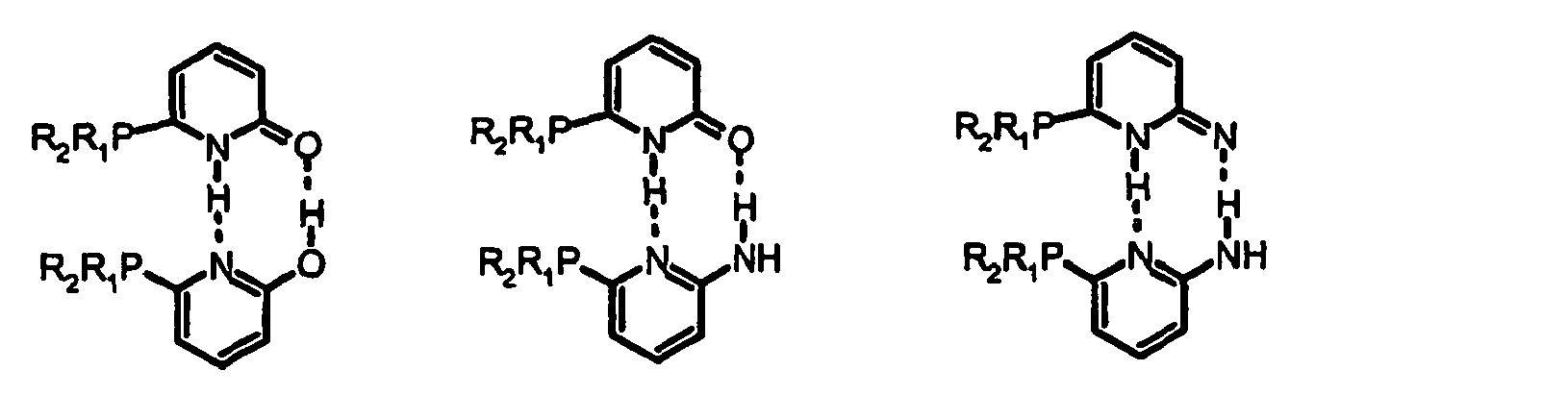


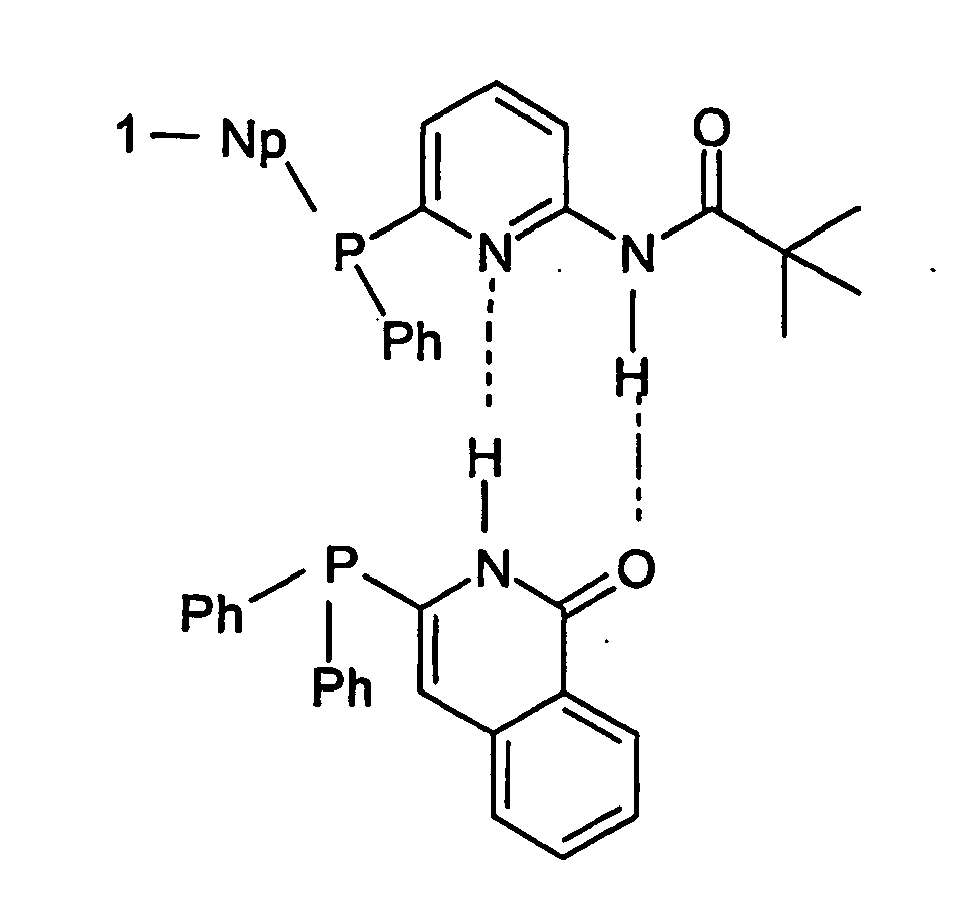
- 6-[(R)-1,1'-Binaphthylen-2,2'-diyldioxyphosphino]-1-H-pyridin-2-on,
- 6-[(S)-1,1'-Binaphthylen-2,2'-diyldioxyphosphino]-1-H-pyridin-2-on, und
- 6-(3,5-Dioxa-4-phosphacyclohepta[2,1-a,3,4-a]dinaphthalen-4-yloxy)-1H-pyridin-2-on genannt.
- Die Herstellung von erfindungsgemäß einsetzbaren Liganden kann nach üblichen, dem Fachmann bekannten Verfahren erfolgen.
- Ein weiterer Gegenstand der Erfindung ist ein chiraler Katalysator, wie zuvor beschrieben. Auf die vorherigen Ausführungen zu geeigneten und bevorzugten Liganden wird vollständig Bezug genommen.
- Die erfindungsgemäßen und erfindungsgemäß eingesetzten chiralen Katalysatoren weisen vorzugsweise zwei oder mehr als zwei der zuvor beschriebenen Verbindungen als Liganden auf. Dabei liegen bevorzugt wenigstens zwei der Liganden in dimerisierter Form (als Ligand/Ligand-Paare) vor. Bei den Ligand/Ligand-Paaren kann es sich dabei um gleiche oder verschiedene Liganden handeln. Zusätzlich zu den zuvor beschriebenen Liganden können Sie noch wenigstens einen weiteren Liganden, der vorzugsweise ausgewählt ist unter Halogeniden, Aminen, Carboxylaten, Acetylacetonat, Aryl- oder Alkylsulfonaten, Hydrid, CO, Olefinen, Dienen, Cycloolefinen; Nitrilen, N-haltigen Heterocyclen, Aromaten und Heteroaromaten, Ethern, PF3, Phospholen, Phosphabenzolen sowie ein-, zwei- und mehrzähnigen Phosphin-, Phosphinit-, Phosphonit-, Phosphoramidit- und Phosphitliganden aufweisen.
- Bevorzugt handelt es sich bei dem Übergangsmetall um ein Metall der I:, VI., VII. oder VIII. Nebengruppe des Periodensystems der Elemente. Besonders bevorzugt ist das Übergangsmetall ausgewählt unter den Metallen der VIII. Nebengruppe (d.h. Fe, Co, Ni, Ru, Rh, Pd, Os, Ir, Pt). Insbesondere handelt es sich bei dem Übergangsmetall um Iridium, Nickel, Ruthenium, Rhodium, Palladium oder Platin.
- Die vorliegende Erfindung betrifft ganz allgemein Verfahren zur Herstellung chiraler Verbindungen durch Umsetzung einer prochiralen Verbindung, die wenigstens eine ethylenisch ungesättigte Doppelbindung enthält, mit einem Substrat in Gegenwart eines chiralen Katalysators, wie zuvor beschrieben. Dabei ist es lediglich erforderlich, dass wenigstens einer der eingesetzten Liganden oder die katalytisch aktive Spezies insgesamt chiral ist. Im Allgemeinen werden unter den Reaktionsbedingungen der einzelnen Verfahren zur Herstellung chiraler Verbindungen bestimmte Übergangsmetallkomplexe als katalytisch aktive Spezies gebildet. So werden beispielsweise unter Hydroformylierungsbedingungen aus den jeweils eingesetzten Katalysatoren oder Katalysatorvorstufen katalytisch aktive Spezies der allgemeinen Formel HxMy(CO)zLq gebildet, worin M für ein Übergangsmetall, L für eine pnicogenatomhaltige Verbindung und q, x, y, z für ganze Zahlen, abhängig von der Wertigkeit und Art des Metalls sowie der Bindigkeit des Liganden L, stehen. Vorzugsweise stehen z und q unabhängig voneinander mindestens für einen Wert von 1, wie z. B. 1, 2 oder 3. Die Summe aus z und q steht bevorzugt für einen Wert von 1 bis 5. Dabei können die Komplexe gewünschtenfalls zusätzlich noch mindestens einen der zuvor beschriebenen weiteren Liganden aufweisen. Es besteht Grund zu der Annahme, dass auch die jeweils katalytisch aktive Spezies dimerisierte Liganden (Pseudochelate) aufweist.
- Die katalytisch aktive Spezies liegt vorzugsweise als homogen einphasige Lösung in einem geeigneten Lösungsmittel vor. Diese Lösung kann zusätzlich freien Liganden enthalten.
- Bevorzugt handelt es sich bei dem erfindungsgemäßen Verfahren zur Herstellung chiraler Verbindungen um eine Hydrierung, Hydroformylierung, Hydrocyanierung, Carbonylierung, Hydroacylierung (intramolekular und intermolekular), Hydroamidierung, Hydroveresterung, Hydrosilylierung, Hydroborierung, Aminolyse (Hydroaminierung), Alkoholyse (Hydroxy-Alkoxy-Addition), Isomerisierung, Transferhydrierung, Metathese, Cyclopropanierung, Aldolkondensation, allylische Alkylierung oder eine [4+2]-Cycloaddition (Diels-Alder-Reaktion).
- Besonders bevorzugt handelt es sich bei dem erfindungsgemäßen Verfahren zur Herstellung chiraler Verbindungen um eine 1,2-Addition, insbesondere eine Hydrierung oder eine 1-Hydro-2-Carbo-Addition. Im Rahmen dieser Erfindung bedeutet 1,2-Addition, dass eine Addition an die beiden benachbarten Atome einer C=X-Doppelbindung (X = C, Heteroatom) erfolgt. 1-Hydro-2-Carbo-Addition bezeichnet eine Additionsreaktion, bei der nach der Reaktion an ein Atom der Doppelbindung Wasser stoff und an das andere eine kohlenstoffatomhaltige Gruppe gebunden ist. Doppelbindungsisomerisierungen während der Addition sind dabei zugelassen. Im Rahmen dieser Erfindung soll mit 1-Hydro-2-Carbo-Addition bei unsymmetrischen Substraten nicht auch eine bevorzugte Addition des Kohlenstofffragmentes an das C2-Atom bezeichnet werden, da die Selektivität bezüglich der Orientierung der Addition in der Regel von dem zu addierenden Agens und dem eingesetzten Katalysator abhängig ist. "1-Hydro-2-Carbo-" ist insofern gleichbedeutend mit "1-Carbo-2-Hydro-".
- Die Reaktionsbedingungen der erfindungsgemäßen Verfahren zur Herstellung chiraler Verbindungen entsprechen, bis auf den eingesetzten chiralen Katalysator, in der Regel denen der entsprechenden asymmetrischen Verfahren. Geeignete Reaktoren und Reaktionsbedingungen kann der Fachmann somit der einschlägigen Literatur zu dem jeweiligen Verfahren entnehmen und routinemäßig anpassen. Geeignete Reaktionstemperaturen liegen im Allgemeinen in einem Bereich von -100 bis 500 °C, vorzugsweise in einem Bereich von -80 bis 250 °C. Geeignete Reaktionsdrücke liegen im Allgemeinen in einem Bereich von 0,0001 bis 600 bar, bevorzugt von 0,5 bis 300 bar. Die Verfahren können im Allgemeinen kontinuierlich, semikontinuierlich oder diskontinuierlich erfolgen. Geeignete Reaktoren für die kontinuierliche Umsetzung sind dem Fachmann bekannt und werden z. B. in Ullmanns Enzyklopädie der technischen Chemie, Bd. 1, 3. Aufl., 1951, S. 743 ff. beschrieben. Geeignete druckfeste Reaktoren sind dem Fachmann ebenfalls bekannt und werden z. B. in Ullmanns Enzyklopädie der technischen Chemie, Bd. 1, 3. Auflage, 1951, S. 769 ff. beschrieben.
- Die erfindungsgemäßen Verfahren können in einem geeigneten, unter den jeweiligen Reaktionsbedingungen inerten Lösungsmittel durchgeführt werden. In der Regel geeignete Lösungsmittel sind z. B. Aromaten, wie Toluol und Xylole, Kohlenwasserstoffe oder Gemische von Kohlenwasserstoffen. Weiterhin geeignet sind halogenierte, insbesondere chlorierte Kohlenwasserstoffe, wie Dichlormethan, Chloroform oder 1,2-Dichlorethan. Weitere Lösungsmittel sind Ester aliphatischer Carbonsäuren mit Alkanolen, beispielsweise Essigester oder Texanol®, Ether wie tert.-Butylmethylether, Dioxan-1,4 und Tetrahydrofuran sowie Dimethylformamid. Bei ausreichend hydrophilisierten Liganden können auch Alkohole, wie Methanol, Ethanol, n-Propanol, Isopropanol, n-Butanol, Isobutanol, Ketone, wie Aceton und Methylethylketon, etc., eingesetzt werden. Ferner können als Lösungsmittel auch so genannte "ionische Flüssigkeiten" verwendet werden. Hierbei handelt es sich um flüssige Salze, beispielsweise um N,N'-Dialkylimidazoliumsalze wie die N-Butyl-N'-methylimidazoliumsalze, Tetraalkylammoniumsalze wie die Tetra-n-butylammoniumsalze, N-Alkylpyridiniumsalze wie die n-Butylpyridiniumsalze, Tetraalkylphosphoniumsalze wie die Trishexyl(tetradecyl)phosphoniumsalze, z. B. die Tetrafluoroborate, Acetate, Tetrachloroaluminate, Hexafluorophosphate, Chloride und Tosylate. Als Lösungsmittel kann auch ein Edukt, Produkt oder Nebenprodukt der jeweiligen Reaktion eingesetzt werden.
- Als prochirale ethylenisch ungesättigte Verbindungen für das erfindungsgemäße Verfahren kommen prinzipiell alle prochiralen Verbindungen in Betracht, welche eine oder mehrere ethylenisch ungesättigte Kohlenstoff-Kohlenstoff- oder Kohlenstoff-Heteroatom-Doppelbindungen enthalten. Dazu zählen allgemein prochirale Olefine (Hydroformylierung, intermolekulare Hydroacylierung, Hydrocyanierung, Hydrosilylierung, Carbonylierung, Hydroamidierung, Hydroveresterung, Aminolyse, Alkoholyse, Cyclopropanierung, Hydroborierung, Diels-Alder-Reaktion, Metathese), unsubstituierte und substituierte Aldehyde (intramolekulare Hydroacylierung, Aldolkondensation, allylische Alkylierung), Ketone (Hydrierung, Hydrosilylierung, Aldolkondensation, Transfer hydrierung, allylische Alkylierung) und Imine (Hydrierung, Hydrosilyllerung, Transferhydrierung, Mannich-Reaktion).
- Geeignete prochirale ethylenisch ungesättigte Olefine sind allgemein Verbindungen der Formel

- Vorzugsweise sind Rα, Rβ, Rγ und Rδ unter Beachtung der vorgenannten Bedingung unabhängig voneinander ausgewählt unter Wasserstoff, Alkyl, Cycloalkyl, Heterocycloalkyl, Aryl, Hetaryl, Alkoxy, Cycloalkoxy, Heterocycloalkoxy, Aryloxy, Hetaryloxy, Hydroxy, Thiol, Polyalkylenoxid, Polyalkylenimin, COOH, Carboxylat, SO3H, Sulfonat, NE7E8, NE7E8E9+X-, Halogen, Nitro, Acyl, Acyloxy oder Cyano, worin E7, E8 und E9 jeweils gleiche oder verschiedene Reste, ausgewählt unter Wasserstoff, Alkyl, Cycloalkyl, oder Aryl bedeuten und X- für ein Anionäquivalent steht,
wobei die Alkylreste 1, 2, 3, 4, 5 oder mehr Substituenten, ausgewählt unter Cycloalkyl, Heterocycloalkyl, Aryl, Hetaryl, Alkoxy, Cycloalkoxy, Heterocycloalkoxy, Aryloxy, Hetaryloxy, Hydroxy, Thiol, Polyalkylenoxid, Polyalkylenimin, COOH, Carboxylat, SO3H, Sulfonat, NE10E11, NE10E11E12+X-, Halogen, Nitro, Acyl, Acyloxy oder Cyano aufweisen können, worin E10, E11 und E12 jeweils gleiche oder verschiedene Reste, ausgewählt unter Wasserstoff, Alkyl, Cycloalkyl, oder Aryl bedeuten und X- für ein Anionäquivalent steht,
und wobei die Cycloalkyl-, Heterocycloalkyl-, Aryl- und Hetarylreste Rα, Rβ, Rγ und Rδ jeweils 1, 2, 3, 4, 5 oder mehr Substituenten aufweisen können, die ausgewählt sind unter Alkyl und den zuvor für die Alkylreste Rα, Rβ, Rγ und Rδ genannten Substituenten, oder
zwei oder mehr der Reste Rα, Rβ, Rγ und Rδ zusammen mit der C-C-Doppelbindung, an die sie gebunden sind, für eine mono- oder polycyclische Verbindung stehen. - Geeignete prochirale Olefine sind Olefine mit mindestens 4 Kohlenstoffatomen und endständigen oder innenständigen Doppelbindungen, die geradkettig, verzweigt oder von cyclischer Struktur sind.
- Geeignete α-Olefine sind z. B. 1-Buten, 1-Penten, 1-Hexen, 1-Hepten, 1-Octen, 1-Nonen, 1-Decen, 1-Undecen, 1-Dodecen, 1-Octadecen etc.
- Geeignete lineare (geradkettige) interne Olefine sind vorzugsweise C4-C20-Olefine, wie 2-Buten, 2-Penten, 2-Hexen, 3-Hexen, 2-Hepten, 3-Hepten, 2-Octen, 3-Octen, 4-Octen etc.
- Geeignete verzweigte, interne Olefine sind vorzugsweise C4-C20-Olefine, wie 2-Methyl-2-buten, 2-Methyl-2-penten, 3-Methyl-2-penten, verzweigte, interne Hepten-Gemische, verzweigte, interne Octen-Gemische, verzweigte, interne Nonen-Gemische, verzweigte, interne Decen-Gemische, verzweigte, interne Undecen-Gemische, verzweigte, interne Dodecen-Gemische etc.
- Geeignete zu hydroformylierende Olefine sind weiterhin C5-C8-Cycloalkene, wie Cyclopenten, Cyclohexen, Cyclohepten, Cycloocten und deren Derivate, wie z. B. deren C1-C20-Alkylderivate mit 1 bis 5 Alkylsubstituenten.
- Geeignete zu hydroformylierende Olefine sind weiterhin Vinylaromaten, wie Styrol, α-Methylstyrol, 4-Isobutylstyrol etc., 2-Vinyl-6-methoxynaphthalin, (3-Ethenylphenyl)-phenylketon, (4-Ethenylphenyl)-2-thienylketon, 4-Ethenyl-2-fluorbiphenyl, 4-(1,3-Dihydro-1-oxo-2H-isoindol-2-yl)styrol, 2-Ethenyl-5- benzoylthiophen, (3-Ethenylphenyl)phenylether, Propenylbenzol, 2-Propenylphenol, Isobutyl-4-propenylbenzol, Phenylvinylether und cyclische Enamide, z. B. 2,3-Diydro-1,4-oxazine, wie 2,3-Diydro-4-tert.-Butoxycarbonyl-1,4-oxazin.Geeignete zu hydroformylierende Olefine sind weiterhin α,β-ethylenisch ungesättigte Mono- und/oder Dicarbonsäuren, deren Ester, Halbester und Amide, wie Acrylsäure, Methacrylsäure, Maleinsäure, Fumarsäure, Crotonsäure, Itaconsäure, 3-Pentensäuremethylester, 4-Pentensäuremethylester, Ölsäuremethylester, Acrylsäuremethylester, Methacrylsäuremethylester, ungesättigte Nitrile, wie 3-Pentennitril, 4-Pentennitril, Acrylnitril, Vinylether, wie Vinylmethylether, Vinylethylether, Vinylpropylether etc., Vinylchlorid, Allylchlorid, C3-C20-Alkenole, -Alkendiole und -Alkadienole, wie Allylalkohol, Hex-1-en-4-ol, Oct-1-en-4-ol, 2,7-Octadienol-1. Geeignete Substrate sind weiterhin Di- oder Polyene mit isolierten oder konjugierten Doppelbindungen. Dazu zählen z. B. 1,3-Butadien, 1,4-Pentadien, 1,5-Hexadien, 1,6-Heptadien, 1,7-Octadien, 1,8-Nonadien, 1 ,9-Decadien, 1,10-Undecadien, 1,11-Dodecadien, 1,12-Tridecadien, 1,13-Tetradecadien, Vinylcyclohexen, Dicyclopentadien, 1,5,9-Cyclooctatrien sowie Butadienhomo- und -copolymere.
- Weitere als Synthesebausteine wichtige prochirale ethylenisch ungesättigte Verbindungen sind z. B. p-Isobutylstyrol, 2-Vinyl-6-methoxynaphthalin, (3-Ethenylphenyl)-phenylketon, (4-Ethenylphenyl)-2-thienylketon, 4-Ethenyl-2-fluorbiphenyl, 4-(1,3-Dihydro-1-oxo-2H-isoindol-2-yl)styrol, 2-Ethenyl-5- benzoylthiophen, (3-Ethenylphenyl)phenylether, Propenylbenzol, 2-Propenylphenol, Isobutyl-4-propenylbenzol, Phenylvinylether und cyclische Enamide, z. B. 2,3-Diydro-1,4-oxazine, wie 2,3-Diydro-4-tert.-Butoxycarbonyl-1,4-oxazin.
- Die zuvor genannten Olefine können einzeln oder in Form von Gemischen eingesetzt werden.
- Nach einer bevorzugten Ausführungsform werden die erfindungsgemäßen und erfindungsgemäß eingesetzten chiralen Katalysatoren in situ in dem für die Reaktion eingesetzten Reaktor hergestellt. Gewünschtenfalls können die erfindungsgemäßen Katalysatoren jedoch auch separat hergestellt und nach üblichen Verfahren isoliert werden. Zur in situ-Herstellung der erfindungsgemäßen Katalysatoren kann man z. B. wenigstens einen erfindungsgemäß eingesetzten Liganden, eine Verbindung oder einen Komplex eines Übergangsmetalls, gegebenenfalls wenigstens einen weiteren zusätzlichen Liganden und gegebenenfalls ein Aktivierungsmittel in einem inerten Lösungsmittel unter den Bedingungen der jeweiligen Reaktion (z. B. unter Hydroformylierungsbedingungen, Hydrocyanierungsbedingungen, etc.) umsetzen. Geeignete Aktivierungsmittel sind z. B. Brönsted-Säuren, Lewis-Säuren, wie z. B. BF3, AlCl3, ZnCl2, und Lewis-Basen.
- Als Katalysator-Precursor geeignet sind ganz allgemein Übergangsmetalle, Übergangsmetallverbindungen und Übergangsmetallkomplexe.
- Geeignete Rhodiumverbindungen oder -komplexe sind z. B. Rhodium(II)- und Rhodium(III)-salze, wie Rhodium(III)-chlorid, Rhodium(III)-nitrat, Rhodium(III)-sulfat, Kalium-Rhodiumsulfat, Rhodium(II)- bzw. Rhodium(III)-carboxylat, Rhodium(II)- und Rhodium(III)-acetat, Rhodium(III)-oxid, Salze der Rhodium(III)-säure, Trisammonium-hexachlororhodat(III) etc. Weiterhin eignen sich Rhodiumkomplexe, wie Rh4(CO)12, Rhodiumbiscarbonylacetylacetonat, Acetylacetonatobisethylenrhodium(I) etc.
- Ebenfalls geeignet sind Rutheniumsalze oder -verbindungen. Geeignete Rutheniumsalze sind beispielsweise Ruthenium(III)chlorid, Ruthenium(IV)-, Ruthenium(VI)- oder Ruthenium(VIII)oxid, Alkalisalze der Rutheniumsauerstoffsäuren wie K2RuO4 oder KRuO4 oder Komplexverbindungen, wie z. B. RuHCI(CO)(PPh3)3, (Ru(p-Cymen)Cl)2, (Ru(benzol)Cl)2, (COD)Ru(methallyl)2, Ru(acac)3. Auch können die Metallcarbonyle des Rutheniums wie Trisrutheniumdodecacarbonyl oder Hexarutheniumoctadecacarbonyl, oder Mischformen, in denen CO teilweise durch Liganden der Formel PR3 ersetzt sind, wie Ru(CO)3(PPh3)2, im erfindungsgemäßen Verfahren verwendet werden.
- Geeignete Eisenverbindungen sind z. B. Eisen(III)acetat und Eisen(III)nitrat sowie die Carbonylkomplexe des Eisens.
- Geeignete Nickelverbindungen sind Nickelfluorid und Nickelsulfat. Ein zur Herstellung eines Nickelkatalysators geeigneter Nickelkomplex ist z. B. Bis(1,5-cyclooctadien)-nickel(0).
- Geeignet sind weiterhin Carbonylkomplexe des Iridiums und Osmiums, Osmiumhalogenide, Osmiumoctoat, Palladiumhydride und -halogenide, Platinsäure, Iridiumsulfat, etc.
- Die genannten und weitere geeignete Übergangsmetallverbindungen und -komplexe sind im Prinzip bekannt und in der Literatur hinreichend beschrieben oder sie können vom Fachmann analog zu den bereits bekannten Verbindungen hergestellt werden.
- Im Allgemeinen liegt die Metallkonzentration im Reaktionsmedium in einem Bereich von etwa 1 bis 10000 ppm. Das Molmengenverhältnis von Monopnicogenligand zu Übergangsmetall liegt im Allgemeinen in einem Bereich von etwa 0,5:1 bis 1000:1, vorzugsweise 1:1 bis 500:1.
- Geeignet ist auch der Einsatz von geträgerten Katalysatoren. Die zuvor beschriebenen Katalysatoren können dazu in geeigneter Weise, z. B. durch Anbindung über als Ankergruppen geeignete funktionelle Gruppen, Adsorption, Pfropfung, etc. an einen geeigneten Träger, z. B. aus Glas, Kieselgel, Kunstharzen, Polymeren etc., immobilisiert werden. Sie eignen sich dann auch für einen Einsatz als Festphasenkatalysatoren.
- Nach einer ersten bevorzugten Ausführungsform handelt es sich bei dem erfindungsgemäßen Verfahren um eine Hydrierung (1,2-H,H-Addition). So gelangt man durch Umsetzung einer prochiralen Verbindung, die wenigstens eine ethylenisch ungesättigte Doppelbindung enthält, mit Wasserstoff in Gegenwart eines chiralen Katalysators, wie zuvor beschrieben, zu entsprechenden chiralen Verbindungen mit einer Einfachbindung. Aus prochiralen Olefinen gelangt man zu chiralen kohlenstoffhaltigen Verbindungen, aus prochiralen Ketonen zu chiralen Alkoholen und aus prochiralen lminen zu chiralen Aminen.
- Nach einer weiteren bevorzugten Ausführungsform handelt es sich bei dem erfindungsgemäßen Verfahren um eine Umsetzung mit Kohlenmonoxid und Wasserstoff, die im Folgenden als Hydroformylierung bezeichnet wird.
- Die Hydroformylierung kann in Gegenwart eines der zuvor genannten Lösungsmittel erfolgen.
- Das Molmengenverhältnis von Mono(pseudo)pnicogenligand zu Metall der VIII. Nebengruppe liegt im Allgemeinen in einem Bereich von etwa 1:1 bis 1000:1, vorzugsweise 2:1 bis 500:1.
- Bevorzugt ist ein Verfahren, das dadurch gekennzeichnet ist, dass der Hydroformylierungskatalysator in situ hergestellt wird, wobei man mindestens einen erfindungsgemäß einsetzbaren Liganden, eine Verbindung oder einen Komplex eines Übergangsmetalls und gegebenenfalls ein Aktivierungsmittel in einem inerten Lösungsmittel unter den Hyd roformylierungsbedingungen zur Reaktion bringt.
- Bei dem Übergangsmetall handelt es sich vorzugsweise um ein Metall der VIII. Nebengruppe des Periodensystems der Elemente, besonders bevorzugt um Cobalt, Ruthenium, Iridium, Rhodium und Palladium. Insbesondere wird Rhodium eingesetzt.
- Die Zusammensetzung des im erfindungsgemäßen Verfahren eingesetzten Synthesegases aus Kohlenmonoxid und Wasserstoff kann in weiten Bereichen variierten. Das molare Verhältnis von Kohlenmonoxid und Wasserstoff beträgt in der Regel etwa 5:95 bis 70:30, bevorzugt etwa 40:60 bis 60:40. Insbesondere bevorzugt wird ein molares Verhältnis von Kohlenmonoxid und Wasserstoff im Bereich von etwa 1:1 eingesetzt.
- Die Temperatur bei der Hydroformylierungsreaktion liegt im Allgemeinen in einem Bereich von etwa 20 bis 180°C, bevorzugt etwa 50 bis 150 °C. Im Allgemeinen liegt der Druck in einem Bereich von etwa 1 bis 700 bar, bevorzugt 1 bis 600 bar, insbesondere 1 bis 300 bar. Der Reaktionsdruck kann in Abhängigkeit von der Aktivität des eingesetzten erfindungsgemäßen Hydroformylierungskatalysators variiert werden. Im Allgemeinen erlauben die erfindungsgemäßen Katalysatoren auf Basis von phosphorhaltigen Verbindungen eine Umsetzung in einem Bereich niedriger Drücke, wie etwa im Bereich von 1 bis 100 bar.
- Die erfindungsgemäß eingesetzten und die erfindungsgemäßen Hydroformylierungskatalysatoren lassen sich nach üblichen, dem Fachmann bekannten Verfahren vom Austrag der Hydroformylierungsreaktion abtrennen und können im Allgemeinen erneut für die Hydroformylierung eingesetzt werden.
- Die asymmetrische Hydroformylierung nach dem erfindungsgemäßen Verfahren zeichnet sich durch eine hohe Stereoselektivität aus. Vorteilhafterweise zeigen die erfindungsgemäßen und die erfindungsgemäß eingesetzten Katalysatoren zudem in der Regel eine hohe Regioselektivität. Weiterhin weisen die Katalysatoren im Allgemeinen eine hohe Stabilität unter den Hydroformylierungsbedingungen auf, so dass mit Ihnen in der Regel längere Katalysatorstandzeiten erzielt werden, als mit aus dem Stand der Technik bekannten Katalysatoren auf Basis herkömmlicher Chelatliganden. Vorteilhafterweise zeigen die erfindungsgemäßen und erfindungsgemäß eingesetzten Katalysatoren weiterhin eine hohe Aktivität, so dass in der Regel die entsprechenden Aldehyde, bzw. Alkohole in guten Ausbeuten erhalten werden.
- Eine weitere wichtige 1-Hydro-2-Carbo-Addition ist die Umsetzung mit Cyanwasserstoff, im Folgenden Hydrocyanierung genannt.
- Auch die zur Hydrocyanierung eingesetzten Katalysatoren umfassen Komplexe eines Metalls der VIII. Nebengruppe, insbesondere Cobalt, Nickel, Ruthenium, Rhodium, Palladium, Platin, bevorzugt Nickel, Palladium und Platin und ganz besonders bevorzugt Nickel. Die Herstellung der Metallkomplexe kann, wie zuvor beschrieben erfolgen. Gleiches gilt für die in situ-Herstellung der erfindungsgemäßen Hydrocyanierungskatalysatoren. Verfahren zur Hydrocyanierung sind in J. March, Advanced Organic Chemistry, 4. Aufl., S. 811 - 812 beschrieben, worauf hier Bezug genommen wird.
- Nach einer weiteren bevorzugten Ausführungsform handelt es sich bei der 1-Hydro-2-Carbo-Addition um eine Umsetzung mit Kohlenmonoxid und wenigstens einer Verbindung mit einer nucleophilen Gruppe, im Folgenden als Carbonylierung bezeichnet.
- Auch die Carbonylierungskatalysatoren umfassen Komplexe eines Metalls der VIII. Nebengruppe, bevorzugt Nickel, Cobalt, Eisen, Ruthenium, Rhodium und Palladium, insbesondere Palladium. Die Herstellung der Metallkomplexe kann wie zuvor beschrieben erfolgen. Gleiches gilt für die in situ-Herstellung der erfindungsgemäßen Carbonylierungskatalysatoren.
- Vorzugsweise sind die Verbindungen mit einer nucleophilen Gruppe, ausgewählt unter Wasser, Alkoholen, Thiolen, Carbonsäureestern, primären und sekundären Aminen.
- Eine bevorzugte Carbonylierungsreaktion ist die Überführung von Olefinen mit Kohlenmonoxid und Wasser zu Carbonsäuren (Hydrocarboxylierung).
- Die Carbonylierung kann in Gegenwart von Aktivierungsmitteln erfolgen. Geeignete Aktivierungsmittel sind z. B. Brönsted-Säuren, Lewis-Säuren, wie z. B. BF3, AlCl3, ZnCl2, und Lewis-Basen.
- Eine weitere wichtige 1,2-Addition ist die Hydroacylierung. So gelangt man bei der asymmetrischen intramolekularen Hydroacylierung durch Umsetzung eines ungesättigten Aldehyds zu optisch aktiven cyclischen Ketonen. Bei der asymmetrischen intermolekularen Hydroacylierung gelangt man durch Umsetzung eines prochiralen Olefins mit einem Acylhalogenid in Gegenwart eines chiralen Katalysators, wie zuvor beschrieben, zu chiralen Ketonen. Geeignete Verfahren zur Hydroacylierung sind in J. March, Advanced Organic Chemistry, 4. Aufl., S. 811 beschrieben, worauf hier Bezug genommen wird.
- Eine weitere wichtige 1,2-Addition ist die Hydroamidierung. So gelangt man durch Umsetzung einer prochiralen Verbindung, die wenigstens eine ethylenisch ungesättigte Doppelbindung enthält, mit Kohlenmonoxid und Ammoniak, einem primären oder einem sekundären Amin in Gegenwart eines chiralen Katalysators, wie zuvor beschrieben, zu chiralen Amiden.
- Eine weitere wichtige 1,2-Addition ist die Hydroveresterung. So gelangt man durch Umsetzung einer prochiralen Verbindung, die wenigstens eine ethylenisch ungesättigte Doppelbindung enthält, mit Kohlenmonoxid und einem Alkohol in Gegenwart eines chiralen Katalysators, wie zuvor beschrieben, zu chiralen Estern.
- Eine weitere wichtige 1,2-Addition ist die Hydroborierung. So gelangt man durch Umsetzung einer prochiralen Verbindung, die wenigstens eine ethylenisch ungesättigte Doppelbindung enthält, mit Boran oder einer Boranquelle in Gegenwart eines chiralen Katalysators, wie zuvor beschrieben, zu chiralen Trialkylboranen, die zu primären Alkoholen (z. B. mit NaOH/H2O2) oder zu Carbonsäuren oxidiert werden können. Geeignete Verfahren zur Hydroborierung sind in J. March, Advanced Organic Chemistry, 4. Aufl., S. 783 - 789 beschrieben, worauf hier Bezug genommen wird.
- Eine weitere wichtige 1,2-Addition ist die Hydrosilylierung. So gelangt man durch Umsetzung einer prochiralen Verbindung, die wenigstens eine ethylenisch ungesättigte Doppelbindung enthält, mit einem Silan in Gegenwart eines chiralen Katalysators, wie zuvor beschrieben, zu chiralen mit Silylgruppen funktionalisierten Verbindungen. Aus prochiralen Olefinen resultieren chirale mit Silylgruppen funktionalisierte Alkane. Aus prochiralen Ketonen resultieren chirale Silylether oder -alkohole. Bei den Hydrosilylierungskatalysatoren ist das Übergangsmetall vorzugsweise ausgewählt unter Pt, Pd, Rh, Ru und Ir. Dabei kann es von Vorteil sein, Kombinationen oder Gemische eines der zuvor genannten Katalysatoren mit weiteren Katalysatoren einzusetzen. Zu den geeigneten zusätzlichen Katalysatoren zählt beispielsweise Platin in feinverteilter Form ("Platinmohr"), Platinchlorid und Platinkomplexe wie Hexachloroplatinsäure oder Divinyldisiloxan-Platin-Komplexe, z. B. Tetramethyldivinyldisiloxan-Platin-Komplexe. Geeignete Rhodiumkatalysatoren sind beispielsweise (RhCl(P(C6H5)3)3) und RhCl3. Geeignet sind weiterhin RuCl3 und IrCl3- Geeignete Katalysatoren sind weiterhin Lewis-Säuren wie AlCl3 oder TiCl4 sowie Peroxide.
- Geeignete Silane sind z. B. halogenierte Silane, wie Trichlorsilan, Methyldichlorsilan, Dimethylchlorsilan und Trimethylsiloxydichlorsilan; Alkoxysilane, wie Trimethoxysilan, Triethoxysilan, Methyldimethoxysilan, Phenyldimethoxysilan, 1,3,3,5,5,7,7-Heptamethyl-1,1-dimethoxytetrasiloxan sowie Acyloxysilane.
- Die Reaktionstemperatur bei der Silylierung liegt vorzugsweise in einem Bereich von 0 bis 140°C, besonders bevorzugt 40 bis 120 °C. Die Reaktion wird üblicherweise unter Normaldruck durchgeführt, kann jedoch auch bei erhöhten Drücken, wie z. B. im Bereich von etwa 1,5 bis 20 bar, oder verringerten Drücken, wie z. B. 200 bis 600 mbar, erfolgen.
- Die Reaktion kann ohne Lösungsmittel oder in Gegenwart eines geeigneten Lösungsmittels erfolgen. Als Lösungsmittel bevorzugt sind beispielsweise Toluol, Tetrahydrofuran und Chloroform.
- Eine weitere wichtige 1,2-Addition ist die Aminolyse (Hydroaminierung). So gelangt man durch Umsetzung einer prochiralen Verbindung, die wenigstens eine ethylenisch ungesättigte Doppelbindung enthält, mit Ammoniak, einem primären oder einem sekundären Amin in Gegenwart eines chiralen Katalysators, wie zuvor beschrieben, zu chiralen primären, sekundären oder tertiären Aminen. Geeignete Verfahren zur Hydroaminierung sind in J. March, Advanced Organic Chemistry, 4. Aufl., S. 768 - 770 beschrieben, worauf hier Bezug genommen wird.
- Eine weitere wichtige 1,2-Addition ist die Alkoholyse (Hydro-Alkoxy-Addition). So gelangt man durch Umsetzung einer prochiralen Verbindung, die wenigstens eine ethylenisch ungesättigte Doppelbindung enthält, mit Alkoholen in Gegenwart eines chiralen Katalysators, wie zuvor beschrieben, zu chiralen Ethern. Geeignete Verfahren zur Alkoholyse sind in J. March, Advanced Organic Chemistry, 4. Aufl., S. 763 - 764 beschrieben, worauf hier Bezug genommen wird.
- Eine weitere wichtige Reaktion ist die Isomerisierung. So gelangt man von einer prochiralen Verbindung, die wenigstens eine ethylenisch ungesättigte Doppelbindung enthält, in Gegenwart eines chiralen Katalysators, wie zuvor beschrieben, zu chiralen Verbindungen.
- Eine weitere wichtige Reaktion ist die Cyclopropanierung. So gelangt man von einer prochiralen Verbindung, die wenigstens eine ethylenisch ungesättigte Doppelbindung enthält, mit einer Diazoverbindung in Gegenwart eines chiralen Katalysators, wie zuvor beschrieben, zu chiralen Cyclopropanen.
- Eine weitere wichtige Reaktion ist die Metathese. So gelangt man von einer prochiralen Verbindung, die wenigstens eine ethylenisch ungesättigte Doppelbindung enthält, mit einem weiteren Olefin in Gegenwart eines chiralen Katalysators, wie zuvor beschrieben, zu chiralen Kohlenwasserstoffen.
- Eine weitere wichtige Reaktion ist die Aldolkondensation. So gelangt man durch Umsetzung eines prochiralen Ketons oder Aldehyds mit einem Silylenolether in Gegenwart eines chiralen Katalysators, wie zuvor beschrieben, zu chiralen Aldolen.
- Eine weitere wichtige Reaktion ist die allylische Alkylierung. So gelangt man durch Umsetzung eines prochiralen Ketons oder Aldehyds mit einem allylischen Alkylierungsmittel in Gegenwart eines chiralen Katalysators, wie zuvor beschrieben, zu chiralen Kohlenwasserstoffen.
- Eine weitere wichtige Reaktion ist die [4+2]-Cycloaddition. So gelangt man durch Umsetzung eines Diens mit einem Dienophil, wovon wenigstens eine Verbindung prochiral ist, in Gegenwart eines chiralen Katalysators, wie zuvor beschrieben, zu chiralen Cyclohexen-Verbindungen.
- Ein weiterer Gegenstand der Erfindung ist die Verwendung von Katalysatoren, umfassend wenigstens einen Komplex eines Metalls der VIII. Nebengruppe mit wenigstens einem Liganden, wie zuvor beschrieben, zur Hydroformylierung, Hydrocyanierung, Carbonylierung, Hydroacylierung, Hydroamidierung, Hydroveresterung, Hydrosilyllerung, Hydroborierung, Hydrierung, Aminolyse, Alkoholyse, Isomerisierung, Metathese, Cyclopropanierung oder [4+2]-Cycloaddition.
- Das erfindungsgemäße Verfahren eignet sich zur Herstellung einer Vielzahl nützlicher optisch aktiver Verbindungen. Dabei wird stereoselektiv ein chirales Zentrum erzeugt. Beispielhafte optisch aktive Verbindungen, die sich nach dem erfindungsgemäßen Verfahren herstellen lassen sind substituierte und unsubstituierte Alkohole oder Phenole, Amine, Amide, Ester, Carbonsäuren oder Anhydride, Ketone, Olefine, Aldehyde, Nitrile und Kohlenwasserstoffe. Bevorzugt nach dem erfindungsgemäßen asymmetrischen Hydroformylierungsverfahren hergestellte optisch aktive Aldehyde umfassen beispielsweise S-2-(p-isobutylphenyl)propionaldehyd, S-2-(6-methoxynaphthyl)propionaldehyd, S-2-(3-benzoylphenyl)propionaldehyd, S-2-(p-thienoylphenyl)propionaldehyd, S-2-(3-fluoro-4-phenyl)phenylpropionaldehyd, S-2-[4-(1,3-dihydro-I-oxo-2H-isoindol-2-yl)phenyl]propionaldehyd, S-2-(2-methylacetaldehyde)-5-benzoylthiophen, etc. Weitere nach dem erfindungsgemäßen Verfahren (einschließlich einer etwaigen Derivatisierung) herstellbare optisch aktive Verbindungen sind in Kirk-Othmer, Encyclopedia of Chemical Technology, Third Edition, 1984, und The Merck Index, An Encyclopedia of Chemicals, Drugs and Biologicals, Eleventh Edition, 1989, beschrieben, worauf hier Bezug genommen wird.
- Das erfindungsgemäße Verfahren erlaubt die Herstellung von optisch aktiven Produkten mit hoher Enantioselektivität und erforderlichenfalls Regioselektivität, z. B. bei der Hydroformylierung. Enantiomere Überschüsse (ee) von mindestens 50 %, bevorzugt mindestens 75 % und insbesondere mindestens 90 % können erzielt werden.
- Die Isolierung der erhaltenen Produkte gelingt nach üblichen, dem Fachmann bekannten Verfahren. Dazu zählen beispielsweise Lösungsmittelextraktion, Kristallisation, Destillation, Verdampfen z. B. in einem Wischblatt- oder Fallfilmverdampfer, etc.
- Die nach dem erfindungsgemäßen Verfahren erhaltenen optisch aktiven Verbindungen können einer oder mehreren Folgeumsetzung(en) unterzogen werden. Derartige Verfahren sind dem Fachmann bekannt. Dazu zählen beispielsweise die Veresterung von Alkoholen, die Oxidation von Alkoholen zu Aldehyden, N-Alkylierung von Amiden, Addition von Aldehyden an Amide, Nitrilreduktion, Acylierung von Ketonen mit Estern, Acylierung von Aminen, etc. Beispielsweise können durch erfindungsgemäße asymmetrische Hydroformylierung erhaltene optisch aktive Aldehyde einer Oxidation zu Carbonsäuren, Reduktion zu Alkoholen, Aldolkondensation zu α,β-ungesättigten Verbindungen, reduktiven Aminierung zu Aminen, Aminierung zu Iminen, etc., unterzogen werden.
- Eine bevorzugte Derivatisierung umfasst die Oxidation eines nach dem erfindungsgemäßen asymmetrischen Hydroformylierungsverfahren hergestellten Aldehyds zur entsprechenden optisch aktiven Carbonsäure. So können eine Vielzahl pharmazeutisch wichtiger Verbindungen, wie S-Ibuprofen, S-Naproxen, S-Ketoprofen, S-Suprofen, S-Fluorbiprofen, S-Indoprofen, S-Tiaprofensäure etc. hergestellt werden.
- Einige bevorzugte Derivatisierungen werden in der folgenden Tabelle hinsichtlich Olefinausgangsmaterial, Aldehydzwischenprodukt und Endprodukt aufgezählt:
Olefin Aldehyd Produkt p-Isobutylstyrol S-2-(p-Isobutylphenyl)propionaldehyd S-Ibuprofen 2-Vinyl-6-methoxynaphthalin S-2-(6-Methoxynaphthyl)propionaldehyd S-Naproxen 3-Ethenylphenylphenylketon S-2-(3-Benzoylphenyl)propionaldehyd S-Ketoprofen 4-Ethenylphenyl-2-thienylketon S-2-(p-Thienoylphenyl)propionaldehyd S-Suprofen 4-Ethenyl-2-fluorobiphenyl S-2-(3-Fluoro-4-phenyl)phenylpropionaldehyd S-Fluorbiprofen 1,3-Dihydro-1-oxo-2H-isoindol-2-yl)styrol S-2-(4-(1,3-Dihydro-1-oxo-2H-isoindol-2-yl)phenyl)-propionaldehyd S-Indoprofen 2-Ethenyl-5-benzoylthiophen S-2-(2-Methylacetaldehyd)-5-benzoylthiophen S-Tiaprofensäure 3-Ethenylphenylphenylether S-2-(3-Phenoxy)propionaldehyd S-Fenoprofen Propenylbenzol S-2-Phenylbutyraldehyd S-Phenetamid, S-Butetamat Isobutyl-4-propenylbenzol S-2-(4-Isobutylphenyl)butyraldehyd S-Butibufen Phenylvinylether S-2-Phenoxypropionaldehyd Pheneticillin Vinylchlorid S-2-Chlorpropionaldehyd S-2-Chlorpropionsäure 2-Vinyl-6-methoxynaphthalin S-2-(6-Methoxynaphthyl)propionaldehyd S-Naproxol 2-Vinyl-6-methoxynaphthalin S-2-(6-Methoxynaphthyl)propionaldehyd S-Naproxen (Na-Salz) 5-(4-Hydroxy)benzoyl-3H-pyrrolizin 5-(4-Hydroxy)benzoyl-1-formyl-2,3-dihydro-pyrrolizin Ketorolac oder Derivate 2,3-Dihydro-[1,4]oxazin-4-carbonsäure tert-butyl ester 3-Formylmorpholin-4-carbonsäure tert-butylester 3-Hydroxymethyl-morpholin-4-carbonsäure tert-butylester 2,3-Dihydro-[1,4]oxazin-4-carbaldehyd Morpholin-3,4-dicarbaldehyd 3-Hydroxymethyl-morpholin-4-carbaldehyd Essigsäure 1-phenyl-vinylester Essigsäure 1-phenyl-vinylester Essigsäure 3-methylamino-l-phenyl-propylester -

- Zu einer Lösung von 2-Brom-6-N-pivaloylaminopyridin (1,80 g, 7,0 mmol) in Tetrahydrofuran (30 ml) wurde bei -100 °C innerhalb von 20 min n-Butyllithium (8,7 ml, 14,0 mmol, 1,6 M Lösung in Hexan, 2 eq) gegeben und die Reaktionslösung 1 h bei dieser Temperatur gerührt. Nach Zugabe von Chlor(1-naphtyl)phenylphosphin (1,89 g, 7,0 mmol, 1 eq, hergestellt wie von G. Wittig et al., in Justus Liebig Ann. Chem. 1971, 17-26, beschrieben) wurde die Reaktionslösung Ober 12 h auf Raumtemperatur erwärmt. Durch Zugabe von gesättigter NaHCO3-Lösung (30 ml) wurde die Reaktion beendet, die wässrige Phase abgetrennt und mit Ethylacetat (3 x 20 ml) extrahiert. Die vereinigten organischen Phasen wurden über MgSO4 getrocknet und das Lösungsmittel am Rotationsverdampfer entfernt. Das Rohprodukt wurde säulenchromatographisch mit Kieselgel als stationärer Phase und einem Cyclohexan-Ethylacetat-Gemisch (10:1) gereinigt.
- Die Titelverbindung (1,50 g, 3,6 mmol, 52 %) konnte in Form eines weißen Feststoffs isoliert werden.
Smp: 55 °C
1H-NMR (499,873 MHz, C6D6):
δ = 0,86 (s, 9H, CH3), 6,66 (d, J = 7,5 Hz, 1H, H5), 6,93 (td, J = 7,5 Hz, J = 1,9 Hz, 1H, H4), 7,04-7,05 (m, 3H, Ar-H), 7,11 (t, J = 7,7 Hz, 1H, Ar-H), 7,17-7,19 (m, 2H, Ar-H), 7,27-7,30 (m, 1 H, Ar-H), 7,43-7,47 (m, 2H, Ar-H), 7,57-7,60 (m, 2H, Ar-H), 7,92 (br, 1H, NH), 8,51 (d, J = 7,5 Hz, 1 H, H3), 8,75-8,77 (m, 1 H, Ar-H).
13C-NMR (125,709 MHz, C6D6):
δ = 27,1 (s, 3C, C(CH3)3), 39,5 (s, 1C, C(CH3)3), 112,8 (s, 1C, C3), 124,5 (d, JC,P = 11,8 Hz, 1C, C5), 126,0 (d, JC,P = 1,8 Hz, 1C, Ar-C), 126,4 (d, JC,P = 1,5 Hz, 1C, Ar-C), 126,6 (s, 1C, Ar-C), 126,7 (d, JC,P = 18,1 Hz, 1C, Ar-C), 128,9 (d, JC,P = 7,3 Hz, 2C, C3"), 129,0 (s, 1C, Ar-C), 129,3 (s, 1C, Ar-C), 130,0 (s, 1C, Ar-C), 132,9 (d, JC,P = 1,2 Hz, 1C, C4), 134,0 (d, JC,P = 4,2 Hz, 1C, C9'), 134,4 (d, JC,P = 15,1 Hz, 1C, C1' oder C1"), 135,1 (d, JC,P = 20,6 Hz, 2C, C2"), 136,0 (d, JC,P = 10,9 Hz, 1C, C1' oder C1"), 136,33 (d, JC,P = 22,1 Hz, 1C, C10'), 138,2 (d, JC,P = 1,5 Hz, 1C, Ar-C), 152,8 (d, JC,P = 15,1 Hz, 1C, C2 oder C6), 161,9 (d, JC,P = 6,4 Hz, 1C, C2 oder C6), 176,5 (s, 1C, C=O).
31P-NMR (121,468 MHz, CDCl3):
δ = -13,72 (s)
Chirale HPLC (AD-H, n-Heptan / EtOH 70:30, RT, 0,8 ml/min, 295 nm, RT)(-)-Enantiomer : 5,7 min [α]D = - 38° (c = 0,30, CHCl3, 21 °C) (+)-Enantiomer: 6,8 min [α]D = + 37° (c = 0,52, CHCI3, 21 °C) - Die Trennung von 200 mg rac-6-NPPAP erfolgte mittels präparativer HPLC (Chiralpak AD-H, n-Heptan / EtOH 70:30, RT, 11,0 ml/min, 295 nm), wobei die einzelnen Enantiomere mit ee>99 % erhalten wurden.
-

- Zu einer Lösung von PtCl2(1,5-Cyclooctadien) (14,3 mg, 3,82·10-2 mmol, 1 eq) in CDCl3 (0,4 ml) wurde eine Lösung aus 3-Diphenylphosphino-2-H-isochinolin-1-on (3-DPICon) (12,6 mg, 3,82·10-2 mmol, 1 eq) und 6-NPPAP aus Beispiel 1 (14,4 mg, 3,28·10 2 mmol, 1 eq) in CDCl3 (0.4 ml) zugegeben. Die Bildung des heteroleptischen Komplexes wurde durch Tieftemperatur-NMR-Spektroskopie beobachtet.
31P-NMR 294K (121,468 MHz, CDCl3):
δ = 6,36 (bd, 1JPt-P = 3521 Hz), 8,02 (bd, 1JPt-P = 3756 Hz).
1H-NMR 240K (499,873 MHz, CDCl3):
δ = 1,11 (s, 9H, CH3), 6,69-6,74 (m, 2H, Ar-H), 6,88 (t, J = 7,2 Hz, 1H, Ar-H), 7,17-7,27 (m, 7H, Ar-H), 7,34-7,48 (m, 5H, Ar-H), 7,55-7,72 (m, 6H, Ar-H), 7,79 (d, J = 8,0 Hz, 1H), 7,81 (d, J = 7,9 Hz, 1H), 7,87-7,89 (br, 1H, Ar-H), 7,98 (d, J = 7,7 Hz, 1 H), 8,04-8,08 (m, 3H, Ar-H), 8,24 (t, J = 8,4 Hz, 2H, Ar-H), 10,44 (s, 1H, NH), 11,53 (d, J = 5,8 Hz, NH).
31P-NMR 240K (121,468 MHz, CDCl3,):
δ = 6,36 (dd, 1JPt-P = 3515 Hz, 2JP-P = 13,2 Hz), 7,26 (dd, 1JPt-P = 3753 Hz, 2JP-P = 13,2 Hz). -

- Eine Mischung aus [Rh(COD)2]BF4 (2 mg, 5,0·10-3 mmol, 1,0 mol%), 3-DPICon (2,1 mg, 6,4·10-3 mmol, 1,3mol%) und (+)-6-NPPAP aus Beispiel 1 (2,7 mg, 6,5·10-3 mmol, 1,3 mol%) wurde in trockenem und entgastem CH2CI2 (5 ml) gelöst und 10 min bei Raumtemperatur gerührt. Die Katalysatorlösung wurde mit 2-Acetamidoacrylsäuremethylester (71,6 mg, 0,5 mmol) versetzt und die Lösung in einen Stahlautoklaven überführt. Der Autoklav wurde fünfmal mit Wasserstoff gespült und anschließend bei Raumtemperatur für 48 h auf einen Druck von 5 bar gebracht.
- Nach Beendigung der Reaktion wurde der Umsatz durch 1H-NMR-Spektroskopie ermittelt und der Enantiomerenüberschuss mittels chiraler GC (Hydrodex β-TBDAc) bestimmt.
- Der Umsatz war quantitativ, der Enantiomerenüberschuss betrug 43 % (R).
-

- 2-Brom-6-N-pivaloylaminopyridin (1,98 g, 7,7 mmol, 1 eq) wurde in Tetrahydrofuran (50 ml) gelöst. Bei -100 °C wurde n-Butyhllithium (10,0 ml, 1,54 M in Hexan, 15,4 mmol, 2 eq) langsam zugetropft. Die gelbe Lösung wurde 90 min bei -100°C gerührt. Anschließend wurde Bis-(diethylamino)-chlorphosphan, hergestellt wie von J. Sakai, W. B. Schweizer, D. Seebach in Helv. Chim. Acta 1993, 76, 2654-2665 beschrieben (1,62 g, 7,7 mmol, 1 eq), schnell zugegeben. Danach wurde das Reaktionsgemisch über Nacht auf Raumtemperatur erwärmt. Das Lösungsmittel wurde im Vakuum abgezogen, der Rückstand in Diethylether (30 ml) aufgenommen und mit entgastem Wasser (0,14 g, 0,14 ml, 7,8 mmol, 1 eq) versetzt. Die entstandene Suspension wurde unter Schutzgasatmosphäre über Celite und Magnesiumsulfat filtriert. Das Lösungsmittel wurde im Vakuum entfernt. Das Rohprodukt wurde mittels Kugelrohrdestillation bei 200°C (10-3 bar) aufgereinigt. Die Titelverbindung wurde als viskose, farblose Flüssigkeit erhalten (1,41 g, 4,0 mmol, 52 %).
1H-NMR (300,064 MHz, C6D6):
δ = 1,05 (s, 9H, C(CH)3), 1,10 (t, 12H, J = 7,0 Hz, CH2CH3), 3,07 (m, 8H, CH2CH3), 7,25 (d, 2H, J = 3,1 Hz, Ar-H), 8,01 (b, 1 H, NH), 8,48 (dd, 1H, J = 5,0 Hz, J = 4,0 Hz, Ar-H).
13C-NMR (100,620 MHz, C6D6):
δ = 14,9 (s, 3C, C(CH)3), 27,3 (s, 4C, CH2CH3), 39,6 (s, 1C, C(CH)3), 43,9 (d, 4C, JP,C = 17,4 Hz, CH2CH3), 111,6 (d, 1C, JP,C = 2,9 Hz, Ar-CH), 122,8 (d, 1C, JP,C = 21,8 Hz, C5), 137,6 (s, 1C, Ar-CH), 152,4 (d, 1C, JP,C = 7,3 Hz, Ar-C), 164,8 (d, 1C, JP,C = 13,1 Hz, Ar-C), 176,1 (s, 1C, C=O).
31P-NMR (121,468 MHz, C6D6):
δ = 94,3 (s) -

- N-(6-(bis(diethylamino)phosphino)pyridin-2-yl)pivalamid (0,292 g, 0,60 mmol, 1 eq) wurde in Toluol (12 ml) gelöst. Anschließend wurde (S)-BINOL (0,172 g, 0,60 mmol, 1 eq) zugegeben und das Reaktionsgemisch 3 h am Rückfluss erhitzt. Das Lösungsmittel wurde im Vakuum entfernt. Die Titelverbindung konnte in Form eines weißen Feststoffs erhalten werden (0,276 g, 0,56 mmol, 93 %).
1H-NMR (300,064 MHz, CDCl3):
δ = 1,37 (s, 9H, C(CH)3), 6,71 (d, 1H, J = 8,8 Hz, Ar-H), 6,98 (d, 1H, J = 7,5 Hz, Ar-H), 7,15-7,47 (m, 7H, Ar-H), 7,62 (pt, 2H, J = 8,9 Hz, Ar-H), 7,83 (d, 1 H, J = 8,1 Hz, Ar-H), 7,96 (d, 1 H, J = 8,0 Hz, Ar-H), 8,04 (d, 1 H, J = 8,8 Hz, Ar-H), 8,16 (b, 1H, NH), 8,27 (d, 1 H, J = 8,5 Hz, Ar-H).
31P-NMR (121,468 MHz, CDCl3):
δ = 167,2 (s) -

- Zu einer Lösung von PtCl2(1,5-Cyclooctadien) (10,0 mg, 2,67·10-2 mmol, 1 eq) in CDCl3 (0,4 ml) wurde eine Lösung aus 3-DPICon (8,8 mg, 2,67·10-2 mmol, 1 eq) und Aminopyridin-Ligand (13,2 mg, 2,67·10-2 mmol, 1 eq) in CDCl3 (0,4 ml) zugegeben. Die Bildung des heteroleptischen Komplexes wurde durch NMR-Spektroskopie beobachtet.
31P-NMR (121,468 MHz, CDCl3):
δ = 17,2 (dd, 1JPt-P = 3590 Hz, 2JP-P = 13,4 Hz), 108,0 (d, 2JP-P = 13,4 Hz).
Ra und Rb für Wasserstoff, Alkyl, Cycloalkyl, Heterocycloalkyl, Aryl oder Hetaryl stehen, wobei Ra auch für Acyl stehen kann.
Claims (29)
- Verfahren zur Herstellung chiraler Verbindungen durch Umsetzung einer prochiralen Verbindung, die wenigstens eine ethylenisch ungesättigte Doppelbindung enthält, mit einem Substrat in Gegenwart eines chiralen Katalysators, umfassend wenigstens einen Übergangsmetallkomplex mit Liganden, die jeweils eine pnicogenatomhaltige oder pseudopnicogenatomhaltige Gruppe und wenigstens eine zur Ausbildung intermolekularer, nichtkovalenter Bindungen befähigte funktionelle Gruppe aufweisen, wobei der Komplex über intermolekulare nichtkovalente Bindungen dimerisierte Liganden aufweist.
- Verfahren nach Anspruch 1, wobei die Liganden wenigstens ein Pnicogenatom aufweisen, das ausgewählt ist unter N, P, As und Sb.
- Verfahren nach Anspruch 2, wobei die Liganden wenigstens ein Stickstoffatom in Form eines Imins aufweisen.
- Verfahren nach Anspruch 1, wobei die Liganden wenigstens ein CarbenKohlenstoffatom als Pseudopnicogenatomen aufweisen.
- Verfahren nach einem der vorhergehenden Ansprüche, wobei der Abstand zwischen den an das Übergangsmetall koordinierenden Atomen der pnicogenatomhaltigen oder pseudopnicogenatomhaltigen Gruppen der dimerisierten Liganden höchstens 5 Å beträgt.
- Verfahren nach einem der vorhergehenden Ansprüche, wobei die über intermolekulare nichtkovalente Bindungen dimerisierten Liganden ausgewählt sind unter Ligand/Ligand-Paaren der Formel 1:
 Pn für unabhängig voneinander ausgewählte Pnicogenatome oder koordinie- rende Atome pseudopnicogenatomhaltiger Gruppen stehen,A und B für Reste mit zueinander komplementären funktionellen Gruppen ste- hen, zwischen denen eine nichtkovalente Wechselwirkung besteht,R1 für einen einfach oder doppelt gebundenen Organylrest steht,R2 für einen einfach gebundenen Organylrest steht,a in Abhängigkeit von der Valenz des Pnicogenatoms oder koordinierenden Atoms pseudopnicogenatomhaltiger Gruppen und der Bindigkeit des Rests R1 für 0 oder 1 steht,wobei das Pnicogenatom oder koordinierende Atome der pseudopnicogenatomhaltigen Gruppe auch gemeinsam mit wenigstens zwei der daran gebundenen Reste R1, R2 und A oder B Teil eines Ringsystems sein kann.
 - Verfahren nach einem der Ansprüche 1 bis 6, wobei es sich bei der pnicogen- oder pseudopnicogenatomhaltigen Gruppe um eine Carbengruppe handelt und die Carbengruppe Teil eines Ringsystems der allgemeinen Formel I.1
 G1 für NRB oder CRCRD steht, worin RB, RC und RD unabhängig voneinander für Wasserstoff, Alkyl, Cycloalkyl, Heterocycloalkyl, Aryl oder Hetaryl ste- hen, wobei RC oder RD auch für ein Bindungsäquivalent einer Doppelbin- dung stehen kann,Q1 für eine zweiwertige verbrückende Gruppe mit 1 bis 5 Atomen zwischen den flankierenden Bindungen steht,RA für Wasserstoff, Alkyl, Cycloalkyl, Heterocycloalkyl, Aryl oder Hetaryl steht,wobei einer der Reste RA, RB, RC, RD oder ein Rest an der Gruppe Q1 für eine zur Ausbildung intermolekularer, nichtkovalenter Bindungen befähigte funktionelle Gruppe steht oder eine solche Gruppe umfasst.
 - Verfahren nach Anspruch 7, wobei die Verbindungen der Formel I.1 ausgewählt unter Verbindungen der Formeln I.1a bis I.1d
 RA, RB, RC, RE und RF unabhängig voneinander für Wasserstoff, Alkyl, Cycloalkyl, Heterocycloalkyl, Aryl oder Hetaryl stehen, wobei einer dieser Reste für eine zur Ausbildung intermolekularer, nichtkovalenter Bindungen befähigte funktionelle Gruppe steht oder eine solche Gruppe umfasst.
 - Verfahren nach einem der Ansprüche 1 bis 6, wobei es sich bei der pnicogen- oder pseudopnicogenatomhaltigen Gruppe um eine Imingruppe handelt, die Teil eines Ringsystems der allgemeinen Formel 1.2
 Q2 für eine zweiwertige verbrückende Gruppe mit 1 bis 5 Atomen zwischen den flankierend en Bindungen steht, undRG, RH und RI unabhängig voneinander für Wasserstoff, Alkyl, Cycloalkyl, Hetero- cycloalkyl, Aryl oder Hetaryl stehen,wobei einer der Reste RG, RH, RI oder ein Rest an der Gruppe Q2 für eine zur Ausbildung intermolekularer, nichtkovalenter Bindungen befähigte funktionelle Gruppe steht oder eine solche Gruppe umfasst.
 - Verfahren nach Anspruch 9, wobei die Verbindungen der Formel 1.2 ausgewählt sind unter cyclischen Iminen der Formeln 1.2a oder 1.2b
 G2 für O oder NRK steht, worin RK für Wasserstoff, Alkyl, Cycloalkyl, Hetero- cycloalkyl, Aryl oder Hetaryl steht,RG, RH, RI und RL unabhängig voneinander für Wasserstoff, Alkyl, Cycloalkyl, He- terocycloalkyl, Aryl oder Hetaryl stehen,wobei einer der Reste RG, RH, RI, RK und RL für eine zur Ausbildung intermolekularer, nichtkovalenter Bindungen befähigte funktionelle Gruppe steht oder eine solche Gruppe umfasst.
 - Verfahren nach einem der Ansprüche 1 bis 5, wobei es sich bei der pnicogen- oder pseudopnicogenatomhaltigen Gruppe, die ausgewählt ist unter Gruppen der allgemeinen Formel 1.3
 Pn für N, P, As oder Sb, vorzugsweise P steht,R1 und R2 unabhängig voneinander für Alkyl, Alkoxy, Cycloalkyl, Cycloalkoxy, Heterocycloalkyl, Heterocycloalkoxy, Aryl, Aryloxy, Hetaryl oder Hetaryloxy stehen oderR1 und R2 zusammen mit dem Phosphoratom, an das sie gebunden sind, für ei- nen 4- bis 8-gliedrigen Heterocyclus stehen, der gegebenenfalls zusätzlich ein-, zwei- oder dreifach mit Cycloalkyl, Heterocycloalkyl, Aryl oder Hetaryl anelliert ist, wobei der Heterocyclus und, falls vorhanden, die anellierten Gruppen unabhängig voneinander je einen, zwei, drei oder vier Substituen- ten tragen können, die ausgewählt sind unter Alkyl, Cycloalkyl, Heterocyc- loalkyl, Aryl, Hetaryl, COORc, COO-M+, SO3Rc, SO3 -M+, PO3(Rc)(Rd), (PO3)2- (M+)2, NE4E5, (NE4E5E6)+X-, ORe, SRe, (CHR'CH2O)yRe, (CH2O)yRe, (CH2CH2N E4)yRe; Halogen, Nitro, Acyl oder Cyano stehen,worinRc und Rd jeweils gleiche oder verschiedene Reste, ausgewählt unter Was- serstoff, Alkyl, Cycloalkyl, Aryl oder Hetaryl bedeuten,Re, E4, E5, E6 jeweils gleiche oder verschiedene Reste, ausgewählt unter Wasserstoff, Alkyl, Cycloalkyl, Aryl oder Hetaryl bedeuten,Rf für Wasserstoff, Methyl oder Ethyl steht,M+ für ein Kationäquivalent steht,X- für ein Anionäquivalent steht undy für eine ganze Zahl von 1 bis 240 steht.
 - Verfahren nach einem der vorhergehenden Ansprüche, wobei die zur Ausbildung intermolekularer nichtkovalenter Bindungen befähigten funktionellen Gruppen ausgewählt sind unter Hydroxyl-, primären, sekundären und tertiären Amino-, Thiol-, Keto-, Thioketon-, Imin-, Carbonsäureester-, Carbonsäureamid-, Amidin-, Urethan-, Harnstoff-, Sulfoxid-, Sulfoximin-, Sulfonsäureamid- und Sulfonsäureestergruppen.
- Verfahren nach einem der vorhergehenden Ansprüche, wobei die zur Ausbildung intermolekularer nichtkovalenter Bindungen befähigten funktionellen Gruppen ausgewählt sind unter Gruppen, die zur Tautomerie befähigt sind.
- Verfahren nach einem der vorhergehenden Ansprüche, wobei die Liganden wenigstens ein Strukturelement der allgemeinen Formeln I.a oder I.b
 Pn, R1, R2 und a wie in Anspruch 6 definiert sind,R3 für Wasserstoff, Alkyl, Alkoxy, Cycloalkyl, Cycloalkoxy, Heterocycloalkyl, Heterocycloalkoxy, Aryl, Aryloxy, Hetaryl oder Hetaryloxy steht,X für eine zweiwertige verbrückende Gruppe mit 1 bis 5 Brückenatomen zwi- schen den flankierenden Bindungen steht,Y für O, S oder NR4 steht, wobei R4 für Wasserstoff, Alkyl, Cycloalkyl, Hete- rocycloalkyl, Aryl oder Hetaryl steht,wobei zwei oder mehr als zwei der Reste X und R1 bis R4 gemeinsam mit dem Strukturelement der Formel I.a oder I.b, an das sie gebunden sind, für eine mono- oder polycyclische Verbindung stehen können.
 - Verfahren nach Anspruch 13, wobei in den Liganden I.a oder I.b R1 und R2 zusammen mit dem Phosphoratom, an das sie gebunden sind, für einen 5- bis 8-gliedrigen Heterocyclus stehen, der gegebenenfalls zusätzlich ein-, zwei- oder dreifach mit Cycloalkyl, Heterocycloalkyl, Aryl oder Hetaryl anelliert ist, wobei der Heterocyclus und, falls vorhanden, die anellierten Gruppen unabhängig voneinander je einen, zwei, drei oder vier Substituenten tragen können, die ausgewählt sind unter Alkyl, Cycloalkyl, Heterocycloalkyl, Aryl, Hetaryl, COORc, COO-M+, SO3Rc, SO3 -M+, PO3(Rc)(Rd), (PO3)2-(M+)2, NE4E5, (NE4E5E6)+X-, ORe, SRe, (CHRfCH2O)yRe, (CH2NE4)yRe, (CH2CH2NE4)yRe, Halogen, Nitro, Acyl oder Cyano stehen, worinRc und Rd jeweils gleiche oder verschiedene Reste, ausgewählt unter Alkyl, Cyc- loalkyl, Aryl oder Hetaryl bedeuten,Re, E4, E5, E6 jeweils gleiche oder verschiedene Reste, ausgewählt unter Was- serstoff, Alkyl, Cycloalkyl, Acyl, Aryl oder Hetaryl bedeuten,Rf für Wasserstoff, Methyl-oder Ethyl steht,M+ für ein Kationäquivalent steht,X- für ein Anionäquivalent steht undy für eine ganze Zahl von 1 bis 240 steht.
- Verfahren nach Anspruch 15, wobei der Heterocyclus chiral ist.
- Verfahren nach einem der vorhergehenden Ansprüche, wobei die Liganden ausgewählt sind unter Verbindungen der allgemeinen Formeln I.A bis I.C

einer der Reste R5 bis R9 für eine pnicogen- oder pseudopnicogenatomhaltige Gruppe steht,
die Reste R5 bis R9, die nicht für eine pnicogen- oder pseudopnicogenatomhaltige Gruppe stehen, unabhängig voneinander für Wasserstoff, Alkyl, Cycloalkyl, Heterocycloalkyl, Aryl, Hetaryl, WCOORo, WCOO-M+, W(SO3)Ro, W(SO3)-M+, WPO3(Ro)(Rp), W(PO3)2-(M+)2, WNE1E2, W(NE1E2E3)+X-, WORq, WSRq, (CHRrCH2O)xRq, (CH2NE1)xRq, (CH2CH2NE1)xRq, Halogen, Nitro, Acyl oder Cyano stehen, worinW für eine Einfachbindung, ein Heteroatom; eine heteroatomhaltige Gruppe oder eine zweiwertige verbrückende Gruppe mit 1 bis 20 Brückenatomen steht,Ro und Rp jeweils gleiche oder verschiedene Reste, ausgewählt unter Alkyl, Cycloalkyl, Aryl oder Hetaryl bedeuten,Rq, E1, E2, E3 jeweils gleiche oder verschiedene Reste, ausgewählt unter Was- serstoff, Alkyl, Cycloalkyl, Acyl, Aryl oder Hetaryl bedeuten,Rr für Wasserstoff, Methyl oder Ethyl steht,M+ für ein Kationäquivalent steht,X- für ein Anionäquivalent steht undx für eine ganze Zahl von 1 bis 240 steht, wobei zwei vicinale Reste R5 bis R9 auch für ein kondensiertes Ringsystem stehen können, undRa und Rb für Wasserstoff, Alkyl, Cycloalkyl, Heterocycloalkyl, Aryl oder Hetaryl stehen, wobei Ra auch für Acyl stehen kann. - Verfahren nach Anspruch 17, wobei die Reste R5 bis R9, die für eine pnicogen- oder pseudopnicogenatomhaltige Gruppe stehen, für eine Gruppe der Formel -W'-PnR1R2 stehen, worinPn für ein Pnicogenatom oder Pseudopnicogenatom steht,W' für eine Einfachbindung, ein Heteroatom, eine heteroatomhaltige Gruppe oder eine zweiwertige verbrückende Gruppe mit 1 bis 4 Brückenatomen zwischen den flankierenden Bindungen steht,R1 und R2 wie in einem der Ansprüche 13 oder 14 definiert sind.
- Verfahren zur Herstellung chiraler Verbindungen durch Umsetzung einer prochiralen Verbindung, die wenigstens eine ethylenisch ungesättigte Doppelbindung enthält, mit einem Substrat in Gegenwart eines chiralen Katalysators, umfassend wenigstens einen Übergangsmetallkomplex mit Liganden, die ausgewählt sind unter Verbindungen der allgemeinen Formeln I.A bis I.C

einer der Reste R5 bis R9 für eine pnicogen- oder pseudopnicogenatomhaltige Gruppe steht,
die Reste R5 bis R9, die nicht für eine pnicogen- oder pseudopnicogenatomhaltige Gruppe stehen, unabhängig voneinander für Wasserstoff, Alkyl, Cycloalkyl, Heterocycloalkyl, Aryl, Hetaryl, WCOORo, WCOO-M+, W(SO3)Ro, W(SO3)-M+, WPO3(Ro)(Rp), W(PO3)2-(M+)2, WNE1E2, W(NE1E2E3)+X-, WORq, WSRq, (CHRrCH2O)xRq, (CH2NE1)xRq, (CH2CH2NE1)xRq, Halogen, Nitro, Acyl oder Cyano stehen, worinW für eine Einfachbindung, ein Heteroatom, eine heteroatomhaltige Gruppe oder eine zweiwertige verbrückende Gruppe mit 1 bis 20 Brückenatomen steht,Ro und Rp jeweils gleiche oder verschiedene Reste, ausgewählt unter Alkyl, Cycloalkyl, Aryl oder Hetaryl bedeuten,Rq, E1, E2, E3 jeweils gleiche oder verschiedene Reste, ausgewählt unter Was- serstoff, Alkyl, Cycloalkyl, Acyl, Aryl oder Hetaryl bedeuten,Rr für Wasserstoff, Methyl oder Ethyl steht,M+ für ein Kationäquivalent steht,X- für ein Anionäquivalent steht undx für eine ganze Zahl von 1 bis 240 steht, wobei zwei vicinale Reste R5 bis R9 auch für ein kondensiertes Ringsystem stehen können, undRa und Rb für Wasserstoff, Alkyl, Cycloalkyl, Heterocycloalkyl, Aryl oder Hetaryl stehen, wobei Ra auch für Acyl stehen kann. - Verfahren nach einem der Ansprüche 17 bis 19, wobei die Liganden ausgewählt sind unter Verbindungen der allgemeinen Formeln I.i bis I.iii
 b für 0 der 1 steht,Pn für eine pnicogen- oder pseudopnicogenatomhaltige Gruppe steht,R1 und R2 wie in einem der Ansprüche 13 oder 14 definiert sind,R6 bis R9 unabhängig voneinander für Wasserstoff, C1-C4-Alkyl, C1-C4-Alkoxy, Aryl, Heteroaryl, Acyl, Halogen, C1-C4-Alkoxycarbonyl oder Carboxylat ste- hen,wobei zwei vicinale Reste R6 bis R9 auch für ein kondensiertes Ringsystem stehen können, undRa und Rb für Wasserstoff, Alkyl, Cycloalkyl oder Aryl stehen, wobei Ra auch für Acyl stehen kann.
 - Verfahren nach einem der vorhergehenden Ansprüche, wobei die prochirale Verbindung ausgewählt ist unter Olefinen, Aldehyden, Ketonen und Iminen.
- Verfahren nach einem der vorhergehenden Ansprüche, bei dem es sich um eine Hydrierung, Hydroformylierung, Hydrocyanierung, Carbonylierung, Hydroacylierung, Hydroamidierung, Hydroveresterung, Hydrosilylierung, Hydroborierung, Aminolyse, Alkoholyse, Isomerisierung, Metathese, Cyclopropanierung, Aldolkondensation, allylische Alkylierung oder [4+2]-Cycloaddition handelt.
- Verfahren nach einem der vorhergehenden Ansprüche, bei dem es sich um eine 1,2-Addition, bevorzugt eine 1-Hydro-2-Carbo-Addition, handelt.
- Verfahren nach einem der vorhergehenden Ansprüche, bei dem es sich um eine Hydroformylierung handelt.
- Verfahren nach einem der vorhergehenden Ansprüche, bei dem es sich um eine Hydrierung handelt.
- Ligand, wie in Anspruch 20 definiert, ausgewählt unter Verbindungen der allgemeinen Formeln I.i bis I.iii
 b für 0 oder 1 steht,Pn für P, As oder Sb steht,R1 und R2 so miteinander verbrückt sind, dass sie für eine pnicogenhaltige Grup- pe der Formel
 r und s unabhängig voneinander für 0 oder 1 stehen, undD zusammen mit dem Phosphoratom und dem/den Sauerstoffatom(en), an die es gebunden ist, für einen 4- bis 8-gliedrigen Heterocyclus steht, der gegebenenfalls ein-, zwei- oder dreifach mit Cycloalkyl, Heterocycloalkyl, Aryl und/oder Hetaryl anelliert ist, wobei die anellierten Gruppen unabhän- gig voneinander je einen, zwei, drei oder vier Substituenten, ausgewählt unter Alkyl, Alkoxy, Halogen, Sulfonat, NE4E5, Alkylen-NE4E5, Nitro, Cyano und Carboxylat, tragen können und/oder D einen, zwei, drei oder vier Sub- stituenten, die ausgewählt sind unter Alkyl, Hydroxy, Alkoxy, gegebenen- falls substituiertem Cycloalkyl und gegebenenfalls substituiertem Aryl, auf- weisen kann und/oder D durch 1, 2 oder 3 gegebenenfalls substituierte He- teroatome unterbrochen sein kann,R6 bis R9 unabhängig voneinander für Wasserstoff, C1-C4-Alkyl, C1-C4-Alkoxy, Aryl, Heteroaryl, Acyl, Halogen, C1-C4-Alkoxycarbonyl oder Carboxylat ste- hen,wobei zwei vicinale Reste R6 bis R9 auch für ein kondensiertes Ringsystem ste- hen können undRa und Rb für Wasserstoff, Alkyl, Cycloalkyl oder Aryl stehen, wobei Ra auch für Acyl stehen kann.
 - Ligand, wie in Anspruch 20 definiert, ausgewählt unter- Liganden der Formel I.i
 - Liganden der Formel I.ii

- Katalysator, umfassend wenigstens einen Übergangsmetallkomplex mit Liganden, die jeweils eine pnicogenatomhaltige oder pseudopnicogenatomhaltige Gruppe und wenigstens eine zur Ausbildung intermolekularer, nichtkovalenter Bindungen befähigte funktionelle Gruppe aufweisen, wobei der Komplex über intermolekulare nichtkovalente Bindungen dimerisierte Liganden aufweist, die ausgewählt sind unter Verbindungen der Formeln 1.i bis 1.iii, wie in Anspruch 26 oder 27 definiert.
- Verwendung eines Katalysators nach Anspruch 28, zur Hydrierung, Hydroformylierung, Hydrocyanierung, Carbonylierung, Hydroacylierung, Hydroamidierung, Hydroveresterung, Hydrosilylierung, Hydroborierung, Aminolyse, Alkoholyse, Isomerisierung, Metathese, Cyclopropanierung, Aldolkondensation, allylische Alkylierung oder [4+2]-Cycloaddition.
Applications Claiming Priority (2)
| Application Number | Priority Date | Filing Date | Title |
|---|---|---|---|
| DE10355066A DE10355066A1 (de) | 2003-11-25 | 2003-11-25 | Verfahren zur asymmetrischen Synthese |
| PCT/EP2004/013344 WO2005051964A1 (de) | 2003-11-25 | 2004-11-24 | Verfahren zur asymmetrischen synthese |
Publications (2)
| Publication Number | Publication Date |
|---|---|
| EP1689760A1 EP1689760A1 (de) | 2006-08-16 |
| EP1689760B1 true EP1689760B1 (de) | 2009-10-28 |
Family
ID=34609277
Family Applications (1)
| Application Number | Title | Priority Date | Filing Date |
|---|---|---|---|
| EP04803259A Expired - Lifetime EP1689760B1 (de) | 2003-11-25 | 2004-11-24 | Verfahren zur asymmetrischen synthese |
Country Status (9)
| Country | Link |
|---|---|
| US (2) | US7442842B2 (de) |
| EP (1) | EP1689760B1 (de) |
| JP (1) | JP4829121B2 (de) |
| KR (1) | KR101174528B1 (de) |
| CN (1) | CN1906202A (de) |
| AT (1) | ATE446964T1 (de) |
| DE (2) | DE10355066A1 (de) |
| ES (1) | ES2333336T3 (de) |
| WO (1) | WO2005051964A1 (de) |
Families Citing this family (9)
| Publication number | Priority date | Publication date | Assignee | Title |
|---|---|---|---|---|
| EP1479439A1 (de) | 2003-05-22 | 2004-11-24 | Universiteit van Amsterdam | Koordinationskomplexsystem bestehend aus Bausteinen und dessen Verwendung als Katalysator |
| US7312331B2 (en) * | 2005-06-17 | 2007-12-25 | The Regents Of The University Of California | Stable cyclic (alkyl)(amino) carbenes as ligands for transition metal catalysts |
| WO2008031889A2 (de) * | 2006-09-15 | 2008-03-20 | Basf Se | Pnicogenhaltige pseudochelatliganden |
| US7790932B1 (en) * | 2009-12-21 | 2010-09-07 | Lyondell Chemical Technology, L.P. | Hydroformylation process |
| US9765005B2 (en) * | 2014-09-09 | 2017-09-19 | Lyondell Chemical Technology, L.P. | Methods of using homogenous rhodium catalysts with N-heterocyclic carbene ligands for the hydroformylation of olefins and substituted olefins |
| US9950981B2 (en) | 2014-09-09 | 2018-04-24 | Lyondell Chemical Technology, L.P. | Allyl alcohol hydroformylation process |
| ES2846833T3 (es) | 2016-07-18 | 2021-07-29 | Janssen Pharmaceutica Nv | Ligandos de obtención de imágenes de tau por PET |
| WO2020061103A1 (en) | 2018-09-18 | 2020-03-26 | Nikang Therapeutics, Inc. | Fused tricyclic ring derivatives as src homology-2 phosphatase inhibitors |
| CN112570028B (zh) * | 2020-11-23 | 2022-09-16 | 万华化学集团股份有限公司 | 一种不对称氢化催化剂及其催化柠檬醛制备r-香茅醛的方法 |
Family Cites Families (17)
| Publication number | Priority date | Publication date | Assignee | Title |
|---|---|---|---|---|
| NL8020079A (nl) | 1979-02-12 | 1980-12-31 | Exxon Research Engineering Co | Werkwijze ter bereiding van aldehyden. |
| US4687874A (en) | 1980-02-12 | 1987-08-18 | Exxon Research And Engineering Company | Selective hydroformylation process using alkyl diaryl phosphine rhodium carbonyl hydride catalysts |
| US4786433A (en) * | 1986-07-02 | 1988-11-22 | Ecolab Inc. | Method of preparing phosphorous-free stable detergent emulsion |
| CA1331173C (en) | 1986-12-05 | 1994-08-02 | Eit Drent | Process for the carbonylation of acetylenically unsaturated compounds |
| GB8705699D0 (en) | 1987-03-11 | 1987-04-15 | Shell Int Research | Carbonylation of olefinically unsaturated compounds |
| US5360938A (en) | 1991-08-21 | 1994-11-01 | Union Carbide Chemicals & Plastics Technology Corporation | Asymmetric syntheses |
| EP0633534B1 (de) * | 1992-03-27 | 2001-02-07 | ITAI, Akiko | Verfahren zur analyse der struktur von stabilen zusammengesetzten biopolymerligandmolekuelen |
| EP0614903B1 (de) | 1993-03-12 | 2000-09-20 | Takasago International Corporation | Verfahren zur Herstellung von optisch-aktiven Aldehyden unter Verwendung von Übergangsmetall-Phosphin-Komplexen, und Verfahren zur Herstellung eines Zwischenprodukts bei der Herstellung von Carbapenemantibiotika unter Verwendung dieser Komplexe |
| JP3313805B2 (ja) | 1993-03-12 | 2002-08-12 | 高砂香料工業株式会社 | ホスフィン化合物およびこれを配位子とする遷移金属−ホスフィン錯体 |
| JPH06263777A (ja) | 1993-03-12 | 1994-09-20 | Takasago Internatl Corp | ホスフィン化合物およびこれを配位子とする遷移金属−ホスフィン錯体 |
| JPH06263681A (ja) | 1993-03-12 | 1994-09-20 | Mitsubishi Gas Chem Co Inc | 光学活性アルデヒド類の製造法 |
| DE19840279A1 (de) * | 1998-09-04 | 2000-03-09 | Studiengesellschaft Kohle Mbh | Neue chirale Diphosphonite auf Ferrocenbasis für die asymmetrische Katalyse |
| WO2000027855A1 (en) * | 1998-11-05 | 2000-05-18 | Chirotech Technology Limited | Chiral ligands for asymmetric catalysis |
| DE19853748A1 (de) | 1998-11-21 | 2000-05-25 | Studiengesellschaft Kohle Mbh | Verfahren zur Herstellungh chiraler Aldehyde |
| US6399843B1 (en) * | 2000-10-12 | 2002-06-04 | Uop Llc | Upflow oligomerization reaction process |
| DE10313319A1 (de) | 2003-03-25 | 2004-10-07 | Basf Ag | Verfahren zur Hydroformylierung |
| EP1479439A1 (de) * | 2003-05-22 | 2004-11-24 | Universiteit van Amsterdam | Koordinationskomplexsystem bestehend aus Bausteinen und dessen Verwendung als Katalysator |
-
2003
- 2003-11-25 DE DE10355066A patent/DE10355066A1/de not_active Withdrawn
-
2004
- 2004-11-24 ES ES04803259T patent/ES2333336T3/es not_active Expired - Lifetime
- 2004-11-24 WO PCT/EP2004/013344 patent/WO2005051964A1/de not_active Ceased
- 2004-11-24 AT AT04803259T patent/ATE446964T1/de not_active IP Right Cessation
- 2004-11-24 US US10/580,322 patent/US7442842B2/en not_active Expired - Fee Related
- 2004-11-24 CN CNA2004800409183A patent/CN1906202A/zh active Pending
- 2004-11-24 JP JP2006540371A patent/JP4829121B2/ja not_active Expired - Fee Related
- 2004-11-24 EP EP04803259A patent/EP1689760B1/de not_active Expired - Lifetime
- 2004-11-24 DE DE502004010307T patent/DE502004010307D1/de not_active Expired - Lifetime
-
2006
- 2006-05-24 KR KR1020067010153A patent/KR101174528B1/ko not_active Expired - Fee Related
-
2008
- 2008-09-24 US US12/237,154 patent/US7696349B2/en not_active Expired - Fee Related
Also Published As
| Publication number | Publication date |
|---|---|
| ATE446964T1 (de) | 2009-11-15 |
| DE502004010307D1 (de) | 2009-12-10 |
| ES2333336T3 (es) | 2010-02-19 |
| US20070073092A1 (en) | 2007-03-29 |
| JP4829121B2 (ja) | 2011-12-07 |
| EP1689760A1 (de) | 2006-08-16 |
| US20090326226A1 (en) | 2009-12-31 |
| WO2005051964A1 (de) | 2005-06-09 |
| JP2007513883A (ja) | 2007-05-31 |
| KR101174528B1 (ko) | 2012-08-16 |
| US7696349B2 (en) | 2010-04-13 |
| US7442842B2 (en) | 2008-10-28 |
| DE10355066A1 (de) | 2005-06-23 |
| CN1906202A (zh) | 2007-01-31 |
| KR20060123198A (ko) | 2006-12-01 |
Similar Documents
| Publication | Publication Date | Title |
|---|---|---|
| EP1383777B1 (de) | Liganden für pnicogenchelatkomplexe mit einem metall der viii. nebengruppe und verwendung der komplexe als katalysatoren für hydroformylierung, carbonylierung, hydrocyanierung oder hydrierung | |
| DE69208093T2 (de) | Asymetrische synthese | |
| EP1257361B1 (de) | Verbindungen des phosphors, arsens und des antimons basierend auf diarylanellierten bicyclo[2.2.n]-grundkörpern und diese enthaltende katalysatoren | |
| EP1486481A2 (de) | Verfahren zur Hydroformylierung | |
| US7696349B2 (en) | Method for asymmetric synthesis | |
| EP1163051B1 (de) | Katalysator, umfassend einen rhodium-komplex auf der basis eines phosphinamiditliganden; seine verwendung zur hydroformylierung | |
| EP1318868A2 (de) | Verfahren zur hydroformylierung mit katalysatoren von xanthen-verbruckten liganden | |
| DE102004052040A1 (de) | Liganden zur asymmetrischen Hydroformylierung | |
| DE10205361A1 (de) | Phosphorchelatverbindungen | |
| WO2008141853A1 (de) | Stabile katalysatorvorstufe von rh-komplexkatalysatoren | |
| EP2057109A2 (de) | Übergangsmetallkatalysierte additionsreaktionen in halogenierten lösungsmitteln | |
| DE10342760A1 (de) | Pnicogenverbindungen | |
| WO2008031889A2 (de) | Pnicogenhaltige pseudochelatliganden | |
| DE102005061642A1 (de) | Phosphorchelatverbindungen | |
| DE102006041064A1 (de) | Peptidgruppenhaltige Phosphorverbindungen | |
| DE10260797A1 (de) | Monopnicogenverbindungen |
Legal Events
| Date | Code | Title | Description |
|---|---|---|---|
| PUAI | Public reference made under article 153(3) epc to a published international application that has entered the european phase |
Free format text: ORIGINAL CODE: 0009012 |
|
| 17P | Request for examination filed |
Effective date: 20060626 |
|
| AK | Designated contracting states |
Kind code of ref document: A1 Designated state(s): AT BE BG CH CY CZ DE DK EE ES FI FR GB GR HU IE IS IT LI LU MC NL PL PT RO SE SI SK TR |
|
| RIN1 | Information on inventor provided before grant (corrected) |
Inventor name: BREIT, BERNHARD Inventor name: SEICHE, WOLFGANG Inventor name: WALOCH, CHRISTOPH Inventor name: MACKEWITZ, THOMAS Inventor name: WEIS, MARTINE Inventor name: VOLLAND, MARTIN Inventor name: PACIELLO, ROCCO Inventor name: JAEKEL, CHRISTOPH |
|
| DAX | Request for extension of the european patent (deleted) | ||
| RIN1 | Information on inventor provided before grant (corrected) |
Inventor name: WALOCH, CHRISTOPH Inventor name: VOLLAND, MARTIN Inventor name: BREIT, BERNHARD Inventor name: SEICHE, WOLFGANG Inventor name: JAEKEL, CHRISTOPH Inventor name: MACKEWITZ, THOMAS Inventor name: WEIS, MARTINE Inventor name: PACIELLO, ROCCO |
|
| 17Q | First examination report despatched |
Effective date: 20061013 |
|
| RAP1 | Party data changed (applicant data changed or rights of an application transferred) |
Owner name: BASF SE |
|
| GRAP | Despatch of communication of intention to grant a patent |
Free format text: ORIGINAL CODE: EPIDOSNIGR1 |
|
| GRAS | Grant fee paid |
Free format text: ORIGINAL CODE: EPIDOSNIGR3 |
|
| GRAA | (expected) grant |
Free format text: ORIGINAL CODE: 0009210 |
|
| AK | Designated contracting states |
Kind code of ref document: B1 Designated state(s): AT BE BG CH CY CZ DE DK EE ES FI FR GB GR HU IE IS IT LI LU MC NL PL PT RO SE SI SK TR |
|
| REG | Reference to a national code |
Ref country code: GB Ref legal event code: FG4D Free format text: NOT ENGLISH |
|
| REG | Reference to a national code |
Ref country code: CH Ref legal event code: EP |
|
| REG | Reference to a national code |
Ref country code: IE Ref legal event code: FG4D |
|
| REF | Corresponds to: |
Ref document number: 502004010307 Country of ref document: DE Date of ref document: 20091210 Kind code of ref document: P |
|
| REG | Reference to a national code |
Ref country code: ES Ref legal event code: FG2A Ref document number: 2333336 Country of ref document: ES Kind code of ref document: T3 |
|
| PG25 | Lapsed in a contracting state [announced via postgrant information from national office to epo] |
Ref country code: FI Free format text: LAPSE BECAUSE OF FAILURE TO SUBMIT A TRANSLATION OF THE DESCRIPTION OR TO PAY THE FEE WITHIN THE PRESCRIBED TIME-LIMIT Effective date: 20091028 Ref country code: SE Free format text: LAPSE BECAUSE OF FAILURE TO SUBMIT A TRANSLATION OF THE DESCRIPTION OR TO PAY THE FEE WITHIN THE PRESCRIBED TIME-LIMIT Effective date: 20091028 Ref country code: PT Free format text: LAPSE BECAUSE OF FAILURE TO SUBMIT A TRANSLATION OF THE DESCRIPTION OR TO PAY THE FEE WITHIN THE PRESCRIBED TIME-LIMIT Effective date: 20100301 Ref country code: IS Free format text: LAPSE BECAUSE OF FAILURE TO SUBMIT A TRANSLATION OF THE DESCRIPTION OR TO PAY THE FEE WITHIN THE PRESCRIBED TIME-LIMIT Effective date: 20100228 |
|
| REG | Reference to a national code |
Ref country code: IE Ref legal event code: FD4D |
|
| PG25 | Lapsed in a contracting state [announced via postgrant information from national office to epo] |
Ref country code: CY Free format text: LAPSE BECAUSE OF FAILURE TO SUBMIT A TRANSLATION OF THE DESCRIPTION OR TO PAY THE FEE WITHIN THE PRESCRIBED TIME-LIMIT Effective date: 20091028 Ref country code: SI Free format text: LAPSE BECAUSE OF FAILURE TO SUBMIT A TRANSLATION OF THE DESCRIPTION OR TO PAY THE FEE WITHIN THE PRESCRIBED TIME-LIMIT Effective date: 20091028 Ref country code: PL Free format text: LAPSE BECAUSE OF FAILURE TO SUBMIT A TRANSLATION OF THE DESCRIPTION OR TO PAY THE FEE WITHIN THE PRESCRIBED TIME-LIMIT Effective date: 20091028 |
|
| PG25 | Lapsed in a contracting state [announced via postgrant information from national office to epo] |
Ref country code: MC Free format text: LAPSE BECAUSE OF NON-PAYMENT OF DUE FEES Effective date: 20091130 |
|
| PG25 | Lapsed in a contracting state [announced via postgrant information from national office to epo] |
Ref country code: DK Free format text: LAPSE BECAUSE OF FAILURE TO SUBMIT A TRANSLATION OF THE DESCRIPTION OR TO PAY THE FEE WITHIN THE PRESCRIBED TIME-LIMIT Effective date: 20091028 Ref country code: EE Free format text: LAPSE BECAUSE OF FAILURE TO SUBMIT A TRANSLATION OF THE DESCRIPTION OR TO PAY THE FEE WITHIN THE PRESCRIBED TIME-LIMIT Effective date: 20091028 Ref country code: IE Free format text: LAPSE BECAUSE OF FAILURE TO SUBMIT A TRANSLATION OF THE DESCRIPTION OR TO PAY THE FEE WITHIN THE PRESCRIBED TIME-LIMIT Effective date: 20091028 Ref country code: BG Free format text: LAPSE BECAUSE OF FAILURE TO SUBMIT A TRANSLATION OF THE DESCRIPTION OR TO PAY THE FEE WITHIN THE PRESCRIBED TIME-LIMIT Effective date: 20100128 Ref country code: RO Free format text: LAPSE BECAUSE OF FAILURE TO SUBMIT A TRANSLATION OF THE DESCRIPTION OR TO PAY THE FEE WITHIN THE PRESCRIBED TIME-LIMIT Effective date: 20091028 |
|
| PG25 | Lapsed in a contracting state [announced via postgrant information from national office to epo] |
Ref country code: SK Free format text: LAPSE BECAUSE OF FAILURE TO SUBMIT A TRANSLATION OF THE DESCRIPTION OR TO PAY THE FEE WITHIN THE PRESCRIBED TIME-LIMIT Effective date: 20091028 Ref country code: CZ Free format text: LAPSE BECAUSE OF FAILURE TO SUBMIT A TRANSLATION OF THE DESCRIPTION OR TO PAY THE FEE WITHIN THE PRESCRIBED TIME-LIMIT Effective date: 20091028 |
|
| PLBE | No opposition filed within time limit |
Free format text: ORIGINAL CODE: 0009261 |
|
| STAA | Information on the status of an ep patent application or granted ep patent |
Free format text: STATUS: NO OPPOSITION FILED WITHIN TIME LIMIT |
|
| 26N | No opposition filed |
Effective date: 20100729 |
|
| PG25 | Lapsed in a contracting state [announced via postgrant information from national office to epo] |
Ref country code: GR Free format text: LAPSE BECAUSE OF FAILURE TO SUBMIT A TRANSLATION OF THE DESCRIPTION OR TO PAY THE FEE WITHIN THE PRESCRIBED TIME-LIMIT Effective date: 20100129 |
|
| PG25 | Lapsed in a contracting state [announced via postgrant information from national office to epo] |
Ref country code: AT Free format text: LAPSE BECAUSE OF NON-PAYMENT OF DUE FEES Effective date: 20091124 |
|
| PG25 | Lapsed in a contracting state [announced via postgrant information from national office to epo] |
Ref country code: LU Free format text: LAPSE BECAUSE OF NON-PAYMENT OF DUE FEES Effective date: 20091124 |
|
| PG25 | Lapsed in a contracting state [announced via postgrant information from national office to epo] |
Ref country code: HU Free format text: LAPSE BECAUSE OF FAILURE TO SUBMIT A TRANSLATION OF THE DESCRIPTION OR TO PAY THE FEE WITHIN THE PRESCRIBED TIME-LIMIT Effective date: 20100429 |
|
| PG25 | Lapsed in a contracting state [announced via postgrant information from national office to epo] |
Ref country code: TR Free format text: LAPSE BECAUSE OF FAILURE TO SUBMIT A TRANSLATION OF THE DESCRIPTION OR TO PAY THE FEE WITHIN THE PRESCRIBED TIME-LIMIT Effective date: 20091028 |
|
| PGFP | Annual fee paid to national office [announced via postgrant information from national office to epo] |
Ref country code: CH Payment date: 20131126 Year of fee payment: 10 Ref country code: GB Payment date: 20131129 Year of fee payment: 10 |
|
| PGFP | Annual fee paid to national office [announced via postgrant information from national office to epo] |
Ref country code: ES Payment date: 20131227 Year of fee payment: 10 Ref country code: NL Payment date: 20131127 Year of fee payment: 10 Ref country code: FR Payment date: 20131129 Year of fee payment: 10 Ref country code: IT Payment date: 20131127 Year of fee payment: 10 |
|
| PGFP | Annual fee paid to national office [announced via postgrant information from national office to epo] |
Ref country code: BE Payment date: 20131223 Year of fee payment: 10 |
|
| PGFP | Annual fee paid to national office [announced via postgrant information from national office to epo] |
Ref country code: DE Payment date: 20140131 Year of fee payment: 10 |
|
| REG | Reference to a national code |
Ref country code: DE Ref legal event code: R119 Ref document number: 502004010307 Country of ref document: DE |
|
| REG | Reference to a national code |
Ref country code: NL Ref legal event code: V1 Effective date: 20150601 |
|
| PG25 | Lapsed in a contracting state [announced via postgrant information from national office to epo] |
Ref country code: BE Free format text: LAPSE BECAUSE OF NON-PAYMENT OF DUE FEES Effective date: 20141130 |
|
| REG | Reference to a national code |
Ref country code: CH Ref legal event code: PL |
|
| GBPC | Gb: european patent ceased through non-payment of renewal fee |
Effective date: 20141124 |
|
| PG25 | Lapsed in a contracting state [announced via postgrant information from national office to epo] |
Ref country code: CH Free format text: LAPSE BECAUSE OF NON-PAYMENT OF DUE FEES Effective date: 20141130 Ref country code: LI Free format text: LAPSE BECAUSE OF NON-PAYMENT OF DUE FEES Effective date: 20141130 |
|
| REG | Reference to a national code |
Ref country code: FR Ref legal event code: ST Effective date: 20150731 |
|
| PG25 | Lapsed in a contracting state [announced via postgrant information from national office to epo] |
Ref country code: NL Free format text: LAPSE BECAUSE OF NON-PAYMENT OF DUE FEES Effective date: 20150601 |
|
| PG25 | Lapsed in a contracting state [announced via postgrant information from national office to epo] |
Ref country code: GB Free format text: LAPSE BECAUSE OF NON-PAYMENT OF DUE FEES Effective date: 20141124 Ref country code: DE Free format text: LAPSE BECAUSE OF NON-PAYMENT OF DUE FEES Effective date: 20150602 |
|
| PG25 | Lapsed in a contracting state [announced via postgrant information from national office to epo] |
Ref country code: FR Free format text: LAPSE BECAUSE OF NON-PAYMENT OF DUE FEES Effective date: 20141201 |
|
| PG25 | Lapsed in a contracting state [announced via postgrant information from national office to epo] |
Ref country code: IT Free format text: LAPSE BECAUSE OF NON-PAYMENT OF DUE FEES Effective date: 20141124 |
|
| REG | Reference to a national code |
Ref country code: ES Ref legal event code: FD2A Effective date: 20160129 |
|
| PG25 | Lapsed in a contracting state [announced via postgrant information from national office to epo] |
Ref country code: ES Free format text: LAPSE BECAUSE OF NON-PAYMENT OF DUE FEES Effective date: 20141125 |