EP1687239B1 - Dualphasenhartstoff, verfahren zu seiner herstellung und dessen verwendung - Google Patents
Dualphasenhartstoff, verfahren zu seiner herstellung und dessen verwendung Download PDFInfo
- Publication number
- EP1687239B1 EP1687239B1 EP04797914A EP04797914A EP1687239B1 EP 1687239 B1 EP1687239 B1 EP 1687239B1 EP 04797914 A EP04797914 A EP 04797914A EP 04797914 A EP04797914 A EP 04797914A EP 1687239 B1 EP1687239 B1 EP 1687239B1
- Authority
- EP
- European Patent Office
- Prior art keywords
- tungsten carbide
- wsc
- carbide powder
- carbon
- powder according
- Prior art date
- Legal status (The legal status is an assumption and is not a legal conclusion. Google has not performed a legal analysis and makes no representation as to the accuracy of the status listed.)
- Expired - Lifetime
Links
Images


Classifications
-
- C—CHEMISTRY; METALLURGY
- C04—CEMENTS; CONCRETE; ARTIFICIAL STONE; CERAMICS; REFRACTORIES
- C04B—LIME, MAGNESIA; SLAG; CEMENTS; COMPOSITIONS THEREOF, e.g. MORTARS, CONCRETE OR LIKE BUILDING MATERIALS; ARTIFICIAL STONE; CERAMICS; REFRACTORIES; TREATMENT OF NATURAL STONE
- C04B35/00—Shaped ceramic products characterised by their composition; Ceramics compositions; Processing powders of inorganic compounds preparatory to the manufacturing of ceramic products
- C04B35/622—Forming processes; Processing powders of inorganic compounds preparatory to the manufacturing of ceramic products
- C04B35/626—Preparing or treating the powders individually or as batches ; preparing or treating macroscopic reinforcing agents for ceramic products, e.g. fibres; mechanical aspects section B
- C04B35/62605—Treating the starting powders individually or as mixtures
- C04B35/62645—Thermal treatment of powders or mixtures thereof other than sintering
- C04B35/6268—Thermal treatment of powders or mixtures thereof other than sintering characterised by the applied pressure or type of atmosphere, e.g. in vacuum, hydrogen or a specific oxygen pressure
-
- B—PERFORMING OPERATIONS; TRANSPORTING
- B22—CASTING; POWDER METALLURGY
- B22F—WORKING METALLIC POWDER; MANUFACTURE OF ARTICLES FROM METALLIC POWDER; MAKING METALLIC POWDER; APPARATUS OR DEVICES SPECIALLY ADAPTED FOR METALLIC POWDER
- B22F1/00—Metallic powder; Treatment of metallic powder, e.g. to facilitate working or to improve properties
- B22F1/05—Metallic powder characterised by the size or surface area of the particles
-
- C—CHEMISTRY; METALLURGY
- C01—INORGANIC CHEMISTRY
- C01B—NON-METALLIC ELEMENTS; COMPOUNDS THEREOF; METALLOIDS OR COMPOUNDS THEREOF NOT COVERED BY SUBCLASS C01C
- C01B32/00—Carbon; Compounds thereof
- C01B32/90—Carbides
- C01B32/914—Carbides of single elements
- C01B32/949—Tungsten or molybdenum carbides
-
- C—CHEMISTRY; METALLURGY
- C04—CEMENTS; CONCRETE; ARTIFICIAL STONE; CERAMICS; REFRACTORIES
- C04B—LIME, MAGNESIA; SLAG; CEMENTS; COMPOSITIONS THEREOF, e.g. MORTARS, CONCRETE OR LIKE BUILDING MATERIALS; ARTIFICIAL STONE; CERAMICS; REFRACTORIES; TREATMENT OF NATURAL STONE
- C04B35/00—Shaped ceramic products characterised by their composition; Ceramics compositions; Processing powders of inorganic compounds preparatory to the manufacturing of ceramic products
- C04B35/515—Shaped ceramic products characterised by their composition; Ceramics compositions; Processing powders of inorganic compounds preparatory to the manufacturing of ceramic products based on non-oxide ceramics
- C04B35/56—Shaped ceramic products characterised by their composition; Ceramics compositions; Processing powders of inorganic compounds preparatory to the manufacturing of ceramic products based on non-oxide ceramics based on carbides or oxycarbides
-
- C—CHEMISTRY; METALLURGY
- C04—CEMENTS; CONCRETE; ARTIFICIAL STONE; CERAMICS; REFRACTORIES
- C04B—LIME, MAGNESIA; SLAG; CEMENTS; COMPOSITIONS THEREOF, e.g. MORTARS, CONCRETE OR LIKE BUILDING MATERIALS; ARTIFICIAL STONE; CERAMICS; REFRACTORIES; TREATMENT OF NATURAL STONE
- C04B35/00—Shaped ceramic products characterised by their composition; Ceramics compositions; Processing powders of inorganic compounds preparatory to the manufacturing of ceramic products
- C04B35/515—Shaped ceramic products characterised by their composition; Ceramics compositions; Processing powders of inorganic compounds preparatory to the manufacturing of ceramic products based on non-oxide ceramics
- C04B35/56—Shaped ceramic products characterised by their composition; Ceramics compositions; Processing powders of inorganic compounds preparatory to the manufacturing of ceramic products based on non-oxide ceramics based on carbides or oxycarbides
- C04B35/5607—Shaped ceramic products characterised by their composition; Ceramics compositions; Processing powders of inorganic compounds preparatory to the manufacturing of ceramic products based on non-oxide ceramics based on carbides or oxycarbides based on refractory metal carbides
- C04B35/5626—Shaped ceramic products characterised by their composition; Ceramics compositions; Processing powders of inorganic compounds preparatory to the manufacturing of ceramic products based on non-oxide ceramics based on carbides or oxycarbides based on refractory metal carbides based on tungsten carbides
-
- C—CHEMISTRY; METALLURGY
- C04—CEMENTS; CONCRETE; ARTIFICIAL STONE; CERAMICS; REFRACTORIES
- C04B—LIME, MAGNESIA; SLAG; CEMENTS; COMPOSITIONS THEREOF, e.g. MORTARS, CONCRETE OR LIKE BUILDING MATERIALS; ARTIFICIAL STONE; CERAMICS; REFRACTORIES; TREATMENT OF NATURAL STONE
- C04B35/00—Shaped ceramic products characterised by their composition; Ceramics compositions; Processing powders of inorganic compounds preparatory to the manufacturing of ceramic products
- C04B35/622—Forming processes; Processing powders of inorganic compounds preparatory to the manufacturing of ceramic products
- C04B35/626—Preparing or treating the powders individually or as batches ; preparing or treating macroscopic reinforcing agents for ceramic products, e.g. fibres; mechanical aspects section B
- C04B35/62605—Treating the starting powders individually or as mixtures
- C04B35/62645—Thermal treatment of powders or mixtures thereof other than sintering
- C04B35/62675—Thermal treatment of powders or mixtures thereof other than sintering characterised by the treatment temperature
-
- C—CHEMISTRY; METALLURGY
- C04—CEMENTS; CONCRETE; ARTIFICIAL STONE; CERAMICS; REFRACTORIES
- C04B—LIME, MAGNESIA; SLAG; CEMENTS; COMPOSITIONS THEREOF, e.g. MORTARS, CONCRETE OR LIKE BUILDING MATERIALS; ARTIFICIAL STONE; CERAMICS; REFRACTORIES; TREATMENT OF NATURAL STONE
- C04B35/00—Shaped ceramic products characterised by their composition; Ceramics compositions; Processing powders of inorganic compounds preparatory to the manufacturing of ceramic products
- C04B35/622—Forming processes; Processing powders of inorganic compounds preparatory to the manufacturing of ceramic products
- C04B35/626—Preparing or treating the powders individually or as batches ; preparing or treating macroscopic reinforcing agents for ceramic products, e.g. fibres; mechanical aspects section B
- C04B35/628—Coating the powders or the macroscopic reinforcing agents
-
- C—CHEMISTRY; METALLURGY
- C04—CEMENTS; CONCRETE; ARTIFICIAL STONE; CERAMICS; REFRACTORIES
- C04B—LIME, MAGNESIA; SLAG; CEMENTS; COMPOSITIONS THEREOF, e.g. MORTARS, CONCRETE OR LIKE BUILDING MATERIALS; ARTIFICIAL STONE; CERAMICS; REFRACTORIES; TREATMENT OF NATURAL STONE
- C04B35/00—Shaped ceramic products characterised by their composition; Ceramics compositions; Processing powders of inorganic compounds preparatory to the manufacturing of ceramic products
- C04B35/622—Forming processes; Processing powders of inorganic compounds preparatory to the manufacturing of ceramic products
- C04B35/626—Preparing or treating the powders individually or as batches ; preparing or treating macroscopic reinforcing agents for ceramic products, e.g. fibres; mechanical aspects section B
- C04B35/628—Coating the powders or the macroscopic reinforcing agents
- C04B35/62802—Powder coating materials
- C04B35/62828—Non-oxide ceramics
- C04B35/62831—Carbides
-
- C—CHEMISTRY; METALLURGY
- C22—METALLURGY; FERROUS OR NON-FERROUS ALLOYS; TREATMENT OF ALLOYS OR NON-FERROUS METALS
- C22C—ALLOYS
- C22C19/00—Alloys based on nickel or cobalt
- C22C19/007—Alloys based on nickel or cobalt with a light metal (alkali metal Li, Na, K, Rb, Cs; earth alkali metal Be, Mg, Ca, Sr, Ba, Al Ga, Ge, Ti) or B, Si, Zr, Hf, Sc, Y, lanthanides, actinides, as the next major constituent
-
- C—CHEMISTRY; METALLURGY
- C22—METALLURGY; FERROUS OR NON-FERROUS ALLOYS; TREATMENT OF ALLOYS OR NON-FERROUS METALS
- C22C—ALLOYS
- C22C29/00—Alloys based on carbides, oxides, nitrides, borides, or silicides, e.g. cermets, or other metal compounds, e.g. oxynitrides, sulfides
- C22C29/02—Alloys based on carbides, oxides, nitrides, borides, or silicides, e.g. cermets, or other metal compounds, e.g. oxynitrides, sulfides based on carbides or carbonitrides
- C22C29/06—Alloys based on carbides, oxides, nitrides, borides, or silicides, e.g. cermets, or other metal compounds, e.g. oxynitrides, sulfides based on carbides or carbonitrides based on carbides, but not containing other metal compounds
- C22C29/08—Alloys based on carbides, oxides, nitrides, borides, or silicides, e.g. cermets, or other metal compounds, e.g. oxynitrides, sulfides based on carbides or carbonitrides based on carbides, but not containing other metal compounds based on tungsten carbide
-
- E—FIXED CONSTRUCTIONS
- E21—EARTH OR ROCK DRILLING; MINING
- E21B—EARTH OR ROCK DRILLING; OBTAINING OIL, GAS, WATER, SOLUBLE OR MELTABLE MATERIALS OR A SLURRY OF MINERALS FROM WELLS
- E21B10/00—Drill bits
- E21B10/46—Drill bits characterised by wear resisting parts, e.g. diamond inserts
- E21B10/56—Button-type inserts
-
- B—PERFORMING OPERATIONS; TRANSPORTING
- B22—CASTING; POWDER METALLURGY
- B22F—WORKING METALLIC POWDER; MANUFACTURE OF ARTICLES FROM METALLIC POWDER; MAKING METALLIC POWDER; APPARATUS OR DEVICES SPECIALLY ADAPTED FOR METALLIC POWDER
- B22F2999/00—Aspects linked to processes or compositions used in powder metallurgy
-
- C—CHEMISTRY; METALLURGY
- C01—INORGANIC CHEMISTRY
- C01P—INDEXING SCHEME RELATING TO STRUCTURAL AND PHYSICAL ASPECTS OF SOLID INORGANIC COMPOUNDS
- C01P2004/00—Particle morphology
- C01P2004/01—Particle morphology depicted by an image
- C01P2004/02—Particle morphology depicted by an image obtained by optical microscopy
-
- C—CHEMISTRY; METALLURGY
- C01—INORGANIC CHEMISTRY
- C01P—INDEXING SCHEME RELATING TO STRUCTURAL AND PHYSICAL ASPECTS OF SOLID INORGANIC COMPOUNDS
- C01P2006/00—Physical properties of inorganic compounds
- C01P2006/80—Compositional purity
-
- C—CHEMISTRY; METALLURGY
- C04—CEMENTS; CONCRETE; ARTIFICIAL STONE; CERAMICS; REFRACTORIES
- C04B—LIME, MAGNESIA; SLAG; CEMENTS; COMPOSITIONS THEREOF, e.g. MORTARS, CONCRETE OR LIKE BUILDING MATERIALS; ARTIFICIAL STONE; CERAMICS; REFRACTORIES; TREATMENT OF NATURAL STONE
- C04B2235/00—Aspects relating to ceramic starting mixtures or sintered ceramic products
- C04B2235/02—Composition of constituents of the starting material or of secondary phases of the final product
- C04B2235/30—Constituents and secondary phases not being of a fibrous nature
- C04B2235/38—Non-oxide ceramic constituents or additives
- C04B2235/3817—Carbides
- C04B2235/3839—Refractory metal carbides
-
- C—CHEMISTRY; METALLURGY
- C04—CEMENTS; CONCRETE; ARTIFICIAL STONE; CERAMICS; REFRACTORIES
- C04B—LIME, MAGNESIA; SLAG; CEMENTS; COMPOSITIONS THEREOF, e.g. MORTARS, CONCRETE OR LIKE BUILDING MATERIALS; ARTIFICIAL STONE; CERAMICS; REFRACTORIES; TREATMENT OF NATURAL STONE
- C04B2235/00—Aspects relating to ceramic starting mixtures or sintered ceramic products
- C04B2235/02—Composition of constituents of the starting material or of secondary phases of the final product
- C04B2235/30—Constituents and secondary phases not being of a fibrous nature
- C04B2235/40—Metallic constituents or additives not added as binding phase
- C04B2235/405—Iron group metals
-
- C—CHEMISTRY; METALLURGY
- C04—CEMENTS; CONCRETE; ARTIFICIAL STONE; CERAMICS; REFRACTORIES
- C04B—LIME, MAGNESIA; SLAG; CEMENTS; COMPOSITIONS THEREOF, e.g. MORTARS, CONCRETE OR LIKE BUILDING MATERIALS; ARTIFICIAL STONE; CERAMICS; REFRACTORIES; TREATMENT OF NATURAL STONE
- C04B2235/00—Aspects relating to ceramic starting mixtures or sintered ceramic products
- C04B2235/02—Composition of constituents of the starting material or of secondary phases of the final product
- C04B2235/30—Constituents and secondary phases not being of a fibrous nature
- C04B2235/42—Non metallic elements added as constituents or additives, e.g. sulfur, phosphor, selenium or tellurium
- C04B2235/421—Boron
-
- C—CHEMISTRY; METALLURGY
- C04—CEMENTS; CONCRETE; ARTIFICIAL STONE; CERAMICS; REFRACTORIES
- C04B—LIME, MAGNESIA; SLAG; CEMENTS; COMPOSITIONS THEREOF, e.g. MORTARS, CONCRETE OR LIKE BUILDING MATERIALS; ARTIFICIAL STONE; CERAMICS; REFRACTORIES; TREATMENT OF NATURAL STONE
- C04B2235/00—Aspects relating to ceramic starting mixtures or sintered ceramic products
- C04B2235/02—Composition of constituents of the starting material or of secondary phases of the final product
- C04B2235/30—Constituents and secondary phases not being of a fibrous nature
- C04B2235/42—Non metallic elements added as constituents or additives, e.g. sulfur, phosphor, selenium or tellurium
- C04B2235/428—Silicon
-
- C—CHEMISTRY; METALLURGY
- C04—CEMENTS; CONCRETE; ARTIFICIAL STONE; CERAMICS; REFRACTORIES
- C04B—LIME, MAGNESIA; SLAG; CEMENTS; COMPOSITIONS THEREOF, e.g. MORTARS, CONCRETE OR LIKE BUILDING MATERIALS; ARTIFICIAL STONE; CERAMICS; REFRACTORIES; TREATMENT OF NATURAL STONE
- C04B2235/00—Aspects relating to ceramic starting mixtures or sintered ceramic products
- C04B2235/70—Aspects relating to sintered or melt-casted ceramic products
- C04B2235/96—Properties of ceramic products, e.g. mechanical properties such as strength, toughness, wear resistance
-
- Y—GENERAL TAGGING OF NEW TECHNOLOGICAL DEVELOPMENTS; GENERAL TAGGING OF CROSS-SECTIONAL TECHNOLOGIES SPANNING OVER SEVERAL SECTIONS OF THE IPC; TECHNICAL SUBJECTS COVERED BY FORMER USPC CROSS-REFERENCE ART COLLECTIONS [XRACs] AND DIGESTS
- Y10—TECHNICAL SUBJECTS COVERED BY FORMER USPC
- Y10T—TECHNICAL SUBJECTS COVERED BY FORMER US CLASSIFICATION
- Y10T428/00—Stock material or miscellaneous articles
- Y10T428/25—Web or sheet containing structurally defined element or component and including a second component containing structurally defined particles
- Y10T428/256—Heavy metal or aluminum or compound thereof
-
- Y—GENERAL TAGGING OF NEW TECHNOLOGICAL DEVELOPMENTS; GENERAL TAGGING OF CROSS-SECTIONAL TECHNOLOGIES SPANNING OVER SEVERAL SECTIONS OF THE IPC; TECHNICAL SUBJECTS COVERED BY FORMER USPC CROSS-REFERENCE ART COLLECTIONS [XRACs] AND DIGESTS
- Y10—TECHNICAL SUBJECTS COVERED BY FORMER USPC
- Y10T—TECHNICAL SUBJECTS COVERED BY FORMER US CLASSIFICATION
- Y10T428/00—Stock material or miscellaneous articles
- Y10T428/29—Coated or structually defined flake, particle, cell, strand, strand portion, rod, filament, macroscopic fiber or mass thereof
- Y10T428/2982—Particulate matter [e.g., sphere, flake, etc.]
- Y10T428/2991—Coated
Definitions
- the invention relates to tungsten carbide powder of powder particles having a core of tungsten carbide and a shell of tungsten monocarbide, their preparation and their use for wear-stressed components or their coating.
- Hard materials in particular tungsten carbides, are widely used because of their hardness and resistance.
- layers containing these hard materials are applied to tools such as excavator buckets to impart high wear resistance and toughness against friction and impact to these tools.
- the WSC is a eutectic mixture of WC and di tungsten carbide (W 2 C), the average carbon mass ratio generally being between 3.8 and 4.2% by weight. This corresponds to a phase distribution of 73-80 wt .-% W 2 C and 20-27 wt .-% WC.
- WSC has a very fine-grained crystal structure, which is often described as a spring structure, and is obtained by rapid quenching of a carbide melt.
- US Pat. No. 4,834,963 discloses the production of so-called macrocrystalline WC (mWC). This is produced aluminothermisch and is characterized in particular by a very low content of impurities. By adding metallic iron into the starting mixture, the production process proceeds in a desired temperature range. Because of its grain size, mWC is used in many areas instead of WSC. Compared to WSC, however, mWC has a significantly lower hardness and toughness.
- WSC For the production of WSC, various processes are known, which differ essentially in the type of heat supply and removal.
- DE 36 26 031 A1 describes the production of WSC in an electric arc. It is obtained WSC with a carbon content of 3.5 to 4.2 wt .-% and a feinnadeligen microstructure. The hardness HV0.4 is given as 2100 to 2400.
- the WSC is subjected to classical processing techniques such as crushing and sieving to obtain fractured, fractionated WSC.
- EP 238 425 B1, DE 199 45 318 A1 and EP 687 650 A1 disclose various processes for producing WSC, which are characterized by a spherical particle morphology.
- Spherical WSC has, in addition to an extremely high hardness of over 3000 HV0.1, advantages over broken WSC due to its morphology, for example with regard to the avoidance of voltage peaks under load.
- the WSC When processing WSC for the production of wear protection layers or components, the WSC is usually mixed with a powdered metallic alloy based on Fe, Ni or Co and processed under heat.
- a matrix metal e.g. Cu
- a heat treatment is necessary. By melting and re-solidifying the matrix metal, the hard material is evenly distributed in the ductile metallic matrix and firmly embedded.
- WSC WSC
- a matrix metal BZ Li et al .: Acta. Met., Vol. 12, No. 4, 566 -572 (1999), F. Schreiber: Ziegelindustrie International, 55 (6), 12-17 (2002), I. Aydin et al.: DVS Report 175, 137-142 (1996).
- the proportion of usable hard material decreases and the metal alloy used as matrix material is irreversibly changed by the accumulation of tungsten and carbon.
- a simple increase in the proportion of hard material in the processed hard material matrix metal mixture are clearly set limits on the processing side. Due to the flow behavior of the mixture, the proportion of hard material mixed with the matrix metal in welding applications usually does not exceed 60% by weight.
- the amount of dissolved WSC increases with increasing treatment temperature and the duration of heat.
- an example is the manual welding of a wear protection layer.
- the local quality of the layer produced is directly dependent on the ability, the constancy and endurance of the operator of the device used for welding, as this affects the intensity and duration of the heat treatment.
- the resolution of the WSC has a negative effect.
- the temperature for the heat treatment and the welding speed can be chosen only within narrow limits in order to avoid too much or even complete dissolution of the WSC.
- the resolution of the WSC can significantly change the matrix material.
- the solution of carbon and tungsten in the metal leads, for example, to the uncontrolled precipitation of brittle carbide phases, which reduce the ductility of the matrix and promote the formation of cracks.
- Even for matrix alloys with a low proportion of additional carbide formers the dissolution of the WSC is disadvantageous, since the usable proportion of hard material is reduced in each case.
- the accumulation of carbon can cause the precipitation of austenite, which has inferior wear properties than the desired ferritic phase.
- the object of the present invention was therefore to provide a tungsten carbide which is distinguished by high chemical resistance, in particular in a molten metal, and at the same time by high hardness and toughness.
- the object is achieved by a tungsten carbide powder having a core of WSC surrounded by a dense shell of WC.
- the invention therefore relates to tungsten carbide powder, wherein the powder particles have a core of tungsten carbide and a shell of Wolfranunonocarbid.
- cWSC The hard material according to the invention, hereinafter abbreviated to "cWSC", can be obtained by converting WSC into WC by carburizing to a desired depth, and can be used, for example, for producing wear protection layers and wear-resistant components.
- the cWSC according to the invention is characterized in particular by the fact that the outstanding toughness and hardness of the WSC in the core of the WC / WSC composite is maintained even when it is processed in the usual way, i. is brought into contact with a liquid matrix material.
- the tungsten carbide powder of the present invention preferably has a bound carbon content of 4 to 6% by weight, more preferably 4.5 to 5.5% by weight, and most preferably 4.3 to 4.8% by weight , The content of free carbon should not exceed 0.1% by weight.
- the content of bound carbon is less than 4% by weight, a sufficiently dense WC shell does not form, so that no increase in chemical resistance is observed in comparison to WSC. If the content of bound carbon approaches the threshold of 6.13% by weight corresponding to pure WC, the WSC core becomes so small that no increase in hardness is achieved in comparison with pure WC.
- the advantageous properties of the tungsten carbide powder according to the invention are retained even if it has a small proportion of WC particles, ie not all powder particles built from a core of WSC and a toilet sleeve.
- Such tungsten carbide powders are therefore also according to the invention.
- at least 90% of the powder particles have a core of WSC and a WC shell, more preferably at least 95%, most preferably at least 99%.
- the average particle size can vary within a wide range and depends in particular on the planned use of the cWSC.
- the particle size determined by means of RoTap sieve analysis according to ASTM B 214 can be, for example, up to 3000 ⁇ m. If the cWSC is to be used for the production of wear protection layers using the PTA process, a particle size fraction determined by means of RoTap sieve analysis according to ASTM B 214 of 40 to 160 ⁇ m has proven to be advantageous.
- the adjustment of the mean particle size can be carried out, for example, by selecting a WSC powder having a certain average particle size as the educt for producing the cWSC. However, it is also possible, for example, to mix or separate certain grain fractions from already produced cWSC, for example by sieving or sifting.
- the WSC core is surrounded by a dense shell of tungraymonocarbide.
- the thickness of the shell is preferably 0.05 to 0.4 times the average particle size determined by RoTap sieve analysis according to ASTM B 214, more preferably 0.05 to 0.15 times.
- cWSC has excellent hardness.
- the hardness according to Vickers > 2000 HV0.1, in particular preferably> 2500 HV0.1.
- the adjustment of the morphology of the particles can be done for example by using a suitable WSC powder.
- the tungsten carbide powder according to the invention can accordingly have different morphologies, for example sharp-edged or spherical.
- the spherical morphology offers advantages in principle in terms of wear resistance, but is more expensive to produce than powder with an irregular morphology.
- the invention further provides a process for producing the tungsten carbide (cWSC) according to the invention, wherein tungsten carbide powder is heated in the presence of a carbon source to a temperature of 1300 to 2000 ° C, preferably from 1400 to 1700 ° C.
- the process according to the invention can be carried out in the presence of inert gas, in the presence of reactive gas or in vacuo.
- the reaction is carried out in the presence of hydrogen.
- a gaseous carbon source for example carbon monoxide, a CO / CO 2 mixture, a hydrocarbon or a hydrocarbon mixture, such as natural gas, is suitable as the reactive gas.
- carbon source gaseous and solid carbon sources are considered.
- a solid carbon source for example, carbon black or graphite can be used.
- mixtures of different gaseous and / or solid carbon sources are also possible.
- the temperature treatment of WSC in the presence of the carbon source leads to a conversion of W 2 C to WC at the surface. So it forms around the WSC a dense toilet layer.
- Temperature, reaction time and the amount of added carbon source are to be chosen so that the shell forms WC in the desired thickness. It is important to ensure that WSC is retained inside the particles.
- the conditions to be met are essentially determined by the particle size and particle shape of the WSC powder used and can be determined on the basis of simple test series. If the carbon content is set too high, this increases the time and temperature required for the reaction and reduces the proportion of the spring-shaped structure, i. the share of WSC unnecessary.
- the carbon source in an amount such that the total carbon content in the reaction mixture, i. the sum of the carbon contents of WSC and carbon source, 4 to 6 wt .-%, preferably 4.3 to 5.5 wt .-% is.
- finer grain fractions can be carburized more strongly than coarse grains in relation to their grain diameter. This is especially true for powders with a high fines content ⁇ 45 ⁇ m and can be prevented by prior separation of the fine fraction and separate reaction of the various powder fractions.
- reaction times can be, for example, 1 to 10 hours, preferably 1.5 to 7 hours.
- the tungsten carbide according to the invention it is thus possible, for example, to start from broken or spherical WSC which is screened off to the desired grain size.
- the material is then mixed intensively with a carbon source, eg carbon black, in the desired amount, subjected to a heat treatment and carburized at the edge.
- a carbon source eg carbon black
- Conventional push-through furnaces or comparable units which can be operated, for example, in the temperature range between 1550 and 1900 ° C. under a hydrogen atmosphere or inert gas are suitable for the heat treatment.
- the mixture of WSC and carbon black is filled into graphite boats, for example.
- the carbon reacts with the W 2 C present in the WSC and converts it into WC, which can no longer be distinguished from the existing WC.
- the resulting WC seam forms a natural diffusion barrier for the carbon so that the desired carburization depth can be controlled via the parameters of time and temperature.
- CWSC according to the invention can be processed in the usual way by sintering, spraying, welding, infiltration, spin or other processes which are suitable for producing a dense composite material. It is excellently suited for the production of surface coatings of wear-stressed components.
- cWSC is generally mixed with a matrix metal, for example an alloy based on Fe, Ni or Co, and then applied to the surface to be protected by means of the abovementioned methods, in particular by welding.
- the invention therefore also relates to the use of the tungsten carbide powder according to the invention for the surface coating of wear-stressed components and for the production of drill bits.
- the content of total carbon was determined by combustion of the sample in oxygen flow and thermal conductivity detection, the content of free carbon by acid digestion (HF / HNO 3 / H 3 PO 4 ) and subsequent non-dispersive infrared absorption after combustion in the oxygen stream.
- the content of bound carbon corresponds to the difference between total and free carbon.
- the mixture was poured into graphite boats and annealed for 2 hours at 1550 ° C under hydrogen in a push-through furnace.
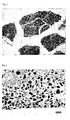
- the resulting cWSC was prepared in cross-section, etched to visualize the phase composition and examined in an incident-light microscope. A micrograph (1000x magnification) is shown in FIG.
- the coarse particles After coking, the coarse particles have an approx. 15 ⁇ m thick edge of WC, which can be seen in Fig. 1 as a bright surface layer. Particles with a large aspect ratio (aspect ratio), i. elongated shaped particles are partially completely carbonated.
- the final product had 5.26 wt% bound carbon and 0.41 wt% free carbon.
- the high level of free carbon indicates that the carbon offered was not fully absorbed at the carburization conditions chosen.
- the proportions of the sieve fractions between 150 microns and 45 microns did not change by the treatment compared to the starting material.
- the structure created during welding is virtually free of carbide precipitates. Matrix metal and hard material are retained in their original composition. Especially The exposed to the atmosphere, thermally stressed edge zone shows an unchanged in comparison to the middle and bottom of the heat affected zone content of intact hard material, with a considerable number of particles even protrudes from the atmosphere to the surface.
- the WSC used to make the tungsten carbide of the present invention was welded under identical conditions.
- the WSC dissolves almost completely in the outer edge area to a depth of 200-500 ⁇ m. It comes to the excretion of fine carbides.
- the specimens were examined in transverse section in the incident light microscope. Microscopic images are shown in Fig. 4 (50X magnification) and Fig. 5 (500X magnification). It can be seen clearly the fine carbide particles.
- the number of hard material particles stored in the composite material is about 30% higher than the non-carburized reference material (WSC) welded under the same conditions.
- WSC of the grain size -150 + 45 ⁇ m was reacted with carbon black analogously to Example 1.
- the treatment duration was 6h.
- the result was a cWSC with 5.48 wt% bound and 0.06 wt% free carbon.
- the particle size distribution was not affected by the extended reaction time.
- the ratio of free to bonded carbon was expected to be lowered by the prolonged temperature treatment compared to Example 1.
- 6 kg of cWSC were mixed with 4 kg of Ni-3B-3Si alloy and welded with a PTA hand torch.
- the lower content of free carbon had a positive effect on the welding behavior compared to Example 1.
- Microscopic examination of the weld layer revealed that the number of unresolved tungsten carbide particles increased by another 10%, i. 40% higher than the non-carburetted comparative sample (WSC).
- WSC of the grain size -150 + 45 ⁇ m was reacted with carbon black analogously to Example 1.
- a smaller amount of carbon black was used so that the total carbon content of the mixture was 4.3% by weight.
- the result was a cWSC with 4.3 wt .-% bound and 0.01 wt .-% free carbon. Due to the small amount of added carbon source, only a very thin shell of WC formed.
- Fig. 6 shows in cross section a micrograph (50X magnification) of the tungsten carbide after welding. It can be seen a small number of fine carbide particles.
- Example 1 For comparison, 6 kg of macrocrystalline WC of the grain size -150 + 45 ⁇ m with 6.1% by weight of bound carbon were mixed analogously to Example 1 with 4 kg of a Ni-3B-3Si alloy and welded under the conditions mentioned in Example 1. As expected, the macrocrystalline WC did not dissolve during welding.
- the proportion of hard material particles in the welded layer is about 48% higher than when using the WSC starting material from Example 1.
- the hardness of the macrocrystalline WC in the weld layer was about 1500 HV0.1 and was thus significantly lower than the hardness of the cWSC from Examples 1-3 according to the invention, which can be given as 2200 to 2500 HV0.1.
- the average hardness of the matrix metal after welding was about 700 HV0.1.
Landscapes
- Chemical & Material Sciences (AREA)
- Engineering & Computer Science (AREA)
- Ceramic Engineering (AREA)
- Organic Chemistry (AREA)
- Manufacturing & Machinery (AREA)
- Materials Engineering (AREA)
- Structural Engineering (AREA)
- Inorganic Chemistry (AREA)
- Mechanical Engineering (AREA)
- Physics & Mathematics (AREA)
- Metallurgy (AREA)
- Thermal Sciences (AREA)
- Life Sciences & Earth Sciences (AREA)
- Geology (AREA)
- Mining & Mineral Resources (AREA)
- Environmental & Geological Engineering (AREA)
- Fluid Mechanics (AREA)
- General Life Sciences & Earth Sciences (AREA)
- Geochemistry & Mineralogy (AREA)
- Powder Metallurgy (AREA)
- Carbon And Carbon Compounds (AREA)
- Organic Low-Molecular-Weight Compounds And Preparation Thereof (AREA)
- Drilling Tools (AREA)
- Cutting Tools, Boring Holders, And Turrets (AREA)
- Materials For Medical Uses (AREA)
- Polyesters Or Polycarbonates (AREA)
Priority Applications (1)
| Application Number | Priority Date | Filing Date | Title |
|---|---|---|---|
| PL04797914T PL1687239T3 (pl) | 2003-11-21 | 2004-11-16 | Bardzo twardy materiał dwufazowy, sposób jego wytwarzania i jego zastosowanie |
Applications Claiming Priority (2)
| Application Number | Priority Date | Filing Date | Title |
|---|---|---|---|
| DE10354543A DE10354543B3 (de) | 2003-11-21 | 2003-11-21 | Dualphasenhartstoff, Verfahren zu seiner Herstellung und dessen Verwendung |
| PCT/EP2004/012959 WO2005049490A1 (de) | 2003-11-21 | 2004-11-16 | Dualphasenhartstoff, verfahren zu seiner herstellung und dessen verwendung |
Publications (2)
| Publication Number | Publication Date |
|---|---|
| EP1687239A1 EP1687239A1 (de) | 2006-08-09 |
| EP1687239B1 true EP1687239B1 (de) | 2007-04-11 |
Family
ID=34609212
Family Applications (1)
| Application Number | Title | Priority Date | Filing Date |
|---|---|---|---|
| EP04797914A Expired - Lifetime EP1687239B1 (de) | 2003-11-21 | 2004-11-16 | Dualphasenhartstoff, verfahren zu seiner herstellung und dessen verwendung |
Country Status (11)
| Country | Link |
|---|---|
| US (2) | US7541090B2 (pl) |
| EP (1) | EP1687239B1 (pl) |
| JP (1) | JP4773362B2 (pl) |
| KR (1) | KR101083940B1 (pl) |
| CN (1) | CN100441505C (pl) |
| AT (1) | ATE359233T1 (pl) |
| CA (1) | CA2546617C (pl) |
| DE (2) | DE10354543B3 (pl) |
| IL (1) | IL175668A (pl) |
| PL (1) | PL1687239T3 (pl) |
| WO (1) | WO2005049490A1 (pl) |
Families Citing this family (21)
| Publication number | Priority date | Publication date | Assignee | Title |
|---|---|---|---|---|
| DE10354543B3 (de) * | 2003-11-21 | 2005-08-04 | H.C. Starck Gmbh | Dualphasenhartstoff, Verfahren zu seiner Herstellung und dessen Verwendung |
| DE102007019150A1 (de) * | 2007-04-20 | 2008-10-30 | Durum Verschleißschutz GmbH | Werkstoff und Verfahren zur Beschichtung einer Oberfläche |
| WO2009111749A1 (en) * | 2008-03-07 | 2009-09-11 | University Of Utah | Thermal degradation and crack resistant functionally graded cemented tungsten carbide and polycrystalline diamond |
| US8220566B2 (en) * | 2008-10-30 | 2012-07-17 | Baker Hughes Incorporated | Carburized monotungsten and ditungsten carbide eutectic particles, materials and earth-boring tools including such particles, and methods of forming such particles, materials, and tools |
| GB2480207B (en) * | 2009-02-18 | 2013-05-22 | Smith International | Matrix body fixed cutter bits |
| US9353578B2 (en) * | 2009-03-20 | 2016-05-31 | Smith International, Inc. | Hardfacing compositions, methods of applying the hardfacing compositions, and tools using such hardfacing compositions |
| US20110042145A1 (en) * | 2009-05-04 | 2011-02-24 | Smith International, Inc. | Methods for enhancing a surface of a downhole tool and downhole tools having an enhanced surface |
| WO2010129507A2 (en) * | 2009-05-04 | 2010-11-11 | Smith International, Inc. | Roller cones, methods of manufacturing such roller cones, and drill bits incorporating such roller cones |
| CN101704522B (zh) * | 2009-11-11 | 2012-06-13 | 苏州新锐硬质合金有限公司 | 碳化钨包覆铸造碳化钨颗粒的制备方法及其应用 |
| US8950518B2 (en) | 2009-11-18 | 2015-02-10 | Smith International, Inc. | Matrix tool bodies with erosion resistant and/or wear resistant matrix materials |
| US20110195834A1 (en) * | 2010-02-05 | 2011-08-11 | Kennametal, Inc. | Wear Resistant Two-Phase Binderless Tungsten Carbide and Method of Making Same |
| DE102010014267A1 (de) | 2010-04-08 | 2011-10-13 | H.C. Starck Gmbh | Dispersionen, sowie Verfahren zur deren Herstellung und deren Verwendung |
| KR101688524B1 (ko) | 2010-07-30 | 2016-12-22 | 삼성전자주식회사 | 연료전지용 전극촉매, 이 전극촉매를 포함하는 막 전극 접합체와 연료전지, 및 연료전지용 전극촉매의 제조방법 |
| JP5590326B2 (ja) * | 2011-01-05 | 2014-09-17 | 三菱マテリアル株式会社 | ダイヤモンド被覆超硬合金製ドリル |
| DE102011117042B4 (de) * | 2011-10-27 | 2019-02-21 | H. C. Starck Tungsten GmbH | Verfahren zur Herstellung eines Bauteils umfassend das Sintern einer Hartmetallzusammensetzung |
| US8936114B2 (en) | 2012-01-13 | 2015-01-20 | Halliburton Energy Services, Inc. | Composites comprising clustered reinforcing agents, methods of production, and methods of use |
| PE20141226Z (es) * | 2013-04-05 | 2014-10-02 | Minetec Sa | Ojo de pestillo para palas de maquina excavadora |
| US9604345B2 (en) | 2013-11-01 | 2017-03-28 | National Oilwell DHT, L.P. | Hard-facing for downhole tools and matrix bit bodies with enhanced wear resistance and fracture toughness |
| WO2016099459A1 (en) * | 2014-12-16 | 2016-06-23 | Halliburton Energy Services, Inc. | Downhole tools with hard, fracture-resistant tungsten carbide elements |
| RU2644483C2 (ru) * | 2016-07-21 | 2018-02-12 | Руслан Алексеевич Шевченко | Способ получения сферического порошка монокарбида вольфрама wc |
| CN117401682A (zh) * | 2023-11-14 | 2024-01-16 | 自贡长城表面工程技术有限公司 | 一种梯度碳化钨颗粒及其制备方法 |
Family Cites Families (28)
| Publication number | Priority date | Publication date | Assignee | Title |
|---|---|---|---|---|
| US3660050A (en) * | 1969-06-23 | 1972-05-02 | Du Pont | Heterogeneous cobalt-bonded tungsten carbide |
| US3848062A (en) | 1972-02-17 | 1974-11-12 | Ppg Industries Inc | Preparation of monotungsten carbide |
| DE2525185C3 (de) * | 1975-06-06 | 1986-04-17 | Fried. Krupp Gmbh, 4300 Essen | Hartmetallkörper |
| US4066451A (en) * | 1976-02-17 | 1978-01-03 | Erwin Rudy | Carbide compositions for wear-resistant facings and method of fabrication |
| US4588606A (en) * | 1983-10-18 | 1986-05-13 | Union Carbide Corporation | Abrasion resistant coating and method for producing the same |
| FR2595716B1 (fr) | 1986-03-13 | 1992-07-10 | Technogenia Sa | Procede et dispositif pour l'elaboration de materiaux refractaires par induction |
| DE3626031A1 (de) * | 1986-08-01 | 1988-02-11 | Starck Hermann C Fa | Verfahren zur herstellung von wolframschmelzcarbid und dessen verwendung |
| US4834963A (en) * | 1986-12-16 | 1989-05-30 | Kennametal Inc. | Macrocrystalline tungsten monocarbide powder and process for producing |
| US5096689A (en) * | 1989-01-23 | 1992-03-17 | Kennametal Inc. | Process for producing tungsten monocarbide |
| JP2813414B2 (ja) * | 1990-04-26 | 1998-10-22 | 三菱マテリアル株式会社 | 等軸状炭化タングステン超微粒粉末の製造法 |
| SE500049C2 (sv) * | 1991-02-05 | 1994-03-28 | Sandvik Ab | Hårdmetallkropp med ökad seghet för mineralavverkning samt sätt att framställa denna |
| US5166103A (en) * | 1991-08-13 | 1992-11-24 | Vladimir Krstic | Method of making monotunsten carbide and mixtures of monotungsten carbide-titanium carbide powders |
| JPH06321520A (ja) * | 1992-12-11 | 1994-11-22 | Asahi Glass Co Ltd | 金属炭化物微小中空体およびその製造方法 |
| KR100330107B1 (ko) * | 1993-04-30 | 2002-08-21 | 더 다우 케미칼 캄파니 | 조밀화된 미세입자 내화금속 또는 고용체(혼합금속) 탄화물 세라믹 |
| DE4420496A1 (de) * | 1994-06-13 | 1995-12-14 | Woka Schweistechnik Gmbh | Verfahren und Vorrichtung zur schmelzmetallurgischen Herstellung von Hartstoffen |
| SE513740C2 (sv) * | 1995-12-22 | 2000-10-30 | Sandvik Ab | Slitstark hårmetallkropp främst för användning vid bergborrning och mineralbrytning |
| JP3385549B2 (ja) * | 1996-05-20 | 2003-03-10 | 株式会社アライドマテリアル | 複合タングステン球,それを用いた探針装置及び半導体パッケージ |
| US5942204A (en) * | 1997-03-31 | 1999-08-24 | Omg Americas, Inc. | Method to produce a transition metal carbide from a partially reduced transition metal compound |
| DE19852459A1 (de) * | 1998-11-13 | 2000-05-18 | Starck H C Gmbh Co Kg | Verfahren zur Herstellung von Wolframkarbiden durch Gasphasenkarburierung |
| AT3064U1 (de) * | 1998-12-28 | 1999-09-27 | Plansee Tizit Gmbh | Gaskarburierungsverfahren zur herstellung von reinem wc-pulver |
| US6248149B1 (en) * | 1999-05-11 | 2001-06-19 | Baker Hughes Incorporated | Hardfacing composition for earth-boring bits using macrocrystalline tungsten carbide and spherical cast carbide |
| JP4406120B2 (ja) * | 1999-09-02 | 2010-01-27 | 株式会社東芝 | 炭化タングステン粉末 |
| DE19945318C2 (de) * | 1999-09-22 | 2001-12-13 | Hartmetall Beteiligungs Gmbh | Verfahren zur Herstellung sphäroidisierter Hartstoffpulver |
| DE10043792A1 (de) * | 2000-09-06 | 2002-03-14 | Starck H C Gmbh | Ultragrobes, einkristallines Wolframkarbid und Verfahren zu dessen Herstellung; und daraus hergestelltes Hartmetall |
| AT410939B (de) * | 2000-12-20 | 2003-08-25 | Treibacher Ind Ag | Verfahren zur herstellung von wolframcarbid |
| CN1289392C (zh) * | 2001-07-30 | 2006-12-13 | 三菱麻铁里亚尔株式会社 | 微粒碳化钨粉末的制造方法及粉末 |
| CN1210203C (zh) * | 2003-01-03 | 2005-07-13 | 浙江大学 | 一种制备碳化钨粉体的方法 |
| DE10354543B3 (de) * | 2003-11-21 | 2005-08-04 | H.C. Starck Gmbh | Dualphasenhartstoff, Verfahren zu seiner Herstellung und dessen Verwendung |
-
2003
- 2003-11-21 DE DE10354543A patent/DE10354543B3/de not_active Expired - Fee Related
-
2004
- 2004-11-16 CN CNB2004800341693A patent/CN100441505C/zh not_active Expired - Lifetime
- 2004-11-16 JP JP2006540285A patent/JP4773362B2/ja not_active Expired - Fee Related
- 2004-11-16 PL PL04797914T patent/PL1687239T3/pl unknown
- 2004-11-16 CA CA2546617A patent/CA2546617C/en not_active Expired - Lifetime
- 2004-11-16 US US10/579,291 patent/US7541090B2/en not_active Expired - Lifetime
- 2004-11-16 AT AT04797914T patent/ATE359233T1/de active
- 2004-11-16 KR KR1020067009748A patent/KR101083940B1/ko not_active Expired - Fee Related
- 2004-11-16 EP EP04797914A patent/EP1687239B1/de not_active Expired - Lifetime
- 2004-11-16 WO PCT/EP2004/012959 patent/WO2005049490A1/de not_active Ceased
- 2004-11-16 DE DE502004003500T patent/DE502004003500D1/de not_active Expired - Lifetime
-
2006
- 2006-05-16 IL IL175668A patent/IL175668A/en active IP Right Grant
-
2009
- 2009-04-09 US US12/420,971 patent/US7810587B2/en not_active Expired - Lifetime
Also Published As
| Publication number | Publication date |
|---|---|
| DE502004003500D1 (de) | 2007-05-24 |
| JP2007516918A (ja) | 2007-06-28 |
| JP4773362B2 (ja) | 2011-09-14 |
| DE10354543B3 (de) | 2005-08-04 |
| IL175668A0 (en) | 2006-09-05 |
| WO2005049490A1 (de) | 2005-06-02 |
| US7810587B2 (en) | 2010-10-12 |
| KR20070001062A (ko) | 2007-01-03 |
| US20070079905A1 (en) | 2007-04-12 |
| CN100441505C (zh) | 2008-12-10 |
| KR101083940B1 (ko) | 2011-11-15 |
| CA2546617C (en) | 2012-05-08 |
| PL1687239T3 (pl) | 2007-09-28 |
| US7541090B2 (en) | 2009-06-02 |
| EP1687239A1 (de) | 2006-08-09 |
| CA2546617A1 (en) | 2005-06-02 |
| IL175668A (en) | 2010-11-30 |
| US20090263646A1 (en) | 2009-10-22 |
| CN1882501A (zh) | 2006-12-20 |
| HK1098119A1 (zh) | 2007-07-13 |
| ATE359233T1 (de) | 2007-05-15 |
Similar Documents
| Publication | Publication Date | Title |
|---|---|---|
| EP1687239B1 (de) | Dualphasenhartstoff, verfahren zu seiner herstellung und dessen verwendung | |
| EP1242642B1 (de) | Verfahren zur herstellung von pulvermischungen bzw. verbundpulver | |
| DE69620998T2 (de) | Oxidationsbeständige molybdänlegierung | |
| EP2771494B1 (de) | Verfahren zur herstellung einer hartmetallzusammensetzung | |
| DE60201922T2 (de) | Sprühpulver und Verfahren zur seiner Herstellung | |
| DE69333657T2 (de) | Legierung mit hoher Korrosionsbeständigkeit und hoher Verschleissfestigkeit, Verfahren zur Herstellung dieser Erzeugnisse und Ausgangsmaterial für dieses Herstellungsverfahren | |
| DE60124061T2 (de) | Hartstoffschicht für Schneidwerkzeuge | |
| DE3937526C2 (de) | Verschleißfeste Titanlegierung, Verfahren zu ihrer Herstellung und ihre Verwendung | |
| DE69403413T2 (de) | Pulver zum Gebrauch beim thermischen Spritzen | |
| DE69211736T2 (de) | Verschleissfeste Legierung auf Kupferbasis | |
| EP1324946B1 (de) | Ultragrobes, einkristallines wolframkarbid und verfahren zu dessen herstellung; und daraus hergestelltes hartmetall | |
| EP0044351B1 (de) | Hartlegierung, bestehend aus einem oder mehreren Hartstoffen und einer Bindemetall-Legierung, und Verfahren zum Herstellen dieser Legierung | |
| BRPI0714305B1 (pt) | Método para revestimento duro de um substrato | |
| Huang et al. | Investigation of the structure and properties of AlCrCuFeNiVx high-entropy alloys | |
| DE69809616T2 (de) | Verschleissfestes beschichtetes Teil | |
| DE3789313T2 (de) | Laser-aufschweissmaterial und dessen verwendung zum laser-aufschweissen. | |
| EP1968893B1 (de) | Metallboride | |
| DE10124250C2 (de) | Verfahren zur Bildung einer hochfesten und verschleißbeständigen Verbundschicht | |
| DE2322159C3 (de) | Verfahren zur Herstellung eines geschmolzenen Behandlungsbades zur Erzeugung einer Vanadin-, Niob- oder Tantalcarbidschicht auf der Oberfläche von mindestens 0,05 Gewichtsprozent Kohlenstoff enthaltenden Werkstücken aus Eisen, Eisenlegierungen oder Sintercarbid | |
| DD160344A5 (de) | Verfahren zur oberflaechenhaertung eines auf eisen basierenden legierungssubstrats | |
| DE69022064T2 (de) | Verfahren zum ändern eines oberflächenbereiches eines werkstückes. | |
| DE2829976C2 (de) | Gemisch, enthaltend Borsäure, Natriumborat und/oder Kaliumborat zur Erzeugung einer Carbidschicht und Verfahren zur Erzeugung der Carbidschicht | |
| DE102025109242A1 (de) | Nichtmagnetische metallmatrix-verbundwerkstoffe | |
| HK1098119B (en) | Dual-phase hard material, method for the production thereof and its use | |
| DE102008042476C5 (de) | Verfahren zum Herstellen einer Auflage auf einem Träger |
Legal Events
| Date | Code | Title | Description |
|---|---|---|---|
| PUAI | Public reference made under article 153(3) epc to a published international application that has entered the european phase |
Free format text: ORIGINAL CODE: 0009012 |
|
| 17P | Request for examination filed |
Effective date: 20060621 |
|
| AK | Designated contracting states |
Kind code of ref document: A1 Designated state(s): AT BE BG CH CY CZ DE DK EE ES FI FR GB GR HU IE IS IT LI LU MC NL PL PT RO SE SI SK TR |
|
| GRAP | Despatch of communication of intention to grant a patent |
Free format text: ORIGINAL CODE: EPIDOSNIGR1 |
|
| RAP1 | Party data changed (applicant data changed or rights of an application transferred) |
Owner name: H.C. STARCK GMBH & CO. KG |
|
| DAX | Request for extension of the european patent (deleted) | ||
| GRAS | Grant fee paid |
Free format text: ORIGINAL CODE: EPIDOSNIGR3 |
|
| GRAA | (expected) grant |
Free format text: ORIGINAL CODE: 0009210 |
|
| AK | Designated contracting states |
Kind code of ref document: B1 Designated state(s): AT BE BG CH CY CZ DE DK EE ES FI FR GB GR HU IE IS IT LI LU MC NL PL PT RO SE SI SK TR |
|
| PG25 | Lapsed in a contracting state [announced via postgrant information from national office to epo] |
Ref country code: FI Free format text: LAPSE BECAUSE OF FAILURE TO SUBMIT A TRANSLATION OF THE DESCRIPTION OR TO PAY THE FEE WITHIN THE PRESCRIBED TIME-LIMIT Effective date: 20070411 Ref country code: SI Free format text: LAPSE BECAUSE OF FAILURE TO SUBMIT A TRANSLATION OF THE DESCRIPTION OR TO PAY THE FEE WITHIN THE PRESCRIBED TIME-LIMIT Effective date: 20070411 |
|
| REG | Reference to a national code |
Ref country code: GB Ref legal event code: FG4D Free format text: NOT ENGLISH |
|
| REG | Reference to a national code |
Ref country code: CH Ref legal event code: EP |
|
| REG | Reference to a national code |
Ref country code: CH Ref legal event code: NV Representative=s name: E. BLUM & CO. AG PATENT- UND MARKENANWAELTE VSP |
|
| REG | Reference to a national code |
Ref country code: IE Ref legal event code: FG4D Free format text: LANGUAGE OF EP DOCUMENT: GERMAN |
|
| REF | Corresponds to: |
Ref document number: 502004003500 Country of ref document: DE Date of ref document: 20070524 Kind code of ref document: P |
|
| GBT | Gb: translation of ep patent filed (gb section 77(6)(a)/1977) |
Effective date: 20070531 |
|
| PG25 | Lapsed in a contracting state [announced via postgrant information from national office to epo] |
Ref country code: ES Free format text: LAPSE BECAUSE OF FAILURE TO SUBMIT A TRANSLATION OF THE DESCRIPTION OR TO PAY THE FEE WITHIN THE PRESCRIBED TIME-LIMIT Effective date: 20070722 |
|
| REG | Reference to a national code |
Ref country code: GR Ref legal event code: EP Ref document number: 20070401812 Country of ref document: GR |
|
| REG | Reference to a national code |
Ref country code: SE Ref legal event code: TRGR Ref country code: CH Ref legal event code: PFA Owner name: H.C. STARCK GMBH Free format text: H.C. STARCK GMBH & CO. KG#IM SCHLEEKE 78-91#38642 GOSLAR (DE) -TRANSFER TO- H.C. STARCK GMBH#IM SCHLEEKE 78-91#38642 GOSLAR (DE) |
|
| PG25 | Lapsed in a contracting state [announced via postgrant information from national office to epo] |
Ref country code: IS Free format text: LAPSE BECAUSE OF FAILURE TO SUBMIT A TRANSLATION OF THE DESCRIPTION OR TO PAY THE FEE WITHIN THE PRESCRIBED TIME-LIMIT Effective date: 20070811 |
|
| PG25 | Lapsed in a contracting state [announced via postgrant information from national office to epo] |
Ref country code: PT Free format text: LAPSE BECAUSE OF FAILURE TO SUBMIT A TRANSLATION OF THE DESCRIPTION OR TO PAY THE FEE WITHIN THE PRESCRIBED TIME-LIMIT Effective date: 20070911 |
|
| ET | Fr: translation filed | ||
| REG | Reference to a national code |
Ref country code: PL Ref legal event code: T3 |
|
| PG25 | Lapsed in a contracting state [announced via postgrant information from national office to epo] |
Ref country code: BG Free format text: LAPSE BECAUSE OF FAILURE TO SUBMIT A TRANSLATION OF THE DESCRIPTION OR TO PAY THE FEE WITHIN THE PRESCRIBED TIME-LIMIT Effective date: 20070711 Ref country code: CZ Free format text: LAPSE BECAUSE OF FAILURE TO SUBMIT A TRANSLATION OF THE DESCRIPTION OR TO PAY THE FEE WITHIN THE PRESCRIBED TIME-LIMIT Effective date: 20070411 Ref country code: DK Free format text: LAPSE BECAUSE OF FAILURE TO SUBMIT A TRANSLATION OF THE DESCRIPTION OR TO PAY THE FEE WITHIN THE PRESCRIBED TIME-LIMIT Effective date: 20070411 |
|
| PLBE | No opposition filed within time limit |
Free format text: ORIGINAL CODE: 0009261 |
|
| STAA | Information on the status of an ep patent application or granted ep patent |
Free format text: STATUS: NO OPPOSITION FILED WITHIN TIME LIMIT |
|
| PG25 | Lapsed in a contracting state [announced via postgrant information from national office to epo] |
Ref country code: SK Free format text: LAPSE BECAUSE OF FAILURE TO SUBMIT A TRANSLATION OF THE DESCRIPTION OR TO PAY THE FEE WITHIN THE PRESCRIBED TIME-LIMIT Effective date: 20070411 |
|
| 26N | No opposition filed |
Effective date: 20080114 |
|
| PG25 | Lapsed in a contracting state [announced via postgrant information from national office to epo] |
Ref country code: RO Free format text: LAPSE BECAUSE OF FAILURE TO SUBMIT A TRANSLATION OF THE DESCRIPTION OR TO PAY THE FEE WITHIN THE PRESCRIBED TIME-LIMIT Effective date: 20070411 |
|
| PG25 | Lapsed in a contracting state [announced via postgrant information from national office to epo] |
Ref country code: MC Free format text: LAPSE BECAUSE OF NON-PAYMENT OF DUE FEES Effective date: 20071130 |
|
| PG25 | Lapsed in a contracting state [announced via postgrant information from national office to epo] |
Ref country code: EE Free format text: LAPSE BECAUSE OF FAILURE TO SUBMIT A TRANSLATION OF THE DESCRIPTION OR TO PAY THE FEE WITHIN THE PRESCRIBED TIME-LIMIT Effective date: 20070411 |
|
| PG25 | Lapsed in a contracting state [announced via postgrant information from national office to epo] |
Ref country code: CY Free format text: LAPSE BECAUSE OF FAILURE TO SUBMIT A TRANSLATION OF THE DESCRIPTION OR TO PAY THE FEE WITHIN THE PRESCRIBED TIME-LIMIT Effective date: 20070411 |
|
| PG25 | Lapsed in a contracting state [announced via postgrant information from national office to epo] |
Ref country code: LU Free format text: LAPSE BECAUSE OF NON-PAYMENT OF DUE FEES Effective date: 20071116 |
|
| PG25 | Lapsed in a contracting state [announced via postgrant information from national office to epo] |
Ref country code: HU Free format text: LAPSE BECAUSE OF FAILURE TO SUBMIT A TRANSLATION OF THE DESCRIPTION OR TO PAY THE FEE WITHIN THE PRESCRIBED TIME-LIMIT Effective date: 20071012 Ref country code: TR Free format text: LAPSE BECAUSE OF FAILURE TO SUBMIT A TRANSLATION OF THE DESCRIPTION OR TO PAY THE FEE WITHIN THE PRESCRIBED TIME-LIMIT Effective date: 20070411 |
|
| PGFP | Annual fee paid to national office [announced via postgrant information from national office to epo] |
Ref country code: GR Payment date: 20101014 Year of fee payment: 7 |
|
| PGFP | Annual fee paid to national office [announced via postgrant information from national office to epo] |
Ref country code: NL Payment date: 20111117 Year of fee payment: 8 |
|
| REG | Reference to a national code |
Ref country code: NL Ref legal event code: V1 Effective date: 20130601 |
|
| PG25 | Lapsed in a contracting state [announced via postgrant information from national office to epo] |
Ref country code: GR Free format text: LAPSE BECAUSE OF NON-PAYMENT OF DUE FEES Effective date: 20130604 Ref country code: NL Free format text: LAPSE BECAUSE OF NON-PAYMENT OF DUE FEES Effective date: 20130601 |
|
| REG | Reference to a national code |
Ref country code: GR Ref legal event code: ML Ref document number: 20070401812 Country of ref document: GR Effective date: 20130604 |
|
| REG | Reference to a national code |
Ref country code: FR Ref legal event code: PLFP Year of fee payment: 12 |
|
| REG | Reference to a national code |
Ref country code: FR Ref legal event code: PLFP Year of fee payment: 13 |
|
| REG | Reference to a national code |
Ref country code: DE Ref legal event code: R079 Ref document number: 502004003500 Country of ref document: DE Free format text: PREVIOUS MAIN CLASS: C01B0031340000 Ipc: C01B0032949000 |
|
| REG | Reference to a national code |
Ref country code: FR Ref legal event code: PLFP Year of fee payment: 14 |
|
| REG | Reference to a national code |
Ref country code: DE Ref legal event code: R081 Ref document number: 502004003500 Country of ref document: DE Owner name: H.C. STARCK SURFACE TECHNOLOGY AND CERAMIC POW, DE Free format text: FORMER OWNER: H.C. STARCK GMBH, 38642 GOSLAR, DE |
|
| REG | Reference to a national code |
Ref country code: CH Ref legal event code: PUE Owner name: H.C. STARCK SURFACE TECHNOLOGY AND CERAMIC POW, DE Free format text: FORMER OWNER: H.C. STARCK GMBH, DE |
|
| REG | Reference to a national code |
Ref country code: AT Ref legal event code: PC Ref document number: 359233 Country of ref document: AT Kind code of ref document: T Owner name: H.C. STARCK SURFACE TECHNOLOGY AND CERAMIC POW, DE Effective date: 20180305 |
|
| REG | Reference to a national code |
Ref country code: BE Ref legal event code: PD Owner name: H.C. STARCK SURFACE TECHNOLOGY AND CERAMIC POWDER Free format text: DETAILS ASSIGNMENT: CHANGE OF OWNER(S), CESSION; FORMER OWNER NAME: H.C. STARCK GMBH Effective date: 20180322 |
|
| REG | Reference to a national code |
Ref country code: GB Ref legal event code: 732E Free format text: REGISTERED BETWEEN 20180405 AND 20180411 |
|
| REG | Reference to a national code |
Ref country code: FR Ref legal event code: TP Owner name: H.C. STARCK SURFACE TECHNOLOGY AND CERAMIC POW, DE Effective date: 20180914 |
|
| PGFP | Annual fee paid to national office [announced via postgrant information from national office to epo] |
Ref country code: BE Payment date: 20191017 Year of fee payment: 16 Ref country code: IT Payment date: 20191108 Year of fee payment: 16 |
|
| PGFP | Annual fee paid to national office [announced via postgrant information from national office to epo] |
Ref country code: CH Payment date: 20191116 Year of fee payment: 16 |
|
| REG | Reference to a national code |
Ref country code: CH Ref legal event code: PL |
|
| REG | Reference to a national code |
Ref country code: BE Ref legal event code: MM Effective date: 20201130 |
|
| PG25 | Lapsed in a contracting state [announced via postgrant information from national office to epo] |
Ref country code: LI Free format text: LAPSE BECAUSE OF NON-PAYMENT OF DUE FEES Effective date: 20201130 Ref country code: CH Free format text: LAPSE BECAUSE OF NON-PAYMENT OF DUE FEES Effective date: 20201130 |
|
| PG25 | Lapsed in a contracting state [announced via postgrant information from national office to epo] |
Ref country code: IT Free format text: LAPSE BECAUSE OF NON-PAYMENT OF DUE FEES Effective date: 20201116 |
|
| PG25 | Lapsed in a contracting state [announced via postgrant information from national office to epo] |
Ref country code: BE Free format text: LAPSE BECAUSE OF NON-PAYMENT OF DUE FEES Effective date: 20201130 |
|
| P01 | Opt-out of the competence of the unified patent court (upc) registered |
Effective date: 20230529 |
|
| PGFP | Annual fee paid to national office [announced via postgrant information from national office to epo] |
Ref country code: GB Payment date: 20231006 Year of fee payment: 20 |
|
| PGFP | Annual fee paid to national office [announced via postgrant information from national office to epo] |
Ref country code: SE Payment date: 20231010 Year of fee payment: 20 Ref country code: IE Payment date: 20231009 Year of fee payment: 20 Ref country code: FR Payment date: 20231024 Year of fee payment: 20 Ref country code: DE Payment date: 20231003 Year of fee payment: 20 Ref country code: AT Payment date: 20231025 Year of fee payment: 20 |
|
| PGFP | Annual fee paid to national office [announced via postgrant information from national office to epo] |
Ref country code: PL Payment date: 20231016 Year of fee payment: 20 |
|
| REG | Reference to a national code |
Ref country code: DE Ref legal event code: R071 Ref document number: 502004003500 Country of ref document: DE |
|
| REG | Reference to a national code |
Ref country code: GB Ref legal event code: PE20 Expiry date: 20241115 |
|
| REG | Reference to a national code |
Ref country code: IE Ref legal event code: MK9A |
|
| REG | Reference to a national code |
Ref country code: SE Ref legal event code: EUG |
|
| REG | Reference to a national code |
Ref country code: AT Ref legal event code: MK07 Ref document number: 359233 Country of ref document: AT Kind code of ref document: T Effective date: 20241116 |
|
| PG25 | Lapsed in a contracting state [announced via postgrant information from national office to epo] |
Ref country code: GB Free format text: LAPSE BECAUSE OF EXPIRATION OF PROTECTION Effective date: 20241115 |
|
| PG25 | Lapsed in a contracting state [announced via postgrant information from national office to epo] |
Ref country code: IE Free format text: LAPSE BECAUSE OF EXPIRATION OF PROTECTION Effective date: 20241116 |
|
| PG25 | Lapsed in a contracting state [announced via postgrant information from national office to epo] |
Ref country code: IE Free format text: LAPSE BECAUSE OF EXPIRATION OF PROTECTION Effective date: 20241116 Ref country code: GB Free format text: LAPSE BECAUSE OF EXPIRATION OF PROTECTION Effective date: 20241115 |