EP1672041A1 - Wässrige Beschichtungen für Nahrungsmittelbehälter - Google Patents
Wässrige Beschichtungen für Nahrungsmittelbehälter Download PDFInfo
- Publication number
- EP1672041A1 EP1672041A1 EP05026426A EP05026426A EP1672041A1 EP 1672041 A1 EP1672041 A1 EP 1672041A1 EP 05026426 A EP05026426 A EP 05026426A EP 05026426 A EP05026426 A EP 05026426A EP 1672041 A1 EP1672041 A1 EP 1672041A1
- Authority
- EP
- European Patent Office
- Prior art keywords
- acid
- aqueous coating
- blocked
- coating compositions
- mol
- Prior art date
- Legal status (The legal status is an assumption and is not a legal conclusion. Google has not performed a legal analysis and makes no representation as to the accuracy of the status listed.)
- Granted
Links
Classifications
-
- C—CHEMISTRY; METALLURGY
- C08—ORGANIC MACROMOLECULAR COMPOUNDS; THEIR PREPARATION OR CHEMICAL WORKING-UP; COMPOSITIONS BASED THEREON
- C08G—MACROMOLECULAR COMPOUNDS OBTAINED OTHERWISE THAN BY REACTIONS ONLY INVOLVING UNSATURATED CARBON-TO-CARBON BONDS
- C08G18/00—Polymeric products of isocyanates or isothiocyanates
- C08G18/06—Polymeric products of isocyanates or isothiocyanates with compounds having active hydrogen
- C08G18/28—Polymeric products of isocyanates or isothiocyanates with compounds having active hydrogen characterised by the compounds used containing active hydrogen
- C08G18/40—High-molecular-weight compounds
- C08G18/42—Polycondensates having carboxylic or carbonic ester groups in the main chain
- C08G18/4263—Polycondensates having carboxylic or carbonic ester groups in the main chain containing carboxylic acid groups
-
- C—CHEMISTRY; METALLURGY
- C09—DYES; PAINTS; POLISHES; NATURAL RESINS; ADHESIVES; COMPOSITIONS NOT OTHERWISE PROVIDED FOR; APPLICATIONS OF MATERIALS NOT OTHERWISE PROVIDED FOR
- C09D—COATING COMPOSITIONS, e.g. PAINTS, VARNISHES OR LACQUERS; FILLING PASTES; CHEMICAL PAINT OR INK REMOVERS; INKS; CORRECTING FLUIDS; WOODSTAINS; PASTES OR SOLIDS FOR COLOURING OR PRINTING; USE OF MATERIALS THEREFOR
- C09D175/00—Coating compositions based on polyureas or polyurethanes; Coating compositions based on derivatives of such polymers
- C09D175/04—Polyurethanes
-
- C—CHEMISTRY; METALLURGY
- C08—ORGANIC MACROMOLECULAR COMPOUNDS; THEIR PREPARATION OR CHEMICAL WORKING-UP; COMPOSITIONS BASED THEREON
- C08G—MACROMOLECULAR COMPOUNDS OBTAINED OTHERWISE THAN BY REACTIONS ONLY INVOLVING UNSATURATED CARBON-TO-CARBON BONDS
- C08G18/00—Polymeric products of isocyanates or isothiocyanates
- C08G18/06—Polymeric products of isocyanates or isothiocyanates with compounds having active hydrogen
- C08G18/70—Polymeric products of isocyanates or isothiocyanates with compounds having active hydrogen characterised by the isocyanates or isothiocyanates used
- C08G18/72—Polyisocyanates or polyisothiocyanates
- C08G18/77—Polyisocyanates or polyisothiocyanates having heteroatoms in addition to the isocyanate or isothiocyanate nitrogen and oxygen or sulfur
- C08G18/78—Nitrogen
- C08G18/79—Nitrogen characterised by the polyisocyanates used, these having groups formed by oligomerisation of isocyanates or isothiocyanates
- C08G18/791—Nitrogen characterised by the polyisocyanates used, these having groups formed by oligomerisation of isocyanates or isothiocyanates containing isocyanurate groups
- C08G18/792—Nitrogen characterised by the polyisocyanates used, these having groups formed by oligomerisation of isocyanates or isothiocyanates containing isocyanurate groups formed by oligomerisation of aliphatic and/or cycloaliphatic isocyanates or isothiocyanates
-
- C—CHEMISTRY; METALLURGY
- C08—ORGANIC MACROMOLECULAR COMPOUNDS; THEIR PREPARATION OR CHEMICAL WORKING-UP; COMPOSITIONS BASED THEREON
- C08G—MACROMOLECULAR COMPOUNDS OBTAINED OTHERWISE THAN BY REACTIONS ONLY INVOLVING UNSATURATED CARBON-TO-CARBON BONDS
- C08G18/00—Polymeric products of isocyanates or isothiocyanates
- C08G18/06—Polymeric products of isocyanates or isothiocyanates with compounds having active hydrogen
- C08G18/70—Polymeric products of isocyanates or isothiocyanates with compounds having active hydrogen characterised by the isocyanates or isothiocyanates used
- C08G18/72—Polyisocyanates or polyisothiocyanates
- C08G18/80—Masked polyisocyanates
- C08G18/8061—Masked polyisocyanates masked with compounds having only one group containing active hydrogen
- C08G18/8064—Masked polyisocyanates masked with compounds having only one group containing active hydrogen with monohydroxy compounds
- C08G18/8067—Masked polyisocyanates masked with compounds having only one group containing active hydrogen with monohydroxy compounds phenolic compounds
-
- C—CHEMISTRY; METALLURGY
- C08—ORGANIC MACROMOLECULAR COMPOUNDS; THEIR PREPARATION OR CHEMICAL WORKING-UP; COMPOSITIONS BASED THEREON
- C08G—MACROMOLECULAR COMPOUNDS OBTAINED OTHERWISE THAN BY REACTIONS ONLY INVOLVING UNSATURATED CARBON-TO-CARBON BONDS
- C08G18/00—Polymeric products of isocyanates or isothiocyanates
- C08G18/06—Polymeric products of isocyanates or isothiocyanates with compounds having active hydrogen
- C08G18/70—Polymeric products of isocyanates or isothiocyanates with compounds having active hydrogen characterised by the isocyanates or isothiocyanates used
- C08G18/72—Polyisocyanates or polyisothiocyanates
- C08G18/80—Masked polyisocyanates
- C08G18/8061—Masked polyisocyanates masked with compounds having only one group containing active hydrogen
- C08G18/807—Masked polyisocyanates masked with compounds having only one group containing active hydrogen with nitrogen containing compounds
- C08G18/8074—Lactams
-
- C—CHEMISTRY; METALLURGY
- C09—DYES; PAINTS; POLISHES; NATURAL RESINS; ADHESIVES; COMPOSITIONS NOT OTHERWISE PROVIDED FOR; APPLICATIONS OF MATERIALS NOT OTHERWISE PROVIDED FOR
- C09D—COATING COMPOSITIONS, e.g. PAINTS, VARNISHES OR LACQUERS; FILLING PASTES; CHEMICAL PAINT OR INK REMOVERS; INKS; CORRECTING FLUIDS; WOODSTAINS; PASTES OR SOLIDS FOR COLOURING OR PRINTING; USE OF MATERIALS THEREFOR
- C09D175/00—Coating compositions based on polyureas or polyurethanes; Coating compositions based on derivatives of such polymers
- C09D175/04—Polyurethanes
- C09D175/06—Polyurethanes from polyesters
-
- C—CHEMISTRY; METALLURGY
- C08—ORGANIC MACROMOLECULAR COMPOUNDS; THEIR PREPARATION OR CHEMICAL WORKING-UP; COMPOSITIONS BASED THEREON
- C08G—MACROMOLECULAR COMPOUNDS OBTAINED OTHERWISE THAN BY REACTIONS ONLY INVOLVING UNSATURATED CARBON-TO-CARBON BONDS
- C08G2390/00—Containers
- C08G2390/40—Inner coatings for containers
Definitions
- the present invention relates to aqueous coating compositions and to inner coatings of metallic food containers and packaging produced therefrom.
- polyurethane stoving lacquers (1-component PUR stoving lacquers) consisting mainly of a blocked polyisocyanate as crosslinking component and a polyol as binder component, as coating agent, e.g. for automotive OEM, general industrial painting and coil coating.
- 1-component PU stoving lacquers are those lacquers which cure at elevated temperatures to form a polyurethane network. The hydroxyl groups of a polyol react with the (de) blocked NCO groups of a polyisocyanate.
- a disadvantage of the use of blocked polyisocyanates for the production of polyurethane coatings for example, that depending on the nature of the blocking agent and the baking conditions a more or less large part of the blocking agent remains in free form in the coating.
- the residual content of blocking agent depends on the particular blocking agent itself, on its reactivity and on the stoving conditions.
- high demands are placed on the coating, especially when it comes to the inner coating of food containers, such as beverage cans.
- the paints must be flexible enough to withstand deformation during the manufacture of the containers and during transport of the packaged goods without damage to the coating (eg by cracking), on the other hand, the metallic substrate must be reliably protected from the influence of corrosive media.
- the adhesion to the metallic substrate must be given both in the deformation and in the subsequent sterilization, as is necessary in particular in containers that serve as food and beverage packaging. It is undesirable for constituents of the coating to become involved in the production and storage of the packaged goods, since this can lead to impairment of the product properties.
- the prior art includes the use of coating agents based on bisphenol A diglycidyl ether (BADGE). It is known that small amounts of these in vitro tests can transfer mutagenic substance into the packaged foods. Therefore, the goal should be to use BADGE-free coatings for the interior coating of food contact cans.
- BADGE bisphenol A diglycidyl ether
- polyurethane powder coatings based on polyisocyanates and polyols for the production of inner coatings of packaging containers is described in DE-A 195 45 424.
- polyurethane coatings based on blocked polyisocyanates for coating the majority of food containers with permanent contact with the foodstuff. This is due to the fact that it is known to those skilled in the art that such coatings contain a residual content of free blocking agent. It therefore had to be assumed that these chemicals would migrate into the filling material, where they could lead to changes in taste or cloudiness or, in the worst case, to damage to the health of the consumer.
- the object of the present invention was therefore to provide aqueous coating compositions for internal coating of, preferably metallic, food packaging with permanent contact with foodstuffs, which have the abovementioned properties. Do not prove disadvantages.
- the lacquer coatings based on the coating compositions according to the invention either no longer contain any relevant amounts of free blocking agents or they do not migrate - as is assumed - into the packaged foodstuffs. In any case, no relevant amounts of coating compositions are found in these, even if the inner surface of the container is completely coated with the coating compositions used according to the invention, as is the case for example with beverage cans.
- the teaching according to the invention thus overcomes a previous prejudice.
- Suitable polyisocyanates A) are low-monomer, prepared by modification in particular aliphatic, cycloaliphatic, araliphatic and / or aromatic diisocyanates, constructed from at least two diisocyanates polyisocyanates with preferably uretdione, isocyanurate, urethane, allophanate, biuret, iminooxadiazinedione and / or Oxadiazinetrion Modell or mixtures of these compounds.
- Suitable diisocyanates are diisocyanates having aliphatically and / or cycloaliphatically attached isocyanate groups, e.g. 1,4-diisocynanatobutane, 1,6-diisocyanatohexane, isophorone diisocyanate, 4,4'-diisocyanatodicyclohexylmethane and 1,3- and 1,4-bis (2-isocyanatoprop-2-yl) -benzene.
- diisocyanates having aliphatically and / or cycloaliphatically attached isocyanate groups, e.g. 1,4-diisocynanatobutane, 1,6-diisocyanatohexane, isophorone diisocyanate, 4,4'-diisocyanatodicyclohexylmethane and 1,3- and 1,4-bis (2-isocyanatoprop-2-yl)
- polyisocyanates or polyisocyanate mixtures having an isocyanurate structure and / or iminooxadiazinedione and / or biuret structure based on HDI, IPDI and / or 4,4'-diisocyanatodicyclohexylmethane or mixtures of these compounds.
- Polyisocyanates based on IPDI with isocyanurate structure are particularly preferred because they are approved for use in packaging materials for foodstuffs according to European Standard EEC 2002/72.
- Suitable blocking agents for the preparation of component A) are p-hydroxybenzoic acid esters, ⁇ -caprolactam and aliphatic alcohols having a molecular weight ⁇ 100 or mixtures of these connections. Preference is given to using ⁇ -caprolactam and / or p-hydroxybenzoic acid esters.
- hydroxybenzoic acids or their derivatives according to the invention are: o-, m- and p-hydroxybenzoic acid and their methyl, ethyl, (iso) propyl, butyl, 2-ethylhexyl, tert-butyl neopentyl esters, amides such as methyl and ethyl amide, dimethyl and diethyl amide.
- Preferred hydroxycarboxylic acid derivatives are methyl, ethyl and butyl esters, particularly preferred are propyl esters of o- and / or p-hydroxybenzoic acid.
- Suitable difunctional chain extender component iii) are, for example, diamines, diols and also hydroxyamines in the molecular weight range from 32 to 300. Preference is given to using C 2 -C 12 diols and triols and all isomers and any mixtures of the compounds listed below with one another: ethanediols, propanediols, butanediols, pentanediols, hexanediols, heptanediols, octanediols, nonanediols, decanediols, trimethylolethane and -propane.
- hydrazine ethylenediamine, isophoronediamine, the bisketimine of isophoronediamine and methyl isobutyl ketone, 1,4-dihydroxybutane, ethanolamine, N-methylethanolamine, hydroxyethylethylenediamine, and the adduct of 2 mol of propylene carbonate and 1 mol of hydrazine of the general formula (II)
- the paint binder (B) employed is at least one hydrophilicized polyester polyol containing on average at least two reactive hydroxyl groups per molecule or a mixture of hydrophilized and non-hydrophilicized polyester polyols.
- polystyrene resins for the purposes of the present invention are the organic polyhydroxyl compounds known in polyurethane coating technology, such as the customary polyester polyols, polyacrylate polyols, polyurethane polyols, polycarbonate polyols, polyether polyols, polyester polyacrylate polyols and polyurethane polyacrylate polyols, polyurethane polyester polyols, polyurethane polyether polyols, polyurethane polycarbonate polyols, polyester polycarbonate polyols, phenol / formaldehyde resins, alone or in mixtures ,
- the compounds used as paint binders (B) contain on average at least two NCO groups reactive hydroxyl groups per molecule and are dilutable with water or soluble or dispersible in water.
- the polyhydroxyl compounds (B) used are those having an average molecular weight M w of from 1500 to 60 000, an OH content to DIN 53 240/2 of from 0.5 to 30% and an acid number of ⁇ 15 mg KOH / g.
- Polyhydroxyl compounds (B) used are preferably polyols which are composed of toxicologically acceptable constituents. Particularly preferred are those which, according to ⁇ 175300, 21, are FDA - compliant and contain at most 30% by weight of organic solvents. In combination with the polyisocyanate crosslinkers (A) these polyhydroxyl compounds (B) provide coatings with very good levels of properties, such as. B. high elasticity, a high resistance to solvents, chemicals and greasy and oily substances and at the same time a high resistance to thermal stress.
- FDA-compliant in this context means that only components are used in the binder compositions or in their manufacture, which are listed in accordance with ⁇ 175300 in the USA Code of Federal Regulations No. 21 (FDA).
- component al) are as aromatic di- or polycarboxylic acid or anhydrides preferably phthalic acid, isophthalic acid, terephthalic acid, trimellitic acid, phthalic anhydride, trimellitic anhydride and / or pyromellitic anhydride, more preferably phthalic anhydride, terephthalic acid and / or isophthalic acid, most preferably phthalic anhydride and / or Terephthalic acid used.
- aromatic di- or polycarboxylic acid or anhydrides preferably phthalic acid, isophthalic acid, terephthalic acid, trimellitic acid, phthalic anhydride, trimellitic anhydride and / or pyromellitic anhydride, more preferably phthalic anhydride, terephthalic acid and / or isophthalic acid, most preferably phthalic anhydride and / or Terephthalic acid used.
- Suitable aliphatic di- or polycarboxylic acids a1) are preferably succinic acid, maleic acid, adipic acid, sebacic acid, dodecanedioic acid, dimerized fatty acids, succinic anhydride and / or maleic anhydride; succinic anhydride, maleic anhydride and / or adipic acid are particularly preferred, adipic acid and / or maleic anhydride are very particularly preferred.
- Suitable cycloaliphatic di- or polycarboxylic acids a1) are preferably 1,4-cyclohexanedicarboxylic acid, hexahydrophthalic acid and / or hexahydrophthalic anhydride, particular preference is given to 1,4-cyclohexanedicarboxylic acid and / or hexahydrophthalic anhydride, very particular preference to 1,4-cyclohexanedicarboxylic acid.
- component a2) are preferred as monocarboxylic acids acetic acid, propionic acid, 1-octanoic acid, 1-decanoic acid, 1-dodecanoic acid, 1-octadecanoic acid, saturated and unsaturated fatty acids and / or benzoic acid, more preferably 1-dodecanoic acid, 1-octadecanoic acid, saturated and unsaturated fatty acids and / or benzoic acid, very particularly preferably saturated and unsaturated fatty acids and / or benzoic acid.
- component b1) are as aliphatic polyols preferably ethylene glycol, diethylene glycol, triethylene glycol, 1,2-propanediol, 1,4-butanediol, neopentyl glycol, 1,6-hexanediol, glycerol, trimethylolpropane, pentaerythritol and / or sorbitol, particularly preferably neopentyl glycol, ethylene glycol , Diethylene glycol, 1,2-propanediol, 1,6-hexanediol, glycerol and / or trimethylolpropane, most preferably neopentyl glycol, ethylene glycol, diethylene glycol, 1,2-propanediol and / or trimethylolpropane used.
- Monoalcohols b2) are preferably methanol, ethanol, 1-propanol, 1-butanol, 2-butanol, isobutanol, 1-pentanol, 1-hexanol, 2-ethylhexanol, 1-octanol, 1-decanol, 1-dodecanol, butylglycol, and / or butyl diglycol, particularly preferably 2-ethylhexanol, 1-decanol, 1-dodecanol, cyclohexanol, butylglycol and / or butyldiglycol, very particularly preferably 2-ethylhexanol, cyclohexanol, butylglycol and / or butyldiglycol.
- the abovementioned compounds of the components a1), a2), b1) and b2) can each be used individually or in any desired mixtures with one another in the respective components for the preparation of the polyesterpolyols B). Preference is given to using compounds of components a1) and b1). Adipic acid, maleic anhydride, phthalic anhydride, isophthalic acid and terephthalic acid are particularly preferred for the preparation of the polyester polyols B) and ethylene glycol, diethylene glycol, 1,2-propanediol, dipropylene glycol, neopentyl glycol and trimethylolpropane are used as compounds of component b1).
- polyester polyols B The preparation of the polyester polyols B) is carried out in a conventional manner by methods such as those described in "Ullmann's Encyclopedia of Industrial Chemistry", Verlag Chemie Weinheim, 4th Edition (1980) Volume 19, pages 61 ff. Or by H. Wagner and HF Sarx in “Lackbuchharze”, Carl Hanser Verlag, Kunststoff (1971), pages 86 to 152 are described in detail.
- the preparation is preferably carried out in the melt, optionally in the presence of a catalytic amount of a conventional esterification catalyst, e.g. Acids, bases or transition metal compounds, e.g. Titantetrabutylate, dibutyltin oxide or butylstannoic acid, at temperatures of 80 to 270 ° C, preferably from 100 to 250 ° C, carried out under a nitrogen atmosphere.
- a conventional esterification catalyst e.g. Acids, bases or transition metal compounds, e.g. Titantetrabutylate, dibutyltin oxide or butylstannoic acid
- the nitrogen flow also serves to remove the resulting water of reaction.
- the removal of the water of reaction can also be carried out by applying a vacuum of preferably up to 0.1 mbar.
- an entraining agent such as e.g. Xylene, be added to discharge the water of reaction.
- an OH-functional polyester polyol is first prepared which has no or only small amounts of free carboxylic acid and / or carboxylate functions, which is then reacted in a subsequent step with a cyclic dicarboxylic acid anhydride, such as e.g. Phthalic anhydride is reacted with ring opening and half esterification, in which case the desired number of free carboxylic acid and / or carboxylate arise.
- a cyclic dicarboxylic acid anhydride such as e.g. Phthalic anhydride
- the weight-average molecular weights M.sub.w of the water-dilutable polyesterpolyols B) are> 1.500 g / mol, preferably> 2.000 g / mol, more preferably> 3.000 g / mol and most preferably between 5.000 and 60.000 g / mol.
- the OH numbers of the water-dilutable polyester polyols B) are in the range from 20 to 300 mg KOH / g, preferably from 25 to 250 mg KOH / g, more preferably from 30 to 200 mg KOH / g and most preferably from 35 to 150 mg KOH / g, based on solid resin.
- the acid numbers of the water-dilutable polyester polyols B) are in the range of ⁇ 15 mg KOH / g, preferably from 20 to 75 mg KOH / g, more preferably from 25 to 70 mg KOH / g and most preferably from 30 to 60 mg KOH / g , based on solid resin.
- Suitable neutralizing agents d) for neutralizing the carboxylic acid groups of the polyester polyols B) are both inorganic and organic bases.
- Preferred are primary, secondary and tertiary amines and ammonia, more preferably tertiary amines, e.g. Triethylamine, tributylamine, N-methyldiethanolamine, N, N-dimethylethanolamine, N, N-diethylethanolamine, triethanolamine, triisopropylamine and triisopropanolamine used.
- Triethylamine, tributylamine N-methyldiethanolamine, N, N-dimethylethanolamine, N, N-diethylethanolamine, triethanolamine, triisopropylamine and triisopropanolamine used.
- Very particular preference is given to N, N-dimethylethanolamine, triethanolamine and triethylamine.
- Components of component e) are, for example, defoamers, thickeners, leveling agents, pigments, fillers, emulsifiers, dispersing agents, light stabilizers and also solvents.
- the desired processing viscosity is usually adjusted by the addition of organic solvents or water, preferably water.
- thickeners In order to set very specific processing viscosities or to achieve particular rheological properties, it is also possible to use thickeners or combinations of various thickening agents, e.g. ionic and associative thickeners.
- the carboxylic acid groups contained must be completely or partially neutralized with a neutralizing agent.
- the neutralizing agent d) can be added before, during or after the conversion of the polyester according to the invention into the aqueous phase, preference being given to neutralization before the conversion into the aqueous phase.
- the amount of component d) used for this purpose is customarily from 0.4 to 1.5 mol, preferably from 0.5 to 1.4 mol and more preferably from 0.6 to 1.3 mol, based on all COOH present in computational form in B) functions.
- polyesterpolyols B) To convert the polyesterpolyols B) into the aqueous phase, these are introduced, if appropriate under high shear, such as vigorous stirring, either into the dispersing water c) or, conversely, the dispersing water c) is stirred to give the polyesterpolyol (s). It is often advantageous to add water-dilutable organic solvents of component e) to the polyesterpolyol prior to the dispersing process which serve as auxiliary or co-solvent, as it were. Such solvents are, for example, butyl glycol or butyl diglycol.
- the present invention also provides a process for the preparation of the aqueous coating compositions according to the invention, which comprises mixing components A), B) and, if appropriate, C), followed by the addition of water and dispersion, during mixing of constituents A) to C) is operated below the temperature at which the blocked NCO groups can react with the other constituents.
- the mixing takes place at temperatures between 15 and 100 ° C, more preferably between 20 and 80 ° C instead.
- a particular embodiment of the process according to the invention consists in that a component A) which is not or only slightly hydrophilized is mixed with component B) before the addition of water, and the two components are then dispersed together.
- a little hydrophilized component A) is meant such a compound containing such a small amount of hydrophilic groups, which is not sufficient to form a sedimentation-stable dispersion.
- This little hydrophilic component A) would either not be able to be dispersed in water at all, or a possible resulting dispersion would not be stable and a sediment would form.
- auxiliaries and additives C e.g. Plasticizers, leveling agents and other additives, pigments, fillers, solvents or crosslinking reaction accelerating catalysts can be used.
- Catalysts which can be used are the compounds known in polyurethane chemistry which accelerate the reaction of isocyanate groups with hydroxyl groups. For example, these are tin, zinc, zirconium, bismuth and titanium compounds. If catalysts are used, preference is given to nontoxic catalysts, examples being butyltin tris (2-ethylhexanoate), dibutyltin bis (2-ethylhexanoate), tetrabutyl titanate and tin (II) 2-ethylhexanoate.
- crosslinker components can also be used.
- these are aminoplast resins.
- Aminoplast resins are the condensation products of melamine and formaldehyde or urea and formaldehyde which are known in paint technology. Suitable are all conventional melamine-formaldehyde condensates which have not been etherified or are etherified with saturated monoalcohols having 1 to 4 C atoms.
- the amount of binder with NCO-reactive hydroxyl groups or the amount of NCO-containing components must be adjusted accordingly.
- Each of the components A) to C) used can optionally be used dissolved in an organic solvent.
- an addition of solvents can also be carried out following the mixing of the components A) to C), for example to lower the viscosity.
- Suitable solvents are, for example, water or the conventional lacquer solvents, such as e.g. Ethyl acetate, butyl acetate, 1-methoxy-2-propyl acetate, 3-methoxy-n-butyl acetate, acetone, 2-butanone, 4-methyl-2-pentanone, cyclohexanone, toluene, xylene, N-methylpyrrolidone, chlorobenzene, ethylene and propylene glycol monomethyl ether, Butyl glycol, butyl diglycol.
- lacquer solvents such as e.g. Ethyl acetate, butyl acetate, 1-methoxy-2-propyl acetate, 3-methoxy-n-butyl acetate, acetone, 2-butanone, 4-methyl-2-pentanone, cyclohexanone, toluene, xylene, N-methylpyrrolidone, chlorobenzene,
- the invention relates to the use of the coating compositions according to the invention for the coating of packaging and for the inner coating of cans. Preference is given to cans for the packaging of foods.
- the coating compositions are applied to an optionally precoated, metallic substrate and cured at elevated temperatures. Of course, they can also be used for the production of other coating materials and adhesives.
- the present invention also relates to metallic substrates coated with the coating compositions according to the invention.
- lacquers is carried out directly on the metallic substrate or on previously applied to the substrate lacquer layers according to known from the prior art methods, for example by spraying, dipping, flooding or by means of rollers or squeegees.
- a dry film thickness for the inner coating of 1 to 50 ⁇ m, preferably 3 to 30 ⁇ m, more preferably 5 to 15 ⁇ m and most preferably 8 to 12 microns results.
- the substrates are after application of the coatings to temperatures between 100 ° C and 400 ° C, preferably between 180 ° C and 260 ° C, most preferably heated between 190 ° C and 240 ° C and for 100 minutes 1 second, preferably for 30 minutes to 15 seconds, more preferably stored for 15 minutes to 20 seconds at this temperature.
- the heating can be carried out batchwise in baking ovens or continuously in coil coating plants, so-called coil coating plants.
- the coating compositions of the invention are suitable for the coating of packaging, in particular for the inner coating of cans. But they can also be used for exterior coating of cans.
- the Emballagen can consist of different materials and have different geometry. As materials are preferably black plate, tinplate and various iron alloys in question, which may be provided with a passivation layer based on nickel, chromium and zinc compounds.
- the packaging can take the form of, for example, can bodies, that is to say hulls and lids, as 3-part cans and as 2-part, stretched deep-drawn or otherwise deep-drawn cans, such as, for example, cans. Beverage and food cans, coated.
- foods and stimulants are foods in the broadest sense or animal foods. These are liquid or solid, as well as semi-solid goods containing, for example, water, fats, alcohol and / or protein.
- these are coffee, tea or extracts of coffee and tea, fruit and / or carbonated beverages such as fruit and vegetable juices, wine, sodas, beer, sparkling wine and sparkling wine, and mixtures of these drinks and fish, meat, vegetables or Fruit preserves, which may be cooked or frozen in the coated containers.
- the subject matter of the present invention is also paint coatings obtainable from the coating compositions according to the invention.
- the paint coatings obtained from the coating compositions according to the invention are distinguished by very good metal adhesion, freedom from pores, product resistance, high hardness and, at the same time, particularly good elasticity, which are contradictory properties. Furthermore, the paint coatings have a very high resistance to solvents, chemicals and water and have a good sterilization and pasteurization resistance and taste neutrality, a good flow and a high gloss. They are free of "BADGE" and very well suited as coating of cans with food contact.
- the characteristic values were the solids content (thick-layer method: lid, 1 g sample, 1 h 125 ° C., convection oven, DIN EN ISO 3251 basis), the acid number (mg KOH / g sample, titration with 0.1 mol / l NaOH solution, basis DIN 53402), the viscosity (rotational viscometer VT 550 from Haake GmbH, Düsseldorf, DE, MV-DIN cup at viscosity ⁇ 10,000 mPas / 23 ° C), the OH number (mg KOH / g sample, acetylation, hydrolysis, titration with 0.1 mol / 1 NaOH, based on DIN 53240) and the Hazen color number (Hazen color number according to DIN 53995, color number meter Lico® 400, Dr. Lange GmbH, Berlin, DE). The acid and OH numbers are given both for the delivery form (Lff.) And for the solid resin (FH).
- the OH content can be calculated
- the result was a clear, light-colored resin having an acid number of 46 mg KOH / g, an OH number of 45 mg KOH / g (based on solid resin), a viscosity of 91 seconds (flow time from a DIN-4-mm cup at 23 ° C, 50% dissolved in methoxypropyl acetate) and a Hazen color number of 64 APHA (70% solution in butylglycol).
- the result was a clear, light-colored resin having an acid number of 55 mg KOH / g, an OH number of 40 mg KOH / g (based on solid resin), a viscosity of 85 seconds (flow time from a DIN-4-mm beaker at 23 ° C, 40% dissolved in methoxypropyl acetate) and a Hazen color number of 44 APHA (70% solution in butyl glycol).
- Example 2 622 g (0.5 eq OH) of Example 2 were dissolved at 65 ° C in 284.80 g of acetone with stirring. To the clear solution was added 150.0 g Desmodur® VP LS 2078 (0.25 eq blocked NCO) (blocked IPDI trimer, Bayer AG, Leverkusen) and the mixture was stirred at 60 ° C for 15 minutes.
- Desmodur® VP LS 2078 (0.25 eq blocked NCO) (blocked IPDI trimer, Bayer AG, Leverkusen)
- Example 3 616.00 g (0.44 Val OH) of Example 3 were dissolved in 299.52 g of acetone at 65 ° C. Thereafter, 132.00 g (0.22 eq blocked NCO) of Desmodur® VP LS 2078 (blocked IPDI trimer, Bayer AG, Leverkusen) was added, stirred for 10 minutes at 60 ° C, then 53.59 g (0.616 mol) of dimethyl ethanolamine added, stirred for 10 minutes at 60 ° C and then dispersed with 1337.81 g of deionized water at room temperature.
- Desmodur® VP LS 2078 blocked IPDI trimer, Bayer AG, Leverkusen
- the mixture was then stirred for 1 hour at 50 ° C, cooled to room temperature and then acetone distilled off in vacuo (last 1 hour at 120 mbar / 40 ° C). The mixture was then allowed to cool while stirring (about 4 hours).
- the resulting dispersion had the following properties: Solids content: 35% PH value: 8.20 Viscosity at 23 ° C: 8800 mPa ⁇ s particle size 215 nm
- Example 9 The procedure was as described in Example 9, except that 648.12 g of the compound from Example 3 and instead of Desmodur® VP LS 2078 157.26 g of the compound from Example 6, 61.76 g (0.69 mol) of dimethylethanolamine and 1609, 8 g of deionized water used.
- the resulting dispersion had the following properties: Solids content: 30% PH value: 8.05 Viscosity at 23 ° C: 1500 mPa ⁇ s particle size 282 nm
- Example 9 The procedure was as described in Example 9, except that 547.36 g of the compound from Example 2, 256.69 g of acetone, 157.26 (0.22 Val blocked NCO) compound from Example 6, 45.98 g of dimethylethanolamine and 1082, 9 g of deionized water used.
- the resulting dispersion had the following properties: Solids content: 35% PH value: 8.84 Viscosity at 23 ° C: 32000 mPa ⁇ s particle size 2900 nm
- Example 7 The procedure was as described in Example 7, but instead of the compound from Example 6 126.36 g (0.2106 Val blocked NCO) Desmodur® VP LS 2078 (blocked IPDI trimer, Bayer AG, Leverkusen) and 2002.1 g used deionized water.
- the resulting dispersion had the following properties: Solids content: 35% PH value: 8.24 Viscosity at 23 ° C: 23500 mPa.s particle size 1698 nm
- Example 1 583.12 g (0.74 g of OH) of Example 1 were dissolved in 280.34 g of acetone. After addition of 41.14 g (0.3 equivalents of NCO) of isophorone diisocyanate, refluxing was continued until no NCO groups could be detected by IR spectroscopy (about 5 hours).
- Example 17 to 21 are 1K PU dispersions according to the invention and Example 22 is a comparative dispersion based on a commercially available epoxy resin.
- Example 17 Example 18
- Example 20 Example 21 Comparative Example 22
- Polyester Example 5 38.8 g Polyester Example 4 38.8 g Polyester Example 1 46.6 g Polyester Example 3 46.6 g Product from Example 15 84.2 g Desmodur® VP LS 2078 1) 14.6 g Blocked polyisocyanate
- Example 6 14.6 g Blocked polyisocyanate
- Example 16 11.5 g 11.5 g butylglycol 11.5 g 11.5 g 8.8 g 8.8 g
- the plates coated according to the invention were stored for 2 hours at 121 ° C. in 120 ml of a mixture of equal volumes of ethanol and water. The liquid was then chromatographed for liberated blocking agent. At a detection limit of 3 ⁇ g / l no liberated blocking agent was found.
Landscapes
- Chemical & Material Sciences (AREA)
- Organic Chemistry (AREA)
- Polymers & Plastics (AREA)
- Health & Medical Sciences (AREA)
- Chemical Kinetics & Catalysis (AREA)
- Medicinal Chemistry (AREA)
- Materials Engineering (AREA)
- Wood Science & Technology (AREA)
- Engineering & Computer Science (AREA)
- Life Sciences & Earth Sciences (AREA)
- Paints Or Removers (AREA)
- Details Of Rigid Or Semi-Rigid Containers (AREA)
- Wrappers (AREA)
- Laminated Bodies (AREA)
- Application Of Or Painting With Fluid Materials (AREA)
Abstract
Description
- Die vorliegende Erfindung betrifft wässrige Beschichtungsmittel sowie daraus hergestellte Innenbeschichtungen von metallischen Nahrungsmittelbehältern und -verpackungen.
- Es ist bekannt, Einkomponenten-Polyurethan-Einbrennlacke (1K-PUR-Einbrennlacke), bestehend hauptsächlich aus einem blockierten Polyisocyanat als Vernetzerkomponente und einem Polyol als Bindemittelkomponente, als Beschichtungsmittel, z.B. für die Automobil-Erstlackierung, die allgemeine Industrielackierung und im Coil-Coating einzusetzen. Als 1K-PUR-Einbrennlacke werden solche Lacke bezeichnet, die bei erhöhten Temperaturen unter Ausbildung eines Polyurethannetzwerkes aushärten. Dabei reagieren die Hydroxylgruppen eines Polyols mit den (de)blockierten NCO-Gruppen eines Polyisocyanates. Die Reaktion von mit CH-aciden Estern blockierten NCO-Gruppen mit Polyolen stellt dagegen eine Umesterung dar, bei der kein Polyurethannetzwerk entsteht, deshalb werden Lacke auf Basis solcher blockierten Polyisocyanate nicht als 1K-PUR-Einbrennlacke bezeichnet.
- Nachteilig am Einsatz von blockierten Polyisocyanaten zur Herstellung von Polyurethanbeschichtungen ist beispielsweise, dass je nach Art des Blockierungsmittel und der Einbrennbedingungen ein mehr oder weniger großer Teil des Blockierungsmittels in freier Form in der Beschichtung verbleibt. Dabei hängt der Restgehalt an Blockierungsmittel vom jeweiligen Blockierungsmittel selbst, von dessen Reaktivität und von den Einbrennbedingungen ab.
- Bei der Herstellung von Beschichtungen auf metallischen Verpackungen, dem sogenannten "Can Coating", werden Bleche, z.B. aus Weißblech oder Aluminium, mit einem Einbrennlack beschichtet und nach Aushärtung des Lackes zu den gewünschten Gebrauchsgütern verarbeitet. Hierbei werden hohe Anforderungen an die Beschichtung gestellt, insbesondere, wenn es sich um die Innenbeschichtung von Nahrungsmittelbehältern, beispielsweise Getränkedosen, handelt. Zum einen müssen die Lacke flexibel genug sein, um Verformungen während der Herstellung der Behälter und bei Transport der fertig verpackten Güter ohne Beschädigungen der Beschichtung (z.B. durch Rissbildung) zu überstehen, zum anderen muss das metallische Substrat zuverlässig vor dem Einfluss korrosiver Medien geschützt werden. Zusätzlich muss die Haftfähigkeit auf dem metallischen Substrat sowohl bei der Verformung als auch bei einer nachträglichen Sterilisierung, wie sie insbesondere bei Behältern, die als Verpackung für Nahrungsmittel und Getränke dienen, notwendig ist, gegeben sein. Es ist nicht erwünscht, dass Bestandteile der Beschichtung bei Herstellung und Lagerung der verpackten Güter in diese übergehen, weil dies zur Beeinträchtigung der Produkteigenschaften führen kann.
- Zum Stand der Technik gehört die Verwendung von Beschichtungsmitteln auf Basis von Bisphenol-A-Diglycidyl-Ether (BADGE). Es ist bekannt, dass geringe Mengen dieser in-vitro Tests mutagen wirksamen Substanz in die verpackten Nahrungsmittel übergehen können. Daher sollte es Ziel sein, BADGE-freie Beschichtungen für die Innenbeschichtung von Dosen mit Nahrungsmittelkontakt einzusetzen.
- Der Einsatz von Polyurethan-Pulverlacken auf Basis von Polyisocyanaten und Polyolen zur Herstellung von Innenbeschichtungen von Verpackungsbehältern wird in der DE-A 195 45 424 beschrieben. Es ist jedoch nicht bekannt, Polyurethanlacke auf Basis blockierter Polyisocyanate zur Beschichtung des überwiegenden Teils von Nahrungsmittelbehältern mit dauerhaftem Kontakt zum Nahrungsmittel zu verwenden. Dies ist darauf zurückzufiihren, dass dem Fachmann bekannt ist, dass solche Beschichtungen einen Restgehalt an freiem Blockierungsmittel enthalten. Es musste daher davon ausgegangen werden, dass diese Chemikalien in das Füllgut übergehen würden und dort zu Geschmacksveränderungen oder Trübungen oder im schlimmsten Fall zur gesundheitlichen Schädigung des Konsumenten führen könnten.
- Daher ist nie in Betracht gezogen worden, Beschichtungssysteme auf Basis blockierter Polyisocyanate, die im Zuge der Vernetzung das Blockierungsmittel abspalten, zur Beschichtung von in direktem Kontakt mit Nahrungsmitteln stehenden Oberflächen einzusetzen, weil von den abgespaltenen Blockierungsmitteln ein potenzielles toxikologisches Risiko ausgehen könnte. Insbesondere ist bisher nicht versucht worden, wässrige Beschichtungssysteme auf Polyurethanbasis für diesen Zweck einzusetzen.
- Die Aufgabe der vorliegenden Erfindung bestand daher in der Bereitstellung wässriger Beschichtungsmittel zur Innenbeschichtung von, vorzugsweise metallischen, Nahrungsnüttelverpackungen mit dauerhaftem Kontakt zu Nahrungsmitteln, die die o.g. Nachteile nicht aüfweisen.
- Diese Aufgabe wurde mit den erfindungsgemäßen selbstvernetzenden Einkomponenten-Einbrennlacken gelöst. Überraschenderweise enthalten die Lackbeschichtungen auf Basis der erfindungsgemäßen Beschichtungsmittel entweder keine relevanten Mengen an freien Blockierungsmitteln mehr oder diese migrieren nicht - wie an sich vermutet - in die verpackten Nahrungsmittel. Jedenfalls werden in diesen keine relevanten Mengen an Beschichtungsmitteln gefunden, selbst dann nicht, wenn die Innenfläche des Behältnisses vollständig mit den erfindungsgemäß verwendeten Beschichtungsmitteln überzogen ist, wie dies beispielsweise bei Getränkedosen der Fall ist. Die erfindungsgemäße Lehre überwindet demnach ein bisher bestandenes Vorurteil.
- Gegenstand der vorliegenden Erfindung sind daher wässrige Beschichtungsmittel enthaltend
- A) mindestens ein im Mittel mindestens zwei NCO-Gruppen pro Molekül enthaltendes Polyisocyanat bei dem mindestens 85 % der NCO-Gruppen mit einem Blockierungsmittel blockiert sind, wobei das Blockierungsmitttel ε-Caprolactam und/oder eine Hydroxycarbonsäure und/oder ein aliphatischer Alkohol mit einem Molekulargewicht <100 ist,
- B) mindestens ein im Mittel mindestens zwei reaktive Hydroxylgruppen pro Molekül enthaltendes hydrophiliertes Polyesterpolyol oder Gemisch aus hydrophilierten und nicht hydrophilierten Polyesterpolyolen mit einer Säurezahl von ≥ 15 mg KOH/g, einer Hydroxylzahl von 20 bis 300 mg KOH/g und einem gewichtsgemittelten Molekulargewicht Mw von > 1500 g/mol und
- C) gegebenenfalls Hilfs- und Zusatzstoffen,
- Geeignete Polyisocyanate A) sind monomerenarme, durch Modifizierung insbesondere aliphatischer, cycloaliphatischer, araliphatischer und/oder aromatischer Diisocyanate hergestellte, aus mindestens zwei Diisocyanaten aufgebaute Polyisocyanate mit vorzugsweise Uretdion-, Isocyanurat-, Urethan-, Allophanat-, Biuret-, Iminooxadiazindion- und/oder Oxadiazintrionstruktur oder Gemische dieser Verbindungen.
- Geeignete Diisocyanate sind Diisocyanate mit aliphatisch und/oder cycloaliphatisch gebundenen Isocyanatgruppen, wie z.B. 1,4-Diisocynanatobutan, 1,6-Diisocyanatohexan, Isophorondiisocyanat, 4,4'-Diisocyanatodicyclohexylmethan und 1,3- und 1,4-Bis(2-isocyanatoprop-2yl)-benzol.
- Bevorzugt sind Polyisocyanate bzw. Polyisocyanatgemische mit Isocyanuratstruktur und/oder Iminooxadiazindion- und/oder Biuretstruktur auf Basis von HDI, IPDI und/oder 4,4'-Diisocyanatodicyclohexylmethan oder Gemische dieser Verbindungen. Besonders bevorzugt werden Polyisocyanate auf Basis von IPDI mit Isocyanuratstruktur eingesetzt, weil diese nach der Europäischen Norm EEC 2002/72 für den Einsatz in Verpackungsmaterialien für Lebensmittel zugelassen sind.
- Selbstverständlich können alle genannten Polyisocyanate auch als Gemische untereinander oder auch mit anderen Vernetzern wie mit Melaminharzen zur Herstellung der erfindungsgemäßen Beschichtungsmittel eingesetzt werden.
- Geeignete Blockierungsmittel zur Herstellung der Komponente A) sind p-Hydroxybenzoesäureester, ε-Caprolactam und aliphatische Alkohole mit einem Molgewicht <100 oder Gemische dieser Verbindungen. Bevorzugt werden ε-Caprolactam und/oder p-Hydroxybenzoesäureester eingesetzt.
- Die in den erfindungsgemäßen Beschichtungsmitteln eingesetzten blockierten Polyisocyanate können durch Umsetzung von Polyisocyanaten mit ε-Caprolactam und/oder aliphatischen Alkoholen mit einem Molekulargewicht <100 und/oder Hydroxycarbonsäure bzw. deren Derivaten der allgemeinen Formel (I)
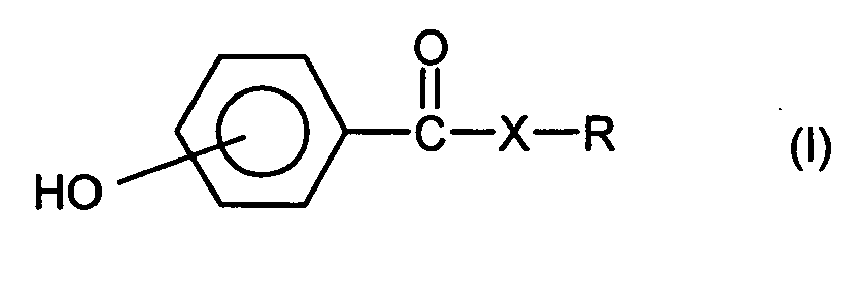
- X
- Sauerstoff, NH oder NR und
- R
- Wasserstoff, einen C1- bis C8-Alkyl-oder Cycloalkylrest bedeutet,
- Als Beispiele für die erfindungsgemäßen Hydroxybenzoesäuren oder deren Derivate seien genannt: o-, m- und p-Hydroxybenzoesäure und deren Methyl-, Ethyl-, (Iso)propyl-, Butyl-, 2-Ethylhexyl-, tert-Butyl-Neopentylester, Amide wie Methyl- und Ethylamid, Dimethyl- und Diethylamid. Bevorzugte Hydroxycarbonsäurederivate sind Methyl-, Ethyl- und Butylester, besonders bevorzugt sind Propylester der o- und/oder p-Hydroxybenzoesäure.
- Bevorzugte Polyisocyanate (A) enthalten
- i) 100 Äquivalent-% Polyisocyanat,
- ii) 60-100 Äquivalent-% Hydroxybenzoesäure-Derivate der Formel (I) und/oder ε-Caprolactam,
- iii) 0-40 Äquivalent-% einer mindestens difunktionellen Hydroxyl- und/oder Aminogruppen enthaltenden Verbindung, mittleren Molgewichts von 32 bis 3000, bevorzugt 32 bis 1500 sowie
- iv) gegebenenfalls Zuschlagstoffe und Hilfsstoffe,
- Als difunktionelle Kettenverlängerungskomponente iii) kommen beispielsweise Diamine, Diole und auch Hydroxyamine im Molekulargewichtsbereich von 32 bis 300 in Betracht. Bevorzugt werden C2-C12 Di- und Triole eingesetzt sowie alle Isomeren und beliebige Mischungen nachfolgend aufgeführter Verbindungen untereinander: Ethandiole, Propandiole, Butandiole, Pentandiole, Hexandiole, Heptandiole, Octandiole, Nonandiole, Decandiole, Trimethylolethan sowie -propan. Weitere Beispiele sind Hydrazin, Ethylendiamin, Isophorondiamin, das Bisketimin aus Isophorondiamin und Methylisobutylketon, 1,4-Dihydroxybutan, Ethanolamin, N-Methylethanolamin, Hydroxyethylethylendiamin, sowie das Addukt von 2 Mol Propylencarbonat und 1 Mol Hydrazin der allgemeinen Formel (II)

- Als Lackbindemittel (B) wird mindestens ein im Mittel mindestens zwei reaktive Hydroxylgruppen pro Molekül enthaltendes hydrophiliertes Polyesterpolyol oder Gemisch aus hydrophilierten und nicht hydrophilierten Polyesterpolyolen eingesetzt.
- Es ist jedoch auch möglich, neben den erfindungsgemäß einzusetzenden Polyesterpolyolen anteilig andere Polyhydroxylverbindungen einzusetzen, jedoch sollte deren Anteil nicht mehr als 50 Mol-%, bezogen auf die Gesamtheit der hydroxyfunktionellen Verbindungen (B), ausmachen. Andere Polyole im Sinne der vorliegenden Erfindung sind die in der Polyurethanlacktechnologie bekannten organischen Polyhydroxylverbindungen, wie beispielsweise die üblichen Polyesterpolyole, Polyacrylatpolyole, Polyurethanpolyole, Polycarbonatpolyole, Polyetherpolyole, Polyesterpolyacrylatpolyole sowie Polyurethanpolyacrylatpolyole, Polyurethanpolyesterpolyole, Polyurethanpolyetherpolyole, Polyurethanpolycarbonatpolyole, Polyesterpolycarbonatpolyole, Phenol/Formaldehydharze, allein oder in Mischungen.
- Die als Lackbindemittel (B) verwendeten Verbindungen enthalten im Mittel mindestens zwei mit NCO-Gruppen reaktive Hydroxylgruppen pro Molekül und sind mit Wasser verdünnbar oder in Wasser löslich oder dispergierbar. Als Polyhydroxylverbindungen (B) werden solche mit einem mittleren Molekulargewicht Mw von 1500 bis 60.000, einem OH-Gehalt nach DIN 53 240/2 von 0,5 bis 30% und einer Säurezahl von ≥ 15 mg KOH/g eingesetzt.
- Bevorzugt als Polyhydroxylverbindungen (B) werden Polyole eingesetzt, die aus toxikologisch unbedenklichen Bestandteilen aufgebaut sind. Besonders bevorzugt sind solche, die nach § 175300, USA Code of Federal Regulations Nr. 21, FDA - konform sind und höchstens 30 Gew.-% organische Lösemittel enthalten. In Kombination mit den Polyisocyanatvernetzern (A) liefern diese Polyhydroxylverbindungen (B) Beschichtungen mit sehr gutem Eigenschaftsniveau, wie z. B. hohe Elastizität, ein hohes Beständigkeitsniveau gegen Lösemitteln, Chemikalien sowie fettige und ölige Substanzen und gleichzeitig eine hohe Resistenz bei thermischer Beanspruchung.
- FDA-konform in diesem Zusammenhang bedeutet, dass ausschließlich Komponenten in den Bindemittelzusammensetzungen bzw. bei deren Herstellung verwendet werden, die gemäß § 175300 in USA Code of Federal Regulations Nr. 21 (FDA) gelistet sind.
- Solche besonders bevorzugten Polyole (B) enthalten ein oder mehrere wasserverdünnbare Polyesterpolyole und werden hergestellt durch Umsetzung von
- a) 49 bis 40 Mol-%, bevorzugt 49 bis 45 Mol-%, einer Carbonsäurekomponente enthaltend
- a1) eine oder mehrere aliphatische, cycloaliphatische, araliphatische und/oder aromatische Carbonsäuren einer COOH-Funktionalität ≥ 2, bevorzugt 2 bis 3, oder deren Anhydride und
- a2) gegebenenfalls aromatische, cycloaliphatische und/oder aliphatische Monocarbonsäuren
- b) 51 bis 60 Mol-%, bevorzugt 51 bis 55 Mol-%, einer Alkoholkomponente enthaltend
- b1) ein oder mehrere aliphatische, cycloaliphatische und/oder araliphatische Polyole eines zahlenmittleren Molekulargewichts von 62 bis 272 g/mol sowie einer mittleren OH-Funktionalität ≥ 2, bevorzugt 2 bis 4, und
- b2) gegebenenfalls aliphatische, cycloaliphatische und/oder araliphatische Monoalkohole
- c) Wasser
- d) Neutralisationsmitteln und
- e) gegebenenfalls Lösemitteln, Hilfs- und Zusatzstoffen.
- In der Komponente al) werden als aromatische Di- oder Polycarbonsäure bzw. -anhydride bevorzugt Phthalsäure, Isophthalsäure, Terephthalsäure, Trimellitsäure, Phthalsäureanhydrid, Trimellitsäureanhydrid und/oder Pyromellitsäureanhydrid, besonders bevorzugt Phtalsäureanhydrid, Terephthalsäure und/oder Isophthalsäure, ganz besonders bevorzugt Phtalsäureanhydrid und/oder Terephthalsäure eingesetzt.
- Geeignete aliphatische Di- oder Polycarbonsäuren a1) sind bevorzugt Bernsteinsäure, Maleinsäure, Adipinsäure, Sebacinsäure, Dodecandisäure, dimerisierte Fettsäuren, Bernsteinsäureanhydrid und/oder Maleinsäureanhydrid, besonders bevorzugt sind Bernsteinsäureanhydrid, Maleinsäureanhydrid und/oder Adipinsäure, ganz besonders bevorzugt sind Adipinsäure und/oder Maleinsäureanhydrid.
- Geeignete cycloaliphatische Di- oder Polycarbonsäuren a1) sind bevorzugt 1,4-Cyclohexandicarbonsäure, Hexahydrophthalsäure und/oder Hexahydrophthalsäureanhydrid, besonders bevorzugt sind 1,4-Cyclohexandicarbonsäure und/oder Hexahydrophthalsäureanhydrid, ganz besonders bevorzugt ist 1,4-Cyclohexandicarbonsäure.
- In der Komponente a2) werden bevorzugt als Monocarbonsäuren Essigsäure, Propionsäure, 1-Octansäure, 1-Decansäure, 1-Dodecansäure, 1-Octadecansäure, gesättigte und ungesättigte Fettsäuren und/oder Benzoesäure, besonders bevorzugt 1-Dodecansäure, 1-Octadecansäure, gesättigte und ungesättigte Fettsäuren und/oder Benzoesäure, ganz besonders bevorzugt gesättigte und ungesättigte Fettsäuren und/oder Benzoesäure eingesetzt.
- Als Komponente b1) werden als aliphatische Polyole bevorzugt Ethylenglykol, Diethylenglykol, Triethylenglykol, 1,2-Propandiol, 1,4-Butandiol, Neopentylglycol, 1,6-Hexandiol, Glycerin, Trimethylolpropan, Pentaerythrit und/oder Sorbit, besonders bevorzugt Neopentylglycol, Ethylenglykol, Diethylenglykol, 1,2-Propandiol, 1,6-Hexandiol, Glycerin und/oder Trimethylolpropan, ganz besonders bevorzugt Neopentylglycol, Ethylenglykol, Diethylenglykol, 1,2-Propandiol und/oder Trimethylolpropan eingesetzt.
- Monoalkohole b2) sind bevorzugt Methanol, Ethanol, 1-Propanol, 1-Butanol, 2-Butanol, Isobutanol, 1-Pentanol, 1-Hexanol, 2-Ethylhexanol, 1-Octanol, 1-Decanol, 1-Dodecanol, Butylglykol, und/oder Butyldiglykol, besonders bevorzugt 2-Ethylhexanol, 1-Decanol, 1-Dodecanol, Cyclohexanol, Butylglykol und/oder -Butyldiglykol, ganz besonders bevorzugt 2-Ethylhexanol, Cyclohexanol, Butylglykol und/oder Butyldiglykol.
- Die genannten Verbindungen der Komponenten a1), a2), b1) und b2) können jeweils einzeln oder in beliebigen Mischungen untereinander in den jeweiligen Komponenten eingesetzt werden.
- Die genannten Verbindungen der Komponenten a1), a2), b1) und b2) können jeweils einzeln oder in beliebigen Mischungen untereinander in den jeweiligen Komponenten zur Herstellung der Polyesterpolyole B) eingesetzt werden. Bevorzugt werden Verbindungen der Komponenten a1) und b1) eingesetzt. Besonders bevorzugt zur Herstellung der Polyesterpolyole B) werden als Verbindungen der Komponente a1) Adipinsäure, Maleinsäureanhydrid, Phthalsäureanhydrid, Isophthalsäure und Terephthalsäure und als Verbindungen der Komponente b1) Ethylenglykol, Diethylenglykol, 1,2-Propandiol, Dipropylenglykol, Neopentylglycol und Trimethylolpropan eingesetzt.
- Die Herstellung der Polyesterpolyole B) erfolgt in an sich bekannter Weise nach Methoden, wie sie beispielsweise in "Ullmanns Encyclopädie der Technischen Chemie", Verlag Chemie Weinheim, 4. Auflage (1980) Band 19, Seiten 61 ff. oder von H. Wagner und H. F. Sarx in "Lackkunstharze", Carl Hanser Verlag, München (1971), Seiten 86 bis 152 ausführlich beschrieben sind.
- Die Herstellung wird bevorzugt in der Schmelze, gegebenenfalls in Gegenwart einer katalytischen Menge eines üblichen Veresterungskatalysators, wie z.B. Säuren, Basen oder Übergangsmetallverbindungen, wie z.B. Titantetrabutylat, Dibutylzinnoxid oder Butylzinnsäure, bei Temperaturen von 80 bis 270°C, bevorzugt von 100 bis 250°C, unter Stickstoffatmosphäre durchgeführt. Dabei dient der Stickstoffstrom auch dazu, das entstehende Reaktionswasser zu entfernen. Das Entfernen des Reaktionswassers kann jedoch auch durch Anlegen eines Vakuums von bevorzugt bis zu 0,1 mbar erfolgen. Gegebenenfalls kann auch ein Schleppmittel, wie z.B. Xylol, zum Austragen des Reaktionswassers zugegeben werden. Die Veresterungsreaktion wird so lange durchgefiihrt, bis die angestrebten Werte für die Hydroxyl- und Säurezahl sowie für die Viskosität erreicht sind. In einer bevorzugten Ausführungsform der Erfindung wird zunächst ein OH-funktionelles Polyesterpolyol hergestellt, das keine bzw. nur geringe Mengen an freien Carbonsäure- und/oder Carboxylatfunktionen aufweist, welches dann in einem nachfolgenden Schritt mit einem cyclischen Dicarbonsäureanhydrid, wie z.B. Phthalsäureanhydrid, unter Ringöffnung und Halbesterbildung umgesetzt wird, wobei dann die gewünschte Anzahl an freien Carbonsäure- und/oder Carboxylatgruppen entstehen.
- Die gewichtsmittleren Molekulargewichte Mw der wasserverdünnbaren Polyesterpolyole B) liegen bei > 1.500 g/mol, bevorzugt > 2.000 g/mol, besonders bevorzugt > 3.000 g/mol und ganz besonders bevorzugt zwischen 5.000 und 60.000 g/mol.
- Die OH-Zahlen der wasserverdünnbaren Polyesterpolyole B) liegen im Bereich von 20 bis 300 mg KOH/g, bevorzugt von 25 bis 250 mg KOH/g, besonders bevorzugt von 30 bis 200 mg KOH/g und ganz besonders bevorzugt von 35 bis 150 mg KOH/g, bezogen auf Festharz.
- Die Säurezahlen der wasserverdünnbaren Polyesterpolyole B) liegen im Bereich von ≥ 15 mg KOH/g, bevorzugt von 20 bis 75 mg KOH/g, besonders bevorzugt von 25 bis 70 mg KOH/g und ganz besonders bevorzugt bei 30 bis 60 mg KOH/g, bezogen auf Festharz.
- Geeignete Neutralisationsmittel d) zur Neutralisation der Carbonsäuregruppen der Polyesterpolyole B) sind sowohl anorganische als auch organische Basen. Bevorzugt werden primäre, sekundäre und tertiäre Amine und Ammoniak, besonders bevorzugt tertiäre Amine, wie z.B. Triethylamin, Tributylamin, N-Methyldiethanolamin, N,N-Dimethylethanolamin, N,N-Diethylethanolamin, Triethanolamin, Triisopropylamin und Triisopropanolamin eingesetzt. Ganz besonders bevorzugt sind N,N-Dimethylethanolamin, Triethanolamin und Triethylamin.
- Bestandteile der Komponente e) sind beispielsweise Entschäumer, Verdicker, Verlaufsmittel, Pigmente, Füllstoffe, Emulgatoren, Dispergierhilfsmittel, Lichtschutzmittel und auch Lösemittel.
- Die gewünschte Verarbeitungsviskosität wird in aller Regel durch die Zugabe organischer Lösemittel oder Wasser, bevorzugt Wasser, eingestellt.
- Um ganz bestimmte Verarbeitungsviskositäten einzustellen oder besondere rheologische Eigenschaften zu erzielen, ist es auch möglich, Verdickungsmittel oder Kombinationen von verschiedenen Verdickungsmitteln, z.B. ionische und assoziative Verdicker, einzusetzen.
- Um die Polyester B) wasserverdünnbar zu machen, müssen die enthaltenen Carbonsäuregruppen mit einem Neutralisationsmittel vollständig oder teilweise neutralisiert werden. Dabei kann das Neutralisationsmittel d) vor, während oder nach der Überführung des erfindungsgemäßen Polyesters in die wässrige Phase zugegeben werden, wobei eine Neutralisation vor der Überführung in die wässrige Phase bevorzugt ist.
- Üblicherweise beträgt die dazu verwendete Menge der Komponente d) 0,4 bis 1,5 Mol, bevorzugt von 0,5 bis 1,4 Mol und besonders bevorzugt 0,6 bis 1,3 Mol, bezogen auf alle in B) rechnerisch vorhandenen COOH-Funktionen.
- Zur Überführung der Polyesterpolyole B) in die wässrige Phase werden diese, gegebenenfalls unter starker Scherung, wie z.B. starkem Rühren, entweder in das Dispergierwasser c) eingetragen oder man rührt umgekehrt das Dispergierwasser c) zu dem/den Polyesterpolyol(en). Es ist dabei oft vorteilhaft, dem Polyesterpolyol vor dem Dispergiervorgang wasserverdünnbare organische Lösungsmittel der Komponente e) zuzusetzen, die quasi als Hilfs- oder Colöser dienen. Solche Lösemittel sind beispielsweise Butylglykol oder Butyldiglykol.
- Gegenstand der vorliegenden Erfindung ist auch ein Verfahren zur Herstellung der erfindungsgemäßen wässrigen Beschichtungsmittel, dadurch gekennzeichnet, dass die Komponenten A), B) und gegebenenfalls C) gemischt werden und anschließend die Zugabe von Wasser und Dispergierung erfolgt, wobei beim Vermischen der Bestandteile A) bis C) unterhalb der Temperatur, bei der die blockierten NCO-Gruppen mit den übrigen Bestandteilen reagieren können, gearbeitet wird. Bevorzugt findet das Vermischen bei Temperaturen zwischen 15 und 100°C, besonders bevorzugt zwischen 20 und 80 °C statt.
- Eine besondere Ausführungsform des erfindungsgemäßen Verfahrens besteht darin, dass eine nicht oder nur wenig hydrophilierte Komponente A) vor der Wasserzugabe mit der Komponente B) vermischt wird und beide Komponenten anschließend gemeinsam dispergiert werden. Als wenig hydrophilierte Komponente A) wird eine solche Verbindung verstanden, die eine so geringe Menge an hydrophilen Gruppen enthält, welche nicht zur Ausbildung einer sedimentationsstabilen Dispersion ausreicht. Diese wenig hydrophile Komponente A) würde sich entweder gar nicht in Wasser dispergieren lassen, bzw. eine eventuelle entstandenen Dispersion wäre nicht stabil und es würde sich ein Bodensatz bilden.
- Als Hilfs- und Zusatzstoffe C) können z.B. Weichmacher, Verlaufshilfsmittel und andere Additive, Pigmente, Füllstoffe, Lösemittel oder die Vernetzungsreaktion beschleunigende Katalysatoren verwendet werden.
- Als Katalysatoren können die in der Polyurethanchemie bekannten Verbindungen eingesetzt werden, die die Reaktion von Isocyanatgruppen mit Hydroxylgruppen beschleunigen. Beispielsweise sind dies Zinn-, Zink-, Zirkonium-, Wismut- und Titanverbindungen. Werden Katalysatoren eingesetzt, so sind nichttoxische Katalysatoren bevorzugt, beispielhaft seien Butylzinn-tris-(2-ethylhexanoat), Dibutylzinn-bis(2-ethylhexanoat), Tetrabutyltitanat und Zinn(II)-2-ethylhexanoat genannt.
- Es können ebenfalls zusätzliche Vernetzerkomponenten eingesetzt werden. Beispielsweise sind dies Aminoplastharze. Als Aminoplastharze sind die in der Lacktechnologie bekannten Kondensationsprodukte von Melamin und Formaldehyd, bzw. Harnstoff und Formaldehyd anzusehen. Geeignet sind alle herkömmlichen, nicht oder mit gesättigten Monoalkoholen mit 1 bis 4 C-Atomen veretherten Melamin-Formaldehyd-Kondensate. Im Falle der Mitverwendung anderer Vernetzerkomponenten muss die Menge an Bindemittel mit NCO-reaktiven Hydroxylgruppen oder die Menge an NCO-Gruppen enthaltenden Bestandteilen entsprechend angepasst werden.
- Jede der eingesetzten Komponenten A) bis C) kann gegebenenfalls in einem organischen Lösemittel gelöst eingesetzt werden. Eine Zugabe von Lösemitteln kann aber auch im Anschluss an das Vermischen der Komponenten A) bis C) beispielsweise zur Erniedrigung der Viskosität erfolgen.
- Als Lösemittel geeignet sind beispielsweise Wasser oder die an sich üblichen Lacklösemittel wie z.B. Ethylacetat, Butylacetat, 1-Methoxy-2 propylacetat, 3-Methoxy-n-butylacetat, Aceton, 2-Butanon, 4-Methyl-2-pentanon, Cyclohexanon, Toluol, Xylol, N-Methylpyrrolidon, Chlorbenzol, Ethylen- und Propylenglykolmonomethylether, Butylglykol, Butyldiglykol. Mischungen, die vor allem höher substituierte Aromaten enthalten, wie sie beispielsweise unter den Bezeichnungen Solvent Naphtha, Solvesso® (Exxon Chemicals, Houston, USA), Cypar® (Shell Chemicals, Eschborn, DE), Cyclosol® (Shell Chemicals, Eschborn, DE), Tolusol® (Shell Chemicals, Eschborn, DE), Shellsol® (Shell Chemicals, Eschborn, DE) im Handel sind, sind ebenfalls geeignet.
- Weiterhin ist Gegenstand der Erfindung die Verwendung der erfindungsgemäßen Beschichtungsmittel zur Beschichtung von Emballagen und zur Innenbeschichtung von Dosen. Bevorzugt sind Dosen für die Verpackung von Lebensmitteln. Die Beschichtungsmittel werden dabei auf ein, gegebenenfalls vorbeschichtetes, metallisches Substrat aufgebracht und unter erhöhten Temperaturen ausgehärtet. Selbstverständlich können sie auch zur Herstellung von anderen Beschichtungsmaterialien und Klebstoffen eingesetzt werden.
- Gegenstand der vorliegenden Erfindung sind auch metallische Substrate, beschichtet mit den erfindungsgemäßen Beschichtungsmittel.
- Die Applikation der Lacke erfolgt direkt auf das metallische Substrat oder auf bereits vorher auf das Substrat aufgebrachte Lackschichten nach aus dem Stand der Technik bekannten Methoden, beispielsweise durch Spritzen, Tauchen, Fluten oder mit Hilfe von Walzen oder Rakeln.
- Es wird soviel des erfmdungsgemäßen Beschichtungsmittels aufgetragen, dass sich nach dem Abdampfen des gegebenenfalls vorhandenen Lösungsmittels und dem Aushärten der Beschichtung eine Trockenfilmschichtdicke für die Innenbeschichtung von 1 bis 50 µm, bevorzugt 3 bis 30 µm, besonders bevorzugt 5 bis 15 µm und ganz besonders bevorzugt 8 bis 12 µm ergibt.
- Zur Aushärtung der Beschichtungen werden die Substrate nach der Applikation der Lacke auf Temperaturen zwischen 100°C und 400°C, bevorzugt zwischen 180°C und 260°C, ganz besonders bevorzugt zwischen 190°C und 240°C erhitzt und für 100 Minuten bis 1 Sekunde, bevorzugt für 30 Minuten bis 15 Sekunden, besonders bevorzugt für 15 Minuten bis 20 Sekunden bei dieser Temperatur gelagert. Das Erhitzen kann diskontinuierlich in Einbrennöfen geschehen oder kontinuierlich in Bandbeschichtungsanlagen, so genannten Coil-Coating-Anlagen, erfolgen.
- Die erfindungsgemäßen Beschichtungsmittel eignen sich zur Beschichtung von Emballagen, insbesondere zur Innenbeschichtung von Dosen. Sie können aber auch zur Außenbeschichtung von Dosen eingesetzt werden. Die Emballagen können dabei aus den unterschiedlichsten Materialien bestehen und unterschiedlichster Geometrie aufweisen. Als Materialien kommen bevorzugt Schwarzblech, Weißblech und verschiedene Eisenlegierungen in Frage, die ggf. mit einer Passivierungsschicht auf Basis von Nickel-, Chrom- und Zinkverbindungen versehen sind. Die Emballagen können in Form von beispielsweise Dosenhalbteilen, also Rümpfen und Deckeln, als 3-teilige Dosen und als 2-teilige, abgestreckt tiefgezogene oder anderweitig tiefgezogene Dosen, wie z.B. Getränke- und Konservendosen, beschichtet werden.
- Als Nahrungs- und Genussmittel werden im Sinne der vorliegenden Erfindung Lebensmittel im weitesten Sinn oder Tiernahrungsmittel verstanden. Dies sind flüssige oder feste, sowie halbfeste Güter, die beispielsweise Wasser, Fette, Alkohol und/oder Eiweiß enthalten. Beispielsweise sind dies Kaffee, Tee oder Extrakte aus Kaffee und Tee, frucht- und/oder kohlensäurehaltige Getränke wie Obst und Gemüsesäfte-, Wein-, Limonaden, Bier, Sekt und Schaumwein, sowie Gemische dieser Getränke sowie Fisch-, Fleisch-, Gemüse oder Obstkonserven, die gegebenenfalls in den beschichteten Behältern gegart bzw. gefroren werden.
- Gegenstand der vorliegenden Erfindung sind schließlich auch Lackbeschichtungen, erhältlich aus den erfindungsgemäßen Beschichtungsmitteln.
- Die aus den erfindungsgemäßen Beschichtungsmitteln erhaltenen Lackbeschichtungen zeichnen sich durch eine sehr gute Metallhaftung, Porenfreiheit, Füllgutbeständigkeit, eine hohe Härte und zugleich besonders gute Elastizität aus, was an sich gegensätzliche Eigenschaften sind. Weiterhin besitzen die Lackbeschichtungen eine sehr hohe Beständigkeit gegen Lösemittel, Chemikalien und Wasser und weisen eine gute Sterilisations- und Pasteurisationsbeständigkeit sowie Geschmacksneutralität, einen guten Verlauf sowie einen hohen Glanz auf. Sie sind frei von "BADGE" und sehr gut geeignet als Beschichtung von Dosen mit Lebensmittelkontakt.
- In den folgenden Beispielen beziehen sich alle Prozentangaben auf das Gewicht.
- Als Kenndaten wurden der Festgehalt (Dickschichtmethode: Deckel, 1g Probe, 1h 125°C, Konvektionsofen, Grundlage DIN EN ISO 3251), die Säurezahl (mg KOH/g Probe, Titration mit 0,1 mol/l NaOH-Lösung, Grundlage DIN 53402), die Viskosität (Rotationsviskosimeter VT 550 der Firma Haake GmbH, Karlsruhe, DE, MV-DIN Becher bei Viskosität < 10.000 mPas/23°C), die OH-Zahl (mg KOH/g Probe, Acetylierung, Hydrolyse, Titration mit 0,1 mol/1 NaOH, Grundlage DIN 53240) und die Hazen-Farbzahl (Hazen-Farbzahl nach DIN 53995, Farbzahlmessgerät Lico® 400, Dr. Lange GmbH, Berlin, DE) bestimmt. Die Säure- und OH-Zahl werden sowohl für die Lieferform (Lff.) und für das Festharz (FH) angegeben. Der OH-Gehalt kann aus der OH-Zahl mittels Division durch 33 errechnet werden.
- Verwendete Abkürzungen:
- MPA: 1-Methoxy-2-propylacetat
- DABCO: 1,4-Diazabicyclo[2,2,2]octan
- 1646 g Diethylenglykol und 594 g Trimethylolpropan wurden zusammen in einen 5 Liter-Reaktor, der mit Rührer, Heizung, automatischer Temperatursteuerung, Stickstoffeinleitung, Kolonne, Wasserabscheider und Vorlage ausgerüstet ist, eingewogen und unter Rühren und Durchleiten von Stickstoff auf 120°C aufgeheizt. Dann wurden 1298 g Terephthalsäure und 1415 g Phthalsäureanhydrid zugegeben und die Mischung so auf 230°C aufgeheizt, dass die Kopftemperatur an der Kolonne 103°C nicht überstieg. Dabei schied sich das Reaktionswasser ab. Es wurde bis zu einer Harzviskosität von 50 bis 55 Sekunden (Auslaufzeit aus einem DIN-4-mm Becher bei 23°C, 55%ig gelöst in Methoxypropylacetat) kondensiert. Dann wurde auf 140°C abgekühlt. Bis zu diesem Zeitpunkt der Reaktion wurden 536 g Harz für Proben entnommen. Zum restlichen Kesselinhalt wurden 536 g Phthalsäureanhydrid gegeben und so lange bei 140°C gerührt, bis eine Harzviskosität von 87 bis 92 Sekunden (Auslaufzeit aus einem DIN-4-mm Becher bei 23°C, 55%ig gelöst in Methoxypropylacetat) erreicht war. Es resultierte ein klares, farbhelles Harz mit einer Säurezahl von 47 mg KOH/g, einer OH-Zahl von 71 mg KOH/g (bezogen auf Festharz) und einer Hazen-Farbzahl von 64 APHA (50%ige Lösung in Methoxypropylacetat).
- 4418 g Diethylenglykol und 1596 g Trimethylolpropan wurden zusammen in einen 15 Liter-Reaktor, der mit Rührer, Heizung, automatischer Temperatursteuerung, Stickstoffeinleitung, Kolonne, Wasserabscheider und Vorlage ausgerüstet ist, eingewogen und unter Rühren und Durchleiten von Stickstoff auf 120°C aufgeheizt. Dann wurden 682 g Adipinsäure, 2717 g Terephthalsäure und 3806 g Phthalsäureanhydrid zugegeben und die Mischung so auf 230°C aufgeheizt, dass die Kopftemperatur an der Kolonne 103°C nicht überstieg. Dabei schied sich das Reaktionswasser ab. Es wurde bis zu einer Harzviskosität von 86 bis 91 Sekunden (Auslaufzeit aus einem DIN-4-mm Becher bei 23°C, 55%ig gelöst in Methoxypropylacetat) kondensiert. Dann wurde auf 140°C abgekühlt. Bis zu diesem Zeitpunkt der Reaktion wurden 1428 g Harz für Proben entnommen. Zum restlichen Kesselinhalt wurden 1428 g Phthalsäureanhydrid gegeben und so lange bei 140°C gerührt, bis eine Harzviskosität von 88 bis 92 Sekunden (Auslaufzeit aus einem DIN-4-mm Becher bei 23°C, 50%ig gelöst in Methoxypropylacetat) erreicht war. Es resultierte ein klares, farbhelles Harz mit einer Säurezahl von 46 mg KOH/g, einer OH-Zahl von 45 mg KOH/g (bezogen auf Festharz), einer Viskosität von 91 Sekunden (Auslaufzeit aus einem DIN-4-mm Becher bei 23°C, 50%ig gelöst in Methöxypropylacetat) und einer Hazen-Farbzahl von 64 APHA (70%ige Lösung in Butylglykol).
- 4375 g Diethylenglykol und 1579 g Trimethylolpropan wurden zusammen in einen 15 Liter-Reaktor, der mit Rührer, Heizung, automatischer Temperatursteuerung, Stickstoffeinleitung, Kolonne, Wasserabscheider und Vorlage ausgerüstet ist, eingewogen und unter Rühren und Durchleiten von Stickstoff auf 120°C aufgeheizt. Dann wurden 689 g Adipinsäure, 2743 g Terephthalsäure und 3845 g Phthalsäureanhydrid zugegeben und die Mischung so auf 230°C aufgeheizt, dass die Kopftemperatur an der Kolonne 103°C nicht überstieg. Dabei schied sich das Reaktionswasser ab. Es wurde bis zu einer Harzviskosität von 100 bis 110 Sekunden (Auslaufzeit aus einem DIN-4-mm Becher bei 23°C, 50%ig gelöst in Methoxypropylacetat) kondensiert. Dann wurde auf 140°C abgekühlt. Bis zu diesem Zeitpunkt der Reaktion wurden 1428 g Harz für Proben entnommen. Zum restlichen Kesselinhalt wurden 1428 g Phthalsäureanhydrid gegeben und so lange bei 140°C gerührt, bis eine Harzviskosität von 75 bis 85 Sekunden (Auslaufzeit aus einem DIN-4-mm Becher bei 23°C, 40%ig gelöst in Methoxypropylacetat) erreicht war. Es resultierte ein klares, farbhelles Harz mit einer Säurezahl von 55 mg KOH/g, einer OH-Zahl von 40 mg KOH/g (bezogen auf Festharz), einer Viskosität von 85 Sekunden (Auslaufzeit aus einem DIN-4-mm Becher bei 23°C, 40%ig gelöst in Methoxypropylacetat) und einer Hazen-Farbzahl von 44 APHA (70%ige Lösung in Butylglykol).
- 263 g Propandiol-1,2, 4923g Neopentylglycol, 1233 g Trimethylolpropan und 3122 g Maleinsäureanhydrid wurden zusammen in einen 15 Liter-Reaktor, der mit Rührer, Heizung, automatischer Temperatursteuerung, Stickstoffeinleitung, Kolonne, Wasserabscheider und Vorlage ausgerüstet ist, eingewogen und unter Rühren und Durchleiten von Stickstoff auf 125°C aufgeheizt. Dann wurden 2696 g Adipinsäure zugegeben und die Mischung so auf 180°C aufgeheizt, dass die Kopftemperatur an der Kolonne 103°C nicht überstieg. Dabei schied sich das Reaktionswasser ab. Es wurde bis zu einer Säurezahl zwischen 4 bis 6 mg KOH/g kondensiert. Dann wurde auf 140°C abgekühlt. Bis zu diesem Zeitpunkt der Reaktion wurden 1160 g Harz für Proben entnommen. Zum restlichen Kesselinhalt wurden 1160 g Phthalsäureanhydrid gegeben und so lange bei 140°C gerührt, bis eine Harzviskosität von 77 bis 81 Sekunden (Auslaufzeit aus einem DIN-4-mm Becher bei 23°C, 60%ig gelöst in Methoxypropylacetat) erreicht war. Es resultierte ein klares, farbhelles Harz mit einer Säurezahl von 44 mg KOH/g, einer OH-Zahl von 88 mg KOH/g (bezogen auf Festharz) und einer Viskosität von 79 Sekunden (Auslaufzeit aus einem DIN-4-mm Becher bei 23°C, 60%ig gelöst in Methoxypropylacetat). Zu 8800 g dieses Harzes werden bei 120°C 2200 g Butylglykol gegeben und anschließend 2 Stunden bei 120°C gerührt. Dann wird auf 60°C abgekühlt und die Harzlösung filtriert. Es resultierte eine Harzlösung mit einem Festgehalt von 80 Gew.-%, einer Viskosität von 13758 mPa.s und einer Hazen-Farbzahl von 26 APHA.
- 261 g Propandiol-1,2, 5506g Neopentylglycol, 693 g Trimethylolpropan und 3094 g Maleinsäureanhydrid wurden zusammen in einen 15 Liter-Reaktor, der mit Rührer, Heizung, automatischer Temperatursteuerung, Stickstoffeinleitung, Kolonne, Wasserabscheider und Vorlage ausgerüstet ist, eingewogen und unter Rühren und Durchleiten von Stickstoff auf 125°C aufgeheizt. Dann wurden 2672 g Adipinsäure zugegeben und die Mischung so auf 180°C aufgeheizt, dass die Kopftemperatur an der Kolonne 103°C nicht überstieg. Dabei schied sich das Reaktionswasser ab. Es wurde bis zu einer Säurezahl zwischen 4 bis 6 mg KOH/g kondensiert. Dann wurde auf 140°C abgekühlt. Bis zu diesem Zeitpunkt der Reaktion wurden 1160 g Harz für Proben entnommen. Zum restlichen Kesselinhalt wurden 1160 g Phthalsäureanhydrid gegeben und so lange bei 140°C gerührt, bis eine Harzviskosität von 60 bis 64 Sekunden (Auslaufzeit aus einem DIN-4-mm Becher bei 23°C, 60%ig gelöst in Methoxypropylacetat) erreicht war. Es resultierte ein klares, farbhelles Harz mit einer Säurezahl von 41 mg KOH/g, einer OH-Zahl von 79 mg KOH/g (bezogen auf Festharz) und einer Viskosität von 62 Sekunden (Auslaufzeit aus einem DIN-4-mm Becher bei 23°C, 60%ig gelöst in Methoxypropylacetat). Zu 8800 g dieses Harzes werden bei 120°C 2200 g Butylglykol gegeben und anschließend 2 Stunden bei 120°C gerührt. Dann wird auf 60°C abgekühlt und die Harzlösung filtriert. Es resultierte eine Harzlösung mit einem Festgehalt von 79,9 Gew.-%, einer Viskosität von 8838 mPa·s und einer Hazen-Farbzahl von 25 APHA.
- 352,9g Desmodur® Z 4470 MPA/Xylol (IPDI-Trimersisat, nicht blockiert, Bayer AG, Leverkusen), 90g MPA und 90g Xylol wurden unter Stickstoff vorgelegt und auf 60°C aufgewärmt. Zu der homogenen Lösung wurde dann unter Rühren portionenweise 180,2g p-Hydroxybenzoesäurepropylester zugegeben. Nach beendeter Zugabe des Esters wurde so lange bei 60°C gerührt bis sich der Ester vollständig gelöst hatte. Anschließend wurden 1,7g DABCO (Katalysator) zugegeben und weitere 19 Stunden bei 60°C gerührt. Nach dieser Zeit wurde ein NCO-Gehalt von 0,3% titriert. Es wurden weitere 0,6g DABCO zugegeben. Nach 4 Stunden Rühren bei 60°C waren IR-spektroskopisch keine freien NCO-Gruppen mehr festzustellen. Das Produkt wurde abgekühlt und abgefüllt. Es wurden folgende Kenndaten ermittelt:
- Festkörpergehalt: 60%
- Viskosität bei 23°C: 6000 mPa·s
- Farbe: gelblich
- berechneter blockierter NCO-Gehalt ca. 5,8%
- 614,64 g (0,78 Val OH) Verbindung aus Beispiel 1 und 299,92 g Aceton wurden unter Rühren auf 65°C erwärmt und 30 Minuten gerührt. Zu der klaren Lösung wurden 149,14 g (0,2106 Val blockiertes NCO) Verbindung aus Beispiel 6 zugegeben, 40 Minuten bei 60°C gerührt, dann 45,67 g (0,5226 Mol) Dimethylethanolamin zugegeben und 10 Minuten weiter gerührt. Anschließend wurde mit 856,76 g deionisiertem Wasser von Raumtemperatur dispergiert, 1 Stunde bei 50°C nachgerührt, auf Raumtemperatur abgekühlt und im Vakuum von Aceton befreit (zuletzt 1 Stunde bei 120 mbar/40°C). Dann wurde unter Rühren auf Raumtemperatur abkühlen gelassen (ca. 4 Stunden). Die erhaltene Dispersion hatte nachfolgende Eigenschaften:
Festkörpergehalt: 45% pH-Wert: 8,54 Viskosität bei 23°C, 46700 mPa.s Partikelgröße 3512 nm - 622 g (0,5 Val OH) Verbindung aus Beispiel 2 wurden bei 65°C in 284,80 g Aceton unter Rühren gelöst. Zu der klaren Lösung wurden 150,0 g Desmodur® VP LS 2078 (0,25 Val blockiertes NCO) (blockiertes IPDI-Trimerisat, Bayer AG, Leverkusen) zugegeben und das Gemisch 15 Minuten bei 60°C gerührt. Danach wurden 52,25 g (0,585 Mol) Dimethylethanolamin zugegeben, 10 Minuten bei 60°C gerührt und anschließend mit 1554,83 g entionisiertes Wasser von Raumtemperatur dispergiert, 1 Stunde bei 40°C nachgerührt, auf Raumtemperatur abgekühlt und im Vakuum von Aceton befreit (zuletzt 1 Stunde bei 120 mbar/40°C). Dann wurde unter Rühren abkühlen gelassen (ca. 4 Stunden). Die erhaltene Dispersion hatte nachfolgende Eigenschaften:
Festkörpergehalt: 30 % pH-Wert: 8,70 Viskosität bei 23°C: 14500 mPa·s Partikelgröße 339 nm - 616,00 g (0,44 Val OH) Verbindung aus Beispiel 3 wurden in 299,52 g Aceton bei 65°C gelöst. Danach wurden 132,00 g (0,22 Val blockiertes NCO) Desmodur® VP LS 2078 (blockiertes IPDI-Trimerisat, Bayer AG, Leverkusen) zugegeben, 10 Minuten bei 60°C nachgerührt, dann 53,59 g (0,616 Mol) Dimethylethanolamin zugegeben, 10 Minuten bei 60°C nachgerührt und danach mit 1337,81 g entionisiertem Wasser von Raumtemperatur dispergiert. Danach wurde 1 Stunde bei 50°C nachgerührt, auf Raumtemperatur abgekühlt und dann Aceton im Vakuum abdestilliert (zuletzt 1 Stunde bei 120 mbar/40°C). Anschließend wurde unter Rühren abkühlen gelassen (ca. 4 Stunden). Die erhaltene Dispersion besaß nachfolgende Eigenschaften:
Festkörpergehalt: 35 % pH-Wert: 8,20 Viskosität bei 23°C: 8800 mPa·s Partikelgröße 215 nm - Es wurde wie im Beispiel 9 beschrieben gearbeitet, jedoch wurden 648,12 g Verbindung aus Beispiel 3 und anstelle von Desmodur® VP LS 2078 157,26 g Verbindung aus Beispiel 6, 61,76 g (0,69 Mol) Dimethylethanolamin und 1609,8 g entionisiertes Wasser eingesetzt. Die erhaltene Dispersion besaß nachfolgende Eigenschaften:
Festkörpergehalt: 30 % pH-Wert: 8,05 Viskosität bei 23°C: 1500 mPa·s Partikelgröße 282 nm - Es wurde wie im Beispiel 9 beschrieben gearbeitet, jedoch wurden 547,36 g Verbindung aus Beispiel 2, 256,69 g Aceton, 157,26 (0,22 Val blockiertes NCO) Verbindung aus Beispiel 6, 45,98 g Dimethylethanolamin und 1082,9 g entionisiertes Wasser eingesetzt. Die erhaltene Dispersion besaß nachfolgende Eigenschaften:
Festkörpergehalt: 35 % pH-Wert: 8,84 Viskosität bei 23°C: 32000 mPa·s Partikelgröße 2900 nm - Es wurde wie im Beispiel 7 beschrieben gearbeitet, jedoch wurden anstelle der Verbindung aus Beispiel 6 126,36 g (0,2106 Val blockiertes NCO) Desmodur® VP LS 2078 (blockiertes IPDI-Trimerisat, Bayer AG, Leverkusen) sowie 2002,1 g entionisiertes Wasser eingesetzt. Die erhaltene Dispersion besaß nachfolgende Eigenschaften:
Festkörpergehalt: 35 % pH-Wert: 8,24 Viskosität bei 23°C: 23500 mPa.s Partikelgröße 1698 nm - 583,12 g (0,74 Val OH) Verbindung aus Beispiel 1 wurden in 280,34 g Aceton gelöst. Nach Zugabe von 41,14 g (0,3 Val NCO) Isophorondiisocyanat wurde so lange unter Rückfluss gekocht, bis IR-spektroskopisch keine NCO-Gruppen mehr nachweisbar waren (ca. 5 Stunden). Danach wurden 132,24 g (0,185 Val blockiertes NCO) Verbindung aus Beispiel 6 zugegeben, 10 Minuten nachgerührt, dann 44,20 g (0,496 mol) Dimethylethanolamin zugegeben, 10 Minuten gerührt und anschließend mit 1169,7 g entionisiertem Wasser von Raumtemperatur dispergiert, 1 Stunde bei 50°C nachgerührt, auf Raumtemperatur abgekühlt und im Vakuum von Aceton befreit (zuletzt 1 Stunde bei 120 mbar/40°C). Die Dispersion wurde anschließend unter Rühren auf Raumtemperatur abgekühlt (ca. 4 Stunden). Die erhaltene Dispersion besaß nachfolgende Eigenschaften:
Festkörpergehalt: 35% pH-Wert: 8,45 Viskosität bei 23°C: 15000 mPa.s Partikelgröße 3014 nm - Zu 795,45 g (1,0 Val) Verbindung 4 wurden bei 23°C unter Rühren 300,00 g (0,5 Val blockiertes NCO) Desmodur® VP LS 2078 (blockiertes IPDI-Trimerisat, Bayer AG, Leverkusen) und 53,45 g (0,6 mol) Dimethylethanolamin zugegeben, 10 Minuten nachgerührt und anschließend mit 483,82 g entionisiertem Wasser von Raumtemperatur dispergiert. Dann wurde noch 1 Stunde bei 23°C nachgerührt. Die erhaltene Dispersion besaß folgende Eigenschaften:
Festkörpergehalt: 50,7% pH-Wert: 8,24 Viskosität bei 23°C: 4170 mPa.s Partikelgröße 63 nm - Zu 708,86 g (1,0 Val) Verbindung 5 wurden bei 23°C unter Rühren 300,00 g (0,5 Val blockiertes NCO) Desmodur® VP LS 2078 (blockiertes IPDI-Trimerisat, Bayer AG, Leverkusen) und 43,64 g (0,49 mol) Dimethylethanolamin zugegeben, 10 Minuten nachgerührt und anschließend mit 527,54 g entionisiertem Wasser von Raumtemperatur dispergiert. Dann wurde noch 1 Stunde bei 23°C nachgerührt. Die erhaltene Dispersion besaß folgende Eigenschaften:
Festkörpergehalt: 48,6% pH-Wert: 7,42 Viskosität bei 23°C: 3700 mPa.s Partikelgröße 133 nm - 315 g Desmodur® N 3300 (HDI-Trimerisat, nicht blockiert, Bayer AG, Leverkusen, DE) wurden unter Stickstoff vorgelegt und auf 60°C aufgewärmt. Zu dem Polyisocyanat wurde dann unter Rühren portionenweise 187 g ε-Caprolactam zugegeben. Nach beendeter Zugabe wurde so lange bei 60°C gerührt bis sich das ε-Caprolactam vollständig gelöst hatte. Anschließend wurde auf 80°C aufgeheizt und so lange bei 80°C gerührt, bis IR-spektroskopisch keine freien NCO-Gruppen mehr festzustellen waren. Danach wurden 125 g Solventnaphtha 100 zugegeben und unter Rühren eingelöst. Das Produkt wurde abgekühlt und abgefüllt. Es wurden folgende Kenndaten ermittelt:
- Festkörpergehalt: 80 %
- Viskosität bei 23°C: 17520 mPa.s
- Farbe: farblos
- berechneter blockierter NCO-Gehalt ca. 12,4 %
- Es wurden Klarlacke durch inniges Vermischen folgender Einsatzstoffe bei Raumtemperatur hergestellt. Dabei handelt es sich bei den Beispielen 17 bis 21 um erfindungsgemäße 1K PUR-Dispersionen und bei dem Beispiel 22 um eine Vergleichsdispersion auf Basis eines handelsüblichen Epoxidharzes.
Formulierung Beispiel 17 Beispiel 18 Beispiel 19 Beispiel 20 Beispiel 21 Vergleichsbeispiel 22 Polyester Beispiel 5 38,8 g Polyester Beispiel 4 38,8 g Polyester Beispiel 1 46,6 g Polyester Beispiel 3 46,6 g Produkt aus Beispiel 15 84,2 g Desmodur® VP LS 20781) 14,6 g Blockiertes Polyisocyanat Beispiel 6 14,6 g Blockiertes Polyisocyanat Beispiel 16 11,5 g 11,5 g Butylglykol 11,5 g 11,5 g 8,8 g 8,8 g Wasser/Butylglykol 85 : 15 15,8 g N,N-Dimethylethanolamin, 10 %ig in Wasser 35,1 g 35,1 g 33,1 g 33,1 g Formaldehyd/Phenolharz2) 13,8 g Epikote® 10073) 82,9 g Phosphorsäure, 10 %ig in n-Butanol 3,3 g 1) Blockiertes aliphatisches Polyisocyanat (IPDI) der Bayer MaterialScience AG, Leverkusen, DE 2) Resistherm LVP BBB 2036, Bayer MaterialScience AG, Leverkusen, DE 3) Epoxidharz der Resolution Europe BV, 3190 AN Hoogvliet Rt, NL - Die obigen Klarlacke wurden auf Weißblechplatten E1 (Rasselstein Hoesch, Andemach, DE) mit einem handelsüblichen Rakel der Firma Deka appliziert und für 10 Minuten bei 180°C im Umluftofen eingebrannt. Es ergaben sich Trockenfilmschichtstärken von ca. 8-10 µm.
- Folgende lacktechnische Eigenschaften wurden ermittelt:
Beispiel 17 18 19 20 21 V22 Haftung Gitterschnitta) 0 0 0 0 0 0 Schlagbiegeprüfungb) (mm gerissen) 20 20 30-40 20-30 20 20-30 Tiefzug/Rund-näpfchenc) 0 0 0 0 0 0 Stapelfestigkeitd) 1 1 1 1 1 1 MEK-Wischteste) 45-50 x 35-40 x 40-45 x 50-55 x 45-50x 80x(weich) Sterilisationf) 0 1 1 0 0 0 a) Haftung Gitterschnitt (nach DIN 53151) Bewertung: 0= gut, 5= schlecht. b) Erichsen Schlagfaltprüfgerät Typ 471 (Prüfmaschine (Erichsen GmbH & Co KG, Hemer, DE), Schlaghammer 2300 g, Fallhöhe 650 mm, Angabe der Risslänge in mm. c) Erichsen Tiefzieh-Näpfchen-Prüfinaschine (Erichsen GmbH & Co KG, Hemer, DE), Bewertung nach DIN 53230. d) Je 2 beschichtete Platten wurden mit den lackierten Seiten gegeneinander gestapelt. Zwischen die beschichteten Platten wurde ein Schwarzbandfilter gelegt. Der Stapel wurde anschließend mit einer Stahlplatte zur besseren Gewichtsverteilung und einem 5 kg Gewicht belastet und 16 h bei 50°C gelagert. Nach Lagerung wurden etwaige Beschädigungen des Films (wie Abdruckspuren des Filterpapiers) visuell abgemustert; Bewertung: 0= gut, 5= schlecht. e) Ein mit Methylethylketon (MEK) getränkter Wattebausch wurde mit einem konstanten Druck auf dem Lackfilm 100 mal hin und her bewegt (100 Doppelhübe). Falls bei weniger als 100 Doppelhüben bereits starke Beschädigung oder Ablösung zu beobachten war, wurde der Test abgebrochen. Anschließend wurden die Platten visuell auf Trübung und/oder Filmablösung beurteilt. f) Ausgehärtete Beschichtungen wurden in einem Sterilisator (Aesculap JA 154, Aesculap AG, Tuttlingen, DE), 2 h bei 1,2 bar / 121°C behandelt und anschließend erfolgte Untersuchung der Beschichtung wird auf Haftungsverlust (Strippen), Glanzverlust, Wasserflecken, Blasenbildung; Bewertung: 0=gut, 5= schlecht - Alle geprüften Lacke haben eine sehr gute Haftung auf Weißblech und zeigen eine gute Elastizität. Die Stapelfestigkeit und die Beständigkeiten der Lacke sind vergleichbar gut, wobei der Vergleichslack V22 eine etwas bessere MEK-Beständigkeit zeigt. Der besondere Vorteil bei den erfindungsgemäßen Lacken V 17 bis V21 ist jedoch, dass sie völlig frei von Bisphenol A Diglycidylether (BADGE) sind, weil sie nicht auf Epoxidharzen als Rohstoffe basieren. Das bei den Vernetzem verwendete Blockierungsmittel konnte analytisch in den Beschichtungen nicht nachgewiesen werden.
- Die erfindungsgemäß beschichteten Platten wurden 2h bei 121 °C in 120 ml eines Gemisches gleicher Volumina Ethanol und Wasser gelagert. Die Flüssigkeit wurde daraufhin chromatographisch auf freigesetztes Blockierungsmittel untersucht. Es wurde bei einer Nachweisgrenze von 3 µg/l kein freigesetztes Blockierungsmittel gefunden.
Claims (10)
- Wässrige Beschichtungsmittel enthaltendA) mindestens ein im Mittel mindestens zwei NCO-Gruppen pro Molekül enthaltendes Polyisocyanat bei dem mindestens 85 % der NCO-Gruppen mit einem Blockierungsmittel blockiert sind, wobei das Blockierungsmitttel ε-Caprolactam und/oder eine Hydroxycarbonsäure und/oder ein aliphatischer Alkohol mit einem Molekulargewicht <100 ist,B) mindestens ein im Mittel mindestens zwei reaktive Hydroxylgruppen pro Molekül enthaltendes hydrophiliertes Polyesterpolyol oder Gemisch aus hydrophilierten und nicht hydrophilierten Polyesterpolyolen mit einer Säurezahl von ≥ 15 mg KOH/g, einer Hydroxylzahl von 20 bis 300 mg KOH/g und einem gewichtsgemittelten Molekulargewicht Mw von > 1500 g/mol undC) Hilfs- und Zusatzstoffen,wobei das Verhältnis zwischen den blockierten Isocyanatgruppen (Komponente A) zu allen gegenüber Isocyanaten reaktionsfähigen Gruppen 0,5 bis 5,0 zu 1 beträgt.
- Wässrige Beschichtungsmittel gemäß Anspruch 1, dadurch gekennzeichnet, dass die Polyisocyanate (A)i) 100 Äquivalent-% Polyisocyanat,ii) 60 - 100 Äquivalent-%, Hydroxybenzoesäure-Derivate der Formel (I),

X Sauerstoff, NH oder NR und
R Wasserstoff, einen C1- bis C8-Alkyl-oder Cycloalkylrest bedeutet,
und/oder ε-Caprolactam,iii) 0-40 Äquivalent-% einer mindestens difunktionellen Hydroxyl- und/oder Aminogruppen enthaltenden Verbindung, mittleren Molgewichts von 32 bis 3000, sowiev) gegebenenfalls Zuschlagstoffe und Hilfsstoffe enthalten,wobei die Mengenverhältnisse der Reaktionspartner so gewählt werden, dass das Äquivalentverhältnis von NCO-Gruppen des Polyisocyanats zu gegenüber Isocyanaten reaktionsfähigen Gruppen der Komponenten ii) und iii) bei 1:0,8 bis 1:1,2 liegt. - Wässrige Beschichtungsmittel gemäß Anspruch 1, dadurch gekennzeichnet, dass die Polyesterpolyole (B) hergestellt werden durch Umsetzung vona) 49 bis 40 Mol-% einer Carbonsäurekomponente enthaltenda1) eine oder mehrere aliphatische, cycloaliphatische, araliphatische und/oder aromatische Carbonsäuren einer COOH-Funktionalität ≥ 2 oder deren Anhydride unda2) gegebenenfalls aromatische, cycloaliphatische und/oder aliphatische Monocarbonsäurenmitb) 51 bis 60 Mol-% einer Alkoholkomponente enthaltendb1) ein oder mehrere aliphatische, cycloaliphatische und/oder araliphatische Polyole eines zahlenmittleren Molekulargewichts von 62 bis 272 g/mol sowie einer mittleren OH-Funktionalität ≥ 2 undb2) gegebenenfalls aliphatische, cycloaliphatische und/oder araliphatische Monoalkoholeund gegebenenfallsc) Wasserd) Neutralisationsmitteln unde) gegebenenfalls Lösemitteln, Hilfs- und Zusatzstoffen.
- Wässrige Beschichtungsmittel gemäß Anspruch 1, dadurch gekennzeichnet, dass die Polyesterpolyole (B) Säurezahlen im Bereich von 20 bis 75 mg KOH/g Festharz aufweisen.
- Verfahren zur Herstellung der wässrigen Beschichtungsmittel gemäß Anspruch 1, dadurch gekennzeichnet, dass die Komponenten A), B) und gegebenenfalls C) gemischt werden und anschließend die Zugabe von Wasser und die Dispergierung erfolgt, wobei beim Vermischen der Bestandteile A) bis C) unterhalb der Temperatur, bei der die blockierten NCO-Gruppen mit den übrigen Bestandteilen reagieren können, gearbeitet wird.
- Verfahren zur Herstellung der wässrigen Beschichtungsmittel gemäß Anspruch 5, dadurch gekennzeichnet, dass eine nicht oder nur wenig hydrophilierte Komponente A) vor der Wasserzugabe mit der Komponente B) vermischt wird und beide Komponenten anschließend gemeinsam dispergiert werden.
- Verwendung der wässrigen Beschichtungsmittel gemäß Anspruch 1 zur Beschichtung von Emballagen und zur Innenbeschichtung von Dosen.
- Verwendung gemäß Anspruch 7, dadurch gekennzeichnet, dass die Dosen als Verpackung von Lebensmitteln dienen.
- Metallische Substrate, beschichtet mit den wässrigen Beschichtungsmitteln gemäß Anspruch 1.
- Lackbeschichtungen, erhältlich durch Auftragen des wässrigen Beschichtungsmittels gemäß Anspruch 1, anschließendem Abdampfen des gegebenenfalls vorhandenen Lösungsmittels und dem Aushärten der Beschichtung bei Temperaturen zwischen 100°C und 400°C und Lagerung für 100 Minuten bis 1 Sekunde bei dieser Temperatur.
Applications Claiming Priority (1)
| Application Number | Priority Date | Filing Date | Title |
|---|---|---|---|
| DE102004060798A DE102004060798A1 (de) | 2004-12-17 | 2004-12-17 | Wässrige Beschichtungen für Nahrungsmittelbehälter |
Publications (2)
| Publication Number | Publication Date |
|---|---|
| EP1672041A1 true EP1672041A1 (de) | 2006-06-21 |
| EP1672041B1 EP1672041B1 (de) | 2012-03-21 |
Family
ID=35992705
Family Applications (1)
| Application Number | Title | Priority Date | Filing Date |
|---|---|---|---|
| EP05026426A Expired - Lifetime EP1672041B1 (de) | 2004-12-17 | 2005-12-03 | Wässrige Beschichtungen für Nahrungsmittelbehälter |
Country Status (10)
| Country | Link |
|---|---|
| US (1) | US20060149019A1 (de) |
| EP (1) | EP1672041B1 (de) |
| JP (1) | JP5507031B2 (de) |
| KR (1) | KR101292425B1 (de) |
| CN (1) | CN1789356B (de) |
| AT (1) | ATE550398T1 (de) |
| CA (1) | CA2529922A1 (de) |
| DE (1) | DE102004060798A1 (de) |
| ES (1) | ES2382469T3 (de) |
| MX (1) | MXPA05013650A (de) |
Families Citing this family (23)
| Publication number | Priority date | Publication date | Assignee | Title |
|---|---|---|---|---|
| US20100260954A1 (en) * | 2008-11-26 | 2010-10-14 | Valspar Sourcing, Inc. | Polymer having polycyclic groups and coating compositions thereof |
| US8367171B2 (en) | 2008-11-26 | 2013-02-05 | Valspar Sourcing, Inc. | Polymer having polycyclic groups and coating compositions thereof |
| AU2009319890B2 (en) | 2008-11-26 | 2015-09-10 | Swimc Llc | Polyester-carbamate polymer and coating compositions thereof |
| AU2009319797B2 (en) * | 2008-11-26 | 2015-09-03 | Swimc Llc | Polyester polymer and coating compositions thereof |
| MX338773B (es) | 2009-04-09 | 2016-05-02 | Valspar Sourcing Inc | Polimero que tiene funcionalidad cicloalifatica insaturada y composiciones de recubrimiento formadas de este. |
| WO2010118349A1 (en) | 2009-04-09 | 2010-10-14 | Valspar Sourcing, Inc. | Polyester coating composition |
| CN101619128B (zh) * | 2009-07-31 | 2011-12-21 | 中国科学院广州化学研究所 | 酰胺封端非离子型水性异氰酸酯及其制备方法与应用 |
| US9011999B2 (en) * | 2009-09-18 | 2015-04-21 | Valspar Sourcing, Inc. | Coating composition including an unsaturated polymer |
| JP5889561B2 (ja) * | 2011-07-15 | 2016-03-22 | 日本パーカライジング株式会社 | 水系金属表面処理剤及び表面皮膜付き金属材料 |
| CN104119794A (zh) * | 2013-04-27 | 2014-10-29 | 湖南互力达涂料科技有限公司 | 一种用于食品包装的水性涂料 |
| DE202013010114U1 (de) | 2013-11-08 | 2013-11-21 | Ipc Gmbh | Beschichtungszusammensetzung für die Beschichtung von Getränkedosen |
| CN104086739A (zh) * | 2014-07-09 | 2014-10-08 | 浙江枧洋化工有限公司 | 水分散型热塑性聚氨酯及其生产方法 |
| JP6569421B2 (ja) * | 2014-09-19 | 2019-09-04 | 荒川化学工業株式会社 | 缶内面塗料用樹脂組成物 |
| KR101742708B1 (ko) * | 2016-08-23 | 2017-06-01 | (주)에버켐텍 | 천연물을 이용한 식품포장재용 코팅 조성물 및 이의 제조방법 |
| CN108409946B (zh) * | 2018-03-29 | 2020-06-30 | 绍兴立源科技信息有限公司 | 一种水性聚酯树脂的制备方法及应用 |
| CA3155902C (en) * | 2019-10-25 | 2024-05-21 | Peter R. Jepson | Polyester polymer and polyester-based heat resistant coating for cookware or bakeware |
| US20240309150A1 (en) * | 2020-12-28 | 2024-09-19 | Ppg Industries Ohio, Inc. | Polyester polymer |
| JPWO2022168910A1 (de) | 2021-02-05 | 2022-08-11 | ||
| WO2022168912A1 (ja) | 2021-02-05 | 2022-08-11 | 東洋紡株式会社 | ポリエステル樹脂組成物、水分散体、塗料組成物および塗膜 |
| EP4289905B1 (de) | 2021-02-05 | 2025-08-20 | TOYOBO MC Corporation | Polyesterharzzusammensetzung, wässrige dispersion, beschichtungszusammensetzung und beschichtungsfilm |
| TW202248346A (zh) | 2021-03-22 | 2022-12-16 | 日商東洋紡股份有限公司 | 聚酯樹脂組成物、水分散體、塗料組成物及塗膜 |
| JPWO2023013474A1 (de) | 2021-08-02 | 2023-02-09 | ||
| EP4602118A1 (de) * | 2022-12-09 | 2025-08-20 | Swimc LLC | Beschichtungszusammensetzungen, artikel und beschichtungsverfahren |
Citations (7)
| Publication number | Priority date | Publication date | Assignee | Title |
|---|---|---|---|---|
| DE2824418A1 (de) * | 1977-06-06 | 1978-12-21 | Herberts & Co Gmbh Dr Kurt | Carboxylgruppenhaltiger polyester, verfahren zu seiner herstellung und diesen enthaltendes waessriges ueberzugsmittel |
| EP0022452A1 (de) * | 1979-06-29 | 1981-01-21 | HOECHST SARA S.p.A. | Anstrichmittel auf Basis eines Polyurethan-Prepolymers und eines Polyesterharzes, Verfahren zu seiner Herstellung und seine Verwendung zum Überziehen von metallischen Oberflächen |
| EP0114358A2 (de) * | 1982-12-23 | 1984-08-01 | Herberts Gesellschaft mit beschränkter Haftung | Wässriges Überzugsmittel |
| EP0200272A2 (de) | 1985-04-29 | 1986-11-05 | Koninklijke Philips Electronics N.V. | Röntgenuntersuchungsgerät und Verfahren zur Belichtungssteuerung |
| EP0330139A2 (de) * | 1988-02-24 | 1989-08-30 | Herberts Gesellschaft mit beschränkter Haftung | Verwendung eines Beschichtungsmittels zur Herstellung von steinschlagfesten Überzügen und/oder Füllerschichten |
| DE19545424A1 (de) | 1995-12-06 | 1997-06-12 | Basf Lacke & Farben | Pulverlack und dessen Verwendung zur Innenbeschichtung von Verpackungsbehältern |
| DE19703091A1 (de) * | 1997-01-29 | 1998-07-30 | Ppg Industries Inc | Überzugsmittel für Nahrungsmittelbehälter |
Family Cites Families (18)
| Publication number | Priority date | Publication date | Assignee | Title |
|---|---|---|---|---|
| DE4203510A1 (de) | 1992-02-07 | 1993-08-12 | Bayer Ag | Beschichtungsmittel, ein verfahren zu ihrer herstellung und ihre verwendung zur herstellung von beschichtungen |
| DE4204611A1 (de) * | 1992-02-15 | 1993-08-19 | Herberts Gmbh | Ueberzugsmittel, deren verwendung als klarlacke und verfahren zur herstellung von mehrschichtlackierungen |
| DE4424277A1 (de) * | 1994-07-09 | 1996-01-11 | Huels Chemische Werke Ag | Einkomponentige wäßrige Beschichtungssysteme enthaltend eine reaktive Additiv-Komponente |
| JPH08209059A (ja) * | 1995-02-02 | 1996-08-13 | Nippon Paint Co Ltd | 水性塗料組成物およびそれを用いる塗装方法 |
| JPH08209066A (ja) * | 1995-02-07 | 1996-08-13 | Kansai Paint Co Ltd | 水性中塗塗料 |
| CA2207146A1 (en) * | 1996-05-28 | 1997-11-28 | Atofina Chemicals, Inc. | Catalyst for low temperature cure of blocked isocyanates |
| DE19910492A1 (de) * | 1999-03-10 | 2000-09-21 | Basf Coatings Ag | Polyurethan und seine Verwendung zur Herstellung lösemittelfreier Beschichtungsstoffe |
| JP2001139879A (ja) | 1999-11-15 | 2001-05-22 | Asahi Kasei Corp | 水性熱硬化性塗料組成物 |
| CA2353005A1 (en) * | 2000-08-01 | 2002-02-01 | Dai-Ichi Kogyo Seiyaku Co., Ltd. | Blocked urethane prepolymers as paper wet strength agent |
| DE10052875A1 (de) | 2000-08-14 | 2002-02-28 | Bayer Ag | Wässrige Dispersionen |
| JP2002121472A (ja) * | 2000-10-11 | 2002-04-23 | Dainippon Ink & Chem Inc | 着色塗料用樹脂組成物及び積層塗装方法 |
| JP4310082B2 (ja) * | 2001-08-20 | 2009-08-05 | 関西ペイント株式会社 | 水性中塗り塗料及び複層塗膜形成方法 |
| JP2003313490A (ja) * | 2002-04-18 | 2003-11-06 | Toyota Motor Corp | 水性中塗り塗料 |
| JP4499386B2 (ja) * | 2003-07-29 | 2010-07-07 | 浜松ホトニクス株式会社 | 裏面入射型光検出素子の製造方法 |
| DE10349811A1 (de) * | 2003-10-24 | 2005-05-25 | Bayer Materialscience Ag | Beschichtungen für Nahrungsmittelbehälter |
| JP2006022216A (ja) * | 2004-07-08 | 2006-01-26 | Kansai Paint Co Ltd | ポリエステルポリオール及び熱硬化性水性塗料組成物 |
| JPWO2006009219A1 (ja) * | 2004-07-22 | 2008-05-01 | 関西ペイント株式会社 | 熱硬化性水性塗料組成物及び塗膜形成方法 |
| WO2006028262A1 (ja) * | 2004-09-09 | 2006-03-16 | Kansai Paint Co., Ltd. | 熱硬化性水性塗料組成物 |
-
2004
- 2004-12-17 DE DE102004060798A patent/DE102004060798A1/de not_active Withdrawn
-
2005
- 2005-12-03 ES ES05026426T patent/ES2382469T3/es not_active Expired - Lifetime
- 2005-12-03 EP EP05026426A patent/EP1672041B1/de not_active Expired - Lifetime
- 2005-12-03 AT AT05026426T patent/ATE550398T1/de active
- 2005-12-13 CA CA002529922A patent/CA2529922A1/en not_active Abandoned
- 2005-12-13 US US11/301,622 patent/US20060149019A1/en not_active Abandoned
- 2005-12-14 MX MXPA05013650A patent/MXPA05013650A/es active IP Right Grant
- 2005-12-16 CN CN2005101361347A patent/CN1789356B/zh not_active Expired - Fee Related
- 2005-12-16 KR KR1020050124259A patent/KR101292425B1/ko not_active Expired - Fee Related
- 2005-12-19 JP JP2005364412A patent/JP5507031B2/ja not_active Expired - Fee Related
Patent Citations (7)
| Publication number | Priority date | Publication date | Assignee | Title |
|---|---|---|---|---|
| DE2824418A1 (de) * | 1977-06-06 | 1978-12-21 | Herberts & Co Gmbh Dr Kurt | Carboxylgruppenhaltiger polyester, verfahren zu seiner herstellung und diesen enthaltendes waessriges ueberzugsmittel |
| EP0022452A1 (de) * | 1979-06-29 | 1981-01-21 | HOECHST SARA S.p.A. | Anstrichmittel auf Basis eines Polyurethan-Prepolymers und eines Polyesterharzes, Verfahren zu seiner Herstellung und seine Verwendung zum Überziehen von metallischen Oberflächen |
| EP0114358A2 (de) * | 1982-12-23 | 1984-08-01 | Herberts Gesellschaft mit beschränkter Haftung | Wässriges Überzugsmittel |
| EP0200272A2 (de) | 1985-04-29 | 1986-11-05 | Koninklijke Philips Electronics N.V. | Röntgenuntersuchungsgerät und Verfahren zur Belichtungssteuerung |
| EP0330139A2 (de) * | 1988-02-24 | 1989-08-30 | Herberts Gesellschaft mit beschränkter Haftung | Verwendung eines Beschichtungsmittels zur Herstellung von steinschlagfesten Überzügen und/oder Füllerschichten |
| DE19545424A1 (de) | 1995-12-06 | 1997-06-12 | Basf Lacke & Farben | Pulverlack und dessen Verwendung zur Innenbeschichtung von Verpackungsbehältern |
| DE19703091A1 (de) * | 1997-01-29 | 1998-07-30 | Ppg Industries Inc | Überzugsmittel für Nahrungsmittelbehälter |
Also Published As
| Publication number | Publication date |
|---|---|
| CA2529922A1 (en) | 2006-06-17 |
| ATE550398T1 (de) | 2012-04-15 |
| DE102004060798A1 (de) | 2006-06-29 |
| KR101292425B1 (ko) | 2013-07-31 |
| JP5507031B2 (ja) | 2014-05-28 |
| US20060149019A1 (en) | 2006-07-06 |
| HK1089468A1 (en) | 2006-12-01 |
| EP1672041B1 (de) | 2012-03-21 |
| JP2006169535A (ja) | 2006-06-29 |
| ES2382469T3 (es) | 2012-06-08 |
| MXPA05013650A (es) | 2006-06-19 |
| CN1789356A (zh) | 2006-06-21 |
| CN1789356B (zh) | 2011-05-25 |
| KR20060069313A (ko) | 2006-06-21 |
Similar Documents
| Publication | Publication Date | Title |
|---|---|---|
| EP1672041B1 (de) | Wässrige Beschichtungen für Nahrungsmittelbehälter | |
| EP0566953B1 (de) | Wässrige Einbrennfüller für elastische Einbrennlackierungen | |
| EP0576952B1 (de) | Einbrennlacke aus in Wasser löslichen oder dispergierbaren Polyisocyanatgemischen | |
| EP1498461B1 (de) | Lösungsmittelhaltige Beschichtungszusammensetzungen | |
| EP2121787B1 (de) | Colöserfreie, selbstvernetzende pur-dispersionen | |
| DE19617086A1 (de) | Verfahren zur Herstellung wäßriger Beschichtungsmittel für Einbrennlackierungen | |
| EP1265941B1 (de) | Wässrige überzugsmittel für festkörperreiche einbrennlackierungen | |
| EP1529791B1 (de) | Beschichtung für Nahrungsmittelbehälter | |
| EP0802210A1 (de) | Wässrige bzw. wasserverdünnbare blockierte Polyisocyanate für die Herstellung von wässrigen 1K-PUR-Klarlacken mit wesentlich verringerter Thermovergilbung | |
| EP1520888B1 (de) | Wässrige Beschichtungsmittel für Can Coating | |
| EP1910437B1 (de) | Selbstvernetzende pur-dispersionen | |
| DE3632358A1 (de) | Ester- und ethergruppen enthaltende polyhydroxylverbindungen als reaktivverduenner | |
| EP2305727A1 (de) | Neue 2K-PUR-Systeme | |
| EP1641860B1 (de) | Blockierte polyisocyanate | |
| EP1502926B1 (de) | Neue Bindemittelkombinationen für hochbeständige Kunststofflacke | |
| EP1173496B1 (de) | Verfahren zur herstellung von oxidativ trocknenden urethanmodifizierten polyesterdispersionen und ihre verwendung | |
| WO2005033165A1 (de) | Selbstvernetzende pur-dispersionen | |
| HK1089468B (zh) | 用於食品容器的水性涂料 | |
| DE102005030523A1 (de) | Neue Hydrophilierungsmittel / HPS-Ersatz | |
| DE10009414A1 (de) | Wässrige Überzugsmittel für festkörperreiche Einbrennlackierungen |
Legal Events
| Date | Code | Title | Description |
|---|---|---|---|
| PUAI | Public reference made under article 153(3) epc to a published international application that has entered the european phase |
Free format text: ORIGINAL CODE: 0009012 |
|
| AK | Designated contracting states |
Kind code of ref document: A1 Designated state(s): AT BE BG CH CY CZ DE DK EE ES FI FR GB GR HU IE IS IT LI LT LU LV MC NL PL PT RO SE SI SK TR |
|
| AX | Request for extension of the european patent |
Extension state: AL BA HR MK YU |
|
| 17P | Request for examination filed |
Effective date: 20061221 |
|
| AKX | Designation fees paid |
Designated state(s): AT BE BG CH CY CZ DE DK EE ES FI FR GB GR HU IE IS IT LI LT LU LV MC NL PL PT RO SE SI SK TR |
|
| 17Q | First examination report despatched |
Effective date: 20070207 |
|
| GRAP | Despatch of communication of intention to grant a patent |
Free format text: ORIGINAL CODE: EPIDOSNIGR1 |
|
| GRAS | Grant fee paid |
Free format text: ORIGINAL CODE: EPIDOSNIGR3 |
|
| GRAA | (expected) grant |
Free format text: ORIGINAL CODE: 0009210 |
|
| AK | Designated contracting states |
Kind code of ref document: B1 Designated state(s): AT BE BG CH CY CZ DE DK EE ES FI FR GB GR HU IE IS IT LI LT LU LV MC NL PL PT RO SE SI SK TR |
|
| REG | Reference to a national code |
Ref country code: GB Ref legal event code: FG4D Free format text: NOT ENGLISH |
|
| REG | Reference to a national code |
Ref country code: CH Ref legal event code: EP |
|
| REG | Reference to a national code |
Ref country code: IE Ref legal event code: FG4D Free format text: LANGUAGE OF EP DOCUMENT: GERMAN |
|
| REG | Reference to a national code |
Ref country code: AT Ref legal event code: REF Ref document number: 550398 Country of ref document: AT Kind code of ref document: T Effective date: 20120415 |
|
| REG | Reference to a national code |
Ref country code: DE Ref legal event code: R096 Ref document number: 502005012542 Country of ref document: DE Effective date: 20120516 |
|
| REG | Reference to a national code |
Ref country code: ES Ref legal event code: FG2A Ref document number: 2382469 Country of ref document: ES Kind code of ref document: T3 Effective date: 20120608 |
|
| REG | Reference to a national code |
Ref country code: NL Ref legal event code: T3 |
|
| PG25 | Lapsed in a contracting state [announced via postgrant information from national office to epo] |
Ref country code: LT Free format text: LAPSE BECAUSE OF FAILURE TO SUBMIT A TRANSLATION OF THE DESCRIPTION OR TO PAY THE FEE WITHIN THE PRESCRIBED TIME-LIMIT Effective date: 20120321 |
|
| LTIE | Lt: invalidation of european patent or patent extension |
Effective date: 20120321 |
|
| PG25 | Lapsed in a contracting state [announced via postgrant information from national office to epo] |
Ref country code: LV Free format text: LAPSE BECAUSE OF FAILURE TO SUBMIT A TRANSLATION OF THE DESCRIPTION OR TO PAY THE FEE WITHIN THE PRESCRIBED TIME-LIMIT Effective date: 20120321 Ref country code: FI Free format text: LAPSE BECAUSE OF FAILURE TO SUBMIT A TRANSLATION OF THE DESCRIPTION OR TO PAY THE FEE WITHIN THE PRESCRIBED TIME-LIMIT Effective date: 20120321 Ref country code: GR Free format text: LAPSE BECAUSE OF FAILURE TO SUBMIT A TRANSLATION OF THE DESCRIPTION OR TO PAY THE FEE WITHIN THE PRESCRIBED TIME-LIMIT Effective date: 20120622 |
|
| PG25 | Lapsed in a contracting state [announced via postgrant information from national office to epo] |
Ref country code: CY Free format text: LAPSE BECAUSE OF FAILURE TO SUBMIT A TRANSLATION OF THE DESCRIPTION OR TO PAY THE FEE WITHIN THE PRESCRIBED TIME-LIMIT Effective date: 20120321 |
|
| PG25 | Lapsed in a contracting state [announced via postgrant information from national office to epo] |
Ref country code: RO Free format text: LAPSE BECAUSE OF FAILURE TO SUBMIT A TRANSLATION OF THE DESCRIPTION OR TO PAY THE FEE WITHIN THE PRESCRIBED TIME-LIMIT Effective date: 20120321 Ref country code: EE Free format text: LAPSE BECAUSE OF FAILURE TO SUBMIT A TRANSLATION OF THE DESCRIPTION OR TO PAY THE FEE WITHIN THE PRESCRIBED TIME-LIMIT Effective date: 20120321 Ref country code: PL Free format text: LAPSE BECAUSE OF FAILURE TO SUBMIT A TRANSLATION OF THE DESCRIPTION OR TO PAY THE FEE WITHIN THE PRESCRIBED TIME-LIMIT Effective date: 20120321 Ref country code: IS Free format text: LAPSE BECAUSE OF FAILURE TO SUBMIT A TRANSLATION OF THE DESCRIPTION OR TO PAY THE FEE WITHIN THE PRESCRIBED TIME-LIMIT Effective date: 20120721 Ref country code: SE Free format text: LAPSE BECAUSE OF FAILURE TO SUBMIT A TRANSLATION OF THE DESCRIPTION OR TO PAY THE FEE WITHIN THE PRESCRIBED TIME-LIMIT Effective date: 20120321 Ref country code: CZ Free format text: LAPSE BECAUSE OF FAILURE TO SUBMIT A TRANSLATION OF THE DESCRIPTION OR TO PAY THE FEE WITHIN THE PRESCRIBED TIME-LIMIT Effective date: 20120321 Ref country code: SI Free format text: LAPSE BECAUSE OF FAILURE TO SUBMIT A TRANSLATION OF THE DESCRIPTION OR TO PAY THE FEE WITHIN THE PRESCRIBED TIME-LIMIT Effective date: 20120321 |
|
| PG25 | Lapsed in a contracting state [announced via postgrant information from national office to epo] |
Ref country code: SK Free format text: LAPSE BECAUSE OF FAILURE TO SUBMIT A TRANSLATION OF THE DESCRIPTION OR TO PAY THE FEE WITHIN THE PRESCRIBED TIME-LIMIT Effective date: 20120321 Ref country code: PT Free format text: LAPSE BECAUSE OF FAILURE TO SUBMIT A TRANSLATION OF THE DESCRIPTION OR TO PAY THE FEE WITHIN THE PRESCRIBED TIME-LIMIT Effective date: 20120723 |
|
| PLBE | No opposition filed within time limit |
Free format text: ORIGINAL CODE: 0009261 |
|
| STAA | Information on the status of an ep patent application or granted ep patent |
Free format text: STATUS: NO OPPOSITION FILED WITHIN TIME LIMIT |
|
| PG25 | Lapsed in a contracting state [announced via postgrant information from national office to epo] |
Ref country code: DK Free format text: LAPSE BECAUSE OF FAILURE TO SUBMIT A TRANSLATION OF THE DESCRIPTION OR TO PAY THE FEE WITHIN THE PRESCRIBED TIME-LIMIT Effective date: 20120321 |
|
| 26N | No opposition filed |
Effective date: 20130102 |
|
| REG | Reference to a national code |
Ref country code: DE Ref legal event code: R097 Ref document number: 502005012542 Country of ref document: DE Effective date: 20130102 |
|
| BERE | Be: lapsed |
Owner name: BAYER MATERIALSCIENCE A.G. Effective date: 20121231 |
|
| PG25 | Lapsed in a contracting state [announced via postgrant information from national office to epo] |
Ref country code: BG Free format text: LAPSE BECAUSE OF FAILURE TO SUBMIT A TRANSLATION OF THE DESCRIPTION OR TO PAY THE FEE WITHIN THE PRESCRIBED TIME-LIMIT Effective date: 20120621 Ref country code: MC Free format text: LAPSE BECAUSE OF NON-PAYMENT OF DUE FEES Effective date: 20121231 |
|
| REG | Reference to a national code |
Ref country code: CH Ref legal event code: PL |
|
| REG | Reference to a national code |
Ref country code: IE Ref legal event code: MM4A |
|
| PG25 | Lapsed in a contracting state [announced via postgrant information from national office to epo] |
Ref country code: BE Free format text: LAPSE BECAUSE OF NON-PAYMENT OF DUE FEES Effective date: 20121231 |
|
| PG25 | Lapsed in a contracting state [announced via postgrant information from national office to epo] |
Ref country code: CH Free format text: LAPSE BECAUSE OF NON-PAYMENT OF DUE FEES Effective date: 20121231 Ref country code: IE Free format text: LAPSE BECAUSE OF NON-PAYMENT OF DUE FEES Effective date: 20121203 Ref country code: LI Free format text: LAPSE BECAUSE OF NON-PAYMENT OF DUE FEES Effective date: 20121231 |
|
| PG25 | Lapsed in a contracting state [announced via postgrant information from national office to epo] |
Ref country code: TR Free format text: LAPSE BECAUSE OF FAILURE TO SUBMIT A TRANSLATION OF THE DESCRIPTION OR TO PAY THE FEE WITHIN THE PRESCRIBED TIME-LIMIT Effective date: 20120321 |
|
| PG25 | Lapsed in a contracting state [announced via postgrant information from national office to epo] |
Ref country code: LU Free format text: LAPSE BECAUSE OF NON-PAYMENT OF DUE FEES Effective date: 20121203 |
|
| REG | Reference to a national code |
Ref country code: DE Ref legal event code: R081 Ref document number: 502005012542 Country of ref document: DE Owner name: COVESTRO DEUTSCHLAND AG, DE Free format text: FORMER OWNER: BAYER MATERIALSCIENCE AKTIENGESELLSCHAFT, 51373 LEVERKUSEN, DE Effective date: 20120327 Ref country code: DE Ref legal event code: R081 Ref document number: 502005012542 Country of ref document: DE Owner name: COVESTRO DEUTSCHLAND AG, DE Free format text: FORMER OWNER: BAYER MATERIALSCIENCE AG, 51373 LEVERKUSEN, DE Effective date: 20140526 Ref country code: DE Ref legal event code: R081 Ref document number: 502005012542 Country of ref document: DE Owner name: BAYER INTELLECTUAL PROPERTY GMBH, DE Free format text: FORMER OWNER: BAYER MATERIALSCIENCE AKTIENGESELLSCHAFT, 51373 LEVERKUSEN, DE Effective date: 20120327 Ref country code: DE Ref legal event code: R081 Ref document number: 502005012542 Country of ref document: DE Owner name: BAYER INTELLECTUAL PROPERTY GMBH, DE Free format text: FORMER OWNER: BAYER MATERIALSCIENCE AG, 51373 LEVERKUSEN, DE Effective date: 20140526 |
|
| PG25 | Lapsed in a contracting state [announced via postgrant information from national office to epo] |
Ref country code: HU Free format text: LAPSE BECAUSE OF FAILURE TO SUBMIT A TRANSLATION OF THE DESCRIPTION OR TO PAY THE FEE WITHIN THE PRESCRIBED TIME-LIMIT Effective date: 20051203 |
|
| REG | Reference to a national code |
Ref country code: FR Ref legal event code: PLFP Year of fee payment: 11 |
|
| REG | Reference to a national code |
Ref country code: DE Ref legal event code: R081 Ref document number: 502005012542 Country of ref document: DE Owner name: COVESTRO DEUTSCHLAND AG, DE Free format text: FORMER OWNER: BAYER INTELLECTUAL PROPERTY GMBH, 40789 MONHEIM, DE |
|
| PGFP | Annual fee paid to national office [announced via postgrant information from national office to epo] |
Ref country code: GB Payment date: 20151202 Year of fee payment: 11 Ref country code: DE Payment date: 20151125 Year of fee payment: 11 |
|
| PGFP | Annual fee paid to national office [announced via postgrant information from national office to epo] |
Ref country code: FR Payment date: 20151123 Year of fee payment: 11 Ref country code: NL Payment date: 20151210 Year of fee payment: 11 Ref country code: AT Payment date: 20151125 Year of fee payment: 11 Ref country code: ES Payment date: 20151127 Year of fee payment: 11 |
|
| PGFP | Annual fee paid to national office [announced via postgrant information from national office to epo] |
Ref country code: IT Payment date: 20151221 Year of fee payment: 11 |
|
| REG | Reference to a national code |
Ref country code: NL Ref legal event code: HC Owner name: COVESTRO DEUTSCHLAND AG; DE Free format text: DETAILS ASSIGNMENT: VERANDERING VAN EIGENAAR(S), VERANDERING VAN NAAM VAN DE EIGENAAR(S); FORMER OWNER NAME: BAYER MATERIALSCIENCE AG Effective date: 20160810 |
|
| REG | Reference to a national code |
Ref country code: FR Ref legal event code: CA Effective date: 20161213 Ref country code: FR Ref legal event code: CD Owner name: COVESTRO DEUTSCHLAND AG, DE Effective date: 20161213 |
|
| REG | Reference to a national code |
Ref country code: ES Ref legal event code: PC2A Owner name: COVESTRO DEUTSCHLAND AG Effective date: 20170206 |
|
| REG | Reference to a national code |
Ref country code: DE Ref legal event code: R119 Ref document number: 502005012542 Country of ref document: DE |
|
| REG | Reference to a national code |
Ref country code: NL Ref legal event code: MM Effective date: 20170101 |
|
| REG | Reference to a national code |
Ref country code: AT Ref legal event code: MM01 Ref document number: 550398 Country of ref document: AT Kind code of ref document: T Effective date: 20161203 |
|
| GBPC | Gb: european patent ceased through non-payment of renewal fee |
Effective date: 20161203 |
|
| PG25 | Lapsed in a contracting state [announced via postgrant information from national office to epo] |
Ref country code: NL Free format text: LAPSE BECAUSE OF NON-PAYMENT OF DUE FEES Effective date: 20170101 |
|
| REG | Reference to a national code |
Ref country code: FR Ref legal event code: ST Effective date: 20170831 |
|
| PG25 | Lapsed in a contracting state [announced via postgrant information from national office to epo] |
Ref country code: AT Free format text: LAPSE BECAUSE OF NON-PAYMENT OF DUE FEES Effective date: 20161203 Ref country code: IT Free format text: LAPSE BECAUSE OF NON-PAYMENT OF DUE FEES Effective date: 20161203 Ref country code: FR Free format text: LAPSE BECAUSE OF NON-PAYMENT OF DUE FEES Effective date: 20170102 |
|
| PG25 | Lapsed in a contracting state [announced via postgrant information from national office to epo] |
Ref country code: DE Free format text: LAPSE BECAUSE OF NON-PAYMENT OF DUE FEES Effective date: 20170701 Ref country code: GB Free format text: LAPSE BECAUSE OF NON-PAYMENT OF DUE FEES Effective date: 20161203 |
|
| PG25 | Lapsed in a contracting state [announced via postgrant information from national office to epo] |
Ref country code: ES Free format text: LAPSE BECAUSE OF NON-PAYMENT OF DUE FEES Effective date: 20161204 |
|
| REG | Reference to a national code |
Ref country code: ES Ref legal event code: FD2A Effective date: 20181121 |