EP1668041B1 - Verfahren zur herstellung von copolymerisaten - Google Patents
Verfahren zur herstellung von copolymerisaten Download PDFInfo
- Publication number
- EP1668041B1 EP1668041B1 EP04765160A EP04765160A EP1668041B1 EP 1668041 B1 EP1668041 B1 EP 1668041B1 EP 04765160 A EP04765160 A EP 04765160A EP 04765160 A EP04765160 A EP 04765160A EP 1668041 B1 EP1668041 B1 EP 1668041B1
- Authority
- EP
- European Patent Office
- Prior art keywords
- copolymer
- alkyl
- mol
- butyl
- und
- Prior art date
- Legal status (The legal status is an assumption and is not a legal conclusion. Google has not performed a legal analysis and makes no representation as to the accuracy of the status listed.)
- Expired - Lifetime
Links
Classifications
-
- C—CHEMISTRY; METALLURGY
- C08—ORGANIC MACROMOLECULAR COMPOUNDS; THEIR PREPARATION OR CHEMICAL WORKING-UP; COMPOSITIONS BASED THEREON
- C08G—MACROMOLECULAR COMPOUNDS OBTAINED OTHERWISE THAN BY REACTIONS ONLY INVOLVING UNSATURATED CARBON-TO-CARBON BONDS
- C08G65/00—Macromolecular compounds obtained by reactions forming an ether link in the main chain of the macromolecule
- C08G65/02—Macromolecular compounds obtained by reactions forming an ether link in the main chain of the macromolecule from cyclic ethers by opening of the heterocyclic ring
- C08G65/32—Polymers modified by chemical after-treatment
- C08G65/329—Polymers modified by chemical after-treatment with organic compounds
-
- C—CHEMISTRY; METALLURGY
- C08—ORGANIC MACROMOLECULAR COMPOUNDS; THEIR PREPARATION OR CHEMICAL WORKING-UP; COMPOSITIONS BASED THEREON
- C08F—MACROMOLECULAR COMPOUNDS OBTAINED BY REACTIONS ONLY INVOLVING CARBON-TO-CARBON UNSATURATED BONDS
- C08F267/00—Macromolecular compounds obtained by polymerising monomers on to polymers of unsaturated polycarboxylic acids or derivatives thereof as defined in group C08F22/00
-
- C—CHEMISTRY; METALLURGY
- C08—ORGANIC MACROMOLECULAR COMPOUNDS; THEIR PREPARATION OR CHEMICAL WORKING-UP; COMPOSITIONS BASED THEREON
- C08F—MACROMOLECULAR COMPOUNDS OBTAINED BY REACTIONS ONLY INVOLVING CARBON-TO-CARBON UNSATURATED BONDS
- C08F267/00—Macromolecular compounds obtained by polymerising monomers on to polymers of unsaturated polycarboxylic acids or derivatives thereof as defined in group C08F22/00
- C08F267/04—Macromolecular compounds obtained by polymerising monomers on to polymers of unsaturated polycarboxylic acids or derivatives thereof as defined in group C08F22/00 on to polymers of anhydrides
-
- C—CHEMISTRY; METALLURGY
- C08—ORGANIC MACROMOLECULAR COMPOUNDS; THEIR PREPARATION OR CHEMICAL WORKING-UP; COMPOSITIONS BASED THEREON
- C08F—MACROMOLECULAR COMPOUNDS OBTAINED BY REACTIONS ONLY INVOLVING CARBON-TO-CARBON UNSATURATED BONDS
- C08F283/00—Macromolecular compounds obtained by polymerising monomers on to polymers provided for in subclass C08G
- C08F283/06—Macromolecular compounds obtained by polymerising monomers on to polymers provided for in subclass C08G on to polyethers, polyoxymethylenes or polyacetals
-
- C—CHEMISTRY; METALLURGY
- C08—ORGANIC MACROMOLECULAR COMPOUNDS; THEIR PREPARATION OR CHEMICAL WORKING-UP; COMPOSITIONS BASED THEREON
- C08F—MACROMOLECULAR COMPOUNDS OBTAINED BY REACTIONS ONLY INVOLVING CARBON-TO-CARBON UNSATURATED BONDS
- C08F8/00—Chemical modification by after-treatment
- C08F8/44—Preparation of metal salts or ammonium salts
-
- C—CHEMISTRY; METALLURGY
- C08—ORGANIC MACROMOLECULAR COMPOUNDS; THEIR PREPARATION OR CHEMICAL WORKING-UP; COMPOSITIONS BASED THEREON
- C08L—COMPOSITIONS OF MACROMOLECULAR COMPOUNDS
- C08L51/00—Compositions of graft polymers in which the grafted component is obtained by reactions only involving carbon-to-carbon unsaturated bonds; Compositions of derivatives of such polymers
- C08L51/003—Compositions of graft polymers in which the grafted component is obtained by reactions only involving carbon-to-carbon unsaturated bonds; Compositions of derivatives of such polymers grafted on to macromolecular compounds obtained by reactions only involving unsaturated carbon-to-carbon bonds
-
- C—CHEMISTRY; METALLURGY
- C08—ORGANIC MACROMOLECULAR COMPOUNDS; THEIR PREPARATION OR CHEMICAL WORKING-UP; COMPOSITIONS BASED THEREON
- C08L—COMPOSITIONS OF MACROMOLECULAR COMPOUNDS
- C08L51/00—Compositions of graft polymers in which the grafted component is obtained by reactions only involving carbon-to-carbon unsaturated bonds; Compositions of derivatives of such polymers
- C08L51/08—Compositions of graft polymers in which the grafted component is obtained by reactions only involving carbon-to-carbon unsaturated bonds; Compositions of derivatives of such polymers grafted on to macromolecular compounds obtained otherwise than by reactions only involving unsaturated carbon-to-carbon bonds
-
- C—CHEMISTRY; METALLURGY
- C11—ANIMAL OR VEGETABLE OILS, FATS, FATTY SUBSTANCES OR WAXES; FATTY ACIDS THEREFROM; DETERGENTS; CANDLES
- C11D—DETERGENT COMPOSITIONS; USE OF SINGLE SUBSTANCES AS DETERGENTS; SOAP OR SOAP-MAKING; RESIN SOAPS; RECOVERY OF GLYCEROL
- C11D3/00—Other compounding ingredients of detergent compositions covered in group C11D1/00
- C11D3/16—Organic compounds
- C11D3/37—Polymers
- C11D3/3746—Macromolecular compounds obtained by reactions only involving carbon-to-carbon unsaturated bonds
- C11D3/3757—(Co)polymerised carboxylic acids, -anhydrides, -esters in solid and liquid compositions
-
- C—CHEMISTRY; METALLURGY
- C11—ANIMAL OR VEGETABLE OILS, FATS, FATTY SUBSTANCES OR WAXES; FATTY ACIDS THEREFROM; DETERGENTS; CANDLES
- C11D—DETERGENT COMPOSITIONS; USE OF SINGLE SUBSTANCES AS DETERGENTS; SOAP OR SOAP-MAKING; RESIN SOAPS; RECOVERY OF GLYCEROL
- C11D3/00—Other compounding ingredients of detergent compositions covered in group C11D1/00
- C11D3/16—Organic compounds
- C11D3/37—Polymers
- C11D3/3746—Macromolecular compounds obtained by reactions only involving carbon-to-carbon unsaturated bonds
- C11D3/3769—(Co)polymerised monomers containing nitrogen, e.g. carbonamides, nitriles or amines
-
- C—CHEMISTRY; METALLURGY
- C14—SKINS; HIDES; PELTS; LEATHER
- C14C—CHEMICAL TREATMENT OF HIDES, SKINS OR LEATHER, e.g. TANNING, IMPREGNATING, FINISHING; APPARATUS THEREFOR; COMPOSITIONS FOR TANNING
- C14C3/00—Tanning; Compositions for tanning
- C14C3/02—Chemical tanning
- C14C3/08—Chemical tanning by organic agents
- C14C3/22—Chemical tanning by organic agents using polymerisation products
Definitions
- polymers can be used in pre-treatment, main- and retanning. In many cases, the use of polymers in the pre-tanning process makes it possible to dispense entirely or at least partially with Cr compounds.
- the choice of polymers can affect the properties of the final leather product. For the choice of polymers different proposals are made in the literature.
- EP-A 0 628 085 describes the use of copolymers of maleic anhydride and optionally a second monomer, for example styrene, isobutene or vinyl acetate, the copolymers being reacted before use with retanning and filling with alkoxylated alcohols.
- EP-A 0 372 746 discloses the use of amphiphilic copolymers of methacrylic acid and, for example, cetyl eicosyl methacrylate (Process Example A) or of acrylic acid with ⁇ -hexadecene (Process Example C) for the after-treatment of leather.
- the use of such polymers is limited to the post-treatment of chrome-tanned leathers (see page 8, lines 50-54).
- the polymers mentioned in the prior art are not yet optimal for the treatment of especially soft leathers.
- the leathers produced by the previous methods can be improved in their fullness, their grain texture and the surface properties.
- the distribution of the fats used in the retanning in the leather cross section is not optimal.
- Copolymers of partially esterified with polyethylene glycol maleic anhydride and styrene are known from other fields of application.
- EP-A 0 306 449 Example 1 describes the preparation of styrene-maleic acid half-ester copolymers by copolymerization of styrene and maleic anhydride and subsequent esterification with polyethylene glycol, resulting in brown products which are suitable as flow improvers of cement.
- EP-A 0 945 473 discloses processes for the preparation of styrene-maleic acid half-ester copolymers.
- the processes are carried out either as a two-step process (Examples 1 to 3), two-step processes meaning that a styrene-maleic anhydride copolymer is subjected to partial esterification.
- two-stage processes are relatively expensive.
- the process is practiced as a one step process (Examples 7 to 9).
- the groups A 1 can only be different if n is a number greater than 1 or if different compounds of the general formula I a and / or I b are used.
- mixtures of different components (D), for example of the formula Ia are used.
- mixtures of compounds of the formula Ia can be used in which, based in each case on the mixture, at least 95 mol%, preferably at least 98 mol%, up to a maximum of 99.8 mol% R 1 for C 1 -C 30 -Alkyl and at least 0.2 mol% and at most 5 mol%, preferably at most 2 mol% of hydrogen.
- initiator is again added, it being possible for the initiator (s) to be identical or different from the initiator or initiators of the copolymerization.
- comonomer (C) acrylic acid, methacrylic acid, methyl acrylate, methyl methacrylate, acrylamide, vinyl n-butyl ether, vinyl isobutyl ether, N-vinylformamide, N-vinylpyrrolidone, 1-vinylimidazole and 4-vinylpyridine.
- the copolymerization of (A), (B) and optionally (C) is first carried out and then reacted with (D).
- the copolymerization of (A), (B) and optionally (C) is carried out in the presence of the entire amount or proportions of the compound (D) to be used.
- the total amount of (D) is calculated in such a way that one starts from a complete reaction of (D) and 5 to 80 mol%, preferably 10 to 67 mol%, particularly preferably 20 to 50 mol% (D), based on all carboxyl groups of the copolymer, starts.
- all carboxyl groups contained in the polymer is understood as meaning those carboxyl groups of copolymerized comonomers (A) and optionally (C) which are present as anhydride, as C 1 -C 4 -alkyl ester or as carboxylic acid.
- the copolymerization is advantageously started by initiators, for example free-radical compounds such as peroxides or hydroperoxides.
- Suitable peroxides or hydroperoxides are di-tert-butyl peroxide, tert-butyl peroctoate, tert-butyl perpivalate, tert-butyl per-2-ethylhexanoate, tert-butyl per-maleate, tert-butyl perisobutyrate, benzoyl peroxide, diacetyl peroxide, succinyl peroxide, p-Chlorobenzoyl peroxide, Dicyclohexylperoxiddicarbonat, exemplified.
- redox initiators is also suitable, for example combinations of hydrogen peroxide or sodium peroxodisulfate or one of the abovementioned peroxides with a reducing agent.
- Suitable reducing agents are, for example, ascorbic acid, tartaric acid, Fe (II) salts such as FeSO 4 , sodium bisulfite, potassium bisulfite.
- Suitable initiators are also azo compounds such as 2,2'-azobis (isobutyronitrile), 2,2'-azobis (2-methylpropionamidine) dihydrochloride and 2,2'-azobis (4-methoxy-2,4-dimethylvaleronitrile).
- initiator is used in amounts of 0.1 to 20 wt .-%, preferably 0.2 to 15 wt .-%, calculated on the mass of all comonomers.
- Suitable solvents are to be understood as meaning inert substances under the conditions of copolymerization and esterification or amidation, in particular aliphatic and aromatic hydrocarbons such as cyclohexane, n-heptane, isododecane, benzene, toluene, ethylbenzene, xylene as mixture of isomers, meta-xylene, ortho-xylene , Working in the reaction with (D) without acidic catalyst, so you can copolymerization and / or reaction with (D) in solvents selected from ketones such as acetone, methyl ethyl ketone, or cyclic or non-cyclic ethers such as tetrahydrofuran or Perform di-n-buty
- a mixture of (D) and (A) is added and initiator is added at the same time as (B) and optionally (C).
- a mixture of (D) and (A) is added and initiator and simultaneously (B) and optionally (C) are added in the manner of a feed process, wherein initiator, (B) and optionally (C) in each case in (D) are solved.
- a mixture of (D) and (A) is added and gives initiator and (B) and (C) in the manner of a feed process, wherein the feed rates of (B) and (C) are chosen differently ,
- a mixture of (D) and (A) is provided and gives initiator and (B) and (C) in the manner of a feed process, wherein the feed rates of (B) and (C) are the same become.
- additional initiator is added during the addition of (B) and optionally (C).
- the molar ratio (A): (B) is in the range from 1: 0.1 to 1:10, preferably 1: 0.2 to 1: 1, more preferably 1: 0.3 to 1: 0.98 and most preferably 1: 0.4 to 1: 0.97.
- the molar ratio (A) to (C) is in the range of 1: 0 to 1:10, preferably 10: 1 to 1: 1, more preferably 9: 1 to 4: 1.
- the molar ratio (A) to [(B) + (C)] is in the range from 2: 1 to 1:20, preferably 1.5: 1 to 1:10, particularly preferably 1.1: 1 to 1: 6,
- the temperature for the copolymerization of (A), (B) and optionally (C) is in the range from 40 to 120 ° C, preferably 60 to 115 ° C.
- the pressure during the copolymerization may be, for example, in the range of 1 to 10 bar, preferably 1 to 3 bar.
- regulators for example mercaptoethanol or n-dodecylmercaptan. Suitable amounts are, for example, 0.1 to 6 wt .-%, based on the mass of the comonomers used. Preference is given to working without the use of controllers.
- polymerization inhibitor can be advantageously with (B) and optionally (C) dose.
- Suitable amounts of polymerization inhibitor are 0.01 to 1 wt .-%, preferably 0.05 to 0.1 wt .-%, calculated on the mass of all comonomers.
- the addition of polymerization inhibitor is particularly preferred when carrying out the copolymerization at temperatures above 80 ° C.
- the duration of the copolymerization is generally 0.5 to 8 hours, preferably 1 to 5 hours.
- the duration of the reaction with (D) can be 0.5 to 8 hours, preferably 1 to 5 hours.
- reaction time is from 0.5 to 8 hours, preferably from 1 to 5 Hours suitable.
- catalysts in particular acidic catalysts such as e.g. Sulfuric acid, methanesulfonic acid, p-toluenesulfonic acid, n-dodecylbenzenesulfonic acid, hydrochloric acid or acidic ion exchangers.
- the reaction with (D) is carried out in the absence of catalysts at a temperature in the range of 60 to 130 ° C, preferably from 100 to 120 ° C.
- the reaction with (D) is carried out in the presence of catalysts.
- the duration of the reaction with (D) may be 0.25 to 1 hour.
- reaction with (D) is carried out in the presence of acidic catalysts at a temperature in the range of 80 to 95 ° C.
- reaction with (D) is carried out in the presence of an entraining agent which forms an azeotrope with water which may be formed during the reaction.
- Exemplary selected compounds of formula III are (meth) acrylamides such as acrylamide, N-methylacrylamide, N, N-dimethylacrylamide, N-ethylacrylamide, N-propylacrylamide, N-tert-butylacrylamide, N-tert-octylacrylamide, N-undecylacrylamide or the corresponding methacrylamides.
- Exemplary selected compounds of the formula IV a are N-vinylcarboxamides such as N-vinylformamide, N-vinyl-N-methylformamide, N-vinylacetamide or N-vinyl-N-methylacetamide; Exemplary selected representatives of compounds of formula IV b are N-vinylpyrrolidone, N-vinyl-4-piperidone and N-vinyl- ⁇ -caprolactam.
- Exemplary selected compounds of formula VI are (meth) acrylic acid esters and -am ide as N, N-dialkylaminoalkyl (meth) acrylates or N, N-dialkylaminoalkyl (meth) acrylamides; Examples are N, N-dimethylaminoethyl acrylate, N, N-dimethylaminoethyl methacrylate, N, N-diethylaminoethyl acrylate, N, N-diethylaminoethyl methacrylate, N, N-dimethylaminopropyl acrylate, N, N-dimethylaminopropyl methacrylate, N, N-diethylaminopropyl acrylate, N, N-diethylaminopropyl methacrylate, 2- (N, N-dimethylamino) ethylacrylamide, 2- (N, N-dimethylamino) ethylmethacrylamide,
- Illustratively selected compounds of the formula VII are vinyl acetate, allyl acetate, vinyl propionate, vinyl butyrate, vinyl 2-ethylhexanoate or vinyl laurate.
- copolymers are used together with a certain percentage of unreacted (D) for the production of leather or as an additive in detergents or detergents.
- copolymerization described above gives copolymers.
- the resulting copolymers can be subjected to purification by conventional methods, for example reprecipitation or extractive removal of unreacted monomers. If a solvent or precipitant has been used, it is possible to remove it after completion of the copolymerization, for example by distillation.
- the copolymers are reacted with water or with an aqueous alkaline solution to obtain aqueous solutions or dispersions of copolymers which may be partially or fully hydrolyzed. This step is also called hydrolysis below.
- the hydrolysis is carried out according to the invention by reacting the copolymers according to the invention with water or aqueous alkaline solution, such as alkali metal hydroxides such as sodium hydroxide or potassium hydroxide, alkali metal carbonates such as sodium carbonate or potassium carbonate, alkali metal bicarbonates such as potassium bicarbonate, ammonia, primary, secondary or tertiary Reacting alkylamines or alkanolamines.
- sodium hydroxide solution or potassium hydroxide solution are suitable.
- about 30 to 150% by weight of water or aqueous alkaline solution, based on the copolymer prepared according to the invention, is used.
- Dilute aqueous acid such as 0.5 to 5% by weight of sulfuric acid or 0.5 to 10% by weight of citric acid may be used for the hydrolysis.
- the temperature during the hydrolysis is generally not critical. In general, suitable are 15 to 100 ° C, preferably 20 to 100 ° C, particularly preferably up to 90 ° C. Usually, the hydrolysis is completed after 10 minutes to 4 hours.
- initiator is added again, for example peroxides or hydroperoxides.
- peroxides or hydroperoxides tert-butyl hydroperoxide and hydrogen peroxide may be mentioned by way of example.
- the use of redox initiators is also suitable, for example combinations of hydrogen peroxide or sodium peroxodisulfate or one of the abovementioned peroxides with a reducing agent.
- Suitable reducing agents are, for example, ascorbic acid, tartaric acid, Fe (II) salts such as FeSO 4 , sodium bisulfite, potassium bisulfite.
- azo compounds such as 2,2'-azobis (isobutyronitrile), 2,2'-azobis (2-methylpropionamidine) dihydrochloride and 2,2'-azobis (4-methoxy-2,4-dimethylvaleronitrile). Particular preference is given to hydrogen peroxide, sodium peroxodisulfate and tert-butyl hydroperoxide and redox initiators.
- initiator when added again, is added in amounts of from 0.1 to 20% by weight, preferably from 0.2 to 15% by weight, calculated on the mass of all comonomers.
- the renewed addition of initiator and optionally the post-reaction are carried out at a temperature in the range from 20 to 100 ° C., preferably from 25 to 70 ° C.
- the renewed addition of initiator and optionally the post-reaction are carried out at a pressure in the range from 0.5 to 10 bar, preferably at atmospheric pressure.
- the re-addition of initiator and, optionally, postreaction after hydrolysis and before neutralization are carried out.
- the addition of redox initiators is carried out after hydrolysis. First, oxidizer is added and after neutralization, reducing agent. The post-reaction takes place before and after the neutralization.
- aqueous dispersions or aqueous solutions of copolymers prepared according to the invention hereinafter also referred to as aqueous dispersions of copolymers in which in the reaction with (D) unreacted anhydride groups are completely or partially hydrolyzed and carboxylic acid groups free or in the form of their alkali salts or ammonium salts available.
- Another object of the present invention are copolymers obtainable by the process according to the invention.
- Copolymers of the invention are usually obtained in the form of aqueous dispersions or aqueous solutions. From novel aqueous dispersions, copolymers according to the invention can be isolated by methods known per se to the person skilled in the art, for example by evaporation of water or by spray-drying.
- the polydispersity of copolymers according to the invention is generally between 2 and 20, preferably up to 15.
- the K values of copolymers according to the invention are from 6 to 100, preferably from 10 to 60 (measured according to H. Fikentscher at 25 ° C. in water and a polymer concentration of 2% by weight).
- copolymers according to the invention may be block copolymers, alternating copolymers or random copolymers, preference being given to alternating copolymers in relation to (A) and (B).
- the color number also called APHA color number, of 33% by weight of aqueous solutions of copolymer according to the invention is less than 150, preferably less than 100, measured according to Hazen according to EN 1557: Colorimetric characterization of optically clear, colored liquids.
- the extinction of 33% by weight of aqueous solutions of copolymer of the invention at 450 nm is at most 0.25.
- copolymers according to the invention in the range from 1 to 100 ppm contain residual monomer, determined by gas chromatography according to the method described in the dispersion manual, Chapter C 2.4.7.4 (1994).
- the residual monomer in the copolymer is free-standing (B).
- copolymer of the invention it is not necessary to isolate copolymer of the invention.
- the aqueous dispersions or aqueous solutions obtained by the process according to the invention can be used without further workup.
- Aqueous dispersions and solutions containing copolymer of the invention are therefore also the subject of the present invention.
- aqueous dispersions and solutions according to the invention comprising the copolymer according to the invention have a pH in the range from 4 to 8, preferably 5 to 7.
- aqueous dispersions and solutions according to the invention comprising copolymer of the invention have a solids content in the range from 30 to 70% by weight, preferably 40 to 65% by weight.
- Another object of the present invention is the use of the novel copolymers for the production of leather.
- Another object of the present invention is a process for the production of leather using the novel copolymers.
- Copolymers of the invention can be used in the pretanning, tanning or retanning.
- the process according to the invention for the production of leather can be carried out as a process for pretanning or tanning, in the following also called tanning process according to the invention.
- the tanning process according to the invention is based on hides of animals, such as cattle, pretreated by conventional methods, Pigs, goats or deer, the so-called pats. It is not essential for the tanning process according to the invention, whether the animals were killed, for example, by slaughtering or have died of natural causes.
- conventional methods of pre-treatment include liming, deliming, pickling and pimpling, as well as mechanical operations, such as defloaming the hides.
- the tanning process according to the invention is generally carried out by adding copolymer of the invention in one portion or in several portions immediately before or else during the tanning step.
- the tanning process according to the invention is preferably carried out at a pH of 2.5 to 4, it being frequently observed that the pH increases by about 0.3 to three units during the performance of the tanning process according to the invention. It is also possible to increase the pH by about 0.3 to three units by adding blunting agents.
- the tanning process according to the invention is generally carried out at temperatures of 10 to 45 °, preferably at 20 to 30 ° C. Has proven useful a duration of 10 minutes to 12 hours, preferably one to three hours.
- the tanning process according to the invention can be carried out in any conventional tanning vessel, for example by walking in barrels or in rotated drums.
- copolymer according to the invention is used together with one or more conventional tanning agents, for example with chrome tanning agents, mineral tannins, syntans, polymer tanning agents or vegetable tanning agents, as described, for example, in Ullmann's Encyclopedia of Industrial Chemistry , Volume A15, page 259 to 282 and in particular page 268 ff., 5th edition, (1990), Verlag Chemie Weinheim.
- the weight ratio of copolymer according to the invention: conventional tanning agent or sum of conventional tanning agents is suitably from 0.01: 1 to 100: 1.
- the copolymer according to the invention is added in one portion or in several portions before or during pre-tanning, in a particular variant already in pimples.
- the process according to the invention for the production of leather can also be carried out as a process for retanning leather using copolymer according to the invention, also referred to below as retanning process according to the invention.
- the retanning process according to the invention is based on semi-finished products which have been conventionally tanned, ie, for example, with chrome tanning agents, mineral tannins, polymer tanning agents, aldehydes, syntans or resin tanning agents, or semifinished products produced according to the invention.
- chrome tanning agents ie, for example, with chrome tanning agents, mineral tannins, polymer tanning agents, aldehydes, syntans or resin tanning agents, or semifinished products produced according to the invention.
- To carry out the retanning according to the invention is allowed to act on semi-finished copolymers according to the invention.
- the retanning process according to the invention can be carried out under otherwise customary conditions. It is convenient to choose one or more, i. 2 to 6 action steps and can rinse with water between the interaction steps.
- the temperature in the individual reaction steps is in each case from 5 to 60.degree. C., preferably from 20 to 45.degree.
- further agents customarily used during the retanning for example fatliquors, polymer tanning agents and acrylate- and / or methacrylate-based fatliquoring agents, retanning agents based on resin and vegetable tanning agents, fillers, leather dyes or emulsifiers.
- a further aspect of the present invention is leather produced by the tanning process according to the invention or the retanning process according to the invention or by a combination of inventive tanning process and retanning process according to the invention.
- the leathers of the invention are characterized by an overall advantageous quality, for example, they are particularly soft.
- the leathers according to the invention contain copolymer according to the invention distributed particularly uniformly over the cross section.
- Another aspect of the present invention is the use of the leather according to the invention for the production of clothing, furniture or car parts.
- garments are, for example, jackets, trousers, shoes, belts or suspenders.
- furniture is to be understood as meaning all furniture which contains leather components. Examples include seating, such as armchairs, chairs, sofas.
- Car parts are exemplified by car seats.
- Another aspect of the present invention are garments comprising or made of leathers of the invention.
- Another aspect of the present invention is furniture comprising or made of leathers according to the invention.
- Another aspect of the present invention are car parts containing or made from leathers of the invention.
- Another aspect of the present invention is the use of the novel copolymers as additives in detergents and cleaners and a process for the purification of textile substrates using the novel copolymers.
- Copolymers of the invention are advantageously suitable as an additive for cleaning agents, in particular for cleaners for hard surfaces, such as dishwashing and household cleaners, and detergents.
- Copolymers of the invention are characterized in particular by the following advantageous application properties, which make them particularly suitable for use in detergents: they disperse dirt particles outstandingly and thus prevent redeposition of the dirt on the fabric during washing. They thus prevent graying of the textiles. In addition, they improve the primary washing power of both solid and liquid detergents in particular. This is especially true for particulate soiling, but also hydrophobic, oily and greasy Gewebeanschmutzungen are easier to remove. In addition, they can be easily incorporated into solid and liquid detergent formulations. It should be emphasized that stability and homogeneity of the liquid detergents are not impaired by copolymers according to the invention. Undesirable phase formations, cloudiness, precipitations and color changes are not observed even after prolonged storage.
- the invention accordingly also detergent formulations containing copolymers of the invention as an additive.
- the copolymers according to the invention can be used in the form of the free acids or in partially or completely neutralized form.
- Solid detergent formulations according to the invention may be in powder, granule, extrudate or tablet form.
- Anionic surfactant is preferably added to the detergent in the form of salts.
- Suitable cations are e.g. Alkali metal ions such as sodium, potassium and lithium, and ammonium salts such as hydroxyethylammonium, di (hydroxyethyl) ammonium and tri (hydroxyethyl) ammonium salts.
- Suitable bleach activators are e.g. N, N, N ', N'-tetraacetylethylenediamine (TAED), sodium p-nonanoyloxybenzenesulfonate and N-methylmorpholinium acetonitrile methyl sulfate.
- TAED tetraacetylethylenediamine
- Enzymes preferably used in detergents are proteases, lipases, amylases, cellulases, oxidases and peroxidases.
- Suitable color transfer inhibitors are, for example, homo-, co- and graft polymers of 1-vinylpyrrolidone, 1-vinylimidazole or 4-vinylpyridine-N-oxide. Also with Chloroacetic acid reacted homo- and copolymers of 4-vinylpyridine are suitable as color transfer inhibitors.
- Another object of the present invention are cleaners for hard surfaces, containing inventive copolymer.
- Another object of the present invention is a process for the purification of hard surfaces using copolymer of the invention or aqueous dispersions or solutions of copolymer of the invention.
- Cleaners for hard surfaces include, for example, cleaners for metal, plastic, glass and ceramic cleaning, floor cleaners, sanitary cleaners, all-purpose household and commercial cleaners, technical cleaners (for use in car washes or high-pressure cleaners), cold cleaners, dishwashing detergents, rinse aids , Disinfectant cleaners, cleaners for the food and beverage industry, especially as bottle cleaners, as CIP cleaners (cleaning-in-place) in dairies, breweries and other establishments understood by food manufacturers.
- Cleaners containing copolymer of the invention are particularly suitable for cleaning hard surfaces such as glass, plastic and metal.
- the cleaners can be alkaline, acidic or neutral. They usually contain one or more surfactants in amounts of about 0.2 to 50 wt .-%.
- Alkaline cleaners may include soda, potash, sodium bicarbonate, potassium bicarbonate, sodium sesquicarbonate, potassium sesquicarbonate, sodium hydroxide, potassium hydroxide, amine bases such as monoethanolamine, diethanolamine, triethanolamine, ammonia or silicate in amounts up to 60% by weight, in some cases even up to 80%. -%.
- Hard surface cleaners according to the invention may also contain citrates, gluconates or tartrates in amounts of up to 80% by weight.
- Hard surface cleaners of the present invention may be in solid or liquid form.
- copolymer of the invention is contained in hard surface cleaners according to the invention in amounts of from 0.1 to 20, preferably from 0.2 to 15,% by weight.
- the K values of the novel copolymers were determined by H. Fikentscher, Cellulose-Chemie, Vol. 13, 58-64 and 761-774 (1932) in aqueous solution at 25 ° C. and a polymer concentration of 2% by weight.
- the color numbers of the copolymers according to the invention were determined by Hazen (APHA color numbers).
- the APHA color numbers given in Table 1 were measured using a LICO 200 instrument from Dr. Ing. Long measured. The samples were measured as 33 wt .-% aqueous solutions.
- the oil was taken up in 500 g of water and treated with a 1 g of an aqueous hydrogen peroxide solution (30 wt .-%). The solution was adjusted to a pH of 6 to 7 with 50% by weight of sodium hydroxide solution. After stirring at 50 ° C for 10 minutes, a 2 g of ascorbic acid was added. The reaction mixture was stirred for two hours at 50 ° C and then cooled to room temperature.
- the resulting reaction mixture was then stirred for one hour at 90 ° C and then for 4 hours at 120 ° C, resulting in a brownish oil. It was cooled to 50 ° C.
- the oil was taken up in 700 g of water and treated with a 1 g of an aqueous hydrogen peroxide solution (30 wt .-%). The solution was adjusted to a pH of 6 to 7 with 50% by weight of sodium hydroxide solution. After stirring for 10 minutes at 50 ° C., 2 g of tartaric acid were added.
- the reaction mixture was stirred for two hours at 50 ° C and then cooled to room temperature.
- the oil was taken up in 700 g of water and added with 18 g of aqueous hydrogen peroxide solution (30%).
- the solution was adjusted to a pH of 6 to 7 with 50% by weight of sodium hydroxide solution.
- the reaction mixture was stirred for two hours at 50 ° C and then cooled to room temperature.
- the oil was taken up in 700 g of water and added with 18 g of an aqueous hydrogen peroxide solution (30 wt .-%).
- the solution was adjusted to a pH of 6 to 7 with 50% by weight of sodium hydroxide solution.
- the reaction mixture was stirred for two hours at 50 ° C and then cooled to room temperature.
- a copolymer of styrene, maleic anhydride, CARBOWAX 550, NEODOL 25-9 and NEODOL 25-7 (1/1 / 1.3 /) was prepared according to the process described in EP-A 0 945 473 (Nat. Starch) (Preparation Example 7). 0.04 / 0.10).
- the APHA color number was 236.
- a commercially available cattle Wetblue (Packer, USA) were folded to a thickness of 1.8-2.0 mm and cut into six strips of about 1000 g each. The strips were then in a barrel (30 l) and a fleet length of 200 wt .-% at intervals of 10 minutes with 2 wt .-% sodium formate and 0.4 wt .-% NaHCO 3 and 1 wt .-% of a naphthalenesulfonic acid Formaldehyde condensation product, prepared according to US 5,186,846, example "Dispersant 1", added. After 90 minutes, the fleet was drained. The strips were then distributed to separate walk barrels.
- the tanning barrels 5 to 8 were each charged with 100% by weight of water and with 1% by weight of a 50% by weight of an aqueous solution of the dye from DE-A 197 40 473, Example 4.3.
- the washed leathers were dried and staked.
Landscapes
- Chemical & Material Sciences (AREA)
- Organic Chemistry (AREA)
- Chemical Kinetics & Catalysis (AREA)
- Health & Medical Sciences (AREA)
- Medicinal Chemistry (AREA)
- Polymers & Plastics (AREA)
- General Chemical & Material Sciences (AREA)
- Engineering & Computer Science (AREA)
- Oil, Petroleum & Natural Gas (AREA)
- Wood Science & Technology (AREA)
- Life Sciences & Earth Sciences (AREA)
- Addition Polymer Or Copolymer, Post-Treatments, Or Chemical Modifications (AREA)
- Treatment And Processing Of Natural Fur Or Leather (AREA)
Abstract
Description
- Die vorliegende Erfindung betrifft ein Verfahren zur Herstellung von Copolymerisaten, dadurch gekennzeichnet, dass man
- (A) mindestens ein ethylenisch ungesättigtes Dicarbonsäureanhydrid, abgeleitet von mindestens einer Dicarbonsäure mit 4 bis 8 C-Atomen,
- (B) mindestens eine vinylaromatische Verbindung und
- (C) optional mindestens ein von (A) verschiedenes ethylenisch ungesättigtes Comonomer mit mindestens einem Heteroatom, copolymerisiert,
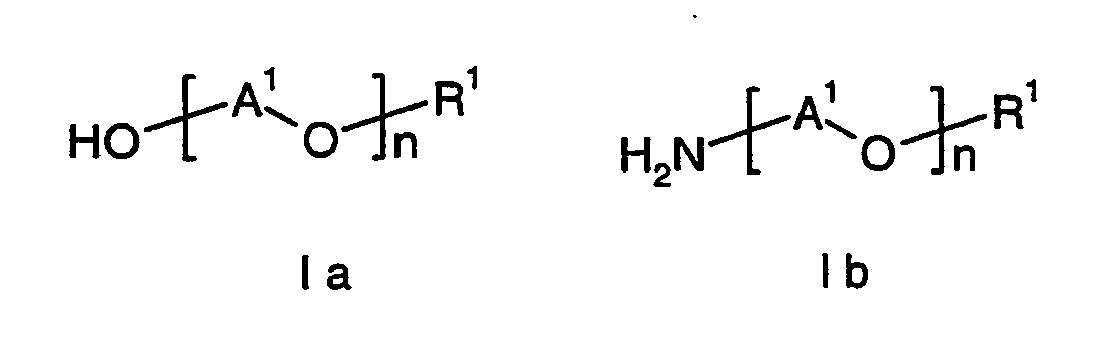
- (D) mit mindestens einer Verbindung der allgemeinen Formel I a oder I b
mit Wasser oder wässriger alkalischer Lösung hydrolysiert
und nach der Hydrolyse erneut Initiator zugibt, - A1
- C2-C20-Alkylen, gleich oder verschieden,
- R1
- C1-C30-Alkyl, linear oder verzweigt,
- n
- eine ganze Zahl von 1 bis 200.
- Zur Herstellung von Leder können bei der Vor-, Haupt- und Nachgerbung Polymere eingesetzt werden. Durch den Einsatz von Polymeren in der Vorgerbung kann dabei in vielen Fällen auf Cr-Verbindungen ganz oder zumindest teilweise verzichtet werden. Die Wahl der Polymeren kann die Eigenschaften des Lederendprodukts beeinflussen. Für die Wahl der Polymeren werden in der Literatur unterschiedliche Vorschläge gemacht.
- In EP-A 0 628 085 wird die Verwendung von Copolymeren aus Maleinsäureanhydrid und optional einem zweiten Monomer, beispielsweise Styrol, Isobuten oder Vinylacetat beschrieben, wobei die Copolymeren vor der Verwendung zum Nachgerben und Füllen mit alkoxylierten Alkoholen umgesetzt werden.
- Aus EP-A 0 372 746 ist die Verwendung von amphiphilen Copolymeren aus Methacrylsäure und beispielsweise Cetyl-Eicosyl-Methacrylat (Verfahrensbeispiel A) oder von Acrylsäure mit α-Hexadecen (Verfahrensbeispiel C) zur Nachbehandlung von Leder bekannt. Die Verwendung derartiger Polymerer ist auf die Nachbehandlung von Chrom-gegerbten Ledern beschränkt (s. Seite 8, Zeile 50-54).
- Zur Behandlung von insbesondere weichen Ledern sind die im Stand der Technik genannten Polymere jedoch noch nicht optimal. Beispielsweise lassen sich die nach den bisherigen Methoden hergestellten Leder in ihrer Fülle, ihrer Narbenbeschaffenheit und den Oberflächeneigenschaften verbessern. Weiterhin ist die Verteilung der in der Nachgerbung eingesetzten Fette im Lederquerschnitt noch nicht optimal.
- Copolymerisate aus partiell mit Polyethylenglykol verestertem Maleinsäureanhydrid und Styrol sind aus anderen Anwendungsgebieten bekannt. Beispielsweise beschreibt EP-A 0 306 449, Beispiel 1 die Herstellung von Styrol-Maleinsäurehalbester-Copolymerisaten durch-Copolymerisation von Styrol und Maleinsäureanhydrid und anschließende Veresterung mit Polyethylenglykol, wobei braune Produkte entstehen, die sich als Fließverbesserer von Zement eignen.
- Die genauen Gründe für die Bildung brauner Produkte während der in EP 0 306 449, Beispiel 1 beschriebenen Reaktion sind nicht bekannt.
- Aus EP-A 0 945 473 sind Verfahren zur Herstellung von Styrol-Maleinsäurehalbester-Copolymerisaten bekannt. Die Verfahren werden entweder als Zweistufenverfahren ausgeführt (Beispiele 1 bis 3), wobei unter Zweistufenverfahren zu verstehen ist, dass ein Styrol-Maleinsäureanhydrid-Copolymer einer partiellen Veresterung unterworfen wird. Derartige Zweistufenverfahren sind jedoch verhältnismäßig aufwändig. In einer anderen offenbarten Variante, die zu gefärbten Produkten führt, wird das Verfahren als Einstufenverfahren ausgeübt (Beispiele 7 bis 9).
- Aus EP-A 0 945 501 ist bekannt, dass durch ein Zweistufenverfahren hergestellte Styrol-Maleinsäurehalbester-Copolymerisate als Zusatz in Waschmitteln geeignet sind, die einen Builder und ein Tensid enthalten. Das Syntheseverfahren ist jedoch relativ aufwändig. Auch lässt sich die Reinigungswirkung der offenbarten Styrol-Maleinsäurehalbester-Copolymerisate noch verbessern.
- Es bestand daher die Aufgabe, ein verbessertes Verfahren zur Herstellung von Copolymerisaten bereitzustellen, das die oben genannten Schwächen vermeidet und zu wenig gefärbten Produkten führt.
- Demgemäß wurde das eingangs definierte Verfahren gefunden. Das eingangs definierte Verfahren ist dadurch gekennzeichnet, dass man folgende Comonomere miteinander copolymerisiert:
- (A) mindestens ein ethylenisch ungesättigtes Dicarbonsäureanhydrid, abgeleitet von mindestens einer Dicarbonsäure mit 4 bis 8 C-Atomen, beispielsweise Maleinsäureanhydrid, Itaconsäureanhydrid, Citraconsäureanhydrid, Methylenmalonsäureanydrid, bevorzugt Itaconsäureanhydrid und Maleinsäureanhydrid und ganz besonders bevorzugt Maleinsäureanhydrid;
- (B) mindestens eine vinylaromatische Verbindung, beispielsweise der allgemeinen Formel VIII

und - (C) optional mindestens ein von (A) verschiedenes ethylenisch ungesättigtes Comonomer mit mindestens einem Heteroatom.
Man setzt mit - (D) mindestens einer Verbindung der allgemeinen Formel I a oder I b, vorzugsweise I a

- A1
- C2-C20-Alkylen, beispielsweise -(CH2)2-, -CH2-CH(CH3)-, -(CH2)3-, -CH2-CH(C2H5)-, -CH2-CH(iso·C3H7)-, -CH2-CH(n·C4H9)-, -(CH2)4-, -(CH2)5-, -(CH2)6-, vorzugsweise C2-C4-Alkylen; insbesondere -(CH2)2-, -CH2-CH(CH3)- und -CH2-CH(C2H5)-;
- R1
- C1-C30-Alkyl, linear oder verzweigt, wie Methyl, Ethyl, n-Propyl, iso-Propyl, n-Butyl, iso-Butyl, sec.-Butyl, tert.-Butyl, n-Pentyl, iso-Pentyl, sec.-Pentyl, neo-Pentyl, 1,2-Dimethylpropyl, iso-Amyl, n-Hexyl, iso-Hexyl, sec.-Hexyl, n-Heptyl, n-Octyl, n-Nonyl, n-Decyl, iso-Decyl, 2-Propylheptyl, n-Dodecyl, iso-Tridecyl, lineares und verzweigtes C13- und C15-Alkyl, n-Hexadecyl, n-Octadecyl, n-Eicosyl; besonders bevorzugt C1-C4-Alkyl wie Methyl, Ethyl, n-Propyl, iso-Propyl, n-Butyl, iso-Butyl, sec.-Butyl und tert.-Butyl; ganz besonders bevorzugt Methyl;
- n
- eine ganze Zahl von 1 bis 200, bevorzugt 4 bis 50.
- Die Gruppen A1 können natürlich nur dann verschieden sein, wenn n eine Zahl größer 1 ist oder wenn man verschiedene Verbindungen der allgemeinen Formel I a und/oder I b einsetzt.
- In einer Ausführungsform der vorliegenden Erfindung setzt man Mischungen von verschiedenen Komponenten (D) beispielsweise der Formel I a ein. Insbesondere kann man solche Mischungen an Verbindungen der Formel I a einsetzen, in denen - bezogen jeweils auf die Mischung - mindestens 95 mol-%, bevorzugt mindestens 98 mol-% bis maximal 99,8 mol-% R1 für C1-C30-Alkyl steht und mindestens 0,2 mol-% und maximal 5 mol-%, bevorzugt maximal 2 mol-% für Wasserstoff.
- Nach der Copolymerisation und der Umsetzung mit (D) hydrolysiert man mit Wasser, wässriger alkalischer Lösung oder verdünnter wässriger Säure, wobei Hydrolyse mit Wasser oder wässriger alkalischer Lösung bevorzugt ist.
- Nach der Hydrolyse gibt man erfindungsgemäß erneut Initiator zu, wobei der oder die Initiatoren gleich oder verschieden von dem oder den Initiatoren der Copolymerisation sein können.
- Besondere Beispiele für Verbindungen der allgemeinen Formel I a sind
- Methylendgruppenverschlossene Polyethylenglykole der Formel HO-(CH2CH2O)m-CH3 mit m = 1 bis 200, vorzugsweise 4 bis 100, besonders bevorzugt 4 bis 50
- Methylendgruppenverschlossene Blockcopolymere aus Ethylenoxid, Propylenoxid und/oder Butylenoxid mit einem Molekulargewicht Mn von 300 bis 5000 g/mol
- Methylendgruppenverschlossene statistische Copolymere aus Ethylenoxid, Propylenoxid und/oder Butylenoxid mit einem Molekulargewicht Mn von 300 bis 5000 g/mol
- Alkoxylierte C2- bis C30-Alkohole, insbesondere n-Butanolalkoxylate, n-Hexanolalkoxylate, Fettalkoholalkoxylate, Oxoalkohol-alkoxylate oder GuerbetAlkoholalkoxylate, wobei die Alkoxylierung mit Ethylenoxid, Propylenoxid und/oder Butylenoxid durchgeführt werden kann, Beispiele sind
- C13-C15-Oxoalkoholethoxylate mit 3 bis 30 Ethylenoxideinheiten
- C13-Oxoalkoholethoxylate mit 3 bis 30 Ethylenoxideinheiten,
- C12C14-Fettalkoholethoxylate mit 3 bis 30 Ethylenoxideinheiten,
- C10-Oxoalkoholethoxylate mit 3 bis 30 Ethylenoxideinheiten,
- C10-Guerbetalkoholethoxylate mit 3 bis 30 Ethylenoxideinheiten,
- C9-C11-Oxoalkoholalkoxylate mit 2 bis 20 Ethylenoxideinheiten, 2 bis 20 Propylenoxideinheiten und/oder 1 bis 5 Butylenoxideinheiten;
- C4-C20-Alkoholalkoxylate mit 2 bis 20 Ethylenoxideinheiten, 2 bis 20 Propylenoxideinheiten und/oder 1 bis 5 Butylenoxideinheiten
- C13-C15-Oxoalkoholalkoxylate mit 2 bis 20 Ethylenoxideinheiten, 2 bis 20 Propylenoxideinheiten und/oder 1 bis 5 Butylenoxideinheiten;
- C4-C20-Alkoholethoxylate mit 3 bis 30 Ethylenoxideinheiten.
- Bevorzugte Beispiele für Verbindungen der Formel I b sind Methylendgruppenverschlossene Polyethylenglykolamine der Formel H2N-(CH2CH2O)m-CH3 mit m = 1 bis 200, vorzugsweise 4 bis 100, besonders bevorzugt 4-50.
- Bevorzugt setzt man als Comonomer (B) α-Methylstyrol und ganz besonders bevorzugt Styrol ein.
- Ganz besonders bevorzugt wird als Comonomer (C) eingesetzt: Acrylsäure, Methacrylsäure, Methylacrylat, Methylmethacrylat, Acrylamid, Vinyl-n-butylether, Vinyl-isobutylether, N-Vinylformamid, N-Vinylpyrrolidon, 1-Vinylimidazol und 4-Vinylpyridin.
- In einer Ausführungsform der vorliegenden Erfindung führt man zunächst eine Copolymerisation von (A), (B) und gegebenenfalls (C) durch und setzt anschließend mit (D) um.
- In einer anderen Ausführungsform der vorliegenden Erfindung wird die Copolymerisation von (A), (B) und gegebenenfalls (C) in Gegenwart der gesamten Menge oder Anteilen der einzusetzenden Verbindung (D) durchgeführt.
- Die gesamte Menge an (D) berechnet man so, dass man von einer vollständigen Umsetzung von (D) ausgeht und 5 bis 80 mol-%, bevorzugt 10 bis 67 mol-%, besonders bevorzugt 20 bis 50 mol-% (D), bezogen auf alle Carboxylgruppen des Copolymerisats, einsetzt. Unter dem Begriff "alle im Polymerisat enthaltene Carboxylgruppen" sind im Rahmen der vorliegenden Erfindung diejenigen Carboxylgruppen aus einpolymerisierten Comonomeren (A) und gegebenenfalls (C) zu verstehen, die als Anhydrid, als C1-C4-Alkylester oder als Carbonsäure vorliegen.
- Man startet die Copolymerisation vorteilhaft durch Initiatoren, beispielsweise radikalische zerfallende Verbindungen wie Peroxide oder Hydroperoxide. Als Peroxide bzw. Hydroperoxide seien Di-tert.-butylperoxid, tert.-Butylperoctoat, tert.-Butylperpivalat, tert.-Butylper-2-ethylhexanoat, tert.-Butylper-maleinat, tert.-Butylperisobutyrat, Benzoylperoxid, Diacetylperoxid, Succinylperoxid, p-Chlorbenzoylperoxid, Dicyclohexylperoxiddicarbonat, beispielhaft genannt. Auch der Einsatz von Redoxinitiatoren ist geeignet, beispielsweise Kombinationen aus Wasserstoffperoxid oder Natriumperoxodisulfat oder einem der vorstehend genannten Peroxide mit einem Reduktionsmittel. Als Reduktionsmittel sind beispielsweise geeignet: Ascorbinsäure, Weinsäure, Fe(II)-Salze wie beispielsweise FeSO4, Natriumbisulfit, Kaliumbisulfit.
- Geeignete Initiatoren sind außerdem Azoverbindungen wie 2,2'-Azobis(isobutyronitril), 2,2'-Azobis(2-methylpropion-amidin)dihydrochlorid und 2,2'-Azobis(4-methoxy-2,4-dimethylvaleronitril).
- Im allgemeinen wird Initiator in Mengen von 0,1 bis 20 Gew.-%, vorzugsweise 0,2 bis 15 Gew.-%, berechnet auf die Masse aller Comonomeren, eingesetzt.
- In einer bevorzugten Ausführungsform arbeitet man ohne Lösungsmittel oder in Gegenwart von nur geringen Mengen an Lösungsmittel, d.h. maximal 10 Gew.-%, bezogen auf die Gesamtmasse an Comonomeren (A), (B) sowie gegebenenfalls (C). Als Lösungsmittel sind unter den Bedingungen der Copolymerisation und der Veresterung beziehungsweise Amidbildung inerte Stoffe zu verstehen, insbesondere aliphatische und aromatische Kohlenwasserstoffe wie beispielsweise Cyclohexan, n-Heptan, Isododekan, Benzol, Toluol, Ethylbenzol, Xylol als Isomerengemisch, meta-Xylol, ortho-Xylol. Arbeitet man bei der Umsetzung mit (D) ohne sauren Katalysator, so kann man die Copolymerisation und/oder Umsetzung mit (D) auch in Lösungsmitteln, gewählt aus Ketonen wie beispielsweise Aceton, Methylethylketon, oder cyclischen oder nicht-cyclischen Ethern wie beispielsweise Tetrahydrofuran oder Di-n-Butylether durchführen.
- Die Reihenfolge der Zugabe der Comonomere kann man auf verschiedene Weise vornehmen.
- In einer Ausführungsform des erfindungsgemäßen Verfahrens legt man eine Mischung aus (D) und (A) vor und gibt Initiator und gleichzeitig (B) und gegebenenfalls (C) zu.
- Dabei ist es bevorzugt, (B) und gegebenenfalls (C) nach Art eines Zulaufverfahrens zuzugeben.
- In einer Ausführungsform der vorliegenden Erfindung legt man eine Mischung aus (D) und (A) vor und gibt Initiator und gleichzeitig (B) und gegebenenfalls (C) nach Art eines Zulaufverfahrens zu, wobei Initiator, (B) und gegebenenfalls (C) jeweils in (D) gelöst sind.
- In einer Ausführungsform der vorliegenden Erfindung legt man eine Mischung aus (D) und (A) vor und gibt Initiator und (B) und (C) nach Art eines Zulaufverfahrens zu, wobei die Zulaufgeschwindigkeiten von (B) und (C) unterschiedlich gewählt werden.
- In einer anderen Ausführungsform der vorliegenden Erfindung legt man eine Mischung aus (D) und (A) vor und gibt Initiator und (B) und (C) nach Art eines Zulaufverfahrens zu, wobei die Zulaufgeschwindigkeiten von (B) und (C) gleich gewählt werden.
- In einer Ausführungsform der vorliegenden Erfindung gibt man während der Zugabe von (B) und gegebenenfalls (C) weiteren Initiator zu.
- In einer Ausführungsform der vorliegenden Erfindung liegt das Molverhältnis (A) : (B) im Bereich von 1 : 0,1 bis 1 : 10, bevorzugt 1 : 0,2 bis 1 : 1, besonders bevorzugt 1 : 0,3 bis 1 : 0,98 und ganz besonders bevorzugt 1 : 0,4 bis 1 : 0,97.
- In einer Ausführungsform der vorliegenden Erfindung liegt das Molverhältnis (A) zu (C) im Bereich von 1 : 0 bis 1 : 10, bevorzugt 10 : 1 bis 1 : 1, besonders bevorzugt 9 : 1 bis 4:1.
- In einer Ausführungsform der vorliegenden Erfindung liegt das Molverhältnis (A) zu [(B) + (C)] im Bereich von 2 : 1 bis 1 : 20, bevorzugt 1,5 : 1 bis 1 : 10, besonders bevorzugt 1,1 : 1 bis 1 : 6,
- In einer Ausführungsform der vorliegenden Erfindung liegt die Temperatur für die Copolymerisation von (A), (B) und gegebenenfalls (C) im Bereich von 40 bis 120°C, bevorzugt 60 bis 115°C.
- Der Druck während der Copolymerisation kann beispielsweise im Bereich von 1 bis 10 bar, bevorzugt 1 bis 3 bar liegen.
- Man kann Regler einsetzen, beispielsweise Mercaptoethanol oder n-Dodecylmercaptan. Geeignete Mengen sind beispielsweise 0,1 bis 6 Gew.-%, bezogen auf die Masse der eingesetzten Comonomeren. Bevorzugt arbeitet man ohne Einsatz von Reglern.
- Man kann während der Copolymerisation einen oder mehrere Polymerisationsinhibitor in geringen Mengen zugeben, beispielsweise Hydrochinonmonomethylether. Polymerisationsinhibitor kann man vorteilhaft mit (B) und gegebenenfalls (C) dosieren. Geeignete Mengen an Polymerisationsinhibitor sind 0,01 bis 1 Gew.-%, vorzugsweise 0,05 bis 0,1 Gew.-%, berechnet auf die Masse aller Comonomeren. Die Zugabe von Polymerisationsinhibitor ist insbesondere dann bevorzugt, wenn man die Copolymerisation bei Temperaturen über 80°C durchführt.
- Nach Beendigung der Zugabe von (B), gegebenenfalls (C), gegebenenfalls (D) sowie gegebenenfalls Initiator kann man nachreagieren lassen.
- Die Dauer der Copolymerisation beträgt im Allgemeinen 0,5 bis 8 Stunden, bevorzugt 1 bis 5 Stunden.
- Die Dauer der Umsetzung mit (D) kann 0,5 bis 8 Stunden, bevorzugt 1 bis 5 Stunden betragen.
- Führt man das erfindungsgemäße Verfahren so durch, dass man (A), (B) und gegebenenfalls (C) in Gegenwart der gesamten Menge an (D) copolymerisiert, so ist eine Reaktionsdauer von insgesamt 0,5 bis 8 Stunden, bevorzugt 1 bis 5 Stunden geeignet.
- Man kann die Umsetzung mit (D) in Abwesenheit oder auch Anwesenheit von Katalysatoren durchführen, insbesondere sauren Katalysatoren wie z.B. Schwefelsäure, Methansulfonsäure, p-Toluolsulfonsäure, n-Dodecylbenzolsulfonsäure, Salzsäure oder sauren Ionenaustauschern.
- In einer Ausführungsform der vorliegenden Erfindung führt man die Umsetzung mit (D) in Abwesenheit von Katalysatoren bei einer Temperatur im Bereich von 60 bis 130°C durch, bevorzugt von 100 bis 120°C.
- In einer Ausführungsform der vorliegenden Erfindung führt man die Umsetzung mit (D) in Anwesenheit von Katalysatoren durch. Die Dauer der Umsetzung mit (D) kann 0,25 bis 1 Stunde betragen.
- In einer Ausführungsform der vorliegenden Erfindung führt man die Umsetzung mit (D) in Anwesenheit von sauren Katalysatoren bei einer Temperatur im Bereich von 80 bis 95°C durch.
- In einer weiteren Variante des beschriebenen Verfahrens führt man die Umsetzung mit (D) in Anwesenheit eines Schleppmittels durch, das mit bei der Reaktion gegebenenfalls entstehendem Wasser ein Azeotrop bildet.
- Im Allgemeinen regiert unter den Bedingungen der oben beschriebenen Schritte (D) vollständig oder zu einem gewissen Prozentsatz mit den Carboxylgruppen einpolymerisierter Anhydride (A) und gegebenenfalls den Carboxylgruppen aus einpolymerisiertem (C). Im Allgemeinen bleiben weniger als 40 mol-% als nicht umgesetztes (D) zurück.
- Es ist möglich, durch an sich bekannte Methoden wie beispielsweise Extraktion nicht umgesetztes (D) von den nach dem erfindungsgemäßen Verfahren erhältlichen Copolymerisaten abzutrennen.
- Das oder die Monomere (C), das bzw. die optional im erfindungsgemäßen Verfahren copolymerisiert werden können, sind von (A) verschieden. Als bevorzugte Monomere (C) mit mindestens einem Heteroatom sind zu nennen:
C3-C8-Carbonsäurederivate der allgemeinen Formel II


α,β-ungesättigte Nitrile wie beispielsweise Acrylnitril, Methacrylnitril;
alkoxylierte ungesättigte Ether der allgemeinen Formel V,


wobei die Variablen wie folgt definiert sind: - A2
- C2-C20-Alkylen, beispielsweise -(CH2)2-, -CH2-CH(CH3)-, -(CH2)3-, -CH2-CH(C2H5)-, -CH2-CH(iso·C3H7)-, -CH2-CH(n·C4H9)-, -(CH2)4-, -(CH2)5-, -(CH2)6-, vorzugsweise C2-C4-Alkylen; insbesondere -(CH2)2-, -CH2-CH(CH3)- und -CH2-CH(C2H5)-;
- R2, R3
- gleich oder verschieden und gewählt aus unverzweigten oder verzweigten C1-C5-Alkyl, wie Methyl, Ethyl, n-Propyl, iso-Propyl, n-Butyl, iso-Butyl, sec.-Butyl, tert.-Butyl, n-Pentyl, iso-Pentyl, sec.-Pentyl, neo-Pentyl, 1,2-Dimethylpropyl, iso-Amyl, besonders bevorzugt C1-C4-Alkyl wie Methyl, Ethyl, n-Propyl, iso-Propyl, n-Butyl, iso-Butyl, sec.-Butyl und tert.-Butyl;
und insbesondere Wasserstoff; - R4
- gleich oder verschieden und C1-C22-Alkyl, verzweigt oder unverzweigt, wie Methyl, Ethyl, n-Propyl, iso-Propyl, n-Butyl, iso-Butyl, sec.-Butyl, tert.-Butyl, n-Pentyl, iso-Pentyl, sec.-Pentyl, neo-Pentyl, 1,2-Dimethylpropyl, iso-Amyl, n-Hexyl, iso-Hexyl, sec.-Hexyl, n-Heptyl, n-Octyl, n-Nonyl, n-Decyl, n-Dodecyl, n-Eicosyl; besonders bevorzugt C1-C4-Alkyl wie Methyl, Ethyl, n-Propyl, iso-Propyl, n-Butyl, iso-Butyl, sec.-Butyl und tert.-Butyl; oder besonders bevorzugt Wasserstoff;
- R5
- Wasserstoff oder Methyl,
- x
- eine ganze Zahl im Bereich von 2 bis 6, vorzugsweise 3 bis 5;
- y
- eine ganze Zahl, ausgewählt aus 0 oder 1, vorzugsweise 1;
- a
- eine ganze Zahl im Bereich von 0 bis 6, vorzugsweise im Bereich von 0 bis 2;
- R6, R7
- gleich oder verschieden und gewählt aus Wasserstoff, unverzweigten oder verzweigten C1-C10-Alkyl und wobei unverzweigtes und verzweigtes C1-C10-Alkyl wie oben stehend definiert ist;
- X
- Sauerstoff oder N-R4;
- R8
- [A1-O]n-R4,
- R9
- gewählt aus unverzweigten oder verzweigten C1-C20-Alkyl, wie Methyl, Ethyl, n-Propyl, iso-Propyl, n-Butyl, iso-Butyl, sec.-Butyl, tert.-Butyl, n-Pentyl, iso-Pentyl, sec.-Pentyl, neo-Pentyl, 1,2-Dimethylpropyl, iso-Amyl, n-Hexyl, iso-Hexyl, sec.-Hexyl, n-Heptyl, n-Octyl, n-Nonyl, n-Decyl, n-Dodecyl, n-Tetradecyl, n-Hexadecyl, n-Octadecyl, n-Eicosyl; bevorzugt C1-C14-Alkyl wie Methyl, Ethyl, n-Propyl, iso-Propyl, n-Butyl, iso-Butyl, sec.-Butyl, tert.-Butyl, n-Pentyl, iso-Pentyl, sec.-Pentyl, neo-Pentyl, 1,2-Dimethylpropyl, iso-Amyl, n-Hexyl, iso-Hexyl, sec.-Hexyl, n-Heptyl, n-Octyl, n-Nonyl, n-Decyl, n-Dodecyl, n-Tetradecyl,
und insbesondere Wasserstoff oder Methyl; - Die übrigen Variablen sind wie oben stehend definiert.
- Beispielhaft ausgewählte Verbindungen der Formel III sind (Meth)Acrylamide wie Acrylamid, N-Methylacrylamid, N,N-Dimethylacrylamid, N-Ethylacrylamid, N-Propylacrylamid, N-tert.-Butylacrylamid, N-tert.-Octylacrylamid, N-Undecylacrylamid oder die entsprechenden Methacrylamide.
- Beispielhaft ausgewählte Verbindungen der Formel IV a sind N-Vinylcarbonsäureamide wie N-Vinylformamid, N-Vinyl-N-methylfomamid, N-Vinylacetamid oder N-Vinyl-N-methylacetamid; Beispielhaft ausgewählte Vertreter für Verbindungen der Formel IV b sind N-Vinylpyrrolidon, N-Vinyl-4-piperidon und N-Vinyl-ε-caprolactam.
- Beispielhaft ausgewählte Verbindungen der Formel VI sind (Meth)acrylsäureester und -am ide wie N,N-Dialkylaminoalkyl(meth)acrylate oder
N,N-Dialkylaminoalkyl(meth)acrylamide; Beispiele sind N,N-Dimethylaminoethylacrylat,
N,N-Dimethylaminoethylmethacrylat, N,N-Diethylaminoethylacrylat,
N,N-Diethylaminoethylmethacrylat, N,N-Dimethylaminopropylacrylat,
N,N-Dimethylaminopropylmethacrylat, N,N-Diethylaminopropylacrylat,
N,N-Diethylaminopropylmethacrylat, 2-(N,N-Dimethylamino)ethylacrylamid,
2-(N,N-Dimethylamino)ethylmethacrylamid, 2-(N,N-Diethylamino)ethylacrylamid,
2-(N,N-Diethylamino)ethylmethacrylamid, 3-(N,N-Dimethylamino)propylacrylamid und
3-(N , N-Dimethylamino)propylmethacrylamid. - Beispielhaft ausgewählte Verbindungen der Formel VII sind Vinylacetat, Allylacetat, Vinylpropionat, Vinylbutyrat, Vinyl-2-ethylhexanoat oder Vinyllaurat.
- In einer Ausführungsform kann man auf den weiteren Schritt der Abtrennung von nicht abreagiertem (D) von den erfindungsgemäß hergestellten Copolymerisaten verzichten. In dieser Ausführungsform setzt man Copolymerisate zusammen mit einem gewissen Prozentsatz an nicht abreagiertem (D) zur Herstellung von Leder oder als Zusatz in Reinigungs- oder Waschmitteln ein.
- Durch die oben beschriebene Copolymerisation erhält man Copolymerisate. Die anfallenden Copolymerisate kann man einer Reinigung nach konventionellen Methoden unterziehen, beispielsweise Umfällen oder extraktiver Entfernung nicht-umgesetzter Monomere. Wenn ein Lösemittel oder Fällungsmittel eingesetzt wurde, so ist es möglich, dieses nach beendeter Copolymerisation zu entfernen, beispielsweise durch Abdestillieren.
- Im Anschluss an die Copolymerisation setzt man die Copolymerisate mit Wasser oder mit wässriger alkalischer Lösung um und erhält wässrige Lösungen oder Dispersionen von Copolymerisaten, die partiell oder vollständig hydrolysiert sein können. Dieser Schritt wird im Folgenden auch Hydrolyse genannt.
- Die Hydrolyse führt man erfindungsgemäß so durch, dass man die erfindungsgemäß hergestellten Copolymerisate mit Wasser oder wässriger alkalischer Lösung, wie beispielsweise von Alkalimetallhydroxiden wie z.B. Natriumhydroxid oder Kaliumhydroxid, Alkalicarbonaten wie z.B. Natriumcarbonat oder Kaliumcarbonat, Alkalihydrogencarbonaten wie Kaliumhydrogencarbonat, von Ammoniak, primären, sekundären oder tertiären Alkylaminen oder Alkanolaminen umsetzt. Geeignet sind insbesondere Natronlauge oder Kalilauge. Man setzt beispielsweise etwa 30 bis 150 Gew.-% Wasser oder wässrige alkalische Lösung, bezogen auf erfindungsgemäß hergestelltes Copolymerisat, ein.
Man kann zur Hydrolyse verdünnte wässrige Säure einsetzen wie beispielsweise 0,5 bis 5 Gew.-% Schwefelsäure oder 0,5 bis 10 Gew.-% Zitronensäure. - Die Temperatur während der Hydrolyse ist im Allgemeinen unkritisch. Geeignet sind im Allgemeinen 15 bis 100°C, bevorzugt 20 bis 100°C, besonders bevorzugt bis 90°C. Üblicherweise ist die Hydrolyse nach 10 Minuten bis 4 Stunden beendet.
- Im Anschluss an die Hydrolyse gibt man erneut Initiator zu, beispielsweise Peroxide oder Hydroperoxide. Als Peroxide bzw. Hydroperoxide seien tert.-Butylhydro-peroxid und Wasserstoffperoxid beispielhaft genannt. Auch der Einsatz von Redoxinitiatoren ist geeignet, beispielsweise Kombinationen aus Wasserstoffperoxid oder Natriumperoxodisulfat oder einem der vorstehend genannten Peroxide mit einem Reduktionsmittel. Als Reduktionsmittel sind beispielsweise geeignet: Ascorbinsäure, Weinsäure, Fe(II)-Salze wie beispielsweise FeSO4, Natriumbisulfit, Kaliumbisulfit.
- Als Initiatoren sind außerdem Azoverbindungen wie 2,2'-Azobis(isobutyronitril), 2,2'-Azobis(2-methylpropion-amidin)dihydrochlorid und 2,2'-Azobis(4-methoxy-2,4-dimethylvaleronitril) geeignet. Besonders bevorzugt sind Wasserstoffperoxid, Natriumperoxodisulfat und tert.-Butylhydroperoxid und Redoxinitiatoren.
- Im Allgemeinen setzt man bei der erneuten Zugabe Initiator in Mengen von 0,1 bis 20 Gew.-% zu, vorzugsweise 0,2 bis 15 Gew.-%, berechnet auf die Masse aller Comonomeren.
- Man kann den gleichen Initiator zusetzen, den man für die Initiierung der Copolymerisation eingesetzt hat, oder bevorzugt mindestens einen anderen Initiator.
- Im Anschluss an die erneute Zugabe von Initiator kann man nachreagieren lassen, beispielsweise über einen Zeitraum von 0,5 bis 5 Stunden.
- In einer Ausführungsform der vorliegenden Erfindung führt man die erneute Zugabe von Initiator und gegebenenfalls das Nachreagieren bei einer Temperatur im Bereich von 20 bis 100°C durch, bevorzugt von 25 bis 70°C.
- In einer Ausführungsform der vorliegenden Erfindung führt man die erneute Zugabe von Initiator und gegebenenfalls das Nachreagieren bei einem Druck im Bereich von O,5 bis 10 bar durch, bevorzugt bei Normaldruck.
- In einer Ausführungsform der vorliegenden Erfindung führt man die erneute Zugabe von Initiator und gegebenenfalls das Nachreagieren nach der Hydrolyse und vor der Neutralisation durch.
- In einer Ausführungsform der vorliegenden Erfindung führt man die Zugabe von Redoxinitiatoren nach der Hydrolyse durch. Zuerst wird Oxidationsmittel zugegeben und nach der Neutralisation Reduktionsmittel. Das Nachreagieren erfolgt vor und nach der Neutralisation.
- Man erhält wässrige Dispersionen oder wässrige Lösungen von erfindungsgemäß hergestellten Copolymerisaten, im Folgenden auch als wässrige Dispersionen von Copolymerisaten bezeichnet, in denen die bei der Reaktion mit (D) nicht umgesetzten Anhydridgruppen vollständig oder partiell hydrolysiert sind und Carbonsäuregruppen frei oder in Form ihrer Alkalisalze oder Ammoniumsalze vorliegen.
- Ein weiterer Gegenstand der vorliegenden Erfindung sind Copolymerisate, erhältlich nachdem erfindungsgemäßen Verfahren.
- Erfindungsgemäße Copolymerisate fallen üblicherweise in Form von wässrigen Dispersionen oder wässrigen Lösungen an. Aus erfindungsgemäßen wässrigen Dispersionen lassen sich erfindungsgemäße Copolymerisate durch dem Fachmann an sich bekannte Methoden isolieren, beispielsweise durch Verdampfen von Wasser oder durch Sprühtrocknen.
- Die Polydispersität erfindungsgemäßer Copolymerisate liegt im Allgemeinen zwischen 2 und 20, bevorzugt bis 15.
- Die K-Werte erfindungsgemäßer Copolymerisate betragen 6 bis 100, vorzugsweise 10 bis 60 (gemessen nach H. Fikentscher bei 25 °C in Wasser und einer Polymerkonzentration von 2 Gew.-%).
- Erfindungsgemäße Copolymerisate können betreffend (A), (B) und gegebenenfalls (C) Blockcopolymerisate, alternierende Copolymerisate oder statistische Copolymerisate sein, wobei in Bezug auf (A) und (B) alternierende Copolymerisate bevorzugt sind.
- Die Farbzahl, auch APHA-Farbzahl genannt, von 33 Gew.-% wässrigen Lösungen von erfindungsgemäßem Copolymerisat liegt unter 150, bevorzugt unter 100, gemessen nach Hazen nach EN 1557: Farbmetrische Charakterisierung von optisch klaren, gefärbten Flüssigkeiten.
- In einer Ausführungsform der vorliegenden Erfindung beträgt die Extinktion von 33 Gew.-% wässrigen Lösungen von erfindungsgemäßem Copolymerisat bei 450 nm maximal 0,25.
- In einer Ausführungsform der vorliegenden Erfindung enthalten erfindungsgemäße Copolymerisate im Bereich von 1 bis 100 ppm Restmonomer, bestimmt durch Gaschromatographie nach der im Dispersionshandbuch, Kapitel C 2.4.7.4 (1994), beschriebenen Methode. Als Restmonomer wird im Falle der vorliegenden Erfindung im Copolymerisat frei vorliegendes (B) bezeichnet.
- Für viele Anwendungen ist es nicht notwendig, erfindungsgemäßes Copolymerisat zu isolieren; man kann in vielen Anwendungen die durch das erfindungsgemäße Verfahren anfallenden wässrigen Dispersionen oder wässrigen Lösungen ohne weitere Aufarbeitung einsetzen. Wässrige Dispersionen und Lösungen, enthaltend erfindungsgemäßes Copolymerisat, sind daher ebenfalls Gegenstand der vorliegenden Erfindung.
- In einer Ausführungsform der vorliegenden Erfindung haben erfindungsgemäße wässrige Dispersionen und Lösungen, enthaltend erfindungsgemäßes Copolymerisat, einen pH-Wert im Bereich von 4 bis 8, bevorzugt 5 bis 7.
- In einer Ausführungsform der vorliegenden Erfindung haben erfindungsgemäße wässrige Dispersionen und Lösungen, enthaltend erfindungsgemäßes Copolymerisat, einen Feststoffgehalt im Bereich von 30 bis 70 Gew.-%, bevorzugt 40 bis 65 %-Gew.
- Ein weiterer Gegenstand der vorliegenden Erfindung ist die Verwendung der erfindungsgemäßen Copolymerisate zur Herstellung von Leder. Ein weiterer Gegenstand der vorliegenden Erfindung ist ein Verfahren zur Herstellung von Leder unter Verwendung der erfindungsgemäßen Copolymerisate.
- Erfindungsgemäße Copolymerisate kann man in der Vorgerbung, Gerbung oder Nachgerbung einsetzen.
- Das erfindungsgemäße Verfahren zur Herstellung von Leder kann man als Verfahren zum Vorgerben oder Gerben ausüben, im Folgenden dann auch erfindungsgemäßes Gerbverfahren genannt. Das erfindungsgemäße Gerbverfahren geht aus von nach konventionellen Methoden vorbehandelten Häuten von Tieren wie beispielsweise Rindern, Schweinen, Ziegen oder Hirschen, den sogenannten Blößen. Dabei ist es für das erfindungsgemäßen Gerbverfahren nicht wesentlich, ob die Tiere beispielsweise durch Schlachten getötet wurden oder aber an natürlichen Ursachen verendet sind. Zu den konventionellen Methoden der Vorbehandlung gehören beispielsweise das Äschern, Entkälken, Beizen und Pickeln sowie mechanische Arbeitsschritte, beispielsweise die Entfleischung der Häute.
- Das erfindungsgemäße Gerbverfahren übt man im Allgemeinen so aus, dass man erfindungsgemäßes Copolymerisat in einer Portion oder in mehreren Portionen unmittelbar vor oder aber während des Gerbungsschrittes zusetzt. Das erfindungsgemäße Gerbverfahren wird vorzugsweise bei einem pH-Wert von 2,5 bis 4 durchgeführt, wobei man häufig beobachtet, dass der pH-Wert während der Durchführung des erfindungsgemäßen Gerbverfahrens um etwa 0,3 bis drei Einheiten ansteigt. Man kann den pH-Wert auch durch Zugabe abstumpfender Mittel um etwa 0,3 bis drei Einheiten erhöhen.
- Das erfindungsgemäße Gerbverfahren führt man im Allgemeinen bei Temperaturen von 10 bis 45°, bevorzugt bei 20 bis 30°C durch. Bewährt hat sich eine Dauer von 10 Minuten bis 12 Stunden, bevorzugt sind eine bis drei Stunden. Das erfindungsgemäße Gerbverfahren kann man in beliebigen gerbereiüblichen Gefäßen durchführen, beispielsweise durch Walken in Fässern oder in gedrehten Trommeln.
- In einer Variante des erfindungsgemäßen Gerbverfahrens setzt man erfindungsgemäßes Copolymerisat zusammen mit einem oder mehreren herkömmlichen Gerbstoffen ein, beispielsweise mit Chromgerbstoffen, mineralischen Gerbstoffen, Syntanen, Polymergerbstoffen oder vegetabilen Gerbstoffen, wie sie beispielsweise beschrieben sind in Ullmann's Encyclopedia of Industrial Chemistry, Band A15, Seite 259 bis 282 und insbesondere Seite 268 ff., 5. Auflage, (1990), Verlag Chemie Weinheim. Das Gewichtsverhältnis erfindungsgemäßes Copolymerisat : herkömmlicher Gerbstoff bzw. Summe der herkömmlichen Gerbstoffe beträgt zweckmäßig von 0,01 : 1 bis 100 : 1.
- In einer Variante des erfindungsgemäßen Gerbverfahrens setzt man erfindungsgemäßes Copolymerisat in einer Portion oder in mehreren Portionen vor oder während des Vorgerbens zu, in einer besonderen Variante bereits im Pickel.
- Man kann das erfindungsgemäße Verfahren zur Herstellung von Leder auch als Verfahren zum Nachgerben von Leder unter der Verwendung von erfindungsgemäßem Copolymerisat durchführen, im Folgenden auch erfindungsgemäßes Nachgerbverfahren genannt. Das erfindungsgemäße Nachgerbverfahren geht aus von konventionell, d.h. beispielsweise mit Chromgerbstoffen, mineralischen Gerbstoffen, Polymergerbstoffen, Aldehyden, Syntanen oder Harzgerbstoffen gegerbten Halbzeugen oder erfindungsgemäß wie oben beschrieben hergestellten Halbzeugen. Zur Durchführung des erfindungsgemäßen Nachgerbung lässt man erfindungsgemäßes Copolymerisat auf Halbzeuge einwirken.
- Das erfindungsgemäße Nachgerbverfahren kann man unter ansonsten üblichen Bedingungen durchführen. Man wählt zweckmäßig einen oder mehrere, d.h. 2 bis 6 Einwirkschritte und kann zwischen den Einwirkschritten mit Wasser spülen. Die Temperatur bei den einzelnen Einwirkschritten beträgt jeweils von 5 bis 60°C, bevorzugt 20 bis 45°C. Man setzt zweckmäßig weitere, während der Nachgerbung üblicherweise verwendete Mittel ein, beispielsweise Fettlicker, Polymergerbstoffe und Fettungsmittel auf Acrylat- und/oder Methacrylatbasis, Nachgerbstoffe auf Basis von Harz- und Vegetabilgerbstoffen, Füllstoffe, Lederfarbstoffe oder Emulgatoren.
- Ein weiterer Aspekt der vorliegenden Erfindung sind Leder, hergestellt durch das erfindungsgemäße Gerbverfahren oder das erfindungsgemäße Nachgerbverfahren oder durch eine Kombination aus erfindungsgemäßem Gerbverfahren und erfindungsgemäßen Nachgerbverfahren. Die erfindungsgemäßen Leder zeichnen sich durch eine insgesamt vorteilhafte Qualität aus, beispielsweise sind sie besonders weich. Die erfindungsgemäßen Leder enthalten erfindungsgemäßes Copolymerisat besonders gleichmäßig über den Querschnitt verteilt.
- Ein weiterer Aspekt der vorliegenden Erfindung ist die Verwendung der erfindungsgemäßen Leder zur Herstellung von Bekleidungsstücken, Möbeln oder Autoteilen. Unter Bekleidungsstücke sind im Sinne der vorliegenden Erfindung beispielsweise Jacken, Hosen, Schuhe, Gürtel oder Hosenträger zu nennen. Unter Möbeln sind im Zusammenhang mit der vorliegenden Erfindung alle solchen Möbel zu nennen, die Bestandteile aus Leder enthalten. Beispielhaft seien Sitzmöbel genannt wie etwa Sessel, Stühle, Sofas. Unter Autoteilen seien beispielhaft Autositze genannt.
- Ein weiterer Aspekt der vorliegenden Erfindung sind Bekleidungsstücke, enthaltend die oder hergestellt aus erfindungsgemäßen Ledern. Ein weiterer Aspekt der vorliegenden Erfindung sind Möbel, enthaltend die oder hergestellt aus erfindungsgemäßen Ledern. Ein weiterer Aspekt der vorliegenden Erfindung sind Autoteile, enthaltend die oder hergestellt aus erfindungsgemäßen Ledern.
- Ein weiterer Aspekt der vorliegenden Erfindung ist die Verwendung der erfindungsgemäßen Copolymerisate als Zusatz in Wasch- und Reinigungsmitteln sowie ein Verfahren zur Reinigung von textilen Substraten unter Verwendung der erfindungsgemäßen Copolymerisate.
- Erfindungsgemäße Copolymerisate eignen sich vorteilhaft als Zusatz für Reinigungsmittel, insbesondere für Reinigungsmittel für harte Oberflächen, wie Geschirrspül- und Haushaltsreiniger, und Waschmittel.
- Erfindungsgemäße Copolymerisate zeichnen sich dabei insbesondere durch folgende vorteilhafte Anwendungseigenschaften aus, die sie für den Einsatz in Waschmitteln besonders geeignet machen: Sie dispergieren Schmutzpartikel hervorragend und verhindern so während des Waschens eine Wiederablagerung des Schmutzes auf dem Gewebe. Sie beugen damit einer Vergrauung der Textilien vor. Außerdem verbessern sie die Primärwaschkraft sowohl von festen und insbesondere flüssigen Waschmitteln. Dies gilt besonders für partikuläre Anschmutzungen, aber auch hydrophobe, öl- und fetthaltige Gewebeanschmutzungen werden leichter entfernt. Zudem lassen sie sich problemlos in feste und flüssige Waschmittelformulierungen einarbeiten. Dabei ist hervorzuheben, dass Stabilität und Homogenität der Flüssigwaschmittel durch erfindungsgemäßen Copolymerisate nicht beeinträchtigt werden. Unerwünschte Phasenbildungen, Trübungen, Ausfällungen und Farbveränderungen werden auch bei längerer Lagerung nicht beobachtet.
- Gegenstand der Erfindung sind demgemäß auch Waschmittelformulierungen, welche erfindungsgemäßen Copolymerisate als Zusatz enthalten. Die erfindungsgemäßen Copolymere können dabei in Form der freien Säuren oder in partiell oder vollständig neutralisierter Form eingesetzt werden.
- Erfindungsgemäße feste Waschmittelformulierungen enthalten insbesondere folgende Komponenten:
- a) 0,05 bis 20 Gew.-% mindestens eines erfindungsgemäßen Copolymers,
- (b) 0,5 bis 40 Gew.-% mindestens eines nichtionischen, anionischen und/oder kationischen Tensids,
- (c) 0,5 bis 50 Gew.-% mindestens eines anorganischen Builders,
- (d) 0 bis 10 Gew.-% eines organischen Cobuilders und
- (e) 0 bis 60 Gew.-% anderer üblicher Inhaltsstoffe, wie Stellmittel, Enzyme, Parfum, Komplexbildner, Korrosionsinhibitoren, Bleichmittel, Bleichaktivatoren, Bleichkatalysatoren, Farbübertragungsinhibitoren, weitere Vergrauungsinhibitoren, Soil-Release-Polyester, Faser- und Farbschutzadditve, Silicone, Farbstoffe, Bakterizide, Auflösungsverbesserer und/oder Sprengmittel,
- Erfindungsgemäße feste Waschmittelformulierungen können in Pulver-, Granulat-, Extrudat- oder Tablettenform vorliegen.
- Erfindungsgemäße flüssige Waschmittelformulierungen haben vorzugsweise folgende Zusammensetzung:
- (a) 0,05 bis 20 Gew.-% mindestens eines erfindungsgemäßen Copolymers,
- (b) 0,5 bis 40 Gew.-% mindestens eines nichtionischen, anionischen und/oder kationischen Tensids,
- (c) 0 bis 20 Gew.-% mindestens eines anorganischen Builders,
- (d) 0 bis 10 Gew.-% eines organischen Cobuilders,
- (e) 0 bis 60 Gew.-% anderer üblicher Inhaltsstoffe, wie Soda, Enzyme, Parfum, Komplexbildner, Korrosionsinhibitoren, Bleichmittel, Bleichaktivatoren, Bleichkatalysatoren, Farbübertragungsinhibitoren, weitere Vergrauungsinhi-bitoren , Soil-Release-Polyester, Faser- und Farbschutzadditve, Silicone, Farbstoffe, Bakterizide, organische Lösungsmittel, Löslichkeitsvermittler, Hydrotrope, Verdicker und/oder Alkanolamine und
- (f) 0 bis 99,45 Gew.-% Wasser.
- Als nichtionische Tenside (b) eignen sich dabei vor allem:
- Alkoxylierte C8-C22-Alkohole, wie Fettalkoholalkoxylate, Oxoalkoholalkoxylate und Guerbetalkoholalkoxylate: Die Alkoxylierung kann mit C2-C20 -Alkylenoxiden, vorzugsweise mit Ethylenoxid, Propylenoxid und/oder Butylenoxid erfolgen. Es können Blockcopolymerisate oder statistische Copolymere vorliegen. Pro mol Alkohol enthalten sie üblicherweise 1 bis 50 mol, vorzugsweise 1 bis 20 mol, mindestens eines Alkylenoxids. Besonders bevorzugtes Alkylenoxid ist Ethylenoxid. Die Alkohole haben vorzugsweise 10 bis 18 Kohlenstoffatome.
- Alkylphenolalkoxylate, insbesondere Alkylphenolethoxylate, die C6-C14-Alkylketten und 5 bis 30 mol Alkylenoxid/mol enthalten.
- Alkylpolyglucoside, die C8-C22, vorzugsweise C10-C18-Alkylketten und in der Regel 1 bis 20, vorzugsweise 1,1 bis 5, Glucosideinheiten enthalten.
- N-Alkylglucamide, Fettsäureamidalkoxylate, Fettsäurealkanolamidalkoxylate sowie Blockcopolymere aus Ethylenoxid, Propylenoxid und/oder Butylenoxid.
- Geeignete anionische Tenside sind beispielsweise:
- Sulfate von (Fett)alkoholen mit 8 bis 22, vorzugsweise 10 bis 18, Kohlenstoffatomen, insbesondere C9C11-Alkoholsulfate, C12C14-Alkoholsulfate, C12-C18-Alkoholsulfate, Laurylsulfat, Cetylsulfat, Myristylsulfat, Palmitylsulfat, Stearylsulfat und Talgfettalkoholsulfat.
- Sulfatierte alkoxylierte C8-C22-Alkohole (Alkylethersulfate): Verbindungen dieser Art werden beispielsweise dadurch hergestellt, daß man zunächst einen C8-C22-, vorzugsweise einen C10-C18-Alkohol, z.B. einen Fettalkohol, alkoxyliert und das Alkoxylierungsprodukt anschließend sulfatiert. Für die Alkoxylierung verwendet man vorzugsweise Ethylenoxid.
- Lineare C8-C20-Alkylbenzolsulfonate (LAS), vorzugsweise lineare C9-C13-Alkylbenzolsulfonate und -Alkyltoluolsulfonate.
- Alkansulfonate, insbesondere C8-C24-, vorzugsweise C10-C18-Alkansulfonate.
- Seifen, wie die Na- und K-Salze von C8-C24-Carbonsäuren.
- Anionisches Tensid wird dem Waschmittel vorzugsweise in Form von Salzen zugegeben. Geeignete Kationen sind dabei z.B. Alkalimetallionen, wie Natrium, Kalium und Lithium, und Ammoniumsalze, wie Hydroxyethylammonium-, Di(hydroxyethyl)-ammonium- und Tri(hydroxyethyl)ammoniumsalze.
- Als besonders geeignete kationische Tenside seien genannt:
- C7-C25-Alkylamine;
- N,N-Dimethyl-N-(hydroxy-C7-C25-alkyl)ammoniumsalze;
- mit Alkylierungsmitteln quaternisierte Mono- und Di-(C7-C25-alkyl)dimethylammoniumverbindungen;
- Esterquats, insbesondere quaternäre veresterte Mono-, Di- und Trialkanolamine, die mit C8-C22-Carbonsäuren verestert sind;
- Imidazolinquats, insbesondere 1-Alkylimidazoliniumsalze der Formeln IX oder X

- R13
- gleich oder verschieden und gewählt aus C1-C25-Alkyl oder C2-C25-Alkenyl;
- R14
- C1-C4-Alkyl oder Hydroxy-C1-C4-alkyl;
- R15
- C1-C4-Alkyl, Hydroxy-C1-C4-alkyl oder Rest R16-(CO)-X-(CH2)p- (X:-O- oder -NH-; p: 2 oder 3),
- R16
- gewählt aus C7-C22-Alkyl.
- Als anorganische Builder eignen sich insbesondere:
- Kristalline und amorphe Alumosilikate mit ionenaustauschenden Eigenschaften, wie vor allem Zeolithe: Verschiedene Typen von Zeolithen sind geeignet, insbesondere die Zeolithe A, X, B, P, MAP und HS in ihrer Na-Form oder in Formen, in denen Na teilweise gegen andere Kationen wie Li, K, Ca, Mg oder Ammonium ausgetauscht ist.
- Kristalline Silikate, wie insbesondere Disilikate und Schichtsilikate, z.B. δ- und β-Na2Si2O5. Die Silikate können in Form ihrer Alkalimetall-, Erdalkalimetall- oder Ammoniumsalze eingesetzt werden, bevorzugt sind die Na-, Li- und Mg-Silicate.
- Amorphe Silikate, wie Natriummetasilikat und amorphes Disilikat.
- Carbonate und Hydrogencarbonate: Diese können in Form ihrer Alkalimetall-, Erdalkalimetall- oder Ammoniumsalze eingesetzt werden. Bevorzugt sind Na-,U- und Mg-Carbonate und -Hydrogencarbonate, insbesondere Natriumcarbonat und/oder Natriumhydrogencarbonat.
- Polyphosphate, wie Pentanatriumtriphosphat.
- Als organische Cobuilder eignen sich vor allem:
- Niedermolekulare Carbonsäuren, wie Citronensäure, hydrophob modifizierte Citronensäure, z. B. Agaricinsäure, Äpfelsäure, Weinsäure, Gluconsäure, Glutarsäure, Bernsteinsäure, Imidodibernsteinsäure, Oxydibernsteinsäure, Propantricarbonsäure, Butantetracarbonsäure, Cyclopentantetracarbonsäure, Alkyl- und Alkenylbernsteinsäuren und Aminopolycarbonsäuren, z.B. Nitrilotriessigsäure, β-Alanindiessigsäure, Ethylendiamintetraessigsäure, Serindiessigsäure, Isoserindiessigsäure, N-(2-Hydroxyethyl)iminodiessigsäure, Ethylendiamindibernsteinsäure und Methyl- und Ethylglycindiessigsäure.
- Oligomere und polymere Carbonsäuren, wie Homopolymere von Acrylsäure und Asparaginsäure, Oligomaleinsäuren, Copolymere der Maleinsäure mit Acrylsäure, Methacrylsäure oder C2-C22-Olefinen, z.B. Isobuten oder langkettigen α-Olefinen, Vinyl-C1-C8-alkylether, Vinylacetat, Vinylpropionat, (Meth)Acrylsäureester von C1-C8-Alkoholen und Styrol, Copolymere der Acrylsäure mit Methacrylsäure oder C2-C22-0iefinen, z.B. Isobuten oder langkettigen α-Olefinen, Vinyl-C1-C8-alkylether, Vinylacetat, Vinylpropionat, (Meth)Acrylsäureester von C1-C8-Alkoholen und Styrol. Bevorzugt sind die Homopolymere der Acrylsäure und Copolymere von Acrylsäure mit Maleinsäure. Die oligomeren und polymeren Carbonsäuren werden in Säureform oder als Natriumsalz eingesetzt. Geeignete Bleichmittel sind beispielsweise Addukte von Wasserstoffperoxid an anorganische Salze, wie Natriumperborat-Monohydrat, Natriumperborat-Tetrahydrat und Natriumcarbonat-Perhydrat, und Percarbonsäuren, wie Phthalimidopercapronsäure.
- Als Bleichaktivatoren eignen sich z.B. N,N,N',N'-Tetraacetylethylendiamin (TAED), Natrium-p-nonanoyloxybenzolsulfonat und N-Methylmorpholiniumacetonitrilmethyl-sulfat.
- Vorzugsweise in Waschmitteln eingesetzte Enzyme sind Proteasen, Lipasen, Amylasen, Cellulasen, Oxidasen und Peroxidasen.
- Geeignete Farbübertragungsinhibitoren sind beispielsweise Homo-, Co- und Pfropfpolymere von 1-Vinylpyrrolidon, 1-Vinylimidazol oder 4-Vinylpyridin-N-oxid. Auch mit Chloressigsäure umgesetzte Homo- und Copolymere des 4-Vinylpyridins eignen sich als Farbübertragungsinhibitoren.
- Weitere Waschmittelinhaltsstoffe sind bekannt. Detaillierte Beschreibungen sind z. B. in WO 99/06524 und WO 99/04313; in "Liquid Detergents", Editor: Kuo-Yann Lai, Surfactant Sci. Ser., Vol. 67, Marcel Decker, New York, 1997, p. 272-304, zu finden. Es wurde außerdem gefunden, dass man erfindungsgemäße Copolymerisate und wässrige Dispersionen oder Lösungen von erfindungsgemäßem Copolymerisat als Dispergiermittel und Belagsverhinderer in Reinigern für harte Oberflächen verwenden kann. Gegenstand der vorliegenden Erfindung ist daher die Verwendung von erfindungsgemäßen Copolymerisaten und von wässrigen Dispersionen oder Lösungen von erfindungsgemäßem Copolymerisat als Zusatzmittel für Reiniger für harte Oberflächen. Ein weiterer Gegenstand der vorliegenden Erfindung sind Reiniger für harte Oberflächen, enthaltend erfindungsgemäßes Copolymerisat. Ein weiterer Gegenstand der vorliegenden Erfindung ist ein Verfahren zur Reinigung von harten Oberflächen unter Verwendung von erfindungsgemäßem Copolymerisat oder von wässrigen Dispersionen oder Lösungen von erfindungsgemäßem Copolymerisat.
- Unter Reinigern für harte Oberflächen sollen beispielsweise Reiniger für die Metall-, Kunststoff-, Glas- und Keramikreinigung, Fußbodenreiniger, Sanitärreiniger, Allzweckreiniger im Haushalt und in gewerblichen Anwendungen, technische Reiniger (für den Einsatz in Autowaschanlagen oder Hochdruckreinigern), Kaltreiniger, Geschirreiniger, Klarspüler, Desinfektionsreiniger, Reiniger für die Nahrungsmittel- und Getränkeindustrie, insbesondere als Flaschenreiniger, als CIP-Reiniger (Cleaning-in-Place) in Molkereien, Brauereien und sonstigen Betrieben von Nahrungsmittelherstellern verstanden werden. Reiniger, welche erfindungsgemäßes Copolymerisat enthalten, eignen sich besonders zum Reinigen harter Oberflächen wie Glas, Kunststoff und Metall. Die Reiniger können alkalisch, sauer oder neutral eingestellt sein. Sie enthalten üblicherweise ein oder mehrere Tenside in Mengen von etwa 0,2 bis 50 Gew.-%. Dabei kann es sich um anionische, nicht-ionische oder kationische Tenside sowie um Mischungen von Tensiden handeln, die miteinander verträglich sind, z.B. Mischungen aus anionischen und nicht-ionischen oder aus kationischen und nicht-ionischen Tensiden. Alkalische Reiniger können enthalten Soda, Pottasche, Natriumhydrogencarbonat, Kaliumhydrogencarbonat, Natriumsesquicarbonat, Kaliumsesquicarbonat, Natriumhydroxid, Kaliumhydroxid, Aminbasen wie Monoethanolamin, Diethanolamin, Triethanolamin, Ammoniak oder Silikat in Mengen bis zu 60 Gew.-%, in einigen Fällen sogar bis zu 80 Gew.-%. Erfindungsgemäße Reiniger für harte Oberflächen können außerdem Zitrate, Glukonate oder Tartrate in Mengen bis zu 80 Gew.-% enthalten. Erfindungsgemäße Reiniger für harte Oberflächen können in fester oder in flüssiger Form vorliegen.
- In einer Ausführungsform der vorliegenden Erfindung ist erfindungsgemäßes Copolymerisat in erfindungsgemäßen Reinigern für harte Oberflächen in Mengen von 0,1 bis 20, vorzugsweise 0,2 bis 15 Gew.-% enthalten.
- Die Erfindung wird durch Arbeitsbeispiele erläutert.
- Alle Reaktionen wurden - wenn nicht anders angegeben - unter einer Atmosphäre von Stickstoff durchgeführt.
- Die K-Werte der erfindungsgemäßen Copolymerisate wurden nach H. Fikentscher, Cellulose-Chemie, Band 13, 58-64 und 761-774 (1932) in wässriger Lösung bei 25 °C und einer Polymerkonzentration von 2 Gew.-% bestimmt. Die Farbzahlen der erfindungsgemäßen Copolymerisate wurden nach Hazen (APHA-Farbzahlen) bestimmt. Die in Tabelle 1 angegebenen APHA-Farbzahlen wurden mit einem LICO 200-Gerät der Firma Dr. Lange gemessen. Die Proben wurden dabei als 33 Gew.-%ige wässrige Lösungen vermessen.
- 108 g (1,10 mol) Maleinsäureanhydrid wurden in x1 g (x2 mol) des Alkoholalkoxylats (D) gelöst und unter Rühren in einer Stickstoffatmosphäre auf 90 °C erhitzt. Bei dieser Temperatur wurden innerhalb von zwei Stunden 6 g tert. Butylperoctoat, gelöst in y1 g (y2 mol) des Alkoholalkoxylats (D), und eine Lösung von 0,54 g Hydrochinonmonomethylether in z1 g (z2 mol) Styrol langsam zugetropft. Das erhaltene Reaktionsgemisch wurde dann eine Stunde bei 90 °C und anschließend 4 Stunden bei 120 °C gerührt, wobei ein braunes Öl entstand. Es wurde auf 50 °C abgekühlt. Das Öl wurde in 500 g Wasser aufgenommen und mit a1 g einer wässrigen Wasserstoffperoxidlösung (30 Gew.-%) versetzt. Die Lösung wurde mit 50 Gew.-% Natronlauge auf einen pH-Wert von 6 bis 7 eingestellt. Nach 10 Minuten Rühren bei 50 °C wurden a2 g Ascorbinsäure zugegeben. Das Reaktionsgemisch wurde zwei Stunden bei 50 °C gerührt und anschließend auf Raumtemperatur abgekühlt.
- Es wurden 30 bis 50 Gew.-% dünnviskose Lösungen von erfindungsgemäßen Copolymerisaten erhalten. Weitere Einzelheiten sind in Tabelle 1 zusammengestellt.
- Als Alkoholalkoxylate (D) wurden eingesetzt:
- D1:
- Polyethylenglykolmonomethylether mit mittlerem Molekulargewicht Mn von 350 g/mol
- D2:
- Polyethylenglykolmonomethylether mit mittlerem Molekulargewicht Mn von 500 g/mol
- D3:
- Polyethylenglykolmonomethylether mit mittlerem Molekulargewicht Mn von 1000 g/mol
- D4
- Polyalkylenmono-n-Butylether (EO + PO) mit mittlerem Molekulargewicht Mn von 1000 g/mol
- D5:
- Ethoxylierter C13-C15-Alkohol (7 mol EO/mol)
- D6:
- Ethoxylierter-, Propoxylierter C13-C15-Alkohol (4 mol PO/mol, 16 mol EO/mol, statistisch)
- 108 g (1,10 mol) Maleinsäureanhydrid wurden in einer Mischung aus x1 g (x2 mol) des Alkoholalkoxylats (D) und y1 g (y2 mol) eines zweiten Alkoholalkoxylats (D) gelöst und unter Rühren in einer Stickstoffatmosphäre auf 90 °C erhitzt. Bei dieser Temperatur wurden innerhalb von zwei Stunden 6 g tert. Butylperoctoat, gelöst in 5 ml des ersten Alkoholalkoxylats (D), und eine Lösung von 0,54 g Hydrochinonmonomethylether in z1 g (z2 mol) Styrol langsam zugetropft. Das erhaltene Reaktionsgemisch wurde dann eine Stunde bei 90 °C und anschließend 4 Stunden bei 120 °C gerührt, wobei ein bräunliches Öl entstand. Es wurde auf 50 °C abgekühlt. Das Öl wurde in 700 g Wasser aufgenommen und mit a1 g einer wässrigen Wasserstoffperoxidlösung (30 Gew.-%) versetzt. Die Lösung wurde mit 50 Gew.-% Natronlauge auf einen pH-Wert von 6 bis 7 eingestellt. Nach 10 Minuten Rühren bei 50 °C wurden a2 g Weinsäure zugegeben.
- Das Reaktionsgemisch wurde zwei Stunden bei 50 °C gerührt und anschließend auf Raumtemperatur abgekühlt.
- Es wurden 30 bis 50 Gew.-% dünnviskose Lösungen von erfindungsgemäßen Copolymerisaten erhalten. Weitere Einzelheiten sind in Tabelle 2 zusammengestellt.
- Als Alkoholalkoxylate (D) wurden eingesetzt:
- D2:
- Polyethylenglykolmonomethylether mit einem mittleren Molekulargewicht Mn von 500 g/mol
- D5:
- Ethoxylierter C13-C15-Alkohol (7 mol EO/mol)
- D7:
- Polyethylenglykolmonomethylether mit einem mittleren Molekulargewicht Mn von 2000 g/mol
- 108 g (1,10 mol) Maleinsäureanhydrid wurde in 550 g (1,10 mol) D2) gelöst und unter Rühren in einer Stickstoffatmosphäre auf 95 °C erhitzt. Bei 95 °C wurden innerhalb von zwei Stunden 6 g tert. Butylperoctoat, gelöst in 5 ml des Alkoholalkoxylats (D), und eine Lösung von 0,54 g Hydrochinonmonomethylether in 112 g (1,08 mol) Styrol langsam zugetropft. Das erhaltene Reaktionsgemisch wurde dann eine Stunde bei 95 °C gerührt und mit x1 g Säure versetzt. Das Reaktionsgemisch wurde y3 Stunden bei 95 C gerührt, wobei ein braunes Öl entstand. Es wurde auf 50 °C abgekühlt. Das Öl wurde in 700 g Wasser aufgenommen und mit 18 g einer wässrigen Wasserstoffperoxidlösung (30%) versetzt. Die Lösung wurde mit 50 Gew.-% Natronlauge auf einen pH-Wert von 6 bis 7 eingestellt. Das Reaktionsgemisch wurde zwei Stunden bei 50 °C gerührt und anschließend auf Raumtemperatur abgekühlt.
- Es wurden 30 bis 50 Gew.-% dünnviskose Lösungen von erfindungsgemäßen Copolymerisaten erhalten. Weitere Einzelheiten sind in Tabelle 3 zusammengestellt.
Tabelle 3: Copolymerisat Säure x1 [g] y3 [h] APHA-Farbzahl K-Wert Cop13 p-Toluolsulfonsäure 7,7 1,0 55 23 Cop14 Methansulfonsäure 3,8 0,5 68 22 - 108 g (1,10 mol) Maleinsäureanhydrid wurden in x1 g (x2 mol) D gelöst und unter Rühren in einer Stickstoffatmosphäre auf 95 °C erhitzt. Bei dieser Temperatur wurden innerhalb von zwei Stunden 6 g tert. Butylperoctoat, gelöst in 5 ml von Alkoholalkoxylat (D), und eine Lösung von 0,54 g Hydrochinonmonomethylether und y1 g (y2 mol) Acrylsäure in z1 g (z2 mol) Styrol langsam zugetropft. Das erhaltene Reaktionsgemisch wurde dann eine Stunde bei 95 °C und anschließend 4 Stunden bei 120 °C gerührt, wobei ein braunes Öl entstand. Es wurde auf 50 °C abgekühlt. Das Öl wurde in 700 g Wasser aufgenommen und mit 18 g einer wässrigen Wasserstoffperoxidlösung (30 Gew.-%) versetzt. Die Lösung wurde mit 50 Gew.-% Natronlauge auf einen pH-Wert von 6 bis 7 eingestellt. Das Reaktionsgemisch wurde zwei Stunden bei 50 °C gerührt und anschließend auf Raumtemperatur abgekühlt.
- Es wurde eine 48 Gew.-% dünnviskose Copolymerisatlösungen erhalten.
Tabelle 4: Copolymerisat D x1 [g] (x2 [mol]) y1 [g] (y2 [mol]) z1 [g] (z2 [mol]) APHA-Farbzahl K-Wert Cop15 D2 550 (1,10) 16 (0,22) 92 (0,88) 74 51 Cop16 D3 550 (0,55) 16 (0,22) 92 (0,88) 85 50 Cop17 D5 555 (1,10) 16 (0,22) 92 (0,88) 105 40 - Nach dem in der EP-A 0 945 473 (Nat. Starch) beschriebenen Verfahren (Herstellbeispiel 7) wurde ein Copolymerisat aus Styrol, Maleinsäureanhydrid, CARBOWAX 550, NEODOL 25-9 und NEODOL 25-7 (1/1/1,3/0,04/0,10) hergestellt. Die APHA-Farbzahl betrug 236.
- Ein handelsübliches Rinder-Wetblue (Fa. Packer, USA) wurden auf eine Stärke von 1,8-2,0 mm gefalzt und in sechs Streifen zu je ca. 1000 g geschnitten. Anschließend wurden die Streifen in einem Fass (30 l) und einer Flottenlänge von 200 Gew.-% im Abstand von 10 Minuten mit 2 Gew.-% Natriumformiat und 0,4 Gew.-% NaHCO3 sowie 1 Gew.-% eines Naphthalinsulfonsäure-Formaldehyd-Kondensationsprodukts, hergestellt nach US 5,186,846, Beispiel "Dispergiermittel 1", versetzt. Nach 90 Minuten wurde die Flotte abgelassen. Die Streifen wurden dann auf separate Walk-Fässer verteilt.
- Zusammen mit 100 Gew.-% Wasser wurden die Fässer 1 bis 6 bei 25 bis 35°C mit je 1 Gew.-% einer 50 Gew.-% (Feststoffgehalt) wässrigen Lösung von Farbstoffen dosiert, deren Feststoffe wie folgt zusammen gesetzt waren:
- 70 Gewichtsteile Farbstoff aus EP-B 0 970 148, Beispiel 2.18,
- 30 Gewichtsteile Acid Brown 75 (Eisenkomplex), Colour Index 1.7.16;
- und 10 Minuten im Fass gewalkt.
- Entsprechend wurden die Gerbfässer 5 bis 8 mit je 100 Gew.-% Wasser und mit je 1 Gew.-% einer 50 Gew.-% einer wässrigen Lösung des Farbstoffs aus DE-A 197 40 473, Beispiel 4.3 beschickt.
- Anschließend wurden wie in Tabelle 5 angegeben je 6 Gew.-% erfindungsgemäßes Copolymerisat gemäß Tabelle 1, gefolgt von 4 Gew.-% Sulfongerbstoff aus EP-B 0 459 168, Beispiel K1. Danach wurden die Streifen 45 Minuten bei 15 Umdrehungen/min im Fass gewalkt. Danach wurden 2 Gew.-% Vegetabilgerbstoff Mimosa® zugesetzt. Nach 30 Minuten wurden weitere 1,5 Gew.-% des jeweiligen Farbstoffs nachdosiert.
- Anschließend wurde mit Ameisensäure auf einen pH-Wert von 3,6-3,8 abgesäuert. Nach 20 Minuten wurden die Flotten durch ein optisches Verfahren bzgl. der Auszehrung bewertet und abgelassen. Die Leder wurden danach mit 200 Gew.-% Wasser gewaschen. Zuletzt wurden in 100 % Wasser bei 50 °C 6 Gew.-% eines Lipodermlicker® CMG dosiert. Nach einer Walkzeit von 45 Minuten wurde mit 1 % Gew.-% Ameisensäure abgesäuert und mit Wasser gewaschen.
- Die gewaschenen Leder wurden getrocknet und gestollt.
- Sie wiesen ausgezeichnete Fülle und Festnarbigkeit bei vorzüglicher Durchfärbung der Fasern sowie eine hervorragende Egalität in der Fläche auf (Fett- und Farbstoffverteilung).
- Außerdem wurde eine sehr gute Flottenstabilität beobachtet.
Tabelle 5: eingesetzte erfindungsgemäße Copolymerisate Fass Copolymerisat 1 Cop 1 2 Cop 2 3 Cop 3 4 Cop 4 5 Cop 5 6 Cop 10 - Primär- und Sekundärwaschwirkung von erfindungsgemäßen Copolymerisaten wurde bestimmt.
- Für die Waschversuche wurden zwei pulverförmige Waschmittelformulierungen (WM 1 und 2) und eine flüssige Waschmittelformulierung (WM 3) verwendet, deren Zusammensetzung in Tabelle 6 wiedergegeben ist. Die Waschbedingungen sind in Tabelle 7 aufgeführt.
Tabelle 6 WM1 WM2 WM3 Inhaltsstoffe [Gew.-%] [Gew.-%] [Gew.-%] n-C12H25-C6H4SO3Na 5,0 12,0 17,4 n-C13H27O(CH2-CH2O)7H 5,0 3,0 n-C12H25O(CH2-CH2O)7H 5,4 Seife 1,4 Kokosfettsäure 1 Zeolith A 30,0 20,0 Natriumcarbonat 14,0 15,0 0,5 Natriummetasilikat x 5 H2O 3,6 10 Natriumperborat Tetrahydrat 21,0 Tetraacetylethylendiamin 6,0 CMC 1,2 1,0 Cumolsulfonat Natriumsalz 1,5 Natriumsulfat 4,5 36,5 Wasser auf 100 auf 100 auf 100 Unter "auf 100" ist zu verstehen, dass auf 100 Gew.-% aufzufüllen ist. Tabelle 7: Waschbedingungen Gerät Launder-o-meter der Fa. Atlas, Chicago, USA Waschflotte 250 ml Waschdauer 30 min bei 40°C Waschmitteldosierung WM 1: 4,5 g/l WM 2: 1,5 g/l WM 3: 1,5 g/l Wasserhärte WM 1: 3 mmol/l Ca : Mg : HCO3 4 : 1 : 8 WM 2 und WM 3: 1 mmol/l Ca : Mg : HCO3 3 : 2 : 8 Flottenverhältnis WM 1: 1 : 12,5 WM 2 und WM 3: 1 : 20 Waschcyclen 1 Copolymerzugabe 2,5 Gew.-%, bezogen auf das jeweilige WM Prüfgewebe 2,5 g Baumwollgewebe 221 (gebleicht, Flächengewicht 132 g/m2) ("BW 221") Fisat 2,5 g Mischgewebe 768 (65:35 PES:BW, gebleicht, Flächengewicht 155 g/m2) ("MG 768") Schmutzgewebe 5 g Baumwollgewebe 290 (Köperware, gebleicht, Flächengewicht 193 g/m2) ("BW 290") angeschmutzt mit einer 1:1:1-Mischung aus 3 Tonsorten (Na/Al-Silikatanteil des Schmutzgewebes 4,53 Gew.-%) Tonsorten Niederahrer rotbrennender Ton 178/RI Hessischer braunbrennender Manganton 262 Gelbbrennender Ton 158/G alle Fa. Jäger KG, Hilgert, Deutschland Ballastgewebe WM 1: 10 g PES-Ballastgewebe WM 2 und WM 3: 2,5 g PES-Ballastgewebe - Zur Ermittlung der Primärwaschwirkung wurde der Weißgrad des Schmutzgewebes vor und nach dem Waschen mit einem Photometer der Fa. Datacolor (Elrepho® 2000) anhand der Remission (%) gemessen. Das Primärwaschvermögen ist umso besser, je höher der Remissionswert ist.
Die erhaltenen Ergebnisse sind in Tabelle 8 zusammengestellt.Tabelle 8 Ergebnisse der Waschexperimente (Primärwaschwirkung) Waschmittel Zusatz Copolymerisat (2,5 Gew.-%) Baumwolle 290 Remission in % ungewaschen 17,1 WM 1 ohne 25,1 WM 1 Copolymerisat 7 27,3 WM 1 Copolymerisat 9 27,1 WM 1 Copolymerisat 15 28,6 WM 2 ohne 24,5 WM 2 Copolymerisat 1 26,6 WM 2 Copolymerisat 2 27,4 WM 2 Copolymerisat 3 29,0 WM 2 Copolymerisat 6 28,3 WM 2 Copolymerisat 13 27,9 WM 2 Copolymerisat 15 28,1 WM 3 Ohne 24,2 WM 3 Copolymerisat 3 26,7 - Zur Ermittlung der Sekundärwaschwirkung wurde die Vergrauung der weißen Prüfgewebe durch Weißgradbestimmung vor und nach der Wäsche mit einem Photometer der Fa. Datacolor (Elrepho® 2000) anhand der Remission (%) gemessen. Je höher der Abfall im Weißgrad ist, desto stärker ist die Vergrauung des Gewebes und umgekehrt. Die erhaltenen Ergebnisse sind in Tabelle 9 zusammengestellt.
Tabelle 9: Ergebnisse der Waschexperimente (Sekundärwaschwirkung) Waschmittel Zusatz Copolymerisat (2,5 Gew.-%) BW 221 MG 768 Remission in % Remission in % ungewaschen 83,2 84,9 WM 1 ohne 63,7 62,5 WM 1 Copolymerisat 1 67,0 65,7 WM 1 Copolymerisat 2 67,9 65,8 WM 1 Copolymerisat 3 66,5 68,0 WM 1 Copolymerisat 5 66,2 64,5 WM 1 Copolymerisat 6 71,6 67,7 WM 1 Copolymerisat 7 WM 1 Copolymerisat 9 WM 1 Copolymerisat 15 68,5 68,5 WM 1 Copolymerisat 16 67,7 67,0 WM 1 Copolymerisat 17 67,1 65,7 WM 2 ohne 61,1 61,1 WM 2 Copolymerisat 1 63,5 65,6 WM 2 Copolymerisat 2 64,9 65,6 WM 2 Copolymerisat 3 64,5 63,6 WM 2 Copolymerisat 5 65,1 66,8 WM 2 Copolymerisat 6 64,1 63,5 WM 2 Copolymerisat 7 64,2 63,7 WM 2 Copolymerisat 13 64,9 64,4 WM 2 Copolymerisat 15 65,1 66,3 WM 3 ohne 63,5 62,8 WM 3 Copolymerisat 2 65,9 67,1 WM 3 Copolymerisat 3 66,5 68,0 WM 3 Copolymerisat 5 66,6 67,5 WM 3 Copolymerisat 7 65,3 67,0 WM 3 Copolymerisat 13 67,2 69,3 WM 3 Copolymerisat 15 67,3 68,5
| Copolymerisat | D | x1 [g] (x2 [mol]) | y1 [g] (y2 [mol]) | z1 [g] (z2 [mol]) | a1 [g] / a2 [g] | APHA-Farbzahl | K-Wert |
| Cop1 | D1 | 230 (0,66) | 155(0,44) | 114 (1,10) | 20/0 | 86 | 33 |
| Cop2 | D2 | 330(0,66) | 220(0,44) | 114(1,10) | 19/1,9 | 28 | 31 |
| Cop3 | D2 | 500 (1,00) | 50 (0,10) | 112 (1,08) | 23/0 | 74 | 31 |
| Cop4 | D2 | 500 (1,00) | 50 (0,10) | 104 (1,00) | 18/1,8 | 124 | 32 |
| Cop5 | D2 | 365 (0,73) | 20 (0,04) | 114 (1,10) | 15/1,5 | 39 | 44 |
| Cop6 | D3 | 660 (0,66) | 440(0,44) | 114 (1,10) | 20/0 | 77 | 27 |
| Cop7 | D4 | 660 (0,66) | 440 (0,44) | 112 (1,08) | 25/0 | 94 | 21 |
| Cop8 | D5 | 440 (0,88) | 110 (0,22) | 108 (1,04) | 18/1,8 | 81 | 32 |
| Cop9 | D6 | 750 (0,66) | 500 (0,44) | 114 (1,10) | 30 / 0 | 55 | 18 |
| Cop10 | D6 | 400 (0,32) | 12,5(0,01) | 112 (1,08) | 15/1,5 | 33 | 38 |
| Verwendete Abkürzungen: EO: Ethylenoxid, PO: Propylenoxid |
| Copolymerisat | D | x1 [g] (x2 [mol]) | y1 [g] (y2 [mol]) | z1 [g] (z2 [mol]) | a1 [g] / a2 [g] | APHA-Farbzahl | K-Wert |
| Cop11 | D2/D7 | D2 275 (0,55) | D7 280 (0,14) | 112 (1,08) | 20/0 | 54 | 28 |
| Cop12 | D2/D5 | D2 440 (0,88) | D5 111 (0,22) | 112 (1,08) | 19/1,9 | 49 | 33 |
Claims (20)
- Verfahren zur Herstellung von Copolymerisaten, dadurch gekennzeichnet, dass man(A) mindestens ein ethylenisch ungesättigtes Dicarbonsäureanhydrid (A), abgeleitet von mindestens einer Dicarbonsäure mit 4 bis 8 C-Atomen,(B) mindestens eine vinylaromatische Verbindung und(C) optional mindestens ein von (A) verschiedenes ethylenisch ungesättigtes Comonomer mit mindestens einem Heteroatom
copolymerisiert,(D) mit mindestens einer Verbindung der allgemeinen Formel I a oder I bwobei in Formel I a und I b die Variablen wie folgt definiert sind:
mit Wasser oder wässriger alkalischer Lösung hydrolysiert,
und nach der Hydrolyse erneut Initiator zugibt,A1 C2-C20-Alkylen, gleich oder verschiedenR1 C1-C30-Alkyl, linear oder verzweigt,n eine ganze Zahl von 1 bis 200. - Verfahren nach Anspruch 1, dadurch gekennzeichnet, dass es sich bei (B) um Styrol handelt.
- Verfahren nach einem der Ansprüche 1 bis 2, dadurch gekennzeichnet, dass das Molverhältnis von (A) zu (C) im Bereich von 1:0 bis 1:10 liegt.
- Verfahren nach einem der Ansprüche 1 bis 3, dadurch gekennzeichnet, dass das Molverhältnis (A) zu [(B) + (C)] im Bereich von 2:1 bis 1:20 liegt.
- Verfahren nach einem der Ansprüche 1 bis 4, dadurch gekennzeichnet, dass (C) gewählt wird aus ethylenisch ungesättigten C3-C8-Carbonsäurederivaten der allgemeinen Formel II


N·Vinyl-Derivaten von stickstoffhaltigen aromatischen Verbindungen, α,β-ungesättigten Nitrilen,
alkoxylierten ungesättigten Ethern der allgemeinen Formel V


wobei in den allgemeinen Formeln die Variablen wie folgt definiert sind:A2 C2-C20-AlkylenR2, R3 gleich oder verschieden und gewählt aus Wasserstoff, unverzweigten oder verzweigten C1-C5-Alkyl,R4 gleich oder verschieden und gewählt aus Wasserstoff oder C1-C22-Alkyl, verzweigt oder unverzweigt,R5 Wasserstoff oder Methyl,x eine ganze Zahl im Bereich von 2 bis 6,y eine ganze Zahl, ausgewählt aus 0 oder 1,a eine ganze Zahl im Bereich von 0 bis 6,R6, R7 gleich oder verschieden und gewählt aus Wasserstoff, unverzweigten oder verzweigten C1-C10-Alkyl,X Sauerstoff oder N-R4R8 [A1-O]n-R4,R9 gleich oder verschieden und gewählt aus Wasserstoff, unverzweigten oder verzweigten C1-C10-Alkylund die übrigen Variablen wie oben stehend definiert sind. - Verfahren nach einem der Ansprüche 1 bis 5, dadurch gekennzeichnet, dass man die Hydrolyse bei Temperaturen im Bereich von 15 bis 100 °C durchführt.
- Verfahren nach einem der Ansprüche 1 bis 6, dadurch gekennzeichnet, dass man (A) und (D) vorlegt und während der Copolymerisation (B) sowie gegebenenfalls (C) zudosiert.
- Copolymerisate, erhältlich durch ein Verfahren nach einem der Ansprüche 1 bis 7.
- Copolymerisate nach Anspruch 8, dadurch gekennzeichnet, dass ihre 33 Gew.-% wässrige Lösungen eine Farbzahl nach Hazen von höchstens 150 aufweisen.
- Wässrige Dispersionen und Lösungen, enthaltend Copolymerisate nach Anspruch 8 oder 9.
- Verwendung von Copolymerisaten nach Anspruch 8 oder 9 oder von wässrigen Dispersionen oder Lösungen nach Anspruch 10 zur Herstellung von Leder.
- Verfahren zur Herstellung von Leder unter Verwendung von Copolymerisaten nach einem der Ansprüche 8 oder 9 oder von wässrigen Dispersionen oder Lösungen nach Anspruch 10.
- Leder, hergestellt durch ein Verfahren nach Anspruch 12.
- Verwendung von Ledern nach Anspruch 12 zur Herstellung von Bekleidungsstücken oder Möbeln oder Autoteilen.
- Verwendung von Copolymerisaten nach Anspruch 8 oder 9 oder von wässrigen Dispersionen oder Lösungen nach Anspruch 10 als Zusatz in Wasch- oder Reinigungsmitteln.
- Wasch- oder Reinigungsmittel, enthaltend Copolymerisate nach Anspruch 8 oder 9 oder wässrige Dispersionen oder Lösungen nach Anspruch 10.
- Verfahren zur Reinigung von textilen Substraten unter Verwendung von Copolymerisaten nach Anspruch 8 oder 9 oder von wässrigen Dispersionen oder Lösungen nach Anspruch 10.
- Verwendung von Copolymerisaten nach Anspruch 8 oder 9 oder von wässrigen Dispersionen oder Lösungen nach Anspruch 10 als Zusatzmittel für Reiniger für harte Oberflächen.
- Reiniger für harte Oberflächen, enthaltend Copolymerisate nach Anspruch 8 oder 9 oder wässrige Dispersionen oder Lösungen nach Anspruch 10.
- Verfahren zum Reinigen von harten Oberflächen unter Verwendung von Copolymerisaten nach Anspruch 8 oder 9 oder von wässrigen Dispersionen oder Lösungen nach Anspruch 10.
Applications Claiming Priority (2)
| Application Number | Priority Date | Filing Date | Title |
|---|---|---|---|
| DE10343904A DE10343904A1 (de) | 2003-09-19 | 2003-09-19 | Verfahren zur Herstellung von Copolymerisaten |
| PCT/EP2004/010244 WO2005033151A1 (de) | 2003-09-19 | 2004-09-14 | Verfahren zur herstellung von copolymerisaten |
Publications (2)
| Publication Number | Publication Date |
|---|---|
| EP1668041A1 EP1668041A1 (de) | 2006-06-14 |
| EP1668041B1 true EP1668041B1 (de) | 2007-01-24 |
Family
ID=34353006
Family Applications (1)
| Application Number | Title | Priority Date | Filing Date |
|---|---|---|---|
| EP04765160A Expired - Lifetime EP1668041B1 (de) | 2003-09-19 | 2004-09-14 | Verfahren zur herstellung von copolymerisaten |
Country Status (9)
| Country | Link |
|---|---|
| US (1) | US20070037934A1 (de) |
| EP (1) | EP1668041B1 (de) |
| CN (1) | CN100404561C (de) |
| AR (1) | AR045604A1 (de) |
| AT (1) | ATE352573T1 (de) |
| BR (1) | BRPI0414449B1 (de) |
| DE (2) | DE10343904A1 (de) |
| ES (1) | ES2279426T3 (de) |
| WO (1) | WO2005033151A1 (de) |
Cited By (1)
| Publication number | Priority date | Publication date | Assignee | Title |
|---|---|---|---|---|
| CN102153699A (zh) * | 2011-03-25 | 2011-08-17 | 温州大学 | 一种聚长链脂肪醇衣康酸单酯--丙烯酸共聚物的皮革复鞣加脂剂的制备方法 |
Families Citing this family (7)
| Publication number | Priority date | Publication date | Assignee | Title |
|---|---|---|---|---|
| DE102005041349A1 (de) * | 2005-08-31 | 2007-03-01 | Basf Ag | Reinigungsformulierungen für die maschinelle Geschirrreinigung enthaltend hydrophil modifizierte Polycarboxylate |
| DE102006062441A1 (de) | 2006-12-27 | 2008-07-03 | Byk-Chemie Gmbh | Modifizierte Kammcopolymere |
| DE102006062440A1 (de) | 2006-12-27 | 2008-07-03 | Byk-Chemie Gmbh | Polymermischung umfassend ein Kammcopolymeres |
| EP2607499A3 (de) * | 2013-02-14 | 2013-07-10 | Basf Se | Verfahren zur Herstellung von Leder |
| EP3626753B1 (de) * | 2017-05-17 | 2022-02-09 | China Petroleum & Chemical Corporation | Esterpolymer, herstellungsverfahren dafür und verwendung davon |
| CN109939612A (zh) * | 2019-03-11 | 2019-06-28 | 上海发凯化工有限公司 | 格尔伯特醇烷基糖苷表面活性剂及其制备方法 |
| IT201900015300A1 (it) * | 2019-08-30 | 2021-03-02 | Leder Chimica Srl | Prodotto per conceria per un trattamento di depilazione ossidativa di pelli animali e relativo procedimento |
Family Cites Families (4)
| Publication number | Priority date | Publication date | Assignee | Title |
|---|---|---|---|---|
| DE4205839A1 (de) * | 1992-02-26 | 1993-09-02 | Basf Ag | Verwendung von umsetzungsprodukten von homo- oder copolymerisaten auf basis monoethylenisch ungesaettigter dicarbonsaeureanhydride mit aminen oder alkoholen zum fetten und fuellen von leder oder pelzfellen |
| DE19516957C2 (de) * | 1995-05-12 | 2000-07-13 | Stockhausen Chem Fab Gmbh | Wasserlösliche Copolymere und Verfahren zu ihrer Herstellung und ihre Verwendung |
| US6075093A (en) * | 1998-03-24 | 2000-06-13 | National Starch And Chemical Investment Holding Corporation | Laundry detergents containing styrene-anhydride copolymers grafted with polyethylene glycol |
| AU2122599A (en) * | 1998-03-24 | 1999-10-07 | National Starch And Chemical Investment Holding Corporation | Laundry detergents containing styrene-anhydride copolymers grafted with polyethylene glycol |
-
2003
- 2003-09-19 DE DE10343904A patent/DE10343904A1/de not_active Withdrawn
-
2004
- 2004-09-07 AR ARP040103202A patent/AR045604A1/es not_active Application Discontinuation
- 2004-09-14 BR BRPI0414449-0A patent/BRPI0414449B1/pt not_active IP Right Cessation
- 2004-09-14 CN CNB2004800271991A patent/CN100404561C/zh not_active Expired - Fee Related
- 2004-09-14 WO PCT/EP2004/010244 patent/WO2005033151A1/de not_active Ceased
- 2004-09-14 US US10/572,093 patent/US20070037934A1/en not_active Abandoned
- 2004-09-14 EP EP04765160A patent/EP1668041B1/de not_active Expired - Lifetime
- 2004-09-14 AT AT04765160T patent/ATE352573T1/de not_active IP Right Cessation
- 2004-09-14 DE DE502004002810T patent/DE502004002810D1/de not_active Expired - Lifetime
- 2004-09-14 ES ES04765160T patent/ES2279426T3/es not_active Expired - Lifetime
Cited By (1)
| Publication number | Priority date | Publication date | Assignee | Title |
|---|---|---|---|---|
| CN102153699A (zh) * | 2011-03-25 | 2011-08-17 | 温州大学 | 一种聚长链脂肪醇衣康酸单酯--丙烯酸共聚物的皮革复鞣加脂剂的制备方法 |
Also Published As
| Publication number | Publication date |
|---|---|
| BRPI0414449B1 (pt) | 2014-05-20 |
| ES2279426T3 (es) | 2007-08-16 |
| US20070037934A1 (en) | 2007-02-15 |
| CN100404561C (zh) | 2008-07-23 |
| AR045604A1 (es) | 2005-11-02 |
| WO2005033151A1 (de) | 2005-04-14 |
| DE502004002810D1 (de) | 2007-03-15 |
| BRPI0414449A (pt) | 2006-11-14 |
| EP1668041A1 (de) | 2006-06-14 |
| CN1856510A (zh) | 2006-11-01 |
| DE10343904A1 (de) | 2005-04-21 |
| ATE352573T1 (de) | 2007-02-15 |
Similar Documents
| Publication | Publication Date | Title |
|---|---|---|
| EP0824553B1 (de) | Wasserlösliche copolymere und verfahren zu ihrer herstellung und ihre verwendung | |
| EP0457205B1 (de) | Verwendung von wasserlöslichen oder wasserdispergierbaren gepfropften Proteinen als Zusatz zu Wasch- und Reinigungsmitteln | |
| EP0471710B1 (de) | Copolymerisate, die polyalkylenoxid-blöcke enthaltende monomere einpolymerisiert enthalten, ihre herstellung und ihre verwendung | |
| EP2126020B1 (de) | Hydrophob modifizierte polyalkylenimine als farbübertragungsinhibitoren | |
| EP0116930B2 (de) | Copolymerisate, ihre Herstellung und ihre Verwendung als Hilfsmittel in Wasch- und Reinigungsmitteln | |
| EP1687347B1 (de) | Wasserlösliche copolymere von monoethylenisch ungesätti gten polyalkylenoxidmonomeren und mindestens ein stickstoffatom enthaltenden dipolaren monomeren | |
| DE3837013A1 (de) | Verwendung von partiell veresterten copolymerisaten in fluessigwaschmitteln | |
| EP2454296A2 (de) | Copolymere, ihre verwendung als verdicker, und verfahren zu ihrer herstellung | |
| EP0548639A2 (de) | Polyacetale auf Basis von Vinylethern und Dihydroxyverbindungen und ihre Verwendung in Wasch- und Reinigungsmitteln | |
| EP0368214A2 (de) | Verwendung von Copolymerisaten als Zusatz zu Flüssigwaschmitteln | |
| EP0603236B1 (de) | Copolymerisate von hydroxyalkylvinylethern und verwendung von homo- und copolymerisaten von hydroxyalkylvinylethern in wasch- und reinigungsmitteln | |
| JPH09507691A (ja) | コポリマーの水溶液または分散液 | |
| EP1587848B1 (de) | Partiell veresterte copolymere von monoethylenisch ungesättigten dicarbonsäureanhydriden, vinylaromatischen verbindungen und weitere heteroatome enthaltenden monoethylenisch ungesättigten monomeren | |
| DE4334796A1 (de) | Weichmachende und hydrophobierende Nachgerbstoffe | |
| US5433752A (en) | Use of rection products of Homo- or copolymers based on monoethylenically unsaturated dicarboxylic anhydrides with amines or alcohols for fatliquoring and filling leather and fur skins | |
| WO2005033151A1 (de) | Verfahren zur herstellung von copolymerisaten | |
| DE3900207A1 (de) | Verwendung von copolymerisaten aus 1,2-di-alkoxyethylenen und monoethylenisch ungesaettigten dicarbonsaeureanhydriden in waschmitteln und waschmittel, die diese copolymerisate enthalten | |
| EP1448642B1 (de) | Pfropfpolymerisate mit cyclische n-vinylamide enthaltenden seitenketten | |
| EP1670859B1 (de) | Wässrige dispersionen von copolymerisaten, ihre herstellung und verwendung | |
| EP1592814B1 (de) | Verfahren zur herstellung von leder | |
| KR20060023530A (ko) | 가죽 제조를 위한 보조물로서 공중합체의 용도 | |
| DE3744592C2 (de) | Wasserlösliche Polymerisate enthaltende Geschirrspülmittel | |
| DE102005039971A1 (de) | Flüssigwaschmittelformulierung | |
| DE4023820A1 (de) | Verwendung von n-(alkyloxy-polyalkoxymethyl)carbonamid-gruppen aufweisenden polymerisaten als zusatz zu wasch- und reinigungsmitteln | |
| DE102004029467A1 (de) | Polyisobutylenderivate, Verfahren zu ihrer Herstellung und ihre Verwendung |
Legal Events
| Date | Code | Title | Description |
|---|---|---|---|
| PUAI | Public reference made under article 153(3) epc to a published international application that has entered the european phase |
Free format text: ORIGINAL CODE: 0009012 |
|
| 17P | Request for examination filed |
Effective date: 20060419 |
|
| AK | Designated contracting states |
Kind code of ref document: A1 Designated state(s): AT BE BG CH CY CZ DE DK EE ES FI FR GB GR HU IE IT LI LU MC NL PL PT RO SE SI SK TR |
|
| GRAP | Despatch of communication of intention to grant a patent |
Free format text: ORIGINAL CODE: EPIDOSNIGR1 |
|
| GRAS | Grant fee paid |
Free format text: ORIGINAL CODE: EPIDOSNIGR3 |
|
| GRAA | (expected) grant |
Free format text: ORIGINAL CODE: 0009210 |
|
| DAX | Request for extension of the european patent (deleted) | ||
| AK | Designated contracting states |
Kind code of ref document: B1 Designated state(s): AT BE BG CH CY CZ DE DK EE ES FI FR GB GR HU IE IT LI LU MC NL PL PT RO SE SI SK TR |
|
| PG25 | Lapsed in a contracting state [announced via postgrant information from national office to epo] |
Ref country code: FI Free format text: LAPSE BECAUSE OF FAILURE TO SUBMIT A TRANSLATION OF THE DESCRIPTION OR TO PAY THE FEE WITHIN THE PRESCRIBED TIME-LIMIT Effective date: 20070124 Ref country code: SI Free format text: LAPSE BECAUSE OF FAILURE TO SUBMIT A TRANSLATION OF THE DESCRIPTION OR TO PAY THE FEE WITHIN THE PRESCRIBED TIME-LIMIT Effective date: 20070124 Ref country code: PL Free format text: LAPSE BECAUSE OF FAILURE TO SUBMIT A TRANSLATION OF THE DESCRIPTION OR TO PAY THE FEE WITHIN THE PRESCRIBED TIME-LIMIT Effective date: 20070124 Ref country code: DK Free format text: LAPSE BECAUSE OF FAILURE TO SUBMIT A TRANSLATION OF THE DESCRIPTION OR TO PAY THE FEE WITHIN THE PRESCRIBED TIME-LIMIT Effective date: 20070124 Ref country code: IE Free format text: LAPSE BECAUSE OF FAILURE TO SUBMIT A TRANSLATION OF THE DESCRIPTION OR TO PAY THE FEE WITHIN THE PRESCRIBED TIME-LIMIT Effective date: 20070124 |
|
| REG | Reference to a national code |
Ref country code: GB Ref legal event code: FG4D Free format text: NOT ENGLISH |
|
| REG | Reference to a national code |
Ref country code: CH Ref legal event code: EP |
|
| REG | Reference to a national code |
Ref country code: IE Ref legal event code: FG4D Free format text: LANGUAGE OF EP DOCUMENT: GERMAN |
|
| REF | Corresponds to: |
Ref document number: 502004002810 Country of ref document: DE Date of ref document: 20070315 Kind code of ref document: P |
|
| PG25 | Lapsed in a contracting state [announced via postgrant information from national office to epo] |
Ref country code: BG Free format text: LAPSE BECAUSE OF FAILURE TO SUBMIT A TRANSLATION OF THE DESCRIPTION OR TO PAY THE FEE WITHIN THE PRESCRIBED TIME-LIMIT Effective date: 20070424 Ref country code: SE Free format text: LAPSE BECAUSE OF FAILURE TO SUBMIT A TRANSLATION OF THE DESCRIPTION OR TO PAY THE FEE WITHIN THE PRESCRIBED TIME-LIMIT Effective date: 20070424 |
|
| GBT | Gb: translation of ep patent filed (gb section 77(6)(a)/1977) |
Effective date: 20070419 |
|
| ET | Fr: translation filed | ||
| REG | Reference to a national code |
Ref country code: ES Ref legal event code: FG2A Ref document number: 2279426 Country of ref document: ES Kind code of ref document: T3 |
|
| REG | Reference to a national code |
Ref country code: IE Ref legal event code: FD4D |
|
| PG25 | Lapsed in a contracting state [announced via postgrant information from national office to epo] |
Ref country code: SK Free format text: LAPSE BECAUSE OF FAILURE TO SUBMIT A TRANSLATION OF THE DESCRIPTION OR TO PAY THE FEE WITHIN THE PRESCRIBED TIME-LIMIT Effective date: 20070124 |
|
| PLBE | No opposition filed within time limit |
Free format text: ORIGINAL CODE: 0009261 |
|
| STAA | Information on the status of an ep patent application or granted ep patent |
Free format text: STATUS: NO OPPOSITION FILED WITHIN TIME LIMIT |
|
| 26N | No opposition filed |
Effective date: 20071025 |
|
| PG25 | Lapsed in a contracting state [announced via postgrant information from national office to epo] |
Ref country code: RO Free format text: LAPSE BECAUSE OF FAILURE TO SUBMIT A TRANSLATION OF THE DESCRIPTION OR TO PAY THE FEE WITHIN THE PRESCRIBED TIME-LIMIT Effective date: 20070124 Ref country code: CZ Free format text: LAPSE BECAUSE OF FAILURE TO SUBMIT A TRANSLATION OF THE DESCRIPTION OR TO PAY THE FEE WITHIN THE PRESCRIBED TIME-LIMIT Effective date: 20070124 |
|
| PG25 | Lapsed in a contracting state [announced via postgrant information from national office to epo] |
Ref country code: MC Free format text: LAPSE BECAUSE OF NON-PAYMENT OF DUE FEES Effective date: 20070930 Ref country code: GR Free format text: LAPSE BECAUSE OF FAILURE TO SUBMIT A TRANSLATION OF THE DESCRIPTION OR TO PAY THE FEE WITHIN THE PRESCRIBED TIME-LIMIT Effective date: 20070425 |
|
| PG25 | Lapsed in a contracting state [announced via postgrant information from national office to epo] |
Ref country code: AT Free format text: LAPSE BECAUSE OF NON-PAYMENT OF DUE FEES Effective date: 20070914 |
|
| PG25 | Lapsed in a contracting state [announced via postgrant information from national office to epo] |
Ref country code: EE Free format text: LAPSE BECAUSE OF FAILURE TO SUBMIT A TRANSLATION OF THE DESCRIPTION OR TO PAY THE FEE WITHIN THE PRESCRIBED TIME-LIMIT Effective date: 20070124 |
|
| REG | Reference to a national code |
Ref country code: CH Ref legal event code: PL |
|
| PG25 | Lapsed in a contracting state [announced via postgrant information from national office to epo] |
Ref country code: LI Free format text: LAPSE BECAUSE OF NON-PAYMENT OF DUE FEES Effective date: 20070930 Ref country code: CH Free format text: LAPSE BECAUSE OF NON-PAYMENT OF DUE FEES Effective date: 20070930 |
|
| PG25 | Lapsed in a contracting state [announced via postgrant information from national office to epo] |
Ref country code: CY Free format text: LAPSE BECAUSE OF FAILURE TO SUBMIT A TRANSLATION OF THE DESCRIPTION OR TO PAY THE FEE WITHIN THE PRESCRIBED TIME-LIMIT Effective date: 20070124 |
|
| PG25 | Lapsed in a contracting state [announced via postgrant information from national office to epo] |
Ref country code: LU Free format text: LAPSE BECAUSE OF NON-PAYMENT OF DUE FEES Effective date: 20070914 |
|
| PG25 | Lapsed in a contracting state [announced via postgrant information from national office to epo] |
Ref country code: TR Free format text: LAPSE BECAUSE OF FAILURE TO SUBMIT A TRANSLATION OF THE DESCRIPTION OR TO PAY THE FEE WITHIN THE PRESCRIBED TIME-LIMIT Effective date: 20070124 Ref country code: HU Free format text: LAPSE BECAUSE OF FAILURE TO SUBMIT A TRANSLATION OF THE DESCRIPTION OR TO PAY THE FEE WITHIN THE PRESCRIBED TIME-LIMIT Effective date: 20070725 |
|
| PG25 | Lapsed in a contracting state [announced via postgrant information from national office to epo] |
Ref country code: CH Free format text: LAPSE BECAUSE OF NON-PAYMENT OF DUE FEES Effective date: 20080930 Ref country code: LI Free format text: LAPSE BECAUSE OF NON-PAYMENT OF DUE FEES Effective date: 20080930 |
|
| PG25 | Lapsed in a contracting state [announced via postgrant information from national office to epo] |
Ref country code: PT Free format text: LAPSE BECAUSE OF FAILURE TO SUBMIT A TRANSLATION OF THE DESCRIPTION OR TO PAY THE FEE WITHIN THE PRESCRIBED TIME-LIMIT Effective date: 20070124 |
|
| PGFP | Annual fee paid to national office [announced via postgrant information from national office to epo] |
Ref country code: GB Payment date: 20140929 Year of fee payment: 11 |
|
| PGFP | Annual fee paid to national office [announced via postgrant information from national office to epo] |
Ref country code: IT Payment date: 20140925 Year of fee payment: 11 |
|
| PGFP | Annual fee paid to national office [announced via postgrant information from national office to epo] |
Ref country code: FR Payment date: 20140929 Year of fee payment: 11 Ref country code: DE Payment date: 20141128 Year of fee payment: 11 Ref country code: ES Payment date: 20141024 Year of fee payment: 11 |
|
| PGFP | Annual fee paid to national office [announced via postgrant information from national office to epo] |
Ref country code: NL Payment date: 20140925 Year of fee payment: 11 |
|
| PGFP | Annual fee paid to national office [announced via postgrant information from national office to epo] |
Ref country code: BE Payment date: 20140929 Year of fee payment: 11 |
|
| REG | Reference to a national code |
Ref country code: DE Ref legal event code: R119 Ref document number: 502004002810 Country of ref document: DE |
|
| PG25 | Lapsed in a contracting state [announced via postgrant information from national office to epo] |
Ref country code: IT Free format text: LAPSE BECAUSE OF NON-PAYMENT OF DUE FEES Effective date: 20150914 |
|
| GBPC | Gb: european patent ceased through non-payment of renewal fee |
Effective date: 20150914 |
|
| REG | Reference to a national code |
Ref country code: NL Ref legal event code: MM Effective date: 20151001 |
|
| REG | Reference to a national code |
Ref country code: FR Ref legal event code: ST Effective date: 20160531 |
|
| PG25 | Lapsed in a contracting state [announced via postgrant information from national office to epo] |
Ref country code: DE Free format text: LAPSE BECAUSE OF NON-PAYMENT OF DUE FEES Effective date: 20160401 Ref country code: GB Free format text: LAPSE BECAUSE OF NON-PAYMENT OF DUE FEES Effective date: 20150914 |
|
| PG25 | Lapsed in a contracting state [announced via postgrant information from national office to epo] |
Ref country code: NL Free format text: LAPSE BECAUSE OF NON-PAYMENT OF DUE FEES Effective date: 20151001 Ref country code: FR Free format text: LAPSE BECAUSE OF NON-PAYMENT OF DUE FEES Effective date: 20150930 |
|
| REG | Reference to a national code |
Ref country code: ES Ref legal event code: FD2A Effective date: 20161027 |
|
| PG25 | Lapsed in a contracting state [announced via postgrant information from national office to epo] |
Ref country code: ES Free format text: LAPSE BECAUSE OF NON-PAYMENT OF DUE FEES Effective date: 20150915 |
|
| PG25 | Lapsed in a contracting state [announced via postgrant information from national office to epo] |
Ref country code: BE Free format text: LAPSE BECAUSE OF NON-PAYMENT OF DUE FEES Effective date: 20150930 |