EP1663235B1 - Gekappte pyrazinoylguanidin-natrium-kanal-blocker - Google Patents
Gekappte pyrazinoylguanidin-natrium-kanal-blocker Download PDFInfo
- Publication number
- EP1663235B1 EP1663235B1 EP04781545.1A EP04781545A EP1663235B1 EP 1663235 B1 EP1663235 B1 EP 1663235B1 EP 04781545 A EP04781545 A EP 04781545A EP 1663235 B1 EP1663235 B1 EP 1663235B1
- Authority
- EP
- European Patent Office
- Prior art keywords
- compound
- link
- cap
- chor
- subject
- Prior art date
- Legal status (The legal status is an assumption and is not a legal conclusion. Google has not performed a legal analysis and makes no representation as to the accuracy of the status listed.)
- Expired - Lifetime
Links
- 0 CC1N=C(*)*C1O Chemical compound CC1N=C(*)*C1O 0.000 description 13
- POIQYVAJVXTJOX-UHFFFAOYSA-N Nc(c(C(NC(NCCCCc(cc1)ccc1OCCCC(C(N1)=O)OC1=O)=N)=O)n1)nc(N)c1Cl Chemical compound Nc(c(C(NC(NCCCCc(cc1)ccc1OCCCC(C(N1)=O)OC1=O)=N)=O)n1)nc(N)c1Cl POIQYVAJVXTJOX-UHFFFAOYSA-N 0.000 description 1
Classifications
-
- C—CHEMISTRY; METALLURGY
- C07—ORGANIC CHEMISTRY
- C07D—HETEROCYCLIC COMPOUNDS
- C07D241/00—Heterocyclic compounds containing 1,4-diazine or hydrogenated 1,4-diazine rings
- C07D241/02—Heterocyclic compounds containing 1,4-diazine or hydrogenated 1,4-diazine rings not condensed with other rings
- C07D241/10—Heterocyclic compounds containing 1,4-diazine or hydrogenated 1,4-diazine rings not condensed with other rings having three double bonds between ring members or between ring members and non-ring members
- C07D241/14—Heterocyclic compounds containing 1,4-diazine or hydrogenated 1,4-diazine rings not condensed with other rings having three double bonds between ring members or between ring members and non-ring members with hetero atoms or with carbon atoms having three bonds to hetero atoms with at the most one bond to halogen, e.g. ester or nitrile radicals, directly attached to ring carbon atoms
- C07D241/24—Carbon atoms having three bonds to hetero atoms with at the most one bond to halogen, e.g. ester or nitrile radicals
- C07D241/26—Carbon atoms having three bonds to hetero atoms with at the most one bond to halogen, e.g. ester or nitrile radicals with nitrogen atoms directly attached to ring carbon atoms
-
- C—CHEMISTRY; METALLURGY
- C07—ORGANIC CHEMISTRY
- C07D—HETEROCYCLIC COMPOUNDS
- C07D241/00—Heterocyclic compounds containing 1,4-diazine or hydrogenated 1,4-diazine rings
- C07D241/02—Heterocyclic compounds containing 1,4-diazine or hydrogenated 1,4-diazine rings not condensed with other rings
- C07D241/10—Heterocyclic compounds containing 1,4-diazine or hydrogenated 1,4-diazine rings not condensed with other rings having three double bonds between ring members or between ring members and non-ring members
- C07D241/14—Heterocyclic compounds containing 1,4-diazine or hydrogenated 1,4-diazine rings not condensed with other rings having three double bonds between ring members or between ring members and non-ring members with hetero atoms or with carbon atoms having three bonds to hetero atoms with at the most one bond to halogen, e.g. ester or nitrile radicals, directly attached to ring carbon atoms
- C07D241/24—Carbon atoms having three bonds to hetero atoms with at the most one bond to halogen, e.g. ester or nitrile radicals
- C07D241/26—Carbon atoms having three bonds to hetero atoms with at the most one bond to halogen, e.g. ester or nitrile radicals with nitrogen atoms directly attached to ring carbon atoms
- C07D241/28—Carbon atoms having three bonds to hetero atoms with at the most one bond to halogen, e.g. ester or nitrile radicals with nitrogen atoms directly attached to ring carbon atoms in which said hetero-bound carbon atoms have double bonds to oxygen, sulfur or nitrogen atoms
- C07D241/34—(Amino-pyrazine carbonamido) guanidines
-
- A—HUMAN NECESSITIES
- A61—MEDICAL OR VETERINARY SCIENCE; HYGIENE
- A61K—PREPARATIONS FOR MEDICAL, DENTAL OR TOILETRY PURPOSES
- A61K31/00—Medicinal preparations containing organic active ingredients
- A61K31/33—Heterocyclic compounds
- A61K31/395—Heterocyclic compounds having nitrogen as a ring hetero atom, e.g. guanethidine or rifamycins
- A61K31/495—Heterocyclic compounds having nitrogen as a ring hetero atom, e.g. guanethidine or rifamycins having six-membered rings with two or more nitrogen atoms as the only ring heteroatoms, e.g. piperazine or tetrazines
- A61K31/4965—Non-condensed pyrazines
-
- A—HUMAN NECESSITIES
- A61—MEDICAL OR VETERINARY SCIENCE; HYGIENE
- A61K—PREPARATIONS FOR MEDICAL, DENTAL OR TOILETRY PURPOSES
- A61K31/00—Medicinal preparations containing organic active ingredients
- A61K31/33—Heterocyclic compounds
- A61K31/395—Heterocyclic compounds having nitrogen as a ring hetero atom, e.g. guanethidine or rifamycins
- A61K31/495—Heterocyclic compounds having nitrogen as a ring hetero atom, e.g. guanethidine or rifamycins having six-membered rings with two or more nitrogen atoms as the only ring heteroatoms, e.g. piperazine or tetrazines
- A61K31/4965—Non-condensed pyrazines
- A61K31/497—Non-condensed pyrazines containing further heterocyclic rings
-
- A—HUMAN NECESSITIES
- A61—MEDICAL OR VETERINARY SCIENCE; HYGIENE
- A61P—SPECIFIC THERAPEUTIC ACTIVITY OF CHEMICAL COMPOUNDS OR MEDICINAL PREPARATIONS
- A61P1/00—Drugs for disorders of the alimentary tract or the digestive system
-
- A—HUMAN NECESSITIES
- A61—MEDICAL OR VETERINARY SCIENCE; HYGIENE
- A61P—SPECIFIC THERAPEUTIC ACTIVITY OF CHEMICAL COMPOUNDS OR MEDICINAL PREPARATIONS
- A61P1/00—Drugs for disorders of the alimentary tract or the digestive system
- A61P1/02—Stomatological preparations, e.g. drugs for caries, aphtae, periodontitis
-
- A—HUMAN NECESSITIES
- A61—MEDICAL OR VETERINARY SCIENCE; HYGIENE
- A61P—SPECIFIC THERAPEUTIC ACTIVITY OF CHEMICAL COMPOUNDS OR MEDICINAL PREPARATIONS
- A61P1/00—Drugs for disorders of the alimentary tract or the digestive system
- A61P1/10—Laxatives
-
- A—HUMAN NECESSITIES
- A61—MEDICAL OR VETERINARY SCIENCE; HYGIENE
- A61P—SPECIFIC THERAPEUTIC ACTIVITY OF CHEMICAL COMPOUNDS OR MEDICINAL PREPARATIONS
- A61P11/00—Drugs for disorders of the respiratory system
-
- A—HUMAN NECESSITIES
- A61—MEDICAL OR VETERINARY SCIENCE; HYGIENE
- A61P—SPECIFIC THERAPEUTIC ACTIVITY OF CHEMICAL COMPOUNDS OR MEDICINAL PREPARATIONS
- A61P11/00—Drugs for disorders of the respiratory system
- A61P11/06—Antiasthmatics
-
- A—HUMAN NECESSITIES
- A61—MEDICAL OR VETERINARY SCIENCE; HYGIENE
- A61P—SPECIFIC THERAPEUTIC ACTIVITY OF CHEMICAL COMPOUNDS OR MEDICINAL PREPARATIONS
- A61P11/00—Drugs for disorders of the respiratory system
- A61P11/12—Mucolytics
-
- A—HUMAN NECESSITIES
- A61—MEDICAL OR VETERINARY SCIENCE; HYGIENE
- A61P—SPECIFIC THERAPEUTIC ACTIVITY OF CHEMICAL COMPOUNDS OR MEDICINAL PREPARATIONS
- A61P15/00—Drugs for genital or sexual disorders; Contraceptives
-
- A—HUMAN NECESSITIES
- A61—MEDICAL OR VETERINARY SCIENCE; HYGIENE
- A61P—SPECIFIC THERAPEUTIC ACTIVITY OF CHEMICAL COMPOUNDS OR MEDICINAL PREPARATIONS
- A61P17/00—Drugs for dermatological disorders
-
- A—HUMAN NECESSITIES
- A61—MEDICAL OR VETERINARY SCIENCE; HYGIENE
- A61P—SPECIFIC THERAPEUTIC ACTIVITY OF CHEMICAL COMPOUNDS OR MEDICINAL PREPARATIONS
- A61P17/00—Drugs for dermatological disorders
- A61P17/16—Emollients or protectives, e.g. against radiation
-
- A—HUMAN NECESSITIES
- A61—MEDICAL OR VETERINARY SCIENCE; HYGIENE
- A61P—SPECIFIC THERAPEUTIC ACTIVITY OF CHEMICAL COMPOUNDS OR MEDICINAL PREPARATIONS
- A61P27/00—Drugs for disorders of the senses
- A61P27/02—Ophthalmic agents
-
- A—HUMAN NECESSITIES
- A61—MEDICAL OR VETERINARY SCIENCE; HYGIENE
- A61P—SPECIFIC THERAPEUTIC ACTIVITY OF CHEMICAL COMPOUNDS OR MEDICINAL PREPARATIONS
- A61P27/00—Drugs for disorders of the senses
- A61P27/16—Otologicals
-
- A—HUMAN NECESSITIES
- A61—MEDICAL OR VETERINARY SCIENCE; HYGIENE
- A61P—SPECIFIC THERAPEUTIC ACTIVITY OF CHEMICAL COMPOUNDS OR MEDICINAL PREPARATIONS
- A61P43/00—Drugs for specific purposes, not provided for in groups A61P1/00-A61P41/00
-
- A—HUMAN NECESSITIES
- A61—MEDICAL OR VETERINARY SCIENCE; HYGIENE
- A61P—SPECIFIC THERAPEUTIC ACTIVITY OF CHEMICAL COMPOUNDS OR MEDICINAL PREPARATIONS
- A61P7/00—Drugs for disorders of the blood or the extracellular fluid
- A61P7/10—Antioedematous agents; Diuretics
-
- A—HUMAN NECESSITIES
- A61—MEDICAL OR VETERINARY SCIENCE; HYGIENE
- A61P—SPECIFIC THERAPEUTIC ACTIVITY OF CHEMICAL COMPOUNDS OR MEDICINAL PREPARATIONS
- A61P9/00—Drugs for disorders of the cardiovascular system
- A61P9/12—Antihypertensives
-
- C—CHEMISTRY; METALLURGY
- C07—ORGANIC CHEMISTRY
- C07D—HETEROCYCLIC COMPOUNDS
- C07D241/00—Heterocyclic compounds containing 1,4-diazine or hydrogenated 1,4-diazine rings
- C07D241/02—Heterocyclic compounds containing 1,4-diazine or hydrogenated 1,4-diazine rings not condensed with other rings
- C07D241/10—Heterocyclic compounds containing 1,4-diazine or hydrogenated 1,4-diazine rings not condensed with other rings having three double bonds between ring members or between ring members and non-ring members
- C07D241/14—Heterocyclic compounds containing 1,4-diazine or hydrogenated 1,4-diazine rings not condensed with other rings having three double bonds between ring members or between ring members and non-ring members with hetero atoms or with carbon atoms having three bonds to hetero atoms with at the most one bond to halogen, e.g. ester or nitrile radicals, directly attached to ring carbon atoms
- C07D241/24—Carbon atoms having three bonds to hetero atoms with at the most one bond to halogen, e.g. ester or nitrile radicals
- C07D241/26—Carbon atoms having three bonds to hetero atoms with at the most one bond to halogen, e.g. ester or nitrile radicals with nitrogen atoms directly attached to ring carbon atoms
- C07D241/28—Carbon atoms having three bonds to hetero atoms with at the most one bond to halogen, e.g. ester or nitrile radicals with nitrogen atoms directly attached to ring carbon atoms in which said hetero-bound carbon atoms have double bonds to oxygen, sulfur or nitrogen atoms
- C07D241/30—Carbon atoms having three bonds to hetero atoms with at the most one bond to halogen, e.g. ester or nitrile radicals with nitrogen atoms directly attached to ring carbon atoms in which said hetero-bound carbon atoms have double bonds to oxygen, sulfur or nitrogen atoms in which said hetero-bound carbon atoms are part of a substructure —C(=X)—X—C(=X)—X— in which X is an oxygen or sulphur atom or an imino radical, e.g. imidoylguanidines
- C07D241/32—(Amino-pyrazinoyl) guanidines
-
- C—CHEMISTRY; METALLURGY
- C07—ORGANIC CHEMISTRY
- C07D—HETEROCYCLIC COMPOUNDS
- C07D401/00—Heterocyclic compounds containing two or more hetero rings, having nitrogen atoms as the only ring hetero atoms, at least one ring being a six-membered ring with only one nitrogen atom
- C07D401/02—Heterocyclic compounds containing two or more hetero rings, having nitrogen atoms as the only ring hetero atoms, at least one ring being a six-membered ring with only one nitrogen atom containing two hetero rings
- C07D401/12—Heterocyclic compounds containing two or more hetero rings, having nitrogen atoms as the only ring hetero atoms, at least one ring being a six-membered ring with only one nitrogen atom containing two hetero rings linked by a chain containing hetero atoms as chain links
-
- C—CHEMISTRY; METALLURGY
- C07—ORGANIC CHEMISTRY
- C07D—HETEROCYCLIC COMPOUNDS
- C07D403/00—Heterocyclic compounds containing two or more hetero rings, having nitrogen atoms as the only ring hetero atoms, not provided for by group C07D401/00
- C07D403/02—Heterocyclic compounds containing two or more hetero rings, having nitrogen atoms as the only ring hetero atoms, not provided for by group C07D401/00 containing two hetero rings
- C07D403/12—Heterocyclic compounds containing two or more hetero rings, having nitrogen atoms as the only ring hetero atoms, not provided for by group C07D401/00 containing two hetero rings linked by a chain containing hetero atoms as chain links
-
- C—CHEMISTRY; METALLURGY
- C07—ORGANIC CHEMISTRY
- C07D—HETEROCYCLIC COMPOUNDS
- C07D413/00—Heterocyclic compounds containing two or more hetero rings, at least one ring having nitrogen and oxygen atoms as the only ring hetero atoms
- C07D413/02—Heterocyclic compounds containing two or more hetero rings, at least one ring having nitrogen and oxygen atoms as the only ring hetero atoms containing two hetero rings
- C07D413/12—Heterocyclic compounds containing two or more hetero rings, at least one ring having nitrogen and oxygen atoms as the only ring hetero atoms containing two hetero rings linked by a chain containing hetero atoms as chain links
-
- C—CHEMISTRY; METALLURGY
- C07—ORGANIC CHEMISTRY
- C07D—HETEROCYCLIC COMPOUNDS
- C07D417/00—Heterocyclic compounds containing two or more hetero rings, at least one ring having nitrogen and sulfur atoms as the only ring hetero atoms, not provided for by group C07D415/00
- C07D417/02—Heterocyclic compounds containing two or more hetero rings, at least one ring having nitrogen and sulfur atoms as the only ring hetero atoms, not provided for by group C07D415/00 containing two hetero rings
- C07D417/12—Heterocyclic compounds containing two or more hetero rings, at least one ring having nitrogen and sulfur atoms as the only ring hetero atoms, not provided for by group C07D415/00 containing two hetero rings linked by a chain containing hetero atoms as chain links
-
- C—CHEMISTRY; METALLURGY
- C07—ORGANIC CHEMISTRY
- C07D—HETEROCYCLIC COMPOUNDS
- C07D473/00—Heterocyclic compounds containing purine ring systems
-
- C—CHEMISTRY; METALLURGY
- C07—ORGANIC CHEMISTRY
- C07D—HETEROCYCLIC COMPOUNDS
- C07D473/00—Heterocyclic compounds containing purine ring systems
- C07D473/02—Heterocyclic compounds containing purine ring systems with oxygen, sulphur, or nitrogen atoms directly attached in positions 2 and 6
- C07D473/16—Heterocyclic compounds containing purine ring systems with oxygen, sulphur, or nitrogen atoms directly attached in positions 2 and 6 two nitrogen atoms
Definitions
- the present invention relates to sodium channel blockers.
- the present invention also includes a variety of methods of treatment using these inventive sodium channel blockers.
- the mucosal surfaces at the interface between the environment and the body have evolved a number of "innate defense", i.e., protective mechanisms.
- a principal form of such innate defense is to cleanse these surfaces with liquid.
- the quantity of the liquid layer on a mucosal surface reflects the balance between epithelial liquid secretion, often reflecting anion (C1 - and/or HCO 3 - ) secretion coupled with water (and a cation counter-ion), and epithelial liquid absorption, often reflecting Na + absorption, coupled with water and counter anion (C1 - and/or HCO 3 - ).
- ENaC epithelial Na + channel
- the present invention describes diseases characterized by too little liquid on mucosal surfaces and "topical" sodium channel blockers designed to exhibit the increased potency, reduced mucosal abosrption, and slow dissociation ("unbinding" or detachment) from ENaC required for therapy of these diseases.
- Chronic bronchitis including the most common lethal genetic form of chronic bronchitis, cystic fibrosis (CF), are diseases that reflect the body's failure to clear mucus normally from the lungs, which ultimately produces chronic airways infection.
- CB chronic bronchitis
- CF cystic fibrosis
- chronic bronchitis the primary defense against chronic intrapulmonary airways infection
- This function in health effectively removes from the lung potentially noxious toxins and pathogens.
- Recent data indicate that the initiating problem, i.e., the "basic defect," in both CB and CF is the failure to clear mucus from airway surfaces.
- ASL airway surface liquid
- PCL peripheral liquid
- the current afflicted population in the U.S. is 12,000,000 patients with the acquired (primarily from cigarette smoke exposure) form of chronic bronchitis and approximately 30,000 patients with the genetic form, cystic fibrosis. Approximately equal numbers of both populations are present in Europe. In Asia, there is little CF but the incidence of CB is high and, like the rest of the world, is increasing.
- a major unmet therapeutic need for both CB and CF lung diseases is an effective means of re-hydrating airway mucus (i.e., restoring/expanding the volume of the ASL) and promoting its clearance, with bacteria, from the lung.
- US 3,313,813 relates to (3-amino-5,6-disubstituted-pyrazinoyl)guanidine compounds which possess diuretic and natriuretic properties. These compounds are disclosed as selectively enhancing the excretion of sodium ions without causing an increase in excretion of potassium ions.
- R.C. Boucher in U.S. 6,264,975 , describes the use of pyrazinoylguanidine sodium channel blockers for hydrating mucosal surfaces.
- These compounds typified by the well-known diuretics amiloride, benzamil, and phenamil, are effective.
- these compounds suffer from the significant disadvantage that they are (1) relatively impotent, which is important because the mass of drug that can be inhaled by the lung is limited; (2) rapidly absorbed, which limits the half-life of the drug on the mucosal surface; and (3) are freely dissociable from ENaC.
- the sum of these disadvantages embodied in these well known diurectics produces compounds with insufficient potency and/or effective half-life on mucosal surfaces to have therapeutic benefit for hydrating mucosal surfaces.
- mucosal surfaces in and on the body exhibit subtle differences in the normal physiology of the protective surface liquids on their surfaces but the pathophysiology of disease reflects a common theme, i.e., too little protective surface liquid.
- xerostomia dry mouth
- the oral cavity is depleted of liquid due to a failure of the parotid sublingual and submandibular glands to secrete liquid despite continued Na + (ENaC) transport mediated liquid absorption from the oral cavity.
- keratoconjunctivitis sira dry eye is caused by failure of lacrimal glands to secrete liquid in the face of continued Na + dependent liquid absorption on conjunctional surfaces.
- novel sodium channel blockers of this invention can be designed to target the kidney and as such they may be used as diuretics for the treatment of hypertension, congestive heart failure (CHF) and other cardiovascular diseases.
- CHF congestive heart failure
- new agents may be used alone or in combination with beta-blockers, ACE inhibitors, HMGCoA reductase inhibitors, calcium channel blockers and other cardiovascular agents.
- the present invention also provides pharmaceutical compositions which contain a compound described above.
- the present invention also provides a method of promoting hydration of mucosal surfaces, comprising:
- the present invention also provides a method of restoring mucosal defense, comprising:
- the present invention also provides a method of blocking ENaC, comprising:
- the present invention also provides a method of promoting mucus clearance in mucosal surfaces, comprising:
- the present invention also provides a method of treating chronic bronchitis, comprising:
- the present invention also provides a method of treating cystic fibrosis, comprising:
- the present invention also provides a method of treating rhinosinusitis, comprising:
- the present invention also provides a method of treating nasal dehydration, comprising:
- the nasal dehydration is brought on by administering dry oxygen to the subject.
- the present invention also provides a method of treating sinusitis, comprising:
- the present invention also provides a method of treating pneumonia, comprising:
- the present invention also provides a method of preventing ventilator-induced pneumonia, comprising:
- the present invention also provides a method of treating asthma, comprising:
- the present invention also provides a method of treating primary ciliary dyskinesia, comprising:
- the present invention also provides a method of treating otitis media, comprising:
- the present invention also provides a method of inducing sputum for diagnostic purposes, comprising:
- the present invention also provides a method of treating chronic obstructive pulmonary disease, comprising:
- the present invention also provides a method of treating emphysema, comprising:
- the present invention also provides a method of treating dry eye, comprising:
- the present invention also provides a method of promoting ocular hydration, comprising:
- the present invention also provides a method of promoting corneal hydration, comprising:
- the present invention also provides a method of treating Sjögren's disease, comprising:
- the present invention also provides a method of treating vaginal dryness, comprising:
- the present invention also provides a method of treating dry skin, comprising:
- the present invention also provides a method of treating dry mouth (xerostomia), comprising:
- the present invention also provides a method of treating distal intestinal obstruction syndrome, comprising:
- the present invention also provides a method of treating esophagitis, comprising:
- the present invention also provides a method of treating constipation, comprising:
- the present invention also provides a method of treating chronic diverticulitis comprising:
- the present invention also provides a method of treating hypertension, comprising administering the compound represented by formula (I) to a subject in need thereof.
- the present invention also provides a method of reducing blood pressure, comprising administering the compound represented by formula (I) to a subject in need thereof.
- the present invention also provides a method of treating edema, comprising administering the compound represented by formula (I) to a subject in need thereof.
- the present invention also provides a method of promoting diuresis, comprising administering the compound represented by formula (I) to a subject in need thereof.
- the present invention also provides a method of promoting natriuresis, comprising administering the compound represented by formula (I) to a subject in need thereof.
- the present invention also provides a method of promoting saluresis, comprising administering the compound represented by formula (I) to a subject in need thereof.
- the present invention is based on the discovery that the compounds of formula (I) are more potent and/or, absorbed less rapidly from mucosal surfaces, especially airway surfaces, and/or less reversible from interactions with ENaC as compared to compounds such as amiloride, benzamil, and phenamil. Therefore, the compounds of formula (I) have a longer half-life on mucosal surfaces as compared to these compounds.
- the present invention is also based on the discovery that certain compounds embraced by formula (I) are converted in vivo into metabolic derivatives thereof that have reduced efficacy in blocking sodium channels as compared to the parent administered compound, after they are absorbed from mucosal surfaces after administration. This important property means that the compounds will have a lower tendency to cause undesired side-effects by blocking sodium channels located at untargeted locations in the body of the recipient, e.g., in the kidneys.
- the present invention is also based on the discovery that certain compounds embraced by formula (1) target the kidney and thus may be used as cardiovascular agents.
- X may be hydrogen, halogen, trifluoromethyl, C1-C7 alkyl, unsubstituted or phenyl substituted by halogens, C1-C7 alkyl-thio, phenyl-C1-C7 alkyl-thio, C1-C7 alkyl-sulfonyl, or phenyl-C1-C7 alkyl-sulfonyl.
- Halogen is preferred.
- halogen examples include fluorine, chlorine, bromine, and iodine. Chlorine and bromine are the preferred halogens. Chlorine is particularly preferred. This description is applicable to the term "halogen" as used throughout the present disclosure.
- lower alkyl means an alkyl group having less than 8 carbon atoms. This range includes all specific values of carbon atoms and subranges there between, such as 1 ,2, 3, 4, 5, 6, and 7 carbon atoms.
- alkyl embraces all types of such groups, e.g., linear, branched, and cyclic alkyl groups. This description is applicable to the term “lower alkyl” as used throughout the present disclosure. Examples of suitable lower alkyl groups include methyl, ethyl, propyl, cyclopropyl, butyl, isobutyl, etc.
- Substituents for the phenyl group include halogens. Particularly preferred halogen substituents are chlorine and bromine.
- Y may be hydrogen, hydroxyl, mercapto, lower alkoxy, C1-C7 alkyl-thio, halogen, C1-C7 alkyl, mononuclear aryl, or -N(R 2 ) 2 .
- the alkyl moiety of the lower alkoxy groups is the same as described above.
- mononuclear aryl include phenyl groups.
- the phenyl group may be unsubstituted or substituted as described above.
- the preferred identity of Y is -N(R 2 ) 2 . Particularly preferred are such compounds where each R 2 is hydrogen.
- R 1 may be hydrogen or C1-C7 alkyl. Hydrogen is preferred for R 1 .
- Hydrogen and C1-C7 alkyl, particularly C 1 -C 3 alkyl are preferred for R 2 . Hydrogen is particularly preferred.
- R 3 and R 4 may be, independently, hydrogen, a group represented by formula (A), C1-C7 alkyl, hydroxy C1-C7 alkyl, phenyl, phenyl-C1-C7 alkyl, (halophenyl)-C1-C7 alkyl, C 1 -C 7 (alkylphenylalkyl), C 1 -C 7 (alkoxyphenyl)-C1-C7 alkyl, naphthyl-C1-C7 alkyl, or pyridyl- C1-C7 alkyl, provided that at least one of R 3 and R 4 is a group represented by formula (A).
- Preferred compounds are those where one of R 3 and R 4 is hydrogen and the other is represented by formula (A).
- the moiety -(C(R L ) 2 ) o -x-(C(R L ) 2 ) p - defines an alkylene group bonded to the aromatic ring.
- the variables o and p may each be an integer from 0 to 10, subject to the proviso that the sum of o and p in the chain is from 1 to 10.
- o and p may each be 0, 1, 2, 3, 4, 5, 6, 7, 8, 9, or 10.
- the sum of o and p is from 2 to 6. In a particularly preferred embodiment, the sum of o and p is 4.
- the alkylene chain bonded to the ring is represented by the formula -(C(R L ) 2 ) o+p -, in which the sum o+p is from 1 to 10.
- Each R L may be, independently, -R 7 , -(CH 2 ) n -OR 8 , -O-(CH 2 ) m OR 8 , -(CH 2 ) n -NR 7 R 10 , -O-(CH 2 ) m -NR 7 R 10 , -(CH 2 ) n (CHOR 8 )(CHOR 8 ) n -CH 2 OR 8 , -O-(CH 2 ) m (CHOR 8 )(CHOR 8 ) n -CH 2 OR 8 , -(CH 2 CH 2 O) m -R 8 , -O-(CH 2 CH 2 O) m -R 8 , -(CH 2 CH 2 O) m -CH 2 CH 2 NR 7 R 10 , -O-(CH 2 CH 2 O) m -CH 2 CH 2 NR 7 R 10 , -O-(CH 2 CH 2 O) m -CH 2 CH 2 NR 7 R 10
- the preferred R L groups include -H, -OH, -N(R 7 ) 2 , especially where each R 7 is hydrogen.
- the alkylene chain in formula (A) it is preferred that when one R L group bonded to a carbon atoms is other than hydrogen, then the other R L bonded to that carbon atom is hydrogen, i.e., the formula -CHR L -. It is also preferred that at most two R L groups in an alkylene chain are other than hydrogen, where in the other R L groups in the chain are hydrogens. Even more preferably, only one R L group in an alkylene chain is other than hydrogen, where in the other R L groups in the chain are hydrogens. In these embodiments, it is preferable that x represents a single bond.
- all of the R L groups in the alkylene chain are hydrogen.
- the alkylene chain is represented by the formula -(CH 2 ) o -x-(CH 2 ) p -.
- Each R 5 is, independently, Link-(CH 2 ) n -CAP, Link-(CH 2 ) n (CHOR 8 )(CHOR 8 ) n -CAP, Link-(CH 2 CH 2 O) m -CH 2 -CAP, Link-(CH 2 CH 2 O) m -CH 2 CH 2 -CAP, Link-(CH 2 ) n -(Z) g -CAP, Link-(CH 2 ) n (Z) g -(CH 2 ) m -CAP, Link-(CH 2 ) n -NR 13 -CH 2 (CHOR 8 )(CHOR 8 ) n -CAP, Link-(CH 2 ) n -(CHOR 8 ) m CH 2 -NR 13 -(Z) g -CAP, Link-(CH 2 ) n NR 13 -(CH 2 ) m (CHOR 8 ) ) m (CHOR 8 ) ) m (CHOR 8 ) n
- Each Ar is, independently, phenyl, phenyl substituted by halogens, wherein the substituents of the phenyl substituted by halogens are 1-3 substituents independently selected from the group consisting of OH, OCH 3 , NR 13 R 13 , Cl, F, and CH 3 , or heteroaryl.
- heteroaryl examples include pyridyl, pyrazyl, tinazyl, furyl, furfuryl, thienyl, tetrazyl, thiazolidinedionyl and imidazoyl, pyrrolyl, furanyl, thiophenyl, quinolyl, indolyl, adenyl, pyrazolyl, thiazolyl, isoxazolyl, indolyl, benzimidazolyl, purinyl, quinolinyl, isoquinolinyl, pyridazyl, pyrimidyl, pyrazyl, 1,2,3-triazyl, 1,2,4-triazyl, 1,3,5-triazyl, cinnolyl, phthalazyl, quinazolyl, quinoxalyl or pterdyl groups.
- Each R 6 is, independently, -R 7 , -OR 7 , -OR 11 , -N(R 7 ) 2 , -(CH 2 ) m -OR 8 , -O-(CH 2 ) m -OR 8 , -(CH 2 ) n -NR 7 R 10 , -O-(CH 2 ) m -NR 7 R 10 , -(CH 2 ) n (CHOR 8 )(CHOR 8 ) n -CH 2 OR 8 , -O-(CH 2 ) m (CHOR 8 )(CHOR 8 ) n -CH 2 OR 8 , -(CH 2 CH 2 O) m -R 8 , -O-(CH 2 CH 2 O) m -R 8 , -(CH 2 CH 2 O) m -CH 2 CH 2 NR 7 R 10 , -O-(CH 2 CH 2 O) m -CH 2 CH 2 NR 7 R 10 ,
- one of more of the R 6 groups can be one of the R 5 groups which fall within the broad definition of R 6 set forth above.
- the alkyl moieties of the two R 6 groups may be bonded together to form a methylenedioxy group, i.e., a group of the formula -O-CH 2 -O-.
- R 6 may be hydrogen. Therefore, 1, 2, 3, or 4 R 6 groups may be other than hydrogen. Preferably at most 3 of the R 6 groups are other than hydrogen.
- each g is, independently, an integer from 1 to 6. Therefore, each g may be 1, 2, 3, 4, 5, or 6.
- each m is an integer from 1 to 7. Therefore, each m may be 1, 2, 3, 4, 5, 6, or 7.
- each n is an integer from 0 to 7. Therefore, each n may be 0, 1, 2, 3, 4, 5, 6, or 7.
- Each Q in formula (A) is C-R 5 , C-R 6 , or a nitrogen atom, where at most three Q in a ring are nitrogen atoms. Thus, there may be 1, 2, or 3 nitrogen atoms in a ring. Preferably, at most two Q are nitrogen atoms. More preferably, at most one Q is a nitrogen atom. In one particular embodiment, the nitrogen atom is at the 3-position of the ring. In another embodiment of the invention, each Q is either C-R 5 or C-R 6 , i.e., there are no nitrogen atoms in the ring.
- Y is -NH 2 .
- R 2 is hydrogen
- R 1 is hydrogen
- X is chlorine
- R 3 is hydrogen
- R L is hydrogen
- o is 4.
- p is 0.
- the sum of o and p is 4.
- x represents a single bond.
- R 6 is hydrogen
- At most one Q is a nitrogen atom.
- no Q is a nitrogen atom.
- the compounds of formula (I) may be prepared and used as the free base. Alternatively, the compounds may be prepared and used as a pharmaceutically acceptable salt.
- Pharmaceutically acceptable salts are salts that retain or enhance the desired biological activity of the parent compound and do not impart undesired toxicological effects.
- salts are (a) acid addition salts formed with inorganic acids, for example, hydrochloric acid, hydrobromic acid, sulfuric acid, phosphoric acid, nitric acid and the like; (b) salts formed with organic acids such as, for example, acetic acid, oxalic acid, tartaric acid, succinic acid, maleic acid, fumaric acid, gluconic acid, citric acid, malic acid, ascorbic acid, benzoic acid, tannic acid, palmitic acid, alginic acid, polyglutamic acid, naphthalenesulfonic acid, methanesulfonic acid, p-toluenesulfonic acid, naphthalenedisulfonic acid, polygalacturonic acid, malonic acid, sulfosalicylic acid, glycolic acid, 2-hydroxy-3-naphthoate, pamoate, salicylic acid, stearic acid, phthalic acid, mandelic acid,
- the compounds of formula (I) function in vivo as sodium channel blockers.
- the compounds of formula (I) reduce the absorption of water by the mucosal surfaces. This effect increases the volume of protective liquids on mucosal surfaces, rebalances the system, and thus treats disease.
- the present invention also provides methods of treatment that take advantage of the properties of the compounds of formula (I) discussed above.
- subjects that may be treated by the methods of the present invention include, but are not limited to, patients afflicted with cystic fibrosis, primary ciliary dyskinesia, chronic bronchitis, chronic obstructive airway disease, artificially ventilated patients, patients with acute pneumonia, etc.
- the present invention may be used to obtain a sputum sample from a patient by administering the active compounds to at least one lung of a patient, and then inducing or collecting a sputum sample from that patient.
- the invention will be administered to respiratory mucosal surfaces via aerosol (liquid or dry powders) or lavage.
- Subjects that may be treated by the method of the present invention also include patients being administered supplemental oxygen nasally (a regimen that tends to dry the airway surfaces); patients afflicted with an allergic disease or response (e.g., an allergic response to pollen, dust, animal hair or particles, insects or insect particles, etc.) that affects nasal airway surfaces; patients afflicted with a bacterial infection e.g., staphylococcus infections such as Staphylococcus aureus infections, Hemophilus influenza infections, Streptococcus pneumoniae infections, Pseudomonas aeuriginosa infections, etc.) of the nasal airway surfaces; patients afflicted with an inflammatory disease that affects nasal airway surfaces; or patients afflicted with sinusitis (wherein the active agent or agents are administered to promote drainage of congested mucous secretions in the sinuses by administering an amount effective to promote drainage of congested fluid in the sinuses), or combined, Rhinosinusitis.
- the invention may be
- the present invention may be used to hydrate mucosal surfaces other than airway surfaces.
- mucosal surfaces include gastrointestinal surfaces, oral surfaces, genito-urethral surfaces, ocular surfaces or surfaces of the eye, the inner ear and the middle ear.
- the active compounds of the present invention may be administered by any suitable means, including locally/topically, orally, or rectally, in an effective amount.
- the compounds of the present invention are also useful for treating a variety of functions relating to the cardiovascular system.
- the compounds of the present invention are useful for use as antihypertensive agents.
- the compounds may also be used to reduce blood pressure and to treat edema.
- the compounds of the present invention are also useful for promoting diuresis, natriuresis, and saluresis.
- the compounds may be used alone or in combination with beta blockers, ACE inhibitors, HMGCoA reductase inhibitors, calcium channel blockers and other cardiovascular agents to treat hypertension, congestive heart failure and reduce cardiovascular mortality.
- the present invention is concerned primarily with the treatment of human subjects, but may also be employed for the treatment of other mammalian subjects, such as dogs and cats, for veterinary purposes.
- the compounds used to prepare the compositions of the present invention may be in the form of a pharmaceutically acceptable free base. Because the free base of the compound is generally less soluble in aqueous solutions than the salt, free base compositions are employed to provide more sustained release of active agent to the lungs. An active agent present in the lungs in particulate form which has not dissolved into solution is not available to induce a physiological response, but serves as a depot of bioavailable drug which gradually dissolves into solution.
- compositions comprising a compound of formula (I) in a pharmaceutically acceptable carrier (e.g., an aqueous carrier solution).
- a pharmaceutically acceptable carrier e.g., an aqueous carrier solution.
- the compound of formula (I) is included in the composition in an amount effective to inhibit the reabsorption of water by mucosal surfaces.
- the compounds of the present invention may also be used in conjunction with a P2Y2 receptor agonist or a pharmaceutically acceptable salt thereof (also sometimes referred to as an "active agent” herein).
- the composition may further comprise a P2Y2 receptor agonist or a pharmaceutically acceptable salt thereof (also sometimes referred to as an "active agent” herein).
- the P2Y2 receptor agonist is typically included in an amount effective to stimulate chloride and water secretion by airway surfaces, particularly nasal airway surfaces. Suitable P2Y2 receptor agonists are described in columns 9-10 of U.S. 6,264,975 , U.S. 5,656,256 , and U.S. 5,292,498 .
- Bronchodiloators can also be used in combination with compounds of the present invention.
- These bronchodilators include, but are not limited to, ⁇ -adrenergic agonists including but not limited to epinephrine, isoproterenol, fenoterol, albutereol, terbutalin, pirbuterol, bitolterol, metaproterenol, iosetharine, salmeterol xinafoate, as well as anticholinergic agents including but not limited to ipratropium bromide, as well as compounds such as theophylline and aminophylline.
- These compounds may be administered in accordance with known techniques, either prior to or concurrently with the active compounds described herein.Aditional procedures useful for the preparation are found in USUSUS especially for the preparation of various ipratropium bromide, as well as compounds such as theophylline and aminophylline.
- Another aspect of the present invention is a pharmaceutical formulation, comprising an active compound as described above in a pharmaceutically acceptable carrier (e.g., an aqueous carrier solution).
- a pharmaceutically acceptable carrier e.g., an aqueous carrier solution.
- the active compound is included in the composition in an amount effective to treat mucosal surfaces, such as inhibiting the reabsorption of water by mucosal surfaces, including airway and other surfaces.
- the active compounds disclosed herein may be administered to mucosal surfaces by any suitable means, including topically, orally, rectally, vaginally, ocularly and dermally, etc.
- the active compounds may be administered orally or rectally to the gastrointestinal mucosal surface.
- the active compound may be combined with a pharmaceutically acceptable carrier in any suitable form, such as sterile physiological or dilute saline or topical solution, as a droplet, tablet or the like for oral administration, as a suppository for rectal or genito-urethral administration, etc.
- Excipients may be included in the formulation to enhance the solubility of the active compounds, as desired.
- the active compounds disclosed herein may be administered to the airway surfaces of a patient by any suitable means, including as a spray, mist, or droplets of the active compounds in a pharmaceutically acceptable carrier such as physiological or dilute saline solutions or distilled water.
- a pharmaceutically acceptable carrier such as physiological or dilute saline solutions or distilled water.
- the active compounds may be prepared as formulations and administered as described in U.S. Patent No. 5,789,391 to Jacobus .
- Solid or liquid particulate active agents prepared for practicing the present invention could, as noted above, include particles of respirable or non-respirable size; that is, for respirable particles, particles of a size sufficiently small to pass through the mouth and larynx upon inhalation and into the bronchi and alveoli of the lungs, and for non-respirable particles, particles sufficiently large to be retained in the nasal airway passages rather than pass through the larynx and into the bronchi and alveoli of the lungs.
- particles ranging from about 1 to 5 microns in size (more particularly, less than about 4.7 microns in size) are respirable.
- Particles of non-respirable size are greater than about 5 microns in size, up to the size of visible droplets.
- a particle size in the range of 10-500 ⁇ m may be used to ensure retention in the nasal cavity.
- active agents or the physiologically acceptable salts or free bases thereof are typically admixed with, inter alia, an acceptable carrier.
- the carrier must be compatible with any other ingredients in the formulation and must not be deleterious to the patient.
- the carrier must be solid or liquid, or both, and is preferably formulated with the compound as a unit-dose formulation, for example, a capsule, that may contain 0.5% to 99% by weight of the active compound.
- One or more active compounds may be incorporated in the formulations of the invention, which formulations may be prepared by any of the well-known techniques of pharmacy consisting essentially of admixing the components.
- compositions containing respirable or non-respirable dry particles of micronized active agent may be prepared by grinding the dry active agent with a mortar and pestle, and then passing the micronized composition through a 400 mesh screen to break up or separate out large agglomerates.
- the particulate active agent composition may optionally contain a dispersant which serves to facilitate the formulation of an aerosol.
- a suitable dispersant is lactose, which may be blended with the active agent in any suitable ratio (e.g., a 1 to 1 ratio by weight).
- Active compounds disclosed herein may be administered to airway surfaces including the nasal passages, sinuses and lungs of a subject by a suitable means know in the art, such as by nose drops, mists, etc.
- the active compounds of the present invention and administered by transbronchoscopic lavage are deposited on lung airway surfaces by administering an aerosol suspension of respirable particles comprised of the active compound, which the subject inhales.
- the respirable particles may be liquid or solid. Numerous inhalers for administering aerosol particles to the lungs of a subject are known.
- Inhalers such as those developed by Inhale Therapeutic Systems, Palo Alto, California, USA, may be employed, including but not limited to those disclosed in U.S. Patents Nos. 5,740,794 ; 5,654,007 ; 5,458,135 ; 5,775,320 ; and 5,785,049 .
- Inhalers such as those developed by Dura Pharmaceuticals, Inc., San Diego, California, USA, may also be employed, including but not limited to those disclosed in U.S. Patents Nos. 5,622,166 ; 5,577,497 ; 5,645,051 ; and 5,492,112 .
- inhalers such as those developed by Aradigm Corp., Hayward, California, USA, may be employed, including but not limited to those disclosed in U.S. Patents Nos. 5,826,570 ; 5,813,397 ; 5,819,726 ; and 5,655,516 . These apparatuses are particularly suitable as dry particle inhalers.
- Aerosols of liquid particles comprising the active compound may be produced by any suitable means, such as with a pressure-driven aerosol nebulizer or an ultrasonic nebulizer. See, e.g., U.S. Patent No. 4,501,729 .
- Nebulizers are commercially available devices which transform solutions or suspensions of the active ingredient into a therapeutic aerosol mist either by means of acceleration of compressed gas, typically air or oxygen, through a narrow venturi orifice or by means of ultrasonic agitation.
- Suitable formulations for use in nebulizers consist of the active ingredient in a liquid carrier, the active ingredient comprising up to 40% w/w of the formulation, but preferably less than 20% w/w.
- the carrier is typically water (and most preferably sterile, pyrogen-free water) or dilute aqueous alcoholic solution. Perfluorocarbon carriers may also be used.
- Optional additives include preservatives if the formulation is not made sterile, for example, methyl hydroxybenzoate, antioxidants, flavoring agents, volatile oils, buffering agents and surfactants.
- Aerosols of solid particles comprising the active compound may likewise be produced with any solid particulate medicament aerosol generator.
- Aerosol generators for administering solid particulate medicaments to a subject produce particles which are respirable, as explained above, and generate a volume of aerosol containing predetermined metered dose of medicament at a rate suitable for human administration.
- One illustrative type of solid particulate aerosol generator is an insufflator.
- Suitable formulations for administration by insufflation include finely comminuted powders which may be delivered by means of an insufflator or taken into the nasal cavity in the manner of a snuff.
- the powder e.g., a metered dose thereof effective to carry out the treatments described herein
- the powder is contained in capsules or cartridges, typically made of gelatin or plastic, which are either pierced or opened in situ and the powder delivered by air drawn through the device upon inhalation or by means of a manually-operated pump.
- the powder employed in the insufflator consists either solely of the active ingredient or of powder blend comprising the active ingredient, a suitable powder diluent, such as lactose, and an optional surfactant.
- the active ingredient typically comprises of 0.1 to 100% w/w of the formulation.
- a second type of illustrative aerosol generator comprises a metered dose inhaler.
- Metered dose inhalers are pressurized aerosol dispensers, typically containing a suspension or solution formulation of active ingredient in a liquified propellant. During use, these devices discharge the formulation through a valve adapted to deliver a metered volume, typically from 10 to 150 ⁇ l, to produce a fine particle spray containing the active ingredient.
- Suitable propellants include certain chlorofluorocarbon compounds, for example, dichlorodifluoromethane, trichlorofluoromethane, dichlorotetrafluoroethane and mixtures thereof.
- the formulation may additionally contain one of more co-solvents, for example, ethanol, surfactants, such as oleic acid or sorbitan trioleate, antioxidants and suitable flavoring agents.
- the aerosol may be produced by the aerosol generator at a rate of from about 10 to 150 liters per minute, more preferable from 30 to 150 liters per minute, and most preferably about 60 liters per minute. Aerosols containing greater amounts of medicament may be administered more rapidly.
- the dosage of the active compounds disclosed herein will vary depending on the condition being treated and the state of the subject, but generally may be from about 0.01, 0.03, 0.05, 0.1 to 1, 5, 10 or 20 mg of the pharmaceutic agent, deposited on the airway surfaces.
- the daily dose may be divided among one or multiple unit dose administrations.
- the goal is to achieve a concentration of the pharmaceutic agents on lung airway surfaces of between 10 -9 - 10 4 M .
- respirable or non-respirable particles preferably non-respirable particles
- active compound which the subject inhales through the nose.
- the respirable or non-respirable particles may be liquid or solid.
- the quantity of active agent included may be an amount of sufficient to achieve dissolved concentrations of active agent on the airway surfaces of the subject of from about 10 -9 , 10 -8 , or 10 -7 to about 10 -3 , 10 -2 , 10 -1 moles/liter, and more preferably from about 10 -9 to about 10 -4 moles/liter.
- the dosage of active compound will vary depending on the condition being treated and the state of the subject, but generally may be an amount sufficient to achieve dissolved concentrations of active compound on the nasal airway surfaces of the subject from about 10 -9 , 10 -8 , 10 -7 to about 10 -3 , 10 -2 , or 10 -1 moles/liter, and more preferably from about 10 -7 to about 10 -4 moles/liter.
- the daily dose may be divided among one or several unit dose administrations.
- the daily dose by weight may range from about 0.01, 0.03, 0.1, 0.5 or 1.0 to 10 or 20 milligrams of active agent particles for a human subject, depending upon the age and condition of the subject.
- a currently preferred unit dose is about 0.5 milligrams of active agent given at a regimen of 2-10 administrations per day.
- the dosage may be provided as a prepackaged unit by any suitable means (e.g., encapsulating a gelatin capsule).
- the particulate active agent composition may contain both a free base of active agent and a pharmaceutically acceptable salt to provide both early release and sustained release of active agent for dissolution into the mucus secretions of the nose.
- a composition serves to provide both early relief to the patient, and sustained relief over time. Sustained relief, by decreasing the number of daily administrations required, is expected to increase patient compliance with the course of active agent treatments.
- compositions suitable for airway administration include formulations of solutions, emulsions, suspensions and extracts. See generally, J. Naim, Solutions, Emulsions, Suspensions and Extracts, in Remington: The Science and Practice of Pharmacy, chap. 86 (19th ed. 1995 ).
- Pharmaceutical formulations suitable for nasal administration may be prepared as described in U.S. Patents Nos. 4,389,393 to Schor ; 5,707,644 to Illum ; 4,294,829 to Suzuki ; and 4,835,142 to Suzuki .
- Mists or aerosols of liquid particles comprising the active compound may be produced by any suitable means, such as by a simple nasal spray with the active agent in an aqueous pharmaceutically acceptable carrier, such as a sterile saline solution or sterile water. Administration may be with a pressure-driven aerosol nebulizer or an ultrasonic nebulizer. See e.g. U.S. Patent No. 4,501,729 and 5,656,256 . Suitable formulations for use in a nasal droplet or spray bottle or in nebulizers consist of the active ingredient in a liquid carrier, the active ingredient comprising up to 40% w/w of the formulation, but preferably less than 20% w/w.
- the carrier is water (and most preferably sterile, pyrogen-free water) or dilute aqueous alcoholic solution, preferably made in a 0.12% to 0.8% solution of sodium chloride.
- Optional additives include preservatives if the formulation is not made sterile, for example, methyl hydroxybenzoate, antioxidants, flavoring agents, volatile oils, buffering agents, osmotically active agents (e.g. mannitol, xylitol, erythritol) and surfactants.
- compositions containing respirable or non-respirable dry particles of micronized active agent may be prepared by grinding the dry active agent with a mortar and pestle, and then passing the micronized composition through a 400 mesh screen to break up or separate out large agglomerates.
- the particulate composition may optionally contain a dispersant which serves to facilitate the formation of an aerosol.
- a suitable dispersant is lactose, which may be blended with the active agent in any suitable ratio (e.g., a 1 to I ratio by weight).
- the compounds of formula (I) may be synthesized according to procedures known in the art.
- a representative synthetic procedure is shown in the scheme below: These procedures are described in, for example, E.J. Cragoe, "The Synthesis of Amiloride and Its Analogs” (Chapter 3) in Amiloride and Its Analogs, pp. 25-36 .
- Other methods of preparing the compounds are described in, for example, U.S. 3,313,813 . See in particular Methods A, B, C, and D described in U.S. 3,313,813 .
- Other methods useful for the preparation of these compounds, especially for the preparation of the novel HNR3R4 fragment are described in, for example, 229929US , 233377US , and 234105US .
- Schemes 1 to 11 are representative, but limited to, of procedures used to prepare the Sodium Channel Blockers described herein.
- One assay used to assess mechanism of action and/or potency of the compounds of the present invention involves the determination of lumenal drug inhibition of airway epithelial sodium currents measured under short circuit current (I SC ) using airway epithelial monolayers mounted in Ussing chambers.
- I SC short circuit current
- Cells obtained from freshly excised human, dog, sheep or rodent airways are seeded onto porous 0.4 micron Snapwell TM Inserts (CoStar), cultured at air-liquid interface (ALI) conditions in hormonally defined media, and assayed for sodium transport activity (I SC ) while bathed in Krebs Bicarbonate Ringer (KBR) in Using chambers.
- All test drug additions are to the lumenal bath with half-log dose addition protocols (from 1 x 10 -11 M to 3 x 10 -5 M), and the cumulative change in I SC (inhibition) recorded.
- All drugs are prepared in dimethyl sulfoxide as stock solutions at a concentration of 1 x 10 -2 M and stored at -20° C. Eight preparations are typically run in parallel; two preparations per run incorporate amiloride and/or benzamil as positive controls. After the maximal concentration (5 x 10 -5 M) is administered, the lumenal bath is exchanged three times with fresh drug-free KBR solution, and the resultant I SC measured after each wash for approximately 5 minutes in duration. Reversibility is defined as the percent return to the baseline value for sodium current after the third wash. All data from the voltage clamps are collected via a computer interface and analyzed off-line.
- IC 50 values, maximal effective concentrations, and reversibility are calculated and compared to amiloride and benzamil as positive controls.
- Bronchial cells (dog, human, sheep, or rodent cells) are seeded at a density of 0.25 x 10 6 /cm 2 on a porous Transwell-Col collagen-coated membrane with a growth area of 1.13 cm 2 grown at an air-liquid interface in hormonally defined media that promotes a polarized epithelium. From 12 to 20 days after development of an air-liquid interface (ALI) the cultures are expected to be > 90% ciliated, and mucins will accumulate on the cells. To ensure the integrity of primary airway epithelial cell preparations, the transepithelial resistance (R t ) and transepithelial potential differences (PD), which are indicators of the integrity of polarized nature of the culture, are measured.
- R t transepithelial resistance
- PD transepithelial potential differences
- the disappearance assay is conducted under conditions that mimic the "thin" films in vivo (-25 ⁇ l) and is initiated by adding experimental sodium channel blockers or positive controls (amiloride, benzamil, phenamil) to the apical surface at an initial concentration of 10 ⁇ M.
- a series of samples (5 ⁇ l volume per sample) is collected at various time points, including 0, 5, 20, 40, 90 and 240 minutes. Concentrations are determined by measuring intrinsic fluorescence of each sodium channel blocker using a Fluorocount Microplate Flourometer or HPLC. Quantitative analysis employs a standard curve generated from authentic reference standard materials of known concentration and purity. Data analysis of the rate of disappearance is performed using nonlinear regression, one phase exponential decay (Prism V 3.0).
- Airway epithelial cells have the capacity to metabolize drugs during the process of transepithelial absorption. Further, although less likely, it is possible that drugs can be metabolized on airway epithelial surfaces by specific ectoenzyme activities. Perhaps more likely as an ecto-surface event, compounds may be metabolized by the infected secretions that occupy the airway lumens of patients with lung disease, e.g. cystic fibrosis. Thus, a series of assays is performed to characterize the compound metabolism that results from the interaction of test compounds with human airway epithelia and/or human airway epithelial lumenal products.
- test compounds in KBR as an "ASL" stimulant are applied to the apical surface of human airway epithelial cells grown in the T-Col insert system.
- metabolism generation of new species
- HPLC high performance liquid chromatography
- a test solution 25 ⁇ l KBR, containing 10 ⁇ M test compound is placed on the epithelial lumenal surface.
- Sequential 5 to 10 ⁇ l samples are obtained from the lumenal and serosal compartments for HPLC analysis of (1) the mass of test compound permeating from the lumenal to serosal bath and (2) the potential formation of metabolites from the parent compound.
- radiolabeled compounds are used for these assays.
- the rate of disappearance and/or formation of novel metabolite compounds on the lumenal surface and the appearance of test compound and/or novel metabolite in the basolateral solution is quantitated.
- the data relating the chromatographic mobility of potential novel metabolites with reference to the parent compound are also quantitated.
- Typical studies of compound metabolism by CF sputum involve the addition of known masses of test compound to "neat" CF sputum and aliquots of CF sputum "supernatant" incubated at 37 °C, followed by sequential sampling of aliquots from each sputum type for characterization of compound stability/metabolism by HPLC analysis as described above. As above, analysis of compound disappearance, rates of formation of novel metabolities, and HPLC mobilities of novel metabolites are then performed.
- MCC mucociliary clearance
- GC-analysis was performed on a Shimadzu GC-17 equipped with a Heliflex Capillary Column (Alltech); Phase: AT-1, Length: 10 meters, ID: 0.53 mm, Film: 0.25 micrometers.
- GC Parameters Injector at 320 °C, Detector at 320 °C, FID gas flow: H 2 at 40 ml/min., Air at 400 ml/min.
- Carrier gas Split Ratio 16:1, N 2 flow at 15 ml/min., N 2 velocity at 18 cm/sec.
- the temperature program is 70 °C for 0-3 min, 70-300 °C from 3-10 min, 300 °C from 10-15 min.
- HPLC analysis was performed on a Gilson 322 Pump, detector UV/Vis-156 at 360 nm, equipped with a Microsorb MV C8 column, 100 A, 25 cm.
- Dimethylthiocarbamic acid O- ⁇ 4-[4-(1,3-dioxo-1,3-dihydroisoindol-2-yl)butyl]-phenyl ⁇ ester (9).
- a suspension of sodium hydride (60% in mineral oil, 0.44 g, 0.11 mmol) in anhydrous DMF (10 mL) was cooled to 0 °C and added to a solution of 2-[4-(4-hydroxyphenyl)-butyl]isoindole-1,3-dione 8 (2.95 g, 10 mmol) in DMF (15 mL). The mixture was stirred at 0 °C for 30 min and then at room temperature for an additional one hour.
- (2 S )-[4-(4-Aminobutyl)benzenesulfonylamino]-3-methylbutyramide (15).
- the reaction mixture was stirred at that temperature for 3 h and then cooled to room temperature.
- the reaction mixture was concentrated by rotary evaporation.
- the crude residue was triturated with water and filtered.
- the filter cake was purified by flash silica gel column chromatography eluting with dichloromethane/methanol/concentrated ammonium hydroxide (200:10:0, 200:10:1, v/v) to give 2-(4- ⁇ 4-[ N' -(3,5-diamino-6-chloropyrazine-2-carbonyl)guanidino]butyl ⁇ -phenoxy)- N,N -dimethylacetamide as a yellow solid (35 mg, 28% yield).
- N-Carbamoylmethyl-2-(4- ⁇ 4-[N'-(3,5-diamino-6-chloropyrazine-2-carbonyl)-guanidino]butyl ⁇ phenoxy)acetamide 39, PSA 16314.
- Compound 38 (79 mg, 0.283 mmol) was dissolved in a mixture of absolute ethanol (5 mL) and Hunig's base (0.25 mL, 1.41 mmol) at 65 °C over 10 min. To the solution was added 1-(3,5-diamino-6-chloropyrazine-2-carbonyl)-2-methylisothiourea hydriodide (132 mg, 0.34 mmol) in one portion.
- the newly resulting reaction mixture was continuously stirred for an additional 2 h before it was cooled down to ambient temperature and subsequently concentrated under vacuum.
- the resulting residue was purified by chromatography eluting with methanol/dichloromethane/concentrated ammonium hydroxide (10/2/88, v/v) to afford the free base (93 mg, 67% yield) as a yellow solid.
- the HCl salt was made using the following procedure: 45 mg of the free base was suspended in ethanol (2 mL) and treated with concentrated HCl (12 N, 0.5 mL) for 10 min. All liquid was then completely removed under vacuum to afford 39 (47 mg). mp 178-180 °C (decomposed).
- [4-(4-Cyanomethoxyphenyl)butyl]carbamic acid tert-butyl ester (40).
- a mixture of [4-(4-hydroxyphenyl)butyl]carbamic acid tert -butyl ester 31 (0.365 g, 1.37 mmol) and Cs 2 CO 3 (0.672 g, 2.06 mmol) in anhydrous DMF (8 mL) was heated at 65 °C for 30 min. Iodoacetonitrile (0.276 g, 1.651 mmol) was then added to the mixture in one portion. The mixture was stirred at 65 °C overnight, and then cooled to room temperature.
- N -[4-(4-Cyanomethoxyphenyl)butyl]- N '-(3,5-diamino-6-chloropyrazine-2-carbonyl)guanidine (42, PSA 16208).
- a mixture of compound 41 (0.070 g, 0.345 mmol) and Hunig's base (0.3 mL, 1.72 mmol) in anhydrous ethanol was heated at 65 °C for 20 min.
- To the solution was added 1-(3,5-diamino-6-chloropyrazine-2-carbonyl)-2-methylisothiourea hydriodide (0.148 g, 0.379 mmol) in one portion. The heating was continued for another 2 h.
- N-(3,5-Diamino-6-chloropyrazine-2-carbonyl)-N'-(4- ⁇ 4-[3-(2,3-dihydroxypropoxy)-2-hydroxypropoxy]phenyl ⁇ butyl)guanidine 45, PSA 15143.
- Compound 44 50 mg, 0.159 mmol was dissolved in a mixture of absolute ethanol (0.5 mL) and triethylamine (0.076 mL, 0.541 mmol) at 65 °C over 15 min. To the solution was added 1-(3,5-diamino-6-chloropyrazine-2-carbonyl)-2-methylisothiourea hydriodide (74 mg, 0.191 mmol).
- Aerosols of 99m Tc-Human serum albumin (3.1 mg/ml; containing approximately 20 mCi) were generated using a Raindrop Nebulizer which produces a droplet with a median aerodynamic diameter of 3.6 ⁇ m.
- the nebulizer was connected to a dosimetry system consisting of a solenoid valve and a source of compressed air (20 psi).
- the output of the nebulizer was directed into a plastic T connector; one end of which was connected to the endotracheal tube, the other was connected to a piston respirator. The system was activated for one second at the onset of the respirator's inspiratory cycle.
- the respirator was set at a tidal volume of 500 mL, an inspiratory to expiratory ratio of 1:1, and at a rate of 20 breaths per minute to maximize the central airway deposition.
- the sheep breathed the radio-labeled aerosol for 5 minutes.
- a gamma camera was used to measure the clearance of 99m Tc-Human serum albumin from the airways. The camera was positioned above the animal's back with the sheep in a natural upright position supported in a cart so that the field of image was perpendicular to the animal's spinal cord. External radio-labeled markers were placed on the sheep to ensure proper alignment under the gamma camera. All images were stored in a computer integrated with the gamma camera.
- a region of interest was traced over the image corresponding to the right lung of the sheep and the counts were recorded. The counts were corrected for decay and expressed as percentage of radioactivity present in the initial baseline image.
- the left lung was excluded from the analysis because its outlines are superimposed over the stomach and counts can be swallowed and enter the stomach as radio-labeled mucus.
- Treatment Protocol (Assessment of activity at t-zero): A baseline deposition image was obtained immediately after radio-aerosol administration. At time zero, after acquisition of the baseline image, vehicle control (distilled water), positive control (amiloride), or experimental compounds were aerosolized from a 4 ml volume using a Pari LC JetPlus nebulizer to free-breathing animals. The nebulizer was driven by compressed air with a flow of 8 liters per minute. The time to deliver the solution was 10 to 12 minutes. Animals were extubated immediately following delivery of the total dose in order to prevent false elevations in counts caused by aspiration of excess radio-tracer from the ETT. Serial images of the lung were obtained at 15-minute intervals during the first 2 hours after dosing and hourly for the next 6 hours after dosing for a total observation period of 8 hours. A washout period of at least 7 days separated dosing sessions with different experimental agents.
- Treatment Protocol (Assessment of Activity at t-4hours): The following variation of the standard protocol was used to assess the durability of response following a single exposure to vehicle control (distilled water), positive control compounds (amiloride or benzamil), or investigational agents. At time zero, vehicle control (distilled water), positive control (amiloride), or investigational compounds were aerosolized from a 4 ml volume using a Pari LC JetPlus nebulizer to free-breathing animals. The nebulizer was driven by compressed air with a flow of 8 liters per minute. The time to deliver the solution was 10 to 12 minutes. Animals were restrained in an upright position in a specialized body harness for 4 hours.
- mice received a single dose of aerosolized 99m Tc-Human serum albumin (3.1 mg/ml; containing approximately 20 mCi) from a Raindrop Nebulizer. Animals were extubated immediately following delivery of the total dose of radio-tracer. A baseline deposition image was obtained immediately after radio-aerosol administration. Serial images of the lung were obtained at 15-minute intervals during the first 2 hours after administration of the radio-tracer (representing hours 4 through 6 after drug administration) and hourly for the next 2 hours after dosing for a total observation period of 4 hours. A washout period of at least 7 days separated dosing sessions with different experimental agents.
Landscapes
- Chemical & Material Sciences (AREA)
- Organic Chemistry (AREA)
- Health & Medical Sciences (AREA)
- Veterinary Medicine (AREA)
- Public Health (AREA)
- General Health & Medical Sciences (AREA)
- Animal Behavior & Ethology (AREA)
- Life Sciences & Earth Sciences (AREA)
- Medicinal Chemistry (AREA)
- Pharmacology & Pharmacy (AREA)
- General Chemical & Material Sciences (AREA)
- Chemical Kinetics & Catalysis (AREA)
- Nuclear Medicine, Radiotherapy & Molecular Imaging (AREA)
- Bioinformatics & Cheminformatics (AREA)
- Engineering & Computer Science (AREA)
- Epidemiology (AREA)
- Pulmonology (AREA)
- Dermatology (AREA)
- Crystallography & Structural Chemistry (AREA)
- Toxicology (AREA)
- Cardiology (AREA)
- Diabetes (AREA)
- Endocrinology (AREA)
- Reproductive Health (AREA)
- Heart & Thoracic Surgery (AREA)
- Hematology (AREA)
- Ophthalmology & Optometry (AREA)
- Pharmaceuticals Containing Other Organic And Inorganic Compounds (AREA)
- Nitrogen Condensed Heterocyclic Rings (AREA)
- Plural Heterocyclic Compounds (AREA)
- Medicines That Contain Protein Lipid Enzymes And Other Medicines (AREA)
Claims (110)
- Verbindung dargestellt durch die Formel (I):
 X gleich Wasserstoff, Halogen, Trifluormethyl, C1-C7-Alkyl, nicht substituiertes Phenyl oder mit Halogenen substituiertes Phenyl, C1-C7-Alkylthio, Phenyl-C1-C7-alkylthio, C1-C7-Alkylsulfonyl oder Phenyl-C1-C7-alkylsulfonyl ist;Y gleich Wasserstoff, Hydroxyl, Mercapto, C1-C7-Alkoxy, C1-C7-Alkylthio, Halogen, C1-C7-Alkyl, nicht substituiertes Phenyl oder mit Halogenen substituiertes Phenyl oder -N(R2)2 ist;R1 gleich Wasserstoff oder C1-C7-Alkyl ist;jeder R2 unabhängig -R7, -(CH2)m-OR8, -(CH2)m-NR7R10, -(CH2)n(CHOR8)(CHOR8)n-CH2OR8, -(CH2CH2O)m-R8, -(CH2CH2O)m-CH2CH2NR7R10, -(CH2)n-C(=O)NR7R10, -(CH2)n-Zg-R7 -(CH2)m-NR10-CH2(CHOR8)(CHOR8)n-CH2OR8, -(CH2)n-CO2R7 oder
 R3 und R4 jeweils unabhängig Wasserstoff, eine durch die Formel (A) dargestellte Gruppe, C1-C7-Alkyl, Hydroxy-C1-C7-alkyl, Phenyl, Phenyl-C1-C7-alkyl, (Halogenphenyl)-C1-C7-alkyl, C1-C7(Alkylphenylalkyl), C1-C7-(Alkoxyphenyl)-C1-C7alkyl, Naphthyl-C1-C7-alkyl oder Pyridyl-C1-C7-alkyl sind, mit der Maßgabe, dass mindestens einer von R3 undR4 eine durch die Formel (A) dargestellte Gruppe ist:oder ein pharmazeutisch akzeptables Salz davon; und
 jeder RL unabhängig -R7, -(CH2)n-OR8, -O-(CH2)m-OR8, -(CH2)n-NR7R10, -O-(CH2)m-NR7R10, -(CH2)n(CHOR8)(CHOR8)n-CH2OR8, -O-(CH2)m(CHOR8)(CHOR8)n-CH2OR8, -(CH2CH2O)m-R8, -O-(CH2CH2O)m-R8, -(CH2CH2O)m-CH2CH2NR7R10, -O-(CH2CH2O)m-CH2CH2NR7R10, -(CH2)n-C(=O)NR7R10, -O-(CH2)m-C(=O)NR7R10, -(CH2)n-(Z)g-R7, -O-(CH2)m-(Z)g-R7, -(CH2)n-NR10-CH2(CHOR8)(CHOR8)n-CH2OR8, -O-(CH2)n,-NR10-CH2(CHOR8)(CHOR8)n-CH2OR8, -(CH2)n-CO2R7, -O-(CH2)m-CO2R7, -OSO3H, -O-Glucuronid, -O-Glucose,
 jedes o unabhängig eine ganze Zahl von 0 bis 10 ist;jedes p eine ganze Zahl von 0 bis 10 ist;mit der Maßgabe, dass die Summe aus o und p in jeder zusammenhängenden Kette von 1 bis 10 ist;jedes x unabhängig 0, NR10, C(=O), CHOH, C(=N-R10), CHNR7R10 ist oder eine einzelne Bindung darstellt;wobei jeder R5 unabhängig Link-(CH2)n-CAP, Link-(CH2),(CHOR8)(CHOR8)n-CAP, Link-(CH2CH2O)m-CH2-CAP, Link-(CH2CH2O)m-CH2CH2=CAP, Link-(CH2)n-(Z)g-CAP, Link-(CH2)n(Z)g-(CH2)m-CAP, Link-(CH2)n-NR3-CH2(CHOR8)(CHOR8)n-CAP, Link-(CH2)n-(CHOR8)mCH2-NR13-(Z)g-CAP, Link-(CH2)nNR13-(CH2)m(CHOR8)nCH2NR13-(Z)g-CAP, Link-(CH2)m-(Z)g-(CH2)m-CAP, Link-NH-C(=O)-NH-(CH2)m-CAP, Link-(CH2)m-C(=O)NR13-(CH2)m-C(=O)NR10R10, Llnk-(CH2)m-C(=O)NR13-(CH2)m-CAP, Link-(CH2)m-C(=O)NR11R11, Link-(CH2)n-(Z)g-(CH2)m-(Z)g-CAP, Link-Zg-(CH2)m-Het-(CH2)m-CAP ist;jeder Link unabhängig -O-, -(CH2)n-, -O(CH2)m-, -NR13-C(=O)-NR13, -NR13-C(=O)-(CH2)m-, -C(=O)NR13-(CH2)m, -(CH2)n-Zg-(CH2)n, -S-, -SO-, -SO2-, -SO2NR7-, -SO2NR10- oder -Het- ist;jeder CAP unabhängig Thiazolidindion, Oxazolidindion, Heteroaryl-C(=O)N R13R13, Heteroaryl-W, -CN, -O-C(=S)NR13R13, -C(=O)OAr, -C(=O)N R13Ar, Imidazolin, Tetrazol, Tetrazolamid, -SO2NHR13, -SO2NH-C(R13R13)-(Z)g-R13, ein zyklischer Aminozucker oder Oligosaccharid,
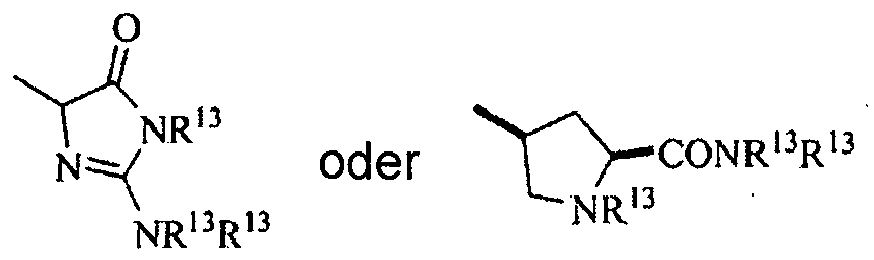 jedes Ar unabhängig Phenyl, substituiertes Phenyl, wobei die Substituenten des substituierten Phenyls 1-3 Substituenten sind, die unabhängig aus der aus OH, OCH3, NR13R13, Cl, F und CH3 bestehenden Gruppe ausgewählt sind, oder Heteroaryl ist;jedes W unabhängig Thiazolidindion, Oxazolidindion, Heteroaryl-C(=O)NR13R13, -CN, -O-C(=S)NR13R13, -ZgR13, -CR10(ZgR13)(ZgR13), -C(=O)OAr, -C(=O)NR13Ar, Imidazolin, Tetrazol, Tetrazolamid, -SO2NHR13, -SO2NH-C(R13R13)-(Z)g-R13, ein zyklischer Zucker oder Oligosaccharid, ein zyklischer Aminozucker oder -oligosaccharid,
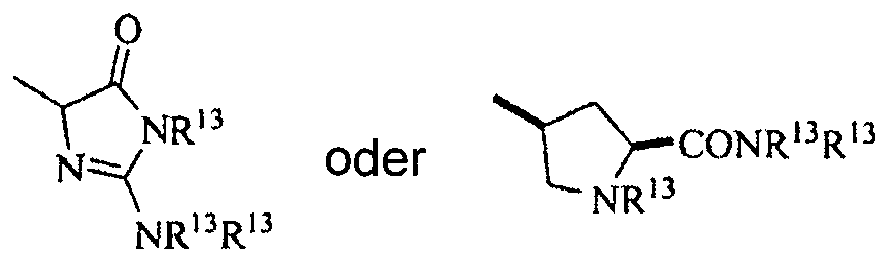 jeder R6 unabhängig -R7, -OR7, -OR11, -N(R7)2, -(CH2)m-OR8, -O-(CH2)m-OR8, -(CH2)n-NR7R10, -O-(CH2)m-NR7R10, -(CH2)n(CHOR8)(CHOR8)(CH2OR8, -0-(CH2)n,(CHOR8)(CHOR8)n-CH2OR8, -(CH2CH2O)m-R8, -O-(CH2CH2O)m-R8, -(CH2CH2O)m-CH2CH2NR7R10, -O-(CH2CH2O)m-CH2CH2NR7R10, -(CH2)n-C(=O)NR7R10, -O-(CH2)m-C(=O)NR7R10, -(CH2)n-(Z)g-R7, -O-(CH2)m-(Z)g-R7, -(CH2)n-NR10-CH2(CHOR8)(CHOR8)n-CH2OR8, -O-(CH2)m-NR10-CH2(CHOR8)(CHOR8)n-CH2OR8, -(CH2)n-CO2R7, -O-(CH2)m-CO2R7, -OSO3H, -O-Glucuronid, -O-Glucose,
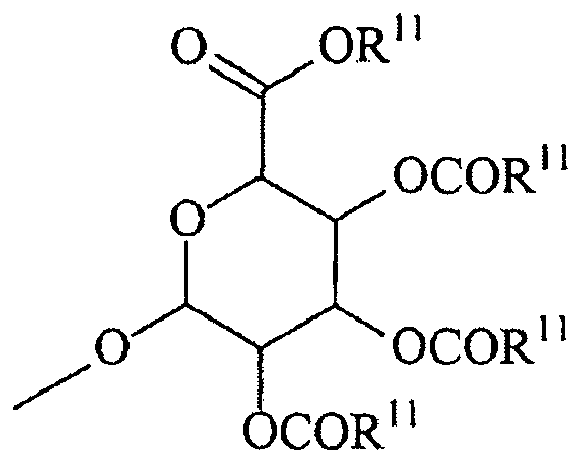
 wobei wenn zwei R6 gleich -OR11 sind und an einem Phenylring benachbart zueinander angeordnet sind, die Alkylgruppierungen der beiden R6 unter Ausbildung einer Methylendioxygruppe miteinander verbunden sein können; jeder R7 unabhängig Wasserstoff C1-C7Alkyl, Phenyl oder mit Halogenen substituiertes Phenyl ist;jeder R8 unabhängig Wasserstoff, C1-C7-Alkyl, -C(=O)-R11, Glucuronid, 2-Tetrahydropyranyl oder
 jeder R9 unabhängig -CO2R13, -CON(R13)2, -SO2CH2R13 oder -C(=O)R13 ist;jeder R10 unabhängig -H, -SO2CH3, -CO2R13, -C(=O)NR13R13, -C(=O)R13 oder -(CH2)m-(CHOH)m-CH2OH ist;jedes Z unabhängig CHOH, C(=O), -(CH2)n-,CHNR13R13, C=NR13 oder NR13 ist;jeder R11 unabhängig C1-C7-Alkyl ist;jeder R12 unabhängig -SO2CH3, -CO2R13, -C(=O)NR13R13, -C(=O)R13 oder -CH2-(CHOH)n-CH2OH ist;jeder R13 unabhängig Wasserstoff, R7, R10, -(CH2)m-NR13R13, -(CH2)m-N+R13R13R13, -(CH2)m-(CHOR8)m-(CH2)m-NR10R10, -(CH2)m-NR10R10, -(CH2)m-(CHOR8)m-(CH2)mN+R13R13R13,


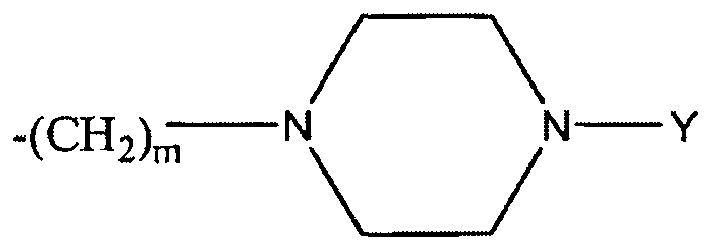
mit der Maßgabe, dass NR13R13 unter Ausbildung eines Rings mit sich selbst verbunden sein kann umfassend einen der Folgenden:

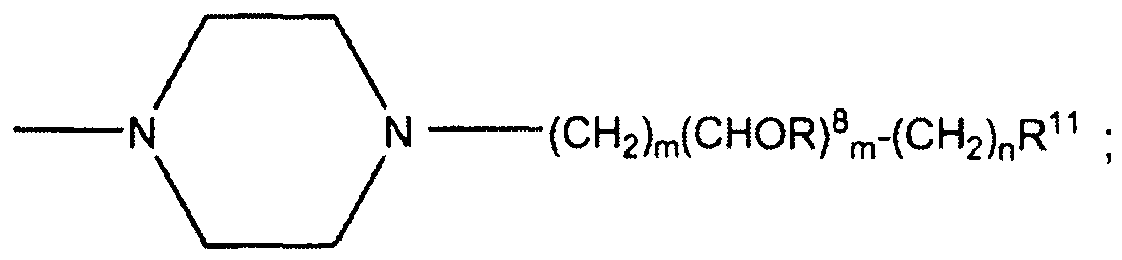 jedes Het unabhängig -NR13, -S-, -SO- oder -SO2-; -O-, -SO2NR13-, -NHSO2-, -NR13CO- oder -CONR13- ist;jedes g unabhängig eine ganze Zahl von 1 bis 6 ist;jedes m unabhängig eine ganze Zahl von 1 bis 7 ist;jedes n unabhängig eine ganze Zahl von 0 bis 7 ist;jedes Q unabhängig C-R5, C-R6 oder ein Stickstoffatom ist, wobei höchstens drei Q in einem Ring Stickstoffatome sind;jedes V unabhängig -(CH2)m-NR7R10, -(CH2)m-NR7R7, -(CH2)m-N+R11 R11 R11, -(CH2)n-(CHOR8)m-(CH2)mNR7R10, -(CH2)n-NR10R10, -(CH2)n-(CHOR8)m-(CH2)mNR7R7, -(CH2)n-(CHOR8)m-(CH2)mN+R11R11R11 ist, mit der Maßgabe, dass wenn V direkt an ein Stickstoffatom gebunden ist, V dann auch unabhängig R7, R10 oder (R11)2 sein kann;mit der Maßgabe, dass wenn beliebige zwei -CH2OR8-Gruppen 1,2 oder 1,3 zueinander angeordnet sind, die R8-Gruppen unter Ausbildung eines zyklischen Mono- oder Di-substituierten 1,3-Dioxans oder 1,3-Dioxolans verbunden sein können;
einschließlich alle Enantiomere, Diastereomere und racemische Mischungen davon. - Verbindung nach Anspruch 1, wobei Y gleich -NH2 ist.
- Verbindung nach Anspruch 2, wobei R2 gleich Wasserstoff ist.
- Verbindung nach Anspruch 3, wobei R1 gleich Wasserstoff ist.
- Verbindung nach Anspruch 4, wobei X gleich Chlor ist.
- Verbindung nach Anspruch 5, wobei R3 gleich Wasserstoff ist.
- Verbindung nach Anspruch 6, wobei jeder RL gleich Wasserstoff ist.
- Verbindung nach Anspruch 7, wobei o gleich 4 ist.
- Verbindung nach Anspruch 8, wobei p gleich 0 ist.
- Verbindung nach Anspruch 9, wobei x eine einzelne Bindung darstellt.
- Verbindung nach Anspruch 10, wobei each R6 gleich Wasserstoff ist.
- Verbindung nach Anspruch 11, wobei höchstens ein Q ein Stickstoffatom ist.
- Verbindung nach Anspruch 12, wobei kein Q ein Stickstoffatom ist.
- Verbindung nach Anspruch 13, wobei R5 gleich Link-(CH2)n-CAP ist.
- Verbindung nach Anspruch 14, wobei Link gleich -O- und CAP gleich Thiazolidindion ist.
- Verbindung nach Anspruch 15, die dargestellt ist durch die Formel:

- Verbindung nach Anspruch 14, wobei Link gleich -O- und CAP gleich Tetrazol ist.
- Verbindung nach Anspruch 17, die dargestellt ist durch die Formel:

- Verbindung nach Anspruch 14, wobei Link gleich -O- und CAP gleich N,N-Dimethylsulfonamid ist.
- Verbindung nach Anspruch 19, die dargestellt ist durch die Formel:

- Verbindung nach Anspruch 19, die dargestellt ist durch die Formel:

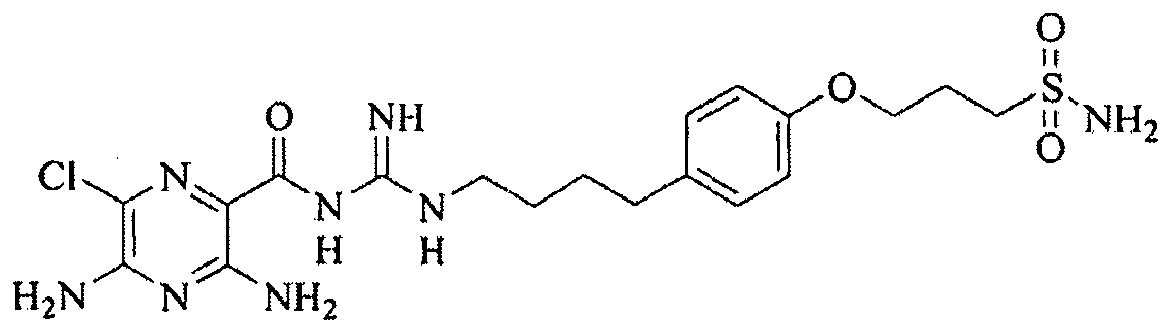
- Verbindung nach Anspruch 14, wobei Link gleich -O- und CAP gleich Sulfonamid ist.
- Verbindung nach Anspruch 22, die dargestellt ist durch die Formel:
- Verbindung nach Anspruch 14, wobei Link gleich -O- und CAP gleich Oxazolidindion ist.
- Verbindung nach Anspruch 24, die dargestellt ist durch die Formel:

- Verbindung nach Anspruch 14, wobei Link gleich -O- und CAP gleich -C(=O)N-R10Ar ist.
- Verbindung nach Anspruch 26, die dargestellt ist durch die Formel:

- Verbindung nach Anspruch 26, die dargestellt ist durch die Formel:

- Verbindung nach Anspruch 26, die dargestellt ist durch die Formel:

- Verbindung nach Anspruch 26, die dargestellt ist durch die Formel:
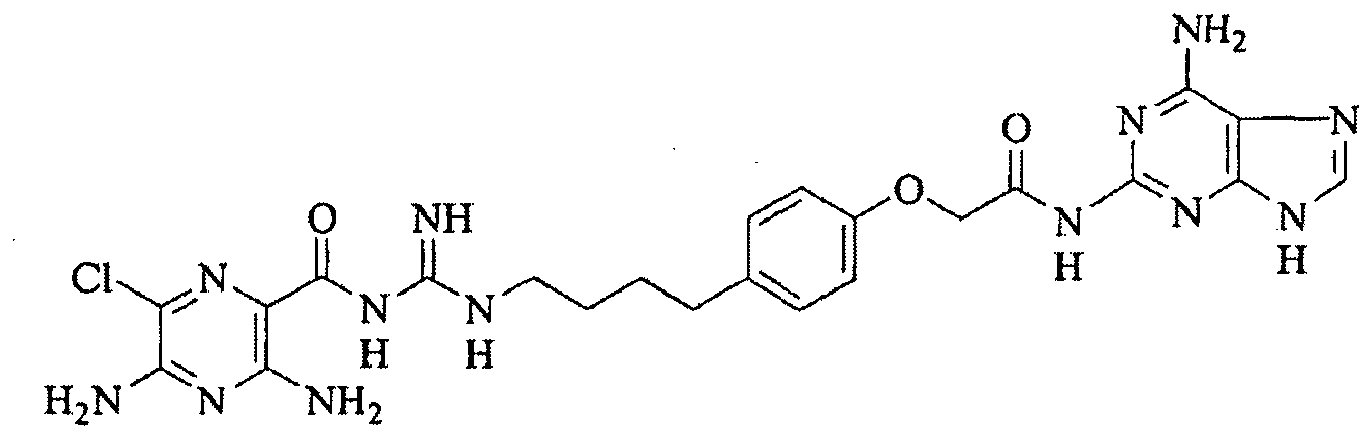
- Verbindung nach Anspruch 26, die dargestellt ist durch die Formel:

- Verbindung nach Anspruch 26, die dargestellt ist durch die Formel:

- Verbindung nach Anspruch 26, die dargestellt ist durch die Formel:

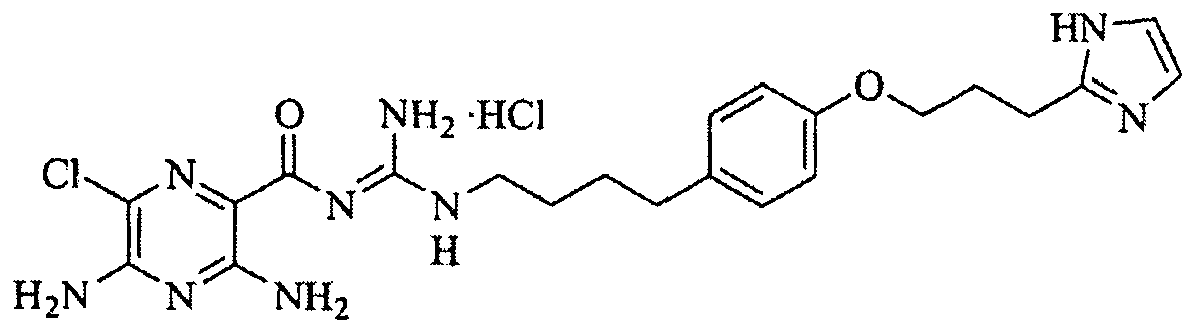
- Verbindung nach Anspruch 14, wobei Link gleich -O- und CAP gleich Imidazol ist.
- Verbindung nach Anspruch 34, die dargestellt ist durch die Formel:
- Verbindung nach Anspruch 14, wobei Link gleich -O- und CAP gleich Cyano ist.
- Verbindung nach Anspruch 36, die dargestellt ist durch die Formel:

- Verbindung nach Anspruch 14, wobei CAP gleich -SO2NH-CR7R10-Zg-R7 ist.
- Verbindung nach Anspruch 38 die dargestellt ist durch die Formel:
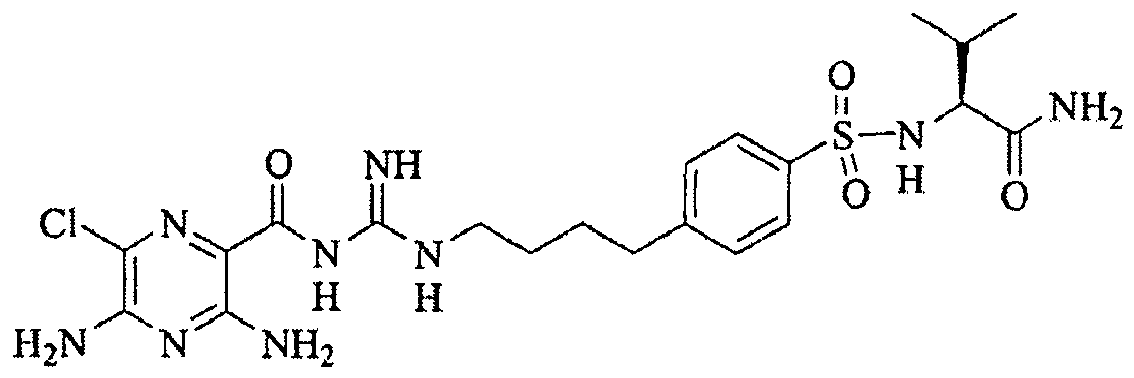
- Verbindung nach Anspruch 13, wobei R5 gleich Link-(CH2)n(CHOR8)(CHOR8)n-CAP ist.
- Verbindung nach Anspruch 13, wobei R5 gleich Link-(CH2CH2O)m-CH2-CAP ist.
- Verbindung nach Anspruch 13, wobei R5 gleich Link-(CH2CH2O)m-CH2CH2-CAP ist.
- Verbindung nach Anspruch 13, wobei R5 gleich Link-(CH2)n-(Z)g-CAP ist.
- Verbindung nach Anspruch 13, wobei R5 gleich Link-(CH2)n(Z)g-(CH2)m-CAP ist.
- Verbindung nach Anspruch 13, wobei R5 gleich Link-(CH2)n-NR10-CH2(CHOR8)(CHOR8)n-CAP ist.
- Verbindung nach Anspruch 13, wobei R5 gleich Link-(CH2)n-(CHOR8)mCH2-NR10-(Z)g-CAP ist.
- Verbindung nach Anspruch 13, wobei R5 gleich Link-(CH2)nNR10-(CH2)m(CHOR8)nCH2NR10-(Z)g-CAP ist.
- Verbindung nach Anspruch 13, wobei R5 gleich Link-(CH2)m-(Z)g-(CH2)m-CAP ist.
- Verbindung nach Anspruch 13, wobei R5 gleich Link-NH-C(=O)-NH-(CH2)m-CAP ist.
- Verbindung nach Anspruch 13, wobei R5 gleich Link-(CH2)m-C(=O)NR10-(CH2)m-C(=O)NR10R10 ist.
- Verbindung nach Anspruch 13, wobei R3 gleich Link-(CH2)m-C(=O)NR10-(CH2)m-CAP ist.
- Verbindung nach Anspruch 13, wobei R5 gleich Link-(CH2)m-C(=O)NR11R11 ist.
- Verbindung nach Anspruch 13, wobei R5 gleich Link-(CH2)n-(Z)g-(CH2)m-(Z)g-CAP ist.
- Verbindung nach Anspruch 1, wobei R5 gleich Link-(CH2)n-CAP ist.
- Verbindung nach Anspruch 1, wobei R5 gleich Link-(CH2)n(CHOR8)(CHOR8)n-CAP ist.
- Verbindung nach Anspruch 1, wobei R5 gleich Link-(CH2CH2O)m-CH2-CAP ist.
- Verbindung nach Anspruch 1, wobei R5 gleich Link-(CH2CH2O)m-CH2CH2-CAP ist.
- Verbindung nach Anspruch 1, wobei R5 gleich Link-(CH2)n-(Z)g-CAP ist.
- Verbindung nach Anspruch 1, wobei R5 gleich Link-(CH2)n(Z)g-(CH2)m-CAP ist.
- Verbindung nach Anspruch 1, wobei R5 gleich Link-(CH2)n-NR10-CH2(CHOR8)(CHOR8)n-CAP ist.
- Verbindung nach Anspruch 1, wobei R5 gleich Link-(CH2)n-(CHOR8)mCH2-NR10-(Z)g-CAP ist.
- Verbindung nach Anspruch 1, wobei R5 gleich Link-(CH2)nNR10-(CH2)m(CHOR8)nCH2NR10-(Z)g-CAP ist.
- Verbindung nach Anspruch 1, wobei R5 gleich Link-(CH2)m-(Z)g-(CH2)m-CAP ist.
- Verbindung nach Anspruch 1, wobei R5 gleich Link-NH-C(=O)-NH-(CH2)m-CAP ist.
- Verbindung nach Anspruch 1, wobei R5 gleich Link-(CH2)m-C(=O)NR10-(CH2)m-C(=O)NR10R10 ist.
- Verbindung nach Anspruch 1, wobei R5 gleich Link-(CH2)m-C(=O)NR10-(CH2)m-CAP ist.
- Verbindung nach Anspruch 1, wobei R5 gleich Link-(CH2)m-C(=O)NR11R11 ist.
- Verbindung nach Anspruch 1, wobei R5 gleich Link-(CH2)n-(Z)g-(CH2)m-(Z)g-CAP ist.
- Verbindung nach Anspruch 1, wobei x eine einzelne Bindung ist.
- Verbindung nach Anspruch 1, wobei das Heteroaryl ein Pyridyl, Pyrazyl, Tinazyl, Furyl, Furfuryl, Thienyl, Tetrazyl, Thiazolidindionyl und Imidazoyl, Pyrrolyl, Furanyl, Thiophenyl, Chinolyl, Indolyl, Adenyl, Pyrazolyl, Thiazolyl, lsoxazolyl, Indolyl, Benzimidazolyl, Purinyl, Chinolinyl, Isochinolinyl, Pyridazyl, Pyrimidyl, Pyrazyl, 1,2,3-Triazyl, 1,2,4-Triazyl, 1,3,5-Triazyl, Cinnolyl, Phthalazyl, Chinazolyl, Chinoxalyl oder Pterdyl ist.
- Verbindung nach Anspruch 1, wobei die Summe aus o und p gleich 2 bis 6 ist.
- Verbindung nach Anspruch 1, die in der Form eines pharmazeutisch akzeptablen Salzes vorliegt.
- Zusammensetzung umfassend:die Verbindung gemäß Anspruch 1 undeinen P2Y2-Rezeptoragonisten.
- Zusammensetzung umfassend:die Verbindung gemäß Anspruch 1 undeinen Bronchodilatator.
- Pharmazeutische Zusammensetzung umfassend die Verbindung gemäß Anspruch 1 und einen pharmazeutisch akzeptablen Träger.
- Verbindung nach Anspruch 1 zur Verabreichung an eine mukosale Oberfläche einer Person als Anwendung zur Förderung der Hydratation von mukosalen Oberflächen.
- Verbindung nach Anspruch 1 zur Verabreichung an eine mukosale Oberfläche einer diesbezüglich bedürftigen Person als Anwendung zur Wiederherstellung der mukosalen Abwehr.
- Verbindung nach Anspruch 1 zur Verabreichung an eine diesbezüglich bedürftige Person als Anwendung zur Behandlung von chronischer Bronchitis.
- Verbindung nach Anspruch 1 zur Verabreichung an eine diesbezüglich bedürftige Person als Anwendung zur Behandlung von zystischer Fibrose.
- Verbindung nach Anspruch 1 zur Verabreichung an eine diesbezüglich bedürftige Person als Anwendung zur Behandlung von Sinusitis.
- Verbindung nach Anspruch 1 zur Verabreichung an den Vaginaltrakt einer diesbezüglich bedürftigen Person als Anwendung zur Behandlung von vaginaler Trockenheit.
- Verbindung nach Anspruch 1 zur Verabreichung an das Auge einer diesbezüglich bedürftigen Person als Anwendung zur Behandlung eines trockenen Auges.
- Verbindung nach Anspruch 1 zur Verabreichung an das Auge einer Person als Anwendung zur Förderung der Augenhydratation.
- Verbindung nach Anspruch 1 zur Verabreichung an das Auge einer Person als Anwendung zur Förderung der cornealen Hydratation.
- Verbindung nach Anspruch 1 zur Verabreichung an eine mukosale Oberfläche einer Person als Anwendung zur Förderung der mukosalen Reinigung der mukosalen Oberfläche.
- Verbindung nach Anspruch 1 zur Verabreichung an eine diesbezüglich bedürftige Person als Anwendung zur Behandlung des Sjögren-Syndroms.
- Verbindung nach Anspruch 1 zur Verabreichung an eine diesbezüglich bedürftige Person als Anwendung zur Behandlung des distalen intestinalen Obstruktionssyndroms.
- Verbindung nach Anspruch 1 zur Verabreichung an die Haut einer diesbezüglich bedürftigen Person als Anwendung zur Behandlung von trockener Haut.
- Verbindung nach Anspruch 1 zur Verabreichung an eine diesbezüglich bedürftige Person als Anwendung zur Behandlung von Ösophagitis.
- Verbindung nach Anspruch 1 zur Verabreichung an den Mund einer diesbezüglich bedürftigen Person als Anwendung zur Behandlung von trockenem Mund (Xerostomie).
- Verbindung nach Anspruch 1 zur Verabreichung an den Nasengang einer diesbezüglich bedürftigen Person als Anwendung zur Behandlung von nasaler Dehydratation.
- Verbindung zur Anwendung gemäß Anspruch 91, wobei die nasale Dehydratation bewirkt wurde durch Verabreichen von trockenem Sauerstoff an die Person.
- Verbindung nach Anspruch 1 zur Verabreichung an eine Person an einem Beatmungsgerät als Anwendung zur Vermeidung von beatmungsassoziierter Pneumonie.
- Verbindung nach Anspruch 1 zur Verabreichung an eine diesbezüglich bedürftige Person als Anwendung zur Behandlung von Asthma.
- Verbindung nach Anspruch 1 zur Verabreichung an eine diesbezüglich bedürftige Person als Anwendung zur Behandlung von primärer Ziliendyskinesie.
- Verbindung nach Anspruch 1 zur Verabreichung an eine diesbezüglich bedürftige Person als Anwendung zur Behandlung einer Mittelohrentzündung.
- Verbindung nach Anspruch 1 zur Verabreichung an eine diesbezüglich bedürftige Person als Anwendung zur Induzierung von Sputum für diagnostische Zwecke.
- Verbindung nach Anspruch 1 zur Verabreichung an eine diesbezüglich bedürftige Person als Anwendung zur Behandlung einer chronisch obstruktiven Lungenerkrankung.
- Verbindung nach Anspruch 1 zur Verabreichung an eine diesbezüglich bedürftige Person als Anwendung zur Behandlung eines Emphysems.
- Verbindung nach Anspruch 1 zur Verabreichung an eine diesbezüglich bedürftige Person als Anwendung zur Behandlung einer Pneumonie.
- Verbindung nach Anspruch 1 zur Verabreichung an eine diesbezüglich bedürftige Person als Anwendung zur Behandlung von Verstopfung.
- Verbindung zur Anwendung gemäß Anspruch 101, wobei die Zusammensetzung eine orale Zusammensetzung, ein Suppositorium oder ein Einlauf ist.
- Verbindung nach Anspruch 1 zur Verabreichung an eine diesbezüglich bedürftige Person als Anwendung zur Behandlung von chronischer Divertikulitis.
- Verbindung nach Anspruch 1 zur Verabreichung an eine diesbezüglich bedürftige Person als Anwendung zur Behandlung von Rhinusinusitis.
- Verbindung nach Anspruch 1 zur Verabreichung an eine diesbezüglich bedürftige Person als Anwendung zur Behandlung von Hypertonie.
- Verbindung nach Anspruch 1 zur Herstellung einer pharmazeutischen Zusammensetzung zur Verabreichung an eine diesbezüglich bedürftige Person als Anwendung zur Verringerung des Blutdrucks.
- Verbindung nach Anspruch 1 zur Verabreichung an eine diesbezüglich bedürftige Person als Anwendung zur Behandlung eines Ödems.
- Verbindung nach Anspruch 1 zur Verabreichung an eine diesbezüglich bedürftige Person als Anwendung zur Förderung der Diurese.
- Verbindung nach Anspruch 1 zur Verabreichung an eine diesbezüglich bedürftige Person als Anwendung zur Förderung der Natriurese.
- Verbindung nach Anspruch 1 zur Verabreichung an eine diesbezüglich bedürftige Person als Anwendung zur Förderung der Salurese.
Priority Applications (4)
| Application Number | Priority Date | Filing Date | Title |
|---|---|---|---|
| EP12159292A EP2465852A1 (de) | 2003-08-18 | 2004-08-18 | Gekappte Pyrazinoylguanidin-Natrium-Kanal-Blocker |
| SI200432100T SI1663235T1 (sl) | 2003-08-18 | 2004-08-18 | Zaščiteni pirazinoilgvanidinski blokatorji natrijevega kanala |
| PL04781545T PL1663235T3 (pl) | 2003-08-18 | 2004-08-18 | Pirazynoiloguanidyny z grupami okrywającymi jako blokery kanałów sodowych |
| CY20131100933T CY1114588T1 (el) | 2003-08-18 | 2013-10-23 | Αποκλειστες διαυλων νατριου κεκαλυμμενης πυραζινοϋλγουανιδινης |
Applications Claiming Priority (2)
| Application Number | Priority Date | Filing Date | Title |
|---|---|---|---|
| US49572503P | 2003-08-18 | 2003-08-18 | |
| PCT/US2004/026885 WO2005018644A1 (en) | 2003-08-18 | 2004-08-18 | Capped pyrazinoylguanidine sodium channel blockers |
Related Child Applications (1)
| Application Number | Title | Priority Date | Filing Date |
|---|---|---|---|
| EP12159292.7 Division-Into | 2012-03-13 |
Publications (3)
| Publication Number | Publication Date |
|---|---|
| EP1663235A1 EP1663235A1 (de) | 2006-06-07 |
| EP1663235A4 EP1663235A4 (de) | 2008-11-12 |
| EP1663235B1 true EP1663235B1 (de) | 2013-07-24 |
Family
ID=34215937
Family Applications (2)
| Application Number | Title | Priority Date | Filing Date |
|---|---|---|---|
| EP04781545.1A Expired - Lifetime EP1663235B1 (de) | 2003-08-18 | 2004-08-18 | Gekappte pyrazinoylguanidin-natrium-kanal-blocker |
| EP12159292A Withdrawn EP2465852A1 (de) | 2003-08-18 | 2004-08-18 | Gekappte Pyrazinoylguanidin-Natrium-Kanal-Blocker |
Family Applications After (1)
| Application Number | Title | Priority Date | Filing Date |
|---|---|---|---|
| EP12159292A Withdrawn EP2465852A1 (de) | 2003-08-18 | 2004-08-18 | Gekappte Pyrazinoylguanidin-Natrium-Kanal-Blocker |
Country Status (12)
| Country | Link |
|---|---|
| US (12) | US7064129B2 (de) |
| EP (2) | EP1663235B1 (de) |
| JP (1) | JP4805824B2 (de) |
| KR (1) | KR20060060027A (de) |
| AU (1) | AU2004266704B2 (de) |
| CA (1) | CA2534682C (de) |
| DK (1) | DK1663235T3 (de) |
| ES (1) | ES2432529T3 (de) |
| PL (1) | PL1663235T3 (de) |
| PT (1) | PT1663235E (de) |
| SI (1) | SI1663235T1 (de) |
| WO (1) | WO2005018644A1 (de) |
Families Citing this family (47)
| Publication number | Priority date | Publication date | Assignee | Title |
|---|---|---|---|---|
| US6858615B2 (en) | 2002-02-19 | 2005-02-22 | Parion Sciences, Inc. | Phenyl guanidine sodium channel blockers |
| US6903105B2 (en) * | 2003-02-19 | 2005-06-07 | Parion Sciences, Inc. | Sodium channel blockers |
| KR20060115348A (ko) * | 2003-08-18 | 2006-11-08 | 패리온 사이언스 인코퍼레이티드 | 지방족 피라지노일구아니딘 나트륨 채널 차단제 |
| AU2004264441A1 (en) * | 2003-08-18 | 2005-02-24 | Parion Sciences, Inc. | Cyclic pyrazinoylguanidine sodium channel blockers |
| SI1663235T1 (sl) * | 2003-08-18 | 2013-12-31 | Parion Sciences, Inc. | Zaščiteni pirazinoilgvanidinski blokatorji natrijevega kanala |
| US20050090505A1 (en) * | 2003-08-18 | 2005-04-28 | Johnson Michael R. | Methods of reducing risk of infection from pathogens |
| US7745442B2 (en) | 2003-08-20 | 2010-06-29 | Parion Sciences, Inc. | Methods of reducing risk of infection from pathogens |
| KR20070059063A (ko) * | 2004-08-18 | 2007-06-11 | 마이클 알 존슨. | 지방족 아미드 및 에스테르 피라지노일구아니딘 나트륨채널 차단제 |
| US7399766B2 (en) * | 2004-08-18 | 2008-07-15 | Parion Sciences, Inc. | Soluble amide & ester pyrazinoylguanidine sodium channel blockers |
| CA2575680A1 (en) * | 2004-08-18 | 2006-03-02 | Michael R. Johnson | Cyclic amide & ester pyrazinoylguanidine sodium channel blockers |
| US20070021439A1 (en) * | 2005-07-25 | 2007-01-25 | Parion Sciences, Inc. | Methods of reducing risk of infection from pathogens with soluble amide and ester pyrazinoylguanidine sodium channel blockers |
| US7807834B2 (en) | 2005-08-03 | 2010-10-05 | Parion Sciences, Inc. | Capped pyrazinoylguanidine sodium channel blockers |
| US8324218B2 (en) * | 2006-06-09 | 2012-12-04 | Parion Sciences, Inc. | Aliphatic pyrazinoylguanidine sodium channel blockers with beta agonist activity |
| PL2035004T3 (pl) * | 2006-06-09 | 2013-01-31 | Parion Sciences Inc | Podstawione fenylem pirazynoiloguanidynowe blokery kanału sodowego o aktywności beta-agonistycznej |
| US7981898B2 (en) * | 2006-09-07 | 2011-07-19 | Parion Sciences, Inc. | Methods of enhancing mucosal hydration and mucosal clearance by treatment with sodium channel blockers and osmolytes |
| EP2059237A4 (de) * | 2006-09-07 | 2010-06-30 | Parion Sciences Inc | Verfahren für erhöhte schleimhydrierung und schleimlösung mittels behandlung mit natrium-kanal-blockern und osmolyten |
| US8288391B2 (en) * | 2007-04-03 | 2012-10-16 | Parion Sciences, Inc. | Pyrazinoylguanidine compounds for use as taste modulators |
| US20080293740A1 (en) * | 2007-04-03 | 2008-11-27 | Parion Sciences, Inc. | Method of treating acid-sensing ion channel mediated pain, cough suppression, and central nervous system disorders |
| BRPI0810840A2 (pt) * | 2007-05-09 | 2014-10-29 | Exxonmobil Upstream Res Co | Métodos para inversão de dados sísmicos de lapso de tempo e para produzir hidrocarbonetos a partir de uma formação em uma região de sub-superfície |
| EP2211956A4 (de) | 2007-10-10 | 2014-07-09 | Parion Sciences Inc | Abgabe von osmolyten mit einer nasenkanüle |
| AU2009246799B2 (en) | 2008-02-26 | 2014-02-27 | Parion Sciences, Inc. | Poly aromatic pyrazinoylguanidine sodium channel blockers |
| US20100074881A1 (en) * | 2008-07-11 | 2010-03-25 | Parion Sciences, Inc. | Multiple nebulizer systems |
| JP5638216B2 (ja) * | 2009-10-09 | 2014-12-10 | パーパス株式会社 | 加圧循環培養装置及び加圧循環培養システム |
| NZ603136A (en) | 2010-05-10 | 2014-11-28 | Gilead Sciences Inc | Bifunctional quinoline derivatives |
| WO2011143106A1 (en) | 2010-05-10 | 2011-11-17 | Gilead Sciences, Inc. | Bi - functional pyrazolopyridine compounds |
| US8778383B2 (en) | 2011-06-07 | 2014-07-15 | Parion Sciences, Inc. | Methods of treatment |
| US8945605B2 (en) | 2011-06-07 | 2015-02-03 | Parion Sciences, Inc. | Aerosol delivery systems, compositions and methods |
| PL2723176T3 (pl) | 2011-06-27 | 2018-01-31 | Parion Sciences Inc | Chemicznie i metabolicznie stabilny dipeptyd o silnej aktywności blokera kanału sodowego |
| AR086745A1 (es) | 2011-06-27 | 2014-01-22 | Parion Sciences Inc | 3,5-diamino-6-cloro-n-(n-(4-(4-(2-(hexil(2,3,4,5,6-pentahidroxihexil)amino)etoxi)fenil)butil)carbamimidoil)pirazina-2-carboxamida |
| US9183380B2 (en) * | 2011-10-11 | 2015-11-10 | Citrix Systems, Inc. | Secure execution of enterprise applications on mobile devices |
| CA2872029A1 (en) | 2012-05-29 | 2013-12-05 | Parion Sciences, Inc. | Dendrimer like amino amides possessing sodium channel blocker activity for the treatment of dry eye and other mucosal diseases |
| PE20151054A1 (es) | 2012-12-17 | 2015-08-07 | Parion Sciences Inc | Derivados de cloro-pirazin carboxamida con actividad bloqueadora sobre los canales de sodio epiteliales |
| CA2896686A1 (en) | 2012-12-17 | 2014-06-26 | Parion Sciences, Inc. | 3,5-diamino-6-chloro-n-(n-(4-phenylbutyl)carbamimidoyl) pyrazine-2- carboxamide compounds |
| MX2015007797A (es) | 2012-12-17 | 2015-10-05 | Parion Sciences Inc | Compuestos de 3,5-diamino-6-cloro-n-(n-(4-fenilbutil) carbamimidoil) pirazin-2-carboxamida. |
| JP6353032B2 (ja) * | 2013-04-30 | 2018-07-04 | ベーリンガー インゲルハイム インターナショナル ゲゼルシャフト ミット ベシュレンクテル ハフツング | ジアミノピラジン化合物、前記化合物を含有する医薬、その使用、およびその調製方法 |
| JP6461134B2 (ja) | 2013-07-15 | 2019-01-30 | ベーリンガー インゲルハイム インターナショナル ゲゼルシャフト ミット ベシュレンクテル ハフツング | 新規ベンゾイミダゾリウム化合物 |
| WO2015007517A1 (en) * | 2013-07-15 | 2015-01-22 | Boehringer Ingelheim International Gmbh | Novel tetra- and pentasubstituted benzimidazolium compounds |
| CN103396369B (zh) * | 2013-08-14 | 2016-03-23 | 盐城工学院 | 一种制备2-氯-4-硝基咪唑的方法 |
| US9346753B2 (en) | 2013-08-23 | 2016-05-24 | Parion Sciences, Inc. | Dithiol mucolytic agents |
| US9102633B2 (en) | 2013-12-13 | 2015-08-11 | Parion Sciences, Inc. | Arylalkyl- and aryloxyalkyl-substituted epithelial sodium channel blocking compounds |
| US20150376145A1 (en) | 2014-06-30 | 2015-12-31 | Parion Sciences, Inc. | Stable sodium channel blockers |
| CN112321472A (zh) | 2015-01-30 | 2021-02-05 | 帕里昂科学公司 | 新型单硫醇粘液溶解剂 |
| JP2018520986A (ja) | 2015-04-30 | 2018-08-02 | パリオン・サイエンシィズ・インコーポレーテッド | ジチオール粘液溶解剤の新規なプロドラッグ |
| GB201610854D0 (en) | 2016-06-21 | 2016-08-03 | Entpr Therapeutics Ltd | Compounds |
| GB201619694D0 (en) | 2016-11-22 | 2017-01-04 | Entpr Therapeutics Ltd | Compounds |
| GB201717051D0 (en) | 2017-10-17 | 2017-11-29 | Enterprise Therapeutics Ltd | Compounds |
| GB201808093D0 (en) | 2018-05-18 | 2018-07-04 | Enterprise Therapeutics Ltd | Compounds |
Citations (1)
| Publication number | Priority date | Publication date | Assignee | Title |
|---|---|---|---|---|
| US3313813A (en) * | 1962-10-30 | 1967-04-11 | Merck & Co Inc | (3-amino-5, 6-disubstituted-pyrazinoyl) guanidines |
Family Cites Families (67)
| Publication number | Priority date | Publication date | Assignee | Title |
|---|---|---|---|---|
| US198747A (en) * | 1878-01-01 | Improvement in car-axle couplings | ||
| US198749A (en) * | 1878-01-01 | Improvement in apparatus for teaching history | ||
| US198746A (en) * | 1878-01-01 | Improvement in car-couplings | ||
| US198744A (en) * | 1878-01-01 | Samuel johnsok | ||
| US233377A (en) | 1880-10-19 | Chaeles schwartz | ||
| US229929A (en) | 1880-07-13 | Miner s lamp | ||
| US195160A (en) * | 1877-09-11 | Improvement in draw-bridge lock and signal | ||
| US198748A (en) * | 1878-01-01 | Improvement in sled-runner attachments for vehicles | ||
| US198745A (en) * | 1878-01-01 | Improvement in extractors for revolving fire-arms | ||
| US234105A (en) | 1880-11-02 | Lifting-jack | ||
| US162296A (en) * | 1875-04-20 | Improvement in washing-machines | ||
| US204424A (en) * | 1878-06-04 | Improvement in harvesters | ||
| US199456A (en) * | 1878-01-22 | Improvement | ||
| US204425A (en) * | 1878-06-04 | Improvement in metallic tent-pins | ||
| FR1525670A (fr) * | 1966-08-25 | 1968-05-17 | Merck & Co Inc | Procédé de fabrication de guanidines substituées |
| FR1525671A (fr) * | 1966-08-25 | 1968-05-17 | Merck & Co Inc | Procédé de préparation de (3, 5 - diamino - 6 - halogéno - pyrazinoyl) - guanidines et de (3, 5 - diamino - 6 - halogéno -pyrazinamido) guanidines |
| US3527758A (en) * | 1967-04-13 | 1970-09-08 | Merck & Co Inc | Process for the preparation of pyrazinoylguanidines from a pyrazinoic azide and a guanidine |
| US3539569A (en) * | 1968-08-21 | 1970-11-10 | Merck & Co Inc | Preparation of pyrazinoylguanidines from pyrazinoylureas |
| US4246406A (en) * | 1979-03-27 | 1981-01-20 | Merck & Co., Inc. | Heterocyclic substituted pyrazinoylguanidines |
| JPS6034925B2 (ja) | 1979-07-31 | 1985-08-12 | 帝人株式会社 | 持続性鼻腔用製剤およびその製造法 |
| US4389393A (en) | 1982-03-26 | 1983-06-21 | Forest Laboratories, Inc. | Sustained release therapeutic compositions based on high molecular weight hydroxypropylmethylcellulose |
| US4501729A (en) | 1982-12-13 | 1985-02-26 | Research Corporation | Aerosolized amiloride treatment of retained pulmonary secretions |
| JPS6032714A (ja) | 1983-08-01 | 1985-02-19 | Teijin Ltd | 鼻腔粘膜に適用するための安定化された粉末状薬学的組成物 |
| US4604394A (en) * | 1984-10-01 | 1986-08-05 | Merck & Co., Inc. | Antiarrhythmic compositions and method |
| US4894376A (en) * | 1988-02-26 | 1990-01-16 | Trustees Of The University Of Pennsylvania | Methods of treating diseases characterized by hyperexcitability of neurons |
| US5707644A (en) | 1989-11-04 | 1998-01-13 | Danbiosyst Uk Limited | Small particle compositions for intranasal drug delivery |
| US5404871A (en) | 1991-03-05 | 1995-04-11 | Aradigm | Delivery of aerosol medications for inspiration |
| US5492112A (en) | 1991-05-20 | 1996-02-20 | Dura Pharmaceuticals, Inc. | Dry powder inhaler |
| US5292498A (en) | 1991-06-19 | 1994-03-08 | The University Of North Carolina At Chapel Hill | Method of treating lung disease with uridine triphosphates |
| WO1993000951A1 (en) | 1991-07-02 | 1993-01-21 | Inhale, Inc. | Method and device for delivering aerosolized medicaments |
| US5785049A (en) | 1994-09-21 | 1998-07-28 | Inhale Therapeutic Systems | Method and apparatus for dispersion of dry powder medicaments |
| DE69322789T2 (de) | 1992-10-19 | 1999-07-01 | Dura Pharmaceuticals, Inc., San Diego, Calif. | Trockenpulverinhalator |
| US5819726A (en) | 1993-01-29 | 1998-10-13 | Aradigm Corporation | Method for the delivery of aerosolized drugs to the lung for the treatment of respiratory disease |
| US5656256A (en) | 1994-12-14 | 1997-08-12 | The University Of North Carolina At Chapel Hill | Methods of treating lung disease by an aerosol containing benzamil or phenamil |
| US5645051A (en) | 1995-04-21 | 1997-07-08 | Dura Pharmaceuticals, Inc. | Unit dose dry powder inhaler |
| US5622166A (en) | 1995-04-24 | 1997-04-22 | Dura Pharmaceuticals, Inc. | Dry powder inhaler delivery system |
| US5654007A (en) | 1995-06-07 | 1997-08-05 | Inhale Therapeutic Systems | Methods and system for processing dispersible fine powders |
| US5789391A (en) | 1996-07-03 | 1998-08-04 | Inspire Pharmaceuticals, Inc. | Method of treating sinusitis with uridine triphosphates and related compounds |
| WO2000023023A1 (en) | 1998-10-20 | 2000-04-27 | The University Of North Carolina At Chapel Hill | Methods of hydrating mucosal surfaces |
| US20040195160A1 (en) | 1999-07-12 | 2004-10-07 | Marine Desalination Systems, L.L.C. | Hydrate-based reduction of fluid inventories and concentration of aqueous and other water-containing products |
| CA2378181A1 (en) * | 1999-07-19 | 2001-01-25 | Richard C. Boucher, Jr. | Conjugates of sodium channel blockers and methods of using the same |
| US20040199456A1 (en) | 2000-08-01 | 2004-10-07 | Andrew Flint | Method and apparatus for explaining credit scores |
| US6673802B2 (en) * | 2000-12-01 | 2004-01-06 | Osi Pharmaceuticals, Inc. | Compounds specific to adenosine A3 receptor and uses thereof |
| US6858615B2 (en) * | 2002-02-19 | 2005-02-22 | Parion Sciences, Inc. | Phenyl guanidine sodium channel blockers |
| US6858614B2 (en) * | 2002-02-19 | 2005-02-22 | Parion Sciences, Inc. | Phenolic guanidine sodium channel blockers |
| US6903105B2 (en) | 2003-02-19 | 2005-06-07 | Parion Sciences, Inc. | Sodium channel blockers |
| SI1663235T1 (sl) * | 2003-08-18 | 2013-12-31 | Parion Sciences, Inc. | Zaščiteni pirazinoilgvanidinski blokatorji natrijevega kanala |
| KR20060115348A (ko) | 2003-08-18 | 2006-11-08 | 패리온 사이언스 인코퍼레이티드 | 지방족 피라지노일구아니딘 나트륨 채널 차단제 |
| AU2004264441A1 (en) * | 2003-08-18 | 2005-02-24 | Parion Sciences, Inc. | Cyclic pyrazinoylguanidine sodium channel blockers |
| US20050090505A1 (en) | 2003-08-18 | 2005-04-28 | Johnson Michael R. | Methods of reducing risk of infection from pathogens |
| US20090253714A1 (en) | 2003-08-20 | 2009-10-08 | Johnson Michael R | Methods of reducing risk of infection from pathogens |
| US7745442B2 (en) | 2003-08-20 | 2010-06-29 | Parion Sciences, Inc. | Methods of reducing risk of infection from pathogens |
| US20090142272A1 (en) * | 2004-06-21 | 2009-06-04 | Exelixis, Inc. | Pfks as modifiers of the igfr pathway and methods of use |
| US7399766B2 (en) * | 2004-08-18 | 2008-07-15 | Parion Sciences, Inc. | Soluble amide & ester pyrazinoylguanidine sodium channel blockers |
| KR20070059063A (ko) | 2004-08-18 | 2007-06-11 | 마이클 알 존슨. | 지방족 아미드 및 에스테르 피라지노일구아니딘 나트륨채널 차단제 |
| US20090324724A1 (en) | 2004-08-18 | 2009-12-31 | Parion Sciences, Inc. | Soluble amide & ester pyrazinoylguanidine sodium channel blockers |
| CA2575680A1 (en) * | 2004-08-18 | 2006-03-02 | Michael R. Johnson | Cyclic amide & ester pyrazinoylguanidine sodium channel blockers |
| US7807834B2 (en) | 2005-08-03 | 2010-10-05 | Parion Sciences, Inc. | Capped pyrazinoylguanidine sodium channel blockers |
| US8324218B2 (en) | 2006-06-09 | 2012-12-04 | Parion Sciences, Inc. | Aliphatic pyrazinoylguanidine sodium channel blockers with beta agonist activity |
| PL2035004T3 (pl) | 2006-06-09 | 2013-01-31 | Parion Sciences Inc | Podstawione fenylem pirazynoiloguanidynowe blokery kanału sodowego o aktywności beta-agonistycznej |
| EP2059237A4 (de) * | 2006-09-07 | 2010-06-30 | Parion Sciences Inc | Verfahren für erhöhte schleimhydrierung und schleimlösung mittels behandlung mit natrium-kanal-blockern und osmolyten |
| US7981898B2 (en) | 2006-09-07 | 2011-07-19 | Parion Sciences, Inc. | Methods of enhancing mucosal hydration and mucosal clearance by treatment with sodium channel blockers and osmolytes |
| US8288391B2 (en) | 2007-04-03 | 2012-10-16 | Parion Sciences, Inc. | Pyrazinoylguanidine compounds for use as taste modulators |
| US20080293740A1 (en) | 2007-04-03 | 2008-11-27 | Parion Sciences, Inc. | Method of treating acid-sensing ion channel mediated pain, cough suppression, and central nervous system disorders |
| EP2211956A4 (de) | 2007-10-10 | 2014-07-09 | Parion Sciences Inc | Abgabe von osmolyten mit einer nasenkanüle |
| AU2009246799B2 (en) | 2008-02-26 | 2014-02-27 | Parion Sciences, Inc. | Poly aromatic pyrazinoylguanidine sodium channel blockers |
| US20100074881A1 (en) | 2008-07-11 | 2010-03-25 | Parion Sciences, Inc. | Multiple nebulizer systems |
-
2004
- 2004-08-18 SI SI200432100T patent/SI1663235T1/sl unknown
- 2004-08-18 PL PL04781545T patent/PL1663235T3/pl unknown
- 2004-08-18 PT PT47815451T patent/PT1663235E/pt unknown
- 2004-08-18 AU AU2004266704A patent/AU2004266704B2/en not_active Ceased
- 2004-08-18 ES ES04781545T patent/ES2432529T3/es not_active Expired - Lifetime
- 2004-08-18 US US10/920,410 patent/US7064129B2/en not_active Expired - Lifetime
- 2004-08-18 DK DK04781545.1T patent/DK1663235T3/da active
- 2004-08-18 EP EP04781545.1A patent/EP1663235B1/de not_active Expired - Lifetime
- 2004-08-18 WO PCT/US2004/026885 patent/WO2005018644A1/en not_active Ceased
- 2004-08-18 JP JP2006524028A patent/JP4805824B2/ja not_active Expired - Fee Related
- 2004-08-18 EP EP12159292A patent/EP2465852A1/de not_active Withdrawn
- 2004-08-18 KR KR1020067003333A patent/KR20060060027A/ko not_active Ceased
- 2004-08-18 CA CA2534682A patent/CA2534682C/en not_active Expired - Fee Related
-
2005
- 2005-05-18 US US11/131,262 patent/US7247637B2/en not_active Expired - Fee Related
- 2005-05-27 US US11/138,280 patent/US7388013B2/en not_active Expired - Lifetime
- 2005-08-26 US US11/211,660 patent/US7368451B2/en not_active Expired - Lifetime
- 2005-08-26 US US11/211,422 patent/US7368447B2/en not_active Expired - Lifetime
- 2005-08-26 US US11/211,707 patent/US7410968B2/en not_active Expired - Lifetime
-
2008
- 2008-03-17 US US12/049,894 patent/US20080167466A1/en not_active Abandoned
- 2008-03-17 US US12/049,968 patent/US7868010B2/en not_active Expired - Fee Related
- 2008-03-17 US US12/049,946 patent/US20080176863A1/en not_active Abandoned
- 2008-04-07 US US12/098,581 patent/US20080200476A1/en not_active Abandoned
- 2008-07-11 US US12/171,814 patent/US20090018144A1/en not_active Abandoned
-
2010
- 2010-11-04 US US12/939,579 patent/US8431579B2/en not_active Expired - Fee Related
Patent Citations (1)
| Publication number | Priority date | Publication date | Assignee | Title |
|---|---|---|---|---|
| US3313813A (en) * | 1962-10-30 | 1967-04-11 | Merck & Co Inc | (3-amino-5, 6-disubstituted-pyrazinoyl) guanidines |
Also Published As
Similar Documents
| Publication | Publication Date | Title |
|---|---|---|
| US7410968B2 (en) | Capped pyrazinoylguanidine sodium channel blockers | |
| EP1922073B1 (de) | Neue geschützte pyrazinoylguanidin-natrium-kanalblocker | |
| EP1485360B1 (de) | Natriumkanalblocker | |
| US7317013B2 (en) | Cyclic pyrazinoylguanidine sodium channel blockers | |
| EP1485359B1 (de) | Natriumkanalblocker | |
| WO2005025496A2 (en) | Aliphatic pyrazinoylguanidine sodium channel blockers | |
| HK1088531A (en) | Capped pyrazinoylguanidine sodium channel blockers | |
| HK1088531B (en) | Capped pyrazinoylguanidine sodium channel blockers | |
| HK1172333A (en) | Capped pyrazinoylguanidine sodium channel blockers | |
| HK1112853B (en) | New capped pyrazinoylguanidine sodium channel blockers | |
| HK1070369B (en) | Sodium channel blockers | |
| HK1068609B (en) | Sodium channel blockers |
Legal Events
| Date | Code | Title | Description |
|---|---|---|---|
| PUAI | Public reference made under article 153(3) epc to a published international application that has entered the european phase |
Free format text: ORIGINAL CODE: 0009012 |
|
| 17P | Request for examination filed |
Effective date: 20060317 |
|
| AK | Designated contracting states |
Kind code of ref document: A1 Designated state(s): AT BE BG CH CY CZ DE DK EE ES FI FR GB GR HU IE IT LI LU MC NL PL PT RO SE SI SK TR |
|
| REG | Reference to a national code |
Ref country code: HK Ref legal event code: DE Ref document number: 1088531 Country of ref document: HK |
|
| DAX | Request for extension of the european patent (deleted) | ||
| A4 | Supplementary search report drawn up and despatched |
Effective date: 20081010 |
|
| RIC1 | Information provided on ipc code assigned before grant |
Ipc: C07C 241/02 20060101ALI20081006BHEP Ipc: C07D 241/26 20060101AFI20081006BHEP Ipc: A61K 31/4965 20060101ALI20081006BHEP Ipc: A61P 11/00 20060101ALI20081006BHEP |
|
| 17Q | First examination report despatched |
Effective date: 20100304 |
|
| REG | Reference to a national code |
Ref country code: DE Ref legal event code: R079 Ref document number: 602004042849 Country of ref document: DE Free format text: PREVIOUS MAIN CLASS: C07D0241260000 Ipc: C07D0403120000 |
|
| GRAJ | Information related to disapproval of communication of intention to grant by the applicant or resumption of examination proceedings by the epo deleted |
Free format text: ORIGINAL CODE: EPIDOSDIGR1 |
|
| GRAP | Despatch of communication of intention to grant a patent |
Free format text: ORIGINAL CODE: EPIDOSNIGR1 |
|
| RIC1 | Information provided on ipc code assigned before grant |
Ipc: C07D 417/12 20060101ALI20130110BHEP Ipc: A61P 11/00 20060101ALI20130110BHEP Ipc: C07D 413/12 20060101ALI20130110BHEP Ipc: C07D 473/16 20060101ALI20130110BHEP Ipc: C07D 473/12 20060101ALI20130110BHEP Ipc: C07D 403/12 20060101AFI20130110BHEP Ipc: C07D 241/26 20060101ALI20130110BHEP Ipc: C07C 241/02 20060101ALI20130110BHEP Ipc: C07D 473/00 20060101ALI20130110BHEP |
|
| GRAS | Grant fee paid |
Free format text: ORIGINAL CODE: EPIDOSNIGR3 |
|
| GRAA | (expected) grant |
Free format text: ORIGINAL CODE: 0009210 |
|
| AK | Designated contracting states |
Kind code of ref document: B1 Designated state(s): AT BE BG CH CY CZ DE DK EE ES FI FR GB GR HU IE IT LI LU MC NL PL PT RO SE SI SK TR |
|
| REG | Reference to a national code |
Ref country code: GB Ref legal event code: FG4D |
|
| REG | Reference to a national code |
Ref country code: CH Ref legal event code: EP |
|
| REG | Reference to a national code |
Ref country code: AT Ref legal event code: REF Ref document number: 623368 Country of ref document: AT Kind code of ref document: T Effective date: 20130815 |
|
| REG | Reference to a national code |
Ref country code: IE Ref legal event code: FG4D |
|
| REG | Reference to a national code |
Ref country code: DE Ref legal event code: R096 Ref document number: 602004042849 Country of ref document: DE Effective date: 20130919 |
|
| REG | Reference to a national code |
Ref country code: DK Ref legal event code: T3 |
|
| REG | Reference to a national code |
Ref country code: PT Ref legal event code: SC4A Free format text: AVAILABILITY OF NATIONAL TRANSLATION Effective date: 20131022 |
|
| PGFP | Annual fee paid to national office [announced via postgrant information from national office to epo] |
Ref country code: NL Payment date: 20130926 Year of fee payment: 10 Ref country code: DK Payment date: 20130925 Year of fee payment: 10 Ref country code: FI Payment date: 20130927 Year of fee payment: 10 Ref country code: AT Payment date: 20131002 Year of fee payment: 10 |
|
| REG | Reference to a national code |
Ref country code: CH Ref legal event code: NV Representative=s name: BOVARD AG, CH |
|
| REG | Reference to a national code |
Ref country code: SE Ref legal event code: TRGR |
|
| REG | Reference to a national code |
Ref country code: NL Ref legal event code: T3 |
|
| PGFP | Annual fee paid to national office [announced via postgrant information from national office to epo] |
Ref country code: SE Payment date: 20130927 Year of fee payment: 10 |
|
| REG | Reference to a national code |
Ref country code: ES Ref legal event code: FG2A Ref document number: 2432529 Country of ref document: ES Kind code of ref document: T3 Effective date: 20131204 |
|
| REG | Reference to a national code |
Ref country code: RO Ref legal event code: EPE |
|
| REG | Reference to a national code |
Ref country code: EE Ref legal event code: FG4A Ref document number: E008501 Country of ref document: EE Effective date: 20131022 |
|
| REG | Reference to a national code |
Ref country code: PL Ref legal event code: T3 |
|
| REG | Reference to a national code |
Ref country code: SK Ref legal event code: T3 Ref document number: E 15068 Country of ref document: SK |
|
| REG | Reference to a national code |
Ref country code: GR Ref legal event code: EP Ref document number: 20130402196 Country of ref document: GR Effective date: 20131118 |
|
| PGFP | Annual fee paid to national office [announced via postgrant information from national office to epo] |
Ref country code: EE Payment date: 20131007 Year of fee payment: 10 Ref country code: CY Payment date: 20131004 Year of fee payment: 10 Ref country code: MC Payment date: 20131007 Year of fee payment: 10 Ref country code: LU Payment date: 20131008 Year of fee payment: 10 Ref country code: PT Payment date: 20131025 Year of fee payment: 10 Ref country code: CZ Payment date: 20131010 Year of fee payment: 10 Ref country code: SK Payment date: 20131001 Year of fee payment: 10 Ref country code: BE Payment date: 20130927 Year of fee payment: 10 Ref country code: BG Payment date: 20131030 Year of fee payment: 10 |
|
| PGFP | Annual fee paid to national office [announced via postgrant information from national office to epo] |
Ref country code: RO Payment date: 20131007 Year of fee payment: 10 Ref country code: GR Payment date: 20131101 Year of fee payment: 10 Ref country code: PL Payment date: 20131015 Year of fee payment: 10 Ref country code: SI Payment date: 20131113 Year of fee payment: 10 Ref country code: TR Payment date: 20131004 Year of fee payment: 10 |
|
| REG | Reference to a national code |
Ref country code: HK Ref legal event code: GR Ref document number: 1088531 Country of ref document: HK |
|
| PLBE | No opposition filed within time limit |
Free format text: ORIGINAL CODE: 0009261 |
|
| STAA | Information on the status of an ep patent application or granted ep patent |
Free format text: STATUS: NO OPPOSITION FILED WITHIN TIME LIMIT |
|
| 26N | No opposition filed |
Effective date: 20140425 |
|
| REG | Reference to a national code |
Ref country code: DE Ref legal event code: R097 Ref document number: 602004042849 Country of ref document: DE Effective date: 20140425 |
|
| REG | Reference to a national code |
Ref country code: HU Ref legal event code: AG4A Ref document number: E020057 Country of ref document: HU |
|
| PGFP | Annual fee paid to national office [announced via postgrant information from national office to epo] |
Ref country code: HU Payment date: 20131009 Year of fee payment: 10 |
|
| REG | Reference to a national code |
Ref country code: NL Ref legal event code: V1 Effective date: 20150301 |
|
| REG | Reference to a national code |
Ref country code: DK Ref legal event code: EBP Effective date: 20140831 |
|
| PG25 | Lapsed in a contracting state [announced via postgrant information from national office to epo] |
Ref country code: LU Free format text: LAPSE BECAUSE OF NON-PAYMENT OF DUE FEES Effective date: 20140818 Ref country code: MC Free format text: LAPSE BECAUSE OF NON-PAYMENT OF DUE FEES Effective date: 20140901 |
|
| REG | Reference to a national code |
Ref country code: SE Ref legal event code: EUG |
|
| REG | Reference to a national code |
Ref country code: AT Ref legal event code: MM01 Ref document number: 623368 Country of ref document: AT Kind code of ref document: T Effective date: 20140818 Ref country code: EE Ref legal event code: MM4A Ref document number: E008501 Country of ref document: EE Effective date: 20140831 |
|
| REG | Reference to a national code |
Ref country code: GR Ref legal event code: ML Ref document number: 20130402196 Country of ref document: GR Effective date: 20150304 |
|
| PG25 | Lapsed in a contracting state [announced via postgrant information from national office to epo] |
Ref country code: EE Free format text: LAPSE BECAUSE OF NON-PAYMENT OF DUE FEES Effective date: 20140831 Ref country code: BG Free format text: LAPSE BECAUSE OF NON-PAYMENT OF DUE FEES Effective date: 20150331 Ref country code: CZ Free format text: LAPSE BECAUSE OF NON-PAYMENT OF DUE FEES Effective date: 20140818 Ref country code: SK Free format text: LAPSE BECAUSE OF NON-PAYMENT OF DUE FEES Effective date: 20140818 Ref country code: RO Free format text: LAPSE BECAUSE OF NON-PAYMENT OF DUE FEES Effective date: 20140818 Ref country code: NL Free format text: LAPSE BECAUSE OF NON-PAYMENT OF DUE FEES Effective date: 20150301 Ref country code: FI Free format text: LAPSE BECAUSE OF NON-PAYMENT OF DUE FEES Effective date: 20140818 Ref country code: BE Free format text: LAPSE BECAUSE OF NON-PAYMENT OF DUE FEES Effective date: 20140831 Ref country code: HU Free format text: LAPSE BECAUSE OF NON-PAYMENT OF DUE FEES Effective date: 20140819 |
|
| REG | Reference to a national code |
Ref country code: SK Ref legal event code: MM4A Ref document number: E 15068 Country of ref document: SK Effective date: 20140818 |
|
| REG | Reference to a national code |
Ref country code: PT Ref legal event code: MM4A Free format text: LAPSE DUE TO NON-PAYMENT OF FEES Effective date: 20150518 |
|
| PG25 | Lapsed in a contracting state [announced via postgrant information from national office to epo] |
Ref country code: SE Free format text: LAPSE BECAUSE OF NON-PAYMENT OF DUE FEES Effective date: 20140819 Ref country code: AT Free format text: LAPSE BECAUSE OF NON-PAYMENT OF DUE FEES Effective date: 20140818 Ref country code: GR Free format text: LAPSE BECAUSE OF NON-PAYMENT OF DUE FEES Effective date: 20150304 Ref country code: CY Free format text: LAPSE BECAUSE OF NON-PAYMENT OF DUE FEES Effective date: 20140818 Ref country code: SI Free format text: LAPSE BECAUSE OF NON-PAYMENT OF DUE FEES Effective date: 20140819 |
|
| REG | Reference to a national code |
Ref country code: SI Ref legal event code: KO00 Effective date: 20150408 |
|
| REG | Reference to a national code |
Ref country code: FR Ref legal event code: PLFP Year of fee payment: 12 |
|
| PG25 | Lapsed in a contracting state [announced via postgrant information from national office to epo] |
Ref country code: DK Free format text: LAPSE BECAUSE OF NON-PAYMENT OF DUE FEES Effective date: 20140831 Ref country code: PT Free format text: LAPSE BECAUSE OF NON-PAYMENT OF DUE FEES Effective date: 20150518 |
|
| PG25 | Lapsed in a contracting state [announced via postgrant information from national office to epo] |
Ref country code: PL Free format text: LAPSE BECAUSE OF NON-PAYMENT OF DUE FEES Effective date: 20140818 |
|
| REG | Reference to a national code |
Ref country code: PL Ref legal event code: LAPE |
|
| REG | Reference to a national code |
Ref country code: FR Ref legal event code: PLFP Year of fee payment: 13 |
|
| REG | Reference to a national code |
Ref country code: FR Ref legal event code: PLFP Year of fee payment: 14 |
|
| PG25 | Lapsed in a contracting state [announced via postgrant information from national office to epo] |
Ref country code: TR Free format text: LAPSE BECAUSE OF NON-PAYMENT OF DUE FEES Effective date: 20140818 |
|
| REG | Reference to a national code |
Ref country code: FR Ref legal event code: PLFP Year of fee payment: 15 |
|
| PGFP | Annual fee paid to national office [announced via postgrant information from national office to epo] |
Ref country code: IT Payment date: 20190826 Year of fee payment: 16 Ref country code: IE Payment date: 20190827 Year of fee payment: 16 Ref country code: FR Payment date: 20190826 Year of fee payment: 16 Ref country code: DE Payment date: 20190828 Year of fee payment: 16 Ref country code: ES Payment date: 20190902 Year of fee payment: 16 |
|
| PGFP | Annual fee paid to national office [announced via postgrant information from national office to epo] |
Ref country code: GB Payment date: 20190827 Year of fee payment: 16 |
|
| PGFP | Annual fee paid to national office [announced via postgrant information from national office to epo] |
Ref country code: CH Payment date: 20190903 Year of fee payment: 16 |
|
| REG | Reference to a national code |
Ref country code: DE Ref legal event code: R119 Ref document number: 602004042849 Country of ref document: DE |
|
| REG | Reference to a national code |
Ref country code: CH Ref legal event code: PL |
|
| GBPC | Gb: european patent ceased through non-payment of renewal fee |
Effective date: 20200818 |
|
| PG25 | Lapsed in a contracting state [announced via postgrant information from national office to epo] |
Ref country code: LI Free format text: LAPSE BECAUSE OF NON-PAYMENT OF DUE FEES Effective date: 20200831 Ref country code: CH Free format text: LAPSE BECAUSE OF NON-PAYMENT OF DUE FEES Effective date: 20200831 |
|
| PG25 | Lapsed in a contracting state [announced via postgrant information from national office to epo] |
Ref country code: DE Free format text: LAPSE BECAUSE OF NON-PAYMENT OF DUE FEES Effective date: 20210302 Ref country code: FR Free format text: LAPSE BECAUSE OF NON-PAYMENT OF DUE FEES Effective date: 20200831 |
|
| PG25 | Lapsed in a contracting state [announced via postgrant information from national office to epo] |
Ref country code: GB Free format text: LAPSE BECAUSE OF NON-PAYMENT OF DUE FEES Effective date: 20200818 Ref country code: IE Free format text: LAPSE BECAUSE OF NON-PAYMENT OF DUE FEES Effective date: 20200818 |
|
| REG | Reference to a national code |
Ref country code: ES Ref legal event code: FD2A Effective date: 20220103 |
|
| PG25 | Lapsed in a contracting state [announced via postgrant information from national office to epo] |
Ref country code: ES Free format text: LAPSE BECAUSE OF NON-PAYMENT OF DUE FEES Effective date: 20200819 |
|
| PG25 | Lapsed in a contracting state [announced via postgrant information from national office to epo] |
Ref country code: IT Free format text: LAPSE BECAUSE OF NON-PAYMENT OF DUE FEES Effective date: 20200818 |