EP1654046B1 - Destillatives verfahren zur trennung von engsiedenden oder azeotropen gemischen unter verwendung von ionischen flüssigkeiten - Google Patents
Destillatives verfahren zur trennung von engsiedenden oder azeotropen gemischen unter verwendung von ionischen flüssigkeiten Download PDFInfo
- Publication number
- EP1654046B1 EP1654046B1 EP04763246A EP04763246A EP1654046B1 EP 1654046 B1 EP1654046 B1 EP 1654046B1 EP 04763246 A EP04763246 A EP 04763246A EP 04763246 A EP04763246 A EP 04763246A EP 1654046 B1 EP1654046 B1 EP 1654046B1
- Authority
- EP
- European Patent Office
- Prior art keywords
- methyl
- column
- ethyl
- butyl
- hydrogen
- Prior art date
- Legal status (The legal status is an assumption and is not a legal conclusion. Google has not performed a legal analysis and makes no representation as to the accuracy of the status listed.)
- Revoked
Links
- 239000002608 ionic liquid Substances 0.000 title claims abstract description 42
- 239000000203 mixture Substances 0.000 title claims abstract description 28
- 238000000034 method Methods 0.000 title claims abstract description 19
- 238000009835 boiling Methods 0.000 title claims abstract description 18
- 230000008569 process Effects 0.000 claims abstract description 16
- 238000010626 work up procedure Methods 0.000 claims description 6
- 238000009834 vaporization Methods 0.000 claims 1
- 230000008016 vaporization Effects 0.000 claims 1
- -1 phosphonium ions Chemical class 0.000 description 199
- 125000002496 methyl group Chemical group [H]C([H])([H])* 0.000 description 64
- 125000001495 ethyl group Chemical group [H]C([H])([H])C([H])([H])* 0.000 description 49
- 229910052739 hydrogen Inorganic materials 0.000 description 40
- 239000001257 hydrogen Substances 0.000 description 40
- 238000000926 separation method Methods 0.000 description 36
- 125000004108 n-butyl group Chemical group [H]C([H])([H])C([H])([H])C([H])([H])C([H])([H])* 0.000 description 34
- OKKJLVBELUTLKV-UHFFFAOYSA-N Methanol Chemical compound OC OKKJLVBELUTLKV-UHFFFAOYSA-N 0.000 description 33
- 125000002777 acetyl group Chemical group [H]C([H])([H])C(*)=O 0.000 description 29
- UFHFLCQGNIYNRP-UHFFFAOYSA-N Hydrogen Chemical compound [H][H] UFHFLCQGNIYNRP-UHFFFAOYSA-N 0.000 description 23
- 239000000047 product Substances 0.000 description 22
- 150000002431 hydrogen Chemical class 0.000 description 17
- 125000001997 phenyl group Chemical group [H]C1=C([H])C([H])=C(*)C([H])=C1[H] 0.000 description 9
- XLYOFNOQVPJJNP-UHFFFAOYSA-N water Substances O XLYOFNOQVPJJNP-UHFFFAOYSA-N 0.000 description 9
- WYURNTSHIVDZCO-UHFFFAOYSA-N Tetrahydrofuran Chemical compound C1CCOC1 WYURNTSHIVDZCO-UHFFFAOYSA-N 0.000 description 8
- 125000000623 heterocyclic group Chemical group 0.000 description 8
- 125000003118 aryl group Chemical group 0.000 description 7
- 150000001768 cations Chemical class 0.000 description 7
- 239000007788 liquid Substances 0.000 description 7
- 150000003254 radicals Chemical class 0.000 description 7
- 150000001450 anions Chemical class 0.000 description 6
- QVGXLLKOCUKJST-UHFFFAOYSA-N atomic oxygen Chemical compound [O] QVGXLLKOCUKJST-UHFFFAOYSA-N 0.000 description 6
- 125000005842 heteroatom Chemical group 0.000 description 6
- 229910052760 oxygen Inorganic materials 0.000 description 6
- 239000001301 oxygen Substances 0.000 description 6
- 125000000954 2-hydroxyethyl group Chemical group [H]C([*])([H])C([H])([H])O[H] 0.000 description 5
- SECXISVLQFMRJM-UHFFFAOYSA-N N-Methylpyrrolidone Chemical compound CN1CCCC1=O SECXISVLQFMRJM-UHFFFAOYSA-N 0.000 description 5
- 125000003545 alkoxy group Chemical group 0.000 description 5
- 125000000217 alkyl group Chemical group 0.000 description 5
- 125000004104 aryloxy group Chemical group 0.000 description 5
- 125000000524 functional group Chemical group 0.000 description 5
- 229910052736 halogen Inorganic materials 0.000 description 5
- 150000002367 halogens Chemical class 0.000 description 5
- 125000001841 imino group Chemical group [H]N=* 0.000 description 5
- 125000004434 sulfur atom Chemical group 0.000 description 5
- WRECIMRULFAWHA-UHFFFAOYSA-N trimethyl borate Chemical compound COB(OC)OC WRECIMRULFAWHA-UHFFFAOYSA-N 0.000 description 5
- 125000001731 2-cyanoethyl group Chemical group [H]C([H])(*)C([H])([H])C#N 0.000 description 4
- 125000005129 aryl carbonyl group Chemical group 0.000 description 4
- 239000000460 chlorine Substances 0.000 description 4
- 238000004821 distillation Methods 0.000 description 4
- 238000010992 reflux Methods 0.000 description 4
- 239000000126 substance Substances 0.000 description 4
- 229910052717 sulfur Inorganic materials 0.000 description 4
- YLQBMQCUIZJEEH-UHFFFAOYSA-N tetrahydrofuran Natural products C=1C=COC=1 YLQBMQCUIZJEEH-UHFFFAOYSA-N 0.000 description 4
- 239000012808 vapor phase Substances 0.000 description 4
- IQQRAVYLUAZUGX-UHFFFAOYSA-N 1-butyl-3-methylimidazolium Chemical compound CCCCN1C=C[N+](C)=C1 IQQRAVYLUAZUGX-UHFFFAOYSA-N 0.000 description 3
- QTBSBXVTEAMEQO-UHFFFAOYSA-N Acetic acid Chemical compound CC(O)=O QTBSBXVTEAMEQO-UHFFFAOYSA-N 0.000 description 3
- UHOVQNZJYSORNB-UHFFFAOYSA-N Benzene Chemical compound C1=CC=CC=C1 UHOVQNZJYSORNB-UHFFFAOYSA-N 0.000 description 3
- ZMXDDKWLCZADIW-UHFFFAOYSA-N N,N-Dimethylformamide Chemical compound CN(C)C=O ZMXDDKWLCZADIW-UHFFFAOYSA-N 0.000 description 3
- NINIDFKCEFEMDL-UHFFFAOYSA-N Sulfur Chemical compound [S] NINIDFKCEFEMDL-UHFFFAOYSA-N 0.000 description 3
- 239000000654 additive Substances 0.000 description 3
- 230000000996 additive effect Effects 0.000 description 3
- 125000004448 alkyl carbonyl group Chemical group 0.000 description 3
- 230000008901 benefit Effects 0.000 description 3
- 150000001875 compounds Chemical class 0.000 description 3
- 230000000694 effects Effects 0.000 description 3
- 238000001704 evaporation Methods 0.000 description 3
- 230000008020 evaporation Effects 0.000 description 3
- 239000012535 impurity Substances 0.000 description 3
- 230000008018 melting Effects 0.000 description 3
- 238000002844 melting Methods 0.000 description 3
- 125000004433 nitrogen atom Chemical group N* 0.000 description 3
- 239000011593 sulfur Substances 0.000 description 3
- XUAXVBUVQVRIIQ-UHFFFAOYSA-N 1-butyl-2,3-dimethylimidazol-3-ium Chemical compound CCCCN1C=C[N+](C)=C1C XUAXVBUVQVRIIQ-UHFFFAOYSA-N 0.000 description 2
- JYARJXBHOOZQQD-UHFFFAOYSA-N 1-butyl-3-ethylimidazol-1-ium Chemical compound CCCC[N+]=1C=CN(CC)C=1 JYARJXBHOOZQQD-UHFFFAOYSA-N 0.000 description 2
- NNLHWTTWXYBJBQ-UHFFFAOYSA-N 1-butyl-4-methylpyridin-1-ium Chemical compound CCCC[N+]1=CC=C(C)C=C1 NNLHWTTWXYBJBQ-UHFFFAOYSA-N 0.000 description 2
- HXMUPILCYSJMLQ-UHFFFAOYSA-M 1-ethyl-3-methylimidazol-3-ium;4-methylbenzenesulfonate Chemical compound CC[N+]=1C=CN(C)C=1.CC1=CC=C(S([O-])(=O)=O)C=C1 HXMUPILCYSJMLQ-UHFFFAOYSA-M 0.000 description 2
- 125000004200 2-methoxyethyl group Chemical group [H]C([H])([H])OC([H])([H])C([H])([H])* 0.000 description 2
- CSCPPACGZOOCGX-UHFFFAOYSA-N Acetone Chemical compound CC(C)=O CSCPPACGZOOCGX-UHFFFAOYSA-N 0.000 description 2
- QGZKDVFQNNGYKY-UHFFFAOYSA-O Ammonium Chemical compound [NH4+] QGZKDVFQNNGYKY-UHFFFAOYSA-O 0.000 description 2
- IJGRMHOSHXDMSA-UHFFFAOYSA-N Atomic nitrogen Chemical compound N#N IJGRMHOSHXDMSA-UHFFFAOYSA-N 0.000 description 2
- 229910019142 PO4 Inorganic materials 0.000 description 2
- 150000001242 acetic acid derivatives Chemical class 0.000 description 2
- 230000009471 action Effects 0.000 description 2
- 125000001797 benzyl group Chemical group [H]C1=C([H])C([H])=C(C([H])=C1[H])C([H])([H])* 0.000 description 2
- 229910052799 carbon Inorganic materials 0.000 description 2
- 229910052801 chlorine Inorganic materials 0.000 description 2
- 238000000895 extractive distillation Methods 0.000 description 2
- DCAYPVUWAIABOU-UHFFFAOYSA-N hexadecane Chemical compound CCCCCCCCCCCCCCCC DCAYPVUWAIABOU-UHFFFAOYSA-N 0.000 description 2
- 229930195733 hydrocarbon Natural products 0.000 description 2
- 150000002430 hydrocarbons Chemical class 0.000 description 2
- 150000002500 ions Chemical class 0.000 description 2
- 125000001449 isopropyl group Chemical group [H]C([H])([H])C([H])(*)C([H])([H])[H] 0.000 description 2
- BDAGIHXWWSANSR-UHFFFAOYSA-N methanoic acid Natural products OC=O BDAGIHXWWSANSR-UHFFFAOYSA-N 0.000 description 2
- 229910052757 nitrogen Inorganic materials 0.000 description 2
- 125000000636 p-nitrophenyl group Chemical group [H]C1=C([H])C(=C([H])C([H])=C1*)[N+]([O-])=O 0.000 description 2
- 238000012856 packing Methods 0.000 description 2
- 235000021317 phosphate Nutrition 0.000 description 2
- 238000012545 processing Methods 0.000 description 2
- 125000001501 propionyl group Chemical group O=C([*])C([H])([H])C([H])([H])[H] 0.000 description 2
- 125000001436 propyl group Chemical group [H]C([*])([H])C([H])([H])C([H])([H])[H] 0.000 description 2
- 150000003839 salts Chemical class 0.000 description 2
- 229920006395 saturated elastomer Polymers 0.000 description 2
- 125000002914 sec-butyl group Chemical group [H]C([H])([H])C([H])([H])C([H])(*)C([H])([H])[H] 0.000 description 2
- 239000002904 solvent Substances 0.000 description 2
- 125000000999 tert-butyl group Chemical group [H]C([H])([H])C(*)(C([H])([H])[H])C([H])([H])[H] 0.000 description 2
- 125000003944 tolyl group Chemical group 0.000 description 2
- SEPPVOUBHWNCAW-FNORWQNLSA-N (E)-4-oxonon-2-enal Chemical compound CCCCCC(=O)\C=C\C=O SEPPVOUBHWNCAW-FNORWQNLSA-N 0.000 description 1
- ZXMGHDIOOHOAAE-UHFFFAOYSA-N 1,1,1-trifluoro-n-(trifluoromethylsulfonyl)methanesulfonamide Chemical compound FC(F)(F)S(=O)(=O)NS(=O)(=O)C(F)(F)F ZXMGHDIOOHOAAE-UHFFFAOYSA-N 0.000 description 1
- KCUGPPHNMASOTE-UHFFFAOYSA-N 1,2,3-trimethylimidazol-1-ium Chemical compound CC=1N(C)C=C[N+]=1C KCUGPPHNMASOTE-UHFFFAOYSA-N 0.000 description 1
- GIWQSPITLQVMSG-UHFFFAOYSA-N 1,2-dimethylimidazole Chemical compound CC1=NC=CN1C GIWQSPITLQVMSG-UHFFFAOYSA-N 0.000 description 1
- UMZDENILBZKMFY-UHFFFAOYSA-N 1,2-dimethylpyridin-1-ium Chemical compound CC1=CC=CC=[N+]1C UMZDENILBZKMFY-UHFFFAOYSA-N 0.000 description 1
- NOBVKAMFUBMCCA-UHFFFAOYSA-N 1,3,4,5-tetramethylimidazol-1-ium Chemical compound CC1=C(C)[N+](C)=CN1C NOBVKAMFUBMCCA-UHFFFAOYSA-N 0.000 description 1
- CDIWYWUGTVLWJM-UHFFFAOYSA-N 1,3,4-trimethylimidazol-1-ium Chemical compound CC1=C[N+](C)=CN1C CDIWYWUGTVLWJM-UHFFFAOYSA-N 0.000 description 1
- CLHRGZGPVVFEAO-UHFFFAOYSA-N 1,3-dibutyl-2-methylimidazol-1-ium Chemical compound CCCCN1C=C[N+](CCCC)=C1C CLHRGZGPVVFEAO-UHFFFAOYSA-N 0.000 description 1
- NWXVIUBYBJUOAY-UHFFFAOYSA-N 1,3-dibutylimidazol-1-ium Chemical compound CCCCN1C=C[N+](CCCC)=C1 NWXVIUBYBJUOAY-UHFFFAOYSA-N 0.000 description 1
- HVVRUQBMAZRKPJ-UHFFFAOYSA-N 1,3-dimethylimidazolium Chemical compound CN1C=C[N+](C)=C1 HVVRUQBMAZRKPJ-UHFFFAOYSA-N 0.000 description 1
- HQNBJNDMPLEUDS-UHFFFAOYSA-N 1,5-dimethylimidazole Chemical compound CC1=CN=CN1C HQNBJNDMPLEUDS-UHFFFAOYSA-N 0.000 description 1
- BXKLAIZZZVWDLP-UHFFFAOYSA-N 1-butyl-2-ethyl-5-methylimidazole Chemical compound CCCCN1C(C)=CN=C1CC BXKLAIZZZVWDLP-UHFFFAOYSA-N 0.000 description 1
- DRRUKZGOEVGCED-UHFFFAOYSA-N 1-butyl-2-ethyl-6-methylpyridin-1-ium Chemical compound CCCC[N+]1=C(C)C=CC=C1CC DRRUKZGOEVGCED-UHFFFAOYSA-N 0.000 description 1
- FWEIDDZCICNFFR-UHFFFAOYSA-N 1-butyl-2-ethylimidazole Chemical compound CCCCN1C=CN=C1CC FWEIDDZCICNFFR-UHFFFAOYSA-N 0.000 description 1
- GYZXRPOUUZKBAT-UHFFFAOYSA-N 1-butyl-2-ethylpyridin-1-ium Chemical compound CCCC[N+]1=CC=CC=C1CC GYZXRPOUUZKBAT-UHFFFAOYSA-N 0.000 description 1
- WHLZPGRDRYCVRQ-UHFFFAOYSA-N 1-butyl-2-methylimidazole Chemical compound CCCCN1C=CN=C1C WHLZPGRDRYCVRQ-UHFFFAOYSA-N 0.000 description 1
- BHIGPVGNEXDQBL-UHFFFAOYSA-N 1-butyl-2-methylpyridin-1-ium Chemical compound CCCC[N+]1=CC=CC=C1C BHIGPVGNEXDQBL-UHFFFAOYSA-N 0.000 description 1
- RIDWYWYHKGNNOF-UHFFFAOYSA-N 1-butyl-3,4,5-trimethylimidazol-3-ium Chemical compound CCCCN1C=[N+](C)C(C)=C1C RIDWYWYHKGNNOF-UHFFFAOYSA-N 0.000 description 1
- QVHIOPQEIQXVPH-UHFFFAOYSA-N 1-butyl-5-methylimidazole Chemical compound CCCCN1C=NC=C1C QVHIOPQEIQXVPH-UHFFFAOYSA-N 0.000 description 1
- LDVVBLGHGCHZBJ-UHFFFAOYSA-N 1-decyl-3-methylimidazolium Chemical compound CCCCCCCCCCN1C=C[N+](C)=C1 LDVVBLGHGCHZBJ-UHFFFAOYSA-N 0.000 description 1
- 125000004343 1-phenylethyl group Chemical group [H]C1=C([H])C([H])=C(C([H])=C1[H])C([H])(*)C([H])([H])[H] 0.000 description 1
- UTQNKKSJPHTPBS-UHFFFAOYSA-N 2,2,2-trichloroethanone Chemical group ClC(Cl)(Cl)[C]=O UTQNKKSJPHTPBS-UHFFFAOYSA-N 0.000 description 1
- 125000004206 2,2,2-trifluoroethyl group Chemical group [H]C([H])(*)C(F)(F)F 0.000 description 1
- 125000003456 2,6-dinitrophenyl group Chemical group [H]C1=C([H])C(=C(*)C(=C1[H])[N+]([O-])=O)[N+]([O-])=O 0.000 description 1
- 125000000022 2-aminoethyl group Chemical group [H]C([*])([H])C([H])([H])N([H])[H] 0.000 description 1
- 125000001340 2-chloroethyl group Chemical group [H]C([H])(Cl)C([H])([H])* 0.000 description 1
- 125000003006 2-dimethylaminoethyl group Chemical group [H]C([H])([H])N(C([H])([H])[H])C([H])([H])C([H])([H])* 0.000 description 1
- KACBWSJPLBIMGN-UHFFFAOYSA-N 2-ethyl-1,5-dimethylimidazole Chemical compound CCC1=NC=C(C)N1C KACBWSJPLBIMGN-UHFFFAOYSA-N 0.000 description 1
- YQCACEPSJCNFNB-UHFFFAOYSA-N 2-ethyl-1,6-dimethylpyridin-1-ium Chemical compound CCC1=CC=CC(C)=[N+]1C YQCACEPSJCNFNB-UHFFFAOYSA-N 0.000 description 1
- UINDRJHZBAGQFD-UHFFFAOYSA-N 2-ethyl-1-methylimidazole Chemical compound CCC1=NC=CN1C UINDRJHZBAGQFD-UHFFFAOYSA-N 0.000 description 1
- BJMBCVIFMXOIIH-UHFFFAOYSA-N 2-ethyl-1-methylpyridin-1-ium Chemical compound CCC1=CC=CC=[N+]1C BJMBCVIFMXOIIH-UHFFFAOYSA-N 0.000 description 1
- 125000000094 2-phenylethyl group Chemical group [H]C1=C([H])C([H])=C(C([H])=C1[H])C([H])([H])C([H])([H])* 0.000 description 1
- SVTMPVRFMNPZTP-UHFFFAOYSA-N 3-butyl-1,4-dimethylimidazol-1-ium Chemical compound CCCCN1C=[N+](C)C=C1C SVTMPVRFMNPZTP-UHFFFAOYSA-N 0.000 description 1
- QOXOZONBQWIKDA-UHFFFAOYSA-N 3-hydroxypropyl Chemical group [CH2]CCO QOXOZONBQWIKDA-UHFFFAOYSA-N 0.000 description 1
- WXMVWUBWIHZLMQ-UHFFFAOYSA-N 3-methyl-1-octylimidazolium Chemical compound CCCCCCCCN1C=C[N+](C)=C1 WXMVWUBWIHZLMQ-UHFFFAOYSA-N 0.000 description 1
- OSWFIVFLDKOXQC-UHFFFAOYSA-N 4-(3-methoxyphenyl)aniline Chemical compound COC1=CC=CC(C=2C=CC(N)=CC=2)=C1 OSWFIVFLDKOXQC-UHFFFAOYSA-N 0.000 description 1
- 125000004042 4-aminobutyl group Chemical group [H]C([*])([H])C([H])([H])C([H])([H])C([H])([H])N([H])[H] 0.000 description 1
- 125000004800 4-bromophenyl group Chemical group [H]C1=C([H])C(*)=C([H])C([H])=C1Br 0.000 description 1
- 125000006283 4-chlorobenzyl group Chemical group [H]C1=C([H])C(=C([H])C([H])=C1Cl)C([H])([H])* 0.000 description 1
- SXIFAEWFOJETOA-UHFFFAOYSA-N 4-hydroxy-butyl Chemical group [CH2]CCCO SXIFAEWFOJETOA-UHFFFAOYSA-N 0.000 description 1
- LLBZPESJRQGYMB-UHFFFAOYSA-N 4-one Natural products O1C(C(=O)CC)CC(C)C11C2(C)CCC(C3(C)C(C(C)(CO)C(OC4C(C(O)C(O)C(COC5C(C(O)C(O)CO5)OC5C(C(OC6C(C(O)C(O)C(CO)O6)O)C(O)C(CO)O5)OC5C(C(O)C(O)C(C)O5)O)O4)O)CC3)CC3)=C3C2(C)CC1 LLBZPESJRQGYMB-UHFFFAOYSA-N 0.000 description 1
- 125000004070 6 membered heterocyclic group Chemical group 0.000 description 1
- QTBSBXVTEAMEQO-UHFFFAOYSA-M Acetate Chemical compound CC([O-])=O QTBSBXVTEAMEQO-UHFFFAOYSA-M 0.000 description 1
- 229910016467 AlCl 4 Inorganic materials 0.000 description 1
- BVKZGUZCCUSVTD-UHFFFAOYSA-M Bicarbonate Chemical compound OC([O-])=O BVKZGUZCCUSVTD-UHFFFAOYSA-M 0.000 description 1
- LSNNMFCWUKXFEE-UHFFFAOYSA-M Bisulfite Chemical compound OS([O-])=O LSNNMFCWUKXFEE-UHFFFAOYSA-M 0.000 description 1
- UIOAQJNADLELPQ-UHFFFAOYSA-N C[C]1OCCO1 Chemical group C[C]1OCCO1 UIOAQJNADLELPQ-UHFFFAOYSA-N 0.000 description 1
- BVKZGUZCCUSVTD-UHFFFAOYSA-L Carbonate Chemical compound [O-]C([O-])=O BVKZGUZCCUSVTD-UHFFFAOYSA-L 0.000 description 1
- ZAMOUSCENKQFHK-UHFFFAOYSA-N Chlorine atom Chemical compound [Cl] ZAMOUSCENKQFHK-UHFFFAOYSA-N 0.000 description 1
- 229910021591 Copper(I) chloride Inorganic materials 0.000 description 1
- XDTMQSROBMDMFD-UHFFFAOYSA-N Cyclohexane Chemical compound C1CCCCC1 XDTMQSROBMDMFD-UHFFFAOYSA-N 0.000 description 1
- MYMOFIZGZYHOMD-UHFFFAOYSA-N Dioxygen Chemical compound O=O MYMOFIZGZYHOMD-UHFFFAOYSA-N 0.000 description 1
- 241000790917 Dioxys <bee> Species 0.000 description 1
- SNRUBQQJIBEYMU-UHFFFAOYSA-N Dodecane Natural products CCCCCCCCCCCC SNRUBQQJIBEYMU-UHFFFAOYSA-N 0.000 description 1
- KIWBPDUYBMNFTB-UHFFFAOYSA-N Ethyl hydrogen sulfate Chemical compound CCOS(O)(=O)=O KIWBPDUYBMNFTB-UHFFFAOYSA-N 0.000 description 1
- LYCAIKOWRPUZTN-UHFFFAOYSA-N Ethylene glycol Chemical compound OCCO LYCAIKOWRPUZTN-UHFFFAOYSA-N 0.000 description 1
- PQBAWAQIRZIWIV-UHFFFAOYSA-N N-methylpyridinium Chemical compound C[N+]1=CC=CC=C1 PQBAWAQIRZIWIV-UHFFFAOYSA-N 0.000 description 1
- 229910002651 NO3 Inorganic materials 0.000 description 1
- NHNBFGGVMKEFGY-UHFFFAOYSA-N Nitrate Chemical compound [O-][N+]([O-])=O NHNBFGGVMKEFGY-UHFFFAOYSA-N 0.000 description 1
- IOVCWXUNBOPUCH-UHFFFAOYSA-M Nitrite anion Chemical compound [O-]N=O IOVCWXUNBOPUCH-UHFFFAOYSA-M 0.000 description 1
- NBIIXXVUZAFLBC-UHFFFAOYSA-L Phosphate ion(2-) Chemical compound OP([O-])([O-])=O NBIIXXVUZAFLBC-UHFFFAOYSA-L 0.000 description 1
- OAICVXFJPJFONN-UHFFFAOYSA-N Phosphorus Chemical compound [P] OAICVXFJPJFONN-UHFFFAOYSA-N 0.000 description 1
- QAOWNCQODCNURD-UHFFFAOYSA-L Sulfate Chemical compound [O-]S([O-])(=O)=O QAOWNCQODCNURD-UHFFFAOYSA-L 0.000 description 1
- LSNNMFCWUKXFEE-UHFFFAOYSA-N Sulfurous acid Chemical compound OS(O)=O LSNNMFCWUKXFEE-UHFFFAOYSA-N 0.000 description 1
- DTQVDTLACAAQTR-UHFFFAOYSA-M Trifluoroacetate Chemical compound [O-]C(=O)C(F)(F)F DTQVDTLACAAQTR-UHFFFAOYSA-M 0.000 description 1
- 150000001252 acrylic acid derivatives Chemical class 0.000 description 1
- 230000000274 adsorptive effect Effects 0.000 description 1
- 150000001298 alcohols Chemical class 0.000 description 1
- 150000001335 aliphatic alkanes Chemical class 0.000 description 1
- 150000001336 alkenes Chemical class 0.000 description 1
- PQLAYKMGZDUDLQ-UHFFFAOYSA-K aluminium bromide Chemical compound Br[Al](Br)Br PQLAYKMGZDUDLQ-UHFFFAOYSA-K 0.000 description 1
- VSCWAEJMTAWNJL-UHFFFAOYSA-K aluminium trichloride Chemical class Cl[Al](Cl)Cl VSCWAEJMTAWNJL-UHFFFAOYSA-K 0.000 description 1
- 150000001412 amines Chemical class 0.000 description 1
- 125000003785 benzimidazolyl group Chemical group N1=C(NC2=C1C=CC=C2)* 0.000 description 1
- 125000001164 benzothiazolyl group Chemical group S1C(=NC2=C1C=CC=C2)* 0.000 description 1
- 125000004541 benzoxazolyl group Chemical group O1C(=NC2=C1C=CC=C2)* 0.000 description 1
- 125000003236 benzoyl group Chemical group [H]C1=C([H])C([H])=C(C([H])=C1[H])C(*)=O 0.000 description 1
- 125000001584 benzyloxycarbonyl group Chemical group C(=O)(OCC1=CC=CC=C1)* 0.000 description 1
- 125000002619 bicyclic group Chemical group 0.000 description 1
- XHIHMDHAPXMAQK-UHFFFAOYSA-N bis(trifluoromethylsulfonyl)azanide;1-butylpyridin-1-ium Chemical compound CCCC[N+]1=CC=CC=C1.FC(F)(F)S(=O)(=O)[N-]S(=O)(=O)C(F)(F)F XHIHMDHAPXMAQK-UHFFFAOYSA-N 0.000 description 1
- 125000004432 carbon atom Chemical group C* 0.000 description 1
- 150000003857 carboxamides Chemical class 0.000 description 1
- 125000003178 carboxy group Chemical group [H]OC(*)=O 0.000 description 1
- 230000008859 change Effects 0.000 description 1
- 125000001309 chloro group Chemical group Cl* 0.000 description 1
- 125000002668 chloroacetyl group Chemical group ClCC(=O)* 0.000 description 1
- 125000004218 chloromethyl group Chemical group [H]C([H])(Cl)* 0.000 description 1
- 125000000068 chlorophenyl group Chemical group 0.000 description 1
- 239000012141 concentrate Substances 0.000 description 1
- 238000011109 contamination Methods 0.000 description 1
- OXBLHERUFWYNTN-UHFFFAOYSA-M copper(I) chloride Chemical compound [Cu]Cl OXBLHERUFWYNTN-UHFFFAOYSA-M 0.000 description 1
- ORTQZVOHEJQUHG-UHFFFAOYSA-L copper(II) chloride Chemical compound Cl[Cu]Cl ORTQZVOHEJQUHG-UHFFFAOYSA-L 0.000 description 1
- 125000004093 cyano group Chemical group *C#N 0.000 description 1
- 125000006254 cycloalkyl carbonyl group Chemical group 0.000 description 1
- 125000006639 cyclohexyl carbonyl group Chemical group 0.000 description 1
- 125000000113 cyclohexyl group Chemical group [H]C1([H])C([H])([H])C([H])([H])C([H])(*)C([H])([H])C1([H])[H] 0.000 description 1
- 125000000640 cyclooctyl group Chemical group [H]C1([H])C([H])([H])C([H])([H])C([H])([H])C([H])(*)C([H])([H])C([H])([H])C1([H])[H] 0.000 description 1
- 125000006638 cyclopentyl carbonyl group Chemical group 0.000 description 1
- 125000001511 cyclopentyl group Chemical group [H]C1([H])C([H])([H])C([H])([H])C([H])(*)C1([H])[H] 0.000 description 1
- 125000003074 decanoyl group Chemical group [H]C([H])([H])C([H])([H])C([H])([H])C([H])([H])C([H])([H])C([H])([H])C([H])([H])C([H])([H])C([H])([H])C(*)=O 0.000 description 1
- 125000002704 decyl group Chemical group [H]C([H])([H])C([H])([H])C([H])([H])C([H])([H])C([H])([H])C([H])([H])C([H])([H])C([H])([H])C([H])([H])C([H])([H])* 0.000 description 1
- 230000001419 dependent effect Effects 0.000 description 1
- 238000013461 design Methods 0.000 description 1
- 125000004188 dichlorophenyl group Chemical group 0.000 description 1
- 125000004212 difluorophenyl group Chemical group 0.000 description 1
- NBIIXXVUZAFLBC-UHFFFAOYSA-M dihydrogenphosphate Chemical compound OP(O)([O-])=O NBIIXXVUZAFLBC-UHFFFAOYSA-M 0.000 description 1
- 238000010790 dilution Methods 0.000 description 1
- 239000012895 dilution Substances 0.000 description 1
- 125000005805 dimethoxy phenyl group Chemical group 0.000 description 1
- 125000002147 dimethylamino group Chemical group [H]C([H])([H])N(*)C([H])([H])[H] 0.000 description 1
- ZZVUWRFHKOJYTH-UHFFFAOYSA-N diphenhydramine Chemical group C=1C=CC=CC=1C(OCCN(C)C)C1=CC=CC=C1 ZZVUWRFHKOJYTH-UHFFFAOYSA-N 0.000 description 1
- 125000003438 dodecyl group Chemical group [H]C([H])([H])C([H])([H])C([H])([H])C([H])([H])C([H])([H])C([H])([H])C([H])([H])C([H])([H])C([H])([H])C([H])([H])C([H])([H])C([H])([H])* 0.000 description 1
- 238000011143 downstream manufacturing Methods 0.000 description 1
- 125000003754 ethoxycarbonyl group Chemical group C(=O)(OCC)* 0.000 description 1
- 239000012530 fluid Substances 0.000 description 1
- 235000019253 formic acid Nutrition 0.000 description 1
- 125000002541 furyl group Chemical group 0.000 description 1
- 239000007789 gas Substances 0.000 description 1
- 150000004820 halides Chemical class 0.000 description 1
- 125000003187 heptyl group Chemical group [H]C([*])([H])C([H])([H])C([H])([H])C([H])([H])C([H])([H])C([H])([H])C([H])([H])[H] 0.000 description 1
- 125000004051 hexyl group Chemical group [H]C([H])([H])C([H])([H])C([H])([H])C([H])([H])C([H])([H])C([H])([H])* 0.000 description 1
- 125000005935 hexyloxycarbonyl group Chemical group 0.000 description 1
- 229940079826 hydrogen sulfite Drugs 0.000 description 1
- QAOWNCQODCNURD-UHFFFAOYSA-M hydrogensulfate Chemical compound OS([O-])(=O)=O QAOWNCQODCNURD-UHFFFAOYSA-M 0.000 description 1
- 125000004356 hydroxy functional group Chemical group O* 0.000 description 1
- 125000001041 indolyl group Chemical group 0.000 description 1
- 230000003993 interaction Effects 0.000 description 1
- 125000005928 isopropyloxycarbonyl group Chemical group [H]C([H])([H])C([H])(OC(*)=O)C([H])([H])[H] 0.000 description 1
- 125000000400 lauroyl group Chemical group O=C([*])C([H])([H])C([H])([H])C([H])([H])C([H])([H])C([H])([H])C([H])([H])C([H])([H])C([H])([H])C([H])([H])C([H])([H])C([H])([H])[H] 0.000 description 1
- 239000007791 liquid phase Substances 0.000 description 1
- 239000012263 liquid product Substances 0.000 description 1
- 125000002960 margaryl group Chemical group [H]C([*])([H])C([H])([H])C([H])([H])C([H])([H])C([H])([H])C([H])([H])C([H])([H])C([H])([H])C([H])([H])C([H])([H])C([H])([H])C([H])([H])C([H])([H])C([H])([H])C([H])([H])C([H])([H])C([H])([H])[H] 0.000 description 1
- 239000000463 material Substances 0.000 description 1
- 238000005259 measurement Methods 0.000 description 1
- 125000001160 methoxycarbonyl group Chemical group [H]C([H])([H])OC(*)=O 0.000 description 1
- JZMJDSHXVKJFKW-UHFFFAOYSA-M methyl sulfate(1-) Chemical compound COS([O-])(=O)=O JZMJDSHXVKJFKW-UHFFFAOYSA-M 0.000 description 1
- 125000001421 myristyl group Chemical group [H]C([*])([H])C([H])([H])C([H])([H])C([H])([H])C([H])([H])C([H])([H])C([H])([H])C([H])([H])C([H])([H])C([H])([H])C([H])([H])C([H])([H])C([H])([H])C([H])([H])[H] 0.000 description 1
- 125000006606 n-butoxy group Chemical group 0.000 description 1
- 125000006257 n-butyloxycarbonyl group Chemical group [H]C([H])([H])C([H])([H])C([H])([H])C([H])([H])OC(*)=O 0.000 description 1
- 125000000740 n-pentyl group Chemical group [H]C([H])([H])C([H])([H])C([H])([H])C([H])([H])C([H])([H])* 0.000 description 1
- 125000004123 n-propyl group Chemical group [H]C([H])([H])C([H])([H])C([H])([H])* 0.000 description 1
- 230000009972 noncorrosive effect Effects 0.000 description 1
- 125000003518 norbornenyl group Chemical group C12(C=CC(CC1)C2)* 0.000 description 1
- 125000002868 norbornyl group Chemical group C12(CCC(CC1)C2)* 0.000 description 1
- 125000002347 octyl group Chemical group [H]C([*])([H])C([H])([H])C([H])([H])C([H])([H])C([H])([H])C([H])([H])C([H])([H])C([H])([H])[H] 0.000 description 1
- SOWBFZRMHSNYGE-UHFFFAOYSA-N oxamic acid Chemical compound NC(=O)C(O)=O SOWBFZRMHSNYGE-UHFFFAOYSA-N 0.000 description 1
- 125000004430 oxygen atom Chemical group O* 0.000 description 1
- 125000001147 pentyl group Chemical group C(CCCC)* 0.000 description 1
- 239000012071 phase Substances 0.000 description 1
- UYWQUFXKFGHYNT-UHFFFAOYSA-N phenylmethyl ester of formic acid Natural products O=COCC1=CC=CC=C1 UYWQUFXKFGHYNT-UHFFFAOYSA-N 0.000 description 1
- NBIIXXVUZAFLBC-UHFFFAOYSA-K phosphate Chemical compound [O-]P([O-])([O-])=O NBIIXXVUZAFLBC-UHFFFAOYSA-K 0.000 description 1
- 239000010452 phosphate Substances 0.000 description 1
- XYFCBTPGUUZFHI-UHFFFAOYSA-O phosphonium Chemical compound [PH4+] XYFCBTPGUUZFHI-UHFFFAOYSA-O 0.000 description 1
- 150000003013 phosphoric acid derivatives Chemical class 0.000 description 1
- 229910052698 phosphorus Inorganic materials 0.000 description 1
- 239000011574 phosphorus Substances 0.000 description 1
- 229920000642 polymer Polymers 0.000 description 1
- 238000001556 precipitation Methods 0.000 description 1
- 125000002924 primary amino group Chemical group [H]N([H])* 0.000 description 1
- WGYKZJWCGVVSQN-UHFFFAOYSA-N propylamine Chemical group CCCN WGYKZJWCGVVSQN-UHFFFAOYSA-N 0.000 description 1
- 125000004742 propyloxycarbonyl group Chemical group 0.000 description 1
- 238000000746 purification Methods 0.000 description 1
- JUJWROOIHBZHMG-UHFFFAOYSA-O pyridinium Chemical compound C1=CC=[NH+]C=C1 JUJWROOIHBZHMG-UHFFFAOYSA-O 0.000 description 1
- 125000004076 pyridyl group Chemical group 0.000 description 1
- 238000011084 recovery Methods 0.000 description 1
- 238000004064 recycling Methods 0.000 description 1
- 230000003014 reinforcing effect Effects 0.000 description 1
- 125000005930 sec-butyloxycarbonyl group Chemical group [H]C([H])([H])C([H])([H])C([H])(OC(*)=O)C([H])([H])[H] 0.000 description 1
- 230000009834 selective interaction Effects 0.000 description 1
- 239000002689 soil Substances 0.000 description 1
- 239000007790 solid phase Substances 0.000 description 1
- 125000004079 stearyl group Chemical group [H]C([*])([H])C([H])([H])C([H])([H])C([H])([H])C([H])([H])C([H])([H])C([H])([H])C([H])([H])C([H])([H])C([H])([H])C([H])([H])C([H])([H])C([H])([H])C([H])([H])C([H])([H])C([H])([H])C([H])([H])C([H])([H])[H] 0.000 description 1
- 150000003871 sulfonates Chemical class 0.000 description 1
- 150000003467 sulfuric acid derivatives Chemical class 0.000 description 1
- 125000005931 tert-butyloxycarbonyl group Chemical group [H]C([H])([H])C(OC(*)=O)(C([H])([H])[H])C([H])([H])[H] 0.000 description 1
- 125000001973 tert-pentyl group Chemical group [H]C([H])([H])C([H])([H])C(*)(C([H])([H])[H])C([H])([H])[H] 0.000 description 1
- 125000001544 thienyl group Chemical group 0.000 description 1
- JOXIMZWYDAKGHI-UHFFFAOYSA-M toluene-4-sulfonate Chemical compound CC1=CC=C(S([O-])(=O)=O)C=C1 JOXIMZWYDAKGHI-UHFFFAOYSA-M 0.000 description 1
- 125000005425 toluyl group Chemical group 0.000 description 1
- 125000003866 trichloromethyl group Chemical group ClC(Cl)(Cl)* 0.000 description 1
- ITMCEJHCFYSIIV-UHFFFAOYSA-M triflate Chemical compound [O-]S(=O)(=O)C(F)(F)F ITMCEJHCFYSIIV-UHFFFAOYSA-M 0.000 description 1
- 125000004044 trifluoroacetyl group Chemical group FC(C(=O)*)(F)F 0.000 description 1
- 125000002023 trifluoromethyl group Chemical group FC(F)(F)* 0.000 description 1
- 239000003643 water by type Substances 0.000 description 1
- 125000005023 xylyl group Chemical group 0.000 description 1
Images



Classifications
-
- B—PERFORMING OPERATIONS; TRANSPORTING
- B01—PHYSICAL OR CHEMICAL PROCESSES OR APPARATUS IN GENERAL
- B01D—SEPARATION
- B01D3/00—Distillation or related exchange processes in which liquids are contacted with gaseous media, e.g. stripping
- B01D3/34—Distillation or related exchange processes in which liquids are contacted with gaseous media, e.g. stripping with one or more auxiliary substances
- B01D3/36—Azeotropic distillation
-
- B—PERFORMING OPERATIONS; TRANSPORTING
- B01—PHYSICAL OR CHEMICAL PROCESSES OR APPARATUS IN GENERAL
- B01D—SEPARATION
- B01D3/00—Distillation or related exchange processes in which liquids are contacted with gaseous media, e.g. stripping
- B01D3/14—Fractional distillation or use of a fractionation or rectification column
-
- B—PERFORMING OPERATIONS; TRANSPORTING
- B01—PHYSICAL OR CHEMICAL PROCESSES OR APPARATUS IN GENERAL
- B01D—SEPARATION
- B01D3/00—Distillation or related exchange processes in which liquids are contacted with gaseous media, e.g. stripping
- B01D3/14—Fractional distillation or use of a fractionation or rectification column
- B01D3/143—Fractional distillation or use of a fractionation or rectification column by two or more of a fractionation, separation or rectification step
-
- B—PERFORMING OPERATIONS; TRANSPORTING
- B01—PHYSICAL OR CHEMICAL PROCESSES OR APPARATUS IN GENERAL
- B01D—SEPARATION
- B01D3/00—Distillation or related exchange processes in which liquids are contacted with gaseous media, e.g. stripping
- B01D3/34—Distillation or related exchange processes in which liquids are contacted with gaseous media, e.g. stripping with one or more auxiliary substances
- B01D3/343—Distillation or related exchange processes in which liquids are contacted with gaseous media, e.g. stripping with one or more auxiliary substances the substance being a gas
Definitions
- the present invention relates to an improved process for separating azeotropic or close-boiling mixtures by extractive rectification
- the separation effort for a binary liquid mixture consisting of components i and j in the rectification is reflected in the so-called separation factor ⁇ ij , the ratio of the distribution coefficients of the components i and j.
- the separation factor when using the separation factor, it should be noted that it may be larger or smaller than 1, depending on whether the distribution coefficient of the low boiler is in the numerator or in the denominator. Normally, the low boilers are applied in the meter so that the separation factor is greater than one.
- An often practiced procedure in the industry for the separation of more dense - this is a separation factor about less than 1.2 understood - or azeotropic systems represents the addition of a selective additive, the so-called entrainers, in an extractive rectification.
- a suitable additive influenced by selective interactions with one or more of the mixture components the separation factor, so that the separation of the dense or azeotropic-boiling mixture components is made possible.
- the top and bottom components obtained by the action of the entrainer are the target components of the column.
- the head component is the lower boiling component in the presence of the entrainer and in the swamp is the components boiling in the presence of the entrainer.
- a measure of the intensity of the interactions of the entrainer with one or more of the mixture components is the so-called selectivity.
- the selectivity is defined as the ratio of the limit activity coefficient of component i to the limit activity coefficient of component j, wherein components i and j are infinitely diluted in the entrainer [ Schult, CJ et. al .; Infinite-dilution activity coefficients for several solutes in hexadecane and in n-methyl-2-pyrrolidone (NMP): experimental measurements and UNIFAC predictions; Fluid Phase Equilibria 179 (2001) p.117-129 ]. As described by Schult et. al. As shown, higher entrainment selectivity results in higher relative volatility, a lower reflux ratio, and thus lower separation costs. As further disclosed below is the highest possible selectivity z. B. greater than 1.3, preferably greater than 2.0. sought.
- ionic liquids are particularly good entrainers for separating dense or azeotropic liquid mixtures and are superior to conventional entrainers.
- the superiority can be read directly on selectivity and separation factor.
- the azeotropic separation factor is more different from unity than when using a conventional additive in equal amounts.
- Ionic liquids are understood as meaning those of Wasserscheid and Keim in Angewandte Chemie 2000, 112, 3926-3945 are defined.
- the group of ionic liquids represents a novel solvent.
- ionic liquids are salts of non-molecular, ionic character melting at relatively low temperatures. They are already at relatively low temperatures less than 200 ° C, preferably less than 150 ° C, more preferably less than 100 ° C liquid and thereby relatively low viscosity. They have very good solubilities for a large number of organic, inorganic and polymeric substances.
- Ionic liquids are compared to ionic salts at much lower temperatures (usually below 200 ° C,) liquid and often have a melting point below 0 ° C, in individual cases down to -96 ° C, which is important for the industrial implementation of Extractive rectification is.
- ionic liquids are usually non-flammable, non-corrosive and less viscous and are characterized by a non-measurable vapor pressure.
- ionic liquids are those compounds which have at least one positive and at least one negative charge, but are charge-neutral overall, and have a melting point below 200 ° C., preferably below 100, particularly preferably below 50 ° C.
- the ionic liquids may also have a plurality of positive or negative charges, for example 1 to 5, preferably 1 to 4, more preferably 1 to 3, most preferably 1 to 2, but in particular one positive and one negative charge.
- the charges may be located at different localized or delocalized regions within a molecule, that is, betaine-like, or distributed to a separate anion and cation each. Preference is given to those ionic liquids which are composed of at least one cation and at least one anion. Cation and anion can, as stated above, be one or more times, preferably simply charged.
- mixtures of different ionic liquids or mixtures of conventional entrainers such as n-methylpyrrolidone, dimethylformamide, ethanediol, benzene, cyclohexane, water, etc., with ionic liquids are conceivable.
- Preferred as a cation are ammonium or phosphonium ions, or such cations containing at least one 5- to 6-membered heterocycle having at least one phosphorus or nitrogen atom and optionally an oxygen or sulfur atom, more preferably those compounds having at least one five- to containing six-membered heterocycle having one, two or three nitrogen atoms and a sulfur or an oxygen atom, most preferably those having one or two nitrogen atoms.
- Particularly preferred ionic liquids are those which have a molecular weight of less than 1000 g / mol, very particularly preferably less than 350 g / mol.
- R 1 , R 2 , R 3 , R 4 , R 5 , R 6 and R 7 are each independently C 1 - C 18 -alkyl, optionally by one or more oxygen and / or sulfur atoms and / or a or a plurality of substituted or unsubstituted imino groups is interrupted C 2 -C 18 -alkyl, C 6 -C 12 -aryl, C 5 -C 12 -cycloalkyl or a five- to six-membered, oxygen-, nitrogen- and / or sulfur-containing heterocycle or two of them together form an unsaturated, saturated or aromatic ring optionally interrupted by one or more oxygen and / or sulfur atoms and / or one or more substituted or unsubstituted imino groups, said radicals being in each case denoted by functional groups,
- R 1 , R 2 , R 3 , R 4 , R 5 and R 6 may additionally denote hydrogen.
- R 7 may further C 1 -C 18 -Alkyloyl (alkylcarbonyl), C 1 - C 18 - alkyloxycarbonyl, C 5 - C 12 cycloalkyl-carbonyl or C 6 - C 12 mean -Aryloyl (arylcarbonyl), where the radicals mentioned may each be substituted by functional Groups, aryl, alkyl, aryloxy, alkyloxy, halogen, heteroatoms and / or heterocycles may be substituted.
- C 1 -C 18 -alkyl substituted by functional groups, aryl, alkyl, aryloxy, alkyloxy, halogen, heteroatoms and / or heterocycles, for example methyl, ethyl, propyl, isopropyl, n-butyl, sec-butyl, tert-butyl, Pentyl, hexyl, heptyl, octyl, 2-ethylhexyl, 2,4,4-trimethylpentyl, decyl, dodecyl, tetradecyl, heptadecyl, octadecyl, 1,1-dimethylpropyl, 1,1-dimethylbutyl, 1,1,3,3- Tetramethylbutyl, benzyl, 1-phenylethyl, 2-phenylethyl, ⁇ , ⁇ -dimethylbenzyl, benzhydryl, p-
- radicals When two radicals form a ring, these radicals may together be 1,3-propylene, 1,4-butylene, 2-oxa-1,3-propylene, 1-oxa-1,3-propylene, 2-oxa-1, 3-propylene, 1-oxa-1,3-propenylene, 1-aza-1,3-propenylene, 1-C 1 -C 4 -alkyl-1-aza-1,3-propenylene, 1,4-one 1,3-dienylene, 1-aza-1,4-buta-1,3-dienylene or 2-aza-1,4-buta-1,3-dienylene.
- the number of oxygen and / or sulfur atoms and / or imino groups is not limited. As a rule, it is not more than 5 in the radical, preferably not more than 4, and very particularly preferably not more than 3.
- At least one carbon atom preferably at least two, is usually present between two heteroatoms.
- Substituted and unsubstituted imino groups may be, for example, imino, methylimino, iso-propylimino, n-butylimino or tert-butylimino.
- C 1 -C 18 -alkyloyl may be, for example, acetyl, propionyl, n-butyloyl, sec-butyloyl, tert-butyloyl, 2-ethylhexylcarbonyl, decanoyl, dodecanoyl, chloroacetyl, trichloroacetyl or trifluoroacetyl.
- C 1 -C 18 -alkyloxycarbonyl may be, for example, methyloxycarbonyl, ethyloxycarbonyl, propyloxycarbonyl, isopropyloxycarbonyl, n-butyloxycarbonyl, sec-butyloxycarbonyl, tert-butyloxycarbonyl, hexyloxycarbonyl, 2-ethylhexyloxycarbonyl or benzyloxycarbonyl.
- C 5 -C 12 -cycloalkylcarbonyl may be, for example, cyclopentylcarbonyl, cyclohexylcarbonyl or cyclododecylcarbonyl.
- C 6 -C 12 -Aryloyl may be, for example, benzoyl, toluyl, xyloyl, ⁇ -naphthoyl, ⁇ -naphthoyl, chlorobenzoyl, dichlorobenzoyl, trichlorobenzoyl or trimethylbenzoyl.
- R 1 , R 2 , R 3 , R 4 , R 5 and R 6 are independently hydrogen, methyl, ethyl, n-butyl, 2-hydroxyethyl, 2-cyanoethyl, 2- (methoxycarbonyl) -ethyl, 2- ( Ethoxycarbonyl) -ethyl, 2- (n-butoxycarbonyl) -ethyl, dimethylamino, diethylamino and chloro.
- R 7 is methyl, ethyl, n-butyl, 2-hydroxyethyl, 2-cyanoethyl, 2- (methoxycarbonyl) -ethyl, 2- (ethoxycarbonyl) -ethyl, 2- (n-butoxycarbonyl) -ethyl, acetyl, propionyl, t-butyryl, methoxycarbonyl, ethoxycarbonyl or n-butoxycarbonyl.
- Particularly preferred pyridinium ions (Ia) are those in which one of the radicals R 1 to R 5 is methyl, ethyl or chlorine, R 7 is acetyl, methyl, ethyl or n-butyl and all others are hydrogen, or R 3 is dimethylamino, R 7 Acetyl, methyl, ethyl or n-butyl and all others are hydrogen or R 7 is acetyl, methyl, ethyl or n-butyl and all others are hydrogen or R 2 is carboxy or carboxamide, R 7 is acetyl, methyl, ethyl or n-butyl and all others are hydrogen or R 1 and R 2 or R 2 and R 3 are 1, 4-buta-1,3-dienylene, R 7 is acetyl, methyl, ethyl or n-butyl and all others are hydrogen.
- Particularly preferred pyridazinium ions (Ib) are those in which one of the radicals R 1 to R 4 is methyl or ethyl, R 7 is acetyl, methyl, ethyl or n-butyl and all other hydrogen or R 7 is acetyl, methyl, ethyl or n-butyl , and all others are hydrogen.
- Particularly preferred pyrimidinium ions are those in which R 2 to R 4 are hydrogen or methyl, R 7 is acetyl, methyl, ethyl or n-butyl and R 1 is hydrogen, methyl or ethyl, or R 2 and R 4 are methyl, R 3 is hydrogen and R 1 is hydrogen, methyl or ethyl and R 7 is acetyl, methyl, ethyl or n-butyl.
- Particularly preferred pyrazinium ions (Id) are those in which R 1 to R 4 are all methyl and R 7 is acetyl, methyl, ethyl or n-butyl or R 7 is acetyl, methyl, ethyl or n-butyl and all others are hydrogen.
- Particularly preferred imidazolium ions are those in which independently of one another R 1 is selected from methyl, ethyl, n-propyl, n-butyl, n-pentyl, n-octyl, n-decyl, n-dodecyl, 2-hydroxyethyl or 2-cyanoethyl, R 7 is acetyl, methyl, ethyl or n-butyl and R 2 to R 4 independently of one another denote hydrogen, methyl or ethyl.
- Particularly preferred 1 H-pyrazolium ions are those in which independently of one another R 1 is hydrogen, methyl or ethyl, R 2 , R 3 and R 4 are hydrogen or methyl and R 7 are selected from acetyl, methyl, ethyl or n-butyl.
- Particularly preferred 3H-pyrazolium ions (Ig) are those in which independently of one another R 1 is hydrogen, methyl or ethyl, R 2 , R 3 and R 4 are hydrogen or methyl and R 7 are selected from acetyl, methyl, ethyl or n-butyl.
- Particularly preferred 4H-pyrazolium ions (Ih) are those in which independently of one another R 1 to R 4 are hydrogen or methyl and R 7 are selected from acetyl, methyl, ethyl or n-butyl.
- Particularly preferred 1-pyrazolinium ions (Ii) are those in which independently of one another R 1 to R 6 are hydrogen or methyl and R 7 are selected from acetyl, methyl, ethyl or n-butyl.
- Particularly preferred 2-pyrazolinium ions (Ij) are those in which independently of one another R 1 is hydrogen, methyl, ethyl or phenyl, R 7 is acetyl, methyl, ethyl or n-butyl and R 2 to R 6 are selected from hydrogen or methyl.
- Particularly preferred 3-pyrazolinium ions (Ik) are those in which independently of one another R 1 or R 2 is hydrogen, methyl, ethyl or phenyl, R 7 is acetyl, methyl, ethyl or n-butyl and R 3 to R 6 are selected from hydrogen or methyl.
- Particularly preferred imidazolinium ions (II) are those in which independently of one another R 1 or R 2 is hydrogen, methyl, ethyl, n-butyl or phenyl, R 7 is acetyl, methyl, ethyl or n-butyl and R 3 or R 4 is hydrogen, methyl or ethyl and R 5 or R 6 are selected from hydrogen or methyl.
- Particularly preferred imidazolinium ions (Im) are those in which independently of one another R 1 or R 2 is hydrogen, methyl or ethyl, R 7 is acetyl, methyl, ethyl or n-butyl and R 3 to R 6 are selected from hydrogen or methyl.
- Particularly preferred imidazolinium ions are those in which independently of one another R 1 , R 2 or R 3 is hydrogen, methyl or ethyl, R 7 is acetyl, methyl, ethyl or n-butyl and R 4 to R 6 are selected from hydrogen or methyl.
- Particularly preferred thiazolium ions (Io) or oxazolium ions (Ip) are those in which independently of one another R 1 is hydrogen, methyl, ethyl or phenyl, R 7 is acetyl, methyl, ethyl or n-butyl and R 2 or R 3 are selected from hydrogen or methyl.
- Particularly preferred 1,2,4-triazolium ions (Iq) and (Ir) are those in which independently of one another R 1 or R 2 is hydrogen, methyl, ethyl or phenyl, R 7 is acetyl, methyl, ethyl or n-butyl and R 3 are selected from hydrogen, methyl or phenyl.
- Particularly preferred 1,2,3-triazolium ions (Is) and (It) are those in which independently of one another R 1 is hydrogen, methyl or ethyl, R 7 is acetyl, methyl, ethyl or n-butyl and R 2 or R 3 are selected from hydrogen or methyl or R 2 and R 3 are 1,4-buta-1,3-dienylene and all others are hydrogen.
- Particularly preferred pyrrolidinium ions (Iu) are those in which independently of one another R 1 and R 7 are selected from acetyl, methyl, ethyl or n-butyl, and R 2 , R 3 , R 4 and R 5 are hydrogen.
- ammonium ions (Iv) are those in which independently of one another R 7 is acetyl, methyl, ethyl or n-butyl and R 1 , R 2 , and R 3 are selected from methyl, ethyl, n-butyl, 2-hydroxyethyl, benzyl or phenyl.
- Particularly preferred phosphonium ions (Iw) are those in which independently of one another R 7 is acetyl, methyl, ethyl or n-butyl and R 1 , R 2 , and R 3 are selected from phenyl, phenoxy, ethoxy and n-butoxy.
- ammonium, phosphonium, pyridinium and imidazolium ions are preferred.
- Very particularly preferred cations are 1,2-dimethylpyridinium, 1-methyl-2-ethylpyridinium, 1-methyl-2-ethyl-6-methylpyridinium, N-methylpyridinium, 1-butyl-2-methylpyridinium, 1-butyl-2- ethylpyridinium, 1-butyl-2-ethyl-6-methylpyridinium, N-butylpyridinium, 1-butyl-4-methylpyridinium, 1,3-dimethylimidazolium, 1,2,3-trimethylimidazolium, 1-n-butyl-3-methylimidazolium, 1,3,4,5-tetramethylimidazolium, 1,3,4-trimethylimidazolium, 2,3-dimethylimidazolium, 1-butyl-2,3-dimethylimidazolium, 3,4-dimethylimidazolium, 2-ethyl-3,4-dimethylimidazolium, 3-methyl-2-ethylim
- Preferred anions are halides, F, Cl - , Br - , I - , acetate CH 3 COO - , trifluoroacetate CF 3 COO - , triflate CF 3 SO 3 - , sulfate SO 4 2- , hydrogen sulfate HSO 4 - , methylsulfate CH 3 OSO 3 - , ethyl sulfate C 2 H 5 OSO 3 - , sulfite SO 3 2- , hydrogen sulfite HSO 3 - , aluminum chlorides AlCl 4 - , Al 2 Cl 7 - , Al 3 Cl 10 - , aluminum tribromide AlBr 4 - , nitrite NO 2 - , Nitrate NO 3 - , copper chloride CuCl 2 - , phosphate PO 4 3- , hydrogen phosphate HPO 4 2- , dihydrogen phosphate H 2 PO 4 - , carbonate CO 3 2-
- FIG. 1 shows the inflow of the entrainer into a countercurrent rectification column. Since in conventional processes the entrainer has a low but remarkable volatility with respect to the top product (stream 7), the separators (1) must be used for separation between top product and entrainer.
- the separating elements (3) and (5) cause the desired separation between top product and bottom product under the action of the entrainer, stream (4) is the feed of the components to be separated (feed), stream (6) is bottom product and the Entrainer.
- Separating elements can be, for example, trays, ordered packings or non-ordered random packings.
- ionic liquids are used as entrainer, this has the advantage that the vapor pressure of the pure ionic liquid and thus also its partial pressure in the mixture with the overhead product are approximately equal to zero.
- the separating elements (1) can be omitted. This is not the case only if volatile impurities are present in the ionic liquid, e.g. could not be completely separated during recycling. To separate these from the top product u.U. but a reinforcing part between addition point of the ionic liquid and the head of the columns necessary.
- Suitable are those ionic liquids which, in a total concentration in the liquid of from 5 to 90 mol%, preferably from 10 to 70 mol%, lead to a change in the separation factor of the target components differing from one another.
- ionic liquids as entrainer in the extractive rectification is particularly suitable for the following applications, among others.
- Azeotropes Amines / water, THF / water, formic acid / water, alcohols / water, acetone / methanol, acetates / water, acrylates / water, trimethyl borate / methanol or high boiling mixtures: acetic acid / water, C4 hydrocarbons, C3 hydrocarbons, alkanes / Alkenes, in general, separation of polar and nonpolar substances that form or are azeotropic.
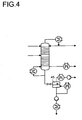
- the inventive method is exemplary in FIG. 2 shown.
- the countercurrent rectification column (20) is fed via line (21) of the feed and line (22), the ionic liquid as Entrainer. Via line (23), the top stream is discharged.
- the low boiler (s) (LS) is separated from the high boiler (s) (SS) and the ionic liquid (IF) so that no low boiler is present in the sump.
- This can be achieved by a sufficient number of separation stages in the stripping section for the person skilled in the distillation, if the IF causes a selectivity of greater than 1.3, which is your task. Since the IF has no vapor pressure, the vapor phase in the sump consists entirely of high boiler. This is withdrawn through a vaporous side stream (24). The design of this side stream and the necessary apparatus is carried out according to the usual rules of distillation and are dependent on the respective specific separation task.
- the high-boiling product is withdrawn from the sump with the side stream preferably in the stripping section close to the sump, more preferably from one of the 3 lowest stages, most preferably directly from the bottom step.
- the permissible temperature in the bottom of the extractive rectification depends on the permissible temperature in the bottom of the extractive rectification. The greater the current, the more SS is removed from the stripping section of the column and less SS is contained in the IF and thus in the sump. Consequently, the temperature in the sump rises because the IF has no vapor pressure.
- the thermal stability of the components in the sump and the resilience of the material are taken into account.
- the goal is a lowest possible SS content in the IF without thermal Cause damage.
- the permissible bottom temperature may range from 50 ° C to over 200 ° C. Preferably, it lies between. 100 and 200 ° C. Due to the thermal stability of common ionic liquids 250 ° C, preferably 200 ° C should not be exceeded.
- the content of SS in the IF can be greatly reduced.
- Contents of SS in IF of less than 10%, preferably less than 5%, more preferably less than 1%, are achievable, the achievable values depending on pressure and permissible temperature in the bottom of the column.
- a high vapor pressure of the SS and a low column pressure are advantageous for the depletion of the SS from the IF.
- concentrations indicated are by weight unless otherwise indicated. % means weight% and ppm means weight ppm.
- the vaporous side stream is to be liquefied with the aid of an additional condenser.
- the process according to the invention makes it possible to deplete the high boiler in the bottoms stream from the column. In some applications, this purification can already be sufficient in terms of its quality in that the still occurring bottom stream is recycled directly near the top of the column, in order to use the ionic liquid again as entrainer.
- the IF must be cycled, i. SS, who remained in the IF, is led with her back to the head of the extractive rectification. There, part of the SS will enter the vapor phase and contaminate the top product (LS). If the purity requirements for the LS are moderate, then the depletion of the SS in the IF is sufficient solely by the vapor side stream and no further processing of the IF is needed.
- an azeotrope or narrow-boiling mixture can be separated by addition of an IF in a column without additional apparatus in Leich and high boilers. Compared with a normal extractive rectification, which always requires a second column for processing the entrainers, this means a considerable simplification of the process and considerable savings in investment costs.
- the process according to the invention offers a procedurally simple and economical possibility of separating azeotropic or narrow-boiling mixtures. With little expenditure on apparatus can hereby a large part of the high boiler contained are obtained in high purity. Depending on the specific, substance-specific conditions and requirements, the ionic liquid thus obtained in the bottom stream can be returned directly to the column. In the case of increased requirements, a further separation by means of a work-up stage is required beforehand, but the process-related expense required for this purpose is significantly lower due to the separation of the high boiler according to the invention.
- the feed to the extractive rectification column was 844 kg / h of a binary mixture consisting of 77% TMB (trimethyl borate) and 23% methanol. This is the azeotropic composition.
- the feed soil was always at level 12.
- Example 1 Extractive rectification with side stream
- the IF (1-ethyl-3-methyl-imidazolium tosylate) was charged at 1364 kg / h. It contained 1% methanol. The top product was 657 kg / h with a concentration of 99% TMB and 1% methanol. 179 kg / h of pure methanol were removed in vapor form from the bottom of the column via a side stream.
- the azeotrope is broken by the ionic liquid. 99% purity in the top product are achieved. If this product purity is sufficient, then no further treatment of the emerging at the sump IF is necessary. It can be returned directly to the top of the column. Thus, with IF as entrainer and a column with sidestream, the azeotrope can be overcome and product of relatively high purity can be generated.
- the IF (1-ethyl-3-methyl-imidazolium tosylate) at 1452 kg / h was abandoned. It contained 1% methanol.
- the top product was 657 kg / h with a concentration of 99% TMB and 1% methanol. No side stream was taken. Head and bottom temperatures set at 63 and 94 ° C.
- the bottom product was a flow of 1639 kg / h with 87.6% IF and 12.4% methanol.
- the following amounts of energy were consumed by the heat exchangers: column condenser: 95 kW, column evaporator: 136 kW.
Landscapes
- Chemical & Material Sciences (AREA)
- Chemical Kinetics & Catalysis (AREA)
- Organic Low-Molecular-Weight Compounds And Preparation Thereof (AREA)
- Vaporization, Distillation, Condensation, Sublimation, And Cold Traps (AREA)
Description
- Die vorliegende Erfindung betrifft ein verbessertes Verfahren zur Auftrennung azeotroper oder engsiedender Gemische durch eine Extraktiv-Rektifikation
- In der Industrie treten eine Vielzahl von Flüssigmischungen auf, die sich nicht durch konventionelle Rektifikation, sondern vorzugsweise durch Extraktiv-Rektifikation [Stichlmair, S. und Fair, J., Distillation, ISBN 0-471-25241-7, Seite 241 ff] trennen lassen. Dieser Sachverhalt ist in dem ähnlichen Siedeverhalten der Gemischkomponenten begründet, das heißt in ihrer Eigenschaft, sich bei einem definiertem Druck und einer definierten Temperatur im nahezu gleichen oder gleichen molaren Konzentrationsverhältnis auf die Dampf- und Flüssigphase zu verteilen.
- Der Trennaufwand für eine binäre - aus den Komponenten i und j bestehende - Flüssigmischung bei der Rektifikation spiegelt sich im sogenannten Trennfaktor αij, dem Verhältnis der Verteilungskoeffizienten der Komponenten i und j, wider. Je näher der Trennfaktor dem Wert eins kommt, desto aufwendiger wird die Trennung der Gemischkomponenten mittels konventioneller Rektifikation, da entweder die Trennstufenanzahl der Rektifikationskolonne und/oder das Rücklaufverhältnis im Kolonnenkopf vergrößert werden muss. Nimmt der Trennfaktor den Wert eins an, so liegt ein azeotroper Punkt vor, und die weitere Aufkonzentrierung der Gemischkomponenten ist auch durch eine Erhöhung der Trennstufenzahl oder des Rücklaufverhältnisses nicht mehr möglich. Generell ist bei der Verwendung des Trennfaktors zu beachten, dass er größer oder kleiner 1 sein kann, je nachdem ob der Verteilungskoeffizient des Leichtsieders im Zähler oder im Nenner steht. Normalerweise wird der Leichtsieder im Zähler aufgetragen, so dass der Trennfaktor größer 1 ist.
- Ein in der Industrie häufig praktiziertes Vorgehen zur Trennung engsiedender - hierbei wird ein Trennfaktor etwa kleiner 1,2 verstanden - oder azeotroper Systeme stellt die Zugabe eines selektiven Zusatzstoffes, des sogenannten Entrainers, in einer Extraktiv-Rektifikation dar. Ein geeigneter Zusatzstoff beeinflusst durch selektive Wechselwirkungen mit einer oder mehreren der Gemischkomponenten den Trennfaktor, so dass die Auftrennung der engsiedenden oder azeotrop-siedenden Gemischkomponenten ermöglicht wird. Bei der Extraktiv-Rektifikation sind die durch die Wirkung des Entrainers erhaltenen Kopf- und Sumpfkomponenten die Zielkomponenten der Kolonne. Die Kopfkomponente ist die in Anwesenheit des Entrainers leichter siedende Komponente und im Sumpf befindet sich die in Anwesenheit des Entrainers schwerer siedenden Komponenten.
- Ein Gütemaß für die Intensität der Wechselwirkungen des Entrainers mit einer oder mehreren der Gemischkomponenten stellt die sogenannte Selektivität dar. Die Selektivität ist definiert als das Verhältnis aus Grenzaktivitätskoeffizient der Komponente i zu Grenzaktivitätskoeffizient der Komponente j, wobei die Komponenten i und j im Entrainer unendlich verdünnt vorliegen [Schult, C. J. et. al.; Infinite-dilution activity coefficients for several solutes in hexadecane and in n-methyl-2-pyrrolidone (NMP): experimental measurements and UNIFAC predictions; Fluid Phase Equilibria 179 (2001) S.117-129]. Wie von Schult et. al. dargelegt, führt eine höhere Entrainer-Selektivität zu einer höheren relativen Flüchtigkeit, einem kleineren Rücklaufverhältnis und somit zu niedrigeren Trennkosten. Wie weiter hinten offenbart ist eine möglichst hohe Selektivität z. B. größer 1,3, bevorzugt größer 2,0. angestrebt.
- In der Patentschrift
WO 02/074718 - Unter ionischen Flüssigkeiten werden solche verstanden, wie sie von Wasserscheid und Keim in der Angewandten Chemie 2000, 112, 3926-3945 definiert sind. Die Stoffgruppe der ionischen Flüssigkeiten stellt ein neuartiges Lösungsmittel dar. Wie in der genannten Druckschrift aufgeführt handelt es sich bei ionischen Flüssigkeiten um bei relativ niedrigen Temperaturen schmelzende Salze mit nichtmolekularem, ionischen Charakter. Sie sind bereits bei relativ niedrigen Temperaturen kleiner 200°C, bevorzugt kleiner 150°C, besonders bevorzugt kleiner 100°C flüssig und dabei relativ niedrigviskos. Sie besitzen sehr gute Löslichkeiten für eine große Anzahl organischer, anorganischer und polymerer Substanzen.
- Ionische Flüssigkeiten sind im Vergleich zu ionischen Salzen bei wesentlich geringeren Temperaturen (in der Regel unterhalb von 200°C,) flüssig und besitzen häufig einen Schmelzpunkt unterhalb von 0°C, im Einzelfall bis -96°C, was wichtig für die industrielle Umsetzung der Extraktiv-Rektifikation ist.
- Darüber hinaus sind ionische Flüssigkeiten in der Regel nicht brennbar, nicht korrosiv und wenig viskos und zeichnen sich durch einen nicht messbaren Dampfdruck aus.
- Als ionische Flüssigkeiten werden erfindungsgemäß solche Verbindungen bezeichnet, die mindestens eine positive und mindestens eine negative Ladung aufweisen, insgesamt jedoch ladungsneutral sind, und einen Schmelzpunkt unter 200°C aufweisen, bevorzugt unter 100, besonders bevorzugt unter 50°C.
- Die Ionischen Flüssigkeiten können auch mehrere positive oder negative Ladungen aufweisen, beispielsweise 1 bis 5, bevorzugt 1 bis 4, besonders bevorzugt 1 bis 3, ganz besonders bevorzugt 1 bis 2, insbesondere jedoch je eine positive und negative Ladung.
- Die Ladungen können sich an verschiedenen lokalisierten oder delokalisierten Bereichen innerhalb eines Moleküls befinden, also betainartig, oder auf je ein getrenntes Anion und Kation verteilt sein. Bevorzugt sind solche Ionischen Flüssigkeiten, die aus mindestens einem Kation und mindestens einem Anion aufgebaut sind. Kation und Anion können, wie oben ausgeführt, ein oder mehrfach, bevorzugt einfach geladen sein.
- Selbstverständlich sind auch Gemische verschiedener ionischer Flüssigkeiten oder Mischungen aus herkömmlichen Entrainern, wie n-Methylpyrrolidon, Dimethylformamid, Ethandiol, Benzol, Cyclohexan, Wasser usw., mit Ionischen Flüssigkeiten denkbar.
- Bevorzugt als Kation sind Ammonium- oder Phosphoniumionen, oder solche Kationen, die mindestens einen fünf- bis sechsgliedrigen Heterocyclus enthalten, der mindestens ein Phosphor- oder Stickstoffatom sowie gegebenenfalls ein Sauerstoff- oder Schwefelatom aufweist, besonders bevorzugt solche Verbindungen, die mindestens einen fünf- bis sechsgliedrigen Heterocyclus enthalten, der ein, zwei oder drei Stickstoffatome und ein Schwefel- oder ein Sauerstoffatom aufweist, ganz besonders bevorzugt solche mit ein oder zwei Stickstoffatomen.
- Besonders bevorzugte Ionische Flüssigkeiten sind solche, die ein Molgewicht unter 1000 g/mol aufweisen, ganz besonders bevorzugt unter 350 g/mol.
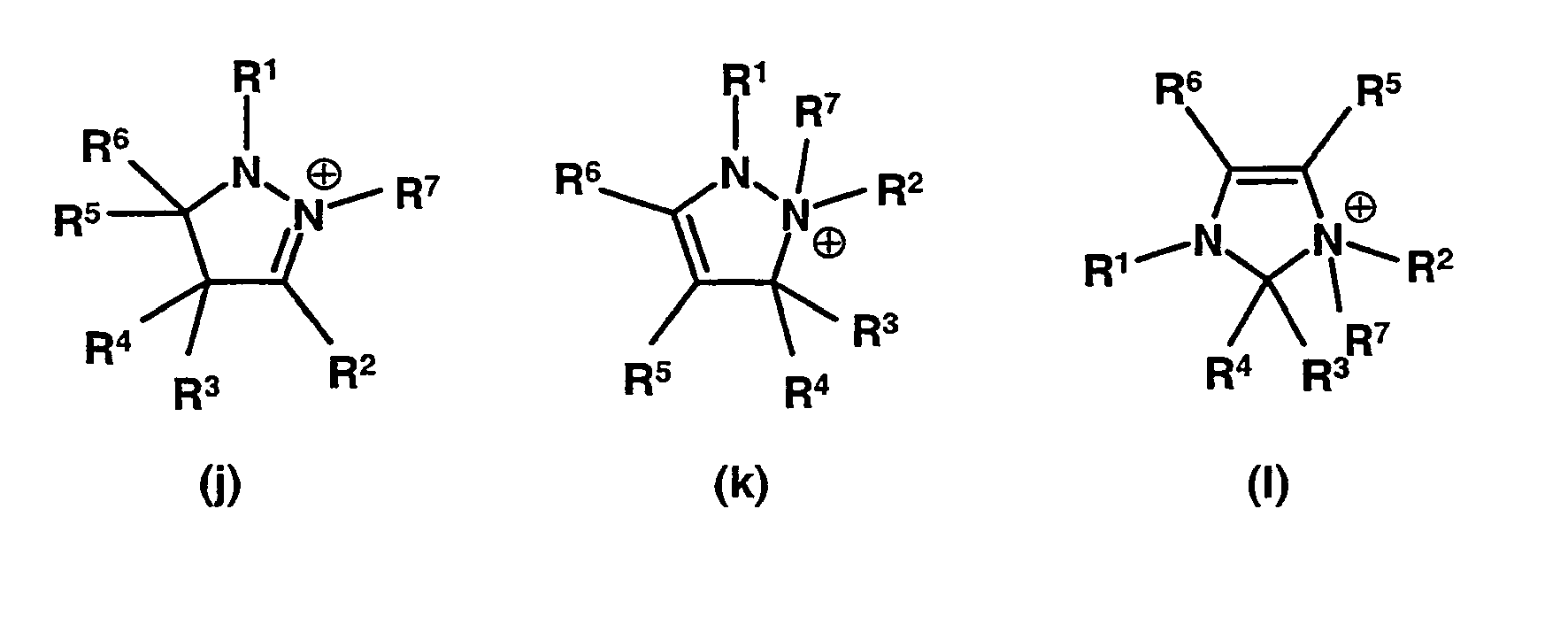
- Weiterhin sind solche Kationen bevorzugt, die ausgewählt sind aus den Verbindungen der Formeln (Ia) bis (Iw),




worin
R1, R2, R3, R4, R5, R6 und R7 unabhängig voneinander jeweils C1 - C18-Alkyl, gegebenenfalls durch ein oder mehrere Sauerstoff- und/oder Schwefelatome und/oder ein oder mehrere substituierte oder unsubstituierte Iminogruppen unterbrochenes C2 - C18-Alkyl, C6 - C12-Aryl, C5 - C12-Cycloalkyl oder einen fünf- bis sechsgliedrigen, Sauerstoff-, Stickstoff- und/oder Schwefelatome aufweisenden Heterocyclus bedeuten oder zwei von ihnen gemeinsam einen ungesättigten, gesättigten oder aromatischen und gegebenenfalls durch ein oder mehrere Sauerstoff- und/oder Schwefelatome und/oder ein oder mehrere substituierte oder unsubstituierte Iminogruppen unterbrochenen Ring bilden, wobei die genannten Reste jeweils durch funktionelle Gruppen, Aryl, Alkyl, Aryloxy, Alkyloxy, Halogen, Heteroatome und/oder Heterocyclen substituiert sein können.
R1, R2, R3, R4, R5 und R6 können zusätzlich dazu Wasserstoff bedeuten.
R7 kann darüberhinaus C1-C18-Alkyloyl (Alkylcarbonyl), C1 - C18- Alkyloxycarbonyl, C5 - C12-Cycloalkylcarbonyl oder C6 - C12-Aryloyl (Arylcarbonyl) bedeuten, wobei die genannten Reste jeweils durch funktionelle Gruppen, Aryl, Alkyl, Aryloxy, Alkyloxy, Halogen, Heteroatome und/oder Heterocyclen substituiert sein können. - Darin bedeuten
gegebenenfalls durch funktionelle Gruppen, Aryl, Alkyl, Aryloxy, Alkyloxy, Halogen, Heteroatome und/oder Heterocyclen substituiertes C1-C18-Alkyl beispielsweise Methyl, Ethyl, Propyl, Isopropyl, n-Butyl, sec-Butyl, tert.-Butyl, Pentyl, Hexyl, Heptyl, Octyl, 2-Etylhexyl, 2,4,4-Trimethylpentyl, Decyl, Dodecyl, Tetradecyl, Hetadecyl, Octadecyl, 1,1-Dimethylpropyl, 1,1-Dimethylbutyl, 1,1,3,3-Tetramethylbutyl, Benzyl, 1-Phenylethyl, 2-Phenylethyl, α,α-Dimethylbenzyl, Benzhydryl, p-Tolylmethyl, 1-(p-Butylphenyl)-ethyl, p-Chlorbenzyl, 2,4-Dichlorbenzyl, p-Methoxybenzyl, m-Ethoxybenzyl, 2-Cyanoethyl, 2-Cyanopropyl, 2-Methoxycarbonethyl, 2-Ethoxycarbonylethyl, 2-Butoxycarbonylpropyl, 1,2-Di-(methoxycarbonyl)-ethyl, 2-Methoxyethyl, 2-Ethoxyethyl, 2-Butoxyethyl, Diethoxymethyl, Diethoxyethyl, 1,3-Dioxolan-2-yl, 1,3-Dioxan-2-yl, 2-Methyl-1,3-dioxolan-2-yl, 4-Methyl-1,3-dioxolan-2-yl, 2-Isopropoxyethyl, 2-Butoxypropyl, 2-Octyloxyethyl, Chlormethyl, 2-Chlorethyl, Trichlormethyl, Trifluormethyl, 1,1-Dimethyl-2-chlorethyl, 2-Methoxyisopropyl, 2-Ethoxyethyl, Butylthiomethyl, 2-Dodecylthioethyl, 2-Phenylthioethyl, 2,2,2-Trifluorethyl, 2-Hydroxyethyl, 2-Hydroxypropyl, 3-Hydroxypropyl, 4-Hydroxybutyl, 6-Hydroxyhexyl, 2-Aminoethyl, 2-Aminopropyl, 3-Aminopropyl, 4-Aminobutyl, 6-Aminohexyl, 2-Methylaminoethyl, 2-Methylaminopropyl, 3-Methylaminopropyl, 4-Methylaminobutyl, 6-Methylaminohexyl, 2-Dimethylaminoethyl, 2-Dimethylaminopropyl, 3-Dimethylaminopropyl, 4-Dimethylaminobutyl, 6-Dimethylaminohexyl, 2-Hydroxy-2,2-dimethylethyl, 2-Phenoxyethyl, 2-Phenoxypropyl, 3-Phenoxypropyl, 4-Phenoxybutyl, 6-Phenoxyhexyl, 2-Methoxyethyl, 2-Methoxypropyl, 3-Methoxypropyl, 4-Methoxybutyl, 6-Methoxyhexyl, 2-Ethoxyethyl, 2-Ethoxypropyl, 3-Ethoxypropyl, 4-Ethoxybutyl oder 6-Ethoxyhexyl und,
gegebenenfalls durch ein oder mehrere Sauerstoff- und/oder Schwefelatome und/oder ein oder mehrere substituierte oder unsubstituierte Iminogruppen unterbrochenes C2 - C18-Alkyl beispielsweise 5-Hydroxy-3-oxa-pentyl, 8-Hydroxy-3,6-dioxa-octyl, 11-Hydroxy-3,6,9-trioxa-undecyl, 7-Hydroxy-4-oxa-heptyl, 11-Hydroxy-4,8-dioxaundecyl, 15-Hydroxy-4,8,12-trioxa-pentadecyl, 9-Hydroxy-5-oxa-nonyl, 14-Hydroxy-5,10-oxa-tetradecyl, 5-Methoxy-3-oxa-pentyl, 8-Methoxy-3,6-dioxa-octyl, 11-Methoxy-3,6,9-trioxa-undecyl, 7-Methoxy-4-oxa-heptyl, 11-Methoxy-4,8-dioxa-undecyl, 15-Methoxy-4,8,12-trioxa-pentadecyl, 9-Methoxy-5-oxa-nonyl, 14-Methoxy-5,10-oxa-tetradecyl, 5-Ethoxy-3-oxa-pentyl, 8-Ethoxy-3,6-dioxa-octyl, 11-Ethoxy-3,6,9-trioxa-undecyl, 7-Ethoxy-4-oxa-heptyl, 11-Ethoxy-4,8-dioxa-undecyl, 15-Ethoxy-4,8,12-trioxa-pentadecyl, 9-Ethoxy-5-oxa-nonyl oder 14-Ethoxy-5,10-oxa-tetradecyl. - Bilden zwei Reste einen Ring, so können diese Reste gemeinsam bedeuten 1,3-ropylen, 1,4-Butylen, 2-Oxa-1,3-propylen, 1-Oxa-1,3-propylen, 2-Oxa-1,3-propylen, 1-Oxa-1,3-propenylen, 1-Aza-1,3-propenylen, 1-C1-C4-Alkyl-1-aza-1,3-propenylen, 1,4-uta-1,3-dienylen, 1-Aza-1,4-buta-1,3-dienylen oder 2-Aza-1,4-buta-1,3-dienylen.
- Die Anzahl der Sauerstoff- und/oder Schwefelatome und/oder Iminogruppen ist nicht beschränkt. In der Regel beträgt sie nicht mehr als 5 in dem Rest, bevorzugt nicht mehr als 4 und ganz besonders bevorzugt nicht mehr als 3.
- Weiterhin befinden sich zwischen zwei Heteroatomen in der Regel mindestens ein Kohlenstoffatom, bevorzugt mindestens zwei.
- Substituierte und unsubstituierte Iminogruppen können beispielsweise Imino-, Methylimino-, iso-Propylimino, n-Butylimino oder tert-Butylimino sein.
- Weiterhin bedeuten
funktionelle Gruppen Carboxy, Carboxamid, Hydroxy, Di-(C1-C4-Alkyl)-amino, C1-C4-Alkyloxycarbonyl, Cyano oder C1-C4-Alkyloxy,
gegebenenfalls durch funktionelle Gruppen, Aryl, Alkyl, Aryloxy, Alkyloxy, Halogen, Heteroatome und/oder Heterocyclen substituiertes C6-C12-Aryl beispielsweise Phenyl, Tolyl, Xylyl, α-Naphthyl, β-Naphthyl, 4-Diphenylyl, Chlorphenyl, Dichlorphenyl, Trichlorphenyl, Difluorphenyl, Methylphenyl, Dimethylphenyl, Trimethylphenyl, Ethylphenyl, Diethylphenyl, iso-Propylphenyl, tert.-Butylphenyl, Dodecylphenyl, Methoxyphenyl, Dimethoxyphenyl, Ethoxyphenyl, Hexyloxyphenyl, Methylnaphthyl, Isopropylnaphthyl, Chlornaphthyl, Ethoxynaphthyl, 2,6-Dimethylphenyl, 2,4,6-Trimethylphenyl, 2,6-Diethoxyphenyl, 2,6-Dichlorphenyl, 4-Bromphenyl, 2- oder 4-Nitrophenyl, 2,4- oder 2,6-Dinitrophenyl, 4-Dimethylaminophenyl, 4-Acetylphenyl, Methoxyethylphenyl oder Ethoxyethylphenyl,
gegebenenfalls durch funktionelle Gruppen, Aryl, Alkyl, Aryloxy, Alkyloxy, Halogen, Heteroatome und/oder Heterocyclen substituiertes C5-C12-Cycloalkyl beispielsweise Cyclopentyl, Cyclohexyl, Cyclooctyl, Cyclododecyl, Methylcyclopentyl, Dimethylcyclopentyl, Methylcyclohexyl, Dimethylcyclohexyl, Diethylcyclohexyl, Butylcyclohexyl, Methoxycyclohexyl, Dimethoxycyclohexyl, Diethoxycyclohexyl, Butylthiocyclohexyl, Chlorcyclohexyl, Dichlorcyclohexyl, Dichlorcyclopentyl sowie ein gesättigtes oder ungesättigtes bicyclisches System wie z.B. Norbornyl oder Norbornenyl,
ein fünf- bis sechsgliedriger, Sauerstoff-, Stickstoff- und/oder Schwefelatome aufweisender Heterocyclus beispielsweise Furyl, Thiophenyl, Pyrryl, Pyridyl, Indolyl, Benzoxazolyl, Dioxolyl, Dioxyl, Benzimidazolyl, Benzthiazolyl, Dimethylpyridyl, Methylchinolyl, Dimethylpyrryl, Methoxyfuryl, Dimethoxypyridyl, Difluorpyridyl, Methylthiophenyl, Isopropylthiophenyl oder tert.-Butylthiophenyl und
C1 bis C4-Alkyl beispielsweise Methyl, Ethyl, Propyl, Isopropyl, n-Butyl, sec-Butyl oder tert.-Butyl. - C1-C18-Alkyloyl (Alkylcarbonyl) kann beispielsweise sein Acetyl, Propionyl, n-Butyloyl, sec-Butyloyl, tert.-Butyloyl, 2-Etylhexylcarbonyl, Decanoyl, Dodecanoyl, Chloracetyl, Trichloracetyl oder Trifluoracetyl.
- C1 - C18- Alkyloxycarbonyl kann beispielsweise sein Methyloxycarbonyl, Ethyloxycarbonyl, Propyloxycarbonyl, Isopropyloxycarbonyl, n-Butyloxycarbonyl, sec-Butyloxycarbonyl, tert.-Butyloxycarbonyl, Hexyloxycarbonyl, 2-Etylhexyloxycarbonyl oder Benzyloxycarbonyl.
- C5-C12-Cycloalkylcarbonyl kann beispielsweise sein Cyclopentylcarbonyl, Cyclohexylcarbonyl oder Cyclododecylcarbonyl.
- C6-C12-Aryloyl (Arylcarbonyl) kann beispielsweise sein Benzoyl, Toluyl, Xyloyl, α-Naphthoyl, β-Naphthoyl, Chlorbenzoyl, Dichlorbenzoyl, Trichlorbenzoyl oder Trimethylbenzoyl.
- Bevorzugt sind R1, R2, R3, R4, R5 und R6 unabhängig voneinander Wasserstoff, Methyl, Ethyl, n-Butyl, 2-Hydroxyethyl, 2-Cyanoethyl, 2-(Methoxycarbonyl)-ethyl, 2-(Ethoxycarbonyl)-ethyl, 2-(n-Butoxycarbonyl)-ethyl, Dimethylamino, Diethylamino und Chlor. Bevorzugt ist R7 Methyl, Ethyl, n-Butyl, 2-Hydroxyethyl, 2-Cyanoethyl, 2-(Methoxycarbonyl)-ethyl, 2-(Ethoxycarbonyl)-ethyl, 2-(n-Butoxycarbonyl)-ethyl, Acetyl, Propionyl, t-Butyryl, Methoxycarbonyl, Ethoxycarbonyl oder n-Butoxycarbonyl.
- Besonders bevorzugte Pyridiniumionen (la) sind solche, bei denen einer der Reste R1 bis R5 Methyl, Ethyl oder Chlor ist, R7 Acetyl, Methyl, Ethyl oder n-Butyl und alle anderen Wasserstoff sind, oder R3 Dimethylamino, R7 Acetyl, Methyl, Ethyl oder n-Butyl und alle anderen Wasserstoff sind oder R7 Acetyl, Methyl, Ethyl oder n-Butyl und alle anderen Wasserstoff sind oder R2 Carboxy oder Carboxamid, R7 Acetyl, Methyl, Ethyl oder n-Butyl und alle anderen Wasserstoff oder R1 und R2 oder R2 und R3 1 ,4-Buta-1,3-dienylen, R7 Acetyl, Methyl, Ethyl oder n-Butyl und alle anderen Wasserstoff sind.
- Besonders bevorzugte Pyridaziniumionen (Ib) sind solche, bei denen einer der Reste R1 bis R4 Methyl oder Ethyl, R7 Acetyl, Methyl, Ethyl oder n-Butyl und alle anderen Wasserstoff oder R7 Acetyl, Methyl, Ethyl oder n-Butyl, und alle anderen Wasserstoff sind.
- Besonders bevorzugte Pyrimidiniumionen (Ic) sind solche, bei denen R2 bis R4 Wasserstoff oder Methyl, R7 Acetyl, Methyl, Ethyl oder n-Butyl und R1 Wasserstoff, Methyl oder Ethyl ist, oder R2 und R4 Methyl, R3 Wasserstoff und R1 Wasserstoff, Methyl oder Ethyl und R7 Acetyl, Methyl, Ethyl oder n-Butyl ist.
- Besonders bevorzugte Pyraziniumionen (Id) sind solche, bei denen
R1 bis R4 alle Methyl und
R7 Acetyl, Methyl, Ethyl oder n-Butyl oder R7 Acetyl, Methyl, Ethyl oder n-Butyl und alle anderen Wasserstoff sind. - Besonders bevorzugte Imidazoliumionen (Ie) sind solche, bei denen unabhängig voneinander
R1 ausgewählt ist unter Methyl, Ethyl, n-Propyl, n-Butyl, n-Pentyl, n-Octyl, n-Decyl, n-Dodecyl, 2-Hydroxyethyl oder 2-Cyanoethyl,
R7 Acetyl, Methyl, Ethyl oder n-Butyl und
R2 bis R4 unabhängig voneinander Wasserstoff, Methyl oder Ethyl bedeuten. - Besonders bevorzugte 1 H-Pyrazoliumionen (If) sind solche, bei denen unabhängig voneinander
R1 unter Wasserstoff, Methyl oder Ethyl,
R2, R3 und R4 unter Wasserstoff oder Methyl und
R7 unter Acetyl, Methyl, Ethyl oder n-Butyl ausgewählt sind. - Besonders bevorzugte 3H-Pyrazoliumionen (Ig) sind solche, bei denen unabhängig voneinander
R1 unter Wasserstoff, Methyl oder Ethyl,
R2, R3 und R4 unter Wasserstoff oder Methyl und
R7 unter Acetyl, Methyl, Ethyl oder n-Butyl ausgewählt sind. - Besonders bevorzugte 4H-Pyrazoliumionen (Ih) sind solche, bei denen unabhängig voneinander
R1 bis R4 unter Wasserstoff oder Methyl und
R7 unter Acetyl, Methyl, Ethyl oder n-Butyl ausgewählt sind. - Besonders bevorzugte 1-Pyrazoliniumionen (Ii) sind solche, bei denen unabhängig voneinander
R1 bis R6 unter Wasserstoff oder Methyl und
R7 unter Acetyl, Methyl, Ethyl oder n-Butyl ausgewählt sind. - Besonders bevorzugte 2-Pyrazoliniumionen (Ij) sind solche, bei denen unabhängig voneinander
R1 unter Wasserstoff, Methyl, Ethyl oder Phenyl,
R7 unter Acetyl, Methyl, Ethyl oder n-Butyl und
R2 bis R6 unter Wasserstoff oder Methyl ausgewählt sind. - Besonders bevorzugte 3-Pyrazoliniumionen (Ik) sind solche, bei denen unabhängig voneinander
R1 oder R2 unter Wasserstoff, Methyl, Ethyl oder Phenyl,
R7 unter Acetyl, Methyl, Ethyl oder n-Butyl und
R3 bis R6 unter Wasserstoff oder Methyl ausgewählt sind. - Besonders bevorzugte Imidazoliniumionen (II) sind solche, bei denen unabhängig voneinander
R1 oder R2 unter Wasserstoff, Methyl, Ethyl, n-Butyl oder Phenyl,
R7 unter Acetyl, Methyl, Ethyl oder n-Butyl und
R3 oder R4 unter Wasserstoff, Methyl oder Ethyl und
R5 oder R6 unter Wasserstoff oder Methyl ausgewählt sind. - Besonders bevorzugte Imidazoliniumionen (Im) sind solche, bei denen unabhängig voneinander
R1 oder R2 unter Wasserstoff, Methyl oder Ethyl,
R7 unter Acetyl, Methyl, Ethyl oder n-Butyl und
R3 bis R6 unter Wasserstoff oder Methyl ausgewählt sind. - Besonders bevorzugte Imidazoliniumionen (In) sind solche, bei denen unabhängig voneinander
R1, R2 oder R3 unter Wasserstoff, Methyl oder Ethyl,
R7 Acetyl, Methyl, Ethyl oder n-Butyl und
R4 bis R6 unter Wasserstoff oder Methyl ausgewählt sind. - Besonders bevorzugte Thiazoliumionen (Io) oder Oxazoliumionen (Ip) sind solche, bei denen unabhängig voneinander
R1 unter Wasserstoff, Methyl, Ethyl oder Phenyl,
R7 unter Acetyl, Methyl, Ethyl oder n-Butyl und
R2 oder R3 unter Wasserstoff oder Methyl ausgewählt sind. - Besonders bevorzugte 1,2,4-Triazoliumionen (Iq) und (Ir) sind solche, bei denen unabhängig voneinander
R1 oder R2 unter Wasserstoff, Methyl, Ethyl oder Phenyl,
R7 unter Acetyl, Methyl, Ethyl oder n-Butyl und
R3 unter Wasserstoff, Methyl oder Phenyl ausgewählt sind. - Besonders bevorzugte 1,2,3-Triazoliumionen (Is) und (It) sind solche, bei denen unabhängig voneinander
R1 unter Wasserstoff, Methyl oder Ethyl,
R7 unter Acetyl, Methyl, Ethyl oder n-Butyl und
R2 oder R3 unter Wasserstoff oder Methyl ausgewählt sind oder
R2 und R3 1,4-Buta-1,3-dienylen und alle anderen Wasserstoff sind. - Besonders bevorzugte Pyrrolidiniumionen (Iu) sind solche, bei denen unabhängig voneinander
R1 und R7 unter Acetyl, Methyl, Ethyl oder n-Butyl ausgewählt sind und
R2, R3, R4 und R5 Wasserstoff bedeuten. - Besonders bevorzugte Ammoniumionen (Iv) sind solche, bei denen unabhängig voneinander
R7 unter Acetyl, Methyl, Ethyl oder n-Butyl und
R1, R2, und R3 unter Methyl, Ethyl, n-Butyl, 2-Hydroxyethyl, Benzyl oder Phenyl ausgewählt sind. - Besonders bevorzugte Phosphoniumionen (Iw) sind solche, bei denen unabhängig voneinander
R7 unter Acetyl, Methyl, Ethyl oder n-Butyl und
R1, R2, und R3 unter Phenyl, Phenoxy, Ethoxy und n-Butoxy ausgewählt sind. - Unter diesen sind die Ammonium-, Phosphonium-, Pyridinium- und Imidazoliumionen bevorzugt.
- Ganz besonders bevorzugt sind als Kationen 1,2-Dimethylpyridinium, 1-Methyl-2-ethylpyridinium, 1-Methyl-2-ethyl-6-methylpyridinium, N-Methylpyridinium, 1-Butyl-2-methylpyridinium, 1-Butyl-2-ethylpyridinium, 1-Butyl-2-ethyl-6-methylpyridinium, N-Butylpyridinium, 1-Butyl-4-methylpyridinium, 1,3-Dimethylimidazolium, 1,2,3-Trimethylimidazolium, 1-n-Butyl-3-methylimidazolium, 1,3,4,5-Tetramethylimidazolium, 1,3,4-Trimethylimidazolium, 2,3-Dimethylimidazolium, 1-Butyl-2,3-dimethylimidazolium, 3,4-Dimethylimidazolium, 2-Ethyl-3,4-dimethylimidazolium, 3-Methyl-2-ethylimidazol, 3-Butyl-1-methylimidazolium, 3-Butyl-1-ethylimidazolium, 3-Butyl-1,2-dimethylimidazolium, 1,3-Di-n-Butylimidazolium, 3-Butyl-1,4,5-Trimethylimidazolium, 3-Butyl-1,4-Dimethylimidazolium, 3-Butyl-2-methylimidazolium, 1,3-Dibutyl-2-methylimidazolium, 3-Butyl-4-methylimidazolium, 3-Butyl-2-ethyl-4-methylimidazolium und 3-Butyl-2-ethylimidazolium, 1-Methyl-3-Octylimidazolium, 1-Decyl-3-Methylimidazolium.
- Insbesondere bevorzugt sind 1-Butyl-4-methylpyridinium, 1-n-Butyl-3-methylimidazolium und 1-n-Butyl-3-ethylimidazolium.
- Als Anionen sind prinzipiell alle Anionen denkbar.
- Bevorzugt als Anionen sind Halogenide, F, Cl-, Br-, I-, Acetat CH3COO-, Trifluoracetat CF3COO-, Triflat CF3SO3-, Sulfat SO4 2-, Hydrogensulfat HSO4 -, Methylsulfat CH3OSO3 -, Ethylsulfat C2H5OSO3 -, Sulfit SO3 2-, Hydrogensulfit HSO3 -, Aluminiumchloride AlCl4 -, Al2Cl7 -, Al3Cl10 -, Aluminiumtribromid AlBr4 -, Nitrit NO2 -, Nitrat NO3 -, Kupferchlorid CuCl2 -, Phosphat PO4 3-, Hydrogenphosphat HPO4 2-, Dihydrogenphosphat H2PO4 -, Carbonat CO3 2-, Hydrogencarbonat HCO3 -.
- Besonders bevorzugt sind Acetate, Sulfonate, Tosylat p-CH3C6H4SO3 -, Sulfate, Phosphate, Bis(trifluormethylsulfonyl)imid (CF3SO2)2N-.
- In der Patentanmeldung
WO 02/074718 Figur 1 ). Mit (2) ist der Zufluss des Entrainers in eine Gegenstrom-Rektifikationskolonne dargestellt. Da in herkömmlichen Verfahren der Entrainer eine geringe, aber bemerkenswerte Flüchtigkeit bezüglich des Kopfproduktes (Strom 7) besitzt, müssen zur Trennung zwischen Kopfprodukt und Entrainer die Trennelemente (1) verwendet werden. Die Trennelemente (3) und (5) bewirken die gewünschte Trennung zwischen Kopf- und Sumpfprodukt unter Wirkung des Entrainers, Strom (4) ist der Zulauf der zu trennenden Komponenten (Feed), Strom(6) ist Sumpfprodukt und der Entrainer. Trennelemente können beispielsweise Böden, geordnete Packungen oder nicht geordnete Füllkörper sein. - Werden Ionische Flüssigkeit als Entrainer verwendet, hat das den Vorteil, dass der Dampfdruck der reinen ionischen Flüssigkeit und damit auch ihr Partialdruck in der Mischung mit dem Kopfprodukt annähernd gleich null sind. Damit können die Trennelemente (1) entfallen. Diese ist nur dann nicht der Fall, wenn flüchtige Verunreinigungen in der Ionischen Flüssigkeit enthalten sind, die z.B. beim Recycling nicht vollständig abgetrennt werden konnten. Um diese vom Kopfprodukt zu trennen ist u.U. doch ein Verstärkungsteil zwischen Zugabestelle der Ionischen Flüssigkeit und dem Kopf der Kolonnen notwendig.
- Die bekannten Vorteile von ionischen Flüssigkeiten gegenüber herkömmlichen Entrainern in der Extraktiv-Rektifikation sind im wesentlichen:
- Ionische Flüssigkeiten sind selektiver als herkömmliche Entrainer. Sie ermöglichen durch ihre vergleichsweise große Selektivität, dass im Vergleich zur konventionellen Extraktivrektifikation ein geringerer Massenstrom an Entrainer der Extraktiv-Rektifikation zugeführt und/oder die Trennstufenanzahl in der Extraktiv-Rektifikationskolonne verringert werden kann.
- Durch den äußerst niedrigen Dampfdruck des Entrainers können verschiedene Trennoperationen zur Abtrennung des Entrainers vom Sumpfprodukt verwendet werden, die im Vergleich zur zweiten Rektifikationskolonne bei der konventionellen Extraktivrektifikation einen Vorteil bezüglich Betriebs- und Investkosten ermöglichen.
- Die Trennelemente "1" führen in der konventionellen Extraktiv-Rektifikation zu einer Trennung des Entrainers vom Kopfprodukt, die Trennung ist aber nie vollständig. Ein Austrag von Anteilen an ionischer Flüssigkeit über die Dampfphase ohne die Trennelemente "1" ist aufgrund ihrer äußerst geringen Flüchtigkeit nicht möglich.
- Investitionskosten werden durch Wegfall der Trennelemente (1) reduziert.
- Geeignet sind solche ionischen Flüssigkeiten, die in einer Gesamtkonzentration in der Flüssigkeit von 5 bis 90 Mol %, bevorzugt 10 bis 70 Mol %, zu einer Veränderung des Trennfaktors der Zielkomponenten untereinander verschieden von eins führen.
- Der Einsatz von Ionischen Flüssigkeiten als Entrainer in der Extraktiv-Rektifikation ist unter anderem für die folgenden Anwendungen besonders geeignet. z.B. Azeotrope: Amine/Wasser, THF/Wasser, Ameisensäure/Wasser, Alkohole/Wasser, Aceton/Methanol, Acetate/Wasser, Acrylate/Wasser, Trimethylborat/Methanol oder engsiedende Gemische: Essigsäure/Wasser, C4-Kohlenwasserstoffe, C3-Kohlenwasserstoffe, Alkane/Alkene, generell Trennung von polaren und unpolaren Stoffen, die Azeotrope bilden oder engsiedend sind.
- Die Rückgewinnung der ionischen Flüssigkeit nach der Extraktiv-Destillation ist bisher jedoch nicht befriedigend gelöst. Herkömmliche Entrainer werden üblicherweise vom Sumpfprodukt über eine zweite Destillationskolonne abgetrennt. Da Ionische Flüssigkeiten nicht verdampfbar sind, ist die Anreicherung in einem destillativen Gegenstromprozess nicht von Vorteil und führt zu unnötigen Investitionskosten.
- In der
WO 02/07418 - In der deutschen Patentanmeldung mit dem Aktenzeichen
10313207.4 werden adsorptive Trennverfahren beschrieben, mit deren Hilfe nicht mehr verdampfbare Schwersieder von ionischer Flüssigkeit abgetrennt werden sollen. Dieser Fall tritt dann ein, wenn die verdampfbaren Komponenten bereits von der ionischen Flüssigkeit abgetrennt worden sind. Es handelt sich dabei meistens um Gemische mit einem sehr hohen Anteil an Ionischer Flüssigkeit und geringen Verunreinigungen, die sich aber aufkonzentrieren würden, wenn sie nicht abgetrennt werden würden. Purgeströme aus IF-haltigen Kreislaufströmen sind dafür z.B. eine Hauptanwendung. - Generell ist man bestrebt, bei der Auftrennung des Gemisches sowohl den Leichtsieder als auch den Schwersieder in möglichst reiner Form in verfahrenstechnisch einfacher Weise zu gewinnen. Weiterhin ist es verfahrenstechnisch und energetisch aufwendig, die wertvolle ionische Flüssigkeit nach der Extraktiv-Rektifikation von noch enthaltenen Schwersiedern zu trennen und in hoher Reinheit wieder zu gewinnen. Unter Schwersieder versteht man in diesem Zusammenhang alle verdampfbaren Produkte in der Extraktiv-Destillationskolonne, die nicht als gewünschter Leichtsieder über Kopf der Kolonne abgezogen werden. Beim System Tetrahydrofuran (THF) / Wasser wäre z.B. das THF der Leichtsieder und das Wasser der Schwersieder. Insbesondere bei einem relativ hohen Anteil von Schwersieder im Sumpfstrom aus der Kolonne kann sich eine weitere Auftrennung als äußerst schwierig erweisen. Es stellte sich somit die Aufgabe, ein verbessertes Verfahren zur Auftrennung azeotroper oder engsiedender Gemische durch eine Extraktiv-Rektifikation zu finden, welches den genannten Nachteilen abhilft und das eine verfahrenstechnisch einfache und wirtschaftliche Auftrennung ermöglicht.
- Demgemäß wurde ein Verfahren zur Auftrennung azeotroper oder engsiedender Gemische durch eine Extraktiv-Rektifikation gefunden, bei welcher die ionische Flüssigkeit als Entrainer eingesetzt wird, welches dadurch gekennzeichnet ist, dass man schwersiedendes Sumpfprodukt durch einen Seitenstrom gasförmig aus der Kolonne abzieht.
- Das erfindungsgemäße Verfahren ist exemplarisch in
Figur 2 dargestellt. - Der Gegenstrom-Rektifikationskolonne (20) wird über Leitung (21) der Feed und Leitung (22) die ionische Flüssigkeit als Entrainer zugeführt. Über Leitung (23) wird der Kopfstrom abgeführt.
- Im Abtriebsteil der Extraktiv-Rektifikationskolonne wird der oder die Leichtsieder (LS) von dem oder den Schwersiedern (SS) und der ionischer Flüssigkeit (IF) abgetrennt, so dass im Sumpf kein Leichtsieder mehr vorhanden ist. Dieses ist durch eine ausreichende Trennstufenzahl im Abtriebsteil für den Fachmann der Destillation erreichbar, wenn die IF eine Selektivität von größer 1,3 bewirkt, was Ihre Aufgabe ist. Da die IF keinen Dampfdruck besitzt, besteht die Dampfphase im Sumpf vollständig aus Schwersieder. Dieser wird durch einen dampfförmiger Seitenstrom (24) abgezogen. Die Auslegung dieses Seitenstroms und der notwendigen Apparate erfolgt nach den üblichen Regeln der Destillation und sind von der jeweilig konkret vorliegenden Trennaufgabe abhängig. Da der Trennfaktor zwischen IF und SS unendlich groß ist, reicht eine Verdampfungsstufe zur Abtrennung aus. Für den Fall, dass andere schwersiedende Verunreinigungen vorhanden sind, bzw. im Sumpf entstehen oder ein Gemisch aus IF und herkömmlichen Lösungsmittel als Entrainer verwendet wurde, sind weitere Trennelemente notwendig.
- Das schwersiedende Produkt wird mit dem Seitenstrom bevorzugt im Abtriebsteil nahe am Sumpf, besonders bevorzugt von einer der 3 untersten Stufen, ganz besonders bevorzugt direkt von der untersten Stufe aus dem Sumpf abgezogen.
- Die optimale Menge des Seitenstroms hängt von der zulässigen Temperatur im Sumpf der Extraktiv-Rektifikation ab. Je größer der Strom, desto mehr SS wird aus dem Abtriebsteil der Kolonne entfernt und weniger SS ist im IF und damit im Sumpf enthalten. Folglich steigt die Temperatur im Sumpf, denn die IF hat keinen Dampfdruck. Hier sind die thermische Stabilität der Komponenten im Sumpf und die Belastbarkeit des Materials zu berücksichtigen. Ziel ist ein möglichst niedriger SS-Gehalt in der IF ohne thermische Schäden hervorzurufen. Je nach Stoffgemisch und Betriebsdruck kann die zulässige Sumpftemperatur von 50°C bis über 200°C betragen. Bevorzugt liegt sie zwischen. 100 und 200°C. Wegen der thermischen Stabilität gängiger ionischer Flüssigkeiten sollten 250°C, bevorzugt 200°C nicht überschritten werden.
- Über den Seitenstrom kann der Gehalt an SS im IF stark erniedrigt werden. Erreichbar sind Gehalte an SS in IF von kleiner 10 %, bevorzugt kleiner 5 %, besonders bevorzugt kleiner 1 %, wobei die erreichbaren Werte von Druck und zulässiger Temperatur im Kolonnensumpf abhängen. Vorteilhaft für die Abreicherung des SS aus der IF sind neben der hohen Temperatur ein hoher Dampfdruck des SS und ein niedriger Kolonnendruck. Die angegebenen Konzentrationen sind, wenn nicht anders gekennzeichnet, auf die Masse bezogen, d.h. % bedeuten Gewichts-% und ppm bedeuten Gewichts-ppm.
- Soll der SS als flüssiges Produkt anfallen, so ist der dampfförmige Seitenstrom mit Hilfe eines zusätzlichen Kondensators zu verflüssigen.
- Mittels Leitung (25) wird der Sumpfstrom aus der Kolonne (20) abgeführt. In nachgeschalteten Verfahrensschritten wie Verdampfung und / oder Strippung kann weiterer Schwersieder, welcher in diesem Gemisch noch enthalten ist, abgetrennt werden.
- Das erfindungsgemäße Verfahren ermöglicht die Abreicherung des Schwersieders im von der Kolonne anfallenden Sumpfstrom. Diese Abreinigung kann in einigen Anwendungsfällen in ihrer Qualität schon genügen, dass der noch anfallende Sumpfstrom direkt nahe dem Kolonnenkopf zurückgeführt wird, um somit die ionische Flüssigkeit erneut als Entrainer zu verwenden.
- Aus wirtschaftlichen Gründen muss die IF im Kreislauf gefahren werden, d.h. SS, der in der IF verblieben ist, wird mit ihr wieder zum Kopf der Extraktiv-Rektifikation geführt. Dort wird ein Teil des SS in die Dampfphase gelangen und das Kopfprodukt (LS) verunreinigen. Wenn die Reinheitsanforderungen für den LS moderat sind, dann reicht die Abreicherung des SS im IF alleine durch den dampfförmigen Seitenstrom aus, und es ist keine weitere Aufarbeitung der IF nötig. In dieser besonders vorteilhaften Variante kann ein azeotrop- oder engsiedendes Gemisch durch Zugabe einer IF in einer Kolonne ohne Zusatzapparat in Leich- und Schwersieder aufgetrennt werden. Gegenüber einer normalen Extraktiv-Rektifikation, die immer eine zweite Kolonne zur Aufarbeitung des Entrainers benötigt, bedeutet das eine beachtliche Vereinfachung des Verfahrens sowie erhebliche Einsparung an Investitionskosten.
- Im Falle erhöhter Anforderungen oder einer noch nicht befriedigenden Abreicherung von Schwersieder im Sumpfstrom kann sich vor einer Rückführung dieses Stroms in die Kolonne eine weitere Aufarbeitung empfehlen, um einer unerwünschten Verunreinigung des Kopfproduktes zu begegnen. Hierzu wird dieser entnommene Sumpfstrom einem Verdampfer und / oder einer Strippkolonne zugeführt, in welcher noch enthaltene Reste an Schwersieder weiter verringert werden. Im Anschluss wird die so gewonnene ionische Flüssigkeit der Kolonne wieder zugeführt. Diese Varianten sind exemplarisch in den
Figuren 3 und4 dargestellt. Sie entsprechen in ihrem wesentlichen Aufbau derFigur 2 , es ist hier jedoch zusätzlich eine Aufarbeitung des Sumpfstromes dargestellt. Diese erfolgt gemäßFigur 3 mit einem Stripper (35) bzw. gemäßFigur 4 und4a mit einem Verdampfer (45). InFigur 4a wird der Gasstrom aus dem Verdampfer (45) einem Verdichter (48) zugeführt. - Das erfindungsgemäße Verfahren bietet eine verfahrenstechnisch einfache und wirtschaftliche Möglichkeit der Auftrennung azeotroper oder engsiedender Gemische. Mit geringem apparativem Aufwand kann hierbei ein großer Teil des enthaltenen Schwersieders in hoher Reinheit gewonnen werden. Je nach konkreten, stoffspezifischen Rahmenbedingungen und Anforderungen kann die so im Sumpfstrom anfallende ionische Flüssigkeit direkt in die Kolonne zurückgeführt werden. Bei erhöhten Anforderungen ist zuvor eine weitere Auftrennung mittels einer Aufarbeitungsstufe erforderlich, der hierzu notwendige, verfahrenstechnische Aufwand ist jedoch aufgrund der erfindungsgemäßen Abtrennung des Schwersieders deutlich geringer.
- In den folgenden Beispielen sind alle Konzentrationen, wenn nicht anders gekennzeichnet, auf die Masse bezogen, d.h. % bedeutet Gewichts-% und ppm bedeutet Gewichts-ppm.
- In allen Beispielen betrug der Zulauf in die Extraktiv-Rektifikationskolonne 844 kg/h eines binären Gemisches bestehend aus 77 % TMB(Trimethylborat) und 23 % Methanol. Dieses ist die azeotrope Zusammensetzung. Die Kolonne hatte immer 20 Stufen und wurde bei einem Rücklaufverhältnis von RV = 0,5 und einem Druck von P = 1 bar gefahren. Der Feedboden lag immer auf Stufe 12.
- Am Kopf der Kolonne wurde die IF (1-Ethyl-3-Methyl-Imidazolium-Tosylat) mit 1364 kg/h aufgegeben. Sie enthielt 1 % Methanol. Als Kopfprodukt fielen 657 kg/h mit einer Konzentration von 99 % TMB und 1 % Methanol an. Aus dem Sumpf der Kolonne wurden 179 kg/h reines Methanol über einen Seitenstrom dampfförmig entnommen.
- Kopf- und Sumpftemperatur stellten sich bei 63 und 180°C ein. Als Sumpfprodukt ergab sich ein Strom von 1364 kg/h mit 99 % IF und 1 % Methanol.
- Von den Wärmeübertragern wurden folgende Energiemengen verbraucht: Kolonnenkondensator: 95 kW, Kolonnenverdampfer: 303 kW, Seitenstromkondensator: 63 kW.
- Ergebnis: Das Azeotrop wird durch die Ionische Flüssigkeit gebrochen. 99 % Reinheit im Kopfprodukt werden erreicht. Ist diese Produktreinheit ausreichend, so ist keine weitere Aufbereitung der am Sumpf austretenden IF nötig. Sie kann direkt zum Kopf der Kolonne zurückgeführt werden. So kann mit IF als Entrainer und einer Kolonne mit Seitenstrom das Azeotrop überwunden werden und Produkt von relativ hoher Reinheit erzeugt werden.
- Am Kopf der Kolonne wurde die IF (1-Ethyl-3-Methyl-Imidazolium-Tosylat) mit 1452 kg/h aufgegeben. Sie enthielt 1 % Methanol. Als Kopfprodukt fielen 657 kg/h mit einer Konzentration von 99 % TMB und 1 % Methanol an. Es wurde kein Seitenstrom entnommen. Kopf- und Sumpftemperatur stellten sich bei 63 und 94°C ein. Als Sumpfprodukt ergab sich ein Strom von 1639 kg/h mit 87,6 % IF und 12,4 % Methanol. Von den Wärmeübertragern wurden folgende Energiemengen verbraucht: Kolonnenkondensator: 95 kW, Kolonnenverdampfer: 136 kW.
- Ergebnis: Der im Sumpf der Kolonne anfallende IF-reiche Strom hat mit über 12 % eine zu hohe Konzentration an Methanol. Diese IF kann nicht direkt im Kreislauf gefahren und wieder auf die Kolonne gegeben werden, da Reinheiten von 99 % im Destillat dann nicht erreichbar ist.
Claims (6)
- Verfahren zur Auftrennung azeotroper oder engsiedender Gemische durch eine Extraktiv-Rektifikation, bei welcher ionische Flüssigkeit als Entrainer eingesetzt wird, dadurch gekennzeichnet, dass man schwersiedendes Sumpfprodukt durch einen Seitenstrom dampfförmig aus der Kolonne abzieht.
- Verfahren gemäß Anspruch 1, dadurch gekennzeichnet, dass man den Seitenstrom im Abtriebsteil der Kolonne im Bereich der untersten drei Stufen, bevorzugt direkt an der untersten Stufe positioniert.
- Verfahren gemäß Ansprüchen 1 bis 2, dadurch gekennzeichnet, dass man den Sumpfstrom der Kolonne einer Aufarbeitungsstufe zuführt, in welcher die enthaltene ionische Flüssigkeit durch Verdampfung von noch vorhandenem Schwersieder weiter abgetrennt wird.
- Verfahren gemäß Ansprüchen 1 bis 3, dadurch gekennzeichnet, dass man den Sumpfstrom der Kolonne einer Aufarbeitungsstufe zuführt, in welcher die enthaltene ionische Flüssigkeit durch Strippung von noch vorhandenem Schwersieder weiter abgetrennt wird.
- Verfahren gemäß Ansprüchen 1 bis 2, dadurch gekennzeichnet, dass man den an Schwersieder abgereicherten Sumpfstrom in die Kolonne bevorzugt im Verstärkungsteil, besonders bevorzugt auf eine der obersten 3 Stufen, ganz besonders bevorzugt auf die oberste Stufe zurückführt.
- Verfahren gemäß Ansprüchen 3 bis 4, dadurch gekennzeichnet, dass man die aus der Aufarbeitungsstufe gewonnene ionische Flüssigkeit in die Kolonne bevorzugt im Verstärkungsteil, besonders bevorzugt auf eine der obersten 3 Stufen, ganz besonders bevorzugt auf die oberste Stufe zurückführt.
Applications Claiming Priority (2)
| Application Number | Priority Date | Filing Date | Title |
|---|---|---|---|
| DE10336556A DE10336556A1 (de) | 2003-08-05 | 2003-08-05 | Destillatives Verfahren zur Trennung von engsiedenden oder azeotropen Gemischen unter Verwendung von ionischen Flüssigkeiten |
| PCT/EP2004/007869 WO2005016483A1 (de) | 2003-08-05 | 2004-07-15 | Destillatives verfahren zur trennung von engsiedenden oder azeotropen gemischen unter verwendung von ionischen flüssigkeiten |
Publications (2)
| Publication Number | Publication Date |
|---|---|
| EP1654046A1 EP1654046A1 (de) | 2006-05-10 |
| EP1654046B1 true EP1654046B1 (de) | 2009-09-23 |
Family
ID=34177391
Family Applications (1)
| Application Number | Title | Priority Date | Filing Date |
|---|---|---|---|
| EP04763246A Revoked EP1654046B1 (de) | 2003-08-05 | 2004-07-15 | Destillatives verfahren zur trennung von engsiedenden oder azeotropen gemischen unter verwendung von ionischen flüssigkeiten |
Country Status (10)
| Country | Link |
|---|---|
| US (1) | US20070080052A1 (de) |
| EP (1) | EP1654046B1 (de) |
| JP (1) | JP2007501191A (de) |
| KR (1) | KR20060054424A (de) |
| CN (1) | CN1832789A (de) |
| AT (1) | ATE443554T1 (de) |
| BR (1) | BRPI0413017A (de) |
| DE (2) | DE10336556A1 (de) |
| MY (1) | MY140258A (de) |
| WO (1) | WO2005016483A1 (de) |
Families Citing this family (29)
| Publication number | Priority date | Publication date | Assignee | Title |
|---|---|---|---|---|
| ES2231699T3 (es) * | 2001-03-20 | 2005-05-16 | Basf Aktiengesellschaft | Liquidos ionicos como aditivos selectivos para la separacion de mezclas con un intervalo estrecho de ebullicion o azeotropicas. |
| DE10336555A1 (de) * | 2003-08-05 | 2005-02-24 | Basf Ag | Recycling von lonischen Flüssigkeiten bei der Extraktiv-Destillation |
| US8715521B2 (en) | 2005-02-04 | 2014-05-06 | E I Du Pont De Nemours And Company | Absorption cycle utilizing ionic liquid as working fluid |
| AR058054A1 (es) * | 2005-09-22 | 2008-01-23 | Du Pont | Utilizacion de liquidos ionicos para la separacion de hidrofluorocarburos |
| US8771626B2 (en) * | 2006-05-31 | 2014-07-08 | E I Du Pont De Nemours And Company | Process for purifying perfluorinated products |
| WO2008057574A1 (en) * | 2006-11-08 | 2008-05-15 | E. I. Du Pont De Nemours And Company | Process for the separation of tetrafluoroethylene from carbon dioxide using ionic liquids |
| US8075777B2 (en) * | 2007-05-16 | 2011-12-13 | E. I. Du Pont De Nemours And Company | Process for the separation of diastereomers |
| US7964760B2 (en) * | 2007-05-25 | 2011-06-21 | E.I. Du Pont De Nemours And Company | Process for the separation of fluorocarbons using ionic liquids |
| CN101417913B (zh) * | 2008-11-19 | 2013-01-16 | 烟台大学 | 一种用多元混合溶剂分离丁烷与丁烯的方法 |
| EP2243530A1 (de) * | 2009-04-21 | 2010-10-27 | LANXESS Deutschland GmbH | Verfahren zur Trennung aromatischer Verbindungen |
| DE102010038518A1 (de) | 2010-07-28 | 2012-02-02 | Bayer Technology Services Gmbh | Elektrisch leitfähige Pasten mit erhöhter Ladungsspeicherfähigkeit umfassend Graphenlagen und Lagen aus Schichtsilikaten oder Schichtdoppelhydroxide, sowie mit diesen Pasten hergestellte elektrische Kondensatoren |
| CN102452882B (zh) * | 2010-10-19 | 2014-02-05 | 中国石油化工股份有限公司 | 一种基于离子液体的碳五分离用混合溶剂 |
| WO2012130803A1 (de) | 2011-03-31 | 2012-10-04 | Bayer Technology Services Gmbh | Verfahren zur abtrennung von halogenen aus stoffgemischen |
| CN102850170B (zh) * | 2011-06-29 | 2015-12-16 | 中国石油化工股份有限公司 | 一种基于离子液体的碳五分离用混合溶剂 |
| CN102850158B (zh) * | 2011-06-29 | 2014-12-31 | 中国石油化工股份有限公司 | 一种碳五分离用混合溶剂 |
| CN103073388B (zh) * | 2013-01-28 | 2015-07-08 | 北京化工大学 | 一种离子液体萃取精馏分离乙醇和水的方法 |
| CN103467246A (zh) * | 2013-08-20 | 2013-12-25 | 天津科林泰克科技有限公司 | 一种分离异丙醇-水混合物的方法 |
| CN103467286A (zh) * | 2013-08-20 | 2013-12-25 | 天津科林泰克科技有限公司 | 一种分离乙酸乙酯-乙醇混合物的方法 |
| CN103435445A (zh) * | 2013-08-20 | 2013-12-11 | 天津科林泰克科技有限公司 | 一种分离乙醇-水混合物的方法 |
| CN103449969A (zh) * | 2013-09-05 | 2013-12-18 | 天津科林泰克科技有限公司 | 一种分离甲醇-乙醇-异丙醇-水混合物的方法及生产装置 |
| EP2853559A1 (de) | 2013-09-27 | 2015-04-01 | Bayer MaterialScience AG | Polycarbonatzusammensetzung mit verbesserten elektrischen Eigenschaften enthaltend Ruß |
| EP2853560A1 (de) | 2013-09-27 | 2015-04-01 | Bayer MaterialScience AG | Polycarbonatzusammensetzung mit verbesserten elektrischen Eigenschaften enthaltend Kohlenstoffnanoröhrchen |
| CN103641700A (zh) * | 2013-11-22 | 2014-03-19 | 天津大学 | 一种萃取精馏分离丁酮-水共沸混合物的方法 |
| CN103613485B (zh) * | 2013-12-09 | 2016-02-17 | 北京化工大学 | 乙二醇加离子液体萃取精馏分离醇水溶液的方法 |
| MA41688A (fr) * | 2014-10-16 | 2017-08-22 | Honeywell Int Inc | Procédé de séparation de fluorure d'hydrogène de mélanges fluorure d'hydrogène/hydrocarbures halogénés au moyen de liquides ioniques |
| KR102611842B1 (ko) * | 2017-08-28 | 2023-12-07 | 차이나 페트로리움 앤드 케미컬 코포레이션 | 메탄올로부터 디메틸 카보네이트를 분리하는 방법 |
| CN107823907B (zh) * | 2017-11-13 | 2018-11-20 | 亚洲硅业(青海)有限公司 | 混合液中轻组分的分离方法及该分离方法使用的精馏塔 |
| CN110028388B (zh) * | 2019-05-23 | 2023-01-17 | 山东科技大学 | 一种用亲水性离子液体萃取精馏分离四氟丙醇和水共沸物的方法 |
| CN121041720B (zh) * | 2025-11-04 | 2026-03-03 | 石家庄辰泰环境科技有限公司 | 一种nmp萃取精馏甲基吡啶和水的设备 |
Family Cites Families (8)
| Publication number | Priority date | Publication date | Assignee | Title |
|---|---|---|---|---|
| US4623432A (en) * | 1984-04-23 | 1986-11-18 | Amoco Corporation | Removal of brominated organics from acetic acid obtained by oxidation of liquid butane in presence of Co-Br or Co-Mn-Br system catalysis |
| DE3905786A1 (de) * | 1989-02-24 | 1990-08-30 | Wipf Ag Verpackungen | Verfahren und vorrichtung zur trennung von diacetylhaltigen gemischen aus methylethylketon, ethylacetat, ethanol und wasser sowie gegebenenfalls toluol und n-hexanen |
| DE4242054C1 (de) * | 1992-12-14 | 1994-01-13 | Basf Ag | Verfahren zur Gewinnung einer polymerisierbaren Wertstofffraktion |
| DE4342570C1 (de) * | 1993-12-14 | 1995-09-21 | Hoechst Ag | Verfahren zur kontinuierlichen Herstellung von Vinylphosphonsäuredialkylestern |
| ES2231699T3 (es) * | 2001-03-20 | 2005-05-16 | Basf Aktiengesellschaft | Liquidos ionicos como aditivos selectivos para la separacion de mezclas con un intervalo estrecho de ebullicion o azeotropicas. |
| DE10206808A1 (de) * | 2002-02-19 | 2003-08-28 | Oxeno Olefinchemie Gmbh | Verfahren zur Trennung von Stoffen durch Extraktion oder Wäsche mit ionischen Flüssigkeiten |
| DE10312918A1 (de) * | 2003-03-22 | 2004-09-30 | Oxeno Olefinchemie Gmbh | Verfahren zur Abtrennung von 2-Butanol aus tert.-Butanol/Wasser-Gemischen |
| DE10336555A1 (de) * | 2003-08-05 | 2005-02-24 | Basf Ag | Recycling von lonischen Flüssigkeiten bei der Extraktiv-Destillation |
-
2003
- 2003-08-05 DE DE10336556A patent/DE10336556A1/de not_active Withdrawn
-
2004
- 2004-07-15 DE DE502004010120T patent/DE502004010120D1/de not_active Expired - Fee Related
- 2004-07-15 CN CNA2004800223038A patent/CN1832789A/zh active Pending
- 2004-07-15 AT AT04763246T patent/ATE443554T1/de not_active IP Right Cessation
- 2004-07-15 US US10/566,935 patent/US20070080052A1/en not_active Abandoned
- 2004-07-15 BR BRPI0413017-0A patent/BRPI0413017A/pt not_active IP Right Cessation
- 2004-07-15 JP JP2006522259A patent/JP2007501191A/ja not_active Withdrawn
- 2004-07-15 WO PCT/EP2004/007869 patent/WO2005016483A1/de not_active Ceased
- 2004-07-15 EP EP04763246A patent/EP1654046B1/de not_active Revoked
- 2004-07-15 KR KR1020067002400A patent/KR20060054424A/ko not_active Ceased
- 2004-08-04 MY MYPI20043139A patent/MY140258A/en unknown
Also Published As
| Publication number | Publication date |
|---|---|
| DE502004010120D1 (de) | 2009-11-05 |
| KR20060054424A (ko) | 2006-05-22 |
| CN1832789A (zh) | 2006-09-13 |
| ATE443554T1 (de) | 2009-10-15 |
| MY140258A (en) | 2009-12-31 |
| DE10336556A1 (de) | 2005-03-10 |
| US20070080052A1 (en) | 2007-04-12 |
| JP2007501191A (ja) | 2007-01-25 |
| WO2005016483A1 (de) | 2005-02-24 |
| EP1654046A1 (de) | 2006-05-10 |
| BRPI0413017A (pt) | 2006-10-17 |
Similar Documents
| Publication | Publication Date | Title |
|---|---|---|
| EP1372807B1 (de) | Ionische flüssigkeiten als selektive zusatzstoffe für die trennung engsiedender oder azeotroper gemische | |
| EP1654046A1 (de) | Destillatives verfahren zur trennung von engsiedenden oder azeotropen gemischen unter verwendung von ionischen flüssigkeiten | |
| EP1654047B1 (de) | Recycling von ionischen flüssigkeiten bei der extraktiv-destillation | |
| EP1866045B1 (de) | Verfahren zur destillativen reinigung von ionischen flüssigkeiten und/oder polymeren | |
| DE10313207A1 (de) | Reinigung oder Aufarbeitung von Ionischen Flüssigkeiten mit adsorptiven Trennverfahren | |
| WO2000025881A1 (de) | Rektifizierkolonne für die extraktivdestillation von eng- oder azeotrop siedenden gemischen | |
| WO2005068404A1 (de) | Destillation von ionischen flüssigkeiten | |
| WO2005026089A2 (de) | Verfahren zur herstellung von halogenalkanen aus alkoholen | |
| EP1817090B1 (de) | Verfahren zur chemischen umsetzung und auftrennung eines gemisches in einer kolonne | |
| EP2432757A1 (de) | Verfahren zur reinigung von halogenverbindungen enthaltenden carbonsäuren | |
| DE10315412A1 (de) | Verfahren zur Herstellung von 2,2,6,6-Tetramethylpiperidin-4-on |
Legal Events
| Date | Code | Title | Description |
|---|---|---|---|
| PUAI | Public reference made under article 153(3) epc to a published international application that has entered the european phase |
Free format text: ORIGINAL CODE: 0009012 |
|
| 17P | Request for examination filed |
Effective date: 20060306 |
|
| AK | Designated contracting states |
Kind code of ref document: A1 Designated state(s): AT BE BG CH CY CZ DE DK EE ES FI FR GB GR HU IE IT LI LU MC NL PL PT RO SE SI SK TR |
|
| DAX | Request for extension of the european patent (deleted) | ||
| 17Q | First examination report despatched |
Effective date: 20061121 |
|
| RAP1 | Party data changed (applicant data changed or rights of an application transferred) |
Owner name: BASF SE |
|
| GRAP | Despatch of communication of intention to grant a patent |
Free format text: ORIGINAL CODE: EPIDOSNIGR1 |
|
| GRAS | Grant fee paid |
Free format text: ORIGINAL CODE: EPIDOSNIGR3 |
|
| GRAA | (expected) grant |
Free format text: ORIGINAL CODE: 0009210 |
|
| AK | Designated contracting states |
Kind code of ref document: B1 Designated state(s): AT BE BG CH CY CZ DE DK EE ES FI FR GB GR HU IE IT LI LU MC NL PL PT RO SE SI SK TR |
|
| REG | Reference to a national code |
Ref country code: GB Ref legal event code: FG4D Free format text: NOT ENGLISH |
|
| REG | Reference to a national code |
Ref country code: CH Ref legal event code: EP |
|
| REG | Reference to a national code |
Ref country code: IE Ref legal event code: FG4D |
|
| REF | Corresponds to: |
Ref document number: 502004010120 Country of ref document: DE Date of ref document: 20091105 Kind code of ref document: P |
|
| PG25 | Lapsed in a contracting state [announced via postgrant information from national office to epo] |
Ref country code: FI Free format text: LAPSE BECAUSE OF FAILURE TO SUBMIT A TRANSLATION OF THE DESCRIPTION OR TO PAY THE FEE WITHIN THE PRESCRIBED TIME-LIMIT Effective date: 20090923 Ref country code: SE Free format text: LAPSE BECAUSE OF FAILURE TO SUBMIT A TRANSLATION OF THE DESCRIPTION OR TO PAY THE FEE WITHIN THE PRESCRIBED TIME-LIMIT Effective date: 20090923 |
|
| PG25 | Lapsed in a contracting state [announced via postgrant information from national office to epo] |
Ref country code: PL Free format text: LAPSE BECAUSE OF FAILURE TO SUBMIT A TRANSLATION OF THE DESCRIPTION OR TO PAY THE FEE WITHIN THE PRESCRIBED TIME-LIMIT Effective date: 20090923 Ref country code: SI Free format text: LAPSE BECAUSE OF FAILURE TO SUBMIT A TRANSLATION OF THE DESCRIPTION OR TO PAY THE FEE WITHIN THE PRESCRIBED TIME-LIMIT Effective date: 20090923 |
|
| NLV1 | Nl: lapsed or annulled due to failure to fulfill the requirements of art. 29p and 29m of the patents act | ||
| PG25 | Lapsed in a contracting state [announced via postgrant information from national office to epo] |
Ref country code: CY Free format text: LAPSE BECAUSE OF FAILURE TO SUBMIT A TRANSLATION OF THE DESCRIPTION OR TO PAY THE FEE WITHIN THE PRESCRIBED TIME-LIMIT Effective date: 20090923 |
|
| REG | Reference to a national code |
Ref country code: IE Ref legal event code: FD4D |
|
| PG25 | Lapsed in a contracting state [announced via postgrant information from national office to epo] |
Ref country code: EE Free format text: LAPSE BECAUSE OF FAILURE TO SUBMIT A TRANSLATION OF THE DESCRIPTION OR TO PAY THE FEE WITHIN THE PRESCRIBED TIME-LIMIT Effective date: 20090923 Ref country code: PT Free format text: LAPSE BECAUSE OF FAILURE TO SUBMIT A TRANSLATION OF THE DESCRIPTION OR TO PAY THE FEE WITHIN THE PRESCRIBED TIME-LIMIT Effective date: 20100125 Ref country code: ES Free format text: LAPSE BECAUSE OF FAILURE TO SUBMIT A TRANSLATION OF THE DESCRIPTION OR TO PAY THE FEE WITHIN THE PRESCRIBED TIME-LIMIT Effective date: 20100103 Ref country code: CZ Free format text: LAPSE BECAUSE OF FAILURE TO SUBMIT A TRANSLATION OF THE DESCRIPTION OR TO PAY THE FEE WITHIN THE PRESCRIBED TIME-LIMIT Effective date: 20090923 Ref country code: RO Free format text: LAPSE BECAUSE OF FAILURE TO SUBMIT A TRANSLATION OF THE DESCRIPTION OR TO PAY THE FEE WITHIN THE PRESCRIBED TIME-LIMIT Effective date: 20090923 Ref country code: IE Free format text: LAPSE BECAUSE OF FAILURE TO SUBMIT A TRANSLATION OF THE DESCRIPTION OR TO PAY THE FEE WITHIN THE PRESCRIBED TIME-LIMIT Effective date: 20090923 |
|
| PG25 | Lapsed in a contracting state [announced via postgrant information from national office to epo] |
Ref country code: SK Free format text: LAPSE BECAUSE OF FAILURE TO SUBMIT A TRANSLATION OF THE DESCRIPTION OR TO PAY THE FEE WITHIN THE PRESCRIBED TIME-LIMIT Effective date: 20090923 |
|
| PLBI | Opposition filed |
Free format text: ORIGINAL CODE: 0009260 |
|
| 26 | Opposition filed |
Opponent name: LANXESS DEUTSCHLAND GMBH Effective date: 20100623 Opponent name: BAYER TECHNOLOGY SERVICES GMBH Effective date: 20100622 |
|
| PG25 | Lapsed in a contracting state [announced via postgrant information from national office to epo] |
Ref country code: NL Free format text: LAPSE BECAUSE OF FAILURE TO SUBMIT A TRANSLATION OF THE DESCRIPTION OR TO PAY THE FEE WITHIN THE PRESCRIBED TIME-LIMIT Effective date: 20090923 Ref country code: DK Free format text: LAPSE BECAUSE OF FAILURE TO SUBMIT A TRANSLATION OF THE DESCRIPTION OR TO PAY THE FEE WITHIN THE PRESCRIBED TIME-LIMIT Effective date: 20090923 |
|
| PLAX | Notice of opposition and request to file observation + time limit sent |
Free format text: ORIGINAL CODE: EPIDOSNOBS2 |
|
| PG25 | Lapsed in a contracting state [announced via postgrant information from national office to epo] |
Ref country code: GR Free format text: LAPSE BECAUSE OF FAILURE TO SUBMIT A TRANSLATION OF THE DESCRIPTION OR TO PAY THE FEE WITHIN THE PRESCRIBED TIME-LIMIT Effective date: 20091224 |
|
| PLBB | Reply of patent proprietor to notice(s) of opposition received |
Free format text: ORIGINAL CODE: EPIDOSNOBS3 |
|
| BERE | Be: lapsed |
Owner name: BASF SE Effective date: 20100731 |
|
| PG25 | Lapsed in a contracting state [announced via postgrant information from national office to epo] |
Ref country code: MC Free format text: LAPSE BECAUSE OF NON-PAYMENT OF DUE FEES Effective date: 20100731 |
|
| REG | Reference to a national code |
Ref country code: CH Ref legal event code: PL |
|
| GBPC | Gb: european patent ceased through non-payment of renewal fee |
Effective date: 20100715 |
|
| PG25 | Lapsed in a contracting state [announced via postgrant information from national office to epo] |
Ref country code: IT Free format text: LAPSE BECAUSE OF FAILURE TO SUBMIT A TRANSLATION OF THE DESCRIPTION OR TO PAY THE FEE WITHIN THE PRESCRIBED TIME-LIMIT Effective date: 20090923 |
|
| REG | Reference to a national code |
Ref country code: FR Ref legal event code: ST Effective date: 20110331 |
|
| PG25 | Lapsed in a contracting state [announced via postgrant information from national office to epo] |
Ref country code: DE Free format text: LAPSE BECAUSE OF NON-PAYMENT OF DUE FEES Effective date: 20110201 Ref country code: LI Free format text: LAPSE BECAUSE OF NON-PAYMENT OF DUE FEES Effective date: 20100731 Ref country code: CH Free format text: LAPSE BECAUSE OF NON-PAYMENT OF DUE FEES Effective date: 20100731 |
|
| REG | Reference to a national code |
Ref country code: DE Ref legal event code: R119 Ref document number: 502004010120 Country of ref document: DE Effective date: 20110201 |
|
| PG25 | Lapsed in a contracting state [announced via postgrant information from national office to epo] |
Ref country code: FR Free format text: LAPSE BECAUSE OF NON-PAYMENT OF DUE FEES Effective date: 20100802 |
|
| PG25 | Lapsed in a contracting state [announced via postgrant information from national office to epo] |
Ref country code: BE Free format text: LAPSE BECAUSE OF NON-PAYMENT OF DUE FEES Effective date: 20100731 |
|
| PG25 | Lapsed in a contracting state [announced via postgrant information from national office to epo] |
Ref country code: GB Free format text: LAPSE BECAUSE OF NON-PAYMENT OF DUE FEES Effective date: 20100715 |
|
| PG25 | Lapsed in a contracting state [announced via postgrant information from national office to epo] |
Ref country code: AT Free format text: LAPSE BECAUSE OF NON-PAYMENT OF DUE FEES Effective date: 20100715 |
|
| RDAF | Communication despatched that patent is revoked |
Free format text: ORIGINAL CODE: EPIDOSNREV1 |
|
| RDAG | Patent revoked |
Free format text: ORIGINAL CODE: 0009271 |
|
| STAA | Information on the status of an ep patent application or granted ep patent |
Free format text: STATUS: PATENT REVOKED |
|
| 27W | Patent revoked |
Effective date: 20120220 |
|
| PG25 | Lapsed in a contracting state [announced via postgrant information from national office to epo] |
Ref country code: LU Free format text: LAPSE BECAUSE OF REVOCATION BY EPO Effective date: 20100715 Ref country code: HU Free format text: LAPSE BECAUSE OF FAILURE TO SUBMIT A TRANSLATION OF THE DESCRIPTION OR TO PAY THE FEE WITHIN THE PRESCRIBED TIME-LIMIT Effective date: 20100324 |
|
| PG25 | Lapsed in a contracting state [announced via postgrant information from national office to epo] |
Ref country code: BG Free format text: LAPSE BECAUSE OF FAILURE TO SUBMIT A TRANSLATION OF THE DESCRIPTION OR TO PAY THE FEE WITHIN THE PRESCRIBED TIME-LIMIT Effective date: 20090923 |