EP1647754A2 - Verbindung zweier Rohre und Dichtring für die Verbindung - Google Patents
Verbindung zweier Rohre und Dichtring für die Verbindung Download PDFInfo
- Publication number
- EP1647754A2 EP1647754A2 EP05021453A EP05021453A EP1647754A2 EP 1647754 A2 EP1647754 A2 EP 1647754A2 EP 05021453 A EP05021453 A EP 05021453A EP 05021453 A EP05021453 A EP 05021453A EP 1647754 A2 EP1647754 A2 EP 1647754A2
- Authority
- EP
- European Patent Office
- Prior art keywords
- tube
- sealing ring
- flange
- clamp
- pipe
- Prior art date
- Legal status (The legal status is an assumption and is not a legal conclusion. Google has not performed a legal analysis and makes no representation as to the accuracy of the status listed.)
- Granted
Links
Images

Classifications
-
- F—MECHANICAL ENGINEERING; LIGHTING; HEATING; WEAPONS; BLASTING
- F01—MACHINES OR ENGINES IN GENERAL; ENGINE PLANTS IN GENERAL; STEAM ENGINES
- F01N—GAS-FLOW SILENCERS OR EXHAUST APPARATUS FOR MACHINES OR ENGINES IN GENERAL; GAS-FLOW SILENCERS OR EXHAUST APPARATUS FOR INTERNAL-COMBUSTION ENGINES
- F01N13/00—Exhaust or silencing apparatus characterised by constructional features
- F01N13/18—Construction facilitating manufacture, assembly, or disassembly
- F01N13/1805—Fixing exhaust manifolds, exhaust pipes or pipe sections to each other, to engine or to vehicle body
- F01N13/1827—Sealings specially adapted for exhaust systems
-
- F—MECHANICAL ENGINEERING; LIGHTING; HEATING; WEAPONS; BLASTING
- F01—MACHINES OR ENGINES IN GENERAL; ENGINE PLANTS IN GENERAL; STEAM ENGINES
- F01N—GAS-FLOW SILENCERS OR EXHAUST APPARATUS FOR MACHINES OR ENGINES IN GENERAL; GAS-FLOW SILENCERS OR EXHAUST APPARATUS FOR INTERNAL-COMBUSTION ENGINES
- F01N13/00—Exhaust or silencing apparatus characterised by constructional features
- F01N13/18—Construction facilitating manufacture, assembly, or disassembly
- F01N13/1805—Fixing exhaust manifolds, exhaust pipes or pipe sections to each other, to engine or to vehicle body
-
- F—MECHANICAL ENGINEERING; LIGHTING; HEATING; WEAPONS; BLASTING
- F16—ENGINEERING ELEMENTS AND UNITS; GENERAL MEASURES FOR PRODUCING AND MAINTAINING EFFECTIVE FUNCTIONING OF MACHINES OR INSTALLATIONS; THERMAL INSULATION IN GENERAL
- F16L—PIPES; JOINTS OR FITTINGS FOR PIPES; SUPPORTS FOR PIPES, CABLES OR PROTECTIVE TUBING; MEANS FOR THERMAL INSULATION IN GENERAL
- F16L23/00—Flanged joints
- F16L23/04—Flanged joints the flanges being connected by members tensioned in the radial plane
- F16L23/08—Flanged joints the flanges being connected by members tensioned in the radial plane connection by tangentially arranged pin and nut
-
- F—MECHANICAL ENGINEERING; LIGHTING; HEATING; WEAPONS; BLASTING
- F16—ENGINEERING ELEMENTS AND UNITS; GENERAL MEASURES FOR PRODUCING AND MAINTAINING EFFECTIVE FUNCTIONING OF MACHINES OR INSTALLATIONS; THERMAL INSULATION IN GENERAL
- F16L—PIPES; JOINTS OR FITTINGS FOR PIPES; SUPPORTS FOR PIPES, CABLES OR PROTECTIVE TUBING; MEANS FOR THERMAL INSULATION IN GENERAL
- F16L23/00—Flanged joints
- F16L23/16—Flanged joints characterised by the sealing means
- F16L23/18—Flanged joints characterised by the sealing means the sealing means being rings
- F16L23/20—Flanged joints characterised by the sealing means the sealing means being rings made exclusively of metal
Definitions
- the invention relates to a connection of two tubes, of which a first tube has a welded to a first wall at the tube circumference first flange made of sheet metal and a second tube has a second flange shaped end portion, with a flanges cross-span clamp, the conical side walls has, through which the flanges are pressed during clamping of the clamp axially towards each other. It further relates to a sealing ring for the connection.
- the invention has for its object to provide a pipe joint of the type mentioned, in which the clamp is exposed to a lower thermal load.
- this object is achieved in that the first flange bounded to the longitudinal center axis of the first tube, closed annular space with the first tube, wherein a second wall of the first flange at the free end of the first tube slidably supported.
- the first flange remains relatively cool due to the air trapped in the annulus.
- the first flange expands thermally less, but under the thermal, radial expansion pressure of the first tube relative to this, with support on the clamp, can bend radially inwardly, as its wall not welded to the first tube at the free end slides along the first tube, so that the radial expansion pressure of the first tube is largely absorbed by the bending of the first flange without completely transferring to the clamp.
- the free end of the first tube is chamfered.
- the second wall of the first flange can slide easier under the radial, thermal expansion pressure.
- the second wall of the first flange is supported with a rounding at the free end of the first tube, the second wall of the first flange under the radial expansion pressure even easier to slide along the slope of the first tube.
- the second tube between the second flange and its remaining pipe section has an elastically flexible, cylindrical portion.
- a radial elastic deflection of the cylindrical portion and a large part of the radial expansion pressure of the second tube can be accommodated.
- the elasticity of the cylindrical portion allows for angling or radial displacement of the two tubes relative to each other when they are not exactly coaxially aligned due to slight misassembly.
- the inner diameter of the cylindrical portion may be larger than the outer diameter of the first tube. This makes it possible that the between the cylindrical portion and the associated with him remaining pipe section of the second tube existing transition section of the second tube can bend under the axial thermal expansion pressure of both tubes and thus provides for an axial expansion compensation.
- the rounding of the second wall of the first flange merges into a cylindrical extension and the inner diameter of the cylindrical portion of the second tube is greater than the outer diameter of the extension.
- This design has the advantage that there is a gap or clearance between the cylindrical extension of the second wall of the first flange, wherein the extension simultaneously forms a cylindrical extension of the first tube and facilitates the mating of both tubes, since the second tube out on the extension becomes.
- both tubes can be largely centered, if they are not initially brought together coaxially.
- transition section between the cylindrical portion and the associated with him remaining pipe section of the second tube is conical.
- the conicity and elasticity of the transition section also facilitates radial thermal expansion of the remainder of the tube section of the second tube relative to its cylindrical section and the second flange, so that the radial thermal expansion pressure of the second tube on the clip is also partially compensated by the transition section.
- connection between the flanges has a sealing ring in the form of an elastic steel strip with at least one edge portion which is bent back to a portion of the remaining sealing ring portion, and that the remaining sealing ring portion at least one over the thickness of the bent edge portion in the unstressed state of the clamp has projecting bead.
- This seal holds for a very high temperatures stood, as they occur especially in exhaust pipes, but is still elastic in the region of its bead. This bead not only receives the clamping pressure, but also the axial thermal expansion of both tubes relative to each other, without deforming completely flat.
- Each edge portion may form a tab which is easier to bend than an edge portion of the sealing ring flanged continuously over the circumference of the remaining sealing portion.
- the bead preferably extends over the entire circumference of the sealing ring. It can therefore be formed by a simple embossing tool.
- FIGS. 1 and 2 of a first tube 1 with a second tube 2 by means of a tensionable clamp 3 has a first flange 4 made of resilient sheet metal with an oblique first wall 5 and an oblique second wall 6.
- the wall 5 is on the periphery welded to the tube 1.
- the wall 6 is supported with a rounded 7 sliding on a chamfer 8 at the free end of the tube 1 from.
- the chamfer 8 encloses an acute angle ⁇ of about 30 ° with the axial direction of the tube.
- the rounding 7 merges into a cylindrical projection 9 whose inner and outer diameter are equal to the inner and outer diameters of the tube 1 are.
- the flange 4 therefore closes together with the tube 1 from an air-filled annular space.
- An end portion of the second tube 2 forms a second flange 10.
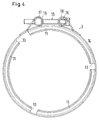
- the clamp 3 engages over the flanges 4 and 10 and pulls with conical side walls 11 and 12, which in the circumferential direction at equal angular intervals interruptions 13 (Fig. 4) to hold an outer strap 14 and thus the entire clamp flexible, the two flanges 4 and 10 when tightening together.
- the clamp 3 is tensioned by means of a screw 15.
- the screw 15 is passed through coaxial holes in a hinge sleeve 16 and screwed through coaxial threaded holes in a hinge sleeve 17.
- the hinge sleeves 16, 17 are surrounded by loops 18 which are formed by bent-back end portions of the tension band 14. The bent-back ends of the loops 18 are welded to the remaining part of the tension band 14.
- the clamping screw 15 is passed through slots in the loops.
- the second tube 2 has between the second flange 10 and its remaining tube portion 19 an elastically flexible cylindrical portion 20, whose inner diameter is greater than the outer diameter of the first tube 1 and the cylindrical extension 9.
- a transition section 21 (Fig. 1) between the cylindrical section 20 and the remaining pipe section 19 of the pipe 2 is conical and also elastically flexible.
- a sealing ring 22 made of resilient steel sheet in the tensioned state of the clamp 3 is clamped.
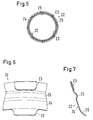
- FIGS. 2 and 5 to 7 show more clearly, eight edge sections 23 are bent back in the form of tabs onto part of the remaining sealing ring section 24.
- the remaining sealing ring portion 24 has a over the thickness of the bent edge portions 23 in the untensioned state of the clamp projecting bead 25 which extends over the entire circumference of the sealing ring 22.
- the radially inner edge of the sealing ring 22 is provided with three corresponding to the rounding 7 curved alignment tabs 26 at the same circumferential intervals.
- the flange 4 Due to the air trapped in the annulus between the first flange 4 and the tube 1, the flange 4 remains relatively cool when a hot fluid, such as hot exhaust gases, is passed through the tubes 1 and 2.
- the first flange 4 therefore expands less thermally in the radial direction than when it comes into direct contact with the hot fluid. But he can bend under the thermal, radial expansion pressure of the tube 1 with support on the clamp 3 radially inwardly, as its not welded to the tube 1 wall 6 slides along the free end of the tube 1, so that the radial expansion pressure of the tube. 1 is absorbed by the bending of the flange 4 for the most part without completely transferring to the clamp 3.
- the elastic cylindrical portion 20 has the advantage that it bends under the thermal expansion pressure in the second tube 2 and thus also receives a large part of the expansion pressure. At the same time allows the elasticity of the cylindrical portion 20, a bend or radial displacement of the two tubes 1, 2 relative to each other, if they are not exactly coaxial with each other due to a slight incorrect assembly.
- the cylindrical extension 9 of the rounding 7 of the second wall 6 of the flange 4 has the advantage that there is a gap or clearance between the cylindrical extension 9 of the wall 6 of the first flange 4 and the cylindrical portion 20, wherein the extension 9 at the same time a cylindrical Extension of the tube 1 forms and facilitates the mating of both tubes, since the Tube 2 is guided on the extension 9. At the same time both tubes 1, 2 can be largely centered, if they are not first brought together coaxially.
- the conicity and elasticity of the transition section 21 also facilitates a radial thermal expansion of the remaining portion 19 of the tube 2 relative to its cylindrical portion 20 and the second flange 12, so that the radial, thermal expansion pressure of the tube 2 on the clamp 3 in part by the transition section 21 is balanced.
- the existing steel sheet sealing ring 22 holds for a high temperatures stood, as they occur especially in exhaust pipes, but is still elastic in the region of its bead 25.
- This bead 25 receives not only the clamping pressure of the clamp 3, but partly also the axial thermal expansion of both tubes 1, 2 relative to each other, without completely deform back flat. This reversion is prevented by the fact that the bent-back edge portions 23 or tabs act as a stop for the second flange 10 of the tube 2.
- the elasticity of the bead 25 is thus largely retained.
- distributed edge portions 23 may also be provided over the entire circumference of the sealing ring 22 extending edge portion by flanging.
- individual edge sections 23 in the form of tabs can be bent over more easily than a marginal section of the sealing ring 22 that is continuously flanged over the circumference of the remaining sealing ring section 24.
- the bead 25 preferably extends over the entire circumference of the sealing ring 22. It can therefore be formed by a simple embossing tool. Alternatively, it would also be possible to divide the bead 25 into individual beads or provide radial, distributed over the circumference of the sealing ring 22 beads. However, these would have a higher rigidity than the over the entire circumference of the remaining sealing ring portion 24 extending bead 25th
Landscapes
- Engineering & Computer Science (AREA)
- General Engineering & Computer Science (AREA)
- Mechanical Engineering (AREA)
- Chemical & Material Sciences (AREA)
- Combustion & Propulsion (AREA)
- Flanged Joints, Insulating Joints, And Other Joints (AREA)
- Joints With Sleeves (AREA)
- Quick-Acting Or Multi-Walled Pipe Joints (AREA)
- Non-Disconnectible Joints And Screw-Threaded Joints (AREA)
- Earth Drilling (AREA)
- Joints Allowing Movement (AREA)
Abstract
Description
- Die Erfindung betrifft eine Verbindung zweier Rohre, von denen ein erstes Rohr einen mit einer ersten Wand am Rohrumfang angeschweißten ersten Flansch aus Blech aufweist und ein zweites Rohr einen als zweiter Flansch geformten Endabschnitt aufweist, mit einer die Flansche übergreifenden, spannbaren Schelle, die konische Seitenwände aufweist, durch die die Flansche beim Spannen der Schelle axial zueinander hin gedrückt werden. Sie betrifft ferner einen Dichtring für die Verbindung.
- Eine bekannte Vorrichtung dieser Art ist in dem Prospekt Nr. 6 "NORMA® PROFILSCHELLEN KEGELFLANSCHVERBIN-DUNGEN", September 1987, Seite 6, linke Spalte, oberstes Bild, schematisch als Ausschnitt dargestellt. Bei dieser Verbindung berühren sich die freien Enden beider Flansche, wobei sie zusammen mit dem ersten Rohr, an dem der erste Flansch angeschweißt ist, einen Ringraum begrenzen. Wenn die zu verbindenden Rohre Teile einer Abgasrohrleitung eines Kraftfahrzeugs sind, strömen sehr heiße Abgase mit einer Temperatur von etwa 900 bis 1000°C hindurch. Dadurch werden die Rohre sehr stark erhitzt, so daß sie sich radial stärker als die Schelle ausdehnen (aufweiten), die einer geringeren Temperatur ausgesetzt ist, weil sie radial außen liegt und somit überdehnt werden und reißen kann.
- Der Erfindung liegt die Aufgabe zugrunde, eine Rohrverbindung der eingangs genannten Art anzugeben, bei der die Schelle einer geringeren thermischen Belastung ausgesetzt ist.
- Erfindungsgemäß ist diese Aufgabe dadurch gelöst, daß der erste Flansch einen zur Längsmittelachse des ersten Rohres koaxialen, geschlossenen Ringraum mit dem ersten Rohr begrenzt, wobei sich eine zweite Wand des ersten Flansches am freien Ende des ersten Rohres gleitend abstützt.
- Bei dieser Lösung bleibt der erste Flansch aufgrund der in dem Ringraum eingeschlossenen Luft relativ kühl. Der erste Flansch weitet sich mithin thermisch weniger stark auf, kann sich aber unter dem thermischen, radialen Aufweitungsdruck des ersten Rohres relativ zu diesem, unter Abstützung an der Schelle, radial nach innen biegen, da seine nicht am ersten Rohr angeschweißte Wand an dem freien Ende des ersten Rohres entlanggleitet, so daß der radiale Aufweitungsdruck des ersten Rohres durch die Verbiegung des ersten Flansches zum größten Teil aufgenommen wird, ohne sich vollständig auf die Schelle zu übertragen.
- Vorzugsweise ist das freie Ende des ersten Rohres abgeschrägt. Auf dieser Schräge des ersten Rohres kann die zweite Wand des ersten Flansches unter dem radialen, thermischen Aufweitungsdruck leichter entlanggleiten.
- Wenn sich die zweite Wand des ersten Flansches mit einer Rundung am freien Ende des ersten Rohres abstützt, kann die zweite Wand des ersten Flansches unter dem radialen Aufweitungsdruck noch leichter an der Schräge des ersten Rohres entlanggleiten.
- Sodann kann dafür gesorgt sein, daß das zweite Rohr zwischen dem zweiten Flansch und seinem übrigen Rohrabschnitt einen elastisch biegsamen, zylindrischen Abschnitt aufweist. Durch eine radiale elastische Verbiegung des zylindrischen Abschnitts kann auch ein großer Teil des radialen Aufweitungsdrucks des zweiten Rohres aufgenommen werden. Gleichzeitig läßt die Elastizität des zylindrischen Abschnitts eine Abwinklung oder radiale Versetzung der beiden Rohre relativ zueinander zu, wenn sie aufgrund einer geringfügigen Fehlmontage nicht genau koaxial miteinander fluchten.
- Ferner kann der Innendurchmesser des zylindrischen Abschnitts größer als der Außendurchmesser des ersten Rohres sein. Dies ermöglicht es, daß der zwischen dem zylindrischen Abschnitt und dem mit ihm verbundenen übrigen Rohrabschnitt des zweiten Rohres vorhandene Übergangsabschnitt des zweiten Rohres sich unter dem axialen thermischen Dehnungsdruck beider Rohre verbiegen kann und damit für einen axialen Dehnungsausgleich sorgt.
- Vorzugsweise ist ferner dafür gesorgt, daß die Rundung der zweiten Wand des ersten Flansches in einen zylindrischen Fortsatz übergeht und der Innendurchmesser des zylindrischen Abschnitts des zweiten Rohres größer als der Außendurchmesser des Fortsatzes ist. Diese Ausbildung hat den Vorteil, daß sich ein Spalt oder Spiel zwischen dem zylindrischen Fortsatz der zweiten Wand des ersten Flansches ergibt, wobei der Fortsatz gleichzeitig einen zylindrischen Fortsatz des ersten Rohres bildet und das Zusammenstecken beider Rohre erleichtert, da das zweite Rohr auf dem Fortsatz geführt wird. Gleichzeitig lassen sich dadurch beide Rohre weitgehend zentrieren, wenn sie zunächst nicht koaxial zusammengeführt werden.
- Günstig ist es ferner, wenn der Übergangsabschnitt zwischen dem zylindrischen Abschnitt und dem mit ihm verbundenen übrigen Rohrabschnitt des zweiten Rohres konisch ist. Die Konizität und Elastizität des Übergangsabschnitts erleichtert ebenfalls eine radiale thermische Aufweitung des übrigen Rohrabschnitts des zweiten Rohres relativ zu seinem zylindrischen Abschnitt und dem zweiten Flansch, so daß der radiale thermische Aufweitungsdruck des zweiten Rohres auf die Schelle zum Teil auch durch den Übergangsabschnitt ausgeglichen wird.
- Eine weitere vorteilhafte Ausgestaltung besteht darin, daß die Verbindung zwischen den Flanschen einen Dichtring in Form eines elastischen Stahlbands mit wenigstens einem Randabschnitt aufweist, der auf einen Teil des übrigen Dichtringabschnitts zurückgebogen ist, und daß der übrige Dichtringabschnitt wenigstens eine über die Dicke des umgebogenen Randabschnitts im ungespannten Zustand der Schelle hinausragende Sicke aufweist. Dieser Dichtring hält zum einen sehr hohen Temperaturen stand, wie sie insbesondere bei Abgasrohren auftreten, ist aber dennoch im Bereich seiner Sicke elastisch. Diese Sicke nimmt nicht nur den Einspanndruck auf, sondern auch die axiale thermische Dehnung beider Rohre relativ zueinander, ohne sich vollständig eben zurückzuverformen. Diese Rückverformung wird dadurch verhindert, daß der oder die zurückgebogene(n) Randabschnitt(e) als Anschlag für den zweiten Flansch des zweiten Rohres wirkt bzw. wirken und dadurch eine weitere Rückverformung der Sicke(n) verhindert bzw. verhindern. Die Elastizität der Sicke(n) bleibt mithin weitgehend erhalten und trägt zur Verringerung der thermischen Axialbelastung der Schelle durch thermische Dehnung der Rohre bei.
- Jeder Randabschnitt kann eine Lasche bilden, die sich leichter umbiegen läßt als ein durchgehend über den Umfang des übrigen Dichtungsabschnitts umgebördelter Randabschnitt des Dichtrings.
- Die Sicke erstreckt sich vorzugsweise über den gesamten Umfang des Dichtrings. Sie kann daher durch ein einfaches Prägewerkzeug geformt werden.
- Die Erfindung und ihre Weiterbildungen werden nachstehend anhand der beiliegenden Zeichnung eines bevorzugten Ausführungsbeispiels näher beschrieben. Darin stellen dar:
- Fig. 1
- einen Ausschnitt eines Axialschnitts einer erfindungsgemäßen Verbindung zweier Rohre,
- Fig. 2
- einen vergrößerten Ausschnitt der in Fig. 1 dargestellten Rohrverbindung,
- Fig. 3
- ein vergrößertes Detail der Fig. 1,
- Fig. 4
- eine Seitenansicht einer Schelle, die für die Verbindung nach Fig. 1 verwendet wird, in größerem Maßstab,
- Fig. 5
- eine verkleinerte Seitenansicht des Dichtrings der in den Fig. 1 und 2 dargestellten Verbindung,
- Fig. 6
- einen vergrößerten Ausschnitt des Dichtrings nach Fig. 5 und
- Fig. 7
- einen Querschnitt des Dichtrings nach Fig. 6.
- Die Verbindung in den Fig. 1 und 2 eines ersten Rohres 1 mit einem zweiten Rohr 2 mittels einer spannbaren Schelle 3 hat einen ersten Flansch 4 aus federndem Blech mit einer schrägen ersten Wand 5 und einer schrägen zweiten Wand 6. Die Wand 5 ist am Umfang des Rohres 1 angeschweißt. Die Wand 6 stützt sich mit einer Rundung 7 gleitend an einer Abschrägung 8 am freien Ende des Rohres 1 ab. Die Abschrägung 8 schließt mit der Axialrichtung des Rohres einen spitzen Winkel β von etwa 30° ein. Die Rundung 7 geht in einen zylindrischen Fortsatz 9 über, dessen Innen- und Außendurchmesser jeweils gleich dem Innen- und Außendurchmesser des Rohres 1 sind. Der Flansch 4 schließt daher zusammen mit dem Rohr 1 einen mit Luft gefüllten Ringraum ab.
- Ein Endabschnitt des zweiten Rohres 2 bildet einen zweiten Flansch 10.
- Die Schelle 3 übergreift die Flansche 4 und 10 und zieht mit konischen Seitenwänden 11 und 12, die in Umfangsrichtung in gleichen Winkelabständen Unterbrechungen 13 aufweisen (Fig. 4), um ein äußeres Spannband 14 und damit die gesamte Schelle flexibel zu halten, die beiden Flansche 4 und 10 beim Spannen zusammen. Die Schelle 3 wird mittels einer Schraube 15 gespannt. Die Schraube 15 ist durch koaxiale Löcher in einer Gelenkhülse 16 hindurchgeführt und durch koaxiale Gewindelöcher in einer Gelenkhülse 17 hindurchgeschraubt. Die Gelenkhülsen 16, 17 sind von Schlaufen 18 umgeben, die durch zurückgebogene Endabschnitte des Spannbands 14 gebildet sind. Die zurückgebogenen Enden der Schlaufen 18 sind am übrigen Teil des Spannbandes 14 angeschweißt. Die Spannschraube 15 ist durch Schlitze in den Schlaufen hindurchgeführt.
- Das zweite Rohr 2 hat zwischen dem zweiten Flansch 10 und seinem übrigen Rohrabschnitt 19 einen elastisch biegsamen zylindrischen Abschnitt 20, dessen Innendurchmesser größer als der Außendurchmesser des ersten Rohres 1 und des zylindrischen Fortsatzes 9 ist. Ein Übergangsabschnitt 21 (Fig. 1) zwischen dem zylindrischen Abschnitt 20 und dem übrigen Rohrabschnitt 19 des Rohres 2 ist konisch und ebenfalls elastisch biegsam.
- Zwischen den beiden Flanschen 4 und 10 ist ein Dichtring 22 aus federndem Stahlblech im gespannten Zustand der Schelle 3 eingeklemmt.
- Wie die Fig. 2 und 5 bis 7 deutlicher zeigen, sind acht Randabschnitte 23 in Form von Laschen auf einen Teil des übrigen Dichtringabschnitts 24 zurückgebogen. Der übrige Dichtringabschnitt 24 hat eine über die Dicke der umgebogenen Randabschnitte 23 im ungespannten Zustand der Schelle hinausragende Sicke 25, die sich über den gesamten Umfang des Dichtrings 22 erstreckt. Der radial innere Rand des Dichtrings 22 ist mit drei entsprechend der Rundung 7 gekrümmten Angleichungslaschen 26 in gleichen Umfangsabständen versehen.
- Nachstehend werden die Wirkungsweise und Vorteile des dargestellten Ausführungsbeispiels näher beschrieben.
- Durch die in dem Ringraum zwischen dem ersten Flansch 4 und dem Rohr 1 eingeschlossene Luft bleibt der Flansch 4 relativ kühl, wenn ein heißes Fluid, wie heiße Abgase, durch die Rohre 1 und 2 geleitet wird. Der erste Flansch 4 weitet sich mithin in radialer Richtung thermisch weniger stark auf als wenn er unmittelbar mit dem heißen Fluid in Berührung kommt. Er kann sich aber unter dem thermischen, radialen Aufweitungsdruck des Rohres 1 unter Abstützung an der Schelle 3 radial nach innen biegen, da seine nicht am Rohr 1 angeschweißte Wand 6 an dem freien Ende des Rohres 1 entlanggleitet, so daß der radiale Aufweitungsdruck des Rohres 1 durch die Verbiegung des Flansches 4 zum größten Teil aufgenommen wird, ohne sich vollständig auf die Schelle 3 zu übertragen. Hierzu trägt insbesondere die Abschrägung 8 des Rohres 1 bei, weil die Wand 6 des Flansches 4 unter dem radialen, thermischen Aufweitungsdruck und der diesem entgegenwirkenden Schelle 3 an der Abschrägung 8 leichter entlanggleiten kann. Die Rundung 7 der Wand 6 des Flansches 4 erleichtert zusätzlich das Entlanggleiten der Wand 6 an der Abschrägung 8.
- Der elastische zylindrische Abschnitt 20 hat den Vorteil, daß er sich unter dem thermischen Aufweitungsdruck im zweiten Rohr 2 verbiegt und somit ebenfalls einen großen Teil des Aufweitungsdrucks aufnimmt. Gleichzeitig läßt die Elastizität des zylindrischen Abschnitts 20 eine Abwinklung oder radiale Versetzung der beiden Rohre 1, 2 relativ zueinander zu, wenn sie aufgrund einer geringfügigen Fehlmontage nicht genau koaxial miteinander fluchten.
- Da der Innendurchmesser des zylindrischen Abschnitts 20 größer als der Außendurchmesser des ersten Rohres 1 ist, kann sich der zwischen dem zylindrischen Abschnitt 20 und dem mit ihm verbundenen übrigen Rohrabschnitt 19 des Rohres 2 vorhandene Übergangsabschnitt 21 des Rohres 2 unter dem axialen thermischen Dehnungsdruck beider Rohre 1, 2 verbiegen und damit für einen axialen Dehnungsausgleich sorgen.
- Der zylindrische Fortsatz 9 der Rundung 7 der zweiten Wand 6 des Flansches 4 hat den Vorteil, daß sich ein Spalt oder Spiel zwischen dem zylindrischen Fortsatz 9 der Wand 6 des ersten Flansches 4 und dem zylindrischen Abschnitt 20 ergibt, wobei der Fortsatz 9 gleichzeitig einen zylindrischen Fortsatz des Rohres 1 bildet und das Zusammenstecken beider Rohre erleichtert, da das Rohr 2 auf dem Fortsatz 9 geführt wird. Gleichzeitig lassen sich dadurch beide Rohre 1, 2 weitgehend zentrieren, wenn sie zunächst nicht koaxial zusammengeführt werden.
- Die Konizität und Elastizität des Übergangsabschnitts 21 erleichtert ebenfalls eine radiale thermische Aufweitung des übrigen Abschnitts 19 des Rohres 2 relativ zu seinem zylindrischen Abschnitt 20 und dem zweiten Flansch 12, so daß der radiale, thermische Aufweitungsdruck des Rohres 2 auf die Schelle 3 zum Teil auch durch den Übergangsabschnitt 21 ausgeglichen wird.
- Der aus Stahlblech bestehende Dichtring 22 hält zum einen hohen Temperaturen stand, wie sie insbesondere bei Abgasrohren auftreten, ist aber dennoch im Bereich seiner Sicke 25 elastisch. Diese Sicke 25 nimmt nicht nur den Einspanndruck der Schelle 3 auf, sondern teilweise auch die axiale thermische Dehnung beider Rohre 1, 2 relativ zueinander, ohne sich vollständig eben zurückzuverformen. Diese Rückverformung wird dadurch verhindert, daß die zurückgebogenen Randabschnitte 23 bzw. Laschen als Anschlag für den zweiten Flansch 10 des Rohres 2 wirken. Die Elastizität der Sicke 25 bleibt mithin weitgehend erhalten. Statt über den Umfang des Dichtrings 22 verteilter Randabschnitte 23 kann auch ein sich über den gesamten Umfang des Dichtrings 22 erstreckender Randabschnitt durch Umbördelung vorgesehen sein. Einzelne Randabschnitte 23 in Form von Laschen lassen sich jedoch leichter umbiegen als ein durchgehend über den Umfang des übrigen Dichtringabschnitts 24 umgebördelter Randabschnitt des Dichtrings 22.
- Die Sicke 25 erstreckt sich vorzugsweise über den gesamten Umfang des Dichtrings 22. Sie kann daher durch ein einfaches Prägewerkzeug geformt werden. Alternativ wäre es aber auch möglich, die Sicke 25 in einzelne Sicken aufzuteilen oder radiale, über den Umfang des Dichtrings 22 verteilte Sicken vorzusehen. Diese hätten jedoch insgesamt eine höhere Steifigkeit als die sich über den gesamten Umfang des übrigen Dichtringabschnitts 24 erstreckende Sicke 25.
Claims (13)
- Verbindung zweier Rohre (1, 2), von denen ein erstes Rohr (1) einen mit einer ersten Wand (5) am Rohrumfang angeschweißten ersten Flansch (4) aus Blech aufweist und ein zweites Rohr (2) einen als zweiter Flansch (10) geformten Endabschnitt aufweist, mit einer die Flansche (4, 10) übergreifenden, spannbaren Schelle (3), die konische Seitenwände (11, 12) aufweist, durch die die Flansche (4, 10) beim Spannen der Schelle (3) axial zueinander hin gedrückt werden, dadurch gekennzeichnet, daß der erste Flansch (4) einen zur Längsmittelachse des ersten Rohres (1) koaxialen, geschlossenen Ringraum mit dem ersten Rohr (1) begrenzt, wobei sich eine zweite Wand (6) des ersten Flansches (4) am freien Ende des ersten Rohres (1) gleitend abstützt.
- Verbindung nach Anspruch 1, dadurch gekennzeichnet, daß das freie Ende des ersten Rohres (1) abgeschrägt ist.
- Verbindung nach Anspruch 1 oder 2, dadurch gekennzeichnet, daß sich die zweite Wand (6) des ersten Flansches (4) mit einer Rundung (7) am freien Ende des ersten Rohres (1) abstützt.
- Verbindung nach einem der Ansprüche 1 bis 3, dadurch gekennzeichnet, daß das zweite Rohr (2) zwischen dem zweiten Flansch (10) und seinem übrigen Rohrabschnitt (19) einen elastisch biegsamen, zylindrischen Abschnitt (20) aufweist.
- Verbindung nach Anspruch 4, dadurch gekennzeichnet, daß der Innendurchmesser des zylindrischen Abschnitts (20) größer als der Außendurchmesser des ersten Rohres (1) ist.
- Verbindung nach den Ansprüchen 3 und 4, dadurch gekennzeichnet, daß die Rundung (7) der zweiten Wand (6) des ersten Flansches (4) in einen zylindrischen Fortsatz (9) übergeht und der Innendurchmesser des zylindrischen Abschnitts (20) des zweiten Rohres (2) größer als der Außendurchmesser des Fortsatzes (9) ist.
- Verbindung nach Anspruch 6, dadurch gekennzeichnet, daß der Übergangsabschnitt (21) zwischen dem zylindrischen Abschnitt (20) und dem mit ihm verbundenen übrigen Rohrabschnitt (19) des zweiten Rohres (2) konisch ist.
- Verbindung nach einem der Ansprüche 1. bis 7, dadurch gekennzeichnet, daß sie zwischen den Flanschen (4, 10) einen Dichtring (22) in Form eines elastischen Stahlbands mit wenigstens einem Randabschnitt (23) aufweist, der auf einen Teil des übrigen Dichtringabschnitts (24) zurückgebogen ist, und daß der übrige Dichtringabschnitt (24) wenigstens eine über die Dicke des umgebogenen Randabschnitts (23) im ungespannten Zustand der Schelle (3) hinausragende Sicke (25) aufweist.
- Verbindung nach Anspruch 8, dadurch gekennzeichnet, daß jeder Randabschnitt (23) eine Lasche bildet.
- Verbindung nach Anspruch 8 oder 9, dadurch gekennzeichnet, daß die Sicke (25) sich über den gesamten Umfang des Dichtrings (22) erstreckt.
- Dichtring für eine Verbindung zweier Rohre (1, 2), von denen ein erstes Rohr (1) einen ersten Flansch (4) und ein zweites Rohr (2) einen zweiten Flansch (10) aufweist, mit einer die Flansche (4, 10) übergreifenden, spannbaren Schelle (3), die konische Seitenwände (11, 12) aufweist, durch die die Flansche (4, 10) beim Spannen der Schelle (3) axial zueinander hin gedrückt werden, wobei der Dichtring zwischen den Flanschen (4, 10) angeordnet wird, dadurch gekennzeichnet, daß der Dichtring (22) ein elastisches Stahlband mit wenigstens einem Randabschnitt (23) aufweist, der auf einen Teil des übrigen Dichtringabschnitts (24) zurückgebogen ist, und daß der übrige Dichtringabschnitt (24) wenigstens eine über die Dicke des umgebogenen Randabschnitts (23) im ungespannten Zustand der Schelle (3) hinausragende Sicke (25) aufweist.
- Dichtring nach Anspruch 11, dadurch gekennzeichnet, daß jeder Randabschnitt (23) eine Lasche bildet.
- Dichtring nach Anspruch 11 oder 12, dadurch gekennzeichnet, daß die Sicke (25) sich über den gesamten Umfang des Dichtrings (22) erstreckt.
Priority Applications (1)
| Application Number | Priority Date | Filing Date | Title |
|---|---|---|---|
| EP10009860A EP2270381B1 (de) | 2004-10-15 | 2005-09-30 | Dichtring für eine Verbindung zweier Rohre |
Applications Claiming Priority (1)
| Application Number | Priority Date | Filing Date | Title |
|---|---|---|---|
| DE102004050302A DE102004050302B4 (de) | 2004-10-15 | 2004-10-15 | Verbindung zweier Rohre und Dichtring für die Verbindung |
Related Child Applications (1)
| Application Number | Title | Priority Date | Filing Date |
|---|---|---|---|
| EP10009860.7 Division-Into | 2010-09-17 |
Publications (3)
| Publication Number | Publication Date |
|---|---|
| EP1647754A2 true EP1647754A2 (de) | 2006-04-19 |
| EP1647754A3 EP1647754A3 (de) | 2007-03-28 |
| EP1647754B1 EP1647754B1 (de) | 2010-11-03 |
Family
ID=35615517
Family Applications (2)
| Application Number | Title | Priority Date | Filing Date |
|---|---|---|---|
| EP10009860A Expired - Lifetime EP2270381B1 (de) | 2004-10-15 | 2005-09-30 | Dichtring für eine Verbindung zweier Rohre |
| EP05021453A Expired - Lifetime EP1647754B1 (de) | 2004-10-15 | 2005-09-30 | Verbindung zweier Rohre |
Family Applications Before (1)
| Application Number | Title | Priority Date | Filing Date |
|---|---|---|---|
| EP10009860A Expired - Lifetime EP2270381B1 (de) | 2004-10-15 | 2005-09-30 | Dichtring für eine Verbindung zweier Rohre |
Country Status (6)
| Country | Link |
|---|---|
| US (1) | US7393020B2 (de) |
| EP (2) | EP2270381B1 (de) |
| JP (1) | JP4134139B2 (de) |
| AT (2) | ATE487081T1 (de) |
| DE (2) | DE102004050302B4 (de) |
| ES (2) | ES2351979T3 (de) |
Cited By (8)
| Publication number | Priority date | Publication date | Assignee | Title |
|---|---|---|---|---|
| EP1873368A3 (de) * | 2006-06-28 | 2008-02-06 | Witzenmann GmbH | Flexibles Metallrohr und Dichtring |
| FR2935745A1 (fr) * | 2008-09-08 | 2010-03-12 | Faurecia Sys Echappement | Volume d'echappement pour vehicule automobile |
| EP2180163A3 (de) * | 2008-10-21 | 2012-05-30 | Benteler Automobiltechnik GmbH | Turbinengehäuse und Verfahren zu seiner Herstellung |
| EP2385228A3 (de) * | 2010-05-05 | 2014-06-25 | Metal Textiles Corporation | Rohrklemme und Dichtungsbandklemme |
| WO2017109458A1 (en) * | 2015-12-22 | 2017-06-29 | Teconnex Ltd | Improved slip joint apparatus and method of use thereof |
| FR3057947A1 (fr) * | 2016-10-26 | 2018-04-27 | Valeo Systemes Thermiques | Dispositif de raccord pour un echangeur thermique de vehicule automobile |
| EP3460307A1 (de) * | 2017-09-22 | 2019-03-27 | NORMA Germany GmbH | Profilschelle mit dichtelement |
| CN112814773A (zh) * | 2019-11-15 | 2021-05-18 | 马自达汽车株式会社 | 内燃机搭载车辆的排气管结构及内燃机搭载车辆制造方法 |
Families Citing this family (19)
| Publication number | Priority date | Publication date | Assignee | Title |
|---|---|---|---|---|
| FR2833065B1 (fr) * | 2001-12-05 | 2004-09-03 | Caillau Ets | Systeme de serrage pour le raccordement etanche de deux tubes ayant des surfaces d'appui |
| JP4917069B2 (ja) * | 2008-04-28 | 2012-04-18 | 株式会社流機エンジニアリング | 送風ダクト |
| US9285066B2 (en) * | 2009-01-15 | 2016-03-15 | Cheminee Securite International Ltee | Positive pressure pipe coupling |
| DE102009039862B4 (de) * | 2009-09-03 | 2013-04-18 | Norma Germany Gmbh | Profilschelle |
| CN104964111B (zh) * | 2009-09-29 | 2017-12-12 | 卡明斯Ip公司 | 球形法兰接头 |
| US20110181037A1 (en) * | 2010-01-22 | 2011-07-28 | International Engine Intellectual Property Company Llc | Alignment clamp |
| DE102010025031A1 (de) * | 2010-06-24 | 2011-12-29 | Benteler Automobiltechnik Gmbh | Wärmetauscher |
| FR2963404B1 (fr) * | 2010-07-27 | 2014-02-07 | Caillau Ets | Systeme de serrage pour le raccordement et le pre-montage d'un premier et d'un deuxieme tube |
| DE102012006756B3 (de) * | 2012-04-03 | 2013-09-12 | Norma Germany Gmbh | Verbindungsanordnung für eine Kegelflanschverbindung und Kegelflanschverbindung |
| GB201209696D0 (en) * | 2012-05-31 | 2012-07-18 | Teconnex Ltd | Clamping means and method of use thereof |
| DE102013219349A1 (de) * | 2012-09-27 | 2014-05-28 | Ifm Electronic Gmbh | Temperatursensor für Hygieneanwendungen mit klemmbaren Prozessanschluss |
| DE102013212545B4 (de) * | 2013-06-28 | 2015-04-02 | Saf-Holland Gmbh | Schale |
| FR3008160B1 (fr) * | 2013-07-03 | 2015-10-09 | Caillau Ets | Dispositif de serrage comprenant un collier et un manchon |
| US20150226368A1 (en) * | 2014-02-12 | 2015-08-13 | Nelson Global Products | Insulated Tube Joint Connection |
| US9926956B2 (en) | 2016-02-19 | 2018-03-27 | Cummins Emission Solutions Inc. | Dual purpose clamp for securing aftertreatment housing joints |
| FR3087868B1 (fr) * | 2018-10-25 | 2021-05-07 | Airbus Operations Sas | Dispositif de raccordement de deux conduits d’une canalisation comportant un jeu de collerettes tronconiques et canalisation comprenant ledit dispositif de raccordement |
| DE102019126484A1 (de) * | 2019-10-01 | 2021-04-01 | Norma Germany Gmbh | Profilschelle mit Verrastlasche |
| DE102020100285A1 (de) * | 2020-01-09 | 2021-07-15 | Eberspächer Exhaust Technology GmbH | Abgasanlage |
| US12435659B2 (en) | 2023-02-01 | 2025-10-07 | Cummins Emission Solutions Inc. | Aftertreatment component cartridge for an aftertreatment system |
Family Cites Families (22)
| Publication number | Priority date | Publication date | Assignee | Title |
|---|---|---|---|---|
| US805645A (en) * | 1904-03-19 | 1905-11-28 | James W Guillott | Gasket. |
| FR8073E (fr) | 1906-10-26 | 1908-01-08 | Julien Marie Adrien Rivals | Servo-moteur électrique de relais |
| DE890588C (de) * | 1950-08-22 | 1953-09-21 | Max Dr-Ing Natter | Luttenverbindung |
| US2761707A (en) * | 1954-12-16 | 1956-09-04 | Aeroquip Corp | Tube coupling with impressionable metallic seal |
| US3180662A (en) * | 1958-07-10 | 1965-04-27 | Flexonics Corp | Tube coupling having a springy metallic gasket |
| US3455582A (en) * | 1967-10-11 | 1969-07-15 | Hanlon & Wilson Co | Multiple segment v-type flange slip joint coupling |
| US3633928A (en) | 1970-03-05 | 1972-01-11 | Douglas Smith | Pipe joint coupling with gasket seal |
| US3674291A (en) * | 1970-11-30 | 1972-07-04 | Lockheed Aircraft Corp | Flange for conduit coupling |
| CH555022A (de) * | 1972-08-10 | 1974-10-15 | Oetiker Hans | Rohrverbindung. |
| US3820831A (en) * | 1973-02-20 | 1974-06-28 | J Swedelius | Coupling for connecting aligned tubes |
| US3964773A (en) * | 1974-09-13 | 1976-06-22 | Mercury Metal Products, Inc. | Anti-emission exhaust pipe joint and clamp therefor |
| US4175754A (en) * | 1978-05-08 | 1979-11-27 | Lockheed Corporation | Seal for fluid ducts |
| US4579374A (en) * | 1982-04-01 | 1986-04-01 | Hymatic Clamps International Limited | Joint structure for connecting hollow members |
| US4597596A (en) * | 1984-11-07 | 1986-07-01 | Heat Transfer Technology Limited | Cylinder end seal |
| US5213345A (en) * | 1986-11-10 | 1993-05-25 | Ishikawa Gasket Co., Ltd. | Steel laminate gasket with wide sealing area |
| JP2841250B2 (ja) * | 1991-09-05 | 1998-12-24 | 日本ガスケット株式会社 | 金属製ガスケット及びその製造方法 |
| DE4219241A1 (de) * | 1992-06-12 | 1992-10-22 | Witzenmann Metallschlauchfab | Gelenkige verbindung von rohrteilen, insbesondere bei abgasleitungen von kraftfahrzeugen |
| US5582415A (en) * | 1993-08-31 | 1996-12-10 | Kokusan Parts Industry Co., Ltd. | Metal gasket |
| US5505498A (en) * | 1994-05-16 | 1996-04-09 | Eg&G Pressure Science, Inc. | Flexible pressure-energized joint |
| US6209883B1 (en) * | 1998-03-04 | 2001-04-03 | Dana Corporation | Single layer head gasket with integral stopper and method of making the same |
| FR2810716B1 (fr) * | 2000-06-23 | 2002-10-04 | Peugeot Citroen Automobiles Sa | Dispositif d'accouplement de deux elements tubulaires formant notamment des elements d'une ligne d'echappement de vehicule automobile |
| FR2867511B1 (fr) * | 2004-03-09 | 2009-04-24 | Faurecia Sys Echappement | Dispositif d'assemblage reversible d'un premier et d'un second troncon tubulaire d'une ligne d'echappement et joint d'etancheite pour un tel dispositif d'assemblage |
-
2004
- 2004-10-15 DE DE102004050302A patent/DE102004050302B4/de not_active Expired - Fee Related
-
2005
- 2005-09-30 EP EP10009860A patent/EP2270381B1/de not_active Expired - Lifetime
- 2005-09-30 EP EP05021453A patent/EP1647754B1/de not_active Expired - Lifetime
- 2005-09-30 DE DE502005010471T patent/DE502005010471D1/de not_active Expired - Lifetime
- 2005-09-30 ES ES05021453T patent/ES2351979T3/es not_active Expired - Lifetime
- 2005-09-30 ES ES10009860T patent/ES2374381T3/es not_active Expired - Lifetime
- 2005-09-30 AT AT05021453T patent/ATE487081T1/de active
- 2005-09-30 AT AT10009860T patent/ATE531989T1/de active
- 2005-10-14 US US11/251,052 patent/US7393020B2/en not_active Expired - Fee Related
- 2005-10-14 JP JP2005300232A patent/JP4134139B2/ja not_active Expired - Fee Related
Non-Patent Citations (1)
| Title |
|---|
| "NORMA® PROFILSCHELLEN KEGELFLANSCHVERBIN- DUNGEN", September 1987, pages: 6 |
Cited By (12)
| Publication number | Priority date | Publication date | Assignee | Title |
|---|---|---|---|---|
| EP1873368A3 (de) * | 2006-06-28 | 2008-02-06 | Witzenmann GmbH | Flexibles Metallrohr und Dichtring |
| FR2935745A1 (fr) * | 2008-09-08 | 2010-03-12 | Faurecia Sys Echappement | Volume d'echappement pour vehicule automobile |
| EP2180163A3 (de) * | 2008-10-21 | 2012-05-30 | Benteler Automobiltechnik GmbH | Turbinengehäuse und Verfahren zu seiner Herstellung |
| EP2385228A3 (de) * | 2010-05-05 | 2014-06-25 | Metal Textiles Corporation | Rohrklemme und Dichtungsbandklemme |
| WO2017109458A1 (en) * | 2015-12-22 | 2017-06-29 | Teconnex Ltd | Improved slip joint apparatus and method of use thereof |
| FR3057947A1 (fr) * | 2016-10-26 | 2018-04-27 | Valeo Systemes Thermiques | Dispositif de raccord pour un echangeur thermique de vehicule automobile |
| WO2018078238A1 (fr) * | 2016-10-26 | 2018-05-03 | Valeo Systemes Thermiques | Dispositif de raccord pour un echangeur thermique de vehicule automobile |
| EP3460307A1 (de) * | 2017-09-22 | 2019-03-27 | NORMA Germany GmbH | Profilschelle mit dichtelement |
| CN109538853A (zh) * | 2017-09-22 | 2019-03-29 | 德国诺玛公司 | 具有密封组件的型材夹具 |
| US10794518B2 (en) | 2017-09-22 | 2020-10-06 | Norma Germany Gmbh | Profile clamp having sealing element |
| CN112814773A (zh) * | 2019-11-15 | 2021-05-18 | 马自达汽车株式会社 | 内燃机搭载车辆的排气管结构及内燃机搭载车辆制造方法 |
| EP3822466A1 (de) * | 2019-11-15 | 2021-05-19 | Mazda Motor Corporation | Abgasrohrstruktur, fahrzeug und verfahren zur herstellung des fahrzeugs |
Also Published As
| Publication number | Publication date |
|---|---|
| EP2270381A1 (de) | 2011-01-05 |
| ATE487081T1 (de) | 2010-11-15 |
| DE102004050302A1 (de) | 2006-05-04 |
| EP1647754B1 (de) | 2010-11-03 |
| ATE531989T1 (de) | 2011-11-15 |
| EP2270381B1 (de) | 2011-11-02 |
| ES2351979T3 (es) | 2011-02-14 |
| US7393020B2 (en) | 2008-07-01 |
| US20060082154A1 (en) | 2006-04-20 |
| EP1647754A3 (de) | 2007-03-28 |
| JP2006112631A (ja) | 2006-04-27 |
| ES2374381T3 (es) | 2012-02-16 |
| DE102004050302B4 (de) | 2010-09-30 |
| JP4134139B2 (ja) | 2008-08-13 |
| DE502005010471D1 (de) | 2010-12-16 |
Similar Documents
| Publication | Publication Date | Title |
|---|---|---|
| EP1647754B1 (de) | Verbindung zweier Rohre | |
| DE69825637T2 (de) | Dichtring für röhrenförmiges Element | |
| DE69411935T2 (de) | Schlauchschelle | |
| DE3605020C2 (de) | ||
| DE2832614C2 (de) | Verbindungsstück für Rohrleitungen | |
| DE102004050300B4 (de) | Profilschelle | |
| DE19514940C1 (de) | Rohrkupplung | |
| EP3460307A1 (de) | Profilschelle mit dichtelement | |
| EP0214395A1 (de) | Elastische Rohrverbindung, insbesondere flexible Rohrkupplung | |
| DE69703856T2 (de) | Kupplung für zwei Metallrohre | |
| WO2009015927A1 (de) | Pressfitting fuer ein rohr, insbesondere kunststoffrohr oder kunststoff-metall-verbundrohr | |
| DE102007008759B3 (de) | Pressfitting für ein Rohr | |
| DE1872225U (de) | Rohrkupplung. | |
| EP3807564B1 (de) | Profilschelle | |
| DE102012005943A1 (de) | Vorrichtung zum Verbinden von zwei Rundkörpern mit unterschiedlichen Außendurchmessern | |
| DE4317256C2 (de) | Rohrverbindung, insbesondere in einer Brennkraftmaschinen-Abgasanlage | |
| EP0498322B1 (de) | Vorrichtung zum abgedichteten Verbinden der glattzylindrischen Enden zweier Rohre | |
| DE102010009618A1 (de) | Anschlussvorrichtung für ein modulares Installationssystem | |
| WO2000060265A1 (de) | Vorrichtung zum verbinden von rohrstücken | |
| DE19539824C1 (de) | Rohrschelle | |
| DE3445662A1 (de) | Anschlusshuelse an metallringwellschlauch | |
| DE102004056792C5 (de) | Rohrverbindung | |
| DE3047382A1 (de) | "rohrverbindung" | |
| EP1298374B2 (de) | Rohrsystem und Rohrschelle für ein Rohrsystem | |
| DE202019100995U1 (de) | Halteelement und Rohrverbindungsanordnung |
Legal Events
| Date | Code | Title | Description |
|---|---|---|---|
| PUAI | Public reference made under article 153(3) epc to a published international application that has entered the european phase |
Free format text: ORIGINAL CODE: 0009012 |
|
| 17P | Request for examination filed |
Effective date: 20060222 |
|
| AK | Designated contracting states |
Kind code of ref document: A2 Designated state(s): AT BE BG CH CY CZ DE DK EE ES FI FR GB GR HU IE IS IT LI LT LU LV MC NL PL PT RO SE SI SK TR |
|
| AX | Request for extension of the european patent |
Extension state: AL BA HR MK YU |
|
| PUAL | Search report despatched |
Free format text: ORIGINAL CODE: 0009013 |
|
| AK | Designated contracting states |
Kind code of ref document: A3 Designated state(s): AT BE BG CH CY CZ DE DK EE ES FI FR GB GR HU IE IS IT LI LT LU LV MC NL PL PT RO SE SI SK TR |
|
| AX | Request for extension of the european patent |
Extension state: AL BA HR MK YU |
|
| RAP1 | Party data changed (applicant data changed or rights of an application transferred) |
Owner name: NORMA GERMANY GMBH |
|
| AKX | Designation fees paid |
Designated state(s): AT BE BG CH CY CZ DE DK EE ES FI FR GB GR HU IE IS IT LI LT LU LV MC NL PL PT RO SE SI SK TR |
|
| GRAP | Despatch of communication of intention to grant a patent |
Free format text: ORIGINAL CODE: EPIDOSNIGR1 |
|
| RTI1 | Title (correction) |
Free format text: CONNECTION OF TWO PIPES |
|
| GRAS | Grant fee paid |
Free format text: ORIGINAL CODE: EPIDOSNIGR3 |
|
| RAP1 | Party data changed (applicant data changed or rights of an application transferred) |
Owner name: NORMA GERMANY GMBH |
|
| GRAA | (expected) grant |
Free format text: ORIGINAL CODE: 0009210 |
|
| AK | Designated contracting states |
Kind code of ref document: B1 Designated state(s): AT BE BG CH CY CZ DE DK EE ES FI FR GB GR HU IE IS IT LI LT LU LV MC NL PL PT RO SE SI SK TR |
|
| REG | Reference to a national code |
Ref country code: GB Ref legal event code: FG4D Free format text: NOT ENGLISH |
|
| REG | Reference to a national code |
Ref country code: CH Ref legal event code: EP |
|
| REG | Reference to a national code |
Ref country code: IE Ref legal event code: FG4D Free format text: LANGUAGE OF EP DOCUMENT: GERMAN |
|
| REF | Corresponds to: |
Ref document number: 502005010471 Country of ref document: DE Date of ref document: 20101216 Kind code of ref document: P |
|
| REG | Reference to a national code |
Ref country code: SE Ref legal event code: TRGR |
|
| REG | Reference to a national code |
Ref country code: ES Ref legal event code: FG2A Effective date: 20110202 |
|
| REG | Reference to a national code |
Ref country code: NL Ref legal event code: VDEP Effective date: 20101103 |
|
| LTIE | Lt: invalidation of european patent or patent extension |
Effective date: 20101103 |
|
| PG25 | Lapsed in a contracting state [announced via postgrant information from national office to epo] |
Ref country code: LT Free format text: LAPSE BECAUSE OF FAILURE TO SUBMIT A TRANSLATION OF THE DESCRIPTION OR TO PAY THE FEE WITHIN THE PRESCRIBED TIME-LIMIT Effective date: 20101103 |
|
| REG | Reference to a national code |
Ref country code: IE Ref legal event code: FD4D |
|
| PG25 | Lapsed in a contracting state [announced via postgrant information from national office to epo] |
Ref country code: PT Free format text: LAPSE BECAUSE OF FAILURE TO SUBMIT A TRANSLATION OF THE DESCRIPTION OR TO PAY THE FEE WITHIN THE PRESCRIBED TIME-LIMIT Effective date: 20110303 Ref country code: LV Free format text: LAPSE BECAUSE OF FAILURE TO SUBMIT A TRANSLATION OF THE DESCRIPTION OR TO PAY THE FEE WITHIN THE PRESCRIBED TIME-LIMIT Effective date: 20101103 Ref country code: IS Free format text: LAPSE BECAUSE OF FAILURE TO SUBMIT A TRANSLATION OF THE DESCRIPTION OR TO PAY THE FEE WITHIN THE PRESCRIBED TIME-LIMIT Effective date: 20110303 Ref country code: FI Free format text: LAPSE BECAUSE OF FAILURE TO SUBMIT A TRANSLATION OF THE DESCRIPTION OR TO PAY THE FEE WITHIN THE PRESCRIBED TIME-LIMIT Effective date: 20101103 Ref country code: NL Free format text: LAPSE BECAUSE OF FAILURE TO SUBMIT A TRANSLATION OF THE DESCRIPTION OR TO PAY THE FEE WITHIN THE PRESCRIBED TIME-LIMIT Effective date: 20101103 Ref country code: BG Free format text: LAPSE BECAUSE OF FAILURE TO SUBMIT A TRANSLATION OF THE DESCRIPTION OR TO PAY THE FEE WITHIN THE PRESCRIBED TIME-LIMIT Effective date: 20110203 Ref country code: SI Free format text: LAPSE BECAUSE OF FAILURE TO SUBMIT A TRANSLATION OF THE DESCRIPTION OR TO PAY THE FEE WITHIN THE PRESCRIBED TIME-LIMIT Effective date: 20101103 |
|
| PG25 | Lapsed in a contracting state [announced via postgrant information from national office to epo] |
Ref country code: GR Free format text: LAPSE BECAUSE OF FAILURE TO SUBMIT A TRANSLATION OF THE DESCRIPTION OR TO PAY THE FEE WITHIN THE PRESCRIBED TIME-LIMIT Effective date: 20110204 |
|
| PG25 | Lapsed in a contracting state [announced via postgrant information from national office to epo] |
Ref country code: EE Free format text: LAPSE BECAUSE OF FAILURE TO SUBMIT A TRANSLATION OF THE DESCRIPTION OR TO PAY THE FEE WITHIN THE PRESCRIBED TIME-LIMIT Effective date: 20101103 Ref country code: IE Free format text: LAPSE BECAUSE OF FAILURE TO SUBMIT A TRANSLATION OF THE DESCRIPTION OR TO PAY THE FEE WITHIN THE PRESCRIBED TIME-LIMIT Effective date: 20101103 Ref country code: CZ Free format text: LAPSE BECAUSE OF FAILURE TO SUBMIT A TRANSLATION OF THE DESCRIPTION OR TO PAY THE FEE WITHIN THE PRESCRIBED TIME-LIMIT Effective date: 20101103 |
|
| PG25 | Lapsed in a contracting state [announced via postgrant information from national office to epo] |
Ref country code: DK Free format text: LAPSE BECAUSE OF FAILURE TO SUBMIT A TRANSLATION OF THE DESCRIPTION OR TO PAY THE FEE WITHIN THE PRESCRIBED TIME-LIMIT Effective date: 20101103 Ref country code: SK Free format text: LAPSE BECAUSE OF FAILURE TO SUBMIT A TRANSLATION OF THE DESCRIPTION OR TO PAY THE FEE WITHIN THE PRESCRIBED TIME-LIMIT Effective date: 20101103 Ref country code: RO Free format text: LAPSE BECAUSE OF FAILURE TO SUBMIT A TRANSLATION OF THE DESCRIPTION OR TO PAY THE FEE WITHIN THE PRESCRIBED TIME-LIMIT Effective date: 20101103 Ref country code: PL Free format text: LAPSE BECAUSE OF FAILURE TO SUBMIT A TRANSLATION OF THE DESCRIPTION OR TO PAY THE FEE WITHIN THE PRESCRIBED TIME-LIMIT Effective date: 20101103 |
|
| PLBE | No opposition filed within time limit |
Free format text: ORIGINAL CODE: 0009261 |
|
| STAA | Information on the status of an ep patent application or granted ep patent |
Free format text: STATUS: NO OPPOSITION FILED WITHIN TIME LIMIT |
|
| 26N | No opposition filed |
Effective date: 20110804 |
|
| PGFP | Annual fee paid to national office [announced via postgrant information from national office to epo] |
Ref country code: GB Payment date: 20110923 Year of fee payment: 7 Ref country code: SE Payment date: 20110923 Year of fee payment: 7 Ref country code: FR Payment date: 20111005 Year of fee payment: 7 Ref country code: ES Payment date: 20110923 Year of fee payment: 7 Ref country code: DE Payment date: 20110916 Year of fee payment: 7 |
|
| REG | Reference to a national code |
Ref country code: DE Ref legal event code: R097 Ref document number: 502005010471 Country of ref document: DE Effective date: 20110804 |
|
| BERE | Be: lapsed |
Owner name: NORMA GERMANY G.M.B.H. Effective date: 20110930 |
|
| PG25 | Lapsed in a contracting state [announced via postgrant information from national office to epo] |
Ref country code: MC Free format text: LAPSE BECAUSE OF NON-PAYMENT OF DUE FEES Effective date: 20110930 |
|
| REG | Reference to a national code |
Ref country code: CH Ref legal event code: PL |
|
| PG25 | Lapsed in a contracting state [announced via postgrant information from national office to epo] |
Ref country code: BE Free format text: LAPSE BECAUSE OF NON-PAYMENT OF DUE FEES Effective date: 20110930 |
|
| PG25 | Lapsed in a contracting state [announced via postgrant information from national office to epo] |
Ref country code: CH Free format text: LAPSE BECAUSE OF NON-PAYMENT OF DUE FEES Effective date: 20110930 Ref country code: LI Free format text: LAPSE BECAUSE OF NON-PAYMENT OF DUE FEES Effective date: 20110930 |
|
| REG | Reference to a national code |
Ref country code: AT Ref legal event code: MM01 Ref document number: 487081 Country of ref document: AT Kind code of ref document: T Effective date: 20110930 |
|
| PG25 | Lapsed in a contracting state [announced via postgrant information from national office to epo] |
Ref country code: AT Free format text: LAPSE BECAUSE OF NON-PAYMENT OF DUE FEES Effective date: 20110930 |
|
| GBPC | Gb: european patent ceased through non-payment of renewal fee |
Effective date: 20120930 |
|
| PG25 | Lapsed in a contracting state [announced via postgrant information from national office to epo] |
Ref country code: CY Free format text: LAPSE BECAUSE OF EXPIRATION OF PROTECTION Effective date: 20101103 Ref country code: LU Free format text: LAPSE BECAUSE OF NON-PAYMENT OF DUE FEES Effective date: 20110930 |
|
| REG | Reference to a national code |
Ref country code: FR Ref legal event code: ST Effective date: 20130531 |
|
| PG25 | Lapsed in a contracting state [announced via postgrant information from national office to epo] |
Ref country code: SE Free format text: LAPSE BECAUSE OF NON-PAYMENT OF DUE FEES Effective date: 20121001 Ref country code: GB Free format text: LAPSE BECAUSE OF NON-PAYMENT OF DUE FEES Effective date: 20120930 Ref country code: DE Free format text: LAPSE BECAUSE OF NON-PAYMENT OF DUE FEES Effective date: 20130403 |
|
| PG25 | Lapsed in a contracting state [announced via postgrant information from national office to epo] |
Ref country code: FR Free format text: LAPSE BECAUSE OF NON-PAYMENT OF DUE FEES Effective date: 20121001 Ref country code: IT Free format text: LAPSE BECAUSE OF NON-PAYMENT OF DUE FEES Effective date: 20120930 |
|
| REG | Reference to a national code |
Ref country code: DE Ref legal event code: R119 Ref document number: 502005010471 Country of ref document: DE Effective date: 20130403 |
|
| PG25 | Lapsed in a contracting state [announced via postgrant information from national office to epo] |
Ref country code: TR Free format text: LAPSE BECAUSE OF FAILURE TO SUBMIT A TRANSLATION OF THE DESCRIPTION OR TO PAY THE FEE WITHIN THE PRESCRIBED TIME-LIMIT Effective date: 20101103 |
|
| REG | Reference to a national code |
Ref country code: ES Ref legal event code: FD2A Effective date: 20131023 |
|
| PG25 | Lapsed in a contracting state [announced via postgrant information from national office to epo] |
Ref country code: HU Free format text: LAPSE BECAUSE OF FAILURE TO SUBMIT A TRANSLATION OF THE DESCRIPTION OR TO PAY THE FEE WITHIN THE PRESCRIBED TIME-LIMIT Effective date: 20101103 |
|
| PG25 | Lapsed in a contracting state [announced via postgrant information from national office to epo] |
Ref country code: ES Free format text: LAPSE BECAUSE OF NON-PAYMENT OF DUE FEES Effective date: 20121001 |