EP1646674B1 - Asymmetrische polymerfolie, verfahren zu deren herstellung sowie deren verwendung - Google Patents
Asymmetrische polymerfolie, verfahren zu deren herstellung sowie deren verwendung Download PDFInfo
- Publication number
- EP1646674B1 EP1646674B1 EP04740851A EP04740851A EP1646674B1 EP 1646674 B1 EP1646674 B1 EP 1646674B1 EP 04740851 A EP04740851 A EP 04740851A EP 04740851 A EP04740851 A EP 04740851A EP 1646674 B1 EP1646674 B1 EP 1646674B1
- Authority
- EP
- European Patent Office
- Prior art keywords
- different
- polynuclear
- mononuclear
- stand
- polymer film
- Prior art date
- Legal status (The legal status is an assumption and is not a legal conclusion. Google has not performed a legal analysis and makes no representation as to the accuracy of the status listed.)
- Expired - Lifetime
Links
- 0 C*c([n]c1c2)nc1ccc2-c(cc1)cc2c1[n]c(-c1ncnc(*)c1)n2 Chemical compound C*c([n]c1c2)nc1ccc2-c(cc1)cc2c1[n]c(-c1ncnc(*)c1)n2 0.000 description 16
Images


Classifications
-
- B—PERFORMING OPERATIONS; TRANSPORTING
- B01—PHYSICAL OR CHEMICAL PROCESSES OR APPARATUS IN GENERAL
- B01D—SEPARATION
- B01D71/00—Semi-permeable membranes for separation processes or apparatus characterised by the material; Manufacturing processes specially adapted therefor
- B01D71/06—Organic material
- B01D71/58—Other polymers having nitrogen in the main chain, with or without oxygen or carbon only
- B01D71/62—Polycondensates having nitrogen-containing heterocyclic rings in the main chain
-
- B—PERFORMING OPERATIONS; TRANSPORTING
- B01—PHYSICAL OR CHEMICAL PROCESSES OR APPARATUS IN GENERAL
- B01D—SEPARATION
- B01D67/00—Processes specially adapted for manufacturing semi-permeable membranes for separation processes or apparatus
- B01D67/0081—After-treatment of organic or inorganic membranes
- B01D67/0088—Physical treatment with compounds, e.g. swelling, coating or impregnation
-
- B—PERFORMING OPERATIONS; TRANSPORTING
- B01—PHYSICAL OR CHEMICAL PROCESSES OR APPARATUS IN GENERAL
- B01D—SEPARATION
- B01D69/00—Semi-permeable membranes for separation processes or apparatus characterised by their form, structure or properties; Manufacturing processes specially adapted therefor
-
- B—PERFORMING OPERATIONS; TRANSPORTING
- B01—PHYSICAL OR CHEMICAL PROCESSES OR APPARATUS IN GENERAL
- B01D—SEPARATION
- B01D69/00—Semi-permeable membranes for separation processes or apparatus characterised by their form, structure or properties; Manufacturing processes specially adapted therefor
- B01D69/14—Dynamic membranes
- B01D69/141—Heterogeneous membranes, e.g. containing dispersed material; Mixed matrix membranes
-
- C—CHEMISTRY; METALLURGY
- C08—ORGANIC MACROMOLECULAR COMPOUNDS; THEIR PREPARATION OR CHEMICAL WORKING-UP; COMPOSITIONS BASED THEREON
- C08G—MACROMOLECULAR COMPOUNDS OBTAINED OTHERWISE THAN BY REACTIONS ONLY INVOLVING UNSATURATED CARBON-TO-CARBON BONDS
- C08G61/00—Macromolecular compounds obtained by reactions forming a carbon-to-carbon link in the main chain of the macromolecule
- C08G61/12—Macromolecular compounds containing atoms other than carbon in the main chain of the macromolecule
- C08G61/122—Macromolecular compounds containing atoms other than carbon in the main chain of the macromolecule derived from five- or six-membered heterocyclic compounds, other than imides
- C08G61/123—Macromolecular compounds containing atoms other than carbon in the main chain of the macromolecule derived from five- or six-membered heterocyclic compounds, other than imides derived from five-membered heterocyclic compounds
- C08G61/124—Macromolecular compounds containing atoms other than carbon in the main chain of the macromolecule derived from five- or six-membered heterocyclic compounds, other than imides derived from five-membered heterocyclic compounds with a five-membered ring containing one nitrogen atom in the ring
-
- C—CHEMISTRY; METALLURGY
- C08—ORGANIC MACROMOLECULAR COMPOUNDS; THEIR PREPARATION OR CHEMICAL WORKING-UP; COMPOSITIONS BASED THEREON
- C08G—MACROMOLECULAR COMPOUNDS OBTAINED OTHERWISE THAN BY REACTIONS ONLY INVOLVING UNSATURATED CARBON-TO-CARBON BONDS
- C08G73/00—Macromolecular compounds obtained by reactions forming a linkage containing nitrogen with or without oxygen or carbon in the main chain of the macromolecule, not provided for in groups C08G12/00 - C08G71/00
- C08G73/06—Polycondensates having nitrogen-containing heterocyclic rings in the main chain of the macromolecule
- C08G73/0622—Polycondensates containing six-membered rings, not condensed with other rings, with nitrogen atoms as the only ring hetero atoms
- C08G73/0633—Polycondensates containing six-membered rings, not condensed with other rings, with nitrogen atoms as the only ring hetero atoms with only two nitrogen atoms in the ring
-
- C—CHEMISTRY; METALLURGY
- C08—ORGANIC MACROMOLECULAR COMPOUNDS; THEIR PREPARATION OR CHEMICAL WORKING-UP; COMPOSITIONS BASED THEREON
- C08G—MACROMOLECULAR COMPOUNDS OBTAINED OTHERWISE THAN BY REACTIONS ONLY INVOLVING UNSATURATED CARBON-TO-CARBON BONDS
- C08G73/00—Macromolecular compounds obtained by reactions forming a linkage containing nitrogen with or without oxygen or carbon in the main chain of the macromolecule, not provided for in groups C08G12/00 - C08G71/00
- C08G73/06—Polycondensates having nitrogen-containing heterocyclic rings in the main chain of the macromolecule
- C08G73/0666—Polycondensates containing five-membered rings, condensed with other rings, with nitrogen atoms as the only ring hetero atoms
- C08G73/0677—Polycondensates containing five-membered rings, condensed with other rings, with nitrogen atoms as the only ring hetero atoms with only two nitrogen atoms in the ring
-
- C—CHEMISTRY; METALLURGY
- C08—ORGANIC MACROMOLECULAR COMPOUNDS; THEIR PREPARATION OR CHEMICAL WORKING-UP; COMPOSITIONS BASED THEREON
- C08G—MACROMOLECULAR COMPOUNDS OBTAINED OTHERWISE THAN BY REACTIONS ONLY INVOLVING UNSATURATED CARBON-TO-CARBON BONDS
- C08G73/00—Macromolecular compounds obtained by reactions forming a linkage containing nitrogen with or without oxygen or carbon in the main chain of the macromolecule, not provided for in groups C08G12/00 - C08G71/00
- C08G73/06—Polycondensates having nitrogen-containing heterocyclic rings in the main chain of the macromolecule
- C08G73/0683—Polycondensates containing six-membered rings, condensed with other rings, with nitrogen atoms as the only ring hetero atoms
- C08G73/0694—Polycondensates containing six-membered rings, condensed with other rings, with nitrogen atoms as the only ring hetero atoms with only two nitrogen atoms in the ring, e.g. polyquinoxalines
-
- H—ELECTRICITY
- H01—ELECTRIC ELEMENTS
- H01M—PROCESSES OR MEANS, e.g. BATTERIES, FOR THE DIRECT CONVERSION OF CHEMICAL ENERGY INTO ELECTRICAL ENERGY
- H01M8/00—Fuel cells; Manufacture thereof
- H01M8/10—Fuel cells with solid electrolytes
- H01M8/1016—Fuel cells with solid electrolytes characterised by the electrolyte material
- H01M8/1018—Polymeric electrolyte materials
- H01M8/102—Polymeric electrolyte materials characterised by the chemical structure of the main chain of the ion-conducting polymer
- H01M8/103—Polymeric electrolyte materials characterised by the chemical structure of the main chain of the ion-conducting polymer having nitrogen, e.g. sulfonated polybenzimidazoles [S-PBI], polybenzimidazoles with phosphoric acid, sulfonated polyamides [S-PA] or sulfonated polyphosphazenes [S-PPh]
-
- H—ELECTRICITY
- H01—ELECTRIC ELEMENTS
- H01M—PROCESSES OR MEANS, e.g. BATTERIES, FOR THE DIRECT CONVERSION OF CHEMICAL ENERGY INTO ELECTRICAL ENERGY
- H01M8/00—Fuel cells; Manufacture thereof
- H01M8/10—Fuel cells with solid electrolytes
- H01M8/1016—Fuel cells with solid electrolytes characterised by the electrolyte material
- H01M8/1018—Polymeric electrolyte materials
- H01M8/1041—Polymer electrolyte composites, mixtures or blends
- H01M8/1046—Mixtures of at least one polymer and at least one additive
- H01M8/1048—Ion-conducting additives, e.g. ion-conducting particles, heteropolyacids, metal phosphate or polybenzimidazole with phosphoric acid
-
- H—ELECTRICITY
- H01—ELECTRIC ELEMENTS
- H01M—PROCESSES OR MEANS, e.g. BATTERIES, FOR THE DIRECT CONVERSION OF CHEMICAL ENERGY INTO ELECTRICAL ENERGY
- H01M8/00—Fuel cells; Manufacture thereof
- H01M8/10—Fuel cells with solid electrolytes
- H01M8/1016—Fuel cells with solid electrolytes characterised by the electrolyte material
- H01M8/1018—Polymeric electrolyte materials
- H01M8/1067—Polymeric electrolyte materials characterised by their physical properties, e.g. porosity, ionic conductivity or thickness
-
- H—ELECTRICITY
- H01—ELECTRIC ELEMENTS
- H01M—PROCESSES OR MEANS, e.g. BATTERIES, FOR THE DIRECT CONVERSION OF CHEMICAL ENERGY INTO ELECTRICAL ENERGY
- H01M8/00—Fuel cells; Manufacture thereof
- H01M8/10—Fuel cells with solid electrolytes
- H01M8/1016—Fuel cells with solid electrolytes characterised by the electrolyte material
- H01M8/1018—Polymeric electrolyte materials
- H01M8/1069—Polymeric electrolyte materials characterised by the manufacturing processes
- H01M8/1081—Polymeric electrolyte materials characterised by the manufacturing processes starting from solutions, dispersions or slurries exclusively of polymers
-
- H—ELECTRICITY
- H05—ELECTRIC TECHNIQUES NOT OTHERWISE PROVIDED FOR
- H05K—PRINTED CIRCUITS; CASINGS OR CONSTRUCTIONAL DETAILS OF ELECTRIC APPARATUS; MANUFACTURE OF ASSEMBLAGES OF ELECTRICAL COMPONENTS
- H05K1/00—Printed circuits
- H05K1/02—Details
- H05K1/03—Use of materials for the substrate
- H05K1/0313—Organic insulating material
- H05K1/032—Organic insulating material consisting of one material
- H05K1/0346—Organic insulating material consisting of one material containing N
-
- Y—GENERAL TAGGING OF NEW TECHNOLOGICAL DEVELOPMENTS; GENERAL TAGGING OF CROSS-SECTIONAL TECHNOLOGIES SPANNING OVER SEVERAL SECTIONS OF THE IPC; TECHNICAL SUBJECTS COVERED BY FORMER USPC CROSS-REFERENCE ART COLLECTIONS [XRACs] AND DIGESTS
- Y02—TECHNOLOGIES OR APPLICATIONS FOR MITIGATION OR ADAPTATION AGAINST CLIMATE CHANGE
- Y02E—REDUCTION OF GREENHOUSE GAS [GHG] EMISSIONS, RELATED TO ENERGY GENERATION, TRANSMISSION OR DISTRIBUTION
- Y02E60/00—Enabling technologies; Technologies with a potential or indirect contribution to GHG emissions mitigation
- Y02E60/30—Hydrogen technology
- Y02E60/50—Fuel cells
-
- Y—GENERAL TAGGING OF NEW TECHNOLOGICAL DEVELOPMENTS; GENERAL TAGGING OF CROSS-SECTIONAL TECHNOLOGIES SPANNING OVER SEVERAL SECTIONS OF THE IPC; TECHNICAL SUBJECTS COVERED BY FORMER USPC CROSS-REFERENCE ART COLLECTIONS [XRACs] AND DIGESTS
- Y02—TECHNOLOGIES OR APPLICATIONS FOR MITIGATION OR ADAPTATION AGAINST CLIMATE CHANGE
- Y02P—CLIMATE CHANGE MITIGATION TECHNOLOGIES IN THE PRODUCTION OR PROCESSING OF GOODS
- Y02P70/00—Climate change mitigation technologies in the production process for final industrial or consumer products
- Y02P70/50—Manufacturing or production processes characterised by the final manufactured product
Definitions
- the present invention relates to an asymmetric polymer film, in particular based on polyazoles, a process for the preparation thereof and their use.
- the polymer film according to the invention can be used in many ways due to its excellent chemical, thermal and mechanical properties and is particularly suitable as a polymer electrolyte membrane (PEM) in so-called PEM fuel cells.
- PEM polymer electrolyte membrane
- the polyazole membranes must be doped with acid.
- the basic polyazole membranes are treated with concentrated phosphoric acid or sulfuric acid and act as proton conductors and separators in so-called polymer electrolyte membrane fuel cells (PEM fuel cells).
- PEM fuel cells polymer electrolyte membrane fuel cells
- the object of the present invention is therefore to provide a polymer membrane based on polyazoles, which on the one hand ensures homogeneous acid doping over the entire cross section of the membrane and at the same time can be obtained in a technically feasible process.
- an asymmetric polymer film based on polyazoles which has both a smooth and a rough side, allows a much faster and more homogeneous acid uptake in the doping and thus economically, i. in a shorter time, and with high reproducibility can be produced.
- the doped polymer membranes produced by the process according to the invention have good mechanical properties and excellent proton conductivity.
- the present invention is an asymmetric polymer film based on polyazoles, which has a smooth and a rough side, wherein the roughness of the smooth side ⁇ 2 microns, in particular ⁇ 1 micron, and the roughness of the rough side between 3 to 10 microns, preferably 4 to 8.5 microns, in particular 4 to 7 microns, is.
- the roughness of the polymer film according to the invention is determined by means of scanning electron micrographs (SEM). Roughness is the depth of the craters (layer thickness). As can be seen from FIG. 1, the polymer film according to the invention has distinctly different surfaces. While the smooth side of a predominantly even structure with only smaller
- the rough side of the film has a layer thickness (depth) in the range of 3 to 10 .mu.m, preferably 4 to 8.5 .mu.m, in particular 4 to 7 microns.
- Preferred aromatic or heteroaromatic groups are derived from benzene, naphthalene, biphenyl, diphenyl ether, diphenylmethane, diphenyldimethylmethane, bisphenone, diphenylsulfone, quinoline, pyridine, bipyridine, pyridazine, pyrimidine, pyrazine, Triazine, tetrazine, pyrol, pyrazole, anthracene, benzopyrrole, benzotriazole, benzooxathiadiazole, benzooxadiazole, benzopyridine, benzopyrazine, benzopyrazidine, benzopyrimidine, benzopyrazine, benzotriazine, indolizine, quinolizine, pyridopyridine, imidazopyrimidine, pyrazinopyrimidine, carbazole, aciridine, phenazine, benzoquinoline, phen
- the substitution pattern of Ar 1 , Ar 4 , Ar 6 , Ar 7 , Ar 8 , Ar 9 , Ar 10 , Ar 11 is arbitrary, in the case of phenylene, for example, Ar 1 , Ar 4 , Ar 6 , Ar 7 , Ar 8 , Ar 9 , Ar 10 , Ar 11 are ortho, meta and para-phenylene. Particularly preferred groups are derived from benzene and biphenylene, which may optionally also be substituted.
- Preferred alkyl groups are short chain alkyl groups of 1 to 4 carbon atoms, such as. For example, methyl, ethyl, n- or i-propyl and t-butyl groups.
- Preferred aromatic groups are phenyl or naphthyl groups.
- the alkyl groups and the aromatic groups may be substituted.
- Preferred substituents are halogen atoms such as. As fluorine, amino groups, hydroxy groups or short-chain alkyl groups such as. For example, methyl or ethyl groups.
- the polyazoles can also have different recurring units which differ, for example, in their radical X. Preferably, however, it has only the same X radicals in a repeating unit.
- polyazole polymers are polyimidazoles, polybenzothiazoles, polybenzoxazoles, polyoxadiazoles, polyquinoxalines, polythiadiazoles, poly (pyridines), poly (pyrimidines), and poly (tetrazapyrenes).
- the polymer containing recurring azole units is a copolymer or a blend containing at least two units of the formulas (I) to (XXII) which differ from each other.
- the polymers can be present as block copolymers (diblock, triblock), random copolymers, periodic copolymers and / or alternating polymers.
- the polymer containing recurring azole units is a polyazole which contains only units of the formula (I) and / or (II).
- the number of repeating azole units in the polymer is preferably an integer greater than or equal to 10.
- Particularly preferred polymers contain at least 100 recurring azole units.
- polymers containing recurring benzimidazole units are preferred.
- Some examples of the most useful polymers containing benzimidazole recurring units are represented by the following formulas: where n and m is an integer greater than or equal to 10, preferably greater than or equal to 100.
- the polyazoles used, but especially the polybenzimidazoles, have a high molecular weight. This is, measured as intrinsic viscosity, this is at least 0.8 dl / g, preferably at least 1.1 dl / g.
- EP-A-0816415 describes a process for dissolving polymers based on polyazoles using N, N-dimethylacetamide as a polar, aprotic solvent at temperatures above 260 ° C.
- a significantly gentler process for the preparation of solutions based on polyazoles is disclosed in German patent application 10052237.8.
- the layer formation takes place by means of measures known per se (casting, spraying, doctoring) which are known from the prior art for polymer film production.
- the layer thus produced has a thickness of between 15 and 4000 ⁇ m, preferably between 20 and 3500 ⁇ m, in particular between 30 and 2000 ⁇ m.
- the carrier all carriers which are inert under the conditions are suitable, usually metal bands are used, but any other materials that are inert under the conditions and allow the required roughness can be used.
- metal bands any other materials that are inert under the conditions and allow the required roughness can be used.
- the use of metal strips also allows the possibility of superficially coating them with alloys.
- Roughening options are e.g. Sandblast or sand the surface of the metal strip. Such methods are known to the person skilled in the art.
- step C The layer on the support is then dried in step C) until the film thus produced is self-supporting.
- the side facing away from the carrier of the film is, as in the known method also smooth and even, while the on the carrier located side in analogy to the surface structure of the carrier has a roughened surface.
- SEM images clearly show the difference in the structure of the roughened and smooth sides of the film.
- the drying of the film in step C) takes place at temperatures between room temperature and 300 ° C. The drying takes place under normal pressure or reduced pressure. The drying time depends on the thickness of the film thus formed and is between 10 seconds and 24 hours.
- the film dried in step C) is subsequently self-supporting and can be further processed. The drying takes place by means of drying processes customary in the film industry.
- step C With the aid of the drying carried out in step C), if a polar, aprotic organic solvent was used, this is removed as far as possible.
- the residual content of polar, aprotic organic solvent after drying is usually between 10 and 23% by weight.
- the thickness of the polymer film is reduced. This is after drying between 10 and 3500 .mu.m, preferably between 15 and 3000 .mu.m, in particular between 25 and 1800 microns.
- a further reduction of the residual solvent contents to below 2 wt .-% can be achieved by increasing the drying temperature and drying time, but the subsequent doping of the film, for example, with phosphoric acid, significantly more difficult.
- the polymer film according to the invention can be freed from residual solvents in a downstream procedure.
- the corresponding process is described in WO 02/071518.
- the asymmetric polymer film based on polyazoles formed in step C) can subsequently be treated further.
- This is understood in particular to mean the crosslinking of the surface. This can be done by exposure to heat in the presence of atmospheric oxygen at the surface. This hardening of the film surface additionally improves the properties of the film.
- IR infra red, ie light with a wavelength of more than 700 nm
- NIR near IR, ie light with a wavelength in the range of about 700 to 2000 nm or an energy in the range of about 0.6 to 1.75 eV).
- Another method is irradiation with ⁇ -rays.
- the radiation dose is between 5 and 200 kGy.
- the film obtained according to step C) is wetted with a dopant or inserted in this.
- a dopant for the polymer membranes according to the invention acids are preferably used for all known Lewis and Br ⁇ nsted acids, in particular for inorganic Lewis and Br ⁇ nsted acids. Besides these abovementioned acids, it is also possible to use polyacids, in particular isopolyacids and heteropolyacids, and also mixtures of various acids.
- heteropolyacids mean inorganic polyacids having at least two different central atoms, each of which is composed of weak, polybasic oxygen acids of a metal (preferably Cr, Mo, V, W) and a nonmetal (preferably As, I, P, Se, Si, Te) as partial mixed anhydrides.
- a metal preferably Cr, Mo, V, W
- a nonmetal preferably As, I, P, Se, Si, Te
- Particularly preferred dopants are sulfuric acid and phosphoric acid.
- a most preferred dopant is phosphoric acid (H 3 PO 4 ).
- the acid on the rough side of the film is absorbed very quickly. If, for example, a drop of phosphoric acid (85% phosphoric acid) is applied to the rough surface of the film, it can be seen that the phosphoric acid penetrates very rapidly into the film. With increasing subsidence of the drop in the film, the contact angle decreases steadily. In the films according to the invention, a decrease in the contact angle to values of ⁇ 10 ° is observed within 1 minute after application of the drop. By applying a drop of phosphoric acid on a smooth film surface, however, there is only a spreading of the drop. The contact angle decreases much slower. After 10 minutes, the contact angle is still> 35 °, without the phosphoric acid drop is completely absorbed by the film.
- phosphoric acid 85% phosphoric acid
- the doping of the asymmetric polymer film according to the invention on the roughened side results in a homogeneous acid uptake.
- Another The advantage lies in the improved reproducibility of the doping of the present films compared to conventional films and a Zeiterspamis the doping process, which is particularly important in the large-scale production of polymer electrolyte membranes of importance.
- the asymmetric polymer films of the invention are preferably doped.
- doped polymer membranes designate those polymer membranes which, due to the presence of dopants, show an increased proton conductivity in comparison with the non-doped polymer membranes.
- Methods for producing doped polymer membrane are known.
- they are obtained by reacting a film of the relevant polymer over a suitable time, preferably 1 minute to 96 hours, more preferably 10 minutes to 50 hours, at temperatures between room temperature and 100 ° C. and optionally elevated pressure with concentrated acid, preferably with highly concentrated phosphoric acid, as described vorstenend wetted.
- the doping process can be shortened in the membranes of the invention to 1/5 of the original time, since the acid absorption on the roughened membrane side happens much faster.
- the conductivity of the polymer membrane of the invention can be influenced.
- the conductivity increases with increasing concentration of dopant until a maximum value is reached.
- the degree of doping is given as mol of acid per mole of repeat unit of the polymer. In the context of the present invention, a degree of doping between 3 and 15, in particular between 6 and 12, is preferred.
- fillers in particular proton-conductive fillers, and additional acids can be added.
- the addition is usually carried out in step A).
- this membrane may also contain perfluorinated sulfonic acid additives (0.1-20% by weight, preferably 0.2-15% by weight, very preferably 0.2-10% by weight). These additives improve performance near the cathode to increase oxygen solubility and oxygen diffusion and reduce the adsorption of phosphoric acid and phosphate to platinum.
- perfluorinated sulfonic acid additives (0.1-20% by weight, preferably 0.2-15% by weight, very preferably 0.2-10% by weight.
- Non-limiting examples of persulfonated additives are: Trifluoromethanesulfonic acid, potassium trifluoromethanesulfonate, Sodium trifluoromethanesulfonate, lithium trifluoromethanesulfonate, Ammonium trifluoromethanesulfonate, potassium perfluorohexanesulfonate, Sodium perfluorohexanesulfonate, lithium perfluorohexanesulfonate, Ammonium perfluorohexanesulfonate, perfluorohexanesulfonic acid, Potassium nonafluorobutanesulfonate, sodium nonafluorobutanesulfonate, Lithium nonafluorobutanesulfonate, ammonium nonafluorobutanesulfonate, Cesium nonafluorobutanesulfonate, triethylammonium perfluor
- Possible fields of use of the polymer films according to the invention include, inter alia, the use as a filter medium, in particular in gas filtration and separation or gas purification, and in reverse osmosis, as a substrate in the electronics industry, in particular for flexible electrical circuits, printed electrical circuits, in transistors , Capacitors and other electronic components, as battery separators, as a protective film for electrical cables, as an insulator in electrical components and devices such as capacitors, as a protective film for metal and other surfaces.
- the doped polymer membranes according to the invention include, inter alia, use in fuel cells, in electrolysis, in capacitors and in battery systems. Because of their property profile, the doped polymer membranes are preferably used in fuel cells.
- the present invention also relates to a membrane-electrode assembly comprising at least one asymmetric doped polymer membrane of the invention.
- a membrane-electrode assembly comprising at least one asymmetric doped polymer membrane of the invention.
- FIGS. 1a and 1b show scanning electron micrographs of the roughened side of an asymmetric polyazole membrane according to the invention. As can be seen, the membrane is roughened over a layer thickness (depth) of 4.775 ⁇ m (FIG. 1 b) or 6.350 ⁇ m (FIG. 1 a).
- Figure 2 shows a scanning electron micrographs of the smooth side of a Polyazolmembran. Compared to FIGS. 1a and 1b, a predominantly uniform surface can be seen here. The fine unevenness can be perceived more accurately only at a high magnification and do not go beyond a layer thickness of 2 microns.
- Figures 3a and 3b show once again the asymmetric membrane according to the invention over the entire diameter. Again, the difference between the roughened and the smooth membrane side is clearly visible again.
- a drop of 85% phosphoric acid is applied to the roughened side of the film. It can be clearly seen that the acid drop quickly penetrates into the rough surface. The contact angle decreases within one minute to a value of ⁇ 10 °.
- the measurement of the contact angle as a function of time was determined from a drop contour analysis using a contact angle meter type G10 / DAS 10 from Krüss.
- Figure 4 shows the decrease in contact angle as a function of time on the smooth and rough membrane surfaces. It can be clearly seen that after some time a constant value is reached and no further appreciable fluid intake occurs more. The absorption of the acid was not only much faster on the roughened side of the film, but also more complete.
Landscapes
- Chemical & Material Sciences (AREA)
- Chemical Kinetics & Catalysis (AREA)
- Engineering & Computer Science (AREA)
- Manufacturing & Machinery (AREA)
- Sustainable Energy (AREA)
- General Chemical & Material Sciences (AREA)
- Organic Chemistry (AREA)
- Medicinal Chemistry (AREA)
- Polymers & Plastics (AREA)
- Life Sciences & Earth Sciences (AREA)
- Health & Medical Sciences (AREA)
- Sustainable Development (AREA)
- Electrochemistry (AREA)
- Dispersion Chemistry (AREA)
- Crystallography & Structural Chemistry (AREA)
- Microelectronics & Electronic Packaging (AREA)
- Composite Materials (AREA)
- Inorganic Chemistry (AREA)
- Manufacture Of Macromolecular Shaped Articles (AREA)
- Fuel Cell (AREA)
- Compositions Of Macromolecular Compounds (AREA)
- Conductive Materials (AREA)
- Polyoxymethylene Polymers And Polymers With Carbon-To-Carbon Bonds (AREA)
- Macromolecular Compounds Obtained By Forming Nitrogen-Containing Linkages In General (AREA)
- Electric Double-Layer Capacitors Or The Like (AREA)
Description
- Die vorliegende Erfindung betrifft eine mit asymmetrische Polymerfolie, insbesondere auf Basis von Polyazolen, ein Verfahren zur Herstellung derselben sowie ihre Verwendung.
- Die erfindungsgemäße Polymerfolie kann aufgrund ihrer hervorragenden chemischen, thermischen und mechanischen Eigenschaften vielfältig eingesetzt werden und eignet sich insbesondere als Polymer-Elektrolyt-Membran (PEM) in sogenannten PEM-Brennstoffzellen.
- Um für den Einsatz in PEM-Brennstoffzellen geeignet zu sein müßen die Polyazolmembranen mit Säure dotiert werden. Hierfür werden die basischen Polyazol-Membranen mit konzentrierter Phosphorsäure oder Schwefelsäure behandelt und wirken als Protonenleiter und Separatoren in sogenannten Polymerelektrolyt-Membran-Brennstoffzellen (PEM-Brennstoffzellen).
- Bedingt durch die hervorragenden Eigenschaften des Polyazol-Polymeren können derartige Polymerelektrolytmembran - zu Membran-Elektroden-Einheit (MEE) verarbeitet - bei Dauerbetriebstemperaturen oberhalb 100°C insbesondere oberhalb 120°C in Brennstoffzellen eingesetzt werden. Diese hohe Dauerbetriebstemperatur erlaubt es die Aktivität der in der Membran-Elektroden-Einheit (MEE) enthaltenen Katalysatoren auf Edelmetallbasis zu erhöhen. Insbesondere bei der Verwendung von sogenannten Reformaten aus Kohlenwasserstoffen sind im Reformergas deutliche Mengen an Kohlenmonoxid enthalten, die überlicherweise durch eine aufwendige Gasaufbereitung bzw. Gasreinigung entfernt werden müssen. Durch die Möglichkeit die Betriebstemperatur zu erhöhen, können deutlich höhere Konzentrationen an CO-Verunreinigungen dauerhaft toleriert werden.
- Durch Einsatz von Polymer-Elektrolyt-Membranen auf Basis von Polyazol-Polymeren kann zum einen auf die aufwendige Gasaufbereitung bzw. Gasreinigung teilweise verzichtet werden und andererseits die Katalysatorbeladung in der Membran-Elektroden-Einheit reduziert werden. Beides ist für einen Masseneinsatz von PEM-Brennstoffzellen unabdingbare Voraussetzung, da ansonsten die Kosten für ein PEM-Brennstoffzellen-System zu hoch sind.
- Die Dotierung von Polymermembranen mit starken Säuren ist oft mit einem erheblichen Aufwand verbunden, da die Aufnahme der Säure auf der glatten Oberfläche der Membran nur langsam stattfindet. Daher kommt es häufig zu einer inhomogenen Säuredotierung über den Querschnitt der Membran, was zu einer unbefriedigenden Reproduzierbarkeit führt.
So zeigen die bislang bekannten Polymermembran auf Basis von Polyazolen nach ihrer Dotierung mit Säure noch - für den obigen Einsatzzweck - unzureichende mechanische Eigenschaften. Diese mechanische Instabilität zeigt sich in einem geringen E-Modul, einer geringen Reißfestigkeit und einer niedrigen Bruchzähigkeit. - Aufgrund der für PEM-Brennstoffzellen angestrebten Anwendungen, insbesondere im Automobil- und Stationärbereich, ist eine hohe Reproduzierbarkeit der einzusetzenden Membranen jedoch gewünscht und die bisher bekannten Verfahren noch zu verbessern.
- Das Dokument WO-A-0204083 offenbart oberflächenmodifizierte Polymermembranen, auf Basis anderer Polymere als Polyazole und deren Verwendung n.A. in der Ultrafiltration.
- Aufgabe der vorliegenden Erfindung ist es daher eine Polymermembran auf Basis von Polyazolen bereitzustellen, die einerseits eine homogene Säuredotierung über den gesamten Querschnitt der Membran gewährleistet und gleichzeitig in einem technisch durchführbaren Verfahren erhalten werden kann.
- Überraschender Weise wurde nun gefunden, daß eine asymmetrische Polymerfolie auf Basis von Polyazolen, die sowohl eine glatte als auch eine rauhe Seite besitzt, eine wesentlich schnellere und homogenere Säureaufnahme bei der Dotierung erlaubt und somit wirtschaftlich, d.h. in kürzerer Zeit, und mit hoher Reproduzierbarkeit herstellbar ist. Femer besitzen die mit dem erfindungsgemäßen Verfahren hergestellten dotierten Polymermembranen gute mechanische Eigenschaften und eine ausgezeichnete Protonenleitfähigkeit.
- Gegenstand der vorliegenden Erfindung ist eine asymmetrische Polymerfolie auf Basis von Polyazolen, die eine glatte und eine rauhe Seite aufweist, wobei die Rauhigkeit der glatten Seite < 2 µm, insbesondere < 1 µm, ist und die Rauhigkeit der rauhen Seite zwischen 3 bis 10 µm, vorzugsweise 4 bis 8,5 µm, insbesondere 4 bis 7 µm, beträgt.
- Die Rauhigkeit der erfindungsgemäßen Polymerfolie wird mittels Rasterelektronenmikroskopischen (REM) Aufnahmen bestimmt. Als Rauhigkeit wird die Tiefe der Krater (Schichtdicke) bezeichnet. Wie aus Figur 1 ersichtlich, hat die erfindungsgemäße Polymerfolie deutlich unterschiedliche Oberflächen. Während die glatte Seite eine überwiegend ebenmäßige Struktur mit lediglich kleinere
- Unebenheiten in einer Tiefe von < 2 µm, insbesondere < 1 µm erkennen lässt, zeigt die rauhe Seite der Folie eine Schichtdicke (Tiefe) im Bereich von 3 bis 10 µm, vorzugsweise 4 bis 8,5 µm, insbesondere 4 bis 7 µm.
- Als Polyazole im Sinne der vorliegenden Erfindung werden Polymere enthaltend wiederkehrende Azoleinheiten der allgemeinen Formel (I) und/oder (II) und/oder (III) und/oder (IV) und/oder (V) und/oder (VI) und/oder (VII) und/oder (VIII) und/oder (IX) und/oder (X) und/oder (XI) und/oder (XII) und/oder (XIII) und/oder (XIV) und/oder (XV) und/oder (XVI) und/oder (XVI) und/oder (XVII) und/oder (XVIII) und/oder (XIX) und/oder (XX) und/oder (XXI) und/oder (XXII)


- Ar
- gleich oder verschieden sind und für eine vierbindige aromatische oder heteroaromatische Gruppe, die ein- oder mehrkernig sein kann,
- Ar1
- gleich oder verschieden sind und für eine zweibindige aromatische oder heteroaromatische Gruppe, die ein- oder mehrkernig sein kann,
- Ar2
- gleich oder verschieden sind und für eine zwei oder dreibindige aromatische oder heteroaromatische Gruppe, die ein- oder mehrkernig sein kann,
- Ar3
- gleich oder verschieden sind und für eine dreibindige aromatische oder heteroaromatische Gruppe, die ein- oder mehrkernig sein kann,
- Ar4
- gleich oder verschieden sind und für eine dreibindige aromatische oder heteroaromatische Gruppe, die ein- oder mehrkernig sein kann,
- Ar5
- gleich oder verschieden sind und für eine vierbindige aromatische oder heteroaromatische Gruppe, die ein- oder mehrkernig sein kann,
- Ar6
- gleich oder verschieden sind und für eine zweibindige aromatische oder heteroaromatische Gruppe, die ein- oder mehrkernig sein kann,
- Ar7
- gleich oder verschieden sind und für eine zweibindige aromatische oder heteroaromatische Gruppe, die ein- oder mehrkernig sein kann,
- Ar8
- gleich oder verschieden sind und für eine dreibindige aromatische oder heteroaromatische Gruppe, die ein- oder mehrkernig sein kann,
- Ar9
- gleich oder verschieden sind und für eine zwei- oder drei- oder vierbindige aromatische oder heteroaromatische Gruppe, die ein- oder mehrkernig sein kann,
- Ar10
- gleich oder verschieden sind und für eine zwei- oder dreibindige aromatische oder heteroaromatische Gruppe, die ein- oder mehrkernig sein kann,
- Ar11
- gleich oder verschieden sind und für eine zweibindige aromatische oder heteroaromatische Gruppe, die ein- oder mehrkernig sein kann,
- X
- gleich oder verschieden ist und für Sauerstoff, Schwefel oder eine Aminogruppe, die ein Wasserstoffatom, eine 1- 20 Kohlenstoffatome aufweisende Gruppe, vorzugsweise eine verzweigte oder nicht verzweigte Alkyl- oder Alkoxygruppe, oder eine Arylgruppe als weiteren Rest trägt
- R
- gleich oder verschieden für Wasserstoff, eine Alkylgruppe und eine aromatische Gruppe steht, wobei der Rest R in Formel (XX) ungleich Wasserstoff ist, und
- n, m
- eine ganze Zahl größer gleich 10, bevorzugt größer gleich 100 ist, verstanden
- Bevorzugte aromatische oder heteroaromatische Gruppen leiten sich von Benzol, Naphthalin, Biphenyl, Diphenylether, Diphenylmethan, Diphenyldimethylmethan, Bisphenon, Diphenylsulfon, Chinolin, Pyridin, Bipyridin, Pyridazin, Pyrimidin, Pyrazin, Triazin, Tetrazin, Pyrol, Pyrazol, Anthracen, Benzopyrrol, Benzotriazol, Benzooxathiadiazol, Benzooxadiazol, Benzopyridin, Benzopyrazin, Benzopyrazidin, Benzopyrimidin, Benzopyrazin, Benzotriazin, Indolizin, Chinolizin, Pyridopyridin, Imidazopyrimidin, Pyrazinopyrimidin, Carbazol, Aciridin, Phenazin, Benzochinolin, Phenoxazin, Phenothiazin, Acridizin, Benzopteridin, Phenanthrolin und Phenanthren, die gegebenenfalls auch substituiert sein können, ab.
- Dabei ist das Substitionsmuster von Ar1, Ar4, Ar6, Ar7, Ar8, Ar9, Ar10, Ar11 beliebig, im Falle vom Phenylen beispielsweise kann Ar1, Ar4, Ar6, Ar7, Ar8, Ar9, Ar10, Ar11 ortho-, meta- und para-Phenylen sein. Besonders bevorzugte Gruppen leiten sich von Benzol und Biphenylen, die gegebenenfalls auch substituiert sein können, ab.
- Bevorzugte Alkylgruppen sind kurzkettige Alkylgruppen mit 1 bis 4 Kohlenstoffatomen, wie z. B. Methyl-, Ethyl-, n- oder i-Propyl- und t-Butyl-Gruppen.
- Bevorzugte aromatische Gruppen sind Phenyl- oder Naphthyl-Gruppen. Die Alkylgruppen und die aromatischen Gruppen können substituiert sein.
- Bevorzugte Substituenten sind Halogenatome wie z. B. Fluor, Aminogruppen, Hydroxygruppen oder kurzkettige Alkylgruppen wie z. B. Methyl- oder Ethylgruppen.
- Bevorzugt sind Polyazole mit wiederkehrenden Einheiten der Formel (I) bei denen die Reste X innerhalb einer wiederkehrenden Einheit gleich sind.
- Die Polyazole können grundsätzlich auch unterschiedliche wiederkehrende Einheiten aufweisen, die sich beispielsweise in ihrem Rest X unterscheiden. Vorzugsweise jedoch weist es nur gleiche Reste X in einer wiederkehrenden Einheit auf.
- Weitere bevorzugte Polyazol-Polymere sind Polyimidazole, Polybenzthiazole, Polybenzoxazole, Polyoxadiazole, Polyquinoxalines, Polythiadiazole Poly(pyridine), Poly(pyrimidine), und Poly(tetrazapyrene).
- In einer weiteren Ausführungsform der vorliegenden Erfindung ist das Polymer enthaltend wiederkehrende Azoleinheiten ein Copolymer oder ein Blend, das mindestens zwei Einheiten der Formel (I) bis (XXII) enthält, die sich voneinander unterscheiden. Die Polymere können als Blockcopolymere (Diblock, Triblock), statistische Copolymere, periodische Copolymere und/oder alternierende Polymere vorliegen.
- In einer besonders bevorzugten Ausführungsform der vorliegenden Erfindung ist das Polymer enthaltend wiederkehrende Azoleinheiten ein Polyazol, das nur Einheiten der Formel (I) und/oder (II) enthält.
- Die Anzahl der wiederkehrende Azoleinheiten im Polymer ist vorzugsweise eine ganze Zahl größer gleich 10. Besonders bevorzugte Polymere enthalten mindestens 100 wiederkehrende Azoleinheiten.
- Im Rahmen der vorliegenden Erfindung sind Polymere enthaltend wiederkehrenden Benzimidazoleinheiten bevorzugt. Einige Beispiele der äußerst zweckmäßigen Polymere enthaltend wiederkehrende Benzimidazoleinheiten werden durch die nachfolgende Formeln wiedergegeben:


- Die eingesetzten Polyazole, insbesondere jedoch die Polybenzimidazole, weisen ein hohes Molekulargewicht aus. Dieses beträgt, gemessen als Intrinsische Viskosität, beträgt diese mindestens 0,8 dl/g, vorzugweise mindestens 1,1 dl/g.
- Die Herstellung der erfindungsgemäßen Polymerfolie erfolgt durch die Schritte
- A) Aufbringen einer Lösung und/oder Suspension enthaltend Polyazol-Polymer in einem Lösungsmittel auf einen Träger, dessen Oberfläche in einer solchen Weise aufgerauht ist, das die erwünschte Rauhigkeit erhalten wird, unter Ausbildung einer flächigen Schicht,
- B) Trocknung der gemäß Schritt A) gebildeten Schicht und
- C) Ablösen der getrockneten Polymerfolie vom Träger.
- Herstellung von Polymer-Lösungen auf Basis von Polyazolen ist im Stand der Technik eingehend beschrieben. So beschreibt EP-A-0816415 ein Verfahren zum Lösen von Polymeren auf Basis von Polyazolen unter Verwendung von N,N-Dimethylacetamid als polares, aprotisches Lösungsmittel bei Temperaturen oberhalb 260°C. Ein wesentlich schonenderes Verfahren zur Herstellung von Lösungen auf Basis von Polyazolen ist in der deutschen Patentanmeldung 10052237.8 offenbart.
- Die Schichtbildung erfolgt mittels an sich bekannter Maßnahmen (Gießen, Sprühen, Rakeln) die aus dem Stand der Technik zur Polymerfilm-Herstellung bekannt sind. Die so erzeugte Schicht hat eine Dicke zwischen 15 und 4000 µm, vorzugsweise zwischen 20 und 3500 µm, insbesondere zwischen 30 und 2000 µm.
- Als Träger sind alle unter den Bedingungen als inert zu bezeichnenden Träger geeignet, üblicherweise werden Metallbänder verwendet, es können jedoch auch alle anderen Materialien verwendet werden, die unter den Bedingungen inert sind und die erforderliche Rauheit erlauben. Die Verwendung von Metallbändern erlaubt ferner die Möglichkeit diese mit Legierungen oberflächlich zu beschichten.
- Um eine aufgerauhte Oberfläche zu erhalten, auf welche die Polymerlösung erfindungsgemäß aufgebracht werden kann, hat es sich als sinnvoll erwiesen die Oberfläche der Bänder aufzurauen. Möglichkeiten zur Aufrauung sind z.B. die Oberfläche des Metallbandes sandzustrahlen oder anzuschleifen. Derartige Methoden sind dem Fachmann bekannt.
- Die auf dem Träger befindliche Schicht wird in Schritt C) anschliessend getrocknet bis die so erzeugte Folie selbsttragend ist. Die dem Träger abgewandte Seite der Folie ist, wie bei den bekannten Verfahren auch glatt und ebenmäßig, während die auf dem Träger befindliche Seite in Analogie zur Oberflächenstruktur des Trägers eine aufgerauhte Oberfläche besitzt.
- Die Rasterelektronenmikroskopischen (REM) Aufnahmen zeigen sehr deutlich den Unterschied der Struktur der aufgerauhten und der glatten Seite der Folie.
Die Trocknung der Folie in Schritt C) erfolgt bei Temperaturen zwischen Raumtemperatur und 300°C. Die Trocknung erfolgt unter Normaldruck oder reduziertem Druck. Die Trocknungsdauer ist von der Dicke der so gebildeten Folie abhängig und beträgt zwischen 10 Sekunden und 24 Stunden. Die gemäß Schritt C) getrocknete Folie ist anschließend selbsttragend und kann weiterverarbeitet werden. Die Trocknung erfolgt mittels in der Folienindustrie üblichen Trocknungsverfahren. - Mit Hilfe der in Schritt C) durchgeführten Trocknung wird sofern ein polar, aprotisches organisches Lösungsmittel verwendet wurde, dieses weitestgehend entfernt. Üblicherweise beträgt der Restgehalt an polarem, aprotischen organischen Lösungsmittel nach der Trocknung zwischen 10 - 23 Gew.-%.
- Bedingt durch die Trocknung verringert sich die Dicke der Polymerfolie. Diese beträgt nach Trocknung zwischen 10 und 3500 µm, vorzugsweise zwischen 15 und 3000 µm, insbesondere zwischen 25 und 1800 µm.
- Eine weitere Absenkung des Rest-Lösemittelgehalten auf unter 2 Gew.-% läßt sich durch eine Erhöhung der Trocknungstemperatur und Trocknungsdauer erzielen, wobei jedoch die nachfolgende Dotierung der Folie, beispielsweise mit Phosphorsäure, deutlich erschwert wird.
- Zur Verbesserung der Leistungscharakteristik für Anwendungen als Polymerelektrolytmembran kann die erfindungsgemäße Polymerfolie ein einer nachgeschaltenen Prozedur von Restlösemitteln befreit werden. Das entsprechende Verfahren ist in WO 02/071518 beschrieben.
- Die gemäß Schritt C) gebildete asymmetrische Polymerfolie auf Basis von Polyazolen kann anschließend noch weiter behandelt werden. Hierunter wird insbesondere die Vernetzung der Oberfläche verstanden. Diese kann durch Einwirken von Hitze in Gegenwart von Luftsauerstoff an der Oberfläche erfolgen. Diese Härtung der Folienoberfläche verbessert die Eigenschaften der Folie zusätzlich.
- Des weiteren kann die Vernetzung auch durch Einwirken von IR bzw. NIR (IR = InfraRot, d. h. Licht mit einer Wellenlänge von mehr als 700 nm; NIR = Nahes IR, d. h. Licht mit einer Wellenlänge im Bereich von ca. 700 bis 2000 nm bzw. einer Energie im Bereich von ca. 0.6 bis 1.75 eV) erfolgen. Eine weitere Methode ist die Bestrahlung mit β-Strahlen. Die Strahlungsdosis beträgt hierbei zwischen 5 und 200 kGy.
- Zur Dotierung wird die gemäß Schritt C) erhaltenen Folie mit einem Dotierungsmittel benetzt oder in diesem eingelegt. Als Dotierungsmittel für die erfindungsgemäßen Polymermembranen werden Säuren vorzugsweise alle bekannten Lewis- und Brønsted-Säuren, insbesondere anorganische Lewis- und Brønsted-Säuren eingesetzt.
Neben diesen vorstehend genannten Säure ist auch der Einsatz von Polysäuren möglich, insbesondere Isopolysäuren und Heteropolysäuren sowie von Mischungen verschiedener Säuren. Dabei bezeichnen im Sinne der vorliegenden Erfindung Heteropolysäuren anorganische Polysäuren mit mindestens zwei verschiedenen Zentralatomen, die aus jeweils schwachen, mehrbasischen Sauerstoff-Säuren eines Metalls (vorzugsweise Cr, Mo, V, W) und eines Nichtmetalls (vorzugsweise As, I, P, Se, Si, Te) als partielle gemischte Anhydride entstehen. Zu ihnen gehören unter anderen die 12-Molybdatophosphorsäure und die 12-Wolframatophosphorsäure. - Besonders bevorzugte Dotierungsmittel sind Schwefelsäure und Phosphorsäure. Ein ganz besonders bevorzugtes Dotierungsmittel ist Phosphorsäure (H3PO4).
- Bei der Dotierung der erfindungsgemäßen Folien hat sich überraschend gezeigt, daß die Säure auf der rauhen Seite der Folie sehr schnell einzieht.
Bringt man z.B. einen Tropfen Phosphorsäure (85%ige Phophorsäure) auf die rauhe Oberfläche der Folie auf, so zeigt sich, daß die Phosphorsäure sehr schnell in die Folie eindringt. Mit zunehmenden Einsinken des Tropfens in die Folie nimmt der Kontaktwinkel stetig ab. Bei den erfindungsgemäßen Folien beobachtet man eine Abnahme des Kontaktwinkels auf Werte von < 10° innerhalb von 1 Minute nach Aufbringen des Tropfens.
Bei Aufbringen eines Phosphorsäuretropfens auf eine glatte Folienoberfläche kommt es dagegen lediglich zu einer Aufspreizung des Tropfens. Der Kontaktwinkel nimmt wesentlich langsamer ab. Nach 10 Minuten liegt der Kontaktwinkel noch bei > 35°, ohne daß der Phosphorsäuretropfen ganz von der Folie aufgenommen wird. - Bei der Dotierung der erfindungsgemäßen asymmetrischen Polymerfolie auf der aufgerauhten Seite kommt es zu einer homogenen Säureaufnahme. Ein weiterer Vorteil liegt in der verbesserten Reproduzierbarkeit der Dotierung der vorliegenden Folien im Vergleich zu herkömmlichen Folien und einer Zeiterspamis des Dotiervorganges, was insbesondere bei der großtechnischen Herstellung der Polymerelektrolytmembranen von Bedeutung ist.
- Die erfindungsgemäßen asymmetrischen Polymerfolien werden vorzugsweise dotiert. Im Rahmen der vorliegenden Erfindung bezeichnen dotierte Polymermembranen solche Polymermembranen, die aufgrund der Gegenwart von Dotierungsmitteln eine erhöhte Protonenleitfähigkeit im Vergleich mit den nicht dotierten Polymermembranen zeigen.
- Verfahren zur Herstellung von dotierten Polymermembran sind bekannt. In einer bevorzugten Ausführungsform der vorliegenden Erfindung werden sie erhalten, indem man eine Folie des betreffenden Polymeren über eine geeignete Zeit, vorzugsweise 1 Minute - 96 Stunden, besonders bevorzugt 10 Minuten - 50 Stunden, bei Temperaturen zwischen Raumtemperatur und 100°C und gegebenenfalls erhöhtem Druck mit konzentrierter Säure, vorzugsweise mit hochkonzentrierter Phosphorsäure, wie vorstenend beschrieben benetzt. Der Dotiervorgang kann bei den erfindungsgemäßen Membranen bis auf 1/5 der ursprünglichen Zeit verkürzt werden, da die Säureaufnahme auf der aufgerauhten Membranseite erheblich schneller geschieht.
- Über den Dotierungsgrad kann die Leitfähigkeit der erfindungsgemäßen Polymermembran beeinflußt werden. Dabei nimmt die Leitfähigkeit mit steigender Konzentration an Dotierungsmittel solange zu, bis ein maximaler Wert erreicht ist. Erfindungsgemäß wird der Dotierungsgrad angegeben als Mol Säure pro Mol Wiederholungseinheit des Polymers. Im Rahmen der vorliegenden Erfindung ist ein Dotierungsgrad zwischen 3 und 15, insbesondere zwischen 6 und 12, bevorzugt.
- Zur weiteren Verbesserung der anwendungstechnischen Eigenschaften können der Membran bzw. der Folie zusätzlich noch Füllstoffe, insbesondere protonenleitende Füllstoffe, sowie zusätzliche Säuren zugesetzt werden. Die Zugabe erfolgt überlicherweise bei Schritt A).
- Nicht limitierende Beispiele für Protonenleitende Füllstoffe sind
- Sulfate wie:
- CSHSO4, Fe(SO4)2, (NH4)3H(SO4)2, LiHSO4, NaHSO4, KHSO4, RbSO4, LiN2H5SO4, NH4HSO4,
- Phosphate wie
- Zr3(PO4)4, Zr(HPO4)2, HZr2(PO4)3, UO2PO4.3H2O, H8UO2PO4, Ce(HPO4)2, Ti(HPO4)2, KH2PO4, NaH2PO4, LiH2PO4, NH4H2PO4, CsH2PO4, CaHPO4, MgHPO4, HSbP2O8, HSb3P2O14, H5Sb5P2O20,
- Polysäure wie
- H3PW12O40.nH2O (n=21-29), H3SiW12O40.nH2O (n=21-29), HxWO3, HSbWO6, H3PMo12O40, H2Sb4O11, HTaWO6, HNbO3, HTiNbO5, HTiTaO5, HSbTeO6, H5Ti4O9, HSbO3, H2MoO4
- Selenite und Arsenide wie
- (NH4)3H(SeO4)2, UO2AsO4, (NH4)3H(SeO4)2, KH2AsO4, Cs3H(SeO4)2, Rb3H(SeO4)2,
- Oxide wie
- Al2O3, Sb2O5, ThO2, SnO2, ZrO2, MoO3
- Silikate wie
- Zeolithe, Zeolithe(NH4+), Schichtsilikate, Gerüstsilikate, H-Natrolite, H-Mordenite, NH4-Analcine, NH4-Sodalite, NH4-Gallate, H- Montmorillonite
- Säuren wie
- HClO4, SbF5
- Füllstoffe wie
- Carbide, insbesondere SiC, Si3N4, Fasern, insbesondere Glasfasern, Glaspulvern und/oder Polymerfasern, bevorzugt auf Basis von Polyazolen.
- Als weiteres kann diese Membran auch perfluorierte Sulfonsäure Additive (0,1-20 wt%, bevorzugt 0,2-15 wt%, ganz bevorzugt 0,2-10 wt%) enthalten. Diese Additive führen zur Leistungsverbesserung, in der Nähe der Kathode zur Erhöhung der Sauerstofflöslichkeit und Sauerstoffdiffusion und zur Verringerung der Adsorbtion von Phosphorsäure und Phosphat zu Platin. (Electrolyte additives for phosphoric acid fuel cells. Gang, Xiao; Hjuler, H. A.; Olsen, C.; Berg, R. W.; Bjerrum, N. J.. Chem. Dep. A, Tech. Univ. Denmark, Lyngby, Den. J. Electrochem. Soc. (1993), 140(4), 896-902 und Perfluorosulfonimide as an additive in phosphoric acid fuel cell.
Razaq, M.; Razaq, A.; Yeager, E.; DesMarteau, Darryl D.; Singh, S. Case Cent.
Electrochem. Sci., Case West. Reserve Univ., Cleveland, OH, USA. J.
Electrochem. Soc. (1989), 136(2), 385-90.)
Nicht limitierende Beispiele für persulfonierte Additive sind:
Trifluomethansulfonsäure, Kaliumtrifluormethansulfonat,
Natriumtrifluormethansulfonat, Lithiumtrifluormethansulfonat,
Ammoniumtrifluormethansulfonat, Kaliumperfluorohexansulfonat,
Natriumperfluorohexansulfonat, Lithiumperfluorohexansulfonat,
Ammoniumperfluorohexansulfonat, Perfluorohexansulfonsäure,
Kaliumnonafluorbutansulfonat, Natriumnonafluorbutansulfonat,
Lithiumnonafluorbutansulfonat, Ammoniumnonafluorbutansulfonat,
Cäsiumnonafluorbutansulfonat, Triethylammoniumperfluorohexasulfonat,
Perflurosulfoimide und Nafion. - Als weiteres kann die Membran bzw. Folie auch als Additive enthalten, die die im Betrieb bei der Sauerstoffreduktion erzeugten Peroxidradikale abfangen (primäre Anitoxidanzien) oder zerstören (sekundäre Antioxidanzien) und dadurch wie in JP2001118591 A2 beschrieben Lebensdauer und Stabilität der Membran und Membranelektrodeneinheit verbessern. Die Funktionsweise und molekularen Strukturen solcher Additive sind in F. Gugumus in Plastics Additives, Hanser Verlag, 1990; N.S. Allen, M. Edge Fundamentals of Polymer Degradation and Stability, Elsevier, 1992; oder H. Zweifel, Stabilization of Polymeric Materials, Springer, 1998 beschrieben.
Nicht limitierende Beispiele für solche Additive sind: - Bis(trifluormethyl)nitroxid, 2,2-Diphenyl-1-pikrinylhydrazyl, Phenole, Alkylphenole, sterisch gehinderte Alkylphenole wie zum Beispiel Irganox, aromatische Amine, sterisch gehinderte Amine wie zum Beispiel Chimassorb; sterisch gehinderte Hydroxylamine, sterisch gehinderte Alkylamine, sterisch gehinderte Hydroxylamine, sterisch gehinderte Hydroxylaminether, Phosphite wie zum Beispiel Irgafos, Nitrosobenzol, Methyl.2-nitroso-propan, Benzophenon, Benzaldehyd-tert.-butylnitron, Cysteamin, Melanine, Bleioxide, Manganoxide, Nickeloxide, Cobaltoxide.
- Zu möglichen Einsatzgebieten der erfindungsgemäßen Polymerfolien gehört unter anderem die Verwendung als Filtermedium, insbesondere in der Gasfiltration und - trennung bzw. Gasaufreinigung, sowie in der Umkehr-Osmose, als Substrat in der Elektronikindustrie, insbesondere für flexible elektrische Schaltungen, gedruckte elektrische Schaltungen, in Transistoren, Kondensatoren und anderen elektronischen Bauteilen, als Batterieseparatoren, als Schutzfolie für elektrische Kabel, als Isolator in elektrischen Bauteilen und Vorrichtungen wie Kondensatoren, als Schutzfolie für Metall- und sonstige Oberflächen.
- Zu möglichen Einsatzgebieten der erfindungsgemäßen, dotierten Polymermembranen gehören unter anderem die Verwendung in Brennstoffzellen, bei der Elektrolyse, in Kondensatoren und in Batteriesystemen. Aufgrund ihres Eigenschaftsprofils werden die dotierten Polymermembranen vorzugsweise in Brennstoffzellen verwendet.
- Die vorliegende Erfindung betrifft auch eine Membran-Elektroden-Einheit, die mindestens eine erfindungsgemäße asymmetrische dotierte Polymermembran aufweist. Für weitere Informationen über Membran-Elektroden-Einheiten wird auf die Fachliteratur, insbesondere auf die Patente US-A-4,191,618, US-A-4,212,714 und US-A-4,333,805 verwiesen. Die in den vorstehend genannten Literaturstellen [US-A-4,191,618, US-A-4,212,714 und US-A-4,333,805] enthaltene Offenbarung hinsichtlich des Aufbaues und der Herstellung von Membran-Elektroden-Einheiten ist auch Bestandteil der Beschreibung.
- Nachfolgend wird die Erfindung durch Beispiele und Vergleichsbeispiel eingehender erläutert, ohne daß die Erfindung auf diese Beispiele beschränkt werden soll.
- Figuren 1a und 1 b zeigen Rasterelektronenmikroskopische Aufnahmen der aufgerauhten Seite einer erfindungsgemäßen asymmetrischen Polyazolmembran. Wie zu erkennen ist, ist die Membran über eine Schichtdicke (Tiefe) von 4,775 µm (Figur 1 b) bzw. 6,350 µm (Figur 1 a) aufgerauht.
Im Vergleich dazu zeigt das Figur 2 eine Rasterelektronenmikroskopische Aufnahmen der glatten Seite einer Polyazolmembran. Im Vergleich zu Figuren 1a und 1 b ist hier eine überwiegend ebenmäßige Oberfläche erkennbar. Die feinen Unebenheiten lassen sich erst bei einer starken Vergrößerung genauer wahrnehmen und gehen über eine Schichtdicke von 2 µm nicht hinaus. - Figuren 3a und 3b zeigen noch einmal die erfindungsgemäße asymmetrische Membran über den gesamten Durchmesser. Auch hier ist wieder der Unterschied zwischen der aufgerauhten und der glatten Membranseite deutlich erkennbar.
- Vergleich der Eindringgeschwindigkeit eines Phophorsäuretropfens auf der glatten und der rauhen Oberfläche einer erfindungsgemäß hergestellten asymmetrischen Polyazolmembran.
- Auf den Membranoberfläche wird ein Phosphorsäuretropfen erzeugt und mittels eines Lichtmikroskops der Kontaktwinkel gemessen. Dieser ergibt sich aus der Tropfenkonturenanalyse aus den Mittelwerten der beiden Tangenten an der Grenzfläche Luft/ Film / Phosphorsäure.
- Auf eine erfindungsgemäß erhaltene asymmetrische Polyazolmembran wird ein Tropfen 85%ige Phophorsäure auf die aufgerauhte Seite der Folie aufgebracht. Es ist deutlich erkennbar, daß der Säuretropfen schnell in die rauhe Oberfläche einzieht. Der Kontaktwinkel nimmt innerhalb von einer Minute auf einen Wert von < 10° ab.
- Der gleiche Versuch wird auf der zwei glatten Seite der Polyazolmembran durchgeführt. Im Unterschied zum vorher durchgeführten Versuch spreizte sich der Tropfen lediglich auf der Membranoberfläche auf. Auch nach 10 Minuten war der Säuretropfen noch nicht nennenswert in die Oberfläche der Membran eingedrungen. Der Kontaktwinkel lag nach 10 Minuten immer noch bei > 35°.
- Die Messung des Kontaktwinkels als Funktion der Zeit wurden aus einer Tropfenkonturenanalyse unter Verwendung eines Kontaktwinkelmessgeräts Typ G10/DAS 10 der Firma Krüss bestimmt.
- Figur 4 zeigt die Abnahme des Kontaktwinkel als Funktion der Zeit auf der glatten und der rauhen Membranoberfläche. Es ist deutlich zu erkennen, daß nach einiger Zeit ein konstanter Wert erreicht wird und keine weitere nennenswerte Flüssigkeitsaufnahme mehr erfolgt. Die Aufnahme der Säure erfolgte auf der aufgerauhten Seite der Folie nicht nur wesentlich schneller, sondern auch vollständiger.
Claims (15)
- Polymerfolie auf Basis von Polyazolen, die eine glatte und eine rauhe Seite aufweist, wobei die Rauhigkeit der glatten Seite < 2 µm und die Rauhigkeit der rauhen Seite zwischen 3 bis 10 µm beträgt.
- Polymerfolie gemäß Anspruch 1, dadurch gekennzeichnet, daß es sich um ein Polyazol enthaltend wiederkehrende Azoleinheiten der allgemeinen Formel (I) und/oder (II) und/oder (III) und/oder (IV) und/oder (V) und/oder (VI) und/oder (VII) und/oder (VIII) und/oder (IX) und/oder (X) und/oder (XI) und/oder (XII) und/oder (XIII) und/oder (XIV) und/oder (XV) und/oder (XVI) und/oder (XVI) und/oder (XVII) und/oder (XVIII) und/oder (XIX) und/oder (XX) und/oder (XXI) und/oder (XXII)


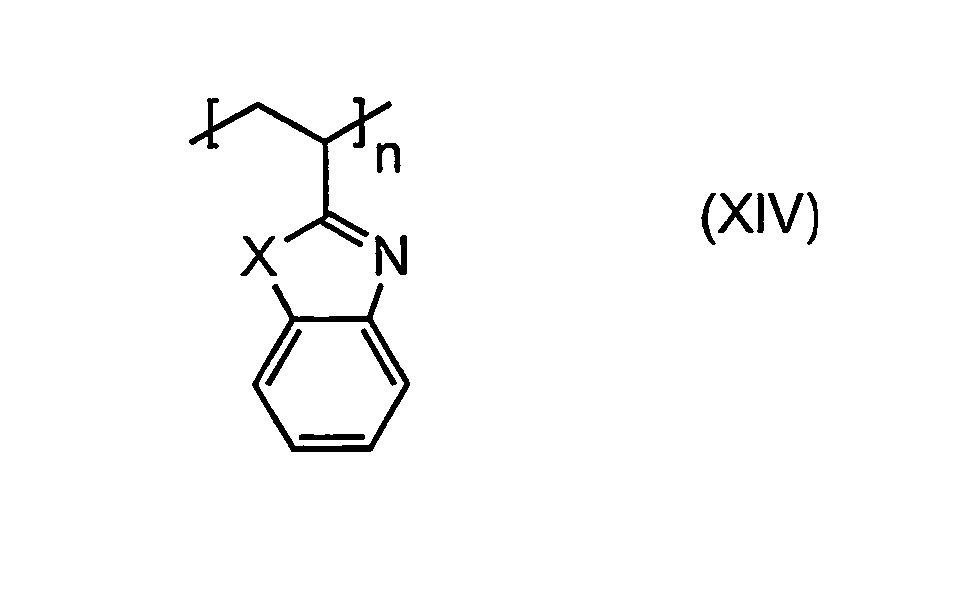


 Ar gleich oder verschieden sind und für eine vierbindige aromatische oder heteroaromatische Gruppe, die ein- oder mehrkernig sein kann,Ar1 gleich oder verschieden sind und für eine zweibindige aromatische oder heteroaromatische Gruppe, die ein- oder mehrkernig sein kann,Ar2 gleich oder verschieden sind und für eine zwei oder dreibindige aromatische oder heteroaromatische Gruppe, die ein- oder mehrkernig sein kann,Ar3 gleich oder verschieden sind und für eine dreibindige aromatische oder heteroaromatische Gruppe, die ein- oder mehrkernig sein kann,Ar4 gleich oder verschieden sind und für eine dreibindige aromatische oder heteroaromatische Gruppe, die ein- oder mehrkernig sein kann,Ar5 gleich oder verschieden sind und für eine vierbindige aromatische oder heteroaromatische Gruppe, die ein- oder mehrkernig sein kann,Ar6 gleich oder verschieden sind und für eine zweibindige aromatische oder heteroaromatische Gruppe, die ein- oder mehrkernig sein kann,Ar7 gleich oder verschieden sind und für eine zweibindige aromatische oder heteroaromatische Gruppe, die ein- oder mehrkernig sein kann,Ar8 gleich oder verschieden sind und für eine dreibindige aromatische oder heteroaromatische Gruppe, die ein- oder mehrkernig sein kann,Ar9 gleich oder verschieden sind und für eine zwei- oder drei- oder vierbindige aromatische oder heteroaromatische Gruppe, die ein- oder mehrkernig sein kann,Ar10 gleich oder verschieden sind und für eine zwei- oder dreibindige aromatische oder heteroaromatische Gruppe, die ein- oder mehrkernig sein kann,Ar11 gleich oder verschieden sind und für eine zweibindige aromatische oder heteroaromatische Gruppe, die ein- oder mehrkernig sein kann,X gleich oder verschieden ist und für Sauerstoff, Schwefel oder eine Aminogruppe, die ein Wasserstoffatom, eine 1- 20 Kohlenstoffatome aufweisende Gruppe, vorzugsweise eine verzweigte oder nicht verzweigte Alkyl- oder Alkoxygruppe, oder eine Arylgruppe als weiteren Rest trägtR gleich oder verschieden für Wasserstoff, eine Alkylgruppe und eine aromatische Gruppe steht, wobei der Rest R in Formel (XX) ungleich Wasserstoff ist, undn, m eine ganze Zahl größer gleich 10, bevorzugt größer gleich 100 ist, handelt
 - Polymerfolie gemäß Anspruch 1, dadurch gekennzeichnet, daß es sich um ein Polyazol enthaltend wiederkehrende Azoleinheiten der allgemeinen Formel


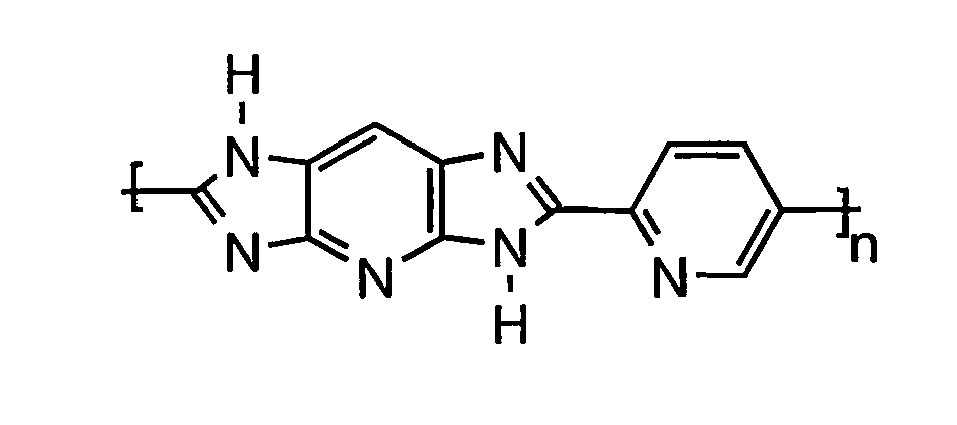


- Verfahren zur Herstellung der Polymerfolie gemäß Anspruch 1 umfassend die SchritteA) Aufbringen einer Lösung und/oder Suspension enthaltend Polyazol-Polymer in einem Lösungsmittel auf einen Träger, dessen Oberfläche in einer solchen Weise aufgerauht ist, das die erwünschte Rauhigkeit erhalten wird, unter Ausbildung einer flächigen Schicht,B) Trocknung der gemäß Schritt A) gebildeten Schicht undC) Ablösen der getrockneten Polymerfolie vom Träger.
- Verfahren gemäß Anspruch 4, dadurch gekennzeichnet, daß als Lösungsmittel ein polares, aprotisches Lösungsmittel, insbesondere N,N-Dimethylacetamid, eingesetzt wird.
- Verfahren gemäß Anspruch 4, dadurch gekennzeichnet, daß die in Schritt A) erzeugte Schicht eine Dicke zwischen 15 und 4000 µm aufweist.
- Verfahren gemäß Anspruch 4, dadurch gekennzeichnet, daß in Schritt A) ein inerter Träger, vorzugsweise ein Metallband, eingesetzt wird.
- Verfahren gemäß Anspruch 7, dadurch gekennzeichnet, daß der Träger eine Rauheit aufweist, welche die Rauheit der Polymermembran aufweist.
- Verfahren gemäß Anspruch 4, dadurch gekennzeichnet, daß die Polymerfolie nach Schritt C) vernetzt wird.
- Verfahren gemäß Anspruch 4, dadurch gekennzeichnet, daß in Schritt A) weitere Füllstoffe, insbesondere protonenleitende Füllstoffe, zugesetzt werden.
- Verwendung der Polymerfolie gemäß Anspruch 1 als Filtermedium, insbesondere in der Gasfiltration und -trennung oder Gasaufreinigung, sowie in der Umkehr-Osmose, als Substrat in der Elektronikindustrie, insbesondere für flexible elektrische Schaltungen, gedruckte elektrische Schaltungen, in Transistoren, Kondensatoren und anderen elektronischen Bauteilen, als Batterieseparatoren, als Schutzfolie für elektrische Kabel, als Isolator in elektrischen Bauteilen und Vorrichtungen wie Kondensatoren, als Schutzfolie für Metall- und sonstige Oberflächen und zur Herstellung von Polymerelektrolytmembranen für elektrochemische Zellen, insbesondere für Brennstoffzellen- und Elektrolyseanwendungen, in Batteriesystemen und Kondensatoren.
- Elektrochemische Zelle, die mindestens eine Polymermembran hergestellt aus einer Polymerfolie gemäß einem der Ansprüche 1 bis 3 und mindestens eine Elektrode aufweist.
- Membran-Elektroden-Einheit, die mindestens eine Polymermembran hergestellt aus einer Polymerfolie gemäß einem der Ansprüche 1 bis 3 und mindestens eine Elektrode aufweist.
- Membran-Elektroden-Einheit gemäß Anspruch 13, dadurch gekennzeichnet, daß die Polymermembran mit mindestens einer Lewis- und/oder Bronsted-Säuren, bevorzugt Schwefelsäure und/oder Phosphorsäure, insbesondere Phosphorsäure, dotiert ist.
- Brennstoffzelle die mindestens eine Membran-Elektroden-Einheit gemäß Anspruch 13 aufweist.
Applications Claiming Priority (2)
| Application Number | Priority Date | Filing Date | Title |
|---|---|---|---|
| DE10331365A DE10331365A1 (de) | 2003-07-11 | 2003-07-11 | Asymmetrische Polymermembran, Verfahren zu deren Herstellung sowie deren Verwendung |
| PCT/EP2004/007570 WO2005007725A1 (de) | 2003-07-11 | 2004-07-09 | Asymmetrische polymerfolie, verfahren zu deren herstellung sowie deren verwendung |
Publications (2)
| Publication Number | Publication Date |
|---|---|
| EP1646674A1 EP1646674A1 (de) | 2006-04-19 |
| EP1646674B1 true EP1646674B1 (de) | 2007-01-24 |
Family
ID=34041776
Family Applications (1)
| Application Number | Title | Priority Date | Filing Date |
|---|---|---|---|
| EP04740851A Expired - Lifetime EP1646674B1 (de) | 2003-07-11 | 2004-07-09 | Asymmetrische polymerfolie, verfahren zu deren herstellung sowie deren verwendung |
Country Status (6)
| Country | Link |
|---|---|
| EP (1) | EP1646674B1 (de) |
| JP (2) | JP2007527443A (de) |
| CN (1) | CN100432121C (de) |
| AT (1) | ATE352579T1 (de) |
| DE (2) | DE10331365A1 (de) |
| WO (1) | WO2005007725A1 (de) |
Families Citing this family (14)
| Publication number | Priority date | Publication date | Assignee | Title |
|---|---|---|---|---|
| DE10242708A1 (de) | 2002-09-13 | 2004-05-19 | Celanese Ventures Gmbh | Protonenleitende Membranen und deren Verwendung |
| DE10246461A1 (de) | 2002-10-04 | 2004-04-15 | Celanese Ventures Gmbh | Protonenleitende Polymermembran enthaltend Polyazolblends und deren Anwendung in Brennstoffzellen |
| JP5005160B2 (ja) * | 2003-12-08 | 2012-08-22 | 三星エスディアイ株式会社 | ゲル電解質及び燃料電池 |
| JP2007537317A (ja) * | 2004-05-14 | 2007-12-20 | ペミアス ゲーエムベーハー | 異方性造形体、異方性造形体の製造方法および使用 |
| US7736782B2 (en) * | 2004-10-20 | 2010-06-15 | Samsung Sdi Co., Ltd. | Proton conductive solid polymer electrolyte and fuel cell |
| KR20060087140A (ko) * | 2005-01-28 | 2006-08-02 | 삼성에스디아이 주식회사 | 고분자 전해질막 및 이를 채용한 연료전지 |
| KR20090064543A (ko) * | 2006-08-25 | 2009-06-19 | 스미또모 가가꾸 가부시끼가이샤 | 고분자 전해질 막, 그 적층체, 및 그것들의 제조 방법 |
| DE102007018280A1 (de) | 2007-04-18 | 2008-10-23 | Volkswagen Ag | Verfahren zur Herstellung einer Polymerelektrolytmembran für eine Brennstoffzelle sowie nach dem Verfahren hergestellte Membran |
| DE102008009437A1 (de) | 2008-02-14 | 2009-09-03 | Volkswagen Ag | Membran-Elektroden-Einheit für eine HT-PEM-Brennstoffzelle sowie ein Verfahren zu ihrer Herstellung |
| EP2228857A1 (de) | 2009-03-06 | 2010-09-15 | Basf Se | Verbesserte Membran-Elektrodeneinheiten |
| EP2869382B1 (de) | 2013-10-30 | 2018-12-12 | Basf Se | Verbesserte Membranelektrodenanordnungen |
| JP6131973B2 (ja) | 2014-03-14 | 2017-05-24 | トヨタ自動車株式会社 | 補強型電解質膜の製造方法、膜電極接合体の製造方法、及び、膜電極接合体 |
| CN106296796B (zh) | 2015-06-04 | 2019-08-13 | 北京智谷睿拓技术服务有限公司 | 信息处理方法、信息处理装置及用户设备 |
| CN116059801B (zh) * | 2023-01-10 | 2024-05-28 | 中南大学 | 一种气体膜分离装置、及气体选择性分离的方法 |
Family Cites Families (5)
| Publication number | Priority date | Publication date | Assignee | Title |
|---|---|---|---|---|
| US4272353A (en) * | 1980-02-29 | 1981-06-09 | General Electric Company | Method of making solid polymer electrolyte catalytic electrodes and electrodes made thereby |
| EP0141793A1 (de) * | 1983-06-30 | 1985-05-15 | Monsanto Company | Asymmetrische Membranen für die Gastrennung mit erhöhter Selektivität sowie deren Herstellungsverfahren |
| WO2002004083A2 (en) * | 2000-07-07 | 2002-01-17 | Colorado State University Research Foundation | Surface modified membranes and methods for producing the same |
| JP3947994B2 (ja) * | 2000-12-06 | 2007-07-25 | 東レ・デュポン株式会社 | ポリイミドフィルム、その製造方法および用途 |
| DE10109829A1 (de) * | 2001-03-01 | 2002-09-05 | Celanese Ventures Gmbh | Polymermembran, Verfahren zu deren Herstellung sowie deren Verwendung |
-
2003
- 2003-07-11 DE DE10331365A patent/DE10331365A1/de not_active Withdrawn
-
2004
- 2004-07-09 CN CNB2004800200036A patent/CN100432121C/zh not_active Expired - Fee Related
- 2004-07-09 AT AT04740851T patent/ATE352579T1/de not_active IP Right Cessation
- 2004-07-09 WO PCT/EP2004/007570 patent/WO2005007725A1/de not_active Ceased
- 2004-07-09 JP JP2006518161A patent/JP2007527443A/ja active Pending
- 2004-07-09 EP EP04740851A patent/EP1646674B1/de not_active Expired - Lifetime
- 2004-07-09 DE DE502004002796T patent/DE502004002796D1/de not_active Expired - Lifetime
-
2011
- 2011-03-23 JP JP2011064782A patent/JP2011190445A/ja not_active Withdrawn
Also Published As
| Publication number | Publication date |
|---|---|
| CN100432121C (zh) | 2008-11-12 |
| JP2007527443A (ja) | 2007-09-27 |
| JP2011190445A (ja) | 2011-09-29 |
| DE10331365A1 (de) | 2005-02-10 |
| EP1646674A1 (de) | 2006-04-19 |
| ATE352579T1 (de) | 2007-02-15 |
| WO2005007725A1 (de) | 2005-01-27 |
| DE502004002796D1 (de) | 2007-03-15 |
| CN1823114A (zh) | 2006-08-23 |
Similar Documents
| Publication | Publication Date | Title |
|---|---|---|
| EP1427517B1 (de) | Protonleitende membran und beschichtung | |
| EP1550174B1 (de) | Protonenleitende membran und deren verwendung | |
| EP1379572B1 (de) | Protonenleitende membran und deren verwendung | |
| EP1379573B1 (de) | Protonenleitende membran und deren verwendung | |
| EP1506591B1 (de) | Polymerelektrolytmembran, verfahren zu deren herstellung und deren anwendung in brennstoffzellen | |
| US7834131B2 (en) | Asymmetric polymer film, method for the production and utilization thereof | |
| EP1519981B1 (de) | Protonenleitende membran und deren verwendung | |
| EP1652259A2 (de) | Protonenleitende membran und deren verwendung | |
| DE10235358A1 (de) | Protonenleitende Polymermembran umfassend Phosphonsäuregruppen enthaltende Polymere und deren Anwendung in Brennstoffzellen | |
| DE10246461A1 (de) | Protonenleitende Polymermembran enthaltend Polyazolblends und deren Anwendung in Brennstoffzellen | |
| EP1512190A2 (de) | Gepfropfte polymerelektrolytmembran, verfahren zu deren herstellung und deren anwendung in brennstoffzellen | |
| JP2011190445A (ja) | 非対称ポリマーフィルム、その製造方法およびその使用 | |
| EP2069056A1 (de) | Verfahren zur herstellung einer protonenleitenden, polyazol-enthaltenden membran | |
| WO2010081698A1 (de) | Monomerperlen zur herstellung einer protonenleitenden membran | |
| WO2003007411A2 (de) | Verfahren zur herstellung einer plasmapolymerisierten polymer-elektrolytmembran sowie eine plasmabeschichtete polyazol-membran | |
| WO2010063489A1 (de) | Verfahren zur herstellung einer protonenleitenden membran | |
| DE10340927A1 (de) | Protonenleitende Polymermembran enthaltend Polymere mit an aromatische Gruppen kovalent gebundene Sulfonsäuregruppen, Membran-Elektoden-Einheit und deren Anwendung in Brennstoffzellen | |
| EP1927151A1 (de) | Verfahren zur konditionierung von membran-elektroden-einheiten fur brennstoffzellen | |
| DE102009028758A1 (de) | Langzeitstabile Polymerelektrolytmembran für HT-Brennstoffzellen und Verfahren zu ihrer Herstellung | |
| WO2011003539A1 (de) | Verfahren zur stabilisierung von stickstoffhaltigen polymeren | |
| DE102012007178A1 (de) | Verbesserte Membran-Elektrodeneinheiten und Brennstoffzellen mit langer Lebensdauer | |
| WO2012153172A1 (de) | Mechanisch stabilisierte polyazole enthaltend mindestens einen polyvinylalkohol |
Legal Events
| Date | Code | Title | Description |
|---|---|---|---|
| PUAI | Public reference made under article 153(3) epc to a published international application that has entered the european phase |
Free format text: ORIGINAL CODE: 0009012 |
|
| 17P | Request for examination filed |
Effective date: 20060213 |
|
| AK | Designated contracting states |
Kind code of ref document: A1 Designated state(s): AT BE BG CH CY CZ DE DK EE ES FI FR GB GR HU IE IT LI LU MC NL PL PT RO SE SI SK TR |
|
| GRAP | Despatch of communication of intention to grant a patent |
Free format text: ORIGINAL CODE: EPIDOSNIGR1 |
|
| DAX | Request for extension of the european patent (deleted) | ||
| GRAS | Grant fee paid |
Free format text: ORIGINAL CODE: EPIDOSNIGR3 |
|
| GRAA | (expected) grant |
Free format text: ORIGINAL CODE: 0009210 |
|
| AK | Designated contracting states |
Kind code of ref document: B1 Designated state(s): AT BE BG CH CY CZ DE DK EE ES FI FR GB GR HU IE IT LI LU MC NL PL PT RO SE SI SK TR |
|
| PG25 | Lapsed in a contracting state [announced via postgrant information from national office to epo] |
Ref country code: IE Free format text: LAPSE BECAUSE OF FAILURE TO SUBMIT A TRANSLATION OF THE DESCRIPTION OR TO PAY THE FEE WITHIN THE PRESCRIBED TIME-LIMIT Effective date: 20070124 Ref country code: PL Free format text: LAPSE BECAUSE OF FAILURE TO SUBMIT A TRANSLATION OF THE DESCRIPTION OR TO PAY THE FEE WITHIN THE PRESCRIBED TIME-LIMIT Effective date: 20070124 Ref country code: DK Free format text: LAPSE BECAUSE OF FAILURE TO SUBMIT A TRANSLATION OF THE DESCRIPTION OR TO PAY THE FEE WITHIN THE PRESCRIBED TIME-LIMIT Effective date: 20070124 Ref country code: NL Free format text: LAPSE BECAUSE OF FAILURE TO SUBMIT A TRANSLATION OF THE DESCRIPTION OR TO PAY THE FEE WITHIN THE PRESCRIBED TIME-LIMIT Effective date: 20070124 Ref country code: FI Free format text: LAPSE BECAUSE OF FAILURE TO SUBMIT A TRANSLATION OF THE DESCRIPTION OR TO PAY THE FEE WITHIN THE PRESCRIBED TIME-LIMIT Effective date: 20070124 Ref country code: SI Free format text: LAPSE BECAUSE OF FAILURE TO SUBMIT A TRANSLATION OF THE DESCRIPTION OR TO PAY THE FEE WITHIN THE PRESCRIBED TIME-LIMIT Effective date: 20070124 |
|
| REG | Reference to a national code |
Ref country code: GB Ref legal event code: FG4D Free format text: NOT ENGLISH |
|
| REG | Reference to a national code |
Ref country code: CH Ref legal event code: EP |
|
| REG | Reference to a national code |
Ref country code: IE Ref legal event code: FG4D Free format text: LANGUAGE OF EP DOCUMENT: GERMAN |
|
| REF | Corresponds to: |
Ref document number: 502004002796 Country of ref document: DE Date of ref document: 20070315 Kind code of ref document: P |
|
| PG25 | Lapsed in a contracting state [announced via postgrant information from national office to epo] |
Ref country code: SE Free format text: LAPSE BECAUSE OF FAILURE TO SUBMIT A TRANSLATION OF THE DESCRIPTION OR TO PAY THE FEE WITHIN THE PRESCRIBED TIME-LIMIT Effective date: 20070424 Ref country code: BG Free format text: LAPSE BECAUSE OF FAILURE TO SUBMIT A TRANSLATION OF THE DESCRIPTION OR TO PAY THE FEE WITHIN THE PRESCRIBED TIME-LIMIT Effective date: 20070424 |
|
| PG25 | Lapsed in a contracting state [announced via postgrant information from national office to epo] |
Ref country code: ES Free format text: LAPSE BECAUSE OF FAILURE TO SUBMIT A TRANSLATION OF THE DESCRIPTION OR TO PAY THE FEE WITHIN THE PRESCRIBED TIME-LIMIT Effective date: 20070505 |
|
| GBT | Gb: translation of ep patent filed (gb section 77(6)(a)/1977) |
Effective date: 20070417 |
|
| PG25 | Lapsed in a contracting state [announced via postgrant information from national office to epo] |
Ref country code: PT Free format text: LAPSE BECAUSE OF FAILURE TO SUBMIT A TRANSLATION OF THE DESCRIPTION OR TO PAY THE FEE WITHIN THE PRESCRIBED TIME-LIMIT Effective date: 20070625 |
|
| NLV1 | Nl: lapsed or annulled due to failure to fulfill the requirements of art. 29p and 29m of the patents act | ||
| ET | Fr: translation filed | ||
| REG | Reference to a national code |
Ref country code: IE Ref legal event code: FD4D |
|
| PG25 | Lapsed in a contracting state [announced via postgrant information from national office to epo] |
Ref country code: SK Free format text: LAPSE BECAUSE OF FAILURE TO SUBMIT A TRANSLATION OF THE DESCRIPTION OR TO PAY THE FEE WITHIN THE PRESCRIBED TIME-LIMIT Effective date: 20070124 |
|
| PLBE | No opposition filed within time limit |
Free format text: ORIGINAL CODE: 0009261 |
|
| STAA | Information on the status of an ep patent application or granted ep patent |
Free format text: STATUS: NO OPPOSITION FILED WITHIN TIME LIMIT |
|
| 26N | No opposition filed |
Effective date: 20071025 |
|
| PG25 | Lapsed in a contracting state [announced via postgrant information from national office to epo] |
Ref country code: RO Free format text: LAPSE BECAUSE OF FAILURE TO SUBMIT A TRANSLATION OF THE DESCRIPTION OR TO PAY THE FEE WITHIN THE PRESCRIBED TIME-LIMIT Effective date: 20070124 Ref country code: CZ Free format text: LAPSE BECAUSE OF FAILURE TO SUBMIT A TRANSLATION OF THE DESCRIPTION OR TO PAY THE FEE WITHIN THE PRESCRIBED TIME-LIMIT Effective date: 20070124 |
|
| BERE | Be: lapsed |
Owner name: PEMEAS G.M.B.H. Effective date: 20070731 |
|
| PG25 | Lapsed in a contracting state [announced via postgrant information from national office to epo] |
Ref country code: GR Free format text: LAPSE BECAUSE OF FAILURE TO SUBMIT A TRANSLATION OF THE DESCRIPTION OR TO PAY THE FEE WITHIN THE PRESCRIBED TIME-LIMIT Effective date: 20070425 Ref country code: MC Free format text: LAPSE BECAUSE OF NON-PAYMENT OF DUE FEES Effective date: 20070731 |
|
| PG25 | Lapsed in a contracting state [announced via postgrant information from national office to epo] |
Ref country code: BE Free format text: LAPSE BECAUSE OF NON-PAYMENT OF DUE FEES Effective date: 20070731 |
|
| PG25 | Lapsed in a contracting state [announced via postgrant information from national office to epo] |
Ref country code: AT Free format text: LAPSE BECAUSE OF NON-PAYMENT OF DUE FEES Effective date: 20070709 |
|
| PG25 | Lapsed in a contracting state [announced via postgrant information from national office to epo] |
Ref country code: EE Free format text: LAPSE BECAUSE OF FAILURE TO SUBMIT A TRANSLATION OF THE DESCRIPTION OR TO PAY THE FEE WITHIN THE PRESCRIBED TIME-LIMIT Effective date: 20070124 |
|
| PG25 | Lapsed in a contracting state [announced via postgrant information from national office to epo] |
Ref country code: CY Free format text: LAPSE BECAUSE OF FAILURE TO SUBMIT A TRANSLATION OF THE DESCRIPTION OR TO PAY THE FEE WITHIN THE PRESCRIBED TIME-LIMIT Effective date: 20070124 |
|
| PG25 | Lapsed in a contracting state [announced via postgrant information from national office to epo] |
Ref country code: LU Free format text: LAPSE BECAUSE OF NON-PAYMENT OF DUE FEES Effective date: 20070709 |
|
| PG25 | Lapsed in a contracting state [announced via postgrant information from national office to epo] |
Ref country code: HU Free format text: LAPSE BECAUSE OF FAILURE TO SUBMIT A TRANSLATION OF THE DESCRIPTION OR TO PAY THE FEE WITHIN THE PRESCRIBED TIME-LIMIT Effective date: 20070725 Ref country code: TR Free format text: LAPSE BECAUSE OF FAILURE TO SUBMIT A TRANSLATION OF THE DESCRIPTION OR TO PAY THE FEE WITHIN THE PRESCRIBED TIME-LIMIT Effective date: 20070124 |
|
| PGFP | Annual fee paid to national office [announced via postgrant information from national office to epo] |
Ref country code: CH Payment date: 20100730 Year of fee payment: 7 |
|
| PGFP | Annual fee paid to national office [announced via postgrant information from national office to epo] |
Ref country code: IT Payment date: 20100729 Year of fee payment: 7 |
|
| REG | Reference to a national code |
Ref country code: CH Ref legal event code: PL |
|
| PG25 | Lapsed in a contracting state [announced via postgrant information from national office to epo] |
Ref country code: CH Free format text: LAPSE BECAUSE OF NON-PAYMENT OF DUE FEES Effective date: 20110731 Ref country code: LI Free format text: LAPSE BECAUSE OF NON-PAYMENT OF DUE FEES Effective date: 20110731 |
|
| PG25 | Lapsed in a contracting state [announced via postgrant information from national office to epo] |
Ref country code: IT Free format text: LAPSE BECAUSE OF NON-PAYMENT OF DUE FEES Effective date: 20110709 |
|
| PGFP | Annual fee paid to national office [announced via postgrant information from national office to epo] |
Ref country code: GB Payment date: 20120731 Year of fee payment: 9 |
|
| PGFP | Annual fee paid to national office [announced via postgrant information from national office to epo] |
Ref country code: FR Payment date: 20120814 Year of fee payment: 9 |
|
| PGFP | Annual fee paid to national office [announced via postgrant information from national office to epo] |
Ref country code: DE Payment date: 20121001 Year of fee payment: 9 |
|
| REG | Reference to a national code |
Ref country code: DE Ref legal event code: R082 Ref document number: 502004002796 Country of ref document: DE Representative=s name: MAI, OPPERMANN & PARTNER I. L., DE |
|
| GBPC | Gb: european patent ceased through non-payment of renewal fee |
Effective date: 20130709 |
|
| REG | Reference to a national code |
Ref country code: DE Ref legal event code: R119 Ref document number: 502004002796 Country of ref document: DE Effective date: 20140201 |
|
| REG | Reference to a national code |
Ref country code: FR Ref legal event code: ST Effective date: 20140331 |
|
| PG25 | Lapsed in a contracting state [announced via postgrant information from national office to epo] |
Ref country code: DE Free format text: LAPSE BECAUSE OF NON-PAYMENT OF DUE FEES Effective date: 20140201 Ref country code: GB Free format text: LAPSE BECAUSE OF NON-PAYMENT OF DUE FEES Effective date: 20130709 |
|
| PG25 | Lapsed in a contracting state [announced via postgrant information from national office to epo] |
Ref country code: FR Free format text: LAPSE BECAUSE OF NON-PAYMENT OF DUE FEES Effective date: 20130731 |
|
| REG | Reference to a national code |
Ref country code: DE Ref legal event code: R082 Ref document number: 502004002796 Country of ref document: DE Representative=s name: MAI, OPPERMANN & PARTNER I. L., DE |