EP1645201B1 - Mehrlagiges Bekleidungstück - Google Patents
Mehrlagiges Bekleidungstück Download PDFInfo
- Publication number
- EP1645201B1 EP1645201B1 EP20050256269 EP05256269A EP1645201B1 EP 1645201 B1 EP1645201 B1 EP 1645201B1 EP 20050256269 EP20050256269 EP 20050256269 EP 05256269 A EP05256269 A EP 05256269A EP 1645201 B1 EP1645201 B1 EP 1645201B1
- Authority
- EP
- European Patent Office
- Prior art keywords
- layer
- fabric
- garment
- fabric layer
- composite
- Prior art date
- Legal status (The legal status is an assumption and is not a legal conclusion. Google has not performed a legal analysis and makes no representation as to the accuracy of the status listed.)
- Expired - Lifetime
Links
Images





Classifications
-
- B—PERFORMING OPERATIONS; TRANSPORTING
- B32—LAYERED PRODUCTS
- B32B—LAYERED PRODUCTS, i.e. PRODUCTS BUILT-UP OF STRATA OF FLAT OR NON-FLAT, e.g. CELLULAR OR HONEYCOMB, FORM
- B32B7/00—Layered products characterised by the relation between layers; Layered products characterised by the relative orientation of features between layers, or by the relative values of a measurable parameter between layers, i.e. products comprising layers having different physical, chemical or physicochemical properties; Layered products characterised by the interconnection of layers
- B32B7/04—Interconnection of layers
- B32B7/12—Interconnection of layers using interposed adhesives or interposed materials with bonding properties
-
- A—HUMAN NECESSITIES
- A41—WEARING APPAREL
- A41D—OUTERWEAR; PROTECTIVE GARMENTS; ACCESSORIES
- A41D13/00—Professional, industrial or sporting protective garments, e.g. surgeons' gowns or garments protecting against blows or punches
-
- A—HUMAN NECESSITIES
- A41—WEARING APPAREL
- A41D—OUTERWEAR; PROTECTIVE GARMENTS; ACCESSORIES
- A41D27/00—Details of garments or of their making
- A41D27/02—Linings
- A41D27/04—Removable linings
-
- A—HUMAN NECESSITIES
- A41—WEARING APPAREL
- A41D—OUTERWEAR; PROTECTIVE GARMENTS; ACCESSORIES
- A41D3/00—Overgarments
- A41D3/005—Overgarments with pullover structure
-
- A—HUMAN NECESSITIES
- A41—WEARING APPAREL
- A41D—OUTERWEAR; PROTECTIVE GARMENTS; ACCESSORIES
- A41D31/00—Materials specially adapted for outerwear
- A41D31/04—Materials specially adapted for outerwear characterised by special function or use
- A41D31/06—Thermally protective, e.g. insulating
- A41D31/065—Thermally protective, e.g. insulating using layered materials
-
- A—HUMAN NECESSITIES
- A41—WEARING APPAREL
- A41D—OUTERWEAR; PROTECTIVE GARMENTS; ACCESSORIES
- A41D31/00—Materials specially adapted for outerwear
- A41D31/04—Materials specially adapted for outerwear characterised by special function or use
- A41D31/08—Heat resistant; Fire retardant
- A41D31/085—Heat resistant; Fire retardant using layered materials
-
- A—HUMAN NECESSITIES
- A41—WEARING APPAREL
- A41D—OUTERWEAR; PROTECTIVE GARMENTS; ACCESSORIES
- A41D31/00—Materials specially adapted for outerwear
- A41D31/04—Materials specially adapted for outerwear characterised by special function or use
- A41D31/10—Impermeable to liquids, e.g. waterproof; Liquid-repellent
- A41D31/102—Waterproof and breathable
-
- A—HUMAN NECESSITIES
- A41—WEARING APPAREL
- A41D—OUTERWEAR; PROTECTIVE GARMENTS; ACCESSORIES
- A41D31/00—Materials specially adapted for outerwear
- A41D31/04—Materials specially adapted for outerwear characterised by special function or use
- A41D31/12—Hygroscopic; Water retaining
- A41D31/125—Moisture handling or wicking function through layered materials
-
- A—HUMAN NECESSITIES
- A41—WEARING APPAREL
- A41D—OUTERWEAR; PROTECTIVE GARMENTS; ACCESSORIES
- A41D31/00—Materials specially adapted for outerwear
- A41D31/04—Materials specially adapted for outerwear characterised by special function or use
- A41D31/14—Air permeable, i.e. capable of being penetrated by gases
- A41D31/145—Air permeable, i.e. capable of being penetrated by gases using layered materials
-
- B—PERFORMING OPERATIONS; TRANSPORTING
- B32—LAYERED PRODUCTS
- B32B—LAYERED PRODUCTS, i.e. PRODUCTS BUILT-UP OF STRATA OF FLAT OR NON-FLAT, e.g. CELLULAR OR HONEYCOMB, FORM
- B32B27/00—Layered products comprising a layer of synthetic resin
- B32B27/06—Layered products comprising a layer of synthetic resin as the main or only constituent of a layer, which is next to another layer of the same or of a different material
- B32B27/08—Layered products comprising a layer of synthetic resin as the main or only constituent of a layer, which is next to another layer of the same or of a different material of synthetic resin
-
- B—PERFORMING OPERATIONS; TRANSPORTING
- B32—LAYERED PRODUCTS
- B32B—LAYERED PRODUCTS, i.e. PRODUCTS BUILT-UP OF STRATA OF FLAT OR NON-FLAT, e.g. CELLULAR OR HONEYCOMB, FORM
- B32B27/00—Layered products comprising a layer of synthetic resin
- B32B27/12—Layered products comprising a layer of synthetic resin next to a fibrous or filamentary layer
-
- B—PERFORMING OPERATIONS; TRANSPORTING
- B32—LAYERED PRODUCTS
- B32B—LAYERED PRODUCTS, i.e. PRODUCTS BUILT-UP OF STRATA OF FLAT OR NON-FLAT, e.g. CELLULAR OR HONEYCOMB, FORM
- B32B27/00—Layered products comprising a layer of synthetic resin
- B32B27/30—Layered products comprising a layer of synthetic resin comprising vinyl (co)polymers; comprising acrylic (co)polymers
- B32B27/308—Layered products comprising a layer of synthetic resin comprising vinyl (co)polymers; comprising acrylic (co)polymers comprising acrylic (co)polymers
-
- B—PERFORMING OPERATIONS; TRANSPORTING
- B32—LAYERED PRODUCTS
- B32B—LAYERED PRODUCTS, i.e. PRODUCTS BUILT-UP OF STRATA OF FLAT OR NON-FLAT, e.g. CELLULAR OR HONEYCOMB, FORM
- B32B27/00—Layered products comprising a layer of synthetic resin
- B32B27/34—Layered products comprising a layer of synthetic resin comprising polyamides
-
- B—PERFORMING OPERATIONS; TRANSPORTING
- B32—LAYERED PRODUCTS
- B32B—LAYERED PRODUCTS, i.e. PRODUCTS BUILT-UP OF STRATA OF FLAT OR NON-FLAT, e.g. CELLULAR OR HONEYCOMB, FORM
- B32B27/00—Layered products comprising a layer of synthetic resin
- B32B27/40—Layered products comprising a layer of synthetic resin comprising polyurethanes
-
- B—PERFORMING OPERATIONS; TRANSPORTING
- B32—LAYERED PRODUCTS
- B32B—LAYERED PRODUCTS, i.e. PRODUCTS BUILT-UP OF STRATA OF FLAT OR NON-FLAT, e.g. CELLULAR OR HONEYCOMB, FORM
- B32B37/00—Methods or apparatus for laminating, e.g. by curing or by ultrasonic bonding
- B32B37/12—Methods or apparatus for laminating, e.g. by curing or by ultrasonic bonding characterised by using adhesives
- B32B37/1284—Application of adhesive
-
- B—PERFORMING OPERATIONS; TRANSPORTING
- B32—LAYERED PRODUCTS
- B32B—LAYERED PRODUCTS, i.e. PRODUCTS BUILT-UP OF STRATA OF FLAT OR NON-FLAT, e.g. CELLULAR OR HONEYCOMB, FORM
- B32B5/00—Layered products characterised by the non- homogeneity or physical structure, i.e. comprising a fibrous, filamentary, particulate or foam layer; Layered products characterised by having a layer differing constitutionally or physically in different parts
- B32B5/02—Layered products characterised by the non- homogeneity or physical structure, i.e. comprising a fibrous, filamentary, particulate or foam layer; Layered products characterised by having a layer differing constitutionally or physically in different parts characterised by structural features of a fibrous or filamentary layer
- B32B5/024—Woven fabric
-
- B—PERFORMING OPERATIONS; TRANSPORTING
- B32—LAYERED PRODUCTS
- B32B—LAYERED PRODUCTS, i.e. PRODUCTS BUILT-UP OF STRATA OF FLAT OR NON-FLAT, e.g. CELLULAR OR HONEYCOMB, FORM
- B32B5/00—Layered products characterised by the non- homogeneity or physical structure, i.e. comprising a fibrous, filamentary, particulate or foam layer; Layered products characterised by having a layer differing constitutionally or physically in different parts
- B32B5/02—Layered products characterised by the non- homogeneity or physical structure, i.e. comprising a fibrous, filamentary, particulate or foam layer; Layered products characterised by having a layer differing constitutionally or physically in different parts characterised by structural features of a fibrous or filamentary layer
- B32B5/026—Knitted fabric
-
- B—PERFORMING OPERATIONS; TRANSPORTING
- B32—LAYERED PRODUCTS
- B32B—LAYERED PRODUCTS, i.e. PRODUCTS BUILT-UP OF STRATA OF FLAT OR NON-FLAT, e.g. CELLULAR OR HONEYCOMB, FORM
- B32B5/00—Layered products characterised by the non- homogeneity or physical structure, i.e. comprising a fibrous, filamentary, particulate or foam layer; Layered products characterised by having a layer differing constitutionally or physically in different parts
- B32B5/22—Layered products characterised by the non- homogeneity or physical structure, i.e. comprising a fibrous, filamentary, particulate or foam layer; Layered products characterised by having a layer differing constitutionally or physically in different parts characterised by the presence of two or more layers which are next to each other and are fibrous, filamentary, formed of particles or foamed
- B32B5/24—Layered products characterised by the non- homogeneity or physical structure, i.e. comprising a fibrous, filamentary, particulate or foam layer; Layered products characterised by having a layer differing constitutionally or physically in different parts characterised by the presence of two or more layers which are next to each other and are fibrous, filamentary, formed of particles or foamed one layer being a fibrous or filamentary layer
- B32B5/26—Layered products characterised by the non- homogeneity or physical structure, i.e. comprising a fibrous, filamentary, particulate or foam layer; Layered products characterised by having a layer differing constitutionally or physically in different parts characterised by the presence of two or more layers which are next to each other and are fibrous, filamentary, formed of particles or foamed one layer being a fibrous or filamentary layer another layer next to it also being fibrous or filamentary
-
- B—PERFORMING OPERATIONS; TRANSPORTING
- B32—LAYERED PRODUCTS
- B32B—LAYERED PRODUCTS, i.e. PRODUCTS BUILT-UP OF STRATA OF FLAT OR NON-FLAT, e.g. CELLULAR OR HONEYCOMB, FORM
- B32B7/00—Layered products characterised by the relation between layers; Layered products characterised by the relative orientation of features between layers, or by the relative values of a measurable parameter between layers, i.e. products comprising layers having different physical, chemical or physicochemical properties; Layered products characterised by the interconnection of layers
- B32B7/04—Interconnection of layers
- B32B7/05—Interconnection of layers the layers not being connected over the whole surface, e.g. discontinuous connection or patterned connection
-
- D—TEXTILES; PAPER
- D04—BRAIDING; LACE-MAKING; KNITTING; TRIMMINGS; NON-WOVEN FABRICS
- D04B—KNITTING
- D04B1/00—Weft knitting processes for the production of fabrics or articles not dependent on the use of particular machines; Fabrics or articles defined by such processes
- D04B1/02—Pile fabrics or articles having similar surface features
- D04B1/04—Pile fabrics or articles having similar surface features characterised by thread material
-
- D—TEXTILES; PAPER
- D04—BRAIDING; LACE-MAKING; KNITTING; TRIMMINGS; NON-WOVEN FABRICS
- D04B—KNITTING
- D04B1/00—Weft knitting processes for the production of fabrics or articles not dependent on the use of particular machines; Fabrics or articles defined by such processes
- D04B1/14—Other fabrics or articles characterised primarily by the use of particular thread materials
-
- D—TEXTILES; PAPER
- D04—BRAIDING; LACE-MAKING; KNITTING; TRIMMINGS; NON-WOVEN FABRICS
- D04B—KNITTING
- D04B1/00—Weft knitting processes for the production of fabrics or articles not dependent on the use of particular machines; Fabrics or articles defined by such processes
- D04B1/22—Weft knitting processes for the production of fabrics or articles not dependent on the use of particular machines; Fabrics or articles defined by such processes specially adapted for knitting goods of particular configuration
- D04B1/24—Weft knitting processes for the production of fabrics or articles not dependent on the use of particular machines; Fabrics or articles defined by such processes specially adapted for knitting goods of particular configuration wearing apparel
-
- D—TEXTILES; PAPER
- D04—BRAIDING; LACE-MAKING; KNITTING; TRIMMINGS; NON-WOVEN FABRICS
- D04B—KNITTING
- D04B21/00—Warp knitting processes for the production of fabrics or articles not dependent on the use of particular machines; Fabrics or articles defined by such processes
- D04B21/14—Fabrics characterised by the incorporation by knitting, in one or more thread, fleece, or fabric layers, of reinforcing, binding, or decorative threads; Fabrics incorporating small auxiliary elements, e.g. for decorative purposes
-
- A—HUMAN NECESSITIES
- A41—WEARING APPAREL
- A41D—OUTERWEAR; PROTECTIVE GARMENTS; ACCESSORIES
- A41D2400/00—Functions or special features of garments
- A41D2400/42—Foldable
- A41D2400/422—Foldable into a pocket
-
- B—PERFORMING OPERATIONS; TRANSPORTING
- B32—LAYERED PRODUCTS
- B32B—LAYERED PRODUCTS, i.e. PRODUCTS BUILT-UP OF STRATA OF FLAT OR NON-FLAT, e.g. CELLULAR OR HONEYCOMB, FORM
- B32B38/00—Ancillary operations in connection with laminating processes
- B32B38/0012—Mechanical treatment, e.g. roughening, deforming, stretching
- B32B2038/0028—Stretching, elongating
-
- B—PERFORMING OPERATIONS; TRANSPORTING
- B32—LAYERED PRODUCTS
- B32B—LAYERED PRODUCTS, i.e. PRODUCTS BUILT-UP OF STRATA OF FLAT OR NON-FLAT, e.g. CELLULAR OR HONEYCOMB, FORM
- B32B2250/00—Layers arrangement
- B32B2250/40—Symmetrical or sandwich layers, e.g. ABA, ABCBA, ABCCBA
-
- B—PERFORMING OPERATIONS; TRANSPORTING
- B32—LAYERED PRODUCTS
- B32B—LAYERED PRODUCTS, i.e. PRODUCTS BUILT-UP OF STRATA OF FLAT OR NON-FLAT, e.g. CELLULAR OR HONEYCOMB, FORM
- B32B2262/00—Composition or structural features of fibres which form a fibrous or filamentary layer or are present as additives
- B32B2262/02—Synthetic macromolecular fibres
- B32B2262/0261—Polyamide fibres
-
- B—PERFORMING OPERATIONS; TRANSPORTING
- B32—LAYERED PRODUCTS
- B32B—LAYERED PRODUCTS, i.e. PRODUCTS BUILT-UP OF STRATA OF FLAT OR NON-FLAT, e.g. CELLULAR OR HONEYCOMB, FORM
- B32B2262/00—Composition or structural features of fibres which form a fibrous or filamentary layer or are present as additives
- B32B2262/02—Synthetic macromolecular fibres
- B32B2262/0276—Polyester fibres
-
- B—PERFORMING OPERATIONS; TRANSPORTING
- B32—LAYERED PRODUCTS
- B32B—LAYERED PRODUCTS, i.e. PRODUCTS BUILT-UP OF STRATA OF FLAT OR NON-FLAT, e.g. CELLULAR OR HONEYCOMB, FORM
- B32B2307/00—Properties of the layers or laminate
- B32B2307/30—Properties of the layers or laminate having particular thermal properties
- B32B2307/304—Insulating
-
- B—PERFORMING OPERATIONS; TRANSPORTING
- B32—LAYERED PRODUCTS
- B32B—LAYERED PRODUCTS, i.e. PRODUCTS BUILT-UP OF STRATA OF FLAT OR NON-FLAT, e.g. CELLULAR OR HONEYCOMB, FORM
- B32B2307/00—Properties of the layers or laminate
- B32B2307/70—Other properties
- B32B2307/712—Weather resistant
-
- B—PERFORMING OPERATIONS; TRANSPORTING
- B32—LAYERED PRODUCTS
- B32B—LAYERED PRODUCTS, i.e. PRODUCTS BUILT-UP OF STRATA OF FLAT OR NON-FLAT, e.g. CELLULAR OR HONEYCOMB, FORM
- B32B2307/00—Properties of the layers or laminate
- B32B2307/70—Other properties
- B32B2307/724—Permeability to gases, adsorption
-
- B—PERFORMING OPERATIONS; TRANSPORTING
- B32—LAYERED PRODUCTS
- B32B—LAYERED PRODUCTS, i.e. PRODUCTS BUILT-UP OF STRATA OF FLAT OR NON-FLAT, e.g. CELLULAR OR HONEYCOMB, FORM
- B32B2307/00—Properties of the layers or laminate
- B32B2307/70—Other properties
- B32B2307/726—Permeability to liquids, absorption
-
- B—PERFORMING OPERATIONS; TRANSPORTING
- B32—LAYERED PRODUCTS
- B32B—LAYERED PRODUCTS, i.e. PRODUCTS BUILT-UP OF STRATA OF FLAT OR NON-FLAT, e.g. CELLULAR OR HONEYCOMB, FORM
- B32B2307/00—Properties of the layers or laminate
- B32B2307/70—Other properties
- B32B2307/726—Permeability to liquids, absorption
- B32B2307/7265—Non-permeable
-
- B—PERFORMING OPERATIONS; TRANSPORTING
- B32—LAYERED PRODUCTS
- B32B—LAYERED PRODUCTS, i.e. PRODUCTS BUILT-UP OF STRATA OF FLAT OR NON-FLAT, e.g. CELLULAR OR HONEYCOMB, FORM
- B32B2307/00—Properties of the layers or laminate
- B32B2307/70—Other properties
- B32B2307/728—Hydrophilic
-
- B—PERFORMING OPERATIONS; TRANSPORTING
- B32—LAYERED PRODUCTS
- B32B—LAYERED PRODUCTS, i.e. PRODUCTS BUILT-UP OF STRATA OF FLAT OR NON-FLAT, e.g. CELLULAR OR HONEYCOMB, FORM
- B32B2307/00—Properties of the layers or laminate
- B32B2307/70—Other properties
- B32B2307/73—Hydrophobic
-
- B—PERFORMING OPERATIONS; TRANSPORTING
- B32—LAYERED PRODUCTS
- B32B—LAYERED PRODUCTS, i.e. PRODUCTS BUILT-UP OF STRATA OF FLAT OR NON-FLAT, e.g. CELLULAR OR HONEYCOMB, FORM
- B32B2437/00—Clothing
-
- B—PERFORMING OPERATIONS; TRANSPORTING
- B32—LAYERED PRODUCTS
- B32B—LAYERED PRODUCTS, i.e. PRODUCTS BUILT-UP OF STRATA OF FLAT OR NON-FLAT, e.g. CELLULAR OR HONEYCOMB, FORM
- B32B2459/00—Nets, e.g. camouflage nets
-
- D—TEXTILES; PAPER
- D06—TREATMENT OF TEXTILES OR THE LIKE; LAUNDERING; FLEXIBLE MATERIALS NOT OTHERWISE PROVIDED FOR
- D06N—WALL, FLOOR, OR LIKE COVERING MATERIALS, e.g. LINOLEUM, OILCLOTH, ARTIFICIAL LEATHER, ROOFING FELT, CONSISTING OF A FIBROUS WEB COATED WITH A LAYER OF MACROMOLECULAR MATERIAL; FLEXIBLE SHEET MATERIAL NOT OTHERWISE PROVIDED FOR
- D06N2209/00—Properties of the materials
- D06N2209/12—Permeability or impermeability properties
- D06N2209/121—Permeability to gases, adsorption
- D06N2209/123—Breathable
-
- D—TEXTILES; PAPER
- D06—TREATMENT OF TEXTILES OR THE LIKE; LAUNDERING; FLEXIBLE MATERIALS NOT OTHERWISE PROVIDED FOR
- D06N—WALL, FLOOR, OR LIKE COVERING MATERIALS, e.g. LINOLEUM, OILCLOTH, ARTIFICIAL LEATHER, ROOFING FELT, CONSISTING OF A FIBROUS WEB COATED WITH A LAYER OF MACROMOLECULAR MATERIAL; FLEXIBLE SHEET MATERIAL NOT OTHERWISE PROVIDED FOR
- D06N2209/00—Properties of the materials
- D06N2209/14—Properties of the materials having chemical properties
- D06N2209/141—Hydrophilic
-
- D—TEXTILES; PAPER
- D06—TREATMENT OF TEXTILES OR THE LIKE; LAUNDERING; FLEXIBLE MATERIALS NOT OTHERWISE PROVIDED FOR
- D06N—WALL, FLOOR, OR LIKE COVERING MATERIALS, e.g. LINOLEUM, OILCLOTH, ARTIFICIAL LEATHER, ROOFING FELT, CONSISTING OF A FIBROUS WEB COATED WITH A LAYER OF MACROMOLECULAR MATERIAL; FLEXIBLE SHEET MATERIAL NOT OTHERWISE PROVIDED FOR
- D06N2209/00—Properties of the materials
- D06N2209/14—Properties of the materials having chemical properties
- D06N2209/142—Hydrophobic
-
- D—TEXTILES; PAPER
- D10—INDEXING SCHEME ASSOCIATED WITH SUBLASSES OF SECTION D, RELATING TO TEXTILES
- D10B—INDEXING SCHEME ASSOCIATED WITH SUBLASSES OF SECTION D, RELATING TO TEXTILES
- D10B2331/00—Fibres made from polymers obtained otherwise than by reactions only involving carbon-to-carbon unsaturated bonds, e.g. polycondensation products
- D10B2331/02—Fibres made from polymers obtained otherwise than by reactions only involving carbon-to-carbon unsaturated bonds, e.g. polycondensation products polyamides
- D10B2331/021—Fibres made from polymers obtained otherwise than by reactions only involving carbon-to-carbon unsaturated bonds, e.g. polycondensation products polyamides aromatic polyamides, e.g. aramides
-
- D—TEXTILES; PAPER
- D10—INDEXING SCHEME ASSOCIATED WITH SUBLASSES OF SECTION D, RELATING TO TEXTILES
- D10B—INDEXING SCHEME ASSOCIATED WITH SUBLASSES OF SECTION D, RELATING TO TEXTILES
- D10B2401/00—Physical properties
- D10B2401/02—Moisture-responsive characteristics
- D10B2401/022—Moisture-responsive characteristics hydrophylic
-
- Y—GENERAL TAGGING OF NEW TECHNOLOGICAL DEVELOPMENTS; GENERAL TAGGING OF CROSS-SECTIONAL TECHNOLOGIES SPANNING OVER SEVERAL SECTIONS OF THE IPC; TECHNICAL SUBJECTS COVERED BY FORMER USPC CROSS-REFERENCE ART COLLECTIONS [XRACs] AND DIGESTS
- Y10—TECHNICAL SUBJECTS COVERED BY FORMER USPC
- Y10T—TECHNICAL SUBJECTS COVERED BY FORMER US CLASSIFICATION
- Y10T428/00—Stock material or miscellaneous articles
- Y10T428/23907—Pile or nap type surface or component
- Y10T428/2395—Nap type surface
-
- Y—GENERAL TAGGING OF NEW TECHNOLOGICAL DEVELOPMENTS; GENERAL TAGGING OF CROSS-SECTIONAL TECHNOLOGIES SPANNING OVER SEVERAL SECTIONS OF THE IPC; TECHNICAL SUBJECTS COVERED BY FORMER USPC CROSS-REFERENCE ART COLLECTIONS [XRACs] AND DIGESTS
- Y10—TECHNICAL SUBJECTS COVERED BY FORMER USPC
- Y10T—TECHNICAL SUBJECTS COVERED BY FORMER US CLASSIFICATION
- Y10T428/00—Stock material or miscellaneous articles
- Y10T428/24—Structurally defined web or sheet [e.g., overall dimension, etc.]
- Y10T428/24628—Nonplanar uniform thickness material
- Y10T428/24636—Embodying mechanically interengaged strand[s], strand-portion[s] or strand-like strip[s] [e.g., weave, knit, etc.]
-
- Y—GENERAL TAGGING OF NEW TECHNOLOGICAL DEVELOPMENTS; GENERAL TAGGING OF CROSS-SECTIONAL TECHNOLOGIES SPANNING OVER SEVERAL SECTIONS OF THE IPC; TECHNICAL SUBJECTS COVERED BY FORMER USPC CROSS-REFERENCE ART COLLECTIONS [XRACs] AND DIGESTS
- Y10—TECHNICAL SUBJECTS COVERED BY FORMER USPC
- Y10T—TECHNICAL SUBJECTS COVERED BY FORMER US CLASSIFICATION
- Y10T442/00—Fabric [woven, knitted, or nonwoven textile or cloth, etc.]
- Y10T442/20—Coated or impregnated woven, knit, or nonwoven fabric which is not [a] associated with another preformed layer or fiber layer or, [b] with respect to woven and knit, characterized, respectively, by a particular or differential weave or knit, wherein the coating or impregnation is neither a foamed material nor a free metal or alloy layer
- Y10T442/2139—Coating or impregnation specified as porous or permeable to a specific substance [e.g., water vapor, air, etc.]
-
- Y—GENERAL TAGGING OF NEW TECHNOLOGICAL DEVELOPMENTS; GENERAL TAGGING OF CROSS-SECTIONAL TECHNOLOGIES SPANNING OVER SEVERAL SECTIONS OF THE IPC; TECHNICAL SUBJECTS COVERED BY FORMER USPC CROSS-REFERENCE ART COLLECTIONS [XRACs] AND DIGESTS
- Y10—TECHNICAL SUBJECTS COVERED BY FORMER USPC
- Y10T—TECHNICAL SUBJECTS COVERED BY FORMER US CLASSIFICATION
- Y10T442/00—Fabric [woven, knitted, or nonwoven textile or cloth, etc.]
- Y10T442/20—Coated or impregnated woven, knit, or nonwoven fabric which is not [a] associated with another preformed layer or fiber layer or, [b] with respect to woven and knit, characterized, respectively, by a particular or differential weave or knit, wherein the coating or impregnation is neither a foamed material nor a free metal or alloy layer
- Y10T442/2213—Coating or impregnation is specified as weather proof, water vapor resistant, or moisture resistant
-
- Y—GENERAL TAGGING OF NEW TECHNOLOGICAL DEVELOPMENTS; GENERAL TAGGING OF CROSS-SECTIONAL TECHNOLOGIES SPANNING OVER SEVERAL SECTIONS OF THE IPC; TECHNICAL SUBJECTS COVERED BY FORMER USPC CROSS-REFERENCE ART COLLECTIONS [XRACs] AND DIGESTS
- Y10—TECHNICAL SUBJECTS COVERED BY FORMER USPC
- Y10T—TECHNICAL SUBJECTS COVERED BY FORMER US CLASSIFICATION
- Y10T442/00—Fabric [woven, knitted, or nonwoven textile or cloth, etc.]
- Y10T442/20—Coated or impregnated woven, knit, or nonwoven fabric which is not [a] associated with another preformed layer or fiber layer or, [b] with respect to woven and knit, characterized, respectively, by a particular or differential weave or knit, wherein the coating or impregnation is neither a foamed material nor a free metal or alloy layer
- Y10T442/2221—Coating or impregnation is specified as water proof
-
- Y—GENERAL TAGGING OF NEW TECHNOLOGICAL DEVELOPMENTS; GENERAL TAGGING OF CROSS-SECTIONAL TECHNOLOGIES SPANNING OVER SEVERAL SECTIONS OF THE IPC; TECHNICAL SUBJECTS COVERED BY FORMER USPC CROSS-REFERENCE ART COLLECTIONS [XRACs] AND DIGESTS
- Y10—TECHNICAL SUBJECTS COVERED BY FORMER USPC
- Y10T—TECHNICAL SUBJECTS COVERED BY FORMER US CLASSIFICATION
- Y10T442/00—Fabric [woven, knitted, or nonwoven textile or cloth, etc.]
- Y10T442/30—Woven fabric [i.e., woven strand or strip material]
-
- Y—GENERAL TAGGING OF NEW TECHNOLOGICAL DEVELOPMENTS; GENERAL TAGGING OF CROSS-SECTIONAL TECHNOLOGIES SPANNING OVER SEVERAL SECTIONS OF THE IPC; TECHNICAL SUBJECTS COVERED BY FORMER USPC CROSS-REFERENCE ART COLLECTIONS [XRACs] AND DIGESTS
- Y10—TECHNICAL SUBJECTS COVERED BY FORMER USPC
- Y10T—TECHNICAL SUBJECTS COVERED BY FORMER US CLASSIFICATION
- Y10T442/00—Fabric [woven, knitted, or nonwoven textile or cloth, etc.]
- Y10T442/30—Woven fabric [i.e., woven strand or strip material]
- Y10T442/3179—Woven fabric is characterized by a particular or differential weave other than fabric in which the strand denier or warp/weft pick count is specified
- Y10T442/3301—Coated, impregnated, or autogenous bonded
-
- Y—GENERAL TAGGING OF NEW TECHNOLOGICAL DEVELOPMENTS; GENERAL TAGGING OF CROSS-SECTIONAL TECHNOLOGIES SPANNING OVER SEVERAL SECTIONS OF THE IPC; TECHNICAL SUBJECTS COVERED BY FORMER USPC CROSS-REFERENCE ART COLLECTIONS [XRACs] AND DIGESTS
- Y10—TECHNICAL SUBJECTS COVERED BY FORMER USPC
- Y10T—TECHNICAL SUBJECTS COVERED BY FORMER US CLASSIFICATION
- Y10T442/00—Fabric [woven, knitted, or nonwoven textile or cloth, etc.]
- Y10T442/30—Woven fabric [i.e., woven strand or strip material]
- Y10T442/3179—Woven fabric is characterized by a particular or differential weave other than fabric in which the strand denier or warp/weft pick count is specified
- Y10T442/3301—Coated, impregnated, or autogenous bonded
- Y10T442/3317—Woven fabric contains synthetic polymeric strand material
-
- Y—GENERAL TAGGING OF NEW TECHNOLOGICAL DEVELOPMENTS; GENERAL TAGGING OF CROSS-SECTIONAL TECHNOLOGIES SPANNING OVER SEVERAL SECTIONS OF THE IPC; TECHNICAL SUBJECTS COVERED BY FORMER USPC CROSS-REFERENCE ART COLLECTIONS [XRACs] AND DIGESTS
- Y10—TECHNICAL SUBJECTS COVERED BY FORMER USPC
- Y10T—TECHNICAL SUBJECTS COVERED BY FORMER US CLASSIFICATION
- Y10T442/00—Fabric [woven, knitted, or nonwoven textile or cloth, etc.]
- Y10T442/30—Woven fabric [i.e., woven strand or strip material]
- Y10T442/3325—Including a foamed layer or component
- Y10T442/335—Plural fabric layers
-
- Y—GENERAL TAGGING OF NEW TECHNOLOGICAL DEVELOPMENTS; GENERAL TAGGING OF CROSS-SECTIONAL TECHNOLOGIES SPANNING OVER SEVERAL SECTIONS OF THE IPC; TECHNICAL SUBJECTS COVERED BY FORMER USPC CROSS-REFERENCE ART COLLECTIONS [XRACs] AND DIGESTS
- Y10—TECHNICAL SUBJECTS COVERED BY FORMER USPC
- Y10T—TECHNICAL SUBJECTS COVERED BY FORMER US CLASSIFICATION
- Y10T442/00—Fabric [woven, knitted, or nonwoven textile or cloth, etc.]
- Y10T442/30—Woven fabric [i.e., woven strand or strip material]
- Y10T442/3325—Including a foamed layer or component
- Y10T442/335—Plural fabric layers
- Y10T442/3358—Including a nonwoven fabric layer
-
- Y—GENERAL TAGGING OF NEW TECHNOLOGICAL DEVELOPMENTS; GENERAL TAGGING OF CROSS-SECTIONAL TECHNOLOGIES SPANNING OVER SEVERAL SECTIONS OF THE IPC; TECHNICAL SUBJECTS COVERED BY FORMER USPC CROSS-REFERENCE ART COLLECTIONS [XRACs] AND DIGESTS
- Y10—TECHNICAL SUBJECTS COVERED BY FORMER USPC
- Y10T—TECHNICAL SUBJECTS COVERED BY FORMER US CLASSIFICATION
- Y10T442/00—Fabric [woven, knitted, or nonwoven textile or cloth, etc.]
- Y10T442/30—Woven fabric [i.e., woven strand or strip material]
- Y10T442/3325—Including a foamed layer or component
- Y10T442/3366—Woven fabric is coated, impregnated, or autogenously bonded
-
- Y—GENERAL TAGGING OF NEW TECHNOLOGICAL DEVELOPMENTS; GENERAL TAGGING OF CROSS-SECTIONAL TECHNOLOGIES SPANNING OVER SEVERAL SECTIONS OF THE IPC; TECHNICAL SUBJECTS COVERED BY FORMER USPC CROSS-REFERENCE ART COLLECTIONS [XRACs] AND DIGESTS
- Y10—TECHNICAL SUBJECTS COVERED BY FORMER USPC
- Y10T—TECHNICAL SUBJECTS COVERED BY FORMER US CLASSIFICATION
- Y10T442/00—Fabric [woven, knitted, or nonwoven textile or cloth, etc.]
- Y10T442/30—Woven fabric [i.e., woven strand or strip material]
- Y10T442/3472—Woven fabric including an additional woven fabric layer
-
- Y—GENERAL TAGGING OF NEW TECHNOLOGICAL DEVELOPMENTS; GENERAL TAGGING OF CROSS-SECTIONAL TECHNOLOGIES SPANNING OVER SEVERAL SECTIONS OF THE IPC; TECHNICAL SUBJECTS COVERED BY FORMER USPC CROSS-REFERENCE ART COLLECTIONS [XRACs] AND DIGESTS
- Y10—TECHNICAL SUBJECTS COVERED BY FORMER USPC
- Y10T—TECHNICAL SUBJECTS COVERED BY FORMER US CLASSIFICATION
- Y10T442/00—Fabric [woven, knitted, or nonwoven textile or cloth, etc.]
- Y10T442/30—Woven fabric [i.e., woven strand or strip material]
- Y10T442/3472—Woven fabric including an additional woven fabric layer
- Y10T442/3504—Woven fabric layers comprise chemically different strand material
-
- Y—GENERAL TAGGING OF NEW TECHNOLOGICAL DEVELOPMENTS; GENERAL TAGGING OF CROSS-SECTIONAL TECHNOLOGIES SPANNING OVER SEVERAL SECTIONS OF THE IPC; TECHNICAL SUBJECTS COVERED BY FORMER USPC CROSS-REFERENCE ART COLLECTIONS [XRACs] AND DIGESTS
- Y10—TECHNICAL SUBJECTS COVERED BY FORMER USPC
- Y10T—TECHNICAL SUBJECTS COVERED BY FORMER US CLASSIFICATION
- Y10T442/00—Fabric [woven, knitted, or nonwoven textile or cloth, etc.]
- Y10T442/30—Woven fabric [i.e., woven strand or strip material]
- Y10T442/3472—Woven fabric including an additional woven fabric layer
- Y10T442/3504—Woven fabric layers comprise chemically different strand material
- Y10T442/3512—Three or more fabric layers
-
- Y—GENERAL TAGGING OF NEW TECHNOLOGICAL DEVELOPMENTS; GENERAL TAGGING OF CROSS-SECTIONAL TECHNOLOGIES SPANNING OVER SEVERAL SECTIONS OF THE IPC; TECHNICAL SUBJECTS COVERED BY FORMER USPC CROSS-REFERENCE ART COLLECTIONS [XRACs] AND DIGESTS
- Y10—TECHNICAL SUBJECTS COVERED BY FORMER USPC
- Y10T—TECHNICAL SUBJECTS COVERED BY FORMER US CLASSIFICATION
- Y10T442/00—Fabric [woven, knitted, or nonwoven textile or cloth, etc.]
- Y10T442/40—Knit fabric [i.e., knit strand or strip material]
-
- Y—GENERAL TAGGING OF NEW TECHNOLOGICAL DEVELOPMENTS; GENERAL TAGGING OF CROSS-SECTIONAL TECHNOLOGIES SPANNING OVER SEVERAL SECTIONS OF THE IPC; TECHNICAL SUBJECTS COVERED BY FORMER USPC CROSS-REFERENCE ART COLLECTIONS [XRACs] AND DIGESTS
- Y10—TECHNICAL SUBJECTS COVERED BY FORMER USPC
- Y10T—TECHNICAL SUBJECTS COVERED BY FORMER US CLASSIFICATION
- Y10T442/00—Fabric [woven, knitted, or nonwoven textile or cloth, etc.]
- Y10T442/40—Knit fabric [i.e., knit strand or strip material]
- Y10T442/413—Including an elastic strand
-
- Y—GENERAL TAGGING OF NEW TECHNOLOGICAL DEVELOPMENTS; GENERAL TAGGING OF CROSS-SECTIONAL TECHNOLOGIES SPANNING OVER SEVERAL SECTIONS OF THE IPC; TECHNICAL SUBJECTS COVERED BY FORMER USPC CROSS-REFERENCE ART COLLECTIONS [XRACs] AND DIGESTS
- Y10—TECHNICAL SUBJECTS COVERED BY FORMER USPC
- Y10T—TECHNICAL SUBJECTS COVERED BY FORMER US CLASSIFICATION
- Y10T442/00—Fabric [woven, knitted, or nonwoven textile or cloth, etc.]
- Y10T442/40—Knit fabric [i.e., knit strand or strip material]
- Y10T442/425—Including strand which is of specific structural definition
-
- Y—GENERAL TAGGING OF NEW TECHNOLOGICAL DEVELOPMENTS; GENERAL TAGGING OF CROSS-SECTIONAL TECHNOLOGIES SPANNING OVER SEVERAL SECTIONS OF THE IPC; TECHNICAL SUBJECTS COVERED BY FORMER USPC CROSS-REFERENCE ART COLLECTIONS [XRACs] AND DIGESTS
- Y10—TECHNICAL SUBJECTS COVERED BY FORMER USPC
- Y10T—TECHNICAL SUBJECTS COVERED BY FORMER US CLASSIFICATION
- Y10T442/00—Fabric [woven, knitted, or nonwoven textile or cloth, etc.]
- Y10T442/40—Knit fabric [i.e., knit strand or strip material]
- Y10T442/488—Including an additional knit fabric layer
Definitions
- This invention relates to garments, and in particular to garments formed of multi-layer composite fabric.
- Composite fabric articles are achieved by joining together one or more materials in a fabric body for the purpose of attaining desirable properties that cannot be attained by the fabric body or the individual materials alone.
- Laminated composites e.g., those having multiple layers joined, e.g., by an adhesive, are sometimes formed for increasing thermal resistance performance of a composite fabric body.
- Composite fabrics can be designed for wind and/or liquid water resistance.
- Composite fabrics of this type typically include a barrier membrane adhered to one fabric layer, or adhered or placed between fabric layers.
- the barrier membrane of such composite fabrics may be constructed to resist, or substantially impede, passage of air and wind through the fabric layers.
- this type of construction can make it difficult for water vapor to escape outwardly through the barrier, causing liquid to build up on the wearer's skin, with resulting discomfort, in particular during exercise or other physical exertion.
- EP0081850 describes a waterproof and water vapour permeable function layer consisting of a microporous material of tetrafluorethylene polymer.
- the clothing includes a layer of upper material and at least one inner layer separated from the upper material layer and comprising the waterproof and water vapour permeable function layer.
- a garment is described that has five layers: an outer layer, an inner lining, and a three-ply composite layer hung between the outer and inner layers.
- the composite layer includes a waterproof and breathable membrane laminated in between two abrasion protective layers,
- a composite fabric garment comprises a first garment portion disposed in one or more upper regions of the fabric garment, i.e. those regions relatively more likely in use to be exposed to wind and rain, and a second garment portion disposed in one or more lower regions of the fabric garment, i.e. those regions relatively less likely in use to be exposed to wind and rain.
- the first garment portion is formed of a first composite fabric comprising a first inner fabric layer, a first outer fabric layer, and a first intermediate barrier layer disposed between and bonded to at least one of the first inner fabric layer and the first outer fabric layer.
- the first intermediate barrier layer is breathable and substantially impermeable to wind and liquid water.
- the second garment portion is formed of a second composite fabric having predetermined air permeability and comprising, at least, a second inner fabric layer and a second outer fabric layer.
- the second garment portion has no intermediate barrier layer and has a relatively higher level of breathability and air permeability than said first garment portion.
- Lower regions of the fabric garment include a wearer's lower chest region and below.
- At least one of the first inner fabric layer and the second inner fabric layer comprises yam with a plurality of synthetic fibers rendered hydrophilic.
- the synthetic fibers of at least one of the first inner fabric layer and the second inner fabric layer rendered hydrophilic are selected from the group consisting of polyester and nylon.
- the first intermediate barrier layer comprises a first hydrophilic layer bonded to at least one of the first inner fabric layer and the first outer fabric layer by transfer coating from a carrier without a separate adhesive, the first intermediate barrier layer permitting moisture vapor transmission (MVT).
- the first intermediate barrier layer further includes a second hydrophilic barrier layer disposed on and adhered to the other of the first inner fabric layer and the first outer fabric layer by transfer coating from a carrier without a separate adhesive, the first hydrophilic layer and the second hydrophilic layer being adhered together. More preferably, the first hydrophilic layer and the second hydrophilic layer are adhered together with adhesive.
- the first hydrophilic layer is bonded to at least one of the first inner fabric layer and the first outer fabric layer by a discontinuous adhesive layer.
- the first inner fabric layer is hydrophilic.
- the first outer fabric layer is hydrophobic.
- At least one of the first inner fabric layer and the second inner fabric layer defines a surface comprising discrete pillar regions of relatively deeper pile, the discrete pillar regions of relatively deeper pile being spaced apart and isolated from each other by regions of relatively shorter pile or no pile that form a plurality of channels passing among the discrete pillar regions, the plurality of channels defining insulation regions to contain a cushion of air for promoting warmth under static conditions during periods of wearer inactivity and defining circulation regions creating avenues for flow of air and enhanced evaporation of moisture from the skin of the wearer for creating a heat dissipation or cooling effect during periods of physical activity by the wearer.
- the plurality of channels formed along at least one of the first inner fabric layer and the second inner fabric layer comprises a plurality of intersecting vertical and horizontal channels. More preferably, the vertical channels formed along at least one of the first inner fabric layer and the second inner fabric layer are constructed by tipped and tipless sinkers, high and low sinkers, or a combination thereof. At least one of the first outer fabric layer and the second outer fabric layer comprises a knit construction of multi-filament, interlaced yarns with one or more outer surface regions having a non-continuous coating comprising discrete coating segments of coating material applied to bind individual yarn fibers together for enhanced resistance of the outer surface region to abrasion, pilling or fraying.
- At least one of the first inner fabric layer and the second inner fabric layer has a raised surface in a form selected from the group consisting of: velour, shearling, and loop terry. At least one of the first outer fabric layer and the second outer fabric layer has a construction selected from the group consisting of: woven construction, circular knit construction, single face knit construction, double face knit construction, and warp knit construction. Preferably, at least one of the first outer fabric layer and the second outer fabric layer has one-way stretch or two-way stretch. At least one of the first outer fabric layer and the second outer fabric layer has a raised surface and/or an unraised surface in one or more regions.
- At least the outer layer has a construction with minimal seams for improved resistance to penetration of water.
- the outer surface region of non-continuous coating is limited to one or more discrete regions of the outer surface and one or more other outer surface regions are substantially free of coating material.
- the outer surface region of non-continuous coating is limited to one or more discrete regions of the outer surface and one or more other outer surface regions have a continuous coating.
- the discrete regions and the other outer surface regions have contrasting resistance to abrasion and/or to pilling or fraying.
- the discrete regions and the other outer surface regions have contrasting air permeability.
- the discrete coating segments of coating materials comprise discrete dots.
- the coating material is selected from the group consisting of acrylic latex, polyurethane and silicone.
- the discrete regions correspond to regions of the garment typically subjected to relatively higher levels of abrasion and pilling or fraying during use.
- At least one of the first outer fabric layer and the second outer fabric layer comprises a fabric of knitted or woven construction of multi-filament, interlaced yarns with one or more outer surface regions having a non-continuous coating of binder material adhered to yarns and to yam fibers at least at interlacing intersections for enhanced durability performance of the outer surface region against pilling or fraying during use.
- the multi-filament yarns comprise fibers formed of materials selected from the group consisting of polyester, nylon and polypropylene. Adhering of the binder material to yarn fibers is limited in a manner to substantially avoid restriction of air permeability through the composite fabric garment.
- the first inner fabric layer comprises a raised inner surface and a plain outer surface, the first inner fabric layer being formed of essentially hydrophobic material rendered hydrophilic to permit wicking of moisture from the raised inner surface to the plain outer surface, and wherein the first intermediate barrier layer comprises a first hydrophilic layer bonded to at least one of the first inner fabric layer and the first outer fabric layer, the first intermediate barrier layer permitting water vapor transport.
- the first intermediate barrier layer comprises a second hydrophilic layer disposed upon and adhered to the other of the first inner fabric layer and the first outer fabric layer, the first hydrophilic layer and the second hydrophilic layer being adhered together.
- the first intermediate barrier layer is essentially non-porous.
- the first intermediate barrier layer comprises hydrophilic polyurethane.
- the first outer fabric layer is hydrophobic.
- the first hydrophilic layer is bonded to at least one of the first inner z fabric layer and the first outer fabric layer by a discontinuous adhesive layer.
- the first inner fabric layer comprises a raised inner surface and a plain outer surface, the first inner fabric layer being formed of essentially hydrophilic material to permit wicking of moisture from the raised inner surface to the plain outer surface, and wherein the first intermediate barrier layer comprises a non-porous hydrophilic layer, the first intermediate barrier layer permitting water vapor transport, and wherein a first hydrophilic adhesive layer affixes the first intermediate barrier layer to at least one of an outer surface of the first inner fabric layer and an inner surface of the first outer fabric layer.
- the first hydrophilic adhesive layer is continuous.
- the first hydrophilic adhesive layer affixes the first intermediate barrier layer to the outer surface of the first inner fabric layer, and a second hydrophilic adhesive layer affixes the first intermediate barrier layer to the inner surface of the first outer fabric layer.
- the second hydrophilic adhesive layer is continuous.
- the first intermediate barrier layer further comprises a second hydrophilic layer disposed upon and adhered to the first hydrophilic layer, the first hydrophilic layer being disposed upon and adhered to the first inner fabric layer, and the second hydrophilic layer being disposed upon and adhered to the first outer fabric layer, the first adhesive layer joining the first hydrophilic layer to the first inner fabric layer, and a second adhesive layer joining the second hydrophilic layer to the first outer fabric layer.
- the second adhesive layer is continuous.
- the first intermediate barrier layer is formed of essentially non-porous hydrophilic material.
- the second garment portion has a velour/velour construction selected from the group consisting of: woven construction, circular knit construction and warp knit construction, with predetermined air permeability, achieved in a non-laminate absent an intermediate barrier.
- multi-layer composite fabric garments 100, 100' have an upper portion 105 and lower portions 110, 110', respectively.
- the upper portion 105 is formed of a laminate consisting of an inner fabric layer and an outer fabric layer, with an intermediate barrier layer disposed therebetween.
- the outer fabric is stretch woven with two-way stretch (length and width directions) and laminated to single face velour with a small box pile pattern of intersecting channels on the inner surface.
- the intermediate barrier is a moisture permeable film, e.g. porous hydrophobic or full film hydrophilic. This construction provides a composite fabric with very good hydrostatic resistance (almost waterproof) properties.
- At least the outer layer is constructed with no seams, or at least a bare minimum number of seams, for improved resistance to penetration of water with little of no sealing of seams.
- the lower portion 110 extending, e.g. over the lower region of the chest and below, is formed of an inner fabric layer and an outer fabric layer, with an intermediate, air-permeable barrier layer, e.g. crushed adhesive, discontinuous adhesive, foamed adhesive, or the like, disposed therebetween.
- This construction is adapted to provide a controlled, somewhat higher level of water vapor and air permeability, e.g. in the range of about 0 CFM to about 20 CFM (about 0 cc/sec to about 9,440 cc/sec) (ASTM D-737).
- the lower portion 110' is formed of an inner fabric layer and an outer fabric layer (i.e. without an intermediate barrier layer).
- This construction is employed to provide a controlled, relatively higher level of water vapor and air permeability, e.g. in the range of about 0 CFM to about 100 CFM (about 0 cc/sec to about 47,200 cc/sec) (ASTM D-737).
- the fabric of lower portion 110' can be selected from among, e.g., woven construction having one-way stretch, with or without raised surface; woven construction having two-way stretch, with or without raised surface; knit construction (circular, single face, double face, single face with hard surface (described below), etc.) with one-way stretch; knit construction (circular, single face, double face, single face with hard surface, etc.) with two-way stretch; and warp knit construction with one-way or two-way stretch.
- the inner layer may be worn, e.g., as a thermal insulation layer or as a first layer, i.e, as underwear or as expedition weight wear.
- composite fabric elements of the upper and lower portions are stitched together in a predetermined pattern to form a composite fabric garment 100' of the invention, with a bare minimum number of seams (both for wearer comfort (i.e. less chafing) and to reduce shortening of a garment's useful life due, e.g. to wearing and ripping of seams), and, in at least the upper portion, to improve resistance to penetration of water without sealing of seams.
- the upper portion 105 of covers the shoulder regions, S, and extends below the elbows down over the entire lengths of the arms.
- the lower portion 110' of the composite fabric garment extends about the body from the chest region down to the waist.
- This arrangement provides enhanced air circulation over regions of the body that produce excessive heat during periods of high activity.
- the sleeves are divided into two separate regions, with the lower or under portions of the sleeves extending from the armpits down along the undersides of each arm to the wrist.
- This arrangement allows the body's natural cooling system additional control by permitting cooling close to the arteries of the arm while preventing heat loss due to wind chill in the upper or topside portion of the sleeve.
- the pattern designs of the respective upper and lower portions of the multi-layer composite fabric garment 100' are not limited to the particular combinations shown in the drawings and described herein; rather, a wide variety of different patterns can be employed in order to achieve the desired results with optimum performance.
- the upper portion 105 of the composite fabric garment may completely cover the surface of the garment except in high perspiration regions of the body, i.e., under the arms. More extensive coverage by the upper portion 105 can produce a garment offering enhanced resistance in extremely wet and windy environments.
- the upper portion and/or the lower portion of multi-layer composite fabric garments of the invention may be provided with one-way or two-way stretch, e.g. by incorporation of spandex material in the inner and/or outer fabric layers.
- the inner layers of the upper and lower portions are finished with raised surfaces, e.g. in a three-dimensional pattern with raised regions separated by channels or with velour at predetermined pile height, shearling, loop terry, etc.
- multi-layer composite fabric garments of the invention protect a wearer with a relatively high degree of resistance to penetration of liquid water and wind in areas of the garment that are relatively more likely to be exposed to rain and wind, while at the same time, the composite fabric garment also provides a relatively higher degree of water vapor permeability and controlled air flow in areas that are relatively less likely to be exposed to rain and wind.
- the multi-layer composite fabric garments of the invention thus provide a wearer with an increased overall level of comfort, e.g. as compared to prior art garments of similar design.
- the upper portion 105 of multi-layer composite fabric garment 100' includes the shoulder regions, S, of the garment.
- the shoulder regions are frequently exposed to rain and wind, thus the liquid water resistance and the wind resistance provided by the constructions of the upper portion 105 of fabric garments of the invention have particular importance to enhancing and maintaining a wearer's comfort.
- the upper portion 105 may additionally or instead encompass various other regions of the garments, in particular, those regions relatively more likely to be exposed to wind and rain.
- the upper portion may include the sleeve regions, the upper back region, and/or upper regions of the front of the garments.
- 1 and 2 are a jacket and a jersey, respectively, it should be noted that the invention relates to multi-layer composite fabric garments of any of the various types of clothing articles, including, but not limited to, coats, shells, pullovers, vests, shirts, pants, etc.
- the upper portion 105 is formed of a multi-layer composite fabric consisting of an outer fabric layer 115, an inner fabric layer 120 (worn towards a wearer's skin), and an intermediate barrier layer 125 positioned between and adhered to the inner and outer fabric layers 115, 120. Due to the construction of the multi-layer composite, which is described in more detail below, the upper portion 105 is resistant to penetration by liquid water and wind. For example, as mentioned above, the laminate of the upper portion of the composite fabric garment permits only a relatively low volume of air flow, e.g.
- the laminate of the upper portion also has very good hydrostatic resistance, e.g. in the range of about 20 cm W.C. (centimeters of water column) to about 1,000 cm W.C., as established according to test method ASTM-D-751 procedure B.
- the outer fabric layer 115 also has very good water repellence rating, e.g. in the range of about 90 to about 100, as established according to test method AATCC22-1980, and very good resistance rating to pilling, e.g. in the range of about 4 to about 5, as established according to test method ASTM-D-3512, all as described in more detail below.
- the inner fabric layer 115 of the upper portion 105 absorbs liquid moisture, e.g., sweat, which it then transports on a molecular level to and through the barrier layer 125 and through the outer fabric layer 120, to the outer surface, where the moisture evaporates.
- liquid moisture e.g., sweat
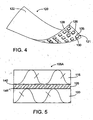
- the inner fabric layer 120 which may be formed, e.g., of a yam that includes multiple fibers of polyester, nylon, or other synthetic fabric that have been rendered hydrophilic, has an inner surface 121 (worn towards or against the wearer's skin) and an outer surface 122.
- the inner surface 121 defines a pattern of discrete pillar regions 126 of relatively deeper pile, which are spaced apart and isolated from each other by regions 128 of relatively shorter pile or no pile that form a plurality of intersecting channels 130, 135 passing among the discrete pillar regions, e.g., as described in U.S. Patent Publication No. 2003-0077967, dated April 24, 2003 .
- the outer surface 122 of the inner fabric layer 120 may be flat or smooth, or may be a raised fleece.
- the inner surface 121 may be raised or it may be covered with velour at a predetermined pile height, or covered with shearling, loop terry, or the like.
- the fibers of the discrete pillar regions 126 are disposed in contact the wearer's skin, and the base surface regions 128 of the channels 130, 135 of the inner surface 121 are spaced from contact with the wearer's skin.
- the plurality of intersecting channels 130, 135 define insulation regions that contain a cushion of air for promoting warmth under static conditions during periods of wearer inactivity and define circulation regions that create avenues for flow of air and enhanced evaporation of moisture from the skin of the wearer for creating a heat dissipation or cooling effect during periods of physical activity by the wearer.
- the horizontal channels 130 of the inner surface 121 can be created in various different ways. For example, loop yarns can be removed from one or more of the feeds during knitting. As a result, yam is excluded from preselected regions of the inner fabric layer 120 and channels 130 are created. As another example, a shrinkable loop yam can be used in those areas where horizontal channels 130 are desired. Processing the fabric with wet heat (e.g., hot water or steam) or dry heat (e.g., hot air) causes the shrinkable yam to shrink, creating channels 130.
- Vertical channels 135 can, for example, be formed by using tipped and tipless sinkers, high and low sinkers, or some combination of both. Other suitable methods are also contemplated.
- the degree of thermal insulation and/or heat dissipation desired is a function of anticipated external conditions, e.g. of temperature and wind speed, and the expected level of physical exertion by the wearer.
- the level of thermal insulation and heat dissipation provided by the upper portion 105 of multi-layer composite fabric garments is a function of the cross-sectional flow area of the channels 130, 135. For example, as the cross-sectional area (e.g., the depth and/or width) of channels 130, 135 is increased, a greater volume of air can be contained within the channels.
- larger channels allow the upper portion 105 of garments 110, 100' to provide a relatively higher level of thermal insulation and heat dissipation.
- smaller channels in the upper portion 105 of the garments provide a relatively lower level of thermal insulation and heat dissipation.
- channels 130, 135 can be altered in various ways. For example, regions 126 of raised fibers defining channels 130, 135 can be napped or brushed such that regions 126 become further raised to cause channels 130, 135 to take on greater depth. Napping and/or brushing regions 126 also makes the inner surface 121 of inner fabric layer 120 softer to the touch and enhances moisture absorption. With respect to horizontal channels 130 in particular, the loop yam may be removed from greater or fewer feeds and/or more or fewer loops of shrinkable yam can be used to alter the cross-sectional area of the channels 130. Similarly, with respect to vertical channels 135, the sinker height can be increased or decreased to produce channels that are deeper or shallower, respectively. Other suitable techniques for altering the size of channels 130, 135 are also contemplated.
- inner fabric layer 120 is rendered hydrophilic to promote transport of moisture through the fabric.
- liquid moisture e.g., sweat
- inner fabric layer 120 may be configured to transport moisture away from the wearer's skin and toward the intermediate barrier 125. (The moisture is subsequently transported through the barrier to the outer fabric layer 115, where it is absorbed and/or spread towards the surface for evaporation, as described in more detail below.) This arrangement helps to resist build up of moisture on the wearer's skin, and thus further increases the comfort level of the wearer.
- inner fabric layer 120 may be chemically treated, e.g. as described in U.S. Patent No. 5,312,667 .
- a material such as low molecular weight polyester can be added to a dye bath used to dye the inner fabric layer 120.
- the outer fabric layer 115 may be a woven, two-way stretch material. Other suitable materials may also be employed alone or in various combinations.
- outer fabric layer 115 is formed from a moisture absorbent material, such as cotton, rayon, or wool. Thus, during use, moisture is transported away from the inner fabric layer 120 and absorbed by the outer fabric layer 115.
- the outer fabric layer 115 alternatively may be formed of synthetic material, such as polyester, that has been rendered hydrophilic to help promote transport of moisture through the outer fabric layer 115.
- liquid moisture is transported to the surface of the hydrophilic outer fabric layer 115 by capillary action after passing through barrier layer 125. Liquid moisture evaporates relatively rapidly from the surface of outer fabric layer 115, thus this arrangement increases the rate at which moisture is evaporated from outer layer 115, thereby increasing the rate at which moisture or sweat is removed from the region in contact with the wearer's skin.
- the outer fabric layer 115 is formed from both moisture absorbent materials and materials that have been rendered hydrophilic. As a result, moisture is both absorbed by the outer fabric layer 115 and transported to the surface of outer fabric layer 115 by capillary action.
- the barrier layer 125 is positioned between the inner and outer fabric layers 120, 115.
- Barrier layer 125 is windproof and water-resistant.
- barrier layer 125 helps to provide upper portion 105 with wind and liquid water resistance, as well as limited levels of vapor permeability, i.e., breathability.
- barrier layer 125 substantially restricts air and liquid water droplets from passing inwardly through the barrier layer toward the wearer's skin, but water vapor, e.g. sweat, is allowed to pass outwardly through barrier layer 125 for enhanced wearer comfort.
- Breathability can be imparted to barrier layer 125 by forming the barrier layer to be sufficiently thin so as to permit water vapor to pass through the layer, as by an absorption-diffusion-desorption process in polyurethane barrier materials, or by providing material with micro-pores for the passage of water vapor.
- barrier layer 125 may be formed of any of various water resistant materials.
- barrier layer 125 may be formed from aromatic or aliphatic polyurethane.
- a suitable polyurethane material is available from UCB Chemical Corp., located in Drogenbos, Belgium.
- a micro-porous hydrophobic film, permeable to water vapor but impermeable to liquid water can also be used.
- Barrier layer 125 can be formed to be soft, with an ability to stretch and recover. In some cases, barrier layer 125 is formed of a material that adheres to fabric layers without application of an intervening adhesive layer.
- Material used to form barrier layer 125 may also advantageously contain various useful additives.
- the material may contain polyfunctional isocyanate to promote cross-linking, melamine to promote adhesion, aliphatic polyamine to catalyze curing, and/or fluorocarbon resin to enhance water repellency.
- a well-suited barrier can be formed from hydrophilic polyurethane derived from a solvent-based system, which permits moisture to pass through the barrier by an absorption-diffusion-desorption process.
- a polyurethane barrier is non-porous and formed so that body moisture will be transported therethrough, while being sufficiently resistant to passage of water droplets.
- the thickness of barrier layer 125 is selected to balance its properties of liquid water resistance and vapor permeability. Typically, liquid water resistance of barrier layer 125 increases with thickness and vapor permeability of the barrier layer decreases with thickness. In some embodiments, the barrier layer 125 may be formed to be relatively thicker so as to increase liquid water resistance. In other embodiments, the barrier layer may be formed to be relatively thinner so as to increase its vapor permeability.
- barrier layer 125 can be partially hydrophobic, in that there are fewer pores/mm 2 than in a true hydrophobic barrier. Thus, moisture can pass through the hydrophilic portion of the barrier layer by an absorption-diffusion-desorption process and through micropores of the hydrophobic portion.
- barrier layer 125 may be adhered to the inner and outer fabric layers 120, 115 using the process of transfer coating.
- the barrier layer is formed on a carrier, such as release paper, and then the exposed surface of barrier layer 125 is joined to one of the inner and outer fabric layers 120, 115.
- the carrier is removed from the barrier layer, and the other of the inner and outer fabric layers 120, 115 is adhered to the opposite surface of barrier layer 125, without additional adhesive, to form the multi-layer composite fabric of which of upper portion 105 of garment 100 is constructed.
- the barrier layer is adhered to the inner and outer fabric layers 120, 115 by an adhesive applied in a continuous or discontinuous layer.
- the adhesive may be hydrophilic or hydrophobic material.
- the barrier layer can also be adhered to the fabric layers 120, 115 by other methods, such as using heat or pressure.
- adhesive layers 140, 145 secure barrier layer 125 to opposed surfaces of the outer fabric layer 115 and inner fabric layer 120.
- the adhesive layers 140, 145 can be applied to opposed, unraised surfaces of the inner and outer layers 120, 115 and/or to the barrier layer 125 before joining layers 120, 115 together.
- Application of the adhesive may be by means of gravure printing or by another suitable application process.
- the adhesive layers 140, 145 may be formed of any of various suitable materials.
- adhesive layers 140, 145 are water resistant.
- a suitable material for the adhesive layers is solvent-based polyurethane, such as Ucecoat TD9607, manufactured by UCB Chemical Corp.
- the barrier layer 125 includes first and second sub-barrier layers 147, 149.
- the first sub-barrier layer 147 is adhered to a surface of outer fabric layer 115, and the second sub-barrier layer 149 is adhered to a surface of inner fabric layer 120.
- Sub-barrier layers 147, 149 are adhered to inner and outer fabric layers 120, 115 using any of the techniques described above.
- the sub-barrier layers are also adhered to one another.
- the sub-barrier layers can be joined together, for example, by heat and/or pressure. They can also be adhered to one another with adhesive or by any other suitable means.
- each of the sub-barrier layers 147, 149 is laid on a carrier, such as release paper.
- the first sub-barrier layer 147 is transferred from its carrier to the surface of outer fabric layer 115, and the second sub-barrier layer 149 is transferred from its carrier to the surface of inner fabric layer 120.
- This method referred to as transfer coating, is advantageous because it allows for precise control of barrier weight and thickness and allows use of thinner and lighter barrier layers.
- Sub-barrier layers 147,149 are then adhered to each other, as shown.
- first sub-barrier layer 147' is adhered to a surface 157 of outer fabric layer 115 by a first adhesive layer 150.
- second sub-barrier layer 149' is adhered to a surface 159 of inner fabric layer 120 by a second adhesive layer 155.
- adhesive layers 150, 155 are continuous and formed of hydrophilic material.
- one or both of the adhesive layers are formed of micro-porous hydrophobic material.
- adhesive layers 150, 155 are preferably discontinuous.
- the composite fabric of FIG. 7 may be constructed by laying each of the sub-barrier layers 147', 149' on a carrier sheet. First sub-barrier layer 147 is transferred directly to the first adhesive layer 150, and second sub-barrier layer 149 is transferred directly to the second adhesive layer 155. The sub-barrier layers are then adhered to each other by heat and/or pressure, for example, to form the composite fabric shown in FIG. 7 .
- the lower portion 110' of the multi-layer composite fabric garment 100' (shown in FIG 2 ) is constructed to provide a relatively higher level of air permeability.
- FIG. 1 which shows a comparative example for background information
- the lower portion 110 a laminate with inner and outer fabric layers disposed about an intermediate barrier layer, provides controlled air permeability in the range of about 0 CFM to about 20 CFM (about 0 cc/sec to about 9,440 cc/sec).
- the lower portion 110' without an intermediate barrier layer, provides controlled air permeability in the range of about 0 CFM to about 60 CFM (about 0 cc/sec to about 28,320 cc/sec).
- the lower portion 110' includes regions of the garment 100' less likely (relative to the upper portion 105) to be exposed to wind and rain, so the lower portion 110' is constructed in a manner to provide a high level of breathability and air permeability, and thus increase the comfort level of the wearer.
- the composite fabric of the lower portion 110 of multi-layer composite fabric garment 100 has controlled air permeability in a construction consisting of an outer fabric layer 160, an inner fabric layer 165, and an intermediate barrier layer 170.
- liquid moisture e.g., sweat
- the inner fabric layer 165 is absorbed by the inner fabric layer 165 and transported through the barrier layer 170 to the outer fabric layer 160 where it is absorbed and/or evaporates.
- Due to the construction of the composite fabric 110 air is also permitted to penetrate through the fabric into contact with the wearer's skin, e.g. for cooling, including by direct evaporation of liquid moisture (sweat) from the wearer's skin, under certain conditions.
- the composite fabric of the lower portion 110' of multi-layer composite fabric garment 100' has controlled air permeability in a construction consisting of an outer fabric layer 160' and an inner fabric layer 165', without an intermediate barrier layer.
- liquid moisture e.g., sweat
- the composite fabric 110' i.e. absence of an intermediate barrier layer, air is permitted to penetrate more easily through the multi-layer composite fabric layer 110' for cooling and providing direct evaporation of liquid moisture (sweat) from the wearer's skin.
- the barrier layer 170 between fabric layers 160, 165 of the multi-layer composite fabric of lower portion 110 and the tortuosity of interstitial spaces at the interface 175 between the fabric layers 160', 165' of the multi-layer composite fabric of lower portion 100' help to provide the lower portions 110, 110' with relatively higher levels of vapor permeability or breathability, as compared to the upper portion 105 (shown in FIG. 1 ).
- the multi-layer composite fabric of the lower portions 110, 110' can be constructed to provide a desired level of air permeability. As indicated by the arrows in FIGS. 8A and 8B , air impinging upon the lower portions 110, 110' is partially deflected, e.g., at the barrier layer 170 ( FIG. 8A ) or at the interface 175 ( FIG. 8B ), and partially penetrates through to the inner surface of the fabric.
- the lower portion 110' has relatively higher water vapor permeability in moving air and relatively lower water vapor permeability in static air. As a result, the lower portion 110' beneficially cool the wearer during periods of physical activity and warm the wearer during periods of inactivity.
- the inner fabric layers 165, 165' are similar to the inner fabric layer 120 of the upper portion 105, as described above with respect to FIG. 4 .
- the inner fabric layers 165, 165' have multiple intersecting channels defined by discrete raised pillar regions.
- the intersecting channels provide insulation regions that contain a cushion of air for promoting warmth under static conditions, i.e. during periods of wearer inactivity, and the channels provide circulation regions creating avenues for flow of air and enhanced evaporation of moisture from the skin of the wearer, providing a heat dissipation or cooling effect, i.e. during periods of physical activity by the wearer.
- the inner surfaces of the inner fabric layers 165, 165' of lower portions 110, 110' may be finished with raised surfaces other than in a three-dimensional pattern with raised regions separated by channels, e.g. with velour at predetermined pile height, shearling, loop terry, etc.
- inner fabric layers 165, 165' can be treated or modified, e.g. as described in U.S. Patent No. 5,204,156 , U.S. Patent No. 5,268,212 , and U.S. Patent No. 5,364,678 .
- inner fabric layers 165, 165' can be rendered hydrophilic, provided with a raised surface, treated to be water repellant, etc.
- the outer fabric layers 160, 160' are woven material, e.g. a two-way stretch woven material or a one-way stretch woven material, with one or more raised surface regions.
- the outer fabric layers 160, 160' are knit material, e.g. a one-way stretch knit material.
- the outer fabric layers may also be treated or modified, including as described in U.S. Patent No. 5,204,156 , U.S. Patent No. 5,268,212 , and U.S. Patent No. 5,364,678 .
- the outer fabric layers 160, 160' may be rendered hydrophilic, provided with a raised surface, treated to be water repellant, etc.
- the barrier layer 170 of the multi-layer composite fabric of lower portion 110 can be of any material and/or configuration, e.g., as described in U.S. Application Publication 2005-0020160 .
- the barrier layer 170 can be an adhesive.
- the adhesive can be polyurethane, polyester, acrylic, polyamide, or a combination of these materials.
- the adhesive can, for example, be applied to the inner and/or outer fabric layers 165, 160 by means of transfer coating from release paper at between about 0.25 oz/yd 2 and about 2.5 oz/yd 2 (between about 8.5 gms/m 2 and about 84.8 gms/m 2 ).
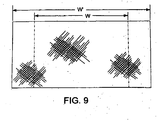
- a multi-layer composite fabric from which the lower portion 110 is constructed has an original width, W.
- the composite fabric is subjected to controlled stretching in such a manner as to result in a stretched width, W'.
- the composite fabric having the stretched width, W' provides a relatively higher level of air permeability. More specifically, as the composite fabric is stretched, the interstitial spaces between the yarns become larger, with resulting increase in air permeability. Thus, the composite fabric can be stretched to a point of providing a desired level of air permeability.
- One or more regions of the outer surface of the multi-layer composite fabric garments 100, 100' may have a non-continuous protective coating applied thereon, e.g. for protection of the material surface from abrasion and pilling or fraying.
- a non-continuous coating is adhered upon one or more selected regions of the relatively smooth outer surface of multi-layer composite fabric garments of the invention.
- the non-continuous outer surface coating enhances surface abrasion resistance and pilling resistance of the resulting fabric while allowing generation of controlled air permeability in a predetermined range to facilitate improved levels of moisture vapor transmission (MVT), which is particularly desirable for activities generating high metabolism rates.
- MVT moisture vapor transmission
- the elbow regions of the outer fabric layer 115 of the upper portion 105 can be provided with a non-continuous coating 161, while the remaining regions of the outer fabric layer of the upper and lower portions 105, 110, 110' are left free of coating.
- the non-continuous coating 161 can be more typically be applied to multiple regions of the outer surface of the garment 100, 100' that are relatively more prone to abrasion and pilling or fraying during use, i.e. in addition to the elbow regions.
- Non-continuous coating 161 provides the coated regions with relatively higher levels of abrasion and pilling resistance, e.g., as compared to uncoated regions, while those uncoated regions, being substantially free of coating material, have a relatively higher level of air permeability and facilitate a higher moisture vapor transmission rate.
- the outer fabric layers of the upper and lower portions 105, 110' of the garments 100' have one or multiple regions of non-continuous coating and one or multiple regions of continuous coating.
- the non-continuous coating is preferably applied to regions of the garments 100° subjected to relatively high perspiration levels during use, e.g., the underarm regions.
- the non-continuous coating by being applied to those regions that are subjected to relatively higher perspiration levels, permits relatively higher levels of airflow, which facilitates moisture vapor transmission, while still enhancing the resistance to abrasion and pilling.
- the continuous coating permits the remaining regions of the garments 100' to be provided, e.g., with relatively higher abrasion and pilling resistances and relatively lower air permeability levels when desired.
- the non-continuous coating may be applied or additionally applied in areas of the fabric article subjected to relatively high levels of wind impact (e.g., the chest of a shirt or jacket) to provide improved wind resistance due to the selected application of the coating material.
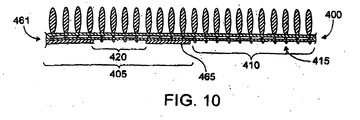
- a knit fabric 400 forming an outer fabric layer of the garment 100' has a non-continuous coating 461 formed of multiple, spaced apart or discontinuous coating segments 465 applied within a first area 405 of the technical face, i.e., the outer surface of garments 100'.
- the non-continuous coating 461 is applied to only portions of the knit fabric 400, leaving a second area 410 substantially free of the non-continuous coating 461.
- the second area 410 may have a continuous coating applied thereon.
- the non-continuous coating 461 within the first area 405 of the technical face 415 is applied in a predetermined pattern (e.g., lines, dots, etc.) leaving portion 420 of the technical face within the first area 405 adjacent the coating segments 465 free of coating material.
- the coating material forming the coating segments 465 is generally air impermeable or semi-impermeable, while within the portion 420, the fabric remains air permeable to allow air passage through the composite fabric at controlled rates, the details of which are further described below.
- the coating material binds together yam fibers to improve certain other structural and physical properties of the composite fabric.
- the coating material in binding together the individual fibers, forms bound fiber groupings (e.g., of at least about 5 fibers and up to about 100 fibers) and the tenacity of these groupings of fibers (e.g., from about 140 to about 350 grams per denier for a grouping of about 70 fibers) is greater than the tenacity of each individual fiber (e.g., from about 2 to about 5 grams per denier).
- the abrasion and pilling resistances within the region of the composite fabric are improved.
- pilling resistance within the coated regions of the composite fabric can be as high as five on a scale from one to five measured by ASTM D-3512.
- Face abrasion resistance of the composite fabric within the coated regions can be as high as five on a scale from one to five after 250 cycles measured by ASTM D-3884 and using a Martindale abrasion machine where the abrasion is done by a VELCRO ® hook touch fastener tape mounted on the Martindale testing unit.
- the non-continuous coating 461 also provides greater freedom of yam selection in the construction of the fabric.
- the coating 461 facilitates use of relatively finer fibers (e.g., from about 5.0 dpf down to about 0.1 dpf) in the construction of the fabric, e.g., by reducing the risk of the fibers being pulled from the technical face.
- relatively finer fibers e.g., from about 5.0 dpf down to about 0.1 dpf
- a tighter stitch can be achieved, which, in turn, improves the dynamic insulating performance of the resultant fabric by, e.g., providing relatively narrow air passageways through the fabric and increasing tortuosity through those passageways.
- the non-continuous coating 461, in binding fibers in the yam of fabric 400 allows use of relatively weaker fibers, such as polyester and nylon, in construction of the fabric, which also provides greater tortuosity of air passageways to enhance dynamic insulation performance of the fabric.
- a variety of coating materials can be used, including, e.g. acrylic (including acrylic latex), polyurethane and silicone.
- the coating can be selected to have a dry hand upon curing or drying, i.e. not tacky to the touch, good stretch/recovery, and good bond to textile fibers.
- the amount of coating material applied depends, at least in part, on the end use of the product. For example, in some cases, it may be desirable to greatly enhance the abrasion resistance of areas of the fabric. In these cases, relatively more coating material can be applied (e.g., more dots per area of fabric material and/or more material per dot). In other cases, it may be desirable for areas of the fabric article to have enhanced abrasion resistance, while having a relatively high level of air permeability.
- the weight of the non-continuous coating 461 on the printed fabric can be between about 0.5 oz/yd 2 to about 6.0 oz/yd 2 (between about 14.2 gms/m 2 and about 170.2 gms/m 2 ), and preferably is about 1.7 oz/yd 2 (about 48.2 gms/m 2 ).
- the non-continuous coating 461 can be applied by any suitable method including, e.g., rotary printing, kiss rolling, and gravure rolling.
- the non-continuous coating 461 is applied by a single head rotary screen having a selected number of holes per lineal measure (e.g., from about 30 holes per lineal inch to about 195 holes per lineal inch (about 11-12 holes per lineal centimeter to about 76-77 holes per lineal centimeter))
- coating or binder may be applied to yarns of the outer fabric surface of the garment 100' in different configurations.
- regions 505 of binder or coagulant material are adhered primarily to yam fibers 500 and at interlacing intersections of yarns 510, thereby allowing the fabric to retain its original form and characteristics, including good drapability and hand, and allowing through-passage of air to a predetermined degree (MVT and breathability), but also providing an outer surface of enhanced durability, e.g. against pilling and wear, e.g. during exercise and harsher outdoor sports.
- the binder material forms a film 515 that constricts (but preferably does not block) interstitial spaces 520 between yarns 500, to reduce air-permeability and provide increased insulation and warmth, for use in particular under colder and windier conditions.
- the binder or coating for forming a surface region of enhanced durability surface is applied to the outer surface of garment 100' with a pad.
- deposit of the binder material is limited primarily to the fibers and/or to the intersections of fibers in the yam segments, and formation of binder film in the interstitial spaces between yarns is minimized.
- the formation of film may particularly be avoided by removal of excess liquid binder from interstitial spaces between yarns shortly following application, e.g. while the binder material is still wet or moist, by air suction or air blowing through the fabric article.
- the binder material can be applied in a low viscosity system, or in a system with relatively low level of binder solids or particulates in a liquid carrier, so that as the system dries, the liquid carrier evaporates (or in a foam system, collapses), leaving the solid binder deposited primarily or only on the yarns or yarn fibers. In this manner, the air permeability level and other characteristics of the base fabric are maintained.
- binder or coating material of relatively higher viscosity may be employed, to encourage formation of a fine film in interstitial areas between yarns that will partially or fully maintain its integrity during the drying process.
- the fabric article may be provided with increased water repellency and wind resistance, which would be advantageous in cold windy ambient environments.
- a full or continuous film is typically to be avoided, in order to maintain at least a minimum desired degree of moisture vapor transmission necessary for comfort during high energy activities, such as running, skiing, etc.
- the improved surface durability of multi-layer composite fabric articles of the invention is demonstrated in a severe pilling and abrasion test, such as the modified Martindale abrasion test method of ASTM D 4966.
- a fabric article of the invention to be tested is subjected to repeated rubbing by a strip of the hook element (General Application type, 3 ⁇ 4-inch by 1 ⁇ 2-inch (19.1mm by 12.7 mm)) of a hook-and-loop type fastener element. After 250 rubs, the appearance of the fabric article of the invention has been seen to be markedly better, e.g., as compared to untreated fabric articles.
- raised regions 126 of the inner surfaces of the upper portion 105 and lower portions 110' of garments of the invention can be formed to define channels of other, different arrangements, e.g., raised regions 126 may define horizontal channels alone, vertical channels alone, zig-zag channels, arcuate channels, or channels of any other desired shape or configuration capable of providing a cushion of air within the channels and/or permitting circulation of air through the channels. Accordingly, other embodiments are within the scope of the following claims.
Landscapes
- Engineering & Computer Science (AREA)
- Textile Engineering (AREA)
- Health & Medical Sciences (AREA)
- General Health & Medical Sciences (AREA)
- Physical Education & Sports Medicine (AREA)
- Physics & Mathematics (AREA)
- Thermal Sciences (AREA)
- Laminated Bodies (AREA)
- Outer Garments And Coats (AREA)
- Details Of Garments (AREA)
- Peptides Or Proteins (AREA)
- Manufacturing Of Multi-Layer Textile Fabrics (AREA)
Claims (24)
- Kleidungsstück aus einem zusammengesetzten Stoff (100'), das aufweist:einen ersten Kleidungsstück-Abschnitt (105), der in einem oder mehreren oberen Bereichen des Stoff-Kleidungsstücks angeordnet ist, von dem / denen es wahrscheinlicher ist, dass sie bei Benutzung Wind und Regen ausgesetzt sind, wobei der erste Kleidungsstück-Abschnitt (105), der aus einem ersten zusammengesetzten Stoff ausgebildet ist, aufweist:eine erste innere Stoffschicht (120);eine erste äußere Stoffschicht (115); undeine erste Zwischen-Grenzschicht (125), die sich zwischen der ersten inneren Stoffschicht (120) und der ersten äußeren Stoffschicht (115) befindet und damit verbunden ist, wobei die erste Zwischen-Grenzschicht (125) atmungsaktiv und im Wesentlichen für Wind und flüssiges Wasser undurchlässig ist; undeinen zweiten Kleidungsstück-Abschnitt (110'), der in einem oder mehreren unteren Bereichen des Stoff-Kleidungsstücks (100') angeordnet ist, von dem /denen es weniger wahrscheinlich ist, dass sie bei Benutzung Wind und Regen ausgesetzt sind, wobei der zweite Kleidungsstück-Abschnitt (110'), der aus einem zweiten zusammengesetzten Stoff ausgebildet ist, eine vorgegebene Luftdurchlässigkeit hat und aufweist:wobei der zweite Kleidungsstück-Abschnitt (110') keine Zwischen-Grenzschicht hat und einen relativ höheren Grad von Atmungsaktivität und Luftdurchlässigkeit aufweist, als der erste Kleidungsstück-Abschnitt (105).eine zweite innere Stoffschicht (165'); undeine zweite äußere Stoffschicht (160'),
- Kleidungsstück aus einem zusammengesetzten Stoff (100') nach Anspruch 1, wobei der eine oder die mehreren unteren Bereiche des Stoff-Kleidungsstücks (100') den unteren Brustbereich des Trägers und den Bereich abwärts davon umfassen.
- Kleidungsstück aus einem zusammengesetzten Stoff (100') nach Anspruch 1 oder 2, wobei wenigstens eine der ersten inneren Stoffschicht (120) und der zweiten inneren Stoffschicht (165') Garn mit einer Vielzahl von Kunstfasern aufweist, die hydrophil gemacht worden sind.
- Kleidungsstück aus einem zusammengesetzten Stoff (100') nach Anspruch 3, wobei die Kunstfasern wenigstens einer der ersten inneren Stoffschicht (120) und der zweiten inneren Stoffschicht (165') aus der Gruppe bestehend aus Polyester und Nylon ausgewählt werden.
- Kleidungsstück aus einem zusammengesetzten Stoff (100') nach einem der vorhergehenden Ansprüche, wobei die erste Zwischen-Grenzschicht (125) eine erste hydrophile Schicht (147) aufweist, die mit wenigstens einer der ersten inneren Stoffschicht (120) und der ersten äußeren Stoffschicht (115) mittels Transferbeschichtung von einem Träger ohne separaten Klebstoff verbunden wird, wobei die erste Zwischen-Grenzschicht (125) Wasserdampfdurchlässigkeit (Moisture Vapor Transmission; MVT) ermöglicht.
- Kleidungsstück aus einem zusammengesetzten Stoff (100') nach einem der Ansprüche 1, 2 oder 5, wobei die erste innere Stoffschicht (120) hydrophil ist.
- Kleidungsstück aus einem zusammengesetzten Stoff (100') nach einem der vorhergehenden Ansprüche, wobei die erste äußere Stoffschicht (115) hydrophob ist.
- Kleidungsstück aus einem zusammengesetzten Stoff (100') nach einem der vorhergehenden Ansprüche, wobei wenigstens eine der ersten inneren Stoffschicht (120) und der zweiten inneren Stoffschicht (165') eine Oberfläche definiert, die diskrete Säulenbereiche (126) von relativ tieferem Flor aufweist, wobei die diskreten Säulenbereiche (126) von relativ tieferem Flor durch Bereiche (128) von relativ kürzerem Flor oder keinem Flor, die eine Vielzahl von Kanälen (130, 135) bilden, die sich zwischen den diskreten Säulenbereichen (126) erstrecken, voneinander beabstandet und isoliert sind, wobei die Vielzahl von Kanälen (130, 135) Isolierbereiche definieren, um ein Luftkissen zu enthalten, um Wärme unter statischen Bedingungen während Perioden der Inaktivität des Trägers zu fördern und Zirkulationsbereiche zu definieren, die Zugänge für Luftströme und verbesserte Verdunstung von Feuchtigkeit von der Haut des Trägers schaffen, um während Perioden körperlicher Aktivität durch den Träger Wärmeableitung oder einen Kühlungseffekt zu schaffen.
- Kleidungsstück aus einem zusammengesetzten Stoff (100') nach Anspruch 8, wobei die Vielzahl von Kanälen (130, 135), die entlang wenigstens einer der ersten inneren Stoffschicht (120) und der zweiten inneren Stoffschicht (165') ausgebildet sind, eine Vielzahl von sich überschneidenden vertikalen und horizontalen Kanälen aufweisen.
- Kleidungsstück aus einem zusammengesetzten Stoff (100') nach Anspruch 9, wobei die vertikalen Kanäle, die entlang wenigstens einer der ersten inneren Stoffschicht und der zweiten inneren Stoffschicht (165') ausgebildet sind, durch Sinkers mit Spitze und ohne Spitze, hohe und niedrige Sinkers, oder eine Kombination davon hergestellt werden.
- Kleidungsstück aus einem zusammengesetzten Stoff (100') nach einem der vorhergehenden Ansprüche, wobei wenigstens eine der ersten äußeren Stoffschicht (115) und der zweiten äußeren Stoffschicht (160') eine Strickkonstruktion aus verflochtenen Multifilamentgarnen mit einem oder mehreren Oberflächenbereichen aufweist, die eine diskontinuierliche Beschichtung (461) haben, die diskrete Beschichtungssegmente (465) aus Beschichtungsmaterial aufweist, das aufgetragen wird, um einzelne Garnfasern zur verbesserten Widerstandsfähigkeit des äußeren Oberflächenbereichs gegenüber Abrieb, Pilling oder Durchscheuern zusammenzubinden.
- Kleidungsstück aus einem zusammengesetzten Stoff (100') nach einem der Ansprüche 1 bis 10, wobei wenigstens eine der ersten äußeren Stoffschicht (115) und der zweiten äußeren Stoffschicht (160') einen Stoff von gestrickter oder gewobener Konstruktion aus verflochtenen Multifilamentgarnen (500) mit einem oder mehreren äußeren Oberflächenbereichen aufweist, die eine diskontinuierliche Beschichtung von Bindematerial aufweisen, das wenigstens an verflochtenen Schnittpunkten (510) an Garne und an Garnfasern geklebt wird zur verbesserten Beständigkeit des äußeren Oberflächenbereichs hinsichtlich Pilling oder Durchscheuern.
- Kleidungsstück aus einem zusammengesetzten Stoff (100') nach Anspruch 12, wobei das Kleben des Bindematerials an Garnfasern (500) so begrenzt ist, dass eine Einschränkung der Luftdurchlässigkeit durch den zweiten Artikel aus zusammengesetztem Stoff im Wesentlichen vermieden wird.
- Kleidungsstück aus einem zusammengesetzten Stoff (100') nach einem der vorhergehenden Ansprüche, wobei wenigstens eine der ersten inneren Stoffschicht (120) und der zweiten inneren Stoffschicht (165') eine erhabene Oberfläche in einer Form ausgewählt aus der Gruppe bestehend aus Velours Shearling (gewachsenes Lammfell) und Schlingenfrottee aufweist.
- Kleidungsstück aus einem zusammengesetzten Stoff (100') nach einem der vorhergehenden Ansprüche, wobei wenigstens eine der ersten äußeren Stoffschicht (115) und der zweiten äußeren Stoffschicht (160') eine Konstruktion hat, die ausgewählt wird aus der Gruppe bestehend aus: gewebte Konstruktion, rundgestrickte Konstruktion, Einseiten-Strickkonstruktion, Doppelseiten-Strickkonstruktion und Kettenstrick-Konstruktion.
- Kleidungsstück aus einem zusammengesetzten Stoff (100') nach Anspruch 15, wobei wenigstens eine der ersten äußeren Stoffschicht (115) und der zweiten äußeren Stoffschicht (160') wenigstens einseitigen Stretch aufweist.
- Kleidungsstück aus einem zusammengesetzten Stoff (100') nach Anspruch 16, wobei wenigstens eine der ersten äußeren Stoffschicht (115) und der zweiten äußeren Stoffschicht (160') zweiseitigen Stretch aufweist.
- Kleidungsstück aus einem zusammengesetzten Stoff (100') nach Anspruch 15, Anspruch 16 oder Anspruch 17, wobei wenigstens eine der ersten äußeren Stoffschicht (115) und der zweiten äußeren Stoffschicht (160') eine erhabene Oberfläche in einem oder mehreren Bereichen hat.
- Kleidungsstück aus einem zusammengesetzten Stoff (100') nach Anspruch 15, Anspruch 16 oder Anspruch 17, wobei wenigstens eine der ersten äußeren Stoffschicht (115) und der zweiten äußeren Stoffschicht (160') eine nicht erhabene Oberfläche in einem oder mehreren Bereichen hat.
- Kleidungsstück aus einem zusammengesetzten Stoff (100') nach einem der vorhergehenden Ansprüche, wobei die erste innere Stoffschicht (120) eine erhabene innere Oberfläche und eine ebene äußere Oberfläche aufweist, wobei die erste innere Stoffschicht (120) aus im Wesentlichen hydrophobem Material ausgebildet ist, das hydrophil gemacht worden ist, um eine Dochtwirkung für Feuchtigkeit aus der erhabenen inneren Oberfläche in die ebene äußere Oberfläche zu erlauben.
- Kleidungsstück aus einem zusammengesetzten Stoff (100') nach einem der Ansprüche 1 bis 19, wobei die erste innere Stoffschicht (120) eine erhabene innere Oberfläche und eine ebene äußere Oberfläche aufweist, wobei die erste innere Stoffschicht (120) aus im Wesentlichen hydrophilem Material ausgebildet ist, um eine Dochtwirkung für Feuchtigkeit von der erhabenen inneren Oberfläche zu der ebenen äußeren Oberfläche zu erlauben, und wobei die erste Zwischen-Grenzschicht (125) eine nicht poröse hydrophile Schicht aufweist, wobei die erste Zwischen-Grenzschicht (125) Wasserdampftransport ermöglicht, und wobei eine erste hydrophile Klebeschicht (150, 155) die erste Zwischen-Grenzschicht (147', 149') an wenigstens einer einer äußeren Oberfläche der ersten inneren Stoffschicht (120) und einer inneren Oberfläche der ersten äußeren Stoffschicht (115) befestigt.
- Kleidungsstück aus einem zusammengesetzten Stoff (100') nach einem der vorhergehenden Ansprüche, wobei der zweite Kleidungsstück-Abschnitt (110') eine Konstruktion hat, die ausgewählt wird aus der Gruppe bestehend aus: gewebte Konstruktion, rundgestrickte Konstruktion und kettengestrickte Konstruktion, wobei vorgegebene Luftdurchlässigkeit in einem Nicht-Laminat ohne Zwischen-Grenzschicht erreicht wird.
- Kleidungsstück aus einem zusammengesetzten Stoff (100') nach den Ansprüchen 1 bis 3, 6 bis 20 oder 22, wobei die erste Zwischen-Grenzschicht (125) ein poröser hydrophober Film ist.
- Kleidungsstück aus einem zusammengesetzten Stoff (100') nach den Ansprüchen 1 bis 3, 6 bis 20 oder 22, wobei die erste Zwischen-Grenzschicht (126) hydrophil ist und mittels einer diskontinuierlichen Klebeschicht an wenigstens eine der ersten inneren Stoffschicht (120) und der ersten äußeren Stoffschicht (115) geklebt ist.
Priority Applications (1)
| Application Number | Priority Date | Filing Date | Title |
|---|---|---|---|
| EP20090168849 EP2116143A3 (de) | 2004-10-07 | 2005-10-07 | Kleidung aus mehrschichtigen Verbundfasern |
Applications Claiming Priority (1)
| Application Number | Priority Date | Filing Date | Title |
|---|---|---|---|
| US10/960,402 US7560399B2 (en) | 1998-08-28 | 2004-10-07 | Multi-layer composite fabric garment |
Related Child Applications (1)
| Application Number | Title | Priority Date | Filing Date |
|---|---|---|---|
| EP20090168849 Division EP2116143A3 (de) | 2004-10-07 | 2005-10-07 | Kleidung aus mehrschichtigen Verbundfasern |
Publications (3)
| Publication Number | Publication Date |
|---|---|
| EP1645201A2 EP1645201A2 (de) | 2006-04-12 |
| EP1645201A3 EP1645201A3 (de) | 2007-10-10 |
| EP1645201B1 true EP1645201B1 (de) | 2009-12-02 |
Family
ID=35448417
Family Applications (2)
| Application Number | Title | Priority Date | Filing Date |
|---|---|---|---|
| EP20090168849 Withdrawn EP2116143A3 (de) | 2004-10-07 | 2005-10-07 | Kleidung aus mehrschichtigen Verbundfasern |
| EP20050256269 Expired - Lifetime EP1645201B1 (de) | 2004-10-07 | 2005-10-07 | Mehrlagiges Bekleidungstück |
Family Applications Before (1)
| Application Number | Title | Priority Date | Filing Date |
|---|---|---|---|
| EP20090168849 Withdrawn EP2116143A3 (de) | 2004-10-07 | 2005-10-07 | Kleidung aus mehrschichtigen Verbundfasern |
Country Status (4)
| Country | Link |
|---|---|
| US (1) | US7560399B2 (de) |
| EP (2) | EP2116143A3 (de) |
| AT (1) | ATE450163T1 (de) |
| DE (2) | DE602005017994D1 (de) |
Families Citing this family (59)
| Publication number | Priority date | Publication date | Assignee | Title |
|---|---|---|---|---|
| US7776421B2 (en) * | 1998-08-28 | 2010-08-17 | Mmi-Ipco, Llc | Multi-layer flame retardant fabric |
| US7930767B2 (en) * | 2001-12-12 | 2011-04-26 | Reynolds Eric M | Body form-fitting rainwear |
| AU2003251382A1 (en) * | 2002-05-24 | 2003-12-12 | Michel Joyce | Article of clothing with moisture absorbent portion |
| US8555414B2 (en) * | 2004-05-06 | 2013-10-15 | Nike, Inc. | Article of apparel utilizing zoned venting and/or other body cooling features or methods |
| EP1774076A4 (de) * | 2004-06-24 | 2008-04-30 | Mmi Ipco Llc | Gezielt gestaltete textilerzeugnisse |
| US20060090249A1 (en) * | 2004-10-29 | 2006-05-04 | Rodriguez Yenis A | Body suit with impermeable pectoral guard |
| US7653949B2 (en) * | 2005-05-17 | 2010-02-02 | Trisha Kraus | Mitten-sleeve combination for a winter garment |
| WO2007076003A2 (en) * | 2005-12-20 | 2007-07-05 | Ryan B. Hannigan | Multifunctional composite vapor barrier textile |
| US7546853B2 (en) * | 2006-05-30 | 2009-06-16 | Mmi-Ipco, Llc | Advanced engineered garment |
| US20080103798A1 (en) * | 2006-10-25 | 2008-05-01 | Domenikos Steven D | Identity Protection |
| US8575044B2 (en) * | 2007-01-25 | 2013-11-05 | W. L. Gore & Associates, Inc. | Packable water resistant insulated articles |
| US8856964B2 (en) | 2007-05-08 | 2014-10-14 | Nike, Inc. | Articles of apparel including zones having increased thermally insulative and thermally resistive properties |
| US8256024B2 (en) * | 2007-08-21 | 2012-09-04 | Massif Mountain Gear Company, L.L.C. | Cold weather garment |
| US20090064391A1 (en) * | 2007-09-10 | 2009-03-12 | Michael Herd El | Water-channeling system for rainwear |
| US20090077724A1 (en) * | 2007-09-26 | 2009-03-26 | Courtney Mark J | Protective Undergarment |
| US20090089911A1 (en) * | 2007-10-05 | 2009-04-09 | Smith Timothy J | Comfortable Protective Garments |
| US9885129B2 (en) | 2007-12-19 | 2018-02-06 | Coolcore, Llc | Fabric and method of making the same |
| KR20100120650A (ko) * | 2008-01-18 | 2010-11-16 | 엠엠아이-아이피씨오, 엘엘씨 | 복합 직물 |
| EP2276362B1 (de) * | 2008-04-16 | 2012-11-14 | Öztek Tekstil Terbiye Tesisleri Sanayi Ve Ticaret Anonim Sirketi | Mehrschichtige hitzedämmfaser |
| US20100130085A1 (en) * | 2008-11-25 | 2010-05-27 | Invista North America S.A R.L. | Moisture-vapor-breathable and liquid-impermissible structures, moisture-vapor-breathable and liquid-impermissible upholstery structures and methods of making moisture-vapor-breathable and liquid-impermissible structures |
| US8679285B2 (en) * | 2009-03-31 | 2014-03-25 | Velero Industries B.V. | Breathable fabric lamination |
| US8176569B2 (en) * | 2009-06-24 | 2012-05-15 | Mmi-Ipco, Llc | Advanced engineered garment |
| US20110086208A1 (en) * | 2009-10-08 | 2011-04-14 | Nemphos Jr Charles J | Lightweight, Breathable, Waterproof, Stretchable, Dye-Sublimatable Fabric For Apparel |
| USD626720S1 (en) | 2009-11-05 | 2010-11-09 | Daniel Pinkhasov | Disposable sweat absorbent undershirt |
| US20130196109A1 (en) | 2009-11-24 | 2013-08-01 | Mmi-Ipco, Llc | Insulated Composite Fabric |
| US8535776B2 (en) * | 2010-11-16 | 2013-09-17 | Velcro Industries B.V. | Breathable and elastic fabric lamination |
| WO2012135634A1 (en) * | 2011-03-30 | 2012-10-04 | Dartex Coatings, Inc. | Flexible barrier composite fabrics via an adhered film process |
| WO2013015882A1 (en) * | 2011-07-26 | 2013-01-31 | Velcro Industries B.V | Fabric finishing |
| US8715452B2 (en) | 2011-08-09 | 2014-05-06 | Medline Industries, Inc. | Seamless protective apparel |
| GB2496174A (en) * | 2011-11-04 | 2013-05-08 | Tracey Trotter | Post exercise suit |
| US9763482B2 (en) * | 2011-12-21 | 2017-09-19 | Under Armour, Inc. | Neck gaiter |
| RU2015118384A (ru) * | 2012-10-16 | 2016-12-10 | КулКор ЛЛК | Текстильное полотно и способ его изготовления |
| US9936751B1 (en) | 2013-03-14 | 2018-04-10 | Francesco Mignone | Towel/absorptive arm sleeve and means of hands free toweling |
| US10391740B2 (en) | 2015-02-19 | 2019-08-27 | Nike, Inc. | Adaptive material article system |
| US9681689B2 (en) | 2015-02-19 | 2017-06-20 | Nike, Inc. | Layered thumbhole structure |
| DE102015217873A1 (de) * | 2015-09-17 | 2017-03-23 | Contitech Luftfedersysteme Gmbh | Artikel, insbesondere ein Luftfederbalg, ein Metall-Gummi-Element oder ein Schwingungsdämpfer |
| US11297888B2 (en) | 2016-01-15 | 2022-04-12 | Nike, Inc. | Garment with integral wipe zones |
| US10208415B2 (en) * | 2016-01-15 | 2019-02-19 | Ronie Reuben | Method of automatically fabricating pattern composite fabric pieces with seam allowance flaps |
| US10595570B1 (en) | 2016-03-10 | 2020-03-24 | Under Armour, Inc. | Apparel with body mapped waterproof-breathable portions |
| CN107232685A (zh) * | 2016-03-29 | 2017-10-10 | 巨大发展有限公司 | 透湿防水鞋的制法 |
| US10575569B2 (en) * | 2016-05-27 | 2020-03-03 | Nike, Inc. | Zoned insulation garment |
| US20180015686A1 (en) * | 2016-07-12 | 2018-01-18 | Huge Development Limited | Method of making a moisture-permeable and waterproof vamp |
| US20180070657A1 (en) * | 2016-09-13 | 2018-03-15 | LaTisha Carter | Moisture and motion activated cooling in kitchen apparel |
| US11412796B2 (en) | 2016-11-16 | 2022-08-16 | Nike, Inc. | Garment with wipe zones |
| US11767619B2 (en) | 2017-09-28 | 2023-09-26 | Velcro Ip Holdings Llc | Knit fastener loop products |
| CN107718816B (zh) * | 2017-11-07 | 2024-06-04 | 江苏福泰涂布科技股份有限公司 | 一种耐高温离型纸 |
| US12005688B2 (en) * | 2017-11-10 | 2024-06-11 | Chen-Cheng Huang | Composite cloth |
| US11446889B2 (en) * | 2018-01-12 | 2022-09-20 | Kornit Digital Technologies Ltd. | 3D printed cage structures for apparel |
| US20210392980A1 (en) * | 2018-11-01 | 2021-12-23 | Marmot Mountain, Llc | Warming cell pattern for garments and other outdoor equipment |
| EP4028256A1 (de) * | 2019-09-13 | 2022-07-20 | The North Face Apparel Corp. | Kompositmaterialien mit membran |
| EP4035549A4 (de) * | 2019-09-26 | 2023-09-13 | Toray Industries, Inc. | Kleidungsstück |
| CN112568519A (zh) * | 2019-09-29 | 2021-03-30 | 谢志进 | 电动风力面部防雨雨披 |
| US20210274856A1 (en) * | 2020-03-09 | 2021-09-09 | Drymax Technologies, Inc. | Elastic band construct |
| CN112048813A (zh) * | 2020-08-27 | 2020-12-08 | 宁波大千纺织品有限公司 | 一种卷毛防风保暖新面料的制备方法 |
| US20230138847A1 (en) * | 2021-11-02 | 2023-05-04 | Milliken & Company | Composite fabric containing bio-based fibers |
| CN118369472A (zh) * | 2021-11-02 | 2024-07-19 | 美利肯公司 | 含有生物基纤维的复合织物 |
| CN114434896B (zh) * | 2021-11-29 | 2024-10-29 | 惠州市盛兴隆实业有限公司 | 一种格子组织的圆编面料 |
| CN119141963B (zh) * | 2024-11-13 | 2025-02-11 | 柏天尼(福建)服饰织造有限公司 | 一种透气可调的保暖面料及制备工艺 |
| CN119663524B (zh) * | 2024-12-16 | 2025-11-25 | 绍兴乔诗纺织科技有限公司 | 一种保暖面料及其织造工艺 |
Family Cites Families (125)
| Publication number | Priority date | Publication date | Assignee | Title |
|---|---|---|---|---|
| US958879A (en) | 1908-12-14 | 1910-05-24 | Felix Krokert | Printing process. |
| US2144514A (en) | 1937-01-16 | 1939-01-17 | Hazel C Speh | Waterproofed garment |
| US2430534A (en) | 1939-09-27 | 1947-11-11 | Rodli Gilbert | Marker and process of making it |
| US2269088A (en) | 1939-11-14 | 1942-01-06 | Infants Socks Inc | Hosiery |
| US2384951A (en) | 1940-03-04 | 1945-09-18 | Nat Automotive Fibres Inc | Automotive trim |
| US2404207A (en) | 1940-06-29 | 1946-07-16 | United Cotton Products Company | Abrasive belt |
| BE558858A (de) | 1956-06-30 | |||
| US3906131A (en) | 1964-12-31 | 1975-09-16 | Freudenberg Carl Fa | Chamois leather-like material having improved water absorbency and abrasion resistance |
| FR1477810A (fr) | 1965-04-01 | 1967-04-21 | Porous Plastics Ltd | Perfectionnements apportés aux matières poreuses |
| US3436245A (en) | 1965-11-08 | 1969-04-01 | Minnesota Mining & Mfg | Flock-coated substrate and method of making the same |
| US3496042A (en) | 1966-03-30 | 1970-02-17 | Porvair Ltd | Process for making a porous polyurethane-fabric laminate |
| US3575789A (en) | 1966-12-27 | 1971-04-20 | Owens Corning Fiberglass Corp | Fiber ceramic composites and method of producing same |
| US3518154A (en) | 1967-09-06 | 1970-06-30 | Uniroyal Inc | Process for making flock decorated materials and product |
| GB1260462A (en) | 1967-12-29 | 1972-01-19 | Kagan Textiles Ltd | Multi-ply flexible material |
| US3591401A (en) | 1969-03-11 | 1971-07-06 | Armstrong Cork Co | Flocked,foamed,embossed surface covering |
| US3642563A (en) | 1969-09-23 | 1972-02-15 | Burlington Industries Inc | A laminated fabric for use as the fabric upper of shoes |
| CA962021A (en) | 1970-05-21 | 1975-02-04 | Robert W. Gore | Porous products and process therefor |
| US3690977A (en) | 1970-06-04 | 1972-09-12 | Celanese Corp | Method for making air-permeable waterproof products having fabric-like aesthetic properties |
| GB1321643A (en) | 1970-06-26 | 1973-06-27 | Fogarty Co Ltd E | Fabrics |
| FR2131852A1 (en) | 1971-03-30 | 1972-11-17 | Piel Michel | Laminate water proof fabric - for winter sports garments has good breathing props |
| DE2214236C3 (de) | 1972-03-23 | 1983-11-10 | Kufner Textilwerke KG, 8000 München | Rasterförmige Beschichtung aus Heißsiegelklebern auf Flächengebilden |
| DE2231411C3 (de) | 1972-06-27 | 1980-02-21 | Bayer Ag, 5090 Leverkusen | Verbundmaterialien und Verfahren zu ihrer Herstellung |
| US3837943A (en) | 1972-10-05 | 1974-09-24 | Textiltech Forsch | Method of producing compound fabrics |
| US3961125A (en) | 1972-12-18 | 1976-06-01 | Kurashiki Boseki Kabushiki Kaisha | Temporary interlining coated with foamed adhesive |
| DE2328470C2 (de) | 1973-06-05 | 1975-06-12 | Vereinigte Papierwerke Schickedanz & Co, 8500 Nuernberg | Verfahren zum Herstellen von spleißnetz-verstärktemTextilfaservliesstoff |
| DE2441781C3 (de) | 1974-08-31 | 1980-12-04 | Hoechst Ag, 6000 Frankfurt | Verfahren zur Verbesserung der Wasseraufnahme und Saugfähigkeit von Fasermaterialien |
| US3956530A (en) | 1974-11-19 | 1976-05-11 | Armstrong Cork Company | Method of making chemically embossed surface coverings |
| IT7521333U1 (it) | 1975-04-24 | 1976-10-24 | Samas Spa | Giacca a vento con zone a differente formatura con caratteristiche di impermeabilita' e contemporanea traspirazione |
| US4056646A (en) | 1975-05-16 | 1977-11-01 | Union Carbide Corporation | Flocked foamed latex sheet |
| GB1557161A (en) | 1975-06-04 | 1979-12-05 | Iws Nominee Co Ltd | Upholstery fabrics |
| US4018956A (en) | 1975-10-03 | 1977-04-19 | Microfibres, Inc. | Method of making a differentially shrunk flocked fabric, and flocked fabric product |
| US4035532A (en) | 1975-11-11 | 1977-07-12 | United Merchants And Manufacturers, Inc. | Transfer flocking and laminates obtained therefrom |
| US4103518A (en) | 1976-06-21 | 1978-08-01 | Jumberca S.A. | Knitting machine for knitting fabrics having terry loops at least on the technical front face thereof |
| DE2721189A1 (de) | 1977-05-11 | 1978-11-16 | Bayer Ag | Verfahren zur verbesserung der wasserdampfaufnahmefaehigkeit von textilen substraten |
| US4352837A (en) | 1977-06-20 | 1982-10-05 | Certain-Teed Corporation | Method of manufacturing roofing shingles having multiple ply appearance |
| DE2728774C3 (de) | 1977-06-25 | 1980-04-10 | Deutsche Gold- Und Silber-Scheideanstalt Vormals Roessler, 6000 Frankfurt | Schuhinnenmaterial, wie Brandsohlen- und Zwischensohlenmaterial, in Bahnform oder in Zuschnitten daraus |
| DE2737756A1 (de) | 1977-08-22 | 1979-03-01 | Gore & Ass | Laminate mit mindestens einer mikroporoesen ptfe-membrane und aus diesen laminaten hergestellte endprodukte |
| IT7722084U1 (it) | 1977-08-31 | 1979-03-03 | Maglificio Biellese F Lli Fila Spa | Giacca da montagna in tela con imbottitura termica |
| US4194041A (en) | 1978-06-29 | 1980-03-18 | W. L. Gore & Associates, Inc. | Waterproof laminate |
| US4316931A (en) | 1979-04-11 | 1982-02-23 | Firma Carl Freudenberg | Planar textile structure with improved heat retention |
| US4344999A (en) | 1980-04-22 | 1982-08-17 | W. L. Gore & Associates, Inc. | Breathable laminate |
| US4382111A (en) | 1980-05-07 | 1983-05-03 | Meisei Chemical Works Co., Ltd. | Method of treating fiber |
| DE3043433A1 (de) | 1980-11-18 | 1982-07-08 | Vepa AG, 4125 Riehen, Basel | Verfahren und vorrichtung zum veraendern von hergestellter maschenware |
| US4379189A (en) | 1980-12-19 | 1983-04-05 | Phillips Petroleum Company | Nonwoven textile fabric with fused face and raised loop pile |
| US4560611A (en) | 1981-07-24 | 1985-12-24 | Toray Industries, Incorporated | Moisture-permeable waterproof coated fabric |
| US4341213A (en) | 1981-08-13 | 1982-07-27 | The Kendall Co. | Bonded nonwoven fabrics |
| GB2106153B (en) | 1981-09-03 | 1985-04-11 | Ici Plc | Elastomeric knitted pile fabrics |
| EP0077525A3 (de) | 1981-10-15 | 1984-08-22 | Sakashita Co., Ltd. | Schweissabsorbierender Stoff |
| US4433026A (en) | 1981-10-29 | 1984-02-21 | Standard Textile Company, Inc. | Cloth-like material for forming a surgical gown and/or a surgical drape and method of making the same |
| DE3149878A1 (de) | 1981-12-16 | 1983-06-23 | W.L.Gore & Co. GmbH, 8011 Putzbrunn | Bekleidungsstueck mit einer wasserdichten und wasserdampfdurchlaessigen funktionsschicht |
| JPS5953786A (ja) | 1982-09-17 | 1984-03-28 | カネボウ株式会社 | 透湿性防水布 |
| US4421809A (en) | 1982-09-20 | 1983-12-20 | The Procter & Gamble Company | Floor mat with flock fibers adhesively bonded onto a thin polymeric film |
| US4459461A (en) | 1982-09-28 | 1984-07-10 | West Point Pepperell, Inc. | Flocked electric blanket construction |
| US4443511A (en) | 1982-11-19 | 1984-04-17 | W. L. Gore & Associates, Inc. | Elastomeric waterproof laminate |
| GB2131464B (en) | 1982-12-03 | 1986-03-26 | Guilford Kapwood Ltd | Fabric and method |
| US4533594A (en) | 1983-12-16 | 1985-08-06 | Porritts & Spencer | Batt-on-mesh felt employing polyurethane-coated multifilaments in the cross-machine direction |
| US4733546A (en) | 1984-02-24 | 1988-03-29 | Toray Industries, Inc. | Knitted fabric for clothing |
| JPS60215835A (ja) | 1984-04-07 | 1985-10-29 | 株式会社 サカシタ | コアヤ−ンの布地 |
| US4613544A (en) | 1984-12-04 | 1986-09-23 | Minnesota Mining And Manufacturing Co. | Waterproof, moisture-vapor permeable sheet material and method of making the same |
| US4620956A (en) | 1985-07-19 | 1986-11-04 | Celanese Corporation | Process for preparing microporous polyethylene film by uniaxial cold and hot stretching |
| US4735849A (en) | 1985-08-26 | 1988-04-05 | Toray Industries, Inc. | Non-woven fabric |
| DE3533535A1 (de) | 1985-09-20 | 1987-04-16 | Deutsches Textilforschzentrum | Verfahren zum ausruesten von garnen und textilen flaechengebilden |
| DE3666140D1 (en) | 1986-01-31 | 1989-11-16 | Uni Charm Corp | Facing for absorptive articles and process for making it |
| US4828556A (en) | 1986-10-31 | 1989-05-09 | Kimberly-Clark Corporation | Breathable, multilayered, clothlike barrier |
| US4713068A (en) | 1986-10-31 | 1987-12-15 | Kimberly-Clark Corporation | Breathable clothlike barrier having controlled structure defensive composite |
| US4970109A (en) | 1986-12-12 | 1990-11-13 | Conductex, Inc. | Knitted barrier fabric |
| US4847142A (en) | 1986-12-22 | 1989-07-11 | Allied-Signal Inc. | Moisture permeable film for lamination to a textile material |
| JPS63297516A (ja) | 1987-02-23 | 1988-12-05 | Kobe Steel Ltd | 高炉炉熱低下予測方法 |
| DE3719420A1 (de) | 1987-06-11 | 1988-12-29 | Sandler Helmut Helsa Werke | Atemschutzmaske |
| US4761324B1 (en) | 1987-06-24 | 1991-05-07 | Elastic,laminated,water-proof,moisture-permeable fabric | |
| US4833026A (en) | 1987-10-08 | 1989-05-23 | Minnesota Mining And Manufacturing Company | Breathable, waterproof sheet materials and methods for making the same |
| US4868928A (en) | 1987-10-21 | 1989-09-26 | W. L. Gore & Associates, Inc. | Windproof weather-resistant lined garment material |
| US4809447A (en) | 1987-11-13 | 1989-03-07 | W. L. Gore & Associates, Inc. | Waterproof breathable sock |
| US4808458A (en) | 1988-02-08 | 1989-02-28 | Gencorp Inc. | Textured suede |
| FI81840C (fi) | 1988-02-09 | 1990-12-10 | Jukka Elias Saarikettu | Orienterad fiberstruktur och foerfarande foer dess framstaellning. |
| US5013439A (en) | 1988-05-12 | 1991-05-07 | Hoechst Celanese Corporation | Microporous membranes having increased pore densities and process for making the same |
| US4961985A (en) | 1988-07-06 | 1990-10-09 | W. L. Gore & Associates, Inc. | Fabrics for protective clothing |
| US5119644A (en) | 1988-11-15 | 1992-06-09 | Miller Harness Company, Inc. | Fabric for recreational clothing |
| US4954388A (en) | 1988-11-30 | 1990-09-04 | Mallouk Robert S | Fabric reinforced composite membrane |
| JPH0340845A (ja) | 1989-07-03 | 1991-02-21 | Kanebo Ltd | 防風性編地及びその製造方法 |
| US4935287A (en) | 1989-08-30 | 1990-06-19 | Minnesota Mining And Manufacturing Company | Stretchable laminate constructions |
| US5204156A (en) | 1989-10-17 | 1993-04-20 | Malden Mills Industries, Inc. | Windproof and water resistant composite fabric with barrier layer |
| US5268212A (en) | 1989-10-17 | 1993-12-07 | Malden Mills Industries, Inc. | Windproof and water resistant composite fabric with barrier layer |
| US5126182A (en) | 1989-10-17 | 1992-06-30 | Malden Mills Industries, Inc. | Drapable, water vapor permeable, wind and water resistant composite fabric and method of manufacturing same |
| US5364678A (en) | 1989-10-17 | 1994-11-15 | Malden Mills Industries, Inc. | Windproof and water resistant composite fabric with barrier layer |
| US5065600A (en) | 1989-11-30 | 1991-11-19 | Guilford Mills, Inc. | Textile fabric with opposed absorbent and non-absorbent layers and method of fabricating same |
| US5312667A (en) | 1991-05-23 | 1994-05-17 | Malden Mills Industries, Inc. | Composite sweatshirt fabric |
| GB9200845D0 (en) | 1992-01-15 | 1992-03-11 | Conyers William G | Weather resistant outer garment |
| CA2131902C (en) | 1992-03-13 | 2004-08-03 | Paul Martakos | Controlled porosity expanded polytetrafluoroethylene products and fabrication |
| US5234525A (en) | 1992-07-16 | 1993-08-10 | Surface Coatings, Inc. | Waterproof breathable fabric laminates and method for producing same |
| US5389430A (en) | 1993-02-05 | 1995-02-14 | Th. Goldschmidt Ag | Textiles coated with waterproof, moisture vapor permeable polymers |
| US5415924A (en) * | 1993-02-05 | 1995-05-16 | Aquatic Design | Waterproof, breathable fabric for outdoor athletic apparel |
| US5520022A (en) | 1993-09-27 | 1996-05-28 | Milliken Research Corporation | Tack or wiping cloth |
| CA2116081C (en) | 1993-12-17 | 2005-07-26 | Ann Louise Mccormack | Breathable, cloth-like film/nonwoven composite |
| JPH07197354A (ja) | 1993-12-28 | 1995-08-01 | Unitika Ltd | 編地の製造方法 |
| US5756180A (en) | 1994-01-12 | 1998-05-26 | Squires; William J. | Flocked fabric suitable as outerwear |
| US5526532A (en) | 1994-02-04 | 1996-06-18 | Gates-Mills, Inc. | Waterproof and breathable garment |
| US5529830A (en) | 1994-05-25 | 1996-06-25 | W. L. Gore & Associates, Inc. | Two-way stretchable fabric laminate and articles made from it |
| CN1158104A (zh) | 1994-09-20 | 1997-08-27 | 埃克森化学专利公司 | 微孔膜/无纺复合材料 |
| US5547733A (en) | 1995-06-02 | 1996-08-20 | Malden Mills Industries, Inc. | Plaited double-knit fabric |
| US5557950A (en) | 1995-06-02 | 1996-09-24 | Guilford Mills, Inc. | Warp knitted plush fabric resistant to pile pull-through |
| JPH0931798A (ja) | 1995-07-07 | 1997-02-04 | Toru Takada | シルク・ビロード布地又は編地とその製造方法 |
| US5636533A (en) | 1996-03-12 | 1997-06-10 | Domestic Fabrics Corporation | Composite fabric with integral thermal layer |
| FR2747133B1 (fr) | 1996-04-03 | 1998-05-15 | Sicart Philippe | Tissu d'ameublement ignifuge |
| US5906876A (en) | 1996-07-17 | 1999-05-25 | Intellitecs International, Inc. | Absorbent fabric and undergarments incorporating the fabric |
| US6258308B1 (en) | 1996-07-31 | 2001-07-10 | Exxon Chemical Patents Inc. | Process for adjusting WVTR and other properties of a polyolefin film |
| US5718000A (en) | 1996-11-25 | 1998-02-17 | Ost; Lynn Van | Modular, all season multi-compartment clothing |
| US5817391A (en) | 1997-04-17 | 1998-10-06 | Malden Mills Industries, Inc. | Three-dimensional knit spacer fabric for bed pads |
| GB9719205D0 (en) | 1997-09-10 | 1997-11-12 | Spink Andrew D | Breatheable waterproof garment construction |
| US6018819A (en) * | 1998-04-15 | 2000-02-01 | Bha Technologies, Inc. | Garment with moisture vapor transmissive wind barrier panels |
| US6164095A (en) | 1998-04-29 | 2000-12-26 | Malden Mills Industries, Inc. | Two face terry knit raised surface fabric with face to back color differentiation |
| EP0969130B1 (de) | 1998-07-01 | 2004-08-18 | Malden Mills Industries, Inc. | Doppelseitige Polschlingenstrickware mit Farbdifferenzierung zwischen Vorder- und Hinterseite |
| US20020025747A1 (en) | 1999-08-20 | 2002-02-28 | Moshe Rock | Windproof and water resistant composite fabric |
| US20040132367A1 (en) | 1999-07-02 | 2004-07-08 | Moshe Rock | Multi-layer garment system |
| US6927182B2 (en) | 2001-10-23 | 2005-08-09 | Malden Mills Industries, Inc. | Enhanced composite sweatshirt fabric with knit constructed channels |
| US6511927B1 (en) | 1998-09-08 | 2003-01-28 | Brookwood Companies, Inc. | Breathable waterproof laminate and method for making same |
| CN1330669A (zh) | 1998-12-18 | 2002-01-09 | 陶氏化学公司 | 可用于制备具有改进抗湿性能的聚合物的聚氨酯水分散体 |
| EP1159474A1 (de) | 1999-01-15 | 2001-12-05 | Valtion Teknillinen Tutkimuskeskus | Künstlicher pelz und verfahren zur seiner herstellung |
| JP2000239906A (ja) | 1999-02-22 | 2000-09-05 | Yokohama Rubber Co Ltd:The | 透湿防水性衣服 |
| US6439002B1 (en) | 1999-02-24 | 2002-08-27 | Sara Lee Corporation | Print-receptive, pill-resistant, knitted fleece fabric |
| JP2001020158A (ja) | 1999-07-02 | 2001-01-23 | Malden Mills Ind Inc | 改良された動的断熱性能を有する両面ベロア布製品 |
| IT1306681B1 (it) | 1999-07-06 | 2001-10-02 | Nottington Holding Bv | Struttura di capo traspirante da indossare per migliorare il comfortdel corpo umano. |
| US6336221B1 (en) | 2000-11-06 | 2002-01-08 | Blauer Manufacturing Company, Inc. | Unlined waterproof clothing |
| US6668435B2 (en) | 2001-01-09 | 2003-12-30 | Milliken & Company | Loop pile fabrics and methods for making same |
| FR2857229B1 (fr) * | 2003-07-08 | 2006-01-27 | Salomon Sa | Vetement de protection du buste |
-
2004
- 2004-10-07 US US10/960,402 patent/US7560399B2/en not_active Expired - Fee Related
-
2005
- 2005-10-07 DE DE200560017994 patent/DE602005017994D1/de not_active Expired - Lifetime
- 2005-10-07 EP EP20090168849 patent/EP2116143A3/de not_active Withdrawn
- 2005-10-07 AT AT05256269T patent/ATE450163T1/de not_active IP Right Cessation
- 2005-10-07 EP EP20050256269 patent/EP1645201B1/de not_active Expired - Lifetime
- 2005-10-07 DE DE2009168849 patent/DE09168849T1/de active Pending
Also Published As
| Publication number | Publication date |
|---|---|
| ATE450163T1 (de) | 2009-12-15 |
| US20050075028A1 (en) | 2005-04-07 |
| EP1645201A2 (de) | 2006-04-12 |
| US7560399B2 (en) | 2009-07-14 |
| DE09168849T1 (de) | 2010-04-15 |
| EP2116143A3 (de) | 2010-02-17 |
| EP2116143A2 (de) | 2009-11-11 |
| DE602005017994D1 (de) | 2010-01-14 |
| EP1645201A3 (de) | 2007-10-10 |
Similar Documents
| Publication | Publication Date | Title |
|---|---|---|
| EP1645201B1 (de) | Mehrlagiges Bekleidungstück | |
| US20090260126A1 (en) | Multi-layer composite fabric garment | |
| TWI229037B (en) | Fiber structure of heat retaining property | |
| US7428772B2 (en) | Engineered fabric articles | |
| US8932966B2 (en) | Multi-layer flame retardant fabric | |
| US8656512B2 (en) | Advanced engineered garment | |
| US8029862B2 (en) | Composite fabric with engineered pattern | |
| US8028386B2 (en) | Engineered fabric articles | |
| JP5112745B2 (ja) | 高度に設計された衣服 | |
| EP2242385B1 (de) | Verbundgewebe | |
| EP2470035B1 (de) | Isolierter verbundstoff | |
| US20160353820A1 (en) | Lightweight, breathable, waterproof, soft shell composite apparel and technical alpine apparel | |
| KR20190035898A (ko) | 단열성 의복 | |
| US20090298370A1 (en) | Flame Retardant Fabrics | |
| EP1505184B1 (de) | Aus Kompositstoff mit kontrolierter Luftdurchlässigkeit hergestellte Waren mit verbesserter Oberflächenhaltbarkeit | |
| US20220380952A1 (en) | Lightweight, breathable, waterproof, soft shell composite apparel and technical alpine apparel | |
| US20060068155A1 (en) | Controlled air permeability composite fabric articles having enhanced surface durability | |
| CN110621180B (zh) | 通风服装 | |
| EP1481599A2 (de) | Feuchtigskeistregelnde Unterbekleidung | |
| JPH0587385B2 (de) | ||
| HK40015954A (en) | Vented garment |
Legal Events
| Date | Code | Title | Description |
|---|---|---|---|
| PUAI | Public reference made under article 153(3) epc to a published international application that has entered the european phase |
Free format text: ORIGINAL CODE: 0009012 |
|
| AK | Designated contracting states |
Kind code of ref document: A2 Designated state(s): AT BE BG CH CY CZ DE DK EE ES FI FR GB GR HU IE IS IT LI LT LU LV MC NL PL PT RO SE SI SK TR |
|
| AX | Request for extension of the european patent |
Extension state: AL BA HR MK YU |
|
| PUAL | Search report despatched |
Free format text: ORIGINAL CODE: 0009013 |
|
| AK | Designated contracting states |
Kind code of ref document: A3 Designated state(s): AT BE BG CH CY CZ DE DK EE ES FI FR GB GR HU IE IS IT LI LT LU LV MC NL PL PT RO SE SI SK TR |
|
| AX | Request for extension of the european patent |
Extension state: AL BA HR MK YU |
|
| 17P | Request for examination filed |
Effective date: 20080326 |
|
| 17Q | First examination report despatched |
Effective date: 20080506 |
|
| AKX | Designation fees paid |
Designated state(s): AT BE BG CH CY CZ DE DK EE ES FI FR GB GR HU IE IS IT LI LT LU LV MC NL PL PT RO SE SI SK TR |
|
| RAP1 | Party data changed (applicant data changed or rights of an application transferred) |
Owner name: MMI-IPCO, LLC |
|
| GRAP | Despatch of communication of intention to grant a patent |
Free format text: ORIGINAL CODE: EPIDOSNIGR1 |
|
| GRAS | Grant fee paid |
Free format text: ORIGINAL CODE: EPIDOSNIGR3 |
|
| GRAA | (expected) grant |
Free format text: ORIGINAL CODE: 0009210 |
|
| AK | Designated contracting states |
Kind code of ref document: B1 Designated state(s): AT BE BG CH CY CZ DE DK EE ES FI FR GB GR HU IE IS IT LI LT LU LV MC NL PL PT RO SE SI SK TR |
|
| REG | Reference to a national code |
Ref country code: GB Ref legal event code: FG4D |
|
| REG | Reference to a national code |
Ref country code: CH Ref legal event code: EP |
|
| REG | Reference to a national code |
Ref country code: IE Ref legal event code: FG4D |
|
| REF | Corresponds to: |
Ref document number: 602005017994 Country of ref document: DE Date of ref document: 20100114 Kind code of ref document: P |
|
| REG | Reference to a national code |
Ref country code: NL Ref legal event code: VDEP Effective date: 20091202 |
|
| PG25 | Lapsed in a contracting state [announced via postgrant information from national office to epo] |
Ref country code: SE Free format text: LAPSE BECAUSE OF FAILURE TO SUBMIT A TRANSLATION OF THE DESCRIPTION OR TO PAY THE FEE WITHIN THE PRESCRIBED TIME-LIMIT Effective date: 20091202 Ref country code: FI Free format text: LAPSE BECAUSE OF FAILURE TO SUBMIT A TRANSLATION OF THE DESCRIPTION OR TO PAY THE FEE WITHIN THE PRESCRIBED TIME-LIMIT Effective date: 20091202 Ref country code: LT Free format text: LAPSE BECAUSE OF FAILURE TO SUBMIT A TRANSLATION OF THE DESCRIPTION OR TO PAY THE FEE WITHIN THE PRESCRIBED TIME-LIMIT Effective date: 20091202 |
|
| LTIE | Lt: invalidation of european patent or patent extension |
Effective date: 20091202 |
|
| PG25 | Lapsed in a contracting state [announced via postgrant information from national office to epo] |
Ref country code: PL Free format text: LAPSE BECAUSE OF FAILURE TO SUBMIT A TRANSLATION OF THE DESCRIPTION OR TO PAY THE FEE WITHIN THE PRESCRIBED TIME-LIMIT Effective date: 20091202 Ref country code: LV Free format text: LAPSE BECAUSE OF FAILURE TO SUBMIT A TRANSLATION OF THE DESCRIPTION OR TO PAY THE FEE WITHIN THE PRESCRIBED TIME-LIMIT Effective date: 20091202 Ref country code: CY Free format text: LAPSE BECAUSE OF FAILURE TO SUBMIT A TRANSLATION OF THE DESCRIPTION OR TO PAY THE FEE WITHIN THE PRESCRIBED TIME-LIMIT Effective date: 20091202 Ref country code: SI Free format text: LAPSE BECAUSE OF FAILURE TO SUBMIT A TRANSLATION OF THE DESCRIPTION OR TO PAY THE FEE WITHIN THE PRESCRIBED TIME-LIMIT Effective date: 20091202 |
|
| PG25 | Lapsed in a contracting state [announced via postgrant information from national office to epo] |
Ref country code: AT Free format text: LAPSE BECAUSE OF FAILURE TO SUBMIT A TRANSLATION OF THE DESCRIPTION OR TO PAY THE FEE WITHIN THE PRESCRIBED TIME-LIMIT Effective date: 20091202 |
|
| PG25 | Lapsed in a contracting state [announced via postgrant information from national office to epo] |
Ref country code: IS Free format text: LAPSE BECAUSE OF FAILURE TO SUBMIT A TRANSLATION OF THE DESCRIPTION OR TO PAY THE FEE WITHIN THE PRESCRIBED TIME-LIMIT Effective date: 20100402 Ref country code: EE Free format text: LAPSE BECAUSE OF FAILURE TO SUBMIT A TRANSLATION OF THE DESCRIPTION OR TO PAY THE FEE WITHIN THE PRESCRIBED TIME-LIMIT Effective date: 20091202 Ref country code: NL Free format text: LAPSE BECAUSE OF FAILURE TO SUBMIT A TRANSLATION OF THE DESCRIPTION OR TO PAY THE FEE WITHIN THE PRESCRIBED TIME-LIMIT Effective date: 20091202 Ref country code: RO Free format text: LAPSE BECAUSE OF FAILURE TO SUBMIT A TRANSLATION OF THE DESCRIPTION OR TO PAY THE FEE WITHIN THE PRESCRIBED TIME-LIMIT Effective date: 20091202 Ref country code: BG Free format text: LAPSE BECAUSE OF FAILURE TO SUBMIT A TRANSLATION OF THE DESCRIPTION OR TO PAY THE FEE WITHIN THE PRESCRIBED TIME-LIMIT Effective date: 20100302 Ref country code: ES Free format text: LAPSE BECAUSE OF FAILURE TO SUBMIT A TRANSLATION OF THE DESCRIPTION OR TO PAY THE FEE WITHIN THE PRESCRIBED TIME-LIMIT Effective date: 20100313 Ref country code: PT Free format text: LAPSE BECAUSE OF FAILURE TO SUBMIT A TRANSLATION OF THE DESCRIPTION OR TO PAY THE FEE WITHIN THE PRESCRIBED TIME-LIMIT Effective date: 20100402 |
|
| PG25 | Lapsed in a contracting state [announced via postgrant information from national office to epo] |
Ref country code: SK Free format text: LAPSE BECAUSE OF FAILURE TO SUBMIT A TRANSLATION OF THE DESCRIPTION OR TO PAY THE FEE WITHIN THE PRESCRIBED TIME-LIMIT Effective date: 20091202 Ref country code: BE Free format text: LAPSE BECAUSE OF FAILURE TO SUBMIT A TRANSLATION OF THE DESCRIPTION OR TO PAY THE FEE WITHIN THE PRESCRIBED TIME-LIMIT Effective date: 20091202 Ref country code: CZ Free format text: LAPSE BECAUSE OF FAILURE TO SUBMIT A TRANSLATION OF THE DESCRIPTION OR TO PAY THE FEE WITHIN THE PRESCRIBED TIME-LIMIT Effective date: 20091202 |
|
| PLBE | No opposition filed within time limit |
Free format text: ORIGINAL CODE: 0009261 |
|
| STAA | Information on the status of an ep patent application or granted ep patent |
Free format text: STATUS: NO OPPOSITION FILED WITHIN TIME LIMIT |
|
| PG25 | Lapsed in a contracting state [announced via postgrant information from national office to epo] |
Ref country code: GR Free format text: LAPSE BECAUSE OF FAILURE TO SUBMIT A TRANSLATION OF THE DESCRIPTION OR TO PAY THE FEE WITHIN THE PRESCRIBED TIME-LIMIT Effective date: 20100303 |
|
| 26N | No opposition filed |
Effective date: 20100903 |
|
| PG25 | Lapsed in a contracting state [announced via postgrant information from national office to epo] |
Ref country code: DK Free format text: LAPSE BECAUSE OF FAILURE TO SUBMIT A TRANSLATION OF THE DESCRIPTION OR TO PAY THE FEE WITHIN THE PRESCRIBED TIME-LIMIT Effective date: 20091202 |
|
| PG25 | Lapsed in a contracting state [announced via postgrant information from national office to epo] |
Ref country code: IT Free format text: LAPSE BECAUSE OF FAILURE TO SUBMIT A TRANSLATION OF THE DESCRIPTION OR TO PAY THE FEE WITHIN THE PRESCRIBED TIME-LIMIT Effective date: 20091202 |
|
| PG25 | Lapsed in a contracting state [announced via postgrant information from national office to epo] |
Ref country code: MC Free format text: LAPSE BECAUSE OF NON-PAYMENT OF DUE FEES Effective date: 20101031 |
|
| REG | Reference to a national code |
Ref country code: CH Ref legal event code: PL |
|
| PG25 | Lapsed in a contracting state [announced via postgrant information from national office to epo] |
Ref country code: CH Free format text: LAPSE BECAUSE OF NON-PAYMENT OF DUE FEES Effective date: 20101031 Ref country code: LI Free format text: LAPSE BECAUSE OF NON-PAYMENT OF DUE FEES Effective date: 20101031 |
|
| PG25 | Lapsed in a contracting state [announced via postgrant information from national office to epo] |
Ref country code: IE Free format text: LAPSE BECAUSE OF NON-PAYMENT OF DUE FEES Effective date: 20101007 |
|
| PG25 | Lapsed in a contracting state [announced via postgrant information from national office to epo] |
Ref country code: LU Free format text: LAPSE BECAUSE OF NON-PAYMENT OF DUE FEES Effective date: 20101007 Ref country code: HU Free format text: LAPSE BECAUSE OF FAILURE TO SUBMIT A TRANSLATION OF THE DESCRIPTION OR TO PAY THE FEE WITHIN THE PRESCRIBED TIME-LIMIT Effective date: 20100603 |
|
| PG25 | Lapsed in a contracting state [announced via postgrant information from national office to epo] |
Ref country code: TR Free format text: LAPSE BECAUSE OF FAILURE TO SUBMIT A TRANSLATION OF THE DESCRIPTION OR TO PAY THE FEE WITHIN THE PRESCRIBED TIME-LIMIT Effective date: 20091202 |
|
| PGFP | Annual fee paid to national office [announced via postgrant information from national office to epo] |
Ref country code: FR Payment date: 20121107 Year of fee payment: 8 Ref country code: DE Payment date: 20121029 Year of fee payment: 8 |
|
| PGFP | Annual fee paid to national office [announced via postgrant information from national office to epo] |
Ref country code: GB Payment date: 20121025 Year of fee payment: 8 |
|
| GBPC | Gb: european patent ceased through non-payment of renewal fee |
Effective date: 20131007 |
|
| PG25 | Lapsed in a contracting state [announced via postgrant information from national office to epo] |
Ref country code: GB Free format text: LAPSE BECAUSE OF NON-PAYMENT OF DUE FEES Effective date: 20131007 |
|
| REG | Reference to a national code |
Ref country code: DE Ref legal event code: R119 Ref document number: 602005017994 Country of ref document: DE Effective date: 20140501 |
|
| REG | Reference to a national code |
Ref country code: FR Ref legal event code: ST Effective date: 20140630 |
|
| PG25 | Lapsed in a contracting state [announced via postgrant information from national office to epo] |
Ref country code: FR Free format text: LAPSE BECAUSE OF NON-PAYMENT OF DUE FEES Effective date: 20131031 Ref country code: DE Free format text: LAPSE BECAUSE OF NON-PAYMENT OF DUE FEES Effective date: 20140501 |