EP1636415B1 - Nonwoven-papiermachergewebe - Google Patents
Nonwoven-papiermachergewebe Download PDFInfo
- Publication number
- EP1636415B1 EP1636415B1 EP04754954.8A EP04754954A EP1636415B1 EP 1636415 B1 EP1636415 B1 EP 1636415B1 EP 04754954 A EP04754954 A EP 04754954A EP 1636415 B1 EP1636415 B1 EP 1636415B1
- Authority
- EP
- European Patent Office
- Prior art keywords
- fabric
- layer
- machine direction
- filaments
- papermaker
- Prior art date
- Legal status (The legal status is an assumption and is not a legal conclusion. Google has not performed a legal analysis and makes no representation as to the accuracy of the status listed.)
- Expired - Lifetime
Links
- 239000004744 fabric Substances 0.000 title claims description 134
- 239000000463 material Substances 0.000 claims description 38
- 238000000034 method Methods 0.000 claims description 12
- 238000004804 winding Methods 0.000 claims description 10
- 230000007935 neutral effect Effects 0.000 claims description 7
- 230000008569 process Effects 0.000 claims description 6
- 239000004952 Polyamide Substances 0.000 claims description 4
- 229920000728 polyester Polymers 0.000 claims description 4
- 229920002647 polyamide Polymers 0.000 claims description 3
- 229920000098 polyolefin Polymers 0.000 claims description 3
- XLYOFNOQVPJJNP-UHFFFAOYSA-N water Substances O XLYOFNOQVPJJNP-UHFFFAOYSA-N 0.000 description 6
- 239000002759 woven fabric Substances 0.000 description 6
- 230000006835 compression Effects 0.000 description 4
- 238000007906 compression Methods 0.000 description 4
- 238000004519 manufacturing process Methods 0.000 description 4
- 230000013011 mating Effects 0.000 description 4
- 238000013459 approach Methods 0.000 description 3
- 230000007246 mechanism Effects 0.000 description 3
- 239000004745 nonwoven fabric Substances 0.000 description 3
- 230000035699 permeability Effects 0.000 description 3
- 238000009958 sewing Methods 0.000 description 3
- 239000002002 slurry Substances 0.000 description 3
- 239000004696 Poly ether ether ketone Substances 0.000 description 2
- 239000004734 Polyphenylene sulfide Substances 0.000 description 2
- 239000011230 binding agent Substances 0.000 description 2
- 239000003292 glue Substances 0.000 description 2
- 239000012943 hotmelt Substances 0.000 description 2
- 238000005304 joining Methods 0.000 description 2
- 238000009940 knitting Methods 0.000 description 2
- 229920002530 polyetherether ketone Polymers 0.000 description 2
- 229920000069 polyphenylene sulfide Polymers 0.000 description 2
- 230000004044 response Effects 0.000 description 2
- 229920003043 Cellulose fiber Polymers 0.000 description 1
- 239000004743 Polypropylene Substances 0.000 description 1
- 239000004736 Ryton® Substances 0.000 description 1
- 238000004026 adhesive bonding Methods 0.000 description 1
- MGIAHHJRDZCTHG-UHFFFAOYSA-N benzene-1,3-dicarboxylic acid;terephthalic acid Chemical compound OC(=O)C1=CC=C(C(O)=O)C=C1.OC(=O)C1=CC=CC(C(O)=O)=C1 MGIAHHJRDZCTHG-UHFFFAOYSA-N 0.000 description 1
- 239000013590 bulk material Substances 0.000 description 1
- 230000008859 change Effects 0.000 description 1
- 239000000356 contaminant Substances 0.000 description 1
- 238000010924 continuous production Methods 0.000 description 1
- 238000000151 deposition Methods 0.000 description 1
- 238000013461 design Methods 0.000 description 1
- 239000006185 dispersion Substances 0.000 description 1
- 238000001035 drying Methods 0.000 description 1
- 230000008020 evaporation Effects 0.000 description 1
- 238000001704 evaporation Methods 0.000 description 1
- 239000000835 fiber Substances 0.000 description 1
- 239000002657 fibrous material Substances 0.000 description 1
- 238000010348 incorporation Methods 0.000 description 1
- 238000009434 installation Methods 0.000 description 1
- 238000003754 machining Methods 0.000 description 1
- 238000002844 melting Methods 0.000 description 1
- 230000008018 melting Effects 0.000 description 1
- 238000012986 modification Methods 0.000 description 1
- 230000004048 modification Effects 0.000 description 1
- 238000009740 moulding (composite fabrication) Methods 0.000 description 1
- 229920006122 polyamide resin Polymers 0.000 description 1
- 229920001225 polyester resin Polymers 0.000 description 1
- 239000004645 polyester resin Substances 0.000 description 1
- 239000002861 polymer material Substances 0.000 description 1
- 239000002952 polymeric resin Substances 0.000 description 1
- -1 polypropylene Polymers 0.000 description 1
- 229920001155 polypropylene Polymers 0.000 description 1
- 238000003825 pressing Methods 0.000 description 1
- 239000002994 raw material Substances 0.000 description 1
- 239000007787 solid Substances 0.000 description 1
- 229920003002 synthetic resin Polymers 0.000 description 1
- 238000003466 welding Methods 0.000 description 1
Images

Classifications
-
- D—TEXTILES; PAPER
- D21—PAPER-MAKING; PRODUCTION OF CELLULOSE
- D21F—PAPER-MAKING MACHINES; METHODS OF PRODUCING PAPER THEREON
- D21F1/00—Wet end of machines for making continuous webs of paper
- D21F1/0027—Screen-cloths
- D21F1/0036—Multi-layer screen-cloths
-
- D—TEXTILES; PAPER
- D21—PAPER-MAKING; PRODUCTION OF CELLULOSE
- D21F—PAPER-MAKING MACHINES; METHODS OF PRODUCING PAPER THEREON
- D21F3/00—Press section of machines for making continuous webs of paper
-
- D—TEXTILES; PAPER
- D21—PAPER-MAKING; PRODUCTION OF CELLULOSE
- D21F—PAPER-MAKING MACHINES; METHODS OF PRODUCING PAPER THEREON
- D21F1/00—Wet end of machines for making continuous webs of paper
-
- Y—GENERAL TAGGING OF NEW TECHNOLOGICAL DEVELOPMENTS; GENERAL TAGGING OF CROSS-SECTIONAL TECHNOLOGIES SPANNING OVER SEVERAL SECTIONS OF THE IPC; TECHNICAL SUBJECTS COVERED BY FORMER USPC CROSS-REFERENCE ART COLLECTIONS [XRACs] AND DIGESTS
- Y10—TECHNICAL SUBJECTS COVERED BY FORMER USPC
- Y10S—TECHNICAL SUBJECTS COVERED BY FORMER USPC CROSS-REFERENCE ART COLLECTIONS [XRACs] AND DIGESTS
- Y10S162/00—Paper making and fiber liberation
- Y10S162/902—Woven fabric for papermaking drier section
-
- Y—GENERAL TAGGING OF NEW TECHNOLOGICAL DEVELOPMENTS; GENERAL TAGGING OF CROSS-SECTIONAL TECHNOLOGIES SPANNING OVER SEVERAL SECTIONS OF THE IPC; TECHNICAL SUBJECTS COVERED BY FORMER USPC CROSS-REFERENCE ART COLLECTIONS [XRACs] AND DIGESTS
- Y10—TECHNICAL SUBJECTS COVERED BY FORMER USPC
- Y10T—TECHNICAL SUBJECTS COVERED BY FORMER US CLASSIFICATION
- Y10T428/00—Stock material or miscellaneous articles
- Y10T428/24—Structurally defined web or sheet [e.g., overall dimension, etc.]
- Y10T428/24058—Structurally defined web or sheet [e.g., overall dimension, etc.] including grain, strips, or filamentary elements in respective layers or components in angular relation
- Y10T428/24074—Strand or strand-portions
- Y10T428/24116—Oblique to direction of web
-
- Y—GENERAL TAGGING OF NEW TECHNOLOGICAL DEVELOPMENTS; GENERAL TAGGING OF CROSS-SECTIONAL TECHNOLOGIES SPANNING OVER SEVERAL SECTIONS OF THE IPC; TECHNICAL SUBJECTS COVERED BY FORMER USPC CROSS-REFERENCE ART COLLECTIONS [XRACs] AND DIGESTS
- Y10—TECHNICAL SUBJECTS COVERED BY FORMER USPC
- Y10T—TECHNICAL SUBJECTS COVERED BY FORMER US CLASSIFICATION
- Y10T428/00—Stock material or miscellaneous articles
- Y10T428/24—Structurally defined web or sheet [e.g., overall dimension, etc.]
- Y10T428/24132—Structurally defined web or sheet [e.g., overall dimension, etc.] including grain, strips, or filamentary elements in different layers or components parallel
-
- Y—GENERAL TAGGING OF NEW TECHNOLOGICAL DEVELOPMENTS; GENERAL TAGGING OF CROSS-SECTIONAL TECHNOLOGIES SPANNING OVER SEVERAL SECTIONS OF THE IPC; TECHNICAL SUBJECTS COVERED BY FORMER USPC CROSS-REFERENCE ART COLLECTIONS [XRACs] AND DIGESTS
- Y10—TECHNICAL SUBJECTS COVERED BY FORMER USPC
- Y10T—TECHNICAL SUBJECTS COVERED BY FORMER US CLASSIFICATION
- Y10T428/00—Stock material or miscellaneous articles
- Y10T428/24—Structurally defined web or sheet [e.g., overall dimension, etc.]
- Y10T428/24174—Structurally defined web or sheet [e.g., overall dimension, etc.] including sheet or component perpendicular to plane of web or sheet
-
- Y—GENERAL TAGGING OF NEW TECHNOLOGICAL DEVELOPMENTS; GENERAL TAGGING OF CROSS-SECTIONAL TECHNOLOGIES SPANNING OVER SEVERAL SECTIONS OF THE IPC; TECHNICAL SUBJECTS COVERED BY FORMER USPC CROSS-REFERENCE ART COLLECTIONS [XRACs] AND DIGESTS
- Y10—TECHNICAL SUBJECTS COVERED BY FORMER USPC
- Y10T—TECHNICAL SUBJECTS COVERED BY FORMER US CLASSIFICATION
- Y10T428/00—Stock material or miscellaneous articles
- Y10T428/24—Structurally defined web or sheet [e.g., overall dimension, etc.]
- Y10T428/24479—Structurally defined web or sheet [e.g., overall dimension, etc.] including variation in thickness
- Y10T428/2457—Parallel ribs and/or grooves
-
- Y—GENERAL TAGGING OF NEW TECHNOLOGICAL DEVELOPMENTS; GENERAL TAGGING OF CROSS-SECTIONAL TECHNOLOGIES SPANNING OVER SEVERAL SECTIONS OF THE IPC; TECHNICAL SUBJECTS COVERED BY FORMER USPC CROSS-REFERENCE ART COLLECTIONS [XRACs] AND DIGESTS
- Y10—TECHNICAL SUBJECTS COVERED BY FORMER USPC
- Y10T—TECHNICAL SUBJECTS COVERED BY FORMER US CLASSIFICATION
- Y10T428/00—Stock material or miscellaneous articles
- Y10T428/24—Structurally defined web or sheet [e.g., overall dimension, etc.]
- Y10T428/24479—Structurally defined web or sheet [e.g., overall dimension, etc.] including variation in thickness
- Y10T428/24612—Composite web or sheet
-
- Y—GENERAL TAGGING OF NEW TECHNOLOGICAL DEVELOPMENTS; GENERAL TAGGING OF CROSS-SECTIONAL TECHNOLOGIES SPANNING OVER SEVERAL SECTIONS OF THE IPC; TECHNICAL SUBJECTS COVERED BY FORMER USPC CROSS-REFERENCE ART COLLECTIONS [XRACs] AND DIGESTS
- Y10—TECHNICAL SUBJECTS COVERED BY FORMER USPC
- Y10T—TECHNICAL SUBJECTS COVERED BY FORMER US CLASSIFICATION
- Y10T442/00—Fabric [woven, knitted, or nonwoven textile or cloth, etc.]
- Y10T442/30—Woven fabric [i.e., woven strand or strip material]
- Y10T442/3707—Woven fabric including a nonwoven fabric layer other than paper
- Y10T442/3715—Nonwoven fabric layer comprises parallel arrays of strand material
-
- Y—GENERAL TAGGING OF NEW TECHNOLOGICAL DEVELOPMENTS; GENERAL TAGGING OF CROSS-SECTIONAL TECHNOLOGIES SPANNING OVER SEVERAL SECTIONS OF THE IPC; TECHNICAL SUBJECTS COVERED BY FORMER USPC CROSS-REFERENCE ART COLLECTIONS [XRACs] AND DIGESTS
- Y10—TECHNICAL SUBJECTS COVERED BY FORMER USPC
- Y10T—TECHNICAL SUBJECTS COVERED BY FORMER US CLASSIFICATION
- Y10T442/00—Fabric [woven, knitted, or nonwoven textile or cloth, etc.]
- Y10T442/60—Nonwoven fabric [i.e., nonwoven strand or fiber material]
- Y10T442/608—Including strand or fiber material which is of specific structural definition
- Y10T442/609—Cross-sectional configuration of strand or fiber material is specified
- Y10T442/611—Cross-sectional configuration of strand or fiber material is other than circular
-
- Y—GENERAL TAGGING OF NEW TECHNOLOGICAL DEVELOPMENTS; GENERAL TAGGING OF CROSS-SECTIONAL TECHNOLOGIES SPANNING OVER SEVERAL SECTIONS OF THE IPC; TECHNICAL SUBJECTS COVERED BY FORMER USPC CROSS-REFERENCE ART COLLECTIONS [XRACs] AND DIGESTS
- Y10—TECHNICAL SUBJECTS COVERED BY FORMER USPC
- Y10T—TECHNICAL SUBJECTS COVERED BY FORMER US CLASSIFICATION
- Y10T442/00—Fabric [woven, knitted, or nonwoven textile or cloth, etc.]
- Y10T442/60—Nonwoven fabric [i.e., nonwoven strand or fiber material]
- Y10T442/608—Including strand or fiber material which is of specific structural definition
- Y10T442/609—Cross-sectional configuration of strand or fiber material is specified
- Y10T442/612—Hollow strand or fiber material
-
- Y—GENERAL TAGGING OF NEW TECHNOLOGICAL DEVELOPMENTS; GENERAL TAGGING OF CROSS-SECTIONAL TECHNOLOGIES SPANNING OVER SEVERAL SECTIONS OF THE IPC; TECHNICAL SUBJECTS COVERED BY FORMER USPC CROSS-REFERENCE ART COLLECTIONS [XRACs] AND DIGESTS
- Y10—TECHNICAL SUBJECTS COVERED BY FORMER USPC
- Y10T—TECHNICAL SUBJECTS COVERED BY FORMER US CLASSIFICATION
- Y10T442/00—Fabric [woven, knitted, or nonwoven textile or cloth, etc.]
- Y10T442/60—Nonwoven fabric [i.e., nonwoven strand or fiber material]
- Y10T442/608—Including strand or fiber material which is of specific structural definition
- Y10T442/627—Strand or fiber material is specified as non-linear [e.g., crimped, coiled, etc.]
-
- Y—GENERAL TAGGING OF NEW TECHNOLOGICAL DEVELOPMENTS; GENERAL TAGGING OF CROSS-SECTIONAL TECHNOLOGIES SPANNING OVER SEVERAL SECTIONS OF THE IPC; TECHNICAL SUBJECTS COVERED BY FORMER USPC CROSS-REFERENCE ART COLLECTIONS [XRACs] AND DIGESTS
- Y10—TECHNICAL SUBJECTS COVERED BY FORMER USPC
- Y10T—TECHNICAL SUBJECTS COVERED BY FORMER US CLASSIFICATION
- Y10T442/00—Fabric [woven, knitted, or nonwoven textile or cloth, etc.]
- Y10T442/60—Nonwoven fabric [i.e., nonwoven strand or fiber material]
- Y10T442/659—Including an additional nonwoven fabric
- Y10T442/668—Separate nonwoven fabric layers comprise chemically different strand or fiber material
-
- Y—GENERAL TAGGING OF NEW TECHNOLOGICAL DEVELOPMENTS; GENERAL TAGGING OF CROSS-SECTIONAL TECHNOLOGIES SPANNING OVER SEVERAL SECTIONS OF THE IPC; TECHNICAL SUBJECTS COVERED BY FORMER USPC CROSS-REFERENCE ART COLLECTIONS [XRACs] AND DIGESTS
- Y10—TECHNICAL SUBJECTS COVERED BY FORMER USPC
- Y10T—TECHNICAL SUBJECTS COVERED BY FORMER US CLASSIFICATION
- Y10T442/00—Fabric [woven, knitted, or nonwoven textile or cloth, etc.]
- Y10T442/60—Nonwoven fabric [i.e., nonwoven strand or fiber material]
- Y10T442/659—Including an additional nonwoven fabric
- Y10T442/671—Multiple nonwoven fabric layers composed of the same polymeric strand or fiber material
Definitions
- the present invention relates to the papermaking arts. More specifically, the present invention relates to dryer fabrics for the dryer section of a paper machine.
- a cellulosic fibrous web is formed by depositing a fibrous slurry, that is, an aqueous dispersion of cellulose fibers, onto a moving forming fabric in the forming section of a paper machine. A large amount of water is drained from the slurry through the forming fabric, leaving the cellulosic fibrous web on the surface of the forming fabric.
- a fibrous slurry that is, an aqueous dispersion of cellulose fibers
- the newly formed cellulosic fibrous web proceeds from the forming section to a press section, which includes a series of press nips.
- the cellulosic fibrous web passes through the press nips supported by a press fabric, or, as is often the case, between two such press fabrics.
- the press nips the cellulosic fibrous web is subjected to compressive forces which squeeze water therefrom, and which adhere the cellulosic fibers in the web to one another to turn the cellulosic fibrous web into a paper sheet.
- the water is accepted by the press fabric or fabrics and, ideally, does not return to the paper sheet.
- the paper sheet finally proceeds to a dryer section, which includes at least one series of rotatable dryer drums or cylinders, which are internally heated by steam.
- the newly formed paper sheet is directed in a serpentine path sequentially around each in the series of drums by a dryer fabric, which holds the paper sheet closely against the surfaces of the drums.
- the heated drums reduce the water content of the paper sheet to a desirable level through evaporation.
- the forming, press and dryer fabrics all take the form of endless loops on the paper machine and function in the manner of conveyors. It should further be appreciated that paper manufacture is a continuous process which proceeds at considerable speeds. That is to say, the fibrous slurry is continuously deposited onto the forming fabric in the forming section, while a newly manufactured paper sheet is continuously wound onto rolls after it exits from the dryer section.
- the present invention relates specifically to the dryer fabrics used in the dryer section.
- the cylinders in a dryer section may be arranged in a top and a bottom row or tier. Those in the bottom tier may be staggered relative to those in the top tier, rather than being in a strict vertical relationship.
- As the sheet proceeds through the dryer section it may pass alternately between the top and bottom tiers as it passes first around a dryer cylinder in one of the two tiers, then around a dryer cylinder in the other tier, and so on sequentially through the dryer section.
- single-run dryer sections may be used to transport the sheet being dried at high speeds.
- a paper sheet 198 is transported by use of a single dryer fabric 199 which follows a serpentine path sequentially about dryer cylinders 200 in the top and bottom tiers.
- a number of turning rolls may be used. These turning rolls may be solid or vented.
- the dryer fabric holds the paper sheet being dried directly against the dryer cylinders in one of the two tiers, typically the top tier, but carries it around the dryer cylinders in the bottom tier.
- the fabric return run is above the top dryer cylinders.
- some single-run dryer sections have the opposite configuration in which the dryer fabric holds the paper sheet directly against the dryer cylinders in the bottom tier, but carries it around the top cylinders. In this case, the fabric return run is below the bottom tier of cylinders.
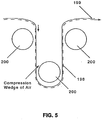
- a compression wedge is formed by air carried along by the backside surface of the moving dryer fabric in the narrowing space where the moving dryer fabric approaches a dryer cylinder. The resulting increase in air pressure in the compression wedge causes air to flow outwardly through the dryer fabric. This air flow, in turn, forces the paper sheet away from the surface of the dryer fabric, a phenomenon
- Drop off can reduce the quality of the paper product being manufactured by causing edge cracks. Drop off can also reduce machine efficiency if it leads to sheet breaks.
- Contemporary dryer fabrics are produced in a wide variety of styles designed to meet the requirements of the paper machines on which they are installed for the paper grades being manufactured.
- they comprise a base fabric usually woven from monofilaments and may be single-layered or multi-layered.
- the yarns are typically extruded from any one of several synthetic polymeric resins, such as polyamide and polyester resins, used for this purpose by those of ordinary skill in the paper machine clothing arts.
- Fabrics in modern papermaking machines may have a width of from 1.524m to over 10.058m (5 to over 33 feet), a length of from 12.192 to over 121.92m (40 to over 400 feet) and weigh from approximately 45.35kg to 1360.77kg (100 to over 3,000 pounds). These fabrics wear out and require replacement. Replacement of fabrics often involves taking the machine out of service, removing the worn fabric, setting up to install a fabric and installing the new fabric. While many fabrics are endless, many of those used today are on-machine-seamable. Installation of the fabric includes pulling the fabric body onto a machine and joining the fabric ends to form an endless belt.
- EP 1 045 066 discloses a press fabric for the press section of a paper machine has a base fabric which includes a nonwoven mesh fabric.
- the base fabric, or a layer thereof, is assembled in integral form using a strip or strips of the nonwoven mesh fabric.
- the assembly may be effected by spirally winding the nonwoven mesh fabric in a plurality of non-overlapping turns, by abutting each turn of the nonwoven mesh fabric against that previously wound, and by joining each turn of the nonwoven mesh fabric to that previously wound to form an endless loop.
- a plurality of endless loops of equivalent length are formed from separate strips of nonwoven mesh fabric, and arranged in a side-by-side abutting relationship. The endless loops are then joined, one to the next, to provide a base fabric, or component thereof, in the form of an endless loop.
- U.S. Patent No. 5,360,656 shows a fabric comprising a base fabric having one or more layers of staple fiber material needled thereinto.
- the base fabric comprises at least one layer composed of a spirally wound strip of woven fabric having a width which is smaller than the width of the base fabric.
- the base fabric is endless in the longitudinal, or machine, direction. Lengthwise threads of the spirally wound strip make an angle with the longitudinal direction of the fabric.
- the strip of woven fabric may be flat-woven on a loom which is narrower than those typically used in the production of paper machine clothing.
- the base fabric comprises a plurality of spirally wound and joined turns of the relatively narrow woven fabric strip.
- the fabric strip is woven from lengthwise (warp) and crosswise (filling) yarns. Adjacent turns of the spirally wound fabric strip may be abutted against one another, and the spirally continuous seam so produced may be closed by sewing, stitching, melting, welding (e.g. ultrasonic) or gluing. Alternatively, adjacent longitudinal edge portions of adjoining spiral turns may be arranged overlappingly, so long as the edges have a reduced thickness, so as not to give rise to an increased thickness in the area of the overlap. Alternatively still, the spacing between lengthwise yarns may be increased at the edges of the strip, so that, when adjoining spiral turns are arranged overlappingly, there may be an unchanged spacing between lengthwise threads in the area of the overlap.
- a woven base fabric taking the form of an endless loop and having an inner surface, a longitudinal (machine) direction and a transverse (cross-machine) direction, is the result.
- the lateral edges of the woven base fabric are then trimmed to render them parallel to its longitudinal (machine) direction.
- the angle between the machine direction of the woven base fabric and the spirally continuous seam may be relatively small, that is, typically less than 10°.
- the lengthwise (warp) yarns of the woven fabric strip make the same relatively small angle with the longitudinal (machine) direction of the woven base fabric.
- the crosswise (filling) yarns of the woven fabric strip being perpendicular to the lengthwise (warp) yarns, make the same relatively small angle with the transverse (cross-machine) direction of the woven base fabric.
- neither the lengthwise (warp) nor the crosswise (filling) yarns of the woven fabric strip align with the longitudinal (machine) or transverse (cross-machine) directions of the woven base fabric.
- a fabric having such a base fabric may be referred to as a multiaxial fabric.
- the standard fabrics of the prior art have three axes: one in the machine direction (MD), one in the cross-machine direction (CD), and one in the z-direction, which is through the thickness of the fabric
- a multiaxial fabric has not only these three axes, but also has at least two more axes defined by the directions of the yarn systems in its spirally wound layer or layers.
- a multiaxial fabric has at least five axes. Because of its multiaxial structure, a multiaxial fabric having more than one layer exhibits superior resistance to nesting and/or to collapse in response to compression during the papermaking process as compared to one having base fabric layers whose yarn systems are parallel to one another.
- the present invention provides an alternative to typical woven dryer fabrics.
- the present invention is a non-woven dryer fabric produced directly from raw material stock. This approach allows for the incorporation of bulk material elements in the fabric and for greater design control of the operating characteristics of the fabric.
- the present fabric may be produced using a spiral winding technique, similar to that discussed above, only replacing the strips of woven material with raw stock material elements.
- the present invention is a dryer fabric, although it may find application in the forming, pressing and drying sections of a paper machine.
- the present invention is a nonwoven papermaker's fabric for use in a dryer section of a papermaking machine.
- the fabric has a spiral wound machine direction (MD) layer made of a first raw stock material.
- the spiral wound MD layer is formed by winding MD elements of the first raw stock material around a pair of parallel rolls or cylinders until the layer has a desired length and a desired width.
- a cross-machine direction (CD) layer of CD elements of a second raw stock material is overlaid and mated with the spiral wound MD layer. This is done so that the fabric has a neutral line oriented towards a paper side of the fabric. This neutral line placement in the z-direction or thickness direction in the fabric reduces stretching of the supported paper sheet when used in a papermaking machine as the fabric turns around the cylinders in the papermaking machine.
- the spiral wound MD layer forms the paper side of the fabric and the CD layer forms a machine side of the fabric.
- the first raw stock material may be the same as the second raw stock material.
- the MD elements and the CD elements are preferably flat filaments, round filaments, textured filaments, bulk-crimped filaments, shaped filaments, hollow filaments, films, nonwoven materials, or segments of woven material.
- the raw stock material is preferably one of polyamide, polyester, polyolefins, or other polymeric material.
- the air permeability and water permeability of the fabric are determined by the spacing of the MD elements.
- the CD elements may be mated to the spiral wound MD layer using a rotating cylinder having spacing elements to place the CD elements directly onto the spiral wound MD layer.
- the CD layer may alternately be mated to the spiral wound MD layer using a heat activated bonding process.
- the CD elements may be provided with MD oriented channels or grooves to provide for enhanced air handling by the fabric.
- the present invention relates to a fabric produced for the dryer section of a paper machine that is produced as a nonwoven product using various different raw stock materials.
- the present fabric is an alternative to typical dryer fabrics which are woven using polymeric monofilament or multifilament yarns or spiral-link dryer fabrics.
- the present fabric has a spiral wound machine direction (MD) base layer of raw stock which is wound around two parallel cylinders until the desired length and width is achieved.
- MD machine direction
- This spiral winding technique is similar to that taught in the '656 patent-which is discussed above only the strips of woven material are replaced in the present invention with raw stock material elements.
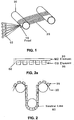
- Figure 1 is an exemplary setup for producing the spiral wound base layer of raw stock elements in accordance with the teachings of the present invention. As shown in Figure 1 , the raw stock material is fed via a delivery system, preferably from a harness/spool arrangement 10, through a feed mechanism 15 which winds the stock around the cylinders 30 (heated or unheated) to form a spiral wound base layer 20 until the desired length and width is achieved.
- a delivery system preferably from a harness/spool arrangement 10
- a feed mechanism 15 which winds the stock around the cylinders 30 (heated or unheated) to form a spiral wound base layer 20 until the desired length and width is achieved.
- This base layer is essentially a spiral wound layer of raw stock material that is fundamentally length oriented.
- the spacing between elements of the raw stock material can be zero to form a sealed cylinder, or may be appropriately spaced to control the air and water permeability of the fabric. It is to be understood that many other setups can be used to produce the spiral wound base layer and that the present invention is not to be limited to this setup.
- This spiral wound MD layer is overlaid with a cross-machine direction (CD) layer of similar or dissimilar raw stock and mated by any of a number of means.
- Figure 3 is an exemplary setup for mating the CD layer of raw stock to the spiral wound base layer in accordance with the teachings of the present invention. As shown in Figure 3 , the spiral wound layer 20 is rotated about two cylinders 30 and elements of the CD raw stock material 35 are attached to the MD layer by a feed mechanism 40.
- Figure 4 is another exemplary setup for mating the CD layer of raw stock to the MD base layer in accordance with the teachings of the present invention.
- the spiral wound layer 20 is rotated about two cylinders and elements of the CD raw stock material 35 are fed by a feed mechanism 42 through a conveyor means 43 and attached to the MD layer by an attachment means 44.
- the fabric may be turned inside out so that the MD layer is the paper side of the fabric and the CD layer is the machine (or wear) side of the fabric.
- the CD elements can be overlaid onto the spiral wound MD layer by a variety of methods, including a rotating cylinder with spacing elements or forms that allow a rotating cylinder to feed the elements directly to the MD spiral.
- Each MD winding of raw stock is mated to the adjacent winding by any of a variety of means, including adhesion via glues (hot melts, male/female 'snaps', applying a binder system to mate the elements (via sewing, knitting, etc%), or by applying a layer of meltable, fusible material between the windings and applying heat to the structure to subsequently bond the windings together.
- adhesion via glues hot melts, male/female 'snaps'
- applying a binder system to mate the elements (via sewing, knitting, etc%)
- a layer of meltable, fusible material between the windings and applying heat to the structure to subsequently bond the windings together.
- the MD spiral of raw stock is mated to the perpendicular attached CD elements of similar or dissimilar raw stock by any of a variety of means, including adhesion via glues (hot melts, male/female 'snaps' (where practical), applying a binder system to mate the CD and MD elements (via sewing, knitting, etc%), or by applying a layer of meltable, fusible material between the CD and MD layers and applying heat to the structure to subsequently bond the layers together.
- This bonded structure forms a nonwoven fabric consisting of MD elements and CD elements which provide the stability and integrity necessary for a papermaking fabric.
- the original spiral wound MD layer can be mated to another spiral wound MD layer that is wound in the opposite direction in order to provide the necessary stability in the MD and the CD. Note this process can be extended so that as many spiral wound layers could be laminated together in a manner as aforementioned as required to form the fabric.
- FIG. 2 shows a nonwoven fabric according to the present invention installed on a dryer section of a papermaking machine.
- Figure 2A shows a straightened view of the present fabric in Figure 2 , which is comprised of the spiral wound MD layer 20 and the CD layer 35 having a neutral line 60 that is offset towards one side of the fabric as shown (by the dashed line).
- One method to produce such an offset neutral line is by applying a CD layer that is thicker in caliper than the MD layer. This provides a structure that exhibits this flexed behavior when wrapped around the dryer cylinders, thereby providing a greater change in distance in the MD on one side of the fabric as opposed to the other side of the fabric. This is advantageous for production of the paper sheet, since when the paper is in contact with the fabric side closer to the neutral line, the fabric and therefore the paper will be stretched less than with typical fabrics as the fabric turns around the dryer cylinders.
- the present fabric can either be produced endless or preferably be joined together via a seam, employing any method known in the art.
- the raw stock materials used in the present invention are preferably polyesters, polyolefins (polypropylene), polyphenylene sulfide (PPS, which is commercially available under the name RYTON®), polyamides, or other polymer materials.
- Another example material is a modified heat-, hydrolysis- and contaminant-resistant polyester of the variety disclosed in commonly assigned U.S. Patent No. 5,169,499 , and used in dryer fabrics sold by Albany International Corp. under the trademark THERMONETICS®.
- PCTA poly (cyclohexanedimethylene terephthalate-isophthalate)
- PEEK polyetheretherketone
- raw stock elements which could be flat filaments, round filaments, textured filaments, bulk-crimped filaments, shaped filaments (tongue-in-groove, tetrahedral, elliptical, rectangular, etc...), hollow filaments, films (perforated or nonperforated), nonwoven materials (i.e. spun bond, melt bond, etc%), or segments of woven material.
- flat filaments can be utilized in both the MD and CD sections, or as in the case of opposing spiral wound layers, in one or all of the spiral wound layers. Any combination of elements for either layer of the fabric may be used as identified by one of ordinary skill in the art.
- CD elements could include MD oriented channels or grooves to enhance air handling by the fabric.
Landscapes
- Paper (AREA)
- Inking, Control Or Cleaning Of Printing Machines (AREA)
- Laminated Bodies (AREA)
Claims (10)
- Papiermaschinenvliesgewebe, umfassend:eine spiralgewickelte (MD)-Schicht (20) aus einem ersten Rohmaterial mit gewünschter Länge und Breite;und eine Quermaschinenrichtungs-(CD)-Schicht (35) von Quermaschinenrichtungselementen (CD-Elementen) eines zweiten Rohmaterials, dadurch gekennzeichnet, dass die Quermaschinenrichtungs-(CD)-Schicht (35) mit der spiralgewickelten (MD)-Schicht überlagert und zusammengefügt ist, wobei das Gewebe so beschaffen sein muss, dass es eine neutrale Linie (60) aufweist, die in einer Dickenrichtung des Gewebes zu einer Papierseite des Gewebes hin versetzt ist, indem die Quermaschinenrichtungs-(CD)-Schicht dicker aufgebracht wird als die spiralgewickelten (MD)-Schicht, wobei die Papierseite des Gewebes durch die spiralgewickelten (MD)-Schicht geformt wird und die Maschinenseite des Gewebes durch die Quermaschinenrichtungs-(CD)-Schicht geformt wird.
- Das Papiermaschinengewebe nach Anspruch 1, worin die spiralgewickelte (MD)-Schicht durch spiralförmige Wickelmaschinenrichtungs (MD) -Elemente des ersten Rohmaterialmaterials um ein Paar parallele Zylinder geformt wird.
- Das Papiermaschinengewebe nach Anspruch 1, worin das erste Rohmaterial das gleiche ist wie das zweite Rohmaterial.
- Das Papiermaschinengewebe nach einem der vorhergehenden Ansprüche, worin das Gewebe ein Trockensieb zur Verwendung in einer Trockenpartie der Papierherstellungsmaschine ist.
- Das Papiermaschinengewebe nach einem der vorhergehenden Ansprüche, worin die Maschinenrichtungs-(MD)-Schicht mit Elementen gebildet ist, die aus der Gruppe der Flachfilamenten, Rundfilamenten, texturierten Filamenten, gekräuselten Filamenten, Formfilamenten, Hohlfilamenten und Filmen besteht, sowie Vliesstoffen und Segmenten aus gewebtem Material.
- Das Papiermaschinengewebe nach Anspruch 1, worin die Quermaschinenrichtungs-(CD)-Schicht mit Elementen gebildet ist, die aus der Gruppe der Flachfilamenten, Rundfilamenten, texturierten Filamenten, gekräuselten Filamenten, Formfilamenten, Hohlfilamenten und Filmen besteht, sowie Vliesstoffen und Segmenten aus gewebtem Material.
- Das Papiermaschinengewebe nach Anspruch 6, worin einige oder alle der Quermaschinenrichtungselemente (CD-Elemente) in Maschinenrichtung (MD) ausgerichtete Kanäle oder Rillen aufweisen.
- Das Papiermaschinengewebe nach einem der vorhergehenden Ansprüche, worin das erste oder das zweite Rohmaterial aus Polyamid, Polyester, Polyolefinen oder einem anderen Polymermaterial besteht.
- Das Papiermaschinengewebe nach Anspruch 1, worin Elemente der Quermaschinenrichtungs-(CD)-Schicht mit der spiralgewickelten (MD)-Schicht zusammengefügt werden und ein rotierender Zylinder mit Abstandselementen zum Platzieren der Quermaschinenrichtungselemente (CD) auf die spiralgewickelte (MD)-Schicht eingesetzt wird.
- Das Papiermaschinengewebe nach Anspruch 1, worin die Quermaschinenrichtungs-(CD)-Schicht mit der spiralgewickelten (MD) -Schicht unter Verwendung eines wärmeaktivierten Verbindungsprozesses verbunden wird.
Priority Applications (1)
| Application Number | Priority Date | Filing Date | Title |
|---|---|---|---|
| PL04754954T PL1636415T3 (pl) | 2003-06-19 | 2004-06-10 | Włóknina papiernicza |
Applications Claiming Priority (2)
| Application Number | Priority Date | Filing Date | Title |
|---|---|---|---|
| US10/465,168 US6989080B2 (en) | 2003-06-19 | 2003-06-19 | Nonwoven neutral line dryer fabric |
| PCT/US2004/018522 WO2004113609A1 (en) | 2003-06-19 | 2004-06-10 | Nonwoven papermaker’s fabric |
Publications (3)
| Publication Number | Publication Date |
|---|---|
| EP1636415A1 EP1636415A1 (de) | 2006-03-22 |
| EP1636415B1 true EP1636415B1 (de) | 2019-02-27 |
| EP1636415B8 EP1636415B8 (de) | 2019-04-10 |
Family
ID=33517457
Family Applications (1)
| Application Number | Title | Priority Date | Filing Date |
|---|---|---|---|
| EP04754954.8A Expired - Lifetime EP1636415B8 (de) | 2003-06-19 | 2004-06-10 | Nonwoven-papiermachergewebe |
Country Status (16)
| Country | Link |
|---|---|
| US (1) | US6989080B2 (de) |
| EP (1) | EP1636415B8 (de) |
| JP (1) | JP4949023B2 (de) |
| KR (1) | KR101124962B1 (de) |
| CN (1) | CN1809665B (de) |
| AU (1) | AU2004250134C1 (de) |
| BR (1) | BRPI0411648B1 (de) |
| CA (2) | CA2776442C (de) |
| ES (1) | ES2717333T3 (de) |
| NO (1) | NO20060282L (de) |
| NZ (1) | NZ543802A (de) |
| PL (1) | PL1636415T3 (de) |
| RU (1) | RU2352701C2 (de) |
| TW (1) | TWI358482B (de) |
| WO (1) | WO2004113609A1 (de) |
| ZA (1) | ZA200509592B (de) |
Families Citing this family (11)
| Publication number | Priority date | Publication date | Assignee | Title |
|---|---|---|---|---|
| US7473336B2 (en) * | 2005-04-28 | 2009-01-06 | Albany International Corp. | Multiaxial fabrics |
| JP4883629B2 (ja) * | 2007-03-13 | 2012-02-22 | イチカワ株式会社 | 湿紙搬送用ベルト |
| US8728280B2 (en) | 2008-12-12 | 2014-05-20 | Albany International Corp. | Industrial fabric including spirally wound material strips with reinforcement |
| CN106995981A (zh) | 2008-12-12 | 2017-08-01 | 阿尔巴尼国际公司 | 包括螺旋缠绕材料条带的工业织物 |
| US8764943B2 (en) | 2008-12-12 | 2014-07-01 | Albany International Corp. | Industrial fabric including spirally wound material strips with reinforcement |
| BRPI1007355B1 (pt) | 2009-01-28 | 2020-10-06 | Albany International Corp. | Tecidos de fabrico de papel e sistema e métodos de produção de vazios de atravessamento em tecido de fabrico de papel |
| CA2688470A1 (en) | 2009-12-11 | 2011-06-11 | Allan Manninen | Industrial fabric comprised of selectively slit and embossed film |
| DE102010038399A1 (de) * | 2010-07-26 | 2012-01-26 | Voith Patent Gmbh | Formiersieb und Verfahren zur Herstellung eines Formiersiebs |
| RU2633267C2 (ru) | 2012-05-11 | 2017-10-11 | Олбани Интернешнл Корп. | Техническая ткань, содержащая навитые по спирали полосы материала с усилением |
| US8980062B2 (en) | 2012-12-26 | 2015-03-17 | Albany International Corp. | Industrial fabric comprising spirally wound material strips and method of making thereof |
| CN109549334A (zh) * | 2019-02-02 | 2019-04-02 | 上海政昕实业有限公司 | 一种多功能旅行收纳包 |
Citations (3)
| Publication number | Priority date | Publication date | Assignee | Title |
|---|---|---|---|---|
| EP0577572A1 (de) * | 1992-06-03 | 1994-01-05 | Valmet Corporation | Verfahren in einer Ein-Sieb-Trockengruppe sowie Sieb für diese Trockengruppe |
| US6124015A (en) * | 1996-04-18 | 2000-09-26 | Jwi Ltd. | Multi-ply industrial fabric having integral jointing structures |
| US6451412B1 (en) * | 1997-08-09 | 2002-09-17 | Voith Fabrics Heidenheim Gmbh & Co Kg | Fabric seam |
Family Cites Families (29)
| Publication number | Priority date | Publication date | Assignee | Title |
|---|---|---|---|---|
| US3097413A (en) * | 1960-05-26 | 1963-07-16 | Draper Brothers Company | Unwoven papermaker's felt |
| US4487930A (en) * | 1982-09-07 | 1984-12-11 | The Dow Chemical Company | 6-[(Cyclic amino)alkylamino]-tetrahydrotriazolo[3,4-a]phthalazines |
| DE69031037T3 (de) * | 1989-04-24 | 2008-05-21 | Albany International Corp. | Papiermaschinensieb |
| US5268076A (en) * | 1990-06-13 | 1993-12-07 | Thomas Josef Heimbach Gmbh & Co. | Spiral wound papermaking-machine felt |
| DE4022800C1 (de) * | 1990-07-18 | 1991-09-19 | J.M. Voith Gmbh, 7920 Heidenheim, De | |
| SE468602B (sv) * | 1990-12-17 | 1993-02-15 | Albany Int Corp | Pressfilt samt saett att framstaella densamma |
| US5202170A (en) * | 1991-04-08 | 1993-04-13 | Wangner Systems Corporation | Papermaking felt with a non-spiralled machine direction fiber batt |
| US5864931A (en) * | 1991-05-23 | 1999-02-02 | Thomas Josef Heimbach Gmbh & Co. | Felt, in particular a papermaking-machine felt, and method for its manufacture |
| DE4443598C2 (de) * | 1994-12-07 | 2000-05-25 | Voith Sulzer Papiermasch Gmbh | Verfahren zur Herstellung eines Preßmantels |
| US5792323A (en) * | 1995-09-07 | 1998-08-11 | Albany International Corp. | Spiral base structres for long nip paper machine press belts |
| SE505390C2 (sv) * | 1995-11-30 | 1997-08-18 | Albany Int Corp | Laminerad beklädnad samt metod och ämne för framställning därav |
| US5785818A (en) * | 1997-02-27 | 1998-07-28 | Jwi Ltd. | Multiaxial pin seamed papermaker's press felt |
| JP3053374B2 (ja) * | 1997-07-03 | 2000-06-19 | 市川毛織株式会社 | シュープレスベルト及びその製造法 |
| JP3272282B2 (ja) * | 1997-10-20 | 2002-04-08 | 市川毛織株式会社 | ニードルフェルト及びその製造方法 |
| DE19814473A1 (de) * | 1998-04-01 | 1999-10-07 | Heimbach Gmbh Thomas Josef | Maschinenfilz sowie Verfahren zu dessen Herstellung |
| US5939176A (en) * | 1998-09-01 | 1999-08-17 | Albany International Corp. | Warp loop seam |
| US6240608B1 (en) | 1999-04-12 | 2001-06-05 | Albany International Corp. | Method for joining nonwoven mesh products |
| JP3488397B2 (ja) * | 1999-04-26 | 2004-01-19 | 市川毛織株式会社 | シュープレス用ベルト及びその製造方法 |
| US6350336B1 (en) * | 1999-06-22 | 2002-02-26 | Albany International Corp. | Method of manufacturing a press fabric by spirally attaching a top laminate layer with a heat-activated adhesive |
| US6276728B1 (en) * | 1999-07-08 | 2001-08-21 | Omega Flex, Inc. | Fitting for use with corrugated tubing |
| AU5951799A (en) * | 1999-07-09 | 2001-01-11 | Albany International Corp. | Multi-axial press fabric with angular web |
| US6231928B1 (en) * | 1999-08-30 | 2001-05-15 | Albany International Corp. | Method for manufacturing resin-impregnated endless belt structures for papermaking machines and similar industrial applications |
| JP2002004190A (ja) * | 2000-06-19 | 2002-01-09 | Ichikawa Woolen Textile Co Ltd | 抄紙用フェルト |
| US6723208B1 (en) * | 2000-10-05 | 2004-04-20 | Albany International Corp. | Method for producing spiral wound paper machine clothing |
| US6660362B1 (en) * | 2000-11-03 | 2003-12-09 | Kimberly-Clark Worldwide, Inc. | Deflection members for tissue production |
| ES2223995T3 (es) | 2002-04-25 | 2005-03-01 | THOMAS JOSEF HEIMBACH GESELLSCHAFT MIT BESCHRANKTER HAFTUNG & CO. | Revestimiento de maquina papelera y procedimiento para su fabricacion. |
| ES2262726T3 (es) | 2002-04-25 | 2006-12-01 | THOMAS JOSEF HEIMBACH GESELLSCHAFT MIT BESCHRANKTER HAFTUNG & CO. | Revestimiento de maquina papelera y procedimiento para su fabricacion. |
| DE50203497D1 (de) | 2002-04-25 | 2005-08-04 | Heimbach Gmbh Thomas Josef | Trockensieb sowie Verfahren zu dessen Herstellung |
| US6875315B2 (en) * | 2002-12-19 | 2005-04-05 | Kimberly-Clark Worldwide, Inc. | Non-woven through air dryer and transfer fabrics for tissue making |
-
2003
- 2003-06-19 US US10/465,168 patent/US6989080B2/en not_active Expired - Lifetime
-
2004
- 2004-06-10 KR KR1020057024009A patent/KR101124962B1/ko not_active Expired - Fee Related
- 2004-06-10 NZ NZ543802A patent/NZ543802A/en unknown
- 2004-06-10 AU AU2004250134A patent/AU2004250134C1/en not_active Ceased
- 2004-06-10 RU RU2005136420A patent/RU2352701C2/ru not_active IP Right Cessation
- 2004-06-10 WO PCT/US2004/018522 patent/WO2004113609A1/en not_active Ceased
- 2004-06-10 JP JP2006517219A patent/JP4949023B2/ja not_active Expired - Fee Related
- 2004-06-10 CA CA 2776442 patent/CA2776442C/en not_active Expired - Lifetime
- 2004-06-10 CA CA 2529843 patent/CA2529843C/en not_active Expired - Lifetime
- 2004-06-10 PL PL04754954T patent/PL1636415T3/pl unknown
- 2004-06-10 EP EP04754954.8A patent/EP1636415B8/de not_active Expired - Lifetime
- 2004-06-10 ES ES04754954T patent/ES2717333T3/es not_active Expired - Lifetime
- 2004-06-10 CN CN2004800172110A patent/CN1809665B/zh not_active Expired - Lifetime
- 2004-06-10 ZA ZA200509592A patent/ZA200509592B/en unknown
- 2004-06-10 BR BRPI0411648A patent/BRPI0411648B1/pt not_active IP Right Cessation
- 2004-06-18 TW TW93117654A patent/TWI358482B/zh not_active IP Right Cessation
-
2006
- 2006-01-19 NO NO20060282A patent/NO20060282L/no not_active Application Discontinuation
Patent Citations (3)
| Publication number | Priority date | Publication date | Assignee | Title |
|---|---|---|---|---|
| EP0577572A1 (de) * | 1992-06-03 | 1994-01-05 | Valmet Corporation | Verfahren in einer Ein-Sieb-Trockengruppe sowie Sieb für diese Trockengruppe |
| US6124015A (en) * | 1996-04-18 | 2000-09-26 | Jwi Ltd. | Multi-ply industrial fabric having integral jointing structures |
| US6451412B1 (en) * | 1997-08-09 | 2002-09-17 | Voith Fabrics Heidenheim Gmbh & Co Kg | Fabric seam |
Also Published As
| Publication number | Publication date |
|---|---|
| JP4949023B2 (ja) | 2012-06-06 |
| EP1636415B8 (de) | 2019-04-10 |
| RU2352701C2 (ru) | 2009-04-20 |
| NO20060282L (no) | 2006-03-20 |
| JP2006528281A (ja) | 2006-12-14 |
| RU2005136420A (ru) | 2007-07-27 |
| EP1636415A1 (de) | 2006-03-22 |
| NZ543802A (en) | 2008-03-28 |
| CN1809665A (zh) | 2006-07-26 |
| TW200506139A (en) | 2005-02-16 |
| US6989080B2 (en) | 2006-01-24 |
| AU2004250134A1 (en) | 2004-12-29 |
| CA2776442C (en) | 2013-02-05 |
| PL1636415T3 (pl) | 2019-07-31 |
| CN1809665B (zh) | 2013-05-08 |
| CA2529843A1 (en) | 2004-12-29 |
| KR101124962B1 (ko) | 2012-03-27 |
| BRPI0411648B1 (pt) | 2015-12-01 |
| WO2004113609A1 (en) | 2004-12-29 |
| CA2529843C (en) | 2012-10-02 |
| ES2717333T3 (es) | 2019-06-20 |
| AU2004250134C1 (en) | 2009-12-17 |
| TWI358482B (en) | 2012-02-21 |
| ZA200509592B (en) | 2007-03-28 |
| US20040259450A1 (en) | 2004-12-23 |
| CA2776442A1 (en) | 2004-12-29 |
| AU2004250134B2 (en) | 2009-06-04 |
| KR20060021378A (ko) | 2006-03-07 |
| BRPI0411648A (pt) | 2006-08-08 |
Similar Documents
| Publication | Publication Date | Title |
|---|---|---|
| US5732749A (en) | Pin seam for laminated integrally woven papermaker's fabric | |
| CA2406859C (en) | Base structure for seamed papermaker's fabrics | |
| CA2701224A1 (en) | Flat woven full width on-machine-seamable fabric | |
| EP0940499B1 (de) | Zusatz von strömungsverringerndem Material zur Doppelnahtverbindung von Gewebene | |
| EP1789627B1 (de) | Halbdurchlässige gewebe für transferbänder- und pressfilzenanwendungen | |
| CA2529843C (en) | Nonwoven papermaker's fabric | |
| AU2001236937B2 (en) | Seamed industrial fabrics | |
| AU2001236937A1 (en) | Seamed industrial fabrics | |
| EP1771620B1 (de) | Verfahren zur nahtverbindung bei einer multiaxialen papiermaschinenbespannung unter vermeidung der fadenmigration sowie entsprechende papiermaschinenbespannung | |
| MXPA05013700A (en) | NONWOVEN PAPERMAKERâÇÖS FABRIC |
Legal Events
| Date | Code | Title | Description |
|---|---|---|---|
| PUAI | Public reference made under article 153(3) epc to a published international application that has entered the european phase |
Free format text: ORIGINAL CODE: 0009012 |
|
| 17P | Request for examination filed |
Effective date: 20051222 |
|
| AK | Designated contracting states |
Kind code of ref document: A1 Designated state(s): AT BE BG CH CY CZ DE DK EE ES FI FR GB GR HU IE IT LI LU MC NL PL PT RO SE SI SK TR |
|
| DAX | Request for extension of the european patent (deleted) | ||
| 17Q | First examination report despatched |
Effective date: 20100709 |
|
| STAA | Information on the status of an ep patent application or granted ep patent |
Free format text: STATUS: EXAMINATION IS IN PROGRESS |
|
| GRAP | Despatch of communication of intention to grant a patent |
Free format text: ORIGINAL CODE: EPIDOSNIGR1 |
|
| STAA | Information on the status of an ep patent application or granted ep patent |
Free format text: STATUS: GRANT OF PATENT IS INTENDED |
|
| INTG | Intention to grant announced |
Effective date: 20181011 |
|
| GRAS | Grant fee paid |
Free format text: ORIGINAL CODE: EPIDOSNIGR3 |
|
| GRAA | (expected) grant |
Free format text: ORIGINAL CODE: 0009210 |
|
| STAA | Information on the status of an ep patent application or granted ep patent |
Free format text: STATUS: THE PATENT HAS BEEN GRANTED |
|
| AK | Designated contracting states |
Kind code of ref document: B1 Designated state(s): AT BE BG CH CY CZ DE DK EE ES FI FR GB GR HU IE IT LI LU MC NL PL PT RO SE SI SK TR |
|
| REG | Reference to a national code |
Ref country code: GB Ref legal event code: FG4D |
|
| REG | Reference to a national code |
Ref country code: CH Ref legal event code: EP |
|
| REG | Reference to a national code |
Ref country code: CH Ref legal event code: PK Free format text: BERICHTIGUNG B8 Ref country code: AT Ref legal event code: REF Ref document number: 1101513 Country of ref document: AT Kind code of ref document: T Effective date: 20190315 |
|
| REG | Reference to a national code |
Ref country code: DE Ref legal event code: R082 Ref document number: 602004053737 Country of ref document: DE Representative=s name: BROYDE, MARC, FR |
|
| RAP2 | Party data changed (patent owner data changed or rights of a patent transferred) |
Owner name: ALBANY INTERNATIONAL CORP. |
|
| REG | Reference to a national code |
Ref country code: IE Ref legal event code: FG4D |
|
| REG | Reference to a national code |
Ref country code: DE Ref legal event code: R096 Ref document number: 602004053737 Country of ref document: DE |
|
| REG | Reference to a national code |
Ref country code: SE Ref legal event code: TRGR |
|
| REG | Reference to a national code |
Ref country code: ES Ref legal event code: FG2A Ref document number: 2717333 Country of ref document: ES Kind code of ref document: T3 Effective date: 20190620 |
|
| REG | Reference to a national code |
Ref country code: NL Ref legal event code: MP Effective date: 20190227 |
|
| PG25 | Lapsed in a contracting state [announced via postgrant information from national office to epo] |
Ref country code: PT Free format text: LAPSE BECAUSE OF FAILURE TO SUBMIT A TRANSLATION OF THE DESCRIPTION OR TO PAY THE FEE WITHIN THE PRESCRIBED TIME-LIMIT Effective date: 20190627 Ref country code: NL Free format text: LAPSE BECAUSE OF FAILURE TO SUBMIT A TRANSLATION OF THE DESCRIPTION OR TO PAY THE FEE WITHIN THE PRESCRIBED TIME-LIMIT Effective date: 20190227 |
|
| PG25 | Lapsed in a contracting state [announced via postgrant information from national office to epo] |
Ref country code: GR Free format text: LAPSE BECAUSE OF FAILURE TO SUBMIT A TRANSLATION OF THE DESCRIPTION OR TO PAY THE FEE WITHIN THE PRESCRIBED TIME-LIMIT Effective date: 20190528 Ref country code: BG Free format text: LAPSE BECAUSE OF FAILURE TO SUBMIT A TRANSLATION OF THE DESCRIPTION OR TO PAY THE FEE WITHIN THE PRESCRIBED TIME-LIMIT Effective date: 20190527 |
|
| REG | Reference to a national code |
Ref country code: AT Ref legal event code: MK05 Ref document number: 1101513 Country of ref document: AT Kind code of ref document: T Effective date: 20190227 |
|
| PG25 | Lapsed in a contracting state [announced via postgrant information from national office to epo] |
Ref country code: RO Free format text: LAPSE BECAUSE OF FAILURE TO SUBMIT A TRANSLATION OF THE DESCRIPTION OR TO PAY THE FEE WITHIN THE PRESCRIBED TIME-LIMIT Effective date: 20190227 Ref country code: EE Free format text: LAPSE BECAUSE OF FAILURE TO SUBMIT A TRANSLATION OF THE DESCRIPTION OR TO PAY THE FEE WITHIN THE PRESCRIBED TIME-LIMIT Effective date: 20190227 Ref country code: DK Free format text: LAPSE BECAUSE OF FAILURE TO SUBMIT A TRANSLATION OF THE DESCRIPTION OR TO PAY THE FEE WITHIN THE PRESCRIBED TIME-LIMIT Effective date: 20190227 Ref country code: SK Free format text: LAPSE BECAUSE OF FAILURE TO SUBMIT A TRANSLATION OF THE DESCRIPTION OR TO PAY THE FEE WITHIN THE PRESCRIBED TIME-LIMIT Effective date: 20190227 |
|
| REG | Reference to a national code |
Ref country code: DE Ref legal event code: R097 Ref document number: 602004053737 Country of ref document: DE |
|
| PG25 | Lapsed in a contracting state [announced via postgrant information from national office to epo] |
Ref country code: AT Free format text: LAPSE BECAUSE OF FAILURE TO SUBMIT A TRANSLATION OF THE DESCRIPTION OR TO PAY THE FEE WITHIN THE PRESCRIBED TIME-LIMIT Effective date: 20190227 |
|
| PLBE | No opposition filed within time limit |
Free format text: ORIGINAL CODE: 0009261 |
|
| STAA | Information on the status of an ep patent application or granted ep patent |
Free format text: STATUS: NO OPPOSITION FILED WITHIN TIME LIMIT |
|
| PG25 | Lapsed in a contracting state [announced via postgrant information from national office to epo] |
Ref country code: CZ Free format text: LAPSE BECAUSE OF NON-PAYMENT OF DUE FEES Effective date: 20190610 Ref country code: MC Free format text: LAPSE BECAUSE OF FAILURE TO SUBMIT A TRANSLATION OF THE DESCRIPTION OR TO PAY THE FEE WITHIN THE PRESCRIBED TIME-LIMIT Effective date: 20190227 |
|
| REG | Reference to a national code |
Ref country code: CH Ref legal event code: PL |
|
| 26N | No opposition filed |
Effective date: 20191128 |
|
| PG25 | Lapsed in a contracting state [announced via postgrant information from national office to epo] |
Ref country code: SI Free format text: LAPSE BECAUSE OF FAILURE TO SUBMIT A TRANSLATION OF THE DESCRIPTION OR TO PAY THE FEE WITHIN THE PRESCRIBED TIME-LIMIT Effective date: 20190227 |
|
| PG25 | Lapsed in a contracting state [announced via postgrant information from national office to epo] |
Ref country code: TR Free format text: LAPSE BECAUSE OF FAILURE TO SUBMIT A TRANSLATION OF THE DESCRIPTION OR TO PAY THE FEE WITHIN THE PRESCRIBED TIME-LIMIT Effective date: 20190227 |
|
| PG25 | Lapsed in a contracting state [announced via postgrant information from national office to epo] |
Ref country code: IE Free format text: LAPSE BECAUSE OF NON-PAYMENT OF DUE FEES Effective date: 20190610 |
|
| PG25 | Lapsed in a contracting state [announced via postgrant information from national office to epo] |
Ref country code: CH Free format text: LAPSE BECAUSE OF NON-PAYMENT OF DUE FEES Effective date: 20190630 Ref country code: LI Free format text: LAPSE BECAUSE OF NON-PAYMENT OF DUE FEES Effective date: 20190630 Ref country code: LU Free format text: LAPSE BECAUSE OF NON-PAYMENT OF DUE FEES Effective date: 20190610 |
|
| PGFP | Annual fee paid to national office [announced via postgrant information from national office to epo] |
Ref country code: DE Payment date: 20200629 Year of fee payment: 17 |
|
| PGFP | Annual fee paid to national office [announced via postgrant information from national office to epo] |
Ref country code: BE Payment date: 20200629 Year of fee payment: 17 Ref country code: PL Payment date: 20200518 Year of fee payment: 17 Ref country code: SE Payment date: 20200629 Year of fee payment: 17 Ref country code: GB Payment date: 20200629 Year of fee payment: 17 |
|
| PG25 | Lapsed in a contracting state [announced via postgrant information from national office to epo] |
Ref country code: CY Free format text: LAPSE BECAUSE OF FAILURE TO SUBMIT A TRANSLATION OF THE DESCRIPTION OR TO PAY THE FEE WITHIN THE PRESCRIBED TIME-LIMIT Effective date: 20190227 |
|
| PG25 | Lapsed in a contracting state [announced via postgrant information from national office to epo] |
Ref country code: HU Free format text: LAPSE BECAUSE OF FAILURE TO SUBMIT A TRANSLATION OF THE DESCRIPTION OR TO PAY THE FEE WITHIN THE PRESCRIBED TIME-LIMIT; INVALID AB INITIO Effective date: 20040610 |
|
| REG | Reference to a national code |
Ref country code: DE Ref legal event code: R119 Ref document number: 602004053737 Country of ref document: DE |
|
| REG | Reference to a national code |
Ref country code: SE Ref legal event code: EUG |
|
| GBPC | Gb: european patent ceased through non-payment of renewal fee |
Effective date: 20210610 |
|
| REG | Reference to a national code |
Ref country code: BE Ref legal event code: MM Effective date: 20210630 |
|
| PG25 | Lapsed in a contracting state [announced via postgrant information from national office to epo] |
Ref country code: GB Free format text: LAPSE BECAUSE OF NON-PAYMENT OF DUE FEES Effective date: 20210610 Ref country code: DE Free format text: LAPSE BECAUSE OF NON-PAYMENT OF DUE FEES Effective date: 20220101 |
|
| PG25 | Lapsed in a contracting state [announced via postgrant information from national office to epo] |
Ref country code: SE Free format text: LAPSE BECAUSE OF NON-PAYMENT OF DUE FEES Effective date: 20210611 |
|
| PG25 | Lapsed in a contracting state [announced via postgrant information from national office to epo] |
Ref country code: BE Free format text: LAPSE BECAUSE OF NON-PAYMENT OF DUE FEES Effective date: 20210630 |
|
| PG25 | Lapsed in a contracting state [announced via postgrant information from national office to epo] |
Ref country code: PL Free format text: LAPSE BECAUSE OF NON-PAYMENT OF DUE FEES Effective date: 20210610 |
|
| PGFP | Annual fee paid to national office [announced via postgrant information from national office to epo] |
Ref country code: FR Payment date: 20230626 Year of fee payment: 20 |
|
| PGFP | Annual fee paid to national office [announced via postgrant information from national office to epo] |
Ref country code: FI Payment date: 20230626 Year of fee payment: 20 |
|
| PGFP | Annual fee paid to national office [announced via postgrant information from national office to epo] |
Ref country code: IT Payment date: 20230620 Year of fee payment: 20 Ref country code: ES Payment date: 20230703 Year of fee payment: 20 |
|
| REG | Reference to a national code |
Ref country code: ES Ref legal event code: FD2A Effective date: 20240626 |
|
| PG25 | Lapsed in a contracting state [announced via postgrant information from national office to epo] |
Ref country code: ES Free format text: LAPSE BECAUSE OF EXPIRATION OF PROTECTION Effective date: 20240611 |
|
| PG25 | Lapsed in a contracting state [announced via postgrant information from national office to epo] |
Ref country code: ES Free format text: LAPSE BECAUSE OF EXPIRATION OF PROTECTION Effective date: 20240611 |