EP1632662B1 - Strömungsarbeitsmaschine mit Fluidentnahme - Google Patents
Strömungsarbeitsmaschine mit Fluidentnahme Download PDFInfo
- Publication number
- EP1632662B1 EP1632662B1 EP05018097.5A EP05018097A EP1632662B1 EP 1632662 B1 EP1632662 B1 EP 1632662B1 EP 05018097 A EP05018097 A EP 05018097A EP 1632662 B1 EP1632662 B1 EP 1632662B1
- Authority
- EP
- European Patent Office
- Prior art keywords
- fluid
- blade
- removal opening
- fluid removal
- flow machine
- Prior art date
- Legal status (The legal status is an assumption and is not a legal conclusion. Google has not performed a legal analysis and makes no representation as to the accuracy of the status listed.)
- Expired - Lifetime
Links
Images





Classifications
-
- F—MECHANICAL ENGINEERING; LIGHTING; HEATING; WEAPONS; BLASTING
- F02—COMBUSTION ENGINES; HOT-GAS OR COMBUSTION-PRODUCT ENGINE PLANTS
- F02C—GAS-TURBINE PLANTS; AIR INTAKES FOR JET-PROPULSION PLANTS; CONTROLLING FUEL SUPPLY IN AIR-BREATHING JET-PROPULSION PLANTS
- F02C9/00—Controlling gas-turbine plants; Controlling fuel supply in air- breathing jet-propulsion plants
- F02C9/16—Control of working fluid flow
- F02C9/18—Control of working fluid flow by bleeding, bypassing or acting on variable working fluid interconnections between turbines or compressors or their stages
-
- F—MECHANICAL ENGINEERING; LIGHTING; HEATING; WEAPONS; BLASTING
- F01—MACHINES OR ENGINES IN GENERAL; ENGINE PLANTS IN GENERAL; STEAM ENGINES
- F01D—NON-POSITIVE DISPLACEMENT MACHINES OR ENGINES, e.g. STEAM TURBINES
- F01D17/00—Regulating or controlling by varying flow
- F01D17/10—Final actuators
- F01D17/105—Final actuators by passing part of the fluid
-
- F—MECHANICAL ENGINEERING; LIGHTING; HEATING; WEAPONS; BLASTING
- F01—MACHINES OR ENGINES IN GENERAL; ENGINE PLANTS IN GENERAL; STEAM ENGINES
- F01D—NON-POSITIVE DISPLACEMENT MACHINES OR ENGINES, e.g. STEAM TURBINES
- F01D5/00—Blades; Blade-carrying members; Heating, heat-insulating, cooling or antivibration means on the blades or the members
- F01D5/12—Blades
- F01D5/14—Form or construction
- F01D5/141—Shape, i.e. outer, aerodynamic form
- F01D5/142—Shape, i.e. outer, aerodynamic form of the blades of successive rotor or stator blade-rows
- F01D5/143—Contour of the outer or inner working fluid flow path wall, i.e. shroud or hub contour
-
- F—MECHANICAL ENGINEERING; LIGHTING; HEATING; WEAPONS; BLASTING
- F01—MACHINES OR ENGINES IN GENERAL; ENGINE PLANTS IN GENERAL; STEAM ENGINES
- F01D—NON-POSITIVE DISPLACEMENT MACHINES OR ENGINES, e.g. STEAM TURBINES
- F01D5/00—Blades; Blade-carrying members; Heating, heat-insulating, cooling or antivibration means on the blades or the members
- F01D5/12—Blades
- F01D5/14—Form or construction
- F01D5/141—Shape, i.e. outer, aerodynamic form
- F01D5/145—Means for influencing boundary layers or secondary circulations
-
- F—MECHANICAL ENGINEERING; LIGHTING; HEATING; WEAPONS; BLASTING
- F04—POSITIVE - DISPLACEMENT MACHINES FOR LIQUIDS; PUMPS FOR LIQUIDS OR ELASTIC FLUIDS
- F04D—NON-POSITIVE-DISPLACEMENT PUMPS
- F04D29/00—Details, component parts, or accessories
- F04D29/40—Casings; Connections of working fluid
- F04D29/52—Casings; Connections of working fluid for axial pumps
- F04D29/54—Fluid-guiding means, e.g. diffusers
- F04D29/541—Specially adapted for elastic fluid pumps
- F04D29/542—Bladed diffusers
- F04D29/544—Blade shapes
-
- F—MECHANICAL ENGINEERING; LIGHTING; HEATING; WEAPONS; BLASTING
- F04—POSITIVE - DISPLACEMENT MACHINES FOR LIQUIDS; PUMPS FOR LIQUIDS OR ELASTIC FLUIDS
- F04D—NON-POSITIVE-DISPLACEMENT PUMPS
- F04D27/00—Control, e.g. regulation, of pumps, pumping installations or pumping systems specially adapted for elastic fluids
- F04D27/02—Surge control
- F04D27/0207—Surge control by bleeding, bypassing or recycling fluids
-
- Y—GENERAL TAGGING OF NEW TECHNOLOGICAL DEVELOPMENTS; GENERAL TAGGING OF CROSS-SECTIONAL TECHNOLOGIES SPANNING OVER SEVERAL SECTIONS OF THE IPC; TECHNICAL SUBJECTS COVERED BY FORMER USPC CROSS-REFERENCE ART COLLECTIONS [XRACs] AND DIGESTS
- Y02—TECHNOLOGIES OR APPLICATIONS FOR MITIGATION OR ADAPTATION AGAINST CLIMATE CHANGE
- Y02T—CLIMATE CHANGE MITIGATION TECHNOLOGIES RELATED TO TRANSPORTATION
- Y02T50/00—Aeronautics or air transport
- Y02T50/60—Efficient propulsion technologies, e.g. for aircraft
Definitions
- the invention relates to a fluid flow machine with fluid removal according to the preamble of the main claim.
- the present invention relates to fluid flow machines such as fans, compressors, pumps and fans, in both axial, semi-axial and radial designs.
- the working medium or fluid may be gaseous or liquid.
- the invention relates to a fluid flow machine having at least one rotor, but may also include one or more stages each having a rotor and a stator.
- a housing which limits the flow of the given rotors and stators with a fluid to the outside.
- the rotor consists of a number of blades, which are connected to a rotating shaft and deliver energy to the working fluid.
- the rotor is designed with a free blade end or with shroud on the housing.
- the stator consists of a number of fixed blades, which are designed on the housing side and / or hub side with a fixed blade end.
- the turbomachine can be designed with one or more corrugations.
- a widely used requirement of fluid flow machines is the provision of secondary fluid quantities at the walls of the main flowpath.
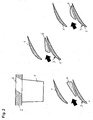
- Fig. 1 shows, for the removal of the required quantities of fluid usually slots are provided on the hub or housing wall, which are arranged in unbladed areas between two rows of blades of the machine and extend over parts or the entirety of the circumference.
- the fluid removal device extends over portions of the circumference upstream into a row of blades.
- removal devices within the blade passage the circular, oval or otherwise geometrically simple design and due to their shape and their location in the passage have a very adverse effect on the flow in the relevant blade row and the efficiency of the entire flow machine.
- Fig. 1 the blade shown schematically is provided with the reference numeral 1, wherein the upper variants of Fig. 1 each represent side views in radial sections, while the lower representations are each sectional views in the circumferential direction.
- the wall of the housing is designated 2.
- the reference numeral 6 denotes a fluid discharge opening.
- the prior art does not yet provide an effective combination of secondary fluid delivery and favorable flow control in the fluid flow machine.
- a fluid flow machine in which recesses are provided for removing fluid between the individual stator blades, which are arranged close to the pressure side of the blade, but further away from the suction side of the blade.
- recesses are provided for removing fluid between the individual stator blades, which are arranged close to the pressure side of the blade, but further away from the suction side of the blade.
- D1 says nothing.
- the US 2003/033815 A1 shows fluid removal recesses between stator blades which extend substantially in the circumferential direction.
- the recesses are not arranged close to the suction side, so they do not orient themselves on the blade suction side.
- the US-A-3,846,038 shows recesses between the stator blades, which extend at an angle to the circumferential direction like a slot from the leading edge of the blade to a central region of the next blade.
- the recesses are in particular not arranged along or near the suction side of the blade.
- the present invention has for its object to provide on at least one row of blades of a fluid flow machine, a device for fluid removal, which achieves a Sekundärfluidrgna while avoiding the prior art and at the same time an increase in efficiency by favorable flow control.
- the prior art does not yet provide an effective combination of secondary fluid delivery and favorable flow control in the fluid flow machine.
- the present invention has for its object to provide on at least one row of blades of a fluid flow machine, a device for fluid removal, which achieves a Sekundärfluidrgna while avoiding the prior art and at the same time an increase in efficiency by favorable flow control.
- a fluid take-off device is provided on the inner or the outer wall of the turbomachine within at least one blade passage of a rotor or stator blade row, the opening of which is positioned close to the blade suction side, oriented substantially along the blade suction side and viewed in chordwise direction, an elongated shape and varying Has width.
- the Fig. 1 shows in a highly simplified representation configurations of prior art fluid sampling devices: a ring slot behind the blade row, simple holes of round or oval shape without special placement, a ring slot behind blade row with spurs into the passage.
- the Fig. 2 shows a highly simplified representation of the inventive solution to a configuration of wall and blade row.
- This may be any pairing of rotor or stator blade row with a hub or housing wall of the fluid flow machine.
- the fluid removal device according to the invention is located in at least one of the passages between two blades bounded by leading and trailing edge planes.
- the blade row is, as indicated by the arrow, flows through from the left.
- the opening of the fluid removal device is located near the blade suction side and is elongated in the chordwise direction.
- Fig. 2 As well as the following figures, the fluid removal opening is designated in each case by the reference numeral 6. It is also referred to below as FE ⁇ .
- FE ⁇ fluid removal opening 6
- the blade section has the meridional length Cm.
- the flow direction is indicated by an arrow.
- a position field for the fluid removal opening 6 (FE ⁇ ) At the upstream side, the boundary is given by a circumferential line having the distance a measured from the leading edge of the profile in the meridian direction m.
- a line oriented in the circumferential direction with the distance e measured in the meridian direction m from the profile leading edge is used.
- the size of the distances a, e, and b is determined as follows (see Fig. 3 ): 0 . 2 Cm ⁇ a ⁇ 0 . 9 Cm 0 . 5 Cm ⁇ e ⁇ Cm b ⁇ 0 . 7 e - a / cos ⁇ ⁇ 2
- Reference numeral 10 denotes the pressure side of the bucket 1.
- the reference numeral 11 denotes the position field of the fluid removal opening 6.
- the reference numeral 12 denotes the radius of curvature of the bucket 1.
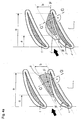
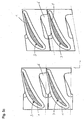
- Fig. 4a shows two favorable, within the scope of the invention possible variants of the fluid removal device with the indicated Fluident Spotifyö Stamms (FE ⁇ ) -Positionsfeld 6 and the sizes a, e and b. Characteristic of these solutions is the close orientation on the Schaufelsaugseite and on at least Parts of the fluid removal opening 6 (FE ⁇ ) provided increase in width W in blade chord direction.
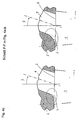
- the Fig. 4c showed the in Fig. 4a . b marked section FF. Shown are examples of possible edge inclination and edge rounding at the fluid removal opening 6 (FE ⁇ ) within the scope of the invention. At the fluid removal opening 6 (FE ⁇ ) is followed by a removal channel, which is shown in a straight line in the sectional plane for easy visualization, but according to the invention may also have freely curved walls.
- the center line of the removal channel 9 adjoining the opening of the fluid removal opening 6 (FE ⁇ ) is inclined in the vicinity of the fluid removal opening 6 (FE ⁇ ) by the angle ⁇ against the perpendicular to the meridian direction m (15 ° ⁇ ⁇ 75 °).
- the Fig. 4d shows the in Fig. 4a . b marked section GG. Shown here are examples of possible in the invention edge bevel and edge rounding of the FE ⁇ .
- the removal channel adjoins the fluid removal opening 6 (FE ⁇ ), which is also shown in a straight line in this sectional plane for easy visualization, but according to the invention can have freely curved walls.
- the center line of the removal channel 9 adjoining the opening of the fluid removal opening 6 (FE ⁇ ) is inclined in the vicinity of the fluid removal opening 6 (FE ⁇ ) by the angle ⁇ against the perpendicular to the chord normal direction sn (15 ° ⁇ ⁇ 75 °).
- FE ⁇ fluid removal opening 6
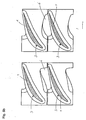
- Fig. 5a shows this for two forms according to the invention the fluid removal opening 6 (FE ⁇ ) without edge slope / rounding and aligned portions of the affected side edges.
- the Fig. 5b shows solutions with fluid removal opening 6 (FE ⁇ ) edge slope / rounding.
- FE ⁇ fluid removal opening 6
- Fig. 5c shows inventive solutions for a fluid removal opening 6 (FE ⁇ ) with edge slope / rounding, in the left half of a rectangular platform platform arrangement, in the right half for an inclined platform edge arrangement.
- FIG. 5a Inventive solutions for a row of blades with individual platforms without edge slope or edge rounding at the fluid removal opening 6
- Fig. 5b shows variants of solution according to the invention for a blade row with individual platforms with edge slope or edge rounding at the fluid removal opening 6
- Fig. 5c shows inventive solution variants for a row of blades with individual platforms and offset at the platform side edges.
Landscapes
- Engineering & Computer Science (AREA)
- Physics & Mathematics (AREA)
- Mechanical Engineering (AREA)
- General Engineering & Computer Science (AREA)
- Fluid Mechanics (AREA)
- Chemical & Material Sciences (AREA)
- Combustion & Propulsion (AREA)
- Geometry (AREA)
- Structures Of Non-Positive Displacement Pumps (AREA)
Description
- Die Erfindung bezieht sich auf eine Strömungsarbeitsmaschine mit Fluidentnahme gemäß dem Oberbegriff des Hauptanspruchs.
- Die vorliegende Erfindung bezieht sich auf Strömungsarbeitsmaschinen wie etwa Bläser, Verdichter, Pumpen und Ventilatoren, sowohl in axialer, halbaxialer als auch in radialer Bauart. Das Arbeitsmedium oder Fluid kann gasförmig oder flüssig sein.
- Im Einzelnen betrifft die Erfindung eine Strömungsarbeitsmaschine mit zumindest einem Rotor, sie kann aber auch eine oder mehrere Stufen mit jeweils einem Rotor und einem Stator umfassen. Es existiert ein Gehäuse, welches die Durchströmung der gegebenen Rotoren und der Statoren mit einem Fluid nach außen begrenzt. Der Rotor besteht aus einer Anzahl von Schaufeln, die mit einer rotierenden Welle verbunden sind und Energie an das Arbeitsmedium abgeben. Der Rotor ist mit freiem Schaufelende oder mit Deckband am Gehäuse ausgeführt. Der Stator besteht aus einer Anzahl feststehender Schaufeln, die gehäuseseitig und/oder nabenseitig mit festem Schaufelende ausgeführt sind. Die Strömungsarbeitsmaschine kann ein- oder mehrwellig ausgeführt sein.
- Eine weit verbreitete Anforderung an Strömungsarbeitsmaschinen, beispielsweise Bläsern, Verdichtern, Pumpen und Ventilatoren, besteht in der Bereitstellung von Sekundärfluidmengen an den Wandungen des Hauptströmungspfades. Wie die
Fig. 1 zeigt, werden für die Entnahme der erforderlichen Fluidmengen üblicherweise Schlitze an der Naben- oder Gehäusewand vorgesehen, die in unbeschaufelten Bereichen zwischen zwei Schaufelreihen der Maschine angeordnet sind und sich über Teile oder die Gesamtheit des Umfangs erstrecken. In manchen Fällen reicht die Fluidentnahmevorrichtung über Teile des Umfangs stromauf in eine Schaufelreihe hinein. Ebenfalls zum Stand der Technik gehören Entnahmevorrichtungen innerhalb der Schaufelpassage, die kreisförmig, oval oder anders geometrisch einfach gestaltet sind und sich aufgrund ihrer Form und ihrer Lage in der Passage sehr nachteilig auf die Strömung in der betreffenden Schaufelreihe sowie den Wirkungsgrad der gesamten Strömungsarbeitmaschine auswirken. - In
Fig. 1 ist die schematisch gezeigte Schaufel mit dem Bezugszeichen 1 versehen, wobei die oberen Varianten derFig. 1 jeweils Seitenansichten in Radialschnitten darstellen, während die unteren Darstellungen jeweils Schnittansichten in Umfangsrichtung sind. Die Wand des Gehäuses ist mit 2 bezeichnet. Das Bezugszeichen 6 bezeichnet eine Fluidentnahmeöffnung. - Der in
Fig. 1 beschriebene Stand der Technik ergibt sich beispielsweise aus derEP-A-0 049 655 . - Als nachteilig erweist sich beim Stand der Technik, dass zur Realisierung zusätzliche Baulänge aufgewendet werden muss und/oder Einbußen bezüglich des Wirkungsgrades der Strömungsarbeitmaschine hinzunehmen sind. Im Falle eines Flugtriebwerks führen übliche Fluidentnahmevorichtungen, die innerhalb des Verdichters angeordnet sind, zu Nachteilen bezüglich der Baulänge, des Baugewichts und des Kraftstoffverbrauchs.
- Der Stand der Technik sieht bislang keine wirkungsvolle Kombination der Sekundärfluidbereitstellung und einer günstigen Strömungsbeeinflussung in der Strömungsarbeitsmaschine vor.
- Aus der
GB-A-2 388 875 - Die
US 2003/033815 A1 zeigt Fluidentnahmeausnehmungen zwischen Statorschaufeln, welche sich im Wesentlichen in Umfangrichtung erstrecken. Die Ausnehmungen sind nicht nahe der Saugseite angeordnet, sie orientieren sich somit nicht an der Schaufelsaugseite. - Die
US-A-3 846 038 zeigt Ausnehmungen zwischen den Statorschaufeln, welche sich in einem Winkel zur Umfangsrichtung schlitzartig von der Anströmkante der Schaufel zu einem mittleren Bereich der nächstfolgenden Schaufel erstrecken. Die Ausnehmungen sind insbesondere nicht entlang oder nahe der Saugseite der Schaufel angeordnet. - Aus der
EP-A-0 049 655 ist eine Ausgestaltung einer Fluidentnahmeöffnung gezeigt, welche mittig zwischen benachbarten Schaufeln angeordnet und im Wesentlichen kreisrund ausgebildet ist, so wie dies in der Beschreibung des Standes der Technik gemäßFig. 1 dargestellt ist. Eine ähnliche Ausgestaltung zeigt auch dieEP-A-1 329 615 . - Der vorliegenden Erfindung liegt die Aufgabe zugrunde, an mindestens einer Schaufelreihe einer Strömungsarbeitsmaschine eine Vorrichtung zur Fluidabführung zu schaffen, welche unter Vermeidung des Standes der Technik eine Sekundärfluidbereitstellung und gleichzeitig eine Wirkungsgradsteigerung durch günstige Strömungsbeeinflussung erreicht.
- Erfindungsgemäß wird die Aufgabe durch die Merkmalskombination des Hauptanspruchs gelöst, die Unteransprüche zeigen weitere vorteilhafte Ausgestaltungen der Erfindung.
- Als nachteilig erweist sich beim Stand der Technik, dass zur Realisierung zusätzliche Baulänge aufgewendet werden muss und/oder Einbußen bezüglich des Wirkungsgrades der Strömungsarbeitmaschine hinzunehmen sind. Im Falle eines Flugtriebwerks führen übliche Fluidentnahmevorichtungen, die innerhalb des Verdichters angeordnet sind, zu Nachteilen bezüglich der Baulänge, des Baugewichts und des Kraftstoffverbrauchs.
- Der Stand der Technik sieht bislang keine wirkungsvolle Kombination der Sekundärfluidbereitstellung und einer günstigen Strömungsbeeinflussung in der Strömungsarbeitsmaschine vor.
- Der vorliegenden Erfindung liegt die Aufgabe zugrunde, an mindestens einer Schaufelreihe einer Strömungsarbeitsmaschine eine Vorrichtung zur Fluidabführung zu schaffen, welche unter Vermeidung des Standes der Technik eine Sekundärfluidbereitstellung und gleichzeitig eine Wirkungsgradsteigerung durch günstige Strömungsbeeinflussung erreicht.
- Erfindungsgemäß wird die Aufgabe durch die Merkmalskombination des Hauptanspruchs gelöst, die Unteransprüche zeigen weitere vorteilhafte Ausgestaltungen der Erfindung.
- Erfindungsgemäß ist an der inneren oder der äußeren Wandung der Strömungsarbeitsmaschine innerhalb mindestens einer Schaufelpassage einer Rotor- oder Statorschaufelreihe eine Fluidentnahmevorrichtung vorgesehen, deren Öffnung nahe an der Schaufelsaugseite positioniert ist, im Wesentlichen entlang der Schaufelsaugseite orientiert ist und in Profilsehnenrichtung betrachtet, eine längliche Form sowie variierende Breite besitzt.
- Im Folgenden wird die Erfindung anhand von Ausführungsbeispielen in Verbindung mit den Figuren beschrieben. Dabei zeigt:
- Fig. 1
- eine schematische Darstellung des Standes der Technik;
- Fig. 2
- eine schematische Darstellung des erfindungsgemäßen Grundkonzeptes;
- Fig. 3
- eine Definition der Fluidentnahmeöffnung;
- Fig. 4a
- erfindungsgemäße Lösungen;
- Fig. 4b
- erfindungsgemäße Lösungen;
- Fig. 4c
- erfindungsgemäße Lösungen, Schnitt F-F in
Fig. 4a ,b; - Fig. 4d
- erfindungsgemäße Lösungen, Schnitt G-G in
Fig. 4a ,b; - Fig. 5a
- erfindungsgemäße Lösungen für eine Schaufelreihe mit Einzelplattformen, ohne Kantenschräge/-rundung an der Fluidentnahmeöffnung;
- Fig. 5b
- erfindungsgemäße Lösungen für eine Schaufelreihe mit Einzelplattformen, mit Kantenschräge/-rundung an der Fluidentnahmeöffnung;
- Fig. 5c
- erfindungsgemäße Lösungen für eine Schaufelreihe mit Einzelplattformen und Versatz an den Plattformseitenkanten.
- Die
Fig. 1 zeigt in stark vereinfachter Darstellung Konfigurationen von Fluidentnahmevorrichtungen nach dem Stand der Technik: ein Ringschlitz hinter der Schaufelreihe, einfache Bohrungen runder oder ovaler Form ohne spezielle Platzierung, ein Ringschlitz hinter Schaufelreihe mit Ausläufern in die Passage. - Die
Fig. 2 zeigt in stark vereinfachter Darstellung die erfindungsgemäße Lösung an einer Konfiguration aus Wand und Schaufelreihe. Hierbei kann es sich um eine beliebige Paarung von Rotor- oder Statorschaufelreihe mit einer Naben- oder Gehäusewand der Strömungsarbeitsmaschine handeln. In mindestens einer der durch Vorder- und Hinterkantenebene begrenzten Passage zwischen zwei Schaufeln befindet sich die erfindungsgemäße Fluidentnahmevorrichtung. Die Schaufelreihe wird, wie durch den Pfeil angedeutet, von links durchströmt. Die Öffnung der Fluidentnahmevorrichtung befindet sich in der Nähe der Schaufelsaugseite und ist in Profilsehnenrichtung länglich gestaltet. - In
Fig. 2 sowie den nachfolgenden Figuren ist die Fluidentnahmeöffnung jeweils mit dem Bezugszeichen 6 bezeichnet. Sie wird nachfolgend auch als FEÖ bezeichnet. - In
Fig. 3 sind die Gestaltungsgrenzen der Fluidentnahmeöffnung 6 (FEÖ) definiert. Betrachtet wird hier der Wandschnitt einer Schaufel in einer durch die Meridianrichtung m und die Umfangsrichtung u aufgespannten Ebene. Der Schaufelschnitt besitzt die meridionale Länge Cm. Die Strömungsrichtung ist durch einen Pfeil angedeutet. In der m-u-Ebene ist durch drei begrenzende Linien ein Positionsfeld für die Fluidentnahmeöffnung 6 (FEÖ) gegeben. An der zuströmungszugewandten Seite wird die Grenze durch eine in Umfangsrichtung verlaufende Linie mit dem in Meridianrichtung m gemessenen Abstand a von der Profilvorderkante gegeben. An der zuströmungsabgewandten Seite wird eine in Umfangsrichtung orientierte Linie mit dem in Meridianrichtung m gemessenen Abstand e von der Profilvorderkante herangezogen. Als Begrenzung an der oberen, dem nächsten Schaufelprofil zugewandten Seite der FEÖ wird eine Grenzlinie verwendet, die in einem in Umfangsrichtung u gemessenen Abstand b parallel zu der an die Druckseite angelegten Profilsehne verläuft. Die Profilsehne des Schaufelwandschnittes verläuft unter einem Winkel λ gegen die Meridianrichtung m. Erfindungsgemäß ist die Größe der Abstände a, e, und b wie folgt festgelegt (sieheFig. 3 ):


- Die in Umfangsrichtung gemessene Weite W der Fluidentnahmeöffnung 6 (FEÖ) variiert abweichend von einem konstanten Verlauf als Funktion der Meridiankoordinate: W = f(m).
- Schließlich ist es besonders vorteilhaft, die der Strömung zugewandten Ränder der Fluidentnahmeöffnung 6 (FEÖ) mit einer Schräge 4 oder einer Rundung 5 zu versehen. Erfindungsgemäß werden gegebenenfalls jene Ränder der Fluidentnahmeöffnung 6 (FEÖ) mit einer Schräge 4 oder Rundung 5 versehen, deren Randnormale 8 mit der Profilsehne 7 des Wandschaufelschnittes einen Winkel α zwischen 70° und 250° einschließt (70° < α < 250°). Als Schräge/Rundung sind erfindungsgemäß auch Kantenphasen sowie längere stromauf reichende Einströmrampen zu verstehen.
- Weiterhin zeigt die
Fig. 3 mit dem Bezugszeichen 10 die Druckseite der Schaufel 1. Das Bezugszeichen 11 bezeichnet das Positionsfeld der Fluidentnahmeöffnung 6. Das Bezugszeichen 12 bezeichnet den Rundungsradius der Schaufel 1. - Die
Fig. 4a zeigt zwei günstige, im Rahmen der Erfindung mögliche Varianten der Fluidentnahmevorrichtung mit dem kenntlich gemachten Fluidentnahmeöffnungs (FEÖ) -Positionsfeld 6 sowie den Größen a, e und b. Kennzeichnend für diese Lösungen ist die enge Orientierung an der Schaufelsaugseite und ein über wenigstens Teile der Fluidentnahmeöffnung 6 (FEÖ) vorgesehenen Anstieg der Weite W in Schaufelprofilsehnenrichtung. - Wie in
Fig. 4b gezeigt, kann es erfindungsgemäß besonders vorteilhaft sein, den Abstand der Fluidentnahmeöffnung 6 (FEÖ) zur Schaufelsaugseite, gegen die Anströmungsrichtung betrachtet, ansteigen zu lassen und die Fluidentnahmeöffnung 6 (FEÖ) auf diese Weise mit einem merklich zur Saugseite hin konvex gekrümmten Verlauf zu versehen. - Die
Fig. 4c zeigte den inFig. 4a ,b eingezeichneten Schnitt F-F. Dargestellt sind Beispiele für eine im Rahmen der Erfindung mögliche Kantenschräge und Kantenrundung an der Fluidentnahmeöffnung 6 (FEÖ). An die Fluidentnahmeöffnung 6 (FEÖ) schließt sich ein Entnahmekanal an, der in der Schnittebene zur einfachen Visualisierung geradlinig dargestellt ist, aber erfindungsgemäß auch frei gekrümmte Wandungen besitzen kann. - Die Mittellinie des sich an die Öffnung der Fluidentnahmeöffnung 6 (FEÖ) anschließende Entnahmekanals 9 ist in Umgebung der Fluidentnahmeöffnung 6 (FEÖ) um den Winkel β gegen die Senkrechte zur Meridianrichtung m geneigt (15° < β < 75°).
- Die
Fig. 4d zeigt den inFig. 4a ,b eingezeichneten Schnitt G-G. Dargestellt sind auch hier Beispiele für eine im Rahmen der Erfindung mögliche Kantenschräge und Kantenrundung and der FEÖ. An die Fluidentnahmeöffnung 6 (FEÖ) schließt sich der Entnahmekanal an, der auch in dieser Schnittebene zur einfachen Visualisierung geradlinig dargestellt ist, aber erfindungsgemäß frei gekrümmte Wandungen besitzen kann. Die Mittellinie des sich an die Öffnung der Fluidentnahmeöffnung 6 (FEÖ) anschließende Entnahmekanals 9 ist in Umgebung der Fluidentnahmeöffnung 6 (FEÖ) um den Winkel γ gegen die Senkrechte zur Sehnennormalenrichtung sn geneigt (15° < γ < 75°). - Erfindungsgemäß ist es vorteilhaft, bei Konstruktionen mit Schaufeleinzelplattformen die Fluidentnahmeöffnung 6 (FEÖ) mit Hilfe der Seitenflanken zweier benachbarter Plattformen zu bilden. Die
Fig. 5a zeigt dies für zwei erfindungsgemäße Formen der Fluidentnahmeöffnung 6 (FEÖ) ohne Randschräge/-rundung und fluchtende Teilabschnitte der betroffenen Seitenflanken. DieFig. 5b zeigt Lösungen mit Fluidentnahmeöffnung 6 (FEÖ) Randschräge/-rundung. - Weiterhin ist es erfindungsgemäß besonders vorteilhaft, bei Konstruktionen mit Schaufeleinzelplattformen die Fluidentnahmeöffnung 6 (FEÖ) mit Hilfe der Seitenflanken zweier benachbarter Plattformen zu bilden, deren Teilabschnitte der betroffenen Seitenflanken nicht fluchten, sondern parallel gegeneinander versetzt ausgeführt sind. Die
Fig. 5c zeigt erfindungsgemäße Lösungen für eine Fluidentnahmeöffnung 6 (FEÖ) mit Randschräge/-rundung, in der linken Bildhälfte für eine rechtwinklige Plattformkantenanordnung, in der rechten Bildhälfte für eine schräge Plattformkantenanordnung. - Im Einzelnen zeigt die
Fig. 5a erfindungsgemäße Lösungen für eine Schaufelreihe mit Einzelplattformen ohne Kantenschräge bzw. Kantenrundung an der Fluidentnahmeöffnung 6. DieFig. 5b zeigt erfindungsgemäße Lösungsvarianten für eine Schaufelreihe mit Einzelplattformen mit Kantenschräge oder Kantenrundung an der Fluidentnahmeöffnung 6. DieFig. 5c zeigt erfindungsgemäße Lösungsvarianten für eine Schaufelreihe mit Einzelplattformen und Versatz an den Plattformseitenkanten. - Im Rahmen der Erfindung ergeben sich somit insbesondere folgende Vorteile:
- Bei der erfindungsgemäßen Fluidentnahmeöffnung wird eine Sekundärfluidbereitstellung in Strömungsarbeitsmaschinen ermöglicht, die gleichzeitig eine positive Beeinflussung der Schaufelumströmung innerhalb des Hauptströmungspfades erlaubt. Dies ist bei unterschiedlichsten Arten von Strömungsarbeitsmaschinen wie Bläsern, Verdichtern, Pumpen und Ventilatoren möglich. Am Beispiel eines 6-stufigen Triebwerkverdichters gemessen ist pro betroffener Schaufelreihe eine Verbesserung des Verdichtergesamtwirkungsgrades von 0,2% bis 0,30% zu beziffern.
-
- 1
- Schaufel
- 2
- Gehäuse (Wand)
- 3
- Saugseite
- 4
- Randschräge
- 5
- Öffnung
- 6
- Fluidentnahmeöffnung
Claims (6)
- Strömungsarbeitsmaschine mit Fluidentnahme, mit zumindest einem Stator oder mindestens einem Rotor, wobei der Stator mit feststehenden Schaufeln (1) versehen ist und der Rotor mehrere an einer rotierenden Welle befestigte Rotorschaufeln umfasst, wobei ein Gehäuse (2) die Durchströmung des Rotors oder des Stators mit einem Fluid nach außen begrenzt, dadurch gekennzeichnet, dass an einer inneren oder einer äußeren Wandung der Strömungsarbeitsmaschine innerhalb mindestens einer Schaufelpassage einer Rotor- oder Statorschaufelreihe eine Fluidentnahmeöffnung (6) vorgesehen ist, welche nahe an der Schaufelsaugseite positioniert ist, im Wesentlichen entlang der Schaufelsaugseite orientiert ist und in Profilsehnenrichtung betrachtet, eine längliche Form sowie eine variierende Breite besitzt,
wobei in einer die Meridianrichtung (m) und die Umfangsrichtung (u) umfassenden Ebene die Gestaltungsgrenzen der Fluidentnahmeöffnung (6) an der zuströmungszugewandten Seite durch eine in Umfangsrichtung verlaufende Linie mit dem in Meridianrichtung (m) gemessenen Abstand (a) von der Profilvorderkante der Schaufel (1) und an der zuströmungsabgewandten Seite durch eine in Umfangsrichtung orientierte Linie mit dem in Meridianrichtung (m) gemessenen Abstand (e) von der Profilvorderkante der Schaufel (1) und an der dem nächsten Schaufelprofil zugewandten Seite durch eine Grenzlinie, die in einem in Umfangsrichtung (u) gemessenen Abstand (b) parallel zu der an die Druckseite angelegten Profilsehne (7) verläuft, begrenzt werden,
wobei die Profilsehne des Schaufelschnitts unter einem Winkel (λ) gegen die Meridianrichtung (m) verläuft, wobei die Größe der Abstände a, e und b wie folgt festgelegt ist:


wobei Cm die meridionale Länge des Schaufelschnitts ist,
wobei eine in Umfangsrichtung gemessene Weite (W) der Fluidentnahmeöffnung (6) nicht konstant verläuft, sondern als Funktion der Meridiankoordinate (m) frei variiert, so dass sich folgende Gleichung ergibt:
- Strömungsarbeitsmaschine nach Anspruch 1, dadurch gekennzeichnet, dass Ränder der Fluidentnahmeöffnung (6) mit einer Schräge oder Rundung versehen sind, deren Randnormale (8) mit der Profilsehne (7) des Wandschaufelschnittes einen Winkel α zwischen 70° und 250° einschließt.
- Strömungsarbeitsmaschine nach Anspruch 1 oder 2, dadurch gekennzeichnet, dass zumindest ein Rand der Fluidentnahmeöffnung (6) mit einer Randschräge (4) versehen ist.
- Strömungsarbeitsmaschine nach Anspruch 1 oder 2, dadurch gekennzeichnet, dass zumindest ein Rand der Fluidentnahmeöffnung (6) mit einer Rundung (5) versehen ist.
- Strömungsarbeitsmaschine nach einem der Ansprüche 1 bis 4, dadurch gekennzeichnet, dass eine Mittellinie eines sich an die Fluidentnahmeöffnung (6) anschließenden Entnahmekanals (9) in Umgebung der Fluidentnahmeöffnung (6) um einen Winkel β gegen die Senkrechte zur Meridianrichtung m geneigt ist, sodass sich folgende Beziehung ergibt:

- Strömungsarbeitsmaschine nach einem der Ansprüche 1 bis 5, dadurch gekennzeichnet, dass eine Mittellinie eines sich an die Fluidentnahmeöffnung (6) anschließenden Entnahmekanals (9) in Umgebung der Fluidentnahmeöffnung (6) um einen Winkel γ gegen die Senkrechte zur Sehnennormalenrichtung sn geneigt ist, sodass sich folgende Beziehung ergibt:

Applications Claiming Priority (1)
| Application Number | Priority Date | Filing Date | Title |
|---|---|---|---|
| DE102004043036A DE102004043036A1 (de) | 2004-09-06 | 2004-09-06 | Strömungsarbeitsmaschine mit Fluidentnahme |
Publications (3)
| Publication Number | Publication Date |
|---|---|
| EP1632662A2 EP1632662A2 (de) | 2006-03-08 |
| EP1632662A3 EP1632662A3 (de) | 2008-10-01 |
| EP1632662B1 true EP1632662B1 (de) | 2013-10-09 |
Family
ID=35447463
Family Applications (1)
| Application Number | Title | Priority Date | Filing Date |
|---|---|---|---|
| EP05018097.5A Expired - Lifetime EP1632662B1 (de) | 2004-09-06 | 2005-08-19 | Strömungsarbeitsmaschine mit Fluidentnahme |
Country Status (3)
| Country | Link |
|---|---|
| US (1) | US7594793B2 (de) |
| EP (1) | EP1632662B1 (de) |
| DE (1) | DE102004043036A1 (de) |
Cited By (1)
| Publication number | Priority date | Publication date | Assignee | Title |
|---|---|---|---|---|
| CN111412181A (zh) * | 2020-04-09 | 2020-07-14 | 中国航发沈阳发动机研究所 | 一种压气机引气结构及其引流槽 |
Families Citing this family (22)
| Publication number | Priority date | Publication date | Assignee | Title |
|---|---|---|---|---|
| DE102004055439A1 (de) | 2004-11-17 | 2006-05-24 | Rolls-Royce Deutschland Ltd & Co Kg | Strömungsarbeitsmaschine mit dynamischer Strömungsbeeinflussung |
| US8292567B2 (en) * | 2006-09-14 | 2012-10-23 | Caterpillar Inc. | Stator assembly including bleed ports for turbine engine compressor |
| US7661924B2 (en) * | 2007-03-28 | 2010-02-16 | General Electric Company | Method and apparatus for assembling turbine engines |
| FR2914705B1 (fr) * | 2007-04-06 | 2012-04-27 | Snecma | Compresseur de turbomachine avec trous de prelevement d'air |
| DE102007037924A1 (de) | 2007-08-10 | 2009-02-12 | Rolls-Royce Deutschland Ltd & Co Kg | Strömungsarbeitsmaschine mit Ringkanalwandausnehmung |
| DE102008011644A1 (de) | 2008-02-28 | 2009-09-03 | Rolls-Royce Deutschland Ltd & Co Kg | Gehäusestrukturierung für Axialverdichter im Nabenbereich |
| DE102008014957A1 (de) * | 2008-03-19 | 2009-09-24 | Rolls-Royce Deutschland Ltd & Co Kg | Gasturbinenverdichter mit Zapfluftentnahme |
| DE102008031982A1 (de) | 2008-07-07 | 2010-01-14 | Rolls-Royce Deutschland Ltd & Co Kg | Strömungsarbeitsmaschine mit Nut an einem Laufspalt eines Schaufelendes |
| DE102008037154A1 (de) | 2008-08-08 | 2010-02-11 | Rolls-Royce Deutschland Ltd & Co Kg | Strömungsarbeitsmaschine |
| EP2184442A1 (de) * | 2008-11-11 | 2010-05-12 | ALSTOM Technology Ltd | Übergang eines Schaufelprofils |
| EP2224096A1 (de) * | 2009-02-27 | 2010-09-01 | Alstom Technology Ltd | Dampfturbine und Verfahren zur Extraktion von Feuchtigkeit aus einer Dampfturbine |
| FR2958694B1 (fr) * | 2010-04-07 | 2014-04-18 | Snecma | Compresseur de moteur, en particulier de turboreacteur d'aeronef, muni d'un systeme de prelevement d'air |
| GB201015029D0 (en) * | 2010-09-10 | 2010-10-20 | Rolls Royce Plc | Gas turbine engine |
| EP2844880B1 (de) * | 2012-05-02 | 2017-09-27 | GKN Aerospace Sweden AB | Stützstruktur für einen gasturbinenmotor |
| US9528391B2 (en) | 2012-07-17 | 2016-12-27 | United Technologies Corporation | Gas turbine engine outer case with contoured bleed boss |
| US20140154068A1 (en) * | 2012-09-28 | 2014-06-05 | United Technologies Corporation | Endwall Controuring |
| US20140093355A1 (en) * | 2012-09-28 | 2014-04-03 | United Technologies Corporation | Extended indentation for a fastener within an air flow |
| JP6037996B2 (ja) * | 2013-10-17 | 2016-12-07 | 三菱重工業株式会社 | 圧縮機、及びガスタービン |
| US10196982B2 (en) * | 2015-11-04 | 2019-02-05 | General Electric Company | Gas turbine engine having a flow control surface with a cooling conduit |
| US10227930B2 (en) | 2016-03-28 | 2019-03-12 | General Electric Company | Compressor bleed systems in turbomachines and methods of extracting compressor airflow |
| JP7439285B2 (ja) * | 2020-09-28 | 2024-02-27 | 三菱重工業株式会社 | 蒸気タービン |
| US11725530B1 (en) * | 2022-05-20 | 2023-08-15 | General Electric Company | Offtake scoops for bleed pressure recovery in gas turbine engines |
Family Cites Families (42)
| Publication number | Priority date | Publication date | Assignee | Title |
|---|---|---|---|---|
| DE889506C (de) | 1940-09-25 | 1953-09-10 | Versuchsanstalt Fuer Luftfahrt | Stroemungsmaschine mit Grenzschichtabsaugung |
| GB619722A (en) | 1946-12-20 | 1949-03-14 | English Electric Co Ltd | Improvements in and relating to boundary layer control in fluid conduits |
| US2933238A (en) * | 1954-06-24 | 1960-04-19 | Edward A Stalker | Axial flow compressors incorporating boundary layer control |
| GB799675A (en) | 1955-10-13 | 1958-08-13 | Bristol Aeroengines Ltd | Improvements in or relating to axial flow gas compressors and turbines |
| US3066912A (en) * | 1961-03-28 | 1962-12-04 | Gen Electric | Turbine erosion protective device |
| CH437614A (de) | 1963-07-02 | 1967-11-30 | Moravec Zdenek | Strömungsmaschine mit verminderter Geräuscherzeugung |
| GB987625A (en) * | 1963-10-14 | 1965-03-31 | Rolls Royce | Improvements in or relating to axial flow compressors, for example for aircraft gas turbine engines |
| US3572960A (en) * | 1969-01-02 | 1971-03-30 | Gen Electric | Reduction of sound in gas turbine engines |
| DE1938132A1 (de) * | 1969-07-26 | 1971-01-28 | Daimler Benz Ag | Leitschaufeln von Axialverdichtern |
| FR2166494A5 (de) | 1971-12-27 | 1973-08-17 | Onera (Off Nat Aerospatiale) | |
| FR2248732A5 (de) * | 1973-10-23 | 1975-05-16 | Onera (Off Nat Aerospatiale) | |
| US4155680A (en) * | 1977-02-14 | 1979-05-22 | General Electric Company | Compressor protection means |
| FR2491549B1 (fr) * | 1980-10-08 | 1985-07-05 | Snecma | Dispositif de refroidissement d'une turbine a gaz, par prelevement d'air au niveau du compresseur |
| DE3407945A1 (de) * | 1984-03-03 | 1985-09-05 | MTU Motoren- und Turbinen-Union München GmbH, 8000 München | Verfahren und mittel zur vermeidung der entstehung von titanfeuer |
| US5008886A (en) * | 1989-01-27 | 1991-04-16 | Digital Equipment Corporation | Read-modify-write operation |
| US5020970A (en) | 1989-07-13 | 1991-06-04 | Dresser-Rand Company | Fluid-handling, bladed rotor |
| US5059093A (en) * | 1990-06-07 | 1991-10-22 | United Technologies Corporation | Compressor bleed port |
| US5203162A (en) * | 1990-09-12 | 1993-04-20 | United Technologies Corporation | Compressor bleed manifold for a gas turbine engine |
| JPH04132899A (ja) * | 1990-09-25 | 1992-05-07 | Mitsubishi Heavy Ind Ltd | 軸流送風機 |
| US5209633A (en) | 1990-11-19 | 1993-05-11 | General Electric Company | High pressure compressor flowpath bleed valve extraction slot |
| DE69204861T2 (de) | 1991-01-30 | 1996-05-23 | United Technologies Corp | Ventilatorgehäuse mit Rezirculationskanälen. |
| US5327716A (en) * | 1992-06-10 | 1994-07-12 | General Electric Company | System and method for tailoring rotor tip bleed air |
| US5480284A (en) * | 1993-12-20 | 1996-01-02 | General Electric Company | Self bleeding rotor blade |
| US5562404A (en) | 1994-12-23 | 1996-10-08 | United Technologies Corporation | Vaned passage hub treatment for cantilever stator vanes |
| US5607284A (en) | 1994-12-29 | 1997-03-04 | United Technologies Corporation | Baffled passage casing treatment for compressor blades |
| US5762034A (en) * | 1996-01-16 | 1998-06-09 | Board Of Trustees Operating Michigan State University | Cooling fan shroud |
| DE19632207A1 (de) | 1996-08-09 | 1998-02-12 | Bmw Rolls Royce Gmbh | Verfahren zur Verhinderung der laminaren Grenzschicht-Ablösung an Turbomaschinen-Schaufeln |
| US6109868A (en) * | 1998-12-07 | 2000-08-29 | General Electric Company | Reduced-length high flow interstage air extraction |
| US6574965B1 (en) * | 1998-12-23 | 2003-06-10 | United Technologies Corporation | Rotor tip bleed in gas turbine engines |
| US6302640B1 (en) * | 1999-11-10 | 2001-10-16 | Alliedsignal Inc. | Axial fan skip-stall |
| DE10135003C1 (de) * | 2001-07-18 | 2002-10-02 | Mtu Aero Engines Gmbh | Verdichtergehäusestruktur |
| US6585479B2 (en) * | 2001-08-14 | 2003-07-01 | United Technologies Corporation | Casing treatment for compressors |
| US6550254B2 (en) | 2001-08-17 | 2003-04-22 | General Electric Company | Gas turbine engine bleed scoops |
| US6663346B2 (en) | 2002-01-17 | 2003-12-16 | United Technologies Corporation | Compressor stator inner diameter platform bleed system |
| GB0206880D0 (en) | 2002-03-23 | 2002-05-01 | Rolls Royce Plc | A vane for a rotor arrangement for a gas turbine engine |
| DE10233032A1 (de) * | 2002-07-20 | 2004-01-29 | Rolls-Royce Deutschland Ltd & Co Kg | Strömungsarbeitsmaschine mit integriertem Fluidzirkulationssystem |
| DE10330084B4 (de) | 2002-08-23 | 2010-06-10 | Mtu Aero Engines Gmbh | Rezirkulationsstruktur für Turboverdichter |
| CA2496543C (en) * | 2002-08-23 | 2010-08-10 | Mtu Aero Engines Gmbh | Recirculation structure for a turbocompressor |
| DE10355240A1 (de) * | 2003-11-26 | 2005-07-07 | Rolls-Royce Deutschland Ltd & Co Kg | Strömungsarbeitsmaschine mit Fluidentnahme |
| US7097414B2 (en) * | 2003-12-16 | 2006-08-29 | Pratt & Whitney Rocketdyne, Inc. | Inducer tip vortex suppressor |
| GB2413158B (en) * | 2004-04-13 | 2006-08-16 | Rolls Royce Plc | Flow control arrangement |
| DE102004030597A1 (de) * | 2004-06-24 | 2006-01-26 | Rolls-Royce Deutschland Ltd & Co Kg | Strömungsarbeitsmaschine mit Aussenradstrahlerzeugung am Stator |
-
2004
- 2004-09-06 DE DE102004043036A patent/DE102004043036A1/de not_active Withdrawn
-
2005
- 2005-08-19 EP EP05018097.5A patent/EP1632662B1/de not_active Expired - Lifetime
- 2005-09-06 US US11/218,521 patent/US7594793B2/en not_active Expired - Fee Related
Cited By (1)
| Publication number | Priority date | Publication date | Assignee | Title |
|---|---|---|---|---|
| CN111412181A (zh) * | 2020-04-09 | 2020-07-14 | 中国航发沈阳发动机研究所 | 一种压气机引气结构及其引流槽 |
Also Published As
| Publication number | Publication date |
|---|---|
| US7594793B2 (en) | 2009-09-29 |
| DE102004043036A1 (de) | 2006-03-09 |
| EP1632662A3 (de) | 2008-10-01 |
| US20060051199A1 (en) | 2006-03-09 |
| EP1632662A2 (de) | 2006-03-08 |
Similar Documents
| Publication | Publication Date | Title |
|---|---|---|
| EP2025945B1 (de) | Strömungsarbeitsmaschine mit Ringkanalwandausnehmung | |
| EP2003292B1 (de) | Strömungsarbeitsmaschine aufweisend ein Schaufeldeckband mit Überstand | |
| EP2138727B1 (de) | Schaufeldeckband mit Durchlass | |
| EP1632662A2 (de) | Strömungsarbeitsmaschine mit Fluidentnahme | |
| EP2194232B1 (de) | Strömungsmaschine mit Seitenwand-Grenzschicht-Barriere | |
| EP1927723B1 (de) | Stator-Stufe eines Axialverdichters einer Strömungsmaschine mit Querlamellen zur Wirkungsgradsteigerung | |
| DE10327574B4 (de) | Laufrad für eine Kraftstoffpumpe | |
| EP2463480B1 (de) | Schaufel mit hybrider Profilgestaltung | |
| EP2226510B1 (de) | Strömungsarbeitsmaschine mit Fluidzufuhr zur Grenzschichtbeeinflussung | |
| EP2696029B1 (de) | Schaufelgitter mit Seitenwandkonturierung und Strömungsmaschine | |
| EP2927503B1 (de) | Gasturbinenverdichter, Flugtriebwerk und Auslegungsverfahren | |
| EP2275643B1 (de) | Triebwerkschaufel mit überhöhter Vorderkantenbelastung | |
| EP2761137B1 (de) | Schaufel einer rotor- oder statorreihe für den einsatz in einer strömungsmaschine | |
| EP2947270B1 (de) | Schaufelreihengruppe | |
| EP1657401A2 (de) | Schaufel einer Strömungsarbeitsmaschine mit erweiterter Randprofiltiefe | |
| DE19940020C2 (de) | Extraktionseinrichtung | |
| EP0916812A1 (de) | Endstufe für axialdurchströmte Turbine | |
| EP3536974B1 (de) | Gasturbinenverdichter | |
| EP2538024A1 (de) | Schaufel einer Strömungsmaschine | |
| EP2180195A2 (de) | Strömungsarbeitsmaschine mit Laufspalteinzug | |
| EP3078804A1 (de) | Deckbandanordnung einer schaufelreihe von stator- oder rotorschaufeln und zugehörige turbine | |
| DE102016102732A1 (de) | Mixed-Flow-Turbinenrad eines Abgasturboladers sowie Abgasturbine mit einem solchen Turbinenrad | |
| DE102005042115A1 (de) | Schaufel einer Strömungsarbeitsmaschine mit blockweise definierter Profilskelettlinie | |
| EP2607625B1 (de) | Turbomaschine und turbomaschinenstufe | |
| EP1798375A2 (de) | Schaufelprofil für verstellbare Statorschaufeln |
Legal Events
| Date | Code | Title | Description |
|---|---|---|---|
| PUAI | Public reference made under article 153(3) epc to a published international application that has entered the european phase |
Free format text: ORIGINAL CODE: 0009012 |
|
| AK | Designated contracting states |
Kind code of ref document: A2 Designated state(s): AT BE BG CH CY CZ DE DK EE ES FI FR GB GR HU IE IS IT LI LT LU LV MC NL PL PT RO SE SI SK TR |
|
| AX | Request for extension of the european patent |
Extension state: AL BA HR MK YU |
|
| PUAL | Search report despatched |
Free format text: ORIGINAL CODE: 0009013 |
|
| AK | Designated contracting states |
Kind code of ref document: A3 Designated state(s): AT BE BG CH CY CZ DE DK EE ES FI FR GB GR HU IE IS IT LI LT LU LV MC NL PL PT RO SE SI SK TR |
|
| AX | Request for extension of the european patent |
Extension state: AL BA HR MK YU |
|
| 17P | Request for examination filed |
Effective date: 20090312 |
|
| AKX | Designation fees paid |
Designated state(s): DE FR GB |
|
| 17Q | First examination report despatched |
Effective date: 20110707 |
|
| REG | Reference to a national code |
Ref country code: DE Ref legal event code: R079 Ref document number: 502005014020 Country of ref document: DE Free format text: PREVIOUS MAIN CLASS: F02C0006080000 Ipc: F01D0005140000 |
|
| RIC1 | Information provided on ipc code assigned before grant |
Ipc: F02C 9/18 20060101ALI20130307BHEP Ipc: F01D 5/14 20060101AFI20130307BHEP Ipc: F01D 17/10 20060101ALI20130307BHEP Ipc: F04D 27/02 20060101ALI20130307BHEP |
|
| GRAP | Despatch of communication of intention to grant a patent |
Free format text: ORIGINAL CODE: EPIDOSNIGR1 |
|
| INTG | Intention to grant announced |
Effective date: 20130515 |
|
| GRAS | Grant fee paid |
Free format text: ORIGINAL CODE: EPIDOSNIGR3 |
|
| GRAA | (expected) grant |
Free format text: ORIGINAL CODE: 0009210 |
|
| AK | Designated contracting states |
Kind code of ref document: B1 Designated state(s): DE FR GB |
|
| REG | Reference to a national code |
Ref country code: GB Ref legal event code: FG4D Free format text: NOT ENGLISH |
|
| REG | Reference to a national code |
Ref country code: DE Ref legal event code: R096 Ref document number: 502005014020 Country of ref document: DE Effective date: 20131205 |
|
| REG | Reference to a national code |
Ref country code: DE Ref legal event code: R097 Ref document number: 502005014020 Country of ref document: DE |
|
| PLBE | No opposition filed within time limit |
Free format text: ORIGINAL CODE: 0009261 |
|
| STAA | Information on the status of an ep patent application or granted ep patent |
Free format text: STATUS: NO OPPOSITION FILED WITHIN TIME LIMIT |
|
| 26N | No opposition filed |
Effective date: 20140710 |
|
| REG | Reference to a national code |
Ref country code: DE Ref legal event code: R097 Ref document number: 502005014020 Country of ref document: DE Effective date: 20140710 |
|
| REG | Reference to a national code |
Ref country code: FR Ref legal event code: PLFP Year of fee payment: 12 |
|
| REG | Reference to a national code |
Ref country code: FR Ref legal event code: PLFP Year of fee payment: 13 |
|
| REG | Reference to a national code |
Ref country code: FR Ref legal event code: PLFP Year of fee payment: 14 |
|
| PGFP | Annual fee paid to national office [announced via postgrant information from national office to epo] |
Ref country code: DE Payment date: 20190828 Year of fee payment: 15 Ref country code: FR Payment date: 20190826 Year of fee payment: 15 |
|
| PGFP | Annual fee paid to national office [announced via postgrant information from national office to epo] |
Ref country code: GB Payment date: 20190827 Year of fee payment: 15 |
|
| REG | Reference to a national code |
Ref country code: DE Ref legal event code: R082 Ref document number: 502005014020 Country of ref document: DE |
|
| REG | Reference to a national code |
Ref country code: DE Ref legal event code: R119 Ref document number: 502005014020 Country of ref document: DE |
|
| GBPC | Gb: european patent ceased through non-payment of renewal fee |
Effective date: 20200819 |
|
| PG25 | Lapsed in a contracting state [announced via postgrant information from national office to epo] |
Ref country code: DE Free format text: LAPSE BECAUSE OF NON-PAYMENT OF DUE FEES Effective date: 20210302 Ref country code: FR Free format text: LAPSE BECAUSE OF NON-PAYMENT OF DUE FEES Effective date: 20200831 |
|
| PG25 | Lapsed in a contracting state [announced via postgrant information from national office to epo] |
Ref country code: GB Free format text: LAPSE BECAUSE OF NON-PAYMENT OF DUE FEES Effective date: 20200819 |