EP1627896A1 - Intumeszenzbrandschutzbeschichtung enthaltend Phosphor/Stickstoff-Flammschutzmittel und ein Phosphinsäuresalz - Google Patents
Intumeszenzbrandschutzbeschichtung enthaltend Phosphor/Stickstoff-Flammschutzmittel und ein Phosphinsäuresalz Download PDFInfo
- Publication number
- EP1627896A1 EP1627896A1 EP05017266A EP05017266A EP1627896A1 EP 1627896 A1 EP1627896 A1 EP 1627896A1 EP 05017266 A EP05017266 A EP 05017266A EP 05017266 A EP05017266 A EP 05017266A EP 1627896 A1 EP1627896 A1 EP 1627896A1
- Authority
- EP
- European Patent Office
- Prior art keywords
- fire protection
- acid salt
- protection coating
- formula
- phosphorus
- Prior art date
- Legal status (The legal status is an assumption and is not a legal conclusion. Google has not performed a legal analysis and makes no representation as to the accuracy of the status listed.)
- Granted
Links
Images

Classifications
-
- C—CHEMISTRY; METALLURGY
- C08—ORGANIC MACROMOLECULAR COMPOUNDS; THEIR PREPARATION OR CHEMICAL WORKING-UP; COMPOSITIONS BASED THEREON
- C08K—Use of inorganic or non-macromolecular organic substances as compounding ingredients
- C08K5/00—Use of organic ingredients
- C08K5/0008—Organic ingredients according to more than one of the "one dot" groups of C08K5/01 - C08K5/59
- C08K5/0066—Flame-proofing or flame-retarding additives
-
- C—CHEMISTRY; METALLURGY
- C08—ORGANIC MACROMOLECULAR COMPOUNDS; THEIR PREPARATION OR CHEMICAL WORKING-UP; COMPOSITIONS BASED THEREON
- C08K—Use of inorganic or non-macromolecular organic substances as compounding ingredients
- C08K5/00—Use of organic ingredients
- C08K5/49—Phosphorus-containing compounds
- C08K5/51—Phosphorus bound to oxygen
- C08K5/53—Phosphorus bound to oxygen bound to oxygen and to carbon only
- C08K5/5313—Phosphinic compounds, e.g. R2=P(:O)OR'
-
- C—CHEMISTRY; METALLURGY
- C09—DYES; PAINTS; POLISHES; NATURAL RESINS; ADHESIVES; COMPOSITIONS NOT OTHERWISE PROVIDED FOR; APPLICATIONS OF MATERIALS NOT OTHERWISE PROVIDED FOR
- C09D—COATING COMPOSITIONS, e.g. PAINTS, VARNISHES OR LACQUERS; FILLING PASTES; CHEMICAL PAINT OR INK REMOVERS; INKS; CORRECTING FLUIDS; WOODSTAINS; PASTES OR SOLIDS FOR COLOURING OR PRINTING; USE OF MATERIALS THEREFOR
- C09D5/00—Coating compositions, e.g. paints, varnishes or lacquers, characterised by their physical nature or the effects produced; Filling pastes
- C09D5/18—Fireproof paints including high temperature resistant paints
- C09D5/185—Intumescent paints
-
- C—CHEMISTRY; METALLURGY
- C08—ORGANIC MACROMOLECULAR COMPOUNDS; THEIR PREPARATION OR CHEMICAL WORKING-UP; COMPOSITIONS BASED THEREON
- C08K—Use of inorganic or non-macromolecular organic substances as compounding ingredients
- C08K2201/00—Specific properties of additives
- C08K2201/014—Additives containing two or more different additives of the same subgroup in C08K
Definitions
- the invention relates to an intumescent fire protection coating based on fire-barrier foam-forming and carbon-forming substances, film-forming binders, blowing agents and customary auxiliaries and additives.
- Intumescent fire protection coatings also called Intumeszenzbe Anlagenmoid.
- Intumeszenzbe GmbH characterized in that they foam in the event of fire under appropriate temperature action and by this foaming of the aforementioned fire protection coating the heat transfer to steel structures, ceilings, walls, cables, pipes and the like is prevented or at least hampered.
- US-A-4,965,296 describes a flame retardant material composed of a flame retardant coating material and an electrically conductive material.
- the flame-retardant coating material consists of foaming and carbon-forming substances, a gas-generating compound, a film-forming binder and corresponding solvents.
- conventional, other ingredients may be present.
- US-A-4,879,320 discloses a similar flame retardant composition to which, instead of a conductive material, a ceramic fiber material is added.
- US-A-6,096,812 describes an epoxy resin based intumescent coating having a particularly low specific gravity of the dried film.
- the aim of the aforementioned fire protection coatings of the prior art is to achieve the longest possible fire resistance times with the lowest possible order quantities.
- a disadvantage of the aforementioned fire protection coatings is overall that the foam structures formed in case of fire do not allow a better insulation effect and the reaction start takes place only at temperatures T ⁇ 180 ° C.
- the phosphorus / nitrogen flame retardants are preferably nitrogen-containing phosphates of the formulas (NH 4) y H 3 -y P04 or (NH 4 PO 3) z, where y is 1 to 3 and z is 1 to 10 000.
- the phosphorus / nitrogen flame retardants are particularly preferably ammonium hydrogen phosphate, ammonium dihydrogen phosphate and / or ammonium polyphosphate.
- the phosphorus / nitrogen flame retardants are preferably ammonium polyphosphate of the formula (NH 4 PO 3 ) n , where n is a number from 10 to ⁇ 1000, preferably between 200 to ⁇ 1000 means.
- the phosphorus / nitrogen flame retardants are preferably also reaction products of melamine with phosphoric acid or condensed phosphoric acids or reaction products of condensation products of melamine with phosphoric acid or condensed phosphoric acids and mixtures of these products.
- the phosphorus / nitrogen flame retardants are particularly preferably melam, melem or melon, dimelamine phosphate, dimelamine pyrophosphate, melamine phosphate, melamine pyrophosphate, melamine polyphosphate, melampolyphosphate, melon polyphosphate and / or melem polyphosphate or mixed polysalts thereof.
- the intumescent fire protection coating according to the invention preferably comprises the phosphorus / nitrogen flame retardant and the phosphinic acid salt of the formula (I) and / or the diphosphinic salt of the formula (II) and / or their polymers in a weight ratio of from 0.1 to 100 (phosphorus / nitrogen flame retardant) to 100 to 0.1 (phosphinic acid salt).
- the intumescent fire protection coating according to the invention particularly preferably comprises the phosphorus / nitrogen flame retardant and the phosphinic acid salt of the formula (I) and / or the diphosphinic acid salt of the formula (II) and / or their polymers in a weight ratio of from 1 to 50 (phosphorus / nitrogen flame retardant) 50 to 1 (phosphinic acid salt).
- the intumescent fire protection coating of the invention further contains 0 to 60 wt .-% of additives such as accelerators, fillers and auxiliaries, blowing agents and nitrogen synergists, carbon donors, pigments, flexibilizers and / or reactive thinners and optionally other additives.
- additives such as accelerators, fillers and auxiliaries, blowing agents and nitrogen synergists, carbon donors, pigments, flexibilizers and / or reactive thinners and optionally other additives.
- the total sum of all components is always 100 wt .-%.
- M is calcium, aluminum or zinc.
- R 1 , R 2 are the same or different and are methyl, ethyl, n-propyl, iso-propyl, n-butyl, tert-butyl, n-pentyl and / or phenyl.
- R 3 is methylene, ethylene, n-propylene, iso-propylene, n-butylene, tert-butylene, n-pentylene, n-octylene or n-dodecylene; Phenylene or naphthylene; Methylphenylene, ethylphenylene, tert-butylphenylene, methylnaphthylene, ethylnaphthylene or tert-butylnaphthylene; Phenylmethylene, phenylethylene, phenylpropylene or phenylbutylene.
- Protonated nitrogen bases are preferably understood to mean the protonated bases of ammonia, melamine, triethanolamine, in particular NH 4 + .
- R 1 , R 2 are particularly preferably identical or different and are methyl, ethyl, n-propyl, isopropyl, n-butyl, tert-butyl, n-pentyl and / or phenyl.
- halogen-free epoxide compounds used according to the invention can be saturated or unsaturated and also aliphatic, cycloaliphatic, aromatic and / or heterocyclic. They may further contain such substituents which do not cause any interfering side reactions under the mixing or reaction conditions, for example alkyl or aryl substituents, ether groups or the like. It is also possible to use mixtures of different polyepoxide compounds.
- the average molecular weight Mn of these polyepoxide compounds can be up to about 9,000, but is generally about 150 to 4,000.
- these polyepoxide compounds are polyglycidyl ethers based on polyhydric, preferably dihydric alcohols, phenols, hydrogenation products of these phenols and / or novolaks (reaction products of mono- or polyhydric phenols, such as phenol and / or cresols, with aldehydes, especially formaldehyde in Present acid catalysts), which is obtained in a known manner, for example by reacting the respective polyols with epichlorohydrin.
- polyhydric preferably dihydric alcohols, phenols, hydrogenation products of these phenols and / or novolaks
- aldehydes especially formaldehyde in Present acid catalysts
- polyhydric phenols examples include resorcinol, hydroquinone, 2,2-bis- (4-hydroxyphenyl) -propane (bisphenol A), isomer mixtures of dihydroxydiphenylmethane (bisphenol F), 4,4'-dihydroxydiphenylcyclohexane, 4,4'-dihydroxy-3,3'-dimethyldiphenylpropane, 4,4-dihydroxydiphenyl, 4,4'-dihydroxybenzophenone, bis (4-hydroxyphenyl) -1,1-ethane, bis (4-hydroxyphenyl) -1 '1'-isobutane, bis (4-hydroxy-tert-butylphenyl) -2,2-propane, bis (2-hydroxynaphthyl) -methane, 1,5-dihydroxynaphthalene, tris- (4-hydroxyphenyl) -methane , Bis (4-hydroxyphenyl) -1,1'-ether.
- bisphenol A 2,
- Bisphenol A and bisphenol F are preferred here.
- polyglycidyl ethers of polyhydric aliphatic alcohols are also suitable as polyepoxide compound.
- polyhydric alcohols include 1,4-butanediol, 1,6-hexanediol, polyalkylene glycols, glycerol, trimethylolpropane, bis (4-hydroxycyclohexyl) -2,2-propane and pentaerythritol.
- polyepoxide compounds are (poly) glycidyl esters which are obtained by reacting epichlorohydrin or similar epoxy compounds with an aliphatic, cycloaliphatic or aromatic polycarboxylic acid, such as oxalic acid, adipic acid, glutaric acid, phthalic, isophthalic, terephthalic, tetrahydrophthalic or Hexahydrophthalic acid, 2,6-naphthalenedicarboxylic acid and dimerized fatty acids. Examples of these are terephthalic acid diglycidyl ester and hexahydrophthalic acid diglycidyl ester.
- an aliphatic, cycloaliphatic or aromatic polycarboxylic acid such as oxalic acid, adipic acid, glutaric acid, phthalic, isophthalic, terephthalic, tetrahydrophthalic or Hexahydrophthalic acid, 2,6-naphthalenedicarboxylic acid
- polyepoxide compounds containing the epoxide groups in random distribution throughout the molecular chain and which can be prepared by emulsion copolymerization using olefinically unsaturated compounds containing these epoxide groups, such as e.g. Glycidyl esters of acrylic or methacrylic acid, can be used advantageously in some cases.
- polyepoxide compounds are, for example, those based on heterocyclic ring systems, such as, for example, hydantoine epoxy resins, triglycidyl isocyanurate and / or its oligomers, triglycidyl-p-aminophenol, triglycidyl-p-aminodiphenyl ether, tetraglycidyldiaminodiphenyimethane, tetraglycidyldiaminodiphenyl ether, tetrakis (4-glycidoxyphenyl) ethane, uracolepoxides. Uracilepoxide, oxazolidinone-modified epoxy resins.
- polyepoxides based on aromatic amines such as aniline, for example N, N-diglycidylaniline, Diaminodiphenylmethane and N, N'-dimethylaminodiphenylmethane or sulfone.
- aniline for example N, N-diglycidylaniline, Diaminodiphenylmethane and N, N'-dimethylaminodiphenylmethane or sulfone.
- aniline for example N, N-diglycidylaniline, Diaminodiphenylmethane and N, N'-dimethylaminodiphenylmethane or sulfone.
- aniline for example N, N-diglycidylaniline, Diaminodiphenylmethane and N, N'-dimethylaminodiphenylmethane or sulfone.
- Other suitable polyepoxide compounds are described in the "Handbook of Epoxy Resins
- Preferred polyepoxide compounds are bisglycidyl ethers based on bisphenol A, bisphenol F and bisphenol S (reaction products of these bisphenols and epichloro (halo) hydrin) or their oligomers, polyglycidyl ethers of phenol / formaldehyde and / or cresol / formaldehyde novolaks and diglycidyl esters of phthalic , Isophthalic terephthalic, tetrahydrophthalic and / or hexahydrophthalic acid, and trimellitic acid, N-glycidyl compounds of aromatic amines and heterocyclic nitrogen bases such as N, N-diglyadiananiline, N, N, O-triglycidyl-p-aminophenol, triglycidyl isocyanurate and
- oxazolidinone-modified epoxy resins are also suitable.
- Such compounds are already known (see: "Angew macromol Chem", Vol 44 (1975) pages 151 to 163, and US-A-3,334,110), for example, the reaction product of bis-phenol-A diglycidyl ether with diphenylmethane diisocyanate (in the presence of a suitable accelerator) called.
- the polyepoxide resins can be present individually or in admixture in the preparation of the fire protection coating according to the invention.
- Suitable hardener components are aliphatic and aromatic polyamines. Aromatic polyamines are described, for example, in EP-A-0 274 646. They are prepared by trimerization of 2,6- or 2,4-Disocyanatoalkylbenzolen and subsequent hydrolysis of the remaining isocyanate groups. Such hardener components can be used individually or in a mixture. Such mixtures are available industrially and allow a cost-effective production of the hardener component.
- heterocyclic polyamines having urea groups can be used as a further additive hardener component (i.e., in addition to the actual hardener).
- Other aromatic polyamines, such as 4,4'-diammodiphenylmethane, 4,4'-diaminodiphenylsulfone, and / or other heterocyclic polyamines can be used in a proportion by weight of up to a maximum of 30% in the hardener mixture.
- the fire protection coating according to the invention contains as further additives accelerators, fillers and auxiliaries, blowing agents and nitrogen synergists, carbon donors, pigments, flexibilizers and / or reactive diluents.
- Particularly suitable accelerators are imidazole derivatives, for example 2-methylimidazole, 2-phenylimidazole and 2-heptadecylimidazole; furthermore phosphines, tertiary amines such as benzylmethylamine and tris (dimethylaminomethyl) phenol, as well as metal soaps and acetylacetonates.
- Fillers and auxiliaries are, for example, expandable graphite, boric acid, phosphoric acid ester, quartz, bolus Alba (China Clay), chalk, wollastonite, talc, antimony trioxide, glass fibers, mineral fibers, aluminum oxide, aluminum hydroxide, magnesium hydroxide, precipitated silicas, silicates and / or pulverized celluloses.
- Propellants and nitrogen synergists are melamine and / or guanidine and their salts and / or dicyandiamides.
- the melamine salts are preferably melamine phosphate, melamine polyphosphate, melamine cyanurate, melamine borate, melamine silicate and guanidine phosphate in the guanidine salt.
- the nitrogen-containing synergists are preferably benzoguanamine, tris (hydroxyethyl) isocyanurate, allantoin, glycouril, melamine, melamine cyanurate, urea cyanurate, dicyandiamide, guanidine.
- the nitrogen synergists are preferably condensation products of the melamine.
- Condensation products of the melamine are e.g. Melem, melam or melon or higher condensed compounds of this type and mixtures thereof and may be e.g. be prepared by a process as described in WO-A-96/16948.
- the intumescent fire protection coating preferably contains carbohydrates as carbon-forming substances.
- Pentaerythritol, dipentaerythritol, tripentaerythritol and / or polycondensates of pentaerythritol are preferably used as carbohydrates.
- pigments carbon black, phthalocyanine pigments and metal oxides can be used. Titanium dioxide is preferably used as the metal oxide.
- butadiene-acrylonitrile rubber and other aliphatic polymers may be used as flexibilizers.
- Suitable reactive diluents are, for example, monofunctional or polyfunctional, low molecular weight alcohols which are reacted with epichlorohydrin.
- the epoxy resin used for the fire protection coating according to the invention is usually composed of an epoxy resin component and a hardener component.
- epoxy resin component bisphenol A, bisphenol F or mixtures thereof and aliphatic amines as the hardener component are preferred.
- the present object is also achieved by a process for the preparation of intumescent fire protection coatings of epoxy resins and the aforementioned flame retardant mixture, characterized in that reacting an epoxy resin with the flame retardant mixture and then transferred with a hardener in the fire protection coating.
- the method may also employ solvents and diluents. Aprotic polar solvents are preferred.
- N-methylpyrrolidone dimethylformamide
- ethers such as diethyl ether, tetrahydrofuran, dioxane, ethyl glycol ethers, propylene glycol ethers, butyl glycol ethers of monoalcohols having an optionally branched alkyl radical of 1 to 6 carbon atoms.
- solvents include ketones such as acetone, methyl ethyl ketone, methyl isopropyl ketone, methyl isobutyl ketone, cyclohexanone and the like, but also esters such as ethyl acetate. Butyl acetate, ethylene glycol acetate and methoxypropyl acetate can be used.
- suitable solvents are halogenated hydrocarbons and cycloaliphatic and / or aromatic hydrocarbons, hexane, heptane, cyclohexane, toluene and dixylenes are preferred. It is possible to use these solvents individually or in a mixture.
- the reaction of the epoxy resin with the flame retardant mixture (component A + B) and the curing agent at temperatures of -10 to + 150 ° C.
- the invention also relates to the use of the aforementioned fire protection coatings.
- these fire protection coatings of the invention are used for coating of supporting and non-supporting metallic structures or structures.
- floors, walls or moldings can be protected against thermal stress by the fire protection coatings according to the invention.
- the fire protection coatings according to the invention have a good flame resistance and can be processed in a simple manner. It is preferred that the epoxy resin and the hardener components or the constituents which contain these are mixed shortly before application. In addition, it is preferred that the epoxy resin-containing systems containing the hardener components be heated to lower the viscosity. As a result, the spray application - preferably in the airless process - simplified. Typically, the systems to be heated are heated to 50 ° C to 75 ° C, preferably the systems to be heated should have a temperature between 65 ° C and 70 ° C directly before application. In the following examples intumescent fire protection coatings were produced and their effectiveness was determined.
- thermogravimetric evaluation of the flame retardant mixture was carried out analytically by means of a thermobalance of the type "NETZSCH STA 409C".
- the same fire protection coating was produced as in Example 1, but using Exolit AP750 instead of Exolit AP422.
- the resulting fire protection coating was applied with a roller on one side to a steel plate (St 37) of 280 x 280 x 6 mm.
- the surface of the coating was smooth and crack-free.
Landscapes
- Chemical & Material Sciences (AREA)
- Organic Chemistry (AREA)
- Health & Medical Sciences (AREA)
- Chemical Kinetics & Catalysis (AREA)
- Medicinal Chemistry (AREA)
- Polymers & Plastics (AREA)
- Life Sciences & Earth Sciences (AREA)
- Engineering & Computer Science (AREA)
- Materials Engineering (AREA)
- Wood Science & Technology (AREA)
- Fireproofing Substances (AREA)
- Paints Or Removers (AREA)
- Compositions Of Macromolecular Compounds (AREA)
Abstract
- R1, R2
- gleich oder verschieden sind und C1-C6-Alkyl, linear oder verzweigt und/oder Aryl;
- R3
- C1-C10-Alkylen, linear oder verzweigt, C6-C10-Arylen, -Alkylarylen oder -Arylalkylen;
- M
- Mg, Ca, Al, Sb, Sn, Ge, Ti, Zn, Fe, Zr, Ce, Bi, Sr, Mn, Li, Na, K und/oder eine protonierte Stickstoffbase;
- m
- 1 bis 4; n 1 bis 4 und x 1 bis 4 bedeuten.
Description
- Die Erfindung betrifft eine dämmschichtbildende Brandschutzbeschichtung auf Basis von im Brandfall schaumschichtbildenden und kohlenstoffbildenden Substanzen, filmbildenden Bindemitteln, Treibmitteln und üblichen Hilfs- und Zusatzstoffen.
- Dämmschichtbildende Brandschutzbeschichtungen, auch Intumeszenzbeschichtungen genannt, zeichnen sich dadurch aus, dass sie im Brandfall unter entsprechender Temperatureinwirkung aufschäumen und durch dieses Aufschäumen der vorgenannten Brandschutzbeschichtung der Wärmedurchtritt auf Stahlkonstruktionen, Decken, Wände, Kabel, Rohre und dergleichen verhindert oder zumindest behindert wird.
- Die US-A-4,965,296 beschreibt ein flammhemmendes Material, das sich aus einem flammhemmenden Beschichtungsmaterial und einem elektrisch leitfähigen Material zusammensetzt. Das flammhemmende Beschichtungsmaterial besteht dabei aus schaum- und kohlenstoffbildenden Substanzen, einer gaserzeugenden Verbindung, einem filmbildenden Bindemittel und entsprechenden Lösemitteln. Fakultativ können übliche, weitere Inhaltsstoffe anwesend sein.
- In der US-A-4,879,320 wird eine ähnliche flammhemmende Zusammensetzung beschrieben, der jedoch anstelle eines leitfähigen Materials ein keramisches Fasermaterial zugesetzt ist.
- Die US-A-6,096,812 beschreibt eine auf Epoxidharzen basierende intumeszierende Beschichtung mit einer besonders geringen spezifischen Dichte des getrockneten Films.
- Diese Beschichtungen werden hauptsächlich für den Schutz von Schiffen, Ölplattformen und anderen Einrichtungen zur Lagerung und Verarbeitung von entzündlichen Kohlenwasserstoffen verwendet. Im Allgemeinen benötigen diese Einrichtungen eine hohe Menge an Brandschutzmaterial um eine ausreichende Isolierung der metallischen Komponenten sicherstellen zu können. Dieses führt automatisch zu einer signifikanten Erhöhung der Gewichtsbeladung der zu schützenden Strukturen. Häufig ist allerdings die zusätzliche Gewichtsbeladung der tragenden und nicht tragenden Metallstrukturen limitiert (z.B. auf Ölplattformen).
- Das Ziel der vorgenannten Brandschutzbeschichtungen aus dem Stand der Technik ist es, mit möglichst geringen Auftragsmengen möglichst lange Feuerwiderstandszeiten zu erreichen.
- Ein Lösungsansatz für geringere Auftragsmengen kann über eine Reduzierung der spezifischen Dichte des getrockneten Films erreicht werden (US-A-6,096,812). Nachteilig ist, dass dabei häufig eine Reduzierung der Brandschutzleistung einhergeht.
- Nachteilig bei den vorgenannten Brandschutzbeschichtungen ist insgesamt, dass die im Brandfall gebildeten Schaumstrukturen keine bessere Isolationswirkung zulassen und der Reaktionsstart erst bei Temperaturen T ≥ 180°C stattfindet.
- Vielfach findet der Reaktionsstart sogar erst bei Temperaturen weiter oberhalb dieser Grenze statt.
- Es ist daher Aufgabe der nachfolgenden Erfindung, solche Brandschutzbeschichtungen zur Verfügung zu stellen, die bei gleicher Auftragsmenge verlängerte Feuerwiderstandszeiten oder bei reduzierter Auftragsmenge bereits gleiche Feuerwiderstandszeiten wie im Stand der Technik erreichen.
- Diese Aufgabe wird durch eine Brandschutzbeschichtung gelöst, deren Reaktionsstart bei Temperaturen T< 180°C (also unterhalb 180°C) stattfindet.
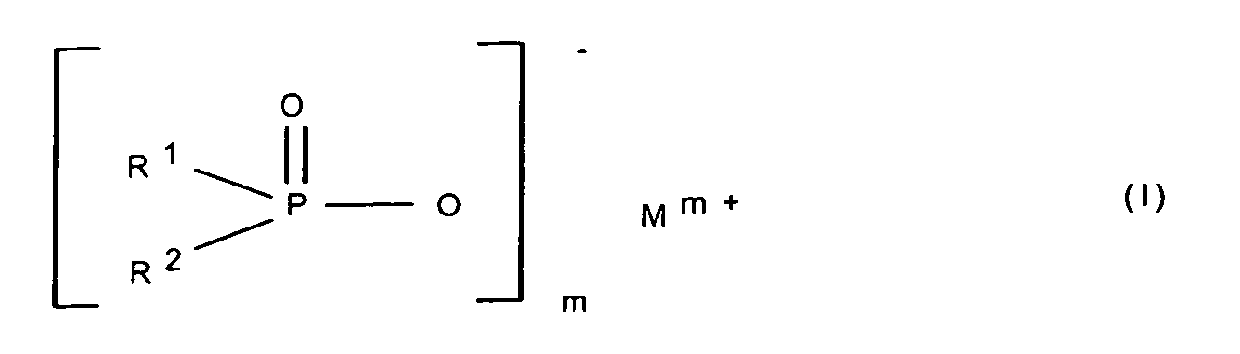
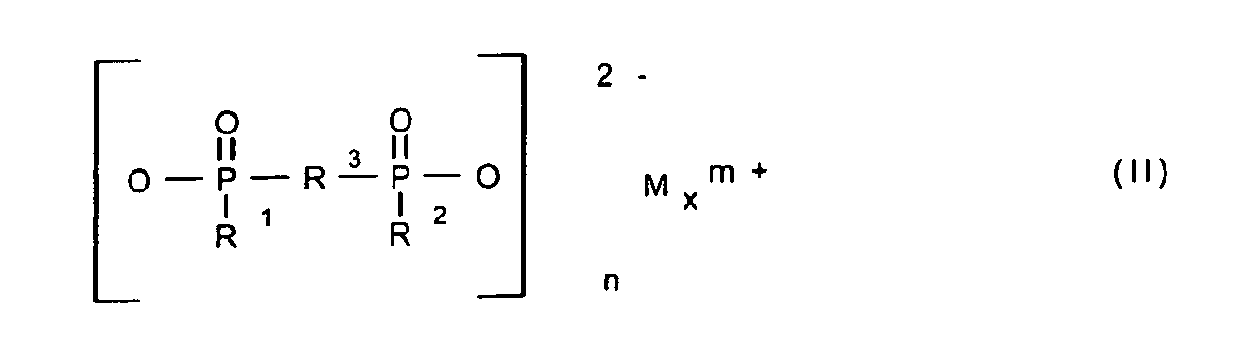
- Gegenstand der Erfindung ist daher eine dämmschichtbildende Brandschutzbeschichtung, die dadurch gekennzeichnet ist, dass sie eine Flammschutzmischung enthält, welche ein Phosphor/Stickstoff-Flammschutzmittel und ein Phosphinsäuresalz der Formel (I) und/oder ein Diphosphinsäuresalz der Formel (II) und/oder deren Polymere enthält,


worin - R1, R2
- gleich oder verschieden sind und C1-C6-Alkyl, linear oder verzweigt und/oder Aryl;
- R3
- C1-C10-Alkylen, linear oder verzweigt, C6-C10-Arylen, -Alkylarylen oder -Arylalkylen;
- M
- Mg, Ca, Al, Sb, Sn, Ge, Ti, Zn, Fe, Zr, Ce, Bi, Sr, Mn, Li, Na, K und/oder eine protonierte Stickstoffbase;
- m
- 1 bis 4; n 1 bis 4 und x 1 bis 4 bedeuten.
- Bevorzugt handelt es sich bei den Phosphor/Stickstoff-Flammschutzmitteln um stickstoffhaltige Phosphate der Formeln (NH4)y H3-y P04 bzw. (NH4 P03)z, mit y gleich 1 bis 3 und z gleich 1 bis 10.000.
- Besonders bevorzugt handelt es sich bei den Phosphor/Stickstoff-Flammschutzmitteln um Ammoniumhydrogenphosphat, Ammoniumdihydrogenphosphat und/oder Ammoniumpolyphosphat.
- Bei den Phosphor/Stickstoff-Flammschutzmitteln handelt es sich bevorzugt um Ammoniumpolyphosphat der Formel (NH4PO3)n, worin n eine Zahl von 10 bis
≤ 1000, bevorzugt zwischen 200 bis ≤ 1000 bedeutet.
Bevorzugt handelt es sich bei den Phosphor/Stickstoff-Flammschutzmitteln auch um Umsetzungsprodukte des Melamins mit Phosphorsäure oder kondensierten Phosphorsäuren bzw. Umsetzungsprodukte von Kondensationsprodukten des Melamins mit Phosphorsäure oder kondensierten Phosphorsäuren sowie Gemische dieser Produkte. - Besonders bevorzugt handelt es sich bei den Phosphor/Stickstoff-Flammschutzmitteln um Melam, Melem oder Melon, Dimelaminphosphat, Dimelaminpyrophosphat, Melaminphosphat, Melaminpyrophosphat, Melaminpolyphosphat, Melampolyphosphat, Melonpolyphosphat und/oder Melempolyphosphat bzw. gemischte Polysalze hiervon.
- Bevorzugt enthält die erfindungsgemäße dämmschichtbildende Brandschutzbeschichtung das Phosphor/Stickstoff-Flammschutzmittel und das Phosphinsäuresalz der Formel (I) und/oder das Diphosphinsäuresalz der Formel (II) und/oder deren Polymere im Gewichtsverhältnis von 0,1 bis 100 (Phosphor/Stickstoff-Flammschutzmittel) zu 100 bis 0,1 (Phosphinsäuresalz).
- Besonders bevorzugt enthält die erfindungsgemäße dämmschichtbildende Brandschutzbeschichtung das Phosphor/Stickstoff-Flammschutzmittel und das Phosphinsäuresalz der Formel (I) und/oder das Diphosphinsäuresalz der Formel (II) und/oder deren Polymere im Gewichtsverhältnis von 1 bis 50 (Phosphor/Stickstoff-Flammschutzmittel) zu 50 bis 1 (Phosphinsäuresalz) enthält.
- Bevorzugt enthält die erfindungsgemäße dämmschichtbildende Brandschutzbeschichtung
- A) 1 bis 99 Gew.-% eines Epoxidharzes und
- B) 1 bis 99 Gew.-% einer Flammschutzmischung, welche ein Phosphor/Stickstoff-Flammschutzmittel und ein Phosphinsäuresalz der Formel (I) und/oder ein Diphosphinsäuresalz der Formel (II) und/oder deren Polymere enthält,
- C) 0 bis 60 Gew.-% weitere Zusätze.
- Besonders bevorzugt enthält die erfindungsgemäße dämmschichtbildende Brandschutzbeschichtung
- A) 10 bis 90 Gew.-% eines Epoxidharzes und
- B) 2 bis 60 Gew.-% einer Flammschutzmischung, welche ein Phosphor/Stickstoff-Flammschutzmittel und ein Phosphinsäuresalz der Formel (I) und/oder ein Diphosphinsäuresalz der Formel (II) und/oder deren Polymere enthalten,
- C) 3 bis 45 Gew.-% weitere Zusätze.
- Besonders bevorzugt enthält die erfindungsgemäße dämmschichtbildende Brandschutzbeschichtung auch
- A) 30 bis 85 Gew.-% eines Epoxidharzes und
- B) 3 bis 50 Gew.-% einer Flammschutzmischung, welche ein Phosphor/Stickstoff-Flammschutzmittel und ein Phosphinsäuresalz der Formel (I) und/oder ein Diphosphinsäuresalz der Formel (II) und/oder deren Polymere enthalten,
- C) 5 bis 40 Gew.-% weitere Zusätze.
- Besonders enthält die erfindungsgemäße dämmschichtbildende Brandschutzbeschichtung weiterhin 0 bis 60 Gew.-% an Zusätzen, wie Beschleuniger, Füll- und Hilfsstoffe, Treibmittel und Stickstoffsynergisten, Kohlenstoffspender, Pigmente, Flexibilisatoren und/oder Reaktiv-Verdünner sowie ggf. weitere Additive. Die Gesamtsumme aller Komponenten beträgt dabei immer 100 Gew.-%.
- Bevorzugt bedeutet M Calcium, Aluminium oder Zink.
- Bevorzugt sind R1, R2 gleich oder verschieden sind und bedeuten Methyl, Ethyl, n-Propyl, iso-Propyl, n-Butyl, tert.-Butyl, n-Pentyl und/oder Phenyl.
- Bevorzugt bedeutet R3 Methylen, Ethylen, n-Propylen, iso-Propylen, n-Butylen, tert.-Butylen, n-Pentylen, n-Octylen oder n-Dodecylen; Phenylen oder Naphthylen; Methylphenylen, Ethylphenylen, tert.-Butylphenylen, Methylnaphthylen, Ethylnaphthylen oder tert.-Butylnaphthylen; Phenylmethylen, Phenylethylen, Phenylpropylen oder Phenylbutylen.
- Unter protonierten Stickstoffbasen werden bevorzugt die protonierten Basen von Ammoniak, Melamin, Triethanolamin, insbesondere NH4 +, verstanden.
- Besonders bevorzugt sind R1, R2 gleich oder verschieden und bedeuten Methyl, Ethyl, n-Propyl, iso-Propyl, n-Butyl, tert.-Butyl, n-Pentyl und/oder Phenyl.
- Die erfindungsgemäß eingesetzten halogenfreien Epoxidverbindungen (im Folgenden auch Polyepoxidverbindungen genannt) können gesättigt oder ungesättigt sowie aliphatisch, cycloaliphatisch, aromatisch und/oder heterocyclisch sein. Sie können weiterhin solche Substituenten enthalten, die unter den Mischungs- oder Reaktionsbedingungen keine störenden Nebenreaktionen verursachen, beispielsweise Alkyl- oder Arylsubstituenten, Ethergruppierungen oder ähnliche. Es können auch Gemische verschiedener Polyepoxidverbindungen verwendet werden. Das mittlere Molekulargewicht Mn dieser Polyepoxidverbindungen kann bis zu etwa 9000 betragen, liegt jedoch im Allgemeinen bei etwa 150 bis 4000.
- Beispielsweise handelt es sich bei diesen Polyepoxidverbindungen um Polyglycidylether auf Basis von mehrwertigen, vorzugsweise zweiwertigen Alkoholen, Phenolen, Hydrierungsprodukten dieser Phenole und/oder von Novolaken (Umsetzungsprodukte von ein- oder mehrwertigen Phenolen, wie Phenol und/oder Kresole, mit Aldehyden, insbesondere Formaldehyd in Gegenwart saurer Katalysatoren), die man in bekannter Weise, beispielsweise durch Umsetzung der jeweiligen Polyole mit Epichlorhydrin, erhält.
- Als mehrwertige Phenole sind hier beispielsweise zu nennen: Resorcin, Hydrochinon, 2,2-Bis-(4-hydroxyphenyl)-propan (Bisphenol A), Isomerengemische des Dihydroxydiphenylmethans (Bisphenol F), 4,4'-Dihydroxydiphenylcyclohexan, 4,4'-Dihydroxy-3,3'-dimethyldiphenylpropan, 4,4-Dihydroxydiphenyl, 4,4'-Dihydroxybenzophenon, Bis-(4-hydroxyphenyl)- 1,1-ethan, Bis-(4-hydroxyphenyl)-1,1'-isobutan, Bis-(4-hydroxy-tert.-butylphenyl)-2,2-propan, Bis-(2-hydroxynaphthyl)-methan, 1,5-Dihydroxynaphthalin, Tris-(4-hydroxyphenyl)-methan, Bis-(4-hydroxyphenyl)-1,1'-ether.
- Bisphenol A und Bisphenol F sind hierbei bevorzugt.
- Auch die Polyglycidylether von mehrwertigen aliphatischen Alkoholen sind als Polyepoxidverbindung geeignet. Als Beispiele derartiger mehrwertiger Alkohole seien 1,4-Butandiol, 1,6-Hexandiol, Polyalkylenglykole, Glycerin, Trimethylolpropan, Bis-(4-hydroxycyclohexyl)-2,2-propan und Pentaerythrit genannt.
- Weiter kommen als Polyepoxidverbindungen auch (Poly)glycidester in Frage, die man erhält durch Umsetzung von Epichlorhydrin oder ähnlichen Epoxyverbindungen mit einer aliphatischen, cycloaliphatischen oder aromatischen Polycarbonsäure, wie Oxalsäure, Adipinsäure, Glutarsäure, Phthal-, Isophthal-, Terephthal-, Tetrahydrophthal- oder Hexahydrophthalsäure, 2,6-Naphthalindicarbonsäure und dimerisierte Fettsäuren. Beispiele hierfür sind Terephthalsäurediglycidylester und Hexahydrophthalsäurediglycidylester.
- Auch Polyepoxidverbindungen, die die Epoxidgruppen in statistischer Verteilung über die Molekülkette enthalten und die durch Emulsions-Copolymerisation unter Verwendung von olefinisch ungesättigten, diese Epoxidgruppen enthaltenden Verbindungen hergestellt werden können, wie z.B. Glycidylester der Acryl- oder Methacrylsäure, können in manchen Fällen vorteilhaft eingesetzt werden.
- Weitere verwendbare Polyepoxidverbindungen sind beispielsweise solche auf der Basis heterocyclischer Ringsysteme, wie z.B. Hydantoinepoxidharze, Triglycidylisocyanurat und/oder dessen Oligomeren, Triglycidyl-p-aminophenol, Triglycidyl-p-aminodiphenylether, Tetraglycidyldiaminodiphenyimethan, Tetraglycidyldiaminodiphenylether, Tetrakis(4-glycidoxyphenyl)-ethan, Urazolepoxide. Uracilepoxide, oxazolidinonmodifizierte Epoxidharze. Weiterhin Polyepoxide auf der Basis von aromatischen Aminen, wie Anilin, beispielsweise N,N-Diglycidylanilin, Diaminodiphenylmethan und N,N'-Dimethylaminodiphenylmethan oder -sulfon. Weitere geeignete Polyepoxidverbindungen sind im "Handbook of Epoxy Resins" von Henry Lee und Kris Neville, McGraw-Hill Book Company, 1967, in der Monographie von Henry Lee "Epoxy Resins" American Chemical Society, 1970, in Wagner/Sarx, Lackkunstharze", Carl Hanser Verlag (1971), 5. Auflage, S. 174-196 in der "Angew. Makromol. Chemie", Bd. 44 (1975), Seiten 151 bis 163. in der DE-A- 27 57 733 sowie in der EP-A- 0 384 939 beschrieben, auf die hiermit Bezug genommen wird.
Bevorzugt eingesetzte Polyepoxidverbindungen sind Bisglycidylether auf Basis von Bisphenol A, Bisphenol F und Bisphenol S (Umsetzungsprodukte dieser Bisphenole und Epichlor(halogen)hydrin) oder deren Oligomere, Polyglycidylether von Phenol/Formaldehyd- und/oder Kresol/Formaldehyd-Novolake sowie Diglycidylester der Phthal-, Isophthal- Terephthal-, Tetrahydrophthal- und/oder Hexahydrophthalsäure sowie der Trimellithsäure, N- Glycidylverbindungen von aromatischen Aminen und heterocyclischen Stickstoffbasen, wie N,N-Diglyadyianilin, N,N,O-Triglycidyl-p-aminophenol, Triglycidylisocyanurat und N,N,N',N-Tetraglycidyl-bis-(p-aminophenyl)-methan, Hydrantoin-Epoxidharze und Aracid-Epoxidharze sowie Di- und Polyglycidylverbindungen von mehrwertigen aliphatischen Alkoholen, wie 1,4-Butandiol, Trimethylolpropan und Polyalkylenglykolen. Des Weiteren sind auch oxazolidinonmodifizierte Epoxidharze geeignet. Derartige Verbindungen sind bereits bekannt (siehe: "Angew. Makromol. Chem., Bd. 44 (1975) Seiten 151 bis 163, sowie US-A-3,334,110); beispielhaft sei hierfür das Umsetzungsprodukt von Bis-phenol-A-diglycidylether mit Diphenylmethandiisocyanat (in Gegenwart eines geeigneten Beschleunigers) genannt. - Die Polyepoxidharze können bei der Herstellung der erfindungsgemäßen Brandschutzbeschichtung einzeln oder im Gemisch vorliegen. Als Härter-Komponenten kommen aliphatische und aromatische Polyamine in Frage. Aromatische Polyamine sind beispielsweise in der EP-A-0 274 646 beschrieben. Sie werden durch Trimerisierung von 2,6- oder 2,4-Disocyanatoalkylbenzolen und nachfolgender Hydrolyse der verbleibenden Isocyanatgruppen hergestellt. Solche Härter-Komponenten können einzeln oder im Gemisch eingesetzt werden. Derartige Gemische sind großtechnisch erhältlich und erlauben eine kostengünstige Herstellung der Härterkomponente.
- Als weitere additive Härterkomponente (d.h. zusätzlich zum eigentlichen Härter) können heterocyclische Polyamine mit Harnstoffgruppen eingesetzt werden. Auch andere aromatische Polyamine, wie etwa 4,4'-Diammodiphenylmethan, 4,4'-Diaminodiphenylsufon, und/oder andere heterocyclische Polyamine können mit einem Gewichtsanteil bis zu maximal 30 % im Härter-Gemisch eingesetzt werden.
- Bevorzugt enthält die erfindungsgemäße Brandschutzbeschichtung als weitere Zusätze Beschleuniger, Füll- und Hilfsstoffe, Treibmittel und Stickstoffsynergisten, Kohlenstoffspender, Pigmente, Flexibilisatoren und/oder Reaktiv-Verdünner.
- Als Beschleuniger kommen vor allem Imidazolderivate, beispielsweise 2-Methylimidazol, 2-Phenylimidazol und 2-Heptadecylimidazol in Frage; weiterhin Phosphine, tertiäre Amine wie Benzylmethylamin und Tris- (dimethylaminomethyl)phenol sowie Metallseifen und Acetylacetonate.
- Füll- und Hilfsstoffe sind beispielsweise expandierbarer Graphit, Borsäure, Phosphorsäureester, Quarz, Bolus Alba (China Clay), Kreide, Wollastonit, Talkum, Antimontrioxid, Glasfasern, Mineralfasern, Aluminiumoxid, Aluminiumhydroxid, Magnesiumhydroxid, Fällungskieselsäuren, Silikate und/oder pulverisierte Cellulosen.
- Treibmittel und Stickstoffsynergisten sind Melamin und/oder Guanidin sowie deren Salze und/oder Dicyandiamide. Bevorzugt handelt es sich bei den Melaminsalzen um Melaminphoshat, Melaminpolyphosphat, Melamincyanurat, Melaminborat, Melaminsilikat und bei dem Guanidinsalz um Guanidinphosphat.
- Wie oben bereits ausgeführt, kann die erfindungsgemäße dämmschichtbildende Brandschutzbeschichtung 0 bis 60 Gew.-% an Zusätzen enthalten. Innerhalb dieses Bereichs von 0 bis 60 Gew.-% können sich die Zusätze mengenmäßig wie folgt verteilen:
- Beschleuniger: 0 bis 25 Gew.-%,
- Füll- und Hilfsstoffe: 0 bis 100 Gew.-%,
- Treibmittel und Stickstoffsynergisten: 0 bis 100 Gew.-%,
- Kohlenstoffspender: 0 bis 100 Gew.-%,
- Pigmente: 0 bis 50 Gew.-%,
- Flexibilisatoren: 0 bis 50 Gew.-%,
- Reaktiv-Verdünner: 0 bis 25 Gew.-%.
- Die Prozentangaben der jeweiligen Zusätze beziehen sich also jeweils auf die zuvor genannten 0 bis 60 Gew.-% absolut.
Bevorzugt handelt es sich bei den stickstoffhaltigen Synergisten um solche der Formeln (III) bis (VIII) oder Gemische davon


worin - R5 bis R7
- Wasserstoff, C1-C8-Alkyl, C5-C16-Cycloalkyl oder -Alkylcycloalkyl, möglicherweise substituiert mit einer Hydroxy- oder einer C1-C4- Hydroxyalkyl-Funktion, C2-C8-Alkenyl, C1-C8-Alkoxy, -Acyl, -Acyloxy, C6-C12-Aryl oder -Arylalkyl, -OR8 und -N(R8)R9, sowie N-alicyclisch oder N-aromatisch,
- R8
- Wasserstoff, C1-C8-Alkyl, C5-C16-Cycloalkyl oder -Alkylcycloalkyl, möglicherweise substituiert mit einer Hydroxy- oder einer C1-C4-Hydroxyalkyl-Funktion, C2-C8-Alkenyl, C1-C8-Alkoxy, -Acyl, -Acyloxy oder C6-C12-Aryl oder -Arylalkyl,
- R9 bis R13
- die gleichen Gruppen wie R8 sowie -O-R8,
- m und n
- unabhängig voneinander 1, 2, 3 oder 4,
- X
- Säuren, die Addukte mit Triazinverbindungen (III) bilden können,
- Bevorzugt handelt es sich bei den stickstoffhaltigen Synergisten um Benzoguanamin, Tris(hydroxyethyl)isocyanurat, Allantoin, Glycouril, Melamin, Melamincyanurat, Harnstoffcyanurat, Dicyandiamid, Guanidin.
- Bevorzugt handelt es sich bei den Stickstoffsynergisten um Kondensationsprodukte des Melamins. Kondensationsprodukte des Melamins sind z.B. Melem, Melam oder Melon bzw. höher kondensierte Verbindungen dieses Typs sowie Gemische derselben und können z.B. durch ein Verfahren hergestellt werden, wie es in WO-A-96/16948 beschrieben ist.
- Bevorzugt enthält die dämmschichtbildende Brandschutzbeschichtung als kohlenstoffbildende Substanzen Kohlenhydrate.
- Bevorzugt werden als Kohlenhydrate Pentaerythrit, Dipentaerythrit, Tripentaerythrit und/oder Polykondensate des Pentaerythrits eingesetzt.
- Als Pigmente können Gasruß, Phthalocyanin-Pigmente und Metalloxide eingesetzt werden. Bevorzugt wird als Metalloxid Titandioxid verwendet.
- Zur Verbesserung der Zähigkeit der Brandschutzbeschichtung können als Flexibilisatoren Butadien-Acrylnitril-Kautschuk und andere aliphatische Polymere verwendet werden.
- Als Reaktiv-Verdünner kommen beispielsweise mono- oder polyfunktionelle, niedermolekulare Alkohole, die mit Epichlorhydrin umgesetzt werden, in Frage.
- Das für die erfindungsgemäße Brandschutzbeschichtung eingesetzte Epoxidharz ist üblicherweise aus einer Epoxidharz-Komponente und einer Härter-Komponente zusammengesetzt.
- Als Epoxidharz-Komponente sind Bisphenol A, Bisphenol F oder Gemische hiervon und als Härter-Komponente aliphatische Amine bevorzugt.
- Die vorliegende Aufgabe wird ebenfalls gelöst durch ein Verfahren zur Herstellung von intumeszierenden Brandschutzbeschichtungen aus Epoxidharzen und der vorgenannten Flammschutzmischung, dadurch gekennzeichnet, dass man ein Epoxidharz mit der Flammschutzmischung umsetzt und anschließend mit einem Härter in die Brandschutzbeschichtung überführt.
Beim Verfahren können, falls gewünscht, auch Lösungs- und Verdünnungsmittel eingesetzt werden. Dabei sind aprotische polare Lösungsmittel bevorzugt. Beispiele hierfür sind: N-Methylpyrrolidon, Dimethylformamid, Ether wie etwa Diethylether, Tetrahydrofuran, Dioxan, Ethylglykolether, Propylenglykolether, Butylglykolether von Monoalkoholen mit einem ggf. verzweigten Alkylrest von 1 bis 6 Kohlenstoffatomen. - Andere Lösungsmittel sind z.B. Ketone, wie etwa Aceton, Methylethylketon, Methylisopropylketon, Methylisobutylketon Cyclohexanon und ähnliche, aber auch Ester, wie Ethylacetat. Butylacetat, Ethylenglykolacetat und Methoxypropylacetat können eingesetzt werden. Weitere geeignete Lösungsmittel sind halogenierte Kohlenwasserstoffe sowie cycloaliphatische und/oder aromatische Kohlenwasserstoffe, bevorzugt sind dabei Hexan, Heptan, Cyclohexan, Toluol sowie Dixylole. Es ist möglich, diese Lösemittel einzeln oder im Gemisch einzusetzen.
- Bevorzugt erfolgt die Umsetzung des Epoxidharzes mit der Flammschutzmittelmischung (Komponente A + B) und dem Härter bei Temperaturen von -10 bis +150°C.
- Die Erfindung betrifft ebenfalls die Verwendung der vorgenannten Brandschutzbeschichtungen. Bevorzugt werden diese erfindungsgemäßen Brandschutzbeschichtungen zum Beschichten von tragenden und nicht tragenden metallischen Strukturen oder Gebilden verwendet. Des Weiteren lassen sich Fußböden, Wände oder Formteile mit den erfindungsgemäßen Brandschutzbeschichtungen gegen Temperaturbeanspruchung schützen.
- Die erfindungsgemäßen Brandschutzbeschichtungen weisen eine gute Flammwidrigkeit auf und lassen sich auf einfache Art und Weise verarbeiten. Dabei ist bevorzugt, dass das Epoxidharz und die Härterkomponenten oder die Bestandteile welche diese enthalten kurz vor der Applikation vermischt werden. Zusätzlich ist bevorzugt, dass die Epoxidharz enthaltenden und die Härterkomponenten enthaltenden Systeme erwärmt werden um die Viskosität zu erniedrigen. Dadurch wird die Sprühapplikation - bevorzugt im Airless Verfahren - vereinfacht. Typischerweise werden die zu erwärmenden Systeme auf 50°C bis 75°C aufgeheizt, bevorzugt sollten die zu erwärmenden Systeme direkt vor der Applikation eine Temperatur zwischen 65°C und 70°C aufweisen.
In den folgenden Beispielen wurden intumeszierende Brandschutzbeschichtungen hergestellt und ihre Wirksamkeit ermittelt. Die Prüfung der thermischen Isolierfähigkeit der intumeszierenden Brandschutzbeschichtungen erfolgte in einem Kleinprüfstand analog DIN4102 Teil 8 (1986) unter der Verwendung der Aufheizkurve analog ISO834 (1975). Die thermogravimetrische Bewertung der Flammschutzmittelmischung wurde analytisch mittels einer Thermowaage des Typs "NETZSCH STA 409C" durchgeführt. - In den Beispielen wurden folgende Produkte eingesetzt:
- ®Exolit AP422 (Clariant GmbH)
Bei ®Exolit AP422 handelt es sich um ein freifließendes, pulverförmiges, in Wasser schwer lösliches Ammoniumpolyphosphat der Formel (NH4PO3)n mit n = 20 bis 1000, insbesondere 200 - 1000. - ®Exolit AP750 (Clariant GmbH)
Es handelt es sich um eine halogenfreie Flammschutzmittelmischung, die polymeres Ammoniumpolyphosphat in Verbindung mit aromatischen Carbonsäureestern des Tris(2-hydroxyethyl)-isocyanurates als Synergisten enthält. - ®Exolit OP1230 (Clariant GmbH)
- Bei ®Exolit OP1230 handelt es sich um ein feinkörniges, nicht hygroskopisches und in Wasser und gängigen organischen Lösungsmitteln unlöslichen Pulvers auf Basis eines organischen Phosphinates.
®Beckopox EP140 (UCB-Surface Specialties) - Es handelt sich um ein niedermolekulares Kondensationsprodukt aus Bisphenol A und Epichlorhydrin mit einer Dichte von 1,16 g/ml (bei 25°C)und einem EpoxidÄquivalentgewicht von 180 - 190.
- ®Beckopox EH624 (UCB-Surface Specialties)
Es handelt sich um ein aliphatisches Polyamin mit einem H-aktivem Äquivalentgewicht von 80 g/mol und einer dynamischen Viskosität von 2300 - 3800 mPas (bei 23°C). - Tronox® R-KB-5 (Kerr Mc-Gee Chemical LLC)
Es handelt sich um eine Titandioxid Rutil Type, welche mit Al2O3 stabilisiert wurde und die Oberfläche mit Al- und Zr- Komponenten behandelt wurde. - Optibor® Borsäure (Deutsche Borax GmbH)
Es handelt sich um eine reine Borsäure der Formel (H3BO3) - In einem Rührgefäß wurden nacheinander 100 Teile Beckopox EP 140, 25 Teile Borsäure, 2 Teile TiO2 und 100 Teile Exolit AP422 eingetragen und nach ausreichender Durchmischung mit 43 Teilen Beckopox EH 624 umgesetzt. Die resultierende Brandschutzbeschichtung wurde mit einer Rolle einseitig auf eine Stahlplatte (St 37) von 280 x 280 x 6 mm aufgetragen. Die Masse härtete einen Tag bei Raumtemperatur aus, ihre Schichtdicke wurde mit 3,5 mm ermittelt.
Die Oberfläche der Beschichtung war glatt und rissfrei.
Die Brandprüfung der beschichteten Platte gemäß DIN 4102 ergab eine Feuerwiderstandszeit von 33 Minuten. Die Reaktion startete bei T = 240°C. - Es wurde die gleiche Brandschutzbeschichtung wie im Beispiel 1 hergestellt, jedoch Exolit AP750 anstatt Exolit AP422 verwendet. Die resultierende Brandschutzbeschichtung wurde mit einer Rolle einseitig auf eine Stahlplatte (St 37) von 280 x 280 x 6 mm aufgetragen. Die Masse härtete einen Tag bei Raumtemperatur aus, ihre Schichtdicke wurde mit 3,5 mm ermittelt.
Die Oberfläche der Beschichtung war glatt und rissfrei.
Die Brandprüfung der beschichteten Platte gemäß DIN 4102 ergab eine Feuerwiderstandszeit von 41 Minuten. Die Reaktion startete bei T = 220°C. - In einem Rührgefäß wurden nacheinander 100 Teile Beckopox EP 140, 25 Teile Borsäure, 9 Teile Tris(hydroxyethyl)isocyanurat, 2 Teile TiO2 und 5 Teile einer ungleichteiligen Flammschutzmittelmischung bestehend aus Exolit AP422 und Exolit OP1230 eingetragen und nach ausreichender Durchmischung mit 43 Teilen Beckopox EH 624 umgesetzt. Die resultierende Brandschutzbeschichtung wurde mit einer Rolle einseitig auf eine Stahlplatte (St 37) von 280 x 280 x 6 mm aufgetragen.
- Die Masse härtete einen Tag bei Raumtemperatur aus, ihre Schichtdicke wurde mit 3,5 mm ermittelt.
Die Oberfläche der Beschichtung war glatt und rissfrei.
Die Brandprüfung der beschichteten Platte gemäß DIN 4102 ergab eine Feuerwiderstandszeit von 44 Minuten. Die Reaktion startete bei T = 179°C. - In einem Rührgefäß wurden nacheinander 100 Teile Beckopox EP 140, 25 Teile Borsäure, 9 Teile Tris(hydroxyethyl)isocyanurat, 2 Teile TiO2 und 60 Teile einer ungleichteiligen Flammschutzmittelmischung bestehend aus Exolit AP422 und Exolit OP1230 eingetragen und nach ausreichender Durchmischung mit 43 Teilen Beckopox EH 624 umgesetzt. Die resultierende Brandschutzbeschichtung wurde mit einer Rolle einseitig auf eine Stahlplatte (St 37) von 280 x 280 x 6 mm aufgetragen. Die Masse härtete einen Tag bei Raumtemperatur aus, ihre Schichtdicke wurde mit 3,5 mm ermittelt.
Die Oberfläche der Beschichtung war glatt und rissfrei.
Die Brandprüfung der beschichteten Platte gemäß DIN 4102 ergab eine Feuerwiderstandszeit von 49 Minuten. Die Reaktion startete bei T = 175°C. - In einem Rührgefäß wurden nacheinander 100 Teile Beckopox EP 140, 25 Teile Borsäure, 9 Teile Tris(hydroxyethyl)isocyanurat, 2 Teile TiO2 und 140 Teile einer ungleichteiligen Flammschutzmittelmischung bestehend aus Exolit AP422 und Exolit OP1230 eingetragen und nach ausreichender Durchmischung mit 43 Teilen Beckopox EH 624 umgesetzt. Die resultierende Brandschutzbeschichtung wurde mit einer Rolle einseitig auf eine Stahlplatte (St 37) von 280 x 280 x 6 mm aufgetragen. Die Masse härtete einen Tag bei Raumtemperatur aus, ihre Schichtdicke wurde mit 3,5 mm ermittelt.
Die Oberfläche der Beschichtung war glatt und rissfrei.
Die Brandprüfung der beschichteten Platte gemäß DIN 4102 ergab eine Feuerwiderstandszeit von 59 Minuten. Die Reaktion startete bei T = 164°C. - Es wurde die gleiche Brandschutzbeschichtung wir im Beispiel 5 hergestellt, jedoch betrug die Auftragsdicke 2,0 mm. Die Oberfläche der Beschichtung war glatt und rissfrei.
Die Brandprüfung der beschichteten Platte gemäß DIN 4102 ergab eine Feuerwiderstandszeit von 42 Minuten. Der Reaktion startete bei T = 166°C. - Die Flammschutzmittelmischung aus Beispiel 3 und 4, sowie die darin enthaltenden Einzelkomponenten Exolit AP422 und Exolit OP1230 wurden mittels Thermogravimetrie verglichen. Der signifikant frühere Reaktionsstart der Flammschutzmittelmischung zeigt den Synergismus im Vergleich zu den Einzelkomponenten auf (Anlage 1).
oder um oligomere Ester des Tris(hydroxyethyl)isocyanurats mit aromatischen Polycarbonsäuren
Claims (15)


worin
Applications Claiming Priority (1)
| Application Number | Priority Date | Filing Date | Title |
|---|---|---|---|
| DE102004039758A DE102004039758A1 (de) | 2004-08-17 | 2004-08-17 | Brandschutzbeschichtung |
Publications (2)
| Publication Number | Publication Date |
|---|---|
| EP1627896A1 true EP1627896A1 (de) | 2006-02-22 |
| EP1627896B1 EP1627896B1 (de) | 2008-03-05 |
Family
ID=35149589
Family Applications (1)
| Application Number | Title | Priority Date | Filing Date |
|---|---|---|---|
| EP05017266A Expired - Lifetime EP1627896B1 (de) | 2004-08-17 | 2005-08-09 | Intumeszenzbrandschutzbeschichtung enthaltend Phosphor/Stickstoff-Flammschutzmittel und ein Phosphinsäuresalz |
Country Status (7)
| Country | Link |
|---|---|
| US (1) | US20060041042A1 (de) |
| EP (1) | EP1627896B1 (de) |
| JP (1) | JP2006057091A (de) |
| AT (1) | ATE388196T1 (de) |
| DE (2) | DE102004039758A1 (de) |
| DK (1) | DK1627896T3 (de) |
| ES (1) | ES2302104T3 (de) |
Cited By (1)
| Publication number | Priority date | Publication date | Assignee | Title |
|---|---|---|---|---|
| CN110760244A (zh) * | 2019-11-20 | 2020-02-07 | 应急管理部四川消防研究所 | 一种环氧基钢结构防火涂料 |
Families Citing this family (19)
| Publication number | Priority date | Publication date | Assignee | Title |
|---|---|---|---|---|
| DE10241376A1 (de) * | 2002-09-06 | 2004-03-18 | Clariant Gmbh | Kompaktierte Flammschutzmittelzusammensetzung |
| JP5068919B2 (ja) * | 2003-09-25 | 2012-11-07 | スリーエム イノベイティブ プロパティズ カンパニー | 発泡シート形成性組成物、熱伝導性発泡シート及びその製造方法 |
| US7758964B2 (en) | 2006-02-10 | 2010-07-20 | 3M Innovative Properties Company | Flame resistant covercoat for flexible circuit |
| DE102006052819A1 (de) * | 2006-11-09 | 2008-05-15 | Clariant International Limited | Feste, pulverförmige Flammschutzmittelmischung |
| CN101200573B (zh) * | 2006-12-14 | 2010-06-09 | 上海化工研究院 | 无卤膨胀型阻燃环氧树脂组合物 |
| JP5311088B2 (ja) * | 2007-09-06 | 2013-10-09 | Dic株式会社 | 防水用トップコート材組成物、それを用いた土木建築構造体及びそれを用いた施工方法 |
| US20090124734A1 (en) * | 2007-11-05 | 2009-05-14 | 3M Innovative Properties Company | Halogen-free flame retardant resin composition |
| JP4565079B1 (ja) * | 2009-08-14 | 2010-10-20 | 株式会社サードニックス | 溶解含有させた断熱添加成分塗料及び塗膜と製造法 |
| US8604105B2 (en) | 2010-09-03 | 2013-12-10 | Eastman Chemical Company | Flame retardant copolyester compositions |
| SK5976Y1 (sk) * | 2011-02-24 | 2011-12-05 | Moles Technology A S | Fireproof paint coat matter |
| DE102012223515A1 (de) * | 2012-12-18 | 2014-06-18 | Hilti Aktiengesellschaft | Dämmschichtbildende Zusammensetzung und deren Verwendung |
| CN103146117B (zh) * | 2013-02-01 | 2015-06-03 | 金发科技股份有限公司 | 一种阻燃abs/共聚酯合金及其制备方法和制品 |
| EP2973610A4 (de) * | 2013-03-15 | 2016-11-02 | Gen Cable Technologies Corp | Flammhemmende beschichtung für halogenfreie kabel |
| RU2654760C2 (ru) | 2013-07-16 | 2018-05-22 | Акцо Нобель Коатингс Интернэшнл Б.В. | Вспучивающаяся композиция для нанесения покрытия |
| KR102271077B1 (ko) * | 2013-07-16 | 2021-06-30 | 아크조노벨코팅스인터내셔널비.브이. | 팽창성 코팅 조성물 |
| EP2966103A1 (de) * | 2014-07-09 | 2016-01-13 | Sika Technology AG | Flüssig aufgetragene wasserdichte Membran für Dächer |
| NO346733B1 (en) | 2019-06-28 | 2022-12-05 | Klingelberg Products As | Flame retardant, method for its preparation and article comprising same |
| CN110862748B (zh) * | 2019-11-29 | 2021-06-29 | 广州建筑产业研究院有限公司 | 防火隔热涂料及其制备方法和应用 |
| EP4667538A1 (de) * | 2024-06-21 | 2025-12-24 | Clariant International Ltd | Intumeszierende beschichtungszusammensetzung mit glycouril und aminotriazinverbindung als treibmittel |
Citations (11)
| Publication number | Priority date | Publication date | Assignee | Title |
|---|---|---|---|---|
| US3334110A (en) | 1965-08-16 | 1967-08-01 | Baker Chem Co J T | Method for preparing epoxyoxazolidinones |
| DE2757733A1 (de) | 1976-12-23 | 1978-07-13 | Dow Chemical Co | Verfahren zur herstellung von mit wasser verduennbaren, mit base neutralisierten saueren harzen |
| EP0274646A1 (de) | 1986-12-15 | 1988-07-20 | Siemens Nixdorf Informationssysteme Aktiengesellschaft | Verfahren zur Herstellung von Prepregs und deren Verwendung |
| US4879320A (en) | 1989-03-15 | 1989-11-07 | Hastings Otis | Intumescent fire-retardant coating material |
| EP0384939A1 (de) | 1989-03-03 | 1990-09-05 | Siemens Aktiengesellschaft | Epoxidharz-Formmassen |
| US4965296A (en) | 1989-03-15 | 1990-10-23 | No Fire Engineering, Inc. | Intumescent fire-retardant and electrically-conductive coating material |
| WO1996016948A1 (en) | 1994-12-01 | 1996-06-06 | Dsm N.V. | Process for the preparation of condensation products of melamine |
| US6096812A (en) | 1996-09-23 | 2000-08-01 | Textron Systems Corporation | Low density, light weight intumescent coating |
| EP1396521A1 (de) * | 2002-09-06 | 2004-03-10 | Clariant GmbH | Staubarme, pulverförmige Flammschutzmittelzusammensetzung, Verfahren zu deren Herstellung und deren Verwendung, sowie flammgeschützte Polymerformmassen |
| EP1400573A1 (de) * | 2002-09-17 | 2004-03-24 | Clariant GmbH | Brandschutzbeschichtung |
| EP1403311A1 (de) * | 2002-09-25 | 2004-03-31 | Clariant GmbH | Flammwidrige duroplastische Massen |
Family Cites Families (15)
| Publication number | Priority date | Publication date | Assignee | Title |
|---|---|---|---|---|
| GB1570604A (en) * | 1976-03-12 | 1980-07-02 | Advanced Fireproofing Syst | Fire proofing compositions |
| US4164487A (en) * | 1976-12-23 | 1979-08-14 | The Dow Chemical Company | Water-thinnable mixtures of base-neutralized products of reaction of H3 PO4 with polyether epoxides and with other type epoxides |
| US4289812A (en) * | 1977-11-21 | 1981-09-15 | The Dow Chemical Company | Method of water-solubilizing high performance polyether epoxide resins, the solubilized resins and thermoset, hydrophobic coatings derived therefrom |
| DE4343668A1 (de) * | 1993-12-21 | 1995-06-22 | Hoechst Ag | Aufblähbare, flammhemmende Überzugsmassen |
| GB9411313D0 (en) * | 1994-06-07 | 1994-07-27 | Hedley Purvis Ltd | Improved reaction nut |
| DE19903707C2 (de) * | 1999-01-30 | 2003-05-28 | Clariant Gmbh | Flammwidrige duroplastische Massen |
| DE19909387C2 (de) * | 1999-03-04 | 2001-01-25 | Clariant Gmbh | Brandschutzbeschichtung |
| DE19919707A1 (de) * | 1999-04-30 | 2000-11-02 | Clariant Gmbh | Brandschutzbeschichtung für Fasermaterialien |
| DE10015889B4 (de) * | 2000-03-30 | 2005-09-08 | Clariant Gmbh | Brandschutzbeschichtung |
| NL1016340C2 (nl) * | 2000-10-05 | 2002-04-08 | Dsm Nv | Halogeenvrije vlamvertragende samenstelling en vlamdovende polyamidesamenstelling. |
| JP2002284963A (ja) * | 2001-03-26 | 2002-10-03 | Nippon Kayaku Co Ltd | 難燃性エポキシ樹脂組成物及びその用途 |
| DE10241376A1 (de) * | 2002-09-06 | 2004-03-18 | Clariant Gmbh | Kompaktierte Flammschutzmittelzusammensetzung |
| DE10241373A1 (de) * | 2002-09-06 | 2004-03-18 | Clariant Gmbh | Oberflächenmodifizierte Phosphinsäuresalze |
| DE10241375A1 (de) * | 2002-09-06 | 2004-03-18 | Clariant Gmbh | Granulare Flammschutzmittelzusammensetzung |
| DE10244579A1 (de) * | 2002-09-25 | 2004-04-08 | Clariant Gmbh | Flammwidrige duroplastische Massen |
-
2004
- 2004-08-17 DE DE102004039758A patent/DE102004039758A1/de not_active Withdrawn
-
2005
- 2005-08-09 ES ES05017266T patent/ES2302104T3/es not_active Expired - Lifetime
- 2005-08-09 DK DK05017266T patent/DK1627896T3/da active
- 2005-08-09 AT AT05017266T patent/ATE388196T1/de active
- 2005-08-09 DE DE502005003054T patent/DE502005003054D1/de not_active Expired - Lifetime
- 2005-08-09 EP EP05017266A patent/EP1627896B1/de not_active Expired - Lifetime
- 2005-08-16 JP JP2005235928A patent/JP2006057091A/ja active Pending
- 2005-08-17 US US11/205,832 patent/US20060041042A1/en not_active Abandoned
Patent Citations (11)
| Publication number | Priority date | Publication date | Assignee | Title |
|---|---|---|---|---|
| US3334110A (en) | 1965-08-16 | 1967-08-01 | Baker Chem Co J T | Method for preparing epoxyoxazolidinones |
| DE2757733A1 (de) | 1976-12-23 | 1978-07-13 | Dow Chemical Co | Verfahren zur herstellung von mit wasser verduennbaren, mit base neutralisierten saueren harzen |
| EP0274646A1 (de) | 1986-12-15 | 1988-07-20 | Siemens Nixdorf Informationssysteme Aktiengesellschaft | Verfahren zur Herstellung von Prepregs und deren Verwendung |
| EP0384939A1 (de) | 1989-03-03 | 1990-09-05 | Siemens Aktiengesellschaft | Epoxidharz-Formmassen |
| US4879320A (en) | 1989-03-15 | 1989-11-07 | Hastings Otis | Intumescent fire-retardant coating material |
| US4965296A (en) | 1989-03-15 | 1990-10-23 | No Fire Engineering, Inc. | Intumescent fire-retardant and electrically-conductive coating material |
| WO1996016948A1 (en) | 1994-12-01 | 1996-06-06 | Dsm N.V. | Process for the preparation of condensation products of melamine |
| US6096812A (en) | 1996-09-23 | 2000-08-01 | Textron Systems Corporation | Low density, light weight intumescent coating |
| EP1396521A1 (de) * | 2002-09-06 | 2004-03-10 | Clariant GmbH | Staubarme, pulverförmige Flammschutzmittelzusammensetzung, Verfahren zu deren Herstellung und deren Verwendung, sowie flammgeschützte Polymerformmassen |
| EP1400573A1 (de) * | 2002-09-17 | 2004-03-24 | Clariant GmbH | Brandschutzbeschichtung |
| EP1403311A1 (de) * | 2002-09-25 | 2004-03-31 | Clariant GmbH | Flammwidrige duroplastische Massen |
Non-Patent Citations (5)
| Title |
|---|
| "ANGEW. MAKROMOL. CHEM.", vol. 44, 1975, pages: 151 - 163 |
| "ANGEW. MAKROMOL. CHEMIE", vol. 44, 1975, pages: 151 - 163 |
| "EPOXY RESINS", 1970, AMERICAN CHEMICAL SOCIETY |
| "HANDBOOK OF EPOXY RESINS", 1967, MCGRAW-HILL BOOK COMPANY |
| "WAGNER/SARX, LACKKUNSTHARZE", 1971, CARL HANSER VERLAG, pages: 174 - 196 |
Cited By (1)
| Publication number | Priority date | Publication date | Assignee | Title |
|---|---|---|---|---|
| CN110760244A (zh) * | 2019-11-20 | 2020-02-07 | 应急管理部四川消防研究所 | 一种环氧基钢结构防火涂料 |
Also Published As
| Publication number | Publication date |
|---|---|
| ES2302104T3 (es) | 2008-07-01 |
| DE502005003054D1 (de) | 2008-04-17 |
| US20060041042A1 (en) | 2006-02-23 |
| EP1627896B1 (de) | 2008-03-05 |
| JP2006057091A (ja) | 2006-03-02 |
| ATE388196T1 (de) | 2008-03-15 |
| DK1627896T3 (da) | 2008-06-30 |
| DE102004039758A1 (de) | 2006-03-02 |
Similar Documents
| Publication | Publication Date | Title |
|---|---|---|
| EP1627896B1 (de) | Intumeszenzbrandschutzbeschichtung enthaltend Phosphor/Stickstoff-Flammschutzmittel und ein Phosphinsäuresalz | |
| DE10309805B4 (de) | Flammschutzmittel-Dispersion | |
| EP1498448B1 (de) | Flammschutzmittel-Zubereitung | |
| PL175777B1 (pl) | Sposób wytwarzania utwardzalnej,modyfikowanej fosforem żywicy epoksydowej | |
| EP0689558A1 (de) | Phosphormodifizierte epoxidharze, verfahren zu ihrer herstellung sowie deren verwendung | |
| DE19613067C2 (de) | Phosphormodifizierte Epoxidharzmischungen aus Epoxidharzen, phosphorhaltigen Verbindungen und einem Härter, ein Verfahren zu deren Herstellung und ihre Verwendung | |
| DE4308185A1 (de) | Phosphormodifizierte Epoxidharze, Verfahren zu ihrer Herstellung sowie deren Verwendung | |
| EP0794236B1 (de) | Phosphormodifizierte Überzugsmassen, ein Verfahren zu ihrer Herstellung und ihre Verwendung | |
| DE19608612C2 (de) | Phosphormodifizierte Überzugsmassen, ein Verfahren zu ihrer Herstellung und ihre Verwendung als Intumeszenzbeschichtungen | |
| EP0719825B1 (de) | Stabilisierte, Phosphormodifizierte Epoxidharze und ihre Verwendung | |
| DE19613064C2 (de) | Phosphormodifizierte Epoxidharzmischungen aus Epoxidharzen, phosphorhaltigen Verbindungen und einem Härter, Verfahren zu ihrer Herstellung und ihre Verwendung | |
| EP0735119B1 (de) | Flammwidrige Überzugsmasse | |
| DE19613063C2 (de) | Phosphormodifizierte Epoxidharze und ein Verfahren zu ihrer Herstellung | |
| DE19613066C2 (de) | Verfahren zur Herstellung phosphormodifizierter Epoxidharze | |
| EP0799848B1 (de) | Phosphormodifizierte Epoxidharze aus Epoxidharzen und phosphorhaltigen Verbindungen | |
| EP0799846B1 (de) | Phosphormodifizierte Epoxid-harzmischungen aus Expoxid-harzen, phosphorhaltigen Verbindungen und einem Härter | |
| DE19608613A1 (de) | Lagerstabile, phosphormodifizierte Epoxidharze | |
| DE19709519A1 (de) | Phosphormodifizierte Epoxidharzmischungen aus Epoxidharzen, phosphorhaltigen Verbindungen und einem Härter |
Legal Events
| Date | Code | Title | Description |
|---|---|---|---|
| PUAI | Public reference made under article 153(3) epc to a published international application that has entered the european phase |
Free format text: ORIGINAL CODE: 0009012 |
|
| AK | Designated contracting states |
Kind code of ref document: A1 Designated state(s): AT BE BG CH CY CZ DE DK EE ES FI FR GB GR HU IE IS IT LI LT LU LV MC NL PL PT RO SE SI SK TR |
|
| AX | Request for extension of the european patent |
Extension state: AL BA HR MK YU |
|
| RAP1 | Party data changed (applicant data changed or rights of an application transferred) |
Owner name: CLARIANT PRODUKTE (DEUTSCHLAND) GMBH |
|
| 17P | Request for examination filed |
Effective date: 20060822 |
|
| AKX | Designation fees paid |
Designated state(s): AT BE BG CH CY CZ DE DK EE ES FI FR GB GR HU IE IS IT LI LT LU LV MC NL PL PT RO SE SI SK TR |
|
| 17Q | First examination report despatched |
Effective date: 20061011 |
|
| GRAP | Despatch of communication of intention to grant a patent |
Free format text: ORIGINAL CODE: EPIDOSNIGR1 |
|
| GRAS | Grant fee paid |
Free format text: ORIGINAL CODE: EPIDOSNIGR3 |
|
| GRAA | (expected) grant |
Free format text: ORIGINAL CODE: 0009210 |
|
| AK | Designated contracting states |
Kind code of ref document: B1 Designated state(s): AT BE BG CH CY CZ DE DK EE ES FI FR GB GR HU IE IS IT LI LT LU LV MC NL PL PT RO SE SI SK TR |
|
| REG | Reference to a national code |
Ref country code: GB Ref legal event code: FG4D Free format text: NOT ENGLISH |
|
| REG | Reference to a national code |
Ref country code: CH Ref legal event code: EP |
|
| REG | Reference to a national code |
Ref country code: IE Ref legal event code: FG4D Free format text: LANGUAGE OF EP DOCUMENT: GERMAN |
|
| REF | Corresponds to: |
Ref document number: 502005003054 Country of ref document: DE Date of ref document: 20080417 Kind code of ref document: P |
|
| REG | Reference to a national code |
Ref country code: SE Ref legal event code: TRGR |
|
| REG | Reference to a national code |
Ref country code: DK Ref legal event code: T3 |
|
| REG | Reference to a national code |
Ref country code: ES Ref legal event code: FG2A Ref document number: 2302104 Country of ref document: ES Kind code of ref document: T3 |
|
| PG25 | Lapsed in a contracting state [announced via postgrant information from national office to epo] |
Ref country code: LV Free format text: LAPSE BECAUSE OF FAILURE TO SUBMIT A TRANSLATION OF THE DESCRIPTION OR TO PAY THE FEE WITHIN THE PRESCRIBED TIME-LIMIT Effective date: 20080305 Ref country code: SI Free format text: LAPSE BECAUSE OF FAILURE TO SUBMIT A TRANSLATION OF THE DESCRIPTION OR TO PAY THE FEE WITHIN THE PRESCRIBED TIME-LIMIT Effective date: 20080305 Ref country code: PL Free format text: LAPSE BECAUSE OF FAILURE TO SUBMIT A TRANSLATION OF THE DESCRIPTION OR TO PAY THE FEE WITHIN THE PRESCRIBED TIME-LIMIT Effective date: 20080305 |
|
| REG | Reference to a national code |
Ref country code: IE Ref legal event code: FD4D |
|
| PG25 | Lapsed in a contracting state [announced via postgrant information from national office to epo] |
Ref country code: SK Free format text: LAPSE BECAUSE OF FAILURE TO SUBMIT A TRANSLATION OF THE DESCRIPTION OR TO PAY THE FEE WITHIN THE PRESCRIBED TIME-LIMIT Effective date: 20080305 Ref country code: PT Free format text: LAPSE BECAUSE OF FAILURE TO SUBMIT A TRANSLATION OF THE DESCRIPTION OR TO PAY THE FEE WITHIN THE PRESCRIBED TIME-LIMIT Effective date: 20080805 Ref country code: CZ Free format text: LAPSE BECAUSE OF FAILURE TO SUBMIT A TRANSLATION OF THE DESCRIPTION OR TO PAY THE FEE WITHIN THE PRESCRIBED TIME-LIMIT Effective date: 20080305 |
|
| PG25 | Lapsed in a contracting state [announced via postgrant information from national office to epo] |
Ref country code: RO Free format text: LAPSE BECAUSE OF FAILURE TO SUBMIT A TRANSLATION OF THE DESCRIPTION OR TO PAY THE FEE WITHIN THE PRESCRIBED TIME-LIMIT Effective date: 20080305 |
|
| ET | Fr: translation filed | ||
| PG25 | Lapsed in a contracting state [announced via postgrant information from national office to epo] |
Ref country code: IS Free format text: LAPSE BECAUSE OF FAILURE TO SUBMIT A TRANSLATION OF THE DESCRIPTION OR TO PAY THE FEE WITHIN THE PRESCRIBED TIME-LIMIT Effective date: 20080705 |
|
| PLBE | No opposition filed within time limit |
Free format text: ORIGINAL CODE: 0009261 |
|
| STAA | Information on the status of an ep patent application or granted ep patent |
Free format text: STATUS: NO OPPOSITION FILED WITHIN TIME LIMIT |
|
| PG25 | Lapsed in a contracting state [announced via postgrant information from national office to epo] |
Ref country code: LT Free format text: LAPSE BECAUSE OF FAILURE TO SUBMIT A TRANSLATION OF THE DESCRIPTION OR TO PAY THE FEE WITHIN THE PRESCRIBED TIME-LIMIT Effective date: 20080305 Ref country code: IE Free format text: LAPSE BECAUSE OF FAILURE TO SUBMIT A TRANSLATION OF THE DESCRIPTION OR TO PAY THE FEE WITHIN THE PRESCRIBED TIME-LIMIT Effective date: 20080305 |
|
| 26N | No opposition filed |
Effective date: 20081208 |
|
| PG25 | Lapsed in a contracting state [announced via postgrant information from national office to epo] |
Ref country code: MC Free format text: LAPSE BECAUSE OF NON-PAYMENT OF DUE FEES Effective date: 20080831 |
|
| PG25 | Lapsed in a contracting state [announced via postgrant information from national office to epo] |
Ref country code: EE Free format text: LAPSE BECAUSE OF FAILURE TO SUBMIT A TRANSLATION OF THE DESCRIPTION OR TO PAY THE FEE WITHIN THE PRESCRIBED TIME-LIMIT Effective date: 20080305 Ref country code: BG Free format text: LAPSE BECAUSE OF FAILURE TO SUBMIT A TRANSLATION OF THE DESCRIPTION OR TO PAY THE FEE WITHIN THE PRESCRIBED TIME-LIMIT Effective date: 20080605 |
|
| REG | Reference to a national code |
Ref country code: FR Ref legal event code: ST Effective date: 20090630 |
|
| PG25 | Lapsed in a contracting state [announced via postgrant information from national office to epo] |
Ref country code: CY Free format text: LAPSE BECAUSE OF FAILURE TO SUBMIT A TRANSLATION OF THE DESCRIPTION OR TO PAY THE FEE WITHIN THE PRESCRIBED TIME-LIMIT Effective date: 20080305 |
|
| REG | Reference to a national code |
Ref country code: FR Ref legal event code: RN |
|
| REG | Reference to a national code |
Ref country code: FR Ref legal event code: FC |
|
| PG25 | Lapsed in a contracting state [announced via postgrant information from national office to epo] |
Ref country code: FR Free format text: LAPSE BECAUSE OF NON-PAYMENT OF DUE FEES Effective date: 20080901 |
|
| PGRI | Patent reinstated in contracting state [announced from national office to epo] |
Ref country code: FR Effective date: 20091203 |
|
| PG25 | Lapsed in a contracting state [announced via postgrant information from national office to epo] |
Ref country code: LU Free format text: LAPSE BECAUSE OF NON-PAYMENT OF DUE FEES Effective date: 20080809 Ref country code: HU Free format text: LAPSE BECAUSE OF FAILURE TO SUBMIT A TRANSLATION OF THE DESCRIPTION OR TO PAY THE FEE WITHIN THE PRESCRIBED TIME-LIMIT Effective date: 20080906 |
|
| PG25 | Lapsed in a contracting state [announced via postgrant information from national office to epo] |
Ref country code: TR Free format text: LAPSE BECAUSE OF FAILURE TO SUBMIT A TRANSLATION OF THE DESCRIPTION OR TO PAY THE FEE WITHIN THE PRESCRIBED TIME-LIMIT Effective date: 20080305 |
|
| PG25 | Lapsed in a contracting state [announced via postgrant information from national office to epo] |
Ref country code: GR Free format text: LAPSE BECAUSE OF FAILURE TO SUBMIT A TRANSLATION OF THE DESCRIPTION OR TO PAY THE FEE WITHIN THE PRESCRIBED TIME-LIMIT Effective date: 20080606 |
|
| PGFP | Annual fee paid to national office [announced via postgrant information from national office to epo] |
Ref country code: CH Payment date: 20110719 Year of fee payment: 7 |
|
| PGFP | Annual fee paid to national office [announced via postgrant information from national office to epo] |
Ref country code: DK Payment date: 20120613 Year of fee payment: 8 |
|
| PGFP | Annual fee paid to national office [announced via postgrant information from national office to epo] |
Ref country code: SE Payment date: 20120618 Year of fee payment: 8 |
|
| PGFP | Annual fee paid to national office [announced via postgrant information from national office to epo] |
Ref country code: FI Payment date: 20120820 Year of fee payment: 8 |
|
| PGFP | Annual fee paid to national office [announced via postgrant information from national office to epo] |
Ref country code: FR Payment date: 20120808 Year of fee payment: 8 Ref country code: BE Payment date: 20120709 Year of fee payment: 8 |
|
| REG | Reference to a national code |
Ref country code: CH Ref legal event code: PL |
|
| PGFP | Annual fee paid to national office [announced via postgrant information from national office to epo] |
Ref country code: AT Payment date: 20120613 Year of fee payment: 8 |
|
| PG25 | Lapsed in a contracting state [announced via postgrant information from national office to epo] |
Ref country code: CH Free format text: LAPSE BECAUSE OF NON-PAYMENT OF DUE FEES Effective date: 20120831 Ref country code: LI Free format text: LAPSE BECAUSE OF NON-PAYMENT OF DUE FEES Effective date: 20120831 |
|
| BERE | Be: lapsed |
Owner name: CLARIANT PRODUKTE (DEUTSCHLAND) G.M.B.H. Effective date: 20130831 |
|
| REG | Reference to a national code |
Ref country code: DK Ref legal event code: EBP Effective date: 20130831 |
|
| REG | Reference to a national code |
Ref country code: SE Ref legal event code: EUG |
|
| REG | Reference to a national code |
Ref country code: AT Ref legal event code: MM01 Ref document number: 388196 Country of ref document: AT Kind code of ref document: T Effective date: 20130809 |
|
| PG25 | Lapsed in a contracting state [announced via postgrant information from national office to epo] |
Ref country code: FI Free format text: LAPSE BECAUSE OF NON-PAYMENT OF DUE FEES Effective date: 20130809 Ref country code: SE Free format text: LAPSE BECAUSE OF NON-PAYMENT OF DUE FEES Effective date: 20130810 |
|
| REG | Reference to a national code |
Ref country code: FR Ref legal event code: ST Effective date: 20140430 |
|
| PG25 | Lapsed in a contracting state [announced via postgrant information from national office to epo] |
Ref country code: AT Free format text: LAPSE BECAUSE OF NON-PAYMENT OF DUE FEES Effective date: 20130809 Ref country code: BE Free format text: LAPSE BECAUSE OF NON-PAYMENT OF DUE FEES Effective date: 20130831 |
|
| PG25 | Lapsed in a contracting state [announced via postgrant information from national office to epo] |
Ref country code: FR Free format text: LAPSE BECAUSE OF NON-PAYMENT OF DUE FEES Effective date: 20130902 |
|
| PG25 | Lapsed in a contracting state [announced via postgrant information from national office to epo] |
Ref country code: DK Free format text: LAPSE BECAUSE OF NON-PAYMENT OF DUE FEES Effective date: 20130831 |
|
| PGFP | Annual fee paid to national office [announced via postgrant information from national office to epo] |
Ref country code: IT Payment date: 20150625 Year of fee payment: 11 |
|
| PG25 | Lapsed in a contracting state [announced via postgrant information from national office to epo] |
Ref country code: IT Free format text: LAPSE BECAUSE OF NON-PAYMENT OF DUE FEES Effective date: 20160809 |
|
| PGFP | Annual fee paid to national office [announced via postgrant information from national office to epo] |
Ref country code: NL Payment date: 20220823 Year of fee payment: 18 |
|
| PGFP | Annual fee paid to national office [announced via postgrant information from national office to epo] |
Ref country code: ES Payment date: 20220908 Year of fee payment: 18 |
|
| P01 | Opt-out of the competence of the unified patent court (upc) registered |
Effective date: 20230504 |
|
| PGFP | Annual fee paid to national office [announced via postgrant information from national office to epo] |
Ref country code: GB Payment date: 20230822 Year of fee payment: 19 |
|
| PGFP | Annual fee paid to national office [announced via postgrant information from national office to epo] |
Ref country code: DE Payment date: 20230828 Year of fee payment: 19 |
|
| REG | Reference to a national code |
Ref country code: NL Ref legal event code: MM Effective date: 20230901 |
|
| PG25 | Lapsed in a contracting state [announced via postgrant information from national office to epo] |
Ref country code: NL Free format text: LAPSE BECAUSE OF NON-PAYMENT OF DUE FEES Effective date: 20230901 |
|
| PG25 | Lapsed in a contracting state [announced via postgrant information from national office to epo] |
Ref country code: NL Free format text: LAPSE BECAUSE OF NON-PAYMENT OF DUE FEES Effective date: 20230901 |
|
| REG | Reference to a national code |
Ref country code: ES Ref legal event code: FD2A Effective date: 20240927 |
|
| PG25 | Lapsed in a contracting state [announced via postgrant information from national office to epo] |
Ref country code: ES Free format text: LAPSE BECAUSE OF NON-PAYMENT OF DUE FEES Effective date: 20230810 |
|
| PG25 | Lapsed in a contracting state [announced via postgrant information from national office to epo] |
Ref country code: ES Free format text: LAPSE BECAUSE OF NON-PAYMENT OF DUE FEES Effective date: 20230810 |
|
| REG | Reference to a national code |
Ref country code: DE Ref legal event code: R119 Ref document number: 502005003054 Country of ref document: DE |
|
| GBPC | Gb: european patent ceased through non-payment of renewal fee |
Effective date: 20240809 |
|
| PG25 | Lapsed in a contracting state [announced via postgrant information from national office to epo] |
Ref country code: DE Free format text: LAPSE BECAUSE OF NON-PAYMENT OF DUE FEES Effective date: 20250301 |
|
| PG25 | Lapsed in a contracting state [announced via postgrant information from national office to epo] |
Ref country code: GB Free format text: LAPSE BECAUSE OF NON-PAYMENT OF DUE FEES Effective date: 20240809 |