EP1627775A2 - Kameraanordnung für Kraftfahrzeuge mit einer Kamera - Google Patents
Kameraanordnung für Kraftfahrzeuge mit einer Kamera Download PDFInfo
- Publication number
- EP1627775A2 EP1627775A2 EP05110590A EP05110590A EP1627775A2 EP 1627775 A2 EP1627775 A2 EP 1627775A2 EP 05110590 A EP05110590 A EP 05110590A EP 05110590 A EP05110590 A EP 05110590A EP 1627775 A2 EP1627775 A2 EP 1627775A2
- Authority
- EP
- European Patent Office
- Prior art keywords
- camera
- optical guide
- guide element
- arrangement according
- disc
- Prior art date
- Legal status (The legal status is an assumption and is not a legal conclusion. Google has not performed a legal analysis and makes no representation as to the accuracy of the status listed.)
- Withdrawn
Links
Images



Classifications
-
- B—PERFORMING OPERATIONS; TRANSPORTING
- B60—VEHICLES IN GENERAL
- B60S—SERVICING, CLEANING, REPAIRING, SUPPORTING, LIFTING, OR MANOEUVRING OF VEHICLES, NOT OTHERWISE PROVIDED FOR
- B60S1/00—Cleaning of vehicles
- B60S1/02—Cleaning windscreens, windows or optical devices
- B60S1/04—Wipers or the like, e.g. scrapers
- B60S1/06—Wipers or the like, e.g. scrapers characterised by the drive
- B60S1/08—Wipers or the like, e.g. scrapers characterised by the drive electrically driven
- B60S1/0818—Wipers or the like, e.g. scrapers characterised by the drive electrically driven including control systems responsive to external conditions, e.g. by detection of moisture, dirt or the like
- B60S1/0822—Wipers or the like, e.g. scrapers characterised by the drive electrically driven including control systems responsive to external conditions, e.g. by detection of moisture, dirt or the like characterized by the arrangement or type of detection means
- B60S1/0874—Wipers or the like, e.g. scrapers characterised by the drive electrically driven including control systems responsive to external conditions, e.g. by detection of moisture, dirt or the like characterized by the arrangement or type of detection means characterized by the position of the sensor on the windshield
- B60S1/0881—Wipers or the like, e.g. scrapers characterised by the drive electrically driven including control systems responsive to external conditions, e.g. by detection of moisture, dirt or the like characterized by the arrangement or type of detection means characterized by the position of the sensor on the windshield characterized by the attachment means on the windshield
-
- B—PERFORMING OPERATIONS; TRANSPORTING
- B60—VEHICLES IN GENERAL
- B60R—VEHICLES, VEHICLE FITTINGS, OR VEHICLE PARTS, NOT OTHERWISE PROVIDED FOR
- B60R11/00—Arrangements for holding or mounting articles, not otherwise provided for
- B60R11/04—Mounting of cameras operative during drive; Arrangement of controls thereof relative to the vehicle
-
- B—PERFORMING OPERATIONS; TRANSPORTING
- B60—VEHICLES IN GENERAL
- B60S—SERVICING, CLEANING, REPAIRING, SUPPORTING, LIFTING, OR MANOEUVRING OF VEHICLES, NOT OTHERWISE PROVIDED FOR
- B60S1/00—Cleaning of vehicles
- B60S1/02—Cleaning windscreens, windows or optical devices
- B60S1/04—Wipers or the like, e.g. scrapers
- B60S1/06—Wipers or the like, e.g. scrapers characterised by the drive
- B60S1/08—Wipers or the like, e.g. scrapers characterised by the drive electrically driven
- B60S1/0818—Wipers or the like, e.g. scrapers characterised by the drive electrically driven including control systems responsive to external conditions, e.g. by detection of moisture, dirt or the like
- B60S1/0822—Wipers or the like, e.g. scrapers characterised by the drive electrically driven including control systems responsive to external conditions, e.g. by detection of moisture, dirt or the like characterized by the arrangement or type of detection means
-
- B—PERFORMING OPERATIONS; TRANSPORTING
- B60—VEHICLES IN GENERAL
- B60S—SERVICING, CLEANING, REPAIRING, SUPPORTING, LIFTING, OR MANOEUVRING OF VEHICLES, NOT OTHERWISE PROVIDED FOR
- B60S1/00—Cleaning of vehicles
- B60S1/02—Cleaning windscreens, windows or optical devices
- B60S1/04—Wipers or the like, e.g. scrapers
- B60S1/06—Wipers or the like, e.g. scrapers characterised by the drive
- B60S1/08—Wipers or the like, e.g. scrapers characterised by the drive electrically driven
- B60S1/0818—Wipers or the like, e.g. scrapers characterised by the drive electrically driven including control systems responsive to external conditions, e.g. by detection of moisture, dirt or the like
- B60S1/0822—Wipers or the like, e.g. scrapers characterised by the drive electrically driven including control systems responsive to external conditions, e.g. by detection of moisture, dirt or the like characterized by the arrangement or type of detection means
- B60S1/0833—Optical rain sensor
- B60S1/0844—Optical rain sensor including a camera
-
- G—PHYSICS
- G06—COMPUTING OR CALCULATING; COUNTING
- G06V—IMAGE OR VIDEO RECOGNITION OR UNDERSTANDING
- G06V20/00—Scenes; Scene-specific elements
- G06V20/50—Context or environment of the image
- G06V20/56—Context or environment of the image exterior to a vehicle by using sensors mounted on the vehicle
-
- B—PERFORMING OPERATIONS; TRANSPORTING
- B60—VEHICLES IN GENERAL
- B60R—VEHICLES, VEHICLE FITTINGS, OR VEHICLE PARTS, NOT OTHERWISE PROVIDED FOR
- B60R11/00—Arrangements for holding or mounting articles, not otherwise provided for
- B60R2011/0001—Arrangements for holding or mounting articles, not otherwise provided for characterised by position
- B60R2011/0003—Arrangements for holding or mounting articles, not otherwise provided for characterised by position inside the vehicle
- B60R2011/0026—Windows, e.g. windscreen
-
- B—PERFORMING OPERATIONS; TRANSPORTING
- B60—VEHICLES IN GENERAL
- B60R—VEHICLES, VEHICLE FITTINGS, OR VEHICLE PARTS, NOT OTHERWISE PROVIDED FOR
- B60R11/00—Arrangements for holding or mounting articles, not otherwise provided for
- B60R2011/0042—Arrangements for holding or mounting articles, not otherwise provided for characterised by mounting means
- B60R2011/0049—Arrangements for holding or mounting articles, not otherwise provided for characterised by mounting means for non integrated articles
- B60R2011/005—Connection with the vehicle part
- B60R2011/0063—Connection with the vehicle part using adhesive means, e.g. hook and loop fasteners
-
- B—PERFORMING OPERATIONS; TRANSPORTING
- B60—VEHICLES IN GENERAL
- B60R—VEHICLES, VEHICLE FITTINGS, OR VEHICLE PARTS, NOT OTHERWISE PROVIDED FOR
- B60R11/00—Arrangements for holding or mounting articles, not otherwise provided for
- B60R2011/0042—Arrangements for holding or mounting articles, not otherwise provided for characterised by mounting means
- B60R2011/0049—Arrangements for holding or mounting articles, not otherwise provided for characterised by mounting means for non integrated articles
- B60R2011/0064—Connection with the article
- B60R2011/0077—Connection with the article using adhesive means, e.g. hook and loop fasteners
-
- B—PERFORMING OPERATIONS; TRANSPORTING
- B60—VEHICLES IN GENERAL
- B60S—SERVICING, CLEANING, REPAIRING, SUPPORTING, LIFTING, OR MANOEUVRING OF VEHICLES, NOT OTHERWISE PROVIDED FOR
- B60S1/00—Cleaning of vehicles
- B60S1/02—Cleaning windscreens, windows or optical devices
- B60S1/04—Wipers or the like, e.g. scrapers
- B60S1/06—Wipers or the like, e.g. scrapers characterised by the drive
- B60S1/08—Wipers or the like, e.g. scrapers characterised by the drive electrically driven
- B60S1/0818—Wipers or the like, e.g. scrapers characterised by the drive electrically driven including control systems responsive to external conditions, e.g. by detection of moisture, dirt or the like
- B60S1/0822—Wipers or the like, e.g. scrapers characterised by the drive electrically driven including control systems responsive to external conditions, e.g. by detection of moisture, dirt or the like characterized by the arrangement or type of detection means
- B60S1/0874—Wipers or the like, e.g. scrapers characterised by the drive electrically driven including control systems responsive to external conditions, e.g. by detection of moisture, dirt or the like characterized by the arrangement or type of detection means characterized by the position of the sensor on the windshield
- B60S1/0885—Wipers or the like, e.g. scrapers characterised by the drive electrically driven including control systems responsive to external conditions, e.g. by detection of moisture, dirt or the like characterized by the arrangement or type of detection means characterized by the position of the sensor on the windshield the sensor being integrated in a rear-view mirror module
Definitions
- the invention relates to a camera arrangement for motor vehicles with a camera, which is arranged in the vehicle interior behind a disc.
- a camera arrangement is known for example from DE 40 16 570 A1.
- With such a camera arrangement a variety of video surveillance of the vehicle exterior or an automatic lane detection are possible.
- the use of cameras in vehicles will increase in the future.
- rain sensors are increasingly being used in vehicles, which detect precipitation on the windscreen and thus enable automatic windscreen wiping.
- a rain sensor is known for example from DE 199 55 423 A1.
- infrared measuring radiation is coupled by a transmitter via an optical guide element in the windshield.
- the thus coupled radiation is reflected at the interface of the disk outside by total reflection and directed via another optical guide element in the direction of a receiver.
- the total reflection condition is disturbed in the presence of precipitation on the disc, so that the proportion of the reflected radiation and thus the signal in the receiver decreases, which ultimately based on the principle of this rain sensor.
- the two optical guide elements are directly or indirectly, e.g. via an optical coupling medium (for example a silicon layer or an adhesive layer) on the pane, wherein the pane, the optical guide elements and optionally the optical coupling medium have at least similar refractive indices for the relevant radiation.
- an optical coupling medium for example a silicon layer or an adhesive layer
- the object of the invention is to provide a camera arrangement with cost-effective and simple inclusion of at least one optical guide element for a sensor device independent of the camera.
- a support plate is provided which is fixed to the inside of the disc and serves as a holder for the camera, wherein the support plate is connected to at least one matter-bound optical guide element for a sensor device independent of the camera, preferably flush with the carrier plate.
- This support plate with the at least one optical guide element is then brought to bear directly or via an optical coupling medium on the disk inside.
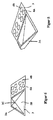
- Figure 1 shows a support plate (3), which serves as a holder for the camera (1) and is attached to the inside of the windshield (2).
- the support plate (3) For holding the camera or the camera housing (1) is on the support plate (3) has a preferably funnel-shaped Cover cap (3A) integrally formed, which encloses the space between the disc (2) and camera lens (1A) and the lens barrel light and dustproof.
- the camera or the camera housing (1) is arranged on the end of the funnel-shaped cover cap (3A) facing away from the disc (2) (compare FIGS. 3, 4 and 9).
- the funnel (3A) which tapers away in the direction away from the disk (2) thus also defines the light detection area of the camera (1).
- the support plate (3) has a light entrance window (3B), wherein the support plate (3) rests against the disc (2) so that the cap (3A) in the region Light entrance window (3 B) of the disc (2) is closed.
- the funnel-shaped covering cap (3A) has a recess (3C) for the light-tight and dust-tight reception of the camera lens or of the lens barrel (1A)
- the cover cap (3A) has an end integrally formed with the cap (3A) socket (3D), while the camera body (1) has a corresponding spherical segment (1B).
- the ball joint is used for adjustment. In the adjusted position, the joint socket (3D) and the ball segment (1B) are connected to each other by laser welding. In the welded state, the ball segment (1B) lies dust-tight against the socket (3D). It is particularly advantageous that the center of the ball joint lies on the optical axis of the objective (1A), whereby a very compact design of the camera arrangement is achieved. This is achieved in that the lens or the lens barrel (1A) is arranged concentrically within the ball segment (1B). Accordingly, the socket (3D) of the cap (3) has a concentric clear recess (3C) for the lens (1A).
- the optical guide elements (4A, 4B) are formed integrally with the carrier plate (3) for the camera (1).
- the illustrated optical guide elements (4A, 4B) are part of a rain sensor which serves to detect precipitation on the disk.
- three pairs of optical guide elements are provided, wherein each one optical guide element (4A) of a pair combination of the coupling of measuring radiation from a transmitter in the disc, while the other optical guide element (4B) of the coupling of the at the Disk outside reflected measuring radiation in the direction of a receiver is used. Transmitter and receiver are not shown.
- the optical guide elements (4A, 4B) terminate flush with the carrier plate (3) on the one side so that it can be brought into contact with the optical guide elements directly or indirectly via an optical coupling medium (not shown) on the inner side of the wafer.
- the optical guide elements (4A, 4B) On the side facing away from the disc (2), the optical guide elements (4A, 4B) have a curvature (not shown) for forming a lens.
- the optical guide elements (4A, 4B) are preferably manufactured in a two-component injection molding in one piece with the support plate (3), wherein the support plate is made of a visible radiation and for the measuring radiation impermeable plastic material, while the optical guide elements from a for the measuring radiation made of transparent plastic material.
- the support plate (3) preferably by injection molding, integrally formed cap (3A) - like the support plate itself - from a visible light impermeable plastic material, so that the space between the disc (2) and camera lens (1A) is enclosed light-tight.
- the carrier plate has at least one optical guide element, which is part of an apron and / or ambient light sensor for automatic driving light circuit, wherein the optical guide element directs the apron and / or ambient light to an associated receiver.
- the optical guide elements are not formed integrally with the carrier plate.
- the at least one optical guide element is connected via a connecting means, in particular via a latching connection, with the carrier plate for the camera.
- the at least one optical guide element is part of a second carrier plate, which is then connected via a connecting means with the carrier plate for the camera.
- the attachment of the support plate (3) on the disc (2) is preferably via a mounting ring (not shown) which is glued to the disc (2), wherein the support plate (3) for the camera (1) via a on the mounting ring attacking spring is pressed against the disc.
- a mounting ring not shown
- the support plate (3) for the camera (1) via a on the mounting ring attacking spring is pressed against the disc.
- the carrier plate itself is glued to the disc.
- FIG. 7 shows a carrier plate (3) on which two cover caps (3A) for each camera (1) are arranged.
- the optical guide elements (4A, 4B) are arranged between the two light entry windows (3B) of the cover caps (3A).
- the optical guide elements can be arranged arbitrarily on the carrier plate around the light entry window, both around the light entry window and only on one side thereof.
- the camera comprises at least one objective and a photosensitive semiconductor chip.
Landscapes
- Engineering & Computer Science (AREA)
- Mechanical Engineering (AREA)
- Automation & Control Theory (AREA)
- Physics & Mathematics (AREA)
- General Physics & Mathematics (AREA)
- Multimedia (AREA)
- Theoretical Computer Science (AREA)
- Studio Devices (AREA)
- Fittings On The Vehicle Exterior For Carrying Loads, And Devices For Holding Or Mounting Articles (AREA)
Abstract
Description
- Die Erfindung bezieht sich auf eine Kameraanordnung für Kraftfahrzeuge mit einer Kamera, die im Fahrzeuginnenraum hinter einer Scheibe angeordnet ist. Eine derartige Kameraanordnung ist beispielsweise aus der DE 40 16 570 A1 bekannt. Mit einer solchen Kameraanordnung sind verschiedenste Videoüberwachungen des Fahrzeugaußenraums oder auch eine automatisch Fahrspurerkennung möglich. Der Einsatz von Kameras in Fahrzeugen wird zukünftig zunehmen.
- Ferner werden in Fahrzeugen derzeit verstärkt Regensensoren eingesetzt, die den Niederschlag auf der Windschutzscheibe erfassen und so ein automatisches Scheibenwischen ermöglichen. Ein derartiger Regensensor ist beispielsweise aus der DE 199 55 423 A1 bekannt. Bei einem solchen Regensensor wird infrarote Meßstrahlung von einem Sender über ein optisches Führungselement in die Windschutzscheibe eingekoppelt. Die so eingekoppelte Strahlung wird an der Grenzfläche der Scheibenaußenseite durch Totalreflexion reflektiert und über ein weiteres optisches Führungselement in Richtung auf einen Empfänger gerichtet. Die Totalreflexionsbedingung wird bei Anwesenheit von Niederschlag auf der Scheibe gestört, so daß der Anteil der reflektierten Strahlung und damit das Signal im Empfänger abnimmt, worauf letztendlich das Prinzip dieses Regensensors beruht. Die beiden optischen Führungselemente liegen direkt oder indirekt, z.B. über ein optisches Koppelmedium (z.B. eine Silikonschicht oder eine Klebeschicht) an der Scheibe an, wobei die Scheibe, die optischen Führungselemente und ggf. das optische Koppelmedium zumindest ähnliche Brechungsindizes für die relevante Strahlung aufweisen.
- Derzeit sind die Kameraanordnung und der Regensensor völlig voneinander getrennt, was sowohl aus Kostengründen als auch konstruktiven Gründen sowie hinsichtlich des zur Verfügung stehenden Bauraums ungünstig ist.
- Aufgabe der Erfindung ist die Schaffung einer Kameraanordnung unter kostengünstiger und einfacher Einbeziehung von mindestens einem optischen Führungselement für eine von der Kamera unabhängige Sensoreinrichtung.
- Diese Aufgabe wird erfindungsgemäß dadurch gelöst, daß eine Trägerplatte vorgesehen ist, die an der Innenseite der Scheibe befestigt ist und als Halterung für die Kamera dient, wobei mit der Trägerplatte mindestens ein materiegebundenes optisches Führungselement für eine von der Kamera unabhängige Sensoreinrichtung verbunden ist, das vorzugsweise mit der Trägerplatte bündig abschließt. Diese Trägerplatte mit dem mindestens einen optischen Führungselement wird dann direkt oder über ein optisches Koppelmedium an der Scheibeninnenseite zur Anlage gebracht. Auf diese Weise wird eine einfach zu handhabende und kompakte Kameraanordnung geschaffen, in die ein oder mehr optische Führungselemente für eine zusätzliche Sensoreinrichtung bereits integriert sind.
- Anhand der beigefügten Zeichnungen soll die Erfindung nachfolgend näher erläutert werden. Es zeigt:
- Figur 1
- eine perspektivische Ansicht einer Trägerplatte für die Kamera mit darin einstückig integrierten optischen Führungselementen für einen Regensensor,
- Figur 2
- eine Draufsicht auf die Trägerplatte von Figur 1,
- Figur 3
- eine Draufsicht auf die Trägerplatte von Figur 1, jedoch mit Einblick in die trichterförmige Abdeckkappe,
- Figur 4
- eine Seitenansicht der an der Scheibeninnenseite angeordneten Trägerplatte mit daran angeformter Abdeckkappe,
- Figur 5
- eine perspektivische Ansicht einer Trägerplatte für die Kamera mit darin einstückig integrierten optischen Führungselementen für einen Regensensor, wobei die Anordnung der optischen Führungselemente gegenüber der Trägerplatte von Figur 1 verschieden ist,
- Figur 6
- eine Draufsicht auf die Trägerplatte von Figur 5,
- Figur 7
- eine perspektivische Ansicht einer Trägerplatte für zwei Kameras mit darin einstückig integrierten optischen Führungselementen für einen Regensensor,
- Figur 8
- die Schnittdarstellung einer Trägerplatte mit daran angeformter Abdeckkappe sowie der Kamera in Explosionsdarstellung.
- Figur 1 zeigt eine Trägerplatte (3), die als Halterung für die Kamera (1) dient und an der Innenseite der Windschutzscheibe (2) befestigt wird. Zur Halterung der Kamera bzw. des Kameragehäuses (1) ist an der Trägerplatte (3) eine vorzugsweise trichterförmige Abdeckkappe (3A) einstückig angeformt, welche den Raum zwischen Scheibe (2) und Kameraobjektiv (1A) bzw. dem Objektivtubus licht- und staubdicht umschließt. Die Kamera bzw. das Kameragehäuse (1) ist an dem der Scheibe (2) abgewandten Ende der trichterförmigen Abdeckkappe (3A) angeordnet (vgl. Figur 3, 4 und 9). Der in Richtung von der Scheibe (2) weg verjüngt ausgebildete Trichter (3A) definiert damit auch den Lichterfassungsbereich der Kamera (1). Um den Lichteintritt in die trichterförmige Abdeckkappe (3A) zu ermöglichen, weist die Trägerplatte (3) ein Lichteintrittsfenster (3B) auf, wobei die Trägerplatte (3) so an der Scheibe (2) anliegt, daß die Abdeckkappe (3A) im Bereich des Lichteintrittsfensters (3B) von der Scheibe (2) verschlossen wird. An ihrem der Scheibe (2) abgewandten Ende weist die trichterförmige Abdeckkappe (3A) eine Aussparung (3C) zur licht- und staubdichten Aufnahme des Kameraobjektivs bzw. des Objektivtubus (1A) auf
- Die Verbindung zwischen der Abdeckkappe (3A) und der Kamera bzw. dem Kameragehäuse (1) erfolgt über ein Kugelgelenk. Zu diesem Zweck weist die Abdeckkappe (3A) endseitig eine einstückig mit der Abdeckkappe (3A) ausgebildete Gelenkpfanne (3D) auf, während das Kameragehäuse (1) ein entsprechendes Kugelsegment (1B) aufweist. Das Kugelgelenk dient der Justage. In der justierten Stellung werden die Gelenkpfanne (3D) und das Kugelsegment (1B) durch Laserschweißen miteinander verbunden. Dabei liegt das Kugelsegment (1B) im verschweißten Zustand staubdicht an der Gelenkpfanne (3D) an. Besonders vorteilhaft ist, daß der Mittelpunkt des Kugelgelenks auf der optischen Achse des Objektivs (1A) liegt, wodurch eine sehr kompakte Bauweise der Kameraanordnung erzielt wird. Dies wird dadurch erreicht, daß das Objektiv bzw. der Objektivtubus (1A) konzentrisch innerhalb des Kugelsegments (1B) angeordnet ist. Dementsprechend weist die Gelenkpfanne (3D) der Abdeckkappe (3) eine konzentrische lichte Aussparung (3C) für das Objektiv (1A) auf.
- In den Ausführungsformen gemäß Figur 1,2,3, 5, 6 und 7 sind die optischen Führungselemente (4A,4B) einstückig mit der Trägerplatte (3) für die Kamera (1) ausgebildet. Die dargestellten optischen Führungselemente (4A,4B) sind Teil eines Regensensors, der der Niederschlagserfassung auf der Scheibe dient. Dabei sind drei optische FührungselementePaare vorgesehen, wobei jeweils das eine optische Führungselement (4A) einer Paarkombination der Einkopplung von Meßstrahlung aus einem Sender in die Scheibe dient, während das andere optische Führungselement (4B) der Auskopplung der an der Scheibenaußenseite reflektierten Meßstrahlung in Richtung auf einen Empfänger dient. Sender und Empfänger sind nicht dargestellt.
- Erfmdungsgemäß schließen die optischen Führungselemente (4A,4B) auf der einen Seite bündig mit der Trägerplatte (3) ab, damit diese mit den optischen Führungselementen direkt oder indirekt über ein optisches Koppelmedium (nicht dargestellt) an der Scheibeninnenseite zur Anlage gebracht werden kann. Auf der der Scheibe (2) abgewandten Seite weisen die optischen Führungselemente (4A,4B) eine Krümmung (nicht dargestellt) zur Ausbildung einer Linse auf.
- Die optischen Führungselemente (4A,4B) werden vorzugsweise in einem Zweikomponeten-Spritzgießverfahren einstückig mit der Trägerplatte (3) hergestellt, wobei die Trägerplatte aus einem für sichtbare Strahlung und für die Meßstrahlung undurchlässigen Kunststoffmaterial hergestellt wird, während die optischen Führungselemente aus einem für die Meßstrahlung transparenten Kunststoffmaterial hergestellt sind. Im Fall des Regensensors wird infrarotes Licht als Meßstrahlung verwendet. Die an der Trägerplatte (3), vorzugsweise im Spritzgießverfahren, angeformte Abdeckkappe (3A) besteht - wie die Trägerplatte selbst - aus einem für sichtbares Licht undurchlässigen Kunststoffmaterial, so daß der Raum zwischen Scheibe (2) und Kameraobjektiv (1A) lichtdicht umschlossen wird.
- In einer nicht dargestellten Ausführungsform weist die Trägerplatte mindestens ein optisches Führungselement auf, das Teil eines Vorfeld- und/oder Umgebungslichtsensors zur automatischen Fahrlichtschaltung ist, wobei das optische Führungselement das Vorfeld- und/oder Umgebungslicht auf einen zugeordneten Empfänger richtet.
- In einer nicht dargestellten Ausführungsform sind die optischen Führungselemente nicht einstückig mit der Trägerplatte ausgebildet. In dieser Ausführungsform ist das mindestens eine optische Führungselement über ein Verbindungsmittel, insbesondere über eine Rastverbindung, mit der Trägerplatte für die Kamera verbunden. Zu diesem Zweck ist das mindestens eine optische Führungselement Teil einer zweiten Trägerplatte, die dann über ein Verbindungsmittel mit der Trägerplatte für die Kamera verbunden wird.
- Die Befestigung der Trägerplatte (3) an der Scheibe (2) erfolgt vorzugsweise über einen Befestigungsring (nicht dargestellt), der an die Scheibe (2) geklebt ist, wobei die Trägerplatte (3) für die Kamera (1) über eine an dem Befestigungsring angreifende Feder gegen die Scheibe gedrückt wird. Dabei kann zwischen Scheibe und Trägerplatte/Führungselementen noch ein für die Meßstrahlung transparentes Koppelmedium, z.B. eine Silikonschicht, angeordnet sein. In einer alternativen Ausführungsform wird die Trägerplatte selbst an die Scheibe angeklebt.
- In Figur 7 ist eine Trägerplatte (3) gezeigt, an der zwei Abdeckkappen (3A) für jeweils eine Kamera (1) angeordnet sind. Die optischen Führungselemente (4A,4B) sind zwischen den beiden Lichteintrittsfenstern (3B) der Abdeckkappen (3A) angeordnet.
- Die optischen Führungselemente können grundsätzlich beliebig auf der Trägerplatte um das Lichteintrittsfenster herum angeordnet sein, und zwar sowohl um das Lichteintrittsfenster herum als auch nur auf einer Seite davon.
- Die Kamera umfasst mindestens ein Objektiv und einen lichtempfindlichen Halbleiterchip.
- In einer nicht dargestellten Ausführungsform weist die Trägerplatte randseitig einen gegenüber der Grrundfläche - in der die optischen Führungselemente bündig angeordnet sind - hervorstehenden, umlaufenden Kragen auf, der als Begrenzungsrahmen für eine aushärtende Vergussmasse dient, welche das Koppelmedium ausbildet.
-
- 1)
- Kamera
- 1A)
- Kameraobjektiv
- 1B)
- Kugelsegment auf der Kamera
- 2)
- Scheibe
- 3)
- Trägerplatte
- 3A)
- Abdeckkappe
- 3B)
- Lichteintrittsfenster in der Trägerplatte
- 3C)
- Aussparung in der trichterförmigen Abdeckkappe zur Aufnahme des Kameraobjektivs
- 4A, 4B)
- Optische Führungselemente in der Trägerplatte
Claims (14)
- Kameraanordnung für Kraftfahrzeuge mit einer Kamera (1), die im Fahrzeuginnenraum hinter einer Scheibe (2) angeordnet ist, wobei eine Trägerplatte (3) vorgesehen ist, die an der Innenseite der Scheibe (2) befestigt ist und als Halterung für die Kamera (1) dient,
dadurch gekennzeichnet, dass- mit der Trägerplatte (3) mindestens ein materiegebundenes optisches Führungselement (4A,4B) für eine von der Kamera (1) unabhängige Sensoreinrichtung verbunden ist,- die Trägerplatte (3) mit dem mindestens einen optischen Führungselement (4A,4B) direkt oder indirekt über ein optisches Koppelmedium an der Scheibeninnenseite anliegt,- an der Trägerplatte (3) eine Abdeckkappe (3A) angeformt ist, welche den Raum zwischen Scheibe (2) und Kameraobjektiv (1A) licht- und staubdicht umschließt, wobei die Kamera (1) an dem der Scheibe (2) abgewandten Ende der Abdeckkappe (3A) angeordnet ist,- die Trägerplatte (3) ein Lichteintrittsfenster (3B) aufweist,- die Trägerplatte (3) so an der Scheibe (2) anliegt, dass die Abdeckkappe (3A) im Bereich des Lichteintrittsfensters (3B) von der Scheibe (2) verschlossen wird.- die Abdeckkappe (3A) in Form eines Trichters ausgebildet ist, der in Richtung von der Scheibe weg verjüngt ausgebildet ist. - Kameraanordnung nach Anspruch 1,
dadurch gekennzeichnet, dass
das optische Führungselement (4A,4B) bündig mit der Trägerplatte (3) abschließt. - Kameraanordnung nach Anspruch 1 oder 2,
dadurch gekennzeichnet, dass
das mindestens eine optische Führungselement (4A,4B) einstückig mit der Trägerplatte (3) für die Kamera (1) ausgebildet ist. - Kameraanordnung nach Anspruch 1 oder 2,
dadurch gekennzeichnet, dass
das mindestens eine optische Führungselement (4A,4B) über ein Verbindungselement, insbesondere eine Rastverbindung, mit der Trägerplatte (3) für die Kamera (1) verbunden ist. - Kameraanordnung nach Anspruch 4,
dadurch gekennzeichnet, dass
das mindestens eine optische Führungselement (4A,4B) Teil einer zweiten Trägerplatte ist, die über ein Verbindungselement, insbesondere eine Rastverbindung, mit der Trägerplatte (3) für die Kamera (1) verbunden ist. - Kameraanordnung nach einem der vorstehenden Ansprüche,
dadurch gekennzeichnet, dass
an der Scheibe (2) ein Befestigungselement, insbesondere ein Befestigungsring angeklebt ist, wobei die Trägerplatte (3) für die Kamera (1) über eine an dem Befestigungselement angreifende Feder gegen die Scheibe (2) gedrückt wird. - Kameraanordnung nach einem der vorstehenden Ansprüche 1 bis 5,
dadurch gekennzeichnet, dass
die Trägerplatte (3) an die Scheibe (1) geklebt ist. - Kameraanordnung nach einem der vorstehenden Ansprüche,
dadurch gekennzeichnet, dass
die Abdeckkappe (3A) an ihrem der Scheibe abgewandten Ende eine Aussparung (3C) zur licht- und staubdichten Aufnahme des Kameraobjektivs (1A) aufweist. - Kameraanordnung nach einem der vorstehenden Ansprüche,
dadurch gekennzeichnet, dass
das mindestens eine optische Führungselement (4A,4B) Teil eines Regensensors zur Niederschlagserfassung auf der Scheibe ist. - Kameraanordnung nach Anspruch 9,
dadurch gekennzeichnet, dass
wenigstens ein optisches Führungselemente-Paar (4A,4B) vorgesehen ist, wobei das eine optische Führungselement (4A) der Einkopplung von Meßstrahlung aus einem Sender in die Scheibe (2) dient, während das andere optische Führungselement (4B) der Auskopplung der an der Scheibenaußenseite reflektierten Meßstrahlung in Richtung auf einen Empfänger dient. - Kameraanordnung nach einem der vorstehenden Ansprüche,
dadurch gekennzeichnet, dass
das mindestens eine optische Führungselement (4A,4B) Teil eines Vorfeld- und/oder Umgebungslichtsensors zur automatischen Fahrlichtschaltung ist, wobei das mindestens eine optische Führungselement das Vorfeld- und/oder Umgebungslicht auf einen zugeordneten Empfänger richtet. - Kameraanordnung nach einem der vorstehenden Ansprüche,
dadurch gekennzeichnet, dass
die Trägerplatte (3) für die Kamera (1) bis auf das mindestens eine optische Führungselement (4A,4B) aus einem nicht transparenten Material besteht. - Kameraanordnung nach Anspruch 12,
dadurch gekennzeichnet, dass
die Trägerplatte (3) aus einem für sichtbares Licht nicht transparenten Material besteht. - Kameraanordnung nach Anspruch 12 oder 13,
dadurch gekennzeichnet, dass
die Trägerplatte (3) aus einem für infrarotes Licht nicht transparenten Material besteht.
Applications Claiming Priority (2)
| Application Number | Priority Date | Filing Date | Title |
|---|---|---|---|
| DE10237481A DE10237481A1 (de) | 2002-08-16 | 2002-08-16 | Kameraanordnung für Kraftfahrzeuge |
| EP03102436A EP1389565B1 (de) | 2002-08-16 | 2003-08-06 | Kameraanordnung für Kraftfahrzeuge |
Related Parent Applications (1)
| Application Number | Title | Priority Date | Filing Date |
|---|---|---|---|
| EP03102436A Division EP1389565B1 (de) | 2002-08-16 | 2003-08-06 | Kameraanordnung für Kraftfahrzeuge |
Publications (2)
| Publication Number | Publication Date |
|---|---|
| EP1627775A2 true EP1627775A2 (de) | 2006-02-22 |
| EP1627775A3 EP1627775A3 (de) | 2006-03-01 |
Family
ID=30469760
Family Applications (3)
| Application Number | Title | Priority Date | Filing Date |
|---|---|---|---|
| EP05110590A Withdrawn EP1627775A3 (de) | 2002-08-16 | 2003-08-06 | Kameraanordnung für Kraftfahrzeuge mit einer Kamera |
| EP05110596A Withdrawn EP1623876A3 (de) | 2002-08-16 | 2003-08-06 | Kameraanordnung für Kraftfahrzeuge |
| EP03102436A Expired - Lifetime EP1389565B1 (de) | 2002-08-16 | 2003-08-06 | Kameraanordnung für Kraftfahrzeuge |
Family Applications After (2)
| Application Number | Title | Priority Date | Filing Date |
|---|---|---|---|
| EP05110596A Withdrawn EP1623876A3 (de) | 2002-08-16 | 2003-08-06 | Kameraanordnung für Kraftfahrzeuge |
| EP03102436A Expired - Lifetime EP1389565B1 (de) | 2002-08-16 | 2003-08-06 | Kameraanordnung für Kraftfahrzeuge |
Country Status (2)
| Country | Link |
|---|---|
| EP (3) | EP1627775A3 (de) |
| DE (2) | DE10237481A1 (de) |
Families Citing this family (24)
| Publication number | Priority date | Publication date | Assignee | Title |
|---|---|---|---|---|
| US6326613B1 (en) | 1998-01-07 | 2001-12-04 | Donnelly Corporation | Vehicle interior mirror assembly adapted for containing a rain sensor |
| US6124886A (en) | 1997-08-25 | 2000-09-26 | Donnelly Corporation | Modular rearview mirror assembly |
| US8288711B2 (en) | 1998-01-07 | 2012-10-16 | Donnelly Corporation | Interior rearview mirror system with forwardly-viewing camera and a control |
| US6278377B1 (en) | 1999-08-25 | 2001-08-21 | Donnelly Corporation | Indicator for vehicle accessory |
| US6445287B1 (en) | 2000-02-28 | 2002-09-03 | Donnelly Corporation | Tire inflation assistance monitoring system |
| US6420975B1 (en) | 1999-08-25 | 2002-07-16 | Donnelly Corporation | Interior rearview mirror sound processing system |
| US7480149B2 (en) | 2004-08-18 | 2009-01-20 | Donnelly Corporation | Accessory module for vehicle |
| WO2001064481A2 (en) | 2000-03-02 | 2001-09-07 | Donnelly Corporation | Video mirror systems incorporating an accessory module |
| US6396408B2 (en) | 2000-03-31 | 2002-05-28 | Donnelly Corporation | Digital electrochromic circuit with a vehicle network |
| WO2003065084A1 (en) | 2002-01-31 | 2003-08-07 | Donnelly Corporation | Vehicle accessory module |
| DE102004024735A1 (de) | 2004-05-19 | 2005-12-15 | Leopold Kostal Gmbh & Co Kg | Kameraanordnung für ein Kraftfahrzeug |
| US8256821B2 (en) | 2004-12-15 | 2012-09-04 | Magna Donnelly Engineering Gmbh | Accessory module system for a vehicle window |
| DE102005014961A1 (de) * | 2005-04-01 | 2006-10-05 | Hella Kgaa Hueck & Co. | Befestigung elektronischer Bauteile im Bereich der Windschutzscheibe eines Fahrzeugs |
| JP4848795B2 (ja) * | 2006-02-27 | 2011-12-28 | パナソニック株式会社 | ステレオカメラ |
| DE102007020912A1 (de) | 2007-05-04 | 2008-11-06 | GM Global Technology Operations, Inc., Detroit | Kraftfahrzeug mit einer Kamera und einem Scheibenwischer |
| US8570374B2 (en) | 2008-11-13 | 2013-10-29 | Magna Electronics Inc. | Camera for vehicle |
| DE102009018348B3 (de) | 2009-04-23 | 2010-12-30 | Saint-Gobain Sekurit Deutschland Gmbh & Co. Kg | Fahrzeugverglasung, Verfahren zur Herstellung einer Fahrzeugverglasung |
| DE102013000751B4 (de) * | 2013-01-17 | 2024-02-29 | HELLA GmbH & Co. KGaA | Sensorvorrichtung zum Erfassen von Feuchtigkeit auf einer Scheibe |
| KR101698783B1 (ko) * | 2013-12-16 | 2017-01-23 | 엘지전자 주식회사 | 스테레오 카메라 및 이를 구비한 차량 |
| DE102015007830B4 (de) | 2015-06-18 | 2017-12-28 | e.solutions GmbH | Optische Baugruppe, elektronisches Gerät und Kraftfahrzeug mit einer optischen Baugruppe sowie Verfahren zum Herstellen einer optischen Baugruppe |
| WO2022193091A1 (zh) * | 2021-03-15 | 2022-09-22 | 深圳市大疆创新科技有限公司 | 成像装置及可移动平台 |
| DE102022123456A1 (de) | 2022-09-14 | 2024-03-14 | Valeo Schalter Und Sensoren Gmbh | Einrichtung für ein fahrzeug |
| EP4586006A1 (de) * | 2024-01-11 | 2025-07-16 | Aptiv Technologies AG | Gehäuse für eine kameraanordnung und kameraanordnung |
| DE102024120595A1 (de) * | 2024-07-19 | 2026-01-22 | Valeo Schalter Und Sensoren Gmbh | Sensorbaugruppe für ein Kraftfahrzeug und Kraftfahrzeug |
Family Cites Families (7)
| Publication number | Priority date | Publication date | Assignee | Title |
|---|---|---|---|---|
| JP2920653B2 (ja) * | 1990-03-15 | 1999-07-19 | アイシン精機株式会社 | 車載撮像装置 |
| DE4329983B4 (de) * | 1993-09-04 | 2004-12-02 | Robert Bosch Gmbh | Dachmodul für ein Kraftfahrzeug |
| DE19647200C1 (de) * | 1996-11-15 | 1998-01-08 | Kostal Leopold Gmbh & Co Kg | Gehäuse für Dachmodul |
| DE19753879C1 (de) * | 1997-12-05 | 1998-12-03 | Kostal Leopold Gmbh & Co Kg | Dachmodul |
| US6170955B1 (en) * | 1998-02-27 | 2001-01-09 | Iteris, Inc. | Vehicle mounted optical assembly |
| DE19955423A1 (de) * | 1999-11-18 | 2001-05-31 | Hella Kg Hueck & Co | Sensoreinrichtung und Verfahren zur Herstellung einer Sensoreinrichtung |
| US6392218B1 (en) * | 2000-04-07 | 2002-05-21 | Iteris, Inc. | Vehicle rain sensor |
-
2002
- 2002-08-16 DE DE10237481A patent/DE10237481A1/de not_active Withdrawn
-
2003
- 2003-08-06 EP EP05110590A patent/EP1627775A3/de not_active Withdrawn
- 2003-08-06 EP EP05110596A patent/EP1623876A3/de not_active Withdrawn
- 2003-08-06 DE DE50306013T patent/DE50306013D1/de not_active Expired - Lifetime
- 2003-08-06 EP EP03102436A patent/EP1389565B1/de not_active Expired - Lifetime
Also Published As
| Publication number | Publication date |
|---|---|
| EP1627775A3 (de) | 2006-03-01 |
| DE10237481A1 (de) | 2004-04-01 |
| EP1389565B1 (de) | 2006-12-20 |
| EP1389565A1 (de) | 2004-02-18 |
| EP1623876A2 (de) | 2006-02-08 |
| EP1623876A3 (de) | 2006-03-01 |
| DE50306013D1 (de) | 2007-02-01 |
Similar Documents
| Publication | Publication Date | Title |
|---|---|---|
| EP1389565B1 (de) | Kameraanordnung für Kraftfahrzeuge | |
| DE19861428B4 (de) | Optischer Sensor | |
| EP2976237B1 (de) | Kameraanordnung für ein fahrzeug und fahrzeug mit einer derartigen kameraanordnung | |
| EP1289796B1 (de) | Lichtempfindliche sensoreinheit, insbesondere zum automatischen schalten von beleuchtungseinrichtungen | |
| DE10237554B4 (de) | Justierbare Kameraanordnung für Kraftfahrzeuge | |
| EP1101673B1 (de) | Sensoreinrichtung und Verfahren zur Herstellung einer Sensoreinrichtung | |
| WO2007090576A1 (de) | Kameraanordnung hinter einer geneigten scheibe | |
| DE19839273A1 (de) | Optischer Sensor | |
| EP1257444B1 (de) | Regensensor, insbesondere für ein kraftfahrzeug | |
| DE102009027512A1 (de) | Vorrichtung zur Erfassung von Bilddaten | |
| DE10237607A1 (de) | Kameraanordnung für Kraftfahrzeuge | |
| EP1200286B1 (de) | Lichtempfindliche sensoreinheit, insbesondere zum automatischen schalten von beleuchtungseinrichtungen | |
| DE10147176B4 (de) | Sensoreinrichtung zur Erfassung der Benetzung einer Scheibe, insbesondere einer Kraftfahrzeugscheibe | |
| DE19704415A1 (de) | Sensoreinrichtung für eine automatische Fahrlichtschaltung | |
| DE4407911A1 (de) | Optisches System | |
| DE102015007830B4 (de) | Optische Baugruppe, elektronisches Gerät und Kraftfahrzeug mit einer optischen Baugruppe sowie Verfahren zum Herstellen einer optischen Baugruppe | |
| EP1908652B1 (de) | Regensensor | |
| EP1765646B1 (de) | Optoelektronische sensoreinrichtung | |
| DE29924958U1 (de) | Optischer Sensor | |
| EP1431145A1 (de) | Regensensor, insbesondere für ein Kraftfahrzeug | |
| DE10261923A1 (de) | Sensorvorrichtung zur Erfassung der Benetzung einer transparenten Scheibe | |
| DE10261247A1 (de) | Regensensor, insbesondere für ein Kraftfahrzeug | |
| DE4041769A1 (de) | Optischer sensor | |
| DE19704413A1 (de) | Sensoreinrichtung für eine automatische Fahrlichtschaltung | |
| DE29923466U1 (de) | Sensoreinrichtung zur Erfassung einer Benetzung auf einer Scheibe |
Legal Events
| Date | Code | Title | Description |
|---|---|---|---|
| PUAI | Public reference made under article 153(3) epc to a published international application that has entered the european phase |
Free format text: ORIGINAL CODE: 0009012 |
|
| PUAL | Search report despatched |
Free format text: ORIGINAL CODE: 0009013 |
|
| AC | Divisional application: reference to earlier application |
Ref document number: 1389565 Country of ref document: EP Kind code of ref document: P |
|
| AK | Designated contracting states |
Kind code of ref document: A2 Designated state(s): DE ES FR GB IT SE |
|
| AK | Designated contracting states |
Kind code of ref document: A3 Designated state(s): DE ES FR GB IT SE |
|
| 17P | Request for examination filed |
Effective date: 20060822 |
|
| 17Q | First examination report despatched |
Effective date: 20060922 |
|
| AKX | Designation fees paid |
Designated state(s): DE FR |
|
| STAA | Information on the status of an ep patent application or granted ep patent |
Free format text: STATUS: THE APPLICATION IS DEEMED TO BE WITHDRAWN |
|
| 18D | Application deemed to be withdrawn |
Effective date: 20070203 |