EP1619188A1 - Verfahren zur Herstellung von Monoarylpiperazinen - Google Patents
Verfahren zur Herstellung von Monoarylpiperazinen Download PDFInfo
- Publication number
- EP1619188A1 EP1619188A1 EP05008949A EP05008949A EP1619188A1 EP 1619188 A1 EP1619188 A1 EP 1619188A1 EP 05008949 A EP05008949 A EP 05008949A EP 05008949 A EP05008949 A EP 05008949A EP 1619188 A1 EP1619188 A1 EP 1619188A1
- Authority
- EP
- European Patent Office
- Prior art keywords
- formula
- compounds
- alkyl
- piperazine
- palladium
- Prior art date
- Legal status (The legal status is an assumption and is not a legal conclusion. Google has not performed a legal analysis and makes no representation as to the accuracy of the status listed.)
- Withdrawn
Links
- 238000000034 method Methods 0.000 title claims description 27
- 150000004885 piperazines Chemical class 0.000 title description 2
- -1 aryl piperazine compounds Chemical class 0.000 claims abstract description 44
- GLUUGHFHXGJENI-UHFFFAOYSA-N Piperazine Chemical compound C1CNCCN1 GLUUGHFHXGJENI-UHFFFAOYSA-N 0.000 claims abstract description 43
- 229910052757 nitrogen Inorganic materials 0.000 claims abstract description 20
- 125000000217 alkyl group Chemical group 0.000 claims abstract description 13
- 239000002585 base Substances 0.000 claims abstract description 11
- 150000001340 alkali metals Chemical class 0.000 claims abstract description 10
- 150000002940 palladium Chemical class 0.000 claims abstract description 10
- 229910052783 alkali metal Inorganic materials 0.000 claims abstract description 8
- 125000003710 aryl alkyl group Chemical group 0.000 claims abstract description 7
- 125000003118 aryl group Chemical group 0.000 claims abstract description 6
- 239000003446 ligand Substances 0.000 claims abstract description 6
- 229910052760 oxygen Inorganic materials 0.000 claims abstract description 6
- 125000006413 ring segment Chemical group 0.000 claims abstract description 6
- 229910052801 chlorine Inorganic materials 0.000 claims abstract description 5
- 125000001153 fluoro group Chemical group F* 0.000 claims abstract description 5
- 229910052717 sulfur Inorganic materials 0.000 claims abstract description 5
- 229910052794 bromium Inorganic materials 0.000 claims abstract description 4
- 229910052740 iodine Inorganic materials 0.000 claims abstract description 3
- IJGRMHOSHXDMSA-UHFFFAOYSA-N Atomic nitrogen Chemical compound N#N IJGRMHOSHXDMSA-UHFFFAOYSA-N 0.000 claims description 36
- 150000001875 compounds Chemical class 0.000 claims description 25
- KDLHZDBZIXYQEI-UHFFFAOYSA-N Palladium Chemical compound [Pd] KDLHZDBZIXYQEI-UHFFFAOYSA-N 0.000 claims description 10
- 239000000203 mixture Substances 0.000 claims description 10
- 125000004642 (C1-C12) alkoxy group Chemical group 0.000 claims description 8
- 239000003960 organic solvent Substances 0.000 claims description 7
- ZAMOUSCENKQFHK-UHFFFAOYSA-N Chlorine atom Chemical compound [Cl] ZAMOUSCENKQFHK-UHFFFAOYSA-N 0.000 claims description 6
- 239000012696 Pd precursors Substances 0.000 claims description 6
- 125000004428 fluoroalkoxy group Chemical group 0.000 claims description 6
- 125000003709 fluoroalkyl group Chemical group 0.000 claims description 6
- NINIDFKCEFEMDL-UHFFFAOYSA-N Sulfur Chemical compound [S] NINIDFKCEFEMDL-UHFFFAOYSA-N 0.000 claims description 5
- 239000001301 oxygen Substances 0.000 claims description 5
- WKBOTKDWSSQWDR-UHFFFAOYSA-N Bromine atom Chemical compound [Br] WKBOTKDWSSQWDR-UHFFFAOYSA-N 0.000 claims description 4
- 150000004945 aromatic hydrocarbons Chemical class 0.000 claims description 4
- QVGXLLKOCUKJST-UHFFFAOYSA-N atomic oxygen Chemical compound [O] QVGXLLKOCUKJST-UHFFFAOYSA-N 0.000 claims description 4
- 239000000460 chlorine Substances 0.000 claims description 4
- 229910052763 palladium Inorganic materials 0.000 claims description 4
- 239000011593 sulfur Substances 0.000 claims description 4
- 150000001298 alcohols Chemical class 0.000 claims description 3
- 150000005840 aryl radicals Chemical class 0.000 claims description 3
- GDTBXPJZTBHREO-UHFFFAOYSA-N bromine Substances BrBr GDTBXPJZTBHREO-UHFFFAOYSA-N 0.000 claims description 3
- 229910052799 carbon Inorganic materials 0.000 claims description 3
- 150000002170 ethers Chemical class 0.000 claims description 3
- 239000012429 reaction media Substances 0.000 claims description 3
- 150000003512 tertiary amines Chemical class 0.000 claims description 3
- XTFIVUDBNACUBN-UHFFFAOYSA-N 1,3,5-trinitro-1,3,5-triazinane Chemical compound [O-][N+](=O)N1CN([N+]([O-])=O)CN([N+]([O-])=O)C1 XTFIVUDBNACUBN-UHFFFAOYSA-N 0.000 claims description 2
- ZCYVEMRRCGMTRW-UHFFFAOYSA-N 7553-56-2 Chemical compound [I] ZCYVEMRRCGMTRW-UHFFFAOYSA-N 0.000 claims description 2
- 229910000272 alkali metal oxide Inorganic materials 0.000 claims description 2
- 229910001860 alkaline earth metal hydroxide Inorganic materials 0.000 claims description 2
- 150000001408 amides Chemical class 0.000 claims description 2
- 229910052739 hydrogen Inorganic materials 0.000 claims description 2
- 239000011630 iodine Substances 0.000 claims description 2
- 125000003545 alkoxy group Chemical group 0.000 abstract description 3
- 125000003282 alkyl amino group Chemical group 0.000 abstract 1
- HEMHJVSKTPXQMS-UHFFFAOYSA-M sodium hydroxide Inorganic materials [OH-].[Na+] HEMHJVSKTPXQMS-UHFFFAOYSA-M 0.000 description 28
- WYURNTSHIVDZCO-UHFFFAOYSA-N Tetrahydrofuran Chemical compound C1CCOC1 WYURNTSHIVDZCO-UHFFFAOYSA-N 0.000 description 24
- YXFVVABEGXRONW-UHFFFAOYSA-N Toluene Chemical compound CC1=CC=CC=C1 YXFVVABEGXRONW-UHFFFAOYSA-N 0.000 description 24
- 238000006243 chemical reaction Methods 0.000 description 24
- 239000007787 solid Substances 0.000 description 19
- 239000003054 catalyst Substances 0.000 description 17
- YLQBMQCUIZJEEH-UHFFFAOYSA-N tetrahydrofuran Natural products C=1C=COC=1 YLQBMQCUIZJEEH-UHFFFAOYSA-N 0.000 description 12
- 125000001449 isopropyl group Chemical group [H]C([H])([H])C([H])(*)C([H])([H])[H] 0.000 description 11
- OKKJLVBELUTLKV-UHFFFAOYSA-N Methanol Chemical compound OC OKKJLVBELUTLKV-UHFFFAOYSA-N 0.000 description 9
- 125000000956 methoxy group Chemical group [H]C([H])([H])O* 0.000 description 8
- IBQMAPSJLHRQPE-UHFFFAOYSA-N 1-(4-(trifluoromethyl)phenyl)piperazine Chemical compound C1=CC(C(F)(F)F)=CC=C1N1CCNCC1 IBQMAPSJLHRQPE-UHFFFAOYSA-N 0.000 description 7
- 125000004432 carbon atom Chemical group C* 0.000 description 7
- 125000001495 ethyl group Chemical group [H]C([H])([H])C([H])([H])* 0.000 description 7
- 125000002496 methyl group Chemical group [H]C([H])([H])* 0.000 description 7
- 150000003254 radicals Chemical class 0.000 description 7
- RTZKZFJDLAIYFH-UHFFFAOYSA-N Diethyl ether Chemical compound CCOCC RTZKZFJDLAIYFH-UHFFFAOYSA-N 0.000 description 6
- VEXZGXHMUGYJMC-UHFFFAOYSA-N Hydrochloric acid Chemical compound Cl VEXZGXHMUGYJMC-UHFFFAOYSA-N 0.000 description 6
- 239000008346 aqueous phase Substances 0.000 description 6
- 239000000706 filtrate Substances 0.000 description 6
- 239000000047 product Substances 0.000 description 6
- 238000000425 proton nuclear magnetic resonance spectrum Methods 0.000 description 6
- MFRIHAYPQRLWNB-UHFFFAOYSA-N sodium tert-butoxide Chemical compound [Na+].CC(C)(C)[O-] MFRIHAYPQRLWNB-UHFFFAOYSA-N 0.000 description 6
- WTAPZWXVSZMMDG-UHFFFAOYSA-N 1,5-diphenylpenta-1,4-dien-3-one;palladium Chemical compound [Pd].C=1C=CC=CC=1C=CC(=O)C=CC1=CC=CC=C1 WTAPZWXVSZMMDG-UHFFFAOYSA-N 0.000 description 5
- DGRVQOKCSKDWIH-UHFFFAOYSA-N 1-chloro-2-(trifluoromethyl)benzene Chemical compound FC(F)(F)C1=CC=CC=C1Cl DGRVQOKCSKDWIH-UHFFFAOYSA-N 0.000 description 5
- CPELXLSAUQHCOX-UHFFFAOYSA-M Bromide Chemical compound [Br-] CPELXLSAUQHCOX-UHFFFAOYSA-M 0.000 description 5
- PXGOKWXKJXAPGV-UHFFFAOYSA-N Fluorine Chemical compound FF PXGOKWXKJXAPGV-UHFFFAOYSA-N 0.000 description 5
- JFDZBHWFFUWGJE-UHFFFAOYSA-N benzonitrile Chemical compound N#CC1=CC=CC=C1 JFDZBHWFFUWGJE-UHFFFAOYSA-N 0.000 description 5
- 125000000113 cyclohexyl group Chemical group [H]C1([H])C([H])([H])C([H])([H])C([H])(*)C([H])([H])C1([H])[H] 0.000 description 5
- KWYUFKZDYYNOTN-UHFFFAOYSA-M potassium hydroxide Inorganic materials [OH-].[K+] KWYUFKZDYYNOTN-UHFFFAOYSA-M 0.000 description 5
- QTBSBXVTEAMEQO-UHFFFAOYSA-M Acetate Chemical compound CC([O-])=O QTBSBXVTEAMEQO-UHFFFAOYSA-M 0.000 description 4
- WEVYAHXRMPXWCK-UHFFFAOYSA-N Acetonitrile Chemical compound CC#N WEVYAHXRMPXWCK-UHFFFAOYSA-N 0.000 description 4
- VEXZGXHMUGYJMC-UHFFFAOYSA-M Chloride anion Chemical compound [Cl-] VEXZGXHMUGYJMC-UHFFFAOYSA-M 0.000 description 4
- 150000001450 anions Chemical class 0.000 description 4
- VNFWTIYUKDMAOP-UHFFFAOYSA-N sphos Chemical compound COC1=CC=CC(OC)=C1C1=CC=CC=C1P(C1CCCCC1)C1CCCCC1 VNFWTIYUKDMAOP-UHFFFAOYSA-N 0.000 description 4
- 239000000126 substance Substances 0.000 description 4
- ITMCEJHCFYSIIV-UHFFFAOYSA-M triflate Chemical compound [O-]S(=O)(=O)C(F)(F)F ITMCEJHCFYSIIV-UHFFFAOYSA-M 0.000 description 4
- UGOMMVLRQDMAQQ-UHFFFAOYSA-N xphos Chemical compound CC(C)C1=CC(C(C)C)=CC(C(C)C)=C1C1=CC=CC=C1P(C1CCCCC1)C1CCCCC1 UGOMMVLRQDMAQQ-UHFFFAOYSA-N 0.000 description 4
- 125000004400 (C1-C12) alkyl group Chemical group 0.000 description 3
- UHOVQNZJYSORNB-UHFFFAOYSA-N Benzene Chemical compound C1=CC=CC=C1 UHOVQNZJYSORNB-UHFFFAOYSA-N 0.000 description 3
- DGAQECJNVWCQMB-PUAWFVPOSA-M Ilexoside XXIX Chemical compound C[C@@H]1CC[C@@]2(CC[C@@]3(C(=CC[C@H]4[C@]3(CC[C@@H]5[C@@]4(CC[C@@H](C5(C)C)OS(=O)(=O)[O-])C)C)[C@@H]2[C@]1(C)O)C)C(=O)O[C@H]6[C@@H]([C@H]([C@@H]([C@H](O6)CO)O)O)O.[Na+] DGAQECJNVWCQMB-PUAWFVPOSA-M 0.000 description 3
- ZMXDDKWLCZADIW-UHFFFAOYSA-N N,N-Dimethylformamide Chemical compound CN(C)C=O ZMXDDKWLCZADIW-UHFFFAOYSA-N 0.000 description 3
- ZMANZCXQSJIPKH-UHFFFAOYSA-N Triethylamine Chemical compound CCN(CC)CC ZMANZCXQSJIPKH-UHFFFAOYSA-N 0.000 description 3
- 125000004122 cyclic group Chemical group 0.000 description 3
- HGCIXCUEYOPUTN-UHFFFAOYSA-N cyclohexene Chemical compound C1CCC=CC1 HGCIXCUEYOPUTN-UHFFFAOYSA-N 0.000 description 3
- 125000001511 cyclopentyl group Chemical group [H]C1([H])C([H])([H])C([H])([H])C([H])(*)C1([H])[H] 0.000 description 3
- 229910052731 fluorine Inorganic materials 0.000 description 3
- 239000011737 fluorine Substances 0.000 description 3
- 150000002941 palladium compounds Chemical class 0.000 description 3
- YJVFFLUZDVXJQI-UHFFFAOYSA-L palladium(ii) acetate Chemical compound [Pd+2].CC([O-])=O.CC([O-])=O YJVFFLUZDVXJQI-UHFFFAOYSA-L 0.000 description 3
- 125000001997 phenyl group Chemical group [H]C1=C([H])C([H])=C(*)C([H])=C1[H] 0.000 description 3
- 125000002924 primary amino group Chemical group [H]N([H])* 0.000 description 3
- 125000000999 tert-butyl group Chemical group [H]C([H])([H])C(*)(C([H])([H])[H])C([H])([H])[H] 0.000 description 3
- 125000004191 (C1-C6) alkoxy group Chemical group 0.000 description 2
- 125000004169 (C1-C6) alkyl group Chemical group 0.000 description 2
- VYXHVRARDIDEHS-UHFFFAOYSA-N 1,5-cyclooctadiene Chemical compound C1CC=CCCC=C1 VYXHVRARDIDEHS-UHFFFAOYSA-N 0.000 description 2
- 125000003903 2-propenyl group Chemical group [H]C([*])([H])C([H])=C([H])[H] 0.000 description 2
- LFQSCWFLJHTTHZ-UHFFFAOYSA-N Ethanol Chemical compound CCO LFQSCWFLJHTTHZ-UHFFFAOYSA-N 0.000 description 2
- AFVFQIVMOAPDHO-UHFFFAOYSA-M Methanesulfonate Chemical compound CS([O-])(=O)=O AFVFQIVMOAPDHO-UHFFFAOYSA-M 0.000 description 2
- AFVFQIVMOAPDHO-UHFFFAOYSA-N Methanesulfonic acid Chemical compound CS(O)(=O)=O AFVFQIVMOAPDHO-UHFFFAOYSA-N 0.000 description 2
- BZLVMXJERCGZMT-UHFFFAOYSA-N Methyl tert-butyl ether Chemical compound COC(C)(C)C BZLVMXJERCGZMT-UHFFFAOYSA-N 0.000 description 2
- NHNBFGGVMKEFGY-UHFFFAOYSA-N Nitrate Chemical compound [O-][N+]([O-])=O NHNBFGGVMKEFGY-UHFFFAOYSA-N 0.000 description 2
- XYFCBTPGUUZFHI-UHFFFAOYSA-N Phosphine Chemical compound P XYFCBTPGUUZFHI-UHFFFAOYSA-N 0.000 description 2
- DKGAVHZHDRPRBM-UHFFFAOYSA-N Tert-Butanol Chemical compound CC(C)(C)O DKGAVHZHDRPRBM-UHFFFAOYSA-N 0.000 description 2
- MQRWBMAEBQOWAF-UHFFFAOYSA-N acetic acid;nickel Chemical compound [Ni].CC(O)=O.CC(O)=O MQRWBMAEBQOWAF-UHFFFAOYSA-N 0.000 description 2
- 150000001336 alkenes Chemical class 0.000 description 2
- 150000004703 alkoxides Chemical class 0.000 description 2
- 150000001448 anilines Chemical class 0.000 description 2
- 150000001500 aryl chlorides Chemical class 0.000 description 2
- 125000000058 cyclopentadienyl group Chemical group C1(=CC=CC1)* 0.000 description 2
- 150000001993 dienes Chemical class 0.000 description 2
- ZUOUZKKEUPVFJK-UHFFFAOYSA-N diphenyl Chemical compound C1=CC=CC=C1C1=CC=CC=C1 ZUOUZKKEUPVFJK-UHFFFAOYSA-N 0.000 description 2
- ZSWFCLXCOIISFI-UHFFFAOYSA-N endo-cyclopentadiene Natural products C1C=CC=C1 ZSWFCLXCOIISFI-UHFFFAOYSA-N 0.000 description 2
- XTHFKEDIFFGKHM-UHFFFAOYSA-N ethylene glycol dimethyl ether Natural products COCCOC XTHFKEDIFFGKHM-UHFFFAOYSA-N 0.000 description 2
- 125000005842 heteroatom Chemical group 0.000 description 2
- WMFOQBRAJBCJND-UHFFFAOYSA-M lithium hydroxide Inorganic materials [Li+].[OH-] WMFOQBRAJBCJND-UHFFFAOYSA-M 0.000 description 2
- 238000004519 manufacturing process Methods 0.000 description 2
- 229940078494 nickel acetate Drugs 0.000 description 2
- QJGQUHMNIGDVPM-UHFFFAOYSA-N nitrogen group Chemical group [N] QJGQUHMNIGDVPM-UHFFFAOYSA-N 0.000 description 2
- JRZJOMJEPLMPRA-UHFFFAOYSA-N olefin Natural products CCCCCCCC=C JRZJOMJEPLMPRA-UHFFFAOYSA-N 0.000 description 2
- QULYNCCPRWKEMF-UHFFFAOYSA-N parachlorobenzotrifluoride Chemical compound FC(F)(F)C1=CC=C(Cl)C=C1 QULYNCCPRWKEMF-UHFFFAOYSA-N 0.000 description 2
- 238000006467 substitution reaction Methods 0.000 description 2
- IMFACGCPASFAPR-UHFFFAOYSA-N tributylamine Chemical compound CCCCN(CCCC)CCCC IMFACGCPASFAPR-UHFFFAOYSA-N 0.000 description 2
- 239000008096 xylene Substances 0.000 description 2
- 125000004178 (C1-C4) alkyl group Chemical group 0.000 description 1
- 125000000229 (C1-C4)alkoxy group Chemical group 0.000 description 1
- POILWHVDKZOXJZ-ARJAWSKDSA-M (z)-4-oxopent-2-en-2-olate Chemical compound C\C([O-])=C\C(C)=O POILWHVDKZOXJZ-ARJAWSKDSA-M 0.000 description 1
- FKTXDTWDCPTPHK-UHFFFAOYSA-N 1,1,1,2,3,3,3-heptafluoropropane Chemical group FC(F)(F)[C](F)C(F)(F)F FKTXDTWDCPTPHK-UHFFFAOYSA-N 0.000 description 1
- FIARMZDBEGVMLV-UHFFFAOYSA-N 1,1,2,2,2-pentafluoroethanolate Chemical group [O-]C(F)(F)C(F)(F)F FIARMZDBEGVMLV-UHFFFAOYSA-N 0.000 description 1
- JGTNAGYHADQMCM-UHFFFAOYSA-M 1,1,2,2,3,3,4,4,4-nonafluorobutane-1-sulfonate Chemical compound [O-]S(=O)(=O)C(F)(F)C(F)(F)C(F)(F)C(F)(F)F JGTNAGYHADQMCM-UHFFFAOYSA-M 0.000 description 1
- RYHBNJHYFVUHQT-UHFFFAOYSA-N 1,4-Dioxane Chemical compound C1COCCO1 RYHBNJHYFVUHQT-UHFFFAOYSA-N 0.000 description 1
- 239000004912 1,5-cyclooctadiene Substances 0.000 description 1
- RWXUNIMBRXGNEP-UHFFFAOYSA-N 1-bromo-2-(trifluoromethyl)benzene Chemical compound FC(F)(F)C1=CC=CC=C1Br RWXUNIMBRXGNEP-UHFFFAOYSA-N 0.000 description 1
- 125000004206 2,2,2-trifluoroethyl group Chemical group [H]C([H])(*)C(F)(F)F 0.000 description 1
- SBASXUCJHJRPEV-UHFFFAOYSA-N 2-(2-methoxyethoxy)ethanol Chemical compound COCCOCCO SBASXUCJHJRPEV-UHFFFAOYSA-N 0.000 description 1
- XNWFRZJHXBZDAG-UHFFFAOYSA-N 2-METHOXYETHANOL Chemical compound COCCO XNWFRZJHXBZDAG-UHFFFAOYSA-N 0.000 description 1
- ZNQVEEAIQZEUHB-UHFFFAOYSA-N 2-ethoxyethanol Chemical compound CCOCCO ZNQVEEAIQZEUHB-UHFFFAOYSA-N 0.000 description 1
- 125000004493 2-methylbut-1-yl group Chemical group CC(C*)CC 0.000 description 1
- SDTMFDGELKWGFT-UHFFFAOYSA-N 2-methylpropan-2-olate Chemical compound CC(C)(C)[O-] SDTMFDGELKWGFT-UHFFFAOYSA-N 0.000 description 1
- GJNGXPDXRVXSEH-UHFFFAOYSA-N 4-chlorobenzonitrile Chemical compound ClC1=CC=C(C#N)C=C1 GJNGXPDXRVXSEH-UHFFFAOYSA-N 0.000 description 1
- DJJNYEXRPRQXPD-UHFFFAOYSA-N 4-piperazin-1-ylbenzonitrile Chemical compound C1=CC(C#N)=CC=C1N1CCNCC1 DJJNYEXRPRQXPD-UHFFFAOYSA-N 0.000 description 1
- 125000006549 C4-C10 aryl group Chemical group 0.000 description 1
- ZAFNJMIOTHYJRJ-UHFFFAOYSA-N Diisopropyl ether Chemical compound CC(C)OC(C)C ZAFNJMIOTHYJRJ-UHFFFAOYSA-N 0.000 description 1
- MYMOFIZGZYHOMD-UHFFFAOYSA-N Dioxygen Chemical compound O=O MYMOFIZGZYHOMD-UHFFFAOYSA-N 0.000 description 1
- KFZMGEQAYNKOFK-UHFFFAOYSA-N Isopropanol Chemical compound CC(C)O KFZMGEQAYNKOFK-UHFFFAOYSA-N 0.000 description 1
- WHXSMMKQMYFTQS-UHFFFAOYSA-N Lithium Chemical compound [Li] WHXSMMKQMYFTQS-UHFFFAOYSA-N 0.000 description 1
- FXHOOIRPVKKKFG-UHFFFAOYSA-N N,N-Dimethylacetamide Chemical compound CN(C)C(C)=O FXHOOIRPVKKKFG-UHFFFAOYSA-N 0.000 description 1
- SECXISVLQFMRJM-UHFFFAOYSA-N N-Methylpyrrolidone Chemical compound CN1CCCC1=O SECXISVLQFMRJM-UHFFFAOYSA-N 0.000 description 1
- ZWXPDGCFMMFNRW-UHFFFAOYSA-N N-methylcaprolactam Chemical compound CN1CCCCCC1=O ZWXPDGCFMMFNRW-UHFFFAOYSA-N 0.000 description 1
- 229910002651 NO3 Inorganic materials 0.000 description 1
- CTQNGGLPUBDAKN-UHFFFAOYSA-N O-Xylene Chemical compound CC1=CC=CC=C1C CTQNGGLPUBDAKN-UHFFFAOYSA-N 0.000 description 1
- ZLMJMSJWJFRBEC-UHFFFAOYSA-N Potassium Chemical compound [K] ZLMJMSJWJFRBEC-UHFFFAOYSA-N 0.000 description 1
- XBDQKXXYIPTUBI-UHFFFAOYSA-M Propionate Chemical compound CCC([O-])=O XBDQKXXYIPTUBI-UHFFFAOYSA-M 0.000 description 1
- XBDQKXXYIPTUBI-UHFFFAOYSA-N Propionic acid Chemical compound CCC(O)=O XBDQKXXYIPTUBI-UHFFFAOYSA-N 0.000 description 1
- VYPSYNLAJGMNEJ-UHFFFAOYSA-N Silicium dioxide Chemical compound O=[Si]=O VYPSYNLAJGMNEJ-UHFFFAOYSA-N 0.000 description 1
- CIUQDSCDWFSTQR-UHFFFAOYSA-N [C]1=CC=CC=C1 Chemical compound [C]1=CC=CC=C1 CIUQDSCDWFSTQR-UHFFFAOYSA-N 0.000 description 1
- VRAKDAYLTPMBAW-UHFFFAOYSA-N [O-][N+](=O)ClC#N Chemical compound [O-][N+](=O)ClC#N VRAKDAYLTPMBAW-UHFFFAOYSA-N 0.000 description 1
- PXGKGQWMIMUYPF-UHFFFAOYSA-N [fluoro(nitro)-lambda3-chloranyl]formonitrile Chemical compound C(#N)Cl(F)[N+](=O)[O-] PXGKGQWMIMUYPF-UHFFFAOYSA-N 0.000 description 1
- 239000004480 active ingredient Substances 0.000 description 1
- TWKVUTXHANJYGH-UHFFFAOYSA-L allyl palladium chloride Chemical compound Cl[Pd]CC=C.Cl[Pd]CC=C TWKVUTXHANJYGH-UHFFFAOYSA-L 0.000 description 1
- 150000001412 amines Chemical class 0.000 description 1
- 125000002178 anthracenyl group Chemical group C1(=CC=CC2=CC3=CC=CC=C3C=C12)* 0.000 description 1
- 150000001499 aryl bromides Chemical class 0.000 description 1
- 150000001502 aryl halides Chemical class 0.000 description 1
- 125000000499 benzofuranyl group Chemical group O1C(=CC2=C1C=CC=C2)* 0.000 description 1
- 230000015572 biosynthetic process Effects 0.000 description 1
- 235000010290 biphenyl Nutrition 0.000 description 1
- 239000004305 biphenyl Substances 0.000 description 1
- CODNYICXDISAEA-UHFFFAOYSA-N bromine monochloride Chemical compound BrCl CODNYICXDISAEA-UHFFFAOYSA-N 0.000 description 1
- 150000001649 bromium compounds Chemical class 0.000 description 1
- AXCZMVOFGPJBDE-UHFFFAOYSA-L calcium dihydroxide Chemical compound [OH-].[OH-].[Ca+2] AXCZMVOFGPJBDE-UHFFFAOYSA-L 0.000 description 1
- 239000000920 calcium hydroxide Substances 0.000 description 1
- 229910001861 calcium hydroxide Inorganic materials 0.000 description 1
- 150000007938 chlorocyclic compounds Chemical class 0.000 description 1
- 125000002603 chloroethyl group Chemical group [H]C([*])([H])C([H])([H])Cl 0.000 description 1
- 238000004587 chromatography analysis Methods 0.000 description 1
- 230000000052 comparative effect Effects 0.000 description 1
- 239000012043 crude product Substances 0.000 description 1
- 125000004093 cyano group Chemical group *C#N 0.000 description 1
- URYYVOIYTNXXBN-UHFFFAOYSA-N cyclooctene Chemical compound [CH]1[CH]CCCCCC1 URYYVOIYTNXXBN-UHFFFAOYSA-N 0.000 description 1
- URYYVOIYTNXXBN-UPHRSURJSA-N cyclooctene Chemical compound C1CCC\C=C/CC1 URYYVOIYTNXXBN-UPHRSURJSA-N 0.000 description 1
- 239000004913 cyclooctene Substances 0.000 description 1
- WMKGGPCROCCUDY-PHEQNACWSA-N dibenzylideneacetone Chemical compound C=1C=CC=CC=1\C=C\C(=O)\C=C\C1=CC=CC=C1 WMKGGPCROCCUDY-PHEQNACWSA-N 0.000 description 1
- XXJWXESWEXIICW-UHFFFAOYSA-N diethylene glycol monoethyl ether Chemical compound CCOCCOCCO XXJWXESWEXIICW-UHFFFAOYSA-N 0.000 description 1
- 229940075557 diethylene glycol monoethyl ether Drugs 0.000 description 1
- HHFAWKCIHAUFRX-UHFFFAOYSA-N ethoxide Chemical compound CC[O-] HHFAWKCIHAUFRX-UHFFFAOYSA-N 0.000 description 1
- 230000007717 exclusion Effects 0.000 description 1
- 238000002474 experimental method Methods 0.000 description 1
- 125000003983 fluorenyl group Chemical group C1(=CC=CC=2C3=CC=CC=C3CC12)* 0.000 description 1
- 125000001072 heteroaryl group Chemical group 0.000 description 1
- PNDPGZBMCMUPRI-UHFFFAOYSA-N iodine Chemical compound II PNDPGZBMCMUPRI-UHFFFAOYSA-N 0.000 description 1
- 125000001972 isopentyl group Chemical group [H]C([H])([H])C([H])(C([H])([H])[H])C([H])([H])C([H])([H])* 0.000 description 1
- 125000004108 n-butyl group Chemical group [H]C([H])([H])C([H])([H])C([H])([H])C([H])([H])* 0.000 description 1
- 125000003136 n-heptyl group Chemical group [H]C([H])([H])C([H])([H])C([H])([H])C([H])([H])C([H])([H])C([H])([H])C([H])([H])* 0.000 description 1
- 125000001280 n-hexyl group Chemical group C(CCCCC)* 0.000 description 1
- JIKUXBYRTXDNIY-UHFFFAOYSA-N n-methyl-n-phenylformamide Chemical compound O=CN(C)C1=CC=CC=C1 JIKUXBYRTXDNIY-UHFFFAOYSA-N 0.000 description 1
- 125000000740 n-pentyl group Chemical group [H]C([H])([H])C([H])([H])C([H])([H])C([H])([H])C([H])([H])* 0.000 description 1
- 125000004123 n-propyl group Chemical group [H]C([H])([H])C([H])([H])C([H])([H])* 0.000 description 1
- 125000001624 naphthyl group Chemical group 0.000 description 1
- 125000001971 neopentyl group Chemical group [H]C([*])([H])C(C([H])([H])[H])(C([H])([H])[H])C([H])([H])[H] 0.000 description 1
- 150000002825 nitriles Chemical class 0.000 description 1
- 125000005246 nonafluorobutyl group Chemical group FC(F)(F)C(F)(F)C(F)(F)C(F)(F)* 0.000 description 1
- SJYNFBVQFBRSIB-UHFFFAOYSA-N norbornadiene Chemical compound C1=CC2C=CC1C2 SJYNFBVQFBRSIB-UHFFFAOYSA-N 0.000 description 1
- 125000002971 oxazolyl group Chemical group 0.000 description 1
- LXNAVEXFUKBNMK-UHFFFAOYSA-N palladium(II) acetate Substances [Pd].CC(O)=O.CC(O)=O LXNAVEXFUKBNMK-UHFFFAOYSA-N 0.000 description 1
- 125000006340 pentafluoro ethyl group Chemical group FC(F)(F)C(F)(F)* 0.000 description 1
- 125000003538 pentan-3-yl group Chemical group [H]C([H])([H])C([H])([H])C([H])(*)C([H])([H])C([H])([H])[H] 0.000 description 1
- 125000005007 perfluorooctyl group Chemical group FC(C(C(C(C(C(C(C(F)(F)F)(F)F)(F)F)(F)F)(F)F)(F)F)(F)F)(F)* 0.000 description 1
- 125000001792 phenanthrenyl group Chemical group C1(=CC=CC=2C3=CC=CC=C3C=CC12)* 0.000 description 1
- SUSQOBVLVYHIEX-UHFFFAOYSA-N phenylacetonitrile Chemical compound N#CCC1=CC=CC=C1 SUSQOBVLVYHIEX-UHFFFAOYSA-N 0.000 description 1
- 229910052698 phosphorus Inorganic materials 0.000 description 1
- 239000011574 phosphorus Substances 0.000 description 1
- 229910000073 phosphorus hydride Inorganic materials 0.000 description 1
- BDAWXSQJJCIFIK-UHFFFAOYSA-N potassium methoxide Chemical compound [K+].[O-]C BDAWXSQJJCIFIK-UHFFFAOYSA-N 0.000 description 1
- BDERNNFJNOPAEC-UHFFFAOYSA-N propan-1-ol Chemical compound CCCO BDERNNFJNOPAEC-UHFFFAOYSA-N 0.000 description 1
- 125000006239 protecting group Chemical group 0.000 description 1
- 125000004076 pyridyl group Chemical group 0.000 description 1
- 125000002943 quinolinyl group Chemical group N1=C(C=CC2=CC=CC=C12)* 0.000 description 1
- 125000002914 sec-butyl group Chemical group [H]C([H])([H])C([H])([H])C([H])(*)C([H])([H])[H] 0.000 description 1
- 125000003548 sec-pentyl group Chemical group [H]C([H])([H])C([H])([H])C([H])([H])C([H])(*)C([H])([H])[H] 0.000 description 1
- 239000000741 silica gel Substances 0.000 description 1
- 229910002027 silica gel Inorganic materials 0.000 description 1
- 229910052708 sodium Inorganic materials 0.000 description 1
- 239000011734 sodium Substances 0.000 description 1
- 239000002904 solvent Substances 0.000 description 1
- 125000001424 substituent group Chemical group 0.000 description 1
- 125000003107 substituted aryl group Chemical group 0.000 description 1
- 231100000331 toxic Toxicity 0.000 description 1
- 230000002588 toxic effect Effects 0.000 description 1
- 125000002023 trifluoromethyl group Chemical group FC(F)(F)* 0.000 description 1
- BWHDROKFUHTORW-UHFFFAOYSA-N tritert-butylphosphane Chemical compound CC(C)(C)P(C(C)(C)C)C(C)(C)C BWHDROKFUHTORW-UHFFFAOYSA-N 0.000 description 1
- 238000010626 work up procedure Methods 0.000 description 1
- 150000003738 xylenes Chemical class 0.000 description 1
Classifications
-
- C—CHEMISTRY; METALLURGY
- C07—ORGANIC CHEMISTRY
- C07D—HETEROCYCLIC COMPOUNDS
- C07D295/00—Heterocyclic compounds containing polymethylene-imine rings with at least five ring members, 3-azabicyclo [3.2.2] nonane, piperazine, morpholine or thiomorpholine rings, having only hydrogen atoms directly attached to the ring carbon atoms
- C07D295/04—Heterocyclic compounds containing polymethylene-imine rings with at least five ring members, 3-azabicyclo [3.2.2] nonane, piperazine, morpholine or thiomorpholine rings, having only hydrogen atoms directly attached to the ring carbon atoms with substituted hydrocarbon radicals attached to ring nitrogen atoms
- C07D295/06—Heterocyclic compounds containing polymethylene-imine rings with at least five ring members, 3-azabicyclo [3.2.2] nonane, piperazine, morpholine or thiomorpholine rings, having only hydrogen atoms directly attached to the ring carbon atoms with substituted hydrocarbon radicals attached to ring nitrogen atoms substituted by halogen atoms or nitro radicals
- C07D295/073—Heterocyclic compounds containing polymethylene-imine rings with at least five ring members, 3-azabicyclo [3.2.2] nonane, piperazine, morpholine or thiomorpholine rings, having only hydrogen atoms directly attached to the ring carbon atoms with substituted hydrocarbon radicals attached to ring nitrogen atoms substituted by halogen atoms or nitro radicals with the ring nitrogen atoms and the substituents separated by carbocyclic rings or by carbon chains interrupted by carbocyclic rings
-
- C—CHEMISTRY; METALLURGY
- C07—ORGANIC CHEMISTRY
- C07D—HETEROCYCLIC COMPOUNDS
- C07D295/00—Heterocyclic compounds containing polymethylene-imine rings with at least five ring members, 3-azabicyclo [3.2.2] nonane, piperazine, morpholine or thiomorpholine rings, having only hydrogen atoms directly attached to the ring carbon atoms
- C07D295/04—Heterocyclic compounds containing polymethylene-imine rings with at least five ring members, 3-azabicyclo [3.2.2] nonane, piperazine, morpholine or thiomorpholine rings, having only hydrogen atoms directly attached to the ring carbon atoms with substituted hydrocarbon radicals attached to ring nitrogen atoms
- C07D295/14—Heterocyclic compounds containing polymethylene-imine rings with at least five ring members, 3-azabicyclo [3.2.2] nonane, piperazine, morpholine or thiomorpholine rings, having only hydrogen atoms directly attached to the ring carbon atoms with substituted hydrocarbon radicals attached to ring nitrogen atoms substituted by carbon atoms having three bonds to hetero atoms with at the most one bond to halogen, e.g. ester or nitrile radicals
- C07D295/155—Heterocyclic compounds containing polymethylene-imine rings with at least five ring members, 3-azabicyclo [3.2.2] nonane, piperazine, morpholine or thiomorpholine rings, having only hydrogen atoms directly attached to the ring carbon atoms with substituted hydrocarbon radicals attached to ring nitrogen atoms substituted by carbon atoms having three bonds to hetero atoms with at the most one bond to halogen, e.g. ester or nitrile radicals with the ring nitrogen atoms and the carbon atoms with three bonds to hetero atoms separated by carbocyclic rings or by carbon chains interrupted by carbocyclic rings
Definitions
- the invention relates to a process for preparing arylpiperazines from the corresponding aryl chlorides or bromides and piperazine using a base and a catalyst consisting of a palladium salt and a bisaryl dialkylphosphine.
- Monoarylpiperazines find particular use as building blocks for the preparation of pharmaceutical active ingredients.
- the selectivity of the reaction can be increased by using monoprotected piperazine in the reaction (F. Kerrigan, C. Martin, G.H. Thomas, Tetrahedron Letters, 39 (1998), 2219-2222).
- this measure requires the production of the protected piperazine and the subsequent removal of the protective group two undesirable additional process steps that make the overall process uneconomical.
- Alkyl or alkoxy is in each case independently a straight-chain, cyclic, branched or unbranched alkyl or alkoxy radical, where the radicals mentioned may be further substituted by C 1 -C 4 -alkoxy radicals.
- C 1 -C 6 -alkyl is, for example and preferably, methyl, ethyl, n-propyl, isopropyl, n-butyl, sec-butyl, tert-butyl, n-pentyl, 1-methylbutyl, 2-methylbutyl, 3-methylbutyl, neo-pentyl, 1-ethylpropyl, cyclo-hexyl, cyclo-pentyl, n-hexyl, C 1 -C 12 -alkyl furthermore, for example, for n-heptyl, n-octyl, n-decyl and n-dodecyl.
- C 1 -C 12 -alkoxy is, for example and preferably, methoxy, ethoxy, n-propoxy, isopropoxy, n-butoxy, sec-butoxy, tert-butoxy, n-pentoxy, cyclo-hexoxy, cyclo-pentoxy, n-hexoxy, C 1 -C 12 -alkoxy furthermore, for example, for n-heptoxy, n-octoxy, n-decoxy and n-dodecoxy.
- di-C 1 -C 6 -alkylamino is preferably N, N-dimethylamino, N, N-diethylamino or N, N-di-isopropylamino.
- Each fluoroalkyl or fluoroalkoxy is independently a straight-chain, cyclic, branched or unbranched alkyl radical or alkoxy radical which is monosubstituted, polysubstituted or completely substituted by fluorine atoms.
- C 1 -C 12 fluoroalkyl is trifluoromethyl, 2,2,2-trifluoroethyl, pentafluoroethyl, nonafluorobutyl, heptafluoroisopropyl, perfluorooctyl and perfluorododecyl.
- C 1 -C 12 fluoroalkoxy is trifluoromethoxy, 2,2,2-trifluoroethoxy, pentafluoroethoxy, nonafluorobutoxy, heptafluoroisopropoxy, perfluorooctoxy and perfluorododecoxy.
- Aryl is in each case a radical having 5 to 10 skeletal carbon atoms in which heteroaromatic one, two or three skeletal carbon atoms per cycle may be substituted by heteroatoms selected from the group consisting of nitrogen, sulfur or oxygen, or preferably a carbocyclic aromatic radical having 6 up to 14 skeletal carbon atoms.
- Examples of mono-, bi- or tricyclic carbocyclic aromatic radicals having 6 to 10 skeletal carbon atoms are phenyl, biphenyl, naphthyl, phenanthrenyl, anthracenyl or fluorenyl, mono-, bi- or tricyclic heteroaromatic radicals having 5 to 14 skeletal carbon atoms in which none, one, two or three skeletal carbon atoms per cycle, but in the entire molecule at least one skeleton carbon atom, by heteroatoms selected from the group consisting of nitrogen, sulfur or oxygen, may be substituted, for example, pyridinyl, oxazolyl, benzofuranyl, dibenzofuran-yl or quinolinyl.
- carbocyclic aromatic radical or heteroaromatic radical may be substituted with up to five identical or different substituents per cycle, which are selected from the group fluorine, cyano, C 1 -C 12 alkyl, C 1 -C 12 fluoroalkyl, C 1 -C 12 fluoroalkoxy, C 1 -C 12 alkoxy or di (C 1 -C 8 alkyl) amino.
- Arylalkyl is in each case independently a straight-chain, cyclic, branched or unbranched alkyl radical as defined above, which may be monosubstituted, polysubstituted or completely substituted by aryl radicals as defined above.
- a particularly preferred compound of formula (I) is 4-trifluoromethylphenylpiperazine, a particularly preferred compound of formula (II) 4-trifluoromethylchlorobenzene (often also referred to as 4-chlorobenzotrifluoride).
- Particularly preferred compounds of formula (III) are [2- (2,4,6-triisopropylphenyl) -phenyl] -dicyclohexylphosphine and [2- (2,6-dimethoxyphenyl) -phenyl] -dicyclohexylphosphine.
- Suitable palladium complexes which carry compounds of the formula (III) as ligands are, for example, isolated or preformed palladium complexes containing compounds of the formula (III) or those which are produced by reacting a palladium precursor with compounds of the formula (III) in the reaction medium.
- the palladium complexes used for the process are preferably produced by reacting a palladium precursor with compounds of the formula (III) in the reaction medium.
- Suitable palladium precursors are all palladium compounds which can react with compounds of the formula (III) to form a palladium-phosphorus coordination.
- Preferred palladium precursors are palladium (II) acetate and [Pd 2 (dba) 3 ].
- the molar ratio of palladium to compounds of the formula (III) may be, for example, 1 to 4, but preferably 1.5 to 2.5, and more preferably 1.5 to 2.2, in particular exactly 2.
- the molar ratio of palladium to compounds of the formula (I) may be, for example, 0.000001 to 0.05, but preferably 0.00001 to 0.01 and particularly preferably 0.0001 to 0.001.
- Alkali metal-containing bases are, for example and preferably, alkali metal or alkaline earth metal hydroxides or alkoxides, such as, for example, lithium, sodium, potassium or calcium hydroxide, sodium or potassium methoxide, ethanolate, n-or-i-propoxide, -n -, -, -, - or -t-butoxide or i-pentoxide; particularly preferably sodium or potassium hydroxide or tertiary butoxide, and most preferably sodium hydroxide.
- alkali metal-containing bases are, for example and preferably, alkali metal or alkaline earth metal hydroxides or alkoxides, such as, for example, lithium, sodium, potassium or calcium hydroxide, sodium or potassium methoxide, ethanolate, n-or-i-propoxide, -n -, -, -, - or -t-butoxide or i-pentoxide; particularly preferably sodium or potassium hydroxide or ter
- the molar ratio of alkali metal-containing base to compounds of the formula (I) may be, for example, from 1 to 2.2, but preferably from 1.2 to 1.6, and particularly preferably 1.4. Larger quantities are possible, but uneconomical.
- the molar ratio of piperazine to compounds of the formula (I) may be, for example, 1 to 3, but preferably 1.5 to 2 and particularly preferably 1.5. Larger quantities are possible, but uneconomical.
- organic solvent Suitable organic solvents are, in particular, aromatic hydrocarbons, for example benzene, toluene and xylenes; Amides such as N, N-dimethylformamide, N, N-dimethylacetamide, N-methylformanilide, N-methylpyrrolidone and N-methylcaprolactam; Ethers, such as, for example, diethyl ether, methyl tert-butyl ether, diisopropyl ether, dioxane, tetrahydrofuran or ethylene glycol dimethyl or diethyl ether; Alcohols such as methanol, ethanol, n- or i-propanol, tert-butanol, ethylene glycol monomethyl ether, ethylene glycol monoethyl ether, diethylene glycol monomethyl ether, diethylene glycol monoethyl ether, tertiary amines such as tri
- mixtures of aromatic hydrocarbons and ethers such as in particular a mixture of toluene and tetrahydrofuran
- mixtures of aromatic hydrocarbons and alcohols such as in particular mixtures of toluene and methanol and tertiary amines.
- the reaction temperature may for example be 30 to 150 ° C, preferably 60 to 150 ° C, more preferably 70 to 120 ° C, the reaction pressure 0.5 to 100 bar, preferably ambient pressure.
- the advantage of the method according to the invention lies in the fact that high chemical yields of monoarylpiperazines can be obtained at low catalyst amounts without having to use a high excess of piperazine.
- Chlorobenzotrifluoride (18.5 g, 100 mmol) and piperazine (12.9 g) were initially charged in 400 ml of xylene and by passing nitrogen for 15 min. degassed at room temperature. Dry sodium tert -butylate (13.5 g, 140 mmol) was added and stirred for a further 10 min. degassed. In a separate vessel, tris-tert-butylphosphine (81 mg, 0.4 mmol) was stirred under careful exclusion of air and palladium-dibenzylideneacetone (41 mg, 0.05 mmol) in 10 ml of degassed tetrahydrofuran under nitrogen. After 30 min.
- This catalyst solution was dropped using a transfer needle into the larger flask at room temperature. After complete addition, the reaction was heated to 120 ° C internal temperature. After 8 h, the reaction was allowed to cool to 50 ° C and filtered from the precipitated solid. The solvent was removed in vacuo and the crude product isolated by chromatography on silica gel. 12.4 g (54 mmol, 54% of theory) of N- (4-trifluoromethylphenyl) -piperazine were obtained.
- Chlorobenzotrifluoride (18.5 g, 100 mmol) and piperazine (12.9 g, 150 mmol) were dissolved in a mixture of 120 ml of toluene and 80 ml of tetrahydrofuran and stirred for 15 minutes by passing nitrogen through. degassed at room temperature. Dry sodium tert -butylate (13.5 g, 140 mmol) was added and refluxed for a further 10 min. degassed.
- Chlorobenzotrifluoride (18.5 g, 100 mmol) and piperazine (12.9 g, 150 mmol) were dissolved in a mixture of 120 ml of toluene and 80 ml of tetrahydrofuran and purified by passing Nitrogen for 15 min. degassed at room temperature. Dry sodium tert -butylate (13.5 g, 140 mmol) was added and continued for a further 10 min. degassed.
- Chlorobenzotrifluoride (18.5 g, 100 mmol) and piperazine (12.9 g, 150 mmol) were dissolved in a mixture of 120 ml of toluene and 80 ml of methanol and stirred for 15 minutes by passing nitrogen through. degassed at room temperature. Sodium hydroxide (5.6 g, 140 mmol) was added and stirred for a further 10 min. degassed.
- Chlorobenzotrifluoride (18.5 g, 100 mmol) and piperazine (12.9 g, 150 mmol) were dissolved in 200 ml of tri-n-butylamine and passed through nitrogen for 15 min. degassed at room temperature. Dry sodium tert -butylate (13.5 g, 140 mmol) was added and refluxed for a further 10 min. degassed.
- the aqueous phase was separated and adjusted to pH 10 using sodium hydroxide solution.
- the precipitated white solid was filtered off and dried under high vacuum. 22.1 g (96 mmol, 96% of theory) of N- (4-trifluoromethylphenyl) -piperazine were obtained.
- the solids content of product was found to be> 99% by quantitative proton NMR.
- Bromobenzotrifluoride (22.5 g, 100 mmol) and piperazine (12.9 g, 150 mmol) were dissolved in 200 ml of toluene and bubbled with nitrogen for 15 min. degassed at room temperature. Dry sodium tert -butylate (13.5 g, 140 mmol) was added and refluxed for a further 10 min. degassed.
- the aqueous phase was separated and adjusted to pH 10 using sodium hydroxide solution.
- the precipitated white solid was filtered off and dried under high vacuum. 17.8 g (95 mmol, 95% of theory) of N- (4-cyanophenyl) -piperazine were obtained.
- the solids content of product was found to be> 99% by quantitative proton NMR.
Landscapes
- Chemical & Material Sciences (AREA)
- Organic Chemistry (AREA)
- Low-Molecular Organic Synthesis Reactions Using Catalysts (AREA)
- Organic Low-Molecular-Weight Compounds And Preparation Thereof (AREA)
Abstract

- Ar
- für einen mono-, bi- oder tricyclischen aromatischen Rest mit insgesamt 5 bis 18 Ringatomen steht, wobei pro Cyclus keines, ein oder zwei Ringatome ausgewählt ist aus der Gruppe Sauerstoff, Schwefel und Stickstoff und wobei der mono-, bi- oder tricyclische aromatische Rest gegebenenfalls einfach oder mehrfach substituiert ist,
- Verbindungen der Formel (II)
Ar―Hal (II)
in der Ar die vorstehend genannte Bedeutung besitzt und Hal für Chlor, Brom oder Iod steht - mit Piperazin umsetzt werden,
- in Gegenwart von Palladiumkomplexen, die als Liganden Verbindungen der Formel (III) tragen,
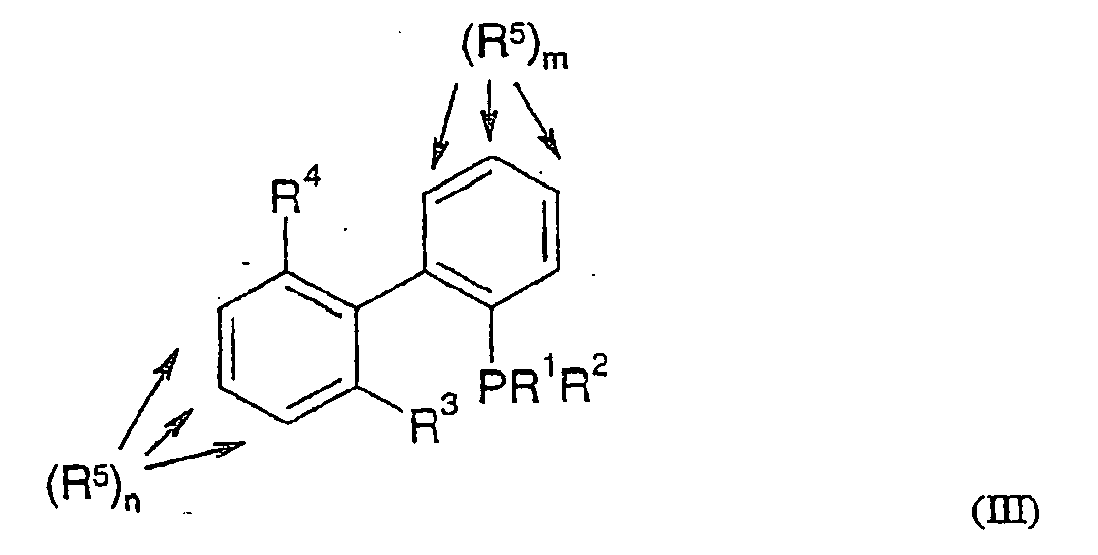
- in Gegenwart von alkalimetallhaltiger Base erfolgt.
Description
- Gegenstand der Erfindung ist ein Verfahren zur Herstellung von Arylpiperazinen aus den entsprechenden Arylchloriden oder -bromiden und Piperazin unter Verwendung einer Base und eines Katalysators, bestehend aus einem Palladium Salz und einem Bisaryl-dialkylphosphin.
- Monoarylpiperazine finden insbesondere als Bausteine zur Herstellung pharmazeutischer Wirkstoffe Verwendung.
- Es ist bekannt, Monoarylpiperazine ausgehend von Anilinen durch Reaktion mit aktivierten Diethylenaminen, wie z.B. Di-(chlorethyl)amin herzustellen. Nachteilig an diesen Verfahren ist der Umstand, dass nur wenige hochsubstituierte Aniline kommerziell verfügbar sind und die Wirtschaftlichkeit dieses Verfahrens somit nur für wenige Monoarylpiperazine gegeben ist.
- Weiterhin ist aus E. Brenner, R. Schneider, Y. Fort, Tetrahedron 58, (2002), 6913-6924 bekannt, Monoarylpiperazine durch Umsetzung von Chloraromaten und Piperazinen unter Verwendung eines Katalysators herzustellen, wobei der Katalysator aus Nickelacetat und 2,2' -Bipyridin besteht. Nachteilig an diesen Verfahren ist der Umstand, dass die Selektivität von Mono- zu Diarylierung bei diesen Reaktionen für industrielle Zwecke mit 85:15 zu gering ist und darüber hinaus mit 10 mol-% unverhältnismäßig große Mengen des toxischen Nickelacetates eingesetzt werden müssen.
- Die Reaktion von substituierten Arylhalogeniden mit Piperazin unter Verwendung eines Palladium-Triarylphosphin-Katalysators wurde erstmalig von Zhao beschrieben (S. Zhao, A.K. Miller, J. Berger, L.A. Flippin, Tetrahedron Letters, 37 (1997), 4463-4466). Dieses Verfahren erfordert jedoch ebenfalls große Katalysatormengen von 2 bis 5 mol-%, um akzeptable chemische Ausbeuten zu erreichen. Weiterhin nachteilig ist der Umstand, dass hohe Selektivitäten bei der Bildung von Monoarylpiperazinen im Vergleich zu Diarylpiperazinen nur erreicht werden können, wenn ein sehr hoher Überschuss von vier bis sechs Äquivalenten an Piperazin zugegeben wird, was sowohl die Aufarbeitung der Reaktion erschwert, wie auch zu höheren Kosten für die Durchführung der Reaktion führt.
- Die Selektivität der Reaktion kann durch Verwendung von einfach geschütztem Piperazin in der Reaktion erhöht werden (F. Kerrigan, C. Martin, G.H.Thomas, Tetrahedron Letters, 39 (1998), 2219-2222). Diese Maßnahme bedingt aber durch die Herstellung des geschützten Piperazins sowie die nachträgliche Entfernung der Schutzgruppe zwei unerwünschte zusätzliche Verfahrensschritte, die das Gesamtverfahren unwirtschaftlich machen.
- Akzeptable Ausbeuten unter Verwendung geringerer Mengen des Katalysators wurden durch Verwendung eines Palladium-Trisalkylphosphin-Katalysators erreicht (M. Nishiyama, Y. Koie, EP 0 802 173). Nachteilig an diesem Verfahren ist jedoch, dass ein sechsfacher Überschuss an Piperazin eingesetzt werden muss. Weiterhin wird dieses Verfahren unter Einsatz eines hochgradig luftempfindlichen und selbstentzündlichen Phosphins durchgeführt, so dass die Wirtschaftlichkeit des Verfahrens durch zusätzlich erforderliche Sicherheitsmaßnahmen leidet. Weiterhin gelingt dieses Verfahren oft nur bei Einsatz der teuren Arylbromide.
- Die Reaktion von Arylchloriden und Piperazin unter Verwendung eines Katalysators bestehend aus luftstabilen N-heterocyclischen Carbenen und einem Palladium-Salz sowie einer starken Alkoholat-Base ist ebenfalls bereits beschrieben worden (S.R. Stauffer, S. Lee, J.P. Stambuli, S.I. Hauk, J.F. Hartwig, Organic Letters 2 (10), 2000, 1423-1426), jedoch wird hier zur Herstellung der Arylpiperazine ausdrücklich erwähnt, dass große Katalysatormengen von 2 mol% notwendig sind. Auch in diesem Verfahren ist ein sehr hoher Überschuss an Piperazin notwendig.
- Es bestand demnach weiterhin das Bedürfnis, ein Verfahren bereitzustellen, mit dem eine Vielzahl von Arylhalogeniden mit guten chemischen Ausbeuten wirtschaftlich zu Monoarylpiperazinen umgesetzt werden können.
- Es wurde nun ein Verfahren zur Herstellung von Verbindungen der Formel (I) gefunden
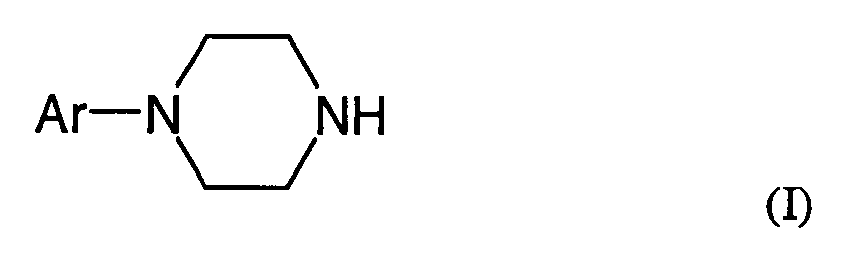
- Ar
- für einen mono-, bi- oder tricyclischen aromatischen Rest mit insgesamt 5 bis 18 Ringatomen steht, wobei pro Cyclus keines, ein oder zwei Ringatome ausgewählt ist aus der Gruppe Sauerstoff, Schwefel und Stickstoff und wobei der mono-, bi- oder tricyclische aromatische Rest gegebenenfalls einfach oder mehrfach substituiert ist,
- Verbindungen der Formel (II)
Ar―Hal (II)
in der Ar die vorstehend genannte Bedeutung besitzt und Hal für Chlor, Brom oder Iod steht - mit Piperazin umsetzt werden,
wobei die Umsetzung - in Gegenwart von Palladiumkomplexen, die als Liganden Verbindungen der Formel (III) tragen,

R1 und R2 jeweils unabhängig voneinander für C1-C12-Alkyl oder C5-C11-Arylalkyl stehen
R3 und R4 jeweils unabhängig voneinander für H, C1-C6-Alkyl, C1-C6-Alkoxy oder Di-C1-C6-Alkylamino, bevorzugt für C1-C6-Alkyl oder C1-C6-Alkoxy stehen,
die Reste R5 jeweils unabhängig voneinander für C1-C12-Alkyl, C1-C12-Alkoxy, C1-C12-Fluoralkyl, C1-C12-Fluoralkoxy, Fluor, C4-C10-Aryl oder C5-C11-Arylalkyl stehen und die Pfeile die möglichen Bindungsstellen zum jeweiligen Arylrest anzeigen und
n und m jeweils unabhängig voneinander für 0, 1, 2, oder 3 stehen und - in Gegenwart von alkalimetallhaltiger Base erfolgt.
- Der Rahmen der Erfindung umfasst alle oben stehenden und im Folgenden aufgeführten, allgemeinen oder in Vorzugsbereichen genannten Restedefinitionen, Parameter und Erläuterungen untereinander, also auch zwischen den jeweiligen Bereichen und Vorzugsbereichen in beliebiger Kombination.
- Alkyl beziehungsweise Alkoxy steht jeweils unabhängig für einen geradkettigen, cyclischen, verzweigten oder unverzweigten Alkyl- beziehungsweise Alkoxy-Rest, wobei die genannten Reste gegebenenfalls durch C1-C4-Alkoxy-Reste weiter substituiert sein können. Gleiches gilt für den Alkylenteil eines Arylalkylrestes oder den Alkylteil eines Di-Alkylaminorestes.
- C1-C6-Alkyl steht beispielsweise und bevorzugt für Methyl, Ethyl, n-Propyl, iso-Propyl, n-Butyl, sec.-Butyl, tert.-Butyl, n-Pentyl, 1-Methylbutyl, 2-Methylbutyl, 3-Methylbutyl, neo-Pentyl, 1-Ethylpropyl, cyclo-Hexyl, cyclo-Pentyl, n-Hexyl, C1-C12-Alkyl darüber hinaus z.B. für n-Heptyl, n-Octyl, n-Decyl und n-Dodecyl.
- C1-C12-Alkoxy steht beispielsweise und bevorzugt für Methoxy, Ethoxy, n-Propoxy, iso-Propoxy, n-Butoxy, sec.-Butoxy, tert.-Butoxy, n-Pentoxy, cyclo-Hexoxy, cyclo-Pentoxy, n-Hexoxy, C1-C12-Alkoxy darüber hinaus z.B. für n-Heptoxy, n-Octoxy, n-Decoxy und n-Dodecoxy.
- Di-C1-C6-Alkylamino steht beispielsweise bevorzugt für N,N-Dimethylamino, N,N-Diethylamino oder N,N-Di-isopropylamino.
- Fluoralkyl beziehungsweise Fluoralkoxy steht jeweils unabhängig für einen geradkettigen, cyclischen, verzweigten oder unverzweigten Alkyl-Rest beziehungsweise Alkoxy-Rest, der einfach, mehrfach oder vollständig durch Fluoratome substituiert ist.
- Beispielsweise steht C1-C12-Fluoralkyl für Trifluormethyl, 2,2,2-Trifluorethyl, Pentafluorethyl, Nonafluorbutyl, Heptafluorisopropyl, Perfluoroctyl und Perfluordodecyl.
- Beispielsweise steht C1-C12-Fluoralkoxy für Trifluormethoxy, 2,2,2-Trifluorethoxy, Pentafluorethoxy, Nonafluorbutoxy, Heptafluorisopropoxy, Perfluoroctoxy und Perfluordodecoxy.
- Aryl steht jeweils für einen Rest mit 5 bis 10 Gerüstkohlenstoffatomen, in denen heteroaromatischen ein, zwei oder drei Gerüstkohlenstoffatome pro Cyclus, durch Heteroatome, ausgewählt aus der Gruppe Stickstoff, Schwefel oder Sauerstoff, substituiert sein können, oder vorzugsweise für einen carbocyclischen aromatischen Rest mit 6 bis 14 Gerüstkohlenstoffatomen.
- Beispiele für mono-, bi- oder tricyclische carbocyclische aromatische Reste mit 6 bis 10 Gerüstkohlenstoffatomen sind Phenyl, Biphenyl, Naphtyl, Phenanthrenyl, Anthracenyl oder Fluorenyl, mono-, bi- oder tricyclische heteroaromatische Reste mit 5 bis 14 Gerüstkohlenstoffatomen in denen keines, ein, zwei oder drei Gerüstkohlenstoffatome pro Cyclus, im gesamten Molekül mindestens jedoch ein Gerüstkohlenstoffatom, durch Heteroatome, ausgewählt aus der Gruppe Stickstoff, Schwefel oder Sauerstoff, substituiert sein können, sind beispielsweise Pyridinyl, Oxazolyl, Benzofuranyl, Dibenzofuran-yl oder Chinolinyl.
- Weiterhin kann der carbocyclische aromatische Rest oder heteroaromatische Rest mit bis zu fünf gleichen oder verschiedenen Substituenten pro Cyclus substituiert sein, die ausgewählt sind aus der Gruppe Fluor, Cyano, C1-C12-Alkyl, C1-C12-Fluoralkyl, C1-C12-Fluoralkoxy, C1-C12-Alkoxy oder Di(C1-C8-alkyl)amino.
- Arylalkyl bedeutet jeweils unabhängig einen geradkettigen, cyclischen, verzweigten oder unverzweigten Alkyl-Rest nach vorstehender Definition, der einfach, mehrfach oder vollständig durch Aryl-Reste gemäß vorstehender Definition substituiert sein kann.
- Im Folgenden werden die bevorzugten Substitutionsmuster für die Formeln (I) und (II) definiert:
- Ar
- steht bevorzugt für Aryl nach vorstehender Definition, besonders bevorzugt für einen Phenyl oder Naphthylrest, der nicht, einfach, zweifach oder dreifach mit Resten substituiert ist, die ausgewählt sind aus der Gruppe Nitro, Cyano, Chlor, Fluor, C1-C12-Alkyl, C1-C12-Fluoralkyl, C1-C12-Fluoralkoxy, C1-C12-Alkoxy, Di(C1-C8-alkyl)amino und ganz besonders bevorzugt für einen Phenylrest, der nicht, einfach, zweifach oder dreifach mit Resten substituiert ist, die ausgewählt sind aus der Gruppe Fluor, C1-C4-Alkyl, C1-C4-Fluoralkyl, C1-C4-Fluoralkoxy oder C1-C4-Alkoxy.
- Hal
- steht bevorzugt für Chlor oder Brom, besonders bevorzugt für Chlor.
- Eine besonders bevorzugte Verbindung der Formel (I) ist 4-Trifluormethylphenylpiperazin, eine besonders bevorzugte Verbindung der Formel (II) 4-Trifluormethylchlorbenzol (oft auch als 4-Chlorbenzotrifluorid bezeichnet).
- Im Folgenden werden die bevorzugten Substitutionsmuster für Formel (III) definiert:
- R1und R2
- stehen bevorzugt jeweils unabhängig für iso-Propyl, tert-Butyl, Cyclopentyl oder Cyclohexyl, besonders bevorzugt jeweils identisch für vorstehend genannte Reste und ganz besonders bevorzugt jeweils identisch für Cyclohexyl.
- R3 und R4
- stehen bevorzugt jeweils unabhängig für H, Methyl, Ethyl, iso-Propyl, Methoxy oder N,N-Dimethylamino, besonders bevorzugt für Methyl, Ethyl, iso-Propyl oder Methoxy, ganz besonders bevorzugt jeweils identisch für vorstehend genannte Reste und in bevorzugten Ausführungsformen jeweils identisch für iso-Propyl oder Methoxy.
- n
- steht bevorzugt für 0 oder 1,
- m
- steht bevorzugt für 0.
- R5
- steht bevorzugt jeweils unabhängig für Methyl, Ethyl, iso-Propyl und Methoxy.
- Besonders bevorzugte Verbindungen der Formel (III) sind [2-(2,4,6-Triisopropylphenyl)-phenyl]-dicyclohexylphosphin und [2-(2,6-Dimethoxyphenyl)-phenyl]-dicyclohexylphosphin.
- Die Verbindungen der Formel (III) sind literaturbekannt und beispielsweise gemäß E.R. Strieter, D.G. Blackmond, S.L. Buchwald, Journal of the American Chemical Society, 125, 2003, 13978-13980 herstellbar.
- Als Palladiumkomplexe, die als Liganden Verbindungen der Formel (III) tragen, kommen beispielsweise isolierte oder präformierte Palladiumkomplexe enthaltend Verbindungen der Formel (III) oder solche in Betracht, die durch Umsetzung eines Palladiumprecursors mit Verbindungen der Formel (III) im Reaktionsmedium erzeugt werden.
- Vorzugsweise werden die für das Verfahren eingesetzten Palladiumkomplexe durch Umsetzung eines Palladiumprecursors mit Verbindungen der Formel (III) im Reaktionsmedium erzeugt.
- Geeignete Palladiumprecursoren sind alle Palladiumverbindungen, die mit Verbindungen der Formel (III) unter Ausbildung einer Palladium-Phosphor-Koordination reagieren können.
- Bevorzugte Palladiumprecursoren sind: Pd2(dibenzylidenaceton)3 oder Allylpalladiumchlorid oder -bromid oder Palladiumverbindungen der Formel (IVa),
PdY1 2 (IVa)
in der - Y1
- für ein Anion, bevorzugt für Chlorid, Bromid, Acetat, Propionat, Nitrat, Methansulfonat, Trifluormethansulfonat, Acetylacetonat, Allyl oder Cyclopentadienyl steht,
- Y2
- für ein Anion, bevorzugt Chlorid, Bromid, Acetat, Methansulfonat oder Tri-fluormethansulfonat, Nonafluorbutansulfonat, Tetrafluoroborat oder Hexafluorophosphat steht und
- L
- jeweils für ein Nitril, bevorzugt Acetonitril, Benzonitril oder Benzylnitril, oder ein Olefin, bevorzugt Cyclohexen oder Cycloocten, steht, oder
- L2
- zusammen für ein Diolefin, bevorzugt Norbornadien oder 1,5-Cyclooctadien steht.
- Bevorzugt sind als Palladiumprecursoren Palladium(II)acetat und [Pd2(dba)3].
- Das molare Verhältnis von Palladium zu Verbindungen der Formel (III) kann beispielsweise 1 bis 4 betragen, bevorzugt jedoch 1,5 bis 2,5 und besonders bevorzugt 1,5 bis 2,2, insbesondere genau 2.
- Das molare Verhältnis von Palladium zu Verbindungen der Formel (I) kann beispielsweise 0,000001 bis 0,05 betragen, bevorzugt jedoch 0,00001 bis 0,01 und besonders bevorzugt 0,0001 bis 0,001.
- Das erfindungsgemäße Verfahren wird in Gegenwart von alkalimetallhaltiger Base durchgeführt. Alkalimetallhaltige Basen sind beispielsweise und bevorzugt Alkalimetall- oder Erdalkalimetall-hydroxide oder -alkanolate, wie beispielsweise Lithium-, Natrium-, Kalium- oder Calciumhydroxid, Natrium- oder Kalium-methanolat, -ethanolat, -n- oder -i-propanolat, -n-, -i-, -s- oder -t-butanolat oder i-Pentanolat; besonders bevorzugt Natrium- oder Kalium-hydroxid oder -tertiärbutanolat und ganz besonders bevorzugt Natriumhydroxid.
- Das molare Verhältnis von alkalimetallhaltiger Base zu Verbindungen der Formel (I) kann beispielsweise 1 bis 2,2 betragen, bevorzugt jedoch 1,2 bis 1,6 und besonders bevorzugt 1,4. Größere Mengen sind möglich, jedoch unwirtschaftlich.
- Das molare Verhältnis von Piperazin zu Verbindungen der Formel (I) kann beispielsweise 1 bis 3, bevorzugt jedoch 1,5 bis 2 und besonders bevorzugt 1,5. Größere Mengen sind möglich, jedoch unwirtschaftlich.
- In einer bevorzugten Ausführungsform wird das Verfahren weiterhin in Gegenwart von organischem Lösungsmittel durchgeführt. Als organische Lösungsmittel eignen sich insbesondere aromatische Kohlenwasserstoffe, wie beispielsweise Benzol, Toluol und Xylole; Amide, wie beispielsweise N,N-Dimethylformamid, N,N-Dimethylacetamid, N-Methyl-formanilid, N-Methylpyrrolidon und N-Methylcaprolactam; Ether, wie beispielsweise Diethylether, Methyl-tert.-butylether, Diisopropylether, Dioxan, Tetrahydrofuran oder Ethylenglykoldimethyl- oder -diethylether; Alkohole, wie beispielsweise Methanol, Ethanol, n- oder i-Propanol, tert.- Butanol, Ethylenglykolmonomethylether, Ethylenglykolmonoethylether, Diethylenglykolmonomethylether, Diethylenglykolmonoethylether, tertiäre Amine, wie beispielsweise Tri-n-butylamin oder Triethylamin oder Gemische solcher organischen Lösungsmittel.
- Als organische Lösungsmittel haben sich besonders bewährt: Mischungen von aromatischen Kohlenwasserstoffen und Ethern, wie insbesondere eine Mischung aus Toluol und Tetrahydrofuran, Mischungen von aromatische Kohlenwasserstoffen und Alkoholen wie insbesondere Mischungen aus Toluol und Methanol sowie tertiäre Amine.
- Die Reaktionstemperatur kann beispielsweise 30 bis 150°C betragen, bevorzugt 60 bis 150°C, besonders bevorzugt 70 bis 120°C, der Reaktionsdruck 0,5 bis 100 bar, bevorzugt ist Umgebungsdruck.
- Auf erfindungsgemäße Weise können Verbindungen der Formel (I) in hoher Reinheit und Ausbeute in einfacher Weise erhalten werden.
- Der Vorteil des erfindungsgemäßen Verfahrens liegt insbesondere darin, dass bei geringen Katalysatormengen hohe chemische Ausbeuten an Monoarylpiperazinen erhalten werden können, ohne einen hohen Überschuß an Piperazin verwenden zu müssen.
- Chlorbenzotrifluorid (18,5g, 100 mmol) und Piperazin (12,9g) wurden in 400 ml Xylol vorgelegt und durch Durchleiten von Stickstoff 15 min. bei Raumtemperatur entgast. Trockenes Natrium-tert.butylat (13,5 g, 140mmol) wurde zugegeben und weitere 10 min. entgast. In einem separaten Gefäß wurden Tris-tert.-butylphosphin (81 mg, 0,4 mmol) unter sorgfältigem Ausschluss von Luft und Palladium-dibenzylideneaceton (41 mg, 0,05 mmol) in 10 ml entgastem Tetrahydrofuran unter Stickstoff gerührt. Nach 30 min. wurde diese Katalysatorlösung mithilfe einer Überführungsnadel in den größeren Kolben bei Raumtemperatur eingetropft. Nach vollständiger Zugabe wurde die Reaktion auf 120°C Innentemperatur erwärmt. Nach 8 h ließ man die Reaktion auf 50°C abkühlen und filtrierte vom ausgefallen Feststoff ab. Das Lösungsmittel wurde im Vakuum entfernt und das Rohprodukt durch chromatographische Reinigung an Kieselgel isoliert. Man erhielt 12,4 g (54 mmol, 54% d. Th.) N-(4-Trifluoromethylphenyl)-piperazin.
- Chlorbenzotrifluorid (18,5 g, 100 mmol) und Piperazin (12,9g, 150 mmol) wurden in einem Gemisch von 120 ml Toluol und 80 ml Tetrahydrofuran gelöst und durch Durchleiten von Stickstoff 15 min. bei Raumtemperatur entgast. Trockenes Natrium-tert.butylat (13,5 g, 140 mmol) wurde zugegeben und weitere 10 min. entgast. In einem separaten Gefäß wurden [2-(2,6-Dimethoxyphenyl)-phenyl]-dicyclohexylphosphin (41 mg, 0,1 mmol) und Palladium-dibenzylideneaceton (20 mg, 0,025 mmol) und in 10ml entgastem Tetrahydrofuran unter Stickstoff gerührt. Nach 30 min. wurde diese Katalysatorlösung mithilfe einer Überführungsnadel in den größeren Kolben bei Raumtemperatur eingetropft. Nach vollständiger Zugabe wurde die Reaktion auf 90°C Innentemperatur erwärmt. Nach 8 h lies man die Reaktion auf 50°C abkühlen und filtrierte vom ausgefallen Feststoff ab. Das Filtrat wurde mit verdünnter Salzsäure bei pH 3 extrahiert. Die wässrige Phase wurde abgetrennt und mithilfe von Natronlauge auf pH 10 eingestellt. Der ausgefallene weiße Feststoff wurde abfiltriert und im Hochvakuum getrocknet. Man erhielt 21,4 g (93 mmol, 93 % d. Th.) N-(4-Trifluoromethylphenyl)-piperazin. Der Gehalt des Feststoffes an Produkt wurde über quantitatives Protonen-NMR auf >99% festgestellt.
- Chlorbenzotrifluorid (18,5 g, 100 mmol) und Piperazin (12,9 g, 150 mmol) wurden in einem Gemisch von 120 ml Toluol und 80 ml Tetrahydrofuran gelöst und durch Durchleiten von Stickstoff 15 min. bei Raumtemperatur entgast. Trockenes Natrium-tert.butylat (13,5 g, 140 mmol) wurde zugegeben und weitere 10min. entgast. In einem separaten Gefäß wurden [2-(2,6-Dimethoxyphenyl)-phenyl]-dicyclohexylphosphin (164 mg, 0,4 mmol) und Palladiumacetat (45 mg, 0,2 mmol) und in 10ml entgastem Tetrahydrofuran unter Stickstoff gerührt. Nach 30 min. wurde diese Katalysatorlösung mithilfe einer Überführungsnadel in den größeren Kolben bei Raumtemperatur eingetropft. Nach vollständiger Zugabe wurde die Reaktion auf 90°C Innentemperatur erwärmt. Nach 8 h lies man die Reaktion auf 50°C abkühlen und filtrierte vom ausgefallen Feststoff ab. Das Filtrat wurde mit verdünnter Salzsäure bei pH 3 extrahiert. Die wässrige Phase wurde abgetrennt und mithilfe von Natronlauge auf pH 10 eingestellt. Der ausgefallene weisse Feststoff wurde abfiltriert und im Hochvakuum getrocknet. Man erhielt 21,8 g (95 mmol, 95 % d. Th.) N-(4-Trifluoromethylphenyl)-piperazin. Der Gehalt des Feststoffes an Produkt wurde über quantitatives Protonen-NMR auf >99% festgestellt.
- Chlorbenzotrifluorid (18,5 g, 100 mmol) und Piperazin (12,9 g, 150 mmol) wurden in einem Gemisch von 120 ml Toluol und 80 ml Methanol gelöst und durch Durchleiten von Stickstoff 15 min. bei Raumtemperatur entgast. Natriumhydroxid (5,6 g, 140 mmol) wurde zugegeben und weitere 10 min. entgast. In einem separaten Gefäß wurden [2-(2,4,6-Triisopropylphenyl)-phenyl]-dicyclohexylphosphin (95 mg, 0,2 mmol) und Palladium-dibenzylideneaceton (40 mg, 0,05 mmol) und in 10 ml entgastem Tetrahydrofuran unter Stickstoff gerührt. Nach 30 min. wurde diese Katalysatorlösung mithilfe einer Überführungsnadel in den größeren Kolben bei Raumtemperatur eingetropft. Nach vollständiger Zugabe wurde die Reaktion auf 78°C Innentemperatur erwärmt. Nach 8 h lies man die Reaktion auf 50°C abkühlen und filtrierte vom ausgefallen Feststoff ab. Das Filtrat wurde mit verdünnter Salzsäure bei pH 3 extrahiert. Die wässrige Phase wurde abgetrennt und mithilfe von Natronlauge auf pH 10 eingestellt. Der ausgefallene weiße Feststoff wurde abfiltriert und im Hochvakuum getrocknet. Man erhielt 21,8 g (95 mmol, 95 % d. Th.) N-(4-Trifluoromethylphenyl)-piperazin. Der Gehalt des Feststoffes an Produkt wurde über quantitatives Protonen-NMR auf >99% festgestellt.
- Chlorbenzotrifluorid (18,5 g, 100 mmol) und Piperazin (12,9 g, 150 mmol) wurden in 200 ml Tri-n-butylamin gelöst und durch Durchleiten von Stickstoff 15 min. bei Raumtemperatur entgast. Trockenes Natrium-tert.butylat (13,5 g, 140 mmol) wurde zugegeben und weitere 10 min. entgast. In einem separaten Gefäß wurden [2-(2,6-Dimethoxyphenyl)-phenyl]-dicyclohexylphosphin (41 mg, 0,1 mmol) und Palladium-dibenzylideneaceton (20 mg, 0,025 mmol) und in 5ml entgastem Tetrahydrofuran unter Stickstoff gerührt. Nach 30 min. wurde diese Katalysatorlösung mithilfe einer Überführungsnadel in den größeren Kolben bei Raumtemperatur eingetropft. Nach vollständiger Zugabe wurde die Reaktion auf 110°C Innentemperatur erwärmt. Nach 8 h lies man die Reaktion auf 50°C abkühlen und filtrierte vom ausgefallen Feststoff ab. Das Filtrat wurde im Vakuum eingeengt und mit verdünnter Salzsäure bei pH 3 extrahiert. Die wässrige Phase wurde abgetrennt und mithilfe von Natronlauge auf pH 10 eingestellt. Der ausgefallene weiße Feststoff wurde abfiltriert und im Hochvakuum getrocknet. Man erhielt 22,1 g (96 mmol, 96 % d. Th.) N-(4-Trifluoromethylphenyl)-piperazin. Der Gehalt des Feststoffes an Produkt wurde über quantitatives Protonen-NMR auf >99% festgestellt.
- Brombenzotrifluorid (22,5 g, 100 mmol) und Piperazin (12,9 g, 150 mmol) wurden in 200 ml Toluol gelöst und durch Durchleiten von Stickstoff 15 min. bei Raumtemperatur entgast. Trockenes Natrium-tert.butylat (13,5 g, 140 mmol) wurde zugegeben und weitere 10 min. entgast. In einem separaten Gefäß wurden [2-(2,4,6-Triisopropylphenyl)-phenyl]-dicyclohexylphosphin (95 mg, 0,2 mmol) und Palladiumacetat (23 mg, 0,1 mmol) und in 10 ml entgastem Tetrahydrofuran unter Stickstoff gerührt. Nach 30 min. wurde diese Katalysatorlösung mithilfe einer Überführungsnadel in den größeren Kolben bei Raumtemperatur eingetropft. Nach vollständiger Zugabe wurde die Reaktion auf 110°C Innentemperatur erwärmt. Nach 8 h lies man die Reaktion auf 50°C abkühlen und filtrierte vom ausgefallen Feststoff ab. Das Filtrat wurde mit verdünnter Salzsäure bei pH 3 extrahiert. Die wässrige Phase wurde abgetrennt und mithilfe von Natronlauge auf pH 10 eingestellt. Der ausgefallene weiße Feststoff wurde abfiltriert und im Hochvakuum getrocknet. Man erhielt 22,1 g (96 mmol, 96 % d. Th.) N-(4-Trifluoromethylphenyl)-piperazin. Der Gehalt des Feststoffes an Produkt wurde über quantitatives Protonen-NMR auf >99% festgestellt.
- 4-Cyanochlorbenzol (13,8 g, 100 mmol) und Piperazin (12,9 g, 150 mmol) wurden in einem Gemisch von 120 ml Toluol und 80 ml Tetrahydrofuran gelöst und durch Durchleiten von Stickstoff 15 min. bei Raumtemperatur entgast. Trockenes Natrium-tert.butylat (13,5 g, 140 mmol) wurde zugegeben und weitere 10 min. entgast. In einem separaten Gefäß wurden [2-(2,4,6-Triisopropylphenyl)-phenyl]-dicyclohexylphosphin (95 mg, 0,2 mmol) und Palladium-dibenzylideneaceton (40 mg, 0,05 mmol) in 10 ml entgastem Tetrahydrofuran unter Stickstoff gerührt. Nach 30 min. wurde diese Katalysatorlösung mithilfe einer Überführungsnadel in den größeren Kolben bei Raumtemperatur eingetropft. Nach vollständiger Zugabe wurde die Reaktion auf 90°C Innentemperatur erwärmt. Nach 8h lies man die Reaktion auf 50°C abkühlen und filtrierte vom ausgefallen Feststoff ab. Das Filtrat wurde mit verdünnter Salzsäure bei pH 3 extrahiert. Die wässrige Phase wurde abgetrennt und mithilfe von Natronlauge auf pH 10 eingestellt. Der ausgefallene weiße Feststoff wurde abfiltriert und im Hochvakuum getrocknet. Man erhielt 17,8 g (95 mmol, 95 % d.Th.) N-(4-Cyanophenyl)-piperazin. Der Gehalt des Feststoffes an Produkt wurde über quantitatives Protonen-NMR auf >99% festgestellt.
PdY2 2L2 (IVb)
in der
Claims (8)
- Verfahren zur Herstellung von Verbindungen der Formel (I),
 Ar für einen mono-, bi- oder tricyclischen aromatischen Rest mit insgesamt 5 bis 18 Ringatomen steht, wobei pro Cyclus keines oder ein Ringatom ausgewählt ist aus der Gruppe Sauerstoff, Schwefel und Stickstoff und wobei der mono-, bi- oder tricyclische aromatische Rest gegebenenfalls einfach oder mehrfach substituiert ist,dadurch gekennzeichnet, dass• Verbindungen der Formel (II)
Ar―Hal (II)
in der Ar die vorstehend genannte Bedeutung besitzt und Hal für Chlor, Brom oder Iod steht• mit Piperazin umsetzt werden,wobei die Umsetzung• in Gegenwart von Palladiumkomplexen, die als Liganden Verbindungen der Formel (III) tragen,
R1 und R2 jeweils unabhängig voneinander für C1-C12-Alkyl oder C5-C11-Arylalkyl stehen
R3 und R4 jeweils unabhängig voneinander für H, C1-C6-Alkyl, C1-C6-Alkoxy oder Di-C1-C6-Alkylamino stehen,
die Reste R5 jeweils unabhängig voneinander für C1-C12-Alkyl, C1-C12-Alkoxy, C1-C12-Fluoralkyl, C1-C12-Fluoralkoxy, Fluor, C4-C10-Aryl oder C5-C11-Arylalkyl stehen und die Pfeile die möglichen Bindungsstellen zum jeweiligen Arylrest anzeigen und
n und m jeweils unabhängig voneinander für 0, 1, 2, oder 3 stehen und• in Gegenwart von alkalimetallhaltiger Base erfolgt. - Verfahren nach Anspruch 1, dadurch gekennzeichnet, dass als Palladiumkomplexe, die als Liganden Verbindungen der Formel (III) tragen, solche eingesetzt werden, die durch Umsetzung eines Palladiumprecursors mit Verbindungen der Formel (III) im Reaktionsmedium erzeugt werden.
- Verfahren nach Anspruch 1 oder 2, dadurch gekennzeichnet, dass das molare Verhältnis von Palladium zu Verbindungen der Formel (III) 1 bis 4 beträgt.
- Verfahren nach Anspruch 1, 2 oder 3, dadurch gekennzeichnet, dass das molare Verhältnis von Palladium zu Verbindungen der Formel (I) 0,000001 bis 0,05 beträgt.
- Verfahren nach Anspruch 1, 2, 3 oder 4, dadurch gekennzeichnet, dass als alkalimetallhaltige Basen Alkalimetall- oder Erdalkalimetall-hydroxide oder -alkanolate eingesetzt werden.
- Verfahren nach Anspruch 1, 2, 3, 4 oder 5, dadurch gekennzeichnet, dass das molare Verhältnis von Piperazin zu Verbindungen der Formel (I) 1,2 bis 1,8 beträgt.
- Verfahren nach Anspruch 1, 2, 3, 4, 5 oder 6, dadurch gekennzeichnet, dass das Verfahren weiterhin in Gegenwart von organischem Lösungsmittel durchgeführt wird.
- Verfahren nach Anspruch 7, dadurch gekennzeichnet, dass als organische Lösungsmittel aromatische Kohlenwasserstoffe, Amide, Ether, Alkohole, tertiäre Amine oder Gemische solcher organischen Lösungsmittel eingesetzt werden.
Applications Claiming Priority (1)
| Application Number | Priority Date | Filing Date | Title |
|---|---|---|---|
| DE102004022765A DE102004022765A1 (de) | 2004-05-05 | 2004-05-05 | Verfahren zur Herstellung von Monoarylpiperazinen |
Publications (1)
| Publication Number | Publication Date |
|---|---|
| EP1619188A1 true EP1619188A1 (de) | 2006-01-25 |
Family
ID=35124299
Family Applications (1)
| Application Number | Title | Priority Date | Filing Date |
|---|---|---|---|
| EP05008949A Withdrawn EP1619188A1 (de) | 2004-05-05 | 2005-04-23 | Verfahren zur Herstellung von Monoarylpiperazinen |
Country Status (4)
| Country | Link |
|---|---|
| US (1) | US20050250791A1 (de) |
| EP (1) | EP1619188A1 (de) |
| JP (1) | JP2005320332A (de) |
| DE (1) | DE102004022765A1 (de) |
Families Citing this family (2)
| Publication number | Priority date | Publication date | Assignee | Title |
|---|---|---|---|---|
| KR20070086565A (ko) * | 2004-11-24 | 2007-08-27 | 유씨비 파마, 에스.에이. | 특정 용매계에서 pd촉매화된 cn 커플링 방법 |
| CN102060712A (zh) * | 2010-12-28 | 2011-05-18 | 天津市筠凯化工科技有限公司 | 4-三氟甲基苯基哌嗪制备方法 |
Citations (1)
| Publication number | Priority date | Publication date | Assignee | Title |
|---|---|---|---|---|
| WO2000002887A2 (en) * | 1998-07-10 | 2000-01-20 | Massachusetts Institute Of Technology | Ligands for metals and metal-catalyzed processes |
Family Cites Families (4)
| Publication number | Priority date | Publication date | Assignee | Title |
|---|---|---|---|---|
| US5929281A (en) * | 1996-04-19 | 1999-07-27 | Tosoh Corporation | Process for producing heterocyclic aromatic amine or arylamine |
| US6867310B1 (en) * | 1997-11-20 | 2005-03-15 | Massachusetts Institute Of Technology | Arylation and vinylation of activated carbons |
| US6395916B1 (en) * | 1998-07-10 | 2002-05-28 | Massachusetts Institute Of Technology | Ligands for metals and improved metal-catalyzed processes based thereon |
| US6307087B1 (en) * | 1998-07-10 | 2001-10-23 | Massachusetts Institute Of Technology | Ligands for metals and improved metal-catalyzed processes based thereon |
-
2004
- 2004-05-05 DE DE102004022765A patent/DE102004022765A1/de not_active Withdrawn
-
2005
- 2005-04-23 EP EP05008949A patent/EP1619188A1/de not_active Withdrawn
- 2005-05-02 JP JP2005134676A patent/JP2005320332A/ja not_active Withdrawn
- 2005-05-03 US US11/120,488 patent/US20050250791A1/en not_active Abandoned
Patent Citations (1)
| Publication number | Priority date | Publication date | Assignee | Title |
|---|---|---|---|---|
| WO2000002887A2 (en) * | 1998-07-10 | 2000-01-20 | Massachusetts Institute Of Technology | Ligands for metals and metal-catalyzed processes |
Non-Patent Citations (2)
| Title |
|---|
| HEPPERLE M ET AL: "Mono N-arylation of piperazine(III): metal-catalyzed N-arylation and its application to the novel preparations of the antifungal posaconazole and its advanced intermediate", TETRAHEDRON LETTERS, ELSEVIER, AMSTERDAM, NL, vol. 43, no. 18, 29 April 2002 (2002-04-29), pages 3359 - 3363, XP004349385, ISSN: 0040-4039 * |
| SUN L-Q ET AL: "Palladium-catalyzed amination of 3-bromo-4-fluoro-acetophenone", TETRAHEDRON LETTERS, ELSEVIER, AMSTERDAM, NL, vol. 43, no. 51, 16 December 2002 (2002-12-16), pages 9291 - 9294, XP004392959, ISSN: 0040-4039 * |
Also Published As
| Publication number | Publication date |
|---|---|
| US20050250791A1 (en) | 2005-11-10 |
| DE102004022765A1 (de) | 2005-12-15 |
| JP2005320332A (ja) | 2005-11-17 |
Similar Documents
| Publication | Publication Date | Title |
|---|---|---|
| DE60131985T2 (de) | Katalysator für aromatische c-o, c-n und c-c-bindungsbildung | |
| DE69914337T2 (de) | Verbesserte arylamin-synthese | |
| EP2185500B1 (de) | Verfahren zur herstellung von biarylen | |
| EP1437355B1 (de) | Kupfer-Carben-Komplexe und ihre Verwendung | |
| EP0846676B1 (de) | Synthese von aromatischen Aminen aus Chloraromaten | |
| EP1856024B1 (de) | Verfahren zur herstellung substituierter biphenyle | |
| DE602004012712T2 (de) | Phosphinverbindung, zwischenverbindung, palladiumkomplex, und deren verwendung | |
| EP1437356A1 (de) | Kupferkomplexe und ihre Verwendung | |
| EP1899289B1 (de) | Verfahren zur herstellung von arylaminen, arylethern und arylthioethern | |
| DE10152989A1 (de) | Komplexe N-heterocyslischer Carbene und ihre Verwendung | |
| DE102004022765A1 (de) | Verfahren zur Herstellung von Monoarylpiperazinen | |
| EP1437340B1 (de) | Verfahren zur Herstellung von Aminodiphenylaminen | |
| EP1775276B1 (de) | Verfahren zur Kupplung von Benzylaminen mit Halogenaromaten | |
| WO1999036388A1 (de) | Katalytische synthese von n-alkylierten anilinen aus olefinen und anilinen | |
| WO1999065861A1 (de) | Verfahren zur symmetrischen und unsymmetrischen disubstitution von carbonsäureamiden mit organotitanaten und grignard-reagenzien | |
| DE102004029695A1 (de) | Verfahren zur Herstellung von Arylaminen | |
| DE102009045366A1 (de) | Polycyclische Pentafluorsulfanylbenzolverbindung und Verfahren zur Herstellung der Verbindung | |
| WO1999065858A1 (de) | Verfahren zur katalytischen, unsymmetrischen disubstitution von carbonsäureamiden mit zwei unterschiedlichen grignard-reagenzien | |
| DE2804263A1 (de) | Verfahren zur herstellung von indolin-derivaten | |
| DE102005016344A1 (de) | Verfahren zur Herstellung von Diarylbenzidinen | |
| DE3403778A1 (de) | Cyanomethyl-(2-cyano-ethyl)-(3-hydroxy-propyl)-amin seine verwendung zur herstellung von 1-(3-hydroxy-propyl)-1,4-diazepan und 1,4-bis(3-(3,4,5-trimethoxybenzoyloxy)-propyl)-diazepan | |
| DE69714404T2 (de) | Verfahren zur herstellung von benzyl-metall-verbindungen und verfahren zur herstellung von 4-phenyl-1-butenen unter verwendung derselben | |
| EP1087930A1 (de) | Verfahren zur katalytischen disubstitution von carbonsäureamiden mit wenigstens einem grignard-reagenz | |
| DE10001208B4 (de) | Verfahren zur homogen-katalytischen Hydroaminierung von Alkinen für die Herstellung von Enaminen, Iminen, Indolen und Diaminen und deren Weiterverarbeitung durch katalytische Hydrierung | |
| WO2023198596A1 (de) | Metallorganische verbindungen, deren herstellung und verwendung |
Legal Events
| Date | Code | Title | Description |
|---|---|---|---|
| PUAI | Public reference made under article 153(3) epc to a published international application that has entered the european phase |
Free format text: ORIGINAL CODE: 0009012 |
|
| AK | Designated contracting states |
Kind code of ref document: A1 Designated state(s): AT BE BG CH CY CZ DE DK EE ES FI FR GB GR HU IE IS IT LI LT LU MC NL PL PT RO SE SI SK TR |
|
| AX | Request for extension of the european patent |
Extension state: AL BA HR LV MK YU |
|
| RAP1 | Party data changed (applicant data changed or rights of an application transferred) |
Owner name: SALTIGO GMBH |
|
| 17P | Request for examination filed |
Effective date: 20060725 |
|
| AKX | Designation fees paid |
Designated state(s): AT BE BG CH CY CZ DE DK EE ES FI FR GB GR HU IE IS IT LI LT LU MC NL PL PT RO SE SI SK TR |
|
| RAP1 | Party data changed (applicant data changed or rights of an application transferred) |
Owner name: SALTIGO GMBH |
|
| 17Q | First examination report despatched |
Effective date: 20120816 |
|
| RAP1 | Party data changed (applicant data changed or rights of an application transferred) |
Owner name: SALTIGO GMBH |
|
| STAA | Information on the status of an ep patent application or granted ep patent |
Free format text: STATUS: THE APPLICATION HAS BEEN WITHDRAWN |
|
| 18W | Application withdrawn |
Effective date: 20141216 |