EP1611051B1 - Urea based composition and system for same - Google Patents
Urea based composition and system for same Download PDFInfo
- Publication number
- EP1611051B1 EP1611051B1 EP04717956A EP04717956A EP1611051B1 EP 1611051 B1 EP1611051 B1 EP 1611051B1 EP 04717956 A EP04717956 A EP 04717956A EP 04717956 A EP04717956 A EP 04717956A EP 1611051 B1 EP1611051 B1 EP 1611051B1
- Authority
- EP
- European Patent Office
- Prior art keywords
- urea
- ammonia
- water
- composition
- reaction
- Prior art date
- Legal status (The legal status is an assumption and is not a legal conclusion. Google has not performed a legal analysis and makes no representation as to the accuracy of the status listed.)
- Expired - Lifetime
Links
Images

Classifications
-
- C—CHEMISTRY; METALLURGY
- C01—INORGANIC CHEMISTRY
- C01C—AMMONIA; CYANOGEN; COMPOUNDS THEREOF
- C01C1/00—Ammonia; Compounds thereof
- C01C1/02—Preparation, purification or separation of ammonia
- C01C1/08—Preparation of ammonia from nitrogenous organic substances
- C01C1/086—Preparation of ammonia from nitrogenous organic substances from urea
-
- C—CHEMISTRY; METALLURGY
- C01—INORGANIC CHEMISTRY
- C01B—NON-METALLIC ELEMENTS; COMPOUNDS THEREOF; METALLOIDS OR COMPOUNDS THEREOF NOT COVERED BY SUBCLASS C01C
- C01B3/00—Hydrogen; Gaseous mixtures containing hydrogen; Separation of hydrogen from mixtures containing it; Purification of hydrogen; Reversible storage of hydrogen
- C01B3/02—Production of hydrogen; Production of gaseous mixtures containing hydrogen
- C01B3/04—Production of hydrogen; Production of gaseous mixtures containing hydrogen by decomposition of inorganic compounds
-
- B—PERFORMING OPERATIONS; TRANSPORTING
- B01—PHYSICAL OR CHEMICAL PROCESSES OR APPARATUS IN GENERAL
- B01J—CHEMICAL OR PHYSICAL PROCESSES, e.g. CATALYSIS OR COLLOID CHEMISTRY; THEIR RELEVANT APPARATUS
- B01J8/00—Chemical or physical processes in general, conducted in the presence of fluids and solid particles; Apparatus for such processes
- B01J8/0005—Catalytic processes under superatmospheric pressure
-
- B—PERFORMING OPERATIONS; TRANSPORTING
- B01—PHYSICAL OR CHEMICAL PROCESSES OR APPARATUS IN GENERAL
- B01J—CHEMICAL OR PHYSICAL PROCESSES, e.g. CATALYSIS OR COLLOID CHEMISTRY; THEIR RELEVANT APPARATUS
- B01J8/00—Chemical or physical processes in general, conducted in the presence of fluids and solid particles; Apparatus for such processes
- B01J8/02—Chemical or physical processes in general, conducted in the presence of fluids and solid particles; Apparatus for such processes with stationary particles, e.g. in fixed beds
- B01J8/04—Chemical or physical processes in general, conducted in the presence of fluids and solid particles; Apparatus for such processes with stationary particles, e.g. in fixed beds the fluid passing successively through two or more beds
-
- B—PERFORMING OPERATIONS; TRANSPORTING
- B01—PHYSICAL OR CHEMICAL PROCESSES OR APPARATUS IN GENERAL
- B01J—CHEMICAL OR PHYSICAL PROCESSES, e.g. CATALYSIS OR COLLOID CHEMISTRY; THEIR RELEVANT APPARATUS
- B01J8/00—Chemical or physical processes in general, conducted in the presence of fluids and solid particles; Apparatus for such processes
- B01J8/18—Chemical or physical processes in general, conducted in the presence of fluids and solid particles; Apparatus for such processes with fluidised particles
- B01J8/20—Chemical or physical processes in general, conducted in the presence of fluids and solid particles; Apparatus for such processes with fluidised particles with liquid as a fluidising medium
-
- C—CHEMISTRY; METALLURGY
- C01—INORGANIC CHEMISTRY
- C01B—NON-METALLIC ELEMENTS; COMPOUNDS THEREOF; METALLOIDS OR COMPOUNDS THEREOF NOT COVERED BY SUBCLASS C01C
- C01B21/00—Nitrogen; Compounds thereof
- C01B21/02—Preparation of nitrogen
-
- C—CHEMISTRY; METALLURGY
- C01—INORGANIC CHEMISTRY
- C01B—NON-METALLIC ELEMENTS; COMPOUNDS THEREOF; METALLOIDS OR COMPOUNDS THEREOF NOT COVERED BY SUBCLASS C01C
- C01B3/00—Hydrogen; Gaseous mixtures containing hydrogen; Separation of hydrogen from mixtures containing it; Purification of hydrogen; Reversible storage of hydrogen
- C01B3/02—Production of hydrogen; Production of gaseous mixtures containing hydrogen
- C01B3/04—Production of hydrogen; Production of gaseous mixtures containing hydrogen by decomposition of inorganic compounds
- C01B3/047—Decomposition of ammonia
-
- C—CHEMISTRY; METALLURGY
- C01—INORGANIC CHEMISTRY
- C01B—NON-METALLIC ELEMENTS; COMPOUNDS THEREOF; METALLOIDS OR COMPOUNDS THEREOF NOT COVERED BY SUBCLASS C01C
- C01B3/00—Hydrogen; Gaseous mixtures containing hydrogen; Separation of hydrogen from mixtures containing it; Purification of hydrogen; Reversible storage of hydrogen
- C01B3/02—Production of hydrogen; Production of gaseous mixtures containing hydrogen
- C01B3/32—Production of hydrogen; Production of gaseous mixtures containing hydrogen by reaction of gaseous or liquid organic compounds with gasifying agents, e.g. water, carbon dioxide or air
- C01B3/34—Production of hydrogen; Production of gaseous mixtures containing hydrogen by reaction of gaseous or liquid organic compounds with gasifying agents, e.g. water, carbon dioxide or air by reaction of hydrocarbons with gasifying agents
-
- C—CHEMISTRY; METALLURGY
- C01—INORGANIC CHEMISTRY
- C01C—AMMONIA; CYANOGEN; COMPOUNDS THEREOF
- C01C1/00—Ammonia; Compounds thereof
- C01C1/02—Preparation, purification or separation of ammonia
- C01C1/08—Preparation of ammonia from nitrogenous organic substances
-
- H—ELECTRICITY
- H01—ELECTRIC ELEMENTS
- H01M—PROCESSES OR MEANS, e.g. BATTERIES, FOR THE DIRECT CONVERSION OF CHEMICAL ENERGY INTO ELECTRICAL ENERGY
- H01M8/00—Fuel cells; Manufacture thereof
- H01M8/22—Fuel cells in which the fuel is based on materials comprising carbon or oxygen or hydrogen and other elements; Fuel cells in which the fuel is based on materials comprising only elements other than carbon, oxygen or hydrogen
- H01M8/222—Fuel cells in which the fuel is based on compounds containing nitrogen, e.g. hydrazine, ammonia
-
- B—PERFORMING OPERATIONS; TRANSPORTING
- B01—PHYSICAL OR CHEMICAL PROCESSES OR APPARATUS IN GENERAL
- B01J—CHEMICAL OR PHYSICAL PROCESSES, e.g. CATALYSIS OR COLLOID CHEMISTRY; THEIR RELEVANT APPARATUS
- B01J2208/00—Processes carried out in the presence of solid particles; Reactors therefor
- B01J2208/00008—Controlling the process
- B01J2208/00017—Controlling the temperature
- B01J2208/00106—Controlling the temperature by indirect heat exchange
- B01J2208/00309—Controlling the temperature by indirect heat exchange with two or more reactions in heat exchange with each other, such as an endothermic reaction in heat exchange with an exothermic reaction
-
- B—PERFORMING OPERATIONS; TRANSPORTING
- B01—PHYSICAL OR CHEMICAL PROCESSES OR APPARATUS IN GENERAL
- B01J—CHEMICAL OR PHYSICAL PROCESSES, e.g. CATALYSIS OR COLLOID CHEMISTRY; THEIR RELEVANT APPARATUS
- B01J2208/00—Processes carried out in the presence of solid particles; Reactors therefor
- B01J2208/00008—Controlling the process
- B01J2208/00539—Pressure
-
- B—PERFORMING OPERATIONS; TRANSPORTING
- B01—PHYSICAL OR CHEMICAL PROCESSES OR APPARATUS IN GENERAL
- B01J—CHEMICAL OR PHYSICAL PROCESSES, e.g. CATALYSIS OR COLLOID CHEMISTRY; THEIR RELEVANT APPARATUS
- B01J2219/00—Chemical, physical or physico-chemical processes in general; Their relevant apparatus
- B01J2219/00002—Chemical plants
- B01J2219/00004—Scale aspects
- B01J2219/00006—Large-scale industrial plants
-
- B—PERFORMING OPERATIONS; TRANSPORTING
- B01—PHYSICAL OR CHEMICAL PROCESSES OR APPARATUS IN GENERAL
- B01J—CHEMICAL OR PHYSICAL PROCESSES, e.g. CATALYSIS OR COLLOID CHEMISTRY; THEIR RELEVANT APPARATUS
- B01J2219/00—Chemical, physical or physico-chemical processes in general; Their relevant apparatus
- B01J2219/00002—Chemical plants
- B01J2219/00027—Process aspects
- B01J2219/0004—Processes in series
-
- B—PERFORMING OPERATIONS; TRANSPORTING
- B01—PHYSICAL OR CHEMICAL PROCESSES OR APPARATUS IN GENERAL
- B01J—CHEMICAL OR PHYSICAL PROCESSES, e.g. CATALYSIS OR COLLOID CHEMISTRY; THEIR RELEVANT APPARATUS
- B01J23/00—Catalysts comprising metals or metal oxides or hydroxides, not provided for in group B01J21/00
- B01J23/70—Catalysts comprising metals or metal oxides or hydroxides, not provided for in group B01J21/00 of the iron group metals or copper
- B01J23/74—Iron group metals
- B01J23/745—Iron
-
- C—CHEMISTRY; METALLURGY
- C01—INORGANIC CHEMISTRY
- C01B—NON-METALLIC ELEMENTS; COMPOUNDS THEREOF; METALLOIDS OR COMPOUNDS THEREOF NOT COVERED BY SUBCLASS C01C
- C01B2203/00—Integrated processes for the production of hydrogen or synthesis gas
- C01B2203/02—Processes for making hydrogen or synthesis gas
- C01B2203/0205—Processes for making hydrogen or synthesis gas containing a reforming step
- C01B2203/0227—Processes for making hydrogen or synthesis gas containing a reforming step containing a catalytic reforming step
- C01B2203/0233—Processes for making hydrogen or synthesis gas containing a reforming step containing a catalytic reforming step the reforming step being a steam reforming step
-
- C—CHEMISTRY; METALLURGY
- C01—INORGANIC CHEMISTRY
- C01B—NON-METALLIC ELEMENTS; COMPOUNDS THEREOF; METALLOIDS OR COMPOUNDS THEREOF NOT COVERED BY SUBCLASS C01C
- C01B2203/00—Integrated processes for the production of hydrogen or synthesis gas
- C01B2203/12—Feeding the process for making hydrogen or synthesis gas
- C01B2203/1205—Composition of the feed
- C01B2203/1211—Organic compounds or organic mixtures used in the process for making hydrogen or synthesis gas
- C01B2203/1235—Hydrocarbons
- C01B2203/1241—Natural gas or methane
-
- H—ELECTRICITY
- H01—ELECTRIC ELEMENTS
- H01M—PROCESSES OR MEANS, e.g. BATTERIES, FOR THE DIRECT CONVERSION OF CHEMICAL ENERGY INTO ELECTRICAL ENERGY
- H01M8/00—Fuel cells; Manufacture thereof
- H01M8/10—Fuel cells with solid electrolytes
- H01M8/12—Fuel cells with solid electrolytes operating at high temperature, e.g. with stabilised ZrO2 electrolyte
- H01M2008/1293—Fuel cells with solid oxide electrolytes
-
- H—ELECTRICITY
- H01—ELECTRIC ELEMENTS
- H01M—PROCESSES OR MEANS, e.g. BATTERIES, FOR THE DIRECT CONVERSION OF CHEMICAL ENERGY INTO ELECTRICAL ENERGY
- H01M8/00—Fuel cells; Manufacture thereof
- H01M8/14—Fuel cells with fused electrolytes
- H01M2008/147—Fuel cells with molten carbonates
-
- H—ELECTRICITY
- H01—ELECTRIC ELEMENTS
- H01M—PROCESSES OR MEANS, e.g. BATTERIES, FOR THE DIRECT CONVERSION OF CHEMICAL ENERGY INTO ELECTRICAL ENERGY
- H01M8/00—Fuel cells; Manufacture thereof
- H01M8/08—Fuel cells with aqueous electrolytes
-
- Y—GENERAL TAGGING OF NEW TECHNOLOGICAL DEVELOPMENTS; GENERAL TAGGING OF CROSS-SECTIONAL TECHNOLOGIES SPANNING OVER SEVERAL SECTIONS OF THE IPC; TECHNICAL SUBJECTS COVERED BY FORMER USPC CROSS-REFERENCE ART COLLECTIONS [XRACs] AND DIGESTS
- Y02—TECHNOLOGIES OR APPLICATIONS FOR MITIGATION OR ADAPTATION AGAINST CLIMATE CHANGE
- Y02E—REDUCTION OF GREENHOUSE GAS [GHG] EMISSIONS, RELATED TO ENERGY GENERATION, TRANSMISSION OR DISTRIBUTION
- Y02E60/00—Enabling technologies; Technologies with a potential or indirect contribution to GHG emissions mitigation
- Y02E60/30—Hydrogen technology
- Y02E60/36—Hydrogen production from non-carbon containing sources, e.g. by water electrolysis
-
- Y—GENERAL TAGGING OF NEW TECHNOLOGICAL DEVELOPMENTS; GENERAL TAGGING OF CROSS-SECTIONAL TECHNOLOGIES SPANNING OVER SEVERAL SECTIONS OF THE IPC; TECHNICAL SUBJECTS COVERED BY FORMER USPC CROSS-REFERENCE ART COLLECTIONS [XRACs] AND DIGESTS
- Y02—TECHNOLOGIES OR APPLICATIONS FOR MITIGATION OR ADAPTATION AGAINST CLIMATE CHANGE
- Y02E—REDUCTION OF GREENHOUSE GAS [GHG] EMISSIONS, RELATED TO ENERGY GENERATION, TRANSMISSION OR DISTRIBUTION
- Y02E60/00—Enabling technologies; Technologies with a potential or indirect contribution to GHG emissions mitigation
- Y02E60/30—Hydrogen technology
- Y02E60/50—Fuel cells
-
- Y—GENERAL TAGGING OF NEW TECHNOLOGICAL DEVELOPMENTS; GENERAL TAGGING OF CROSS-SECTIONAL TECHNOLOGIES SPANNING OVER SEVERAL SECTIONS OF THE IPC; TECHNICAL SUBJECTS COVERED BY FORMER USPC CROSS-REFERENCE ART COLLECTIONS [XRACs] AND DIGESTS
- Y02—TECHNOLOGIES OR APPLICATIONS FOR MITIGATION OR ADAPTATION AGAINST CLIMATE CHANGE
- Y02P—CLIMATE CHANGE MITIGATION TECHNOLOGIES IN THE PRODUCTION OR PROCESSING OF GOODS
- Y02P20/00—Technologies relating to chemical industry
- Y02P20/50—Improvements relating to the production of bulk chemicals
- Y02P20/52—Improvements relating to the production of bulk chemicals using catalysts, e.g. selective catalysts
Definitions
- the present invention relates to a urea based composition, and more particularly to a composition containing urea and water.
- the present invention also relates to a method for generating energy from a urea based composition.
- Fossil fuels constitute the largest source of energy supply in the world. Their availability in large quantities, high energy density, and relatively low cost makes fossil fuels the fuel of choice for many applications for both industries and consumers. Nonetheless, an alternative to fossil fuels as an energy source is highly desirable for safety reasons, for environmental reasons, and to reduce the dependence of the industrialized world on oil imported from relatively few oil-producing countries. In spite of these compelling arguments in favor of new energy sources, no economical, safe and readily available fuel has been found to be a viable alternative for fossil fuels, especially in automotive and portable power applications, even though extensive research has been aimed at developing a fuel having the many positive characteristics of gasoline without its drawbacks.
- a new, alternative fuel should fulfill several requirements.
- the cost of the fuel should be competitive with the cost of current energy sources.
- the fuel should have no undesirable emissions. It should have a high energy density, as gasoline does, to avoid the need for frequent refilling.
- the fuel should be easy to handle. Preferably, it should be non-flammable and non-toxic, and have a pH as close to 7 as possible. Finally, it should be universally available through a reliable distribution infrastructure that can be readily expanded. There is therefore a need in the art for a fuel having all of the above characteristics.
- FR2259 784 discloses a method of using ammonia to power a heating unit or a combustion engine.
- the ammonia is cracked to produce a permanently combustible gas which is then combusted without the production of nitrogen oxides. Heat from the engine may be utilised in cracking the ammonia.
- US5,252,308 discloses a method whereby high purity ammonia is quantitatively produced from urea by reaction with water in the presence of acid. The urea can be safely transported to a conversion site and then converted to ammonia.
- US3455282 discloses an internal combustion engine for an automobile having as a fuel anhydrous ammonia.
- the technical solution described in US3455282 addresses the problem of fuelling the engine with ammonia only (in the absence of hydrogen) is a special shape of the combustion chamber.
- US3455282 does not disclose that ammonia can be generated on-board from urea.
- the method in first embodiment comprises: (a) reacting the urea with water to form ammonia; and (b) delivering the ammonia formed in step (a) into an internal combustion engine of the automobile; and (c) oxidising the ammonia by combusting the ammonia in the internal combustion engine to generate energy, wherein the composition comprising urea and water is stored on-board of the automobile.
- the composition comprising urea and water represents a suitable alternative to fossil fuels.
- gasoline has a more favorable cost per unit energy than the present invention
- the composition comprising urea and water has a more favorable cost per unit volume than gasoline.
- the composition is environmentally friendly and easy to handle. Urea is non-toxic and non-flammable. Since urea is already used on a large scale as a fertilizer, it is also widely available through a reliable distribution infrastructure.
- urea is not 100% pure urea. Accordingly, the term "urea” as used herein is intended to denote any one or the components of commercial urea, including urea, NH 2 CONH 2 , ammonium carbamate, ammonium carbonate, ammonium bicarbonate, ammonium formate, ammonium acetate, or a mixture of two or more of these components.
- the term "enzyme capable of catalyzing the reaction of urea with water” is intended to denote any enzyme capable of catalyzing the reaction of urea with water.
- the term “catalyst capable of catalyzing the reaction of urea with water” is intended to denote any catalyst, preferably a non-enzymatic catalyst, capable of catalyzing the reaction of urea with water.
- non-enzymatic catalyst is intended to denote any catalyst that is not an enzyme and does not comprise an enzyme as a catalytic moiety.
- Reaction (1) is preferably carried out at a temperature ranging between about 140 °C and about 240 °C and a pressure ranging between about 30 and about 50 atmospheres.
- the heat required for reaction (1) which is endothermic, may be obtained from waste heat generated by an engine or fuel cell in which urea, ammonia, or hydrogen is combusted or oxidized. This heat source may be supplemented with an additional energy source, particularly to initiate reaction (1).
- a preferred additional energy source is a battery which may be part of the apparatus of the invention and which serves as a source of electricity.
- the weight of urea in the composition may range between about 10% and about 90% of the composition. In one embodiment, the weight of the urea ranges between about 30% and about 70% of the weight of water. In one exemplary embodiment, the composition is a solution containing a weight of urea equal to 50% of the weight of water. This composition is known in the fertilizer industry as fertilizer 46-0-0. 10 million tons per year of fertilizer 46-0-0 are produced in the United States alone. In another exemplary embodiment, the composition contains a weight of urea equal to 70% of the weight of water. This amount corresponds to the stoichiometric amount for equation (1). A composition containing a weight of urea equal to 70% of the weight of water is known in commerce as urea liquor or fertilizer 32-0-0.
- Urea liquor is maintained and shipped at a temperature of 135° F to prevent the urea from crystallizing out of the aqueous phase.
- Urea liquor may be handled at this temperature anywhere along the distribution chain.
- the system in which urea liquor is used as an energy source, which is an automobile, may be designed to handle the urea liquor at this temperature if desired.
- the composition containing a weight of urea equal to 70% of the weight of water may be a slurry of urea in water.
- the slurry may be used at a temperature between room temperature and 135°F.
- the composition may contain a component selected from the group consisting of a combustible fuel, a combustion enhancer, and a combination thereof.
- the combustible fuel is present in an amount which can be combusted to generate a sufficient amount of heat to initiate the reaction of urea with water to form ammonia.
- the oxidation of ammonia to form nitrogen and water is performed by combusting the ammonia in an engine.
- the combustion of ammonia to form water and nitrogen may also lead to the formation of nitrogen oxides which have the general formula N x O y , such as, for example, NO or NO 2 . Elevated levels of the nitrogen oxides are obtained depending upon reaction conditions.
- the nitrogen oxides are pollutants and their emission is regulated.
- An advantage of using a composition as the fuel in the present invention is that pollution caused by the nitrogen oxides may be abated or eliminated by introducing a small amount of urea either in the combustion chamber or in a post combustion reactor.
- the urea acts as a reducing agent to convert nitrogen oxides into molecular nitrogen according to the well-known reaction described in equation (2): NH 2 CONH 2 + NO + NO 2 --> 2 N 2 + 2 H 2 O + CO 2 (2)
- composition comprising urea and water provides a simple and efficient solution to the problem of pollution caused by nitrogen oxides. Since urea acts as both the fuel and the NO x reducing agent, an apparatus that uses urea as the fuel also provides for its own pollution abatement. As long as there is fuel to run a vehicle there is also material to remove the NO x produced by the combustion of the fuel. Accordingly, consumers would only require one fill-up, since the same substance would serve both purposes.
- ammonia An example of a suitable combustible fuel is ammonia.
- the amount of ammonia used is preferably an amount of ammonia sufficient to initiate the reaction of equation (1). This amount is limited by pH concerns and odor concerns.
- ammonia is provided in a buffer tank. The ammonia in the buffer tank also compensates for the difference between the production rate of ammonia from urea and the consumption rate of ammonia, which is either oxidized or forms hydrogen which is then oxidized, as is further discussed below. Ammonia can also be generated from one or more nitrogen based compounds.
- the one or more nitrogen based compounds are selected from the group consisting of ammonium carbamate, ammonium carbonate, ammonium bicarbonate, biuret, ammonium formate, hydrazine, hydroxylamine, and a mixture thereof.
- the use of such nitrogen based compounds ensures that the only products of the decomposition of these compounds are ammonia and other harmless compounds including as carbon dioxide, nitrogen, and water.
- the composition may also include a combustion enhancer.
- combustion enhancers include ammonium nitrate, ammonia, hydrazine, and certain water soluble compounds which can be made from renewable sources or waste, such as isopropanol, ethanol and methanol. In addition to favoring combustion, such combustion enhancers may also help decrease the freezing point of the fuel.
- urea reacts with water to form ammonia, according to equation (1).
- the ammonia formed from the reaction of urea with water is then oxidized to form water and nitrogen generating energy.
- the oxidation of ammonia is performed by combusting the ammonia in an engine.
- the engine may be an engine having a compression ratio at least similar to compression ratios ordinarily used in the art, such as a compression ratio of 9:1, or a compression ratio higher than compression ratios ordinarily used in the art, such as a compression ratio of 30:1 or greater, or a compression ratio ranging between 9:1 and 30:1.
- the urea reacts with water to form ammonia.
- the ammonia is then separated into a first portion and a second portion.
- the first portion of ammonia is then converted into nitrogen and hydrogen.
- the hydrogen and the second portion of ammonia are then oxidized to form water and nitrogen generating energy.
- the oxidation of hydrogen and the second portion of ammonia preferably comprises mixing the hydrogen and the second portion of ammonia to form a mixture comprising the hydrogen and the second portion of ammonia, and oxidizing the mixture.
- the oxidation of the hydrogen and of the second portion of ammonia may be performed by combusting the hydrogen and the second portion of ammonia in an engine.
- the hydrogen and the second portion of ammonia may be heated in a fuel cell, such as solid oxide fuel cell, using a suitable catalyst.
- the second embodiment of the method of the invention may further include the step of reacting a sufficient amount of the composition with nitrogen oxides formed from the combustion of the second portion of ammonia in an engine to reduce the nitrogen oxides.
- the first portion of ammonia may be mixed with or contacted with a catalyst capable of catalyzing the conversion of ammonia into nitrogen and hydrogen.
- the catalyst is preferably an oxide of a transition metal. More preferably, the catalyst is iron (II) oxide or iron (III) oxide.
- the second method of the invention combines the advantageously high compression ratio of ammonia with the wide flammability range of hydrogen and the high flame speed of the hydrogen flame.
- the molar ratio of the first portion of ammonia to the second portion of ammonia may be varied between 99.9:0.1 and 0.1:99.9, for example, between 95:5 and 5:95.
- the molar ratio of the first portion of ammonia to the second portion of ammonia is 95:5.
- the reaction of urea with water to form ammonia according to equation (1) may be performed at a temperature of about 500 °C.
- the reaction may be performed by mixing or contacting the composition with a catalyst capable of catalyzing the reaction of urea with water to form ammonia.
- the catalyst may be a metal oxide.
- the catalyst is an oxide of iron, nickel, vanadium or zinc.
- the reaction of urea with water to form ammonia according to equation (1) may be performed by mixing or contacting the composition with an enzyme capable of catalyzing the reaction of urea with water to form ammonia.
- an enzyme capable of catalyzing the reaction of urea with water to form ammonia.
- the use of an enzyme is advantageous if the automotive system which uses the composition comprising urea and water as an energy source must be maintained at a temperature which is too low for the reaction of equation (1) to proceed in the absence of an enzyme.
- the composition comprising urea and water may be transferred from a container to a reactor containing the enzyme. As the volume of the composition comprising urea and water decreases in the course of the reaction, additional amounts of the composition comprising urea and water are transferred to the reactor.
- the method may further comprise adding additional amounts of the enzyme to the reaction mixture in the course of the reaction as needed.
- the use of an enzyme allows the reaction of urea with water to proceed at lower temperatures than the reaction in the absence of the enzyme.
- the temperature of the enzyme-catalyzed reaction may range between room temperature and a temperature at which the half life of the enzyme is less than 1 minute.
- the enzyme may be provided in a tank equipped with a filter which prevents the enzyme from leaving but which is permeable to the gases formed Alternatively, the enzyme may be immobilized on a substrate. Suitable substrates include ion exchange resins, ceramics, and polymeric materials.
- the substrate may be in the form of a sheet or beads.
- the enzyme capable of catalyzing the reaction of urea with water to form ammonia is urease.
- the urease catalyzes the reaction at a temperature which is preferably between about 0°C and about 60°C, more preferably about 60 °C.
- the heat required to maintain the process at this temperature is available from proton exchange membrane (PEM) fuel cell stacks which may be easily integrated into the apparatus of the invention to provide a low temperature energy sink.
- PEM proton exchange membrane
- a synthetic urease may be used instead of urease.
- Suitable synthetic ureases include organic compounds containing nickel, such as organic compounds containing nickel in the +2 oxidation state. It has been found that several nickel compounds can hydrolyse urea, as discussed, for example, in Yamaguchi et al., "Structures and catalytic Activities of Carboxylate-Bridged Dinickel (II) Complexes as Models for the Metal Center of Urease," Journal of the American Chemical Society, Vol. 119 (1997), pp.
- the present invention also provides a method for driving a pneumatic device.
- Oxidation of the urea in the composition containing urea and water with an oxidizing agent in the presence of a catalyst may generate energy and form a plurality of gaseous substances under pressure.
- the gaseous substances are then directed into the pneumatic device to drive the device.
- the oxidizing agent which is used to oxidize the urea may be any oxidizing agent which is capable of delivering an oxygen atom or atoms or a molecule or ion containing one or more oxygen atoms or which is capable of accepting electrons from the urea. Suitable examples are oxygen (O 2 ) and hypobromite.
- the oxidation proceeds according to equation (4.1) when oxygen is the oxidizing agent, and according to equation (4.2) when hypobromite is the oxidizing agent.
- the bromide (Br - ) formed in reaction (4.2) may be reoxidized by air and an oxidation catalyst to regenerate the reactant hypobromite BrO - .
- Reactions (4.1) and (4.2) are exothermic reactions which generates nitrogen (N 2 ), carbon dioxide (CO 2 ) and water as gaseous substances.
- the gaseous substances may be directed into a pneumatic device to drive the pneumatic device and perform work in the device, which can be any kind of gas-powered apparatus such as a turbine, an air motor, a piston motor, and the like. Additional amounts of the gaseous substances may be stored under pressure in one or more buffer tanks. Each buffer tank may be connected to the pneumatic device so that the additional amounts of the gaseous substances may be provided to the device to start the device or to compensate for variations in the amounts of the gaseous substances formed from reactions (4.1) and (4.2) which are directed into the device.
- the apparatus 10 includes a container such as tank 11 for providing the composition.
- the composition is delivered from tank 11 to a container such as reactor 12 for reacting the urea with water to form ammonia.
- the reactor 12 for reacting the urea with water may be a container for providing a catalyst capable of catalyzing the reaction of urea with water or an enzyme capable of catalyzing the reaction of urea with water.
- the apparatus may also include a container such as buffer tank 13 for providing ammonia which is connected to the reactor.
- the buffer tank 13 may be a container for containing an amount of ammonia which can be combusted to generate a sufficient amount of heat to initiate the reaction of the urea with water, preferably to instantly initiate the reaction of the urea with water.
- the buffer tank 13 also compensates for the difference between the production rate of ammonia from urea and the consumption rate of ammonia.
- the ammonia produced from the reaction of urea with water is delivered from the reactor 12 to a container such as chamber 14 for oxidizing ammonia to form water and nitrogen generating energy.
- the chamber 14 is an engine and the ammonia is oxidized by combusting it in the engine.
- the apparatus may also include a container such as post-combustion reactor 15 connected to the engine for providing a sufficient amount of the composition to reduce the nitrogen oxides which are formed as by-products of the combustion of ammonia. The nitrogen oxides are delivered to the post-combustion reactor 15 and are reduced by the urea in the composition to form nitrogen.
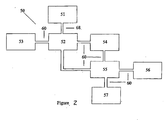
- the apparatus 50 includes a container such as tank 51 for providing the composition.
- the fuel is delivered to a container such as first reactor 52 for reacting the urea with water to form ammonia.
- the first reactor 52 for reacting the urea with water may be a container for providing a catalyst capable of catalyzing the reaction of urea with water or an enzyme capable of catalyzing the reaction of urea with water.
- the apparatus may also include a container such as buffer tank 53 for providing ammonia which is connected to the first reactor 52.
- the buffer tank 53 may be a container for providing an amount of ammonia which can be combusted to generate a sufficient amount of heat to initiate the reaction of the urea with water, preferably to instantly initiate the reaction of the urea with water.
- a first portion of the ammonia formed from the reaction of urea with water is delivered from the first reactor 52 to a container such as second reactor 54 for converting the first portion of ammonia into nitrogen and hydrogen.
- the hydrogen formed from the conversion of the first portion of ammonia is delivered from the second reactor 54 to a container such as chamber 55.
- a second portion of the ammonia produced from the reaction of urea with water is delivered from the reactor 52 to chamber 55.
- Chamber 55 is a container for oxidizing hydrogen and the second portion of ammonia to form water and nitrogen generating energy.
- the apparatus may also include a container such as buffer tank 56 for providing hydrogen which is connected to the chamber 55. The buffer tank 56 compensates for the difference between the production rate of hydrogen from the reformation of ammonia and the consumption rate of hydrogen.
- the chamber 55 is an engine and the hydrogen and the second portion of ammonia are oxidized by combusting the hydrogen and the second portion of ammonia in the engine.
- the apparatus may also include a container such as post-combustion reactor 57 connected to the engine for providing a sufficient amount of the composition to reduce the nitrogen oxides which are formed as by-products of the combustion of the second portion of ammonia. The nitrogen oxides are delivered to the post-combustion reactor 57 and are reduced by the urea in the composition to form nitrogen.
- Figures 1-2 include means 60 for delivering gaseous substances including ammonia, hydrogen, and nitrogen oxides, as well as means for delivering solutions such as the composition containing urea and water.
- Means for delivering cold solutions may include, for example, conveying means such as plastic tubing and glass manifolds.
- Means for delivering hot solutions may include conveying means such as, for example, steel or stainless steel tubes.
- Means 60 for delivering gaseous substances may include conveying means such as, for example, steel or stainless steel tubes, pumping means such as pumps, or a combination thereof. The pumping means may be used for pumping the gaseous substances to the extent needed to overcome pressure differentials.
- Figures 1-2 also include means 68 for delivering the composition comprising urea and water to the container in which the urea in the composition is reacted.
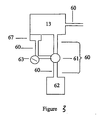
- the buffer tank 13, or 53 in Figures 1-2 may be connected to an ammonia source 62, so that the amount of ammonia in the starter or buffer tank is constantly replenished.
- Suitable ammonia sources 62 may include, for example, an ammonia tank.
- gaseous ammonia may be generated from the decomposition of an ammonium salt.
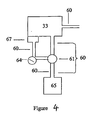
- the embodiments of Figures.1-2 may also include a first pressure regulator 63 and an exhaust (the exhaust is not shown in the figures).
- buffer tank 13 is fitted with a pressure sensor 67, and the first pressure regulator 63 is connected to the pressure sensor 67 and to pumping means 61 for pumping ammonia from the source 62 into buffer tank 13.
- the first pressure regulator 63 decreases the pumping rate of pumping means 61. Conversely, if the pressure sensor 67 indicates that the pressure in buffer tank 13 falls below a second predetermined value, the first pressure regulator 63 increases the pumping rate of pumping means 61.
- buffer tank 33 is fitted with a pressure sensor 67, and the second pressure regulator 64 is connected to the pressure sensor 67 and to pumping means 61 for pumping hydrogen from the source 65 into buffer tank 33. If the pressure sensor 67 indicates that the pressure in buffer tank 33 exceeds a first predetermined value, the second pressure regulator 64 decreases the pumping rate of pumping means 61. Conversely, if the pressure sensor 67 indicates that the pressure in buffer tank 33 falls below a second predetermined value, the second pressure regulator 64 increases the pumping rate of pumping means 61.
- Reactor 12, 52 in Figures 1 , and 2 respectively may be a container for providing an enzyme capable of catalyzing the reaction of urea with water fitted with a first valve such as a fill valve to enable adding the enzyme to reactor 12, 52 as needed during the course of the reaction.
- the reactor may also be fitted with a second valve such as a drain valve to enable draining particulate matter which may form during the course of the reaction.
- the reactor may also be fitted with a fuel filter to prevent build-up of particular matter.
- the cost advantage of the present invention may be illustrated as follows.
- the current spot cost of urea is about $90 / ton, or about $.045 / pound, which is competitive with the cost of gasoline.
- the pH of a concentrated solution of urea is about 7.4, which is very similar to the pH of human blood.
- Urea has a very low degree of toxicity, is safe to handle, and is well understood thanks to its extensive use as a fertilizer.
- the energy density of urea is suitable for using urea as an energy source for transportation.
- One mole of urea is equivalent to two moles of ammonia, which when burned yields 650 Kilojoules. This energy is sufficient for a car weighing two tons to travel about 1/4 of a mile.
- a 50% by weight solution in water of one mole of urea would contain 60 grams of urea and would have a volume of about 100 mls. Accordingly, one gallon of this solution would move a car for about 9 miles, and a 300-mile range could be achieved with a 34 gallon tank. Although such a tank would be larger than a conventional gas tank, the space for the larger tank would be readily available since the fuel tank would no longer need to be insulated from collision as is currently necessary with gas tanks containing flammable liquids. In fact, the liquid component of the composition would be water, a cheap and effective energy-absorbing component in the event of a collision.
- 34 gallons of the composition described above weigh about 324 pounds: This weight is somewhat larger than the weight an equal volume of gasoline but lies well within design parameters for a standard automobile. Furthermore, the remaining components of the apparatus would weigh less than 100 pounds overall and cost less than $500. All the data discussed above compare very favorably with the corresponding data for other proposed alternative fuels.
- a full tank containing 324 pounds of a 50% by weight solution of urea contains 162 pounds of urea, at a cost of $7.30.
- the corresponding cost is only 42 cents per gallon of the fuel.
- the retail cost of the fuel would be 84 cents per gallon ($14.60 per tankful), which would be significantly less than the cost of gasoline but with a higher profit margin for the sellers of the fuel.
- urea in the United States is made from air and domestic natural gas, thereby allowing a complete break from foreign oil dependency using existing technology.
- the fact that urea is the only non-fossil alternative that is cheaper than gasoline also provides an economic incentive to switch from gasoline to a urea based fuel system.
- the cost of the composition comprising urea and water used in the present invention is even more advantageous when the cost is calculated on the basis of the cost of urea in countries outside the United States.
- the cost of urea in Russia can be as low as $35/ton.
- Urea is produced from the reaction of ammonia gas with carbon dioxide. When reacted in the presence of water, urea generates ammonia and carbon dioxide. Ammonia is a known fuel which can run internal and external combustion engines. The ammonia can also be decomposed to give its constituent elements nitrogen and hydrogen. The hydrogen may then be used in an engine or in a hydrogen fuel cell. As a hydrogen source, urea contains 6.71% by weight of hydrogen. However, upon hydrolysis with one molecule of water, one molecule of urea produces two molecules of ammonia, with two of the hydrogen atoms coming from the water molecule. Accordingly, the ammonia - water system can theoretically yield up to 7.69% of hydrogen. In practice, a 5% yield of hydrogen is attainable.
- one liter of urea solution produces about 57 grams of hydrogen or about 80% of the amount of hydrogen available from cryogenic liquid hydrogen, which is 71 grams per liter.
- the figure of 57 grams of hydrogen per liter is extremely favorable when considering all the positive safety features of a urea based fuel compared to cryogenic liquid hydrogen, as well as the fact that the bulk of a cryogenic tank has an unfavorable effect on the energy density value of cryogenic liquid hydrogen.
- a composition comprising 70% by weight of urea in water produces about 79 grams of hydrogen per liter, which is larger than the amount of 71 grams per liter available from cryogenic hydrogen, and provides greater energy efficiency and far safety than cryogenic hydrogen.
- the present invention also has significant advantages over fossil fuels and many alternative fuels in terms of safety.
- the present invention gives ammonia on demand, so that at any given time the amount of ammonia present is very low and does not pose any safety concern.
- the water solution of urea is non-toxic and can be stored in simple plastic or metal tanks at no pressure.
- ammonia generated from the reaction of urea with water is oxidized or combusted to produce energy. While pure ammonia has also been proposed as a fuel, the use of pure ammonia has several drawbacks. Ammonia is a gas at room temperature and requires high pressure to liquefy. It is a corrosive substance which in large quantities may cause respiratory problems and even death. While it is possible to dissolve ammonia in water to produce a fuel, the resulting fuel has a pH of over 11 and a strong ammonia odor: Finally, ammonia has a relatively low energy density compared to gasoline and other alternative fuels. The use of urea as a source of ammonia in the present invention provides ammonia in low concentrations and thus removes most of the problems associated with storing large quantities of ammonia in a device.
- the present invention is also environmentally advantageous.
- carbon dioxide is one of the products of the hydrolysis of urea in reaction (1)
- an equal amount of carbon dioxide is removed from the atmosphere to make urea in the first place.
- ammonia is ammonia, which in turn requires a hydrogen source for its manufacture.
- Most of the hydrogen used for this purpose is supplied by the process of steam reforming of natural gas, which releases carbon dioxide into the atmosphere.
- hydrogen can also be prepared by an environmentally friendly method such as the electrolysis of water, where the electricity needed for the process is supplied by nuclear, hydroelectric, solar, tidal or wind power, none of which is a greenhouse gas emitting process.
- the required amount of carbon dioxide may be obtained by sequestering carbon dioxide from flue gases, or from the atmosphere, which contains 370 ppm CO 2 , as needed. Accordingly, it is possible using existing technology to prepare urea in a manner that is economical and environmentally friendly compared to fossil fuels.
Landscapes
- Chemical & Material Sciences (AREA)
- Organic Chemistry (AREA)
- Chemical Kinetics & Catalysis (AREA)
- Inorganic Chemistry (AREA)
- Engineering & Computer Science (AREA)
- Combustion & Propulsion (AREA)
- Health & Medical Sciences (AREA)
- General Health & Medical Sciences (AREA)
- Analytical Chemistry (AREA)
- Manufacturing & Machinery (AREA)
- Life Sciences & Earth Sciences (AREA)
- Sustainable Development (AREA)
- Sustainable Energy (AREA)
- Electrochemistry (AREA)
- General Chemical & Material Sciences (AREA)
- Catalysts (AREA)
- Exhaust Gas After Treatment (AREA)
- Fuel Cell (AREA)
- Organic Low-Molecular-Weight Compounds And Preparation Thereof (AREA)
- Feeding, Discharge, Calcimining, Fusing, And Gas-Generation Devices (AREA)
Applications Claiming Priority (2)
| Application Number | Priority Date | Filing Date | Title |
|---|---|---|---|
| US10/408,731 US7140187B2 (en) | 2002-04-15 | 2003-04-07 | Urea based composition and system for same |
| PCT/US2004/006646 WO2004094569A2 (en) | 2003-04-07 | 2004-03-05 | Urea based composition and system for same |
Publications (3)
| Publication Number | Publication Date |
|---|---|
| EP1611051A2 EP1611051A2 (en) | 2006-01-04 |
| EP1611051A4 EP1611051A4 (en) | 2008-12-31 |
| EP1611051B1 true EP1611051B1 (en) | 2012-11-28 |
Family
ID=33309468
Family Applications (1)
| Application Number | Title | Priority Date | Filing Date |
|---|---|---|---|
| EP04717956A Expired - Lifetime EP1611051B1 (en) | 2003-04-07 | 2004-03-05 | Urea based composition and system for same |
Country Status (7)
| Country | Link |
|---|---|
| US (1) | US7140187B2 (https=) |
| EP (1) | EP1611051B1 (https=) |
| JP (2) | JP4653733B2 (https=) |
| KR (1) | KR101134424B1 (https=) |
| CN (1) | CN1787962A (https=) |
| CA (1) | CA2521750A1 (https=) |
| WO (1) | WO2004094569A2 (https=) |
Families Citing this family (41)
| Publication number | Priority date | Publication date | Assignee | Title |
|---|---|---|---|---|
| US7393369B2 (en) | 2002-06-11 | 2008-07-01 | Trulite, Inc. | Apparatus, system, and method for generating hydrogen |
| US7556660B2 (en) | 2003-06-11 | 2009-07-07 | James Kevin Shurtleff | Apparatus and system for promoting a substantially complete reaction of an anhydrous hydride reactant |
| CN100449843C (zh) * | 2004-03-23 | 2009-01-07 | 氨合物公司 | 储氨装置在能量生产中的用途 |
| NZ551021A (en) * | 2004-05-05 | 2009-11-27 | Vechten James Alden Van | Guanidine based composition and system for generating energy |
| US7727374B2 (en) * | 2004-09-23 | 2010-06-01 | Skyonic Corporation | Removing carbon dioxide from waste streams through co-generation of carbonate and/or bicarbonate minerals |
| AU2005304304B2 (en) | 2004-11-12 | 2009-01-15 | Trulite, Inc. | Hydrogen generator cartridge |
| ATE540745T1 (de) * | 2006-07-20 | 2012-01-15 | Amminex As | Verfahren und vorrichtung zur speicherung und lieferung von ammoniak aus einem festen ammoniakspeichermedium |
| US7648786B2 (en) | 2006-07-27 | 2010-01-19 | Trulite, Inc | System for generating electricity from a chemical hydride |
| US7651542B2 (en) | 2006-07-27 | 2010-01-26 | Thulite, Inc | System for generating hydrogen from a chemical hydride |
| US20090025282A1 (en) * | 2007-07-27 | 2009-01-29 | Adelman Barnet R | Nitrogen based fuel systems |
| US8357214B2 (en) | 2007-04-26 | 2013-01-22 | Trulite, Inc. | Apparatus, system, and method for generating a gas from solid reactant pouches |
| CA2732060A1 (en) | 2007-07-25 | 2009-01-29 | Trulite, Inc. | Apparatus, system, and method to manage the generation and use of hybrid electric power |
| PL2205341T3 (pl) * | 2007-09-20 | 2012-08-31 | Skyonic Corp | Usuwanie dwutlenku węgla ze strumieni gazów spalinowych poprzez współwytwarzanie minerałów węglanów i/lub wodorowęglanów |
| US7863028B2 (en) * | 2007-09-27 | 2011-01-04 | Sidkar Technologies, Inc. | Methods and device for producing hydrogen from biomass |
| JP2009097422A (ja) * | 2007-10-16 | 2009-05-07 | Toyota Central R&D Labs Inc | 内燃機関の燃料改質装置及びエンジンシステム |
| GB2458994A (en) * | 2008-04-11 | 2009-10-14 | Johnson Matthey Plc | The use of urea in catalytic production of hydrogen |
| US20100019506A1 (en) * | 2008-07-22 | 2010-01-28 | Caterpillar Inc. | Power system having an ammonia fueled engine |
| NL2003429C2 (en) * | 2009-09-02 | 2011-03-03 | Dhv B V | Method for the production of electrical energy from ammonium. |
| GB201012011D0 (en) | 2010-07-16 | 2010-09-01 | Univ Heriot Watt | Fuel cell |
| DE102010034271A1 (de) * | 2010-08-13 | 2012-02-16 | Forschungszentrum Jülich GmbH | Festoxid-Brennstoffzelle (Solid Oxide Fuel Cell, SOFC) sowie Verfahren zum Betreiben derselben |
| WO2012123378A1 (en) | 2011-03-11 | 2012-09-20 | Puregeneration (Uk) Ltd | Production and use of cyanoguanidine and cyanamide |
| US20120280517A1 (en) * | 2011-05-06 | 2012-11-08 | eRevolution Technologies, Inc. | Stable hydrogen-containing fuels and systems and methods for generating energy therefrom |
| JP5214044B1 (ja) * | 2012-03-09 | 2013-06-19 | 三菱電機株式会社 | 内燃機関の燃料制御装置および方法 |
| JP5315491B1 (ja) * | 2012-06-13 | 2013-10-16 | 武史 畑中 | 次世代カーボンフリー燃焼器、これを利用した次世代カーボンフリーエンジン及び次世代カーボンフリー発電装置並びに次世代カーボンフリー燃焼器、次世代カーボンフリーエンジン及び次世代カーボンフリー発電装置に利用される尿素水 |
| JP5315492B1 (ja) * | 2012-06-13 | 2013-10-16 | 武史 畑中 | 次世代カーボンフリー発電プラント及び次世代カーボンフリー発電方法並びに次世代カーボンフリー発電プラント及び次世代カーボンフリー発電方法に利用する尿素水 |
| JP5315493B1 (ja) * | 2012-06-13 | 2013-10-16 | 武史 畑中 | 次世代カーボンフリー動力装置及びこれを利用した次世代カーボンフリー移動体 |
| JP5327686B1 (ja) * | 2012-06-13 | 2013-10-30 | 武史 畑中 | 次世代カーボンフリーボイラ、その運転方法及び次世代カーボンフリーボイラにおける水素リッチアンモニアの製造方法並びに次世代カーボンフリーボイラ、その運転方法及び次世代カーボンフリーボイラにおける水素リッチアンモニアの製造方法に利用する尿素水 |
| DE102012214435A1 (de) * | 2012-08-14 | 2014-02-20 | Elringklinger Ag | Verfahren zum Betrieb eines Brennstoffzellensystems |
| EP2746548B1 (en) * | 2012-12-21 | 2017-03-15 | Inergy Automotive Systems Research (Société Anonyme) | Method and system for purifying the exhaust gases of a combustion engine. |
| EP2846011A1 (en) * | 2013-09-04 | 2015-03-11 | Inergy Automotive Systems Research (Société Anonyme) | Method and system for purifying the exhaust gases of a combustion engine |
| EP2881558B1 (en) * | 2013-12-05 | 2016-09-14 | Inergy Automotive Systems Research (Société Anonyme) | Method and system for purifying the exhaust gases of a combustion engine |
| EP3125348B1 (en) * | 2015-07-31 | 2018-11-07 | Plastic Omnium Advanced Innovation and Research | Vehicle system comprising a fuel cell |
| EP3150813A1 (en) * | 2015-09-30 | 2017-04-05 | Plastic Omnium Advanced Innovation and Research | Feed line system for a vehicle system |
| JP6637724B2 (ja) * | 2015-10-28 | 2020-01-29 | 株式会社Kri | エンジンシステム及びエンジンシステムの運転方法 |
| KR102314229B1 (ko) * | 2017-03-23 | 2021-10-15 | 대우조선해양 주식회사 | 잠수함용 연료전지시스템 및 이를 이용한 전력 생산 방법 |
| JP6938186B2 (ja) * | 2017-03-24 | 2021-09-22 | 株式会社Kri | アンモニア燃料発電システム及びアンモニア燃料供給装置 |
| CN107237687B (zh) * | 2017-06-14 | 2020-04-28 | 大唐环境产业集团股份有限公司 | 一种采用生物尿素发电的系统 |
| CN109437237B (zh) * | 2018-12-21 | 2022-09-23 | 广东工业大学 | 一种自动化固氮制氨的方法 |
| US11180371B2 (en) | 2019-04-12 | 2021-11-23 | J. Dustin Hultine | Integrated synthesis of commodity chemicals from waste plastic |
| US11390388B2 (en) | 2019-05-17 | 2022-07-19 | Ami Industries, Inc. | Urine-based power generation for adjustable seat cushion |
| US11804605B1 (en) | 2023-02-20 | 2023-10-31 | King Faisal University | Metal oxide nanocomposites for electrochemical oxidation of urea |
Family Cites Families (20)
| Publication number | Priority date | Publication date | Assignee | Title |
|---|---|---|---|---|
| US2601221A (en) * | 1949-03-29 | 1952-06-17 | Baker & Co Inc | Dissociation of ammonia |
| DE2404492A1 (de) * | 1974-01-31 | 1975-08-14 | Gerhard Kraft | Verfahren zur verbrennung von ammoniak und einrichtung zur durchfuehrung des verfahrens |
| US4168299A (en) * | 1978-03-20 | 1979-09-18 | Olin Corporation | Catalytic method for hydrolyzing urea |
| JPH02191528A (ja) * | 1989-01-20 | 1990-07-27 | Babcock Hitachi Kk | 固体還元剤を用いた脱硝装置 |
| JPH05332152A (ja) * | 1991-06-25 | 1993-12-14 | Koji Korematsu | アンモニア燃焼エンジン |
| US5252308A (en) * | 1991-12-31 | 1993-10-12 | Union Oil Company Of California | Transporting urea for quantitative conversion into ammonia |
| JPH0857261A (ja) * | 1994-08-24 | 1996-03-05 | Babcock Hitachi Kk | 還元剤水溶液を用いる脱硝装置 |
| US5804329A (en) | 1995-12-28 | 1998-09-08 | National Patent Development Corporation | Electroconversion cell |
| US5976723A (en) * | 1997-03-12 | 1999-11-02 | Boffito; Claudio | Getter materials for cracking ammonia |
| ITMI981155A1 (it) * | 1998-05-25 | 1999-11-25 | Siirtec Nigi S P A | Processo per la produzione di ammoniaca mediante idrolisi dell'urea |
| US6093380A (en) * | 1998-10-16 | 2000-07-25 | Siirtec Nigi, S.P.A. | Method and apparatus for pollution control in exhaust gas streams from fossil fuel burning facilities |
| DE19901760A1 (de) * | 1999-01-18 | 2000-07-27 | Emitec Emissionstechnologie | Verfahren und Anordnung zum Reinigen eines in einem Abgasstrang strömenden Abgasstromes eines Ottomotors |
| JP2001163848A (ja) * | 1999-12-06 | 2001-06-19 | Mitsubishi Chemicals Corp | ニトリル化合物の製造方法 |
| US6534033B1 (en) | 2000-01-07 | 2003-03-18 | Millennium Cell, Inc. | System for hydrogen generation |
| DE10022842A1 (de) * | 2000-05-10 | 2001-11-22 | Dmc2 Degussa Metals Catalysts | Strukturierter Katalysator für die selektive Reduktion von Stickoxiden mittels Ammoniak unter Verwendung einer zu Ammoniak hydrolysierbaren Verbindung |
| AU2001263069A1 (en) * | 2000-05-12 | 2001-11-26 | Gradient Technology | Production of hydrogen by autothermic decomposition of ammonia |
| US6826906B2 (en) * | 2000-08-15 | 2004-12-07 | Engelhard Corporation | Exhaust system for enhanced reduction of nitrogen oxides and particulates from diesel engines |
| JP2002306929A (ja) * | 2001-04-16 | 2002-10-22 | Hitachi Ltd | エンジン排ガスの浄化方法及び装置 |
| US20050095465A1 (en) * | 2001-12-27 | 2005-05-05 | Hirohisa Tanaka | Fuel cell |
| DE10219799A1 (de) * | 2002-05-03 | 2003-11-13 | Bosch Gmbh Robert | Verbrennungsvorrichtung mit einer Abgasreinigungsvorrichtung |
-
2003
- 2003-04-07 US US10/408,731 patent/US7140187B2/en not_active Expired - Fee Related
-
2004
- 2004-03-05 CN CNA2004800127011A patent/CN1787962A/zh active Pending
- 2004-03-05 EP EP04717956A patent/EP1611051B1/en not_active Expired - Lifetime
- 2004-03-05 KR KR1020057019160A patent/KR101134424B1/ko not_active Expired - Fee Related
- 2004-03-05 CA CA002521750A patent/CA2521750A1/en not_active Abandoned
- 2004-03-05 WO PCT/US2004/006646 patent/WO2004094569A2/en not_active Ceased
- 2004-03-05 JP JP2006509137A patent/JP4653733B2/ja not_active Expired - Fee Related
-
2010
- 2010-06-09 JP JP2010132487A patent/JP2010248070A/ja active Pending
Also Published As
| Publication number | Publication date |
|---|---|
| EP1611051A4 (en) | 2008-12-31 |
| CA2521750A1 (en) | 2004-11-04 |
| JP2007524783A (ja) | 2007-08-30 |
| US7140187B2 (en) | 2006-11-28 |
| JP2010248070A (ja) | 2010-11-04 |
| CN1787962A (zh) | 2006-06-14 |
| KR20060007017A (ko) | 2006-01-23 |
| JP4653733B2 (ja) | 2011-03-16 |
| US20030219371A1 (en) | 2003-11-27 |
| WO2004094569A3 (en) | 2005-02-24 |
| WO2004094569A2 (en) | 2004-11-04 |
| KR101134424B1 (ko) | 2012-04-09 |
| EP1611051A2 (en) | 2006-01-04 |
Similar Documents
| Publication | Publication Date | Title |
|---|---|---|
| EP1611051B1 (en) | Urea based composition and system for same | |
| RU2393116C2 (ru) | Композиция на основе гуанидина и система для указанной композиции | |
| Amendola et al. | A safe, portable, hydrogen gas generator using aqueous borohydride solution and Ru catalyst | |
| Juangsa et al. | CO2-free power generation employing integrated ammonia decomposition and hydrogen combustion-based combined cycle | |
| JPH07506327A (ja) | 改良された水素発生システム | |
| TW201318968A (zh) | 燃料性能提升劑 | |
| US5690902A (en) | Hydrogen-powered automobile with in situ hydrogen generation | |
| US20110219773A1 (en) | Systems and methods for producing hydrogen from cellulosic and/or grain feedstocks for use as a vehicle fuel, use in the production of anhydrous ammonia, and to generate electricity | |
| US20120280517A1 (en) | Stable hydrogen-containing fuels and systems and methods for generating energy therefrom | |
| CN112234235A (zh) | 氢气发生装置及燃料电池系统 | |
| Hodoshima et al. | Chemical recuperation of low-quality waste heats by catalytic dehydrogenation of organic chemical hydrides and its exergy analysis | |
| CN215974955U (zh) | 一种部分氧化重整与水蒸汽重整结合的重整器 | |
| CN216678182U (zh) | 一种自热重整与水蒸气重整结合的重整器 | |
| Hasanpour et al. | Physicochemical Characteristics, Process Optimization, and Energy Efficiency of Hydrogen Production from Methanol, Ethanol, and Glycerol: A Comparative Review, Adv | |
| US20060266159A1 (en) | Method and device for pure hydrogen generation from acidic solution | |
| CN1976874A (zh) | 胍基组合物以及用于该组合物的系统 | |
| KR20070022297A (ko) | 구아니딘 주성분의 혼합물과 제반 시스템 | |
| WO2025245515A1 (en) | Methods and systems for hydrogen production | |
| RU2243149C2 (ru) | Беспламенное топливо | |
| KR20250160293A (ko) | 암모니아를 이용한 메탄올 생산 방법 | |
| Mehta et al. | Low-Pressure Ammonia Production | |
| Selvan et al. | Theoretical Investigation on Ammonia as a Secondary fuel for IC Engines |
Legal Events
| Date | Code | Title | Description |
|---|---|---|---|
| PUAI | Public reference made under article 153(3) epc to a published international application that has entered the european phase |
Free format text: ORIGINAL CODE: 0009012 |
|
| 17P | Request for examination filed |
Effective date: 20051027 |
|
| AK | Designated contracting states |
Kind code of ref document: A2 Designated state(s): AT BE BG CH CY CZ DE DK EE ES FI FR GB GR HU IE IT LI LU MC NL PL PT RO SE SI SK TR |
|
| AX | Request for extension of the european patent |
Extension state: AL LT LV MK |
|
| DAX | Request for extension of the european patent (deleted) | ||
| A4 | Supplementary search report drawn up and despatched |
Effective date: 20081203 |
|
| 17Q | First examination report despatched |
Effective date: 20090525 |
|
| REG | Reference to a national code |
Ref country code: DE Ref legal event code: R079 Ref document number: 602004040209 Country of ref document: DE Free format text: PREVIOUS MAIN CLASS: C01B0003040000 Ipc: C01C0001080000 |
|
| GRAP | Despatch of communication of intention to grant a patent |
Free format text: ORIGINAL CODE: EPIDOSNIGR1 |
|
| RIC1 | Information provided on ipc code assigned before grant |
Ipc: C01B 21/02 20060101ALN20120604BHEP Ipc: B01J 8/20 20060101ALN20120604BHEP Ipc: C01C 1/08 20060101AFI20120604BHEP Ipc: C01B 3/04 20060101ALI20120604BHEP |
|
| RIC1 | Information provided on ipc code assigned before grant |
Ipc: C01B 3/04 20060101ALI20120611BHEP Ipc: C01C 1/08 20060101AFI20120611BHEP Ipc: C01B 21/02 20060101ALN20120611BHEP Ipc: B01J 8/20 20060101ALN20120611BHEP |
|
| GRAS | Grant fee paid |
Free format text: ORIGINAL CODE: EPIDOSNIGR3 |
|
| GRAA | (expected) grant |
Free format text: ORIGINAL CODE: 0009210 |
|
| AK | Designated contracting states |
Kind code of ref document: B1 Designated state(s): AT BE BG CH CY CZ DE DK EE ES FI FR GB GR HU IE IT LI LU MC NL PL PT RO SE SI SK TR |
|
| REG | Reference to a national code |
Ref country code: GB Ref legal event code: FG4D |
|
| REG | Reference to a national code |
Ref country code: CH Ref legal event code: EP |
|
| REG | Reference to a national code |
Ref country code: AT Ref legal event code: REF Ref document number: 586065 Country of ref document: AT Kind code of ref document: T Effective date: 20121215 |
|
| REG | Reference to a national code |
Ref country code: IE Ref legal event code: FG4D |
|
| REG | Reference to a national code |
Ref country code: DE Ref legal event code: R096 Ref document number: 602004040209 Country of ref document: DE Effective date: 20130124 |
|
| RAP2 | Party data changed (patent owner data changed or rights of a patent transferred) |
Owner name: AMENDOLA, STEVEN C. |
|
| RIN2 | Information on inventor provided after grant (corrected) |
Inventor name: AMENDOLA, STEVEN C. |
|
| REG | Reference to a national code |
Ref country code: AT Ref legal event code: MK05 Ref document number: 586065 Country of ref document: AT Kind code of ref document: T Effective date: 20121128 |
|
| REG | Reference to a national code |
Ref country code: NL Ref legal event code: VDEP Effective date: 20121128 |
|
| REG | Reference to a national code |
Ref country code: DE Ref legal event code: R082 Ref document number: 602004040209 Country of ref document: DE Representative=s name: MITSCHERLICH & PARTNER PATENT- UND RECHTSANWAE, DE |
|
| PG25 | Lapsed in a contracting state [announced via postgrant information from national office to epo] |
Ref country code: FI Free format text: LAPSE BECAUSE OF FAILURE TO SUBMIT A TRANSLATION OF THE DESCRIPTION OR TO PAY THE FEE WITHIN THE PRESCRIBED TIME-LIMIT Effective date: 20121128 Ref country code: SE Free format text: LAPSE BECAUSE OF FAILURE TO SUBMIT A TRANSLATION OF THE DESCRIPTION OR TO PAY THE FEE WITHIN THE PRESCRIBED TIME-LIMIT Effective date: 20121128 Ref country code: ES Free format text: LAPSE BECAUSE OF FAILURE TO SUBMIT A TRANSLATION OF THE DESCRIPTION OR TO PAY THE FEE WITHIN THE PRESCRIBED TIME-LIMIT Effective date: 20130311 |
|
| PG25 | Lapsed in a contracting state [announced via postgrant information from national office to epo] |
Ref country code: BE Free format text: LAPSE BECAUSE OF FAILURE TO SUBMIT A TRANSLATION OF THE DESCRIPTION OR TO PAY THE FEE WITHIN THE PRESCRIBED TIME-LIMIT Effective date: 20121128 Ref country code: SI Free format text: LAPSE BECAUSE OF FAILURE TO SUBMIT A TRANSLATION OF THE DESCRIPTION OR TO PAY THE FEE WITHIN THE PRESCRIBED TIME-LIMIT Effective date: 20121128 Ref country code: CY Free format text: LAPSE BECAUSE OF FAILURE TO SUBMIT A TRANSLATION OF THE DESCRIPTION OR TO PAY THE FEE WITHIN THE PRESCRIBED TIME-LIMIT Effective date: 20121128 Ref country code: PT Free format text: LAPSE BECAUSE OF FAILURE TO SUBMIT A TRANSLATION OF THE DESCRIPTION OR TO PAY THE FEE WITHIN THE PRESCRIBED TIME-LIMIT Effective date: 20130328 Ref country code: GR Free format text: LAPSE BECAUSE OF FAILURE TO SUBMIT A TRANSLATION OF THE DESCRIPTION OR TO PAY THE FEE WITHIN THE PRESCRIBED TIME-LIMIT Effective date: 20130301 Ref country code: PL Free format text: LAPSE BECAUSE OF FAILURE TO SUBMIT A TRANSLATION OF THE DESCRIPTION OR TO PAY THE FEE WITHIN THE PRESCRIBED TIME-LIMIT Effective date: 20121128 |
|
| REG | Reference to a national code |
Ref country code: DE Ref legal event code: R081 Ref document number: 602004040209 Country of ref document: DE Owner name: AMENDOLA, STEVEN C., US Free format text: FORMER OWNER: AMENDOLA, STEVEN C., OCEAN, US Effective date: 20130423 Ref country code: DE Ref legal event code: R082 Ref document number: 602004040209 Country of ref document: DE Representative=s name: MITSCHERLICH & PARTNER PATENT- UND RECHTSANWAE, DE Effective date: 20130423 Ref country code: DE Ref legal event code: R081 Ref document number: 602004040209 Country of ref document: DE Owner name: AMENDOLA, STEVEN C., US Free format text: FORMER OWNER: AMENDOLA, STEVEN C., OCEAN, US Effective date: 20121128 Ref country code: DE Ref legal event code: R082 Ref document number: 602004040209 Country of ref document: DE Representative=s name: MITSCHERLICH, PATENT- UND RECHTSANWAELTE, PART, DE Effective date: 20130423 Ref country code: DE Ref legal event code: R082 Ref document number: 602004040209 Country of ref document: DE Representative=s name: MITSCHERLICH, PATENT- UND RECHTSANWAELTE PARTM, DE Effective date: 20130423 Ref country code: DE Ref legal event code: R081 Ref document number: 602004040209 Country of ref document: DE Owner name: AMENDOLA, STEVEN C., EASTON, US Free format text: FORMER OWNER: AMENDOLA, STEVEN C., OCEAN, N.J., US Effective date: 20121128 Ref country code: DE Ref legal event code: R081 Ref document number: 602004040209 Country of ref document: DE Owner name: AMENDOLA, STEVEN C., EASTON, US Free format text: FORMER OWNER: AMENDOLA, STEVEN C., OCEAN, N.J., US Effective date: 20130423 |
|
| PG25 | Lapsed in a contracting state [announced via postgrant information from national office to epo] |
Ref country code: AT Free format text: LAPSE BECAUSE OF FAILURE TO SUBMIT A TRANSLATION OF THE DESCRIPTION OR TO PAY THE FEE WITHIN THE PRESCRIBED TIME-LIMIT Effective date: 20121128 |
|
| PG25 | Lapsed in a contracting state [announced via postgrant information from national office to epo] |
Ref country code: BG Free format text: LAPSE BECAUSE OF FAILURE TO SUBMIT A TRANSLATION OF THE DESCRIPTION OR TO PAY THE FEE WITHIN THE PRESCRIBED TIME-LIMIT Effective date: 20130228 Ref country code: DK Free format text: LAPSE BECAUSE OF FAILURE TO SUBMIT A TRANSLATION OF THE DESCRIPTION OR TO PAY THE FEE WITHIN THE PRESCRIBED TIME-LIMIT Effective date: 20121128 Ref country code: SK Free format text: LAPSE BECAUSE OF FAILURE TO SUBMIT A TRANSLATION OF THE DESCRIPTION OR TO PAY THE FEE WITHIN THE PRESCRIBED TIME-LIMIT Effective date: 20121128 Ref country code: CZ Free format text: LAPSE BECAUSE OF FAILURE TO SUBMIT A TRANSLATION OF THE DESCRIPTION OR TO PAY THE FEE WITHIN THE PRESCRIBED TIME-LIMIT Effective date: 20121128 Ref country code: EE Free format text: LAPSE BECAUSE OF FAILURE TO SUBMIT A TRANSLATION OF THE DESCRIPTION OR TO PAY THE FEE WITHIN THE PRESCRIBED TIME-LIMIT Effective date: 20121128 |
|
| PG25 | Lapsed in a contracting state [announced via postgrant information from national office to epo] |
Ref country code: NL Free format text: LAPSE BECAUSE OF FAILURE TO SUBMIT A TRANSLATION OF THE DESCRIPTION OR TO PAY THE FEE WITHIN THE PRESCRIBED TIME-LIMIT Effective date: 20121128 Ref country code: RO Free format text: LAPSE BECAUSE OF FAILURE TO SUBMIT A TRANSLATION OF THE DESCRIPTION OR TO PAY THE FEE WITHIN THE PRESCRIBED TIME-LIMIT Effective date: 20121128 |
|
| PLBE | No opposition filed within time limit |
Free format text: ORIGINAL CODE: 0009261 |
|
| STAA | Information on the status of an ep patent application or granted ep patent |
Free format text: STATUS: NO OPPOSITION FILED WITHIN TIME LIMIT |
|
| PG25 | Lapsed in a contracting state [announced via postgrant information from national office to epo] |
Ref country code: MC Free format text: LAPSE BECAUSE OF NON-PAYMENT OF DUE FEES Effective date: 20130331 |
|
| REG | Reference to a national code |
Ref country code: CH Ref legal event code: PL |
|
| 26N | No opposition filed |
Effective date: 20130829 |
|
| REG | Reference to a national code |
Ref country code: DE Ref legal event code: R097 Ref document number: 602004040209 Country of ref document: DE Effective date: 20130829 |
|
| REG | Reference to a national code |
Ref country code: IE Ref legal event code: MM4A |
|
| PG25 | Lapsed in a contracting state [announced via postgrant information from national office to epo] |
Ref country code: LI Free format text: LAPSE BECAUSE OF NON-PAYMENT OF DUE FEES Effective date: 20130331 Ref country code: CH Free format text: LAPSE BECAUSE OF NON-PAYMENT OF DUE FEES Effective date: 20130331 Ref country code: IE Free format text: LAPSE BECAUSE OF NON-PAYMENT OF DUE FEES Effective date: 20130305 |
|
| PG25 | Lapsed in a contracting state [announced via postgrant information from national office to epo] |
Ref country code: TR Free format text: LAPSE BECAUSE OF FAILURE TO SUBMIT A TRANSLATION OF THE DESCRIPTION OR TO PAY THE FEE WITHIN THE PRESCRIBED TIME-LIMIT Effective date: 20121128 |
|
| PG25 | Lapsed in a contracting state [announced via postgrant information from national office to epo] |
Ref country code: HU Free format text: LAPSE BECAUSE OF FAILURE TO SUBMIT A TRANSLATION OF THE DESCRIPTION OR TO PAY THE FEE WITHIN THE PRESCRIBED TIME-LIMIT; INVALID AB INITIO Effective date: 20040305 Ref country code: LU Free format text: LAPSE BECAUSE OF NON-PAYMENT OF DUE FEES Effective date: 20130305 |
|
| REG | Reference to a national code |
Ref country code: FR Ref legal event code: PLFP Year of fee payment: 13 |
|
| PGFP | Annual fee paid to national office [announced via postgrant information from national office to epo] |
Ref country code: DE Payment date: 20160302 Year of fee payment: 13 |
|
| PGFP | Annual fee paid to national office [announced via postgrant information from national office to epo] |
Ref country code: FR Payment date: 20160208 Year of fee payment: 13 Ref country code: GB Payment date: 20160302 Year of fee payment: 13 |
|
| PGFP | Annual fee paid to national office [announced via postgrant information from national office to epo] |
Ref country code: IT Payment date: 20160324 Year of fee payment: 13 |
|
| REG | Reference to a national code |
Ref country code: DE Ref legal event code: R119 Ref document number: 602004040209 Country of ref document: DE |
|
| GBPC | Gb: european patent ceased through non-payment of renewal fee |
Effective date: 20170305 |
|
| REG | Reference to a national code |
Ref country code: FR Ref legal event code: ST Effective date: 20171130 |
|
| PG25 | Lapsed in a contracting state [announced via postgrant information from national office to epo] |
Ref country code: DE Free format text: LAPSE BECAUSE OF NON-PAYMENT OF DUE FEES Effective date: 20171003 Ref country code: FR Free format text: LAPSE BECAUSE OF NON-PAYMENT OF DUE FEES Effective date: 20170331 |
|
| PG25 | Lapsed in a contracting state [announced via postgrant information from national office to epo] |
Ref country code: GB Free format text: LAPSE BECAUSE OF NON-PAYMENT OF DUE FEES Effective date: 20170305 Ref country code: IT Free format text: LAPSE BECAUSE OF NON-PAYMENT OF DUE FEES Effective date: 20170305 |