EP1610511A1 - Verfahren und Vorrichtung zur Nachrichtenübertragung - Google Patents
Verfahren und Vorrichtung zur Nachrichtenübertragung Download PDFInfo
- Publication number
- EP1610511A1 EP1610511A1 EP05019596A EP05019596A EP1610511A1 EP 1610511 A1 EP1610511 A1 EP 1610511A1 EP 05019596 A EP05019596 A EP 05019596A EP 05019596 A EP05019596 A EP 05019596A EP 1610511 A1 EP1610511 A1 EP 1610511A1
- Authority
- EP
- European Patent Office
- Prior art keywords
- terminal
- message
- adaptation device
- messages
- mms
- Prior art date
- Legal status (The legal status is an assumption and is not a legal conclusion. Google has not performed a legal analysis and makes no representation as to the accuracy of the status listed.)
- Ceased
Links
- 230000005540 biological transmission Effects 0.000 title claims abstract description 35
- 238000000034 method Methods 0.000 title claims abstract description 30
- 230000006978 adaptation Effects 0.000 claims description 54
- 230000011664 signaling Effects 0.000 claims description 4
- 238000012546 transfer Methods 0.000 abstract description 24
- 230000006870 function Effects 0.000 description 9
- 230000008901 benefit Effects 0.000 description 6
- 230000008569 process Effects 0.000 description 4
- 238000006243 chemical reaction Methods 0.000 description 3
- 230000010354 integration Effects 0.000 description 3
- 238000010295 mobile communication Methods 0.000 description 3
- 230000011218 segmentation Effects 0.000 description 3
- 230000001413 cellular effect Effects 0.000 description 2
- 230000008859 change Effects 0.000 description 2
- 239000002131 composite material Substances 0.000 description 2
- 238000012545 processing Methods 0.000 description 2
- 238000000926 separation method Methods 0.000 description 2
- 230000001419 dependent effect Effects 0.000 description 1
- 238000001514 detection method Methods 0.000 description 1
- 238000011161 development Methods 0.000 description 1
- 230000018109 developmental process Effects 0.000 description 1
- 238000010586 diagram Methods 0.000 description 1
- 238000011156 evaluation Methods 0.000 description 1
- 230000001771 impaired effect Effects 0.000 description 1
- 230000000977 initiatory effect Effects 0.000 description 1
- 238000013507 mapping Methods 0.000 description 1
- 238000012986 modification Methods 0.000 description 1
- 230000004048 modification Effects 0.000 description 1
- 238000007781 pre-processing Methods 0.000 description 1
- 210000002023 somite Anatomy 0.000 description 1
- 238000012549 training Methods 0.000 description 1
- 230000009466 transformation Effects 0.000 description 1
Images
Classifications
-
- H—ELECTRICITY
- H04—ELECTRIC COMMUNICATION TECHNIQUE
- H04L—TRANSMISSION OF DIGITAL INFORMATION, e.g. TELEGRAPHIC COMMUNICATION
- H04L51/00—User-to-user messaging in packet-switching networks, transmitted according to store-and-forward or real-time protocols, e.g. e-mail
- H04L51/06—Message adaptation to terminal or network requirements
-
- H—ELECTRICITY
- H04—ELECTRIC COMMUNICATION TECHNIQUE
- H04L—TRANSMISSION OF DIGITAL INFORMATION, e.g. TELEGRAPHIC COMMUNICATION
- H04L51/00—User-to-user messaging in packet-switching networks, transmitted according to store-and-forward or real-time protocols, e.g. e-mail
- H04L51/06—Message adaptation to terminal or network requirements
- H04L51/066—Format adaptation, e.g. format conversion or compression
-
- H—ELECTRICITY
- H04—ELECTRIC COMMUNICATION TECHNIQUE
- H04L—TRANSMISSION OF DIGITAL INFORMATION, e.g. TELEGRAPHIC COMMUNICATION
- H04L9/00—Cryptographic mechanisms or cryptographic arrangements for secret or secure communications; Network security protocols
- H04L9/40—Network security protocols
-
- H—ELECTRICITY
- H04—ELECTRIC COMMUNICATION TECHNIQUE
- H04W—WIRELESS COMMUNICATION NETWORKS
- H04W4/00—Services specially adapted for wireless communication networks; Facilities therefor
- H04W4/18—Information format or content conversion, e.g. adaptation by the network of the transmitted or received information for the purpose of wireless delivery to users or terminals
-
- H—ELECTRICITY
- H04—ELECTRIC COMMUNICATION TECHNIQUE
- H04L—TRANSMISSION OF DIGITAL INFORMATION, e.g. TELEGRAPHIC COMMUNICATION
- H04L51/00—User-to-user messaging in packet-switching networks, transmitted according to store-and-forward or real-time protocols, e.g. e-mail
- H04L51/21—Monitoring or handling of messages
- H04L51/212—Monitoring or handling of messages using filtering or selective blocking
-
- H—ELECTRICITY
- H04—ELECTRIC COMMUNICATION TECHNIQUE
- H04L—TRANSMISSION OF DIGITAL INFORMATION, e.g. TELEGRAPHIC COMMUNICATION
- H04L51/00—User-to-user messaging in packet-switching networks, transmitted according to store-and-forward or real-time protocols, e.g. e-mail
- H04L51/21—Monitoring or handling of messages
- H04L51/224—Monitoring or handling of messages providing notification on incoming messages, e.g. pushed notifications of received messages
-
- H—ELECTRICITY
- H04—ELECTRIC COMMUNICATION TECHNIQUE
- H04L—TRANSMISSION OF DIGITAL INFORMATION, e.g. TELEGRAPHIC COMMUNICATION
- H04L51/00—User-to-user messaging in packet-switching networks, transmitted according to store-and-forward or real-time protocols, e.g. e-mail
- H04L51/58—Message adaptation for wireless communication
-
- H—ELECTRICITY
- H04—ELECTRIC COMMUNICATION TECHNIQUE
- H04L—TRANSMISSION OF DIGITAL INFORMATION, e.g. TELEGRAPHIC COMMUNICATION
- H04L69/00—Network arrangements, protocols or services independent of the application payload and not provided for in the other groups of this subclass
- H04L69/24—Negotiation of communication capabilities
-
- H—ELECTRICITY
- H04—ELECTRIC COMMUNICATION TECHNIQUE
- H04M—TELEPHONIC COMMUNICATION
- H04M3/00—Automatic or semi-automatic exchanges
- H04M3/42—Systems providing special services or facilities to subscribers
- H04M3/50—Centralised arrangements for answering calls; Centralised arrangements for recording messages for absent or busy subscribers ; Centralised arrangements for recording messages
- H04M3/53—Centralised arrangements for recording incoming messages, i.e. mailbox systems
- H04M3/5307—Centralised arrangements for recording incoming messages, i.e. mailbox systems for recording messages comprising any combination of audio and non-audio components
-
- H—ELECTRICITY
- H04—ELECTRIC COMMUNICATION TECHNIQUE
- H04M—TELEPHONIC COMMUNICATION
- H04M3/00—Automatic or semi-automatic exchanges
- H04M3/42—Systems providing special services or facilities to subscribers
- H04M3/50—Centralised arrangements for answering calls; Centralised arrangements for recording messages for absent or busy subscribers ; Centralised arrangements for recording messages
- H04M3/53—Centralised arrangements for recording incoming messages, i.e. mailbox systems
- H04M3/533—Voice mail systems
-
- H—ELECTRICITY
- H04—ELECTRIC COMMUNICATION TECHNIQUE
- H04W—WIRELESS COMMUNICATION NETWORKS
- H04W28/00—Network traffic management; Network resource management
- H04W28/02—Traffic management, e.g. flow control or congestion control
- H04W28/06—Optimizing the usage of the radio link, e.g. header compression, information sizing, discarding information
Definitions
- the invention relates to a method for the transmission of Messages between at least one central office and one Terminal and of a matching device therefor after Genus of the independent claims.
- the so-called Internet E-Mail service becomes news generated by a so-called mail client and with the so-called Simple Mail Transfer Protocol (SMTP) according to RFC 821 (Request for Command) of the IETF (Internet Engineering Task Force) or with the Enhanced Simple Mail Transfer Protocol (ESMTP) RFC 1869 of the IETF over the Internet to a mail server transmitted to a recipient.
- SMTP Simple Mail Transfer Protocol
- ESMTP Enhanced Simple Mail Transfer Protocol
- the Receiver also with the help of a mail client on the access sent message.
- For access to the sent message will be corresponding logs used, for example, the POP (Post Office Protocol) according to RFC 1729 the IETF or the IMAP (Internet Message Access Protocol) according to RFC 2060 of the IETF or also manufacturer-specific protocols.
- POP Post Office Protocol
- IMAP Internet Message Access Protocol
- the method described is essentially intended for leased lines, where the mail client a permanent connection or a connection with relative has short time interruptions to the mail server.
- SMTP was originally intended for text messaging only.
- MIME Multipoint Internet Mail Extensions
- the IETF can extend such messages with attachments become.
- These attachments can be of any format and are not set to text messaging. For the Transmission, however, these attachments are recoded in such a way that they are also in the form of simple text messages can be transmitted.
- the SMS service (Short Message Service) according to the GSM standard (Global System for Mobile Communications), GSM 03.40 ETSI is fundamentally different from the one described Internet e-mail service. He is exclusively on Text messages with a maximum length of 160 characters limited, with extensions by concatenation of several consist of such text messages.
- the SMS service is based continue to insist that the text messages from an SMS sender sent to an SMS server, who will then send them automatically transmits to a mobile device. This Procedure is also referred to as push mode. Is this mobile terminal in the mobile network not available, e.g. because it is off, then the text message is in the SMS server cached. Is in the following then the mobile Terminal is again accessible, so this is the SMS server signaled and this then starts automatically the Transmission of the text message to the mobile terminal.
- the inventive method and the invention Adaptation device with the features of independent Claims have the advantage that the Message exchange by an adapter between the at least one center and the terminal in Dependence of at least one specification of the terminal or the at least one control center is controlled.
- the Adaptation device is an adaptation of control panels or Servers of different services to a terminal possible, without that a direct connection between the terminal and the respective headquarters must be established and without that between the terminal and the respective center service-specific and thus depending on the headquarters different protocols have to be transmitted.
- the inventive method and the invention Adaptation device is the corresponding center for the Terminal not visible, but only the Matching device.
- the adapter device becomes service-specific Characteristics for the message exchange between the terminal and the corresponding headquarters canceled and by Replaces user-specific characteristics that are used for the Transmission of messages to the terminal by specifying the Terminal or the user of the terminal to be defined can.
- a transmission mode independent of used service so that by means of Adaptation device, for example, the SMS service a pull mode or a push mode for the internet e-mail service can be realized.
- Adaptation device several messages, in particular of different control panels, combined to the terminal be transmitted in different modes. In this way the clarity for the user when receiving the Increases messages and prevents the terminal to Reception of messages from different control centers several times must be activated.
- Another advantage is that of the Adaptation device depending on the specification of the terminal individual parts of a multi-element Message segmented and processed. To this Way can be an automatic user-individual Preprocessing of such messages realize that no Input of the user on the terminal requires as long as the Default for processing such messages to be changed.
- a Record is selected that the terminal from the selected record identifier to the Is transferred to the adaptation device that in the Adaptation device is checked if a record with the received identifier is stored in the storage device, and that in the presence of a received identifier belonging record in the memory device this Record is selected.
- this Record is selected.
- the data sets in the Order of dropping them in the storage device numbered, with the respective identifier of the records is formed from this numbering. That way is a very simple and inexpensive way to Identification formed given the identifiers thus formed each trained as a number and therefore special little transmission capacity for their transmission claim.
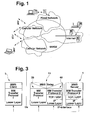
- FIG. 1 shows a schematic representation an integration of different information networks for one integral multimedia messaging service
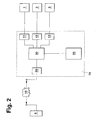
- Figure 2 Block diagram of an inventive Adaptation device for carrying out the inventive Process
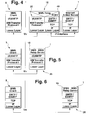
- Figure 3 is a representation of the for message exchange required according to the invention Protocol layers in a general form
- Figure 4 the Protocol layers for the invention Message exchange in a first special Embodiment
- Figure 5 shows the protocol layers for the Message exchange according to the invention in a second special embodiment
- Figure 6 the Protocol layers for the invention Message exchange in a third special Embodiment.
- MMS multimedia messaging service
- GSM Short Message Service
- GSM Global System for Mobile Communications
- Today's SMS service is limited to a maximum of 160 characters per Message is limited and it can only transfer text are, that is, there is a limited character set, which can be used.
- an MM Multimedia Message
- An MM should neither to a certain size yet on the presentation of text be limited.
- An MM should instead be diverse Support media types.
- a central function in the MMS service is an MMS relay designated fitting device 15 to.
- This Element can be used on a variety of media various as server or service provider designated panels 1, 2, 3, such as email servers, Fax server, voice mailbox, MMS server or The like can be connected as shown in FIG. It serves to the user of the terminal 5 all those To make information / news accessible on the mentioned servers.
- the user of the terminal has 5 thus accessing his emails on an email server lying on faxes "waiting" for him on a fax server, and on voice messages on a voice mailbox for he was recorded.
- FIG. 1 schematically shows an MMSE (Multimedia Messaging Service Environment), as for example for Mobile radio systems according to the UMTS standard (Universal Mobile Telecommunications System) or according to the GSM standard (Global System for Mobile Communications) can.
- the MMSE represents a system in which different new and existing services, as in the Mobile telephony, landline telephony, Internet and such integrated and the previously existing separation the individual services within the different networks is canceled.
- Landline telephony service is in Figure 1 as a landline represented by the term "Fixed Network” characterized.
- the Internet service is shown in FIG Internet represented and designated.
- the MMSE refers to it according to the example of Figure 1 all networks shown or services. For this, the MMSE includes various Service elements that are flexible in any of the illustrated networks can be implemented.
- Adaptation device 15 comprises a controller 30 to which a storage device 25 is connected. Furthermore is to the controller 30, a fourth interface 20 to a Terminal 5 is connected, it being at the fourth Interface 20, for example, an air interface or wireless interface and 5 at the terminal mobile terminal, for example in the form of a mobile phone can act.
- the exchange of data between the terminal 5 and the fourth interface 20 via a Telecommunications network 10, the training in the fourth Interface 20 as a wireless interface and the Terminal 5 as a mobile terminal as a mobile network can be trained.
- the telecommunications network 10 is a landline and the Terminal 5 and the fourth interface 20 wired are. The following is an example of the case be described that the fourth interface 20 wirelessly and the terminal 5 are mobile.
- first interface 11 a first center 1 to the adapter 15 connected.
- second interface 12 a second center 2 to the adapter 15 connected.
- third interface 13 is a third center 3 to the adapter 15 connected.
- Each of the panels 1, 2, 3 offers one or more Services.
- the offered by the central 1, 2, 3 Services differ in the manner described here Embodiment of each other.
- the terminal 5 does not have a service-specific each Establish connection to the corresponding central office.
- Much more builds the terminal 5 for each claim Service a connection to the adaptation device 15, the the various services of the central 1, 2, 3 for the Terminal 5 converts into a uniform shape.
- These uniform form can be from the terminal 5 or of a Users of the terminal 5 are given and in shape a record from the terminal 5 via the Telecommunications network 10 to the matching device 15th transferred and stored in the storage device 25 become.
- the first center 1 is exemplary of an electronic postal service, such as e-mail, be provided.
- the second center 2 is intended for example be provided an SMS service.
- the third center 3 should be provided by way of example for a fax mail service.
- from Terminal 5 is now intended for example in the Storage device 25 the default be stored after which messages from the adaptation device 15 to Terminal 5 are transmitted in the form of SMS messages should. It could be reversed in another Embodiment in a similar manner, SMS messages in the form of e-mails from the adaptation device 15 to Terminal 5 are transmitted.
- the Storage device 25 stored default of the terminal 5 Provide that the messages from the adaptation device 15 transmitted to the terminal 5 in the described pull mode are, i. So only after request by the terminal 5.
- One in the first center 1 for the terminal 5 incoming message is due to appropriate Signaling of the first center 1 of the controller 30th recognized.
- the terminal 5 is then used by the Adaptation device 15 via the telecommunications network 10th signals that a message for the terminal 5 in the first central office 1 is present.
- the terminal 5 then the Adaptation device 15 for transmission in the first Call Central 1 for this message.
- the control 30 causes upon detection of this request signal the first center 1 for the transmission of the terminal 5 present message. For example, is this message as an electronic mail message, it recognizes Control 30 this.
- the memory device 25 stored default of the terminal 5 converts the controller 30th the electronic mail message then into one or more SMS messages around, depending on the length of the electronic Mail message.
- a Transmission of the SMS or SMS messages from the adaptation device 15 to the terminal 5 then takes place Accessibility of the terminal 5 and as described below the condition that the request signal from the Control 30 was detected.
- the controller 30 converts one of the third center 3 via the third interface 13 received fax mail message in one or more SMS messages and sends it on request by the Terminal 5 via the fourth interface 20 and the Telecommunications network 10 to the terminal 5.
- One from the second center 2 over the second Interface 12 received at the matching device 15 SMS message is recognized by the controller 30 as such and therefore does not have to be converted, but can be in the described pull mode prompted by the Terminal 5 via the fourth interface 20 and the Telecommunications network 10 transmitted to the terminal 5 become.
- the controller 30 may receive messages, from the terminal 5 via the telecommunications network 10 and the fourth interface 20 on the adapter 15 received, recognize and according to a specification of This message addressed the head office in one of these Convert the central desired format and to this center be transmitted, e.g. Text on voicemail box or text on fax.
- Made by the appropriate headquarters Specifications can also be in the storage device 25 be stored. There can also be defaults of several Central stores.
- the terminal 5 is also referred to as an MMS client (Multimedia Message Service).
- the adaptation device 15 is referred to in accordance with FIG. 3 and as described also as MMS relay.
- the first control unit 1, which is also referred to as an MMS server, is intended to be connected to the adaptation device 15 in FIG. 3 by way of example.
- the fourth interface 20 as the air interface between the terminal 5 and the adaptation device 15 is designated U u in FIG.
- the first interface 11 for connecting the first center 1 to the adaptation device 15 is referred to in Figure 3 as an IP interface (Internet Protocol).
- IP interface Internet Protocol
- the MMS server and the MMS relay 15 need not necessarily be separated from each other as shown in Figure 3, but may also form a physical unit. A separation of MMS relay 15 and MMS server according to Figure 3 and a distributed arrangement of the two elements is particularly useful if the MMS server is an Internet e-mail server.
- the MMS relay 15 and the MMS server are interconnected via the usual protocol layers.
- the MMS relay 15 comprises on the side of the air interface U u a first protocol layer sequence, which corresponds to the protocol layer sequence of the terminal 5.
- the MMS relay 15 comprises a second protocol layer sequence on the side of the IP interface, which corresponds to the protocol layer sequence of the first center 1.
- MM transfer protocol Multimedia Messaging
- an upper protocol layer which may be designed, for example, as SMTP or ESMTP or manufacturer-specific.
- the MM transfer protocol on the side of the air interface U u can differ from the MM transfer protocol on the side of the IP interface.
- the MM transfer protocol on the side of the air interface U u is therefore indicated in FIG. 3 as I and the MM transfer protocol on the side of the IP interface is denoted by II in order to take this circumstance into account.
- the MM transfer protocol II may be designed as SMTP and the MM transfer protocol I as a protocol for the transmission of SMS messages in order to implement the application described in FIG.
- the upper layer is subdivided on the side of the IP interface into the MM Transfer Protocol II and the TCP / UDP (Transmission Control Protocol / User Datagram Protocol).
- the lower layer is generally referred to as a lower layer, is used to set up and establish a connection between adapter 15 and terminal 5 on the one hand and between adapter 15 and corresponding center on the other hand and is also adapted to the type of messages to be transmitted via the corresponding interface.
- the lower layer corresponding to the IP interface according to FIG. 3 is designed as an IP (Internet Protocol) and underlying lower layer layer.
- the MMS relay 15 performs an adaptation of the message exchange between the MMS server and the MMS client.
- the second protocol layer sequence 40 of the MMS relay 15 assigned to the IP interface is traversed from bottom to top.
- a transformation of the message takes place according to the specification of the terminal 5 in the MMS relay 15.
- the thus transformed message then passes through the first protocol layer sequence 35 of the MMS relay 15 assigned to the air interface U u from top to bottom, so that the message can be sent to the MMS client.
- the protocol and message conversion for messages that are to be transmitted from the MMS client via the MMS relay 15 to the MMS server runs.
- the protocol layer sequence of the second center 2 and the third center 3 can each differ from the protocol layer sequence of the first center 1 according to FIG. 3, the second interface 12 and the third interface 13 then each having its own second protocol layer sequence 40 on the side of the MMS relay 15 is assigned, which corresponds to the protocol layer sequence of the connected central office. In this way, three different protocol layer sequences on the side of the MMS relay 15 can be realized by the first interface 11, the second interface 12 and the third interface 13, each corresponding to the protocol layer sequence of the connected center. It is essential in the arrangement described according to FIG. 3 that the MMS client communicates via the MMS relay 15 with one or more MMS servers and vice versa.
- the illustrated structure allows on the one hand a flexible integration of several different MMS servers or control centers from different networks or for different services, such as a fax mail service or a voice mail service, which are realized via a cellular mobile network, and an e-mail service that is realized over the Internet.
- the terminal 5 if it is designed as a mobile device, for example, according to the GSM standard, in addition to the realization of mobile-specific functions, such as the SMS service, the use of standardized mail services, for example, according to the Internet standard of the IETF with the necessary protocols, procedures and MMS servers are offered.
- a first group of such Functions allows the integration of different Services or different MMS server through the Adaptation device 15.
- the MMS server different Services, such as Send e-mail, voice mail or fax mail their messages via the MMS Relay 15, this one Converting messages into a uniform form, to the terminal 5.
- different Data formats e.g. a fax mail format in a graphic format.
- the data type may be required to convert such a message, for example a To translate a text message into a voice mail message so that the text message acoustically reproduced at the terminal 5 can be.
- a second set of functions in MMS relay 15 is to do this necessary to determine if the terminal 5 by the Telecommunications network 10 from the adaptation device 15 can be achieved. For this it is necessary that the MMS relay 15 connects to another Message element, such as an HLR (Home Location Register) to obtain information about whether the Terminal 5 logged in the telecommunications network 10 or is available. Is the corresponding terminal 5 is not reachable, so the message to be transmitted in the Storage device 25 are stored. As soon as that Terminal 5 is reachable again and the MMS relay 15 this learns about the network element described, it leads MMS Relay 15 the previously by storing the message aborted delivery process automatically.
- HLR Home Location Register
- a third group of functions concerns the to be set transmission mode for the transmission of Messages from the adapter 15 to the terminal 5. It should be possible, for a direct news from the adaptation device 15 to the terminal 5 according to the push mode transferred to. On the other hand, it should be possible that the terminal 5 only from the matching device 15th is informed that for the terminal 5 a Message in the adapter 15 or one of the assigned panels 1, 2, 3 is stored. These Messages can then be sent to the terminal 5 via the Adaptation device 15 retrieved or to another Be forwarded to the mail system. This transfer mode corresponds to the described pull mode.
- the user can specify the terminal 5 by means of a record and this record to the adjustment device 15 for Send storage in the storage device 25.
- One such record is also referred to as profiles. Recognizes the MMS relay 15 is receiving a new message for the Terminal 5 in one of the panels 1, 2, 3 or it is the MMS relay 15 is signaled by one of the control stations 1, 2, 3, then the MMS relay 15 checks as a function of the Storage device 25 stored profile entries, in which transmission mode the message to the terminal 5 to be transmitted, so for example in push mode or in pull mode. According to the given Transfer mode will then transfer the message to the terminal 5 controlled by the controller 30.
- FIG. 15 Another group of functions of the adaptation device FIG. 15 relates to the segmentation or summarization of News. Messages can be made up of multiple elements exist, such as emails, which are different May include attachments.
- the MMS relay 15 can be any Individually treat element of a message, i. under Circumstances individual elements of the message to the terminal 5 forward others in the storage device 25 Save, delete others or another Forward mail system. This procedure is called Segmentation of messages called. Accordingly a message are recombined, for example Message elements from different panels 1, 2, 3.
- a profile be given which data types or data formats of Message elements of such a message in which the described forms are to be treated individually. For example, all message elements in a video format to another terminal in another Be forwarded to the mail system that is capable of Play video data.
- Message elements with Text messages can be used in this example for sending be provided to the terminal 5 according to profiles and Message elements in fax form could be edited according to profiles in this example for storage in the storage device 25 be provided for a later retrieval.
- the custom profile is one Record, by the user of the terminal 5 and in the memory device 25 of the MMS relay 15 is stored. He determines the behavior of the MMS Relays 15 and specifies which messages or Message elements directly or on demand, i. in the push or in pull mode, are transmitted to the terminal 5, which messages or news items automatically another mail system is forwarded or deleted, which messages or news items in another Format to be converted, etc. To those for the news or the news items provided by profiles Processing needs to be able to do these messages or news items distinguished from one another and can be identified. Distinguishing features to Identification of the news or news items are for example, the data type, e.g. Fax mail, voice mail, E-mail, SMS, etc. and the size of the messages or the News items.
- the data type e.g. Fax mail, voice mail, E-mail, SMS, etc.
- Data type and size of the messages or Message elements can from the controller 30 on suitable and known to the expert way, eg. by evaluation of the news or the Message elements attached header information with the necessary information is determined.
- the profiles can also include device specific specifications that are not supported by the User are influenced and the the terminal 5 to Available resources, e.g. the graphics ability a display device of the terminal 5, the Memory capacity of the terminal 5 or the like as Specify boundary conditions. However, it can also be provided be that the user himself pretends which with the Terminal 5 realizable functionalities in the profile be recorded. From the publication "Composite Capability / Preference Profiles (CC / PP): A user side framework for content negotiation ", W3C Note, July 27, 1999 it is already known how a user his profile set and change.
- Terminal 5 There may also be several such profiles to for example, different skills Terminal 5 displays or capabilities different terminal configurations in general too that may arise as a result of the fact that Terminal 5 external components, such as their own Display devices, can be connected.
- Terminal 5 external components such as their own Display devices
- Such an external Component may be, for example, a laptop.
- the settings for the current profile depend on the Rule of the functionalities of the terminal 5 from which currently available to the user. More than Today, a mobile user will become external devices in the future with his example as a mobile phone or Mobile device trained mobile terminal 5 connect can, so the current means of the terminal 5 feasible capabilities as needed or Offer to vary. For reasons of mobility, the Device size and stand-by time will be many Mobile devices in the future only basic Offer functionalities. These functionalities can be the However, users can expand by, for example, one electronic notebook or electronic Organizer coupled to the mobile terminal 5.
- identifiers for example in the form of Numbers, agreed for each of these profiles, so that one one-to-one mapping of an identifier to a profile name of each profile and thus on the content of the corresponding profiles is possible.
- All of the User of the mobile terminal 5 predetermined profile be in an initialization of the terminal 5 via the telecommunications network 10 to the adaptation device 15th or transferred to the Profile Database 25 and in the Profile Database 25, for example, in order stored their arrival. Further from the user defined or predefined profiles can also still at a later time from the terminal 5 in the described manner to Profile Database 25 transferred and There, for example, in the order of their arrival get saved.
- GSM mobile device trained terminal 5 for example, a first profile which name it gives the name "pure GSM (SMS only)".
- this profile he will then specify that his GSM mobile device 5 only supports SMS and he therefore e-mails available to him on an internet e-mail server not want to get sent automatically, but in this case rather on the Internet E-Mail server want to leave.
- SMS messages different for the user Messages that are also in the corresponding servers should be saved.
- GSM + organizer e.g. establish, that not only text messages are sent to him but that the user also automatically updates of his calendar - if e.g. his secretary or Work colleagues can change, add or add an appointment to brush.
- the user becomes the mobile Terminal 5, then e.g. consider the case that he not in the area of his home network is traveling, but e.g. stays abroad. In such a case are him The resulting roaming charges too high, so that while he SMS messages continue to receive, over incoming Calendar messages or faxes only by SMS want to be informed - without him automatically be delivered. Emails and messages of others Message types that are from the specified message types are different, should also be on the associated Server remain saved.
- the user needs according to this invention then only those profiles from a List of the profile names used in the mobile terminal 5 are saved, to choose his wishes corresponds and the current functionalities of the mobile Terminal 5 and the straight connected to him external accessories or components.
- this profile name the corresponding identifier is displayed.
- This identifier is then the only thing really about the air interface or the mobile network 10 from the mobile terminal 5 must be transmitted to the MMS relay 15 to the Start MMS service as desired. Because about this ID can be the MMS Relay 15 in the Profile Database 25 the Settings for the profiles assigned to the identifier ask and realize.
- An advantage of the invention is in particular that the user only once the capabilities of his Terminal 5 or its possible combination of devices in the form from the external device connected to the terminal 5 or components, and its desired configuration of the MMS service must set or from the MMS relay 15 to the profiles Database 25 can be set. Changes something in the Device combination and / or his wishes, he needs just select the appropriate profile from the list.
- Another advantage results from the respective identifier the profile. As explained above, according to this invention do not transfer the difference information to the previous profile the air interface will be transmitted, but it will just transmit the identifier of the desired profile. This saves data and thus resources on the mobile radio channel in the mobile network 10 and speeds up the setting of the MMS service.
- MMS Relay 15 as described data type and / or Data format conversions performed.
- Dependency of the specifications of the user-defined profile or of terminal-specific default specifications are doing Messages or news items that are in one of Central 1, 2, 3 for the terminal 5 in a first Data type, e.g. as fax or text, in converted another data type, for example a fax mail into a graphic or a text in language.
- Corresponding may be a message in a first data format through the MMS relay 15 into a second data format be converted.
- a GIF graphic Graphic Interchange Format
- JPEG graphic Joint Picture Expert Group
- a text of a first alphabet be converted into a text of a second alphabet.
- the MMS relay 15, the terminal 5 be notified when new messages or Message elements not automatically to the terminal 5 be forwarded, for example according to the pull mode. Accordingly, a notification of the terminal 5 be done by the MMS relay 15, if messages or Message elements automatically according to the specification of the Profiles forwarded to another mail system or to be deleted.
- FIG. 4 shows, starting from FIG. 3, layer sequences for a specific example, in which the MMS server is designed as an Internet e-mail server and represents the first center 1.
- the MM Transfer Protocol II is designed as SMTP or ESMTP.
- the MM transfer protocol I is superior to the SMTP or ESMTP in association with the air interface U u .
- the remaining layers correspond to the layers already shown in FIG.
- the terminal 5 is an SMTP or ESMTP-capable terminal.
- the Internet E-mail server illustrated in FIG. 4 is an Internet E-mail POP (Post Office Protocol) server.
- the MMS client according to FIG. 4 is designed in this example as an SMTP client, ie SMTP-capable terminal 5.
- the connection from MMS relay 15 to the Internet E-mail POP server is identical to a classic Internet E-mail configuration, where a POP server stores all incoming e-mail for the POP client and the POP client stores in Checks regular cycles, whether for him new mails have been received at the POP server. If this is the case, they are loaded completely into the POP client, whereby in the classical Internet E-Mail configuration no MMS Relay 15 is intended.
- the SMTP is provided, which, as described, at least for the IP interface, the TCP / IP (Transmission Control Protocol / Internet Protocol) uses.
- FIG. 4 In the first embodiment of Figure 4 includes the MMS relay 15 for the IP interface the described POP client functionality according to the classic Internet e-mail configuration.
- a new e-mail on the Internet E-mail POP server will thus be in the for classic POP client described manner to MMS relay 15 transmitted.
- the MMS relay 15 sets then depending on in the Storage device 25 stored profile entries determines whether this e-mail or what elements of this e-mail directly to Terminal 5 are forwarded by means of push mode and additionally signals to the terminal 5, if necessary, that other elements of this message for transmission to the Terminal 5 according to the pull mode are present or to a other mail system have been forwarded or deleted.
- the e-mail should now Elements for both transmission modes, ie for push mode and the pull mode included.
- the MMS relay 15 which are provided according to the profile for the push mode Elements to a new message together, build one Transmission channel to the terminal 5 and sends them summarized elements via SMTP.
- the other elements are also summarized and using SMTP to Internet e-mail server transferred to from there on other mail system forwarded, deleted or for the Pull mode stored until retrieved by the terminal 5 too become.
- the notification of the presence of Message elements intended for the pull mode can, together with the transfer of the combined Message elements according to the push mode or take place separately. If only one notification takes place, i. are No news items exist that are in push mode could be transmitted to the terminal 5, so could this notification by means of one of the MMS relay 15 generated message in push mode to the Terminal 5 is transmitted or special Used signaling channels, such as the SMS service according to GSM standard.
- the Storage of the news items; the according to the push mode to be transmitted and / or the notifications lasts until the MMS relay 15, for example, from HLR is communicated that the terminal 5 now via the Telecommunications network 10 is reached. Subsequently, will the transmission of the message elements according to the push mode or the notifications to the terminal 5 continued. Saving the message elements and / or The notifications can be on the internet in this example E-mail server or in MMS relay 15 done.
- the profile controls how described, for example, conversions of the data format of News.
- the POP will be exemplified used.
- the IMAP Internet Message Access Protocol
- others available for this purpose Protocols are used.
- FIG. 5 shows a second embodiment, in which the MMS server and the MMS relay 15 are functionally combined, as is advantageous, for example, for network-internal services, such as voice / fax mailbox can.
- the protocol layer sequence of the MMS client according to FIG. 4 and the first protocol layer sequence 35 for the air interface U u of the MMS relay 15 according to FIG. 4 are shown in FIG. 5. These protocol layer sequences now share the MMS relay 15 and the MMS server in a common physical unit according to FIG. 5.
- the MMS server and the MMS relay 15 are functionally combined in one physical unit, but rather for IP-based implementations.
- the MMS server according to FIG. 6 corresponds in its protocol layer sequence to the Internet e-mail server according to FIG. 4. This protocol layer sequence is shared by the MMS server with the MMS relay 15. The same protocol layer sequence is then, as usual, used for the MMS message.
- FIG. 6 shows a third embodiment. All three embodiments according to Figure 4, Figure 5 and Figure 6 are mutually applicable in the MMSE.
- the MMS relay 15 either as a separate protocol element or functional with The MMS server is integrated.
Landscapes
- Engineering & Computer Science (AREA)
- Computer Networks & Wireless Communication (AREA)
- Signal Processing (AREA)
- Computer Security & Cryptography (AREA)
- Mobile Radio Communication Systems (AREA)
- Data Exchanges In Wide-Area Networks (AREA)
- Computer And Data Communications (AREA)
- Telephonic Communication Services (AREA)
Priority Applications (2)
| Application Number | Priority Date | Filing Date | Title |
|---|---|---|---|
| EP10184147A EP2262192A3 (de) | 1999-10-01 | 2000-08-17 | Verfahren und Vorrichtung zur Nachrichtenübertragung |
| DE20024016U DE20024016U1 (de) | 1999-10-01 | 2000-08-17 | Mobiltelefon |
Applications Claiming Priority (5)
| Application Number | Priority Date | Filing Date | Title |
|---|---|---|---|
| DE19947578 | 1999-10-01 | ||
| DE19947578 | 1999-10-01 | ||
| DE19956023 | 1999-11-22 | ||
| DE19956023.4A DE19956023B4 (de) | 1999-10-01 | 1999-11-22 | Verfahren zur Übertragung von Nachrichten zwischen mindestens einer Zentrale und einem Endgerät und Anpassungsvorrichtung dafür |
| EP00965758A EP1222782B1 (de) | 1999-10-01 | 2000-08-17 | Verfahren und anpassungsvorrichtung zur übertragung von nachrichten zwischen mindenstens einer zentrale und einem endgerät und anpassungsvorrichtung dafür |
Related Parent Applications (1)
| Application Number | Title | Priority Date | Filing Date |
|---|---|---|---|
| EP00965758A Division EP1222782B1 (de) | 1999-10-01 | 2000-08-17 | Verfahren und anpassungsvorrichtung zur übertragung von nachrichten zwischen mindenstens einer zentrale und einem endgerät und anpassungsvorrichtung dafür |
Publications (1)
| Publication Number | Publication Date |
|---|---|
| EP1610511A1 true EP1610511A1 (de) | 2005-12-28 |
Family
ID=26055156
Family Applications (3)
| Application Number | Title | Priority Date | Filing Date |
|---|---|---|---|
| EP05019596A Ceased EP1610511A1 (de) | 1999-10-01 | 2000-08-17 | Verfahren und Vorrichtung zur Nachrichtenübertragung |
| EP10184147A Ceased EP2262192A3 (de) | 1999-10-01 | 2000-08-17 | Verfahren und Vorrichtung zur Nachrichtenübertragung |
| EP00965758A Revoked EP1222782B1 (de) | 1999-10-01 | 2000-08-17 | Verfahren und anpassungsvorrichtung zur übertragung von nachrichten zwischen mindenstens einer zentrale und einem endgerät und anpassungsvorrichtung dafür |
Family Applications After (2)
| Application Number | Title | Priority Date | Filing Date |
|---|---|---|---|
| EP10184147A Ceased EP2262192A3 (de) | 1999-10-01 | 2000-08-17 | Verfahren und Vorrichtung zur Nachrichtenübertragung |
| EP00965758A Revoked EP1222782B1 (de) | 1999-10-01 | 2000-08-17 | Verfahren und anpassungsvorrichtung zur übertragung von nachrichten zwischen mindenstens einer zentrale und einem endgerät und anpassungsvorrichtung dafür |
Country Status (5)
| Country | Link |
|---|---|
| US (1) | US7274926B1 (enExample) |
| EP (3) | EP1610511A1 (enExample) |
| JP (2) | JP2003511769A (enExample) |
| DE (4) | DE19956023B4 (enExample) |
| WO (1) | WO2001026310A1 (enExample) |
Families Citing this family (44)
| Publication number | Priority date | Publication date | Assignee | Title |
|---|---|---|---|---|
| US20080192768A1 (en) * | 1997-07-30 | 2008-08-14 | Steven Tischer | Apparatus, method, and computer-readable medium for interfacing communication devices |
| US20080220775A1 (en) * | 1997-07-30 | 2008-09-11 | Steven Tischer | Apparatus, method, and computer-readable medium for securely providing communications between devices and networks |
| US20080207178A1 (en) * | 1997-07-30 | 2008-08-28 | Steven Tischer | Apparatus and method for restricting access to data |
| US20080194225A1 (en) * | 1997-07-30 | 2008-08-14 | Steven Tischer | Apparatus and method for providing emergency and alarm communications |
| US20080207197A1 (en) * | 1997-07-30 | 2008-08-28 | Steven Tischer | Apparatus, method, and computer-readable medium for interfacing devices with communications networks |
| US20080194208A1 (en) * | 1997-07-30 | 2008-08-14 | Steven Tischer | Apparatus, method, and computer-readable medium for communicating between and controlling network devices |
| US7149514B1 (en) | 1997-07-30 | 2006-12-12 | Bellsouth Intellectual Property Corp. | Cellular docking station |
| US20080207179A1 (en) * | 1997-07-30 | 2008-08-28 | Steven Tischer | Apparatus and method for testing communication capabilities of networks and devices |
| DE10103799A1 (de) * | 2001-01-29 | 2002-08-08 | Siemens Ag | Nachrichtenübermittlungsvorrichtung und Verfahren zur Übermittlung von Nachrichten |
| DE10124521A1 (de) * | 2001-05-19 | 2002-11-21 | Deutsche Telekom Ag | Verfahren zum Abrufen von Textnachrichten in einem Mobilfunksystem und Vorrichtung zur Durchführung des Verfahrens |
| US20030195811A1 (en) * | 2001-06-07 | 2003-10-16 | Hayes Marc F. | Customer messaging service |
| DE10141081B4 (de) * | 2001-08-22 | 2009-04-09 | Siemens Ag | Verfahren zum Bereitstellen einer Ansage auf einer Mailbox und Vorrichtungen zum Umsetzen des Verfahrens |
| DE10142680A1 (de) * | 2001-08-31 | 2003-04-03 | Materna Gmbh Information & Com | Verfahren zur Weiterleitung und Entgegennahme von Kurznachrichten im öffentlichen Telekommunikationsnetz |
| DE20114859U1 (de) * | 2001-09-07 | 2003-01-16 | Materna Gmbh Information & Com | Vermittlungssystem für Multimedia-Nachrichten |
| EP1440590A1 (en) * | 2001-10-29 | 2004-07-28 | Nokia Corporation | Adapting the data rate and/or the amount of data of content to be transmitted separately for at least two radio access networks, e.g. umts, geran |
| DE10204112B4 (de) * | 2002-02-01 | 2004-11-18 | Materna Gmbh Information & Communications | Verfahren zur Entgegennahme und Weiterleitung von Kurznachrichten in einem öffentlichen Telekommunikationsfestnetz |
| DE10219391A1 (de) | 2002-04-30 | 2003-11-27 | Siemens Ag | Verfahren zum Übertragen von Nutzdatenobjekten |
| DE10219894A1 (de) * | 2002-05-03 | 2003-11-20 | Siemens Ag | Verfahren zur Erstellung einer Repräsentation von mindestens einer Multimedia-Nachricht, zugehöriges Funkkommunikations-Nettzwerk sowie Subsystem |
| US7318073B2 (en) * | 2002-05-31 | 2008-01-08 | Microsoft Corporation | System and method for downloading information to a mobile device |
| DE10225425A1 (de) * | 2002-06-07 | 2003-12-18 | Siemens Ag | Verfahren zur Übertragung von Daten |
| US7362700B2 (en) * | 2002-06-27 | 2008-04-22 | Extreme Networks, Inc. | Methods and systems for hitless restart of layer 3 packet forwarding |
| US8416804B2 (en) | 2002-07-15 | 2013-04-09 | At&T Intellectual Property I, L.P. | Apparatus and method for providing a user interface for facilitating communications between devices |
| US7200424B2 (en) | 2002-07-15 | 2007-04-03 | Bellsouth Intelectual Property Corporation | Systems and methods for restricting the use and movement of telephony devices |
| US8554187B2 (en) | 2002-07-15 | 2013-10-08 | At&T Intellectual Property I, L.P. | Apparatus and method for routing communications between networks and devices |
| US8000682B2 (en) | 2002-07-15 | 2011-08-16 | At&T Intellectual Property I, L.P. | Apparatus and method for restricting access to data |
| US8526466B2 (en) | 2002-07-15 | 2013-09-03 | At&T Intellectual Property I, L.P. | Apparatus and method for prioritizing communications between devices |
| US8543098B2 (en) * | 2002-07-15 | 2013-09-24 | At&T Intellectual Property I, L.P. | Apparatus and method for securely providing communications between devices and networks |
| US8275371B2 (en) | 2002-07-15 | 2012-09-25 | At&T Intellectual Property I, L.P. | Apparatus and method for providing communications and connection-oriented services to devices |
| DE10325889A1 (de) | 2003-06-06 | 2004-12-23 | Siemens Ag | Verfahren zum Übertragen von Nachrichten |
| DE10327056B4 (de) * | 2003-06-16 | 2011-06-01 | Infineon Technologies Ag | Verfahren zum Modifizieren einer Multimedia-Nachricht durch netzwerkseitige Anwendung von Applikationen sowie zugehöriges Funkkommunikationssystem |
| US7630705B2 (en) * | 2003-06-30 | 2009-12-08 | Motorola, Inc. | Message format conversion in communications terminals and networks |
| EP1501320A1 (fr) * | 2003-07-24 | 2005-01-26 | France Telecom | Procédé et système de soumission d'un message déposé dans une boíte de réception d'un service de messagerie |
| US7483370B1 (en) * | 2003-12-22 | 2009-01-27 | Extreme Networks, Inc. | Methods and systems for hitless switch management module failover and upgrade |
| US20050275406A1 (en) * | 2004-06-15 | 2005-12-15 | Hatalkar Atul N | Apparatus and method of dynamic usage profile acquisition and utilization in a wireless mobile device |
| EP1641200A1 (en) * | 2004-09-28 | 2006-03-29 | iMoNext Holding B.V. | System and method to provide access to at least one multimedia |
| US8819569B2 (en) | 2005-02-18 | 2014-08-26 | Zumobi, Inc | Single-handed approach for navigation of application tiles using panning and zooming |
| KR100739721B1 (ko) * | 2005-08-17 | 2007-07-13 | 삼성전자주식회사 | 정보 제공 방법 및 푸시 모드 서비스 제공 방법 |
| US8050660B2 (en) * | 2006-03-07 | 2011-11-01 | Motorola Mobility, Inc. | Apparatus and method for handling messaging service message adaptation |
| US7817987B2 (en) * | 2006-03-07 | 2010-10-19 | Motorola, Inc. | Apparatus and method for handling messaging service message adaptation |
| US8073474B1 (en) * | 2007-03-23 | 2011-12-06 | Zumobi, Inc. | Systems and methods for controlling group messaging |
| US8914786B2 (en) | 2007-03-23 | 2014-12-16 | Zumobi, Inc. | Systems and methods for controlling application updates across a wireless interface |
| DE102007047281A1 (de) * | 2007-10-02 | 2009-05-07 | T-Mobile International Ag | Verfahren zum Übertragen von Nachrichten mittels Multimedia Message Service (MMS) |
| EP2424205B1 (de) | 2010-08-26 | 2019-03-13 | Unify GmbH & Co. KG | Verfahren und Anordnung zur automatischen Übertragung einer Zustandsinformation |
| US8583748B2 (en) * | 2010-09-01 | 2013-11-12 | At&T Mobility Ii, Llc | Method and apparatus for messaging service internetworking |
Citations (4)
| Publication number | Priority date | Publication date | Assignee | Title |
|---|---|---|---|---|
| US5377354A (en) * | 1989-08-15 | 1994-12-27 | Digital Equipment Corporation | Method and system for sorting and prioritizing electronic mail messages |
| US5742668A (en) * | 1994-09-19 | 1998-04-21 | Bell Communications Research, Inc. | Electronic massaging network |
| GB2328110A (en) * | 1997-08-01 | 1999-02-10 | Mitel Corp | Dialable filtering profile for mixed media stored messages |
| EP0924946A1 (de) * | 1997-12-19 | 1999-06-23 | Siemens Aktiengesellschaft | Telekommunikationssystem und Verfahren zum Austausch von Informationen zwischen einem E-Mail-Service und einem Teilnehmer in einem Telekommunikationsnetz |
Family Cites Families (21)
| Publication number | Priority date | Publication date | Assignee | Title |
|---|---|---|---|---|
| US5917897A (en) * | 1997-02-24 | 1999-06-29 | Summit Telecom System, Inc. | System and method for controlling a telecommunication network in accordance with economic incentives |
| JPH09130425A (ja) * | 1995-11-07 | 1997-05-16 | Fujitsu Ltd | 電子メール送受信システム |
| US6473609B1 (en) * | 1995-12-11 | 2002-10-29 | Openwave Systems Inc. | Method and architecture for interactive two-way communication devices to interact with a network |
| US6466783B2 (en) * | 1995-12-11 | 2002-10-15 | Openwave Systems Inc. | Visual interface to mobile subscriber account services |
| FI102869B (fi) * | 1996-02-26 | 1999-02-26 | Nokia Mobile Phones Ltd | Laite, menetelmä ja järjestelmä eri sovelluksiin liittyvien tietojen l ähettämiseksi ja vastaanottamiseksi |
| US5903845A (en) * | 1996-06-04 | 1999-05-11 | At&T Wireless Services Inc. | Personal information manager for updating a telecommunication subscriber profile |
| US5790789A (en) | 1996-08-02 | 1998-08-04 | Suarez; Larry | Method and architecture for the creation, control and deployment of services within a distributed computer environment |
| US5905777A (en) * | 1996-09-27 | 1999-05-18 | At&T Corp. | E-mail paging system |
| US5842210A (en) * | 1996-10-30 | 1998-11-24 | Motorola, Inc. | Method and apparatus for selectively retrieving data from a database in a data communication system |
| US5958018A (en) * | 1996-10-30 | 1999-09-28 | Lucent Technologies Inc. | Wireless services data network translating mac address to asynchronous transfer mode (ATM) address |
| JPH10240643A (ja) * | 1997-02-25 | 1998-09-11 | Kobe Nippon Denki Software Kk | 電子メールシステム |
| FI104873B (fi) * | 1997-04-16 | 2000-04-14 | Nokia Networks Oy | Datapalvelu matkaviestinverkossa |
| US6023700A (en) * | 1997-06-17 | 2000-02-08 | Cranberry Properties, Llc | Electronic mail distribution system for integrated electronic communication |
| US5895471A (en) * | 1997-07-11 | 1999-04-20 | Unwired Planet, Inc. | Providing a directory of frequently used hyperlinks on a remote server |
| US6243739B1 (en) * | 1997-07-11 | 2001-06-05 | Phone.Com, Inc. | Reducing perceived latency in servicing user requests on low-bandwidth communication channels |
| JPH11146117A (ja) * | 1997-11-04 | 1999-05-28 | Mitsubishi Electric Corp | Fax管理装置 |
| US6088594A (en) * | 1997-11-26 | 2000-07-11 | Ericsson Inc. | System and method for positioning a mobile terminal using a terminal based browser |
| DE19801563B4 (de) * | 1998-01-19 | 2006-04-20 | Telefonaktiebolaget Lm Ericsson (Publ) | Kommunikationssystem mit Unterstützung mobiler Teilnehmer und automatischer Informations- und Medienumsetzung |
| US6138158A (en) * | 1998-04-30 | 2000-10-24 | Phone.Com, Inc. | Method and system for pushing and pulling data using wideband and narrowband transport systems |
| US6560640B2 (en) * | 1999-01-22 | 2003-05-06 | Openwave Systems, Inc. | Remote bookmarking for wireless client devices |
| US6947738B2 (en) * | 2001-01-18 | 2005-09-20 | Telefonaktiebolaget Lm Ericsson (Publ) | Multimedia messaging service routing system and method |
-
1999
- 1999-11-22 DE DE19956023.4A patent/DE19956023B4/de not_active Expired - Lifetime
-
2000
- 2000-08-17 DE DE20024016U patent/DE20024016U1/de not_active Expired - Lifetime
- 2000-08-17 EP EP05019596A patent/EP1610511A1/de not_active Ceased
- 2000-08-17 EP EP10184147A patent/EP2262192A3/de not_active Ceased
- 2000-08-17 US US10/089,623 patent/US7274926B1/en not_active Expired - Lifetime
- 2000-08-17 DE DE20024015U patent/DE20024015U1/de not_active Expired - Lifetime
- 2000-08-17 EP EP00965758A patent/EP1222782B1/de not_active Revoked
- 2000-08-17 WO PCT/DE2000/002780 patent/WO2001026310A1/de not_active Ceased
- 2000-08-17 DE DE50012027T patent/DE50012027D1/de not_active Expired - Lifetime
- 2000-08-17 JP JP2001529152A patent/JP2003511769A/ja active Pending
-
2010
- 2010-02-12 JP JP2010029269A patent/JP5641745B2/ja not_active Expired - Lifetime
Patent Citations (4)
| Publication number | Priority date | Publication date | Assignee | Title |
|---|---|---|---|---|
| US5377354A (en) * | 1989-08-15 | 1994-12-27 | Digital Equipment Corporation | Method and system for sorting and prioritizing electronic mail messages |
| US5742668A (en) * | 1994-09-19 | 1998-04-21 | Bell Communications Research, Inc. | Electronic massaging network |
| GB2328110A (en) * | 1997-08-01 | 1999-02-10 | Mitel Corp | Dialable filtering profile for mixed media stored messages |
| EP0924946A1 (de) * | 1997-12-19 | 1999-06-23 | Siemens Aktiengesellschaft | Telekommunikationssystem und Verfahren zum Austausch von Informationen zwischen einem E-Mail-Service und einem Teilnehmer in einem Telekommunikationsnetz |
Non-Patent Citations (1)
| Title |
|---|
| "Systèmes de messagerie; Protocoles d'accès des terminaux télétex; X.430", 1985, CCITT, Geneva, CH * |
Also Published As
| Publication number | Publication date |
|---|---|
| US7274926B1 (en) | 2007-09-25 |
| DE50012027D1 (de) | 2006-03-30 |
| JP5641745B2 (ja) | 2014-12-17 |
| DE19956023A1 (de) | 2001-04-05 |
| WO2001026310A1 (de) | 2001-04-12 |
| DE20024015U1 (de) | 2009-10-01 |
| JP2010146590A (ja) | 2010-07-01 |
| EP2262192A3 (de) | 2011-03-09 |
| DE19956023B4 (de) | 2019-10-02 |
| JP2003511769A (ja) | 2003-03-25 |
| EP1222782B1 (de) | 2006-01-04 |
| DE20024016U1 (de) | 2009-10-08 |
| EP1222782A1 (de) | 2002-07-17 |
| EP2262192A2 (de) | 2010-12-15 |
Similar Documents
| Publication | Publication Date | Title |
|---|---|---|
| DE19956023B4 (de) | Verfahren zur Übertragung von Nachrichten zwischen mindestens einer Zentrale und einem Endgerät und Anpassungsvorrichtung dafür | |
| EP1256241B2 (de) | Verfahren zur übertragung von nachrichten in einem telekommunikationsnetzwerk | |
| AT411312B (de) | Verfahren zum übermitteln von kurznachrichten (sms) zwischen rechnern im internet | |
| DE602004005319T2 (de) | Nachrichtenverwaltung | |
| EP1430644B1 (de) | Verfahren zur verbesserung der erreichbarkeit von teilnehmern, kommunikationssystem und kommunikationrrichtung | |
| EP1632065B1 (de) | Verfahren zum übertragen von nachrichten in einem auf mms basierten kommunikationssystem | |
| WO2004075523A2 (de) | Verfahren, telekommunikationsgerät sowie multimedianachrichtenzentrum zum zustellen einer multimedianachricht | |
| EP1525724B1 (de) | Verfahren und system zum blockieren von unerwünschten nachrichten | |
| EP2245804A1 (de) | Verfahren zum internetbasierten messaging | |
| EP1493295B1 (de) | Verfahren zur bertragung von daten, insbesondere mit multim edialen inhalten, in einem mobilfunknetz | |
| EP1683320B1 (de) | Verfahren zum aufbauen einer kommunikationsverbindung | |
| DE102005015385A1 (de) | Verfahren zum Umleiten mindestens einer Multimedianachricht in einem Mobilfunk-Kommunikationsnetzwerk, Multimedianachricht-Relaiseinrichtungen, Zentral-Mobilfunk-Servereinheit und Mobilfunk-Kommunikationsendgerät-Speicherelement | |
| EP2223516B1 (de) | Verfahren zum betreiben von einer schnurlosen mobilen funkeinrichtung und einer angeschlossenen schnurlosen stationären funkeinrichtung | |
| DE10127360A1 (de) | Verfahren und Vorrichtung zum Übertragen von Nachrichten | |
| EP1514438B1 (de) | Netzwerkbasiertes sprach- und daten-postdienstsystem für breitbandige mobilfunknetze | |
| EP1051874B1 (de) | Verfahren zum austausch von nachrichten in einem mobilkommunikationssystem | |
| EP1502398B1 (de) | Verfahren zur erstellung einer repräsentation von mindestens einer multimedia-nachricht, zugehöriges funkkommunikations-netzwerk sowie subsystem | |
| EP1424830B1 (de) | Verfahren zum Bereitstellen von Präsenzinformationen mindestens einer Kommunikationseinheit auf mindestens einem Präsenzserver, zugehörige Kommunikationseinheit, Präsenzserver sowie Kommunikationsnetz | |
| DE10149721A1 (de) | Verfahren zur Übertragung von Daten | |
| WO2005046264A1 (de) | Verfahren zum aufbauen einer kommunikationsverbindung |
Legal Events
| Date | Code | Title | Description |
|---|---|---|---|
| PUAI | Public reference made under article 153(3) epc to a published international application that has entered the european phase |
Free format text: ORIGINAL CODE: 0009012 |
|
| AC | Divisional application: reference to earlier application |
Ref document number: 1222782 Country of ref document: EP Kind code of ref document: P |
|
| AK | Designated contracting states |
Kind code of ref document: A1 Designated state(s): DE FR GB IT |
|
| 17P | Request for examination filed |
Effective date: 20060628 |
|
| AKX | Designation fees paid |
Designated state(s): DE FR GB IT |
|
| 17Q | First examination report despatched |
Effective date: 20061030 |
|
| RAP1 | Party data changed (applicant data changed or rights of an application transferred) |
Owner name: IPCOM GMBH & CO. KG |
|
| 111Z | Information provided on other rights and legal means of execution |
Free format text: DE FR GB IT Effective date: 20080507 |
|
| APBK | Appeal reference recorded |
Free format text: ORIGINAL CODE: EPIDOSNREFNE |
|
| APBN | Date of receipt of notice of appeal recorded |
Free format text: ORIGINAL CODE: EPIDOSNNOA2E |
|
| APBR | Date of receipt of statement of grounds of appeal recorded |
Free format text: ORIGINAL CODE: EPIDOSNNOA3E |
|
| APAF | Appeal reference modified |
Free format text: ORIGINAL CODE: EPIDOSCREFNE |
|
| TPAC | Observations filed by third parties |
Free format text: ORIGINAL CODE: EPIDOSNTIPA |
|
| APBT | Appeal procedure closed |
Free format text: ORIGINAL CODE: EPIDOSNNOA9E |
|
| STAA | Information on the status of an ep patent application or granted ep patent |
Free format text: STATUS: THE APPLICATION HAS BEEN REFUSED |
|
| 18R | Application refused |
Effective date: 20160414 |