EP1607468A2 - Klarspülmittel, enthaltend Polyolalkylether - Google Patents
Klarspülmittel, enthaltend Polyolalkylether Download PDFInfo
- Publication number
- EP1607468A2 EP1607468A2 EP05012166A EP05012166A EP1607468A2 EP 1607468 A2 EP1607468 A2 EP 1607468A2 EP 05012166 A EP05012166 A EP 05012166A EP 05012166 A EP05012166 A EP 05012166A EP 1607468 A2 EP1607468 A2 EP 1607468A2
- Authority
- EP
- European Patent Office
- Prior art keywords
- alkyl
- polyol
- agent according
- weight
- ether
- Prior art date
- Legal status (The legal status is an assumption and is not a legal conclusion. Google has not performed a legal analysis and makes no representation as to the accuracy of the status listed.)
- Granted
Links
Classifications
-
- C—CHEMISTRY; METALLURGY
- C11—ANIMAL OR VEGETABLE OILS, FATS, FATTY SUBSTANCES OR WAXES; FATTY ACIDS THEREFROM; DETERGENTS; CANDLES
- C11D—DETERGENT COMPOSITIONS; USE OF SINGLE SUBSTANCES AS DETERGENTS; SOAP OR SOAP-MAKING; RESIN SOAPS; RECOVERY OF GLYCEROL
- C11D1/00—Detergent compositions based essentially on surface-active compounds; Use of these compounds as a detergent
- C11D1/66—Non-ionic compounds
- C11D1/72—Ethers of polyoxyalkylene glycols
- C11D1/721—End blocked ethers
-
- C—CHEMISTRY; METALLURGY
- C11—ANIMAL OR VEGETABLE OILS, FATS, FATTY SUBSTANCES OR WAXES; FATTY ACIDS THEREFROM; DETERGENTS; CANDLES
- C11D—DETERGENT COMPOSITIONS; USE OF SINGLE SUBSTANCES AS DETERGENTS; SOAP OR SOAP-MAKING; RESIN SOAPS; RECOVERY OF GLYCEROL
- C11D3/00—Other compounding ingredients of detergent compositions covered in group C11D1/00
- C11D3/16—Organic compounds
- C11D3/20—Organic compounds containing oxygen
- C11D3/2068—Ethers
Definitions
- the present application relates to rinse aid, in particular rinse aid for the machine Dishwashing, wherein the agents contain polyol alkyl ethers, as well as the use such polyol alkyl ethers.
- rinse aids usually comprise mixtures of low-foaming nonionic surfactants, typically fatty alcohol polyethylene / polypropylene glycol ethers, solubilizers (eg cumene sulfonate), organic acids (eg citric acid) and solvents (eg ethanol) to influence the interfacial tension of the water so that it can run off in a very thin, coherent film of items to be washed, so that remain in the subsequent drying process, no drops of water, streaks or films.
- solubilizers eg cumene sulfonate
- organic acids eg citric acid
- solvents eg ethanol
- multifunctional detergent formulations have come on the market in recent years, which should provide at least one additional benefit in addition to a cleaning performance, such as rinsing and / or softening of the rinse water (so-called 2-in-1, or 3-in-1 Products).
- Combined dishwashing detergent products with built-in rinse aid are being used more and more in households as well as in commercial areas.
- rinse aids are usually added separately before cleaning and released into the rinsing chamber after the pre-rinsing and cleaning cycle at just under 40 ° C - 65 ° C.
- the rinse aid is formulated together with the detergent, but released in such a way that it only takes effect in the final rinse cycle Dosing of cleaning agents easier.
- alternative rinse aids have to be developed which meet the requirements of the multifunctional products without reducing the rinse aid performance. Furthermore, there is a need to find rinse aid with increased efficiency.
- the object of the present invention was to rinse aid with improved rinse performance at the same time to multifunctional products be formulated.
- the present invention in its first embodiment is a rinse aid, containing at least a) water, b) a water-insoluble polyol alkyl ether whose alcohol component at least two hydroxyl groups and three to six carbon atoms contains and whose alkyl or alkenyl radical is selected from saturated and / or unsaturated branched or unbranched radicals having 10 to 22 carbon atoms, and c) a Solubilizer and d) optionally an acid, preferably an organic acid, in particular a carboxylic acid. It is also preferred that the rinse aid additionally additionally non-aqueous solvents.
- the rinse aids according to the invention are characterized by the content of polyol alkyl ethers b).
- polyol alkyl ethers themselves are known, reference being made, for example, to the disclosure of WO 03/040072, in which a specific preparation process for such ethers is described.
- the polyol alkyl ethers according to the invention have a (poly) alcohol component and one or more alkyl radicals.
- the alcohol component of the Polyolalkylethers is preferably selected from the group butanediol, pentanediol, hexanediol, glycerol, diglycerol, neopentyl glycol, pentaerythritol and trimethylolpropane.
- Preferred polyol within the meaning of the present technical teaching is glycerol.
- the alkyl radical of the polyol ether is preferably selected from saturated and / or unsaturated branched or unbranched alkyl radicals having 14 to 22, preferably 14 to 18 carbon atoms. In this case, alkyl radicals having 14 to 22, preferably 14 to 18 carbon atoms are particularly preferred. Also preferred are agents which have polyol alkyl ethers based on unbranched, saturated alkyl radicals.
- the preparation of the polyol alkyl ethers can be carried out in any way known to those skilled in the art, preference being given to those prepared by the process of WO 03/040072.
- a polyol with a base preferably alkali metal or alkaline earth metal oxides, carbonates or hydroxides, deprotonated and (a) the resulting water is continuously removed from the reaction mixture and then the deprotonated polyol with alkyl and or alkenyl (ether) sulfates reacted or (b) the deprotonated polyol after addition of a base, preferably alkali metal or alkaline earth metal oxides, carbonates or hydroxides, mixed with sulfuric acid and the resulting water is continuously removed from the reaction mixture, wherein after carrying out the reaction, the sulfate salt contained in the reaction product by addition of 10 to 20 mol, preferably 11 to 15 and especially 12 to 13 moles of water per mole of alkyl (ether) sulfate, alkenyl (ether) sulfate or alkyl sulphate at a temperature of 50 to 100 and preferably precipitates 80 to 90 ° C and
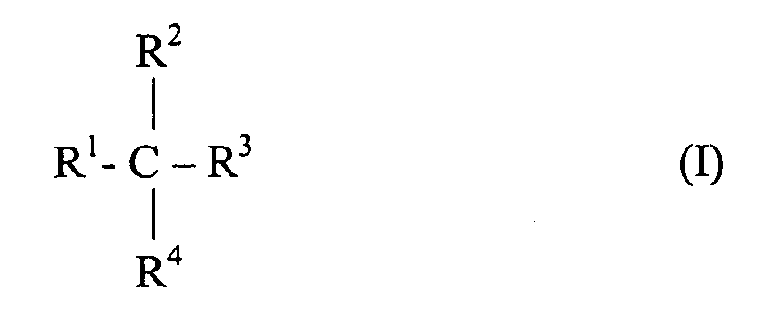
- the polyol alkyl ethers used according to the invention preferably follow the general formula (I) in which R 1 , R 2 , R 3 and R 4 independently of one another have the meaning OR 5 , CH 2 -OR 5 , OH, CH 3 , C 2 H 5 or H.
- Each R 5 independently represents a hydrogen atom or a saturated, unsaturated, branched or unbranched alkyl or alkenyl radical having 12 to 22 carbon atoms.
- the polyol alkyl ethers may also have mixtures of the different alkyl or alkenyl radicals.
- the polyol alkyl ethers used in the agents according to the invention can be fully or partially etherified.
- polyol alkyl ethers It is also possible to use mixtures of partially and completely etherified polyol alkyl ethers. Due to the manufacturing process, a small proportion of unetherified polyols may also be present, the proportion of which typically does not exceed 5% by weight, based on the amount of ether. Particular preference is given to those agents in which the polyol alkyl ethers each have at least one free OH function. If polyols with more than two hydroxyl groups are included, mixtures of mono- and diethers are also preferred.
- Particularly preferred polyol alkyl ethers are glycerol mono and / or diethers wherein the alkyl radical 14 to 18 and preferably 16 to 18 carbon atoms and pentaerythritol monoether with alkyl radicals containing 16 to 18 carbon atoms.
- Very particularly preferred is a Pentaerythritol monoalkyl ether whose alkyl group contains 18 C atoms. There are each preference is given to those compounds which contain only saturated, unbranched alkyl groups.
- the polyol alkyl ethers used in the agents according to the invention are insoluble in water, ie they only dissolve in water at a maximum of 10% by weight, preferably at most 5% by weight, at 21 ° C. Therefore, solubilizers c) must be added.
- Solubilizers are generally surface-active substances which by their presence render other compounds which are virtually insoluble in a certain solvent soluble or emulsifiable in this solvent (solubilization). Particularly preferred here is the cumene sulfonate.
- solubilizers are suitable, for example unbranched C6-C10-n-alkyl sulfates as disclosed in DE 44 01 235.
- aqueous rinse aid according to the invention may still contain non-aqueous solvents.
- polyethylene glycols preferably having molecular weights of 600 to 25,000 or mixtures of these compounds are suitable.
- an acid d) in the rinse aids according to the invention is suitable.
- organic (carboxylic) acids come into question. As organic di- or tricarboxylic acids having 2 to 6 carbon atoms z.
- the rinse aid may contain other conventional auxiliaries and additives.
- Surfactants namely both nonionic, anionic, cationic and zwitterionic surfactants, should be mentioned here.
- the concomitant use of nonionic surfactants for example from the group of fatty alcohol alkoxylates, preferably the - ethoxylates, hydroxy mixed ethers or alkyl (oligo) glycosides is preferred.
- the rinse aids of the present invention in the sense of the first embodiment are aqueous, wherein the water content in the range of 10 to 90 wt .-%, based on the means can lie.
- the aqueous rinse aids preferably contain the polyol alkyl ethers in amounts from 1 to 50% by weight, preferably from 2 to 45% by weight and especially from 5 to 35 Wt .-%.
- the solubilizer is in amounts of 1 to 25 wt .-%, preferably from 1 to Contain 5 wt .-% and the non-aqueous solvent in amounts between 1 and 50 Wt .-%, preferably 1 to 35 wt .-%.
- the acids are typically in amounts up to 10 Wt .-% included.
- the rinse aids according to the invention are usually separated into the dishwasher given.
- the agents are also suitable for use as compounds in, for example, liquid detergent formulations, in particular dishwashing detergents and, preferably, automatic dishwashing detergents to be incorporated.
- a further subject of the present invention relates to compositions containing polyolol ethers according to the above description, at least one enzyme and at least one bleaching agent and optionally further auxiliaries and additives. These may be solid as well as liquid or gel. These contain the polyol alkyl ethers as rinse aid additive. Typically, these are automatic dishwashing detergents, especially those with multifunctional properties.
- the agents can also be used in hand dishwashing detergents.
- the agents preferably contain the polyol alkyl ethers according to the invention in amounts of from 0.1 to a maximum of 50% by weight. A preferred range relates to the content of 1 to 35 wt .-%.
- a content of at least one enzyme and at least one bleaching agent is mandatory.
- Suitable enzymes are those from the class of proteases, lipase, amylases, cellulases or mixtures thereof. Particularly suitable are bacterial strains or fungi, such as Bacillus subtilis, Bacillus lichenformis and Strptomyces griseus derived enzymatic agents.
- Bacillus subtilis Bacillus subtilis
- Bacillus lichenformis and Strptomyces griseus derived enzymatic agents.
- subtilisin-type proteases and in particular proteases derived from Bacillus lentes are used.
- mixtures of enzymes can be used. Their proportion can be about 0.1 to 10, preferably 0.2 to 5 wt .-% amount.
- the agents have 0.2 to 6, or 1 to 5 wt .-% of enzymes.
- the enzymes may be adsorbed to carriers or embedded in encapsulants to protect against premature degradation.
- As a bleaching agent per se known borates, peroxide compounds and chlorine-containing bleaching agents can be used alone or in combination.
- peroxy bleach compounds sodium perborate tetrahydrate and sodium perborate monohydrate are of particular importance.
- Further bleaching agents are, for example, peroxycarbonate, citrate perhydrates and H 2 O 2 -producing peracid salts of peracids such as perbenzoates, peroxyphthalates or diperoxydodecanedioic acid.
- sodium perborate monohydrate in amounts of from 5 to 20% by weight and in particular from 5 to 15% by weight. Further preferred is the use of sodium percarbonate in conjunction with alkyl and / or alkenyl oligoglycosides.
- the rinsing and cleaning agents according to the invention in the second embodiment can be used as further customary ingredients or excipients, for example solubilizers as described above, but especially lower alcohols such as ethanol, isopropyl alcohol, ethylene glycol, propylene glycol, butyl glycol, diethylene glycol, propylene glycol monobutyl ether, polyethylene or polypropylene glycol ethers, preferably having molecular weights of from 600 to 1500, not more than 5000, or in particular butyldiglycol. Also higher molecular weight polyethylene glycols with molecular weights over 25,000 are suitable.
- solubilizers as described above, but especially lower alcohols such as ethanol, isopropyl alcohol, ethylene glycol, propylene glycol, butyl glycol, diethylene glycol, propylene glycol monobutyl ether, polyethylene or polypropylene glycol ethers, preferably having molecular weights of from 600 to 1500, not more than 5000,
- the rinsing and cleaning agents may contain cationic surfactants or biocides, for example, glucoprotamine.
- Suitable builders are zeolites, layered silicates, phosphates and ethylenediaminetetraacetic acid, nitrilotriacetic acid, citric acid and its salt, as well as inorganic phosphonic acids and their derivatives.
- thickeners which may be used are hydrogenated castor oil, salts of long-chain fatty acids, preferably in amounts of from 0.1 to 5% by weight and in particular in amounts of from 0.5 to 2% by weight, for example sodium, potassium, aluminum , Magnesium and titanium stearates or the sodium and / or potassium salts of behenic acid, as well as other polymeric compounds.
- the molecular weight of the homopolymers is generally between 1,000 and 100,000, that of the copolymers between 2,000 and 200,000, preferably between 50,000 and 120,000, based on the free acid.
- water-soluble polyacrylates which are crosslinked, for example, with about 1% of a polyallyl ether of sucrose and which have a molecular weight above 1,000,000.
- the crosslinked polyacrylates are preferably used in amounts of not more than 1% by weight, more preferably in amounts of from 0.2 to 0.7 wt .-% used.
- the agents may contain phosphates.
- the agents may also contain surfactants selected from anionic, cationic, zwitterionic or nonionic surfactants, alone or in combination. These surfactants may be contained in total in amounts of 1 to 25 wt .-%, based on the weight of the composition.
- the rinsing and cleaning agents according to the invention may preferably contain nonionic surfactants.
- nonionic surfactants are alkoxylates of alkanols, end-capped alkoxylates of alkanols without free OH groups, alkoxylated fatty acid lower alkyl esters, amine oxides, alkylphenol polyglycol ethers, fatty acid polyglycol esters, fatty acid amide polyglycol ethers, fatty amine polyglycol ethers, alkoxylated triglycerides, mixed ethers, fatty acid N-alkylglucamides, protein hydrolysates (in particular wheat-based vegetable products), polyol fatty acid esters, sugar esters, sorbitan esters, and polysorbates.
- nonionic surfactants contain polyglycol ether chains, these may have a conventional, but preferably a narrow homolog distribution.
- the further nonionic surfactants are preferably selected from the group formed by alkoxylates of alkanols, in particular fatty alcohol polyethylene glycol / polypropylene glycol ether (FAEO / PO) or fatty alcohol polypropylene glycol / polyethylene glycol ether (FA-PO / EO), end-capped alkoxylates of alkanols, in particular end-capped fatty alcohol polyethylene glycol / Polypropylene glycol ethers or end-capped fatty alcohol polypropylene glycol / polyethylene glycol ethers, and fatty acid lower alkyl esters and amine oxides.
- alkoxylates of alkanols in particular fatty alcohol polyethylene glycol / polypropylene glycol ether (FAEO / PO) or fatty alcohol polypropylene glycol / polyethylene glycol ether (FA-PO
- alkyl and / or alkenyl oligoglycosides may be preferred.
- the nonionic surfactants may be present in the rinsing and cleaning agents according to the invention in amounts of from 0.1 to 15% by weight, preferably from 0.5 to 10% by weight, in particular from 1 to 8% by weight, calculated as the active substance, based on the funds.
- the rinsing and cleaning agents according to the invention may also contain anionic surfactants.
- anionic surfactants are soaps, alkylbenzenesulfonates, secondary alkanesulfonates, olefinsulfonates, alkyl ether sulfonates, glycerol ether sulfonates, ⁇ -methyl ester sulfonates, sulfo fatty acids, alkyl and / or alkenyl sulfates, alkyl ether sulfates, glycerol ether sulfates, hydroxy mixed ether sulfates, monoglyceride (ether) sulfates, fatty acid amide (ether) sulfates , Mono- and dialkylsulfosuccinates, mono- and dialkylsulfosuccinamates, sulfotriglycerides, amide soaps, ether carboxylic acids and
- the anionic surfactants contain polyglycol ether chains, these may have a conventional, but preferably a narrow homolog distribution.
- the anionic surfactants are selected from the group formed by alkyl and / or alkenyl sulfates, alkyl ether sulfates, alkylbenzenesulfonates, monoglyceride (ether) sulfates and alkanesulfonates, in particular fatty alcohol sulfates, fatty alcohol ether sulfates, secondary alkanesulfonates and linear alkylbenzenesulfonates.
- the rinsing and cleaning agents may contain from 0.01 to 20% by weight, preferably from 0.25 to 15% by weight, in particular from 0.4 to 10% by weight, of anionic surfactants, calculated as the active substance , relative to the funds.
- the 100 wt .-% missing remainder can constitute auxiliaries and additives and water.
- auxiliaries may be present, such as, for example, inorganic salts, such as sulfates, chlorides, carbonates or bicarbonates.
- the concomitant use of silicates may be advantageous.
- the detergents of the present invention in its second embodiment are preferably offered in solid form, which includes any type of powders, granules but also tablets and similar shaped bodies. It is essential that these solid agents contain the above-described polyol alkyl ethers, preferably in amounts of 1 to 45 wt .-%, in particular in amounts of 1 to 30 wt .-% and particularly preferably in amounts of 1 to 25 wt .-%.
- the preparation of such solid compositions can be carried out in any way known to those skilled in the art, for example by granulation, extrusion, spray drying, fluidized bed granulation, press agglomeration, roll compacting, pelleting or tableting.
- the solid detergents according to the present invention contain, in addition to the polyol alkyl ethers, further ingredients, preferably surfactants, builders and auxiliaries or additives.
- the solid agents contain polyol alkyl ethers and nonionic surfactants, preferably in the ratio of 99: 1 to 1:99, wherein the ratio 90: 10 to 10: 90 may be particularly preferred.
- the ethers and the nonionic surfactants are present in a weight ratio of 65:35 to 35:65 and especially 50:50. It may be advantageous if granulated agents still contain polymers, in particular polyethylene glycols having a molecular weight of greater than 5000.
- the concomitant use of water-softening substances, such as phosphates, polyacrylates and / or other water-softening polymers, especially copolymers is preferred.
- the solid compositions are particularly suitable for cleaning hard surfaces and especially as automatic dishwashing detergents (so-called "automatic dish detergents" (ADD for short).
- Another aspect of the present invention relates to the use of polyol alkyl ethers as described above in detergents, preferably in agents for automatic dishwashing.
- compounds of the general formula (I) are particularly prefers.
- the concomitant use of bleaching agents and enzymes is preferred.
- the rinse aid is assessed visually by test persons. Were Glasses, cutlery, plastic and porcelain plates under defined conditions (water with 2, 16 or 21 ° dH - depending on the formulation, 50 g standard stain *) in a household dishwasher rinsed.
- Standard soiling Based on 1000 g: 25 g each of ketchup, mustard and Gravy, 300g margarine, 150 g drinking milk, 15 g potato starch, 9 g egg yolk, 3 g benzoic acid, Rest: water.
- Solid formulations used in the test (all data in% by weight): component Detergent powder Cleaner Tablet “3 in 1” powder "3 in 1" tablet "3 in 1” tablet 1 2 3a 3b 3c surfactant 1.2 1/2 2 3.5 / 7 3.5 / 7 0 sodium sulphate 2 0.5 2 2.5 2.5 sodium silicate 3 0 0.5 5 5 sodium 2 2 8th 0 0 tetrasodium diphosphate 1 1 1 1.5 1.5 pentasodium 56.6 / 55.6 66/65 54.5 / 51 61.2 / 57.7 64.7 HEDP-Na 4 0 0.2 0.5 0.5 0.5 benzotriazole 0.2 0.2 0.2 0 0 Na perborate * 1H 2 O 0 11 0 12 12 sodium metaborate 0 0.3 0 0 0 TAED 2 3 3 1.5 1.5 sodium 25 9 15 0 0 sodium 5 0 9 0 0 protease 0.5 1.5 0.5 2.5 2.5 amylase 1 1 2.5 2.5 Natriumhydrogen
- the polyol alkyl ether according to the invention was incorporated into a detergent powder formulation 1 and added to the dishwasher at the beginning of the cleaning cycle. It was rinsed with water at 2 ° dH. Rinse power of the respective product in the cleaner powder formulation 1.
- Table 1.1a shows that the polyol alkyl ethers according to the invention are used as clear rinse components better than thewherestensid. This is particularly evident in the rinse aid on porcelain and cutlery.
- Tables 1.2a and 1.2b show that the compounds of the invention as Rinse aid components are better than thefindstensid. This is particularly evident on Rinse aid on porcelain and cutlery.
Landscapes
- Chemical & Material Sciences (AREA)
- Life Sciences & Earth Sciences (AREA)
- Engineering & Computer Science (AREA)
- Chemical Kinetics & Catalysis (AREA)
- Oil, Petroleum & Natural Gas (AREA)
- Wood Science & Technology (AREA)
- Organic Chemistry (AREA)
- Health & Medical Sciences (AREA)
- Emergency Medicine (AREA)
- Detergent Compositions (AREA)
Abstract
Description
Vor dem Hintergrund dieser neuartigen Formulierungen müssen alternative Klarspüler entwickelt werden, die den Anforderungen der multifunktionalen Produkte entsprechen, ohne dass es zu einer Verringerung der Klarspülleistung kommt. Weiterhin ist das Bedürfnis gegeben, Klarspüler mit erhöhter Effizienz zu finden.
Der Alkylreste des Polyolethers ist vorzugsweise ausgewählt aus gesättigten und/oder ungesättigten verzweigten oder unverzweigten Alkylresten mit 14 bis 22, vorzugsweise 14 bis 18 Kohlenstoffatomen. Dabei sind Alkylreste mit 14 bis 22, vorzugsweise 14 bis 18 Kohlenstoffatomen besonders bevorzugt. Ebenfalls bevorzugt sind Mittel, die Polyolalkylether auf Basis unverzweigter, gesättigter Alkylreste aufweisen. Die Herstellung der Polyolalkylether kann auf allen dem Fachmann bekannten Wegen erfolgen, wobei solche Ether bevorzugt sind, die gemäß dem Verfahren der WO 03/040072 hergestellt wurden. Dabei wird gemäß der Lehre diese Dokuments ein Polyol mit einer Base, vorzugsweise Alkalimetall- oder Erdalkalimetall-oxide, -carbonate oder -hydroxide, deprotoniert und (a) das dabei entstehende Wasser kontinuierlich aus der Reaktionsmischung entfernt und anschließend das deprotonierte Polyol mit Alkyl- und/oder Alkenyl(ether)sulfaten umgesetzt oder (b) das deprotonierte Polyol nach Zugabe einer Base, vorzugsweise Alkalimetall- oder Erdalkalimetall-oxide, -carbonate oder - hydroxide, mit Schwefelsäurealkylestern versetzt und das entstehende Wasser kontinuierlich aus der Reaktionsmischung entfernt, wobei nach Durchführung der Umsetzung das im Reaktionsprodukt enthaltene Sulfatsalz durch Zugabe von 10 bis 20 mol, vorzugsweise 11 bis 15 und insbesondere 12 bis 13 mol Wasser, pro Mol Alkyl(ether)sulfat, Alkenyl(ether)sulfat oder Schwefelsäurealkylester bei einer Temperatur von 50 bis 100 und vorzugsweise 80 bis 90 ° C ausfällt und man den erhaltenen Polyolalkylether in an sich bekannter Weise von der wässrigen und festen Phase abtrennt.

Lösungsvermittler sind in der Regel grenzflächenaktive Stoffe, die durch ihre Gegenwart andere, in einem bestimmten Lösungsmittel praktisch unlösliche Verbindungen in diesem Lösungsmittel lösen oder emulgierbar machen (Solubilisation). Besonders bevorzugt ist hier das Cumolsulfonat. Aber auch andere geeignete Lösungsvermittler sind geeignet, z.B. unverzweigte C6-C10-n-Alkylsulfate wie in der DE 44 01 235 offenbart. Daneben sind auch kurzkettige aliphatische Alkohole geeignet, wie beispielhaft Ethanol, Pröpanol oder Butanol, bzw. deren Isomere, den auch diese Verbindungen haben eine solubilisierende Wirkung und können daher im Sinne der vorliegenden Lehre als Komponente c) eingesetzt werden.
Des weiteren können die erfindungsgemäßen wässerigen Klarspülmittel noch nichtwässerige Lösungsmittel enthalten. Hier sind insbesondere Polyethylenglykole, vorzugsweise mit Molmassen von 600 bis 25000 oder Mischungen dieser Verbindungen geeignet.
Optional, aber bevorzugt, ist die Mitverwendung einer Säure d) in den erfindungsgemäßen Klarspülmitteln. Hier kommen insbesondere organische (Carbon)säuren in Frage. Als organische Di- oder Tricarbonsäuren mit 2 bis 6 C-Atomen kommen z. B. Äpfelsäure, Weinsäure, Oxalsäure, Malonsäure, Bernsteinsäure, Glutarsäure, Adipinsäure, insbesondere aber Zitronensäure in Betracht. Im Rahmen der vorliegenden technischen Lehre sind auch Mischungen unterschiedlicher Einzelsubstanzen der Gruppen a), b), c) und/oder d) bzw. e) geeignet.
Daneben können die Klarspülmittel noch weitere übliche Hilfs- und Zusatzstoffe enthalten. Hierbei sind insbesondere Tenside, und zwar sowohl nichtionische, anionische, kationische und zwitterionische Tenside zu nennen. Dabei ist die Mitverwendung von nichtionischen Tensiden, beispielsweise aus der Gruppe der Fettalkoholalkoxylate, vorzugsweise der - ethoxylate, Hydroxymischether oder Alkyl(oligo)glycoside bevorzugt.
Dabei kann es sich sowohl um feste, als auch um flüssige oder gelförmige Mittel handeln. Diese enthalten die Polyolalkylether als Klarspüladditiv. Typischerweise handelt es sich hierbei um maschinelle Geschirrspülmittel, insbesondere um solche mit Multifunktionseigenschaften. Die Mittel können aber auch in Handgeschirrspülmitteln eingesetzt werden. Die Mittel enthalten die erfindungsgemäßen Polyolalkylether vorzugsweise in Mengen von 0,1 bis maximal 50 Gew.-%. Ein bevorzugter Bereiche betrifft dabei den Gehalt von 1 bis 35 Gew.-%. Zwingend ist, neben der Anwesenheit der Polyolalkylether, ein Gehalt an mindestens einem Enzym und mindestens einem Bleichmittel.
Als Enzyme kommen solche aus der Klasse der Proteasen, Lipase, Amylasen, Cellulasen bzw. deren Gemische in Frage. Besonders gut geeignet sind aus Bakterienstämmen oder Pilzen, wie Bacillus subtilis, Bacillus lichenformis und Strptomyces griseus gewonnene enzymatische Wirkstoffe. Vorzugsweise werden Proteasen vom Subtilisin-Typ und insbesondere Proteasen, die aus Bacillus lentes gewonnen werden, eingesetzt. Auch Mischungen von Enzymen können verwendet werden. Ihr Anteil kann etwa 0,1 bis 10, vorzugsweise 0,2 bis 5 Gew.-% betragen. Es kann aber auch vorteilhaft sein, wenn die Mittel 0,2 bis 6, bzw. 1 bis 5 Gew.-% an Enzymen aufweisen. Die Enzyme können an Trägerstoffen adsorbiert oder in Hüllsubstanzen eingebettet sein, um sie gegen vorzeitige Zersetzung zu schützen.
Als Bleichmittel können an sich bekannte Borate, Peroxidverbindungen und chlorhaltige Bleichmittel allein oder in Kombination eingesetzte werden. Unter den als Peroxy-Bleichmittel dienenden Verbindungen haben das Natriumperborat-Tetrahydrat und das Natriumperborat-Monohydrat eine besondere Bedeutung. Weitere Bleichmittel sind beispielsweise Peroxycarbonat, Citratperhydrate sowie H2O2-liefernde persaure Salze der Persäuren wie Perbenzoate, Peroxyphthalate oder Diperoxydodecandisäure. Sie werden üblicherweise in Mengen von 0,1 bis 40 Gew.-% eingesetzt. Bevorzugt ist der Einsatz von NatriumperboratMonohydrat in Mengen von 5 bis 20 Gew.-% und insbesondere von 5 bis 15 Gew.-%. Weiterhin bevorzugt ist der Einsatz von Natrium-percarbonat in Verbindung mit Alkyl- und/oder Alkenyloligoglycosiden.
In vielen Fällen ist eine zusätzliche bakterizide Wirkung erwünscht, weswegen die Spül- und Reinigungsmittel kationische Tenside oder Biozide, beispielsweise Glucoprotamin, enthalten können. Geeignete Builder sind Zeolithe, Schichtsilicate, Phosphate sowie Ethylendiamintetraessigsäure, Nitrilotriessigsäure, Citronensäure und deren Salz, sowie anorganische Phosphonsäuren und deren Derivate.
Als Verdickungsmittel können beispielsweise gehärtetes Rizinusöl, Salze von langkettigen Fettsäuren, die vorzugsweise in Mengen von 0,1 bis 5 Gew.-% und insbesondere in Mengen von 0,5 bis 2 Gew.-%, beispielsweise Natrium-, Kalium-, Aluminium-, Magnesium- und Titan-Stearate oder die Natrium und/oder Kaliumsalze der Behensäure, sowie weitere polymere Verbindungen eingesetzt werden. Zu den letzten gehören bevorzugt Polyvinylpyrrolidon, Urethane und die Salze polymerer Polycarboxylate, beispielsweisehomopolymerer oder copolymerer Polyacrylate, Polymethacrylate und insbesondere Copolymere der Acrylsäure mit Maleinsäure, vorzugsweise solche aus 50 bis 10 Gew.-% Maleinsäure. Die relative Molekülmasse der Homopolymeren liegt im allgemeinen zwischen 1000 und 100000, die der Copolymeren zwischen 2000 und 200000, vorzugsweise zwischen 50000 bis 120000, bezogen auf die freie Säure. Insbesondere sind auch wasserlösliche Polyacrylate geeignet, die beispielsweise mit etwa 1% eines Polyallylethers der Sucrose quervernetzt sind und die eine relative Molekülmasse oberhalb 1000000 besitzen Die quervernetzten Polyacrylate werden vorzugsweise in Mengen nicht über 1 Gew.-% besonders bevorzugt in Mengen von 0,2 bis 0,7 Gew.-% eingesetzt. Weiterhin können die Mittel Phosphate enthalten.
Die erfindungsgemäßen Spül- und Reinigungsmittel können vorzugsweise nichtionische Tenside enthalten. Typische Beispiele für nichtionische Tenside sind Alkoxylate von Alkanolen, endgruppenverschlossene Alkoxylate von Alkanolen ohne freie OH-Gruppen, alkoxylierte Fettsäureniedrigalkylester, Aminoxide, Alkylphenolpolyglycolether, Fettsäurepolyglycolester, Fettsäureamidpolyglycolether, Fettaminpolyglycolether, alkoxylierte Triglyceride, Mischether bzw. Mischformale, Fettsäure-N-alkylglucamide, Proteinhydrolysate (insbesondere pflanzliche Produkte auf Weizenbasis), Polyolfettsäureester, Zuckerester, Sorbitanester, und Polysorbate. Sofern die nichtionischen Tenside Polyglycoletherketten enthalten, können diese eine konventionelle, vorzugsweise jedoch eine eingeengte Homologenverteilung aufweisen. Bevorzugt sind die weiteren nichtionische Tenside ausgewählt aus der Gruppe, die gebildet wird von Alkoxylaten von Alkanolen, insbesondere Fettalkoholpolyethylenglykol/polypropylenglykolether (FAEO/PO) bzw. Fettalkoholpolypropylenglykol/polyethylenglykolether (FA-PO/EO), endgruppenverschlossene Alkoxylate von Alkanole, insbesondere endgruppenverschlossene Fettalkoholpolyethylenglykol/polypropylenglykolether bzw. endgruppenverschlossene Fettalkoholpolypropylenglykol/polyethylenglykolether, und Fettsäureniedrigalkylester und Aminoxiden. Weiterhin kann der Einsatz von Alkyl- und/oder Alkenyloligoglykoside bevorzugt sein.
Die nichtionischen Tenside können in den erfindungsgemäßen Spül- und Reinigungsmitteln in Mengen von 0,1 bis 15 Gew.-%, vorzugsweise 0,5 bis 10 Gew.-%, insbesondere 1 bis 8 Gew.-% enthalten sein, berechnet als Aktivsubstanz, bezogen auf die Mittel.
Sofern anionische Tenside enthalten sind, können die Spül- und Reinigungsmittel 0,01 bis 20 Gew.-%, vorzugsweise 0,25 bis 15 Gew.-%, insbesondere 0,4 bis 10 Gew.-% anionische Tenside enthalten, berechnet als Aktivsubstanz, bezogen auf die Mittel. Den zu 100 Gew.-% fehlenden Rest können Hilfs- und Zusatzstoffe sowie Wasser darstellen.
Weiterhin können noch weitere Hilfsmittel enthalten sein, wie z.B. anorganische Salze, wie Sulfate, Chloride, Carbonate bzw. Hydrogencarbonate. Auch die Mitverwendung von Silikaten kann vorteilhaft sein.
Wesentlich ist, dass diese festen Mittel die oben beschriebenen Polyolalkylether enthalten, vorzugsweise in Mengen von 1 bis 45 Gew.-%, insbesondere in Mengen von 1 bis 30 Gew.-% und besonders bevorzugt in Mengen von 1 bis 25 Gew.-%.
Die Herstellung solcher festen Mittel kann dabei auf allen dem Fachmann hierzu bekannten Wegen vorgenommen werden, z.B. durch Granulation, Extrusion, Sprühtrocknung, Wirbelschichtgranulation, Pressagglomeration, Walzenkompaktierung, Pelletierung oder Tablettieren. Die festen Reinigungsmittel im Sinne der vorliegenden Erfindung enthalten neben den Polyolalkylethern noch weitere Inhaltsstoffe, vorzugsweise Tenside, Builder und Hilfs- oder Zusatzstoffe. Zu den Einzelheiten und Charakterisierung dieser Inhaltsstoffe sei auf die obige Beschreibung verwiesen.
Die festen Mittel enthalten Polyolalkylether und nichtionische Tenside vorzugsweise im Mengenverhältnis von 99 : 1 bis 1 : 99, wobei das Verhältnis 90 : 10 bis 10 : 90 besonders bevorzugt sein kann. Vorzugsweise liegen die Ether und die nichtionischen Tenside aber in einem Gewichtsverhältnis von 65 : 35 bis 35 : 65 und insbesondere von 50 : 50 vor. Dabei kann es vorteilhaft sein, wenn bei granulierten Mitteln noch Polymere, insbesondere Polyethylenglykole mit einem Molgewicht von größer 5000 enthalten sind.
Bevorzugt ist weiterhin die Mitverwendung von Bleichmitteln, insbesondere von peroxidhaltigen Bleichmitteln. Auch die Mitverwendung von wasserenthärtenden Substanzen, beispielsweise Phosphaten, Polyacrylaten und/oder anderen wasserenthärtenden Polymeren, insbesondere Copolymeren ist bevorzugt.
Die festen Mittel eignen sich insbesondere zum Reinigen harter Oberflächen und besonders als Reinigungsmittel für das automatische Geschirrspülen (sog. "automatic dish detergents" kurz ADD).
- A:
- C16/18-Glycerinmono-/diether
- B:
- C16/18-Glycerinmonoether
- C:
- C 18-Pentaerythritmonoether
- D:
- Produkt A als Granulat
- E:
- 90 Gew.-% A + Gew.-10 % PEG 6000
- F:
- C12-C14 Fettalkohol mit 5 Mol Ethylenoxid pro Mol Fettalkohol
- G:
- Hydroxymischether auf Basis eines alkoxylierten Fettalkohols
- H:
- C8-10-Alkyl-1.5-glucosid.
| Bestandteil | Reiniger-Pulver | Reiniger-Tablette | "3 in 1" Pulver | "3 in 1" Tablette | "3 in 1" Tablette |
| 1 | 2 | 3a | 3b | 3c | |
| Tensid | 1/2 | 1/2 2 | 3,5/7 | 3,5/7 | 0 |
| Natriumsulfat | 2 | 0,5 | 2 | 2,5 | 2,5 |
| Natriumsilikat | 3 | 0 | 0,5 | 5 | 5 |
| Natriumhydrogencarbonat | 2 | 2 | 8 | 0 | 0 |
| Tetranatriumdiphosphat | 1 | 1 | 1 | 1,5 | 1,5 |
| Pentanatriumtriphosphat | 56,6 / 55,6 | 66/65 | 54,5/51 | 61,2/57,7 | 64,7 |
| HEDP-Na4 | 0 | 0,2 | 0,5 | 0,5 | 0,5 |
| Benzotriazol | 0,2 | 0,2 | 0,2 | 0 | 0 |
| Na-perborat*1H 2 O | 0 | 11 | 0 | 12 | 12 |
| Natriummetaborat | 0 | 0,3 | 0 | 0 | 0 |
| TAED | 2 | 3 | 3 | 1,5 | 1,5 |
| Natriumcarbonat | 25 | 9 | 15 | 0 | 0 |
| Natriumpercarbonat | 5 | 0 | 9 | 0 | 0 |
| Protease | 0,5 | 1,5 | 0,5 | 2,5 | 2,5 |
| Amylase | 1 | 1 | 1 | 2,5 | 2,5 |
| Natriumhydrogenphosphat | 0,5 | 0,2 | 0,2 | 0,2 | 0,2 |
| NaCl | 0,2 | 0,1 | 0,1 | 0,1 | 0,1 |
| Polyethylenglycol (MG 6000) | 0 | 3 | 0 | 2 | 2 |
| Acusol 587, (Rohm & Haas) | 0 | 0 | 1 | 5 | 5 |
| Klarspülvermögen des jeweiligen Produktes in der Reiniger-Pulverformulierung 1. | |||||||
| Gew.-% AS in der Formulierung | VI | I | II | III | IV | V | VI |
| F | 1 | ||||||
| A | 1 | 2 | |||||
| B | 1 | ||||||
| D | 1 | 2 | |||||
| A + G (50:50) | 1 | ||||||
| Klarspülvermögen | |||||||
| an Besteck | 0 | + | + | + | + | + | + |
| Porzellan | 0 | 0 | + | 0 | 0 | + | + |
| Glas | 0 | 0 | + | 0 | 0 | + | 0 |
| Kunststoff | 0 | 0 | 0 | 0 | 0 | 0 | 0 |
| Klarspülvermögen des jeweiligen Produktes unter Mitverwendung eines handelsüblichen pulverförmigen Geschirrspülmittels: | |||||||
| Zudosierung in g AS | V1 | I | II | III | IV | V | VI |
| F | 0,6 | ||||||
| A | 0,6 | 1,0 | |||||
| B | 0,6 | ||||||
| C | 0,6 | ||||||
| A + F (50:50) | 0,6 | ||||||
| A + H (50:50) | 0,6 | ||||||
| Klarspülvermögen an | |||||||
| Besteck | 0 | + | ++ | + | + | + | + |
| Porzellan | 0 | + | + | + | + | + | + |
| Glas | 0 | 0 | + | 0 | + | 0 | + |
| Kunststoff | 0 | 0 | 0 | 0 | 0 | 0 | + |
| Klarspülvermögen der erfindungsgemäßen Polyolalkylether unter Verwendung eines handelsüblichen Geschirrspülmittels in Tablettenform: | |||||||
| Zudosierung in g AS | V1 | I | II | III | IV | V | VI |
| F | 0,6 | ||||||
| A | 0,6 | 1,0 | |||||
| B | 0,6 | ||||||
| C | 0,6 | ||||||
| A + F (50:50) | 0,6 | ||||||
| A + H (50:50) | 0,6 | ||||||
| Klarspülvermögen an | |||||||
| Besteck | 0 | + | ++ | + | + | + | + |
| Porzellan | 0 | + | + | + | + | + | + |
| Glas | 0 | + | + | + | + | + | |
| Kunststoff | 0 | 0 | 0 | 0 | 0 | 0 | + |
| Klarspülvermögen des jeweiligen Produktes, eingearbeitet in die Reiniger-Pulverformulierung 1. | ||||||||||||
| Gew.-% AS in der Formulierung | VI | I | II | III | IV | V | VI | VII | VIII | IX | X | XI |
| F | 3,5 | |||||||||||
| A | 3,5 | 7 | ||||||||||
| B | 3,5 | |||||||||||
| C | 3,5 | |||||||||||
| D | 3,5 | 7 | ||||||||||
| E | 3,5 | |||||||||||
| A + F (50:50) | 3,5 | |||||||||||
| A + G (50:50) | 3,5 | 7 | ||||||||||
| A + H (50:50) | 3,5 | |||||||||||
| Klarspülvermögen | ||||||||||||
| an Besteck | 0 | + | ++ | + | + | + | ++ | + | + | + | ++ | + |
| Porzellan | 0 | + | ++ | + | + | + | + | + | + | + | + | + |
| Glas | 0 | 0 | + | + | 0 | + | + | + | 0 | + | + | + |
| Kunststoff | 0 | 0 | 0 | 0 | 0 | 0 | + | 0 | 0 | 0 | 0 | + |
| Klarspülvermögen des jeweiligen Produktes, eingearbeitet in die Reiniger-Tablettenformulierung 2 als gepresste Tablette: | ||||||||||||
| Gew.-% AS in der Formulierung | V1 | I | II | III | IV | V | VI | VII | VIII | IX | X | XI |
| F | 3,5 | |||||||||||
| A | 3,5 | 7 | ||||||||||
| B | 3,5 | |||||||||||
| C | 3,5 | |||||||||||
| D | 3,5 | 7 | ||||||||||
| E | 3,5 | |||||||||||
| A + F (50:50) | 3,5 | |||||||||||
| A + G (50:50) | 3,5 | 7 | ||||||||||
| A + H (50:50) | 3,5 | |||||||||||
| Klarspülvermögen | ||||||||||||
| an Besteck | 0 | + | ++ | + | + | + | + | + | + | + | ++ | + |
| Porzellan | 0 | + | + | + | + | + + | + | + | + | + | + | + |
| Glas | 0 | 0 | + | + | 0 | + | + | + | 0 | 0 | + | + |
| Kunststoff | 0 | 0 | 0 | 0 | + | 0 | 0 | 0 | 0 | 0 | 0 | + |
| Klarspülvermögen unter gleichzeitiger, jedoch separater Zugabe des jeweiligen Produktes zu einer Tablette eines handelsüblichen Geschirrspülmittels: | |||||||
| Zudosierung in g AS | V1 | I | II | III | IV | V | VI |
| F | 0,6 | ||||||
| A | 0,6 | 1,0 | |||||
| B | 0,6 | ||||||
| C | 0,6 | ||||||
| A + F (50:50) | 0,6 | ||||||
| A + H (50:50) | 0,6 | ||||||
| Klarspülvermögen an | |||||||
| Besteck | 0 | + | ++ | + | + | + | + |
| Porzellan | 0 | + | + | + | + | + | + |
| Glas | 0 | + | + | + | 0 | + | + |
| Kunststoff | 0 | 0 | 0 | 0 | 0 | 0 | + |
| Klarspülvermögen des jeweiligen Produktes, eingearbeitet in die "3 in 1" Pulverformulierung 3a: | ||||||||||||
| Gew.- % AS in der Formulierung | V1 | I | II | III | IV | V | VI | VII | VIII | IX | X | XI |
| F | 3,5 | |||||||||||
| A | 3,5 | 7 | ||||||||||
| B | 3,5 | |||||||||||
| C | 3,5 | |||||||||||
| D | 3,5 | |||||||||||
| E | 3,5 | 7 | ||||||||||
| A + F (50:50) | 3,5 | |||||||||||
| A + G (50:50) | 3,5 | 7 | ||||||||||
| A + H (50:50) | 3,5 | |||||||||||
| Klarspülvermögen | ||||||||||||
| an Besteck | 0 | + | ++ | + | + | + | + | ++ | + | + | ++ | + |
| Porzellan | 0 | + | + | + | + | + | + | + | + | + | ++ | + |
| Glas | 0 | 0 | + | + | + | 0 | 0 | + | + | + | + | + |
| Kunststoff | 0 | 0 | 0 | 0 | 0 | 0 | 0 | 0 | 0 | 0 | 0 | + |
| Klarspülvermögen des jeweiligen Produktes, eingearbeitet in die "3 in 1" Tablettenformulierung 3b als gepresste Tablette: | ||||||||||||
| Gew.-% AS in der Formulierung | V1 | I | II | III | IV | V | VI | VII | VIII | IX | X | XI |
| F | 3,5 | |||||||||||
| A | 3,5 | 7 | ||||||||||
| B | 3,5 | |||||||||||
| C | 3,5 | |||||||||||
| D | 3,5 | |||||||||||
| E | 3,5 | 7 | ||||||||||
| A + F (50:50) | 3,5 | |||||||||||
| A + G (50:50) | 3,5 | 7 | ||||||||||
| A + H (50:50) | 3,5 | |||||||||||
| Klarspülvermögen | ||||||||||||
| an Besteck | 0 | + | ++ | + | + | + | + | ++ | + | + | ++ | + |
| Porzellan | 0 | + | ++ | + | + | + | + | + | + | + | + | + |
| Glas | 0 | 0 | + | + | 0 | 0 | 0 | + | + | + | + | + |
| Kunststoff | 0 | 0 | 0 | 0 | 0 | 0 | 0 | 0 | + | 0 | 0 | + |
| Klarspülvermögen unter gleichzeitiger, jedoch separater Zugabe des jeweiligen Produktes zu einer Tablette der "3 in 1" Tablettenformulierung 3c: | |||||||
| Zudosierung in g AS | V1 | I | II | III | IV | V | VI |
| F | 0,6 | ||||||
| A | 0,6 | 1,0 | |||||
| B | 0,6 | ||||||
| C | 0,6 | ||||||
| A + F (50:50) | 0,6 | ||||||
| A + H (50:50) | 0,6 | ||||||
| Klarspülvermögen an | |||||||
| Besteck | 0 | + | ++ | + | + | + | + |
| Porzellan | 0 | + | ++ | + | + | + | + |
| Glas | 0 | 0 | + | 0 | 0 | + | + |
| Kunststoff | 0 | 0 | 0 | 0 | 0 | 0 | + |
Nach Beendigung des Spülprogramms wird das Spülgut unter definierten Lichtverhältnissen nach Tropfenanzahl beurteilt. Die Angabe der Ergebnisse erfolgt als "deutlich besser (++)/besser (+)/ gleich (0)/ schlechter (-) als Standard", wobei in jeder Versuchsreihe der Standard auf 0 gesetzt wird. In den nachfolgenden Tabellen sind die Versuchsergebnisse dargestellt, wobei V1 ein Vergleichsversuch (= Standard) und I bis V die erfindungsgemäßen Beispiele wiedergeben.
| Trocknungsleistung des jeweiligen Produktes, eingearbeitet in die "3 in 1" Pulverformulierung 3a: | |||||||
| Gew.- % AS in der Formulierung | V1 | I | II | III | V | VI | IX |
| F | 3,5 | ||||||
| A | 3,5 | 7 | |||||
| B | 3,5 | ||||||
| D | 3,5 | 7 | |||||
| A + G (50:50) | 3,5 | ||||||
| Trocknungsleistung | |||||||
| an Besteck | 0 | + | ++ | + | + | ++ | + |
| Porzellan | 0 | + | ++ | + | + | + | + |
| Glas | 0 | 0 | + | + | + | + | + |
| Kunststoff | 0 | 0 | + | 0 | 0 | 0 | 0 |
| Trocknungsleistung des jeweiligen Produktes, eingearbeitet in die "3 in 1" Tablettenformulierung 3b als gepresste Tablette: | |||||||
| Gew.-% AS in der Formulierung | V1 | I | II | III | V | VI | IX |
| F | 3,5 | ||||||
| A | 3,5 | 7 | |||||
| C | 3,5 | ||||||
| D | 3,5 | 7 | |||||
| A + H (50:50) | 3,5 | ||||||
| Trocknungsleistung | |||||||
| an Besteck | 0 | + | ++ | + | + | ++ | + |
| Porzellan | 0 | + | ++ | + | + | ++ | + |
| Glas | 0 | + | + | + | + | + | + |
| Kunststoff | 0 | 0 | + | 0 | 0 | 0 | + |
| Trocknungsleistung unter gleichzeitiger, jedoch separater Zugabe des jeweiligen Produktes zu einer Tablette der "3 in 1" Tablettenformulierung 3c: | ||||||
| Zudosierung in g AS | V1 | I | II | III | IV | VI |
| F | 0,6 | |||||
| A | 0,6 | 1,0 | ||||
| B | 0,6 | |||||
| C | 0,6 | |||||
| A + F (50:50) | 0,6 | |||||
| Trocknungsleistung an | ||||||
| Besteck | 0 | + | ++ | + | ++ | + |
| Porzellan | 0 | + | ++ | + | + | + |
| Glas | 0 | + | + | + | + | + |
| Kunststoff | 0 | 0 | 0 | 0 | 0 | 0 |
Claims (23)
- Klarspülmittel, enthaltend mindestensa) Wasser,b) einen in Wasser unlöslichen Polyolalkylether dessen Alkoholkomponente mindestens zwei Hydroxylgruppen und drei bis sechs Kohlenstoffatomen enthält und dessen Alkylrest ausgewählt ist aus gesättigten und/oder ungesättigten verzweigten oder unverzweigten Alkylresten mit 10 bis 22 Kohlenstoffatomen, undc) einen Lösungsvermittlerd) optional eine Säure, vorzugsweise eine organische Säure
- Mittel nach Anspruch 1, dadurch gekennzeichnet, dass es zusätzlich ein nichtwässeriges Lösungsmittel enthält.
- Mittel nach einem der Ansprüche 1 bis 2, dadurch gekennzeichnet, dass die Alkoholkomponente des Polyolethers Glycerin ist.
- Mittel nach einem der Ansprüche 1 bis 3, dadurch gekennzeichnet, dass der Alkylreste des Polyolethers ausgewählt ist aus gesättigten und/oder ungesättigten verzweigten oder unverzweigten Alkylresten mit 14 bis 22, vorzugsweise 14 bis 18 Kohlenstoffatomen.
- Mittel nach einem der Ansprüche 1 bis 4, dadurch gekennzeichnet, das der Polyolalkylether mindestens eine frei Hydroxylgruppe aufweist.
- Mittel nach einem der Ansprüche 1 bis 5, dadurch gekennzeichnet, dass es Glycerinmonoalkylether enthält, wobei der Alkylrest gesättigt und unverzweigt ist und zwischen 14 und 18 Kohlenstoffatome aufweist.
- Mittel nach einem der Ansprüche 1 bis 6, dadurch gekennzeichnet, dass der Lösungsvermittler Cumolsulfonat ist.
- Mittel nach einem der Ansprüche 1 bis 7, dadurch gekennzeichnet, dass das Lösungsmittel ausgewählt ist aus Polyethylenglykol oder Mischungen dieser Verbindungen.
- Mittel nach einem der Ansprüche 1 bis 8, dadurch gekennzeichnet, dass das Mittel Zitronensäure enthält.
- Mittel nach einem der Ansprüche 1 bis 9, dadurch gekennzeichnet, dass es zwischen 10 und 90 Gew.-% Wasser enthält.
- Mittel nach einem der Ansprüche 1 bis 10, dadurch gekennzeichnet, dass es den Polyolalkylether in Mengen von 1 bis 50 Gew.-%, vorzugsweise 2 bis 45 Gew.-% und insbesondere von 5 bis 35 Gew.-% enthält.
- Mittel nach einem der Ansprüche 1 bis 11, dadurch gekennzeichnet, dass es den Lösungsvermittler in Mengen von 1 bis 25 Gew.-%, vorzugsweise von 1 bis 5 Gew.-% enthält.
- Mittel nach einem der Ansprüche 1 bis 12, dadurch gekennzeichnet, dass es zusätzlich noch Tenside, vorzugsweise nichtionische Tenside enthält.
- Verwendung von Polyolalkylethern der Formel (I)in der R1, R2, R3 und R4 unabhängig voneinander die Bedeutung OR5, CH2-OR5, OH, CH3, C2H5 oder H aufweisen und R5 dabei jeweils unabhängig voneinander für ein Wasserstoffatom oder einen gesättigten, ungesättigten, verzweigten oder unverzweigten Alkyl- bzw. Alkenylrest mit 10 bis 22 Kohlenstoffatomen steht, in Reinigungsmitteln, vorzugsweise in Mitteln zum maschinellen Geschirrspülen.

- Verwendung nach Anspruch 14, wobei der Polyolalkylether in Kombination mit Bleichmitteln und Enzymen verwendet wird.
- Mittel, enthaltend Polyolalkylether nach Anspruch 1, Enzyme und Bleichmittel sowie optional weitere Hilfs- und Zusatzstoffe.
- Mittel nach Anspruch 16, dadurch gekennzeichnet, dass das Mittel fest ist.
- Mittel nach den Ansprüchen 16 bis 17, dadurch gekennzeichnet, dass es zusätzlich nichtionische Tenside enthält.
- Mittel nach den Ansprüchen 16 bis 18, dadurch gekennzeichnet, dass es Polyolalkylether und nichtionische Tenside im Mengenverhältnis von 99 : 1 bis 1 : 99 und bevorzugt 90 : 10 bis 10 : 90, vorzugsweise 65 : 35 bis 35 : 65 und insbesondere von 50 : 50 enthält.
- Mittel nach den Ansprüchen 16 bis 19, dadurch gekennzeichnet, dass es wasserenthärtende Substanzen, vorzugsweise Phosphate und/oder Polyacrylate enthält.
- Mittel nach den Ansprüchen 16 bis 20, dadurch gekennzeichnet, dass es die Polyolalkylether in Mengen von 1 bis 30 Gew.-%, vorzugsweise 1 bis 25 Gew.-% enthält.
- Mittel nach den Ansprüchen 16 bis 21, dadurch gekennzeichnet, dass es Enzyme in Mengen von 0,1 bis 10 Gew.-%, vorzugsweise von 0,2 bis 5 Gew.-% enthält.
- Mittel nach den Ansprüchen 16 bis 22, dadurch gekennzeichnet, dass es Bleichmittel in Mengen von 0,1 bis 40 Gew.-%, vorzugsweise 5 bis 20 Gew.-% und insbesondere von 5 bis 15 Gew.-% enthält.
Applications Claiming Priority (4)
| Application Number | Priority Date | Filing Date | Title |
|---|---|---|---|
| DE102004029066 | 2004-06-16 | ||
| DE102004029066 | 2004-06-16 | ||
| DE102004047553 | 2004-09-30 | ||
| DE102004047553A DE102004047553A1 (de) | 2004-06-16 | 2004-09-30 | Klarspülmittel, enthaltend Polyolalkylether |
Publications (3)
| Publication Number | Publication Date |
|---|---|
| EP1607468A2 true EP1607468A2 (de) | 2005-12-21 |
| EP1607468A3 EP1607468A3 (de) | 2006-02-08 |
| EP1607468B1 EP1607468B1 (de) | 2009-11-18 |
Family
ID=35004234
Family Applications (1)
| Application Number | Title | Priority Date | Filing Date |
|---|---|---|---|
| EP20050012166 Expired - Lifetime EP1607468B1 (de) | 2004-06-16 | 2005-06-07 | Klarspülmittel, enthaltend Polyolalkylether |
Country Status (3)
| Country | Link |
|---|---|
| EP (1) | EP1607468B1 (de) |
| DE (2) | DE102004047553A1 (de) |
| ES (1) | ES2336799T3 (de) |
Families Citing this family (2)
| Publication number | Priority date | Publication date | Assignee | Title |
|---|---|---|---|---|
| CN104277924A (zh) * | 2013-07-12 | 2015-01-14 | 中国石油天然气股份有限公司 | 一种汽车风窗玻璃清洗液 |
| EP2963100B1 (de) | 2014-07-04 | 2018-09-19 | Kolb Distribution Ltd. | Flüssige Klarspülmittel |
Family Cites Families (4)
| Publication number | Priority date | Publication date | Assignee | Title |
|---|---|---|---|---|
| US3427248A (en) * | 1965-10-22 | 1969-02-11 | Lever Brothers Ltd | Detergent |
| DE3943070A1 (de) * | 1989-12-27 | 1991-07-04 | Henkel Kgaa | Fluessiges reinigungsmittel fuer harte oberflaechen |
| DE4323252C2 (de) * | 1993-07-12 | 1995-09-14 | Henkel Kgaa | Klarspüler für die maschinelle Reinigung harter Oberflächen |
| DE10152142A1 (de) * | 2001-10-23 | 2003-04-30 | Cognis Deutschland Gmbh | Feste Wasch-, Spül- und Reinigungsmittel |
-
2004
- 2004-09-30 DE DE102004047553A patent/DE102004047553A1/de not_active Withdrawn
-
2005
- 2005-06-07 DE DE200550008515 patent/DE502005008515D1/de not_active Expired - Lifetime
- 2005-06-07 EP EP20050012166 patent/EP1607468B1/de not_active Expired - Lifetime
- 2005-06-07 ES ES05012166T patent/ES2336799T3/es not_active Expired - Lifetime
Also Published As
| Publication number | Publication date |
|---|---|
| EP1607468B1 (de) | 2009-11-18 |
| DE502005008515D1 (de) | 2009-12-31 |
| ES2336799T3 (es) | 2010-04-16 |
| EP1607468A3 (de) | 2006-02-08 |
| DE102004047553A1 (de) | 2006-01-05 |
Similar Documents
| Publication | Publication Date | Title |
|---|---|---|
| EP1148868B1 (de) | Detergensgemische | |
| EP3016984B1 (de) | Verwendung einer gelförmigen polymerzusammensetzung, erhältlich durch polymerisation eines säuregruppenhaltigen monomers in gegenwart einer polyetherverbindung in formulierungen für die maschinelle geschirrreinigung | |
| EP1972683B1 (de) | Amphotere Polymere als Soil Release Additive in Waschmitteln | |
| DE10121724A1 (de) | Geminitenside | |
| WO2016008788A1 (de) | Die primärwaschkraft verbessernde wirkstoffe | |
| EP0720644B1 (de) | Detergensgemische und wasch- oder reinigungsmittel mit verbesserten löseeigenschaften | |
| DE10121723A1 (de) | Geminitenside | |
| EP1524313A1 (de) | Maschinengeschirrreiniger mit verbesserten Spüleigenschaften | |
| WO2015091110A2 (de) | Waschmittel enthaltend methylestersulfonate (mes) und methylesterethoxylate (mee) | |
| EP1645618B1 (de) | Reinigungsmittel, enthaltend Polyolhydroxyalkylether | |
| EP1308499B1 (de) | Tensidmischung mit Hydroxymischethern und Polymeren | |
| EP0928828A1 (de) | Alkylaminotriazolhaltige, granulare Komponente für den Einsatz in Maschinengeschirrspülmitteln (MGSM) und Verfahren zu deren Herstellung | |
| DE10162696A1 (de) | Spül- und Reinigungsmittel | |
| EP1607468B1 (de) | Klarspülmittel, enthaltend Polyolalkylether | |
| EP2254979B1 (de) | Wasch- oder reinigungsmittel mit seife und polyesterbasiertem soil-release-polymer | |
| EP2841544A1 (de) | Wasch-, reinigungs- oder spülmittel mit verbessertem schaumverhalten | |
| DE4223265A1 (de) | Maschinengeschirrspuelmittel und verfahren zu seiner herstellung | |
| EP0826768B1 (de) | Granulare Komponente für den Einsatz in Maschinengeschirrspülmitteln (MGSM) und Verfahren zu deren Herstellung | |
| EP2931858B1 (de) | Wasch- und reinigungsmittel mit polyalkoxyliertem polyamin und angepasstem niotensid | |
| WO2002044314A1 (de) | Mehrphasiges wasch- und reinigungsmittel mit bleiche | |
| EP1217064B1 (de) | Nichtionische Tenside | |
| EP1321512A2 (de) | Spül-und Reinigungsmittel | |
| EP3227421B1 (de) | Wasch- und reinigungsmittel mit polymerem wirkstoff | |
| EP1920039A1 (de) | Feste mittel, enthaltend kationische polymere | |
| EP1897933A1 (de) | Verwendung langkettiger Fettalkoholalkoxylate als Additiv in Reinigungsmitteln für das Reinigen harter Oberflächen |
Legal Events
| Date | Code | Title | Description |
|---|---|---|---|
| PUAI | Public reference made under article 153(3) epc to a published international application that has entered the european phase |
Free format text: ORIGINAL CODE: 0009012 |
|
| 17P | Request for examination filed |
Effective date: 20050607 |
|
| AK | Designated contracting states |
Kind code of ref document: A2 Designated state(s): AT BE BG CH CY CZ DE DK EE ES FI FR GB GR HU IE IS IT LI LT LU MC NL PL PT RO SE SI SK TR |
|
| AX | Request for extension of the european patent |
Extension state: AL BA HR LV MK YU |
|
| PUAL | Search report despatched |
Free format text: ORIGINAL CODE: 0009013 |
|
| AK | Designated contracting states |
Kind code of ref document: A3 Designated state(s): AT BE BG CH CY CZ DE DK EE ES FI FR GB GR HU IE IS IT LI LT LU MC NL PL PT RO SE SI SK TR |
|
| AX | Request for extension of the european patent |
Extension state: AL BA HR LV MK YU |
|
| AKX | Designation fees paid |
Designated state(s): DE ES FR GB IT |
|
| 17Q | First examination report despatched |
Effective date: 20071029 |
|
| GRAP | Despatch of communication of intention to grant a patent |
Free format text: ORIGINAL CODE: EPIDOSNIGR1 |
|
| GRAS | Grant fee paid |
Free format text: ORIGINAL CODE: EPIDOSNIGR3 |
|
| GRAA | (expected) grant |
Free format text: ORIGINAL CODE: 0009210 |
|
| AK | Designated contracting states |
Kind code of ref document: B1 Designated state(s): DE ES FR GB IT |
|
| REG | Reference to a national code |
Ref country code: GB Ref legal event code: FG4D Free format text: NOT ENGLISH |
|
| REF | Corresponds to: |
Ref document number: 502005008515 Country of ref document: DE Date of ref document: 20091231 Kind code of ref document: P |
|
| REG | Reference to a national code |
Ref country code: ES Ref legal event code: FG2A Ref document number: 2336799 Country of ref document: ES Kind code of ref document: T3 |
|
| PLBE | No opposition filed within time limit |
Free format text: ORIGINAL CODE: 0009261 |
|
| STAA | Information on the status of an ep patent application or granted ep patent |
Free format text: STATUS: NO OPPOSITION FILED WITHIN TIME LIMIT |
|
| 26N | No opposition filed |
Effective date: 20100819 |
|
| PGFP | Annual fee paid to national office [announced via postgrant information from national office to epo] |
Ref country code: GB Payment date: 20120629 Year of fee payment: 8 |
|
| PGFP | Annual fee paid to national office [announced via postgrant information from national office to epo] |
Ref country code: IT Payment date: 20120621 Year of fee payment: 8 |
|
| PGFP | Annual fee paid to national office [announced via postgrant information from national office to epo] |
Ref country code: ES Payment date: 20120717 Year of fee payment: 8 Ref country code: DE Payment date: 20120830 Year of fee payment: 8 Ref country code: FR Payment date: 20120720 Year of fee payment: 8 |
|
| GBPC | Gb: european patent ceased through non-payment of renewal fee |
Effective date: 20130607 |
|
| REG | Reference to a national code |
Ref country code: FR Ref legal event code: ST Effective date: 20140228 |
|
| REG | Reference to a national code |
Ref country code: DE Ref legal event code: R119 Ref document number: 502005008515 Country of ref document: DE Effective date: 20140101 |
|
| PG25 | Lapsed in a contracting state [announced via postgrant information from national office to epo] |
Ref country code: GB Free format text: LAPSE BECAUSE OF NON-PAYMENT OF DUE FEES Effective date: 20130607 Ref country code: DE Free format text: LAPSE BECAUSE OF NON-PAYMENT OF DUE FEES Effective date: 20140101 |
|
| PG25 | Lapsed in a contracting state [announced via postgrant information from national office to epo] |
Ref country code: FR Free format text: LAPSE BECAUSE OF NON-PAYMENT OF DUE FEES Effective date: 20130701 Ref country code: IT Free format text: LAPSE BECAUSE OF NON-PAYMENT OF DUE FEES Effective date: 20130607 |
|
| REG | Reference to a national code |
Ref country code: ES Ref legal event code: FD2A Effective date: 20140707 |
|
| PG25 | Lapsed in a contracting state [announced via postgrant information from national office to epo] |
Ref country code: ES Free format text: LAPSE BECAUSE OF NON-PAYMENT OF DUE FEES Effective date: 20130608 |