EP1602661A2 - Dinukleare Übergangsmetallkomplexe - Google Patents
Dinukleare Übergangsmetallkomplexe Download PDFInfo
- Publication number
- EP1602661A2 EP1602661A2 EP05010841A EP05010841A EP1602661A2 EP 1602661 A2 EP1602661 A2 EP 1602661A2 EP 05010841 A EP05010841 A EP 05010841A EP 05010841 A EP05010841 A EP 05010841A EP 1602661 A2 EP1602661 A2 EP 1602661A2
- Authority
- EP
- European Patent Office
- Prior art keywords
- formula
- group
- compound
- und
- groups
- Prior art date
- Legal status (The legal status is an assumption and is not a legal conclusion. Google has not performed a legal analysis and makes no representation as to the accuracy of the status listed.)
- Withdrawn
Links
- 0 CC(C(*)=C*)=N Chemical compound CC(C(*)=C*)=N 0.000 description 8
- KFYKZKISJBGVMR-UHFFFAOYSA-N CCC(C)NCC Chemical compound CCC(C)NCC KFYKZKISJBGVMR-UHFFFAOYSA-N 0.000 description 1
- QHCCDDQKNUYGNC-UHFFFAOYSA-N CCCCNCC Chemical compound CCCCNCC QHCCDDQKNUYGNC-UHFFFAOYSA-N 0.000 description 1
Classifications
-
- C—CHEMISTRY; METALLURGY
- C07—ORGANIC CHEMISTRY
- C07F—ACYCLIC, CARBOCYCLIC OR HETEROCYCLIC COMPOUNDS CONTAINING ELEMENTS OTHER THAN CARBON, HYDROGEN, HALOGEN, OXYGEN, NITROGEN, SULFUR, SELENIUM OR TELLURIUM
- C07F15/00—Compounds containing elements of Groups 8, 9, 10 or 18 of the Periodic Table
- C07F15/04—Nickel compounds
- C07F15/045—Nickel compounds without a metal-carbon linkage
Definitions
- the object of the present invention is therefore to provide dinuclear connections, which show improved catalytic activity in the oligo- and polymerization of olefins as the analogous mononuclear compounds.
- Advantageous compounds are those in which L 1 is L 4 and the unsubstituted skeleton of A1 is equal to the unsubstituted backbone of A2.
- the compounds are used in the presence of Lewis acids or bases.
- Another object of the invention are the polymers obtainable by a method in which the compounds of the invention are used.
- nickel Especially preferred is nickel.
- L1 and L4 are preferably selected from the group C, N, O, S and P.
- L1, L2, L3 and L4 are all nitrogen.
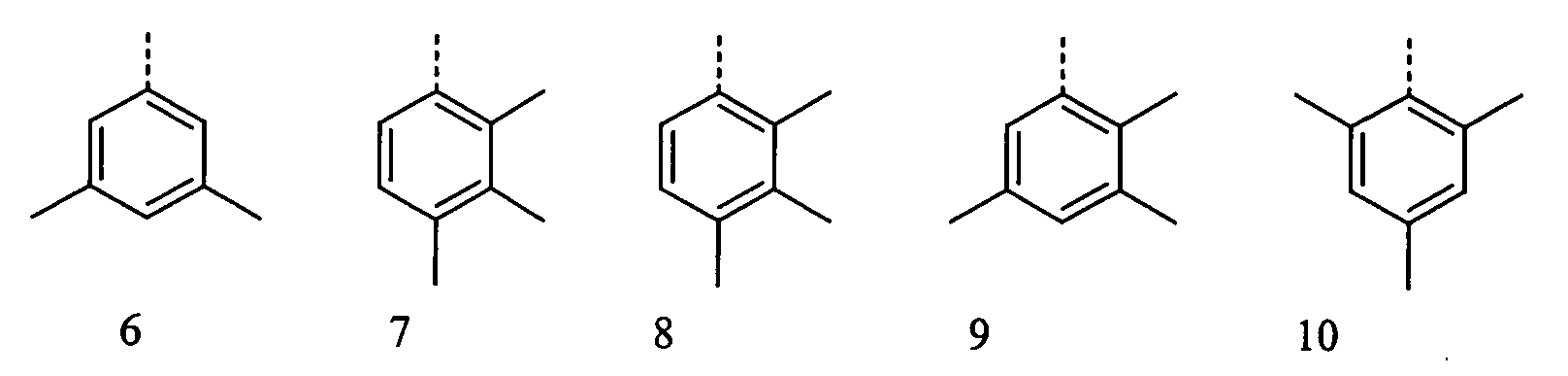
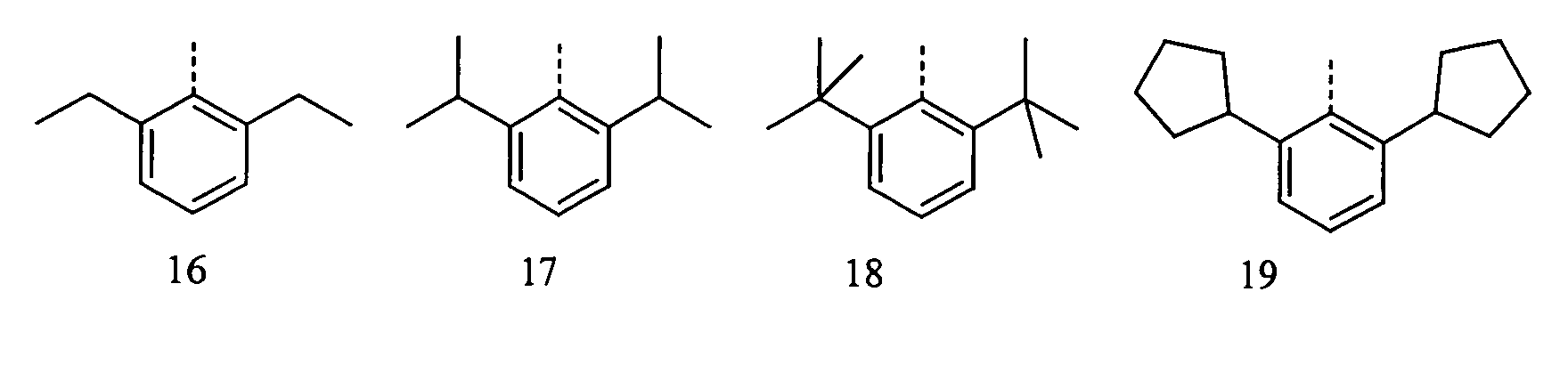
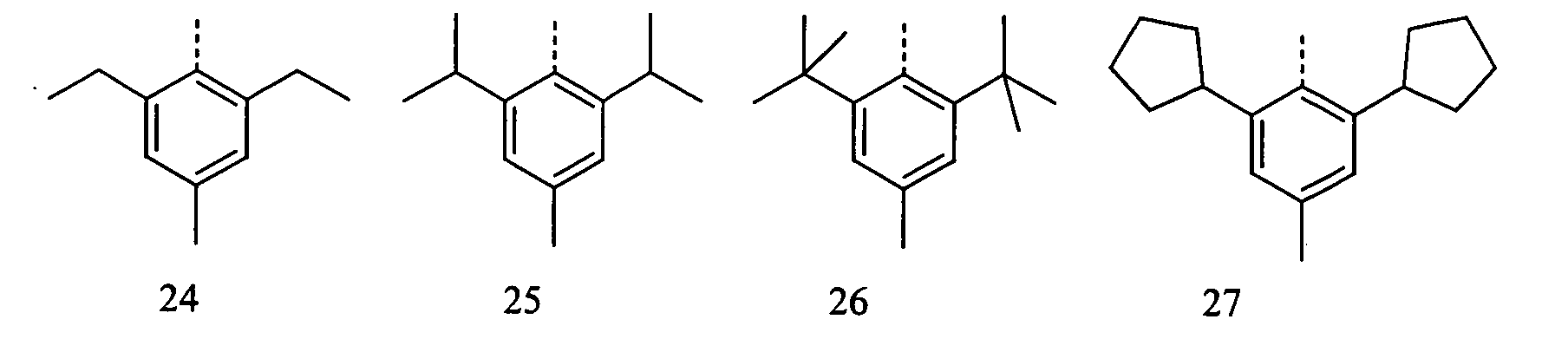
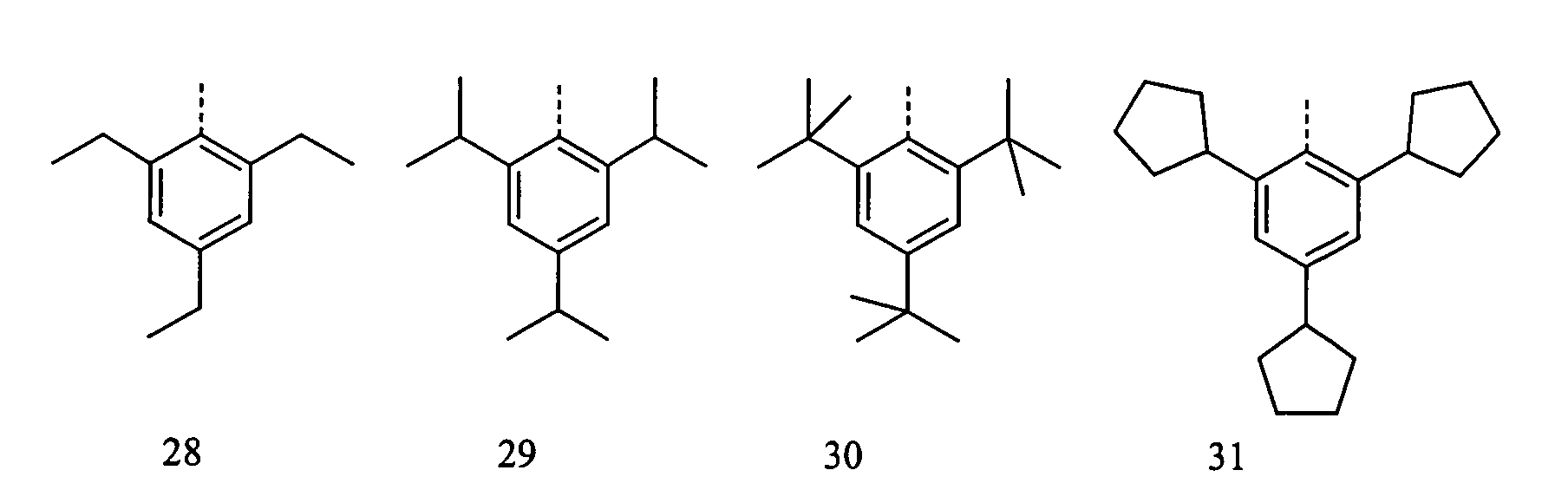
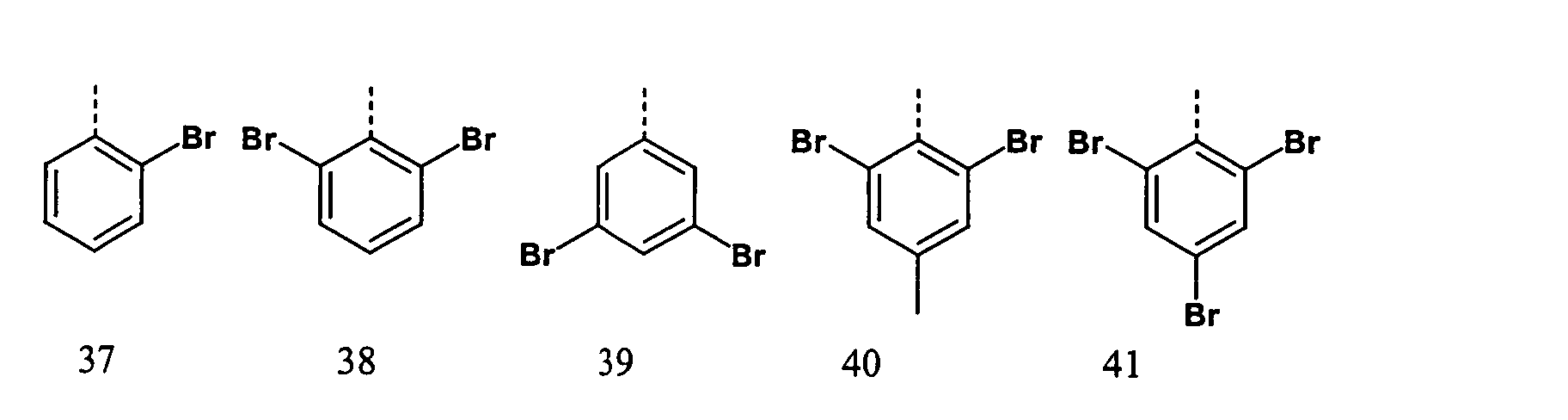
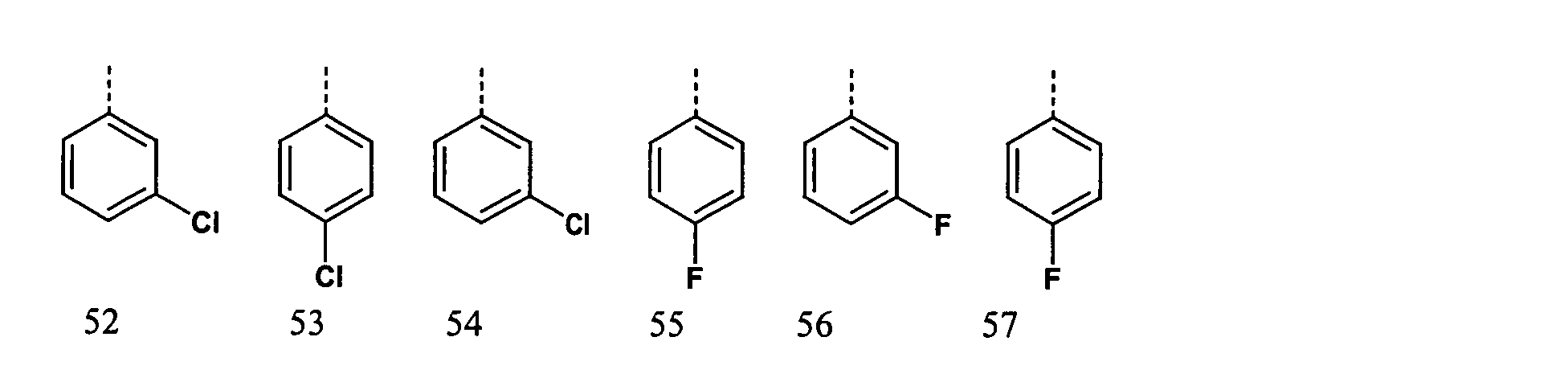
- the groups R k1 and R k4 are selected from the group of substituted aryl and / or heteroaryl groups.
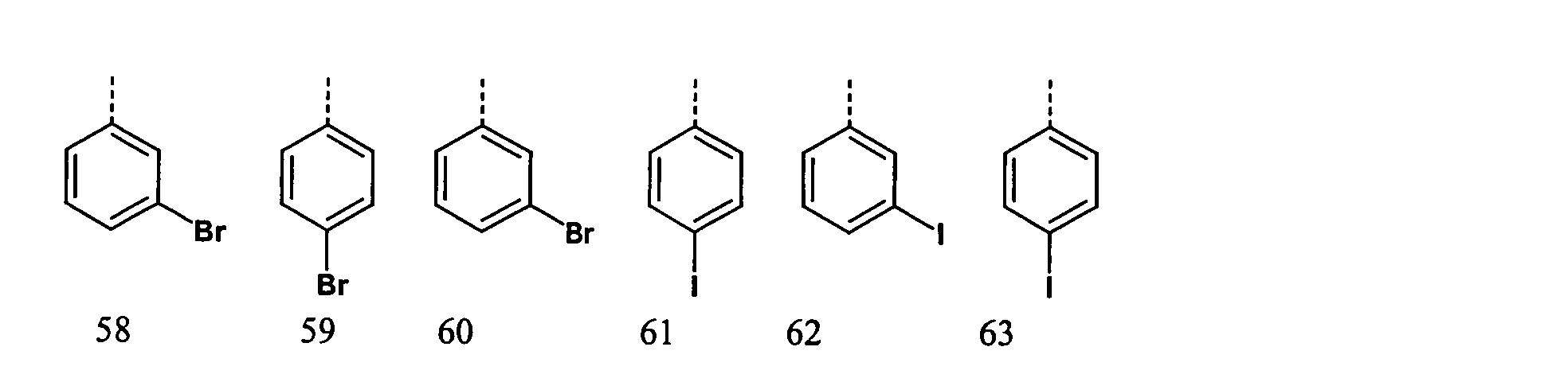
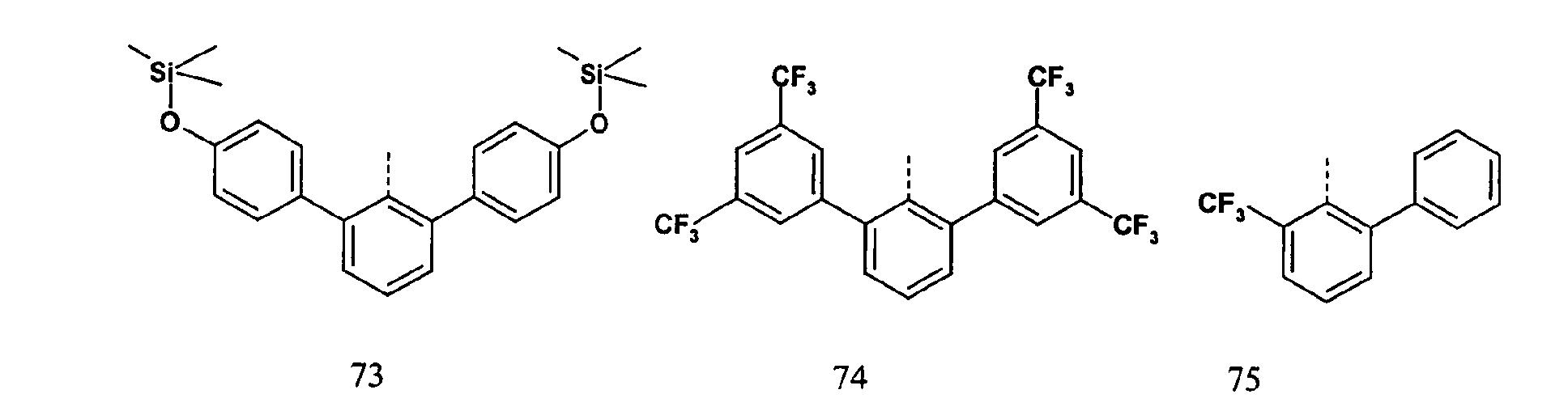
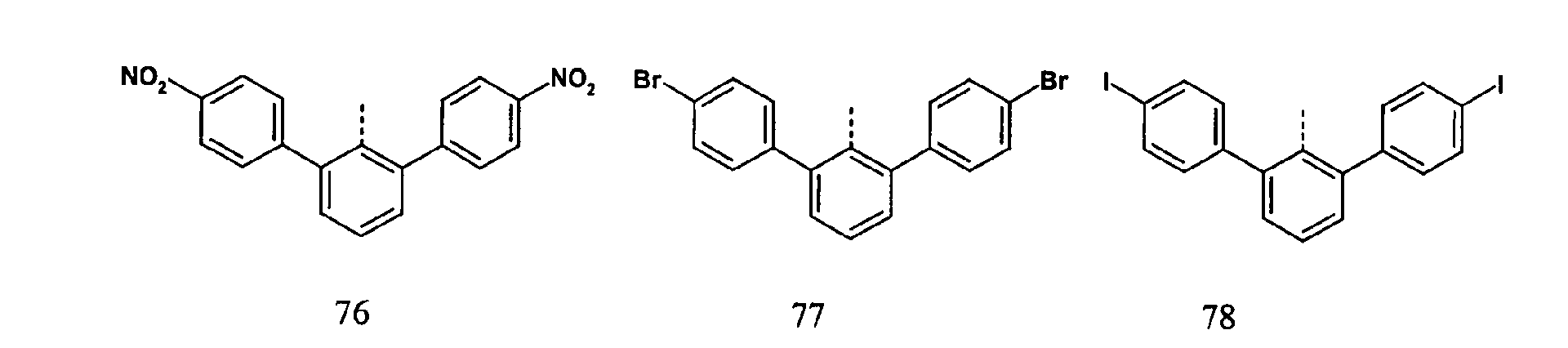
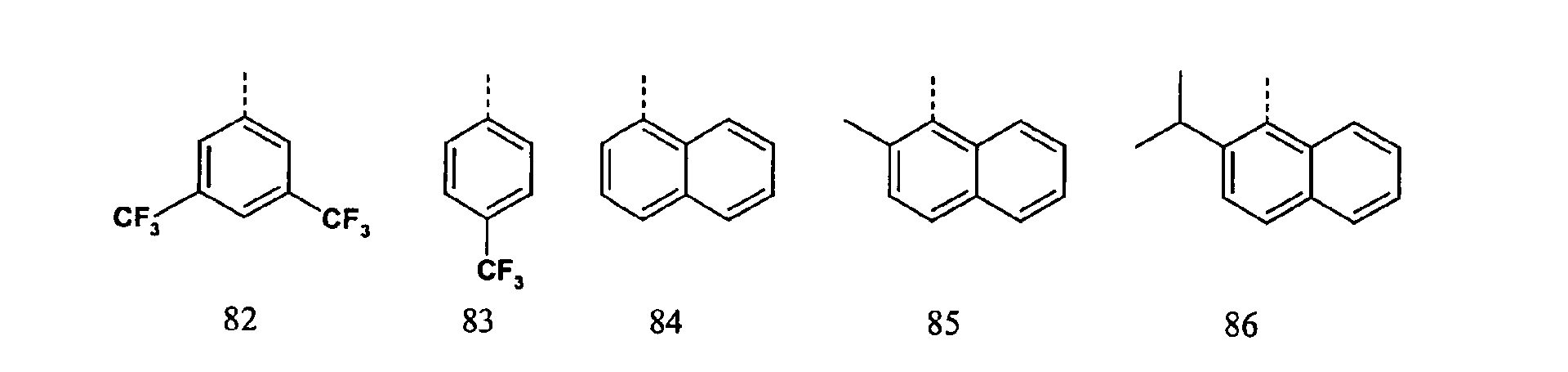
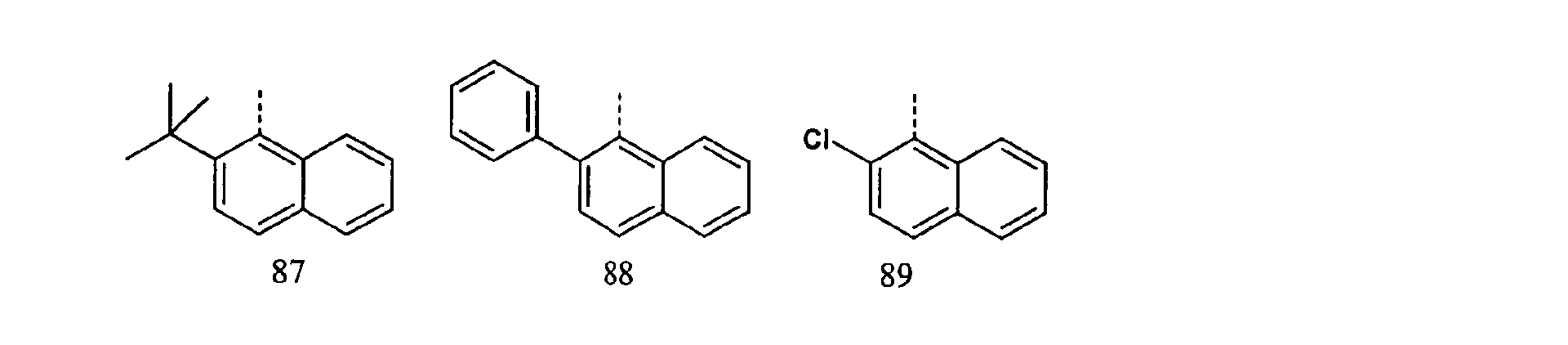
- the groups R k1 and R k4 are selected from the group of the following substituted aromatics of the formulas 1 to 106, where the dashed line represents the point of connection to L1, L2, L3 and / or L4:
- Q is understood to mean all monoanionic, dianionic or neutral ligands known to the person skilled in the art, which are bonded either covalently or via a coordinative bond to M 1 and / or M 2 , the index m 1 and m 2 illustrating that both several identical and different Q ligands from the group of Q may be attached to an M 1 or M 2 .
- the monoanionic ligands are preferably selected from the group consisting of halide, hydride, C 1-20 -alkyl, C 1-20 -alkenyl, C 5 -C 20 -cycloalkyl, C 6-20 -aryl, C 1 -20- heteroaryl, alkylaryl groups with C 1-20 -grouping in the alkyl radical and C 6-20 -nation in the aryl radical, -OT 1 , -OT 1 T 2 , -NT 3 T 4 , -NT 5 T 6 T 7 , -PT 8 T 9 , -PT 10 T 11 T 12 , wherein T 1 to T 12 are the same or different and are independently selected from the group consisting of H, C 1-20 alkyl, C 6-20 cycloalkyl -, C 6-20 -aryl, C 6-20 -alkylaryl groups with C 1-20 -groups in the alkyl radical and C 6-20 -groups in the aryl radical.
- Halides include fluorine, chlorine, bromine or iodine, preferably chlorine and bromine.
- C 1-20 -alkyl, C 1-20 -alkenyl, C 5 -C 20 -cycloalkyl, C 6-20 -aryl, C 1-20 -heteroaryl, and alkylaryl groups with C 1-20 - Grouping in the alkyl radical and C 6-20 grouping in the aryl radical are the same as listed above for the radicals R.
- the dianionic ligands are preferably selected from the group consisting of 1,3-alkanediyl compounds, 1,4-alkanediyl compounds, 1,5-alkanediyl, 1, ⁇ -alkanediyl compounds, Dialcoholates, dithiolates and diamides.
- Very particularly preferred dianionic Ligands are 1,4-butanediyl, 1,5-pentanediyl, 1,2-ethanediolato, 1,2-ethanedithiolato, 1,2-ethanediamido and 1,2-bishydroxylatobenzene.
- the neutral ligands are preferably selected from the group consisting of ethers, amines, phosphines and phosphine oxides, olefins and acetylenes, carbon monoxide, nitrogen (N 2 ), hydrogen (H 2 ), carbenes and phosphorylidene.
- Preferred ethers are diethyl ether, diisopropyl ether, tetrahydrofuran and 1,2-dimethoxyethane.
- Preferred amines are ammonia, triethylamine, pyridine, bipyridine, cyclohexylamine.
- Preferred phosphines and phosphine oxides are tri-tert-butylphosphine, tri-n-butylphosphine, triphenylphosphine, triphenylphosphine oxide, bis (diphenylphosphino) ethane.
- Preferred olefins and acetylenes are ethene, propene, hexene, cyclopentene, styrene, stilbene, butadiene, isoprene, phenylacetylene.
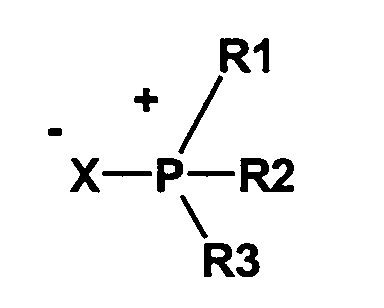
- Preferred phosphorylides are compounds of the formula wherein R 1 , R 2 , R 3 is selected from the group of R and X is selected from oxygen, -NT 1 and -CT 1 T 2 , wherein T 1 to T 12 are the same or different and are independently selected from the group consisting of H , C 1-20 alkyl, C 6-20 cycloalkyl, C 6-20 aryl, C 6-20 alkylaryl groups having C 1-20 moieties in the alkyl moiety and C 6-20 moieties in the aryl moiety.
- Halides include fluorine, chlorine, bromine or iodine, preferably chlorine and bromine.
- C 1-20 -alkyl, C 1-20 -alkenyl, C 5 -C 20 -cycloalkyl, C 6-20 -aryl, C 1-20 -heteroaryl, and alkylaryl groups with C 1-20 - Grouping in the alkyl radical and C 6-20 grouping in the aryl radical are the same as listed above for the radicals R.
- the monoanionic ligands are preferred. Very particular preference is given to the halides and Acetylacetonate derivatives.
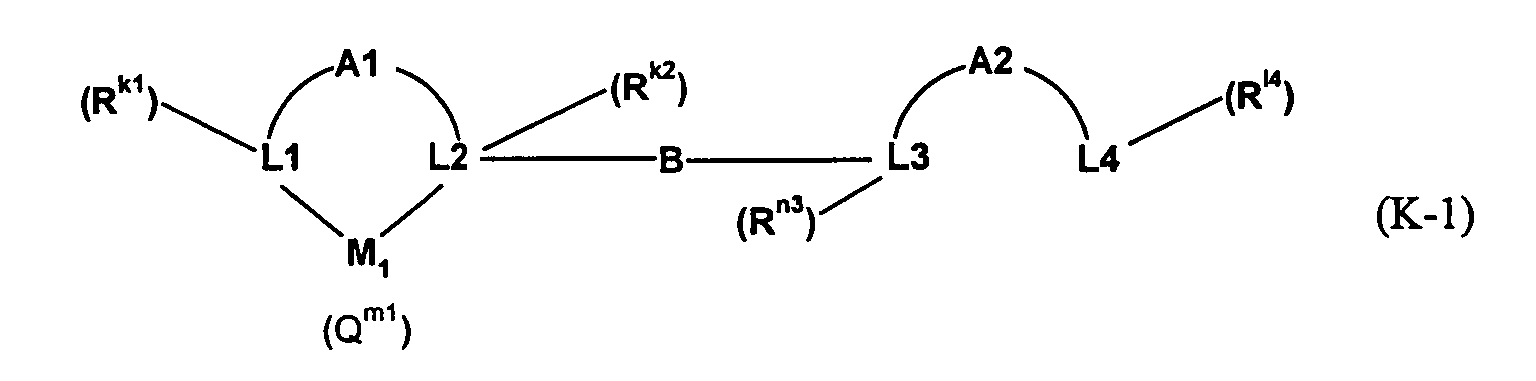
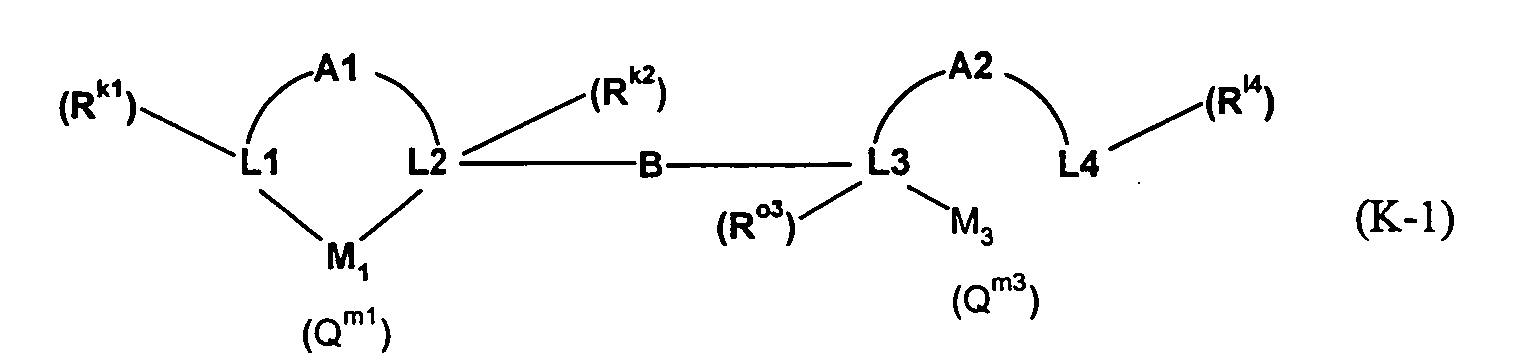
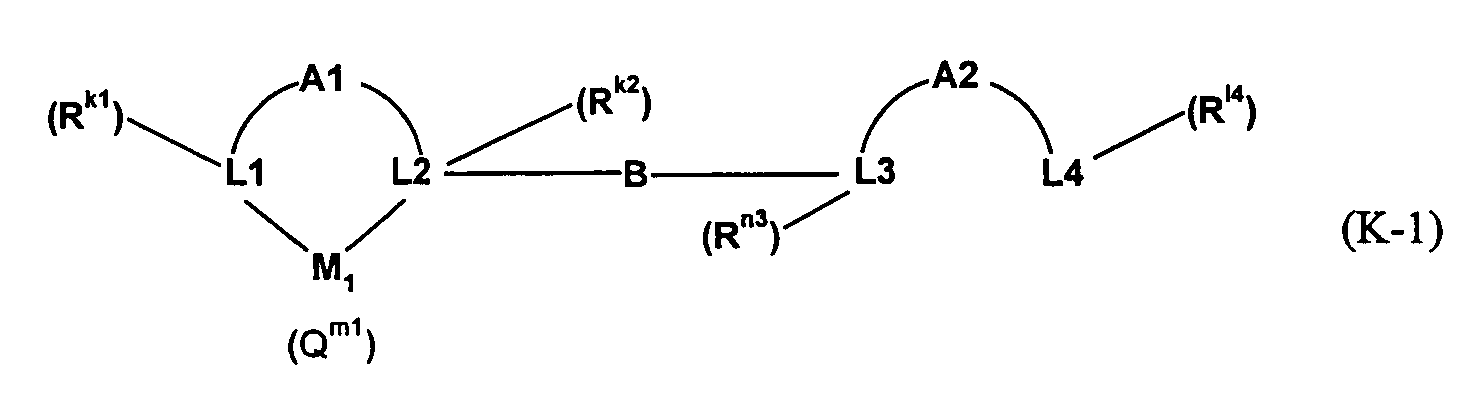
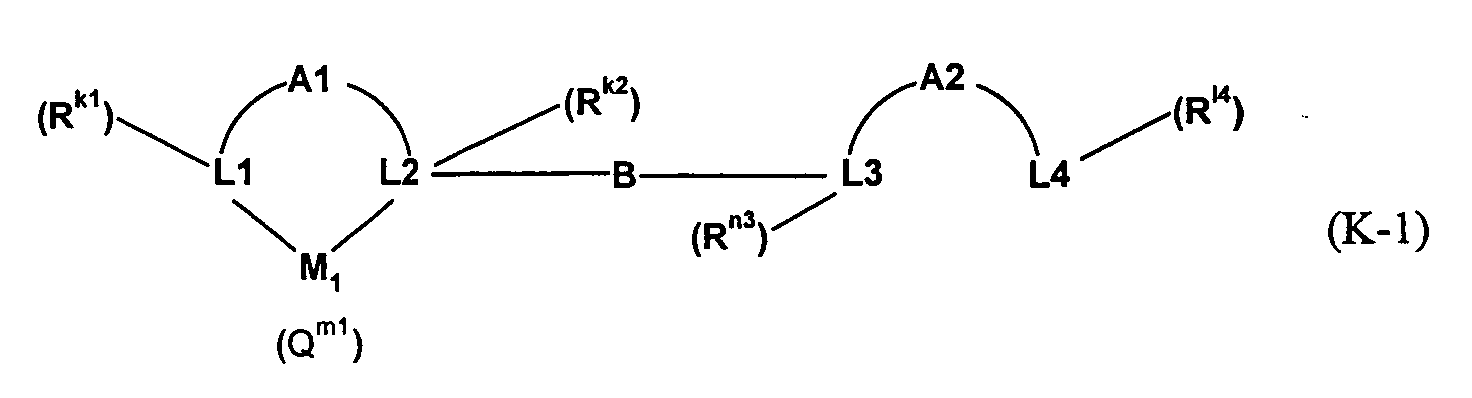
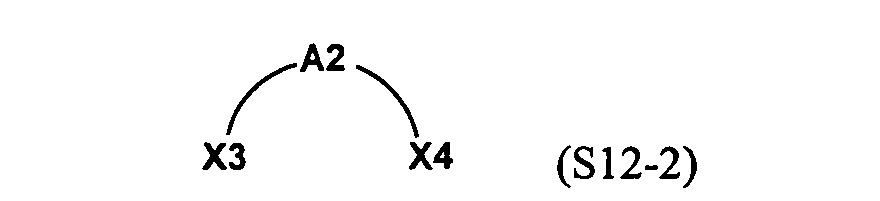
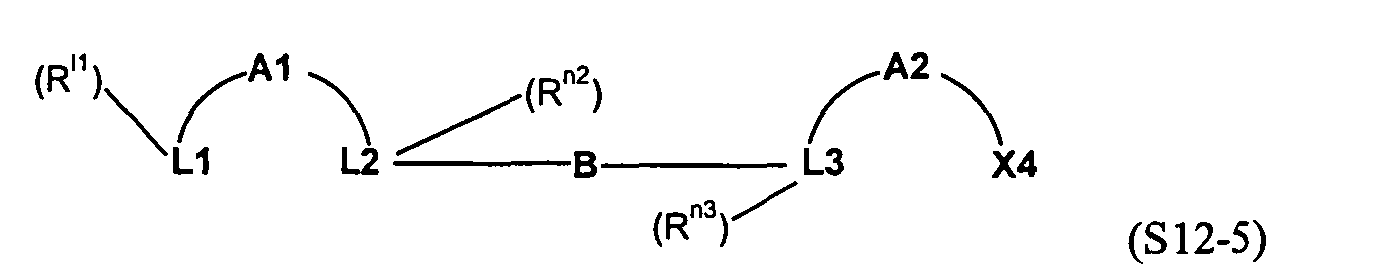
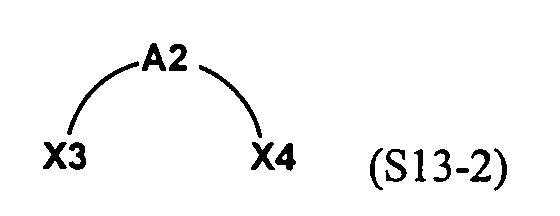
- A1 and A2 are all bridges of a substituted or unsubstituted atom known to the person skilled in the art and / or groups which link the centers L1 with L2 or L3 with L4, where A1 and A2 may contain further coordination sites for the metal centers M 1 and M 2 to understand.
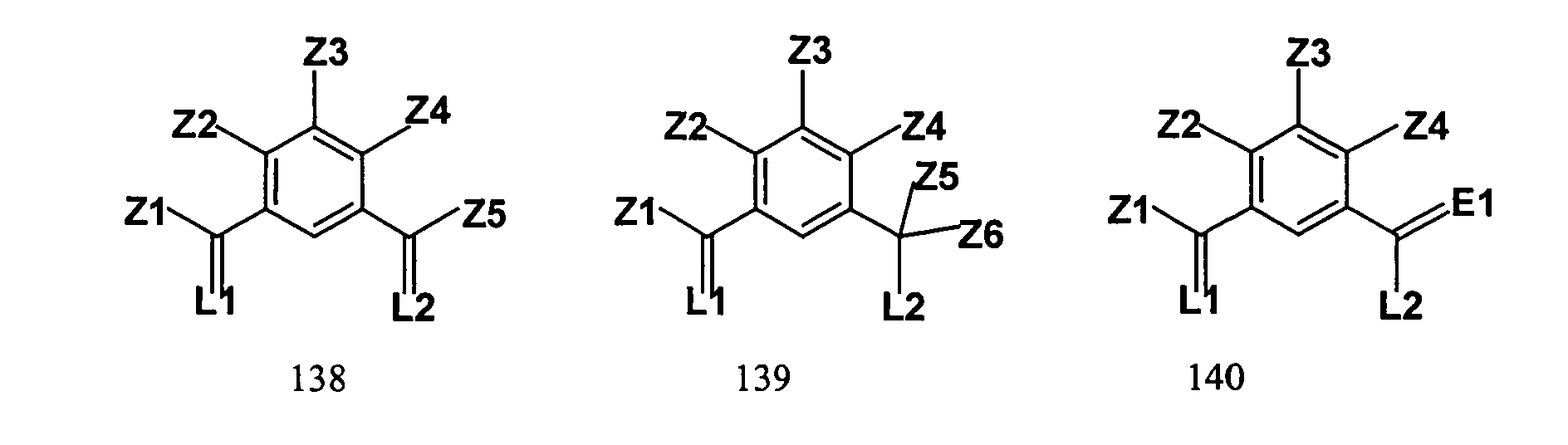
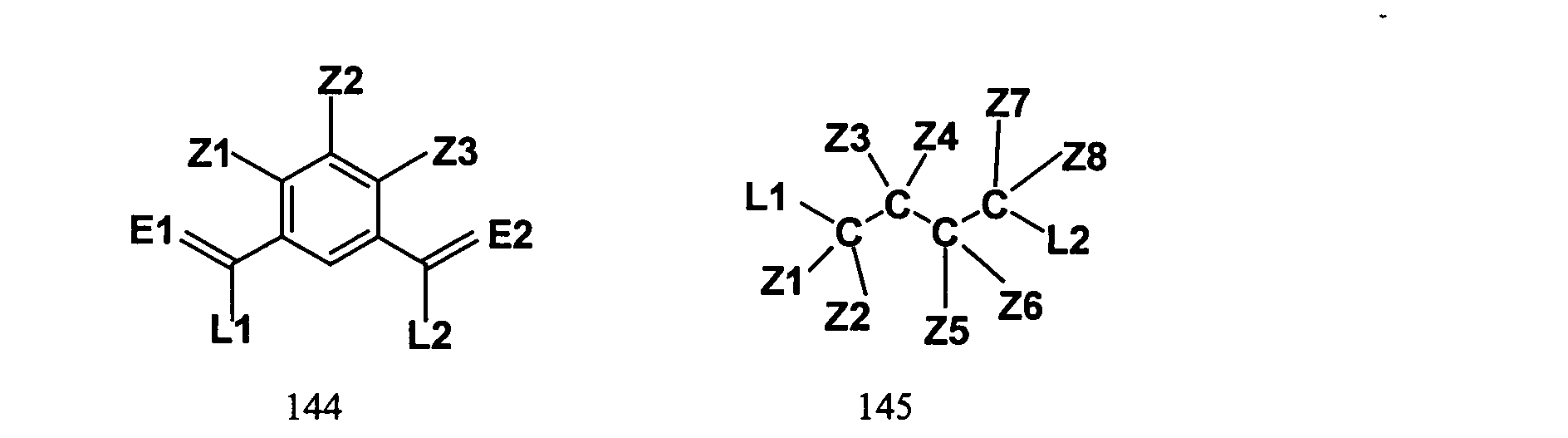
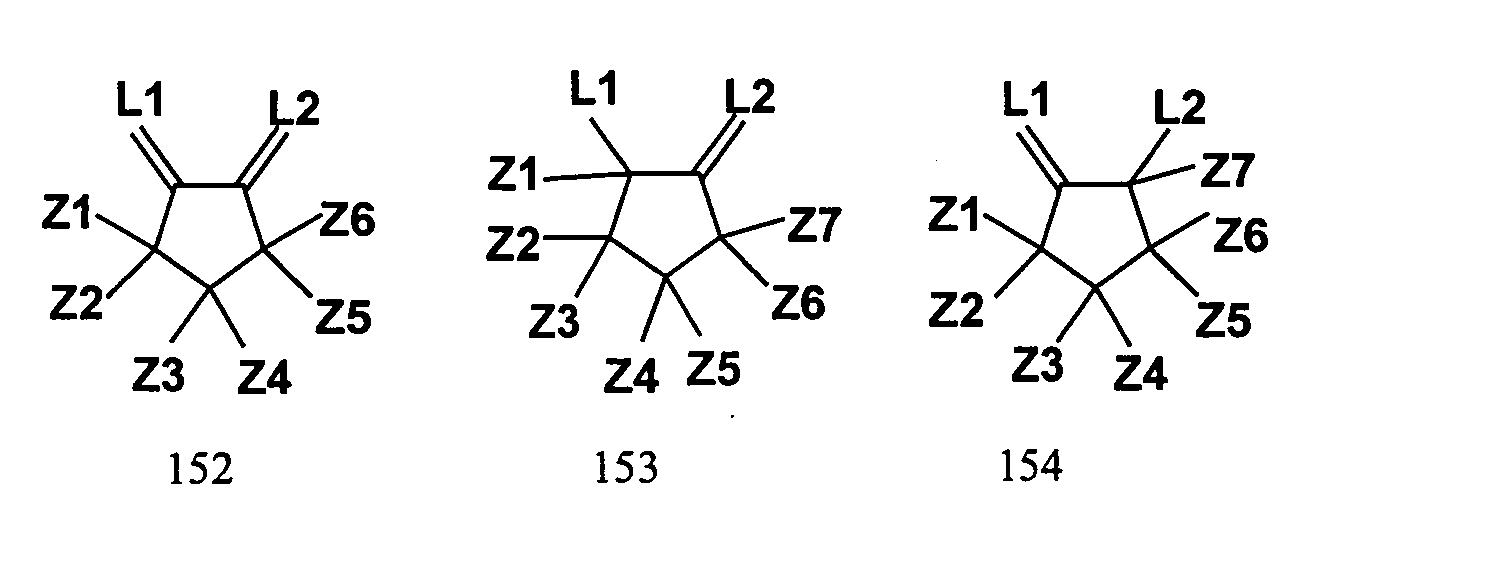
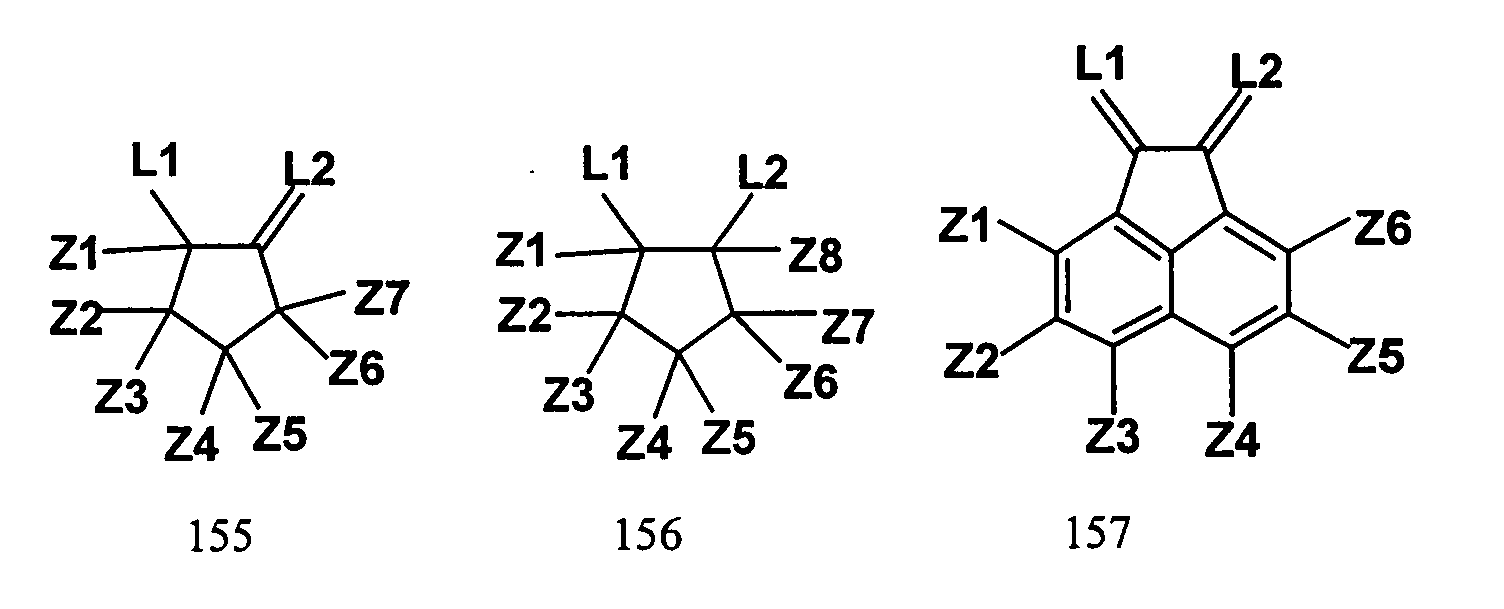
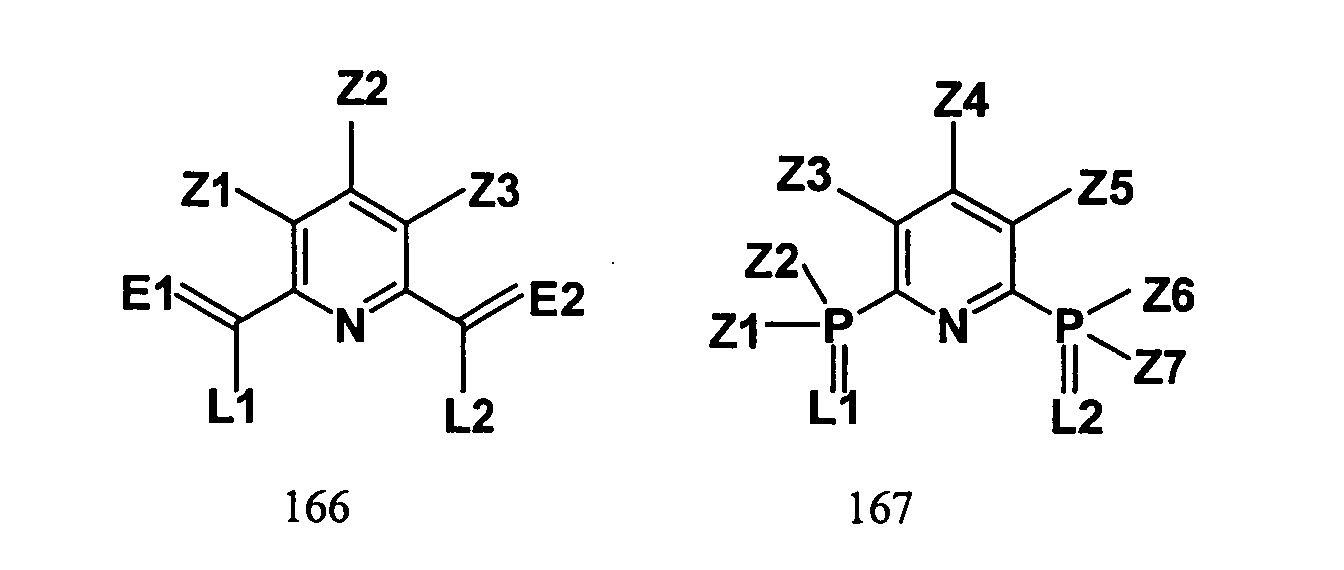
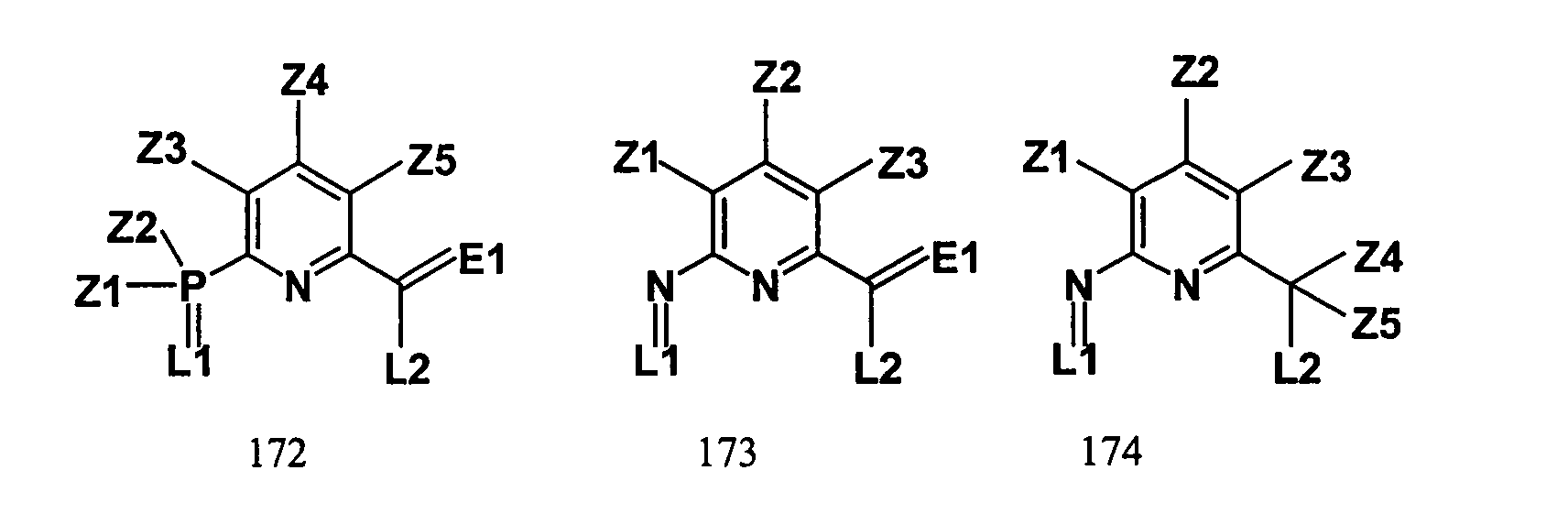
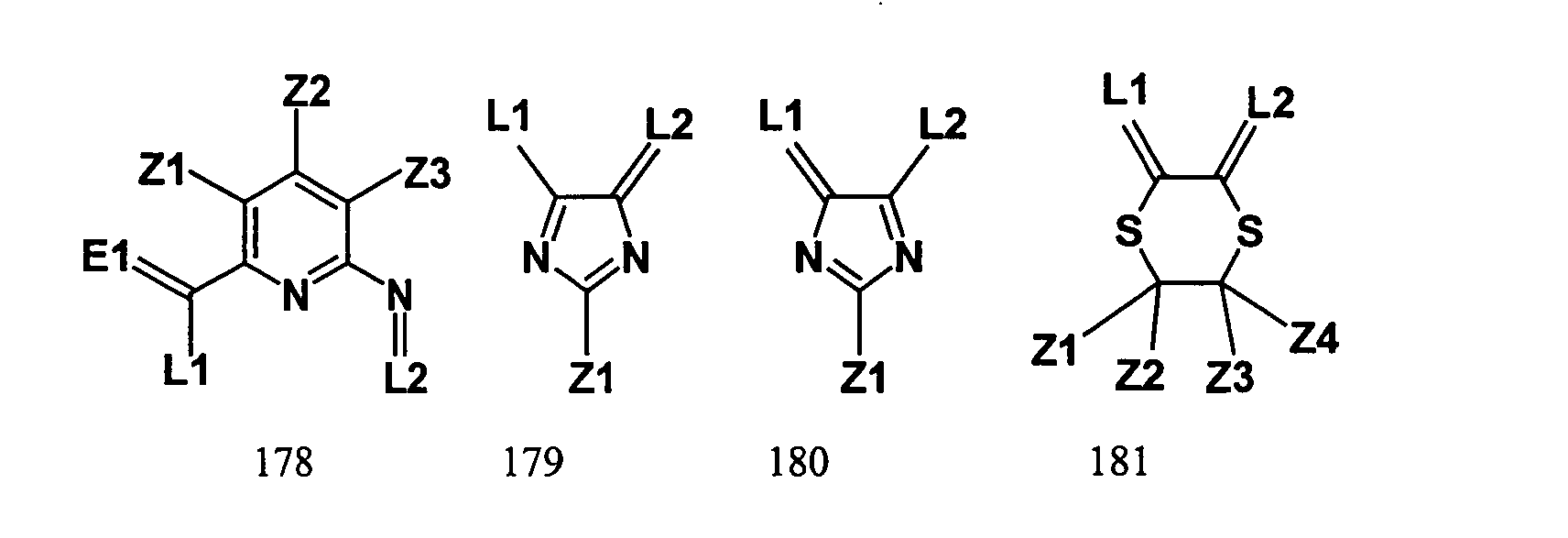
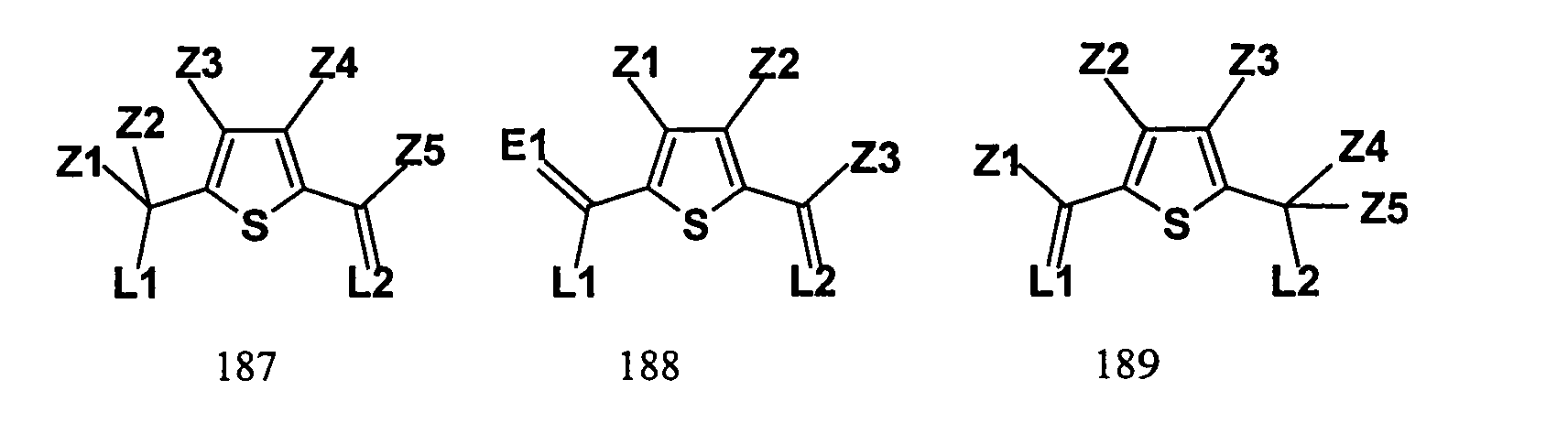
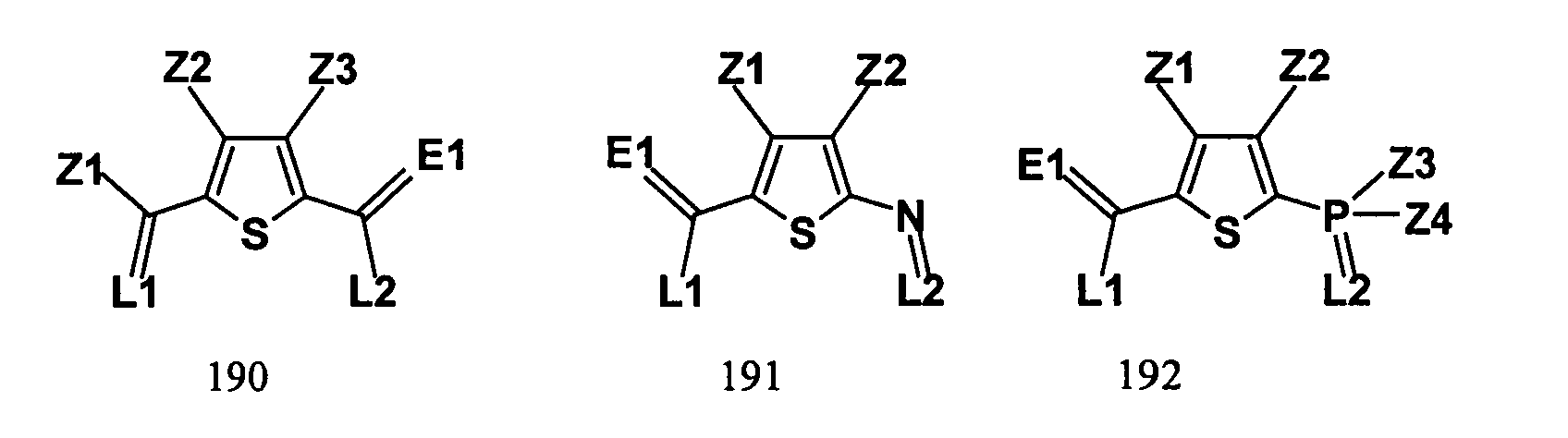
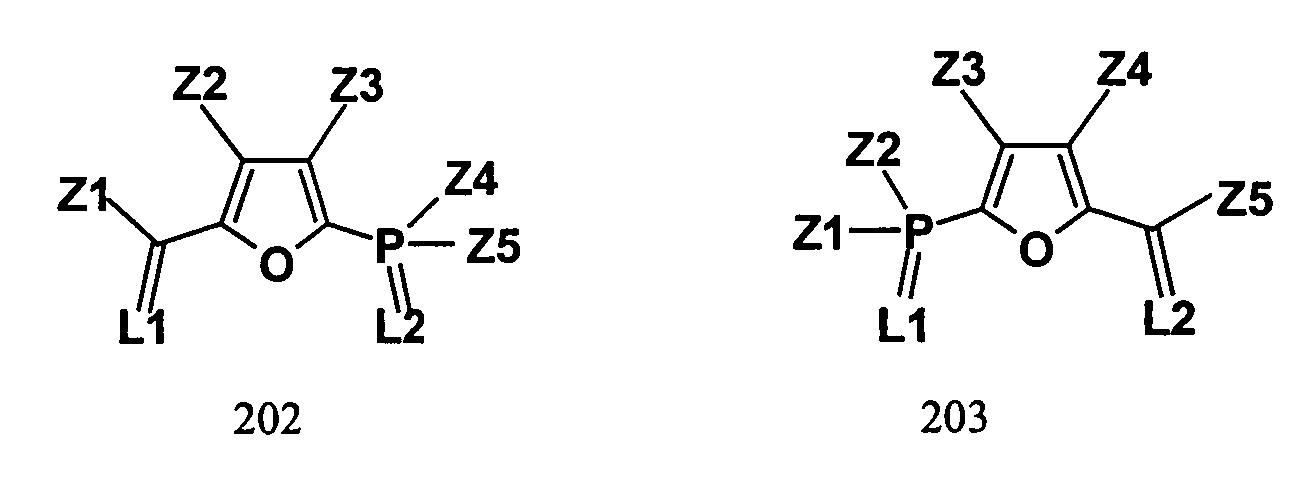
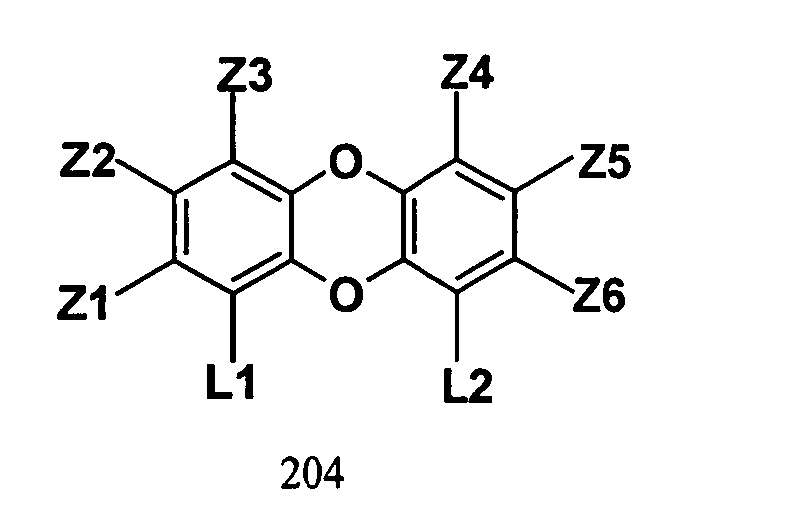
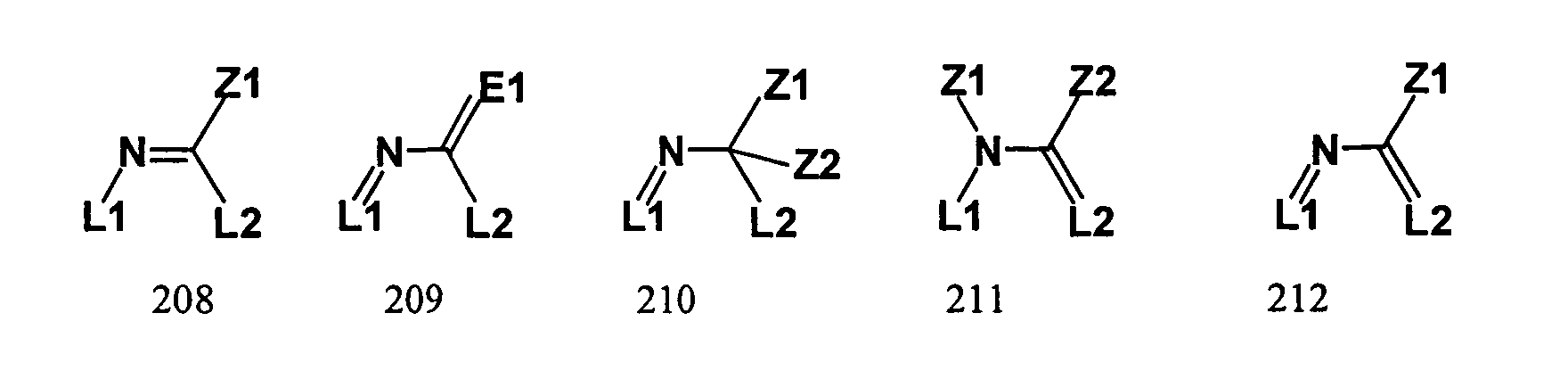
- A1 and A2 are the same or different and are independently selected from the group consisting of saturated or unsaturated hydrocarbon radicals having 1 to 20 carbon atoms, cyclic saturated or unsaturated hydrocarbon radicals having 4 to 20 carbon atoms, in which case L1 and L2 or L3 and L4 are bonded directly to the ring, heterocyclic saturated or unsaturated compounds having 3 to 20 carbon atoms, nitrogen-containing groups, phosphorus-containing groups, silicon-containing groups, tin-containing groups, germanium-containing groups and boron-containing groups, all of these groups even more singly bound substituents Z 1 to Z 10 and / or double-bonded substituents E 1 to E 2 can carry.
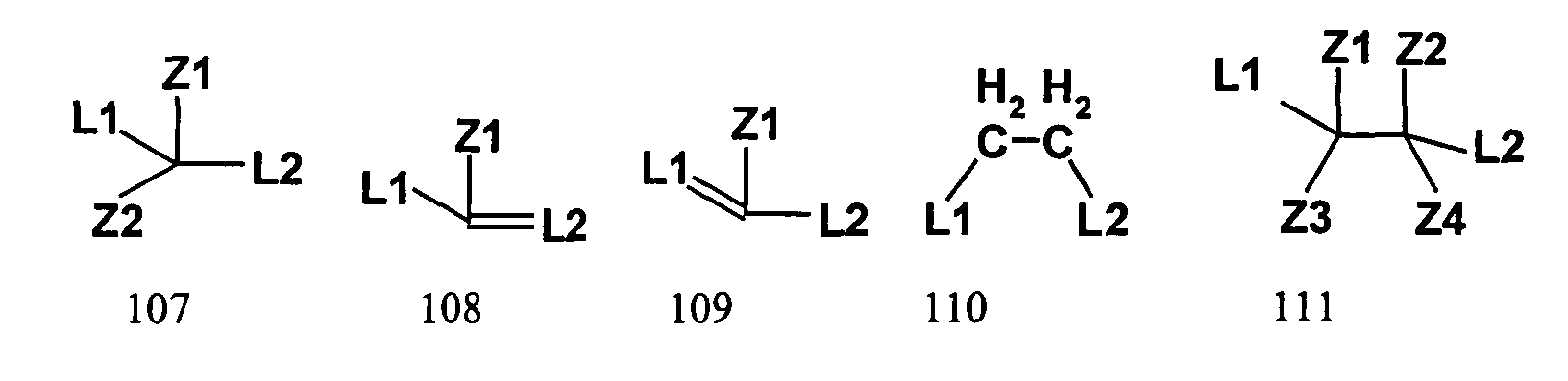
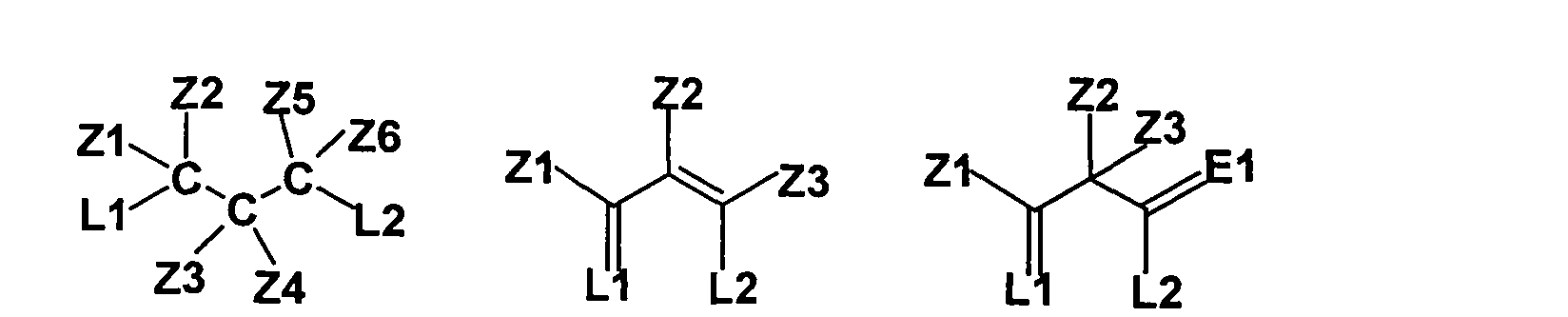
- Preferred saturated or unsaturated hydrocarbon radicals having 4 to 20 C atoms are the structures of the formulas 107 to 145 where A1 is represented as a bridging element of L1 or L2; for A2, L1 and L2 must be replaced by L3 and L4.
- Preferred cyclic saturated or unsaturated hydrocarbon groups of 4-20 carbon atoms in which L1 and L2 or L3 and L4 are directly attached to the ring are substituted or unsubstituted benzene, naphthol and anthracene rings of formulas 146 to 157 where A1 is represented as a bridging element of L1 or L2; for A2, L1 and L2 must be replaced by L3 and L4.
- Preferred heterocyclic compounds having 3 to 20 carbon atoms and one or more heteroatoms are substituted or unsubstituted pyridine, quinoline, thiophene and furan rings of formulas 158 to 204 where A1 is represented as a bridging element of L1 or L2; for A2, L1 and L2 must be replaced by L3 and L4.
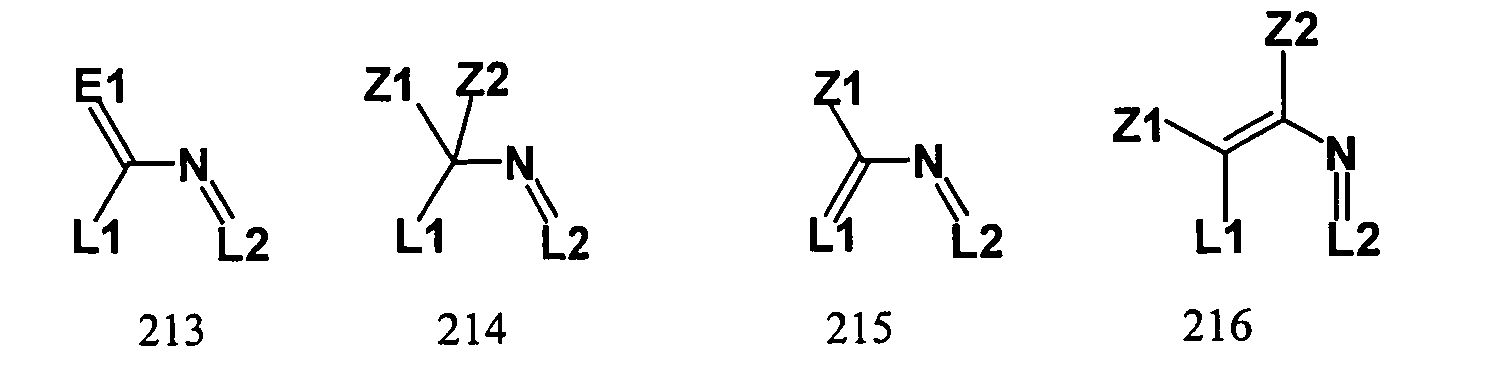
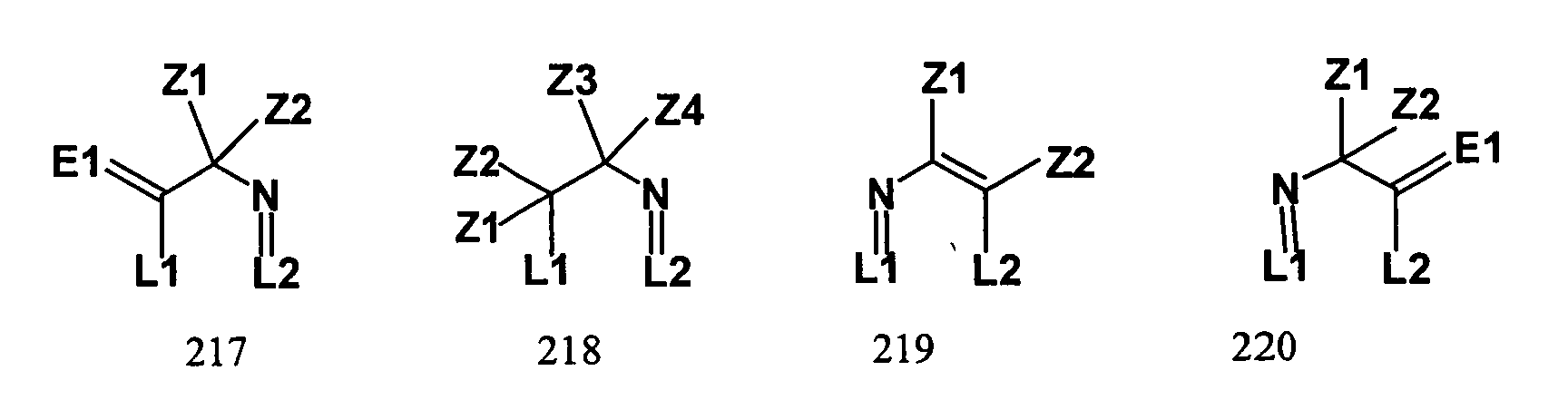
- Preferred groups containing nitrogen are those of the following formulas 205 to 221 where A1 is represented as a bridging element of L1 or L2; for A2, L1 and L2 must be replaced by L3 and L4.
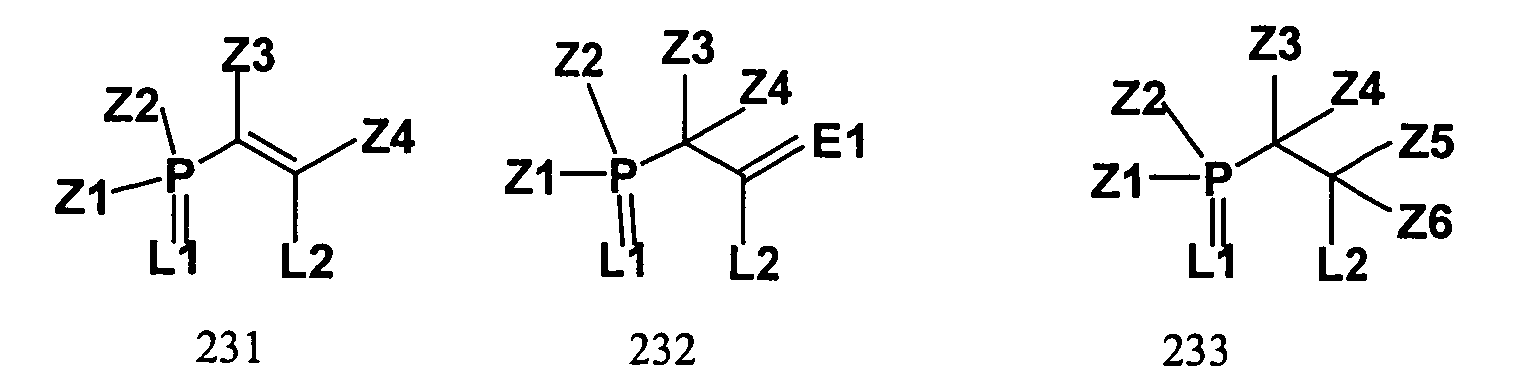
- Preferred groups containing phosphorus are those of the following formulas 222 to 233 where A1 is represented as a bridging element of L1 or L2; for A2, L1 and L2 must be replaced by L3 and L4.
- Preferred groups linking L1 to L2 and / or L3 to L4 via one or more silicon centers are Formulas 234 to 236 where A1 is represented as a bridging element of L1 or L2; for A2, L1 and L2 must be replaced by L3 and L4.
- Preferred groups linking L1 to L2 and / or L3 to L4 via one or more tin centers are those of the following formulas 237 and 238 where A1 is represented as a bridging element of L1 or L2; for A2, L1 and L2 must be replaced by L3 and L4.
- Preferred group linking L1 to L2 and / or L3 to L4 via germanium centers is Formula 239 where A1 is represented as a bridging element of L1 or L2; for A2, L1 and L2 must be replaced by L3 and L4.
- Preferred groups which link L1 to L2 and / or L3 to L4 via phosphorus centers are P (Ph) -P (Ph) -, -P (Me) -P (Me) -.
- E 1 and E 2 represent double-bonded groups and may be the same or different and are independently selected from the group consisting of S, O, CZ 1 Z 2 , NZ 1 , OZ 1 + , NZ 1 Z 2 + .
- Z 1 to Z 10 may be identical or different and are independently selected from the group consisting of halides, hydride, C 1-20 -alkyl, C 1-20 -alkenyl, C 5-20 -cycloalkyl-, C 6-20 -aryl, alkylaryl groups with C 1-20 -group in the alkyl radical and C 6-20 -nation in the aryl radical, -OT 1 , OT 1 T 2 , -NT 3 T 4 , NT 5 T 6 T 7 , -PT 8 T 9 , -PT 10 T 11 T 12 , and wherein T 1 to T 12 may be the same or different and are independently selected from the group consisting of H, C 1-20 alkyl, C 5-20 Cycloalkyl, C 6-20 aryl, C 1-20 heteroaryl, alkylaryl groups having C 1-20 moieties in the alkyl radical and C 6-20 moieties in the aryl radical and arylalkyl groups having C 1-20 moieties in the alky
- the preferred halides C 1-20 -alkyl, C 1-20 -alkenyl, C 5-20 -cycloalkyl, C 6-20 -aryl, alkylaryl groups with C 1-20 -grouping in the alkyl radical and C 6 20 -group in the aryl radical, -OT 1 , OT 1 T 2 , -NT 3 T 4 , NT 5 T 6 T 7 , -PT 8 T 9 , -PT 10 T 11 T 12 are the same as described for the radicals R. ,
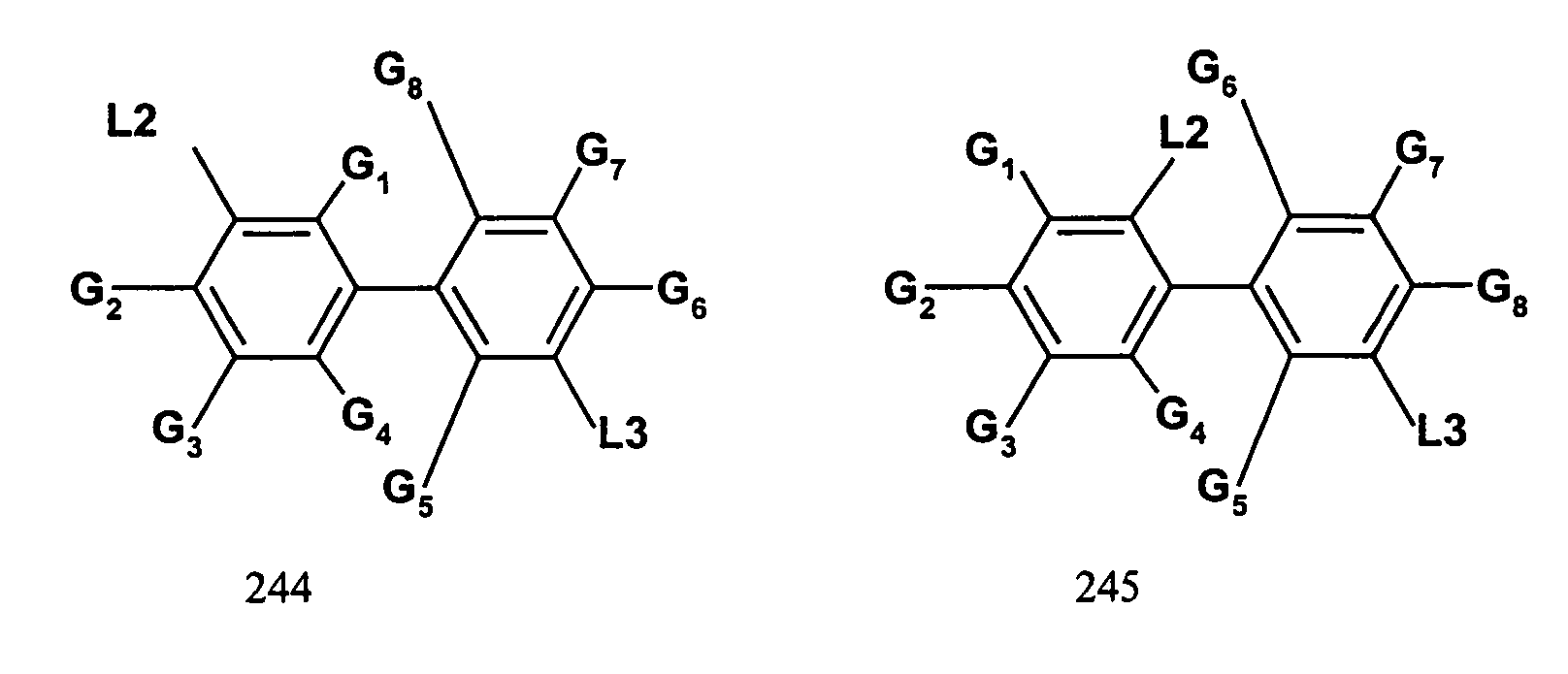
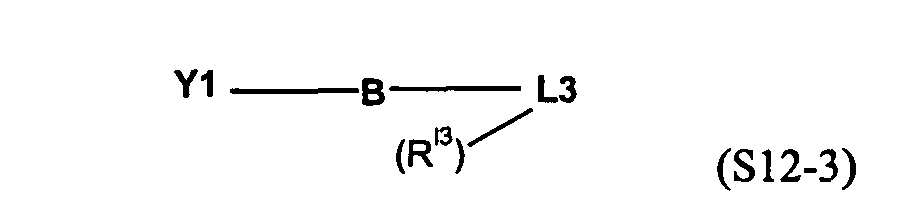
- An electronic linkage between the centers L2 and L3 is to be understood as meaning groups which by delocalization of their ⁇ electrons also carry the charges into the rings of L1; A1; L2 and M 1 and the substituents of this ring and L3; A2; L4 and M 2 and substituents of this ring can move.
- B is preferably an aromatic or heteroaromatic group, which in turn can carry substituents G 1 to G 8 .
- B is particularly preferably an aromatic or heteroaromatic group whose Link points to L2 and L3 are not in ortho position to each other.
- substituents G 1 to G 8 are the same or different and are independently selected from the group consisting of halide, hydride, C 1-20 alkyl, C 1-20 alkenyl, C 5-20 cycloalkyl, C 6-20 -aryl, alkylaryl groups with C 1-20 -group in the alkyl radical and C 6-20 -nation in the aryl radical, -OT 1 , OT 1 T 2 , -NT 3 T 4 , NT 5 T 6 T 7 , - PT 8 T 9 , -PT 10 T 11 T 12 , where T 1 to T 12 are identical or different and are selected independently of one another from the group consisting of H, C 1-20 -alkyl, C 5-20 -cycloalkyl-, C 6-20 -aryl, C 1-20 -heteroaryl, alkylaryl groups with C 1-20 -groups in the alkyl radical and C 6-20 -groups in the aryl radical and arylalkyl groups
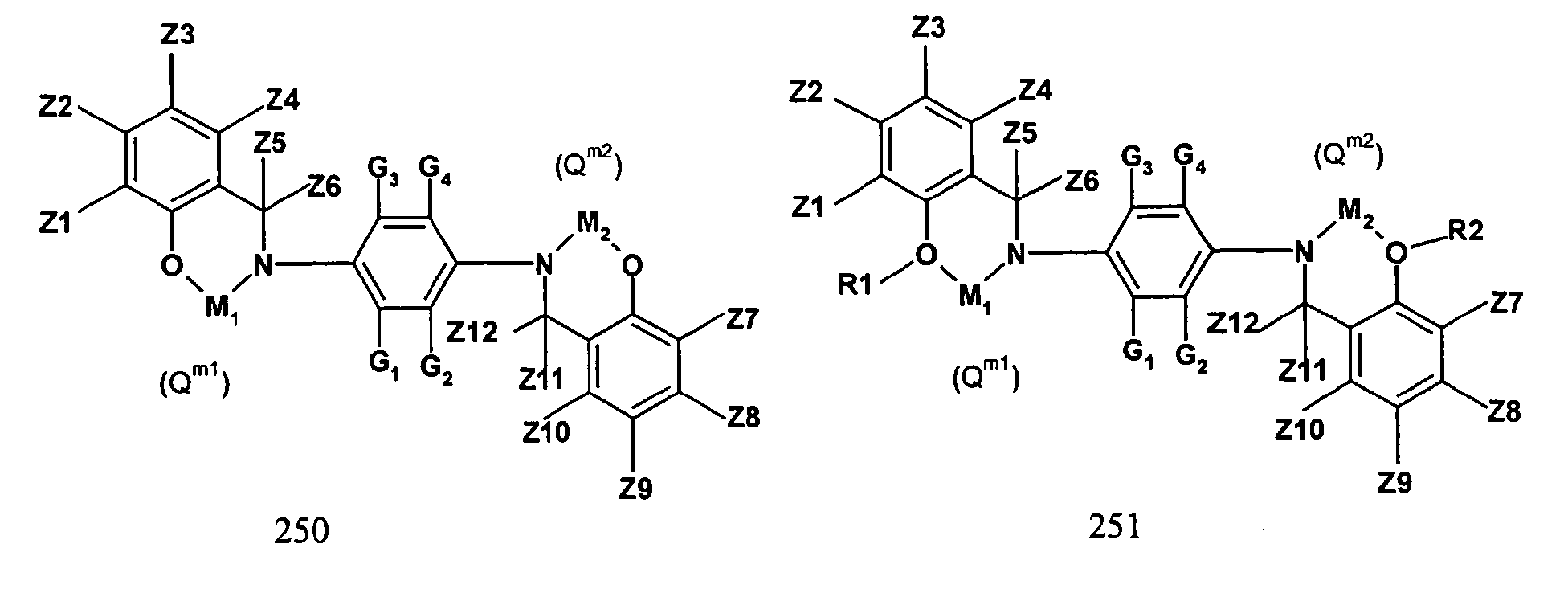
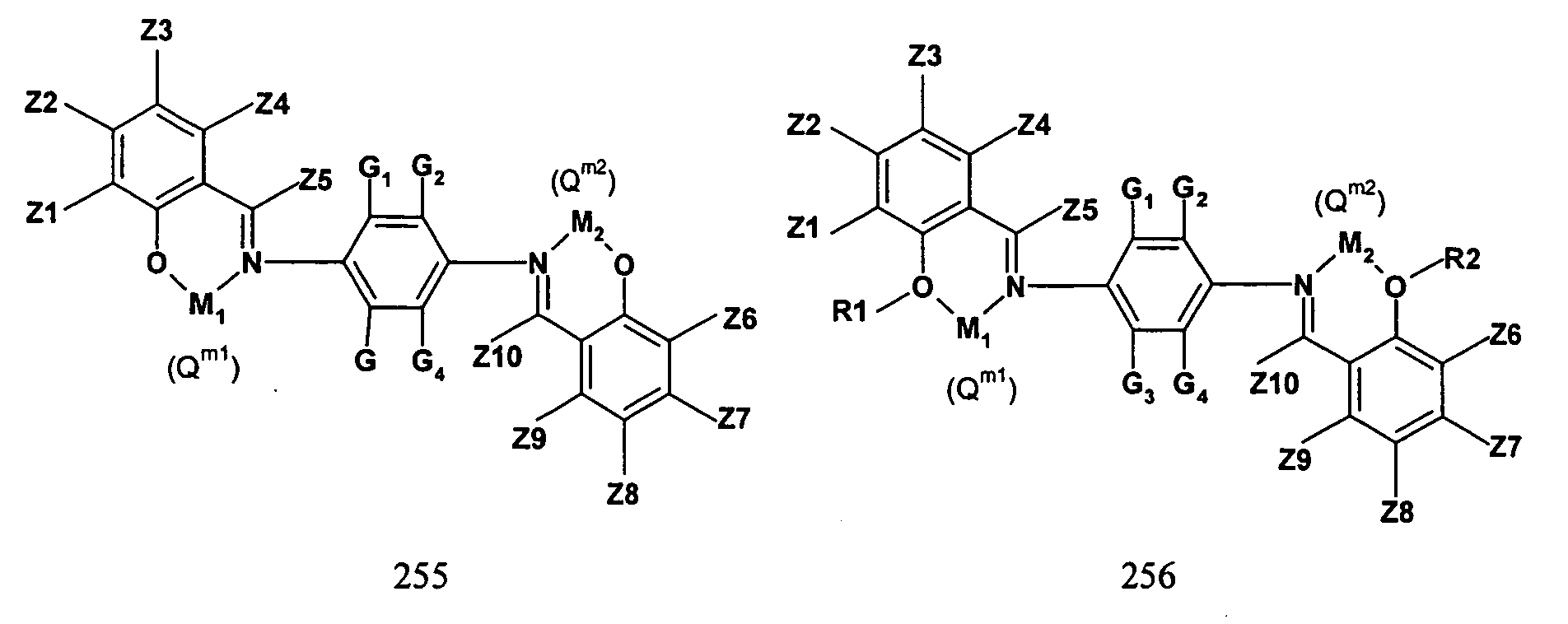
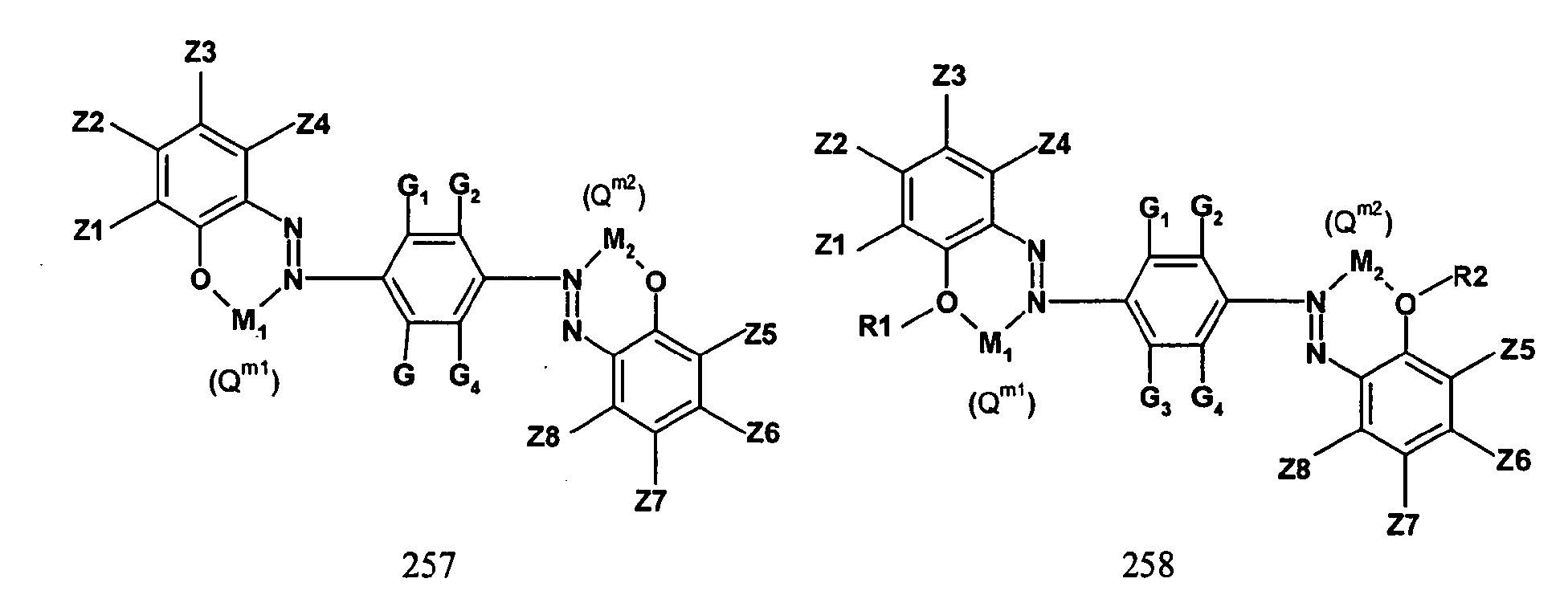
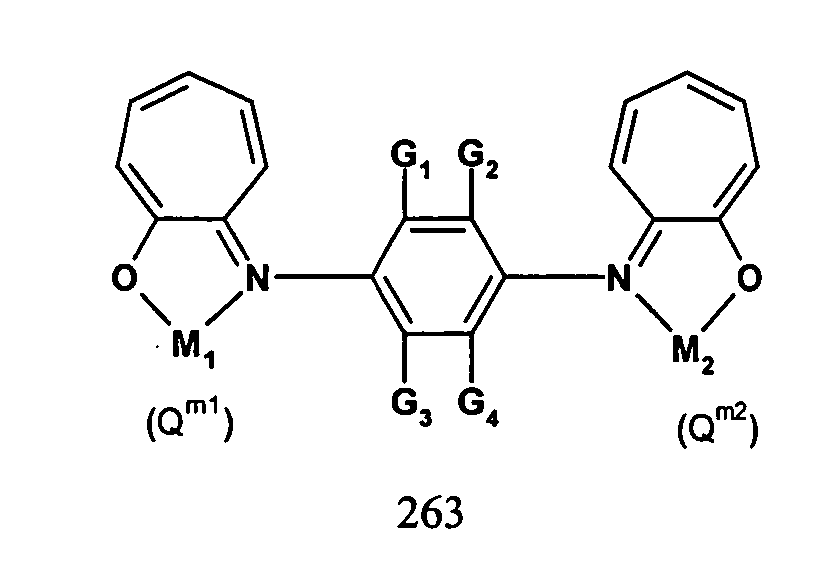
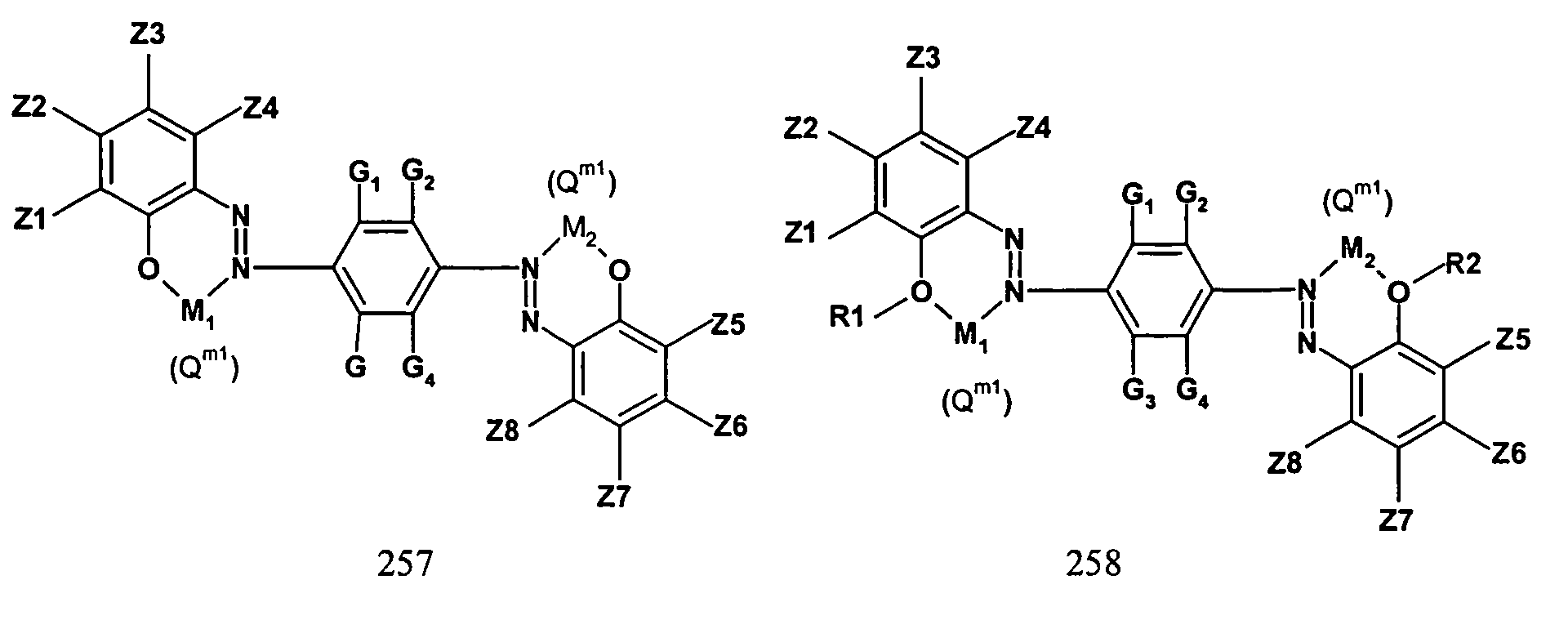
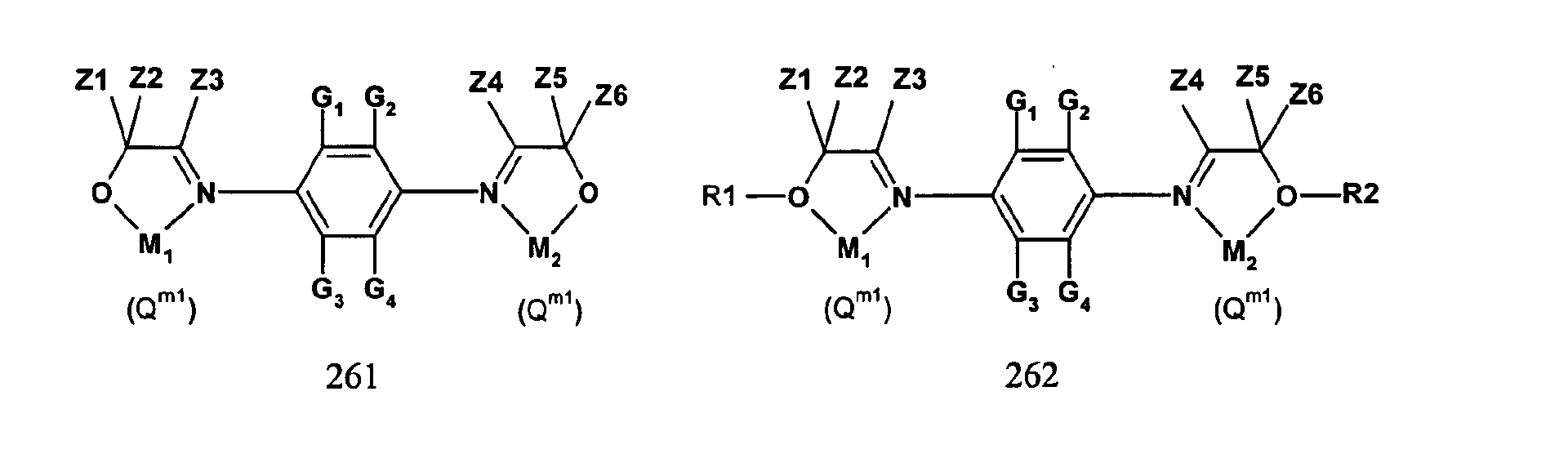
- Preferred basic structures with NO ligands for L1 and L2 and / or L3 and L4 are the following formulas 250 to 263
- Particularly preferred basic structures for compounds having NO ligands for L1 and L2 and / or L3 and L4 are the following formulas 255 to 258, 264, 265, 261 to 263
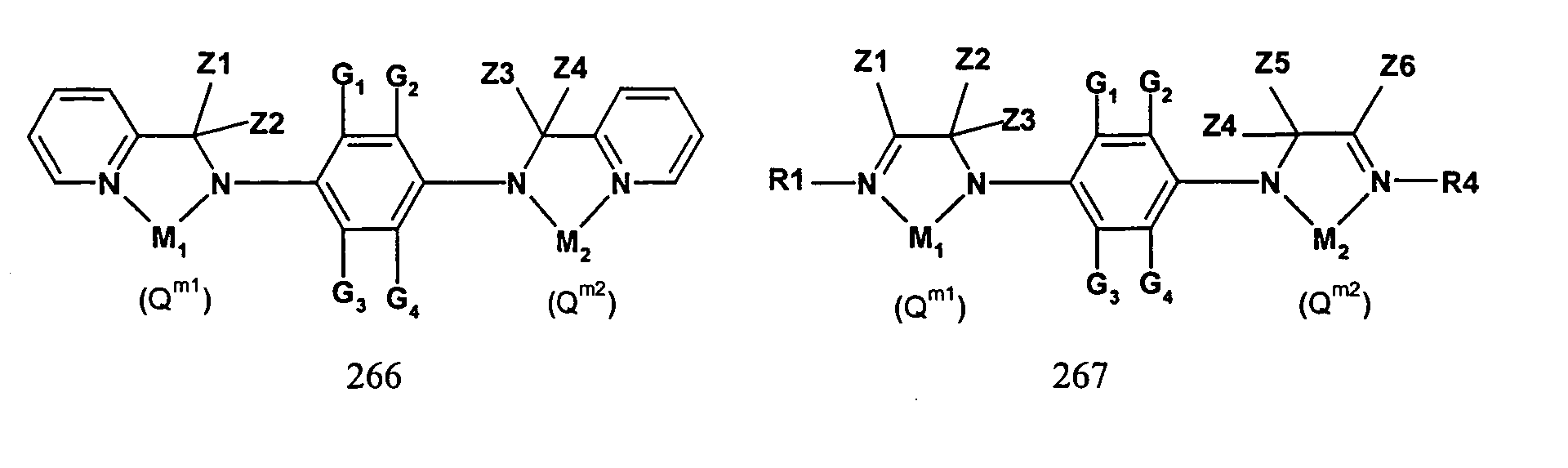
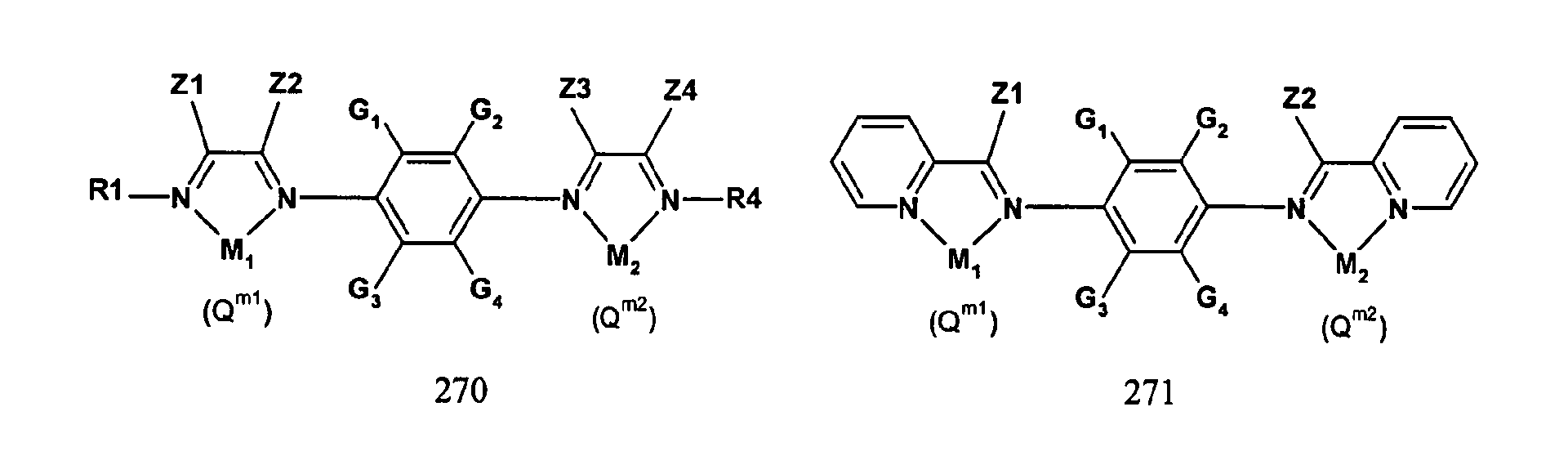
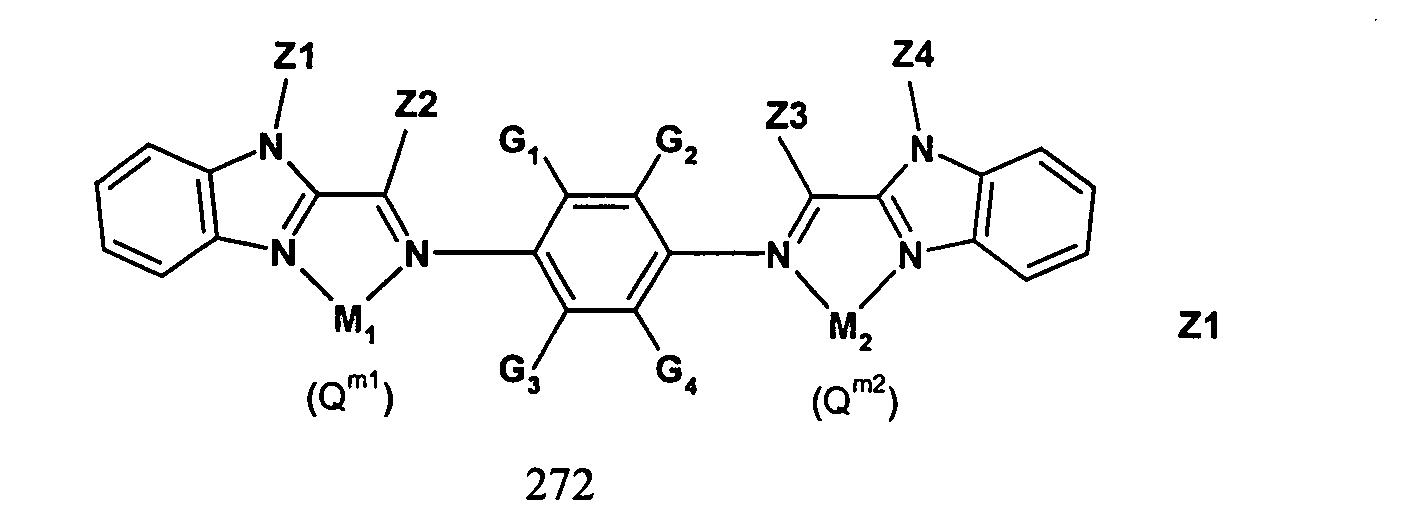
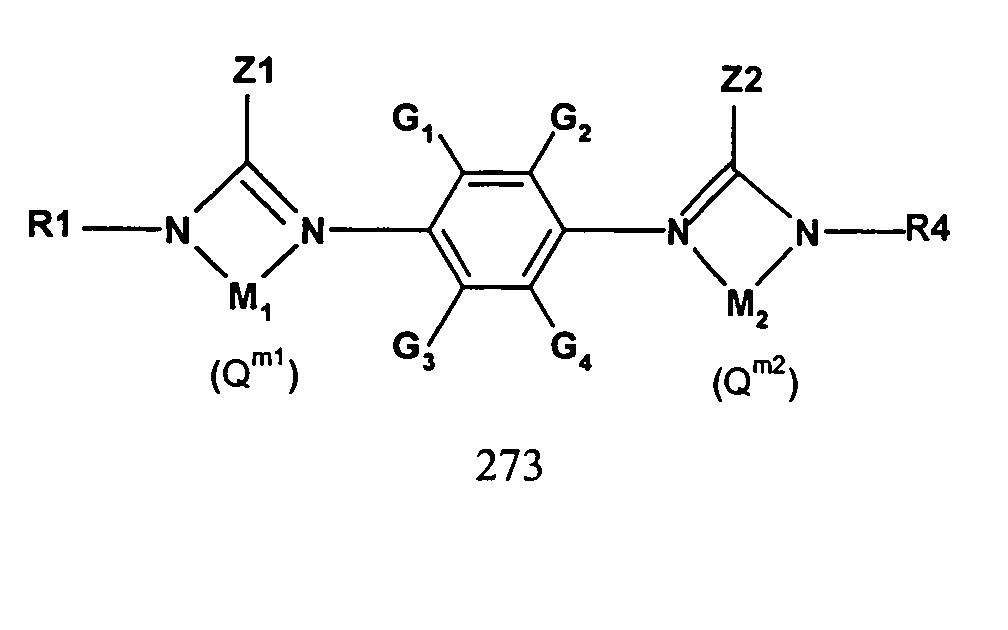
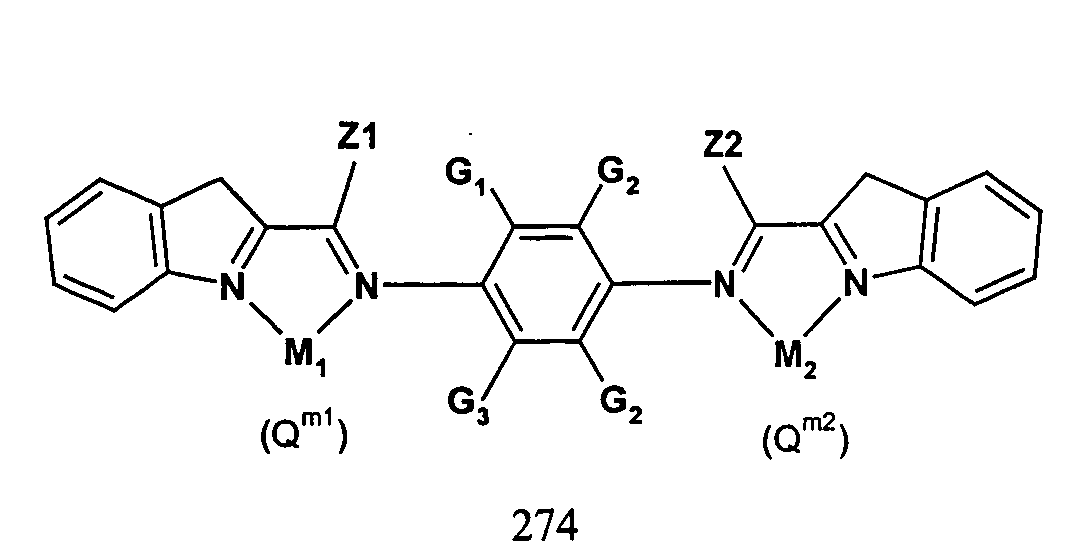
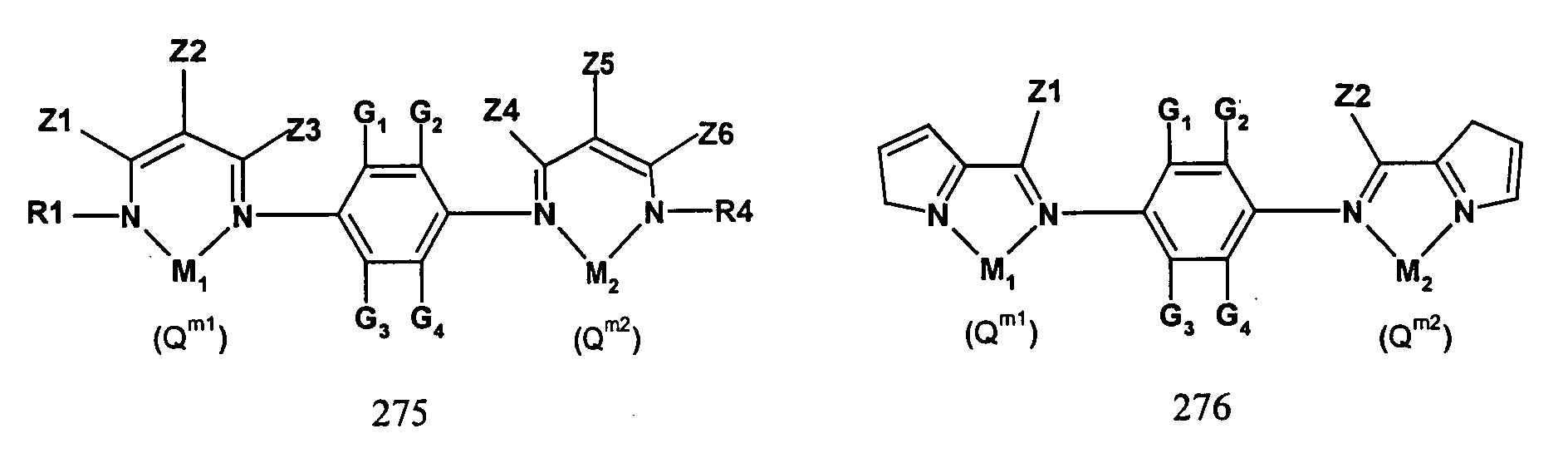
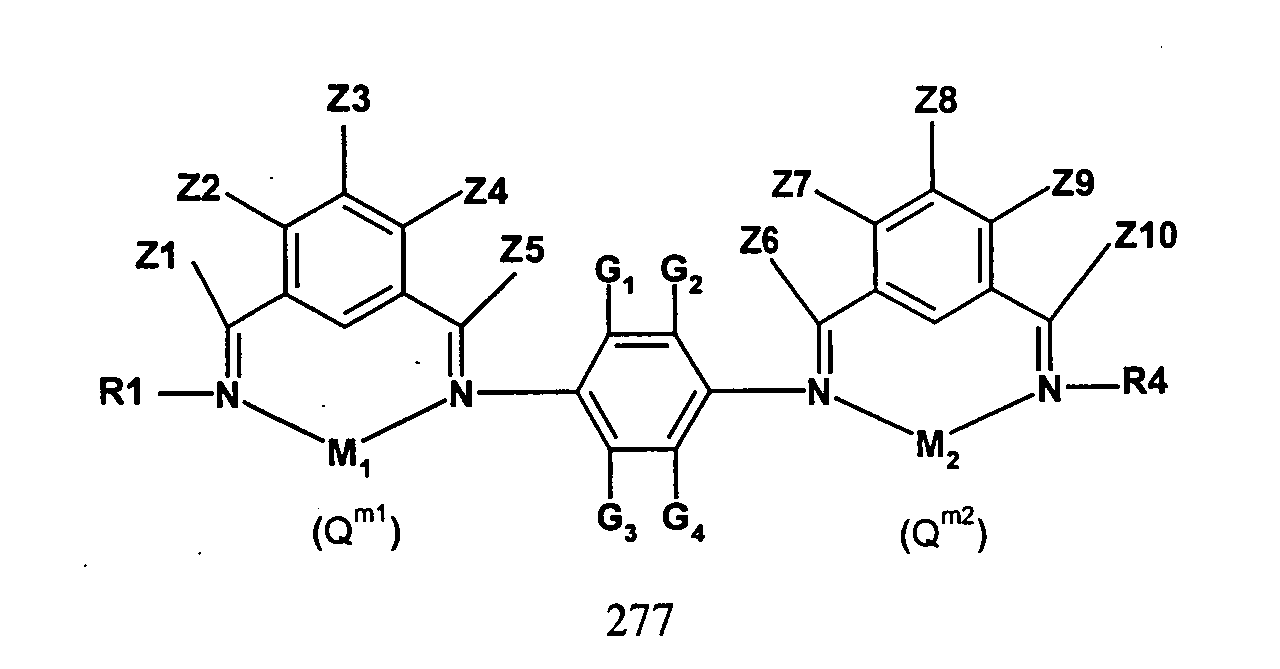
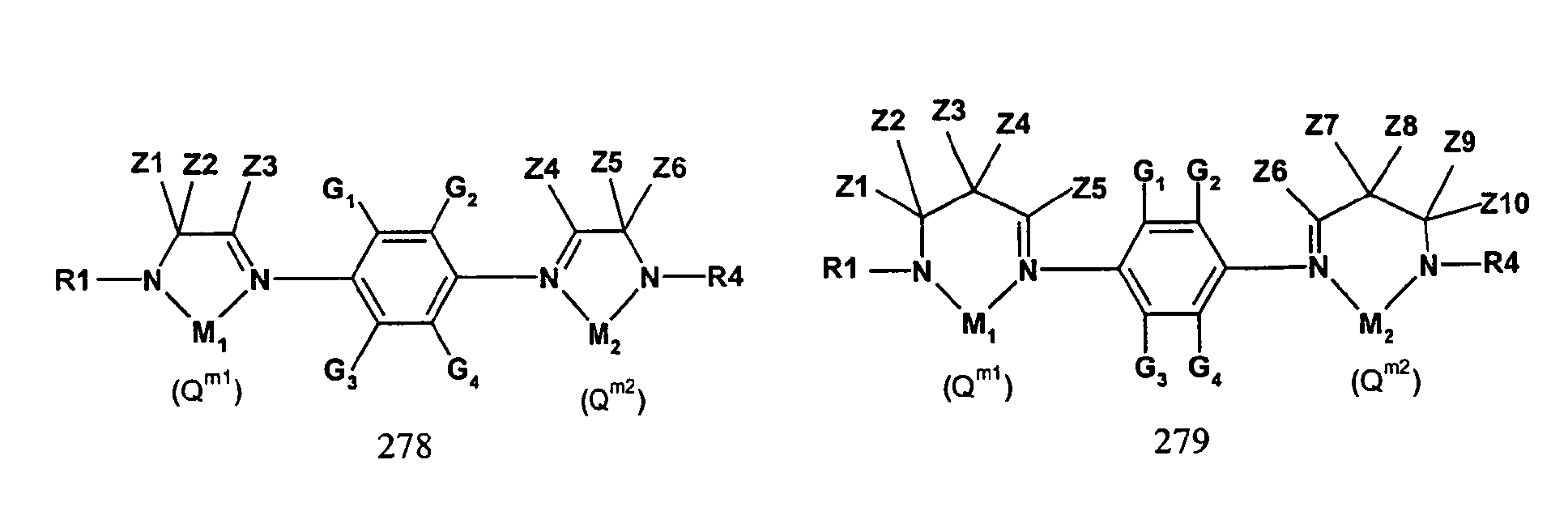
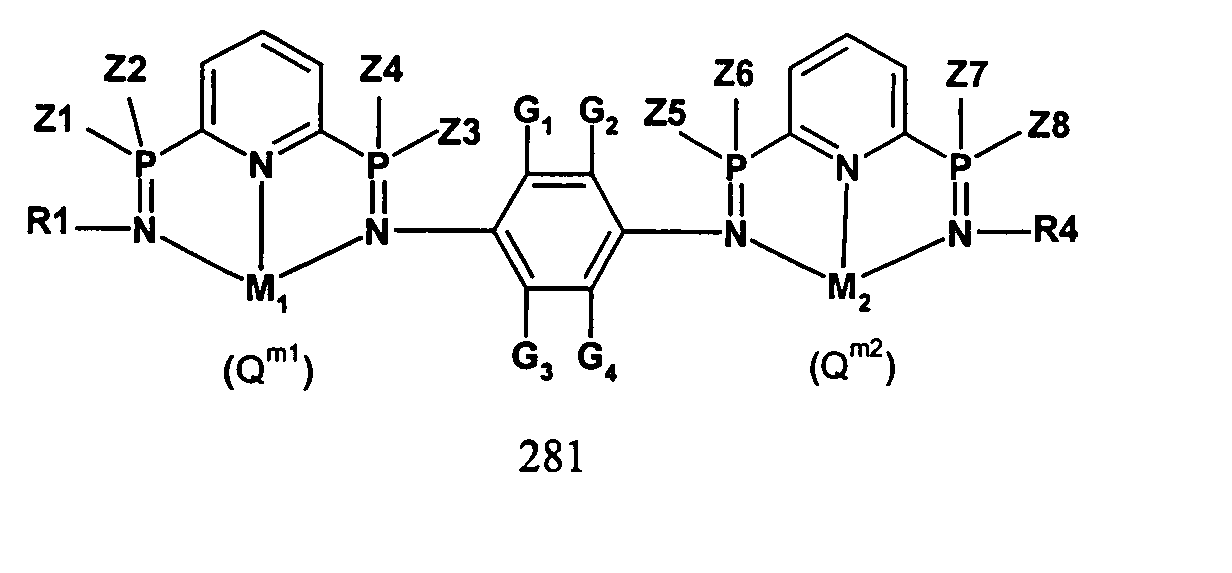
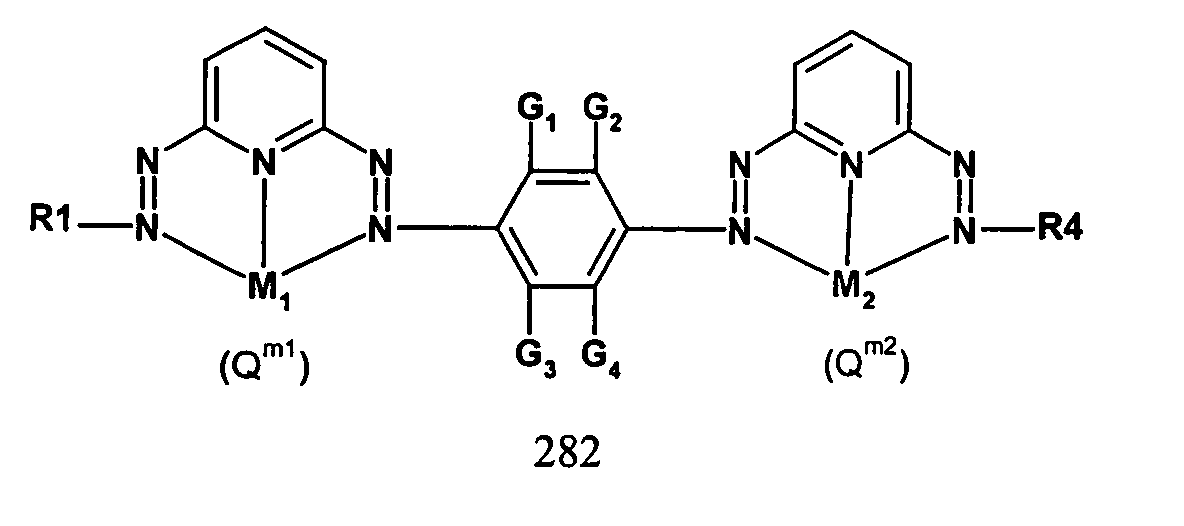
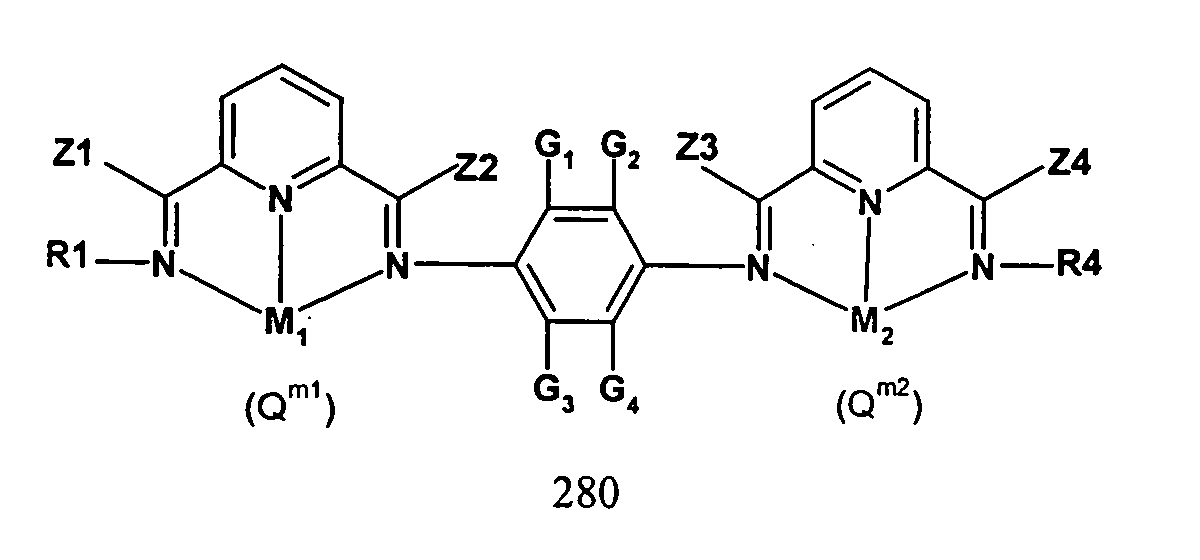
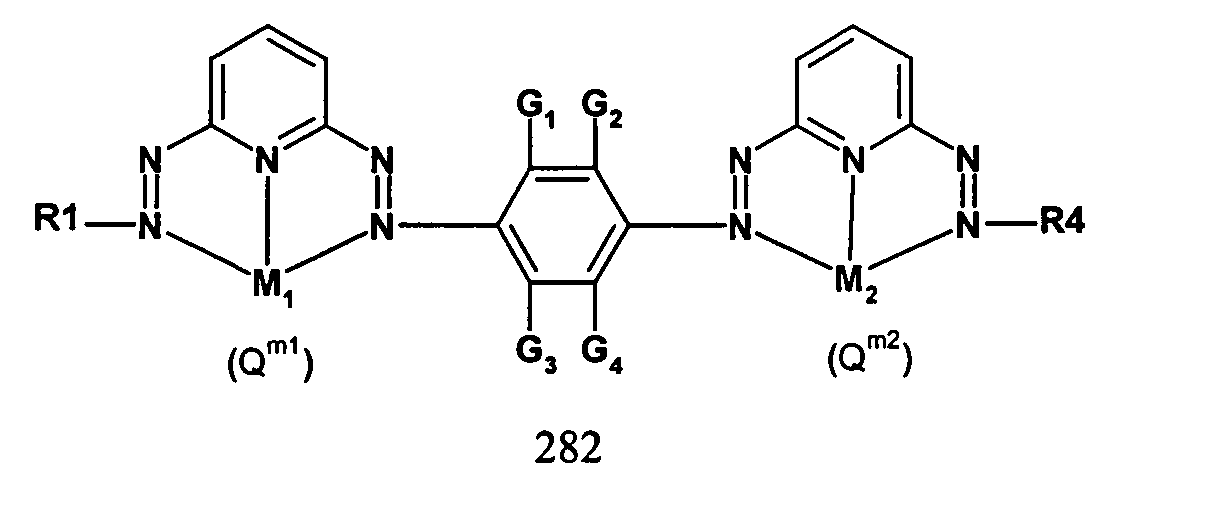
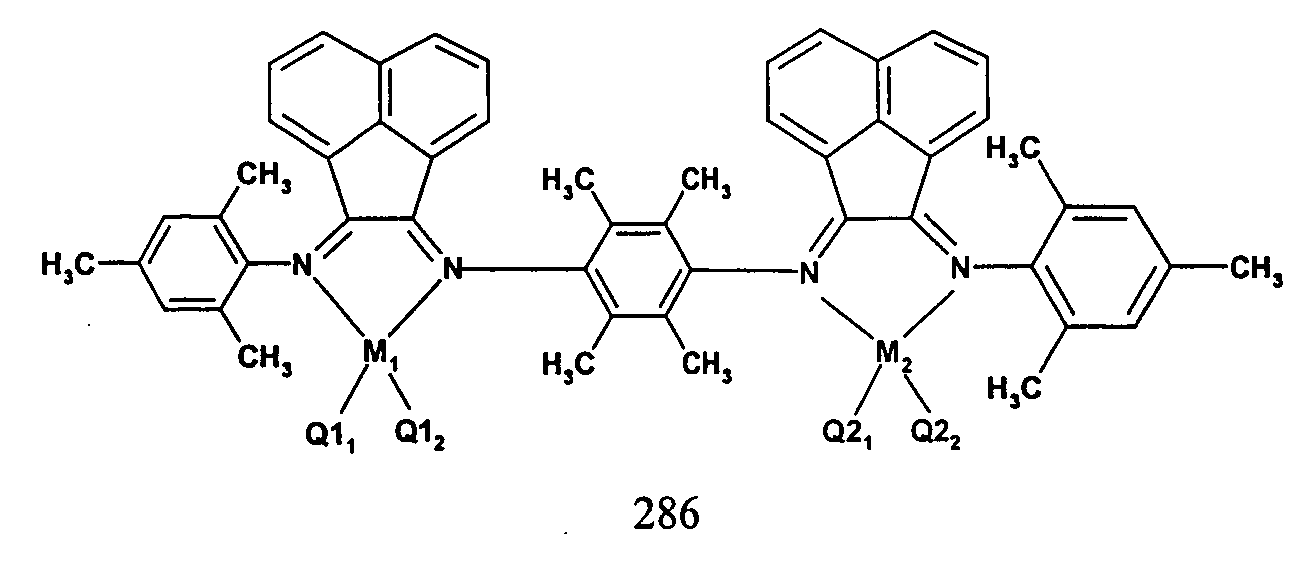
- Preferred structures with NN ligands for L1 and L2 and / or L3 and L4 are the following formulas 266 to 282
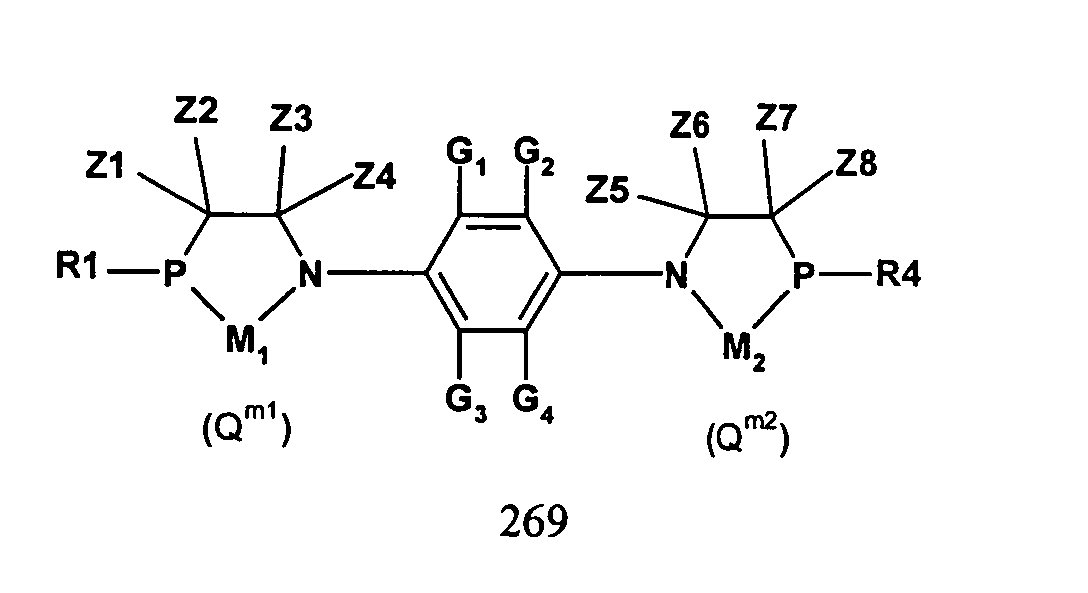
- a particularly preferred structure with a PN ligand for L1 and L2 and / or L3 and L4 is:
- the compounds according to the invention can be prepared by different processes become.
- the polymer is filtered off and dried at 80 ° C in a vacuum oven.
- An inerted glass reactor is mixed with 50ml of toluene, 50ml of 1-hexene and 26.4ml of a 10% Solution of methylaluminoxane in toluene filled.
- the polymer is filtered off and dried at 80 ° C in a vacuum oven.
- An inerted glass reactor is charged with 100 ml of 1-hexane, 8.7 g of trans-2-butene and 12.1 ml of a 10% strength Solution of methylaluminoxane in toluene filled.
- the polymer is dried at 80 ° C in a vacuum oven.
Landscapes
- Chemical & Material Sciences (AREA)
- Organic Chemistry (AREA)
- Organic Low-Molecular-Weight Compounds And Preparation Thereof (AREA)
- Transition And Organic Metals Composition Catalysts For Addition Polymerization (AREA)
- Catalysts (AREA)
Abstract
Description
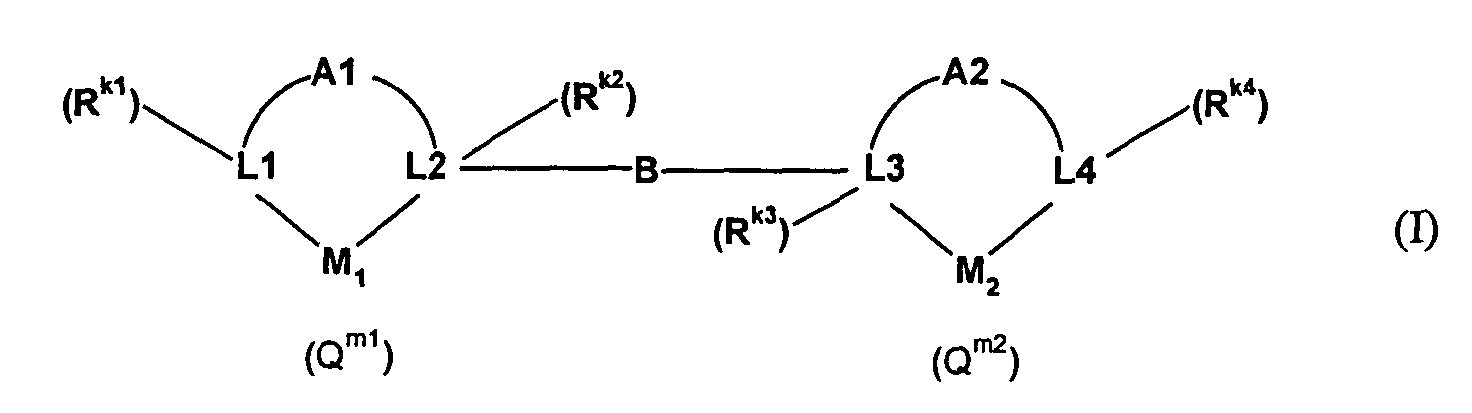
- M1 und M2
- gleich oder verschieden sein können und unabhängig voneinander ausgewählt sind aus der Gruppe bestehend aus Übergangsmetallen der 3. bis 11. Gruppe des Periodensystems, Al und B und
- L1, L2, L3, L4
- gleich oder verschieden sein können und unabhängig voneinander ausgewählt sind aus der Gruppe bestehend aus N, P, S, O, C, Si, Se, As und Sb und
- A1 und A2
- gleich oder verschieden sein können und unabhängig voneinander ausgewählt sind aus Gruppen und/oder Atomen, die die Zentren L1 mit L2 und L3 mit L4 über eine kovalente Bindung verbrücken können und optional weitere koordinierende Gruppen für M1 und M2 enthalten können und
- B
- eine Gruppe ist, die die Zentren L2 mit L3 elektronisch über kovalente Bindungen miteinander verknüpft und
- m1
- die Anzahl und den Unterschied der einzelnen Liganden Q wiedergibt und für alle Werte zwischen 1 bis 6 steht und
- m2
- die Anzahl und den Unterschied der einzelnen Liganden Q wiedergibt und für alle Werte zwischen 1 bis 6 und
- Q
- für eine Gruppe von 1 bis 6 Liganden, die an M1 gebunden sind und für eine Gruppe von 1 bis 6 Liganden, die an M2 gebunden sind, steht, wobei sowohl die Q-Liganden, die an M1 als auch die Q-Liganden, die an M2 gebunden sind gleich oder verschieden sein können und unabhängig voneinander ausgewählt werden aus der Gruppe bestehend aus monoanionischen, dianionischen und neutralen Liganden und
- k1
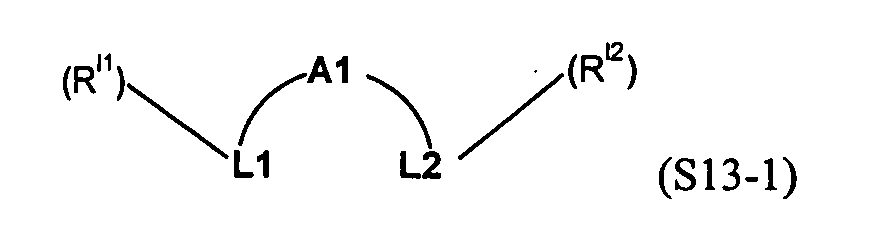
- die Anzahl und die Unterschiede der einzelnen Substituenten R, die an L1 gebunden sind, wiedergibt und für alle Werte zwischen 0 bis s1-1 steht, wobei s1 die Valenz von L1 ist und
- k2
- die Anzahl und die Unterschiede der einzelnen Substituenten R, die an L2 gebunden sind, wiedergibt und für alle Werte zwischen 0 bis s2-2 steht, wobei s2 die Valenz von L2 ist und
- k3
- die Anzahl und die Unterschiede der einzelnen Substituenten R, die an L3 gebunden sind, wiedergibt und für alle Werte zwischen 0 bis s3-2 steht, wobei s3 die Valenz von L3 ist und
- k4
- die Anzahl und die Unterschiede der einzelnen Substituenten R, die an L4 gebunden sind, wiedergibt und für alle Werte zwischen 0 bis s4-1 steht, wobei s4 die Valenz von L4 ist und
- R
- für eine Gruppe von 0 bis s1-1 Substituenten, die an L1 gebunden sind, eine Gruppe von 0 bis s2-2 Substituenten, die an L2 gebunden sind, eine Gruppe von 0 bis s3-2 Substituenten, die an L3 gebunden sind und für eine Gruppe von 0 bis s4-1 Substituenten, die an L4 gebunden sind, steht, wobei diese gleich oder verschieden sein können und unabhängig voneinander ausgewählt sind aus der Gruppe bestehend aus Hydrid, C1-20-Alkyl-, C1-20- Alkenyl-, C5-20 -Cycloalky-l, C6-20 -Aryl-, C1-20 -Heteroaryl-, Alkylarylgruppen mit C1-20 Gruppierungen im Alkylrest und C6-20 Gruppierungen im Arylrest, -OD1, -ND2D3, PD6D7D8 und -BD9D10,
Vorteilhaft sind die erfindungsgemäßen Verbindungen dann, wenn
- L1, L2, L3 und L4
- gleich oder verschieden sind und unabhängig voneinander ausgewählt sind aus der Gruppe bestehend aus N, O, P und S.

- A1 und A2
- gleich oder verschieden sind und unabhängig voneinander ausgewählt sind aus der Gruppe bestehend aus gesättigten oder ungesättigten Kohlenwasserstoffresten mit 1 bis 20 C-Atomen, cyclischen gesättigten oder ungesättigten Kohlenwasserstoffresten mit 4 bis 20 C-Atomen, heterocyclischen gesättigten oder ungesättigen Verbindungen mit 3 bis 20 C-Atomen, stickstoffhaltigen Gruppen, phosphorhaltigen Gruppen, siliziumhaltigen Gruppen, zinnhaltigen Gruppen, germaniumhaltigen Gruppen und borhaltigen Gruppen , wobei all diese Gruppen noch weitere Substituenten tragen können.


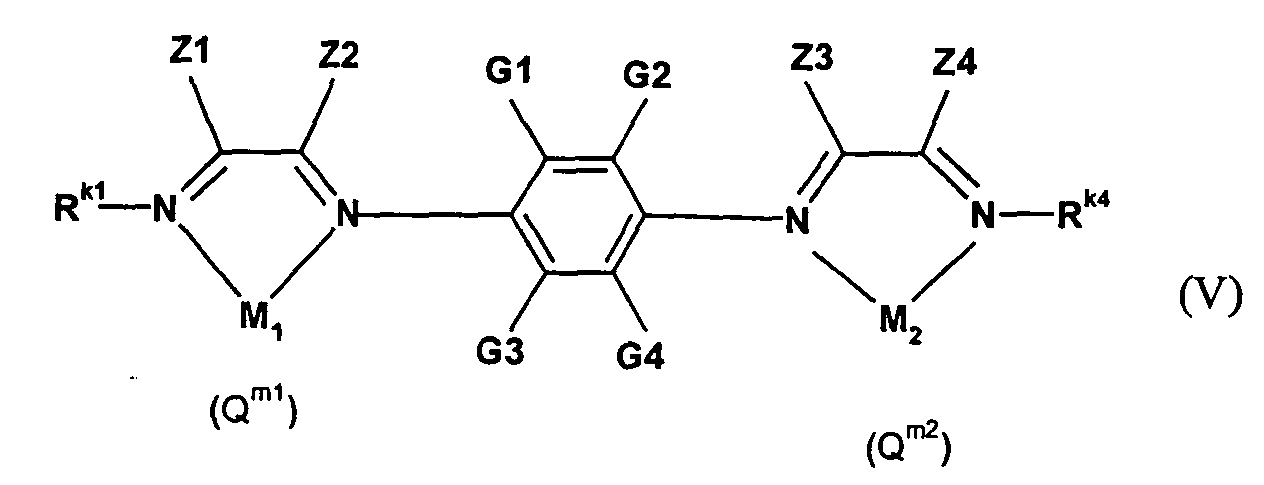
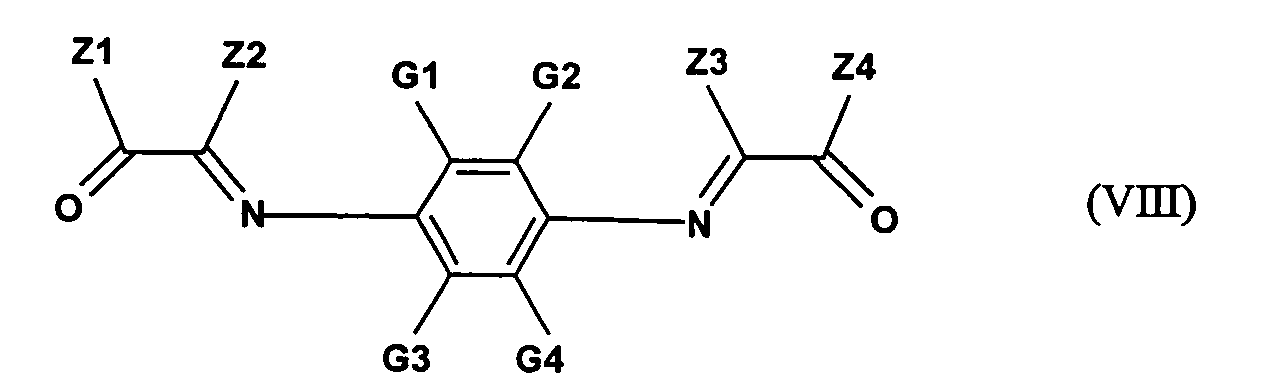
- Z1, Z2, Z3, Z4
- gleich oder verschieden sind und unabhängig voneinander ausgewählt sind aus der Gruppe bestehend aus Halogenid, Hydrid, C1-20 -Alkyl-, C1-20 -Alkenyl-, C5-20 -Cycloalkyl-, C6-20 -Alkylarylgruppen mit C1-20 Gruppierungen im Alkylrest und C6-20 Gruppierungen im Arylrest, -OT1, -OT1T2, -NT3T4, -NT5T6T7, -PT8T9 und -PT10T11T12, wobei zwei benachbarte Z-Substituenten gemeinsam einen gesättigten oder ungesättigten Ring bilden können, der weitere Substituenten tragen kann.
- Rk1 und Rk4
- für eine Gruppe von 1 bis s1-2 Substituenten steht, die an L1 gebunden sind und für eine Gruppe von 1 bis s4-2 Substituenten steht, die an L4 gebunden sind wobei diese gleich oder verschieden sind und unabhängig voneinander ausgewählt sind aus der Gruppe bestehend aus ungesättigten C6-20 Ringsystemen, die weitere Substituenten enthalten können, wobei die Substituenten gleich oder verschieden sein können und unabhängig voneinander ausgewählt sind aus der Gruppe bestehend aus Halogenid, Hydrid, C1-20 -Alkyl-, C1-20 Alkenyl-, C5-20 -Cycloalkyl-, C6-20-Alkylarylgruppen mit C1-20 Gruppierungen im Alkylrest und C6-24 Gruppierungen im Arylrest, -OT1, -OT1T2, -NT3T4, -NT5T6T7, -PT8T9 und -PT10T11T12 und zwei benachbarte Substituenten gemeinsam einen gesättigten oder ungesättigten Ring bilden können, der weitere Substituenten tragen kann.
- M1 und M2
- gleich oder verschieden sind und unabhängig voneinander ausgewählt sind aus der Gruppe bestehend aus Ti, Zr, Hf, V, Cr, Mo, W, Mn, Fe, Ru, Co, Rh, Ni, Pd, Pt, Cu, Zn, Al und B
- m1
- die Anzahl und den Unterschied der einzelnen Liganden Q wiedergibt und für alle Werte zwischen 1 bis 6 steht und
- m2
- die Anzahl und den Unterschied der einzelnen Liganden Q wiedergibt und für alle Werte zwischen 1 bis 6 steht und
- Q
- für eine Gruppe von 1 bis 6 Liganden, die an M1 gebunden sind und für eine Gruppe von 1 bis 6 Liganden, die an M2 gebunden sind, steht, wobei sowohl die Q-Liganden, die an M1 auls auch die Q-Liganden, die an M2 gebunden sind unabhängig voneinander ausgewählt werden aus der Gruppe bestehend aus Halogenid, Hydrid, C1-20 -Alkyl-, C1-20 -Alkenyl-, C5-20 -Cycloalkyl-, C6-20 -Aryl-, C1-20 -Heteroaryl-, Alkylarylgruppen mit C1-20 Gruppierungen im Alkyrest und C6-20 Gruppierungen im Arylrest, OT1, OT1T2, -NT3T4, -NT5T6T7, -PT8T9, -PT10T11T12, 1,2-Alkandiyl-Verbindungen, 1,4-Alkandiyl-Verbindungen, 1,5-Alkandiyl-Verbindungen, 1,ω-Alkandiyl-Verbindungen, Dialkoholate, Dithiolate, Diamide, Ether, Amine, Phosphine, Phosphinoxide, Olefine, Acetylene, Kohlenmonoxid, Stickstoff (N2), Wasserstoff (H2), Carbene, Stickstoff-, Kohlenstoff- und Phosphorylide.
- M1 und M2
- gleich oder verschieden sind und unabhängig voneinander ausgewählt sind aus der Gruppe bestehend aus Ti, Zr, Hf, Fe, Ru, Co, Ni, Pd und Al.


- M3 und M4
- gleich oder verschieden sein können und unabhängig von einander ausgewählt sind aus der Gruppe bestehend aus Übergangsmetallen der 3. bis 11. Gruppe des Periodensystems, Al und B.
- Unter C1-20-Alkylgrupen
- werden sämtliche dem Fachmann bekannte lineare oder verzweigte Alkylreste mit 1 bis 20 C-Atomen verstanden. Bevorzugt sind Methyl-, Ethyl-, n-Propyl-, i-Propyl-, n-Butyl-, i-Butyl-, t-Butyl-, n-Pentyl-, i-Pentyl-, neo-Pentyl-, Hexyl-, Heptyl-, Oktyl-, Nonyl-und Decylgruppen, die ihrerseits wiederum substituiert sein können. Als mögliche Substitueten der C1-20 -Alkylgreste sind alle dem Fachmann für Alkylgruppen bekannten Substituenten möglich. Bevorzugte Substituenten sind Halogen, Nitro-, Hydroxyl-, C1-20-Alkyl-, C5-20-Cycloalkyl-, C6-20-Arylgruppen. Besonders bevorzugte Substituenten der C1-20-Alkylgruppe sind Benzoyl, Trimethylphenyl, Ethylphenyl, Chlormethyl, Chlorethyl und Nitromethyl.
- Unter C1-20-Alkenylgruppen
- werden sämtliche dem Fachmann bekannte lineare oder verzweigte Alkenylreste mit 1 bis 20 C-Atomen verstanden. Bevorzugt sind Methyliden-, Ethyliden-, Propyliden- und Cyclohexenylgruppen.
- Unter C5-C20- Cycloalkylgruppen
- werden sämtliche dem Fachmann bekannte ein- oder mehrkemige substituierte und unsubstituierte Cycloalkylreste mit 5 bis 20 C-Atomen verstanden. Bevorzugt sind Cyclopentyl, Cyclohexyl, Cycloheptyl, Cyclooctyl, Cyclononyl sowie teil- oder vollhydriertes Fluorenyl, wobei alle Cycloalkyle ihrerseits wiederum substituiert sein können. Als Substituenten der C5-14 Cycloalkyle sind alle dem Fachmann für Cycloalkylgruppen bekannten Substituenten möglich. Bevorzugte Substituenten sind Halogen, Nitro-, C1-10-Alkoxy-, C1-10-Alkyl-, C6-12-Cycloalkyl-, C6-12-Arylgruppen. Besonders bevorzugte Substituenten der C5-C14- Cycloalkylgruppe sind Methylcyclohexyl, Chlorcyclohexyl und Nitrocyclohexyl.
- Unter C6-20-Arylgruppen
- werden sämtliche dem Fachmann bekannte ein- oder mehrkernige, substituierte und unsubstituierte Arylreste mit 6 bis 20 C-Atomen verstanden. Bevorzugt sind Phenyl, Naphthyl und Fluorenyl, die ihrerseits wiederum substituiert sein können. Als Substituenten der C6-20-Arylgruppen sind alle dem Fachmann für Arylgruppen bekannten Substituenten möglich. Bevorzugte Substituenten sind Halogen-, Trifluormethyl-, Nitro-, C1-C20-Alkoxy-, C1-20-Alkyl-, C5-20-Cycloalkyl-, C6-20-Arylgruppen. Besonders bevorzugte Substituenten der C6-20-Arylgruppe sind 3,5-Dimethylphenyl, 4-tert-Butylphenyl-, 4-Methoxyphenyl- , Chloro-, Bromo-, Methyl-, Ethyl-, Propyl- Isopropyl-, tert. Butyl-, Toloyl- und Nitrophenylgruppen.
- Unter C1-20-Heteroarylgruppen
- werden sämtliche dem Fachmann bekannten ein- oder mehrkernigen substituierte oder unsubstituierte heterozyklischen Aromaten mit 1 bis 20 C-Atomen verstanden. Bevorzugt sind Thiophenyl-, Pyridyl-, Furanyl-, Pyranyl-, Thiazolyl-, Pyrrolyl-, Oxazolyl-, Isoxazolyl-, Pyrazolyl-, Imidazolyl-, 1.2.3-Triazolyl-, 1.2.4-Triazolyl-, Benzofuranyl-, Thianaphthenyl-, Dibenzofuranyl-, Indolyl-, Benzimidazolyl-, Indazolyl-, Chinolyl- Isochinolylgruppen, die ihrerseites weitere Substituenten tragen können. Als Substituenten für die C1-20-Heteroarylgruppen sind alle dem Fachmann für Heteroarylgruppen bekannten Substituenten möglich. Bevorzugte Substituenten sind Wasserstoff, Halogene, Nitro-, C1-20-Alkoxy-, C1-20-Alkyl-, C1-20-Heteroaryl-, C5-20-Cycloalkyl- und C6-20-Arylgruppen. Besonders bevorzugte Substituenten der C1-20-Heteroarylgruppe sind 2,4-Dimethylfuran-3-yl-, N-Methyl-2-Phenyl-Pyrrol-4-ylgruppen.
- Unter Alkylarylgruppen mit C1-20
- Gruppierungen im Alkylrest und C6-20 Gruppierungen im Arylrest werden sämtliche dem Fachmann bekannten substituierten und unsubstituierten Alkylaryle mit 1 bis 20 C-Atomen im Alkylrest und 6-20 C-Atomen im Arylrest verstanden. Bevorzugt sind Benzyl- und alkylsubstituierte Benzylgruppen.
- Die C1-20 -Alkyl-, C5-20 -Cycloalkyl-, C6-20 -Aryl-, Alkylarylgruppen mit C1-20Gruppierungen im
- Alkylrest und C6-20 Gruppierungen im Arylrest und Arylalkylgruppen mit C1-20 Gruppierungen im Alkylrest und C6-20 Gruppierungen im Arylrest für die Reste D1 bis D10 in -OD1, -ND2D3, -PD6D7D8 und -BD9D10 besitzen die gleiche Bedeutung wie oben. Besonders bevorzugte Verbindungen sind für -OD1 Methoxy-, Ethoxy-, Propoxy-, Isopropoxy-, Butoxy-, tertiärButoxy-, Phenoxy-, 2,6-Diphenylphenoxy-, 2,6-Dimethylphenoxy-, 2,6-Dichlorphenoxy-, 2,6-Dibromphenoxy-, 2,6-Diiodphenoxygruppen, für -ND2D3 Dimethylamino-, Diethylamino-, Diisopropylamino-, Dipropylamino-, Dibutylamino-, Ditertbutylamino-, Diphenylamino-, Methylphenylamino-, Ethylphenylamino-, 2,6-Dimethylanilino-, 2,6-Diethylanilino-, 2,6-Diisopropylanilino, 2,6-Dichloranilino-, 3,5-Dimethylanilinogruppen, für -PD6D7D8 Tricyclohexylphosphino-, Triphenylphosphino-, Tritertbutylphosphino-, Triethylphosphino-, Trimethylphosphino-, Dicyclohexylphosphino-, Duphenylphosphino- und für -BD9D10 Dichloroboranyl-, Dimethylboranyl-, Diethylboranyl-, Diphenylboranyl-, Bis(2,3,4,5,6-pentaflourphenyl)boranyl-, Dihydroxyboranyl-, Dimethoxyboranyl-, Diethoxyboranyl.












wobei A1 und A2 noch weitere Koordinationsstellen für die Metallzentren M1 und M2 enthalten können, zu verstehen.







































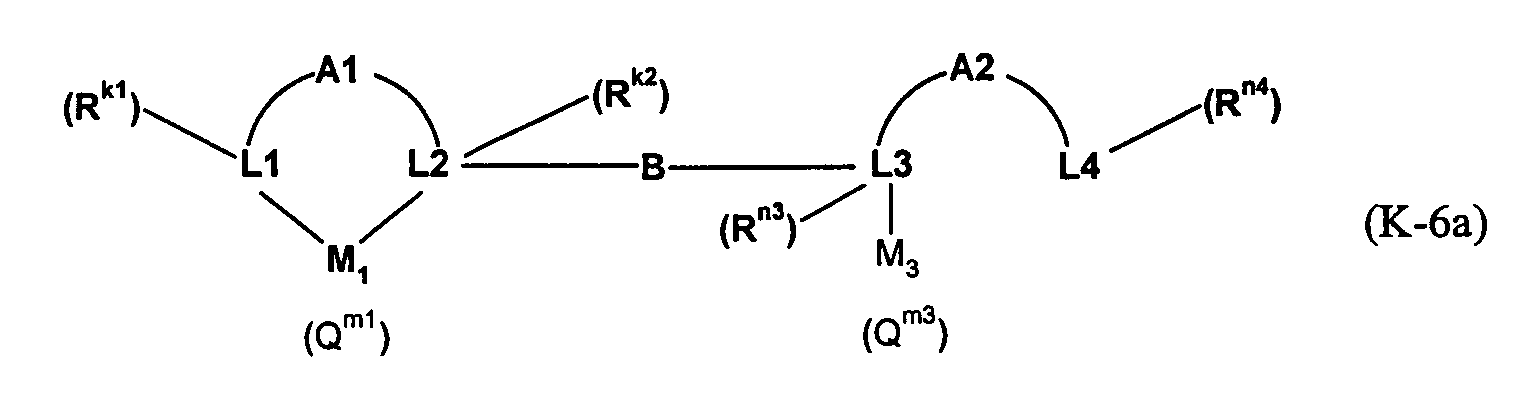






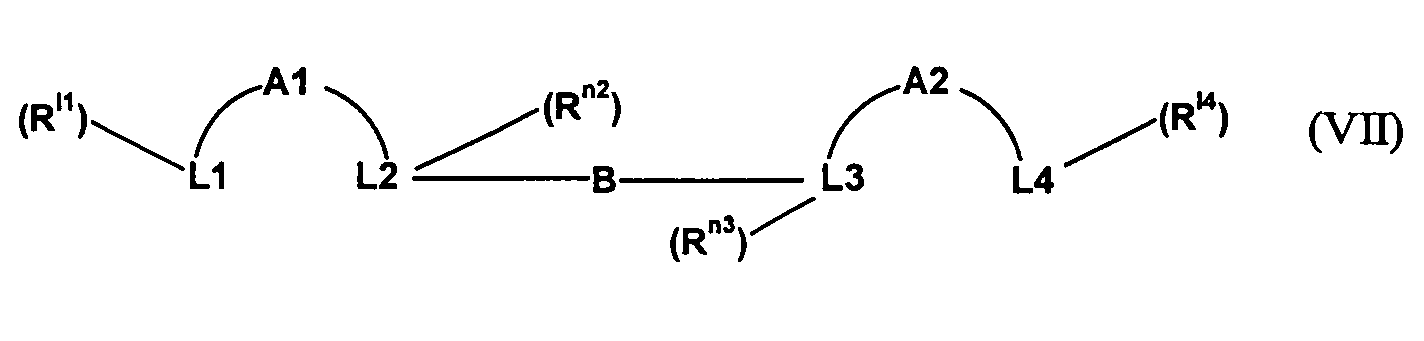
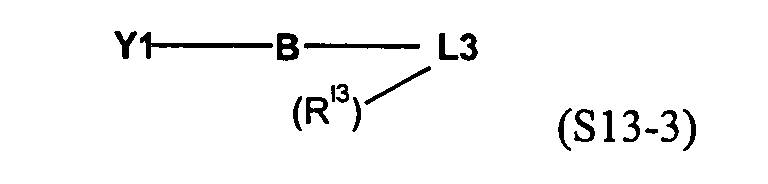
wobei o3 Werte zwischen 1 und 8 annehmen kann zu einer Verbindung der Formel (K-10a),
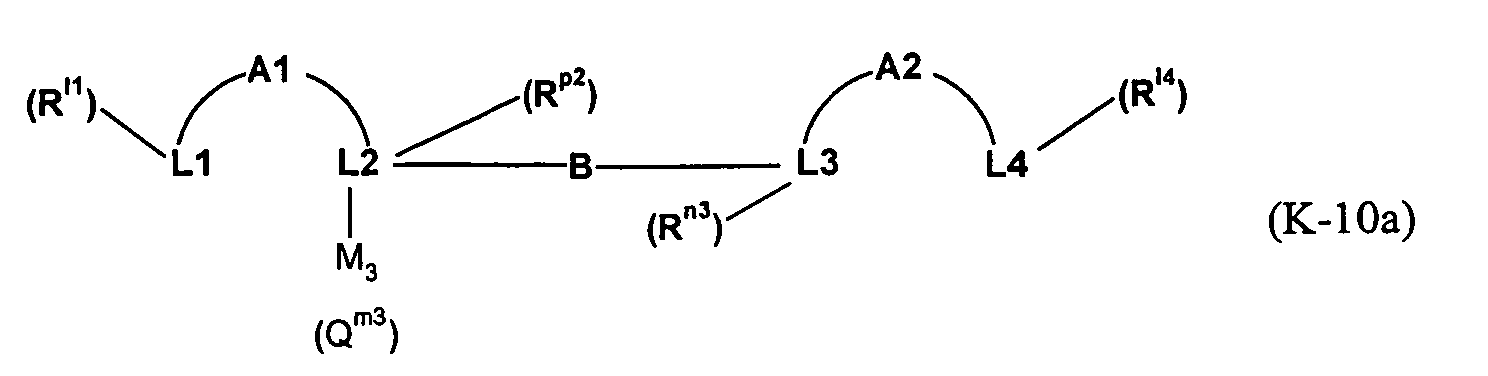
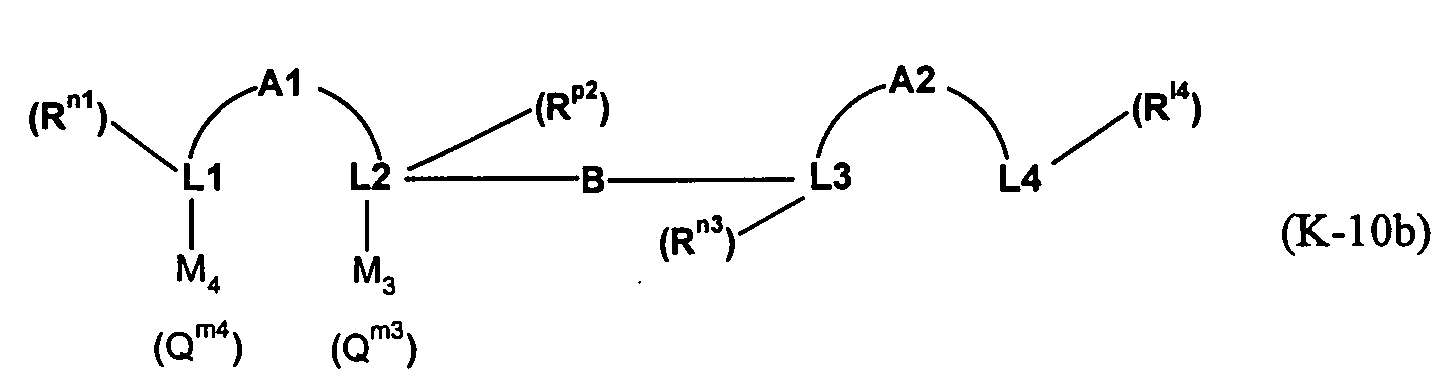

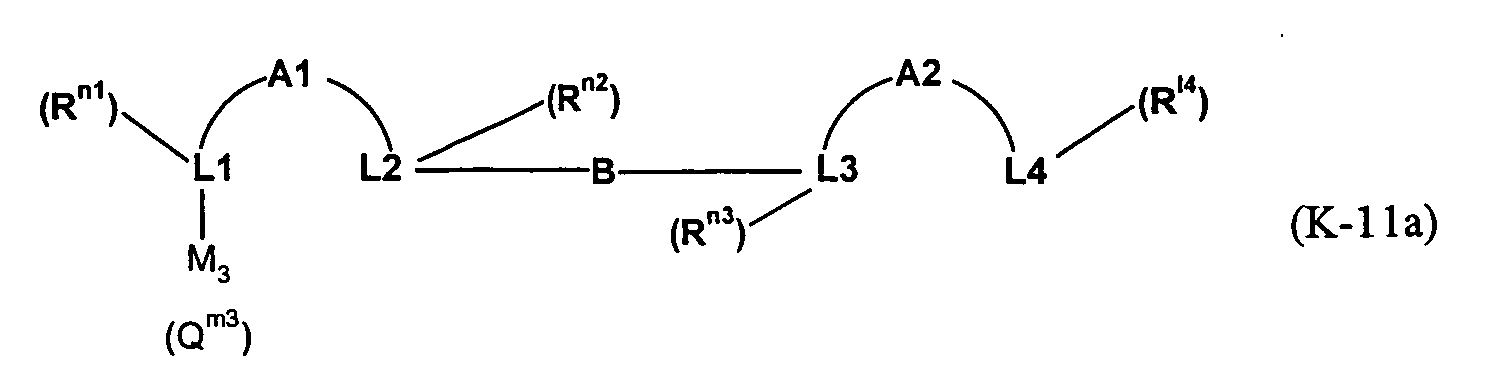


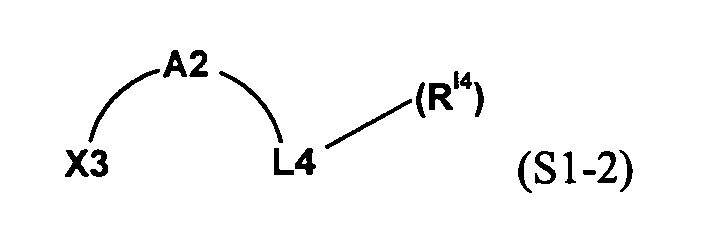


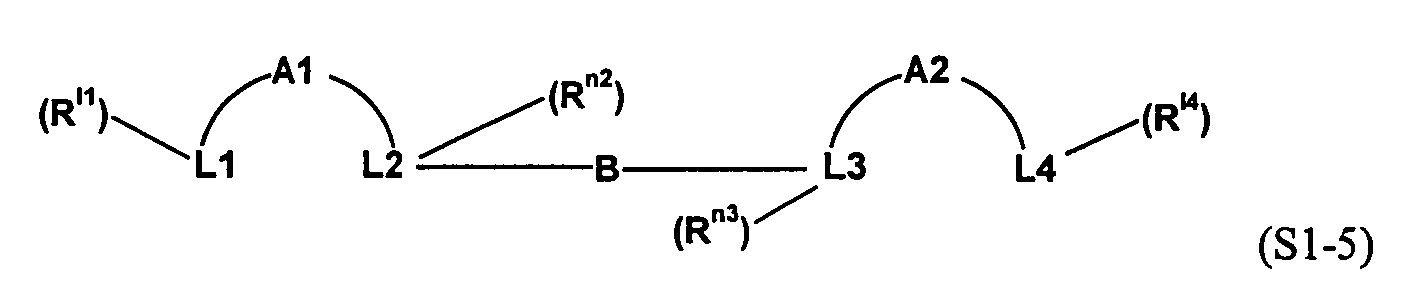


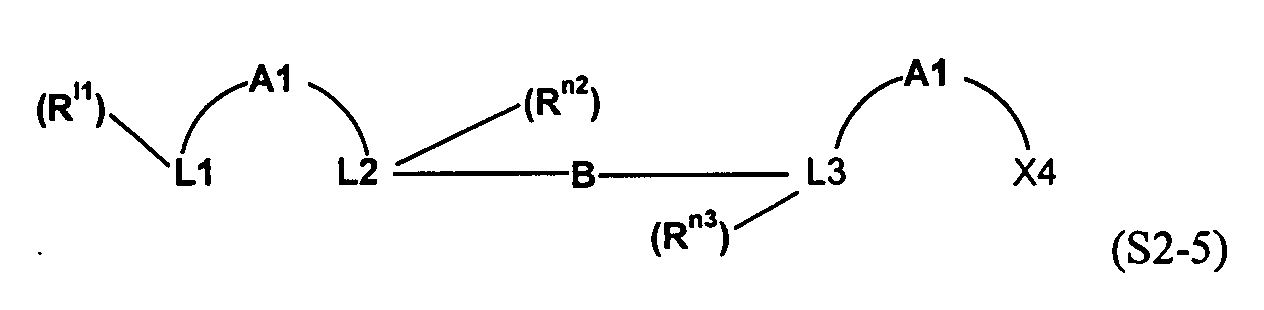


wobei δ der Valenz von L4 entspricht,

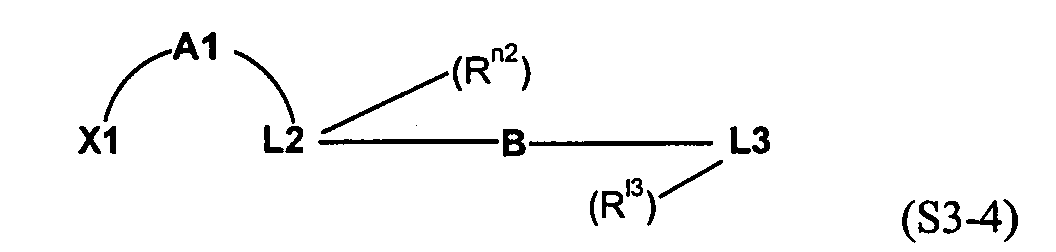


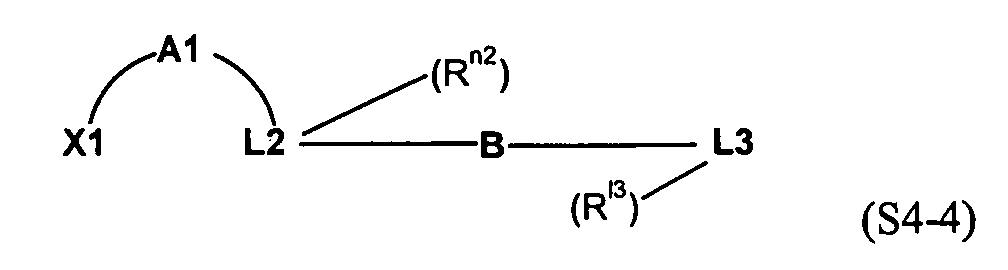

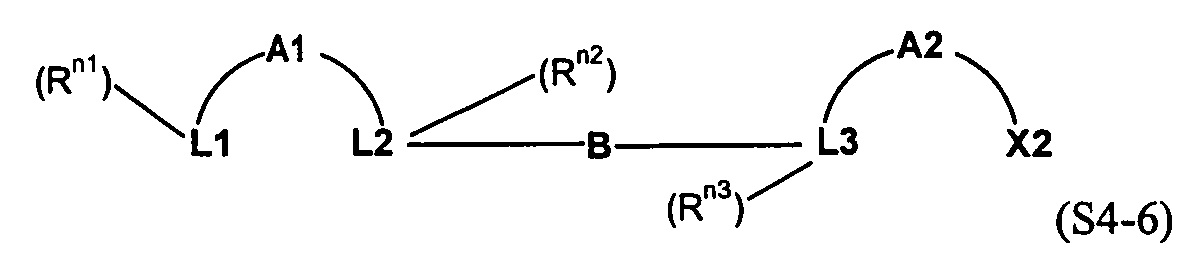


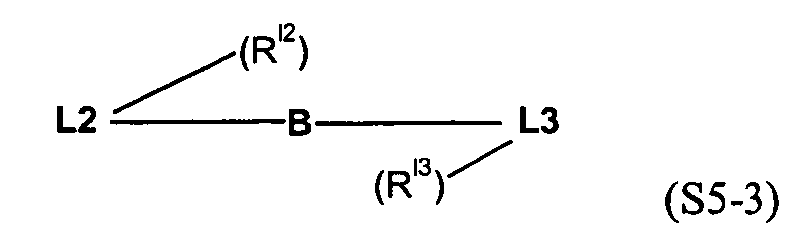
wobei γ der Valenz von L3 entspricht zu einer Verbindung der Formel (S5-4),


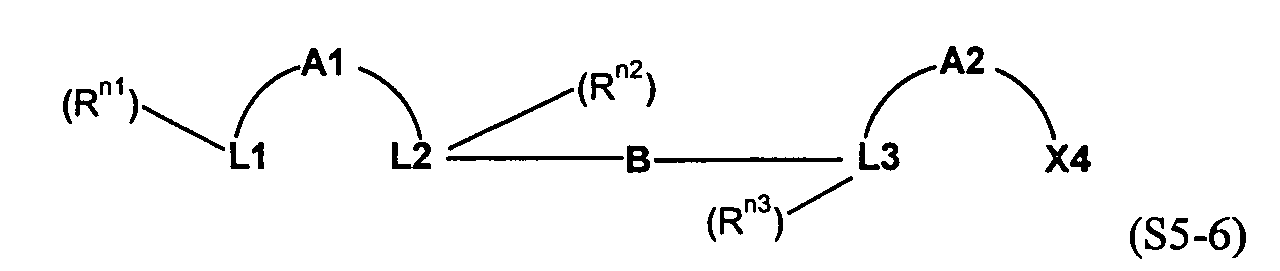

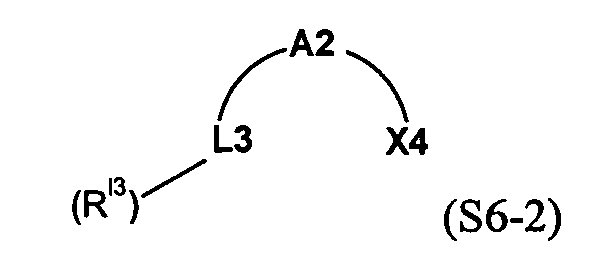

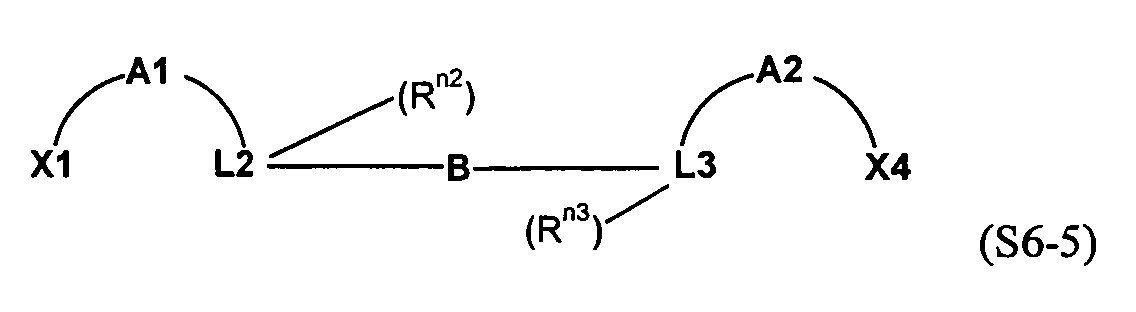
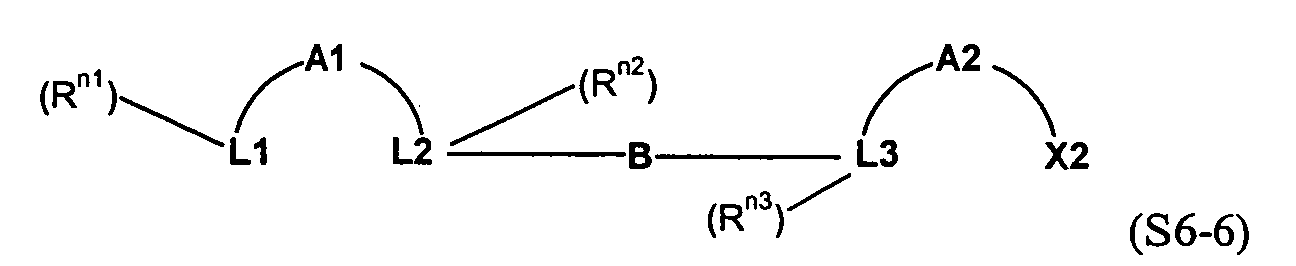

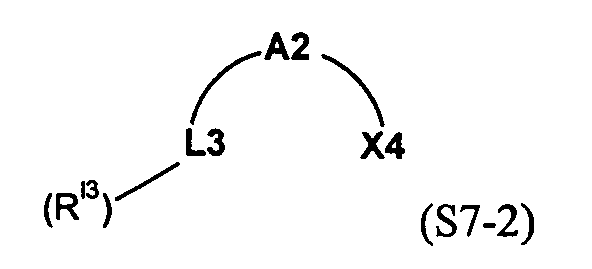
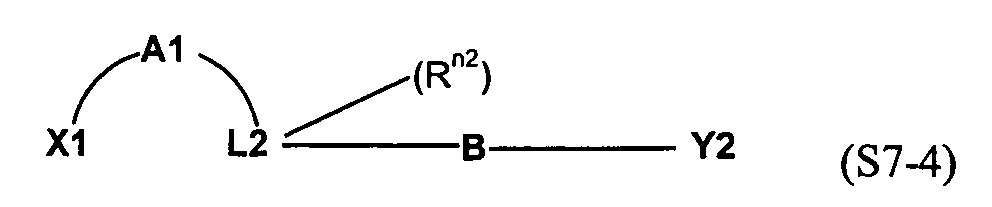




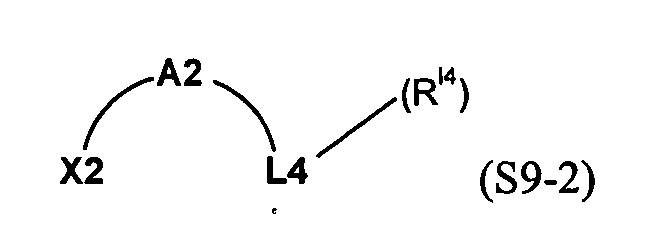
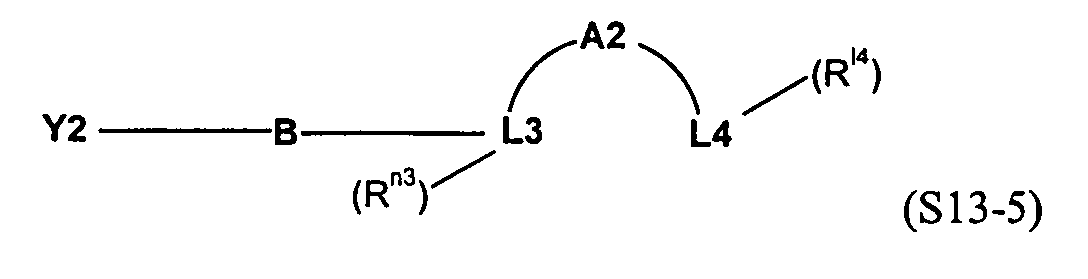
wobei δ der Valenz von L4 entspricht,
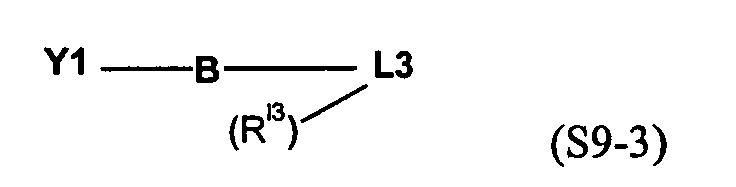

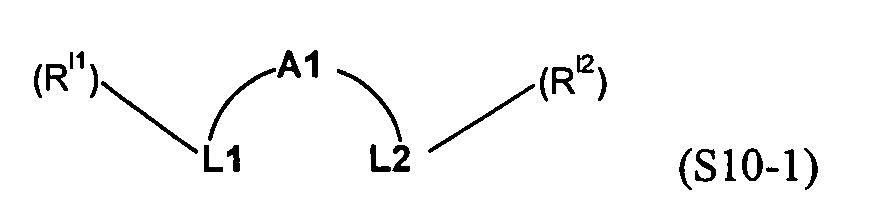

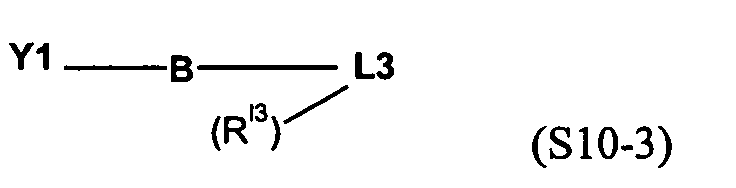
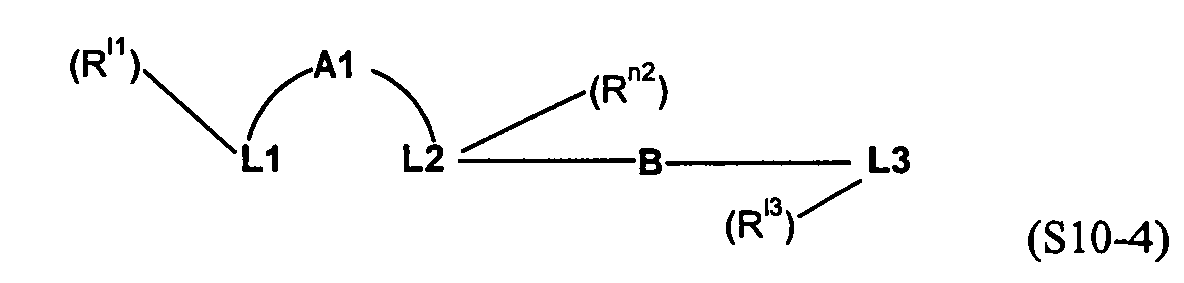


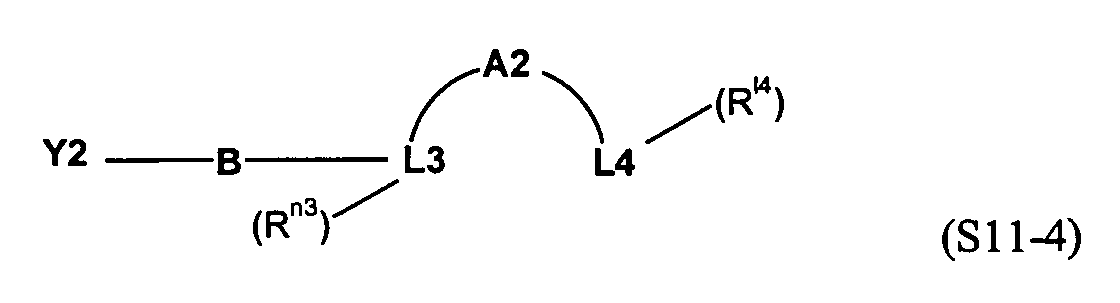
wobei δ der Valenz von L4 entspricht,




- M3
- ein Übergangsmetall, Bor, Aluminium, Silicium, Germanium, ein Alkali-oder Erdalkalimetall darstellt und
- Q
- ausgewählt werden aus der Gruppe bestehend aus monoanionischen, dianionischen und neutralen Liganden und
- o3
- in Abhängigkeit von der Ladung von M3 die Werte 0, 1, 2, 3, 4, 5, 6, 7 und 8 annehmen kann
- M3
- ein Übergangsmetall, Bor, Aluminium, Silicium, Germanium, ein Alkali-oder Erdalkalimetall darstellt und
- Q
- ausgewählt werden aus der Gruppe bestehend aus monoanionischen, dianionischen und neutralen Liganden und
- o3
- in Abhängigkeit von der Ladung von M1 die Werte 0, 1, 2, 3, 4, 5, 6, 7 und 8 annehmen kann
- M4
- ein Übergangsmetall, Bor, Aluminium, Silicium, Germanium, ein Alkali-oder Erdalkalimetall darstellt und
- Q
- ausgewählt werden aus der Gruppe bestehend aus monoanionischen, dianionischen und neutralen Liganden und
- o4
- in Abhängigkeit von der Ladung von M1 die Werte 0, 1, 2, 3, 4, 5, 6, 7 und 8 annehmen kann
- M3
- ein Übergangsmetall, Bor, Aluminium, Silicium, Germanium, ein Alkali-oder Erdalkalimetall darstellt und
- Q
- ausgewählt werden aus der Gruppe bestehend aus monoanionischen, dianionischen und neutralen Liganden und
- o3
- in Abhängigkeit von der Ladung von M1 die Werte 0, 1, 2, 3, 4, 5, 6, 7 und 8 annehmen kann


Ausbeute: 11,95g (40%)

Ausbeute: 6,8g (73%)
Ni-Gehalt: 10,1% (ber.: 10.1%)
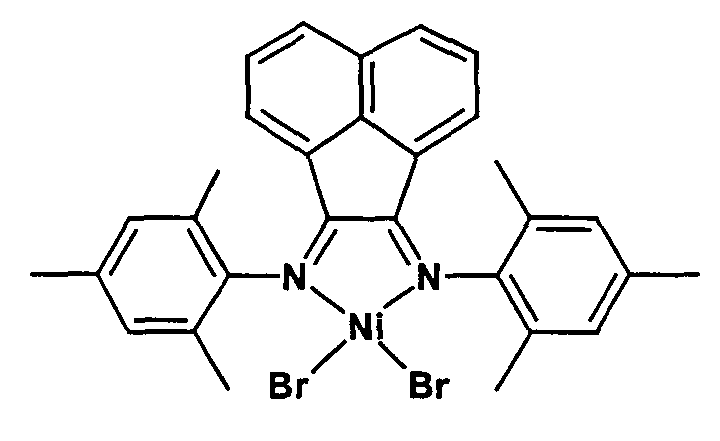
3,66g Acenaphtochinon und 4,37g Nickeldibromid werden in 75ml Eisessig vorgelegt und unter Stickstoffatmosphäre mit 5,41g 2.4.6-Trimethylanilin versetzt. Es wird 7,5 Stunden unter Rückfluss gekocht und dann abgekühlt. Das ausgefallene Produkt wird zweimal mit je 30 ml Eisessig und viermal mit 25ml Diethylether gewaschen und anschließend bis zur Gewichtskonstanz im Ölpumpenvakuum getrocknet.
Ausbeute: 10.4g (78%)
Ni-Gehalt: 9.0% (ber.:9.1%)
Claims (21)
- Verbindungen der Formel (I),worin
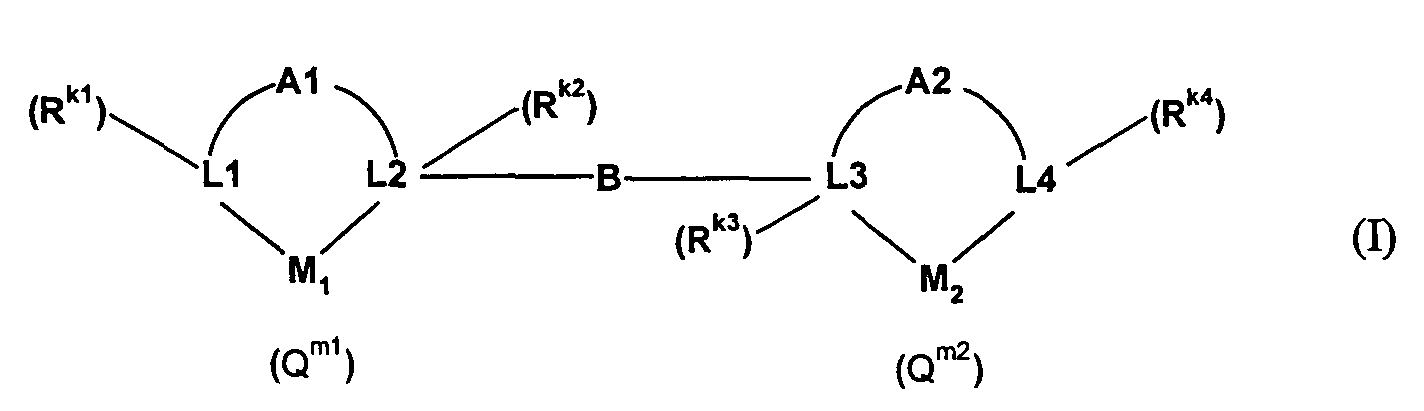
- M1 und M2
- gleich oder verschieden sein können und unabhängig voneinander ausgewählt sind aus der Gruppe bestehend aus Übergangsmetallen der 3. bis 11. Gruppe des Periodensystems, Al und B und
- L1, L2, L3, L4
- gleich oder verschieden sein können und unabhängig voneinander ausgewählt sind aus der Gruppe bestehend aus N, P, S, O, C, Si, Se, As und Sb und
- A1 und A2
- gleich oder verschieden sein können und unabhängig voneinander ausgewählt sind aus Gruppen und/oder Atomen, die die Zentren L1 mit L2 und L3 mit L4 über eine kovalente Bindung verbrücken können und optional weitere koordinierende Gruppen für M1 und M2 enthalten können und
- B
- eine Gruppe ist, die die Zentren L2 mit L3 elektronisch über kovalente Bindungen miteinander verknüpft und
- m1
- die Anzahl und die Unterschiede der einzelnen Liganden Q wiedergibt und für alle Werte zwischen 1 bis 6 steht, und
- m2
- die Anzahl und die Unterschiede der einzelnen Liganden Q wiedergibt und für alle Werte zwischen 1 bis 6 steht, und
- Q
- für eine Gruppe von 1 bis 6 Liganden steht, die an M1 gebunden sind und für eine Gruppe von 1 bis 6 Liganden steht, die an M2 gebunden sind, wobei sowohl die Q-Liganden, die an M1 als auch die Q-Liganden die an M2 gebunden sind, gleich oder verschieden sein können und unabhängig voneinander ausgewählt werden aus der Gruppe bestehend aus monoanionischen, dianionischen und neutralen Liganden und
- k1
- die Anzahl und die Unterschiede der einzelnen Substituenten R, die an L1 gebunden sind, wiedergibt und für alle Werte zwischen 0 bis s1-1 steht, wobei s1 die Valenz von L1 ist und
- k2
- die Anzahl und die Unterschiede der einzelnen Substituenten R, die an L2 gebunden sind, wiedergibt und für alle Werte zwischen 0 bis s2-2 steht, wobei s2 die Valenz von L2 ist und
- k3
- die Anzahl und die Unterschiede der einzelnen Substituenten R, die an L3 gebunden sind, wiedergibt und für alle Werte zwischen 0 bis s3-2 steht, wobei s3 die Valenz von L3 ist und
- k4
- die Anzahl und die Unterschiede der einzelnen Substituenten R, die an L4 gebunden sind, wiedergibt und für alle Werte zwischen 0 bis s4-1 steht, wobei s4 die Valenz von L4 ist und
- R
- für eine Gruppe von 0 bis s1-1 Substituenten, die an L1 gebunden sind, eine Gruppe von 0 bis s2-2 Substituenten, die an L2 gebunden sind, eine Gruppe von 0 bis s3-2 Substituenten, die an L3 gebunden sind und für eine Gruppe von 0 bis s4-1 Substituenten, die an L4 gebunden sind, steht, wobei diese gleich oder verschieden sein können und unabhängig voneinander ausgewählt sind aus der Gruppe bestehend aus Hydrid, C1-20-Alkyl-, C1-20-Alkenyl-, C5-20-Cycloalkyl, C6-20-Aryl-, C1-20-Heteroaryl-, Alkylaryl-gruppen mit C1-20-Gruppierungen im Alkylrest und C6-20-Gruppierungen im Arylrest, -OD1, -ND2D3, PD6D7D8 und -BD9D10,
- Verbindungen nach Anspruch 1, wobei
L1, L2, L3 und L4 gleich oder verschieden sind und unabhängig voneinander ausgewählt sind aus der Gruppe bestehend aus N, O, P und S. - Verbindungen der Formel (II) nach einem der Ansprüche 1 bis 2,wobei L2 und L3 Stickstoffzentren sind.

- Verbindungen nach einem der Ansprüche 1 bis 3, wobei
- A1 und A2
- gleich oder verschieden sind und unabhängig voneinander ausgewählt sind aus der Gruppe bestehend aus gesättigten oder ungesättigten Kohlenwasserstoffresten mit 1 bis 20 C-Atomen, cyclischen gesättigten oder ungesättigten Kohlenwasserstoffresten mit 4 bis 20 C-Atomen, heterocyclischen gesättigten oder ungesättigen Verbindungen mit 3 bis 20 C-Atomen, stickstoffhaltigen Gruppen, phosphorhaltigen Gruppen, siliziumhaltigen Gruppen, zinnhaltigen Gruppen, germaniumhaltigen Gruppen und borhaltigen Gruppen , wobei all diese Gruppen noch weitere Substituenten tragen können.
- Verbindungen gemäß einem der Ansprüche 1 bis 4 bei denen B eine aromatische oder heteroaromatische Gruppe ist, die weitere Substituenten tragen kann.
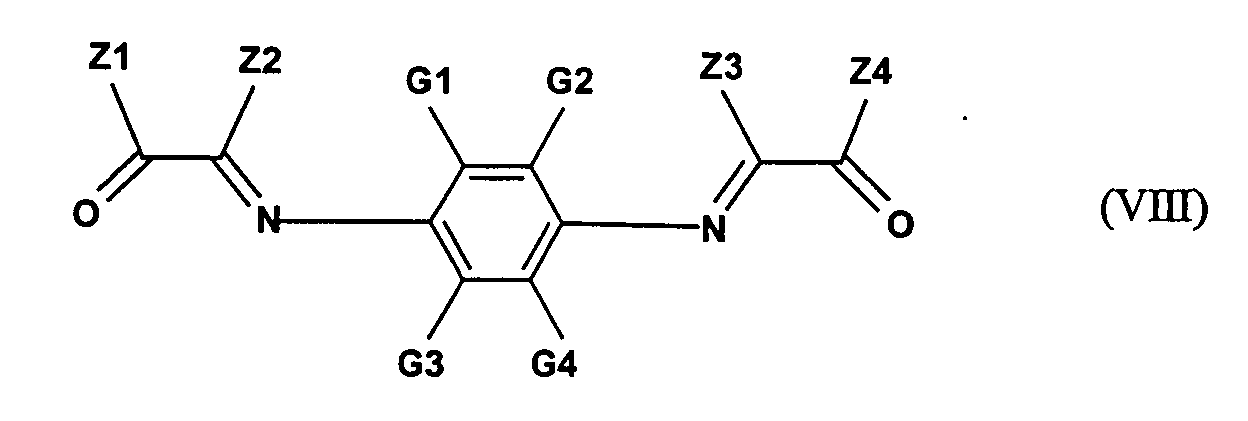
- Verbindungen der Formel (IV) nach einem der Ansprüche 1 bis 5,wobei L2 und L3 Stickstoffzentren sind, die zu A1 und A2 über eine Doppelbindung verknüpft sind und wobei B ein para-substituierter aromatischer Sechsring ist, der mit Substituenten
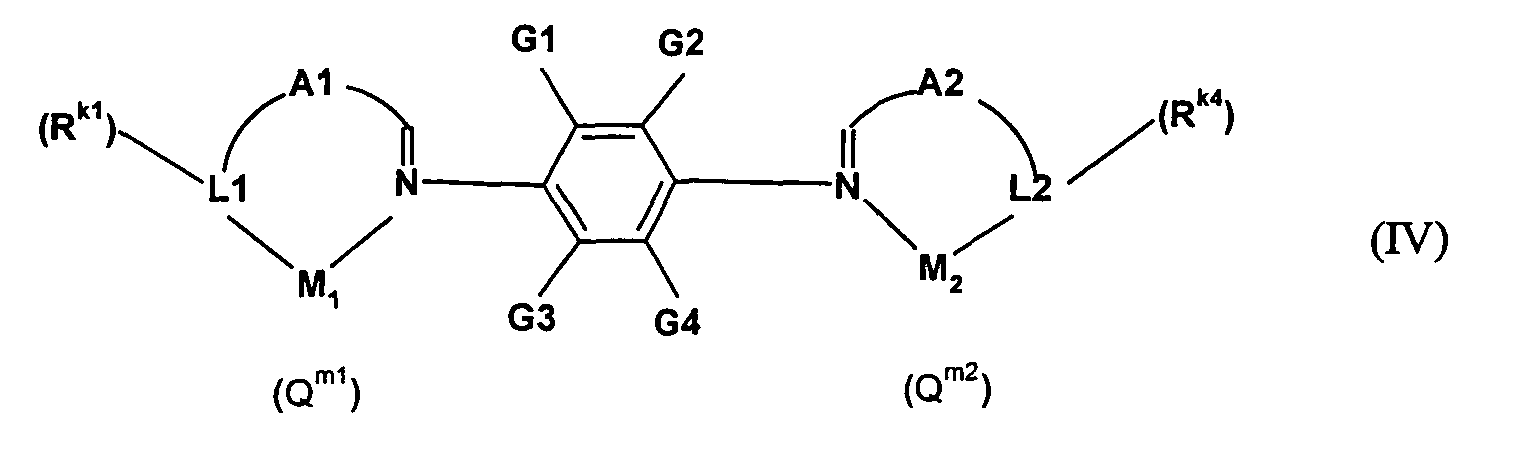
- G1, G2, G3, G4
- die gleich oder verschieden sind und ausgewählt sind aus der Gruppe bestehend aus Halogenid, Hydrid, C1-20-Alkyl-, C1-20-Alkenyl-, C5-20-Cycloalkyl-, C6-20-Aryl-, Alkylarylgruppen mit C1-20-Gruppierungen im Alkylrest und C6-2 Gruppierungen im Arylrest, -OT1, -OT1T2, -NT3T4, -NT5T6T7, -PT8T9, -PT10T11T12, wobei T'bis T12 gleich oder verschieden sind und unabhängig voneinander ausgewählt sind aus der Gruppe bestehend aus H, C1-20-Alkyl-, C5-20-Cycloalkyl-, C6-20-Aryl-, C1-20-Heteroaryl-, Alkylarylgruppen mit C1-20Gruppierungen im Alkylrest und C6-20-Gruppierungen im Arylrest und Arylalkylgruppen mit C1-20-Gruppierungen im Alkylrest und C6-20-Gruppierungen im Arylrest
- Verbindungen nach einem der Ansprüche 1 bis 6, wobei
L1 gleich L4 ist und das unsubstituierte Grundgerüst von A1 gleich dem unsubstituierten Grundgerüst von A2 ist. - Verbindungen nach einem der Ansprüche 1 bis 7, wobei
- Rk1 und Rk4
- für eine Gruppe von 1 bis s1-2 Substituenten steht, die an L1 gebunden sind und für eine Gruppe von 1 bis s4-2 Substituenten, die an L4 gebunden sind, wobei diese gleich oder verschieden sind und unabhängig voneinander ausgewählt sind aus der Gruppe bestehend aus ungesättigten C6-20 Ringsystemen, die weitere Substituenten enthalten können, die gleich oder verschieden sein können und unabhängig voneinander ausgewählt sind aus der Gruppe bestehend aus Halogenid, Hydrid, C1-20-Alkyl-, C1-20-Alkenyl-, C5-20-Cycloalkyl-, C6-20-Alkylarylgruppen mit C1-20-Gruppierungen im Alkylrest und C6-24-Gruppierungen im Arylrest, -OT1, -OT1T2, -NT3T4, -NT5T6T7, -PT8T9 und -PT10T11T12 und zwei benachbarte Substituenten gemeinsam einen gesättigten oder ungesättigten Ring bilden können, der weitere Substituenten tragen kann.
- Verbindungen nach einem der Ansprüche 1 bis 8, wobei die Substituenten R der Gruppen Rk1 und Rk4 jeweils ausgewählt sind aus der Gruppe von substituierten Aryl- und/oder Heteroarylgruppen.
- Verbindungen nach einem der Ansprüche 1 bis 9, wobei
- M1 und M2
- gleich oder verschieden sind und unabhängig voneinander ausgewählt sind aus der Gruppe bestehend aus Ti, Zr, Hf, V, Cr, Mo, W, Mn, Fe, Ru, Co, Rh, Ni, Pd, Pt, Cu, Zn, Al und B
- Q
- für eine Gruppe steht von 1 bis r1-2 Liganden die an M1 gebunden sind und für eine Gruppe von 1 bis r2-2 Liganden, die an M2 gebunden sind, wobei sowohl die Q-Liganden, die an M1 als auch die Q-Liganden die an M2 gebunden sind gleich oder verschieden sind und unabhängig voneinander ausgewählt aus der Gruppe bestehend aus Halogenid, Hydrid, C1-10-Alkyl-, C1-20-Alkenyl-, C5-20-Cycloalkyl-, C6-20-Aryl-, C1-20-Heteroaryl-, Alkylarylgruppen mit C1-20-Gruppierungen im Alkyrest und C6-14 -Gruppierungen im Arylrest, OT1, OT1T2, -NT3T4, -NT5T6T7, -PT8T9, -PT10T11T12, 1,2-Alkandiyl-Verbindungen, 1,4-Alkaniyl-Verbindungen, 1,5-Alkandiyl-Verbindungen, 1,ω-Alkandiyl-Verbindungen, Dialkoholate, Dithiolate, Diamide, Ether, Amine, Phosphine, Phosphinoxide, Olefine, Acetylene, Kohlenmonoxid, Stickstoff, Wasserstoff, Carbene, Stickstoff-,
- Verbindungen nach einem der Ansprüche 1 bis 10, wobei
- M1 und M2
- gleich oder verschieden sind und unabhängig voneinander ausgewählt aus der Gruppe bestehend aus Ti, Zr, Hf, Fe, Ru, Co, Ni und Pd.
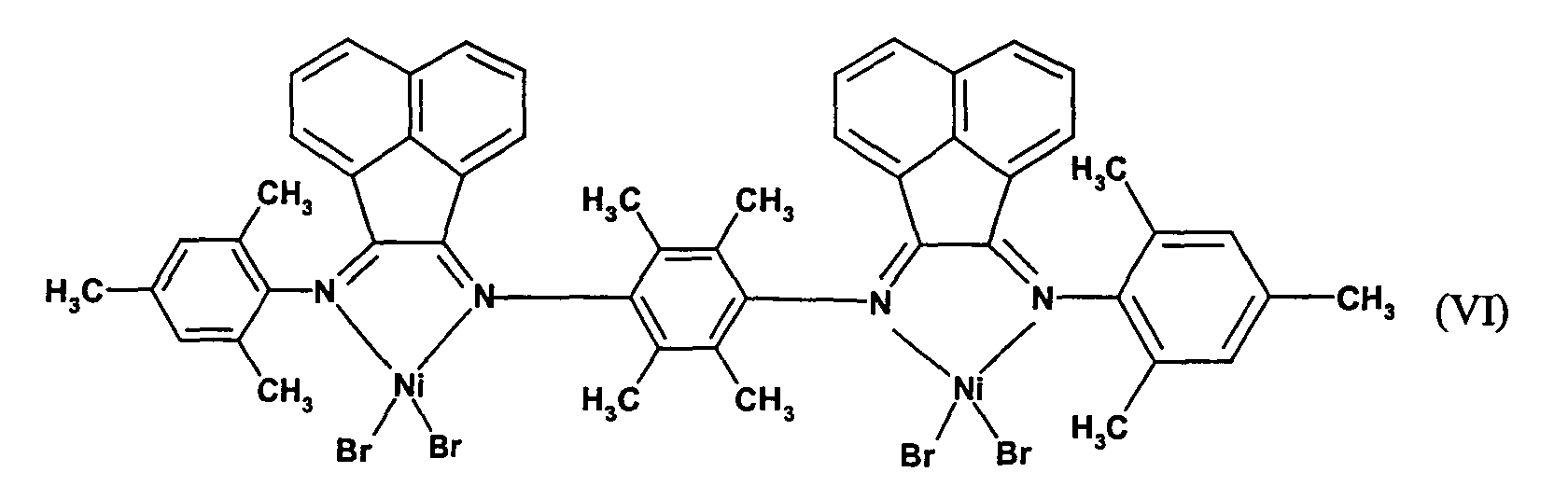
- Die Verbindung gemäß Formel (VI)
- Verfahren zur Herstellung der Verbindungen nach einem der Ansprüche 1 bis 12, umfassend die Schritte
Herstellung einer Verbindung der Formel (VII)anschließende Umsetzung der Verbindung der Formel (VII) entweder wobei o3 und o4 die Anzahl und die Unterschiede der einzelnen Liganden Q wiedergeben und für alle Werte zwischen 1 bis 8 für die Q-Liganden, die an M3 gebunden sind, stehen und für alle Werte zwischen 1 bis 8 für die Q-Liganden, die an M4 gebunden sind, stehen und wobeiI) mit einer metallischen Verbindung der Formel M1(Qm1) und weitere Umsetzung mit einer metallischen Verbindung der Formel M2(Qm2) oderII) mit einer metallischen Verbindung der Formel M3(Qo3), dann Umsetzung mit einer metallischen Verbindung der Formel M1(Qm1) und weitere Umsetzung mit einer metallischen Verbindung der Formel M2(Qm2) oderIII) mit einer metallischen Verbindung der Formel M1(Qm1), dann Umsetzung mit einer metallischen Verbindung der Formel M3(Qo3) und weitere Umsetzung mit einer metallischen Verbindung der Formel M2(Qm2) oderIV) mit einer metallischen Verbindung der Formel M3(Qo3), dann Umsetzung mit einer metallischen Verbindung der Formel M1(Qm1), dann wiederum einer Umsetzung mit einer metallischen Verbindung der Formel M3(Qo3) und weitere Umsetzung mit einer metallischen Verbindung der Formel M2(Qm2) oderV) mit einer mehreren metallischen Verbindungen der Formel M3(Qo3), dann Umsetzung mit einer metallischen Verbindung der Formel M4(Qo4), anschließender Umsetzung mit einer metallischen Verbindung der Formel M1(Qm1) und anschließende Umsetzung mit einer metalischen Verbindung der Formel M2(Qm2) oderVI) mit einer metallischen Verbindung der Formel M1(Qm1), dann Umsetzung mit einer metallischen Verbindung der Formel M3(Qo3), anschließende Umsetzung mit einer metallischen Verbindungen der Formel M4(Qo4) und anschließende Umsetzung mit einer metallischen Verbindung der Formel M2(Qm2) oderVII) mit einer metallischen Verbindung der Formel M3(Qo3), dann Umsetzung mit einer metallischen Verbindung der Formel M4(Qo4), dann Umsetzung mit einer metallischen Verbindung der Formel M1(Qm1), anschließend wieder Umsetzung mit einer metallischen Verbindung der Formel M3(Qo3), dann wieder Umsetzung mit einer metallischen Verbindung M4(Qo4) und anschließende Umsetzung mit einer metallischen Verbindung der Formel M2(Qm2),
M3 und M4 gleich oder verschieden sein können und unabhängig von einander ausgewählt sind aus der Gruppe von bestehend aus Übergangsmetallen der 3. bis 11. Gruppe des Periodensystems, A1 und B - Verwendung der Verbindungen nach einem der Ansprüche 1 bis 12 als Katalysator.
- Verwendung der Verbindungen nach einem der Ansprüche 1 bis 12, wobei die Verbindungen in Gegenwart von Säuren oder Basen umgesetzt werden.
- Zwischenprodukt erhältlich durch Umsetzung einer der Verbindungen nach einem der Ansprüche 1 bis 12 mit einer Säure oder einer Base.
- Verfahren zur Herstellung von Homo-, Co- und/oder Oligo-Polymeren, wobei Verbindungen nach einem der Ansprüche 1 bis 12 oder Zwischenprodukte nach Anspruch 16 mit olefinischen Monomeren umgesetzt werden.
- Verfahren nach Anspruch 17, wobei die olefinischen Monomere ausgewählt sind aus der Gruppe bestehend aus Ethen, Propen, 1-Buten, 2-Buten, Isobuten, 1-Penten, 2-Penten, 1-Hexen, 2-Hexen, 3-Hexen, 1-Hepten, 1-Octen, 1-Decen, 1-Dodecen, Cyclopenten, Norbornen, Styrol, p-Methylstyrol, Methylacrylat, Methylmethacrylat, Vinylacetat, Acrylnitril und Methacrylnitril oder Mischungen derselben.
- Polymere erhältlich durch das Verfahren nach einem der Ansprüche 17 bis 18.
- Verwendung der Polymere nach Anspruch 19 zur Herstellung von Formteilen aller Art.
- Formteile erhältlich durch Verarbeitung der Polymere nach Anspruch 19.
Applications Claiming Priority (2)
| Application Number | Priority Date | Filing Date | Title |
|---|---|---|---|
| DE102004025938A DE102004025938A1 (de) | 2004-05-27 | 2004-05-27 | Dinukleare Übergangsmetallkomplexe |
| DE102004025938 | 2004-05-27 |
Publications (2)
| Publication Number | Publication Date |
|---|---|
| EP1602661A2 true EP1602661A2 (de) | 2005-12-07 |
| EP1602661A3 EP1602661A3 (de) | 2005-12-14 |
Family
ID=34993199
Family Applications (1)
| Application Number | Title | Priority Date | Filing Date |
|---|---|---|---|
| EP05010841A Withdrawn EP1602661A3 (de) | 2004-05-27 | 2005-05-19 | Dinukleare Übergangsmetallkomplexe |
Country Status (5)
| Country | Link |
|---|---|
| US (1) | US20060004218A1 (de) |
| EP (1) | EP1602661A3 (de) |
| JP (1) | JP2005336187A (de) |
| CN (1) | CN1704420A (de) |
| DE (1) | DE102004025938A1 (de) |
Families Citing this family (13)
| Publication number | Priority date | Publication date | Assignee | Title |
|---|---|---|---|---|
| US7172986B2 (en) * | 2004-06-14 | 2007-02-06 | Rohm And Haas Company | Catalytic composition and its preparation and use for preparing polymers from ethylenically unsaturated monomers |
| KR100843598B1 (ko) * | 2005-11-28 | 2008-07-03 | 주식회사 엘지화학 | 새로운 이핵 전이금속 화합물, 상기 화합물을 포함하는촉매 조성물, 올레핀 중합체 제조 방법, 상기 방법으로제조된 올레핀 중합체 |
| TW200951150A (en) * | 2008-02-29 | 2009-12-16 | Sumitomo Chemical Co | Diene polymer and production process thereof |
| CN103012504B (zh) * | 2012-12-31 | 2015-02-25 | 洛阳师范学院 | 异核钯金双环金属化合物及其制备方法和用途 |
| CN103012503B (zh) * | 2012-12-31 | 2015-02-18 | 洛阳师范学院 | 异核钯铱双环金属化合物及其制备方法和用途 |
| CN103145769B (zh) * | 2013-03-11 | 2016-03-02 | 河南科技大学 | 异核钌钯双环金属化合物及其制备方法和应用 |
| CN104356170B (zh) * | 2014-10-27 | 2017-02-15 | 洛阳师范学院 | 钌铱异核环金属化合物及其制备方法和应用 |
| CN108864334A (zh) * | 2017-05-10 | 2018-11-23 | 浙江大学 | 双核(α-二亚胺)镍/钯烯烃催化剂、制备方法与应用 |
| CN107955088B (zh) * | 2017-09-28 | 2020-05-05 | 东华大学 | 一种催化剂、其制备方法、由其制得的组合物及应用 |
| CN107827935B (zh) * | 2017-11-29 | 2020-04-28 | 常州大学 | 一种具有丁二酮骨架的α-二亚胺镍配合物及其制备方法和应用 |
| CN110183496B (zh) * | 2018-02-23 | 2020-10-23 | 中国科学院化学研究所 | 吡啶二亚胺类双核金属配合物,其制备方法及应用 |
| CN111285904B (zh) * | 2020-02-17 | 2023-04-28 | 安徽师范大学 | 双核含氮杂环卡宾钯配位化合物及其制备方法和应用 |
| CN115785150B (zh) * | 2022-11-11 | 2024-09-06 | 陕西瑞科新材料股份有限公司 | 一种双(二环己基膦基)烷烃双齿膦配体制备方法 |
Family Cites Families (3)
| Publication number | Priority date | Publication date | Assignee | Title |
|---|---|---|---|---|
| EP1015462B1 (de) * | 1997-09-15 | 2002-08-28 | The Dow Chemical Company | Bimetallische komplexe und diese enthaltende polymerisationskatalysatoren |
| US7223893B2 (en) * | 2000-09-12 | 2007-05-29 | Chevron Phillips Chemical Company Lp | Linear alpha-olefin dimers possessing substantial linearity |
| CN1361183A (zh) * | 2000-12-25 | 2002-07-31 | 中国科学院长春应用化学研究所 | 多核α-双亚胺镍烯烃聚合催化剂 |
-
2004
- 2004-05-27 DE DE102004025938A patent/DE102004025938A1/de not_active Withdrawn
-
2005
- 2005-05-19 EP EP05010841A patent/EP1602661A3/de not_active Withdrawn
- 2005-05-24 US US11/135,999 patent/US20060004218A1/en not_active Abandoned
- 2005-05-25 JP JP2005152890A patent/JP2005336187A/ja active Pending
- 2005-05-27 CN CN200510081769.1A patent/CN1704420A/zh active Pending
Also Published As
| Publication number | Publication date |
|---|---|
| US20060004218A1 (en) | 2006-01-05 |
| CN1704420A (zh) | 2005-12-07 |
| EP1602661A3 (de) | 2005-12-14 |
| DE102004025938A1 (de) | 2005-12-22 |
| JP2005336187A (ja) | 2005-12-08 |
Similar Documents
| Publication | Publication Date | Title |
|---|---|---|
| DE69802500T2 (de) | Katalysatorsysteme für die polymerisation, enthaltend heterozyklisch kondensierte cyclopentadienyl-liganden | |
| DE102004025938A1 (de) | Dinukleare Übergangsmetallkomplexe | |
| DE69817357T2 (de) | Katalysator für die herstellung von olefinpolymeren | |
| EP1044992A1 (de) | Katalysatorsystem zur Olefinpolymerisation | |
| Guram et al. | Electronic control of regioselectivity in coupling reactions of SiMe3-substituted alkenes with Cp2Zr (* 2 (N, C2)-6-phenylpyridyl)(THF)+ | |
| Wallenhorst et al. | Bis (iminoethyl) pyridine systems with a pendant alkenyl group. Part A: cobalt and iron complexes and their catalytic behavior | |
| EP1242434B1 (de) | Polymerisationsaktive übergangsmetallkomplexverbindungen mit sterisch anspruchsvollem ligandensystem | |
| EP1173452B1 (de) | Metallorganische katalysatoren für die polymerisation ungesättigter verbindungen | |
| CN108191907A (zh) | 非茂类双齿双钒配合物及制备方法与用途 | |
| EP1284271A1 (de) | Katalysatoren für die Olefinpolymerisation | |
| CN108484809B (zh) | 一种烯烃聚合催化剂 | |
| EP1196452B8 (de) | Verfahren zur copolymerisation von polaren und unpolaren monomeren | |
| US4851598A (en) | Method of preparing metallocene compounds | |
| CN117024483A (zh) | 一种茂金属配合物及其应用 | |
| EP0859798B1 (de) | Katalysatorsystem | |
| EP1301520B1 (de) | Liganden, komplexverbindungen und ihre verwendung zur polymerisation von olefinen | |
| EP1200488A1 (de) | Verfahren zur (co)polymerisation von olefinen | |
| DE60205795T2 (de) | Übergangsmetallverbindung, Katalysator für die Olefinpolymerisation und Verwendung des Katalysators für die Olefinpolymerisation | |
| EP1454926A1 (de) | Monometallische Azokomplexe später Übergangsmetalle für die Polymerization von Olefinen | |
| EP1457502A1 (de) | Verfahren zur Herstellung eines Azo-Katalysators für die Polymerisation von Olefinen | |
| EP1336615A2 (de) | Metallkomplexe von Iminohydroxamsäuren | |
| DE2022489A1 (de) | Katalysatortraeger | |
| US6774195B2 (en) | Catalyst composition and process for preparing norbornene-type homopolymers or copolymers | |
| EP1174442A1 (de) | Komplexverbindungen und ihre Verwendung zur Polymerisation von Olefinen | |
| EP1336613A2 (de) | Metallkomplexe von Iminohydroxamsäuren |
Legal Events
| Date | Code | Title | Description |
|---|---|---|---|
| PUAI | Public reference made under article 153(3) epc to a published international application that has entered the european phase |
Free format text: ORIGINAL CODE: 0009012 |
|
| PUAL | Search report despatched |
Free format text: ORIGINAL CODE: 0009013 |
|
| AK | Designated contracting states |
Kind code of ref document: A2 Designated state(s): AT BE BG CH CY CZ DE DK EE ES FI FR GB GR HU IE IS IT LI LT LU MC NL PL PT RO SE SI SK TR |
|
| AX | Request for extension of the european patent |
Extension state: AL BA HR LV MK YU |
|
| AK | Designated contracting states |
Kind code of ref document: A3 Designated state(s): AT BE BG CH CY CZ DE DK EE ES FI FR GB GR HU IE IS IT LI LT LU MC NL PL PT RO SE SI SK TR |
|
| AX | Request for extension of the european patent |
Extension state: AL BA HR LV MK YU |
|
| 17P | Request for examination filed |
Effective date: 20060614 |
|
| AKX | Designation fees paid |
Designated state(s): AT BE BG CH CY CZ DE DK EE ES FI FR GB GR HU IE IS IT LI LT LU MC NL PL PT RO SE SI SK TR |
|
| 17Q | First examination report despatched |
Effective date: 20060913 |
|
| 17Q | First examination report despatched |
Effective date: 20060913 |
|
| GRAP | Despatch of communication of intention to grant a patent |
Free format text: ORIGINAL CODE: EPIDOSNIGR1 |
|
| STAA | Information on the status of an ep patent application or granted ep patent |
Free format text: STATUS: THE APPLICATION IS DEEMED TO BE WITHDRAWN |
|
| 18D | Application deemed to be withdrawn |
Effective date: 20071011 |