EP1601002A2 - Bogen-Entladungs-Gefäss aus Aluminiumnitride hoher Total-Transmissions-Faktor und dessen Herstellungsverfahren - Google Patents
Bogen-Entladungs-Gefäss aus Aluminiumnitride hoher Total-Transmissions-Faktor und dessen Herstellungsverfahren Download PDFInfo
- Publication number
- EP1601002A2 EP1601002A2 EP05002965A EP05002965A EP1601002A2 EP 1601002 A2 EP1601002 A2 EP 1601002A2 EP 05002965 A EP05002965 A EP 05002965A EP 05002965 A EP05002965 A EP 05002965A EP 1601002 A2 EP1601002 A2 EP 1601002A2
- Authority
- EP
- European Patent Office
- Prior art keywords
- ceramic body
- arc discharge
- total transmittance
- ain
- discharge vessel
- Prior art date
- Legal status (The legal status is an assumption and is not a legal conclusion. Google has not performed a legal analysis and makes no representation as to the accuracy of the status listed.)
- Withdrawn
Links
- 238000002834 transmittance Methods 0.000 title claims abstract description 44
- 238000010891 electric arc Methods 0.000 title claims abstract description 28
- 238000004519 manufacturing process Methods 0.000 title claims description 5
- PIGFYZPCRLYGLF-UHFFFAOYSA-N Aluminum nitride Chemical compound [Al]#N PIGFYZPCRLYGLF-UHFFFAOYSA-N 0.000 title description 2
- 229910017083 AlN Inorganic materials 0.000 title 1
- PMHQVHHXPFUNSP-UHFFFAOYSA-M copper(1+);methylsulfanylmethane;bromide Chemical compound Br[Cu].CSC PMHQVHHXPFUNSP-UHFFFAOYSA-M 0.000 claims abstract description 71
- 238000000137 annealing Methods 0.000 claims abstract description 21
- 239000012299 nitrogen atmosphere Substances 0.000 claims abstract description 7
- 239000000919 ceramic Substances 0.000 claims description 40
- 238000005245 sintering Methods 0.000 claims description 17
- 238000000034 method Methods 0.000 claims description 16
- ODINCKMPIJJUCX-UHFFFAOYSA-N Calcium oxide Chemical compound [Ca]=O ODINCKMPIJJUCX-UHFFFAOYSA-N 0.000 claims description 11
- 235000012255 calcium oxide Nutrition 0.000 claims description 11
- 239000000292 calcium oxide Substances 0.000 claims description 11
- 239000000843 powder Substances 0.000 claims description 7
- 229910001507 metal halide Inorganic materials 0.000 abstract description 9
- 150000005309 metal halides Chemical class 0.000 abstract description 9
- PNEYBMLMFCGWSK-UHFFFAOYSA-N aluminium oxide Inorganic materials [O-2].[O-2].[O-2].[Al+3].[Al+3] PNEYBMLMFCGWSK-UHFFFAOYSA-N 0.000 abstract description 4
- IJGRMHOSHXDMSA-UHFFFAOYSA-N Atomic nitrogen Chemical compound N#N IJGRMHOSHXDMSA-UHFFFAOYSA-N 0.000 description 22
- 229910052760 oxygen Inorganic materials 0.000 description 19
- QVGXLLKOCUKJST-UHFFFAOYSA-N atomic oxygen Chemical compound [O] QVGXLLKOCUKJST-UHFFFAOYSA-N 0.000 description 15
- 239000001301 oxygen Substances 0.000 description 15
- 229910052757 nitrogen Inorganic materials 0.000 description 13
- 239000012535 impurity Substances 0.000 description 12
- OKTJSMMVPCPJKN-UHFFFAOYSA-N Carbon Chemical compound [C] OKTJSMMVPCPJKN-UHFFFAOYSA-N 0.000 description 10
- 229910052799 carbon Inorganic materials 0.000 description 10
- 239000012071 phase Substances 0.000 description 10
- 239000013307 optical fiber Substances 0.000 description 6
- 229910018516 Al—O Inorganic materials 0.000 description 4
- 229910052782 aluminium Inorganic materials 0.000 description 4
- 238000009792 diffusion process Methods 0.000 description 4
- 230000004907 flux Effects 0.000 description 4
- 238000010521 absorption reaction Methods 0.000 description 3
- 239000012298 atmosphere Substances 0.000 description 3
- 238000002474 experimental method Methods 0.000 description 3
- 229910018514 Al—O—N Inorganic materials 0.000 description 2
- DGAQECJNVWCQMB-PUAWFVPOSA-M Ilexoside XXIX Chemical compound C[C@@H]1CC[C@@]2(CC[C@@]3(C(=CC[C@H]4[C@]3(CC[C@@H]5[C@@]4(CC[C@@H](C5(C)C)OS(=O)(=O)[O-])C)C)[C@@H]2[C@]1(C)O)C)C(=O)O[C@H]6[C@@H]([C@H]([C@@H]([C@H](O6)CO)O)O)O.[Na+] DGAQECJNVWCQMB-PUAWFVPOSA-M 0.000 description 2
- BYFGZMCJNACEKR-UHFFFAOYSA-N aluminium(i) oxide Chemical compound [Al]O[Al] BYFGZMCJNACEKR-UHFFFAOYSA-N 0.000 description 2
- 229910052593 corundum Inorganic materials 0.000 description 2
- 229910001873 dinitrogen Inorganic materials 0.000 description 2
- 230000000694 effects Effects 0.000 description 2
- 239000007791 liquid phase Substances 0.000 description 2
- 239000013308 plastic optical fiber Substances 0.000 description 2
- 229910052761 rare earth metal Inorganic materials 0.000 description 2
- 150000002910 rare earth metals Chemical class 0.000 description 2
- 229910052708 sodium Inorganic materials 0.000 description 2
- 239000011734 sodium Substances 0.000 description 2
- 229910001845 yogo sapphire Inorganic materials 0.000 description 2
- XUIMIQQOPSSXEZ-UHFFFAOYSA-N Silicon Chemical compound [Si] XUIMIQQOPSSXEZ-UHFFFAOYSA-N 0.000 description 1
- 229910000287 alkaline earth metal oxide Inorganic materials 0.000 description 1
- XAGFODPZIPBFFR-UHFFFAOYSA-N aluminium Chemical compound [Al] XAGFODPZIPBFFR-UHFFFAOYSA-N 0.000 description 1
- 238000000429 assembly Methods 0.000 description 1
- 230000000712 assembly Effects 0.000 description 1
- 125000004429 atom Chemical group 0.000 description 1
- 230000015572 biosynthetic process Effects 0.000 description 1
- 244000309464 bull Species 0.000 description 1
- XFWJKVMFIVXPKK-UHFFFAOYSA-N calcium;oxido(oxo)alumane Chemical compound [Ca+2].[O-][Al]=O.[O-][Al]=O XFWJKVMFIVXPKK-UHFFFAOYSA-N 0.000 description 1
- 238000005266 casting Methods 0.000 description 1
- 238000010276 construction Methods 0.000 description 1
- 230000007797 corrosion Effects 0.000 description 1
- 238000005260 corrosion Methods 0.000 description 1
- 230000003247 decreasing effect Effects 0.000 description 1
- 230000007547 defect Effects 0.000 description 1
- 238000011161 development Methods 0.000 description 1
- 230000008034 disappearance Effects 0.000 description 1
- 238000002845 discoloration Methods 0.000 description 1
- 238000009826 distribution Methods 0.000 description 1
- 238000010101 extrusion blow moulding Methods 0.000 description 1
- 239000000835 fiber Substances 0.000 description 1
- 239000007789 gas Substances 0.000 description 1
- 239000008187 granular material Substances 0.000 description 1
- 229910002804 graphite Inorganic materials 0.000 description 1
- 239000010439 graphite Substances 0.000 description 1
- 229910052736 halogen Inorganic materials 0.000 description 1
- 238000010438 heat treatment Methods 0.000 description 1
- 229910052739 hydrogen Inorganic materials 0.000 description 1
- 238000005286 illumination Methods 0.000 description 1
- 238000001746 injection moulding Methods 0.000 description 1
- 238000003754 machining Methods 0.000 description 1
- 238000005259 measurement Methods 0.000 description 1
- 238000012986 modification Methods 0.000 description 1
- 230000004048 modification Effects 0.000 description 1
- 125000004433 nitrogen atom Chemical group N* 0.000 description 1
- QJGQUHMNIGDVPM-UHFFFAOYSA-N nitrogen group Chemical group [N] QJGQUHMNIGDVPM-UHFFFAOYSA-N 0.000 description 1
- 230000003287 optical effect Effects 0.000 description 1
- 125000004430 oxygen atom Chemical group O* 0.000 description 1
- 238000003825 pressing Methods 0.000 description 1
- -1 rare earth halide Chemical class 0.000 description 1
- 229910001404 rare earth metal oxide Inorganic materials 0.000 description 1
- 238000007789 sealing Methods 0.000 description 1
- 229910052710 silicon Inorganic materials 0.000 description 1
- 239000010703 silicon Substances 0.000 description 1
- 238000007569 slipcasting Methods 0.000 description 1
- 239000007790 solid phase Substances 0.000 description 1
- 241000894007 species Species 0.000 description 1
- 238000001429 visible spectrum Methods 0.000 description 1
- 229910052984 zinc sulfide Inorganic materials 0.000 description 1
Images

Classifications
-
- H—ELECTRICITY
- H01—ELECTRIC ELEMENTS
- H01J—ELECTRIC DISCHARGE TUBES OR DISCHARGE LAMPS
- H01J61/00—Gas-discharge or vapour-discharge lamps
- H01J61/02—Details
- H01J61/30—Vessels; Containers
- H01J61/302—Vessels; Containers characterised by the material of the vessel
-
- C—CHEMISTRY; METALLURGY
- C04—CEMENTS; CONCRETE; ARTIFICIAL STONE; CERAMICS; REFRACTORIES
- C04B—LIME, MAGNESIA; SLAG; CEMENTS; COMPOSITIONS THEREOF, e.g. MORTARS, CONCRETE OR LIKE BUILDING MATERIALS; ARTIFICIAL STONE; CERAMICS; REFRACTORIES; TREATMENT OF NATURAL STONE
- C04B35/00—Shaped ceramic products characterised by their composition; Ceramics compositions; Processing powders of inorganic compounds preparatory to the manufacturing of ceramic products
- C04B35/515—Shaped ceramic products characterised by their composition; Ceramics compositions; Processing powders of inorganic compounds preparatory to the manufacturing of ceramic products based on non-oxide ceramics
- C04B35/58—Shaped ceramic products characterised by their composition; Ceramics compositions; Processing powders of inorganic compounds preparatory to the manufacturing of ceramic products based on non-oxide ceramics based on borides, nitrides, i.e. nitrides, oxynitrides, carbonitrides or oxycarbonitrides or silicides
- C04B35/581—Shaped ceramic products characterised by their composition; Ceramics compositions; Processing powders of inorganic compounds preparatory to the manufacturing of ceramic products based on non-oxide ceramics based on borides, nitrides, i.e. nitrides, oxynitrides, carbonitrides or oxycarbonitrides or silicides based on aluminium nitride
-
- H—ELECTRICITY
- H01—ELECTRIC ELEMENTS
- H01J—ELECTRIC DISCHARGE TUBES OR DISCHARGE LAMPS
- H01J61/00—Gas-discharge or vapour-discharge lamps
- H01J61/82—Lamps with high-pressure unconstricted discharge having a cold pressure > 400 Torr
-
- H—ELECTRICITY
- H01—ELECTRIC ELEMENTS
- H01J—ELECTRIC DISCHARGE TUBES OR DISCHARGE LAMPS
- H01J9/00—Apparatus or processes specially adapted for the manufacture, installation, removal, maintenance of electric discharge tubes, discharge lamps, or parts thereof; Recovery of material from discharge tubes or lamps
- H01J9/24—Manufacture or joining of vessels, leading-in conductors or bases
- H01J9/245—Manufacture or joining of vessels, leading-in conductors or bases specially adapted for gas discharge tubes or lamps
- H01J9/247—Manufacture or joining of vessels, leading-in conductors or bases specially adapted for gas discharge tubes or lamps specially adapted for gas-discharge lamps
-
- C—CHEMISTRY; METALLURGY
- C04—CEMENTS; CONCRETE; ARTIFICIAL STONE; CERAMICS; REFRACTORIES
- C04B—LIME, MAGNESIA; SLAG; CEMENTS; COMPOSITIONS THEREOF, e.g. MORTARS, CONCRETE OR LIKE BUILDING MATERIALS; ARTIFICIAL STONE; CERAMICS; REFRACTORIES; TREATMENT OF NATURAL STONE
- C04B2235/00—Aspects relating to ceramic starting mixtures or sintered ceramic products
- C04B2235/02—Composition of constituents of the starting material or of secondary phases of the final product
- C04B2235/30—Constituents and secondary phases not being of a fibrous nature
- C04B2235/32—Metal oxides, mixed metal oxides, or oxide-forming salts thereof, e.g. carbonates, nitrates, (oxy)hydroxides, chlorides
- C04B2235/3205—Alkaline earth oxides or oxide forming salts thereof, e.g. beryllium oxide
- C04B2235/3208—Calcium oxide or oxide-forming salts thereof, e.g. lime
-
- C—CHEMISTRY; METALLURGY
- C04—CEMENTS; CONCRETE; ARTIFICIAL STONE; CERAMICS; REFRACTORIES
- C04B—LIME, MAGNESIA; SLAG; CEMENTS; COMPOSITIONS THEREOF, e.g. MORTARS, CONCRETE OR LIKE BUILDING MATERIALS; ARTIFICIAL STONE; CERAMICS; REFRACTORIES; TREATMENT OF NATURAL STONE
- C04B2235/00—Aspects relating to ceramic starting mixtures or sintered ceramic products
- C04B2235/70—Aspects relating to sintered or melt-casted ceramic products
- C04B2235/96—Properties of ceramic products, e.g. mechanical properties such as strength, toughness, wear resistance
- C04B2235/9646—Optical properties
- C04B2235/9653—Translucent or transparent ceramics other than alumina
Definitions
- the present invention relates to AIN ceramic bodies suitable for the manufacture of arc discharge vessels and to methods for making the ceramic bodies.
- the invention further relates to high-intensity discharge (HID) lamps having such a discharge vessel, e.g., metal-halide lamps and high-pressure sodium lamps (HPS).
- HID high-intensity discharge
- HPS high-pressure sodium lamps
- Translucent polycrystalline alumina (PCA) ceramic has made possible present-day high-pressure sodium (HPS) and ceramic metal halide lamps.
- HPS lamps the typical wall temperature is 1250°C in the center of the arc discharge tube, and 800°C at the cold end.
- the operating life of an HPS lamp exceeds five years.
- the wall temperature of the arc discharge vessel in ceramic metal halide lamps 1000-1150°C
- the operating life of the lamp is typically less than one year. This is because the PCA is corroded by the rare earth halide fills of metal-halide lamps. Hence, the durability and life of such lamps are significantly less than HPS PCA lamps.
- Construction of the PCA vessel for a ceramic metal-halide lamp ranges from cylindrical to bulgy.
- Examples of these types of arc discharge vessels are given in European Patent Application No. 0587238A 1 and U.S. Patent No. 5,936,351, respectively.
- the bulgy shape yields a more uniform temperature distribution, resulting in reduced corrosion of the PCA by the lamp fills. Even so, the operating life of metal-halide lamps made with bulgy-shaped PCA discharge vessels has been reported to be two years, which is still significantly less than the 5-year life of PCA arc tubes in HPS lamps.
- Aluminum nitride (AlN) has been shown to be more resistant to the corrosive effects of rare earth metal halide fills.
- the use of AIN arc discharge vessels for ceramic metal halide lamps is described in European Patent Application No. 0371315A1 and PCT Application No. WO 03/060952.
- AlN has a wurtzite structure with hexagonal symmetry.
- the fully-dense sintered AlN ceramic is only translucent and not transparent.
- Both the total and in-line transmittance values of as-sintered AlN arc discharge vessels are generally lower ( ⁇ 75% and 0.2%, respectively) than those of PCA arc tubes ( ⁇ 98-99% and 8%, respectively).
- the in-line transmittance is not of concern for diffuse lighting applications such as outdoor or indoor, wide-area illumination. However, the low total transmittance is a major concern, since it strongly affects lumen output.
- Arc discharge vessels typically require >92% total transmittance in the visible wavelength region from about 400nm to about 700nm in order to be useable in commercial lighting applications.
- the total transmittance of the arc discharge vessel of this invention is at least about 95%, and even more preferably at least about 98%.
- the grain size of the sintered AIN grows slightly, and the oxygen impurity, which is a major impurity in all AIN ceramics, is out-diffused and effectively removed as evidenced by the disappearance of the typical brown discoloration of the sintered AIN.
- the temperature, time, and partial pressure of oxygen of the annealing atmosphere are controlled so that the total transmittance improved.
- the sintered AIN is annealed in flowing, high purity, nitrogen gas.
- the annealed AIN discharge vessels with high values of total transmittance (>92%) are useful for applications, such as metal halide lamps, and offer an improved durability and life over PCA.
- AIN arc discharge vessels may be made by slip casting, injection molding, extrusion-blow molding, gel-casting, or pressing/machining of compacts of AIN powders or granules.
- Fig. 1 is a cross-sectional illustration of an arc discharge vessel according to this invention.
- the arc discharge vessel 21 has a ceramic body 23 which is comprised of sintered aluminum nitride.
- the ceramic body 23 has a total transmittance of>92% in the wavelength range from about 400nm to about 700nm.
- the body 23 defines an arc discharge cavity 25 and has two capillaries 27 extending outwardly in opposite directions from the discharge cavity 25.
- the capillaries are suitable for receiving, and sealing therein, electrode assemblies (not shown) which provide a conductive path for supplying electric power to the discharge vessel in order to strike and sustain an arc within the discharge cavity.
- electrode assemblies not shown
- FIG. 1 is a bulgy-shaped arc discharge vessel
- other suitable shapes for the arc discharge vessel of this invention include tubular arc discharge vessels similar to HPS arc tubes.
- Finely divided AIN powders such as those (grade F and H) used in commercial AIN ceramics, are available from Tokuyama Corporation, Tokyo, Japan. Sintering is typically accomplished at 1700-1900°C for 1-5 hours under nitrogen.
- a sintering aid of from about 0.2 to about 5 weight percent calcia is added to the AIN powder prior to forming the green shape.
- N. Kuramoto, H. Taniguchi, and I. Aso “Development of translucent AIN ceramics," Cer. Bull. 68 [4] 883-887 (1989), describes the use of 2.1 wt% 3CaO ⁇ Al 2 O 3 (or 1.3 wt% CaO) as a sintering aid.
- the as-sintered AIN vessel is then annealed in a nitrogen atmosphere at a temperature and for a time sufficient to increase the total transmittance of the vessel to >92% in the visible wavelength range from about 400nm to about 700nm.
- the as-sintered AIN vessel is annealed at a temperature of at least about 1850°C. More preferably, the annealing temperature is from about 1850°C to about 1950°C. At temperatures above about 1950°C, the AIN will begin to vaporize causing damage to the discharge vessel. At temperatures below about 1850°C, it is difficult to obtain high total transmittance values even with long anneal times.
- the as-sintered AIN vessel is annealed for at least about 50 hours, more preferably at least about 60 hours, and even more preferably at least about 100 hours.
- AIN tube sections were made from an AIN powder containing a calcia sintering aid. Most of the AIN tube sections were 8.6mm OD (8mm ID) by 12mm long and had 0.3mm wall thickness. Some of the tube sections had a 0.5mm or 0.8mm-thick wall.
- the as-sintered AIN tubes were observed to have a generally light brown coloration. In-line transmittance measurements were made by passing a light beam through the tube samples (both walls) and measuring the specular, transmitted light.
- the major issue for the as-sintered AIN tubes was their low total transmittance which ranged from about 67% to 84%. As previously stated, the total transmittance needs to be >92% in order to be suitable for lamp applications.
- the total transmittance of the AIN tube sections was measured by placing the end of a small-diameter (0.5mm) plastic optical fiber inside the tube and measuring the total integrated flux of light passing out of the sample.
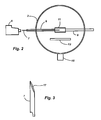
- a schematic illustration of an apparatus for measuring the total transmittance is shown in Fig. 2.
- the arc tube sample 11 is mounted in a center region of integrating sphere 3 by supports 9 which hold the sample at opposite ends.
- a baffle 13 is positioned between the sample 11 and light detector 15.
- Optical fiber 7 is inserted through one of the supports 9 and into a center portion of the sample 11. Light is conducted from tungsten-halogen lamp 5 through the optical fiber 7. As shown in Fig.
- the light-emitting end 17 of the optical fiber 7, which is placed inside the sample has a 20° taper with respect to the cylindrical axis of the fiber in order to scatter the emitted light to produce a nearly point source.
- the light emitted from the end of the optical fiber passes through the sample wall, is collected by the integrating sphere, and the total integrated flux is measured by the light detector, preferably an unfiltered silicon detector.
- the percentage of the total integrated flux transmitted through the sample represents the total transmittance of the sample.
- the total transmittance is effectively measured in the wavelength range from about 400nm to about 700nm.
- Suitable components for the apparatus are available from Labsphere, Inc. of North Sutton, NH.
- the oxygen solubility limit in AIN is reported to be quite high ( ⁇ 4.2 at. % on nitrogen sublattice): e.g. 2x10 21 oxygen atoms/cm 3 while the density of nitrogen atoms in AIN was 4.8x10 22 atoms/cm 3 .
- Oxygen dissolved in AIN is linked to absorption at ⁇ 430nm, as well as at 274nm and 258nm. It is believed that an oxygen impurity played an important role in the optical absorption of the as-sintered AIN tubes. Nitrogen vacancies due to non-stoichiometry of AlN are also known to give a broad absorption from 233nm to 345nm.
- Carbon is believed to be the next most important impurity in AIN. Like oxygen, the solubility limit of C in AIN is also high. Carbon along with oxygen in AIN could form a second phase, Al 2 CO, which is thought to be present in the as-sintered AIN tubes. Carbon most likely substitutes for Al in AIN resulting in Al vacancies. Since C is smaller than O or N (O -2 or N -3 ), diffusion of carbon in AIN should be faster than oxygen or nitrogen. When the oxygen and carbon impurities out-diffuse, they leave behind vacancies that have to be filled with nitrogen or aluminum. This means that N and Al have to migrate in when O and Al move out.
- the total transmittance of the as-sintered AIN tubes may be increased to >92% by performing a post-sintering anneal in a nitrogen atmosphere.
- the post-sintering anneal involves heating the as-sintered AIN arc tube at about 1850°C for about 72 hours under flowing nitrogen in a graphite-element furnace.
- impurity solutes (O and C) and impurity or second phases such as Al 2 O 3 and Al 2 CO, Ca-Al-O, and Ca-Al-O-N solid or liquid phases, are distilled or purified from AIN (for example, by formation of Al 2 O gas).
- the temperature, time, and partial pressure of oxygen of the annealing atmosphere are controlled so that the light-absorbing point defects and impurities (such as oxygen and carbon) are removed.
- the nitrogen atmosphere is flowing, high-purity nitrogen gas having less than about 1 ppm oxygen.
- the grain size grew slightly after annealing for 72h at 1850°C under flowing N 2 in graphite boat of a graphite-element furnace.
- total transmittance of AIN tube samples 1 to 5 reached 95-99%, while samples 6 to 15 annealed at ⁇ 1885-1900C for 60-180h reached 91-95%. Since experiments have shown that annealing at 1850°C for 60 hours is sufficient to raise the total transmittance to >92%, it is preferred that the annealing time should be at least about 50 hours.
- annealing at 1800°C for 60 hours is not sufficient to effectively raise the total transmittance whereas annealing at 1850°C for 60 hours is effective.
- Table 1 clearly show the benefit of the post-sinter anneal in increasing the total transmittance to the minimum level required for lamp applications. A higher pressure of nitrogen during the anneal might reduce the time needed for anneal to result in an improved total transmittance.
- the examples in Table 1 are from calcia-doped AIN. It is expected that this method is also applicable to sintered AIN made with other rare-earth and alkaline-earth-oxide sintering aids although the time and temperature conditions of the post-sinter anneal would likely have to be modified to account for any differences in the kinetics of the out-diffusion processes.
Landscapes
- Engineering & Computer Science (AREA)
- Chemical & Material Sciences (AREA)
- Manufacturing & Machinery (AREA)
- Ceramic Engineering (AREA)
- Materials Engineering (AREA)
- Structural Engineering (AREA)
- Organic Chemistry (AREA)
- Ceramic Products (AREA)
- Vessels And Coating Films For Discharge Lamps (AREA)
- Manufacture Of Electron Tubes, Discharge Lamp Vessels, Lead-In Wires, And The Like (AREA)
Applications Claiming Priority (2)
| Application Number | Priority Date | Filing Date | Title |
|---|---|---|---|
| US851299 | 2004-05-21 | ||
| US10/851,299 US7503825B2 (en) | 2004-05-21 | 2004-05-21 | Aluminum nitride arc discharge vessel having high total transmittance and method of making same |
Publications (1)
| Publication Number | Publication Date |
|---|---|
| EP1601002A2 true EP1601002A2 (de) | 2005-11-30 |
Family
ID=34933715
Family Applications (1)
| Application Number | Title | Priority Date | Filing Date |
|---|---|---|---|
| EP05002965A Withdrawn EP1601002A2 (de) | 2004-05-21 | 2005-02-11 | Bogen-Entladungs-Gefäss aus Aluminiumnitride hoher Total-Transmissions-Faktor und dessen Herstellungsverfahren |
Country Status (5)
| Country | Link |
|---|---|
| US (1) | US7503825B2 (de) |
| EP (1) | EP1601002A2 (de) |
| JP (1) | JP2005340196A (de) |
| CN (1) | CN1700405A (de) |
| CA (1) | CA2490383A1 (de) |
Families Citing this family (8)
| Publication number | Priority date | Publication date | Assignee | Title |
|---|---|---|---|---|
| EP1777204A4 (de) * | 2004-06-21 | 2010-12-01 | Tokuyama Corp | Nitridsinterkörper und herstellungsverfahren dafür |
| US7362053B2 (en) * | 2005-01-31 | 2008-04-22 | Osram Sylvania Inc. | Ceramic discharge vessel having aluminum oxynitride seal region |
| WO2007105728A1 (ja) * | 2006-03-13 | 2007-09-20 | Tokuyama Corporation | 窒化アルミニウム焼結体の製造方法 |
| US9034103B2 (en) | 2006-03-30 | 2015-05-19 | Crystal Is, Inc. | Aluminum nitride bulk crystals having high transparency to ultraviolet light and methods of forming them |
| WO2009031510A1 (ja) * | 2007-09-03 | 2009-03-12 | Tokuyama Corporation | 改質窒化アルミニウム焼結体及びその製造方法 |
| US7799269B2 (en) * | 2007-09-25 | 2010-09-21 | Osram Sylvania Inc. | Method of sintering AIN under a methane-containing nitrogen atmosphere |
| US7952282B2 (en) * | 2008-04-29 | 2011-05-31 | Osram Sylvania Inc. | Brazing alloy and ceramic discharge lamp employing same |
| KR20220034894A (ko) | 2019-07-19 | 2022-03-18 | 에바텍 아크티엔게젤샤프트 | 압전 코팅 및 증착 공정 |
Family Cites Families (17)
| Publication number | Priority date | Publication date | Assignee | Title |
|---|---|---|---|---|
| DE3333406A1 (de) | 1982-09-17 | 1984-03-22 | Tokuyama Soda K.K., Tokuyama, Yamaguchi | Feines aluminiumnitridpulver, verfahren zu seiner herstellung und es enthaltendes mittel |
| JPS60195059A (ja) | 1984-03-15 | 1985-10-03 | 株式会社トクヤマ | 複合焼結体 |
| CA1262149A (en) | 1985-08-13 | 1989-10-03 | Hitofumi Taniguchi | Sinterable aluminum nitride composition, sintered body from this composition and process for producing the sintered body |
| US5242872A (en) | 1986-07-18 | 1993-09-07 | Tokuyama Soda Kabushiki Kaisha | Process for producing aluminum nitride sintered body |
| JPH0717455B2 (ja) | 1986-07-18 | 1995-03-01 | 株式会社トクヤマ | 窒化アルミニウム焼結体の製造方法 |
| DE3840577A1 (de) | 1988-12-01 | 1990-06-07 | Patent Treuhand Ges Fuer Elektrische Gluehlampen Mbh | Entladungsgefaess fuer eine hochdruckentladungslampe und verfahren zu dessen herstellung |
| US5097176A (en) * | 1990-02-21 | 1992-03-17 | U.S. Philips Corporation | High-pressure sodium discharge lamp having a color temperature of at least 2800° K. |
| JP2525074B2 (ja) | 1990-06-15 | 1996-08-14 | 株式会社トクヤマ | 窒化アルミニウム顆粒及びその製造方法 |
| EP0587238B1 (de) | 1992-09-08 | 2000-07-19 | Koninklijke Philips Electronics N.V. | Hochdruckentladungslampe |
| DE19645960A1 (de) | 1996-11-07 | 1998-05-14 | Patent Treuhand Ges Fuer Elektrische Gluehlampen Mbh | Keramisches Entladungsgefäß |
| JP2002075272A (ja) * | 2000-08-29 | 2002-03-15 | Matsushita Electric Ind Co Ltd | メタルハライドランプ |
| US6592695B1 (en) * | 2000-11-16 | 2003-07-15 | General Electric Company | Binder system for ceramic arc discharge lamp |
| US6796869B1 (en) * | 2000-12-28 | 2004-09-28 | General Electric Company | Ceramic arc tube by annealing |
| US6791267B2 (en) * | 2001-10-02 | 2004-09-14 | Ngk Insulators, Ltd. | High pressure discharge lamps, lighting systems, head lamps for automobiles and light emitting vessels for high pressure discharge lamps |
| CN1615535A (zh) | 2002-01-15 | 2005-05-11 | 皇家飞利浦电子股份有限公司 | 高压放电灯 |
| US7371704B2 (en) * | 2002-12-25 | 2008-05-13 | Ngk Insulators, Ltd. | Sintered bodies of yttrium-aluminum garnet, a method of producing the same and sintering aid therefor |
| EP1518843A3 (de) | 2003-09-25 | 2007-05-23 | Tokuyama Corporation | Aluminiumnitridsinterkörper und deren Herstellungsverfahren |
-
2004
- 2004-05-21 US US10/851,299 patent/US7503825B2/en not_active Expired - Fee Related
- 2004-12-16 CA CA002490383A patent/CA2490383A1/en not_active Abandoned
-
2005
- 2005-02-11 EP EP05002965A patent/EP1601002A2/de not_active Withdrawn
- 2005-05-19 JP JP2005146910A patent/JP2005340196A/ja not_active Withdrawn
- 2005-05-23 CN CN200510073913.7A patent/CN1700405A/zh active Pending
Also Published As
| Publication number | Publication date |
|---|---|
| CA2490383A1 (en) | 2005-11-21 |
| CN1700405A (zh) | 2005-11-23 |
| US20050258759A1 (en) | 2005-11-24 |
| JP2005340196A (ja) | 2005-12-08 |
| US7503825B2 (en) | 2009-03-17 |
Similar Documents
| Publication | Publication Date | Title |
|---|---|---|
| US6844285B1 (en) | Transparent polycrystalline yttrium aluminum garnet | |
| Krell et al. | Transparent sintered corundum with high hardness and strength | |
| CA2211225C (en) | Translucent polycrystalline alumina and method of making same | |
| US7503825B2 (en) | Aluminum nitride arc discharge vessel having high total transmittance and method of making same | |
| EP2037010A1 (de) | Verfahren zur Umwandlung von PCA in Saphir und umgewandelter Artikel | |
| EP1727178A2 (de) | Durchscheinende polykristalline Aluminiumoxidkeramik, keramisches Entladungsgefäss, und Verfahren zu dessen Herstellung | |
| JPS6048466B2 (ja) | 多結晶透明アルミナ焼結体の製造法 | |
| CA2211224C (en) | Translucent polycrystalline alumina and method of making same | |
| US7081425B2 (en) | Aluminum nitride sintered body | |
| US20080283522A1 (en) | Translucent polycrystalline alumina ceramic | |
| EP0667322B1 (de) | Lichtdurchlässiges keramisches material und herstellungsverfahren | |
| US7897098B2 (en) | High total transmittance alumina discharge vessels having submicron grain size | |
| US20080108496A1 (en) | Composition Used to Make a Transparent Ceramic Material and Method of Manufacturing the Same | |
| US6734128B2 (en) | Ceramic envelope for high intensity discharge lamp and method for producing polycrystalline transparent sintered alumina body | |
| US20080284338A1 (en) | Translucent polycrystalline alumina ceramic | |
| WO2008057678A2 (en) | An arc tube for a high intensity discharge lamp | |
| US7884550B2 (en) | Arc tube composed of yttrium aluminum garnet ceramic material | |
| JP3340024B2 (ja) | 放電灯用発光管に用いる透光管の製造方法 | |
| US8597743B2 (en) | Aluminum nitride sintered body | |
| WO2012170337A1 (en) | Polycrystalline translucent alumina doped with magnesium oxide/zirconium for high intensity discharge lamps | |
| US20080106010A1 (en) | Transparent Ceramic Material and Method of Manufacturing the Same | |
| Kappen | Status quo of ceramic material for metal halide discharge lamps | |
| JP2004315313A (ja) | アルミナ発光管の製造方法およびその製造方法により製造したアルミナ発光管 | |
| JP5314237B2 (ja) | 窒化アルミニウム焼結体 | |
| JPS59184450A (ja) | 透光性アルミナ管 |
Legal Events
| Date | Code | Title | Description |
|---|---|---|---|
| PUAI | Public reference made under article 153(3) epc to a published international application that has entered the european phase |
Free format text: ORIGINAL CODE: 0009012 |
|
| AK | Designated contracting states |
Kind code of ref document: A2 Designated state(s): AT BE BG CH CY CZ DE DK EE ES FI FR GB GR HU IE IS IT LI LT LU MC NL PL PT RO SE SI SK TR |
|
| AX | Request for extension of the european patent |
Extension state: AL BA HR LV MK YU |
|
| STAA | Information on the status of an ep patent application or granted ep patent |
Free format text: STATUS: THE APPLICATION IS DEEMED TO BE WITHDRAWN |
|
| 18D | Application deemed to be withdrawn |
Effective date: 20100901 |