EP1594262A2 - LIN-Netzwerk und LIN-Slave-Knoten - Google Patents
LIN-Netzwerk und LIN-Slave-Knoten Download PDFInfo
- Publication number
- EP1594262A2 EP1594262A2 EP05075988A EP05075988A EP1594262A2 EP 1594262 A2 EP1594262 A2 EP 1594262A2 EP 05075988 A EP05075988 A EP 05075988A EP 05075988 A EP05075988 A EP 05075988A EP 1594262 A2 EP1594262 A2 EP 1594262A2
- Authority
- EP
- European Patent Office
- Prior art keywords
- slave node
- lin
- processing device
- electronic processing
- transmitting device
- Prior art date
- Legal status (The legal status is an assumption and is not a legal conclusion. Google has not performed a legal analysis and makes no representation as to the accuracy of the status listed.)
- Granted
Links
Images

Classifications
-
- B—PERFORMING OPERATIONS; TRANSPORTING
- B60—VEHICLES IN GENERAL
- B60H—ARRANGEMENTS OF HEATING, COOLING, VENTILATING OR OTHER AIR-TREATING DEVICES SPECIALLY ADAPTED FOR PASSENGER OR GOODS SPACES OF VEHICLES
- B60H1/00—Heating, cooling or ventilating devices
- B60H1/00642—Control systems or circuits; Control members or indication devices for heating, cooling or ventilating devices
-
- B—PERFORMING OPERATIONS; TRANSPORTING
- B60—VEHICLES IN GENERAL
- B60H—ARRANGEMENTS OF HEATING, COOLING, VENTILATING OR OTHER AIR-TREATING DEVICES SPECIALLY ADAPTED FOR PASSENGER OR GOODS SPACES OF VEHICLES
- B60H1/00—Heating, cooling or ventilating devices
- B60H1/00642—Control systems or circuits; Control members or indication devices for heating, cooling or ventilating devices
- B60H1/0073—Control systems or circuits characterised by particular algorithms or computational models, e.g. fuzzy logic or dynamic models
-
- H—ELECTRICITY
- H04—ELECTRIC COMMUNICATION TECHNIQUE
- H04L—TRANSMISSION OF DIGITAL INFORMATION, e.g. TELEGRAPHIC COMMUNICATION
- H04L12/00—Data switching networks
- H04L12/28—Data switching networks characterised by path configuration, e.g. LAN [Local Area Networks] or WAN [Wide Area Networks]
- H04L12/40—Bus networks
- H04L12/40006—Architecture of a communication node
- H04L12/40032—Details regarding a bus interface enhancer
-
- H—ELECTRICITY
- H04—ELECTRIC COMMUNICATION TECHNIQUE
- H04L—TRANSMISSION OF DIGITAL INFORMATION, e.g. TELEGRAPHIC COMMUNICATION
- H04L12/00—Data switching networks
- H04L12/28—Data switching networks characterised by path configuration, e.g. LAN [Local Area Networks] or WAN [Wide Area Networks]
- H04L12/40—Bus networks
- H04L12/403—Bus networks with centralised control, e.g. polling
-
- H—ELECTRICITY
- H04—ELECTRIC COMMUNICATION TECHNIQUE
- H04L—TRANSMISSION OF DIGITAL INFORMATION, e.g. TELEGRAPHIC COMMUNICATION
- H04L12/00—Data switching networks
- H04L12/28—Data switching networks characterised by path configuration, e.g. LAN [Local Area Networks] or WAN [Wide Area Networks]
- H04L12/40—Bus networks
- H04L2012/40208—Bus networks characterized by the use of a particular bus standard
- H04L2012/40234—Local Interconnect Network LIN
-
- H—ELECTRICITY
- H04—ELECTRIC COMMUNICATION TECHNIQUE
- H04L—TRANSMISSION OF DIGITAL INFORMATION, e.g. TELEGRAPHIC COMMUNICATION
- H04L12/00—Data switching networks
- H04L12/28—Data switching networks characterised by path configuration, e.g. LAN [Local Area Networks] or WAN [Wide Area Networks]
- H04L12/40—Bus networks
- H04L2012/40267—Bus for use in transportation systems
- H04L2012/40273—Bus for use in transportation systems the transportation system being a vehicle
Definitions
- This invention relates generally to a Local Interconnect Network (hereafter referred to as a 'LIN network'), and more specifically, to a LIN network having a slave node that is designed to reduce operating current, power consumption and/or operating temperature.
- a 'LIN network' Local Interconnect Network
- a LIN network is a single-wire serial communications protocol that is used in a number of industries, including the automotive industry.
- Reasons for its widespread use in the automotive industry include its scalability and its cost efficiency, the latter of which is at least partially attributed to the simplicity of Universal Asynchronous Receiver/Transmitter (UART) communication and the low cost of using a single-wire medium.
- UART Universal Asynchronous Receiver/Transmitter
- a single LIN network usually includes a number of "slave nodes" that are periodically and/or intermittently addressed by a "master node.”
- a LIN network may include a single master node and up to sixteen separate slave nodes, and the slave nodes can be addressed by the master node at any given time and in a manner that requires no arbitration or collision management in the slave node itself.
- current draw in each of the slave nodes can be a concern. This is particularly true in instances where it is an objective to reduce the power consumption and/or operating temperature in the individual slave nodes.
- a combination of hardware and/or software techniques may be implemented to address the current draw issue, which in turn can affect power consumption and operating temperature.
- a typical LIN slave node 10 is connected to a LIN bus 12 and includes LIN transceiver 20, a microcontroller 22, and one or more additional component(s) 24 such as a sensor unit.
- the LIN transceiver 20 pre-filters and buffers all incoming signals from LIN bus 12, which causes the LIN transceiver to come out of a sleep mode every time there is a request or command placed on the LIN bus, even when it pertains to an entirely different slave node.
- LIN transceiver 20 is not a low current device, this can have a detrimental effect on the overall current being drawn by slave node 10. In certain temperature and/or current sensitive applications, the increased current draw caused by LIN transceiver 20 waking up each time a request is put on LIN bus 12 is undesirable.
- U.S. Patent No. 6,422,062 which is assigned to the present assignee and is hereby incorporated by reference.
- This patent discloses an Integrated Glass Fog Sensor unit (hereafter referred to as an 'IGFS unit'), and is the type of sensor that could be used as sensor unit 24 in Figure 1.
- the IGFS unit taught in the '062 patent is strictly being provided for exemplary purposes, as a number of other sensors and/or components could also be used in LIN slave node 10.
- the IGFS unit of this patent has a glass surface temperature sensor, an ambient air temperature sensor and a relative humidity sensor, and is used for predicting glass fog formation on a vehicle windshield.
- a slave node for use in a LIN network where the slave node has a reduced operating current, power consumption and/or operating temperature. It is also desirable to provide a slave node for use with temperature and/or current sensitive applications such as, but not limited to, an IGFS unit.
- a slave node for use in a LIN network that comprises an input circuit, an electronic processing device, and a transmitting device.
- the input circuit receives an incoming message from the LIN network, the electronic processing device interprets the incoming message and/or compiles an outgoing message, and the transmitting device transmits the outgoing message to the LIN network, if required.
- the input circuit is separate from the transmitting device, such that the transmitting device is generally inactive during reception of the incoming message.
- a slave node for use in a LIN network that comprises a level-shift circuit, a ground-shift circuit, a wave-shaping circuit, an electronic processing device, and a transmitting device. At least one of the level-shift, ground-shift and wave-shaping circuits is integrated into the electronic processing device.
- a Local Interconnect Network that comprises a LIN bus, a master node, and a slave node, which further comprises a level-shift circuit, a ground-shift circuit, a comparator, an electronic processing device and a transmitting device.
- the electronic processing device interprets the incoming message and only wakes up the transmitting device when it is needed to transmit the outgoing message.
- Certain objects, features and advantages of this invention include, but are certainly not limited to, providing a LIN slave node that reduces operating current, power consumption and/or operating temperature, providing a LIN slave node that reduces packaging size so that it can be integrated on a single circuit board with associated components, such as an integrated glass fog sensor (IGFS) unit, and providing a LIN slave node where an input circuit and/or a microcontroller pre-filter incoming messages and wake up a transceiver only when required.
- IGFS integrated glass fog sensor
- HVAC Heating Ventilation Air Conditioning
- CAN Controller Area Network
- This particular LIN network is simply being provided for exemplary purposes, as the slave nodes of the present invention could be used in any LIN network, including those used with a vehicle's seat, door or window controls, remote keyless entry (RKE), exterior and interior mirrors, steering wheel, sunroof, compass, lights, engine sensors, etc.
- RKE remote keyless entry
- the number of slave nodes in the LIN network could be greater than or less than that of the exemplary portion of network 40 shown here.
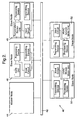
- LIN network 40 is a single-wire serial communications network that generally includes a LIN bus 42, a master node 44, a glass fog sensor slave node 46, a temperature sensor slave node 48, an HVAC blower motor slave node 50 and a HVAC louver motor slave node 52.
- a glass fog sensor slave node 46 may differ from one another, the basic input circuit / processing device / transmitting device arrangements of the slave nodes are generally the same.
- the following explanation of glass fog sensor slave node 46 applies to slave nodes 48-52 as well.
- glass fog sensor slave node 46 is designed to receive messages from LIN bus 42 in a manner that conserves operating current, and preferably includes an input circuit 60, an electronic processing device 62, an IGFS unit 64 and a LIN transmitting device 66 all mounted on a single circuit board. Beginning with input circuit 60, this circuit is electronically coupled to LIN bus 42 and receives incoming messages from LIN network 40.
- incoming message is used herein to broadly include all messages, signals, commands and/or other electronic communications that arrive at a particular slave node via a LIN network; this includes, but is not limited to, LIN transmit and receive messages, as well as LIN message headers and message responses.
- outgoing message is used herein to broadly include all messages, signals, commands and/or other electronic communications that are sent by a particular slave node via a LIN network; this includes, but is not limited to, LIN transmit messages and LIN message responses.
- Input circuit 60 is generally the first slave node component to process an incoming message and, according to the particular embodiment shown here, includes a signal input 70, a level-shift circuit 72, a ground-shift circuit 74, a comparator 76, and a signal output 78.
- Level-shift circuit 72 shifts the voltage of the signals of the incoming messages on LIN bus 42 (typically in the range of 12v) to a lower voltage (V cc ) used by the slave node (typically about 3v-5v).
- the level-shift circuit 72 generally includes a diode 80, a resistor 82, a positive voltage node V cc , and is coupled to signal input 70 and a non-inverting or positive input of comparator 76.
- Ground-shift circuit 74 compensates for fluctuations in the ground reference in order to improve the slave node's ability to accurately interpret messages from LIN bus 42.
- Ground-shift circuit 74 includes resistors 90 and 92 forming a voltage divider, a positive voltage node V cc , and is coupled to the inverting or negative input of comparator 76.
- Comparator 76 or wave-shaping circuit is shown here in the form of an operational amplifier (op-amp), and performs wave-shaping functions on the signals of the incoming messages.
- Comparator 76 has positive and negative inputs coupled to level-shift and ground-shift circuits 72, 74, respectively, and an output coupled to signal output 78.
- Electronic processing device 62 interprets incoming messages from LIN network 40 and, depending upon their nature and content, may also compile outgoing messages to be sent to the LIN network. More specifically, electronic processing device 62 determines if a message on LIN bus 42 pertains to slave node 46 (as opposed to another slave node) and if transmitting device 66 is required to respond to that message, before waking the transmitting device up. According to a preferred embodiment, electronic processing device 62 is a 14-pin microcontroller, such as Model # PIC16F688 sold by Microchip Technology Inc.
- the term “electronic processing device” broadly includes all electronic devices capable of processing digital signals, including but not limited to, digital signal processors (DSPs), microprocessors, and microcontrollers.
- DSPs digital signal processors
- pin 1 of the electronic processing device is connected to a positive voltage node V cc
- pins 2 and 3 are connected to a humidity sensor of IGFS unit 64
- pins 7 and 8 are connected to transmitting device 66
- pin 11 is connected to the signal output 78 of input circuit 60
- pins 12 and 13 are connected to temperature sensors of IGFS unit 64
- pin 14 is connected to a ground node V ss .
- Integrated Glass Fog Sensor (IGFS) unit 64 includes temperature and humidity sensors for monitoring conditions associated with fog formation on a vehicle windshield, as more fully explained in U.S. Patent No. 6,422,062, and is connected to electronic processing device 62.
- IGFS unit 64 includes a humidity sensor (not shown) for transmitting a humidity reading to pins 2 and 3 of the electronic processing device 62 via a pair of signal outputs, and a pair of temperature sensors (also not shown) for transmitting temperature readings to pins 12 and 13 of the electronic processing device.
- Transmitting device 66 transmits outgoing messages to LIN network 40, and is coupled to electronic processing device 62 via signal inputs 96 and is coupled to LIN bus 42 via a signal output 98.
- transmitting device 66 is a model # MC33661 LIN transceiver sold by Freescale Semiconductor Corporation, and can be operated in a low current sleep mode.
- this is only a preferred embodiment, as the term "transmitting device” broadly includes all components capable of transmitting messages onto a LIN network, including but not limited to, transmitters, transceivers, or another physical layer component.
- transmitting device 66 is only part of the path of the outgoing message. Thus, transmitting device 66 is only awakened from its low current sleep mode when a message is being transmitted from slave node 46 to the LIN network 40, and not vice-versa. By removing transmitting device 66 from the incoming message path, the transmitting device avoids being unnecessarily awakened in those instances where a message is put on the LIN bus 42 but does not pertain to slave node 46, or when a message pertains to slave node 46 but requires no response.
- transmitting device 66 removes from the incoming message path from the incoming message path.
- a LIN transceiver is included in the incoming message path, it provides several functions including level-shifting, ground-shifting and wave shaping, to name a few. Those functions have been addressed by the present embodiment through input circuit 60.
- slave node 46 reduces operating current, power consumption and/or operating temperature by removing transmitting device 66 from the incoming message path. This causes incoming messages to bypass the transmitting device and thus reduces the frequency with which the transmitting device is unnecessarily woken up out of its low current sleep mode.
- master node 44 puts a message on LIN bus 42, that incoming message is received by all of the slave nodes in the LIN network 40, even though it generally only pertains to one of them.
- the incoming message reaches slave node 46, it propagates through the incoming message path but does not travel through transmitting device 66, even though the transmitting device has a signal output 98 coupled to LIN bus 42.
- transmitting device 66 is inactive and has not been enabled or turned on by processing device 62. Only in those circumstances where the incoming message pertains to that particular slave node and an outgoing message is required in response, is transmitting device 66 woken up out of its sleep mode. This process will now be explained in greater detail.
- level-shift circuit 72 which is the first circuit to process the incoming message and steps down the voltage of the signals of the incoming message so that they are compatible with the lower voltage used by the slave node.
- master node 46 holds LIN bus 42 at a "high" value. Thus, there is no voltage drop across resistor 82 and the non-inverting input of comparator 76 is maintained at approximately V cc .
- level-shift circuit 72 steps down the higher voltage used on LIN bus 42 to the lower voltage (V cc ) used in the slave node.
- Ground-shifting operations are performed by ground-shift circuit 74, which adjusts the reference voltage being applied to the inverting input of comparator 76 to offset shifts in the ground reference.
- a 2v ground shift in LIN network 40 (voltage of signals of incoming message shifted from 0-12v to 2-14v) could be problematic for a low voltage slave node that only operates at 0-3v.
- Slave node 46 uses the voltage divider made from resistors 90 and 92 to create a reference signal of approximately 2.5v.
- the 2.0v ground shift can then be handled by comparator 76, so long as appropriate resistance values are chosen for resistors 82, 90 and 92 so that they accommodate the voltage drop across diode 80, as well as other considerations known to those skilled in the art.
- Wave-shaping is provided by comparator 76, which compares the voltage of the signals of the incoming message to a ground-related reference voltage provided by ground-shift circuit 74, as just explained. This causes an incoming message having somewhat rounded signals to be squared off such that a more crisp, defined incoming message is provided to electronic processing device 62.
- the message is sent to electronic processing device 62.
- the processing device decides whether or not the incoming message pertains to that particular slave node and whether or not an outgoing message is required in response.
- electronic processing device 62 reads the contents of the incoming message.
- the protocol for LIN-based messages is standardized and is well known in the art, thus an exhaustive explanation has been omitted. Generally speaking, however, there are two different types of LIN messages: a transmit message and a receive message. In a transmit message, the master node provides the first three components of the message and an intended slave node provides the last two.
- the slave node is expected to provide an outgoing message in response to the incoming message from the master node.
- the master node provides all five components of the message, as the intended slave node(s) is only expected to receive the message and is not expected to reply.
- the message header is sent by master node 44 and generally comprises a sync break (13 bits), a sync byte (0-1 bit), and an identifier (8 bits).
- the sync break identifies the start of a message frame
- the sync byte is used by the slave node for clock synchronization
- the identifier includes a 6-bit message ID and a 2-bit parity field.
- the identifier includes information that instructs processing device 62 whether or not to respond to the incoming message or to perform a particular function.
- the message response can be provided by either the slave node or the master node, and generally includes a data field (1-8 bytes) and a checksum (8 bits).
- the data field includes data or information.
- master node 44 were to query slave node 46 for readings pertaining to glass fog formation, then slave node 46 would use the data field to provide this information.
- the checksum is used for error checking and the like.
- processing device 62 maintains LIN transmitting device 66 in a low current sleep mode.
- the only time that the transmitting device is woken up from its sleep mode is if a transmit message pertaining to that slave node has been received. In which case, the transmitting device is woken up, performs any level-shifting, ground-shifting, wave-shaping, or any other task required of it, transmits an outgoing message on LIN bus 42, and then returns to its sleep mode.
- each of these devices draws much less current than does transmitting device 66.
- either of these two devices could be operated in a low current sleep mode to further reduce the amount of operating current, power consumption and/or operating temperature.
- one or more circuits and/or components of input circuit 60 are integrated into electronic processing device 62 such that the level-shifting, ground-shifting, and/or wave-shaping functions are performed by the processing device.
- comparator 76 constituting a separate op-amp
- the level-shift and/or ground-shift circuits 72, 74 could still remain separate from the electronic processing device, or they too could be integrated therein.
- that item still remains a part of input circuit 60, but is integrated into electronic processing device 62 instead of being located at a separate location on the circuit board.
- the processing device could provide its own reference voltage, as opposed to the reference voltage being provided by the specific voltage divider shown in ground-shift circuit 74.
- the processing device could provide its own reference voltage, as opposed to the reference voltage being provided by the specific voltage divider shown in ground-shift circuit 74.
- Other differences or substitutions could also exist and should be apparent to those skilled in the art.
- heat sinks may be used on individual components to decrease their thermal impact. Furthermore, heat generation and dissipation may be characterized so that the electronic processing device actively compensates for increases given off by the slave node.
Landscapes
- Engineering & Computer Science (AREA)
- Physics & Mathematics (AREA)
- Thermal Sciences (AREA)
- Mechanical Engineering (AREA)
- Computer Networks & Wireless Communication (AREA)
- Signal Processing (AREA)
- Fuzzy Systems (AREA)
- Mathematical Physics (AREA)
- Software Systems (AREA)
- Theoretical Computer Science (AREA)
- Small-Scale Networks (AREA)
- Mobile Radio Communication Systems (AREA)
Applications Claiming Priority (4)
| Application Number | Priority Date | Filing Date | Title |
|---|---|---|---|
| US73832 | 1993-06-08 | ||
| US56748104P | 2004-05-03 | 2004-05-03 | |
| US567481P | 2004-05-03 | ||
| US11/073,832 US7701943B2 (en) | 2004-05-03 | 2005-03-07 | Slave node and local interconnect network (LIN network) having same |
Publications (3)
| Publication Number | Publication Date |
|---|---|
| EP1594262A2 true EP1594262A2 (de) | 2005-11-09 |
| EP1594262A3 EP1594262A3 (de) | 2007-09-12 |
| EP1594262B1 EP1594262B1 (de) | 2010-02-03 |
Family
ID=34938219
Family Applications (1)
| Application Number | Title | Priority Date | Filing Date |
|---|---|---|---|
| EP05075988A Expired - Lifetime EP1594262B1 (de) | 2004-05-03 | 2005-04-26 | LIN-Netzwerk und LIN-Slave-Knoten |
Country Status (4)
| Country | Link |
|---|---|
| US (1) | US7701943B2 (de) |
| EP (1) | EP1594262B1 (de) |
| AT (1) | ATE457103T1 (de) |
| DE (1) | DE602005019218D1 (de) |
Cited By (7)
| Publication number | Priority date | Publication date | Assignee | Title |
|---|---|---|---|---|
| DE102007019356A1 (de) * | 2007-04-23 | 2008-10-30 | Micronas Gmbh | LIN-Receiver |
| FR2936123A1 (fr) * | 2008-09-18 | 2010-03-19 | Peugeot Citroen Automobiles Sa | Mise en veille de noeuds esclaves d'un reseau lin par transmission de message(s) de preparation a la mise en veille avant un message de mise en veille |
| WO2010103220A1 (fr) * | 2009-03-12 | 2010-09-16 | Peugeot Citroën Automobiles SA | Procédé et dispositif de contrôle du réveil d'organes esclaves d'un réseau lin, par analyse des raisons du réveil |
| CN102043399A (zh) * | 2010-08-25 | 2011-05-04 | 李志明 | 工矿灯照明能源控制网络系统 |
| CN102892193A (zh) * | 2012-09-20 | 2013-01-23 | 华为技术有限公司 | 数据传输方法和设备 |
| CN103138982A (zh) * | 2011-11-30 | 2013-06-05 | 杭州三花研究院有限公司 | 一种lin网络从节点控制方法、系统 |
| WO2016019938A1 (de) * | 2014-08-08 | 2016-02-11 | Gentherm Gmbh | Bussystem und verfahren zu dessen steuerung |
Families Citing this family (26)
| Publication number | Priority date | Publication date | Assignee | Title |
|---|---|---|---|---|
| DE10354602A1 (de) * | 2003-11-21 | 2005-06-16 | Robert Bosch Gmbh | Verbindungselemente, Verfahren zur Buskommunikation zwischen einem Steuergerät zur Ansteuerung von Personenschutzmitteln als Master und wenigstens einem Verbindungselement zur Gewichtsmessung in einem Sitz als Slave und Bus-System |
| DE102004050423A1 (de) * | 2004-10-15 | 2006-04-20 | Bosch Rexroth Ag | Kommunikationssystem und Verfahren zur Synchronisation desselben |
| DE102004054016A1 (de) * | 2004-11-09 | 2006-05-11 | Robert Bosch Gmbh | Steuergerät zum Steuern und/oder regeln mindestens einer Fahrzeugfunktion |
| CN101384119B (zh) * | 2008-10-17 | 2012-05-23 | 奇瑞汽车股份有限公司 | 一种基于can与lin总线的汽车外部灯控制器 |
| FR2942331A1 (fr) * | 2009-02-18 | 2010-08-20 | Stmicroelectronics Grenoble 2 | Systeme et procede de traitement de donnees numeriques |
| US8334758B2 (en) * | 2009-04-13 | 2012-12-18 | Flextronics Automotive, Inc. | LIN BUS remote control system |
| EP2339789A1 (de) * | 2009-12-28 | 2011-06-29 | Nxp B.V. | Verbesserte Mustererkennung für Teilnetzwerke |
| JP5510286B2 (ja) * | 2010-11-19 | 2014-06-04 | 株式会社デンソー | 通信システム、ノード |
| US8767753B2 (en) | 2011-08-26 | 2014-07-01 | Semiconductor Components Industries, Llc | System, method and device for providing network communications |
| JP2013062722A (ja) * | 2011-09-14 | 2013-04-04 | Denso Corp | 通信システム及び、当該通信システムを構成するスレーブノード |
| CN103580969B (zh) | 2012-07-19 | 2018-08-31 | 杭州三花研究院有限公司 | 一种lin网络从节点控制系统及方法 |
| DE102013201471B4 (de) * | 2013-01-30 | 2020-12-24 | Bayerische Motoren Werke Aktiengesellschaft | Elektronischer LIN Steuerungsbus und Verfahren zu dessen Betrieb sowie Kraftfahrzeug mit einem derartigen Steuerungsbus |
| KR101448775B1 (ko) * | 2013-09-06 | 2014-10-08 | 현대자동차 주식회사 | 공조 패널 반도체 장치 및 이를 포함하는 차량용 공조 시스템 |
| DE102013220707B4 (de) | 2013-10-14 | 2021-03-04 | Bayerische Motoren Werke Aktiengesellschaft | Verfahren zum Betreiben eines Datenbusses, entsprechender Datenbus und Fahrzeug mit einem solchen Datenbus |
| JP2017533853A (ja) * | 2014-10-17 | 2017-11-16 | ジェンサーム インコーポレイテッドGentherm Incorporated | 環境制御システムおよび方法 |
| JP6471540B2 (ja) * | 2015-03-04 | 2019-02-20 | 株式会社デンソー | 車載通信システム、端末装置 |
| DE102015204924B4 (de) * | 2015-03-18 | 2022-05-25 | Röchling Automotive SE & Co. KG | LIN-Netzwerk |
| CN106218359B (zh) * | 2016-07-25 | 2019-04-12 | 奇瑞汽车股份有限公司 | 控制电动汽车加热器的方法和系统 |
| DE102017109868B4 (de) * | 2017-05-08 | 2026-03-12 | Webasto SE | Klimasystem für ein Fahrzeug, Gatewayeinrichtung, Verfahren zum Einstellen eines Parameters einer Klimaeinrichtung und computerlesbares Speichermedium zur Implementierung des Verfahrens |
| US10277385B1 (en) | 2018-05-27 | 2019-04-30 | Nxp B.V. | Slave node for CAN bus network |
| JP7236866B2 (ja) * | 2019-01-17 | 2023-03-10 | 日清紡マイクロデバイス株式会社 | Lin受信機 |
| DE102019200907A1 (de) * | 2019-01-24 | 2020-07-30 | Robert Bosch Gmbh | Teilnehmerstation für ein Bussystem und Verfahren zur Datenübertragung in einem Bussystem |
| DE102020110984A1 (de) * | 2020-04-22 | 2021-10-28 | Infineon Technologies Ag | Bus-transceiver |
| DE102020124549A1 (de) * | 2020-09-21 | 2022-03-24 | Bayerische Motoren Werke Aktiengesellschaft | System zur datenübertragung in einem kraftfahrzeug, kraftfahrzeug und verfahren |
| JP7456925B2 (ja) * | 2020-12-24 | 2024-03-27 | ダイキン工業株式会社 | 空気処理装置 |
| CN112822288B (zh) * | 2021-01-28 | 2022-11-18 | 广汽丰田汽车有限公司 | 车载空调的控制方法、车辆及可读存储介质 |
Family Cites Families (12)
| Publication number | Priority date | Publication date | Assignee | Title |
|---|---|---|---|---|
| US6420975B1 (en) * | 1999-08-25 | 2002-07-16 | Donnelly Corporation | Interior rearview mirror sound processing system |
| US6389337B1 (en) * | 2000-04-24 | 2002-05-14 | H. Brock Kolls | Transacting e-commerce and conducting e-business related to identifying and procuring automotive service and vehicle replacement parts |
| US6853894B1 (en) * | 2000-04-24 | 2005-02-08 | Usa Technologies, Inc. | Global network based vehicle safety and security telematics |
| US6895310B1 (en) * | 2000-04-24 | 2005-05-17 | Usa Technologies, Inc. | Vehicle related wireless scientific instrumentation telematics |
| US6422062B1 (en) * | 2000-08-29 | 2002-07-23 | Delphi Technologies, Inc. | Integrated glass fog sensor unit |
| DE10055163B4 (de) * | 2000-11-08 | 2013-01-03 | Bayerische Motoren Werke Aktiengesellschaft | Datenbus, insbesondere in Kraftfahrzeugen |
| US6959014B2 (en) | 2001-02-01 | 2005-10-25 | Freescale Semiconductor, Inc. | Method and apparatus for operating a communication bus |
| FR2830955A1 (fr) * | 2001-10-15 | 2003-04-18 | St Microelectronics Sa | Recepteur asynchrone de type uart a deux modes de fonctionnement |
| CN1802820A (zh) * | 2003-06-11 | 2006-07-12 | 皇家飞利浦电子股份有限公司 | 用于lin网络的主节点 |
| US7839792B2 (en) * | 2005-08-30 | 2010-11-23 | Tektronix, Inc. | Time-correlated, simultaneous measurement and analysis of network signals from multiple communication networks |
| JP5138949B2 (ja) * | 2007-02-07 | 2013-02-06 | 日立オートモティブシステムズ株式会社 | 車載ゲートウェイ装置 |
| KR100900882B1 (ko) * | 2007-06-11 | 2009-06-04 | 성균관대학교산학협력단 | 상호 상이한 복수의 네트워크 프로토콜을 사용하는 차량에적용되는 게이트웨이 디바이스, 네트워크 시스템 및 데이터변환방법 |
-
2005
- 2005-03-07 US US11/073,832 patent/US7701943B2/en not_active Expired - Fee Related
- 2005-04-26 DE DE602005019218T patent/DE602005019218D1/de not_active Expired - Lifetime
- 2005-04-26 EP EP05075988A patent/EP1594262B1/de not_active Expired - Lifetime
- 2005-04-26 AT AT05075988T patent/ATE457103T1/de not_active IP Right Cessation
Cited By (14)
| Publication number | Priority date | Publication date | Assignee | Title |
|---|---|---|---|---|
| DE102007019356A1 (de) * | 2007-04-23 | 2008-10-30 | Micronas Gmbh | LIN-Receiver |
| FR2936123A1 (fr) * | 2008-09-18 | 2010-03-19 | Peugeot Citroen Automobiles Sa | Mise en veille de noeuds esclaves d'un reseau lin par transmission de message(s) de preparation a la mise en veille avant un message de mise en veille |
| EP2166698A1 (de) * | 2008-09-18 | 2010-03-24 | Peugeot Citroën Automobiles Société Anonyme | Stand-By-Schaltung von Slave-Knoten eines LIN-Netzes durch Übertragung von Vorbereitungsbefehlen für die Stand-By-Schaltung vor einem Stand-By-Modus-Einschaltbefehl |
| WO2010103220A1 (fr) * | 2009-03-12 | 2010-09-16 | Peugeot Citroën Automobiles SA | Procédé et dispositif de contrôle du réveil d'organes esclaves d'un réseau lin, par analyse des raisons du réveil |
| FR2943154A1 (fr) * | 2009-03-12 | 2010-09-17 | Peugeot Citroen Automobiles Sa | Procede et dispositif de controle du reveil d'organes esclaves d'un reseau lin, par analyse des raisons du reveil |
| RU2519025C2 (ru) * | 2009-03-12 | 2014-06-10 | Пежо Ситроен Отомобиль Са | Способ и устройство контроля активации подчиненных блоков сети lin посредством анализа причин активации |
| CN102043399B (zh) * | 2010-08-25 | 2012-09-05 | 李志明 | 工矿灯照明能源控制网络系统 |
| CN102043399A (zh) * | 2010-08-25 | 2011-05-04 | 李志明 | 工矿灯照明能源控制网络系统 |
| CN103138982A (zh) * | 2011-11-30 | 2013-06-05 | 杭州三花研究院有限公司 | 一种lin网络从节点控制方法、系统 |
| CN103138982B (zh) * | 2011-11-30 | 2017-05-10 | 杭州三花研究院有限公司 | 一种lin网络从节点 |
| CN102892193A (zh) * | 2012-09-20 | 2013-01-23 | 华为技术有限公司 | 数据传输方法和设备 |
| WO2014044216A1 (zh) * | 2012-09-20 | 2014-03-27 | 华为技术有限公司 | 数据传输方法和设备 |
| WO2016019938A1 (de) * | 2014-08-08 | 2016-02-11 | Gentherm Gmbh | Bussystem und verfahren zu dessen steuerung |
| US10623203B2 (en) | 2014-08-08 | 2020-04-14 | Gentherm Gmbh | Bus system comprising a master component and a slave component that functions as master, and a method for controlling the same |
Also Published As
| Publication number | Publication date |
|---|---|
| EP1594262B1 (de) | 2010-02-03 |
| DE602005019218D1 (de) | 2010-03-25 |
| EP1594262A3 (de) | 2007-09-12 |
| ATE457103T1 (de) | 2010-02-15 |
| US7701943B2 (en) | 2010-04-20 |
| US20050265344A1 (en) | 2005-12-01 |
Similar Documents
| Publication | Publication Date | Title |
|---|---|---|
| US7701943B2 (en) | Slave node and local interconnect network (LIN network) having same | |
| CN110365564B (zh) | 通信方法及对应的系统和设备 | |
| JP5335663B2 (ja) | 通信バス上の受信装置用のメッセージバッファリング方法、およびユニット | |
| CN109240970B (zh) | 经串行通信总线传输数据的方法、总线接口和计算机程序 | |
| US8868807B2 (en) | Communication system, master node, and slave node | |
| EP1594253B1 (de) | Verfahren und Vorrichtung zur Knotenaufwachung in einem serieller Datenbus | |
| US9164574B2 (en) | Switching a control device in a vehicle network to sleep mode when velocity is above a threshold and switching to an operating mode after a number of received messages | |
| JP7527312B2 (ja) | スリープモード及び部分ネットワーキングサポートを有する物理層デバイス、並びに関連するシステム、方法、及びデバイス | |
| CN102916716B (zh) | 收发器 | |
| CN101283547B (zh) | 一种车载数据库分布节点和车载数据库系统 | |
| CN113691430A (zh) | 操作通信总线的方法、对应系统、设备以及车辆 | |
| US20130326255A1 (en) | Communication system | |
| CN114363099A (zh) | 一种网络管理系统、控制方法、电子控制器及电动汽车 | |
| CN102687461A (zh) | 总线收发器的配置 | |
| CN110875866B (zh) | 用于在通信网络中执行网络操作的网络装置和方法 | |
| CN115848298B (zh) | 一种基于多核的区域网关和动力控制系统及方法 | |
| JP7352166B2 (ja) | 車載通信システム、車載通信装置及び車両用通信方法 | |
| EP1989630B1 (de) | Schnittstelle zwischen bussen verschiedener physikalischer schichten | |
| WO2024090220A1 (ja) | 車載装置、車載システム、制御方法及び制御プログラム | |
| JP2012054830A (ja) | 通信システム、トランシーバ、ノード | |
| JP5406079B2 (ja) | 車載通信システム | |
| Yi et al. | Power saving using Partial Networking in automotive system | |
| Chaithra Chandrasekhar et al. | Automatic car AC control using CAN protocol | |
| JP2016158142A (ja) | 中継装置 | |
| CN119865389A (zh) | 选择性唤醒总线系统的用户站的发送/接收装置和方法 |
Legal Events
| Date | Code | Title | Description |
|---|---|---|---|
| PUAI | Public reference made under article 153(3) epc to a published international application that has entered the european phase |
Free format text: ORIGINAL CODE: 0009012 |
|
| AK | Designated contracting states |
Kind code of ref document: A2 Designated state(s): AT BE BG CH CY CZ DE DK EE ES FI FR GB GR HU IE IS IT LI LT LU MC NL PL PT RO SE SI SK TR |
|
| AX | Request for extension of the european patent |
Extension state: AL BA HR LV MK YU |
|
| PUAL | Search report despatched |
Free format text: ORIGINAL CODE: 0009013 |
|
| AK | Designated contracting states |
Kind code of ref document: A3 Designated state(s): AT BE BG CH CY CZ DE DK EE ES FI FR GB GR HU IE IS IT LI LT LU MC NL PL PT RO SE SI SK TR |
|
| AX | Request for extension of the european patent |
Extension state: AL BA HR LV MK YU |
|
| RIC1 | Information provided on ipc code assigned before grant |
Ipc: H04L 12/12 20060101ALI20070803BHEP Ipc: H04L 12/403 20060101AFI20050903BHEP |
|
| 17P | Request for examination filed |
Effective date: 20080312 |
|
| 17Q | First examination report despatched |
Effective date: 20080417 |
|
| AKX | Designation fees paid |
Designated state(s): AT BE BG CH CY CZ DE DK EE ES FI FR GB GR HU IE IS IT LI LT LU MC NL PL PT RO SE SI SK TR |
|
| GRAP | Despatch of communication of intention to grant a patent |
Free format text: ORIGINAL CODE: EPIDOSNIGR1 |
|
| GRAS | Grant fee paid |
Free format text: ORIGINAL CODE: EPIDOSNIGR3 |
|
| GRAA | (expected) grant |
Free format text: ORIGINAL CODE: 0009210 |
|
| AK | Designated contracting states |
Kind code of ref document: B1 Designated state(s): AT BE BG CH CY CZ DE DK EE ES FI FR GB GR HU IE IS IT LI LT LU MC NL PL PT RO SE SI SK TR |
|
| REG | Reference to a national code |
Ref country code: GB Ref legal event code: FG4D |
|
| REG | Reference to a national code |
Ref country code: CH Ref legal event code: EP |
|
| REG | Reference to a national code |
Ref country code: IE Ref legal event code: FG4D |
|
| REF | Corresponds to: |
Ref document number: 602005019218 Country of ref document: DE Date of ref document: 20100325 Kind code of ref document: P |
|
| REG | Reference to a national code |
Ref country code: NL Ref legal event code: VDEP Effective date: 20100203 |
|
| LTIE | Lt: invalidation of european patent or patent extension |
Effective date: 20100203 |
|
| PG25 | Lapsed in a contracting state [announced via postgrant information from national office to epo] |
Ref country code: IS Free format text: LAPSE BECAUSE OF FAILURE TO SUBMIT A TRANSLATION OF THE DESCRIPTION OR TO PAY THE FEE WITHIN THE PRESCRIBED TIME-LIMIT Effective date: 20100603 Ref country code: ES Free format text: LAPSE BECAUSE OF FAILURE TO SUBMIT A TRANSLATION OF THE DESCRIPTION OR TO PAY THE FEE WITHIN THE PRESCRIBED TIME-LIMIT Effective date: 20100514 Ref country code: PT Free format text: LAPSE BECAUSE OF FAILURE TO SUBMIT A TRANSLATION OF THE DESCRIPTION OR TO PAY THE FEE WITHIN THE PRESCRIBED TIME-LIMIT Effective date: 20100603 Ref country code: LT Free format text: LAPSE BECAUSE OF FAILURE TO SUBMIT A TRANSLATION OF THE DESCRIPTION OR TO PAY THE FEE WITHIN THE PRESCRIBED TIME-LIMIT Effective date: 20100203 |
|
| PG25 | Lapsed in a contracting state [announced via postgrant information from national office to epo] |
Ref country code: SI Free format text: LAPSE BECAUSE OF FAILURE TO SUBMIT A TRANSLATION OF THE DESCRIPTION OR TO PAY THE FEE WITHIN THE PRESCRIBED TIME-LIMIT Effective date: 20100203 Ref country code: AT Free format text: LAPSE BECAUSE OF FAILURE TO SUBMIT A TRANSLATION OF THE DESCRIPTION OR TO PAY THE FEE WITHIN THE PRESCRIBED TIME-LIMIT Effective date: 20100203 Ref country code: FI Free format text: LAPSE BECAUSE OF FAILURE TO SUBMIT A TRANSLATION OF THE DESCRIPTION OR TO PAY THE FEE WITHIN THE PRESCRIBED TIME-LIMIT Effective date: 20100203 Ref country code: PL Free format text: LAPSE BECAUSE OF FAILURE TO SUBMIT A TRANSLATION OF THE DESCRIPTION OR TO PAY THE FEE WITHIN THE PRESCRIBED TIME-LIMIT Effective date: 20100203 |
|
| PG25 | Lapsed in a contracting state [announced via postgrant information from national office to epo] |
Ref country code: BE Free format text: LAPSE BECAUSE OF FAILURE TO SUBMIT A TRANSLATION OF THE DESCRIPTION OR TO PAY THE FEE WITHIN THE PRESCRIBED TIME-LIMIT Effective date: 20100203 Ref country code: CY Free format text: LAPSE BECAUSE OF FAILURE TO SUBMIT A TRANSLATION OF THE DESCRIPTION OR TO PAY THE FEE WITHIN THE PRESCRIBED TIME-LIMIT Effective date: 20100203 Ref country code: GR Free format text: LAPSE BECAUSE OF FAILURE TO SUBMIT A TRANSLATION OF THE DESCRIPTION OR TO PAY THE FEE WITHIN THE PRESCRIBED TIME-LIMIT Effective date: 20100504 Ref country code: NL Free format text: LAPSE BECAUSE OF FAILURE TO SUBMIT A TRANSLATION OF THE DESCRIPTION OR TO PAY THE FEE WITHIN THE PRESCRIBED TIME-LIMIT Effective date: 20100203 Ref country code: RO Free format text: LAPSE BECAUSE OF FAILURE TO SUBMIT A TRANSLATION OF THE DESCRIPTION OR TO PAY THE FEE WITHIN THE PRESCRIBED TIME-LIMIT Effective date: 20100203 Ref country code: SE Free format text: LAPSE BECAUSE OF FAILURE TO SUBMIT A TRANSLATION OF THE DESCRIPTION OR TO PAY THE FEE WITHIN THE PRESCRIBED TIME-LIMIT Effective date: 20100203 Ref country code: EE Free format text: LAPSE BECAUSE OF FAILURE TO SUBMIT A TRANSLATION OF THE DESCRIPTION OR TO PAY THE FEE WITHIN THE PRESCRIBED TIME-LIMIT Effective date: 20100203 |
|
| PG25 | Lapsed in a contracting state [announced via postgrant information from national office to epo] |
Ref country code: MC Free format text: LAPSE BECAUSE OF NON-PAYMENT OF DUE FEES Effective date: 20100430 Ref country code: BG Free format text: LAPSE BECAUSE OF FAILURE TO SUBMIT A TRANSLATION OF THE DESCRIPTION OR TO PAY THE FEE WITHIN THE PRESCRIBED TIME-LIMIT Effective date: 20100503 Ref country code: CZ Free format text: LAPSE BECAUSE OF FAILURE TO SUBMIT A TRANSLATION OF THE DESCRIPTION OR TO PAY THE FEE WITHIN THE PRESCRIBED TIME-LIMIT Effective date: 20100203 Ref country code: SK Free format text: LAPSE BECAUSE OF FAILURE TO SUBMIT A TRANSLATION OF THE DESCRIPTION OR TO PAY THE FEE WITHIN THE PRESCRIBED TIME-LIMIT Effective date: 20100203 |
|
| REG | Reference to a national code |
Ref country code: CH Ref legal event code: PL |
|
| PLBE | No opposition filed within time limit |
Free format text: ORIGINAL CODE: 0009261 |
|
| STAA | Information on the status of an ep patent application or granted ep patent |
Free format text: STATUS: NO OPPOSITION FILED WITHIN TIME LIMIT |
|
| 26N | No opposition filed |
Effective date: 20101104 |
|
| GBPC | Gb: european patent ceased through non-payment of renewal fee |
Effective date: 20100503 |
|
| PG25 | Lapsed in a contracting state [announced via postgrant information from national office to epo] |
Ref country code: DK Free format text: LAPSE BECAUSE OF FAILURE TO SUBMIT A TRANSLATION OF THE DESCRIPTION OR TO PAY THE FEE WITHIN THE PRESCRIBED TIME-LIMIT Effective date: 20100203 Ref country code: IE Free format text: LAPSE BECAUSE OF NON-PAYMENT OF DUE FEES Effective date: 20100426 |
|
| PG25 | Lapsed in a contracting state [announced via postgrant information from national office to epo] |
Ref country code: CH Free format text: LAPSE BECAUSE OF NON-PAYMENT OF DUE FEES Effective date: 20100430 Ref country code: LI Free format text: LAPSE BECAUSE OF NON-PAYMENT OF DUE FEES Effective date: 20100430 |
|
| PG25 | Lapsed in a contracting state [announced via postgrant information from national office to epo] |
Ref country code: GB Free format text: LAPSE BECAUSE OF NON-PAYMENT OF DUE FEES Effective date: 20100503 |
|
| PG25 | Lapsed in a contracting state [announced via postgrant information from national office to epo] |
Ref country code: LU Free format text: LAPSE BECAUSE OF NON-PAYMENT OF DUE FEES Effective date: 20100426 Ref country code: HU Free format text: LAPSE BECAUSE OF FAILURE TO SUBMIT A TRANSLATION OF THE DESCRIPTION OR TO PAY THE FEE WITHIN THE PRESCRIBED TIME-LIMIT Effective date: 20100804 |
|
| PG25 | Lapsed in a contracting state [announced via postgrant information from national office to epo] |
Ref country code: TR Free format text: LAPSE BECAUSE OF FAILURE TO SUBMIT A TRANSLATION OF THE DESCRIPTION OR TO PAY THE FEE WITHIN THE PRESCRIBED TIME-LIMIT Effective date: 20100203 |
|
| PGFP | Annual fee paid to national office [announced via postgrant information from national office to epo] |
Ref country code: DE Payment date: 20130429 Year of fee payment: 9 |
|
| PGFP | Annual fee paid to national office [announced via postgrant information from national office to epo] |
Ref country code: IT Payment date: 20130422 Year of fee payment: 9 Ref country code: FR Payment date: 20130506 Year of fee payment: 9 |
|
| REG | Reference to a national code |
Ref country code: DE Ref legal event code: R119 Ref document number: 602005019218 Country of ref document: DE |
|
| REG | Reference to a national code |
Ref country code: FR Ref legal event code: ST Effective date: 20141231 |
|
| PG25 | Lapsed in a contracting state [announced via postgrant information from national office to epo] |
Ref country code: DE Free format text: LAPSE BECAUSE OF NON-PAYMENT OF DUE FEES Effective date: 20141101 |
|
| REG | Reference to a national code |
Ref country code: DE Ref legal event code: R119 Ref document number: 602005019218 Country of ref document: DE Effective date: 20141101 |
|
| PG25 | Lapsed in a contracting state [announced via postgrant information from national office to epo] |
Ref country code: FR Free format text: LAPSE BECAUSE OF NON-PAYMENT OF DUE FEES Effective date: 20140430 |
|
| PG25 | Lapsed in a contracting state [announced via postgrant information from national office to epo] |
Ref country code: IT Free format text: LAPSE BECAUSE OF NON-PAYMENT OF DUE FEES Effective date: 20140426 |