Technical Field
The present invention relates to a novel epoxy
group-containing silicon compound and a thermosetting
resin composition containing said novel epoxy group-containing
silicon compound which provides a cured
product excellent in heat resistance which is used for
various insulating materials for electrical and
electronic parts, various composite materials such as
laminated sheet (printed wiring board) and FRP (fiber-reinforced
plastic), adhesives, paints, and the like.
Background Art
An epoxy resin is excellent in heat resistance,
electric properties, dynamic properties, and the like
and therefore widely used in the fields of various
electrical and electronic parts, structural materials,
adhesives, paints, and the like. Furthermore, in
accordance with recent development of electrical and
electronic fields, request for an epoxy resin has been
higher, and particularly improvement of heat resistance
has been required.
As a means for improving heat resistance of an
epoxy resin, there are a method of improving structure
of the epoxy resin itself by increasing functional
group density in the epoxy resin to increase cross-link
density of the cured product or by introducing a stiff
skeleton into the resin skeleton, and a method of
filling fillers such as glass fibers, silica particles,
and mica. However, such a means by structure
improvement of the epoxy resin itself or addition of
fillers or the like has not attained sufficient
improvement effects.
A heat resistance improvement method other
than structure improvement of the epoxy resin itself or
addition of fillers or the like is disclosed in, for
example, JP-A 2001-59013 publication. Said publication
proposes a method of using an alkoxy group-containing
silane-modified epoxy resin which is obtained by
subjecting a bisphenol A type epoxy resin and a
hydrolyzable alkoxysilane to dealcoholization reaction.
However, with regard to this method, there is pointed
out a problem that defects such as voids tend to be
caused in the cured product due to the alcohol and
water produced as by-products.
Furthermore, as a compound having in the
molecule silicon and an epoxy group similarly to said
alkoxy group-containing silane-modified epoxy resin,
JP-A 10-324749 publication proposes a
polyorganosiloxane having an epoxy group and the
preparation process thereof. However, this process
necessitates a step of end-capping a hydroxyl group
and/or an alkoxy group at the main chain terminals in
order to improve stability. Moreover, in order to
obtain the target product, the process necessitates
multiple steps of introducing a mercapto group in
advance and subjecting the group and an epoxy group-containing
ethylenically unsaturated compound to Michel
addition reaction in the presence of a radical
initiator, and is not efficient. In addition, heat
resistance of the resultant epoxy group-containing
polyorganosiloxane is not referred to.
Disclosure of the Invention
Therefore, one of the objects of the present
invention is to provide a thermosetting resin
composition which gives the cured product excellent in
heat resistance without depending on the conventional
heat resistance improvement means.
Another object of the present invention is to
provide a novel and stable epoxy group-containing
silicon compound which can be one component of such a
composition.
Another further object of the present
invention is to provide a process for efficiently
preparing such an epoxy group-containing silicon
compound.
In order to solve the above-mentioned problems
in the prior art, the present inventors have devoted
themselves to research and thus have accomplished the
present invention. That is, the present invention
relates to the following constitutions.
Brief Description of the Drawings
Fig. 1 shows evaluation results of heat
resistance of the cured products obtained in Examples 2
and 4 and Comparative Example 1. The ordinate axis and
transverse axis therein indicate dynamic storage
elastic modulus and temperature, respectively.
Fig. 2 shows evaluation results of heat
resistance of the cured products obtained in Examples 6
and 8 and Comparative Example 1. The ordinate axis and
transverse axis therein indicate dynamic storage
elastic modulus and temperature, respectively.
Fig. 3 shows evaluation results of heat
resistance of the cured products obtained in Examples
10 and 12 and Comparative Example 1. The ordinate axis
and transverse axis therein indicate dynamic storage
elastic modulus and temperature, respectively.
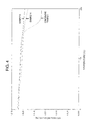
Fig. 4 shows evaluation results of heat
resistance of the cured products obtained in Examples
14 and 16 and Comparative Example 1. The ordinate axis
and transverse axis therein indicate dynamic storage
elastic modulus and temperature, respectively.
Best Mode for Carrying Out the Invention
Hereinafter, the best mode for carrying out
the present invention is described, and "part" and "%"
are based on weight, unless otherwise noted.
As mentioned above, the epoxy group-containing
silicon compound of the present invention is obtained
by condensing at least one epoxy group-containing
alkoxy silicon compound per se represented by the
general formula (1a): R
1aSi(OR
2)
3 ,wherein R
1a denotes a
substituent having an epoxy group and R
2 denotes an
alkyl group having at most 4 carbons, in the presence
of a basic catalyst, or by condensing at least one
epoxy group-containing alkoxy silicon compound
represented by the general formula (1a):
As the epoxy group-containing substituent, R1a
in the epoxy group-containing alkoxy silicon compound
of the formula (1a) used in the present invention,
there is no particular limitation so long as it is a
substituent having an epoxy group, and there are cited
glycidoxyalkyl groups of at most 4 carbons having
oxyglycidyl group such as β-glycidoxyethyl, γ-glycidoxypropyl,
and γ-glycidoxybutyl; glycidyl; alkyl
groups substituted with cycloalkyl group of 5-8 carbons
having oxirane group such as β-(3,4-epoxycyclohexyl)ethyl,
γ-(3,4-epoxycyclohexyl)propyl,
β-(3,4-epoxycycloheptyl)ethyl, β-(3,4-epoxycyclohexyl)propyl,
β-(3,4-epoxycyclohexyl)butyl,
and β-(3,4-epoxycyclohexyl)pentyl; and the like. Above
all, preferable are glycidoxyalkyl groups wherein
oxyglycidyl group is bonded to alkyl group of 1-3
carbons, and alkyl groups of at most 3 carbons
substituted with cycloalkyl group of 5-8 carbons having
oxirane group, for example, β-glycidoxyethyl,
γ-glycidoxypropyl, β-(3,4-epoxycyclohexyl)ethyl, and
the like.
Furthermore, as examples of R2 in the epoxy
group-containing alkoxy silicon compound of the formula
(1a), there are cited alkyl groups of at most 4 carbons
such as methyl, ethyl, n-propyl, i-propyl, n-butyl,
i-butyl, and tert-butyl. Most preferably R2 is methyl
or ethyl from the viewpoint of reaction conditions such
as compatibility, reactivity, and reaction yield.
As preferable specific examples of the
compound of the formula (1a) having these substituents
R
1a and R
2 which can be used, there are cited
As examples of R1b in the substituted alkoxy
silicon compound of the formula (1b) used in the
present invention, there are cited an alkyl group
having at most 10 carbons such as methyl, ethyl, propyl,
butyl, pentyl, hexyl, heptyl, octyl, nonyl, or decanyl;
an aryl group; and an unsaturated aliphatic residue
such as methacryloyl group or acryloyl group.
Preferably R1b is an alkyl group having at most 6
carbons or an aryl group.
Furthermore, as examples of R3 in the
substituted alkoxy silicon compound of the formula (1b),
there are cited alkyl groups having at most 4 carbons
such as methyl, ethyl, n-propyl, i-propyl, n-butyl, i-butyl,
and tert-butyl. Most preferably R3 is methyl or
ethyl from the viewpoint of reaction conditions such as
compatibility, reactivity, and reaction yield.
As preferable specific examples of the
compound of the formula (1b) having these substituents
R1b and R3 which can be used, there are cited
alkyltrialkoxysilanes such as methyltrimethoxysilane,
methyltriethoxysilane, methyltripropoxysilane,
methyltributoxysilane, ethyltrimethoxysilane,
ethyltriethoxysilane, iobutyltrimethoxysilane,
iobutyltriethoxysilane, n-propyltrimethoxysilane,
n-propyltriethoxysilane, isopropyltrimethoxysilane,
isopropyltriethoxysilane, decyltrimethoxysilane, and
decyltriethoxysilane; and aryltrialkoxysilanes such as
phenyltrimethoxysilane and phenyltriethoxysilane; and
the like.
When among compounds of the formula (1b),
compounds having the preferable substituents as
mentioned above as R1b (or a combination of R1b and R3)
are used, improvements are found in the points of
compatibility with other components in the
thermosetting composition of the present invention to
be hereinafter described and physical properties of the
cured product of the composition.
When the epoxy group-containing alkoxy silicon
compound of the formula (1a) and the substituted alkoxy
silicon compound of the formula (1b) are used together
in order to obtain the epoxy group-containing silicon
compound of the present invention, it is possible to
appropriately determine the proportion of the compound
of the formula (1b) used in accordance with the desired
physical properties of the cured product. That is, it
is possible to use the compound of the formula (1b) in
a proportion of usually not more than 95 mole %,
preferably not more than 90 mole % based on the total
moles of the compound of the formula (1a) and the
compound of the formula (1b). When the proportion of
the compound of the formula (1b) used is larger, heat
resistance of the cured product tends to decrease.
Therefore, when the cured product having high heat
resistance is desired, the compound of the formula (1b)
is used in a proportion of not more than 75 mole %,
preferably about 70-5 mole % based on the total moles
of the compound of the formula (1a) and the compound of
the formula (1b). However on the other hand, when the
proportion of the compound of the formula (1b) used is
larger, there is the advantage that improvement is
found in tackiness (stickiness degree) of the cured
product. Furthermore, in this case, refractive index
is higher, and it is possible to design cured products
different in refractive index to desired extent, and
hence they can be used for, for example, optical
waveguide and the like.
The epoxy group-containing silicon compound of
the present invention can be obtained by the
condensation reaction in which the epoxy group-containing
alkoxy silicon compound of the formula (1a)
is used as an essential component, that is, can be
obtained by condensing the compound (one kind or plural
kinds) of the formula (1a) per se, or as necessary, the
compound (one kind or plural kinds) of the formula (1a)
and the substituted alkoxy silicon compound (one kind
or plural kinds) of the formula (1b) in the presence of
a basic catalyst. Furthermore, in order to accelerate
condensation, water can be added as necessary. The
amount of water added is usually 0.05-1.5 moles,
preferably 0.07-1.2 moles based on 1 mole of alkoxy
group of the entire reaction mixture. In addition,
more preferably in the present invention, the compound
(one kind or plural kinds) of the formula (1a) per se
is condensed.
The catalyst used in the above-mentioned
condensation reaction is not particularly limited, so
long as it is basic, and it is possible to use an
inorganic base such as an alkali metal hydroxide such
as sodium hydroxide, potassium hydroxide, lithium
hydroxide, or cesium hydroxide; an alkali metal
carbonate such as sodium carbonate, potassium carbonate,
sodium hydrogen carbonate, or potassium hydrogen
carbonate; or the like; or an organic base such as
ammonia, triethylamine, diethylenetriamine,
n-butylamine, dimethylaminoethanol, triethanolamine,
tetramethylammonium hydroxide, or the like. Among them,
an inorganic base or ammonia is preferable particularly
in the point that catalyst removal from the product is
easy. The amount of catalyst added can be usually 5x10⁻⁴
- 7.5 %, preferably 1x10⁻³ - 5 % based on the total
weight of the epoxy group-containing alkoxy silicon
compound of the formula (1a) and the substituted alkoxy
silicon compound of the formula (1b). When an alkali
metal hydroxide or an alkali metal carbonate is used as
a catalyst, the amount is preferably about 0.01-0.1 %.
The above-mentioned condensation reaction can
be carried out in a solvent or in no solvent. The
solvent is not particularly limited, so long as it
dissolves the epoxy group-containing alkoxy silicon
compound of the formula (1a) and the substituted alkoxy
silicon compound of the formula (1b). As such a
solvent, there can be enumerated, for example, an
aprotic polar solvent such as dimethylformamide,
dimethylacetamide, tetrahydofuran, methyl ethyl ketone,
or methyl isobutyl ketone; an aromatic hydrocarbon such
as toluene or xylene; or the like. Among them, an
aprotic polar solvent is preferable. The amount of a
solvent used is not particularly limited so long as it
is in the range where the reaction proceeds smoothly,
but too much amount necessitates long time to be
removed and makes working efficiency bad, and therefore
it is used usually in about 80-150 parts based on 100
parts of the total weight of the compounds of the
formula (1a) and the formula (1b).
The reaction is carried out by mixing the
compound of the formula (1a) and if necessary the
compound of the formula (1b) and a solvent, and heating
the mixture to 40-140°C, and then adding a basic
catalyst. In addition, the total amount of the basic
catalyst may be added before heating. Furthermore, the
basic catalyst can be added as a solid or an aqueous
solution of about 0.05-0.3 %, but preferably the
aqueous solution is gradually dropped in order to
prevent excess proceeding of the reaction. After
completion of the dropping, the reaction is continued
for 1-12 hours at 40-140°C, while removing alcohols
produced by the reaction. In addition, it is possible
to continue the reaction without removing the alcohols.
After completion of the reaction, the product is washed
until the used wash becomes neutral. In addition, when
a solvent is used, the solvent is removed after washing
under reduced pressure.
The weight average molecular weight of the
epoxy group-containing silicon compound of the present
invention thus obtained is preferably 400-50,000, more
preferably 750-30,000, further preferably 1,200-10,000,
particularly preferably about 2,000-7,000. When the
weight average molecular weight is less than 400,
improvement effect in heat resistance is lean. On the
other hand, when it is larger than 50,000,
deterioration of physical properties as the
corresponding thermosetting composition such as descent
of compatibility with other components and ascent of
viscosity is caused, which is not preferable.
The epoxy group-containing silicon compound of
the present invention is provided for various uses, and
usually used as a thermosetting resin composition in
combination with a curing agent. Furthermore, in
applying the present silicon compound to various uses,
it can be used together with various epoxy resins other
than the epoxy group-containing silicon compound of the
present invention in accordance with uses.
As a curing agent, usually, there can be used
without particular limitation amine type compounds,
amide type compounds, acid anhydride type compounds,
phenol type compounds, imidazoles, Lewis acids, and the
like which have been used as a curing agent for an
epoxy resin. Specifically, there are cited amine type
compounds such as diaminodiphenylmethane,
diethylenetriamine, triethylenetetramine,
diaminodiphenylsulfone, isophorone diamine,
dimethylbenzylamine, tetraethylenepentamine, ketimine
compounds, and guanidine derivatives; amide type
compounds such as dicyandiamide, and polyamide resin
synthesized from dimmer of linolenic acid and ethylene
diamine; acid anhydride type compounds such as phthalic
anhydride, trimellitic anhydride, pyromellitic
anhydride, maleic anhydride, tetrahydrophthalic
anhydride, methyltetrahydrophthalic anhydride,
methylnadic anhydride, hexahydrophthalic anhydride, and
methylhexahydrophthalic anhydride; phenol type
compounds such as bisphenols, polycondensates of
phenols (phenol, alkyl-substituted phenol, naphthol,
alkyl-substituted naphthol, dihydroxybenzene,
dihydroxynaphthalene, and the like) and various
aldehydes, polymerization products of phenols and
various diene compounds, polycondensates of phenols and
aromatic dimethylols, condensates of
bismethoxymethylbiphenyl and naphthols or phenols,
biphenols and the modification products thereof;
imidazoles such as imidazole; Lewis acids such as boron
trifluoride-amine complex; and the like. The amount of
a curing agent used is preferably 0.2-1.5 equivalents,
particularly preferably 0.3-1.2 equivalents based on 1
equivalent of epoxy group in the composition.
Furthermore, a tertiary amine such as
benzyldimethylamine can be used as a curing agent, and
the amount in using it is usually 0.3-20 %, preferably
0.5-10 % based on an epoxy group-containing compound.
The thermosetting resin composition of the
present invention can contain an accelerator if
necessary. As an accelerator there are cited, for
example, imidazoles such as 2-methylimidazole, 2-ethylimidazole,
and 2-ethyl-4-methylimidazole; tertiary
amines such as
2-(dimethylaminomethyl)phenol, and 1,8-diaza-bicyclo(5,4,0)undecene-7;
phosphines such as
triphenylphosphine; metal compounds such as tin
octanoate; quaternary phosphonium salts; and the like.
An accelerator is used as necessary in an amount of
0.01-15 parts based on 100 parts of an epoxy group-containing
compound in the composition.
When the epoxy group-containing silicon
compound of the present invention is used together with
the other epoxy resins in the thermosetting resin
composition of the present invention, the proportion of
the epoxy group-containing silicon compound of the
present invention in all epoxy group-containing
compounds is preferably at least 10 %. The other epoxy
resins which can be used, are not particularly limited,
so long as they are epoxy resins which are usually used
for electrical and electronic parts, and can be
obtained usually by glycidylating a compound having two
or more phenolic hydroxyl groups. As specific examples
of usable epoxy resins, there are cited glycidylation
products of bisphenols such as tetrabromobisphenol A,
tetrabromobisphenol F, bisphenol A,
tetramethylbisphenol F, bisphenol F, bisphenol S, and
bisphenol K; or biphenols such as biphenol and
tetramethylbiphenol; or hydroquinones such as
hydroquinone, methylhydroquinone, dimethylhydroquinone,
trimethylhydroquinone, di-tertiary butylhydroquinone;
or resorcinols such as resorcinol, and
methylresorcinol; or catechols such as catechol, and
methylcatechol; or dihydroxynaphthalenes such as
dihydroxynaphthalene, dihydroxymethylnaphthalene, and
dihydroxydimethylnaphthalene; and glycidylation
products of condensates between phenols or naphthols
and aldehydes, or condensates between phenols or
naphthols and xylylene glycol, or condensates between
phenols and isopropenylacetophenone, or reaction
products between phenols and dicyclopentadiene, or
condensates between bismethoxymethylbiphenyl and
naphthols or phenols; and the like. These are
commercially available or can be obtained by known
methods. These may be used alone or in a combination
of two or more kinds.
Furthermore, to the thermosetting resin
composition of the present invention there can be added
various formulating ingredients such as filler of
silica, alumina, glass fiber, talc or the like; mold
releasing agent, pigment, surface treatment, viscosity
modifier, plasticizer, stabilizer, and coupling agent
as necessary.
Moreover, the thermosetting resin composition
of the present invention can be used as a varnish by
containing an organic solvent. As an organic solvent,
there is no particular limitation so long as it
dissolves each component of the composition, and there
are cited, for example, toluene, xylene, acetone,
methyl ethyl ketone, methyl isobutyl ketone,
dimethylformamide, and the like. The cured product of
the present invention may be obtained by impregnating
the varnish dissolved in such an organic solvent into a
base material such as glass fibers, carbon fibers,
polyester fibers, polyamide fibers, alumina fibers, or
paper, drying under heating to get a prepreg, and
molding the prepreg by hot-pressing.
An organic solvent can be used in such an
amount that the proportion of the organic solvent in
the thermosetting resin composition can be usually 10-70
%, preferably 15-65 %.
The thermosetting resin composition of the
present invention can be obtained by mixing each
component uniformly. The thermosetting resin
composition of the present invention can be easily
changed into its cured product by a method similar to
those which have been heretofore known. For example,
an epoxy group-containing compound and a curing agent,
and optionally an accelerator and other formulating
ingredients as necessary are sufficiently blended until
they become uniform by use of an extruder, a kneader, a
roll or the like to obtain an epoxy resin composition.
Thereafter, the epoxy resin composition can be molten
and then casted or molded by use of a transfer molding
machine, and furthermore can be heated for 2-10 hours
at 80-200°C to obtain the cured product.
<Examples 1-13 and Comparative Example 1>
The present invention is specifically
described by way of working examples, but the present
invention is not limited by them.
Physical property values in the working
examples were measured by the following methods.
Example 1
94.4 parts of γ-glycidoxypropyltrimethoxysilane
and 94.4 parts of
methyl isobutyl ketone were charged in a reaction
vessel and heated to 80°C. After heating, 21.6 parts of
0.1 % potassium hydroxide aqueous solution was
continuously dropped in 30 minutes. After completion
of dropping, reaction was continued for 5 hours at 80°C
while removing the resulting methanol. After
completion of the reaction, washing was repeated until
the used wash becomes neutral. Then the solvent was
removed under reduced pressure to obtain 67 parts of
the epoxy group-containing silicon compound (A) of the
present invention. The epoxy equivalent of the
resultant compound was 166 g/eq., and the weight
average molecular weight thereof was 3700. From 1H-NMR
(CDCl3 solution) of the present epoxy compound (A), it
could be confirmed that epoxy ring is retained due to
the methine peak (in the vicinity of 3.2 ppm) of epoxy
ring and that the peak (in the vicinity of 3.6 ppm) of
methoxy group has disappeared. Furthermore, gelation
was not observed even after elapse of one month at room
temperature.
Example 2
7.5 parts of the epoxy group-containing
silicon compound (A) obtained in Example 1, 7.5 parts
of bisphenol A type epoxy resin (epoxy equivalent: 186
g/eq., Epikote 828 manufactured by Japan Epoxy Resin
K.K.), and 4.1 parts of diaminodiphenylmethane were
uniformly mixed to prepare the thermosetting resin
composition of the present invention. The composition
prepared was poured into an aluminium cup and heated at
60°C, 100°C, 150°C, and 190°C successively for each 4
hours to obtain a cured product. Defects such as voids
were not found in the resultant cured product.
Example 3
100 parts of
β-(3,4epoxycyclohexyl)ethyltrimethoxysilane and 100
parts of methyl isobutyl ketone were charged in a
reaction vessel and heated to 80°C. After heating, 21.6
parts of 0.1 % potassium hydroxide aqueous solution was
continuously dropped in 30 minutes. After completion
of dropping, reaction was continued for 5 hours at 80°C
while removing the resulting methanol. After
completion of the reaction, washing was repeated until
the used wash becomes neutral. Then the solvent was
removed under reduced pressure to obtain 72 parts of
the epoxy group-containing silicon compound (B) of the
present invention. The epoxy equivalent of the
resultant compound was 179 g/eq., and the weight
average molecular weight thereof was 5600. From 1H-NMR
(CDCl3 solution) of the present epoxy compound (B), it
could be confirmed that epoxy ring is retained due to
the methine peak (in the vicinity of 3.2 ppm) of epoxy
ring and that the peak (in the vicinity of 3.6 ppm) of
methoxy group has disappeared. Furthermore, gelation
was not observed even after elapse of one month at room
temperature.
Example 4
7.5 parts of the epoxy group-containing
silicon compound (B) obtained in Example 3, 7.5 parts
of bisphenol A type epoxy resin (epoxy equivalent: 186
g/eq., Epikote 828 manufactured by Japan Epoxy Resin
K.K.), and 4.0 parts of diaminodiphenylmethane were
uniformly mixed to prepare the thermosetting resin
composition of the present invention. The composition
prepared was cured in the similar way to Example 2 to
obtain a cured product. Defects such as voids were not
found in the resultant cured product.
Example 5
67 parts of the epoxy group-containing silicon
compound (C) of the present invention was obtained
similarly to Example 1 except that 21.6 parts of 0.1 %
potassium hydroxide aqueous solution was changed to
10.8 parts of 0.1 % sodium hydroxide aqueous solution
in Example 1. The epoxy equivalent of the resultant
compound was 169 g/eq., and the weight average
molecular weight thereof was 3100. From 1H-NMR (CDCl3
solution) of the present epoxy compound (C), it could
be confirmed that epoxy ring is retained due to the
methine peak (in the vicinity of 3.2 ppm) of epoxy ring
and that the peak (in the vicinity of 3.6 ppm) of
methoxy group has disappeared. Furthermore, gelation
was not observed even after elapse of one month at room
temperature.
Example 6
10.0 parts of the epoxy group-containing
silicon compound (C) obtained in Example 5, 5.5 parts
of bisphenol A type epoxy resin (epoxy equivalent: 186
g/eq., Epikote 828 manufactured by Japan Epoxy Resin
K.K.), and 4.4 parts of diaminodiphenylmethane were
uniformly mixed to prepare the thermosetting resin
composition of the present invention. The composition
prepared was cured in the similar way to Example 2 to
obtain a cured product. Defects such as voids were not
found in the resultant cured product.
Example 7
85 parts of γ-glycidoxypropyltrimethoxysilane,
7.9 parts of phenyltrimethoxysilane, and 92.9 parts of
methyl isobutyl ketone were charged in a reaction
vessel and heated to 80°C. After heating, 10.8 parts of
0.1 % potassium hydroxide aqueous solution was
continuously dropped in 30 minutes. After completion
of dropping, reaction was continued for 5 hours at 80°C
while removing the resulting methanol. After
completion of the reaction, washing was repeated until
the used wash becomes neutral. Then the solvent was
removed under reduced pressure to obtain 65 parts of
the epoxy group-containing silicon compound (D) of the
present invention. The epoxy equivalent of the
resultant compound was 184 g/eq., and the weight
average molecular weight thereof was 2900. From 1H-NMR
(CDCl3 solution) of the present epoxy compound (D), it
could be confirmed that epoxy ring is retained due to
the methine peak (in the vicinity of 3.2 ppm) of epoxy
ring and that the peak (in the vicinity of 3.6 ppm) of
methoxy group has disappeared. Furthermore, gelation
was not observed even after elapse of one month at room
temperature.
Example 8
10.0 parts of the epoxy group-containing
silicon compound (D) obtained in Example 7, 5.5 parts
of bisphenol A type epoxy resin (epoxy equivalent: 186
g/eq., Epikote 828 manufactured by Japan Epoxy Resin
K.K.), and 4.2 parts of diaminodiphenylmethane were
uniformly mixed to prepare the thermosetting resin
composition of the present invention. The composition
prepared was cured in the similar way to Example 2 to
obtain a cured product. Defects such as voids were not
found in the resultant cured product.
Example 9
66 parts of the epoxy group-containing silicon
compound (E) of the present invention was obtained
similarly to Example 1 except that 21.6 parts of 0.1 %
potassium hydroxide aqueous solution was changed to
11.5 parts of 0.5 % potassium carbonate aqueous
solution in Example 1. The epoxy equivalent of the
resultant compound was 173 g/eq., and the weight
average molecular weight thereof was 3200. From 1H-NMR
(CDCl3 solution) of the present epoxy compound (E), it
could be confirmed that epoxy ring is retained due to
the methine peak (in the vicinity of 3.2 ppm) of epoxy
ring and that the peak (in the vicinity of 3.6 ppm) of
methoxy group has disappeared. Furthermore, gelation
was not observed even after elapse of one month at room
temperature.
Example 10
10.5 parts of the epoxy group-containing
silicon compound (E) obtained in Example 9, 6.0 parts
of bisphenol A type epoxy resin (epoxy equivalent: 186
g/eq., Epikote 828 manufactured by Japan Epoxy Resin
K.K.), and 4.6 parts of diaminodiphenylmethane were
uniformly mixed to prepare the thermosetting resin
composition of the present invention. The composition
prepared was cured in the similar way to Example 2 to
obtain a cured product. Defects such as voids were not
found in the resultant cured product.
Example 11
67 parts of the epoxy group-containing silicon
compound (F) of the present invention was obtained
similarly to Example 1 except that 21.6 parts of 0.1 %
potassium hydroxide aqueous solution was changed to
11.5 parts of 0.5 % sodium carbonate aqueous solution
in Example 1. The epoxy equivalent of the resultant
compound was 168 g/eq., and the weight average
molecular weight thereof was 3400. From 1H-NMR (CDCl3
solution) of the present epoxy compound (F), it could
be confirmed that epoxy ring is retained due to the
methine peak (in the vicinity of 3.2 ppm) of epoxy ring
and that the peak (in the vicinity of 3.6 ppm) of
methoxy group has disappeared. Furthermore, gelation
was not observed even after elapse of one month at room
temperature.
Example 12
10.6 parts of the epoxy group-containing
silicon compound (F) obtained in Example 11, 6.0 parts
of bisphenol A type epoxy resin (epoxy equivalent: 186
g/eq., Epikote 828 manufactured by Japan Epoxy Resin
K.K.), and 4.7 parts of diaminodiphenylmethane were
uniformly mixed to prepare the thermosetting resin
composition of the present invention. The composition
prepared was cured in the similar way to Example 2 to
obtain a cured product. Defects such as voids were not
found in the resultant cured product.
Example 13
33.1 parts of γ-glycidoxypropyltrimethoxysilane,
55.5 parts of
phenyltrimethoxysilane, and 88.6 parts of methyl
isobutyl ketone were charged in a reaction vessel and
heated to 80°C. After heating, 11.4 parts of 0.1 %
potassium hydroxide aqueous solution was continuously
dropped in 30 minutes. After completion of dropping,
reaction was continued for 5 hours at 80°C. After
completion of the reaction, washing was repeated until
the used wash becomes neutral. Then the solvent was
removed under reduced pressure to obtain 60.3 parts of
the epoxy group-containing silicon compound (G) of the
present invention. The epoxy equivalent of the
resultant compound was 436 g/eq., and the weight
average molecular weight thereof was 3400. From 1H-NMR
(CDCl3 solution) of the present epoxy compound (G), it
could be confirmed that epoxy ring is retained due to
the methine peak (in the vicinity of 3.2 ppm) of epoxy
ring and that the peak (in the vicinity of 3.6 ppm) of
methoxy group has disappeared. Furthermore, gelation
was not observed even after elapse of one month at room
temperature.
Example 14
10 parts of the epoxy group-containing silicon
compound (G) obtained in Example 13, 2.5 parts of
bisphenol A type epoxy resin (epoxy equivalent: 186
g/eq., Epikote 828 manufactured by Japan Epoxy Resin
K.K.), and 3.6 parts of diaminodiphenylmethane were
uniformly mixed to prepare the thermosetting resin
composition of the present invention. The composition
prepared was cured in the similar way to Example 2 to
obtain a cured product. Defects such as voids were not
found in the resultant cured product.
Example 15
41.4 parts of γ-glycidoxypropyltrimethoxysilane,
67.8 parts of β-(3,4epoxycyclohexyl)ethyltrimethoxysilane,
and 54.6
parts of methyl isobutyl ketone were charged in a
reaction vessel and heated to 80°C. After heating, 14.2
parts of 0.1 % potassium hydroxide aqueous solution was
continuously dropped in 30 minutes. After completion
of dropping, reaction was continued for 5 hours at 80°C.
After completion of the reaction, washing was repeated
until the used wash becomes neutral. Then the solvent
was removed under reduced pressure to obtain 78.2 parts
of the epoxy group-containing silicon compound (H) of
the present invention. The epoxy equivalent of the
resultant compound was 177 g/eq., and the weight
average molecular weight thereof was 4200. From 1H-NMR
(CDCl3 solution) of the present epoxy compound (H), it
could be confirmed that epoxy ring is retained due to
the methine peak (in the vicinity of 3.2 ppm) of epoxy
ring and that the peak (in the vicinity of 3.6 ppm) of
methoxy group has disappeared. Furthermore, gelation
was not observed even after elapse of one month at room
temperature.
Example 16
10 parts of the epoxy group-containing silicon
compound (H) obtained in Example 15, 5.7 parts of
bisphenol A type epoxy resin (epoxy equivalent: 186
g/eq., Epikote 828 manufactured by Japan Epoxy Resin
K.K.), and 4.3 parts of diaminodiphenylmethane were
uniformly mixed to prepare the thermosetting resin
composition of the present invention. The composition
prepared was cured in the similar way to Example 2 to
obtain a cured product. Defects such as voids were not
found in the resultant cured product.
Example 17
25 parts of γ-glycidoxypropyltrimethoxysilane,
75 parts of phenyltrimethoxysilane, and 100 parts of
methyl isobutyl ketone were charged in a reaction
vessel and heated to 80°C. After heating, 13.1 parts of
0.1 % potassium hydroxide aqueous solution was
continuously dropped in 30 minutes. After completion
of dropping, reaction was continued for 5 hours at 80°C
while removing the resulting methanol. After
completion of the reaction, washing was repeated until
the used wash becomes neutral. Then the solvent was
removed under reduced pressure to obtain 69 parts of
the epoxy group-containing silicon compound (I) of the
present invention. The epoxy equivalent of the
resultant compound was 626 g/eq., and the weight
average molecular weight thereof was 2400. From 1H-NMR
(CDCl3 solution) of the present epoxy compound (I), it
could be confirmed that epoxy ring is retained due to
the methine peak (in the vicinity of 3.2 ppm) of epoxy
ring and that the peak (in the vicinity of 3.6 ppm) of
methoxy group has disappeared. Furthermore, gelation
was not observed even after elapse of one month at room
temperature.
Comparative Example 1
15 parts of bisphenol A type epoxy resin
(epoxy equivalent: 186 g/eq., Epikote 828 manufactured
by Japan Epoxy Resin K.K.), and 4.0 parts of
diaminodiphenylmethane were uniformly mixed to prepare
a thermosetting resin composition. The composition
prepared was cured in the similar way to Example 2 to
obtain a cured product.
[Heat resistance evaluation]
The cured products obtained in Examples 2, 4,
6, 8, 10, 12, 14, 16 and Comparative Example 1 were
shaped in a size of 4 mm width, 3 mm thickness, and 40
mm length, and dynamic storage elastic modulus was
measured by use of a dynamic viscoelasticity measuring
apparatus (DMA 2980 manufactured by TA Instruments
Corporation, measurement conditions: amplitude 15 µm,
frequency 10 Hz, and rate of temperature rise 2°C/min.)
to evaluate heat resistance. Measurement results are
shown in Fig. 1-4.
From Fig. 1-4, in Comparative Example 1 large
decrease in elastic modulus is found in accordance with
rising of temperature. On the other hand, in Examples
2, 4, 6, 8, 10, 12, 14, and 16 it is found that
decrease of elastic modulus is low, elastic modulus at
high temperature is high, and heat resistance is
excellent. That is, as temperature passes 150°C, in the
cured product of the Comparative Example elastic
modulus decreases rapidly but in the cured products of
the Examples the initial values are almost retained.
This fact means that the cured product of the present
invention exhibits no glass transition point and is
excellent in heat resistance.
Industrial Usability
By using the thermosetting resin composition
containing the epoxy group-containing silicon compound
of the present invention, remarkable improvement is
found in elastic modulus at high temperature, and the
cured product excellent in heat resistance can be
obtained. The thermosetting resin composition of the
present invention can be used as various insulating
materials for electrical and electronic parts, printed
wiring boards, laminated sheets such as high
functionally copper-clad laminate, semiconductor
encapsulating materials, various composite materials
such as FRP (fiber-reinforced plastic), paints,
adhesives, and coating agents. It provides the cured
product excellent particularly in heat resistance, and
hence has recently been extremely useful as a
thermosetting resin composition which can apply to the
lead-free solder in use.