EP1589732B1 - Klappbares zellulares Telefon - Google Patents
Klappbares zellulares Telefon Download PDFInfo
- Publication number
- EP1589732B1 EP1589732B1 EP05008077A EP05008077A EP1589732B1 EP 1589732 B1 EP1589732 B1 EP 1589732B1 EP 05008077 A EP05008077 A EP 05008077A EP 05008077 A EP05008077 A EP 05008077A EP 1589732 B1 EP1589732 B1 EP 1589732B1
- Authority
- EP
- European Patent Office
- Prior art keywords
- controller
- microphone
- speaker
- housings
- cellular phone
- Prior art date
- Legal status (The legal status is an assumption and is not a legal conclusion. Google has not performed a legal analysis and makes no representation as to the accuracy of the status listed.)
- Expired - Lifetime
Links
Images
Classifications
-
- H—ELECTRICITY
- H04—ELECTRIC COMMUNICATION TECHNIQUE
- H04M—TELEPHONIC COMMUNICATION
- H04M1/00—Substation equipment, e.g. for use by subscribers
- H04M1/60—Substation equipment, e.g. for use by subscribers including speech amplifiers
- H04M1/6008—Substation equipment, e.g. for use by subscribers including speech amplifiers in the transmitter circuit
-
- H—ELECTRICITY
- H04—ELECTRIC COMMUNICATION TECHNIQUE
- H04M—TELEPHONIC COMMUNICATION
- H04M1/00—Substation equipment, e.g. for use by subscribers
- H04M1/02—Constructional features of telephone sets
- H04M1/0202—Portable telephone sets, e.g. cordless phones, mobile phones or bar type handsets
- H04M1/0206—Portable telephones comprising a plurality of mechanically joined movable body parts, e.g. hinged housings
- H04M1/0241—Portable telephones comprising a plurality of mechanically joined movable body parts, e.g. hinged housings using relative motion of the body parts to change the operational status of the telephone set, e.g. switching on/off, answering incoming call
- H04M1/0245—Portable telephones comprising a plurality of mechanically joined movable body parts, e.g. hinged housings using relative motion of the body parts to change the operational status of the telephone set, e.g. switching on/off, answering incoming call using open/close detection
-
- H—ELECTRICITY
- H04—ELECTRIC COMMUNICATION TECHNIQUE
- H04M—TELEPHONIC COMMUNICATION
- H04M1/00—Substation equipment, e.g. for use by subscribers
- H04M1/60—Substation equipment, e.g. for use by subscribers including speech amplifiers
- H04M1/6016—Substation equipment, e.g. for use by subscribers including speech amplifiers in the receiver circuit
-
- H—ELECTRICITY
- H04—ELECTRIC COMMUNICATION TECHNIQUE
- H04M—TELEPHONIC COMMUNICATION
- H04M1/00—Substation equipment, e.g. for use by subscribers
- H04M1/60—Substation equipment, e.g. for use by subscribers including speech amplifiers
- H04M1/6033—Substation equipment, e.g. for use by subscribers including speech amplifiers for providing handsfree use or a loudspeaker mode in telephone sets
- H04M1/6041—Portable telephones adapted for handsfree use
- H04M1/605—Portable telephones adapted for handsfree use involving control of the receiver volume to provide a dual operational mode at close or far distance from the user
-
- H—ELECTRICITY
- H04—ELECTRIC COMMUNICATION TECHNIQUE
- H04M—TELEPHONIC COMMUNICATION
- H04M1/00—Substation equipment, e.g. for use by subscribers
- H04M1/02—Constructional features of telephone sets
- H04M1/0202—Portable telephone sets, e.g. cordless phones, mobile phones or bar type handsets
- H04M1/0206—Portable telephones comprising a plurality of mechanically joined movable body parts, e.g. hinged housings
- H04M1/0208—Portable telephones comprising a plurality of mechanically joined movable body parts, e.g. hinged housings characterized by the relative motions of the body parts
- H04M1/0214—Foldable telephones, i.e. with body parts pivoting to an open position around an axis parallel to the plane they define in closed position
Definitions
- the present invention relates to a folding cellular phone.
- Voice communication is essential to users of cellular phones. With the widespread use of cellular phones, their potential and applicability are increasingly broadened. Besides, there have been proposed cellular phones in a variety of styles, which offer various modes available according to the needs or preferences of users due to competition in the cellular phone market.
- the document GB 2 381 989 A describes a foldable portable phone which can be used either in folded or in opened configuration. Therefore, a microphone with two different voice inlets and two loudspeakers (an internal and an external one) are provided. By means of a sensor it is detected whether the phone is in the folded or in the opened configuration, and based on this sensor information the gain of the microphone as well as the gain of an output amplifier is adapted, in order to provide folded and hands-free call operation.
- the document US 5,818,924 describes a combined mechanical keypad/graphical user interface for a personal intelligent communicator comprising a protecting cover, a microphone and a speaker.
- the mechanical keypad can be used for dialling telephone numbers and the microphone and speaker are used in a common telephone manner. If, however, the cover is opened the mechanical keypad is deactivated and the graphical interface can be used instead of this. The microphone and speaker are then used in speaker phone operation, in order to provide hands-free operation.
- a folding cellular phone having a first housing and a second housing that is foldably or hingedly connected to the first housing, the folding cellular phone comprises: a microphone mounted on the second housing; a variable amplifier for amplifying audio signals output from the microphone to modulate the volume; a detector for outputting a detection signal indicating whether or not the first and second housings are in closed (folded) positions; and a controller for controlling the gain or amplification of the variable amplifier based on the detection signal output from the detector.
- the gain of the variable amplifier is controlled based on whether or not the first and second housings are in their closed positions. Consequently, the gain of the variable amplifier can be changed depending on whether the folding cellular phone is folded or unfolded. Thus, it is possible to properly control the output or sensitivity of a microphone.
- the controller sets the gain of the variable amplifier higher than that when the detection signal does not indicate that the first and second housings are in closed positions.
- the output or sensitivity of the microphone can be increased when the first and second housings are in their folded positions as compared to when the first and second housings are in their unfolded positions.
- the microphone can pick up sounds and voices well.
- the first housing has a notch in a position opposite to the microphone when the first and second housings are in closed positions.
- the microphone can pick up sounds and voices well even when the first and second housings are in closed positions.
- the folding cellular phone further comprises an input section by which a user provides input indicating a call start instruction, wherein, when the call start instruction is input through the input section, the controller determines that a call exists and changes the gain of the variable amplifier based on the detection signal output from the detector.
- the gain of the variable amplifier is changed only when the microphone is in use. Therefore, it is avoided to perform the operation for changing the gain of the variable amplifier, which is hardly necessary if the microphone is not in use.
- the first housing includes thereon a first speaker and a second speaker that is arranged closer to the second housing than the first speaker when the first and second housings are in their open or spread positions, wherein, when the detection signal output from the detector indicates that the first and second housings are in closed positions, the controller activates the second speaker and deactivates the first speaker, while when the detection signal output from the detector does not indicate that the first and second housings are in closed positions, the controller activates the first speaker and deactivates the second speaker.
- the output levels (sensitivity) of the speaker and microphone actually utilized are changed according to the open/ close operation of the first and second housings.
- the output levels of the speaker and microphone can be set so as to suit for the positions of the first and second housings.
- the folding cellular phone further comprises a received sound variable amplifier for amplifying audio signals received from the other party to modulate the volume and a loudspeaker for outputting sound or voice corresponding to the audio signals amplified by the received sound variable amplifier, wherein, when the detection signal output from the detector indicates that the first and second housings are in closed positions, the controller sets the gain of the received sound variable amplifier higher than that when the detection signal does not indicate that the first and second housings are in closed positions.
- the volume of the loudspeaker can be controlled properly according to the open/ close operation of the first and second housings.
- the folding cellular phone further comprises a switch by which a user provides input indicating designation information for designating a conversation through either one of the first and second speakers and the microphone, or a conversation through the loudspeaker and the microphone, wherein, when the designation information for designating a conversation through either one of the first and second speakers and the microphone is input through the switch, the controller activates the first or second speaker and the microphone as well as deactivating the loudspeaker, while when the designation information for designating a conversation through the loudspeaker and the microphone is input through the switch, the controller activates the loudspeaker and the microphone as well as deactivating the first and second speakers.
- a switch by which a user provides input indicating designation information for designating a conversation through either one of the first and second speakers and the microphone, or a conversation through the loudspeaker and the microphone, wherein, when the designation information for designating a conversation through either one of the first and second speakers and the microphone is input through the switch, the controller activates the first or second speaker and the microphone as well as
- the user can select either one of the first and second speakers, or the loudspeaker for use.
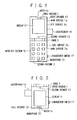
- Fig. 1 is a diagram showing the plan view of a folding cellular phone in open (spread) position according to an embodiment of the present invention.
- the folding cellular phone comprises a first housing 1, a second housing 2 and a hinge 3.
- the first and second housings 1 and 2 are rotatable on the hinge 3 as a rotation axis.
- the first housing 1 is also rotatable on an axis perpendicular to the hinge 3 (not shown) as a rotation axis.
- the first housing 1 is provided on its main surface 1a with a display 11, a first speaker 12, and a second speaker 13.
- the second speaker 13 is arranged on the side of the main surface 1a near the second housing 2 when the first and second housings 1 and 2 are in their open (spread) positions, that is, the folding cellular phone is unfolded.
- the first housing 1 is provided on its side surface 1b with a loudspeaker 14, which can slide in and out of the first housing 1. In Fig. 1 , the loudspeaker 14 appeases outside the first housing 1.
- the second housing 2 is provided on its main surface 2a with a microphone 15 and an input key section 16. Further, the second housing 2 is provided on its side surface 2b with a changeover switch 17.
- the first housing 1 has a notch 1c in a position opposite to the microphone 15 when the first and second housings 1 and 2 are in their closed positions, that is, the folding cellular phone is folded.
- Fig. 2 shows the plan view of the folding cellular phone depicted in Fig. 1 in closed (folded) position.
- the folding cellular phone is folded so that the display 11 is exposed while the input key section 16 is hidden inside.
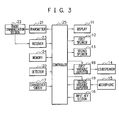
- Fig. 3 is a block diagram showing an example of the construction of the folding cellular phone depicted in Fig. 1 .
- like reference numerals refer to like portions throughout the drawings.
- the folding cellular phone further comprises, as shown in Fig. 3 , a first variable amplifier 18, a second variable amplifier 19, a detector 20, a transmitter 21, a radio communication section 22, a receiver 23, a memory 24, and a controller 25.
- the display 11 displays various types of information under the control of the controller 25.
- the first and second speakers 12 and 13 output the voice of the other party under the control of the controller 25.
- the loudspeaker 14 outputs the voice of the other party or sound at a higher volume compared to that output from the first or second speaker 12 or 13 under the control of the controller 25.
- the microphone 15 inputs the voice of the user, and feeds the second variable amplifier 19 with audio signals corresponding to the voice input therein.
- the second variable amplifier 19 amplifies the audio signals from the microphone 15 to modulate the volume.
- the gain or amplification of the second variable amplifier 19 is controlled by the controller 25.
- the input key section 16 is used by the user to operate the folding cellular phone.
- the user provides via the input key section 16 various types of inputs, such as call start and end instructions (on/ off hook operation).
- the changeover switch 17 is used by the user to select first designation information for designating a conversation through either one of the first and second speakers 12 and 13 and the microphone 15, or second designation information for designating a conversation through the loudspeaker 14 and the microphone 15.
- the first variable amplifier 18 amplifies the audio signals from the controller 25 to modulate the volume, and feeds the loudspeaker 14 with the audio signals thereby amplified.
- the gain or amplification of the first variable amplifier 18 is controlled by the controller 25.
- the detector 20 detects whether the first and second housings 1 and 2 are in their open or closed positions: the folding cellular phone is folded or unfolded. More specifically, the detector 20 sends the controller 25 a detection signal indicating whether the first and second housings 1 and 2 are in open or closed positions.
- the transmitter 21 transmits various types of information through the radio communication section 22 such as an antenna.
- the transmitter 21 transmits, for example, audio signals corresponding to the voice of the user input to the microphone 15 through the radio communication section 22.
- the receiver 23 receives various types of information through the radio communication section 22.
- the receiver 23 receives, for example, audio signals sent from the other party through the radio communication section 22, and feeds the controller 25 with the audio signals.
- the controller 25 supplies the audio signals from the receiver 23 to the first and second speakers 12 and 13, and the loudspeaker 14.
- Each of the first and second speakers 12 and 13, and the loudspeaker 14 outputs the voice or sound corresponding to the audio signals from the controller 25.
- the memory 24 is a machine-readable storage medium.
- the memory 24 stores a program that defines the operation of the folding cellular phone.
- the controller 25 controls the gain or amplification of the second variable amplifier 19 based on the detection signal output from the detector 20. More specifically, the controller 25 sets the gain of the second variable amplifier 19 higher when the detection signal output from the detector 20 indicates that the first and second housings 1 and 2 are in closed positions (see Fig. 2 ) as compared to when it does not (see Fig. 1 ).
- the controller 25 activates the first speaker 12 and deactivates the second speaker 13.
- the controller 25 may supply audio signals fed from the receiver 23 to the first speaker 12 only but not to the second speaker 13.
- the controller 25 also sets the gain of the first variable amplifier 18 higher when the detection signal output from the detector 20 indicates that the first and second housings 1 and 2 are in closed positions as compared to when it does not.
- the controller 25 activates either one of the first and second speakers 12 and 13 and the microphone 15 as well as deactivating the loudspeaker 14.
- the first designation information refers to information for designating a conversation through either one of the first and second speakers 12 and 13 and the microphone 15.
- the controller 25 may supply audio signals fed from the receiver 23 to the loudspeaker 14 only but not to the first speaker 12 and the second speaker 13, and receive the output of the microphone 15 via the second variable amplifier 19.
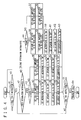
- Fig. 4 is a flowchart showing the operation of the folding cellular phone depicted in Fig. 3 .
- the input key section 16 informs the controller 25 of the call start instruction.
- the input may be provided by the depression of an off-hook key or button (not shown) in the input key section 16.
- the controller 25 is fed with audio signals the receiver 23 has received from the other party.
- the controller 25 determines that a call exists, that is, the user is to have a conversation on the phone.
- the controller 25 When provided with the first designation information from the changeover switch 17 (step 42, Yes), the controller 25 checks a detection signal output from the detector 20. To put it more concretely, the controller 25 checks a detection signal from the detector 20 to determine whether or not the first and second housings 1 and 2 are in their closed positions: whether or not the folding cellular phone is folded (step 43). When provided with the second designation information from the changeover switch 17 (step 42, No), the process proceeds to step 44.
- step 43, Yes If the detection signal output from the detector 20 indicates that the first and second housings 1 and 2 are in closed positions (step 43, Yes), the controller 25 sets the gain of the second variable amplifier 19 to the first level (step 45). If not (step 43, No), the process proceeds to step 46.
- the controller 25 deactivates the first speaker 12 (step 48). In other words, the controller 25 does not supply the first speaker 12 with the audio signals the receiver 23 has received from the other party.
- the controller 25 activates the second speaker 13 (step 49). In other words, the controller 25 supplies the second speaker 13 with the audio signals the receiver 23 has received from the other party.
- controller 25 deactivates the loudspeaker 14 (step 50). In other words, the controller 25 does not supply the loudspeaker 14 with the audio signals the receiver 23 has received from the other party.
- step 48 through 50 when the changeover switch 17 outputs the first designation information and the folding cellular phone is folded (see Fig. 2 ), the voice of the other party is output form the second speaker 13 only but not from the first speaker 12 and the loudspeaker 14. Consequently, the user talks on the folding cellular phone with the second speaker 13 of the phone in closed position, as shown in Fig. 2 , to his/ her ear.
- step 51 the process proceeds to step 51.
- the controller 25 sets the gain of the second variable amplifier 19 to the second level that is lower than the first level (step 46).
- the controller 25 activates the microphone 15 to thereby receive the output of the microphone 15, which has been amplified by the second variable amplifier 19 (step 52).
- the gain of the second variable amplifier 19 is set higher when the detection signal output from the detector 20 indicates that the first and second housings 1 and 2 are in their closed positions as compared to when it does not. That is, when the folding cellular phone is folded and the user cannot hold the microphone 15 close to his/ her mouth, the gain of the second variable amplifier 19, which amplifies the output of the microphone 15, is set higher than that when the folding cellular phone is unfolded. Thus, the microphone 15 can pick up sounds and voices well.
- the controller 25 activates the first speaker 12 (step 53). In other words, the controller 25 supplies the first speaker 12 with the audio signals the receiver 23 has received from the other party.
- the controller 25 deactivates the second speaker 13 (step 54). In other words, the controller 25 does not supply the second speaker 13 with the audio signals the receiver 23 has received from the other party.
- step 55 the controller 25 deactivates the loudspeaker 14 (step 55). In other words, the controller 25 does not supply the loudspeaker 14 with the audio signals the receiver 23 has received from the other party. After the completion of step 55, the process proceeds to step 51.
- the controller 25 When provided with the second designation information from the changeover switch 17 (step 42, No), the controller 25 checks a detection signal output from the detector 20. To put it more concretely, the controller 25 checks a detection signal from the detector 20 to determine whether or not the first and second housings 1 and 2 are in closed positions: whether or not the folding cellular phone is folded (step 44).
- step 44, Yes If the detection signal output from the detector 20 indicates that the first and second housings 1 and 2 are in closed positions (step 44, Yes), the controller 25 sets the gain of the first variable amplifier 18 to the third level (step 56). If not (step 44, No), the controller 25 sets the gain of the first variable amplifier 18 to the fourth level that is lower than the third level (step 57).
- the controller 25 sets the gain of the second variable amplifier 19 to the first level (step 58).
- the first level applied by the controller 25 in step 58 is identical with that applied in step 45.
- the controller 25 sets the gain of the second variable amplifier 19 to the second level (step 60).
- the second level applied by the controller 25 in step 60 is identical with that applied in step 46.
- the controller 25 activates the microphone 15 to thereby receive the output of the microphone 15, which has been amplified by the second variable amplifier 19 (step 59).
- the controller 25 deactivates the first speaker 12 (step 61). In other words, the controller 25 does not supply the first speaker 12 with the audio signals the receiver 23 has received from the other party.
- controller 25 deactivates the second speaker 13 (step 62). In other words, the controller 25 does not supply the second speaker 13 with the audio signals the receiver 23 has received from the other party.
- step 63 the controller 25 activates the loudspeaker 14 (step 63).
- the controller 25 supplies the loudspeaker 14 with the audio signals the receiver 23 has received from the other party via the first variable amplifier 18.
- step 63 the process proceeds to step 51.
- the gain of the first variable amplifier 18, which supplies audio signals to the loudspeaker 14 is set higher than that when the housings 1 and 2 are in their unfolded positions. Thereby, it is possible to prevent the output sound or voice of the loudspeaker 14 from becoming less audible when the folding cellular phone is folded.
- the gain of the second variable amplifier 19 is set higher when the detection signal output from the detector 20 indicates that the first and second housings 1 and 2 are in closed positions as compared to when it does not.
- the volume of the loudspeaker 14 and the sensitivity of the microphone 15 are adjusted depending on whether or not the first and second housings 1 and 2 are in their closed positions. Therefore, it is possible to reduce the possibility that the user may have difficulty in talking on the phone.
- the controller 25 determines whether or not the user has provided input indicating a call end instruction through the input key section 16, and also the input key section 16 has informed the controller 25 of the call end instruction (step 51).
- the input may be provided by the depression of an on-hook key or button (not shown) in the input key section 16.
- the controller 25 has not been informed of a call end instruction by the input key section 16 (step 51, No)
- the process returns to step 42.
- step 51, Yes When the controller 25 has been informed of a call end instruction by the input key section 16 (step 51, Yes), the controller 25 deactivates the microphone 15, the first and second speakers 12 and 13, and the loudspeaker 14. Then the controller 25 terminates the call, thereby completing the operation (step 64). For example, the controller 25 sets the second variable amplifier 19 to off and supplies none of the first and second speakers 12 and 13 and the loudspeaker 14 with audio signals as well as terminating communication on the cellular phone through the transmitter 21, radio communication section 22 and receiver 23.
- the gain or amplification of the second variable amplifier 19, which amplifies the output of the microphone 15, is controlled based on whether or not the first and second housings 1 and 2 are in their closed positions: whether or not the folding cellular phone is folded. That is, the gain of the second variable amplifier 19 is changed depending on whether or not the first and second housings 1 and 2 are in closed positions so that the sensitivity of the microphone 15 can be controlled properly.
- the controller 25 sets the gain of the second variable amplifier 19 higher than that when the detection signal from the detector 20 does not indicate that the first and second housings 1 and 2 are in closed positions.
- the sensitivity of the microphone 15 can be increased when the folding cellular phone is folded as compared to when the phone is unfolded.
- the microphone 15 can pick up sounds and voices well.
- the microphone 15 can pick up sounds and voices well even when the first and second housings 1 and 2 are in closed positions.
- the gain of the second variable amplifier 19 is changed during a call or a conversation on the cellular phone only. Therefore, when the user is not talking on the cellular phone, it is avoided to perform the operation for changing the gain of the second variable amplifier 19, which is hardly necessary if the microphone 15 is not in use.
- the sensitivity of the speaker and microphone actually utilized is changed according to the open/ close operation of the first and second housings 1 and 2.
- the sensitivity of the speaker and microphone can be set so as to suit for the positions of the first and second housings 1 and 2.
- the gain of the first variable amplifier 18 for adjusting the volume of the loudspeaker 14 can be controlled properly according to the open/ close operation of the first and second housings 1 and 2.
- the user can select either one of the first and second speakers 12 and 13, or the loudspeaker 14 for use.
- the folding cellular phone may be constructed without the loudspeaker 14, changeover switch 17 and first variable amplifier 18.
- the controller 25 may skip step 42 and directly perform the process in step 43. Also, having completed the process in step 49 or 54, the controller 25 may directly perform the process in step 51.
- the gain of a variable amplifier is controlled based on whether or not first and second housings are in their closed positions. Thereby, the gain of the variable amplifier can be changed depending on whether the folding cellular phone is folded or unfolded. Thus, it is possible to properly control the output or sensitivity of a microphone.
Landscapes
- Engineering & Computer Science (AREA)
- Signal Processing (AREA)
- Telephone Function (AREA)
- Telephone Set Structure (AREA)
- Mobile Radio Communication Systems (AREA)
Claims (3)
- Klappbares zellulares Telefon mit einem ersten Gehäuse (1) und einem zweiten Gehäuse (2), das klappbar mit dem ersten Gehäuse (1) verbunden ist, wobei das klappbare zellulare Telefon folgendes aufweist:ein Mikrofon (15), das an dem zweiten Gehäuse (2) angebracht ist;einen variablen Verstärker (19) zur Verstärkung von Audiosignalen, die von dem Mikrofon (15) zur Modulation des Volumens ausgegeben werden;einen Detektor (20) zur Ausgabe eines Erfassungssignals, das anzeigt, ob das erste (1) und das zweite (2) Gehäuse in geschlossenen Positionen sind oder nicht;eine Steuereinheit (25) zur Steuerung der Verstärkung des variablen Verstärkers (19), basierend auf der Erfassungssignalausgabe von dem Detektor (20); unddas erste Gehäuse (1), das einen ersten Lautsprecher (12) und einen zweiten Lautsprecher (13) aufweist,dadurch gekennzeichnet, dass der zweite Lautsprecher (13) in einer Position angeordnet ist, die näher an dem Gelenk (3) ist als der erste Lautsprecher (1); und dadurch, dass das klappbare zellulare Telefon des Weiteren folgendes aufweist:einen variablen Eingangstonverstärker (18) zum Verstärken von Tonsignalen, die von der anderen Partei empfangen werden, zur Modulation des Volumens;einen Lautsprecher (14) zur Ausgabe von Ton entsprechend den Tonsignalen, die von dem variablen Eingangstonverstärker (18) verstärkt werden; undeinen Schalter (17), durch welchen ein Nutzer Eingaben bereitstellt, die Zuordnungsinformationen zum Zuordnen einer Konversation durch entweder den ersten (12) oder zweiten (13) Lautsprecher und das Mikrofon (15), oder einer Konversation durch den Lautsprecher (14) und das Mikrofon (15) anzeigen, wobei:wenn die Zuordnungsinformationen zum Zuordnen einer Konversation durch entweder den ersten (12) oder den zweiten (13) Lautsprecher und das Mikrofon (15) über den Schalter (17) eingegeben wird, die Steuereinheit (25) den ersten (12) oder zweiten (13) Lautsprecher und das Mikrofon (15) aktiviert sowie den Lautsprecher (14) deaktiviert;wenn die Zuordnungsinformationen zum Zuordnen einer Konversation durch den Lautsprecher (14) und das Mikrofon (15) über den Schalter (17) eingegeben wird, die Steuereinheit (25) den Lautsprecher (14) und das Mikrofon (15) aktiviert sowie den ersten (12) und zweiten (13) Lautsprecher deaktiviert;wenn das Erfassungssignal, das von dem Detektor (20) ausgegeben wird, anzeigt, dass das erste (1) und das zweite Gehäuse (2) in geschlossenen Positionen sind, die Steuereinheit (25) die Verstärkung des variablen Eingangstonverstärkers (18) höher setzt als diejenige, wenn das Erfassungssignal nicht anzeigt, dass das erste (1) und das zweite (2) Gehäuse in geschlossenen Positionen sind;wenn das Erfassungssignal, das von dem Detektor (20) ausgegeben wird, anzeigt, dass das erste (1) und das zweite Gehäuse (2) in geschlossenen Positionen sind, die Steuereinheit (25) den zweiten Lautsprecher (13) aktiviert und den ersten Lautsprecher (12) deaktiviert; undwenn das Erfassungssignal, das von dem Detektor (20) ausgegeben wird, nicht anzeigt, dass das erste (1) und das zweite Gehäuse (2) in geschlossenen Positionen sind, die Steuereinheit (25) den ersten Lautsprecher (12) aktiviert und den zweiten Lautsprecher (13) deaktiviert.
- Klappbares zellulares Telefon nach Anspruch 1, wobei das erste (1) Gehäuse eine Kerbe (1 c) in einer Position aufweist, die gegenüber von dem Mikrofon (15) liegt, wenn das erste (1) und das zweite (2) Gehäuse in geschlossenen Positionen sind.
- Klappbares zellulares Telefon nach Anspruch 1 oder 2, das des Weiteren einen Eingabeabschnitt (16) aufweist, über welchen ein Nutzer Eingaben bereitstellt, die einen Rufaufbaubefehl anzeigen, wobei:wenn der Rufaufbaubefehl über den Eingabeabschnitt (16) eingegeben wird, die Steuereinheit (25) festlegt, dass ein Gespräch besteht, und die Verstärkung des variablen Verstärkers (19) basierend auf dem Erfassungssignal, das von dem Detektor (20) ausgegeben wird, verändert.
Applications Claiming Priority (2)
| Application Number | Priority Date | Filing Date | Title |
|---|---|---|---|
| JP2004124308A JP4340885B2 (ja) | 2004-04-20 | 2004-04-20 | 折り畳み式携帯電話機 |
| JP2004124308 | 2004-04-20 |
Publications (3)
| Publication Number | Publication Date |
|---|---|
| EP1589732A2 EP1589732A2 (de) | 2005-10-26 |
| EP1589732A3 EP1589732A3 (de) | 2010-05-26 |
| EP1589732B1 true EP1589732B1 (de) | 2012-12-26 |
Family
ID=34935113
Family Applications (1)
| Application Number | Title | Priority Date | Filing Date |
|---|---|---|---|
| EP05008077A Expired - Lifetime EP1589732B1 (de) | 2004-04-20 | 2005-04-13 | Klappbares zellulares Telefon |
Country Status (4)
| Country | Link |
|---|---|
| US (1) | US7529570B2 (de) |
| EP (1) | EP1589732B1 (de) |
| JP (1) | JP4340885B2 (de) |
| CN (1) | CN1691698B (de) |
Families Citing this family (15)
| Publication number | Priority date | Publication date | Assignee | Title |
|---|---|---|---|---|
| KR101155892B1 (ko) | 2006-09-11 | 2012-06-20 | 엘지전자 주식회사 | 휴대형단말기의 오디오 장치 |
| JP2009060426A (ja) * | 2007-08-31 | 2009-03-19 | Sony Ericsson Mobilecommunications Japan Inc | 携帯端末装置 |
| US8909641B2 (en) | 2011-11-16 | 2014-12-09 | Ptc Inc. | Method for analyzing time series activity streams and devices thereof |
| US9098312B2 (en) | 2011-11-16 | 2015-08-04 | Ptc Inc. | Methods for dynamically generating an application interface for a modeled entity and devices thereof |
| US9576046B2 (en) | 2011-11-16 | 2017-02-21 | Ptc Inc. | Methods for integrating semantic search, query, and analysis across heterogeneous data types and devices thereof |
| US9467533B2 (en) | 2014-03-21 | 2016-10-11 | Ptc Inc. | System and method for developing real-time web-service objects |
| US9762637B2 (en) | 2014-03-21 | 2017-09-12 | Ptc Inc. | System and method of using binary dynamic rest messages |
| US9350791B2 (en) | 2014-03-21 | 2016-05-24 | Ptc Inc. | System and method of injecting states into message routing in a distributed computing environment |
| US9560170B2 (en) | 2014-03-21 | 2017-01-31 | Ptc Inc. | System and method of abstracting communication protocol using self-describing messages |
| US9462085B2 (en) | 2014-03-21 | 2016-10-04 | Ptc Inc. | Chunk-based communication of binary dynamic rest messages |
| US9961058B2 (en) | 2014-03-21 | 2018-05-01 | Ptc Inc. | System and method of message routing via connection servers in a distributed computing environment |
| US10338896B2 (en) | 2014-03-21 | 2019-07-02 | Ptc Inc. | Systems and methods for developing and using real-time data applications |
| US10025942B2 (en) | 2014-03-21 | 2018-07-17 | Ptc Inc. | System and method of establishing permission for multi-tenancy storage using organization matrices |
| US9350812B2 (en) | 2014-03-21 | 2016-05-24 | Ptc Inc. | System and method of message routing using name-based identifier in a distributed computing environment |
| US10313410B2 (en) | 2014-03-21 | 2019-06-04 | Ptc Inc. | Systems and methods using binary dynamic rest messages |
Citations (3)
| Publication number | Priority date | Publication date | Assignee | Title |
|---|---|---|---|---|
| JP2002111825A (ja) * | 2000-09-29 | 2002-04-12 | Sharp Corp | 携帯電話機 |
| JP2003087379A (ja) * | 2001-09-17 | 2003-03-20 | Nec Corp | 携帯電話機 |
| GB2381989A (en) * | 2001-10-11 | 2003-05-14 | Nec Corp | Folding radiotelephone capable of receiving and transmitting voice sounds when closed |
Family Cites Families (12)
| Publication number | Priority date | Publication date | Assignee | Title |
|---|---|---|---|---|
| JPH0993316A (ja) | 1995-09-26 | 1997-04-04 | Saitama Nippon Denki Kk | 携帯電話機 |
| JP3694934B2 (ja) | 1995-09-28 | 2005-09-14 | 松下電器産業株式会社 | 携帯電話装置 |
| US5818924A (en) * | 1996-08-02 | 1998-10-06 | Siemens Business Communication Systems, Inc. | Combined keypad and protective cover |
| US6292563B1 (en) * | 1998-10-16 | 2001-09-18 | Radioshack Corporation | Volume attenuator for flip-style hand-held phone |
| JP2001251400A (ja) | 2000-03-03 | 2001-09-14 | Matsushita Electric Ind Co Ltd | 携帯電話機 |
| JP2003018078A (ja) * | 2001-07-03 | 2003-01-17 | Nec Access Technica Ltd | 無線携帯端末装置、受話拡声方法、およびそのプログラム |
| JP2003051871A (ja) | 2001-08-06 | 2003-02-21 | Sony Corp | 折り畳み式携帯通信端末装置 |
| US20030046274A1 (en) | 2001-08-30 | 2003-03-06 | Erickson John S. | Software media container |
| JP3893285B2 (ja) | 2001-12-28 | 2007-03-14 | 株式会社ケンウッド | 移動体電話機 |
| JP3958116B2 (ja) | 2002-05-29 | 2007-08-15 | 京セラ株式会社 | 携帯無線機 |
| AU2003244104A1 (en) * | 2002-06-07 | 2003-12-22 | Matsushita Electric Industrial Co., Ltd. | Collapsible mobile telephone |
| JP4073296B2 (ja) * | 2002-11-14 | 2008-04-09 | 京セラ株式会社 | 重ね型携帯電話機 |
-
2004
- 2004-04-20 JP JP2004124308A patent/JP4340885B2/ja not_active Expired - Fee Related
-
2005
- 2005-04-11 US US11/102,699 patent/US7529570B2/en not_active Expired - Fee Related
- 2005-04-13 EP EP05008077A patent/EP1589732B1/de not_active Expired - Lifetime
- 2005-04-19 CN CN2005100659880A patent/CN1691698B/zh not_active Expired - Fee Related
Patent Citations (3)
| Publication number | Priority date | Publication date | Assignee | Title |
|---|---|---|---|---|
| JP2002111825A (ja) * | 2000-09-29 | 2002-04-12 | Sharp Corp | 携帯電話機 |
| JP2003087379A (ja) * | 2001-09-17 | 2003-03-20 | Nec Corp | 携帯電話機 |
| GB2381989A (en) * | 2001-10-11 | 2003-05-14 | Nec Corp | Folding radiotelephone capable of receiving and transmitting voice sounds when closed |
Also Published As
| Publication number | Publication date |
|---|---|
| US20050233783A1 (en) | 2005-10-20 |
| EP1589732A3 (de) | 2010-05-26 |
| CN1691698B (zh) | 2010-05-05 |
| JP4340885B2 (ja) | 2009-10-07 |
| JP2005311592A (ja) | 2005-11-04 |
| CN1691698A (zh) | 2005-11-02 |
| US7529570B2 (en) | 2009-05-05 |
| EP1589732A2 (de) | 2005-10-26 |
Similar Documents
| Publication | Publication Date | Title |
|---|---|---|
| US7986802B2 (en) | Portable electronic device and personal hands-free accessory with audio disable | |
| US7953456B2 (en) | Acoustic echo reduction in mobile terminals | |
| US7529570B2 (en) | Folding cellular phone | |
| JP3542955B2 (ja) | 携帯電話機 | |
| KR100453042B1 (ko) | 휴대 전화기, 그 제어방법 및 기록매체 | |
| KR100879537B1 (ko) | 소리 자동 조절 장치와 방법 및 이를 이용하는 휴대 단말기 | |
| US20030008689A1 (en) | Wireless portable terminal device, method of amplifying received voices and program for the same | |
| CN1943268A (zh) | 带有用于声音的响亮再现的装置的通信单元 | |
| JP2007520943A (ja) | ノイズの大きい環境における電話機の拡張された使用 | |
| WO2003105450A1 (ja) | 折畳式携帯電話機 | |
| US8862189B2 (en) | Portable electronic device, sound output method, and sound output program | |
| US9100821B2 (en) | Anti-eavesdropping communication system and method | |
| US7242969B2 (en) | Portable communication terminal and ringtone volume control method | |
| JP2001268187A (ja) | 折り畳み型携帯電話機の呼出音の鳴動システム及び方法 | |
| JP2003018267A (ja) | 携帯電話機 | |
| JP4269020B2 (ja) | 携帯通信端末機 | |
| US20060128448A1 (en) | Mobile phone having an easy-receive feature for an incoming call | |
| JPH1117609A (ja) | 複合無線携帯端末装置 | |
| JP2003273989A (ja) | 携帯電話機 | |
| JP2005117117A (ja) | 旋回式携帯電話機器 | |
| JP2007195112A (ja) | 携帯電話機 | |
| JP2001308996A (ja) | 折り畳み式携帯電話機 | |
| JP2007201653A (ja) | 携帯端末装置およびその制御方法 | |
| JP2007097232A (ja) | 無線通信装置 | |
| JPH07231276A (ja) | 携帯用無線電話装置 |
Legal Events
| Date | Code | Title | Description |
|---|---|---|---|
| PUAI | Public reference made under article 153(3) epc to a published international application that has entered the european phase |
Free format text: ORIGINAL CODE: 0009012 |
|
| AK | Designated contracting states |
Kind code of ref document: A2 Designated state(s): AT BE BG CH CY CZ DE DK EE ES FI FR GB GR HU IE IS IT LI LT LU MC NL PL PT RO SE SI SK TR |
|
| AX | Request for extension of the european patent |
Extension state: AL BA HR LV MK YU |
|
| PUAL | Search report despatched |
Free format text: ORIGINAL CODE: 0009013 |
|
| AK | Designated contracting states |
Kind code of ref document: A3 Designated state(s): AT BE BG CH CY CZ DE DK EE ES FI FR GB GR HU IE IS IT LI LT LU MC NL PL PT RO SE SI SK TR |
|
| AX | Request for extension of the european patent |
Extension state: AL BA HR LV MK YU |
|
| 17P | Request for examination filed |
Effective date: 20071027 |
|
| AKX | Designation fees paid |
Designated state(s): DE FR GB IT |
|
| 17Q | First examination report despatched |
Effective date: 20100311 |
|
| PUAF | Information related to the publication of a search report (a3 document) modified or deleted |
Free format text: ORIGINAL CODE: 0009199SEPU |
|
| PUAL | Search report despatched |
Free format text: ORIGINAL CODE: 0009013 |
|
| D17D | Deferred search report published (deleted) | ||
| AK | Designated contracting states |
Kind code of ref document: A3 Designated state(s): DE FR GB IT |
|
| R17C | First examination report despatched (corrected) |
Effective date: 20100426 |
|
| GRAP | Despatch of communication of intention to grant a patent |
Free format text: ORIGINAL CODE: EPIDOSNIGR1 |
|
| GRAS | Grant fee paid |
Free format text: ORIGINAL CODE: EPIDOSNIGR3 |
|
| GRAA | (expected) grant |
Free format text: ORIGINAL CODE: 0009210 |
|
| AK | Designated contracting states |
Kind code of ref document: B1 Designated state(s): DE FR GB IT |
|
| REG | Reference to a national code |
Ref country code: GB Ref legal event code: FG4D |
|
| RAP2 | Party data changed (patent owner data changed or rights of a patent transferred) |
Owner name: WARREN & LEWIS INVESTMENT CORPORATION |
|
| REG | Reference to a national code |
Ref country code: DE Ref legal event code: R096 Ref document number: 602005037557 Country of ref document: DE Effective date: 20130307 |
|
| PLBE | No opposition filed within time limit |
Free format text: ORIGINAL CODE: 0009261 |
|
| REG | Reference to a national code |
Ref country code: DE Ref legal event code: R119 Ref document number: 602005037557 Country of ref document: DE |
|
| STAA | Information on the status of an ep patent application or granted ep patent |
Free format text: STATUS: NO OPPOSITION FILED WITHIN TIME LIMIT |
|
| 26N | No opposition filed |
Effective date: 20130927 |
|
| GBPC | Gb: european patent ceased through non-payment of renewal fee |
Effective date: 20130413 |
|
| REG | Reference to a national code |
Ref country code: DE Ref legal event code: R097 Ref document number: 602005037557 Country of ref document: DE Effective date: 20130927 |
|
| PG25 | Lapsed in a contracting state [announced via postgrant information from national office to epo] |
Ref country code: DE Free format text: LAPSE BECAUSE OF NON-PAYMENT OF DUE FEES Effective date: 20131101 Ref country code: GB Free format text: LAPSE BECAUSE OF NON-PAYMENT OF DUE FEES Effective date: 20130413 |
|
| REG | Reference to a national code |
Ref country code: FR Ref legal event code: ST Effective date: 20131231 |
|
| REG | Reference to a national code |
Ref country code: DE Ref legal event code: R119 Ref document number: 602005037557 Country of ref document: DE Effective date: 20131101 |
|
| PG25 | Lapsed in a contracting state [announced via postgrant information from national office to epo] |
Ref country code: FR Free format text: LAPSE BECAUSE OF NON-PAYMENT OF DUE FEES Effective date: 20130430 Ref country code: IT Free format text: LAPSE BECAUSE OF NON-PAYMENT OF DUE FEES Effective date: 20130413 |