EP1588747A1 - Synchronisationssystem und -programm für einen spielverlauf - Google Patents
Synchronisationssystem und -programm für einen spielverlauf Download PDFInfo
- Publication number
- EP1588747A1 EP1588747A1 EP03736287A EP03736287A EP1588747A1 EP 1588747 A1 EP1588747 A1 EP 1588747A1 EP 03736287 A EP03736287 A EP 03736287A EP 03736287 A EP03736287 A EP 03736287A EP 1588747 A1 EP1588747 A1 EP 1588747A1
- Authority
- EP
- European Patent Office
- Prior art keywords
- display
- game
- switching
- screen
- program
- Prior art date
- Legal status (The legal status is an assumption and is not a legal conclusion. Google has not performed a legal analysis and makes no representation as to the accuracy of the status listed.)
- Withdrawn
Links
Images





Classifications
-
- A—HUMAN NECESSITIES
- A63—SPORTS; GAMES; AMUSEMENTS
- A63F—CARD, BOARD, OR ROULETTE GAMES; INDOOR GAMES USING SMALL MOVING PLAYING BODIES; VIDEO GAMES; GAMES NOT OTHERWISE PROVIDED FOR
- A63F13/00—Video games, i.e. games using an electronically generated display having two or more dimensions
- A63F13/30—Interconnection arrangements between game servers and game devices; Interconnection arrangements between game devices; Interconnection arrangements between game servers
- A63F13/33—Interconnection arrangements between game servers and game devices; Interconnection arrangements between game devices; Interconnection arrangements between game servers using wide area network [WAN] connections
- A63F13/335—Interconnection arrangements between game servers and game devices; Interconnection arrangements between game devices; Interconnection arrangements between game servers using wide area network [WAN] connections using Internet
-
- A—HUMAN NECESSITIES
- A63—SPORTS; GAMES; AMUSEMENTS
- A63F—CARD, BOARD, OR ROULETTE GAMES; INDOOR GAMES USING SMALL MOVING PLAYING BODIES; VIDEO GAMES; GAMES NOT OTHERWISE PROVIDED FOR
- A63F13/00—Video games, i.e. games using an electronically generated display having two or more dimensions
- A63F13/30—Interconnection arrangements between game servers and game devices; Interconnection arrangements between game devices; Interconnection arrangements between game servers
- A63F13/31—Communication aspects specific to video games, e.g. between several handheld game devices at close range
-
- A—HUMAN NECESSITIES
- A63—SPORTS; GAMES; AMUSEMENTS
- A63F—CARD, BOARD, OR ROULETTE GAMES; INDOOR GAMES USING SMALL MOVING PLAYING BODIES; VIDEO GAMES; GAMES NOT OTHERWISE PROVIDED FOR
- A63F13/00—Video games, i.e. games using an electronically generated display having two or more dimensions
- A63F13/30—Interconnection arrangements between game servers and game devices; Interconnection arrangements between game devices; Interconnection arrangements between game servers
- A63F13/32—Interconnection arrangements between game servers and game devices; Interconnection arrangements between game devices; Interconnection arrangements between game servers using local area network [LAN] connections
-
- A—HUMAN NECESSITIES
- A63—SPORTS; GAMES; AMUSEMENTS
- A63F—CARD, BOARD, OR ROULETTE GAMES; INDOOR GAMES USING SMALL MOVING PLAYING BODIES; VIDEO GAMES; GAMES NOT OTHERWISE PROVIDED FOR
- A63F13/00—Video games, i.e. games using an electronically generated display having two or more dimensions
- A63F13/40—Processing input control signals of video game devices, e.g. signals generated by the player or derived from the environment
- A63F13/44—Processing input control signals of video game devices, e.g. signals generated by the player or derived from the environment involving timing of operations, e.g. performing an action within a time slot
-
- A—HUMAN NECESSITIES
- A63—SPORTS; GAMES; AMUSEMENTS
- A63F—CARD, BOARD, OR ROULETTE GAMES; INDOOR GAMES USING SMALL MOVING PLAYING BODIES; VIDEO GAMES; GAMES NOT OTHERWISE PROVIDED FOR
- A63F13/00—Video games, i.e. games using an electronically generated display having two or more dimensions
- A63F13/50—Controlling the output signals based on the game progress
- A63F13/54—Controlling the output signals based on the game progress involving acoustic signals, e.g. for simulating revolutions per minute [RPM] dependent engine sounds in a driving game or reverberation against a virtual wall
-
- A—HUMAN NECESSITIES
- A63—SPORTS; GAMES; AMUSEMENTS
- A63F—CARD, BOARD, OR ROULETTE GAMES; INDOOR GAMES USING SMALL MOVING PLAYING BODIES; VIDEO GAMES; GAMES NOT OTHERWISE PROVIDED FOR
- A63F13/00—Video games, i.e. games using an electronically generated display having two or more dimensions
- A63F13/80—Special adaptations for executing a specific game genre or game mode
- A63F13/843—Special adaptations for executing a specific game genre or game mode involving concurrently two or more players on the same game device, e.g. requiring the use of a plurality of controllers or of a specific view of game data for each player
-
- A—HUMAN NECESSITIES
- A63—SPORTS; GAMES; AMUSEMENTS
- A63F—CARD, BOARD, OR ROULETTE GAMES; INDOOR GAMES USING SMALL MOVING PLAYING BODIES; VIDEO GAMES; GAMES NOT OTHERWISE PROVIDED FOR
- A63F13/00—Video games, i.e. games using an electronically generated display having two or more dimensions
- A63F13/80—Special adaptations for executing a specific game genre or game mode
- A63F13/816—Athletics, e.g. track-and-field sports
-
- A—HUMAN NECESSITIES
- A63—SPORTS; GAMES; AMUSEMENTS
- A63F—CARD, BOARD, OR ROULETTE GAMES; INDOOR GAMES USING SMALL MOVING PLAYING BODIES; VIDEO GAMES; GAMES NOT OTHERWISE PROVIDED FOR
- A63F13/00—Video games, i.e. games using an electronically generated display having two or more dimensions
- A63F13/80—Special adaptations for executing a specific game genre or game mode
- A63F13/822—Strategy games; Role-playing games
-
- A—HUMAN NECESSITIES
- A63—SPORTS; GAMES; AMUSEMENTS
- A63F—CARD, BOARD, OR ROULETTE GAMES; INDOOR GAMES USING SMALL MOVING PLAYING BODIES; VIDEO GAMES; GAMES NOT OTHERWISE PROVIDED FOR
- A63F13/00—Video games, i.e. games using an electronically generated display having two or more dimensions
- A63F13/80—Special adaptations for executing a specific game genre or game mode
- A63F13/833—Hand-to-hand fighting, e.g. martial arts competition
-
- A—HUMAN NECESSITIES
- A63—SPORTS; GAMES; AMUSEMENTS
- A63F—CARD, BOARD, OR ROULETTE GAMES; INDOOR GAMES USING SMALL MOVING PLAYING BODIES; VIDEO GAMES; GAMES NOT OTHERWISE PROVIDED FOR
- A63F2300/00—Features of games using an electronically generated display having two or more dimensions, e.g. on a television screen, showing representations related to the game
- A63F2300/40—Features of games using an electronically generated display having two or more dimensions, e.g. on a television screen, showing representations related to the game characterised by details of platform network
- A63F2300/404—Features of games using an electronically generated display having two or more dimensions, e.g. on a television screen, showing representations related to the game characterised by details of platform network characterized by a local network connection
-
- A—HUMAN NECESSITIES
- A63—SPORTS; GAMES; AMUSEMENTS
- A63F—CARD, BOARD, OR ROULETTE GAMES; INDOOR GAMES USING SMALL MOVING PLAYING BODIES; VIDEO GAMES; GAMES NOT OTHERWISE PROVIDED FOR
- A63F2300/00—Features of games using an electronically generated display having two or more dimensions, e.g. on a television screen, showing representations related to the game
- A63F2300/40—Features of games using an electronically generated display having two or more dimensions, e.g. on a television screen, showing representations related to the game characterised by details of platform network
- A63F2300/407—Data transfer via internet
-
- A—HUMAN NECESSITIES
- A63—SPORTS; GAMES; AMUSEMENTS
- A63F—CARD, BOARD, OR ROULETTE GAMES; INDOOR GAMES USING SMALL MOVING PLAYING BODIES; VIDEO GAMES; GAMES NOT OTHERWISE PROVIDED FOR
- A63F2300/00—Features of games using an electronically generated display having two or more dimensions, e.g. on a television screen, showing representations related to the game
- A63F2300/60—Methods for processing data by generating or executing the game program
- A63F2300/6063—Methods for processing data by generating or executing the game program for sound processing
-
- A—HUMAN NECESSITIES
- A63—SPORTS; GAMES; AMUSEMENTS
- A63F—CARD, BOARD, OR ROULETTE GAMES; INDOOR GAMES USING SMALL MOVING PLAYING BODIES; VIDEO GAMES; GAMES NOT OTHERWISE PROVIDED FOR
- A63F2300/00—Features of games using an electronically generated display having two or more dimensions, e.g. on a television screen, showing representations related to the game
- A63F2300/60—Methods for processing data by generating or executing the game program
- A63F2300/63—Methods for processing data by generating or executing the game program for controlling the execution of the game in time
- A63F2300/638—Methods for processing data by generating or executing the game program for controlling the execution of the game in time according to the timing of operation or a time limit
-
- A—HUMAN NECESSITIES
- A63—SPORTS; GAMES; AMUSEMENTS
- A63F—CARD, BOARD, OR ROULETTE GAMES; INDOOR GAMES USING SMALL MOVING PLAYING BODIES; VIDEO GAMES; GAMES NOT OTHERWISE PROVIDED FOR
- A63F2300/00—Features of games using an electronically generated display having two or more dimensions, e.g. on a television screen, showing representations related to the game
- A63F2300/80—Features of games using an electronically generated display having two or more dimensions, e.g. on a television screen, showing representations related to the game specially adapted for executing a specific type of game
- A63F2300/8005—Athletics
-
- A—HUMAN NECESSITIES
- A63—SPORTS; GAMES; AMUSEMENTS
- A63F—CARD, BOARD, OR ROULETTE GAMES; INDOOR GAMES USING SMALL MOVING PLAYING BODIES; VIDEO GAMES; GAMES NOT OTHERWISE PROVIDED FOR
- A63F2300/00—Features of games using an electronically generated display having two or more dimensions, e.g. on a television screen, showing representations related to the game
- A63F2300/80—Features of games using an electronically generated display having two or more dimensions, e.g. on a television screen, showing representations related to the game specially adapted for executing a specific type of game
- A63F2300/8029—Fighting without shooting
-
- A—HUMAN NECESSITIES
- A63—SPORTS; GAMES; AMUSEMENTS
- A63F—CARD, BOARD, OR ROULETTE GAMES; INDOOR GAMES USING SMALL MOVING PLAYING BODIES; VIDEO GAMES; GAMES NOT OTHERWISE PROVIDED FOR
- A63F2300/00—Features of games using an electronically generated display having two or more dimensions, e.g. on a television screen, showing representations related to the game
- A63F2300/80—Features of games using an electronically generated display having two or more dimensions, e.g. on a television screen, showing representations related to the game specially adapted for executing a specific type of game
- A63F2300/8088—Features of games using an electronically generated display having two or more dimensions, e.g. on a television screen, showing representations related to the game specially adapted for executing a specific type of game involving concurrently several players in a non-networked game, e.g. on the same game console
Definitions
- the present invention relates to various game systems and game programs such as an adventure game, role playing game, and the like. More specifically, the present invention relates to a game system and game program, which execute synchronization control among game devices so as to switch screen contents to be displayed for players.
- the present invention has been made to solve the above problems, and has as its object to limit so that players will not play a game at their own arbitrary paces, to assure synchronization of the game proceeding among players, and to allow smooth game proceeding.
- a game proceeding synchronization system which controls a plurality of terminal devices, each of which has a display screen and input unit that accepts an input from a player, and can execute a game by connecting to a network, to synchronously play a common game, and can display at least one of a common display in the game and a display related to the common display on the display screen of each terminal device, wherein the input unit of each terminal device can input a switching instruction of the screen display before or after display completion of at least one of the common display and the display related to the common display on the display screen of the terminal device, and the system preferably comprises switching unit for switching at least one of the common display and the display related to the common display in accordance with the number of switching instructions of the screen display input from the terminal devices.
- a game proceeding synchronization system which has a plurality of terminal devices, each of which has a display screen and an input unit that accepts an input from a player, and can execute a game by connecting to a network, and controls the plurality of terminal devices to synchronously play a common game, characterized in that at least one of a common display in the game and a display related to the common display can be displayed on the display screen of each terminal device, a switching instruction of the screen display can be input from the input unit of each terminal device before or after display completion of at least one of the common display and the display related to the common display on the display screen of the terminal device, each terminal device can recognize the switching instructions from the input unit of other terminal devices, and each terminal device comprises switching unit for switching the self screen display in accordance with the number of switching instructions of the screen display input from the terminal devices.
- the above object can also be achieved by providing a program that makes a computer function as the aforementioned game proceeding synchronization system.
- Fig. 1A shows the basic arrangement of a game device which also serves as a terminal device in this embodiment.
- Reference numeral 101 denotes a CPU, which controls the overall game device and also executes game proceeding synchronization control using programs, data, and the like stored in a RAM (random-access memory) 102 and ROM (read-only memory) 105.
- Reference numeral 102 denotes a RAM which comprises an area for loading a game program 111 and game data 112 which are stored in an external storage device 110, and also a work area used when the CPU 101 executes various processes.
- Reference numeral 103 denotes an operation unit which serves as input unit that accepts inputs from the player, and includes an instruction input unit 103a used to instruct movements of characters, a cursor, and the like, and an input button group 103b used to input game proceeding instructions, OK and cancel instructions, and the like.
- the form of the operation unit 103 is not limited to that illustrated in Fig. 1A.
- an analog stick may be used in place of the instruction input unit 103a and input button group 103b.
- Reference numeral 104 denotes a communication I/F (interface), which serves as an I/F used to connect another game device via a cable or to connect the Internet or LAN (local area network).
- Reference numeral 105 denotes a ROM which stores programs (e.g., a boot program of this game device), data (e.g., setting data of this game device), and the like, which are used to control the overall game device.
- Reference numeral 106 denotes a display unit as a display screen, which comprises a CRT or a liquid crystal display, and displays a screen associated with the game (a screen during the game, and a screen used to make various settings in the game).
- Reference numeral 107 denotes a sound processor, which generates BGM and effect sounds on the basis of sound data included in the game data 112, and outputs the generated BGM and effect sounds to a loudspeaker 108.
- Reference numeral 110 denotes an external storage device which comprises a CD-ROM, DVD-ROM, ROM cartridge, hard disk, or the like, and stores the aforementioned game program 111 and game data 112, and user data 113. The data stored in this device are loaded onto the RAM 102 as needed.
- the game program 111 is used to control the overall game.
- Reference numeral 112 denotes game data which includes data required to generate images of objects (characters, text, background screens, and the like) which form the game screen, the aforementioned sound data, various parameters, and the like.
- the game program 111 and game data 112 include those downloaded from a predetermined server on the network that provides the game program.
- a package medium such as a CD-ROM, DVD-ROM, ROM cartridge, or the like together with the hard disk, some data may be downloaded from the predetermined server, while the main game program stored in the package medium may be used.
- the user data 113 is associated with the previous game proceeding history and the like of the player.
- Reference numeral 109 denotes a bus which interconnects the aforementioned units.
- the game proceeding synchronization processing executed by the game device in this embodiment with the above arrangement will be described below.
- a character 201 to be operated by each player, and a window 202 including lines delivered by a specific character or an explanation of a situation are displayed on the screen.
- an indication that indicates completion of that display e.g., a linefeed mark 203 in this case, is displayed.
- the "linefeed mark” is exemplified, but indications such as “ ⁇ ",” ⁇ ”,” ⁇ ”,” ⁇ ”, or the like other than the “linefeed mark” may be displayed instead.
- This linefeed mark serves to inform the player of completion of the display for one screen or the sequel to the lines or the like, and to prompt the player to press a predetermined button of the input button group 103b so as to switch the screen display.
- a description "press the linefeed mark 203" means that the player presses the predetermined button to switch the screen display in response to the display of the linefeed mark 203).
- each player may recognize the current situation of a character that is operated by himself or herself or has a talk with a character operated by another player.
- the screen shown in Fig. 2A as an example is provided as a common display to a plurality of players who are playing the identical game by connecting their game devices (including a PC; the same applies to the following description), the players are simultaneously watching the screen display of Fig. 2A.
- some games provide not only a screen associated with the common display to a plurality of players but also a different screen (with some or all of different display contents) for each player as that of a display related to the common display. For example, it is the case that some keywords are required to clear a given stage, and different associated keywords are assigned to respective players.
- the display related to the common display corresponds to that which is required to be displayed on the screen to make the common display in the future.
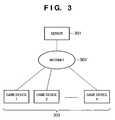
- the game system is configured by a server 301, network 302, and game devices 303.
- the game devices 303 (game devices 1 to n) used by respective players are connected to the network 302, and communicate with the server 301.
- the network includes a LAN or the Internet via the LAN, and the device may be connected to the Internet using a general or dedicated communication line via a provider.
- the server 301 transmits a program required to run a game, and data for screen display of the game device to the game devices 303, and controls the game proceeding by receiving an input signal (to be referred to as a player input signal hereinafter) on the basis of a button input of each player from the game device 303.
- an input signal to be referred to as a player input signal hereinafter
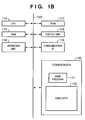
- Reference numeral 114 denotes a CPU which controls the overall server.
- Reference numeral 115 denotes a RAM (random-access memory) which comprises an area for loading programs and data required to control the server 301, and also a work area used when the CPU 114 executes various processes.
- Reference numeral 116 denotes an operation unit.
- Reference numeral 117 denotes a ROM (read-only memory) which stores programs, data, and the like used to control the overall server.
- Reference numeral 119 denotes a communication I/F (interface) which serves as an interface that connects the Internet or LAN.
- Reference numeral 118 denotes a display unit which comprises a CRT or liquid crystal display, and displays predetermined information.
- Reference numeral 120 denotes a storage device which stores a game program 121 and game data 122 to be distributed via the network, and stores a program required to run a game, data required to generate images of objects (characters, text, background screens, and the like) which form the game screen, sound data, and the like.
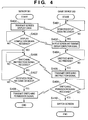
- arrows that associate the steps of the server 301 and game device 303 indicate communications between them.
- the server 301 transmits screen display data to the game devices 303 which have entered the game (S400).
- the screen display data to be transmitted is not one corresponding to one screen, but data having given relevance based on the screen display contents can be transmitted as one unit. Alternatively, screen display data for each screen may be transmitted.
- the screen display data transmitted from the server 301 is received by each game device 303 (S401).
- the game device 303 makes a screen display on the display unit 106 on the basis of the received screen display data, and informs the serve 301 of completion of the display by transmitting a display completion signal to the server 301 upon completion of the screen display (S402).
- the server 301 receives the display completion signal transmitted from each game device 303 (S403).
- each game device 303 checks if the player has pressed the linefeed back 203 by pressing a given button of the input button group 103b (S404). If it is determined that the player has pressed the linefeed mark 203, the game device 303 transmits a switching instruction signal to the server 301 to notify it that the player issued a screen switching request (S405). If it is determined that the player has not pressed the linefeed mark 203, the game device 303 continues monitoring of a button input from the player.
- the switching instruction signal transmitted from the game device 303 is received by the server 301 (S406).
- the server 301 checks if the switching instruction signals are received from Nth game devices of all the game devices 303 that have entered the game (S407).
- Nth may be, e.g., the number of all the game devices which have entered the game, or a value, which is obtained by subtracting a predetermined value (e.g., one game device) from the number of all the game devices which have entered the game.
- Nth may be a value obtained by multiplying the number of all the game devices which have entered the game by a predetermined ratio.
- Nth may be automatically calculated on the basis of the properties of the game, network, and the like.
- the CPU 114 in the server can serve as setting means for setting Nth by executing the predetermined processing.
- a value to be set as Nth may be transmitted from the game device 303 to the server 301 in accordance with an input from the operation unit 103 of the game device 303, and the CPU 114 serving as the setting means may set the setting value received by the server 301 as the value of Nth.
- the CPU 114 serves as screen display switching unit, i.e., it controls the server 301 to transmit a switching permission signal so as to notify each game device 303 of a screen switching permission (S408). If screen display data per screen is transmitted, the flow may return to step S401 to transmit another screen display data after transmission of the switching permission signal.
- the server 301 continues monitoring of signals transmitted from the game devices 303 that have entered the game.
- the switching permission signal transmitted from the server 301 is received by each game device 303 (S409).
- the game device 303 switches the screen display to be displayed on the display unit 106 upon reception of the switching permission signal (S410).
- data of a given size may be transmitted, and upon reception of the switching instruction signals from all the game devices 303, a signal that notifies a screen switching permission (switching permission signal) may be transmitted. At this time, each game device 303 can switch the screen display on the display unit 106 upon reception of the switching permission signal.
- each game device 303 cannot switch the currently displayed screen display unless it receives the switching instruction signal is received from the server 301, the game proceedings can be synchronized among a plurality of players who have entered the identical game. More specifically, a behavior of some players who unilaterally play the game to disturb entry of other players to the game can be effectively prevented.
- Nth is a value smaller than the number of game devices that have entered the game, i.e., when the screen is permitted to be switched with the approval of a large majority of players, a behavior of some players who deliberately do not press the linefeed mark 203 to delay the game proceeding can be prevented to some extent, and the game proceeds by the majority opinion, thus allowing smooth game proceeding.
- the server 301 ceases to transmit the switching permission signal to the game devices 303 until it receives the switching instruction signals from Nth game devices. In this case, a behavior of some players who deliberately do not press the linefeed mark 203 to delay the game proceeding cannot always be prevented effectively.
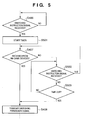
- a switching signal transmittable period i.e., a time limit corresponding to the display period of the screen display can be set so as to abort the reception process of the switching instruction signals. More specifically, steps S501 to S503 are inserted between steps S406 to S408 in Fig. 4, as shown in Fig. 5.
- the server 301 Upon reception of the switching instruction signal from one of a plurality of game devices 303 which have entered the game (S406), the server 301 starts a time set with a predetermined time limit (S501).
- This time limit can be set to be, e.g., 1 minute, or can be arbitrarily changed in accordance with the contents of the game or those to be displayed on the screen. For example, if the importance of the screen is assumed to be low, the time limit may be set to be shorter than 1 minute; if it is assumed to be high, the time limit may be set to be longer than 1 minute.
- the server 301 checks if the switching instruction signals are received from Nth game devices 303 as in the first embodiment. If the switching instruction signals are received from the Nth game devices 303, the flow advances to step S408 to transmit the switching permission signal to the respective game devices 303 as in the first embodiment.
- the server 301 checks if another switching instruction signal is received (step S502). If it is determined that another switching instruction signal is received, the flow returns to step S407 to check if the switching instruction signals are received from the Nth game devices.
- step S503 If it is determined in step S502 that another switching instruction signal is not received, the server 301 checks in step S503 if the timer reaches a time-out. If the timer has does not reach a time-out, the flow returns to step S502 to continue monitoring of reception of the switching instruction signal. On the other hand, if it is determined in step S503 that the timer has reached a time-out, the flow advances to step S408 without waiting for a non-received switching instruction signal transmitted from the game device 303, and the server 301 transmits the switching permission signal to the game devices 303.
- step S407 it is checked in step S407 if switching signals are received from the Nth game devices 303, and only a time-out is used as a trigger to abort the reception process of the switching instruction signals.
- the number of received switching instruction signals can be used as a trigger to abort the reception process of the switching instruction signals. That is, whether or not the number of received switching instruction signals reaches a predetermined value, i.e., Nth, is checked in step S407 as a trigger to abort the reception process.
- the control can start the next process without waiting for reception of switching instruction signals from the remaining three game devices.
- the timer start timing is set after reception of one switching instruction signal.
- the present invention is not limited to such specific timing.
- the timer may start upon reception of the display completion signal in, e.g., step S403 in Fig. 4. More specifically, the timer may start upon reception of the first or second display completion signal or upon reception of the display completion signals from Nth game devices 303. In either case, since the screen display time of each game device 303 can be measured, it is effective to control the game proceeding from the viewpoint of the player.
- the game proceeding can be controlled in accordance with the reception state of switching instruction signals at the server 301, a behavior of some players who deliberately do not press the linefeed mark 203 to delay the game proceeding can be prevented.
- a time-out of the transmittable period of switching instruction signals is used as a trigger to abort the reception process of switching instruction signals.
- the time limit sets a time period until the screen display is switched, irrespective of a change in the number of received switching instruction signals.
- the switching timing of the screen does not always match the average game proceeding level of the players who have entered the game, thus disturbing smooth game proceeding.
- the time limit is set as a time period after reception of a switching instruction signal until the next switching instruction signal is received, in place of a time period until the screen display is switched, thereby solving the aforementioned problem. Also, since the time limit is set for each reception of a switching instruction signal, the game proceeding according to the level of each party formed by a plurality of players who have entered the game can be allowed.
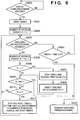
- steps S406 to S408 in Fig. 4 are replaced by steps S901 to S912 shown in Fig. 9.
- the processing based on the flowchart in Fig. 9 will be described below.
- the timer in step S501 in Fig. 4 is read as timer 1.
- step S901 in Fig. 9 timer 2 is started after it is reset.
- This timer 2 is timepiece means used to measure a time period after reception of the display completion signal in step S403 in Fig. 4 until a switching instruction signal is received.
- T1 be the timer value of this timer 2.
- step S902 the number N of received switching instruction signals is reset (N ⁇ 0). Furthermore, it is checked in step S903 if a switching instruction signal is received. If no switching instruction signal is received, the flow advances to step S904. If timer 3 is set, it is checked in step S904 if timer 3 reaches a time-out.
- Timer 3 is timepiece means used to set a time limit after reception of the switching instruction signal until another switching instruction signal is received (this time limit corresponds to a screen display period after reception of the switching instruction signal). The time limit to be set in timer 3 is updated every time the switching instruction signal is received.
- step S904 since timer 3 is started after reception of the first switching instruction signal, the time-out checking process at that time is nonsense. Hence, upon implementation, the process in step S904 may be skipped until the first switching instruction signal is received.
- step S905 Upon reception of a switching instruction signal, the flow advances to step S905 to update the number of received signals.
- An update unit of the number of received signals is basically 1. However, depending on the setting of the timing for monitoring reception of the switching instruction signal in step S903, a plurality of switching signals may be received at substantially the same timings. In such case, the number of received signals may be updated accordingly.
- a predetermined ratio e.g. 60%
- step S906 If the number of received signal switching instruction signals matches ⁇ in step S906, the flow advances to step S907 to stop timer 2 and to acquire the value (T1) of timer 2.
- step S908 a set of time limits Ln to be set in timer 3 is selected from a time limit table on the basis of the value T1 acquired in step S907.
- Fig. 10 shows an example of the configuration of the time limit table.
- Fig. 10 shows the table of time limits Ln under the assumption that 10 players form a party to play the game.
- the table shown in Fig. 10 is stored in, e.g., the storage device 120 in the server 301.
- the storage means 120 preferably stores a plurality of tables in accordance with the number of players who form a party.
- step S909 if the number of received switching signals reaches a value which suffices to switch the screen.
- a threshold Nth2 as a criterion for determining whether or not the screen display is to be switched is determined depending on the number of players (party size) who have entered the game.
- Nth2 may be the number of all game devices which have entered the game, or a value obtained by subtracting a predetermined value (e.g., one game device) from the number of all game devices which have entered the game, as in Nth in the first embodiment.
- Nth2 may be a value obtained by multiplying the number of all the game devices which have entered the game by a predetermined ratio.
- Nth2 may be automatically calculated on the basis of the properties of the game, network, and the like.
- the CPU 114 in the server can serve as setting means for setting Nth2 by executing the predetermined processing.
- a value to be set as Nth2 may be transmitted from the game device 303 to the server 301 in accordance with an input from the operation unit 103 of the game device 303, and the CPU 114 serving as the setting means may set the setting value received by the server 301 as the value of Nth2.
- step S909 If the number of received switching instruction signals is equal to or larger than the threshold Nth2 in step S909, the flow advances to step S911 to transmit a switching permission signal to the game devices 303.
- step S909 if it is determined in step S909 that the number of received switching instruction signals is less than the threshold Nth2, the flow advances to step S910 to check if the number N of received signals is equal to or larger than ⁇ .
- This checking step copes with a case wherein since the number of received signals is less than ⁇ depending on the setting contents of ⁇ , a time limit set is not selected yet in step S908, and timer 3 cannot be set.
- step S903 reception of a switching instruction signal is monitored in step S903.
- step S912 After timer 3 is started in step S912, the flow returns to step S903 to check if another switching instruction signal is received within the range of the set time limit. If a new switching instruction signal is received within the range of time limit Ln set in step S912, the flow advances to step S905 to update the number N of received signals, and the aforementioned processes in step S906 and subsequent steps are repeated.
- step S903 if it is determined in step S903 that no switching instruction signal is received, and if it is determined in step S904 that timer 3 has reached a time-out, the flow jumps to step S911 to transmit a switching permission signal.
- the time limit value of timer 3 is updated to 5 seconds, 4 seconds, 3 seconds, and 2 seconds.
- the six players who have already transmitted switching instruction signals in an early stage need not wait for reception of a switching instruction signal from the seventh game device while watching the identical screen display endlessly.
- a time limit is set every time a switching instruction signal is received, and the game proceeding can be controlled in accordance with the overall skill level of players who have entered the game.
- the time limit can be set depending on a time period from display completion until the number of received switching instruction signals has reached a predetermined value, the game proceeding can be controlled in accordance with the overall skill level of players who have entered the game.
- the time limit value set according to the number of received signals can be set while reflecting a time period until the first (or second) switching signal is received in accordance with the setting value ⁇ , the game proceeding control corresponding to the level of each individual party can be made.
- the game devices 303 are connected to a predetermined network such as the Internet or the like, and receive a program and the like required to execute the game from the server 301, thus configuring the game system, and providing the game to the players.
- game devices 601 to 603 are peer-to-peer connected via connection cables to form a game system, as shown in Fig. 6.
- the game device 601 or the like mounts a ROM cartridge (601c to 603c) that stores a program required to run the game, and predetermined data.
- the game devices 601 to 603 have the arrangement corresponding to the basic arrangement of the game device shown in Fig. 1A, and a description of the arrangement itself of the game device 601 or the like will be omitted.
- the game proceeding synchronization processing in this embodiment will be described below with reference to the flowchart of Fig. 7.
- the game devices 601 to 603 respectively display a background 201 (including a character) and lines 202 so as to display a screen corresponding to, e.g., Fig. 2A (S701).
- a linefeed mark 203 is displayed (S702).
- each player can issue a switching instruction of the screen display by pressing one of the input button group 103b.
- each of the game devices 601 to 603 monitors if the player of the own device has pressed this button. If the player has pressed the button, it is determined that the player issues a switching instruction, and the flow advances to step S704. On the other hand, if the button is not pressed, the control waits while monitoring depression of the button.
- step S704 in order to notify other game devices connected of a message indicating that the player issues a screen switching instruction by the button input, a switching instruction signal is transmitted.
- the control waits for switching instruction messages from other game devices (step S705). If the switching instruction messages are received from Nth of all the connected game devices, the flow returns to step S701 to switch the currently displayed screen contents under the control of the CPU 101 that serves as switching unit, thereby displaying a new background and lines.
- Nth is a value having the same meaning as in the first embodiment, and a detailed description thereof will be omitted.
- the CPU 101 in each of the game devices 601 to 603 serves as the Nth setting means.
- the CPU 101 sets the value of Nth in accordance with the input contents from the operation unit 103 by the player.
- the screen display in the format shown in Figs. 2A and 2B is presented to the player.
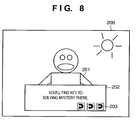
- the format of the screen display presented to the player is not limited to that shown in Figs. 2A and 2B, and linefeed marks 203 as many as a total of the self machine and other machines in communication can be displayed, as shown in, e.g., Fig. 8.
- Fig. 8 exemplifies a case wherein two machines are connected in addition to the self machine.
- linefeed marks 203 for 10 game devices are displayed, and each player can recognize that the number of displayed linefeed marks 203 gradually decreases in response to reception of switching signals from the players, and the screen is switched when the remaining number of linefeed marks reaches 3.
- the player who has already transmitted the switching instruction signal can wait while easily estimating the switching timing of the screen, and a stress due to aimless waiting for screen switching can be reduced.
- Such effect can be obtained in the first, third, and fourth embodiments, needless to say.
- the aforementioned processing for game proceeding synchronization control can also be implemented as a game proceeding synchronization method or a control method of a game proceeding synchronization system, which comprises the following steps.
- the game proceeding synchronization method is directed to a game proceeding synchronization method which controls a plurality of terminal devices, each of which has a display screen and an input unit that accepts an input from a player, and can execute a game by connecting to a network, to synchronously play a common game, and can display at least one of a common display in the game and a display related to the common display on the display screen of each terminal device, characterized in that the input unit of each terminal device can input a switching instruction of the screen display before or after display completion of at least one of the common display and the display related to the common display on the display screen of the terminal device, and the method comprises a switching step of switching at least one of the common display and the display related to the common display in accordance with the number of switching instructions of the screen display input from the terminal devices.
- the control method for the game proceeding synchronization system is directed to a method of controlling a game proceeding synchronization system which has a plurality of terminal devices, each of which has a display screen and an input unit that accepts an input from a player, and can execute a game by connecting to a network, and controls the plurality of terminal devices to synchronously play a common game, characterized in that at least one of a common display in the game and a display related to the common display can be displayed on the display screen of each terminal device, the input unit of each terminal device can input a switching instruction of the screen display before or after display completion of at least one of the common display and the display related to the common display on the display screen of the terminal device, each terminal device can recognize the switching instructions from the input units of other terminal devices, and each terminal device comprises a switching step of switching the self screen display in accordance with the number of switching instructions of the screen display input from the terminal devices.
- the game proceeding synchronization method or the control method for the game proceeding synchronization system is characterized in that the switching step includes a step of switching the screen display in accordance with the number of switching instructions of the screen display input from the terminal devices, and a display time of the screen display.
- the switching step may comprise a setting step of setting the number of switching instructions required to switch the display, or the switching step may comprise a step of starting measurement of the predetermined display time after the display completion.
- the switching step may comprise a step of starting measurement of the predetermined display time after one of the terminal devices inputs the switching instruction, or may comprise a step of restarting measurement of the predetermined display time every time the switching instruction is input.
- the switching step may comprise a step of changing the predetermined display time and restarting measurement of the changed display time in accordance with a time period from the display completion until the input of the switching instruction.
- the switching timing of a screen display of lines or an explanation of a situation can be preferably controlled.
- discrepancy of game proceeding can be prevented, efficient and smooth game proceeding is realized, and nuisance of some players can be effectively prevented.
- the switching timing of the screen display can be controlled in accordance with the average level of players who have entered the game, the game proceeding can be controlled more effectively and smoothly.
Landscapes
- Engineering & Computer Science (AREA)
- Multimedia (AREA)
- Physics & Mathematics (AREA)
- Acoustics & Sound (AREA)
- Management, Administration, Business Operations System, And Electronic Commerce (AREA)
Applications Claiming Priority (3)
| Application Number | Priority Date | Filing Date | Title |
|---|---|---|---|
| JP2003006294 | 2003-01-14 | ||
| JP2003006294A JP3669587B2 (ja) | 2003-01-14 | 2003-01-14 | ゲーム進行同期制御サーバー、端末装置及びプログラム |
| PCT/JP2003/008206 WO2004062756A1 (ja) | 2003-01-14 | 2003-06-27 | ゲーム進行同期制御システム及びプログラム |
Publications (2)
| Publication Number | Publication Date |
|---|---|
| EP1588747A1 true EP1588747A1 (de) | 2005-10-26 |
| EP1588747A4 EP1588747A4 (de) | 2006-03-15 |
Family
ID=32709056
Family Applications (1)
| Application Number | Title | Priority Date | Filing Date |
|---|---|---|---|
| EP03736287A Withdrawn EP1588747A4 (de) | 2003-01-14 | 2003-06-27 | Synchronisationssystem und -programm für einen spielverlauf |
Country Status (6)
| Country | Link |
|---|---|
| US (1) | US20050272505A1 (de) |
| EP (1) | EP1588747A4 (de) |
| JP (1) | JP3669587B2 (de) |
| AU (1) | AU2003244007A1 (de) |
| TW (1) | TW200412527A (de) |
| WO (1) | WO2004062756A1 (de) |
Families Citing this family (20)
| Publication number | Priority date | Publication date | Assignee | Title |
|---|---|---|---|---|
| US7682249B2 (en) | 2001-05-04 | 2010-03-23 | Igt | Light emitting interface displays for a gaming machine |
| US8342938B2 (en) | 2001-09-27 | 2013-01-01 | Igt | Gaming machine reel having a rotatable dynamic display |
| US8002624B2 (en) | 2001-09-27 | 2011-08-23 | Igt | Gaming machine reel having a flexible dynamic display |
| US8388432B2 (en) | 2004-01-12 | 2013-03-05 | Igt | Bi-stable downloadable reel strips |
| US8545326B2 (en) | 2004-01-12 | 2013-10-01 | Igt | Casino display methods and devices |
| US8016670B2 (en) | 2004-01-12 | 2011-09-13 | Igt | Virtual glass for a gaming machine |
| JP4626182B2 (ja) * | 2004-05-14 | 2011-02-02 | 株式会社セガ | 対戦ゲーム処理方法、対戦ゲームシステム、そのプログラム及び記憶媒体 |
| JP4716843B2 (ja) * | 2005-10-17 | 2011-07-06 | シャープ株式会社 | 画像形成装置 |
| JP4508077B2 (ja) * | 2005-10-24 | 2010-07-21 | 株式会社デンソー | 車載マルチカーソルシステム |
| US8352371B2 (en) * | 2008-04-30 | 2013-01-08 | General Instrument Corporation | Limiting access to shared media content |
| JP4666402B2 (ja) * | 2008-06-29 | 2011-04-06 | 株式会社スクウェア・エニックス | ビデオゲーム処理装置、ビデオゲーム処理方法、およびビデオゲーム処理プログラム |
| JP4705179B2 (ja) | 2009-03-26 | 2011-06-22 | 株式会社コナミデジタルエンタテインメント | 端末装置、端末装置の制御方法、ならびに、プログラム |
| US8914788B2 (en) * | 2009-07-01 | 2014-12-16 | Hand Held Products, Inc. | Universal connectivity for non-universal devices |
| US10258886B2 (en) | 2013-09-04 | 2019-04-16 | Nvidia Corporation | Dynamic interface control device mapping when game sharing |
| US11130055B2 (en) | 2013-09-04 | 2021-09-28 | Nvidia Corporation | System and method for granting remote access to a video game executed on a video game console or network client |
| JP5977783B2 (ja) * | 2014-06-09 | 2016-08-24 | 株式会社カプコン | 配信システム |
| US10709991B2 (en) | 2015-04-02 | 2020-07-14 | Nvidia Corporation | System and method for cooperative application control |
| CN110947177B (zh) * | 2019-11-14 | 2023-10-17 | 咪咕互动娱乐有限公司 | 云游戏教学互动的方法、系统、设备及其计算机可读存储介质 |
| CN114681915B (zh) * | 2020-12-25 | 2025-06-20 | 腾讯科技(深圳)有限公司 | 互动内容显示方法、提供方法、装置、设备及存储介质 |
| CN113342402B (zh) * | 2021-08-05 | 2021-11-12 | 北京蔚领时代科技有限公司 | 一种多人协作游戏编辑方法、系统及装置 |
Family Cites Families (10)
| Publication number | Priority date | Publication date | Assignee | Title |
|---|---|---|---|---|
| JP3377304B2 (ja) * | 1994-07-05 | 2003-02-17 | 株式会社ナムコ | ゲーム装置 |
| JPH1186038A (ja) * | 1997-03-03 | 1999-03-30 | Sega Enterp Ltd | 画像処理装置、画像処理方法及び媒体並びにゲーム機 |
| JPH11137839A (ja) * | 1997-11-07 | 1999-05-25 | Namco Ltd | ゲームシステム、ゲーム装置及び情報記憶媒体 |
| JP3269797B2 (ja) * | 1997-12-12 | 2002-04-02 | 株式会社ナムコ | 画像生成装置及び情報記憶媒体 |
| GB9800397D0 (en) * | 1998-01-09 | 1998-03-04 | Philips Electronics Nv | Virtual environment viewpoint control |
| JP3131579B2 (ja) * | 1998-02-18 | 2001-02-05 | 株式会社ナムコ | ゲームシステム、ゲーム装置及び情報記憶媒体 |
| JP2002139982A (ja) * | 2000-11-02 | 2002-05-17 | Keiji Matsushita | 教材用記録媒体およびこれを用いた教育方法 |
| JP3506671B2 (ja) * | 2000-12-20 | 2004-03-15 | 株式会社インテリジェントシステムズ | 通信ゲームシステム |
| JP3699660B2 (ja) * | 2001-03-30 | 2005-09-28 | コナミ株式会社 | ゲーム装置及びネットワークゲームシステム |
| JP2002325965A (ja) * | 2001-04-27 | 2002-11-12 | Sega Corp | 入力文字処理方法 |
-
2003
- 2003-01-14 JP JP2003006294A patent/JP3669587B2/ja not_active Expired - Fee Related
- 2003-06-27 WO PCT/JP2003/008206 patent/WO2004062756A1/ja not_active Ceased
- 2003-06-27 AU AU2003244007A patent/AU2003244007A1/en not_active Abandoned
- 2003-06-27 EP EP03736287A patent/EP1588747A4/de not_active Withdrawn
- 2003-07-08 TW TW092118629A patent/TW200412527A/zh not_active IP Right Cessation
-
2005
- 2005-07-13 US US11/180,124 patent/US20050272505A1/en not_active Abandoned
Also Published As
| Publication number | Publication date |
|---|---|
| TWI321743B (de) | 2010-03-11 |
| EP1588747A4 (de) | 2006-03-15 |
| JP2004215851A (ja) | 2004-08-05 |
| WO2004062756A1 (ja) | 2004-07-29 |
| TW200412527A (en) | 2004-07-16 |
| JP3669587B2 (ja) | 2005-07-06 |
| AU2003244007A1 (en) | 2004-08-10 |
| US20050272505A1 (en) | 2005-12-08 |
Similar Documents
| Publication | Publication Date | Title |
|---|---|---|
| EP1588747A1 (de) | Synchronisationssystem und -programm für einen spielverlauf | |
| RU2571251C2 (ru) | Система обработки информации, способ обработки информации, программа обработки информации, считываемый компьютером носитель записи, на котором хранится программа обработки информации | |
| US20060154710A1 (en) | Method and device for continuing an electronic multi-player game, in case of an absence of a player of said game | |
| JP5530554B1 (ja) | ゲームプログラム、ゲーム処理方法および情報処理装置 | |
| EP2497552A2 (de) | Informationsverarbeitungsvorrichtung | |
| KR100978431B1 (ko) | 게임 시스템, 서버 및 단말기 | |
| JP7585414B2 (ja) | サーバ、ゲームプログラム、情報処理方法 | |
| CN101330949B (zh) | 游戏装置、游戏装置的控制方法及网络游戏系统 | |
| JP2009082508A (ja) | ゲームシステム及びサーバ | |
| JP6793418B1 (ja) | プログラム、情報処理装置、情報処理方法、およびシステム | |
| CN101300054B (zh) | 网络游戏系统、游戏装置及游戏装置的控制方法 | |
| JP7713978B2 (ja) | プログラム | |
| JP7792936B2 (ja) | プログラム、システム、及び方法 | |
| JP7442187B2 (ja) | プログラム、情報処理装置、情報処理方法、およびシステム | |
| JP2002306847A (ja) | 将棋の対戦を行う装置およびその方法 | |
| JP2025139445A (ja) | プログラム、情報処理装置及びゲームシステム | |
| JP2002273050A (ja) | ゲーム装置、ゲーム制御方法およびその記録媒体ならびにコンピュータプログラム | |
| JP2009183315A (ja) | ネットワークゲームシステム、ネットワークゲーム方法およびネットワークゲームプログラム | |
| JP5819549B2 (ja) | ゲームプログラム、ゲーム処理方法および情報処理装置 | |
| JP5892710B2 (ja) | ゲームプログラム、ゲーム処理方法および情報処理装置 | |
| JP2004129213A (ja) | 抽選ゲーム制御プログラム、当該ゲーム制御プログラムを配信するサーバ、サービス提供サーバ、サービス提供方法 | |
| JP2017087015A (ja) | ゲームプログラム、ゲーム処理方法および情報処理装置 | |
| JP2014111167A (ja) | ゲームシステム及びプログラム | |
| KR20150039243A (ko) | 게임 방법 |
Legal Events
| Date | Code | Title | Description |
|---|---|---|---|
| PUAI | Public reference made under article 153(3) epc to a published international application that has entered the european phase |
Free format text: ORIGINAL CODE: 0009012 |
|
| 17P | Request for examination filed |
Effective date: 20050812 |
|
| AK | Designated contracting states |
Kind code of ref document: A1 Designated state(s): AT BE BG CH CY CZ DE DK EE ES FI FR GB GR HU IE IT LI LU MC NL PT RO SE SI SK TR |
|
| AX | Request for extension of the european patent |
Extension state: AL LT LV MK |
|
| A4 | Supplementary search report drawn up and despatched |
Effective date: 20060127 |
|
| DAX | Request for extension of the european patent (deleted) | ||
| RBV | Designated contracting states (corrected) |
Designated state(s): DE FR GB |
|
| RAP1 | Party data changed (applicant data changed or rights of an application transferred) |
Owner name: KONAMI DIGITAL ENTERTAINMENT CO., LTD. |
|
| STAA | Information on the status of an ep patent application or granted ep patent |
Free format text: STATUS: THE APPLICATION IS DEEMED TO BE WITHDRAWN |
|
| 18D | Application deemed to be withdrawn |
Effective date: 20110104 |