EP1586111B1 - Drahtbondierungserfahren und vorrichtung - Google Patents
Drahtbondierungserfahren und vorrichtung Download PDFInfo
- Publication number
- EP1586111B1 EP1586111B1 EP20030813211 EP03813211A EP1586111B1 EP 1586111 B1 EP1586111 B1 EP 1586111B1 EP 20030813211 EP20030813211 EP 20030813211 EP 03813211 A EP03813211 A EP 03813211A EP 1586111 B1 EP1586111 B1 EP 1586111B1
- Authority
- EP
- European Patent Office
- Prior art keywords
- wirebonding
- clamp
- row
- lead frames
- lead
- Prior art date
- Legal status (The legal status is an assumption and is not a legal conclusion. Google has not performed a legal analysis and makes no representation as to the accuracy of the status listed.)
- Expired - Lifetime
Links
Images


Classifications
-
- H10W72/075—
-
- H10W72/0711—
-
- H10W72/07141—
-
- H10W72/552—
Definitions
- the present invention relates to a method and apparatus for wirebonding leads of a plurality of lead frames being part of a lead frame assembly by a wirebonding tool to semiconductor products mounted on the respective lead frames, the lead frame assembly being indexable in an index direction relative to a wirebonding frame, a first clamp and a second clamp clamping the leads of adjacent lead frames during wirebonding.
- a leadframe assembly may be an endless strip or a strip or film having a discrete length. Each of said strips or film comprises at least two parallel rows of lead frames.
- IC Integrated Circuit
- chips are prepared. These semiconductor products are to be accommodated in a package and need to be electrically connectable to components outside the package.
- a plurality of semiconductor products is first mounted on lead frames in a so-called die bonding process.
- each semiconductor product is electrically connected to the associated lead frame in a so-called wirebonding process before packaging the semiconductor product.
- wirebonding process bond pads on one or more surfaces of each semiconductor product are electrically and mechanically connected to leads of the associated lead frame by thin metallic wires, using a wirebonding tool.
- the process of wirebonding one semiconductor product on a lead frame generally requires several steps including, in a working area of a wirebonding apparatus, positioning the lead frame relative to a clamping mechanism, operating different clamping elements, operating the wirebonding tool(s), and indexing the lead frame for bringing a new semiconductor product and associated leads of the lead frame into the working area of the wirebonding apparatus.
- US Patent no. 6,068,174 discloses a wirebonding apparatus including a heat block or other base member for supporting a lead frame during wirebonding. Separate sets of leads of the lead frame associated with a particular semiconductor product are fixedly held against the heat block by different clamping elements of a clamping mechanism, whereby separate sets of leads are wire bonded by a wirebonding tool at different times.
- a relative long lead frame indexing time, or many indexing operations for a lead frame, will lead to a relative low throughput of the wirebonding apparatus. Consequently, a reduction of the lead frame indexing time in which the bonding tool must be inoperative will lead to an increase in the throughput of the wirebonding apparatus.
- US Patent no. 5,322,207 discloses an automated wirebonding apparatus wherein a single indexing step for the lead frame enables two or more semiconductor products to be wirebonded, before a next lead frame indexing step is to be taken, which results in a decrease of the overall time for wirebonding all semiconductor products on the lead frame, and thus in a decrease of the mean wirebonding cycle time per semiconductor product.
- EP0542465 discloses an indexing work holder for an automatic bonding machine having an indexing head with a gripper mechanism for gripping a lead frame and with means for rotating the lead frame into a predetermined theta orientation after being gripped and before bonding.
- the jaws of the gripper mechanism may have pivoted inserts and the orienting means may comprise a linear actuator coupled to a theta bar.
- D2: US6334566 discloses a wire-bonding machine including a heat block for supporting a lead frame during wire-bonding.
- a clamp mechanism in the machine clamps leads of the lead frame during wire-bonding by fixedly holding sets of the leads against the heat block one set at a time.
- a wire-bonding tool wire-bonds leads clamped by the clamp mechanism to bond pads on an integrated circuit die.
- first clamp and the second clamp each comprise a clamping frame being movable towards and away from the semiconductor product on the associated lead frame, and a base member being movable towards and away from the lead frame at the side facing away from the semiconductor product.
- the steps (a)-(g) are not performed in succession, i.e. in general a next step will not be taken only when the previous step is completed. Some steps may be taken in parallel, as will be explained hereafter.
- the clamping of the second clamp according to step (b) may be initiated concurrently with the initiation of the clamping of the first clamp according to step (a), but may also be later in time.
- the initiation of the clamping of the second clamp will be at any moment during the clamping time of the first clamp, before the first clamp is released.
- the first clamp may be released immediately after completing step (a), i.e. after completing the wirebonding of the leads of the n-th lead frame of the n lead frames clamped by the first clamp, but this release may also be later in time, during the clamping time of the second clamp.
- the release of the first clamp should be completed before step (d) is initiated.
- the leads of n adjacent lead frames of the second row of lead frames is still are still clamped by the second clamp to the second base member.
- the wirebonding of the leads of the n lead frames of the second row of lead frames by the wirebonding tool according to step (b) is continued during the indexing step (d), resulting in the indexing not interrupting the wirebonding, thus decreasing the mean semiconductor wirebonding cycle time.
- the second clamp may be released immediately after completing step (b), i.e. after completing the wirebonding of the leads of the n-th lead frame of the n lead frames clamped by the second clamp, but this release may also be later in time, e.g. during the clamping time of the first clamp.
- Step (f) Moving the second clamp back to its previous position relative to the wirebonding frame according to step (f) can only be performed after step (e) is completed. Step (f) should be completed before, in a repetition of steps (a)-(f), step (b) is performed again.
- step (a) can be initiated as soon as steps (b) and (d) are completed.
- the number n is 2 for an optimum path with the shortest route of the wirebonding tool across the lead frames of the first row and the second row.
- the number n may also be greater than 2, although this would result in at least one longer part of the path of the wirebonding tool when moving from the last lead frame of the first row to the first lead frame of the second row or vice versa.
- the n lead frames of the first row lead one lead frame pitch relative to the n lead frames of the second row, as seen in the index direction.
- the shortest paths for the wirebonding tool across the lead frame assembly are achieved.
- the first clamp in step (a) preferably further clamps n lead frames of the further row adjacent the n lead frames of the first row.
- the second clamp in step (b) preferably further clamps n lead frames of the further row adjacent the n lead frames of the second row.
- an optimum meandering wirebonding path can be followed by the wirebonding tool across the lead frames of the first and further row(s), and the lead frames of the second and further row(s), clamped by the first and second clamp, respectively.
- the first clamp is stationary relative to the wirebonding frame, as seen in the index direction.
- a wirebonding apparatus for wirebonding leads of a plurality of lead frames being part of a lead frame assembly to semiconductor products mounted on the respective lead frames, comprises: a wirebonding frame; an indexing device for indexing the lead frame assembly in an index direction relative to the wirebonding frame; at least a first clamp for clamping the leads of n (n ⁇ 1) adjacent lead frames of a first row of lead frames as seen in the index direction, the first clamp being stationary in the index direction relative to the wirebonding frame; at least a second clamp for clamping the leads of n adjacent lead frames of a second row of lead frames adjacent the first row, the second clamp being movable in the index direction relative to the wirebonding frame; and a wirebonding tool for wirebonding the leads of the n lead frames of the first and the second row to the corresponding semiconductor products, the wirebonding tool and the second clamp being adapted for following the index movement of the lead frame assembly.
- the wirebonding tool is preferably adapted to perform a wirebonding operation during the movement of the movement of
- first clamp and the second clamp are situated generally opposite to each other, as seen transversely to the index direction.
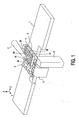
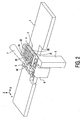
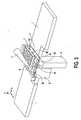
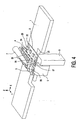
- Figs. 1-6 in a perspective view schematically illustrate consecutive steps in a wire-bonding operation.
- FIGs. 1-6 show a wirebonding frame 1 being part of a wire bonding apparatus (not shown in further detail).
- a lead frame assembly 2 of which only a part is shown in the Figures, comprises several rows (four rows, as seen in the X direction, in the example shown) of lead frames (not shown in detail) carrying semiconductor products 3 which are mounted in a regular arrangement. As seen in each row of semiconductor products 3, the (centre-to-centre) distance between adjacent semiconductor products 3 is indicated with "pitch".
- the lead frame assembly 2 may be of an arbitrary design, comprising leads (not shown in detail) in a configuration suitable for a particular semiconductor package.
- the semiconductor products 3 are provided with bond pads (not shown in detail) which are to be connected to the leads of the lead frames of the lead frame assembly 2 by wirebonding as known in the art.
- the wirebonding apparatus includes a clamping mechanism comprising a stationary clamp 4 extending over part of the area of the lead frame assembly 2 so as to clamp leads associated with at least two adjacent semiconductor products 3 in a row in one or more adjacent rows against a heat block or other base member (not shown).
- the stationary clamp 4 is adapted to clamp two adjacent semiconductor products 3 in three adjacent rows, i.e. a total of six semiconductor products 2, by means of suitable clamping elements (not shown).
- suitable clamping elements may take any suitable shape, e.g. fingers, brackets, or blocks.
- stationary clamp 4 is not movable in the indicated X and Y direction with respect to the wirebonding frame 1 of the wirebonding apparatus on which the stationary clamp 4 is mounted.
- at least part of the stationary clamp 4 comprising the clamping elements is movable in the Z direction between a first end position in which the leads of the lead frames under the stationary clamp 4 are clamped against said heat block or other base member, and a second end position in which the leads of the lead frames under the stationary clamp 4 are not clamped, providing the opportunity to move the lead frame assembly 2 in the X direction relative to the stationary clamp 4.
- the clamping mechanism of the wirebonding apparatus further comprises a movable clamp 5 extending over part of the area of the lead frame assembly 2 so as to clamp leads associated with at least two adjacent semiconductor products 3 in a row in one or more adjacent rows against a heat block or other base member.
- the movable clamp 5 is adapted to clamp two adjacent semiconductor products 3 in one row, i.e. a total of two semiconductor products 3, by means of suitable clamping elements.
- the adjective "movable” is used here to indicate that the movable clamp 5 is movable in the indicated X direction with respect to the wirebonding frame 1 of the wirebonding apparatus on which the movable clamp 5 is mounted.
- the movable clamp 5 comprising the clamping elements is movable in the Z direction between a first end position in which the leads of the lead frames under the movable clamp 5 are clamped against a heat block or other base member, and a second end position in which the leads of the lead frames under the movable clamp 5 are not clamped, providing the opportunity to move the lead frame assembly 2 in the X direction relative to the movable clamp 5.
- the stationary clamp 4 and the movable clamp 5 are situated generally opposite to each other, at opposite sides of the lead frame assembly 2.
- the movable clamp 5 is coupled to an index mechanism 6 such that with a displacement of the lead frame assembly 2 by the index mechanism 6 over a predetermined distance in the X direction also the movable clamp 5 moves over the same distance in the X direction.
- At least one bonding head 7 having a drive mechanism (not shown) is operable.
- semiconductor products 21, 22, 23, 24, 25, and 26 are clamped by the stationary clamp 4 in its first end position, and the semiconductor products 21-26 are wirebonded consecutively, as indicated in Figs. 1 and 2 illustrating the wirebonding of the first one and the last one of the semiconductor products 21-26, respectively.
- the stationary clamp 4 releases the lead frame assembly 2 by moving in the Z direction to its second end position.
- the semiconductor products 27, and 28 are clamped with the movable clamp 5 in its first end position.
- the index mechanism 6 then indexes the lead frame assembly 2 over twice the pitch of the semiconductor products 3 in the X direction.
- the movable clamp 5 and the wirebonding tool 7 follow the indexing movement of the indexing mechanism 6 by a suitable mechanical or electrical coupling therebetween, in particular between their respective (servo) drive motors. Meanwhile, the semiconductor products 27 and 28 are wirebonded.
- the movable clamp 5 releases the lead frame assembly 2 by moving in the Z direction to its second end position.
- the index mechanism 6 then moves back to its former position relative to the wirebonding frame 1 of the wirebonding apparatus, taking the movable clamp 5 along, but without displacing the lead frame assembly 2.
- the movable clamp 5 then clamps leads and semiconductor product 35 and an adjacent semiconductor product not shown in Fig. 6 by moving in the Z direction to its first end position, after which the clamped semiconductor products can be wirebonded.
- the lead frame assembly comprises only two rows of lead frames carrying semiconductor products e.g. a row comprising semiconductor products 26, 29 and 34, and a row comprising semiconductor products 27, 28, and 35.
- both the stationary clamp and the movable clamp are adapted to clamp only one semiconductor product at the time.
- the operational order of wirebonding would be semiconductor products 26, 27, 29, 28, 34, 35, etc., where the movable clamp would follow an indexing of the lead frame assembly over one pitch of the semiconductor products during the wirebonding of semiconductor products 27, 28, 35, etc.
- the lead frame assembly comprises only two rows of lead frames carrying semiconductor products e.g. a row comprising semiconductor products 26, 29 and 34, and a row comprising semiconductor products 27, 28, and 35. If both the stationary clamp and the moving clamp would be adapted to clamp two adjacent semiconductor products in a row at the time, the operational wirebonding order would be semiconductor products 21, 26, 27, 28, 29, 34, 35, etc., where the movable clamp would follow an indexing of the lead frame assembly over two pitches of the semiconductor products during the wirebonding of at least one of semiconductor products 27, 28, 35, etc.
- a meandering wirebonding path may followed over and across the lead frame assembly 2 by the wirebonding tool 7 for a minimum bonding time to be realized.
- other paths may be followed as well.
- the indexing of the lead frame assembly 2 is performed during the wirebonding process, which thus does not need to be interrupted for the indexing.
- More than one bonding tool 7 may be employed.
- a wirebonding method and apparatus have been disclosed in which the lead frame assembly indexing time is virtually taken out of the critical time path of the wirebonding process by using a clamping mechanism comprising a stationary clamp and a movable clamp.
Landscapes
- Wire Bonding (AREA)
- Superconductors And Manufacturing Methods Therefor (AREA)
- Crystals, And After-Treatments Of Crystals (AREA)
- Analysing Materials By The Use Of Radiation (AREA)
Claims (9)
- Verfahren zum Drahtbonden von Leitern einer Vielzahl von Leiterrahmen, die Teil einer Leiterrahmenanordnung (2) sind, mittels eines Drahtbondwerkzeugs (7) mit Halbleitererzeugnissen (3), die auf den jeweiligen Leiterrahmen befestigt sind, wobei die Leiterrahmenanordnung (2) in einer Schaltrichtung bezüglich eines Drahtbondrahmens schaltbar ist, umfassend eine erste Reihe und eine benachbarte zweite Reihe aus Leiterrahmen, in Schaltrichtung gesehen, wobei die Leiterrahmen voneinander an einem Leiterrahmen-Pitch in Schaltrichtung beabstandet sind,
umfassend folgende Schritte:(a) das Einspannen der Leiter von n (n ≥ 1) benachbarten Leiterrahmen der ersten Reihe durch eine erste Spannvorrichtung (4) und das Drahtbonden der Leiter der n Leiterrahmen der ersten Reihe mit den entsprechenden Halbleitererzeugnissen (3)(b) das Einspannen der Leiter von n benachbarten Leiterrahmen der zweiten Reihe in ein zweites Grundbauelement und das Drahtbonden der Leiter der n Leiterrahmen der zweiten Reihe mit den entsprechenden Halbleitererzeugnissen (3),(c) das Lösen der ersten Spannvorrichtung (4) nach Schritt (a),(d) das Weiterschalten der Leiterrahmenanordnung (2) über n Leiterrahmen-Pitches bezüglich des Drahtbondrahmens nach Schritt (a), wobei die zweite Spannvorrichtung (5) und das Drahtbondwerkzeug der Schaltbewegung folgen,(e) das Lösen der zweiten Spannvorrichtung (5) nach Schritt (b);(f) das Bewegen der zweiten Spannvorrichtung (5) entgegen der Schaltrichtung über n Leiterrahmen-Pitches und(g) das Wiederholen der Schritte (a) - (f). - Verfahren nach Anspruch 1, dadurch gekennzeichnet, dass die n Leiterrahmen der ersten Reihe nach Schritt (f) einen Leiterrahmen-Pitch bezüglich der n Leiterrahmen der zweiten Reihe leiten.
- Verfahren nach Anspruch 1 oder 2, gekennzeichnet durch zumindest eine weitere Leiterrahmenreihe, die mit der ersten Reihe benachbart an der der zweiten Leiterrahmenreihe abgewandten Seite angeordnet ist, wobei die erste Spannvorrichtung (4) in Schritt (a) ferner n Leiterrahmen der weiteren, mit den n Leiterrahmen der ersten Reihe benachbarten Reihe einspannt.
- Verfahren nach einem der Ansprüche 1 - 3, gekennzeichnet durch zumindest eine weitere Leiterrahmenreihe, die mit der zweiten Reihe benachbart auf der der ersten Leiterrahmenreihe abgewandten Seite angeordnet ist, wobei die zweite Spannvorrichtung (5) in Schritt (b) ferner n Leiterrahmen der weiteren, mit den n Leiterrahmen der zweiten Reihe benachbarten Reihe einspannt.
- Verfahren nach einem der Ansprüche 1 - 4, dadurch gekennzeichnet, dass n gerade ist.
- Verfahren nach einem der Ansprüche 1 - 5, dadurch gekennzeichnet, dass die erste Spannvorrichtung (4) bezüglich des Drahtbondrahmens in Schaltrichtung gesehen unbeweglich ist.
- Drahtbondvorrichtung zum Drahtbonden von Leitern einer Vielzahl von Leiterrahmen, die Teil einer Leiterrahmenanordnung (2) sind, mit Halbleitererzeugnissen (3), die auf den jeweiligen Leiterrahmen angebracht sind, umfassend:- einen Drahtbondrahmen (1)- an Schaltvorrichtung (6) zum Weiterschalten der Leiterrahmenanordnung in einer Schaltrichtung bezüglich des Drahtbondrahmens (1),gekennzeichnet durch:- zumindest eine erste Spannvorrichtung (4) zum Einspannen der Leiter von n (n ≥ 1) benachbarten Leiterrahmen einer ersten Leiterrahmenreihe, in Schaltrichtung gesehen, wobei die erste Spannvorrichtung in der Schaltrichtung bezüglich des Drahtbondrahmens unbeweglich ist,- zumindest eine zweite Spannvorrichtung (5) zum Einspannen der Leiter von n benachbarten Leiterrahmen einer zweiten, mit der ersten Reihe benachbarten Leiterrahmenreihe, wobei die zweite Spannvorrichtung in der Schaltrichtung bezüglich des Drahtbondrahmens beweglich ist, und- ein Drahtbondwerkzeug (7) zum Drahtbonden der Leiter der n Leiterrahmen der ersten und der zweiten Reihe mit den entsprechenden Halbleitererzeugnissen (3), wobei das Drahtbondwerkzeug (7) und die zweite Spannvorrichtung (5) der Schaltbewegung der Leiterrahmenanordnung (2) durch eine geeignete mechanische oder elektrische Kopplung mit selbiger folgen.
- Drahtbondvorrichtung nach Anspruch 7, dadurch gekennzeichnet, dass das Drahtbondwerkzeug so gestaltet ist, dass es einen Drahtbondvorgang während der Bewegung der zweiten Spannvorrichtung (5) ausführt.
- Drahtbondvorrichtung nach Anspruch 7 oder 8, dadurch gekennzeichnet, dass die erste Spannvorrichtung (4) und die zweite Spannvorrichtung (5) quer zur Schaltrichtung gesehen im Wesentlichen einander gegenüberliegend angeordnet sind.
Priority Applications (1)
| Application Number | Priority Date | Filing Date | Title |
|---|---|---|---|
| EP20030813211 EP1586111B1 (de) | 2002-12-18 | 2003-11-17 | Drahtbondierungserfahren und vorrichtung |
Applications Claiming Priority (4)
| Application Number | Priority Date | Filing Date | Title |
|---|---|---|---|
| EP02080360 | 2002-12-18 | ||
| EP02080360 | 2002-12-18 | ||
| EP20030813211 EP1586111B1 (de) | 2002-12-18 | 2003-11-17 | Drahtbondierungserfahren und vorrichtung |
| PCT/IB2003/005244 WO2004055870A1 (en) | 2002-12-18 | 2003-11-17 | Wirebonding method and apparatus |
Publications (2)
| Publication Number | Publication Date |
|---|---|
| EP1586111A1 EP1586111A1 (de) | 2005-10-19 |
| EP1586111B1 true EP1586111B1 (de) | 2009-04-15 |
Family
ID=32524045
Family Applications (1)
| Application Number | Title | Priority Date | Filing Date |
|---|---|---|---|
| EP20030813211 Expired - Lifetime EP1586111B1 (de) | 2002-12-18 | 2003-11-17 | Drahtbondierungserfahren und vorrichtung |
Country Status (9)
| Country | Link |
|---|---|
| US (2) | US7578425B2 (de) |
| EP (1) | EP1586111B1 (de) |
| JP (1) | JP2006511066A (de) |
| KR (1) | KR20050084355A (de) |
| AT (1) | ATE429030T1 (de) |
| AU (1) | AU2003276600A1 (de) |
| DE (1) | DE60327258D1 (de) |
| TW (1) | TW200414386A (de) |
| WO (1) | WO2004055870A1 (de) |
Families Citing this family (6)
| Publication number | Priority date | Publication date | Assignee | Title |
|---|---|---|---|---|
| US7216794B2 (en) * | 2005-06-09 | 2007-05-15 | Texas Instruments Incorporated | Bond capillary design for ribbon wire bonding |
| EP1984945A2 (de) | 2006-02-10 | 2008-10-29 | Nxp B.V. | Halbleiter-prozesssystem mit einem optischen instrument mit einer vorrichtung zur ausrichtung einer optischen vorrichtung an einem objekt |
| JP2010182911A (ja) * | 2009-02-06 | 2010-08-19 | Renesas Electronics Corp | 半導体装置の製造方法及びワイヤボンダ |
| CN102473698B (zh) * | 2009-07-20 | 2015-07-01 | 库利克和索夫工业公司 | 操作引线接合机的夹持系统的方法 |
| SG190962A1 (en) * | 2010-12-29 | 2013-07-31 | Orthodyne Electronics Corp | Methods and systems for aligning tooling elements of ultrasonic bonding systems |
| MY183541A (en) * | 2016-03-01 | 2021-02-25 | Carsem M Sdn Bhd | Flexible window clamp |
Family Cites Families (3)
| Publication number | Priority date | Publication date | Assignee | Title |
|---|---|---|---|---|
| US5238174A (en) * | 1991-11-15 | 1993-08-24 | Kulicke And Soffa Investments, Inc. | Smart indexing head for universal lead frame work station |
| US6068174A (en) * | 1996-12-13 | 2000-05-30 | Micro)N Technology, Inc. | Device and method for clamping and wire-bonding the leads of a lead frame one set at a time |
| US6062459A (en) * | 1998-04-29 | 2000-05-16 | Advanced Micro Devices, Inc. | Wire bond clamp |
-
2003
- 2003-11-17 WO PCT/IB2003/005244 patent/WO2004055870A1/en not_active Ceased
- 2003-11-17 AT AT03813211T patent/ATE429030T1/de not_active IP Right Cessation
- 2003-11-17 JP JP2004559986A patent/JP2006511066A/ja active Pending
- 2003-11-17 US US10/538,281 patent/US7578425B2/en not_active Expired - Fee Related
- 2003-11-17 KR KR1020057011125A patent/KR20050084355A/ko not_active Abandoned
- 2003-11-17 AU AU2003276600A patent/AU2003276600A1/en not_active Abandoned
- 2003-11-17 EP EP20030813211 patent/EP1586111B1/de not_active Expired - Lifetime
- 2003-11-17 DE DE60327258T patent/DE60327258D1/de not_active Expired - Lifetime
- 2003-12-15 TW TW92135394A patent/TW200414386A/zh unknown
-
2009
- 2009-07-20 US US12/506,065 patent/US8474680B2/en not_active Expired - Fee Related
Also Published As
| Publication number | Publication date |
|---|---|
| TW200414386A (en) | 2004-08-01 |
| DE60327258D1 (de) | 2009-05-28 |
| US7578425B2 (en) | 2009-08-25 |
| EP1586111A1 (de) | 2005-10-19 |
| US20060016860A1 (en) | 2006-01-26 |
| US20090277950A1 (en) | 2009-11-12 |
| ATE429030T1 (de) | 2009-05-15 |
| WO2004055870A1 (en) | 2004-07-01 |
| AU2003276600A1 (en) | 2004-07-09 |
| KR20050084355A (ko) | 2005-08-26 |
| JP2006511066A (ja) | 2006-03-30 |
| US8474680B2 (en) | 2013-07-02 |
Similar Documents
| Publication | Publication Date | Title |
|---|---|---|
| US8474680B2 (en) | Wirebonding method and apparatus | |
| US5735449A (en) | Method and apparatus for bonding semiconductor electronic devices | |
| US5813590A (en) | Extended travel wire bonding machine | |
| US6467672B2 (en) | Methods for clamping and wire-bonding the leads of a lead frame one set at a time | |
| US4821945A (en) | Single lead automatic clamping and bonding system | |
| US8573468B1 (en) | Ultrasonic bonding systems and methods of using the same | |
| US4838472A (en) | Orthogonal axis device with linear motors for positioning and bonding wires onto electronic components | |
| CN112453678A (zh) | 超声加工装置及超声加工方法 | |
| US6006981A (en) | Wirefilm bonding for electronic component interconnection | |
| CA1088281A (en) | Attaching leads to integrated-circuit chips | |
| US12087674B2 (en) | Spring bar leadframe, method and packaged electronic device with zero draft angle | |
| CN216528925U (zh) | 多次布线的多主栅串连设备 | |
| KR20190080776A (ko) | 본딩 및 인덱싱 장치 | |
| JP2685029B2 (ja) | ワイヤボンディング装置 | |
| US20250140739A1 (en) | Laser enhanced wire bonding for semiconductor device packages | |
| KR100368626B1 (ko) | 와이어본딩방법 및 장치 | |
| JP2790085B2 (ja) | 半導体装置の製造方法及び製造装置 | |
| KR100273881B1 (ko) | 와이어본딩방법 | |
| JP2620355B2 (ja) | 半導体装置の製造方法および製造装置 | |
| JP2000183096A (ja) | 半導体装置、その半導体装置のワイヤボンディング方法及びワイヤボンダ | |
| JPS5850762A (ja) | 半導体装置用リ−ドフレ−ム | |
| JPH0714856A (ja) | 半導体製造装置 |
Legal Events
| Date | Code | Title | Description |
|---|---|---|---|
| PUAI | Public reference made under article 153(3) epc to a published international application that has entered the european phase |
Free format text: ORIGINAL CODE: 0009012 |
|
| 17P | Request for examination filed |
Effective date: 20050718 |
|
| AK | Designated contracting states |
Kind code of ref document: A1 Designated state(s): AT BE BG CH CY CZ DE DK EE ES FI FR GB GR HU IE IT LI LU MC NL PT RO SE SI SK TR |
|
| AX | Request for extension of the european patent |
Extension state: AL LT LV MK |
|
| DAX | Request for extension of the european patent (deleted) | ||
| RAP1 | Party data changed (applicant data changed or rights of an application transferred) |
Owner name: NXP B.V. |
|
| 17Q | First examination report despatched |
Effective date: 20070801 |
|
| GRAP | Despatch of communication of intention to grant a patent |
Free format text: ORIGINAL CODE: EPIDOSNIGR1 |
|
| GRAP | Despatch of communication of intention to grant a patent |
Free format text: ORIGINAL CODE: EPIDOSNIGR1 |
|
| GRAS | Grant fee paid |
Free format text: ORIGINAL CODE: EPIDOSNIGR3 |
|
| GRAA | (expected) grant |
Free format text: ORIGINAL CODE: 0009210 |
|
| AK | Designated contracting states |
Kind code of ref document: B1 Designated state(s): AT BE BG CH CY CZ DE DK EE ES FI FR GB GR HU IE IT LI LU MC NL PT RO SE SI SK TR |
|
| REG | Reference to a national code |
Ref country code: CH Ref legal event code: EP Ref country code: GB Ref legal event code: FG4D |
|
| REG | Reference to a national code |
Ref country code: IE Ref legal event code: FG4D |
|
| REF | Corresponds to: |
Ref document number: 60327258 Country of ref document: DE Date of ref document: 20090528 Kind code of ref document: P |
|
| NLV1 | Nl: lapsed or annulled due to failure to fulfill the requirements of art. 29p and 29m of the patents act | ||
| PG25 | Lapsed in a contracting state [announced via postgrant information from national office to epo] |
Ref country code: FI Free format text: LAPSE BECAUSE OF FAILURE TO SUBMIT A TRANSLATION OF THE DESCRIPTION OR TO PAY THE FEE WITHIN THE PRESCRIBED TIME-LIMIT Effective date: 20090415 Ref country code: AT Free format text: LAPSE BECAUSE OF FAILURE TO SUBMIT A TRANSLATION OF THE DESCRIPTION OR TO PAY THE FEE WITHIN THE PRESCRIBED TIME-LIMIT Effective date: 20090415 Ref country code: PT Free format text: LAPSE BECAUSE OF FAILURE TO SUBMIT A TRANSLATION OF THE DESCRIPTION OR TO PAY THE FEE WITHIN THE PRESCRIBED TIME-LIMIT Effective date: 20090915 Ref country code: ES Free format text: LAPSE BECAUSE OF FAILURE TO SUBMIT A TRANSLATION OF THE DESCRIPTION OR TO PAY THE FEE WITHIN THE PRESCRIBED TIME-LIMIT Effective date: 20090726 |
|
| PG25 | Lapsed in a contracting state [announced via postgrant information from national office to epo] |
Ref country code: SI Free format text: LAPSE BECAUSE OF FAILURE TO SUBMIT A TRANSLATION OF THE DESCRIPTION OR TO PAY THE FEE WITHIN THE PRESCRIBED TIME-LIMIT Effective date: 20090415 Ref country code: SE Free format text: LAPSE BECAUSE OF FAILURE TO SUBMIT A TRANSLATION OF THE DESCRIPTION OR TO PAY THE FEE WITHIN THE PRESCRIBED TIME-LIMIT Effective date: 20090715 Ref country code: NL Free format text: LAPSE BECAUSE OF FAILURE TO SUBMIT A TRANSLATION OF THE DESCRIPTION OR TO PAY THE FEE WITHIN THE PRESCRIBED TIME-LIMIT Effective date: 20090415 |
|
| PG25 | Lapsed in a contracting state [announced via postgrant information from national office to epo] |
Ref country code: EE Free format text: LAPSE BECAUSE OF FAILURE TO SUBMIT A TRANSLATION OF THE DESCRIPTION OR TO PAY THE FEE WITHIN THE PRESCRIBED TIME-LIMIT Effective date: 20090415 Ref country code: RO Free format text: LAPSE BECAUSE OF FAILURE TO SUBMIT A TRANSLATION OF THE DESCRIPTION OR TO PAY THE FEE WITHIN THE PRESCRIBED TIME-LIMIT Effective date: 20090415 Ref country code: CZ Free format text: LAPSE BECAUSE OF FAILURE TO SUBMIT A TRANSLATION OF THE DESCRIPTION OR TO PAY THE FEE WITHIN THE PRESCRIBED TIME-LIMIT Effective date: 20090415 Ref country code: DK Free format text: LAPSE BECAUSE OF FAILURE TO SUBMIT A TRANSLATION OF THE DESCRIPTION OR TO PAY THE FEE WITHIN THE PRESCRIBED TIME-LIMIT Effective date: 20090415 |
|
| PLBE | No opposition filed within time limit |
Free format text: ORIGINAL CODE: 0009261 |
|
| STAA | Information on the status of an ep patent application or granted ep patent |
Free format text: STATUS: NO OPPOSITION FILED WITHIN TIME LIMIT |
|
| PG25 | Lapsed in a contracting state [announced via postgrant information from national office to epo] |
Ref country code: BE Free format text: LAPSE BECAUSE OF FAILURE TO SUBMIT A TRANSLATION OF THE DESCRIPTION OR TO PAY THE FEE WITHIN THE PRESCRIBED TIME-LIMIT Effective date: 20090415 Ref country code: SK Free format text: LAPSE BECAUSE OF FAILURE TO SUBMIT A TRANSLATION OF THE DESCRIPTION OR TO PAY THE FEE WITHIN THE PRESCRIBED TIME-LIMIT Effective date: 20090415 |
|
| 26N | No opposition filed |
Effective date: 20100118 |
|
| PG25 | Lapsed in a contracting state [announced via postgrant information from national office to epo] |
Ref country code: BG Free format text: LAPSE BECAUSE OF FAILURE TO SUBMIT A TRANSLATION OF THE DESCRIPTION OR TO PAY THE FEE WITHIN THE PRESCRIBED TIME-LIMIT Effective date: 20090715 |
|
| PG25 | Lapsed in a contracting state [announced via postgrant information from national office to epo] |
Ref country code: MC Free format text: LAPSE BECAUSE OF NON-PAYMENT OF DUE FEES Effective date: 20091130 |
|
| REG | Reference to a national code |
Ref country code: CH Ref legal event code: PL |
|
| PG25 | Lapsed in a contracting state [announced via postgrant information from national office to epo] |
Ref country code: CH Free format text: LAPSE BECAUSE OF NON-PAYMENT OF DUE FEES Effective date: 20091130 Ref country code: LI Free format text: LAPSE BECAUSE OF NON-PAYMENT OF DUE FEES Effective date: 20091130 Ref country code: IE Free format text: LAPSE BECAUSE OF NON-PAYMENT OF DUE FEES Effective date: 20091117 Ref country code: GR Free format text: LAPSE BECAUSE OF FAILURE TO SUBMIT A TRANSLATION OF THE DESCRIPTION OR TO PAY THE FEE WITHIN THE PRESCRIBED TIME-LIMIT Effective date: 20090716 |
|
| PG25 | Lapsed in a contracting state [announced via postgrant information from national office to epo] |
Ref country code: IT Free format text: LAPSE BECAUSE OF FAILURE TO SUBMIT A TRANSLATION OF THE DESCRIPTION OR TO PAY THE FEE WITHIN THE PRESCRIBED TIME-LIMIT Effective date: 20090415 |
|
| PG25 | Lapsed in a contracting state [announced via postgrant information from national office to epo] |
Ref country code: LU Free format text: LAPSE BECAUSE OF NON-PAYMENT OF DUE FEES Effective date: 20091117 |
|
| PG25 | Lapsed in a contracting state [announced via postgrant information from national office to epo] |
Ref country code: HU Free format text: LAPSE BECAUSE OF FAILURE TO SUBMIT A TRANSLATION OF THE DESCRIPTION OR TO PAY THE FEE WITHIN THE PRESCRIBED TIME-LIMIT Effective date: 20091016 |
|
| PG25 | Lapsed in a contracting state [announced via postgrant information from national office to epo] |
Ref country code: TR Free format text: LAPSE BECAUSE OF FAILURE TO SUBMIT A TRANSLATION OF THE DESCRIPTION OR TO PAY THE FEE WITHIN THE PRESCRIBED TIME-LIMIT Effective date: 20090415 |
|
| PG25 | Lapsed in a contracting state [announced via postgrant information from national office to epo] |
Ref country code: CY Free format text: LAPSE BECAUSE OF FAILURE TO SUBMIT A TRANSLATION OF THE DESCRIPTION OR TO PAY THE FEE WITHIN THE PRESCRIBED TIME-LIMIT Effective date: 20090415 |
|
| REG | Reference to a national code |
Ref country code: GB Ref legal event code: 732E Free format text: REGISTERED BETWEEN 20110915 AND 20110921 |
|
| REG | Reference to a national code |
Ref country code: FR Ref legal event code: TP Owner name: INVENSAS CORPORATION, US Effective date: 20111014 |
|
| REG | Reference to a national code |
Ref country code: DE Ref legal event code: R082 Ref document number: 60327258 Country of ref document: DE Representative=s name: RGTH RICHTER GERBAULET THIELEMANN HOFMANN PATE, DE Effective date: 20120412 Ref country code: DE Ref legal event code: R081 Ref document number: 60327258 Country of ref document: DE Owner name: INVENSAS CORP., (N. D. GES. D. STAATES DELAWAR, US Free format text: FORMER OWNER: NXP B.V., EINDHOVEN, NL Effective date: 20120412 |
|
| REG | Reference to a national code |
Ref country code: FR Ref legal event code: CA Effective date: 20120724 |
|
| REG | Reference to a national code |
Ref country code: FR Ref legal event code: PLFP Year of fee payment: 13 |
|
| REG | Reference to a national code |
Ref country code: FR Ref legal event code: PLFP Year of fee payment: 14 |
|
| REG | Reference to a national code |
Ref country code: FR Ref legal event code: PLFP Year of fee payment: 15 |
|
| PGFP | Annual fee paid to national office [announced via postgrant information from national office to epo] |
Ref country code: DE Payment date: 20181128 Year of fee payment: 16 |
|
| PGFP | Annual fee paid to national office [announced via postgrant information from national office to epo] |
Ref country code: GB Payment date: 20181127 Year of fee payment: 16 Ref country code: FR Payment date: 20181127 Year of fee payment: 16 |
|
| REG | Reference to a national code |
Ref country code: DE Ref legal event code: R119 Ref document number: 60327258 Country of ref document: DE |
|
| GBPC | Gb: european patent ceased through non-payment of renewal fee |
Effective date: 20191117 |
|
| PG25 | Lapsed in a contracting state [announced via postgrant information from national office to epo] |
Ref country code: GB Free format text: LAPSE BECAUSE OF NON-PAYMENT OF DUE FEES Effective date: 20191117 Ref country code: FR Free format text: LAPSE BECAUSE OF NON-PAYMENT OF DUE FEES Effective date: 20191130 Ref country code: DE Free format text: LAPSE BECAUSE OF NON-PAYMENT OF DUE FEES Effective date: 20200603 |