EP1584641A1 - Verfahren zur kontinuierlichen Herstellung einer wässrigen Polyurethandispersion - Google Patents
Verfahren zur kontinuierlichen Herstellung einer wässrigen Polyurethandispersion Download PDFInfo
- Publication number
- EP1584641A1 EP1584641A1 EP20050006942 EP05006942A EP1584641A1 EP 1584641 A1 EP1584641 A1 EP 1584641A1 EP 20050006942 EP20050006942 EP 20050006942 EP 05006942 A EP05006942 A EP 05006942A EP 1584641 A1 EP1584641 A1 EP 1584641A1
- Authority
- EP
- European Patent Office
- Prior art keywords
- emulsion
- water
- bar
- prepolymer
- preparation
- Prior art date
- Legal status (The legal status is an assumption and is not a legal conclusion. Google has not performed a legal analysis and makes no representation as to the accuracy of the status listed.)
- Granted
Links
Images


Classifications
-
- C—CHEMISTRY; METALLURGY
- C08—ORGANIC MACROMOLECULAR COMPOUNDS; THEIR PREPARATION OR CHEMICAL WORKING-UP; COMPOSITIONS BASED THEREON
- C08J—WORKING-UP; GENERAL PROCESSES OF COMPOUNDING; AFTER-TREATMENT NOT COVERED BY SUBCLASSES C08B, C08C, C08F, C08G or C08H
- C08J3/00—Processes of treating or compounding macromolecular substances
- C08J3/02—Making solutions, dispersions, lattices or gels by other methods than by solution, emulsion or suspension polymerisation techniques
- C08J3/03—Making solutions, dispersions, lattices or gels by other methods than by solution, emulsion or suspension polymerisation techniques in aqueous media
-
- B—PERFORMING OPERATIONS; TRANSPORTING
- B01—PHYSICAL OR CHEMICAL PROCESSES OR APPARATUS IN GENERAL
- B01F—MIXING, e.g. DISSOLVING, EMULSIFYING OR DISPERSING
- B01F23/00—Mixing according to the phases to be mixed, e.g. dispersing or emulsifying
- B01F23/40—Mixing liquids with liquids; Emulsifying
- B01F23/41—Emulsifying
-
- B—PERFORMING OPERATIONS; TRANSPORTING
- B01—PHYSICAL OR CHEMICAL PROCESSES OR APPARATUS IN GENERAL
- B01F—MIXING, e.g. DISSOLVING, EMULSIFYING OR DISPERSING
- B01F25/00—Flow mixers; Mixers for falling materials, e.g. solid particles
- B01F25/40—Static mixers
- B01F25/45—Mixers in which the materials to be mixed are pressed together through orifices or interstitial spaces, e.g. between beads
- B01F25/452—Mixers in which the materials to be mixed are pressed together through orifices or interstitial spaces, e.g. between beads characterised by elements provided with orifices or interstitial spaces
- B01F25/4521—Mixers in which the materials to be mixed are pressed together through orifices or interstitial spaces, e.g. between beads characterised by elements provided with orifices or interstitial spaces the components being pressed through orifices in elements, e.g. flat plates or cylinders, which obstruct the whole diameter of the tube
- B01F25/45211—Mixers in which the materials to be mixed are pressed together through orifices or interstitial spaces, e.g. between beads characterised by elements provided with orifices or interstitial spaces the components being pressed through orifices in elements, e.g. flat plates or cylinders, which obstruct the whole diameter of the tube the elements being cylinders or cones which obstruct the whole diameter of the tube, the flow changing from axial in radial and again in axial
-
- B—PERFORMING OPERATIONS; TRANSPORTING
- B01—PHYSICAL OR CHEMICAL PROCESSES OR APPARATUS IN GENERAL
- B01F—MIXING, e.g. DISSOLVING, EMULSIFYING OR DISPERSING
- B01F33/00—Other mixers; Mixing plants; Combinations of mixers
- B01F33/80—Mixing plants; Combinations of mixers
- B01F33/81—Combinations of similar mixers, e.g. with rotary stirring devices in two or more receptacles
- B01F33/811—Combinations of similar mixers, e.g. with rotary stirring devices in two or more receptacles in two or more consecutive, i.e. successive, mixing receptacles or being consecutively arranged
-
- C—CHEMISTRY; METALLURGY
- C08—ORGANIC MACROMOLECULAR COMPOUNDS; THEIR PREPARATION OR CHEMICAL WORKING-UP; COMPOSITIONS BASED THEREON
- C08G—MACROMOLECULAR COMPOUNDS OBTAINED OTHERWISE THAN BY REACTIONS ONLY INVOLVING UNSATURATED CARBON-TO-CARBON BONDS
- C08G18/00—Polymeric products of isocyanates or isothiocyanates
- C08G18/02—Polymeric products of isocyanates or isothiocyanates of isocyanates or isothiocyanates only
- C08G18/025—Polymeric products of isocyanates or isothiocyanates of isocyanates or isothiocyanates only the polymeric products containing carbodiimide groups
-
- C—CHEMISTRY; METALLURGY
- C08—ORGANIC MACROMOLECULAR COMPOUNDS; THEIR PREPARATION OR CHEMICAL WORKING-UP; COMPOSITIONS BASED THEREON
- C08G—MACROMOLECULAR COMPOUNDS OBTAINED OTHERWISE THAN BY REACTIONS ONLY INVOLVING UNSATURATED CARBON-TO-CARBON BONDS
- C08G18/00—Polymeric products of isocyanates or isothiocyanates
- C08G18/06—Polymeric products of isocyanates or isothiocyanates with compounds having active hydrogen
- C08G18/08—Processes
- C08G18/0838—Manufacture of polymers in the presence of non-reactive compounds
- C08G18/0842—Manufacture of polymers in the presence of non-reactive compounds in the presence of liquid diluents
- C08G18/0861—Manufacture of polymers in the presence of non-reactive compounds in the presence of liquid diluents in the presence of a dispersing phase for the polymers or a phase dispersed in the polymers
- C08G18/0866—Manufacture of polymers in the presence of non-reactive compounds in the presence of liquid diluents in the presence of a dispersing phase for the polymers or a phase dispersed in the polymers the dispersing or dispersed phase being an aqueous medium
-
- C—CHEMISTRY; METALLURGY
- C08—ORGANIC MACROMOLECULAR COMPOUNDS; THEIR PREPARATION OR CHEMICAL WORKING-UP; COMPOSITIONS BASED THEREON
- C08G—MACROMOLECULAR COMPOUNDS OBTAINED OTHERWISE THAN BY REACTIONS ONLY INVOLVING UNSATURATED CARBON-TO-CARBON BONDS
- C08G18/00—Polymeric products of isocyanates or isothiocyanates
- C08G18/06—Polymeric products of isocyanates or isothiocyanates with compounds having active hydrogen
- C08G18/08—Processes
- C08G18/16—Catalysts
- C08G18/22—Catalysts containing metal compounds
- C08G18/222—Catalysts containing metal compounds metal compounds not provided for in groups C08G18/225 - C08G18/26
-
- C—CHEMISTRY; METALLURGY
- C08—ORGANIC MACROMOLECULAR COMPOUNDS; THEIR PREPARATION OR CHEMICAL WORKING-UP; COMPOSITIONS BASED THEREON
- C08G—MACROMOLECULAR COMPOUNDS OBTAINED OTHERWISE THAN BY REACTIONS ONLY INVOLVING UNSATURATED CARBON-TO-CARBON BONDS
- C08G18/00—Polymeric products of isocyanates or isothiocyanates
- C08G18/06—Polymeric products of isocyanates or isothiocyanates with compounds having active hydrogen
- C08G18/08—Processes
- C08G18/16—Catalysts
- C08G18/22—Catalysts containing metal compounds
- C08G18/225—Catalysts containing metal compounds of alkali or alkaline earth metals
-
- C—CHEMISTRY; METALLURGY
- C08—ORGANIC MACROMOLECULAR COMPOUNDS; THEIR PREPARATION OR CHEMICAL WORKING-UP; COMPOSITIONS BASED THEREON
- C08G—MACROMOLECULAR COMPOUNDS OBTAINED OTHERWISE THAN BY REACTIONS ONLY INVOLVING UNSATURATED CARBON-TO-CARBON BONDS
- C08G18/00—Polymeric products of isocyanates or isothiocyanates
- C08G18/06—Polymeric products of isocyanates or isothiocyanates with compounds having active hydrogen
- C08G18/28—Polymeric products of isocyanates or isothiocyanates with compounds having active hydrogen characterised by the compounds used containing active hydrogen
- C08G18/2805—Compounds having only one group containing active hydrogen
- C08G18/2815—Monohydroxy compounds
- C08G18/283—Compounds containing ether groups, e.g. oxyalkylated monohydroxy compounds
-
- C—CHEMISTRY; METALLURGY
- C08—ORGANIC MACROMOLECULAR COMPOUNDS; THEIR PREPARATION OR CHEMICAL WORKING-UP; COMPOSITIONS BASED THEREON
- C08G—MACROMOLECULAR COMPOUNDS OBTAINED OTHERWISE THAN BY REACTIONS ONLY INVOLVING UNSATURATED CARBON-TO-CARBON BONDS
- C08G18/00—Polymeric products of isocyanates or isothiocyanates
- C08G18/06—Polymeric products of isocyanates or isothiocyanates with compounds having active hydrogen
- C08G18/28—Polymeric products of isocyanates or isothiocyanates with compounds having active hydrogen characterised by the compounds used containing active hydrogen
- C08G18/30—Low-molecular-weight compounds
- C08G18/32—Polyhydroxy compounds; Polyamines; Hydroxyamines
- C08G18/3203—Polyhydroxy compounds
- C08G18/3206—Polyhydroxy compounds aliphatic
-
- C—CHEMISTRY; METALLURGY
- C08—ORGANIC MACROMOLECULAR COMPOUNDS; THEIR PREPARATION OR CHEMICAL WORKING-UP; COMPOSITIONS BASED THEREON
- C08G—MACROMOLECULAR COMPOUNDS OBTAINED OTHERWISE THAN BY REACTIONS ONLY INVOLVING UNSATURATED CARBON-TO-CARBON BONDS
- C08G18/00—Polymeric products of isocyanates or isothiocyanates
- C08G18/06—Polymeric products of isocyanates or isothiocyanates with compounds having active hydrogen
- C08G18/70—Polymeric products of isocyanates or isothiocyanates with compounds having active hydrogen characterised by the isocyanates or isothiocyanates used
- C08G18/72—Polyisocyanates or polyisothiocyanates
- C08G18/74—Polyisocyanates or polyisothiocyanates cyclic
- C08G18/75—Polyisocyanates or polyisothiocyanates cyclic cycloaliphatic
- C08G18/758—Polyisocyanates or polyisothiocyanates cyclic cycloaliphatic containing two or more cycloaliphatic rings
-
- C—CHEMISTRY; METALLURGY
- C09—DYES; PAINTS; POLISHES; NATURAL RESINS; ADHESIVES; COMPOSITIONS NOT OTHERWISE PROVIDED FOR; APPLICATIONS OF MATERIALS NOT OTHERWISE PROVIDED FOR
- C09D—COATING COMPOSITIONS, e.g. PAINTS, VARNISHES OR LACQUERS; FILLING PASTES; CHEMICAL PAINT OR INK REMOVERS; INKS; CORRECTING FLUIDS; WOODSTAINS; PASTES OR SOLIDS FOR COLOURING OR PRINTING; USE OF MATERIALS THEREFOR
- C09D175/00—Coating compositions based on polyureas or polyurethanes; Coating compositions based on derivatives of such polymers
- C09D175/04—Polyurethanes
-
- B—PERFORMING OPERATIONS; TRANSPORTING
- B01—PHYSICAL OR CHEMICAL PROCESSES OR APPARATUS IN GENERAL
- B01F—MIXING, e.g. DISSOLVING, EMULSIFYING OR DISPERSING
- B01F23/00—Mixing according to the phases to be mixed, e.g. dispersing or emulsifying
- B01F23/40—Mixing liquids with liquids; Emulsifying
- B01F23/41—Emulsifying
- B01F23/413—Homogenising a raw emulsion or making monodisperse or fine emulsions
-
- C—CHEMISTRY; METALLURGY
- C08—ORGANIC MACROMOLECULAR COMPOUNDS; THEIR PREPARATION OR CHEMICAL WORKING-UP; COMPOSITIONS BASED THEREON
- C08J—WORKING-UP; GENERAL PROCESSES OF COMPOUNDING; AFTER-TREATMENT NOT COVERED BY SUBCLASSES C08B, C08C, C08F, C08G or C08H
- C08J2375/00—Characterised by the use of polyureas or polyurethanes; Derivatives of such polymers
- C08J2375/04—Polyurethanes
-
- Y—GENERAL TAGGING OF NEW TECHNOLOGICAL DEVELOPMENTS; GENERAL TAGGING OF CROSS-SECTIONAL TECHNOLOGIES SPANNING OVER SEVERAL SECTIONS OF THE IPC; TECHNICAL SUBJECTS COVERED BY FORMER USPC CROSS-REFERENCE ART COLLECTIONS [XRACs] AND DIGESTS
- Y10—TECHNICAL SUBJECTS COVERED BY FORMER USPC
- Y10T—TECHNICAL SUBJECTS COVERED BY FORMER US CLASSIFICATION
- Y10T428/00—Stock material or miscellaneous articles
- Y10T428/31504—Composite [nonstructural laminate]
- Y10T428/31551—Of polyamidoester [polyurethane, polyisocyanate, polycarbamate, etc.]
Definitions
- the invention relates to a process for the continuous preparation of aqueous polyurethane dispersions based on aliphatic and / or aromatic polyisocyanates.
- aqueous polyurethane dispersions essentially two known batch processes: the acetone process and the prepolymer mixing process.
- the preparation of dispersions based on aliphatic polyisocyanates succeeds due to the moderate reactivity of the aliphatic polyisocyanates with both processes comparatively easy.
- the preparation of dispersions based on aromatic polyisocyanates usually takes place after the acetone process or the ketimine process, since both Processes excessive foaming in the dispersing step, caused by the isocyanate-water reaction, prevent.
- PIC aromatic polyisocyanates
- the reactive PIC groups are reacted with a cleavable blocking agent, so that the foaming not or only to a lesser extent takes place.
- a disadvantage of this method is - as well Ketiminmaschine - on the one hand, the additional blocking step and in the system remaining or additionally to be removed low molecular blocking agents.
- EP-A 0 220 000 describes the preparation of aromatic dispersions by the prepolymer mixing method described.
- the examples show that always an external emulsifier in the Manufacturing process is needed later in the coatings, which consist of the dispersions are produced, left behind and brings the disadvantages known to the expert.
- the neutralization of the prepolymer takes place indirectly, i. that for the neutralization of Carboxyl groups necessary tert. Amin is added to the water mask. A direct one Neutralization leads here to a strong NCO drop of the prepolymer, far below the theoretical NCO content.
- the replacement of the chain extension amine Hydrazines used against other, isocyanate-reactive amines hardly possible.
- the dispersions obtained according to EP-A 0 220 000 have only one Solids content of 30% by weight.
- WO 98/41552 discloses a method. In this process, using mechanical driven, and thus susceptible to interference, dispersants and usually by addition of external Emulsifiers dispersions produced.
- EP-A 0 303 907 also describes a continuous process in which aqueous polyurethane dispersions getting produced.
- the preferred method sees the metering of water at high speed in the higher viscosity prepolymer, wherein the inhomogeneous mixture homogenized in a mixing tube or the (pre-) polymer is dispersed.
- Disadvantage of this Very advantageous method is the increasingly deteriorating life of the system in the processing of highly viscous prepolymers.
- the object of the present invention is to provide a process for the continuous production of aqueous aliphatic and aromatic polyurethane dispersions to provide the does not have mentioned disadvantages.
- the method should enable it in particular, too Polyurethane dispersions based on aromatic polyisocyanates to produce and to process highly viscous prepolymers.
- the process should also be characterized by a long service life in the order of 10 hours and more.
- the transfer of the potentially hydrophilic groups into hydrophilic, dispersibility in water-causing groups is usually carried out by Addition of suitable compounds (e.g., bases in the case of carboxylic acid functional prepolymers or quaternization causing components in the case of tertiary amino groups containing prepolymers) before or after the NCO content has stopped.
- suitable compounds e.g., bases in the case of carboxylic acid functional prepolymers or quaternization causing components in the case of tertiary amino groups containing prepolymers
- the conversion of the hydrophilizable component to the hydrophilic form e.g. with help of a Neutralization amine, both in the reaction vessel for the preparation of the prepolymer as also be done online during the continuous process of the invention.
- This is done Step online, so he can either before mixing the prepolymer with water or at the Preparation of the pre-emulsion according to step a) of the method according to the invention carried out by the salifying group in sufficient amount to the water (also as Dispersing water called) is added.
- the prepolymer is preferably prepared prior to the preparation of the aqueous pre-emulsion according to step a) having at least one which causes salification of the potentially ionic groups Component continuously reacted in a mixing nozzle.
- the process according to the invention can be either aliphatic or aromatic Polyisocyanates or mixtures of aliphatic and aromatic polyisocyanates used become.
- Preferred aliphatic polyisocyanates for preparing the polyurethane prepolymer are diisocyanates of the formula R 1 (NCO) 2 , where R 1 is an aliphatic hydrocarbon radical having 4 to 12 carbon atoms or a cycloaliphatic hydrocarbon radical having 6 to 15 carbon atoms or an araliphatic hydrocarbon radical having 7 to 15 carbon atoms stands.
- diisocyanates examples include tetramethylene diisocyanate, hexamethylene diisocyanate, ⁇ , ⁇ , ⁇ ', ⁇ '-tetra-methyl- m - or p -xylylene diisocyanate; 1-isocyanato-3,3,5-trimethyl-5-isocyanatomethylcyclohexane (isophorone diisocyanate) and 4,4'-diisocyanatodicyclohexylmethane and also mixtures of the diisocyanates mentioned.
- Diisocyanates of the formula R 2 (NCO) 2 are used as aromatic polyisocyanates for prepolymer preparation, R 2 being an aromatic hydrocarbon radical having 6 to 15 carbon atoms.
- R 2 being an aromatic hydrocarbon radical having 6 to 15 carbon atoms.
- Examples of such preferred diisocyanates are 4,4'-diisocyanatodiphenylmethane, 2,4'-diisocyanatodiphenylmethane, 2,4-diisocyanatototoluene, 2,6-diisocyanatotoluene or mixtures of these diisocyanates.
- polys having a molecular weight of 400 to 6000 the commonly used for the production of polyurethanes used components. she have an OH functionality of 1.8 to 5, preferably from 1.9 to 3 and more preferably from 1.93 to 2.0 on.
- These are, for example, polyesters, polyethers, polycarbonates, polyestercarbonates, Polyacetals, polyolefins, polyacrylates and polysiloxanes. Preference is given to ⁇ , ⁇ -diols of polyesters, polyethers based on propylene oxide or tetrahydrofuran, polyestercarbonates and polycarbonates used.
- Suitable short-chain diols and polyols are those with molecular weights below 400.
- diols the diols customary in polyurethane chemistry are used, e.g. Ethylene glycol, 1,2- and 1,3-propanediol, 1,3- and 1,4-butanediol, 1,6-hexanediol, 2-ethyl-1,3-hexanediol, diethylene glycol, Dipropylene glycol, neopentyl glycol, 2,4-dimethylpentanediol, 2-ethyl-3-propyl-1,5-pentanediol, 2,2,4-trimethylpentanediol, cyclohexanedimethanol or mixtures of such diols.
- short chain polyols e.g. Trimethylolpropane, glycerol, hexanetriol, Pentaerythritol and N, N ', N "-Tris- (2-hydroxyethyl) isocyanurate added in such quantities be that the prepolymer remains stirrable.
- Suitable ionic or potentially ionic compounds and nonionic compounds are those which have at least one NCO-reactive group.
- suitable compounds are mono- and dihydroxycarboxylic acids, mono- and diaminocarboxylic acids, mono- and dihydroxysulfonic acids, mono- and diaminosulfonic acids and also mono- and dihydroxyphosphonic acids or mono- and diaminophosphonic acids and their salts, for example dimethylolpropionic acid or dimethylolbutanoic acid, hydroxypivalic acid, N- (2-aminoethyl ) - ⁇ -alanine, 2- (2-amino-ethylamino) -ethanesulfonic acid, ethylenediamine-propyl- or ethylenediamineblysulfonic acid, 1,2- or 1,3-propylenediamine- ⁇ -ethylsulfonic acid, lysine or 3,5-diaminobenzoic acid.
- hydrophilicizing agent according to Example 1 from EP-A 0 916 647 and its alkali metal and / or ammonium salts the adduct of sodium bisulfite with butene-2-diol-1,4, polyethersulfonate, the propoxylated adduct of 2-butenediol and NaHSO 3 (for example in DE-A 24 46 440, page 5-9, formula I-III) as well as in cationic groups convertible components such as N-methyl-diethanolamine.
- Nonionic hydrophilic compounds e.g. Polyoxyalkylene ethers having at least one hydroxyl or amino group, can be used proportionally or alone as Hydrophil michskomponente become. These polyethers contain from 30% by weight to 100% by weight of building blocks which derived from ethylene oxide.
- Prepolymers which have potentially ionic groups are prepared prior to the preparation of the Pre-emulsion according to step a) by the reaction with a suitable component in the converted to ionic form.
- Prepolymers with carboxylic acid or sulfonic acid groups are by Addition of basic compounds in ionic, water-soluble groups converted. amino groups are converted by protonation / quaternization into ionic, water-soluble groups. If the prepolymer has a sufficient amount of polyethylene oxide chains or sulfonate groups if necessary, if no Mischhydrophilmaschine with o.g. Components is present without further addition dispersible resin arise.
- the neutralization of the acidic groups is carried out with isocyanate-inert tertiary Amines that can leave the film in whole or in part at the later curing.
- isocyanate-inert tertiary Amines that can leave the film in whole or in part at the later curing.
- examples for such compounds are ammonia, ammonium carbonate or bicarbonate, trimethylamine, Triethylamine, tributylamine, diisopropylethylamine.
- isocyanate-reactive group-containing amines such as e.g. dimethylethanolamine, Diethylethanolamine, triethanolamine are used, which the film at binding no longer rely on the polymer matrix.
- less preferred also come Alkali and alkaline earth hydroxides or corresponding carbonates in question.
- cationic groups sulfuric acid dimethyl ester, phosphoric acid or succinic acid used.
- quaternizing agents such as e.g. 1.4 dichlorobutene be used.
- the transfer of the pot. Ionic groups into the ionic form becomes preferably carried out in a mixing nozzle, but can be based on NCO prepolymers aliphatic polyisocyanates also be carried out in bulk.
- the preparation of the aqueous pre-emulsion according to step a) takes place in a mixing nozzle.
- a mixing nozzle is used, analogous to the pre-emulsification in the known from DE 195 10 651 A jet disperser works.
- the feed of the prepolymer is tempered.
- the preparation of the pre-emulsion according to step a) by means of a mixing nozzle takes place at a Pressure difference of 0.1 to 100 bar, preferably from 0.2 to 50 bar, particularly preferably from 0.5 up to 20 bar.
- the ratio of polyurethane prepolymer to water 70: 30 to 20: 80 parts by weight, preferably 66: 34 to 30: 70 parts by weight and more preferably 50:50 to 35:65 parts by weight.
- the polyurethane prepolymer is injected into the water according to step a).
- This has the advantage of increased service life compared to the reverse procedure, in which the Water is injected into the polyurethane prepolymer.
- the temperature of the prepolymer is 10 ° C to 100 ° C, preferably 15 ° C to 80 ° C and more preferably 20 ° C to 70 ° C.
- the Temperature of the dispersing water is 5 ° C to 95 ° C, preferably 10 ° C to 85 ° C, and especially preferably 20 ° C to 60 ° C. From the processing temperature of the prepolymer results in Viscosity of the resin, the 500 to 100,000 mPa ⁇ s, preferably 1,000 to 70,000 mPa ⁇ s and especially preferably 2,000 to 40,000 mPa ⁇ s.
- step b) of the process according to the invention homogenization of the pre-emulsion from a) prepared an emulsion.
- the homogenization is in a multi-level Homogenizing nozzle performed. Preferably, 2 to 20 stages are used, especially preferably 3 to 15 stages.
- a homogenizing nozzles for example, flat nozzles, Use serrated nozzles, knife edge nozzles or counter jet dispersers. Preferred is as Homogenizing a beam disperser used. As Strahldispergator example, the from DE 195 10 651 A known jet disperser can be used.
- the preparation of the emulsion from the pre-emulsion by homogenization according to step b) by means of a multi-stage homogenizing nozzle takes place at a pressure difference of 1 to 200 bar, preferably from 3 to 100 bar, more preferably from 5 to 60 bar, wherein the pressure difference refers to the totality of all stages of the multi-stage homogenizing nozzle.
- Step c) at least partially containing the NCO-containing emulsion prepared according to b) reacted at least one isocyanate-reactive amine.
- the Amine amount such that a chain extension of 40 to 125%, preferably 50 to 100%, and more preferably 60 to 90%.
- Suitable amines for this purpose are: mono-, di-, tri-, and / or tetra-amino-functional substances and amino alcohols of the molecular weight range to 400, such as Ethylene diamine, 1,2- and 1,3-diaminopropane, 1,3-, 1,4- and 1,6-diaminohexane, 1,3-diamino-2,2-dimethylpropane, 1-amino-3,3,5-trimethyl-5-aminoethyl-cyclohexane (IPDA), 4,4'-diaminodicyclohexylmethane, 2,4- and 2,6-diamino-1-methyl-cyclohexane, 4,4'-diamino-3,3'-dimethyl-dicyclohexylmethane, 1,4-bis (2-amino-prop-2-yl) -cyclohexane, polyamines such as ethylenediamine, 1,2- and 1,
- hydrazine, hydrazine hydrate and substituted hydrazines are also suitable, e.g. N-methyl hydrazine, N, N'-dimethylhydrazine and its homologues and acid dihydrazides of adipic acid, ⁇ -methyladipic acid, Sebacic acid, hydracrylic acid and terephthalic acid, semicarbazido-alkylene hydrazides, such as. ⁇ -semicarbazidopropionic acid hydrazide (e.g., DE-A-1770591), semicarbazidoalkylene-carbazine ester, such as.
- 2-semicarbazidoethylcarbazine ester e.g., DE-A 19 18 504
- aminosemicarbazide compounds e.g. ⁇ -aminoethyl semicarbazido carbonate
- DE-A 19 02 931 2-semicarbazidoethylcarbazine ester
- aminosemicarbazide compounds e.g. ⁇ -aminoethyl semicarbazido carbonate
- the reaction with the amine according to step c) can both batchwise in a separate Reaction vessel as well as continuously, e.g. in a mixing nozzle, done.
- the continuous Reaction in a mixing nozzle is preferred.
- mixing nozzles can be, for example Smooth jet nozzles, slit nozzles, annular gap nozzles, ring slit nozzles, orifice nozzles or counter jet nozzles use.
- a mixing nozzle is used, analogous to Pre-emulsification in the jet disperser known from DE 195 10 651 A works.
- the aqueous polyurethane dispersions prepared by the process according to the invention have an average particle size of 25 to 600 nm, preferably from 30 to 300 nm, especially preferably from 35 to 250 nm.
- the solids content of the polyurethane dispersions is in Range of 30 to 65 wt .-%, preferably 35 to 60 wt .-% and particularly preferably 37th to 50% by weight.
- the essential advantage of the method according to the invention lies in the continuous Operation.
- the inventive method comprising the steps a) and b)
- becomes Preparation of the NCO prepolymer requires only one stirred tank.
- the chain extension can be in a further boiler also be carried out batchwise, but preferably the Chain extension carried out continuously, so dispensed with a second stirred tank can be.
- two stirred tanks are usually required (inverse Method).
- the inventive method is particularly for polyurethane dispersions based on aromatic polyisocyanates of advantage. There will be high solids contents of at least 35 wt.%, While with known from the prior art discontinuous Process solids contents of a maximum of 30 wt.% Can be achieved.
- the inventive method also includes those dispersions exclusively or proportionately by using external ionic and / or nonionic emulsifiers of the prior art and stabilized.
- all known Amines can be used as a chain extender.
- An advantage of the method according to the invention is that for mixing the Components, e.g. of the polyurethane prepolymer with water, and for the homogenization of the Pre-emulsion mixing nozzles, preferably jet dispersers, are used, which are not movable Have components. They therefore show a lower susceptibility to interference and a lower Maintenance.
- the service life in the inventive method over that of the State of the art known method higher. It is in the inventive method in of the order of 10 hours, preferably of the order of 24 hours, in which a continuous, trouble-free operation is guaranteed.
- Another object of the invention are substrates coated with a lacquer layer below Use of an aqueous polyurethane dispersion prepared according to the invention Method.
- substrates are wood, metal, plastic, paper, leather, textiles, Felt, glass or substrates based on mineral components.
- the substrates can either directly with a lacquer layer based on a process according to the invention be prepared coated aqueous polyurethane dispersion or initially with one or be provided with any other layers.
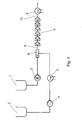
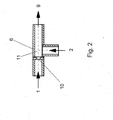
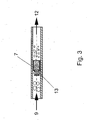
- Fig. 1 The further processing of the prepolymer thus produced in the dispersing system is carried out as in Fig. 1: With the gear pump 3 was the prepolymer 1 with a mass flow of 10 kg / h conveyed into the mixing nozzle 6. Water 2 with a mass flow of 9 kg / h was using the piston diaphragm pump 4 is conveyed via the heat exchanger 5 into the mixing nozzle 6, the one Bore 10 of 2 mm diameter and a mixing section 11 of 9 mm diameter and 200 mm in length (see Fig. 2). The resulting predispersion 9 was over 6 jet dispersants 7 homogenized, each had 2 holes 13 of 0.8 mm diameter (see Fig. 3). The temperature of the supplied prepolymer 1 was 84 ° C.
- the water temperature was set to 80 ° C with the heat exchanger 5 to start the system and then so far lowered, that in the stationary state, a temperature of 46 ° C behind the jet dispersers 7 resulted.
- the pressure drop across the jet dispersers 7 was 17 bar.
- the Dispersion 12 was cooled in the heat exchanger 8 to 29 ° C. Subsequently, to 2330 g of Dispersion 12 with stirring in a glass container (not shown) 176 g of a chain extension solution given.
- As a solution of the chain extender was used: 11 g Hydrazine hydrate and 17.6 g of ethylenediamine in 149 g of water. After cooling to 30 ° C was through Filter a Seitz T5500 filter.
- Fig. 4 The further processing of the prepolymer thus produced in the dispersing system is carried out as in Fig. 4: With the gear pump 3 was the prepolymer 1 with a mass flow of 12 kg / h conveyed into the mixing nozzle 16. Neutralization amine solution 14, consisting of 440.6 parts Triethylamine and 511 parts of N-methylpyrrolidone were used at a mass flow of 1.2 kg / h conveyed via the piston pump 15 into the mixing nozzle 16, which has a bore 22 of 0.3 mm Diameter and a bore 24 of 4 mm diameter possessed (see Fig. 5). The mixture 21 was then passed through 3 jet dispersers 7, each 4 holes 13 of 2.1 mm Diameter had (analogous to Fig. 3).
- the mixture was then passed into the mixing nozzle 6.
- Water 2 with a mass flow of 15 kg / h was transferred by means of the piston diaphragm pump 4 the heat exchanger 5 is conveyed into the mixing nozzle 6, which has a bore 10 of 2 mm in diameter and a mixing section 11 of 9 mm in diameter and 200 mm in length (see Fig. 2).
- the Formed pre-emulsion 9 was homogenized over 6 Stralildispergatoren 7, each 4 holes 13 of 1.2 mm diameter (see Fig. 3).
- the temperature of the supplied prepolymer 1 was 33 ° C.
- the water temperature was adjusted with the heat exchanger 5 so that in stationary state a temperature of 37 ° C behind the jet dispersers 7 resulted.
- the pressure drop over the jet dispersers 7 was 12 bar.
- the dispersion 12 was in the heat exchanger. 8 cooled to 23 ° C and fed to the mixing nozzle 20.
- the mixing nozzle 20 (see Fig. 2), the one Bore 10 of 0.3 mm diameter and a mixing section 11 of 9 mm diameter and 100 mm in length, became a chain extension solution 18 consisting of 148.9 parts Ethylenediamine and 1645.6 parts of water, with a mass flow of 2.0 kg / h over the Piston pump 19 supplied.
- 580 g of dimethylolpropionic acid were at 110 ° C in vacuo for drained for one hour.
- the polyol mixture was subsequently treated with 1292 g of N-methylpyrrolidone added and stirred until a clear solution was obtained. It was then cooled to 60 ° C before 3938 g of isophorone diisocyanate were added within 20 minutes.
- the further processing of the prepolymer thus produced in the dispersing system is carried out as in Fig. 6:
- the prepolymer 1 was with a mass flow of 12 kg / h conveyed into the mixing nozzle 16.
- Water 2 with a mass flow of 12 kg / h was promoted by the piston diaphragm pump 4 via the heat exchanger 5 in the mixing nozzle 16, the a bore 22 of 1.8 mm diameter and a bore 24 of 2.2 mm diameter possessed (analogous to FIG. 5).
- the resulting predispersion 21 was over 6 jet dispersants. 7 homogenized, each had 4 holes of 1.2 mm diameter (see Fig. 3).
- the temperature of the supplied prepolymer 1 was 80 ° C.
- the water temperature was with the Heat exchanger 5 set to start the system to 80 ° C and then lowered so far that In the stationary state, a temperature of 55 ° C behind the jet dispersers 7 resulted. Of the Pressure drop across the jet dispersers 7 was 10 bar.
- the dispersion was the mixing nozzle 26th fed.
- the mixing nozzle 26 (analogous to FIG. 5), which has a bore 22 of 0.3 mm in diameter and had a bore 24 of 2.2 mm in diameter, a chain extension solution 18, consisting of 168 parts of ethylenediamine and 1346 parts of water, with a mass flow of 1.5 kg / h supplied by means of a piston diaphragm pump 19.
- a back pressure of 6 bar was impressed.
Landscapes
- Chemical & Material Sciences (AREA)
- Chemical Kinetics & Catalysis (AREA)
- Organic Chemistry (AREA)
- Health & Medical Sciences (AREA)
- Medicinal Chemistry (AREA)
- Polymers & Plastics (AREA)
- Dispersion Chemistry (AREA)
- Engineering & Computer Science (AREA)
- Life Sciences & Earth Sciences (AREA)
- Materials Engineering (AREA)
- Wood Science & Technology (AREA)
- Manufacturing & Machinery (AREA)
- Polyurethanes Or Polyureas (AREA)
- Paints Or Removers (AREA)
- Processes Of Treating Macromolecular Substances (AREA)
- Adhesives Or Adhesive Processes (AREA)
Abstract
Description
- Figur 1
- ein Fließschema des erfindungsgemäßen Verfahrens für die Dispergierung von aliphatischen Präpolymeren mit batchweiser Kettenverlängerung
- Figur 2
- eine schematische Darstellung einer bevorzugten Ausführungsform der zur Herstellung der Voremulsion verwendeten Mischdüse
- Figur 3
- eine schematische Darstellung einer bevorzugten Ausführungsform der zur Homogenisierung der Voremulsion verwendeten Homogenisierdüse
- Figur 4
- ein Fließschema des erfindungsgemäßen Verfahrens für die Dispergierung von aromatischen Präpolymeren mit kontinuierlicher Kettenverlängerung
- Figur 5
- eine schematische Darstellung einer weiteren bevorzugten Ausführungsform der zur Herstellung der Voremulsion verwendeten Mischdüse
- Figur 6
- ein Fließschema einer bevorzugten Ausführungsform des erfindungsgemäßen Verfahrens für die Dispergierung von aliphatischen Präpolymeren mit kontinuierlicher Kettenverlängerung.
Claims (11)
- Verfahren zur kontinuierlichen Herstellung einer wässrigen Polyurethandispersion, auf Basis wenigstens eines aliphatischen und/oder aromatischen Polyisocyanats, gekennzeichnet durch die folgenden Schritte:a) Herstellung einer wässrigen Voremulsion durch Vermischen eines hydrophile und/oder potenziell hydrophile Gruppen enthaltenden Polyurethanpräpolymers mit Wasser in einer Mischdüse, wobei das Polyurethanpräpolymer in das Wasser eingedüst wirdb) Bildung einer Emulsion durch Homogenisierung der Voremulsion aus Schritt a) in einer mehrstufigen Homogenisierdüse.
- Verfahren nach Anspruch 1, dadurch gekennzeichnet, dass in einem weiteren Schritt c) wenigstens teilweise eine Umsetzung der freie NCO-Gruppen enthaltenden Emulsion aus Schritt b) mit wenigstens einem gegenüber Isocyanatgruppen reaktiven Amin erfolgt.
- Verfahren nach Anspruch 2, dadurch gekennzeichnet, dass die Umsetzung mit einem Amin gemäß Schritt c) kontinuierlich in einer Mischdüse erfolgt.
- Verfahren nach einem der Ansprüche 1-3, dadurch gekennzeichnet, dass die Herstellung der Voremulsion gemäß Schritt a) bei einer Druckdifferenz von 0,1 bis 100 bar, vorzugsweise von 0,2 bis 50 bar, besonders bevorzugt von 0,5 bis 20 bar, erfolgt.
- Verfahren nach einem der Ansprüche 1-4, dadurch gekennzeichnet, dass die Bildung der Emulsion gemäß Schritt b) bei einer Druckdifferenz von 1 bis 200 bar, vorzugsweise von 3 bis 100 bar, besonders bevorzugt von 5 bis 60 bar, erfolgt.
- Verfahren nach einem der Ansprüche 1-5, dadurch gekennzeichnet, dass für die Homogenisierung gemäß Schritt b) 2 bis 20 Stufen eingesetzt werden.
- Verfahren nach einem der Ansprüche 1-6, dadurch gekennzeichnet, dass als Homogenisierdüse in Schritt b) ein Strahldispergator eingesetzt wird.
- Verfahren nach einem der Ansprüche 1-7, dadurch gekennzeichnet, dass in Schritt a) die Temperatur des Polyurethanpräpolymers 10°C bis 100°C beträgt.
- Verfahren nach einem der Ansprüche 1-8, dadurch gekennzeichnet, dass in Schritt a) die Temperatur des Wassers 5°C bis 95°C beträgt.
- Verfahren nach einem der Ansprüche 1-9, dadurch gekennzeichnet, dass als Mischdüse in Schritt a) ein Strahldispergator eingesetzt wird.
- Substrate, beschichtet mit einer Lackschicht unter Verwendung einer wässrigen Polyurethandispersion, hergestellt nach einem Verfahren gemäß einem der Ansprüche 1-10.
Applications Claiming Priority (2)
| Application Number | Priority Date | Filing Date | Title |
|---|---|---|---|
| DE102004017436 | 2004-04-08 | ||
| DE200410017436 DE102004017436A1 (de) | 2004-04-08 | 2004-04-08 | Verfahren zur kontinuierlichen Herstellung einer wässrigen Polyurethandispersion |
Publications (2)
| Publication Number | Publication Date |
|---|---|
| EP1584641A1 true EP1584641A1 (de) | 2005-10-12 |
| EP1584641B1 EP1584641B1 (de) | 2012-07-25 |
Family
ID=34895534
Family Applications (1)
| Application Number | Title | Priority Date | Filing Date |
|---|---|---|---|
| EP20050006942 Expired - Lifetime EP1584641B1 (de) | 2004-04-08 | 2005-03-30 | Verfahren zur kontinuierlichen Herstellung einer wässrigen Polyurethandispersion |
Country Status (7)
| Country | Link |
|---|---|
| US (1) | US7345110B2 (de) |
| EP (1) | EP1584641B1 (de) |
| JP (1) | JP5000854B2 (de) |
| CN (1) | CN100523043C (de) |
| CA (1) | CA2504412A1 (de) |
| DE (1) | DE102004017436A1 (de) |
| ES (1) | ES2390345T3 (de) |
Cited By (2)
| Publication number | Priority date | Publication date | Assignee | Title |
|---|---|---|---|---|
| WO2022195211A1 (fr) | 2021-03-15 | 2022-09-22 | Saint-Gobain Weber France | Composition de revêtement contenant un polyuréthane anionique et un réticulant polycarbodiimide en dispersion aqueuse |
| EP4286351A1 (de) | 2022-06-03 | 2023-12-06 | Saint-Gobain Weber France | Kit zur herstellung einer wasserdichten membran |
Families Citing this family (12)
| Publication number | Priority date | Publication date | Assignee | Title |
|---|---|---|---|---|
| US6645612B2 (en) | 2001-08-07 | 2003-11-11 | Saint-Gobain Ceramics & Plastics, Inc. | High solids hBN slurry, hBN paste, spherical hBN powder, and methods of making and using them |
| CN101348704B (zh) * | 2008-06-20 | 2012-03-21 | 中山大学 | 一种聚氨酯水分散体胶粘剂的连续生产方法 |
| US8394568B2 (en) * | 2009-11-02 | 2013-03-12 | Xerox Corporation | Synthesis and emulsification of resins |
| JP2013513689A (ja) | 2009-12-11 | 2013-04-22 | インビスタ テクノロジーズ エス エイ アール エル | 改良エラストマー組成物 |
| US9732026B2 (en) | 2012-12-14 | 2017-08-15 | Resinate Technologies, Inc. | Reaction products containing hydroxyalkylterephthalates and methods of making and using same |
| JP6360377B2 (ja) * | 2014-07-09 | 2018-07-18 | 旭化成株式会社 | ポリイソシアネート組成物 |
| EP3808788A1 (de) | 2019-10-17 | 2021-04-21 | Saint-Gobain Weber | Wässrige beschichtungszusammensetzungen auf basis von selbstvernetzenden polyurethandispersionen |
| EP4265662A1 (de) | 2022-04-20 | 2023-10-25 | Saint-Gobain Weber France | Beschichtungen auf polyurethanbasis mit hohem sonnenreflexionsindex |
| CN120752275A (zh) | 2023-02-21 | 2025-10-03 | 巴斯夫涂料有限公司 | 连续生产水性聚氨酯-聚脲分散体的方法和水性聚氨酯-聚脲分散体 |
| EP4669683A1 (de) | 2023-02-21 | 2025-12-31 | BASF Coatings GmbH | Verfahren zur kontinuierlichen herstellung von wässrigen polyurethan-polyharnstoff-dispersionen |
| EP4480977A1 (de) | 2023-06-23 | 2024-12-25 | CertainTeed LLC | Beschichtungen auf polyurethanbasis und beschichtete substrate |
| FR3151039B1 (fr) | 2023-07-12 | 2026-05-22 | Saint Gobain Weber France | Composition d’étanchéification à base de polyuréthane et de poly(acétal de vinyle) |
Citations (2)
| Publication number | Priority date | Publication date | Assignee | Title |
|---|---|---|---|---|
| EP0805171A1 (de) * | 1996-04-29 | 1997-11-05 | Bayer Ag | Verfahren zur Herstellung wässriger Beschichtungsmittel für Einbrennlackierungen |
| US20020165314A1 (en) * | 1997-03-17 | 2002-11-07 | The Dow Chemical Company | Polyurethane latexes, processes for preparing them and polymers prepared therewith |
Family Cites Families (16)
| Publication number | Priority date | Publication date | Assignee | Title |
|---|---|---|---|---|
| US3687952A (en) * | 1968-05-31 | 1972-08-29 | Dynamit Nobel Ag | HALOGENPHENOXY-s-TRIAZINE DERIVATIVES HAVING IMPROVED SOLUBILITY |
| DE1770591A1 (de) * | 1968-06-07 | 1971-11-04 | Bayer Ag | Lineare,segmentierte Polyurethanelastomere |
| DE1902932A1 (de) * | 1969-01-22 | 1970-08-20 | Bayer Ag | Semicarbazidarylamine als Kettenverlaengerungsmittel fuer Elastomerfaeden |
| DE1918504A1 (de) * | 1969-04-11 | 1970-10-29 | Bayer Ag | Segmentierte Polyurethanelastomere |
| US4108814A (en) * | 1974-09-28 | 1978-08-22 | Bayer Aktiengesellschaft | Aqueous polyurethane dispersions from solvent-free prepolymers using sulfonate diols |
| US4387181A (en) * | 1980-04-09 | 1983-06-07 | Textron, Inc. | Polymer compositions and manufacture |
| GB8524579D0 (en) * | 1985-10-04 | 1985-11-06 | Polyvinyl Chemicals Inc | Coating compositions |
| DE3727252A1 (de) * | 1987-08-15 | 1989-02-23 | Bayer Ag | Verfahren zur herstellung von waessrigen polyurethandispersionen |
| DE3728140A1 (de) * | 1987-08-22 | 1989-03-02 | Bayer Ag | Waessrige loesungen oder dispersionen von polyisocyanat-polyadditionsprodukten, ein verfahren zur herstellung der waessrigen loesungen oder dispersionen sowie ihre verwendung als klebstoff |
| US5037864A (en) * | 1989-07-11 | 1991-08-06 | The Dow Chemical Company | Semi-continuous process for the preparation of polyurethane-urea aqueous dispersions |
| DE4136618A1 (de) * | 1991-11-07 | 1993-05-13 | Bayer Ag | Wasserdispergierbare polyisocyanatgemische |
| EP0685544B1 (de) * | 1994-06-03 | 1999-08-18 | Bayer Ag | Wässrige 2-Komponenten-Polyurethanlack-Emulsionen und Verfahren zu deren Herstellung |
| DE19510651A1 (de) * | 1994-06-03 | 1995-12-07 | Bayer Ag | Wäßrige 2-Komponenten-Polyurethanlack-Emulsionen und Verfahren zu deren Herstellung |
| ZA981836B (en) * | 1997-03-17 | 1999-09-06 | Dow Chemical Co | Continuous process for preparing a polyurethane latex. |
| DE19750186A1 (de) | 1997-11-13 | 1999-05-20 | Bayer Ag | Hydrophilierungsmittel, ein Verfahren zu dessen Herstellung sowie dessen Verwendung als Dispergator für wäßrige Polyurethan-Dispersionen |
| JP4179008B2 (ja) * | 2002-03-28 | 2008-11-12 | Dic株式会社 | ポリウレタンエマルジョンの製造法 |
-
2004
- 2004-04-08 DE DE200410017436 patent/DE102004017436A1/de not_active Withdrawn
-
2005
- 2005-03-30 EP EP20050006942 patent/EP1584641B1/de not_active Expired - Lifetime
- 2005-03-30 ES ES05006942T patent/ES2390345T3/es not_active Expired - Lifetime
- 2005-04-05 CA CA 2504412 patent/CA2504412A1/en not_active Abandoned
- 2005-04-05 US US11/099,160 patent/US7345110B2/en not_active Expired - Lifetime
- 2005-04-07 JP JP2005110953A patent/JP5000854B2/ja not_active Expired - Fee Related
- 2005-04-08 CN CNB2005100648814A patent/CN100523043C/zh not_active Expired - Fee Related
Patent Citations (2)
| Publication number | Priority date | Publication date | Assignee | Title |
|---|---|---|---|---|
| EP0805171A1 (de) * | 1996-04-29 | 1997-11-05 | Bayer Ag | Verfahren zur Herstellung wässriger Beschichtungsmittel für Einbrennlackierungen |
| US20020165314A1 (en) * | 1997-03-17 | 2002-11-07 | The Dow Chemical Company | Polyurethane latexes, processes for preparing them and polymers prepared therewith |
Non-Patent Citations (3)
| Title |
|---|
| "Mischen und Rühren Grundlagen und moderne Verfahren", 2003, WILEY-VCH, article KRAUME M., pages: 331 - 333, XP003029864 |
| Description of Sulzer mixers dated October 1982 |
| Research Disclosure 457113, page 804-807 published May 2002 |
Cited By (3)
| Publication number | Priority date | Publication date | Assignee | Title |
|---|---|---|---|---|
| WO2022195211A1 (fr) | 2021-03-15 | 2022-09-22 | Saint-Gobain Weber France | Composition de revêtement contenant un polyuréthane anionique et un réticulant polycarbodiimide en dispersion aqueuse |
| EP4286351A1 (de) | 2022-06-03 | 2023-12-06 | Saint-Gobain Weber France | Kit zur herstellung einer wasserdichten membran |
| WO2023232926A1 (en) | 2022-06-03 | 2023-12-07 | Saint-Gobain Weber France | Kit for preparing a waterproofing membrane |
Also Published As
| Publication number | Publication date |
|---|---|
| CA2504412A1 (en) | 2005-10-08 |
| US7345110B2 (en) | 2008-03-18 |
| EP1584641B1 (de) | 2012-07-25 |
| CN1680455A (zh) | 2005-10-12 |
| JP2005314694A (ja) | 2005-11-10 |
| CN100523043C (zh) | 2009-08-05 |
| US20050234190A1 (en) | 2005-10-20 |
| DE102004017436A1 (de) | 2005-10-27 |
| JP5000854B2 (ja) | 2012-08-15 |
| ES2390345T3 (es) | 2012-11-12 |
Similar Documents
| Publication | Publication Date | Title |
|---|---|---|
| EP2268691B1 (de) | Wässrige polyurethanlösungen für polyurethan-systeme | |
| EP0303907B1 (de) | Verfahren zur Herstellung von wässrigen Polyurethandispersionen | |
| EP0994136B1 (de) | Wässrige Polyurethandispersionen | |
| DE2725589A1 (de) | Verfahren zur herstellung von waessrigen polyurethan-dispersionen und -loesungen | |
| EP1584641B1 (de) | Verfahren zur kontinuierlichen Herstellung einer wässrigen Polyurethandispersion | |
| DE102004060139A1 (de) | Festkörperreiche Polyurethanpolyharnstoff-Dispersionen | |
| EP1979389A1 (de) | Polyurethan-polyharnstoff-dispersionen auf basis von polyether-polycarbonat-polyolen | |
| DE19914882A1 (de) | Selbstvernetzende Polyurethan-, Polyurethan-Polyharnstoff- bzw. Polyharnstoff-Dispersionen für Schlichten | |
| DE2843790A1 (de) | Verfahren zur herstellung von waessrigen dispersionen oder loesungen von polyurethan-polyharnstoffen, die nach diesem verfahren erhaeltlichen dispersionen oder loesungen, sowie ihre verwendung | |
| EP1845120B2 (de) | Wässrige polyurethan-Dispersionen mit verbesserter Lagerstabilität | |
| DE69801494T2 (de) | Polyurethanlatex, dessen herstellungsverfahren und daraus hergestellte polymere | |
| EP1193277A2 (de) | Pulverförmige, wasserdispergierbare blockierte Polyisocyanataddukte, ein Verfahren zur Herstellung und ihre Verwendung | |
| EP3109269B1 (de) | Harnstofffreie polyurethan-dispersionen | |
| EP1709096A1 (de) | Thermovergilbungsstabile polyurethan-polyharnstoff dispersionen | |
| EP2118161B1 (de) | Polyurethan-dispersionen auf basis von 2,2'-mdi | |
| EP1578837B1 (de) | Hydrophile polyurethan-polyharnstoff-dispersionen | |
| EP3026071A1 (de) | Stabilisierte Polyurethan-Dispersionen | |
| EP0562436B1 (de) | Wasserverdünnbare Zweikomponenten-Überzugsmasse, ein Verfahren zu deren Herstellung und deren Verwendung | |
| DE19630905A1 (de) | Wäßrige Dispersionen, ihre Herstellung und Verwendung als Lackbindemittel | |
| DE3139966A1 (de) | Verfahren zur herstellung von waessrigen dispersionen oder loesungen von polyurethanen, sowie deren verwendung zur herstellung von ueberzuegen und beschichtungen | |
| EP3590989A1 (de) | Verfahren zur herstellung einer polyurethan-dispersion mit verringerter schaumbildung | |
| EP0989145B1 (de) | Wässrige Polyurethan-Dispersionen mit reduziertem Gehalt an Triethylamin | |
| WO2022096541A1 (de) | Steuerung der teilchengrösse von polyurethandispersionen durch temperaturerhöhung |
Legal Events
| Date | Code | Title | Description |
|---|---|---|---|
| PUAI | Public reference made under article 153(3) epc to a published international application that has entered the european phase |
Free format text: ORIGINAL CODE: 0009012 |
|
| AK | Designated contracting states |
Kind code of ref document: A1 Designated state(s): AT BE BG CH CY CZ DE DK EE ES FI FR GB GR HU IE IS IT LI LT LU MC NL PL PT RO SE SI SK TR |
|
| AX | Request for extension of the european patent |
Extension state: AL BA HR LV MK YU |
|
| 17P | Request for examination filed |
Effective date: 20060412 |
|
| AKX | Designation fees paid |
Designated state(s): AT BE BG CH CY CZ DE DK EE ES FI FR GB GR HU IE IS IT LI LT LU MC NL PL PT RO SE SI SK TR |
|
| TPAC | Observations filed by third parties |
Free format text: ORIGINAL CODE: EPIDOSNTIPA |
|
| 17Q | First examination report despatched |
Effective date: 20110202 |
|
| R17C | First examination report despatched (corrected) |
Effective date: 20110211 |
|
| GRAP | Despatch of communication of intention to grant a patent |
Free format text: ORIGINAL CODE: EPIDOSNIGR1 |
|
| GRAS | Grant fee paid |
Free format text: ORIGINAL CODE: EPIDOSNIGR3 |
|
| GRAA | (expected) grant |
Free format text: ORIGINAL CODE: 0009210 |
|
| AK | Designated contracting states |
Kind code of ref document: B1 Designated state(s): AT BE BG CH CY CZ DE DK EE ES FI FR GB GR HU IE IS IT LI LT LU MC NL PL PT RO SE SI SK TR |
|
| REG | Reference to a national code |
Ref country code: GB Ref legal event code: FG4D Free format text: NOT ENGLISH |
|
| REG | Reference to a national code |
Ref country code: CH Ref legal event code: EP |
|
| REG | Reference to a national code |
Ref country code: AT Ref legal event code: REF Ref document number: 567699 Country of ref document: AT Kind code of ref document: T Effective date: 20120815 Ref country code: IE Ref legal event code: FG4D Free format text: LANGUAGE OF EP DOCUMENT: GERMAN |
|
| REG | Reference to a national code |
Ref country code: DE Ref legal event code: R096 Ref document number: 502005012931 Country of ref document: DE Effective date: 20120920 |
|
| REG | Reference to a national code |
Ref country code: ES Ref legal event code: FG2A Ref document number: 2390345 Country of ref document: ES Kind code of ref document: T3 Effective date: 20121112 |
|
| REG | Reference to a national code |
Ref country code: NL Ref legal event code: T3 |
|
| REG | Reference to a national code |
Ref country code: LT Ref legal event code: MG4D Effective date: 20120704 |
|
| PG25 | Lapsed in a contracting state [announced via postgrant information from national office to epo] |
Ref country code: LT Free format text: LAPSE BECAUSE OF FAILURE TO SUBMIT A TRANSLATION OF THE DESCRIPTION OR TO PAY THE FEE WITHIN THE PRESCRIBED TIME-LIMIT Effective date: 20120725 Ref country code: CY Free format text: LAPSE BECAUSE OF FAILURE TO SUBMIT A TRANSLATION OF THE DESCRIPTION OR TO PAY THE FEE WITHIN THE PRESCRIBED TIME-LIMIT Effective date: 20120725 Ref country code: IS Free format text: LAPSE BECAUSE OF FAILURE TO SUBMIT A TRANSLATION OF THE DESCRIPTION OR TO PAY THE FEE WITHIN THE PRESCRIBED TIME-LIMIT Effective date: 20121125 Ref country code: FI Free format text: LAPSE BECAUSE OF FAILURE TO SUBMIT A TRANSLATION OF THE DESCRIPTION OR TO PAY THE FEE WITHIN THE PRESCRIBED TIME-LIMIT Effective date: 20120725 |
|
| PG25 | Lapsed in a contracting state [announced via postgrant information from national office to epo] |
Ref country code: GR Free format text: LAPSE BECAUSE OF FAILURE TO SUBMIT A TRANSLATION OF THE DESCRIPTION OR TO PAY THE FEE WITHIN THE PRESCRIBED TIME-LIMIT Effective date: 20121026 Ref country code: PT Free format text: LAPSE BECAUSE OF FAILURE TO SUBMIT A TRANSLATION OF THE DESCRIPTION OR TO PAY THE FEE WITHIN THE PRESCRIBED TIME-LIMIT Effective date: 20121126 Ref country code: PL Free format text: LAPSE BECAUSE OF FAILURE TO SUBMIT A TRANSLATION OF THE DESCRIPTION OR TO PAY THE FEE WITHIN THE PRESCRIBED TIME-LIMIT Effective date: 20120725 Ref country code: SI Free format text: LAPSE BECAUSE OF FAILURE TO SUBMIT A TRANSLATION OF THE DESCRIPTION OR TO PAY THE FEE WITHIN THE PRESCRIBED TIME-LIMIT Effective date: 20120725 Ref country code: SE Free format text: LAPSE BECAUSE OF FAILURE TO SUBMIT A TRANSLATION OF THE DESCRIPTION OR TO PAY THE FEE WITHIN THE PRESCRIBED TIME-LIMIT Effective date: 20120725 |
|
| PG25 | Lapsed in a contracting state [announced via postgrant information from national office to epo] |
Ref country code: CZ Free format text: LAPSE BECAUSE OF FAILURE TO SUBMIT A TRANSLATION OF THE DESCRIPTION OR TO PAY THE FEE WITHIN THE PRESCRIBED TIME-LIMIT Effective date: 20120725 Ref country code: EE Free format text: LAPSE BECAUSE OF FAILURE TO SUBMIT A TRANSLATION OF THE DESCRIPTION OR TO PAY THE FEE WITHIN THE PRESCRIBED TIME-LIMIT Effective date: 20120725 Ref country code: DK Free format text: LAPSE BECAUSE OF FAILURE TO SUBMIT A TRANSLATION OF THE DESCRIPTION OR TO PAY THE FEE WITHIN THE PRESCRIBED TIME-LIMIT Effective date: 20120725 Ref country code: RO Free format text: LAPSE BECAUSE OF FAILURE TO SUBMIT A TRANSLATION OF THE DESCRIPTION OR TO PAY THE FEE WITHIN THE PRESCRIBED TIME-LIMIT Effective date: 20120725 |
|
| RAP2 | Party data changed (patent owner data changed or rights of a patent transferred) |
Owner name: BAYER INTELLECTUAL PROPERTY GMBH |
|
| PG25 | Lapsed in a contracting state [announced via postgrant information from national office to epo] |
Ref country code: IT Free format text: LAPSE BECAUSE OF FAILURE TO SUBMIT A TRANSLATION OF THE DESCRIPTION OR TO PAY THE FEE WITHIN THE PRESCRIBED TIME-LIMIT Effective date: 20120725 Ref country code: SK Free format text: LAPSE BECAUSE OF FAILURE TO SUBMIT A TRANSLATION OF THE DESCRIPTION OR TO PAY THE FEE WITHIN THE PRESCRIBED TIME-LIMIT Effective date: 20120725 |
|
| PLBE | No opposition filed within time limit |
Free format text: ORIGINAL CODE: 0009261 |
|
| STAA | Information on the status of an ep patent application or granted ep patent |
Free format text: STATUS: NO OPPOSITION FILED WITHIN TIME LIMIT |
|
| 26N | No opposition filed |
Effective date: 20130426 |
|
| PG25 | Lapsed in a contracting state [announced via postgrant information from national office to epo] |
Ref country code: BG Free format text: LAPSE BECAUSE OF FAILURE TO SUBMIT A TRANSLATION OF THE DESCRIPTION OR TO PAY THE FEE WITHIN THE PRESCRIBED TIME-LIMIT Effective date: 20121025 |
|
| REG | Reference to a national code |
Ref country code: DE Ref legal event code: R097 Ref document number: 502005012931 Country of ref document: DE Effective date: 20130426 |
|
| BERE | Be: lapsed |
Owner name: BAYER MATERIALSCIENCE A.G. Effective date: 20130331 |
|
| PG25 | Lapsed in a contracting state [announced via postgrant information from national office to epo] |
Ref country code: MC Free format text: LAPSE BECAUSE OF NON-PAYMENT OF DUE FEES Effective date: 20130331 |
|
| REG | Reference to a national code |
Ref country code: CH Ref legal event code: PL |
|
| GBPC | Gb: european patent ceased through non-payment of renewal fee |
Effective date: 20130330 |
|
| REG | Reference to a national code |
Ref country code: IE Ref legal event code: MM4A |
|
| PG25 | Lapsed in a contracting state [announced via postgrant information from national office to epo] |
Ref country code: LI Free format text: LAPSE BECAUSE OF NON-PAYMENT OF DUE FEES Effective date: 20130331 Ref country code: CH Free format text: LAPSE BECAUSE OF NON-PAYMENT OF DUE FEES Effective date: 20130331 Ref country code: IE Free format text: LAPSE BECAUSE OF NON-PAYMENT OF DUE FEES Effective date: 20130330 Ref country code: GB Free format text: LAPSE BECAUSE OF NON-PAYMENT OF DUE FEES Effective date: 20130330 Ref country code: BE Free format text: LAPSE BECAUSE OF NON-PAYMENT OF DUE FEES Effective date: 20130331 |
|
| REG | Reference to a national code |
Ref country code: DE Ref legal event code: R081 Ref document number: 502005012931 Country of ref document: DE Owner name: COVESTRO DEUTSCHLAND AG, DE Free format text: FORMER OWNER: BAYER MATERIALSCIENCE AKTIENGESELLSCHAFT, 51373 LEVERKUSEN, DE Effective date: 20120726 Ref country code: DE Ref legal event code: R081 Ref document number: 502005012931 Country of ref document: DE Owner name: COVESTRO DEUTSCHLAND AG, DE Free format text: FORMER OWNER: BAYER MATERIALSCIENCE AG, 51373 LEVERKUSEN, DE Effective date: 20140526 Ref country code: DE Ref legal event code: R081 Ref document number: 502005012931 Country of ref document: DE Owner name: BAYER INTELLECTUAL PROPERTY GMBH, DE Free format text: FORMER OWNER: BAYER MATERIALSCIENCE AKTIENGESELLSCHAFT, 51373 LEVERKUSEN, DE Effective date: 20120726 Ref country code: DE Ref legal event code: R081 Ref document number: 502005012931 Country of ref document: DE Owner name: BAYER INTELLECTUAL PROPERTY GMBH, DE Free format text: FORMER OWNER: BAYER MATERIALSCIENCE AG, 51373 LEVERKUSEN, DE Effective date: 20140526 |
|
| PG25 | Lapsed in a contracting state [announced via postgrant information from national office to epo] |
Ref country code: TR Free format text: LAPSE BECAUSE OF FAILURE TO SUBMIT A TRANSLATION OF THE DESCRIPTION OR TO PAY THE FEE WITHIN THE PRESCRIBED TIME-LIMIT Effective date: 20120725 |
|
| PG25 | Lapsed in a contracting state [announced via postgrant information from national office to epo] |
Ref country code: HU Free format text: LAPSE BECAUSE OF FAILURE TO SUBMIT A TRANSLATION OF THE DESCRIPTION OR TO PAY THE FEE WITHIN THE PRESCRIBED TIME-LIMIT; INVALID AB INITIO Effective date: 20050330 Ref country code: LU Free format text: LAPSE BECAUSE OF NON-PAYMENT OF DUE FEES Effective date: 20130330 |
|
| REG | Reference to a national code |
Ref country code: DE Ref legal event code: R081 Ref document number: 502005012931 Country of ref document: DE Owner name: COVESTRO DEUTSCHLAND AG, DE Free format text: FORMER OWNER: BAYER INTELLECTUAL PROPERTY GMBH, 40789 MONHEIM, DE |
|
| REG | Reference to a national code |
Ref country code: FR Ref legal event code: PLFP Year of fee payment: 12 |
|
| REG | Reference to a national code |
Ref country code: NL Ref legal event code: HC Owner name: COVESTRO DEUTSCHLAND AG; DE Free format text: DETAILS ASSIGNMENT: VERANDERING VAN EIGENAAR(S), VERANDERING VAN NAAM VAN DE EIGENAAR(S); FORMER OWNER NAME: BAYER MATERIALSCIENCE AG Effective date: 20160810 |
|
| REG | Reference to a national code |
Ref country code: FR Ref legal event code: TP Owner name: COVESTRO DEUTSCHLAND AG, DE Effective date: 20161115 |
|
| REG | Reference to a national code |
Ref country code: ES Ref legal event code: PC2A Owner name: COVESTRO DEUTSCHLAND AG Effective date: 20170207 |
|
| REG | Reference to a national code |
Ref country code: FR Ref legal event code: PLFP Year of fee payment: 13 |
|
| REG | Reference to a national code |
Ref country code: FR Ref legal event code: PLFP Year of fee payment: 14 |
|
| PGFP | Annual fee paid to national office [announced via postgrant information from national office to epo] |
Ref country code: AT Payment date: 20200225 Year of fee payment: 16 |
|
| PGFP | Annual fee paid to national office [announced via postgrant information from national office to epo] |
Ref country code: FR Payment date: 20200227 Year of fee payment: 16 |
|
| PGFP | Annual fee paid to national office [announced via postgrant information from national office to epo] |
Ref country code: ES Payment date: 20200401 Year of fee payment: 16 |
|
| REG | Reference to a national code |
Ref country code: AT Ref legal event code: MM01 Ref document number: 567699 Country of ref document: AT Kind code of ref document: T Effective date: 20210330 |
|
| PG25 | Lapsed in a contracting state [announced via postgrant information from national office to epo] |
Ref country code: FR Free format text: LAPSE BECAUSE OF NON-PAYMENT OF DUE FEES Effective date: 20210331 Ref country code: AT Free format text: LAPSE BECAUSE OF NON-PAYMENT OF DUE FEES Effective date: 20210330 |
|
| PGFP | Annual fee paid to national office [announced via postgrant information from national office to epo] |
Ref country code: DE Payment date: 20220223 Year of fee payment: 18 |
|
| REG | Reference to a national code |
Ref country code: ES Ref legal event code: FD2A Effective date: 20220524 |
|
| PGFP | Annual fee paid to national office [announced via postgrant information from national office to epo] |
Ref country code: NL Payment date: 20220301 Year of fee payment: 18 |
|
| PG25 | Lapsed in a contracting state [announced via postgrant information from national office to epo] |
Ref country code: ES Free format text: LAPSE BECAUSE OF NON-PAYMENT OF DUE FEES Effective date: 20210331 |
|
| REG | Reference to a national code |
Ref country code: DE Ref legal event code: R119 Ref document number: 502005012931 Country of ref document: DE |
|
| REG | Reference to a national code |
Ref country code: NL Ref legal event code: MM Effective date: 20230401 |
|
| PG25 | Lapsed in a contracting state [announced via postgrant information from national office to epo] |
Ref country code: NL Free format text: LAPSE BECAUSE OF NON-PAYMENT OF DUE FEES Effective date: 20230401 |
|
| PG25 | Lapsed in a contracting state [announced via postgrant information from national office to epo] |
Ref country code: DE Free format text: LAPSE BECAUSE OF NON-PAYMENT OF DUE FEES Effective date: 20231003 |